About the Holiday
It’s said that food always tastes better when eaten outdoors. If you’re having warm early spring weather today, why not test that theory, by packing a basket or cooler and heading out to your favorite outdoor spot! Whether simple or elegant, enjoyed alone or with family or friends, a picnic can be just the respite you need from the routine workweek. The word “picnic” probably gets its origins from the French language, specifically from the word pique-nique: (to pick) + (small thing or trifle). It’s thought that picnics became popular in France after the French Revolution in the mid 1800s and the idea then spread around the world. If you just can’t get away or the weather isn’t cooperating, International Picnic Day is celebrated on June 18, and the month of July hosts National Picnic Month.
Thank you to Tundra Books for sharing a copy of this book with me!
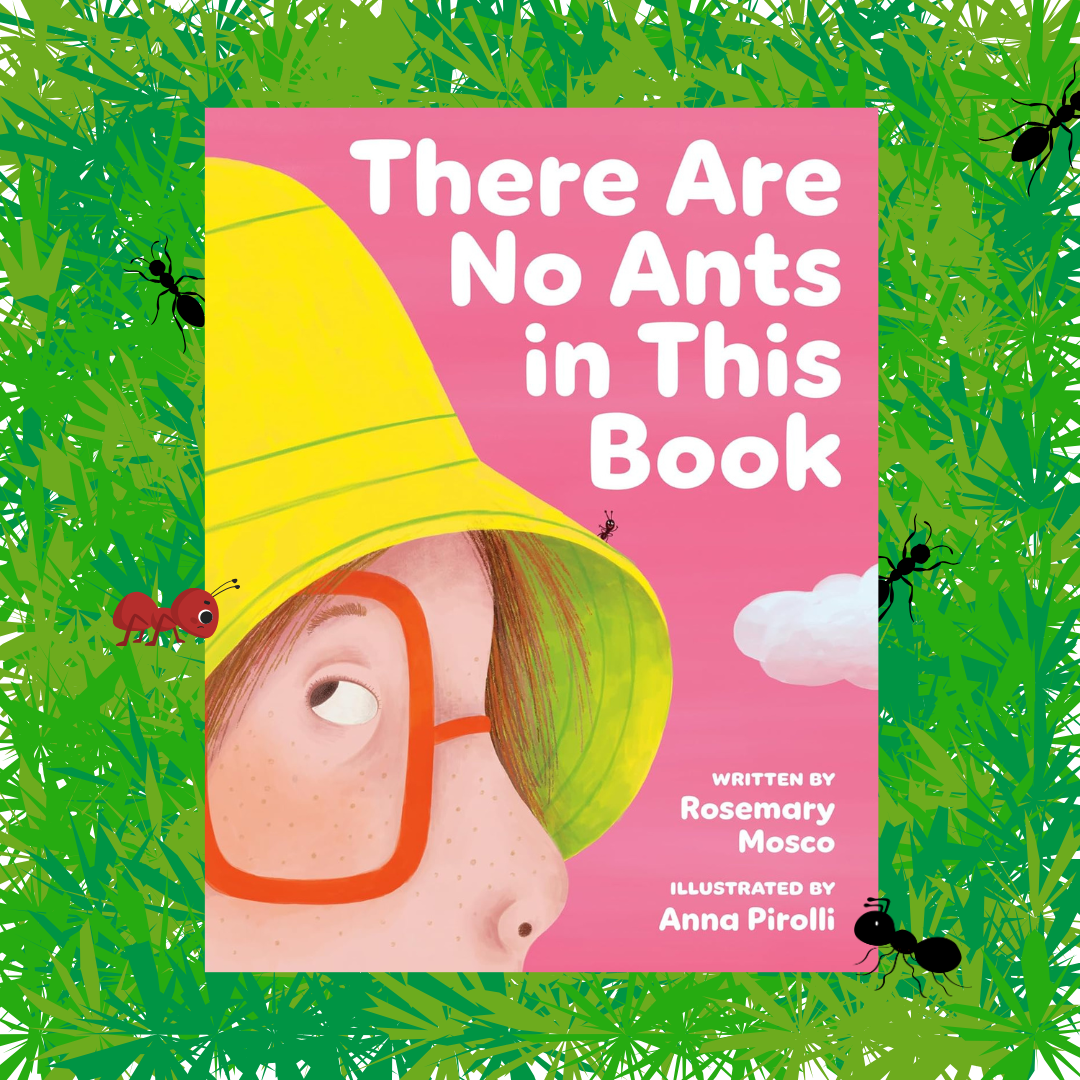
There Are No Ants in This Book
Written by Rosemary Mosco | Illustrated by Anna Pirolli
A child, picnic basket and tote in hand peeks in from the top-left corner of the first page to find a green field just perfect for a picnic. The child is pretty confident they won’t be disturbed by pesky pests purloining food because it says right on the cover that “there are no ants in this book.” But just as the cake is being placed on the blanket, word comes from nearby: “Wrong! There’s one!” Turns out that acorn lying only inches from the picnic cloth is actually the abode of an acorn ant.

Illustration © 2025 by Anna Pirolli, text © 2025 by Rosemary Mosco. Courtesy of Tundra Books.
The child can make an exception for just one ant, but then, out of the clear blue sky, comes “Two!” and “Three!” These two reveal that they are opposites of a sort. Number “two” is “one of the largest ants in the world” and as big as a strawberry. Number “three” is the smallest—”as long as six grains of salt.”
The child is just wrapping their head around this book having “. . . more ants than I was expecting” and figuring “three ants can’t eat my whole picnic, right?” when three more show up, including a honeypot ant that explains, “I fill my big round butt with sweet sugar water . . . in case my family gets hungry” then declares, “I am a walking refrigerator.
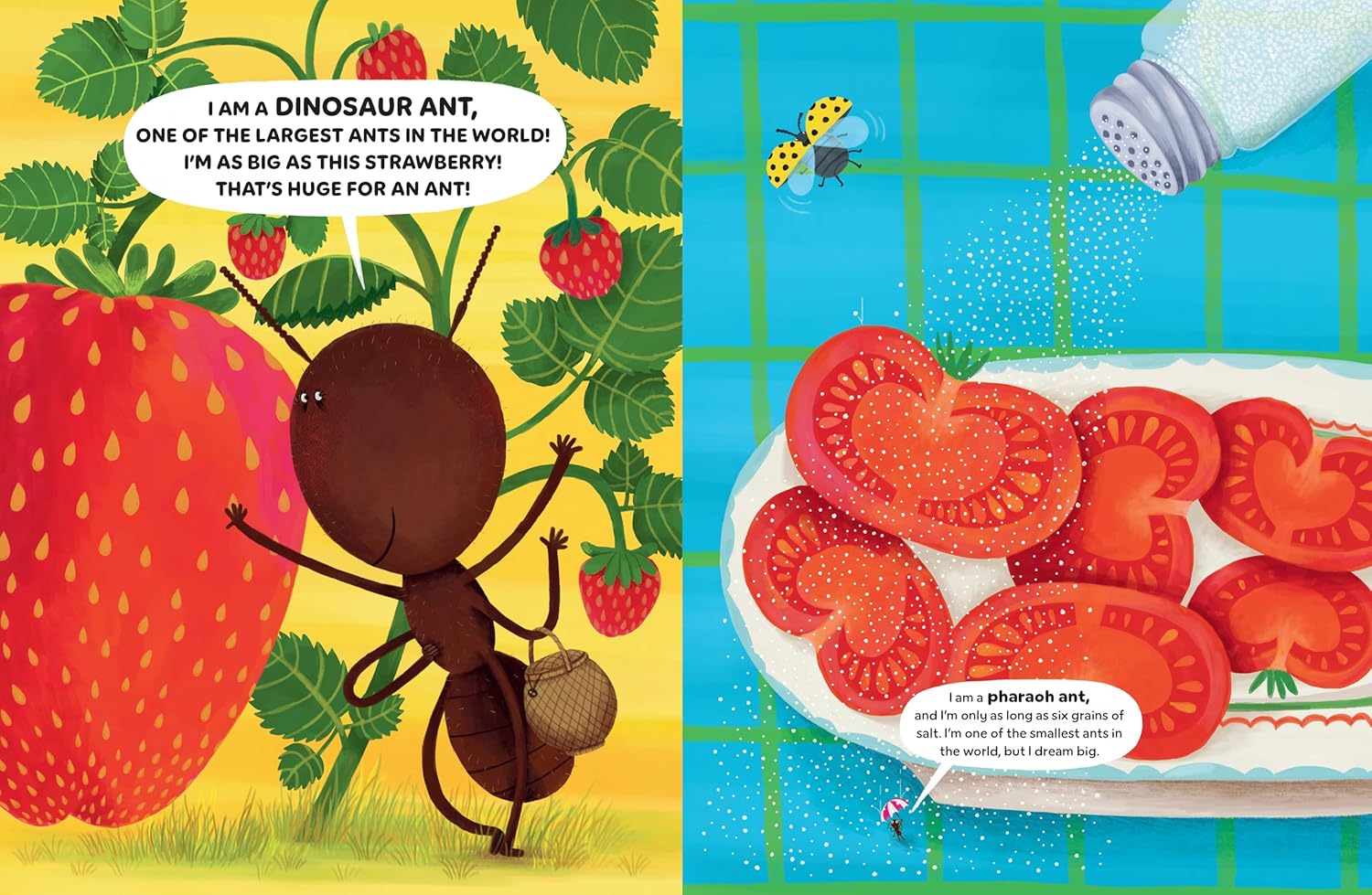
Illustration © 2025 by Anna Pirolli, text © 2025 by Rosemary Mosco. Courtesy of Tundra Books.
Kinda freaked out to meet these six interlopers, the child goes into full “ARRRGH!” mode when four more ants drop by. And who can blame them? The book had such promise at the beginning. But now . . . Yeah. Butt! Two of these new ants have positively particular posterior powers! One lives in trees and uses their butt as a kind of nature-made Siri to guide them home, and the other, an acrobat ant, explains “If someone scares me, I stick my butt high up in the air and wave it around.” The third is a clever crafter, and the fourth uses his head (literally) to defend his home.
The child is “shocked.” “Stunned.” Delighted! And invites these ants as well as their “humungous families” to the picnic. But all these tiny pounding feet attract the attention of an anteater. The child, though, does some quick thinking and then points out that the title of the book clearly states, “there are no ants in this book,” which sends the anteater packing. And now? It’s time for the perfect picnic!
Back matter presents realistic illustrations of each of the ten ants found in the book with a bite-sized paragraph revealing what part of the world the ant is native too as well as more about the feature that makes it unique.
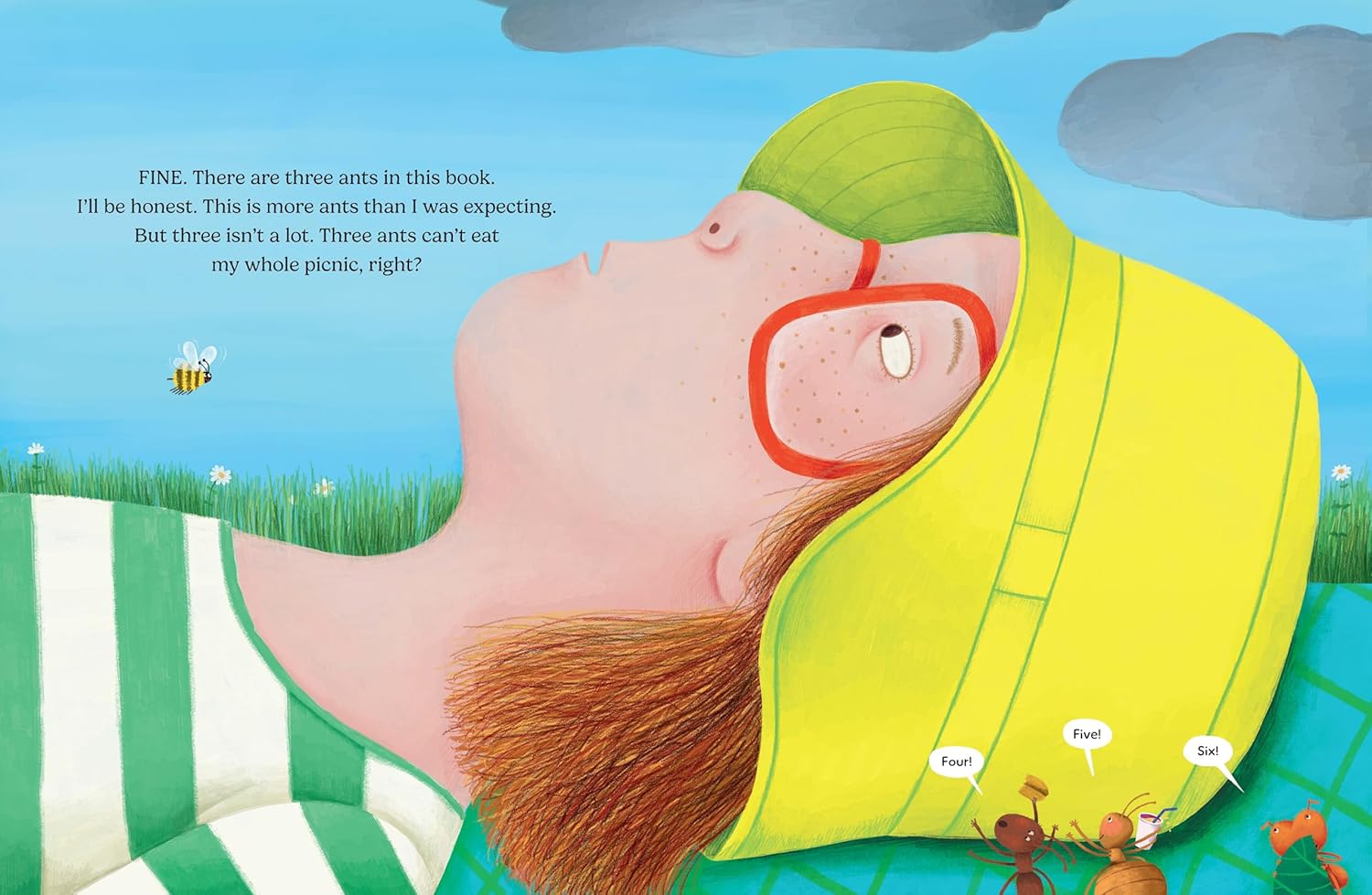
Illustration © 2025 by Anna Pirolli, text © 2025 by Rosemary Mosco. Courtesy of Tundra Books.
In her funny and fast-paced tribute to ants, Rosemary Mosco proves that even the smallest creatures have enormous appeal. As each ant makes an appearance to proudly describe its distinct capability or feature, Mosco’s conversational, easy-to-digest writing style makes it simple for kids to remember the prominent details. Kids will also identify with the narrator, who humorously cycles from certainty in the promise of the title to disillusionment to acceptance to all-out appreciation for these tiny critters.
Vibrant and loaded with personality, Anna Pirolli’s cartoon, graphic-style illustrations use perspective, natural surroundings, and emotive facial expressions to immerse kids in this rollicking educational experience.
If you like a dose of laughter with your science, There Are No Ants in This Book is the ant-idote you’ve been looking for. A perfect addition to any classroom, homeschool, or science educator’s collection, the book will also be an often-asked-for favorite for home story times.
Ages 4 – 8
Tundra Books, 2024 | ISBN 978-1774881163
About the Author
Rosemary Mosco makes books and cartoons that connect people with the natural world. Her nature comics won the National Cartoonist Society’s award for Best Online Short Form Comic and were the subject of an award-winning museum exhibit. She co-wrote the New York Times bestseller The Atlas Obscura Explorer’s Guide for the World’s Most Adventurous Kid, and is the author of the picture books Butterflies Are Pretty . . . Gross! and Flowers Are Pretty . . . Weird! illustrated by Jacob Souva, as well as five other science books. She speaks at birding festivals and looks for cool critters under every rock she can find. Rosemary lives in Massachusetts. Visit her at rosemarymosco.com.
About the Illustrator
Anna Pirolli was born in Genoa and moved to Milan to study illustration at the European Institute of Design. She has worked as a freelance illustrator and art director for companies such as Mondadori, Pearson, Vogue, MTV, Kinder Ferrero, Nickelodeon, Disney and others, following the creative process from concept to creation. She’s also a visiting professor at the Accademia di Brera, where she teaches design applied to the arts. Anna has illustrated the picture books I Hate My Cats: A Love Story by Davide Cali and Anonymouse by Vikki VanSickle, which won the Dilys Evans Founder’s Award at the 2021 Society of Illustrators Original Art Show. Follow her on Instagram.
National Picnic Day Activity

A Perfect Day for a Picnic! Maze
Can you lead the ants to the picnic in this printable A Perfect Day for a Picnic! maze?
You can purchase There Are No Ants in This Book from these booksellers
Amazon | Barnes & Noble | Bookshop (discounted books and support for your local independent bookstore)