September 4 – National Wildlife Day

About the Holiday

National Wildlife Day was established in 2005 by author and pet lifestyle expert Colleen Paige to promote awareness of endangered species as well as preservation and conservation efforts around the world. Globally, there is increased pressure on many animals due to pollution, habitat destruction, and other environmental issues. This day (as well as February 22, in honor of renowned conservationist Steve Irwin) encourages people to learn more about the species in their area, work toward creating hospitable habitats in their own yard or community, and implement environment-friendly choices in their homes. One of the animals featured in today’s book is the pangolin, a species whose members range in endangered status from vulnerable to critically endangered.

Thank you to Scholastic for sending me a copy of this book for review!

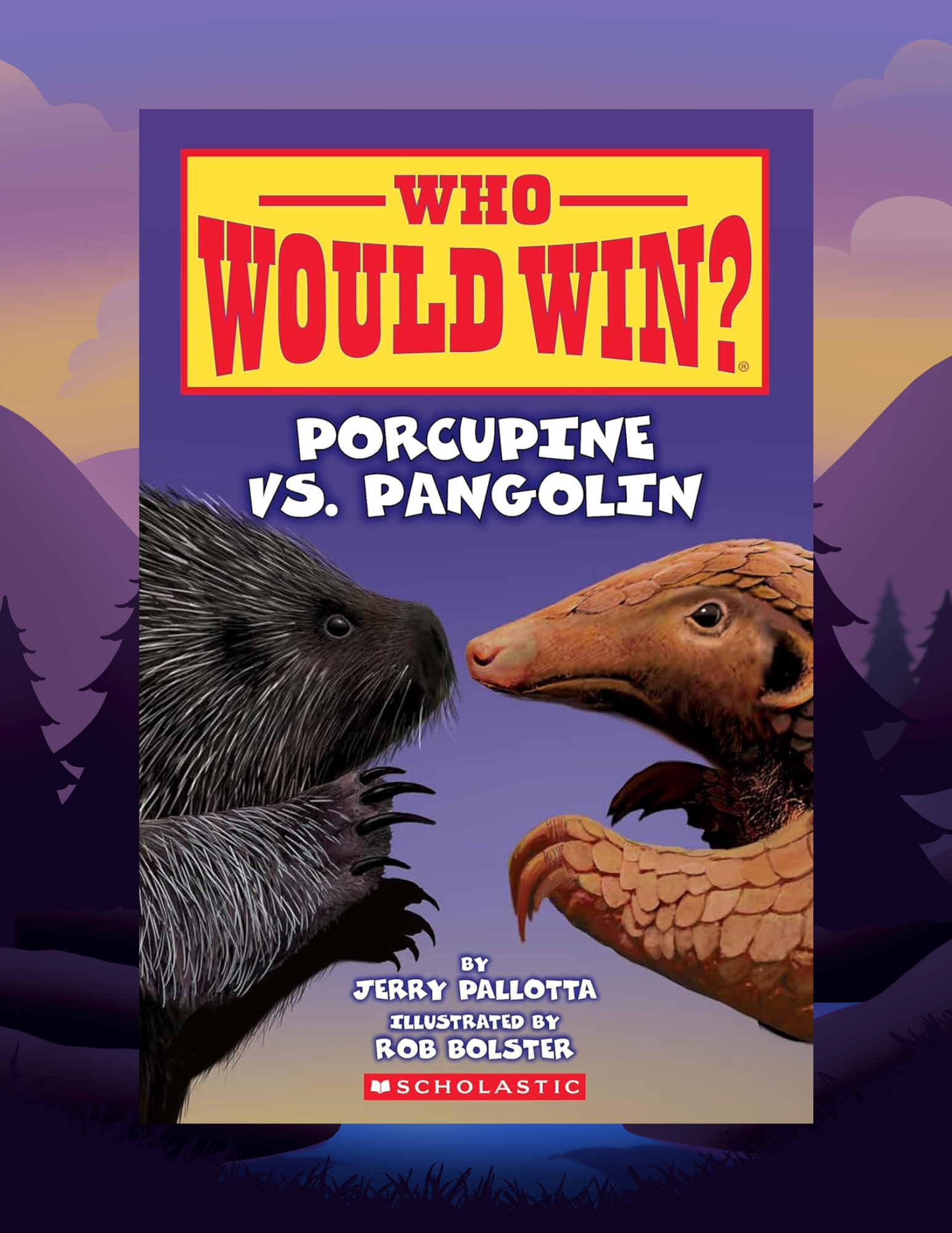
Who Would Win? Porcupine vs. Pangolin

Written by Jerry Pallotta | Illustrated by Rob Bolster


Welcome to Jerry Pallotta’s and Rob Bolster’s nocturnal showdown in the latest addition to the Who Would Win? series! On the left hand page: a porcupine; on the right: a pangolin. To help readers decide which animal would emerge victorious in a fight, Pallotta provides side-by-side dossiers that reveal pertinent facts about porcupines’ and pangolins’ bodies, skills, and defenses. 

Examining these profiles, kids learn that a porcupine is “a mammal with sharp, pointed quills . . . that looks like a spiky fur ball.” They also get to know the pangolin, a mammal that resembles a reptile due to its scales that make it look like a “walking pine cone.” Pallotta—his text supported with photographs and Bolster’s realistic illustrations—presents clear and snappy descriptions of the competitor’s quills vs. scales, fur vs. hair, faces and feet, weapons and defenses, and the scientific group each animal belongs to.

Illustration © 2025 by Rob Bolster. Text © 2025 by Jerry Pallotta. Courtesy of Scholastic.

 The pages are also sprinkled with kid-pleasing visual elements that call out a wide range of facts, from “ouch facts” about quills to “hair facts” about naked mole rats and elephants to “name facts” that reveal alternate monikers for each contestant. There’s humor here too, and even a poem about a pangolin! Pallotta is also tuned into children’s boundless curiosity, revealing the various types of porcupines and pangolins; a lineup of animals with spikes as well as those that can roll into a ball like the pangolin; and a fascinating look at how other animals would fare against these two warriors.

As the sun sets, however, it’s time for the main attraction as the porcupine, searching for dinner, comes upon the pangolin slurping ants from a log. It’s time to RUMBLE! Who will win?
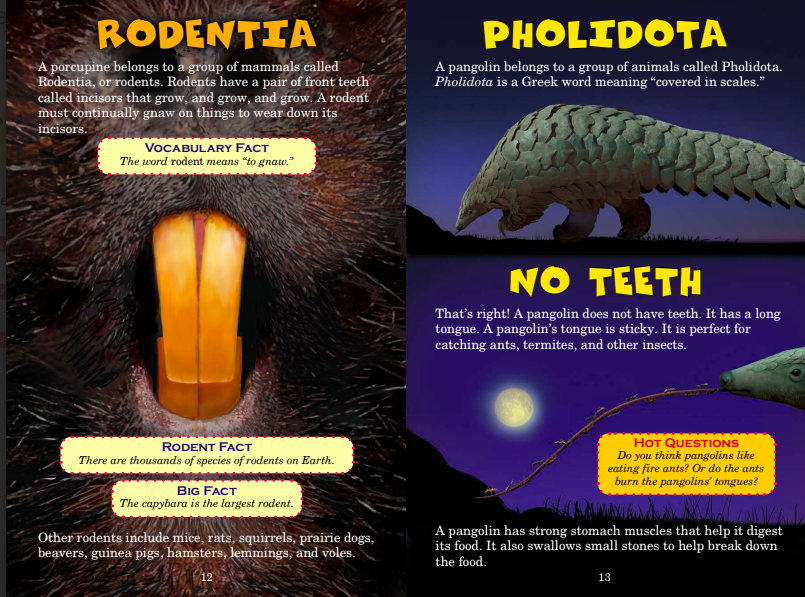
Illustration © 2025 by Rob Bolster. Text © 2025 by Jerry Pallotta. Courtesy of Scholastic.

If you’re a parent, librarian, teacher, or caregiver with a child or children who are familiar with the Who Will Win? series, then you know what a phenomenon these books are. Who Will Win? Porcupine vs. Pangolin is a worthy entrant into the field, providing educational and entertaining depth to the scientific study of these two unusual mammals. Children come away from reading (and excitedly rereading) this book not only with knowledge about porcupines and pangolins, but with bits about 21 other animals as well, making it an energizing spark for expanded learning. 

Information-packed and high-interest, Who Will Win? Porcupine vs. Pangolin will appeal to emergent and independent readers and makes a perfect read aloud for adults to share with their animal-loving kids. This book, as well as the rest of the series, is a must for any library collection and highly recommended for home bookshelves.

Ages 6 – 8

Scholastic, 2025 | ISBN 978-1339000961

About the Author

Jerry Pallotta is an award-winning author of children’s books, including What I Saw in the Teachers’ Lounge, Dinosaur Christmas, Who Will Guide My Sleigh Tonight?, Apple Fractions, and The Hershey’s Milk Chocolate Multiplication BookHis combination of interesting facts, detailed research, humor, and realistic illustrations has mesmerized countless children across the United States. You can visit him at jerrypallotta.com.

About the Illustrator

Rob Bolster is both a fine artist and a professional illustrator. His work has appeared in newspaper and magazine advertisements, and he has illustrated many books for young readers, including the bestselling Who Would Win? series. Rob lives and works near Boston, Massachusetts.

National Wildlife Day Activity
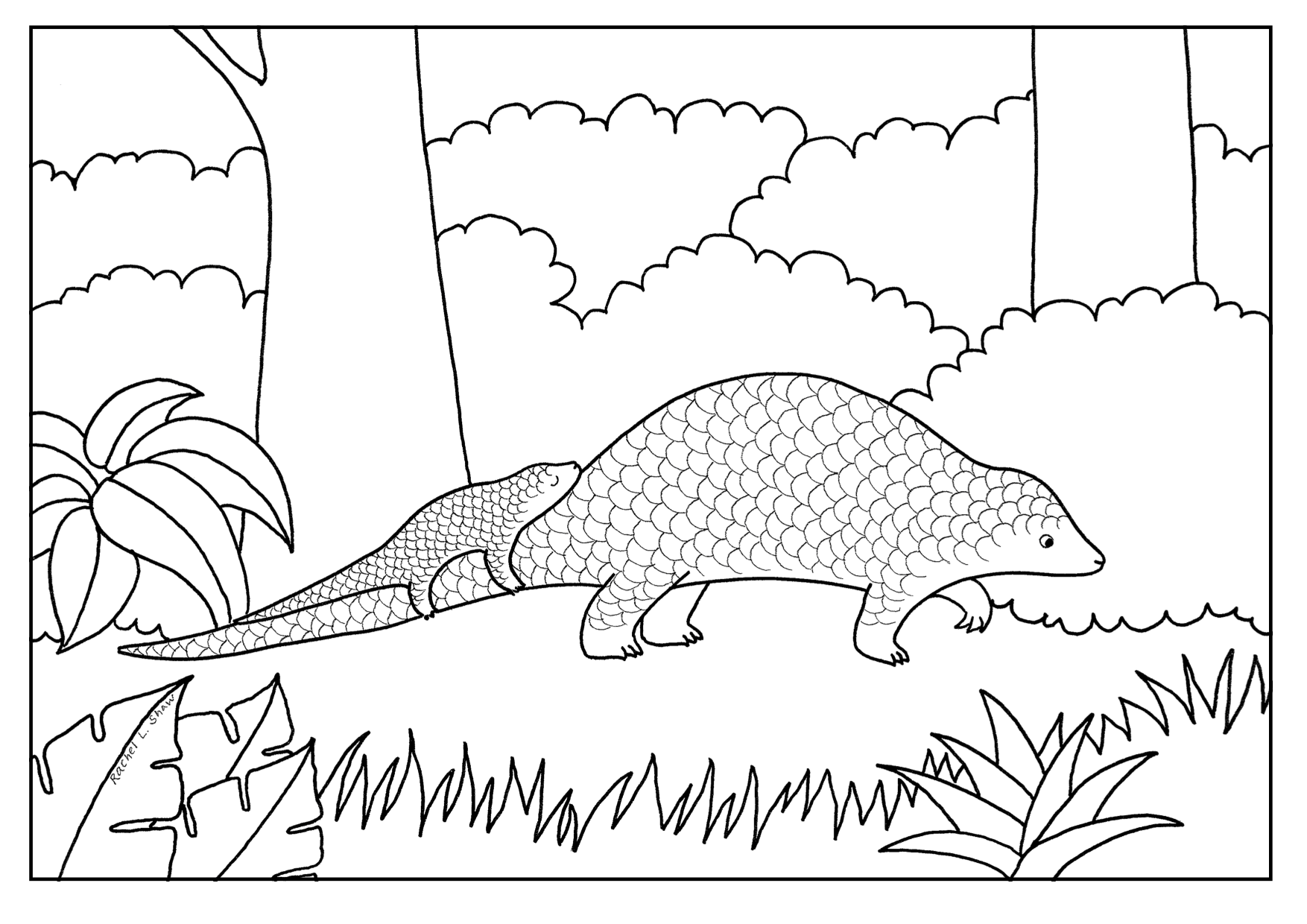
Pangolin and Porcupine Coloring Pages


Celebrate the diversity of wildlife with these coloring pages of a pangolin and her pup and a porcupine!

Pangolin and Pup (by Rachel L Shaw) | Porcupine (courtesy of Karen Watson of The Graphics Fairy)
You can purchase Who Would Win? Porcupine vs. Pangolin from these booksellers

Amazon | Barnes & Noble | Bookshop (discounted books and support for your local independent bookstore)

Picture Book Review

April 10 – National Wildlife Week

About the Holiday

National Wildlife Week, dating back to 1938, is the National Wildlife Federation’s longest-running education program. The celebration was designed to connect budding conservationists of all ages to the awesome wonders of wildlife. Each year, we pick a theme and provide fun educational materials and activities for educators and caregivers to use with kids. This year’s theme is Keep an Eye on the Wild. Conservationists and animal lovers are keeping a lookout for wildlife in the most unexpected places as we learn how we can keep their habitats safe and live in harmony with our incredible wild neighbors. Whether you keep your eyes out for the wildlife living near you with a “critter cam” or by walking around and paying attention to your backyard, neighborhood, and wider area, being aware of the creatures around you can help them survive for generations to come. To learn more about National Wildlife Week and find fun activities aimed at connecting kids with wildlife, visit the National Wildlife Week Kids Page!

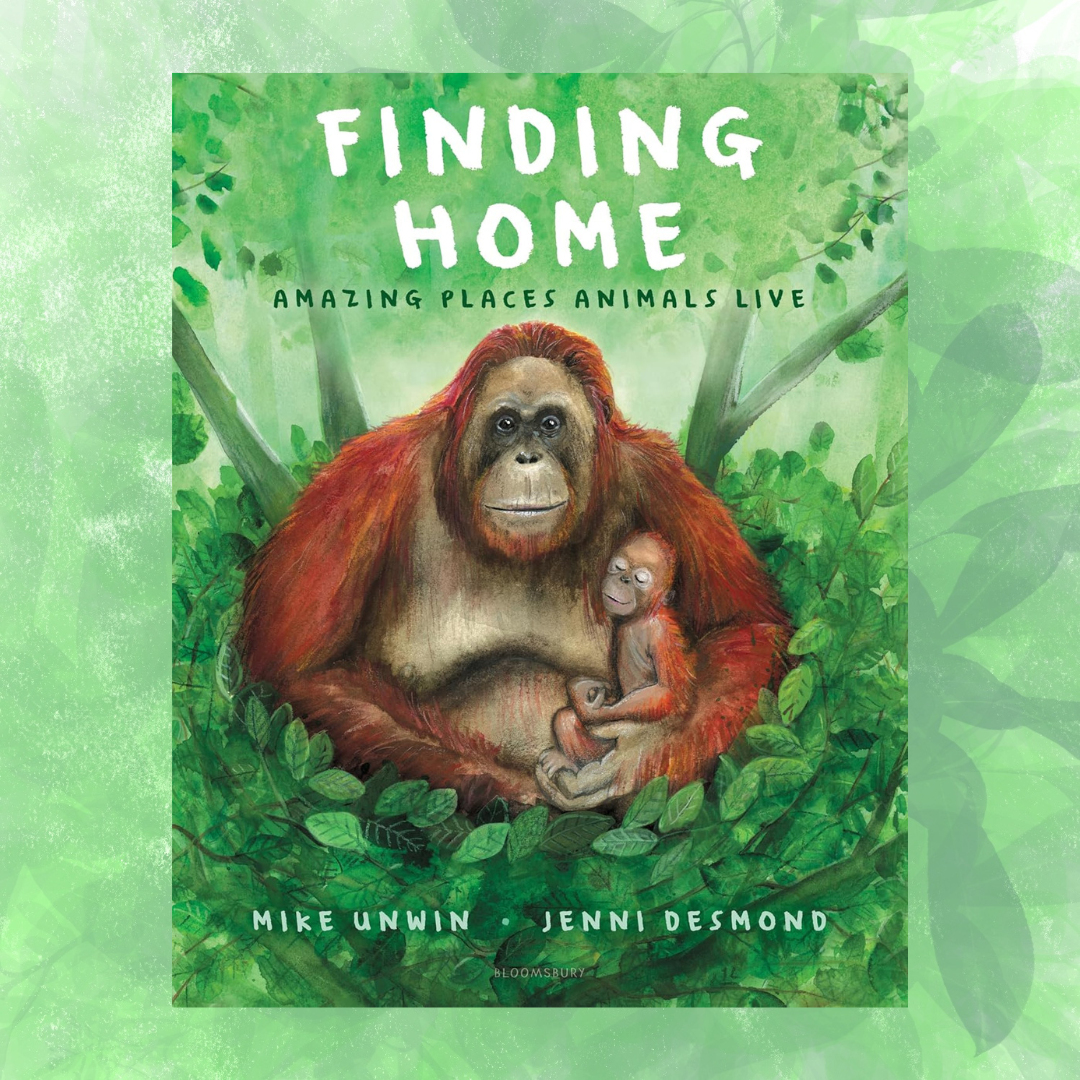
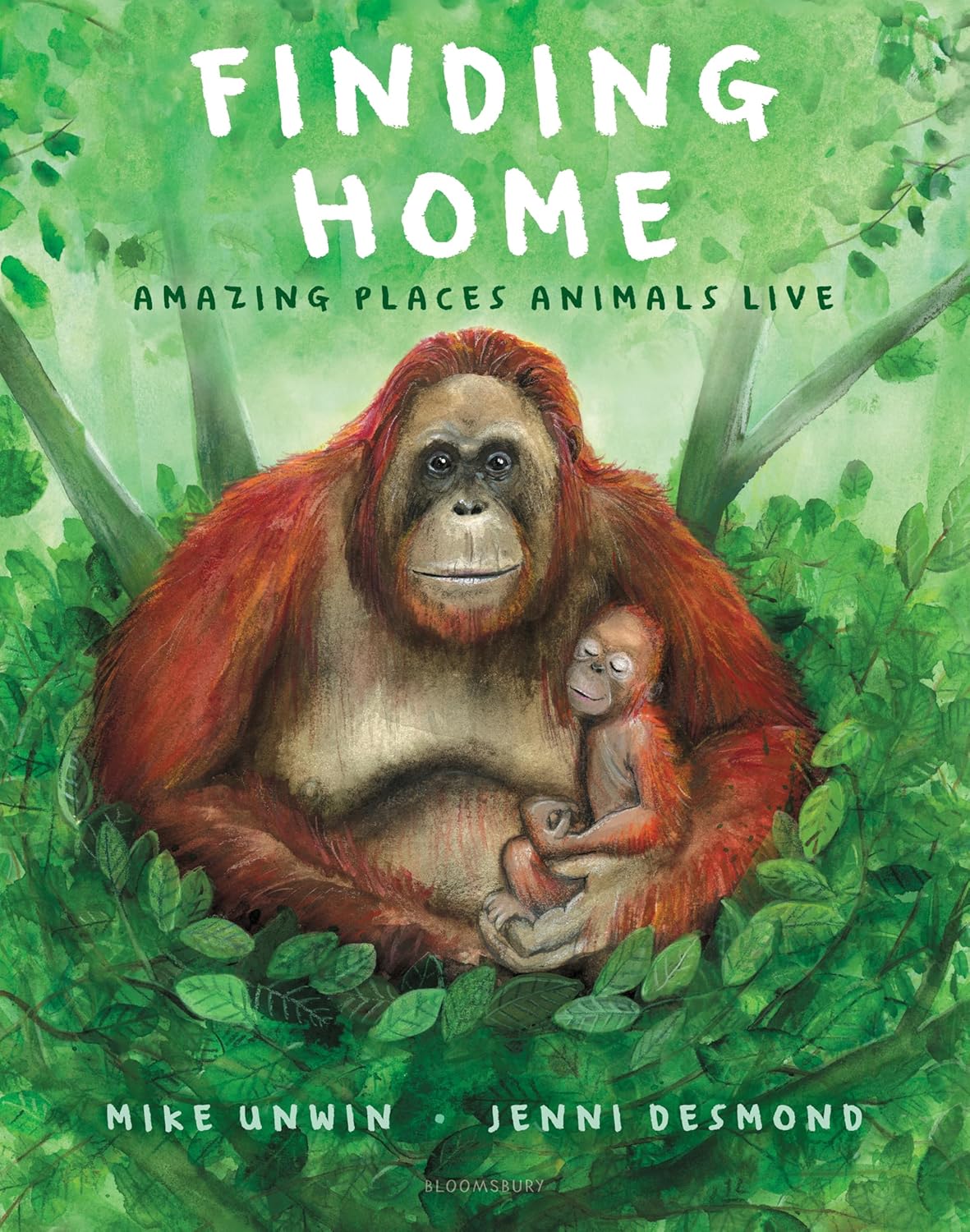
Finding Home: Amazing Places Animals Live

Written by Mike Unwin | Illustrated by Jenni Desmond


Finding Home begins: “Our planet is home to a mind-boggling number of different animals: at least 6,500 species of mammal, 10,000 species of reptile, 11,000 species of bird, and literally millions of insects. Every single one has its own home.” Just think of it! As your eye sweeps across any vista; as you walk across your yard, local playground, or favorite park, beach, or mountain trail, an untold number of creatures’ homes are within sight or underfoot. We know their names: Den. Nest. Burrow. Taxi (wait, what?). You’ll see, because in their astounding and gorgeous book, Mike Unwin and Jenni Desmond reveal that there is no such thing as a generic animal home.

Illustration © 2025 by Jenni Desmond, text © 2025 by Mike Unwin. Courtesy of Bloomsbury Children’s Books.

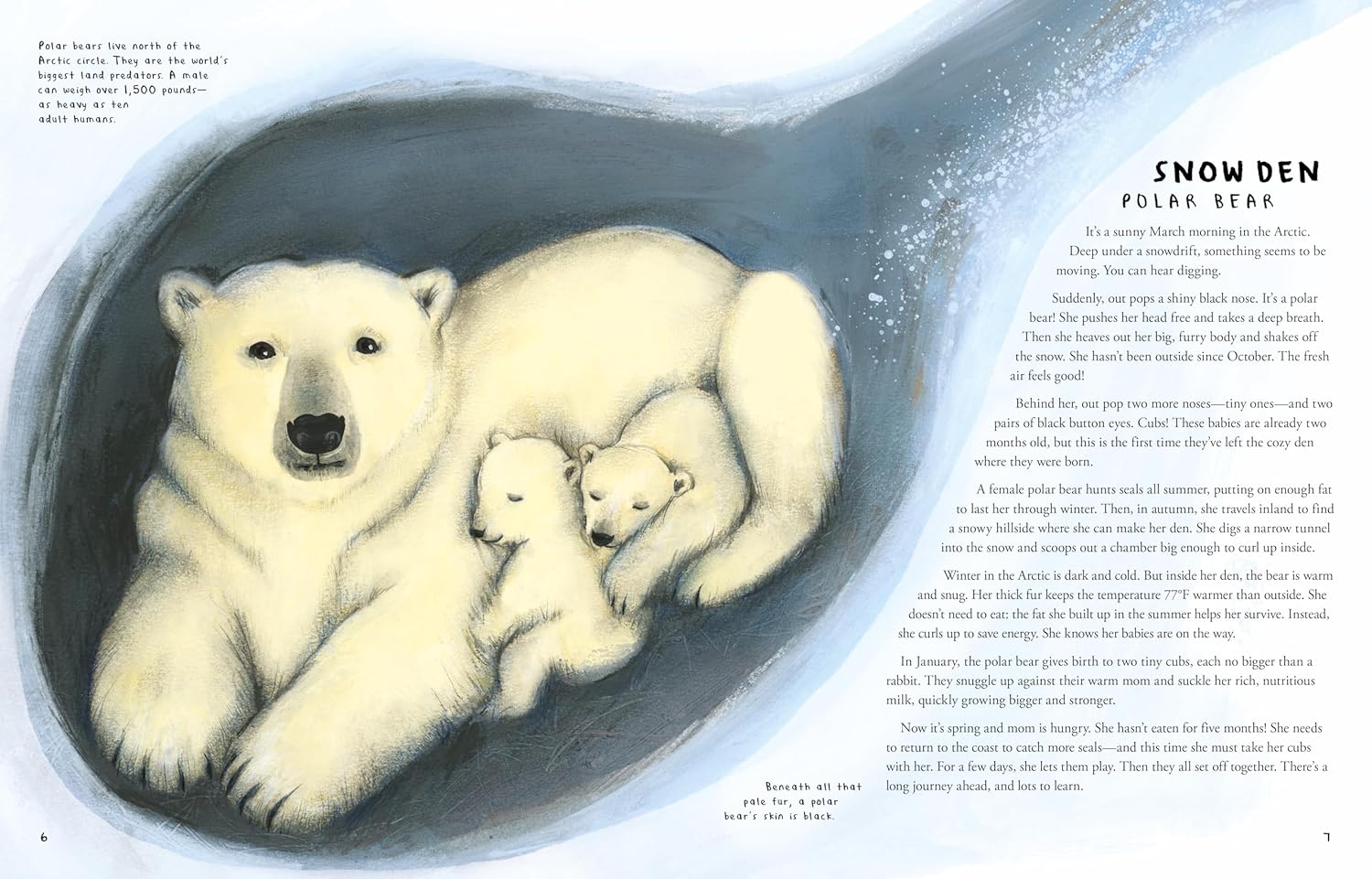
Take “den,” for instance—a polar bear’s snow den. Unwin and Desmond take you right inside this winter home, where a mother polar bear and her two cubs (born here in the cold of January) welcome you. As you squeeze inside, don’t worry about being cold. The polar bear’s “thick fur keeps the temperature 77°F warmer than outside.” 

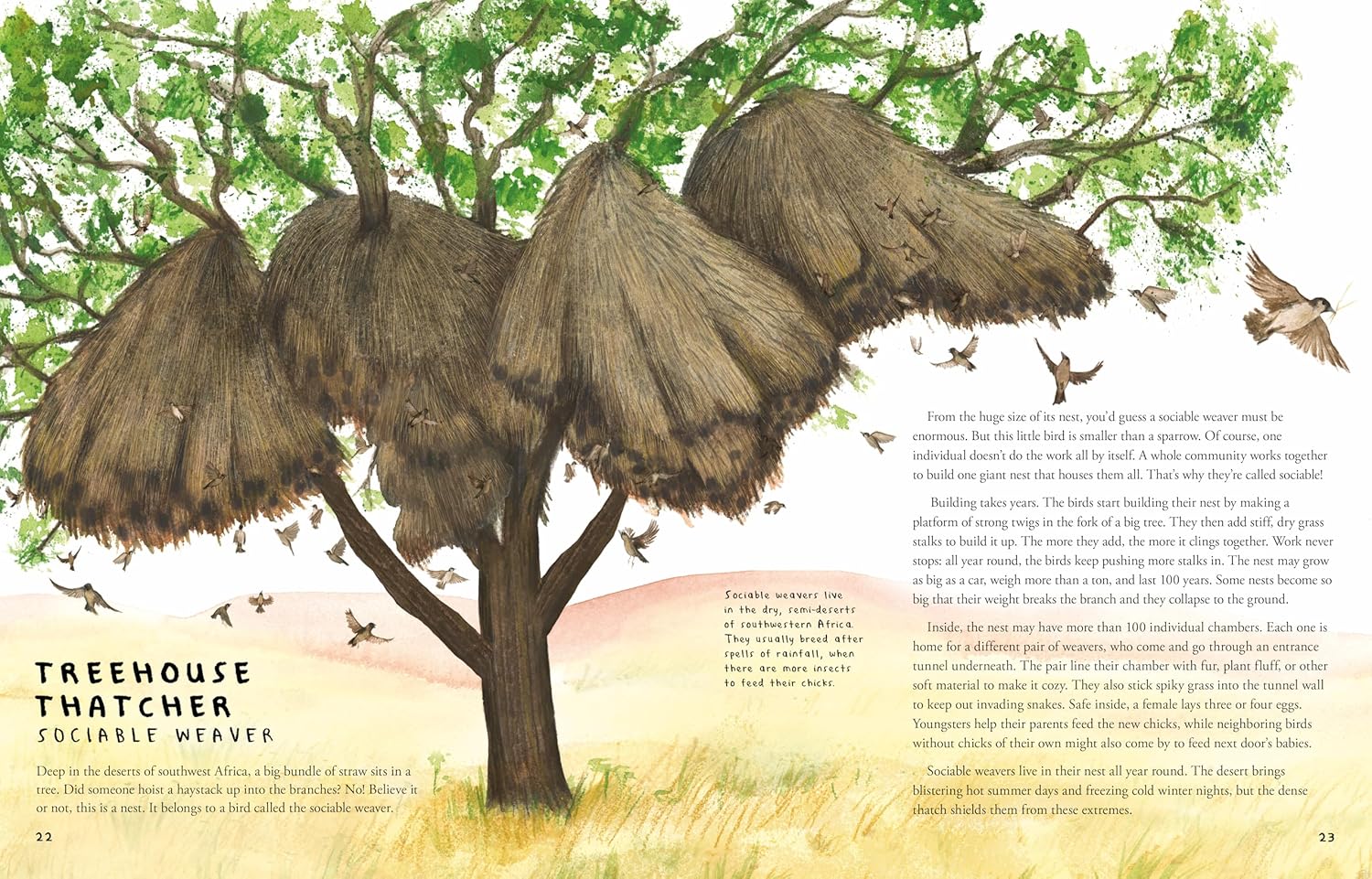
Next up is “nest.” These are bowls made from twigs, straw, and fluff and, sometimes, found objects like bits of paper or cloth, right? Well, yes—for some birds. But you won’t believe your eyes when you see what appears to be several haystacks lodged within a tree’s branches. This nest, constructed by a whole community of birds smaller than sparrows, can “grow as big as a car, weigh more than a ton, and last 100 years.” Like humans’ apartment buildings, the bird pairs that inhabit this nest look out for each other and help their neighbors. Kids will also be amazed by another type of bird that literally sews leaves together with “plant fiber and spider silk” to create their soft, deep nests.

Illustration © 2025 by Jenni Desmond, text © 2025 by Mike Unwin. Courtesy of Bloomsbury Children’s Books.

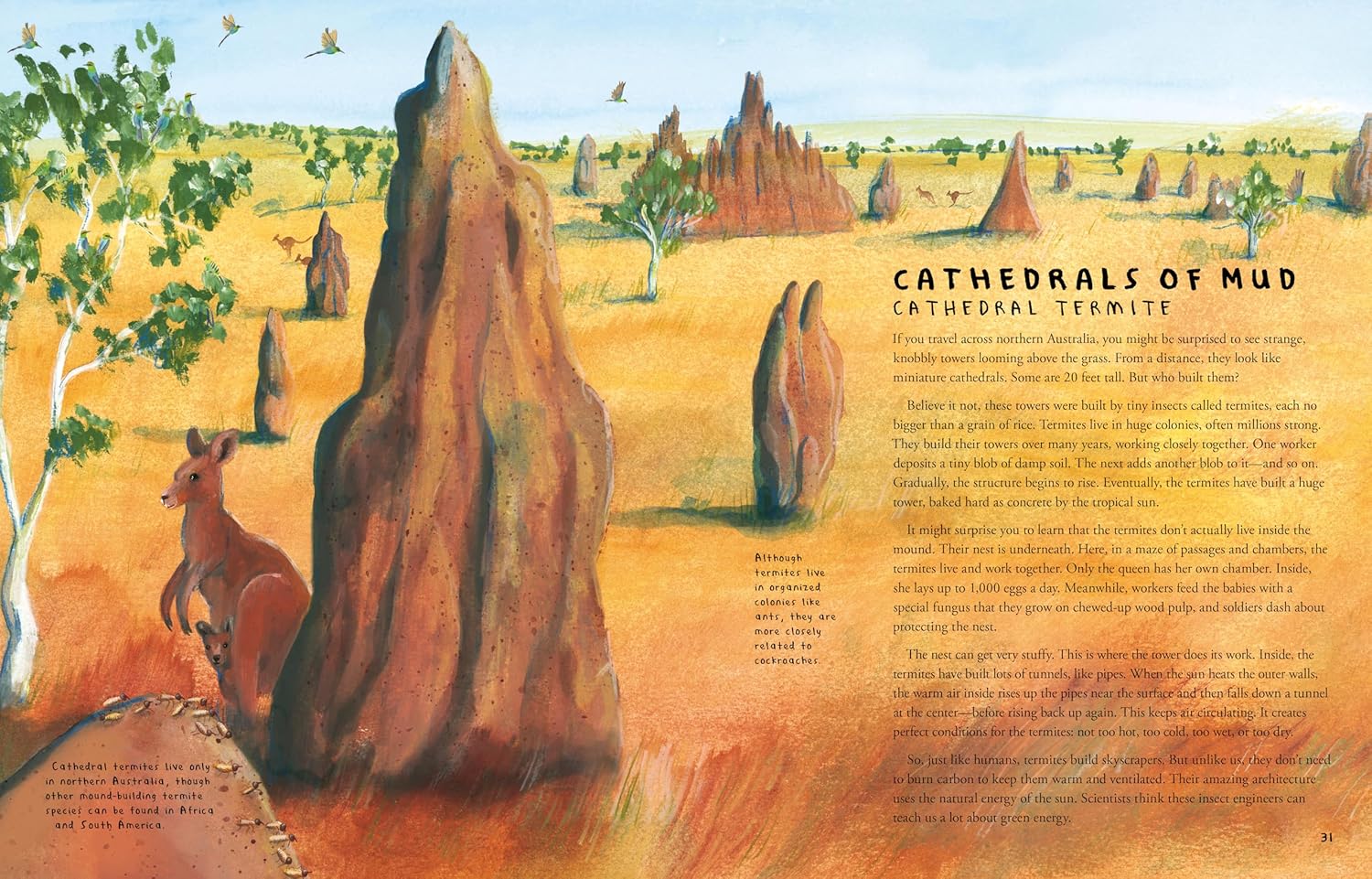
And how about “burrows?” Yep, Unwin and Desmond showcase a couple of pretty spectacular burrows too. Take the aardvark’s home. You won’t see an aardvark during the day. While the sun is up, they stay below ground, sleeping and tending to their young. It’s only after sunset that these unusual, ant-eating animals (including two-week-old babies) make an appearance topside. This is when they do what they do best: sniff out anthills and termite mounds, dig them up, and have dinner. It takes a hearty meal to satisfy an aardvark: “One aardvark can eat an amazing 50,000 ants and termites in a single night!”

Now, about that “taxi.” Children will be wowed by two, very different types of animals who prefer moving from one area to another by hitching a ride on another creature, from whom they can get food and other necessities of life while helping their hosts as well. Of course, the variety of animal homes don’t stop at these four. Every page transports readers to a different part of the globe to witness creatures of the air, sea, and land living in the home of their choice.

Unwin ends this fascinating travelogue with a map showing different ways some of the animals in the book tend to the environment, protecting it and keeping it growing for themselves and humans. He also includes a caution, reminding readers that “all these habitats . . . fit together like jigsaw pieces to make up planet Earth. And just like a jigsaw needs all its pieces, a healthy planet needs all its animals and their habitats.” Sadly, humans have not been good stewards of Earth’s bounty. “Today, scientists and conservationists are working hard to put things right.” But everyone is needed to make sure our environment is cared for the way we care for our own families. “Only then will planet Earth truly be home, sweet home.”

Illustration © 2025 by Jenni Desmond, text © 2025 by Mike Unwin. Courtesy of Bloomsbury Children’s Books.

Mike Unwin draws readers in with engaging storytelling that allows kids to easily understand how each animal goes about building their home and why it’s perfect for their lifestyle. Children also learn just as much about the animals as the homes they build, giving them deep and well-rounded knowledge of some of the most unusual birds, fish, mammals, and insects on our planet and how many of them benefit humankind. Unwin’s phrasing, vocabulary and conversational lilt make Finding Home a highly satisfying nonfiction read aloud for younger kids. Independent readers will eagerly dip into the book again and again to meet these intriguing creatures.

With the impact of a museum exhibit, Jenni Desmond’s rich, full-bleed illustrations will take your breath away with their stunning realism and personality. Some animals peek out at the reader, while others busily go about their work oblivious to outside interest. From grassy hillsides to treetop canopies to sunny Africa and the snowy Himalayas, Desmond takes readers on an around the world tour like no other.

Gorgeous, educational, and nature nonfiction at its best, Finding Home: Amazing Places Animals Live is a must for all classroom, school, and public libraries as well as for nature- and animal-loving kids and families.

Ages 5 – 8+

Bloomsbury Children’s Books, 2025 | ISBN 978-1547615100

About the Author

Mike Unwin has written more than 30 books for both adults and children, including the Encyclopedia of Birds and Migration. He is also a regular contributor to publications such as BBC Wildlife and RSPB Nature’s Home. In 2013 Mike was voted UK Travel Writer of the Year by the British Guild of Travel Writers. Follow Mike on Instagram @mikeunwin.wildtravel.

About the Illustrator

Jenni Desmond is the illustrator of more than 20 books, including MigrationThe Wolves of Yellowstone, and The Blue Whale. Her books have been translated into over a dozen languages. In 2016 she was made a Maurice Sendak Fellow and her book The Polar Bear became a New York Times Best Illustrated Children’s Book of the Year. When Jenni is not in her studio, you’ll find her cooking, cycling and looking for adventure. Visit her at jennidesmond.com and follow her on Instagram @jennidesmond.

National Wildlife Week Activity

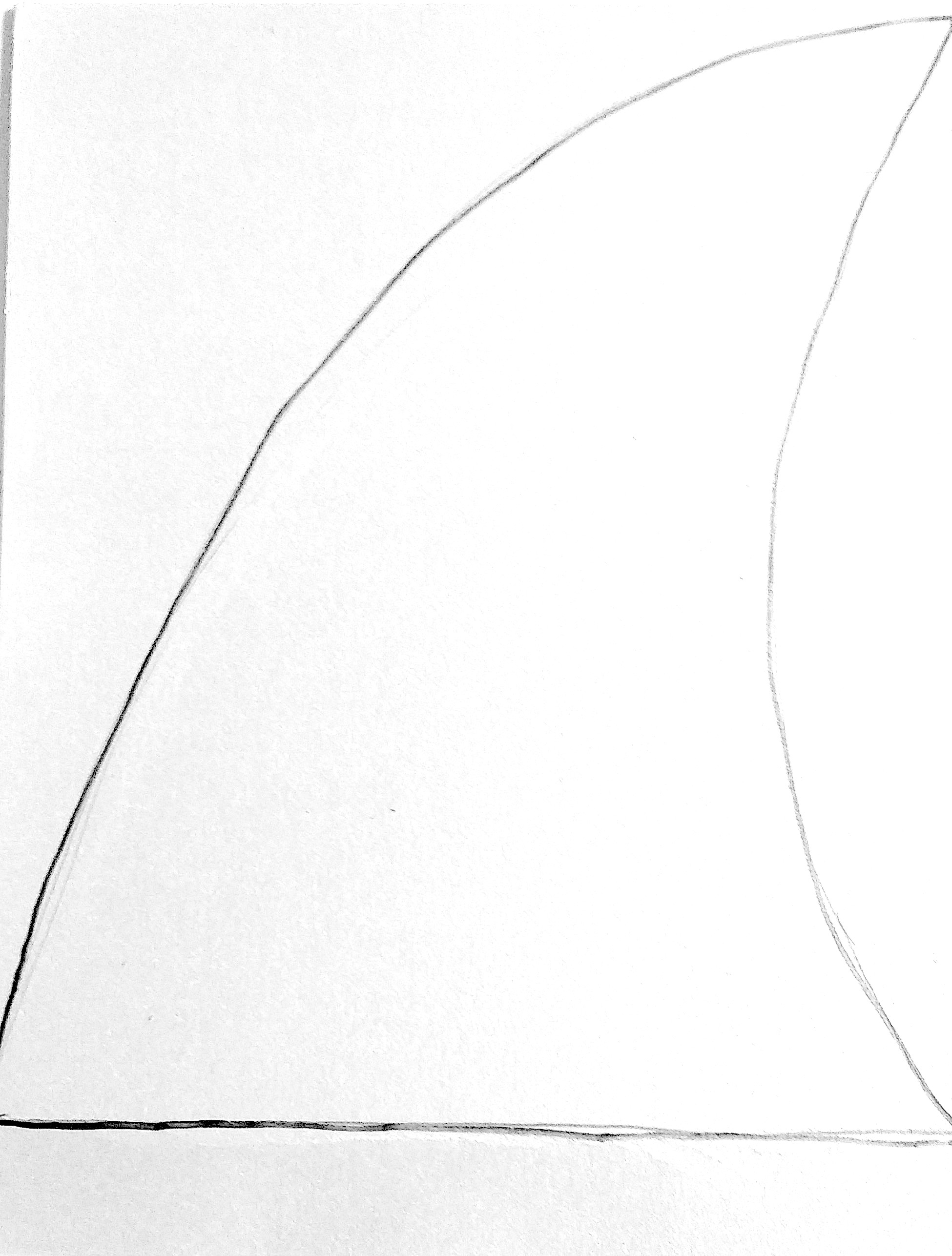
celebrate-picture-books-picture-book-review-shark-fin-craft

Fintastic Shark Fun


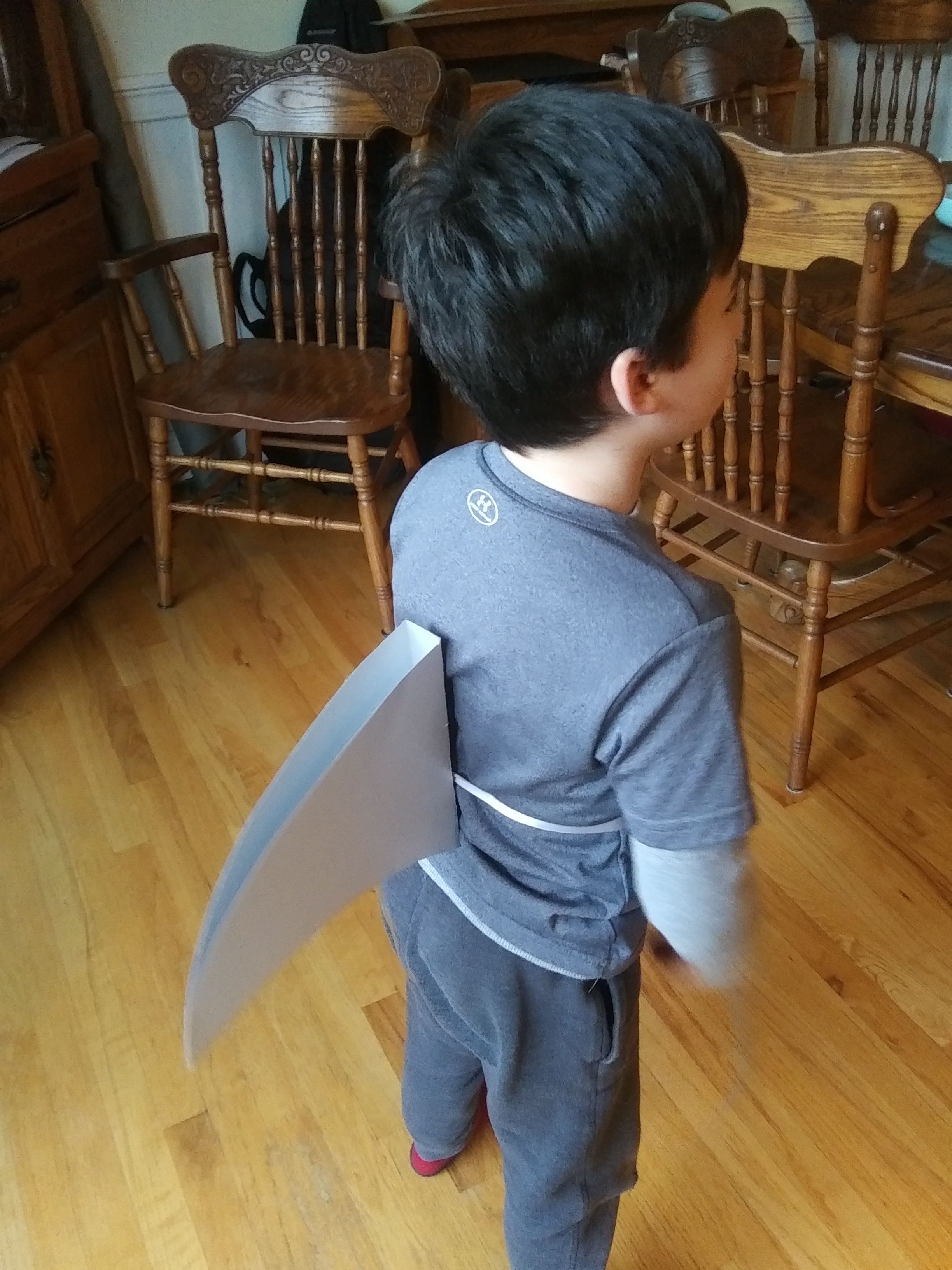
Sharks are awesome creatures and even feature as a home to another animal in today’s book! Follow the directions below and to make your own shark fin. 

Supplies

  • 2 pieces of 8.5 x 11 gray cardstock paper
  • Ribbon
  • Tape
  • Scissors
  • Pencil

fin outline white

celebrate-picture-books-picture-book-review-shark-fin

Directions

  1. Tape the top of the two pieces of paper together
  2. Fold them back together
  3. Measure an inch up from the bottom of the papers (the un-taped side) and trace a straight line across both papers
  4. Trace a shark fin outline onto your paper. The shark outline should stop an inch above the bottom
  5. Cut out the fin on both pieces of paper. If you should cut through the tape, re-tape the tops together
  6. Fold along the lines of both papers so the folds face towards each other.
  7. Tape the folds so the fin becomes a triangle
  8. Cut two slits parallel to the folded lines
  9. Thread ribbon through slits

You can purchase Finding Home: Amazing Places Animals Live from these booksellers

Amazon | Barnes & Noble | Bookshop (discounted books and support for your local independent bookstore)

Picture Book Review
March 22 – It’s Women’s History Month

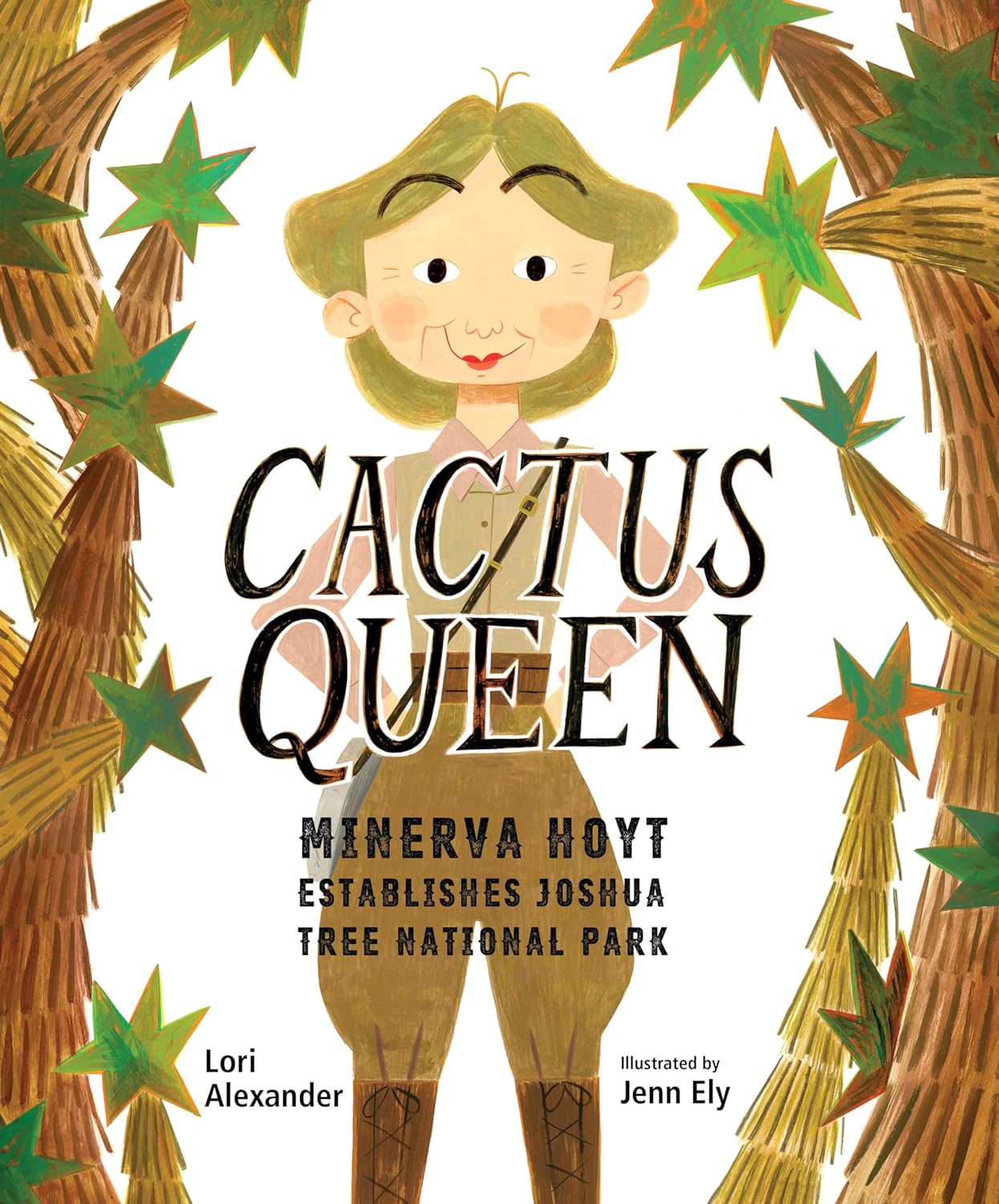
celebrate-picture-books-picture-book-review-cactus-queen-cover

About the Holiday

National Women’s History Month is all about celebrating women who broke barriers with their intelligence, creativity, courage, persistence, and unwavering confidence in their abilities. In every discipline, women have brought and continue to bring new perspectives, experiences, and talents to make contributions toward a better world. The theme for Women’s History Month 2024 celebrates “’Women Who Advocate for Equity, Diversity and Inclusion.’ This theme recognizes women who understand the need to eliminate bias and discrimination from individuals’ lives and institutions.”

Today’s book celebrates a visionary woman who made it her life’s work to protect a unique ecosystem, educate people on the importance of the environment and conservation, and provide the US with one of its most stunning national parks. 

I’d like to thank Calkins Creek/Astra Books for sharing a copy of Cactus Queen” Minerva Hoyt Establishes Joshua Tree National Park with me for review consideration. All opinions on the book are mt own.

Cactus Queen: Minerva Hoyt Establishes Joshua Tree National Park

Written by Lori Alexander | Illustrated by Jenn Ely


Even as a child, Minerva loved the outdoors, was eager to share her thoughts and opinions, and enjoyed “long chats with friends.” When she grew up she married Dr. Albert Hoyt. In 1897 Minerva and her husband moved from Mississippi to Pasadena, California, close to Los Angeles. To meet new friends, Minerva hosted a backyard party, complete with games, food, and, of course, long chats.

Settled into her new city, Minerva took to making trips to the Mojave Desert. She was awed by the Joshua trees, which grew nowhere else but here. After the death of her husband in 1918, Minerva spent more time in the desert, even camping out while “the wind whistled through the Joshua trees,” and “bright constellations swirled overhead.”

celebrate-picture-books-picture-book-review-cactus-queen-garden-party

Illustration copyright Jenn Ely, 2024, text copyright Lori Alexander, 2024. Courtesy of Calkins Creek, Astra Books for Young Readers.

As Los Angeles grew and grew, with more buildings, more cars, and more noise, people began to visit the desert frequently. They didn’t just visit, though, they wanted to take it home. People dug up the “… fuzzy cholla, spiky yucca, and barrel cacti to keep in their backyards.” They even dug up Joshua trees and carted them away. Many of these desert plants didn’t survive their new city surroundings. The Joshua trees were also cut down for construction materials, and motorists lost in the desert set them afire to communicate with other drivers.

By the late 1920s little remained of Minerva’s beloved desert. She wanted to save it . . . but how? Suddenly, “Minerva had a wild idea.” She would show the rest of the country just how special the desert was. With help from garden clubs, artists, taxidermists, and friends, she gathered samples of desert flora and fauna and took them east—by train.

celebrate-picture-books-picture-book-review-cactus-queen-camping

Illustration copyright Jenn Ely, 2024, text copyright Lori Alexander, 2024. Courtesy of Calkins Creek, Astra Books for Young Readers.

At the 1928 International Flower Show in New York City, Minerva erected a display of the desert. Crowds were thrilled to discover this “strange landscape,” and reporters took pictures for magazines and newspapers. Minerva won a gold medal for her exhibit, The Spirit of the Desert. Minerva also won awards in Boston and London for exhibits there. But more important than these accolades was that people were really listening to her and beginning to love the desert. When she donated her exhibits to museums, more people became interested in the desert.

By 1933, Minerva was ready to move on to the next stage in her plan. She wanted 1,000,000 acres of the desert to be declared a national park, protected by federal laws. Minerva garnered an audience with President Franklin D. Roosevelt and brought photographs to show him. She convinced the President—now it was up to Roger W. Toll, superintendent of Yellowstone National Park, to inspect Minerva’s desert and agree.

celebrate-picture-books-picture-book-review-cactus-queen-museum-exhibit

Illustration copyright Jenn Ely, 2024. Courtesy of Calkins Creek, Astra Books for Young Readers.

As Roger Toll stood in the middle of the desert on a rainswept day, he asked, “where are the lush trees, the waterfalls, and lakes?” When he later filed his report, he rejected the desert for National Park status. Minerva was disappointed but did not give up. She began a letter-writing campaign, convincing “scientists, teachers, politicians, and friends” to write to the National Park Service. Letters poured in—enough to convince the Service to send out a new inspector.

This time Assistant Director Harold C. Bryant, who lived in California, was sent. “He knew all about desert plants and animals.” When he arrived, Minerva and more than one hundred supporters greeted him. After touring the desert for three days, Bryant announced his decision: Yes! “Minerva’s desert was worth saving.”

celebrate-picture-books-picture-book-review-cactus-queen-park

Illustration copyright Jenn Ely, 2024, text copyright Lori Alexander, 2024. Courtesy of Calkins Creek, Astra Books for Young Readers.

Extensive backmatter, accompanied by photographs, offers more biographical information about Minerva, points about wildlife in Joshua Tree National Park, facts about other national parks in the United States, tips for how young people can help the environment through easy-to-implement actions, and a bibliography. In Lori Alexander’s Author’s Note, she relates the dangers and destruction that the fragile environment of Joshua Tree National Park and the surrounding desert continues to suffer from “vandalism, urban development, and the effects of climate change,” a report that demonstrates the need for continued education and care taking of our natural resources.

In Cactus Queen, Lori Alexander has created a compelling biography of a remarkable woman as well as a call to action for readers to stand up for the environmental or other causes that are important to them. Alexander highlights Minerva Hoyt’s love of the desert, her dedication, and her unflagging determination to overcome setbacks. Hoyt’s creativity, pragmatism, and lifelong focus serves as an inspirational roadmap for accomplishing goals for children, teens, and even the adults who read with them.

The first thing readers may notice upon opening Cactus Queen is Jenn Ely’s beautiful color palette that mirrors the unique hues of the desert. Her stunning images of the desert and Minerva’s ingenious ways of rallying the country and the President to her cause transport children from Hoyt’s earliest days through her long-fought success. Ely’s charming illustrations reveal not only the special plants and creatures of the Mojave Desert but Minerva’s distress at its destruction and her tenacity to enact change to protect it. 

Both a fascinating biography of Minerva Hoyt and an in-depth look at the multifaceted workings of conservation efforts, Cactus Queen: Minerva Hoyt Establishes Joshua Tree National Park will inspire readers to advocate for causes that are important to them. For educators the book would make an excellent addition to science and language arts curriculum. Cactus Queen would also be an engaging accompaniment to museum visits or field trips for families and teachers.

Cactus Queen is a top pick for classrooms, public and school libraries, museum shops, and families.

Ages 7 – 10

Calkins Creek, 2024 | ISBN 978-1662680212

About the Author

Lori Alexander is the award-winning author of several children’s books, including All in a Drop: How Antony van Leeuwenhoek Discovered an Invisible World, which won a Robert F. Sibert Honor, and A Sporting Chance: How Ludwig Guttmann Created the Paralympic Games, an NCSS Notable Book. Her work has received several starred reviews from KirkusSchool Library Journal, and Horn Book Magazine, has made the NSTA Outstanding Science Trade Book list, and has been selected by the Junior Library Guild. Visit Lori Alexander at lorialexanderbooks.com.

About the Illustrator

Jenn Ely is an artist and animator, who has worked on the movies The Boxtrolls and Guillermo Del Toro’s Pinocchio. In her recent foray into children’s books, she illustrated The Gardener of Alcatraz and If You Were a Kid Building a Pyramid. Visit Jenn Ely at jennely.com.

Women’s History Month Activity

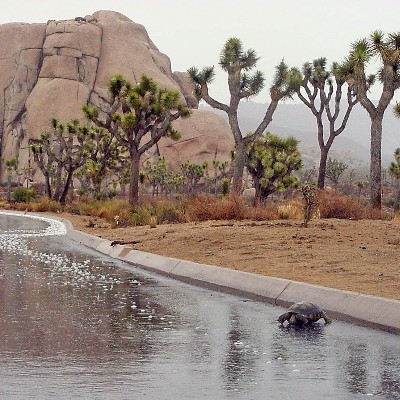
celebrate-picture-books-picture-book-review-joshua-tree-national-park-wildlife

Become a Joshua Tree National Park Junior Ranger

How would you like to become a Joshua Tree National Park Junior Ranger? You can your badge with this online program full of fun and educational activities for all ages! You can learn how to draw a Joshua Tree, create your own constellation, learn all about desert tortoises, create your own rock formation, learn about adaptable plants and design your own, and more.

To earn your badge kids ages 5 – 7 are asked to complete 2 activities; kids ages 8 – 10 are asked to complete 3 activities; and kids ages 10 and above are asked to complete 4 or more. After finishing projects, you just need to send images of your work to receive your badge in the mail!

Simply visit the official Joshua Tree National Park website and learn more about their Junior Ranger program! Learn more about the park and view lots of pictures and videos here.

Joshua Tree National Park Coloring Page

celebrate-picture-books-picure-book-review-joshua-tree-national-park-coloring-page

Enjoy this activity page by filling it with all the colors of the desert.

Joshua Tree National Park Coloring Page

celebrate-picture-books-picture-book-review-cactus-queen-cover

Order from Bookshop to support your local independent bookstore.

You can also find Cactus Queen: Minerva Hoyt Establishes Joshua Tree National Park at these booksellers

Amazon | Barnes & Noble | Books-a-Million

Picture Book Review

April 17 – International Haiku Day

celebrate-picture-books-picture-book-review-peek-a-boo-haiku-cover

About the Holiday

Small things are amazing—and surprising! We all know good things come in small packages, and just look at the wisdom, humor, and capacity for love of children. The same goes for haiku—the smallest form of poetry in size but never in impact. Coming mid-way through National Poetry Month, today’s holiday shines a spotlight on the haiku. The simple 5-7-5 rule that we all learn in school doesn’t begin to define the complexity of these three-line beauties that distill the world into little nuggets that make readers see life in amazing and surprising ways.

Peek-a-Boo Haiku

Written by Danna Smith | Illustrated by Teagan White


In this beautiful board book, little ones are taken through an auditory and visual wonderland from winter through spring, summer, and fall as two mice visit woodland, meadow, garden, and aquatic creatures to play, discover, and celebrate the changing seasons.

celebrate-picture-books-picture-book-review-peek-a-boo-haiku-winter-hidden

Children will enjoy predicting what animals are hiding behind the log and boulder. Image copyright Teagan White, 2023, text copyright Danna Smith, 2023. Courtesy of Little Simon.

Each of Danna Smith’s haiku verses surprises, sparkling with lovely alliteration and evocative language that invites young readers to anticipate and predict who will appear when the flaps on  the facing page are lifted. Smith’s giggly humor and exceptional imagination elevate readers’ experience as she deftly uses games and experiences familiar to children (hide-and-seek, confetti, splashing in water, and lullabies to name a few) in ways that will spark creative thinking and bond them to the natural world. As late fall with its nighttime frost appears in the last spread, Smith’s gentle, sleepy verse welcomes little ones to drift off to dream along with the two snuggled up mice.

celebrate-picture-books-picture-book-review-peek-a-boo-haiku-winter-bunnies

When the rabbits are revealed, Smith’s verse encourages readers to talk about “long ears” and “short ears.” Image copyright Teagan White, 2023, text copyright Danna Smith, 2023. Courtesy of Little Simon.

Any book illustrated by Teagan White is a treasure, and in Peek-a-Boo Haiku, she populates Smith’s various habitats with adorable, yet realistic animals that will charm little readers and adults alike. White’s glorious colors add breathtaking beauty to her gorgeously detailed pages. Each spread is a tiny masterpiece that gives children and adults much to discover and talk about as they move through the seasons. The final spread, washed in somnolent shades of twilight, puts little ones in the mind for sleep, just as the owl snugged into its tree-trunk nest. Kids will enjoy finding the mice (appearing alone or together, allowing the youngest children to engage with the idea of one and/or two) in each spread, and the variety of creatures, plants, and environments provide a wealth of learning, from vocabulary to math to science, for a wide-range of ages and development. 

celebrate-picture-books-picture-book-review-peek-a-boo-haiku-spring-bird-shown

When the colorful bird is revealed behind stems of flowers, Danna Smith invites readers to talk about what she has in her beak, where it came from, and what she will do with it. Image copyright Teagan White, 2023, text copyright Danna Smith, 2023. Courtesy of Little Simon.

Exquisite in every way, Peek-a-Boo Haiku is a book adults and children will love to share again and again and is a perfect choice as a gift for special occasions, baby showers, new siblings, or simply to add to a child’s bookshelf. This superlative board book also belongs in all preschool and kindergarten classrooms as well as school and library collections.

Ages Birth to 5

Little Simon, 2023 | ISBN 978-1665926461

About the Author

Danna Smith is a poet and award-winning author of numerous books for children, including One Blue GnuRooftop GardenWake Up, Freight Train!; and several Little Golden Books. Her nonfiction picture book, The Hawk of the Castle: A Story of Medieval Falconry, received two starred reviews and is a Junior Library Guild Selection and a Bank Street College of Education Best Children’s Books of the Year. Danna currently lives in northern California, where she is hard at work on her next book. For more information about her books and teaching activities, visit her website at DannaSmithBooks.com.

About the Illustrator

Teagan White is an artist and author who creates playful watercolor scenes of the natural world and the friendly creatures who inhabit it. Teagan lives in Oregon, enjoys visiting seagulls at the beach, and has illustrated nine picture books. Find out more at TinyMothStudios.com.

Take a Peek at this Peek-a-Boo Haiku Book Trailer!

National Haiku Day Activities

Screen Shot 2023-04-08 at 11.35.14 AM

Woodland animals love to play hide-and-seek in trees, behind logs and rocks, under bushes, and in all sorts of places. This Peek-a-Boo Haiku Memory Game lets little ones find matching pairs of animals while building observation skills and having lots of fun!

Screen Shot 2023-04-08 at 11.34.29 AM

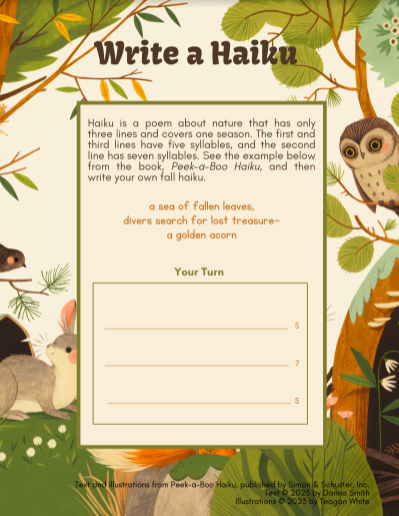
Young children will enjoy writing their own haiku from what they see in nature with this adorable Write a Haiku Page that gets them thinking and using their imagination.

celebrate-picture-books-picture-book-review-peek-a-boo-haiku-cover

You can find Peek-a-Boo Haiku at these booksellers

Amazon | Barnes & Noble | Books-a-Million

To support your local independent bookstore, order from

Bookshop

Picture Book Review

October 13 – It’s Positive Attitude Month

celebrate-picture-books-picture-book-review-raising-don-cover

About the Holiday

No matter how old (or young) you are there’s no getting around the fact that sometimes things are tough or don’t work out the way you planned. For kids, learning how to accept and even make the best of setbacks or disappointments is part of living a happier life. And that’s what Positive Attitude Month is all about. The holiday was established to encourage people to see the bright side of things since being upbeat can improve your health, lower chances of depression, make you more motivated, and lead to better relationships with family and friends. One way for kids to learn this skill is through reading, and today’s book—the true story about a little guy overcoming a few rocky patches of his own—is an adorable and joyful place to start. 

I’d like to thank the San Diego Zoo Wildlife Alliance Press and Blue Slip Media for sharing a copy of Raising Don with me for review consideration. All opinions on the book are my own.

Raising Don: The True Story of a Spunky Baby Tapir

By Georgeanne Irvine


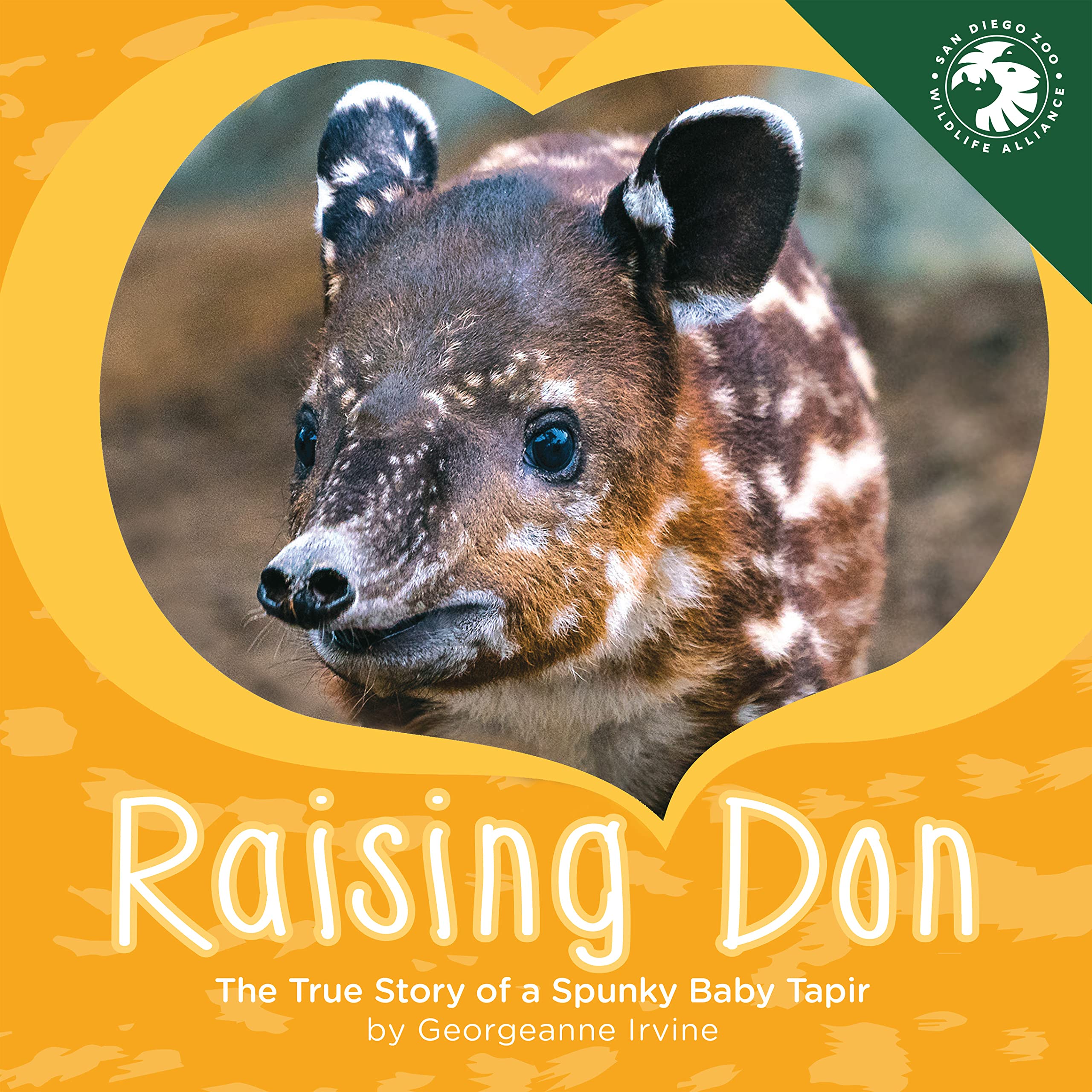
Get ready to open Raising Don and fall in love with this little Baird’s tapir, an absolute cutie with the sweetest of personalities to match. From the first pages—which show the wildlife care team at the San Diego Zoo eagerly anticipating Don’s birth, describe the moment of lucky serendipity when one member of the team witnessed this exciting event, and then reveal that Don’s mother, Luna, as a hesitant “first-time mom” rejected her calf—readers will find themselves invested in the future of “this endangered Baird’s tapir born at the zoo in more than 30 years.”

As the wildlife care team takes over bottle-feeding Don, children learn about the extraordinary steps they took to provide Don with some of Luna’s milk while ensuring that each animal was treated with affection. Discovering that Luna enjoying being scratched with a soft scrub brush while being milked and Don being fed after first having “his back scratched and his face rubbed before he would take his bottle” and getting a belly rub afterwards will make readers with pets of their own smile at this universal favorite. 

celebrate-picture-books-picture-book-review-raising-don-baby-born

Copyright Georgeanne Irvine, 2022, courtesy of San Diego Zoo Wildlife Alliance Press.

Tapirs, kids learn, have noses that are “similar to an elephant’s trunk, only shorter.” Don used his little trunk “for smelling as well as picking up things like branches and bits of lettuce.” But Don was also as playful as any toddler and after eating “often grabbed the bottle with his tiny trunk and tried to run off with it!” Next, when Don was only a week old, the specialists introduced him to a shallow pool. Tapirs are good swimmers, but they need to be taught—just like kids.

In no time, Don was “running, jumping, and belly flopping into the pool.” He even liked to blow bubbles in the water with his trunk. Children then see photographs and read about how Don was gradually introduced to a deeper pond in the habitat where he would eventually live with guanacos, capybaras, and a llama—and, of course, rewarded with “extra back scratches and belly rubs for being such a good swimmer.”

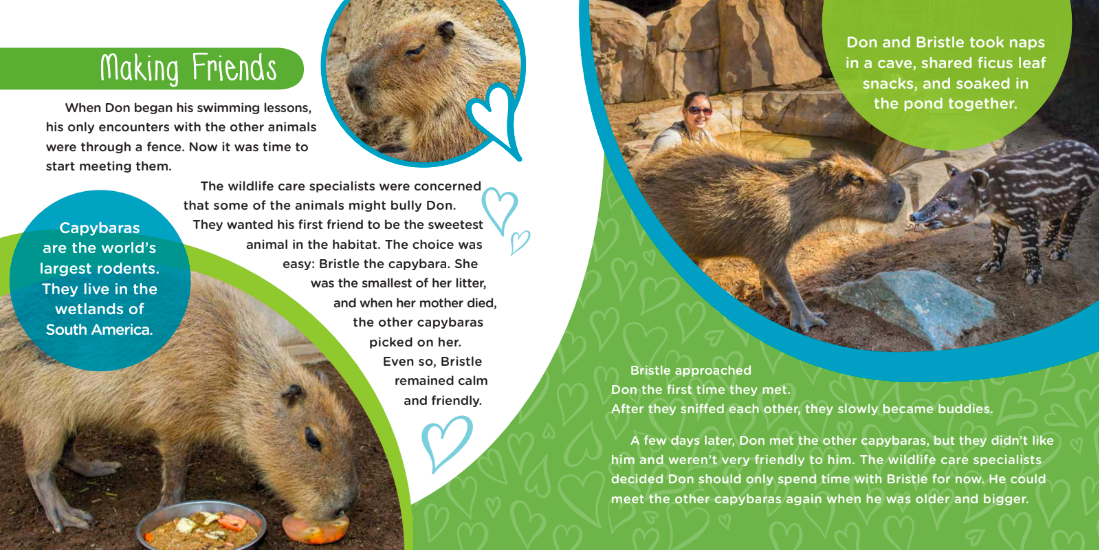
Soon Don would be old enough to be moved to his habitat, so now it was time for him to make a friend. The wildlife care specialists picked out a sweet-tempered capybara, Bristle, with whom he “took naps in a cave, shared ficus leaf snacks, and soaked in the pond together.” Don also met an elderly tapir who, over time, taught him good manners and other particulars about being a tapir. 

celebrate-picture-books-picture-book-review-raising-don-pool-party

Copyright Georgeanne Irvine, 2022, courtesy of San Diego Zoo Wildlife Alliance Press.

But Don learned some other lessons about life too. Even when Don was a baby and the guanacos and the llama saw him through a fence, they didn’t like him. And when, later, Don approached them in the habitat, they bullied him in the way llamas do—by spitting and kicking at him. Don simply took to avoiding them and sticking with his good friend Bristle. 

In these first months of life, Don discovered his favorite foods and learned to accept regular examinations from the care specialists that would keep him healthy. “Tapirs have sensitive feet and need them looked at every day to make sure there aren’t any cuts, scrapes, or bruises.” As he grew older, Don became more independent and confident. He celebrated his first birthday with his favorite foods and a swim. Soon he’d be moving to the Nashville Zoo in Tennessee. “There, he would meet a female tapir and hopefully become a father someday.”

And what about Luna? She has given birth to and is taking care of Don’s sister, named Taiyari (which “means ‘our heart’ in the language of Mexico’s Huichol people”). Now, Don and his new best friend Juju, a female tapir, live in a spacious habitat with shade trees and a pond. Don, as you might imagine, has “won the hearts of his new caregivers,” and someday soon he and Juju will “become parents of their own precious calf, helping to bring more of these endangered animals into the world.”  

Back matter includes fun facts about tapirs, a map showing where they live, the dangers to wild tapirs, and a list of ten ways readers can do to help wildlife.

celebrate-picture-books-picture-book-review-raising-don-making-friends

Copyright Georgeanne Irvine, 2022, courtesy of San Diego Zoo Wildlife Alliance Press.

Full of joy, humor, and personality, Georgeanne Irvine’s story about one plucky tapir born at the San Diego Zoo will capture readers’ hearts. The fervent love felt by Irving and the wildlife care specialists for Don and all the animals at the zoo radiates from the pages. With lively language and detailed, yet easy-to-understand descriptions, Irving reveals the day-to-day attention Don enjoys as well as the ways the specialists became his surrogate mothers.

Children also learn about the thoughtful methods zoo caregivers use to introduce animals to their particular habitats, behaviors, diet, and other animals. Children will respond to the parallels between Don’s experiences while learning skills and making friends and their own, examples that provide wonderful teachable moments and opportunities to fully appreciate the natural world as well as their place and responsibilities in it.

Endearing photographs of Don from babyhood and throughout his first year allow readers to follow his progress and see first hand his adorable, spunky personality as well as how he learns to swim, discover favorite foods, make friends, gets health examinations, and finally moves to Nashville and meets a new best friend.

Nature nonfiction at its finest, Raising Don: The True Story of a Spunky Baby Tapir is sure to be a favorite choice for all animal lovers as a read aloud or for independent reading. The book offers a wide range of learning and discussion opportunities for teachers, educators, and homeschoolers and is a must-addition to home, classroom, school, and public library collections.

Ages 7 – 10 (Younger children will also enjoy this book as a read aloud taken in parts)

San Diego Zoo Wildlife Alliance Press, 2022 | ISBN 978-1943198146

To learn more about the San Diego Zoo and the San Diego Zoo Wildlife Alliance, visit their website.

About the Author

Georgeanne “George” Irvine has devoted her career to raising awareness about animals and wildlife conservation. She is director of publishing for the San Diego Zoo Wildlife Alliance, where she has worked for more than four decades, as well as the author of over two dozen children’s books about animals, including the award-winning Hope and Inspiration collection. Photographing and learning about animals in their native habitats are passions for George. Her worldwide adventures have taken her to many of the wildest places on Earth—from the jungles of Borneo and South America to the mountains of China and the forests of India to the Outback of Australia and the savannas of Africa. 

About the San Diego Zoo Wildlife Alliance Press

San Diego Zoo Wildlife Alliance Press is the book publishing division of San Diego Zoo Wildlife Alliance, a nonprofit international conservation leader, committed to inspiring a passion for nature and working toward a world where all life thrives. Through its publishing efforts, San Diego Zoo Wildlife Alliance Press seeks to motivate and inspire multiple generations to care about wildlife, the natural world and conservation.  

Positive Attitude Month Activity

celebrate-picture-books-picture-book-review-tapir-coloring-page

Tapir Mom and Baby Coloring Page


If you love Don, you’ll love this adorable coloring page created by Honduran graphic designer Jen Chibi! Just download and print—and don’t forget to give the baby stripes and spots like Don!

Tapir Mom and Baby Coloring Page

celebrate-picture-books-picture-book-review-raising-don-cover

You can find Raising Don: The True Story of a Spunky Baby Tapir at these booksellers

Amazon | Barnes & Noble | Books-a-Million

To support your local independent bookstore, order from

Bookshop | IndieBound

Picture Book Review

January 5 – National Bird Day

celebrate-picture-books-picture-book-review-birds-explore-their-extraordinary-world-cover

About the Holiday

Coming at the end of the annual Christmas Bird Count conducted in conjunction with the Audubon Society, National Bird Day turns the focus on the special behavioral and physical needs of birds and works to ensure that all birds—whether kept as pets or living on farms or in their natural environments—are treated compassionately. The day also raises awareness of the dangers that threaten many species of birds with extinction. To celebrate today’s holiday, take a walk in your area or even just in your backyard and take special note of the birds you see. Now that winter has set in making food scarce for wild birds, consider hanging a bird feeder or making one from a pinecone, peanut butter, and seed as in the activity below. 

Thanks to Bloomsbury Children’s Books for sending me a copy of Birds: Explore their extraordinary world for review consideration. All opinions on the book are my own.

Birds: Explore their extraordinary world

Written by Miranda Krestovnikoff | Illustrated by Angela Harding


To love birds is to marvel over everything about them from their smooth gliding flight and beautiful songs to their colorful plumage and intricate nests that protect fragile eggs from the elements and predators. With a stunning number of species, birds are found around the world and living in every kind of climate. In Miranda Krestovnikoff and Angela Harding’s eye-catching compendium, readers learn about seven families of birds – birds of prey, seabirds, freshwater birds, flightless birds, tropical birds, tree dwellers, and passerines. 

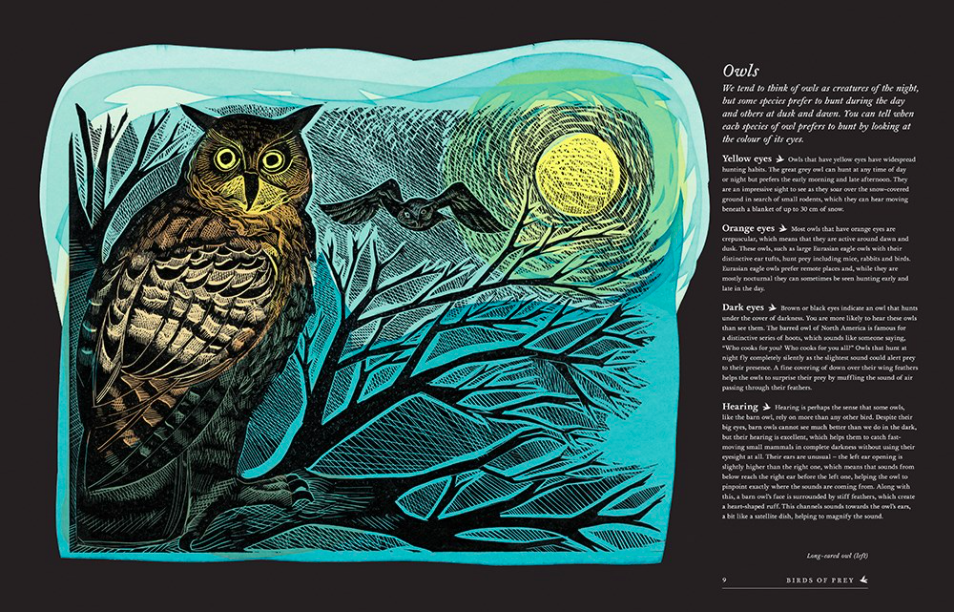
Each chapter opens with general facts on the behavior, anatomical features, and habitat that determine the order in which a bird is categorized. Integrated with this information are descriptions of specific birds within the order. In the section on Birds of Prey, for instance, readers learn about sparrowhawks; fish-eating ospreys; and golden eagles, which can “spot a rodent from over a mile away and a rabbit from nearly double that distance.” Children also learn about extreme birds of prey: the fastest, largest, smallest, tallest, and baldest and how their distinctive feature helps them thrive. Kids also discover how they “can tell when each species of owl prefers to hunt by looking at the color of its eyes.”

celebrate-picture-books-picture-book-review-birds-explore-their-extraordinary-world-owls

Image copyright Angela Harding, 2020, text copyright Miranda Krestovnikoff, 2020. Courtesy of Calkins Creek.

The next chapter takes readers to coastal areas to learn about the seabirds that scour the water from the sky, searching for food and waders, that are found along the water’s edge and “feed on the variety of high-protein invertebrates that lie hidden in the mud.” Children learn about the birds that populate warmer waters, such as blue-footed boobies, terns, and frigatebirds as well as those who survive in colder waters, such as gulls, and kittiwakes. Readers will also find a fascinating description of the gannet and learn how it can safely “dive into the sea at speeds of 60 miles an hour from an impressive height of up to 100 feet” to feed.

From sea birds, readers move on to freshwater birds like ducks, swans, grebes, and Canada geese. Even the bright flamingo is here with its distinctive scoop-shaped beak that is “uniquely designed to be used upside down and helps them to filter out tiny brine shrimps and blue-green algae from the water, which, when digested, give them their pink color.” The flamingo isn’t the only bird with an unusual way to acquire their prey, and kids will discover the clever ways pelicans, herons, and kingfishers (which use “objects such as sticks, feathers, and even discarded popcorn as lures”) find food.

And then there are the “more than 50 bird species across the world [that] stay firmly on the ground (or on water)” or just “choose not to fly very often.” These flightless birds include kiwis, kākāpōs, southern cassowaries, ostriches, and Penguins. Penguins vary in size, from the “little penguin (also known as the fairy or blue penguin)” which comes to shore to nest only at night and stave off predators with their oversized voices, to the emperor penguin. Occasional fliers include great bustards, domestic chickens, and tinamous.

celebrate-picture-books-picture-book-review-birds-explore-their-extraordinary-world-penguin

Image copyright Angela Harding, 2020, text copyright Miranda Krestovnikoff, 2020. Courtesy of Calkins Creek.

When you hear about extravagant birds, you most likely think of tropical birds. “Rainforests are packed with a range of incredible species with dazzling plumage and bizarre courtship displays.” Readers will learn about the appearance and mating rituals of scarlet macaws, Raggiana birds of paradise, and the Andean cock-of-the-rock. A detailed description of the bowerbird and the male bird’s careful and artistic nest (or bower) building is funny, poignant, and even a little bit human. Then readers are treated to some tropical bird extremes: smallest bird, longest bill, and smelliest as well as a poisonous species and one that makes its own musical instrument.

Of course, woodlands are the home of many bird species, and in the chapter on Tree Dwellers, readers learn about acorn woodpeckers and great hornbills that use trees for food and shelter; tawny frogmouths and potoos that use trees for camouflage; and nuthatches, greater honeyguides, and yellow-bellied sapsuckers, which find all the food they need among the bark, leaves, and branches of trees.

celebrate-picture-books-picture-book-review-birds-explore-their-extraordinary-world-chickens

Image copyright Angela Harding, 2020, text copyright Miranda Krestovnikoff, 2020. Courtesy of Calkins Creek.

Next up are passerines, or perching birds, which make up the “largest group of birds, with over half of all known species falling into this category.” Corvids, a group that includes the common raven, crows, magpies, and rooks, are considered to be the most intelligent birds. “These birds have a remarkable ability to solve problems in order to find food, in some cases performing better than young children or chimpanzees!” Readers will be impressed with their tricks and clever use of tools (that even include cars). Children learn about cooperative breeders, which rely on their extended family to help raise the young from year to year. Passerines also include many of the garden birds we find in our backyards and which fill the air with song. Readers discover facts about blue tits, robins, and finches in this section.

The next sections give detailed and interesting information on the features we most associate with birds: their feathers, beaks, eyes, nesting habits, eggs, migration patterns, and birdsong. The book ends with perhaps the most adaptable birds in the world: those that make their homes on glaciers, mountain tops, and in the Arctic snow as well as urban birds, which live among people in crowded cities, nesting on tall cathedrals and skyscrapers and foraging for food in garbage cans and on the street.

celebrate-picture-books-picture-book-review-birds-explore-their-extraordinary-world-woodpeckers

Image copyright Angela Harding, 2020, text copyright Miranda Krestovnikoff, 2020. Courtesy of Calkins Creek.

For young ornithologists, Miranda Krestovnikoff, a wildlife expert, offers a compelling, eye-opening, and accessible introduction to a wide variety of birds, placing them in their natural environments and revealing intriguing facts and tantalizing tidbits that inform and will spark a continued interest in learning more about the world’s feathered creatures. Krestovnikoff’s engaging writing style will captivate readers and keep them turning the pages to discover birds that are both familiar and new to them. The comprehensive nature of the book allows kids in all parts of the world to learn more about their native birds while creating a global connection with these most recognized and widely distributed creatures.

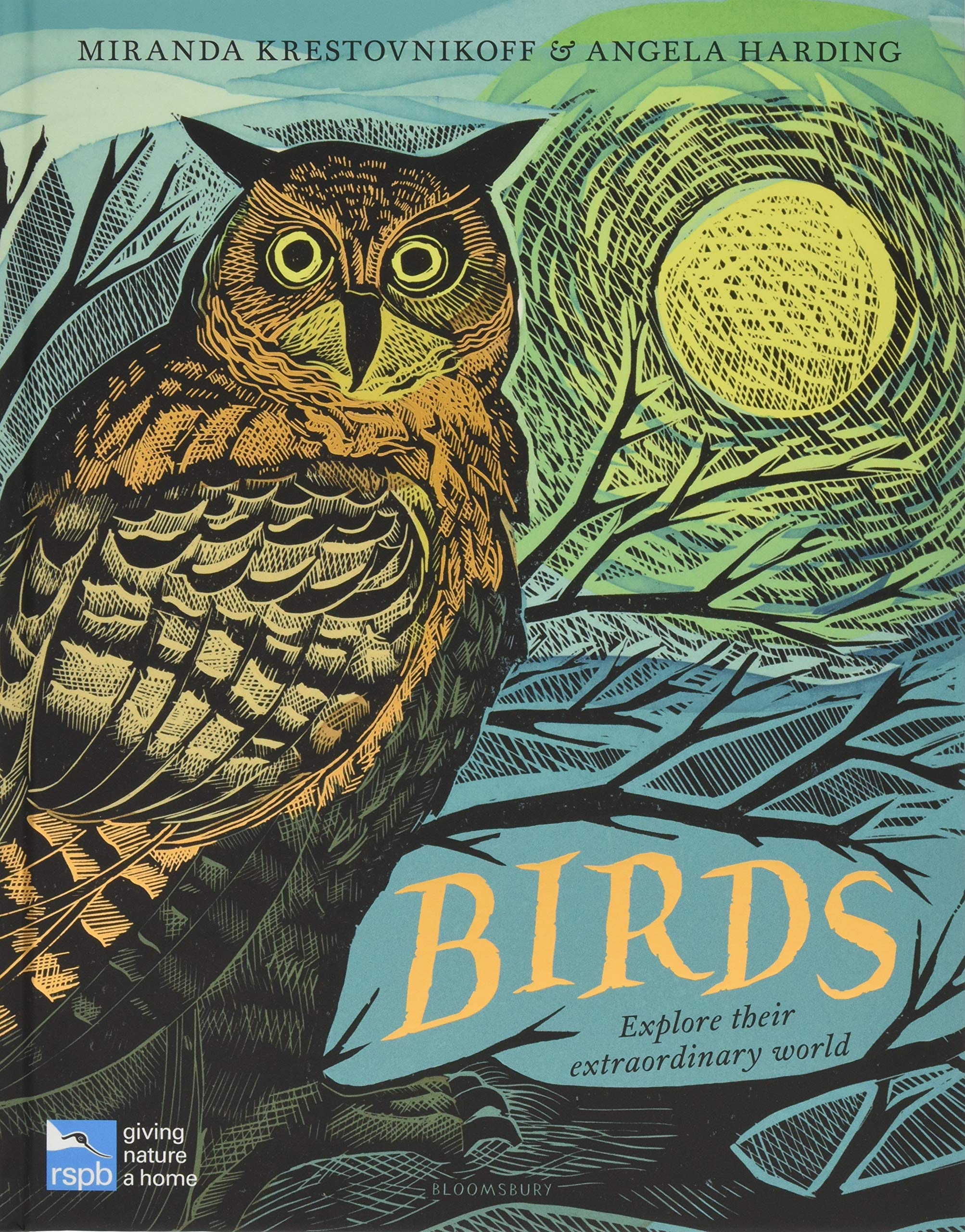
Accompanying Krestovnikoff’s text are Angela Harding’s beautiful linocuts that depict birds in mid-flight, capturing prey on land and water, engaging in mating rituals, and building and protecting their nests and young. Harding’s use of natural colors and exquisitely etched landscapes set off each bird in breathtaking illustrations that invite readers to linger to enjoy their full impact. Each illustration is captioned with the bird’s species.

A gorgeous and educational book that readers of all ages will love dipping into again and again, Birds: Explore their extraordinary world is a must for bird lovers and highly recommended for home, school, and public libraries.

Ages 7 and up

Bloomsbury Children’s Books, 2020 | ISBN 78-1408893913

Discover more about Miranda Krestovnikoff and her books on her website.

To learn more about Angela Harding, her books, and her art on her website.

National Bird Day Activities

celebrate-picture-books-picture-book-review-beautiful-birds-word-search

Beautiful Birds Word Search Puzzle


It’s fun to watch for different kinds of birds when you take a walk or in your own backyard. Can you find the names of twenty types of birds in this printable Beautiful Birds Word Search Puzzle? Here’s the Solution!

cpb-bird-feeder-i

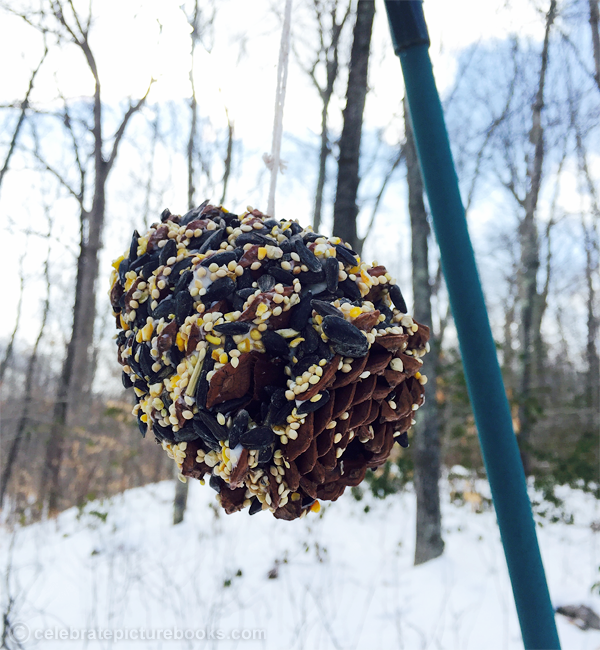
Pinecone Bird Feeder


Pinecone bird feeders are quick to make and great for your backyard fliers. The combination of peanut butter, lard, or vegetable shortening and a quality seed mixture provide birds with the fat and nutrition they need to stay warm and healthy during the winter.

Supplies

  • Pinecones
  • Peanut butter, vegetable shortening, or lard
  • Birdseed
  • String
  • Knife or wooden spreader
  • Spoon

Directions

  1. Tie a long length of string around the middle of the pinecone
  2. Spread the peanut butter, vegetable shortening, or lard on the pinecone
  3. Sprinkle a thick coating of birdseed on the pinecone, pressing it into the covering so it will stick
  4. Tie the pinecone feeder onto a tree branch or other structure
  5. Watch the birds enjoy their meal!

celebrate-picture-books-picture-book-review-birds-explore-their-extraordinary-world-cover

You can find Birds: Explore their extraordinary world at these booksellers

Amazon | Barnes & Noble | Books-a-Million

To support your local independent bookstore, order from

Bookshop | IndieBound

Picture Book Review

December 28 – Endangered Species Act Day

celebrate-picture-books-picture-book-review-a-voice-for-the-everglades-cover

About the Holiday

The Endangered Species Act was signed into law in by President Richard Nixon on this date in 1973.  The primary law in the United States for protecting imperiled species, the Act protects critically imperiled species from extinction as a result of the consequences of economic growth and development undeterred by concern for conservation. The US Supreme Court called it “the most comprehensive legislation for the preservation of endangered species enacted by any nation”. The purposes of the Endangered Species Act are to prevent extinction and to recover species to the point where the law’s protections are not needed, therefore protecting diverse species as well as the ecosystems in which they live or depend on. Today’s book reveals the story of a National Park that provides a unique refuge for many rare and endangered species. To celebrate the holiday, learn more about how the Endangered Species Act affects your state.

Thanks go to Albert Whitman & Company for sharing a copy of A Voice for the Everglades: Marjory Stoneman Douglas with me for review consideration. All opinions on the book are my own.

A Voice for the Everglades: Marjory Stoneman Douglas (Part of the She Made History Series)

Written by Vicki Conrad | Illustrated by Ibon Adarne and Rachel Yew


“Long ago a trickle of water / spilled from a lake / and formed a tiny stream.” The stream spread until it covered almost half of the state of Florida, creating a shallow lake that moved like a slowly running river – “a river bursting with wildlife, / whispering to the world / to listen, to notice, to discover its wonders.” Mangroves and cypress trees grow from the water, the soil fed by the cycles of growing and dying sawgrass. The water, trees, and grass attract a “rainbow of birds” that wade in the shallows, hunting for food. “These are the Everglades. / The wildest, richest, and most diverse ecosystem in all the world – / every plant and animal needing another to survive.”

celebrate-picture-books-picture-book-review-a-voice-for-the-everglades-stream

Image copyright Ibon Adarne and Rachel Yew, 2021, text copyright Vicki Conrad. Courtesy of Albert Whitman & Company.

But leaders and developers wanted to drain the water to create land to build on, land they could sell, land with which they could make money. They pumped the water out and built dams and drains to make farmland, but the farmland turned dry and burned easily. The animals and birds fled. The ecosystem was “desperate for a voice to protect them.”

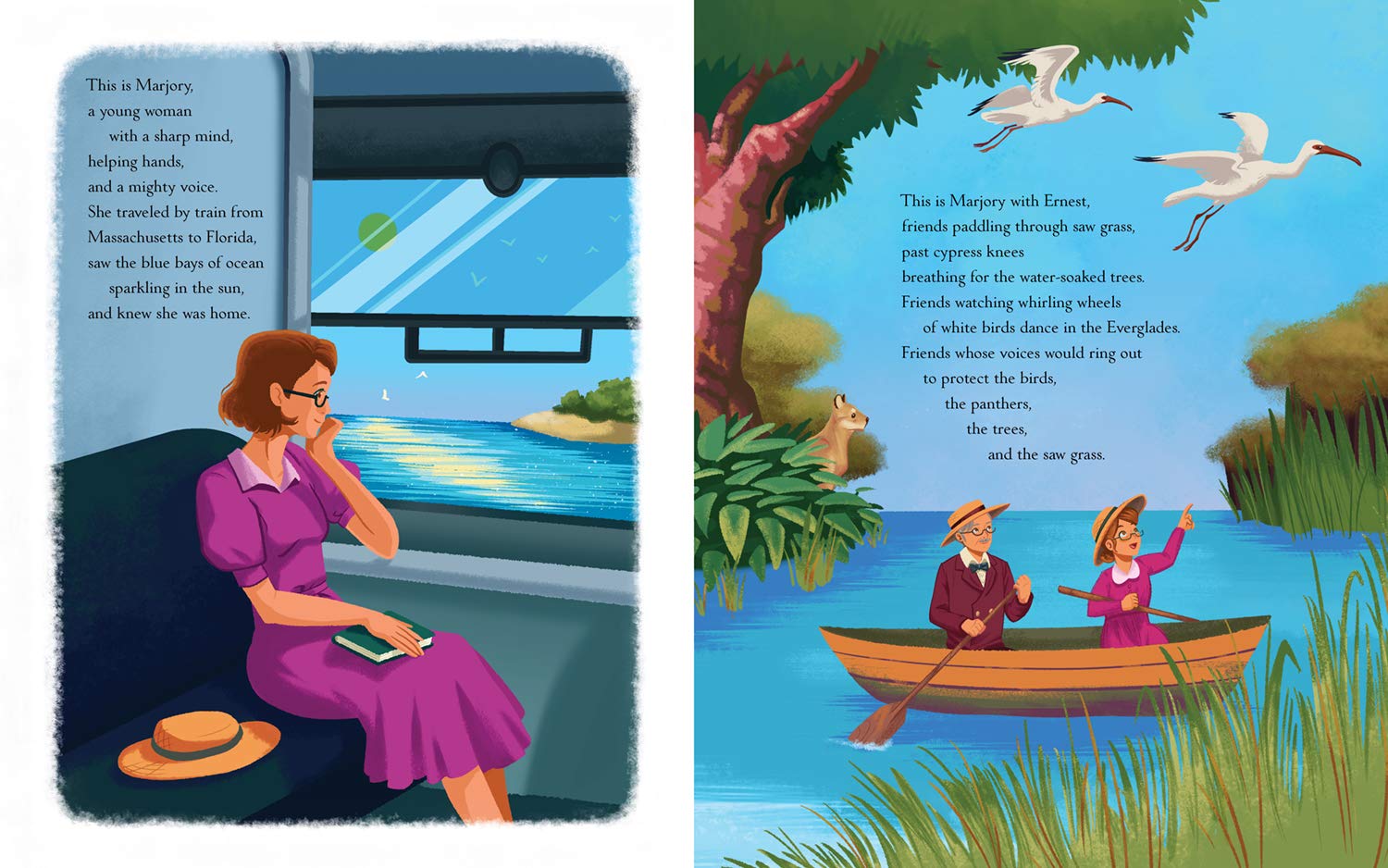
When Marjory traveled from Massachusetts to Florida and saw the beautiful scenery, she knew immediately that this was her new home. She made a friend, Ernest, and together they spent time paddling a boat through the Everglades, “watching whirling wheels of white birds dance” and spying panthers, alligators, turtles, manatees, and more of the animals that lived there. Where other people saw a swamp, Marjory and Ernest saw “treasure.”

Marjory and Ernest wanted to do something to preserve the Everglades. They studied the map and the formation of the Everglades. Marjory called it “a river of grass.” Ernest wrote a bill for the United States Congress to consider, and “Marjory wrote a poem, / hopeful it would move Congress.” Although lawmakers did tour the Everglades and see its miraculous sights, the bill did not pass.

celebrate-picture-books-picture-book-review-a-voice-for-the-everglades-train

Image copyright Ibon Adarne and Rachel Yew, 2021, text copyright Vicki Conrad. Courtesy of Albert Whitman & Company.

Marjory decided to write a book about the area she loved, and in 1947 The Everglades: River of Grass was published. Her book helped people see the marvels that lived within the Everglades: “the manatee munching seagrass / protecting her calf from harm”; “the red-bellied turtle, / laying eggs in the abandoned alligator nest, / dry and protected from water.”; the only place in the world where an alligator and a crocodile live together.”

At last people began to take notice – and care. Their voices joined with Marjory’s and Ernest’s and Everglades National Park was established that same year. “Yet only one-fourth of the Everglades was protected.” Marjory understood that “all the ecosystems needed one another.” When plans to build the world’s largest airport on land that was part of the Everglades, Marjory, now eighty years old, established the Friends of the Everglades, and their three-thousand voices convinced President Richard Nixon to stop the building.

Marjory continued to fight for the Everglades, giving speeches and putting hecklers in their place. When she was ninety-nine years old, Marjory could be found chipping away at a concrete drain to restore the land to its former waterway. At 105 years old, Marjory was awarded the Presidential Medal of Freedom. Adults and children sent her letters thanking her for saving the Everglades, but Marjory knew there would always be more work to be done to protect this unique ecosystem.

Back matter includes an extensive, illustrated discussion of the Everglades ecosystem, the nine different habitats that make it such a unique area, and many of the plants, animals, birds, and fish that call it home. More on the life of Marjory Stoneman Douglas and her legacy as well as how readers can help the Everglades are also included.

celebrate-picture-books-picture-book-review-a-voice-for-the-everglades-national-park

Image copyright Ibon Adarne and Rachel Yew, 2021, text copyright Vicki Conrad. Courtesy of Albert Whitman & Company.

A compelling biography of a woman with vision and grit who took on a nearly impossible task and saved one of the world’s unique environmental treasures, A Voice for the Everglades: Marjory Stoneman Douglas will inspire young environmentalists and would serve as a captivating resource to begin studies about ecosystems, conservation, endangered and rare species, and many other topics revolving around nature science. Marjory Stoneman Douglas, whose perseverance, dedication, and voice still resonate today, continues to be a role model for children and adults alike.

Through Vicki Conrad’s lyrical text and light incorporation of a “This is the House that Jack Built” cadence readers see how people’s actions build on and affect each other – whether detrimentally (as the building plans; pumps, dams, and drains; and disappearing wildlife do) or beneficially (as Marjory’s and Ernest’s appeals to Congress, Marjory’s writings, and her continued advocacy do) and understand that once voice can make a difference. Conrad does an excellent job of portraying the beauty and uniqueness of the Everglades and giving kids a view of the many wonders to be found there.

In their vivid illustrations, Ibon Adarne and Rachel Yew depict the rich colors of the diverse flora and fauna found in the nine cohesive habitats, from the vibrant pink roseate spoonbills to the purple passion flowers to the elusive crocodiles and the breathtaking, fiery sunsets that blanket them all. Adarne and Yew also allow children to navigate the meandering waterways that weave through the mangroves and sawgrass in their slow, steady, and life-giving pace. The breadth of wildlife within the pages offer many opportunities for further learning and research at home and at school.
An enticing and educational look at one of the world’s most valued natural treasures – whose story and resources continues to influence nature studies and advocacy today – A Voice for the Everglades: Marjory Stoneman Douglas is a book that every school and public library will want to add to its collection and would be an inspiring inclusion for home bookshelves for nature lovers and homeschoolers.

Ages 4 – 8

Albert Whitman & Company, 2021 | ISBN 978-0807584965

Discover more about Vicki Conrad and her books on her website.

You can connect with Ibon Adarne on Twitter.

You can connect with Rachel Yew on Twitter.

Endangered Species Act Day Activity

celebrate-picture-books-picture-book-review-everglades-national-park-coloring-page

Everglades National Park Coloring Page


Travel to the Everglades and see the diverse wildlife that lives there with this printable coloring page!

Everglades National Park Coloring Page 

celebrate-picture-books-picture-book-review-a-voice-for-the-everglades-cover

You can find A Voice for the Everglades: Marjory Stoneman Douglas at these booksellers

Amazon | Barnes & Noble | Books-a-Million

To support our local independent bookstore, order from 

Bookshop | IndieBound

Picture Book Review