September 29 – Read a New Book Month

Even though we’re saying goodbye to Read a New Book Month, families don’t have to stop seeking out new books at their local bookstore or library. In fact, fall, with its lead-in to the holidays is one of the busiest times of the year for publishers as they release wonderful books that share traditions and take readers through the winter in thoughtful, funny, and always surprising ways. Maybe that’s why December is also often recognized as Read a New Book Month! Really, there’s never a time when you don’t want to celebrate new books—like today’s!

Thank you to Greystone Books for sending me this book for review!

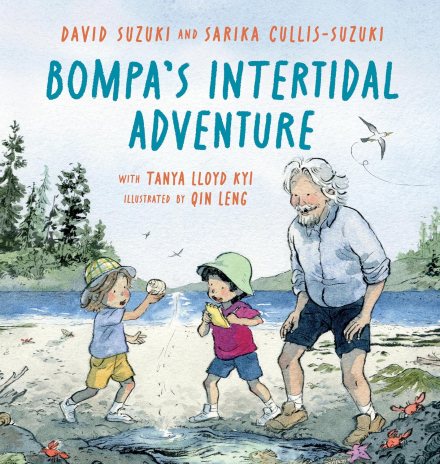
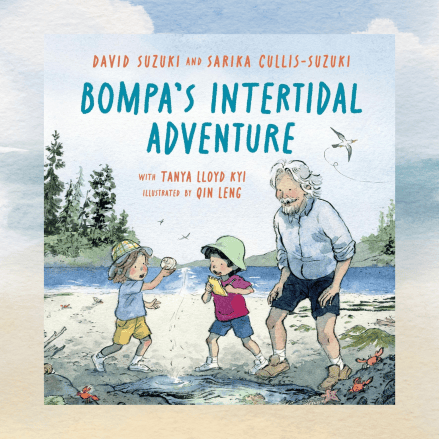
Bompa’s Intertidal Adventure (Nature Adventures with Bompa 2)

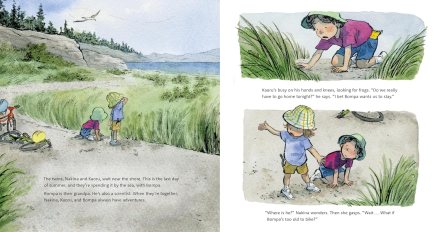
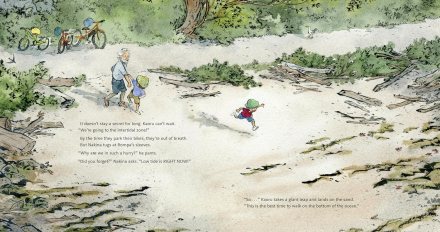
On the last day of summer, twins Nakina and Kaoru wait on the beach for Bompa, their grandfather, and one of his adventures. As soon as Bompa rides up on his new e-bike, Kaoru takes the lead to the intertidal zone, where low tide promises to reveal the secrets on “the bottom of the ocean.” He’s hoping to find some interesting animals to study with their scientist grandpa and extend summer, if only for just a bit. Kaoru and Nakina don’t have to wait long. Bompa is looking at a snail shell that suddenly “scuttles away.” The children hurry over to watch the hermit crab as Bompa explains about adaptations. The twins imagine themselves as hermit crabs, camping out or even carrying “fancy research labs inside [their] shells.”
Text copyright © 2026 by David Suzuki and Sarika Cullis-Suzuki with Tanya Lloyd Kyi. Illustration copyright © 2026 by Qin Leng. Published by Greystone Books copyright © 2026.

Soon they come to a tidal pool where they find limpets and sculpins and a very loud plainfin midshipman under a rock, protecting its eggs. They discover different types of seaweed, and Bompa explains how seaweeds have adapted to stay rooted to the ocean floor so they aren’t swept away by the current. Bompa talks about how many of the creatures in the intertidal zone must adapt to the cyclical wet and dry conditions. Nakina wishes they could breath underwater to “explore a kelp forest.”
Text copyright © 2026 by David Suzuki and Sarika Cullis-Suzuki with Tanya Lloyd Kyi. Illustration copyright © 2026 by Qin Leng. Published by Greystone Books copyright © 2026.

When Kaoru finds a discarded bottle in a tide pool, Bompa grows sad, thinking of what an amazing place the intertidal zone is. Nakina takes his hand and asks why. Bompa explains how “humans are changing the climate, and . . . putting more and more buildings along the shoreline and . . . polluting the oceans. Nakina worries that the animals won’t be able to adapt fast enough to the changes, and says, “‘We all need to learn how important [the intertidal zone] is.”
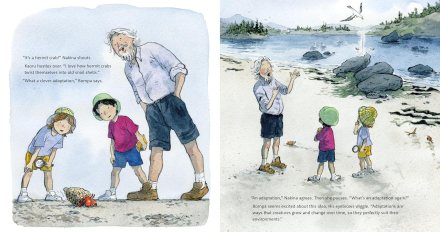
Text copyright © 2026 by David Suzuki and Sarika Cullis-Suzuki with Tanya Lloyd Kyi. Illustration copyright © 2026 by Qin Leng. Published by Greystone Books copyright © 2026.

Listening, while watching “tiny crabs scuttle back and forth,” Kaoru adds that maybe it is people who “need to adapt.” He suggests that when they get back to school, he and Nakina can talk to their friends about the intertidal zone and join the school’s annual shoreline cleanup. The two children imagine all the ways they can help as they grow older. They can’t wait to get back home to share with their classmates everything they’ve seen and that Bompa has taught them.

Back matter includes a list of ways people can protect the intertidal zone, a Shoreline Search and Find puzzle using illustrations from the story, Intertidal Facts, and a close-up look and fact about some creatures in the story.
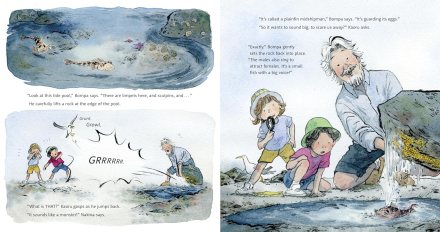
Text copyright © 2026 by David Suzuki and Sarika Cullis-Suzuki with Tanya Lloyd Kyi. Illustration copyright © 2026 by Qin Leng. Published by Greystone Books copyright © 2026.

David Suzuki, Sarika Cullis-Suzuki, and Tanya Lloyd Kyi’s story reveals the wonder of intertidal zones, which are home to intriguing creatures who have adapted to take advantage of the best of their sometimes wet, sometimes dry home. As Kaoru and Nakina marvel over what they find, readers will share their excitement and interest. Bompa’s clear explanations of certain animals’ adaptations and behaviors will spur children at home and in the classroom to learn more about this special ocean zone and how they can protect it.

Qin Leng’s tranquil ink and watercolor illustrations beautifully covey the features of the intertidal zone along the edge of the ocean’s reach. Scattered driftwood, sea birds, crabs, shells, seaweed, and hidden creatures create a lovely true-to-life landscape for the children’s and Bompa’s explorations. As if peering into a mysterious treasure box, readers will be fascinated to discover what lies within the shallow tidal pools, under rocks, and hiding in crevices. Playful scenes at the beach as well as images of Kaoru and Nakina growing into advocates for ocean conservation give children an idea of how people can use all types of talents to help protect these vulnerable natural areas.

Bompa’s Intertidal Adventure is a gentle story with a profound impact, reminding readers of all ages of the uniqueness and importance of intertidal zones and the role they can play in preserving them. The book can spark lessons or projects for families, classrooms, and child-focused organizations and is a must for public and school libraries.

Ages 4 – 8

Greystone Kids, 2026 | ISBN 978-1778402531

About the Authors

David Suzuki is an internationally renowned scientist and environmentalist who has made it his life’s work to help humanity understand, appreciate, respect, and protect nature. He is the co-founder of the David Suzuki Foundation and the author of more than fifty books. He lives in Vancouver, BC, and is a father of five and grandfather to ten, including twins Nakina and Kaoru. Connect with him and the David Suzuki Foundation at davidsuzuki.org.

Sarika Cullis-Suzuki is co-host of The Nature of Things on CBC. Her life’s work is dedicated to science, communication, and oceans. Her research in marine biology has taken her from the high seas, to remote tropical islands, to the coastal intertidal zones of British Columbia for her PhD, where she studied the singing fish, the plainfin midshipman. Visit her at sarikacullissuzuki.com.

Tanya Lloyd Kyi is the award-winning author of more than thirty books for children and young adults. Tanya lives in Vancouver, BC, where she teaches for the University of British Columbia’s School of Creative Writing. Visit her at tanyalloydkyi.com.

About the Illustrator

Qin Leng is a visual development artist and an illustrator and author of children’s books. Throughout her career, she has illustrated picture books, magazines, and book covers with publishers around the world. She lives in Toronto with her husband and her son. You can visit her at qinillustrations.com.
You can purchase Bompa’s Intertidal Adventure from these booksellers

Amazon | Barnes & Noble | Bookshop

December 28 – Endangered Species Act Day

celebrate-picture-books-picture-book-review-a-voice-for-the-everglades-cover

About the Holiday

The Endangered Species Act was signed into law in by President Richard Nixon on this date in 1973.  The primary law in the United States for protecting imperiled species, the Act protects critically imperiled species from extinction as a result of the consequences of economic growth and development undeterred by concern for conservation. The US Supreme Court called it “the most comprehensive legislation for the preservation of endangered species enacted by any nation”. The purposes of the Endangered Species Act are to prevent extinction and to recover species to the point where the law’s protections are not needed, therefore protecting diverse species as well as the ecosystems in which they live or depend on. Today’s book reveals the story of a National Park that provides a unique refuge for many rare and endangered species. To celebrate the holiday, learn more about how the Endangered Species Act affects your state.

Thanks go to Albert Whitman & Company for sharing a copy of A Voice for the Everglades: Marjory Stoneman Douglas with me for review consideration. All opinions on the book are my own.

A Voice for the Everglades: Marjory Stoneman Douglas (Part of the She Made History Series)

Written by Vicki Conrad | Illustrated by Ibon Adarne and Rachel Yew


“Long ago a trickle of water / spilled from a lake / and formed a tiny stream.” The stream spread until it covered almost half of the state of Florida, creating a shallow lake that moved like a slowly running river – “a river bursting with wildlife, / whispering to the world / to listen, to notice, to discover its wonders.” Mangroves and cypress trees grow from the water, the soil fed by the cycles of growing and dying sawgrass. The water, trees, and grass attract a “rainbow of birds” that wade in the shallows, hunting for food. “These are the Everglades. / The wildest, richest, and most diverse ecosystem in all the world – / every plant and animal needing another to survive.”

celebrate-picture-books-picture-book-review-a-voice-for-the-everglades-stream

Image copyright Ibon Adarne and Rachel Yew, 2021, text copyright Vicki Conrad. Courtesy of Albert Whitman & Company.

But leaders and developers wanted to drain the water to create land to build on, land they could sell, land with which they could make money. They pumped the water out and built dams and drains to make farmland, but the farmland turned dry and burned easily. The animals and birds fled. The ecosystem was “desperate for a voice to protect them.”

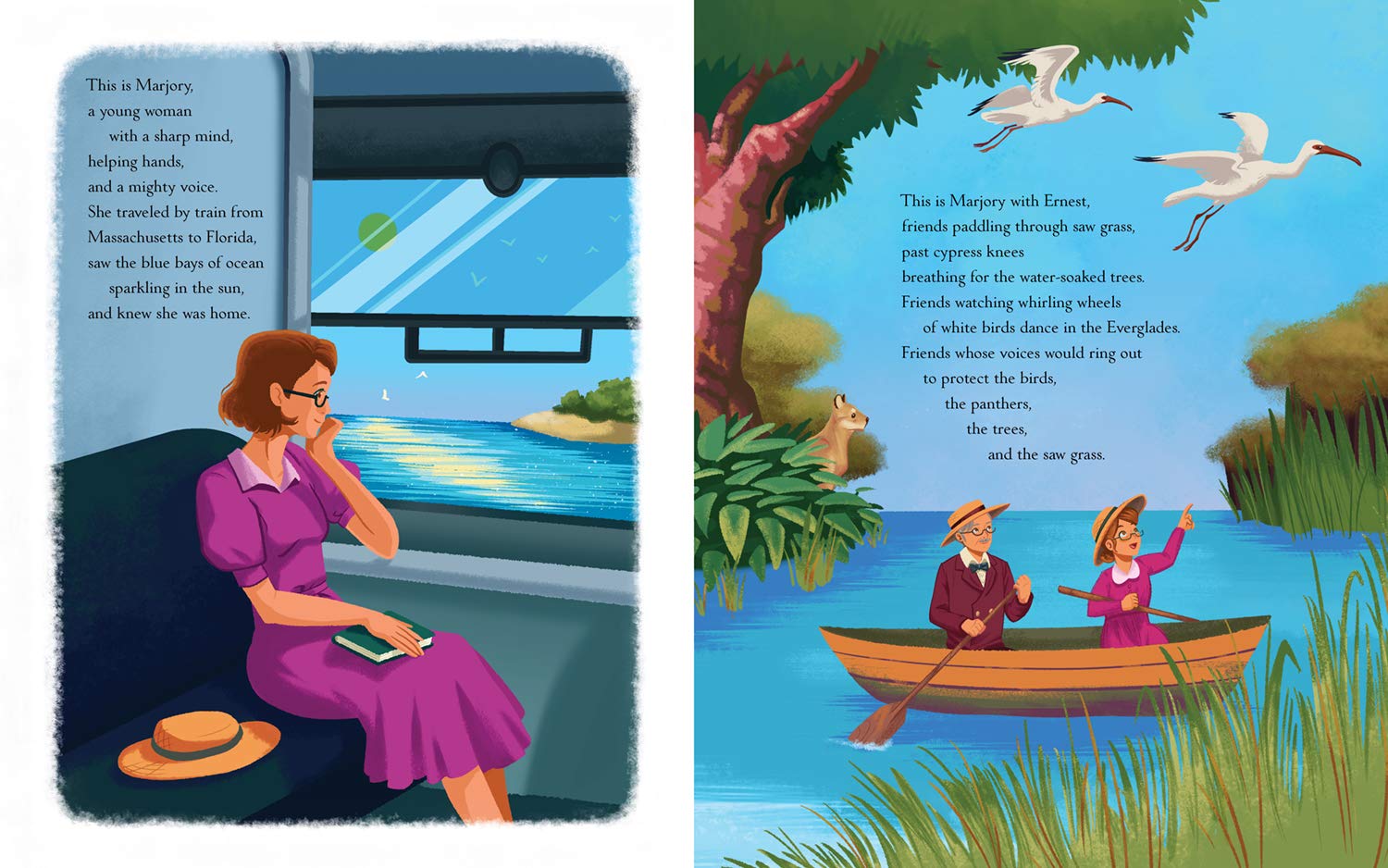
When Marjory traveled from Massachusetts to Florida and saw the beautiful scenery, she knew immediately that this was her new home. She made a friend, Ernest, and together they spent time paddling a boat through the Everglades, “watching whirling wheels of white birds dance” and spying panthers, alligators, turtles, manatees, and more of the animals that lived there. Where other people saw a swamp, Marjory and Ernest saw “treasure.”

Marjory and Ernest wanted to do something to preserve the Everglades. They studied the map and the formation of the Everglades. Marjory called it “a river of grass.” Ernest wrote a bill for the United States Congress to consider, and “Marjory wrote a poem, / hopeful it would move Congress.” Although lawmakers did tour the Everglades and see its miraculous sights, the bill did not pass.

celebrate-picture-books-picture-book-review-a-voice-for-the-everglades-train

Image copyright Ibon Adarne and Rachel Yew, 2021, text copyright Vicki Conrad. Courtesy of Albert Whitman & Company.

Marjory decided to write a book about the area she loved, and in 1947 The Everglades: River of Grass was published. Her book helped people see the marvels that lived within the Everglades: “the manatee munching seagrass / protecting her calf from harm”; “the red-bellied turtle, / laying eggs in the abandoned alligator nest, / dry and protected from water.”; the only place in the world where an alligator and a crocodile live together.”

At last people began to take notice – and care. Their voices joined with Marjory’s and Ernest’s and Everglades National Park was established that same year. “Yet only one-fourth of the Everglades was protected.” Marjory understood that “all the ecosystems needed one another.” When plans to build the world’s largest airport on land that was part of the Everglades, Marjory, now eighty years old, established the Friends of the Everglades, and their three-thousand voices convinced President Richard Nixon to stop the building.

Marjory continued to fight for the Everglades, giving speeches and putting hecklers in their place. When she was ninety-nine years old, Marjory could be found chipping away at a concrete drain to restore the land to its former waterway. At 105 years old, Marjory was awarded the Presidential Medal of Freedom. Adults and children sent her letters thanking her for saving the Everglades, but Marjory knew there would always be more work to be done to protect this unique ecosystem.

Back matter includes an extensive, illustrated discussion of the Everglades ecosystem, the nine different habitats that make it such a unique area, and many of the plants, animals, birds, and fish that call it home. More on the life of Marjory Stoneman Douglas and her legacy as well as how readers can help the Everglades are also included.

celebrate-picture-books-picture-book-review-a-voice-for-the-everglades-national-park

Image copyright Ibon Adarne and Rachel Yew, 2021, text copyright Vicki Conrad. Courtesy of Albert Whitman & Company.

A compelling biography of a woman with vision and grit who took on a nearly impossible task and saved one of the world’s unique environmental treasures, A Voice for the Everglades: Marjory Stoneman Douglas will inspire young environmentalists and would serve as a captivating resource to begin studies about ecosystems, conservation, endangered and rare species, and many other topics revolving around nature science. Marjory Stoneman Douglas, whose perseverance, dedication, and voice still resonate today, continues to be a role model for children and adults alike.

Through Vicki Conrad’s lyrical text and light incorporation of a “This is the House that Jack Built” cadence readers see how people’s actions build on and affect each other – whether detrimentally (as the building plans; pumps, dams, and drains; and disappearing wildlife do) or beneficially (as Marjory’s and Ernest’s appeals to Congress, Marjory’s writings, and her continued advocacy do) and understand that once voice can make a difference. Conrad does an excellent job of portraying the beauty and uniqueness of the Everglades and giving kids a view of the many wonders to be found there.

In their vivid illustrations, Ibon Adarne and Rachel Yew depict the rich colors of the diverse flora and fauna found in the nine cohesive habitats, from the vibrant pink roseate spoonbills to the purple passion flowers to the elusive crocodiles and the breathtaking, fiery sunsets that blanket them all. Adarne and Yew also allow children to navigate the meandering waterways that weave through the mangroves and sawgrass in their slow, steady, and life-giving pace. The breadth of wildlife within the pages offer many opportunities for further learning and research at home and at school.

An enticing and educational look at one of the world’s most valued natural treasures – whose story and resources continues to influence nature studies and advocacy today – A Voice for the Everglades: Marjory Stoneman Douglas is a book that every school and public library will want to add to its collection and would be an inspiring inclusion for home bookshelves for nature lovers and homeschoolers.

Ages 4 – 8

Albert Whitman & Company, 2021 | ISBN 978-0807584965

Discover more about Vicki Conrad and her books on her website.

You can connect with Ibon Adarne on Twitter.

You can connect with Rachel Yew on Twitter.

Endangered Species Act Day Activity

celebrate-picture-books-picture-book-review-everglades-national-park-coloring-page

Everglades National Park Coloring Page


Travel to the Everglades and see the diverse wildlife that lives there with this printable coloring page!

Everglades National Park Coloring Page 

celebrate-picture-books-picture-book-review-a-voice-for-the-everglades-cover

You can find A Voice for the Everglades: Marjory Stoneman Douglas at these booksellers

Amazon | Barnes & Noble | Books-a-Million

To support our local independent bookstore, order from 

Bookshop | IndieBound

Picture Book Review