February 8 – Kite Flying Day

celebrate-picture-books-picture-book-review-red-kite-blue-kite-cover

About the Holiday

If you live in a cold climate and cabin fever has set in or if you live in a warm climate and want to get out and enjoy the day, why not take the opportunity of today’s holiday and go fly a kite? Whether you’re steering a simple diamond or a fancy dragon, watching a kite dip and soar through the sky is an exhilarating experience!

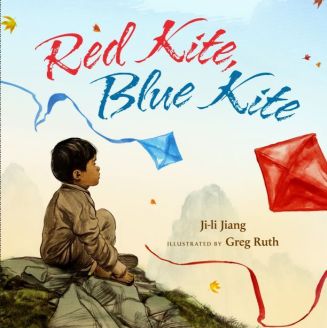
Red Kite, Blue Kite

Written by Ji-li Jiang | Illustrated by Greg Ruth


“I love to fly kites,” young Tai Shan relates, but not he’s while standing on the ground. Instead, because his city is so crowded, his Baba and he climb to the peak of their triangular roof where they are “above but still under, neither here nor there. We are free, like the kites.” While they fly their kites—red for Tai Shan and blue for Baba—Baba tells stories, and Tai Shan feels as if he is soaring through the clouds, “looking down at the dotted houses” and wanting to stay up there forever.

celebrate-picture-books-picture-book-review-red-kite-blue-kite-Tai-Shan-and-Baba-fly-kites

copyright Greg Ruth, courtesy of Disney-Hyperion

But one day dark times descend. Tai Shan’s school and many others are shuttered. Baba is taken away by men in red arm bands and sent to work in a labor camp. Tai Shan is sent to live with Granny Wang, a farmer who lives in a village next to the labor camp. A thick forest separates Tai Shan and Baba. During the day Granny Wang teaches Tai Shan how to make straw grasshoppers and spin cotton and lets him ride her buffalo. At night Tai Shan dreams of flying kites from the rooftop with his father.

On Sundays Baba walks for hours to visit Tai Shan. He spends time telling stories and playing with his son and his friends. Then they climb the hill and fly kites, Tai Shan’s red one following Baba’s blue. “The kites hop and giggle as they rise and dive, soaring and lunging together.” At the end of the day, Baba returns to the labor camp for another week. In the autumn Baba tells Tai Shan that he won’t be able to visit for a long time. But he has a clever plan—a way that he and Tai Shan can see each other.

Baba gives his son a new red kite and tells him to fly it from the hill each morning. He will see it from his camp. In the evening Baba will fly his blue kite so that Tai Shan can see it. Tai Shan likes the idea of this “secret signal.” The next morning Tai Shan runs to the hill and launches his kite, knowing that “Baba is smiling as he watches the red kite dancing.” In the evening he returns to the hill, and after a long wait “Baba’s blue kite sways into the white clouds.”

celebrate-picture-books-picture-book-review-red-kite-blue-kite-Baba-taken

copyright Greg Ruth, courtesy of Disney-Hyperion

Every day Tai Shan sends his father a silent message—“‘How are you, Baba? I miss you.’” and “Baba’s blue kite swirls and circles, replying, ‘I miss you, too, little Tai Shan.’” Autumn is coming to a close, but still Baba does not visit. One day no blue kite appears in the sky. The next day and the next no kite appears either. Tai Shan asks Granny Wang to take him to the camp to see Baba. If there is no kite on the fourth day they will go, Granny Wang promises.

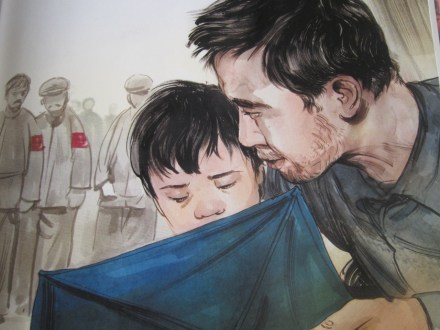
That night Tai Shan dreams about the thick forest and hears Baba whisper, “‘Tai Shan, I saw your red kite fly so high.’” But these words are not in a dream, Baba is there. But Baba is not home to stay. Hurriedly, he gives Tai Shan his blue kite, telling him that he will not be able to fly it for a while. He asks Tai Shan to fly both kites and know that he is looking up and thinking about his son. Suddenly, men with red armbands rush in and take Baba away. Tai Shan tries to run after him, but Granny Wang holds him back.

Tai Shan cries and does not understand. Granny Wang explains that Baba is being sent to another labor camp far away because the authorities don’t agree with his ideas. During the three days when he didn’t fly his blue kite, Granny Wang says, Baba had been imprisoned. He had escaped and run all the way to see Tai Shan before he was taken away. Now Tai Shan flies the two kites every day and thinks of being together with Baba.
celebrate-picture-books-picture-book-review-red-kite-blue-kite-Baba-gives-kite

copyright Greg Ruth, courtesy of Disney-Hyperion

One summer afternoon, Tai Shan dozes while he allows his red kite to dip and soar in the clouds. When he opens his eyes, he sees dozens of red and blue kites in the sky. Tai Shan jumps up. He sees Baba smiling at him and “holding the string of a huge blue kite dancing in the sky.” Tai Shan’s friends are also smiling and flying their new kites. Tai Shan runs to Baba, and Baba runs toward Tai Shan. The sky “is filled with kites—red and blue. They hop and giggle and cheer as they rise and dive, soaring and lunging together. They are free, flying everywhere.”

An Author’s Note about the Chinese Cultural Revolution follows the text.

Inspired by the story of a family friend whose father was sent to a labor camp during the Chinese Cultural Revolution between 1966 and 1976, Ji-li Jiang wrote Red Kite, Blue Kite “for the many fathers and sons who suffered during that turmoil.” Jiang’s story is a universal and relevant reminder of the precious freedoms of thought and speech that need constant and vigilant protection. Through her sensitive storytelling and lyrical language, Jiang offers a story of understanding, hope, and infinite love that will fill readers’ hearts.

Greg Ruth’s stunning paintings show all the emotion of Jiang’s story through exquisite, realistic portraits of Tai Shan, Baba, and Granny Wang. The distinctive landscapes of China are rendered in colorful foregrounds set on gauzy backgrounds of rising hills. Smoky images of the followers of the Cultural Revolution mirrors the darkness and destruction of the time in a way that is understandable for the young audience. The final two-page spread of Tai Shan and Baba’s reunion amid dozens of red and blue kites is inspiring and full of the strength of the human spirit.

Red Kite, Blue Kite is a must for school and public libraries and makes an excellent addition to home libraries as well.

Ages 5 – 9

Disney-Hyperion, 2013 | ISBN 978-1423127536

For a downloadable Educator’s Guide click here.

Learn more about Ji-li Jiang and her books on her website!

Find galleries of books and illustration for children and adults plus lots more on Greg Ruth’s website!

Kite Flying Day Activity
celebrate-picture-books-picture-book-review-kite-maze

Soaring Kite Maze


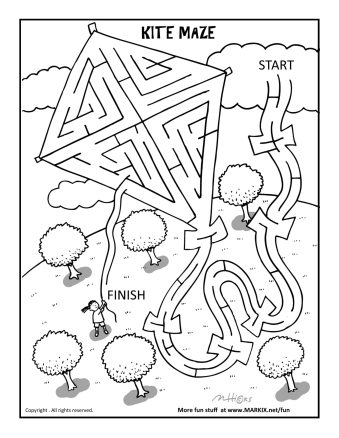
The dips and rises your pencil takes through this maze is a little like the way a kite flies through the sky! Print your Soaring Kite Maze and enjoy!

Picture Book Review

February 4 – Take Your Child to the Library Day

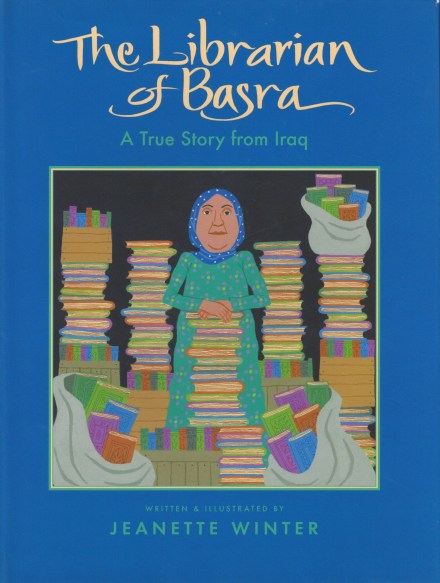
celebrate=picture-books-picture-book-review-the-librarian-of-basra-cover

About the Holiday

What better way to spend a Saturday than by stopping by your local library and picking up a few books to while away the hours on a cold winter day? While you’re there thank the librarians for all they do to keep libraries open and books accessible to all. Consider donating to your local library today!

The Librarian of Basra: A True Story from Iraq

By Jeanette Winter


Alia Muhammad Baker, oversees the library of Basra in Iraq, where all those who love books and learning come to “discuss matters of the world and matters of the spirit.” Now, though, their talk is full of the war around them. Alia is afraid for her books, worried that the fires of war will destroy them, so she petitions the government for permission to move them to a safe place. Her request is denied, so Alia secretly fills her car each night with as many books as it can carry and takes them home.

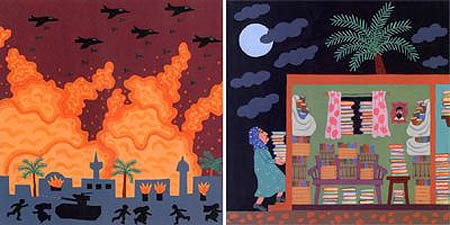
celebrate=picture-books-picture-book-review-the-librarian-of-basra-war

Image copyright Jeanette Winter, courtesy of post-gazette.com

As rumors of war continue to swirl, the library becomes a shelter for government offices. When the battles reach Basra, “the city is lit with a firestorm of bombs and gunfire.” The government officials, soldiers, and library workers abandon the library, leaving Alia alone to protect the books. She summons help from Anis Muhammad, the restaurant owner on the other side of the library wall, and together they remove the rest of the books in crates and sacks and wrapped in curtains. Other shopkeepers and neighbors join in, removing the books and hiding them in Anis’s restaurant.

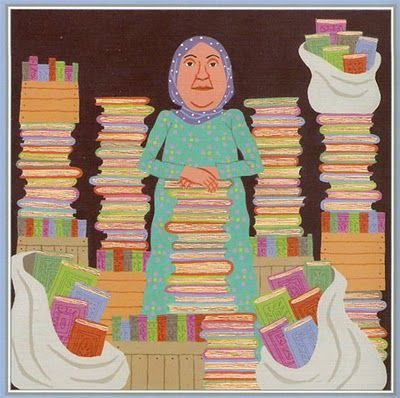
The war rages, but the books’ whereabouts remain a secret. “Then, nine days later, a fire burns the library to the ground.” “At last, the beast of war moves on,” but the books are still in danger. While the city is quiet, Alia “hires a truck to bring all thirty thousand books to her house and to the houses of friends.” Alia’s house is stacked floor to ceiling with the books she loves. They fill every cabinet, teeter on every shelf, and sit in piles under tables, chairs, and Alia’s bed. There’s hardly room for Alia herself.

But Alia is patient. She waits and “dreams of peace” and a time when a new library will be built to replace what has been lost.

celebrate=picture-books-picture-book-review-the-librarian-of-basra-alia

Image copyright Jeanette Winter, courtesy of Houghton Mifflin Harcourt Books for Young Readers

Jeanette Winter’s story of one woman who risked her own safety to protect the books she loved, including an ancient biography of Muhammad, reminds all readers of the importance of these storehouses of our collective history, culture, imagination, and knowledge. The gripping true-life story abounds with suspense as war grows closer but also with hope as friends and neighbors make Alia’s mission theirs too. In these days when so many libraries are threatened with closure, The Librarian of Basra, asks the question: what would we do to protect our books?

In square framed acrylic paintings on solid colored backgrounds, Winter reveals the day-to-day wartime events and the actions Alia takes to save the library’s collection. She is seen visiting a government official, sneaking books into her car by night, and watching as soldiers are stationed on the library roof. When the battle comes to Basra, silhouetted jets fly in a rust-colored sky as orange flames dwarf the buildings and people below. Under the threat of bombs, Alia and her neighbors are portrayed packing up the books and carrying them over the wall to safety. Readers will marvel at the image of Alia’s house stacked with books and may wonder how many their own homes could hold.

Ages 4 – 8

Houghton Mifflin Harcourt Books for Young Readers, 2005 | ISBN 978-0152054458

Take Your Child to the Library Day Activity

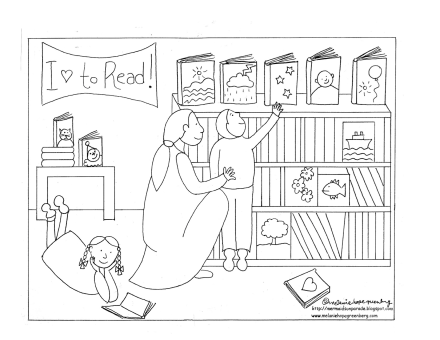
celebrate-picture-books-picture-book-review-library-coloring-page

I Love the Library! Coloring Page


If the library is one of your favorite places, print out this I Love the Library! Coloring Page and enjoy!

Picture Book Review
February 1 – National Freedom Day

celebrate-picture-books-picture-book-review-freedom-in-congo-square-cover

About the Holiday

National Freedom Day commemorates the February 1, 1865 signing by President Abraham Lincoln of a joint United States House of Representatives and Senate resolution that outlawed slavery and later became the 13th Amendment to the Constitution. Major Richard Robert Wright Sr., a former slave, called on local and national leaders to meet in Philadelphia and formalize a national day of remembrance. In 1947, a year after Wright’s death, the U.S. Congress passed a bill marking February 1 as National Freedom Day. The proclamation was signed into law on June 30, 1948 by President Harry S Truman. The holiday led to Black History Day, which was later expanded to Black History Month.

Freedom in Congo Square

Written by Carole Boston Weatherford | Illustrated by R. Gregory Christie


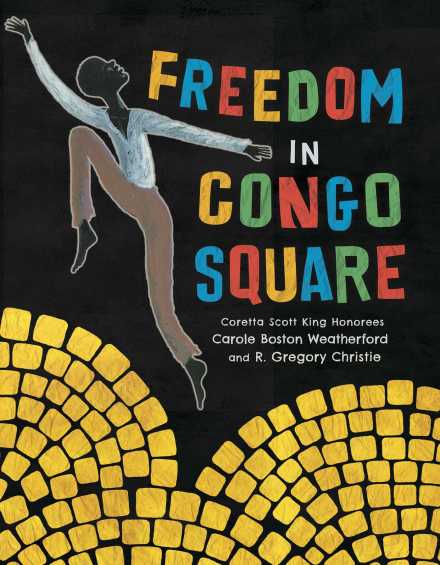
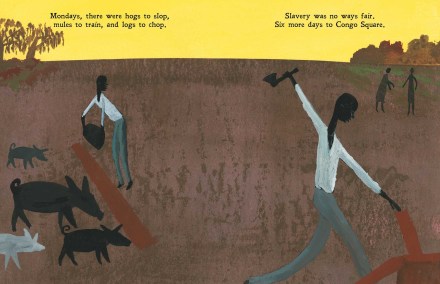
From sunup to sundown slaves brought to the state of Louisiana from their homelands in Africa and the West Indies toiled on plantations six days a week. The seventh day, Sunday, was set aside as a day of rest and worship, and in the afternoon people of African descent gathered in Congo Square in the heart of New Orleans to dance, play instruments, and talk. On Monday morning the long week began anew, but the rhythms of Congo Square sustained the men, women, and children through “hogs to slop, / mules to train, and logs to chop. / Slavery was no ways fair. / Six more days to Congo Square.

celebrate-picture-books-picture-book-review-freedom-in-congo-square-monday

Image copyright R. Gregory Christie, text Carole Boston Weatherford. Courtesy simonandschuster.com

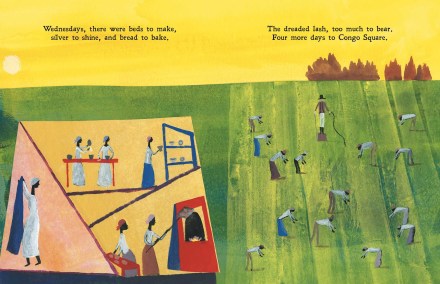
On Tuesdays, with “cows to feed, / fields to plow, and rows to seed,” five more days stretched out in endless labor. “Wednesdays, there were beds to make, / silver to shine, and bread to bake. / The dreaded lash, too much to bear. / Four more days to Congo Square.” Thursdays came with wash tubs and drying lines, scrub brushes, and brooms. “Spirituals rose from the despair. / Three more days to Congo Square.”

celebrate-picture-books-picture-book-review-freedom-in-congo-square-wednesday

Image copyright R. Gregory Christie, text Carole Boston Weatherford. Courtesy simonandschuster.com

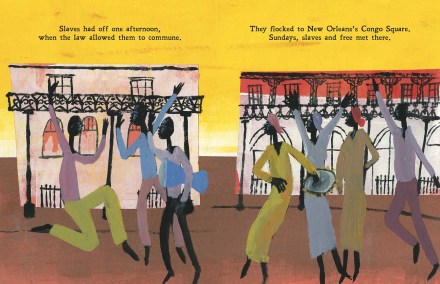
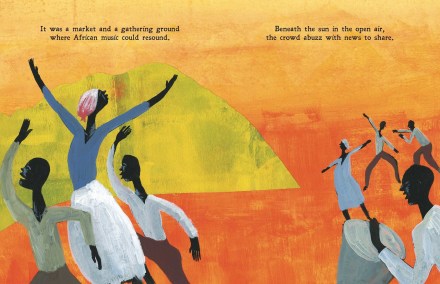
Fridays were spent in back-breaking work and though some brave souls dared to run, most were counting “Two more days to Congo Square.” Saturdays brought no more relief, but the days had whittled down to hours and “Freedom was slaves’ ardent prayer. / One more day to Congo Square.” At last came Sunday afternoon, and slaves and free rushed to Congo Square—“…a market and a gathering ground / where African music could resound.”

They met their kinsmen by nation, tribe, or language and revived their own stories and music played on drums, fiddles, shells, flutes, gourds, and bells that led to chants and dancing. “This piece of earth was a world apart. / Congo Square was freedom’s heart.”

celebrate-picture-books-picture-book-review-freedom-in-congo-square-sunday

Image copyright R. Gregory Christie, text Carole Boston Weatherford. Courtesy simonandschuster.com

Through powerful rhythmic couplets, as spare and austere as the work they describe yet ending in a focal point of hope, Carole Boston Weatherford recreates the steady thrum that resonated in the hearts of slave and free men and women as they anticipated each afternoon in Congo Square.  As the days remaining until Congo Square are counted off, Weatherford’s predominantly one-syllable words form a staccato beat, the pounding of hard, physical work. When Sunday comes and people find joy in their shared music and dance, Weatherford’s phrasing within the same structured couplets rises, employing multi-syllable words that give the verses a pulsing flow that echoes the freedom they find in Congo Square.

celebrate-picture-books-picture-book-review-freedom-in-congo-square-music-resounded

Image copyright R. Gregory Christie, text Carole Boston Weatherford. Courtesy simonandschuster.com

Gregory Christie’s vivid folk-art illustrations are a perfect complement to Weatherford’s verses. The elongated figures stand tall and proud amidst the fields and workrooms of the plantation. In some scenes the slaves’ angled bodies, leaning over to pick cotton, wash floors, or lift baskets may be bent, but they are not broken, and while two men work on building a wall, they seem to kneel prayerfully as they add another brick. In a moving two-page spread set at night, brown wood-grain houses superimposed with rows of sleeping slaves float on a blue-toned ground below a red sky, reminiscent of ships laden with Africans sailing the Middle Passage of the Atlantic slave trade. As the men and women congregate in Congo Square, Christie’s lithe figures raise their arms and kick their legs in dance. The fiery backgrounds swirl with color as the celebrants jump, stretch, play instruments and move with exultation.

A detailed Forward by historian and Congo Square scholar, Freddi Williams Evans and an Author’s Note following the text reveal more information on the history of Congo Square and its significance to Jazz music.

Freedom in Congo Square is both a heartrending and jubilant book that would make a wonderful and meaningful addition to any child’s home library.

Ages 4 – 8

little bee books, 2016 | ISBN 978-1499801033

Learn more about Carole Boston Weatherford and her books and discover book-related resources on her website!

If you’re lucky enough to live in Decatur, Illinois, you can visit R. Gregory Christie’s unique art studio, art school, and bookstore Gas-Art Gifts Autographed Children’s Bookstore. If you don’t live near Decatur, you can check out all the books, art, and items for sale on the website!

National Freedom Day Activity

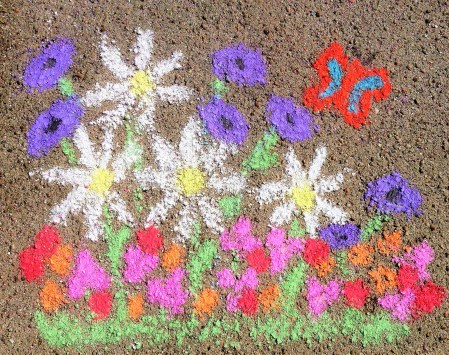
celebrate-picture-books-picture-book-review-chalk-garden-st

Freedom Stone


Freedom is a precious right—one that can be represented in different ways by each person. For today’s activity use a brick, paving stone, large stone, or molded plaster of Paris and decorate it with a picture or design that means freedom to you. Then put it in a special place—in a garden, near your front or back door, in your room, or in another spot—where it will remind you of freedom’s gifts.

Supplies

  • Brick, paving stone, large stone, plaster of Paris
  • Paint
  • Plastic gems, bead, or other small objects
  • Strong glue or other adhesive
  • Paint brush

Directions

  1. Create a design that shows what freedom means to you or an object that represents freedom to you
  2. Paint your stone with the design, let dry
  3. Add gems, beads, or other objects
  4. Display your Freedom Stone

Picture Book Review

January 27 – It’s Creativity Month

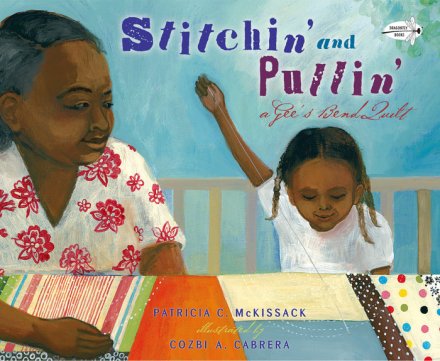
celebrate-picture-books-picture-book-review-stitchin'-and-pullin'-a-gee's-bend-quilt-cover

About the Holiday

January is a time for reflection and new beginnings. What better time to start thinking creatively and finding your inner artist, scientist, inventor, thinker? Go ahead and do the thing you’ve always wanted to do!

Stitchin’ and Pullin’: A Gee’s Bend Quilt

Written by Patricia C. McKissack | Illustrated by Cozbi A. Cabrera

In this story told through poems, a little girl begins telling of her life, starting with a recitation on Gee’s Bend Women: “Gee’s Bend women are / Mothers and Grandmothers / Wives / Sisters and Daughters / Widows.” They are every kind of woman you know, doing every type of work and activity. “Gee’s Bend women are / Talented and Creative / Capable / Makers of artful quilts / Unmatched. / Gee’s Bend women are / Relatives / Neighbors / Friends— / Same as me.”

In Who Would Have Thought, the girl muses on how perceptions change. “For as long as anyone can remember,” she says, the women of Gee’s Bend, Alabama have created quilts that were slept under, sat on, and wrapped around the sick or cold. But now those same quilts are “…hanging on museum walls, / their makers famous….”

When she was just a tot “Baby Girl” reveals in Beneath the Quilting Frame, she played under the quilting frame, listening to her “mama, grandma, and great-gran / as they sewed, talked, sang, and laughed / above my tented playground.” She remembers the “steady fingers  /[that] pieced together colorful scraps of familiar cloth / into something / more lovely / than anything they had been before” as her mother sang her a lullaby.

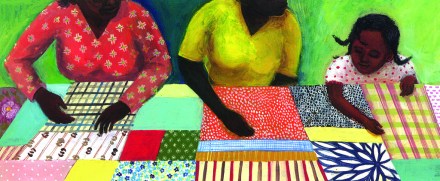
celebrate-picture-books-picture-book-review-stitchin'-and-pullin'-a-gee's-bend-quilt-puzzling-the-pieces

Image copyright Cozbi A. Cabrera, courtesy of Random House Books for Young Readers

In Something Else, “Baby Girl” is growing too big to play beneath the frame. Her legs becoming longer and her mind full of “recipes for eleven kinds of jelly…how to get rid of mold…and the words to a hundred hymns and gospel songs” while she waits her turn at the frame. Finally, in Where to Start? her time comes. The girl asks her mama how to begin and she answers, “‘Look for the heart. / When you find the heart, / your work will leap to life… / strong, beautiful, and… / independent.’”

In Remembering, the girl thinks about how her mama has told her that “cloth has a memory.” As she chooses the cloth that will become her quilt she sees the life and the history in each. 

Nothing Wasted sees Grandma pulling apart a red-and-white gingham dress stitch by stitch to become a quilting square that the girl suddenly knows “will be the heart of my quilt.” In Puzzling the Pieces the girl and her grandma stand over the quilting frame fitting the squares together in the perfect way to tell the girl’s story. Her quilt comes together piece by piece to tell the history of Gee’s Bend in The River Island. The brown strips along three sides mirror the muddy waters surrounding her town. The fourth side is a green strip—“a symbol of the fields where my ancestors / worked cotton from can to can’t— / can see in the morning until / can’t see at night.” Lined up next to the green strip are six squares representing the small communities “where families with / the same name / are not kin by blood / but by plantation.”

Being Discovered is portrayed with “a large smoke-gray square”—the color of the Great Depression and the 15 minutes of fame Gee’s Bend garnered when discovered “by sociologists, historians, / educators, and journalists” who came and went, leaving Gee’s Bend “the way it had been / before being discovered.”

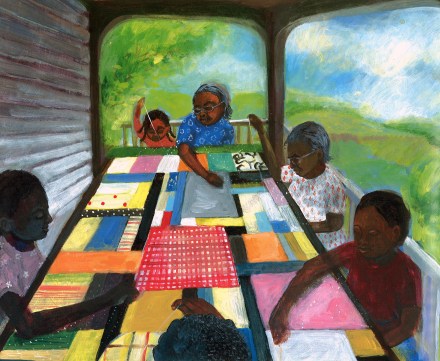
celebrate-picture-books-picture-book-review-stitchin'-and-pullin'-a-gee's-bend-quilt-understanding-comes-later

Image copyright Cozbi A. Cabrera, courtesy of Random House Books for Young Readers

In Colors, the girl’s grandma explains the meanings and feelings behind each colored cloth. “Blue cools. / Red is loud and hard to control, / like fire and a gossiping tongue.” Green, orange, yellow, white, pink, and all the others have their own personalities. “Grandma says, / ‘Colors show how you / feel deep down inside.’”

In Pinky, the harrowing facts of the march from Selma to Montgomery, Alabama frame the story of one marcher, Mr. Willie Quill who broke horses for the Alabama State Mounted Patrol and was saved from the Police attacks when one of the horses he’d trained knew his voice. In Dr. King Brings Hope, the little girl adds a “Patch of bright pink / to remember Pinky’s story. / Next to it I sew / a spotless white patch for the hope Dr. Martin Luther King / brought to the Bend” and goes on to tell how her grandma saw Dr. King at Pleasant Grove Baptist Church and what it meant to her.

By and By follows the girl as she adds “golden thank-yous, for James Reeb,” a “bright blue piece of velvet for Viola Liuzzo,” and a “big plaid people circle of white, black, brown, yellow, and red for Reverend Dr. King, all “killed for believing in justice.”

In the 1960s, The Sewing Bee tells, Gee’s Bend quilters were once again discovered. There were buyers for the handmade quilts, but stipulations. The girl asks her grandma if she was part of the Bee, to which she replies, “‘Yes, / more money. Less freedom. I chose to stay free.’”

At last all of the patches are laid out and the time comes to stitch the girl’s quilt. Five women stand at the frame “all stitchin’ and pullin.’” They work “in a slow and steady rhythm” relaxing and enjoying being together until the quilt is finished. In Finished, the last stitch is sewn, and the thread bitten and knotted. The girl has hundreds of ideas for future quilts. “Quilts that are about me, / the place where I live, / and the people / who have been here for generations.”

Further poems unite the history of “Baby Girl,” her family, and neighbors, and an Author’s Note about quilting and the women of Gee’s Bend follow the text.

Patricia McKessack’s free verse poems capture the close relationships and camaraderie of the generations of women who join around the quilting frame to share and pass down their art and their heart. McKessack’s conversational verses, on page after page like the patches of a quilt, reveal the complexity of this handmade art form in the way intimate talks between friends unveil a life. Readers learn not only about the little girl and her own thoughts, but the history and influence of her immediate family, world events, inspirational figures, and deeply held beliefs that make her who she is and ties her to the other Gee’s Bend women.

Cozbi A. Cabrera’s stunning acrylic paintings take readers inside the heart of the Gee’s Bend women, depicting the girl’s home, the table-sized quilting frame where the women collectively work, the plantations, the protests, and the changes that came but did not unravel the convictions, values, and love of the little girl’s family. Readers can almost hear the talking and singing of the Gee’s Bend women as they stitch their quilts, and the comforting, embracing environment is evident on every page. Cabrera’s portraits of the little girl, her mama, and her grandma are particularly moving. For What Changed, Cabrera depicts a yellow school bus appearing on the dirt road from the right hand corner of the page. In the side mirror a dot of a house comes into view, reminding readers that no matter how far these women are from home, Gee’s Bend is always with them.

Children—and adults—will find Stitchin’ and Pullin’: A Gee’s Bend Quilt inspirational and uplifting. This volume of poetry can be read at one sitting and delved into again and again, making it a wonderful choice for home libraries and a must for school, public, and other libraries.

Ages 5 – 12

Dragonfly Books, Random House, 2016 (paperback edition) | ISBN 978-0399549502

View a gallery  of fashion designs, dolls, and other handmade art work by Cozbi A. Cabrera on her website!

Creativity Month Activity

celebrate-picture-books-picture-book-review-stars-quilt-coloring-page

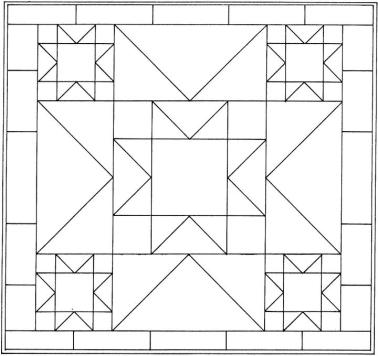
Design a Quilt Coloring Pages

Quilts are so much more than pieces of material sewn together—they’re life stories! Here are two quilt coloring pages for you to design and color. What does each piece mean to you? As you color each section, write a sentence about an event or thought that is important to you.

Quilt Template 1 | Quilt Template 2

Picture Book Review

January 16 – Martin Luther King Jr. Day

celebrate-picture-books-picture-book-review-i-am-martin-luther-king-jr-cover.png

About the Holiday

Martin Luther King Jr. Day celebrates the life and legacy of the man who dedicated his life and work to teaching—as Coretta Scott King stated—“the values of courage, truth, justice, compassion, dignity, humility and service” and led a non-violent Civil Rights movement to enact racial equality and justice throughout state and federal law. President Ronald Reagan signed the holiday into law in 1983, setting it on the third Monday of January to coincide with Martin Luther King, Jr.’s birthday on January 15. The holiday was officially observed in all 50 states in 2000. Today, learn more about the life and work of Martin Luther King and how you can help promote justice and equality for all. Consider volunteering in your community where help is needed.

I am Martin Luther King, Jr.

Written by Brad Meltzer | Illustrated by Christopher Eliopoulos


Standing inside a church, Martin Luther King, Jr. introduces himself with two anecdotes from his childhood that demonstrate his world outlook. “When I was little,” he says, “I used to get into a lot of accidents.” He was hit in the head by a baseball bat, knocked down by cars and once even “tumbled over our banister, then bounced through an open door into the basement.” While these incidents could have made him cautious, Martin instead was determined to keep “getting back up.” His second influence were the books in which he could find “big words.” Even as a child Martin recognized that “there is power in words.”

celebrate-picture-books-picture-book-review-i-am-martin-luther-king-jr-as-a-child

Image copyright Christopher Eliopoulos, text copyright Brad Meltzer. Courtesty of Dial Books for Young Readers

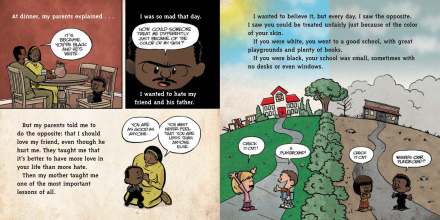
Before he went to school, Martin relates, his best friend was a white boy whose father owned a nearby store. They did everything together until school started. Then Martin went to a school with only black students while his friend went to a white-students-only school. Soon, Martin’s friend told him his father didn’t want them to play together anymore. Martin was confused. When his parents told him the reason was that they had different colored skin, Martin felt angry. He wanted to hate his friend and his father, but Martin’s parents taught him to love his friend, and his mother told him, “you must never feel that you are less than anyone else.”

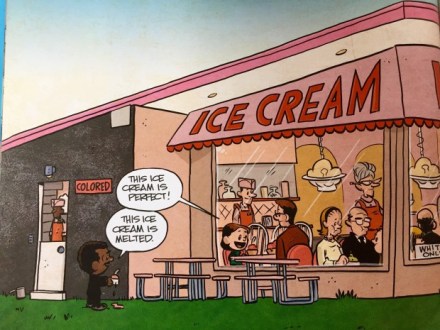
It was a difficult lesson when all around him he saw inequality. White schools had better equipment, there were different elevators, bathrooms, water fountains, and other facilities for black people and white people, on buses black riders had to give up their seats to white riders. Everywhere black people and white people were segregated.

celebrate-picture-books-picture-book-review-i-am-martin-luther-king-jr-ice-cream

Image copyright Christopher Eliopoulos, text copyright Brad Meltzer. Courtesty of Dial Books for Young Readers

When Martin was only 15 he was admitted to college. At 19 he entered the seminary where he learned about civil disobedience and nonviolent resistance—ways to use “love and peaceful methods to change unfair things in society.” These were lessons Martin wanted to share with others. His chance to put his thoughts into action came when Rosa Parks was arrested for refusing to relinquish her seat to a white man. Martin advocated a peaceful protest—a boycott of public buses. He reasoned that without the money from black riders, the bus companies would change their policies.

As the boycott began working, Martin gave a speech in Montgomery, Alabama, motivating people to continue their peaceful protest. Martin was put in jail and his house was bombed, but the boycott continued for more than a year. Eventually, the bus companies changed their rules. Other peaceful protests began to take place in restaurants and other public places.

One protest took place in Birmingham, Alabama.  Martin was again put in prison, where he wrote one of his most famous speeches. Children also took part in the Birmingham protest. The Children’s Crusade attracted more than 1,000 kids. On the first day 900 of them were arrested, but that only inspired the children more. On the second day 2,500 children showed up. They stood firm while they were sprayed with water hoses and attacked by police dogs. People—both black and white—watching the news reports were aghast. Three months later the rules began to change.

celebrate-picture-books-picture-book-review-i-am-martin-luther-king-jr-i-have-a-dream-speech

Image copyright Christopher Eliopoulos, text copyright Brad Meltzer. Courtesty of Dial Books for Young Readers

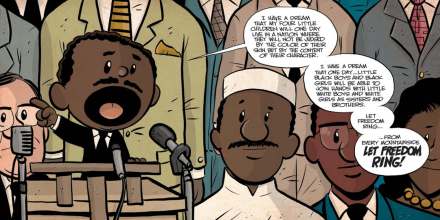
“By the summer of 1963, an estimated one million Americans held their own protests in cities across the country.” Then A. Philip Randolph suggested a single huge march to convince “Congress and the president to pass laws so that no one in America can treat people differently based on skin color.” On August 28, 1963 the March on Washington for Jobs and Freedom took place. Martin gave what may now be considered his most famous speech in which he talked about his dreams for the country, for the people, and for their children.

Although Congress began passing new laws, the ability and right to vote in elections still eluded black people. To change the voting rules another march was organized to walk 54 miles from Selma to Montgomery Alabama. The 600 walkers were met by police who stopped them. Two days later 2,500 activists tried again but could not get through. On the third try 8,000 marchers showed up. This time, with the world watching on television, the activists made it to Montgomery, protected by troops sent by President Johnson.

celebrate-picture-books-picture-book-review-i-am-martin-luther-king-jr-montgomery-march

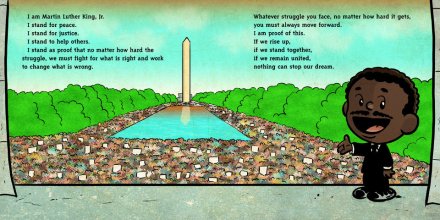
Martin continued to speak out, relating his philosophy and dreams for the nation. “To reach our goals, we must walk the path of peace,” he said. “We must lock arms with our brothers and sisters. We must march together. When we do…Our voices will be heard, and freedom will ring.” The lessons Martin Luther King taught still resonate today. He stands “as proof that no matter how hard the struggle, we must fight for what is right and work to change what is wrong.…if we stand together, if we remain united, nothing can stop our dream.”

celebrate-picture-books-picture-book-review-i-am-martin-luther-king-jr

Brad Meltzer’s Ordinary People Change the World: I am… series of biographies are well-known for showing young readers that they can achieve their dreams and make a difference no matter what those hopes may be. In his biography of Martin Luther King, Jr., Meltzer depicts several incidents from King’s childhood and early adulthood that influenced his future work. These help readers understand not only the types of prejudice King and other African Americans experienced, but also the people who inspired his philosophy of peace.

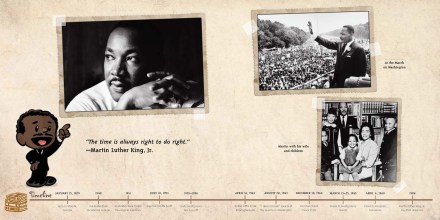
Meltzer’s inclusion of King’s imprisonments and the violence that met the peaceful protesters deepens the understanding of the dangers King and other protesters faced, and provides an opportunity to open a discussion between adults and children about those times and what they now see in the news. Meltzer’s description of the Children’s Crusade will inspire readers, making them proud of children in the past and stirring them to actions of their own. Sections from King’s Letter from Birmingham Jail and his most famous speeches are presented in speech bubbles. The text is followed by photographs of Martin Luther King, Jr. with his family and at the March on Washington as well as a timeline of his life. Sources and resources for further reading are also included.

celebrate-picture-books-picture-book-review-i-am-martin-luther-king-jr-timeline

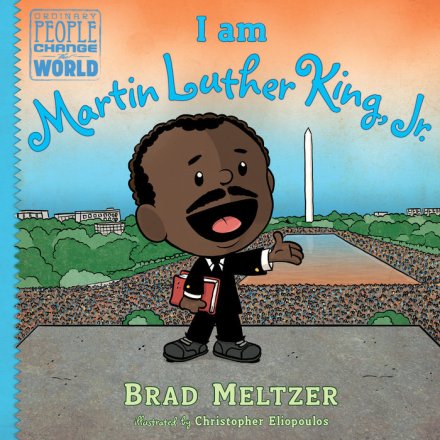
In keeping with the style of all of Meltzer’s and Christopher Eliopoulos’s Ordinary People Change the World: I am… biographies, the illustrations are vibrant and cartoon-inspired. Martin Luther King, Jr. is depicted with the size of a child but the features of an adult, reinforcing the idea contained in the text of the dual nature of the future adult residing in the child and the ideals of the child remaining in the adult that appeals to ambitious young readers. Speech bubbles highlight text that carry emotional dialogue. Settings, including churches, Birmingham jail, Washington DC, the Edmund Pettus Bridge in Alabama, and the Martin Luther King, Jr. monument give children a look at the cities and places described in the text.

For young readers, I am Martin Luther King, Jr. offers a comprehensive biography of the man who was a national and world leader in the fight for equal rights for all people and makes an excellent starting place for classroom lessons and personal discussions.

Ages 5 – 8

Dial Books for Young Readers, 2016 | ISBN 978-0525428527

Discover more about Brad Meltzer and his books for adults and children as well as other goodies on his website!

Learn more about Christopher Eliopoulos, his books, and his comics on his website!

Martin Luther King Jr. Day Activity

celebrate-picture-books-picture-book-review-martin-luther-king-jr-coloring-page

Martin Luther King, Jr. Portrait


Color this printable Martin Luther King, Jr. Portrait and then hang it in your room or locker to inspire you!

Picture Book Review
January 9 – It’s International Creativity Month

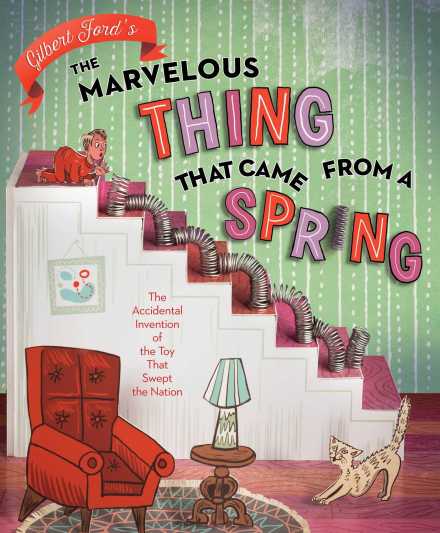
celebrate-picture-books-picture-book-review-the-marvelous-thing-that-came-from-a-spring-cover

About the Holiday

There’s no better time than the beginning of the year to start letting your creative juices flow! Quick fixes or long-leisurely projects are all within your grasp! Want to repaint a room? Build a tree house in the spring? Learn some new recipes? Discover a new hobby? Start planning today how you will accomplish the inventive inspirations that swirl through your imagination.

The Marvelous Thing That Came from a Spring: The Accidental Invention of the Toy That Swept the Nation

By Gilbert Ford


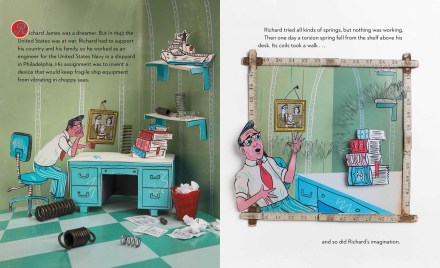
In 1943, during World War II, the United States Navy asked one of their engineers, Richard James, to “invent a device that would keep fragile ship equipment from vibrating in choppy seas.” Richard tried all kinds of springs, but none worked just right. “One day a torsion spring fell from a shelf onto his desk, and “its coils took a walk…” This sparked Richard’s imagination. While Richard knew the spring wasn’t right for his Navy work, he recognized that it might be perfect for something else. But what?

celebrate-picture-books-picture-book-review-the-marvelous-thing-that-came-from-a-spring-spring-walks-spring-falls-off-shelf

Copyright Gilbert Ford, courtesy of simonandschuster.com

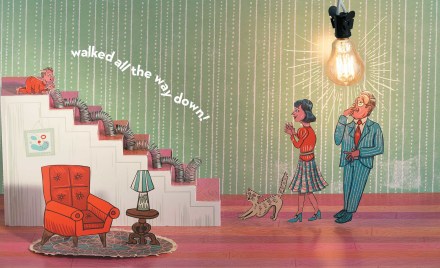
He took the spring home from work that day, showed it to his wife Betty, and gave it to his young son Tom. Tom took it to the top of the stairs and let it go. “The family watched in astonishment as it…walked all the way down!” They lost no time in realizing that this spring made a marvelous toy. But what to call it? “Betty thumbed through a dictionary for two days, underlining words. None really caught her fancy, until she came to ‘slinky,’ which means “‘graceful’ and ‘curvy in movement.’” It also “sounded like the swish and clink of the spring’s coils in motion.”

celebrate-picture-books-picture-book-review-the-marvelous-thing-that-came-from-a-spring-spring-walks-downstairs

Copyright Gilbert Ford, courtesy of simonandschuster.com

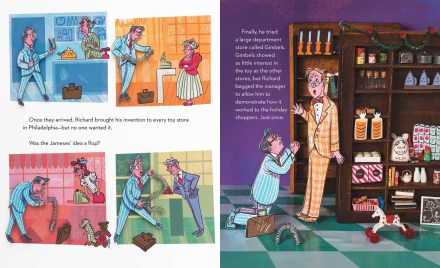
Richard and Betty thought they had a unique hit on their hands, so Richard went to the bank and borrowed five-hundred dollars to make 400 Slinkys. But while Richard and Betty loved their Slinky, toy store managers did not. Finally, Richard went to Gimbels, the big department store. The manager there didn’t see the merits of the Slinky either, but when Richard begged to be allowed to demonstrate it just once, he relented.

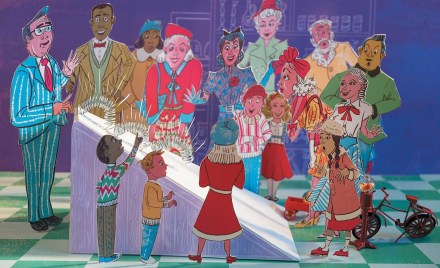
It was now November 1945 and the Christmas shoppers were out looking for stocking stuffers. Richard set up a ramp in the middle of the toy department and placed the Slinky at the top. He looked around for Betty, but she was nowhere to be seen. In fact, Betty was still at home worried that no one would like their toy. She was so concerned that she convinced a friend to “pose as an excited shopper” and buy one with the dollar Betty gave her. At Gimbels, however, time—and shoppers—were passing, so Richard let go of the Slinky. The astonished faces of the children and adults crowded around the ramp said it all. By the time Betty and her friend reached Gimbels, all 400 Slinkys had been sold—in only 90 minutes!

celebrate-picture-books-picture-book-review-the-marvelous-thing-that-came-from-a-spring-spring-walks-spring-richard-begs-gimbels

Copyright Gilbert Ford, courtesy of simonandschuster.com

With the end of the war that same year, troops returned home and a baby boom soon followed. “Demand for the Slinky skyrocketed.” Production needed to speed up, so Richard devised a “machine that could coil eighty feet of steel wire into a Slinky in ten seconds.” The Slinky business became a family business with Betty filling orders and doing the accounting while Richard made and delivered Slinkys. Pretty soon they needed a factory to satisfy demand. That demand still exists today as kids all over the world love the Slinky.

celebrate-picture-books-picture-book-review-the-marvelous-thing-that-came-from-a-spring-spring-walks-spring-at-gimbels

Copyright Gilbert Ford, courtesy of simonandschuster.com

An extended Author’s Note picks up the story of the Slinky where the text leaves off, revealing other creative ways the Slinky has been used and the fact that when Richard went to Bolivia in 1960 to do missionary work, Betty took over the business, relocated the factory to Hollidaysburg, Pennsylvania, and gave the toy a rebirth in popularity. More than 250 million Slinkys have been produced, and in 2001 Betty was inducted into the Toy Industry Hall of Fame.

Gilbert Ford’s Slinky-ography of the man and woman behind one of the world’s most beloved toys is a skip, jump, and bounce through the ingenious brainstorm that transposed a simple spring into a phenomenon. The down-to-earth details of how this invention came to be harken back to a simpler time but also reaffirm that even today there are dreamers sitting in homes across the world imagining the next big thing. Ford’s story is well paced, leading readers through the production process to experience cheerful surprise when the Slinkys sell out at Gimbels. Kids will appreciate the easy-going language that suits its subject perfectly and the emphasis on the teamwork of both Richard and Betty James that made the Slinky possible.

Ford’s illustrations are ingenious in themselves. Careful observation reveals that each page is not merely a drawing, but a 3D experience. As the front matter explains, the illustrations were drawn and colored then printed, assembled into dioramas that incorporate found objects and other popular toys of the period, such as dominoes, jacks, and pick-up sticks, and finally photographed. The effect drops readers into the middle of a 1940s home and department store, giving them a personal stake in the drama.

The Marvelous Thing That Came from a Spring is a fun book for would-be-inventors and kids interested in the history of objects they use and play with.

Ages 4 – 8

Atheneum Books for Young Readers, Simon & Schuster, 2016 | ISBN 978-1481450652

Discover a portfolio of work by Gilbert Ford for books, book jackets, advertising, and more on his website!

International Creativity Month Activity

celebrate-picture-books-picture-book-review-national-archives-coloring-book-of-patents

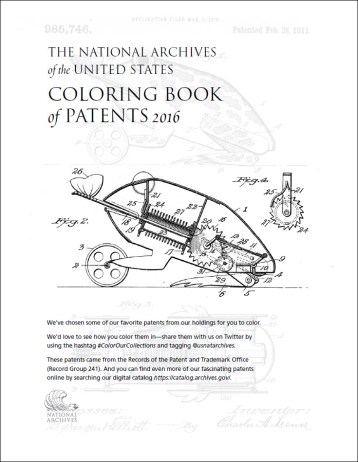
National Archives Coloring Book of Patents


The people at the National Archives of the United States in Washington DC chose some of their favorite patents from the past to share with you as a coloring book. As you have fun coloring these pages of ideas, let yours fly too!

Click here to get your printable National Archives Coloring Book of Patents

Picture Book Review
October 11 – Ada Lovelace Day

celebrate-picture-books-picture-book-review-ada-byron-lovelace-and-the-thinking-machine-cover

About the Holiday

Today we remember the woman who is regarded as “the first computer programmer.” A mathematician, inventor, and scientific pioneer, Ada Lovelace wrote and was the first to publish an algorithm to generate Bernoulli numbers. Her notes published in Taylor’s Scientific Memoirs in 1842 inspired Alan Turing to design the first modern computers 100 years later. Today’s holiday celebrates all women in the science, technology, mathematics, and engineering fields. To learn more about Ada Lovelace Day visit findingada.com.

Ada Byron Lovelace and the Thinking Machine

Written by Laurie Wallmark | Illustrated by April Chu


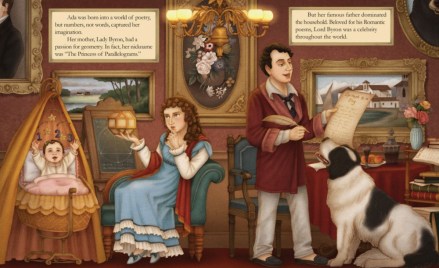
Ada was the daughter of two very distinguished—and distinct—parents. Her mother loved geometry and was known as “‘The Princess of Parallelograms.’” Her father was a world-renowned poet, “beloved for his Romanic poems.” When Ada was still a baby, however, her mother left Lord Byron and his “scandalous behavior” behind, and “Ada never saw her father again.”

celebrate-picture-books-picture-book-review-ada-byron-lovelace-and-the-thinking-machine-ada's-parents

Image copyright April Chu, text copyright Laurie Wallmark. Courtesy of crestonbooks.com

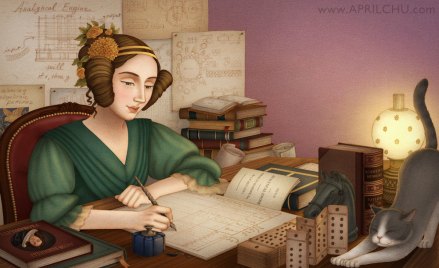
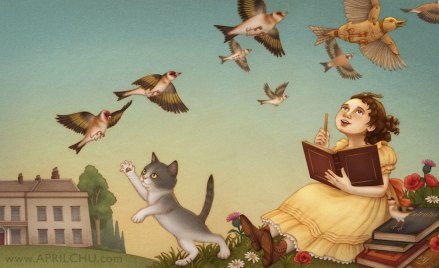
As was common in Ada’s time she was often left on her own while her mother traveled. Ada filled the hours and days writing, sketching, and inventing in her journal. When she was still a little girl, she built a set of wings for a flying machine she had imagined. To discover if her wings could actually fly, “Ada needed to compute the wings’ power. She broke the problem into steps—surface area and weight, wind speed and angles.” She had to multiply and divide again and again, and while she loved calculating numbers, Ada wondered if there wasn’t an easier way to find the answers.

As she sat at her desk one day a storm blew up, sending the curtains around her open window flapping. They reminded Ada of sails and she suddenly realized that sails were like wings. She grabbed her toy sailboat and headed out to a nearby pond to test her theories. She launched her boat over and over, and “each time she adjusted the sails and studied the effect on the little boat’s speed. A storm of numbers and calculations whirled in her mind and spilled onto her pages.” She stayed by the pond until dark, and “returned home muddy, dripping wet, and triumphant.” Her nanny was not pleased. She didn’t agree with Ada’s mother, instead believing that girls “should not waste their time with math and science and experiments and other such nonsense.”

celebrate-picture-books-picture-book-review-ada-byron-lovelace-and-the-thinking-machine-imagining-a-flying-machine

Image copyright April Chu, courtesy of aprilchu.com

Overnight, Ada developed a high fever, and the doctor diagnosed measles. Ada’s mother was sent for. She hurried home and spent the days and nights at Ada’s bedside reading to her. Ada’s “fever finally broke, but the measles left her paralyzed and blind. To keep Ada’s mind sharp, Mama quizzed her on math problems,” asking her harder and harder questions. The numbers kept her company, and in her imagination Ada used her flying machine to travel to London.

While Ada regained her sight in a few weeks, it was three years before she could walk again. During this time Ada’s mother hired tutors to teach her higher and higher level math. One of her tutors was Mary Fairfax Somerville, a famous scientist and mathematician. Somerville invited Ada and her mother to a gathering of other influential scientists, mathematicians, and inventors. There Ada met Charles Babbage. Babbage, a mathematician and inventor, was impressed by 17-year-old Ada’s knowledge and understanding and invited her to visit his laboratory.

celebrate-picture-books-picture-book-review-ada-byron-lovelace-and-the-thinking-machine-difference-engine

Image copyright April Chu, courtesy of aprilchu.com

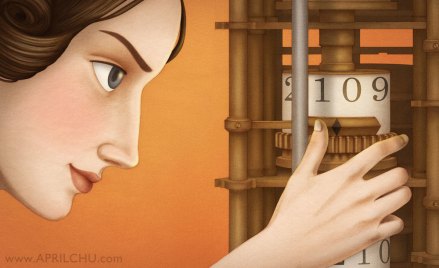
Ada brought her journal and shared with Charles Babbage her own work. He didn’t treat Ada as a child but as a fellow scientist and engineer. Babbage showed Ada a mechanical calculator he had designed. With the turn of a handle cylinders of numbers on the three columns of his Difference Engine spun toward the answer to a math problem Ada posed: what is 15 x 12? The machine gave the right answer: 180!

Babbage also had an idea for a mechanical computer—and Analytical Engine—that “would solve harder problems by working through them step by step.” It was an amazing concept, but Babbage hadn’t built it yet. He gave Ada his notebooks and she studied Babbage’s descriptions of how the machine might work. She realized that the Analytical Engine could work if numbers told it how.

celebrate-picture-books-picture-book-review-ada-byron-lovelace-and-the-thinking-machine-calculating

Image copyright April Chu, courtesy of aprilchu.com

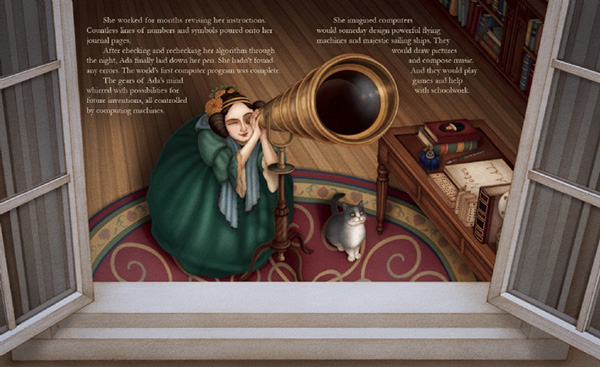
Over several months Ada created an algorithm—a set of mathematical instructions. Her journal was filled with lines and lines of numbers and symbols. At last she checked her work for errors and found none. Ada had developed the world’s first computer program! With her creative imagination she could see that someday computers would “design powerful flying machines and majestic sailing ships. They would draw pictures and compose music. And they would play games and help with schoolwork.”

Unfortunately, Charles Babbage never finished building his Analytical Machine, and Ada never saw her program in action. But future generations remembered her and her contributions to computer programming. There is even a computer program named for her. We can imagine that the little girl who wanted to fly would be very pleased to know that Ada helps guide modern flying machines.

An extensive Author’s Note, a timeline of Ada’s life as well as a partial bibliography and resources follow the text.

celebrate-picture-books-picture-book-review-ada-byron-lovelace-and-the-thinking-machine-looking-at-stars

Image copyright April Chu, text copyright Laurie Wallmark. Courtesy of crestonbooks.com

Laurie Wallmark’s compelling biography of Ada Lovelace is perfectly aimed at her young audience, highlighting Ada’s childhood dreams, obstacles, and events that led her to become an influential mathematician and inventor. Wallmark’s fast-paced text, which beautifully merges lyrical and technical language to tell Ada’s story, is uplifting in its revelation that from even a young age, Ada was respected and acknowledged for her intelligence and mathematical gifts. Illuminating Ada’s predictions for future uses of the computer forms a bridge between her foresight and the experience of today’s children, bringing history alive for readers.

Gorgeous, detailed illustrations set Ada Byron Lovelace and the Thinking Machine firmly in its 19th-century time period. Lush greens, reds, and golds welcome readers into Ada’s home, where her wooden and paper wings lay among blueprints for other inventions as Ada sits at her desk jotting notes in her journal. A mural in her home cleverly depicts Ada’s imaginings while she recovered from the measles, and the gathering that Ada and her mother attend is a stimulating portrait of the scientists and new inventions of the day. Kids will be amazed to see one of the first “calculators” as built by Charles Babbage. Included on the pages are images of an early loom and punch cards that influenced the development of our computers. It is fitting that the last page shows how far we have come—and how forward thinking Ada was—with an illustration of Space technology in action.

Ada Byron Lovelace and the Thinking Machine is an important biography that should be included in every public and school library. For children interested in history, biographies, and the science and math fields, Laurie Wallmark’s and April Chu’s book would make a beautiful gift and addition to home bookshelves as well.

Ages 5 – 10

Creston Books, LLC, 2015 | ISBN 978-1939547200

Discover more about Laurie Wallmark and download curriculum and activity guides on her website!

View a portfolio of artwork and learn more about April Chu’s books on her website
This is one book trailer that really computes!

Ada Lovelace Day Activity

celebrate-picture-books-picture-book-review-computer-coloring-page

Love Your Computer! Coloring Page


What would we do without our computers? Here’s a fun printable Love Your Computer! coloring page for you to enjoy!

Picture Book Review