January 27 – It’s Celebration of Life Month

celebrate-picture-books-picture-book-review-a-beginners-guide-to-being-human-cover

About the Holiday

Today’s holiday was established by Food for Health International to encourage people to take a holistic approach to taking care of themselves, not only their physical health but their emotional health as well. Celebrating all that life has to offer while taking time to enjoy family and friends and be mindful of others through mutual respect, inclusion, empathy, and gratitude goes a long way towards greater happiness and health. Sharing today’s book with your kids is a wonderful way to celebrate this month-long holiday all year around.

A Beginner’s Guide to Being Human

Written by Matt Forrest Esenwine | Illustrated by André Ceolin


“Welcome to Humanity! You’re really going to enjoy it.” With this expansive greeting, Matt Forrest Esenwine invites kids in to learn what they need to know “… to get the most out of [their] human experience….” First up is family—that group of people who spend so much time with you and “care about you the most.” But what does a family do? “Families love each other, disappoint each other, support each other, and get angry with each other, over and over—sometimes all in the same day. Weird, right?” But you can be sure that the “…whole ‘caring about you’ part never stops.

celebrate-picture-books-picture-book-review-a-beginners-guide-to-being-human-sidewalk

Image copyright André Ceolin, 2022, text copyright Matt Forrest Esenwine, 2022. Courtesy of Beaming Books.

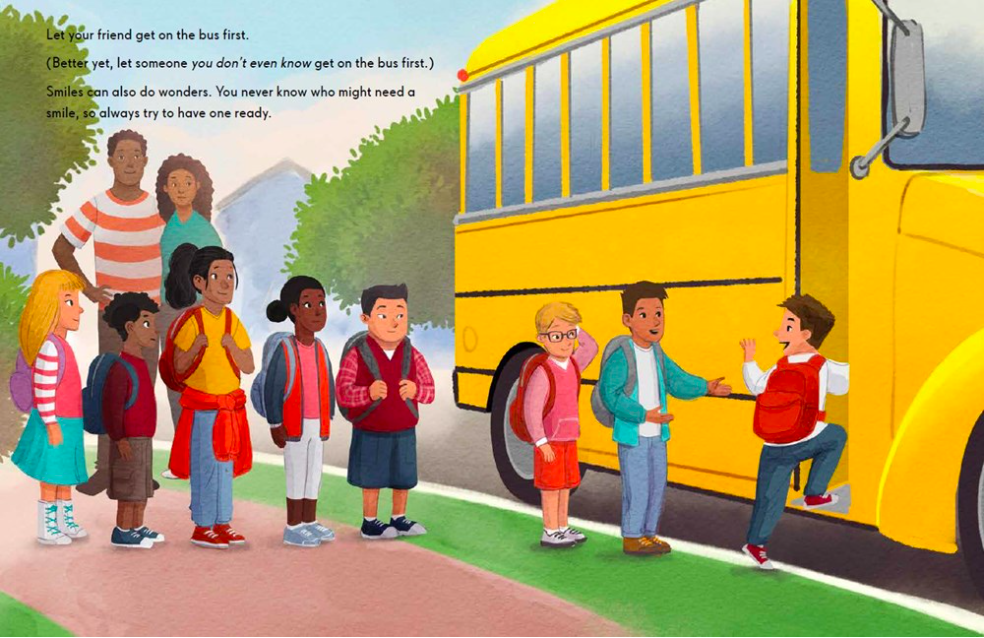
So what do you do with all of that caring that comes your way? You can share it! How? Well, by being kind. Sure, we hear that word all the time, but what does “being kind” really look like? Esenwine and André Ceolin give some easy-to-emulate examples that don’t take any money or super strength or extra time. In fact, everybody carries one of the easiest—maybe even the most meaningful—way to show kindness right on their face: their smile.

celebrate-picture-books-picture-book-review-a-beginners-guide-to-being-human-school-bus

Image copyright André Ceolin, 2022, text copyright Matt Forrest Esenwine, 2022. Courtesy of Beaming Books.

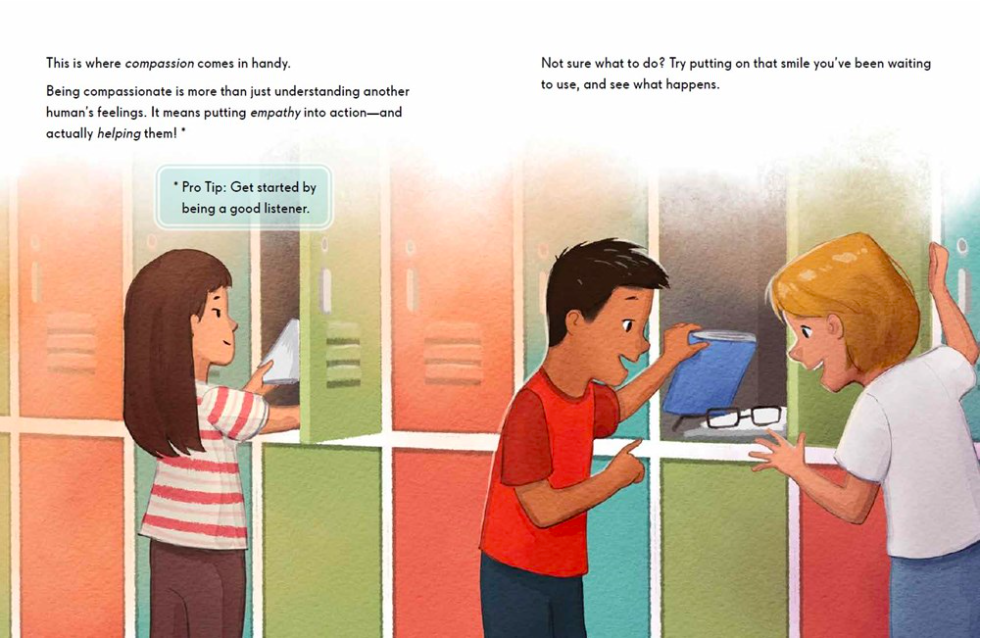
Once kids have kindness down, Esenwine moves on to empathy and urges kids to imagine why others may act the way they do, to think about what else may be going on with someone at home, in school, or elsewhere. Using empathy leads to compassion. What does compassion mean and how does it work? Esenwine and Ceolin show readers a few examples as well as reminding them that “we humans are quite good at ending up in the same situations again and again. Whatever another person is feeling, chances are, you’ll feel the same way at some point too” with a gallery of portraits of kids depicting emotions we all experience from time to time—and, often, every day.

One way of thinking about and reacting to situations that “has produced excellent results for over two thousand years,” Esenwine reveals, is the Golden Rule. He then shows kids how to apply this thoughtful idea to a range of situations to create better communication and understanding than getting angry or pushy or impatient.

celebrate-picture-books-picture-book-review-a-beginners-guide-to-being-human-school-locker

Image copyright André Ceolin, 2022, text copyright Matt Forrest Esenwine, 2022. Courtesy of Beaming Books.

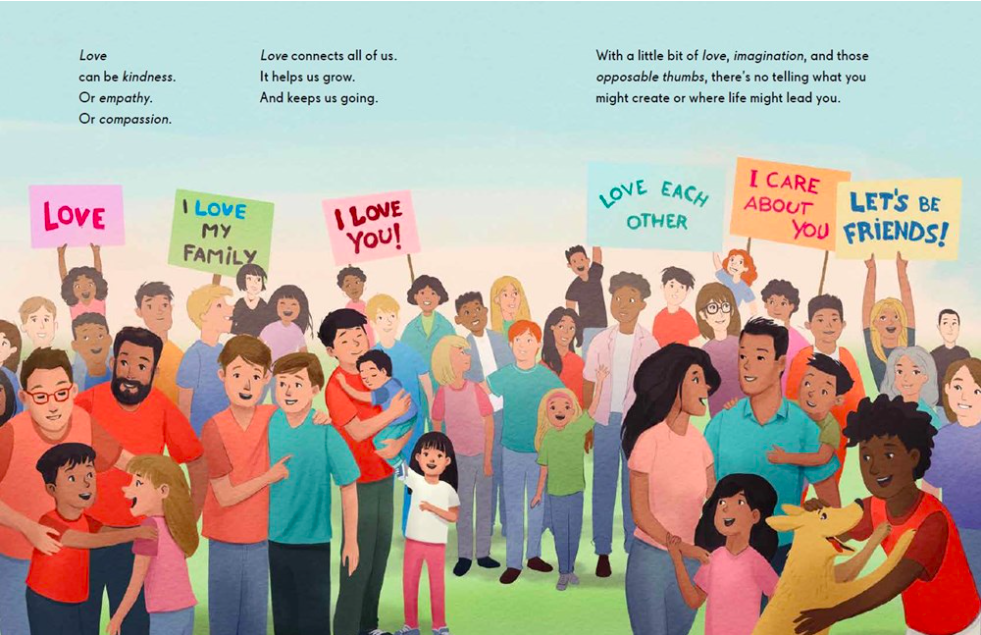
Esenwine acknowledges that there will be bad days among the good, but these too can be handled with honesty, apologies, and forgiveness. Yes, “being human can sometimes be messy,” but that’s where family and friends can help. And, of course, they’re there to celebrate the good times too. So what does all of this kindness and compassion and empathy come down to? The thing that connects us all: Love. “So, welcome to Humanity!” Esenwine emphasizes, “We hope you enjoy your humanness. And we love that you’re here.”

Sprinkled throughout the text are brief “Pro Tips” that in one sentence expand on an idea and give kids confidence in understanding and/or applying the values in their own life.

celebrate-picture-books-picture-book-review-a-beginners-guide-to-being-human-love

Image copyright André Ceolin, 2022, text copyright Matt Forrest Esenwine, 2022. Courtesy of Beaming Books.

Matt Forrest Esenwine has created a book about treating others according to the Golden Rule that goes to the heart not only of how to do that but, so importantly, when and why. Sometimes the need for kindness and empathy can be apparent, as when a child or adult is sad, alone, or has a disappointment or obvious mishap. But what about when someone’s behavior seems to be a personal slight, disrespectful, or just going against the rules?

That’s were Esenwine’s gentle, straightforward, and honest storytelling invites readers to stop and really consider every person and situation individually, to dig deep into one’s own memory and experiences for better understanding and supportive responses. He also addresses the importance of apologizing and forgiveness. And he does all of this with humor and examples that will resonate with kids. Moreover, these elements provide a spark for further conversations among children and adults about specific incidents in a child’s life, possible reasons behind them, and how the child can respond in a kind, empathetic, and compassionate way.

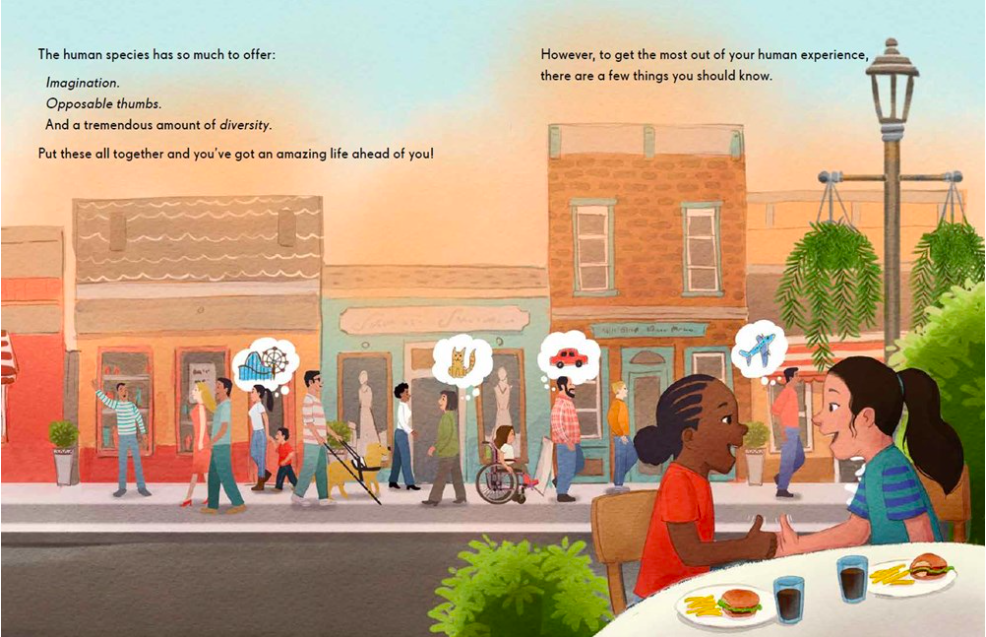
From the first spread, which shows a sidewalk busy with people all thinking their own thoughts (some of whom reappear elsewhere), André Ceolin engages readers in looking closely and thinking about how the people may be feeling, what they are doing, and why they might be behaving in a certain way. He depicts the characters in detailed places and situations familiar to kids that will spark recognition and lead to meaningful discussions and understanding. Ceolin’s images on each page, as well as a portrait gallery of universal emotions, provide excellent social emotional learning tools for adults to share with children when talking about recognizing and reading others’ feelings through facial expressions. Bookending the text, Ceolin emphasizes the support and enduring love of family and good friends.

A well-conceived, heartfelt, and impactful book you’ll want to share again and again, A Beginner’s Guide to Being Human reminds readers that we’re all in this—school, work, sports, clubs: life—together and is a timely must-have addition to home, school, classroom, and public library collections.

Ages 4 – 8

Beaming Books, 2022 | ISBN 978-1506481739

About the Author

Matt Forrest Esenwine is an author and poet from Warner, New Hampshire. His debut picture book, Flashlight Night (Boyds Mills Press, 2017), was selected by the New York Public Library as one of the Best Picture Books for Kids of 2017. His poetry can be found in numerous anthologies, including The National Geographic Book of Nature Poetry (National Geographic Children’s Books, 2015), I Am Someone Else (Charlesbridge, 2019), and Highlights for Children. You can visit him at mattforrest.com and connect with him on Facebook | Instagram | Twitter | YouTube.

About the Illustrator

André Ceolin studied at the School of Visual Arts in New York City. He has illustrated over twenty books for children. André lives in Brazil with his family. You can visit him at andreceolin.com and on Instagram.

Celebration of Life Month Activity

CPB - Random Acts of Kindness cards

Kindness Cards


Here are some cheery cards that are sure to make the recipient’s day happier! Give them to a friend, a family member, your teacher, or your bus driver to show them that you care and that they mean a lot to you!

Random Acts of Kindness Cards Sheet 1 |  Sheet 2 | Sheet 3

celebrate-picture-books-picture-book-review-a-beginners-guide-to-being-human-cover

You can find A Beginner’s Guide to Being Human at these booksellers

Amazon | Barnes & Noble | Books-a-Million

To support your local independent bookstore, order from

Bookshop | IndieBound

Picture Book Review

October 4 – Celebrating the Book Birthday of How to Draw a Happy Cat

celebrate-picture-books-picture-book-review-how-to-draw-a-happy-cat-cover

Thank you to Hippo Park and Deborah Sloan for sharing a copy of How to Draw a Happy Cat with me for review consideration. All opinions on the book are my own.

How to Draw a Happy Cat

Written by Ethan T. Berlin | Illustrated by Jimbo Matison


As the book opens, an unseen art teacher enthusiastically instructs kids in creating a cat. And not just any cat, but one that will be smiling at the end: “Learning how to draw a happy cat is fun and easy!” The narrator lays out clear instructions and gives an example of how the initial shape and each new addition should look. By the end of the first page spread, kids have a striped yellow cat with eyes, nose, and violet ears but no…mouth. On the page turn, the narrator prompts kids to add a smile. But wait! That smile doesn’t last long. On the next page she’s frowning. “What do you think she wants?” the instructor asks.

celebrate-picture-books-picture-book-review-how-to-draw-a-happy-cat-skateboard-ramp

Image copyright Jimbo Matison, 2022, text copyright Ethan T. Berlin, 2022. Courtesy of Hippo Park.

The narrator makes some suggestions: “…a cool T-shirt, …a stuffy,” and “Oh, I know—a skateboard!” These items too are sketched out as examples. And, yeah! The cat is “totally happy now!” This happy cat has some moves on the skateboard too. Her wide smile just shows how happy she is. Even the unicorn on her T-shirt is grinning. But the stuffy? He’s looking a little glum and it brings down the whole vibe. Happy Cat is no longer happy.

celebrate-picture-books-picture-book-review-how-to-draw-a-happy-cat-airplane

Image copyright Jimbo Matison, 2022, text copyright Ethan T. Berlin, 2022. Courtesy of Hippo Park.

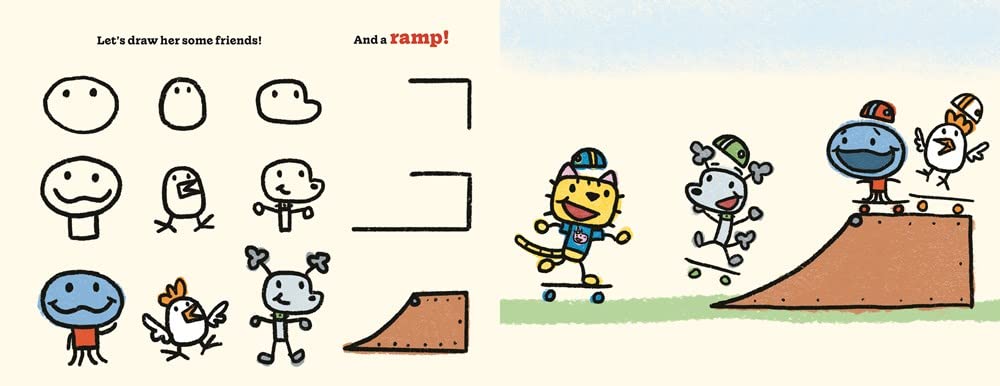
The instructor seems to know what’s needed and suggests readers “draw her some friends! And a ramp!” Now that’s more like it! A four-legged alien-type guy, a chicken, and a dog make very happy friends. So they’re soaring into the air off the ramp on their skateboards and… Oh no! You know—what goes up must come down. Suddenly, Cat is afraid. Down, down they begin to fall. What can readers do?

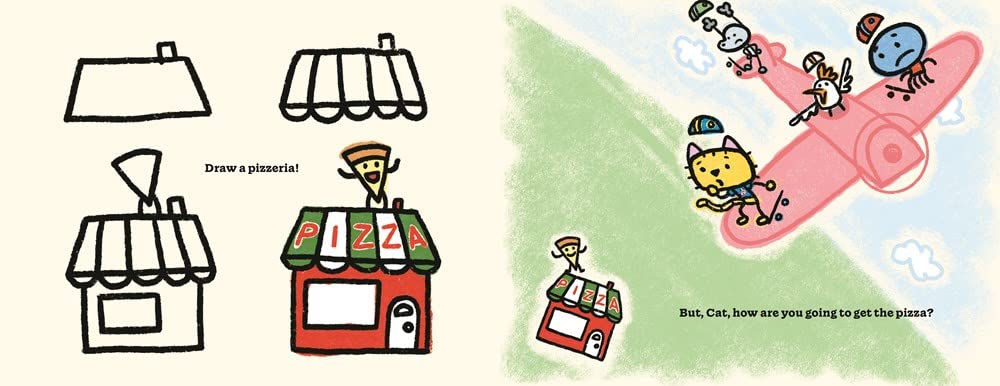
Quick as you can say “airplane,” readers can help a winged and propellered rescue appear. Phew! Now they’re all happy again. Turns out, though, that skateboarding on a plane whips up quite an appetite, and now Cat is hungry. How can readers help? Well, wouldn’t a slice of pizza taste delicious? Kids learn how to draw a pizzeria and a cheesy slice, but delivery? That could be a problem. 

celebrate-picture-books-picture-book-review-how-to-draw-a-happy-cat-pizza

Image copyright Jimbo Matison, 2022, text copyright Ethan T. Berlin, 2022. Courtesy of Hippo Park.

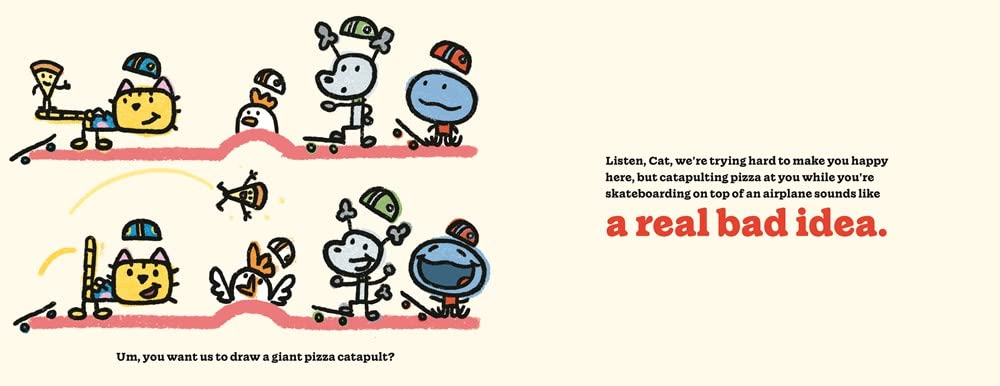
Cat has an idea, and while it works… it kinda, also…doesn’t. Now Cat and her friends are falling once again. Luckily readers are right there to remedy the situation, and all turns out great. So great that Cat and her friends want to celebrate. They can’t do it without decorations, music, entertainment, and some really cool hats, though, so it’s up to readers to create the most awesome party ever to “draw a happy cat!”

celebrate-picture-books-picture-book-review-how-to-draw-a-happy-cat-bad-idea

Image copyright Jimbo Matison, 2022, text copyright Ethan T. Berlin, 2022. Courtesy of Hippo Park.

Starting out with a straightforward drawing lesson, Ethan T. Berlin and Jimbo Matison soon raise the stakes for readers by putting them in charge of pleasing this mercurial cat. Berlin’s enthusiastic narrator makes helpful suggestions throughout the story that prompt kids to use their natural creativity to make Cat happy while Matison actually teaches them how an artist or cartoonist puts together shapes to draw a vast array of characters, objects, moods, and action.

On top of this, Berlin’s rollercoaster story will have kids giggling on every page, and well-placed questions get them thinking about how happiness can turn to sadness or dissatisfaction (for Cat as well as themselves) in the blink of an eye (or the turn of a page) and how those moments can be turned around or amended. The story’s last line gives readers an opportunity to start all over again—or, now that they’ve got the skills, even come up with their own story to write and illustrate.

Matison’s cartoon characters (sometimes charmingly colored outside the lines) are energetic and optimistic, reveling in new playthings, friends, and experiences. Kids will love watching for Chicken’s reactions, one funny placement of a pizza slice, and a few mishaps that foreshadow the book’s cyclical ending. Colorful type highlights strong emotions, especially when Cat is happy.

Sure to make kids laugh and get excited about writing and drawing as well as providing an organic way to talk about emotions and ways to create your own happiness, How to Draw a Happy Cat makes a terrific addition to home bookshelves as a favorite story time read and go-to book for impromptu drawing fun. The book is highly recommended for school and public library collections, where it will certainly enjoy frequent rotation and its multiple layers inspire participatory programs.

Ages 4 – 8 

Hippo Park, 2022 | ISBN 978-1662640049

Discover more about Ethan T. Berlin and his books, TV shows, and other funny stuff on his website.

To learn more about Jimbo Matison, his books, design work, and TV shows, visit his website.

Laugh—or commiserate—along with this How to Draw a Happy Cat book trailer! 

How to Draw a Happy Cat Book Birthday Activity

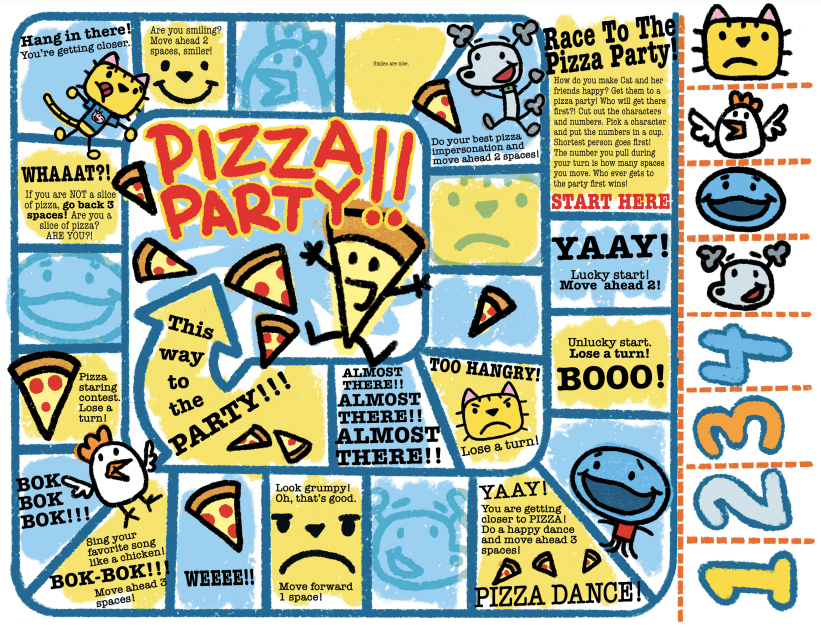
celebrate-picture-books-picture-book-review-how-to-draw-a-happy-cat-pizza-party-game-activity

Pizza Party Board Game and Drawing Kit


Can you make Cat and her friends happy by getting them to the pizza party? Just pick your character, draw numbers to move around the board—and have some fun on the way! Play the game with your friends and then learn how to draw a happy chicken by downloading the How to Draw a Happy Cat Activity Kit from Hippo Park!

How to Draw a Happy Cat Activity Kit

celebrate-picture-books-picture-book-review-how-to-draw-a-happy-cat-cover

You can find How to Draw a Happy Cat at these booksellers

Amazon | Barnes & Noble | Books-a-Million

To support your local independent bookstore, order from

Bookshop | IndieBound

Picture Book Review

September 2 – National Food Bank Day

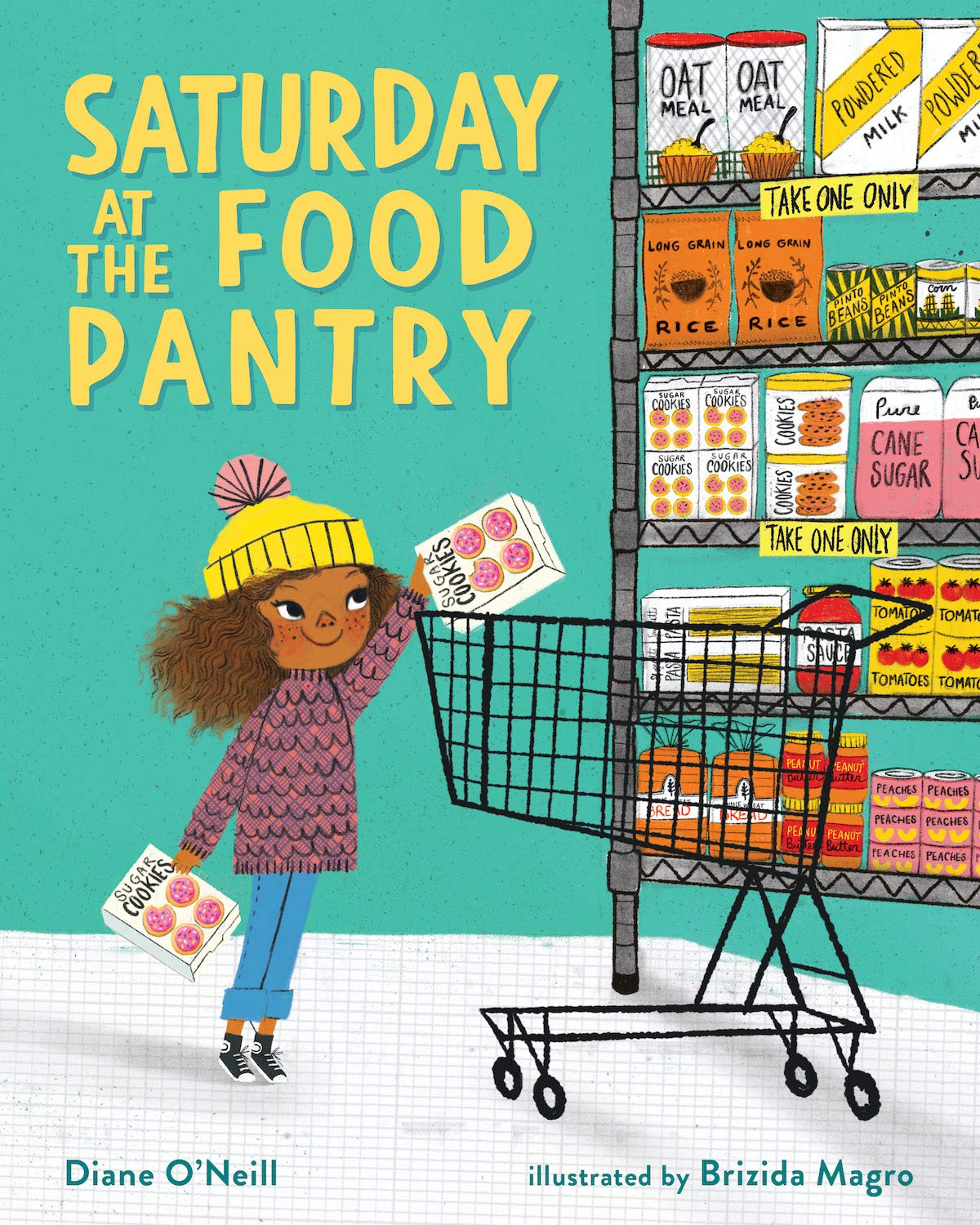
celebrate-picture-books-picture-book-review-saturday-at-the-food-pantry-cover

About the Holiday

National Food Bank Day was established by St. Mary’s Food Bank, the world’s first food bank, which was founded by John van Hengel in Phoenix, Arizona in 1967. The idea spread throughout the country, and now St. Mary’s Food Bank distributes 250,000 meals daily with the help of staff, volunteers, and partner agencies, making it one of the largest food banks in the United States. This year, a record number of families (nearly 150,000 in August alone) have sought help. Food banks across the country help millions of men, women, and children who live with food insecurity due to job loss, illness, and other circumstances. Many food banks offer educational opportunities that help people change their situation and begin anew. Often, those who have benefited from the programs return to volunteer and contribute to the very food bank that helped them. To learn more about St. Mary’s Food Bank, visit their website. To find a food pantry in your area to get help for yourself, to donate, or to volunteer, visit the Ample Harvest website.

I’d like to thank Albert Whitman & Company for sharing a copy of Saturday at the Food Bank with me for review consideration. All opinions on the book are my own.

Saturday at the Food Pantry

Written by Diane O’Neill | Illustrated by Brizida Magro


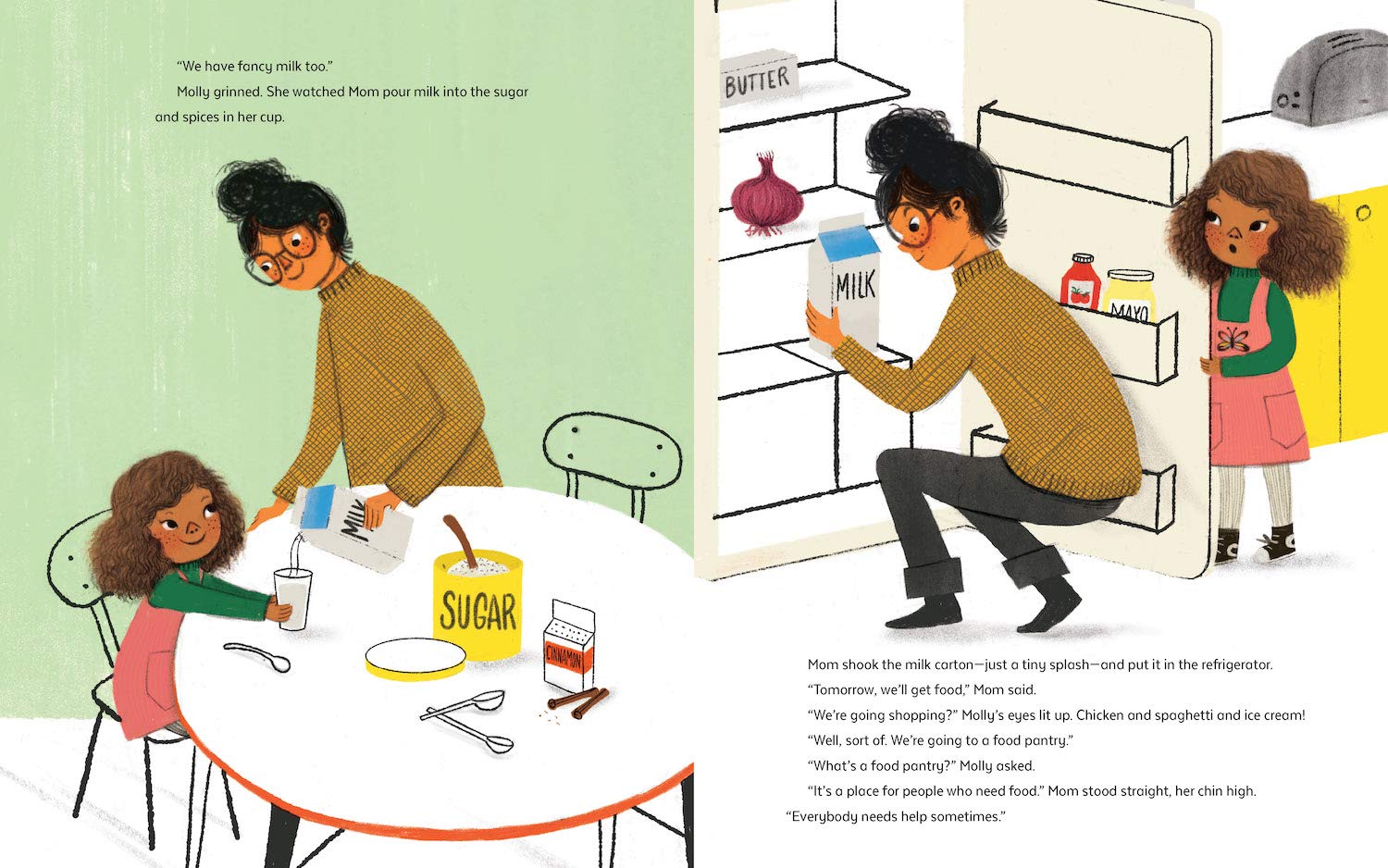
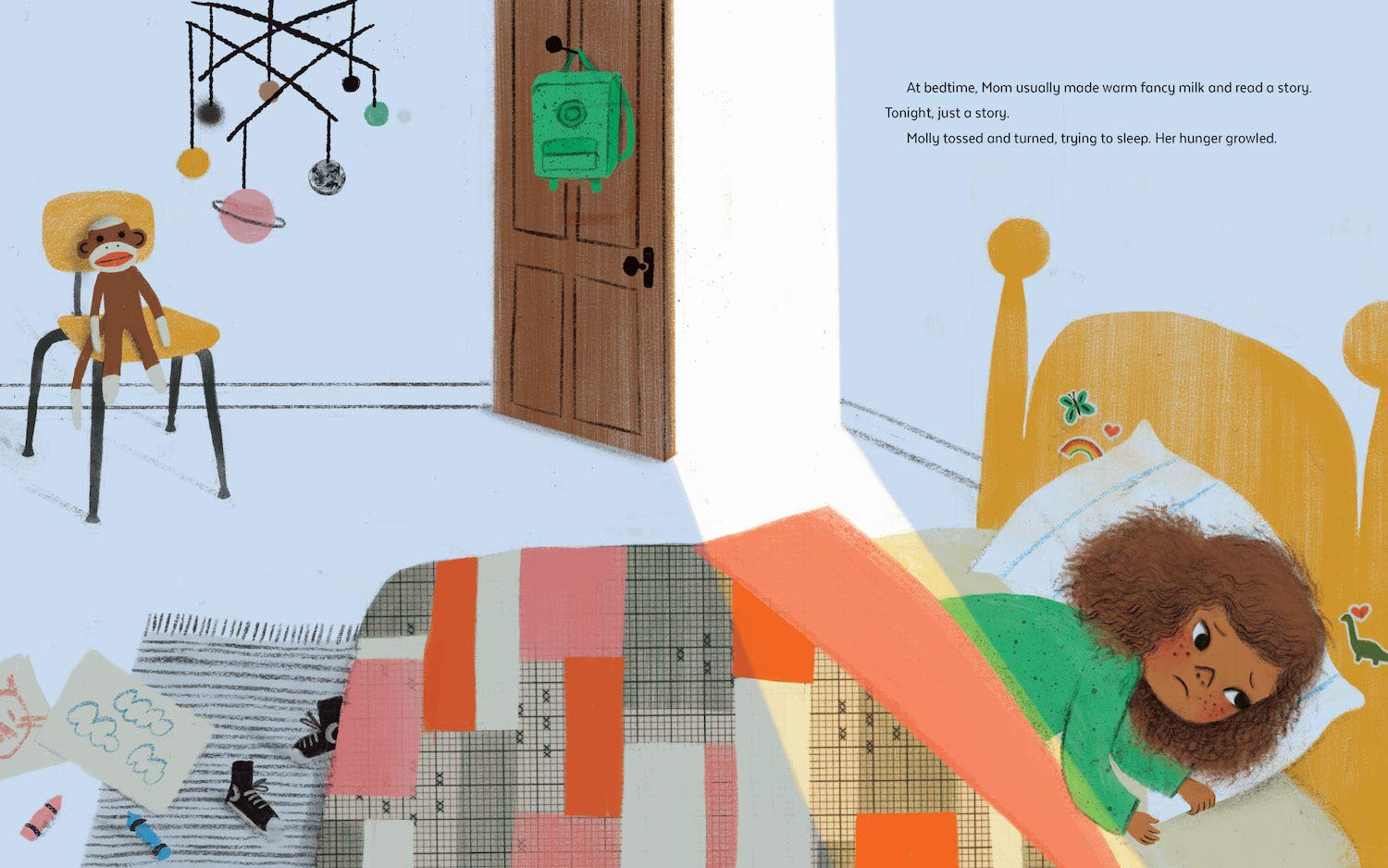
When Molly came to the table for dinner, she saw that they were having chili—again. She and her mom had eaten chili for two weeks straight. But there was “fancy milk too.” Molly smiled as her mom measured sugar and cinnamon into her glass and added milk.” There was only a splash of milk left when Mom put it back into the almost-empty refrigerator.

Tomorrow, Mom said, they’d go shopping. “Molly’s eyes lit up” as she imagined “chicken and spaghetti and ice cream.” But Molly’s mom tempered her expectations, saying that they’d be going to a food pantry. A food pantry, she explained, is “‘a place for people who need food…. Everybody needs help sometimes,’” she added. That night there was no warm milk before Molly went to bed and her stomach growled.

celebrate-picture-books-picture-book-review-saturday-at-the-food-pantry-milk

Image copyright Brizida Magro, 2021, text copyright Diane O’Neill. Courtesy of Albert Whitman & Company.

In the morning when Molly and her mom got to the food pantry there was already a line waiting for it to open. Molly had brought paper and crayons and sat down to draw. Then she saw a girl who was in her class at school. She called out a hello, but “Caitlin looked away.” When Molly ran over, Caitlin told her she didn’t want anyone to know that she and her grandmother needed help.

Molly went back to her mom, wondering if there was “something wrong with needing help.” She wanted to go home, but she was also hungry. Molly’s mom suggested she draw a picture, and the woman in front of them asked if she’d draw one for her too. Then everyone in line seemed to want a picture. Molly ran back to Caitlin to ask for help. Caitlin sat down and began to draw too.

celebrate-picture-books-picture-book-review-saturday-at-the-food-pantry-hungry

Image copyright Brizida Magro, 2021, text copyright Diane O’Neill. Courtesy of Albert Whitman & Company.

When the door opened, Molly and Caitlin each had a picture for the woman who welcomed them in too. Molly noticed that her mom had to sign in before she got a cart and they could begin shopping. They didn’t do that at the grocery store. The shelves at the food pantry were stocked with items she recognized from the store they usually shopped with. She ran over and took a box of sugar cookies off the shelf, but her mom told her “‘They—the people in charge—they’ll want us to take sensible stuff.’” Molly felt embarrassed and couldn’t understand why the cookies were there if they couldn’t take them. She sadly returned them to the shelf. As they went to look for food, Molly thought her mom didn’t want to be seen there, either—just like Caitlin. In a whisper, Molly reminded her that everyone needs help sometimes.

They went through the store taking one can, bag, or box of the food they needed. Then Molly’s mom reached for a box of powdered milk. They could have fancy milk that night. When they got to the checkout desk, Molly and Caitlin found their drawings hanging on the wall. The man at the counter bagged their groceries and then handed Molly’s mom a box of sugar cookies. “‘Saw your little girl looking at these. She can have them, if that’s okay with you, ma’am,’” he said. Molly noticed that her mom looked like she might cry.

celebrate-picture-books-picture-book-review-saturday-at-the-food-pantry-line

Image copyright Brizida Magro, 2021, text copyright Diane O’Neill. Courtesy of Albert Whitman & Company.

As they were walking home, Molly saw Caitlin and her grandmother coming the same way. They were all happy to discover that they were neighbors. Molly’s mom explained that she’d been looking for work since the factory closed, and Caitlin’s grandma said she’d been sick. Caitlin understood, but wished they didn’t have to shop at a food pantry. But then Molly told her that “everybody needs help sometimes” and reminded her that they had helped make the man at the checkout counter feel happy with their drawings. Caitlin hadn’t thought about it that way. She smiled. Then Molly invited her and her grandmother to have lunch with them—with sugar cookies for dessert.

Following the text, a note for parents, teachers, and other caregivers from Kate Maehr, the Executive Director and CEO of the Greater Chicago Food Depository, reveals more information about food insecurity, including recent statistics and a resource where people can find help and more information.

celebrate-picture-books-picture-book-review-saturday-at-the-food-pantry-shopping

Image copyright Brizida Magro, 2021, text copyright Diane O’Neill. Courtesy of Albert Whitman & Company.

Diane O’Neill’s well-executed story about two families who need the help of a food pantry is a poignant reminder of the many people—perhaps even readers’ classmates—who face food insecurity every day. Through the experiences of Molly and her mother and Caitlin and her grandmother, readers discover what it’s like to go to bed hungry, miss out on treats, and feel ashamed to ask for help. As this is Molly and her mother’s first trip to a food pantry, Molly’s questions and observations well reflect children’s own or reassures those who are familiar with these important resources.

O’Neill’s straightforward storytelling emphasizes the fact that at one time or another everyone needs help and demonstrates simple ways that children make things better through their generosity, optimism, and acceptance. Molly and Caitlin’s budding friendship makes for an uplifting and hopeful ending and may spur readers to recognize need in their midst and extend kindness.

Through her realistic illustrations of two families in need of assistance from a food bank, Brizida Magro helps children see and understand what food insecurity and food pantries look like. At home, Molly and her mom eat small portions of leftover chili and the last full glass of milk. When Molly’s mom puts the carton in the refrigerator, the shelves are nearly empty, and Molly lies awake in bed, too hungry to fall asleep.

The line outside the food pantry is made up of people from all walks of life, and inside the displays of food replicate a grocery store with the exception of signs asking shoppers to take one item only. These images can lead to meaningful discussions on the enormity of the issue. When Molly and Caitlin draw pictures that cheer up everyone in line as well as the food pantry workers, kids will recognize not only different ways of helping but their own role in making the world a kinder place.

Empathy shines on every page of O’Neill’s necessary and welcome story. Saturday at the Food Pantry is timely, heartfelt, enlightening and a must-buy addition to home, classroom, and school and public library collections.

Ages 4 – 7

Albert Whitman & Company, 2021 | ISBN 978-0807572368

Discover more about Diane O’Neill and her work on her website.

You can connect with Brizida Magro on Instagram.

celebrate-picture-books-picture-book-review-saturday-at-the-food-pantry-cover

You can find Saturday at the Food Pantry at these booksellers

Amazon | Barnes & Noble | Books-a-Million

To support your local independent bookstore, order from

Bookshop | IndieBound

Picture Book Review

August 16 – Celebrating the Book Birthday of A Case of the Zaps

celebrate-picture-books-picture-book-review-a-case-of-the-zaps-cover

Thanks to Abrams Books for Young Readers for sending me a copy of A Case of the Zaps for review consideration. All opinions on the book are my own.

A Case of the Zaps

Written by Alex Boniella and April Lavalle | Illustrated by James Kwan


On Robot-Earth there lived a robot named 3.14159… (“or Pi, for short”). Pi liked doing things most young robots did, like “playing music, walking their dog, and hanging out with their Parental Units and friends. Pi also liked sports, science, camping, and exploring, and their favorite food was DW-40. One day at school, their teacher announced that in a month the class would be going on a field trip to Olde Silicon Valley.

celebrate-picture-books-picture-book-review-a-case-of-the-zaps-parental-units

Image copyright James Kwan, 2022, text copyright Alex Boniello and April Lavalle, 2022. Courtesy of Abrams Books for Young Readers.

All of Pi’s classmates were excited about the trip, and “Pi felt their circuit board BUZZ with anticipation.” Pi couldn’t stop thinking about the trip. But along with all the fun things they would do, thoughts about what could go wrong crept into his consciousness. And then, unexpectedly, while walking home from school with their friends, Pi experienced a tingle in their arms and then their “defense mechanisms JOLTED on.” Pi’s friends asked if they were all right.

celebrate-picture-books-picture-book-review-a-case-of-the-zaps-hobbies

Image copyright James Kwan, 2022, text copyright Alex Boniello and April Lavalle, 2022. Courtesy of Abrams Books for Young Readers.

Pi wasn’t sure and took off for home, “feeling zaps all around. Feeling afraid for reasons they didn’t quite understand.” The intrusive thoughts kept Pi awake that night, and during the next few days, even though Pi tried to act calm, they felt anything but. Trying not to think about the field trip just made things worse. One night they couldn’t even eat their DW-40, and then… ZAP! 

Pi ran to their room and shut the door. Pi’s “Mother-Board and Father-Board followed their robo-kid upstairs. When they asked through the door what was wrong, Pi admitted that they didn’t want to go on the field trip anymore. They they explained that “something feels wrong” and how all their gears and sensors seemed to be in overdrive. Pi confessed “‘I’m scared I might be . . . broken.'”

celebrate-picture-books-picture-book-review-a-case-of-the-zaps-school

Image copyright James Kwan, 2022, text copyright Alex Boniello and April Lavalle, 2022. Courtesy of Abrams Books for Young Readers.

Pi was surprised to find that just telling their parents made them feel better. Pi’s Father-Board told them that they had had the zaps when he started his new job and that “‘cousin Cosine Tangent has had them for years.'” Pi was surprised because Cosine Tangent had recently won a major science award. Mother-Board suggested that they visit the doctor the next day.

Doctor Bleep Bloop was very friendly and welcoming. The doctor explained to Pi that the Zaps can happen to anyone and at any time and acknowledged that they can be scary. When Pi asked if there was any cure for the Zaps, Doctor Bleep Bloop was honest and told them “‘There isn’t a simple cure.'” The doctor went on to say, though, that there were ways of managing the Zaps and that they could work together to find strategies to help Pi.

celebrate-picture-books-picture-book-review-a-case-of-the-zaps-anxiety

Image copyright James Kwan, 2022, text copyright Alex Boniello and April Lavalle, 2022. Courtesy of Abrams Books for Young Readers.

By the time the field trip to Olde Silicone Valley came around, Pi was ready to go, and they had a lot of fun. Even after the trip, Pi sometimes felt the Zaps. “When that happened, Pi used the tools that Dr. Bleep Bloop had shared with them, and then the Zaps didn’t feel quite so scary.” 

Back matter includes an Authors Note explaining how both Alex and April have experienced anxiety in their lives as well as online resources where parents and caregivers can find more information and help from professionals in the areas of anxiety, depression, and other mental health issues.

celebrate-picture-books-picture-book-review-a-case-of-the-zaps-Dr.-Bleep-Bloop

Image copyright James Kwan, 2022, text copyright Alex Boniello and April Lavalle, 2022. Courtesy of Abrams Books for Young Readers.

Experiencing anxiety can be scary and confusing, and without the language to describe what is happening to them, children can feel isolated and alone. Alex Boniello and April Lavalle’s A Case of the Zaps provides kids and adults with a straightforward way to comfortably talk about anxiety while offering reassurance and a road map to discovering coping strategies that can help. Descriptions of the physical and mental effects of anxiety on Pi give kids direct examples to point to when talking about their own emotions and experiences with their parents, caregivers, or doctors. Pi’s parents’ suggestion to visit the doctor gives adults a starting point on the journey to helping their children. 

James Kwan’s vibrant illustrations, incorporating elements of comics and graphic novels, will enchant kids as they learn about Pi’s hobbies, family life, and excitement to visit Olde Silicone Valley. As Pi’s enthusiasm for the field trip turns to trepidation, kids can watch the robot’s expressive face change from happy to worried and fearful. They also see that anxiety causes physical effects, sleeplessness, depleted energy, and the body’s fight-or-flight mechanism to kick in. After the family’s visit with Dr. Bleep Bloop, Kwan’s depictions of calming activities Pi does with their mother-board and father-board, friends, and the doctor show readers that therapy can be found in many places from play to sports to yoga and more.

Honest, accessible, sprinkled with humor, and written in partnership with Child Mind Institute to ensure that the book can serve as a social-emotional tool, A Case of the Zaps is an outstanding book for talking about anxiety with any child. The book is highly recommended for home libraries and a must for classroom, school, and public library collections.

Ages 4 – 8

Abrams Books for Young Readers, 2022 | ISBN 978-1419756726

You can connect with writer, actor, musician, singer, and Tony award-winning producer Alex Boniella on Twitter and Instagram.

Connect with writer, comedian, actor, and Tony award-winning producer April Lavalle on her website and Twitter.

You’ll find James Kwan on Instagram.

celebrate-picture-books-picture-book-review-a-case-of-the-zaps-cover

You can find A Case of the Zaps at these booksellers

Amazon | Barnes & Noble | Books-a-Million

To support your local independent bookstore, order from

Bookshop | IndieBound


Picture Book Review

May 3 – Celebrating National Lumpy Rug Day with Author Sophia Gholz

celebrate-picture-books-picture-book-review-bug-on-the-rug-coverAbout the Holiday

Today’s holiday, in addition to having a humorous and whimsical bent to it, promotes some thoughtful consideration of two rug-related ideas. The onset of spring often inspires people to do some deep cleaning around the house, and that, according to the holiday, should include rugs – that cushy decor that can define a room or provide an impromptu place for pets to nap. As they age, though, rugs and carpets can develop lumps and bulges that compromise the safety and appearance of your home or office. If that’s the case at your house, a steam clean, day in the sun, or re-rolling may restore your rug to its original beauty. But National Lumpy Rug day isn’t all about outward appearance. The holiday also touches on that common practice of “brushing things under the rug” and encourages people to air any complaints, feelings, or topics that they have been avoiding. Making a full sweep of any problems underfoot is a great way to start the spring season, and sharing today’s book with your kids is a hilarious way to celebrate.

Hi Sophia! I’m thrilled to have you visit to talk about your latest book, Bug on the Rug, its endearing characters, inspirational message, and how the story changed from its initial idea. I also love your tips on how adults can use your book to foster discussion and awareness of those misunderstandings that can adversely affect friendships.

Sophia Gholz - headshot

Sophia Gholz is an award-winning children’s book author, magic seeker and avid reader. Sophia enjoys writing fiction with humor and heart. When writing nonfiction, she pulls on her love of science and her strong family background in ecology. When she’s not writing, you can find Sophia reading a book, visiting schools or exploring the great outdoors with her family.

Sophia’s debut book, The Boy Who Grew a Forest: The True Story of Jadav Payeng, was a NCSS Notable Social Studies Trade Book, a Florida State Book Award Gold Medalist, Eureka! Nonfiction Honor Book and a 2020 Green Earth Honor Book. She is also the author of Jack Horner, Dinosaur Hunter! You can connect with Sophia on her Website | Facebook | Instagram | Twitter | YouTube

Bug on the Rug

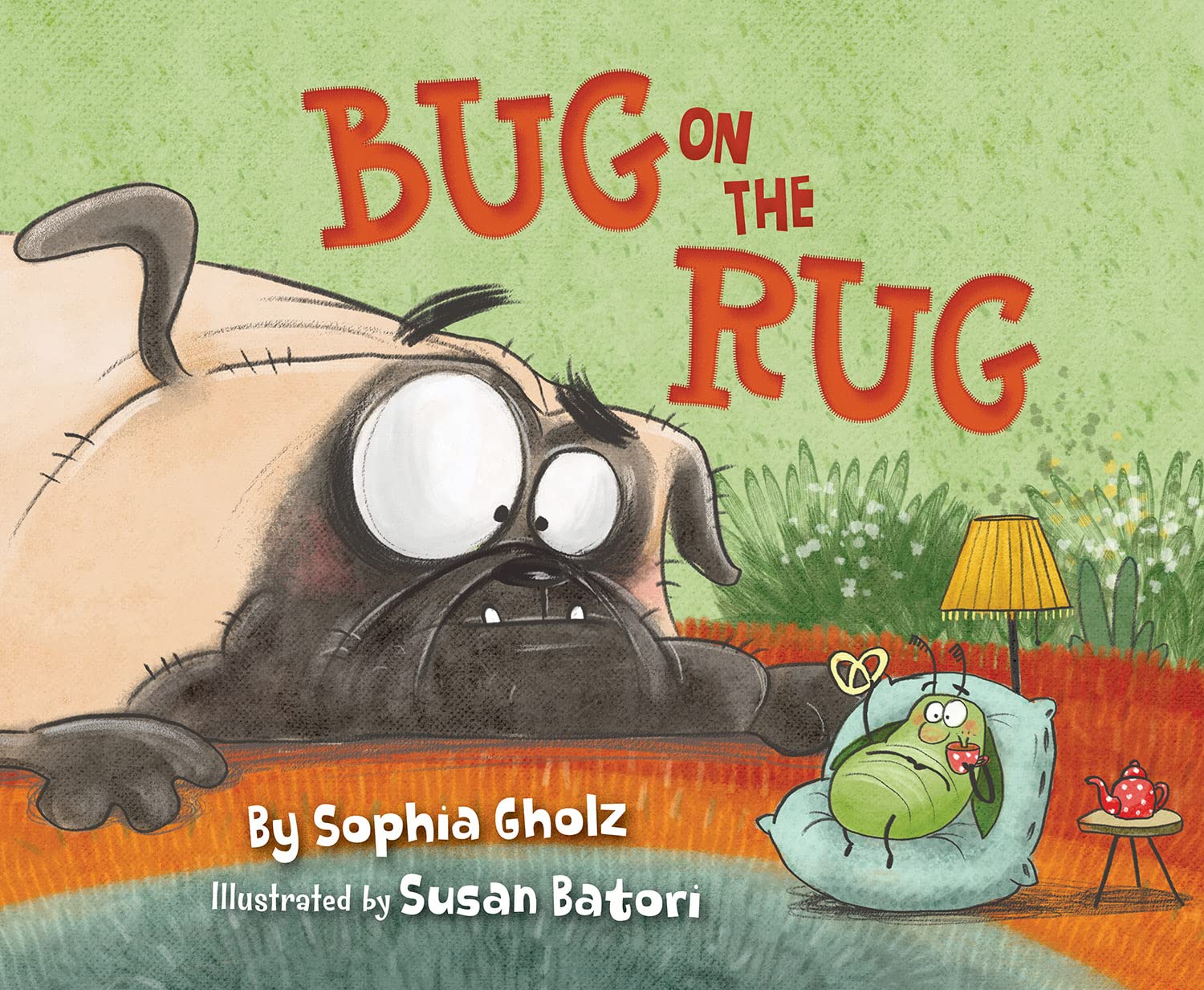
Written by Sophia Gholz | Illustrated by Susan Batori


Picture books are entire worlds and stories wrapped in a few hundred words. They share a mood, a lesson, a hug, a friend, a culture, an adventure. I’ve said it before, and I’ll say it again now: picture books are magic. That is why I am so excited to be here at one of my favorite blogs, Celebrate Picture Books, to share my newest book, Bug on the Rug. And today is the perfect day because it also happens to be National Lumpy Rug Day! Hooray! Did I mention that Bug on the Rug features a verrrry cozy rug? So cozy, in fact, it causes quite a stir.

celebrate-picture-books-picture-book-review-bug-on-the-rug-pug

Image copyright Susan Batori, 2022, text copyright Sophia Gholz, 2022. Courtesy of Sleeping Bear Press.

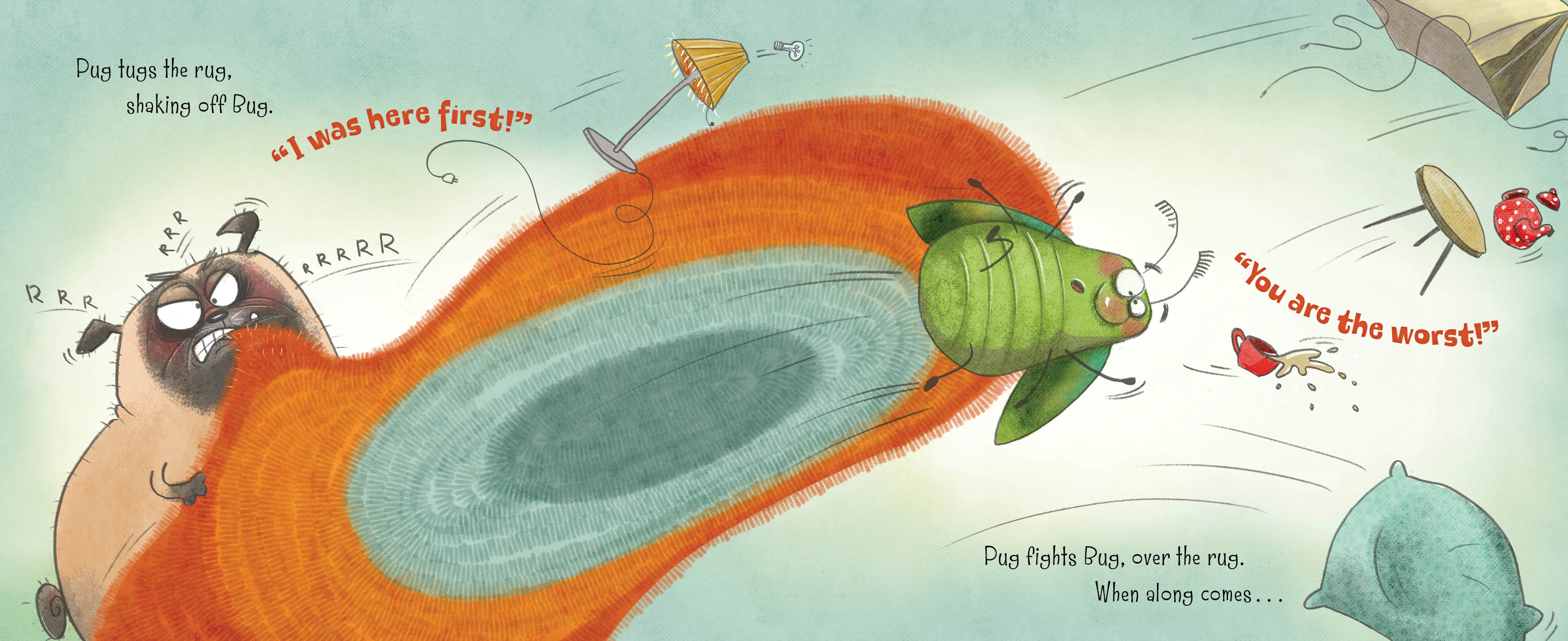
In Bug on the Rug a rug-loving Pug and a rug-stealing Bug battle over a lone rug. These two over-the-top characters both believe they’re right and their claim to the rug takes priority. That is, until Slug comes along and helps open their eyes to the truth of each of their actions. Through empathy, both Pug and Bug learn to take ownership of their mistakes and discover that, in this case, forgiveness and friendship go hand-in-hand.

celebrate-picture-books-picture-book-review-bug-on-the-rug-shaking

Image copyright Susan Batori, 2022, text copyright Sophia Gholz, 2022. Courtesy of Sleeping Bear Press.

I began writing this book with the idea of creating a light story that everyone can have fun with. But as I wrote and these characters took on a life of their own, the story grew. At first glance, Bug on the Rug is silly and filled with word play. But truthfully, this is a friendship book that we can all relate to. Sharing is hard. Making new friends is harder. And admitting to our mistakes? Oof. That is the hardest. But we all make mistakes. It’s natural and if we allow it, we can grow from those mistakes. So, with that in mind and remembering it’s National Lumpy Rug Day, let’s take a moment today to pull out what we may have swept under the rug. Let it go. Shake it out. Smooth out those lumps and enjoy a fresh start!

celebrate-picture-books-picture-book-review-bug-on-the-rug-tears

Image copyright Susan Batori, 2022, text copyright Sophia Gholz, 2022. Courtesy of Sleeping Bear Press.

Thanks, Sophia! I really laughed my way through Bug on the Rug and cheered at the end for these three new friends. I love your rollicking storytelling and know kids and adults will too!

For all you readers out there, Bug on the Rug is a hilarious rhyming romp with a rhythm made for dramatic readings that kids will want to hear again and again. The book will make a favorite addition to home, school, and public libraries for lively and meaningful story times. 

Ages 4 – 7

Sleeping Bear Press, 2022 | ISBN 978-1534111479

Susan Batori - Headshot

Susan Batori’s books include Don’t Call Me Fuzzybutt and
Letters from Space. She worked in advertising before switching to
children’s book illustration. Susan lives in Budapest, Hungary. To learn more about Susan Batori, her books, and her art, you can view a portfolio of her work here and connect with her on Bēhance | Instagram | Twitter

National Lumpy Rug Day Activity

celebrate-picture-books-picture-book-review-kids-on-rug-clip-art

Bug on the Rug-themed Social Emotional Learning (SEL) Activities 


  1. Use Bug on the Rug to start discussions on empathy and growth. Pull up a rug and ask readers to recall instances in their life when they have made a mistake or when they thought they were right when they were wrong. You can ask questions like: How did that moment make you feel? and How did you change in that instance? Readers can also discuss different instances when putting themselves in the shoes of others – empathizing with others – helped them change their point of view in some way.
  2. Ask readers to take a look at Bug and Pug and list how the characters changed from the start of the book to the end. This can be used to start a discussion about how we grow and develop emotionally through challenging experiences.

celebrate-picture-books-picture-book-review-bug-on-the-rug-cover

You can find Bug on the Rug at these booksellers

Amazon | Barnes & Noble | Books-a-Million

To support your local independent bookstore, order from

Bookshop | IndieBound

February 14 – Valentine’s Day

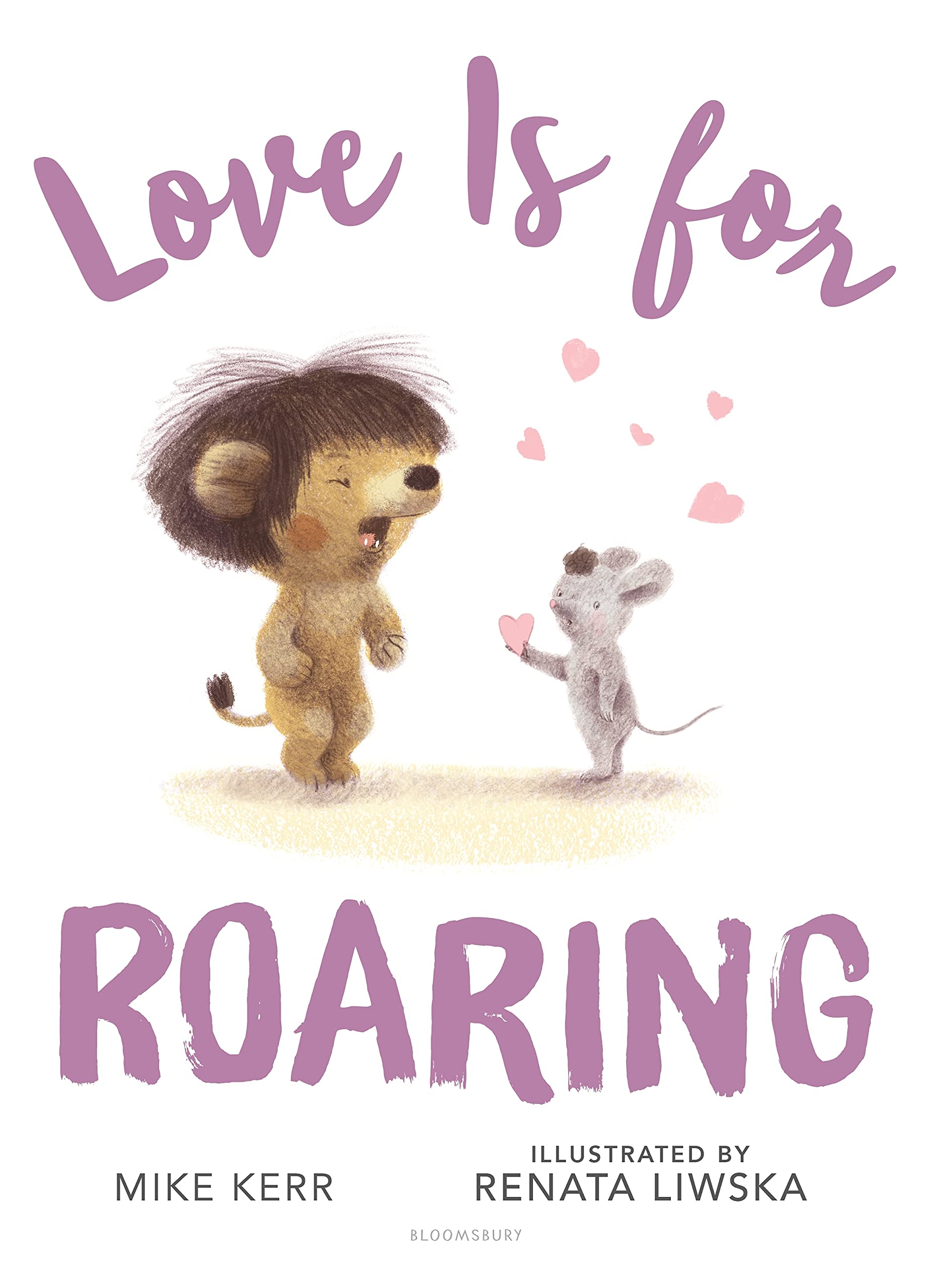
celebrate-picture-books-picture-book-review-love-is-for-roaring-cover

About the Holiday

Hearts are full on Valentine’s Day as we share our love for family, friends, and special sweethearts. This centuries-old holiday continues to grow as people engage in traditional and new ways to express their feelings. But what about the other 364 days of the year? Well, of course, love – in all its wonderful forms – is in the air on those days too as today’s book so charmingly reveals.  

Love Is for Roaring

Written by Mike Kerr | Illustrated by Renata Liwska


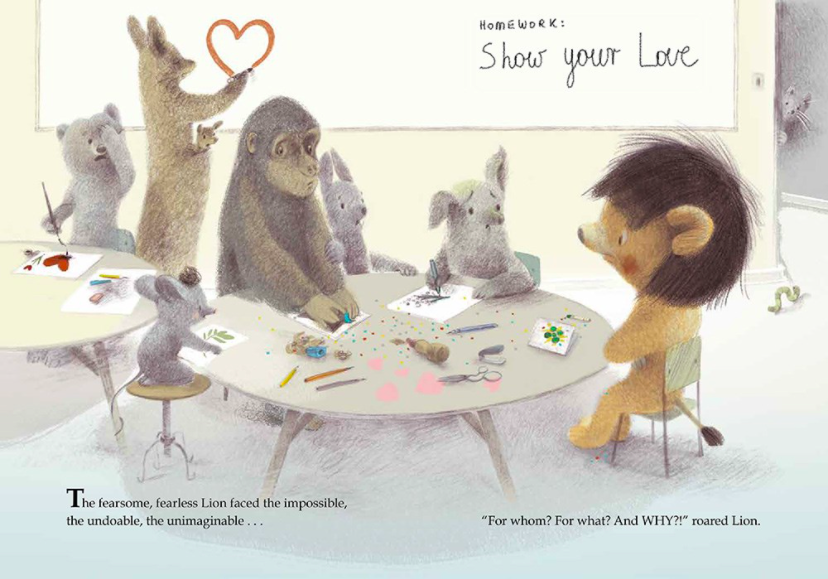
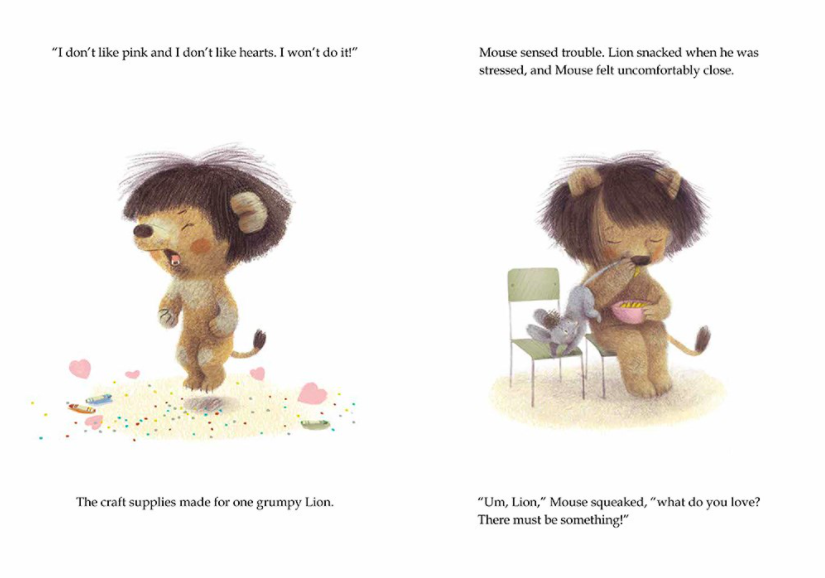
One day at school, the teacher gave her class an impossible assignment – at least for Lion. With their tables full of paper, paint, markers, crayons, scissors, and tape, the students were supposed to “show your Love.” “‘For whom? For what? and WHY?’ roared Lion.” He threw a tiny tantrum. “‘I don’t like pink and I don’t like hearts. I won’t do it!'”

celebrate-picture-books-picture-book-review-love-is-for-roaring-assignmen

Image copyright Renata Liwska, 2022, text copyright Mike Kerr, 2022. Courtesy of Bloomsbury Books for Children.

Mouse wanted to help and told Lion there must be something that he loved. But Lion protested, saying that while love was fine for some, he did not “‘love love.'” He didn’t like hugs or kisses or sweets. Mouse thought and thought and then decided there might be another way to think about love.

celebrate-picture-books-picture-book-review-love-is-for-roaring-snack

Image copyright Renata Liwska, 2022, text copyright Mike Kerr, 2022. Courtesy of Bloomsbury Books for Children.

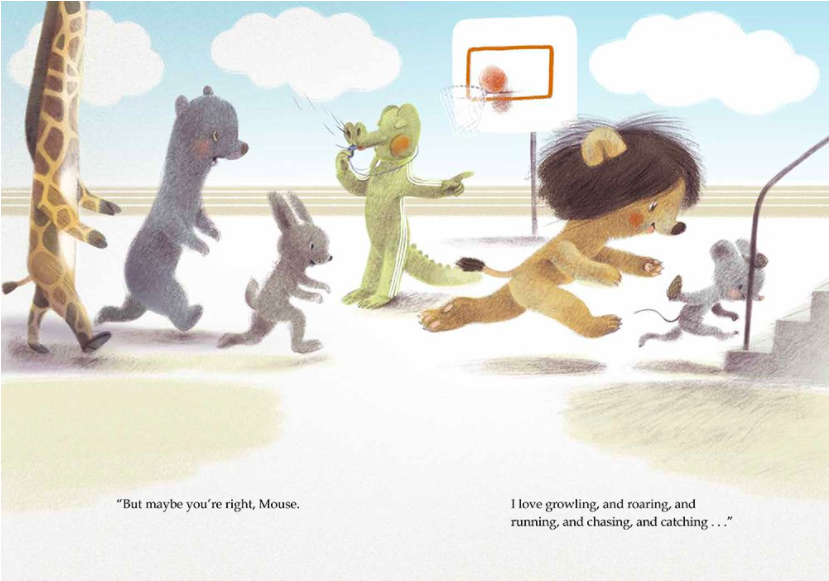
Mouse asked Lion if he didn’t love “‘running and playing.'” Mouse also seemed to remember that Lion loved dozing – especially during class movie times. “‘And growling, and roaring…You don’t love that?'” Mouse prodded. And how about playing together? Lion thought it over, and while hugs, kisses, and sugary sweets weren’t his thing, he knew that playing and chasing and catching were. And there was one more thing that Lion realized he loved – his friendship with Mouse. So he happily worked at the table to make a special card with a pink heart on the front just for Mouse. 

celebrate-picture-books-picture-book-review-love-is-for-roaring-recess

Image copyright Renata Liwska, 2022, text copyright Mike Kerr, 2022. Courtesy of Bloomsbury Books for Children.

Mike Kerr’s gentle story embraces children who may squirm at expressions of love that include hugs, kisses, or other showy displays of affection while reminding readers that love also can be revealed in favorite activities and moments shared with others. Mouse’s thoughtful response to Lion’s initial refusal to participate in craft time demonstrates empathetic friendship and alternate thinking that will resonate with kids. Honest dialogue between Lion and Mouse gives readers language to discuss their own feelings about love and other emotions as well as about how they like to express them. As Lion comes to see that he does love many things, he realizes that friendship is intrinsic to all of them and is a powerful kind of love in itself – a kind of love that he wants to share.

Kids will be captivated by Renata Liwska’s adorable and humorous illustrations. As Lion questions the assignment to show your love, his classmates look on with expressions of shock, sympathy, and confusion while a tiny inchworm makes a run for the door. Lion’s tantrum is more cute than cranky, and  Mouse, wanting to help, nearly becomes part of Lion’s stress snacking and moves a safe distance away to talk about the situation. Images of Lion participating in the rambunctious activities he likes best are joyful, and the final illustrations of Lion, now excited to share his love for Mouse, are heartwarming.

A sweet story of friendship as well as a meaningful way for adults and kids to talk about emotions and expressing their feelings, Love Is for Roaring will become a quick favorite on home bookshelves and is a must for school and public library collections. 

Ages 4 – 8

Bloomsbury Children’s Books, 2022 | ISBN 978-1681191249

Discover more about Mike Kerr and Renata Liwska, their books and their art on their website.

Valentine’s Day Activity

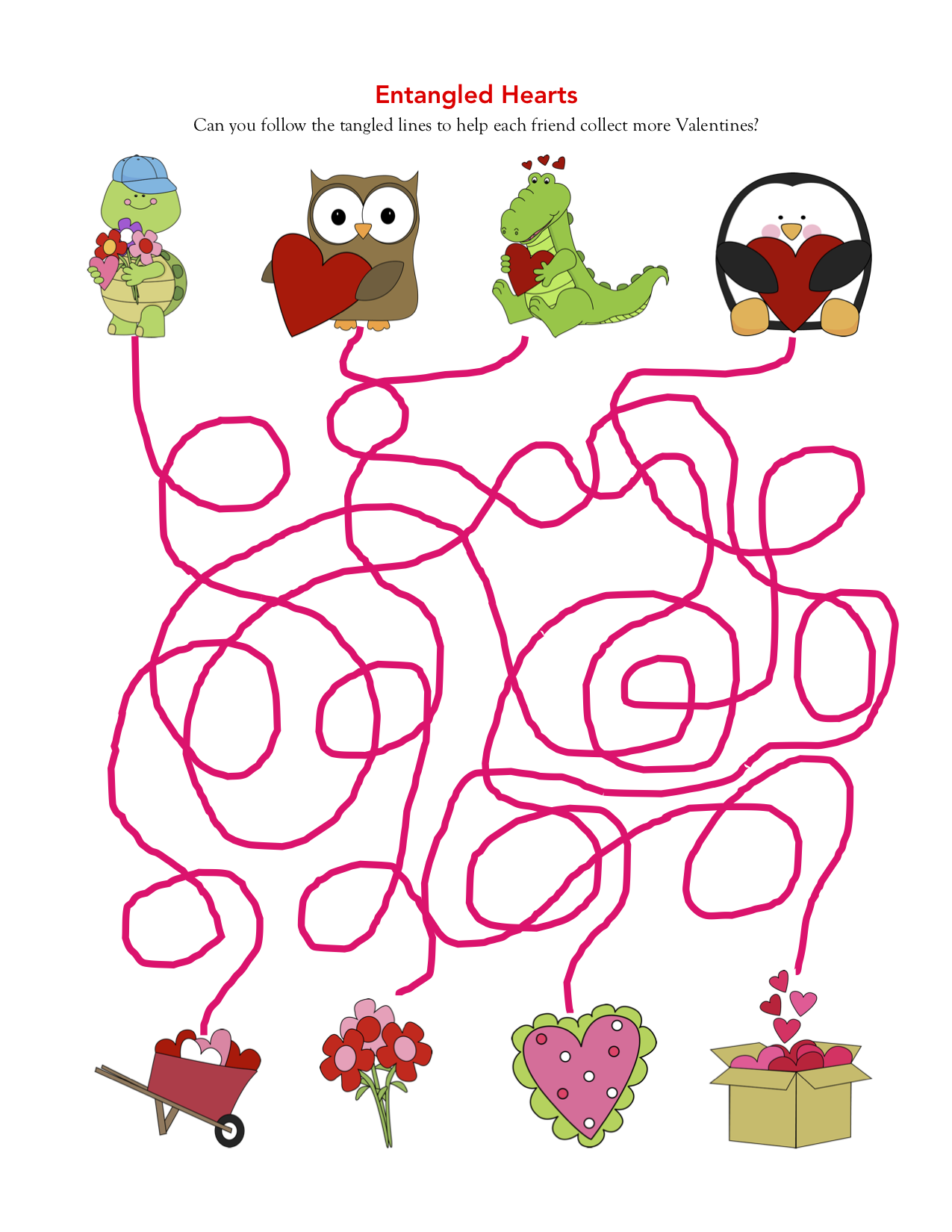
celebrate-picture-books-picture-book-review-entangled-hearts-matching-puzzle

Entangled Hearts Matching Puzzle


These friends are collecting valentines! Can you help them follow the paths to find more in this printable puzzle?

Entangled Hearts Matching Puzzle

celebrate-picture-books-picture-book-review-love-is-for-roaring-cover

You can find Love Is for Roaring at these booksellers

Amazon | Barnes & Noble | Books-a-Million

To support your local independent bookstore, order from

Bookshop | IndieBound

Picture Book Review

January 3 – It’s International Quality of Life Month

celebrate-picture-books-picture-book-review-nobody-owns-the-moon-cover

About the Holiday

How one achieves their definition of a good quality of life may differ for every person, but in general it encompasses being happy and satisfied with one’s relationships, work, living conditions, and self. Whether you find happiness and quality of life in outdoor or indoor pursuits, with others or alone, at work or at home, this month’s holiday gives you time to get in touch with your inner quiet place and reflect on changes or improvements to bring you more peace and happiness in life.

I’d like to thank Berbay Publishing for sharing a copy of Nobody Owns the Moon with me for review consideration. All opinions on the book are my own.

Special Note: As I have been asked to take on extra shifts as a staff member at my local public library due to personnel shortages, I will be taking a break from posting daily reviews over the next coming months. In between new reviews, I invite you to explore all of the holidays, author and illustrator interviews, activities, and, of course, the wonderful books featured on Celebrate Picture Books.

Nobody Owns the Moon

By Tohby Riddle


Upon the opening pages readers are treated to an engaging treatise on the success (or not so) of certain animals trying to “make a life for itself in cities.” The fox, we learn, is especially adept because it is “quick-witted and able to eat a variety of foods.” We are then introduced to one such city-dweller, Clive Prendergast – a self-named fox because his real name “can only be pronounced by foxes.”

celebrate-picture-books-picture-book-review-nobody-owns-the-moon-fox

Copyright Tohby Riddle, 2021, courtesy of Berbay Publishing.

Clive lives in a small apartment and works on a factory production line. At night he takes to the streets, visiting food stalls and watching the interesting goings-on. Clive has a few friends, but the one he sees the most is Humphrey, a donkey who is “one of those creatures that live in cities with less success than foxes” and “doesn’t always have a fixed address.” While Humphrey has had jobs, he has trouble keeping them. Right now he’s working as a piano removalist.

One day Clive saw Humphrey sitting on the stone steps of “a statue of a great conqueror.” Clive thought he looked tired and underfed. Then he noticed a blue envelop sticking out of Humphrey’s tote bag. It turned out that Humphrey had found it in the street and planned on eating it, but thinking Clive was also hungry he offered it to him without a second thought. When Clive opened the envelope, he found two tickets to that night’s performance at the theatre. They should go, he said.

celebrate-picture-books-picture-book-review-nobody-owns-the-moon-humphrey

Copyright Tohby Riddle, 2021, courtesy of Berbay Publishing.

“That night Humphrey and Clive attended the premier of Nobody Owns the Moon – the latest play by the city’s most celebrated playwright. Before the show, ticket-holders were treated to hors d’ oeuvres and punch. Then they were shown to their front-row balcony seats. The play was wonderful, full of humor and poignancy. Tears filled Humphrey’s eyes at the show’s “bittersweet ending” and again as they enjoyed a beverage and “large slice of cake in the theatre’s elegant restaurant.”

Filled with the wonder of the evening, Clive and Humphrey headed out into the “glimmering melee of lights and sounds that was their city at night. “‘This is our town!'” they exclaimed to each other, and before they went “their separate ways, Humphrey gave Clive a big hug goodnight.”

celebrate-picture-books-picture-book-review-nobody-owns-the-moon-city

Copyright Tohby Riddle, 2021, courtesy of Berbay Publishing.

Immersive and openhearted, Tohby Riddle’s poignant friendship tale is as surprising and inclusive as the invitation Humphrey finds. Opening with lines that could come straight from a nature documentary, the story quickly becomes interwoven with an air of mystery and anticipation as Clive Prendergast and Humphrey are introduced. Riddle’s inclusion of smart details, such as Clive’s fox name being unpronounceable to humans and Humphrey’s job that takes advantage of a donkey’s strong back, adds a verisimilitude that will delight readers. The emotional core of the story comes with Clive’s and Humphrey’s friendship, which is equitable and caring and full of generosity. The discovery and use of the theater invitation ushers in sumptuous scenes of a glittering theater, delicious food, and a life-affirming performance while also touching on the importance of satisfying the body and the soul, however one defines this.

Equally captivating are Riddle’s collage-style illustrations, which incorporate sly humor and thought-provoking perspectives. The book opens with an illustration of Clive Prendergast lounging in a comfortable armchair between Vincent van Gogh’s painting “A Wheatfield, with Cypresses” and a window which frames a view of the city that cleverly mirrors the famous artwork. Clive’s position suggests his comfort in both environments. Humphrey’s difficulties fitting in, on the other hand, are depicted in an Italian restaurant where, distracted for a moment, the plates of spaghetti and meatballs he’s carrying tip precariously over a customer sitting under a photograph of the Leaning Tower of Pisa. Other images that contribute to the depth and atmosphere of this book are theater posters advertising Vaudeville and magic acts, Russian nesting dolls and fresh foods for sale in Clive’s multicultural neighborhood, and the copy of Walt Whitman’s Leaves of Grass next to a view-master in Humphrey’s tote bag.

The city’s human inhabitants are all depicted in flat grays and browns while the animals – pigeons, a crocodile, a dancing bear – are portrayed in textured full color. This dichotomy begins to fade at the theater, where a waiter in formal dress offers Humphrey hors d’ oeuvres, in the balcony row where Clive and Humphrey sit, and in the restaurant after the show, a change that offers opportunities for readers to talk about acceptance and how we look at others. The moving ending is eloquent in it’s simple embrace of individuality and acceptance.

A touching, multi-level story that will enchant and impact readers, Nobody Owns the Moon will become a favorite and is a must for home, classroom, school, and public library collections.

Ages 4 – 8

Berbay Publishing, 2021 | ISBN 978-0994384195

Discover more about Tohby Riddle, his books, and his art on his website.

International Quality of Life Activity
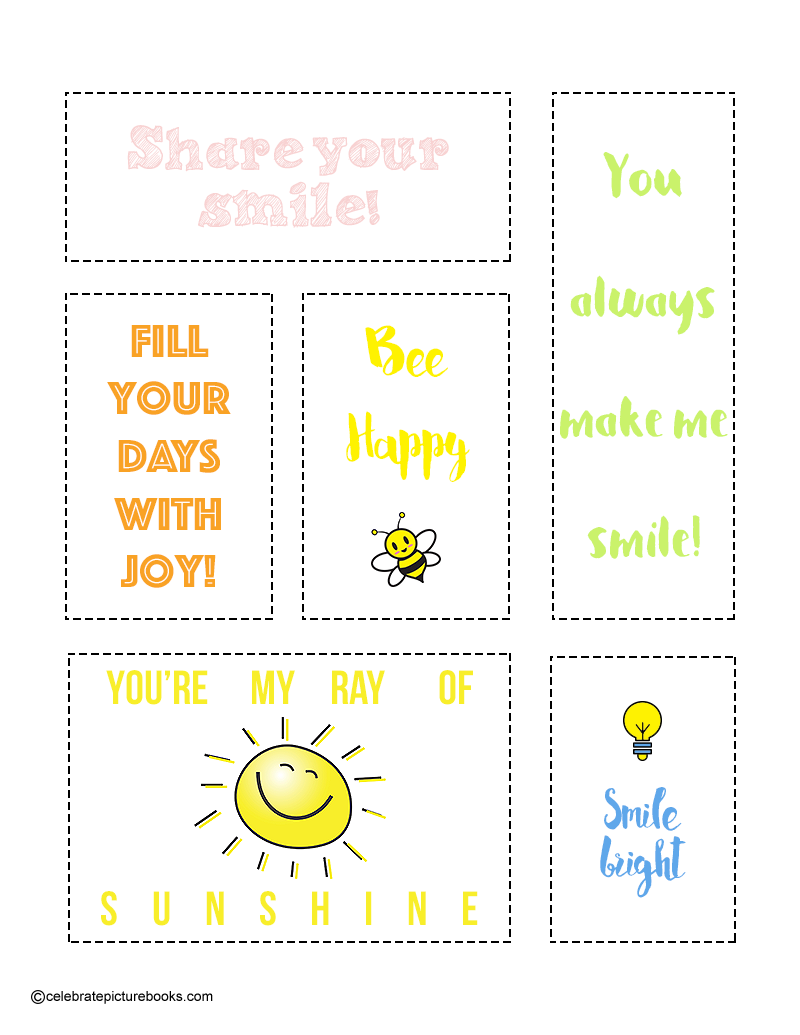
celebrate-picture-books-picture-book-review-smile-cards-craft

Share a Smile Cards


Life is better when you share smiles with those you know—and those you don’t! Try it! When you’re out today at school or other places, give someone a smile. You can be sure that you will have made their day and your day better! These cards are another way you can share a smile. Why not slip one into your dad’s pocket or your mom’s purse, put one in your friend’s backpack, or sneak one onto your teacher’s desk? You can even leave one somewhere for a stranger to find! Have fun sharing your smiles, and see how much better you and the others around you feel!

Click here to print your Share a Smile Cards.
celebrate-picture-books-picture-book-review-nobody-owns-the-moon-cover

You can find Nobody Owns the Moon at these booksellers

Amazon | Barnes & Noble | Books-a-Million

To support your local independent bookstore, order from

Bookshop | IndieBound

Picture Book Review