February 26 – It’s Black History Month

celebrate-picture-books-picture-book-review-what-do-you-do-with-a-voice-like-that-cover

About the Holiday

Black History Month is a celebration of the achievements of African Americans and the contributions they have made to the United States History. Appropriately for this election year, the theme for 2020 is “African Americans and the Vote,” which recognizes the struggle for both black men as well as women throughout American history. This year marks the 150th anniversary of the Fifteenth Amendment, which was ratified in 1870 and gave black men the right to vote after the Civil War. It has also been one hundred years since women gained the right to vote. For more information about Black History Month, visit the ASALH website and africanamericanhistorymonth.gov.

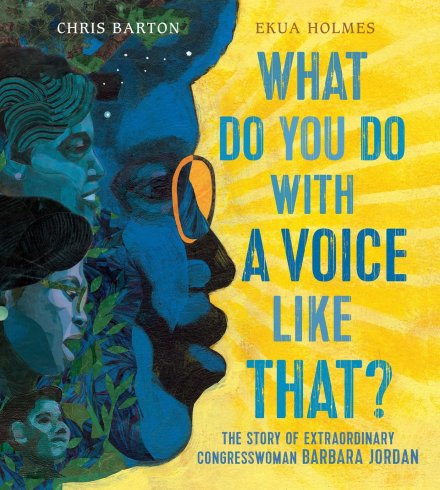
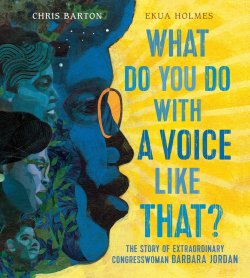
What Do You Do with a Voice Like That? The Story of Extraordinary Congresswoman Barbara Jordan

Written by Chris Barton | Illustrated by Ekua Holmes


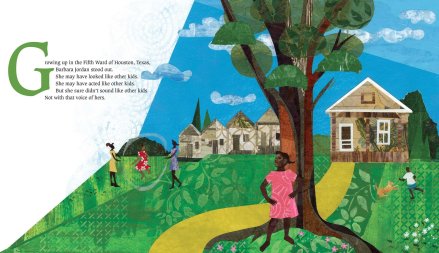
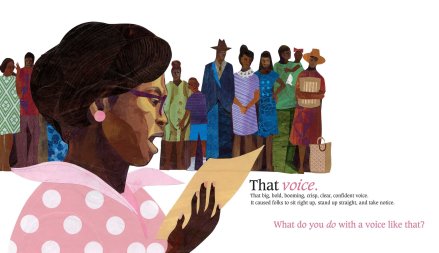
As a child growing up in the Fifth Ward of Houston, Texas, Barbara Jordan was known for her distinctive voice. “That voice. That big, bold, booming, crisp, clear, confident voice. It caused folks to sit right up, stand up straight, and take notice. What do you do with a voice like that?” Barbara recited poetry, gave speeches, and in 1952 won an oratory contest with a trip to Chicago as the prize. She was proud of herself and where her voice was leading her. But where would that be?
celebrate-picture-books-picture-book-review-what-do-you-do-with-a-voice-like-that-child

Image copyright Ekua Holmes, 2018, text copyright Chris Barton, 2018. Courtesy of Beach Lane Books.

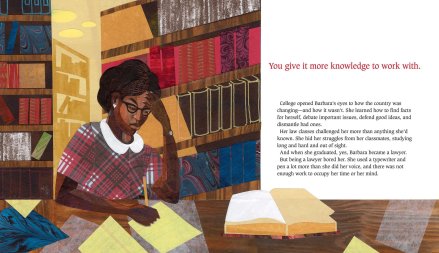
She considered becoming a preacher, a teacher, and a lawyer. When a black woman lawyer gave a speech at Barbara’s high school, Barbara thought she had found her calling. She attended college where she “learned how to find facts for herself, debate important issues, defend good ideas, and dismantle bad ones.” She graduated with a law degree, but practicing law became boring. She wrote more than she spoke, and the work was not demanding enough.
celebrate-picture-books-picture-book-review-what-do-you-do-with-a-voice-like-that-studying

Image copyright Ekua Holmes, 2018, text copyright Chris Barton, 2018. Courtesy of Beach Lane Books.

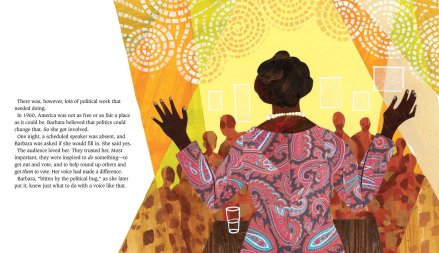
It was 1960, and Barbara decided to lend her voice to causes she believed in. She became involved in politics, and on one pivotal night, she filled in for a speaker who was absent. “The audience loved her. They trusted her. Most important they were inspired to do something—to get out and vote” and to persuade others to vote. Barbara decided to run for office. She lost her first two elections, but the third one she won.

Barbara Jordan was now a Texas state senator, representing the people she grew up with. She believed in making changes from within the political system through debating issues on the Senate floor. She also got to know her colleagues outside of work, and they got to know her. They listened to each other, and positive changes were the result. In 1972, Barbara ran for Congress and won a seat in the U.S. House of Representatives in Washington DC.
celebrate-picture-books-picture-book-review-what-do-you-do-with-a-voice-like-that-politics

Image copyright Ekua Holmes, 2018, text copyright Chris Barton, 2018. Courtesy of Beach Lane Books.

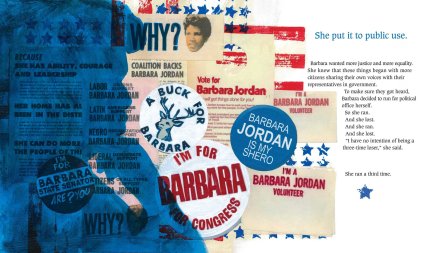
In 1973, the Watergate scandal broke. “President Nixon, it seemed, had broken the law, and Congress had to decide what to do about it.” Once again, as a member of the House Judiciary Committee, Barbara used her voice to remind Congress and the American people that “the Constitution is the document governing all the laws in the United States and applies to all of its people.” Then “in her big, bold, booming, crisp, clear, confident tone” she said, “‘My faith in the Constitution is whole…. And I am not going to sit here and be an idle spectator to the diminution, the subversion, the destruction of the Constitution.’” Barbara said that the president must go. President Nixon resigned in 1974.
celebrate-picture-books-picture-book-review-what-do-you-do-with-a-voice-like-that-campaign

Image copyright Ekua Holmes, 2018, text copyright Chris Barton, 2018. Courtesy of Beach Lane Books.

Barbara became a star, shining “like a bright light in a dark place.” She became the voice for those battling discrimination, for those “who had less power…who possessed quieter strengths than her own…who did not want to be limited by their weaknesses.” People talked about Barbara becoming a Senator, a Supreme Court Justice, or possibly Vice President.

But Barbara, unknown even to herself, had been struggling with multiple sclerosis, and now her inner voice told her that the place she belonged was home. Back in Texas, she became a college professor, where she taught her students not only to “do something, but to do the right thing.” Her students are still working today, striving to make the world a better place and to inspire everyone to make their voices heard.

An Author’s Note, a detailed timeline of Barbara Jordan’s life, and other recommended resources follows the text.
celebrate-picture-books-picture-book-review-what-do-you-do-with-a-voice-like-that-speaking

Image copyright Ekua Holmes, 2018, text copyright Chris Barton, 2018. Courtesy of Beach Lane Books.

Chris Barton’s stirring biography of Barbara Jordan introduces children to a woman whose voice is just as relevant today as it was when she was a state senator, US representative, and professor. Barton clearly and lyrically depicts Jordan’s trajectory while showing readers what it takes to succeed: practice, perseverance, learning, and wisdom. For young readers Barton briefly but cogently outlines the core of the case against Richard Nixon then allows readers to hear, in her own words, Jordan’s rousing defense of the Constitution. His inclusion of Jordan’s seventeen years of teaching after her diagnosis of MS is a poignant reminder that her influence is still heard through her students and admirers, and Barton’s final exhortation to readers to speak out honors Barbara Jordan’s life and will impel both children and adults to follow her lead.

Ekua Holmes stunning mixed-media illustrations will set readers’ hearts soaring in this over-sized picture book that beautifully reflects Barbara Jordan’s influence in politics and beyond. Holmes’ collages, rendered in lush colors and textured with intricate patterns and images from nature, take children on Jordan’s journey from sun-drenched Texas to law school to Washington DC, giving them a glimpse of her childhood and her growing stature as a stateswoman. Today’s savvy readers will be interested in the examples of campaign materials and images of Jordan’s building relationships with diverse voters and her fellow senators and representatives. Several photographs of Jordan from her graduation, campaigns, and televised appearances during the Watergate hearings join Holmes’ realistic portraits and will inspire readers to learn more about this influential and unforgettable woman.

What Do You Do with a Voice Like That? is a stirring and empowering biography that belongs in every home, school, and public library collection.

Ages 4 – 8 and up

Beach Lane Books, 2018 | ISBN 978-1481465618

Discover more about Chris Barton and his books on his website.

To learn more about Ekua Holmes, her books, and her art, visit her website.

Black History Month Activity

celebrate-picture-books-picture-book-review-barbara-jordan-activity

Barbara Jordan Inspirational Poster


If you have ideas about how to make the world better, print this poster of Barbara Jordan and write how you would like to use your voice on the back. This can be through speech, writing, art, community involvement, or any way that uses your talents.
celebrate-picture-books-picture-book-review-what-do-you-do-with-a-voice-like-that-cover

You can find What Do You Do with a Voice Like That? at these booksellers

Amazon | Barnes & Noble | Books-a-Million | IndieBound

Picture Book Review


August 19 – World Photography Day

celebrate-picture-books-picture-book-review-Hector-cover

About the Holiday

Photography is all about providing information through images. A picture really can be worth a thousand words in capturing a moment of surprise, joy, danger, or sadness. Well-placed photographers, videographers, and cinematographers have given voice to some of society’s pivotal moments, allowing the whole world to witness change, sometimes as it happens. Today we celebrate the “art, craft, science, and history of photography,” as well as those photographers who often put themselves in danger to get the story as well as those who bring us much-needed lighter moments. To learn more visit the World Photography Day website.

Hector: A Boy, a Protest, and the Photograph that Changed Apartheid

By Adrienne Wright

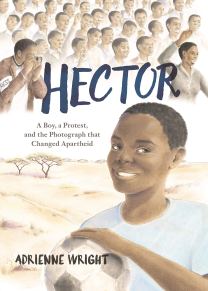
This powerfully emotional book opens with a recollection by Sam Nzima, the photojournalist who captured this pivotal event and a brief history of South Africa and the segregation and governmental restrictions that led up to the protest in 1976 which resulted in Hector Zolile Pieterson’s death. The compelling story, illustrated in graphic novel style, is broken up into three “chapters.”

celebrate-picture-books-picture-book-review-Hector-Hector

Copyright Adrienne Wright, 2019, courtesy of Page Street Kids.

The first introduces Hector, a twelve-year-old boy who loved playing soccer, watching movies, and visiting family. After his normal weekend chores, Hector would run errands for his neighbors to make a little money. Hector was happy, but things were changing at his school. The government had passed a law that instead of the international language English, black students must be taught half of their subjects in Afrikaans, a language derived from Dutch and spoken by descendants of the early Dutch settlers. This “added hardship to students and teachers in an already oppressive education system.” As he counted the money he’d made, his mother reminds him to count in Afrikaans, since that is what will be required in school.

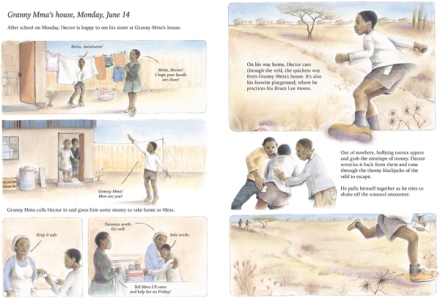
On June 14, 1976 Hector visited his granny Mma. When he left, she gave him some money for his mother. On the way home, he was waylaid by men trying to steal the money. Hector was able to escape with the money and decides not to worry his Mma by telling her. On June 16, Hector heads off to school, but when he gets there, he sees the students “chanting and singing” as they all march toward Orlando Stadium to protest the new Afrikaans law. “More students join in, and soon hundreds, then thousands of people are marching. Hector is swept up in the excited activity of the growing crowd.”

celebrate-picture-books-picture-book-review-Hector-june-14

Copyright Adrienne Wright, 2019, courtesy of Page Street Kids.

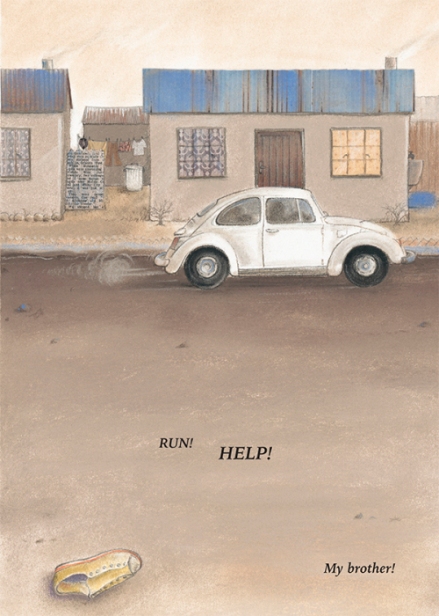
Ahead on the road the protesters see the police and a blockade. The students begin marching down another street. They wave signs and sing the “government-banned anthem, ‘Nkosi Sikelel’ iAfrica’—’God Bless Africa.’” The police confront the students, blowing their whistles, shouting, and throwing tear gas. Suddenly, Hector hears his sister, Antoinette’s voice warning him to run home. Shots ring out.

The second chapter introduces Antoinette, who on June 16 is leaving for school from Granny Mma’s house. She knows about the planned protest but says nothing to Granny Mma. She joins the crowd waving signs and chanting. Then “POW! Tear gas explodes in the air. Students scatter in all directions,” and Antoinette sees Hector. As they run for cover, they become separated. Shots ring out all around them. When the smoke dissipates, Antoinette sees a teenager running towards a car with a boy in his arms. “She can’t see the child’s face, but when she sees his shoe…”

celebrrate-picture-books-picture-book-review-Hector-protest-group

Copyright Adrienne Wright, 2019, courtesy of Page Street Kids.

Chapter three takes readers behind the lens of Sam Nzima’s camera. On assignment for The World newspaper, Sam is documenting the protest through his photographs. “The protest begins. / The students march. / Sam snaps photos…. / The police barricades go up. / The children sing. / Sam snaps photos. / The police shoot! / Sam snaps.”

The police see Sam taking pictures and confiscate his film. But Sam has hidden the most important roll in his sock. “His picture of Hector, Antoinette, and another student runs on the front page of the newspaper.” At Granny Mma’s house, Hector’s family grieves his loss; around the world “Hector lives on as a compelling symbol of the cost of apartheid and the change sparked by students that day.”

The final spread shows the black-and-white photograph of Mbuyisa Makhubu carrying Hector with Antoinette running alongside. Back matter includes a short discussion that expands on the events of June 16, 1976 and the years that followed in the fight against Apartheid. An Author’s Note; short biographies of Hector, Antoinette, Sam Nzima, and Mbuyisa Makhubu; and a glossary also follow the story.

celebrate-picture-books-picture-book-review-Hector-help

Copyright Adrienne Wright, 2019, courtesy of Page Street Kids.

Adrienne Wright’s gripping storytelling and evocative illustrations go hand-in-hand to present a full portrait of young Hector, his life, his sweet nature, and his dreams. His family’s close bonds and their concern for each other is evident in the dialog that accompanies images of Hector playing, helping Mma and Granny Mma, running errands, and interacting with his sisters. As June 16 dawns, Wright sketches a normal day, with Hector joking with his mother at home and his friend on the way to school.

As it did for Hector, the protest comes as a surprise for readers, sweeping them up into the action just as Hector was. Antoinette’s chapter is the shortest but gripping in its pacing that mirrors the turmoil of the day and her tragedy. As readers enter Sam’s viewpoint, they see, blocked off in vertical and horizontal frames, the pictures of celebrating and happy, yet serious students marching to make a difference. The moment of the shot is seen through Sam’s lens and clouded in smoke.

Wright’s use of overlapping storylines as she transitions from Hector’s account to Antoinette’s and then to Sam’s adds to the tension, drawing readers in and reinforcing their understanding of the atmosphere and what the students were protesting. The final, nearly full-page reproduction of the actual photograph is an unflinching look at the reality of that day, what it stands for, and its personal cost.

A profound narrative for teaching children about South African history, the costs of discrimination, and the personal stories involved in any conflict, Hector is an important book to add to school and public library collections.

Ages: The book is targeted for children from eight to twelve, but adults should be mindful of the maturity and sensitivity of readers. Hector would also be a compelling inclusion in middle school and even early high school social studies and history classes.

Page Street Kids, 2019 | ISBN 978-1624146916

To learn more about Adrienne Wright and her work, visit her website.

World Photography Day Activity

CPB - New Professionals Picture

News Professionals Clothespin Figures


Photojournalists and journalists cover the news and sometimes put themselves in danger to bring readers true stories of events happening around the world. With this craft, you can make these clothespin figures that honor the men and women who work to keep us all informed.

Supplies

Directions

  1. Draw a face and hair on the clothespin
  2. Cut out the clothes you want your journalist or photographer to wear
  3. Wrap the clothes around the clothespin. The slit in the clothespin should be on the side.
  4. Tape the clothes together
  5. Cut out the camera
  6. Tape one end of a short length of thread to the right top corner of the camera and the other end of the thread to the left corner. Now you can hang the camera around the figure’s neck.

Idea for displaying the figures

  • Attach a wire or string to the wall and pin the figure to it
  • Pin it to your bulletin board or on the rim of a desk organizer

celebrate-picture-books-picture-book-review-Hector-cover

You can find Hector: A Boy, a Protest, and the Photograph that Changed Apartheid at these booksellers

Amazon | Barnes & Noble | Books-a-Million | IndieBound

Picture Book Review

May 8 – National Bike to School Day

celebrate-picture-books-picture-book-review-born-to-ride-cover

About the Holiday

Established in 2012, National Bike to School Day raises awareness for communities to provide safe biking and walking routes for children and young people. Nearly 3,000 cities and towns across the country have planned events to get people to leave their cars at home and enjoy fresh air and exercise on their way to school. Although only a one-day holiday, National Bike to School Day encourages communities to continue developing safe ways for children to walk to school, including walking buses and bike trains. To learn more about events in your area or how you can get involved in making your own community safer for walking and biking visit walkbiketoschool.org.

Abrams Books for Young Readers sent me a copy of Born to Ride for review consideration. All opinions are my own. I’m happy to be partnering with Abrams Books in a giveaway of the book. See details below.

Born to Ride: A Story about Bicycle Face

Written by Larissa Theule | Illustrated by Kelsey Garrity-Riley

Open the cover of this remarkable picture book to a two-page illustration and you might notice something unusual—for our time. What is it? Read on and see…

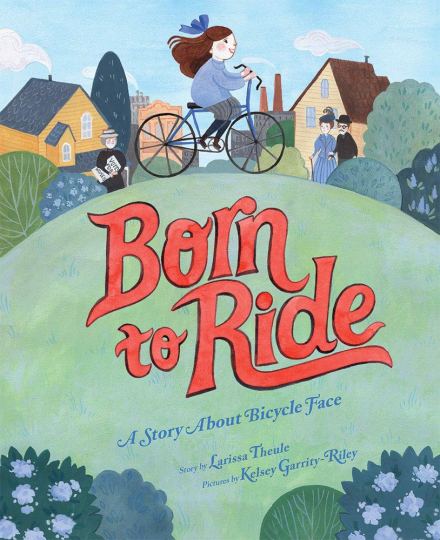
As Louisa Belinda Bellflower gazed out her window at a man riding a bicycle in Rochester, New York, in 1896, she wished that she could ride one too. But girls and women weren’t allowed to ride bicycles, just as they weren’t allowed to vote or wear pants. Louisa’s brother, Joe, had a brand-new bike, and “riding it looked like a whole lot of fun.”

celebrate-picture-books-picture-book-review-born-to-ride-falling

Image copyright Kelsey Garrity-Riley, 2019, text copyright Larissa Theule, 2019. Courtesy of Abrams Books for Young People.

One day, Louisa took off her frilly skirt and put on her brother’s pants and asked him to teach her how to ride. There were, however, a couple of concerns. One was what would their mother say? Another was the horrible medical condition, bicycle face. Everyone knew about it, and Doctor Brown was strict on this matter. He said, “‘girls aren’t strong enough to balance, that your eyes will bulge, and your jaw will close up from the strain of trying—maybe FOREVER.’”

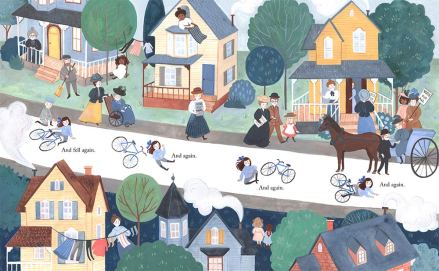
Louisa considered this fate, but Joe didn’t have any of these symptoms. Even though she was a little nervous, she tried it anyway. Louisa fell again and again, but when Joe asked her if she wanted to quit, she continued. She began peddling again and soon had the knack for it. “With some alarm, she felt her eyes bulge, and her mouth widen—into a gigantic, joyous smile.”

celebrate-picture-books-picture-book-review-born-to-ride-tea

Image copyright Kelsey Garrity-Riley, 2019, text copyright Larissa Theule, 2019. Courtesy of Abrams Books for Young People.

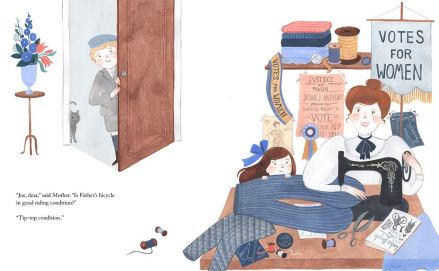
She rode back and forth down the path and when she got home, her mother said, “‘those pants look quite practical, Louisa Belinda,’” And Louisa turned a somersault just to show her she was right. Then Louisa’s mother asked Joe if Father’s bike was in good shape. Joe said it was, and their mother set about converting her skirt into a pair of pants. When they were finished, Louisa and her mother wheeled the bikes out side-by-side and took off. “‘Mother,’” Louisa said, “‘what will your bicycle face be, I wonder!’”

You only need to turn the page to see. Louisa’s mother is smiling and that original two-page spread has been transformed with lots of women and girls riding the roads that lead to the Votes for Women rally in the town green.

An extensive Author’s Note follows the text and explains the origin of “bicycle face” and other such imagined bicycle-related maladies as well as the opposition to women’s riding bicycles. Also included is a discussion on the women’s suffrage movement.

celebrate-picture-books-picture-book-review-born-to-ride-sewing

Image copyright Kelsey Garrity-Riley, 2019, text copyright Larissa Theule, 2019. Courtesy of Abrams Books for Young People.

Both children and adult readers will be astounded at Larissa Theule’s eye-opening story that reveals just one of the many obstacles women have had to overcome in their quest for equal rights. Theule’s story, told through the eyes of a girl with pluck and self-confidence, is well targeted to her young audience with an engaging undercurrent of humor at the nonsensical reasoning behind the ban on women’s bicycle riding and even the constricting clothing of the time for girls and boys. As Louisa falls again and again while learning to ride, Theule infuses her story with the idea that perseverance wins out—a concept she not only applies to learning a new skill, but to the parallel story of women’s suffrage that runs throughout the illustrations.

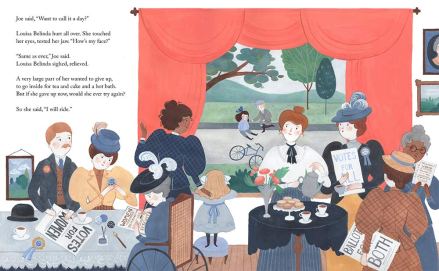
Kelsey Garrity-Riley’s charming illustrations evoke the late 1800s, giving kids a view of history with Victorian-style houses; skirts, bloomers, and pinafores for girls and short-pant suits for boys; and an old-fashioned sewing machine. Adding depth and context to the story, Garrity-Riley follows Louisa and Joe’s mother as she paints “Votes for Women” and “Ballots for Both” signs and later hosts a women’s suffrage tea attended by white and dark-skinned women, a woman in a wheelchair, and one progressive man. Garrity-Riley cleverly combines images of Louisa’s indomitable spirit with these depictions of protest to reinforce the theme and lesson of the story.

To  jumpstart discussions about equal rights for all, Born to Ride: A Story about Bicycle Face is a unique and fascinating addition to home, school, and public libraries.

Ages 4 – 8

Abrams Books for Young Readers, 2019 | ISBN 978-1419734120

Discover more about Larissa Theule and her books on her website.

To learn more about Kelsey Garrity-Riley, her books, and her art, visit her website.

National Bike to School Day Activity

celebrate-picture-books-picture-book-review-bicycle-maze 2

Ride with Me! Maze

Two girls want to ride bikes together. Can you help them find each other in this printable maze?

Ride with Me! Puzzle | Ride with Me! Puzzle Solution

celebrate-picture-books-picture-book-review-born-to-ride-cover

You can find Born to Ride: A Story about Bicycle Face at these booksellers

Amazon | Barnes & Noble | Books-a-Million | IndieBound

Picture Book Review

December 10 – Nobel Prize Day

celebrate-picture-books-picture-book-the-house-that-jane-built-cover

About the Holiday

When Alfred Nobel’s will was read after his death on December 10, 1896, his heirs were taken by surprise. Nobel had signed a new will the year before, leaving most of his wealth to create prizes recognizing those who had done their best to benefit mankind in the fields of physics, chemistry,  medicine, literature, and peace. Opposition to this will on the part of the family and those Nobel had chosen to award the prize delayed Nobel’s wishes until 1901. Today, the awards include a prize for economics and are announced in early October. The awards are presented on December 10 in Stockholm, Sweden, except for the Nobel Peace Prize, which is awarded in Oslo, Norway.

Jane Addams Day falls on the same date to commemorate her achievement in being the first American woman to win the Nobel Peace Prize in 1931 for her work to bring about social change, equality, and peace. Each year the Jane Addams Peace Association presents awards to outstanding children’s books that promote peace and justice. To learn more about Jane Addams and the Jane Addams Peace Association, visit janeaddamspeace.org.

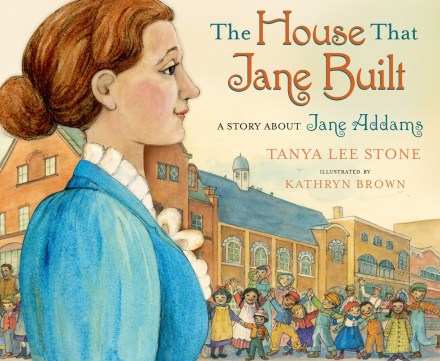
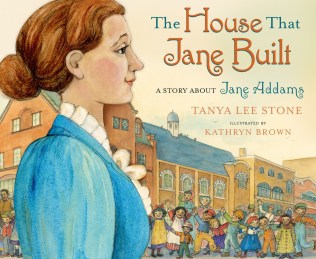
The House that Jane Built: A Story about Jane Addams

Written by Tanya Lee Stone | Illustrated by Kathryn Brown


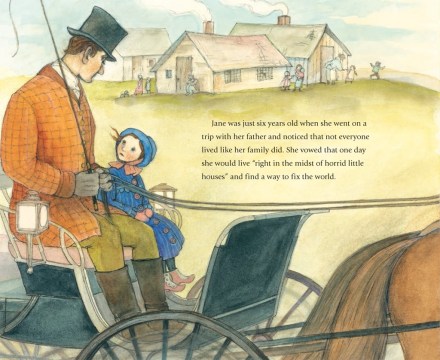
On a busy street stands a very special house where anyone is welcome and some find a home. In 1889 Jane Addams, a wealthy young woman, bought an elegant house in one of Chicago’s poorest neighborhoods. Why? At just six years old on a trip with her father, Jane “noticed that not everyone lived like her family did.” Right then she vowed that when she grew older, she would live in a poor community and “find a way to fix the world.”

celebrate-picture-books-picture-book-the-house-that-jane-built-trip-with-father

Image copyright Kathryn Brown, 2015, text copyright Tanya Lee Stone. Courtesy of us.macmillan.com.

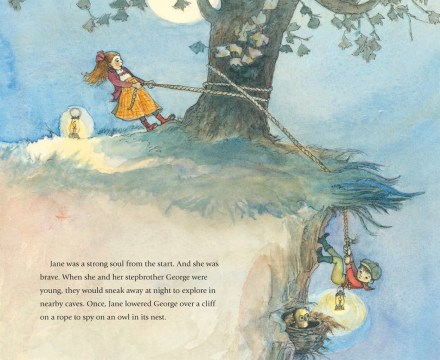
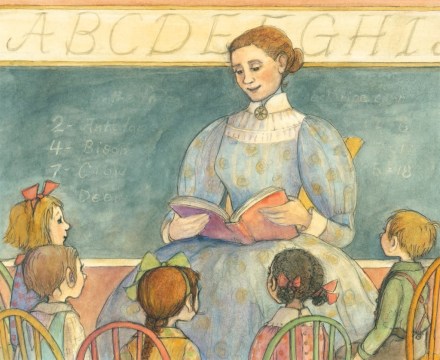
Jane was brave and strong. Sometimes she and her stepbrother George would “sneak away at night to explore in nearby caves.” Jane was also smart and “read and read her father’s book collection,” which also served as the town library. Unlike most women at the time, Jane went to college. She attended Rockford Female Seminary and “graduated at the top of her class.”

celebrate-picture-books-picture-book-the-house-that-jane-built-exploring-with-George

Image copyright Kathryn Brown, 2015, text copyright Tanya Lee Stone. Courtesy of us.macmillan.com.

After graduation, she didn’t know what she wanted to do, and when her father died that same summer, “Jane felt lost.” Two years later some friends invited her to travel to Europe with them. Although they went to the opera, museums, and many beautiful places, it was an experience in London that stuck with her. There she saw many “people in ragged clothes with outstretched hands, begging a cart vendor to buy his rotten fruits and vegetables that hadn’t sold at the market.” 

celebrate-picture-books-picture-book-the-house-that-jane-built-London-settlement-house

Image copyright Kathryn Brown, 2015. Courtesy of us.macmillan.com.

When Jane returned home, the question of how she could help nagged at her. She returned to London to learn about Toynbee Hall, where poor and wealthy people lived together and learned from each other. Here, skills, such as cooking, were taught to provide people with the education to find jobs. Toynbee Hall was called a settlement house, because the rich people who worked there lived there as well.

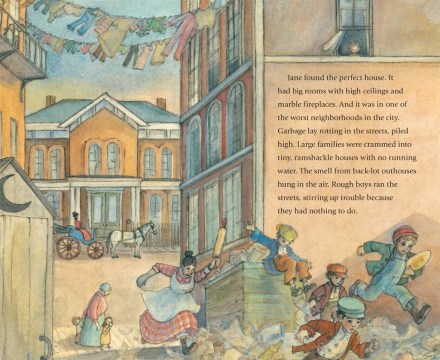
celebrate-picture-books-picture-book-the-house-that-jane-built-Chicago-neighborhood

Image copyright Kathryn Brown, 2015, text copyright Tanya Lee Stone. Courtesy of us.macmillan.com.

Jane now knew what she wanted to do. In 1889 Chicago was a diverse city with a large immigrant population. Many didn’t speak English, which made it hard for them to find jobs. “Large families were crammed into ramshackle houses with no running water.” Garbage lay in the street, and tough kids ran wild with nothing else to do.

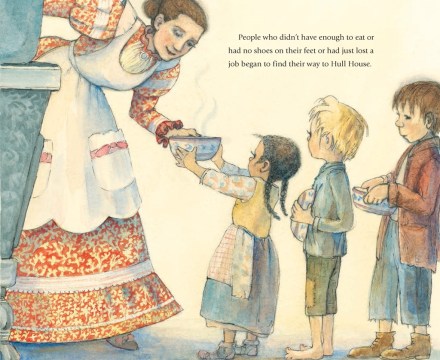
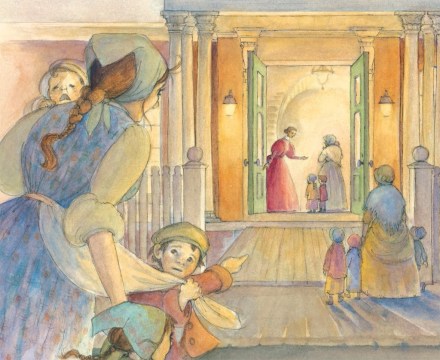
Jane found a large house in the middle of one of these areas that had once belonged to Charles J. Hull and upon his death had been given to his cousin, Helen Culver.  When Helen discovered what Jane wanted to do, she donated the house for free. Jane left the house unlocked, letting people know that they could come there whenever they needed. In time, people did find their way to Hull House when they were hungry or out of work. Jane also had her own way of dealing with unruly children or those who didn’t understand her generosity. Once when a man broke into Hull House twice because he had no job and no money, Jane gave him a job.

celebrate-picture-books-picture-book-the-house-that-jane-built-feeding-hungry

Image copyright Kathryn Brown, 2015, text copyright Tanya Lee Stone. Courtesy of us.macmillan.com.

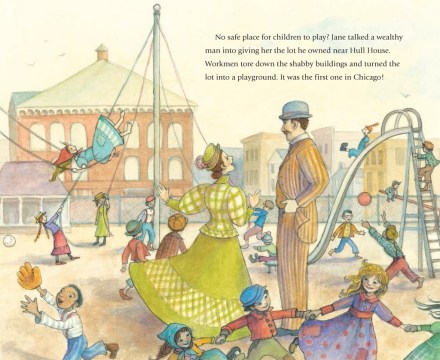
Jane helped the neighborhood in other ways too. She built a public bath so that people could stay clean and avoid illness. She convinced “public officials to build more public baths.” Because children had nowhere to play, Jane convinced a neighbor to give her his unused lot near Hull House. She tore down the buildings and built Chicago’s first playground. For kids whose parents worked long hours, she started a morning kindergarten and after school clubs. She also began offering evening classes for children who worked during the day.

celebrate-picture-books-picture-book-the-house-that-jane-built-kindergarten

Image copyright Kathryn Brown, 2015. Courtesy of us.macmillan.com.

Jane had help with her endeavors. Her friend “Ellen Gates Starr was her partner from the start.” Many other people also helped. They moved into Hull House and “taught literature, art, English, math, science, and cooking.” Hull House continued to grow, and by 1907 Jane oversaw thirteen buildings, including “a gymnasium, coffee house, theater, music school, community kitchen, and an art gallery.”

By the early 1920’s more than 9,000 people visited Hull House every week. Jane’s work “changed a bad neighborhood into a great and strong community.” Today, you can still see Jane Addams’ commitment to others in the community centers that bring people together in nearly every city and town.

An Author’s Note with more information on Jane Addams follows the text.

celebrate-picture-books-picture-book-the-house-that-jane-built-playground

Image copyright Kathryn Brown, 2015, text copyright Tanya Lee Stone. Courtesy of us.macmillan.com.

Tanya Lee Stone brings the story of Jane Addams’ work in Chicago to children in a compelling biography that gives readers a fully developed portrait of this most amazing woman. Stone’s active and evocative language puts children in the Hull House neighborhood, allowing them to get a feeling for and understanding of the issues of the time. Stone’s excellent examples of how Jane Addams responded to a variety of problems facing her community and even Hull House itself, demonstrate how generosity, empathy, and kindness can make positive changes in people’s lives. Depictions of Jane’s early compassion and commitment give children a sense that they too can make a difference in areas that are important to them.

celebrate-picture-books-picture-book-the-house-that-jane-built-front-door

Image copyright Kathryn Brown, 2015. Courtesy of us.macmillan.com.

Kathryn Brown’s riveting illustrations capture Jane’s early moments of concern for others, bravery, and study that informed her adult life; times of decision and cooperation that led to the establishment of Hull House; scenes of poverty, upheaval, and need that touched Jane’s heart; and images of her successes in Chicago that inspired others around the country. Brown’s softly hued watercolors are beautifully infused with realistic period details and honest emotion that provide readers with a strong foundation for understanding and appreciating the life of Jane Addams.

The House that Jane Built: A Story about Jane Addams is an inspiring choice for children with a philanthropic heart and to open discussions on how one person can make a difference. The book would be a welcome addition to home and classroom libraries.

Ages 6 – 10

Henry Holt and Co. Books for Young Readers, 2015 | ISBN 978-0805090499

To learn more about Tanya Lee Stone and her books, visit her website.

You can view a gallery of illustration work by Kathryn Brown on her website

Nobel Prize Day Activity

celebrate-picture-books-picture-book-jane-addams-coloring-page

Jane Addams Coloring Page Poster


Jane Addams is an inspiration to all! Print this Jane Addams Coloring Page and hang it in your room or locker to inspire you to make a difference and be a positive influence in your community!

celebrate-picture-books-picture-book-the-house-that-jane-built-cover

You can find The House that Jane Built: A Story about Jane Addams at these booksellers

Amazon | Barnes & Noble | Books-a-Million | IndieBound

Picture Book Review