December 9 – It’s Read a New Book Month

celebrate-picture-books-picture-book-review-octopuses-have-zero-bones-cover

About the Holiday

The month of December is a gift-giver’s delight, and there’s no better gift for everyone on your list than a book (or two or…). With so many new books hitting bookstore shelves, there really is a perfect one to fit everyone’s taste. Young children, especially, benefit from reading a wide range of picture books from laugh-out-loud or touching stories to nonfiction that introduces them to influential people, science, history, nature, math—like today’s book. If you’re looking for gifts to give, it’s not too late to head to your local bookstore to find books that will make your child’s eyes light up.

I’d like to thank Tra Publishing for sending me a copy of Octopuses Have Zero Bones for review consideration. All opinions on the book are my own.

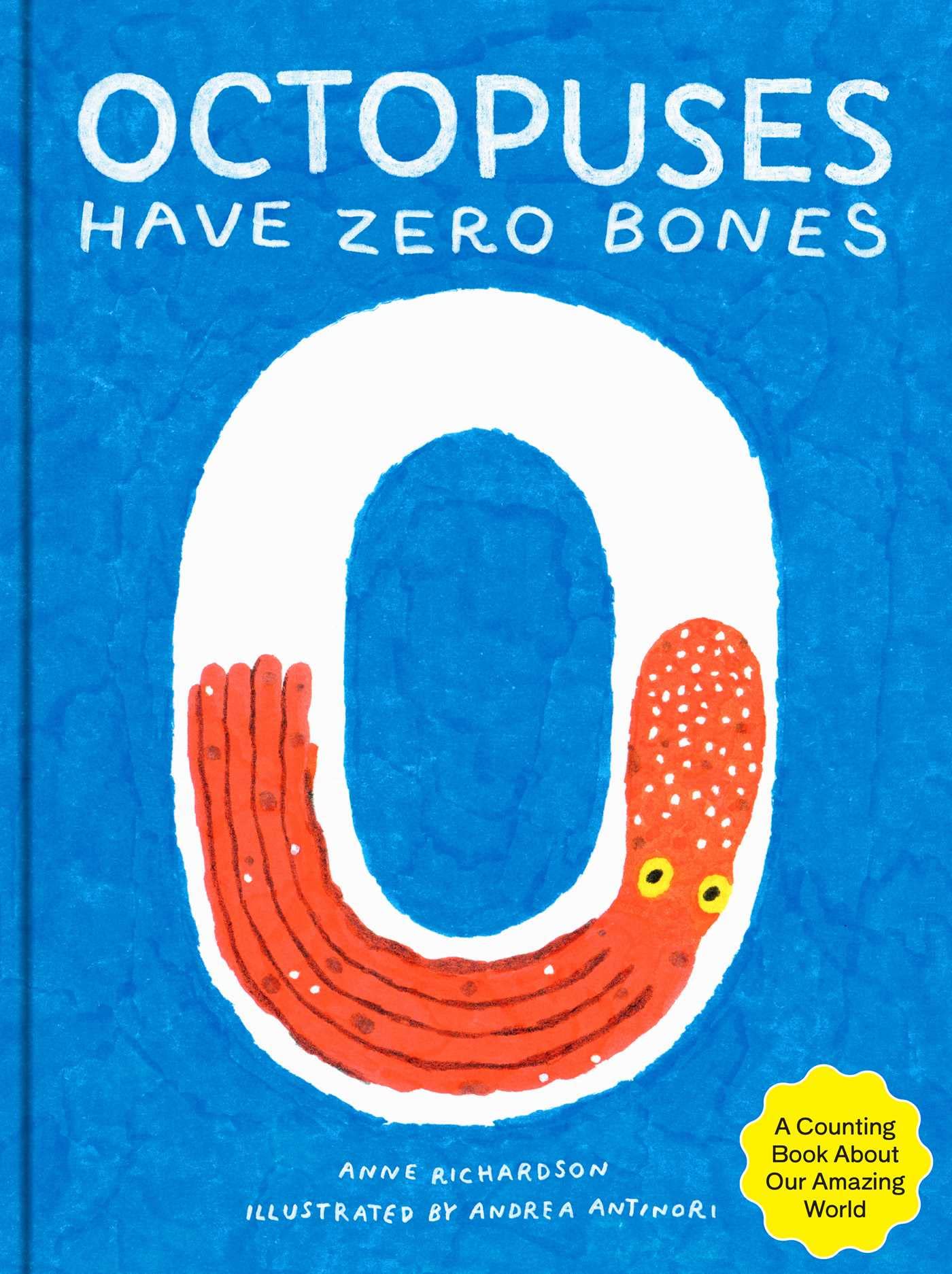
Octopuses Have Zero Bones: A Counting Book about Our Amazing World

Written by Anne Richardson | Illustrated by Andrea Antinori


If you’re looking for a book that opens kids’ eyes and mind to new ways to interact with numbers and fall in love with everything they have to tell about us and the world around us, then you’ll want to wrap your arms around Octopuses Have Zero Bones. This multilayered and eye-opening romp through the ability of numbers to describe, explain, provide perspective, and amaze celebrates the numbers from zero to nine and the power of numbers ten to nine billion.

Kids at all levels will find accessible ways to explore the math concepts that enliven every page, from basic counting to higher-level ideas that include measurement, extrapolation, and estimation as well as complex scientific facts. And how does all of this learning begin? With 0 and simple statement and probing question: “ZERO, all by itself, is nothing. Can you imagine nothing?” It might be hard for kids to think about how “nothing” can be important or have an effect. But Anne Richardson, with illustrative help from Andrea Antinori, reveals that because “octopuses have ZERO bones…” they “can squeeze through very small places.” And, if that doesn’t surprise you, she also presents this fascinating tidbit: “Dry Valleys, Antarctica, gets ZERO rain or snow.” In fact “there’s been no precipitation for two million years.” Two million! That’s nearly as impressive as zero!

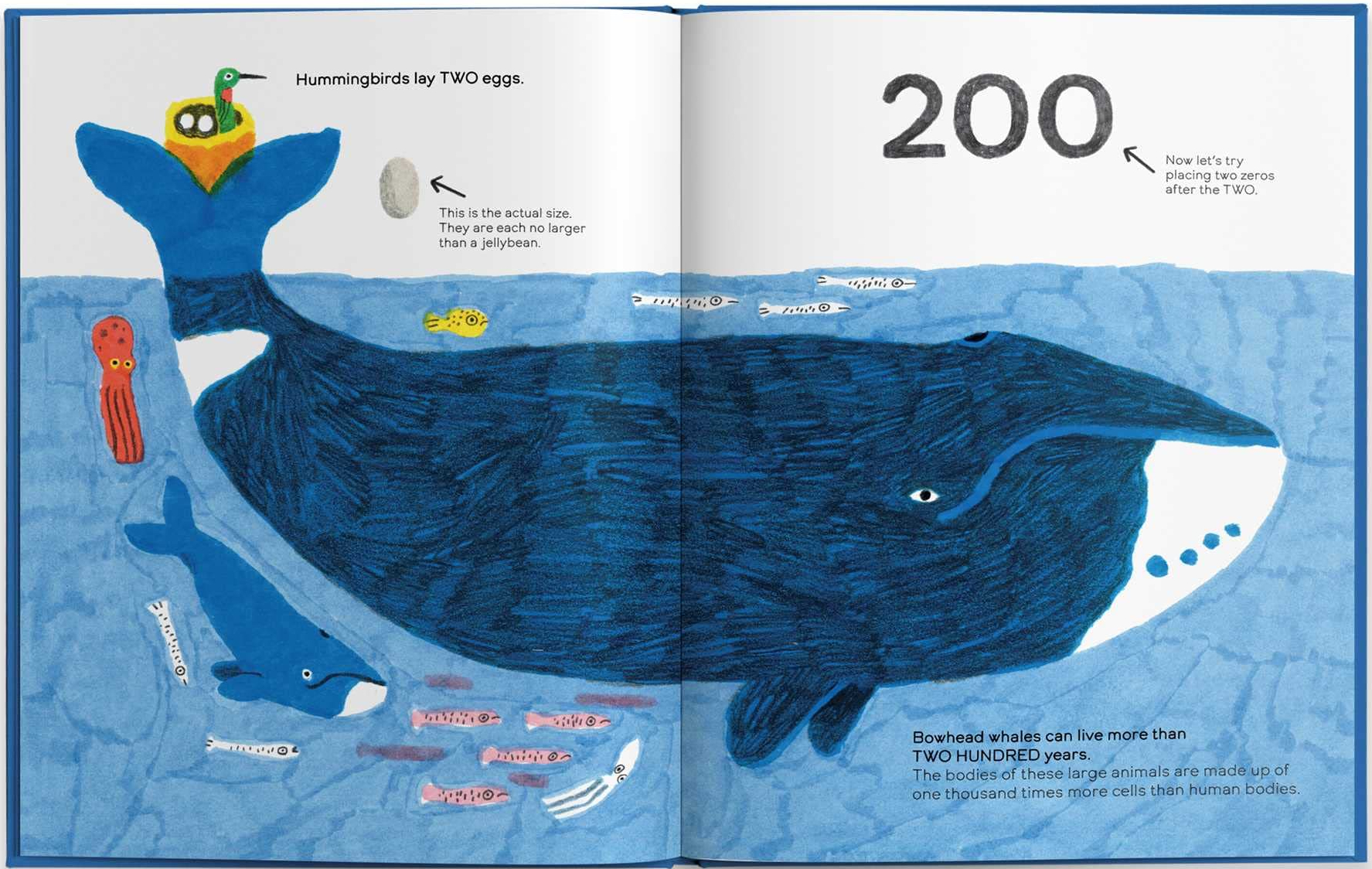
celebrate-picture-books-picture-book-review-octopuses-have-zero-bones-whale

Image copyright Andrea Antinori, 2022, text copyright Anne Richardson, 2022. Courtesy of Tra Publishing.

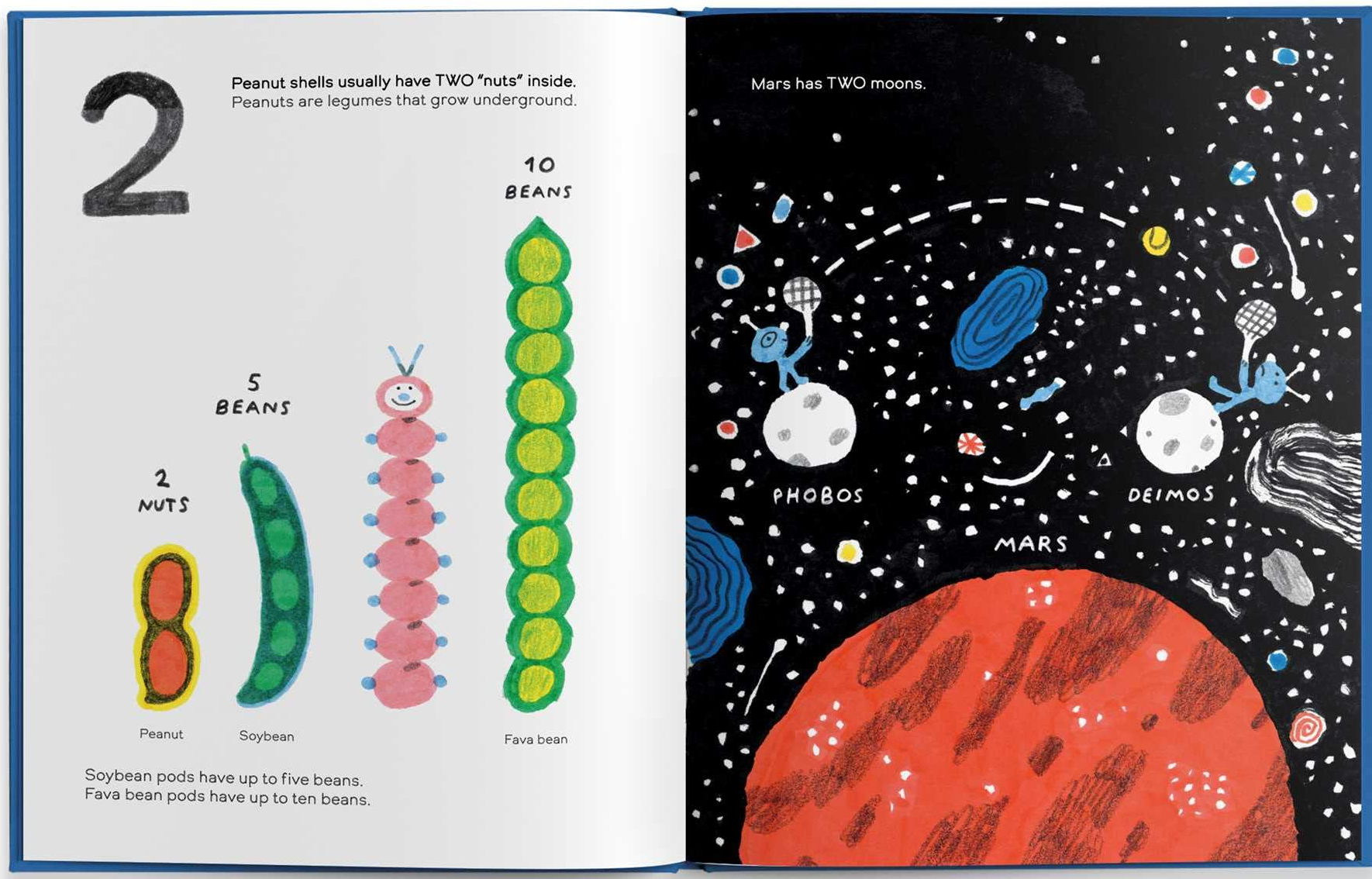
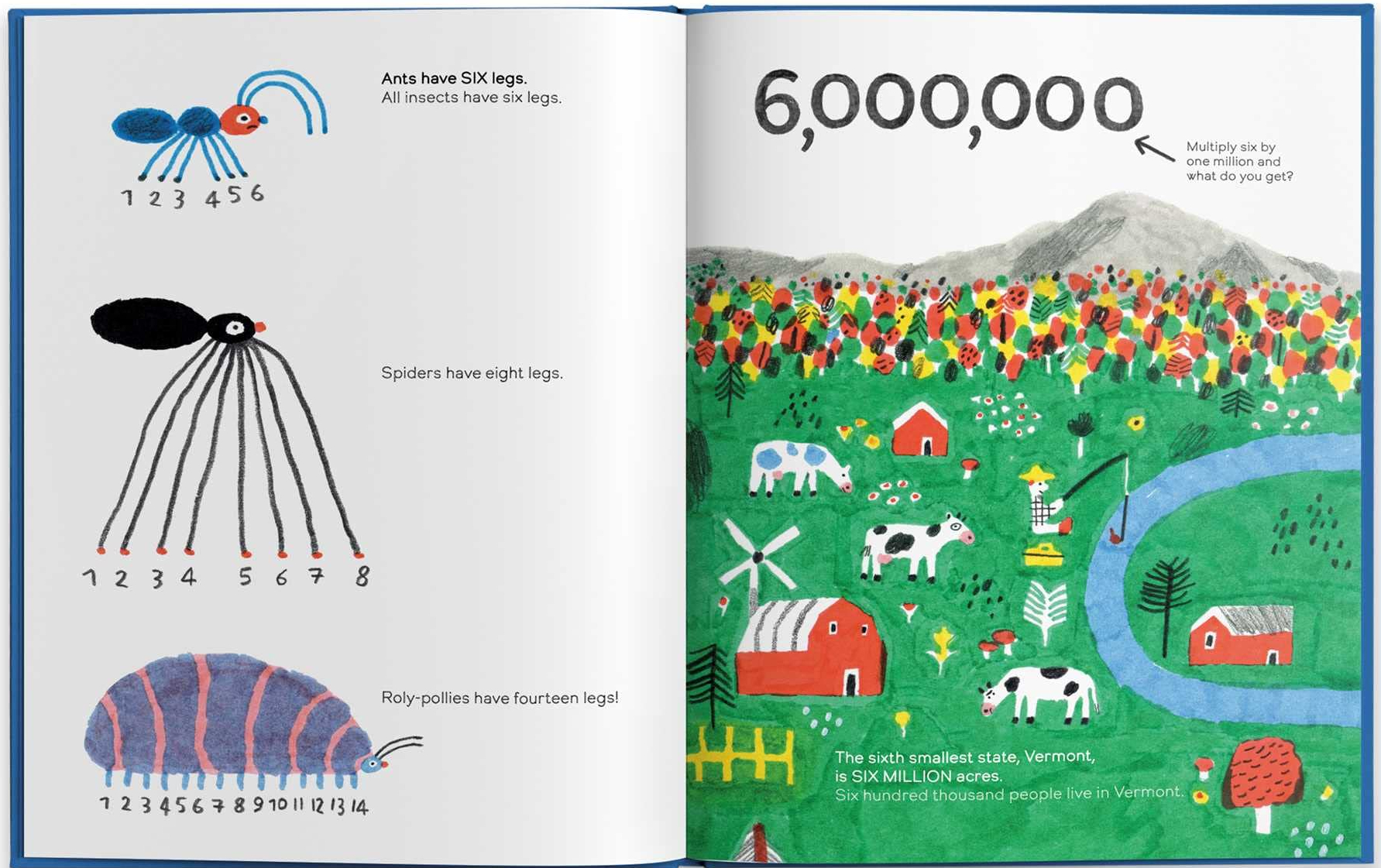
But that’s not all! There are more examples, and then Richardson shows how that simple digit 0 can make a single whole number explode into 100, 1,000, 100,000 and so on. She moves from there to tackle the numbers 1 through 9, by themselves and then attached to one 0. Readers next learn about 10—10 decibels, a creature with 10 legs, 10 fingers, and 10 toes. Those familiar with counting know that 2 comes after 1, and Richardson and Antinori help kids visualize this number with peanut shells that contain two individual nuts, the 2 moons of Mars, and more. Here, readers are shown what happens when two zeros are attached to the number two, and, of course, they’re given a few intriguing examples of 200.

This pattern is continued throughout the pages from 3 and 3,000 to 9 and 9,000,000,000. Along the way, children learn about the different types of clouds, how many times a bear’s heart beats per hour, how many chambers the human heart has, how many grains are in a two-pound bag of rice, and the astounding number of leaves you’d find on a typical mature oak tree. Ever wonder how many gallons of water flow over Niagara Falls every ninety seconds? You’ll find out here—along with the ph of water (7), what that means, and the ph number of other common liquids.

celebrate-picture-books-picture-book-review-octopuses-have-zero-bones-two

Image copyright Andrea Antinori, 2022, text copyright Anne Richardson, 2022. Courtesy of Tra Publishing.

Have you ever tried to measure a raindrop? It’s okay! Richardson shows kids just how big the biggest raindrop can be and reveals what happens if one happens to exceed this limit. Kids fascinated by space will want to check out the pages about the number 8, and future biologists will find interesting facts there too. Entomologists may want to flip to the discussions of the numbers 4, 6, and 9 before settling in to start again at the beginning. The number 9 is pretty awesome, especially if you like narwhals and bananas, and you’ll discover that no matter how antsy you might get while waiting for what seems like for. ev. er, you’ll never, ever be able to jiggle as many times as a cesium atom.

While Octopuses Have Zero Bones ends at nine billion, Richardson reminds readers that while “NINE BILLION is a big number…it’s not the biggest. You can keep counting forever.” Even into the trillions and beyond. In her Author’s Note that follows the text, she reveals the event that sparked the idea for this book and encourages children to “go out into the world and count or measure something, anything”; to do this short-term and long-term; to “be astonished, take a closer look” and “discover many wonderful things.”

celebrate-picture-books-picture-book-review-octopuses-have-zero-bones-six-million

Image copyright Andrea Antinori, 2022, text copyright Anne Richardson, 2022. Courtesy of Tra Publishing.

Andrea Antinori depicts each concept with whimsical illustrations that exude humor and personality while pointing readers to examples of the featured number or numbers. But her pages do much, much more as well. Take two page spreads that portray the number 1 for example. There is an image of our one sun as is mentioned in the text, and there is an image of a man with one heart as mentioned in the text. But this heart is a tattoo, which leads kids to notice that the man has other tattoos—all single images.

He is raising one arm, but at the end of that arm is a hand with five fingers just waiting to be counted. And—oh yeah—next to him is the adorable red octopus from the page about zero, who is also waving at the reader with one arm, but there’s a line of suckers on it (some singular, some in pairs) that also invite counting. And that’s just to get kids started. There are clouds, birds, and a sea full of dots to check out too. Now multiply that kind of clever detail and recurring characters by 30 pages and kids have almost innumerable ways to learn from and engage with this book.

Octopuses Have Zero Bones is a book that readers can page through from beginning to end or dip into whenever curiosity hits. It’s the perfect boredom buster because, as Anne Richardson notes, kids can jump off from any randomly chosen page into their own discovery and research at home, in their neighborhood, or on the Internet.

This book would be a much-used reference on home and bookshelves and is a must for classroom, school, and library collections.

Ages 5 – 9 and up

Tra Publishing, 2022 | ISBN 978-1735311524

You can find a Kids Activity Guide, Teacher’s Guide, and Posters for Octopuses Have Zero Bones to download on the Tra Publishing website.

About the Author

Anne Richardson is an author of experiences that kindle your curiosity. In her work, everything in the world is astonishing and worthy of our attention, from a drop of rain to the way we figure things out together. She is the senior director of Global Collaborations at the Exploratorium, San Francisco, where she works with partners worldwide to imagine and create new science centers and other extraordinary learning experiences. Richardson holds a PhD and an MS in environmental studies from Antioch University New England, and a BA in art history from Northwestern University. She lives in the San Francisco Bay Area with her family, including two little explorers. Visit her at her website.

About the Illustrator

Andrea Antinori is an award-winning illustrator based in Bologna, Italy. Since he was a child, he has loved animals and he has loved to draw them. His favorite animal changes all the time. He likes octopuses very much, but right now, lemurs are the creatures he loves most. He wrote and illustrated the book On the Lives of Lemurs: A Short Treatise on Natural History. Other books he has illustrated include A Book about Whales and The Great Battle, the latter of which has received major international awards including: Best International Illustrated Book — China Shanghai International Children’s Book Fair, Premio Andersen — Best book 6-9 years olds, Selected illustrator for exhibition of Bologna Children’s Book Fair 2017, Italian illustrator in IBBY Honor List 2016. You can learn more about her books and her art on her website and connect with her on Instagram.

Read a New Book Month Activity

celebrate-picture-books-picture-book-review-sock-octopus-craft

Cute Sock Octopus Craft


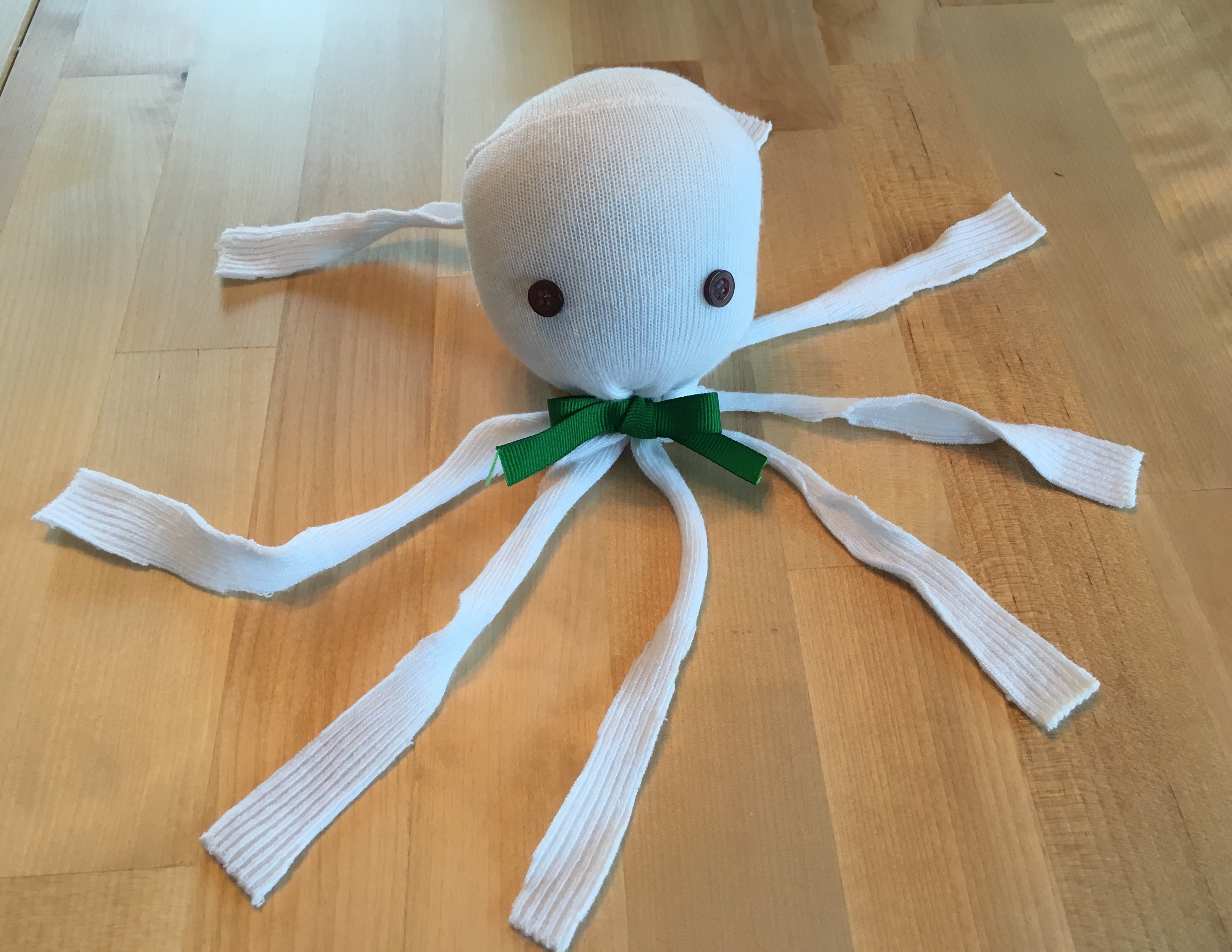
Octopuses may have zero bones but they sure do have a lot of arms! With this fast and easy craft you can make your own little octopus to count on to keep you company on your bed, your shelves, or on your desk!

Supplies

  • Child’s medium or large size sock, in any color
  • Polyfill, available at craft and sewing stores
  • Ribbon
  • 2 Small buttons
  • Scissors
  • Hot glue or strong glue

Directions

  1. Fill the toe of the sock with a handful of polyfiber fill
  2. Tie the ribbon tightly around the sock underneath the fiber fill to separate the head from the legs
  3. Tie the ribbon into a bow tie
  4. With the scissor cut up both sides of the sock almost to the ribbon
  5. Cut these two sections in half almost to the ribbon
  6. Cut the four sections in half almost to the ribbon
  7. Glue the eyes to the lower part of the head

celebrate-picture-books-picture-book-review-octopuses-have-zero-bones-cover

Buy a Book, Plant a Tree

If you purchase Octopuses Have Zero Bones from the Tra Publishing website, they, in partnership with One Tree Planted, plant one tree for every book purchased. At checkout, you have the opportunity to make an additional donation.

Purchase from the Tra Publishing website

You can find Octopuses Have Zero Bones at these booksellers

Amazon | Barnes & Noble | Books-a-Million

To support your local independent bookstore, order from

Bookshop | IndieBound

Picture Book Review
October – It’s National Book Month

celebrate-picture-books-picture-book-review-professor-wooford-mcpaw's-history-of-astronomy-cover

About the Holiday

Readers might say that every month is National Book Month, but October is especially set aside to highlight books and the love of reading. Fall is a book bonanza as publishers release new books in all categories, and the holiday gift-giving season beckons. Books, of course, make superb gifts for all ages! So whether you’re looking for a new or new-to-you book to read right now or new titles to give to the family and friends who will be on your list, this month is a perfect time to check out your local bookstore to see what wonderful books are on the shelves! This month is also a great time to discover books that get kids excited about history, science, and technology in a whole new way – like today’s book!

Thanks to Cicada Books for sharing a digital copy of Professor Wooford McPaw’s History of Astonomy with me for review consideration. All opinions on the book are my own.

Professor Wooford McPaw’s History of Astronomy

By Elliot Kruszynski


The study of astronomy harkens back to the earliest days of scientific discovery, when “civilizations in Mesopotamia, Persia, China, India and Greece all examined the night sky. With only the naked eye, they mapped out the stars and used the information they gathered to create calendars, navigate great distances and keep time.” So begins this comprehensive, detailed, and even humorous compendium of our skies, scientists and thinkers, equipment, and a look to the future.

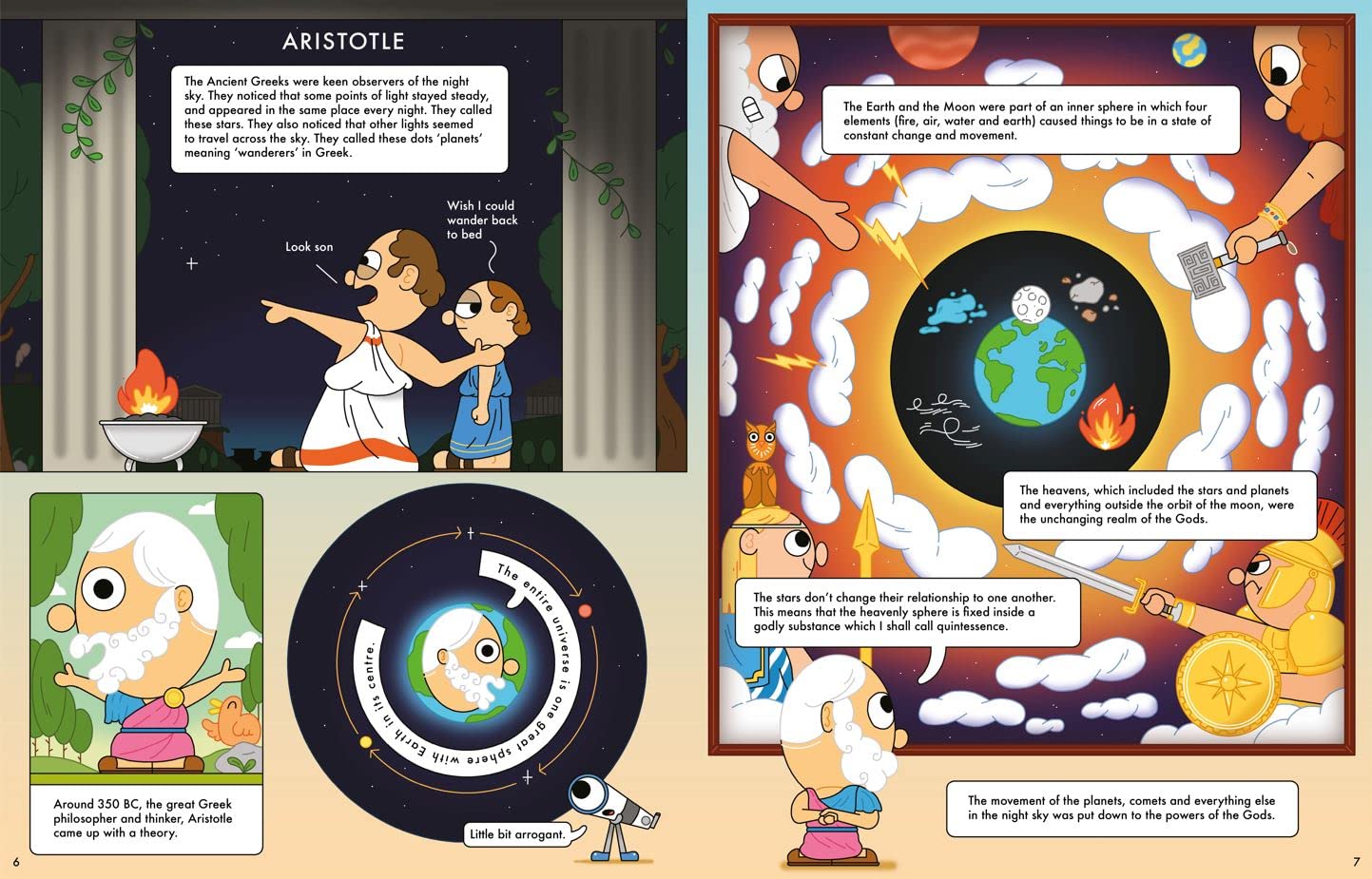
Professor Wooford McPaw and his telescope sidekick, Teley, takes kids back to 3000 BC, when religious leaders determined the longest day of the year by tracking the sun’s progress through the arches and columns erected at Stonehenge, and speeds forward to 1000 BC, when people connected the stars, creating the constellations and stories about them.

celebrate-picture-books-picture-book-review-professor-wooford-mcpaw's-history-of-astronomy-aristotle

Copyright Elliot Kruszynski, 2022, courtesy of Cicada Books.

Kids then meet Aristotle and learn about his theories on the placement of the earth, the four elements, and the role of the gods in the universe. Then they discover the conflict between the teachings of Claudius Ptolemy around 140 AD and the discoveries of Nicolaus Copernicus in the 16th century, who left it to future scientists to explore his theory that that the earth revolved around the sun (and not the other way around). And what happened to those scientists? Well, children learn about Galileo Galilei, who, in addition to inventing the telescope, spent a good part of his life under house arrest for saying the earth and the planets did indeed revolve around the sun.

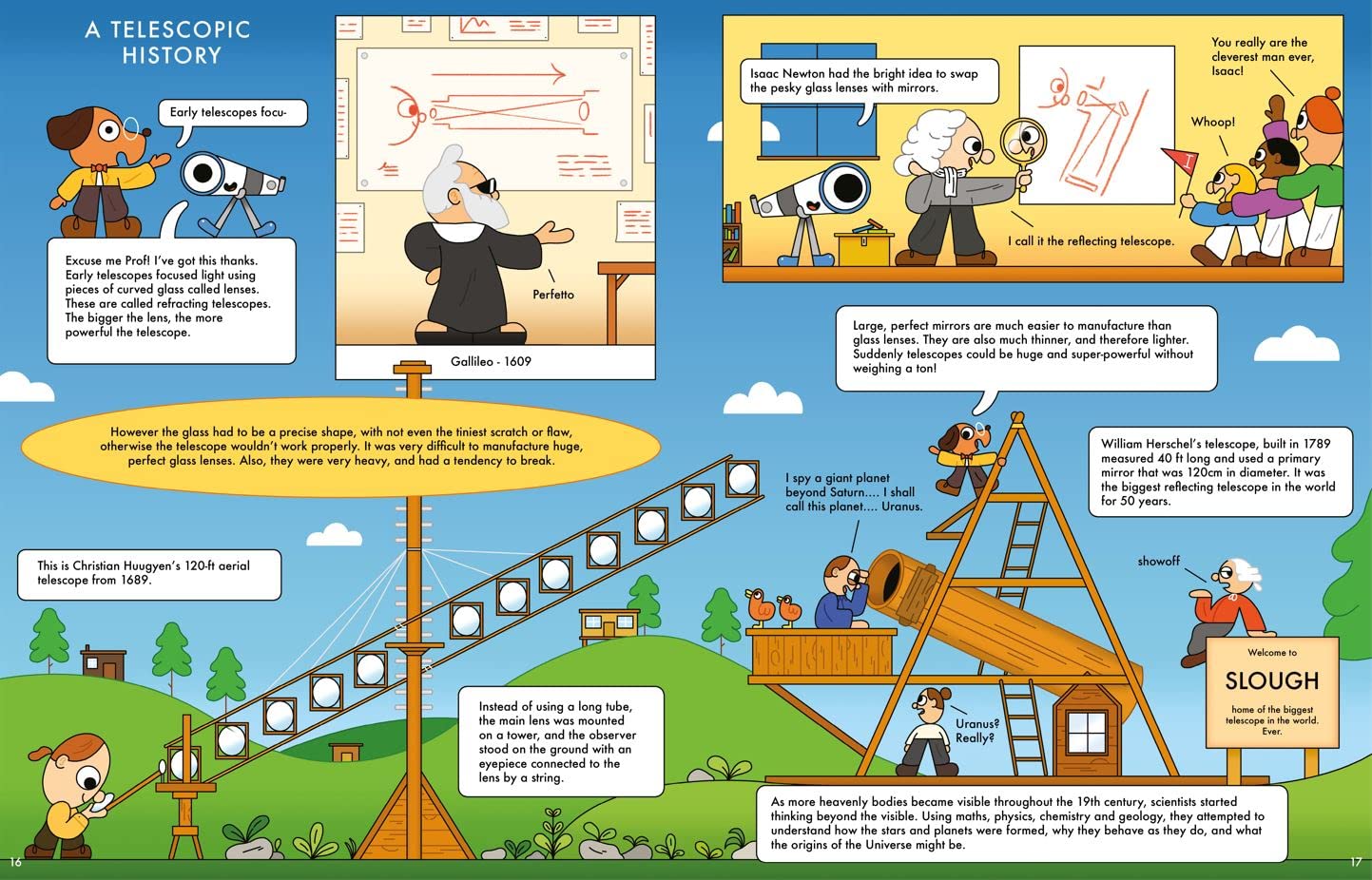
celebrate-picture-books-picture-book-review-professor-wooford-mcpaw's-history-of-astronomy-telescopic-history

Copyright Elliot Kruszynski, 2022, courtesy of Cicada Books.

Professor Wooford introduces readers to Isaac Newton, whose “findings, along with the improvement of telescope technology, changed the way that humans (and for some dogs) looked at our planet.” What kind of telescope technology is the Prof talking about? He gives kids a run down from Galileo’s invention in 1609 to a switch from glass lenses to mirrors in the 1700s to today’s Hubble Space Telescope and James Webb Space Telescope. Here’s Teley explaining about lenses:

“Early telescopes, like the one Galileo invented, focused light using pieces of curved glass called lenses. The bigger the lens, the more powerful the telescope. They were called refracting telescopes. However the glass had to be a precise shape, with not even the tiniest scratch or flaw, otherwise the telescope wouldn’t work properly. It was very difficult to manufacture huge, perfect glass lenses. Also, they were very heavy and had a tendency to break.” Teley goes on to explain that it was Isaac Newton who “had the bright idea to swap the pesky glass lenses with mirrors,” which are much easier to make and are thinner and lighter, allowing telescopes to “be huge and super-powerful without weighing a ton.”

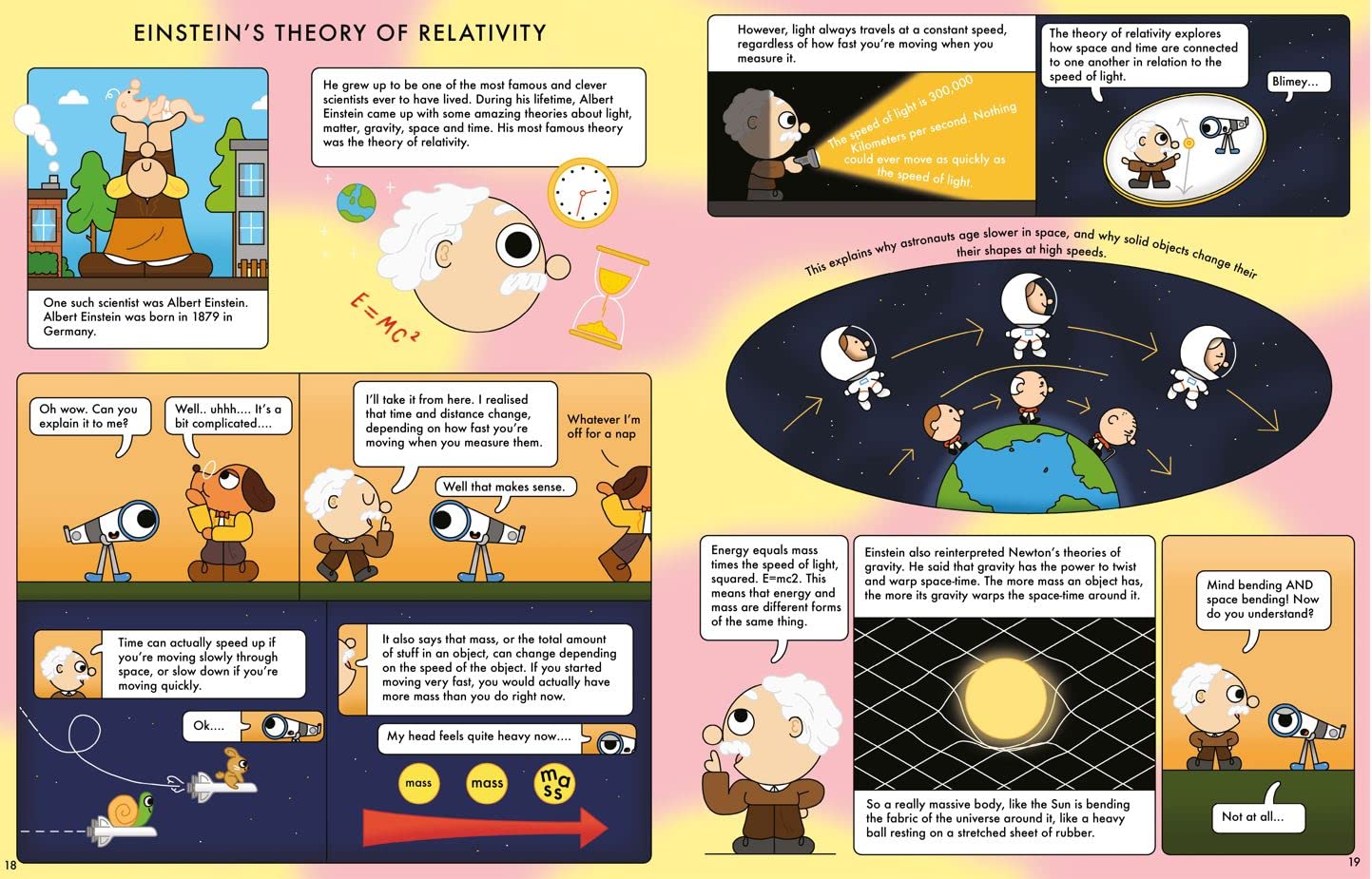
celebrate-picture-books-picture-book-review-professor-wooford-mcpaw's-history-of-astronomy-einstein

Copyright Elliot Kruszynski, 2022, courtesy of Cicada Books.

Albert Einstein travels back through time to explain his “mind bending and space bending” Theory of Relativity in terms that readers can understand. Then kids are launched into space—the space race, that is—where they learn about the advancements and setbacks of the Russian and American from 1957 to 1969, when the first moon walk occurred, as well as a weely … I mean … really unusual tradition among space-going astronauts.

celebrate-picture-books-picture-book-review-professor-wooford-mcpaw's-history-of-astronomy-space-probes

Copyright Elliot Kruszynski, 2022, courtesy of Cicada Books.

Children get info on different kinds of space probes from rovers to orbiters to interplanetary probes before blasting off into our solar system to find out about the planets (even little Pluto gets a cameo. But where is Earth and all of our other planets located? Professor McPaw explains: “Earth is located in a galaxy called the Milky Way. At its center is a supermassive black hole called Sagittarius A*, which contains as much mass as four million suns.” The prof goes on to teach kids about the three different shapes of galaxies, what dwarf galaxies are, how bigger galaxies cannibalize smaller galaxies, and where the term galaxy comes from.

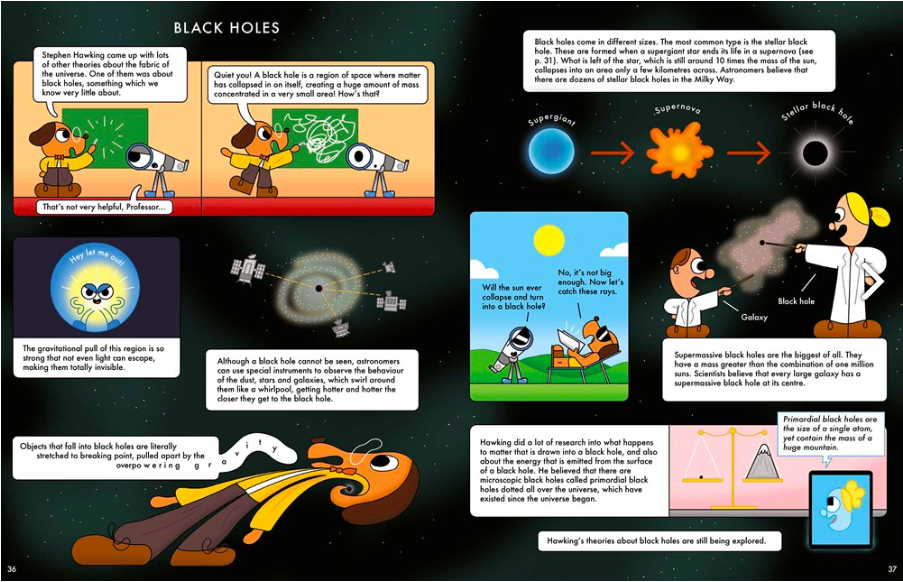
celebrate-picture-books-picture-book-review-professor-wooford-mcpaw's-history-of-astronomy-black-holes

Copyright Elliot Kruszynski, 2022, courtesy of Cicada Books.

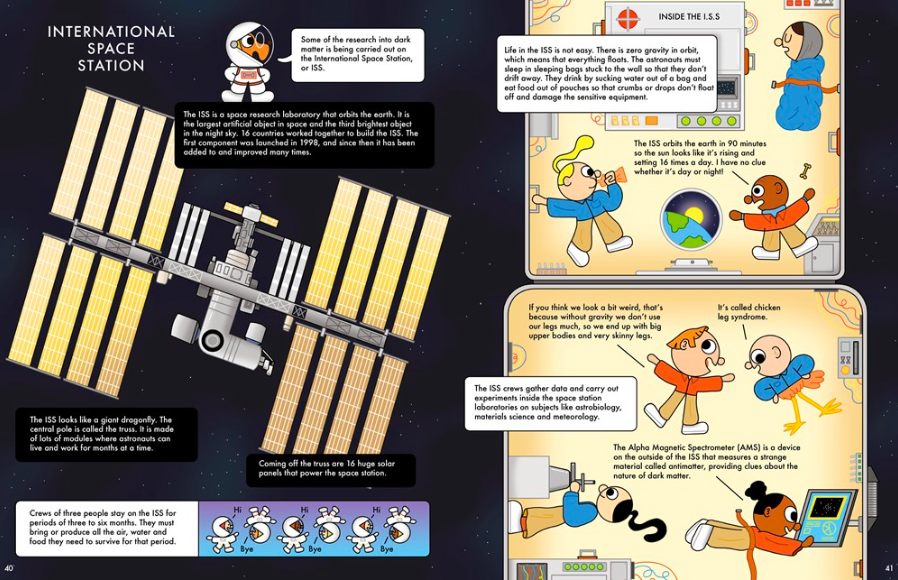
Professor Wooford McPaw and Teley also impart the same fascinating in-depth facts about stars, black holes, and dark matter. And what’s a trip into space without a ride on the International Space Station? Well, readers won’t find out because they get to explore the ISS and learn how the astronauts experience 16 sunrises and sunsets a day, sleep strapped to a wall, and develop “chicken leg syndrome” from not using their legs as much as their upper body in the no-gravity conditions.

By this time, kids are probably wondering about whether there’s life in other parts of the solar system or beyond as well as what the future might hold for astronomers, astrophysicists, other scientists, and even themselves. But are readers going to be abandoned in space? Not at all! Professor Wooford has thoughtfully included a Race to Earth “board game” on the last two-page spread that will get all astronauts … I mean readers … back home in time for dinner.

celebrate-picture-books-picture-book-review-professor-wooford-mcpaw's-history-of-astronomy-international-space-station

Copyright Elliot Kruszynski, 2022, courtesy of Cicada Books.

Elliot Kruszynski’s Professor Wooford McPaw’s History of Astonomy is just the kind of book that both kids who already love space and those who don’t yet know they do will devour, either bit-by-bit or all in one sitting. With affable hosts who give excellent easy-to-understand explanations, historical characters who add funny asides, and a quick-paced graphic-novel format, (title) will spark readers’ interest in learning all about the past, present, and future of astronomy. The book would make a perfect gift and very welcome addition to any home library. Educators and homeschoolers will find it a go-to text for introducing many scientific topics and an engaging way to heighten student’s eagerness for further research. School and public library librarians will find Professor Wooford McPaw’s History of Astonomy to be a favorite to recommend and to have on their shelves.

Ages 6 – 10 and up

Cicada Books, 2022 | ISBN 978-1800660236

To view a portfolio of work by Elliot Kruszynski and connect with him on Instagram, visit his website. 

National Book Month Activity

celebrate-picture-books-picture-book-review-rocket-to-the-moon-tic-tac-toe-game

Out of This World Tic-Tac-Toe Game

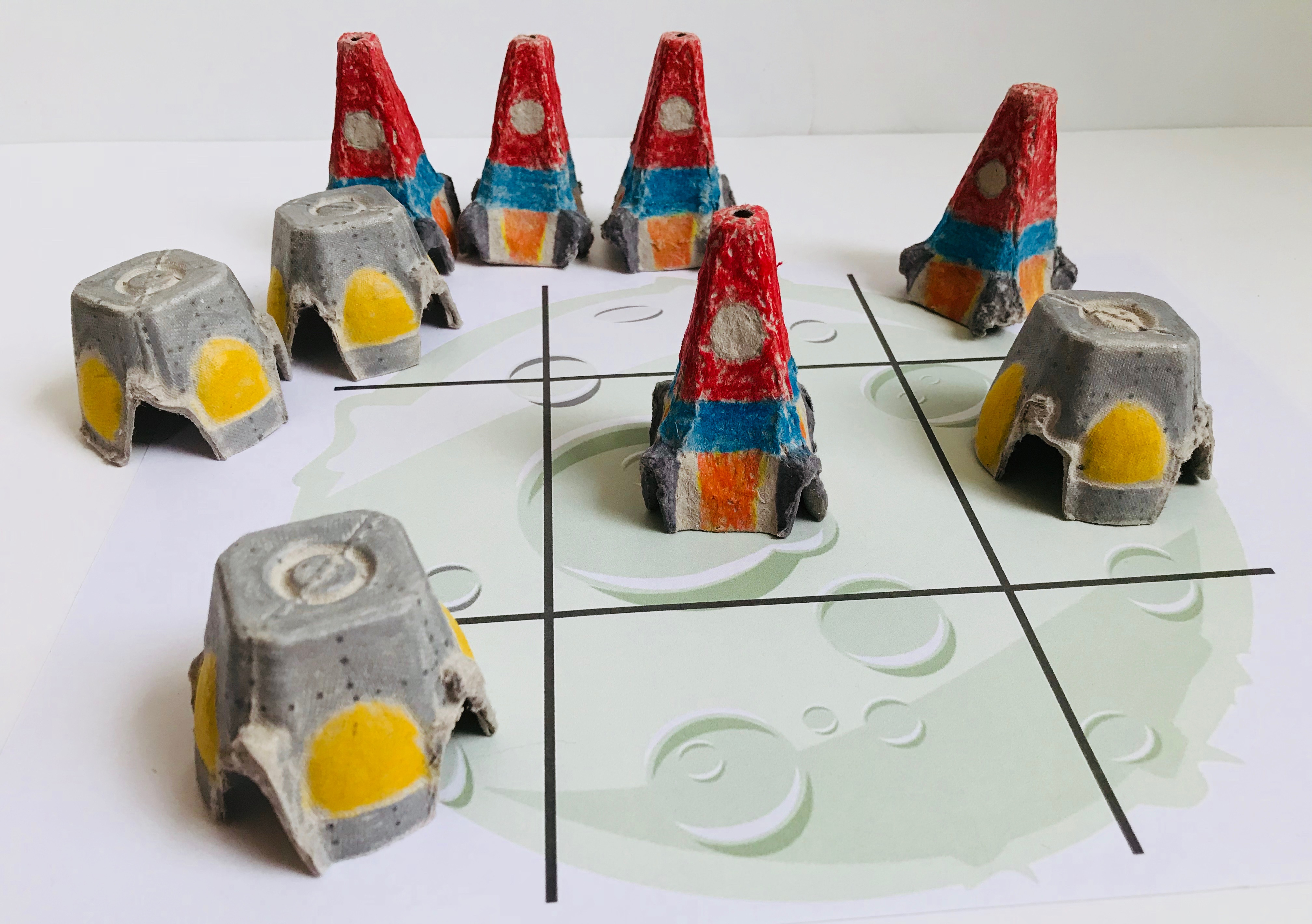
You can launch your own Tic-Tac-Toe Game with this set you make yourself! With just a couple of egg cartons, some crayons, and a printable game board, you’ll be off to the moon for some space-age fun! Opposing players can be designated by rockets and capsules. Each player will need 5 playing pieces. 

SUPPLIES

  • Printable Moon Tic-Tac-Toe Game Board
  • 2 cardboard egg cartons
  • Heavy stock paper or regular printer paper
  • Crayons
  • Black or gray fine-tip marker

DIRECTIONS

To Make the Rockets

  1. Cut the tall center cones from the egg carton
  2. Trim the bottoms of each form so they stand steadily, leaving the arched corners intact
  3. Pencil in a circular window on one side near the top of the cone
  4. Color the rocket body any colors you like, going around the window and stopping where the arched corners begin
  5. With the marker color the arched corners of the form to make legs
  6. On the cardboard between the legs, color flames for blast off

To Make the Capsule

  1. Cut the egg cups from an egg carton
  2. Color the sides silver, leaving the curved section uncolored. (If your egg cup has no pre-pressed curve on the sides of the cup, draw one on each side.)
  3. Color the curved section yellow to make windows
  4. With the marker, dot “rivets” across the capsule

Print the Moon Game Board and play!

celebrate-picture-books-picture-book-review-professor-wooford-mcpaw's-history-of-astronomy-cover

You can find Professor Wooford McPaw’s History of Astronomy at these booksellers

Amazon | Barnes & Noble | Books-a-Million

To support your local independent bookstore, order from

Bookshop | IndieBound

Picture Book Review
September 30 – It’s National Mushroom Month

celebrate-pciture-books-picture-book-review-mushroom-rain-cover

About the Holiday

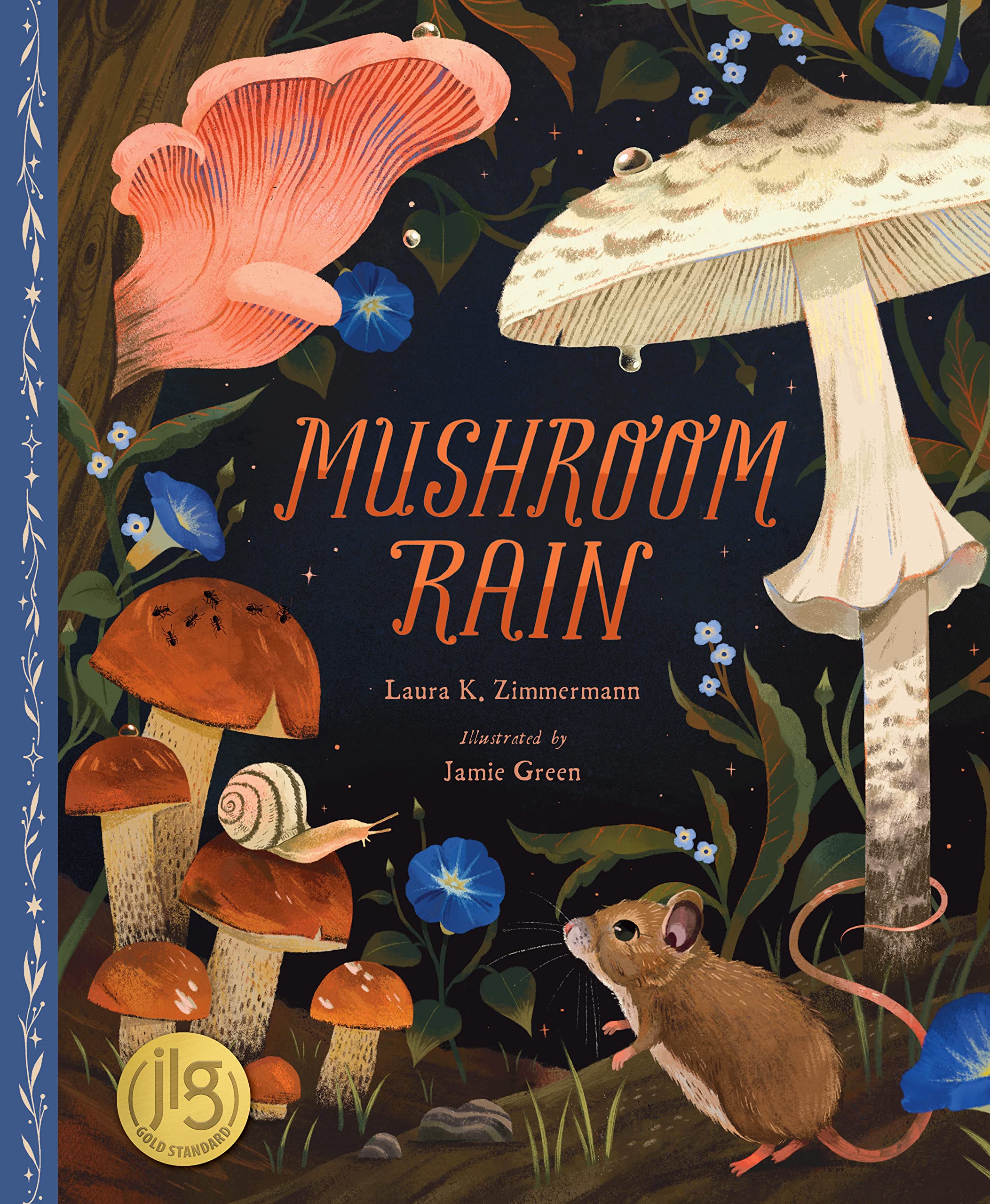
Whether you say “Yes, please!” to mushrooms on pizza, in salads, and in soups, stews, and other dishes or just like to stop and admire them in your yard or on a walk, National Mushroom Month is for you! The holiday was first created by the U.S. Mushroom Council as part of the Mushroom Promotion, Research & Consumer Information Act of 1990 that was instituted to raise awareness and an appreciation for mushrooms, both non-edible and nutritious edible varieties. President George H.W. Bush signed the Act into law on November 28, 1990, and the holiday was first celebrated in 1993. Celebrate your love of mushrooms today and all through the year with your favorite mushroom dish—and today’s book!

Mushroom Rain

Written by Laura K. Zimmermann | Illustrated by Jamie Green


You know how it is with mushrooms—they appear suddenly on the path you take every day, on trees, in the middle of lawns, and each with their own shape and color. Mushrooms are surprising, beautiful, and mysterious. In her evocative, lyrical text, Laura K. Zimmermann takes readers into the forests, meadows, and even up into sky to learn about these plants that can oftentimes seem otherworldly. 

celebrate-pciture-books-picture-book-review-mushroom-rain-bizarre-blooms

Image copyright Jamie Green, 2022, text copyright Laura K. Zimmermann, 2022. Courtesy of Sleeping Bear Press.

Under a starlit sky, Zimmermann gives children a peek into a darkened woods where “delicate umbrellas open, red octopus arms rise from the ground, cupped nests with eggs appear,” and another cluster of mushrooms glow “a spooky green.” These fungi don’t just look unusual, they are “bizarre blooms with strange scents,” and Zimmermann describes them—”some like bubble gum, coconut, maple syrup…”— so readers can imagine the aromas that mix in the night air. Can you smell them?

celebrate-pciture-books-picture-book-review-mushroom-rain-animals-eating

Image copyright Jamie Green, 2022, text copyright Laura K. Zimmermann, 2022. Courtesy of Sleeping Bear Press.

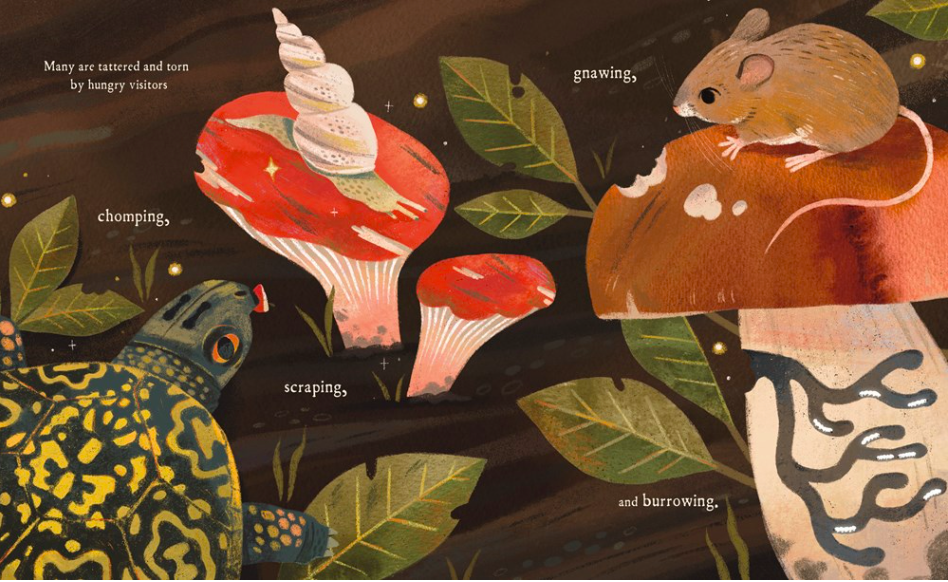
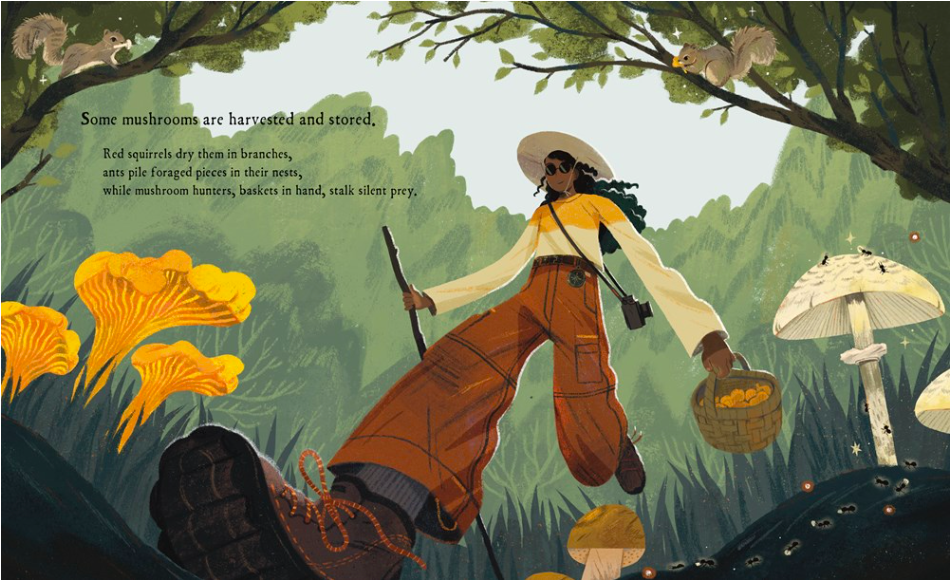
You’ve seen mushrooms with notches and nibbles, scratches and scars, and even meandering trails on their stems and tops. “Many are tattered and torn by hungry visitors chomping, scraping, gnawing, and burrowing” into the soft flesh. And while some are consumed where they grow, others are taken away by a variety of mushroom hunters—”harvested and stored” for another day.

celebrate-pciture-books-picture-book-review-mushroom-rain-mushroom-hunter

Image copyright Jamie Green, 2022, text copyright Laura K. Zimmermann, 2022. Courtesy of Sleeping Bear Press.

Then, just as suddenly as they appeared, mushrooms disappear. But are they gone completely? Zimmermann leads children underground to explore the vast network of roots beneath a forest floor. She floats them on breezes that send spores far and wide. And she sweeps them into the sky to soar with other spores into the clouds, where they’ll discover that an astonishing phenomenon occurs to begin mushrooms growing once again.

Following the text, extensive illustrated back matter reveals more about mushrooms: where they live, who eats them, how spores grow into mushrooms, how they help seed rainclouds, and how they are different from plants. Zimmermann also defines each part of a mushroom, describes the biggest mushroom-producing fungus and the largest living organism in the world, and shows kids how to use a mushroom to make a spore print.

celebrate-pciture-books-picture-book-review-mushroom-rain-disappeared

Image copyright Jamie Green, 2022, text copyright Laura K. Zimmermann, 2022. Courtesy of Sleeping Bear Press.

While Laura K. Zimmermann is taking children on a verbal sensory tour through the darkened world where mushrooms thrive, Jamie Green provides a feast for the eyes with her glorious illustrations of these odd colorful fungi jutting from the ground, posing, and  jockeying for position. Some stand close together, as endearing as a parent and child, or like a large family at a photo shoot while others reach upwards like roaring campfires. Turn the page and readers find themselves in the midst of a glowing alien landscape staring up into the dark night sky along mushrooms frilled and gilled while also aware of the small creatures on the forest floor having dinner or a snack. Green then takes kids underground and into the air, to show how spores find ingenious ways to grow and break the soil once again.

Arresting in both its beauty and enlightening facts that will excite readers’ curiosity, Mushroom Rain is a glowing invitation into the mysterious world of mushrooms and will spur readers to learn more about these delights of nature. The book, along with its extensive back matter and the materials found on Laura K. Zimmermann’s website (link below), would make a superb addition to any lessons on nature, the environment, and ecosystems for schools and homeschoolers, and is a must for school and public library collections.

Ages 5 – 8

Sleeping Bear Press, 2022 | ISBN 978-1534111509

Discover more about Laura K. Zimmermann, her book, and her other writing for children on her website. You’ll also find lots of mushroom-related activities, crafts, posters, puzzles, and more to enjoy with Mushroom Rain. There’s also a Teacher’s Guide for educators.

To learn more about Jamie Green, her books, and her art, visit her website.

celebrate-pciture-books-picture-book-review-mushroom-rain-cover

You can find Mushroom Rain at these booksellers

Amazon | Barnes & Noble | Books-a-Million

To support your local independent bookstore, order from

Bookshop | IndieBound

Picture Book Review

August 27 – It’s National Inventors Month

celebrate-picture-books-picture-book-review-how-was-that-built-cover

About the Holiday

While dates for this holiday may vary – some say May while others celebrate in August, National Inventors Month was established in 1998 by the United Inventors Association of the USA, the Academy of Applied Science, and Inventors’ Digest magazine. This month-long holiday recognizes the imagination and talent of individuals who dare to think differently to create new products, services, and ways of doing things that make a positive contribution to the world. Today, I’m sharing a book that highlights those who reach for the sky, dive under the sea, and look for opportunities to better help and connect people through the structures we use and live in. If you harbor dreams of being an inventor—on a large or small scale—look for opportunities to share your ideas!

How Was that Built?

Written by Roma Agrawal | Illustrated by Katie Hickey


They seem to have sprung from the ground, they soar into the clouds, they cross vast waterways—over and under the ripples and waves, and they come in all shapes and sizes. What are they? Buildings! For lovers of architecture, engineering, and just the marvels that people can construct, Roma Agrawal’s compendium of some of the world’s most incredible buildings will leave them enthralled—and much more knowledgeable on how these structures came to be.

In fifteen chapters, Agrawal reveals all the nuts and bolts about how buildings are secured on difficult sites (such as on sinking ground, in the sea, underground, and on ice); constructed to be tall, long, or able to move; and made to serve civic purposes. In addition to detailed explanations of the conditions architects and engineers must take into consideration when designing and constructing a building, bridge, or other structure, Agrawal clearly describes the materials used, how they are made, and why each is chosen for a particular job.

celebrate-picture-books-picture-book-review-how-was-that-built-emily-warren

Image copyright Katie Hickey, 2022, text copyright Roma Agrawal, 2022. Courtesy of Bloomsbury Children’s Books.

Rounding out each chapter, Agrawal goes in depth on one world building that demonstrates her topic. For example, In the first chapter she introduces readers to the Metropolitan Cathedral in Mexico City, which was built on top of an old Aztec pyramid in the middle of a filled-in lake. When it began sinking and tilting, engineers in the 1990s devised an intriguing way to save it. If you’re a fan of skyscrapers and wonder just how they’re built, a chapter on The Shard in London, which “is over 1,000 feet tall…and has 11,000 glass panels” (and for which Roma Agrawal worked as an engineer) reveals the secrets of a strong core and the incredible machinery that allows workers to keep going up and up.

Readers who love bridges will find two chapters on these beautiful and intricate structures. One reveals the fascinating story of how the construction of the Brooklyn Bridge overcame many challenges under the direction of Emily Warren, a woman who broke barrios for women in the engineering field. Another describes six different types of bridges as well as where they are used and why.

Readers also learn about concrete and how arches and domes work. They then explore the Pantheon and discover how it has stood for nearly 2,000 years. Other concrete structures from around the world are also discussed. You may not think too much about sewers, but imagine living without them! You’ll get a good (and stinky) idea about the conditions in London hundreds of years ago before Joseph Bazalgette designed and built the first sewer system. How did he do it? Agrawal breaks it down and then talks about today’s modern sewers.

celebrate-picture-books-picture-book-review-how-was-that-built-the-shard

Image copyright Katie Hickey, 2022, text copyright Roma Agrawal, 2022. Courtesy of Bloomsbury Children’s Books.

You’ll also find chapters on dams, tunnels, and buildings with moveable parts—or buildings like the Halley VI research station in Antarctica that can be moved easily in their entirety to avoid snow or ice that may crack beneath them. Then there are the challenges of building under the sea and in outer space. While astronauts now rely on the International Space Station, “some engineers and scientists are studying how to build structures on the Moon! Then researchers could live there for a long time to carry out their experiments and learn more about outer space.” What considerations must engineers take into account and what materials will they use? Agrawal fills readers in. She then closes her book with a look toward the future and talks about new materials and methods of building that may transform our world.

Sprinkled throughout the book are “Try It At Home” prompts for experiments that readers can easily do at home to visually interact with the concepts Agrawal lays out, such as using malted milk balls and raisins to understand “how carbon atoms make steel stronger” and making a pneumatic caisson with just a few household items.

Back matter includes a glossary of terms found in the book and brief biographies of ten influential engineers from the past and present.

celebrate-picture-books-picture-book-review-how-was-that-built-outer-space

Image copyright Katie Hickey, 2022, text copyright Roma Agrawal, 2022. Courtesy of Bloomsbury Children’s Books.

Readers of all ages will be engrossed by Roma Agrawal’s guide through the architecture and engineering that go into housing, moving, connecting, and supporting the world’s population. Every page contains fascinating details and interesting tidbits culled from Agrawal’s extensive experience as an engineer. These go far beyond an introduction to landmark buildings to show readers exactly how each type of building works. Relayed in a simple-to-understand, conversational style, her text is also broken up into short paragraphs that are easily digestible and invite further research, making this a superb resource for schools, homeschooling, and enthusiasts of all things engineering and architectural. Agrawal’s inclusion of structures from the past reveal the ingenuity of our ancestors and how they still influence today’s engineers and architects. Kids who love geography, archaeology, astronomy, and learning about all the intricate workings of the world will be enthralled with this book.

Katie Hickey gives readers an insider’s view of these phenomenal buildings with her stylish and incredibly detailed illustrations. Cityscapes allow children to understand the scale of skyscrapers from around the world and the beauty and breadth of New York City’s Brooklyn Bridge. Hickey whisks readers off to London to see The Shard; to New Zealand to view Te matau ā pohe, a bascule bridge whose shape was inspired by a fish hook; to Japan, where the Sapporo Dome accommodates soccer and baseball games with a moveable field of natural turf; and to Africa to stand on the edge of the Katse Dam and look 600 feet down into its reservoir. Along with this world tour, Hickey helps readers visualize the intricate working parts of certain buildings and bridges with interior views and small insets that demonstrate the physics of each design. Images of various types of cranes, pulleys, and other machinery also reveal the science behind building each structure.

A rich and comprehensive resource on the intricate engineering that goes into designing and building complex structures while also sharing the stories behind them, How Was that Built? will captivate readers of all ages. The book is a must for any STEM, science, art, or archaeology lover and belongs in all school and public library collections. 

Ages 6 and up

Bloomsbury Children’s Books, 2022 | ISBN 978-1547609291

Roma Agrawal is a structural engineer who builds big. From footbridges and sculptures, to train stations and skyscrapers – including The Shard – she has left an indelible mark on London’s landscape. She is a tireless promoter of engineering and technical careers to young people, particularly under-represented groups such as women. She has advised policymakers and governments on science education, and has given talks to thousands around the world at universities, schools and organizations, including two for TEDx. Roma has been awarded international awards for her technical prowess and success in promoting the profession, including the prestigious Royal Academy of Engineering’s Rooke Award. 

Discover more about Roma Agrawal and her work on her website, and connect with her on Instagram | Twitter. You can read an interview with Roma Agrawal in Publishers Weekly here.

To view a portfolio of work by Katie Hickey, visit Pickled Ink. You can connect with Katie Hickey on Instagram | Twitter 

National Inventors Month Activity

celebrate-picture-books-picture-book-review-spaghetti-box-bridge-craft

Build a Remarkable Recycled Bridge


You don’t need fancy blocks and construction materials to build a bridge! Little ones will be fascinated to put together a bridge made out of items you already have at home or that may even be slated for the recycle bin. Spaghetti boxes make great roadways, and cut-up egg cartons can be used as supports.

Build a Whole Town

Want to give your bridge a town with a river to span – or maybe two towns to connect? Cereal boxes and pasta boxes make great skyscrapers, apartment buildings, fire stations, and more. Need a farm silo? Grab a peanut butter jar, oatmeal container, or aluminum can. Cut a meandering river for your bridge to span from paper or cardboard. You can use them as is or—if your kids are sticklers for a little more detail—add some paint and details! So look around at the raw materials around you, use your imagination, and get creative!

celebrate-picture-books-picture-book-review-how-was-that-built-cover

You can find How Was that Built? at these booksellers

Amazon | Barnes & Noble | Books-a-Million

To support your local independent bookstore, order from

Bookshop | IndieBound

Picture Book Review

July 2 – World Firefly Day

celebrate-picture-books-picture-book-review-light-the-sky-firefly-cover

About the Holiday

World Firefly Day was instituted by Fireflyers International Network to raise awareness of these summer-night beauties and the dangers to their survival, including habitat destruction, pesticides, light pollution, and over-collection. More and more, as fields and marshlands are paved over for building and waterways open up to recreation, the fireflies that call these places home are disappearing. This year’s theme is “Let’s stay together in the challenging world” and encourages everyone to learn how to “live in harmony” with fireflies. To learn more about fireflies, how you can make your garden or lawn firefly friendly, and more, visit Firefly Conservation & Research.

Light the Sky, Firefly!

Written by Sheri Mabry Bestor | Illustrated by Jonny Lambert


When fireflies begin dotting the summer night sky with light, it may seem like they’ve magically appeared out of nowhere. But as Sheri Mabry Bestor eloquently reveals, these beautiful insects have been lurking and luminescing for a long time. How long? Well, would you believe a full year? As summer rains dampen the earth, a firefly lays her eggs (up to 500!) under brush or fallen leaves. “Under the leaves, the eggs lay still. For the baby fireflies inside the shells, it is time to grow. And begin to glow.”

celebrate-picture-books-picture-book-review-light-the-sky-firefly-laying-eggs

Image copyright Jonny Lambert, 2022, text copyright Sheri Mabry Bestor, 2022. Courtesy of Sleeping Bear Press.

The larvae hatch after a month, and then they begin to eat, eat, eat. Slugs and snails are on the menu and, as a paragraph of scientific information about the firefly’s nighttime dining discloses, “instead of fighting their prey, the larvae bite and then inject the prey with a liquid that keeps it from moving to get away.” All through the rest of summer and fall, the baby fireflies grow. During the winter, the larvae undergo many transformations, growing and outgrowing a series of casings.

celebrate-picture-books-picture-book-review-light-the-sky-firefly-launch

Image copyright Jonny Lambert, 2022, text copyright Sheri Mabry Bestor, 2022. Courtesy of Sleeping Bear Press.

It isn’t until late spring when the larvae are ready to become an adult. When they are ready, they emerge from their mud nest. Then, while the sun is high, they stay low to the ground. But “when the sun begins to set, they begin to climb higher. And when the sky turns black, fireflies launch!” Then “the sky is filled with flashing fireflies. They twinkle like faraway stars.”

celebrate-picture-books-picture-book-review-light-the-sky-firefly-blink-blink

Image copyright Jonny Lambert, 2022, text copyright Sheri Mabry Bestor, 2022. Courtesy of Sleeping Bear Press.

Still, the darkness of night doesn’t protect them from predators, so fireflies always have to be on the alert. If they are caught, fireflies have a bitter surprise for the hungry critter. And what about those “blink, blinks” that we all marvel at? Those signals aren’t random. As Sheri Mabry Bestor explains, “Fireflies blink with specific rhythms called ‘flash patterns,’ and each species has its own. This helps them communicate with each other.” Not only does that luminescent chemical help fireflies, Bestor describes ways in which scientists and doctors are studying it in hopes of helping people.

“In time, the females are ready to lay their eggs. Pitter-patter, drizzle-drip. Summer rain cools the earth. Bees buzz. Birds glide. A firefly finds a place under the leaves that blanket the ground.” The eggs hide, waiting until next summer when it’s their turn to shine.

celebrate-picture-books-picture-book-review-light-the-sky-firefly-summer-again

Image copyright Jonny Lambert, 2022, text copyright Sheri Mabry Bestor, 2022. Courtesy of Sleeping Bear Press.

Sheri Mabry Bestor’s lovely, poetic story of the lifecycle of fireflies is a beautiful read aloud for summer nights or for whenever you and your kids are missing the simple pleasures of summer. While the story plays out from page to page in flowing and sometimes vibrant text, scientific facts about these insects, their transformations, homes, anatomy, protection, and, of course, their bright and glowing communication skills are tucked in the corner waiting to be discovered and explored. Bestor’s rhythmical cadence also highlights the seasonal changes that accompany a fireflies’ growth and the cyclical wonder of nature.

Jonny Lambert’s stunning textured collage-style illustrations portray all the beauty of these unique insects and the landscape they inhabit. Mottled greens and yellows give depth to lush leaves, opaline snail shells catch the light above as the curious snail discovers the glowing eggs below, and delicate spring flowers camouflage the mud nests where the larvae are transforming into adults. The nighttime scenes are breathtaking with deep blue skies, a canvas for the pin pricks of light that create summer’s most spectacular show. Both realistic and dreamlike, these nighttime pages will have kids and adults scurrying outside to watch and be a part of it.

A gorgeous book to celebrate the exquisite charm of fireflies as well as to impart natural science facts, Light the Sky, Firefly is highly recommended for home, school, and public library bookshelves.

Ages 4 – 8

Sleeping Bear Press, 2022 | ISBN 978-1534111158

Discover more about Sheri Mabry Bestor and her books on her website.

You can connect with Jonny Lambert on Twitter.

World Firefly Day Activity

celebrate-picture-books-picture-book-review-firefly-maze

Firefly Flight Maze


This little firefly wants to join her friends in the forest. Can you help her through the maze to find them in this printable maze?

Firefly Flight Maze Puzzle | Firefly Flight Mage Solution

celebrate-picture-books-picture-book-review-light-the-sky-firefly-cover

You can find Light the Sky, Firefly! at these booksellers

Amazon | Barnes & Noble | Books-a-Million

To support your local independent bookstore, order from

Bookshop | IndieBound

Picture Book Review
June 30 – International Asteroid Day

celebrate-picture-books-picture-book-review-oh-no-astro-cover

About the Holiday

If you love learning everything you can about space, then International Asteroid Day is for you! This United Nations-sanctioned global awareness campaign was co-founded by astrophysicist and famed musician Dr. Brian May of the rock group Queen, Apollo 9 astronaut Rusty Schweickart, filmmaker Grig Richters, and B612 Foundation President Danica Remy to raise awareness about the importance of asteroids, their role in the formation of our solar system, their impact on space resources, and the importance of defending our planet from future impacts. Today’s date was chosen to commemorate the Tunguska impact over Siberia, Russian Federation, on June 30, 1908 – Earth’s largest asteroid impact in recorded history. Every year, the holiday is celebrated with Asteroid Day LIVE– a live broadcast with asteroid content and commentary from astronauts, experts and celebrities as well as independently organized events at planetariums, museums, universities, and other venues. For more information and to enjoy the day’s events with astronauts from around the world, astronomers, astrophysicists, and other notable scientific leaders, visit the Asteroid Day website.

Oh No, Astro!

Written by Matt Roeser | Illustrated by Brad Woodard

Astro was not a typical asteroid. Instead of zooming around crashing into obstacles, he believed in “personal outer space” and had for millions of years. One day when Astro spies an approaching satellite, he greets him cordially and lays down the rules: “please keep your distance” and “stay in your orbit.” But the satellite ignores him and comes closer and closer until…

celebrate-picture-books-picture-book-review-oh-no-astro-interior-art-satellite

Image copyright Brad Woodard, 2016, text copyright Matt Roeser, 2016. Courtesy of Simon & Schuster Books for Young Readers.


“‘Good gravity! You’ve struck me!” Astro exclaims. He’s just about to “point out to the satellite that it had done considerable damage to one of his favorite craters” when he discovers that he is spinning out of his orbit and out of control. How humiliating! The usually unflappable space rock suddenly finds himself hurtling past Mars. At the same time young astronomer, Nova, is “enjoying a quiet night of stargazing” through her telescope. She catches sight of Astro as he zips past an astronaut, rushes past the Moon, and finds himself on an inevitable collision course with Earth.

celebrate-picture-books-picture-book-review-oh-no-astro-good-gravity

Image copyright Brad Woodard, 2016, text copyright Matt Roeser, 2016. Courtesy of Simon & Schuster Books for Young Readers.

As he enters Earth’s atmosphere he begins to break apart, shedding bits of the past, as the universe watches. He lands on Earth with a SMASH! Reeling from the impact Astro slowly opens one eye and then the other. He finds that he’s smaller but in one piece. Standing by is Nova, waiting to welcome him to his new home. “‘My stars,’” he mutters. “‘Dare I say that was…FUN?!’”

And as Astro gazes at the night sky from a fresh perspective with Nova by his side, he asks, “‘What on Earth shall we do next?!’”

celebrate-picture-books-picture-book-review-oh-no-astro-hurtling

Image copyright Brad Woodard, 2016, text copyright Matt Roeser, 2016. Courtesy of Simon & Schuster Books for Young Readers.

For anyone stuck in the rut of their own orbit, Matt Roeser’s story of the unwitting space traveler is a humorous invitation to explore the universe around them. Roeser’s language—from calling asteroids “rambunctious” and the satellite a “celestial wanderer” to exclamations of “good gravity!” and “Pluto’s revenge!”—is an inspired treat. Kids and adults will laugh at Astro’s attempts to handle his undesirable predicament with dignity. Complacent Astro with his dry-as-space-dust wit and sparkling puns makes a stellar guide on this journey to more self-discovery and life enjoyment.

In the hands of Brad Woodard, deep space is a very cute and cool place! Rendered in flat tones of black, aqua, yellow, red, and white, Woodard’s illustrations give Oh No, Astro! a retro feel for a space-savvy audience. The oblivious satellite floats through Astro’s orbit with wide eyes and a sweet grin, while angular Astro with his stick arms, expressive face, and boldly displayed “No loitering” banner would be a welcome alien intruder in any back yard. Inquisitive and inclusive Nova, in her ponytails and Saturn-patterned dress, is the perfect companion to greet him. The night sky abounds with constellations, but Astro is the real star.

In the final pages, Astro leads readers in a “A Selection of Space Facts” from the  very Manual of the Cosmos, 2nd edition that he used to sort things out in his own life. A short list of suggested reading is also included.

Kids would love to find Oh No, Astro! on their bookshelf for story times of cosmic fun!

Ages 4 – 8

Simon & Schuster Books for Young Readers, 2016 | ISBN 978-1481439763

Visit Matt Roeser’s Website to discover his gallery of book jacket designs!

You can learn more about design and illustration work by Brad Woodard at Brave the Woods!

International Asteroid Day Activity

celebrate-picture-books-picture-book-review-name-that-asteroid-word-search-puzzle

Name That Asteroid! Word Search

Can you find the names of 20 asteroids floating around in this printable puzzle?

Name That Asteroid! Word Search Puzzle | Name That Asteroid Word Search Solution

celebrate-picture-books-picture-book-review-oh-no-astro-cover

You can find Oh No, Astro! at these booksellers

Amazon | Barnes & Noble | Books-a-Million

To support your local independent bookstore, order from

Bookshop | IndieBound

June 1 – National Dinosaur Day

celebrate-picture-books-picture-book-review-jack-horner-dinosaur-hunter-cover

About the Holiday

Today, we celebrate dinosaurs—those beasts that, although they are of a distant past, remain ever present in our hearts. Their size, diversity, and shear awesomeness make them a favorite of kids, and ongoing discoveries continue to fascinate adults as well. To celebrate, visit a national history museum, watch your favorite dinosaur movies or TV shows, join your kids in playing with their dinos (you know you want to!), and pick up today’s book!

Jack Horner, Dinosaur Hunter!

Written by Sophia Gholz | Illustrated by Dave Shephard


Growing up in Montana, Jack Horner was lulled to sleep by the “crunch, swoosh. Crunch, swoosh” of his father’s gravel business, and as soon as he was big enough to hold a shovel, he began digging. He loved being outdoors, searching for dinosaur bones. He dreamed of being a paleontologist when he grew up. His digging usually only produced rocks, sticks, and dirt, but once he “spied a peculiar rock” and when he had carefully swept the sand aside, he discovered a clamshell. His first fossil find made him look at his backyard differently – as “an ocean covering the land millions of years ago–an ocean filled with ancient beasts.” Jack wanted to find more fossils.

celebrate-picture-books-picture-book-review-jack-horner-dinosaur-hunter-clamshell

Image copyright Dave Shephard, 2021, text copyright Sophia Gholz, 2021. Courtesy of Sleeping Bear Press.

Jack taught himself how to “search for clues among the rocks: irregular textures, colors, and shapes.” He found lots of fossilized shells, but he really wanted to find a dinosaur. He went fossil hunting “in the woods and near the mountains.” Then one day while hiking up a cliff, Jack saw “an odd rock nestled in the ground.” With his tools he brushed the sand aside and uncovered the skeleton of a duck-billed dinosaur. 

celebrate-picture-books-picture-book-review-jack-horner-dinosaur-hunter-duckbill-fossil

Image copyright Dave Shephard, 2021, text copyright Sophia Gholz, 2021. Courtesy of Sleeping Bear Press.

While Jack was quickly becoming an expert on fossils and the landscapes that hid them, he struggled with reading in school.  His teachers told him that if his grades didn’t improve, he’d never be able to become a paleontologist. He took to experimenting in his basement, winning awards for his science projects even as he was failing his classes. One prestigious university, however, did admit Jack on the strength of one impressive project, but just as before Jack was unable to keep up in class. He dropped out and was drafted soon after to join the Vietnam War. 

celebrate-picture-books-picture-book-review-jack-horner-dinosaur-hunter-science-projects

Image copyright Dave Shephard, 2021, text copyright Sophia Gholz, 2021. Courtesy of Sleeping Bear Press.

Here, he decided that when he got home, he would try to work closely with paleontologists, if he couldn’t actually be one himself. He was hired by Princeton University’s natural history museum, where he “assembled and cataloged exhibit, working closely with scientists.” His colleagues recognized that Jack was an “expert at reading fossils.” He got a promotion that allowed him to work in the field. 

celebrate-picture-books-picture-book-review-jack-horner-dinosaur-hunter-museum-job

Image copyright Dave Shephard, 2021, text copyright Sophia Gholz, 2021. Courtesy of Sleeping Bear Press.

It was during one of these trips into cliffs that Jack “spied something odd. Heart thumping like the tail of an Ankylosaurus, he leapt into action.” When Jack swept the sand away, he and his team discovered a nest of fossilized dinosaur eggs – the first such find in North America. Jack went on to find more fossilized eggs, “proving dinosaurs nested in colonies;” name a new dinosaur species; and become an expert on dinosaur behavior and social structure. He even shared his special expertise when a famous movie producer filmed one of his great blockbusters. Jack had succeeded in his dream to be a “world-famous paleontologist.”

Back matter includes an Author’s Note, more about Jack Horner’s life, and a Dino Lab, that invites readers to design their own dinosaur and provides mix-and-match Greek and Latin words to help kids name their dino.

celebrate-picture-books-picture-book-review-jack-horner-dinosaur-hunter-specialist

Image copyright Dave Shephard, 2021, text copyright Sophia Gholz, 2021. Courtesy of Sleeping Bear Press.

Dinosaur lovers and anyone with dino-sized dreams will be instantly hooked by Sophia Gholz’s immersive biography of Jack Horner, who forged his own path to becoming one of the world’s most influential paleontologists. His self-confidence, unstoppable drive, and ultimate success will inspire all readers to define themselves by what they can do – not by what they may struggle with – and to trust their instincts on the way to achieving their goals. Gholz tells Jack’s story clearly and with the kind of repeated phrasing that builds suspense while also replicating the types of life experiences that create expertise. 

Dave Shephard’s bold illustrations will enthrall kids as they join Jack in the cliffs of Montana to brush away the sand from a duck-billed dinosaur fossil, see the underground strata where fossils lurk, and discover the nest of fossilized eggs. Shephard also depicts Jack’s struggles in school, where his undiagnosed dyslexia causes words and equations to become a jumbled stumbling block to his education. The vibrant format with clear typography will appeal to fans of graphic novels as well as to reluctant readers.

Jack Horner, Dinosaur Hunter! is an exceptional biography of a boy and man who never gave up on finding a way to accomplish his goal. The book will captivate children on its own or as an introduction to a wide range of classroom lessons and is highly recommended for all home, classroom, and public library collections.

Ages 6 – 9

Sleeping Bear Press, 2021 | ISBN 978-1534111196

Discover more about Sophia Gholz and her books on her website.

To learn more about Dave Shephard, his books, and his art, visit his website.

National Dinosaur Day Activity

celebrate-picture-books-picture-book-review-dinosaur-word-search-puzzle

Searching for Dinosaurs Puzzle


Hunt for 16 types of dinosaurs in this printable puzzle!

Searching for Dinosaurs Puzzle | Searching for Dinosaurs Solution

celebrate-picture-books-picture-book-review-jack-horner-dinosaur-hunter-cover

You can find Jack Horner, Dinosaur Hunter! at these booksellers

Amazon | Barnes & Noble | Books-a-Million

To support your local independent bookstore, order from

Bookshop | IndieBound

Picture Book Review