October 30 – It’s National Book Month

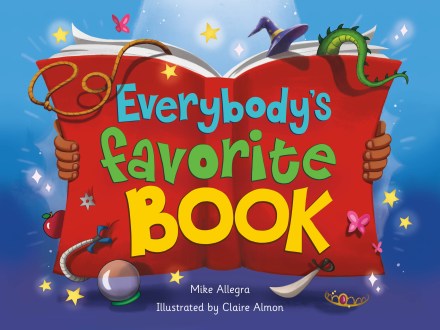
celebrate-picture-books-picture-book-review-everybody's-favorite-book-cover

About the Holiday

It’s been a terrific month of celebrating the joys of reading at home, in the classroom, and at the library! Every book read to and with a child enriches their life and helps to foster a life-long love of learning. Whether your child likes books that are fiction or nonfiction, stories or poetry, funny or poignant, there are a vast array of new and old books to teach them about the world and get them excited about being part of it. There really is a book for every child—as you’ll see in today’s review!

I received a copy of Everybody’s Favorite Book from Imprint to check out. All opinions are my own. I’m thrilled to be partnering with Macmillan Publishing in a giveaway of the book. See details below.

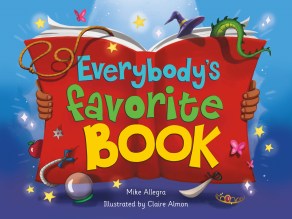
Everybody’s Favorite Book

Written by Mike Allegra | Illustrated by Claire Almon


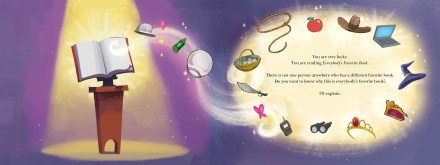
You are quite lucky, the narrator greets you, to be holding the world’s most favorite book. What makes it everybody’s favorite? Well, “lots of great books have cool heroes.” But these are heroes with just one talent—“like spacemen! Or ninjas! Or cowgirls!” In this book, though, the hero multitasks! What is he? “A space ninja cow!” and “his name is Bob.”
celebrate-picture-books-picture-book-review-everybody's-favorite-book-opening

Image copyright Claire Almon, 2018, text copyright Mike Allegra, 2018. Courtesy of Imprint at Macmillan Publishing.

Of course, a hero needs a villain to vanquish, and Bob is lucky because instead of a one-dimensional bad guy, he gets to pit himself against a fierce mash up of a robot, a dragon, and a pirate. What’s this horrible marauder’s name?. Are you ready? It’s Corky! So Bob and Corky fight. It’s thrilling…it’s dangerous…it’s stopped? Ah, the narrator sees now— “everybody doesn’t like violent books” and since this is Everybody’s Favorite Book, the story needs to be a bit more… Well, let’s see if Princess Glittersprinkles can help!

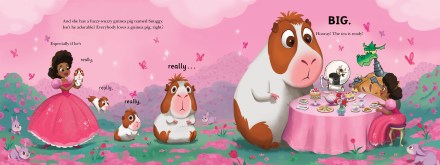
Yes! A tea party would be splendid. Bob and Corky and the princess sit down to a lovely spread with the adorable but really, really, really, really BIG guinea pig, Snuggy. But, wait! We’re forgetting about babies. Baby’s love books too, right? Now might be a good time to offer a bit of ABC fun. “A is for Apple. B is for Bob.” By the way…where is Bob? Is that a suspicious bulge in Snuggy’s cheeks? 
celebrate-picture-books-picture-book-review-everybody's-favorite-book-tea-party

Image copyright Claire Almon, 2018, text copyright Mike Allegra, 2018. Courtesy of Imprint at Macmillan Publishing.

Finding Bob’s going to require spies, especially cool ones. Now, while they’re out spying, let’s give it up for those teachers and librarians who love big, educational words like “Gallimaufry, Codswallop, and Frippery.” Sure, the narrator knows the definitions, but the book will be more fun and educational if you read them for yourself. Oh, dear! Are those words too educational? Then maybe a poop jok…wait a minute! Do you see a suspicious bump in Snuggy’s belly? No, me either.

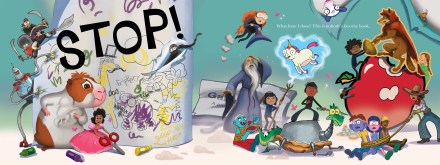
If this really is Everybody’s Favorite Book, it seems that “we are still missing so many things that everybody likes. Things like wizards! And a fairy tale!” And so many other characters and things to do…. Hey! Why is everyone fighting? There’s plenty of room for everybody, but right now “this is nobody’s favorite book.” What’s needed is a hero. “Oh wait! There’s Bob,” launching from Snuggy’s HUGE burp just in time! “Maybe he has an idea.” Bob suggests a “sweet ending.” This is more like it! All the hugs and smiles and cooperation is so sweet. Sweet, Snuggy. Not sweets! Oh dear….
celebrate-picture-books-picture-book-review-everybody's-favorite-book-stop

Image copyright Claire Almon, 2018, text copyright Mike Allegra, 2018. Courtesy of Imprint at Macmillan Publishing.

Mike Allegra will have kids laughing out loud with every page turn in his riotously clever genre mash-up. Allegra’s well-meaning narrator offers up droll juxtapositions of characters and situations while riffing on favorite books and movies, fads and fantasies with some crafts, coloring, and craziness to boot. The fast pace, abrupt interruptions, and zigzagging storyline keep kids guessing and eager to find out what comes next. As the action devolves into a free-for-all, the promise of a book for everybody is fulfilled with inclusive hugs and teamwork.

Claire Almon’s cartoon-inspired illustrations are bold, dynamic, and full of action with plenty of humor thrown in. Ingenious details, comically used tropes, and familiar styles of graphics from kids favorite TV shows and movies give young readers a feeling of shared experiences and culture that underline the theme of friendship. Readers will love following Bob’s journey to escape from Snuggy’s belly, and cutaways and character involvement from page to page keeps everybody reacting to the narrator’s directions until the big finale.

For book lovers of all stripes, Everybody’s Favorite Book will be a much-asked for addition to home, classroom, and library bookshelves. The book makes a terrific gift for all those readers on your list.

Ages 3 – 7 

Imprint, 2018 | ISBN 978-1250132765

Discover more about Mike Allegra, his books, and other projects on his website.

To learn more about Claire Almon, her books, and her art, visit her tumblr.

Meet Mike Allegra

celebrate-picture-books-picture-book-review-mike-allegra-headshot

I’m excited to be chatting with Mike Allegra today about his inspiration for his most original book, what kind of mash-up character he’d be, and his role in a family holiday tradition.

What was the inspiration or spark for Everybody’s Favorite Book?

The idea came to me while wandering around the children’s book section of Barnes & Noble. In the picture book area, I stumbled upon a huuuuge display dedicated to ninjas. Everything you could imagine was ninja-related: ninja pigs, ninja school, ninja camp, ninja grandma, ninja notary public… It was crazy. So I thought, “Hmm…I wonder if I can write a book about a ninja? Then I saw another display dedicated to astronauts and a third display dedicated to cowboys—and thought, “Hmm…I wonder if I can put ninjas and spacemen and cowboys into a single book?” That thought soon evolved into, “I wonder if I can cram a spaceman and ninja and cowboy into a single character?”

And Bob the Space Ninja Cow was born.

Then the creative floodgates opened wide. I giddily zipped around the children’s section looking for characters and genres and themes I could shoehorn into a single picture book. It was a blast!

If you were a mashup hero like Bob or even a mashup villain like Corky, what would you be? What would your name be?

I would want to be a mastodon-sized guinea pig like Snuggy. And I’d want to fly. And solve mysteries.

And they would call me Wondersnug, The Flying Pigamajig.

You’ve done a bit of everything in the writing field—plays, journalism, essay-writing, communications, editing—what do you like about writing for children?

Writing for children is like giving yourself permission to let your creative spirit soar. The possibilities are almost endless. I can write about a Space Ninja Cow! Or a dragon who knits! Or a boy who turns into a Kafka-esque giant bug! My mind can move in the wildest, weirdest directions. It’s wonderful.

You wrote so much as a child that a teacher predicted you’d become a writer. Was your work always funny?

No, but I always tried to make it funny, which is not the same thing.

My sixth-grade teacher, Mrs. Snelback, was the first person outside of my own family to say that I could write “funny.” And Mrs. Snelback was not one of those teachers who spouted compliments. Quite the opposite, really. She was pretty miserly, compliment-wise.

So when she told my parents that I should pursue a career as a writer, it really meant something. Mrs. Snelback didn’t say anything unless she absolutely, positively, 100% believed it. That’s why Mrs. Snelback will always be my favorite teacher. She shoved me onto the writing path and it has been an amazing journey.  

How do you tap into the humor and rhythms that really make kids laugh?

I’d love to say something profound here—like: “I try to see the world through the wondrous eyes of a child”—but the truth is a lot simpler: I like writing silly things and kids like reading silly things. So it works out for both of us!

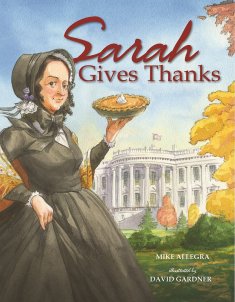
I love hearing about how holidays inspire picture books. Can you talk a little about your first published children’s picture book, Sarah Gives Thanks: How Thanksgiving Became a National Holiday?

Ah, the great Sarah Josepha Hale. She is so awesome. She was a celebrated and prolific writer. She edited the most widely read magazine in America. She founded charities, led patriotic fundraising drives, championed college educations for women, and used her magazine to influence public opinion on a wide spectrum of topics—the most famous of which was a nationalized Thanksgiving, which at that time was rarely celebrated outside of New England.
celebrate-picture-books-picture-book-review-sarah-gives-thanks-cover
And she did all these things in the early- to mid-1800s, when women were widely seen as second-class citizens. And she also did all of these things while raising five children by herself! 

See what I mean? Awesome!

Once I learned about Sarah, I just had to write about her. 

This summer two books in your Prince Not-So-Charming series were released. Can you introduce readers to this prince with other dreams and the very capable princess he encounters?
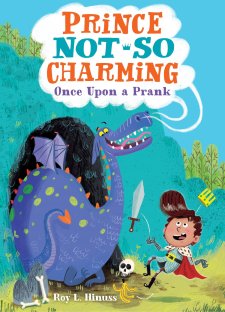
celebrate-picture-books-picture-book-review-prince-not-so-charming-once-upon-a-prank

Prince Carlos Charles Charming is the young prince of the happy and peaceful land of Faraway Kingdom and the sole heir to the kingdom’s throne. But Carlos would much rather be a jester, so he’s forced to live a double life of sorts, performing dangerous princely duties to satisfy his mom and dad (the queen and king) while also searching out venues to perform his juggling routine and road-test his impressive collection of fart jokes.
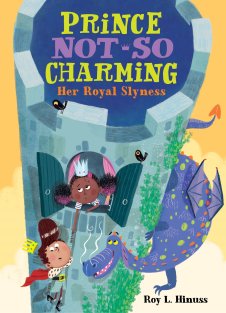
celebrate-picture-books-picture-book-review-prince-not-so-charming-her-royal-slyness

Princess Pinky, from the neighboring kingdom of Ever After Land, is in a similar situation; she would happily give up her crown to be an artist.

So Carlos and Pinky become fast friends who pursue their passions while going on princely and princessly adventures. (Oh, and Carlos has a pet dragon named Smudge who likes to knit. So there’s that, too.)

Any sneak peek into the prince’s future?

Carlos is going to be very busy. In future books he’ll joust, get turned into a frog, lead a search-and-rescue expedition, and attempt to stop a war.

What’s up next for you?
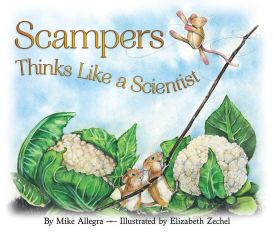
celebrate-picture-books-picture-book-review-scampers-thinks-like-a-scientist-cover

Well, I have another picture book coming out in March titled Scampers Thinks Like a Scientist, which I’m excited about. I just recorded the audiobook for it—which is either a good thing or a bad thing depending on what you think of my voice.

I’m also writing a middle grade murder mystery novel.

What’s your favorite holiday?

I love Christmas, but as I get older, I find myself gravitating toward holidays that contain a lot less hoopla. Thanksgiving is the holiday for me. I get to eat my favorite food on a crisp fall day. (Oh, how I love the fall with its pumpkin-spiced everything!) Also, I was born on November 25th, so I can celebrate my birthday on Thanksgiving, too! Thanksgiving is pretty much perfect.

In other words, Sarah Josepha Hale was a very wise woman.

Do you have an anecdote from a holiday that you’d like to share?

Sure! When I was a kid, every Christmas the entire family would assemble at my grandparents’ house to open presents and eat dinner.

One year—I think I was about seven—I noticed that every time a present was opened, half the room would say, “Ooh,” the other half would say, “Ahh,” and my grandmother would say, “Isn’t that nice!”

No joke; this happened every single time for every single present.

The problem, as I saw it, was that it these responses were too disorganized; everyone was ooh-ing and ahh-ing over everyone else. It was a big ol’ mess of noise. So I stood up and asked if I could conduct my family’s reactions like Leopold Stokowski. They happily agreed.

So whenever a present was opened, I would wave my arms to cue the “Ooh-ers,” the “Ahh-ers,” and Grandma’s “Isn’t that nice!” I never felt more powerful in my life. More importantly, almost everyone in the room was practically peeing their pants laughing. And, from that point forward, an Allegra Christmas tradition was born.

National Book Day Activity
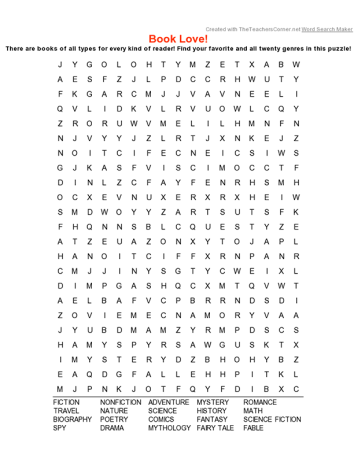
celebrate-picture-books-picture-book-review-book-love-word-search-puzzle

Book Love! Word Search


There are all kinds of books for every reader. Find your favorite along with twenty favorite genres in this printable puzzle.

Book Love! Word Search Puzzle | Book Love! Word Search Solution
celebrate-picture-books-picture-book-review-everybody's-favorite-book-cover

You can find Everybody’s Favorite Book at these booksellers

Amazon | Barnes & Noble | Books-a-Million | IndieBound

Picture Book Review

October 16 – National Dictionary Day

celebrate-picture-books-picture-book-review-w-is-for-webster-cover-image

About the Holiday

Dictionary Day honors Noah Webster, who wrote the first American dictionary. He was born in 1758 to a family that loved learning and knew the importance of a good education. Even as a boy Noah Webster loved words. He went on to become a lawyer, newspaper editor, Connecticut and Massachusetts legislator, and he helped found Amherst College in Massachusetts. He is most well-known, however, for compiling the first American dictionary that is synonymous with his name and still the most popular dictionary in use. His work, first published in 1828, revolutionized the way language and words were presented and remains always current by every year adding new words that come into common use through new products, fads, and slang. Today, celebrate by taking a walk through the dictionary—either in book form or online—to learn a few new words!

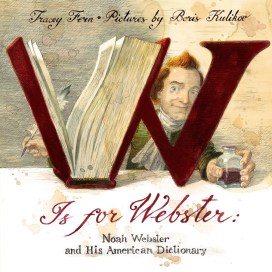
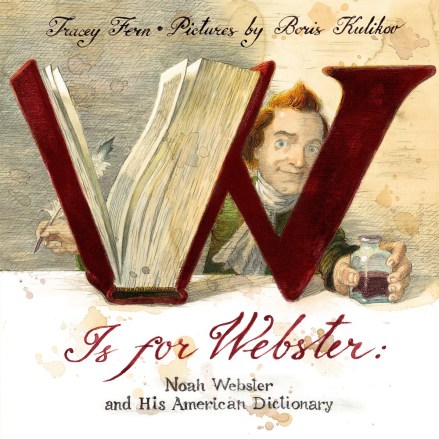
W is for Webster: Noah Webster and His American Dictionary

Witten by Tracey Fern | Illustrated by Boris Kulikov


Noah Webster was always different. Tall and thin with bright red hair, he liked to use big words when he spoke and wanted to do homework instead of goof around in school. Unfortunately for him school was in session for only a few months a year and goofing around seemed to be the major course of study. Of course, Noah didn’t call it “goofing around,” he called it “‘playing roguish tricks.’”

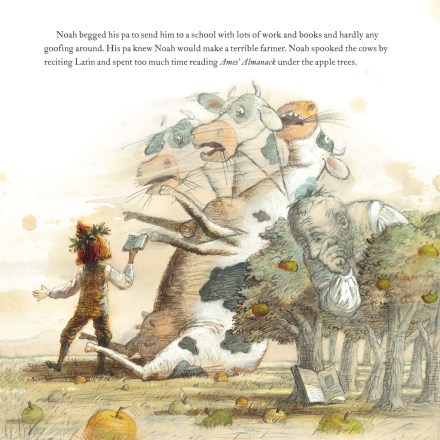
Noah begged to go to a harder school. “His pa knew Noah would make a terrible farmer. Noah spooked the cows by reciting Latin and spent too much time reading Ames’ Almanack under the apple trees.” His pa agreed, and in 1774 at the age of 16 Noah went off to study at nearby Yale College in New Haven, Connecticut. Yale had strict rules. Students had to rise at 5:30 a.m. and study for two hours before class. They were also fined “two shillings for making ‘tumult, noise, hallooing,’ or otherwise goofing around. Noah thought Yale was wonderful.”

celebrate-picture-books-picture-book-review-w-is-for-webster-spooking-horses

Image copyright Boris Kulikov, 2015, text copyright Tracey Fern, 2015 . Courtesy of us.macmillan.com.

Noah hadn’t been at Yale long before the American Revolutionary War broke out. Although Noah signed up to fight, he recognized that he was “‘ill able to bear the fatigues of a soldier,’” which was “Noah’s big way of saying he was a lousy soldier.” He returned to Yale and graduated in 1778, but he left the school with no job and no prospects. Even his pa told him to leave home to find work.

Noah became a teacher, but he found the British textbooks “‘defective and erroneous.’” He believed the students should have American textbooks that better reflected their diverse experiences. With the Revolutionary War at an end and America victorious, Noah wanted to help “hold his new, complicated nation together.” He believed that America needed a language different than the English spoked in Britain. “‘A national language is a national tie,’ Noah insisted to all who would listen, and to many who wouldn’t.”

celebrate-picture-books-picture-book-review-w-is-for-webster-teaching-school

Image copyright Boris Kulikov, 2015. Courtesy of us.macmillan.com.

He began the work himself with a speller. Right from the start Noah’s speller was different than the British books. It included everyday words “like scab, grub, and mop.” He also simplified the spelling by taking out unpronounced letters or spelling words phonetically. He also added pictures to every page and presented lists of rhyming words. He also priced his book so almost anyone could afford it. Noah’s speller became a bestseller.

Still, Noah had bigger ideas. He wanted to write a patriotic dictionary with uniquely American words. He took his idea on the road to make money for the venture, lecturing wherever he could. But Noah’s know-it-all tone of delivery, his “prickly personality,” even his “‘porcupine hair’” put people off. And what’s more, they didn’t like the idea of his dictionary. People thought he was a “lunatic” for wanting to replace British words with American ones.

celebrate-picture-books-picture-book-review-w-is-for-webster-working-on-letter-a

Image copyright Boris Kulikov, 2015, text copyright Tracey Fern, 2015. Courtesy of us.macmillan.com

In 1806 Noah went ahead and published “A Compendious Dictionary of the English Language. It was a flop, but Noah wasn’t discouraged.” The next year he started working on a bigger dictionary. He copied words out of British dictionaries and added American words and he traced the roots of all the words and wrote definitions, sometimes including quotes from famous people to show differences in meaning. He figured the whole dictionary would take 5 years to finish—eight to ten, tops.

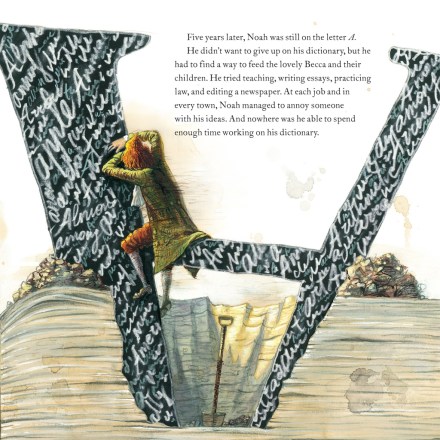
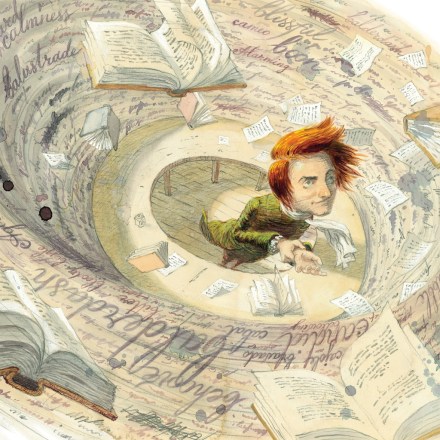
But five years later, Noah was still on the letter A. With no money coming in and a growing family, Noah took a variety of jobs, but he always seemed to rub someone the wrong way, and he lost job after job. He decided to sell his fancy house and bought a farm. Here he was able to gather books, books, and more books around his unusual donut-shaped desk. Standing inside the center of the desk, he spun around and around reading the books and finding words to include in his dictionary.

celebrate-picture-books-picture-book-review-w-is-for-webster-special-desk

Image copyright Boris Kulikov. 2015. Courtesy of us.macmillan.com.

By 1822 Noah had exhausted all the books in his study. He took to traveling to other American libraries, moved his family to New Haven to use the Yale library, and in 1824 even sailed to Europe to explore books found in the National Library in Paris and at the University of Cambridge in England.

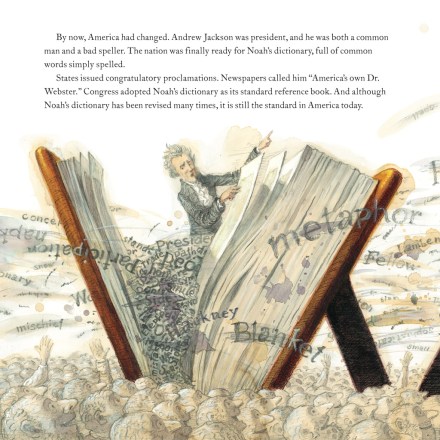
Finally, in 1825 Noah finished his dictionary.  With more than 70,000 words, An American Dictionary of the English Language was the largest English dictionary ever written. “Many people thought it was the best English dictionary ever written.” Why the change of heart? Well, one reason might have been that the President of the United States, Andrew Jackson, “was a common man and a bad speller.” Another might have been that the timing was just right.

celebrate-picture-books-picture-book-review-w-is-for-webster-finished-dictionary

Image copyright Boris Kulikov, 2015, text copyright Tracey Fern, 2015. Courtesy of us.macmillan.com.

However it came to be, Noah was now lauded as a hero by states and newspapers. Congress even adopted the dictionary as its standard reference book. Noah had not only succeeded in writing an American dictionary, he had “created a new American language for a new American nation.” One that is still beloved today.

An Author’s note as well as a list of resources follow the text.

Webster’s dictionary is intrinsically woven into every American child’s life through language and vocabulary development. Tracey Fern’s captivating story reveals the charm and foibles of its author, a man with just the right temperament and perseverance to tackle and complete such an overwhelming task. Fern’s exceptional storytelling skills and deft turns of phrase allow for a comprehensive review of Webster’s life that is full of exhilaration, empathy, and a good dose of the “big” words Webster loved. Fern builds suspense and tension while offering an insightful look at early American history by including details of the staggering research required and the adverse reactions to Webster and his work.

Boris Kulikov’s expressive illustrations perfectly capture the complex personality of Noah Webster, late-1700s-to-early-1800s American society, and the obstacles Webster faced in writing his dictionary. Fittingly, words, books, or ink blots abound on every page, pouring from the air, sprouting from the ground, stacked like the skyscrapers that would come, and surrounding Noah Webster the way they must have swarmed through his brain. Kulikov infuses humor into his paintings, as when Noah tears at his hair wondering how he will support himself after college, shrugs nonplussed at his students’ shenanigans, and buys himself quiet work time by handing out sweets to his kids. Visual metaphors for the hard, backbreaking and mind bending work also enhance this beautiful biography.

Ages 5 – 10 (adult’s will also enjoy this biography)

Farrar Straus Giroux, 2015 | ISBN 978-0374382407

Visit Tracey Fern’s website to learn more about her and her books!

Discover a gallery of artwork by Boris Kulikov on his website!

National Dictionary Day Activity

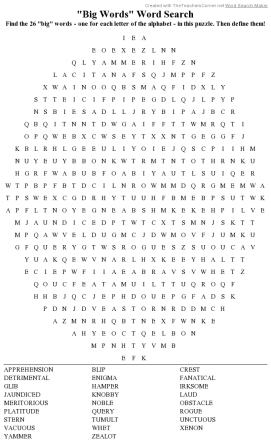
celebrate-picture-books-picture-book-review-big-words-vocabulary-word-search-puzzle

“Big Words” Word Search


Knowing and using a wide range of words allows you to express yourself in exact—and often—fun ways. Find the 26 “big” words—one for each letter of the alphabet—in this printable “Big Words” Word Search puzzle. Here’s the Solution!

celebrate-picture-books-picture-book-review-w-is-for-webster-cover-image

You can find W is for Webster at these booksellers

Amazon | Barnes & Noble | Books-a-Million | IndieBound

Picture Book Review
September 24 – National Punctuation Day

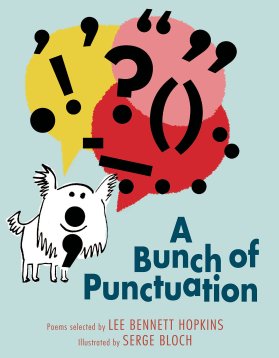
celebrate-picture-books-picture-book-review-a-bunch-of-punctuation-cover

About the Holiday

Founded in 2004 by Jeff Rubin, National Punctuation Day promotes the correct usage of all those little marks that make reading clearer and more meaningful. Do you ever wonder just how to use the ; and what’s the real difference between – and —? It can all get a little confusing. But misplaced or misused punctuation can result in some pretty funny mistakes—or some serious misinterpretations. Whether you love punctuation, would like to understand it better, or just use it to make emojis, today’s holiday will make you : – ). To find information on the day, resources for using punctuation correctly, and a fun contest to enter, visit Jeff Rubin’s National Punctuation Day website.

Boyds Mills Press sent me a copy of A Bunch of Punctuation to check out. All opinions are my own. 

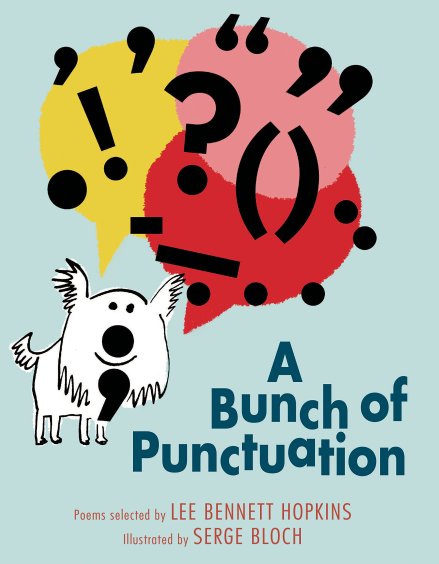
A Bunch of Punctuation

Poems selected by Lee Bennett Hopkins | Illustrated by Serge Bloch


In the world of writing and reading, the letters of the alphabet seem to get all the acclaim as they create cool words and form captivating sentences. But what about those little marks of punctuation that separate clauses, slow readers down, add mystery and excitement, and even tell readers when they should stop? They’d like a little attention too! In this enchanting collection of poetry, they get it as commas, apostrophes, quotation marks, and all the rest are put center stage—as you will see!

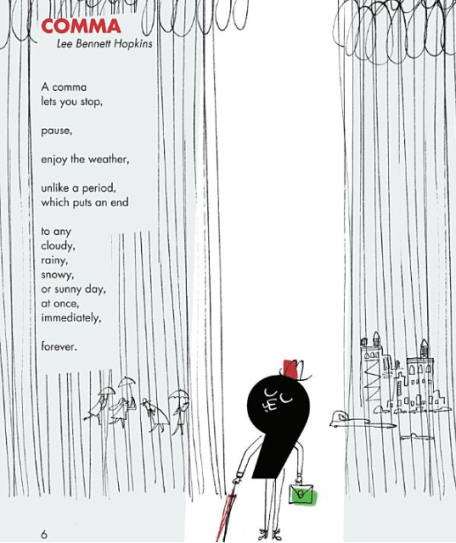
We all know about commas and the quandaries they pose: Is one needed here? Is one needed there? Should I use the Oxford comma? What is an Oxford comma, anyway? Lee Bennett Hopkins offers a lyrical example of a comma’s power in Comma:

“A comma / lets you stop, / pause, / enjoy the weather, / unlike a period, / which puts an end / to any / cloudy, / rainy, / snowy, / or sunny day, / at once, / immediately, / forever.”

celebrate-picture-books-picture-book-review-a-bunch-of-punctuation-comma

Image copyright Serge Bloch, 2018, Comma by Lee Bennett Hopkins, 2018. Courtesy of WordSong.

While a comma is a gentle reminder to take a break, in The Dash Charles Ghigna reveals that the little line is—among other things:

“A subdued dude / in tweet and text, / he signals what / is coming next. / The daring dash— / an interruption— / is cause for pause / a clear disruption.”

In Alice Schertle’s five-stanza Forgotten: A Colon’s Complaint, these two little stacked dots just want some respect:

“The comma, incredibly common / butts right into line after line. / Couldn’t there be a small place for me: / just one little sentence that’s mine?”

celebrate-picture-books-picture-book-review-a-bunch-of-punctuation-apostrophe

Image copyright Serge Bloch, 2018, poems selected by Lee Bennett Hopkins, 2018. From Apostrophe by Amy Ludwig VanDerwater. Courtesy of WordSong.

Julie Larios counts up from 1 to 10 and down from 10 to 1 with the most dynamic of punctuation marks in !!!!!!!!—Superhero Kaboom—!!!!!!!!. Just a peek gives us:

“1 big boom! / 2 kapows!! / 3 in a row of wow, wow, wows!!! / 4 kahblooies!!!! / 5 bops and bams!!!!! / 6 gee whizzes!!!!!! / 7 whops and whams!!!!!!!” And what’s at the end of all this excitement? “1 more kaboom, then it’s off to bed!”

Twelve more rhyming and free-verse poems from Rebecca Kai Dotlich, Amy Ludwig VanDerwater, Allan Wolf, J. Patrick Lewis, Michele Krueger, Jane Yolen, Prince Redcloud, Joan Bransfield Graham, and Betsy Franco will have kids looking at punctuation in new and creative ways. A final poem by Lee Bennett Hopkins invites children (and adults) to write their own poems based on four thought-provoking prompts, such as:

“Can you write poems posing questions / like who, what, where, / when, how, and why?” and “Can you write poems causing / words such as: / Whoopee! / Whee! / Wha-hoo! / to look as if they are / leaping off pages?”

celebrate-picture-books-picture-book-review-a-bunch-of-punctuation-a-punctuation-tale

Image copyright Serge Bloch, 2018, poems selected by Lee Bennett Hopkins, 2018. From A Punctuation Tale by Rebecca Kai Dotlich. Courtesy of WordSong.

Lee Hopkins Bennett gathers a group of the most inventive and popular poets for children in this collection that turns learning about punctuation into a flight of fancy, a comical romp, and an all-around engaging way to learn how these tiny show-stoppers work on a page. Each poem will spark discussions and “Ah-ha” moments about the function of punctuation and will make a grammar lesson one of the most eagerly anticipated classes of the day.

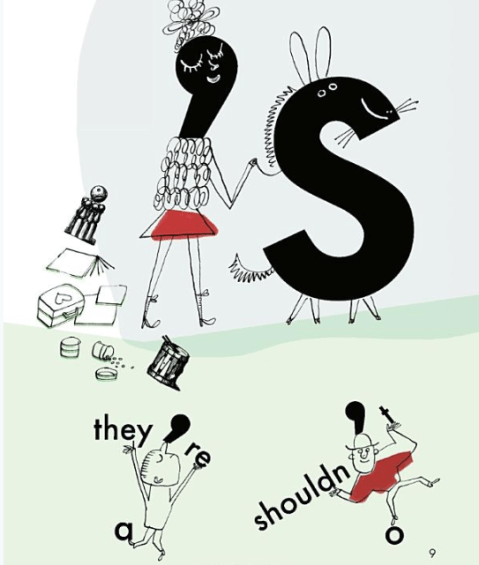
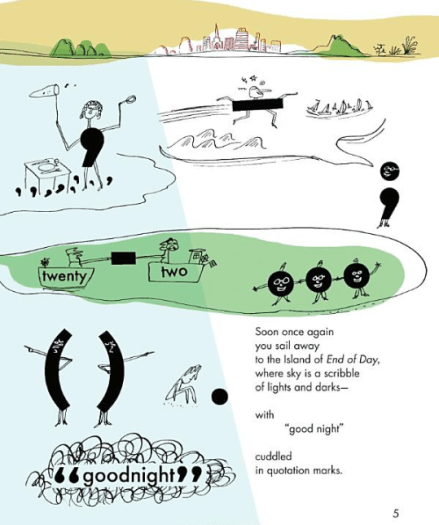
With his signature line drawings and humorous flair, Serge Bloch gives each type of punctuation mark a unique personality and purpose whether it’s creating a contraction, crying a puddle of lonely tears, lassoing words, or linking clauses in a train of thought. Bloch’s bold colors and action-packed pages bring the punctuation to life and will delight readers.

For young and older grammarians and poetry lovers, A Bunch of Punctuation is a bunch of fun to add to home, school, and classroom libraries.

Ages 8 – 12

WordSong, 2018 | ISBN 978-1590789940

To learn more about Lee Bennet Hopkins, his books, and his poetry, visit his website.

To learn more about Serge Bloch, his books, and his art, visit his website.

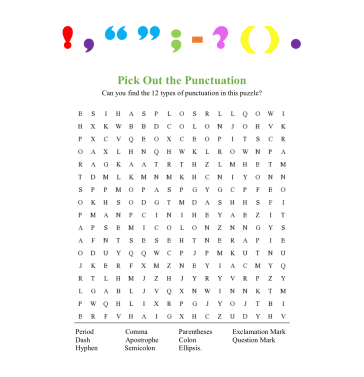
National Punctuation Day Activity

celebrate-picture-books-picture-book-review-Punctuation-Word-Search

Pick Out the Punctuation! Word Search


Have fun finding the twelve types of punctuation in this printable puzzle!

Pick Out the Punctuation! Word Search Puzzle | Pick Out the Punctuation! Solution

celebrate-picture-books-picture-book-review-a-bunch-of-punctuation-cover

You can find A Bunch of Punctuation at these booksellers

Amazon | Barnes & Noble | Books-a-Million | IndieBound

Picture Book Review
September 2 – It’s Read a New Book Month

celebrate-picture-books-picture-book-review-hooray-for-books-cover

About the Holiday

You’ve heard the saying “Too Many Books, Too Little Time,” right? Well, this truism has spawned not only one, but two Read a New Book Month celebrations! Both September and December have been designated as times to make special plans to search out and read new books. These can be books that are newly published or books that are new to you. And if you find yourself putting a few old favorites in the pile, that’s okay too! So, let’s get this book party off to an enthusiastic start with today’s book!

Hooray for Books!

By Brian Won


Turtle was looking everywhere for his favorite book. He took off his shell and searched it through and through. He found a pile of toys, games, hats, and puzzle pieces. There was one swim fin, a red wagon, an apple core, and even a wrapped gift box, but no book. Turtle thought hard, then remembered. “Aha! Maybe I shared it with…Zebra!” After imagining how much Zebra probably enjoyed the book, Turtle couldn’t wait to read it again himself. He dashed off to Zebra’s house, shouting, “‘Hooray for Books!’”

celebrate-picture-books-picture-book-review-hooray-for-books-turtle-looks-for-book

Copyright Brian Won, 2017. Courtesy of brianwon.com.

But Zebra didn’t have Turtle’s book. Instead, while munching on a carrot, Zebra offered him two others about unicorns. Turtle wanted his book, though. He thought some more and decided that maybe Zebra had shared it with…Owl! The two friends marched off to find out, cheering, “‘Hooray for Books!’” Owl was busy reading…but not Turtle’s book. Owl was paging through a book about eagles. While Turtle thought it might be interesting, it was not as interesting as his own book “‘I like my book!’” he said. “Maybe you shared it with…Giraffe!”

So Turtle and Zebra and Owl took off with their books in tow to find Giraffe. Giraffe had a stack of books, but had already passed on Turtle’s book to someone else. Giraffe did have a rollicking roller skating book, however, if Turtle was interested in that one. Turtle was having none of it, and suggested that maybe Giraffe had “shared it with…Elephant!” With Owl carrying the tall stack of books with a little help from Giraffe, and Zebra happily reading the roller skating book, Turtle led the way to Elephant’s house.

celebrate-picture-books-picture-book-review-hooray-for-books-turtle-finds-book

Copyright Brian Won, 2017. Courtesy of brianwon.com.

Elephant did not have Turtle’s book either. “‘It was a very good story,’ Elephant said. ‘Now I can share these with you.’” Elephant held up a book about juggling. Turtle was growing dejected. He wondered if Elephant could possibly have shared it with Lion. Just then Lion approached carrying a very, very tall stack of books. Turtle was so excited to see his own book at the bottom of the pile. He rushed over and pulled it out, sending the rest of the books flying.

“Turtle cheered, ‘I finally found my favorite! Hooray for Books!’” He went to a quiet spot and read his book three times. Meanwhile Owl, Zebra, Elephant, and Giraffe were sharing all of their books. Turtle heard them talking and laughing. Then he heard Lion say, “‘I bet Turtle would love this one.’” Intrigued, “Turtle came closer” and asked if everyone would like to read his book again because it was about friends. Then he asked, “‘Will you share your favorites with me?’”  

Everyone was excited and cheered, “‘Let’s read together!’” So they sat down surrounded by all of their favorite books and celebrated, “‘Hooray for Story Time!’”

celebrate-picture-books-picture-book-review-hooray-for-books-bookshelf

Copyright Brian Won, 2017. Courtesy of brianwon.com.

Brian Won’s sweet group of friends return in a story of togetherness and the joys of sharing favorite books. Won’s dialogue-rich text makes this a perfect read-aloud that encourages little ones to join in on the repeated phrases that are full of the emotions children will recognize. The gentle suspense that propels the story is delightfully cheerful, with plenty of “Hoorays,” smiles, and humor to celebrate the growing pile of books. Won’s ending is comforting and satisfying. Young readers will see that they can enjoy their own favorites while also sharing in the favorites of others – a practice that helps build strong bonds of frienship.

Children will be happy to see Won’s familiar characters having a new adventure. The enthusiasm of Zebra, Owl, Giraffe, Elephant, and Lion to help Turtle is infectious, and readers will giggle at the precarious pile of books that grows and grows. Kids will love predicting what will happen to that stack. As Turtle searches his home for his book, kids will recognize and be happy to point out items from Won’s Hooray for Hat! and Hooray for Today! The final two-page vertical spread is an adorable celebration of story time and friendship.

Hooray for Books! is a joyful addition to any home or classroom bookshelf and would make a fun gift for inspiring many story times to come.

Ages 4 – 7 

HMH Books for Young Readers, 2017 | ISBN 978-0544748026

Discover more about Brian Won, his books, and his art on his website.

Read a New Book Month Activity

celebrate-picture-books-picture-book-review-book-plate

I Have the Reading Bug Book Plate


Do you have a new book to read? Maybe you’d like to share it with a friend – or even a sibling! Use this printable I Have the Reading Bug Book Plate to personalize your book and make sure it never gets lost!

celebrate-picture-books-picture-book-review-hooray-for-books-cover

You can find Hooray for Books! at these booksellers

Amazon | Barnes & Noble | Books-a-Million | IndieBound

Picture Book Review

August 30 – Frankenstein Day

celebrate-picture-books-picture-book-review-mary-who-wrote-frankenstein-cover

About the Holiday

Today’s holiday celebrates the birth of Mary Wollstonecraft Shelley, who in 1818 at the age of 18, penned one of the most influential books of all time. Considered the first modern science fiction novel, Frankenstein; or, The Modern Prometheus incorporates elements of horror, psychology, love, abandonment, and acceptance. These themes and Shelley’s enthralling storytelling created a book that is always current. During this 200th anniversary year of the publishing of classic novel, discover (or rediscover) the spellbinding thrill of reading Frankenstein.

Mary Who Wrote Frankenstein

Written by Linda Bailey | Illustrated by Júlia Sardà


Mary was a dreamer. She liked to spend time alone, thinking and imagining “things that never were.” Mary called these daydreams “‘castles in the air.’” Mary loved to write stories too, but her daydreams were even more thrilling. When Mary wanted to read and dream, she went to the graveyard and sat next to her mother’s grave. Mary’s mother had died when Mary was only 11 days old.

While Mary loved her father, she didn’t like the way he punished her. Mary didn’t like his new wife, either. Mary’s father is friends with many famous people, and he invites them to visit. One night “a writer named Samuel Taylor Coleridge recites a strange, eerie poem—The Rhyme of the Ancient Mariner. Mary loves such poems.” Even though she was supposed to be in bed, she hid and listened, shivering “with fear at the spine-tingling tale of a ship full of ghosts.” Forever after, Mary remembered that night and that poem.

celebrate-picture-books-picture-book-review-mary-who-wrote-frankenstein-town

Image copyright Júlia Sardà, 2018, text copyright Linda Bailey, 2018. Courtesy of Tundra Books.

By the time Mary was fourteen, she was unhappy at home and causing trouble. One night, when she was sixteen, she and her stepsister, Claire, ran away with a “brilliant, young poet” named Percy Bysshe Shelley. They traveled through Europe, one day finding themselves outside a “ruined castle. It’s called Castle Frankenstein. Such an interesting name! Does it stick in Mary’s mind?”

Eighteen months later, the three traveled to Switzerland, where they became friends with Lord Byron—the most famous poet in the world. One night as torrential storms crashed around Lord Byron’s house, he read ghost stories from Fantasmagoriana. After reading, Byron challenged his friends, who also included a doctor named John Polidori, to write a ghost story. Eighteen-year-old Mary, Percy Bysshe Shelley, and John Polidori accepted the challenge. But Mary could not think of a good story idea.

celebrate-picture-books-picture-book-review-mary-who-wrote-frankenstein-friends

Image copyright Júlia Sardà, 2018, text copyright Linda Bailey, 2018. Courtesy of Tundra Books.

Soon, Shelley and Polidori gave up on their ghost stories, but their talk of new scientific experiments excited Mary. “Electricity can make the muscles of a dead frog twitch. Could it bring a dead creature to life? The idea is both thrilling and frightening.” The idea captured Mary, but instead of a frog, she imagined “a hideous monster, made of dead body parts, stretched out—and coming to life!” Mary suddenly realized she had the idea for her ghost story.

It took nine months for Mary to finish her story. When it was published, some people thought it had been written by Percy Bysshe Shelley—they didn’t “believe young Mary could have done it! How could a girl like her come up with such a story?” But she was a writer, assembling bits and pieces, ideas, and scientific changes in her imagination until they turned into the book Frankenstein. In the two-hundred years since the novel was first published, the story has become a classic. It has sparked movies, inspired other writers, and become a favorite all around the world.

An extensive Author’s Note about Mary Shelley, her life, and inspiration as well as Linda Bailey’s thoughts on the story behind Frankenstein follows the text. A full-page portrait of Mary Wollstonecraft Shelley and a list of sources rounds out the informative backmatter.

celebrate-picture-books-picture-book-review-mary-who-wrote-frankenstein-graveyard

Image copyright Júlia Sardà, 2018, text copyright Linda Bailey, 2018. Courtesy of Tundra Books.

With atmospheric and riveting details, Linda Bailey captures the life of Mary Wollstonecraft Shelley and the influences on her imagination that resulted in Frankenstein. Bailey’s use of the present tense is inspired as it reflects the continued currency of the novel while encouraging today’s readers to embrace their “castles in the air.” Facts about Mary’s travels, new scientific discoveries, and favorite books sprinkled throughout the story inform readers on how the imagination combines experiences to create art.

One look at Júlia Sardà’s spellbinding cover tells readers that they are in for an extraordinary reading experience. Muted tones of red, green, gold, blue, and plum cloaked in black create a thrilling backdrop to Bailey’s story. Ghostly winged creatures fly over Lord Byron’s home on a stormy night, smoky monsters emerge from Fantasmagoriana, a frog sits up in its coffin, and the spectre of the monster leans over Mary and sleeps at her feet as she writes her novel. At once spine-tingling and cozy, Júlia Sardà’s illustrations will draw children into this superb story of a ghost story.

Mary Who Wrote Frankenstein is sure to spark the imagination of children who love literature, art, and writing. The book would be a thrilling addition to classroom libraries for literature and writing classes as well as an inspiring favorite on home bookshelves.

Ages 5 – 8

Tundra Books, 2018 | ISBN 978-1770495593

Discover more about Linda Bailey and her books on her website.

To learn more about Júlia Sardà, her books, and her art, visit her website.

Frankenstein Day Activity

celebrate-picture-books-picture-book-review-frankenstein-puzzle

Monstrously Good Puzzle


See if you’re a Frankenstein scholar by filling in this printable puzzle full of words and phrases about the novel!

Monstrously Good Puzzle | Monstrously Good Puzzle Word List | Monstrously Good Puzzle Solution

celebrate-picture-books-picture-book-review-mary-who-wrote-frankenstein-cover

You can find Mary Who Wrote Frankenstein at these booksellers

Amazon | Barnes & Noble | Books-a-Million | IndieBound

Picture Book Review


July 29 – Rain Day

a-book-for-benny-cover-celebrate-picture-books-picture-book-review

About the Holiday

Is it hot enough for you? Do you start to melt the minute you step outside? Are you wishing for a little rain to cool things off? Well, today may be your lucky day! Today, we celebrate that rain that feeds farmer’s crops, brings our lawns back (just a little), and gives us a good reason to stay at home curled up with a good book. Why is July 29th designated as Rain Day? Well, it may have something to do with the fact that in Waynesburg, Pennsylvania it has rained on this date 114 years of the last 142. So watch the skies and get your umbrella ready. A trip to the library or bookstore is a great idea too!

A Book for Benny

Written by Judith Koppens | Illustrated by Marja Meijer


It’s a rainy day and Sam is cozy on the couch reading…well, she would be if her dog, Benny, wasn’t pulling at her arm, wanting to play. “‘I’m not going to play with you. I’m reading.’” Sam tells Benny. She tries to show him how much fun reading is, but Benny doesn’t seem interested in the book Sam has. Maybe, Sam thinks, Benny would like a different book. “‘Come, Benny. We’ll go to the library. We’ll pick out a nice book just for you,’” Sam says. She grabs her raincoat from the hook, and Benny finds his leash.

celebrate-picture-books-picture-book-review-a-book-for-benny-couch

Copyright Marja Meijer, 2017, courtesy of marjameijer.nl.

They reach the library and hurry in through the revolving door to get out of the rain. Just then they hear a voice coming from the front desk. “‘I’m sorry, young lady, but dogs are not allowed in here!’” When Sam explains, the woman thinks that a book just for Benny sounds fun, but she still can’t allow Benny to stay. Sam takes Benny outside and returns to the shelves to look for the perfect book.

She finds one about knights and takes it to the big wall of windows to get Benny’s approval. She shows Benny the pictures. “Benny looks up at Sam, but then he pees against the tree.” Perhaps a circus book would be more appealing; after all, “Benny loves to do tricks with the ball.’” But when Benny sees this book, he simply turns his back on Sam.

celebrate-picture-books-picture-book-review-a-book-for-benny-in-rain

Copyright Marja Meijer, 2017, courtesy of marjameijer.nl.

Sam searches through the bins of books. “‘Yes, this is the one!’ Sam suddenly cries.” She runs to the window and finds “the best picture to show Benny. Benny looks at the book and starts to wag his tail. He barks and licks the window…again and again” even though it’s dirty. Sam rushes to the desk to check out Benny’s book. When the woman picks it up, she “reads the title out loud. ‘I Love Sausages: 101 Recipes.’”

The librarian is surprised, but Sam tells her that this is the book Benny likes best. Back home, Sam settles in on the couch once more and begins reading again. “And Benny?” He stretches out, closes his eyes, and “has lovely dreams about his book.”

celebrate-picture-books-picture-book-review-a-book-for-benny-showing-books

Copyright Marja Meijer, 2017, courtesy of marjameijer.nl.

Judith Koppens’ endearing story about a little girl who wants to share her love of reading with her pet will enchant animal lovers and may inspire some child/furry friend reading time at home. Benny’s humorous displays of disapproval and approval will have kids giggling, and the book that Benny ultimately chooses will be appreciated with a laugh by dog owners. Benny’s choice also demonstrates that everyone finds different books appealing, and that sometimes it takes a little trial and error and alternate thinking to find just the right fit for reluctant readers.

celebrate-picture-books-picture-book-review-a-book-for-benny-at-library

Copyright Marja Meijer, 2017, courtesy of marjameijer.nl.

Marja Meijer’s cartoon-style illustrations are just right for this lighthearted tribute to a love of reading. Sam’s home is warm and cozy with pictures and photos of the most valued family member on the wall, a comfy couch, and a fuzzy rug. The blue watercolor world outside plinks with raindrops and splashes with puddles, while inside the library, the colorful stacks of shelved books offers refuge that is recognizable to all book lovers. Benny’s slobbery assent to the book Sam chooses will have readers wondering about the title, and the cover reveal will make them laugh. As Sam and Benny settle in to read, the clearing skies show that happiness really is a good book.

Dialogue driven,  A Book for Benny makes a great read aloud for home or classroom storytimes.

Ages 4 – 6

Clavis Publishing, 2017 | ISBN 978-1605373522

Discover more about Judith Koppens, her books, illustrations, and other creative endeavors on her website.

To learn more about Marja Meijer and her art, visit her website.

Rain Day Activity

celebrate-picture-books-picture-book-review-rainy-day-match-up-puzzle

Rainy Day Match-Up Puzzle


On a rainy day you need just the right raincoat and umbrella to stay dry! These matching umbrellas and raincoats have gotten separated. Can you find the matching pairs? How do you match them up? 

Rainy Day Match-Up Puzzle

a-book-for-benny-cover-celebrate-picture-books-picture-book-review

You can find A Book for Benny at these booksellers

Amazon | Barnes & Noble | Books-a-Million  | IndieBound 

Picture Book Review
May 2 – It’s Children’s Book Week

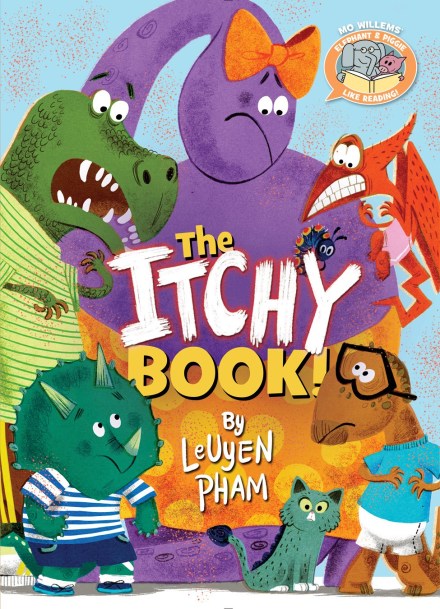
celebrate-picture-books-picture-book-review-the-itchy-book-cover

About the Holiday

Children’s Book Week is the longest-running national literacy program in the United States. The history of the holiday goes back to 1913, when Franklin K. Matthiews, the librarian of the Boy Scouts of America, toured the country to promote a higher standard in children’s books and proposed a Children’s Book Week. The week is celebrated by authors, illustrators, publishers, booksellers, librarians, and schools with special readings, events, and materials to get kids excited about reading. To learn more and find free, downloadable bookmarks and graphic novel, visit Every Child a Reader.

Disney-Hyperion sent me a copy of the Itchy Book to check out. All opinions are my own. I’m also thrilled to be partnering with Disney-Hyperion in a giveaway of a fantastic prize pack of books and other swag. See details below.

The Itchy Book! 

By LeUyen Pham | Elephant & Piggie Like Reading! Series from Mo Willems


Piggie has a question for Elephant: “Do you like books that make you feel things?” Indeed, Elephant does! And Piggie has just the book to give Elephant the feels all over. It’s called The Itchy Book!, and it opens like this:

Dino-Mo, a thoughtful, bespectacled pachycephalosaurus, comes strolling by and notices a sign that reads Dinosaurs Do Not Scratch. “Who knew?” says a tortoise snoozing next to the rock. Dino-Mo is contemplating this new bit of knowledge when a young triceratops comes by whistling a tune. Suddenly, she stops and bends down to scratch her bandaged knee, but before she can get her claws moving, the pachycephalosaurus rushes forwards to stop her.

He shows the triceratops the sign. “But I am ITCHY!” Triceratops tells him. There’s only one thing to do. “Dinosaurs are TOUGH! We do not scratch!” Dino-Mo instructs. The triceratops is doing her best not to think about it when a pterodactyl flies by chased by a bee. The bee catches up to her, and now she has a terrible itch. After a dire warning, Pterodactyl keeps her wings up and toughs it out.

Pterodactyl is ready to do battle against Brontosaurus’s back itch, though and zips up on top to help out. Triceratops thinks this looks like fun and is making the leap when Dino-Mo shouts, “HOLD IT RIGHT THERE!!!” He reminds them all of the sign, and, duly dejected, the three dinos quit their itchfest. But someone else is coming! It’s T-Rex with a scratchy, scratchy tag. He even promises not to eat anyone if they’ll just help with the incredible itching that he can’t reach.

“You tell him,” says Triceratops, and Dino-Mo does. They all acknowledge that “It is tough to be tough.” Only Dino-Mo is itch free, but in a show of solidarity, he asks the other dinos to make him itchy. Triceratops tickles him with a feather. Pterodactyl throws cut grass on him, and Brontosaurus adds an ant. Everyone else is getting itchy just watching all of this, but Dino-Mo doesn’t flinch. Even a wool sweater brings no response.

With a bit of a crazed look in his eyes, Dino-Mo recites the mantra “Dinosaurs…Do…Not…SCRATCH!” as the other dinos shower him with itch-inducing things until they’re all just a bundle of itchiness. They’re hanging tough, though. They’re proud. They’re doing what the sign says. Then the tortoise, refreshed from his nap, gets up and wanders away leaving the whole sign exposed. It seems there’s a little more to this dinosaur scratching business than originally thought. Have an itch to find out what? You’ll have to read along with Elephant and Piggie!

LeUyen Pham rocks the prehistoric landscape with her hilarious early reader that will have all ages of kids—and adults too—giggling, laughing, and groaning in sympathy for these dinos with Gigantosaurus-sized itches. As anyone knows, just thinking about scratching makes the problem worse. Throw in a rule about not scratching, and you have Pham’s recipe for a perfectly frantic and giddy story that kids will love to read again and again.

Pham’s expressive dinosaurs—who really want to obey the law etched in stone—are endearing as they tough it out and encourage their friends to do the same. Bold colors, a great dynamic among the dinosaurs, and the cartoon-inspired format will engage kids. Repeated words and phrases as well as speech bubbles color-coded to each dinosaur will guide early readers.

The Itchy Book!, Book 5 of the Elephant & Piggie Like Reading series, is a must for early and emerging readers or for any fan of the Elephant & Piggie books, It’s also a terrific read-together for younger kids. Adding The Itchy Book! to home bookshelves and classrooms will make them richer—and funnier! 

Ages 6 – 8 , younger children will enjoy having The Itchy Book! read to them.

Disney-Hyperion, 2018 | ISBN 978-1368005647

Discover more about LeUyen Pham, her books, and her art on her very cool website.

Learn more about Mo Willems and his books, find fun activities, and much “Mo” on his website.

To Learn More about The Itchy Book! visit the book’s Official Site.

Children’s Book Week Activity

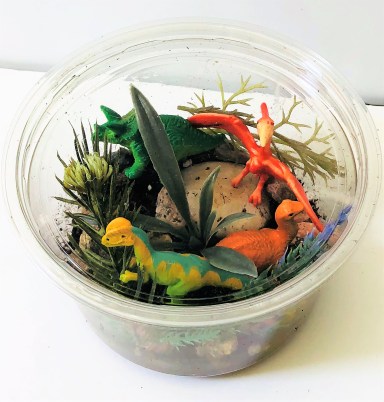
celebrate-picture-books-picture-book-review-dino-diorama-craft-1

Dino Diorama


Ever get an itch to visit the land of the dinosaurs? With this fun Dino Diorama craft you can make a mini version for your own room.

Supplies

  • 1-pound plastic deli container or glass jar
  • Three or four small plastic dinosaur toys
  • Dirt or sand to create a ½-inch ground layer in the bottom of the container
  • Small rocks or pebbles
  • Plastic leaves or plants, available from craft or fish tank supply sections of pet stores
  • Or use succulents in place of plastic plants to make a terrarium diorama
  • Goo-B-Gone for removing label-glue residue from the deli container (optional)

Directions

  1. Wash the deli container and carefully remove the label
  2. Use Goo-B-Gone to remove any residual glue (optional)
  3. Spread the dirt in the bottom of the container
  4. Place the rocks, plants, and dinosaurs into the container
  5. Put the lid on the container
  6. Or plant the succulents and decorate around them with the rocks and dinosaurs
  7. If using succulents, leave the container open

Picture Book Review