March 21 – World Poetry Day

celebrate-picture-books-picture-book-review-enormous-smallness-cover

About the Holiday

Sponsored by the United Nations Educational, Scientific, and Cultural Organization (UNESCO), World Poetry Day celebrates one of the world’s oldest and most treasured forms of linguistic expression. On this day we honor the poets who translate physical beauty into words, expose social injustice in heartrending verse, and make us laugh with quirky juxtapositions. To celebrate the holiday, attend a poetry reading, revisit poems from your favorite author or discover a new writer, or pen a poem yourself!

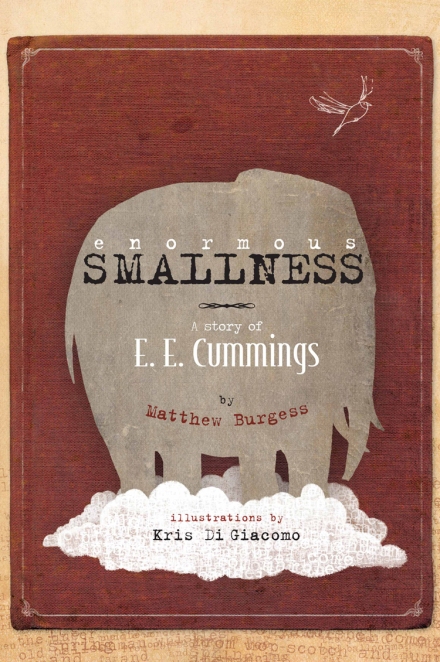
enormous SMALLNESS: A Story of E. E. Cummings

Written by Matthew Burgess | Illustrated by Kris Di Giacomo


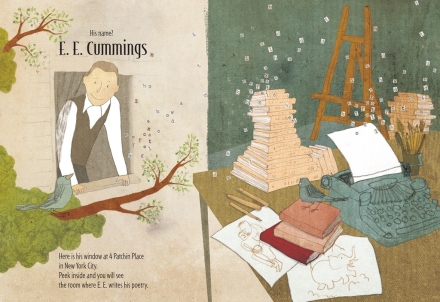
Hello! Welcome to 4 Patchin Place, the home of poet E. E. Cummings! This is where he wrote his poetry on a clackety typewriter, stopping only for tea poured out by the love of his life, Marion Moorehouse. How did he become a poet? That is an interesting story! E. E. was born Edward Estlin Cummings on October 14, 1894 in Cambridge, Massachusetts. His house was full of extended family, a handyman, a maid, and several pets. From an early age he loved to translate the things he saw into words. “His first poem flew out of his mouth when he was only three: “‘Oh, my little / birdie, Oh / with his little / toe, toe, toe!’”
celebrate-picture-books-picture-book-review-enormous-smallness-welcome

Image copyright Kris Di Giacomo, text copyright Matthew Burgess. Courtesy of Enchanted Lion Books

Estlin’s mother wrote down all the poems he told her and made a little book of them, titled “‘Estlin’s Original Poems.’” When he was six, he expressed his love of nature in a poem about trees, and when his mother asked him what else he saw, he “looked around as if his eyes were on tiptoes and when his heart jumped he said another poem: “‘On the chair is sitting / Daddy with his book. / Took it from the bookcase / Beaming in his look.’”
celebrate-picture-books-picture-book-review-enormous-smallness-elephant

Image copyright Kris Di Giacomo, text copyright Matthew Burgess. Courtesy of Enchanted Lion Books

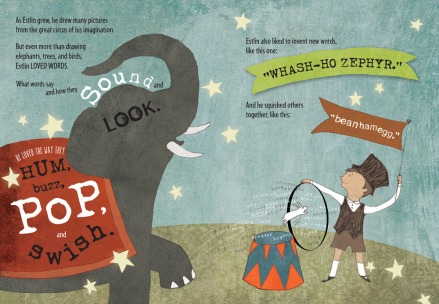
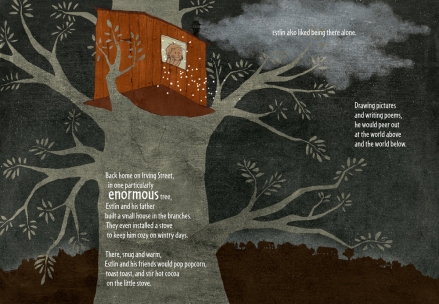
As he grew, Estlin was fascinated by the animals he saw at the circus and in the zoo. He drew pictures of them and wrote about them, using the words he loved so well—and even making up his own words. Estlin had a zest for life and for making life fun for himself and his little sister. During the summers, the family traveled to Joy Farm in New Hampshire, where Estlin swam, milked the cow, rode a donkey, and wandered through the fields and forest. His father had built him a little log cabin in the woods, and in the afternoons Estlin went there to draw and write. At home he also had a special place all his own. In an enormous tree his father built a tree house, complete with stove to keep him warm on cold days.
celebrate-picture-books-picture-book-review-enormous-smallness-tree-house

Image copyright Kris Di Giacomo, text copyright Matthew Burgess. Courtesy of matthewjohnburgess.com

Estlin had support for his writing at school too. His favorite teacher encouraged him saying, “anything is possible, / as long as you are true to yourself / and never give up, even when the world / seems to say, stop!” From his Uncle George, Estlin received a guide to writing poems. Estlin followed the rules in the book, penning poems nearly every day. When Estlin was 17 he attended Harvard College and began publishing his poems in the school’s magazines. While at Harvard, Estlin realized he had to follow his heart to be happy. He wanted to be like the new artists who were shaping the world—people like Gertrude Stein, Paul Cezanne, and Igor Stravinsky, “artists who were,” he once said, “challenging the way we think and see.”
celebrate-picture-books-picture-book-review-enormous-smallness-paris

Image copyright Kris Di Giacomo, text copyright Matthew Burgess. Courtesy of Enchanted Lion Books

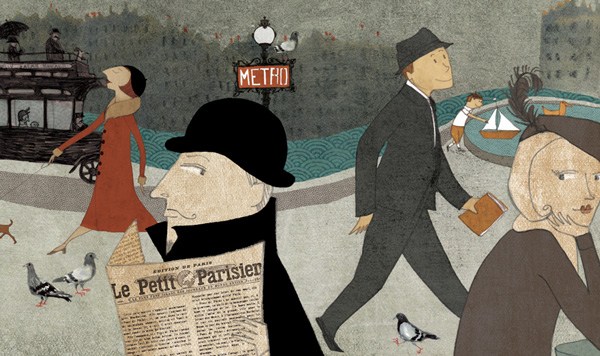
After he graduated, Estlin returned home, but when he had saved enough money he moved to New York and fell in love with the city immediately. He and his friends took in everything new the city had to offer. Soon, however, the United States entered World War II. On April 17, 1917 Estlin volunteered to be an ambulance driver in France. Before he received his assignment, though, he had time to explore Paris. He was “bowled over by the museums, the ballet, and the colorful, crowded streets.” He enjoyed the city so much he returned often during his lifetime.

During the war, Estlin was mistaken for a spy and sent to prison for several months. After the war he wrote a book about his experiences titled The Enormous Room by E. E. Cummings. “The book was published and praised! Estlin was becoming E. E.!” A year later he published his first book of poetry—Tulips & Chimneys. In his poems he experimented with punctuation and using lower case letters instead of capitals.
celebrate-picture-books-picture-book-review-enormous-smallness-yes

Image copyright Kris Di Giacomo, text copyright Matthew Burgess. Courtesy of matthewjohnburgess.com

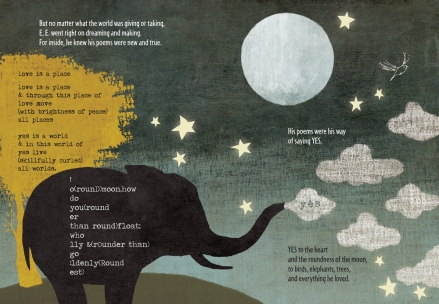
Through his fanciful typography, E. E. “wanted his reader’s eyes to be on tiptoes too, seeing and reading poetry (inaway) that was new.” But some people didn’t understand or like his poetry; it was too strange and too small, they said. But E. E. knew he had to stay true to himself. He believed that “his poems were new and true” and “were his way of saying YES” to everything he loved. As time went on more and more people began to “see the beauty of E. E.’s poetry, and he became one of the most beloved poets in America.”

E. E. Cummings lived and worked at 4 Patchin Place for almost 40 years, but in his mind he would often return to his childhood home. He “could still see himself as a boy gazing out at the sunset”—a memory that he put into words: who are you,little i / (five or six years old) / peering from some high / window;at the gold / of November sunset / (and feeling:that if day has to become night / this is a beautiful way)”
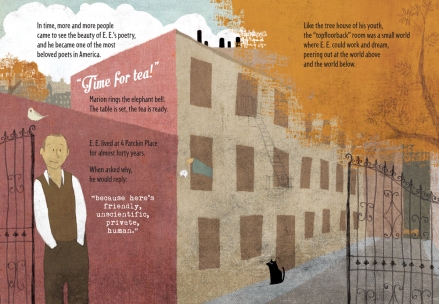
celebrate-picture-books-picture-book-review-enormous-smallness-patchin-place

Image copyright Kris Di Giacomo, text copyright Matthew Burgess. Courtesy of matthewjohnburgess.com

Simply put, Matthew Burgess’s enormous SMALLNESS: A Story of E. E. Cummings is a biography that will make you smile. Upbeat and full of the wonder and whimsy that influenced Estlin Cummings’ prodigious talent, the story encourages readers to always follow their heart. Burgess’s easy-going, conversational style invites kids along on the journey of Cumming’s life, stopping off at points that resonate with kids—early imaginary play, school, family vacations, home life, college, travel, and ultimate success. Seeing the support Cummings received throughout his life will inspire young readers just starting out on their own roads of discovery.

Kris Di Giacomo’s enchanting illustrations will immediately capture the imagination of readers. The playful quality of Cummings’ personality and poems is mirrored in each spread as a variety of children’s drawings and typography are sprinkled throughout. As six-year-old Estlin composes poems for his mother, he stands on tiptoe in his nightshirt surrounded by toys; he experiences life from rooftop and treetop and gazes into the night from his tree house; New York lights up with fireworks and the lights of Broadway; and his poems spring from the pages in their own inimitable way.

For children interested in writing, biographies, history, the arts, and the life of the imagination, enormous SMALLNESS: A Story of E. E. Cummings is a perfect choice for their home bookshelves.

A chronology of E. E. Cummings’ life, five poems, and an Author’s Note follow the text.

Ages 4 – 9

Enchanted Lion Publishing, 2015 | ISBN 978-1592701711

To learn more about Matthew Burgess, his books, and his poetry, visit his website!

View a gallery of illustration by Kris Di Giacomo on her website!

World Poetry Day Activity
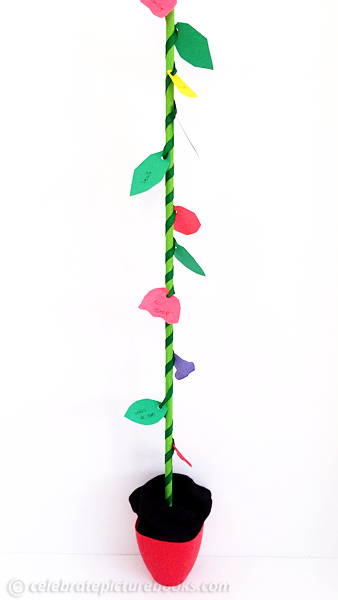
celebrate-picture-books-picture-book-review-grow-a-poem-craft


Grow a Poem


A poem often grows in your imagination like a beautiful plant—starting from the seed of an idea, breaking through your consciousness, and growing and blooming into full form. With this craft you can create a unique poem that is also an art piece!

Supplies

  • Printable Leaves Template
  • Printable Flower Template
  • Wooden dowel, 36-inch-long, ½-inch diameter, available in craft or hardware stores
  • Green ribbon, 48 inches long
  • Green craft paint
  • Green paper for printing leaves (white paper if children would like to color the leaves)
  • Colored paper for printing flowers (white paper if children would like to color the flowers)
  • Flower pot or box
  • Oasis, clay, or dirt
  • Hole punch
  • Glue
  • Markers or pens for writing words
  • Crayons or colored pencils if children are to color leaves and flowers

Directions

  1. Paint the dowel green, let dry
  2. Print the leaves and flower templates
  3. Cut out the leaves and flowers
  4. Punch a hole in the bottom of the leaves or flowers
  5. Write words, phrases, or full sentences of your poem on the leaf and flower templates
  6. String the leaves and flowers onto the green ribbon (if you want the poem to read from top to bottom string the words onto the ribbon in order from first to last)
  7. Attach the ribbon to the bottom of the pole with glue or tape
  8. Wrap the ribbon around the pole, leaving spaces between the ribbon
  9. Move the leaves and flowers so they stick out from the pole or look the way you want them to.
  10. Put oasis or clay in the flower pot or box
  11. Stick your poem pole in the pot
  12. Display your poem!

Picture Book Review

February 7 – It’s Haiku Writing Month

The Maine Coon's Haiku and Other Poems for Cat Lovers by Michael J. Rosen and Lee White picture book review

About the Holiday

National Haiku Writing Month—also known as NaHaiWriMo—encourages poets and poetry lovers to write one haiku a day for the entire month of February. Why was February chosen for this literary challenge? Perhaps the fact that the haiku is the shortest form of poetry and February is the shortest form of month makes them natural allies. While a haiku may be short, it is full of emotion and impact, not unlike its host month. If you have haiku inside of you, write them down and share them with others!

The Maine Coon’s Haiku and Other Poems for Cat Lovers

Written by Michael J. Rosen | Illustrated by Lee White


Fortunately for poetry—and cat—lovers there are as many types of felines as there are ways to describe them. With wit and keen insight, this collection of haiku depicts the mystery, stealth, crouching, and curiosity of twenty breeds of cats.

The remains of a shredded plant elicits an unanswerable question in Ragdoll: “why today the cat / who sleeps beneath the ivy / halved the blameless hearts.”

celebrate-picture-books-picture-book-review-the-maine-coon's-haiku-american-shorthair

Image copyright Lee White, text copyright Michael J. Rosen. Courtesy of Candlewick Press

Any cat owner who finds vases or lamps overturned will appreciate Siamese: “a toppled lamp shade / moon moth must be here somewhere / batted from the dark.” It is commonly known that cats own their domain, a fact acknowledged in British Shorthair: “paws plant mud-daisies / along the polished hillside / parked on the cat’s street.”

In these lines felines become baseball players, gymnasts, ghosts, and mist, as in Bombay: “paired shadows prowling / in nightfall, but just two lights / pierce that darkness” and Norwegian Forest Cat: “caught among branches / fog descends the trunk headfirst / one foot at a time.”

celebrate-picture-books-picture-book-review-the-maine-coon's-haiku-norwegian-forest-coon

Image copyright Lee White, text copyright Michael J. Rosen. Courtesy of Candlewick Press

While the haiku form is necessarily rigid, the supple rhythms of Michael Rosen’s phrases perfectly capture the vast array of quirks, moves, attitudes, and friskiness that make cats such favorite pets. These poems are in turn sweet, spirited, and humorous—just like their subjects.

Lee White similarly highlights the bounding, creeping, prowling, and snoozing postures of all manner and colors of the breeds represented here. The Turkish Angora, stealthily creeping across a room, is painted as transparent as it leaps through the door, becoming more opaque as it reaches mid-page and disappearing from the edge of the book, leaving only its back end behind. The Abyssinian plunks its head and whole body across the open book on its owner’s lap, its eyes closed in dreamy sleep, and the Scottish Fold indomitably maintains its perch in the magnolia tree, determined not to fall like the raining petals.

Ages 5 and up (any cat lover will enjoy these poems)

Candlewick Press, 2015 | ISBN  978-0763664923

Get to know Michael J. Rosen and discover books for kids and adults, poems, videos, work for radio and TV, and more on his website!

View a beautiful gallery of artwork for books and personal illustration by Lee White on his website!

Haiku Writing Month Activity

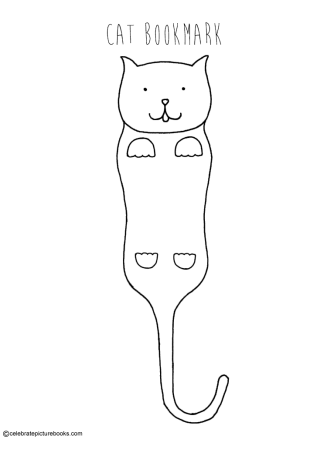
CPB - Cat Bookmark (2)

Hang in there, Kitty! Bookmark


Do you love to read? Do you love to write? If you said yes to either or both of these questions, then here is a kitty that wants to hang out with you! 

Supplies

  • Printable Hang in there, Kitty! bookmark template
  • Card stock paper
  • Colored pencils, crayons, or markers
  • Scissors

Directions

  1. Print the Hang in there, Kitty! bookmark (printing on card stock will make a sturdier bookmark)
  2. Color the bookmark
  3. Cut around the toes of the front paws, leaving the top of the paws attached to make flaps that will hang over the page you want to mark

Picture Book Review

January 23 – National Pie Day

celebrate-picture-books-picture-book-review-edgar-allan-poe's-apple-pie-cover

About the Holiday

National Pie day is perfect for…well…pie! Whether you love fruity pies or meat pies, pies with lattice tops or crumble crusts this day is for you! There’s only one true way to celebrate—make or buy your favorite kind of pie and enjoy! 

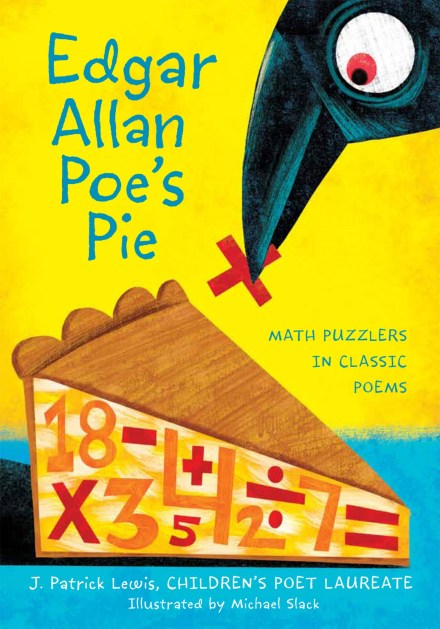
Edgar Allan Poe’s Pie: Math Puzzlers in Classic Poems

Written by J. Patrick Lewis | Illustrated by Michael Slack


There’s something about poetry with its iambic pentameters, feet, meter, sonnets, couplets, and more countable qualities that just seems to lend itself to math. J. Patrick Lewis must have thought so too because he penned a clever volume of poems inspired by well-known verses. First up is Edgar Allan Poe’s Apple Pie, which is inspired by “The Raven” and begins: “Once upon a midnight rotten, / Cold, and rainy, I’d forgotten / All about the apple pie / Still cooling from the hour before.” But now, even though there is a “knocking, knocking…” at the door, the narrator takes up a knife and slices the night with a cutting question, only to hear the stranger’s mysterious clue “‘Never four!’”

celebrate-picture-books-picture-book-review-edgar-allan-poe's-apple-pie-hotdog

Image copyright Michael Slack, text copyright J. Patrick Lewis. Courtesty slackart.com

All the narrator of Emily Dickenson’s Telephone Book, inspired by “My Life Closed Twice Before its Close,” wants to do after napping is to find a certain phone number in her directory, but where is it? She knew where it was before she went to bed—in fact its “two opposing pages / that added up to 113— / Were smudged around the edges—” but now she’s so confused…. Can you help?

Those who think that “Stopping by Woods on a Snowy Evening” has no link to underwear possibly are not aware of Robert Frost’s Boxer Shorts, in which the lilt and the rhythm of the original are perfectly matched in a priceless, pricey puzzle that ends “My tightie whities look so sad. / My tightie whities look so sad.” How can you resist?

celebrate-picture-books-picture-book-review-edgar-allan-poe's-apple-pie-hippo

Image copyright Michael Slack, text copyright J. Patrick Lewis. Courtesty slackart.com

You may know about William Carlos Williams’s red wheelbarrow and where it stood, but what if that handy implement was replaced by a… “fifteen-inch square pizza” that is missing “nineteen and a half pieces”?! Well, there may not be any rainwater glaze, but it sure does make for a delicious arithmetic conundrum in William Carlos Williams’s Pizza.

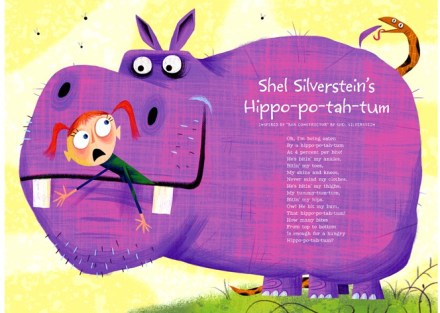
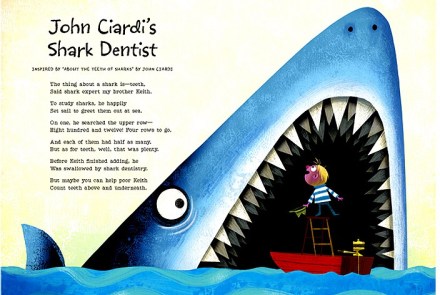
You’re eating up these poems, aren’t you? Well, next come three poems in which termites, sharks, and a “hippo-po-tah-tum” do a bit of nibbling of their own. The fun multiplies in Ogden Nash’s Buggy Rugs, where 313 little wood chompers hide; in John Ciardi’s Shark Dentist, in which you’ll want to brace yourself for the ending; and in Shel Silverstein’s Hippo-po-tah-tum, which is fractionally frightening.

These seven poems are added to seven more, plus two pages full of “prose about the poets,” to equal one smart, tantalizing poetic brainteaser of a book!

celebrate-picture-books-picture-book-review-edgar-allan-poe's-apple-pie-shark

Image copyright Michael Slack, text copyright J. Patrick Lewis. Courtesty slackart.com

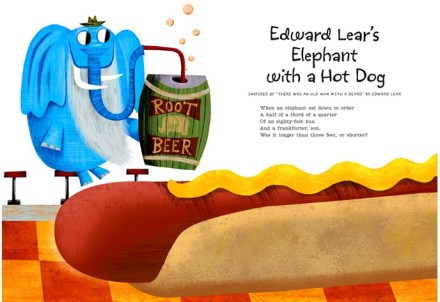
Patrick Lewis, who served as the US Children’s Poet Lauriat from 2011 to 2013, has honored 16 of the world’s most beloved poets the way kids love best—with humor. Adapting the original poem’s rhythm, rhyme scheme, and length with a dash of the ridiculous and a dose of numerical heft, Lewis has created poems that will have kids giggling while they ponder the answers to the lyrical math problems the verses pose. While arithmetic aficionados will gobble these poems up, there’s plenty for language arts lovers to sink their teeth into too. Each witty poem just begs to be compared to the original, which would make for a fun afternoon at home or lesson in the classroom. Admit it—aren’t you just the tiniest bit curious what Edward Lear’s “There was an Old Man with a Beard” has to do with an 80-foot hotdog?

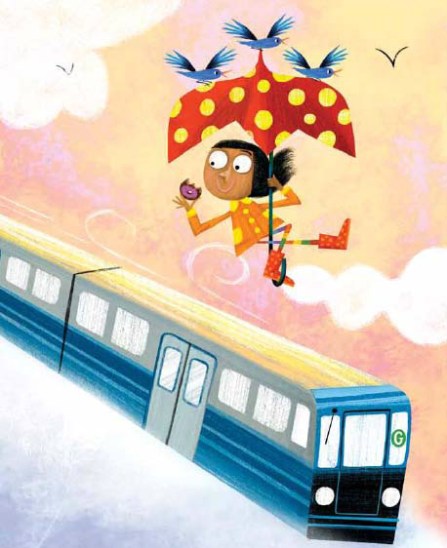
celebrate-picture-books-picture-book-review-edgar-allan-poe's-pie-train

Image copyright Michael Slack Lewis, courtesty slackart.com

Michael Slack gets things off and running on the first spread, where a sharp-taloned blackbird stands over a knife that’s plunged into the center of a pie. While readers of Walt Whitman’s Web-Covered Shoe may wonder exactly how long the boot has been untouched, they’ll be more distracted by the number of eyes on two very fierce-looking spiders. And there may be nothing more diverting than the potbellied cowboy wearing only his tightie whities as he waits for his snowflake, flame, spaceship, and other uniquely decorated boxers to dry. Slack illustrates each poem with distinctive, vibrant images that ramp up the humor and give every page an individual look.

Answers to the math problems proposed are included with every poem, and brief biographies accompanied by tiny portraits, reveal information about the poets represented and their work.

Edgar Allan Poe’s Pie is a fantastic way to get kids interested in math and poetry. The brain ticklers, as well as the wonderful wordplay and illustrations, make this a book that should be on classroom shelves and would be welcome in home libraries too.

Ages 6 – 9

Houghton Mifflin Harcourt Books for Young Readers, 2015 (paperback) | ISBN 978-0544456129

To learn more about J. Patrick Lewis, his books, and resources for kids and teachers, visit his website!

View a gallery of books, illustration, and other art by Michael Slack on his website!

National Pie Day Activity

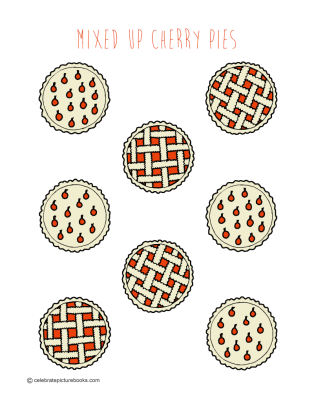
celebrate-picture-books-picture-book-review-cherry-pie-match

Mixed Up Cherry Pies Puzzle


Each winner of a poetry contest were supposed to get two identical pies, but they got mixed up! Can you find the matching pies in this printable Mixed Up Cherry Pies Puzzle and save the day?

Picture Book Review

January 12 – Poetry at Work Day

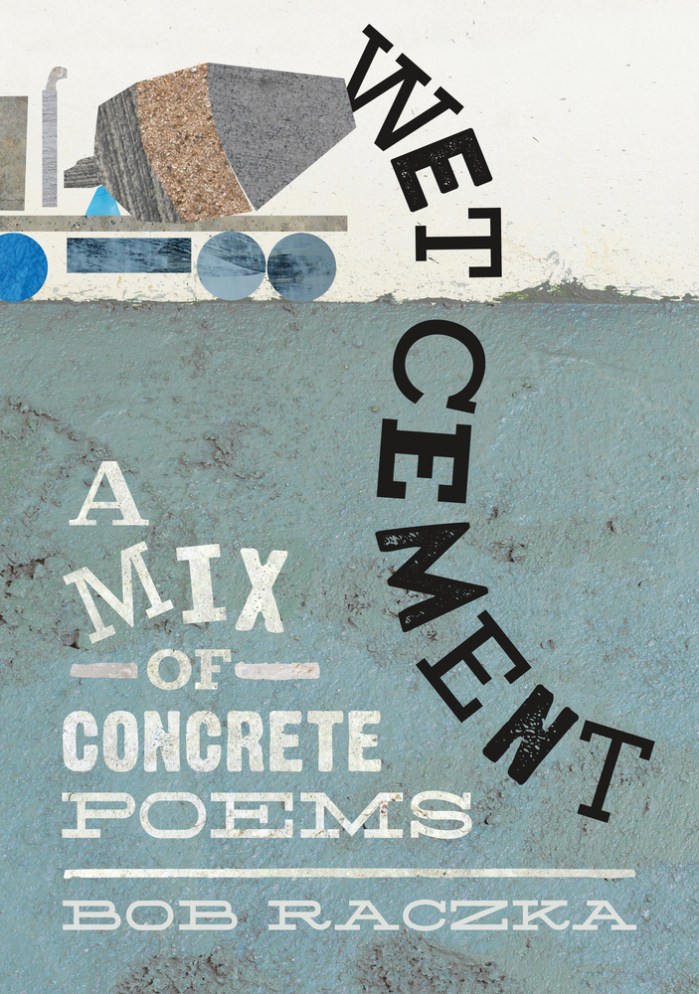
Wet Cement: A Mix of Concrete Poems by Bob Raczka picture book review

About the Holiday

Sometimes your work in school, in the office, outside, or at home inspires you to translate what you’re doing into writing. What better way to express the fun—and folly—of homework, room cleaning, report writing, lunchtime, tests, and all the work that makes up a day than in a poem?! To celebrate today’s holiday try to put the rhythms of your work into poetry! 

Wet Cement: A Mix of Concrete Poems

By Bob Raczka


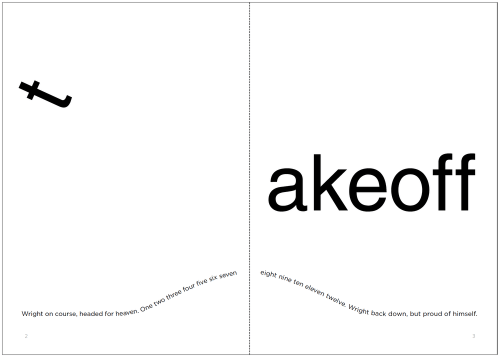
When you envision a poem in your head, what do you see? A block of lines? A square or a rectangle? Well, sweep that image from your mind because in Bob Raczka’s Wet Cement: A Mix of Concrete Poems, verses become actions, objects, puzzles, and natural phenomena. Not only are the poems shaped to illustrate their theme, the titles use clever imagery as well.

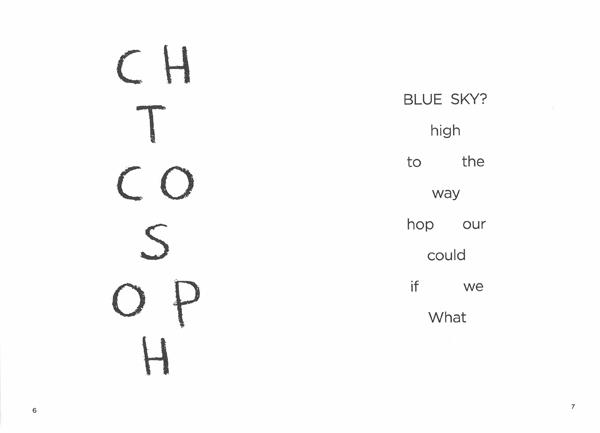
celebrate-picture-books-picture-book-review-wet-cement-a-mix-of-concrete-poems-hopscotch

Text and image copyright Bob Raczka, courtesy of Roaring Brook Press

As you encounter the poem hanger you’ll see that “han” has broken away and is dangling from the hook of g in “ger.” The words of the poem itself are shaped like a hanger and contain a giggle-invoking twist: “I hang out in blue jeans and comfy old shirts. I hang out in blouses and long frilly skirts. I hang out in sport coats and sweaters and shawls. I even hang out with no clothes on at all!”

You might want to get your baseball mitt out before you read homer, in which the first line zooms straight as a pitch and the second—written backwards and at an upward angle—soars like a homerun hit: “The pitcher hurls his hummer toward the slugger squeezing lumber CRA / CK! The slugger slams the hummer toward the bleachers for a homer.”

celebrate-picture-books-picture-book-review-wet-cement-a-mix-of-concrete-poems-takeoff

Text and image copyright Bob Raczka, courtesy of Roaring Brook Press

But don’t put that mitt away just yet! You may need to catch the o, which has escaped from the title p p-up. And if you’ve ever played t-ball, baseball, softball, or even wiffleball, you’ll cringe in recognition of this short but pointed poem.

The sky darkened by night in Dipper and by clouds in Lightning holds two poems expressing very different thoughts. In the title Dipper, the second p has floated to the top of the page where it hangs like a miniature reflection of the dipper-shaped poem, which reads: “Way down there on earth you hold firefly jars, filled up to their lids with light. Up here in the sky, I’m a vessel of stars, my brim overflowing with night.” In the title LIGHTNING, the L strikes the I to create the familiar jagged crack echoed in the shape of the verse: “from a bad mood sky, / tears, / then a jag- / ged slash- / ing flash of anger, / ear- / splitting, / obnoxious, / a cloud tantrum”

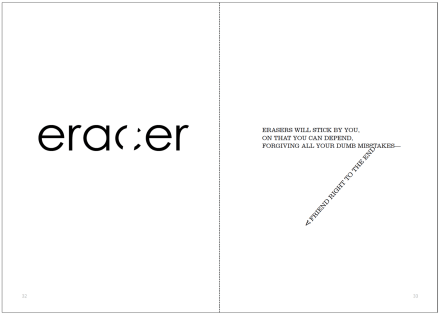
celebrate-picture-books-picture-book-review-wet-cement-a-mix-of-concrete-poems-eracer

Text and image copyright Bob Raczka, courtesy of Roaring Brook Press

Any writer will love poeTRY which is such a clever take on the word as well as the revision and editing process:

“poetry is about taking away the words you don’t need

poetry is taking away words you don’t need

poetry is words you need

poetry is words

try”

Put simply, Bob Raczka’s concrete poems will make you smile. Even more than that, you’ll find yourself wanting to carry this book around, saying “Look at this!” to everyone you meet. Raczka calls these poems “word paintings”—because a poet “uses words like colors to paint pictures inside your head.” If creativity is the talent to present the world in new and surprising ways, making connections that enhance life, then Wet Cement is creativity at its best!

Wet Cement: a Mix of Concrete Poems is one poetry book that belongs on your child’s bookshelf! The combination of subjects, expression, and images will make it an often-read favorite.

Ages 5 – 9 and up (adults will enjoy these poems as much as kids)

Roaring Brook Press, 2016 | ISBN 978-1626722361

Discover a full bookshelf of books by Bob Raczka on his website!

Poetry at Work Day Activity

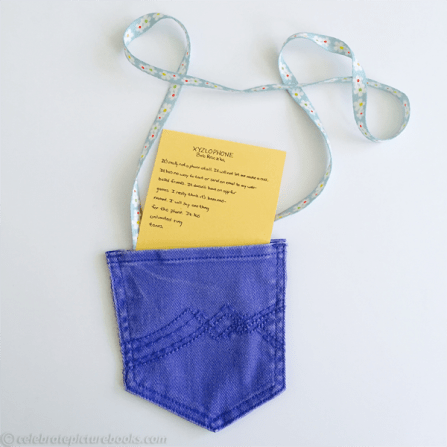
CPB - Pocket Poem Craft

Pocket Poem Carrier


Choose a part of your school or work day and write a poem about it. You can even try writing a concrete poem to give more shape to your thoughts! Then make this pocket poem carrier so you can tote your favorite poem with you to show your friends and family—today and every day!

Supplies

  • An old pair of pants or shorts with back pockets
  • A decorative shoelace
  • Thread or fabric glue
  • Needle
  • Paper
  • Your favorite poem or a poem you write yourself
  • Pen

Directions

  1. Cut one back pocket out of an old pair of pants or shorts, including the back of the pocket
  2. Use the shoelace at its full length or cut to desired length
  3. Inside each edge of the pocket sew or glue the ends of the shoelace to make a strap
  4. Print your favorite poem on the paper
  5. Insert the poem into the pocket poem carrier
  6. Take your poem with you and share it with your friends!

Picture Book Review

October 21 – Count Your Buttons Day

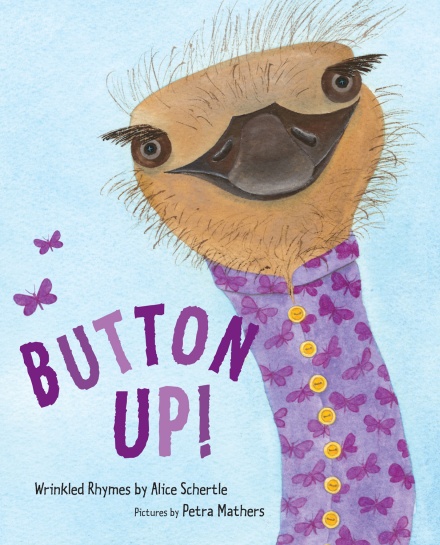
celebrate-picture-books-picture-book-review-button-up-wrinkled-rhymes-cover

About the Holiday

First designed in Germany in the 13th century, buttonholes revolutionized clothing, bags, and other objects that required closing and inspired a new art form. Designers and manufacturers took buttons to heart, making them not only functional but beautiful. Created from iridescent shells, sparkling glass, bone, and other materials, these little canvases were infused with paintings, intricate carvings, astonishing color, and more eye-catching features. Today, buttons still lend distinction and personality to outfits for all ages.

Button Up! Wrinkled Rhymes

Written by Alice Schertle | Illustrated by Petra Mathers


There may be no more outward demonstration of someone’s personality than the clothes they wear. In Button Up! Wrinkled Rhymes kids’ closets become the muse for Alice Schertle’s perky and humorous poems told from the unique perspective of shoelaces, t-shirts, pajamas, hats, and more garrulous garments.

In Bob’s Bicycle Helmet, this protective piece of equipment introduces itself: “Bob’s on his bike / and I’m on Bob. / I’m Bob’s helmet. / I’m on the job.” And even though “Bob skins his elbow. / Bob scrapes his knee. / Bob doesn’t hurt his head— / Bob’s got me.”

In Jennifer’s Shoes her new blue pair “…are learning the ways / of Jennifer’s world: / the way that Jennifer’s toes are curled, / the softness of carpet, / the steepness of stair, / the curve of the rung /  under Jennifer’s chair, / the hole in the heel / of Jennifer’s socks… / We are Jennifer’s shoes, we came home in a box.”

celebrate-picture-books-picture-book-review-button-up-wrinkled-rhymes-jennifer's-shoes

Image copyright Petra Mathers, courtesy of Houghton Mifflin Harcourt

Before bedtime Joshua’s Jammies are quite adamant about who they belong to: “We are the jammies that Joshua wears, / not jammies for penguins, / not jammies for bears, / not jammies for tigers with knots in their tails, / not jammies for whales…. / We don’t fit iguanas, / we’re not for the gnu, / we won’t suit the llamas / (they never wear blue)….”

Poor Tanya’s Old T-Shirt just doesn’t understand: “I live in a bucket shoved under the stair. / They call me a dust rag! / I don’t think it’s fair. / I’m still the same size as when I was new. / “I didn’t shrink— / it was Tanya who GREW…. / You’ll never, not ever / hear anyone say, / ‘She’s gotten too big, she’s just in the way, / let’s dust the piano with Tanya today.’”

While Rick’s Wool Sweater reveals that Rick wears a t-shirt underneath to be “warm on the OUTside / soft on the IN,”  it also takes a bit of pride in its particular talent: “To tell the truth it tickles me / to be a little prickly, / especially around his neck / and under his chin.”

Other poems reveal the inner thoughts of Bertie’s Shoelaces, Violet’s Hiking Hat, Harvey’s Golashes, Emily’s Undies, Wanda’s Swimsuit, Jack’s Soccer Jersey, Jamelia’s Dress-up Clothes, and a Hand-me-down Sweatshirt.

Just in time for Halloween Clyde’s Costume a gingham sheet is pleased to see that it makes a most distinguished ghost after being taken from the guest room bed and given eyes: “Now I’m ghastly and ghoulish and ghostly, / a will-o’-the-wispy fright. / Pardon my pride, but with Clyde inside, I’m the hit of Halloween night.”

Of course, we can’t forget that today is dedicated to buttons and to celebrate, Bill’s Blue Jacket is thrilled to be lifted off the hook: “Arm in the left sleeve, / arm in the right. / Button up! Button up! Button up / TIGHT! / Snap! Goes the collar / under Bill’s chin. / Everybody holler, / BILL’S ALL IN! / Everybody clap your hands, / everybody shout, / Bill’s got his jacket on, / LET’S GO OUT!

celebrate-picture-books-picture-book-review-button-up-wrinkled-rhymes-bertie's-shoelaces

Image copyright Petra Mathers, courtesy of Houghton Mifflin Harcourt

Alice Schertle brings a joyful buoyancy to the rhythms of her innovative poems, making each as distinctive as the article of clothing and the person who wears it. Her insights are surprising and will give kids a new perspective on their world and the secret life of the clothes they present to it.

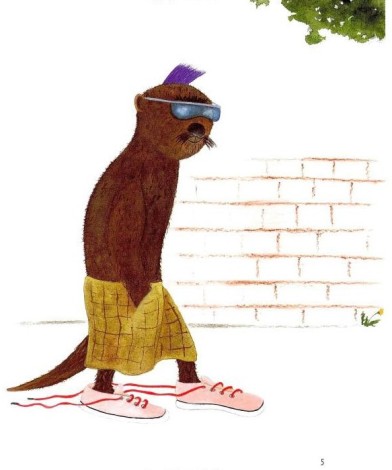
Petra Mathers’ exuberant and adorable pigs, moles, alligators, mice, dogs, one cool-dude otter, and one fuzzy-headed ostrich lend the perfect touch of humor and setting to depict the stars of Schertle’s poems. Harvey the pig exuberantly kicks up mud, Emily happily watches her vibrant and fancy undies flap on the breezy clothesline, a drowsy Joshua in his blue jammies says goodnight to his toys, and Tanya’s old pink t-shirt remembers better days while hanging on the edge of her green bucket. Mathers’ beautiful watercolors also portray a cloudy-day ocean, trick-or-treaters heading out at dusk, a refreshingly cold pool, and other landscapes.

Button Up! Wrinkled Rhymes makes a fun story-time read, a great companion at the laundromat, or an entertaining pre- or post-clothes-shopping pick-me-up.

Ages 4 – 7

Houghton Mifflin Harcourt, 2015 | ISBN 978-0544022690

Count Your Buttons Day Activity

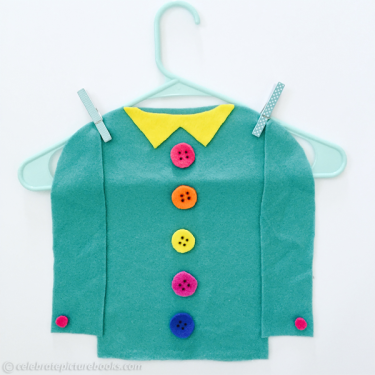
CPB - Button Coat

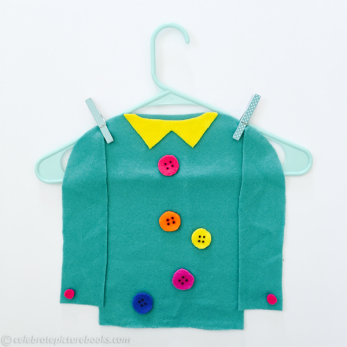
Pin the Button on the Coat Game


Pin the Button on the Coat is a fun game you can make yourself and play anytime! It’s great for a button-themed party or on any day that you’re holed up and wanting something to do! The game is played like “Pin the Tail on the Donkey,” and the object is to get the buttons lined up as close to the center of the coat as possible. Have fun!

Supplies

  • Fleece or felt of your choice of several favorite colors, 2 pieces of 8 ½” x 11” to make the coat and smaller pieces or scraps to make buttons
  • Fabric glue
  • Scissors
  • Black marker
  • Clothes hanger
  • Clothes pins

CPB - Button Coat II

Directions

  1. Cut out a coat shape from the fleece
  2. Cut out a collar from a different color fleece (optional)
  3. With the fabric glue, attach the sleeves to the edge of the coat, and the collar to the top of the coat.
  4. Let dry
  5. Cut circles to represent buttons from the other colors of fleece or felt, as many as you need
  6. With the marker make dots to represent holes in the “buttons”
  7. When the glue on the coat is dry, attach it to the clothes hanger with the clothespins
  8. Have fun playing!

Picture Book Review
 

October 13 – It’s National Popcorn Poppin’ Month

celebrate-picture-books-picture-book-review-the-popcorn-astronauts-cover

 About the Holiday

National Popcorn Poppin’ Month has been celebrated in October for more than 30 years and was made official in 1999 by then Secretary of Agriculture Dan Glickman. With its salty crunchiness and that enticing Pop Pop Pop rhythm, this snack is a favorite the world over. Its history goes back to the Aztecs and beyond. Early explorers of the 1500s wrote about native peoples roasting corn until it popped and described it as looking like a “white flower.” It was eaten and also strung for decoration.

Most people now eat popcorn with salt and butter, but can you imagine having it with milk? Way before Corn Flakes and Cheerios came on the scene people ate popcorn as cereal! And popcorn really became popular during the Great Depression, when it was one of the only treats people could afford. Why not pop up a batch and  read today’s reviewed  picture book. For more interesting popcorn facts and recipes visit www.popcorn.org.

The Popcorn Astronauts and Other Biteable Rhymes

Written by Deborah Ruddell | Illustrated by Joan Rankin


Each season has its much-anticipated delicacies and each food its particular fans. Winter offers hot drinks and cinnamony goodies; Spring ushers in fresh, juicy fruit; Summer requires icy-cold, refreshing treats; and Autumn settles in with warm, comforting meals and snacks. Year-round there are foods to delight the tummy and—in this fun collection of poems—the imagination. So let’s snuggle up on the couch and welcome The Arrival of the Popcorn Astronauts:

“The daring popcorn astronauts / are brave beyond compare— / they scramble into puffy suits / and hurtle through the air. / And when they land, we say hooray / and crowd around the spot / to salt the little astronauts / and eat them while they’re hot.”

Or perhaps those universally loved “Dazzlers of the Dinner Plate” and “Lunchroom Legends” that get their own tribute in Stand and Cheer for MAC and CHEESE! is just what you have in mind. When Winter drapes its icy blanket over the world, a special kind of steaming hot chocolate can always be found at The Cocoa Cabana where “On an ice-skating pond in the state of Montana, / there’s a little red tent called the Cocoa Cabana. Calling all skaters, the big and the small! / Marshmallow Peppermint Cocoa for all!

celebrate-picture-books-picture-book-review-the-popcorn-astronauts-strawberry-queen

Image copyright Joan Rankin, text copyright Deborah Ruddell. Courtesy of simonandschuster.com

Spring invites The Strawberry Queen and “You’ll know her the minute she enters the room / by the first little whiff of her spring time perfume / and her elegant suit—which is beaded and red— / and the leafy green crown on the top of her head. / Remember to bow and address her as Ma’am, but don’t say a word about strawberry jam.”

Thirsty? Then perhaps you would like A Smoothie Supreme with its very distinctive ingredients: “A whisper of pickle / is what I detect. / with glimmers of turnip / I didn’t expect”… “The mudpuddle splashes / are really delish, / and the finishing touch is that nubbin of fish!” Or maybe you’d like to learn How a Poet Orders a Shake, which goes in part: “‘A frosty cup of moonlight, please,’ / the poet murmurs, low. ‘As mushy as a mittenful / of slightly melted snow…’”

celebrate-picture-books-picture-book-review-the-popcorn-astronauts-smoothie-supreme

Image copyright Joan Rankin, text copyright Deborah Ruddell. Courtesy of simonandschuster.com

Imaginative verses also transform a slice of watermelon into a lake complete with “a little fleet of small black boats”, introduce peaches with their “…sunset of beautiful colors / on the flannelpajamaty skin”, follow the Voyage of the Great Baked Potato Canoes that “…oozed with steam and sour cream. / They were loaded with bacon and chives. / But silverware was everywhere— / and they barely escaped with their lives”, and wonder about who will eat The Last Brownie, which is “As hard and square and rugged as a brownie made of stone.”

celebrate-picture-books-picture-book-review-the-popcorn-astronauts-watermelon-lake

Image copyright Joan Rankin, text copyright Deborah Ruddell. Courtesy of simonandschuster.com

Deborah Ruddell has included so many more wonderfully delicious, fresh, and surprising poems with clever takes on the foods that flavor our days. The rhymes flow with a sweet, easy rhythm and are as fun to say as they are to hear.

Joan Rankin’s vivid watercolor illustrations bring each poem to life with adorable characters, humorous details, and plenty of action. Her “healthy” gingerbread house set among a broccoli forest is a beautiful departure from the well-known original, a dapper Dracula swoops down on an unsuspecting sleeper, a mouse wields an axe over a crusty brownie, and impressionistic trees hold ripe apples. Kids will love lingering over the pages as they listen to each poem to capture every nuance.

The Popcorn Astronauts and Other Biteable Rhymes makes a fun take-along book for picnics, trips to the farmers market or orchard, and playground—or anywhere that a quick nibble of food would taste better with a “Biteable Rhyme.”

Ages 4 – 8

Simon & Schuster, New York, 2015 | ISBN 978-1442465558

Discover more books by Deborah Ruddell plus fun activity guides on her website!

National Popcorn Poppin’ Month Activity

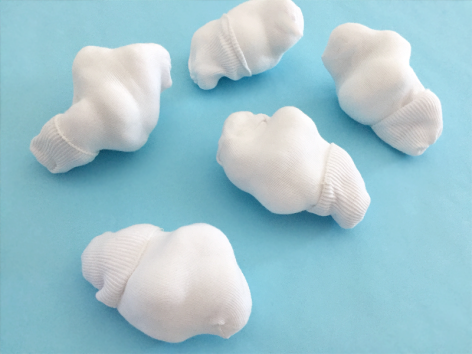
CPB - popcorn1

Popcorn Blast-Off Game


The popcorn is flying! Can you catch it? This is a fun game to celebrate this most delicious month! And if you keep the popcorn socks, it will make a great quick activity for those times when you want to get up and move but just don’t know what to do.

Supplies

  • 6 pairs of girls socks – white
  • A large bag of cotton balls
  • Towel or small blanket

Directions

  1. Stuff the socks with a large handful of cotton balls (about 25)
  2. Knot the sock as you would a balloon and fold down the remaining ankle cuff
  3. Squish the sock to move the cotton balls until your sock looks like a piece of popcorn
  4. Players hold each end of the towel or side of the blanket so it sags
  5. Place popcorn in the middle of the towel or blanket
  6. On the count of 3, players pull tight on the towel or blanket
  7. Try to catch as many flying popcorn pieces in the towel or blanket as you can

Picture Book Review

October 7 – Random Acts of Poetry Day

When Green Becomes Tomatoes by Julie Fogliano and Julie Morstad

About the Holiday

Today is the day to unleash your inner poet – without thinking twice about it. What are the words in your heart or in your imagination? Write them down! You don’t have to be Shakespeare for your words, lines, thoughts, jottings – your poems – to have meaning and value. Then share them with family, friends, or even strangers. To celebrate today’s holiday you can also attend a poetry reading or enjoy a volume of verse – like today’s book!

When Green Becomes Tomatoes: Poems for All Seasons

Written by Julie Fogliano | Illustrated by Julie Morstad


Sometimes you wish for just the right words to express a moment in time, a skip of the heart, or a glimpse of color that truly captures the elation, sadness, or awe you feel. Those words live on every page of When Green Becomes Tomatoes: Poems for All Seasons. Each month of the year is represented by three to five dated poems that expose a nugget of inspiration or a spark of recognition about the natural world and our place in it.

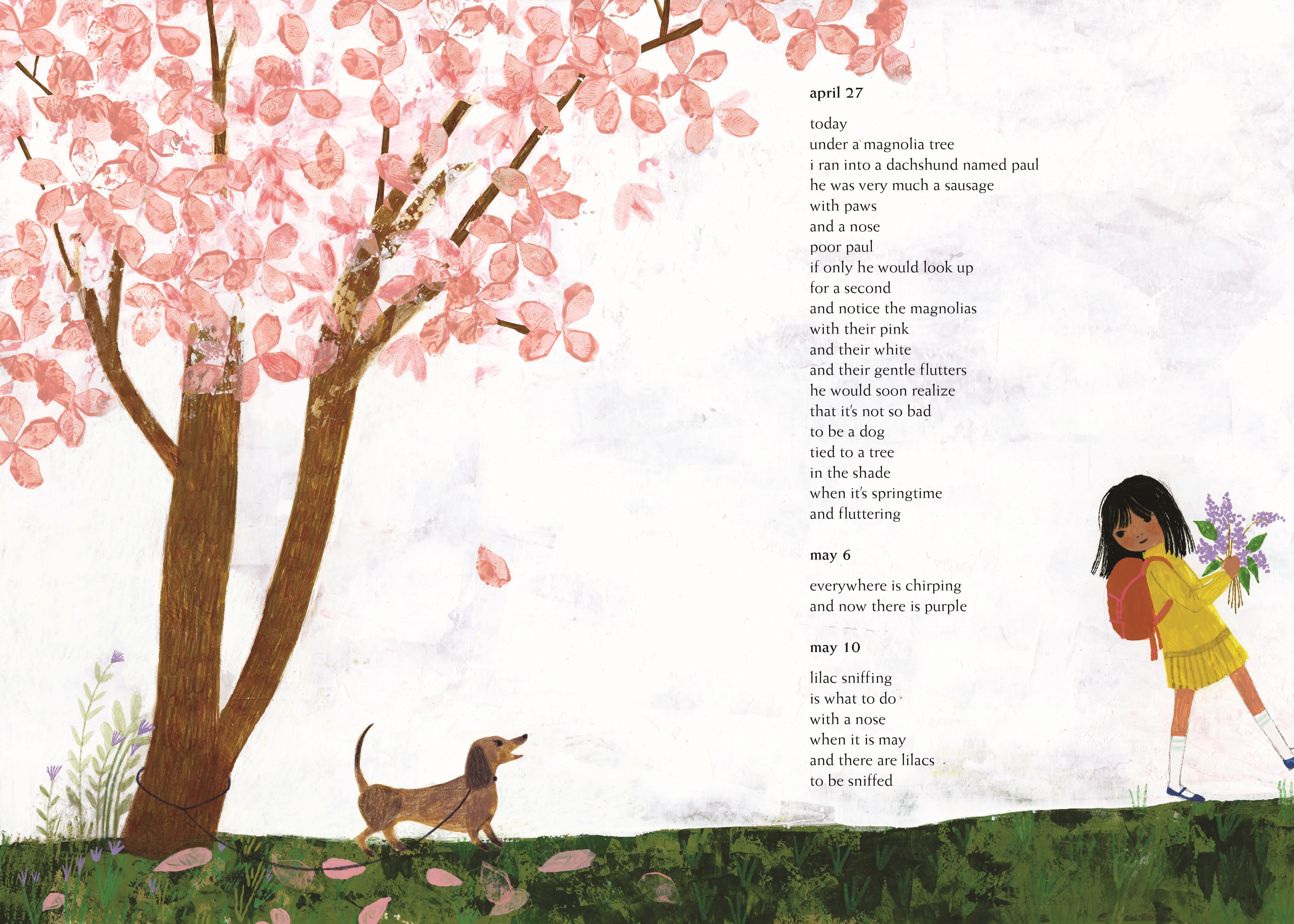
Spring begins its reawakening in the poem dated march 20, on which “from a snow covered tree / one bird singing / each tweet poking / a tiny hole / through the edge of winter / and landing carefully / balancing gently / on the tip of spring.”

celebrate-picture-books-picture-book-review-when-green-becomes-tomatoes-spring

Image copyright Julie Morstad, text copyright Julie Fogliano. Courtesy of us.mcmillan.com

Spring is slow in shaking off its winter coat, however, and march 22 finds “just like a tiny, blue hello / a crocus / blooming in the snow” Even though the days continue to dawn chilly and rainy, early flowers long to see the sun. On march 26: “shivering and huddled close / the forever rushing daffodils / wished they had waited.”

With the onset of April and no reprieve from the weather, everyone it seems is tired of the persistence of winter, which sticks around like a party guest who doesn’t know when to go home. On april 3 “today / the sky was too busy sulking to rain / and the sun was exhausted from trying / and everyone / it seemed / had decided / to wear their sadness / on the outside / and even the birds / and all their singing / sounded brokenhearted / inside of all that gray.”

celebrate-picture-books-picture-book-review-when-green-becomes-tomatoes-summer

Image copyright Julie Morstad, text copyright Julie Fogliano. Courtesy of us.mcmillan.com

At last summer comes and on june 15 “you can taste the sunshine / and the buzzing / and the breeze / while eating berries off the bush / on berry hands / and berry knees.” The warm days also bring swimming holes and fireflies, and by july 10 “when green becomes tomatoes / there will be sky / and sun / and possibly a cloud or two…” and summer bursts with all the wonder that makes it such a yearned for season. 

Then as summer wanes and the nights grow dark, september 10 makes you look into that deep vast space and think “a star is someone else’s sun / more flicker glow than blinding / a speck of light too far for bright / and too small to make a morning”

celebrate-picture-books-picture-book-review-when-green-becomes-tomatoes-fall

Image copyright Julie Morstad, text copyright Julie Fogliano. Courtesy of us.mcmillan.com

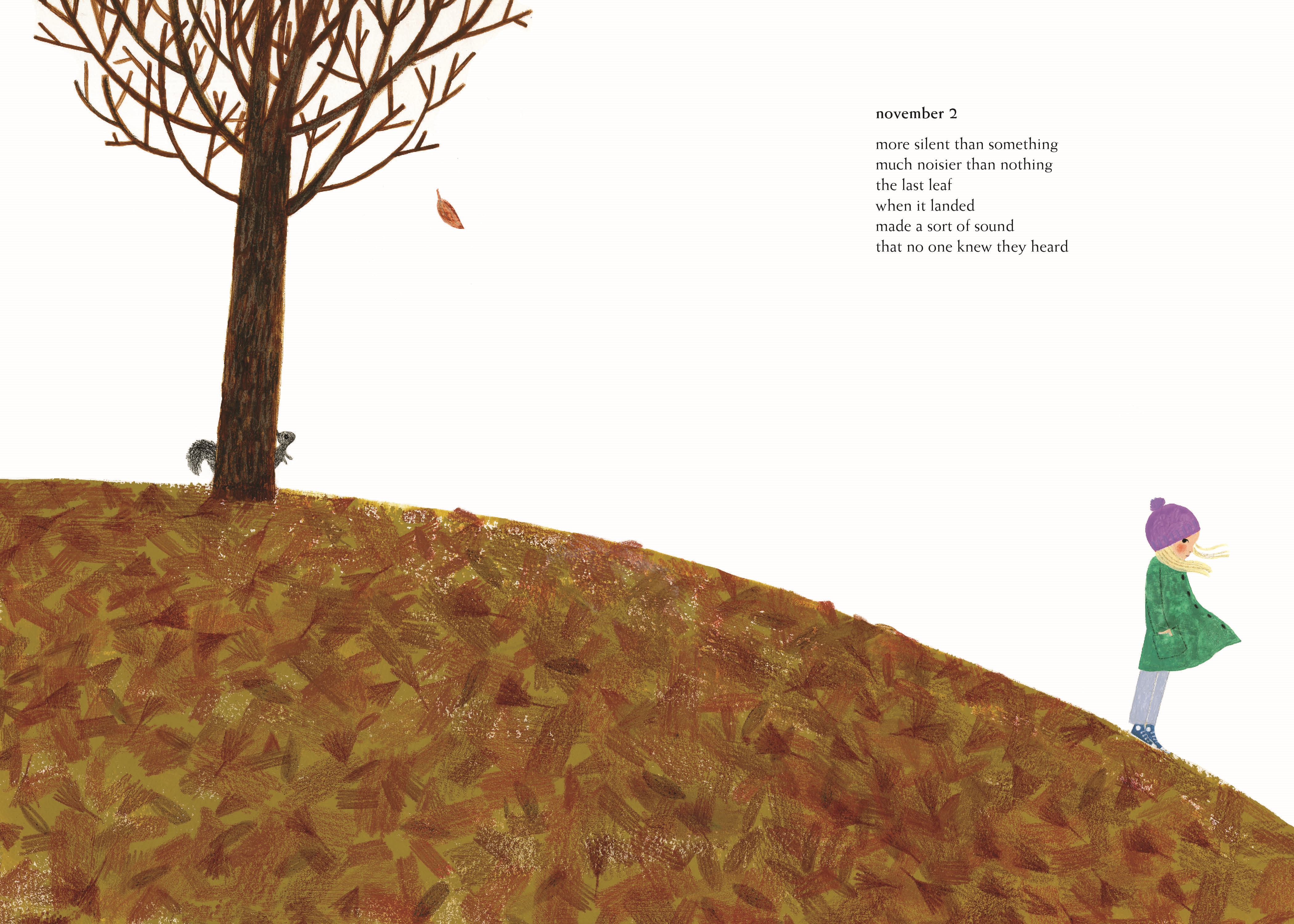
A nip in the air means Fall has come around again. It’s time for sweaters and pumpkins, and for the trees to rest. If you listen carefully, you may hear on november 2 “more silent than something / much noisier than nothing / the last leaf / when it landed / made a sort of sound / that no one knew they heard.”

Then on december 21 “as if one day, the mountain decides / to put on its white furry hat / and call it winter” the season has changed, bringing with it crackling, cozy fires and snow, snow, snow. But this too offers its own enchantment on december 29: “and i woke / to a morning / that was quiet / and white / the first snow / (just like magic) came / on tiptoes / overnight.”
celebrate-picture-books-picture-book-review-when-green-becomes-tomatoes-winter

Image copyright Julie Morstad, text copyright Julie Fogliano. Courtesy of us.mcmillan.com

When Green Becomes Tomatoes begins and ends with a poem dated the same day—March 20, the vernal equinox—giving this book a cyclical form that echoes the passing of time. Julie Fogliano’s delicate and gentle poems are a perfect tonic for the busy, non-stop days the year becomes. Instead of letting the surprising, profound, or beautiful moments pass us by Fogliano gives readers a reason and a way to stop and fully enjoy them.  

In Julie Morstad’s gorgeous watercolors of nature and the changing seasons, readers can almost feel the warm sunshine that feeds the vivid spring and summer blooms, the icy breeze that loosens the last leaf of autumn, and the fluffy blanket winter tucks around the earth. The multiethnic children in Morstad’s paintings are thoughtful, charming, and enchanted with the world around them, actively experiencing the marvels of each changing day. 

When Green Becomes Tomatoes contains such lovely verses that readers will want to revisit them over and over – the way the seasons recur and we are always glad to welcome each one back. This volume of poetry would make a wonderful gift and a terrific addition to anyone’s bookshelf.

Ages 6 and up (adults will enjoy these poems too)

Roaring Brook Press, 2016 | ISBN 978-1596438521

You can connect with Julie Fogliano on Facebook!

You’ll find a gallery of picture books, prints, and other illustrations on Julie Morstad‘s website!

Random Acts of Poetry Day Activity

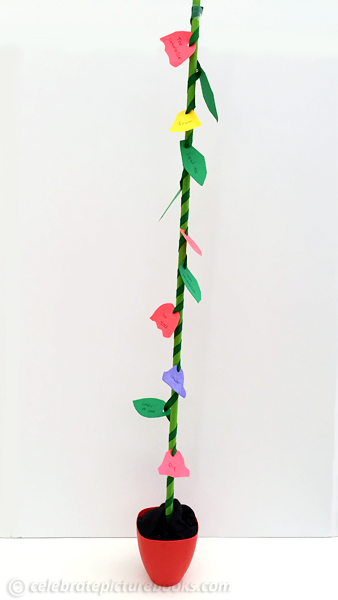
CPB - Plant Poem


Grow a Poem Craft


A poem often grows in your imagination like a beautiful plant—starting from the seed of an idea, breaking through your consciousness, and growing and blooming into full form. With this craft you can create a unique poem that is also an art piece!

Supplies

  • Printable Leaves Template, available here and on the blog post
  • Printable Flower Template, available here and on the blog post
  • Wooden dowel, ½-inch diameter, available in craft or hardware stores
  • Green ribbon
  • Green craft paint
  • Green paper if leaves will be preprinted
  • Colored paper if flowers will be preprinted
  • Flower pot or box
  • Oasis, clay, or dirt
  • Hole punch
  • Glue
  • Markers or pens for writing words
  • Crayons or colored pencils if children are to color leaves and flowers

Directions

  1. Paint the dowel green, let dry
  2. Print the leaves and flower templates
  3. Cut out the leaves and flowers
  4. Punch a hole in the bottom of the leaves or flowers
  5. Write words, phrases, or full sentences of your poem on the leaves and flowers (you can also write the poem after you have strung the leaves and flowers)
  6. String the leaves and flowers onto the green ribbon (if you want the poem to read from top to bottom string the words onto the ribbon in order from first to last)
  7. Attach the ribbon to the bottom of the pole with glue or tape
  8. Wrap the ribbon around the pole, leaving spaces between the ribbon
  9. Gently arrange the leaves and flowers so they stick out from the pole or look the way you want them to.
  10. Put oasis or clay in the flower pot or box
  11. Stick your poem pole in the pot
  12. Display your poem!

Picture Book Review