April 8 – Draw a Picture of a Bird Day

celebrate-picture-books-picture-book-review-birds-&-other-animals-with-pablo-picasso-cover

About the Holiday

With the onset of spring, our feathered friends are busy building nests and hatching little ones. The return of birds to backyards, parks, and beaches as well as the increased activity gives budding nature artists the perfect opportunity to try their hand at sketching these favorite colorful creatures. Whether you prefer to make detailed renderings or simple line drawings, today’s holiday should inspire you to grab your pencil or paints and create!

Birds & Other Animals with Pablo Picasso

First Concepts with Fine Artists | Illustrations by Pablo Picasso


Pablo Picasso, “one of the most famous artists who ever lived,” was a prodigy who loved to draw animals of all kinds. Perhaps best known for his abstract portraits and his colorful canvases, Picasso also created line drawings, many of which were “inspired by poems about animals written by his friend Guillaume Apollinaire, a famous French poet.” The illustrations in Birds & Other Animals with Pablo Picasso come from Picasso’s notebooks and, combined, make a wonderfully conceived concept book for little ones.

Opening to the first page, readers meet three birds, one perhaps a little more steady on its feet than the others. Four more birds follow on the next page, a few gamely trying to stand on one leg like the regal flamingos behind them. From the tropical home of the flamingo, readers next travel to a snowy clime, where “penguins are birds who waddle over snow.”

celebrate-picture-books-picture-book-review-birds-&-other-animals-with-pablo-picasso-flamingo

All artworks by Pablo Picasso © Succession Picasso/DACS, London 2017. © 2017 Phaidon Press

“Cock-a-doodle-doo!” Don’t snooze! The rooster wants you to know that he is a bird too! Of course, “some birds fly,” and many insects have wings too. Flies fly and wasps fly. How about grasshoppers? They prefer to hop! Who else likes to hop? “Bunnies hop…especially to get away from hungry foxes. Does [the] fox look hungry to you?”

Some animals seem to be hungry all the time—like the squirrel on the next page (you know how squirrels are!) and the camel, whose “humps are small. When she eats, her humps will grow!” Do you like dogs? “This little dog has no humps—he’s long like a hot dog!” His friend is a big dog who can do tricks. Horses can learn tricks too and perform for people. They can even rear up and stand on two legs! You know who can’t stand on two legs? Right! Fish! “They swim! Turtles swim too.”

celebrate-picture-books-picture-book-review-birds-&-other-animals-with-pablo-picasso-dogs

All artworks by Pablo Picasso © Succession Picasso/DACS, London 2017. © 2017 Phaidon Press

But we were talking about birds, weren’t we? There are some birds that are like fish. The pelican is a bird who likes to swim—of course, it likes to eat fish too. The ostrich is too big for either flying or swimming, but it can run—really fast! There are so many kinds of birds, aren’t there? Peacocks have long, colorful tail feathers, and owls like the nighttime. Yes, there are so many birds, “beautiful birds.”

The First Concepts with Fine Artists series by Phaidon Press is one of my favorite new collections for babies, toddlers, and even older kids. As an art lover, I’m impressed with the variety of styles and artists introduced to young children who will be attracted to the colors, shapes, and movement in the chosen artwork. As someone who works with words, I love the way the art is tied together with engaging and conversational text.

celebrate-picture-books-picture-book-review-birds-&-other-animals-with-pablo-picasso-fox

All artworks by Pablo Picasso © Succession Picasso/DACS, London 2017. © 2017 Phaidon Press

Birds and Other Animals with Pablo Picasso will enchant little ones with whimsical line drawings of animals that embody charming poise and personality. Each page invites readers to create stories of their own about the characters they see, and both children and adults will enjoy running a finger along the line to discover that most of the animals in this sturdy board book are created from one smooth stroke. Along the way, kids learn facts about certain animals, discover how shapes work together, and find objects to count. 

Line it all up and Birds and Other Animals with Pablo Picasso rewards readers with sophisticated fun. The book would make a lovely new baby gift or a delightful addition to young children’s home libraries.

Ages 2 – 5

Phaidon Press, 2017 | ISBN 978-0714874180

Draw a Picture of a Bird Day Activity
celebrate-picture-books-picture-book-review-how-to-draw-a-bird

Flight of Fancy Bird Drawings


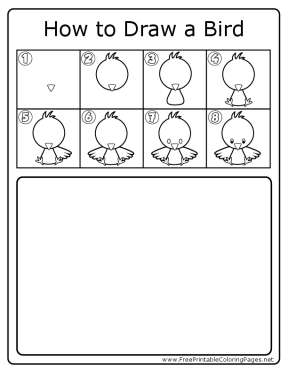
Birds come in all shapes and sizes—which kind of bird is your favorite? With these two printables you can learn how to draw a bird and color a pair of birds who are busy collecting flowers!

Learn to Draw a Bird | Birds Carrying Flowers

Picture Book Review

April 7 – International Beaver Day

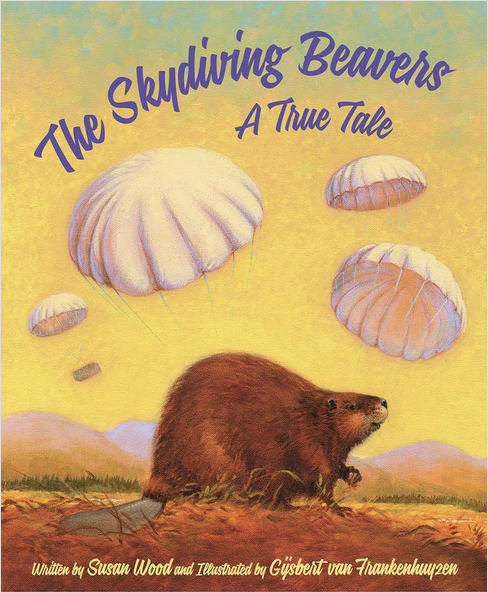
celebrate-picture-books-picture-book-review-the-skydiving-beavers-cover

About the Holiday

Two species of today’s honored animal are found across America, Canada, and Eurasia. Known primarily for building dams in rivers and streams, the beaver is a fascinating animal in many ways. Perhaps one of the greatest natural conservationists, beavers use all parts of the trees they fell. The buds, bark, and leaves are consumed as food, and the rest is gnawed into smaller bits to be used as building materials. The dams, themselves, are helpful in preventing droughts and floods, restoring wetlands, and keeping the water clean. The beaver population has seen a decline for several decades, and today’s holiday aims to promote awareness of this beneficial animal in order to protect it.

The Skydiving Beavers: A True Tale

Written by Susan Wood | Illustrated by Gijsbert van Frankenhuyzen


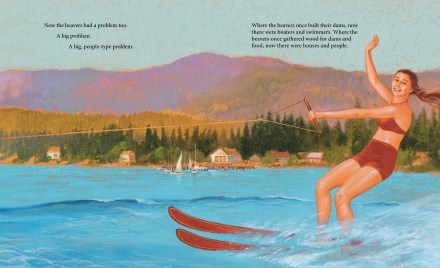
The time was post-World War II and families were eager to build homes and enjoy life again. In McCall, Idaho this meant that people moved to the shore of the beautiful lake, where they could fish, sail, waterski, and have fun. So roads were constructed, docks built, and land cleared. “Trouble was, that lakeside land had already been claimed. For decades—centuries, even—beavers had been the only ones doing the building there.”

Now, though, there was a turf war, of sorts. “Where the beavers once gathered wood for dams and food, now there were houses and people. And where the people tried to drive their cars, now water flooded the roads because of the dams.” Trees were also being “toppled left and right” by those busy beavers. Something needed to be done.

celebrate-picture-books-picture-book-review-the-skydiving-beavers-a-true-tale-water-skiing

Image copyright Gijsbert van Frankenhuyzen, text copyright Susan Wood. Courtesy of Sleeping Bear Press

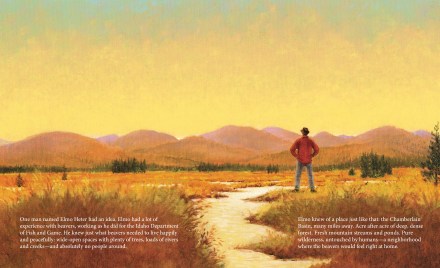
Elmo Heter had an idea. Elmo had experience with beavers from his job with the Idaho Department of Fish and Game. He knew that beavers needed open areas with lots of trees, rivers, and creeks—and no people. There was a place just like this many miles away. The Chamberlain Basin would be perfect for the beavers, but there was a problem—how could he move all those beavers “to a place with no roads, no railway, no airport, and no bus station?”

Elmo thought about loading them into boxes carried by horses or mules, but the rough trip would be too hard on both the beavers and the pack animals. Then Elmo remembered that there were piles of parachutes left over from the war going unused. “What if he dropped the beavers from a plane? Skydiving beavers? Well, why not?” Elmo decided.

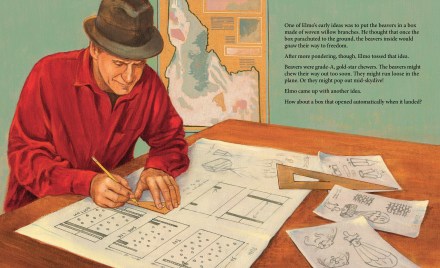
Elmo went to work to design a crate that could hold the beavers safely. His first idea was to build a box of woven willow branches. Once the boxes hit the ground, the beavers could gnaw their way out. But then Elmo feared that those champion chewers might escape before the box touched down. Next, he came up with the idea for a box that opened automatically when it hit the ground. After he created his box, Elmo found a beaver to test it.

celebrate-picture-books-picture-book-review-the-skydiving-beavers-a-true-tale-sunset

Image copyright Gijsbert van Frankenhuyzen, text copyright Susan Wood. Courtesy of Sleeping Bear Press

He found his daredevil and named him Geronimo. Geronimo, cozy in his box, was loaded onto a plane, and as the plane flew low over the test field the box was dropped. “The chute bloomed like a buttercup, then caught the breeze….The box fell as gently as a mountain snowflake, landing softly on the grass.” Just as it was designed to do, the box opened and Geronimo scrambled out.

Elmo wanted to make sure his invention would work every time, so he tested it again and again.  All this flying and skydiving seemed to agree with Geronimo. He soon began to treat it like a game, shuffling out of the box when the door opened and then crawling “right back in for another go.” Now that Elmo knew the plan would work, he gathered the beavers from McCall, put them in their special traveling crates, and headed for the Chamberlain Basin.

When they found the perfect spot, Elmo and his team prepared the chutes and let the beavers go. One by one the parachutes opened, and the beavers “wafted like falling leaves on the autumn wind to their new woodsy patch of paradise.” And who was the first pioneer? Why Geronimo, of course!

celebrate-picture-books-picture-book-review-the-skydiving-beavers-a-true-tale-plans

Image copyright Gijsbert van Frankenhuyzen, text copyright Susan Wood. Courtesy of Sleeping Bear Press

An Author’s Note following the text reveals more about this true story. It also discusses what scientists have since learned about the benefits of beavers to the environment and how communities now work with and around them. A list of interesting facts about beavers is also included.

Susan Wood’s story of a little-known event is a thought-provoking glimpse into early conservation efforts. Her conversational tone and lyrical phrasing enhance the tale, lending it suspense and personality that will draw readers in. Wood’s detailed descriptions allow children to understand the problems for the community as well as the concern for the animals that led to this historical event. 

Gorgeous paintings by Gijsbert van Frankenhuyzen uncover the beauty of Idaho’s backcountry with its sparkling lakes and tree-covered mountains. Glorious sunsets fill the two-page spreads, turning the rolling hills pink and gold as beavers scurry near the shore building their dams. Readers will be intrigued by the clear and close-up views of Elmo Heter as he works on his plans to relocate the beavers. A table strewn with publications and photographs from World War II, set children in the time period, and his schematics of the box he designs as well as his workshop are plainly displayed. Kids can ride along with Geronimo as he climbs into his crate, travels by plane over wide-open vistas, and floats into the Chamberlain Basin at the end of a parachute.

The Skydiving Beavers would be a fresh addition to classroom environmental units to spur discussions on past, present, and future conservation science and will delight young readers interested in the natural sciences.

Ages 6 – 9

Sleeping Bear Press, 2017 | ISBN 978-1585369942

Learn more about Susan Wood and her books on her website!

View a portfolio of artwork by Gijsbert van Frankenhuyzen on his website!

International Beaver Day Activity

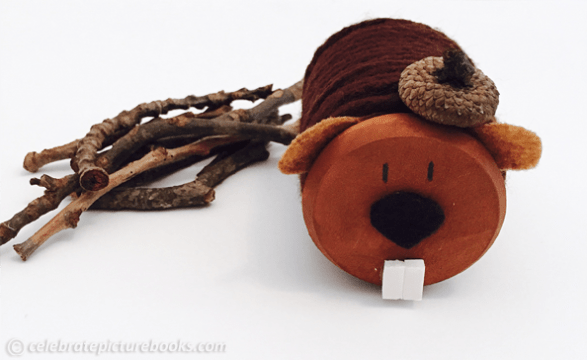
CPB - Beaver craft picture (2)

Make a Spool Beaver


Do you have a gnawing need to have a beaver of your own? Make one with this Spool Beaver craft!

Supplies

  • Printable Ears and Nose Template
  • 2-inch wooden spool, available at craft stores
  • 1 6-inch long x ¾ inch wide craft stick
  • Small piece of foam board
  • Brown “chunky” yarn
  • Brown felt, small piece for ears and tail
  • Black felt, small piece for nose
  • Acorn top for hat (optional)
  • Brown craft paint
  • Black craft paint
  • Black marker
  • Strong glue
  • Paint brush
  • Scissors

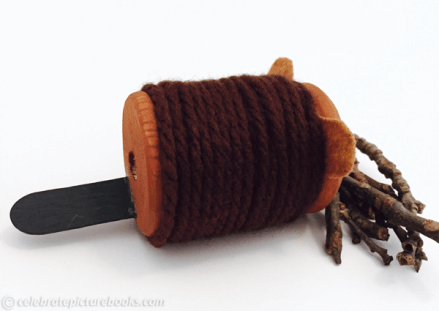
CPB - Beaver craft picture with tail

Directions

  1. Print the Ears and Nose template
  2. Paint the spool with the brown paint, let dry
  3. Cut the ears from the brown felt
  4. Cut the nose from the black felt
  5. Cut a piece from the end of the craft stick
  6. Paint the craft stick brown or black, let dry
  7. Cut two small pieces from the foam board, ½-inch long x 3/8 inch wide
  8. When the spool is dry, glue the ears to the spool, leaving the ears sticking up over the rim of the spool
  9. Glue one end of the yarn to the spool
  10. Holding the spool horizontally, wind the rest of the yarn around the spool back and forth from front to back. Glue the end to the body of yarn. This will be the bottom of the beaver.
  11. Glue the nose over the hole in the spool
  12. Glue the teeth below the nose
  13. Glue the flat edge of the craft stick to the back of the spool to make the tail

Picture Book Review

March 22 – World Water Day

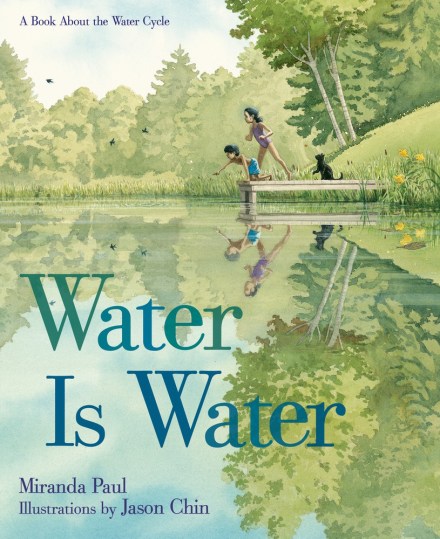
celebrate-picture-books-picture-book-review-water-is-water-cover

About the Holiday

March 22 was designated as World Water Day by the United Nations to bring awareness to the important issue of fresh water for the world’s citizens. Today, 1.8 billion people use sources of water that are contaminated, posing a constant risk of deadly diseases. The Sustainable Development Goals, instituted in 2015, have targeted a deadline of 2030 to provide access to clean water for everyone. This year’s theme is “Wastewater,” and revolves around the development of science and engineering solutions that would allow wastewater to be recycled and used in gardens, green spaces, cooling systems, and irrigation. Now more than ever, we all have a responsibility to keep the environment clean and safe. To celebrate today’s holiday find out how you can help!

Water Is Water: A Book About the Water Cycle

Written by Miranda Paul | Illustrated by Jason Chin


On a soaking rainy day a sister and brother run up to the house with a turtle they’ve caught in the pond out back. They drink glasses of water and offer a bowlful for the turtle too. “Drip. Sip. Pour me a cup.” Out on the porch Dad is ready with warm mugs of hot chocolate. The ghostly steam tickles their noses. “Whirl. Swirl. Watch it curl by. Steam is steam unless…it cools high.” As the kids return the turtle to the pond they watch a dragon and an eagle play across the sky. “Clouds are clouds unless…they form low.”

celebrate-picture-books-picture-book-review-water-is-water-rain-at-school

Image copyright Jason Chin, text copyright Miranda Paul. Courtesy of us.macmillan.com

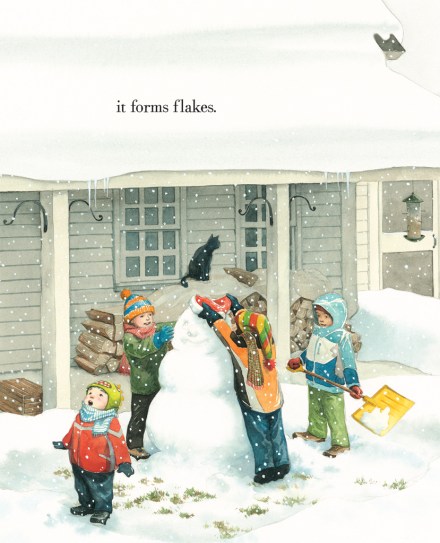
Through the misty fog the school bus rumbles up the hill as a little garter snake wriggles in the fallen leaves at the end of the children’s driveway. By the time the bus drops the kids off at school the fog has turned to rain. It plinks on the sidewalks and pounds the earth, creating puddles just in time for recess. “Slosh in galoshes. Splash to your knees! Puddles are puddles unless…puddles freeze.”

celebrate-picture-books-picture-book-review-water-is-water-snowman

Image copyright Jason Chin, text copyright Miranda Paul. Courtesy of us.macmillan.com

The turtle is hiding now that winter’s come, and a group of friends slip and speed across the pond, some playing hockey, some figure skating, and a couple just learning the ropes. Then suddenly it’s snowing! A brilliant red cardinal watches from the birdfeeder as three sneaky kids with snowballs spy on their friends who are building a snowman. With a “smack!” the snowball fight begins. Soon, however, spring is back with rushing streams and “Creep. Seep. Squish in your boots” mud. And that “mud is mud unless…there are roots.”

The apple trees in the backyard soak up the spring rains that feed the red, plump apples that are apples “unless…they get pressed. Drip. Sip. Pour me a cup. Cider is cider…until we drink it up!”

More information about water, including illustrated definitions of water-related terms, percentages of water in a variety of plants and creatures, and its importance to the world as well as suggestions for further reading, follow the text.

celebrate-picture-books-picture-book-review-water-is-water-making cider

Image copyright Jason Chin, courtesy of us.macmillan.com

Miranda Paul’s lyrical journey through a year of our interactions with water is a beautiful reminder of all the forms water takes. From life-filled ponds to pouring rains to glasses of refreshment, water sustains every creature and plant on earth. Paul’s transitional “unless…” elegantly introduces each transformation in the natural water cycle in a way that children recognize and appreciate. Her rich rhyming and rhythmical language is a joy to read and makes Water an active character in the story.

celebrate-picture-books-picture-book-review-water-is-water-drinking-cider

Image copyright Jason Chin, courtesy of us.macmillan.com

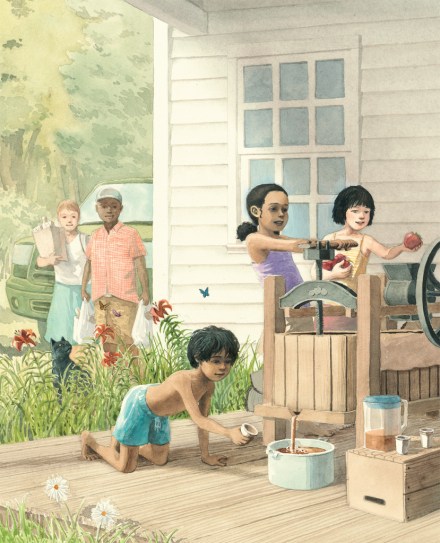
Jason Chin’s superb artwork is as lush and dynamic as the world around us. Each two-page spread is a masterpiece of atmosphere and details that bring not only water’s cycle to life but also that of the children, growing and playing in and around water throughout the year. As the children shelter from the rain at the beginning of the book, a bushel of apples sits snug against the cider press in the corner of the porch foreshadowing the final pages where fresh cider fuels summer fun. Chin’s children are real kids—joyful and playful, enthusiastically and humorously interacting with nature and each other with the kind of abandon that makes hearts sing. Young readers and adults will love lingering over each page.

Water is Water: A Story of the Water Cycle is the kind of book that can get kids excited about one of the quieter aspects of science—but one that is so important to our daily lives. It would make a wonderful accompaniment to elementary school lesson plans and a gorgeous addition to library and home bookshelves.

Ages 5 – 10

Roaring Brook Press, 2015 | ISBN 978-1596439849

Discover more about Miranda Paul and her books plus resources for teachers and writers on her website!

View a portfolio of artwork by Jason Chin and learn more about him and his books on his website!

World Water Day Activity

celebrate-picture-books-picture-book-review-water-words-word-search

A Sprinkling of Water Words Word Search


This tree grew tall and strong by soaking up water through its roots. Can you find the 20 water-related words that are hidden inside this printable tree-shaped A Sprinkling of Water Word Word Search Puzzle? Here’s the Solution.

Picture Book Review

March 19 – National Poultry Day

celebrate-picture-books-picture-book-review-what's-up-with-this-chicken-cover

About the Holiday

National Poultry Day, held annually between St. Patrick’s Day and the first day of spring, celebrates the importance of poultry to the diets of people around the world. From breakfast to special holidays, poultry is a valuable source of protein and nutrition that’s also delicious! 

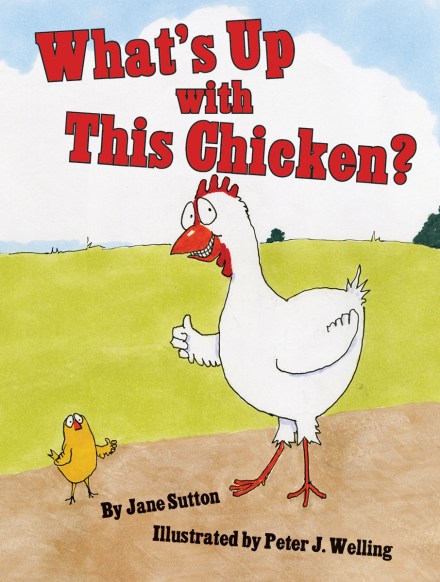
What’s Up with This Chicken?

Written by Jane Sutton | Illustrated by Peter J. Welling


When Sylvia went out to the barn to collect the chickens’ eggs, something was up with Trudy. She squawked and screeched when Sylvia tried to reach under her, but Sylvia took it in stride and with humor: “‘Don’t get so egg-cited!’” she said. “‘I’ll get your egg tomorrow.’” But the next day Sylvia was met with the same reaction. Trudy wasn’t acting like the other chickens in Grandma’s backyard; if fact, she wasn’t even acting like Trudy! “‘What’s up with this chicken?’” Sylvia wondered.

While she and Grandma enjoyed “omelets with eggs from Sue, Clara, Doris, and Olga,” Sylvia talked about “stubborn Trudy.” Grandma didn’t know what was wrong either. The next morning Trudy was even more obstinate. Not only did she make a racket, she tried to peck Sylvia, and she puffed “herself up to twice her size.” Sylvia also noticed “that Trudy left her roost just once a day to eat, drink, and poop. She was getting skinny.”

Sylvia decided that Trudy must be hungry. She tried to lure her off her nest by offering chicken feed, but while all the other hens “wolfed it down like chocolate,” Trudy remained firmly on her roost. Sylvia tried everything she could think of to move Trudy, but nothing worked. That night she and Grandma consulted The Big Book About Chickens. Here they discovered that “‘Trudy is broody!’” Grandma read on: “‘Broody hens stay on their eggs so they will hatch into chicks.’” But Sylvia and Grandma know that Trudy’s eggs are not the kind that hatch.

celebrate-picture-books-picture-book-review-what's-up-with-this-chicken-switching-eggs

Image copyright Peter J. Welling, courtesy of Pelican Publishing


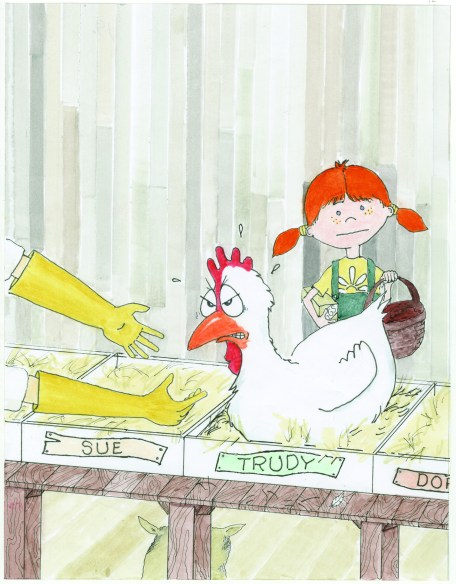
Sylvia realized that Trudy just wanted to be a mother, and she wished there were some way to help her. She thought and thought and finally came up with an idea. She ran to Grandma who agreed that Sylvia’s plan was “an egg-cellent idea.” A few days later a box arrived holding four eggs that would hatch. With thick rubber gloves, a dose of determination, and two tries, Grandma was able to lift Trudy off her nest. Sylvia made a quick switch of the eggs, and “Broody Trudy settled down on the new eggs.”

Trudy grew thinner every day but she stayed on her roost, rolling the eggs to keep them uniformly warm and even blanketing them with her own feathers. One day Sylvia heard peeping! She and Grandma rushed out to the coop and were even in time to watch the fourth little chick peck its way out of its shell. They named the new “little yellow fluff balls Sophie, Danielle, Mildred, and Judy.”

Trudy was a proud and protective mother, shielding her chicks with her wings like a “feathery beach umbrella” and teaching them how to find food and water. Trudy went back to her regular routine and began gaining weight. As the chicks grew they got their own nests in Grandma’s coop. But one day Judy squawked and screeched. This time “Sylvia laughed so hard that she almost dropped her egg basket. ‘Broody Judy,’ she said, ‘I know what’s up with you!’”

An Author’s Note about the real-life “Broody Trudy” that inspired the story follows the text.

With a deft and delightful understanding of the puns and humor that set kids to giggling, Jane Sutton has written a fun—and informative—story for animal lovers and anyone who loves a good, natural mystery. Through the well-paced plot and action-packed description, readers learn about a particular behavioral aspect of some chickens and the clever and sensitive way that Sylvia solves the problem. The close relationship between Sylvia and her grandmother adds charm and depth to the story, and their dialogue is spontaneous and playful.

Peter J. Welling’s bright, homey illustrations are the perfect accompaniment to the story. Animated Trudy shoos Sylvia away while the other chickens take dust baths, scratch for bugs, and look just as perplexed as Sylvia and Grandma. Humorous touches abound in Grandma’s choice of home décor and Sylvia’s printed T-shirts as well as in the facial expressions of the human and feathered characters. Trudy’s chicks are adorable, and readers will cheer to see Trudy fulfill her heart’s desire.

What’s Up with This Chicken is a wonderful read-aloud for younger kids’ story times and a fun romp that will keep older, independent readers guessing and wondering how it all comes out right up to the end. The likeable characters—both human and chicken—make this a book kids will like to hear again and again!

Ages 3 – 8

Pelican Publishing, 2015 | ISBN 978-1455620852

Discover more about Jane Sutton and her books on her website!

To read an interview with Jane, click here!

To learn more about Peter J. Welling, his books for kids and adults as well as the original lunch bags he made for his children, visit his website!

National Poultry Day Activity

celebrate-picture-books-picture-book-review-egg-carton-chicken-double-chickens

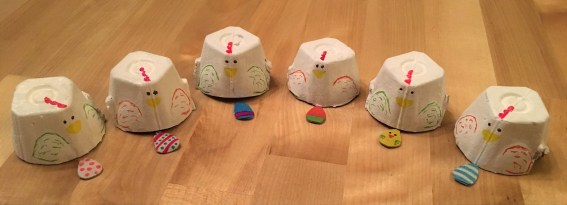
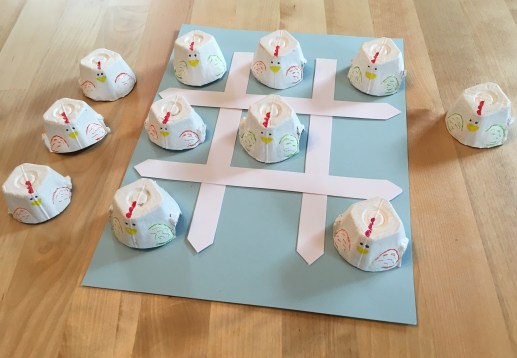
Egg Carton Chickens and a Basket Full of Games


With twelve little chickens you can come up with lots of games to play! This fun craft and game activity is eggs-actly what you need to start hatching some real fun!

Supplies

  • Cardboard egg carton
  • White craft paint
  • Markers: red, yellow, black for the face; any colors you’d like for wings and eggs
  • Paint brush
  • Scissors
  • Glue
  • Construction or craft paper in white and a color of your choice

Directions

  1. Cut the notched flap off the egg carton and set aside
  2. Cut the top off the egg carton
  3. Cut apart all the egg cups and trim slightly so they sit flat
  4. Paint the egg cups with the white paint, let dry
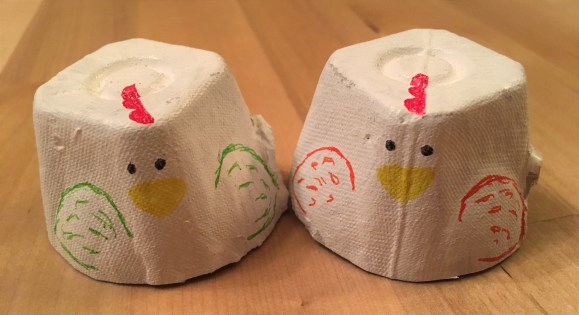
  5. Add the face, comb and wings to the chicken with the markers. Make six chickens with one color wings and six chickens with another color wings.
  6. From the egg carton flap cut thirteen small egg-shaped playing pieces
  7. With the markers, decorate twelve of the eggs in pairs—each egg in the pair with the same design
  8. Color one egg yellow and add a beak, eyes, and wings to make it a chick

Games to Play

Tic-Tac-Toe (2 players)

  1. On a 8 ½” x 11” piece of paper draw a regular tic-tac-toe board or make it fancy – like the picket fence-inspired board in the picture
  2. To make the fence-inspired board on a colored background, cut 2 9-inch-long x 3/4-inch wide strips of white paper, cutting a pointed tip at one or both ends. Cut 2 white  8-inch x 3/4-inch strips of paper with a pointed tip at one or both ends. Glue the strips to the background.
  3. Each player chooses a set of chickens with the same colored wings
  4. Play the game as you usually do

celebrate-picture-books-picture-book-review-egg-carton-chicken-tic-tac-toe

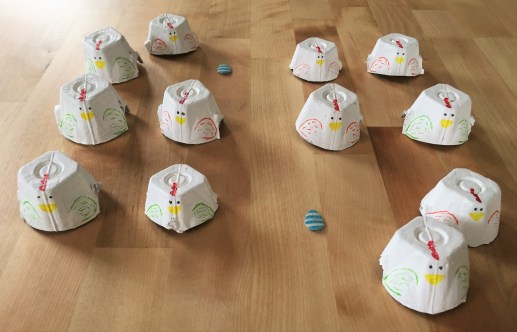
Find the Matching Eggs (2 or more players)

  1. Have one player hide one egg under each chicken
  2. Shuffle the eggs around and form them into three lines of 4 chickens each
  3. Another player lifts one chicken at a time to find matching eggs. If the eggs don’t match, put both chickens back and start again

celebrate-picture-books-picture-book-review-egg-carton-chicken-matching

Where’s the Chick?

  1. Use as many chickens and eggs as you want (fewer for younger children, more for older)
  2. One player hides the chick under one of the chickens and eggs under the others.
  3. Another player has three chances to find the chick

celebrate-picture-books-picture-book-review-egg-carton-chicken-where's-the-chick

You can also design your own games for your adorable chickens to play! With more chickens you can even make a checkers set or replicate another of your favorite board games!

Picture Book Review
March 14 – International Ask a Question Day

celebrate-picture-books-picture-book-review-do-you-see-my-tail-cover

About the Holiday

Admit it—you have a ton of questions. These days, don’t we all! Well, now’s the time to get them out there! Go on—even if you think it’s silly or it seems as if everyone else understands (believe me, they don’t!)—ask away! It’s only through questions that we learn the truth or make new discoveries. Little ones seem to come preloaded with questions, and each one is an opportunity for you to introduce them to our world!

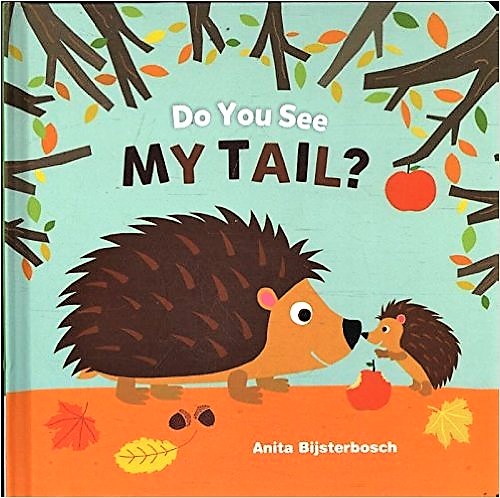
Do You See My Tail?

By Anita Bijsterbosch


A bushy tailed animal hails readers from its place in the treetop—“Do you see my tail? Guess who I am!” A red-bellied bird, butterfly, cricket, spider, and ladybug are all standing by to find out too. Opening the flap, little ones are cheerfully greeted by a squirrel who is feeding its babies. “My babies live in a nest in a hollow tree. They like acorns,” the squirrel says. The young squirrels happily reach for the tasty nuts while their mom or dad says, “Hello, squirrel. Hello, sweet baby squirrels.’

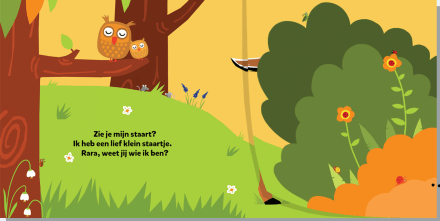
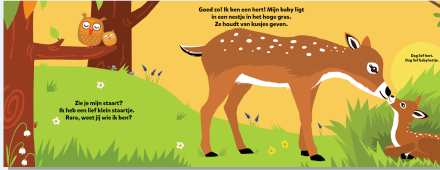
On the next page, a small, brown tail trimmed in black and white peeks out from behind a bush. “Do you see my tail?” the owner asks. “I have a cute little tail. Guess who I am!” Two sleepy owls, a pair of mice and adorable insects can’t wait to find out either. The open flap reveals a mother deer and her fawn who is “lying in a little nest in the high grass.” As the two give kisses, Mom says, “Hello, deer. Hello, sweet baby deer.”

celebrate-picture-books-picture-book-review-do-you-see-my-tail-deer-closed-flap

Copyright Anita Bijsterbosch, courtesy of anitabijsterbosch.nl. Image from the original Dutch-language edition.

Next, a long black feathered tail pokes out from behind a tree. This tail belongs to a bird, and it’s fluffy babies are getting a nutritious worm snack. “How loudly they chirp,” the bird tells readers. Along with their meal, the babies get a little love: “Hello bird. Hello, Hello, sweet baby birds.” Turning the page, young readers see a flat brown tail dipping into the water. Inside the flap a beaver cuddles three babies who “are playing in a nest made of tree trunks and branches.”

“Do you see my tail?” the next animal asks. Who could that ball of fluff belong to? Lift the flap to discover an adult rabbit and four scampering babies “hopping around in a hole under the ground.” You can tell the rabbits hello! “Hello, rabbit. Hello, sweet baby rabbits.” A flip of the page reveals another part of the woods where a fiery red tail sways to and fro in the hedges, a woodpecker makes a hole in a nearby tree trunk, and tiny insects enjoy the day. Baby foxes “love to frolic” in their underground nest.

Can readers spot the next animal’s “teeny tiny tail” and guess who it belongs to? Under the flap they will find a hedgehog and three babies “sleeping and eating in a nest made of branches and leaves.” The hedgehogs love the apples that fall from the nearby tree. Say hello to the little hedgehogs! “Hello, sweet baby hedgehogs.”

celebrate-picture-books-picture-book-review-do-you-see-my-tail-deer-open-flap

Copyright Anita Bijsterbosch, courtesy of anitabijsterbosch.nl. Image from the original Dutch-language edition.

Anita Bijsterbosch’s charming lift-the-flap book introduces toddlers and young children to a variety of animals and their babies through one easily identifiable feature. Each invitation to guess is followed up by a positive, upbeat answer that rewards a little one’s efforts. Two more complete sentences reveal information about the animal’s home as well as a behavioral trait that mirrors the kind of fun or snuggling that young children like to do themselves. The repeated greeting to each animal and their “sweet” babies not only emphasizes the love that families have for each other, but also provides a gentle lesson in the singular and plural forms of each animal’s name. The rich choices, such as frolic, bushy, and hollow used throughout the story promote early language development.

Bijsterbosch’s colorful pages will enchant young readers as cute birds, insects, mice, and other small creatures join in the fun. The fold-out flap is large enough for a detailed depiction of each animal and their home, and the bright eyes and friendly smiles of the adult and baby animals invite children in to learn and play. Little ones will love to name the other creatures and talk about their different habitats. The open art style offers opportunities to count and to discuss concepts such as in, out, inside, outside, on, near, and far, which are the building blocks of early math literacy. Readers will also love looking for the little ladybug on each spread.

Do You See My Tail? would be a wonderful early addition to any toddler’s or young child’s home bookshelf.

Ages 1 and up

Clavis, 2017 | ISBN 978-1605373201

International Ask a Question Day Activity

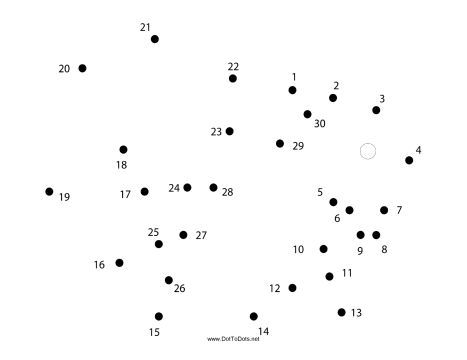
celebrate-picture-books-picture-book-review-squirrel-dot-to-dot

Cute Dot-to-Dot Pages


Can you guess what animals you’ll find when you connect the dots in these two printable Cute Dot-to-Dot Pages?

Dot-to-Dot Page 1 | Dot-to-Dot Page 2

Picture Book Review
March 3 – World Wildlife Day

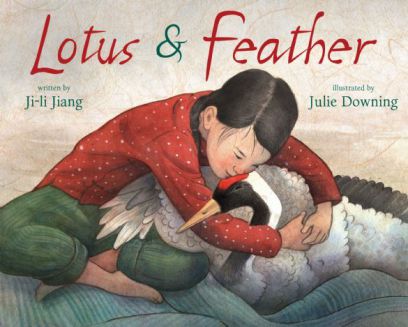
celebrate-picture-books-picture-book-review-lotus-and-feathers-cover

About the Holiday

In December of 2013 the United Nations General Assembly proclaimed March 3rd as World Wildlife Day to promote awareness of our environment and the dangers to it. This year’s theme is “Listen to the Young Voices.” Nearly one-quarter of the world’s population is between the ages of 10 and 24. With a crucial stake in the preservation of the world’s animals and plants and their habitats, more and more young people are getting involved in the preservation of the environment. Today, find a way to get involved in your community or donate to a wildlife cause. A clean, healthy, and protective environment benefits all.

Lotus & Feather

Written by Ji-li Jiang | Illustrated by Julie Downing

Lotus was lonely since her winter illness had left her without a voice. The children at school “treated her like a strange creature,” and she was left without playmates or someone to keep her company on the walk home. She lived with her grandfather who made reed baskets and found solace when he took her to ride in his boat on the nearby lake. As he poled the boat through the still water, Lotus’ grandfather sadly pointed out how the lake had changed. No longer did the lotus flowers, fish, birds, or animals thrive. Instead, the landscape had “‘been ruined by greedy fishermen and hunters, and by ignorant people who took over the land where animals once lived.’”

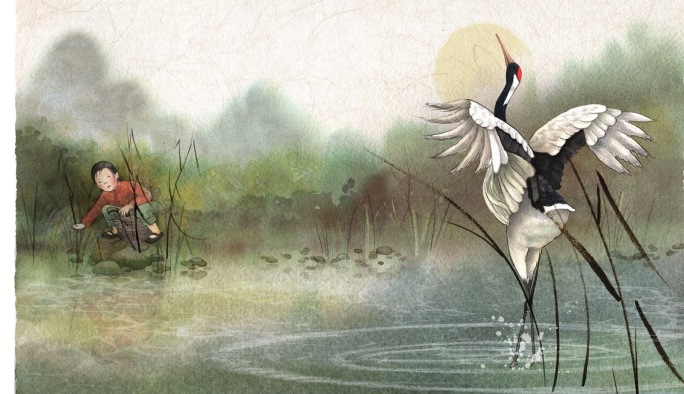
celebrate-picture-books-picture-book-review-lotus-and-feather-lotus-meets-feathers

Image copyright Julie Downing, courtesy of Disney Hyperion

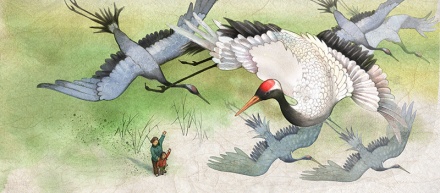
One morning while Lotus was out collecting reeds for her grandfather she spied a rare crane. It’s wide white “wings were edged with black feathers, like lace on a dress”…and “its head was crowned with a red top like a dazzling ruby.” As she watched a gunshot rang out. Unable to alert the hunter by shouting, Lotus banged on her bucket, frightening him away. Lotus rushed toward the wounded bird, picked it up and carefully brought it home to Grandpa.

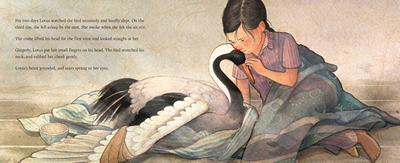
Grandpa tended to the crane’s injury and fed him rice soup while Lotus stroked the soft head. For two days, Lotus hardly slept as she took care of the crane. On the third day she fell asleep next to the crane, waking when he stirred and nestled her cheek. “Lotus’s heart pounded, and tears sprang to her eyes.” Lotus named the crane Feather. As it grew stronger she gathered food for it, and on the day Feather took his first steps, “Lotus jumped and swirled and hugged Grandpa blissfully.”

celebrate-picture-books-picture-book-review-lotus-and-feather-lotus-comforts-feather

Image copyright Julie Downing, courtesy of Disney Hyperion

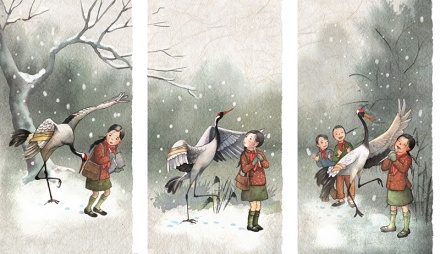
Soon Feather was following Lotus everywhere—even to school. After class Lotus would blow her whistle and Feather would come running and dance as Lotus played. The other children joined in, dancing and playing along every day. One night Lotus heard Feather crowing and woke to find that the village was flooded. Poling his boat through the streets, Grandpa shouted, Lotus banged her pail, and Feather crowed to alert the neighbors. “Over three hundred villagers were saved. Feather was the hero.” He became famous, and people wanted to hear his story again and again.

celebrate-picture-books-picture-book-review-lotus-and-feather-lotus-dancing

Image copyright Julie Downing, courtesy of Disney Hyperion

When Spring arrived Feather was still too weak to fly but he looked longingly at the birds migrating north. Lotus was frightened that her friend might want to leave them, but she “knew she would never separate him from his home and family.” One day Feather spread his wings and leaped into the air. Lotus realized that he had healed and knew it was time for him to leave. Grandpa and Lotus took Feather to the lake. Grandpa tossed Feather into the air, but he returned again and again. Grandpa gave Feather to Lotus. Lotus hugged Feather one more time and threw him into the sky.  

celebrate-picture-books-picture-book-review-lotus-and-feather-lotus-lets-feather-go

Image copyright Julie Downing, courtesy of Disney Hyperion

Holding back tears, Lotus watched as “Feather flapped his big wings and soared north, disappearing into the horizon.” Lotus and the other children missed Feather. They gathered together listening to Lotus play her whistle, imagining that Feather could hear them. One autumn morning, Lotus heard a familiar crow and rushed outside. There stood Feather with his family. Then Lotus gasped. The sky was filled with hundreds of cranes coming to the lake. Lotus blew her whistle, and the notes, “accompanied by the birds’ singing, echoed far, far away in the golden sky.”

celebrate-picture-books-picture-book-review-lotus-and-feather-lotus-waves-goodbye

Image copyright Julie Downing, courtesy of Disney Hyperion

Ji-li-Jiang’s tender story resonates on every page with love and friendship. The relationship revealed in Jiang’s tale exists not only between Lotus and Feather, but between readers and their environment. Beautifully interwoven throughout the plot, the idea of responsibility between friends, to the earth, and to ourselves makes Lotus & Feather a compelling book to read and discuss. Through lyrical passages and detailed storytelling, Jiang develops a deep, emotional bond between Lotus and Feather that readers will respond to. The heartwarming connection between Lotus and her grandfather brings comforting and another level of family commitment to the story.

Julie Downing’s stunning illustrations allow readers to walk, sit, worry, and cheer with Lotus as she finds and cares for Feather. Her sadness is palpable as she walks home from school past a group of classmates playing ball; in the corner of the dark lake, children will find bottles, cans, and other debris floating among the reeds; and Feather makes his debut with a graceful ballet. Readers will love watching the progression of Feather’s healing and Lotus’ reintegration into her circle of friends and will applaud when Feather and his family and friends return to the lake.

Lotus & Feather is a multi-layered story that will captivate readers. It is a must for public and school libraries and would make a beautiful addition to home libraries as well.

Ages 5 – 9

Disney Hyperion, 2016 | ISBN 978-1423127543

Discover more about Ji-li Jiang and her books on her website!

View a portfolio of artwork as well as other books by Julie Downing on her website!

World Wildlife Day Activity

celebrate-picture-books-picture-book-review-world-wildlife-day-word-scramble

Endangered Species Word Scramble

Can you find the names of 15 animals in this printable Endangered Species Word Scramble? Here’s the Solution.

Picture Book Review
February 27 – International Polar Bear Day

celebrate-picture-books-picture-book-review-little-polar-bear-cover

About the Holiday

Today we celebrate polar bears, the largest member of the bear family and a critical part of the Arctic ecosystem. These beautiful creatures spend much of their time at the edge of ice packs, from which they hunt for food. Their excellent sense of smell allows them to sense food up to a mile (1.6 km) away. Increasingly polar bears are under threat from changes in climate which are shrinking their habitat and affecting their quality of life. In honor of today’s holiday take time to research polar bears and consider donating to a cause for their protection.

Little Polar Bear

By Hans de Beer

At last little Lars is old enough to go hunting with his father, and they head out into the white, frozen expanse to find the perfect fishing spot. While Lars watched from the edge of an ice pack, his dad disappeared underwater for so long that Lars began to worry. When he finally surfaced, however, he brought with him a large fish for dinner. After dinner it was time to sleep. Lars’ father showed him how to build a wall of snow to lie behind that would protect him from the wind.

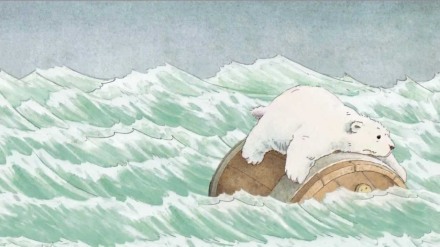
During the night as Lars and his father slept, the ice cracked between them, sending Lars floating away by himself. When Lars woke in the morning, he discovered that he was alone and that the warm sun was melting his ice floe little by little. Just as the ice threatened to disappear entirely, a barrel floated by and Lars crawled on top of it. “Then a storm began to rage. As Lars clung to his bobbing barrel he missed his father and his pile of snow more and more.”

celebrate-picture-books-picture-book-review-little-polar-bear-lars-and-father

Image copyright Hans de Beer, courtesy of NorthSouth Books

By the time the storm subsided Lars was far from home. He found himself in a place with no snow or ice; instead “almost everything was green and the sun was very warm.” Lars left the barrel and padded onto the sandy beach. The hot sand burned Lars’ paws, and he ran to the nearby river to cool them. “But just as he was about to plunge in, a very big, tan animal sprung out of the water.” Frightened, Lars ran away, but the hippopotamus followed him and introduced himself. Henry had never seen a white bear, and Lars had never seen a tan animal.

Lars told Henry about his trip and how he wanted to find father. Henry didn’t know how to help, but he figured that Marcus the eagle would know what to do. With Lars on his back Henry started the long journey across the river, through the jungle, and over the mountains. On the way, Lars loved seeing all the different colors, creatures, and vegetation. He climbed trees, met a chameleon, and sniffed at a butterfly. When they came to the mountains, Henry had trouble climbing, but Lars scampered ahead and showed him where to step.

celebrate-picture-books-picture-book-review-little-polar-bear-lars-on-barrel

Image copyright Hans de Beer, courtesy of NorthSouth Books

Finally, Henry couldn’t go any farther. He and Lars found a place to rest for the night. The view of the water made Lars homesick, but Henry reassured him. The next day, high on the mountain, Lars and Henry found Marcus. “The eagle looked at Lars and then said, ‘Well, well, a polar bear in the tropics! You’re a long way from home aren’t you, young man?’”

Marcus explained that he could indeed help Lars get home, but they would need the assistance of Samson. In the morning a gray whale swam near shore, and Lars climbed on his back. While Henry was happy that Lars could find his way home, he was also sad to see him go. He and Lars said goodbye to each other. As Henry looked on, Samson and Lars swam out into the open ocean with Marcus flying “along a bit to set them on their way.”

After Samson had swum a long distance, icy cliffs once again appeared on the horizon. As they drew closer, Lars spotted his father standing at the edge of the ice scanning the sea. Lars called out to him, and Lars’ father couldn’t believe his eyes. In thanks for bringing back his son, Lars’s father caught a big fish and gave it to Samson. Lars and his father started toward home, and as they walked “Lars talked about all of the amazing things he had seen.” His father was astonished. “‘You didn’t meet anyone who was white?’” he asked. “‘Nobody, except a chameleon,’ said Lars, ‘but that doesn’t count.’” Lars laughed, but his dad couldn’t understand the joke.

celebrate-picture-books-picture-book-review-little-polar-bear-lars-and-henry

Image copyright Hans de Beer, courtesy of NorthSouth Books

Hans de Beer’s sweet, adventurous little polar bear has been long beloved by young readers who have followed his journeys and escapades through many books. This favorite introduction to Lars, his father, and the North Pole was reissued in 2016 and is as timely now as when it was first published. De Beer’s straightforward story of a young bear suddenly taken away from home, surviving by instinct, and discovering new places, friends, and ideas, is at once exciting and comforting. As Lars finds himself in unfamiliar territory populated with animals and creatures he’s never seen before, he doesn’t shy away from the experience, but embraces the diversity of what he sees just as the tropical animals accept him. The kindness and camaraderie shared among the animals is a universal lesson for all.

Little ones love de Beer’s expressive animals and the caring interactions between them. Kids will laugh when Henry pops out of the river to say “boo!” and giggle to see Lars and the chameleon sticking out their tongues together. The soft pastel palette invites kids to linger over the pages and experience both the frozen tundra and lush jungle with the same awe as Lars. Readers will cheer when Lars is reunited with his father, but will also look forward to traveling with their new friend again in his other adventures.

Ages 3 – 8

NorthSouth Books, 2016 (Hardcover) | ISBN 978-0735842649

International Polar Bear Day Activity

CPB - Polar Bear scarf

CPB - Polar Bear Banner

Polar Bear Scarf or Banner

Polar bears aren’t cold in the winter—and neither should you be! Here are directions and printable templates for making a cute scarf to keep you warm, or—if you’d rather—a banner to warm up your room.

Supplies

  • Printable Polar Bear and Igloo Template
  • 1 Strip of blue fleece 4 ½ feet long x 7 inches wide for the scarf
  • 1 Piece of blue scrapbooking paper for a banner
  • Pieces of white, black, blue, and purple fleece or scrapbooking paper to make the polar bear, igloo, snowflakes, and ice floes.
  • String or twine for banner
  • Scissors
  • Fabric or paper glue

Directions for Scarf

To make the fringe at each end of the scarf

  1. Make 7 cuts about 4 inches long
  2. Tie a knot at the top of each fringe section

To make the pieces for the scarf or banner

  1. Trace the polar bear and igloo sections from the Printable Template onto white fleece and cut out
  2. Trace the two ice floes onto blue fleece and cut out
  3. Trace the door of the igloo onto blue fleece and cut out
  4. Trace the polar bear’s scarf onto purple (or any color) fleece and cut out
  5. Cut out round snowflakes
  6. Cut out a small circle from black fleece for the Polar Bear’s nose

On one end of the scarf

  1. Glue the smaller ice floe on one end of the scarf
  2. Tie the bear’s scarf around its neck before gluing the bear to the scarf
  3. Glue the polar bear onto the scarf with its feet on the ice floe
  4. Glue on the polar bear’s nose
  5. Make a small dot for the polar bear’s eye with a marker
  6. Glue snowflakes above polar bear

On the other end of the scarf

  1. Glue the bigger ice floe to the scarf
  2. Glue the three pieces of the large igloo to the scarf, leaving a little space between sections
  3. Glue the small white door of the igloo on top of the last two igloo sections
  4. Glue the small blue door onto the white door
  5. Glue snowflakes above the igloo

Directions for Banner

  1. Cut a point at the bottom of your banner
  2. Follow the directions above to trace the pieces of the polar bear and igloo from the printable template onto scrapbooking paper
  3. Follow the directions above to glue the pieces of the polar bear and igloo to your banner
  4. Attach string or twine to back of banner to make a hanger

Picture Book Review