December 12 – Gingerbread House Day

celebrate-picture-books-picture-book-review-gingerbread-christmas

About the Holiday

Yummy, warm gingerbread and winter just go together. And one of the best ways to enjoy gingerbread is by making a gingerbread house decorated with icing and candy. Gingerbread houses can be elaborate—like those made by professional bakers for competitions—or simple, but they all have one thing in common—they are so tempting to nibble on! To celebrate today’s holiday, grab the mixing bowl, flour and spices, bag of gumdrops, peppermints, and hard candies and get creative!

Gingerbread Christmas

By Jan Brett


Matti and the Gingerbread Baby are excited about the coming Christmas Festival. Gingerbread Baby even has plans to sing with his Gingerbread Band. There’s just one problem—there is no Gingerbread Band. But then Matti has an idea. As he rushes off to find the cookbook, he tells Gingerbread Baby to start practicing his song. “In no time Matti had mixed the ingredients, rolled out the dough, and popped the Gingerbread into the oven.”

celebrate-picture-books-picture-book-review-gingerbread-christmas-matti-baking

Copyright Jan Brett, 2016, courtesy of G. P. Putnam’s Sons Books for Young Readers

Even though the recipe specifically says not to open the oven for a full eight minutes, after six minutes Matti can’t wait another second. He opens the oven door ever so slightly to peek, and out pop the musical instruments made of gingerbread. The instruments hop onto the table and begin playing immediately. But Matti knows they need a bit of icing before they’re ready to make an appearance in the village.

celebrate-picture-books-picture-book-review-gingerbread-christmas-decorated-cookies

Copyright Jan Brett, 2016, courtesy of G. P. Putnam’s Sons Books for Young Readers

After they are decorated in their party best, the Gingerbread Baby leads the procession of instruments—“a violin, cello, double bass, French horn, clarinet, and trumpet, tooting and zumming to the beat of the big bass drum”—to the village. The band jumps on stage, tunes up, and begins playing. People hurry from all over tocome and listen; even the woodland animals stop to watch from behind the trees. The villagers can’t help but tap their toes and dance to the band’s sweet music.

celebrate-picture-books-picture-book-review-gingerbread-christmas-band-playing

Copyright Jan Brett, 2016, courtesy of G. P. Putnam’s Sons Books for Young Readers

When the animals join the crowd, the Gingerbread Baby conducts the band in ‘The Wild Animal’s Waltz.’ No one is left on the sidelines as the band plays faster and faster and everyone joins in the dance. Suddenly, young Ann-Sophie calls out, “‘I think those instruments are really cookies. And I so want one!’” Everyone else takes a closer look, and they all so want a cookie too. The Gingerbread Baby notices the hungry looks on the villagers’ faces, and begins singing an entrancing melody. While the people stand listening, the instruments quietly tiptoe offstage.

Matti meets each one and cleverly disguises them—covering them in snowballs and decorating them as snowmen. As soon as all of the instruments are safe, the Gingerbread Baby somersaults off the stage with a playful taunt for the villagers to try to catch him but also teases, “‘you’ll never guess where I’ll be.’” The chase is on. Zigging and zagging the Gingerbread Baby dashes toward the enormous decorated Christmas tree—where he suddenly vanishes.

celebrate-picture-books-picture-book-review-gingerbread-christmas-dancing

Copyright Jan Brett, 2016, courtesy of G. P. Putnam’s Sons Books for Young Readers

Although the villagers search everywhere, they can find neither the band nor the Gingerbread Baby. While Matti waves goodbye and takes off with his sled full of snowmen, the Gingerbread Baby is being as still and quiet as possible, hidden in the boughs of the Christmas tree. Finally, all the villagers give up the game and go home—all except Ann-Sophie, who may or may not hear “a tiny voice singing” in the now silent air.

Jan Brett’s mischievously loveable Gingerbread Baby is back, wanting to participate in the Village Festival. With her signature storytelling that includes danger, mystery, and clever shenanigans surrounding Matti and his special gingerbread creations, Brett creates a holiday adventure that kids will love. Her well-known intricate illustrations, in a rich palette, offer vivid action as the Gingerbread Baby and instruments play onstage while the villagers dance below. Brett’s beautiful details and cozy settings make Gingerbread Christmas a feast for the eyes, and readers will also like to linger over the musical instruments in the margins of each page that reveal more snapshots of the story line. A dazzling fold-out Christmas tree, decorated from top to bottom will occupy and delight kids as they search for where the Gingerbread Baby is hiding.

For winter fun and especially those days when the house fills with the delicious aroma of baking cookies, Gingerbread Christmas is great book to have on hand.

Ages 4 – 7

G. P. Putnam’s Sons Books for Young Readers, 2016 | ISBN 978-0399170713

Discover more about Jan Brett and her books as well find activities, coloring pages, contests, and more on her website!

Gingerbread House Day Activity

celebrate-picture-books-picture-book-review-gingerbread-house-coloring-page

Gingerbread House Coloring Page


You may not be able to nibble on this printable Gingerbread House Coloring Page, but you can still have fun decorating it!

Picture Book Review

December 11 – International Mountain Day

celebrate-picture-books-picture-book-review-she'll-be-coming-up-the-mountain-cover

About the Holiday

Mountains are majestic! Towering over the landscape, they leave us awestruck with their beauty and mystery. Supporting unique wildlife, providing challenging personal achievement, and inspiring countless works of art, the mountains of the world received their own United Nations-sponsored holiday in 2003. Established so that we remember and honor the importance of mountains to the environment and cultures in which they’re found and to the world at large, International Mountain Day is a celebration we can all support.

She’ll Be Coming UP the Mountain

Written by Kim Norman | Illustrated by Liza Woodruff


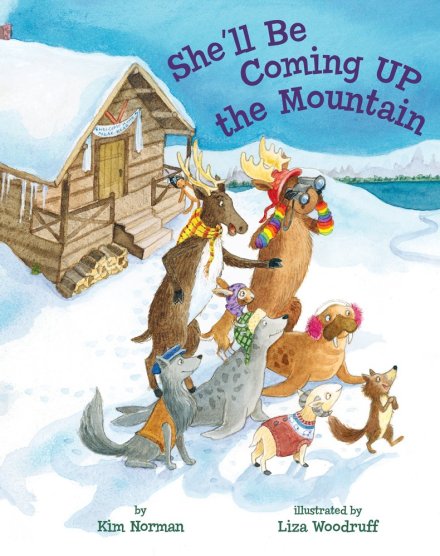
Moose and her pals are sprucing up the place in anticipation of Polar Bear’s return home. They know that “she’ll be coming up the mountain when she comes,” and are sure “She’ll enjoy our frozen fountain when she comes.” In addition to sweeping and dusting, the crew are planning a special welcome, and can’t wait for her arrival because “when she gets here she’ll discover / just how much we really love her / in a banner strung along the cabin wall.”

It seems that even though Polar Bear was away for a long time, no one forgot her. During her absence her friends sent her poems and hand-knitted sweaters, and now that she is coming back even the narwhals and gulls will come to cheer. Even if their “teeth begin to chatter / not a bit of it will matter when she comes.” Then they’ll throw “an arctic party when she comes. / We’ll play music, tapping icicles and drums. / Everybody will be clapping / while the caribou is rapping. / Not a creature will be napping when she comes.”

And, boy, do these guys know how to plan a homecoming! Out in the bay the kayakers will be paddling in formation, the whales will be spouting, and everyone else will be shouting when they see Polar Bear. There will be gifts galore, “high ones, twos, and fives,” a daring ski-slope salute, and plenty of “cheesy” pictures to document it all. As the moment arrives the anxious friends send out a message to which Polar Bear instantly sends an intriguing reply that they that they won’t believe their eyes. Before the waiting group can decide whether to “send our fastest skier, / who will be the first to see her, / and can tell us what will be her big surprise?,” they hear snuffling in the snow. Then suddenly over a snowbank they see her! They cheer and run to meet her and then they all tumble into the house—Polar Bear and her cubs!

Kim Norman has taken the buoyant song “She’ll Be Coming ‘round the Mountain When She Comes” and turned it into a joyful tribute to friendship that will have kids tapping their toes and bouncing along. The sweet story, strict rhythm, and well-known rhyme scheme allow for a mountain of laughs as the welcome-home party grows for the return of a favorite friend. Norman infuses her story with so many details and such enthusiasm that readers can’t help but get excited too. The final revelation that Polar Bear is bringing a surprise will have kids cheering along when they discover Polar Bear has new cubs.

Liza Woodruff’s vibrant illustrations exuberantly depict the preparations and plans the friends have for Polar Bear’s return. Kids will love lingering over Woodruff’s brightly colored and action-packed pages to catch all the details of the coming party. The animals’ camaraderie as they clean together, help deer knit a sweater, practice their welcome activities and especially imagine being together again is heartfelt and infectious. Readers will be glad they too are standing on the front porch looking for the first sight of Polar Bear and are invited inside the cozy cabin for the surprise party.

She’ll Be Coming UP the Mountain is a book full of fun that you’ll probably find yourself singing instead of reading—much to everyone’s delight! For boisterous story times, as a take-along on vacations, or for any time when happiness is the order of the day, this book is a perfect addition to kids’ bookshelves.

Ages 3 – 8

Sterling Children’s Books, 2016 | ISBN 978-1454916109

To learn more about Kim Norman and her other books as well as find fun activities, visit her website!

Discover a portfolio of artwork by Liza Woodruff on her website!

International Mountain Day Activity

celebrate-picture-books-picture-book-review-mountain-landscape-coloring-page

Mountain Landscape Coloring Page


Grab your pencils and crayons and create a beautiful scene with this printable Mountain Landscape Coloring Page.

November 20 – National Absurdity Day

celebrate-picture-books-picture-book-review-strange-mr-satie-cover

About the Holiday

Absurdity is all around us. It can make us laugh, make us mad, and make us see people and events with a new perspective. Today’s holiday gives us the opportunity to embrace absurdity in all its forms. You can spend the day doing something ridiculous, reading absurdist literature, or maybe listening to the music composed by the subject of today’s book!

Strange Mr. Satie: Composer of the Absurd

Written by M. T. Anderson | Illustrated by Petra Mathers


Born in 1866 in France, Erik Satie was a man of contradictions. “‘I was born very young in a very old world,’” he once remarked, and some thought that he never really grew up but always remained “a child with an old man’s smile.” This dichotomy even influenced the kind of music he liked to compose. Even as a child Satie loved music, and as he grew older he wanted to create music that was “both very young and very old, very bold and very shy, that followed no rules but its own.”

Satie liked to combine dissonant styles, such as chants and chorus line tunes. His listeners, with their fancy clothes, impeccable manners, and preconceived notions didn’t understand or like Satie’s “strange” music. On his part Satie found most people frightening and confusing. As a young man he moved to Paris where he made friends. One of his friends took him to a café called Le Chat Noir or The Black Cat. The café, with its resident cat, upstairs theater, and hidden poet’s skeleton attracted poets, artists, dancers, “wizards, and wisecrackers,” who would gather to share their work. Some had invented “luminous hats” while others had “schemes to cover the oceans with cork so they could travel from New York to France.”

celebrate-picture-books-picture-book-review-strange-mr-satie-listeners

Image copyright Petra Mathers, text copyright M. T. Anderson. Courtesy of Candlewick Press

Satie liked Le Chat Noir. He played the piano and people listened—without laughing, without even moving, just allowing themselves to feel happy or sad or as if they were in a dream. Feeling accepted in this atmosphere, Satie wrote his most famous pieces for the piano—the Gymnopédies. His unusual songs for parties, puppet shows, and other occasions had equally unusual titles: one was called “The Dreamy Fish,” another “In a Horse Costume,” and still another “Real Flabby Preludes (for a Dog).” Instead of the usual instructions composers wrote for musicians, Satie included instructions like “‘On yellowing velvet’ and ‘I want a hat of solid mahogany.’”

One day at Le Chat Noir, Erik Satie “met an artist and model Suzanne Valadon and fell in love with her.” The only problem was that she already had a boyfriend—a wealthy lawyer. Satie simply invited himself along on their dates. Satie made friends, but he also lost them easily due to his terrible temper. He yelled at his friends when they didn’t like his music, when they did like his music, and for many small perceived grievances in between. He and Suzanne fought frequently until she left him forever.

Erik Satie seemed more “like a visitor” on Earth than one of its citizens. His wardrobe consisted of “seven identical grey velvet suits and that was all.” Instead of washing with soap, he used a stone, and his room was so small he had to climb on the bed just to get in the door. By this time Satie was in his late 30s and had never learned the rules of music. He realized that he needed to go back to school. After graduating he took to wearing suits and carrying an umbrella. He looked “normal” on the outside, but his eyes still gleamed with the unique creativity inside him.

celebrate-picture-books-picture-book-review-strange-mr-satie-parade-ballet

Image copyright Petra Mathers, text copyright M. T. Anderson. Courtesy of Candlewick Press

In 1917 Satie and his friends wrote and performed a ballet called Parade with sets designed by Pablo Picasso. The story of the ballet was dramatic and the music was peculiar—played on xylophones, typewriters, and sirens. The audiences and critics disliked it intensely; it caused fights and insults. Satie even came close to going to jail over his rude response to a critic.

In 1924 Satie wrote another ballet called Cancelled, which featured a movie and a real camel, and became a self-fulfilling prophesy when on opening night the lead dancer actually worried himself sick and the ballet was cancelled. When the ballet opened a few nights later, however, the audience loved it and, finally, Satie heard long-sought applause. Soon afterward Satie became sick and was taken to the hospital. He died on July 1.

Poets, artists, and musicians came from all over to attend Erik Satie’s funeral. They wanted to honor this most unique man who lived life on his own terms and whose music influenced famous composers in the future.

T. Anderson’s honest and entertaining biography of Erik Satie depicts the quirkiness of the composer’s life through well-chosen anecdotes that will have readers laughing, shaking their heads, and empathizing with this man of extraordinary brilliance. While Satie’s personality and creativity made for a topsy-turvy existence, Anderson combines lyrical passages with those of straight narration sprinkled with expressive adjectives and verbs to clearly paint a portrait of this most unusual and influential composer.

Petra Mathers brings to life late 1800s and early 1900s France as well as the unusual music Erik Satie composes. In vivid illustrations Satie is seen mingling with the patrons of Le Chat Noir, joining Suzanne Valadon on her dates, sitting in his small room and classroom, and giving vent to his argumentative nature. As Satie cannot be separated from his music, his pieces are depicted here. Disparate objects—candles, balls, bells, dice, question marks, dominoes, and more—burst out of a piano and into and out of listeners’ ears; a performer in the ballet Parade cross the stage wearing a costume of skyscrapers; and the ballet Cancelled with its smoking canon and live camel results in flower-strewn acclaim.

Ages 6 – 10

Candlewick Press, 2016 (reprint edition) | ISNB 978-0763687755

Visit M. T. Anderson‘s website to learn more about his books for children, teens, and adults. Plus you’ll find videos, interviews, wallpapers, and more gimmicks!

National Absurdity Day Activity

celebrate-picture-books-picture-book-review-dancing-alligator-coloring-page

Really Ridiculous Coloring Pages


Have you every seen a frog in a suit or a dancing alligator? Absurd, right? Have fun with these printable Really Ridiculous Coloring Pages!

Frog Coloring Page | Alligator Coloring Page

October 20 – International Sloth Day

celebrate-picture-books-picture-book-review-snoozefest-cover-image

About the Holiday

The AIUNAU, a non-profit dedicated to protecting all wildlife, established International Sloth Day in 2010 to raise awareness of the dangers facing these seemingly always smiling, gentle animals. With three species already extinct, sloths need protection from power lines, cars, and those who would capture them as pets as well as from other environmental issues that decrease their habitats. While sloths may not be found in your neck of the woods, concern for all wildlife is an important part of being a global citizen.

SnoozeFest

Written by Samantha Berger | Illustrated by Kristyna Litten


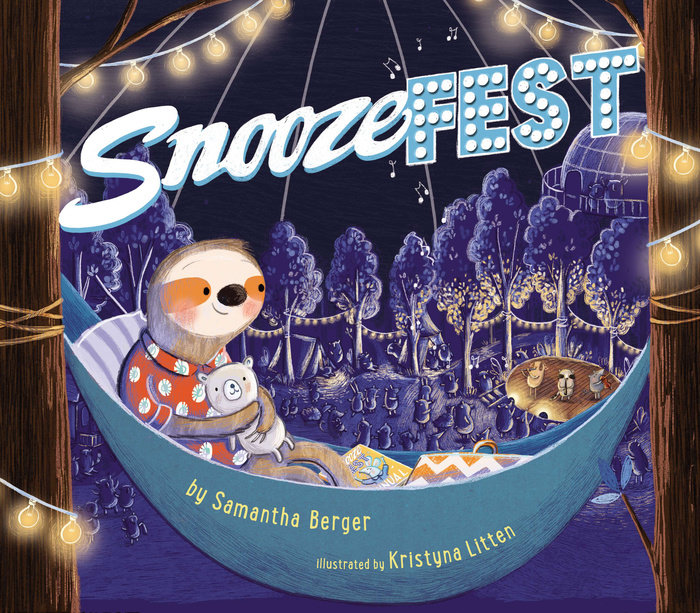
Snuggleford Cuddlebun is the sleepiest sloth in Snoozeville. “Now that sloth can sleep, for a month at a go. / The few time she rises, she moves in slo-mo.” But there is one annual event that sets her heart—and her feet—racing enough to leave her cozy bed—SnoozeFest. “This is the place where the best sleepers go to snore their way through this naptacular show.” So Snuggleford packs up her her jammies and teddy, her pillow and book and joins the other great sleepers on the bus that will take them to the NuzzleDome.

celebrate-picture-books-picture-book-review-snoozefest-snoozeville

Image copyright Kristyna Litten. courtesy of Dial Books for Young Readers, Penguin

As Snuggleford looks for the best place to camp, she sees that she’s in good company. The wildcats, wombats, koala bears, brown bats, squirrels, and armadillos are also setting up tents, laying down sleeping bags, and lounging in hammocks—which is Snuggleford’s favorite too. After finding her spot “she strolls through the stands / for posters and T-shirts / and swag from the bands.” Soon it’s time for the show to begin with the P.J. Parade, where sleepwear from such designers as Diane von FirstInBed and Louis Futon are on full display.

celebrate-picture-books-picture-book-review-snoozefest-sleeping-bags

Image copyright Kristyna Litten. courtesy of Dial Books for Young Readers, Penguin

“Then all the big spotlights dim down in the Dome, / and everyone turns on their night-light from home.” The first band to perform is the “Chamomile Rage” and although the crowd is half asleep by the middle of the first song, “the snoozers yawn deeply, yet still clap for more. / The second act’s also a guaranteed snore.” Then “a poet named Burrows recites a haiku / and imitates rain with his didgeridoo.”  More acts take the stage—the Nocturnal Nesters and the Quiet Quartet, Tranquility Trio and the Drowsy Duet. Yes, “These are the best bands for deep relaxation, / followed by Sweet Dreams and Deep Hiber-Nation.”

For Snuggleford Cuddlebun the concert is all she could want. In fact, “Several days later the SnoozeFest is done. / And who’s still asleep? Why it’s Miss Cuddlebun.” She folds up her things, tosses away her trash, and rides the bus back home. There she climbs into bed and shuts her eyes and dreams of next year’s SnoozeFest.

celebrate-picture-books-picture-book-review-snoozefest-nighttime

Image copyright Kristyna Litten. courtesy of Dial Books for Young Readers, Penguin

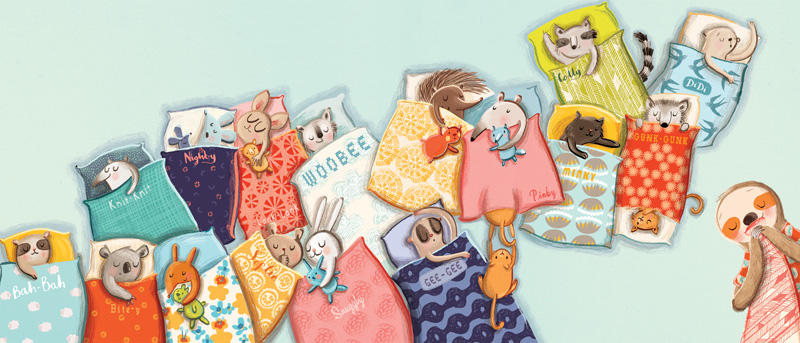
Samantha Berger’s SnoozeFest is one of the cutest, most original bedtime books around. With wit and charm Berger makes full use of the festival setting and experience. Her inspired rhymes, adorable band names, and atmosphere that combines just the right amount of excitement and slumber-inducing lilt, will delight kids of all ages and adults as well. From Snoozeville to the NuzzleDome to a full verse of blanket nicknames, Berger has come up with the “wumphiest, coziest, comfiest” words to send little ones off to dreamland.

celebrate-picture-books-picture-book-review-snoozefest-sleeping-suggleford

Image copyright Kristyna Litten. courtesy of Dial Books for Young Readers, Penguin

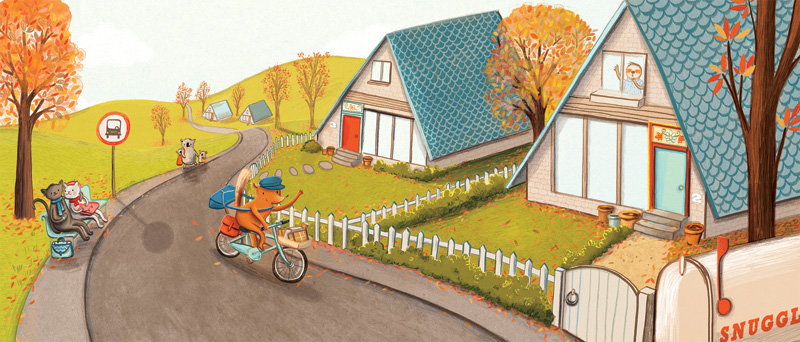
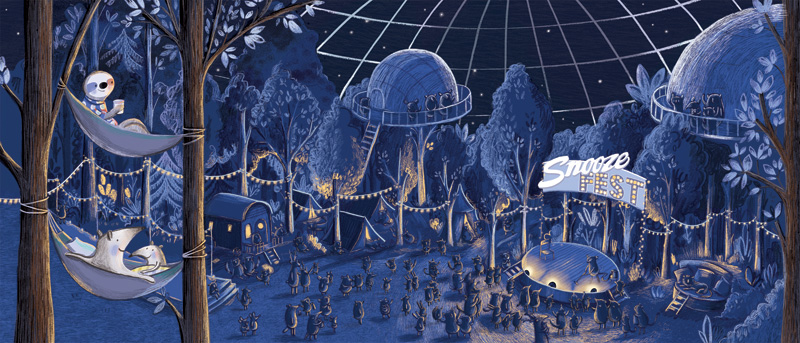
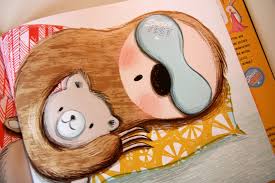
Krisyna Litten’s illustrations, designed with a vintage-yet-modern air and color palette, are the perfect accompaniment to Berger’s story. Anyone would love to join Litten’s sweet Snuggleford and the other “great sleepers” at SnoozeFest. Snuggleford’s endearing slothy smile as well as the joyful camaraderie of the other festival goers invite kids to explore every page. The crowd consists of loveable moles, koalas, raccoons, bears, foxes, porcupines, and more adult and baby animals enjoying the show.  Two-page spreads of the darkened festival grounds lit by nightlights and starlight are gorgeous, peaceful landscapes of blues and gold that set a sleepy tone for little readers.

SnoozeFest would be a very welcome addition to any child’s bookshelf for story times and bed times, and would make a perfect gift.

Ages 3 – 7

Dial Books for Young Readers, Penguin, 2015 | ISBN 978-0803740464

You’ll have plenty of fun discovering lots of books, videos, and more creative stuff by Samantha Berger on her website!

You can catch up with Krisyna Litten on her blog!

You won’t want to snooze through this book trailer!

International Sloth Day Activity

celebrate-picture-books-picture-book-review-sloth-coloring-page

Sweet Sloth Coloring Page


Sloths are sweet, gentle animals who love to hang out. Give the little one in this printable Sweet Sloth Activity Page a colorful world and put it up in your room!

You can find Snoozefest at these booksellers

Amazon | Barnes & Noble | IndieBound

Picture Book Review

September 29 – It’s National Piano Month

The Bear and the Piano by David Litchfield picture book review

About the Holiday

Invented around 1700, the piano was not an immediate hit with composers and performers. It took several decades before musicians embraced its versatility, and over the next 150 years the piano underwent many changes in tonality, size, and shape. In the 19th century the instrument became larger and more powerful to accompany soloists in concert and on tour with large orchestras. At the same time, individuals and families took the piano to heart – and hearth – as it became the primary source of home entertainment and piano lessons a must for all children. The United States became a major producer of pianos, with factories in Boston, New York, and Philadelphia. New technology in the twentieth century provided other types of entertainment that came to toke precedence over the piano, and domestic sales declined.

Today we celebrate the beauty of the piano—both in shape and sound—and all the musical artists who play and compose for this storied instrument.

The Bear and the Piano

By David Litchfield


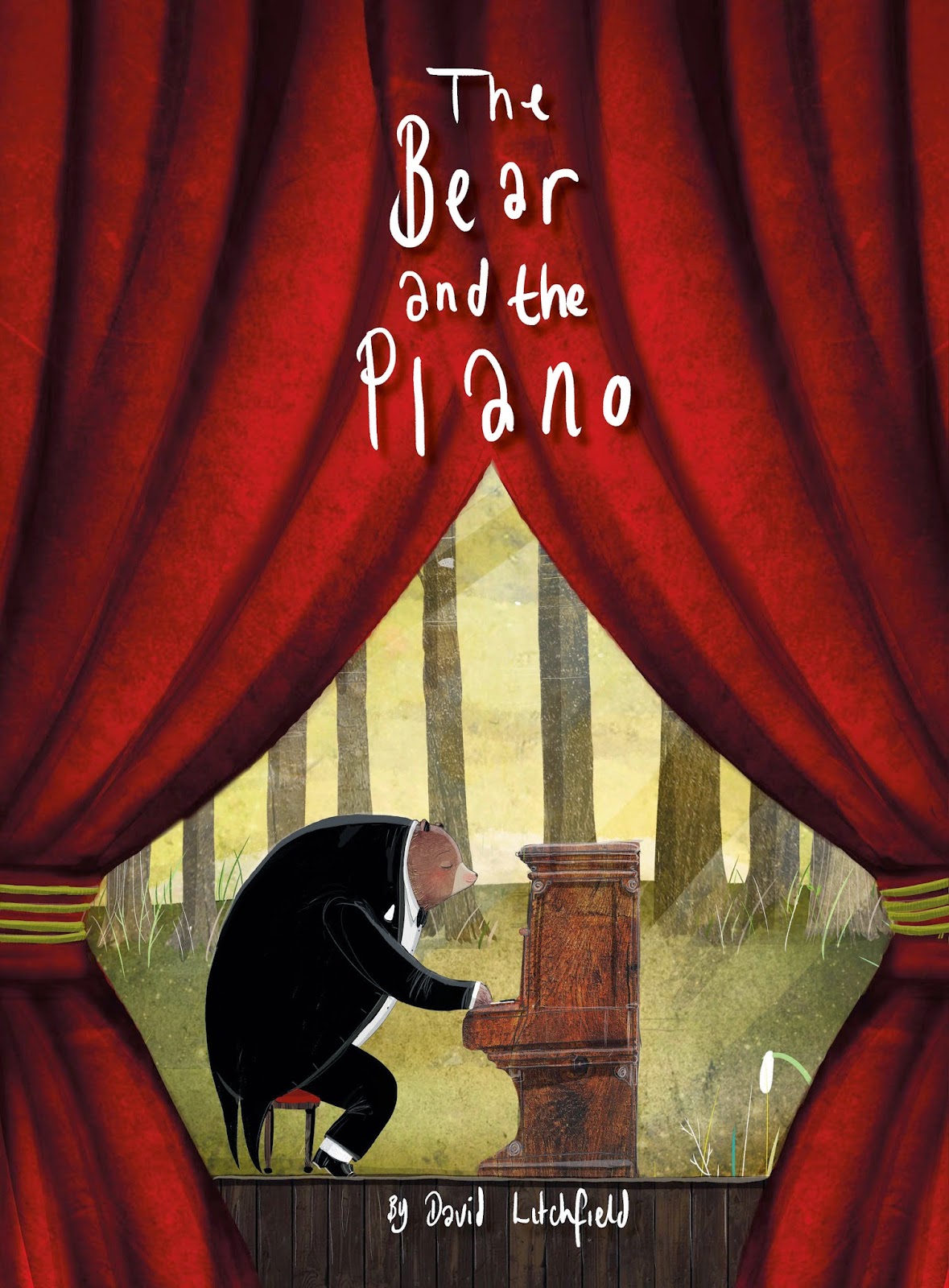
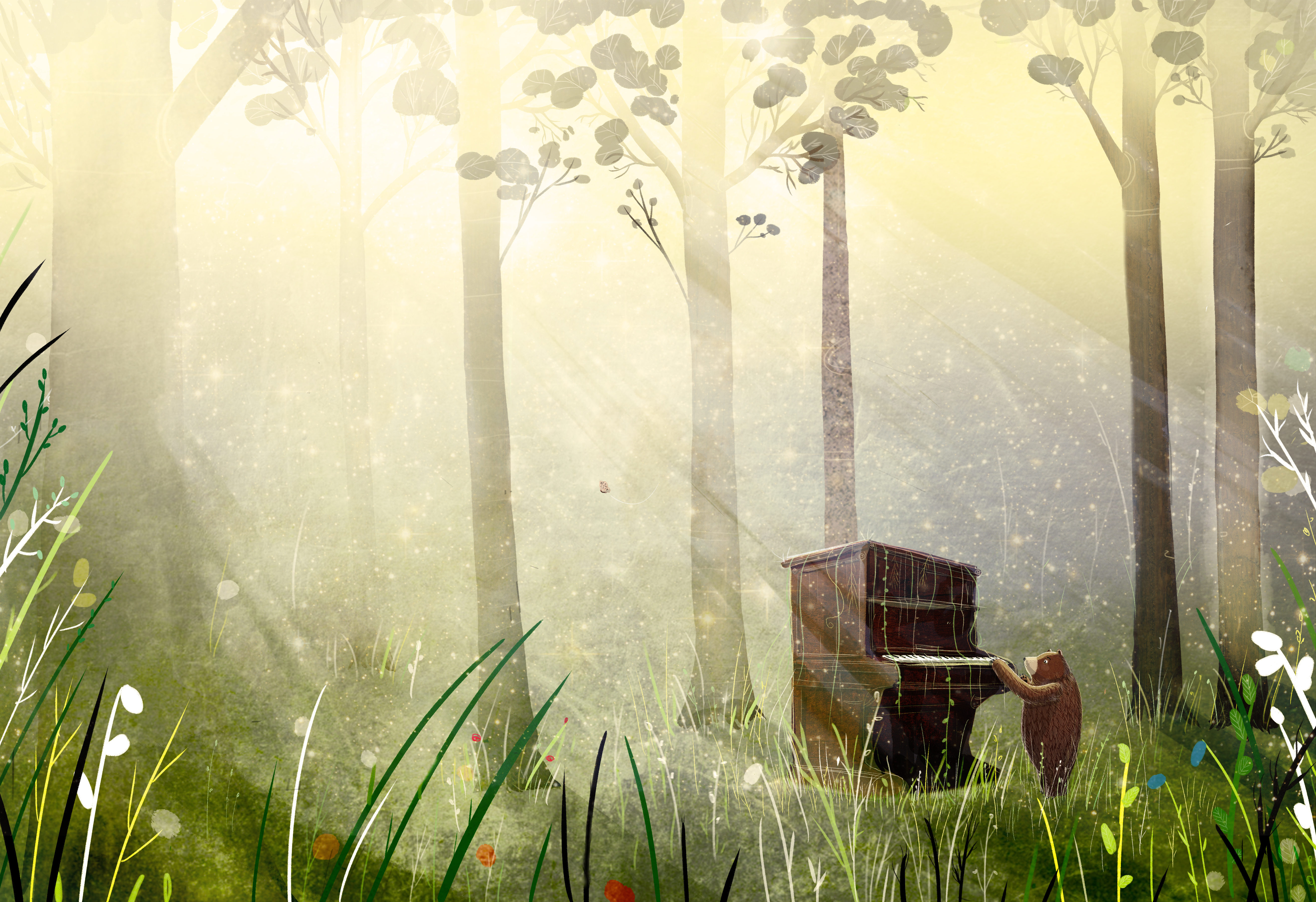
One day a bear cub happens upon a piano in a clearing in the middle of the forest. Wondering what it could be, he approaches and lays his paw on the keys. The strange thing goes PLONK!—such an awful sound. The bear cub leaves, but is drawn back again and again for days, months, and years. Over time the bear grows up and learns to play the piano. The music is beautiful and transports him to strange and wonderful places.

celebrate-picture-books-picture-book-review-bear-finds-piano

Image copyright David Litchfield, courtesy of davidlitchfieldillustration.com

Other bears soon gather in the clearing to hear the “magical melodies” the bear plays. The bear is happy entertaining his friends. One night a girl and her father hiking in the forest come to the clearing. They listen and then tell the bear what his strange instrument is. They invite him to move to the city with them, where he will be able to play grand pianos for hundreds of people. The music he will play and hear “will make your fur stand on end,” they tell him.

The bear is conflicted. One on paw he knows that leaving the forest will make the other bears sad; on the other he longs to explore the world, to play the piano better, and master more intricate music. He decides to go with the girl and her father.

celebrate-picture-books-picture-book-review-bear-in-big-city

Image copyright David Litchfield, courtesy of davidlitchfieldillustration.com

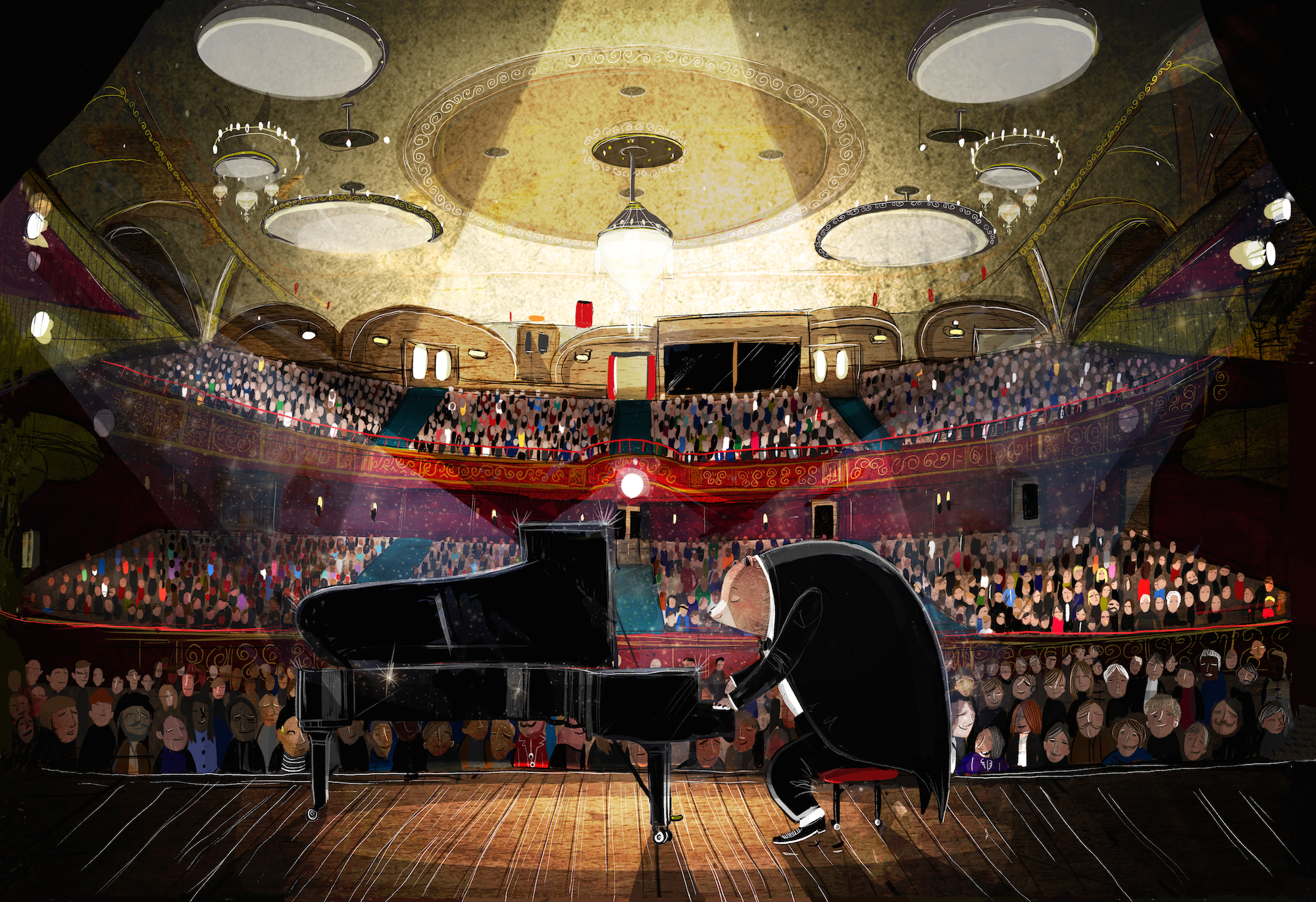
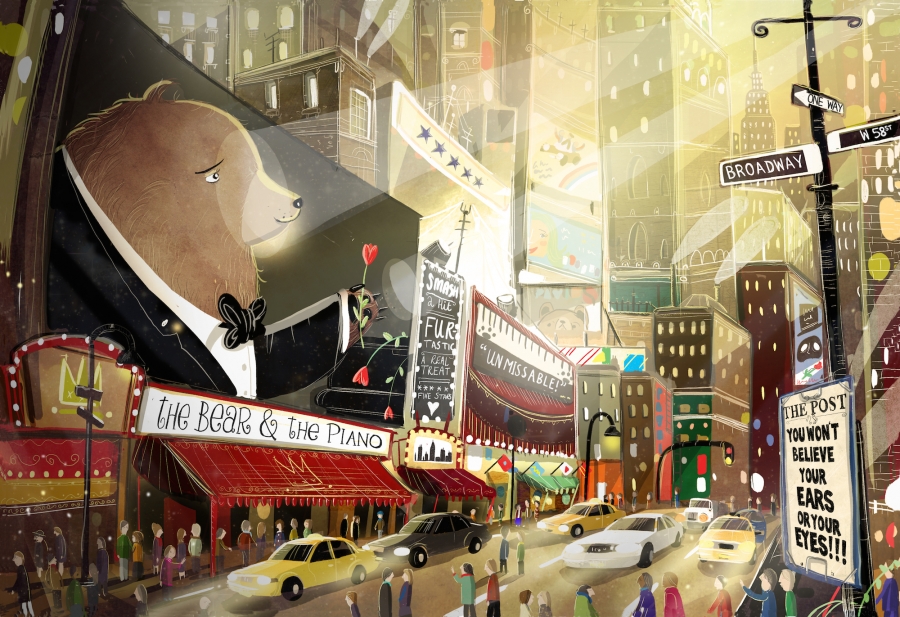
In the city the bear is a sensation! He quickly becomes a celebrity with his name on marquees and playing to sold-out crowds. The bear records albums that go platinum, he appears on the covers of magazines, and wins awards. His experience is everything he could ever wish for. But deep in his heart there is another longing. He misses the forest and his friends there.

He decides to leave the city and rows a boat across the expanse of water to his old home. Excitedly he runs to the clearing, but when he arrives everything has changed. His piano is gone and there are no friends to greet him. The bear worries that everyone is angry at him for leaving, or worse—that they have forgotten him.

celebrate-picture-books-picture-book-review-bear-playing-for-friends

Image copyright David Litchfield, courtesy of davidlitchfieldillustration.com

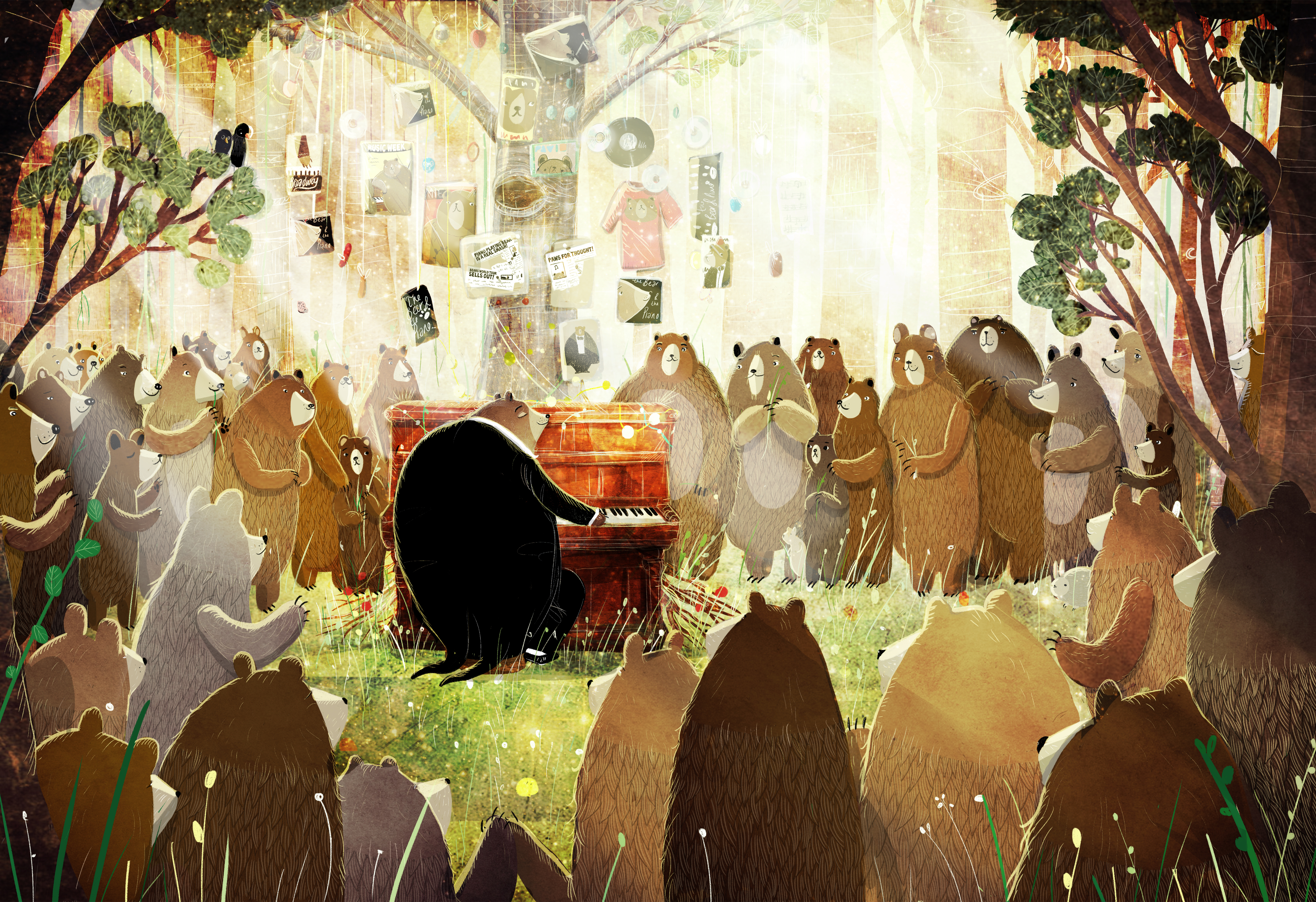
Suddenly an old friend peeks around the trunk of a tree. The bear hails him with a hearty “Hello!” The other bear remains silent, however, and then turns and runs into the trees. The bear follows, plunging deeper and deeper into the forest. Suddenly he stops. In front of him is a sight that makes his fur stand on end.

There, protected in the shade of a tree and surrounded by the albums, magazines, t-shirts, and other mementos of the bear’s success sits the old piano. The bear’s friends have not forgotten him and they are not angry. They are proud and welcoming. The bear tells them all about his adventures then sits down to play again—for the most important audience of all.

David Litchfield’s very original and moving story is such a wonderfully conceived microcosm of the changes life brings. Stumbling upon a talent, cause, or inspiration; opening up to other influences; and acting on hard decisions are all part of growing up. These concepts are honestly and sensitively presented in The Bear and the Piano, and the reassuring ending brings comfort as well as a tear to the eye.

celebrate-picture-books-picture-book-review-bear-giving-concert

Image copyright David Litchfield, courtesy of davidlitchfieldillustration.com

Litchfield’s touching illustrations—rendered in gorgeous hues of browns, greens, yellows, and blues—brim with yearning and mystery. The piano sits in a misty glow, silent and draped with vines, when the cub discovers it. While the bear grows and learns to play, the air clears and the colors become brighter. When the bear moves to the city, the pages glint and swirl with the glow of marquees and concert halls announcing his enormous achievements. But as he sits on a rooftop one night contemplating his life and looking out toward his old home, the lights around him are the elements of normal life—lamps in apartment windows, stars, and the moon glimmering on the water. His nostalgia to be home will resonate with both kids and adults.

The Bear and the Piano makes a wonderful gift for any age—especially as a graduation or new-job gift—and is a must-have for anyone’s personal library.

Clarion Books, Houghton Mifflin Harcourt, 2016 | ISBN 978-0544674547

To learn more about David Litchfield, his books, and his artwork, visit his website!

While I take a few personal days during this month, I am reposting earlier reviews updated with new links, interior art, and book trailers.

Watch the beautiful The Bear and the Piano book trailer!

National Piano Month Activity

CPB - Record Bulletin Board

Make a Record Chalkboard Bulletin Board


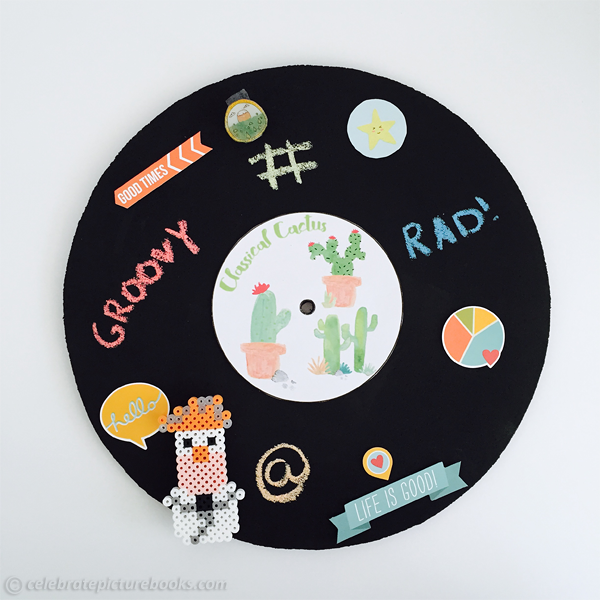
Do you play the piano or another instrument? Would you like to make a record some day? Why wait? In this fun craft you can create your own record bulletin board—and even create your own label art! While this record may not spin on turntables around the world, it will drop in a more important place—your very own room!

Supplies

  • Printable Record Label for you to design
  • Foam board, or a corkboard at least 12-inches x 12-inches square
  • Adhesive cork
  • A 12-inch round plate, record, or other round object to trace OR a compass
  • Chalkboard paint, black
  • X-acto knife
  • Paint brush or foam paint brush
  • Mounting squares

Directions

  1. Cut a section from the adhesive cork a little larger than 12 inches by 12 inches
  2. Affix the cork to the foam board
  3. Trace the 12-inch round object onto the cork/foam board OR use the compass to make a 12-inch circle
  4. With the x-acto knife, carefully cut out the circle (adult help needed for children)
  5. Cut out a ¼ -inch circle in the center of the record bulletin board
  6. Paint the cork, sides and inside the spindle hole with the black chalkboard paint. Let dry
  7. Print the label template and design your own record label
  8. When the paint is dry, glue your label to the center of the bulletin board
  9. Hang your bulletin board with the mounting squares
  10. Decorate!

Picture Book Review
August 27 – International Bat Night

celebrate-picture-books-picture-book-review-bats-in-the-band-cover

About the Holiday

From the time that darkness falls on August 27 until the sun rises on August 28, people in more than 30 countries organize walks, talks, and all kinds of educational and fun activities related to bats and their conservation. Why not find an event in your neck of the woods—or cave—and celebrate this most unusual and beneficial animal!

Bats in the Band

By Brian Lies


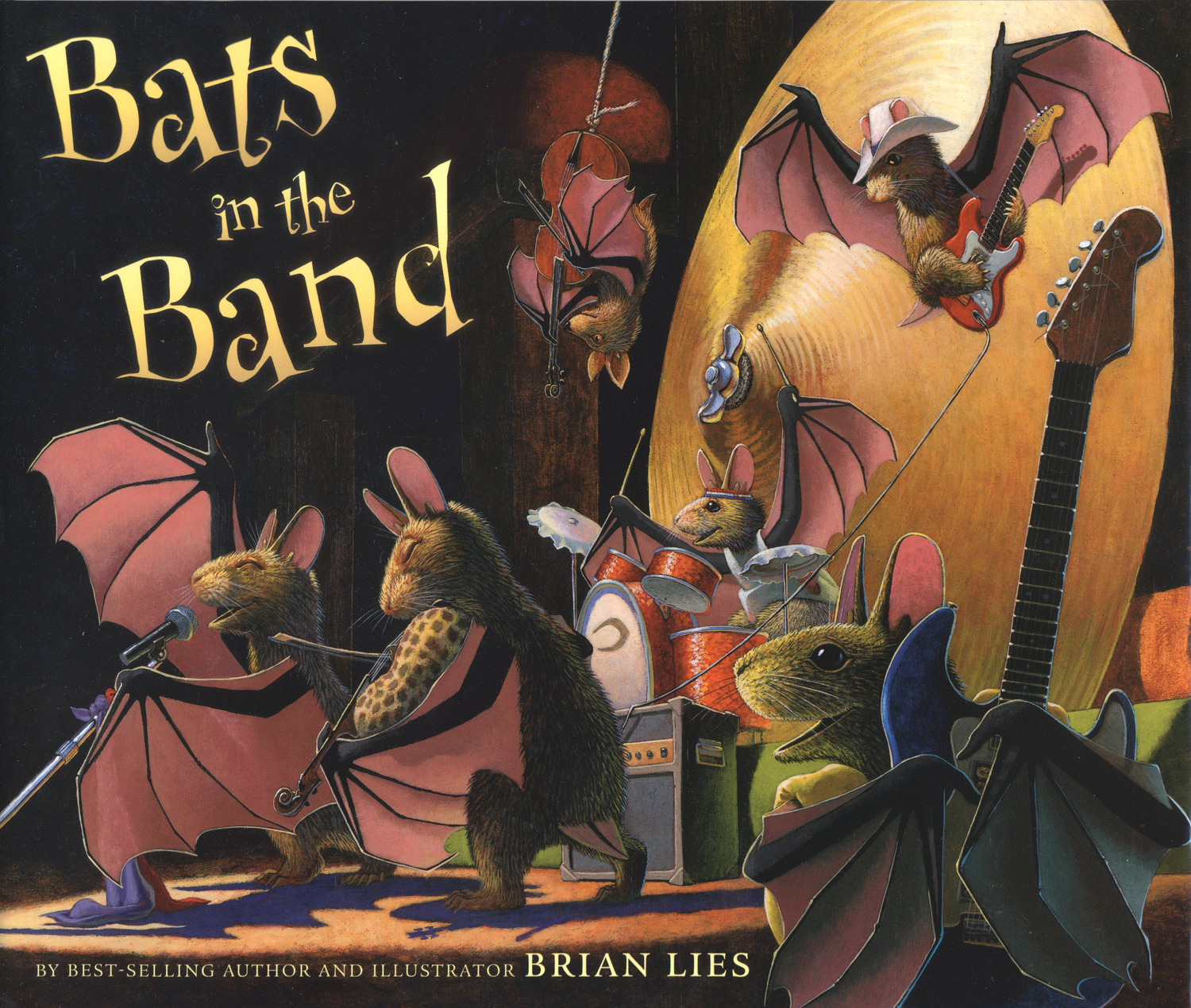
Huddled together a colony of bats sleeps through the winter, but as the icy weather warms they stretch their wings and take flight to find food. As they swoop through the air chasing the echoes they hear, these animals that live by echolocation sense “that something’s not right. / And then when a bugle blast shatters the night, / that one lonely note tells us just what is wrong: / We’re hungry for sound—we’ve been silent too long.”

The bats swarm to a summertime theater now quiet and dark except for a small glow that invites  them inside. They enter the building—passing hawkers of T-shirts, posters, and hats—and set up the stage and the lights. Some bats have brought their own instruments while others improvise with the leftovers of last season’s concertgoers. “Behind the stage curtain, they’re getting in tune, / making up things out of straws, out of spoons.”

celebrate-picture-books-picture-book-review-bats-in-the-band-one-bat-band

Image copyright Brian Lies, courtesy of Houghton Mifflin Harcourt (hmhco.com)

Finally, the conductor lifts his baton, and the concert begins. “We sing together as one voice. / It seems the very walls rejoice! / All together, rafters ringing… / it’s as though our souls are singing.”  Then the strings “change the mood to sweet and mellow” before a one-bat band takes over. “Next up, there’s a country song—/ some lonesome bat done someone wrong. / He’s  gone and broken someone’s heart. / Now everything has come apart.”

There’s even an entertainer for children far off in a corner where the pups can run and play. Now on stage a blues singer “cries of lonely days and empty skies” that make the bats cry. “It’s hard to figure—eyes get wetter, / …so how is it that we feel better?” There’s not much time for reflection though as a hard-rock band begins “blazing,” “pumping,” and “jumping.”

celebrate-picture-books-picture-book-review-bats-in-the-band-blues-singer

Image copyright Brian Lies, courtesy of Houghton Mifflin Harcourt (hmhco.com)

While everyone is dancing to the beat, the sun begins to rise signaling that it’s time for the bats to go. But in one last blast, all the musicians jam together. “The music soars. Finale’s here, the ending of the song. / It builds and builds—now here it comes! / It’s going…/ going…/ GONG!” With that last bang of the cymbal the bats, “worn out, wrung out, half asleep,” fly from the theater and out into the dawning day. In the air they discover the music in everything from “the roar of a car, or the bark of a pup—/ the sound of the rest of the world waking up.” As they fall into slumber up in their cozy rafters, the bats continue to sway unconsciously. “It’s not our intention, but you understand. / We’re dreaming of being the bats in the band.”

Brian Lies “Bat” books are well-known and well-loved. Bats in the Band continues the excellent storytelling and poetry of his other titles, this time to a rock-n’-roll beat. The idea of bats needing to hear sound after a long winter’s silence is brilliant, and these bats play almost as many different styles of music as there are species of bat. The rhyme scheme is true and musical, carrying the story well through its words and rhythm.

celebrate-picture-books-picture-book-review-bats-in-the-band-rock-n-roll-bats

Image copyright Brian Lies, courtesy of Houghton Mifflin Harcourt (hmhco.com)

Lies’ illustrations remain as clever as ever. The two-page spread of the bats choosing and tuning up their instruments is a joy. Bats make a xylophone from keys hanging on a peg board and two nails for mallets. Instead of a harp, a bat plucks the tines of a plastic comb, and a bendy straw serves as a fine wind instrument. The string section plays while hanging upside down (of course!). The pups’ entertainer will bring a smile to readers’ faces, and the blues singer performs under cool blue lights.

Kids and adults will love lingering over the detailed pages, where allusions to actual concert atmospheres abound. Look for the bats holding aloft lightning bugs in a tribute to a long-held tradition.

Bats in the Band is a rockin’ addition to Brian Lies collection and will be welcome on any child’s shelf—whether they are completing the set or just starting it!

Ages 4 – 8

Houghton Mifflin Harcourt, 2014 | ISBN 978-0544105690

Visit Brian Lies‘ website to learn more about him, view his many books, and see a gallery of his artwork.

International Bat Night Activity

celebrate-picture-books=picture-book-review-spiral-bat-words-word-search

Spiraling Bats Word Search


Find the bat related words in this printable Spiraling Bats Word Search that dips and soars like the flight of a bat! Here’s the Solution.

Picture Book Review
July 31 – Uncommon Instrument Awareness Day

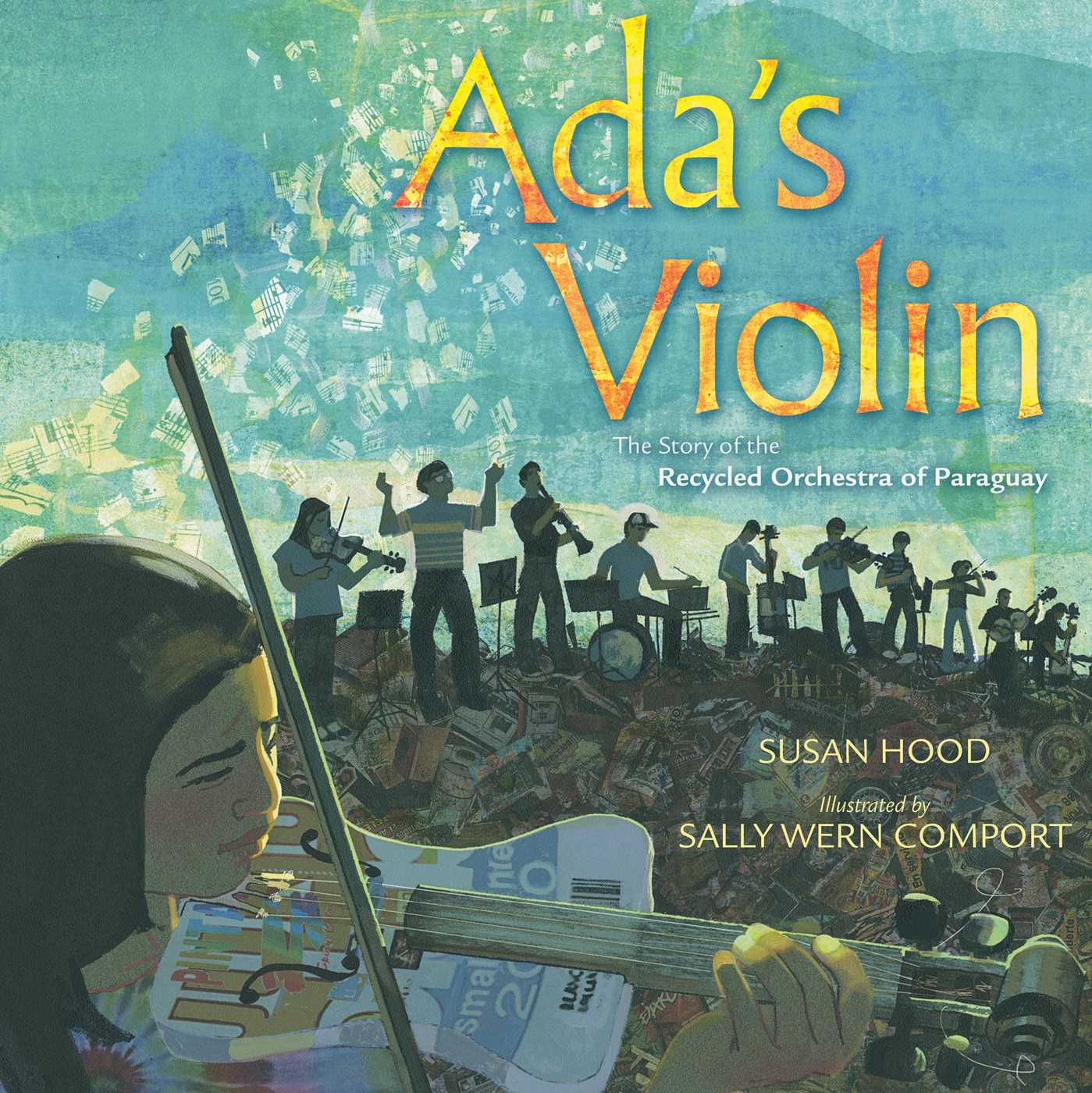
celebrate-picture-books-picture-book-review-ada's-violin-cover

About the Holiday

Today is the day to be musically experimental. Intriguing, inventive instruments that make a wide variety of sounds exist in every corner of the world. From Russia comes the contrabass balalaika, a triangular stringed instrument. The cimbalom, a concert hammered dulcimer, originated in Hungary. And only the Welsh could give us an instrument with no vowels: the crwth. Glass, water, and lightning are also used to make beautiful sounds, and the Holophonor—a musical instrument and hologram projector all in one—is perfect for Elvis sightings wherever he is! So, play a different instrument or research one, and read the inspiring story in today’s book!

Ada’s Violin: The Story of the Recycled Orchestra of Paraguay

Written by Susan Hood | Illustrated by Sally Wern Comport


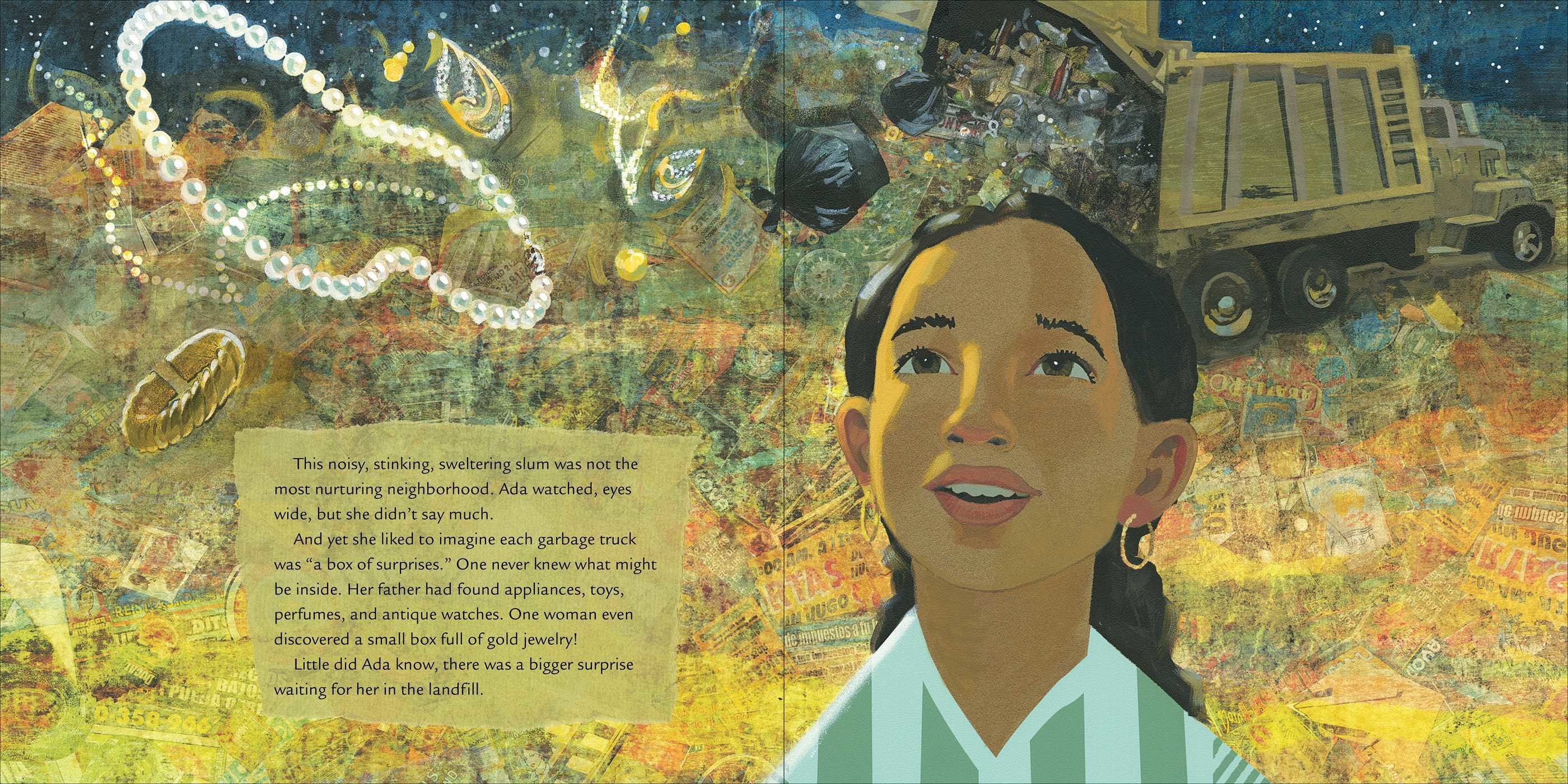
Ada Ríos is growing up in Cateura, a town built of trash as the main garbage dump for the capital city of Paraguay. Every morning the refuse trucks rumble into town to deposit their loads—1,500 tons of trash every day. The citizens of Cateura—gancheros or recyclers—go to work sifting through the mounds and tearing into bags looking for anything valuable enough to recycle or sell. Cardboard is worth 5 cents a pound, plastic 10 cents a pound.

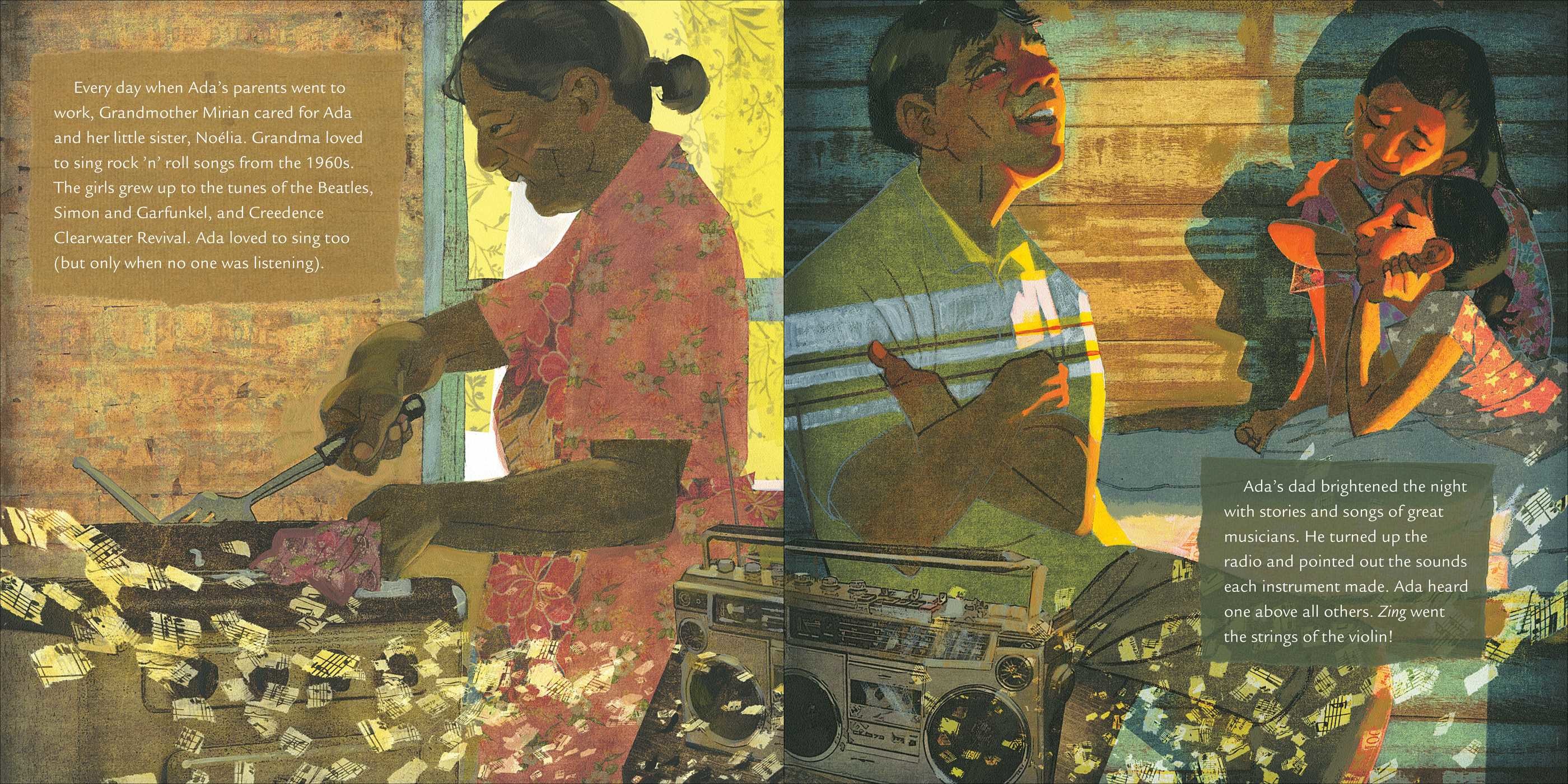
Ada knows the landfill can hold surprises—“Her father, a ganchero, had found appliances, toys, perfumes, and antique watches.”—but she can never imagine what it holds for her. When Ada and her sister were little, their grandmother watched them while their parents worked. They loved to listen to music, to sing, and to learn stories of musicians and the sounds of different instruments. Ada fell in love with the violin.

celebrate-picture-books-picture-book-review-ada's-violin-making-singing

Image copyright Sally Wern Comport, courtesy of simonandschuster.com

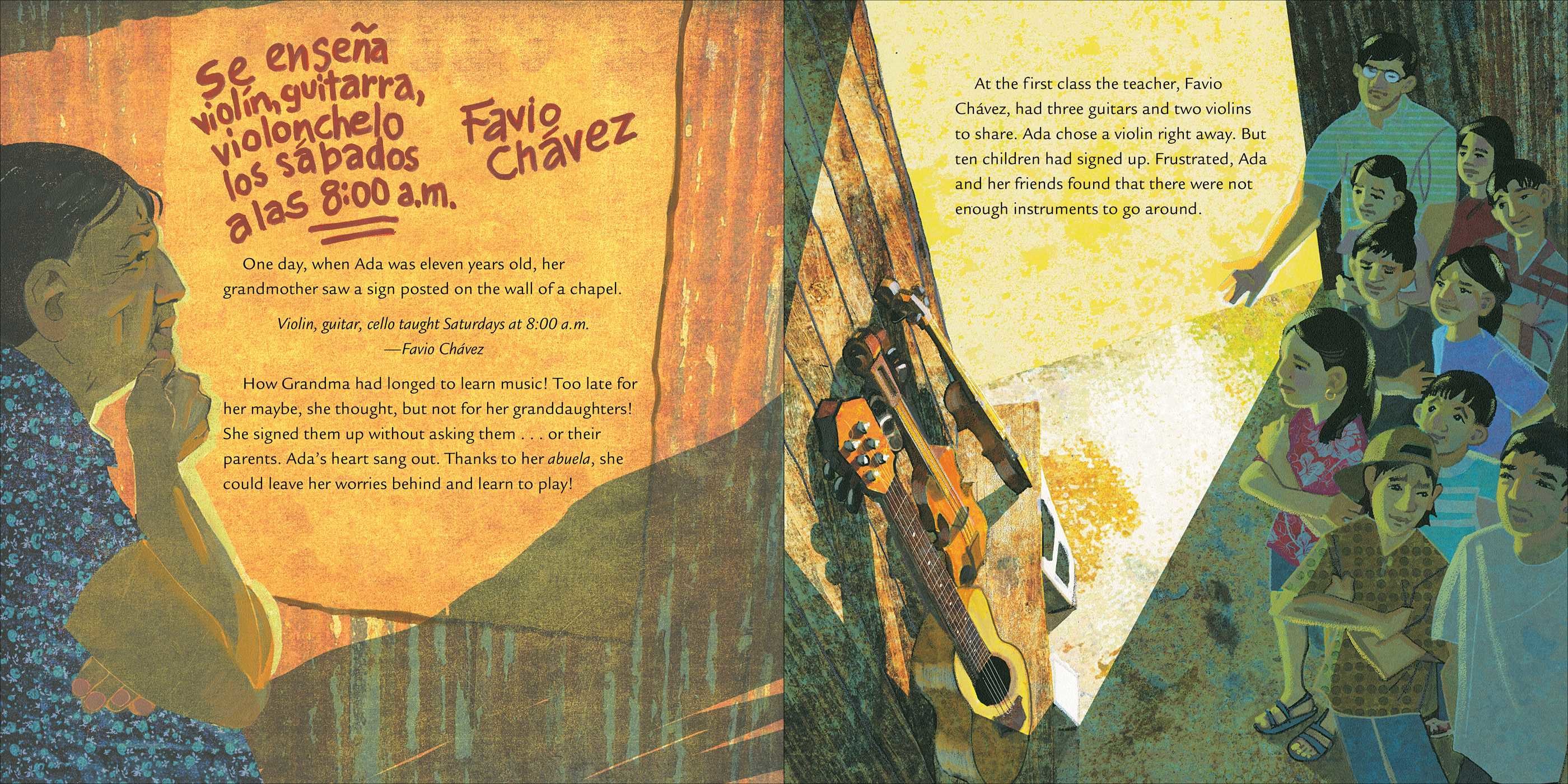
As the girls grow older and go to school, they venture farther into town, but there is little to fill their time. Many kids join gangs or get into fights. When Ada is 11 her grandmother signs her and her sister up for music lessons being offered by a new man in town named Favio Chávez. “Ada’s heart sang out” when she hears the news. On the first day ten children show up to play the five instruments available. But a bigger problem looms: the three guitars and two violins cannot be taken home for practicing as they are magnets for thieves. In Cateura a violin is worth more than a house.

But Favio Chávez has an idea. With help from Nicolás Gómez, a ganchero and carpenter, they pull bits and pieces from the landfill. An old broken drum and an X-ray film become a workable drum, water pipes become flutes, packing crates become guitars and violins, and oil drums become cellos. “Ada chose a violin made from an old paint can, an aluminum baking tray, a fork, and pieces of wooden crates. Worthless to thieves, it was invaluable to her. It was a violin of her very own.”

celebrate-picture-books-picture-book-review-ada's-violin-making-instruments

Image copyright Sally Wern Comport, courtesy of simonandschuster.com

The children practice tirelessly outside in 100-degree heat until the initial “screeches, twangs, and tweets hit all the right notes. Their class became ‘a small island’ where Chávez taught them to respect themselves and one another.” They become known as The Recycled Orchestra. Music now fills the air, adding a soundtrack of beauty to the grueling work. The orchestra is soon invited to play concerts in Cateura and the capital city of Asunción. When word spreads of their talent, they receive offers to play from other cities and even other countries.

When Ada is 16 The Recycled Orchestra is invited to tour with a world-famous rock band. As Ada takes the stage in front of 35,000 people in Bogotá, Colombia, she is afraid, but the audience cheers for them and sings along as they play. On that night the children discover a new life. “Buried in the trash was music. And buried in themselves was something to be proud of.”

celebrate-picture-books-picture-book-review-ada's-violin-lessons

Image copyright Sally Wern Comport, courtesy of simonandschuster.com

An extensive author’s note plus a photograph of The Recycled Orchestra, websites, and videos follow the text, as well as a list of sources.

Ada’s Violin is also available in a Spanish edition—El violín de Ada: La Historia de la Orquesta de Instrumentos Reciclados del Paraguay.

Susan Hood has brought to light an incredible story of perseverance, hope, and the ability of music and other arts to provide opportunities and self-confidence that change lives. Told with unstinting honesty and sensitivity, Hood’s biography of Ada Ríos, Favio Chávez, and The Recycled Orchestra will inspire all who read it. The well-paced text offers revealing details on every page and flows with a lyrical quality that enhances the effect of the story and its impact. From the first sentence to the last, both children and adults will be riveted to The Recycled Orchestra.

celebrate-picture-books-picture-book-review-ada's-violin-hope

Image copyright Sally Wern Comport, courtesy of simonandschuster.com

Sally Wern Comport’s paintings beautifully capture the human spirit that shines through and drives people to astonishing achievements even in the most adverse conditions. With intricately created collages of rich hues, Comport depicts the town of Cateura and the mountains of trash the citizens work and play on. Warm lighting illuminates faces full of dreams and love, and readers will linger over depictions of the instruments workshop and cheer along with the concert audience as the children receive recognition. The full-bleed, two-page spreads echo the expanded world music gave to the children in the orchestra and the adults who heard them as music score confetti flutters throughout.

Both school classrooms and home libraries will benefit from the stirring message of Ada’s Violin.

Ages 4 and up

Simon & Schuster Books for Young Readers, 2016 | ISBN 978-1481430951 (English edition); 978-1481466578 (Spanish edition)

Discover more about Susan Hood and her books, plus fun activities for kids and information for teachers and parents on her website!

View a gallery of Sally Wern Comport’s artwork on her website!

Uncommon Instrument Awareness Day Activity

celebrate-picture-books-picture-book-review-homemade-musical-instrument


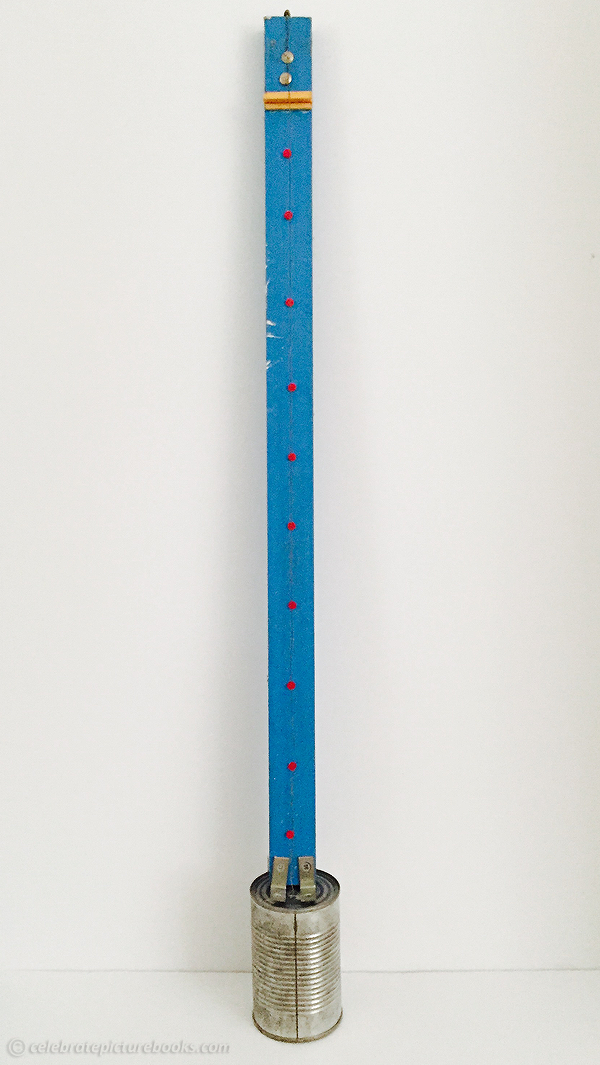
Make Your Own Musical Instrument


Inspiration for sound can come from almost any object! Look around your house or classroom and discover the music in boxes, cans, blocks of wood, plastic egg cartons or deli containers, and more. Add string or wire for plucking, sticks for drumming, or beans for shaking. With a little glue, tape, or hardware and some creativity, you’ll be making your own rhythms in no time!

Supplies for the instrument shown in the picture above

  • Tin can
  • Two small L brackets
  • Piece of wooden molding, 2 1/2 feet by 1 1/2 inches by 3/4 inches
  • Five small strips of wood to raise the wire off the neck of the instrument. I used long wooden fireplace matches cut into 1 1/2″ sections 
  • Thin wire
  • Small circular hook screw or regular screw
  • Two tacks
  • A nail, screw, or piece of wood that will fit horizontally in the mouth of the can
  • a small nail to make a hole in the can
  • Hammer
  • Strong Glue
  • Paint
  • Foam decorative dots

Directions

  1. Paint the wood and let dry
  2. Paint the small strips of wood and let dry
  3. Decorate the can with paint, sticker, duct tape, or paper
  4. With the hammer and small nail, make a hole in the center of the bottom of the can
  5. Wrap one end of the wire around the nail and glue so it is firmly in place
  6. Feed the other end of the wire through the hole in the bottom of the can
  7. Screw or glue two L brackets to one end of the wood molding so that the bottom of the L is flush with the bottom of the wood molding and there is space between the brackets. This makes the neck of the instrument
  8. Screw the circular or regular screw into the top, center of the wooden molding
  9. When the wooden strips are dry, glue three side by side 3 inches from the top of the molding. Glue two more matches, one on top of the other on the center strip.
  10. When the L brackets are dry, glue them (and the neck of the instrument) to the can, making sure the brackets are on either side of the hole in the can. Make sure the wire is out of the hole. 
  11. When the brackets are firmly attached to the can, pull the wire to the top of the neck. Settle it in the center of the small pieces of wood, so that the wire is not touching the neck.
  12. Wrap the wire around the screw at the top of the molding until it is firmly in place and the wire is taut. 
  13. Secure the wire to the neck with the tacks
  14. Mark the “frets” with the foam dots

Picture Book Review