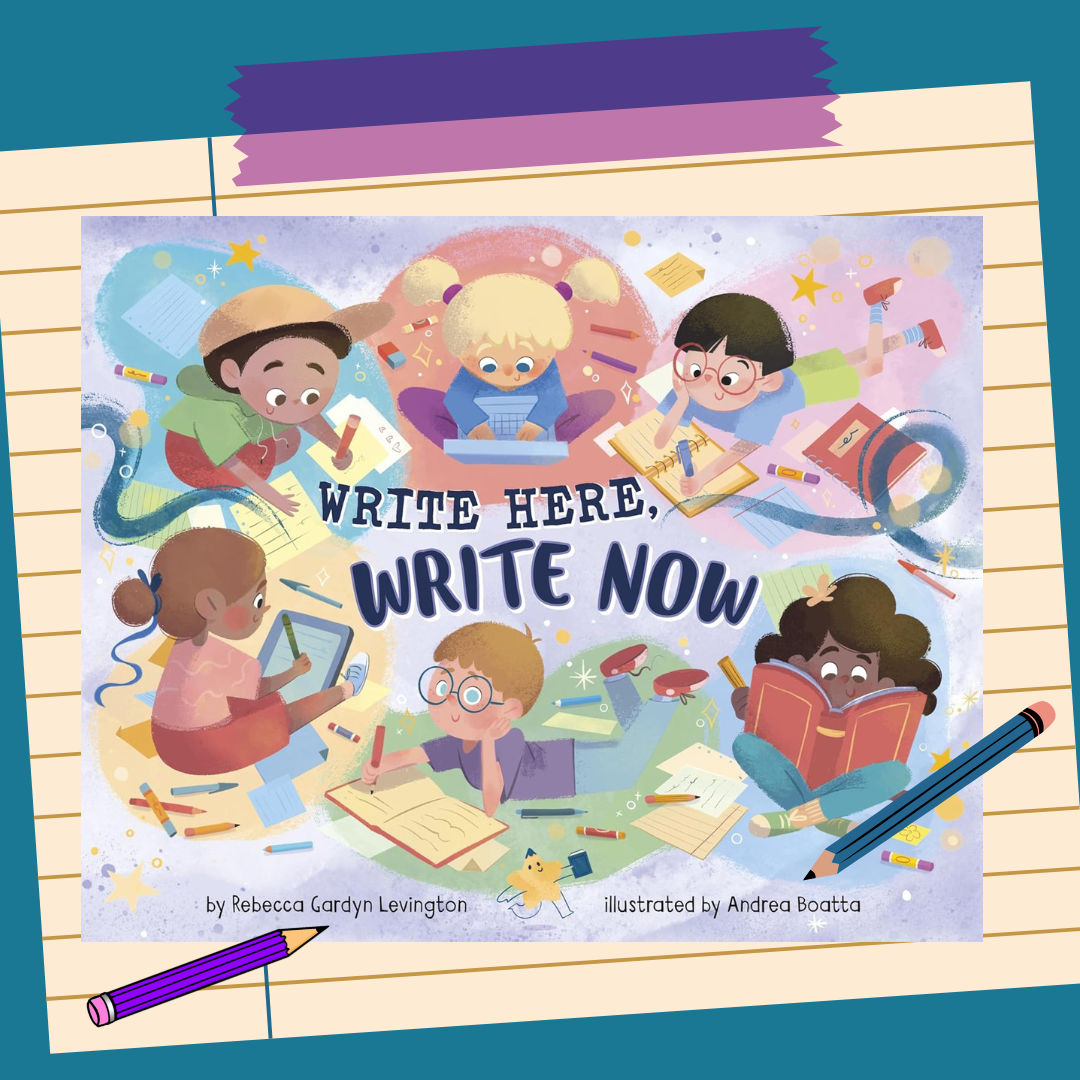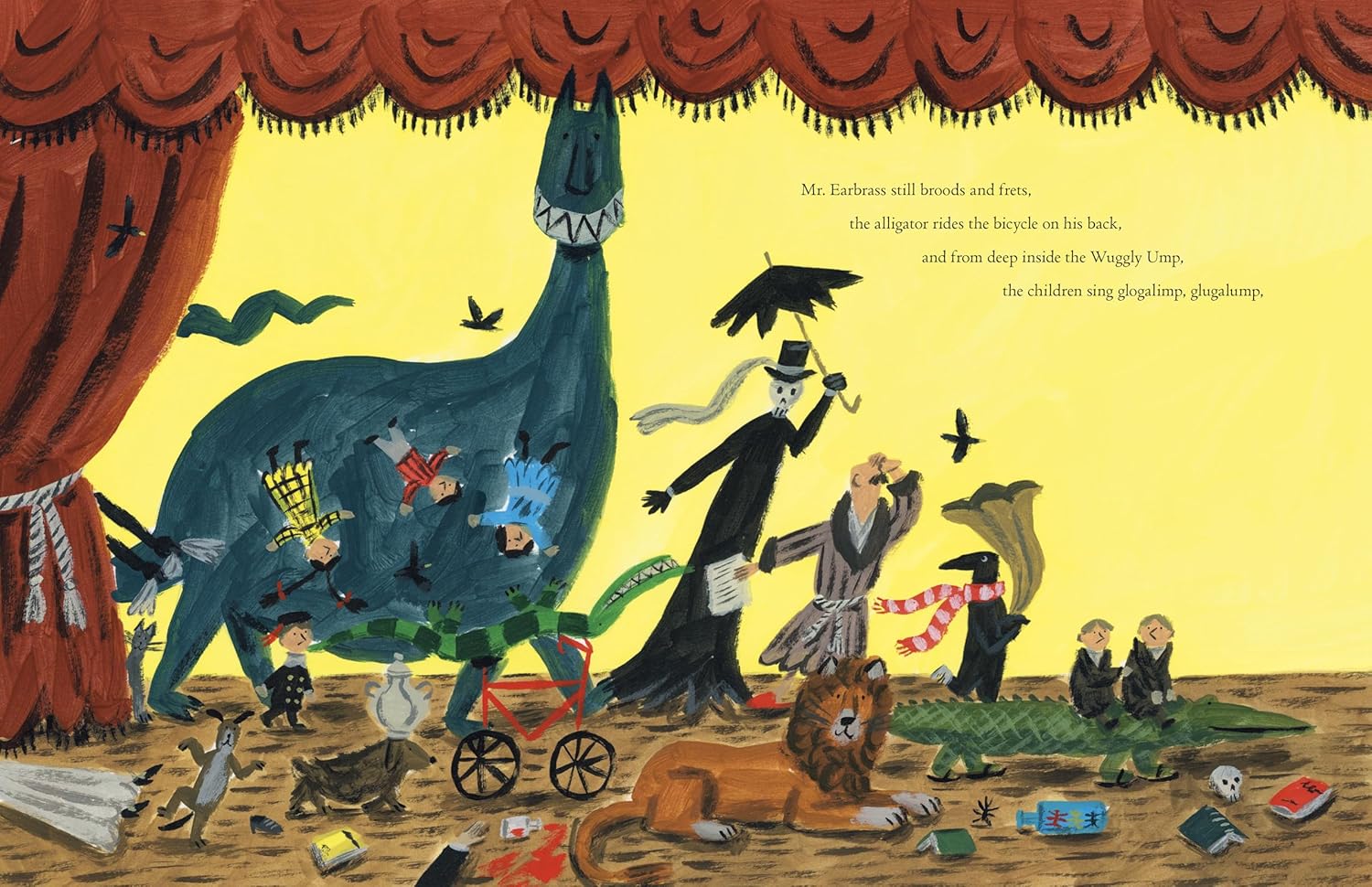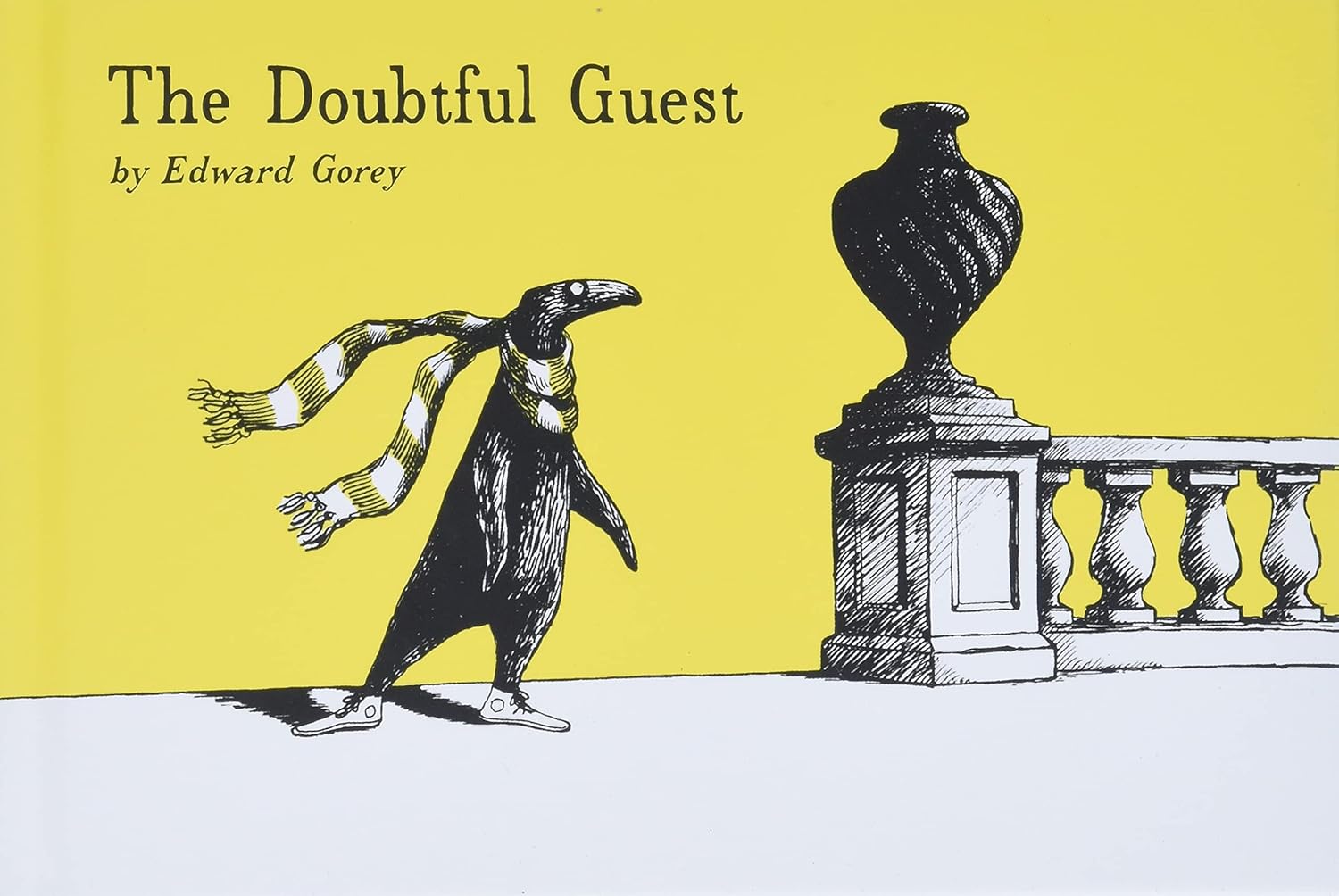
Today’s holiday was instituted in 1928 by Nellie Verne Burt McPherson, president of the Bement, Illinois Women’s Club. An avid reader, she established Author’s Day to thank writer Irving Bacheller—author of 31 novels and founder of the first modern newspaper syndicate—who sent her an autographed story in response to her fan letter. The day was officially recognized in 1949 by the United States Department of Commerce. McPherson’s granddaughter, Sue Cole, promoted the holiday after Nellie’s death in 1968. To celebrate, people are encouraged to write a note of appreciation to their favorite author.
Thank you to Knopf Books for Young Readers and Barbara Fisch of Blue Slip Press for sharing a copy of As Edward Imagined with me for review consideration. All opinions on the book are my own.
As Edward Imagined: A Story of Edward Gorey in Three Acts
Written by Matthew Burgess | Illustrated by Marc Majewski
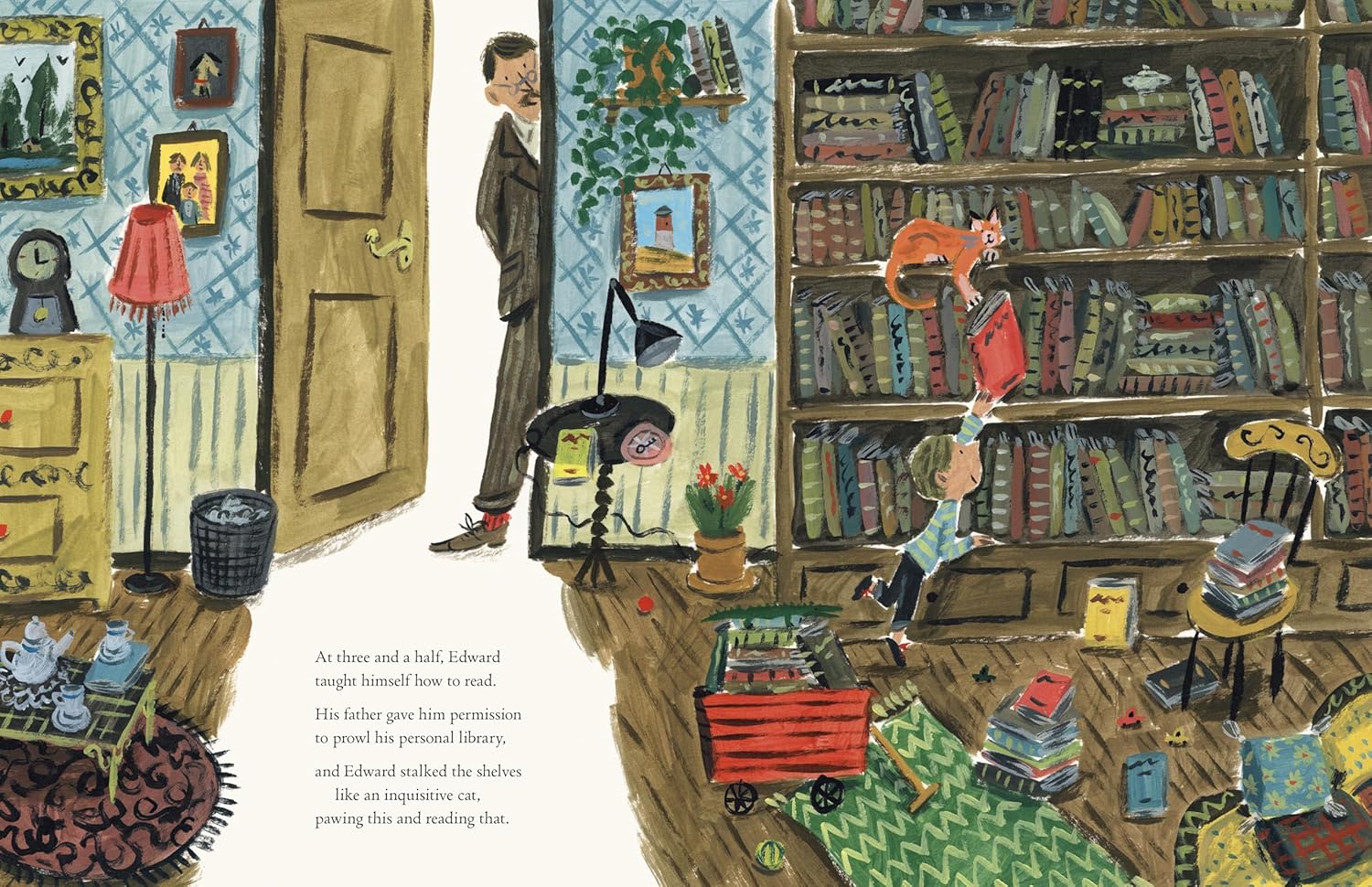
Edward Gorey’s artistic life began early—very early—and built on itself, bit-by-bit, experience-by-experience just like a play, and so it is fitting that Matthew Burgess’s biography is divided into three acts. In Act One readers meet Edward Gorey as a precocious preschooler, creating his first drawing at a year and a half and learning to read at three and a half.
As a voracious reader, he devoured books from his father’s library, including Dracula before he was six. It didn’t take long before he was writing and illustrating his own stories. One was “titled ‘Hand of Doom,’ in which a skeleton’s fingers crept from page to page.” But Edward didn’t consign his “delightfully peculiar” personality to the page, “he [dared] to live the life he imagined.”
Image copyright Marc Majewski, 2024, text copyright Matthew Burgess, 2024. Courtesy of Knopf Books for Young Readers.
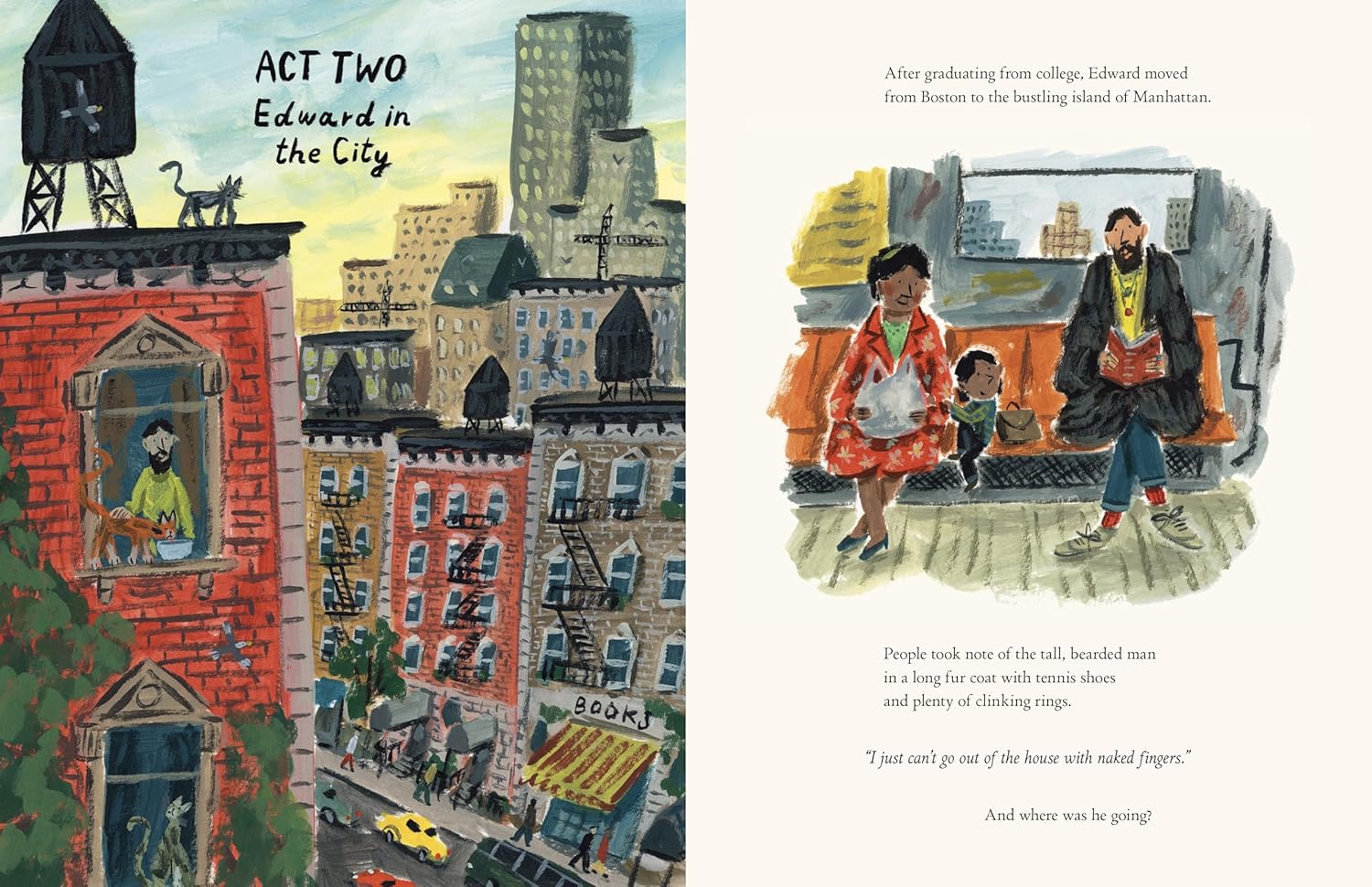
In Act Two, Edward has graduated from college and is living in New York, where he took the subway to attend nearly every performance of the New York City Ballet, dressed in his singular look: a fur coat, tennis shoes, and “plenty of clinking rings.” While working as a book illustrator, he also wrote, illustrated, and published his own stories, and little by little people began to take notice of “his stylish drawings, his outlandish poetry, and his deliciously sinister sense of humor.”
This popularity earned him an invitation to design the costumes and sets for a Broadway production of that classic he had read long ago—Dracula. The play was a smash, and Edward was nominated for Tony awards. Eschewing the limelight, however, Edward watched the ceremony and his own win from the comfort of his home and surrounded by his six beloved cats.
Image copyright Marc Majewski, 2024, text copyright Matthew Burgess, 2024. Courtesy of Knopf Books for Young Readers.
His success on Broadway brings readers to Act Three, and his purchase of an old captain’s house on Cape Cod, Massachusetts, drew, wrote, and collected. “Teddy bears, sea stones, skeletons of all sizes and shapes, and books by the thousands” became his companions and his inspirations. He also worked with local actors to bring his original plays to theaters. Here, Edward was happy living “his life precisely as he wished.” For readers today, he lives on in his one-of-a-kind characters and inimitable stories.
Back matter includes an Author’s Note, a Bibliography, a photograph of Edward Gorey and one of his cats, and a Chronology of his life that fleshes out experiences from his childhood, during which he once owned a baby alligator, to his higher education and military service to his publishing career and animations for PBS’s Mystery! series to his time living on Cape Cod.
Image copyright Marc Majewski, 2024, text copyright Matthew Burgess, 2024. Courtesy of Knopf Books for Young Readers.
Matthew Burgess’s charming storytelling highlights the quirky ingenuity of Edward Gorey’s stories, plays, and illustrations. Cleverly divided into three acts, his biography emphasizes how Edward remained true to himself throughout his life, finding jobs that complimented his skills and pastimes that fed his imagination. Inspirational and celebrating the individual, Burgess’s breezy and uplifting text will engage children and encourage them to listen to and stay true to their own unique voice.
Marc Majewski’s enchanting and atmospheric illustrations will captivate readers with their combination of realism and whimsy that give them a tour through Edward Gorey’s childhood home, New York City haunts, Dracula sets, and Cape Cod comfort. Kids and adults alike will enjoy dawdling over each page to discover the themes of and influences on Edward’s life as well as his eccentric decor and characters and, of course, to point out all the cats.
A fabulous introduction to a truly unique talent and individual, As Edward Imagined: A Story of Edward Gorey in Three Acts will not only fascinate kids but also spark their creativity and an appreciation for the happiness that comes from following their own path. The book would be an often-asked-for favorite on home bookshelves and for public libraries and offers many applications for school libraries and creative arts programs. Pair with readings of Edward Gorey’s books to acquaint young readers with his endearing characters.
Ages 4 – 8
Knopf Books for Young Readers, 2024 | ISBN 978-1984893802
About the Author
Matthew Burgess is the author of Enormous Smallness: A Story of E. E. Cummings, and The Unbudgeable Curmudgeon. He has been a poet-in-residence in New York City elementary schools through the Teachers & Writers Collaborative since 2001. His work has appeared in various magazines and journals, and he recently received an award from the Fund for Poetry. He teaches creative writing and composition at Brooklyn College and lives in Brooklyn, New York. Visit Matthew at matthewjohnburgess.com.
About the Illustrator
Marc Majewski is a French author-illustrator based in Berlin. After obtaining a degree in literature and arts, he studied illustration and painting for two years. His picture books include, Does Earth Feel?, and Butterfly Child. Visit Marc at marc-majewski.com.
National Author’s Day Activity
Watch The Doubtful Guest by Edward Gorey
To celebrate today’s holiday listen to this reading of Edward Gorey’s The Doubtful Guest, a short, eccentric and slightly eerie tale of an uninvited guest. Then check out your local library for more books by Edward Gorey.
You can purchase As Edward Imagined: A Story of Edward Gorey in Three Acts at these booksellers
How one achieves their definition of a good quality of life may differ for every person, but in general it encompasses being happy and satisfied with one’s relationships, work, living conditions, and self. Whether you find happiness and quality of life in outdoor or indoor pursuits, with others or alone, at work or at home, this month’s holiday gives you time to get in touch with your inner quiet place and reflect on changes or improvements to bring you more peace and happiness in life.
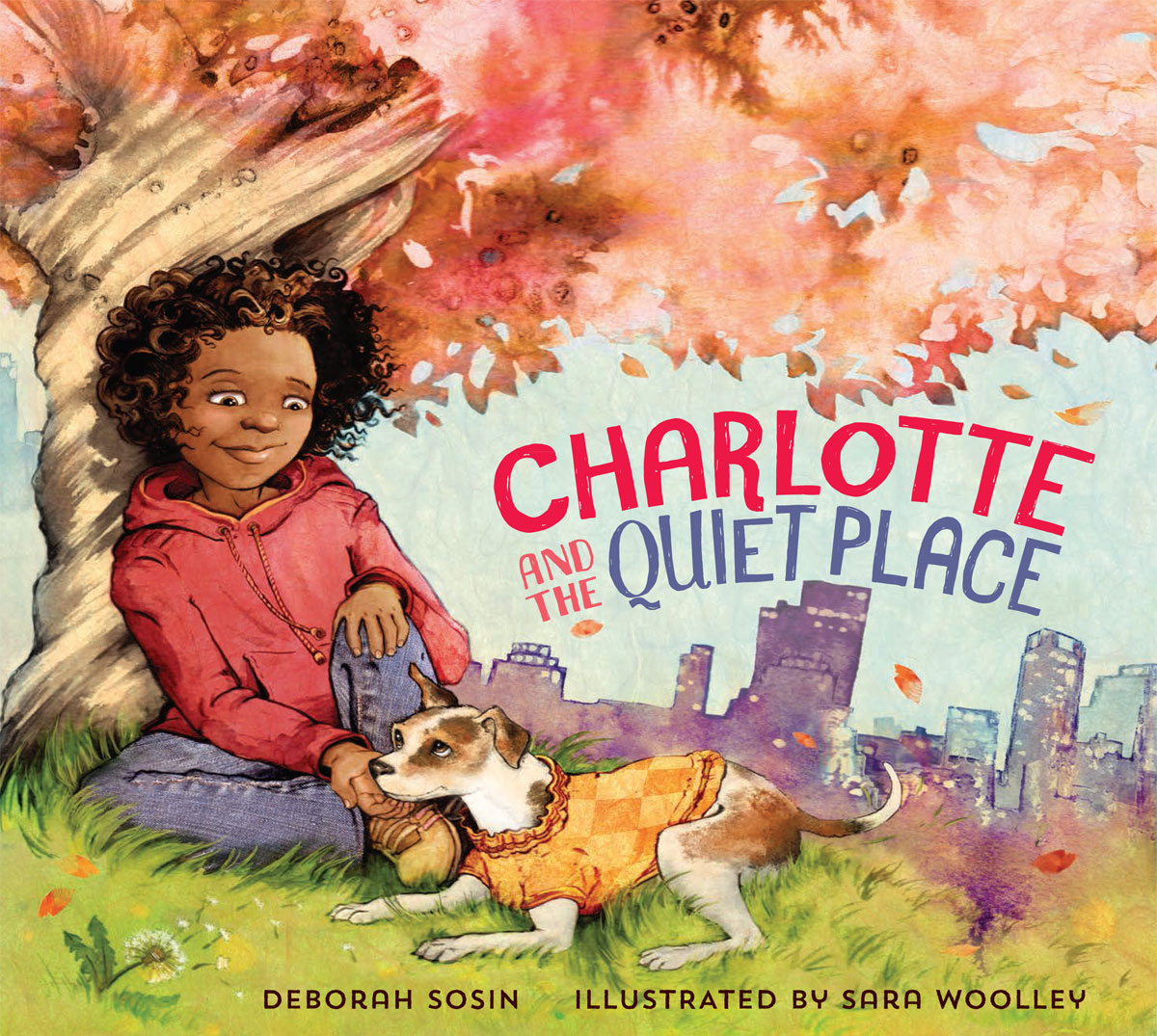
Charlotte and the Quiet Place
Written by Deborah Sosin | Illustrated by Sara Woolley
Charlotte is a girl who likes quiet who lives in a noisy world. Everywhere she goes, it seems, it’s impossible to escape from sounds that disturb her peace. At home the hallway creaks where “the floorboards groan,” the living room is like an arcade where the “TV bellows and blares,” and the kitchen is filled with Otto’s barks for his dinner. Even in Charlotte’s bedroom, “which is supposed to be a quiet place, the old steam radiator hisses, whistles, and whines. Where can Charlotte find a quiet place?”
Image copyright Sara Woolley, 2015, text copyright Deborah Sosin, 2015. Courtesy of sarawoolley.com
When Charlotte goes to school, things are no better. In the classroom kids are boisterous and bells ring; the lunchroom echoes with clattering trays and scuffing chairs; and the playground blares with big voices and stomping feet but also with the little squeaks and rattle of the swings. “Even in the library, which is supposed to be a quiet place, the children giggle, yammer, and yell. Where can Charlotte find a quiet place?”
Image copyright Sara Woolley, 2015, text copyright Deborah Sosin, 2015. Courtesy of sarawoolley.com
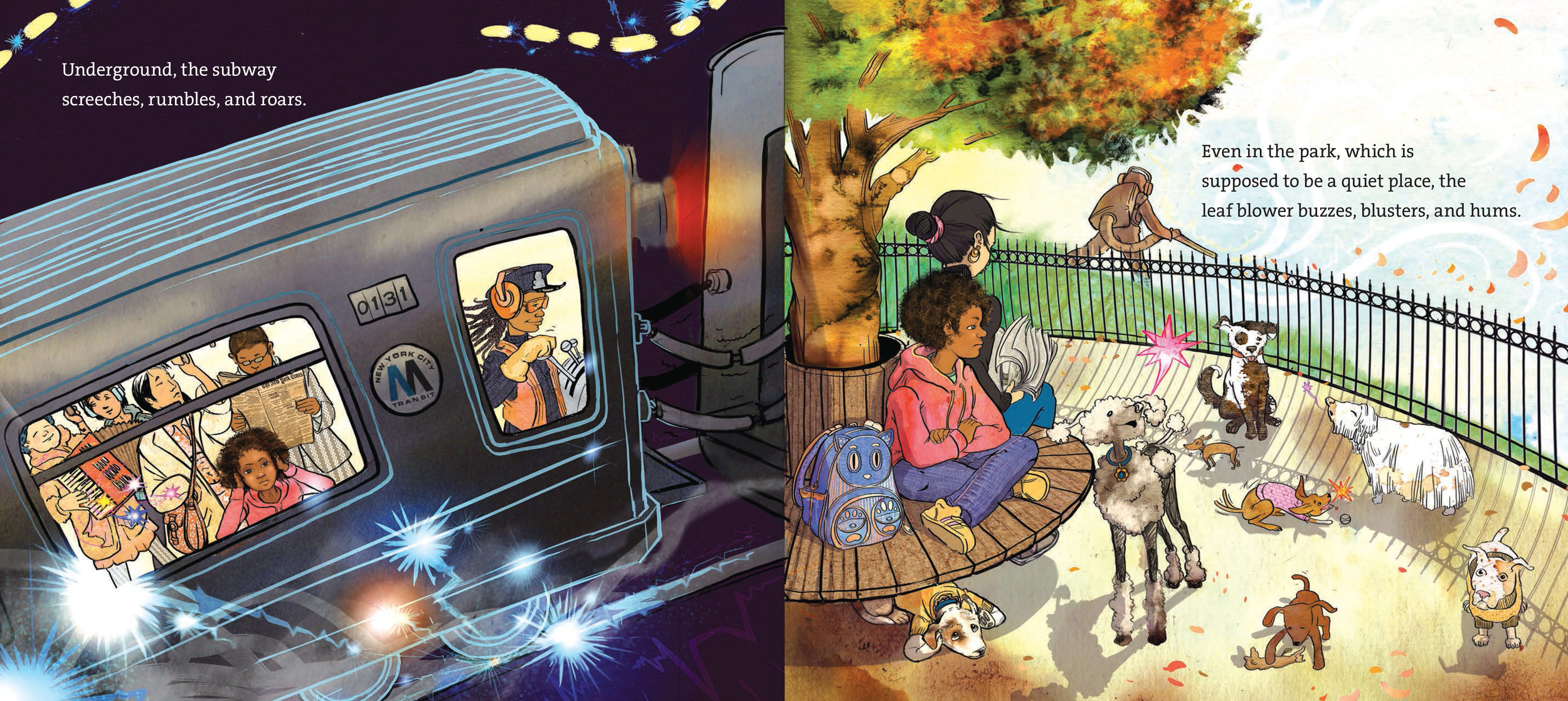
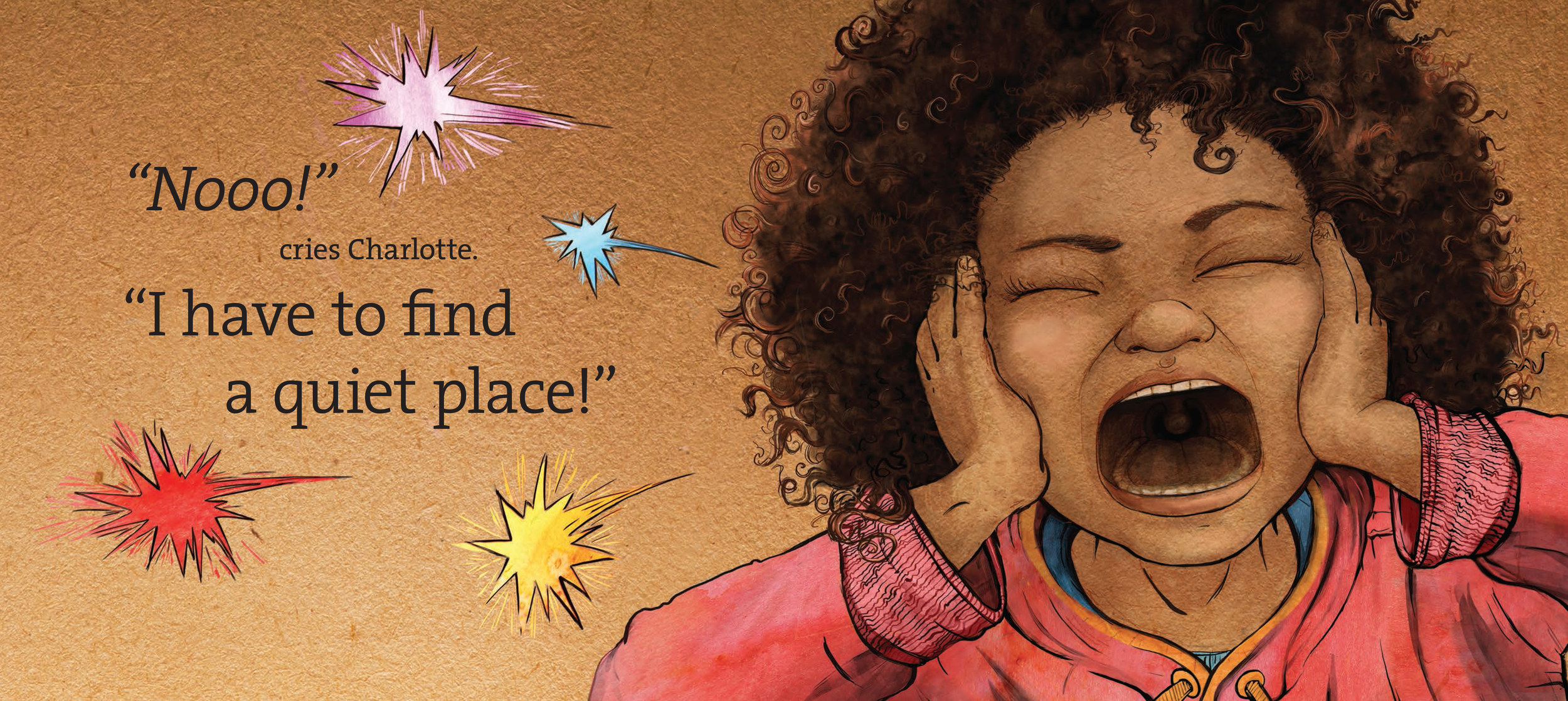
The outside world resounds with the din of jackhammers, horns, sirens, shouts, cars, music, and the “screeches, rumbles, and roars” of the subway. “Even in the park, which is supposed to be a quiet place, the leaf blower buzzes, blusters, and hums.” Charlotte puts her hands to her ears. “‘Nooo!’” she cries, “‘I have to find a quiet place!’”
Image copyright Sara Woolley 2015, text copyright Deborah Sosin, 2015. Courtesy of sarawoolley.com
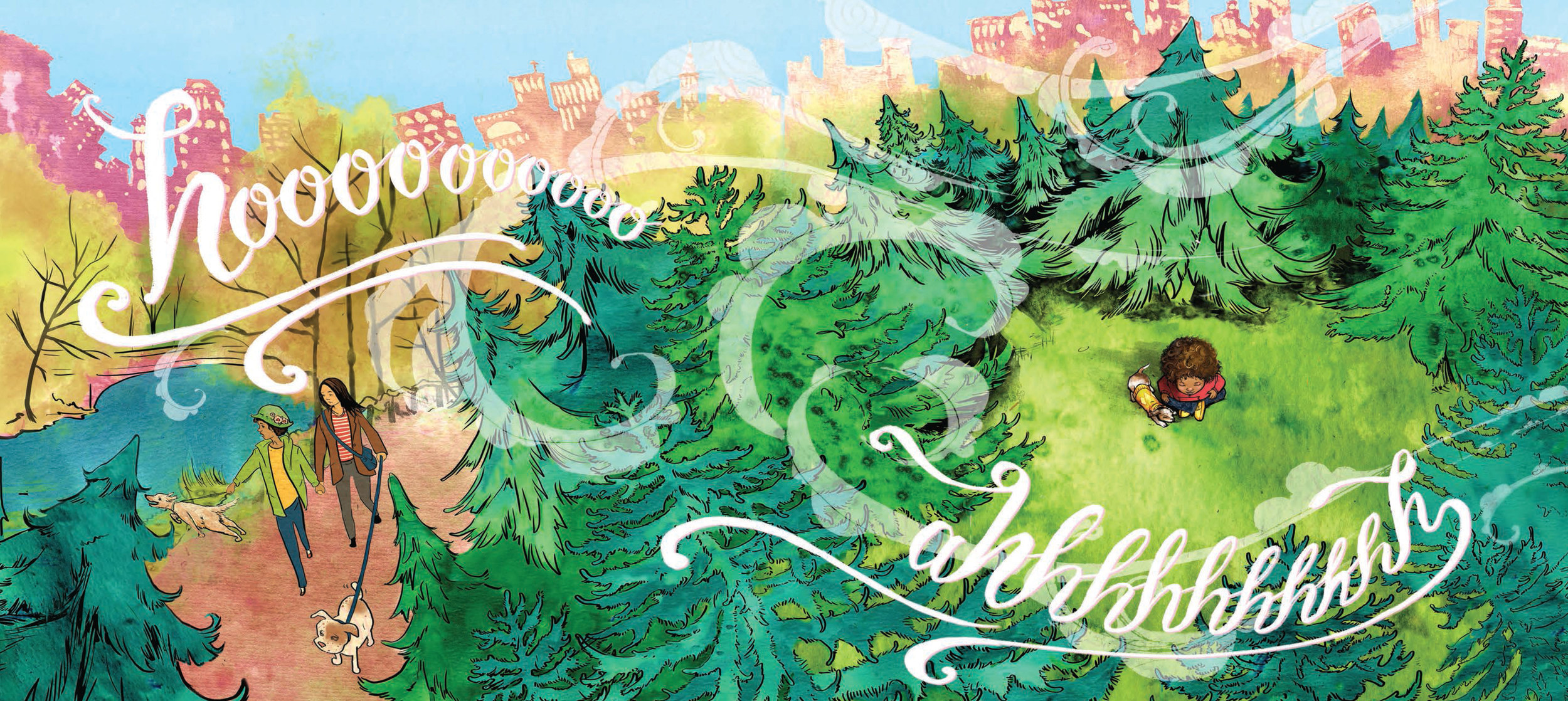
On Saturday Charlotte takes her dog for a walk in the park. Suddenly, Otto spies a squirrel and takes off running, wrenching his leash out of Charlotte’s hand. She chases after him down a hill, over a bridge, into the middle of a grove of trees. Out of breath, Charlotte and Otto sit beneath a tree. Gasping, Charlotte’s “belly rises up and down, up and down. Her breath goes in and out, in and out. Hooooo ahhhhh. Hooo ahhh.”
Slowly, Charlotte’s breath comes easier and “her mind slows down.” In this state, she discovers another, even quieter place. It is a place deep inside where her breath is soft and her “thoughts are hushed and low.” It is “a place as quiet as the small silence on the very last page of her favorite book, the silence right after ‘The End.’”
Image copyright Sara Woolley, 2015, text copyright Deborah Sosin, 2015. Courtesy of sarawoolley.com
In a little while, Charlotte and Otto leave the grove, but now whenever home or school or the neighborhood is too loud, Charlotte remembers where she can find a quiet place. She simply closes her eyes and pays attention to that place deep in her belly and deep in her mind—“that quiet place inside.”
For so many children the world is a blaring, clattering place where their thoughts are drowned out by the noises around them. Deborah Sosin’s award-winning Charlotte and the Quiet Place validates these feelings and offers children a way to discover inner peace wherever they are. As a tonic to today’s hyper-stimulated environment, kids and adults alike will benefit from the method of mindful reflection Sosin presents. Sosin’s combination of evocative verbs and repetition makes the story fresh and an excellent read-aloud while also mirroring the sounds that are a part of our everyday life.
Image copyright Sara Woolley, 2015, text copyright Deborah Sosin, 2015. Courtesy of sarawoolley.com
Sara Woolley’s beautiful watercolor illustrations vividly depict not only Charlotte’s world but the sounds that disturb her peace. Amid the fully realized home, school, and neighborhood environments, complete with realistic details kids will recognize, sharp cracks of equipment, blaring bells and whistles, high-pitched voices, and other noises spark the page. Portrayals of Charlotte, her hands over her ears and her eyes sad, express her distress in a way kids will understand. When Charlotte finds the grove of trees in which she first experiences inner peace, Woolley’s color palette turns softer, with peaceful tones of green, blue, and yellow where, previously, “louder” purples, reds, and golds predominated.
Charlotte and the Quiet Place is a very welcomed book for those times when peace seems elusive and will give comfort to children who prefer quiet places and have more introverted natures. The book would make a wonderful addition to all children’s book shelves as well as to school and public library collections.
View a gallery of artwork for books, comics, and other illustration work by Sara Woolley on her website!
Meet Deborah Sosin
Deborah Sosin is a writer, editor, and clinical social worker specializing in mindfulness-based psychotherapy. She holds an MSW from Smith College School for Social Work and an MFA from Lesley University. Debbie’s picture book, Charlotte and the Quiet Place, illustrated by Sara Woolley, was published by Parallax Press in 2015 and has won multiple awards including the 2015 INDIEFAB Book of the Year Gold Award, the 2016 Independent Publisher Book Awards Silver Medal, and the 2015 National Parenting Publications Bronze Award. Debbie’s essays and op-eds have appeared in the New York Times, Boston Globe Magazine, Salon, Cognoscenti, Brevity Blog, The Writer’s Chronicle, Journal News, Writer’s Digest, Zone 3 Literary Journal, JMWW Journal, The Manifest-Station, and elsewhere. Her essays also appear in the anthologies Chicken Soup for the Soul: The Cat Did What? and The Apollo 11 Moon Landing (Perspectives on Modern World History). (Photo by Kevin Day Photography)
Hi Debbie! I’m really thrilled to have you join me today to talk about your work. In your career you write for adults and children, work within the publishing industry, provide publicity services, and teach. How did you get started? Did you always want to write?
I kept a diary starting at around age ten and always loved writing for school or for fun. I started getting more serious about writing for publication in the past ten years, studied at GrubStreet, attended the Kenyon Review Writers Workshop, and eventually went back to school to get an MFA in Creative Writing. I wish I had started earlier, but it’s been rewarding to finally follow my true passion.
What influenced you to write Charlotte and the Quiet Place?
I wrote the book as an independent project as part of my MFA studies at Lesley University. They say “write what you know,” so I thought about my childhood growing up in kind of a noisy house, where my brother played the piano, my father had a radio and TV on simultaneously, and my mother was on the phone a lot. And then I thought about my longtime meditation practice and how tuning in to my breathing has helped me find a quiet place inside. So I wanted to write a story about children finding their own quiet place inside themselves.
You give school presentations on mindfulness and your picture book Charlotte and the Quiet Place for various ages. Is there an experience from any of these that you would like to share?
School visits are my favorite part of being an author! No matter what age the students are, they love to help me tell the story by repeating the “noisy” sounds and the “hoo ahh” breathing sounds. We usually do a few calming/breathing exercises together and, without fail, even the squirmiest group will settle into a beautiful, shared, often profound silence. Once, when asked where Charlotte finds her quiet place, one kindergarten girl said, “In her belly and in her brain, where it’s calm.” Many kids get that idea. What could be better? I also love showing them my early scribbles and illustrator Sara Woolley’s wonderful sketches and storyboards, and sharing the step-by-step process of publishing the book, from concept to completion.
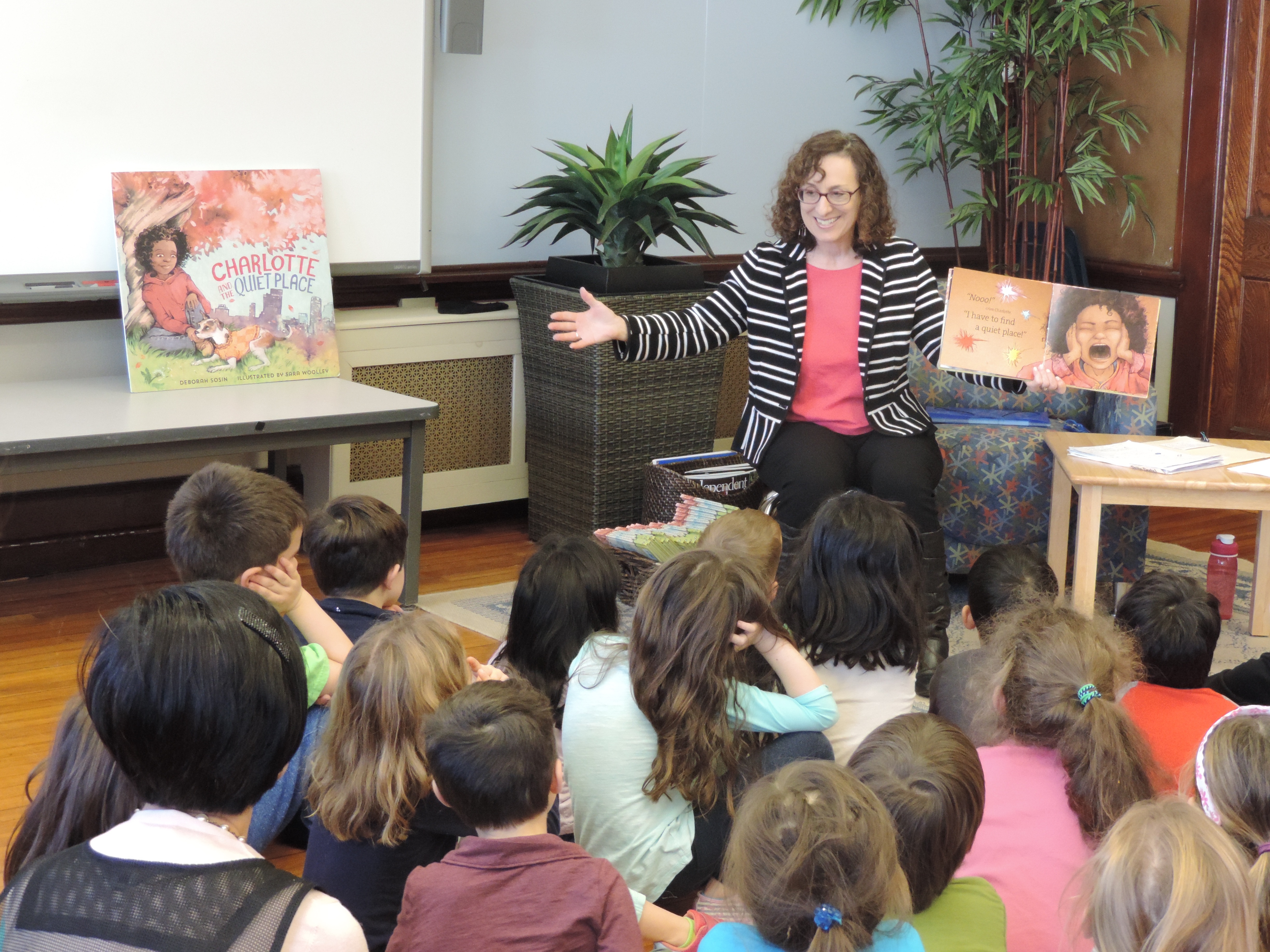
Deborah Sosin reads Charlotte and the Quiet Place to students at Newton Montessori School. Photo courtesy of Newton Montessori School.
Can you talk a little about mindfulness and how it can benefit children?
Mindfulness has become a catchword these days, but my favorite definition is from Dr. Amy Saltzman: “Noticing what’s happening right here and now, with a friendly, curious attitude, then choosing what to do next.” Many top-notch scientific studies show that mindfulness can help kids with concentration, attention, self-soothing, anxiety, depression, sleep, mood, compassion, confidence…I could go on. Compared with adults, most kids are naturally mindful, that is “in the moment,” but kids do get stressed out and worried about the past or the future, so mindfulness helps. I sometimes worry that parents and teachers might use it for disciplinary reasons (“Enough! Go be mindful in the corner!”), which is not the point. It’s a whole-life practice, not a technique or intervention. And, as the book shows, mindfulness can lead us to a quiet place inside that we can access whenever we want.
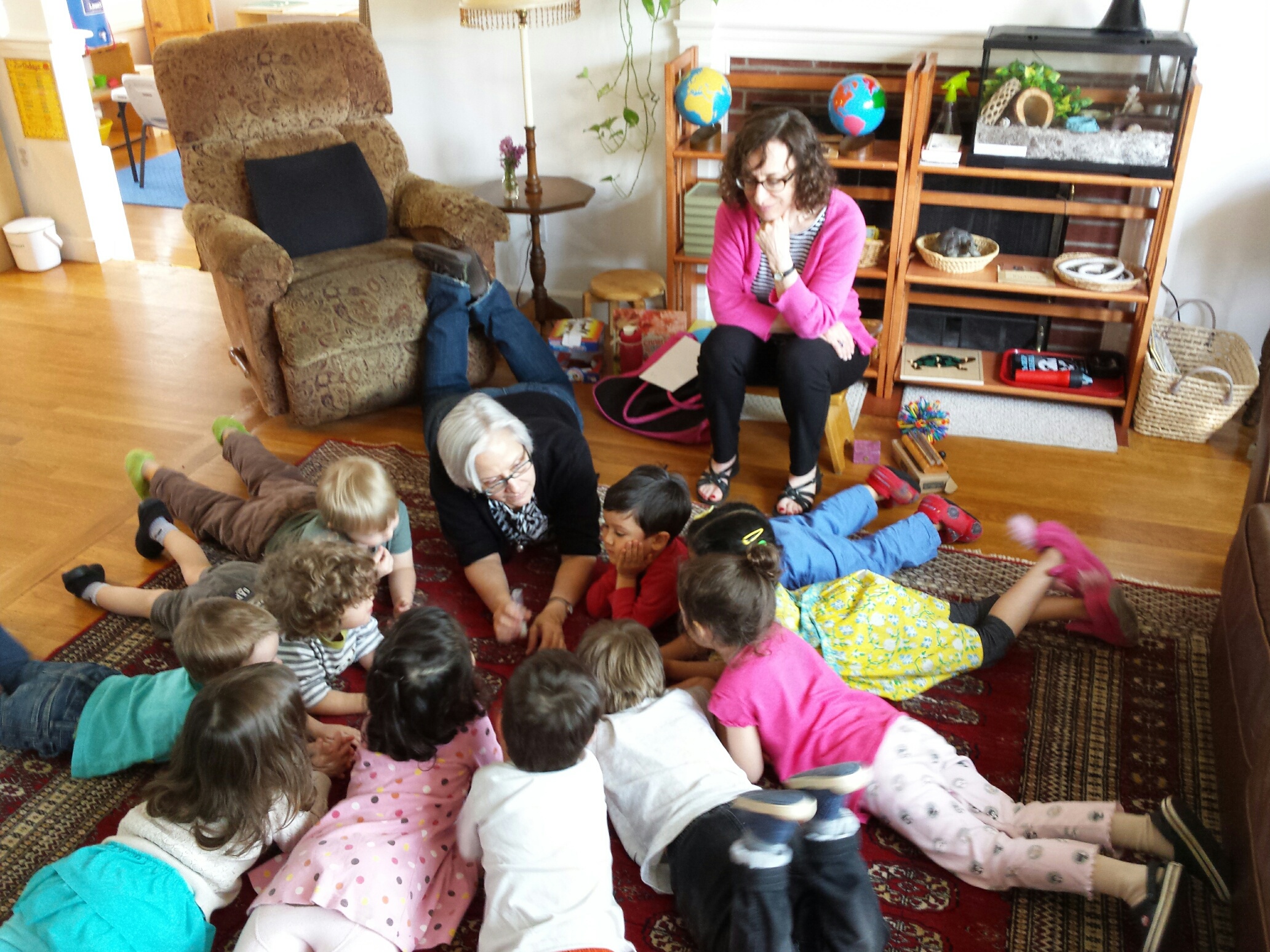
Students at the Cottage Montessori School in Arlington, Massachusetts play the Silence Game with director Karen Wagner, watching the sand in the hourglass. Photo courtesy of Stacey Moriarty.
Can you tell me a little about your work with Grub Street, a creative writing center in Boston?
I started taking classes at GrubStreet in 2008; my first class was “Six Weeks, Six Essays,” and from that class, I helped form a longtime regular writing group. I started blogging soon after and then submitted personal essays for publication, with some good luck. GrubStreet is a fantastic, inclusive community, with excellent faculty and a huge range of motivated, smart, and enthusiastic students, from beginners to veterans. After a few years, I applied to teach classes there and am proud to be on their instructor and consultant rosters now.
You are an accomplished choral singer, having performed at Lincoln Center, the United Nations, Boston’s Symphony Hall, and on an international tour. When did you begin choral singing? Do you have an anecdote you’d like to share from any of your experiences?
I’ve been singing my whole life and have been in choruses since elementary school. Singing with other people is extremely gratifying and, after all the “verbal”-type things I do, including my work as a psychotherapist, it’s a lovely change of pace. I spent about 15 years in the Zamir Chorale of Boston, which specializes in Jewish choral music. Our tours to Eastern Europe, Italy, and Israel were extraordinary. In 1999, when we sang at Auschwitz and Terezin, the sites of former concentration camps, it was hard to keep our emotions in check, but it felt important to revive the voices of the Jewish people that the Nazis had attempted to quell. A PBS documentary film, “Zamir: Jewish Voices Return to Poland,” chronicled our tour that summer. I think it’s still available through the Zamir Chorale website.
What’s the best part about writing for children?
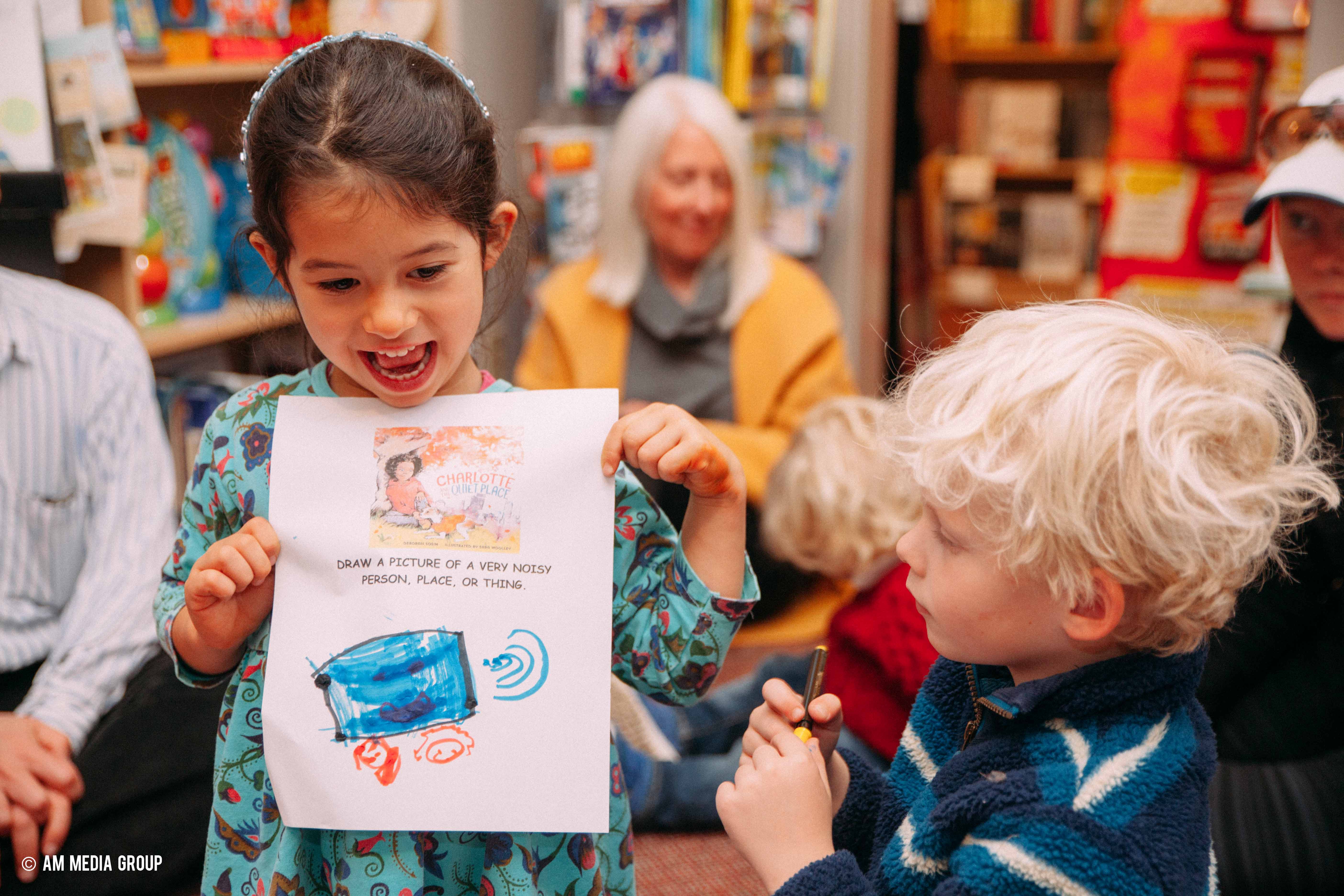
Children enjoy drawing their noisy and quiet places at an Oblong Bookstore event in NY. Photo courtesy of AM Media Group
After having focused almost exclusively on nonfiction for most of my writing career, it’s been wonderful to work in the very precise and rich world of picture-book writing with so many lovely, funny, imaginative, and supportive fellow writers I’ve met through SCBWI and the amazing Writers’ Loft in Sherborn, Mass.
Thanks, Debbie, for stopping by and chatting! I wish you all the best with Charlotte and the Quiet Place and all of your future endeavors!
International Quality of Life Activity
Share a Smile Cards
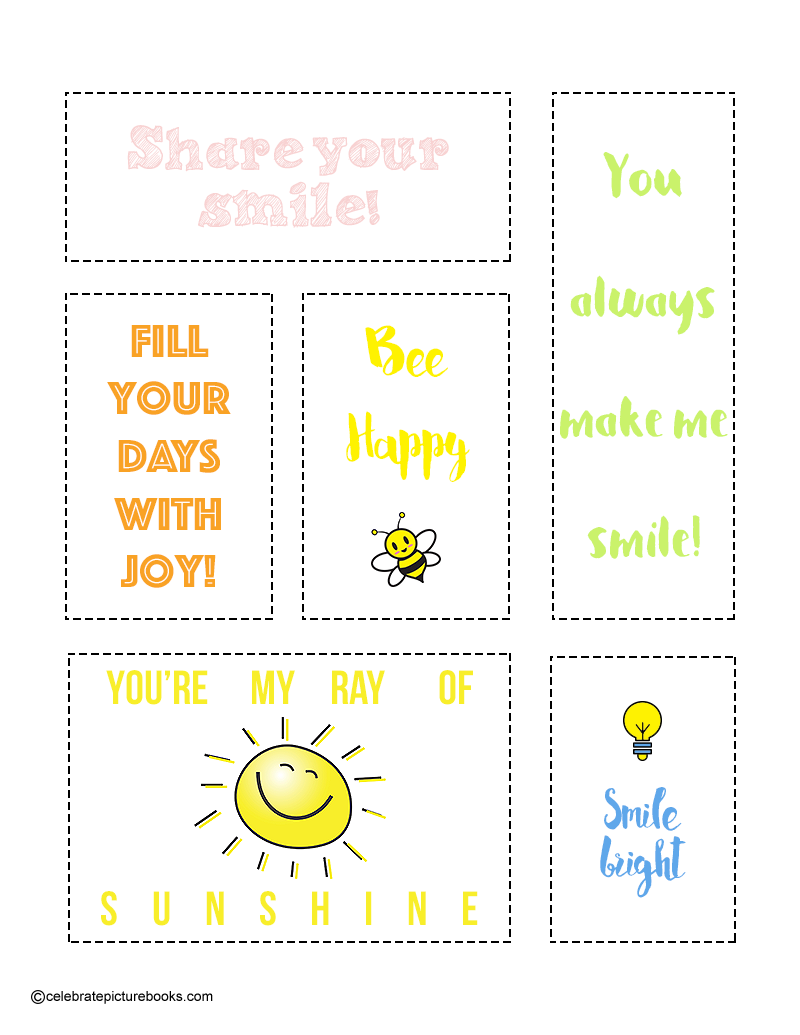
Life is better when you share smiles with those you know—and those you don’t! Try it! When you’re out today at school or other places, look someone in the eye and smile. You’ll probably get a smile back—and you can be sure that you will have made the other person’s and your day better!
Here are some Smile Cards that you can share. Why not slip one into your dad’s pocket or your mom’s purse, put one in your friend’s backpack, or sneak one onto your teacher’s desk? You can even leave one somewhere for a stranger to find! Have fun sharing your smiles, and see how much better you and the others around you feel!
Thanks to Hippo Park Books and Deborah Sloan for sending me a copy of Herbert on the Slide for review consideration. All opinions about the book are my own.
Herbert on the Slide (A Hippo Park Pals Book)
By Rilla Alexander
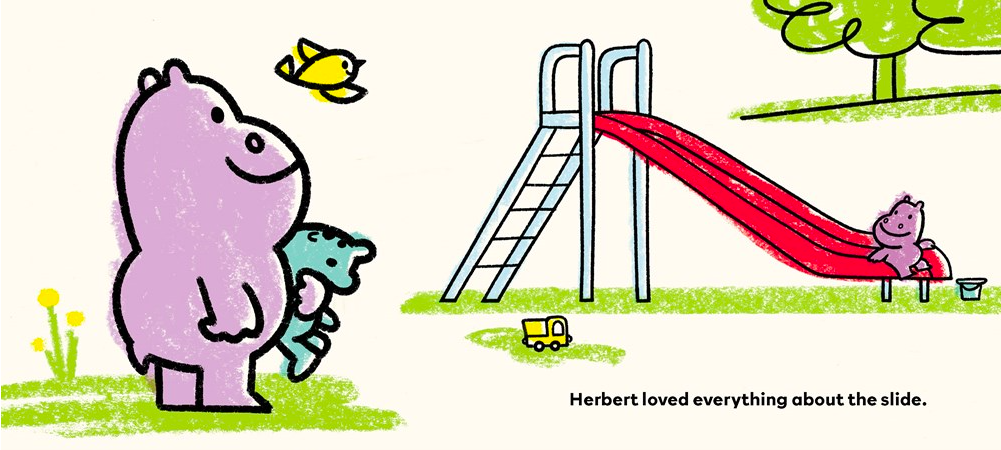
“Herbert loved everything about the slide.” Rilla Alexander’s first sentence speaks directly to the hearts of little ones who fully understand its simple, lovely truth. As Herbert climbs to the top, his teddy bear and truck in tow; settles in on his high perch; launches his “test run” with first Teddy and then truck—”clanky-clank-clank”—and finally counts down to his turn, kids will follow along, entranced by Herbert’s adventure and memories of their own.
Copyright Rilla Alexander, 2022, courtesy of Hippo Park.
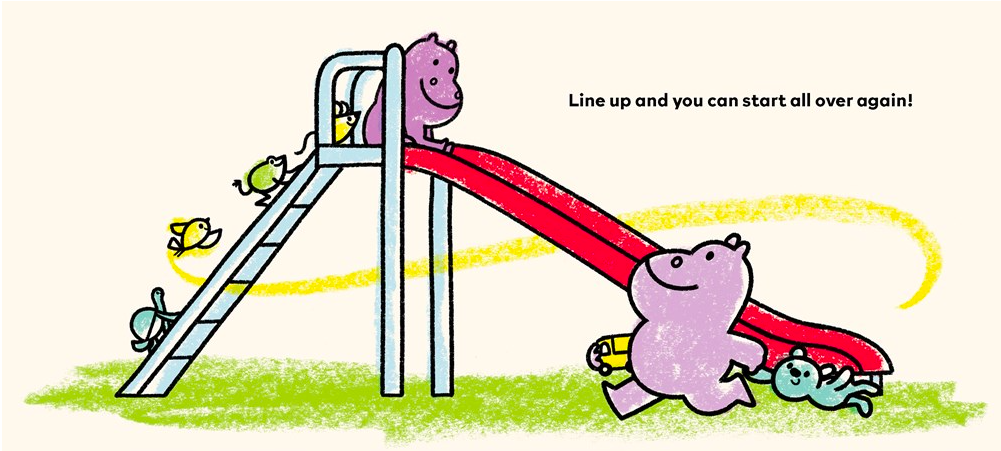
Of course, a slide is never just a slide, and Herbert goes “…again! And again! … sliding down, down, down…into his imagination!” One time, on his belly, “Herbert and Teddy are diving into a deep, purple sea!” Next time, “Herbert is a truck climbing up, up, up a mountain. Chug-chug-chug!” But Herbert isn’t the only one at the playground. His little sister is ready for her turn—and so is mouse and frog and turtle. There’s just one thing to do. “Line up and you can start all over again!”
Copyright Rilla Alexander, 2022, courtesy of Hippo Park.
Rilla Alexandra’s endearing story for little ones, matched page-by-page by her adorable, “awww”-inspiring art is snuggle-up story time reading at its best. Perfectly reflective of a child’s playfulness and imagination, Herbert on the Slide is not only a story that will captivate them time and time again but a wonderful entry into the world of literature.
A subtle subplot involves Herbert’s younger sister, Fiona (soon to be the star of her own Hippo Park Pals book, Fiona in the Sandbox, coming February 7, 2023). She is at first unidentified and only seen in the distance, heading to the sandbox with her pail, a detail sure to pique kids’ interest. She’s later heard telling Herbert—who, mesmerized by an imagined chase and its successful conclusion, is resting on the bottom of the slide—that it’s her turn. Turning the page, kids see that she’s sitting atop the slide with a line of other wanna-be sliders waiting behind her. Alexander’s encouragement for Herbert to get in line and start again is a gentle and reassuring life lesson.
Sweet smiles and a sunny ambiance welcome readers on every clean, slide-focused page. Each scene is colored with the texture of crayons in bright shades and with the “messy” enthusiasm of children’s art.
A Special Note: The book’s small size (5 1/4-inches by 4 3/4-inches) makes it a perfect take-along, easily slipped into a backpack, diaper bag, or even a pocket for picnics, snack time, or just reading-time fun at the playground, park, beach, farmers market, or anywhere waiting may be required.
Cute as a button and perfectly reflecting the excitement and imagination of children’s free play, Herbert on the Slide is a must for any baby’s or preschooler’s home bookshelf as well as for school and public library collections. The book would be a favorite story time read aloud for daycare, preschool, and kindergarten classrooms as well as for public libraries’ preschool programs. It would also make a much-loved gift for baby showers, new siblings, birthdays, and the holidays.
Ages 2 – 5
Hippo Park Books, 2022 | ISBN 978-1662640117
Discover more about Rilla Alexander, her books, and her art on her website.
Herbert on the Slide Book Birthday Activity
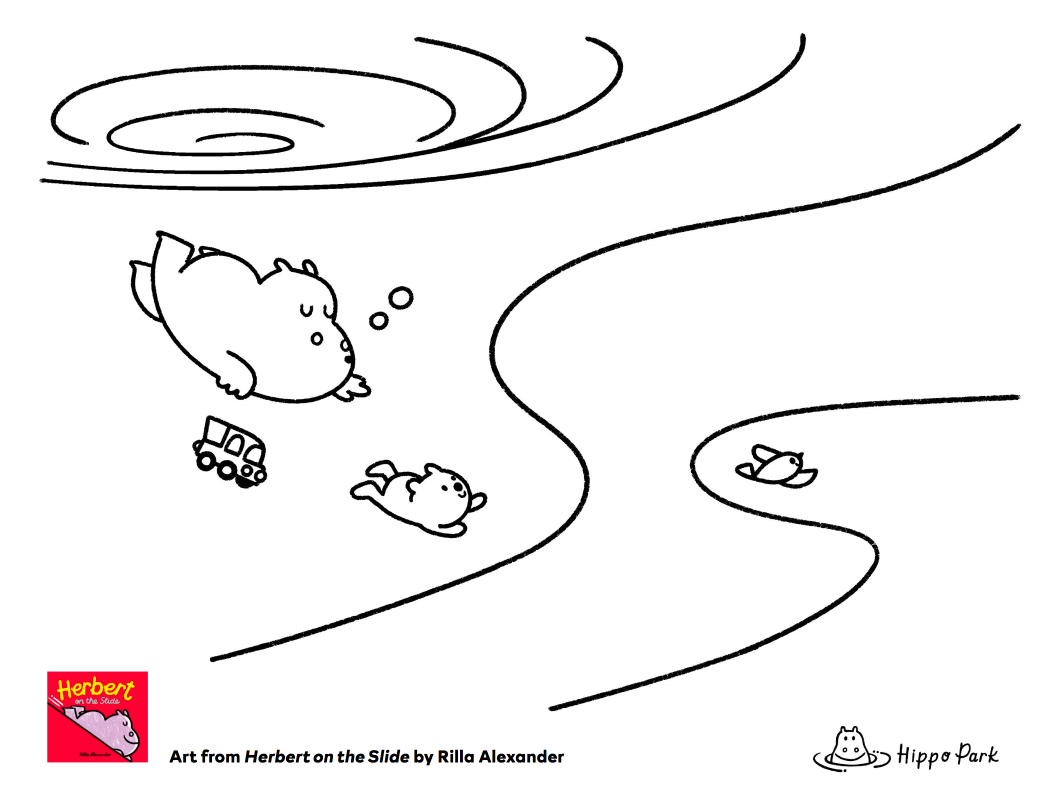
Herbert on the Slide Coloring Pages
You can find three fun coloring pages from Herbert on the Slide to print on the Hippo Park homepage at Astra Publishing House or here.
You can find Herbert on the Slide at these booksellers
Today, I’m celebrating the book birthday of Come On In: There’s a Party in this Book! with two holidays – Read a New Book Month and Friendship Month. I also have amazing interviews with author Jamie Michalak and illustrator Sabine Timm that really dive into the creation of this unique book. So, come on in!
Thanks go to Hippo Park and Deborah Sloan for sharing a copy of Come On In: There’s a Party in this Book! with me for review consideration. All opinions on the book are my own.

Come On In: There’s a Party in this Book!
Written by Jamie Michalak | Illustrated by Sabine Timm
Kids first meet the sweet lemon (yes, an adorably sweet lemon) at the center of this story peeking out from a cutout in the cover. The narrator, having revealed that “there’ a party in this book,” now invites Lemon to find it: “Come on, Lemon! Let’s go look.” So, a little uncertainly, Lemon knocks at a red door with a mouse door knocker. Once inside, Lemon, readers, and the narrator meet a jaunty cast of characters—suspender shorts atop three pillows, a paint-tube mouse on a bed, a curious sock on the top of a bunkbed, and a little pink-and-green house on more pillows.
image copyright Sabine Timm, 2022, text copyright Jamie Malachek, 2022. Courtesy of Hippo Park.
The scene sets Lemon and crew wondering… “Is this a mouse party? A pants, sock, and house party?” And the answer? “No! This is a game where we can’t touch the floor.” Ah! So the narrator says, “Lemon, keep looking. Try the next door.” Lemon tries another house, but there’s no party there either—just some fashionable cats and fruit.
image copyright Sabine Timm, 2022, text copyright Jamie Malachek, 2022. Courtesy of Hippo Park.
Hmmm… Lemon is getting a little discouraged. But the narrator gives Lemon a nudge, saying “This book is not done.” Although Lemon meets a group of friends at the beach, they’re not partying, just hanging out together. Lemon meets some pigeons and enters a kitchen, where a bear, a bunny, and a little toast dog made of bread are baking up treats. But there’s no party! Finally, “…Lemon’s back home. Does the book end right here, with her sad and alone?”
image copyright Sabine Timm, 2022, text copyright Jamie Malachek, 2022. Courtesy of Hippo Park.
But then Lemon has an idea! An idea that needs readers’ help to succeed! Lemon (and readers) are going to host the party for everyone they’ve met! There’s going to be cake and candy, decorations and games. “This is a big and a small, / have a ball party. / Hooray for new friends at the / come one and all party!” And what about readers? Everyone shouts, “Come on in!”
image copyright Sabine Timm, 2022, text copyright Jamie Malachek, 2022. Courtesy of Hippo Park.
Kids can’t help but get excited about joining Lemon in searching for the party promised on the cover. Jamie Michalak’s enthusiastic, inclusive storytelling speaks directly to them from the very first words as she exclaims “What?! There’s a party in this book?” As Lemon goes from door to door and page to page, readers follow, carried along on Michalak’s buoyant rhythm and rhymes that surprise—coming at the ends of lines but also sometimes in the middle, which keeps each page fresh and fun.
When Lemon returns home after not finding the party and hits upon the idea of being the one to host it, the promise that “there’s a party inside” is fulfilled in an unexpected way. An interactive page gets readers involved in the party preparations and will make them feel both included and empowered to invite others to their own party—or just to make new friends.
Sabine Timm’s illustrations, created with found objects, burst with childlike imagination and endearing personalities. Each page is a showstopper that kids and adults will want to explore together to soak up all the details. And you don’t have to stop there! Each character—from Lemon to the yarn cat and clothespin rabbit to the paintbrush dog and soccer-loving log boy (see Sabine’s answer to question 2 in her interview below)—offers up an opportunity for readers to have fun creating their backstories, imagining what they’re doing when Lemon first encounters them, and guessing what their favorite part of the party is. But wait! The party isn’t over yet! The front and back endpapers, full of tiny objects from the story, give families a super search-and-find game to do together.
Full of humor, whimsy, imagination, and the joys of inclusive friendship. Come On In: There’s a Party in this Book! will quickly become a family favorite to read again and again. The book would make a terrific gift and one you’ll want in your home, school, or public library collection.
Ages 4 – 8
Hippo Park, 2022 | ISBN 978-1662640001
Meet Jamie Michalak
Jamie Michalak is a children’s book writer, who loves toast, dogs, and toast shaped like dogs. She is the author of Come On In: There’s a Party in this Book! illustrated by Sabine Timm. Jamie’s other titles include the multiple starred reviewed Niki Nakayama: A Chef’s Tale in 13 Bites, co-written with Debbi Michiko Florence and illustrated by Yuko Kato-Jones; Dakota Crumb: Tiny Treasure Hunter, illustrated by Kelly Murphy; the Frank and Bean early reader series, illustrated by Bob Kolar, and the Joe and Sparky early readers series, illustrated by Frank Remkiewicz. She lives with her family in Rhode Island.
This story feels so fresh—whimsical, comical, and surprising. I’d love to have you talk about how your story came to be and your writing process for it.
Thank you! Long ago, I jotted down the title and idea for this story—an interactive picture book with a different party on every page that the reader was invited to join. But I never wrote it. Several years later, my agent, Victoria Wells Arms, told me that editor Jill Davis was looking for a manuscript for artist Sabine Timm. So I checked out Sabine’s irresistible art on Instagram.
I instantly fell in love with her characters and wanted to write a story that included as many of them as possible. That’s when my old idea for COME ON IN; THERE’S A PARTY IN THIS BOOK! came to mind. I wrote the story and threw a party for Sabine’s characters—cats wearing boots and fruits dressed in suits, pigeons named Fred, and dogs made of bread. As it turns out, this party was just waiting for the right guests to get it started!
The idea of anthropomorphizing everyday objects is so interesting, especially as it’s a practice universal to adults and kids. As a storyteller, do you think this is just part of human nature or do we learn it in childhood?
That’s a fascinating question! I’m not sure. But I do love how children and children book creators are always turning inanimate objects into characters. A hot dog and baked bean can be new friends who form a band called The Chili Dogs. Or the salt and pepper shakers might face off in a talent competition before dinner arrives. Life is more interesting when you use your imagination.
The story lends itself so well to the “search and find” fun of Sabine’s illustrations. Was this also part of your intention as you crafted the story?
It wasn’t, but you’re right! I discovered all of the seek-and-find elements, just like readers will, when I first saw Sabine’s illustrations. There are so many whimsical details that I spot new ones with every read.
Every page is so creatively put together, but do you have a favorite spread in the book?
The cats wearing boots spread is one of my favorites from any picture book ever. How did Sabine create a cat from a small ball of yarn and sassy plastic doll boots? I mean … the BEST!
What would you like kids to take away from the story?
Everyone is invited to this book’s party—and that’s what makes the last spreads, starring all of the characters, the most joyful of all. I hope that readers take away that parties are more fun when no one is left out.
Do you have any special events or other marketing planned that you’d like to tell readers about?
Here’s a video “Welcome to Sabine Timm’s Studio” that introduces readers to Sabine Timm and Lemon. Then Sabine gives a tutorial on how they can make a character of their own. a link to a video “Welcome to Sabine Timm’s Studio – the illustrator of COME ON IN.”
And here’s a short bit of animation showing closeups of the objects that make up the book cover.
I’m excited about several books coming out next year. The first is a picture book about a tiny treasure hunt set in a Parisian bookshop: DAKOTA CRUMB AND THE SECRET BOOKSHOP illustrated by Kelly Murphy (Candlewick Press). It’s the follow-up to DAKOTA CRUMB: TINY TREASURE HUNTER about an Indiana Jones-ish mouse. The third Frank and Bean early reader, FRANK AND BEAN: THE STINKY FEET MONSTER, illustrated by Bob Kolar (Candlewick Press), is a hilarious take on Bigfoot. And two Chicken Soup for the Soul for Kids books—THE SUNSHINE GARDEN, illustrated by Jenna Nahyun Chung, and PLAYDATE (WITH BEAR TOO?), illustrated by Katie Mazeika—will be released from Charlesbridge.
Thanks, Jamie, for taking time to chat with me todat! Finding new book of yours is always a reason to celebrate!
Meet Sabine Timm
Sabine Timm calls herself an artist, creator, beach-trash collector, flea-market lover, and photographer. She draws, paints, assembles and shares her work nonstop on Instagram. She lives in Dusseldorf Germany, but has fans from around the globe.
Hi Sabine! I’m so thrilled to have a chance to talk with you about your incredible illustrations! As your 168K Instagram followers would, I’m sure, agree, your adorable creations are not only awe-inspiring but always bring a smile.Can you tell readers how you got started doing this kind of art?
It’s hard to say when I started making art like this. I always had a big interest in playing with found objects. When I was a child, I collected various things from nature. Shreds, sticks, seeds, buttons I’ve found on the streets etc.
I always loved the fairytales of Hans Christian Andersen and I was very much inspired by the hidden life of things in his stories. Many years later when I became a mother myself we had holidays at the sea and me and my son made a beach walk. We found a lot of funny things…a broken flip-flop, a red-checked French-fries bag, sandblasted wood sticks, small rope pieces, bottle caps, shells, feathers, and stuff like this.
Together we started playing, and we made characters from this found trash. We transformed trash to treasures…through our eyes and visions the things got a second life. I was deeply fascinated by these experiences, and I continued in arranging and photographing characters like this.
Image courtesy of Sabine Timm
When you look at an object, do you immediately see its potential to become something else? I’m thinking of the sofa you made from crackers that appeared on your Instagram page recently.
When I work with found or everyday objects there two options. Sometimes the objects themselves are attractive (colour, shape, size) and while looking at these things I get an inspiration. For example, the Swedish bread that became an upholstered sofa.
Image courtesy of Sabine Timm
The other option is that I have the plan of creating a special character and I go around in my home or in my studio and look around for something that works.
I always try to look at the things around me with the eyes of a child. Forgetting about function and use, I enjoy playing and arranging.
For example the little tree trunk character from the book….I found the miniature soccer shoes at the flea market and I came back to my studio where I had a box with collected objects from nature. I immediately had the idea of a little tree trunk boy who loves playing soccer!
Image courtesy of Sabine Timm
Come On In! is your debut picture book. What were your first impressions when you read Jamie’s manuscript?
I was totally thrilled!!! All my characters united in such a wonderful story! When I read the lovely text for the first time I could hardly believe that Jamie has never been in my studio.
She pictured everything so detailed and gripping. Jamie wrote a charming story of cohesion and team spirit. I love the rhymes and the imaginative language.
I’m so happy to have in Jamie an author who empathizes so much with my characters. Come on In! invites everyone to have a great time together, and I was inspired from the first moment!
Your scenes in Come On In! are beyond adorable. Can you share a little bit about your process in creating them?
So let’s go into my studio . . .
Image courtesy of Sabine Timm
Here I will show you something about my working process. In the very first beginnings of this book, I started with sketches and scribbles to get an idea of the story and the characters.
When I want to build and arrange a scene, I usually start with the characters! When they “come to life“ I start playing and letting them interact with each other. I take a lot of test photos to see how it works.
Next step is building the background or finding the location. In the case of a cardboard background I recycle used boxes and cut them into the right size. I cut out windows and build doors and in the end I paint.
When I just have to find a nice location, I pack all my utensils and my camera. I never go out before checking the weather forecast (no rain and wind, please)!
For example, the scenery with the pigeons is arranged on my studio rooftop even though I had built a nice cardboard roof, but it didn’t work as I imagined. I changed my plans and placed all the pigeons on the real rooftop…this was an authentic and perfect place for a crazy party with sunflower seed snacks and drinks and music! Adding these kind of items is like the icing on the cake!
Image courtesy of Sabine Timm
Did you have a favorite part of the story to create an assemblage for? What made it stand out for you?
It’s hard to make a decision…each assemblage is unique and special.
Creating the characters of fruits and bread was a great fun. Working with edible materials is particularly appealing to me—it is easy to get and you can eat it up when the work is done. (I have to say…sometimes I can’t eat them when they are looking at me so sweetly.)
For the kitchen scene, I was so happy that I could use my lovely vintage furnishings I’d collected for my photo arrangements years before.
I found the perfect buns and cakes to assemble the characters—Mr. Bear looked like a fantastic pastry chef and little bunny girl in her crunchy dress was so photogenic! Very same with the fruits-in-suits scene—in the beginning there is just a bag with fruits and vegetables, and after a few hours you have a gallery of fruity friends!
Image courtesy of Sabine Timm
What are you hoping to inspire in readers with your illustrations?
I hope I can inspire the readers to realise that the best thing in life is coming together, having a good time, respecting each other, and celebrating the uniqueness of each being.
Lemon takes the initiative, and I hope she will empower the readers to do the same.
What would you like for children to take away from your illustrations in this book?
Children are so creative, and I would like for my illustrations to encourage them to play with anything they find around at home, in nature. or wherever. They don’t need to buy new and expensive Playmobil or Lego figures…just a lemon can become a friend.
Image courtesy of Sabine Timm
Thanks, Sabine, for sharing so much of your creative process and all of these images! I’m sure readers are excited to read the book—and to stretch their creativity! I wish you all the best with Come On In: There’s a Party in this Book!
You can find Come On In: There’s a Party in this Book! at these booksellers
Whether you’re still in the midst of winter or spring is knocking on the door, dog owners know that one part – maybe the best part – of their day will be spent taking their beloved pooches for a walk. Today’s holiday celebrates this special time people share with their pets and encourages them to make today’s walk extra fun by taking a new route or rewarding your pup with a few extra treats or minutes of playtime.
Thanks to Floris Books for sharing a copy of The Dog Walk with me for review consideration. All opinions on the book are my own.
The Dog Walk
By Sven Nordqvist
Anyone who spends time outside with their pet knows that you start to see the yard, neighborhood, and perhaps even the world in a different way. Small details of nature, hidden creatures or objects, odors and sounds wafting on the breeze, and people passing by all become new when seen through the eyes of an animal. In his wildly whimsical The Dog Walk, Sven Nordqvist takes readers on a wordless meandering out of the city and into fantastical worlds where anything is possible.
Copyright Sven Nordqvist, 2021, courtesy of Floris Books.
The frame for this adventure is the titular dog walk, in which a child takes their grandmother’s shaggy pet for a jaunt, setting up dazzling discovery as well as an amusing search-and-find puzzle. Following along on this journey, kids and adults are treated to Nordqvist’s endlessly delightful creativity that plays with perspective and size, the expected and the extraordinary and invites readers to look, look again, and ponder.
As the train leaves the station, traversing a bridge that elevates it high above rolling hills and the vast tree houses residents call home as well as a derelict stone castle that now serves as the trunk of a tree, a giant chess board, and giggle-inducing images of a man rowing a boat with a giraffe as passenger (cargo that requires the drawbridge to be raised and traffic to back up) and a bull sitting on the river’s bank and enjoying a tuft of grass like a person picnicking while his bovine friends chomp grass the regular way.
Copyright Sven Nordqvist, 2021, courtesy of Floris Books.
The train is headed for a maze of tracks that twist their way through a castle that houses no fewer than five kings and boasts a turret-top pool. The next stop is a sculpture and animal park, where readers will want to stop and join the cleverly posed statues that tour the gravel paths via goat-pulled platforms and a variety of familiar and fanciful creatures welcome them.
Continuing on, take in the orchestra that’s playing in the bandshell while the appreciative audience enjoys pastries, ice cream, and tea served by a walking teapot and creamer. Further on, readers come to a seaside vista, where small islands of thatched buildings set sail. And if there’s no wind to power them, that’s okay because each island has its own windmill. On shore, a giant couple sit enjoying the sun; the woman reads under a parasol, while the man, his painting supplies at hand, carefully recreates the tiny kindergarten-drawing island. Other islands dotting the inlet are in the shape of hats, while the harbor’s lighthouse is a burning candle atop a top hat.
Copyright Sven Nordqvist, 2021, courtesy of Floris Books.
After a bite of lunch, the child is literally dragged into an antiques store – breathtaking in its intricacies – when the pooch chases a cat inside. This showstopper of a two-page spread juxtaposes items from homes of yesteryear with those of today with, of course, surreal and inventive additions to capture readers’ attention and imagination. From here, the walk takes the child into more bucolic scenery, where the dog gets to frolic with other animals while blueberries are picked from tall trees by a well-steered dragonfly.
Then dodging spitballs through a field, the two come to a sleepy castle where Escher-like stairways lead to the exit and a game of croquet – or is it billards? It’s nearly time to get back home, but first the dog becomes distracted in a community of cats. But nothing – not even a bicyclist balancing on a huge orange; a unicyclist juggling lit torches, an ax, a knife, and a toaster; or a hot dog big enough to fee four – can arrest the dog’s attention when it sees… Grandma!
Copyright Sven Nordqvist, 2021, courtesy of Floris Books.
Beyond lingering over Sven Nordqvist’s hilarious, ingenious, and unbelievably detailed drawings, The Dog Walk offers unending opportunities to expand on and engage with every page. Whether embraced in a classroom or at home, every page provides plenty of inspiration for kids to create their own stories, artwork, inventions, games, and so much more based on the images. Searching for repeated themes, objects, and creatures will also keep kids happily occupied.
A book for sharing or enjoying individually that will spark laughs, awe, inspiration, and fun conversations, The Dog Walk would make a treasured gift and is a highly rewarding and recommended addition to home, school and public library collections.
Ages 3 and up
Floris Books, 2021 | ISBN 978-1782507437
National Dog Walking Day Activities
I Love Dogs! Word Search Puzzle
If you love dogs, you’ll have fun discovering the names of eighteen dog breeds in this printable word search puzzle!
Each of the puppies has a friend. Can you match them up based on one trait? There may be multiple right answers! Why do you think the dogs you chose go together in this printable puzzle?
Whether you’re still looking for a gift to give, looking forward to the upcoming break from school, or wondering how to spend the long winter days with your kids in an exciting new way, the books in today’s lineup will get hearts and imaginations racing and families and friends creating and playing together. You won’t believe what you can make with simple supplies you’ll find in your own home or nearby until you check out the three books below. Working on these projects together with your kids will make lasting memories while setting them free to tinker on their own pays big rewards in self-confidence, pride, and imagination building.
Thank you to Page Street Kids for sharing Cardboard Creations for Kids, The Big Book of Amazing LEGO Creations, and Play & Learn Activities for Babies with me for review consideration. All opinions on the books are my own.
Cardboard Creations for Kids: 50 Fun and Inventive Crafts Using Recycled Materials
By Kathryn Ho
You will never look at a cardboard box the same way again after exploring the pages of Kathryn Ho’s wildly inventive guide to turning boxes, tubes, egg cartons, lids, wooden skewers, and other bits and bobs you have around the house into nearly anything your child can imagine. Like what, you ask? Well, for the homebody, there’s the charming cottage, complete with shingled roof and flowers (or maybe lollipops) in the window boxes. For kids who prefer adventures far from home, the rocket, retro van, or the submarine will take them as far as their imagination can take them!
Copyright Kathryn Ho, 2021, courtesy of Page Street Kids.
Other big-box beauties include an ice-cream cart with a jaunty umbrella, a play oven with knobs that turn, a puppet theater, a castle with a working drawbridge, a tent for camping under the stars (or ceiling festooned with star stickers), and a room-dividing screen that’s great for playtime or drawing on.
But what if you don’t have a big box? Kathryn Ho has you covered with dozens of ideas that will put a gleam in your child’s eyes and have you shaking your head in admiration for her clever crafting. The next chapter is all about creating things that really move, from a train to a school bus to a mini monster truck, complete with a big “personality with headlight eyes and a monster grin.” Other vehicles include a jet plane, a race car to rival any wooden toy, and a sailboat.
Kids who love construction vehicles will really dig the bulldozer with working shovel and the crane that can actually pick up the blocks you’ll make or any other small item from home. And if your kids have been asking for a puppy, the adorable hound will steal their heart.
Copyright Kathryn Ho, 2021, courtesy of Page Street Kids.
Next, Kathryn moves on to creations that can enhance any playtime experience. “Adding just a few simple props to their pretend play can spark so many opportunities for discovery and delight,” she says at the beginning of the fourth chapter, which includes ideas that will delight kids whether they’re playing indoors or out. Got a young builder in the family? Make a tool belt, complete with a screw driver, hammer, wrench, and T-square. Fairy or gnome lovers will want to make their wee friends toadstool homes or maybe a triple-decker treehouse. Machine lovers will want to pretend with the cardboard laptop, and playing grocery store will be even more fun with the clever cash register. There are plenty of other ideas to spark pretend play here too.
Of course, boxes often are best-loved for what’s on the inside, and Kathryn offers up ten amazing designs for games like monster mini golf, tabletop soccer, and an intricate labyrinth that make use of a box’s inside space. There are also instructions on how to make a camera, space helmet, and shadow puppet theater as well as a swing and a cradle for a doll or teddy bear. And did I mention the car wash – with rotating brushes? So clever!
Copyright Kathryn Ho, 2021, courtesy of Page Street Kids.
Designs for simple playthings, room decorations, stamps, and even a flower press make up the final chapter of the book and provide ideas for those rainy or snowy afternoons when a quick craft is just the thing to keep kids busy and happy.
Introductory chapters reveal everything you need to know about the different kinds of cardboard and what they’re best used for, the basic tools for creating with cardboard as well as cutting tips and how to prepare the cardboard. Kathryn Ho also discusses where to source boxes and cardboard if you don’t have what you need at home. Kathryn even makes it easy to create many of the designs by including templates for fourteen of the crafts in the back of the book.
Copyright Kathryn Ho, 2021, courtesy of Page Street Kids.
Cardboard Creations for Kids is a book I would have LOVED to have when my kids were young. This is a must addition to any home as a go-to resource for school projects, art classes, scout projects, pretend play, party ideas, and so much more. Not only will you want to make all of these creations, they’ll spark your and your child’s imagination and desire to try your own hand at designing. The book is also a must-buy for school and public library collections.
Ages 3 – 10
Page Street Kids, 2021 | ISBN 978-1645674627
You can connect with Kathryn Ho on her Instagram, Cardboard Folk.
You can find Cardboard Creations for Kidsat these booksellers
The Big Book of Amazing LEGO Creations with Bricks You Already Have
By Sarah Dees
Are your kids LEGO fanatics eager for every new kit that comes out? Do little tiles occupy buckets and boxes and more buckets in your toy boxes and closets? Then this is the book for you! Open the cover and you’ll discover more than seventy-five creatures, vehicles, games, and dioramas perfect for imaginative play all described with illustrated, step-by-step instructions that make it easy for kids to put them together themselves (but adults will find it hard to resist digging into the stash and building some of these too!).
Sarah Dees begins with eight awesome vehicles, including a retro race car, hot rods, a tank and Humvee, an ATV for off roading, and a sports coupe and tiny car for impressing the inhabitants of any LEGO city.
Copyright Sarah Dees, 2021, courtesy of Page Street Kids.
Chapter Two gets kids excited about building their own town that even boasts a trampoline park where people can challenge themselves on the climbing wall, play basketball, pit themselves against arcade games, have a picnic, and, of course, jump on the trampoline. Perhaps your child is more into playing music than playing games. If so, they can put together their own “rockin’ garage band to “take the stage at the city park.” A keyboard player, piano player, drummer, and a couple of guitar players will have everyone cheering.
Every resident of a LEGO village needs to stay in shape, and they can do that at the gym, using the free weights, bench press, pull-up bars, floor mats, or treadmills. After this full day of activity, LEGO kids can relax in their cozy bedroom, where bunkbeds; a desk complete with bookshelves, lamp, and accessories; a toy table; and a dresser await.
But what about that forest on the edge of town? That magical place is populated with fairytale characters from favorite stories. Take a dragon (after you build it, of course!) to the Three Little Pigs Bake Shop. Bake shop? You bet! Sarah reveals that “after the unfortunate incident with the house of bricks and the Big Bad Wolf coming down the chimney, the Three Little Pigs decided to put their brick house up for sale and make a fresh start in a different part of Fairytale Forest.” After buying a “lovely gingerbread house…and watching some inspiring baking shows, they decided to open their very own bake shop!” And this little cottage does look good enough to eat…I mean eat in!
Copyright Sarah Dees, 2021, courtesy of Page Street Kids.
Jack, of Jack and the Beanstalk fame, lives here too in a tidy home with a little garden. Jack can climb that stalk all the way to the Castle in the Clouds, where he finds the goose that lays golden eggs. No magical forest is complete without a few Terrible Trolls to outsmart, and kids will have a blast building the ones in this book and making up their own.
And what would any Fairytale Forest be without unicorns, a “scheming and conniving witch” who lives in a treehouse lair, complete with potions and a crackling fire in the fireplace and “might be stealing a baby dragon or helping herself to some of the treats at the Three Little Pigs Bakery.” Kids will love coming up with stories of brave knights rescuing the dragon from its cage. Perhaps they’d like to make the wise “Wizard of Marshy Bog” and his pet raven to cast a spell and vanquish that witch! Instructions for making a griffin and a host of small forest creatures finish up the chapter.
If the world of spies is more your child’s thing, building the TEK Agent Headquarters will be an assignment they can’t refuse. This secret, impenetrable room even has a working “secure sliding door that opens when you turn a knob.” And what does all this security protect? The “TEK Agent Headquarters is the place for agents to invent gadgets, fix equipment and monitor villain activity with powerful cameras and computers” that kids construct from scratch.
Copyright Sarah Dees, 2021, courtesy of Page Street Kids.
If the agents need to get a bird’s eye view of nefarious activity, the Drone Launch Station is the perfect addition to the agents’ equipment and contains all the high-tech gear kids can make—a surveillance trailer, equipped with listening devices, recorders, computers, and more; speedy hover craft; jet packs; and a Hero Bot—to defeat the Villain Bot. Sarah Dees even gives kids ideas for disaster scenes that will spark plenty of storylines.
After all that action, a Vacation by the Sea is in order. Young builders can create a relaxing beach scene and a surf shop at the edge of the shore. A super-clever idea even allows kids to make waves worthy of any pro surfer. But what’s this on the horizon? A pirate ship! And under the sea? A colorful diorama of fish, sea plants, and sea creatures that any scuba diver would love to explore.
Kids ready to make their own city or town? Sarah finishes up her book with Awesome Mini Builds that will help kids enhance any landscape with vehicles of all types, animals from around the world, candy machines, robots, cameras and lab equipment, tiny houses, and more. Play and Display shows kids how to build a city skyline, working miniature golf fields, a solitaire game, treasure boxes, and even mosaics and self portraits worthy of hanging on the wall.
Copyright Sarah Dees, 2021, courtesy of Page Street Kids.
Sarah Dees, author of four other books in the LEGO project book series, continues to amaze with the diversity of kid-pleasing projects made from those little colorful blocks. The Big Book of Amazing LEGO Creations with Bricks You Already Have is a must for all LEGO lovers and is sure to turn newbies into diehard fans. The book also makes a perfect gift for any occasion and one to definitely add to home, school, and public library bookshelves.
Ages 6 – 12 and up
Page Street Kids, 2021 | ISBN 978-1645673507
To learn more about Sarah Dees and her books, visit her at Frugal Fun for Boys and Girls.
You can find The Big Book of Amazing LEGO Creations with Bricks You Already Have at these booksellers
Play & Learn Activities for Babies: 65 Simple Ways to Promote Growth & Development from Birth to Two Years Old
By Hannah Fathi
If you have a baby or young toddler at home or in your family, you know how active they are and that they’re learning all the time. “How can you develop their language and motor skills, emotional intelligence, creativity and problem-solving abilities and occupy them all day?” Hannah Fathi has the answers to this question with her 65 easy-to-make and inexpensive ideas that will delight kids and adults alike.
Hannah begins each of her chapters with a discussion about how the projects will promote development—such as strength, investigation, dexterity and coordination, sensory awareness, visual awareness, and imagination—and how this development is important to the growth of your child long-term. The first chapter is entitled “Strengthening and Active Play” and presents ideas for making tummy time, which is “an important time for baby to strengthen their neck, back, and shoulders and prevent flat spots on their head,” engaging. A cardboard stand, complete with plastic pockets that can hold bold black-and-white images or photographs to entertain babies, will “encourage them to lift their head and push up on their arms.” You can also help your baby become more aware of their body and movement with the clever Rattle Socks that will make a sound each time baby kicks or moves their feet. This is a toy that can grow with your child as they learn to walk too!
Copyright Hannah Fathi, 2022, courtesy of Page Street Kids.
Babies who are able to sit on their own or with support will be mesmerized by the Spider Web Toy Grab that uses a laundry basket, string, and small toys to create a framework that encourages problem-solving skills and investigation while developing small motor skills. Older babies and toddlers will enjoy the hands-on learning of Transforming Disks that teach nature science and the Box Car that promotes imaginative play.
Get your child crawling across the floor in chase of the Vibrant Straw Roller, a clear plastic bottle filled with colorful bits of straws and/or beads. Other creative ideas include a play mat to use with little cars, a magnetic fishing pole and fish, the Pound-a-Ball box that will encourage your child to stand and squat to push balls through the holes in the top, a color-matching game, and a felt board for teaching shapes.
Copyright Hannah Fathi, 2022, courtesy of Page Street Kids.
Hands-on investigation takes center stage in the next chapter with a lift-the-flap book of family photographs that promotes important social-emotional learning while teaching kids about their family and encouraging fine-motor skills. A cardboard box Ball Run will keep babies busy, and the Egg Carton Color Sort activity promotes multiple development skills. You don’t need to buy expensive stacking rings, either, if you follow the directions for making this popular toy with plastic jar lids. Hannah includes many more ideas for keeping your little one busy all day long.
Developing dexterity and coordination has never been as fun as when you make the easy crafts in the next chapter. Each activity is designed to encourage little ones to grab or pick up small objects; spin a wheel; and pull, push, pinch, or bat at objects depending on their age and abilities.
Copyright Hannah Fathi, 2022, courtesy of Page Street Kids.
The projects in the chapter on Sensory Play “primarily focus on hearing, touch and sight to capture your child’s interest and create lasting neural connections.” Taste-Safe Sponge Painting lets babies and toddlers paint and make stamps with more ease than using paint brushes, and the flour-based paint is safe for little tasters. Babies in a crib or enjoying some floor time will enjoy the sights and sounds of cardboard tube shakers. A crinkle square made from felt and parchment paper as well as a water mat created from a freezer bag filled with water and colorful buttons are ingenious!
Copyright Hannah Fathi, 2022, courtesy of Page Street Kids.
Projects for Visual Exploration will thrill little ones with surprises, opportunities for hands-on play, matching games, mobiles, and even an I-Spy bottle to excite them again and again. As kids become more independent, imaginative play “promotes problem-solving, empathy, curiosity, and creativity…while providing opportunities to develop language and social skills.” Squishy sock bunnies, a cardboard hutch, and clever carrots; a pretend mailbox and letters; finger puppets made from tiny socks; a milk-jug fish; and a parking garage for little cars made from cardboard tubes, along with other fun crafts will get kids making up stories in no time. Even toilet training will be easier with Hannah’s ideas.
Rounding out her book, Hannah includes templates for many of the crafts as well as a chart that depicts the type of skill each project provides—a valuable resource as children grow.
Copyright Hannah Fathi, 2022, courtesy of Page Street Kids.
Hannah Fathi’s Play & Learn Activities for Babies is a superb collection of ideas that parents, daycare and preschool providers, and other caregivers will find themselves consulting and creating from again and again. The book is a must for home, school, and public library collections and also makes a wonderful and thoughtful gift for baby showers, for new babies, or for anyone with a young child.
Ages Baby – 2 years
Page Street Kids, 2022 | ISBN 978-1645673989
You can learn more aboutHannah Fathiand her book by visiting her at Baby Play Hacks
You can find Play & Learn Activities for Babiesat these booksellers
The founders of Flashlight Day chose the Winter Solstice to shine a little more light on today’s celebrated object. As today is the winter solstice and the shortest of the year, you may find that a flashlight comes in handy during that extra bit of darkness. If you’re wondering about the history of the flashlight, it all goes back to the invention of the dry-cell battery in 1887. These portable power sources inspired new products, such as the flashlight or torch (as it’s called outside of North America), which was invented in 1899. So indispensable is the flashlight, that it is even incorporated into our phones! To celebrate today’s holiday, why not turn off the lights tonight and tell stories, play games, or go exploring illuminated only by your flashlight!
Flashlight Night
Written by Matt Forrest Esenwine | Illustrated by Fred Koehler
Three brave explorers—a boy, a girl, and a little brother—set out from their tree house at night armed only with their flashlight. In the golden beam, the picket fence turns dilapidated and overgrown as it weaves in and out among the gnarled trunks of a dense forest. The children follow “past old post and rail / along a long-forgotten trail / into woods no others dare, / for fear of what is waiting there.” Soon, they find a crawlspace under the deck of their house and venture in. They can hear the sound of rushing water and the yowl of a big cat. Before joining his friend and her little brother, the boy shines his flashlight around the yard, illuminating a wild waterfall and a tiger on the prowl where a tabby had dozed just minutes ago.
Image copyright Fred Koehler, 2017, text copyright Matt Forrest Esenwine, 2017. Courtesy of mattforrest.com.
The three friends crawl deep into the dusty crevices of the tunnel, where the flashlight shows them bones and lost treasures of ancient Egypt “as inky shadows rise and fall, / dancing… / to no sound at all.” They come to “a peculiar door that opens to… / a foreign shore.” From the pool stairs they step into a rubber boat and sail across the sea to the pirate ship dead ahead in the circle of light. A parrot swoops low and a kraken reaches its writhing tentacles from the roiling waves just as the treasure chest is found.
Image copyright Fred Koehler, 2017, text copyright Matt Forrest Esenwine, 2017. Courtesy of mattforrest.com.
With the ship engulfed and sinking, the stream of light from the “shows a stealthy way to flee—….” The three kids run across the sandy beach and around the umbrella palm then scramble up a steep slope. But the angry pirate, brandishing his sword, is looking for his treasure; the kraken has scaled the wall and nabbed the girl; and the tiger approaches with a hungry look in its eyes.
Image copyright Fred Koehler, 2017, text copyright Matt Forrest Esenwine, 2017. Courtesy of mattforrest.com.
Quickly, the older boy swings himself onto the ramparts of an old stone castle and reaches for the outstretched hand of his friend as she dangles upside down in the kraken’s arm. Her brother distracts the beast with his teddy bear, which transforms into a mighty grizzly that scares off the tiger, the pirate, and the astonished kraken. The littlest explorer is hailed as a hero as he is lifted through the window to safety.
Image copyright Fred Koehler, 2017, text copyright Matt Forrest Esenwine, 2017. Courtesy of mattforrest.com.
Happily back in the tree house, the three snuggle under a blanket, reading 20,000 Leagues under the Sea while flanked by stacks of the classics, including Around the World in 80 Days, Treasure Island, and Mysteries of Egypt. And even though “weary eyes fight off the sleep, / adventure lingers, stirs about— / “until a voice says, ‘Shhh…lights out.’”
Image copyright Fred Koehler, 2017, text copyright Matt Forrest Esenwine, 2017. Courtesy of mattforrest.com.
Flashlight Night is that perfect combination of text and illustrations that creates a reading experience that immerses a reader in an alternate world. Matt Forrest Esenwine’s rhyming story entrances with an atmosphere of mystery and intrigue created with language that sets the imagination racing—inky shadows, time-forgotten tomb, slyly sneak, and craggy mountainside is just the beginning.
Image copyright Fred Koehler, 2017, text copyright Matt Forrest Esenwine, 2017. Courtesy of mattforrest.com.
Accompanying this beguiling narration are Fred Koehler’s masterful, dual-duty illustrations. Outside of the flashlight’s beam, charcoal-colored images depict the reality of the children’s yard and treehouse. Inside the beam, the children’s imaginary game is fully illuminated. At the sharp edges between the two, reality and imagination blend together as seamlessly as children traverses both worlds. Under the deck, a forgotten baseball meshes with the rounded body of Egyptian pottery, the wall of the deck morphs into a rocky cliff, the stern of the rubber raft gives way to a wooden dinghy, and the top of the treehouse stretches to become the ledge on a castle.
The classic stories the children read in their tree house inform the friends’ nighttime jaunt and come to life in Koehler’s engrossing illustrations that are themselves scavenger hunts for small details, foreshadowing clues, bits of humor, and literary allusions.
Flashlight Night is a beautiful tribute to adventure classics. It is a fantastic book to cuddle up with for cozy bedtime reading (flashlight highly recommended), to take along for campfire storytelling, or to spark imaginary play. Flashlight Night would be a great gift and welcome addition to any child’s home bookshelf or classroom library.
To learn more about Fred Koehler, his books, and his art, visit his website.
National Flashlight Day Activity
Flashlight Fun Maze
Three friends want to do a little nighttime reading. Can you help the glow of the flashlight reach them so they can enjoy their favorite book in this printable Flashlight Fun Maze? Here’s the Solution.
You can find Flashlight Night at these booksellers