June 15 – Smile Power Day

celebrate-picture-books-picture-book-review-happy-emma-dodd

About the Holiday

Where do you find enough smiles to fill twenty-four hours? Come on, you know! Friends, loved ones, books, movies, videos, jokes, and more funny stuff can instantly elicit that bright, shiny facial expression! Today is a day to share smiles with people you know and those you don’t. So get out there and be happy!

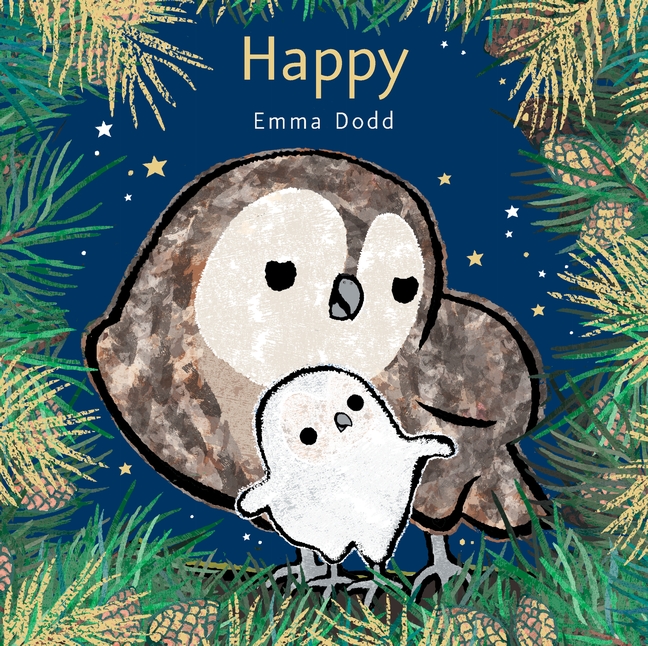
Happy

By Emma Dodd


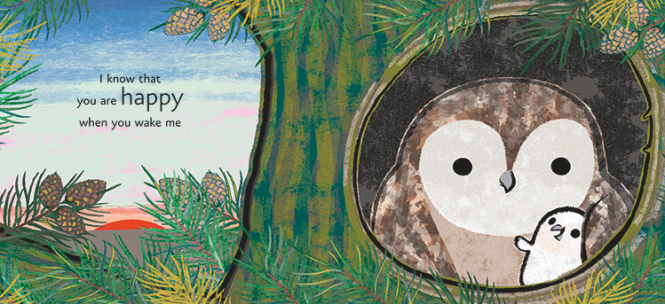
Nestled in a hole in a pine tree, an owl—who could be a mom, a dad, or any caregiver—cradles an adorable tiny owlet under its wing. “I know that / you are happy / when you wake me / with a song,” the owl says. As they venture out onto a limb, the owl adds, “I know that / you are happy / when you hop / and skip along.” With the repeated “I know that you are happy” the owl describes other ways the owlet shows her joy: giggling, rambling conversation, playing loudly, acting proud, and trying “something new…and / if you don’t succeed at first, I’ll help until you do,” the owl reassures the child.
celebrate-picture-books-picture-book-review-happy-emma-dodd

But every day cannot be happy, the owl concedes, and when “things are looking gray, / I’ll do my best to chase / the gloomy clouds away.” As the sun sets on the secluded home and the owl and owlet drift into sleep, the owl reveals: “I love it when you cuddle close / and whisper, ‘I love you.’ / And I am happiest / of all… / when you are happy too.”

Perfect for all parents and caregivers, Emma Dodd’s celebration of how a child’s joy resonates in others’ hearts makes shared reading time special. The lyrical rhythm of the repeated lines accompanied by the sentiments of encouragement and the transposition of point of view give this book impact and poignancy.

Dodd’s gorgeous illustrations of the endearing owl and owlet pair perfectly express the type of discovery that leads to joy on both a child’s and an adult’s part. With its little raised foot, extended tiny wings, and jubilant, smiling beak, the young owlet is both lovable and loved. Dodd’s beautiful muted, blue, green, brown and orange settings shimmer with gilded accents: delicate gold pine needles frame the owls’ home, the baby owl splashes in a glistening puddle under a gleaming moon, sparkling stars light the midnight blue sky, and rain showers fall in glinting streaks as the owls look on.

Simply put Happy will put a smile on your face and bring a tear to your eye. This lovely lullaby will quickly become a favorite for bedtime or cuddle time and is a must for young children’s bookshelves. Happy also makes a perfect gift for new parents or other caregivers. 

Take a peek:

Ages Birth – 5

Nosy Crow, Candlewick Press, 2015 | ISBN 978-0763680084

Smile Power Day Activity
celebrate-picture-books-picture-book-review-smile-cards

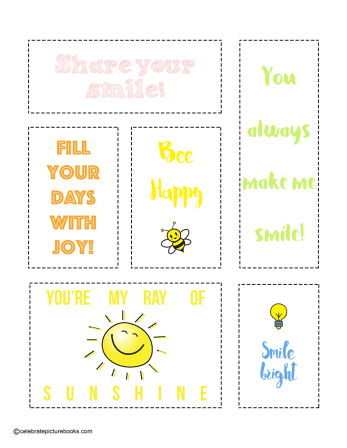
Make Someone Smile Cards


Sharing a smile can make someone’s day! With these printable Make Someone Smile Cards you can spread joy to people you know—and even to those you don’t! Give one to a family member, coworker, or friend. You can surprise your favorite barista, hair stylist, librarian, or shop owner by handing them a card or leaving it where they’ll find it. It’s even fun to tuck a card among the items on a shelf or in a book for someone to find later. Remember, the power of a smile is awesome!

June 10 – It’s Pet Appreciation Week

celebrate-picture-books-picture-book-review-excellent-ed

About the Holiday

Pets give us so much love and joy that we often want to do something special for our furry friends in return. The first full week of June gives us just that opportunity! Why not spend a little extra time walking or cuddling with your pet? Or maybe make them a favorite treat or get them a new toy. However you celebrate, you know your pet will appreciate it!

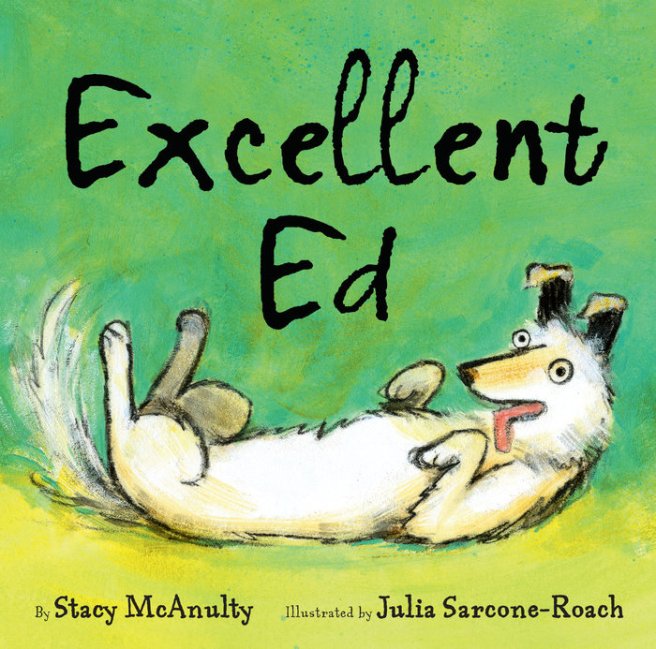
Excellent Ed

Written by Stacy McAnulty | Illustrated by Julia Sarcone-Roach


Ed, the Ellis family dog, is feeling a little left out. All five of the children are excellent at something, but not Ed. All the Ellis kids can eat at the table, ride in the car, sit on the couch, and use the indoor bathroom, but not Ed. Each kid has his or her own talent—playing soccer, calculating math, dancing, and baking cupcakes—and while Ed can carry a ball in his mouth, count to 4, spin after his tail, and eat cupcakes, it’s just not the same.

One day Ed wonders—if he was excellent at something could he have the same perks as the kids? He considers his talents and comes up with something. He knows he’s great at breaking stuff! Surely this will earn him a place at the dinner table. But even before he gets going, Elaine runs in with the news that she’s broken the record for most soccer goals in a season. Ed realizes that Elaine is better at breaking stuff than he is.

Again Ed thinks. Suddenly it dawns on him that he’s excellent at losing things—he even lost himself last week! This kind of ability was surely worth a ride in the van. But just as he’s about to jump in, the twins shout, “I’ve lost a tooth!” Foiled in this attempt, Ed goes back to the drawing board. Hmmm…it was just there…oh, yeah! Ed is fantastic at forgetting stuff! After proving to Dad that he doesn’t remember he ate a minute ago and ready to take his place on the couch, Ed is thwarted again by Edith, who forgot to be nervous during an audition and is now the lead ballerina.

Ed whimpers. Is there nothing he’s most excellent at? Maybe he doesn’t even belong in the Ellis family. Just then Ernie drops his sandwich and Ed gobbles it up, leaving no crumbs on the floor. “‘Wow, Ed! You are excellent at cleaning the floor,’” Earnie says. When Emily and Elmer come home, Ed runs to meet them and covers them in kisses. “‘Ed! You’re excellent at welcoming us home,’” the twins exclaim. Later, with the couch stuffed with Ellises, Ed lays across Edith’s and Elaine’s feet. “‘Ed is excellent at warming feet,’” Elaine and Edith agree.

Ed wags his tail—he is an excellent floor cleaner, welcomer, and feet warmer! Now he knows why he doesn’t sit at the table, stays home instead of riding in the van, and doesn’t join the family on the couch. He realizes that he is an important part of the Ellis family, and that he’s always loved and appreciated. Now, if only he could figure out that indoor bathroom thing….

There comes a time in everyone’s life when they doubt their place in the world. Stacy McAnulty explores that feeling through Ed, who worries, works the problem, and discovers that he is without a doubt excellent just the way he is. Giving the Ellis kids a variety of ages and talents makes this a great universal book for readers. McAnulty’s twist which turns “negative” gifts for breaking, losing, and forgetting things into triumphs for the Ellis kids is ingenious, adding humor, depth, and “ah-ha! moments” to the story. The mystery of Ed’s abilities is well-kept until the end, and the solution comes as a happy surprise.

Readers will wish they were part of the Ellis family, with their exuberant smiles, supportive cheers, snuggly, crowded couch, and, of course, adorable Ed. Julia Sarcone-Roach’s vivid illustrations are infectious as Ed perks up his ears, rolls his eyes skyward and with tongue out thinks about his situation. Scenes of his shenanigans will elicit giggles, and Ed’s sweet looks and wagging tale will win readers’ hearts.

Ages 4 – 8

Alfred A. Knopf Books for Young Readers, 2016 | ISBN 978-0553510232

Pet Appreciation Week Activity

celebrate-picture-books-picture-book-review-dog-maze

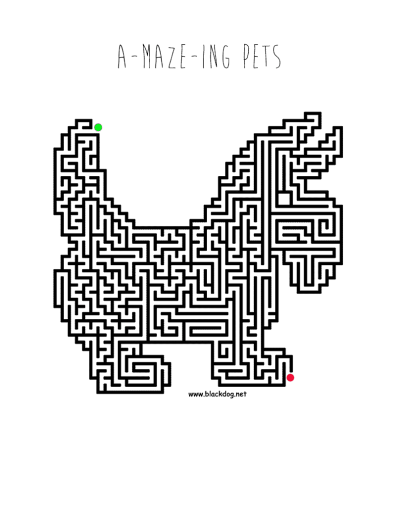
A-maze-ing Pets Maze


Dogs love to take circuitous routes as they pick up scents that are too enticing not to follow! Can you find your way through this printable A-maze-ing Pets Maze

Picture Book Review

May 2 – Brothers and Sisters Day

celebrate-picture-books-picture-book-review-pigs-and-a-blanket

About the Holiday

Ah, brothers and sisters! Those built-in friends (and sometime frenemies) that live in your very own house. Sure, siblings like different things, play different games, and see the world differently, but that just broadens our horizons. And as siblings grow up, it’s nice to know there’s always someone out there who shares your history and has your back. Today, cherish your brothers and sisters. Get in touch or do something together—and tell them how much you love them.

Pigs and a Blanket

By James Burks


A cute piglet sister and brother love their blankets sooo much and sooooo much more! Henrietta loves the way her blanket smells. Henry loves the way his blanket feels. Henrietta reads with her blanket, while Henry draws under his.

Henry also creates hills in his blanket to zoom his monster trucks over while his sister uses it as a backdrop for the fierce dino movie she’s filming. The movie-making gives way to dancing because Henrietta loves to pirouette with her blanket. But wait a minute! The trucks have just gone off-blanket!! What’s happening?

And—“Hey!”—mid-twirl, that familiar green cloth suddenly becomes a cape catching the wind behind Henry’s superhero personae. One blanket between two kids? Henrietta tugs on one end: “Stop pulling on my blanket!” Henry yanks on the other end: “Stop pulling on MY blanket!!” The tug-of-war rages until “RRRIIIPPPPP!”

Henry retreats to one corner and half-heartedly pushes around his monster trucks on his part of the blanket while glancing over to the other corner where Henrietta has unenthusiastically resumed her movie making on her half. Maybe drawing and reading will be better. But no, not really. That separated blanket isn’t nearly as cozy.

The siblings move a little closer and shyly smile at each other. Maybe they can make up. “I missed you,” Henrietta confesses. “I missed you more,” Henry answers, placing a red checker on the board she’s brought over. The day is brightening in their playroom scattered with toys and art supplies. And as night falls, the two have cleverly reunited just in time for sleeping.

James Burks’ charming Pigs and a Blanket captures perfectly the vacillating relationship of siblings. Kids will recognize and appreciate the sentiments in this simple, honest story. While this sister and brother have separate interests and quarrel over a shared blanket, the truth is they love being together, and when the blanket no longer binds them, they soon realize life is much less rich.

Burks’ illustrations of the piglet siblings are adorable and expressive, registering the fortunes and misfortunes of an afternoon of play with joy, consternation, regret, sadness, and reconciliation. The book’s design makes excellent use of the two-page spreads. The sister plays with her blanket on the left-hand page, while her brother plays with his on the right. The blanket ingeniously disappears into the center of the pages, creating a smart, Ah-ha moment when Henrietta twirls it away from Henry. Likewise, after the blanket is torn apart, the once full-page illustrations are replaced with mostly white space as the two kids play alone and disconnected. As they move to restore their friendship, the white space lessens until it is again filled with love.

Pigs and a Blanket would be a wonderful addition to any child’s bookshelf to be reread at those times when getting along with siblings—or friends—seems hard.

Ages 2 – 6

Disney-Hyperion, 2016 | ISBN 978-1484725238

Brothers and Sisters Day Activity

celebrate-picture-books-picture-book-review-my-book-heart

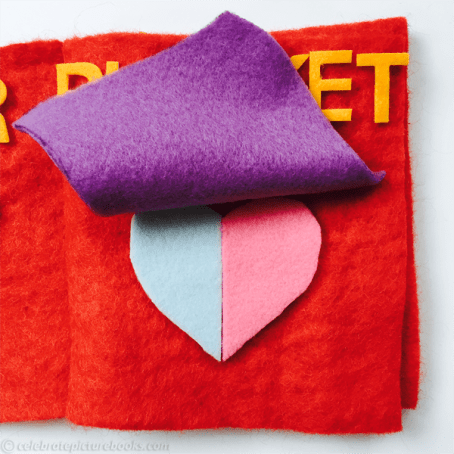
Create a Soft Book, Page 2: Peek-a-Boo Blanket


A blanket is so much fun! It can be a tent, a reading buddy, a cape, and a perfect hiding place! Add this Peek-a-Boo Blanket with its brother and sister heart to page 2 of your book!

Supplies

  • Printable Peek-a-Boo Blanket Template
  • Adhesive letters or fabric paint
  • Blue, pink, and purple felt – or colors of your choice
  • Fabric glue

celebrate-picture-books-picture-book-review-heart-2

Directions

  1. Cut out one half of the heart from the blue felt
  2. Cut out one half of the heart from the pink felt
  3. Cut out the blanket from the purple felt
  4. Apply the adhesive letters to the top of the page. Make sure the letters are firmly attached if you are using this book with very young children. If needed use fabric glue.
  5. Glue the heart to the page
  6. Glue the top of the blanket to the page so it hides the heart

See you tomorrow! For Page 1 see yesterday’s post!

April 3 – National Find a Rainbow Day

celebrate-picture-books-picture-book-review-rainbow-stew-cover

About the Holiday

It’s not often someone wishes you a rainy day. Today, though, I’m doing just that because you can’t see a rainbow without a little of the wet stuff. This early spring month was chosen for this special day because, as we all know, April showers bring May flowers. Those same April showers lead to beautiful rainbows—even double rainbows sometimes! So, I hope you have a bad (weather) day and good luck finding a rainbow today! By the way—what do May flowers bring? Right! Pilgrims!

Rainbow Stew

By Cathryn Falwell


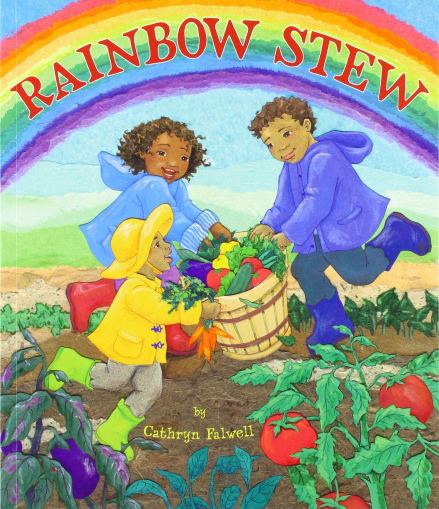
Grandpa’s making pancakes for his three favorite kids, and his granddaughter and two grandsons are excited to be visiting where they can play outside all day. Through the window the kids see that it’s a rainy day. Does this mean they’ll have to stay inside? Their grandpa knows just what to do! “Let’s go and find some colors for my famous Rainbow Stew!” he says.

celebrate-picture-books-picture-book-review-rainbow-stew-interior-art-picking-vegetables

Image copyright Catherine Falwell, 2013, courtesy of rainbowstewbook.com

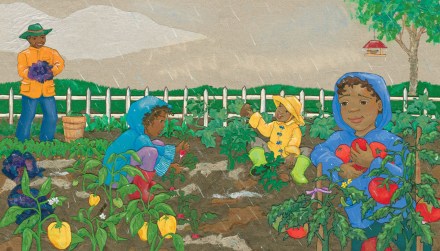
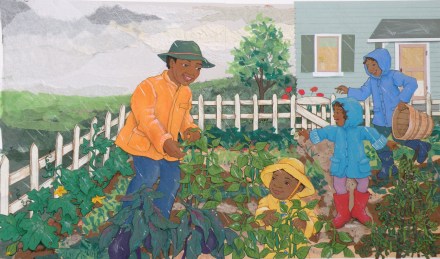
Out to the garden they run in their raincoats and hats. “Splish, splash, / puddle dash, / We bounce right out the door. / We’re off to find some red and green, / some yellow, orange, and more. / Grandpa shows us how to move / Between each garden row. / Lifting up the drippy leaves, /  we see what colors grow.” They collect green spinach, kale, and zucchini; yellow peppers, purple cabbage and eggplant, red radishes and tomatoes; brown potatoes; and orange carrots. After some muddy fun among the plants, the kids go inside, get dried off, and begin to prepare their colorful stew.

celebrate-picture-books-picture-book-review-rainbow-stew-interior-art-in-the-garden

Image copyright Catherine Falwell, 2013, courtesy of rainbowstewbook.com

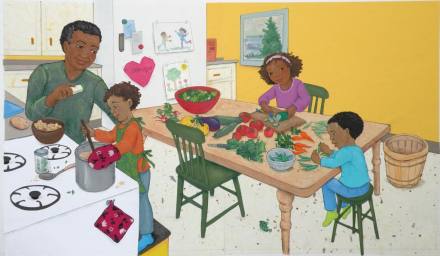
Peel, slice / chop and dice, / colors fill the pot. / Stir in herbs and water / and then wait till it gets hot.” While the pot simmers on the stove, Grandpa and the kids snuggle on the couch with favorite books, reading together until the stew has simmered to perfection. The family then sits down to a homemade, colorful, delicious lunch of Rainbow Stew. 

celebrate-picture-books-picture-book-review-rainbow-stew-interior-art-cooking-together

Image copyright Catherine Falwell, 2013, courtesy of rainbowstewbook.com

Cathryn Falwell’s Rainbow Stew is a wonderful book to share with young children on many levels. The bright colors of Grandpa’s house mirror the vividness of the garden vegetables in his stew, which could be made into a matching game for extra fun. The rhyming verses—each begun with an energetic couplet that would be fun for kids to repeat or act out—draw listeners into the story. Introducing colors through familiar and delicious vegetables can get kids excited about gardening, cooking, even going to the grocery store.

Children will identify with the disappointment of the three siblings when they learn it’s too wet to spend the day outside as well as their glee at squishing in the mud. The close bond between the kids and their grandfather as they cook and read together is a strong anchor for this story.

celebrate-picture-books-picture-book-review-rainbow-stew-interior-reading-together

Image copyright Catherine Falwell, 2013, courtesy of rainbowstewbook.com

A recipe for Rainbow Stew follows the story. Combined with the craft below, the book and recipe could make for a fun rainy-day get-together!

Ages 4 – 7

Lee & Low Books, 2013 | ISBN 978-1600608476 (Hardcover) | ISBN 978-1643790572 (Paperback, 2019)

National Find a Rainbow Day Activity

CPB - Rainbow Crayon Art 3

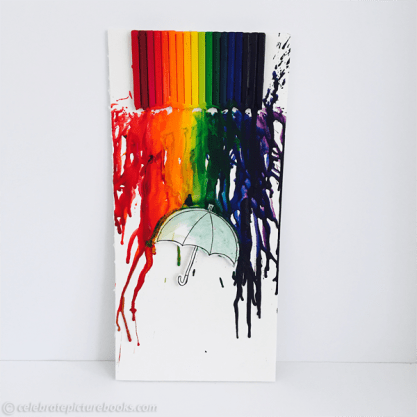
Crayon Rainbow Art


With this cool project you can create an art piece that’s as colorful as a rainbow and as unique as you are! Adult help is needed for children.

Supplies

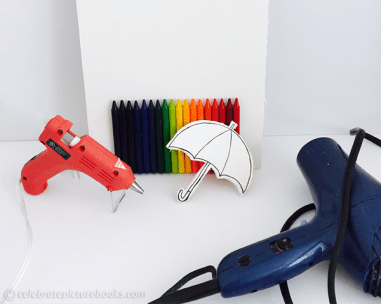
  • Box of 24 crayons
  • White foam board or thick poster board, 8 inches by 17 inches
  • A small piece of corrugated cardboard, about 5 inches by 5 inches (a piece of the foam board can also be used for this step)
  • A small piece of poster board, about 5 inches by 5 inches
  • Scissors
  • X-acto knife (optional)
  • Hot glue gun
  • Hair dryer
  • Old sheets or towels, newspapers, a large box, or a trifold display board

CPB - Rainbow Crayon Art 2

CPB - Rainbow Crayon Art 1 (2)

Directions

  1. Remove the various red, orange, yellow, blue, indigo, and violet hued crayons from the box of crayons
  2. Strip the paper from the crayons by slicing the paper with the x-acto knife, or removing it by hand
  3. Line them up in order at the top of the white foam board
  4. Glue the crayons with their tips facing down to the board with the hot glue gun
  5. Cut an umbrella or other shape of your choice from the poster board
  6. Trace the umbrella or other shape onto the corrugated cardboard or a piece of the foam board and cut out
  7. Glue the poster board shape onto the corrugated cardboard, let dry
  8. Glue the umbrella or other shape to the foam board, about 4 ½ inches below the crayons
  9. Set up a space to melt the crayons. The wax will fly, so protect the floor and walls by placing the art piece in a large box or hanging newspapers, old sheets or towels on the walls and placing newspapers on the floor. A trifold display board and newspapers works well.
  10. Stand the art piece upright with the crayons at the top
  11. With the hot setting of the hair dryer, blow air at the crayons until they start to melt
  12. Move the hair dryer gently back and forth across the line of crayons from a distance of about 6 to 12 inches away. The closer you are to the crayons, the more they will splatter
  13. The crayons will begin to melt and drip downward
  14. You can experiment with aiming the hair dryer straight on or at an angle to mix colors
  15. Wax that drips onto the umbrella or other shape can be chipped off after it dries or wiped off to create a “watercolor” effect on the shape
  16. Once the hair dryer is turned off, the wax cools and dries quickly
  17. Hang or display your art!

March 26 – Noodle Day

Noodle Magic by Roseanne Greenfield Thong and Meilo So Picture Book Review

About the Holiday

Noodle on this: what’s the difference between noodles and most other dry pastas? Noodles contain eggs! It’s just this kind of fascinating fact you can learn during noodle month. Whether you like spinning the long strands around your fork or slurping them right from the bowl, noodles make the perfect comfort food whether they’re mixed with sauce, pesto, or meat and veggies. People make some pretty awesome crafts from them too! Did you know that 13th century bakers made their dough into birds, stars, words, and other shapes? Too bad Pinterest wasn’t around then! So boil up some water and get cookin’ on a delicious day!

Noodle Magic

Written by Roseanne Greenfield Thong | Illustrated by Meilo So


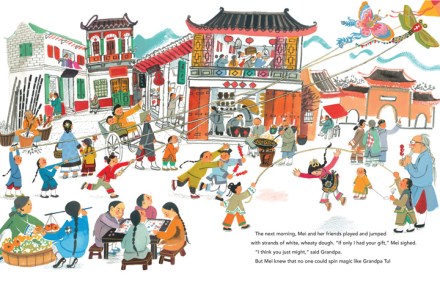
The emperor’s birthday is coming, and everywhere excitement fills the air. Mei’s Grandpa Tu will no doubt be making his famous noodles for the celebration. Mei loves to watch her grandfather work, slapping and kneading the dough and pulling the strands of noodles. He is so creative with his cooking that everyone marvels, even the Moon Goddess. In fact, Grandpa Tu is such an extraordinary artist that he makes noodle jump ropes and kite strings for Mei and her friends. They are as “simple as a sunflower” and as “easy as a sea breeze” to make, says Grandpa Tu.

celebrate-picture-books-picture-book-review-noodle-magic-playing-with-noodles

Image copyright Meilo So, text copyright Roseanne Thong. Courtesy of meiloso.com

But Mei thinks there is more to his talent and wishes that she had his magic. Her grandfather believes she does possess it. One afternoon the pair watch animal-shaped clouds fill the sky, and Mei asks if her grandpa can catch them with noodles. That night he makes a batch of noodles, and in the morning the two collect clouds as the sun appears.

On the day before the emperor’s birthday, everyone is busy making something special—everyone except Grandpa Tu. The villagers are perplexed. On such an important day, they will all want to enjoy noodles—and what about the special long-life noodles for the emperor? It is time, Grandpa Tu tells Mei, for her to make the noodles.

Mei is surprised and terrified. She slaps and kneads the dough as she has seen her grandfather do, but it remains ordinary. Where is the magic? “‘Trust in yourself,’” Grandpa Tu tells her, but Mei is doubtful. She decides that perhaps if she gives the Moon Goddess a gift, she will get magic in return. “‘You have all the magic you need,’” her grandfather assures her. Still, he helps Mei make enough dough to form an enormous ball of noodles.

celebrate-picture-books-picture-book-review-noodle-magic-making-noodles

Image copyright Meilo So, text copyright Roseanne Thong. Courtesy of meiloso.com

Mei throws the ball to the Moon Goddess and calls out for the Goddess to give her magic. Wisely, the Goddess reminds Mei that magic must come from inside. Mei closes her eyes and thinks very hard. She tussles with the Moon Goddess in a noodle tug-of-war, and suddenly…Snap!…the noodles break. The sky rains noodles of all shapes and sizes, Mei has discovered the magic that was in her all along!

With the charm of a Chinese folktale, Roseanne Greenfield Thong tells the universal tale of self-discovery. Her lyrical language adds a magic of its own to the tale, as when Mei watches her grandfather make dough: “she loved the powdery flakes that hung in the air and freckled the morning light.” The relationship between the little girl and her grandfather is lovingly portrayed, offering a gentle depiction of the wisdom and reassurance provided by extended family members.

Meilo So brings the story to vibrant life with her colorful paintings of village life, Mei and Grandpa Tu’s home, and the Moon Goddess. The magic of Grandpa Tu’s noodles is cleverly shown in the transparent animals, dragons, and birds outlined in noodles that frolic across the pages. The two-page spreads of Mei’s village are particularly captivating, as packed with interesting scenes and details as any bustling town.

Ages 4 – 8

Orchard Books, 2014 | ISBN 978-0545521673

Noodle Day Activity

CPB - Noodle Puzzle

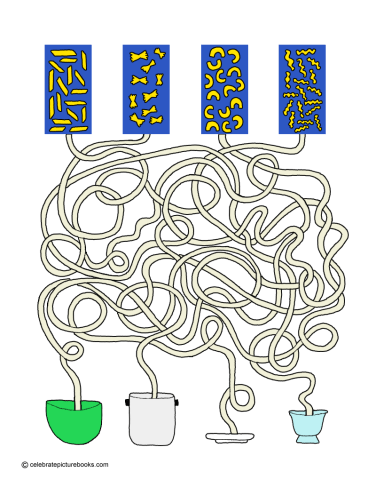
Noodle on This Puzzle


Everyone has their favorite kind of noodles! Help these noodles get to the right plate, bowl, or pot in this printable Noodle on This puzzle that’s as wiggly as a wet noodle!

Picture Book Review

March 4 – It’s Umbrella Month

celebrate-picture-books-picture-book-review-the-umbrella-queen-cover

About the Holiday

Today I am celebrating a month-long holiday. As spring returns with its rainy weather, walkers everywhere appreciate the protection umbrellas give. The need for umbrellas has been recognized since earliest days, when palmetto fronds were used by ancient civilizations. The Chinese were the first to create waterproof umbrellas by waxing or lacquering their paper parasols. Parasols were a woman’s accessory until Jonas Hanway, a Persian travel writer, used one in public in England in the 1700s. English men took up the practice, calling their version a “Hanway.” The first collapsible umbrella was designed in 1710, and in 1928 the folding pocket umbrella appeared. Since then, umbrellas have become fashionable and necessary accessories

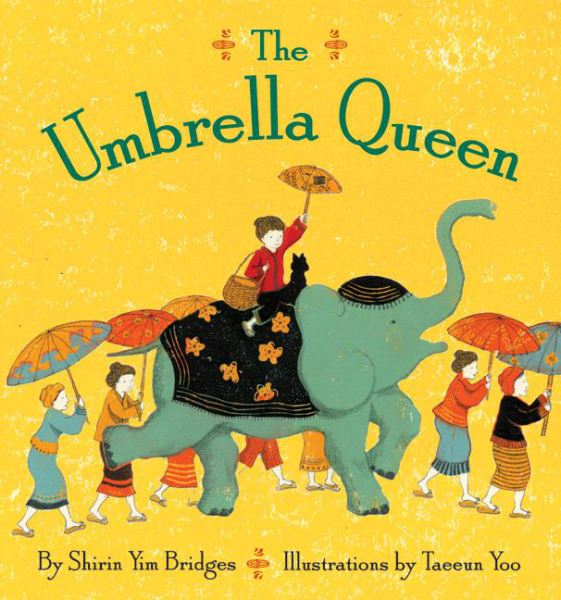
The Umbrella Queen

Written by Shirin Yim Bridges | Illustrated by Taeeun Yoo

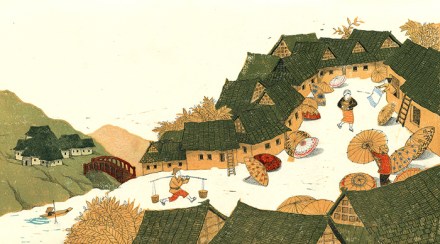
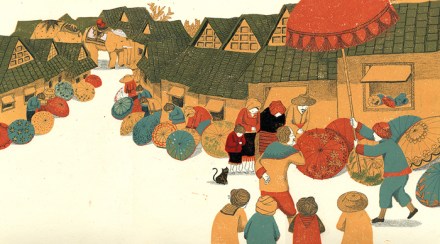
The residents of a small village in Thailand are well known for the beautiful paper umbrellas they make and sell in the local shops. The umbrellas are colorful, but always decorated with flowers and butterflies. Every New Year’s Day the villagers hold an Umbrella Parade, and the woman who has painted the most beautiful umbrella is chosen as the Umbrella Queen.

Noot is a little girl who longs to paint her own umbrellas and partake in the parade. One day her mother gives her an umbrella to paint and shows her how to copy her design. Noot is a natural artist, and her finished umbrella is nearly indistinguishable from her mother’s. She is given her own painting spot in the garden and five umbrellas to decorate.

celebrate-picture-books-picture-book-review-the-umbrella-queen-village

Image copyright Taeeun Yoo, courtesy of taeeunyoo.com

Noot paints the familiar butterflies and is about to start on the flowers when she is inspired to draw elephants instead. She covers all five umbrellas with elephants doing handstands, playing and squirting water, walking trunk-to-tail, and just being silly. When her mother sees these umbrellas, she is unhappy. Flowers and butterflies sell in the local shops, not elephants. Noot understands the importance of the money made from the umbrellas to her family. For the next year she paints the large umbrellas with the traditional design. At night, however, using bits and pieces, she fashions tiny umbrellas. These she paints with elephants, and displays them on her windowsill.

celebrate-picture-books-picture-book-review-the-umbrella-queen-emperor-visits

Image copyright Taeeun Yoo, courtesy of taeeunyoo.com

As New Year approaches there is much excitement in the village. It is rumored that the king will be visiting and will choose the Umbrella Queen himself. One day the villagers receive the message that the king will indeed arrive. The villagers spruce up their town and each woman displays her umbrellas in front of her home.

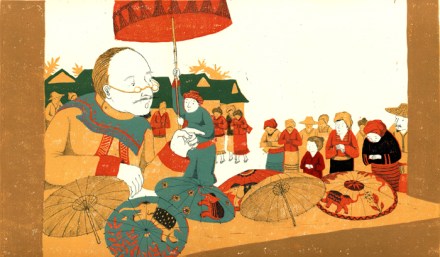
The king walks the length of the street, considering each umbrella until he comes to Noot’s house. He is very impressed with the umbrellas painted by Noot’s mother, but his gaze wanders to Noot’s windowsill, and he asks who painted the “strange” umbrellas.

celebrate-picture-books-picture-book-review-the-umbrella-queen-emperor-judges-umbrellas

Image copyright Taeeun Yoo, courtesy of taeeunyoo.com

A bit embarrassed by the attention, Noot shyly answers the king’s questions about the size of the small umbrellas and the unusual designs. In trying to explain herself, she forgets to look at the ground when talking to the king, and when her eyes meet his she realizes that, instead of judging her, he is charmed. “I like elephants,” she tells him, and he laughs.

The king takes Noot’s hand and names her the Umbrella Queen because “she paints from her heart.”

Shirin Yim Bridges has written a unique story that presents the often conflicting dilemma of responsibility to others while staying true to yourself effectively and engagingly. Noot’s journey from an observer in her family’s business to a valued artist is told straightforwardly and the familial love and support are clearly emphasized. The king’s recognition of Noot’s talent and heart will be highly satisfying for young readers or listeners.

Taeeun Yoo’s delicate illustrations in gold, red, black, and green set the story firmly in Thailand and perfectly demonstrate the close-knit village and relationships as well as the intricate beauty of the umbrellas and the pride the villagers take in them.

The Umbrella Queen is a wonderful story about family, discovering your talents, and self-expression that would find a welcome spot on any child’s bookshelf.

Ages 4 – 8

Greenwillow Books, Harper Collins, New York, 2008 | ISBN 978-0060750404

Learn more about Taeeun Yoo, her books, and her art on her website!

Umbrella Month Activity

CPB - Umbrella Matching Game

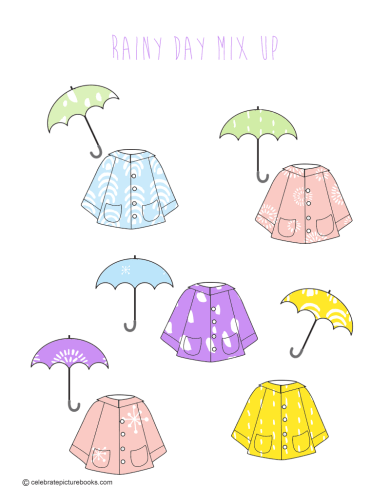
Rainy Day Mix Up Matching Game

A sudden storm scattered all the umbrellas and raincoats! Can you put the pairs together again? Draw a line to connect the umbrella and the raincoat that have the same pattern. Print the Rainy Day Mix Up Game here!


February 6 – Lace Day

celebrate-picture-books-picture-book-review-fionas-lace-cover

About the Holiday

Lace, that delicate material that trims clothing, covers tables, ties up hair, and makes anything seem more dainty and lovely, has been used since the 1500s. When you look at the intricate patterns and fine threads of lace, it’s hard to believe that people once made it all by hand. Lace makers were paid well for their art by the fashion industry, which used it to attract distinguished customers. While lace is mostly made by machines now, the handcraft is making a comeback. Today’s reviewed picture book is about a girl whose lace work was invaluable.

Fiona’s Lace

By Patricia Polacco


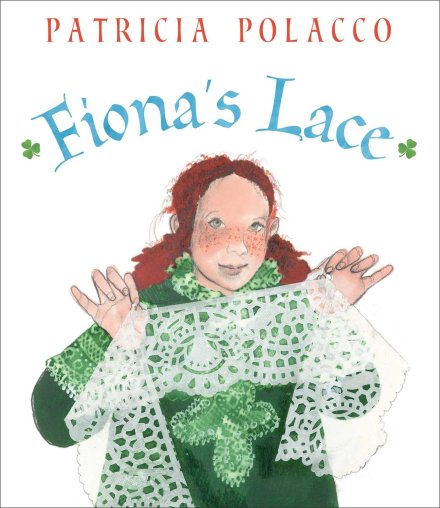
In Fiona’s Lace author-illustrator Patricia Polacco weaves a tale of family love and America’s early immigrant heritage that is as intricate and lovely as the material we celebrate today. The story begins in Ireland, where Fiona and her sister Ailish live with their muther and da. They live happily in Glen Kerry, where their father works in the textile mill and their mother teaches Fiona her art of lace making.

celebrate-picture-books-picture-book-review-fiona's-lace-ma-teaches-lacemaking

Copyright Patricia Polacco, courtesy of simonandschuster.com

In the evenings the girls are entertained by family stories, especially their favorite about how, when their parents first met, their mother left a trail of lace from the factory to her house for her young suitor to follow.

When the textile mill closes, Fiona’s family signs a contract indenturing themselves to a family in Chicago. The voyage to America is long and arduous, but when they arrive in Chicago they marvel at the grand houses and elegant clothes, imagining that this awaits them too in their new home. The reality, however, is much different. Their 2-room apartment is ramshackle, and only by working two jobs can their parents make enough money to live on.

celebrate-picture-books-picture-book-review-fiona's-lace-fiona-gets-job

Copyright Patricia Polacco, courtesy of simonandschuster.com

Fiona wants to help and soon finds that dressmakers will pay handsomely for the lace she makes. The family’s money tin begins to fill up and they are prospering. One night while Muther and Da are away working, a fire rages through Chicago. Fiona and Ailish escape with only the money tin and Fiona’s lace. They run far from home, but worry—how will their parents find them?

Remembering their favorite story, Fiona cuts her lace into strips and ties bits of it along their route to their hiding place. The girls cower in fear until they hear the familiar voices of their parents. Happily reunited, the family lets go of what they have lost, but Ailish cries over the now sooty, torn lace. Ma reassures her and brings comfort, revealing that far from being ruined, this scorched lace is the most valuable and cherished of all because it saved the family.

celebrate-picture-books-picture-book-review-fiona's-lace-trail-of-lace-story

Copyright Patricia Polacco, courtesy of simonandschuster.com

Patricia Polacco’s heartwarming and harrowing story of an Irish immigrant family is a beautiful reminder of the unique talents and strong bonds that built America. Readers will be enthralled by Polacco’s realistic dialogue and detailed storytelling in this compelling and suspenseful tale and will cheer as Ailish cleverly uses her ma and pa’s trick and her own skills to save her family.

Polacco’s gorgeous illustrations bring the time period alive for young readers, portraying the intricate art of lacemaking and the clothing styles that made use of this delicate trimming. Her depictions of tenement living are realistic, yet reveal the love and close family ties within through a warm color palette and the inclusion of cozy comforts brought from Ireland.

Fiona’s Lace is a wonderful book for classroom and home story times.

Ages: 4 – 8

Simon & Schuster, New York 2014 | ISBN 978-1442487246

Discover more about Patricia Polacco and her many, many books on her website!

Lace Day Activity

Hide-and-Seek Game

While Fiona and her sister used a lace trail to lead their parents to their hiding place, you can have fun making a hide-and-seek game for your friends. This game can be played inside or outside

Supplies

  • 1 or 2 yards of lace, cut into sections about 6-inches each. You can use lace to celebrate Lace Day or use string, ribbon, or other kinds of material
  • Choose something to hide – this can be a toy, a secret letter, a snack, or anything

Directions

  1. Hide the item you choose in a secret place
  2. Determine the starting place for your hide-and-seek game
  3. Along the route from the starting point to the hidden item, tie the sections of lace onto things like lamps, furniture, stair banisters, door knobs, etc. if  you’re playing inside. If you are playing outside, tie it onto trees, bushes, bird feeders, swing sets, etc.
  4. For very young children the trail of lace can be straightforward; for older children the trail can be longer and more difficult