Roots Day was established to inspire us to look into our family background and learn about our heritage. It’s fascinating to discover facts about our ancestors’s lives and the stories that have come down from generation to generation. If you will be with family this weekend, talk about your collective history and get to know each other in a whole new way!
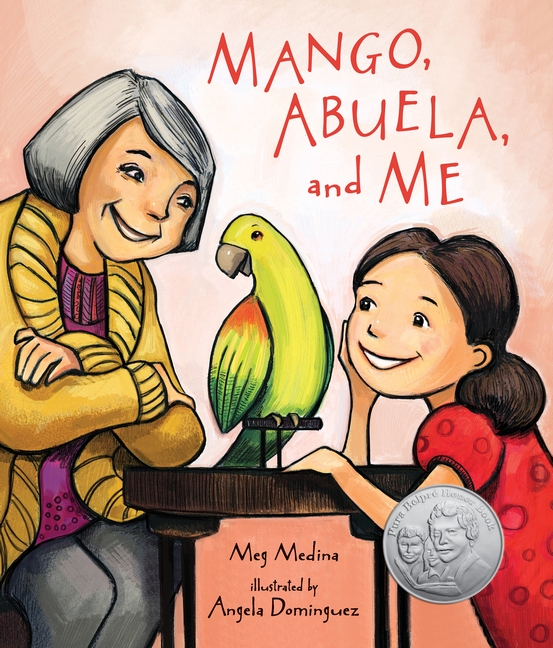
Mango, Abuela, and Me
Written by Meg Medina | Illustrated by Angel Dominguez
During the winter Mia’s Abuela moves from her house far away to live with her family. Mia feels shy around her unfamiliar grandmother, but quickly adapts, sharing her room and her drawer space. The one thing they cannot share is language. Abuela “can’t unlock the English words” in Mia’s book, and Mia knows only a little Spanish.
Image copyright Angela Domingues, text copyright Meg Medina. Courtesy of Candlewick Press
On the first night Abuela shows Mia two things she has carefully brought with her—a feather from a wild parrot that roosted in her mango trees and a photograph of her late husband. “Tu Abuelo,” she explains to Mia.
For the rest of the winter, Mia spends time with her grandmother, but regrets that she can never tell her important things about her life. Abuela does’t know that Mia’s good at art or can beat the boys in a race. Likewise, Abuela can’t tell Mia about her life or answer Mia’s many questions.
Image copyright Angela Domingues, text copyright Meg Medina. Courtesy of Candlewick Press
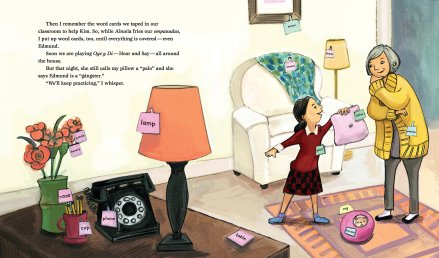
When Mia confides in her mother, her mom reminds her of how she helped her best friend, Kim, learn English when she was new at school. One day while Mia and her grandma bake meat pies, Mia pretends to be her teacher, naming each ingredient in English. Abuela reciprocates with the Spanish word. Mia suddenly has an idea. She tags everything in the house with its English name and the pair practices.
Image copyright Angela Domingues, text copyright Meg Medina. Courtesy of Candlewick Press
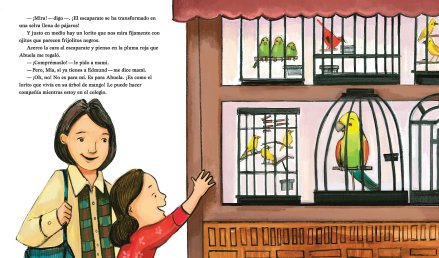
The next day on a trip to the pet shop to buy hamster food, Mia sees something in the window that gives her another exciting idea. Right in the middle of the display sits a colorful parrot. “Let’s buy him,” Mia exclaims. “For Abuela.” The parrot can keep Abuela company while she is in school, Mia thinks.
Abuela is thrilled with the gift, and they name the parrot Mango because he is the color of the tropical fruit. Abuela teaches him to say Buenos tardes. Good afternoon, Mia teaches him. “Buenos tardes, good afternoon,” Mango repeats. Abuela, Mia, and Mango spend the days practicing new English and Spanish words, learning the days of the week, the months, and the names of coins. Encouraged by her success, Abuela asks to learn more and harder words so she can meet people in the neighborhood.
Image copyright Angela Domingues, text copyright Meg Medina. Courtesy of Candlewick Press
Best of all, Mia and Abuela can now talk about everything. Their “mouths are full of things to say,” and they tell each other about their day and their lives. From his perch Mango watches and listens. Night falls and as the light is turned off, Mia says “Hasta mañana, Abuela.” “Good night, Mia,” Abuela whispers.
Image copyright Angela Domingues, text copyright Meg Medina. Courtesy of Candlewick Press
Meg Medina beautifully represents the relationship between a little girl and her grandmother who are unfamiliar with each other but bound by familial love. The little girl’s acceptance of her grandmother and desire to communicate is strongly depicted in the activities they do together. Mia’s clever ideas to promote the mutual learning of each other’s language shows the kind of inclusiveness that builds friendships.
Angela Dominguez depicts the developing friendship between Mia and her Abuela in bright paintings that mirror the reds, blues, greens, and yellows of the tropics. The pair’s closeness grows organically from page to page as Mia first shies away from the grandmother who is a stranger to her to attempts at communication to deep feelings of love as they bridge the language barrier through dedication, hard work, and the help of a unique friend.
Ages 5 – 8
Candlewick Press, 2015 | ISBN 978-0763669003 (English) / 978-0763680992 (Spanish)
Learn more about Meg Medina and her books on her website
Discover more about Angela Dominguez and her books on her website!
Watch the Mango, Abuela, and Me book trailer!
Roots Day Activity
Family Recipe Card
Every family has at least one favorite recipe. Maybe it’s a recipe handed down through the generations or maybe it’s a brand new treat! Print this Family Recipe Card on card stock or glue it to a 4″ x 6″ index card. Write down your recipe and save it. Why not start your own box of special recipes that you can pass down?
Today’s holiday was established by the National Arborist Association to remind people to appreciate the beauty of evergreens that got that name because they stay green year round, These majestic trees add color to the doldrums of winter and remind us that summer will come again. To celebrate, why not take a walk and rediscover the evergreens in your neighborhood!
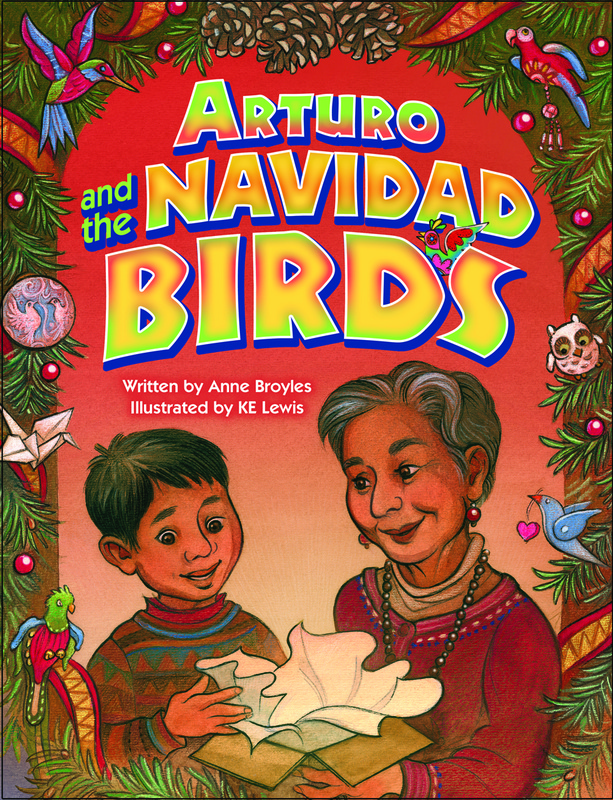
Arturo and the Navidad Birds / Arturo y los Pájaros de Navidad
Written by Anne Broyles | Illustrated by KE Lewis
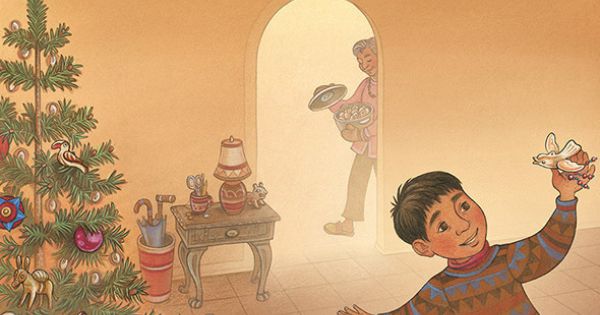
The day for decorating the Christmas tree had arrived, and Arturo “bounced up and down in front of the pine tree. ‘Hurry, Abue!’” he exclaimed. The tree looked so empty, but Arturo’s grandmother brought out the box of ornaments, and soon the two were admiring the little treasures. A tiny mouse nestled into a walnut shell bed had been made by Abue Rosa’s mother when she was a little girl. Although it was hard for Arturo to imagine his grandmother as a little girl, he loved hearing the story of how she carried the mouse in her pocket. “‘I called him Hermanito—my little brother! Find a good home on our tree!’” Abue Rosa said. Arturo placed the ornament on a low branch.
Image copyright Karen Lewis, courtesy of karenlewis.com
The next ornament out of the box was a square piece of “cardboard decorated with mahogany-colored beans.” This had been made by his mother. Arturo hung it in the middle of the tree because his mother “was the middle child between Tío Hernan and Tía Ines.” A donkey ornament that Arturo’s abuelo bought when he and Rosa were first married went high up on the árbol de Navidad. The pair added ornament after ornament on the tree and it “began to shine with Abue Rosa’s stories.” Then Abue Rosa went into the kitchen to fix dinner. While she was gone Arturo rummaged through the box and found a “tiny, blown-glass bird. ‘Fly, bird. Like a plane. Vroom, vroom!’”
The little bird hit the wall and fell to the floor, its wings broken. “Horrified, Arturo covered the pieces with newspaper just before Abue came back.” As they finished decorating the tree, Abue Rosa looked through the box and asked Arturo, “Have you seen the glass pajarito that my dearest friend, Sofie, game me? It’s all I have left from her.” Arturo couldn’t look at his grandmother, instead asking to take a break.
Image copyright Karen Lewis, courtesy of karenlewis.com
Arturo ran to his room and grabbed the glue, but he couldn’t make the wings stick. As he looked at the broken bird, tears filled his eyes. He wondered if his grandmother could forgive him. Then he had an idea. In the basement he found a pinecone and some craft materials. When he finished making his pinecone bird, he gazed at it in disappointment. It didn’t look like any bird he had ever seen and certainly not like the glass bird.
“‘Donde estas, mi’jo?’” Grandma Rosa called from the top of the stairs. Arturo slowly climbed the stairs, carrying both birds. “Arturo took a deep breath. He held out the homemade bird. ‘I made this for our tree.’” “‘Qué bonita!’” How beautiful, Abue Rosa exclaimed. Arturo continued to tell his grandmother that he made it because….He held out his other hand with the broken bird inside. Abue Rosa gasped, and Arturo felt a sob filling him. “‘I didn’t mean to,’” he said.
Image copyright Karen Lewis, courtesy of karenlewis.com
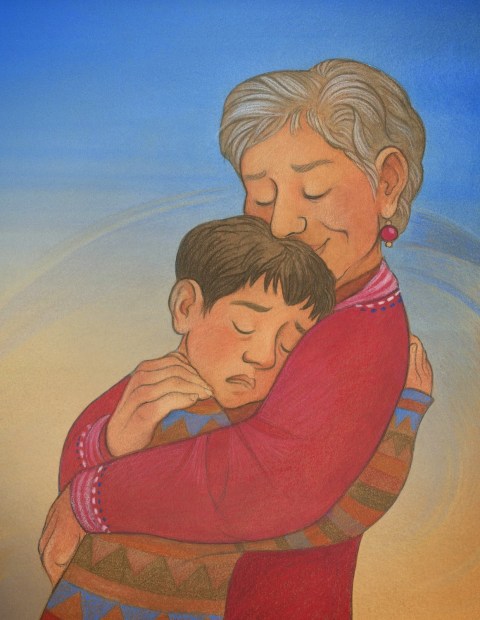
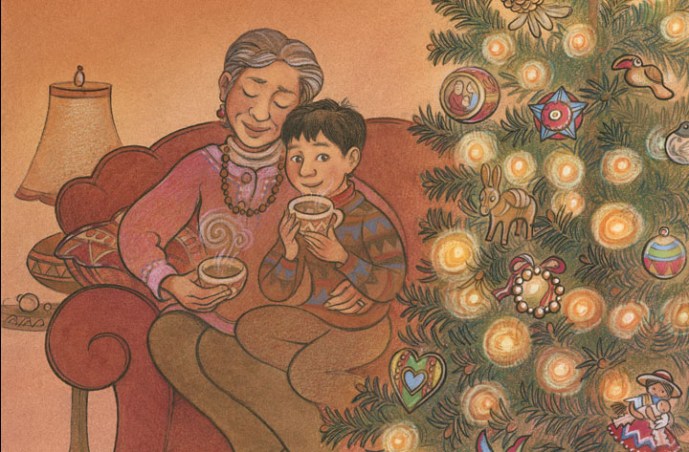
Abue Rosa hugged Arturo and told him that even without the bird she still remembered Sofia. “‘Now when I look at this bird you made, I will think of you and Sofia.’” Together they placed the pinecone ornament on the tree and turned on the lights. Afterward, they enjoyed cups of hot chocolate together. “‘The tree is full now,’ Abue said as Arturo snuggled against her, ‘of memories.’ He nodded. ‘And love.’”
Anne Broyles’ story of a boy and his grandmother who share the true meaning of love and memories is a touching holiday read. Through an incident which many children experience in one way or another, Broyles reassures young readers that—as Arturo’s grandmother states—people are more important than things. Her realistic portrayal of Arturo’s and his grandmother’s actions and emotions will resonate with readers, and the close bond between the two is a highlight of the story. Kids will enjoy the details in the stories of the ornaments as well as in Abue Rosa’s home.
Karen Lewis enhances the cozy tone of the story with her sepia-toned illustrations of Abue Rosa’s home and the personal memories surrounding her Christmas tree ornaments. Kids will recognize and empathize with Arturo’s and his grandmother’s feelings, which are genuine and clearly depicted. Kids will also like seeing the homemade and favorite ornaments that Arturo hangs on the tree as well as the loving relationship between Arturo and his Abue Rosa, which is beautifully revealed throughout the story.
Each page is told in both English and Spanish, making Arturo and the Navidad Birds a wonderful holiday choice for English-speaking, Spanish-speaking, and bilingual families.
Ages 4 – 8
Pelican Publishing, 2013 | ISBN 978-1455618019
To learn more about Anne Broyles and her books, as well as to find book-related activities, visit her website!
Discover a portfolio of illustration work, animation, and picture books on Karen Lewis’s website!
Enjoy this Arturo and the Navidad Birds book trailer!
Look for an Evergreen Day Activity
Puzzling Pine Tree Maze
The branches of a tall evergreen tree can form a kind of maze for the birds and squirrels who call them home. Can you find your way through this printable Puzzling Pine Tree Maze?
Today’s celebration remembers and honors the ninja warriors of China and Japan who with stealth and their signature black clothing could appear and vanish “like a hawk on stolen wings” to defeat their opponents. It was rumored that they were masters of Kuji-Kiri, an eastern magical practice that allowed them to combine their natural ability to move undetected with supernatural powers. The original ninja came from the Iga province of Japan and were made up of regular citizens. Their weapons were those of farmers, making it easier for them to be explained away and these warriors to escape exposure. The black clothing that we now associate with the ninja came from the theater, where the “invisibility” of the common-man warrior was represented by stage hands playing the parts of the ninja. To conceal themselves from the audience, stage hands wore black costumes that blended in with the black background curtains. When they became part of the play, theater-goers were taken by surprise. Today, ninja remain popular characters in movies and books, and especially with children.
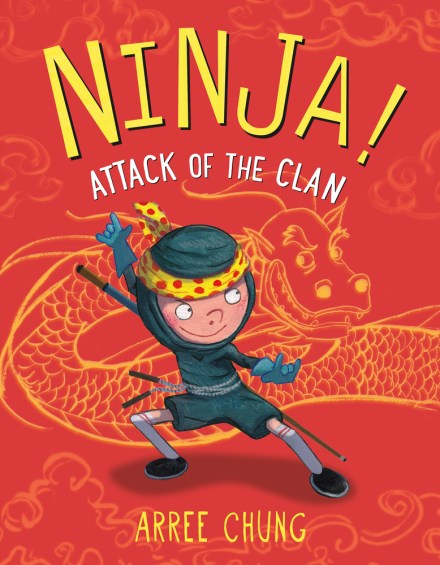
Ninja! Attack of the Clan
By Arree Chung
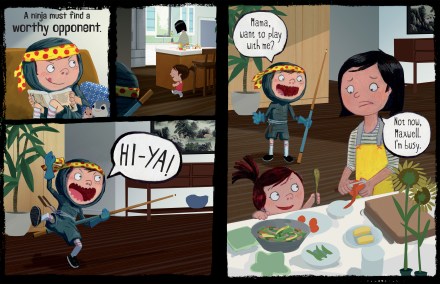
Maxwell is dressed in his ninja best, pool cue at the ready. Now all he needs is a “worthy opponent.” He leaps into the kitchen where his mom’s making a salad. “HI-YA!” But when he asks if his mom wants to play, she tells him she’s too busy. He turns to his sister. “BOOYAH! Cassy, want to play with me?” he asks. “I working,” she answers from behind the tall building she’s constructing from blocks. Disappointed, Maxwell searches out his dad in his office.
Copyright 2016 Arree Chung, courtesy of us.macmillan.com
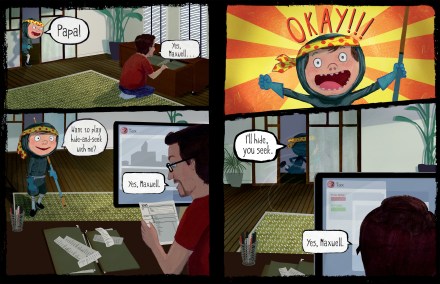
“Papa!” Maxwell exclaims. “Yes, Maxwell…,” Papa says, flipping through the file cabinet. Want to play hide-and-seek with me?” Maxwell asks. “Yes, Maxwell,” Papa says, studying the income tax form in his hand. “OKAY!!! I’ll hide, you seek.” Maxwell shouts as he runs out of the room. “Yes, Maxwell,” Papa says, opening the tax program on the computer.
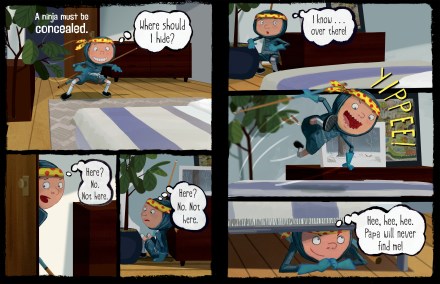
Maxwell tries out various hiding places, but none seem ninja-worthy. Then he spies the bed. Concealing himself underneath, he waits for Papa to find him…and waits. Finally, he hears a thump, thump, thump, and giggles with anticipation. But it’s only Brutus sniffing him out. Time goes by and still no Papa. Maxwell shouts out an anti-clue, but still nothing happens. At last Maxwell leaves his hiding place and goes back to his dad’s office, where Papa is still sitting in front of the computer. “Hey, you never came looking for me,” Maxwell says. But his dad is too distracted to hear him. Maxwell heads out with a dejected, “Forget it.”
Copyright Arree Chung, courtesy of us.macmillan.com
To recover from disappointment, Maxwell knows “a ninja must practice the art of meditation and find inner peace.” But even here his bad day continues. When he’s called for dinner he skips out to the dining room, but no one is at the table except Brutus, who is gulping down Maxwell’s soup. Suddenly, Brutus barks a warning. From behind comes a “surprise attack!” “Defend yourself,” orders Papa. With a flick of his finger, Maxwell secures his mask and goes to work, poking Papa in the belly. His dad comes back with an awesome bear hug, but Maxwell deftly somersaults out of his arms. With lightning speed he whips his jump rope across the room and ties up Papa.
Copyright 2016 Arree Chung, courtesy of us.macmillan.com
Next comes his mom, wielding her yellow bag. Maxwell leaps over the flying purse and retrieves its lost lipstick, which he slathers on in preparation for the “kiss of death!” Covered in red lip marks, Maxwell’s mom joins his father in defeat. Cassy, however, is harder to pin down. She sneaks behind him and in one swift move covers his eyes with his own headband and applies a dastardly “SLURP!” Stunned, Maxwell admits, “I’ve been licked.” Still—as the battle continues to wage—Maxwill declares, “I love my ninja clan!”
In Ninja! Attack of the Clan, Arree Chung’s cute sequel to Ninja!, Maxwell just wants to play with his family but is disappointed as each is too busy to take notice. Maxwell’s dilemma is handled with honesty and humor that will resonate with kids. The end of the story in which Maxwell’s family executes the perfect remedy for his bad day is touching and will have kids cheering for this enthusiastic ninja. Chung’s bold, vibrant cartoon-inspired panels perfectly carry the high-action parts of the story, while full-page illustrations slow things down a bit to embrace family time.
Ages 4 – 7
Henry Holt, 2016 | ISBN 978-0805099164
For little ninjas there’s so much to see and do on Arree Chung’s website, including fun activities, a video, more about the characters, a gallery of ninja art by kids, and even a place where they can “ninjafy” pictures of themselves!
International Ninja Day Activity
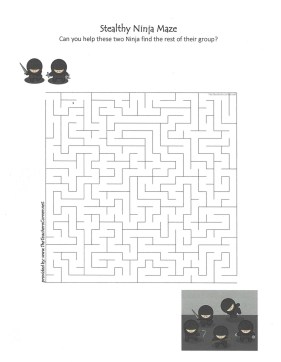
Stealthy Ninja Maze
Two ninja have been separated from their group! Can you help them find their way back in this printable Stealthy Ninja Maze?
Today’s observance was established in 1994 to promote family and community involvement in teaching and supporting children to read more. Family members can make reading a priority at home by sitting down together every day with a wide range of books and other reading material. By taking trips to the library and bookstores, children will also naturally pick up a love of reading. But families can’t do it alone. Kids acquire a drive to read when they see connections between books and their wider world. Fun book-related activities at schools, libraries, science centers, museums, and other places capture children’s attention and make them curious about reading more. Whether children are attracted by fiction or nonfiction, picture books or chapter books, novels or graphic novels, they should be encouraged to read. Universal literacy is a goal that can be accomplished.
About Small Talk Books®
Ellen Mayer’s Small Talk Books® feature young children and adults conversing (or adults speaking to children who are not talking yet) while they have fun, do chores, shop, and bake together. Their conversations demonstrate the kind of excitement and close relationships that encourage learning and language advancement. Each Small Talk Book® includes an accompanying note from Dr. Betty Bardige, an expert on young children’s language and literacy development and the author of Talk to Me, Baby! How You Can Support Young Children’s Language Development. The introduction discusses how children connect actions, words, and meaning as adults speak to them while doing particular jobs or actions.
Other titles in the Small Talk Books® series include Cake Day and Rosa’s Very Big Job. Each book makes a wonderful gift for baby showers, new parents, or anyone with young children in the family. They would be a welcome addition to any young child’s bookshelf as well as libraries and preschool classrooms.
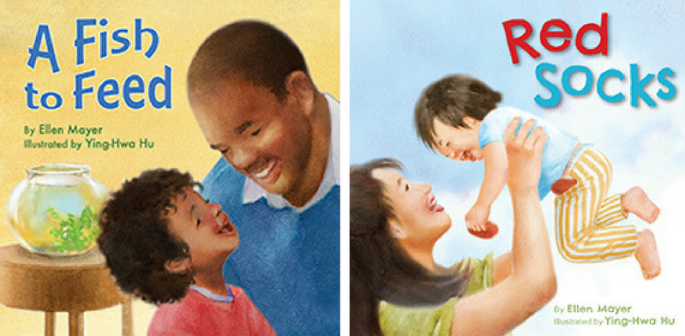
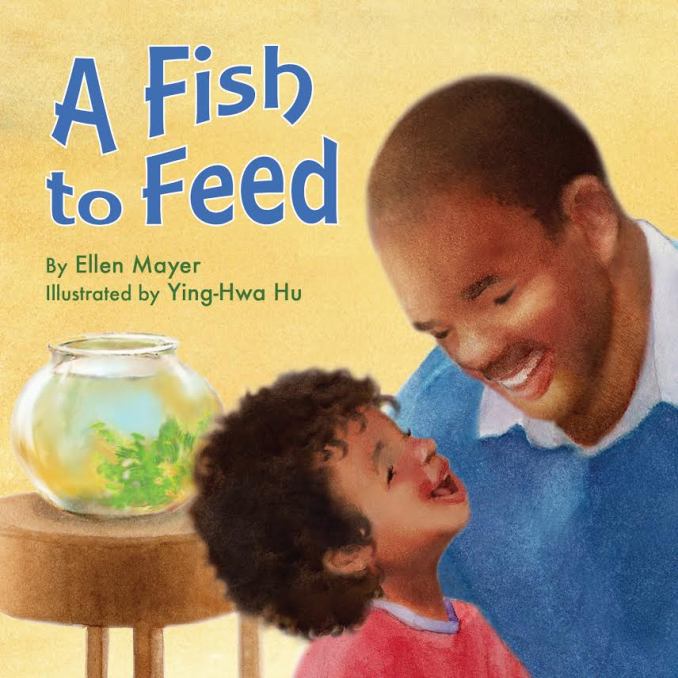
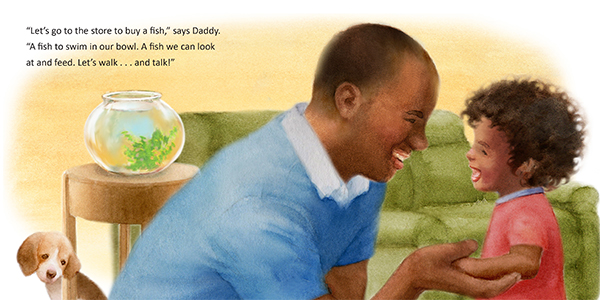
A Fish to Feed
Written by Ellen Mayer | Illustrated by Ying-Hwa Hu
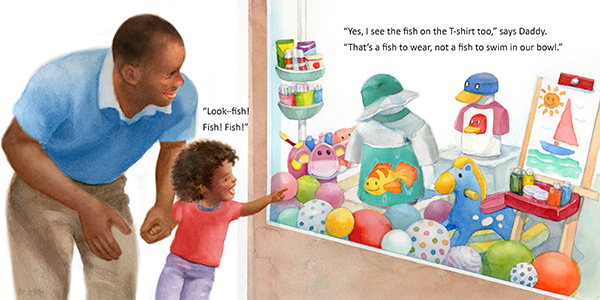
Dad plans a fun trip into town with his young child to buy a pet fish. He says, we will get “a fish to swim in our bowl. A fish we can look at and feed.” The pair are excited to go together and have time to “walk…and talk.” The two head out and soon pass a store. In the window the child sees a T-shirt with the picture of a fish on it and points. “Look—fish! Fish! Fish!” Dad reinforces the observation—“Yes, I see the fish on the T-shirt too.”—and further explains: “That’s a fish to wear, not a fish to swim in our bowl.”
Image copyright Ying-Hwa Hu, text copyright Ellen Mayer. Courtesy of starbrightbooks.com
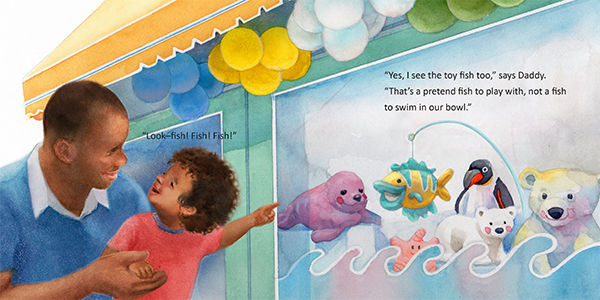
Going into the store, Dad and his youngster find another item with a fish on it. On a shelf is a backpack with a picture of a gold-and-yellow fish on the front pocket. This is a “fish to wear on your back,” Dad says, before going in search of a “fish to feed.” Next, the two come to a toy store. The child points to another fish—a fish on a mobile. “Look—fish! Fish! Fish!” the toddler exclaims. Dad affirms his child’s remark and expands on it using complete sentences that model conversation and increase vocabulary. They linger in the shop, finding other examples of fish.
Image copyright Ying-Hwa Hu, text copyright Ellen Mayer. Courtesy of starbrightbooks.com
“‘Now let’s go find a fish to feed,’ says Daddy.” They head out of the store and continue down the street. As they come to the Pet Shop, the little one shouts, “‘Look—fish! Fish swim!” Daddy echoes the excitement while praising his child. “‘You found a fish that swims!’” They take the goldfish home, where it swims happily in their bowl—a pet they “can love and feed.”
A Fish to Feed contains die-cut holes in the pages that kids will love peering through as they shop along on this adventure to find a special pet.
Image copyright Ying-Hwa Hu, text copyright Ellen Mayer. Courtesy of starbrightbooks.com
Ellen Mayer’s story of a dad and his child out for an afternoon together as they look for a pet to love offers adults and children such a sweet way to spend time with one another. The story, set in the familiar environments of home and stores and revolving around a close parent-child relationship, will engage even the youngest readers. The back-and-forth conversation between Dad and his child as they shop models ways in which adults can follow a child’s lead while providing language and literacy development. The abscence of gender-specific pronouns makes this a universal story.
Ying-Hwa Hu’s illustrations are vibrant and joyful. When Dad bends down to be at eye-level with his toddler as they talk, the close bond between them is obvious in their smiling and laughing faces. The shops are full of colorful toys, clothes, backpacks, and other items that will capture kids’ attention. Spending time looking at each page allows adults and children to point at the various items, name them, and talk about them.
Ages Birth – 5
Star Bright Books, 2015 | ISBN 978-1595727077
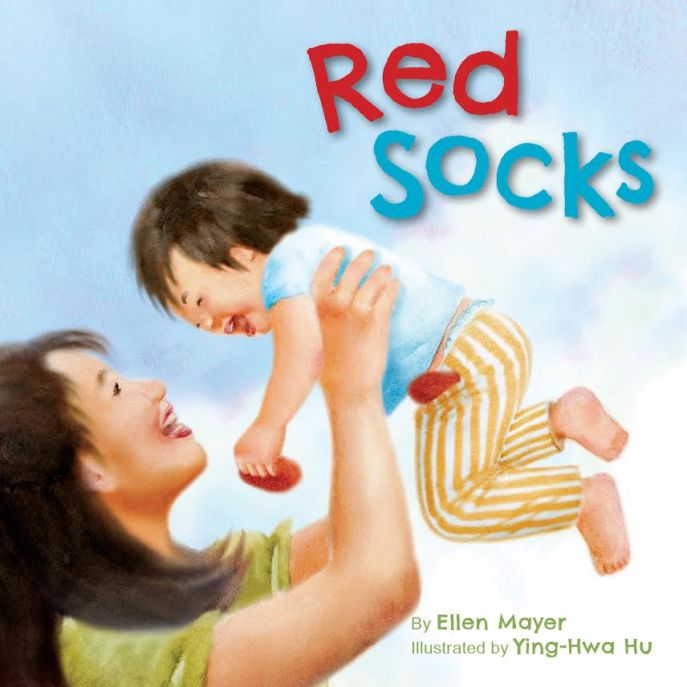
Red Socks
Written by Ellen Mayer | Illustrated by Ying-Hwa Hu
It’s laundry day and the clothes are all dried and soft and ready to wear. “‘Here is your blue shirt, with the goldfish on it,’” Mama says, pulling the top out of the basket and bending down to eye level to show it to her baby. Next, Mama describes the “yellow and white striped pants” she puts on her child. “‘Let’s see what else is in the laundry basket,’” she says.
Image copyright Ying-Hwa Hu, text copyright Ellen Mayer. Courtesy of starbrightbooks.com
Mama pulls a tiny red sock from the basket, but—“UH-OH!—where is the other red sock?’” Now it’s the baby’s turn to help. With a look down, the toddler shows Mama where the sock is. “‘You found the other red sock. Yay!’” she says, giving words to the baby’s action. She continues explaining while pointing to the sock poking out of the baby’s pocket: “‘It was hiding in your pants pocket!” Once the laundry is folded, Mama tells her child exactly what they will do next while she playfully slips the other red sock on the baby’s wiggling feet. “‘Let’s put that other sock on your foot. Then we can go play outside.’” As the baby flies in the swing outside, the red socks are brilliant dots against the blue sky.
Image copyright Ying-Hwa Hu, text copyright Ellen Mayer. Courtesy of starbrightbooks.com
Ellen Mayer’s simple and charming story of a particular moment in a mother and child’s day will immediately appeal to even the youngest reader. Familiar words coupled with clear, vivid illustrations will engage toddlers who are pre-talking and just learning language and concept development. The mother’s use of complete sentences as well as step-by-step descriptions of the activities the child sees and is involved in demonstrates how adults can converse with their babies and young children to encourage strong language and literacy skills. Free of gender-specific pronouns, Red Socks is a universal story.
Ying-Hwa Hu’s illustrations show a mother and child interacting on a typical day while they complete common chores and go outside to play. The mother and child portray a range of emotions and gestures, giving further depth to the understanding of the ideas and conversation presented. Kids will giggle at the adorable puppy who causes a bit of mischief on each page.
Ages Birth – 5
Star Bright Books, 2015 | ISBN 978-1595727060
To learn more about Ellen Mayer and her Small Talk Books® (including other titles: Cake Day and Rosa’s Very Big Job) as well as to find activities to accompany each book, visit her website!
Discover more about Ying-Hwa Hu and view a portfolio of her illustration work on her website!
Red Socks and Too Small to Fail
Red Socks was chosen by Too Small to Fail, an early literacy initiative of The Clinton Foundation to feature in their Wash Time is Talk Time project. Wash Time is Talk Time serves underserved communities and provides resources to turn time spent at the laundromat into an opportunity for families to talk together, read together, and learn together. Language-rich literacy resources will be delivered to more than 5,000 laundromats across the country.
Here’s a video from one fun afternoon with families, Ellen Mayer, and Ying-Hwa Hu during wash time!
National Family Literacy Month Activity
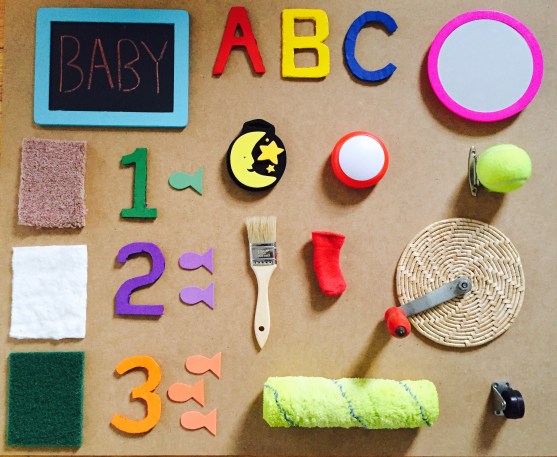
Child’s Sensory Board
Toys or objects that provide many opportunities for sensory experimentation and observation stimulate a baby and young child to learn while having fun. You can make a sensory board for your own child using household items and that have a variety of textures, sizes, shapes, and movement. When you create your own sensory board, you can personalize it for your child by adding their name, pictures of family members, and other special items. While you play with your child, take time to talk about all of the objects on the board, what they do, and how they work. Count the objects. If you include words or your child’s name, spell them outloud and say them. There are so many ways to use a sensory board. Even if children can’t yet talk, they are listening and soaking in the rich language learning you are providing!
**When making your board always ensure that you use items that are not a choking hazard or can catch tiny fingers. Make sure that items are firmly attached to the board. Never leave a baby unattended while playing.**
Supplies
A board large enough to hold the items you want to attach. Boards that can be used include: those found at hardware stores or craft stores; large cutting boards; shelves; old table tops; etc.
Sample items for your sensory board can be age appropriate and include:
Large swatches of various textured material. (I used fur, a scrubbing sheet, and a piece of carpeting)
Wooden or thick cardboard letters and numbers, painted in a variety of colors. Letters can be used to add a child’s name to the board.
Figures cut from sheets of foam or wooden figures found at craft stores in a variety of numbers that you can count with your child (I used sets of 1, 2, and 3 fish cut from foam to go along with the numbers 1, 2, and 3)
Mirror
Push button light
Chalk board to write on
Castor or other wheel
Door latches
Door knockers
Mop heads
Paint rollers
Cranks
Drawer handles
Hinges (I attached a tennis ball to a hinge that children can push back and forth)
Pulleys
Paint in various bright colors
Paint brushes
Scissors
Screws
Nuts and bolts
Velcro
Super glue
Directions
Assemble your items
Paint wooden or cardboard items
Arrange item on the board so that your baby or child can easily reach or manipulate each one
Attach items with screws, nuts and bolts, or super glue
Push button lights or other objects that take batteries can be attached with strong Velcro. Ensure items attached with Velcro are large and not a choking hazard.
Set up board where you and your baby or child can enjoy playing with it together
This week we celebrate families. Yes, those people you may just have seen at the Thanksgiving dinner table—those people that you love even as you sometimes wonder if you’re really related. National Family Week was established in 1968 by Sam Wiley, a former teacher and administrator from Indianapolis, Indiana. In 1970 Wiley partnered with the Alliance for Strong Families and Communities. The aim of the Alliance and this designated holiday is to “build community connections and honor those who strengthen families.” Today, tell your family members how much they mean to you and plan some fun activities that include all!
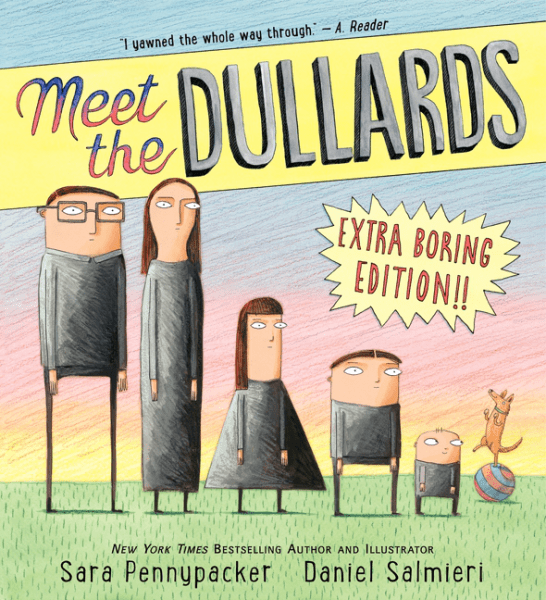
Meet the Dullards
Written by Sara Pennypacker | Illustrated by Daniel Salmieri
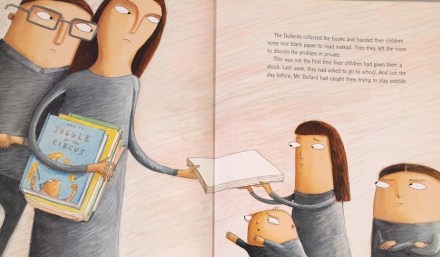
Gray—that’s what the Dullards are. Gray and happily extra boring. Their life is going on in its monotonous way until one day when Mr. and Mrs. Dullard happen upon a most disturbing sight. Their three children are reading—and not only that, they are reading books about befriending lions, juggling, and walking a tightrope. The elder Dullards do what any self-respecting dullard would do. They retrieve the books and hand their children blank pieces of paper to read instead.
Image copyright Daniel Salmieri, text copyright Sara Pennypacker. Courtesy of danielsalmieri.com
The children are definitely becoming a problem. They want to go to school and have been playing outside. It’s not our fault, bemoan the parents; it must be the town, where last fall some leaves actually turned color and there’s that unruly snail in the driveway. In fact the whole atmosphere is like a circus! There’s only one thing to do. The Dullards pack up their house and Blanda, Borely, and Little Dud and move away.
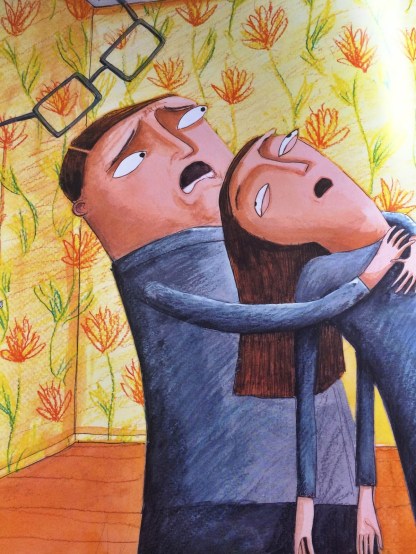
Immediately upon moving into their new home, they are bombarded by the neighbor lady bringing exclamation marks and chunky applesauce cake into their perfectly dull new home. The kids are sent to watch the (unplugged) TV, but instead their eyes are drawn to the window. While unpacking Mr. and Mrs. Dullard discover a sight so shocking that Mrs. Dullard faints into the arms of her distressed husband. It’s yellow flowered wallpaper. (An exclamation mark would be appropriate here, but you know…)
Image copyright Daniel Salmieri, courtesy of harpercollins.com
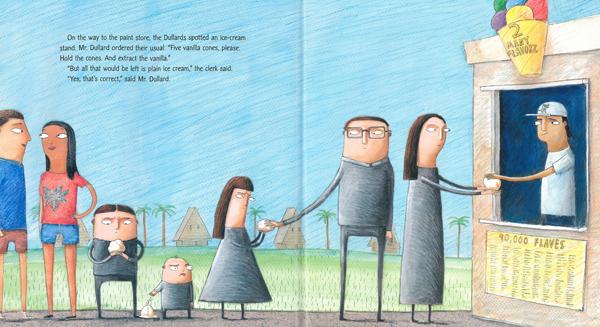
On the way to the paint store the family stops to get ice-cream cones, and with 90,000 flavors to choose from they pick vanilla. Plain cone or sugar cone? No cone, of course. At the paint store Mr. Dullard suggests medium gray, but Mrs. Dullard deems it too risky. Its similarity to highways could make the kids think of travel. Beige? Mrs. Dullard counters. Too much like clay, says Mr. Dullard which can be used to create stuff. They come to a compromise and go home to—you’ve got it—watch the paint dry.
Image copyright Daniel Salmieri, text copyright Sara Pennypacker. Courtesy of harpercollins.com
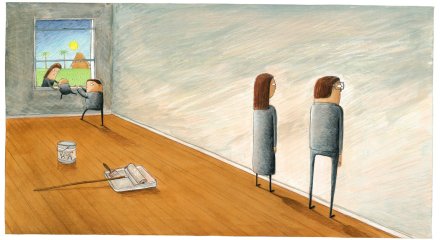
While their parents are mesmerized the kids sneak away and out the window that so enthralled them before. The sight of Blanda, Borely, and Little Dud juggling, teaching a dog tricks, and somersaulting on the clothesline, ushers in another move—back to where they came from just in time for the kids to join the circus.
Image copyright Daniel Salmieri, courtesy of harpercollins.com
With dry wit and laugh-out-loud dialogue Sara Pennypacker delivers a spot-on family story. While seen through the eyes of Mr. and Mrs. Dullard, this funny tale is all about the kids. What kids don’t think their parents are dull and conventional? And can parents really understand what’s going on in those little minds? Both children and adults will love the Dullards, and after reading you may be inspired to go out for vanilla chocolate ice-cream (ok, you can still hold the cone!).
Daniel Salmieri’s Dullards are comic genius! With their oval bodies and gray attire they blend with their oatmeal-hued walls to perfect effect. Identical square houses give way to identical triangular houses as the Dullards move to avoid catastrophic enthusiasm. The kids’ facial expressions as they adhere to booorring rules are priceless, as are the parents’ reactions to the slightest excitement. Details such as a yellow snail in the driveway, the elder Dullards’ looks of horror when discovering the bright wallpaper, the signs on the ice-cream kiosk, and the name of the moving van provide humorous jokes on each page.
Ages 4 – 8
Balzer + Bray, Harper Collins, 2015 | ISBN 978-0062198563
Visit Sara Pennypacker‘s virtual studio to learn more about her, her books, and her thoughts on writing and literacy.
View a portfolio of Daniel Salmieri‘s artwork for picture books and other illustrations on his website!
National Family Week Activity
Paint Strip Inspiration
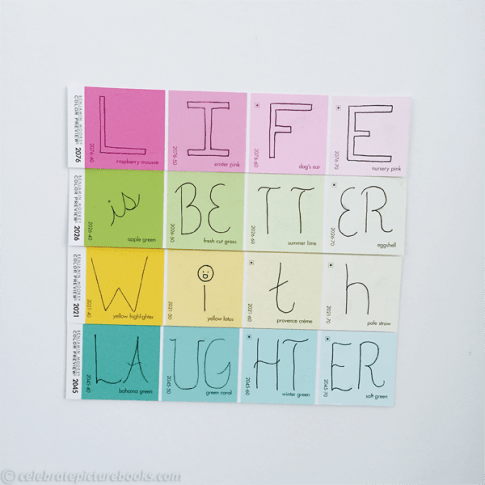
Do you like to laugh? Do you like to watch paint dry? It is kind of cool how it changes color a bit as it dries….Oh, sorry! Where was I? Oh yeah—this craft. Paint sample strips make brilliant backdrops to your thoughts about love, life, laughter, family—anything! You can mix and match your favorite colors and arrange them any way you like to decorate your wall. Frame them for a more put-together look!
Supplies
4 -5 paint strips from a hardware store OR You could also make your own color stips with poster board and craft paint
Poster board
Craft paint
Paint brush
Markers or adhesive letters
Scissors
Mounting squares
Frame (optional)
Directions
Choose an inspirational or funny quotation or make up your own phrase
Decide how you would like the words displayed on the paint strips
Count how many paint strips you will need
If you are using paint strips from a paint or hardware store, choose the number of color strips that you need and write the letters and/or words of your phrase into the individual squares. You can print one letter per square or multiple letters or even whole words. Mix styles of print to give it your own unique look.
If you are making your own paint strip, cut poster board into strips 9 inches long by 2 inches wide, or to desired size
Paint squares of color to fill the strip, leaving a 1/8-inch-wide stripe between colors
Think of a phrase that expresses your thoughts on life and laughter OR use a favorite quotation
Print the words on the squares of color OR use adhesive letters. You can print one letter per square or multiple letters or even whole words. Mix styles of print to give it your own unique look.
National Adoption Day is a national collective initiative to raise awareness of the more than 100,000 children in foster care who are waiting to find permanent families. Sponsored by the Dave Thomas Foundation for Adoption, Congressional Coalition on Adoption Institute, The Alliance for Children’s Rights, and Children’s Action Network, National Adoption Day was instituted in 2000, and since then has made the wishes of nearly 58,000 children come true. Last year 4,000 children in foster care found forever families on this day.
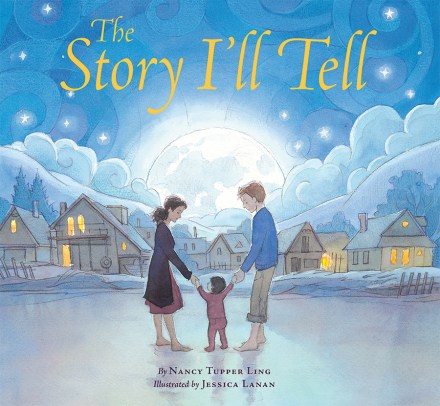
The Story I’ll Tell
Written by Nancy Tupper Ling | Illustrated by Jessica Lanan
A mom and her child snuggle in a big comfy chair reading a book together. “Someday,” the mom thinks, “when you ask where you came from, I’ll tell you a story.” She considers telling her child that they came from a faraway land, carried in a hot-air balloon that gently drifted down “like a feather” into the backyard. “‘You’re home now,’ I said. Then I wrapped you in a blanket as red and silky as the balloon’s sails.”
Image copyright Jessica Lanan, text copyright Nancy Tupper-Ling. Courtesy of Lee & Low
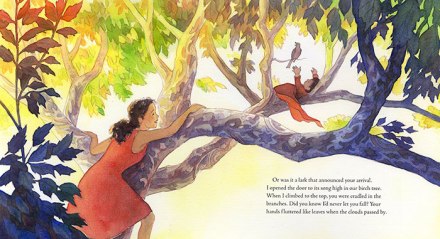
Or perhaps she will remember it differently: the blanket was fashioned from the silver cape worn by a mysterious horseman who rode into town with the baby in his saddle bag. Maybe, instead, it was an angel: “Wrapped in her arms, you followed a trail of lanterns around the world until you reached our doorstep. How your eyes sparkled when I first saw you.” But, no. She thinks back over the years and once again hears a lark singing high in the birch tree. “When I climbed to the top,” the mom will say, “you were cradled in the branches. Did you know I’d never let you fall? Your hands fluttered like leaves when the clouds passed by.”
Image copyright Jessica Lanan, text copyright Nancy Tupper-Ling. Courtesy of Lee & Low
The child’s mom might use her own grandmother’s tale of how she, herself, was found in the cabbage patch. But she would alter the setting slightly to a riot of tiger lilies that peppered her baby’s cheeks with pollen-like freckles. Or the child may have arrived in town with the August moon, the illustrious honoree riding on the dragon float as musicians played and lion dancers performed. “Your smile was as wide as the ocean when I cradled you.”
Image copyright Jessica Lanan, text copyright Nancy Tupper-Ling. Courtesy of Lee & Low
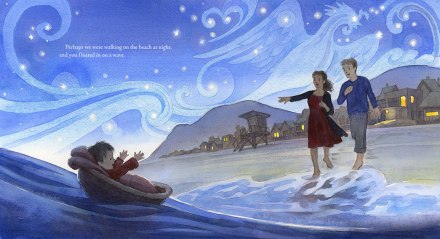
Maybe the baby’s parents weren’t at a parade, but walking along the seashore when their child “floated in on a wave. No, not a wave! I’d say there was a dragon queen who kept you by the sea to raise you as her own….I waited inside until the dragon queen fell asleep. Then I tiptoed inside and rescued you from her dark cave.” Even as she imagines all these stories, however, the child’s mother knows they will not be believed, “because it will be hard to fool the brightest child in the world.”
The true story, however, is just as marvelous and magical as any invention. So when the child is old enough to wonder, the mother says, “I will tell you how we gathered you in a silk blanket and flew on wings through the sky. Your eyes sparkled like the ocean below, and your hands fluttered as clouds passed by.”
Image copyright Jessica Lanan, text copyright Nancy Tupper-Ling. Courtesy of Lee & Low
Bringing a child into a family is always an awe-inspiring experience, almost inexplicable in the changes it creates in the heart. Sometimes the true story doesn’t seem to begin to accurately reflect the wonder of it all. Nancy Tupper Ling plumbs the depth of these feelings in The Story I’ll Tell, offering lyrical imaginings drawn from the fairytales, myths, and legends that are part of our global inheritance and enlighten our lives.
As a mother plans what she will someday tell her adopted child, readers learn that each of her various scenarios contain aspects of the actual story. Throughout, Tupper Ling offers assurances of the anticipated and enduring love the parents have for their child. While the ethnicity of the adopted child is not stated, images suggest that the baby was born in China. The book is also written without gender pronouns and illustrated with gender-neutral clothing and the short hair of most babies, making this a universal book.
Jessica Lanan’s gorgeous, ethereal paintings perfectly reflect the emotional power of Tupper Ling’s text. With each page the baby comes to the mother and father anew, highlighting not only the moment that the child became theirs but also the waiting that took place beforehand. Each two-page spread glows with sunlight, lantern light, or starlight and is connected by a swooping ribbon of imagination that carries aspects of the child’s heritage in its wake. Lanan’s vibrant palette of reds, blues, yellows, and greens depicts the joy of both parents and their child. Every page is infused with exquisite beauty and invites readers to linger to appreciate the full impact of this story.
The Story I’ll Tell makes a wonderful gift and is a must for all adoptive parents and their children. It is also an exceptional book to be shared with all children.
Ages 2 – 8
Lee & Low Books, 2015 | ISBN
Discover more books for children and adults by Nancy Tupper Ling on her website!
View a gallery of Jessica Lanan‘s illustration work for children’s and middle grade books
National Adoption Day Activity
I Love My Family! Portrait
Use this printable heart-framed I Love My Family! Page to draw a portrait of your family!
Bats are popular during the Halloween month of October for many reasons—they fly out of caves and nooks and crannies at night, they look kind of spooky, and they have that cool association with Dracula and other vampires. With over 1,300 species of bats around the world, however, these small fliers play a vital role in the welfare of our planet. Some bats are important for insect control, while others are pollinators and still others disperse seed. Unfortunately, bats have been in the news in the past few years for their declining numbers due to habitat destruction, disease, and hunting. Today’s holiday promotes awareness of the value of bats and urges people to help protect them.
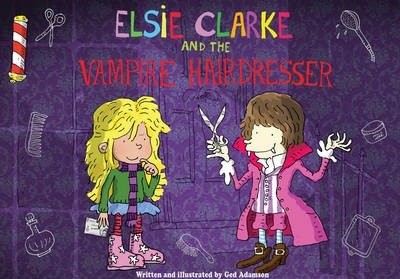
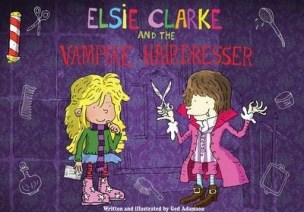
Elsie Clarke and the Vampire Hairdresser
By Ged Adamson
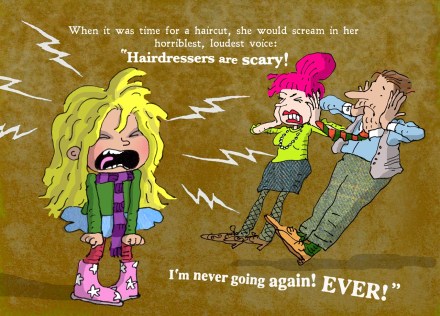
“Elsie Clarke was a brave little girl”…until she had to get her hair cut. Whenever her tresses reached a certain point and it was time for that appointment, “she would scream in her horriblest, loudest voice ‘Hairdressers are scary!’ I’m never going again! EVER!’” But Elsie’s dad thinks she might like his barber. Boris Lazzario, Hairdresser of Quality reads the business card he hands her.
Copyright Ged Adamson, courtesy gedadamson.com
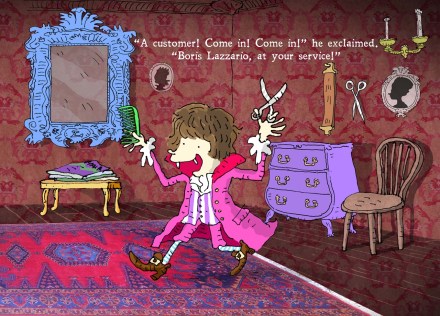
The card piques Elsie’s curiosity, so she heads down to 110 Turning Lane. She enters the door to find a very unusual looking boy rushing toward her. He has a comb in one hand and a scissor in the other, and his delighted smile reveals two sharp fangs. “‘A customer! Come in! Come in!’ he exclaims. “Boris Lazzario at your service!’” Before Elsie knows it, Boris has taken her hand and is showing her to his chair, while his cat, a ghostly Jasper, leads the way.
Copyright Ged Adamson, courtesy gedadamson.com
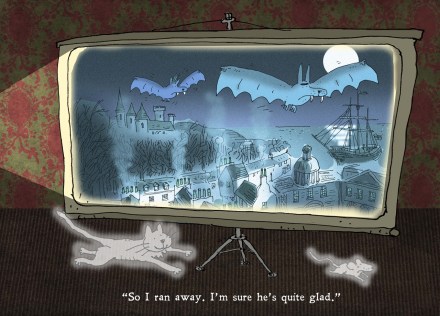
Before Boris can look at Elsie’s hair, however, she tells him that she is afraid of haircuts. Boris has heard it before. He shows Elsie a portrait of his father, Count Lazzario. “‘Everyone’s terrified of him,’” Boris explains, but “‘he’s scared of haircuts, just like you.’” He plays an old movie for Elsie, revealing that his dad wanted him to be a “proper vampire.” To escape this life, Boris tells Elsie, he ran away and is sure his dad is glad that he did.
Just then the door flies open and the house rings with a “blood-curdling HOWL!” It’s Count Lazzario—not looking very glad at all. The Count chases Elsie and Boris upstairs and downstairs, all the while shouting “‘My son a hairdresser! Oh, the shame of it! You’re a disgrace to vampire kind!’” Finally, Elsie has had enough. She stops and pointedly tells the Count in her “horriblest, loudest voice that he should be proud of his son. “‘He’s not a monster like you,’” she shouts.
Copyright Ged Adamson, courtesy gedadamson.com
The Count breaks down in tears. “‘I just wish Boris did something that wasn’t so scary,’” he wails. Suddenly Elsie sees how silly it is to be afraid of a haircut. She musters her courage, reassures the Count, and tells Boris he has two customers. Boris shampoos, rinses, and cuts. While Elsie and the Count sit under the hairdryer, they read magazines while enjoying tea and chocolate cookies.
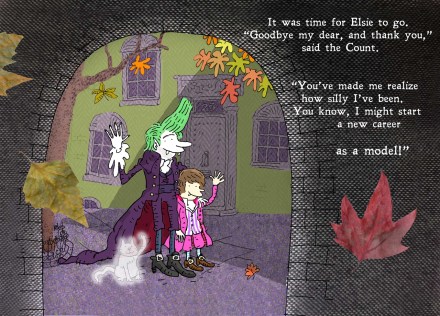
When the two see their new ‘dos they can’t believe their eyes. The Count proclaims his a “triumph,” and Elsie thinks hers is “‘the coolest, most amazing hairstyle in the world!’” As Elsie turns to go, the Count thanks her. He realizes how ridiculous he’s been and even thinks he may “start a new career as a model.” Elsie gives a final wave before heading home to show her mom and dad not only her new haircut but how very brave she really is.
Copyright Ged Adamson, courtesy gedadamson.com
There’s a wonderful free-range silliness to Ged Adamson’s books that brings a smile to your face as you read them. The great thing is that they are based on a kernel of truth, which anchors the story and gives it broader resonance. In the case of Elsie Clarke and the Vampire Hairdresser it’s a fear of haircuts—a scenario I know well from my own son who for a time received his cuts from a very understanding woman who sat with him on the salon’s play rug while she cut his hair. Adamson’s knack with humorous and believable dialogue paired with laugh-inducing action makes the story a page-turner with the kind of suspense that keeps kids giggling from the first page to the satisfying last.
Adamson’s lush illustrations, in a palette of purples, pinks, yellows, and greens, set on backgrounds of plaid tweed, herringbone, denim and other fabrics as well as ornate Victorian wallpapers, offer all the spooky details readers could want from a vampire’s hair salon. Kids will marvel at the old film projector, and the black-and-white home movie of Boris and his dad is a clever touch. Readers will root for cute Elsie and Boris, and have a change of heart when the tyrant Count tears up.
For those times when a fear needs to be overcome—or for any story time—Elsie Clark and the Vampire Hairdresser is monstrous fun and would be an amusing addition to home libraries that kids will really sink their teeth into.
Ages 4 – 8
Sky Pony Press, 2013 | ISBN 978-1620879832
Discover more about Ged Adamson and his books on his website!
This Elsie and the Vampire Hairdresser book trailer is shear fun!
Bat Appreciation Month Activity
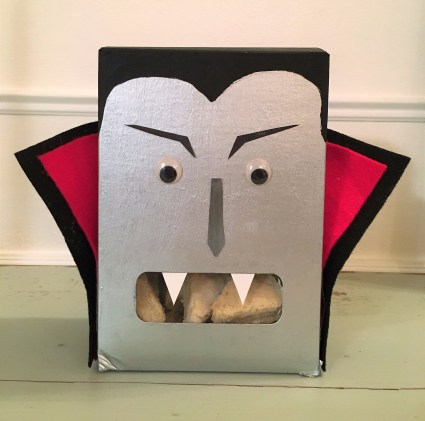
I Vant to Eat These Treats! Vampire Goodie Box
Would you like your gift of homemade or store-bought cookies, candy, or other treats to have a little bite to it? Deliver them in this vampire box you can make yourself!
Supplies
Recycled pasta box (or any box with a cellophane window in it)
Black Paint
Silver Paint
Black felt, 8 ½ x 11 sheet or heavy stock paper
Red felt, 8 ½ x 11 sheet or heavy stock paper
Googly eyes
Black paper, heavy stock or construction paper
Fabric glue
Regular glue or double stick tape
Hot glue gun (optional)
Paint brush
Scissors
Directions
Paint the entire box silver, leaving the window unpainted, let dry
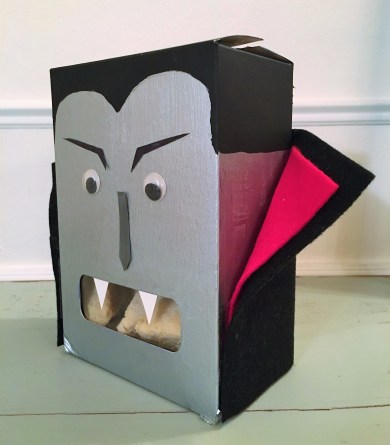
With the black paint create the pointy hairstyle, with the point descending about 1 inch from the top of the box and the curves ending about 1 ½ – 1 ¾ inches from the side of the box (see picture).
Paint around the sides and back of the box in line with the ends of the curves
From the black paper make eyebrows—these can be pointy or rounded
From the index card make the nose and teeth
I painted the nose darker silver by combining silver and a little black paint
With the glue or double stick tape, attach the eyebrows and nose to the box
With the glue or double stick tape, attach the teeth to the window, fitting them slightly up into the rim of the window.
Attach the googly eyes
To make the cape
Holding the black felt or paper horizontally, cut a piece about 4/5 as tall as the box
Holding the red felt or paper horizontally, cut a piece of red felt so that there will be a ½-inch border of black along the top and sides
With the fabric glue attach the red felt to the black felt. Use craft glue on paper. Let dry
With the hot glue gun, fabric glue, craft glue, or double stick tape, attach the felt or paper to the back of the box
Fold the felt or paper around the sides of the box and attach along the bottom edge with tape or glue
Fold the top of the felt or paper back to make the collar
Attach the bottom portion of the collar to the box near the front edge with the tape or glue.
Fill with your favorite treat!
You can find Elsie Clarke and the Vampire Hairdresser at these booksellers


















 celebratepicturebooks.com