July 18 – It’s Park and Recreation Month

celebrate-picture-books-picture-book-review-pedal-power-cover

About the Holiday

We’ve hit mid-summer, and maybe you’re looking for something to do. This month’s holiday encourages people to get out and enjoy some exercise and fun in parks, at home, at the gym, in the pool, on tennis courts, or wherever you like to play. Biking is another wonderful activity that adults and kids can share, whether you live in a small town or the city.

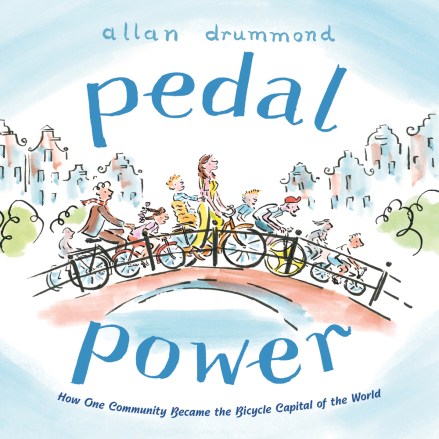
Pedal Power: How One Community Became the Bicycle Capital of the World

By Allan Drummond


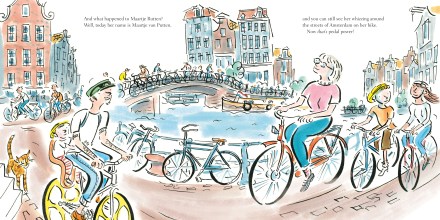
If you were to visit the city of Amsterdam in the Netherlands, you’d be amazed at the number of bicyclists sharing the roads with cars and trucks. In fact, if you could count all of the bicycles going here, there, and everywhere, you’d see that “bikes rule the road.” It wasn’t always like this. Back in the 1970s cars were still king, making the roads unsafe for cyclists.
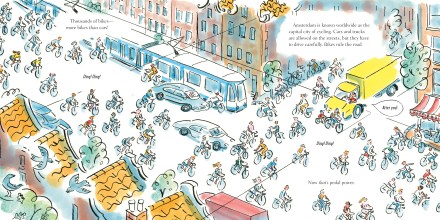
celebrate-picture-books-picture-book-review-pedal-power-bikes

Copyright Allan Drummond, 2017, courtesy of us.macmillan.com

But then “young moms like Maartje Rutten and her friends—and their children” decided to make a change. They called their friends, who called their friends, and word started to get around that roads should be shared by all. People in Amsterdam and all over the Netherlands started protesting. “At first the demonstrations were great fun. People even held parties in the middle of the road.” People sang songs, made human chains across streets, and talked to the media.

Then a tragedy made people look at the issue more seriously. A little girl riding her bike to school was killed by a car. Her father was a newspaper reporter, and he wrote a story revealing that just in that year alone five hundred children had been killed on the roads and “many of them were riding bikes.” This situation made people angry. More and more citizens joined the protests.
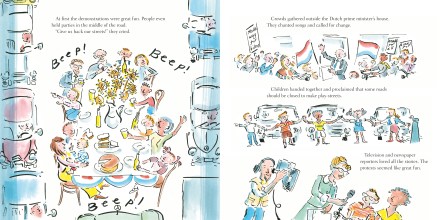
celebrate-picture-books-picture-book-review-pedal-power-protests

Copyright Allan Drummond, 2017, courtesy of us.macmillan.com

At the same time, gas prices were rising and fuel was becoming scarce. The government even banned cars from the roads on Sundays. “That gave Maartje an incredible idea.” She gathered her friends and told them her plan: they would ride their bikes through the new tunnel that was strictly for cars. Many people were wary but they came anyway, and on a quiet Sunday they pedaled through the darkness.

As they neared the mouth of the tunnel, they could see the police waiting for them. Some of the riders wanted to turn around and go back, but Maartje pushed on and they followed. When they reached the end, the cops told them they had broken the law. The cyclists were taken to the police station. There, they were given lemonade and cookies. Maartje even “noticed that the policemen were smiling just a little bit. Maybe all of this protesting is working, she thought.”

celebrate-picture-books-picture-book-review-pedal-power-more-protests

Copyright Allan Drummond, 2017, courtesy of us.macmillan.com

She was right! After that Maartje and her friends thought of other ways cars and bikes could share the roads. “They proposed special bike lanes on busy routes, traffic bumps and curves in the roads to slow down vehicles, and new laws giving bikes the right-of-way over cars.” Finally, it all came together. Now Amsterdam is known as the bike capitol of the world. Their ideas, including bike lanes, bike sharing, and new laws, are used in countries all over the globe.

Biking offers so much more than just less-crowded streets. It provides exercise, a quiet form of transportation, and a pollution-free way to get around. And, of course, bikes don’t require fuel to go. If you visit Amsterdam, you might even see Maartje riding around town on her bike. “Now that’s pedal power!”

An Author’s Note about how Pedal Power came to be and about the past and future of city biking follows the text.
celebrate-picture-books-picture-book-review-pedal-power-Amsterdam-today

Copyright Allan Drummond, 2017, courtesy of us.macmillan.com

Allan Drummond’s city bike-ography is an interesting look at the revolution and evolution of bike-friendly roads in Amsterdam and other large cities. By following the story of Maartje Rutten and how she transformed the mindset of both local drivers and government officials, Drummond allows young readers to see how one person can make lasting changes that benefit all.

Drummond’s colorful and clearly depicted illustrations take children into the heart of Amsterdam—and Amsterdam traffic—to understand the problem and join in the protests. As Maartje and her friends ride through the dark tunnel to face the police, readers will wait in suspense to learn how this peaceful demonstration played out.

Pedal Power would be a great addition to Social Studies units and an engaging read for kids interested in biking, history, and environmental issues.

Ages 4 – 8

Farrar, Straus and Giroux, 2017 | ISBN 978-0374305277

Discover more about Allan Drummond, his books, and his art on his website!

Park and Recreation Month Activity

celebrate-picture-books-picture-book-review-bicycle-coloring-page-2

Everything on a Bicycle Coloring Page


Riding a bicycle is a fast, fun way to exercise, do shopping, and spend time with friends. This printable Everything on a Bicycle Coloring Page combines them all and then some! Grab your colored pencils, crayons, or markers and give it a go!

Picture Book Review

July 3 – International Plastic Bag Free Day

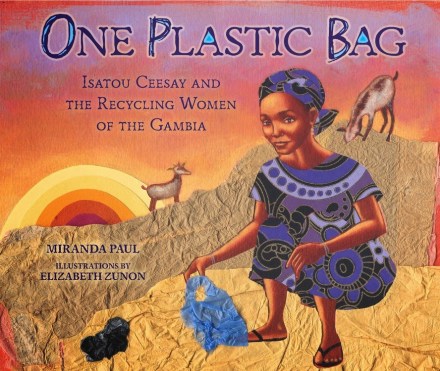
celebrate-picture-books-picture-book-review-one-plastic-bag-cover

About the Holiday

Plastic bags are everywhere! Used by supermarkets, department stores, discount stores, and just about anywhere goods are sold, plastic bags are a take-home-then-throw-away item that never quite goes away. These bags may seem lightweight, but they do heavy damage to the environment, taking hundreds of years to fully decompose. Many shops encourage patrons to bring their own bags and offer cloth and paper bags as well. These are great alternatives that benefit the earth. Today’s holiday was established to promote awareness around the world to the dangers of plastic bags and spur people to use reusable containers.

One Plastic Bag: Isatou Ceesay and the Recycling Women of the Gambia

Written by Miranda Paul | Illustrated by Elizabeth Zunon


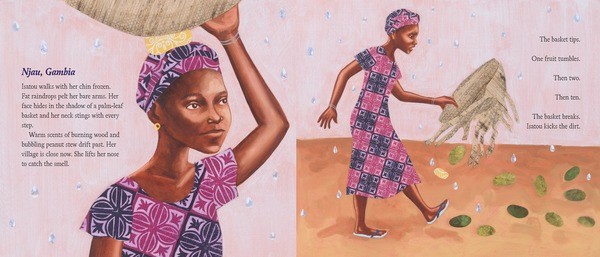
In Njau, Gambia Isatou walks home carrying a basket of fruit on her head. As raindrops begin to fall, the basket shields her, but suddenly the basket tips and falls. The fruit inside tumble to the ground. The basket is in shreds; how will Isatou carry her load? “Something silky dances past her eyes, softening her anger. It moves like a flag, flapping in the wind, and settles under a tamarind tree.” Isatou picks it up and finds that it can hold things. She gathers her fruit and puts them in the bag. She leaves her basket behind, “knowing it will crumble and mix back in with the dirt.”

celebrate-picture-books-picture-book-review-one-plastic-bag-basket

Image copyright Elizabeth Zunon , text copyright Miranda Paul. Courtesy of Millbrook Press.

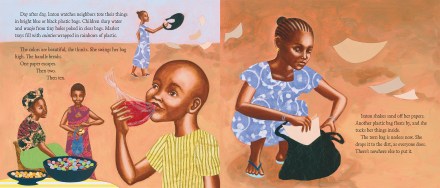
At home Grandmother Mbombeh has a dinner of spicy rice and fish ready. When Isatou tells her about the broken basket and shows her the bag, Grandmother frowns. She has seen more in the city. Now, Isatou notices plastic bags everywhere. They are as colorful as a rainbow. As Isatou swings her bag full of papers, the handle breaks, sending the papers inside flying. She finds another plastic bag lying nearby and transfers her papers. She leaves the torn bag in the dirt as everyone else does.

celebrate-picture-books-picture-book-review-one-plastic-bag-papers

Image copyright Elizabeth Zunon, text copyright Miranda Paul. Courtesy of Millbrook Press.

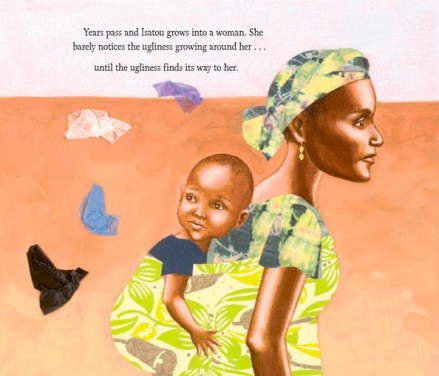
As she passes the spot day after day, she spies her old black bag. It has been joined by others, and the pile grows bigger and bigger. Isatou chooses another path to take and forgets about the bags. “Years pass and Isatou grows into a woman. She barely notices the ugliness growing around her…until the ugliness finds its way to her. One day when coming to Grandmother’s house, she hears one of her goats crying. It’s tied up and there is no sign of her Grandmother’s other goats.

celebrate-picture-books-picture-book-review-one-plastic-bag-Isatou-grown

Image copyright Elizabeth Zunon, text copyright Miranda Paul. Courtesy of Millbrook Press.

Inside, the butcher is talking to Grandmother Mbombeh. He says that the goats have eaten the plastic bags they find lying around. The bags get twisted around their insides, killing the goats. Three of Grandmother’s goats and many more in the village have died. Something must be done. Isatou goes to the road piled with bags. Insects, rotting food, and dirty water mingle with the bags. Goats “forage through the trash for food.”

Isatou retrieves bag after bag from the pile. She and other women wash the bags. While they dry Isatou asks her sister to teach her how to crochet. Isatou has an idea. From a broomstick she carves crochet needles. Then she and her friends cut the bags into strips of thread. The women teach themselves how to crochet with the plastic thread. The work is slow, and some villagers laugh at them. Long into the nights the women continue crocheting by candlelight.

celebrate-picture-books-picture-book-review-one-plastic-bag-purses

Image copyright Elizabeth Zunon , text copyright Miranda Paul. Courtesy of Millbrook Press.

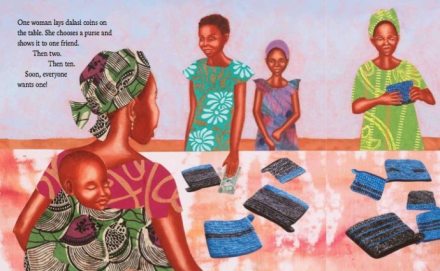
At last a day comes when the women can show what they have been working on. “Fingers sore and blistered, Isatou hauls the recycled purses to the city.” People laugh at her until “one woman lays dalasi coins on the table. She chooses a purse and shows it to one friend. The two. Then ten. Soon everyone wants one!” Later that day Isatou puts the money she has made into her own zippered purse. She can’t wait to show Grandmother that she has earned enough to buy a goat. The trash pile is smaller now. Isatou is determined that one day it will be gone. “And one day…it was.”

An Author’s Note provides more details about this true story as well as a Wolof language glossary and pronunciation guide.

Miranda Paul tells this true story of ingenuity and hope with honesty and evocative language. Young readers will learn how one woman’s concern for her community and courage in the face of opposition changed the lives of the people in her village. Paul’s descriptive text interspersed with native Wolof words allows children to discover details about the customs and daily lives of the citizens of Gambia. Paul’s use of the present tense, makes this a universal story that shows the continuing need for answers to ongoing environmental problems. Isatou’s creative solution to a world-wide problem may spur young readers to develop helpful ideas of their own.

Through her collage illustrations, Elizabeth Zunon brings the vibrant colors and patterns of Africa to readers. The textured papers she uses add depth and details to the women’s clothing, homes, foliage, and the plastic bags that Isotau and her friends transform. Children sit in on the candlelit nighttime crocheting sessions and view the beautiful, finished purses—each one unique.

Ages 6 – 9

Millbrook Press, 2015 | ISBN 978-1467716086

Discover more about Miranda Paul and her books and find resources, videos, photos, and more on her website!

Learn more about Elizabeth Zunon and her books and view a portfolio of her artwork on her website!

International Plastic Bag Free Day Activity

celebrate-picture-books-picture-book-review-book-bag-craft

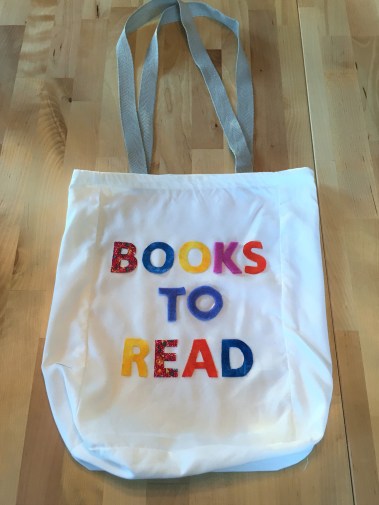
Books to Love, Books to Read Reusable Book Bag


True booklovers can’t go anywhere without a book (or two or three) to read along the way. With this easy craft you can turn a cloth bag into a kid-size book bag!

Supplies

  • Printable Templates: Books to Read Template | Books to Love Template
  • Small cloth bag, available from craft or sewing stores—Recyclable Idea: I used the bag that sheet sets now come in
  • Cloth trim or strong ribbon, available from craft or sewing stores—Recyclable Idea: I used the cloth handles from shopping bags provided from some clothing stores
  • Scraps of different colored and patterned cloth. Or use quilting squares, available at craft and sewing stores
  • Pen or pencil for tracing letters onto cloth
  • Scissors
  • Small sharp scissors (or cuticle scissors) for cutting out the center of the letters
  • Fabric glue
  • Thread (optional)
  • Needle (optional)

celebrate-picture-books-picture-book-review-books-bag-craft

Directions

  1. Print the sayings and cut out the letters
  2. Trace letters onto different kinds of cloth
  3. Cut out cloth letters
  4. Iron cloth bag if necessary
  5. Attach words “Books to Read” to one side of bag with fabric glue
  6. Attach words “Books to Love” to other side of bag with fabric glue
  7. Cut cloth trim or ribbon to desired length to create handles
  8. Glue (or sew) handles onto the inside edge of bag

Picture Book Review

June 28 – It’s Great Outdoors Month

celebrate-picture-books-picture-book-review-the-fog-cover

About the Holiday

Great Outdoors Month may be winding to a close, but the season for enjoying outside adventures is just beginning! Make this a great summer by planning to spend more time in and with nature—whether you do that in a majestic national park, at a local playground, on a patch of green in the city, at the seashore, or in your own backyard! The fresh air and sunshine will make you happy!

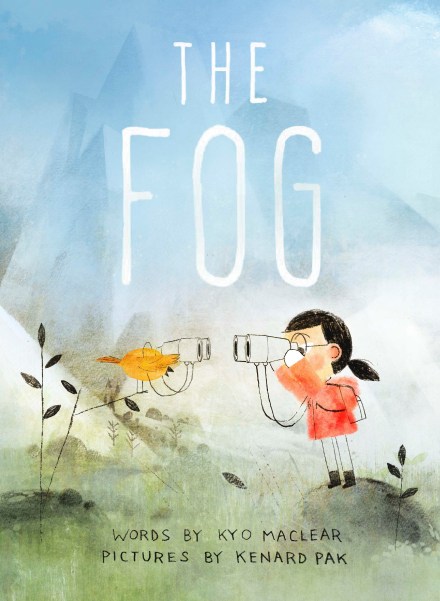
The Fog

Written by Kyo Maclear | Illustrated by Kenard Pak


“Far north, on a wild sea, was an island covered with ice.” The island was a favorite tourist destination, and while the people explored their home, most birds took no notice. “But there was one bird, a small yellow warbler, who did pay attention.” In fact, “Warble was a devoted human watcher.” With so many visitors, Warble always had new specimens to investigate. He kept a journal of his sightings. #671 was a “Behatted Bibliophilic Female.” Warbler remembered her well, reading a book in her wide-brimmed hat. A man bedecked in gold jewelry was entry “#672 Bald-Headed Glitzy Male.”

celebrate-picture-books-picture-book-review-the-fog-tourists

Excerpted from The Fog by Kyo Maclear. Text copyright © 2017 by Kyo Maclear. Illustrations copyright © 2017 by Kenard Pak. Published by Tundra Books, a division of Penguin Random House Canada Limited. Reproduced by arrangement with the Publisher. All rights reserved.

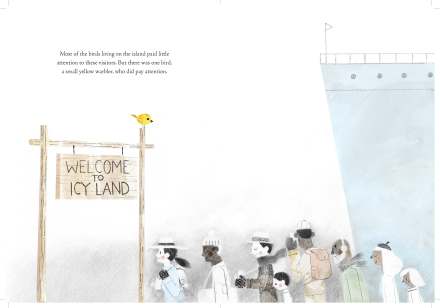
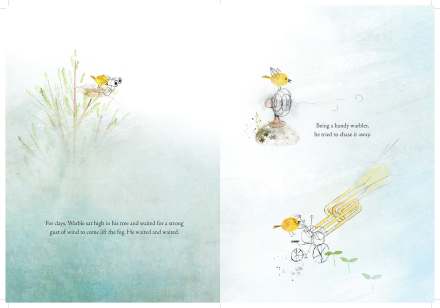
One day, though, a dense fog seeped across the valley, hiding everything in its gauze-like swirls. Warbler’s hobby came to a complete stop. After several days, he tried to blow the fog away with a fan and with a particularly blaring horn of his own invention. Nothing dispelled the fog. When Warbler consulted the other birds, they were nonchalant. It didn’t take long before the sign welcoming guests to the island was changed from “Welcome to Icy Land” to “Welcome to Fog Land.” And it took even less time for the other birds to forget there was ever clear air before.

celebrate-picture-books-picture-book-review-the-fog-chasing-fog

Excerpted from The Fog by Kyo Maclear. Text copyright © 2017 by Kyo Maclear. Illustrations copyright © 2017 by Kenard Pak. Published by Tundra Books, a division of Penguin Random House Canada Limited. Reproduced by arrangement with the Publisher. All rights reserved.

Warbler could not forget, and the creeping dark sea was worrying also. He tried to alert others to the danger, but they had already taken up other pursuits and were too busy to care. Finally, after spotting no more humans, Warbler put away his binoculars, books, and journal, and tried move on. “But then, one foggy morning, Warble spotted a colorful speck in the distance.”

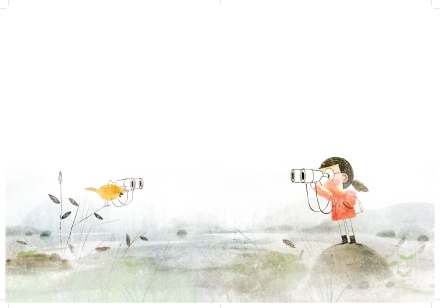
Upon closer inspection, Warble saw that it was a “rare female species and she was singing a song.” He jotted it down in his journal: “#673 Red-hooded Spectacled Female (Juvenile).” She consulted a map and then put her binoculars to her eyes. She found herself staring into the binoculars of Warble. Warble was so happy to see her that he made her a picnic lunch, complete with insects. The girl gave Warble gifts from her pack and taught him origami.

celebrate-picture-books-picture-book-review-the-fog-girl

Excerpted from The Fog by Kyo Maclear. Text copyright © 2017 by Kyo Maclear. Illustrations copyright © 2017 by Kenard Pak. Published by Tundra Books, a division of Penguin Random House Canada Limited. Reproduced by arrangement with the Publisher. All rights reserved.

It turned out that she also understood “Chirp.” Warble asked her about the fog and whether others knew about it. They decided to find out. They made a paper boat and wrote “Do you see the fog?” on it. Then they launched in from shore. No reply came. They launched more and more boats until they got an answer. A walrus in Canada sent back a “Yes, I see the fog.” So did a musk ox from Norway and some cats from England. Notes came from every part of the globe. “With each one, the fog began to lift a little. And the wind began to blow again until the world grew a little less ghostly and it became easier to notice things.”

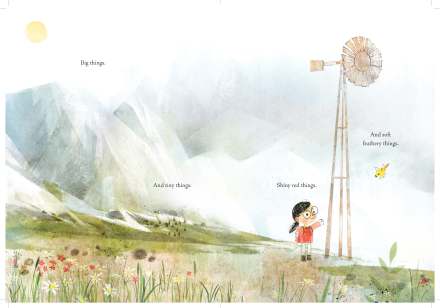
Warble and the human explored the island together, finding big things and little things. As the island brightened, they relaxed together and sang their songs to “each other and to the moon” which shone down through the clear night air on the happy pair.

celebrate-picture-books-picture-book-review-the-fog-fog-clears

Excerpted from The Fog by Kyo Maclear. Text copyright © 2017 by Kyo Maclear. Illustrations copyright © 2017 by Kenard Pak. Published by Tundra Books, a division of Penguin Random House Canada Limited. Reproduced by arrangement with the Publisher. All rights reserved.

From her clever turn-about plot Kyo Maclear has crafted a story that has a multitude of applications for the natural world as well as for the realm of personal relationships. The fog that descends on the island can clearly be read as a cautionary tale about the dangers of ignoring threats to the environment. While the tangible fog surrounds the island, the residents are in fogs of their own—preferring indifference to solving the problem. Only when others—who are brave enough or caring enough—acknowledge that they too recognize the trouble and want to fix it, does the fog begin to lift.

Maclear’s The Fog also gives readers an opportunity to talk with children about other examples of clouded issues. Misunderstandings, confusion, miscommunication, and loneliness can also create personal fogs for children and adults that negatively affect relationships and quality of life. Telling a family member or friend and reaching out to others can be the first step in “clearing the air” and living a happier life.

In his gauzy watercolor and pencil illustrations in frosted sages and yellows, Kenard Pak creates an island paradise that attracts attention from around the world. As the fog thickens, Pak’s colors darken and become denser. As the fog lingers smudges of gray surround the characters, but Pak resists the temptation to fill the pages with darkness. The Fog is, at its core, a story of hope and resolution and while the problem may be worsening, it is not yet insurmountable. The illustrations are sprinkled with puns and visual humor, and both kids and adults will love lingering over the endpapers, which offer a gallery of the humans Warbler has recorded on his life list.

Ages 4 – 8

Tundra Books, 2017 | ISBN 978-1770494923

To discover the unique world of books for children by Kyo Maclear, visit her website! You can learn about Kyo Maclear’s books for adults here.

Learn more about Kenard Pak and his books, as well as about his illustration and animation work on his website!

Great Outdoors Month Activity

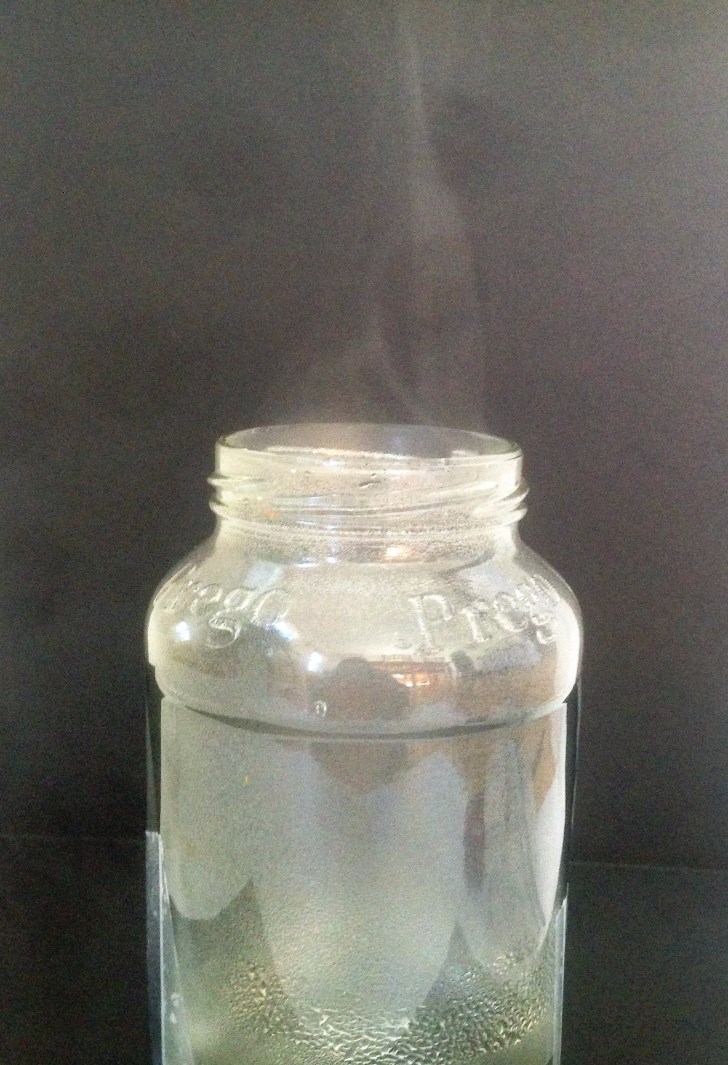
celebrate-picture-books-picture-book-review-fog-experiment-fog-curling-from-jar

Fog in a Jar


A foggy day or night can be mysterious and pretty cool! It’s also a fascinating part of nature and the science of weather! With this experiment you can make fog at home.

**Because a candle lighter is used in this experiment, adult supervision is required for children

Supplies

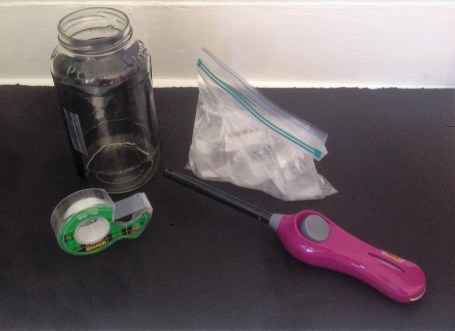
  • Wide-mouth glass jar, like a spaghetti sauce jar, cleaned and dry
  • Plastic baggie with a zip closure
  • Candle lighter
  • Ice
  • Dark paper
  • Tape

celebrate-picture-books-picture-book-review-fog-experiment-materials

Directions

  1. Wrap one side of the jar with the black paper and tape in place
  2. Fill the baggie ½ full of ice
  3. Fill the jar 1/3 full of hot to boiling water
  4. Hold the lighted lighter inside the jar above the water for 3 or 4 seconds and remove
  5. Put the baggie with ice over the opening of the jar
  6. Watch the fog form!
  7. Remove the ice and watch the fog curl out of the jar!

Picture Book Review
June 20 – World Refugee Day

celebrate-picture-books-picture-book-review-the-journey-cover

About the Holiday

On World Refugee Day, first celebrated in 2001, we commemorate the strength, courage, and perseverance of millions of refugees. The annual commemoration is marked by a variety of events in more than 100 countries, involving government officials, humanitarian aid workers, celebrities, civilians and the forcibly displaced themselves.

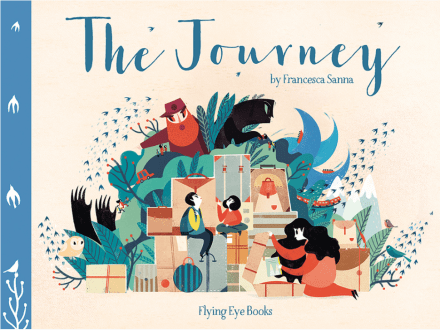
The Journey

By Francesca Sanna 


A child begins the story with a place—the family’s home in a city by the sea. The family used to visit the beach often, but not anymore, “because last year our lives changed forever,” the child reveals. “The war began,” the narrator says, turning their once-peaceful life into “chaos.” Not only was their city torn apart, the family was also, as “one day the war took [their] father.”

celebrate-picture-books-picture-book-review-the-journey-friend

Copyright Francesca Sanna, 2016. Courtesy of Flying Eye Books.

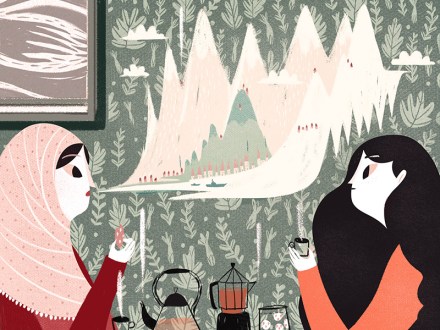
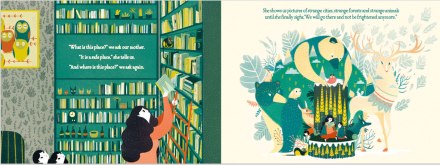
The child’s mother is afraid of the darkness that has descended on them. One of her friends told her that many people are leaving, escaping to another country with high mountains. The two children ask their mother where and what this place is. She answers that “‘it is a safe place’” an then shows them pictures that contain unfamiliar trees and animals. She sighs and tells her son and daughter, “‘We will go there and not be frightened anymore.’”

celebrate-picture-books-picture-book-review-the-journey-library

Copyright Francesca Sanna, 2016. Courtesy of Flying Eye Books.

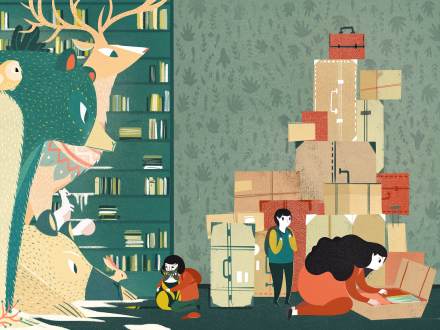
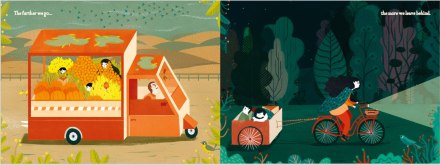
Even though the children don’t want to leave, they pack up all their belongings and say goodbye to their friends. They leave at night so they won’t be caught. They travel for many days, taking various modes of transportation. With each change the family must leave more and more of their things behind.

When they reach the border, they are met by an enormous wall that they must climb over. But before they can, a guard stops them and tells them they cannot cross, that they must go back. The family has nowhere else to go, however, and they are very tired. They find a spot in the woods to sleep, but the strange noises keep the children awake. Their mother tells them not to be afraid, and in her arms they finally fall asleep as she cries silent tears.

celebrate-picture-books-picture-book-review-the-journey-leaving-things-behind

Copyright Francesca Sanna, 2016. Courtesy of Flying Eye Books.

Suddenly, they hear shouting and see that the guards are looking for them. They run and run until they meet a man who takes them over the border. They come to the shores of a huge body of water that stretches far into the distance. The family must cross this water to be safe. They board a ferry loaded with other families and sail for days. On the way, they tell stories of the creatures who lurk in the waters below, “ready to gobble [them] up if the boat capsizes.” Other times they tell stories about magic fairies who live in the land they are going to—ones who have “magic spells to end the war.”

celebrate-picture-books-picture-book-review-the-journey-mother-protecting-at-night

Copyright Francesca Sanna, 2016. Courtesy of Flying Eye Books.

In the dawn light, the children and their mother finally see land. They are close to the place where they will be safe, the mother says, but it requires many more days of train travel across many more borders. On the journey the child watches birds migrating just as they are and hopes that one day, like the birds, they will find a new home where they “can be safe and begin our story again.”

Francesca Sanna’s moving compilation of true immigrant stories into a powerful narrative that speaks for so many provides a compelling and sensitive way to discuss the world’s refugee crisis with children. Sanna’s straightforward storytelling allows children to understand the cause and effect relationship of the war on those it displaces. Her focus on the length and difficulty of the family’s journey gives young children—for whom even short times and distances can seem long—a starting point for deeper comprehension. Sanna tempers frightening aspects of the story with her calm delivery and peppering of courage on the part of the mother and children along the way.

celebrate-picture-books-picture-book-review-the-journey-packing

Copyright Francesca Sanna, 2016. Courtesy of Flying Eye Books.

Sanna’s stunning and emotionally resonant artwork deftly presents the experiences of loss and love the story contains. Her use of the amorphous, seeping black images demonstrate the movement of the war and the ravages it imposes. Collage-like aspects to the illustrations gives readers much to talk about at varying age-appropriate levels. As the family’s journey begins, their suitcases and trunks filled with belongings are piled high, but as it continues, their luggage dwindles until only the most precious valuables remain—the two children and their mother. Sanna’s color pallet of oranges, reds, yellows, and greens are eye-catching and convey the urgency of the family’s plight. The final image of the mother, son, and daughter carried on the wind by a majestic bird offers the opportunity to talk about hope with young readers.

Ages 3 – 8

Flying Eye Books, 2016 | ISBN 978-1909263994

Learn more about Francesca Sanna and her work on her website!

World Refugee Day Activity

celebrate-picture-books-picture-book-review-welcome-sign

Learn to Say “Welcome” in Different Languages


With this printable Welcome sign, you can learn how to greet others in their native language!

Picture Book Review
June 15 – Smile Power Day

celebrate-picture-books-picture-book-review-welcome-barroux-cover

About the Holiday

We smile at people all day long, don’t we? I mean there’s 🙂  😀  🙂  😉  and so many more! But how about the real kind? Giving a warm smile to a friend, a stranger, or—especially—someone who looks as if they need one, makes everyone feel better! Today, be happy and welcome all with a smile!

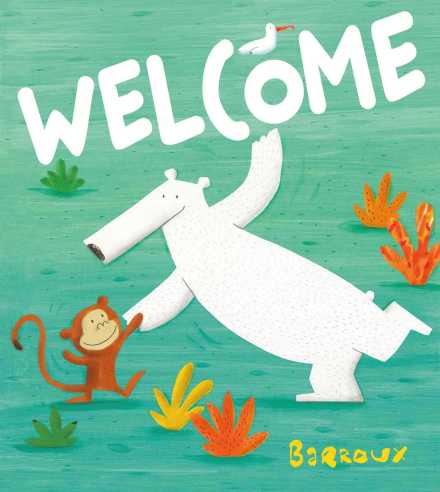
Welcome

By Barroux


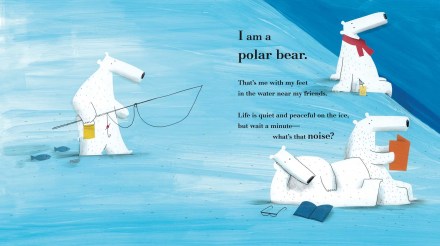
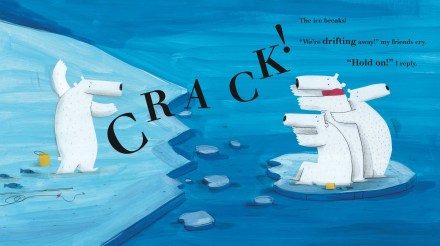
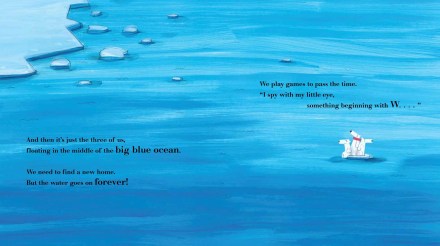
A polar bear is sitting on the edge of an ice floe enjoying some relaxing time with his friends when he hears an ominous noise. “CRACK! The ice breaks! ‘We’re drifting away!’” his friends cry. In no time at all the three polar bears are adrift in the middle of the sea in need of a new home. They float and float, but “the water goes on forever!” To pass the time the friends play games: “‘I spy with my little eye, something beginning with W…’”

celebrate-picture-books-picture-book-review-welcome-barroux-polar-bears-relaxing

Copyright Barroux, courtesy of little bee books and simonandschuster.com

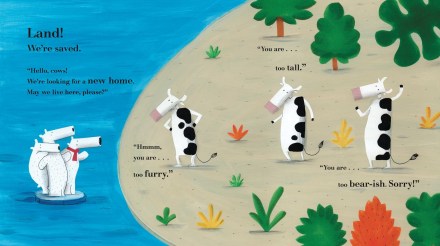
Perhaps days go by. The bears ride out a storm with dark skies and huge waves that threaten to sink them. It’s scary and the trio wants “to find a new home right now!” At last, their ice floe—smaller now—approaches a sandy shore. “Land! We’re saved,” cheer the polar bears. They ask the cows on the beach if they can live there, but the cows take exception. The bears are “too furry…too tall…and too bear-ish.” And with a “Sorry!” the cows turn the weary travelers away.

celebrate-picture-books-picture-book-review-welcome-barroux-ice-breaks-away

Copyright Barroux, courtesy of little bee books and simonandschuster.com

Once again on their own, the bears have no choice but to let the current steer them. With standing room for only one on their icy raft, they near another beach where a single panda relaxes on pillows in the midst of expansive land. “Yes! This could be our new home,” the polar bears shout. The panda ponders the situation for only a moment before stating, “‘…you are too many. Look around, there’s just not enough room! You can’t live here.’”

celebrate-picture-books-picture-book-review-welcome-barroux-polar-bears-meet-cows

Copyright Barroux, courtesy of little bee books and simonandschuster.com

As the polar bears continue on their journey, their “little ice boat has almost melted,” and they are running out of time. They bob next to a tall sea wall. “‘Help us!’” they plead. Behind the wall two giraffes lounge on the beach, too lazy to investigate the noise they hear. The ice floe has melted to a thin disk. The bears are hanging on and about to give up hope when they find an empty island. They jump to shore just in the nick of time and begin enjoying their new home.

celebrate-picture-books-picture-book-review-welcome-barroux-polar-bears-adrift

Copyright Barroux, courtesy of little bee books and simonandschuster.com

It’s not long before a dinghy floats into view with three monkeys on board. “‘Excuse me, we’re looking for a new home. Can you help us please?’” they ask. The polar bears stop their game of badminton and step forward. “‘Hmmm,’” they think. “‘You are…

Welcome!’”

With vibrant blue, full-bleed pages as wide open as the sea itself and three endearing long-nosed polar bears, Barroux has crafted a poignant tale with depth and far-reaching applications for readers of all ages. Inspired by the Syrian refugee crisis, Welcome stands on its own as an uplifting story of friendship and inclusiveness, but also offers an excellent means for beginning a discussion on the world events that children see and have questions about. Employing a bear’s first person point of view and incorporating a child-centric perspective on travel—from the humor of the I Spy game to the perseverance of the bears—Barroux sets just the right tone for his audience.

With sparse text and repetition of the bears’ simple request, the subject matter is handled with sensitivity, not fright, which allows children to understand that the theme of the story is relevant on many levels. Whether the “traveler” comes from near or far, is a classmate, teammate or neighbor, or is even the reader or someone else feeling adrift in a certain situation, children will see that all deserve welcome.

Ages 4 – 8

little bee books, 2016 | ISBN 978-1499804447

You can view a gallery of illustration work for children, adults, and more by Barroux on his website!

Smile Power Day Activity

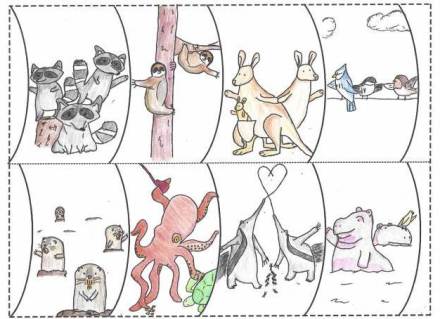
celebrate-picture-books-picture-book-review-give-me-your-hand-puzzle

Give Me Your Hand! Puzzle


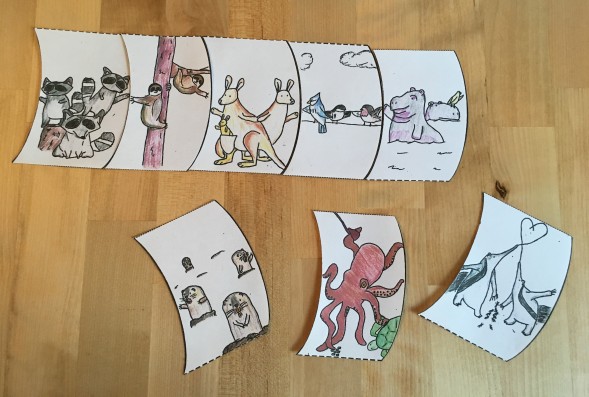
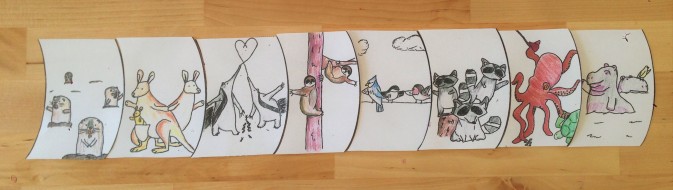
In this printable Give Me Your Hand! Puzzle, everyone is welcomed with a handshake. Offering friendship to all, the interchangeable pieces can be mixed and matched as the animals become buddies with one another.

Supplies

celebrate-picture-books-picture-book-review-UN-day-puzzle

Directions

  1. Print the puzzle: to make the puzzle sturdier: Print on heavy stock paper or glue the page to poster board
  2. Color the pictures with colored pencils or crayons
  3. Cut the pieces apart
  4. Switch the pieces around to make many alternate pictures

celebrate-picture-books-picture-book-review-UN-day-puzzle

Picture Book Review
June 8 – Upsy-Daisy Day

celebrate-picture-books-picture-book-review-a-crow-of-his-own-cover

About the Holiday

Do you wake up before the alarm or do you hit the snooze button a couple of times? Do you bound out of bed or do you pull the covers up tighter? Do you greet your family with a cheery “Good Morning” or do you mumble an incoherent “gmmmphngg?” If you’re more the latter type of person, then today’s holiday encourages you to be a happy “upsy-daisy” who starts the day with enthusiasm and an optimistic outlook. Beginning the day fresh as a daisy helps the whole day go better!

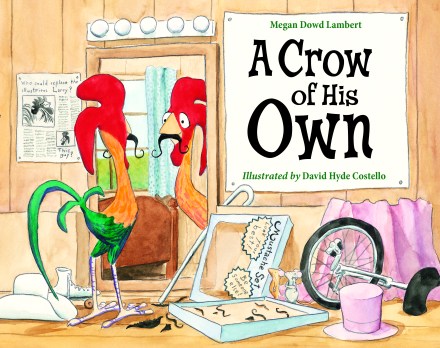
A Crow of His Own

Written by Megan Dowd Lambert | Illustrated by David Hyde Costello


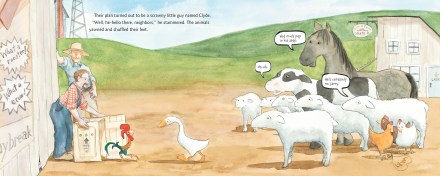
When fame and fortune came calling for Larry, the charismatic rooster of Sunrise Farm, the daily routine turned upside down. “The animals overslept and no one knew what to do.” But while the cow, horse, sheep, chickens, and goose fretted, Farmer Jay and Farmer Kevin had a plan. One day they gathered all the animals and introduced Clyde, the new rooster. Looking at the “scrawny little guy” as he stammered his hello, the cow, horse, and sheep expressed doubt in his abilities, already comparing him to their beloved Larry.

Roberta, the goose, stepped forward, however, and reassured him that “they just miss Larry.” When Clyde asked who Larry was, the animals gasped. “Only the best rooster ever,” claimed the sheep. “Take it straight from my mouth: he was more than that,” said the horse. “He was a genius,” the cow chimed in.” And the chickens? In the dirt they scratched a heart with Larry and XOX in the center.

celebrate-picture-books-picture-book-review-a-crow-of-his-own-clyde-joins-the-farm

Image copyright David Hyde Costello, text copyright Megan Dowd Lambert. Courtesy of Charlesbridge

Clyde was worried—how could he ever live up to Larry? Roberta tried to soothe him. “‘Larry wasn’t a genius…he just made quite a show of it.” Emboldened and with an inkling of what he needed to do, Clyde thanked Roberta and dashed off. “Clyde spent the whole day gathering props, designing his costume, and choreographing a sublime two-step.” As Clyde gave himself one last look in the mirror in his top hat and cloak, he had misgivings. “Could he put on a show of a crow?” He went to bed, but hardly slept at all.

celebrate-picture-books-picture-book-review-a-crow-of-his-own-sleeping

Image copyright David Hyde Costello, text copyright Megan Dowd Lambert. Courtesy of Charlesbridge

In the morning…well…Clyde overslept. The animals were not happy. “Who ever heard of a rooster sleeping in?” baaad mouthed the sheep. “What a worthless chicken,” complained the horse. And the cow had issues of her own. Once again Roberta came to Clyde’s defense. With a wagon full of new props and material, Clyde rushed away to prepare for the next day. Up bright and early and balanced on a unicycle atop the coop while surrounded by promotional signs, Clyde “opened his beak, and…promptly fell to the ground with an undignified croak.”

celebrate-picture-books-picture-book-review-a-crow-of-his-own-skating-ramp

Image copyright David Hyde Costello, text copyright Megan Dowd Lambert. Courtesy of Charlesbridge

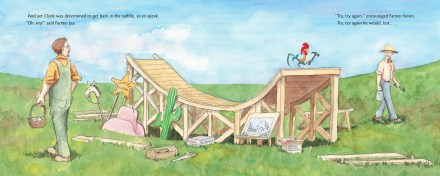
Poor Clyde! Humiliated and hurt he once again had to endure the slights of the farmyard animals, but their comments only spurred him on. Vowing to go bigger and better, Clyde built himself a ramp, ordered roller skates for birds and a parachute, and designed a colorful Western-themed set. “‘Oh, my!’” remarked Farmer Jay as he walked by. “‘Try, try again,’ encouraged Farmer Kevin.” But in the morning Clyde’s spectacular trick left him hanging upside down from the chicken coop, and the animals more “disgruntled and dismayed” than before.

celebrate-picture-books-picture-book-review-a-crow-of-his-own-ramp

Image copyright David Hyde Costello, text copyright Megan Dowd Lambert. Courtesy of Charlesbridge

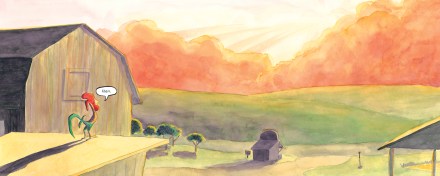
Clyde was distraught. “‘Forget about Larry.’” Roberta said. “‘Just crow your own crow.’” Clyde considered her advice. The next morning as the sky turned pink and orange with the rising sun, Clyde stood tall atop the chicken coop. He quietly cleared his throat and then—“COCK-A-DOODLE-DOO!” The newly awakened animals came running. Even Farmer Jay and Farmer Kevin came to see this new Clyde. The horse summed up their collective feeling: “It’s not so much like crowing, but crooning.” Roberta agreed. “‘Enough to give you goose bumps!’” she exclaimed. As an encore, “Clyde took a deep breath, gave a shake of his comb, and called out another crow of his own.”

celebrate-picture-books-picture-book-review-a-crow-of-his-own-sunrise

Image copyright David Hyde Costello, text copyright Megan Dowd Lambert. Courtesy of Charlesbridge

These days it’s nearly impossible for kids not to compare themselves or be compared to others—even those they’ve never met. All they need to do is jump on the Internet and discover that so-and-so has double, triple, or more friends and/or followers than they do; go to class and get their grade on that assignment they worked so hard on; or simply stand by their locker, go to lunch, or head out to gym and overhear the comments of other students. Avoidance isn’t the answer, but a good base of self-confidence and personal identity is. In A Crow of His Own Megan Dowd Lambert offers readers such a base in her entertaining and meaningful tribute to self-acceptance and love that hits all the right notes.

As soon as scrawny Clyde walks out of his crate to the scorn of his farm mates, kids will root for this underchicken. With a light touch and plenty of wordplay, Dowd deftly presents honest portrayals of the opposition Clyde is up against as well as Clyde’s distressed reactions. Clyde’s three attempts to act like Larry humorously demonstrate the difficulties of trying to be someone you’re not. When Clyde finally musters the courage to “crow his own crow” and is met with praise, readers will see that their own unique talents will find an appreciative audience.

celebrate-picture-books-picture-book-review-a-crow-of-his-own-sunrise-farm

Image copyright David Hyde Costello, text copyright Megan Dowd Lambert. Courtesy of Charlesbridge

David Hyde Costello knows how to put on a show! His Sunrise Farm is a gentle, bucolic spread still under the thrall of Larry. Humorous details, such as the valentines to Larry the chickens draw in the dirt, the movie house-style posters on the side of the barn, and the surprised and exasperated expressions of the animals, testify to Larry’s enduring legacy. But careful observers will notice that while Larry is a rather bland white rooster with some black tail feathers, Clyde is distinctively colorful from his comb to his feet. Kids will giggle at Clyde’s increasingly complex morning shenanigans even as they sympathize with his plight. When Clyde finally reveals his magnificent crow, readers will cheer.

A Crow of His Own is a winner on so many levels. It offers parents and children a way to discuss and begin building the strong sense of self so important to a happy and successful life. The book also presents a positive visual representation of diversity, and in Roberta and Farmer Jay and Farmer Kevin it shows that finding support helps. And it does all of this in a story that stands on its own as a funny, laugh-inducing romp. Because kids will want to hear this story over and over, A Crow of His Own would be a wonderful addition to libraries and home book collections.

Ages 4 – 9

Charlesbridge, 2015 | ISBN 978-1580894470

To learn more about Megan Dowd Lambert, her picture books, her Whole Book Approach to Reading, and more visit her website!

On David Hyde Costellos website you’ll find a gallery of artwork, a portfolio of picture books, videos, and more!

Upsy-Daisy Day Activity

celebrate-picture-books-picture-book-review-chicken-craft

A Chicken to Wake Up To


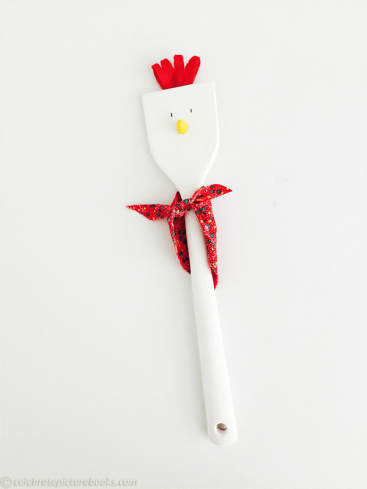
A long-handled wooden turner makes a plucky decoration for your room or kitchen—and a great reminder to bring your passions to every job! In a few simple steps, you’ll have a cute companion you’ll want to crow about!

Supplies

  • Printable Comb and Scarf Template
  • Long-handled wooded turner, available in kitchen supply stores
  • Red felt, 2 inches by 2 inches
  • Yellow bakable clay
  • Fabric, 12 inches square
  • A small piece of white felt or fleece (optional)
  • White paint (or any color you would like)
  • Black marker
  • Fabric glue
  • Glue gun
  • Paint brush

celebrate-picture-books-picture-book-review-chicken-craft

Directions

  1. Paint the wooden turner, let dry
  2. Cut the scarf from the piece of fabric
  3. Make a beak from the yellow clay and bake it according to package directions

To make the comb

  1. Fold the felt in half and glue the end together with the fabric glue
  2. Cut short strips from the folded top of the felt, about ½-inch to ¾ -inch in length
  3. Round the corners of the strips slightly

To make the scarf

  1. Fold the fabric in half
  2. With the long, straight edge of the scarf template along the fold, cut out the scarf
  3. With the fabric glue, glue the two sides of the scarf together so that you have two “right” sides
  4. Let dry

To assemble the chicken

  1. Pinch the bottom of the comb together so that the strips open and the felt pleats a little
  2. With the glue gun attach the comb to the back of the painted turner, keeping the bottom pinched together
  3. Attach the beak to the front of the turner
  4. Draw eyes on the chicken with the black marker
  5. Tie the scarf around the neck of the handle, hold in place with a drop of glue in the back if necessary
  6. To make tail feathers in a turner with a hole in the handle, pinch together a small folded piece of white felt or fleece and push it through the hole in the handle of the turner.
  7. Cut or arrange to look like feathers

Picture Book Review
June 2 – It’s National Oceans Month

celebrate-pciture-books-picture-book-review-town-is-by-the-sea-cover

About the Holiday

The world’s oceans offer beauty, resources, and mystery. This month we celebrate these vast wonders while committing ourselves to their preservation. Pollution, climate change, and habitat destruction all threaten the fragile ecosystems that exist in and near the sea. We also remember the communities that rely on the oceans for economic stability as well as the men and women who work to protect the oceans and their unique creatures. 

Town Is by the Sea

Written by Joanne Schwartz | Illustrated by Sydney Smith


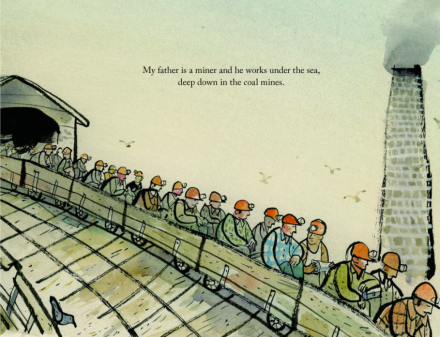
A little boy introduces readers to his home by the sea. It is so close that “it goes like this—house, road, grassy cliff, sea.” Early in the morning, his father leaves home and rides the tram that takes him underneath the ocean to his job as a coal miner. The little boy wakes later to the sounds of town—cars on the road, a dog barking, seagulls calling as they soar overhead. He rises from bed and gazes out the window at the vast sea, knowing that his “father is already deep down under that sea, digging for coal.”

celebrate-picture-books-picture-book-review-town-is-by-the-sea-morning

Image copyright Sydney Smith, text copyright Joanne Schwartz. Courtesy Groundwood Books.

After breakfast he goes next door to his friend’s house. They run to the playground where only two swings are left—“one for big kids and one for babies.” They swing so high they can see far in the distance where the “waves have white tips. And deep down under that sea,” he thinks, “his father digs for coal.” The boy returns home for lunch—a baloney sandwich, carrots, and milk—and then takes the grocery list his mother gives him and goes to the store, which is only a couple of blocks away.

celebrate-picture-books-picture-book-review-town-is-by-the-sea-miners

Image copyright Sydney Smith, text copyright Joanne Schwartz. Courtesy Groundwood Books

On the way back home, past the sparkling sea, the boy thinks about his father digging coal. He stops off at the graveyard to visit his grandfather, who was also a miner.  The boy says, “The air smells like salt. I can taste it on my tongue. My grandfather used to say, Bury me facing the sea b’y, I worked long and hard underground.” The grandfather’s stone is so close to the water that during storms, waves batter it. But the boy says, “That’s okay. My grandfather is used to storms.”

celebrate-picture-books-picture-book-review-town-is-by-the-sea-sunny

Image copyright Sydney Smith, text copyright Joanne Schwartz. Courtesy Groundwood Books.

In the evening “it goes like this—” the boy’s father comes home from work with “black smudges on his face from working the coal.” Even though he is tired, he gives his son a smile and a hug. The little boy is happy to have him home “safe and sound.” The family eats dinner together and later the boy’s mother and father sit on the porch, talking. The boy falls asleep to the sound of the waves washing the shore. He thinks about his father and “the bright days of summer and the dark tunnels underground, knowing that one day, it will be his turn.

celebrate-pciture-books-picture-book-review-town-is-by-the-sea-porch

Image copyright Sydney Smith, text copyright Joanne Schwartz. Courtesy Groundwood Books

In Joanne Schwartz’s graceful tribute to a coal-mining town settled on the coast, the sea is as much a character as the little boy and his family. Sustaining the townspeople over generations, the sea wakes them, feeds them, provides beauty and challenges, and in its fluid consistency mirrors the love and security of family. The repetition of the boy’s thoughts that wander to join his father in the dark tunnels throughout the day demonstrate both the strong bond between father and son and also the developing identity of the boy, who is also destined for those underwater tunnels. Schwartz’s sure, straightforward storytelling provides details that are familiar to all readers, making it a universal tale, rooted in the heart.

Sydney Smith’s ink and watercolor illustrations gorgeously depict the dual nature of this town built solidly on a rocky coastline and surviving on the dusty, back-breaking work of coal-mining while overlooking the constantly flowing wash of the sea. The sunny sky and daily activities of the boy give way every so often to two-page spreads of the black tunnel, where the miners push carts, drill, and recoil from a sudden rock slide. The ocean, rendered in sage and blue with pearlescent waves, is always in sight, the lifeblood of this special town.

Town Is by the Sea is a beautiful reminder of both the constancy and change inherent in life and would be a lovely addition to home libraries for quiet times and family time.

Ages 4 – 9

Groundwood Books, 2017 | ISBN 978-1554988716

View a portfolio of artwork by Sydney Smith on his tumblr!

National Oceans Month Activity

celebrate-picture-books-picture-book-review-kinetic-sand-craft

Kinetic Sand


Sand is so much fun to play with at the beach that you just wish you could bring it home. Now you can! With this easy recipe you can create your own kinetic sand to form or let run through your fingers. It makes a great anti-stress reliever too!
Supplies

  • 1 cup sand
  • ½ tablespoon cornstarch
  • 1 teaspoon dish soap
  • Water as needed – about ¾ cup
  • Bin or bowl for mixing dry ingredients
  • Bowl for mixing dish soap and water

Directions

  1. In the bin combine the sand and cornstarch and mix well
  2. In the bowl combine the dish soap and water until the water is bubbly
  3. Slowly add the water mixture to the dry ingredients, mixing and adding water little-by-little until the desired consistency is reached. The grain of the sand will determine how much water is needed.
  4. The sand can be formed with cookie cutters, molds, hands, etc. and is strong enough to stack. Or its loose consistency makes it fun to drip, drabble, and let run through your fingers.

Picture Book Review