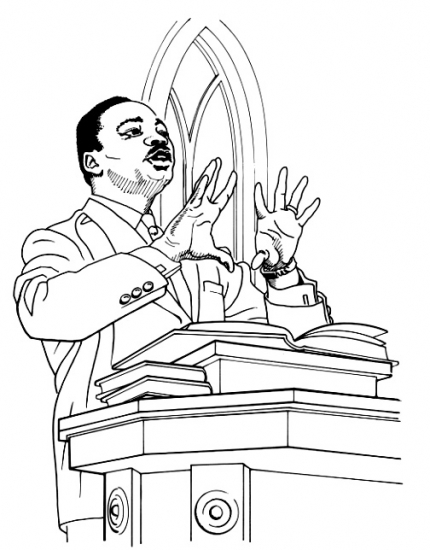
January 20 – Martin Luther King, Jr. Day and Interview with Dean Robbins

celebrate-picture-books-picture-book-review-you-are-a-star-martin-luther-king-jr-cover

About the Holiday

Martin Luther King Jr. Day celebrates the life and legacy of the man who dedicated his life and work to teaching—as Coretta Scott King once stated—“the values of courage, truth, justice, compassion, dignity, humility and service” and who led a non-violent Civil Rights movement to enact racial equality and justice through state and federal laws. President Ronald Reagan created the national holiday in 1983, setting it on the third Monday of January to coincide with Martin Luther King Jr.’s birthday on January 15. To commemorate the holiday, learn more about the life and work of Martin Luther King Jr. We still have a long way to go before there is true justice and equality for all, and it’s more important now than ever to look for ways to offer help and hope.

Thank you to Scholastic Press for sharing a copy of You Are a Star, Martin Luther King, Jr. with me. All opinions on the book are my own.

You Are a Star, Martin Luther King, Jr.

Written by Dean Robbins | Illustrated by Anastasia Magloire Williams

Opening the cover to this visually engaging biography, readers are first introduced to Martin Luther King, Jr. as he stands at a podium on August 28, 1963 ready to address the throngs of people who had joined the March on Washington and now filled the National Mall. He wonders if he’s prepared the right words to offer hope for a better future. His thoughts take him back to when he first experienced discrimination, and readers follow along, learning about segregation in schools, restaurants, recreation areas, even at drinking fountains.

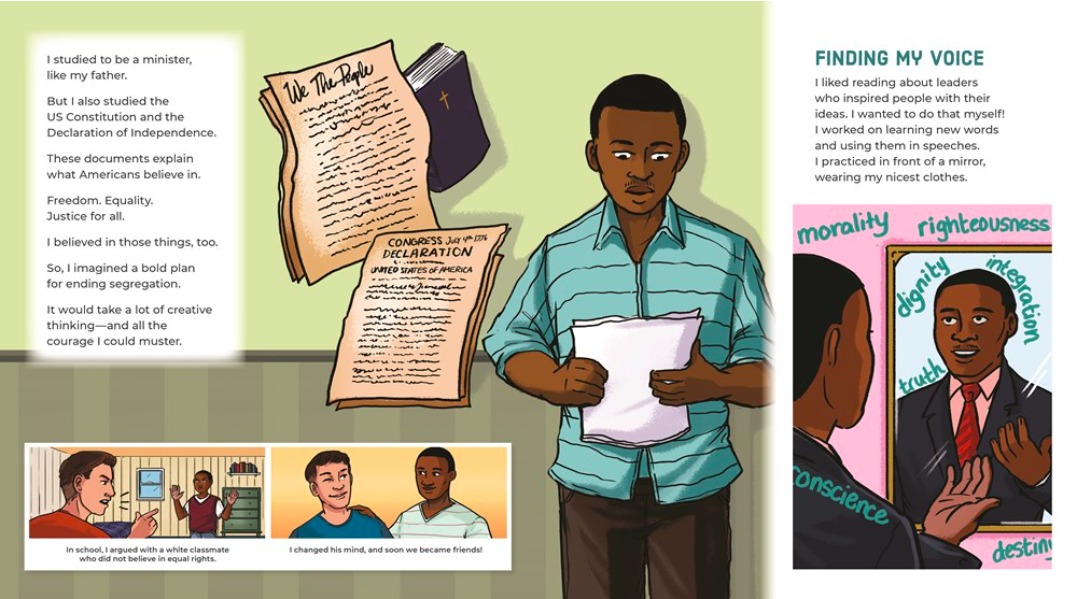
Kids learn that even when Martin Luther King, Jr. was their age he was already thinking that “someone had to change these unfair rules” and deciding “Why not me?” Through the book’s first-person narration, children gain a close portrait of Martin Luther King, Jr. as a committed intellectual, believer in the foundations of America, and outspoken advocate for equal rights. They learn of his life as a minister, his work with Rosa Parks and others to end discrimination on public busses, and his adoption of nonviolent protests to affect change. 
celebrate-picture-books-picture-book-review-you-are-a-star-martin-luther-king-jr-finds-voice

Image copyright Anastasia Magloire Williams, 2025, text copyright Dean Robbins, 2025. courtesy of Scholastic Press.

Readers come to understand how success in Montgomery spurred Martin Luther King, Jr. and others to work toward ending segregation in other places—like stores and restaurants—and even to “challenge American leaders to make a national law against segregation.” They learn how Martin Luther King, Jr. ended up in jail in Birmingham, Alabama, after a peaceful protest and wrote a letter to the world about oppression. Kids also hear about the Children’s March, which took place at the same time and during which more than 2,000 children were also arrested. 

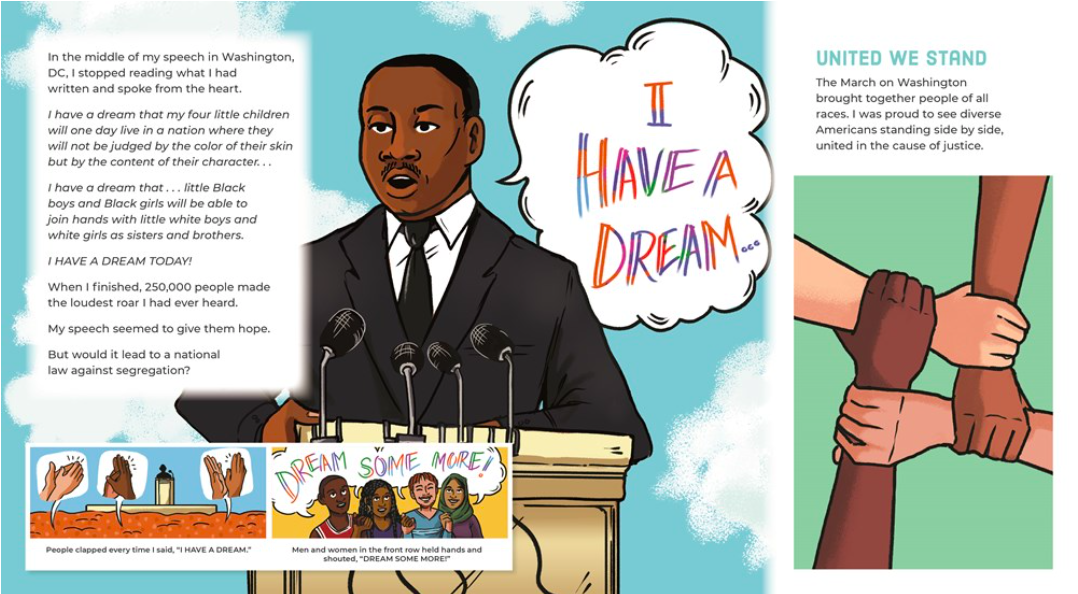
Returning to the March on Washington, Dr. King decides to abandon his written speech and talk from his heart. The result is his now-famous “I have a dream” speech. Following this gathering of 250,000 people and more calls for a national law against segregation from around the country, Dr. King reveals that “In 1964, Congress passed the Civil Rights act.” But even then Dr. King says, “I knew we had more work to do. Many places still had rules to keep Black people from voting.” 
celebrate-picture-books-picture-book-review-you-are-a-star-martin-luther-king-jr-I-have-a-dream-speech

Image copyright Anastasia Magloire Williams, 2025, text copyright Dean Robbins, 2025. courtesy of Scholastic Press.

Another peaceful march was planned for Selma, Alabama, with a 50-mile march to Montgomery. This time, however, Alabama’s governor send troops to attack the marchers. The participants were not intimidated, though, and even invited more Americans to join them. Thousands answered the call. “Maids, students, and movie stars. Parents pushing baby carriages. People on canes and crutches.” Five days later, they reached Montgomery. “The Selma protest was our movement’s greatest victory,” Dr. King tells readers. “It led to a national voting rights law!”

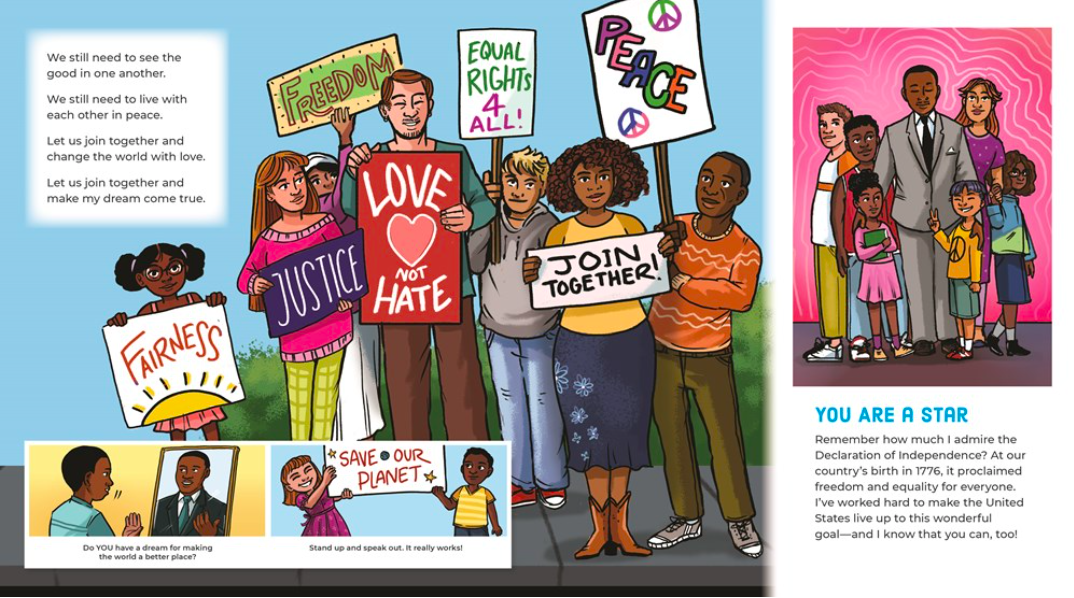
Martin Luther King, Jr. reminds readers, though, that there’s still more to do to “see the good in one another,” “live with each other in peace,” “join together and change the world with love,” and “make my dream come true.”

Beneath the narration of Dr. King’s story, a comic-style panel highlights a single talking point, event, or fact—such as during the Montgomery bus boycott, one man “rode to work on a mule”—often with a light-hearted approach. On the righthand page, Robbins defines concepts such as nonviolent protests, boycotts, freedom of speech, protest songs, the Children’s March, polling place intimidation, and the Voting Rights Act of 1965 in easily understood language. 

Extensive back matter includes an Author’s Note, how children can “Be Like Martin,” notable quotations by Martin Luther King, Jr., four types of Nonviolent civil rights protests, a brief timeline of Dr. King’s life from his birth on January 15, 1929 to 2011, when the Martin Luther King, Jr. Memorial was dedicated in Washington, DC. Also included are a glossary of important terms and a list of resources.
celebrate-picture-books-picture-book-review-you-are-a-star-martin-luther-king-jr-more-to-do

Image copyright Anastasia Magloire Williams, 2025, text copyright Dean Robbins, 2025. courtesy of Scholastic Press.

Dean Robbins’ immediately welcoming and dynamic first-person narration style not only draws young readers into Martin Luther King’s life and the history of the Civil Rights Movement, but makes children feel that they have a personal connection with Dr. King’s legacy. Robbin’s clear, factual writing, is presented in short, separated sentences. These make it easy for children to digest and understand King’s nonviolent approach to protest as well as the social and legal issues of the time and how, unfortunately, vigilance is still needed today. Robbins ends on a note of hope and an invitation to readers to join others and use their talents to help make Martin Luther King, Jr.’s dream come true.

Accompanying Robbins’ text are Anastasia Magloire Williams’ compelling illustrations that are at once realistic and accessible for today’s visual learners. Her stirring depiction of Martin Luther King, Jr. speaking at the 1963 March on Washington sets the tone for children to discover the impact King has had on people’s hearts, minds, and actions for more than 60 years. Through Williams’ expressive portraits, children see Martin Luther King, Jr.’s commitment to studying, practice, and rallying support as well as the effects of segregation, the determination of protestors during the Montgomery, Alabama, bus boycott, and how people from all parts of society working together created—and can still bring about—much-needed change.

With its graphic-style illustrations and well-researched content, You Are a Star, Martin Luther King, Jr. is vibrant and captivating. The book offers exhilarating learning opportunities for individuals, classrooms, and homeschoolers and may spark extended study or activism for a favorite cause. It is highly recommended for home bookshelves and a must for school and library collections.

Ages 5 – 7 and up

Scholastic Press, 2025 | ISBN 978-1338895100

Meet Dean Robbins

celebrate-picture-books-picture-book-review-dean-robbins

Photo credit David Giroux

Dean Robbins is a journalist and the author of the children’s picture books Two Friends: Susan B. Anthony and Frederick Douglass, Margaret and the Moon: How Margaret Hamilton Saved the First Lunar Landing, and Miss Paul and the President: The Creative Campaign for Women’s Right to Vote. His award-winning books have received starred reviews in Publishers Weekly and Kirkus Reviews and have been praised in the New York Times and USA Today. Dean grew up idolizing Apollo astronauts and loved working with Alan Bean on The Astronaut Who Painted the Moon. Learn more at deanrobbins.net.

Hi Dean! I’m thrilled to be talking with you today about your latest book, the impact heroes have always had on your life, and the importance of having heroes for children.

This biography about Martin Luther King, Jr. joins your You Are a Star series that began in 2022 with the story of Supreme Court Justice Ruth Bader Ginsburg. Other inspirational figures in the series are Jane Goodall and Malala Yousafzai. Can you discuss a little about how this series came to be and how you choose the subjects?

My passion is writing about my personal heroes, some of whom are relatively unknown and whose stories I can share with children for the first time. But then there are those like Jane Goodall, Ruth Bader Ginsburg, and Malala Yousafzai who are widely admired and frequently represented in children’s books. I developed the You Are a Star series with Scholastic to present such iconic figures in a new way for young readers, striving to combine emotional storytelling and humor. Each title tells an exciting life story from the subject’s point of view, including anecdotes and quirky details that don’t appear in other picture-book biographies. I hope this approach makes Jane, Ruth, and Malala feel like human beings that kids can relate to rather than like distant statues on Mount Rushmore.           

In You Are a Star, Martin Luther King, Jr., you so clearly present and connect the pivotal moments in King’s life as well as the Civil Rights Movement so children can understand and even feel as if they know Martin Luther King, Jr. How did you approach writing this biography? What kind of research did you do? What was the most meaningful part of the research and writing for you?

It’s a challenging subject to write about for elementary school students—that is, to write about both clearly and entertainingly. I tried to explain such important ideas as desegregation, free speech, and civil disobedience while also telling a page-turning story that, while concise, does justice to Dr. King’s life and work. I’m so glad you think I pulled it off! As a journalist, I love to do research, so the best part was immersing myself in the extensive literature on the civil rights movement to find material that might surprise and delight young readers.

As a library assistant in the children’s department of my local library, I see how excited kids are to read graphic novels. I love the way the format of the You Are a Star series bridges traditional picture books with that of the graphic style. Can you talk about the design of this striking series, and especially about Anastasia Magloire Williams’ dynamic illustrations in this book?

The format is what allows me to have so much fun with You Are a Star. It features a main story that flows throughout the book, supplemented by a two-panel comic and an essential-fact sidebar on each spread. The comics and sidebars offer the chance to introduce key concepts and funny details without bogging down the narrative.

As you noted, the format also provides a showcase for Anastasia’s brilliant illustrations. She artfully combines poignant and playful images, making Dr. King and his movement come alive on the page. She also has a genius for visualizing abstract ideas so that kids can understand them and feel their power. In one of the sidebars, for example, I introduce Dr. King’s comment that “the arc of the moral universe is long, but it bends toward justice.” How on earth do you illustrate such a thing? Anastasia’s creative solution was to show Black and white hands building a wall together, with bricks marked “Justice,” “Equality,” “Unity,” “Change,” “Love,” “Peace,” and “Freedom.” What a lovely way to help children grasp Dr. King’s humane vision.

You’ve talked about the wide range of heroes you had as a child, from sports stars to early social and political reformers. Some of these are represented in the books you’ve written, but could you name some others? What do you think it was about them and yourself that drew you to these specific people?

Ever since I read Superman and Wonder Woman comics as a child, I’ve been attracted to those who overcome seemingly insurmountable obstacles to make the world a better place. And how thrilling is it that our world has real-life analogues to Superman and Wonder Woman? I hope I live long enough to publish a children’s book about every heroic figure whose picture hangs on my office wall, ranging from Jackie Robinson to Emily Dickinson to Louis Armstrong. 

Why do you think it’s important for children to have heroes?

Someone has to demonstrate the best that human beings are capable of, right? Especially when we’re so often confronted with the worst. The more kids who grow up to be like Dr. King, the better our world will be. In the back matter of You Are a Star, Martin Luther King, Jr. is a list of tips titled “Be Like Martin,” which I hope will facilitate this process!

I’ve read that you relish traveling to historical sites. Which place is your favorite or made the biggest impact on you and why?

One of the most stirring places I’ve seen is Susan B. Anthony’s house in Rochester, New York. On my tour of this national historic landmark, the guide pointed out the parlor where Susan would have tea with her neighbor and fellow activist Frederick Douglass. It was news to me that Anthony and Douglass socialized in this way, and I was moved by the idea of two titanic reformers humbly sipping tea while sharing their hopes and dreams. The experience inspired me to write my Scholastic picture book Two Friends: Susan B. Anthony and Frederick Douglass.

Not only has your life included careers as a K–12 school teacher, a journalist, and an author, but you also present fascinating pieces about famous people—from Houdini to Theodore Roosevelt to Harrison Ford to a full stadium’s worth of musicians and sports stars—and their connection to Wisconsin on Public Radio. How did this collaboration come about? Could you take readers through a bit of your process in writing and recording the segments?

It’s yet another way to spread the word about my heroes, and I like doing so in a different medium—one with sound effects! I’ve included some of these pieces in a book of essays that will be published in April by the Wisconsin Historical Society Press. Wisconsin Idols: 100 Heroes Who Changed the State, the World, and Me offers my perspective on heroic figures with often surprising connections to Wisconsin, including Oprah Winfrey, Duke Ellington, and Georgia O’Keeffe. It makes the case for Wisconsin as a notably influential place: a crossroads for people who transformed the world.

What do you enjoy most about being a children’s author?

 When kids tell me that one of my heroes has now become one of their heroes. I can’t begin to describe how gratifying that is.

As a former teacher, you must love going to schools for presentations. From the photos on your website, it looks like you and the kids have a fantastic time! Could you describe what your presentations are like?

My own child has inspired much of my writing but is now 28 years old, so these days I visit schools to hang out with my favorite demographic. With their curiosity and enthusiasm, elementary school kids never fail to restore my hope for the world. The presentations are geared toward maximum interaction so we can get to know each other. I joke, read, ask questions, and give them lots of chances to clap and shout things out. I tell them about my favorite heroes, and they tell me about theirs.

What’s up next for you?   

Next year, Scholastic will publish a book about another one of my heroes: Albert Einstein. The Genius Next Door is based on a little-known true story that, I hope, will make Einstein seem relatable and math seem fun!

Thanks so much for sharing your insight and some background on your wonderful You Are a Star series. I wish you all the best with this book and am looking forward The Genius Next Door.

Look for the rest of the books in the You Are a Star series!

You can visit Dean Robbins on his website at deanrobbins.net | Instagram | X

Martin Luther King, Jr. Day Activity

Students and kids at home will enjoy spending time with these fun and thought-provoking printable activities about Martin Luther King, Jr. from A Day in Our Shoes.

Martin Luther King, Jr. Activity Pack

You can purchase You Are a Star, Martin Luther King, Jr. at these booksellers

Mystery to Me (Dean Robbins’ hometown independent bookstore)

Amazon | Barnes & Noble | Bookshop (to support your local independent bookstore)

Picture Book Review

February 1 – World Read Aloud Day

celebrate-picture-books-picture-book-review-love-is-loud-cover

About the Holiday

Now in its 14th year World Read Aloud Day, founded by global non-profit LitWorld, encourages adults to read aloud to children not only today but every day. Reading aloud to children from birth is one of the best ways to promote language development, improve literacy, and enjoy bonding time together. Millions of people celebrate today’s holiday all across the United States and in more than one hundred countries around the world. Special events are held in schools, libraries, bookstores, homes, and communities, and authors and illustrators hold readings and visit classrooms in person and virtually. To learn more about World Read Aloud Day, visit LitWorld and check out their Activity Hub to find live events, virtual read alouds, downloadable bookmarks, posters, games, and more!

I would like to thank Simon & Schuster and Barbara Fisch at Blue Slip Media for sharing a copy of Love Is Loud with me for review consideration. All opinions on the book are my own.

Love Is Loud: How Diane Nash Led the Civil Rights Movement

Written by Sandra Neil Wallace | Illustrated by Bryan Collier


Raised on Chicago’s South Side, Diane Nash is sheltered by her parents from the segregation of the South that they had grown up in. During the Second World War, Diane is taken care of by her grandmother while her father joins the army and her mother takes a job. Her Grandmother Bolton is from Tennessee and showers her with love. “You are ‘more precious than all the diamonds in the world,'” she told Diane, and growing “up in the rhythm and glow of her love” Diane knew “it must be true.”

celebrate-picture-books-picture-book-review-love-is-loud-baby

Image copyright Bryan Collier, 2023, text copyright Sandra Neil Wallace, 2023. Courtesy of Simon & Schuster/Paula Wiseman Books.

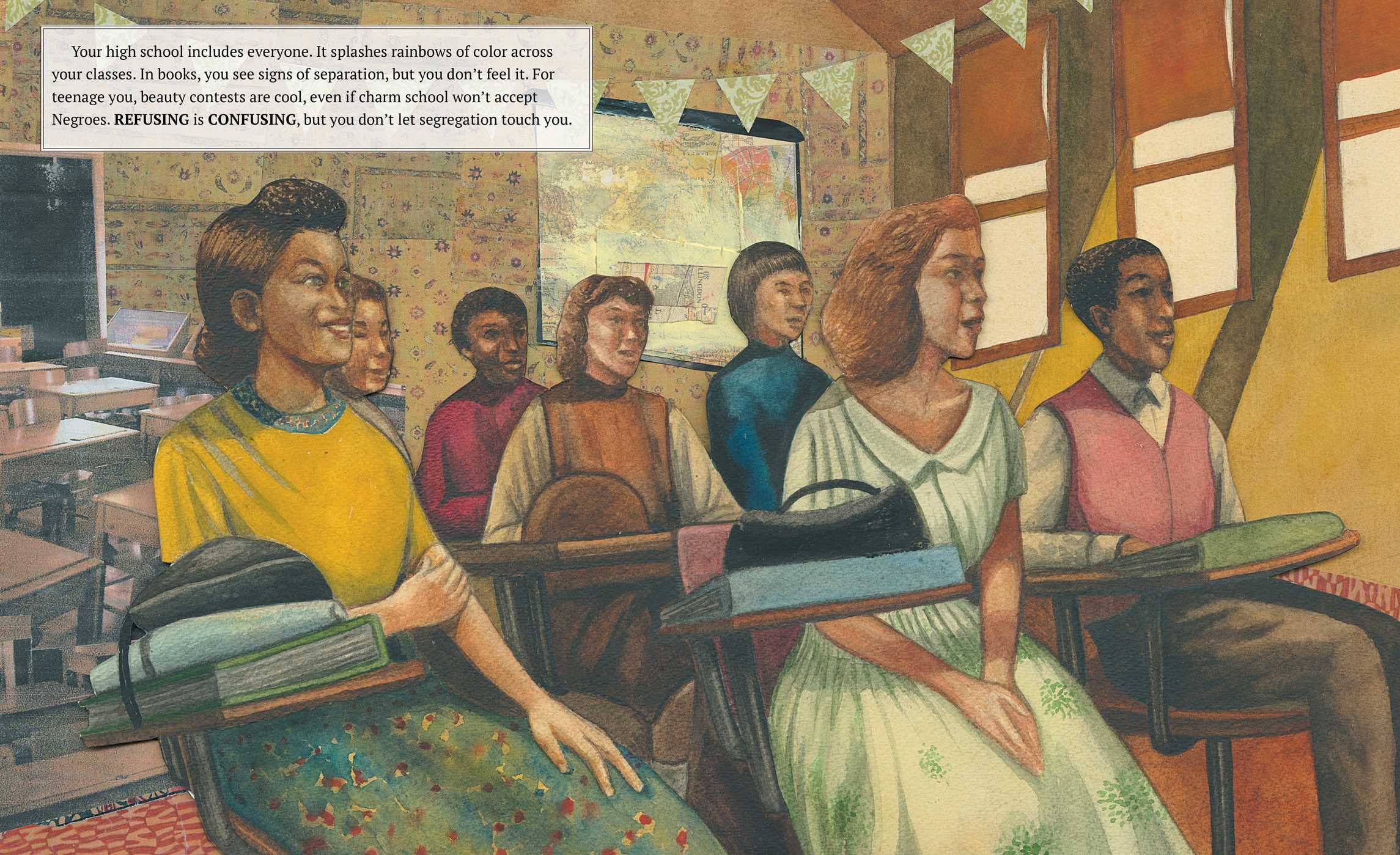
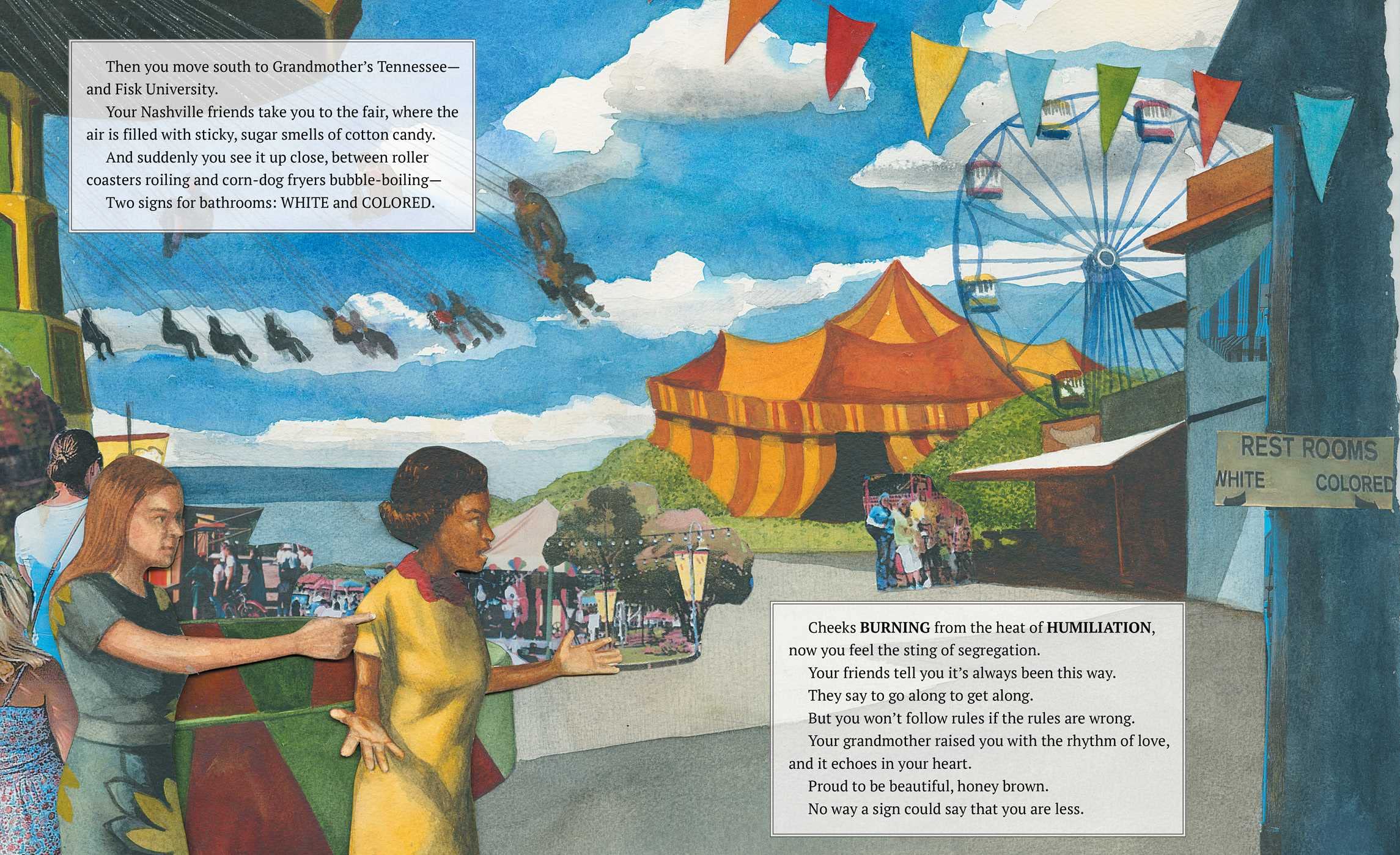
In high school kids of all colors learn together. Diane reads about segregation in textbooks, but it didn’t really touch her. Then she moves to Tennessee to attend Fisk University. Here, when her friends take her to a fair, Diane is confronted with the “sting of segregation” when she sees there are two restrooms: one labeled WHITE and the other COLORED. Her friends have grown up in this system; they tell her “to go along to get along,” but Diane “won’t follow rules if the rules are wrong.” The rhythms of her grandmother’s love and her pride in being “beautiful, honey brown” will not allow her to feel less than others.

In Nashville, Diane experiences the full indignation of segregation that demands separate water fountains and schools, back-of-the-bus seating, and—the worst for Diane—no eating at the lunch counter. She doesn’t want to be arrested for eating at a lunch counter, but neither does she want to let it go. Before each day of college classes, Diane and other students “pray and learn about change in a peaceful way.” They practice calmly sitting and ordering at a lunch counter, knowing that people may be rude, may push them off their stool, may throw sugar in their hair.

celebrate-picture-books-picture-book-review-love-is-loud-school

Image copyright Bryan Collier, 2023, text copyright Sandra Neil Wallace, 2023. Courtesy of Simon & Schuster/Paula Wiseman Books.

In February of 1960, Diane, now at twenty-one years old, leads a group of students to a lunch counter in Nashville. Their presence shocks the cooks and waitress, who drops plate after plate from her shaking hands. “Inside [Diane shakes] too. Hands sweating, never forgetting the danger, the fear of being arrested for ordering a sandwich.” Bravely, despite coffee burns and thrown sugar, Diane and the students hold sit ins at lunch counters across the city. And when Diane is arrested, there are hundreds of others to fill her seat.

After a bombing in April Diane, “quietly walking, without any talking… silently leads six-thousand marching feet to the beat of love” to meet the mayor, who at first says there is nothing he can do. Looking him in the eye, Diane asks him questions he cannot deny, and he admits that prejudice and segregation are wrong—even at the lunch counter. “At that moment, love scores. It soars as six thousand loving hands roar with applause.” And in May—Diane has just turned twenty-two—Nashville’s lunch counters are fully integrated. Martin Luther King Jr. congratulates her on her peaceful victory as she moves on to change the rules of bus travel with Freedom Rides, to uphold the “law of the land [that] says everyone is free to sit or stand together in a bus traveling across America.”

celebrate-picture-books-picture-book-review-love-is-loud-fair

Image copyright Bryan Collier, 2023, text copyright Sandra Neil Wallace, 2023. Courtesy of Simon & Schuster/Paula Wiseman Books.

While the movement makes progress, even attracting the attention of the president, a Mississippi judge charges Diane “with putting Freedom Riders on a bus.” Before her trial, Diane, pregnant with her first child, writes a letter heard around the world that said “‘I believe that if I go to jail now, … it may help hasten that day when my child and all children will be free.'” Her case rivets the world as she chooses to go to jail instead of paying bail. 

After she is released, Diane turns her attention to the issue of voting rights and the state of Alabama, where four young girls are killed in a bombing in a Birmingham church and “where Black people are denied the right to vote.” Following Diane’s example, thousands of adults and children choose jail over bail in protest of the injustice until the Civil Rights Act is signed by President Johnson in 1964 and a year after that when he “signs the 1965 Voting Rights Act to legally end racial discrimination that prevented Black people from voting.” But Diane Nash doesn’t stop there. She takes her message of peace and peaceful change across the country for fifty years, teaching young people “how love creates change.”

Image copyright Bryan Collier, 2023, text copyright Sandra Neil Wallace, 2023. Courtesy of Simon & Schuster/Paula Wiseman Books.

Image copyright Bryan Collier, 2023, text copyright Sandra Neil Wallace, 2023. Courtesy of Simon & Schuster/Paula Wiseman Books.

Extensive back matter includes an Author’s Note and an Illustrator’s Note about the work of Diane Nash; a detailed timeline from her birth to 2022, when she was awarded the Presidential Medal of Freedom; a list of video interviews with Diane Nash, four other books for young readers; sources for quotes found in the story; and a selected bibliography. A photograph of Nash and three other students integrating a lunch counter in Nashville and another of Nash leading demonstrators to meet the mayor of Nashville are also included.

celebrate-picture-books-picture-book-review-love-is-loud-love

Image copyright Bryan Collier, 2023, text copyright Sandra Neil Wallace, 2023. Courtesy of Simon & Schuster/Paula Wiseman Books.

Compelling and moving, Sandra Neil Wallace’s lyrical storytelling about the life and work of Diane Nash rivets readers to this young woman’s courage, confidence, and conviction to overturn the injustice of segregation and inequality for Blacks. Punctuated with often-rhyming phrases, and sharp, short sentences Wallace’s text flows with a rhythm of urgency that perfectly conveys not only Nash’s resolve, but the stakes for the peaceful demonstrators and the atmosphere of the times.

Written in the third person, the story directly addresses Nash, but the repeated “you” also builds a chorus that reverberates in each reader’s heart, telling them that they are brave, that they are strong, and that they too can change the world with love. This format poignantly culminates on the last page. Here, Wallace changes the dynamic with a subtle turn of phrase that now directly embraces each reader, letting them know that Diane Nash worked for freedom “because she loved you even before you were born” and reminding them that “Love is fierce. Love is strong. Love is loud!”

Bryan Collier’s rich watercolor-and-collage illustrations draw readers in with their realistic depictions of Diane Nash as a baby and young girl cherished by her family, as a high school and university student, at the fair that changed the trajectory of her life,  leading peaceful demonstrations at lunch counters and across the South, and crossing the country to bring her message to young people. Nash’s self-assurance, courage, and determination are evocatively expressed, and a full-page portrait of Diane looking out at the reader mirrors Wallace’s invitation for them to look into her eyes and see her love there.

Scraps of photographs are sprinkled here and there among the pages, providing a spark of recognition of the time and places depicted. But it is the cut paper elements that make certain images of people and objects jump off the page, working powerfully with Wallace’s text to make readers feel that they too are at the fair, at the lunch counter, joining the throng of marchers. Each page is a masterpiece of history and story that invites study, thoughtful contemplation, and action.

Absorbing, eloquent, and impactful, Love Is Loud: How Diane Nash Led the Civil Rights Movement is biography at its best: a moving tribute Diane Nash set amid a far-reaching immersion in the time period. Love Is Loud belongs in every home, classroom, school, and public library collection to teach children about the contributions of Diane Nash as well as to remind them that vigilance and the work for freedom is an ever-ongoing pursuit.

Ages 4 – 8 

Simon & Schuster | Paula Wiseman Books, 2022 | ISBN 978-1534451032

About the Author

Sandra Neil Wallace writes about people who break barriers and change the world. She is the author of several award-winning books for children, including Between the Lines: How Ernie Barnes Went from the Football Field to the Art Gallery, illustrated by Bryan Collier, which received the Orbis Pictus Book Award and was an ALA Notable Book. A former ESPN reporter and the first woman to host an NHL broadcast, she is the recipient of the Outstanding Women of New Hampshire Award and creates change as cofounder of The Daily Good, a nonprofit bringing twenty thousand free, culturally diverse foods to college students each year through its Global Foods Pantries. Visit Sandra at SandraNeilWallace.com.

About the Illustrator

Bryan Collier is a beloved illustrator known for his unique style combining watercolor and detailed collage. He is a four-time Caldecott Honor recipient for Trombone ShortyDave the PotterMartin’s Big Words, and Rosa. His books have won many other awards as well, including six Coretta Scott King Illustrator Awards. His recent books include By and By, ThurgoodThe Five O’Clock Band, and Between the Lines. He lives in New York with his family. Visit him at BryanCollier.com.

Watch the Book Trailer for Love Is Loud!

World Read Aloud Day Activities 

2022 Presidential Medal of Freedom Ceremony


Watch as Diane Nash is awarded the Presidential Medal of Freedom in this White House video from July 7, 2022. You can find President Joe Biden’s remarks about Diane Nash at the 5:50 mark, and see her receive her medal at the 41:29 mark.

celebrate-picture-books-picture-book-review-love-is-loud-curriculum-guide-cover

Love Is Loud Curriculum Guide


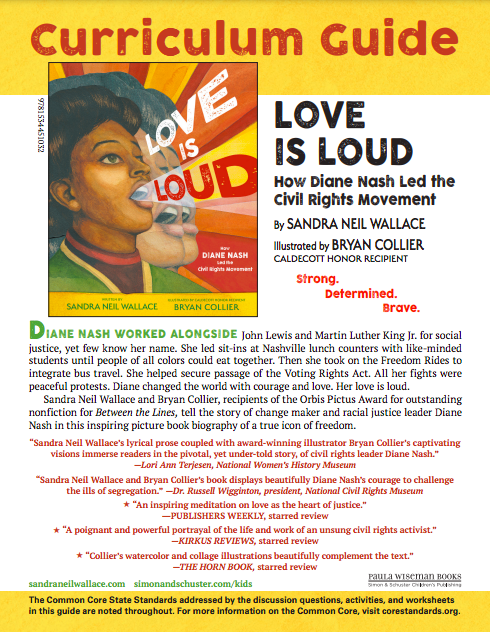
Teachers, educators, and homeschoolers can download an in-depth, 6-page Curriculum Guide for Love Is Loud full of a variety of ways for students to connect with the book and history from Sandra Neil Wallace’s website here.

celebrate-picture-books-picture-book-review-love-is-loud-cover

You can find Love Is Loud: How Diane Nash Led the Civil Rights Movement at these booksellers

Amazon | Barnes & Noble | Books-a-Million

To support your local independent bookstore, order from

Bookshop | IndieBound

Picture Book Review
February 17 – It’s Black History Month

celebrate-picture-books-picture-book-review-the-faith-of-elijah-cummings-cover

About the Holiday

Black History Month celebrates the achievements and contributions of African Americans in United States History. Originally a week-long observance initiated by writer and educator Dr. Carter G. Woodson in1926 and occurring during the second week in February to commemorate the birthdays of Frederick Douglass and Abraham Lincoln, Black History Month was officially established in 1976 by then president Gerald Ford. The holiday is now celebrated across the country with special events in schools, churches, and community centers.

The theme for 2022 is “Black Health and Wellness” and focuses on the legacy of not only Black scholars and medical practitioners in Western medicine, but also on alternate ways of practicing medicine throughout the African Diaspora. The 2022 theme considers activities, rituals, and initiatives that Black communities engage in to live healthy lives.

To learn more about Black History Month, find information on this year’s events, access resources for more research, and find content for teachers, visit the BlackHistoryMonth.gov

The Faith of Elijah Cummings: The North Star of Equal Justice

Written by Carole Boston Weatherford | Illustrated by Laura Freeman

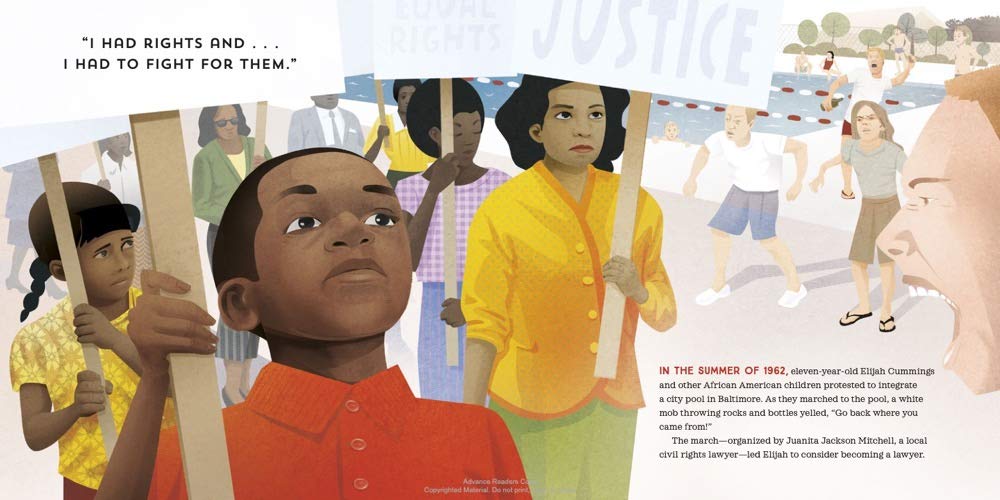
During the summer of 1962, when Elijah Cummings was eleven years old, he and other African American children marched for the integration of a Baltimore city pool. They were met with a white mob who shouted at them to “‘Go back where you came from!'” and threw rocks and bottles at them. This protest, organized by civil rights lawyer Juanita Jackson Mitchell, inspired Elijah to consider becoming a lawyer also.

Elijah’s parents had moved to Maryland from South Carolina in the 1940s, where they had worked the land where their parents had once been enslaved and where “Blacks were beaten for seeking voting rights. Elijah, his parents, and his six siblings lived in a four-room row house, where his mother and father – having only a fourth-grade education – stressed the importance of schooling. But for inquisitive Elijah, the nuts and bolts of reading and writing were elusive. Because of the cramped conditions at home, Elijah took to studying at the library, where the librarians tutored him after their shifts and made it possible for Elijah to succeed.

celebrate-picture-books-picture-book-review-the-faith-of-elijah-cummings-march

Image copyright Laura Freeman, 2022, text copyright Carole Boston Weatherford, 2022. Courtesy of Random House Studio.

Through hard work, scrimping, and saving, Elijah’s parents were able to buy a house with more room and a yard. Here, Elijah’s mother became a preacher and grew her small group of women who met in their home’s basement into a small church, the Victory Prayer Chapel. In addition to leading services, Elijah’s mother lived what she believed by helping those in need. Elijah’s father inspired him to become all that he could be. 

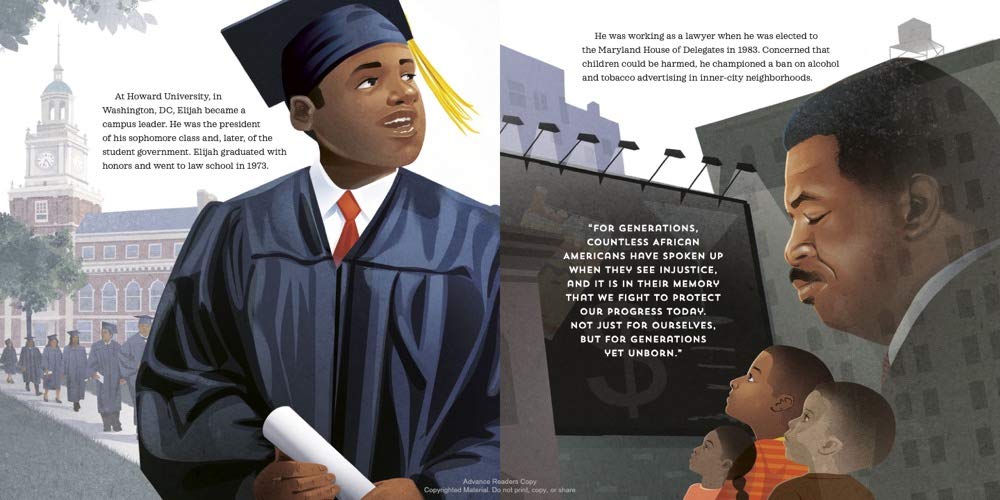
Even as a young boy, Elijah worked hard and, on Sundays after church, he listened to Rev. Martin Luther King’s speeches by transistor radio. He watched as African American boys were put into reform school, and he vowed to become a lawyer, but his high school guidance counselor tried to dissuade him. With the help of his parents and the pharmacist at the drug store where he worked, Elijah attended Howard University, where he was a standout student and leader. He became a lawyer and in 1983 was elected to the Maryland House of Delegates.

celebrate-picture-books-picture-book-review-the-faith-of-elijah-cummings-college

Image copyright Laura Freeman, 2022, text copyright Carole Boston Weatherford, 2022. Courtesy of Random House Studio.

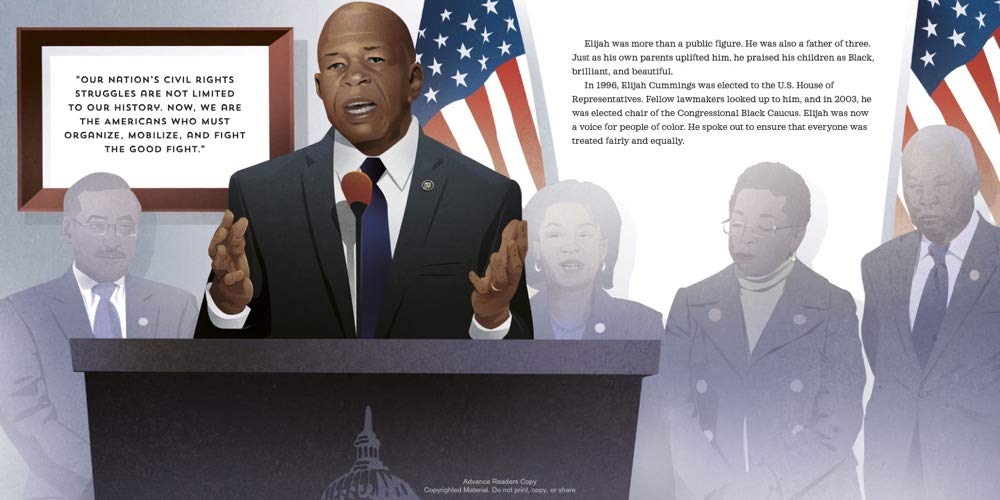
“In 1996, Elijah Cummings was elected to the U.S. House of Representatives,” and later became the chair of the Congressional Black Caucus. “He spoke out to ensure that everyone was treated fairly and equally.” Even though he was a leader in Washington DC, Elijah continued to live in his inner-city Baltimore neighborhood, and during the protests against police brutality in 2015, he appealed for calm as he walked “with residents singing an African American spiritual: ‘This little light of mine, I’m gonna let it shine.'” Before his death in 2019, Elijah Cummings was named chair of the House Committee on Oversight and Reform, where, as he had for his entire career, he advocated for change now and for the future our children will inherit.

Quotes by Elijah Cummings on his inspirations, work, and beliefs included throughout the story allow readers to hear in Cummings’ own words his passion and dedication to creating a more equitable and caring America for all. 

A Foreword reprints remarks given by Speaker of the House of Representatives Nancy Pelosi at Elijah Cummings’ funeral on October 25, 2019. Back matter includes an excerpt of the statement from the Congressional Black Caucus upon Cummings’ death on October 17, a Timeline of his life and work, a Bibliography, and Source Notes for the Cummings’ quotes found throughout the story.

celebrate-picture-books-picture-book-review-the-faith-of-elijah-cummings-house-of-representatives

Image copyright Laura Freeman, 2022, text copyright Carole Boston Weatherford, 2022. Courtesy of Random House Studio.

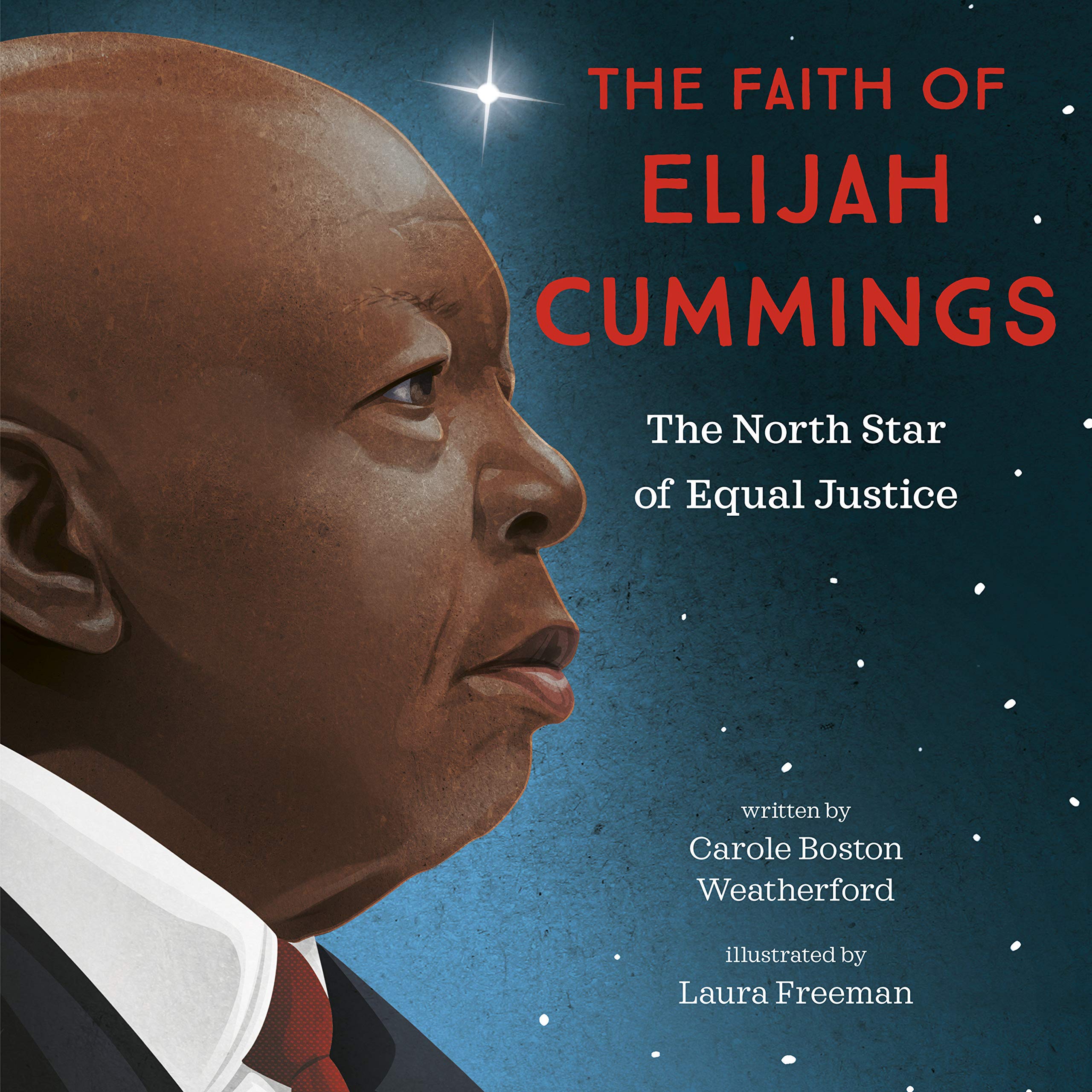
Carole Boston Weatherford’s moving biography of Elijah Cummings highlights the strong and supportive family unit that inspired and sustained Elijah as he grew from a thoughtful and hardworking boy into an empathetic and influential leader. Her focus on formative events in Cummings’ life depict how early experiences often shape the person children become while continuing to inform their opinions, beliefs, and occupations. Through his own words, Weatherford reveals Cummings’ commitment to the children who will read this biography as well as to all young people who will benefit from and carry on his work.

In her rich and expressive illustrations, Laura Freeman recreates pivotal events, touching examples of the Cummings’ family solidarity, and community-based actions inspired by the family’s religious faith to paint a portrait of Elijah’s youth and young adulthood. As he rises to the highest levels within the US Congress, while never losing touch with the neighborhood and people he loved, Freeman’s striking images will entice readers to learn more about Elijah Cummings’ legislative legacy and the workings of Congress and to, perhaps, become involved in their own community.

A masterful biography of Elijah Cummings that deftly interweaves the internal and external influences of his youth with their lifelong effects on his principles, his work, and his lasting influence, The Faith of Elijah Cummings is highly recommended for home bookshelves and a must for school and public library collections.

Ages 6 – 9 

Random House Studio, 2022 | ISBN 978-0593306505

Discover more about Carole Boston Weatherford and her books on her website.

To learn more about Laura Freeman, her books, and her art, visit her website.

celebrate-picture-books-picture-book-review-the-faith-of-elijah-cummings-cover

You can find The Faith of Elijah Cummings at these booksellers

Amazon | Barnes & Noble | Books-a-Million

To support your local independent bookstore, order from 

Bookshop | IndieBound

Picture Book Review
January 17 – Martin Luther King, Jr. Day

celebrate-picture-books-picture-book-review-memphis-martin-and-the-mountaintop-cover

About the Holiday

Martin Luther King Jr. Day celebrates the life and legacy of the man who dedicated his life and work to teaching—as Coretta Scott King stated—“the values of courage, truth, justice, compassion, dignity, humility and service” and led a non-violent Civil Rights movement to enact racial equality and justice throughout state and federal law. President Ronald Reagan signed the holiday into law in 1983, setting it on the third Monday of January to coincide with Martin Luther King, Jr.’s birthday on January 15. The holiday was officially observed in all 50 states in 2000. Today, learn more about the life and work of Martin Luther King and how you can help promote justice and equality for all. Consider volunteering in your community where help is needed

I’d like to sincerely thank Alice Faye Duncan for sharing a digital copy of Memphis, Martin, and the Mountaintop for review consideration. All opinions on the book are my own.

Memphis, Martin, and the Mountaintop: The Sanitation Strike of 1968

Written by Alice Faye Duncan | Illustrated by R. Gregory Christie


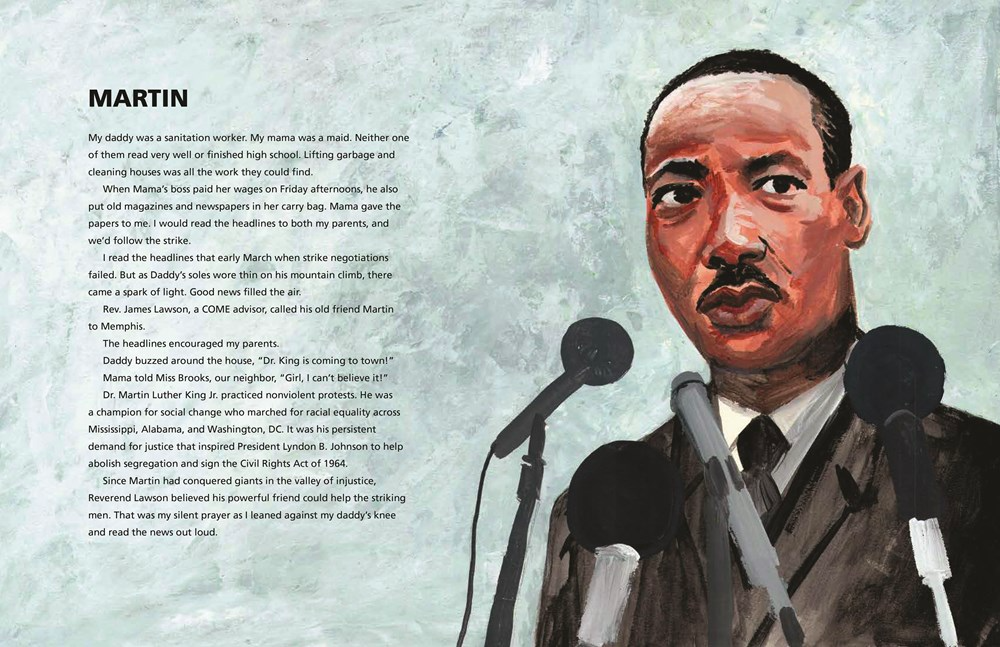
Informed by the memories of Dr. Almella Starks-Umoja, a teacher who as a child participated in the sanitation strike and told through the eyes of fictional nine-year-old Lorraine, Alice Faye Duncan relates the story of the 1968 sanitation strike in Memphis, Tennessee and the assassination of Dr. Martin Luther King just a day after giving his final sermon “I’ve Been to the Mountaintop” at Mason Temple Church in support of the strike.

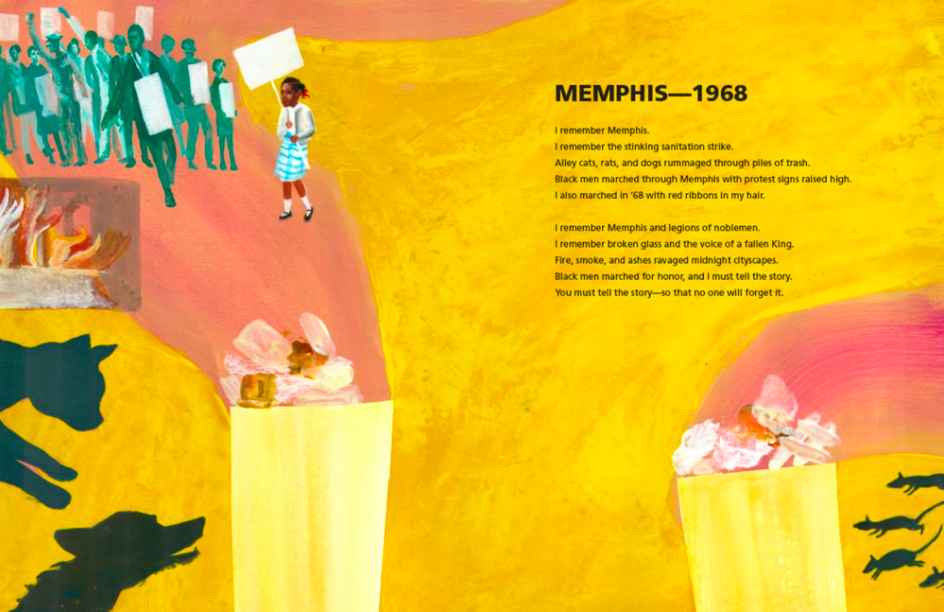
Through thirteen titled vignettes composed of lyrical and powerful language, Duncan reveals the detailed facts and emotions of those days that changed lives, altered the Civil Rights movement, and still resonate today. Duncan begins with “Memphis—1968” in which Lorraine describes a Memphis roiled by “the stinking sanitation strike” when “Black men marched for honor” and she also marched “with red ribbon in [her] hair.” She entreats the reader: “You must tell the story—so that no one will forget it.”

celebrate-picture-books-picture-book-review-memphis-martin-and-the-mountaintop-introduction

Image copyright R. Gregory Christie, 2018, text copyright Alice Faye Duncan, 2018. Courtesy of Calkins Creek.

“Mud Puddles” tells of the moment in January when Lorraine’s father comes home so “distressed and out of breath” that Lorraine’s muddy shoeprints are forgotten by her mama as he tells them about his two fellow sanitation workers and friends—Echol Cole and Robert Walker—who were killed when a truck’s packer blade malfunctioned. “Daddy told Mama, ‘It ain’t right to die like that.’ / Mama shook her head, and I saw a new storm rising up. / I saw it in their eyes.”

In “Marching Orders” Lorraine lays out the ugly conditions sanitation workers like her father toiled under and introduces readers to Mayor Loeb, who refused to increase their wages from $1.70 an hour. She states, “When they could take the abuse no more, 1,300 men deserted their garbage barrels. They organized a labor strike on February 12, 1968. In the morning and afternoon, for sixty-five days, sanitation workers marched fourteen blocks through the streets of downtown Memphis.”

celebrate-picture-books-picture-book-review-memphis-martin-and-the-mountaintop-memphis-1968

Image copyright R. Gregory Christie, 2018, text copyright Alice Faye Duncan, 2018. Courtesy of Calkins Creek.

As the strike continued through the winter, “[crippling] garbage collection with terrific success,” “Winter Blues” depicts the sacrifices Lorraine’s family made, from going without electricity to missing bill payments to skipping treats or getting anything new. But Lorraine also “learned what the grown folks knew. Trouble visits every life. But as strikers marched through sun and rain, help came in many forms.” Two of these were a group of Memphis preachers who helped strikers pay bills and the NAACP.

Winter turns to spring with no concessions from Mayor Loeb and no end to the strike in sight. But then in “Martin” Lorraine learns in the newspapers her mama’s boss gave her that Martin Luther King Jr. would be coming to support the striking workers. “Silver Rights” recounts Lorraine’s memories of listening to Dr. King, his voice “loud and stirring” when he said, “‘All labor has dignity.’” He set the date of March 22nd when he would march with the striking workers. Lorraine’s daddy and mama vowed to be there. And as she recalled, “then Mama patted my hand and said, ‘We will take Lorraine. She can march with us.’” A haiku “Omen” reveals the cancellation of the march.

celebrate-picture-books-picture-book-review-memphis-martin-and-the-mountaintop-mud-puddles

Image copyright R. Gregory Christie, 2018, text copyright Alice Faye Duncan, 2018. Courtesy of Calkins Creek.

In “Beale Street,” Lorraine explains more about Dr. King’s dreams and work and his crusade he named “the ‘Poor People’s Campaign.’” The march was rescheduled for March 28, and on that day “Six thousand people—blacks, whites, men, women, and children—gathered in downtown Memphis. / Police stood guard with tear gas, billy clubs, and guns.” When looters shattered storefront windows, the police moved in, spraying tear gas and beating people.” Lorraine became separated from her mother but was swept to safety by her father. Following the riot, the National Guard was called in and a curfew put in place.

In the aftermath of the riot, Dr. King left Memphis, Lorraine tells readers in “Dreamers.” But he had promised to return despite death threats, and on April 3 he flew from his home in Atlanta to Memphis. It was a stormy night, but Lorraine and her family along with many others packed Mason Temple Church to hear Dr. King preach. But when they got there, Dr. King’s friend Ralph Abernathy told the crowd that Dr. King was too sick to appear.

Other people gave speeches about the strike, and Lorraine had fallen asleep in her mother’s arms when “KABOOM! A voice like the evening thunder shook me from my sleep.” In his booming voice, Dr. King “charged men, women, and children to make the world a promised land flowing with freedom and justice” and “encouraged Memphis strikers and strike supporters to march, boycott, and raise their voices for worker rights until victory was won.”

celebrate-picture-books-picture-book-review-memphis-martin-and-the-mountaintop-marching-orders

Image copyright R. Gregory Christie, 2018, text copyright Alice Faye Duncan, 2018. Courtesy of Calkins Creek.

In “Lorraine” the narrator reveals that her name is the same as the Memphis motel where Dr. King lost his life. She recounts his last hour spent with friends and the moment when he steps out onto the balcony and James Earl Ray shot him from a boarding house nearby. In other cities across the country grief-fueled protests broke out, but Memphis was relatively quiet. As Lorraine listened to the radio that night, she wrote a poem “The King is Dead” that her mama hung on the wall of their rented house.

“Black Widow” relates the events of April 8, when Coretta Scott King fulfilled her husband’s promise to march for the Memphis sanitation workers. Along with 40,000 other people—“ministers, labor leaders, political figures, entertainers, and everyday people”—from Memphis and around the country, Lorraine and her parents marched. In “Victory on a Blue Note,” the Memphis Sanitation Strike comes to an end when president Lyndon B. Johnson sent a labor official to negotiate a settlement. The men received a pay increase and promotions based on merit, not race. As Lorraine’s daddy and mama celebrate, Lorraine reveals what she has learned: “So much was won. / So much was lost. / Freedom is never free.”

An inspirational poem for all readers, “Mountaintop” closes the book. Back matter includes an extensive and detailed timeline as well as information on the National Civil Rights Museum at the Lorraine Motel and a list of sources.

celebrate-picture-books-picture-book-review-memphis-martin-and-the-mountaintop-martin-luther-king-jr

Image copyright R. Gregory Christie, 2018, text copyright Alice Faye Duncan, 2018. Courtesy of Calkins Creek.

In Memphis, Martin, and the Mountaintop, Alice Faye Duncan’s use of a nine-year-old narrator makes her book even more powerful for today’s children in telling the story of the Memphis sanitation strike and the world-changing events surrounding it. Duncan intertwines conviction, pride, activism, and heartbreak together in her compelling and lyrical snapshots that reveal the facts and emotions behind this pivotal Civil Rights and economic rights protest for a living wage for all Americans. Children’s hearts will be filled with empathy for Lorraine as she supports her father, accepts the sacrifices her family must make during the strike, joins her mother in marches, and fears for the safety of the strikers and Martin Luther King Jr.

The life and work of Dr. King, his influence, and the hope he embodied as well as his shocking assassination are all encapsulated in Duncan’s concise paragraphs, allowing readers to understand his enduring inspiration to all who fight injustice. By overlaying the text with descriptions of the volatile weather experienced during the winter and spring of 1968, Duncan amplifies the fearful atmosphere of the times in a metaphorical way that will resonate with readers. Lorraine’s growth and insight gleaned from her experiences will stay with readers long after they read the story.

R. Gregory Christie’s dramatic collage-style gouache paintings set off Duncan’s vignettes with bold blocks of color while inviting readers to experience the determination, community, and dignity of the workers fighting for the universal desire for and right to recognition, safety, and a living wage. Christie’s illustrations are all the more evocative for their varied use of perspective, subtle glimpses of hope and support, and moving portraits of Lorraine’s father, strikers, Martin Luther King Jr., and Lorraine herself. The death of Dr. King is depicted in a tiny image of the Lorraine motel balcony on which three men pointing upward, a kneeling figure, and the fallen Dr. King are all portrayed in silhouette. The intense focus the reader puts on this image increases its effect on the heart and mind.

Compelling, moving, and inspirational, Memphis, Martin, and the Mountaintop: The Sanitation Strike of 1968 is a must-read for all children. The book is a first-rate choice for home libraries and belongs in every school and public library.

Ages 7 and up

Calkins Creek, 2018 | ISBN 978-1629797182

Discover more about Alice Faye Duncan and her books on her website.

To learn more about R. Gregory Christie, his books, and his art, visit his website.

Martin Luther King, Jr. Day Activity

celebrate-picture-books-picture-book-review-martin-luther-king-jr-coloring-page

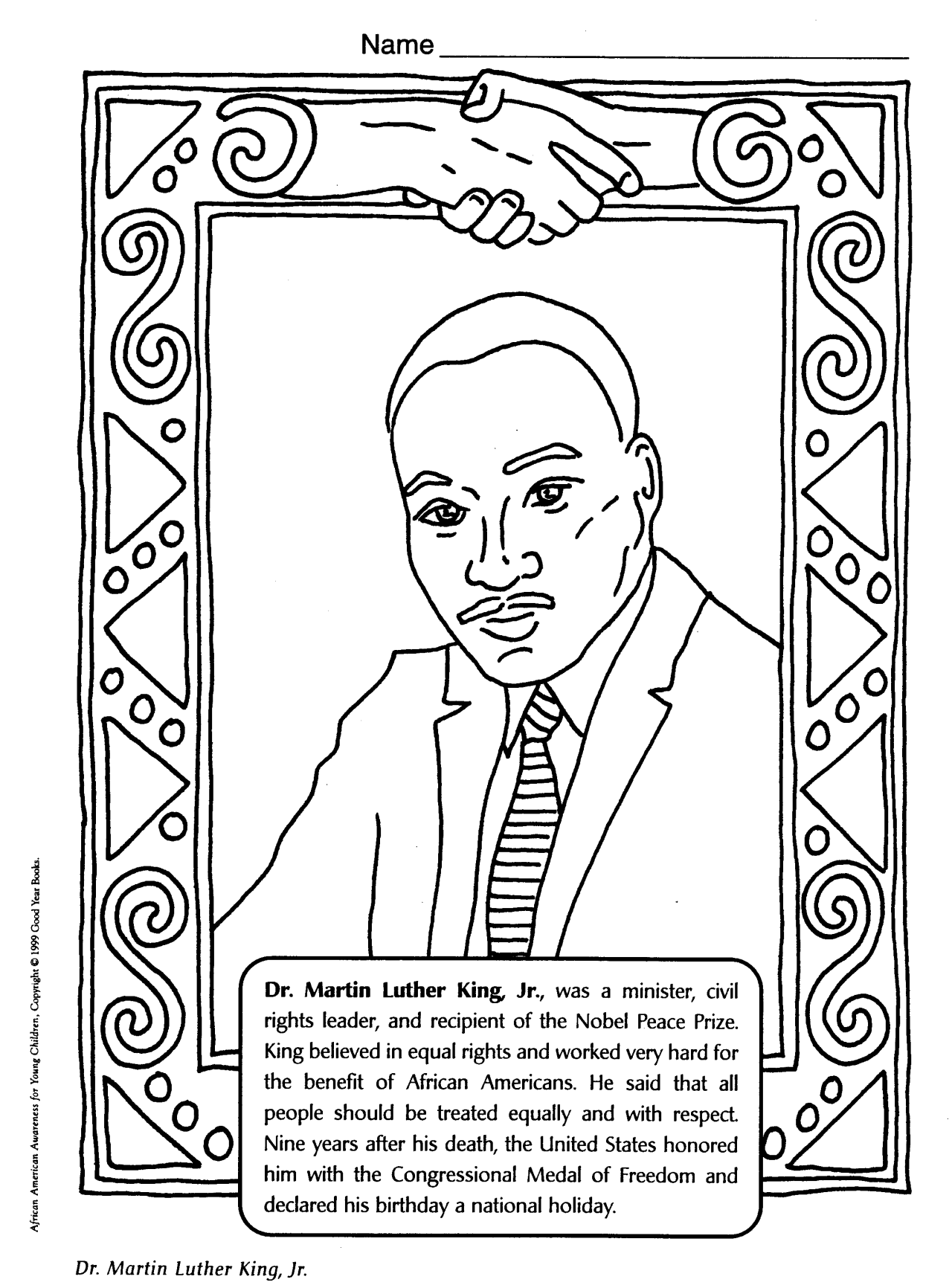
Martin Luther King Jr. Portrait


To inspire your dreams of a better future for all, color this printable page and hang it in your room!

Martin Luther King Jr. Portrait 

celebrate-picture-books-picture-book-review-memphis-martin-and-the-mountaintop-cover

You can find Memphis, Martin, and the Mountaintop: The Sanitation Strike of 1968 at these booksellers

Amazon | Barnes & Noble | Books-a-Million

To support your local independent bookstore, order from

Bookshop | IndieBound

Picture Book Review

December 3 – International Day of Persons with Disabilities

celebrate-picture-books-picture-book-review-we-want-to-go-to-school-cover

About the Holiday

Today we honor International Day of Persons with Disabilities, a holiday that raises awareness for people of different physical and mental abilities across the globe. The day was proclaimed an international holiday in 1992 by the United Nations in order to appreciate members of our society who are often marginalized or ignored because of their different abilities. Today we recognize the importance of creating a world in which everyone feels like an active, respected member and cultivating a society that is accessible and designed for all of us. To celebrate International Day of Persons with Disabilities learn more about the fight for disability education rights or talk to someone you know with a disability about their experiences. You can also visit the IDPWD website to learn about available services, resources, and how you can get involved. We Want to Go to School! is a perfect way to start a conversation with a child about education equality for people with disabilities.

Thank you to Albert Whitman & Company for sharing a copy of We Want to Go to School! with me for review consideration. All opinions on the book are my own.

Review by Dorothy Levine

We Want to Go to School!: The Fight for Disability Rights

Written by Maryann Cocca-Leffler | Illustrated by Janine Leffler


When Janine was born with a disability called cerebral palsy, she had lots of teachers to help her learn. With the aid from different instructors who helped build her speech, her muscles, and her hand coordination, Janine was able to learn, play, study, and graduate school with the rest of her peers. This would not have been true, however, had she been born a decade earlier. Before 1971, millions of kids with disabilities were banned from attending public schools.

celebrate-picture-books-picture-book-review-we-want-to-go-to-school-early-1970s

Image copyright Janine Leffler, 2021, text copyright Maryann Cocca-Leffler, 2021. Courtesy of Albert Whitman & Company.

Janine explains that the people in charge claimed that children with disabilities shouldn’t go to school with everyone else because it would take too much money to fund education for them, and that those with disabilities would distract the other children. They even tried to say children with disabilities wouldn’t be able to learn. The real reason so many children with disabilities had to stay home or in hospitals instead of going to school was because of people’s prejudice.

Many parents of Black children had also experienced discrimination when they were in school. Before 1954, Black children had to go to separate schools that were not given nearly as many resources or good teachers as the white kids received in public schools. Similarly, children with disabilities in some places could take a test to go to public school, but they then were placed in separate, or segregated, classrooms and not given the same quality of education as the other kids. “But in 1971 in Washington, DC, seven school-age children were tired of hearing NO! They wanted to go to school too.” When other families heard about the lawsuit these seven families had started, they joined in too.

celebrate-picture-books-picture-book-review-we-want-to-go-to-school-1971

Image copyright Janine Leffler, 2021, text copyright Maryann Cocca-Leffler, 2021. Courtesy of Albert Whitman & Company.

So many children were not receiving public education because of disabilities, that all together they could file a class action lawsuit, “which meant that it stood up for a lot of children. And I mean a LOT! 18,000 students from the Washington, DC, area were also not receiving a public education because of their disabilities. Try to imagine 18,000. Then try to imagine 8,00,000 (8 million)! That’s how many children in the United States weren’t getting an education because they had disabilities.”

celebrate-picture-books-picture-book-review-we-want-to-go-to-school-families

Image copyright Janine Leffler, 2021, text copyright Maryann Cocca-Leffler, 2021. Courtesy of Albert Whitman & Company.

Joseph C. Waddy, the judge on the case took eleven long months to deliberate over his decision – “On the one hand, he knew that it would cost a lot of money to provide an education to these children. On the other hand, shouldn’t schools be spending their money on ALL children?” – Finally, Judge Waddy decided, and the families won! “All across the country, millions of students with disabilities could finally go to school and get the education they needed and deserved.” The text concludes with one final note from Janine: “Thank you, Peter, Janice, Jerome, Michael, George, Steven, and Duane. You changed many lives…including mine.”

After the resolution of Janine’s recounting of this landmark case, a page entitled “About Disability Education Rights in the United States” provides more details on the key points for readers and educators. The informational spread includes a direct quote from Judge Waddy’s ruling and a timeline of important landmarks for disability rights and education. In personal notes from Janine Leffler and her mom, Maryann, the authors talk about their connections to the disabled community. This insightful page concludes with a personal note from the last surviving Plaintiff’s Attorney on the case: Paul R. Dimond.

celebrate-picture-books-picture-book-review-we-want-to-go-to-school-kids

Image copyright Janine Leffler, 2021, text copyright Maryann Cocca-Leffler, 2021. Courtesy of Albert Whitman & Company.

Janine Leffler and Maryann Cocca-Leffler collaborate to tell the important story of the Mills v. Board of Education of the District Columbia case that served as a critical turning point in the fight for disability education rights. Through Janine’s personal narration of the case, the two authors succinctly explain the unfolding of this history in terms that are engaging and easy to understand for young readers. Speech bubbles and intertwined text with illustrations make the story engaging and exciting for young readers to follow. On the page that states how many children with disabilities were not allowed to go to school in DC, and more widely across the US, the whole spread features 1,000 tiny faces of kids, to help readers fathom the enormity of 18,000 people, let alone 8 million. The children in the story represent a diverse crowd of races, genders, and abilities. A joy to read, and an essential story to learn. Education matters.

Ages 5 – 9

Albert Whitman & Company, 2021 | ISBN 978-0807535189

You can find an Educator’s Guide to download on the Albert Whitman & Company website here.

Discover more about Maryann Cocca-Leffler, her books, and her musical on her website.

To meet and learn about Janine Leffler and discover the books and other creative endeavors she has inspired, visit Janine’s Party.

celebrate-picture-books-picture-book-review-we-want-to-go-to-school-cover

You can find We Want to Go to School!: The Fight for Disability Rights at these booksellers

Amazon | Barnes & Noble | Books-a-Million

To support your local independent bookstore, order from

Bookshop | IndieBound

Picture Book Review

April 28 – Great Poetry Reading Day and Workers Memorial Day

celebrate-picture-books-picture-book-review-memphis-martin-and-the-mountaintop-cover

About the Holiday

This month we honor the life and legacy of Martin Luther King Jr. as we commemorate his assassination on April 4, 1968. Today’s book, told in lyrical language along with interwoven poems, relates the events of the Memphis Sanitation Strike of 1968 as well as the day of Dr. King’s death and touches on two holidays held today: Great Poetry Reading Day and National Workers Memorial Day. 

Great Poetry Reading Day

As National Poetry Month comes to a close, people are encouraged to engage in one more special celebration of poets and their work by reading and sharing poems by their favorite writers as well as discovering new writers whose work they can enjoy today and in the future. To get started why not visit your local library or bookstore and take home a book or two of poetry for you and your kids today as well as today’s superb book. 

Workers Memorial Day

Some jobs are so dangerous that workers get hurt or even die doing them. Around the world organizations have been established to help industries provide safer working environments for their employees by establishing standard rules and regulations for buildings, machinery, working hours, and more. Unions and other groups have also been founded that represent workers to ensure their rights are upheld and their needs are met. Today we honor the sacrifices of workers in dangerous professions and raise awareness for safe working conditions.

I’d like to sincerely thank Alice Faye Duncan for sharing a digital copy of Memphis, Martin, and the Mountaintop for review consideration. All opinions on the book are my own.

Memphis, Martin, and the Mountaintop: The Sanitation Strike of 1968

Written by Alice Faye Duncan | Illustrated by R. Gregory Christie


Informed by the memories of Dr. Almella Starks-Umoja, a teacher who as a child participated in the sanitation strike and told through the eyes of fictional nine-year-old Lorraine, Alice Faye Duncan relates the story of the 1968 sanitation strike in Memphis, Tennessee and the assassination of Dr. Martin Luther King just a day after giving his final sermon “I’ve Been to the Mountaintop” at Mason Temple Church in support of the strike.

Through thirteen titled vignettes composed of lyrical and powerful language, Duncan reveals the detailed facts and emotions of those days that changed lives, altered the Civil Rights movement, and still resonate today. Duncan begins with “Memphis—1968” in which Lorraine describes a Memphis roiled by “the stinking sanitation strike” when “Black men marched for honor” and she also marched “with red ribbon in [her] hair.” She entreats the reader: “You must tell the story—so that no one will forget it.”

celebrate-picture-books-picture-book-review-memphis-martin-and-the-mountaintop-introduction

Image copyright R. Gregory Christie, 2018, text copyright Alice Faye Duncan, 2018. Courtesy of Calkins Creek.

“Mud Puddles” tells of the moment in January when Lorraine’s father comes home so “distressed and out of breath” that Lorraine’s muddy shoeprints are forgotten by her mama as he tells them about his two fellow sanitation workers and friends—Echol Cole and Robert Walker—who were killed when a truck’s packer blade malfunctioned. “Daddy told Mama, ‘It ain’t right to die like that.’ / Mama shook her head, and I saw a new storm rising up. / I saw it in their eyes.”

In “Marching Orders” Lorraine lays out the ugly conditions sanitation workers like her father toiled under and introduces readers to Mayor Loeb, who refused to increase their wages from $1.70 an hour. She states, “When they could take the abuse no more, 1,300 men deserted their garbage barrels. They organized a labor strike on February 12, 1968. In the morning and afternoon, for sixty-five days, sanitation workers marched fourteen blocks through the streets of downtown Memphis.”

celebrate-picture-books-picture-book-review-memphis-martin-and-the-mountaintop-memphis-1968

Image copyright R. Gregory Christie, 2018, text copyright Alice Faye Duncan, 2018. Courtesy of Calkins Creek.

As the strike continued through the winter, “[crippling] garbage collection with terrific success,” “Winter Blues” depicts the sacrifices Lorraine’s family made, from going without electricity to missing bill payments to skipping treats or getting anything new. But Lorraine also “learned what the grown folks knew. Trouble visits every life. But as strikers marched through sun and rain, help came in many forms.” Two of these were a group of Memphis preachers who helped strikers pay bills and the NAACP.

Winter turns to spring with no concessions from Mayor Loeb and no end to the strike in sight. But then in “Martin” Lorraine learns in the newspapers her mama’s boss gave her that Martin Luther King Jr. would be coming to support the striking workers. “Silver Rights” recounts Lorraine’s memories of listening to Dr. King, his voice “loud and stirring” when he said, “‘All labor has dignity.’” He set the date of March 22nd when he would march with the striking workers. Lorraine’s daddy and mama vowed to be there. And as she recalled, “then Mama patted my hand and said, ‘We will take Lorraine. She can march with us.’” A haiku “Omen” reveals the cancellation of the march.

celebrate-picture-books-picture-book-review-memphis-martin-and-the-mountaintop-mud-puddles

Image copyright R. Gregory Christie, 2018, text copyright Alice Faye Duncan, 2018. Courtesy of Calkins Creek.

In “Beale Street,” Lorraine explains more about Dr. King’s dreams and work and his crusade he named “the ‘Poor People’s Campaign.’” The march was rescheduled for March 28, and on that day “Six thousand people—blacks, whites, men, women, and children—gathered in downtown Memphis. / Police stood guard with tear gas, billy clubs, and guns.” When looters shattered storefront windows, the police moved in, spraying tear gas and beating people.” Lorraine became separated from her mother but was swept to safety by her father. Following the riot, the National Guard was called in and a curfew put in place.

In the aftermath of the riot, Dr. King left Memphis, Lorraine tells readers in “Dreamers.” But he had promised to return despite death threats, and on April 3 he flew from his home in Atlanta to Memphis. It was a stormy night, but Lorraine and her family along with many others packed Mason Temple Church to hear Dr. King preach. But when they got there, Dr. King’s friend Ralph Abernathy told the crowd that Dr. King was too sick to appear.

Other people gave speeches about the strike, and Lorraine had fallen asleep in her mother’s arms when “KABOOM! A voice like the evening thunder shook me from my sleep.” In his booming voice, Dr. King “charged men, women, and children to make the world a promised land flowing with freedom and justice” and “encouraged Memphis strikers and strike supporters to march, boycott, and raise their voices for worker rights until victory was won.”

celebrate-picture-books-picture-book-review-memphis-martin-and-the-mountaintop-marching-orders

Image copyright R. Gregory Christie, 2018, text copyright Alice Faye Duncan, 2018. Courtesy of Calkins Creek.

In “Lorraine” the narrator reveals that her name is the same as the Memphis motel where Dr. King lost his life. She recounts his last hour spent with friends and the moment when he steps out onto the balcony and James Earl Ray shot him from a boarding house nearby. In other cities across the country grief-fueled protests broke out, but Memphis was relatively quiet. As Lorraine listened to the radio that night, she wrote a poem “The King is Dead” that her mama hung on the wall of their rented house.

“Black Widow” relates the events of April 8, when Coretta Scott King fulfilled her husband’s promise to march for the Memphis sanitation workers. Along with 40,000 other people—“ministers, labor leaders, political figures, entertainers, and everyday people”—from Memphis and around the country, Lorraine and her parents marched. In “Victory on a Blue Note,” the Memphis Sanitation Strike comes to an end when president Lyndon B. Johnson sent a labor official to negotiate a settlement. The men received a pay increase and promotions based on merit, not race. As Lorraine’s daddy and mama celebrate, Lorraine reveals what she has learned: “So much was won. / So much was lost. / Freedom is never free.”

An inspirational poem for all readers, “Mountaintop” closes the book. Back matter includes an extensive and detailed timeline as well as information on the National Civil Rights Museum at the Lorraine Motel and a list of sources.

celebrate-picture-books-picture-book-review-memphis-martin-and-the-mountaintop-martin-luther-king-jr

Image copyright R. Gregory Christie, 2018, text copyright Alice Faye Duncan, 2018. Courtesy of Calkins Creek.

In Memphis, Martin, and the Mountaintop, Alice Faye Duncan’s use of a nine-year-old narrator makes her book even more powerful for today’s children in telling the story of the Memphis sanitation strike and the world-changing events surrounding it. Duncan intertwines conviction, pride, activism, and heartbreak together in her compelling and lyrical snapshots that reveal the facts and emotions behind this pivotal Civil Rights and economic rights protest for a living wage for all Americans. Children’s hearts will be filled with empathy for Lorraine as she supports her father, accepts the sacrifices her family must make during the strike, joins her mother in marches, and fears for the safety of the strikers and Martin Luther King Jr.

The life and work of Dr. King, his influence, and the hope he embodied as well as his shocking assassination are all encapsulated in Duncan’s concise paragraphs, allowing readers to understand his enduring inspiration to all who fight injustice. By overlaying the text with descriptions of the volatile weather experienced during the winter and spring of 1968, Duncan amplifies the fearful atmosphere of the times in a metaphorical way that will resonate with readers. Lorraine’s growth and insight gleaned from her experiences will stay with readers long after they read the story.

R. Gregory Christie’s dramatic collage-style gouache paintings set off Duncan’s vignettes with bold blocks of color while inviting readers to experience the determination, community, and dignity of the workers fighting for the universal desire for and right to recognition, safety, and a living wage. Christie’s illustrations are all the more evocative for their varied use of perspective, subtle glimpses of hope and support, and moving portraits of Lorraine’s father, strikers, Martin Luther King Jr., and Lorraine herself. The death of Dr. King is depicted in a tiny image of the Lorraine motel balcony on which three men pointing upward, a kneeling figure, and the fallen Dr. King are all portrayed in silhouette. The intense focus the reader puts on this image increases its effect on the heart and mind.

Compelling, moving, and inspirational, Memphis, Martin, and the Mountaintop: The Sanitation Strike of 1968 is a must-read for all children. The book is a first-rate choice for home libraries and belongs in every school and public library.

Ages 7 and up

Calkins Creek, 2018 | ISBN 978-1629797182

Discover more about Alice Faye Duncan and her books on her website.

To learn more about R. Gregory Christie, his books, and his art, visit his website.

Great Poetry Reading Day and Workers’ Memorial Day Activity

celebrate-picture-books-picture-book-review-martin-luther-king-jr-coloring-page

Martin Luther King Jr. Portrait


To inspire your dreams of a better future for all, color this printable page and hang it in your room!

Martin Luther King Jr. Portrait 

celebrate-picture-books-picture-book-review-memphis-martin-and-the-mountaintop-cover

You can find Memphis, Martin, and the Mountaintop: The Sanitation Strike of 1968 at these booksellers

Amazon | Barnes & Noble | Books-a-Million

To support your local independent bookstore, order from

Bookshop | IndieBound

Picture Book Review


February 18 – It’s Black History Month

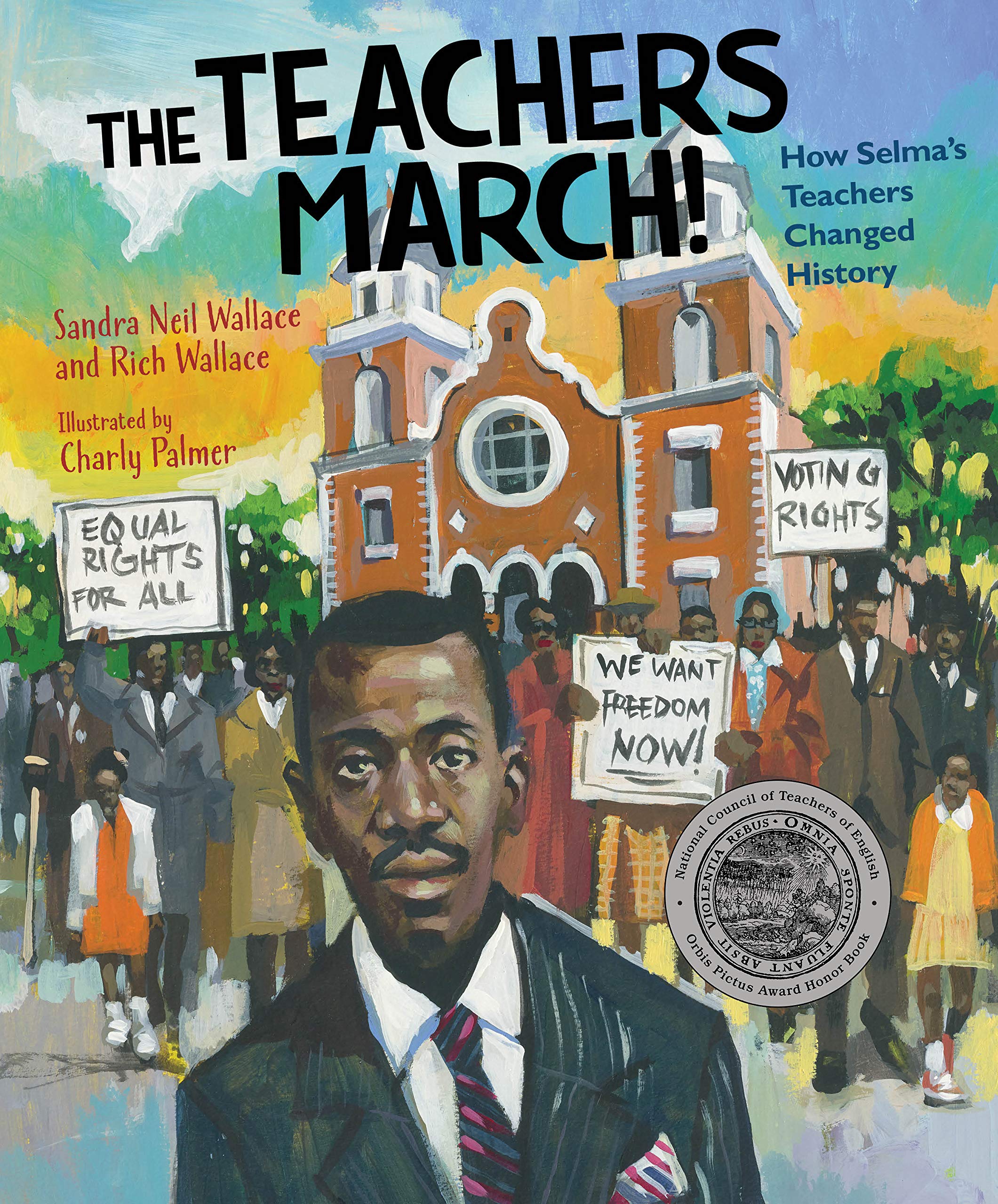
celebrate-picture-month-picture-month-review-the-teachers-march-cover

About the Holiday

Black History Month was instituted by Dr. Carter G. Woodson in 1926 to celebrate the achievements and contributions of African Americans in United States History. The holiday began as a week-long observance taking place during the second week of February to commemorate the birthdays of Frederick Douglass and Abraham Lincoln. In 1976 President Gerald Ford officially established Black History Month. The holiday is now celebrated across the country with special events in schools, churches, and community centers. The theme for 2021 is “Black Family: Representation, Identity and Diversity.” Online events will explore the African diaspora and the spread of Black families across the United States through multiple perspectives. For more information about Black History Month, visit the ASALH website and africanamericanhistorymonth.gov.

The Teachers March! How Selma’s Teachers Changed History

Written by Sandra Neil Wallace and Rich Wallace | Illustrated by Charly Palmer


Reverend F. D. Reese taught science at R. B. Hudson High School, but his favorite subject was freedom…. To be treated as less than equal, that just wasn’t right.” Reverend Reese led marches to register Black voters. The police called them “troublemakers” and used billy clubs to stop them from voting. If the people did make it inside the courthouse to register, they faced a test they had to pass—a test with impossible questions, such as “How many drops of water are in the Alabama River?” Reverend Reese decided he needed a “‘triumphant idea’” to change things.

It came to him that the teachers—leaders and respected in the community—should march for freedom. But a judge had made it illegal to march and even talk about voting rights. Most people were too afraid to march, so Reverend Reese looked for a “‘glorious opportunity’” to come his way. It came when he watched Dr. Martin Luther King Jr. speak on television and wrote him a letter inviting him to come to Selma to “help convince the teachers to march.”

celebrate-picture-month-picture-month-review-the-teachers-march-toothbrushes

Image copyright Charly Palmer, 2020, text copyright Sandra Neil Wallace and Rich Wallace, 2020. Courtesy of Calkins Creek.

Dr. King agreed and spoke to a crowd of 700 people at Brown Chapel. He told the group that everyone should march and “go to jail by the thousands to defend the right to vote.” Two of the people listening to Dr. King were fifteen-year-old Joyce Parrish and her mother, “Two Sweet.” When Reverend Reese asked for teachers to sign up to march, he said that if both parents in a family were teachers, only one should march so that the other could take care of the children if the first went to jail. For Two Sweet it was a difficult decision. She was a teacher and also a single parent. More than 100 teacher signed up, including “Two Sweet.”

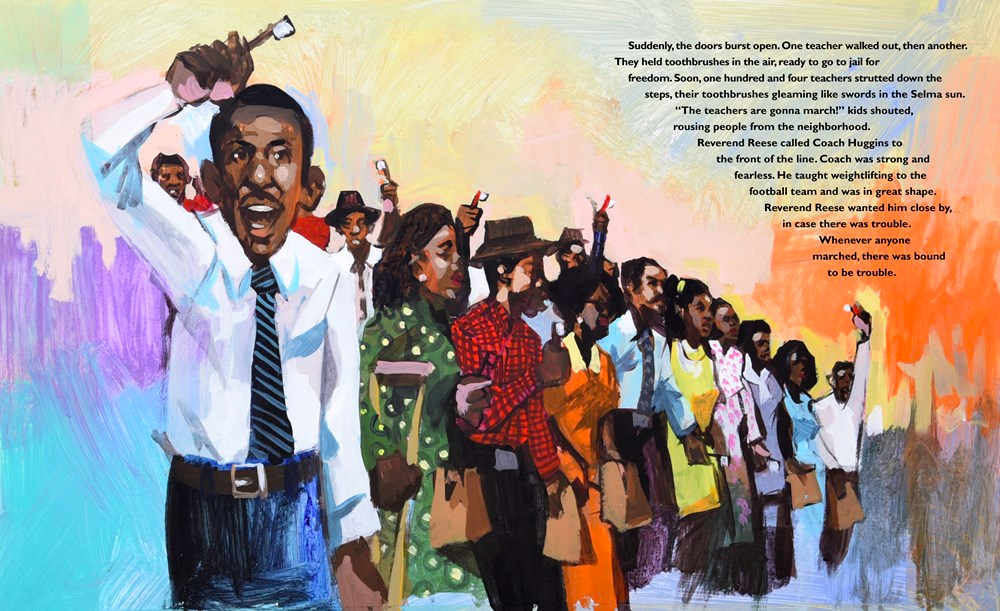
On January 22, the day of the march, Two Sweet packed a toothbrush and a sandwich—things she’d need in jail—and hugged Joyce goodbye. That afternoon as Reverend Reese waited alone outside the school alone, he wondered if the teachers would show up. Then one-by-one the teachers emerged from the building, holding their toothbrushes aloft. Reverend Reese called Coach Huggins to the front of the line and they started walking to the courthouse. People gathered along the street to watch, and Joyce paced nervously, wondering what would happen to her mother.

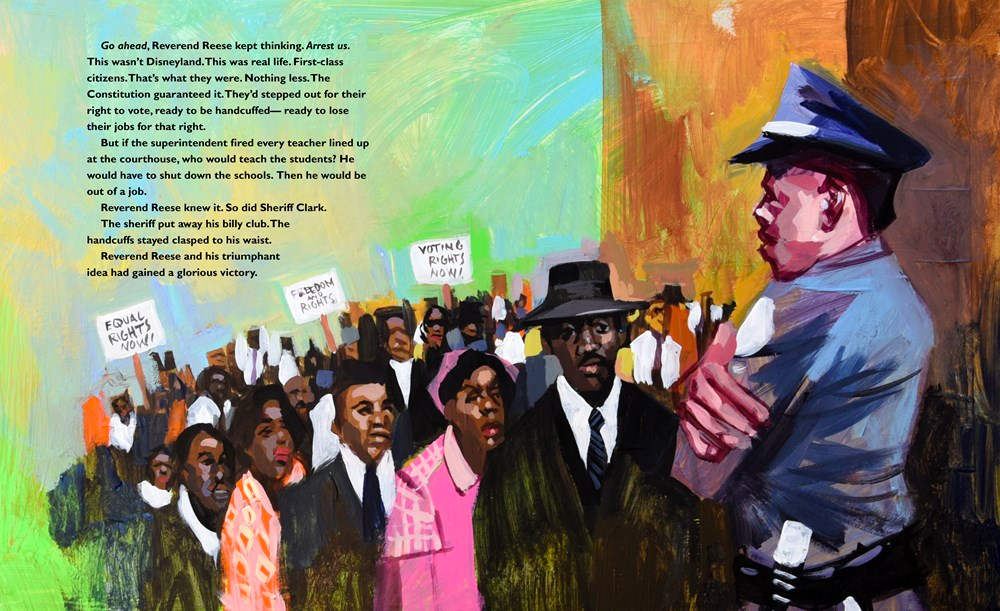
As the teachers crossed into the white section of town, the dirt roads became paved and people swarmed from shops to glare at the marchers, hoping to intimidate them. When they reached the courthouse, the sheriff and his deputies stood atop the steps. Reverend Reese announced that they were there to register to vote, but the sheriff said, “‘You can’t make a plaything out of the corridors of this courthouse.’” He gave the teachers one minute to disperse or face arrest. The teachers stayed put.

celebrate-picture-month-picture-month-review-the-teachers-march-courthouse

Image copyright Charly Palmer, 2020, text copyright Sandra Neil Wallace and Rich Wallace, 2020. Courtesy of Calkins Creek.

When the time was up, the police grabbed their billy clubs. They pushed Coach Huggins and Reverend Reese, causing the teachers to fall backward. When they got up, the police pushed them harder. Then the school superintendent came out of the courthouse. He had the power to fire every teacher. But Reverend Reese and the teachers stood firm for the right the Constitution guaranteed. The superintendent looked out over the crowd. He knew that if he fired them all, there would be no one to teach at the schools and he would lose his job.

The teachers had won the day. They went back to Brown Chapel, where young people were singing freedom songs. The kids were proud of their teachers, and Joyce hugged her mother. That night, Dr. King preached at Brown Chapel. “He praised Reverend Reese and the teachers for making civil rights history” by being the first leaders to risk their jobs by marching. Now other shop keepers and business people were emboldened to march for the right to vote. Kids and young people marched too. These Selma marchers were arrested by the thousands. Across America people took notice. Why, they wondered, were “respectable citizens in suits and dresses, and school kids carrying books” put in jail.

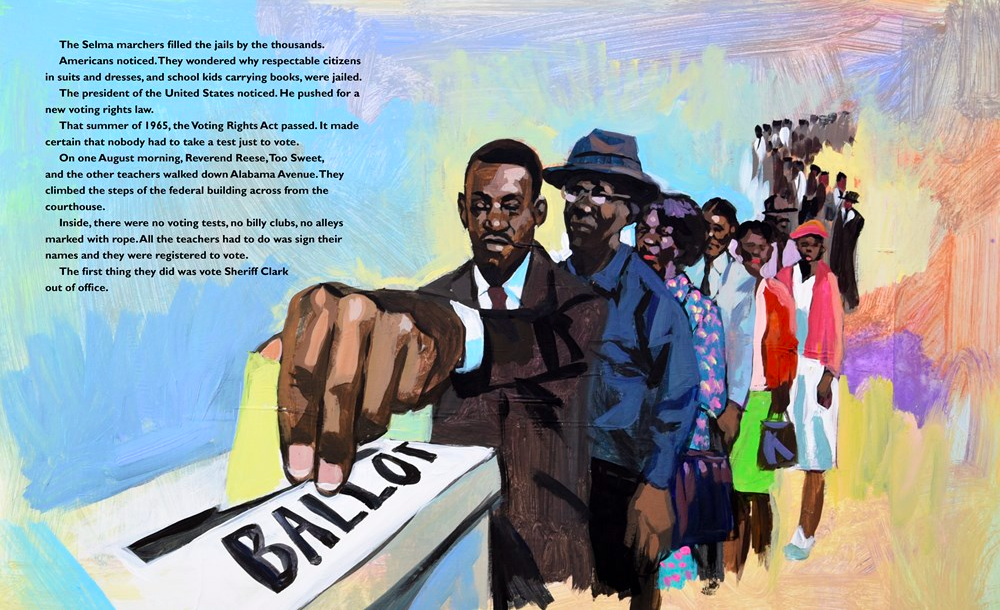
The president of the United States also noticed. In the summer of 1965, Congress passed the Voting Rights Act, ensuring that no test was required to register to vote. In August, Reverend Reese, Two Sweet, and other teachers walked to the federal building and registered to vote. With their first ballot, they voted the sheriff out of office.

Following the text are an extensive Author’s Note about the Teachers’ March and its leaders, with photographs as well as an Illustrator’s Note explains how the illustrations were created. A Timeline follows the 1965 Voting Rights Movement in Selma, Alabama from 1936 to 2018. A photograph of Dr. Martin Luther King Jr., Coretta Scott King, and Reverend Reese leading the 1965 voting rights march from Selma to Montgomery is also included. A selected bibliography of resources used in writing the book, as well as websites where readers can learn more, close out the excellent backmatter.

celebrate-picture-month-picture-month-review-the-teachers-march-ballot

Image copyright Charly Palmer, 2020, text copyright Sandra Neil Wallace and Rich Wallace, 2020. Courtesy of Calkins Creek.

Compelling and comprehensive, Sandra Neil Wallace and Rich Wallace’s story about the teachers march of 1964 is exhilarating reading. Powerful for its personal focus on Reverend Reese, Joyce, and Two Sweet and their fears, doubts, and courage, the story includes vital details that reveal inequalities of the time beyond the issue of voting rights and which will resonate with children aware of continuing inequalities, protests, gerrymandering, and other current issues in the news. Sandra and Rich Wallace build suspense through evocative descriptions to draw children in and immerse them in a reading experience that will have emotional impact.

Charly Palmer’s acrylic on board illustrations capture the motion and emotion of the teachers’ march and the events leading up to that day. All the more moving for their abstract quality, the images portray telling glances (on the first page a student looks out at the reader as Reverend Reese lectures about equal rights at the chalkboard); seminal moments, such as when Dr. Martin Luther King Jr. strides into Brown Chapel and Coach Huggins signs his name, promising to march; and the moments when the sheriff and his deputies confront the teachers with billy clubs raised. The reunion between a worried Joyce and her mother is poignant, and the final illustration of Reverend Reese putting his ballot into the box, reminds all readers of the successes of the past, but also that vigilance and action continues to be needed.

Superb for social studies, American history, homeschooling, and civics lessons, The Teachers March! How Selma’s Teachers Changed History  is highly recommended for home bookshelves and a must for school and public library collections.

Ages 7– 10 and up

Calkins Creek, 2020 | ISBN 978-1629794525

Discover more about Sandra Neil Wallace, and her books on her website. You can also find a downloadable Educator’s Guide for The Teachers March! and other books by Sandra.

You can learn more about Rich Wallace and his books on his website.

To learn more about Charly Palmer and view a portfolio of his art, visit his website.

Watch the trailer for The Teachers March!


Black History Month Activity

celebrate-picture-books-picture-book-review-Black-History-Month-Coloring-Pages-Martin-Luther-King-Jr

Role Model Coloring Pages


Whether you’re interested in law and politics, science, sports, or the arts, you can find a role model in the people in the printable coloring pages below. 

Dr. Mae Jemison | Jackie Robinson | Maya Angelou  | Louis Armstrong | Garrett Morgan | Rosa Parks

celebrate-picture-month-picture-month-review-the-teachers-march-cover

You can find The Teachers March! at these booksellers

Amazon | Barnes & Noble | Books-a-Million

To support your local independent bookstore, order from

Bookshop | IndieBound

Picture Book Review