April 25 – National Telephone Day

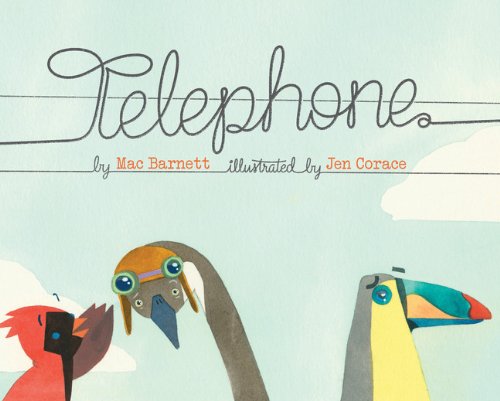
celebrate-picture-books-picture-book-review-telephone-cover

About the Holiday

It may be safe to say that one of the first inventors children learn about is Alexander Graham Bell, the inventor of telephone. In the late 1800s, the need for a better communication device was well recognized, and various people were at work on a solution. Bell, was the first to apply for a patent—awarded on March 7, 1876—and so the acclaim goes to him. Communication had always been a part of Bell’s life. His father had developed a “visible speech” system for deaf students, and he himself was a teacher at a boy’s boarding school. On May10, 1876, the first public demonstration of the telephone occurred at the Philadelphia World’s Fair. The Bell Telephone Company was founded on July 9, 1877, and the one millionth telephone was installed in May of 1967. To celebrate today’s holiday, call someone—okay, or text—and marvel over this indispensable invention and how far it has come.

Telephone

Written by Mac Barnett | Illustrated by Jen Corace


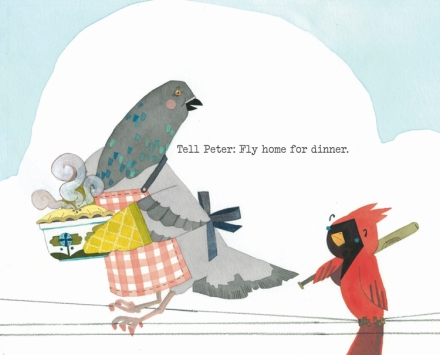
Above a little row of houses and two children playing, a group of very disparate birds sit along the telephone wire. Mama pigeon, holding a nice, steaming potpie, has a message for her little Peter. She turns to Cardinal and says, “Tell Peter: Fly home for dinner.” The cardinal, with a baseball bat tucked under his wing, turns to the goose sitting next to him and says Peter should “hit pop flies and homers.”

celebrate-picture-books-picture-book-review-telephone-mama-pigeon

Image copyright Jen Corace, 2014, text copyright Mac Barnett, 2014. Courtesy of Chronicle Books.

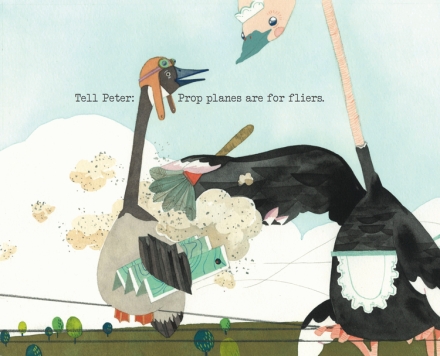
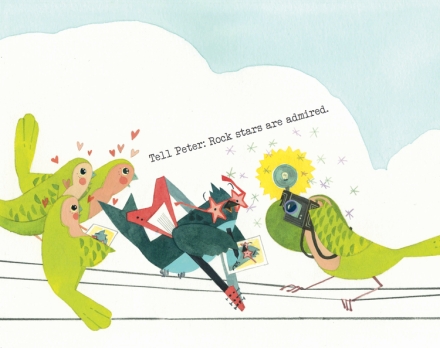
Ostrich, outfitted in an old aviator’s hat and carrying a map, hears the message a bit differently. While gazing out at the small craft zipping through the sky, he whispers into Ostrich’s ear to tell Peter jus who it is that uses “prop planes.” Ostrich has the day’s cleaning on her mind and tells the titmouse what Peter should do with his “wet socks.” The titmouse, with a guitar slung over her shoulder and perhaps a bit of hope in her heart, hears, “Tell Peter, rock stars are admired.”

celebrate-picture-books-picture-book-review-telephone-mama-ostrich

Image copyright Jen Corace, 2014, text copyright Mac Barnett, 2014. Courtesy of Chronicle Books.

The Toucan has his binoculars trained on a passel of crocodiles down below and has some words of warning for Peter. Pelican, meanwhile, is playing hide and seek with Lobster and has some words of praise for these wily crustaceans. Duck is preoccupied with monster truck tires, and turkey is a little concerned about being so “high up on this wire.”

By now moms down below are cooking dinner and calling their kids home. The robin smells smoke and tells the chicken he’s afraid there’s a fire. The chicken, channeling her inner Henny Penny, puts it all together and with a touch of hysteria tells the owl to warn Peter of a smelly, crocodile-riding, fire-breathing monster of a lobster who’s coming to eat him. The owl opens one skeptical eye, then turns nonchalantly to the young birds hanging out and blowing bubble gum bubbles and says, “Hey, Peter, your mom says fly home for dinner.”

celebrate-picture-books-picture-book-review-telephone-mama-rock-stars

Image copyright Jen Corace, 2014, text copyright Mac Barnett, 2014. Courtesy of Chronicle Books.

Mac Barnett’s perfectly goofy read aloud will have kids giggling and eagerly anticipating what interpretation could possibly come next in this story that’s just right for fun story times when you just want to laugh out loud. An enthusiastic reading ramps up the humor and the droll ending.

Jen Corace’s witty illustrations of each bird and their particular preoccupation give eagle-eyed readers clues to how Mama bird’s simple message may be mangled next. The ostrich uses a feather duster to tidy up the goose, the titmouse wears star-shaped sunglasses, and the chicken, with her wild topknot of feathers puts new meaning into the term “wired” with her over-the-top dire warning.

Surprising from one side of the telephone pole to the other, Telephone is a fantastic choice for dialing up fun at home or in the classroom.

Ages 4 – 8

Chronicle Books, 2014 | ISBN  978-1452110233

Discover more about Mac Barnett and his many books on his website.

To learn more about Jen Corace, her books, and her art, visit her website.

Have you heard? It’s the Telephone book trailer!

National Telephone Day Activity

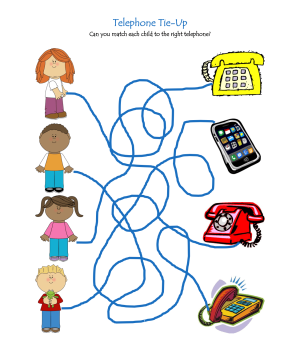
celebrate-picture-books-picture-book-review-telephone-tie-up-puzzle

Telephone Tie-Up Puzzle


These kids want to use a telephone. Can you follow the tangled wires to find a phone for each child in this Telephone Tie-Up Puzzle?

Picture Book Review

April 24 – It’s National Frog Month

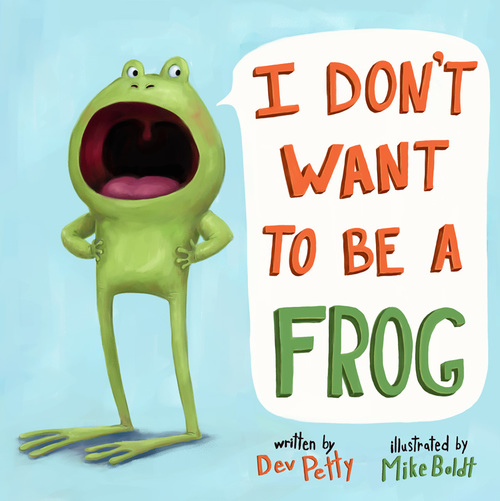
celebrate-picture-books-picture-book-review-i-dont-want-to-be-a-frog

About the Holiday

As the weather gets warmer, rain falls, and swampy areas and wetlands swell with water, the peeps and throaty croaks of frogs begins to fill the nighttime air. April is the perfect time to learn more about frogs and their importance to the ecosystem. Frogs are vital to the food system, and they eat insects that are harmful to crops and carry disease. Because they don’t drink water but absorb it through their skin, frogs are particularly susceptible to pollution. This, in addition to habitat destruction, climate change, and an increase in invasive species, threaten the frog population, making the conservation of their environment of utmost importance. This month, visit an aquarium, nature preserve, or zoo where you can learn more about these fascinating creatures.

I Don’t Want to be a Frog

Written by Dev Petty | Illustrated by Mike Boldt


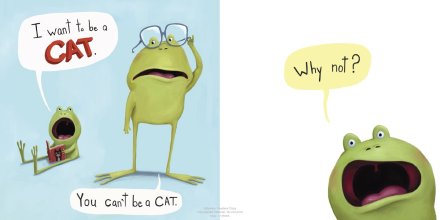
“I want to be a cat,” a little frog announces to his father. “You can’t be a cat,” his dad answers, which elicits the inevitable “Why not?” from his son. His dad isn’t quite ready for this conversation and gives him the standard “because you’re a frog” response. Well, it turns out the little frog would rather be almost anything other than what he is. As he rattles off a list of alternatives that he considers much better, his dad warms to the game and counters each of his son’s suggestions with the realities of life (at least their life).

celebrate-picture-books-picture-book-review-i-don't-want-to-be-a-frog-cat

Image copyright Mike Boldt, 2015, text copyright Dev Petty, 2015. Courtesy of Doubleday Books for Young Readers.

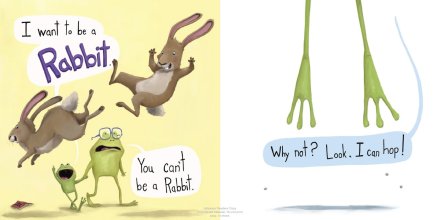
When little frog opines that he’d like to be a rabbit, his dad points out that he doesn’t have long ears. Being a pig seems like an attractive option, but Dad reminds him that he doesn’t have a curly tail or eat garbage. While both son and father believe being an owl would be “the greatest thing ever,” three things are standing in the way: Frogs don’t have wings, they don’t look wise, and they can’t spin their heads around.

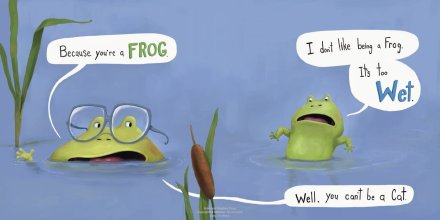
So what’s so bad about being a frog? It’s “too wet,” “too slimy,” and there’s “too much bug eating,” little frog complains. Just then a wolf sneaks up and wants to know why the little guy is so glum. Without turning around to see who’s asking, the frog reveals his plight.

celebrate-picture-books-picture-book-review-i-don't-want-to-be-a-frog-too-wet

Image copyright Mike Boldt, 2015, text copyright Dev Petty, 2015. Courtesy of Doubleday Books for Young Readers.

With glee the wolf lets the frog in on a little secret, explaining that he revels in eating cats, rabbits, pigs, and owls. In fact, just talking about it makes him hungry.  “Guess the one thing I never eat,” the wolf urges. “Badgers?” guesses the little frog. But no, the answer is “frogs.” And why? Because they are “too wet and slimy and full of bugs.”

Wiser for this fresh perspective, the young frog sends the wolf off with a hearty, “I guess you can’t fight nature. We are what we are. You are a fierce hunter.” As the wolf walks away all’s well that ends well—except not so much for the creature who next happens upon the scene!

celebrate-picture-books-picture-book-review-i-don't-want-to-be-a-frog-rabbit

Image copyright Mike Boldt, 2015, text copyright Dev Petty, 2015. Courtesy of Doubleday Books for Young Readers.

Dev Petty’s sassy-in-a-good-way young frog’s identity crisis is pure fun! The notion of self-acceptance and that each person is built, has talents, and embodies skills just right for who they are is playfully presented by Petty’s sweet father-and-son team. The humorous, escalating dialogue will keep kids laughing, and the surprise ending is a perfect twist. Petty’s endearing amphibian has spawned two sequals—I Don’t Want to Be Big and There’s Nothing to Do. A third, I Don’t Want to Go to Sleep, is due this fall.

celebrate-picture-books-picture-book-review-i-don't-want-to-be-a-frog-little-frog

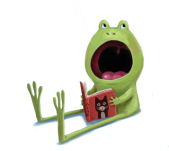
Mike Boldt’s olive green frogs are a delight as they trade off assurance and skepticism in their life-lesson conversation. Dad, initially mystified by his son’s pronouncements, discusses the issue with patience and genuine curiosity, his eyes registering cunning and understanding behind oversized glasses. His son, wide-eyed and vocal, displays the honesty of children with his questions. Boldt’s illustrations of the rabbit, pig, and owl that so captivate the young frog, juxtaposed with the father’s objections, are comical joy, as are the frogs’ looong legs and expressive faces. The final scenes with the enlightening wolf, whose head spans two pages, offer more laughs as the father and son resolve their differences.

Kids will love hearing I Don’t Want to be a Frog again and again, making it sure bet for home and classroom bookshelves. And now, even the littlest tadpoles can enjoy the story with the new board book edition.

Ages 3 – 7

Doubleday Books for Young Readers, 2018 (Board Book) | ISBN 978-0525579502 | 2017 (Paperback) 978-1338225259 | 2015 (Hardcover) 978-0385378666  

Discover more about Dev Petty and her books on her website

To learn more about Mike Boldt, his books, and his art, visit his website.

You do want to watch the I Don’t Want to be a Frog book trailer!

National Frog Month Activity

celebrate-picture-books-picture-book-review-frog-matching

Hop Along Matching Game


Hop along now and help these frogs! Each of these fantastic frogs has a twin, but they’ve gotten separated. Can you spot the identical pairs? Print out the Hop Along Matching Game and draw a line between the pairs.

picture book review

April 20 – National Look Alike Day

celebrate-picture-books-picture-book-review-quackers-liz-wong-cover

About the Holiday

Do people say you look like someone else—a family member or friend or maybe a celebrity or historical figure? If so, today is the day to embrace that dopplegänger and perhaps have a little fun with the resemblance. The holiday got started in 1980 when television news reporter Jack Etzel was looking for a feature story on a slow news day. Out on the sidewalk with his camera crew, Etzel spotted a man who looked like Humphrey Bogart. He stopped him and asked him who people said he looked like. Etzel and his crew went on to ask more people about their look-alikes. The next day, Etzel contacted the people who organize the Chase Calendar of Events and proclaimed April 20 as Look Alike Day. Why not join in the fun and go all out? Dress up as your look alike, talk and act like them, and enjoy a day of fame!

Quackers

By Liz Wong


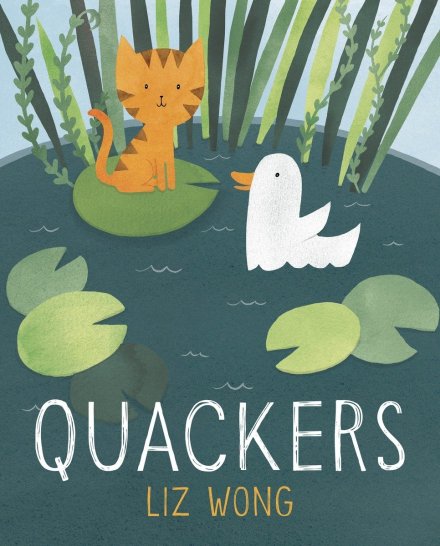
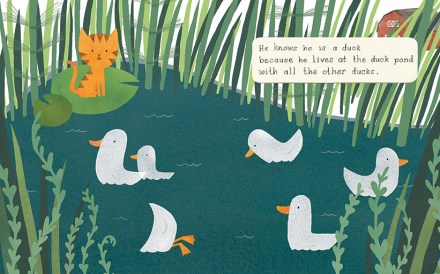
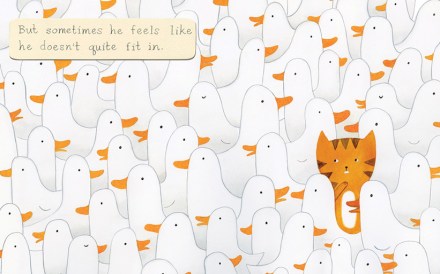
Quackers, a little orange tabby, wants to say hello! “Meow.” Quackers is a duck. “He knows he’s a duck because he lives at the duck pond with all the other ducks.” Not only that, but all of his friends are ducks. Sometimes, though, when he looks around at all the white feathers and orange beaks, he feels a bit out of place, and communicating is sometimes difficult. There’s also the issue of food—some of the things he’s given to eat are pretty slimy or tiny or hard to chew, and duckweed seems to be on the menu all the time. The worst, though? Getting wet.

celebrate-picture-books-picture-book-review-quackers-liz-wong-at-the-pond

Copyright Liz Wong, 2016, courtesy of Knopf Books for Young Readers.

One day, Quackers meets another duck who looks like him and sounds like him. In his joy, Quackers blurts out, “‘I’ve never met a duck who understands me!’” The gray kitten, Mittens, is confused at first and then understands and then laughs. At last, she invites Quackers to follow her. They end up at a farm where Mittens lives with “a whole flock of strange ducks. Ducks just like Quackers.”

Mittens shows Quackers how they “chase mice,” which Quackers prefers to swimming; “drink milk,” which is more delicious than duckweed; and clean themselves, which Quackers is a bit iffy on. Soon, Quackers is napping with his new friends. As much as he enjoys being a cat, Quackers starts to miss the duck pond. He even finds that he has a craving for duckweed. He scampers back and discovers that “most of all, he missed his friends.”

Now Quackers splits his time at the pond and the farm. Sometimes he’s a duck, and sometimes he’s a cat. But all the time “he’s just Quackers, and that makes him completely happy.”

celebrate-picture-books-picture-book-review-quackers-liz-wong-ducks

Copyright Liz Wong, 2016, courtesy of Knopf Books for Young Readers.

As mom to a cat who thinks he’s part person and possibly part dog, I fell in love with Liz Wong’s little Quackers and little readers will too. Kids will giggle as Quackers sits contentedly on a lily pad, accepts slugs and snails as snacks with a meow-nimum of fuss, and explains to Mittens that he’s a duck.  Readers, who are beginning to develop their own identity, will be cheered when Quackers embraces both his duck and cat sides. They’ll understand that it’s what’s inside a person that matters and that being yourself is the best thing you can be. Wong’s adorable kittens and ducks will charm kids, and her simple hand-lettered text and speech bubbles create a cozy reading experience that’s like a sweet hug in a book.

Full of humor, self-acceptance, and inclusion, Quackers should find a home on any child’s and classroom’s bookshelf.

Ages 3 – 7

Knopf Books for Young Readers, 2016 | ISBN 978-0553511543

Discover more about Liz Wong, her books, and her art on her website.

National Look Alike Day Activity

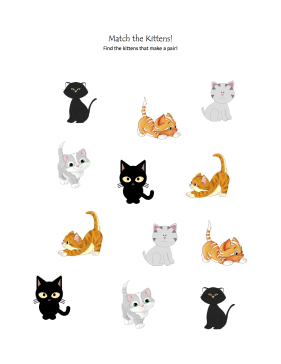
celebrate-picture-books-picture-book-review-match-the-kittens-puzzle

Match the Kittens Puzzle


These adorable kittens all have a twin, but they’ve gotten mixed up while playing. Can you find the matching pairs in this printable Match the Kittens Puzzle?

Picture Book Review

April 18 – It’s Celebrate Diversity Month

celebrate-picture-books-picture-book-review-W-is-for-welcome-cover

About the Holiday

Established in 2004, Celebrate Diversity Month encourages people to learn more about the world’s cultures and religions. Learning more about our global family and celebrating our differences and our similarities can lead to better relationships between people, more inclusion, and a happier future for the world’s children.

W is for Welcome: A Celebration of America’s Diversity

Written by Brad Herzog | Illustrated by nationally acclaimed artists


A journey around America impresses with its natural grandeur of rocky shores, majestic mountains, quilts of fertile fields, and wide-open prairies. More inspiring than these, however, is our diverse population that lends a wealth of knowledge, traditions, language, celebrations, food, music, and experiences to our country, making it a vibrant place to live and work.

celebrate-picture-books-picture-book-review-W-is-for-welcome-Bering-Strait

Image copyright Michael Glenn Monroe, 2018, text copyright Brad Herzog. Courtesy of Sleeping Bear Press.

Brad Herzog has collected twenty-six words to describe the United States and has used them to create lyrical verses and a full compendium of information about the immigrants and their experiences that have molded America from her earliest days and continue to do so today. Starting off, A is for America—that “dreamer’s destination,” and readers learn a bit about the millions of people who have come to our shores.

At C for Culture and D for Diversity, children learn about food, clothing, musical instruments, and even sports that have come to be favorites and were brought here or invented by people from other countries as well as “‘the most diverse square mile’” in America. Because of our country’s innovative spirit, “K is for Knowledge. “From all over the globe, / in a quest to know much more, / brilliant thinkers come here / and continue to explore.” Want to know more? Just check out Y for how immigrants continue to advance our knowledge.

celebrate-picture-books-picture-book-review-W-is-for-welcome-cultures

Image copyright Laura Knorr, 2018, text copyright Brad Herzog. Courtesy of Sleeping Bear Press.

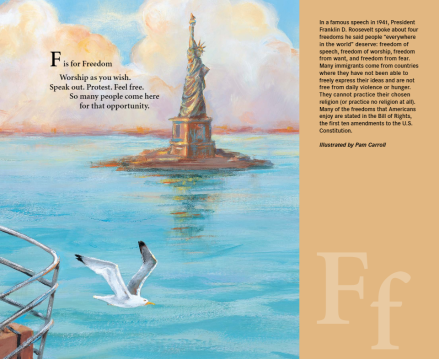
When immigrants want to make the United States their new home, they learn about N, Naturalization, and O, the Oath they take. And P is for the Poem by Emma Lazarus that has “come to define America’s long tradition of welcoming immigrants”: “A ‘world-wide welcome’ states, / ‘Give me your tired, your poor.’ / And then it adds, ‘I lift my lamp / beside the golden door!’”

All those who have taken comfort from that poem make up the narrative of our land, which is why V is for Voices: “Each immigrant has a tale to tell / about how and why they came / to live in the United States. / No two stories are the same.”

Along the way from A to Z young readers learn more about the people, ideas, and places that define America in verses and fascinating information that expands on the history and future of the United States in letter-perfect fashion.

celebrate-picture-books-picture-book-review-W-is-for-welcome-Ellis-Island

Image copyright Pam Carroll, 2018, text copyright Brad Herzog. Courtesy of Sleeping Bear Press.

Brad Herzog has created a compelling look at immigration, its history, and all the ways America has benefited from her philosophy of welcome. His fascinating informative passages and inspiring verses enlighten readers about past and present contributions by immigrants and also educate children about the law and processes involved in adopting America as a new home.

Thirteen illustrators lend their talents to interpreting Herzog’s verses with images full of color and vitality that are as diverse as America itself. Beautiful scenery from around the country reminds readers of the beauty of this vast land. It is the happy, hopeful, and expressive faces of those who have come and continue to journey here looking for a better life that most inspire and reveal that we are all neighbors.

W is for Welcome is an excellent book to use for leading discussions about American history and immigration at home or in the classroom.

Ages 6 – 9

Sleeping Bear Press, 2018 | ISBN 978-1585364022

Discover more about Brad Herzog and his books on his website.

You can learn about these illustrators of W is for Welcome on their websites:

Doug BowlesMaureen K. BrookfieldPat CarrollDavid C. Gardner | Barbara Gibson  | Renée GraefSusan GuyVictor JuhaszLaura KnorrMichael Glenn MonroeGijsbert van Frankenhuyzen | Ross B. Young 

Celebrate Diversity Month Activity 

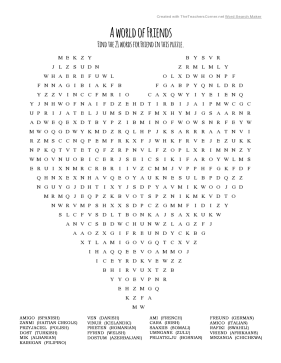
friendwordsearch

A World of Friends! Word Search


There are people all over the world just waiting to be friends! Learn how to say “friend” in twenty-one languages with this printable word search.

A World of Friends! Word Search Puzzle | A World of Friends! Word Search Solution

Picture Book Review

April 16 – It’s National Humor Month

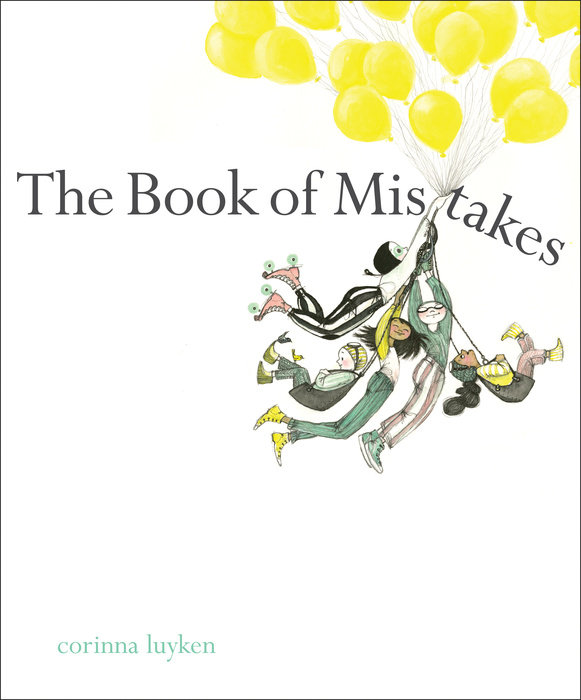
celebrate-picture-books-picture-book-review-the-book-of-mistakes-cover

About the Holiday

There may be no more infectious sound than the tinkle or guffaw of a good laugh. Laughter is therapeutic and can make tough times a little easier. Kids, it seems, are born with the ability to see and appreciate the silliness, absurdity, and fun in life. This month, enjoy the zany side of things—it’s guaranteed to brighten your days and give you a new perspective.

The Book of Mistakes

By Corinna Luyken


The whole thing started while drawing a picture. The head of the child looks good—nice little ear and nose, a dot for the left eye. The hair goes on pretty well—a swoop on the right side, straight on the left. The eyebrows are tiny dashes, and the mouth the size of a chocolate sprinkle. Just have to add the right eye…Oh, no! The right eye is too big!! Okay, okay, this mistake can be fixed. The left eye just needs to be a liiittle bigger…Oh, good grief! “Making the other eye even bigger was another mistake.”

celebrate-picture-books-picture-book-review-the-book-of-mistakes-splotch-on-head

Copyright Corinna Luyken, 2017, courtesy of Dial Books for Young Readers.

Maybe…the perspective might just be right for…Yes! “the glasses—they were a good idea.” Okay on to the body. Hmmm… “The elbows and the extra-long neck? Mistakes. But the collar—ruffled, with patterns of lace and stripes—that was a good idea.” And elbow patches make the arms look a little less pointy.

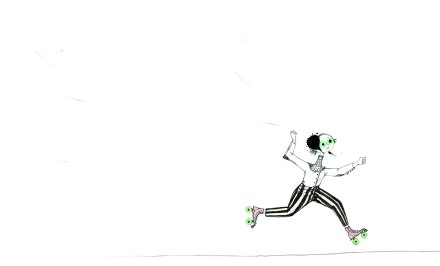
Moving on to the background, a thick and leafy bush is just the thing to hide the animal. Animals? It could be a cat, a cow, or a frog. “Another mistake.” And why is the ground so far below the girl’s feet anyway? Oh! Because she’s wearing roller skates. Nice save! “Those were definitely not a mistake.” Let’s see, the “second frog-cat-cow thing made a very nice rock.” Now, what about the other girl with long hair and one very long leg? Got it! She “looks like she always meant to be climbing that tree” on the side of the page.

celebrate-picture-books-picture-book-review-the-book-of-mistakes-leaves

Copyright Corinna Luyken, 2017, courtesy of Dial Books for Young Readers.

The ink smudges at the top of the paper can be leaves, but back to the roller-skating girl. What to do with those awkwardly positioned arms? Oh dear—the pen should not have been hovering over the page. How to fix the splotch on the side of her head? Ah-hah! An old-fashioned aviator’s helmet. Or is it a swimming cap? No matter…she’s now holding a yellow balloon in her left hand and lots of strings in her right. Wow, tons of yellow balloons are at the ends of those strings!

She’s skating toward the tree with the long-legged girl, and there are a bunch of other kids playing in it too. Cool! They’re all wearing aviator helmets/swimming caps too. Some are wearing roller skates—good—and they’re erecting some kind of tent over a big branch. Wow! Look at the pink balloons and the green ones! There’s a kid riding a hot-air unicycle through the sky and a skateboarder is floating down to a ramp supported by springs in the top of the tree. Someone’s even tatting a lace banner.

celebrate-picture-books-picture-book-review-the-book-of-mistakes-tree

Copyright Corinna Luyken, 2017, courtesy of Dial Books for Young Readers.

“Do you see?” They’re all waiting for the roller-skating girl to bring the yellow balloons. But let’s step back a little. “Do you see—how with each mistake she is becoming?” If we back up some more, she and the tree look so tiny and there’s a big, dark forest in the foreground. “Do you see—” Looking from way far away, doesn’t that forest look a bit like curly hair or…Oh! The top of the roller-skating girl’s cap! She’s so big now, and she’s gazing out of those green glasses at the white page where she’s drawing a small head with a nice little ear and nose and a dot for the left eye. “Do you see—who she could be?”

celebrate-picture-books-picture-book-review-the-book-of-mistakes-girl-as-artist

Copyright Corinna Luyken, 2017, courtesy of Dial Books for Young Readers.

Kids will be charmed by the start of the little head on the first page, begin giggling at the one too-big eye on the third page, and laugh out loud at the even bigger eye on the fifth in Corinna Luyken’s magically inventive The Book of Mistakes. As each mistake is adjusted for or inspires a new twist in the story, young readers will appreciate how creatively right the fix is and look forward to the next mistake and the next. The final pages presenting the tree full of children are so enticing that readers will want to linger over each one to find all the details. Luyken’s minimally colored drawings are funny and endearing and lead readers to question their own perspective and give free reign to their imagination.

The Book of Mistakes is a must for classrooms and highly recommended for home libraries for all those times when mistakes can be perfect conversation starters or the inspiration for…anything!

Ages 4 – 8 and up

Dial Books for Young Readers, 2017 | ISBN 978-0735227927

To find a portfolio of artwork and more information about Corinna Luyken and her books visit her website.

National Humor Month Activity

celebrate-picture-books-picture-book-review-share-a-laugh-wordsearch

Share a Laugh! Word Search Puzzle


Sharing a laugh with friends makes a day better. Can you find the fifteen words about laughter in this puzzle?

Share a Laugh! Word Search PuzzleShare a Laugh! Word Search Solution

Picture Book Review

April 15 – National Rubber Eraser Day

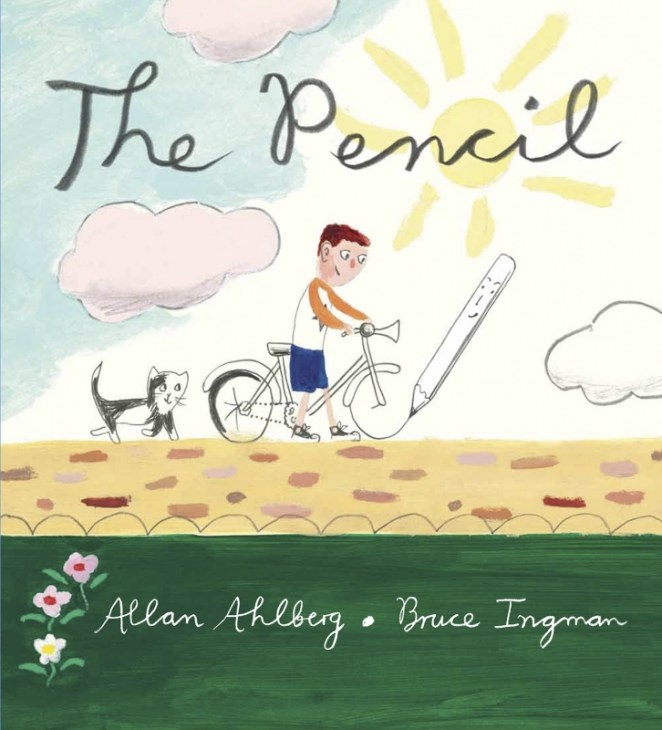
The Pencil by Allan Ahlberg and Bruce Ingman Picture Book Review

About the Holiday

Today we celebrate that little item at the end of the pencil or near at hand that gives us second (or third…or fourth…or…) chances. The rubber eraser has been around since 1770, when Joseph Priestly invented a vegetable gum that could remove pencil marks and Edward Nairne developed it into an eraser that could be widely marketed. In 1839 Charles Goodyear’s work with vulcanization made erasers more durable, and Hyman Lipman put pencil and eraser together in 1858. What did people do before the rubber eraser? They still made mistakes, but wax and even crustless bread were the remedies of choice. To celebrate today, draw or write with abandon and feel free to erase as often as you want!

The Pencil

Written by Allan Ahlberg | Illustrated by Bruce Ingman


Even before the title page readers learn of a little pencil, alone in the world. One day the pencil quivers and begins to draw. The pencil draws a boy, who asks for a name, and receives “Banjo” in reply. The boy wants a dog, and the pencil obliges. Bruce is the dog’s name, and he wants a cat. Mildred is immediately created, and of course Bruce chases Mildred. Banjo chases Bruce. They need a place to run, so the pencil draws a house, a town, and a park.

celebrate-picture-books-picture-book-review-the-pencil-boy

Image copyright Bruce Ingman, 2012, text copyright Allan Ahlberg, 2012. Courtesy of Candlewick Press.

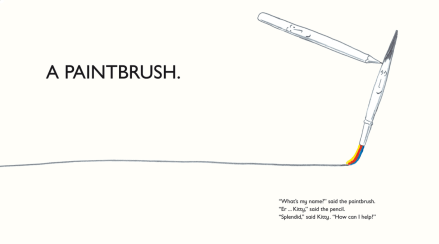
All this excitement makes the trio hungry and tired. Banjo demands the pencil draw him an apple, Bruce wants a bone, and Mildred really wants a mouse but settles for cat food. There’s just one problem—the food is so unappetizing in black and white. The pencil thinks for a bit and comes up with a solution. He draws a paintbrush named Kitty. Kitty colors the food, the boy, the dog, the house, the town, and the park. Mildred is left as created – she’s a black-and-white cat anyway.

celebrate-picture-books-picture-book-review-the-pencil-black-and-white

Image copyright Bruce Ingman, 2012, text copyright Allan Ahlberg, 2012. Courtesy of Candlewick Press.

The team of Pencil and Paintbrush creates a whole family, a friend for Bruce, a ball (Sebastian) for Banjo, and a kitten for Mildred. But all these extra characters cause trouble. Sebastian breaks a window, and the mom, dad, sister, and grandpa aren’t completely satisfied with the traits they’ve been given. What’s a pencil to do? Draw an Eraser, of course!

The eraser takes care of the problems, but he grows fond of his power to rub things out. He erases the table, chair, front door—the whole house. And that’s not all! Nothing the Pencil and Paintbrush have created is safe. Eraser rubs everything out until all that’s left is the pencil and the eraser locked in opposition.

celebrate-picture-books-picture-book-review-the-pencil-paintbrush

Image copyright Bruce Ingman, 2012, text copyright Allan Ahlberg, 2012. Courtesy of Candlewick Press.

The pencil draws a wall, a cage, a river and mountains with fierce animals but none of it is a match for the eraser. Then the pencil has a brainstorm and draws…another eraser! The two erasers engage in an epic battle, and in the end they rub each other out.

Pencil recreates everything he had before, and Kitty colors it all in, including a new picnic with a runaway boiled egg named Billy and ten A-named ants to clean up the crumbs. As the day fades into night, a moon appears in the sky along with a cozy box for Pencil and Paintbrush to sleep in.

celebrate-picture-books-picture-book-review-the-pencil-rubs-out-everything

Image copyright Bruce Ingman, 2012, text copyright Allan Ahlberg, 2012. Courtesy of Candlewick Press.

Allen Ahlberg is a master at tapping into children’s unbridled imagination and silly side. His endearing story of a little pencil who creates himself a world full of friends and excitement—as well as the inevitable conflict—will keep kids laughing with its word play, topsy-turvy names, and mad-dash action. As the eraser rubs out everything in its path, kids will also understand the gentle, underlying  lesson that simply getting rid of a problem can sometimes just create more and that resolution is a better tact.

Bruce Ingman’s sly, childlike illustrations are the perfect accompaniment to Ahlberg’s story, deftly depicting the friendship and collaboration between Pencil and Paintbrush as they create house and its family with a mom sporting a crazy hat, a dad with large ears, and a grandpa smoking a pipe he doesn’t want. As Eraser begins his rampage, readers will enjoy the giddy suspense of how it will all end and will be happy to see that Paintbrush once again fills the pages with joyous and vivid color.

Ages 4 – 8

Candlewick Press, 2012 | ISBN 978-0763660888

National Rubber Eraser Day Activity

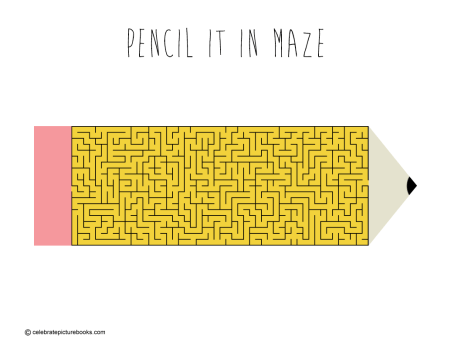
CPB - Pencil Maze

Pencil It In! Maze


Sharpen your pencil and start having fun with this printable pencil-shaped maze. 

Pencil It In Puzzle!  | Pencil It In! Solution

Picture Book Review

April 14 – National Look up at the Sky Day & Interview with Astronaut Clayton C. Anderson

celebrate-picture-books-picture-book-review-astronaut-clayton-anderson-photo

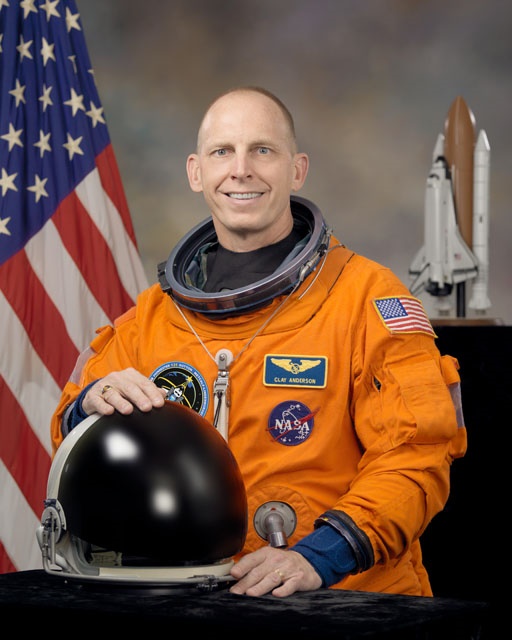
Today, I’m honored to speak with retired astronaut Clayton Anderson about a pivotal childhood moment that inspired his life’s work, the challenges of being an astronaut, and his most vivid memories from space.  

What inspired you to make the journey to become an astronaut?

It was Christmas Eve, 1968.  I was nine years old when my parents put my brother and sister and me on the floor in front of a black-and-white TV around midnight. We sat on an old throw-rug gifted from our grandmother to watch humans circumvent the moon for the first time in human history. As I watched the control center team and listened to the flight director bark out commands, I was enthralled. “I need a Go/NoGo for the trans-lunar injection burn… FIDO? GO!  Retro…? GO!  Surgeon…? GO!  GPO…? GO! The entire team was GO! The craft disappeared behind the moon, leaving me to enjoy the rapid-fire chatter no more. It was simple static on our TV… for about 15 minutes. Then, after a couple of non-answered calls from the Houston CAPCOM to the Apollo 8 crew, I heard the quindar tone (famous “space-beep” you hear on TV), and the first words from the Apollo 8 commander, Frank Borman: “Houston, Apollo 8. Please be informed there is a Santa Claus!” That’s all I needed. The bit was set in my mind that one day, I would become a United States Astronaut.

How did your perspectives change while on the International Space Station?

I am a man of faith. Seeing our earth from orbit did allow me to have the “orbital perspective” so many astronauts speak of. However, while I totally agree that this perspective changed my outlook and my willingness to do better with trying to protect and preserve our “spaceship earth,” it strengthened my faith in God much more. The earth and those of us privileged to be on it, is not random. There is a reason why Sir Isaac Newton discovered gravity and invented calculus. There is a reason why Albert Einstein was able to derive the Theory of Relativity. While I am unable to truly explain my rationale, I believe that there is a higher power. A power that created this universe and gave humans an adaptable brain. That incredible gift will continue to enable us to uncover the secrets of the universe, continuing to strengthen my faith.

What was a big challenge you faced during your career?

The dream of flying in space as an American astronaut was something I pursued for many years of my life. To have finally been selected and given that opportunity is incredible. Yet having the “best job in the universe” is not without difficulty. For me, it was family separation. I love my wife and kids more than anyone… on or off the planet.  To have to be separated from them for months at a time was extremely difficult, especially given their ages (6 and 2) when I began my training. It got easier as they grew older, but it didn’t assuage my guilt very much. While I lived my dream, they sacrificed greatly, and I will spend the rest of my life trying to repay them.

What is your best memory from being in space?

It must be my first spacewalk. Poised above the opened hatch, floating in my spacesuit while looking into the abyss of darkness created by the sun’s travel behind the Earth, I was calm. I watched ice crystals fly from behind my suit (they were created by my sublimator… or air conditioning unit) into the total black void of space. The slight pressure still available after the depressurization of the airlock was “pushing” the crystals into the vacuum of space. I was entranced just watching them sail by. When I finally came back to reality—buoyed by the Mission Control call to exit the airlock—I paused for just a moment to contemplate what was happening. The only thought going through my mind was that “…I was born to be here, right now, in this special place, doing this.”

Seeing my hometown from space…for the very first time, is a very, very close second. On that day, when I expected to excitedly capture photos of my Ashland, Nebraska, I had everything prepped and ready to go. Equipment was strategically placed around the U.S. Lab module’s earth-facing window, cameras were Velcroed securely to the wall, with timers set to remind me when to get into position. Finding my home on earth—without all the wonderfully placed lines, borders, squiggly river italics, and large stars designating capital cities—was tougher than I imagined. But when I finally found success, and saw Nebraska rolling into view by virtue of a big gray splotch known as Omaha (and a smaller gray splotch further southwest called Lincoln), the south bend of the Platte River was the last valid vision I had. When I saw my home, nestled there where the river bent, the place where I was raised and where many of my family and friends still reside, I took not a single photo. I simply broke down and cried. Overcome by the incredible emotions of floating weightlessly, as an American astronaut flying 225 miles above the exact spot where I was born and raised, having first dreamed of doing exactly that, was simply too much for me. So, I did what seemed to come to me naturally.  I wept.

Thank you so much for sharing your thoughts and memories of your incredible career. I wish you all the best with A is for Astronaut and all of your future endeavors as you inspire children and adults to always reach for the stars.

About Clayton C. Anderson

Retired Astronaut Clayton Anderson spent 167 days in outer space, having lived and worked on the International Space Station (ISS) for 152 days and participated in nearly 40 hours of space walks. With a strong belief in perseverance and the importance of STEAM as part of every child’s education, Astronaut Anderson brings his “out of this world” insight to issues faced by children, parents, and educators. 

You can connect with Clayton Anderson on:

His website: astroclay.com | Facebook | Instagram | Twitter. For speaking events and appearances visit www.AstronautClayAnderson.com

You can find A is for Astronaut at these booksellers:

Amazon | Barnes & Noble | Books-a-Million | IndieBound | Sleeping Bear Press

National Look up at the Sky Day Review

celebrate-picture-books-picture-book-review-a-is-for-astronaut-cover

About the Holiday

Today’s holiday hopes to inspire people to slow down and enjoy life’s simple pleasures—like gazing up at the sky and really seeing the beauty that’s there. Throughout the day and night, the sky presents an ever-changing world of color and motion, depth and light. It’s a work of art like no other.  Ever since the earliest times, people have been fascinated with the sky, directed by the stars, and questioning of what lies beyond. Today, we also celebrate those poets, mathematicians, scientists, and especially the astronauts who have explored the sky and brought all of its wonders a little closer.

Sleeping Bear Press sent me a copy of A is for Astronaut to check out. All opinions are my own. I’m also thrilled to be partnering with Sleeping Bear Press in a giveaway of a signed copy of A is for Astronaut and a tote bag. View details below.

A is for Astronaut: Blasting Through the Alphabet

Written by Astronaut Clayton Anderson | Illustrated by Scott Brundage


There are some books that just make you say “Wow!” when you open the cover. A is for Astronaut is one of these. Leafing through the pages is like stepping out into a clear, starry night, visiting a space museum, and letting your own dreams soar all rolled into one. When you settle in to read, you discover that each letter of the alphabet introduces both poetry and facts to enthrall space lovers.
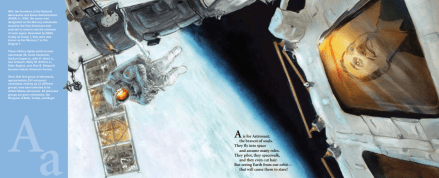
celebrate-picture-books-picture-book-review-a-is-for-astronaut-letter-A

Image copyright Scott Brundage, 2018, text copyright Clayton C. Anderson, 2018. Courtesy of Sleeping Bear Press.

To get things started, “A is for Astronaut, / the bravest of souls. / They fly into space / and assume many roles. / They pilot, they spacewalk, / and they even cut hair. / But seeing Earth from our orbit— / that will cause them to stare!” A sidebar reveals more about astronauts—even astronaut nicknames!

“B is for Blastoff, a powerful thing! / When those engines are fired, it’ll make your ears ring.” And did you know that two and a half minutes after blastoff, the engines are cut off and everything begins to float? Pretty amazing! Blasting through the alphabet we come to G, where readers learn about our Galaxy that is “shaped like a spiral filled with billions of stars.”

celebrate-picture-books-picture-book-review-a-is-for-astronaut-letter-N

Image copyright Scott Brundage, 2018, text copyright Clayton C. Anderson, 2018. Courtesy of Sleeping Bear Press.

How are astronauts able to walk and work in space? “Space Helmets are crucial and H is their letter.” At K kids meet John F. Kennedy, who helped develop the space program, and L is for the Landing that brings astronauts back to Earth. M is for Meteors with their very long tails, and N, of course, is for NASA, which was formed in 1958 with a “goal to better understand our planet and solar system.”

How do astronauts do that? “Working outside in space is sure to impress. / We call it a Space Walk, and its letter is S. / Floating weightless, with tools and a bulky white suit, / we can fix and install things—it’s really a hoot!” And there’s also V for  “Voyager, two NASA space probes. / They are still sending data, / having long left our globe.”

At Z, time is up—that’s Zulu time and “our reference to England, when London’s clocks chime. / As we fly ‘round the Earth, folks must know our day’s plan, / so we all set our watches to match that time span.” 

celebrate-picture-books-picture-book-review-a-is-for-astronaut-letter-P

Image copyright Scott Brundage, 2018, text copyright Clayton C. Anderson, 2018. Courtesy of Sleeping Bear Press.

Both children and adults who have an affinity for space travel and all things related to astronomy will want to dip into A is for Astronaut again and again. With his wealth of knowledge and engaging voice, astronaut Clayton Anderson presents a book that will have readers starry-eyed and full of the kinds of facts and tidbits that answer questions and spur further discovery. A is for Astronaut can be read through from A to Z for its vivid poetry or explored in small chunks to absorb the fascinating facts included with each letter—or both. Expertly written for kids of all ages, Anderson’s A is for Astronaut is a stellar achievement.

Scott Brundage’s incredibly beautiful and detailed illustrations will thrill space buffs and serious scientists and engineers alike. Readers will love meeting astronauts tethered to their ship while working in space, experiencing the vibrant, mottled colors of a darkened sky or distant planet, and viewing the technological marvel that is the NASA control room. With the precision of a photograph and the illumination of true artistry, Brundage’s images put readers in the center of the action, where they can learn and understand more about this favorite science.

A is for Astronaut is a must for classroom, school, and public libraries and would be a favorite on home bookshelves for children (and adults) who love space, technology, math, science, and learning about our universe.

Ages 5 – 10

Sleeping Bear Press, 2018 | ISBN 978-1585363964

Discover more about retired astronaut Clayton Anderson and access resources on his website, or follow him on Facebook | Twitter | or Insta. For speaking events and appearances visit www.AstronautClayAnderson.com

To learn more about Scott Brundage and view a portfolio of his publishing and editorial work, visit his website.

Visit Sleeping Bear Press to learn more about A is for Astronaut

National Look up at the Sky Day Activity


Show your excitement about all things space-related with these fun activity sheets from Astronaut Clayton C. Anderson and Sleeping Bear Press! 

celebrate-picture-books-picture-book-review-a-is-for-astronaut-fill-in-the-blanks-activity

A is for Astronaut Fill in the Blanks
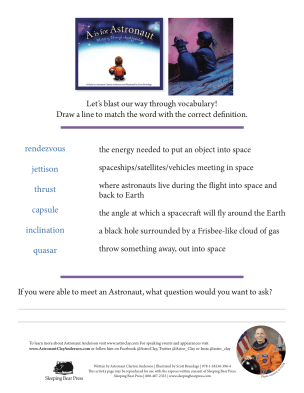
celebrate-picture-books-picture-book-review-a-is-for-astronaut-vocabulary-activity

A is for Astronaut Vocabulary Sheet


Picture Book Review