October 13 – World Egg Day

celebrate-picture-books-picture-book-review-egg-kevin-henkes-cover

About the Holiday

What an amazing thing the egg is! Today’s holiday celebrates its role in feeding families the world over. From ancient times people have relied on the protein and other nutrients in this compact package to stay healthy at an affordable price or from their own farm. World Egg Day was declared at the International Egg Commission Conference in Vienna in 1996 to recognize and promote the benefits of eggs.

Egg

By Kevin Henkes


As this sophisticated paneled picture book opens, four eggs await their fate. One is pink, one is yellow, one is blue, and one is green. On the next page three of the eggs begin their journey with a crack, crack, crack; but the last one? The green one? It remains a smooth egg. With a “surprise!” a pink baby bird hatches from the pink egg. The yellow egg breaks open and a yellow bird chirps “surprise.” When the blue egg breaks a blue baby bird pops free with one more “surprise!” But the last egg? The green one? It remains an intact egg.
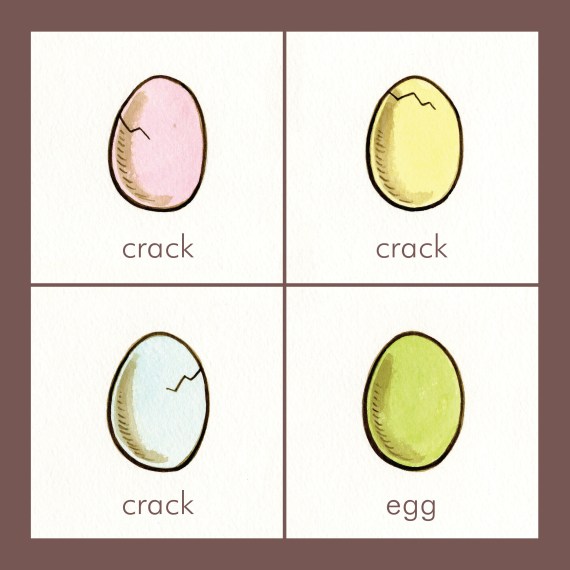
celebrate-picture-books-picture-book-review-egg-kevin-henkes-eggs-cracking

Copyright Kevin Henkes, 2017, courtesy of Greenwillow Books.

The pink bird strides away from her former home with a quick “good-bye.” The yellow bird takes to the sky with a cheery “good-bye.” And the blue bird skips off  with a joyful cheep “good-bye.” But the last egg? The green one? It still remains a silent egg. All alone now, the green egg waits. It waits and waits and waits through a full sixteen-day calendar.
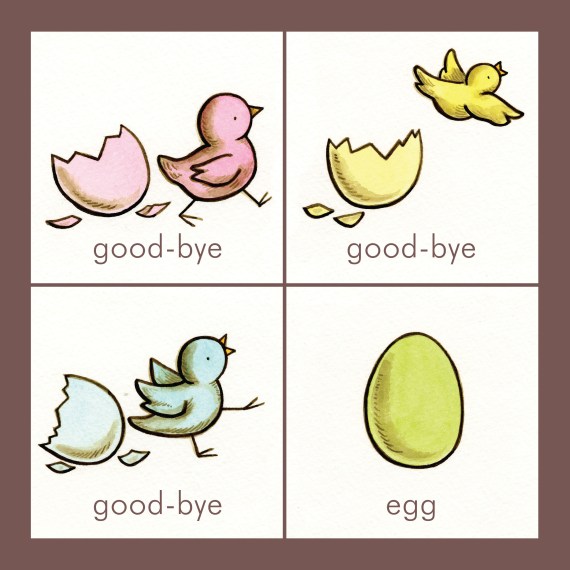
celebrate-picture-books-picture-book-review-egg-kevin-henkes-birds-saying-goodbye

Copyright Kevin Henkes, 2017, courtesy of Greenwillow Books.

Finished with her walk, the pink bird is back to check on the green egg. She hails the yellow chick, who is also returning, and calls out to the blue bird, who runs in to see what’s up. They discuss this anomalous egg and come up with a plan. They lay their ears against the shell and “listen.” Then they begin tapping away. “Peck, peck, peck, peck, peck, peck, peck, peck, peck, peck, peck, peck.” This egg has one tough exterior! They peck and peck until, finally, they hear a “crack.”
celebrate-picture-books-picture-book-review-egg-kevin-henkes-alligator

Copyright Kevin Henkes, 2017, courtesy of Greenwillow Books.

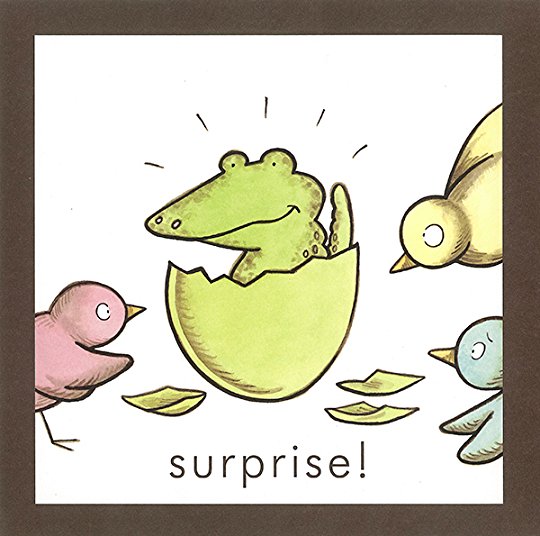
The egg splits to reveal an eye-popping “surprise!” The last egg? The green one? It doesn’t hold a green chick, but a green crocodile! The birds fly away from the dangerous snout. Now the baby croc is “alone” and “sad.” The little birds see how “lonely” the crocodile is and slowly, one-by-one they return. They fly closer and closer until they are all sitting atop the crocodile’s back.

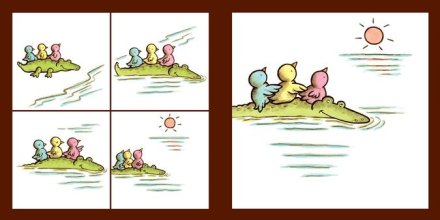
The crocodile takes his new friends on a ride down to the water’s edge. He wades in and follows where the pink bird directs. Then these new friends sit quietly and watch the sun set. The orange sun sinks lower and lower toward the horizon, changing shape and beginning the journey all over again.
celebrate-picture-books-picture-book-review-egg-kevin-henkes-sunset-2

Copyright Kevin Henkes, 2017, courtesy of Greenwillow Books.

Kevin Henkes’ adorable read-aloud is as complex as the egg itself. On the surface it is a comforting and touching tale of friendship, but crack it open and the story takes on deeper meaning. Themes of patience, working together, diversity, acceptance, and even ideas of expectations and preconceived danger are waiting to be explored during repeat readings. The graphic-novel nature of the illustrations allow readers to form bonds with the four eggs as a ready-made group, increasing kids’  curiosity and interest in that fourth egg that just won’t hatch.

Pastel colors differentiate each bird as do simple gestures that little ones will recognize as personality traits. In the final pages, the lines separating the panels disappear as the four friends gather to watch the sun go down, and their life together begins.

Ages 3 – 8

Greenwillow Books, 2017 | ISBN 978-0062408723

You can meet Kevin Henkes, learn about his books, and discover resources, videos, and more on his website.

World Egg Day Activity
celebrate-picture-books-picture-book-review-egg-carton-chicken-double-chickens

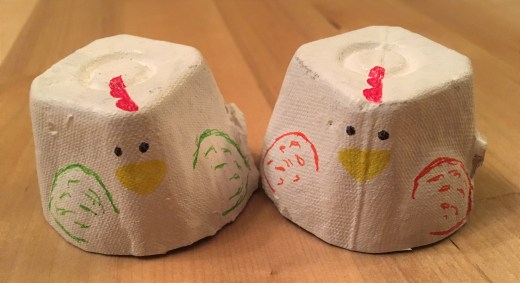
Egg Carton Chickens and a Basket Full of Games


With twelve little chickens you can come up with lots of games to play! This fun craft and game activity is eggs-actly what you need to start hatching some real fun!

Supplies

  • Cardboard egg carton
  • White craft paint
  • Markers: red, yellow, black for the face; any colors you’d like for wings and eggs
  • Paint brush
  • Scissors
  • Glue
  • Construction or craft paper in white and a color of your choice

Directions

  1. Cut the notched flap off the egg carton and set aside
  2. Cut the top off the egg carton
  3. Cut apart all the egg cups and trim slightly so they sit flat
  4. Paint the egg cups with the white paint, let dry
  5. Add the face, comb and wings to the chicken with the markers. Make six chickens with one color wings and six chickens with another color wings.
  6. From the egg carton flap cut thirteen small egg-shaped playing pieces
  7. With the markers, decorate twelve of the eggs in pairs—each egg in the pair with the same design
  8. Color one egg yellow and add a beak, eyes, and wings to make it a chick

Games to Play

Tic-Tac-Toe (2 players)

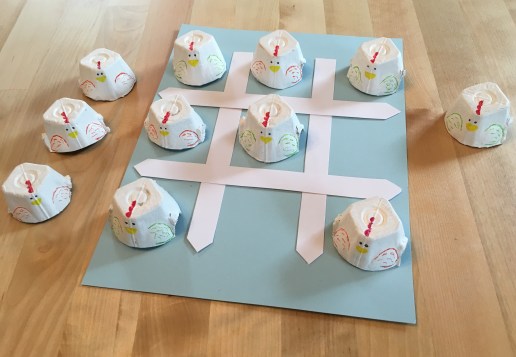
  1. On a 8 ½” x 11” piece of paper draw a regular tic-tac-toe board or make it fancy – like the picket fence-inspired board in the picture
  2. To make the fence-inspired board on a colored background, cut 2 9-inch-long x 3/4-inch wide strips of white paper, cutting a pointed tip at one or both ends. Cut 2 white  8-inch x 3/4-inch strips of paper with a pointed tip at one or both ends. Glue the strips to the background.
  3. Each player chooses a set of chickens with the same colored wings
  4. Play the game as you usually do

celebrate-picture-books-picture-book-review-egg-carton-chicken-tic-tac-toe

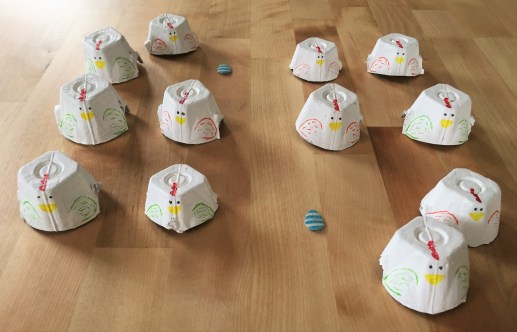
Find the Matching Eggs (2 or more players)

  1. Have one player hide one egg under each chicken
  2. Shuffle the eggs around and form them into three lines of 4 chickens each
  3. Another player lifts one chicken at a time to find matching eggs. If the eggs don’t match, put both chickens back and start again
celebrate-picture-books-picture-book-review-egg-carton-chicken-matching

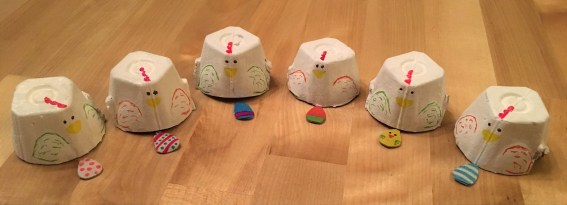
Where’s the Chick?

  1. Use as many chickens and eggs as you want (fewer for younger children, more for older)
  2. One player hides the chick under one of the chickens and eggs under the others.
  3. Another player has three chances to find the chick
celebrate-picture-books-picture-book-review-egg-carton-chicken-where's-the-chick

I’m sure you can also design your own games for your adorable chickens to play! With more chickens you can even make a checkers set or replicate another of your favorite board games!

Picture Book Review

October 3 – It’s National Go on a Field Trip Month

celebrate-picture-books-picture-book-review-south-daniel-duncan-cover

About the Holiday

As the leaves start turning red and yellow and the air becomes crisp and cool, thoughts turn to…field trips? Sure! Autumn is the perfect time to enjoy a bit of travel. For kids a field trip is a fun day away from the classroom, and for adults a little get-away can be refreshing and rejuvenating. With fall festivals, apple-picking, leaf-peeping, and other fun autumn activities, it should be easy to plan a family or group field trip.

South

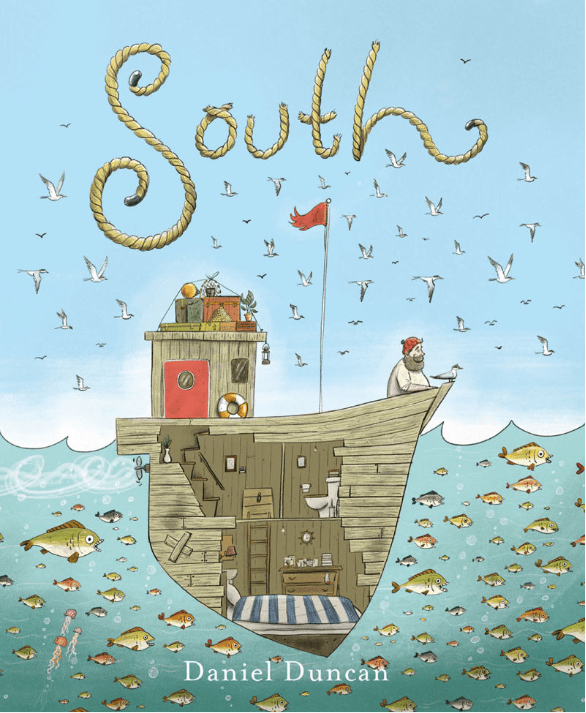
By Daniel Duncan


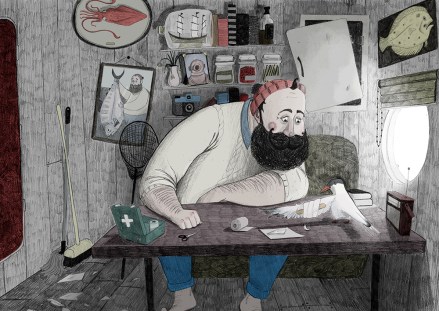
Out on the rolling sea, there was once a fisherman who sailed alone. His only company was his banjo and a small leafy plant. But one day the fisherman heard an unfamiliar noise and discovered an injured seagull taking shelter in the corner of the boat’s deck. The fisherman saw that the seagull’s wing was broken. He attached a splint and bandaged the wing, then “all that was left to do was wait.”

celebrate-picture-books-picture-book-review-south-daniel-duncan-bird-bandaged

Copyright David Duncan, 2017, courtesy of dunksillustration.co.uk.

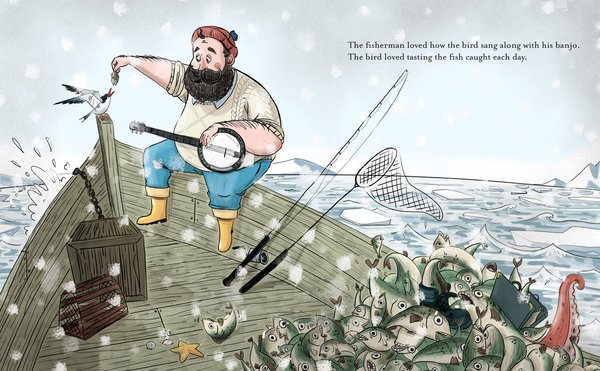
The seagull slept in a cozy nest fashioned from one of the fisherman’s shirts and gently placed in an open drawer. Now the fisherman had a companion, and he “loved how the bird sang along with his banjo.” For his part, the bird loved the continuous supply of fish. But winter was coming, and the fisherman knew that the seagull could not live on his boat forever. 

celebrate-picture-books-picture-book-review-south-daniel-duncan-bird-eating-fish

Copyright Daniel Duncan, 2017, courtesy of Harry N. Abrams.

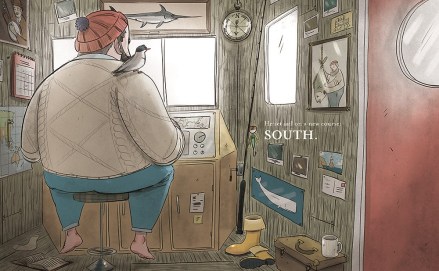
With the seagull perched on his shoulder, the fisherman hoisted anchor and “set sail on a new course: SOUTH.” The vast ocean stretched out in every direction as the little boat chugged along day and night. At last, peering through his telescope, the fisherman spied an island. The bird’s wing had healed, and “the fisherman knew that their journey together had come to an end.” With one last gentle stroke on the seagull’s head, the fisherman let his friend fly away to join the throng of other seagulls on the beach. Then “he set sail on a new course: HOME.”

celebrate-picture-books-picture-book-review-south-daniel-duncan-bird-on-shoulder

Copyright Daniel Duncan, 2017, courtesy of Harry N. Abrams.

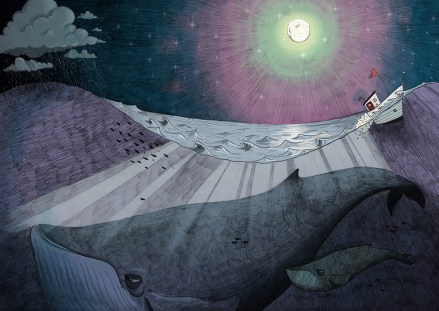
Daniel Duncan’s heartwarming story of friendship and letting go is a tender reminder that life is made up of short-term and long-term relationships, and that sometimes people (and animals) are brought together for a particular purpose. Even if some relationships are temporary, the memories and the feelings live on in our hearts. While Duncan’s story is focused on the seagull, readers must also wonder about the fisherman. At first he seems to be a loner, playing his banjo far out to sea without another soul around. But as the story develops through Duncan’s gorgeous detailed illustrations, the theme of family begins to take shape: the boat sails over a school of fish, is carried past a whale and her baby, and finally comes within sight of an island teeming with seagulls.

celebrate-picture-books-picture-book-review-south-daniel-duncan-whales

Copyright David Duncan, 2017, courtesy of dunksillustration.co.uk.

Early on, as the burly, bearded fisherman bandages the seagull’s wing, alert readers may notice a photograph tacked to the wall of the tidy cabin. Later, as he hangs a framed seagull feather on that same wall, readers can see the photo better and will realize that it is a picture of the fisherman, his wife, and his child. This realization gives the final line more significance, resonance, and joy. Like many families separated for long stretches by a parent’s job, the fisherman’s family is also waiting for him to come home so they can be together again.

Ages 5 – 7

Harry N. Abrams, 2017 | ISBN 978-1419722998

View a gallery of illustration work by Daniel Duncan on his website and blog!

National Go on a Field Trip Month Activity

celebrate-picture-books-picture-book-review-follow-the-open-road-maze

Follow the Open Road Maze


These kids are ready to go on a field trip, but first they have to get in the correct car! Help them find their way in this printable Follow the Open Road Maze.

Picture Book Review

August 23 – It’s Back to School Month

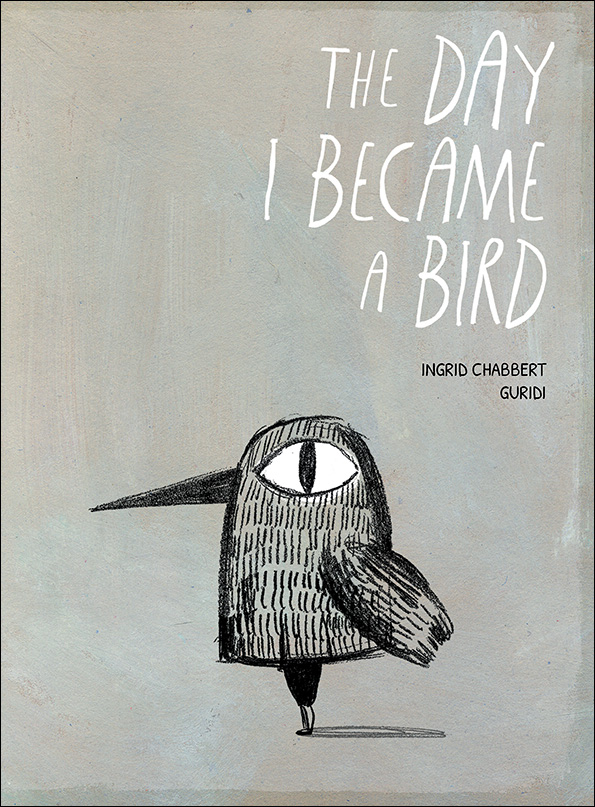
celebrate-picture-books-picture-book-review-the-day-I-became-a-bird-cover

About the Holiday

A lot can happen over the summer.  Going on vacation can give new perspectives; a growth spurt means new clothes and shoes; and a little more maturity can cause unfamiliar feelings. It’s all enough to make a student’s heart race when crossing the classroom threshold on that first day. Sometimes, though, when looking around at all of the known and new faces, that little flutter of the heart can be…love.

The Day I Became a Bird

Written by Ingrid Chabbert | Illustrated by Raúl Nieto Guridi


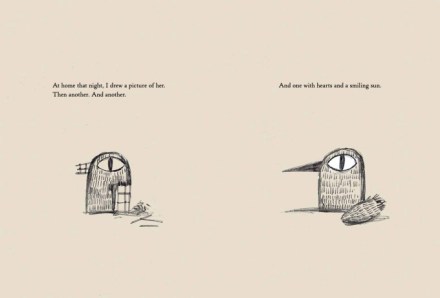
On the first day of school a little boy sees Sylvia and falls instantly in love. At home he draws picture after picture of her. Although the boy only has eyes for Sylvia, she doesn’t see him. Instead, the boy says, “Sylvia is a bird lover. She can’t bear to see them living in cages. She quietly observes them in the wild and gently cares for them when they are injured.”

celebrate-picture-books-picture-book-review-the-day-I-became-a-bird-boy-costume-being-built

Image copyright Raúl Nieto Guridi, 2016, text copyright Ingrid Chabbert, 2016. Courtesy of Kids Can Press

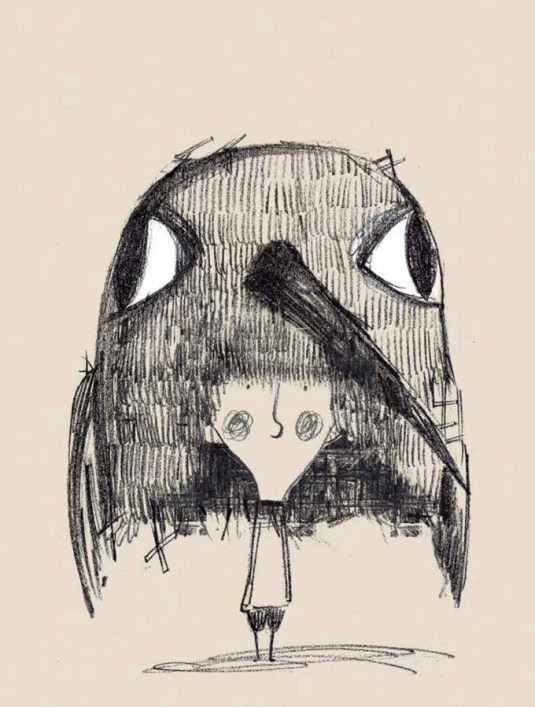
Everything she does and wears is somehow associated with birds. Even “her voice sounds like birdsong.” The boy has lost all interest in his toys, the sports he plays, and all of his old pursuits. He thinks differently about birds now, too. One day he decides “to dress as a bird.” He constructs a costume with glistening feathers “like the ones you see in the forest in summer.” When he puts it on he feels handsome. In the costume he dreams of flying with Sylvia to the top of the Rocky Mountains or a pyramid.

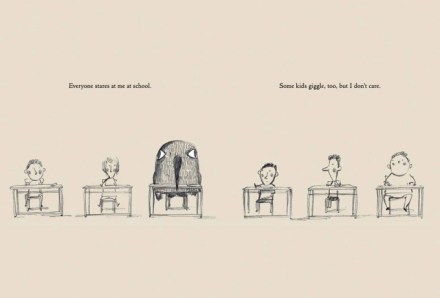
In school he doesn’t care if the other kids stare and giggle. And even though it’s hard to walk, play soccer, and climb trees, he doesn’t want to remove his costume. He is a bird. One afternoon, the boy says, “I come face to face with Sylvia. And finally our eyes meet.” Sylvia approaches and takes off the boy’s costume. “My heart is beating a hundred miles an hour,” he relates. “In the sky, I see a flock of birds take flight.” Sylvia gives him a long hug.

Standing completely still, the boy doesn’t know how to react. He knows he’s not a bird anymore, but still, he feels as if he’s flying.

celebrate-picture-books-picture-book-review-the-day-I-became-a-bird-boy-in-class

Image copyright Raúl Nieto Guridi, 2016, text copyright Ingrid Chabbert, 2016. Courtesy of Kids Can Press

Ingrid Chabbert’s enchanting revelation of first love encompasses in its spare text all the obsessive but ultimately freeing power of this universal emotion. While in the midst of his “normal” life, the boy’s world is suddenly transformed when he spies Sylvia. Leaving his toys behind, he chooses Sylvia’s bird’s eye view. Likewise, when Sylvia sees the narrator, she allows her birds to take wing and considers boys—or at least one boy—in a whole new light. Chabbert’s use of first-person narration reinforces the intimate nature of love and the idea that when love is right, being “captured” is a most liberating experience.

celebrate-picture-books-picture-book-review-the-day-I-became-a-bird-boy-in-costume

Image copyright Raúl Nieto Guridi, 2016, courtesy of Kids Can Press

The themes of Chabbert’s story are so movingly rendered by Raúl Nieto Guridi’s simple, monochromatic line drawings. Although the boy states that “one morning” he decided to dress as a bird, from the first day when the boy falls in love with Sylvia—gazing at her wistfully while her eyes are instead trained at the sky or cast down at her chalk drawings—his costume begins to take shape. As it comes together, its wire skeleton resembles a bird cage, suggesting so many ways in which we may feel trapped by our emotions, our things, even changes in life.

When the boy dons the costume and begins to navigate the world in an unfamiliar way, readers will understand that he is no longer the boy he was, but neither is he a real bird. It is this unique creature that Sylvia responds to when, through holes in the costume where feathers are missing, she sees not the bird, but the boy. So it is that into everyone’s life there come people—or perhaps one particular person—with whom all costumes and cages are discarded, and we soar.

The Day I Became a Bird is a quiet beauty that gets to the core of what it means to give your heart to someone else. It would make a wonderful and touching addition to home libraries.

Ages 4 – 7

Kids Can Press, 2016 | ISBN 978-1771386210

Watch this The Day I Became a Bird book trailer!

Back to School Month Activity

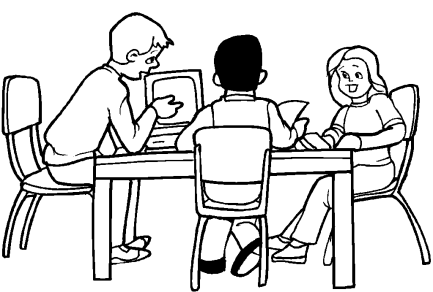
celebrate-picture-books-picture-book-review-studying-together


Let’s Study Together! Coloring Page


Going back to school means getting back with friends! Grab your colored pencils, markers, or crayons and enjoy this Let’s Study Together! Coloring Page!

Picture Book Review
July 25 – Thread the Needle Day

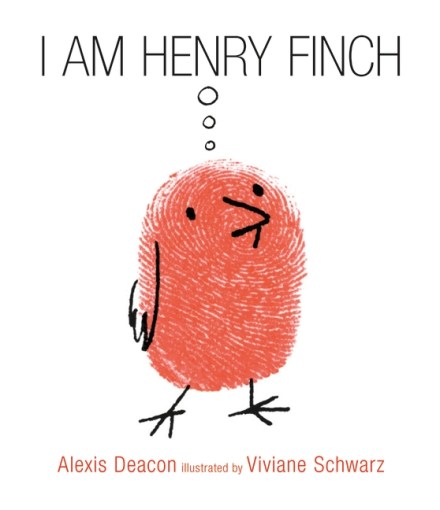
celebrate-picture-books-picture-book-review-I-am-henry-finch-cover

About the Holiday

Sometimes life takes a bit of finessing. When you’re stuck between two seemingly opposing positions, it can be hard to know what to do. Do you choose one side over the other, or is there a better way? Today’s holiday promotes the art of negotiation, that delicate “threading the needle” balance that actually does satisfy all sides involved. Many times both sides just want to be heard and understood. Good and open communication can lead to solutions and make everyone feel empowered.

I Am Henry Finch

Written by Alexis Deacon | Illustrated by Viviane Schwarz


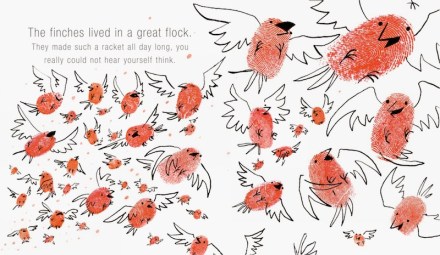
The finches were a talkative bunch. In the morning the flock traded “good mornings”: “‘Good morning, Aziz Finch!’ ‘Good morning, George Finch!’ ‘Good morning, Tiffy Finch!’ ‘Good morning, Henry Finch!’” In the afternoon, they wished each other “Good afternoon!” Evening brought wishes of “Good evening!” And “at night, they said GOOD NIGHT.” The next day the round robin salutations began again. They were only interrupted when the Beast came.

celebrate-picture-books-picture-book-review-I-am-henry-finch-flock

Image copyright Viviane Schwarz, text copyright Alexis Deacon. Courtesy of vivianesxhwarz.blogspot.com

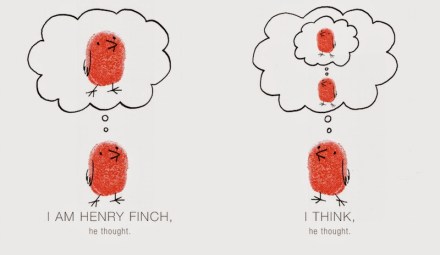
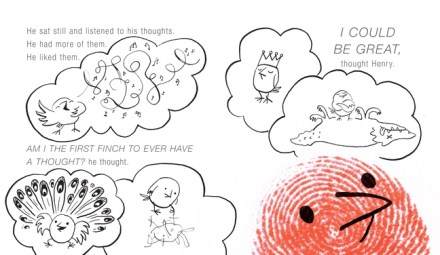
“Then they would all shout, THE BEAST, THE BEAST! And fly as fast as they could to the top of the nearest tree, where they would sit and shout until the Beast moved on.” It remained this way until one night “a little finch woke up in the dark and quiet. He had a thought, and he heard it. I AM HENRY FINCH, he thought.” He considered this thought as well as many others. He wondered if other finches had thoughts like his. He imagined himself defeating the Beast. “I COULD BE GREAT, thought Henry.”

The next morning the Beast did come. Henry envisioned himself standing atop the vanquished Beast and decided now “was the time for greatness.” Screaming his name, he flew directly at his foe…and was…swallowed. Inside the belly of the Beast, Henry had disparaging thoughts. “YOU ARE A FOOL, HENRY FINCH, he thought.” He regretted becoming the beast’s dinner. His troubled mind raced ahead through what would happen to him in the Beast’s digestion process, and yet he continued to think.

celebrate-picture-books-picture-book-review-I-am-henry-finch-I-think

Image copyright Viviane Schwarz, text copyright Alexis Deacon. Courtesy of vivianesxhwarz.blogspot.com

He pondered, “WHO AM I?”and concluded that even if he wasn’t Henry Finch, he was something. “I AM,” he decided, and then he considered the cyclical nature of…well…nature. “IT IS,” he realized. He listened to the grumbling, gurgling sounds inside the Beast. He could even “hear the thoughts of the Beast.” It was on the hunt for any “crawling, swimming, flying, walking” creature it could find to feed his family. Henry had had enough. “NO!” he thought. The Beast heard Henry’s thought, and the next one and the next one that told the Beast that all creatures have families and that from now on the Beast would eat only plants because they “have parts to spare.”

Yes, the Beast determined, “I WILL EAT PLANTS,” and when Henry told the Beast to open his mouth wide, the Beast complied. Out popped Henry much to the surprise and delight of the other finches. Henry told them everything that had happened. When he was finished, a small finch piped up, “I HAVE HAD A THOUGHT. GOOD-BYE, EVERYONE. I WILL COME BACK.” She flew off guided by her vision of landing atop a mountain. One by one, every finch envisioned its own great deed and flew away to achieve it, promising to return. And Henry? Gazing up at them as they disappeared into the sky, “he smiled a finch smile. GREAT! thought Henry.”

celebrate-picture-books-picture-book-review-I-am-henry-finch-could-be-great

Image copyright Viviane Schwarz, text copyright Alexis Deacon. Courtesy of candlewick.com

Alexis Deacon’s unique tale is sure to raise plenty of giggles and “Oh, no’s!” followed by more giggles and finally cheers as Henry comes to terms with his greatness and, despite his diminutive size, figures out a way to vanquish the Beast. Like René Descartes before him, Henry comes to the conclusion that “I think, therefore I am,” and with pluck and self-confidence decides that his existence warrants attention and respect. Deacon’s inspirational story is perfectly aimed at his young audience who are just beginning to “have thoughts” about who they are, who they want to be, and what they want to do. Henry’s wavering and uncertainty are presented with honesty and humor that will resonate with kids, and his final victory is a joy.

celebrate-picture-books-picture-book-review-I-am-henry-finch-wake-up

Image copyright Viviane Schwarz, text copyright Alexis Deacon. Courtesy of vivianesxhwarz.blogspot.com

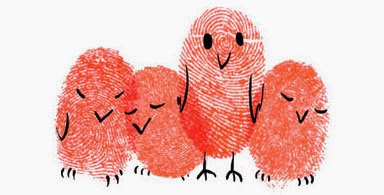
Viviane Schwarz could not have hit upon a more ideal way to depict Henry and the other finches than in the red fingerprints that determine their individuality. With only a few changes to his sketched-in features, adorable Henry becomes sweet, fearful, resolute, courageous, and of course thoughtful. The blue Beast with its mold-green tongue dominates the pages when it appears and dwarfs the tiny birds and other creatures it slurps up. When Henry is eaten and slides through the Beast’s digestive system, the pages turn appropriately black until Henry decides that “NO!” he is not going to become dinner today. A two-page spread of the life cycle for birds, insects, snakes, rats, plants, and even the Beast is a beauty.

I Am Henry Finch is a book that stirs emotions and stimulates discussion, and Henry—like another literary Finch who refused to accept the status quo—is a terrific hero to add to any home bookshelf.

Ages 5 – 8

Candlewick, 2016 | ISBN 978-1406365481 (Paperback) | ISBN 978-0763678128 (Hardcover, 2015)

You can connect with Alexis Deacon on his blog “A Place to Call Home.”

You’ll find more about Viviane Schwarz, her books, and her Cat and Bag web comic as well as videos, worksheets, and other goodies on her website.

Thread the Needle Day Activity

celebrate-picture-books-picture-book-review-negotiation-printable

Think Before You Speak Coloring Page


Everyone can make a difference by taking time to talk to friends or others when problems come up or opinions vary.  How do you keep a conversation productive and possitive? Print out this Think Before You Speak Coloring Page to remember the rules of beneficial communication.

Picture Book Review

June 28 – It’s Great Outdoors Month

celebrate-picture-books-picture-book-review-the-fog-cover

About the Holiday

Great Outdoors Month may be winding to a close, but the season for enjoying outside adventures is just beginning! Make this a great summer by planning to spend more time in and with nature—whether you do that in a majestic national park, at a local playground, on a patch of green in the city, at the seashore, or in your own backyard! The fresh air and sunshine will make you happy!

The Fog

Written by Kyo Maclear | Illustrated by Kenard Pak


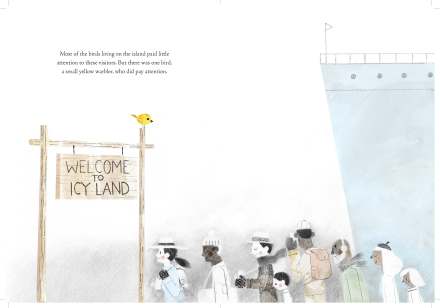
“Far north, on a wild sea, was an island covered with ice.” The island was a favorite tourist destination, and while the people explored their home, most birds took no notice. “But there was one bird, a small yellow warbler, who did pay attention.” In fact, “Warble was a devoted human watcher.” With so many visitors, Warble always had new specimens to investigate. He kept a journal of his sightings. #671 was a “Behatted Bibliophilic Female.” Warbler remembered her well, reading a book in her wide-brimmed hat. A man bedecked in gold jewelry was entry “#672 Bald-Headed Glitzy Male.”

celebrate-picture-books-picture-book-review-the-fog-tourists

Excerpted from The Fog by Kyo Maclear. Text copyright © 2017 by Kyo Maclear. Illustrations copyright © 2017 by Kenard Pak. Published by Tundra Books, a division of Penguin Random House Canada Limited. Reproduced by arrangement with the Publisher. All rights reserved.

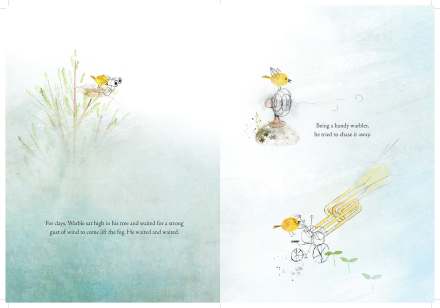
One day, though, a dense fog seeped across the valley, hiding everything in its gauze-like swirls. Warbler’s hobby came to a complete stop. After several days, he tried to blow the fog away with a fan and with a particularly blaring horn of his own invention. Nothing dispelled the fog. When Warbler consulted the other birds, they were nonchalant. It didn’t take long before the sign welcoming guests to the island was changed from “Welcome to Icy Land” to “Welcome to Fog Land.” And it took even less time for the other birds to forget there was ever clear air before.

celebrate-picture-books-picture-book-review-the-fog-chasing-fog

Excerpted from The Fog by Kyo Maclear. Text copyright © 2017 by Kyo Maclear. Illustrations copyright © 2017 by Kenard Pak. Published by Tundra Books, a division of Penguin Random House Canada Limited. Reproduced by arrangement with the Publisher. All rights reserved.

Warbler could not forget, and the creeping dark sea was worrying also. He tried to alert others to the danger, but they had already taken up other pursuits and were too busy to care. Finally, after spotting no more humans, Warbler put away his binoculars, books, and journal, and tried move on. “But then, one foggy morning, Warble spotted a colorful speck in the distance.”

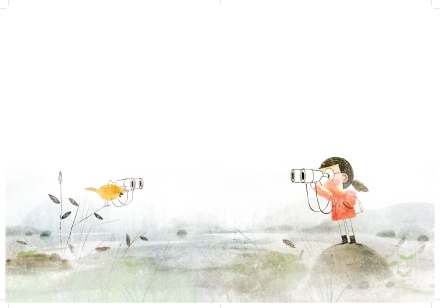
Upon closer inspection, Warble saw that it was a “rare female species and she was singing a song.” He jotted it down in his journal: “#673 Red-hooded Spectacled Female (Juvenile).” She consulted a map and then put her binoculars to her eyes. She found herself staring into the binoculars of Warble. Warble was so happy to see her that he made her a picnic lunch, complete with insects. The girl gave Warble gifts from her pack and taught him origami.

celebrate-picture-books-picture-book-review-the-fog-girl

Excerpted from The Fog by Kyo Maclear. Text copyright © 2017 by Kyo Maclear. Illustrations copyright © 2017 by Kenard Pak. Published by Tundra Books, a division of Penguin Random House Canada Limited. Reproduced by arrangement with the Publisher. All rights reserved.

It turned out that she also understood “Chirp.” Warble asked her about the fog and whether others knew about it. They decided to find out. They made a paper boat and wrote “Do you see the fog?” on it. Then they launched in from shore. No reply came. They launched more and more boats until they got an answer. A walrus in Canada sent back a “Yes, I see the fog.” So did a musk ox from Norway and some cats from England. Notes came from every part of the globe. “With each one, the fog began to lift a little. And the wind began to blow again until the world grew a little less ghostly and it became easier to notice things.”

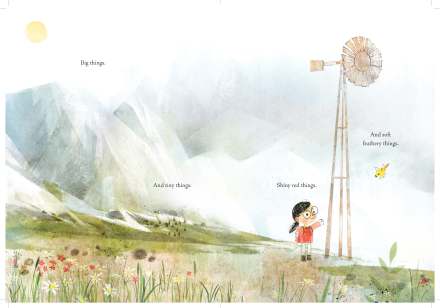
Warble and the human explored the island together, finding big things and little things. As the island brightened, they relaxed together and sang their songs to “each other and to the moon” which shone down through the clear night air on the happy pair.

celebrate-picture-books-picture-book-review-the-fog-fog-clears

Excerpted from The Fog by Kyo Maclear. Text copyright © 2017 by Kyo Maclear. Illustrations copyright © 2017 by Kenard Pak. Published by Tundra Books, a division of Penguin Random House Canada Limited. Reproduced by arrangement with the Publisher. All rights reserved.

From her clever turn-about plot Kyo Maclear has crafted a story that has a multitude of applications for the natural world as well as for the realm of personal relationships. The fog that descends on the island can clearly be read as a cautionary tale about the dangers of ignoring threats to the environment. While the tangible fog surrounds the island, the residents are in fogs of their own—preferring indifference to solving the problem. Only when others—who are brave enough or caring enough—acknowledge that they too recognize the trouble and want to fix it, does the fog begin to lift.

Maclear’s The Fog also gives readers an opportunity to talk with children about other examples of clouded issues. Misunderstandings, confusion, miscommunication, and loneliness can also create personal fogs for children and adults that negatively affect relationships and quality of life. Telling a family member or friend and reaching out to others can be the first step in “clearing the air” and living a happier life.

In his gauzy watercolor and pencil illustrations in frosted sages and yellows, Kenard Pak creates an island paradise that attracts attention from around the world. As the fog thickens, Pak’s colors darken and become denser. As the fog lingers smudges of gray surround the characters, but Pak resists the temptation to fill the pages with darkness. The Fog is, at its core, a story of hope and resolution and while the problem may be worsening, it is not yet insurmountable. The illustrations are sprinkled with puns and visual humor, and both kids and adults will love lingering over the endpapers, which offer a gallery of the humans Warbler has recorded on his life list.

Ages 4 – 8

Tundra Books, 2017 | ISBN 978-1770494923

To discover the unique world of books for children by Kyo Maclear, visit her website! You can learn about Kyo Maclear’s books for adults here.

Learn more about Kenard Pak and his books, as well as about his illustration and animation work on his website!

Great Outdoors Month Activity

celebrate-picture-books-picture-book-review-fog-experiment-fog-curling-from-jar

Fog in a Jar


A foggy day or night can be mysterious and pretty cool! It’s also a fascinating part of nature and the science of weather! With this experiment you can make fog at home.

**Because a candle lighter is used in this experiment, adult supervision is required for children

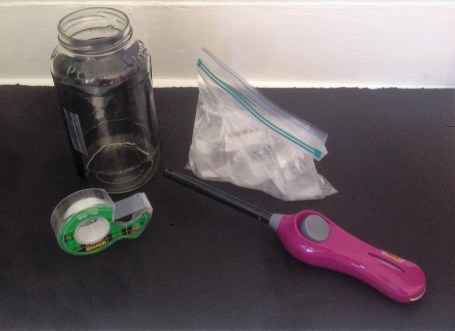
Supplies

  • Wide-mouth glass jar, like a spaghetti sauce jar, cleaned and dry
  • Plastic baggie with a zip closure
  • Candle lighter
  • Ice
  • Dark paper
  • Tape

celebrate-picture-books-picture-book-review-fog-experiment-materials

Directions

  1. Wrap one side of the jar with the black paper and tape in place
  2. Fill the baggie ½ full of ice
  3. Fill the jar 1/3 full of hot to boiling water
  4. Hold the lighted lighter inside the jar above the water for 3 or 4 seconds and remove
  5. Put the baggie with ice over the opening of the jar
  6. Watch the fog form!
  7. Remove the ice and watch the fog curl out of the jar!

Picture Book Review

April 29 – National Go Birding Day

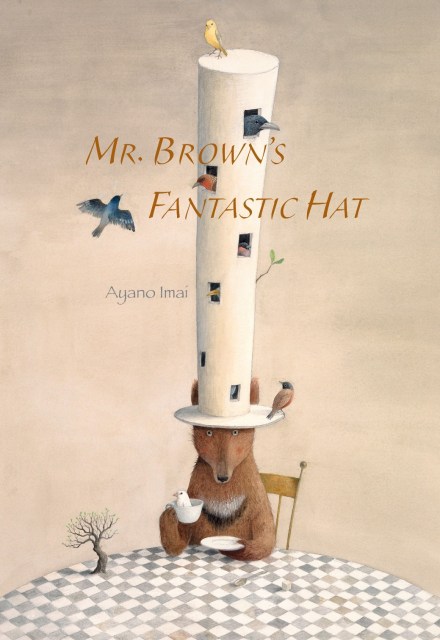
celebrate-picture-books-picture-book-review-mr-brown's-fantastic-hat-cover

About the Holiday

With all the bird activity going on right now as these little creatures build nests, lay eggs, and take care of new families, it’s a perfect time to go bird watching. The weather promises to be warm, and with a little stealth, a good sense of observation, and perhaps some binoculars, you should be able to spot quite a few lovely species. As the subject of today’s book found, if your home—or your hat—is inviting, feathered friends will come! So head out to a park, forest, beach—or even your backyard—and enjoy the beauty of the birds in your area.

Mr. Brown’s Fantastic Hat

By Ayano Imaí


Mr. Brown lived alone and, if you asked him, he’d tell you he liked it that way. He “had no friends and he didn’t want any.” If you were privy to his secret thoughts, however, you’d learn that Mr. Brown was actually very lonely. Mr. Brown liked to take long walks, and when he went out, he always wore his “smart,” distinctive hat. “One day while Mr. Brown was sleeping, a woodpecker flew down and started tapping a hole in his hat, thinking, ‘What a wonderful nest this hat would make!’”

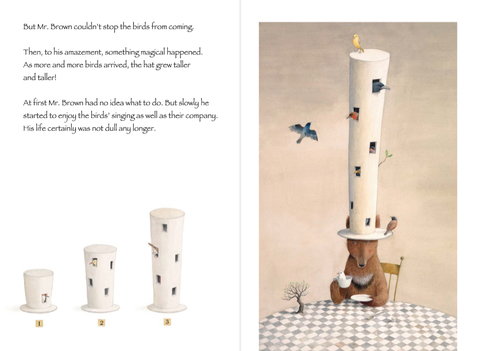
When Mr. Brown woke up he was shocked to discover that a bird had moved into his hat. Someone living this close to him was not what Mr. Brown had in mind at all. Then to Mr. Brown’s dismay the “woodpecker soon told all his friends about the wonderful new home and invited them all to join him.” Soon Mr. Brown’s hat was full of holes—and birds! You might think a regular hat would not have enough room for so many residents—but Mr. Brown’s hat was no ordinary one. As more and more birds moved in, his hat grew taller and taller!

celebrate-picture-books-picture-book-review-mr-brown's-fantastic-hat-birds-live-in-hat

Image copyright Ayano Imaí, courtesy of minedition, 2014

As the days went on Mr. Brown discovered that he was beginning to enjoy the birds’ singing and their company. Now Mr. Brown had renewed purpose in his daily walks: “He loved to show off his hat. Everywhere he went it was full of the music of singing birds.” People on the street took notice and wanted to emulate Mr. Brown. All over town people began wearing tall hats, “but the birds preferred to stay with Mr. Brown no matter how hard people tried to persuade them.”

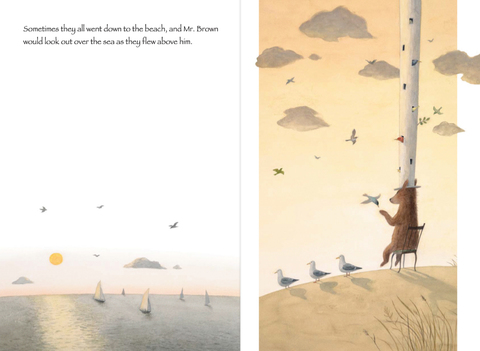
One day as autumn settled in, Mr. Brown noticed that all the birds had flown away. He was sad and didn’t understand where they had gone or why they had left him. He wondered if he would see them again. The idea of a quiet life no longer held the appeal it once did, and Mr. Brown missed his friends. He tried to convince himself that he didn’t care that the birds had left, but he continued to fill the feeders and watch out for them every day.

celebrate-picture-books-picture-book-review-mr-brown's-fantastic-hat-looking-out-to-sea

Image copyright Ayano Imaí, courtesy of minedition, 2014

Even though it was time for Mr. Brown to take a long winter’s nap, he tried to stay awake, worried that there would be no one to care for the birds if they returned. But nature took its course, and Mr. Brown fell into a deep sleep. One morning after a particularly vivid dream in which Mr. Brown could hear the birds singing, he woke to a tapping sound. He went to the door and peered out.

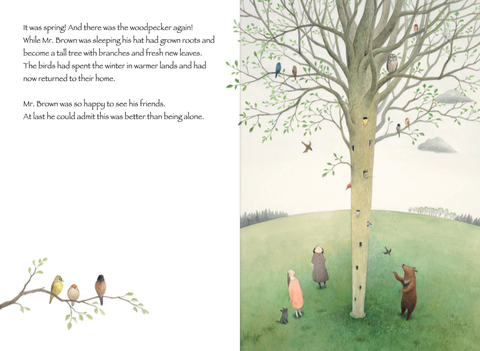
Spring had come and with it Mr. Brown’s hat had grown roots and sprouted branches and leaves. The old holes were filled with their previous tenants. The sight filled Mr. Brown with joy, and he finally could admit to himself that sharing his life with friends “was better than being alone.”

celebrate-picture-books-picture-book-review-mr-brown's-fantastic-hat-hat-grows-into-tree

Image copyright Ayano Imaí, courtesy of minedition, 2014

Ayano Imaí’s gloriously beautiful book plumbs the nature of solitude and loneliness as well as the value of friendship with an honesty that is at once heartrending and uplifting. For so many quiet, introspective people—children and adults alike—navigating the world of small talk, casual relationships, and making friends is similar to traveling uncharted territory, where the language and mores are foreign. It can become easier to tell oneself that it doesn’t matter, when in reality it matters a great deal. Many times happiness comes when one finds their niche or, in some surprising way, a niche finds them.

celebrate-picture-books-picture-book-review-mr-browns-fantastic-hat-sleeping-on-branch

Image copyright Ayano Imaí, courtesy of midedition, 2014

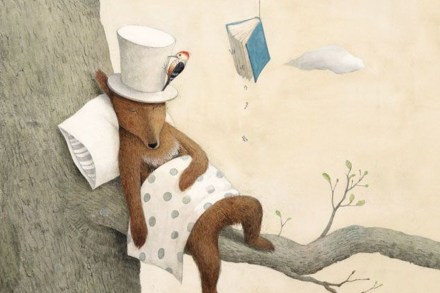
Imaí tells the story of Mr. Brown and his fantastical hat in straightforward narration, but more profound meaning is revealed in her illustrations. Mr. Brown, it is discovered, is a brown bear who has taken on the aspects of humans. He walks upright, carries an umbrella and bag, owns a home, and wears a hat. His fur is even the same color as the townspeople’s clothing. But while he may be among people, he is not of them. His home has a grass floor which sprouts mushrooms and weeds; another weed pokes out from the bristles of his brush; a tree branch juts from a wall; and mushrooms share space with the laundry on the drying line.

Mr. Brown comes from nature and belongs with nature, so it is no surprise that the birds flock to him and prefer him to humans, who in an ironic twist long to be like Mr. Brown. Mr. Brown’s hat is also symbolic of one’s heart, in that as a person embraces friends, their ability to accept and love others continues to grow.

I especially like the ending of Mr. Brown’s Fantastic Hat, in which Mr. Brown stays true to himself. He does not suddenly discover his “wild” side and become someone that he is not. He is able to remain a quiet, introspective bear while also embracing his friends, his love for them, and his place in the world. He finds inner happiness and loved ones to share it with.

Ages 3 – 8 (and up)

minedition, 2014 | ISBN 978-9888240845

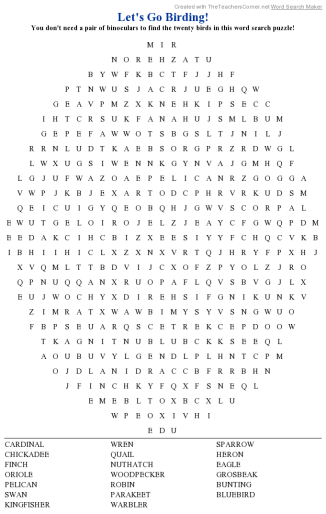
National Go Birding Day Activitycelebrate-picture-books-picture-book-review-mr-browns-fantastic-hat-lets-go-birding-bird-species-word-search

Let’s Go Birding! Word Search Puzzle


You don’t need a pair of binoculars to find the twenty kinds of birds in this printable Let’s Go Birding! Word Search Puzzle. Here’s the Solution!

Picture Book Review
April 27 – National Tell a Story Day

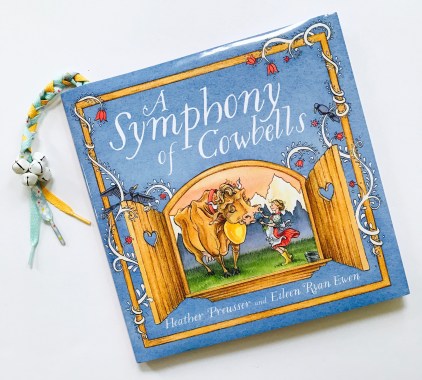
celebrate-picture-books-picture-book-review-a-symphony-of-cowbells-cover

About the Holiday

Today’s holiday was established to celebrate the art of storytelling. Highlighting the tradition of oral storytelling, the day encourages families to get together and have fun remembering and sharing family tales. Reading together is another wonderful way to discover your own stories and those of others around the world.

A Symphony of Cowbells

Written by Heather Preusser | Illustrated by Eileen Ryan Ewen


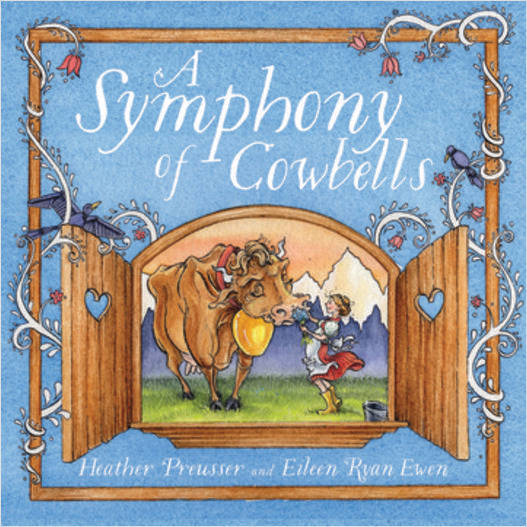
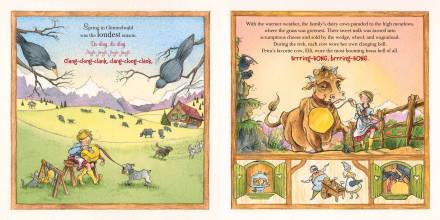
With the dawning of spring, Gimmelwald came alive with the “Da-ding, da-ding. Jingle-jangle, jingle-jangle. Clang-clong-clank, clang-clong-clank” of bells as the cows were led to the sweet, green grass in the high meadows. The cows’ milk would become “scrumptious cheese…sold by the wedge, wheel, and wagonload.” As Petra walked with her family’s herd, she led her favorite cow, Elfi, who “wore the most booming brass bell of all.”

celebrate-picture-books-picture-book-review-a-symphony-of-cowbells-no-bell

Image copyright Eileen Ryan Ewen, text copyright Heather Preusser. Courtesy of Sleeping Bear Press.

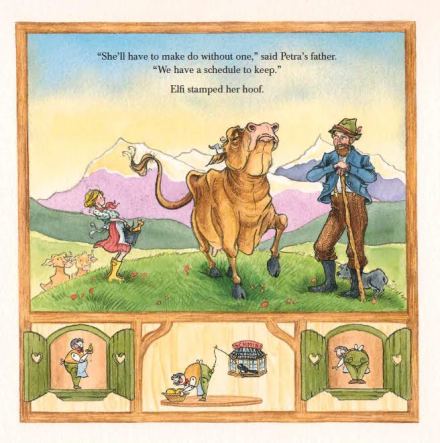
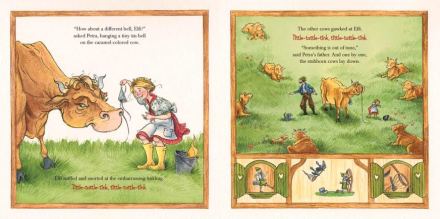
But one day Elfi’s bell was missing. Petra’s father told her they had a schedule to keep and that Elfi would have to go without her bell, but Elfi wouldn’t hear of it. She stomped her hoof and stood her ground. No amount of pushing, pulling or prodding could move Elfi from her spot. Petra ran and retrieved a tiny tin bell to hang around Elfi’s neck, but Elfi only “sniffed and snorted at the embarrassing tinkling. Tittle-tattle-tink, tittle-tattle, tink.”

celebrate-picture-books-picture-book-review-a-symphony-of-cowbells-stubborn-elfi

Image copyright Eileen Ryan Ewen, text copyright Heather Preusser. Courtesy of Sleeping Bear Press.

Without Elfi to lead them, Petra’s other cows lay down in the meadow and refused to move as well. “‘No milk? No cheese? What’ll we do?’ Petra gulped.” She begged Elfi to get up, but Elfi simply gazed at Petra with “eyes wide as milk saucers.” Petra knew she had to find Elfi’s bell. She searched the house, looked in the barn, and combed the field, but didn’t find the bell. The sun went down, and “the stubborn cows remained rooted among the bellflowers.”

celebrate-picture-books-picture-book-review-a-symphony-of-cowbells-tiny-bell

Image copyright Eileen Ryan Ewen, text copyright Heather Preusser. Courtesy of Sleeping Bear Press.

In the morning, Petra spied a crow with something shiny in its beak. She ran after it and discovered the bird’s huge nest high on a cliff. She was much too small to reach it, so she called her father, her mother, and a couple of neighbors. They piled on top of one another, and as Petra teetered on her mother’s shoulders, she reached into the nest and pulled out…Mr. Schmid’s pocket watch, Miss Baumann’s reading glasses, Farmer Felber’s wrench, Mother’s bracelet, Father’s keys, and…Elfi’s brass bell!

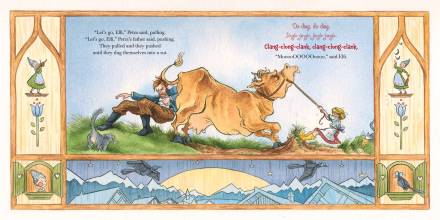
Petra skipped all the way to where Elfi and the other cows were keeping their protest, the brass bell announcing “Brrring-BONG, brrring-BONG. Brrring-BONG, brrring-BONG” all the way. When Elfi saw her bell, she danced with joy. Petra placed the bell over Elfi’s head and kissed her velvety nose. The other cows took notice. “On cue, they stood and moseyed up the mountainside….The symphony of cowbells was harmonious again—and LOUD. It was springtime in Gimmelwald after all.”

celebrate-picture-books-picture-book-review-a-symphony-of-cowbells-clanging-bells

Image copyright Eileen Ryan Ewen, text copyright Heather Preusser. Courtesy of Sleeping Bear Press.

Heather Preusser’s enchanting Swiss tale of tenderhearted but stubborn Elfi will delight readers with its musical mystery and gentle humor. Kids will love hearing and reading along with the melodic verses of jingling cowbells sprinkled throughout the text. Preusser’s lyrical phrasing is as fresh as the mountain air and will transport children to the beautiful Swiss countryside.

A Symphony of Cowbells is a perfect example of text and illustrations working together to present the story and add layered details that elevate the reading experience. Eileen Ryan Ewen’s gorgeously detailed and charming paintings take readers to the heart of Gimmelwald, with its glorious mountain backdrop, quaint village architecture, and cozy homes decorated with Alpen cuckoo clocks, dainty curtains, and window boxes overflowing with flowers.

Along the way Ewen frames a consecutive story along the bottom of most pages. Through these panels, eagle-eyed readers will notice a curious happenstance occurring in Gimmelwald which just may explain a few things…. It’s not until the end, however, that kids discover the answer to the story’s mystery.

A Symphony of Cowbells is a captivating and humorous look at country life with a little science sprinkled in. Readers may be enticed to do a little more research into the animal behaviors that influenced the story. The book would make a lovely addition to any child’s home library.

Ages 5 – 8

Sleeping Bear Press, 2017 | ISBN 978-1585369683

To learn more about Heather Preusser and her book as well as see a video about the real Gimmelwald, visit her website!

Discover more about Eileen Ryan Ewen and view a portfolio of her illustration work on her website!

National Tell a Story Day Activity

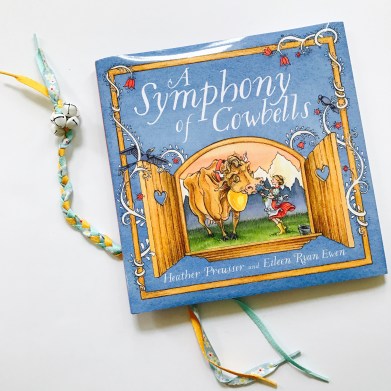
celebrate-picture-books-picture-book-review-bell-bookmark-a-symphony-of-cowbells

Ring a Bell for Reading Bookmark


It’s easy to make a stylish bookmark that can ring out your love of reading while marking your page!

Supplies

  • 3 shoelaces or ribbon of different designs
  • Small “sleigh” bells or other bellscelebrate-picture-books-picture-book-review-bell-bookmark-a-symphony-of-cowbells

Directions

  1. Hold three shoelaces together and knot them together at the top
  2. Braid the shoelaces together as long as you want your bookmark to be
  3. At the end, string three or more bells onto the ends of the shoelaces and knot the shoelaces together to hold the braid closed.
  4. Alternately, you can knot the braid at the end and tie a group of bells to the end.
  5. The end with the bells becomes the top of the bookmark.

Picture Book Review