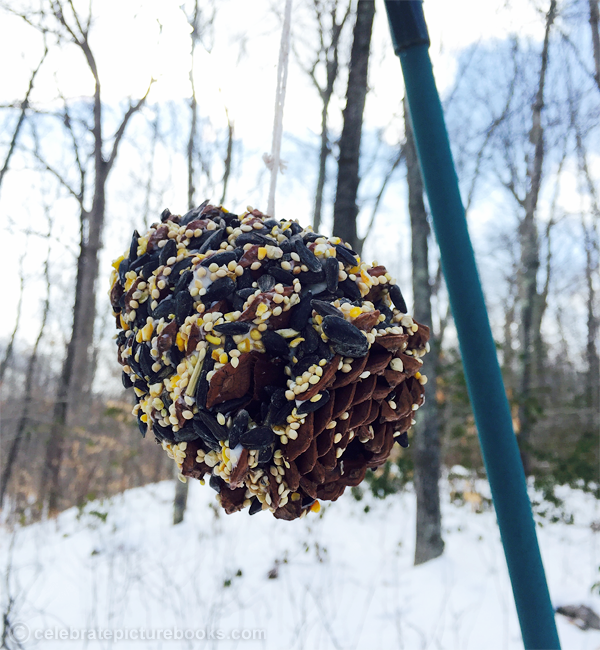
June 13 – National Pigeon Day

About the Holiday

When you see pigeons gathering around park benches or scuttling along urban outdoor areas looking for crumbs or lining up on electrical wires, you may not think much about them. They just seem part of the landscape. Learning more about National Pigeon Day, however, may change your ideas about these unassuming birds forever. The holiday was established by President Woodrow Wilson in acknowledgement of the historical and cultural significance of pigeons, particularly their contributions during World War I. Today, the holiday celebrates the important role they played in both world wars.

As the website BirdTipper explains, pigeons were used during both World Wars as “reliable and efficient messengers, providing a vital link between troops on the front lines and command centers. Their speed and homing ability made them indispensable for conveying important messages, often flying through dangerous conditions to deliver vital information. Numerous pigeons were awarded medals and honors for their service, highlighting their bravery and significance in wartime efforts.”

Today’s date was selected as National Pigeon Day to commemorate the death of one of the most famous World War I pigeons, Cher Ami. To read more about this incredible bird, including its role in saving nearly 200 soldiers despite being grievously injured, and more about how pigeons helped the war efforts, visit BirdTipper.

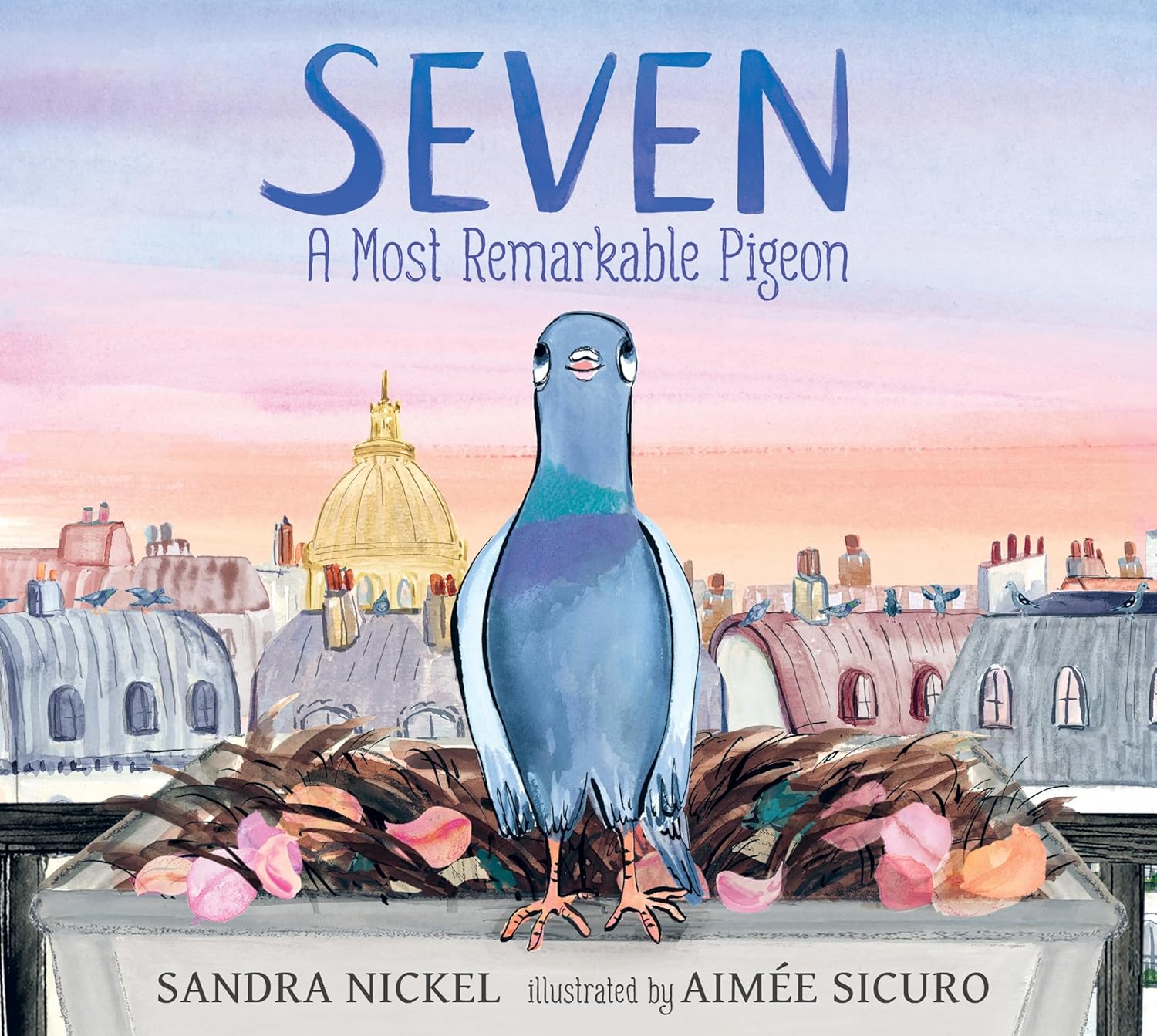
Thanks to Candlewick and Barbara Fisch at Blue Slip Media for sending me a copy of Seven: A Most Remarkable Pigeon!

Seven: A Most Remarkable Pigeon

Written by Sandra Nickel | Illustrated by Aimée Sicuro


The little pigeon was different right from the start—when he was still in the egg, even. Usually “pigeons arrive in twos . . . . But this time, there was only one.” The flock whispered and whispered. When the tiny bird hatched, his parents named him Seven in honor of “seven thousand miles . . . the farthest any pigeon has flown to get back home.” It “is considered a very lucky name.”
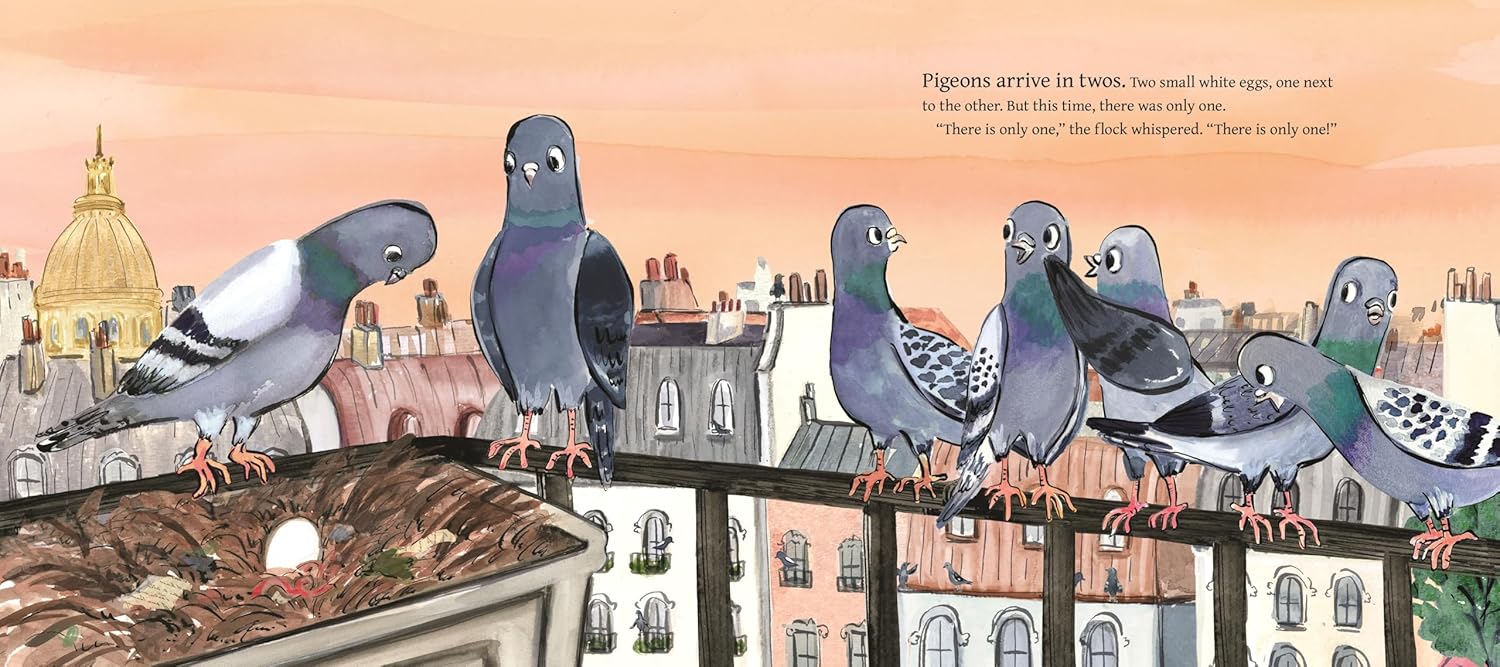
Illustration © 2025 by Aimée Sicuro, text © 2025 by Sandra Nickel. Used with permission of Candlewick Press. All rights reserved.

As Seven waited for his eyes to open and his feathers to sprout, he relished all the lovely scents that wafted to his nest. When he could finally fly, Seven soared to the flower shop to enjoy the aromas, and he picked up petals to fill his nest instead of twigs. On the way to the park with the flock, he veered off, distracted by the fragrant smell of rice. His mother scolded: “‘We stay with the flock. We stay with the flock.'” The flock whispered.

Seven’s father decided it was time to teach his son how to “home.” They left the city and headed into the country. Here, Seven was so captivated by all of the new scents that he didn’t listen to his father’s lesson to memorize the roads below. The flock was scandalized; his mother gave him another scolding. So Seven began toeing the line, but now he “didn’t feel dreamy or cozy or light as a feather.” And the flock? They continued to whisper.
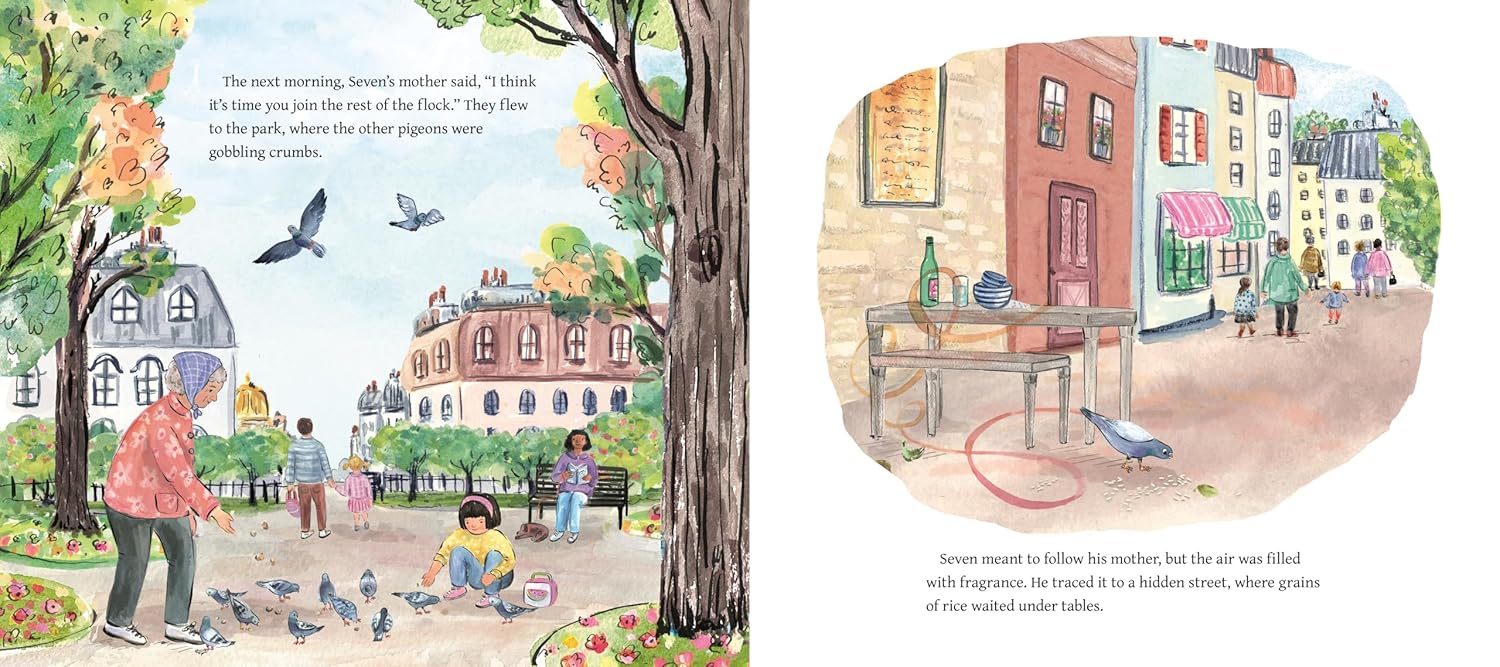
Illustration © 2025 by Aimée Sicuro, text © 2025 by Sandra Nickel. Used with permission of Candlewick Press. All rights reserved.

Finally, it came time for The Big Flight, the annual commemoration of the famous 7,000-mile journey. Instead of 7,000 miles, though, the flock rode the train 700 miles away and would fly home. But soon the fog rolled in, thick and impenetrable. Without being able to see the road map below, the pigeons all flew in different directions. How would they find their way home?

But Seven knew just where to go, led on by the scents he loved so well. The flock fell into formation behind him and followed him home. There “Seven’s parents puffed out their feathers and added rose petals to their nest.” The rest of the flock added 700 more in celebration, and Seven’s parents wrapped their wings around him and held him close.

A discussion about pigeons, their behaviors, the different (and similar) ways the mother and father care for their young, and various theories on how pigeons home follows the story.
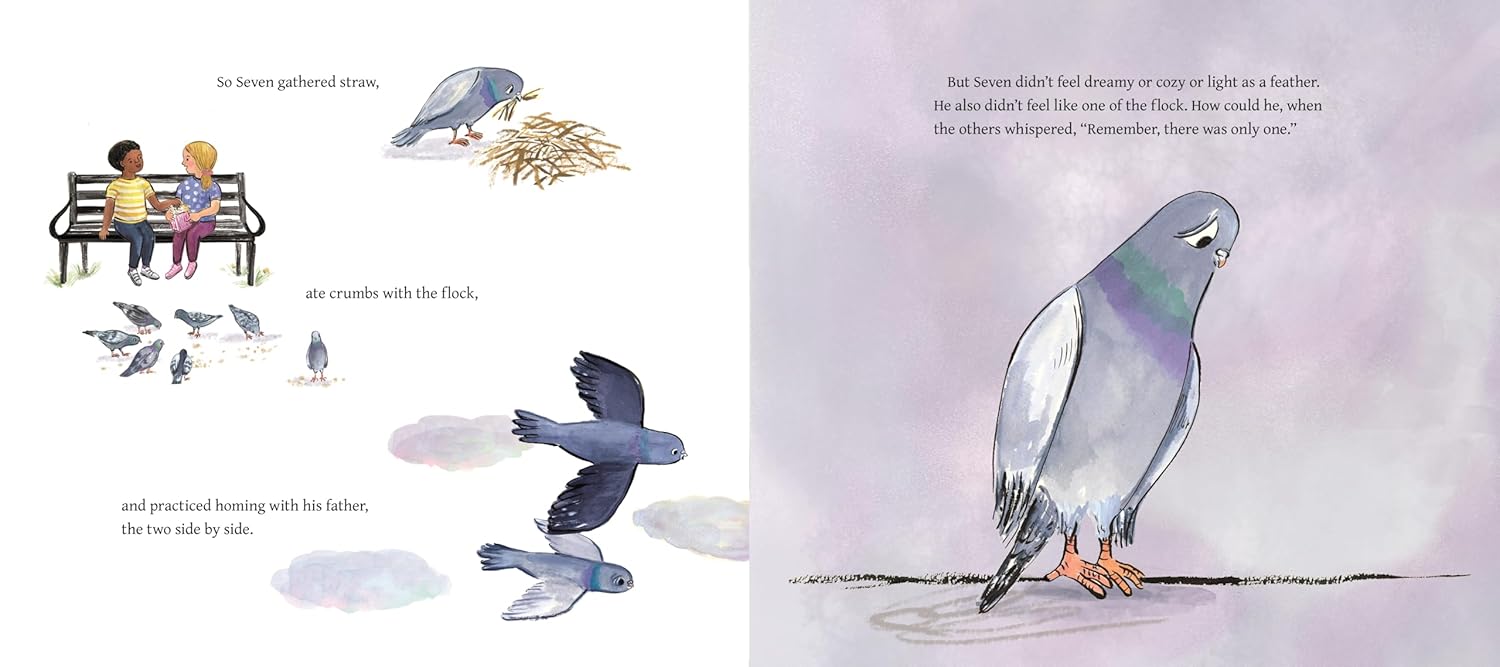
Illustration © 2025 by Aimée Sicuro, text © 2025 by Sandra Nickel. Used with permission of Candlewick Press. All rights reserved.

You will absolutely fall in love with Seven as he stays true to his distinct and savvy preference for scents despite the speculations of his flock in Sandra Nickel’s heartwarming tale. Nickel blends her talent for fiction and nonfiction in her depiction of pigeons’ nesting, flocking, and homing behaviors as well as highlighting the 7,000-mile flight undertaken by one adventurous pigeon. Nickel’s story is built on deeper underpinnings that these, however, as she spotlights the joy and comfort to be found in celebrating individual differences that make each person’s unique contributions to their family, friends, and community invaluable. Kids will cheer Seven on as he forges his own way.

Aimée Sicuro’s watercolor, gouache, and ink illustrations transport readers to lovely French cityscapes and countryside while embedding them with a lively flock of pigeons all aflutter over their newest member. Amplifying Nickel’s focus on individuality, Sicuro has given each pigeon its own markings and coloring, and their facial expressions leave no doubt about their feelings. Seven is especially expressive, from basking in delectable scents to dejectedly enduring scoldings and doubtful glances to leading the flock home with happy certainty and finally soaking up cozy hugs from his parents. 

Seven: A Remarkable Pigeon is a gently told story full of love that celebrates individuality and builds self-esteem. The book is one that kids will want to hear again and again and is a must for home, classroom, and all library collections. 

Ages 4 – 8

Candlewick, 2025 | ISBN 978-1536235197

Connect with Candlewick on Facebook | Instagram | Twitter/X

About the Author

Sandra Nickel is a former lawyer who is now a dedicated children’s book author with many picture books under her belt, including The Stuff Between the Stars, Nacho’s Nachos, Big Bear and Little Fish, and Making Light Bloom. She is honored to be the winner of a Christopher Award, the winner of the Society of Children’s Book Writers & Illustrators Crystal Kite Award, a finalist for the Golden Kite Award for Nonfiction for Younger Readers, a Junior Library Guild Gold Selection honoree, and a Charlotte Huck Award Recommended author. She has presented workshops on writing for children and young adults throughout Europe and the United States. She lives with her family in Switzerland. Visit her at sandranickel.com and on Bluesky | Facebook | Instagram | Twitter/X.

About the Illustrator

Aimée Sicuro is a creator of many picture books for kids. She is the author and illustrator of If You Spot a Shell, and If You Find a Leaf, which was nominated for the Ezra Jacks Keats Award.. Her work has appeared in the New York TimesParents magazine, and many other publications. She lives in Brooklyn with her husband and two children. Visit her at aimeesicuro.com and on Instagram.

You can learn more about Blue Slip Media on Bluesky | Facebook | Instagram  and on Twitter/X here and here.

National Pigeon Day Activity
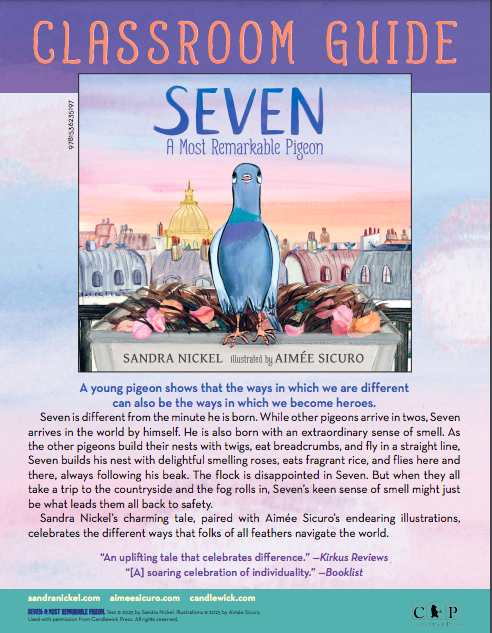
Illustration © 2025 by Aimée Sicuro, text © 2025 by Sandra Nickel. Used with permission of Candlewick Press. All rights reserved.


Seven: A Most Remarkable Pigeon Activity Pages


Download a fun and thoughtful Seven: A Most Remarkable Pigeon Classroom Guide with discussion questions and activities for use by educators as well as readers at home.
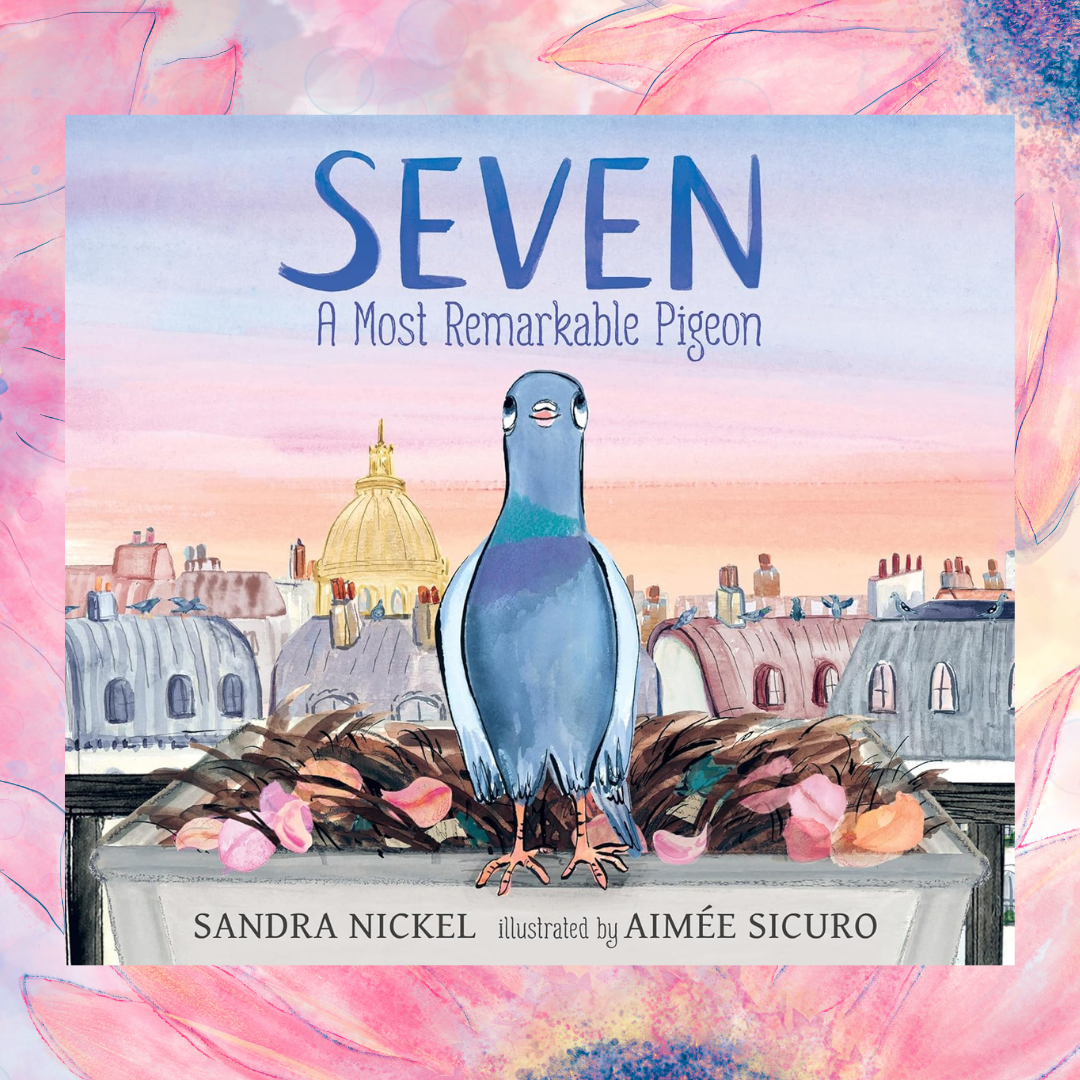
You can purchase Seven: A Most Remarkable Pigeon from these booksellers

Amazon | Barnes & Noble | Bookshop

Picture Book Review

April 10 – National Wildlife Week

About the Holiday

National Wildlife Week, dating back to 1938, is the National Wildlife Federation’s longest-running education program. The celebration was designed to connect budding conservationists of all ages to the awesome wonders of wildlife. Each year, we pick a theme and provide fun educational materials and activities for educators and caregivers to use with kids. This year’s theme is Keep an Eye on the Wild. Conservationists and animal lovers are keeping a lookout for wildlife in the most unexpected places as we learn how we can keep their habitats safe and live in harmony with our incredible wild neighbors. Whether you keep your eyes out for the wildlife living near you with a “critter cam” or by walking around and paying attention to your backyard, neighborhood, and wider area, being aware of the creatures around you can help them survive for generations to come. To learn more about National Wildlife Week and find fun activities aimed at connecting kids with wildlife, visit the National Wildlife Week Kids Page!

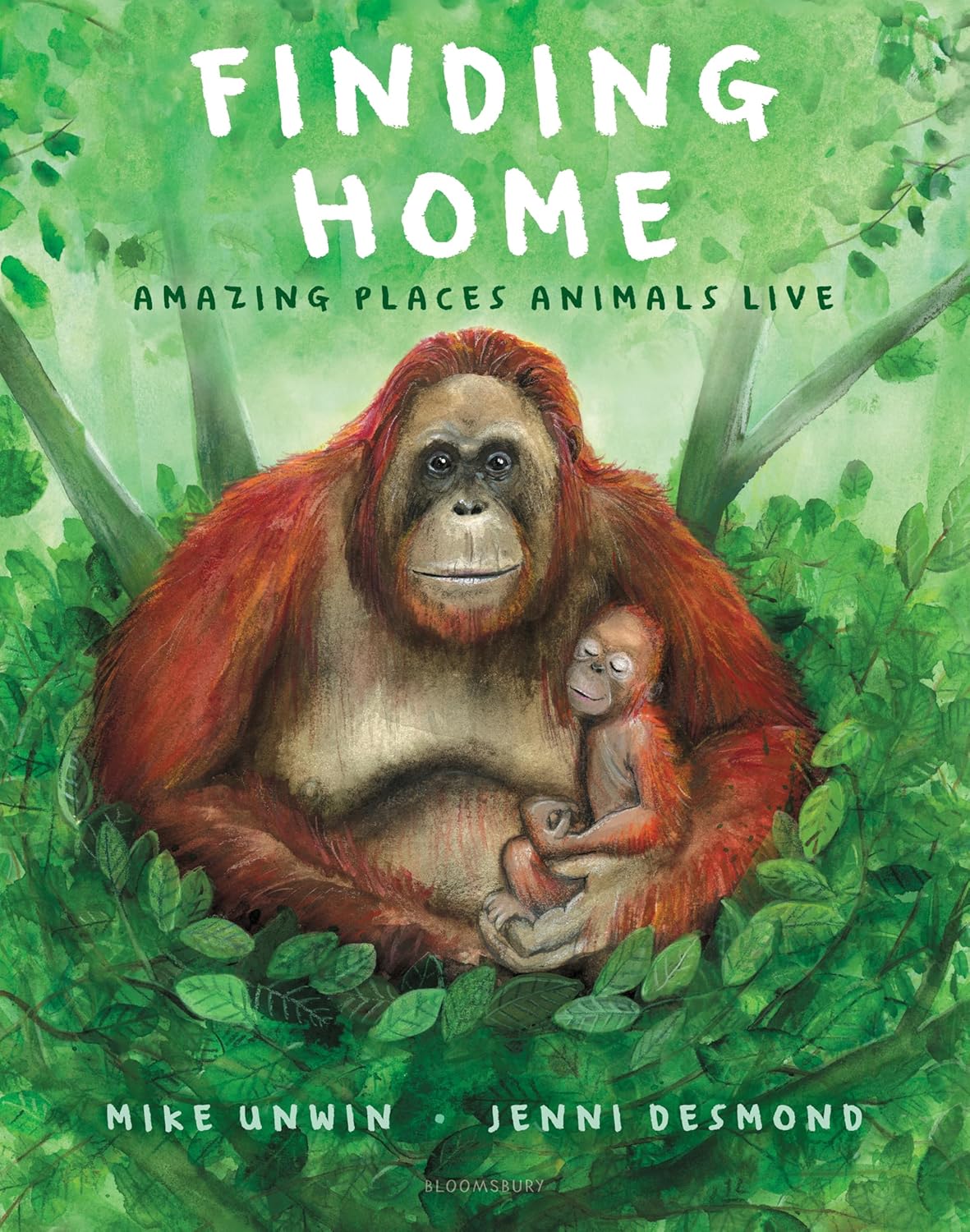
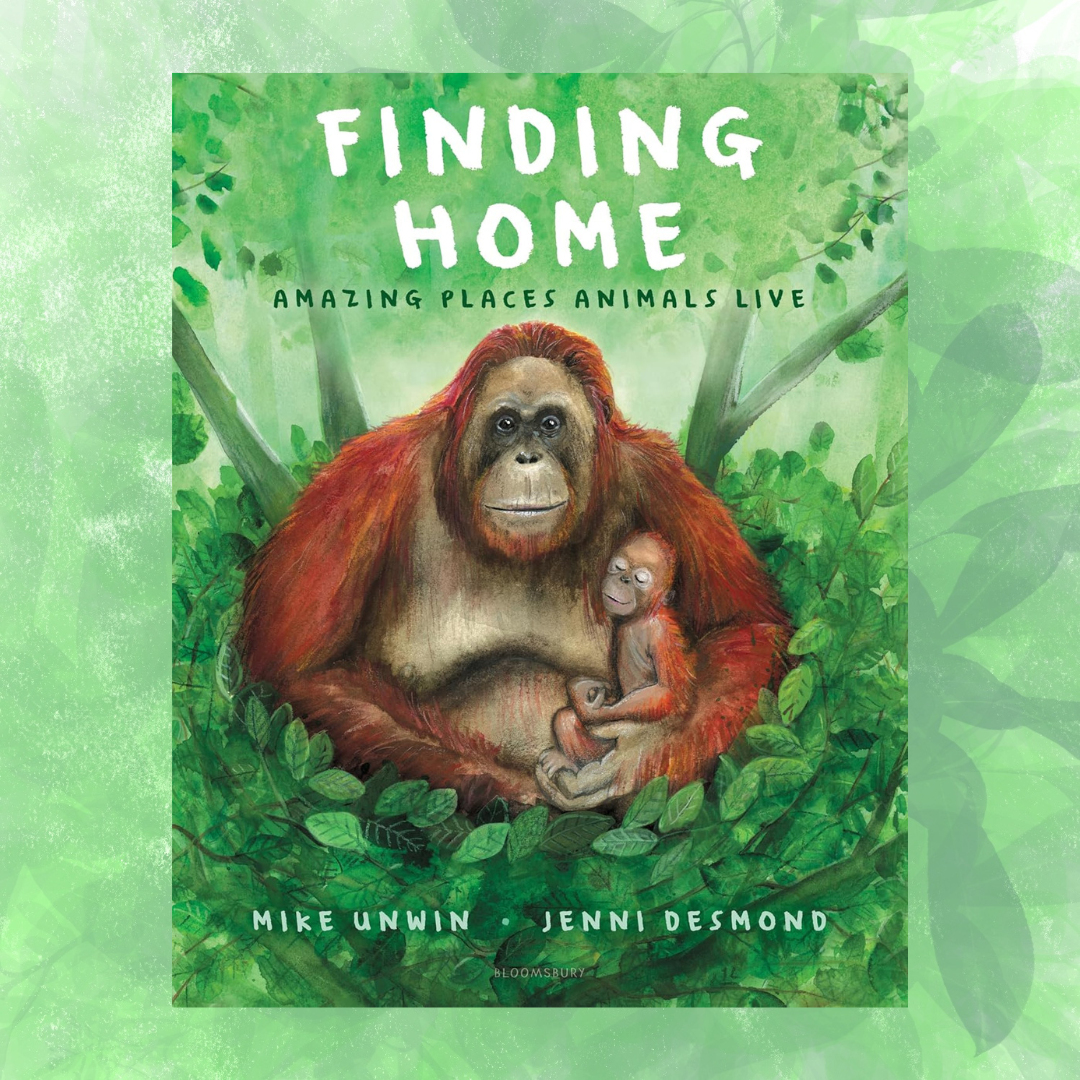
Finding Home: Amazing Places Animals Live

Written by Mike Unwin | Illustrated by Jenni Desmond


Finding Home begins: “Our planet is home to a mind-boggling number of different animals: at least 6,500 species of mammal, 10,000 species of reptile, 11,000 species of bird, and literally millions of insects. Every single one has its own home.” Just think of it! As your eye sweeps across any vista; as you walk across your yard, local playground, or favorite park, beach, or mountain trail, an untold number of creatures’ homes are within sight or underfoot. We know their names: Den. Nest. Burrow. Taxi (wait, what?). You’ll see, because in their astounding and gorgeous book, Mike Unwin and Jenni Desmond reveal that there is no such thing as a generic animal home.

Illustration © 2025 by Jenni Desmond, text © 2025 by Mike Unwin. Courtesy of Bloomsbury Children’s Books.

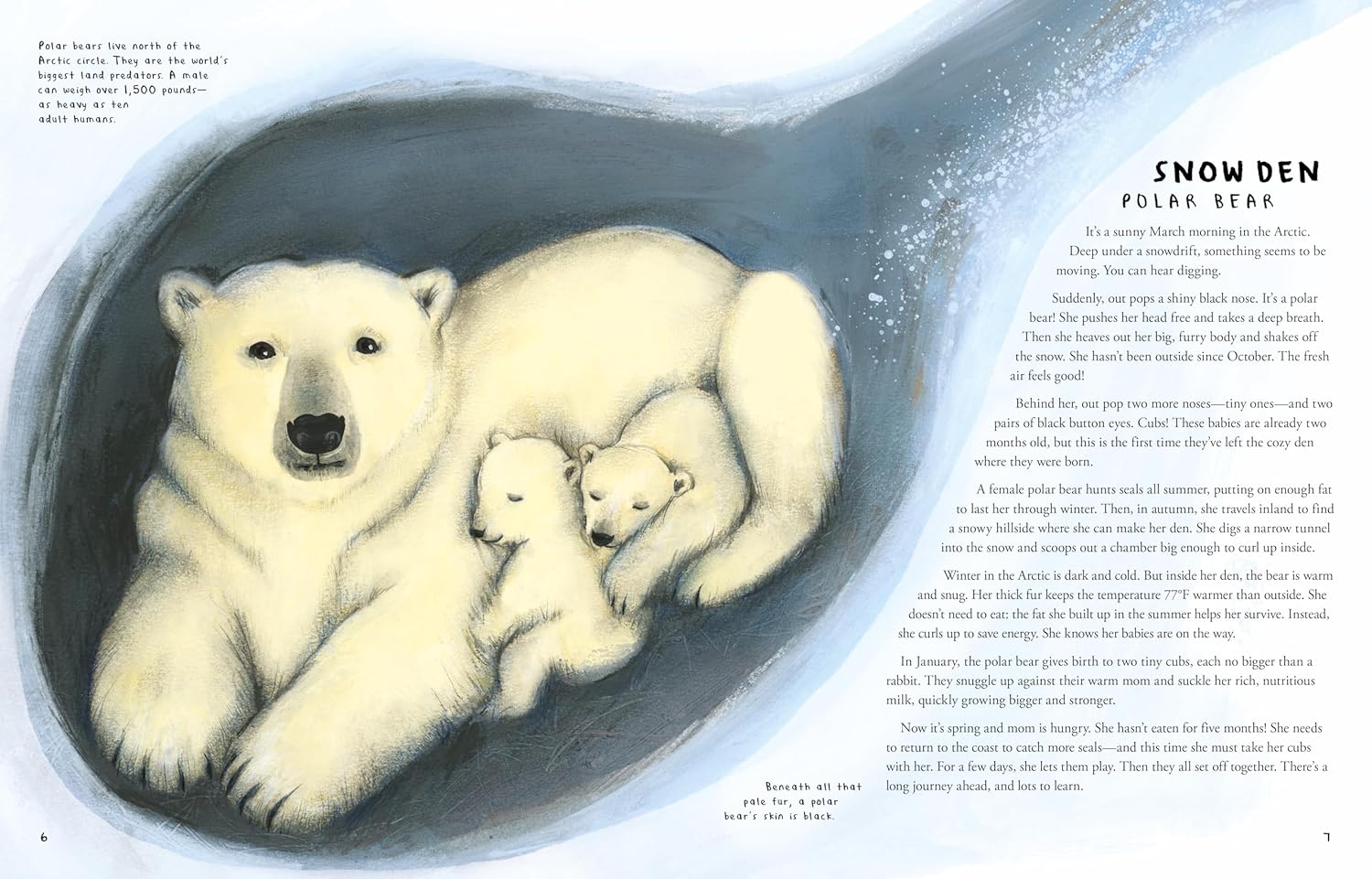
Take “den,” for instance—a polar bear’s snow den. Unwin and Desmond take you right inside this winter home, where a mother polar bear and her two cubs (born here in the cold of January) welcome you. As you squeeze inside, don’t worry about being cold. The polar bear’s “thick fur keeps the temperature 77°F warmer than outside.” 

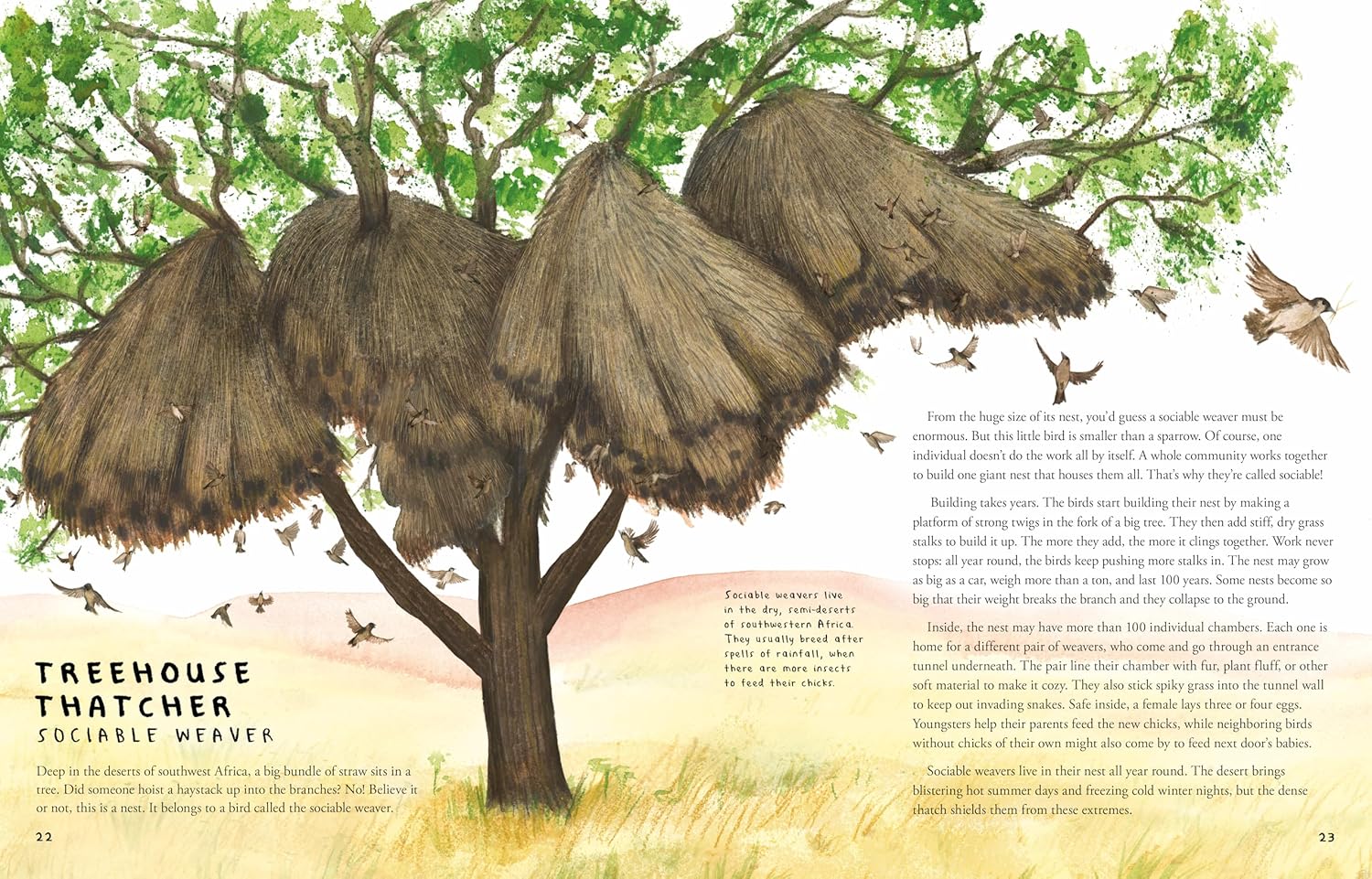
Next up is “nest.” These are bowls made from twigs, straw, and fluff and, sometimes, found objects like bits of paper or cloth, right? Well, yes—for some birds. But you won’t believe your eyes when you see what appears to be several haystacks lodged within a tree’s branches. This nest, constructed by a whole community of birds smaller than sparrows, can “grow as big as a car, weigh more than a ton, and last 100 years.” Like humans’ apartment buildings, the bird pairs that inhabit this nest look out for each other and help their neighbors. Kids will also be amazed by another type of bird that literally sews leaves together with “plant fiber and spider silk” to create their soft, deep nests.

Illustration © 2025 by Jenni Desmond, text © 2025 by Mike Unwin. Courtesy of Bloomsbury Children’s Books.

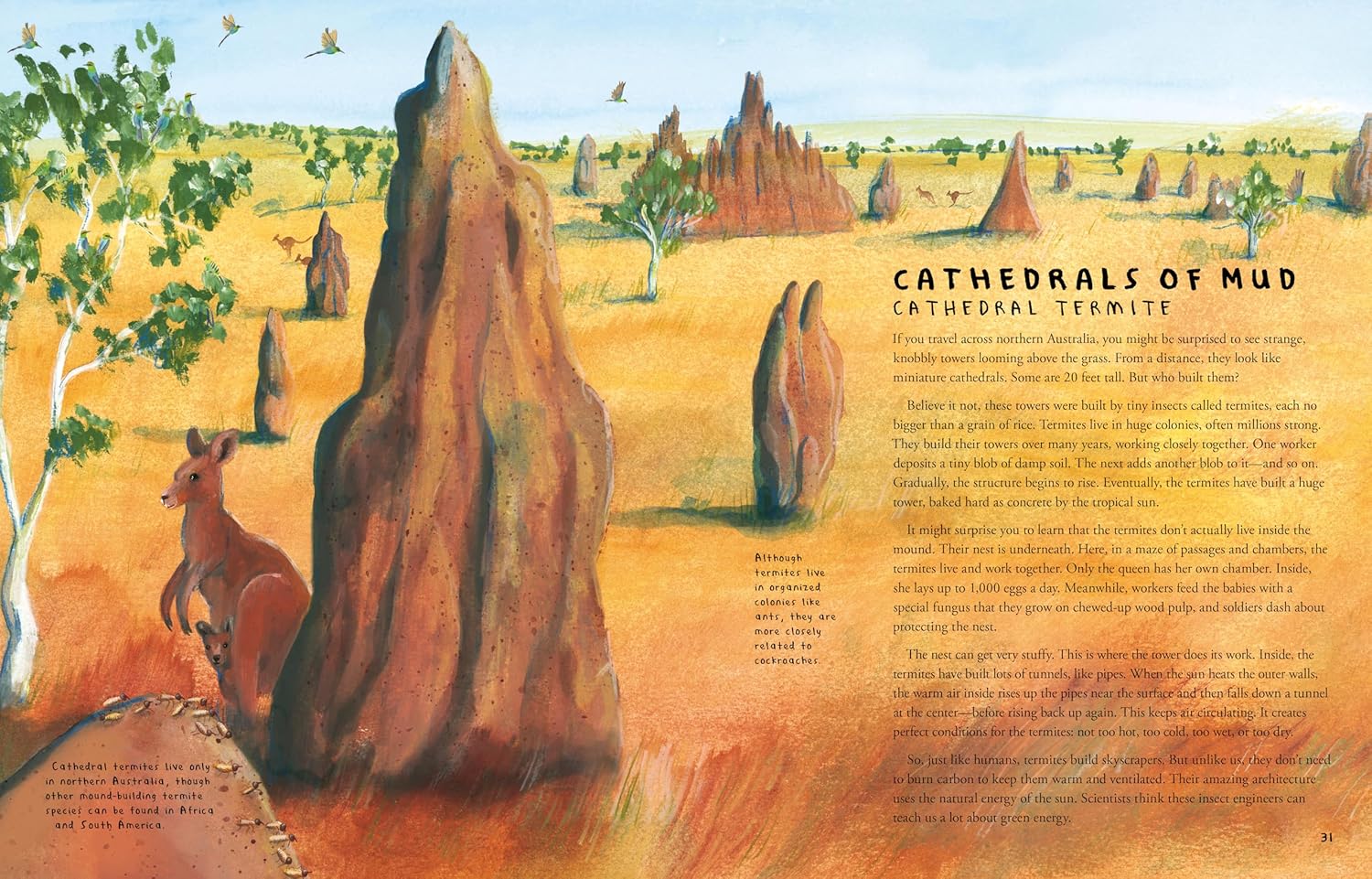
And how about “burrows?” Yep, Unwin and Desmond showcase a couple of pretty spectacular burrows too. Take the aardvark’s home. You won’t see an aardvark during the day. While the sun is up, they stay below ground, sleeping and tending to their young. It’s only after sunset that these unusual, ant-eating animals (including two-week-old babies) make an appearance topside. This is when they do what they do best: sniff out anthills and termite mounds, dig them up, and have dinner. It takes a hearty meal to satisfy an aardvark: “One aardvark can eat an amazing 50,000 ants and termites in a single night!”

Now, about that “taxi.” Children will be wowed by two, very different types of animals who prefer moving from one area to another by hitching a ride on another creature, from whom they can get food and other necessities of life while helping their hosts as well. Of course, the variety of animal homes don’t stop at these four. Every page transports readers to a different part of the globe to witness creatures of the air, sea, and land living in the home of their choice.

Unwin ends this fascinating travelogue with a map showing different ways some of the animals in the book tend to the environment, protecting it and keeping it growing for themselves and humans. He also includes a caution, reminding readers that “all these habitats . . . fit together like jigsaw pieces to make up planet Earth. And just like a jigsaw needs all its pieces, a healthy planet needs all its animals and their habitats.” Sadly, humans have not been good stewards of Earth’s bounty. “Today, scientists and conservationists are working hard to put things right.” But everyone is needed to make sure our environment is cared for the way we care for our own families. “Only then will planet Earth truly be home, sweet home.”

Illustration © 2025 by Jenni Desmond, text © 2025 by Mike Unwin. Courtesy of Bloomsbury Children’s Books.

Mike Unwin draws readers in with engaging storytelling that allows kids to easily understand how each animal goes about building their home and why it’s perfect for their lifestyle. Children also learn just as much about the animals as the homes they build, giving them deep and well-rounded knowledge of some of the most unusual birds, fish, mammals, and insects on our planet and how many of them benefit humankind. Unwin’s phrasing, vocabulary and conversational lilt make Finding Home a highly satisfying nonfiction read aloud for younger kids. Independent readers will eagerly dip into the book again and again to meet these intriguing creatures.

With the impact of a museum exhibit, Jenni Desmond’s rich, full-bleed illustrations will take your breath away with their stunning realism and personality. Some animals peek out at the reader, while others busily go about their work oblivious to outside interest. From grassy hillsides to treetop canopies to sunny Africa and the snowy Himalayas, Desmond takes readers on an around the world tour like no other.

Gorgeous, educational, and nature nonfiction at its best, Finding Home: Amazing Places Animals Live is a must for all classroom, school, and public libraries as well as for nature- and animal-loving kids and families.

Ages 5 – 8+

Bloomsbury Children’s Books, 2025 | ISBN 978-1547615100

About the Author

Mike Unwin has written more than 30 books for both adults and children, including the Encyclopedia of Birds and Migration. He is also a regular contributor to publications such as BBC Wildlife and RSPB Nature’s Home. In 2013 Mike was voted UK Travel Writer of the Year by the British Guild of Travel Writers. Follow Mike on Instagram @mikeunwin.wildtravel.

About the Illustrator

Jenni Desmond is the illustrator of more than 20 books, including MigrationThe Wolves of Yellowstone, and The Blue Whale. Her books have been translated into over a dozen languages. In 2016 she was made a Maurice Sendak Fellow and her book The Polar Bear became a New York Times Best Illustrated Children’s Book of the Year. When Jenni is not in her studio, you’ll find her cooking, cycling and looking for adventure. Visit her at jennidesmond.com and follow her on Instagram @jennidesmond.

National Wildlife Week Activity

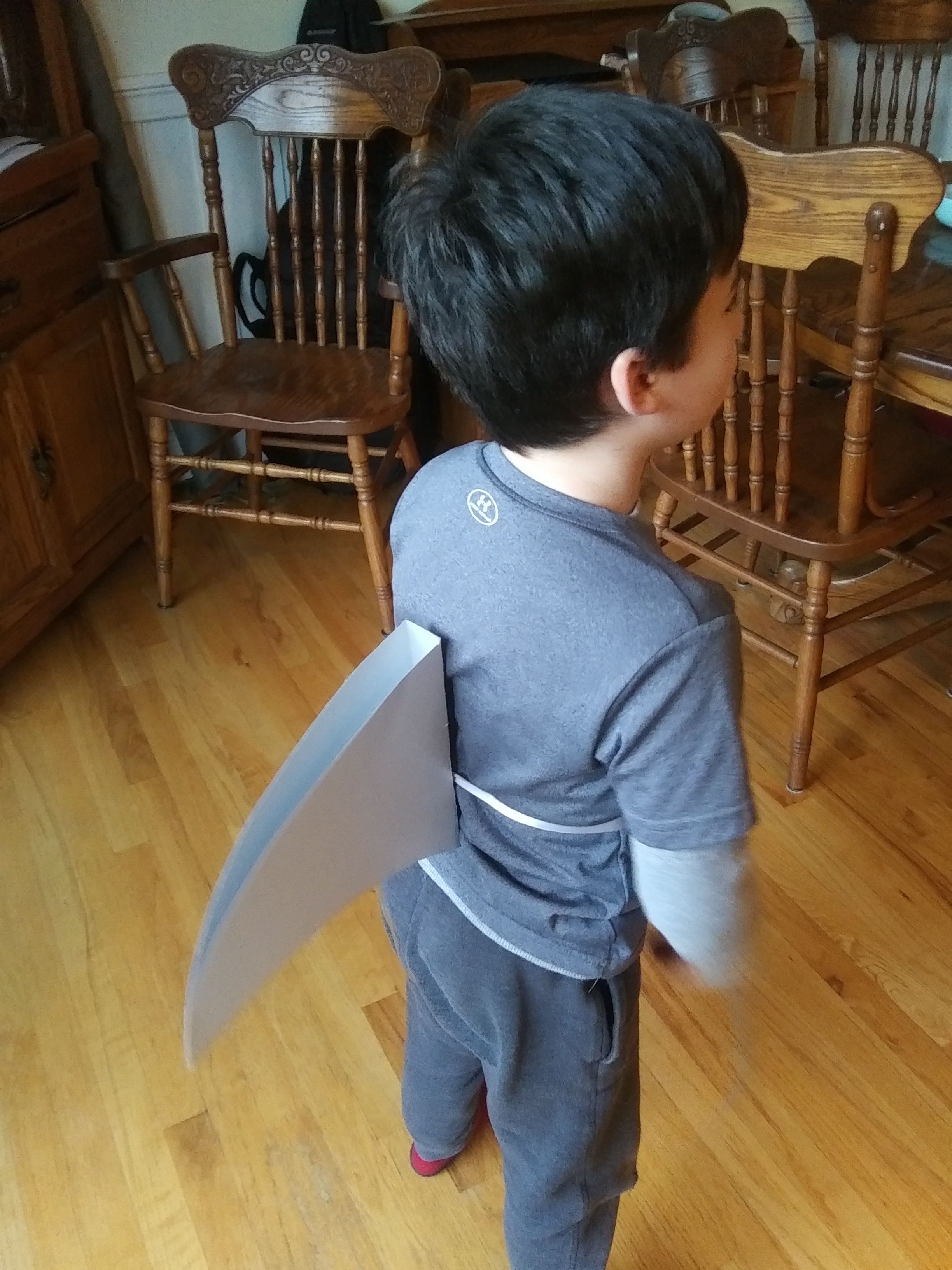
celebrate-picture-books-picture-book-review-shark-fin-craft

Fintastic Shark Fun


Sharks are awesome creatures and even feature as a home to another animal in today’s book! Follow the directions below and to make your own shark fin. 

Supplies

  • 2 pieces of 8.5 x 11 gray cardstock paper
  • Ribbon
  • Tape
  • Scissors
  • Pencil

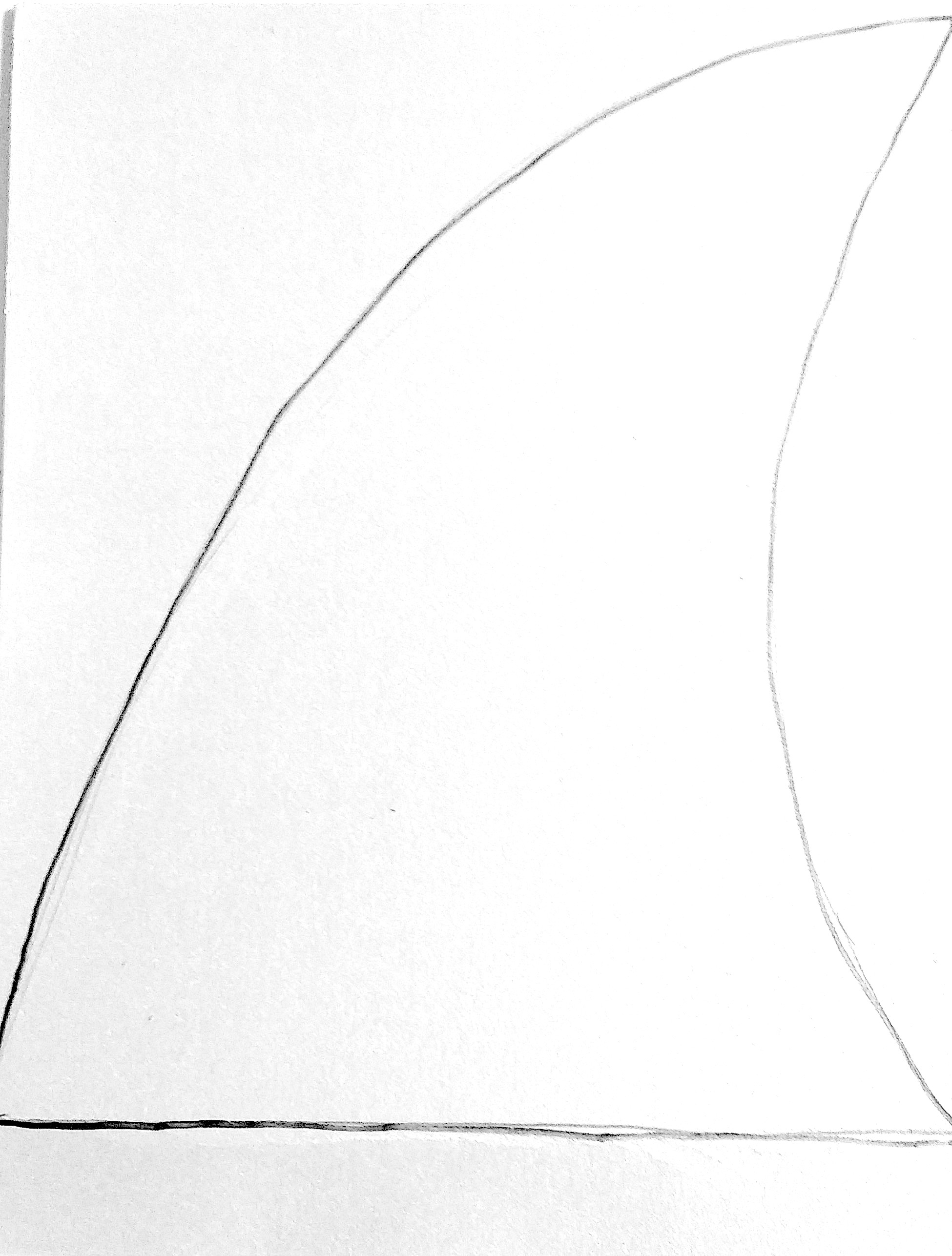
fin outline white

celebrate-picture-books-picture-book-review-shark-fin

Directions

  1. Tape the top of the two pieces of paper together
  2. Fold them back together
  3. Measure an inch up from the bottom of the papers (the un-taped side) and trace a straight line across both papers
  4. Trace a shark fin outline onto your paper. The shark outline should stop an inch above the bottom
  5. Cut out the fin on both pieces of paper. If you should cut through the tape, re-tape the tops together
  6. Fold along the lines of both papers so the folds face towards each other.
  7. Tape the folds so the fin becomes a triangle
  8. Cut two slits parallel to the folded lines
  9. Thread ribbon through slits

You can purchase Finding Home: Amazing Places Animals Live from these booksellers

Amazon | Barnes & Noble | Bookshop (discounted books and support for your local independent bookstore)

Picture Book Review

February 21 – It’s National Nest Box Week

About the Holiday

National Nest Box Week was established in the United Kingdom in 1997 to highlight how birds are often displaced from their natural nesting places with the destruction of the woodlands and fields birds call home. The holiday encourages people to pay attention to their local nesting birds and put up nest boxes to support the conservation of breeding birds. No matter where you live, birds’ ecosystems are fragile. You can make a big difference in the survival of your local bird population by building and maintaining nesting boxes for the spring and summer months. To learn how more about the holiday and how you can help, visit nestboxweek.com.

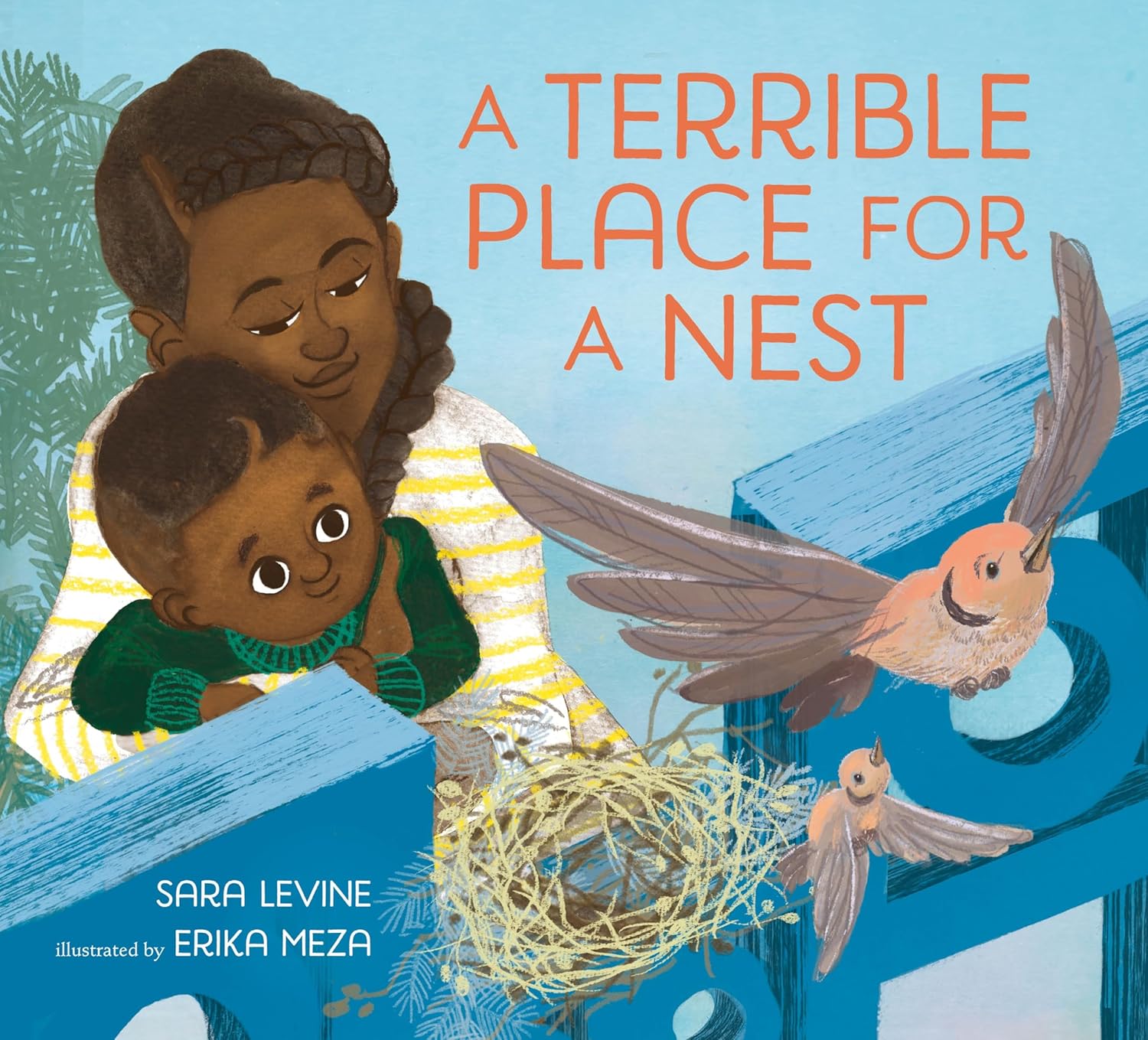
A Terrible Place for a Nest

Written by Sara Levine | Illustrated by Erika Meza


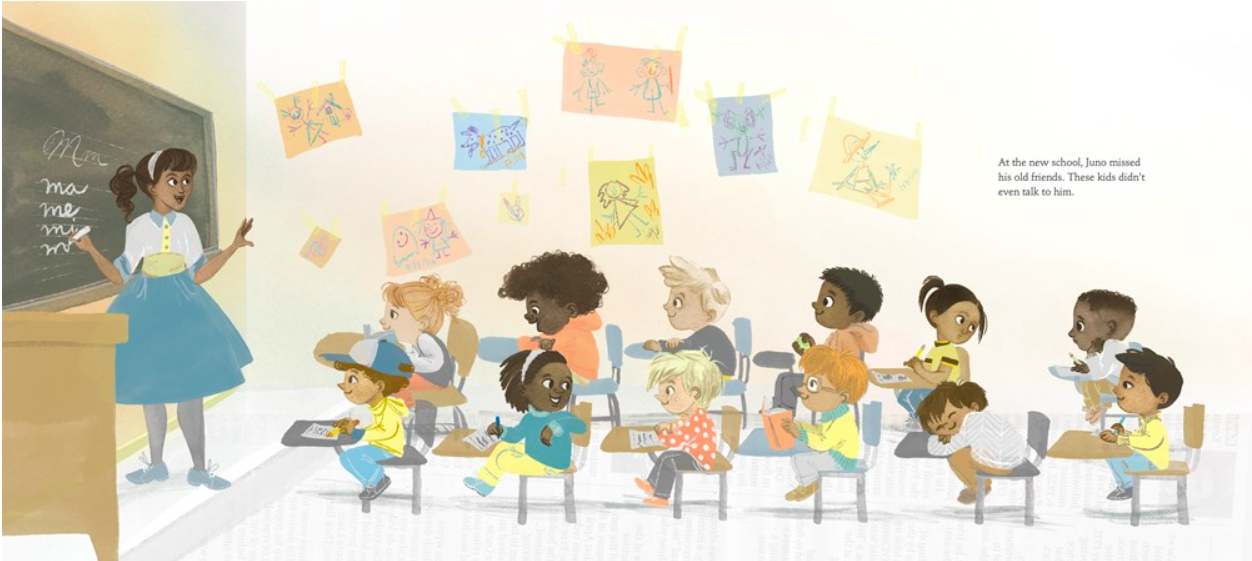
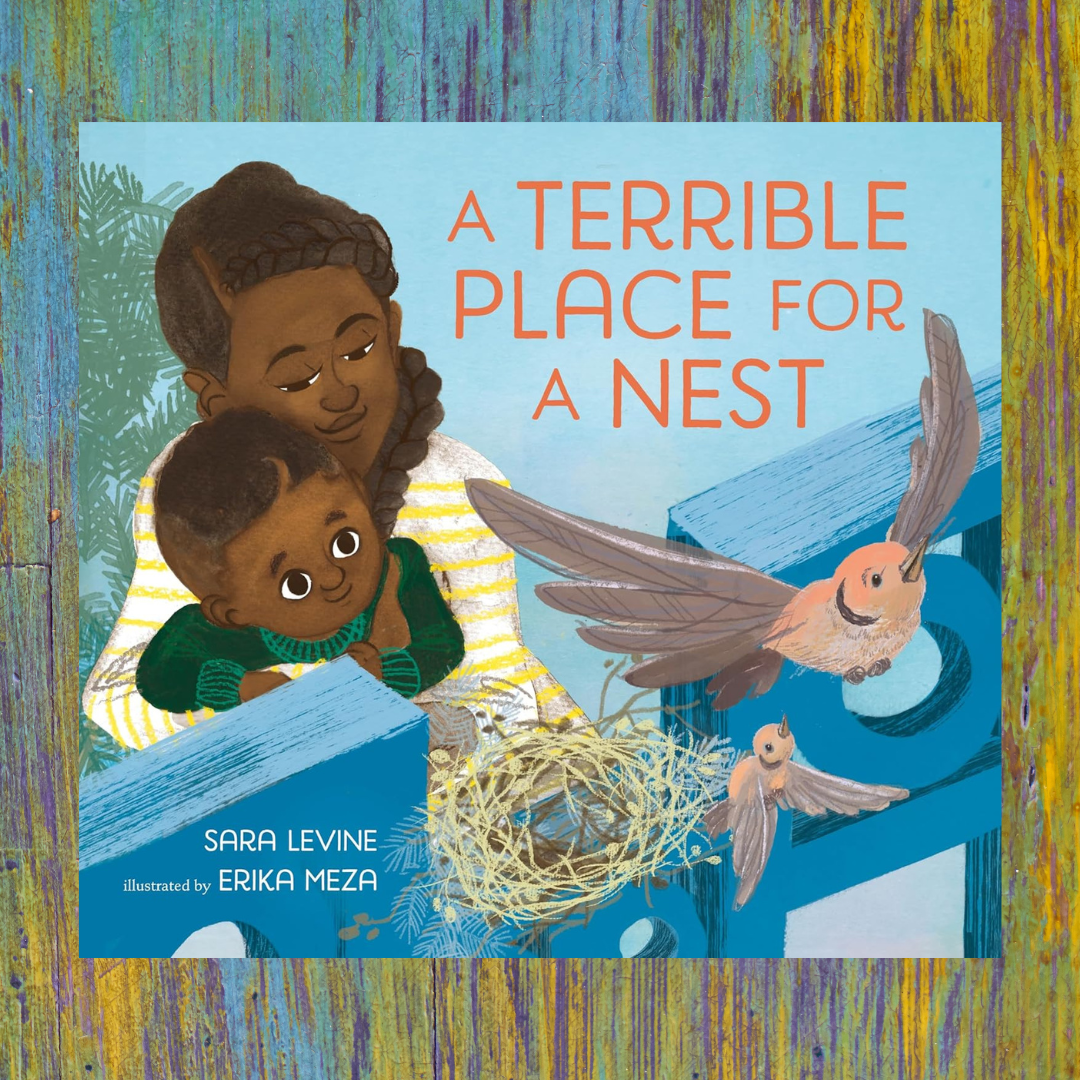
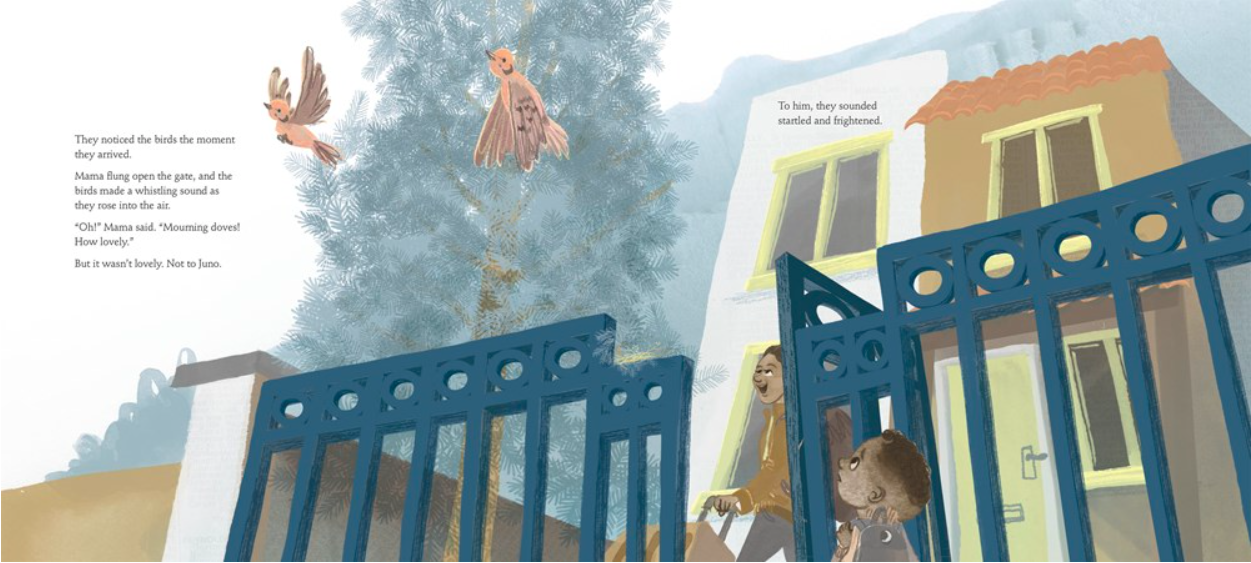
Displaced from their home, a mother and her son, Juno, move to a new place in a new neighborhood. Juno’s mother takes solace in the mourning doves that greet them, but Juno hears sadness and fear in their whistling coos. Nothing about the move feels right to Juno. He can’t get his favorite cereal at the grocery store, and he tells his mama that he’s “‘never going to fall asleep'” in his new room. 

At school he sits alone with no one to talk to. When he gets home he yells, “‘This is a terrible place!,'” frightening the mourning doves from their nest on the gate. The next day, when the movers come, they knock the nest from its perch, breaking the eggs and confirming to Juno his feelings about their new home.

Illustration © 2024, Erika Meza; text © 2024 Sara Levine. Courtesy of Roaring Brook Press.

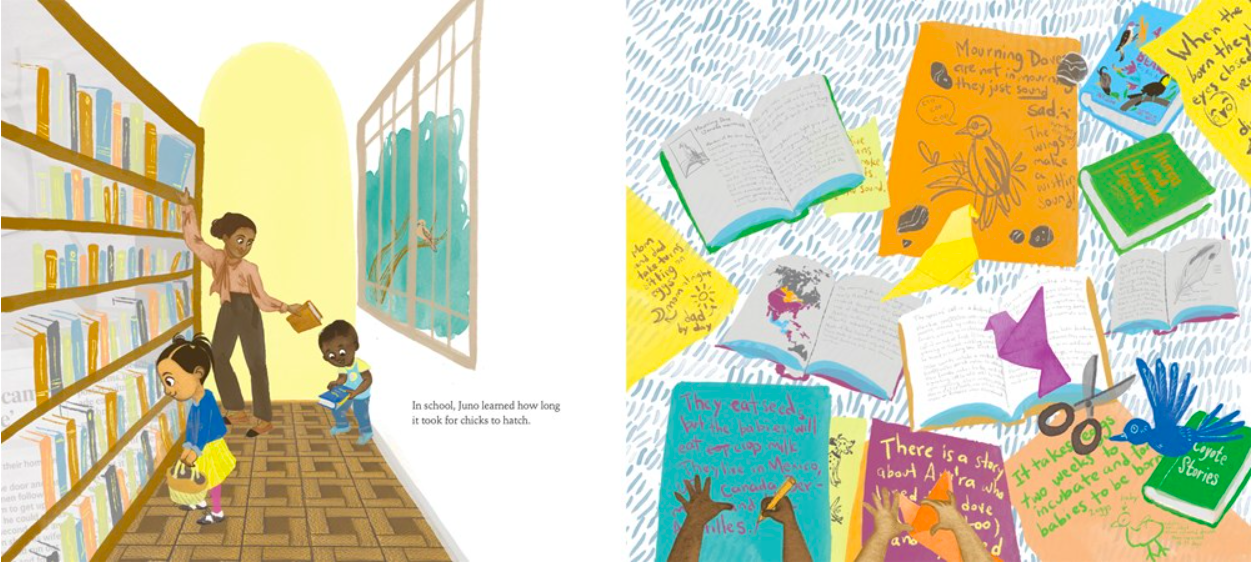
Later, Juno tries to rebuild the nest, and he and his mom buy millet seed to feed them. They’re happy to see the birds return to the yard—although the nest sits empty for days and weeks. Meanwhile, at school, Juno makes a friend of the girl who sits in front of him, talking and drawing and making paper birds together.

Still, no birds occupy the nest. At night in his unfamiliar room, where unpacked boxes of books and art supplies stand stacked against the wall, Juno thinks “maybe it didn’t feel safe to them.” But then one day, Juno notices with excitement that, just as he and his mom are settling into their new home, a dove is snugged into the nest. “Mama said this meant there were eggs.”

Illustration © 2024, Erika Meza; text © 2024 Sara Levine. Courtesy of Roaring Brook Press.

Juno and his new friend go to the school library to learn everything they can about mourning doves. On colored paper they write facts and draw pictures of adult and baby birds. And most importantly they make signs for the fence and gate, alerting people to the fragile nest and baby doves.

Then one bright, sunny morning, Juno looks out his window and sees babies! In their protected nest, the small mourning doves grow until one afternoon as Juno, his friend, and his mom enjoy a picnic in the yard, he watches as the fledglings fly from their nest. “‘I told them it wasn’t a great place for a nest,'” Juno says, but later that night, happily cuddled up with his mom, they agree, “But we made it work.”

Illustration © 2024, Erika Meza; text © 2024 Sara Levine. Courtesy of Roaring Brook Press.

In her honest and poignant story, Sara Levine allows her young protagonist to give vent to his true feelings. While he first reproaches the mourning doves for their poor choice of nesting place, his own deep disappointment, sorrow, and loneliness spill out when the eggs break. As weeks pass, however, Levine shows that just as Juno repairs the nest and makes his yard inviting for the doves again, he also makes a new friend, assimilates into school, and finds comfort in books and creating once more. Levine’s child-centered story is all the stronger for the quiet support Juno’s mother gives him, allowing him the space, time, and freedom to feel his emotions and work them out in his own way. Her final line, “‘But we made it work,'” offers optimism, camaraderie, and confidence in the face of change—the type of powerful spirit that can sustain us all.

In her affecting illustrations, Erika Meza uses color, facial expressions, and visual metaphors to compellingly show readers Juno’s transition as he navigates his way to acceptance of his new home. As the story begins, Meza uses darker and muted colors on the house and gate. As the doves accept Juno’s help, the colors brighten. Likewise, in the beginning, Juno and his mother appear sad and at a loss. Meza portrays Juno’s brown-painted room from above, as if readers are peering into a cardboard moving box. But as Juno makes friends, regains his love of learning, and the doves return, Meza’s color palette turns vivid, smiles return to Juno’s and Mama’s faces, and even the dark of night is dispelled by the dazzling light of the bedroom lamp as Juno and his mom snuggle together.

A candid story about moving away from home that is also applicable for other types of unexpected changes, A Terrible Place for a Nest validates the emotions children can experience when adjusting to new surroundings. For children struggling with change, especially, the story’s focus on taking time to adapt offers comfort and reassurance.

A Terrible Place for a Nest is highly recommended for families with a child or children who have difficulty with change and a must for school and public library collections.

Ages 4 – 8

Roaring Brook Press, 2024 | ISBN 978-1250861221

About the Author

Sara Levine is an award-winning picture book author, veterinarian and science educator. Her books, which include Bone by BoneTooth by ToothFlower TalkSensitive, and The Animals Would Not Sleep!, have received the AAAS/Subaru SB&F Prize, Bank Street College Best Book of the Year, Beehive Book Award, Cook Prize and the Mathical Book Prize. She loves doing school and library programs. Visit Sara at saralevinebooks.com.

About the Illustrator

Erika Meza grew up in Mexico and moved houses more often than she had birthdays. Having studied illustration in Paris, she now lives in London―her thirty-sixth address―where she paints, writes her own stories, and practices her uncanny ability to pack efficiently. Erika loves exploring, learning about many different places and cultures, and finding joy in the people who allow you to be yourself. Visit Erica at ericameza.com.

National Nest Box Week Activity

Watch a pair of mourning doves raise their nestlings from hatching to leaving the nest in this sweet video from Gary’s Backyard.

You can purchase A Terrible Place for a Nest at these booksellers

Amazon | Barnes & Noble | Bookshop (to support your local independent bookstore)

June 12 – It’s Great Outdoors Month

celebrate-picture-books-picture-book-review-turkey's-sandtastic-beach-day-cover

About the Holiday

Kids of all ages benefit from being outdoors whether they’re playing, helping out with home projects, gardening, or traveling. Simple pleasures and even time to be “bored” spark the imagination and creativity and can help kids learn patience and self-sufficiency. To celebrate Great Outdoors Month, plan an outing with your kids. It may turn into an adventure you never expected!

Thanks to Two Lions and Barbara Fisch at Blue Slip Media for sharing a copy of Turkey’s Sandtastic Beach Day with me for review consideration. All opinions on the book are my own.

Turkey’s Sandtastic Beach Day (Turkey Trouble)

Written by Wendi Silvano | Illustrated by Lee Harper


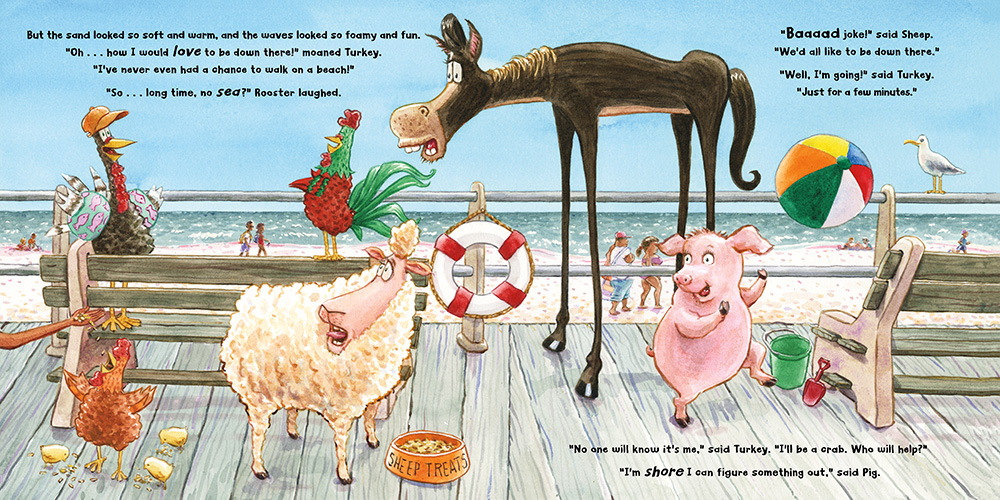
It’s the Summer Children’s Festival on the boardwalk, and Farmer Jake has brought Turkey and all his friends to meet the kids. They’re all happy to be there, except . . . Turkey really wants to be on the beach to feel the soft sand and play in the waves, and he’s determined to sneak down there “‘Just for a few minutes.'” He even knows how he’ll do it—by disguising himself as a crab. When Turkey asks for help, Pig immediately pipes up, “‘I’m shore I can figure something out.”

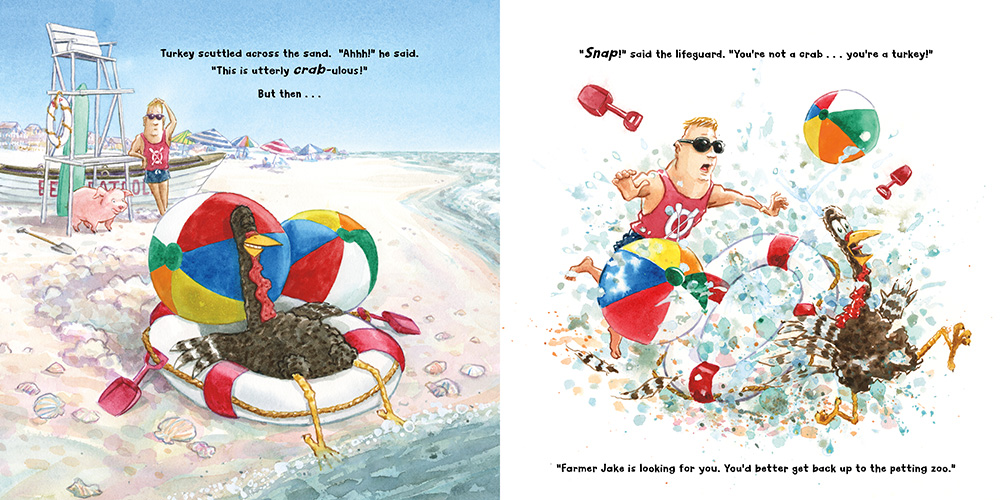
One life preserver, two beachballs, and two shovel “claws” later, Turkey makes his way to the sand. Pig stands by as a lookout for Farmer Jake and reminds Turkey to walk sideways. Turkey is just settling into his crab-costume-turned-beach-chair and dipping his feet in the water when the lifeguard discovers the ruse and rushes to roust Turkey back to the boardwalk’s petting zoo.

Undeterred, Turkey devises a way to disguise himself as a shell, and although he makes it back to the sand for a little ‘”sea-esta,'” he soon finds himself on the boardwalk again. He’s pretty impressed by the surfers, and with Cow’s encouragement decides to infiltrate a group of surfers with a clever get-up using beach trunks and a seaweed wig for that mop-top look. He paddles out, stands up, and is riding the crest of a monster wave until . . . he isn’t.

celebrate-picture-books-picture-book-review-turkey's-sandtastic-beach-day-boardwalk

Image copyright Lee Harper, 2023, text copyright Wendi Silvano, 2023. Courtesy of Two Lions.

Turkey’s about to give up on his dream of enjoying the beach when Horse comes up with another way Turkey can disguise himself and do a little snorkeling—easily accomplished with the fin from the surfboard and a set of false teeth. And it works, for awhile, until a swimmer shouts “‘SHARK!'” and “everyone bolted from the water, including Turkey.” 

Farmer Jake is not happy and scoops Turkey into a fishing net, telling him “. . . you’re fin-ished! Get back to the petting zoo.” Farmer Jake keeps careful tabs on his animals now . . . until he falls asleep, and the animals see their chance to join the sandcastle-building contest. Rooster works the crane, Horse carries an array of buckets, shovels, and sifters, Cow and Pig dig even more sand, and Turkey and Sheep pack and mold. 

When Farmer Jake wakes up, he can’t find his animals behind the mounds of sand. But when “Turkey Town” is declared the winner of the contest, he’s as proud as can be. And the prize? They all cheer when the judge announces they’ve won “‘. . . a free stay at a house on your own private beach!'” And they know just how to celebrate. They invite everyone at the festival to come along too. “It was the most sandtastic beach day ever!”

celebrate-picture-books-picture-book-review-turkey's-sandtastic-beach-day-crab-costume

Image copyright Lee Harper, 2023, text copyright Wendi Silvano, 2023. Courtesy of Two Lions.

What could be better that spending the summer with Turkey and his friends? Wendi Silvano’s beloved poultry pal is sure to delight fans with another adventure full of clever hijinks and lots of laughs on every page. Silvano’s nimble dialogue is not only stuffed with puns that will keep kids giggling and groaning but highlights the camaraderie among the animals and their quick-thinking creativity. Of course, friendship is the theme of all the books in the Turkey Trouble series, and here—in addition to readers—Farmer Jake, the animals, and all the visitors to the Summer Children’s Festival are the beneficiaries of Turkey’s generosity.

Spending time with Lee Harper’s farmyard friends is always a treat, and the seaside setting has inspired some of the goofiest disguises yet as well as that show-stopping winning sand castle that proves this is one talented group of animals. Harper is a master at depicting good-natured mayhem and laugh-inducing facial expressions all backed by the beautiful ocean and scenic boardwalk. Kids will spy lots of humorous shenanigans on the boardwalk and even a nod to the book’s placement in the series on the license plate for Farmer Jake’s wagon.

Whether your kids are fans of Farmer Jake, Turkey, and the crew or just discovering tight-knit group of friends, you’ll want to add Turkey’s Sandtastic Beach Day to your home bookshelves for sunny, laugh-out-loud story times all year round. The book is also a must addition to school and public library collections.

Ages 3 – 7

Two Lions, 2023 | ISBN 978-1662508356

About the Author

Wendi Silvano was born in Salt Lake City, Utah, and has lived in Oregon, Colorado, and Peru. The author of the Turkey Trouble series, she has a BA in early childhood education and taught preschool and elementary school for eleven years. She is the mother of five children and the owner of an assortment of odd pets that are not nearly as clever as Turkey. She now writes from her home in Colorado, where she enjoys hiking, reading, and playing the piano. Visit her online at http://www.wendisilvano.com.

About the Illustrator

Lee Harper is the author-illustrator of the books CoyoteThe Emperor’s Cool Clothes, and Snow! Snow! Snow! In addition to the Turkey Trouble series, Lee is also the illustrator of Looking for the Easy Life by Walter Dean Myers and the Woolbur books by Leslie Helakoski. Lee has four children, a German shepherd, two barn cats, two pigs, eleven chickens, and four sheep…but still no turkeys. Yet. He lives with his wife in Bucks County, Pennsylvania. Visit him online at http://www.leeharperart.com.

National Great Outdoors Month Activity

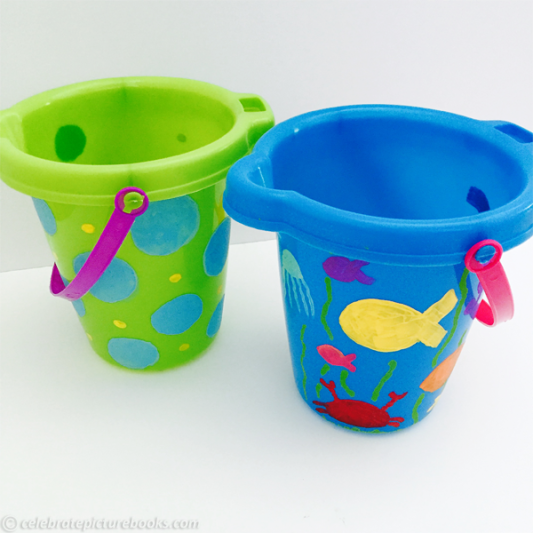
celebrate-picture-books-picture-book-review-bringing-the-outside-in-painted-pails-craft

Personalized Painted Pail


A trip to the beach or park isn’t complete without a pail to collect shells, seaweed, sea glass, pebbles, sticks, nuts, or other things in. But why should all the cool stuff be on the inside? With this craft you can decorate your pail to show your unique personality!

Supplies

  • Plastic or metal pail
  • Craft paint in various colors
  • Crystal Clear Acrylic Coating, for multi-surface use
  • Paint brush

Directions

  1. Paint designs on the pail
  2. When paint is dry spray with acrylic coating to set paint
  3. Let dry

celebrate-picture-books-picture-book-review-turkey's-sandtastic-beach-day-cover

You can find Turkey’s Sandtastic Beach Day at these booksellers

Amazon | Barnes & Noble | Books-a-Million

To support your local independent bookstore, order from

Bookshop

Picture Book Review
April 17 – International Haiku Day

celebrate-picture-books-picture-book-review-peek-a-boo-haiku-cover

About the Holiday

Small things are amazing—and surprising! We all know good things come in small packages, and just look at the wisdom, humor, and capacity for love of children. The same goes for haiku—the smallest form of poetry in size but never in impact. Coming mid-way through National Poetry Month, today’s holiday shines a spotlight on the haiku. The simple 5-7-5 rule that we all learn in school doesn’t begin to define the complexity of these three-line beauties that distill the world into little nuggets that make readers see life in amazing and surprising ways.

Peek-a-Boo Haiku

Written by Danna Smith | Illustrated by Teagan White


In this beautiful board book, little ones are taken through an auditory and visual wonderland from winter through spring, summer, and fall as two mice visit woodland, meadow, garden, and aquatic creatures to play, discover, and celebrate the changing seasons.

celebrate-picture-books-picture-book-review-peek-a-boo-haiku-winter-hidden

Children will enjoy predicting what animals are hiding behind the log and boulder. Image copyright Teagan White, 2023, text copyright Danna Smith, 2023. Courtesy of Little Simon.

Each of Danna Smith’s haiku verses surprises, sparkling with lovely alliteration and evocative language that invites young readers to anticipate and predict who will appear when the flaps on  the facing page are lifted. Smith’s giggly humor and exceptional imagination elevate readers’ experience as she deftly uses games and experiences familiar to children (hide-and-seek, confetti, splashing in water, and lullabies to name a few) in ways that will spark creative thinking and bond them to the natural world. As late fall with its nighttime frost appears in the last spread, Smith’s gentle, sleepy verse welcomes little ones to drift off to dream along with the two snuggled up mice.

celebrate-picture-books-picture-book-review-peek-a-boo-haiku-winter-bunnies

When the rabbits are revealed, Smith’s verse encourages readers to talk about “long ears” and “short ears.” Image copyright Teagan White, 2023, text copyright Danna Smith, 2023. Courtesy of Little Simon.

Any book illustrated by Teagan White is a treasure, and in Peek-a-Boo Haiku, she populates Smith’s various habitats with adorable, yet realistic animals that will charm little readers and adults alike. White’s glorious colors add breathtaking beauty to her gorgeously detailed pages. Each spread is a tiny masterpiece that gives children and adults much to discover and talk about as they move through the seasons. The final spread, washed in somnolent shades of twilight, puts little ones in the mind for sleep, just as the owl snugged into its tree-trunk nest. Kids will enjoy finding the mice (appearing alone or together, allowing the youngest children to engage with the idea of one and/or two) in each spread, and the variety of creatures, plants, and environments provide a wealth of learning, from vocabulary to math to science, for a wide-range of ages and development. 

celebrate-picture-books-picture-book-review-peek-a-boo-haiku-spring-bird-shown

When the colorful bird is revealed behind stems of flowers, Danna Smith invites readers to talk about what she has in her beak, where it came from, and what she will do with it. Image copyright Teagan White, 2023, text copyright Danna Smith, 2023. Courtesy of Little Simon.

Exquisite in every way, Peek-a-Boo Haiku is a book adults and children will love to share again and again and is a perfect choice as a gift for special occasions, baby showers, new siblings, or simply to add to a child’s bookshelf. This superlative board book also belongs in all preschool and kindergarten classrooms as well as school and library collections.

Ages Birth to 5

Little Simon, 2023 | ISBN 978-1665926461

About the Author

Danna Smith is a poet and award-winning author of numerous books for children, including One Blue GnuRooftop GardenWake Up, Freight Train!; and several Little Golden Books. Her nonfiction picture book, The Hawk of the Castle: A Story of Medieval Falconry, received two starred reviews and is a Junior Library Guild Selection and a Bank Street College of Education Best Children’s Books of the Year. Danna currently lives in northern California, where she is hard at work on her next book. For more information about her books and teaching activities, visit her website at DannaSmithBooks.com.

About the Illustrator

Teagan White is an artist and author who creates playful watercolor scenes of the natural world and the friendly creatures who inhabit it. Teagan lives in Oregon, enjoys visiting seagulls at the beach, and has illustrated nine picture books. Find out more at TinyMothStudios.com.

Take a Peek at this Peek-a-Boo Haiku Book Trailer!

National Haiku Day Activities

Screen Shot 2023-04-08 at 11.35.14 AM

Woodland animals love to play hide-and-seek in trees, behind logs and rocks, under bushes, and in all sorts of places. This Peek-a-Boo Haiku Memory Game lets little ones find matching pairs of animals while building observation skills and having lots of fun!

Screen Shot 2023-04-08 at 11.34.29 AM

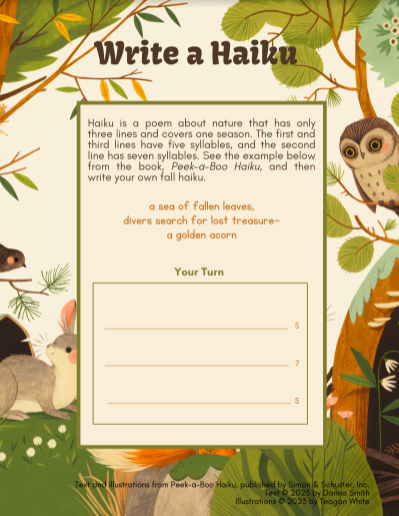
Young children will enjoy writing their own haiku from what they see in nature with this adorable Write a Haiku Page that gets them thinking and using their imagination.

celebrate-picture-books-picture-book-review-peek-a-boo-haiku-cover

You can find Peek-a-Boo Haiku at these booksellers

Amazon | Barnes & Noble | Books-a-Million

To support your local independent bookstore, order from

Bookshop

Picture Book Review
March 7 – It’s National Reading Month

celebrate-picture-books-picture-book-review-lovebird-lou-cover

About the Holiday

In February we show our love with valentines, candy, and flowers. How can we continue to prove our love through the month of March? With books! National Reading Month is the perfect time to say “I love you,” by buying your family members and/or friends a special book they’ll cherish. Reading with your kids also gives you time to relax, giggle, talk, and enjoy some precious moments together. Why not start with today’s book, which is all about family love! 

I’d like to thank Tammi Sauer for sharing a copy of Lovebird Lou with me for review consideration. All opinions about the book are my own.

Lovebird Lou

Written by Tammi Sauer | Illustrated by Stephanie Laberis


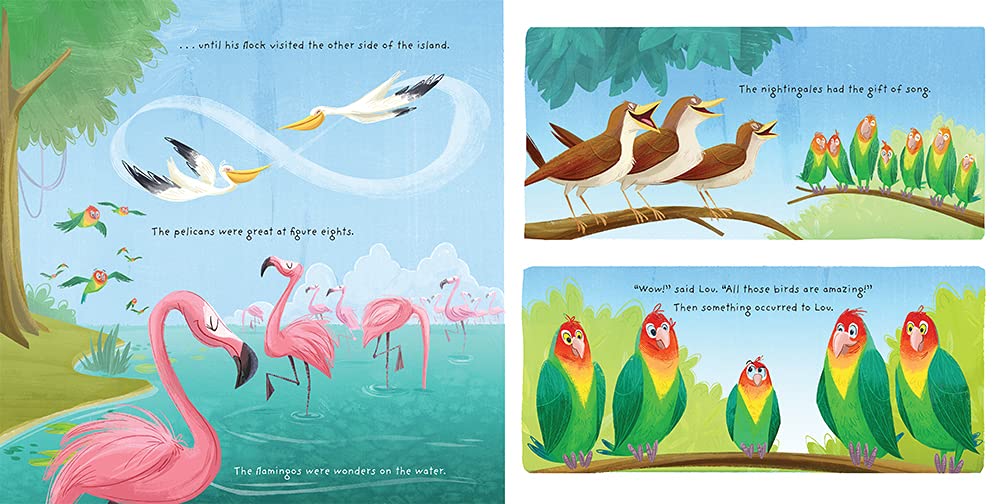
“Lou came from a long line of lovebirds.” His relatives all loved sharing the love, and Lou loved being a lovebird “until his flock visited the other side of the island.” There he saw pelicans who could fly in figure eights, flamingos who could stand on one leg, and nightingales who sang beautiful songs. Lou looked at his ordinary family and decided he wanted to be a pelican.

celebrate-picture-books-picture-book-review-lovebird-lou-family

Image copyright Stephanie Laberis, 2022, text copyright Tammi Sauer, 2022. Courtesy of Union Square Kids.

Not wanting to quash his dreams, his mom said, “‘Okay, cupcake.'” Lou took off from the branch and flew through the air, doing intricate patterns just like the pelicans. His family members were all supportive. “‘We love you, Lou!'” they shouted, and when Lou bonked into a tree, his mom and dad caught him before he fell.

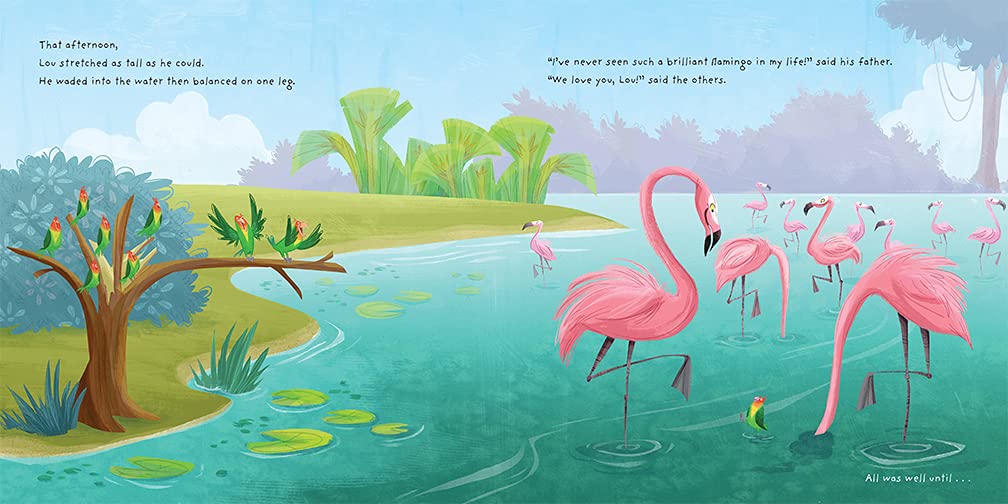
Lou thought maybe he’d make a better flamingo, so he joined the big pink birds in the shallow water and adopted the pose while his family cheered him on. “‘We love you, Lou!'” they all squawked. He was doing great until he lost his footing and splashed down. His parents were right there to dry him off and encourage his next dream to become a nightingale.

celebrate-picture-books-picture-book-review-lovebird-lou-pelicans

Image copyright Stephanie Laberis, 2022, text copyright Tammi Sauer, 2022. Courtesy of Union Square Kids.

When Lou joined the ethereal chorus, he opened his beak and… well… his family members were his only fans. Back with his parents, Lou was disappointed that he couldn’t be a pelican, flamingo, or nightingale. “‘Maybe I’ll just be a rock.'” Lou said. His parents were all in and they even found a perfect place for him to sit and made him a “#1 Rock” sign to accompany him.

All day, Lou excelled at sitting in his spot until darkness and then rain fell. Lou was downhearted, wet, and scared. Lou knew the pelicans, flamingos, and nightingales couldn’t help him. He hurried his tail feathers back to his lovebird family, who welcomed him with lots of reassurances and “‘We love you, Lou!'” “‘I love you too!’ said Lou.”

The pelicans, flamingos, and nightingales thought that was so sweet. In fact, the next day they all shared their love in their own way too. As for Lou, he now understood that “lovebirds were good at the most important thing of all.”

celebrate-picture-books-picture-book-review-lovebird-lou-flamingos

Image copyright Stephanie Laberis, 2022, text copyright Tammi Sauer, 2022. Courtesy of Union Square Kids.

Tammi Sauer’s sweet story shows kids that every family has their own traditions and talents that are just right for them. When Lou is dazzled by the pelicans, flamingos, and nightingales – who all seem more exciting than his one-note family – and wants to emulate them, his parents’ hilarious support of his endeavors are spot on and will make both kids and adults laugh with recognition. Sauer’s quick pace, silly endearments, and frequent choruses of “‘We love you, Lou!'” will have kids wanting to hear the story over and over to chime in on each expression of love.

Stephanie Laberis’s vibrant lovebirds – first introduced in pairs of cuddly closeness and with Lou sandwiched between mom and dad – are charming and, in one funny image, look comically clueless as they watch the other birds demonstrate their special abilities. Little Lou is adorable as he tries his best to keep up with the other birds, tumbling with the pelicans, balancing with the much bigger flamingos, and scaring the nightingales with his raucous squawk. Despite his setbacks, Lou is always ready to try again, which makes both his dejected and his hopeful expressions touching. And hearts will be full when Lou – and the other birds – learn that all-important lesson about love.

A humorous and moving book about family togetherness, Lovebird Lou will be a well-loved addition to home, school, and public library collections.

Ages 3 – 8

Union Square Kids, 2022 | ISBN 978-1454941880

Discover more about Tammi Sauer and her books on her website.

To learn more about Stephanie Laberis, her books, and her art, visit her website.

National Reading Month Activity

celebrate-picture-books-picture-book-review-lovebirds-coloring-page

Lovebirds Coloring Page


Get cozy with your loved ones and color these adorable lovebirds!

Lovebirds Coloring Page

celebrate-picture-books-picture-book-review-lovebird-lou-cover

You can find Lovebird Lou at these booksellers

Amazon | Barnes & Noble | Books-a-Million

To support your local independent bookstore, order from

Bookshop | IndieBound

Picture Book Review
January 5 – National Bird Day

celebrate-picture-books-picture-book-review-birds-explore-their-extraordinary-world-cover

About the Holiday

Coming at the end of the annual Christmas Bird Count conducted in conjunction with the Audubon Society, National Bird Day turns the focus on the special behavioral and physical needs of birds and works to ensure that all birds—whether kept as pets or living on farms or in their natural environments—are treated compassionately. The day also raises awareness of the dangers that threaten many species of birds with extinction. To celebrate today’s holiday, take a walk in your area or even just in your backyard and take special note of the birds you see. Now that winter has set in making food scarce for wild birds, consider hanging a bird feeder or making one from a pinecone, peanut butter, and seed as in the activity below. 

Thanks to Bloomsbury Children’s Books for sending me a copy of Birds: Explore their extraordinary world for review consideration. All opinions on the book are my own.
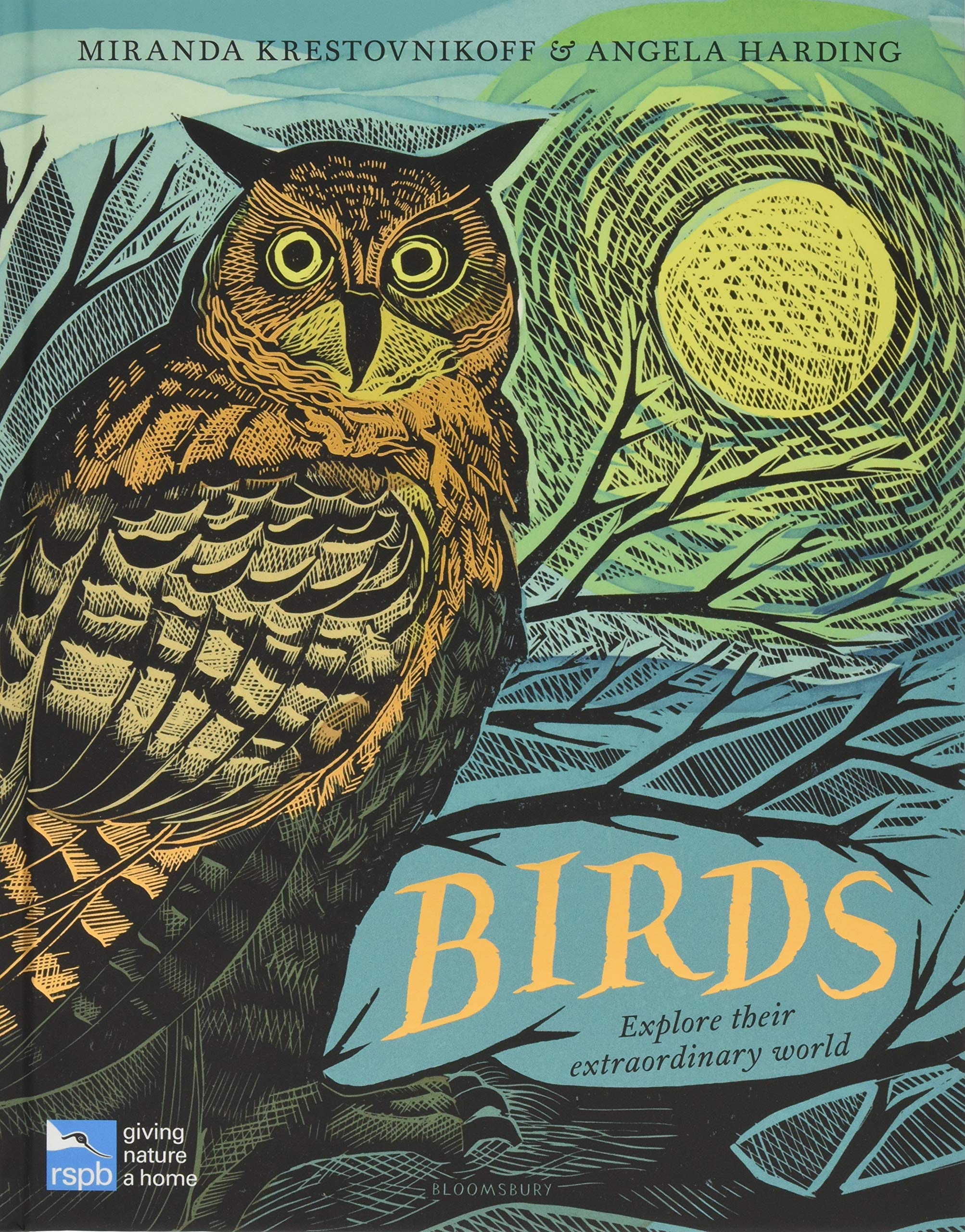
Birds: Explore their extraordinary world

Written by Miranda Krestovnikoff | Illustrated by Angela Harding


To love birds is to marvel over everything about them from their smooth gliding flight and beautiful songs to their colorful plumage and intricate nests that protect fragile eggs from the elements and predators. With a stunning number of species, birds are found around the world and living in every kind of climate. In Miranda Krestovnikoff and Angela Harding’s eye-catching compendium, readers learn about seven families of birds – birds of prey, seabirds, freshwater birds, flightless birds, tropical birds, tree dwellers, and passerines. 

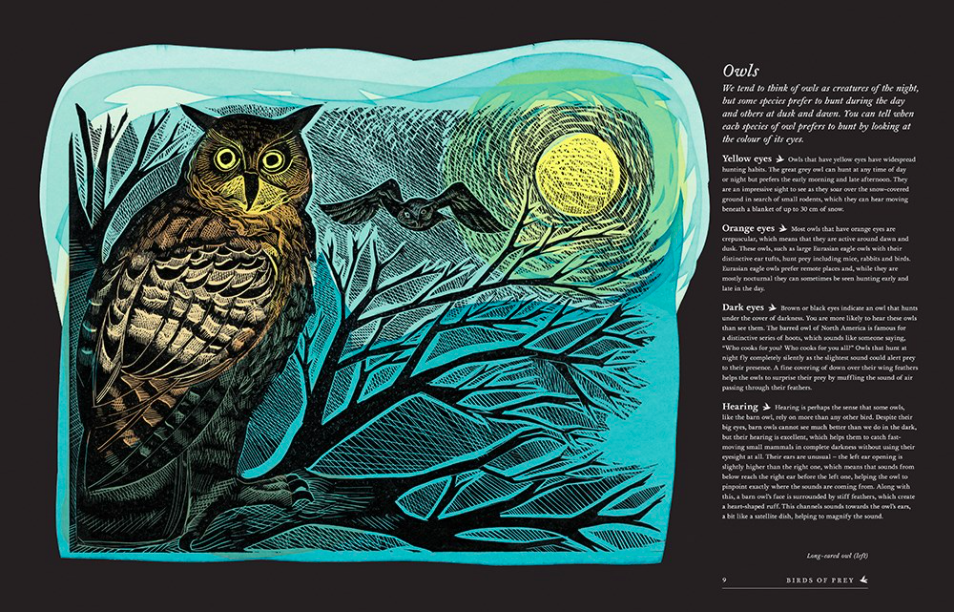
Each chapter opens with general facts on the behavior, anatomical features, and habitat that determine the order in which a bird is categorized. Integrated with this information are descriptions of specific birds within the order. In the section on Birds of Prey, for instance, readers learn about sparrowhawks; fish-eating ospreys; and golden eagles, which can “spot a rodent from over a mile away and a rabbit from nearly double that distance.” Children also learn about extreme birds of prey: the fastest, largest, smallest, tallest, and baldest and how their distinctive feature helps them thrive. Kids also discover how they “can tell when each species of owl prefers to hunt by looking at the color of its eyes.”

celebrate-picture-books-picture-book-review-birds-explore-their-extraordinary-world-owls

Image copyright Angela Harding, 2020, text copyright Miranda Krestovnikoff, 2020. Courtesy of Calkins Creek.

The next chapter takes readers to coastal areas to learn about the seabirds that scour the water from the sky, searching for food and waders, that are found along the water’s edge and “feed on the variety of high-protein invertebrates that lie hidden in the mud.” Children learn about the birds that populate warmer waters, such as blue-footed boobies, terns, and frigatebirds as well as those who survive in colder waters, such as gulls, and kittiwakes. Readers will also find a fascinating description of the gannet and learn how it can safely “dive into the sea at speeds of 60 miles an hour from an impressive height of up to 100 feet” to feed.

From sea birds, readers move on to freshwater birds like ducks, swans, grebes, and Canada geese. Even the bright flamingo is here with its distinctive scoop-shaped beak that is “uniquely designed to be used upside down and helps them to filter out tiny brine shrimps and blue-green algae from the water, which, when digested, give them their pink color.” The flamingo isn’t the only bird with an unusual way to acquire their prey, and kids will discover the clever ways pelicans, herons, and kingfishers (which use “objects such as sticks, feathers, and even discarded popcorn as lures”) find food.

And then there are the “more than 50 bird species across the world [that] stay firmly on the ground (or on water)” or just “choose not to fly very often.” These flightless birds include kiwis, kākāpōs, southern cassowaries, ostriches, and Penguins. Penguins vary in size, from the “little penguin (also known as the fairy or blue penguin)” which comes to shore to nest only at night and stave off predators with their oversized voices, to the emperor penguin. Occasional fliers include great bustards, domestic chickens, and tinamous.

celebrate-picture-books-picture-book-review-birds-explore-their-extraordinary-world-penguin

Image copyright Angela Harding, 2020, text copyright Miranda Krestovnikoff, 2020. Courtesy of Calkins Creek.

When you hear about extravagant birds, you most likely think of tropical birds. “Rainforests are packed with a range of incredible species with dazzling plumage and bizarre courtship displays.” Readers will learn about the appearance and mating rituals of scarlet macaws, Raggiana birds of paradise, and the Andean cock-of-the-rock. A detailed description of the bowerbird and the male bird’s careful and artistic nest (or bower) building is funny, poignant, and even a little bit human. Then readers are treated to some tropical bird extremes: smallest bird, longest bill, and smelliest as well as a poisonous species and one that makes its own musical instrument.

Of course, woodlands are the home of many bird species, and in the chapter on Tree Dwellers, readers learn about acorn woodpeckers and great hornbills that use trees for food and shelter; tawny frogmouths and potoos that use trees for camouflage; and nuthatches, greater honeyguides, and yellow-bellied sapsuckers, which find all the food they need among the bark, leaves, and branches of trees.

celebrate-picture-books-picture-book-review-birds-explore-their-extraordinary-world-chickens

Image copyright Angela Harding, 2020, text copyright Miranda Krestovnikoff, 2020. Courtesy of Calkins Creek.

Next up are passerines, or perching birds, which make up the “largest group of birds, with over half of all known species falling into this category.” Corvids, a group that includes the common raven, crows, magpies, and rooks, are considered to be the most intelligent birds. “These birds have a remarkable ability to solve problems in order to find food, in some cases performing better than young children or chimpanzees!” Readers will be impressed with their tricks and clever use of tools (that even include cars). Children learn about cooperative breeders, which rely on their extended family to help raise the young from year to year. Passerines also include many of the garden birds we find in our backyards and which fill the air with song. Readers discover facts about blue tits, robins, and finches in this section.

The next sections give detailed and interesting information on the features we most associate with birds: their feathers, beaks, eyes, nesting habits, eggs, migration patterns, and birdsong. The book ends with perhaps the most adaptable birds in the world: those that make their homes on glaciers, mountain tops, and in the Arctic snow as well as urban birds, which live among people in crowded cities, nesting on tall cathedrals and skyscrapers and foraging for food in garbage cans and on the street.

celebrate-picture-books-picture-book-review-birds-explore-their-extraordinary-world-woodpeckers

Image copyright Angela Harding, 2020, text copyright Miranda Krestovnikoff, 2020. Courtesy of Calkins Creek.

For young ornithologists, Miranda Krestovnikoff, a wildlife expert, offers a compelling, eye-opening, and accessible introduction to a wide variety of birds, placing them in their natural environments and revealing intriguing facts and tantalizing tidbits that inform and will spark a continued interest in learning more about the world’s feathered creatures. Krestovnikoff’s engaging writing style will captivate readers and keep them turning the pages to discover birds that are both familiar and new to them. The comprehensive nature of the book allows kids in all parts of the world to learn more about their native birds while creating a global connection with these most recognized and widely distributed creatures.

Accompanying Krestovnikoff’s text are Angela Harding’s beautiful linocuts that depict birds in mid-flight, capturing prey on land and water, engaging in mating rituals, and building and protecting their nests and young. Harding’s use of natural colors and exquisitely etched landscapes set off each bird in breathtaking illustrations that invite readers to linger to enjoy their full impact. Each illustration is captioned with the bird’s species.

A gorgeous and educational book that readers of all ages will love dipping into again and again, Birds: Explore their extraordinary world is a must for bird lovers and highly recommended for home, school, and public libraries.

Ages 7 and up

Bloomsbury Children’s Books, 2020 | ISBN 78-1408893913

Discover more about Miranda Krestovnikoff and her books on her website.

To learn more about Angela Harding, her books, and her art on her website.

National Bird Day Activities

celebrate-picture-books-picture-book-review-beautiful-birds-word-search

Beautiful Birds Word Search Puzzle


It’s fun to watch for different kinds of birds when you take a walk or in your own backyard. Can you find the names of twenty types of birds in this printable Beautiful Birds Word Search Puzzle? Here’s the Solution!

cpb-bird-feeder-i

Pinecone Bird Feeder


Pinecone bird feeders are quick to make and great for your backyard fliers. The combination of peanut butter, lard, or vegetable shortening and a quality seed mixture provide birds with the fat and nutrition they need to stay warm and healthy during the winter.

Supplies

  • Pinecones
  • Peanut butter, vegetable shortening, or lard
  • Birdseed
  • String
  • Knife or wooden spreader
  • Spoon

Directions

  1. Tie a long length of string around the middle of the pinecone
  2. Spread the peanut butter, vegetable shortening, or lard on the pinecone
  3. Sprinkle a thick coating of birdseed on the pinecone, pressing it into the covering so it will stick
  4. Tie the pinecone feeder onto a tree branch or other structure
  5. Watch the birds enjoy their meal!

celebrate-picture-books-picture-book-review-birds-explore-their-extraordinary-world-cover

You can find Birds: Explore their extraordinary world at these booksellers

Amazon | Barnes & Noble | Books-a-Million

To support your local independent bookstore, order from

Bookshop | IndieBound

Picture Book Review