November 24 – Picture Book Month

About the Holiday

We’re still celebrating one of the best months of the year—Picture Book Month! If you’re starting your holiday shopping, don’t forget to add picture books to your list for the kids in your life. With so many picture books to choose from on all kinds of topics, there’s sure to be a perfect book for each child. You know what they say—and it’s really true: A book is a gift you can open again and again, and today’s book is loaded with interactive elements that will keep kids coming back again and again! 

Thank you to Twirl and Barbara Fisch at Blue Slip Media for sending me a copy of this book for review!

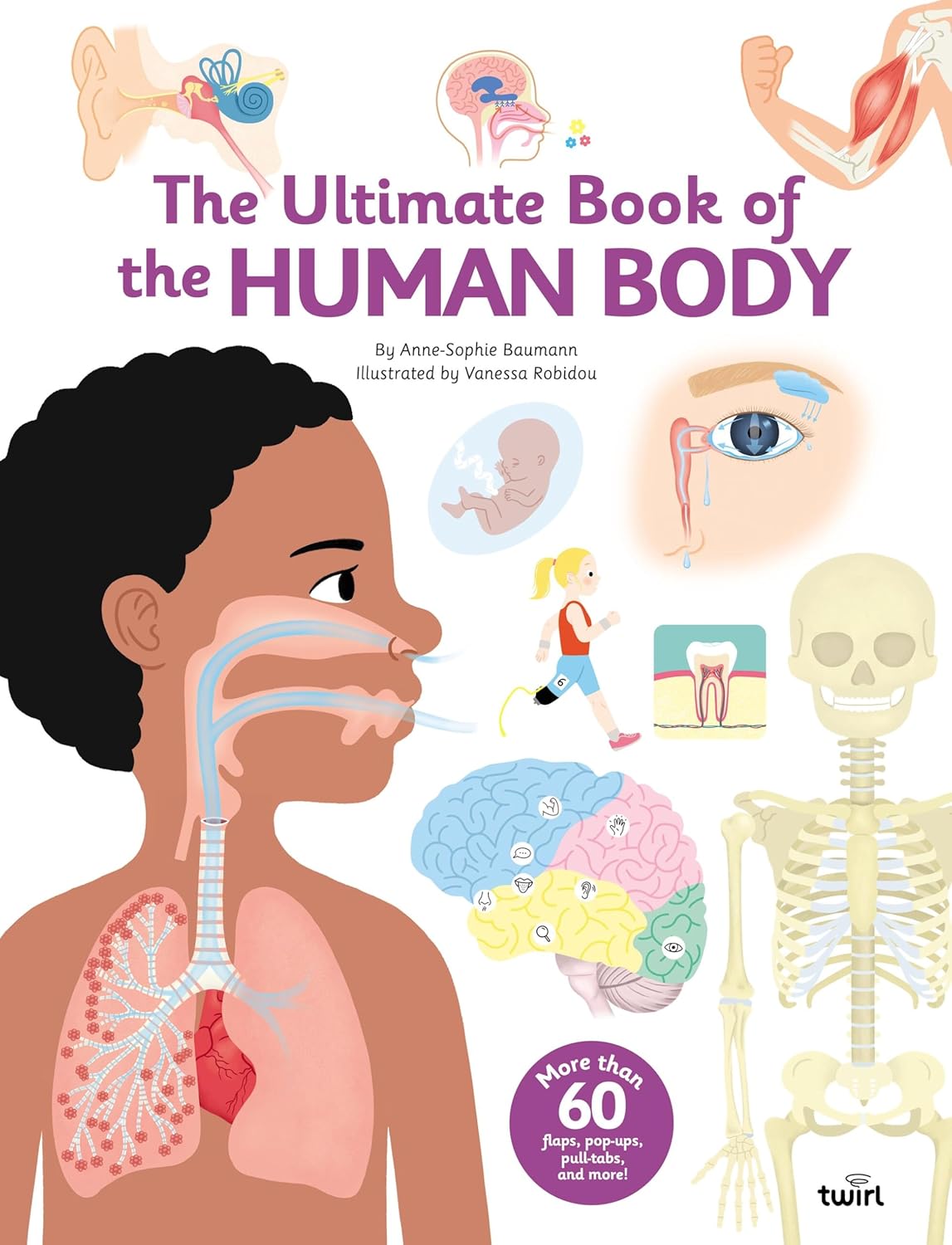
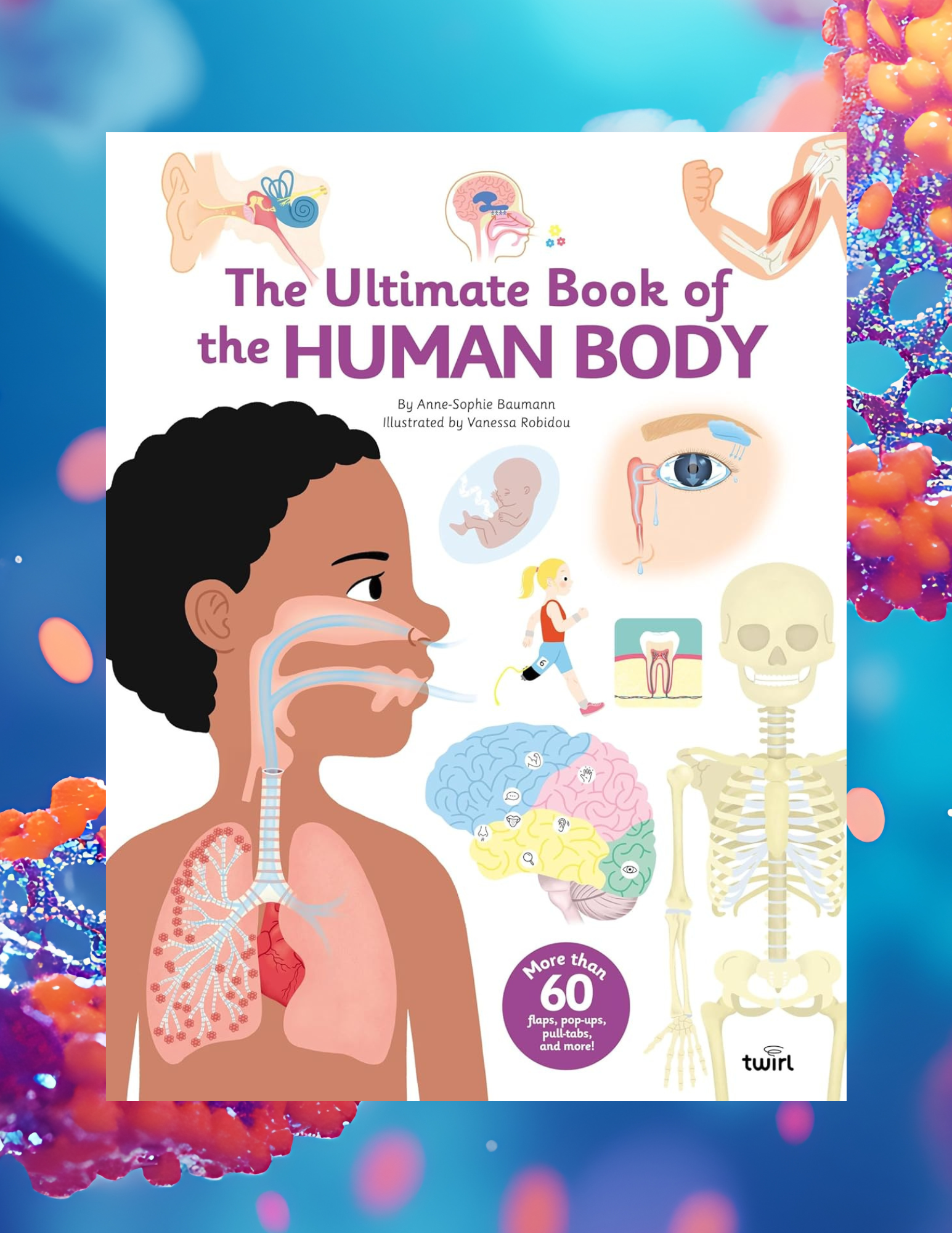
The Ultimate Book of the Human Body

Written by Anne-Sophie Baumann | Illustrated by Vanessa Robidou


If you’re raising or know a child who’s a future medical professional or one who’s simply interested in learning all about health and anatomy, they’ll be enthralled with The Ultimate Book of the Human Body. Teachers and other educators will also find this book an impactful introduction to how the body works that students will love exploring.

Offering an astonishing amount of information on every page, this oversized book is an interactive marvel that engages children through short and detailed, yet easily understood paragraphs that analyze all parts of the body from the tiniest mole to the largest organ: the skin. More than 60 flaps, pull tabs, and tiny booklets take kids under the skin and inside the body with illustrations worthy of a medical textbook. There’s even an articulated skeleton that demonstrates how our joints work. 

Illustration @ 2025 by Vanessa Robidou. Text © 2025 by Anne-Sophie Baumann. Courtesy of Twirl.

The book is broken into these eleven sections:

The Skeleton: Bones and More in which children learn about bone shapes; the makeup of bones; how bones heal; and information on the skull, spine, and joints. They can interact with a full-size hand that reveals all 27 bones that allow the fingers and wrists to move the way they do.

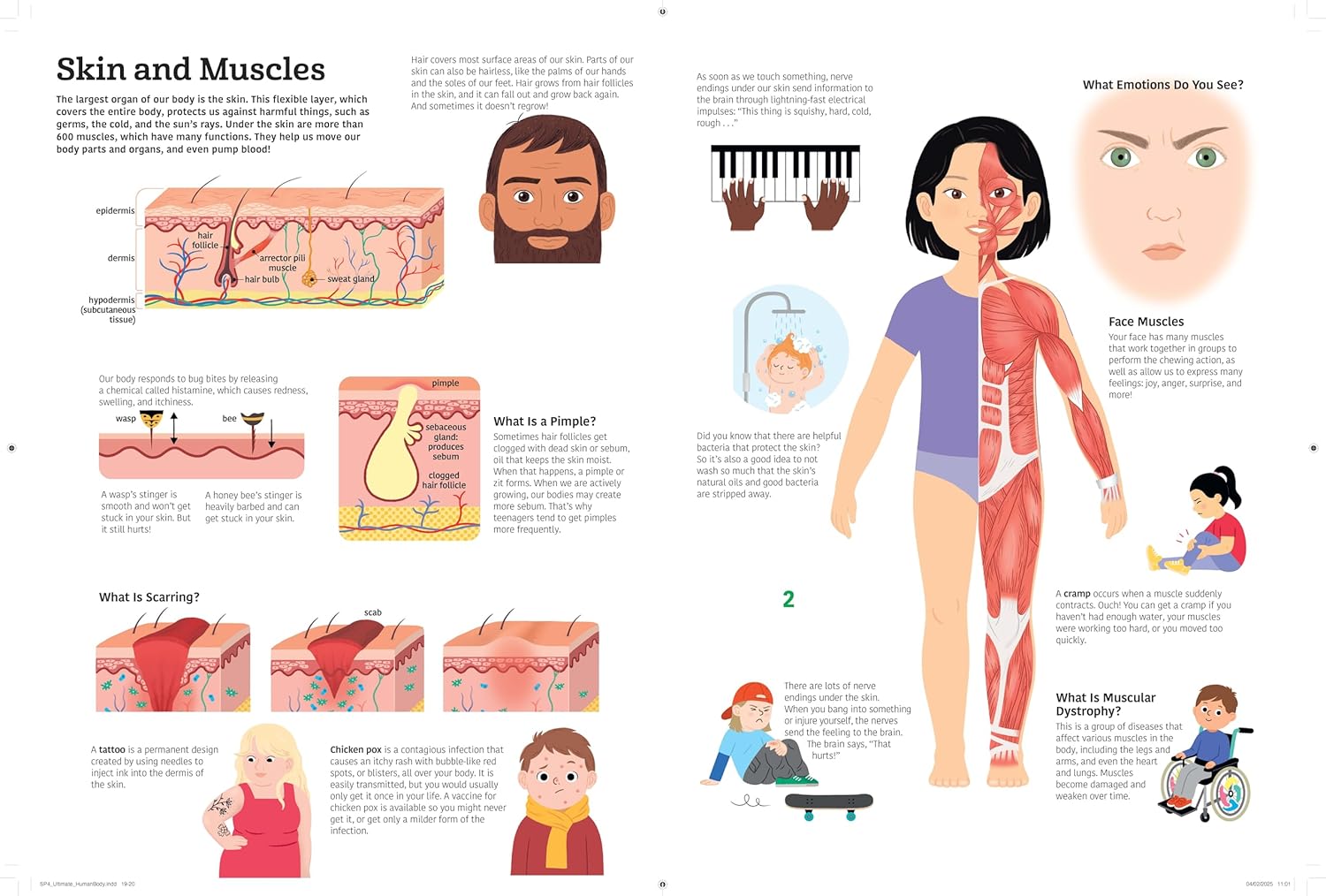
Skin and Muscles introduces kids to the layers of skin; how the skin heals and reacts to various types of bug bites; how impulses flow from our fingers to the brain; what a pimple and a mole are; what tanning is, and more. Children also get a full view of the muscles and how they work to show different emotions. 

Lungs reveals why we need oxygen, why we cough, what asthma is, how our diaphragm works when we inhale and exhale, and how the voice is produced.

Heart and Blood covers the circulatory system, our pulse and blood pressure, how the heart works, all about blood, and even the fact that “an adult’s heart is about the size of a large apple.”

Illustration @ 2025 by Vanessa Robidou. Text © 2025 by Anne-Sophie Baumann. Courtesy of Twirl.

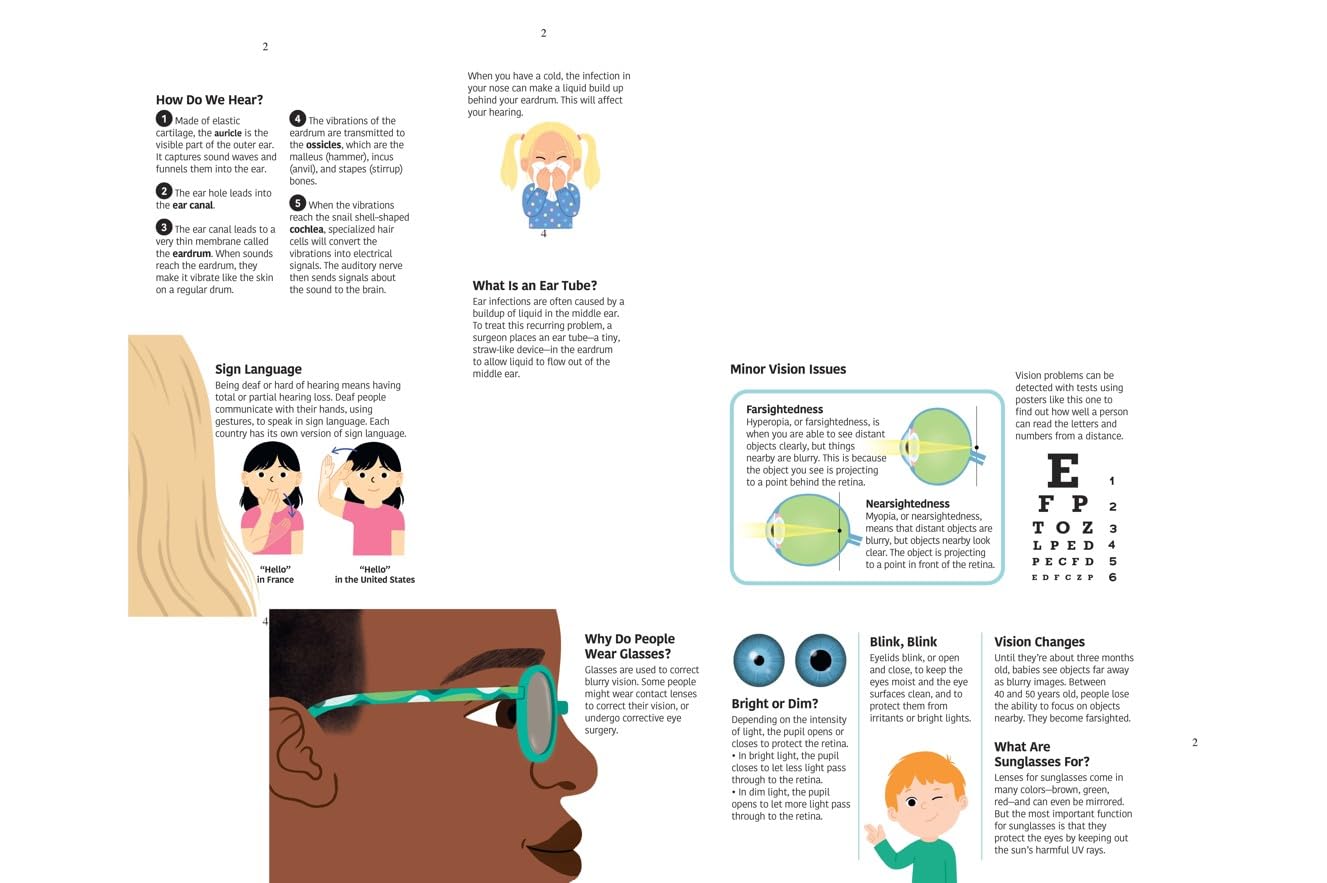
Seeing and Hearing contains information on the parts and working of the eyeball, vision issues, eye color, and more. The hearing section gives kids a look into the inner ear while also learning about sound frequency, earaches, balance, and hearing issues.

Smelling and Tasting talks about the mechanisms of smell, the inner nose, sneezing, the connection between the ear and the nose, the tongue, tasting, ear pain, and sore throats.

Biting and Chewing shows the development of teeth through various ages, and talks about parts of a tooth, cavities, braces, and caring for our teeth.

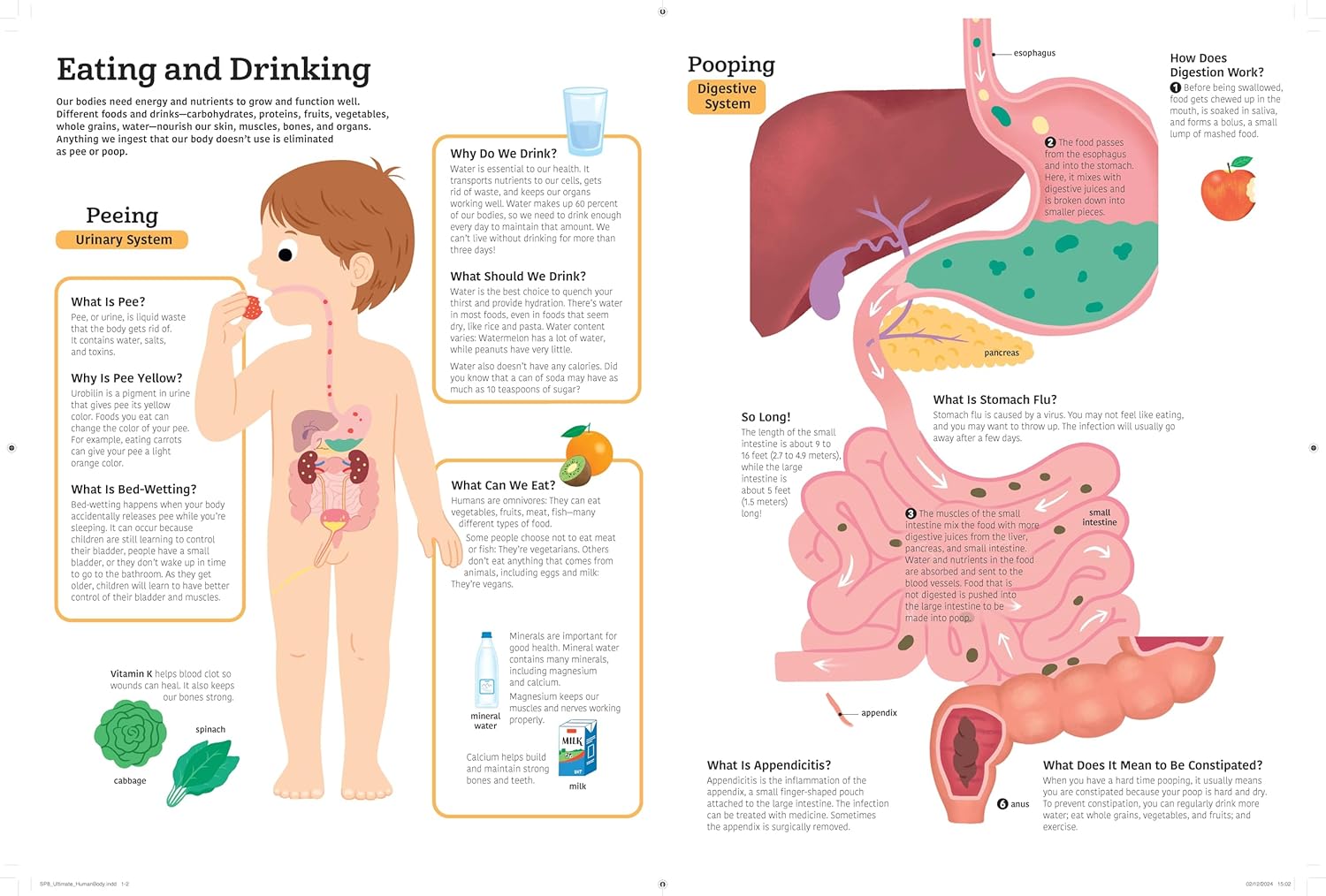
Eating and Drinking contains a wide range of topics and includes interactive elements that expose the workings of the urinary and digestive systems. Other topics include vitamins, foods, constipation, and appendicitis.

Illustration @ 2025 by Vanessa Robidou. Text © 2025 by Anne-Sophie Baumann. Courtesy of Twirl.

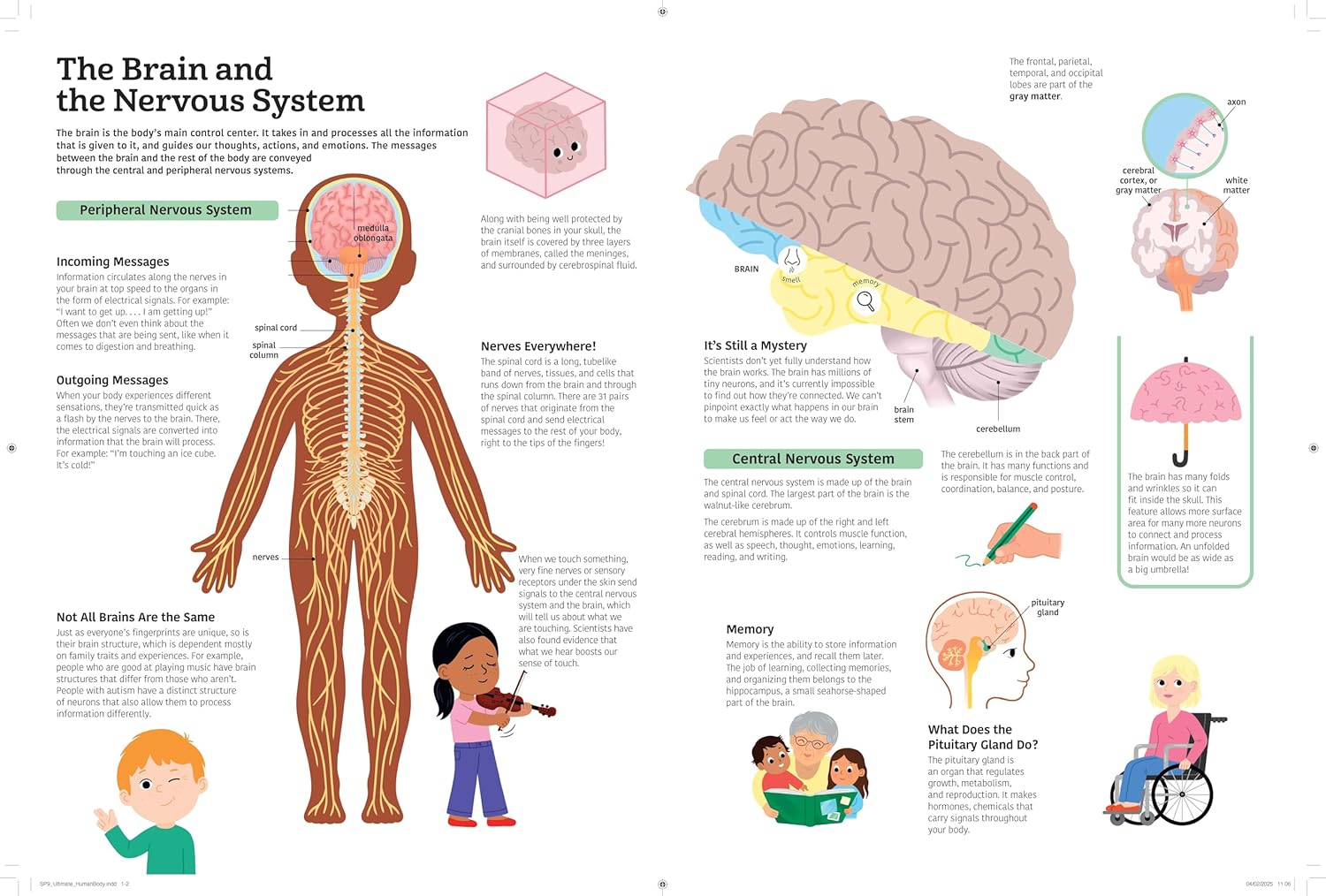
The Brain and the Nervous System is a comprehensive section that goes in-depth on how these intricate systems work and provides detailed illustrations on how the nerves run through the body as well as a pop-up, multilayered depiction of the brain that shows where in the brain our senses, memory, speech, and muscle control originate. You’ll find information on mysteries of the brain, brain disorders, and more.

Birth and Growing Up provides adults and children with a wealth of knowledge about the reproductive organs, how babies are made, how a sperm fertilizes an egg, the major stages of development from embryo to fetus by month, how twins develop, what a cell is, DNA, and highlights of growth and development from birth to adulthood.

Living Well discusses ways people can take care of themselves throughout their lives as well as disabilities, diabetes, Down syndrome, and the role of medical professionals, medications, inventions, and procedures that can help people live a better life.

Illustration @ 2025 by Vanessa Robidou. Text © 2025 by Anne-Sophie Baumann. Courtesy of Twirl.

Anne-Sophie Baumann engages her target audience of children ages 8 through 12 with intelligent writing that uses scientific terminology always followed up with an easily understood definition. She addresses her readers directly, drawing them into this extensive education on anatomy and physiology through discussions about the body’s makeup as well as by spotlighting particular issues of interest for her young readers, such as pimples and skin issues, changing voices, braces, and stages of growth and development.

Accompanying Baumann’s text are Vanessa Robidou‘s incredibly detailed, and in some cases life-sized illustrations. Through the wealth of interactive elements, Robidou invites children to peer inside bones; the ear, eye, and mouth; the skin; and the organs as well as to follow breath, food, blood, and even tears through their dedicated systems. Colorful and expressive, these illustration will wow kids as they support Baumann’s text in exciting ways that reinforce learning.

If you’re looking for a hands-on book about the workings of the human body to share with your child or student, The Ultimate Book of the Human Body is highly recommended and would make a fantastic gift for children interested in topics about anatomy and health.

Ages 8 – 12

Twirl, 2025 | ISBN 979-1027613649

About the Author

Anne-Sophie Baumann studied science and literature before becoming an editor and author. She lives hear Paris, France. You can find her on Instagram.

About the Illustrator

Vanessa Robidou‘s illustrations can be found in various media and in many children’s books. She lives in Rennes, France. You can see more of her work on Instagram.

Picture Book Month Activity

celebrate-picture-books-picture-book-review-x-ray-craft-dog-paw

Dog Paw and Human Hand X-Ray Craft


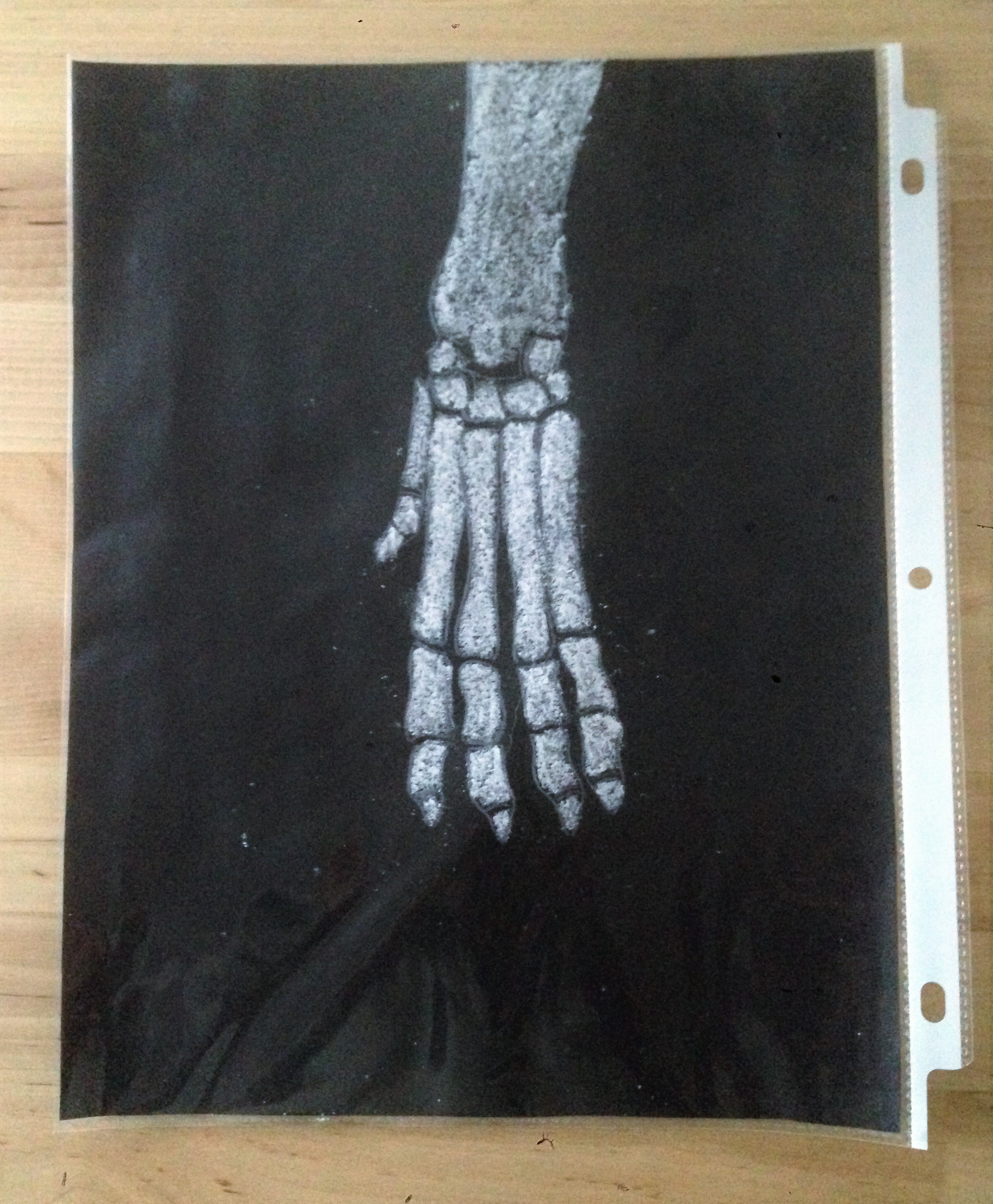
X-rays are cool to look at, but they always stay at the doctor’s office! With this craft you can simulate X-rays of a dog’s paw and a human hand!

Supplies

  • Printable skeleton templates: Human Hand Template | Dog Paw Template
  • Black chalkboard drawing paper, 8 ½ inches by 11 inches
  • White colored pencil
  • White chalk
  • Clear Plastic Report Sheet Protectors

Directions

  1. Print the Human Hand and Dog Paw Templates (you may want to print two—one to cut and one to follow when transferring the bones to the black paper)
  2. Cut the bones apart
  3. Lay the bones on the black chalkboard paper
  4. Trace the bones with the white colored pencil
  5. Color in the bones with the white chalk
  6. Slip the black paper into the plastic report sheet protector

You can purchase The Ultimate Book of the Human Body from these booksellers

Amazon | Barnes & Noble | Bookshop

Picture Book Review

May 30 – National Water a Flower Day

About the Holiday

National Water a Flower Day reminds us of the vast diversity of plants and flowers in the world and even in our own backyards, gardens, and communities. The holiday encourages us to show how much we appreciate plants for their sumptuous colors, their fragrant blossoms, their delicious fruits and seeds, and for the unique ways they survive under sometimes challenging conditions. To this end, as the name of the holiday nudges, we should take special time today to make sure all of our plants—both indoor and outdoor—are watered and cared for.

Superpowered Plants: Meet the Smartest, Strongest, Sneakiest Plants

Written by Soledad Romero Mariño | Illustrated by Sonia Pulido


From the beginning of time (perhaps even before) plants have been growing, spreading, and evolving to survive and thrive.  To do this, they’ve had to become smart, resilient, and even sneaky—ingenious. Plants and their blooms can last only a day or hundreds of years, quietly coexisting with generations of a family. Among the plants on Earth are some of nature’s craftiest mimics, chemists, thieves, and predators.

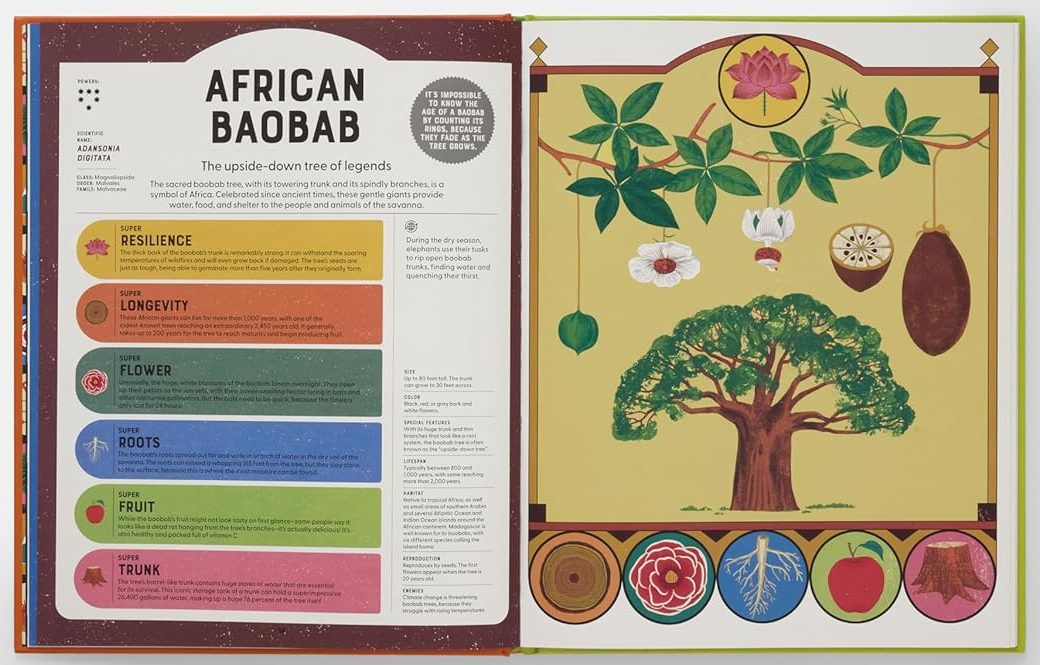
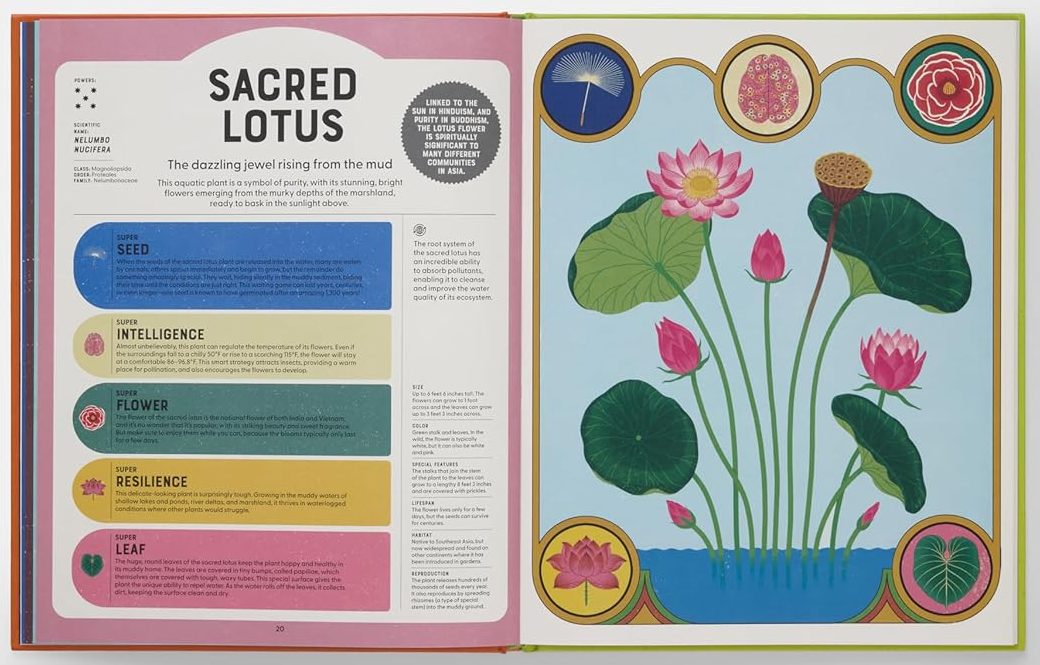
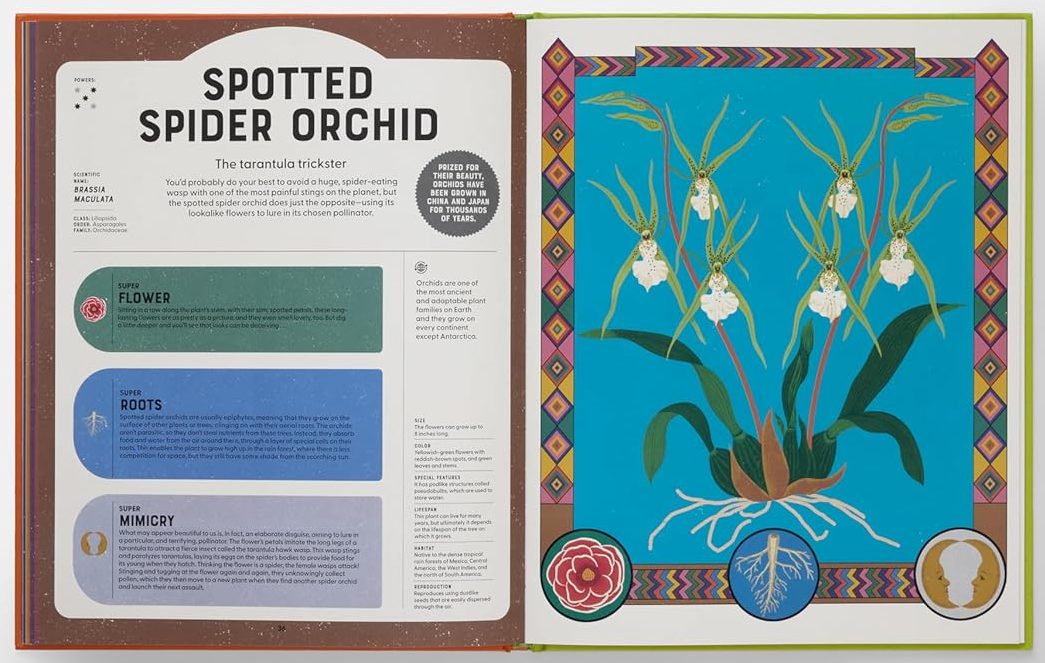
In Superpowered Plants, author Soledad Romero Mariño introduces readers to 22 astonishing plants from across the globe, including the African baobab, sacred lotus, spotted spider orchid, titan arum, and whistling thorn as well as more common varieties like dandelions and sunflowers. She identifies 17 superpowers that plants rely on to feed themselves, multiply, cope with extreme conditions, regenerate after fire or other challenges, and protect themselves. Some of these are super speed, super intelligence, super teamwork, super resilience, and super flower. 

Illustration © 2025 by Sonia Pulido, text © 2025 by Soledad Romero Mariño. Courtesy of Phaidon Press.

Working in tandem with illustrator Sonia Pulido, Mariño provides a short description of each plant before outlining its superpowers in clear, easily-digested tidbits presented in color-coded sections, further marked by a recognizable icon. Other information on the left-hand page includes the plant’s scientific name, class, order, and family as well as its size, color, lifespan, habitat, reproduction method, enemies, and special features, along with a fascinating trivia fact. 

To the right—in stunning tarot card-inspired illustrations that would easily be at home in any fine art museum—Pulido captures each plant in full-page, glorious, realistic splendor while stylishly displaying its flower, seed, and fruit and bordering it with representations of its habitat, superpowers, and unique features. 

Illustration © 2025 by Sonia Pulido, text © 2025 by Soledad Romero Mariño. Courtesy of Phaidon Press.

So what are a couple of examples of these astounding plants? Well, take the Whistling Thorn, which is native to the East African savanna. This plant really has the will (and the way) to survive! Not only are its branches covered in prickly spikes, but it teams up with a particular species of ant, offering colonies a home in exchange for aggressive attacks on any herbivore that dares take a nibble. And if that isn’t enough, the whistling thorn has “developed the superspecial skill of communication.” Where many whistling thorns grow in proximity, if one tree is attacked it releases a scent into the air, “alerting other trees in the area to the threat.” These trees “immediately secrete a toxic substance into their leaves, which can be harmful to touch and eat, therefore putting off the predator and keeping the community of trees safe.”

There’s also the Sandbox, native to tropical regions such as the Amazon rain forest, who’s playful name belies its nickname—the dynamite tree. Determined to spread its seeds far and wide, the sandbox produces fruit that, when ripe, explodes with such force “that it can cause injury to anyone standing in its way.” The seeds are propelled at “speeds of 230 feet per second and can cover distances of up to 150 feet.” It’s also best not to attempt to climb the sandbox, as its trunk is covered in “supersharp spikes.” 

Illustration © 2025 by Sonia Pulido, text © 2025 by Soledad Romero Mariño. Courtesy of Phaidon Press.

“Fascinating” hardly begins to describe all the discovery inside Superpowered Plants: Meet the Smartest, Strongest, and Sneakiest Plants. This well-conceived compendium will enthrall readers of all ages and spur a deeper appreciation for the earth’s vegetation—both the unusual and the common, which might just be more cunning than we imagine. Superpowered Plants is a must for all library collections and is highly recommended for home bookshelves, especially for nature lovers.

Ages 7 – 12+ (adults will be equally captivated)

Phaidon Press, 2025 | ISBN 978-1838669515

About the Author

Soledad Romero Mariño is an experienced children’s non-fiction author who specializes in ‘best of’ round-up style books. Her works include Superpowered Animals: Meet The World’s Strongest, Smartest, and Swiftest Creatures (also published by Phaidon), Awesome Accidents: 19 Discoveries that Changed the World, and Famous Robberies: The World’s Most Spectacular Heists.

About the Illustrator

Sonia Pulido’s illustrations have appeared in publications globally, including The New Yorker and The New York Times. In 2020 Pulido won the Spanish National Illustration Award and she is the illustrator of Phaidon’s bestselling What a Shell Can Tell.

National Water a Flower Day Activity

celebrate-picture-books-picture-book-review-flower-garden-game

Plant a Flower Garden Game


With this fun game you and your family and friends can grow gardens inside! Roll the dice to see whose garden will fully blossom first!

Supplies

Directions

Object: The object of the game is for each player to fill their garden or garden rows with flowers. Depending on the ages of the players, the game can be adjusted to fill all of the rows, some or all rows, or just one.           

  1. Print one Game Board for each player
  2. Print one or more sets of Flower Playing Cards for each player, depending on how  (for sturdier playing items, print on card stock)
  3. Cut the flowers into their individual playing cards
  4. Print one Flower Playing Die and assemble it (for a sturdier die, print on card stock)
  5. Color the “dirt” on the Garden Plot with the crayon (optional)
  6. Choose a player to go first
  7. The player rolls the die and then “plants” the flower rolled in a row on the game board
  8. Play moves to the person on the right
  9. Players continue rolling the die and “planting” flowers until each of the number of determined rows have been filled with flowers or one row has been filled with all six flowers.
  10. The first person to “grow” all of their flowers wins!

You can purchase Superpowered Plants: Meet the Smartest, Strongest, Sneakiest Plants from these booksellers

Amazon | Barnes & Noble | Bookshop

Picture Book Review

April 3 – Find a Rainbow Day

About the Holiday

As the old proverb goes, “April showers bring May flowers,” but all that rain brings something else—rainbows! The science behind rainbows was first discovered in 1693, when scientists realized that this phenomenon is caused by light from the sun being refracted through raindrops and causing a dazzling show. Today, I wish you a rainy day and happy rainbow hunting! A perfect place to find rainbows every day and in amazing places beyond the sky is in today’s book!

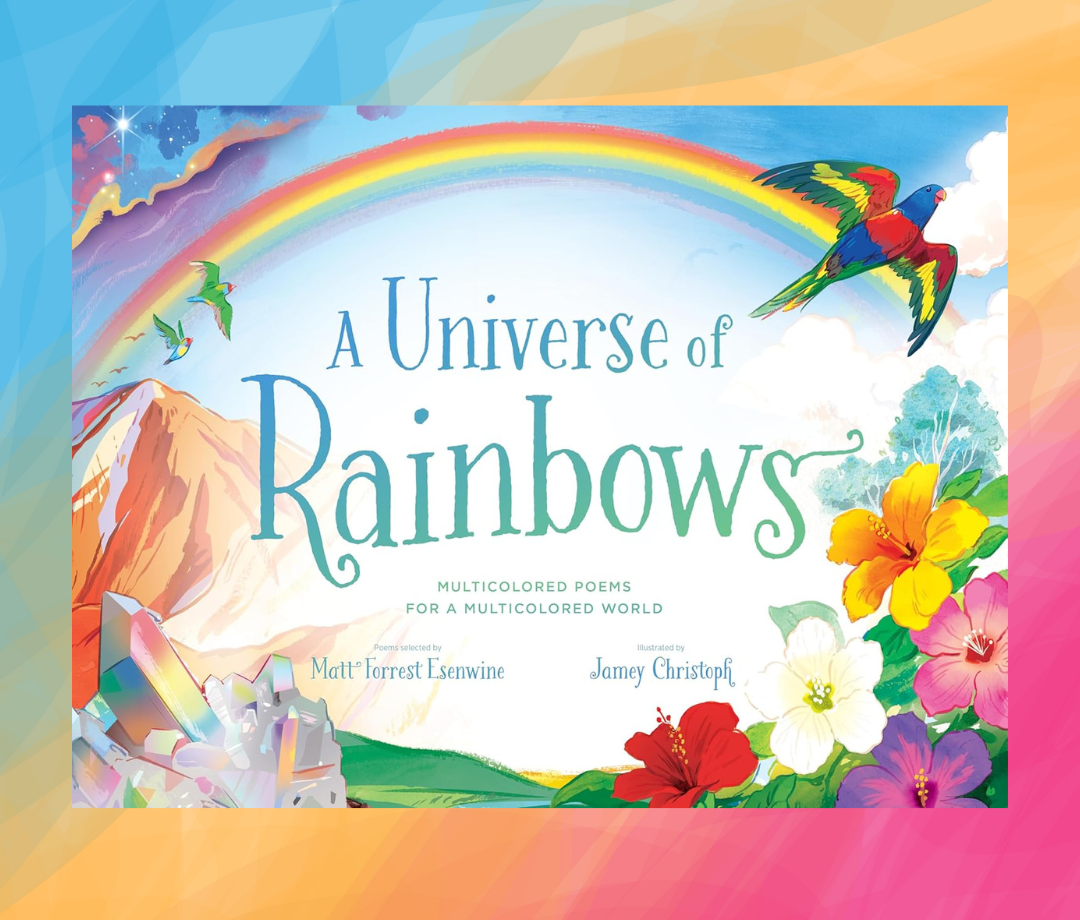
A Universe of Rainbows: Multicolored Poems for a Multicolored World


By Matt Forrest Esenwine | Illustrated by Jamey Christoph


Rainbows are a universally loved natural phenomenon. The excitement of seeing a rainbow arcing across the sky never goes away no matter how old you get. And a double rainbow? For some people, seeing one of those can be like glimpsing a celebrity. In the 22 poems that make up A Universe of Rainbows, Matt Forrest Esenwine and 19 other poets reveal that you don’t always have to wait for rain to be awed by the brilliance of this spectrum of colors as they abound in nature: on land, in waters, on plants and animals, and even in the depths of space.

Illustration © 2025 by Jamey Christoph, text © 2025 by NIkki Grimes. Courtesy of Eerdmans Books for Young Readers.

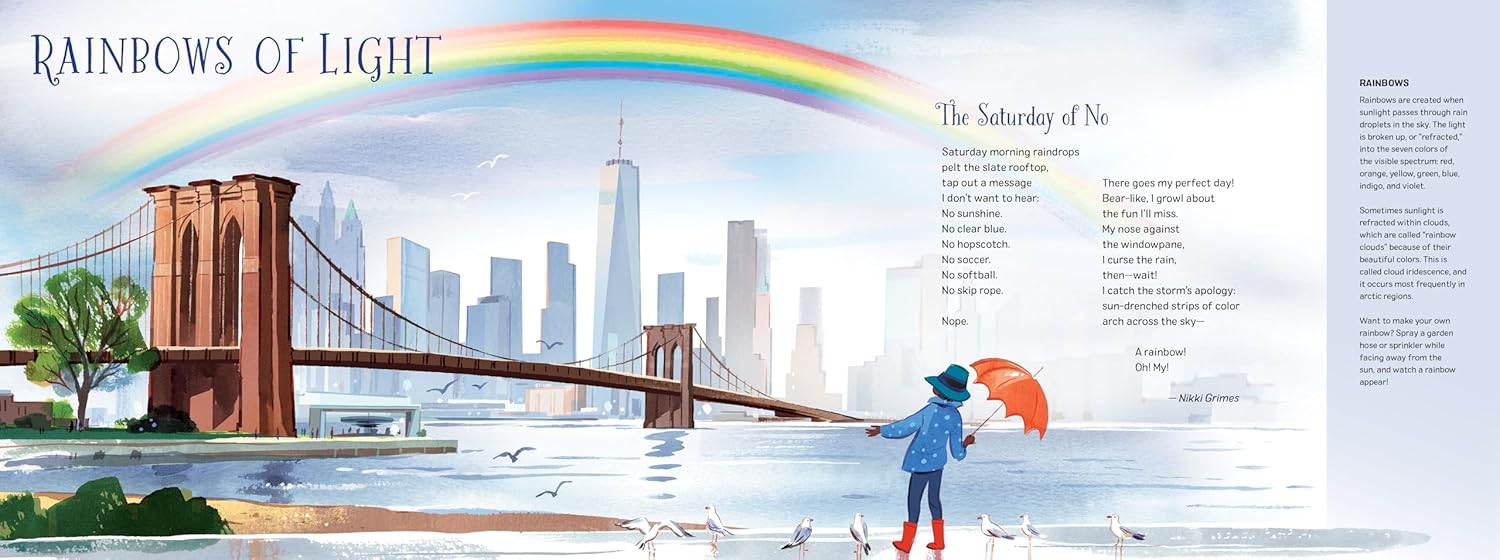
Nikki Grimes leads off this lyrical odyssey that invites readers to travel around the world and beyond to discover rainbows in many forms. In Grimes’ “Rainbows of Light,” she channels the disappointment of a child facing a rainy day with “. . . No hopscotch. / No soccer. / No softball / no skip rope. . . .” The child “. . . curse[s] the rain” until they “catch the storm’s apology: / sun-drenched strips of color / arch across the sky— / A rainbow! / Oh! My!” 

You might think that rainbows occur in nature only during the day, but Joyce Sidman, reveals otherwise in her intricate and arresting pantoum “Along the Zambezi.” Sidman animates a moonbow, entreating readers to take a moment to look as “This dancer will not leap for long / over the span of Victoria Falls,” where “. . . a full moon crowns the darkened hill” while “. . . Mist swirls up in silver shawls, / bending moonlight’s slanting spill.” 

Illustration © 2025 by Jamey Christoph, text © 2025 by David L. Harrison. Courtesy of Eerdmans Books for Young Readers.

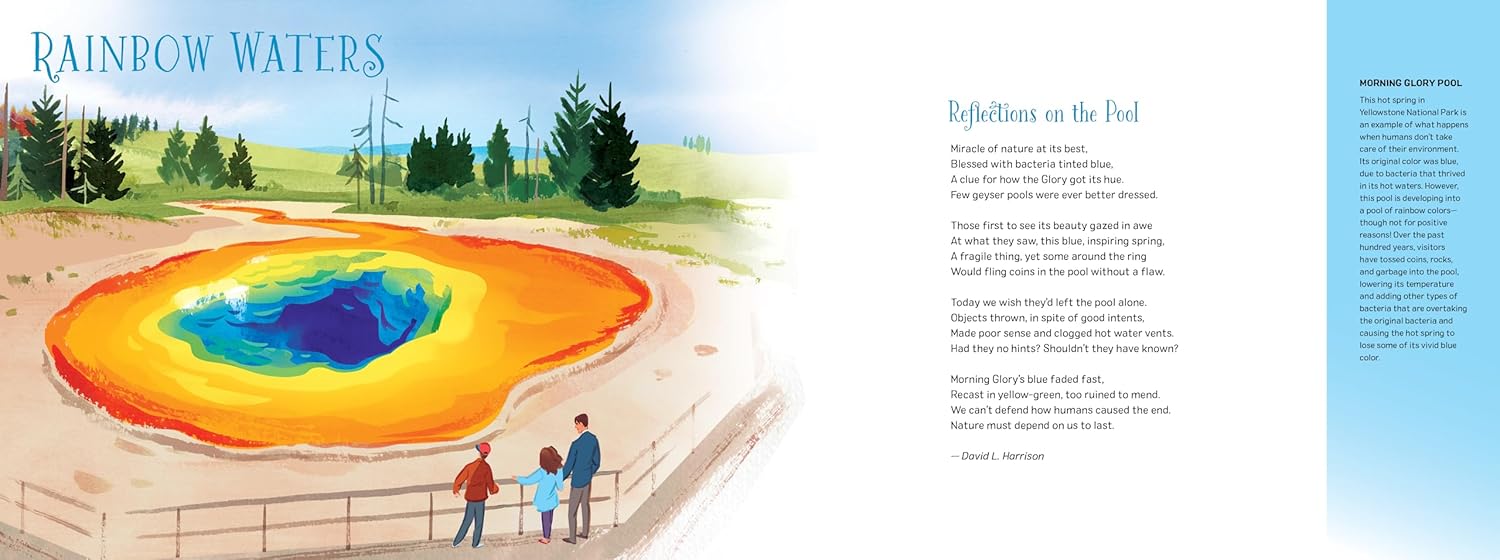
Rainbow seekers do not always need to look toward the sky to find the glorious hues of rainbows. In his rhythmic “Reflections on the Pool,” David L. Harrison nimbly combines assonance and consonance to introduce kids to the surprising Morning Glory Pool in Yellowstone National Park. Harrison describes how this hot spring—a “miracle of nature . . . / Blessed with bacteria tinted blue”—once appeared as vividly blue, but now, because of human interference, is developing a “rainbow of colors” as other types of bacteria take over. Together the poem and sidebar provide a concrete example of the value of conservation and a gripping entry into further study or research. 

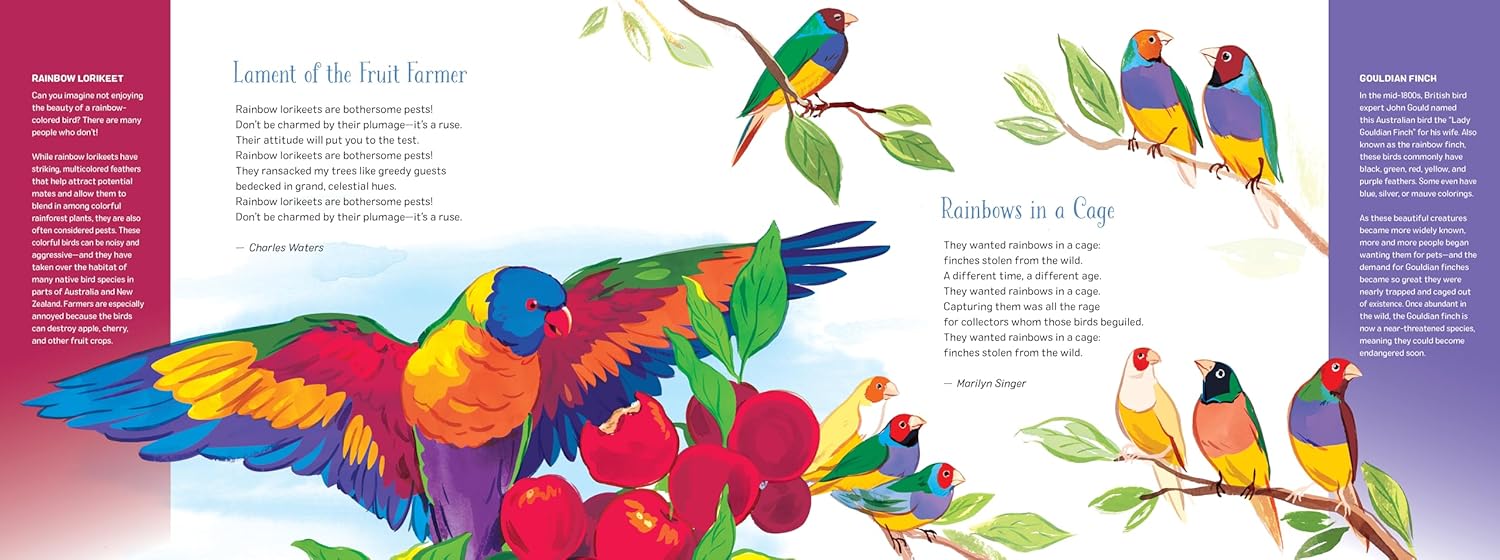
Readers also learn about a uniquely dressed tree, Rebecca Kai Dotlich’s “skirted pinwheel” of a flower, two varieties of birds, and incredible creatures of the sea and land that shimmer and glimmer with the colors of a rainbow. In “Elegant Danger,” Matt Forrest Esenwine exposes the “captivating beauty / with radiant appeal” of the peacock mantis shrimp that has “An appetite of titans. / Attitude of steel.”  into space to float within the Rainbow Nebula with poet Georgia Heard. 

Each poem is accompanied by a short and fascinating side bar offering more information about the natural phenomena that inspired the work.

Back matter includes a list of recommended books and websites where readers can find more information about the rainbows described in each poem as well as a glossary.

Illustration © 2025 by Jamey Christoph, text © 2025 by Janet Wong. Courtesy of Eerdmans Books for Young Readers.

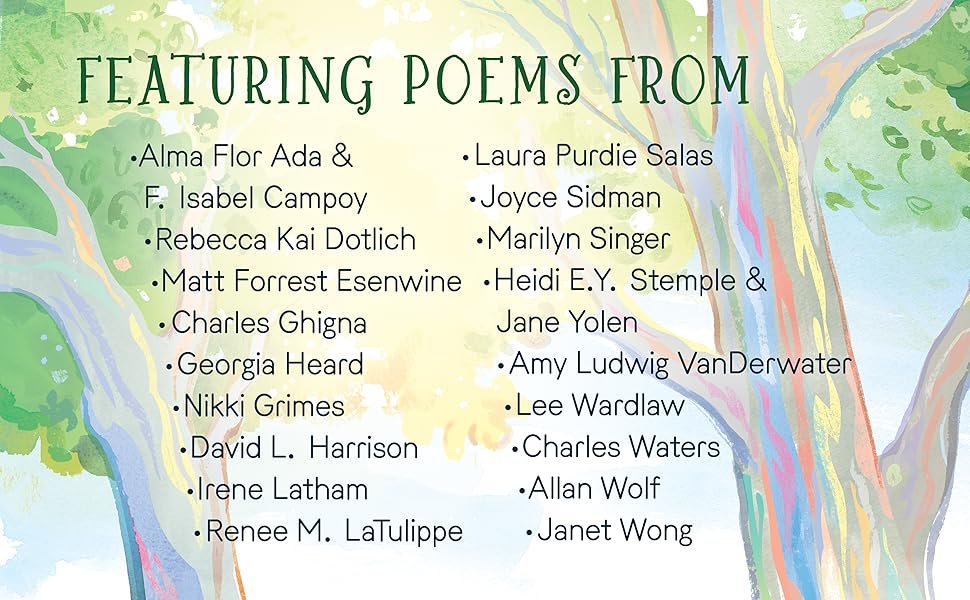
For the twenty award-winning writers who’ve contributed to Matt Forrest Esenwine’s debut poetry anthology, unique rainbows occurring in nature have inspired a wide range of contemplation and poetic form. Some are awe-struck, others hold a touch of humor, and still others are conversational. One thing they all have in common is an ability to transport readers to another place or just the right moment to witness one of life’s most astonishing sights. Through each poem, readers learn facts but they also discover how to observe with curiosity, appreciate the miraculous, and commit to preserving our natural wonders. 

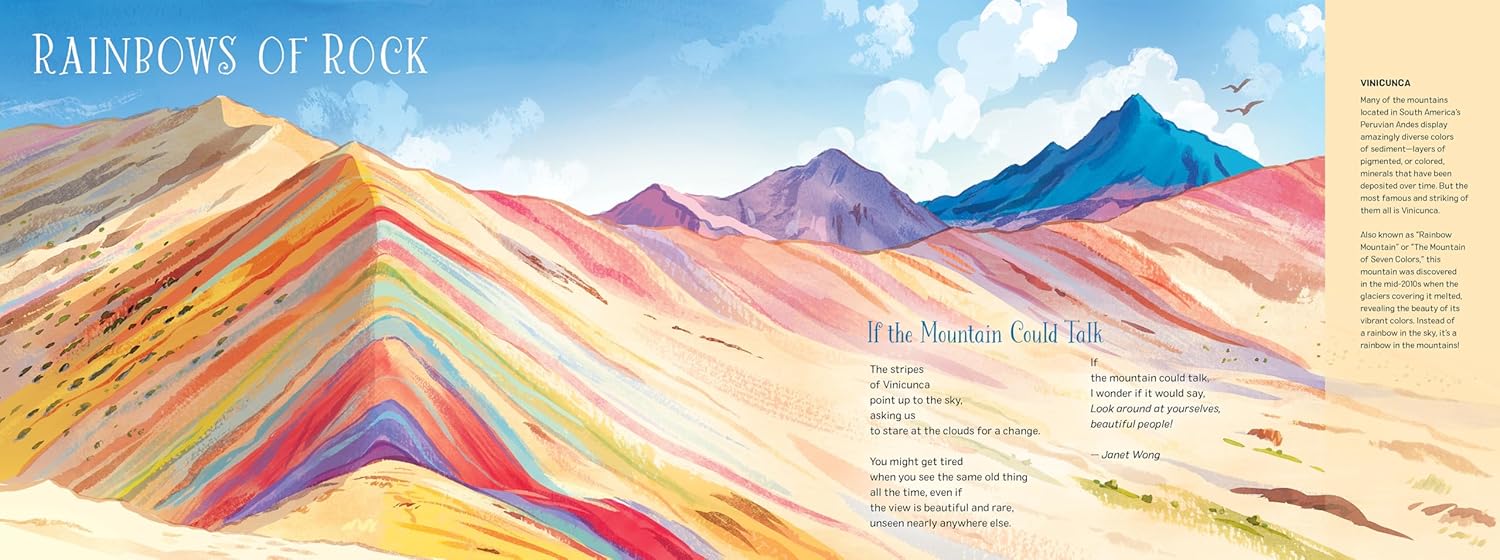
Jamey Christoph’s multi-media illustrations mesmerize with brilliant color that tantalizes like a magic spell, slipping through ice crystals, hiding in plain sight, turning pools of water and majestic trees into artists’ palettes, and clothing creatures of the air, sea, and land. You might be tempted to think that these natural phenomenon can’t possibly be so vivid in real life, but take a look (these poems encourage further research) and you’ll find that Christoph’s full-spread images mirror their inspirations. Beautiful and stirring, each page welcomes you to linger awhile.

Encompassing riveting writing by award-winning poets, spellbinding illustrations of natural phenomena, and nearly endless applications for science, writing, and art study and discovery, A Universe of Rainbows: Multicolored Poems for a Multicolored World is a must for school and public library collections as well as for any reader who loves inspired writing and nature.  

Ages 6 – 10

Eerdmans Books for Young Readers, 2025 | ISBN 978-0802855718

About the Author

Matt Forrest Esenwine is a children’s author and poet whose books include The Thing to Remember about Stargazing (Tilbury House), Once Upon Another Time (Beaming), and A Beginner’s Guide to Being Human (Beaming). His work has been nominated for a Pushcart Prize and featured in numerous anthologies. Also a voiceover actor and commercial copywriter, Matt lives in Warner, New Hampshire, with his family. Visit his website at mattforrest.com.

About the Illustrator

Jamey Christoph has illustrated over twenty books, including The Great Lakes (Knopf), Stonewall (Random House), and Outside My Window (Eerdmans). His books have been named to many best-of-the-year list, including from the CBC and NYPL. Jamey lives in New Hampshire with his husband and their crazy dogs. Visit Jamey’s website at jameychristoph.com and follow him on Instagram @jameychristoph.

National Find a Rainbow Day Activity

celebrate-picture-books-picture-book-review-rainbow-magnet-craft

Mini Rainbow Magnet


If you’re stuck on rainbows, you can make this mini rainbow to stick on your fridge or locker!

Supplies

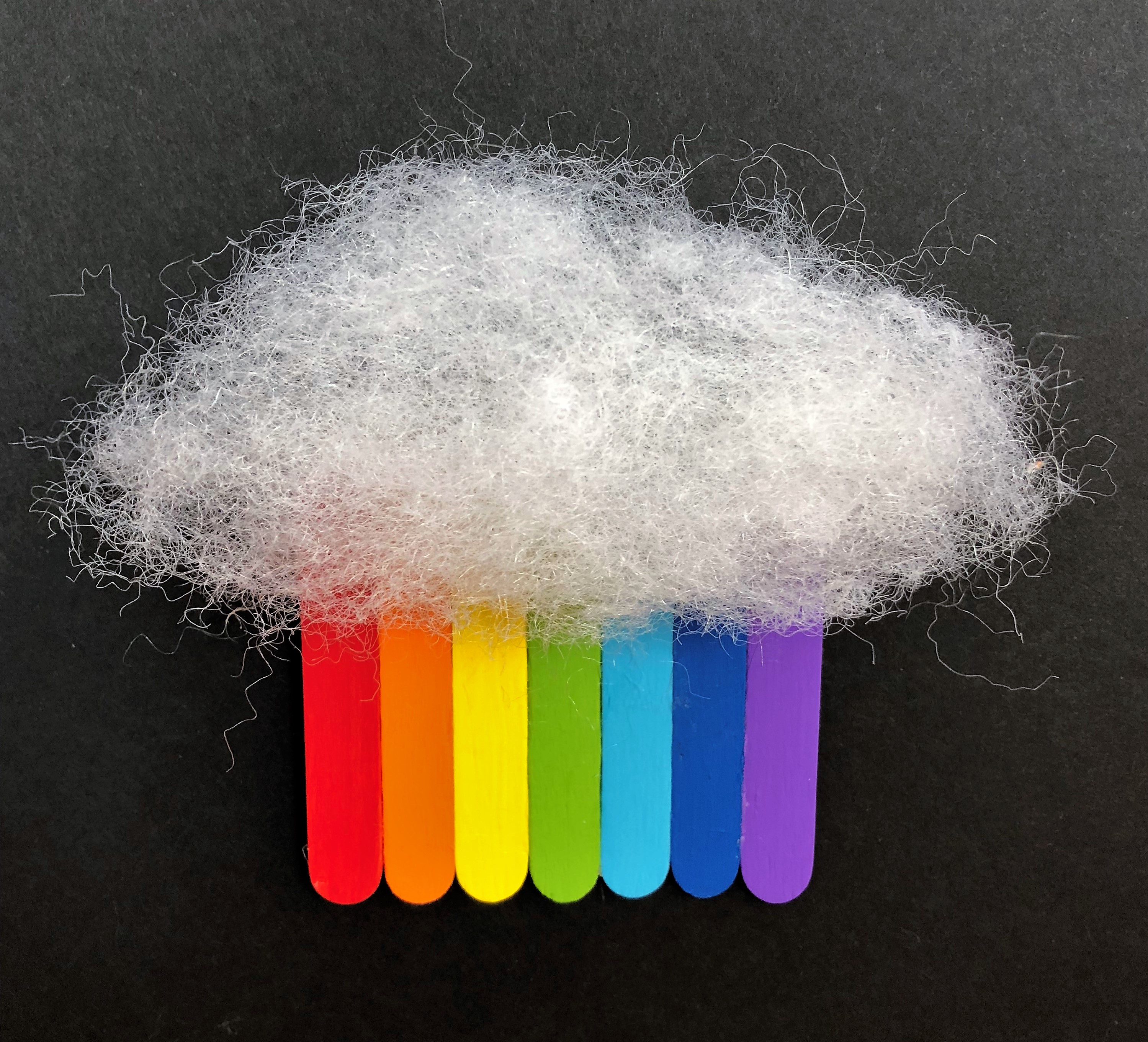
  • 7 mini popsicle sticks (or cut regular popsicle sticks in half)
  • Paint in red, orange, yellow, green, blue, Indigo, violet (ROYGBIV)
  • Adhesive magnet
  • A little bit of polyfill
  • Paint brush
  • Glue or hot glue gun

Directions

  1. Paint one popsicle stick in each color, let dry
  2. Glue the popsicle sticks together side by side in the ROYGBIV order, let dry
  3. Roll a bit of polyfill into a cloud shape and glue to the top of the row of popsicle sticks
  4. Attach the magnet to the back of the rainbow

You can purchase A Universe of Rainbows from these booksellers

Amazon | Barnes & Noble | Bookshop (discounted books and support for your local independent bookstore)

Picture Book Review 

March 3 – World Wildlife Day

About the Holiday

In December of 2013 the United Nations General Assembly proclaimed March 3rd as World Wildlife Day to promote awareness of our environment and the dangers to it. Every year a different theme is chosen to spotlight an area of the world, a particular species, or a group of activists. This year’s theme is “Wildlife Conservation Finance: Investing in People and Planet” and focuses on innovative ideas for financing can contribute to halting biodiversity loss, raising the interest of private sector stakeholders to invest in wildlife conservation, and creating a sustainable future. The day also celebrates successful conservation and sustainability initiatives. To learn more about the day, special events, and how you and your kids can get involved today and throughout the year, visit the World Wildlife Day website.

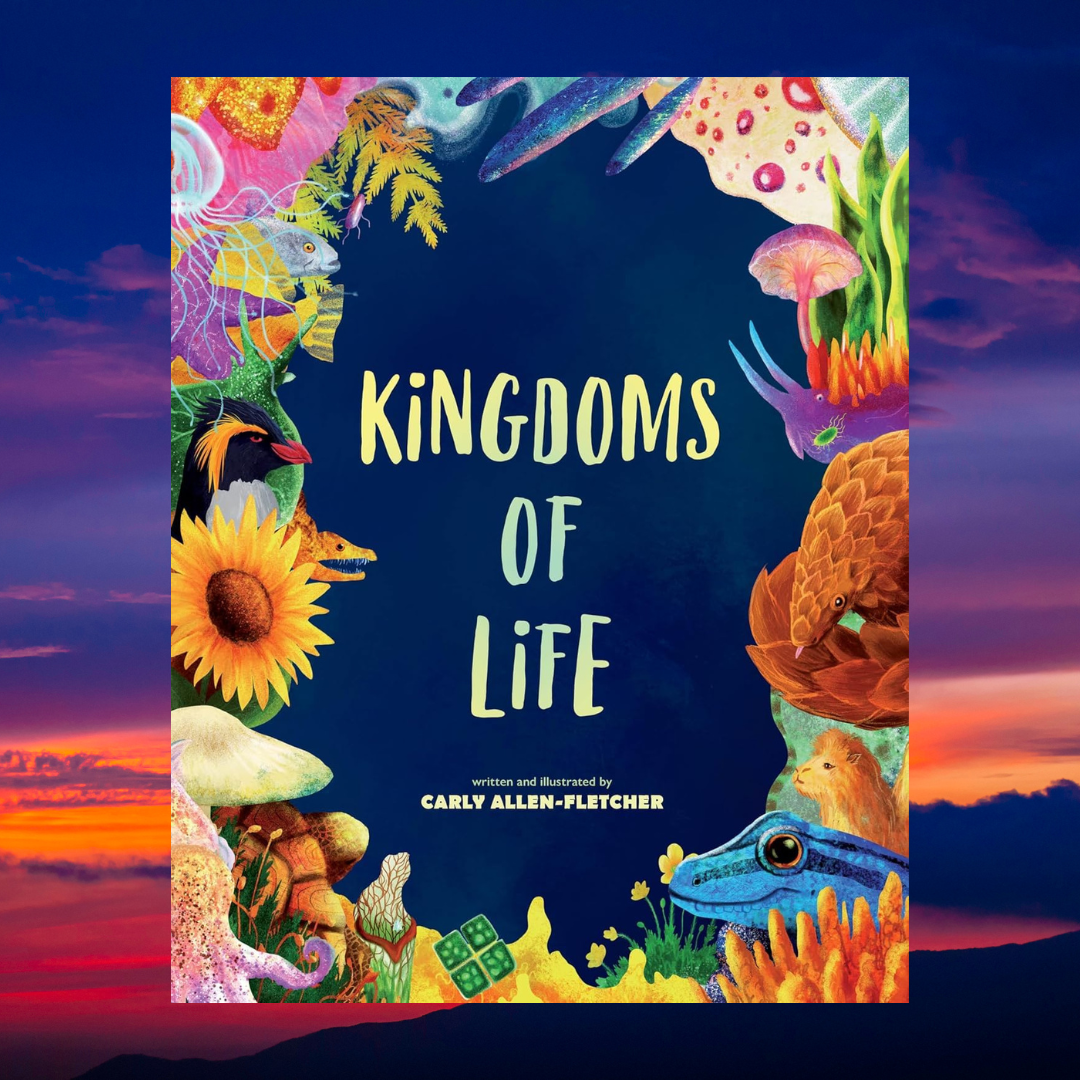
Thanks to Eerdman’s Books for Young Readers for gifting us a copy of Kingdoms of Life for review.

Reviewed by Dorothy Levine

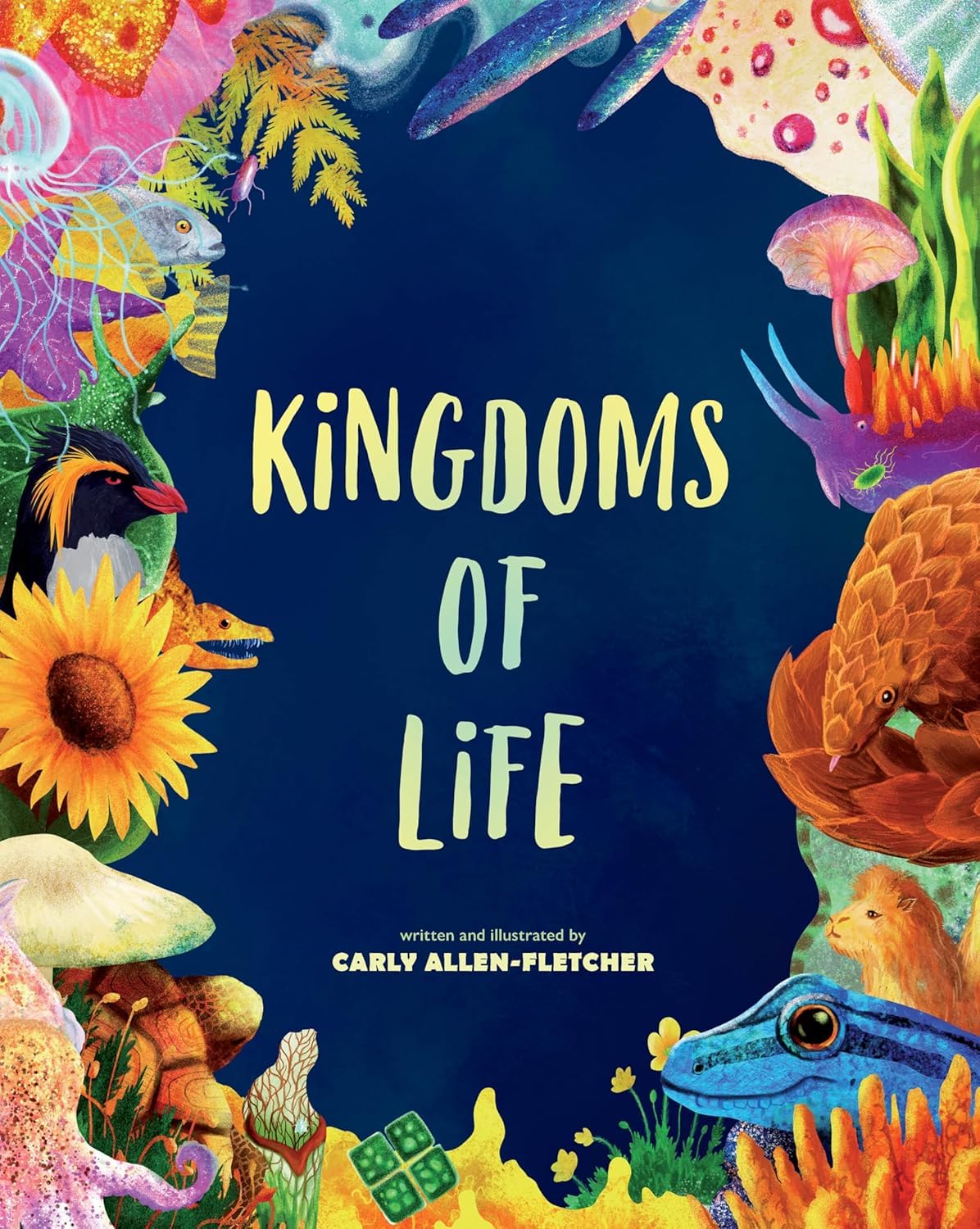
Kingdoms of Life

By Carly Allen-Fletcher


“Life is all around us…In the sky, the sea, and the soil, life exists in millions of different incredible ways.” 

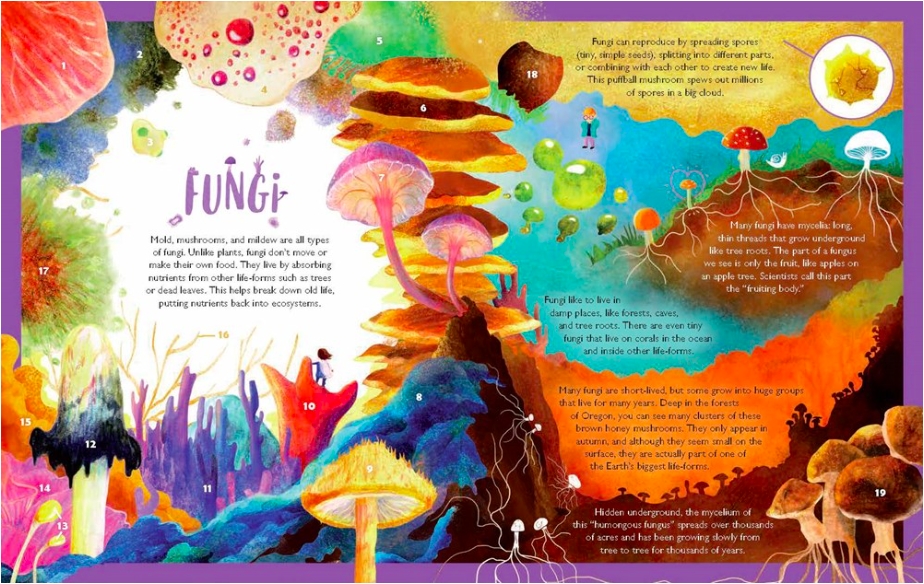
Jump into Carly Allen-Fletcher’s vibrant fact-filled guidebook for kids for a deep-dive exploration of the kingdoms of life. Each Kingdom rules over its own color-coded section, jam-packed with information on how the classified organisms feed, grow, and reproduce. Information also includes the ways in which the organisms across Kingdoms are related or work together with other lifeforms. The pages are royally packed with vibrant illustrations that appear to burst out from the very edges of the book. 

Allen-Fletcher begins with an explanation of how all life is formed—from tiny building blocks called cells. These cells can join to create complex multicellular life forms or just exist on their own as unicellular forms of life. She then zooms out to examine the six biggest categories of life. Allen-Fletcher makes sure to note that these categories are not fixed; they change as scientists learn more and arrange beings in different ways. 

Illustration and text © 2025 Carly Allen-Fletcher. Courtesy of Eerdmans Books for Young Readers.

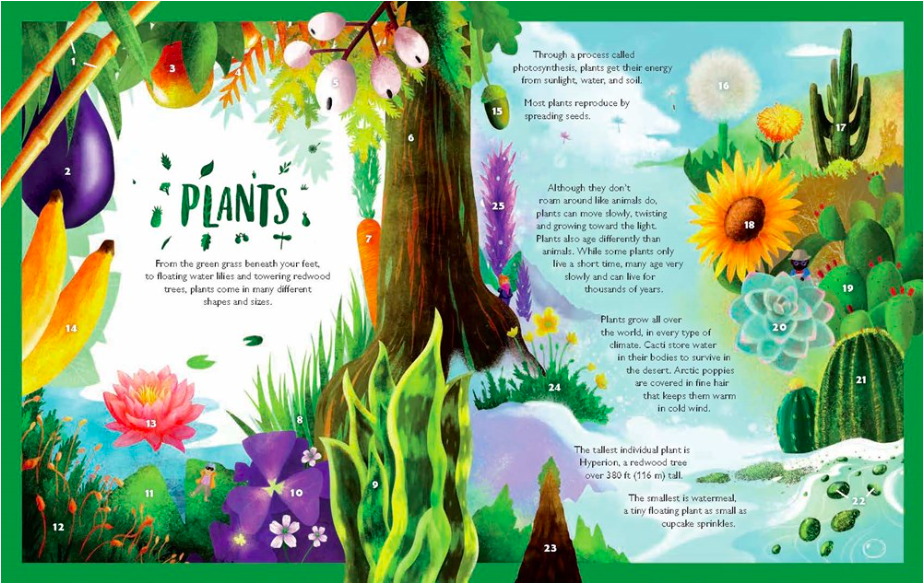
The first category investigated in depth is the most complex of the life-form groups—animals. The animal pages are filled with a diverse range of species, each numerated to a corresponding key at the back. Allen-Fletcher shows the wide range of animals by comparing the smallest species (fairy wasps) to the largest (blue whales), while also explaining how even within one species (dogs) there can be glorious variety. Examples of animals that don’t quite fit in the animal category, such as a sea slug that can make energy from the sun, as well as animals that can survive extreme conditions or are thought to be practically immortal, are also discussed.

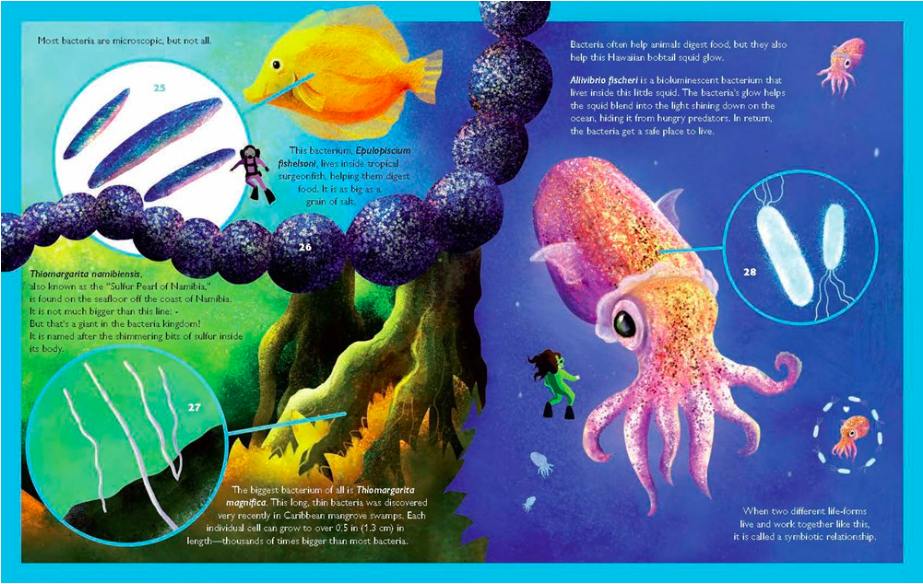
In addition to the animals, plants, fungi, protists, bacteria, and archaea are each given equal attention in their respective kingdom sections. From protists like giant kelp and slime mold to bacteria in our gut and bioluminescent bacteria found in squid, each kingdom is filled with fascinating examples of life and interesting facts on specific organisms. 

Illustration and text © 2025 Carly Allen-Fletcher. Courtesy of Eerdmans Books for Young Readers.

Kingdoms, Allen-Fletcher explains, can also be broken down further, into smaller and smaller groups such as family, genus, and species. A few taxonomists (scientists who study and sort lifeforms into categories) from around the world and throughout many different centuries are highlighted for their contributions to the field.

The book ends with a last dose of wonder: “We know more about the moon than we do about the deepest parts of our oceans. / Every year, we learn more about our home and the incredible life-forms we share it with. / What will we discover next?” The inclusion of “we” in this ending invites readers to feel welcome in this process of study and discovery. Taxonomy need not be only for adult scientists, but anyone who shares a passion for nature and careful observation. 

Back matter features each of the categories taxonomists use to sort life into groups as well as all the names of the featured life-forms throughout the book. The science is detailed while also distributed into easy-to-read bite-sized chunks.

Illustration and text © 2025 Carly Allen-Fletcher. Courtesy of Eerdmans Books for Young Readers.

Carly Allen-Fletcher illuminates a topic that is usually reserved for upper-level biology courses making it accessible and intriguing for young learners. The facts from her book will inspire a passion for all species—large or small, animal or bacteria—and help children to understand where in this big wide world we as humans stand and the symbiotic relationships that exist between creatures. Mini scientists dot the lusciously illustrated pages, comically examining life-forms in all the kingdoms up close.

Kingdoms of Life would make a valuable addition to home, school and library collections.

Ages 6 – 10

Eerdmans Books for Young Readers, 2025 | ISBN 978-0802855916

About the Author/Illustrator

Carly Allen-Fletcher is a British illustrator and author whose books include Goodnight Forest (Muddy Boots), Beastly Biomes (Creston), and Animal Antipodes (Creston). Inspired by nature and science, she creates her art by combining hand-drawn elements, painted textures, and graphic shapes. Carly loves reading about the latest biological discoveries, and if she hadn’t become a professional illustrator, she would have become a scientist instead. Follow Carly on Instagram or visit her website at carlydraws.com.

World Wildlife Day Activity

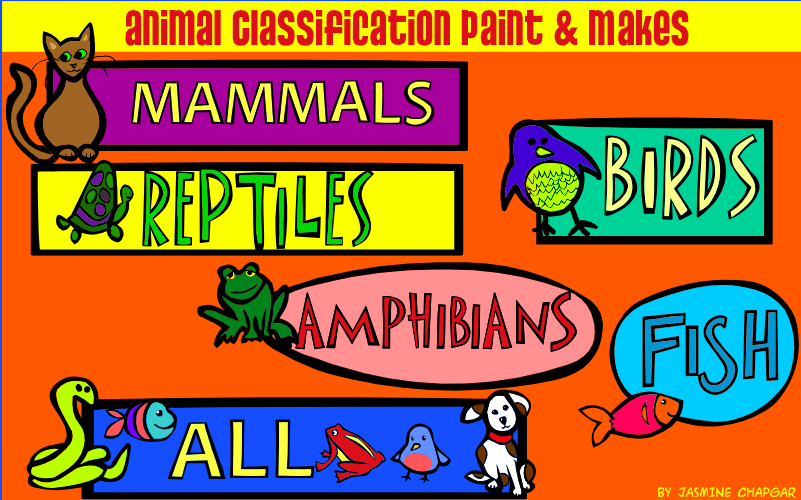
It Takes All Kinds game illustration courtesy of Science Trek.


Kingdoms of Life Fun


Watch a Kingdoms of Life Classification Video with Science Trek

  • As Allen-Fletcher notes in Kingdoms of Life, scientists are constantly evolving the categories for living organisms as they learn more. Do you notice any differences between the book and video kingdom categories? Since this video was published, scientists have started using the kingdom names bacteria and archaea instead of the previously used term, monera!

You can also explore their Online Games on kingdoms of life and animal classification, and practice sorting with Generation Genius’s Candy Classification Activity

You can purchase Kingdoms of Life at these booksellers

Amazon | Barnes & Noble | Bookshop (to support your local independent bookstore)

Picture Book Revie

March 3 – It’s National Reading Month

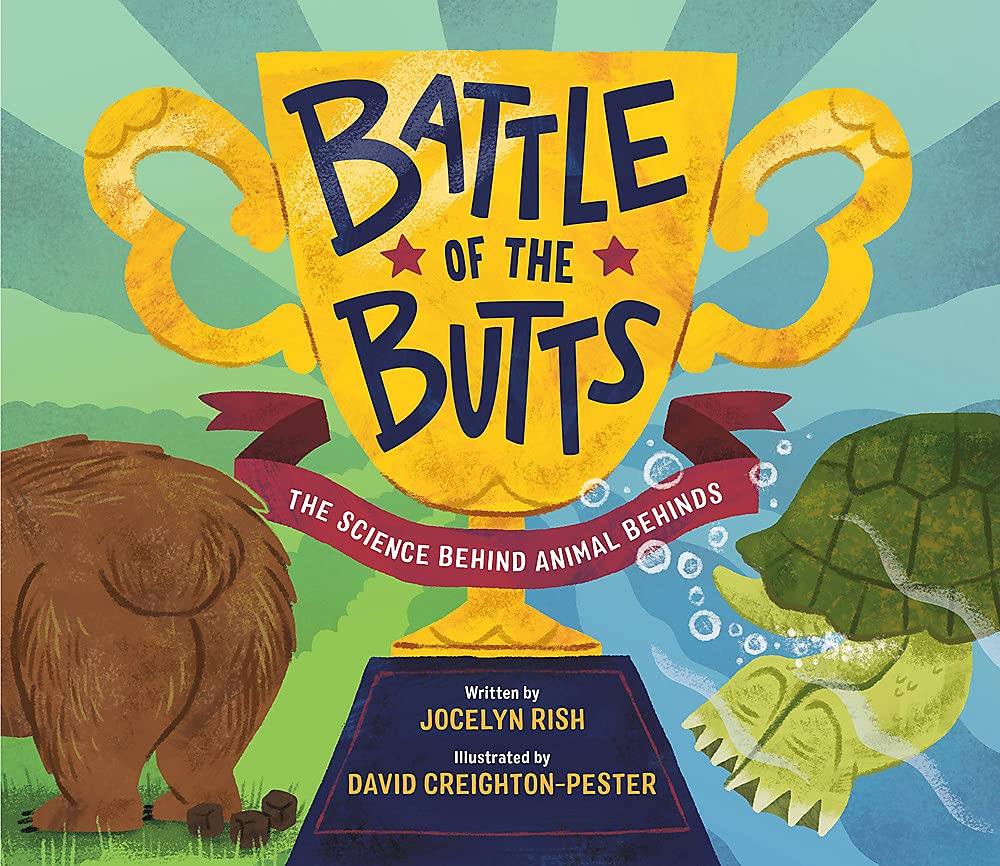
celebrate-picture-books-picture-book-review-the-battle-of-the-butts-cover

About the Holiday

March 3rd is not only part of National Reading Month, but it’s World Book Day and World Wildlife Day too! How can readers celebrate all three holidays at the same time? With today’s book! Here’s a little bit about each holiday:

National Reading Month

All month long, people celebrate all the joys and benefits of reading. When you read with your child or children every day you’re helping them develop the language and literacy skills that will promote success in school and beyond. Even if your child isn’t talking yet, they’re listening and learning about their language as you read to them. Older kids also love being read to, and setting aside time to read together builds strong bonds that can last a lifetime. The month is typically marked with special events in schools, libraries, bookstores, and communities.

World Wildlife Day 

In December of 2013 the United Nations General Assembly proclaimed March 3rd to be World Wildlife Day to promote awareness of our environment and the dangers to it. This year’s theme is “Recovering key species for ecosystem restoration,” which seeks to draw attention to the conservation status of some of the most critically endangered species of wild fauna and flora and to drive discussions toward devising and implementing solutions to conserve them. To learn more, visit the World Wildlife Day website.

World Book Day

World Book Day was created by the United Nations Educational, Scientific and Cultural Organization (UNESCO) to be celebrated on April 23rd, 1995 in honor of William Shakespeare, Miguel de Cervantes, and Inca Garcilaso de la Vega, who all died on this date. Some countries, such as Great Britain, Ireland, and Scotland celebrate on March 3. No matter what date you pick – or whether you choose to celebrate on both days – the holiday encourages families and individuals to rediscover the joys of reading for pleasure and promotes the availability of a wide range of books to all and in all languages. 

Thanks to Running Press Kids for sharing a copy of Battle of the Butts with me for review consideration. All opinions on the book are my own.

Battle of the Butts: The Science Behind Animal Behinds

Written by Jocelyn Rish | Illustrated by David Creighton-Pester


Get ready to RUUUMBLE! as ten of the world’s most fascinating animals put their butts on the line in Jocelyn Rish’s genius look at how certain sea creatures, mammals, insects, and reptiles eat, swim, talk, and defend themselves using their powerful posteriors. Readers don’t have to passively sit by and read, though. Rish invites kids to judge the challengers based on their own preferences and assign a rating from “Terrific Tushie” to “Boring Backside” on their way to crowning the “King of Keisters.”

celebrate-picture-books-picture-book-review-the-battle-of-the-butts-wombats-sleeping

Image copyright David Creighton-Pester, 2021, text copyright Jocelyn Rish, 2021. Courtesy of Running Kids Press.

As each challenger steps up, readers are presented with their stats, which include their “genus, length, weight, home turf, and posterior power.” Turning the page, kids are then drawn into the science of each critter’s anatomy and how they use it as Rish – in her conversational, detailed, and descriptive text – uses dynamic phrasing and familiar comparisons to help kids visualize each animal’s endgame. An “Extra Booty” paragraph and a highlighted “Butt Bonus” provide more info.

So who’s on the roster for this awesome competition? First up is the manatee, who moves through the water by holding onto or releasing farts. Lest kids begin “picturing a manatee zipping through the water like it has a jetpack on its back end,” Rish goes on to explain the mechanics of their gas-fueled swimming, how they fill up, and the enormity of their intestinal system that allows them to store their gas until they need it. 

celebrate-picture-books-picture-book-review-the-battle-of-the-butts-wombat

Image copyright David Creighton-Pester, 2021, text copyright Jocelyn Rish, 2021. Courtesy of Running Kids Press.

Another fierce contender is the bombardier beetle, which at a max length of 1.181 inches (30 millimeters), proves that mighty things come in small packages. This mini-monster might just become the next superhero, with moves worthy of a big-budget blockbuster. Just picture this movie trailer: “A bombardier beetle strolls through the leaves, minding its own business. A bunch of hungry ants attack. Things don’t look so good for the beetle. Then . . . Pew! Pew! Pew! The bombardier beetle fires a pulsing spray of scalding chemicals from its butt, twisting its tushie in different directions to hit all the ants. The bombardier beetle escapes, while the ants regret their decision to snack on the beetle.” Phew! Pass the popcorn! How do they do this? Rish takes kids step-by-step through the bombardier beetle’s chemical processes that read like a blue-ribbon-winning science fair project, complete with boiling blasts ejected at a “speed of 22 miles per hour.” What if the beetle gets eaten anyway? Find out in the explosive Butt Bonus.

celebrate-picture-books-picture-book-review-the-battle-of-the-butts-herring

Image copyright David Creighton-Pester, 2021, text copyright Jocelyn Rish, 2021. Courtesy of Running Kids Press.

Not all of these challengers use their powers for defense. Parrotfish, which are found in “shallow tropical and subtropical waters around the world” use their poop to do double doody – I mean duty. You might feel a little squeamish about walking barefoot on a beautiful beach that’s near a coral reef once you learn that “a large portion of that white sand is actually parrotfish poop.” Say what?! Yep! Parrotfish “eat the algae, polyps, and bacteria that live on and in coral reefs.”

To get at it, they also end up ingesting coral and, after its well ground up by the 1,000 teeth along the fish’s beak and the “throat-teeth [that] work like a pepper grinder to crush the bits of coral into fine sand,” they deposit this non-nutritious detritus which then becomes the stuff of sandcastles, tanning beds, and sunny day seaside playgrounds. Sounds like a lot of poop, huh? The Butt Bonus tells you just how much.

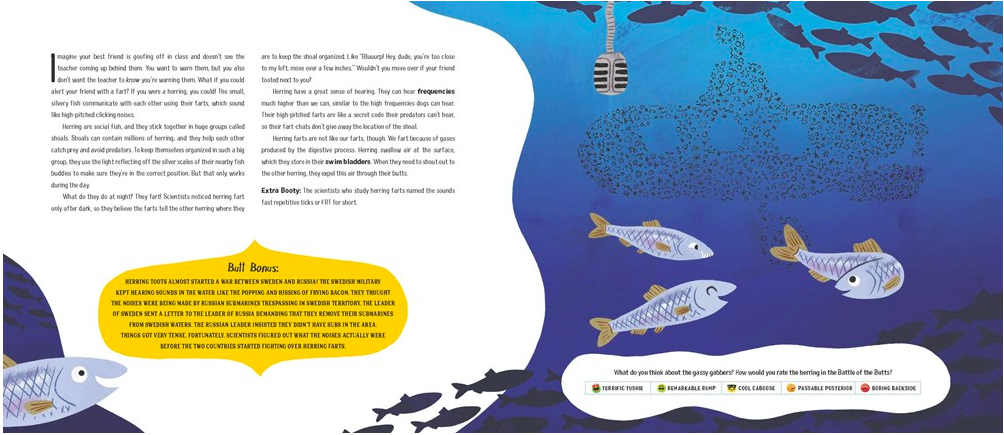
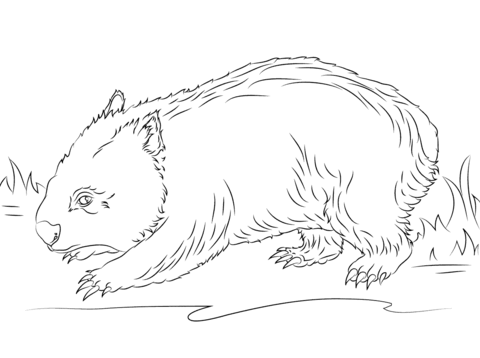
These are just a few of the entrants vying for your verdict. Will any of them win the crown? Or will it be the wombat, with its armored butt; the Fitzroy river turtle, that’s a butt breather; the herring and its unusual communication style; the silver-spotted skipper caterpillar, that puts medieval warriors to shame; the beaded lacewing and its fatal farts; the Sonoran coralsnake that’s a master of confusion; or the sea cucumber, that throws everything it’s got at would-be predators? It’s up to you! Award your favorite with the trophy while rewarding yourself with a full flush of scintillating facts with which to entertain friends and dazzle your teachers!

A Glossary of words found in bold type throughout the book follows the text.

celebrate-picture-books-picture-book-review-the-battle-of-the-butts-herrings

Image copyright David Creighton-Pester, 2021, text copyright Jocelyn Rish, 2021. Courtesy of Running Kids Press.

If you’re looking for a riveting book steeped in nature and environmental science with some chemistry and lots of laughs thrown in for your child, classroom, or other group of kids, you can’t miss with Jocelyn Rish’s Battle of the Butts. Perfect for both younger kids as a read aloud and for independent readers, the book offers opportunities for exciting learning, expanded research, and even experimentation. Rish’s knowledge of her subject and talent for captivating kids jumps off the page with her smooth, alliterative, and hilarious storytelling.

Accompanying each chapter are David Creighton-Pester’s vibrant and dynamic illustrations that accentuate the humor while realistically showing kids how each creature uses their particular skills in their natural environment. Catapulted poop, shooting toots, and funny facial expressions make each page turn a blast. The book’s excellent format also makes it easy to navigate the short chapters and get the most out of all the material presented. At the end of each chapter, kids are invited to rate the creature in this mega-battle of the butts.

A superb way to engage kids in science learning, The Battle of the Butts would be a favorite on any home bookshelf and is a must for school and public library collections.

Ages 4 – 8 and up

Running Press Kids, 2021 | ISBN 978-0762497775

Discover more about Joycelyn Rish and her books on her website.

To learn more about David Creighton-Pester, his books, and his art, visit his website.

 National Reading Month Activity

celebrate-picture-books-picture-book-review-wombat-coloring-page

Wildlife Coloring Pages


You can have fun coloring the animals from today’s book while celebrating all three of today’s featured holidays with these printable coloring pages!

Cute Wombat Coloring Page | Parrotfish Coloring Page | Manatee Coloring Page

celebrate-picture-books-picture-book-review-the-battle-of-the-butts-cover

You can find The Battle of the Butts at these booksellers

Amazon | Barnes & Noble | Books-a-Million

To support your local independent bookstore, order from 

Bookshop | IndieBound

Picture Book Review

May 27 – Rachel Carson Day and Interview with Shana Keller

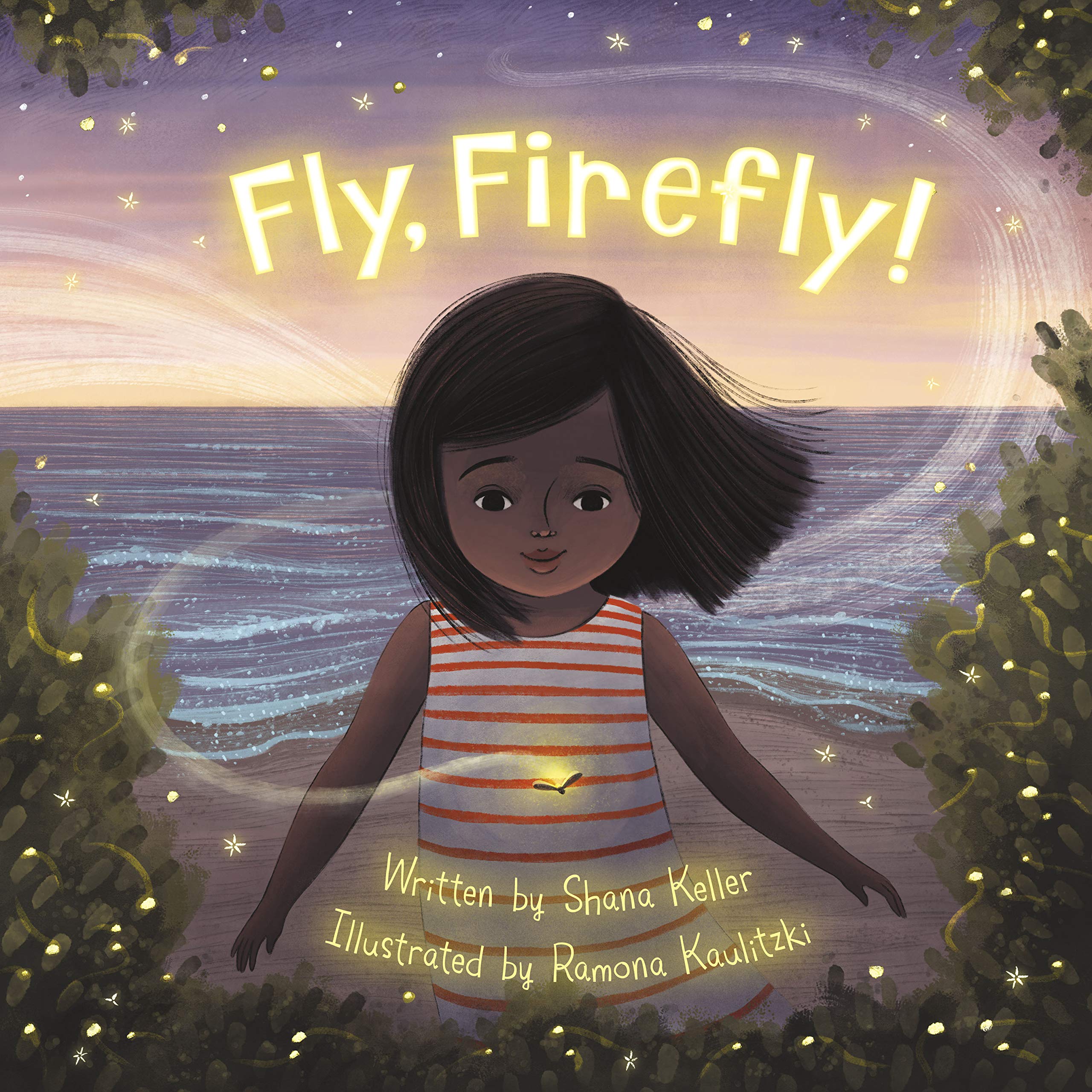
celebrate-picture-books-picture-book-review-fly-firefly-cover

About the Holiday

Today’s holiday commemorates the birthday, on May 27, 1907, of Rachel Carson, the famous ecologist who launched the modern environmental movement with her 1962 book Silent Spring, which documented the dangers of pesticides to the environment. Silent Spring and Carson’s continued advocacy for the environment ultimately resulted in the banning of the pesticide DDT. To honor the day, learn more about the life and legacy of this influential woman whose work continues to impact our world. To learn more about Rachel Carson, visit rachelcarson.org.

I received a copy of Fly, Firefly! from Sleeping Bear Press for review consideration. All opinions about the book are my own.

Fly, Firefly!

Written by Shana Keller | Illustrated by Ramona Kaulitzki


As the wind curled through the forest on a breezy night, a little firefly was blown out to sea. “WHOOSH! Now he was farther than he meant to be.” Floating on the current, “he saw the sparkles that flashed and glowed.” He dove in search of the twinkling lights, but deep water was not the place for him.
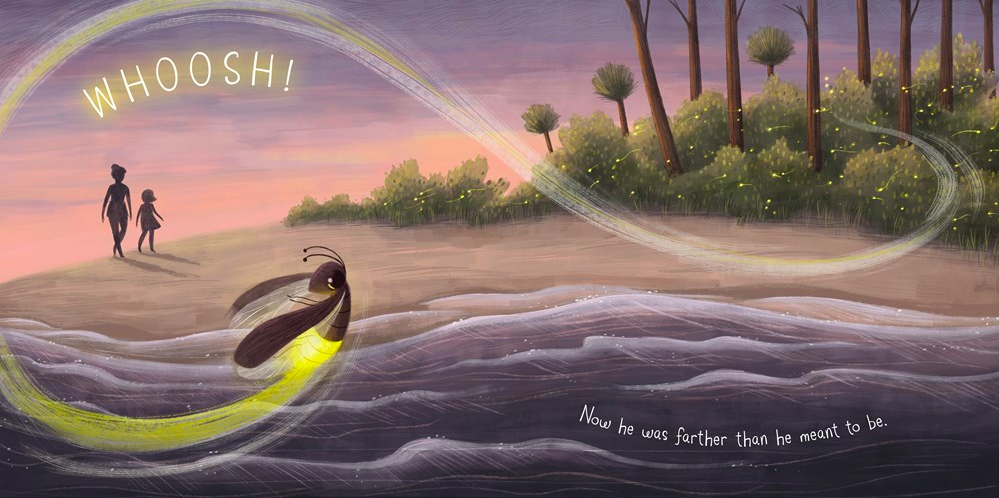
celebrate-picture-books-picture-book-review-fly-firefly-whoosh

Image copyright Ramona Kaulitzki, 2020, text copyright Shana Keller, 2020. Courtesy of Sleeping Bear Press.

A woman and her niece, strolling along the beach, saw him sinking. The woman scooped him up and gently placed him in her niece’s hand. “‘Little firefly,’ Marjie said. / ‘It’s not flies that you see! / That’s bioluminescence swirling / and twirling through the great sea!’” Marjie carried her treasure up the beach to the edge of the woods, where hundreds of glittering friends and family were waiting to welcome him back, and she set him free.

Following the story, Shana Keller includes a discussion about Rachel Carson—scientist and author of Silent Spring and other books whose experience inspired this story­­—and a description of fireflies and bioluminescence.
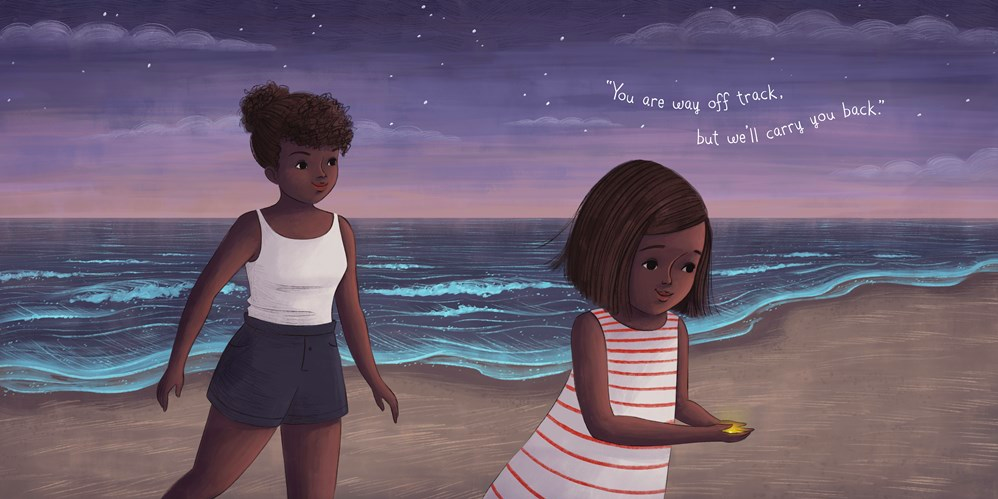
celebrate-picture-books-picture-book-review-fly-firefly-marjie

Image copyright Ramona Kaulitzki, 2020, text copyright Shana Keller, 2020. Courtesy of Sleeping Bear Press.

Shana Keller’s glowing and lyrical story about one misdirected firefly that sparks an act of compassion and discovery will inspire children to learn more about both fireflies and the bioluminescent sea creatures that attracted him. The fact that the story is based on an actual event in the life of Rachel Carson will also appeal to readers, who may enjoy sharing one of their favorite marvels of summer with this influential environmentalist and author. Told in the first person, the story directly invites children to observe nature around them and lend a hand in protecting it.
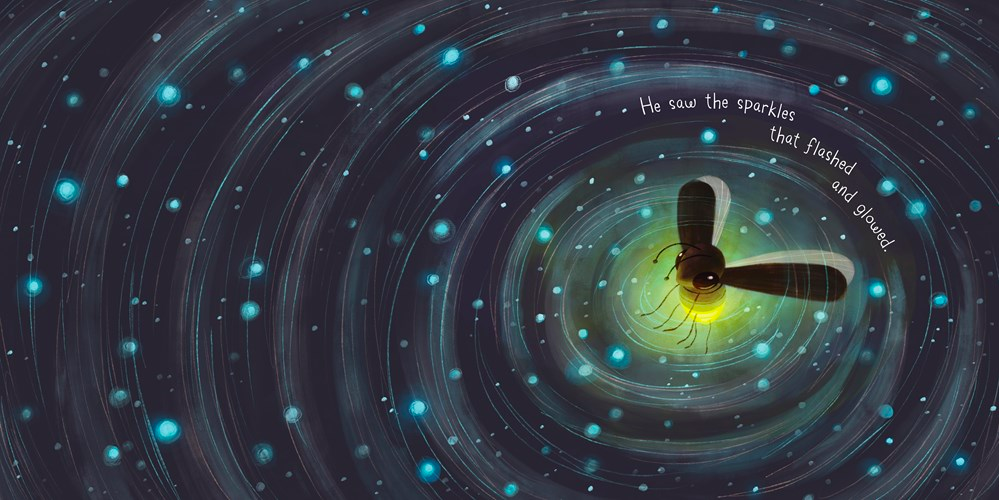
celebrate-picture-books-picture-book-review-fly-firefly-sparkles

Image copyright Ramona Kaulitzki, 2020, text copyright Shana Keller, 2020. Courtesy of Sleeping Bear Press.

Ramona Kaulitzki’s illustrations are as beautiful as a summer sunset. Under the pink and lavender sky, dots of light flit among the bushes and low-standing trees. Children first meet the firefly at the center of the story as he’s tumbling head over tail in the wind toward the rippling ocean. As the firefly mistakenly dives into the waves, kids will empathize with his plight and be cheered when Marjie and her aunt rescue him. Kaulitzki’s gorgeous underwater images highlight the diversity of marine creatures found close to shore as well as those that glitter with bioluminescence. The brilliant glow of the firefly on the dusky pages glimmers like a precious jewel and serves as a beacon of the hope and promise of nature.

A unique book for kids who love nature and to inspire studies of bioluminescence, Fly, Firefly! would be a shining addition to home, school, and public library collections.

Ages 5 – 7

Sleeping Bear Press, 2020 | ISBN 978-1534110335

Discover more about Shana Keller and her books as well as extensive teacher and homeschool resources and readalouds of her books on her website.

To learn more about Ramona Kaulitzki, her books, and her art and find free coloring pages to download in her shop, visit her website.

Meet Shana Keller
celebrate-picture-books-picture-book-review-shana-keller-headshot

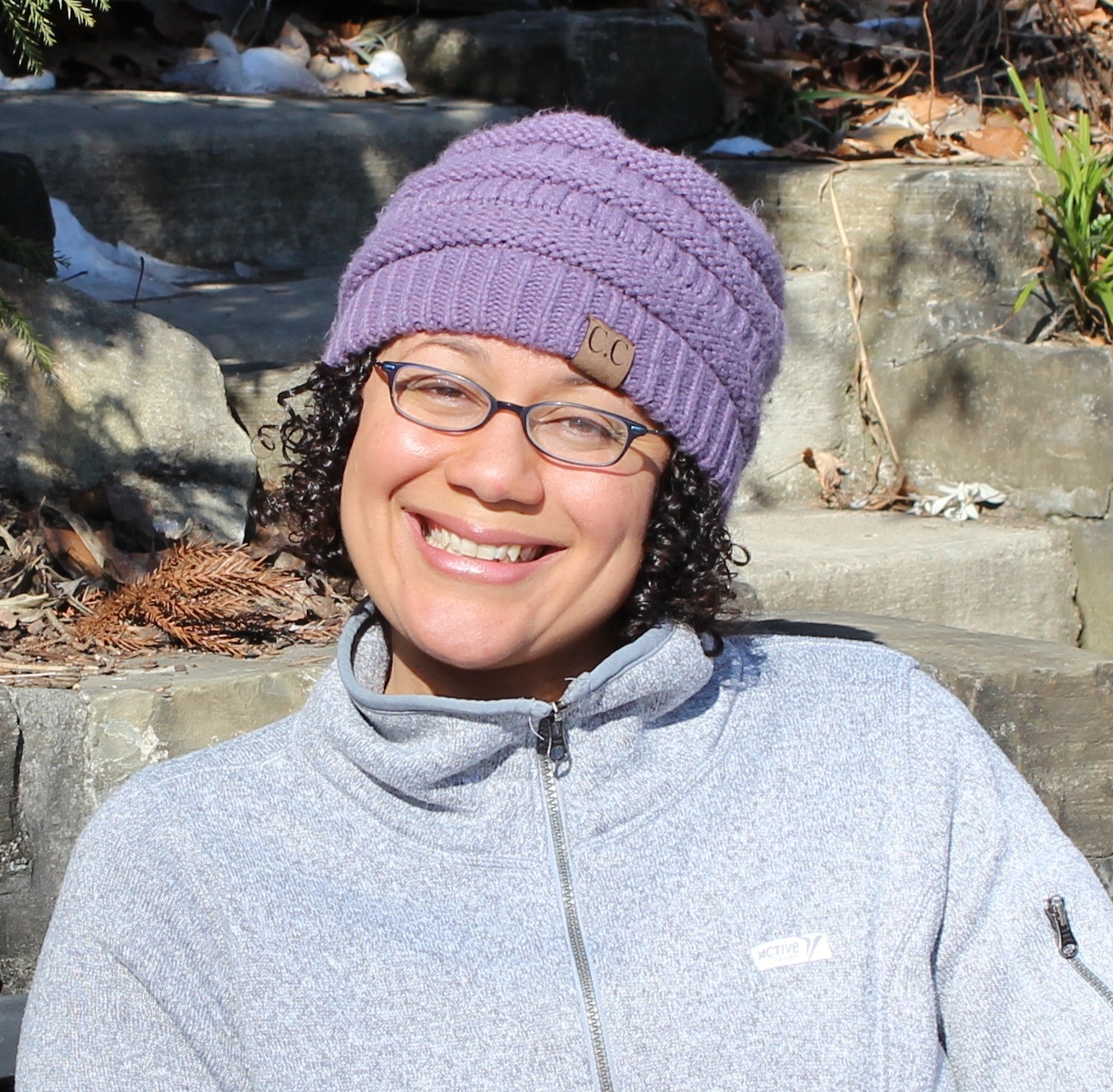
Shana Keller grew up a middle child in Middle America wondering exactly how clouds stayed in the air. She’s traveled all over the country and some parts of Europe with her family and moved too many times to count. She’s settled in Pittsburgh for now, a city built just for kids and one that she finds secretly inspiring. One of her favorite quotes is from Benjamin Banneker. “Every day is an adventure in learning.” That said, she graduated from the University of Miami, Florida, with a degree in Communications, from UCLA’s screenwriting program, and took a course in songwriting from Berklee College of Music. Her goal is to never stop learning.

You can connect with Shana Keller on

Her website | Twitter | Instagram

I’m excited to talk with Shana today about her books, her inspirations, and her extensive travels. My writing partner Jakki’s sons Steve and Jack also loved Fly, Firefly! and had some questions for Shana.

Steve asked: We like to capture fireflies. Did you capture fireflies as a kid?

I did! My brother and sister and I would compete to see if we could get one of them to land on us.

Jack wondered: Did you watch real fireflies to write your story?

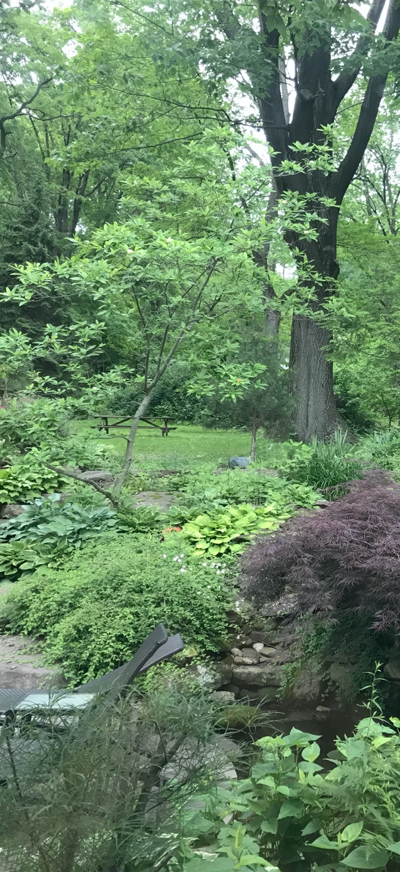
I was so lucky and grateful to live close to where Rachel Carson lived in Pennsylvania while I wrote this story, and to have a pond in our yard. We had frogs, fish, birds, and a good number of fireflies. I watched them every night in the summer when the weather was warm. There was so much wildlife in our backyard! We had chipmunks, groundhogs, wild turkeys, voles, and woodpeckers.
celebrate-picture-books-picture-book-review-shana-keller's-backyard

Our back yard in Pittsburgh. On the bottom right is the pond. Our cat loved to sleep on the picnic table up the small hill. Can you see it behind the little tree? Back there is where the groundhog moseyed around.
celebrate-picture-books-picture-book-review-Shana-Keller-Koi-Image

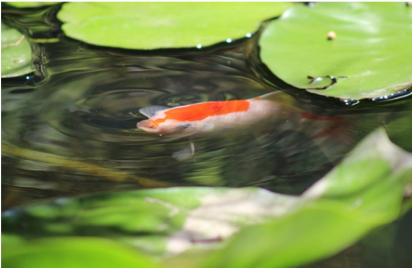
One of the koi fish in our pond surrounded (and protected) by lily pads.
celebrate-picture-books-picture-book-review-Shana-Keller-groundhog-Image

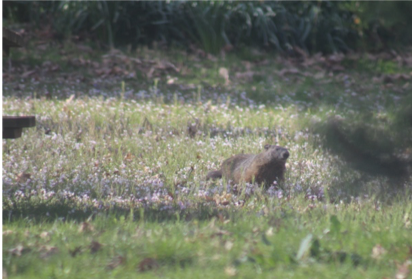
A groundhog just past the picnic table in our (former) backyard.
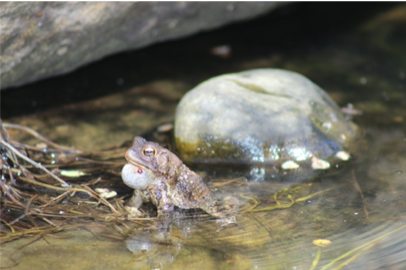
CBP Shana Keller Toad Image

A picture of our frog in the same pond as the koi. Lots of critters lived in it and used it for water.

We don’t live in Pittsburgh anymore and I really miss that yard. Sadly, I haven’t seen any fireflies in my new neighborhood in North Carolina.

Jack and Steve said: We’ve brought frogs back to a pond. Have you ever rescued an animal?

Yes! In the traditional sense, our last dog Abby, was a pound puppy. (Though she has passed, I included a photo.) She always stayed up with me while I wrote, no matter how late it was. I still miss her, so it was the neatest surprise for me to see a beagle in the illustrations for Ticktock Banneker’s Clock. Abby was part beagle.
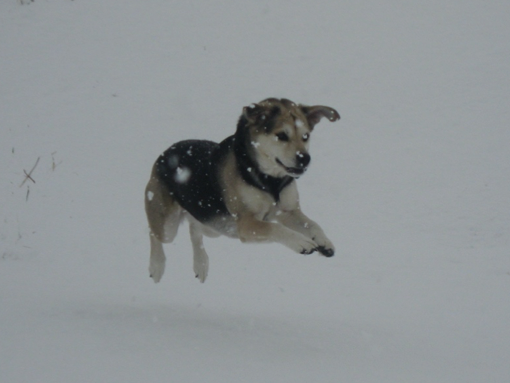
celebrate-picture-books-picture-book-review-Shana-Keller-Dog-Image

Abby running in the snow. She always looked like a deer or rabbit the way she bounded and jumped!
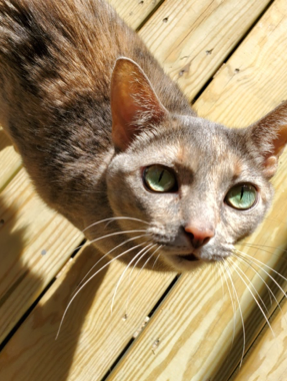
celebrate-picture-books-picture-book-review-Shana-Keller-cat-Image

Jazzy standing outside on our deck.

Today, one of our cats is also a rescue. Her name is Jasmine, but we call her Jazzy. And yes, in the literal sense I have rescued a handful of animals! My most memorable one was when I was about ten or eleven years old and I rescued a squirrel from my aunt’s swimming pool.

The little squirrel had tried to jump from one tall tree to the next and missed. He fell into their round pool. The water was too low, and the ledge was too high for him to climb out. I didn’t want him to drown, so I looked around the yard and grabbed a tree branch to see if he would climb onto it. He didn’t. Then, I ran into the shed and grabbed the biggest (which was also the heaviest) shovel I could find. The squirrel swam away from me even faster than before! I chased after him wielding the long shovel and tried not to rip the lining of the pool. Round and round we went until he finally slowed down long enough, I was able to scoop him out.

I’ve also stopped to scoot turtles along if I see them in the middle of the street. This one (photos are of the same turtle) was the littlest and also brightest green turtle I have ever seen in nature.  
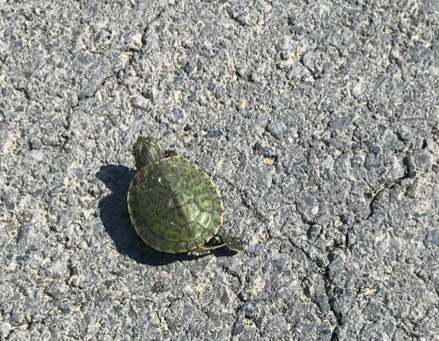
celebrate-picture-books-picture-book-review-Shana-Keller-turtle-pavement-Image

A little turtle crossing the street.

celebrate-picture-books-picture-book-review-Shana-Keller-turtle-grass-Image

A picture of the same little green turtle after I moved him. It looked like he was headed toward a pond. I helped him cross the street so he could get there.

Hi, Shana! What fantastic stories about your love of nature and your pets! Thanks so much for sharing all of these beautiful pictures with us. I can see that nature has really been a life-long inspiration. What sparked your idea to write this particular story?

A few years ago, I read a letter Rachel Carson wrote to her friend Dorothy Freeman in a book called Always, Rachel. In her letter, Rachel and her niece, Marjorie (nicknamed Marjie), came across a firefly while at her summer home in Southport, Maine. Around midnight, Rachel and Marjie headed down to the shore to secure Marjie’s son’s raft.

On the shore, they turned their flashlights off and saw a sea filled with “diamonds and emeralds.” The sparkling was bioluminescence, a (likely) form of marine plankton called Dinoflagellates. Rachel joked with her niece how one gem “took to the air!” Of course, it was a firefly! Well, further in the letter, Rachel tells her friend that she had already thought of a children’s story based on her experience. That sentence is what sparked the idea! 

What kind of research did you do in writing Fly, Firefly! and the back matter about bioluminescence that follows the story? What was the most surprising thing you learned about fireflies?

With this story, I headed to the library first to learn as much about the area Rachel was located in (Maine), and the insects and bioluminescence there. Once I sorted through all of my facts, I reached out to an entomologist here in North Carolina, the director of the Rachel Carson Homestead in Springdale, Pennsylvania, and a marine biologist who studied at the very same Marine Biology Lab Rachel did.

I also read Rachel’s books to get a sense of her voice and style. It filters through in her letters, but her books definitely have a poetic aura about them.

The most inspiring thing I learned was the importance and prominence bugs have in our world. We take them for granted. We call many of them pests. But the truth is, they are an important part of our ecological system. As I discovered with fireflies, when you have them, it is a good indication that your ecosystem is in great health.

What inspired you to write Fly, Firefly! in verse?

While I was researching, I discovered Rachel Carson had a love of poetry. Though this is not pertaining (that I know of) to the children’s story she discusses; in another letter written to her, she was quoted by her friend Dorothy (regarding Rachel’s poetic aims), as having said, “I just want it to be simple and clean and strong and sharp as a sword—for it has work to do!”

I did my best to honor her vision in that way, so I kept it lyrical, simple, and clean!

In your bio, you describe how you’ve traveled and lived all over the country and in parts of Europe. What took you to all of these places? Can you name a favorite place in the US? In Europe? Why are those places special to you?

People always assume I was a military brat when I’m asked about the places I’ve lived. Family and school took me/us to Oklahoma (my birth state), Kansas, Florida, Pennsylvania and Texas. Adventure and jobs took me/us to Colorado, New Mexico, Virginia, Germany, & North Carolina.

My mom simply said she had wanderlust and gypsy blood. I definitely got my love of travel from her. Although now, with my kids in school we have settled down. At least until they graduate. J

My absolute favorite place in the United States is Big Bend national park. My mom and I camped there the year before I left for college. It’s right on the border of Texas and Mexico in a NO-FLY zone which means zero light pollution. Seeing the vast Milky Way at night is something I will carry with me forever. I wish every kid could see the sky that I saw.

My favorite place in Europe was in Berlin. It was the bombed Kaiser Wilhelm Memorial Church left as it was after the war and converted into a museum. When I first saw this monument of destruction but also of hope, it impacted me in a strong way. My photo from over ten years ago is on the left and does not do it justice. The photo on the right is what it originally looked like. It is definitely worth a Google search to see more pictures of it and compare the before and after.

celebrate-picture-books-picture-book-review-Shana Keller-Kaiser-William-Memorial-Church-after-Image

My photo of the Kaiser Wilhelm Memorial Church. Notice the top tower is broken.
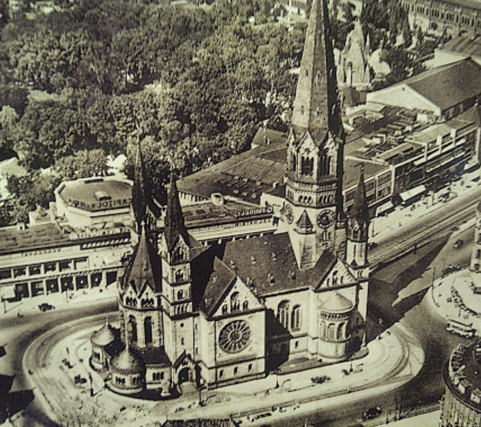
celebrate-picture-books-picture-book-review-Shana Keller-Kaiser-William-Memorial-Church-Before-Image

An online photo of the Kaiser Wilhelm Memorial Church. See how big it was before the bombing?

You’ve also recently released Bread for Words: A Frederick Douglass Story from Sleeping Bear Press that relates how Douglass, born into slavery, taught himself to read and write despite overwhelming challenges. Your powerful telling of this story is written in first person. Why was writing Douglass’s story in first person important to you?

I was first introduced to Douglass’s autobiographies in college. I thought this was way too long of a wait to learn about someone who was the most photographed person in 19th century America and considered one of the greatest orators in our nation.

Frederick struggled for years in a hostile environment while he learned to read and write. To honor his accomplishment, one he was clearly proud of, I wanted to present this story in the same format he had and give children direct access to his own words.
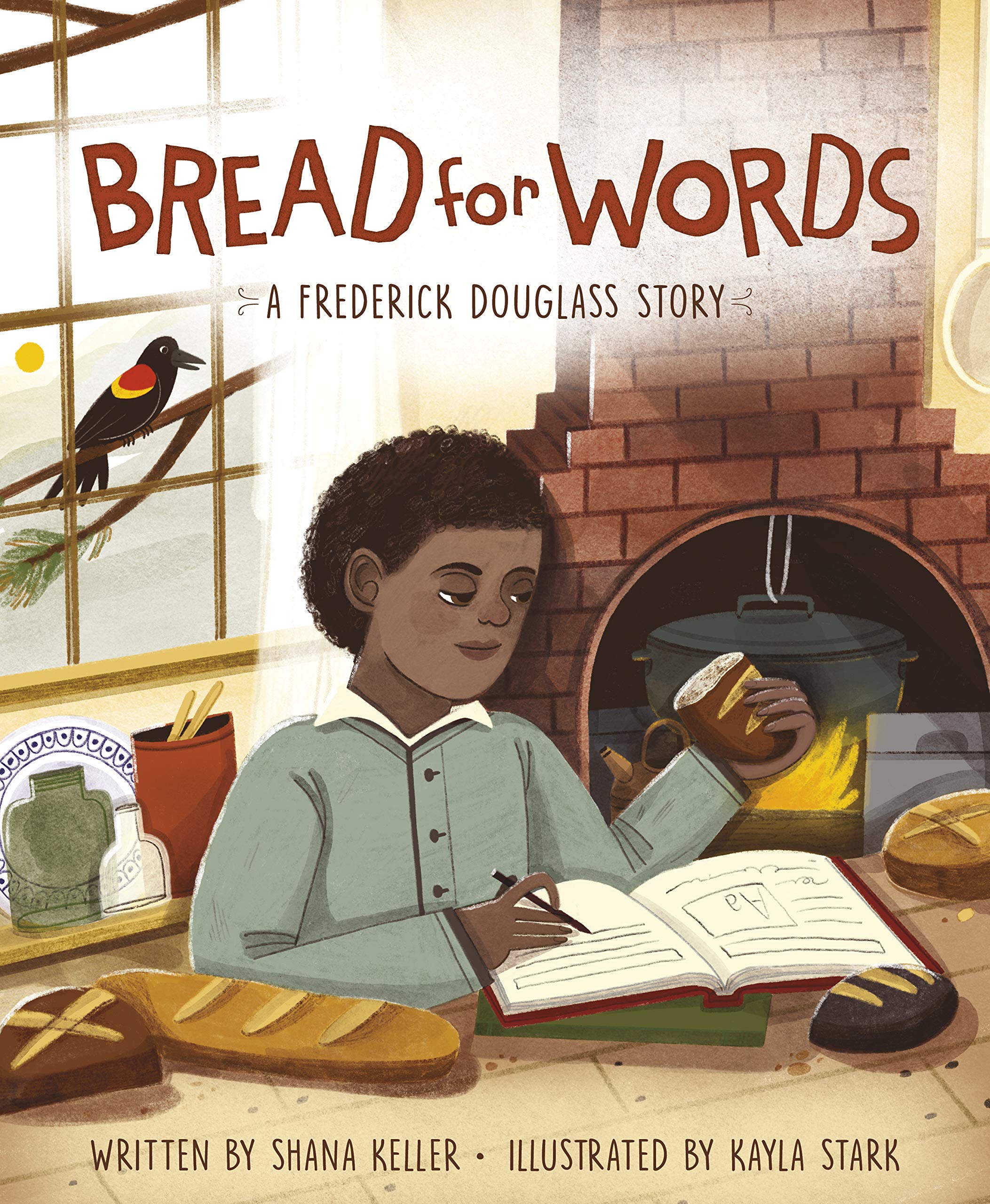
 

celebrate-picture-books-picture-book-review-bread-for-words-cover

Can you describe a little about your process in writing Bread for Words?

I read Douglass’s autobiographies of course, but I also studied his speeches. I was able to take a trip to Baltimore and meet with Urban Ranger and docent, Bradley Alston thanks to the folks at Baltimore National Heritage Area. His insight and knowledge not just of Frederick Douglass but of the Baltimore Douglass grew up in was incredible. Touring the Frederick Douglass–Isaac Myers Maritime Park and museum (a place I highly recommend) with Bradley Alston rounded out my research. I’ve included a few photos from that trip!
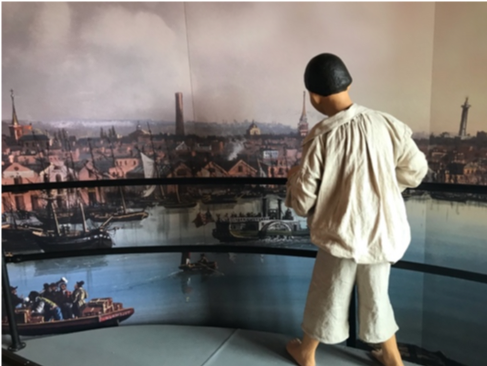
celebrate-picture-books-picture-book-review-Shana-Keller-Frederick-Douglass-Museum-Image-1

A recreation of Frederick Douglass arriving in Baltimore. (Photo taken at the Frederick Douglass-Isaac Myers Maritime Park and Museum.)
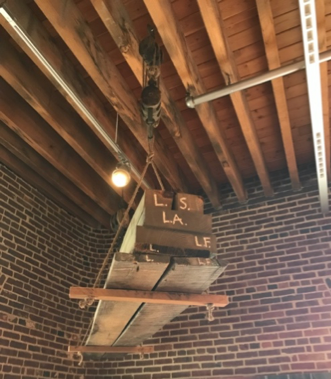
celebrate-picture-books-picture-book-review-Shana-Keller-Frederick-Douglass-Museum-Image-2

A recreation of the letters Frederick Douglass saw carved into the wood. (Photo taken at the Frederick Douglass-Isaac Myers Maritime Park and Museum.)
celebrate-picture-books-picture-book-review-Shana-Keller-Frederick-Douglass-Museum-Image-3

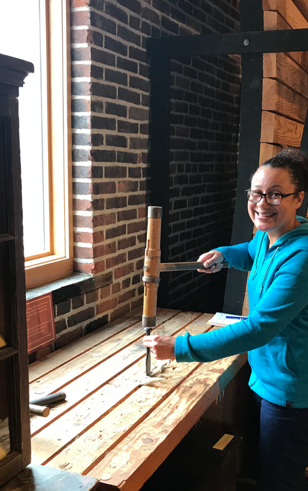
This is me learning what it was like to caulk a ship, a job Douglass had. They took long rope, dipped it into tar and used the hammer and tool to wedge it in for a watertight seal. (Photo taken by Bradley at the Frederick Douglass-Isaac Myers Maritime Park and Museum.)

celebrate-picture-books-picture-book-review-Shana-Keller-Frederick-Douglass-Museum-Image-4

What Baltimore Harbor looks like today.

Did you always want to write for children? How did you get started?

I didn’t expect to, not at first. I always thought I would write screenplays. I got started when my oldest daughter came home with a small paragraph from school about a man named Benjamin Banneker. It was during Black History Month, and I was amazed that I had never heard of this scientist and astronomer. Curious, I began to research him. When I discovered he built a strike clock using only a pocket watch and a pocketknife, that was the story I shared with my daughter, and that’s when the idea to put it in picture book format took place. I haven’t stopped writing picture books since.

You’re really enthusiastic about connecting with readers. What’s your favorite part of book events and meeting kids? Do you have an anecdote from any event you’d like to share?

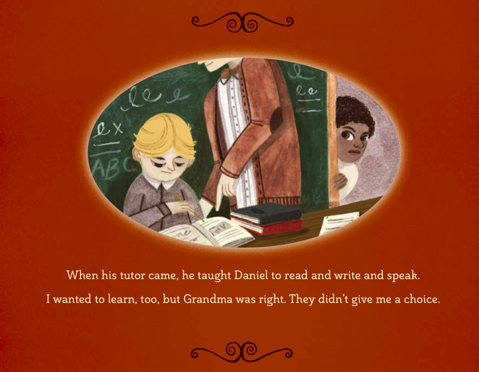
Yes! In fact, before all the quarantines, I had such a special moment with a group of fourth graders on the day I shared Bread for Words with them. A student referred to the picture that’s on the back of the cover and said, “See how Frederick wants to be with his friend?” The kids interpreted that image as Frederick waiting for his friend to finish with his tutoring so that they could play and hunt and eat together. But also waiting, so that his friend could teach him.

It seems so obvious now that they mentioned it, but my original interpretation was one of exclusion, not simply waiting. To them, all Fred had to do (which Fred actually did) was ask his friend for help. One of the 4th grade boys even said, “I’m glad he had a friend that could help him.” I agreed and said, “It’s amazing how all the kid’s helped each other, isn’t it?!” And there was the real ‘lesson’ which another student pointed out and said, “We have to help each other if we can.” That kind of interaction is my favorite part about school and library visits!

It does make me wonder how other students will interpret this image.
celebrate-picture-books-picture-book-review-Shana Keller Bread for Words Back Cover Image

Bread for Words – back cover. Courtesy of Sleeping Bear Press.

What’s up next for you?

Hopefully more picture books! I’m working on a WWI story, as well as a picture book that highlights the effects of light pollution on migratory birds. I also just finished a very cool Coast Guard story that I can’t wait to share with my editor.

Thank you, so much, Shana for this wonderful talk and your generous pictures! I wish you all the best with all of your books and am really looking forward to reading them as I’m sure kids are too!

You can connect with Shana Keller on

Her website | Twitter | Instagram

Rachel Carson Day Activity

celebrate-picture-books-picture-book-review-firefly-maze

Firefly Flight Maze


This little firefly wants to join her friends in the forest. Can you help her through the maze to find them in this printable maze?

Firefly Flight Maze Puzzle| Firefly Flight Mage Solution

celebrate-picture-books-picture-book-review-fly-firefly-cover

You can find Fly, Firefly! at these booksellers

Amazon | Barnes & Noble | Books-a-Million

To support your local independent bookstore, order from

Bookshop | IndieBound

Picture Book Review

March 24 – It’s Women’s History Month

celebrate-picture-books-picture-book-review-june-almeida-virus-detective-cover

About the Holiday

From its beginning as a single-day observance in 1911 in Sonoma, California, the celebration of women’s achievements and contributions throughout history grew to a week-long event in 1980 and finally to encompass the entire month of March in 1987. During this month we remember the trail-blazing women of yesteryear who used their creativity, intelligence, and perseverance to promote rights for women while contributing their own innovations to science, art, social reform, medicine, and other disciplines as well as today’s pioneers who carry on their legacy and make our world a better place. Today, we feature a book about a woman who revolutionized virology and medical research, connecting the past and the present. To learn more about the holiday, visit the National Women’s History Museum website and check out their resource toolkit.

June Almeida, Virus Detective! The Woman Who Discovered the First Human Coronavirus

Written by Suzanne Slade | Illustrated by Elisa Paganelli

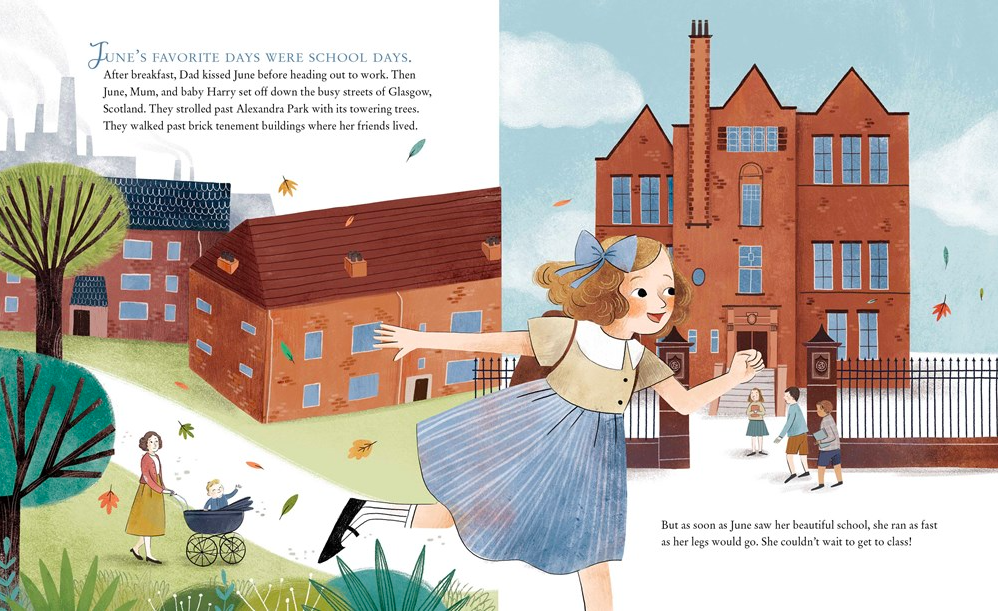
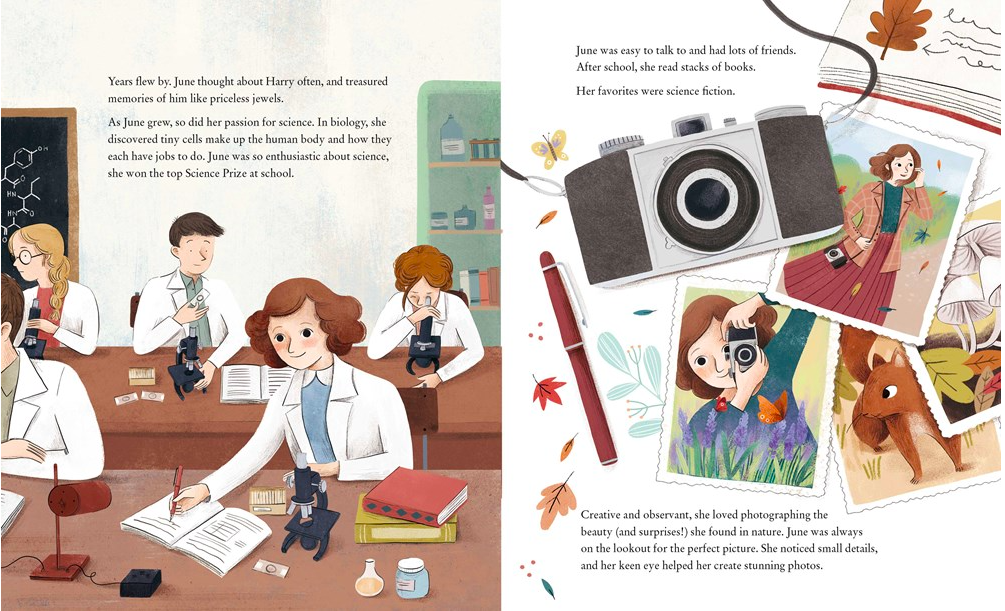
Growing up in Glasgow, Scotland, June Almeida loved school. After class she couldn’t wait to share what she’d learned—especially science subjects—with her mother, father, and little brother, Henry. When June was ten, however, her life changed when Henry became sick and passed away. Throughout elementary school and into high school, June loved studying science, especially biology in which she learned about the cells in the body and their functions. “June was so enthusiastic about science, she won the top science prize at school.”

celebrate-picture-books-picture-book-review-june-almeida-virus-detective-childhood

Image copyright Elisa Paganelli, 2021, text copyright Suzanne Slade, 2021. Courtesy of Sleeping Bear Press.

But science wasn’t the only thing June loved. She had lots of friends, was an avid reader, and became an excellent photographer. Whenever she was out with her camera, “she noticed small details, and her keen eye helped her create stunning photos.” June dreamed of attending college, but the jobs her father and mother held did not pay enough, and when June was sixteen, she dropped out of school to get a job to help pay the bills. June wanted to make a difference, “so she applied to work at the nearby hospital” and was hired as a lab worker. Here she learned how to examine cells with a microscope. “Her findings helped doctors treat patients.”

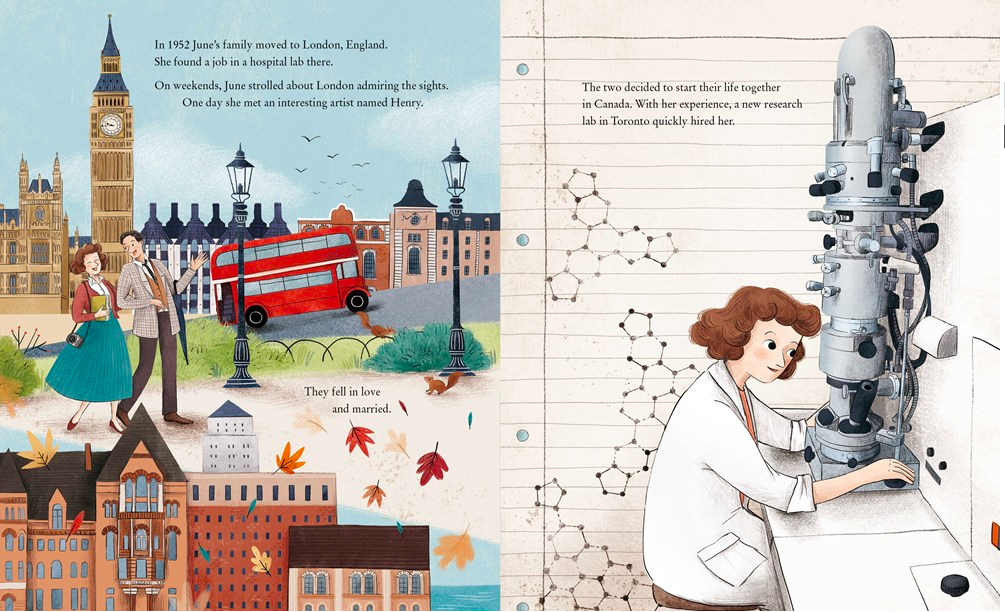
When June was twenty-two, she and her family moved to London. She got a job in a hospital lab and also met and married an artist named Henry. June and Henry moved to Canada, where she quickly found a job at a “new research lab in Toronto.” In this lab, June worked with an electron microscope that could magnify things 25,000 times and produced detailed pictures of the samples being studied. These photos “were helpful. But it was hard to tell which tiny blobs were viruses and which were cells.” June thought she could improve on the photos.

celebrate-picture-books-picture-book-review-june-almeida-virus-detective-photographer

Image copyright Elisa Paganelli, 2021, text copyright Suzanne Slade, 2021. Courtesy of Sleeping Bear Press.

June knew that in the body antibodies would surround viruses as they worked to fight it. June wondered if by introducing antibodies to her samples, scientists would be able to determine the virus from the cells. June’s idea worked. The scientists were astonished. Because of June’s innovation, they now had clear pictures that would help them study and combat viruses.

After June took time away from work to have a baby in 1960, she returned to her research and often lectured about her work. She was recruited to work at a hospital lab in London, so she and her family moved once again. At the time, a researcher named David Tyrrell had been trying to identify a virus that had affected a young boy. Could it be a new virus? He was hoping that June could help.

celebrate-picture-books-picture-book-review-june-almeida-virus-detective-hospital

Image copyright Elisa Paganelli, 2021, text copyright Suzanne Slade, 2021. Courtesy of Sleeping Bear Press.

When June received the sample, she knew that “since it was an unknown virus, there were no antibodies to help find it.” But she was an expert at using another method that might work. Carefully, June implemented the intricate steps. Then she put the sample under the microscope and scanned the picture. “June was stunned.” Each virus blob was encircled by tiny dots “like a crown. ” She had seen this twice before when looking at viruses from sick animals. She had written a paper on it, but it had been rejected by other researchers because they thought her pictures were just blurry and not those of a new virus.

June presented her findings to doctors who agreed with her discovery. They decided to name the new virus coronavirus, after the Latin word for crown, corona. June and David then published a paper telling other doctors and researchers about the new virus. Following this discovery, June continued to study viruses, such as hepatitis B and HIV. Her pictures of these viruses helped researchers develop medications that could “block them from making people sick.” Even after she retired, June never lost her love of learning, teaching herself to play the flute, about antiques, and how to use a digital camera to continue creating incredible photos.

Backmatter includes more about June Almeida and her life’s work, an illustrated timeline of her life, and a selected bibliography.

celebrate-picture-books-picture-book-review-june-almeida-virus-detective-London

Image copyright Elisa Paganelli, 2021, text copyright Suzanne Slade, 2021. Courtesy of Sleeping Bear Press.

Suzanne Slade’s compelling biography of June Almeida gives context for and insight into the research and discovery of the coronavirus and informs present-day events and breakthroughs. Slade’s fluid storytelling clearly reveals Almeida’s intelligence and passion for science as well as her determination to use her skills to the betterment of society. Kids will be astounded that June was able to begin her career at the age of sixteen, and that her beloved hobby of photography became a career that changed medical research. Slade’s sprinkling of personal details about Almeida’s life creates a well-rounded understanding of this influential woman.

Through Elisa Paganelli’s realistic and detailed illustrations, children have the opportunity to see a researcher at work in world-class laboratories. Readers will be especially impressed by images of the electron microscope and how Almeida improved the photographs these powerful machines produced. Children familiar with the shape of the coronavirus will be interested in seeing the faithfully reproduced photographs and how the virus got its name. Kids will also enjoy seeing illustrations of Almeida’s family life, including her daughter Joyce, who is herself a doctor.

An inspirational and fascinating biography of a woman with a very innovative mind, June Almeida, Virus Detective! will thrill children interested in science, medicine, and the arts. The book would be an impactful addition to STEM and STEAM lessons. It is highly recommended for home libraries and is a must for school and public library collections.

Ages 6 – 9 

Sleeping Bear Press, 2021 | ISBN 978-1534111325

Discover more about Suzanne Slade and her books on her website.

To learn more about Elisa Paganelli, her books, and her art, visit her website.

Women’s History Month Activity

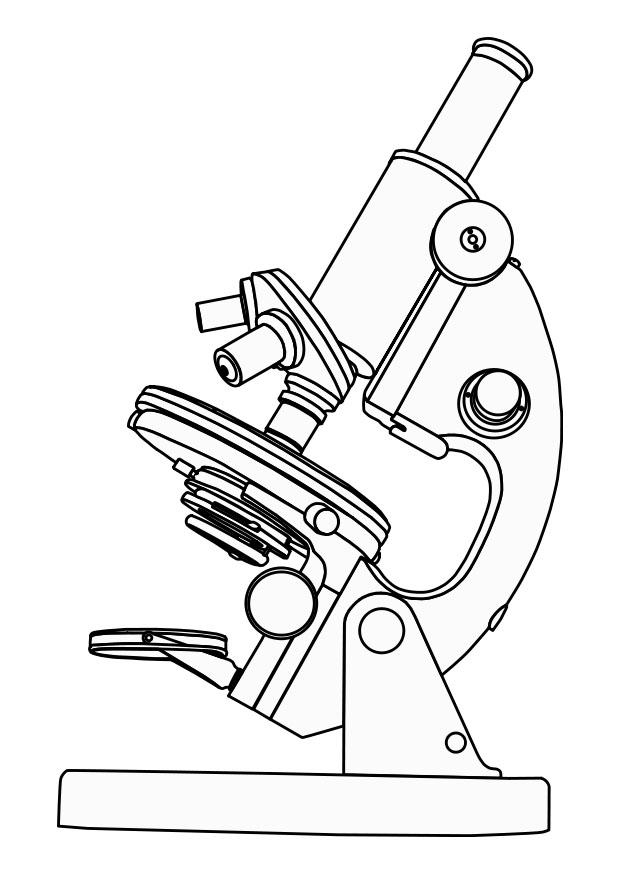
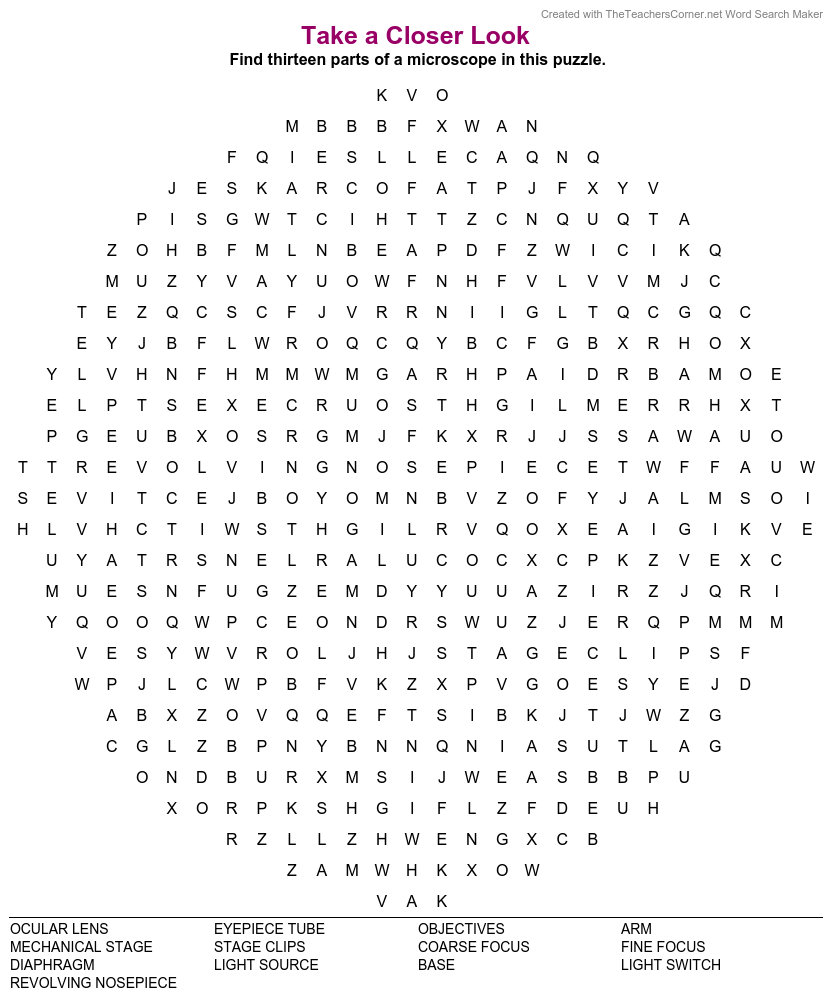
celebrate-picture-books-picture-book-review-microscope-coloring-page          celebrate-picture-books-picture-book-review-microscope-wordsearch-puzzle

Take a Closer Look Coloring Page and Word Search 

You can examine the parts of a microscope with this printable word search puzzle and coloring page.

Take a Closer Look Word Search Puzzle | Take a Closer Look Word Search Solution | Coloring Page

celebrate-picture-books-picture-book-review-june-almeida-virus-detective-cover

You can find June Almeida, Virus Detective! at these booksellers

Amazon | Barnes & Noble | Books-a-Million

To support your local independent bookstore, order from

Bookshop | IndieBound

Picture Book Review