July 1 – National Watercolor Month

About the Holiday

Today, I’m celebrating World Watercolor Month with a biography of a woman artist born in 1861 who not only worked in watercolors but brought the delicately blended beauty of the art form to the solid medium of glass as the creator of iconic Tiffany designs. World Watercolor Month was begun in 2016 by Charlie O’Shields, the creator of Doodlewash®, host of the Sketching Stuff podcast, and founder of a social artist movement dedicated to promoting and connecting watercolor artists from all over the world. The holiday also raises awareness of the global importance of art and creativity. Everyone from amateurs to professionals are welcome to participate—and if you’ve never painted with watercolors before, now’s a great time to try! If you’d like prompts to inspire your work and other ways to enjoy the month and take your love of watercolor painting into next month and beyond, visit Doodlewash.

Thank you to Peachtree and Barbara Fisch of Blue Slip Media for sending me a copy of this book for review!

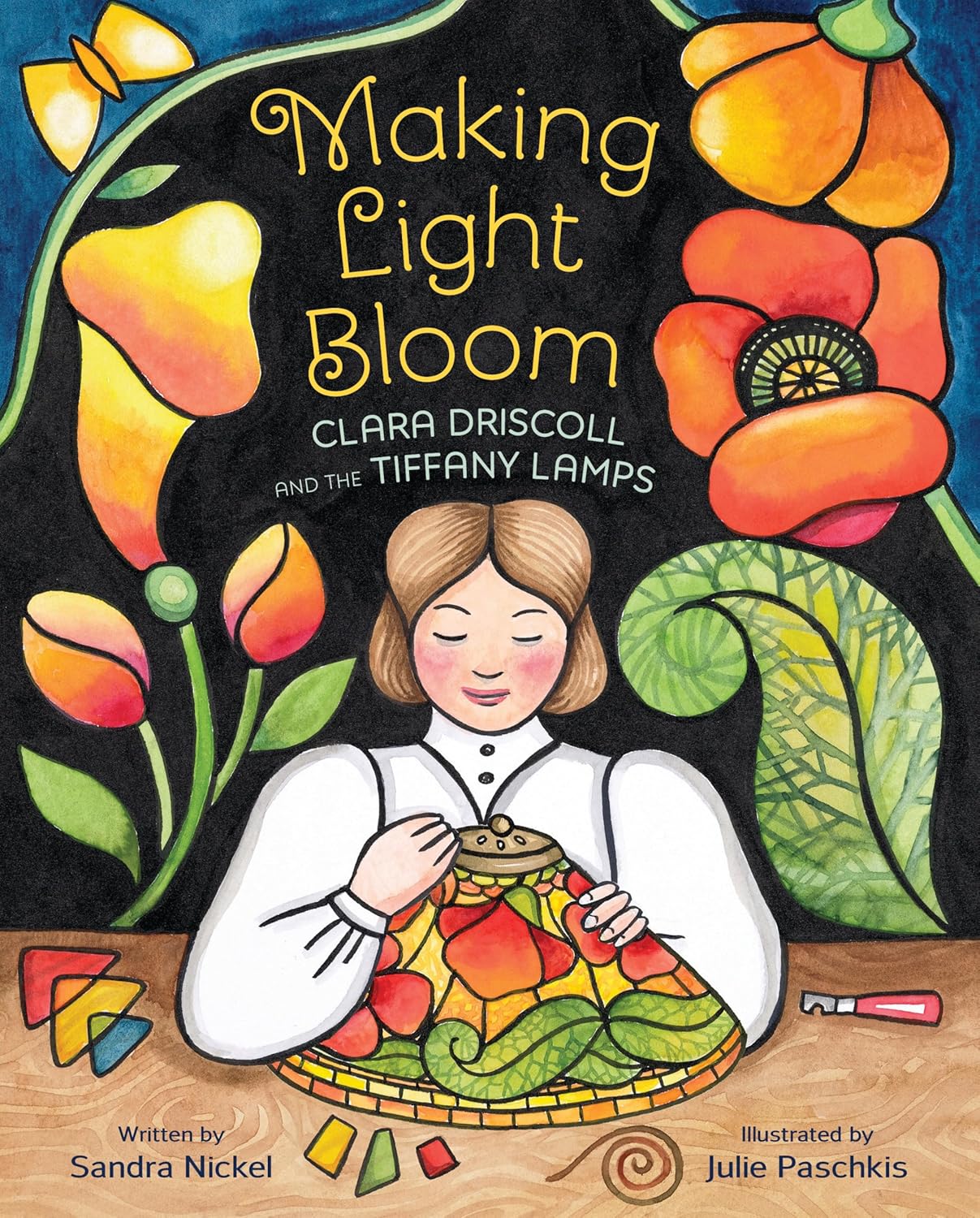
Making Light Bloom: Clara Driscoll and the Tiffany Lamps

Written by Sandra Nickel | Illustrated by Julie Paschkis


As a young girl, Clara Driscoll grew up surrounded by glorious gardens blooming with morning glories, apple blossoms, and wildflowers and shimmering with the dragon flies they attracted. Clara often sketched the gardens, and when she grew older, she enrolled in art school, hoping to turn her talent for drawing into a job that could help her financially struggling family. After graduation, Clara moved to New York City and took a job working for glassmaker Louis C. Tiffany.

Clara’s task was to choose and cut pieces of glass for the craftsmen to join together with metal ridges to make beautiful stained glass windows. She used her creative eye to “‘paint’ robes, halos, and great wings of angels” with “dappled and streaked, shaded and shimmering” glass. It didn’t take long for Louis to recognize Clara’s talent, and soon she was overseeing her own group of women known as Tiffany Girls. Missing her gardens back home, Clara had the idea to make a lamp from the delicate glass that would bring the beauty of a garden inside.
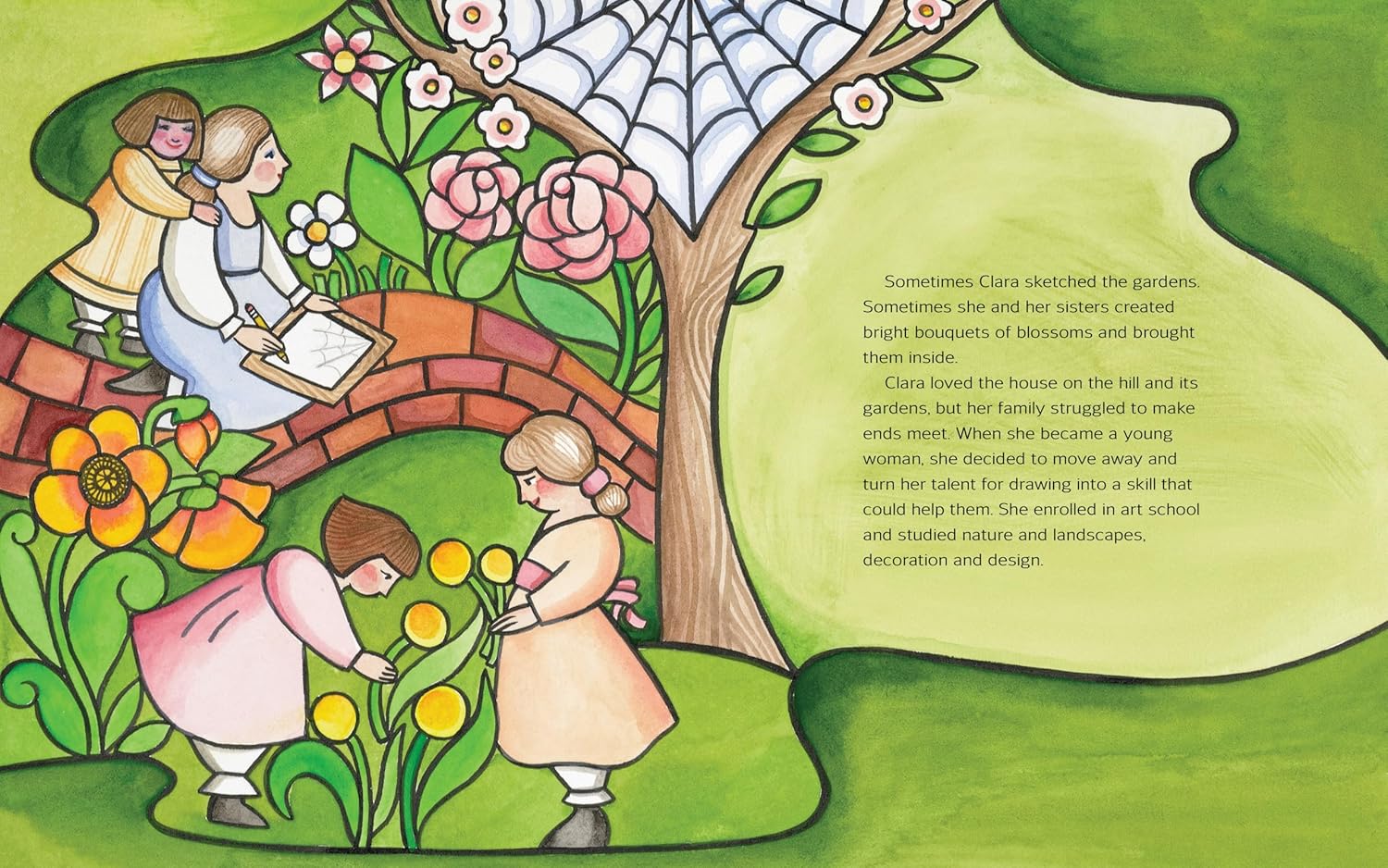
Illustration © 2025 by Julie Paschkis, text © 2025 by Sandra Nickel. Courtesy of Peachtree.

She and the Tiffany Girls cut small pieces of glass to make butterfly wings, and then “together with the craftsmen, she formed the butterfly wings into a lampshade.” Once the kerosene wick was lit, “light bloomed as never before.” Next, Clara wanted to bring the brilliance of dragonflies to her new creation. But cutting and forming the glass into the intricate wings of a dragonfly was time consuming, and one of the managers said that “she could never make another.”

That, however, was before Louis Tiffany saw the lamp and asked Clara “to make another to display at the World’s Fair in Paris.” At the fair, Clara’s lamp won the bronze medal. The lamp’s success “astounded” Louis. He put Clara and the Tiffany Girls in charge of making lamps and windows representing the beauty of natural landscapes.

Feeling shut out, the craftsmen announced a strike unless Louis fired the women. But Louis knew the value of Clara’s imagination and work, so he compromised with the men: Clara’s workshop would not get bigger, but “Clara would be in charge of lamp-making from that day forward.”
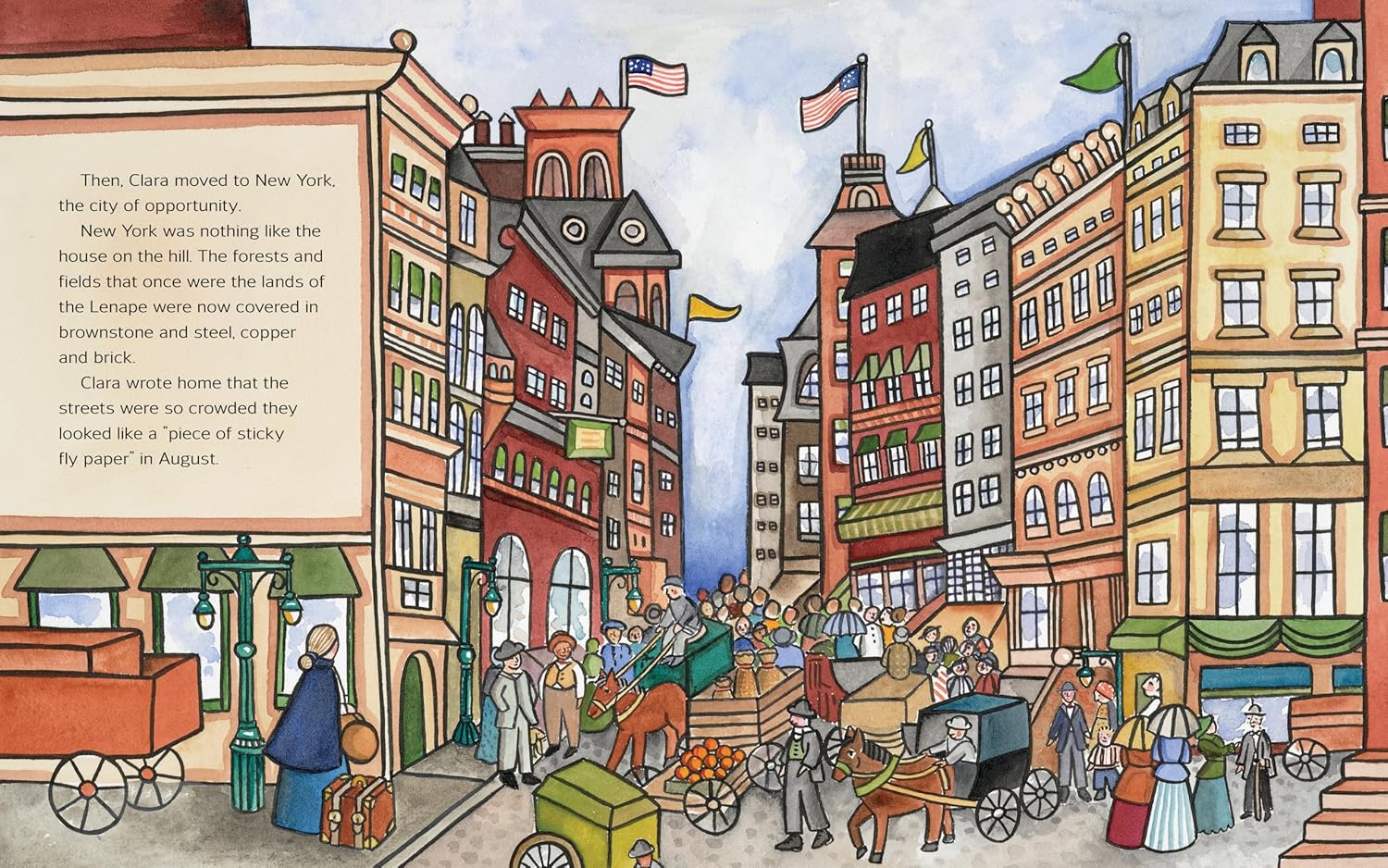
Illustration © 2025 by Julie Paschkis, text © 2025 by Sandra Nickel. Courtesy of Peachtree.

Elated, Clara began creating new designs inspired by the gardens she’d sketched at home as well as  nature she found within the city, all informed by her meticulous research. In the basement storage room, she searched for pieces of glass that were just the right hues to bring to life each petal, flower, leaf, and stem. In one astonishing design, she recreated wisteria with 2,000 tiny petals.

While Clara’s work was recognized inside the studio, because her lamps were only known as “Tiffany lamps,” no one else knew they were Clara’s creation. It was only after both Louis and Clara passed away and Clara’s letters to her sisters were discovered that people learned the truth about how Clara made light bloom “throughout the world.”

Back matter includes an Author’s Note that goes into more detail about Clara’s letters home, Louis C. Tiffany’s reaction to her initial idea, and Clara’s long, intricate process for designing each lamp; a list of museums where you can see Tiffany Lamps; and the names of two archives where Clara’s letters can be read; a bibliography; and dates and quotes for references found in the book.
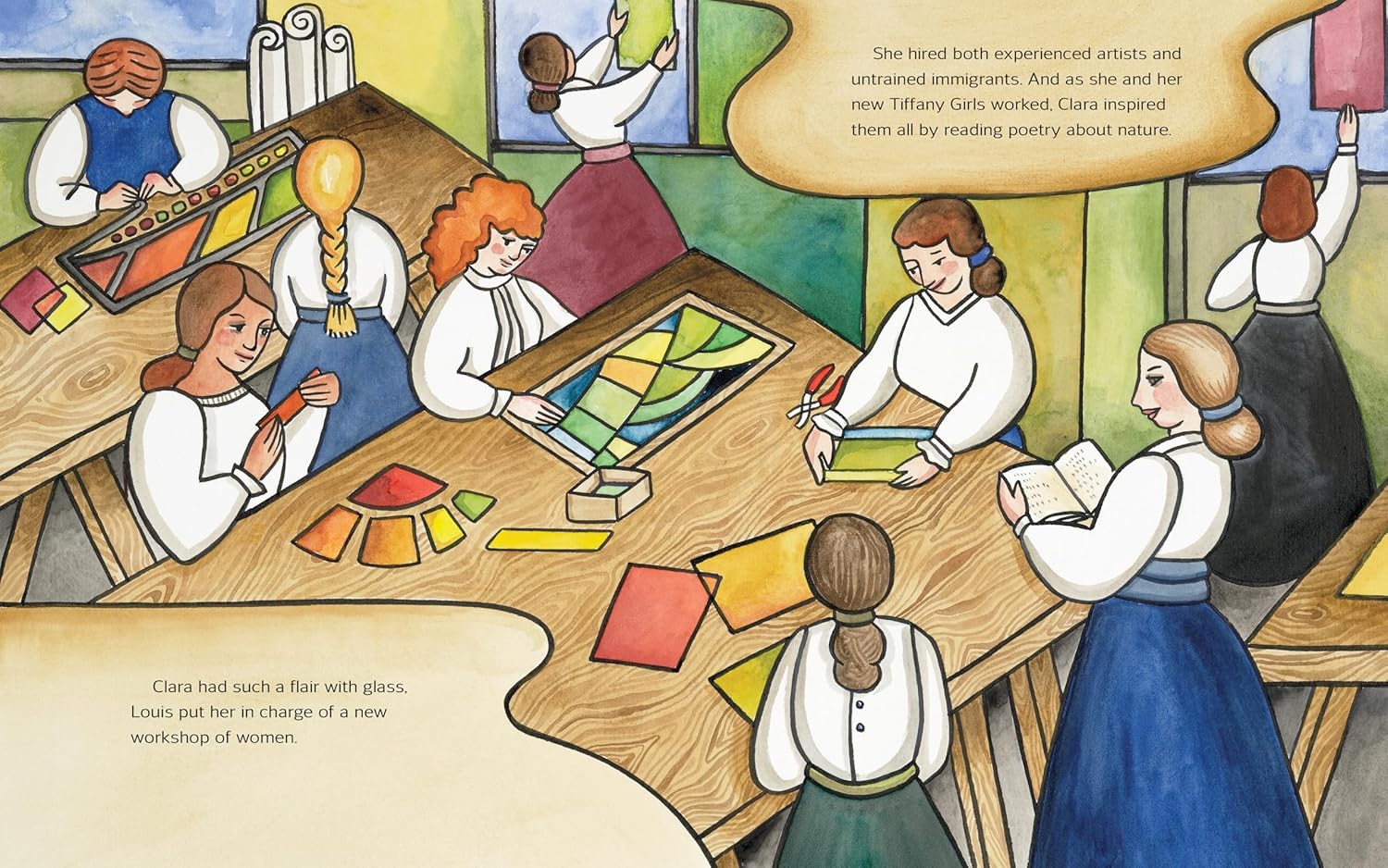
Illustration © 2025 by Julie Paschkis, text © 2025 by Sandra Nickel. Courtesy of Peachtree.

Sandra Nickel’s fascinating and eye-opening story about Clara Driscoll, one of the world’s most innovative artists, is both inspirational and uplifting. Nickel’s heartfelt, straightforward storytelling about Clara’s early years allows readers to see how youthful experiences and interests can influence their later endeavors—creative and otherwise. Nickel also emphasizes Clara’s remarkable vision for ways to expand the use of stained glass in the 1890s as well as her advocacy for herself and her ideas, making her an excellent role model for all children. And while Clara was not recognized for her work during her lifetime, art lovers can be grateful that Louis C. Tiffany knew brilliance when he saw it and valued her contributions—another aspect of Clara’s story to celebrate. 

Julie Paschkis’s dazzling, folk-style illustrations bring the intricate and delicate beauty of stained glass to the page, telling Clara’s story visually in a way similar to the windows she often worked on. Taking kids into the Tiffany studio, Paschkis demonstrates how Clara, the Tiffany Girls, and the craftsmen chose, cut, and pieced together to create complex scenes that glow with life still today. Paschkis faithfully recreates Clara’s iconic dragonfly lamp, an image that will wow kids. 

A vibrant biography of a visionary artist, Making Light Bloom: Clara Driscoll and the Tiffany Lamps is an inspiring book to share with creatives of all types at home, in the classroom, and for art and crafts programs. The book is a must addition to any library collection.

Ages 7 – 10

Peachtree, 2025 | ISBN 978-1682636091

About the Author

Sandra Nickel is an award-winning author of picture books and has two new books out this Spring: Seven, A Most Remarkable Pigeon, an uplifting tale that celebrates differences, and Making Light Bloom, Clara Driscoll and the Tiffany Lamps, in which Sandra continues her mission to celebrate extraordinary individuals who have been nearly forgotten by history. She is honored to be the winner of a Christopher Award, the winner of the Society of Children’s Book Writers & Illustrators Crystal Kite Award, a finalist for the Golden Kite Award for Nonfiction for Younger Readers, a Junior Library Guild Gold Selection honoree, and a Charlotte Huck Award Recommended author. She holds a Master of Fine Arts in Writing for Children and Young Adults and has presented workshops on writing for children and young adults throughout the United States and Europe. Visit her at sandranickel.com. You’ll also find her on Bluesky, Facebook, Instagram, and Twitter/X

About the Illustrator

Julie Paschkis is an award-winning illustrator of more than 25 books for children. A graduate of Cornell University and the School for American Craftsmen at Rochester Institute of Technology, she taught art to grade school children for a number of years before turning her full attention to painting, textile design, and creating illustrations for her books. Visit her at juliepaschkis.com to see more of her work and download whimsical and nature-inspired coloring pages for kids and adults. You’ll also find her on Facebook.

World Watercolor Month Activity
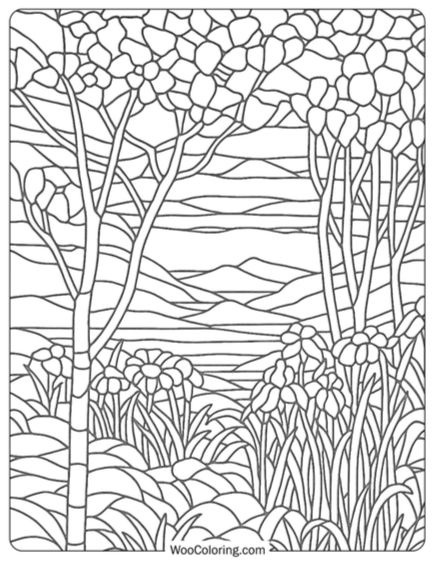
Tiffany Window Coloring Page


Create your own brilliant vision with this Tiffany Window Coloring Page!
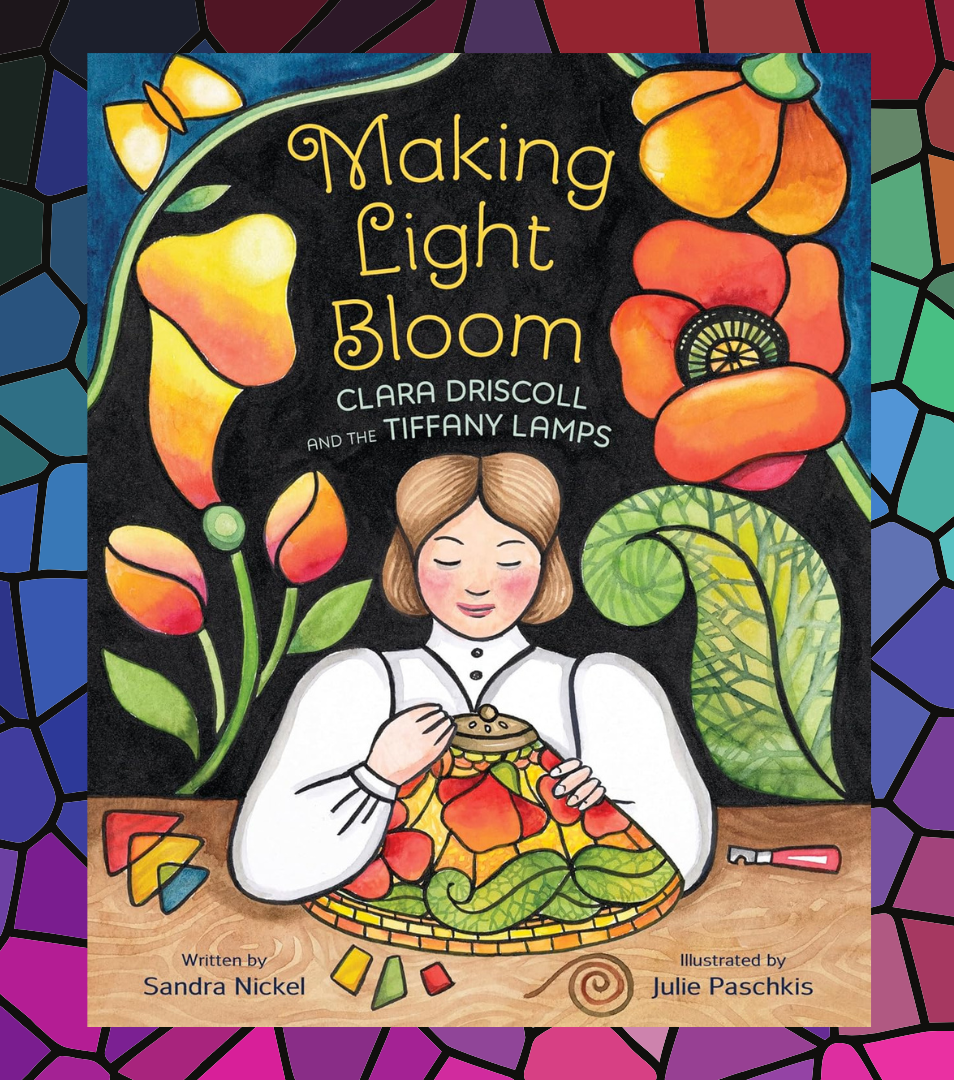
You can purchase Making Light Bloom: Clara Driscoll and the Tiffany Lamps from these booksellers.

Amazon | Barnes & Noble | Bookshop

Picture Book Review

June 13 – National Pigeon Day

About the Holiday

When you see pigeons gathering around park benches or scuttling along urban outdoor areas looking for crumbs or lining up on electrical wires, you may not think much about them. They just seem part of the landscape. Learning more about National Pigeon Day, however, may change your ideas about these unassuming birds forever. The holiday was established by President Woodrow Wilson in acknowledgement of the historical and cultural significance of pigeons, particularly their contributions during World War I. Today, the holiday celebrates the important role they played in both world wars.

As the website BirdTipper explains, pigeons were used during both World Wars as “reliable and efficient messengers, providing a vital link between troops on the front lines and command centers. Their speed and homing ability made them indispensable for conveying important messages, often flying through dangerous conditions to deliver vital information. Numerous pigeons were awarded medals and honors for their service, highlighting their bravery and significance in wartime efforts.”

Today’s date was selected as National Pigeon Day to commemorate the death of one of the most famous World War I pigeons, Cher Ami. To read more about this incredible bird, including its role in saving nearly 200 soldiers despite being grievously injured, and more about how pigeons helped the war efforts, visit BirdTipper.

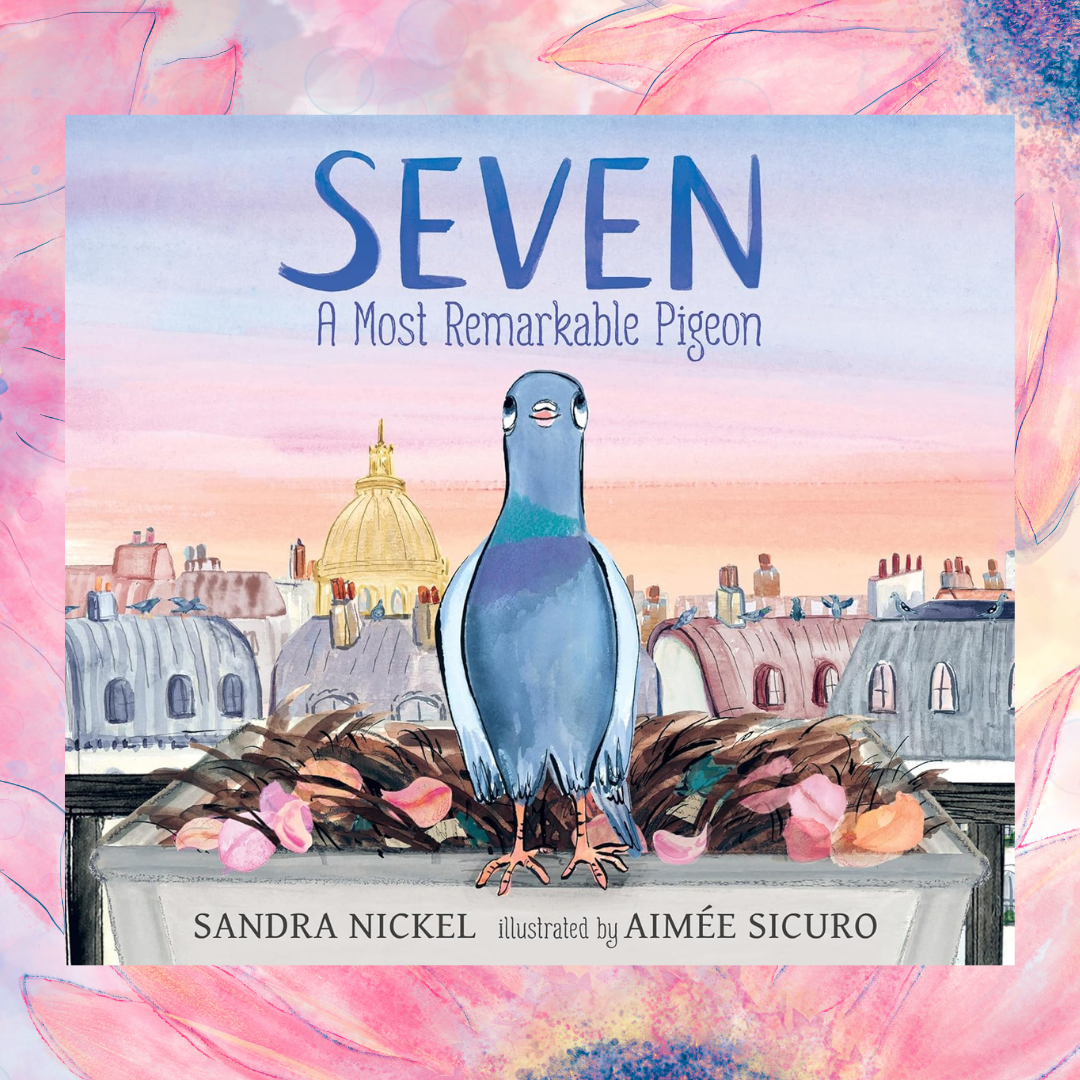
Thanks to Candlewick and Barbara Fisch at Blue Slip Media for sending me a copy of Seven: A Most Remarkable Pigeon!

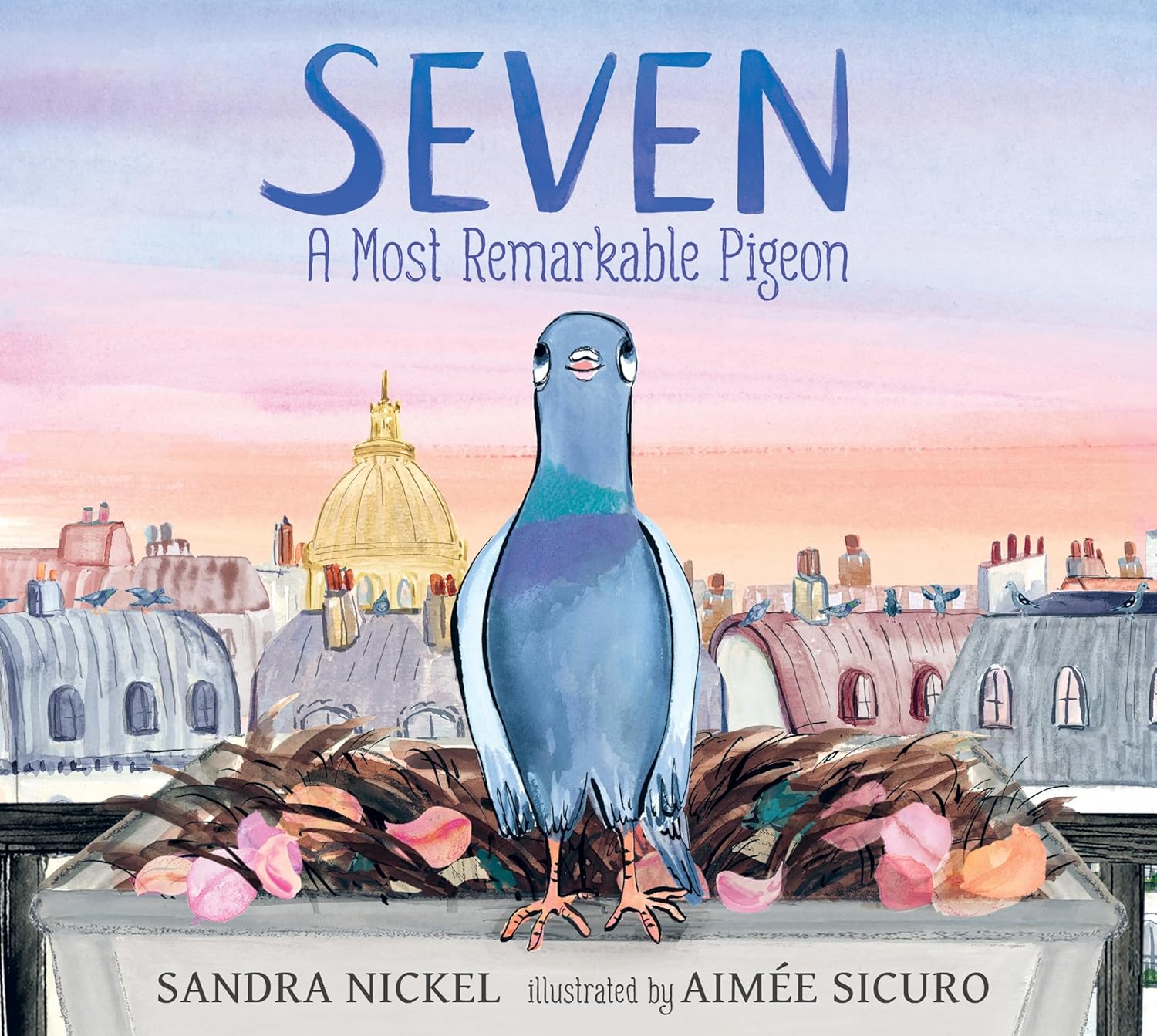
Seven: A Most Remarkable Pigeon

Written by Sandra Nickel | Illustrated by Aimée Sicuro


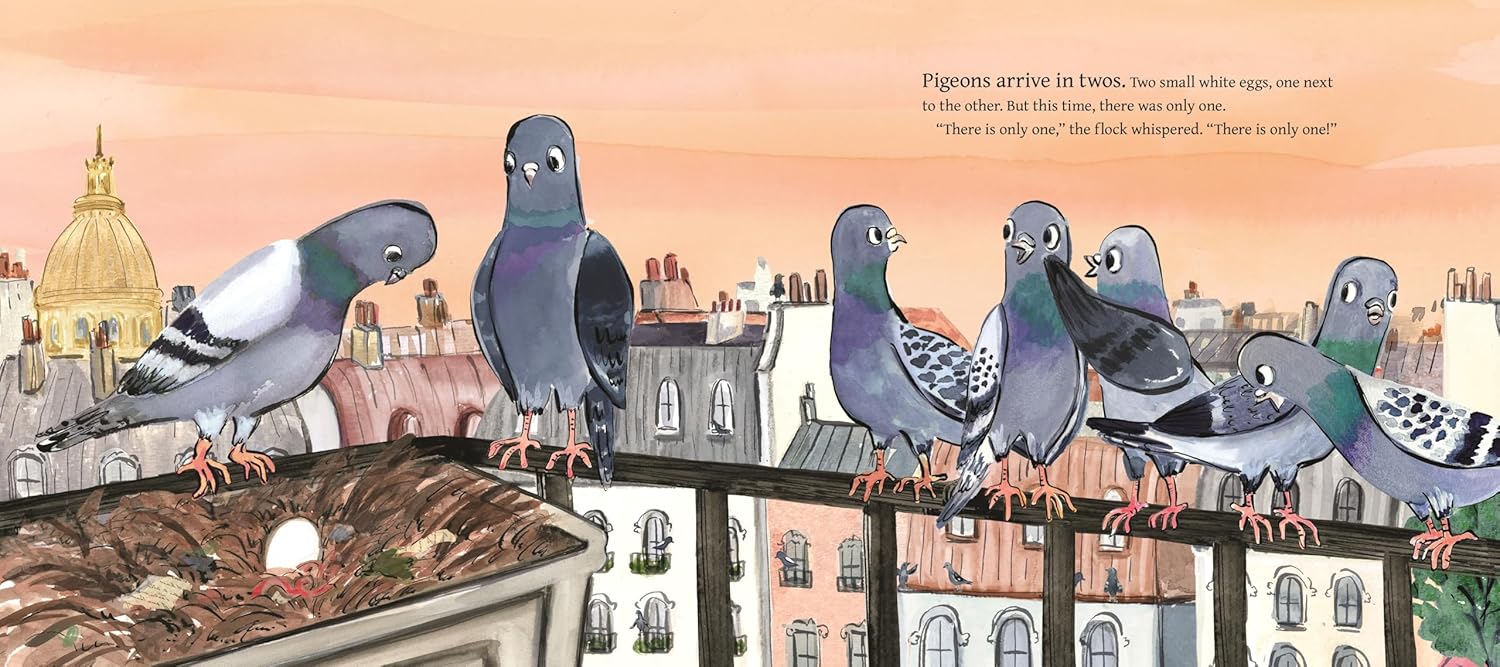
The little pigeon was different right from the start—when he was still in the egg, even. Usually “pigeons arrive in twos . . . . But this time, there was only one.” The flock whispered and whispered. When the tiny bird hatched, his parents named him Seven in honor of “seven thousand miles . . . the farthest any pigeon has flown to get back home.” It “is considered a very lucky name.”

Illustration © 2025 by Aimée Sicuro, text © 2025 by Sandra Nickel. Used with permission of Candlewick Press. All rights reserved.

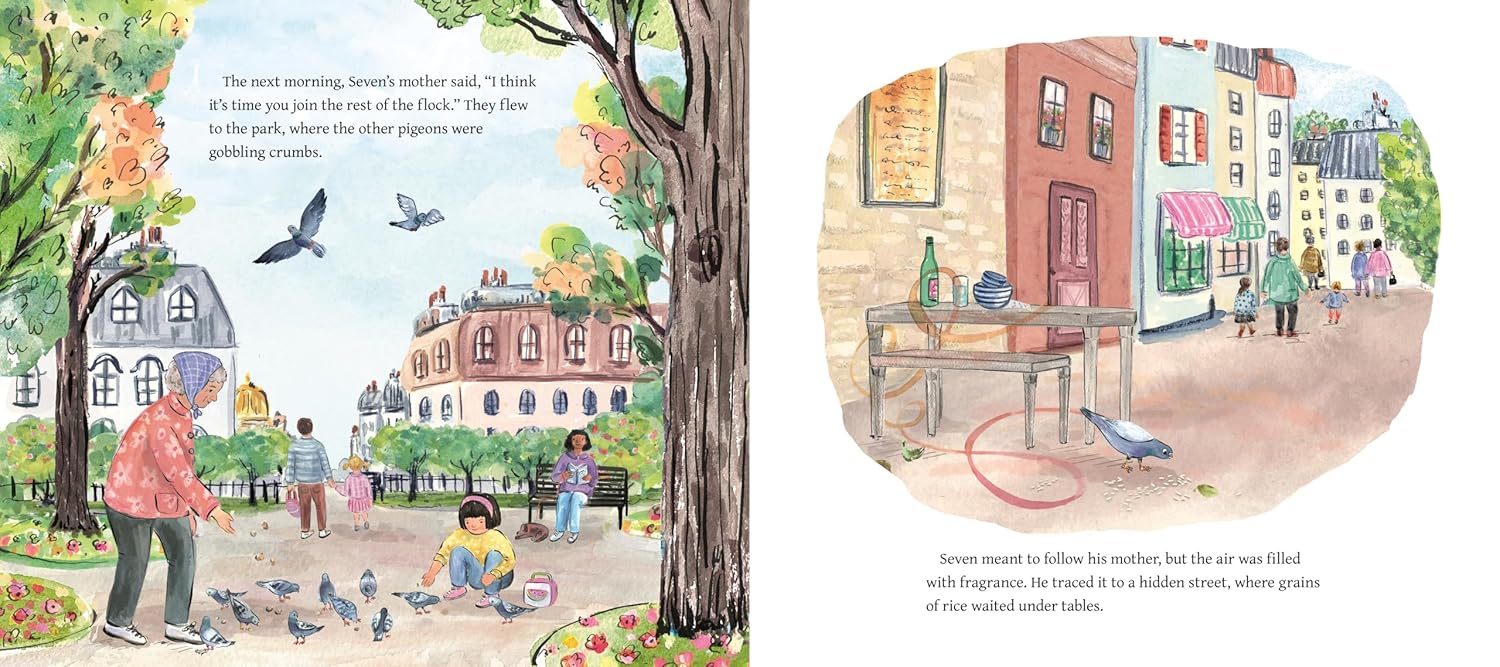
As Seven waited for his eyes to open and his feathers to sprout, he relished all the lovely scents that wafted to his nest. When he could finally fly, Seven soared to the flower shop to enjoy the aromas, and he picked up petals to fill his nest instead of twigs. On the way to the park with the flock, he veered off, distracted by the fragrant smell of rice. His mother scolded: “‘We stay with the flock. We stay with the flock.'” The flock whispered.

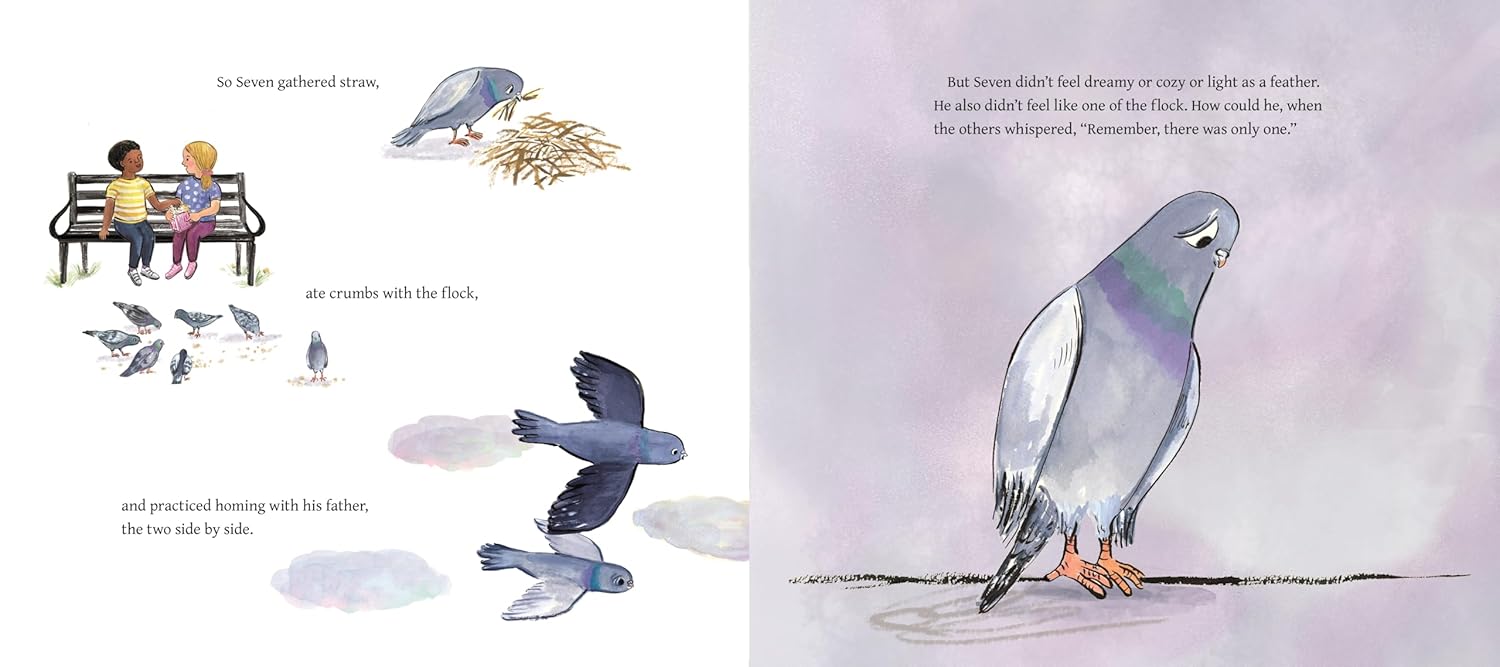
Seven’s father decided it was time to teach his son how to “home.” They left the city and headed into the country. Here, Seven was so captivated by all of the new scents that he didn’t listen to his father’s lesson to memorize the roads below. The flock was scandalized; his mother gave him another scolding. So Seven began toeing the line, but now he “didn’t feel dreamy or cozy or light as a feather.” And the flock? They continued to whisper.

Illustration © 2025 by Aimée Sicuro, text © 2025 by Sandra Nickel. Used with permission of Candlewick Press. All rights reserved.

Finally, it came time for The Big Flight, the annual commemoration of the famous 7,000-mile journey. Instead of 7,000 miles, though, the flock rode the train 700 miles away and would fly home. But soon the fog rolled in, thick and impenetrable. Without being able to see the road map below, the pigeons all flew in different directions. How would they find their way home?

But Seven knew just where to go, led on by the scents he loved so well. The flock fell into formation behind him and followed him home. There “Seven’s parents puffed out their feathers and added rose petals to their nest.” The rest of the flock added 700 more in celebration, and Seven’s parents wrapped their wings around him and held him close.

A discussion about pigeons, their behaviors, the different (and similar) ways the mother and father care for their young, and various theories on how pigeons home follows the story.

Illustration © 2025 by Aimée Sicuro, text © 2025 by Sandra Nickel. Used with permission of Candlewick Press. All rights reserved.

You will absolutely fall in love with Seven as he stays true to his distinct and savvy preference for scents despite the speculations of his flock in Sandra Nickel’s heartwarming tale. Nickel blends her talent for fiction and nonfiction in her depiction of pigeons’ nesting, flocking, and homing behaviors as well as highlighting the 7,000-mile flight undertaken by one adventurous pigeon. Nickel’s story is built on deeper underpinnings that these, however, as she spotlights the joy and comfort to be found in celebrating individual differences that make each person’s unique contributions to their family, friends, and community invaluable. Kids will cheer Seven on as he forges his own way.

Aimée Sicuro’s watercolor, gouache, and ink illustrations transport readers to lovely French cityscapes and countryside while embedding them with a lively flock of pigeons all aflutter over their newest member. Amplifying Nickel’s focus on individuality, Sicuro has given each pigeon its own markings and coloring, and their facial expressions leave no doubt about their feelings. Seven is especially expressive, from basking in delectable scents to dejectedly enduring scoldings and doubtful glances to leading the flock home with happy certainty and finally soaking up cozy hugs from his parents. 

Seven: A Remarkable Pigeon is a gently told story full of love that celebrates individuality and builds self-esteem. The book is one that kids will want to hear again and again and is a must for home, classroom, and all library collections. 

Ages 4 – 8

Candlewick, 2025 | ISBN 978-1536235197

Connect with Candlewick on Facebook | Instagram | Twitter/X

About the Author

Sandra Nickel is a former lawyer who is now a dedicated children’s book author with many picture books under her belt, including The Stuff Between the Stars, Nacho’s Nachos, Big Bear and Little Fish, and Making Light Bloom. She is honored to be the winner of a Christopher Award, the winner of the Society of Children’s Book Writers & Illustrators Crystal Kite Award, a finalist for the Golden Kite Award for Nonfiction for Younger Readers, a Junior Library Guild Gold Selection honoree, and a Charlotte Huck Award Recommended author. She has presented workshops on writing for children and young adults throughout Europe and the United States. She lives with her family in Switzerland. Visit her at sandranickel.com and on Bluesky | Facebook | Instagram | Twitter/X.

About the Illustrator

Aimée Sicuro is a creator of many picture books for kids. She is the author and illustrator of If You Spot a Shell, and If You Find a Leaf, which was nominated for the Ezra Jacks Keats Award.. Her work has appeared in the New York TimesParents magazine, and many other publications. She lives in Brooklyn with her husband and two children. Visit her at aimeesicuro.com and on Instagram.

You can learn more about Blue Slip Media on Bluesky | Facebook | Instagram  and on Twitter/X here and here.

National Pigeon Day Activity

Illustration © 2025 by Aimée Sicuro, text © 2025 by Sandra Nickel. Used with permission of Candlewick Press. All rights reserved.


Seven: A Most Remarkable Pigeon Activity Pages


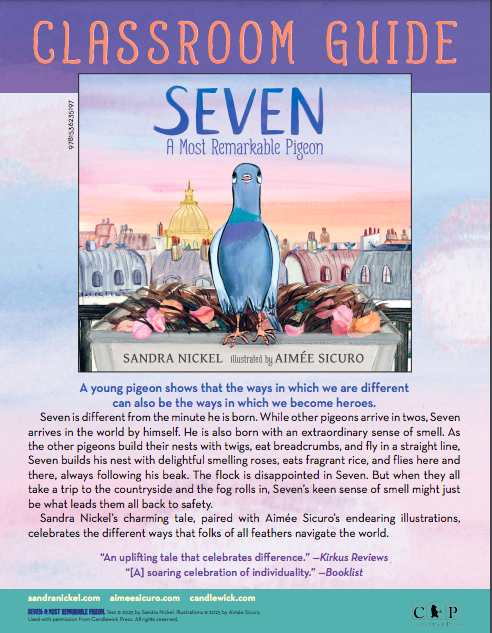
Download a fun and thoughtful Seven: A Most Remarkable Pigeon Classroom Guide with discussion questions and activities for use by educators as well as readers at home.

You can purchase Seven: A Most Remarkable Pigeon from these booksellers

Amazon | Barnes & Noble | Bookshop

Picture Book Review
January 15 – It’s International Creativity Month


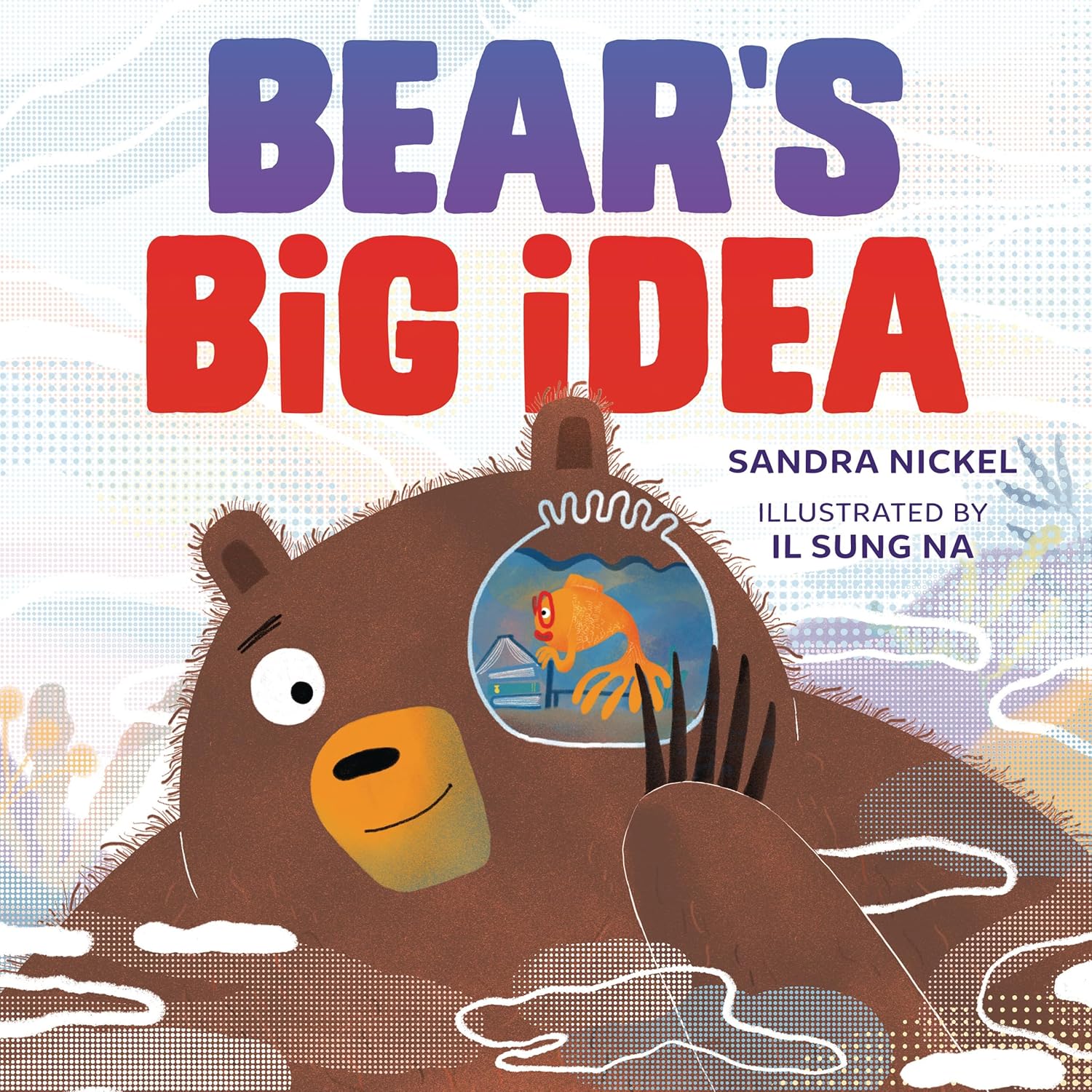
celebrate-picture-books-picture-book-review-bear's-big-idea-cover

About the Holiday

Are you an artist, a writer, a decorator, a chef? How about a floral arranger, a woodworker, a fashion designer, or a gardener? Inside almost every heart lies a desire to create. Whether you use your ingenuity in your job or as an escape from the routine, this month celebrates all that is innovative. Sometimes this comes not in something you can see or touch but in a new thought or novel way of solving a problem—as seen in today’s book!

Thanks to Carolrhoda Books and Barb Fisch at Blue Slip Media for sharing a copy of Bear’s Big Idea with me! All opinions on the book are my own.

Bear’s Big Idea

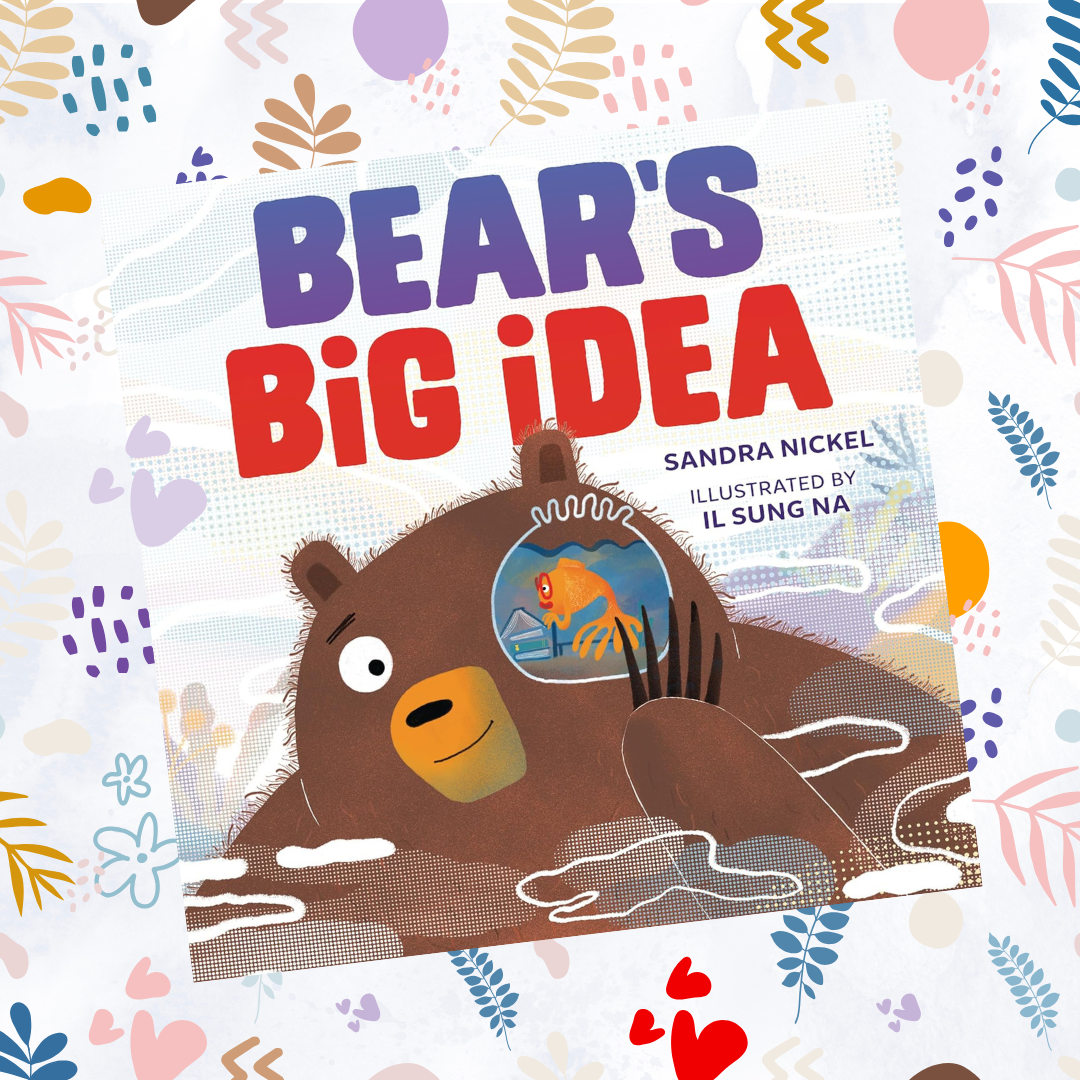
Written by Sandra Nickel | Illustrated by Il Sung Na


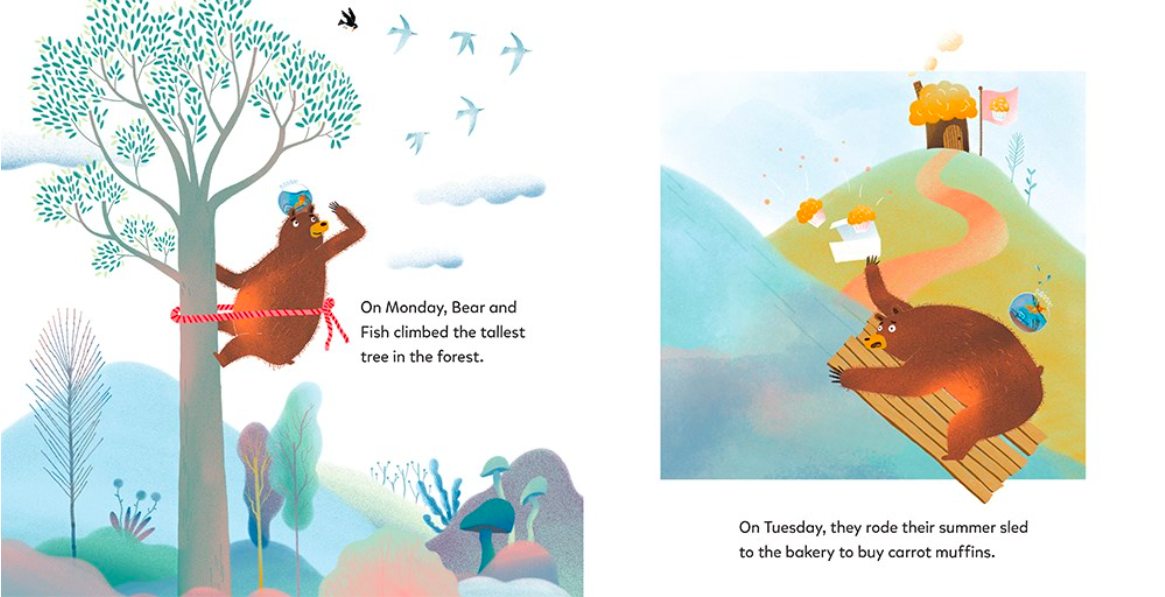
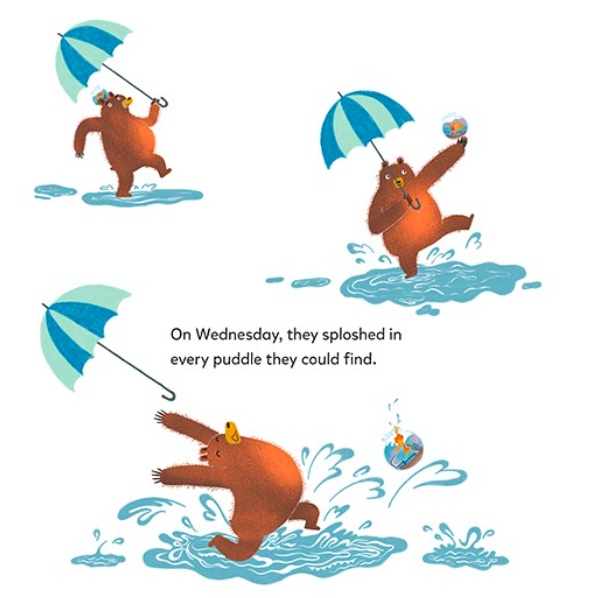
Fish and Bear were best friends. They did everything together, and usually—well, always—Fish was the one with the ideas. “Every morning, Fish would wake up, put on her glasses, and just like that, she would know the perfect thing to do.” Every day of the week, Fish found something—a rope, a sled, an umbrella, and a blanket—and dreamed up an innovative way to have fun with it.

celebrate-picture-books-picture-book-review-bear's-big-idea-Monday

Image copyright Il Sung Na, 2024, text copyright Sandra Nickel, 2024. Courtesy of Carolrhoda Books.

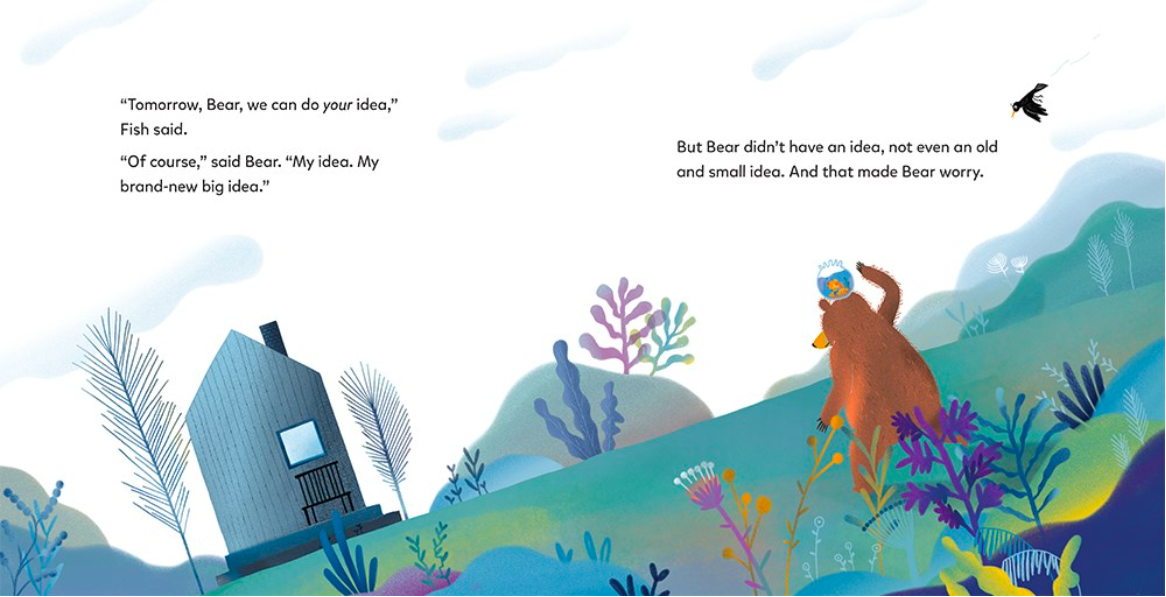
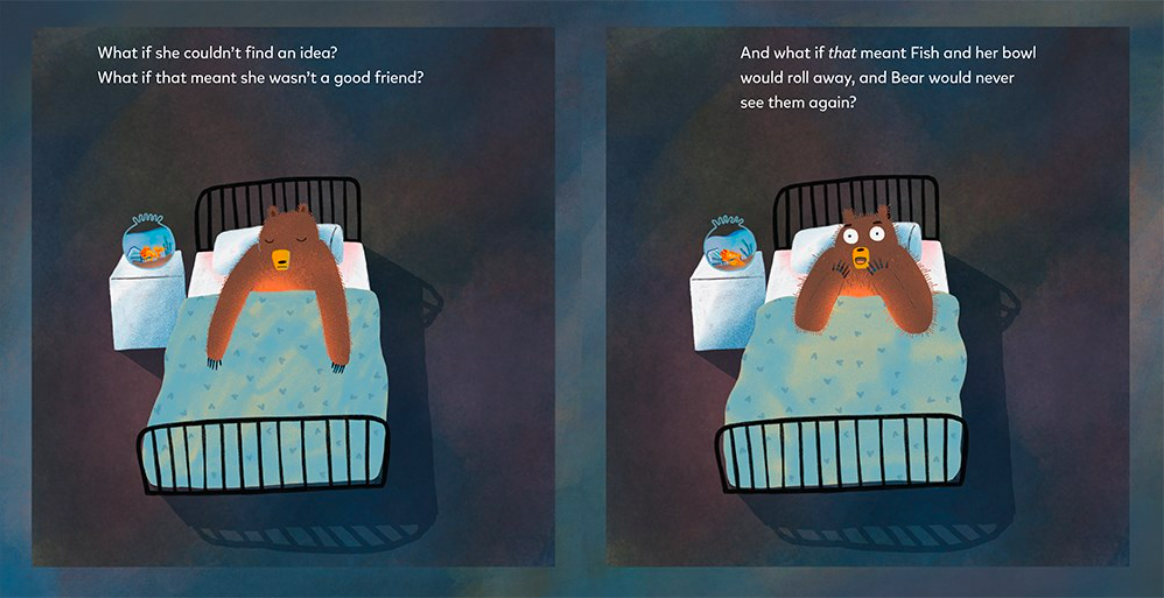
But Fish didn’t want Bear to feel left out, so on Thursday she said that the next day they could do Bear’s idea, “‘Of course, said Bear. ‘My brand-new big idea.'” But Bear was worried. She “didn’t have an idea, not even an old and small idea.” Bear tried to sleep that night, but she was afraid that not having an idea meant she wasn’t a good friend. Would Fish take her bowl and leave? Anxiety muddled Bear’s brain, and all she could think of were now-old ideas.

celebrate-picture-books-picture-book-review-bear's-big-idea-Wednesday

Image copyright Il Sung Na, 2024, text copyright Sandra Nickel, 2024. Courtesy of Carolrhoda Books.

The next morning it was the same. Bear looked everywhere for a brand-new big idea but found nothing. She kept checking in with Fish, asking if she was still there. “‘Always and forever,’ said Fish” with added reassurance. At last, Bear confessed that she couldn’t see an idea anywhere. “‘Don’t worry,’ Fish said. ‘Just because you can’t see something, doesn’t mean it’s not there.'”

celebrate-picture-books-picture-book-review-bear's-big-idea-no-idea

Image copyright Il Sung Na, 2024, text copyright Sandra Nickel, 2024. Courtesy of Carolrhoda Books.

So Bear thought some more, she listened, and she felt the wind whipping up. Suddenly, the air was filled with all of the old things from the past week. As Bear watched the things flying by, she saw it! Her brand-new big idea! She quickly gathered the items together and grabbed Fish’s bowl then rode the sled down to the beach, where she turned those individual items into an ingenious brand-new big idea that even impressed Fish! As pleased as Bear was with her idea, though, she was even happier to discover that good friends were “always and forever there.”

celebrate-picture-books-picture-book-review-bear's-big-idea-sleepless-night

Image copyright Il Sung Na, 2024, text copyright Sandra Nickel, 2024. Courtesy of Carolrhoda Books.

The second book in Sandra Nickel’s Bear and Fish series is a charming story that gently addresses children’s common fears about performance and pressure as well as the nature of friendship itself. Throughout the story, Nickel presents Bear’s conundrum realistically as she first alludes to having a big idea and then worries through the night and part of the next day that she will let down and maybe even lose her bestie because she has no idea at all.

Nickel—through Fish’s encouraging comments and confidence in Bear’s abilities—is always right there, though, with reassurance that children will find comforting in their own life. Nickel’s excellent pacing as well as her metaphorical dark and fog that stymies Bear until her approaching idea clears it away adds depth to the story and shows kids that things such as ideas, learning, self-confidence, and growth come to each person in their own time.

Children will be happy to see Il Sung Na’s fast friends back again in a new adventure. Il Sung’s soft-hued illustrations place Bear and Fish in a whimsically surreal mashup of vegetation from Bear’s forest and Fish’s underwater worlds. Bespectacled, ever-faithful Fish regales Bear with reassuring philosophy from her bowl, but also enjoys a madcap experience of her own thanks to Bear’s big idea. Through Il Sung’s clear depictions of Bear’s emotions, children can empathize with and cheer on Bear while gaining their own sense of self-confidence.

An uplifting, reassuring, and confidence boosting story, Bear’s Big Idea is sure to prompt requests for multiple readings and can spark discussions about feelings of fear, external and internal pressure, true friendship, and using one’s imagination. Bear’s Big Idea would make a valuable addition to home, library, and classroom collections.

Ages 4 – 8

Carolrhoda Books, 2024 | ISBN 979-8765610176

About the Author

Sandra Nickel is a writer of nonfiction picture books for children. Her work includes The Stuff Between Stars, Nacho’s Nachos, and Breaking Through the Clouds. She is the winner of a Christopher Award and holds an MFA in Writing for Children and Young Adults from Vermont College of Fine Arts. When at home in Switzerland, Sandra loves ambling and rambling and eating carrot muffins just as much as Bear and Fish do.

About the Illustrator

Il Sung Na was born in Seoul, South Korea. In 2001, he moved to London to pursue a BFA in Illustration and Animation at Kingston University, where he discovered a passion for children’s books. He completed his MFA Illustration Practice at MICA (Maryland Institute College of Art) in 2015. Il Sung has illustrated several books including Wild Peace, My Tree, and ZZZZ: A Book of Sleep. Currently based in Kansas City, Il Sung teaches illustration courses at KCAI (Kansas City Art Institute) and works on new books.

International Creativity Month Activity

celebrate-picture-books-picture-book-review-bear-craft

Expressive Bear


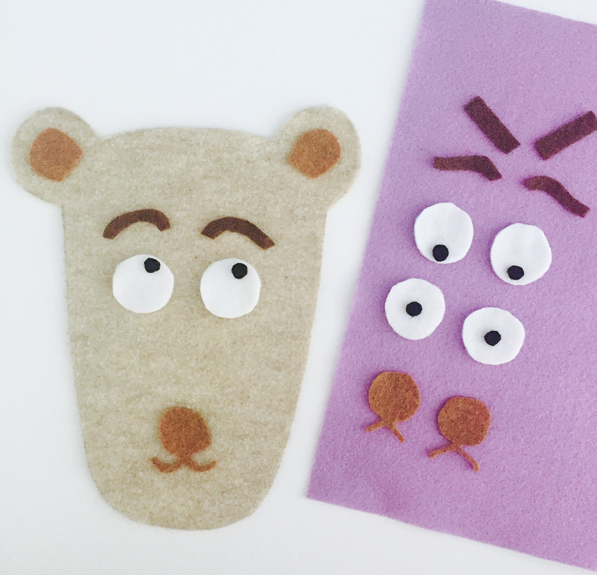
You can talk about different emotions and feelings or make up your own stories with this Expressive Bear Craft! Use the templates and/or make your own expressive eyes, eyebrows, and nose and mouths. You can also play a game in which the first person to collect all the parts of the bear’s face is the winner.

Supplies

  • Printable Bear Head Template
  • Printable Eyes and Noses Template
  • Printable Eyebrows  and Ears Template
  • Light brown felt or fleece (or color of your choice), 8 ½ x 11 inch piece
  • Dark brown felt or fleece(or color of your choice), 8 ½ x 11 inch piece
  • White felt or fleece, 8 ½ x 11 inch piece
  • Black felt or fleece, for pupils
  • Scissors
  • Glue
  • 1 playing die (optional)

Directions

  1. Print templates
  2. Cut bear head from light felt or fleece
  3. Cut eyes from white felt or fleece
  4. Cut nose and inner ears from dark brown felt or fleece
  5. Cut pupils from black felt or fleece
  6. Glue pupils onto white eyes

Alternatively: Color and play with the paper set

For a Fun Story Time

Give the bear different faces and make up stories of why he looks that way!

To Play a Game

Supplies

  • 1 plastic playing die. Or print this playing die template and draw one of the six facial features on each side.
  • Pencil, pen, or markers (if using printed die template)
  • Cut out, fold, and tape the die together

Directions

  1. Roll the die and follow the instructions below to collect parts of the bear’s face.
  2. The first player to create a full face is the winner.
  • Die dots correspond to:
  • 1—one eyebrow
  • 2—second eyebrow
  • 3—one eye
  • 4—second eye
  • 5—nose
  • 6—inner ears

celebrate-picture-books-picture-book-review-bear's-big-idea-cover

You can purchase Bear’s Big Idea from these booksellers

Amazon | Barnes & Noble | Bookshop (to support your local independent bookstore)

Picture Book Review

September 6 – It’s Friendship Month

celebrate-picture-books-picture-book-review-big-bear-and-little-fish-cover

About the Holiday

Friendship Month was established by the Oddfellows (shortened from The Grand United Order of Oddfellows Friendly Society (GUOOFS)), an international fraternity that dates back to 1730s England with the hope of encouraging people to make friends. Now dedicated to philanthropy and charity, the Oddfellows still promote Friendship Month each September to urge people to spend more time with their friends, get in touch with those they haven’t seen or talked to in a while, and, especially, to reach out to others who are alone or need a friend. As school gets underway, there are plenty of opportunities for kids to meet new people and form friendships – some of which may last a lifetime.

I’d like to thank Carolrhoda Books and Blue Slip Media for sharing a copy of Big Bear and Little Fish with me for review consideration. All opinions on the book are my own.

Big Bear and Little Fish

Written by Sandra Nickel | Illustrated by Il Sung Na


At the fair, Bear approached the basketball game booth, where the grand prize was a huge teddy bear. It was almost as big as Bear, herself. But Bear took away the consolation prize: a goldfish. “It was small. It was very small. It was so small it lived in a bowl.” Bear peered into the bowl, but when Fish woke up and said “‘Hello, Bear. Is this my new home?'”, Bear only nodded, afraid her big voice would scare little Fish.

celebrate-picture-books-picture-book-review-big-bear-and-little-fish-teddy-bear

Image copyright Il Sung Na, 2022, text copyright Sandra Nickel, 2022. Courtesy of Carolrhoda Books.

When lunchtime came, Bear made herself a sandwich with syrup that was as gold as she was. Bear didn’t know what to feed Fish, who was orange and probably liked “carrot muffins … or tangerines and pumpkins.” After lunch, Bear always measured herself. Today, she was over nine feet big! Bear didn’t know how she could measure Fish, so she left home for her regular afternoon walk, wishing – and not for the first time – that Fish was a teddy bear.”

While walking, Bear contemplated how inconvenient Fish might find the outdoors. Things could fall into her bowl and get caught in her tail. If she had a teddy bear Bear thought again, she wouldn’t have to worry about such things as tails. Bear began to regret ever bring Fish home from the fair. When Bear got home again, Fish greeted her with a “‘Hello” and a comment on how much she liked their porch.

celebrate-picture-books-picture-book-review-big-bear-and-little-fish-bowl

Image copyright Il Sung Na, 2022, text copyright Sandra Nickel, 2022. Courtesy of Carolrhoda Books.

In response, Bear gave Fish the bad news that she couldn’t stay. When Fish asked why, Bear laid out her reasons: Fish was orange and ate orange foods; Fish had a tail that made it impossible for her to go on walks with Bear; and finally that Fish was too small. Fish was undaunted. She pointed out that Bear was orange too, and when Bear inspected her belly, she agreed that it “was an orangey sort of gold” kind of “like a carrot muffin.” Fish then added that Bear had a tail, and when Bear looked over her shoulder, she saw a tiny tuft. As to the assertion that she is “small,” Fish was surprised. 

celebrate-picture-books-picture-book-review-big-bear-and-little-fish-hello

Image copyright Il Sung Na, 2022, text copyright Sandra Nickel, 2022. Courtesy of Carolrhoda Books.

“Am I?” she asked then welcomed being measured. She stretched herself out, and Bear measured her: three inches long. Fish was happy with this result; she wasn’t so small after all. “‘I am not one inch. I am not two inches. I am three inches,'” she said proudly. Still, Bear couldn’t get over the idea that Fish was so tiny she had to live in a bowl. 

But Fish was philosophical. “‘Don’t you live in a bowl too?'” she asked. Bear had never thought of it that way before, and as she looked around at the big, blue sky, she suddenly felt small too. Fish reassured her and offered another perspective on physical size compared to how big one could feel inside. Bear considered this and then decided she’d like to take another walk – this time accompanied by Fish. And so they set off in search of a very big carrot muffin.

celebrate-picture-books-picture-book-review-big-bear-and-little-fish-sandwich

Image copyright Il Sung Na, 2022, text copyright Sandra Nickel, 2022. Courtesy of Carolrhoda Books.

In her seemingly odd “fellows” friendship story, Sandra Nickel presents a multi-layered look at what it means to be a true friend. She cleverly offers readers a variety of lenses for them to engage in perspective, from the character’s viewpoints to their own. Bear, alone at home and on her walks, focuses only on herself. At the fair, she wants to win a teddy bear that is a twin to herself but for which she would not need to be responsible in any real sense.

Fish, however, immediately wants to interact with Bear. She talks to him and asks questions. At first, it may seem that Bear will simply ignore Fish, but the idea of her has begun to make Bear think and even worry (here, Nickel creates a complex mix of emotions that invites discussion). Equally thought-provoking are Fish’s counter arguments when Bear tells her she can’t stay. While promoting how similar they are, Fish prompts Bear to reevaluate her view of herself and the world she lives in. Once Bear realizes that she, too, can be considered small and that the full measure of a person (or Fish or Bear) is found inside oneself, she embraces Fish – responsibilities, friendship, muffins, and all.

Il Sung Na plays with perspective and color to subtly guide readers through the stages of this endearing friendship. As Bear walks home from the fair, dejectedly carrying Fish in her bowl, the hilly landscape is washed in shades of blue and the twiggy, leafy, mushroomy vegetation replicates an ocean bottom. This evocative effect continues throughout the book, prompting kids to find other similarities between Bear and Fish and their environments. Readers will also enjoy pointing out examples and comparisons of big and small.

An endearing and thought-provoking story that boosts self-confidence while promoting friendship, empathy, and new perspectives, Big Bear and Little Fish will become a quick favorite on home bookshelves, a go-to book for classrooms, and a must for school and public library collections.

Ages 4 – 8

Carolrhoda Books, 2022 | ISBN 978-1728417172

Discover more about Sandra Nickel and her books on her website.

To learn more about Il Sung Na, her books, and her art on her website.

Dive in to this book trailer for Big Bear and Little Fish!

Friendship Month Activity

celebrate-picture-books-picture-book-review-beanstalk-craft-with-top


Measuring Stick Craft


Bear and Fish loved getting measured. If you’re looking for a unique way to measure how big you are, here’s a craft for you! This nature-inspired measuring stick can keep track of your big and small growth spurts whenever you sprout up. You can even add leaves to record thoughts, favorite things, and other ideas as you age! 

Supplies

  • 50-inch wooden stake, available at craft stores
  • Dark and light green foam sheets or 45 – 50 small wooden leaves, available at craft stores
  • Green paint, light and dark
  • Black marker
  • Paint brush
  • Strong glue
  • Flower pot
  • Oasis or clay
  • Ruler
  • Pencil

celebrate-picture-books-picture-book-review-beanstalk-craft-closeup

Directions

  1. Paint the wooden stake with the green paint, let dry
  2. With the ruler mark the stake in 1-inch increments along the edge of the stake

How to Make the Leaves

  1. If using wooden leaves, paint half light green and half dark green
  2. If using foam, cut 1 3/4-inch-long tear-drop shaped leaves (half from light green foam, half from dark green foam), 45 – 50 or as needed
  3. Cut two larger leaves, one from each color to decorate the top of the stake
  4. Draw a line down the center of each leaf

For Measuring Growth: Write the inch 1 through 45 or higher on each leaf with the black marker, alternating colors

For Recording Ideas: You can write favorite ideas, hobbies, or hopes on the leaves too and measure your growth that way!

How to Attach the Leaves

  1. Glue the leaves to the stake, attaching the odd-numbered inch leaves to the left side of the stake and the even-numbered leaves to the right side of the stake.
  2. Attach half of the leaf to the stake, letting the tip stick out from the side
  3. Glue the two larger leaves to the top of the stake

How to Store Your Yardstick

  1. Put the oasis or clay in the flower pot
  2. Stick the stake into the flower pot to keep it handy

celebrate-picture-books-picture-book-review-big-bear-and-little-fish-cover

To get a copy of Big Bear and Little Fish personalized by Sandra Nickel

Visit Watermark Books to request a signed and personalized copy. When ordering, simply note your desired dedication in the Comments section. Sandra will sign on September 24, 2022, so be sure to order in plenty of time.

You can also find Big Bear and Little Fish at these booksellers

Amazon | Barnes & Noble | Books-a-Million

To support your local independent bookstore, order from

Bookshop | IndieBound

Picture Book Review