April 20 – It’s Medical Laboratory Professionals Week

celebrate-picture-books-picture-book-review-germs-up-close-cover

About the Holiday

Instituted in 1975, Medical Laboratory Professionals Week aims to raise awareness of and an appreciation for the importance of laboratory professionals to patient care. Better and more accurate diagnoses as well as targeted treatment are accomplished through the specialized knowledge and dedication of laboratory technicians. This year, especially, we celebrate these individuals who have worked tirelessly to help create a vaccine to combat the COVID-19 virus. Laboratory Science can be an exciting and rewarding career choice for science– and medical-minded students. To learn more about today’s holiday and the work of laboratory professionals, visit the American Society for Clinical Laboratory Science website and LibraryScienceCareers.

Germs Up Close

By Sara Levine


You know they’re there. It’s hard to forget, since people keep reminding you: “wash your hands,” “use sanitizer,” “sneeze into your elbow,” “don’t leave food out too long.” But since you can’t see the germs, it can be hard to remember all the time. If only you could see what everyone is warning you about that might make it easier. Well, now you can with Sara Levine’s book Germs Up Close (and I mean really, really close), which also tells you exactly where germs come from and what they do.

How can you see a germ? “With special magnifying equipment and some dye to make their parts show up,” you can see exactly what different kinds of bacteria, protozoa, fungi, and viruses look like. And you might be surprised to discover that they are very “interesting and beautiful to look at.” Levine lets you in on some fascinating facts about each type of germ, including how its name is pronounced, its common name, its microscopic appearance, where it lives, some diseases it causes, and some more you ought to know. So, let’s get started.

Okay, let’s have a show of (clean) hands! “Have you ever had a cavity? An ear infection? Strep throat?” Yeah? Then you’re already acquainted with bacteria. Sounds bad, huh? Well, yes and no. Levine explains that the majority of bacteria on your body are actually helpful. It’s the bad bacteria that can make us sick that are called germs. In her section on bacteria, Levine introduces kids to salmonella, spirillum, staphylococcus, streptococcus, and Escherichia coli (better known as E. coli) with colorful photographs of each of these “round, hotdog-shaped, or wormlike and squiggly bacteria.

Next up are protozoa. You know not to drink pond water or dirty water, right? These little, one-cell-big guys are the reason why. Here, kids learn about “trypanosoma, the germ that causes sleeping sickness,” plasmodium, which causes malaria, and giardia, which causes giardiasis, an intestinal infection. Turning the page, they’ll discover different kinds of fungi, some of which are edible, like mushrooms and yeast, and others which can produce itchy rashes, yeast infections, or ringworm. 

celebrate-picture-books-picture-book-review-germs-up-close-bacteria

Copyright Sara Levine, 2021, courtesy of Millbrook Press.

And now we come to a germ you’re all very familiar with: the virus. If you’ve had a cold or the flu or “been vaccinated against viral infections that used to be very common such as mumps, measles, and chickenpox,” you’ve heard about viruses. And, of course, we all know about the coronavirus. But what do these germs look like? Kids get to see them in all of their round, peas-in-a-pod, peanut-shaped, or knob-covered wonder. 

But how can we stop germs in their tracks or fight them when they do invade? “The good news is that our bodies take care of most of this for us” through our immune system. Levine gives kids a detailed overview of the ways our skin, mucus, saliva, and stomach acid combat the germs that assail us. She also talks about the different kinds of white blood cells we have and how each kills germs. Illustrations show what the five types of white blood cells look like and their comparative sizes.

Levine reminds kids of all the ways people can protect themselves from surface and air-borne germs as well as germs that are transmitted through food and water. Her discussion on vaccines explains how they work and prepare white blood cells to recognize and fight germs. Still, sometimes we do get sick, and Levine reassures kids that there are medicines for each kind of germ that can make the better.

A glossary, a list of eleven careers that revolve around germs or helping sick people, and resources for further reading or research follow the text.

Sara Levine strikes just the right balance of humor and hard science facts in her engaging and educational book about the germs that make us sick as well as good bacteria and fungi, how our body protects us from most germs, and the vaccines and medicines that help us get well. Through her compelling writing style, Levine presents complex concepts in ways that make it easy for readers to embrace biological and medical science and get excited about research and learning more.

The stunning color photographs of various types of bacteria, fungi, protozoa, and viruses with their unusual shapes – some sporting protrusions like a hairbrush and others that look like they could be the stars of their own sci-fi picture book or TV show – will wow kids and spark a fascination for this important field of knowledge and research.

A fantastic book to add to home libraries for kids who are interested in medicine, biology, veterinary science, and other research sciences, Germs Up Close is a must for school libraries to enhance science, STEM, and research lessons as well as for public library collections.

Ages 5 – 10

Millbrook Press, 2021 | ISBN 978-1728424088

Discover more about Sara Levine and her books on her website.

Medical Laboratory Professionals Week Activity

celebrate-picture-books-picture-book-review-germs-word-search

Look Out for Germs! Word Search


Find the twenty-three words associated with germs in this printable word search puzzle.

Look Out for Germs! Word Search Puzzle | Look Out for Germs! Word Search Solution

celebrate-picture-books-picture-book-review-germs-up-close-cover

You can find Germs Up Close at these booksellers

Amazon | Barnes & Noble | Books-a-Million

To support your local independent bookstore, order from

Bookshop | IndieBound

Picture Book Review

April 14 – It’s Global Astronomy Month

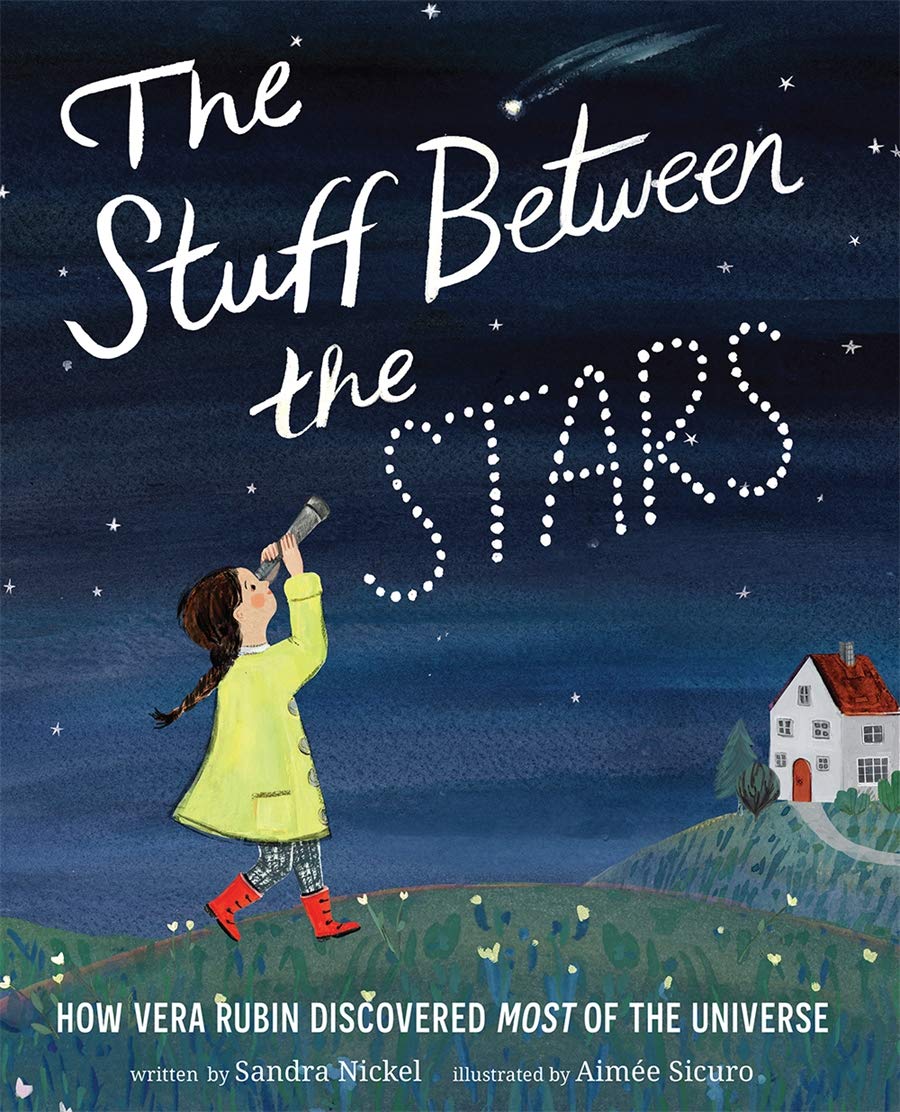
celebrate-picture-books-picture-book-review-the-stuff-between-the-stars-cover

About the Holiday

Instituted by Astronomers Without Borders, a group who sees in our shared sky an opportunity to create “a global community that appreciates, studies, and shares the wonders of the universe, to broaden perspective, transcend borders, and improve lives,” Global Astronomy Month brings people together with arts events, parties, and special events. To find resources, such as April sky maps in English and Spanish, and more information on how you can participate, visit the Astronomers Without Borders website.

Thanks to Abrams Books and Blue Slip Media for sending me a copy of The Stuff Between the Stars for review consideration. All opinions on the book are my own. I’m excited to be hosting a giveaway of the book. See details below.

The Stuff Between the Stars: How Vera Rubin Discovered Most of the Universe

Written by Sandra Nickel | Illustrated by Aimée Sicuro


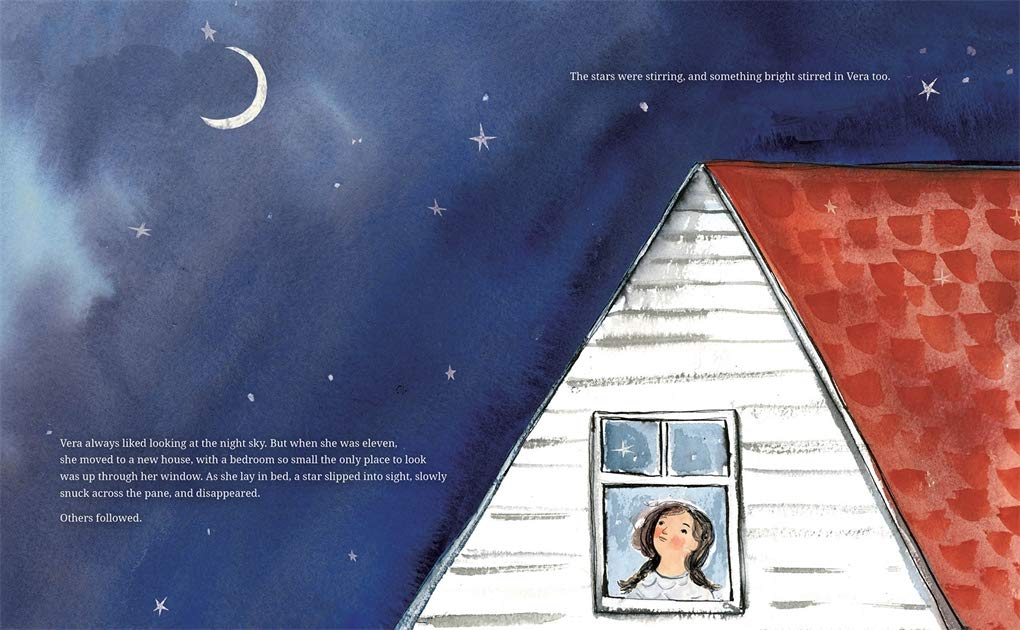
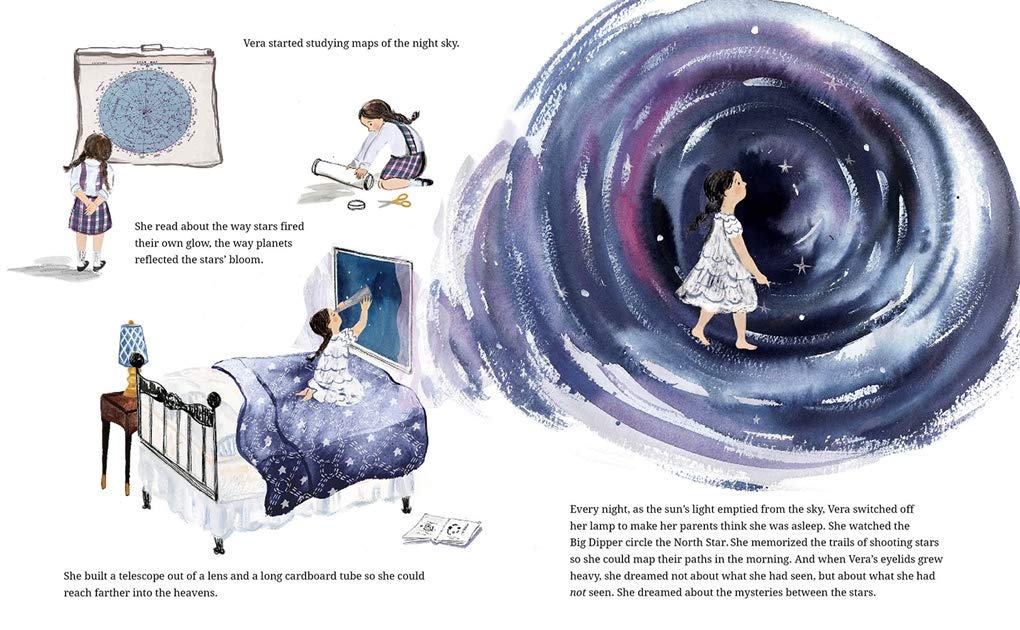
Vera had always been fascinated with the night sky. As she gazed up through her bedroom window, she saw when “the stars were stirring, and something bright stirred in Vera too.” She began studying everything she could about the stars, planets, and how they interacted in the night sky. She even made her own telescope from a cardboard tube and a lens. At seventeen Vera began attending Vassar College as the only astronomy major in her class. Here, she could use the school’s telescope whenever she wanted.

celebrate-picture-books-picture-book-review-the-stuff-between-the-stars-window

Image copyright Aimée Sicuro, text copyright Sandra Nickel. Courtesy of Abrams Books for Young Readers.

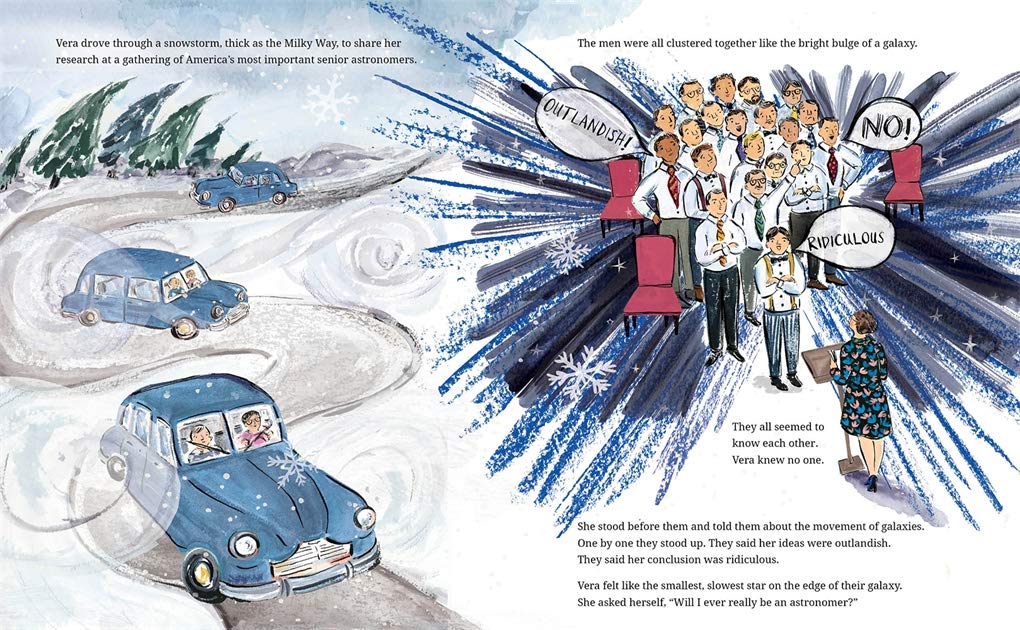
While at Vassar, she fell in love with Robert Rubin, a mathematician. They married and soon Vera was going to have a baby. During her pregnancy, she explored an idea she had: “was it possible that galaxies rotated around a center in the universe like the Big Dipper circled the North Star?” By the time her son was born, Vera decided she was right. Vera presented her conclusions at a meeting of America’s top astronomers. They thought her ideas were “outlandish” and “ridiculous” and told her so. “Vera felt like the smallest, slowest star on the edge of their galaxy” and wondered if she’d “ever really be an astronomer.”

celebrate-picture-books-picture-book-review-the-stuff-between-the-stars-young

Image copyright Aimée Sicuro, text copyright Sandra Nickel. Courtesy of Abrams Books for Young Readers.

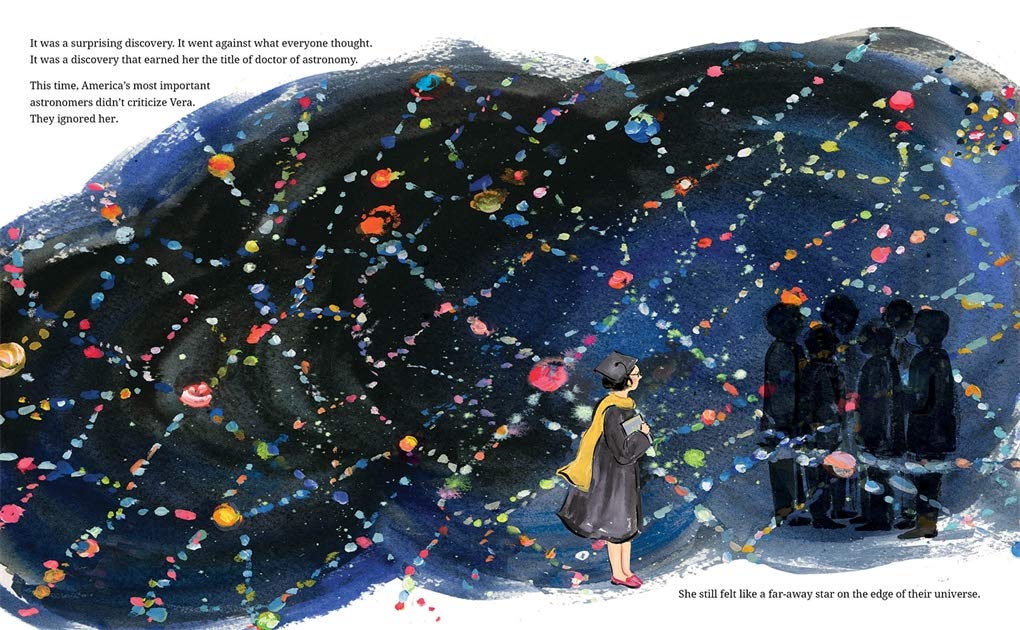
After Vera had a baby girl, she decided to concentrate on a new question that she thought would be fun. She wondered if galaxies were scattered haphazardly or whether there was “a pattern to where they spun.” After many months of staying up late into the night doing calculations, Vera determined that galaxies were “clumped together like dew drops on a spider’s web.” This was a major discovery; one that earned her a doctorate in astronomy. Instead of criticizing her, America’s top astronomers ignored her.

celebrate-picture-books-picture-book-review-the-stuff-between-the-stars-outlandish

Image copyright Aimée Sicuro, text copyright Sandra Nickel. Courtesy of Abrams Books for Young Readers.

Vera had two more children, and as her family grew she dreamed of observing galaxies from a mountaintop like the senior astronomers and watch gravity work within galaxies. She began teaching astronomy at colleges in Washington D.C., and other astronomers began hearing about her and wanting to know more about her ideas that had been dismissed in the past. More than ever Vera wanted to view the sky from an observatory in the mountains—one like the Carnegie Institution had in the California mountains.

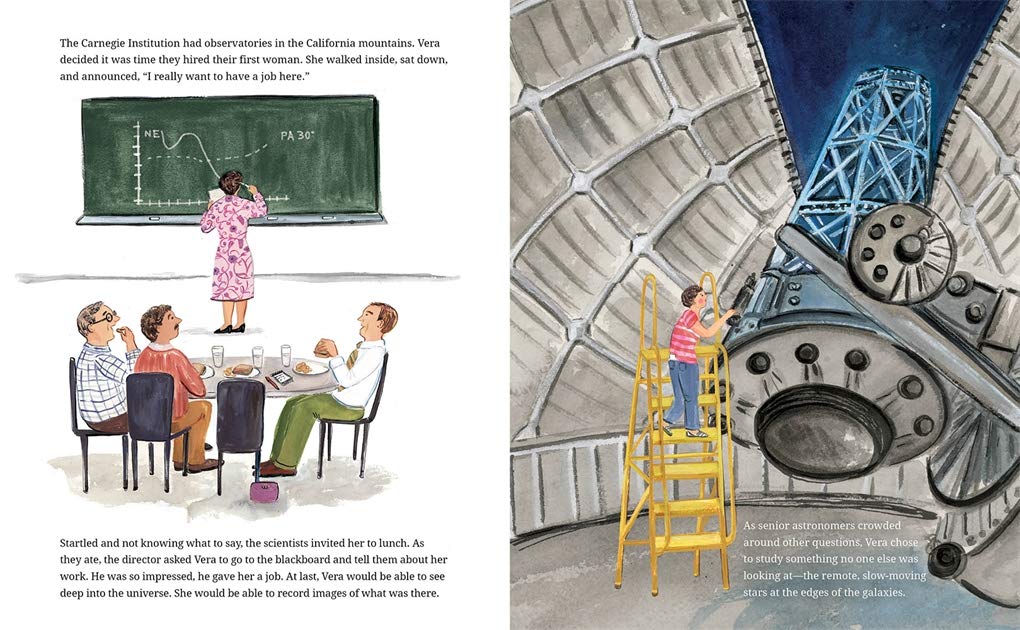
One day she went to the Carnegie Institution and announced that she would like a job there. When the director and other scientists learned about her work and theories, they were so impressed that she landed a job. While the other senior astronomers worked on other questions, Vera studied the “slow-moving stars at the edges of the galaxies.”

celebrate-picture-books-picture-book-review-the-stuff-between-the-stars-galaxies

Image copyright Aimée Sicuro, text copyright Sandra Nickel. Courtesy of Abrams Books for Young Readers.

In Arizona Vera studied the Andromeda Galaxy and the stars on its outside spiral. What Vera found was astounding. Instead of moving slower at the edges of the galaxy because of waning gravity from the center, these stars moved at the same speed. She remembered that earlier astronomers had theorized about a mysterious, unseen “dark matter” with its own gravity that “might be at work in the universe.”

Vera believed dark matter “could fill the space between the stars.” In fact, she was sure it was there by the way the stars moved. Once again, when Vera revealed her findings, most astronomers didn’t want to believe it. They didn’t want to believe that all this time they’d only been studying a small fraction of the universe. After Vera studied two hundred more galaxies, the astronomers had to agree that she was correct. At last “Vera was no longer at the edge of astronomy, she was at it’s very center.”

Backmatter includes an Author’s Note detailing more about Vera Rubin’s work, a timeline of Rubin’s life, resources on quotes found in the text, and a selected bibliography.

celebrate-picture-books-picture-book-review-the-stuff-between-the-stars-observatory

Image copyright Aimée Sicuro, text copyright Sandra Nickel. Courtesy of Abrams Books for Young Readers.

Sandra Nickel’s straightforward and comprehensive storytelling gives kids a well-rounded view of Vera Rubin’s life as she doggedly pursued a career in astronomy despite all the naysayers and snubs along the way and made an astounding discovery that still baffles scientists today. Rubin’s inspirational example will resonate with young readers and give them a pathway to accomplishing their own goals. Nickel does an excellent job of explaining the complex ideas Rubin studied, theorized on, and wrote about, allowing readers to fully understand her impact on the field of astronomy and our understanding of the universe. Nickel’s lyrical prose is also sprinkled with metaphors that link Rubin’s feeling and life changes to the night sky she loved to observe.

Through Aimée Sicuro’s mixed-media illustrations, readers follow Vera Rubin as she matures from a curious child who loves watching the night sky to a college student to a mother to an astronomer making discoveries that changed the way scientists understood the universe. Her detailed images give kids visual representations of Rubin’s work and ideas, including a complex mathematical calculation she works on while her family sleeps and her idea that galaxies were clumped together. Depictions of the Palomar Observatory will thrill space buffs and show readers why Rubin so wanted to study the sky from a mountain top. The final image of a group of children gazing up at the night sky as a shooting star flashes by offers an inspirational quote from Vera Rubin.

A superb biography that will inspire and nurture young minds, The Stuff Between the Stars is highly recommended for home, school, and public library collections.

Ages 6 – 9

Abrams Books for Young Readers, 2021 | ISBN 978-1419736261

Discover more about Sandra Nickel and her books on her website. You can also find curriculum guides and activity sheets to download on her site.

You can connect with Aimée Sicuro on Instagram.

Watch the book trailer for The Stuff Between the Stars!

Global Astronomy Month Activity

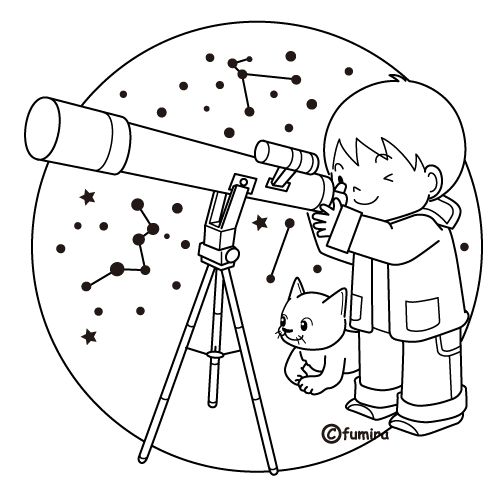
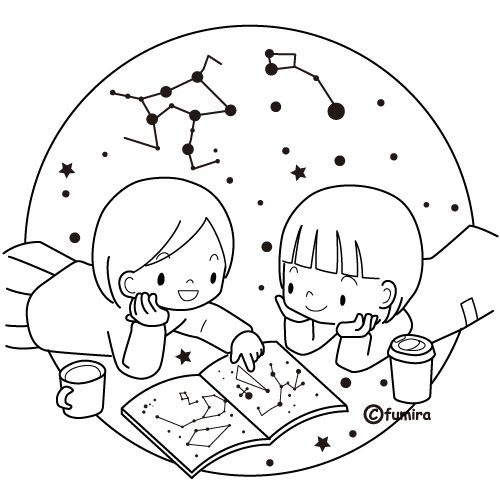
celebrate-picture-books-picture-book-review-astronomy-coloring-page-telescope    celebrate-picture-books-picture-book-review-astronomy-coloring-page-kids

Explore the Galaxies Coloring Pages


Indulge your love of star stuff with these printable coloring pages!

Looking through the Telescope | Studying the Stars | Milky Way Dot-to-Dot

celebrate-picture-books-picture-book-review-the-stuff-between-the-stars-cover

You can find The Stuff Between the Stars at these booksellers

Amazon | Barnes & Noble | Books-a-Million

To support your local independent bookstore, order from

Bookshop | IndieBound

Picture Book Review
 

March 29 – It’s International Ideas Month

celebrate-picture-books-picture-book-review-smelly-kelly-cover

About the Holiday

The onset of spring with its  wide-open sunny days seems to beckon to us to open our minds to all sorts of new possibilities. International Ideas Month also invites would-be inventors and clever folk alike to think differently and pay attention to your brainstorms. You never know – there may be a book, a work of art, a new invention, or a solution to a need inside you just waiting to be let out! 

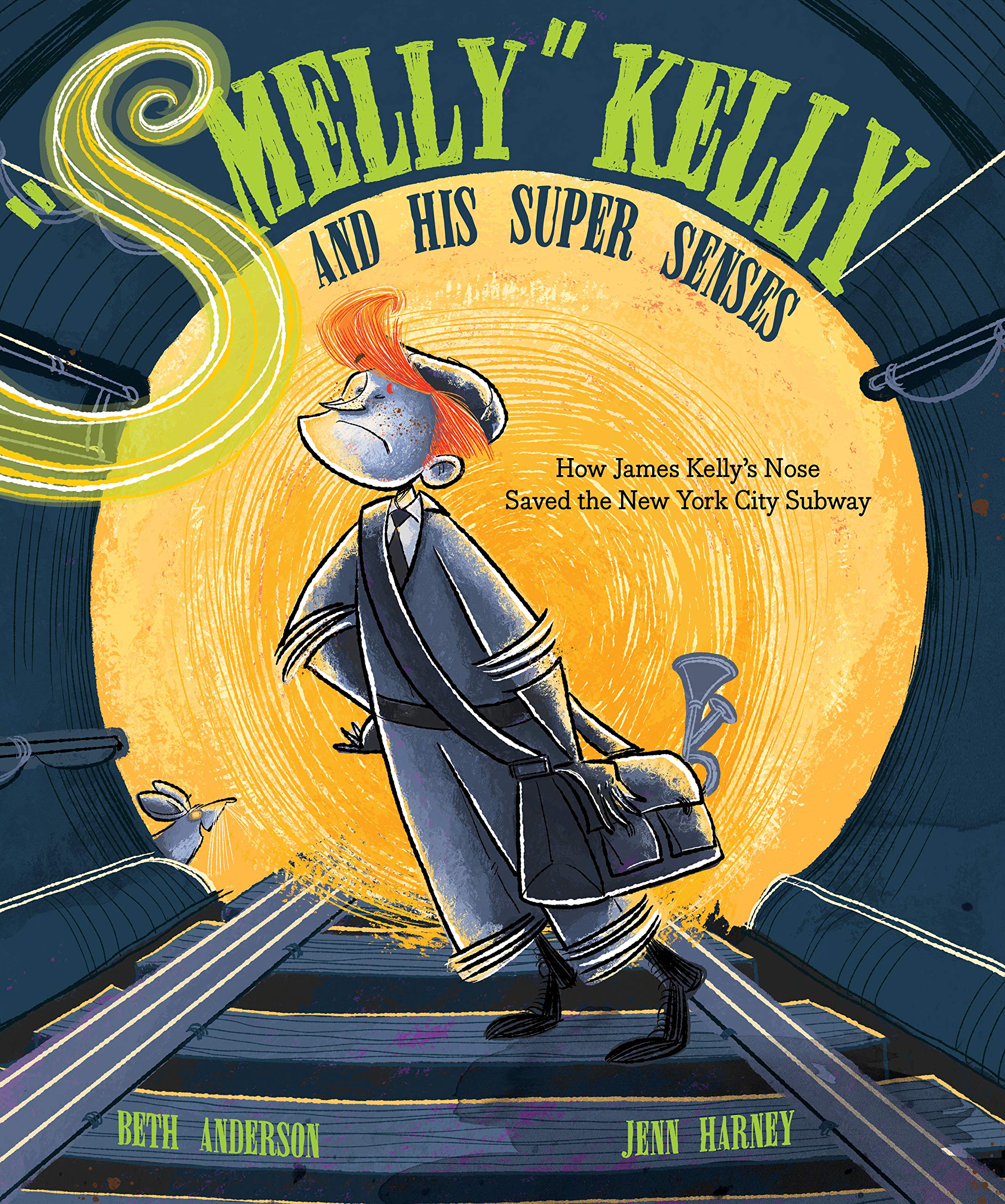
“Smelly” Kelly and His Super Senses: How James Kelly’s Nose Saved the New York City Subway

Written by Beth Anderson | Illustrated by Jenn Harney


James Kelly had a super sensitive nose. It seemed that there was nothing he couldn’t smell: “rats in the shed. Circus elephants a mile away. Tomorrow’s rain.” While this was interesting, James wished he had a different “super power,” one that would get him noticed. When James was older, he moved to New York and set out to find a job. But lots of jobs—like working at the fish market, the butcher shop, or the sanitation department—were just too stinky.

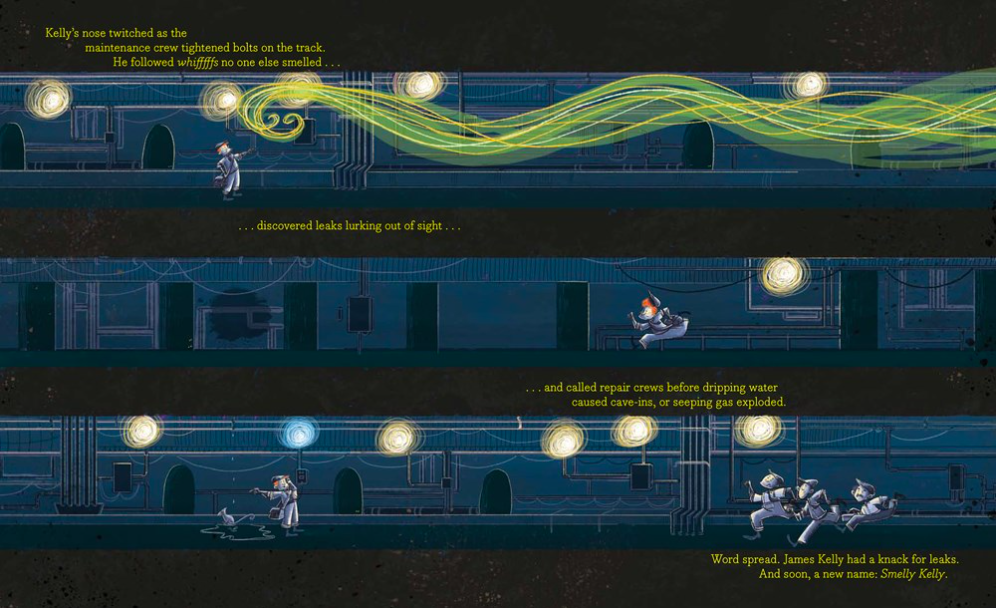
Then James “heard a rumble below the sidewalk and peered through the grate. The damp air bristled with mystery.” James descended below the street and discovered the subway. Here “a nick, a crack, a break, a spark could wreak havoc.” Down here, James Kelly sniffed out water and gas leaks and other problems then led repair crews to the spots. People were so impressed that soon he had “a new name: Smelly Kelly. James began studying about new equipment that could help him.

celebrate-picture-books-picture-book-review-smelly-kelly-underground

Image copyright Jenn Harney, 2020, text copyright Beth Anderson, 2020. Courtesy of Calkins Creek.

The subway wasn’t the only place having trouble with bad odors. At the Hotel New Yorker, a mysterious leak was causing guests to flee and the staff to hold their noses. Everyone blamed the subway, so the hotel manager called for Smelly Kelly. James could smell the leak, but he couldn’t pinpoint where it was coming from. Using a bit of his new equipment, though, the break in the pipes exposed itself. James had found his calling.

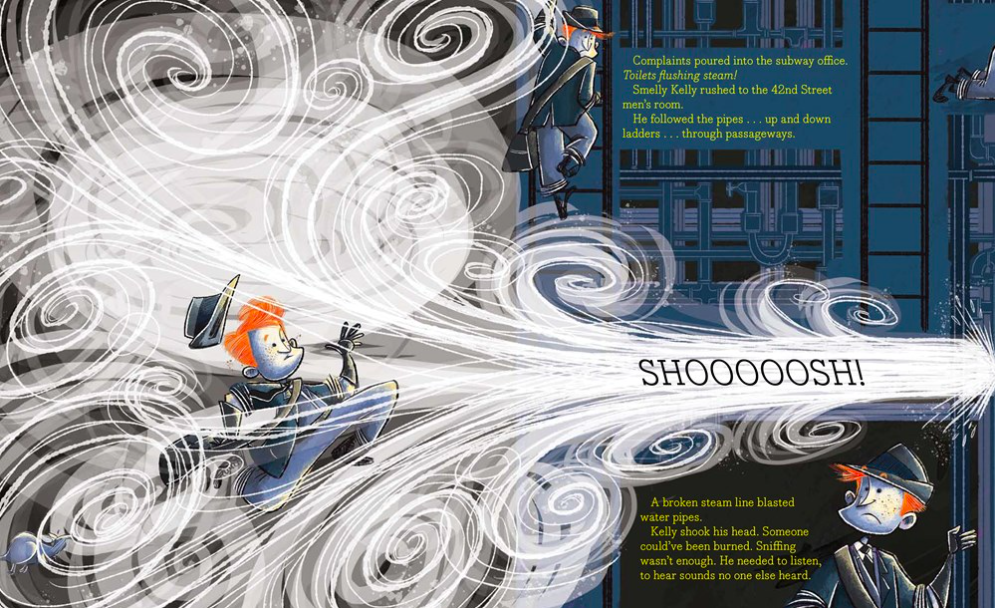
Next, people began complaining about “toilets flushing steam” at the 42nd Street men’s room. He followed the pipes and finally found the cause, but Smelly Kelly realized that “sniffing wasn’t enough.” He needed to be able to hear problems too. But that would require a different kind of equipment—something “like a telephone or stethoscope.” James Kelly tinkered and experimented until he had created just what he needed. Every day, Smelly Kelly rid the city of leaks, toxic spills, and clogs—most unassociated with the subway at all. But one danger did lurk among the tracks: the electricity of the third rail.

celebrate-picture-books-picture-book-review-smelly-kelly-steam

Image copyright Jenn Harney, 2020, text copyright Beth Anderson, 2020. Courtesy of Calkins Creek.

One night his phone rang. It was an emergency—a “tar-like smell” was coming from underground. Smelly Kelly took one whiff and proclaimed, “‘Gasoline. One spark from the third rail and we’re all history,’” he warned. The station was evacuated and the trains slowed. Then Kelly went to work until he found the leaking storage tank. It took ten hours to make the city safe, and when it was Smelly Kelly was hailed as a “superhero.”

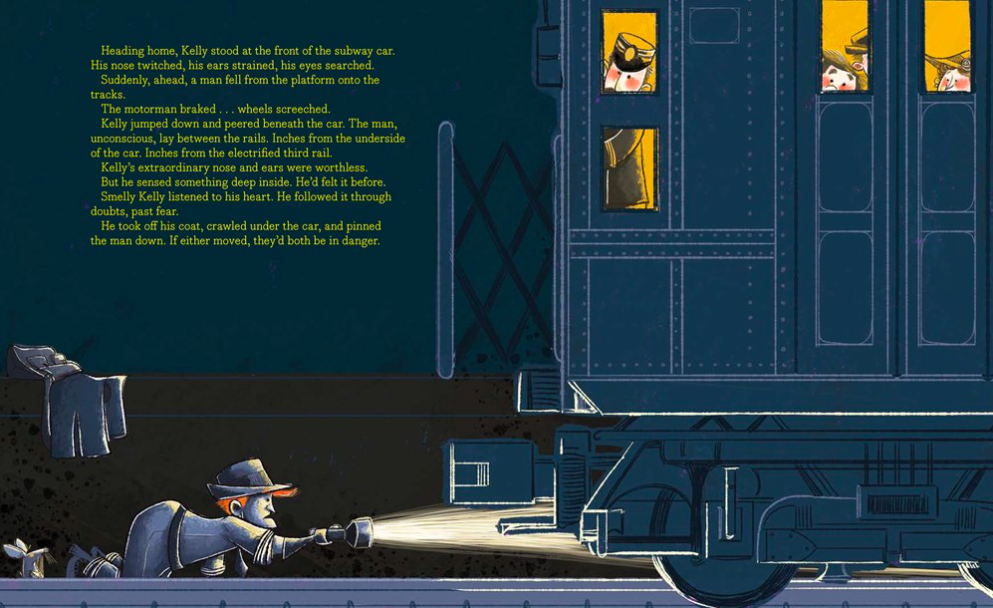
Smelly Kelly’s days were always different and often surprising. Once, he unearthed long-buried elephant manure, but his most dramatic save happened the day a man fell from the platform onto the tracks just as a train rolled into the station. That time Kelly’s sense of smell couldn’t help him, but his courage could. James Kelly crawled under the train car and pinned the unconscious man down and away from the electrified rail. Slowly, the train backed up over them, and when it was clear, James and the man got up. Everyone cheered. That day James Kelly discovered his real superpower: “the force that pushed him…to study, invent, and risk his life. His special power was inside.”

Backmatter includes two Author’s Notes, one revealing more about James Kelly, and the second explaining more about the research that went into writing the story. There is also a section on the tools Kelly used and some fascinating facts about what lies beneath New York City’s streets. Children will also find books and websites for further reading and a bibliography.

celebrate-picture-books-picture-book-review-smelly-kelly-train

Image copyright Jenn Harney, 2020, text copyright Beth Anderson, 2020. Courtesy of Calkins Creek.

Kids will marvel at Beth Anderson’s biography of James Kelly, his super-sensitive nose, and the New York City subway. As readers learn about James Kelly’s unique abilities, they also discover facts about the ever-growing city of the early to mid-1900s. Anderson’s suspense-filled storytelling will keep kids riveted to the action and keep them guessing at where the smells come from. Kelly’s ingenious inventions and uses of new equipment will impress future engineers and other creative kids. Anderson’s unifying theme reminds readers that everyone has the power to use their particular talents to make a difference.

Jenn Harney’s engaging illustrations capture the details and personalities of this quirky biography while also giving kids an underground tour of New York City. Kids will be fascinated to see the dark tunnels of the subway system, crowded with a maze of pipes and wiring over which James Kelly kept constant vigil. The foul aromas that lead Kelly to leaks, dangerous conditions, and other problems waft through the tunnels in ghostly green swirls. With his prominent nose, black jacket, and fedora perched on his red shock of hair, James Kelly looks like the detective he was, and his facial expressions reveal not only the strength of the odors he discovered but also the pride he took in his work.

A unique and intriguing addition to history, science, and STEM lessons for classrooms and homeschoolers as well as a captivating read for home story times, “Smelly” Kelly and his Super Senses is highly recommended for home, school, and pubic library bookshelves

Ages 7 – 10

Calkins Creek, 2020 | ISBN 978-1684373994

International Ideas Month Activity

CPB - Nose Smelling Clipart


It makes sense to learn about your senses! Follow your nose to fun and discovery with these two activities!

  1. Can you guess each smell in this scent-sational experiment from KidsHealth?
  2. Paint your next picture with kool-smelling watercolors with this Scratch-and-Sniff activity from Learn Create Love!

celebrate-picture-books-picture-book-review-smelly-kelly-cover

You can find “Smelly” Kelly and His Super Senses at these booksellers

Amazon | Barnes & Noble | Books-a-Million

To support your local independent bookstore, order from

Bookshop | IndieBound

Picture Book Review
March 24 – It’s Women’s History Month

celebrate-picture-books-picture-book-review-june-almeida-virus-detective-cover

About the Holiday

From its beginning as a single-day observance in 1911 in Sonoma, California, the celebration of women’s achievements and contributions throughout history grew to a week-long event in 1980 and finally to encompass the entire month of March in 1987. During this month we remember the trail-blazing women of yesteryear who used their creativity, intelligence, and perseverance to promote rights for women while contributing their own innovations to science, art, social reform, medicine, and other disciplines as well as today’s pioneers who carry on their legacy and make our world a better place. Today, we feature a book about a woman who revolutionized virology and medical research, connecting the past and the present. To learn more about the holiday, visit the National Women’s History Museum website and check out their resource toolkit.

June Almeida, Virus Detective! The Woman Who Discovered the First Human Coronavirus

Written by Suzanne Slade | Illustrated by Elisa Paganelli

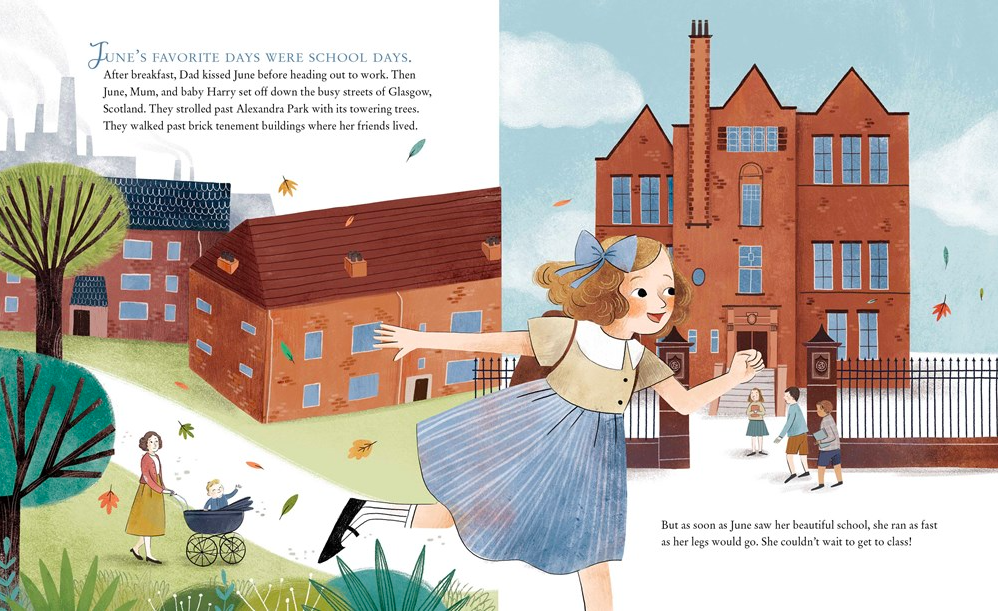
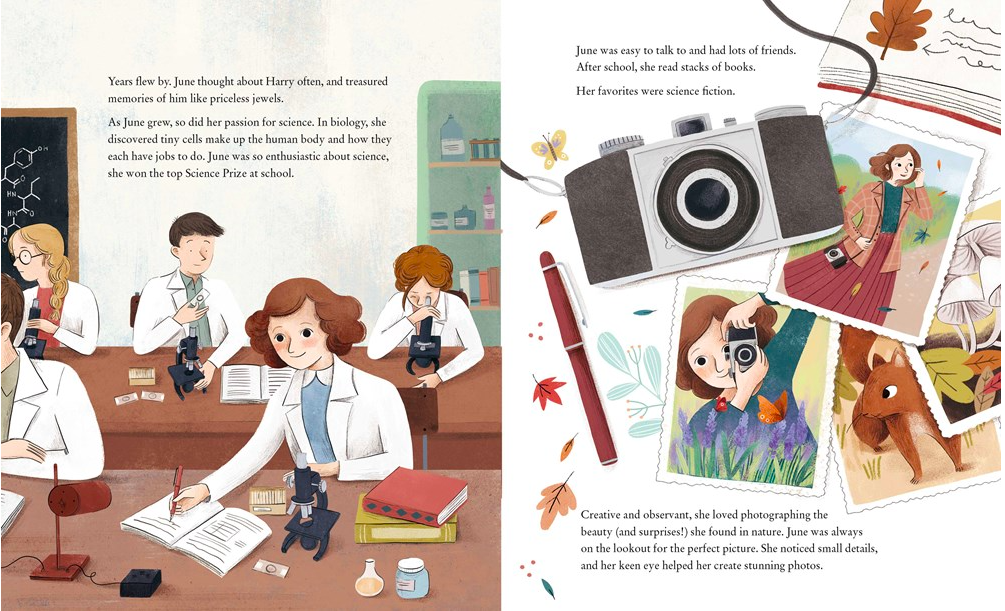
Growing up in Glasgow, Scotland, June Almeida loved school. After class she couldn’t wait to share what she’d learned—especially science subjects—with her mother, father, and little brother, Henry. When June was ten, however, her life changed when Henry became sick and passed away. Throughout elementary school and into high school, June loved studying science, especially biology in which she learned about the cells in the body and their functions. “June was so enthusiastic about science, she won the top science prize at school.”

celebrate-picture-books-picture-book-review-june-almeida-virus-detective-childhood

Image copyright Elisa Paganelli, 2021, text copyright Suzanne Slade, 2021. Courtesy of Sleeping Bear Press.

But science wasn’t the only thing June loved. She had lots of friends, was an avid reader, and became an excellent photographer. Whenever she was out with her camera, “she noticed small details, and her keen eye helped her create stunning photos.” June dreamed of attending college, but the jobs her father and mother held did not pay enough, and when June was sixteen, she dropped out of school to get a job to help pay the bills. June wanted to make a difference, “so she applied to work at the nearby hospital” and was hired as a lab worker. Here she learned how to examine cells with a microscope. “Her findings helped doctors treat patients.”

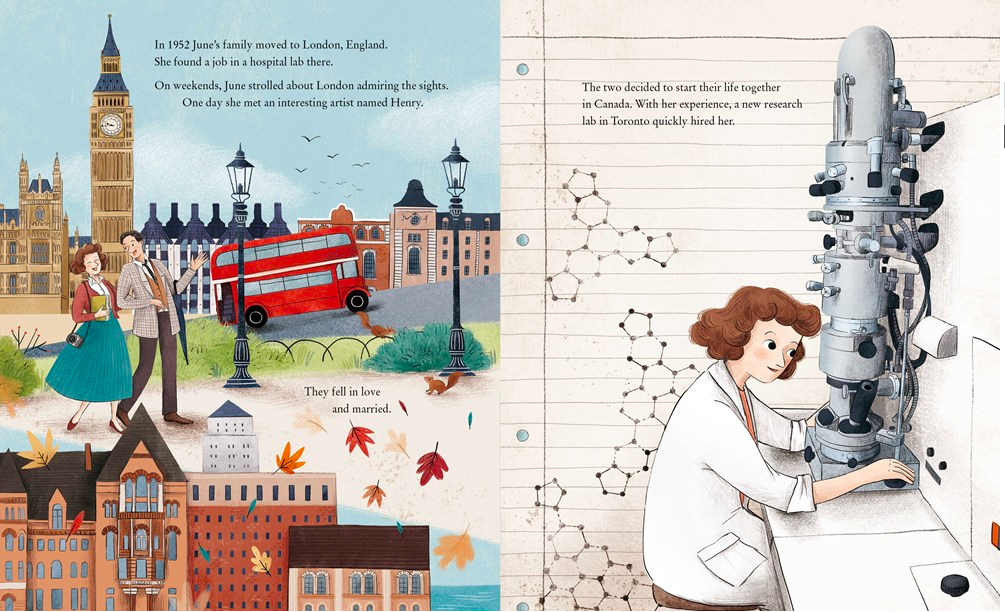
When June was twenty-two, she and her family moved to London. She got a job in a hospital lab and also met and married an artist named Henry. June and Henry moved to Canada, where she quickly found a job at a “new research lab in Toronto.” In this lab, June worked with an electron microscope that could magnify things 25,000 times and produced detailed pictures of the samples being studied. These photos “were helpful. But it was hard to tell which tiny blobs were viruses and which were cells.” June thought she could improve on the photos.

celebrate-picture-books-picture-book-review-june-almeida-virus-detective-photographer

Image copyright Elisa Paganelli, 2021, text copyright Suzanne Slade, 2021. Courtesy of Sleeping Bear Press.

June knew that in the body antibodies would surround viruses as they worked to fight it. June wondered if by introducing antibodies to her samples, scientists would be able to determine the virus from the cells. June’s idea worked. The scientists were astonished. Because of June’s innovation, they now had clear pictures that would help them study and combat viruses.

After June took time away from work to have a baby in 1960, she returned to her research and often lectured about her work. She was recruited to work at a hospital lab in London, so she and her family moved once again. At the time, a researcher named David Tyrrell had been trying to identify a virus that had affected a young boy. Could it be a new virus? He was hoping that June could help.

celebrate-picture-books-picture-book-review-june-almeida-virus-detective-hospital

Image copyright Elisa Paganelli, 2021, text copyright Suzanne Slade, 2021. Courtesy of Sleeping Bear Press.

When June received the sample, she knew that “since it was an unknown virus, there were no antibodies to help find it.” But she was an expert at using another method that might work. Carefully, June implemented the intricate steps. Then she put the sample under the microscope and scanned the picture. “June was stunned.” Each virus blob was encircled by tiny dots “like a crown. ” She had seen this twice before when looking at viruses from sick animals. She had written a paper on it, but it had been rejected by other researchers because they thought her pictures were just blurry and not those of a new virus.

June presented her findings to doctors who agreed with her discovery. They decided to name the new virus coronavirus, after the Latin word for crown, corona. June and David then published a paper telling other doctors and researchers about the new virus. Following this discovery, June continued to study viruses, such as hepatitis B and HIV. Her pictures of these viruses helped researchers develop medications that could “block them from making people sick.” Even after she retired, June never lost her love of learning, teaching herself to play the flute, about antiques, and how to use a digital camera to continue creating incredible photos.

Backmatter includes more about June Almeida and her life’s work, an illustrated timeline of her life, and a selected bibliography.

celebrate-picture-books-picture-book-review-june-almeida-virus-detective-London

Image copyright Elisa Paganelli, 2021, text copyright Suzanne Slade, 2021. Courtesy of Sleeping Bear Press.

Suzanne Slade’s compelling biography of June Almeida gives context for and insight into the research and discovery of the coronavirus and informs present-day events and breakthroughs. Slade’s fluid storytelling clearly reveals Almeida’s intelligence and passion for science as well as her determination to use her skills to the betterment of society. Kids will be astounded that June was able to begin her career at the age of sixteen, and that her beloved hobby of photography became a career that changed medical research. Slade’s sprinkling of personal details about Almeida’s life creates a well-rounded understanding of this influential woman.

Through Elisa Paganelli’s realistic and detailed illustrations, children have the opportunity to see a researcher at work in world-class laboratories. Readers will be especially impressed by images of the electron microscope and how Almeida improved the photographs these powerful machines produced. Children familiar with the shape of the coronavirus will be interested in seeing the faithfully reproduced photographs and how the virus got its name. Kids will also enjoy seeing illustrations of Almeida’s family life, including her daughter Joyce, who is herself a doctor.

An inspirational and fascinating biography of a woman with a very innovative mind, June Almeida, Virus Detective! will thrill children interested in science, medicine, and the arts. The book would be an impactful addition to STEM and STEAM lessons. It is highly recommended for home libraries and is a must for school and public library collections.

Ages 6 – 9 

Sleeping Bear Press, 2021 | ISBN 978-1534111325

Discover more about Suzanne Slade and her books on her website.

To learn more about Elisa Paganelli, her books, and her art, visit her website.

Women’s History Month Activity

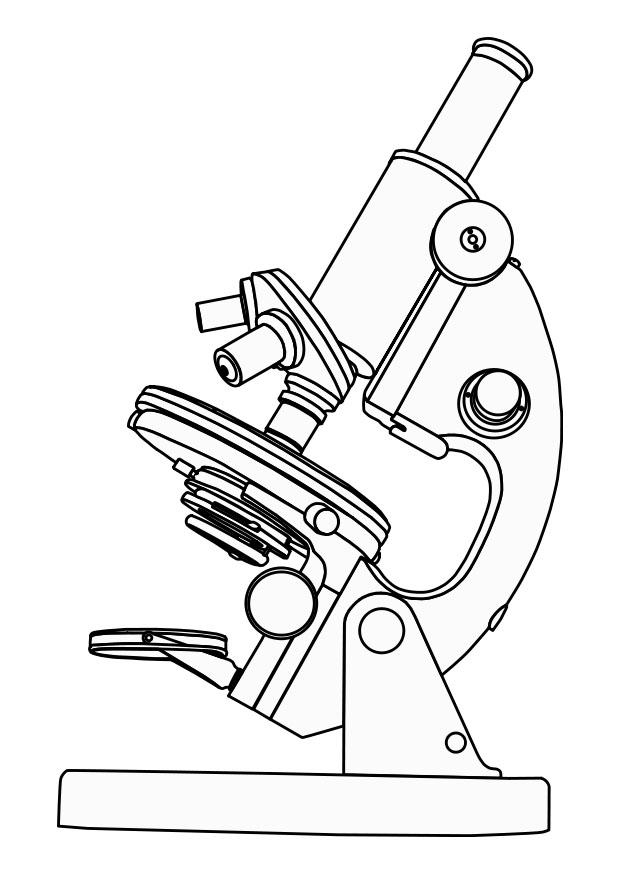
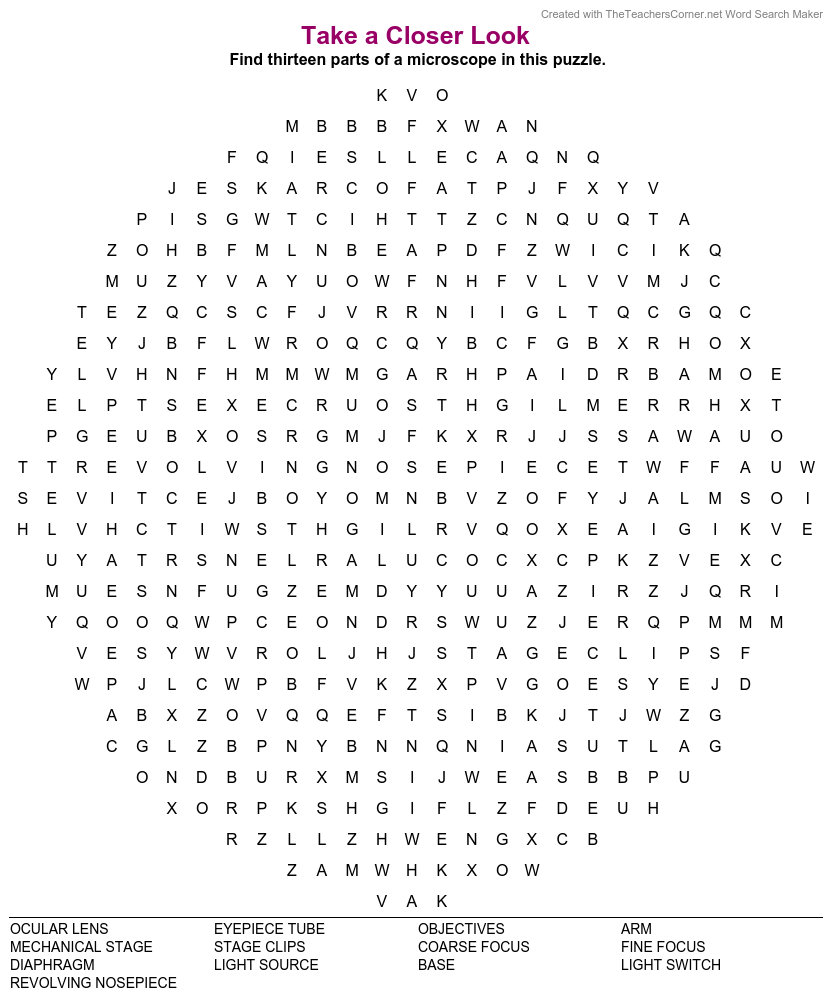
celebrate-picture-books-picture-book-review-microscope-coloring-page          celebrate-picture-books-picture-book-review-microscope-wordsearch-puzzle

Take a Closer Look Coloring Page and Word Search 

You can examine the parts of a microscope with this printable word search puzzle and coloring page.

Take a Closer Look Word Search Puzzle | Take a Closer Look Word Search Solution | Coloring Page

celebrate-picture-books-picture-book-review-june-almeida-virus-detective-cover

You can find June Almeida, Virus Detective! at these booksellers

Amazon | Barnes & Noble | Books-a-Million

To support your local independent bookstore, order from

Bookshop | IndieBound

Picture Book Review
March 15 – Celebrating the Book Birthday of Let’s Pop Pop Popcorn!

celebrate-picture-books-picture-book-review-let's-pop-pop-popcorn-cover

About the Holiday

Today, I’m excited to be celebrating the Book Birthday of Let’s Pop Pop Popcorn!, a story that makes delicious fun of learning about nature, science, and one fantastic treat! 

Thanks to Sleeping Bear Press for sending me a copy of Let’s Pop Pop Popcorn! for review consideration. All opinions on the book are my own.

Let’s Pop Pop Popcorn!

Written by Cynthia Schumerth | Illustrated by Mary Reaves Uhles


A group of kids plants rows of seeds, which with rain and sun grow unseen until “Surprise! Like magic sprouts appear! / Green and tender, finally here.” The kids help their plants grow by pulling weeds and watching out for pests. The seeds grow and grow until they are taller—much taller—than the children. What are the kids growing? Corn, but not just any corn…. Can you guess?

celebrate-picture-books-picture-book-review-let's-pop-pop-popcorn-sprouts

Image copyright Mary Reaves Uhles, 2021, text copyright Cynthia Schumerth, 2021. Courtesy of Sleeping Bear Press.

When the ears are picked, shucked, and dried, the kernels are ready to be tossed “Plink, plunk, plink” into a pot and heated up. Do you know what kind of corn it is now, or do you need another hint? Okay… “Steam builds around each kernel’s germ, / puffs the starch called endosperm.” A bit of science brings about explosive results then “first one pop! Then pops galore!” You know now! The kids grew their own popcorn! When the pot is overflowing it’s time for “butter, salt, then give a swish. / Lick our fingers—Mmm! Delish!”

celebrate-picture-books-picture-book-review-let's-pop-pop-popcorn-stovetop

Image copyright Mary Reaves Uhles, 2021, text copyright Cynthia Schumerth, 2021. Courtesy of Sleeping Bear Press.

Fascinating backmatter reveals the science behind this favorite treat. Diagrams and photographs let kids see inside a popcorn kernel and view the progression of a kernel as it is heated. They also learn about the two different shapes of popcorn and how they are used. A science activity gives readers the steps for growing their own popcorn from seed to sprout and reveals what transformations take place inside the kernel as the little plant grows. A popcorn art project fills out this STEAM lesson that’s sure to be a favorite.

celebrate-picture-books-picture-book-review-let's-pop-pop-popcorn-party

Image copyright Mary Reaves Uhles, 2021, text copyright Cynthia Schumerth, 2021. Courtesy of Sleeping Bear Press.

There may be no more universally loved snack than popcorn, and Cynthia Schumerth makes learning about the science of growing the plants, preparing the ears for popping, and what happens when the kernels are heated lots of fun. Her bouncy rhyming storytelling will engage kids and get them excited about all the lessons these tiny kernels have to teach. Schumerth’s storytelling builds to its “kaboom” moment, mirroring the suspense popcorn lovers listening for that first Pop. Teachers and homeschoolers will love the resources following the story, which provide for a full lesson appropriate for science, nature, or cross-curricular lessons.

Mary Reaves Uhles’s action-packed illustrations will enthrall kids with their close-up perspectives and relatable details, like the little girl who’s wearing a cat’s ears headband as she digs up the ground for planting. Readers go underground to get a worm’s eye view of the kernels sprouting roots, get down in the dirt to pull weeds, and peek into the pot to make sure there’s going to be enough popcorn for the whole crowd. Images of the kernels pop, pop, popping show the process and will make kids plenty hungry. The final spread of all of the kids enjoying their harvest together is a celebration of popcorn and friendship.

An exuberant story that will spark enthusiasm for science learning and gardening, Let’s Pop Pop Popcorn! will be a quick favorite and is highly recommended for home, classroom, and public libraries.

Ages 5 – 8

Sleeping Bear Press, 2021 | ISBN 978-1534110427

To learn more about Mary Reaves Uhles, her books, and her art, visit her website.

Want to know more about Let’s Pop Pop Popcorn? You can read my interview with Cynthia Schumerth and Mary Reaves Uhles here!

Let’s Pop Pop Popcorn! Book Birthday Activity

celebrate-picture-books-picture-book-review-popcorn-toss-up-puzzle

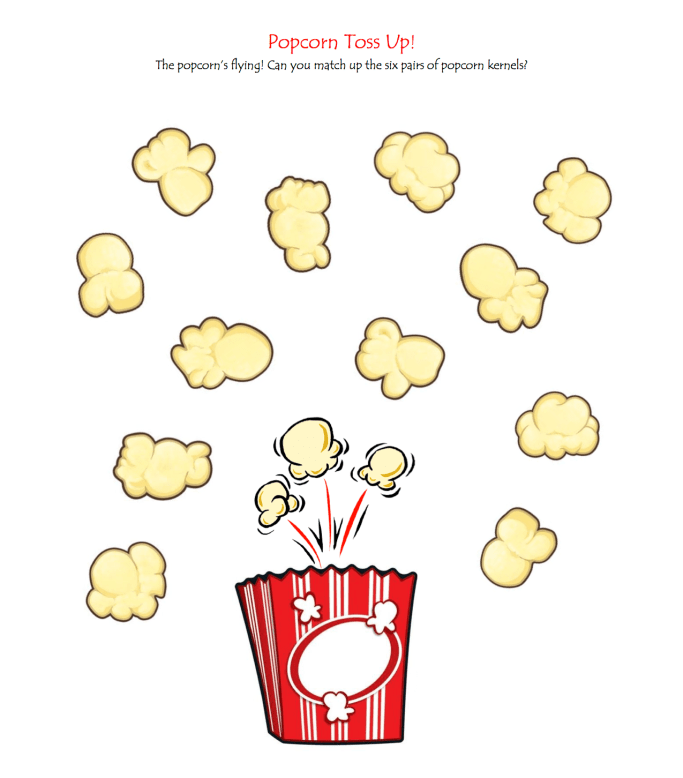
Popcorn Toss Up! Matching Puzzle


The popcorn’s jumpin’! Can you match the six pairs of kernels so you can enjoy a tasty snack in this printable puzzle?

Popcorn Toss Up! Matching Puzzle

You can find Let’s Pop, Pop, Popcorn! at these booksellers

Amazon | Barnes & Noble | Books-a-Million

To support your local independent bookstore, order from

Bookshop | IndieBound

Picture Book Review

March 14 – National Learn about Butterflies Day

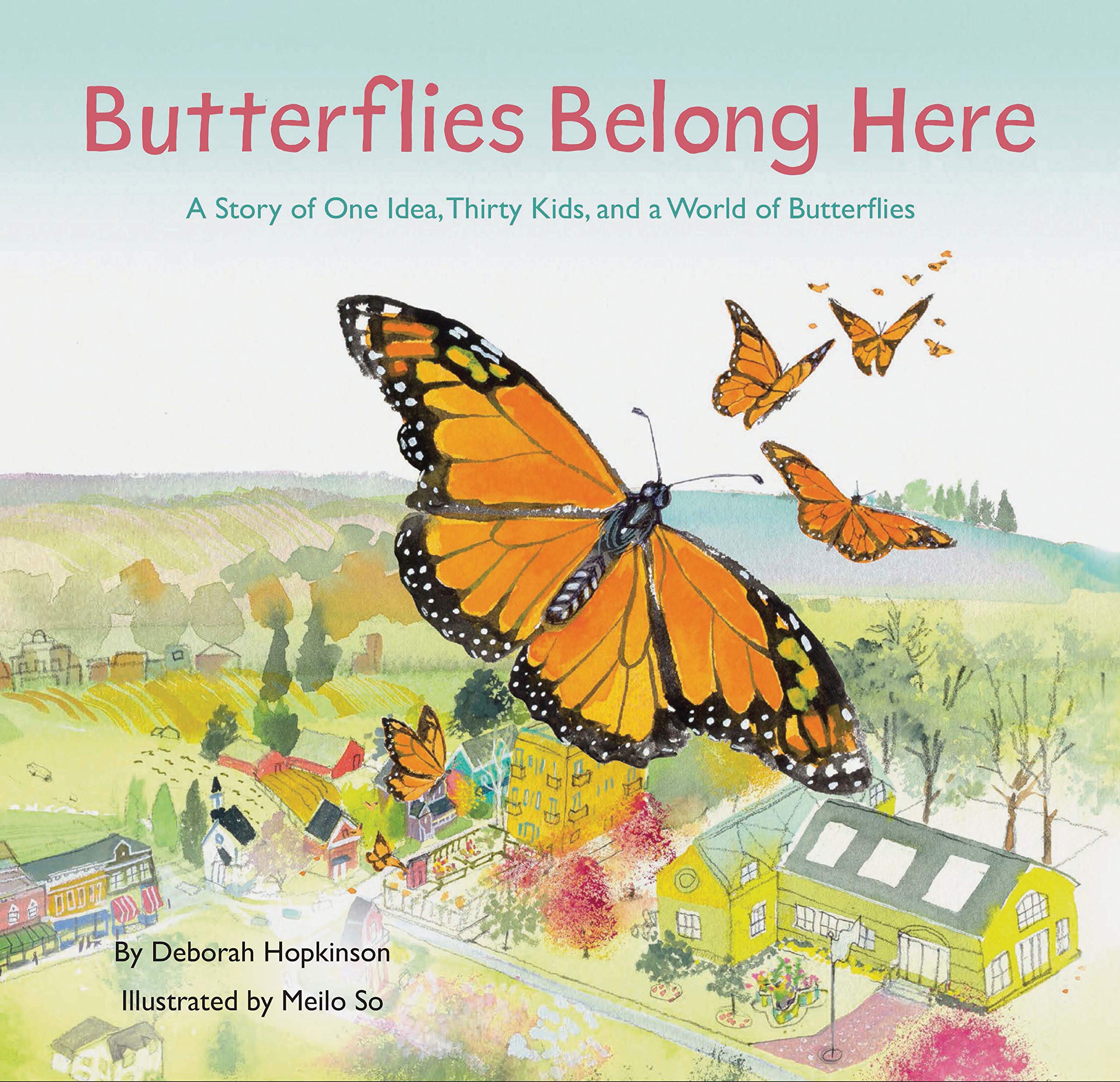
celebrate-picture-books-picture-book-review-butterflies-belong-here-cover

About the Holiday

Spring has sprung – or is right around the corner – so today’s holiday reminds us to watch out for the butterflies in your area. With more than 20,000 species of butterflies around the world, these delicate beauties are one of the most recognized and beloved natural wonders on earth. Butterflies are important to our ecosystem, too, but habitat destruction and climate change are decreasing their numbers by alarming amounts. You can help! By planting milkweed and other plants as well as nectar-producing flowers in your yard or community, you can create an area where butterflies can find shelter, food, and a place to lay their eggs. To learn more about saving monarch butterflies, visit Save Our Monarchs.

Butterflies Belong Here: A Story of One Idea, Thirty Kids, and a World of Butterflies

Written by Deborah Hopkinson | Illustrated by Meilo So


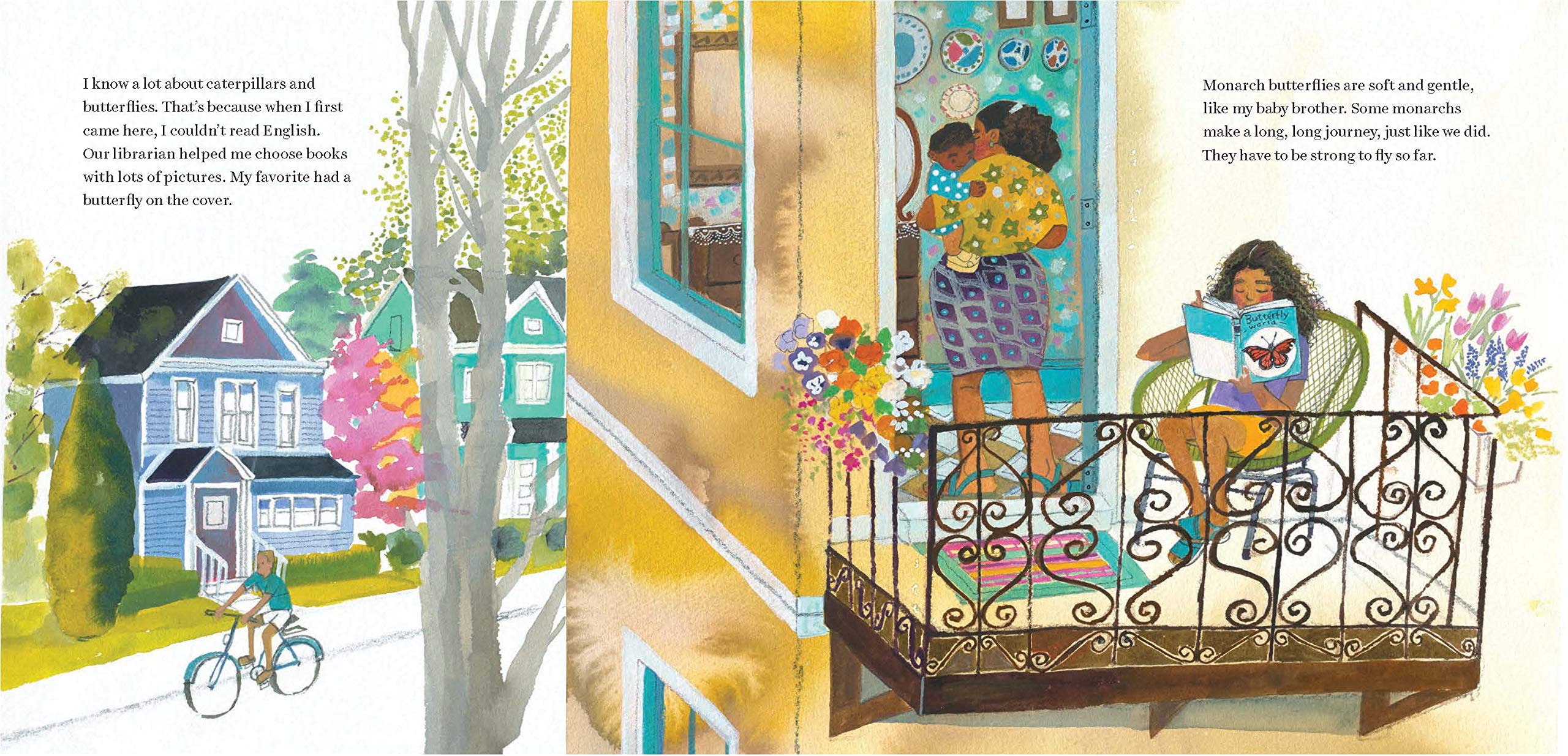
Last spring, the narrator of the story reveals, she was a “little like a caterpillar…quiet and almost invisible.” She had recently moved to the United States and couldn’t read English. The school librarian gave her books with a lot of pictures and her favorite was one about butterflies. Since then she has learned a lot about Monarch butterflies and how they “make a long, long journey” just like her family did. The frame of her story leads into a detailed discussion of the spring monarch migration and the life cycle of caterpillars.

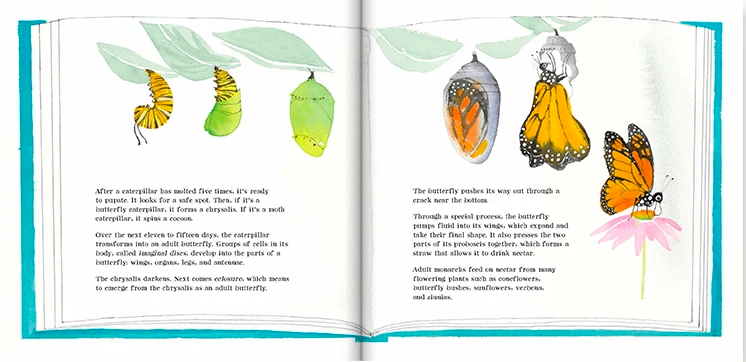
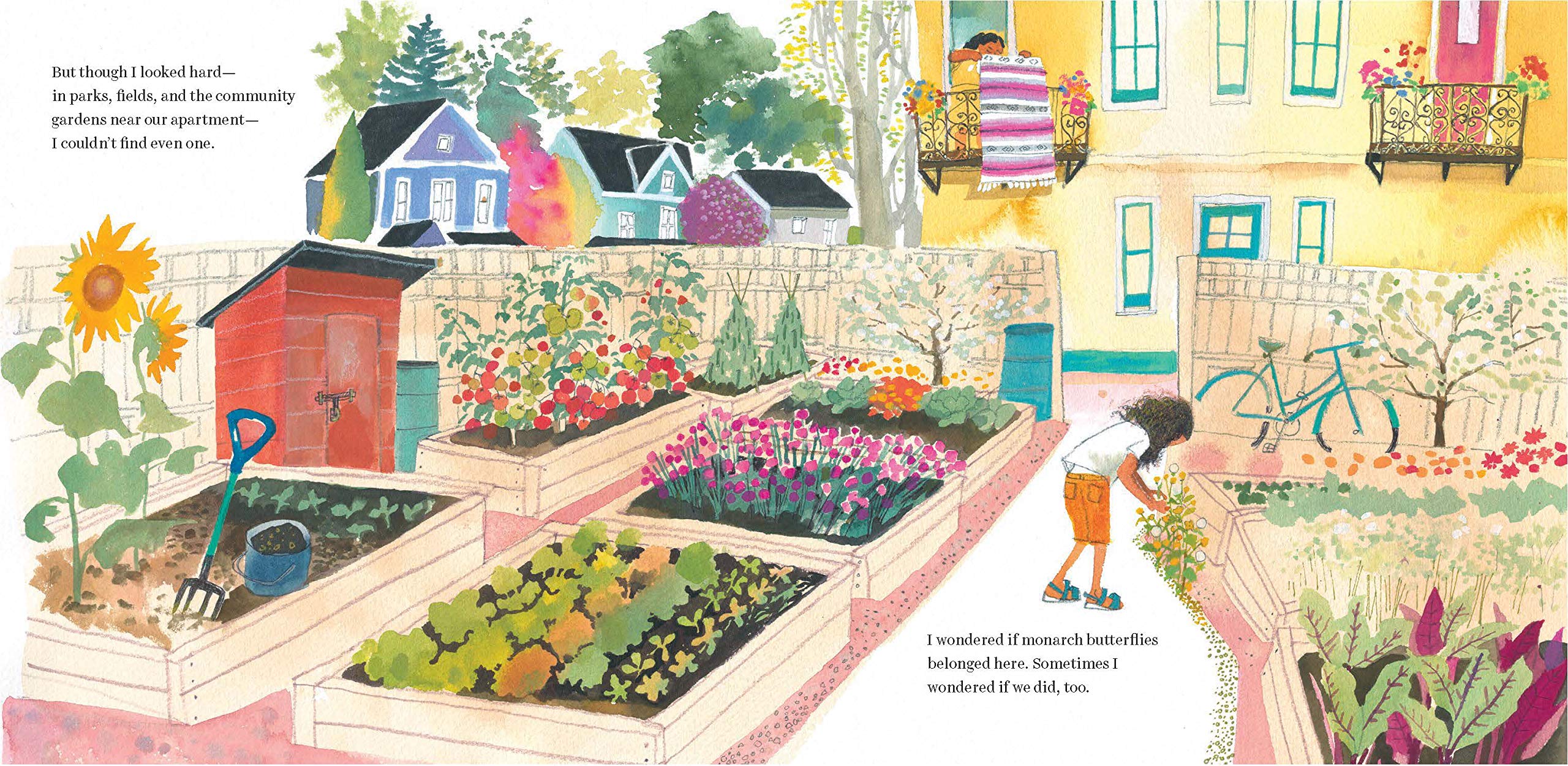
When summer came, the girl thought for sure she would see monarch butterflies. She “wanted to see them flit from flower to flower sipping nectar.” But no matter where she looked—the park, grassy fields, an even the community garden—she couldn’t find any. She began to wonder “if monarch butterflies belonged here.” Sometimes she wondered if her family did either. Turning the page, kids learn how a caterpillar transforms into a butterfly and how, once it emerges from its chrysalis, it “pumps fluid into its wings, which expand and take their final shape” and creates the “straw” it drinks nectar with.

celebrate-picture-books-picture-book-review-butterflies-belong-here-reading

Image copyright Meilo So, 2020, text copyright Deborah Hopkinson, 2020. Courtesy of Chronicle Books.

In the fall when school began, the girl rushed to find her favorite book. Now she could read it, and she discovered that butterflies need milkweed to multiply and thrive. She also learned that milkweed is sparse now, due to habitat destruction due to building, chemical use, and climate change. She also learned some shocking facts, such as “in 20 years, the number of monarchs has fallen by 90 percent.”

One day the librarian calls the girl over and tells her that she has ordered new butterfly books and offers them to her first. The librarian also explains that over the summer she created a monarch way station. The girl knows about these special butterfly gardens. She points out the library window at a place within the school yard that would make a perfect monarch way station. “‘It takes just one person to get things started,’” the librarian says. “‘I’m not that kind of person,’” the girl whispers. But the librarian is encouraging. She reminds the girl about the amazing trip monarchs take and says, “‘It’s surprising what such a tiny creature can do.’” Readers next learn about the generations of butterflies that are born during the summer and how the final generation is different from the rest.

celebrate-picture-books-picture-book-review-butterflies-belong-here-chrysalis

Image copyright Meilo So, 2020, text copyright Deborah Hopkinson, 2020. Courtesy of Chronicle Books.

During the winter, the girl remembers the monarchs who lived “high in the fir forests of Mexico, waiting out the cold to make their long journey north.” She thinks about what the librarian said, and wonders if she could “ever be brave enough to speak up, take charge, and be noticed.” But when she presents a research project on butterflies for her class, the kids loved it. At the end she tells the class how important butterflies are and that they need to help them.

She is surprised by how excited the class is to help and that they want to make a butterfly garden as the class project. The teacher turns to her and asks if she has any ideas on what they could do. The girl is prepared. She turns her poster around and shows them her “plan for a monarch way station, the beginning of a timeline, a list of supplies, and how much it might cost.” And so, they started on their garden. Over the next few weeks, the girl says “‘I could feel myself growing and changing, little by little.’”

celebrate-picture-books-picture-book-review-butterflies-belong-here-community-garden

Image copyright Meilo So, 2020, text copyright Deborah Hopkinson, 2020. Courtesy of Chronicle Books.

The class talked to the principal, made a presentation to parents, and invited gardeners and scientists to speak to the class. They also wrote letters to students in other places who were doing similar projects. Then they held an all-school assembly and asked for volunteers. Kids from all classes—even kindergarten—signed up. They even went to a town council meeting and explained how important milkweed was. They asked that it not be sprayed with poison but instead “be planted in every city park.” The mayor even shook the girl’s hand and told her the city needed citizens like her.

Finally, with a fence and garden plots built, it was planting day. When spring class picture time rolls around again, the girl can be found in the front row, right in the center and holding the class sign. The kids met students from another school who have been helping the butterflies for two years and now serve as monarch trackers, placing tags on their legs and following their migration routes. The class’s monarch way station is thriving, and while they don’t have monarchs yet, the girl is already thinking about how the class can become monarch trackers next year. Just like a caterpillar, the girl thinks again, she has grown and emerged “as something new, unexpected, surprising.”

Backmatter includes an Author’s Note about the story, a guide for making a school or home monarch way station, facts about monarchs, and books and internet resources for learning more about monarchs and how you can help.

celebrate-picture-books-picture-book-review-butterflies-belong-here-migration

Image copyright Meilo So, 2020, text copyright Deborah Hopkinson, 2020. Courtesy of Chronicle Books.

Deborah Hopkinson’s moving and educational story combines a fictional account of growing up with scientific information on butterflies. The structure is exceptionally effective in showing kids and adults that some children find their voice, discover a talent, or overcome hesitation or shyness when they become involved in a cause or activity they believe in. The school librarian and the teacher both model actions and words that can encourage children to express and extend themselves. The girl’s thoughts allow children to see that fears of speaking up or taking charge are not uncommon while also reassuring them that by taking even small actions one step at a time, their confidence will grow. The cyclical structure of the story enhances the idea that change is gradual—in nature and in people. Hopkinson’s text revolving around butterflies and making a butterfly garden way station will excite kids to do the same at their school, at home, or in their community.

Meilo So’s gorgeous and tender illustrations portray vibrant scenes of flower bedecked balconies, blooming community gardens, and a busy, colorful town. So cleverly depicts the library’s stacks of books in similar floral hues, connecting the nurturing of children and butterflies. The faces of all the children and the adults are thoughtful and enthusiastic. Readers can clearly see the protagonist’s physical growth throughout the seasons as well as her developing self-confidence and will want to watch for ways in which she mirrors a butterfly. The children in the classroom and the school are a diverse mix and demonstrate the enthusiasm and determination of kids who want to make a difference.

So is a master at illustrating butterflies, caterpillars, and other insects, and her realistic images will fascinate readers. Children get to see a caterpillar form a chrysalis, transform into a butterfly inside, and emerge. They also see the seeds inside a milkweed pod as well as the plants themselves, throngs of monarchs during migration, and maps of migration routes. 

Exhilarating, poignant, and inspirational on many levels, Butterflies Belong Here is highly recommended for home libraries and a must for school and public libraries.

Ages 5 – 8 and up

Chronicle Books, 2020 | ISBN 978-1452176802

Discover more about Deborah Hopkinson and her books on her website.

To learn more about Meilo So and view portfolios of her art, visit her website and heflinreps.

National Learn about Butterflies Day Activity

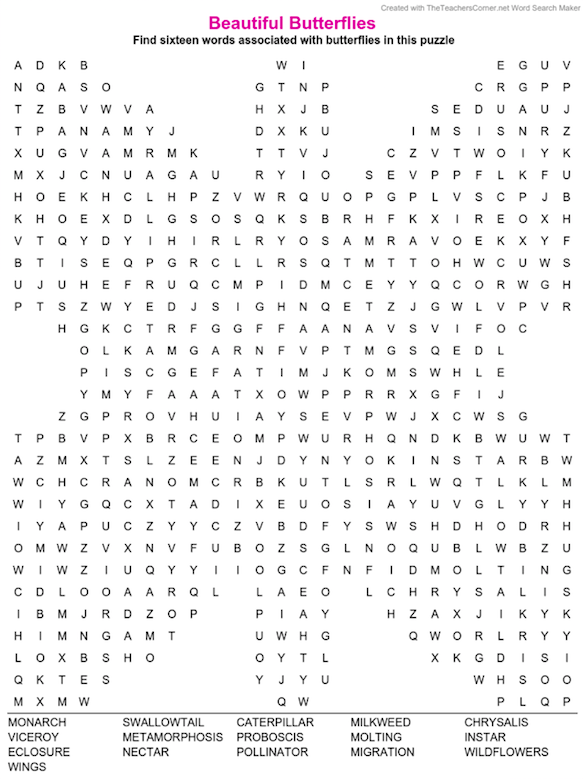
celebrate-picture-books-picture-book-review-beautiful-butterflies-maze

Beautiful Butterflies Maze


Can you find the sixteen words associated with butterflies in this printable puzzle?

Beautiful Butterflies Maze Puzzle | Beautiful Butterflies Maze Solution

celebrate-picture-books-picture-book-review-butterflies-belong-here-cover

You can find Butterflies Belong Here at these booksellers

Amazon | Barnes & Noble | Books-a-Million

To support your local independent bookstore, order from

Bookshop | IndieBound

Picture Book Review

February 11 – Celebrating International Day of Women and Girls in Science with the Book Trailer Reveal for June Almeida, Virus Detective!

About the Holiday

Gender equality has always been a core issue for the United Nations. As such, on December 22, 2015 the United Nations General Assembly established an International Day to recognize the critical role women and girls play in science and technology. The outbreak of the COVID-19 pandemic has clearly demonstrated the critical role of women researchers in different stages of the fight against COVID-19, from advancing the knowledge on the virus, to developing techniques for testing, and finally to creating the vaccine against the virus.

Against this backdrop, this year’s celebration of the Day will address the themeWomen Scientists at the forefront of the fight against COVID-19” and will gather together experts working in fields related to the pandemic from different parts of the world. For more information, visit the UN website.

That this year’s International Day of Women and Girls in Science celebrates women researchers, and especially those involved in COVID-19, makes it all the more exciting to reveal the trailer for a book highlighting the achievements of the pioneer in the field.

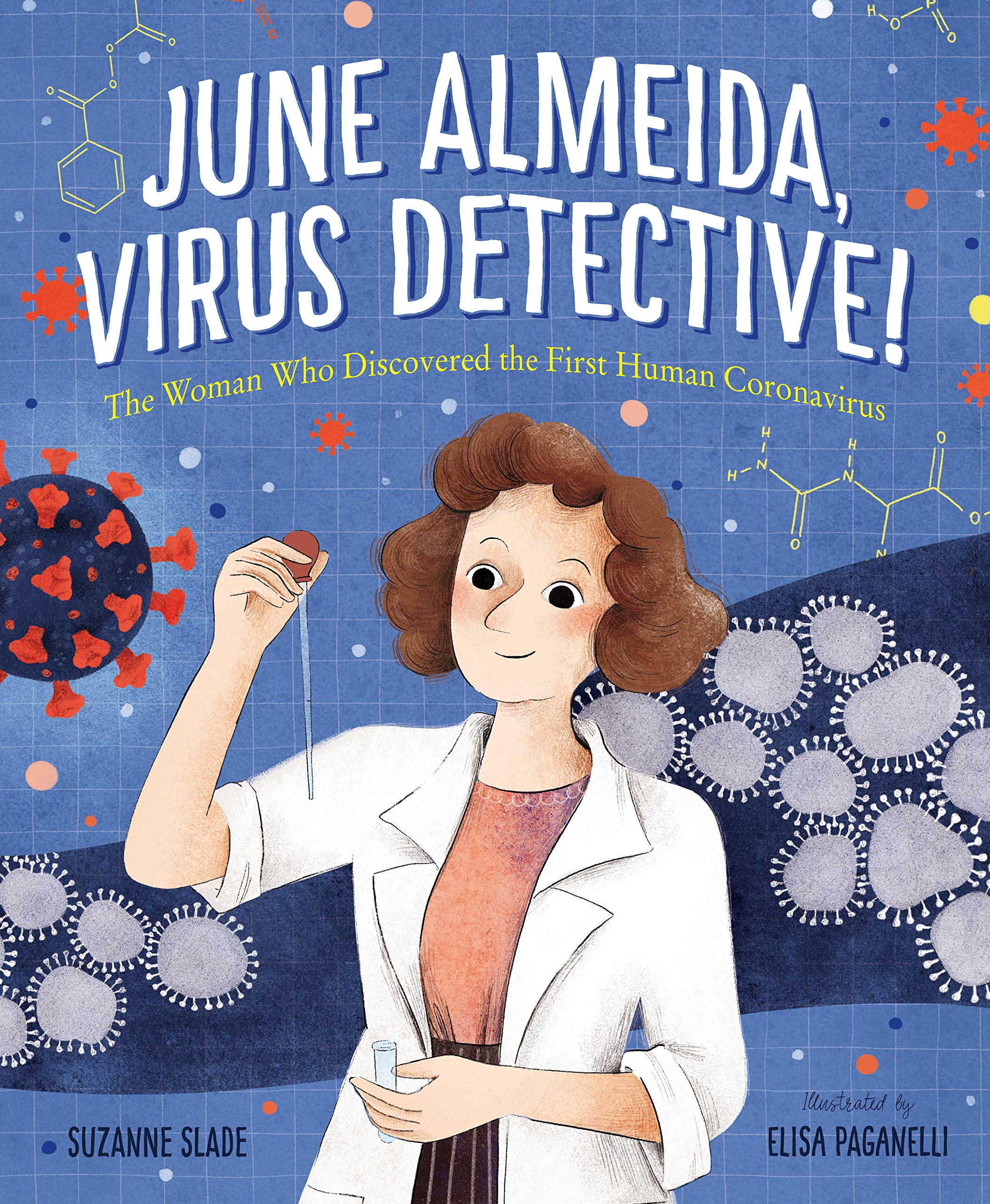
June Almeida, Virus Detective! The Woman Who Discovered the First Human Coronavirus 

Written by Suzanne Slade | Illustrated by Elisa Paganelli


With the rise of the global COVID-19 coronavirus pandemic and its life-changing effects for everyone around the world, scientists, adults, and children began looking for information and answers on how we can defeat the virus so that life can return to normal. In June Almeida, Virus Detective! The Woman Who Discovered the First Human Coronavirus, readers learn the incredible story of the scientist who discovered, photographed, and even named the first human coronavirus.

Growing up in Glasgow, Scotland, June Almeida loved learning about science and nature. A good student, she was especially interested in biology and won the top science prize at her school. Creative and observant, June noticed details that others often missed. She dreamed of going to college but economic hardships caused her to leave school at age 16. Still, June was determined to pursue her passion for science. She was hired by a local hospital to work in its lab, using a microscope to magnify and examine cells. Her work helped doctors treat patients. June later worked in labs in London and in Toronto. Her skill in using the electron microscope to examine cells and help identify viruses earned her promotions and respect in the science community. In the late 1960s, when June was 34 years old, she discovered the first human coronavirus. Her groundbreaking work continues to help researchers today in the fight against illnesses caused by viruses, including COVID-19.

While researching and writing June Almeida, Virus Detective!, award-winning science author Suzanne Slade worked closely with June’s daughter, Joyce, to capture the personality and intelligence of this unsung hero in the fight against the coronavirus. Backmatter includes photographs of June working with various microscopes, more about her career, and a timeline.

Ages 6 – 9

Sleeping Bear Press, 2021 | ISBN 978-1534111325

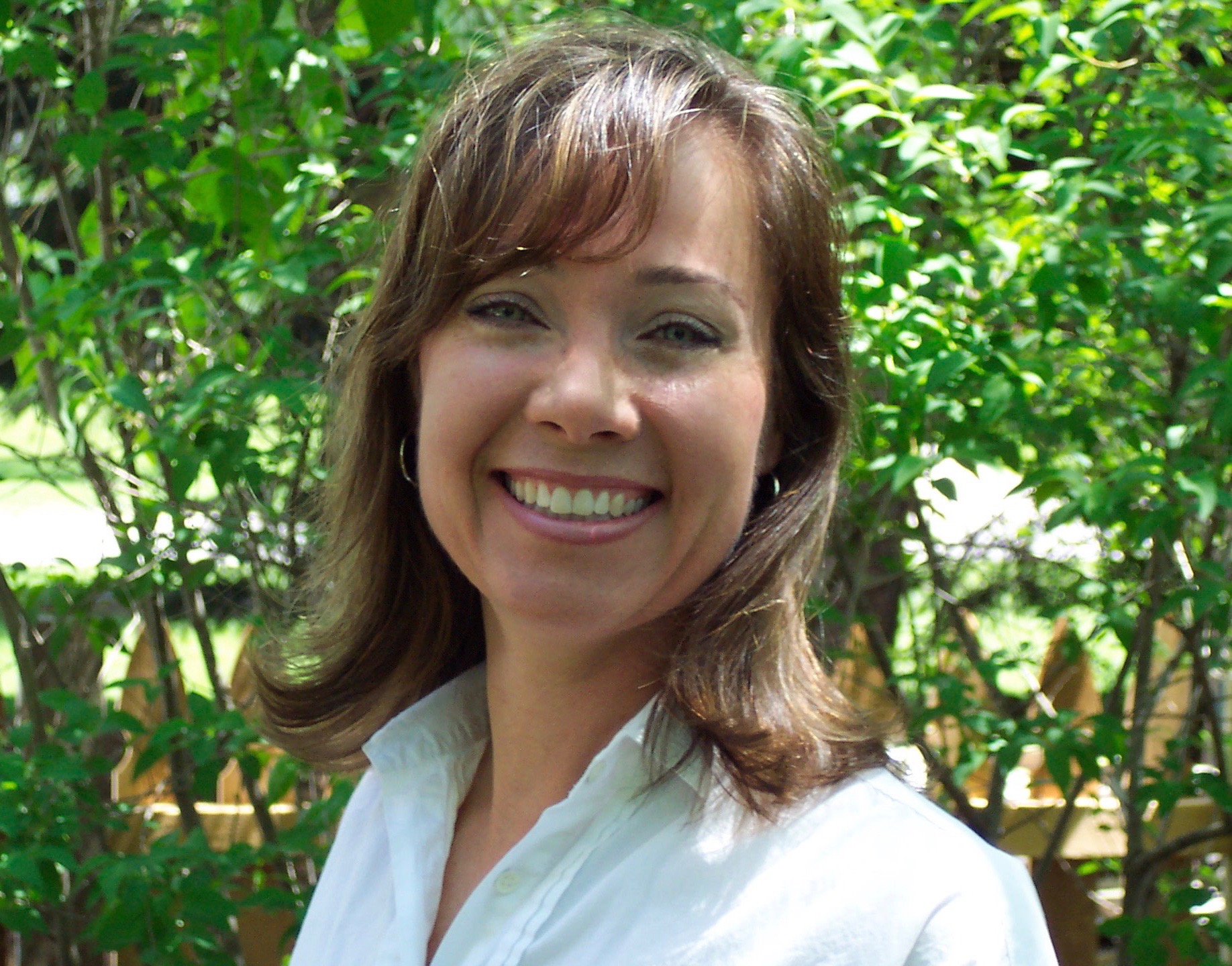
celebrate-picture-books-picture-book-review-suzanne-slade-headshot

Suzanne Slade holds a B.S. degree in science and worked for many years in a STEM career. She is now the award-winning author of more than 100 books, including Out of School and Into Nature: The Anna Comstock Story. She lives in Libertyville, Illinois. Learn more about Suzanne at suzanneslade.com.

celebrate-picture-books-picture-book-review-Elisa-Paganelli-headshot
Elisa Paganelli’s work includes The Highland Falcon Thief, named a Waterstones Book of the Month. She lives in High Wycombe, United Kingdom. Learn more about Elisa at elisapaganelli.com

June Almeida, Virus Detective! is available March 15, 2021

celebrate-picture-books-picture-book-review-june-almeida-virus-detective-cover

You can preorder June Almeida, Virus Detective! at these booksellers

Anderson’s Bookshops | Amazon | Barnes & Noble | Books-a-Million 

To support your local independent bookstore, order from

Bookshop | IndieBound

Picture Book Review