April 21 – World Creativity and Innovation Day

celebrate-picture-books-picture-book-review-my-dog-is-not-a-scientist-cover

About the Holiday

World Creativity and Innovation Day has been observed by citizens and organizations in over 50 countries since 2002. In 2018, the United Nations (U.N.) formally established the holiday to promote the importance of creativity and innovation in all aspects of human development, both at the individual and group levels. This day also highlights the importance of applying creativity and innovation to problem-solving for today’s pressing issues, including scientific, economic, social, and sustainable development. Kids seem to do this inherently as they go about exploring and interacting with all the new things they see, hear, and do every day Books like today’s featured title can spur children to put their own unique talents to work to change an improve the world for all. To learn more about World Creativity and Innovation Day, visit the UN website.

Thanks to Betsy Ellor and Yeehoo Press for sharing a digital copy of My Dog Is NOT a Scientist with me for review consideration. All opinions on the book are my own.

My Dog is NOT a Scientist

Written by Betsy Ellor | Illustrated by Louisa Vera


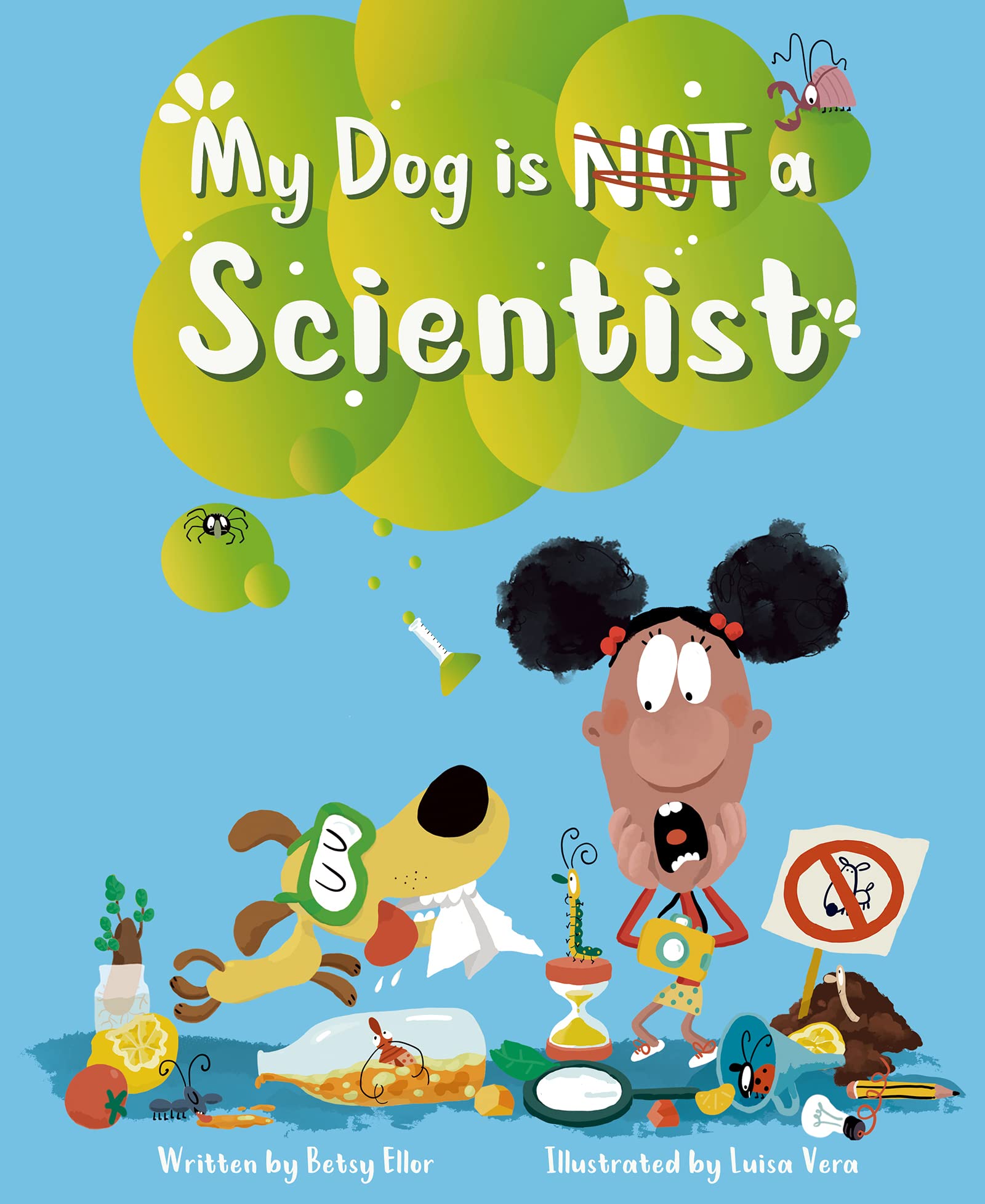
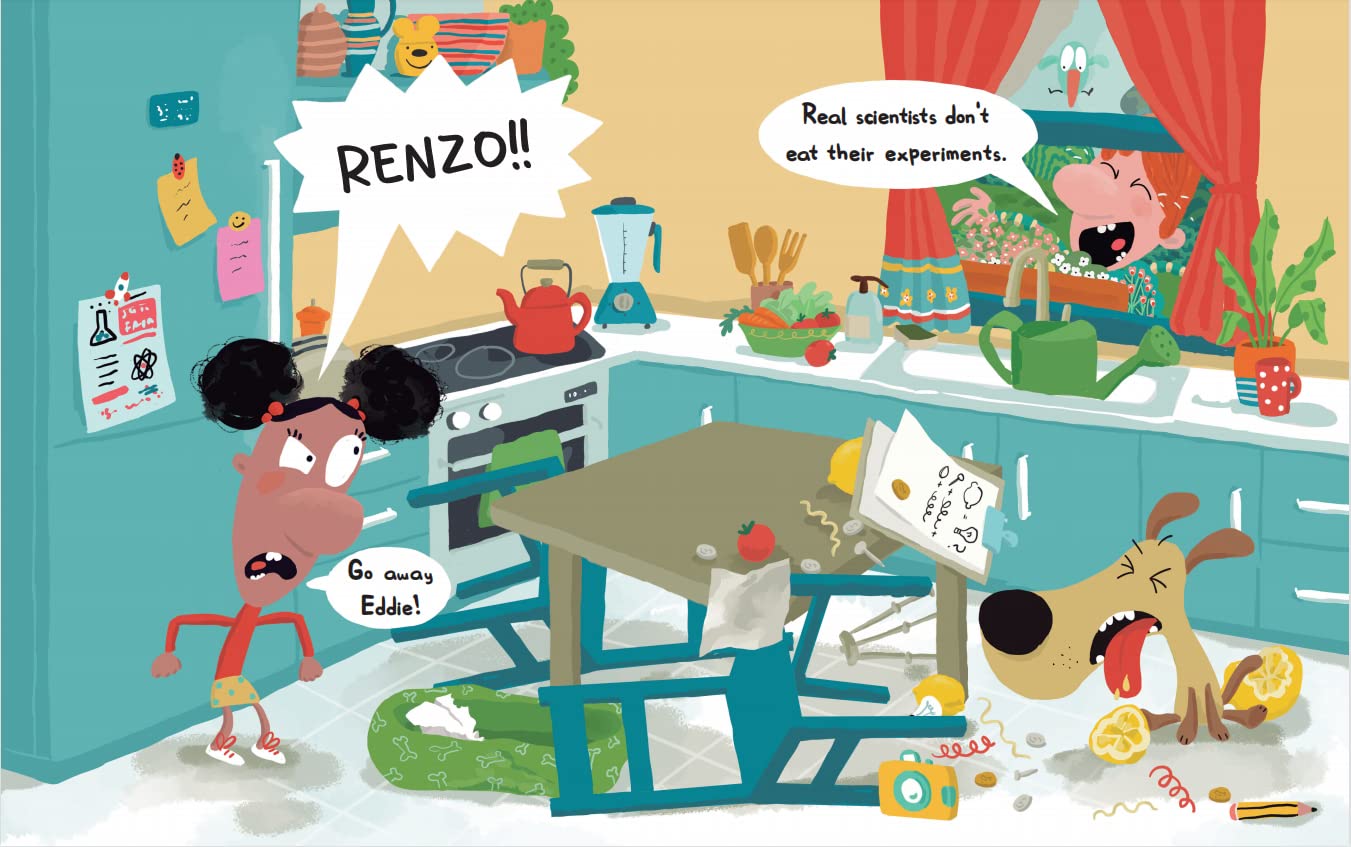
Yara knows she’s the best scientist in town, but how can she prove it when she always loses the school science fair to her neighbor Eddie, who taunts her about being older and smarter and not having a dog like Renzo to mess up his experiments. This year, though, Yara is determined to win. She already has her question to explore: “What makes paper airplanes fly?” and lots of planes to experiment with. But within minutes Renzo has chased down and torn them all apart. “RENZO!!” Yara yells. “Real scientists don’t chase their experiments,” says Eddie.
celebrate-picture-books-picture-book-review-my-dog-is-not-a-scientist-lemon-experiment

Image copyright Luisa Vera, 2023, text copyright Betsy Ellor, 2023. Courtesy of Yeehoo Press.

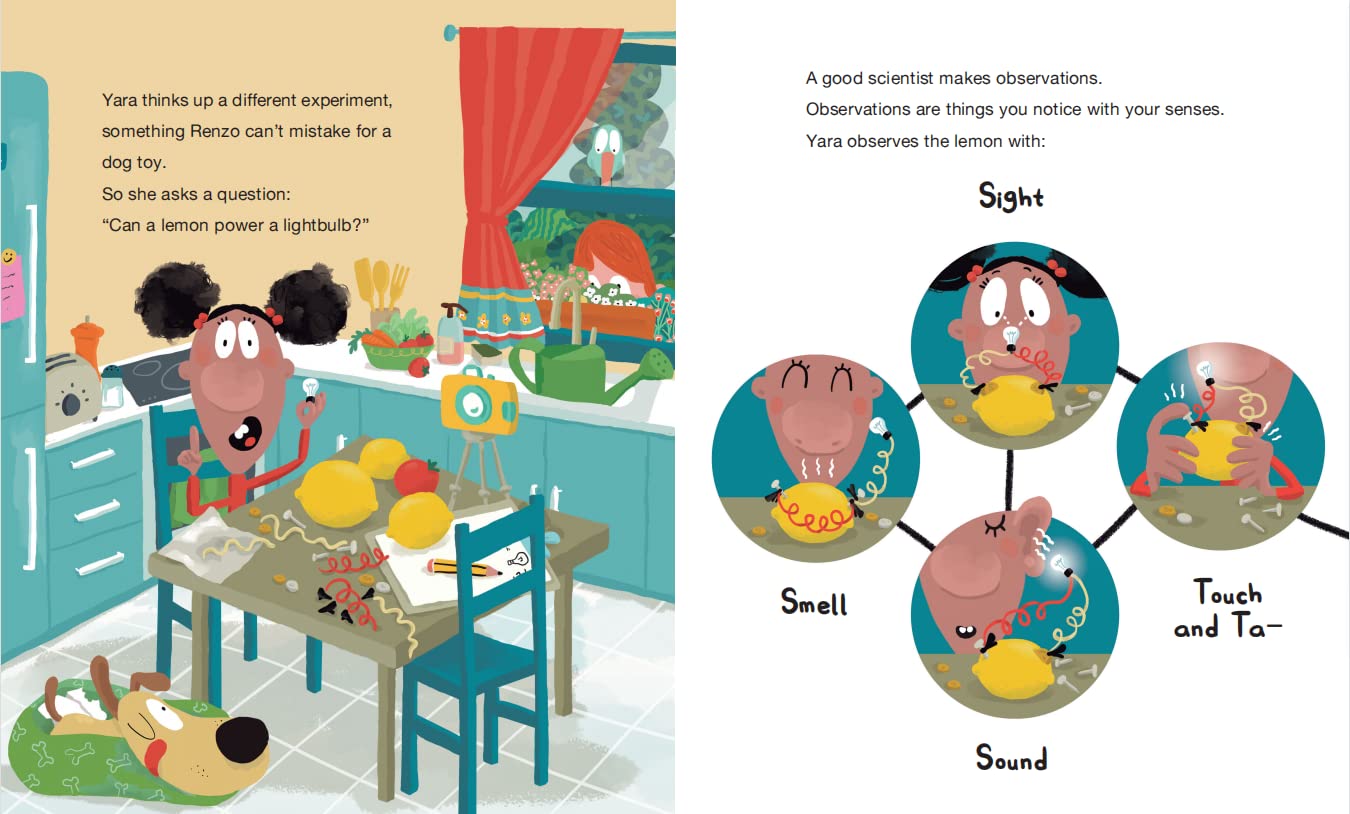
Next, Yara chooses to use her scientific observational skills to see if she can illuminate a lightbulb with a lemon. But again Renzo causes a catastrophe and Eddie is right there to see it and make a comment.  Undaunted, however, Yara decides to test her hypothesis about “what makes grass grow fast.” She marks off sections of her backyard that are sunny, shady, dry, and wet and gets to work. Renzo feels the call of nature, too – only in a . . . umm . . . different way than Yara. And, yep, Eddie sees it too.

With one week to go to the science fair, Yara comes up with a hypothesis about insects and does a little problem-solving by erecting a Renzo-free tent to carry out her experiment. Maybe Renzo can’t read or maybe he just has to know, but that dogged dog digs deep and finds a way to upset another experiment.
celebrate-picture-books-picture-book-review-my-dog-is-not-a-scientist-renzo-eats-lemon

Image copyright Luisa Vera, 2023, text copyright Betsy Ellor, 2023. Courtesy of Yeehoo Press.

Now the science fair is tomorrow, and while Eddie has a neat and tidy, perfect-looking project to present, “all Yara has to show is Renzo’s damage.” How can she report what she’s learned like a real scientist when she hasn’t learned anything? Yara thinks. With tears in her eyes she’s ready to concede to Renzo that “Eddie’s right…. You’re NOT a scientist . . . and neither am I.” But then Yara looks at her experiments in a different way—from Renzo’s point of view. Renzo, she realized, asked questions, made observations, and “even formed a hypothesis and tested it.”

celebrate-picture-books-picture-book-review-my-dog-is-not-a-scientist-night-before-science-fair

Image copyright Luisa Vera, 2023, text copyright Betsy Ellor, 2023. Courtesy of Yeehoo Press.

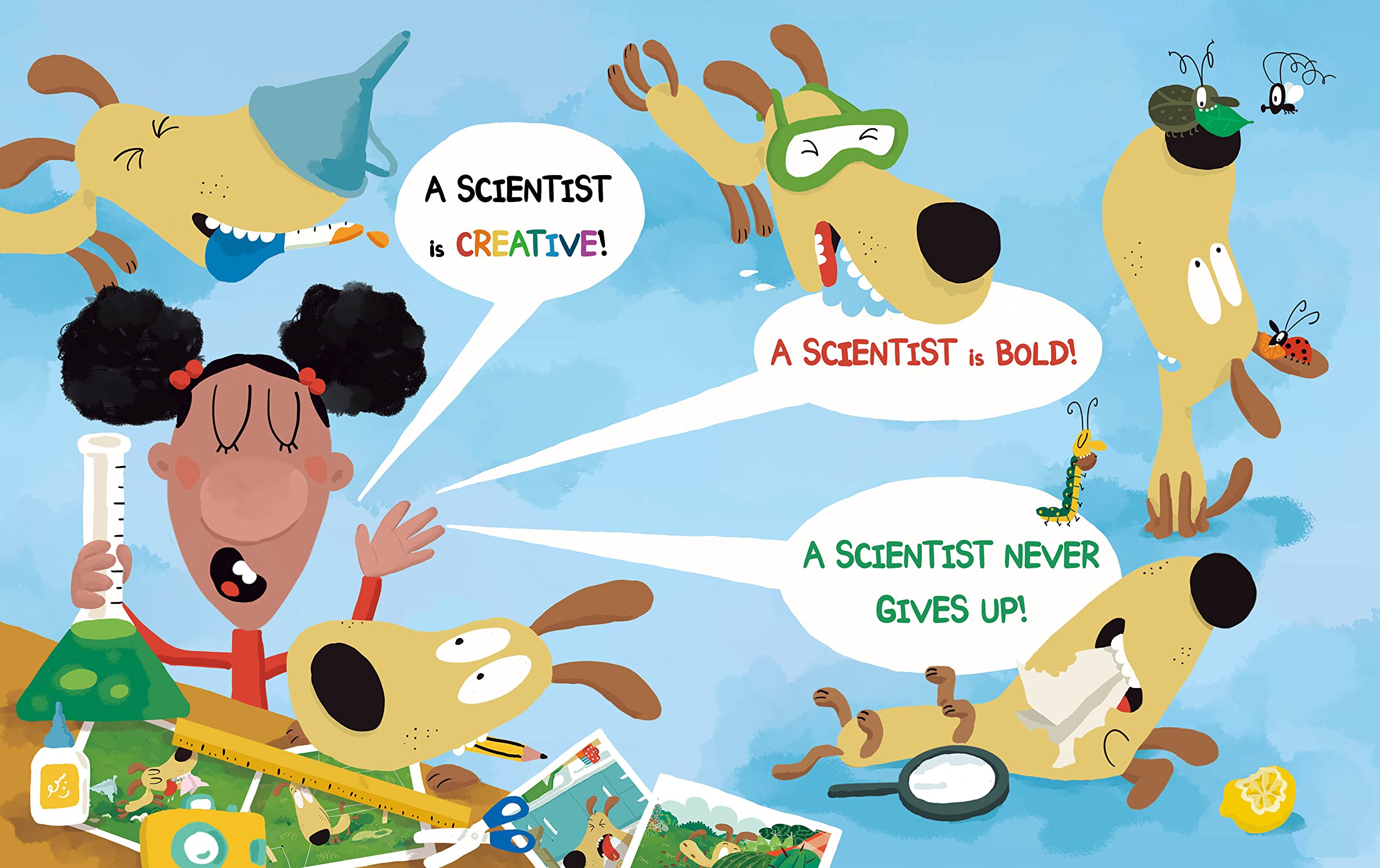
Her new perspective gave Yara another idea for her science project. The next day at the science fair, Renzo was Yara’s star exhibit. “Is My Dog a Scientist?” her display asked. Yara tells the judges how Renzo followed his curiosity, how he asked questions, observed, made a hypothesis, and then tested it—just like a scientist. “‘My project proves my dog really IS a scientist,’” she said. The judges agreed and presented Yara with the first-place ribbon. Even though Eddie whined, Yara knew she and Renzo were the best scientists in town—and now everyone else knew it too.

Back matter includes a step-by-step description of the scientific method, some question starters to get young scientists thinking about their own hypotheses, seven questions to spark experimentation, and an invitation for readers to email Yara and Renzo about their experiments. More ideas for experimentation as well as a curriculum guide are also available on Betsy Ellor’s website.
celebrate-picture-books-picture-book-review-my-dog-is-not-a-scientist-science-fair

Image copyright Luisa Vera, 2023, text copyright Betsy Ellor, 2023. Courtesy of Yeehoo Press.

In her clever and creative story, Betsy Ellor perfectly melds the scientific method with sure-to-produce-guffaws humor that will make this book a favorite with kids who are already hard-core scientists as well as those who just like tinkering to explore life’s mysteries. Yara’s determination to win the science fair provides Ellor with a compelling frame to drop examples of real science-based questions and vocabulary into realistic dialog and suspenseful storytelling. The competition between Yara and Eddie also increases the stakes and will have readers rooting for Yara through every mishap. Yara’s inspired thinking on the night before the science fair encourages kids to never give up and prompts them to look at problems with new perspectives and fresh ideas.

Luisa Vera gives kids so much to see and think about in her dynamic illustrations that readers will love exploring for the science, humor, and plentiful details that define the scientific method while demonstrating Yara’s and Eddie’s different approaches to research. But with Yara’s first exasperated “RENZO!!” all eyes will be on this mischievous mutt who just can’t help it if he has a heart for science and a penchant for mischief. Renzo’s various antics will have kids laughing out loud through each of Yara’s experiments and even to the science fair, where even Eddie’s entry attracts the “Renzo” effect.

Funny, effervescent, and loaded with real science, My Dog Is NOT a Scientist is sure to be a catalyst to spark kids’ interest in and understanding of the scientific method as well as the idea that scientific observation and experimentation is a creative process and one that can be unique to each person. The book would enhance any science curriculum for teachers or homeschoolers and is highly recommended for home, classroom, school, and public library collections.

Ages 4 – 8

Yeehoo Press, 2023 | ISBN 978-1953458469

Discover the real-life inspiration behind My Dog is NOT a Scientist!

About the Author

Betsy Ellor lives in a home filled with kid shenanigans, canine chaos and creative projects run wild. Her picture book debut, My Dog is NOT a Scientist launches in 2023 from Yeehoo Press. Her 2021 anthology Heroic Care: 35 Writers & Artists Show What It Means To Care reached the top 30 on Amazon, and her family musical Sara Crewe has been performed across the US.

Midwest-born, Betsy started as a playwright, earning a degree in Creative Writing from Ball State University before shifting her focus to novels and picture books. Betsy works as an interior designer. This explains her uniquely visual voice and her passion for stories that keep creative thinking at the heart of scientific exploration. Betsy lives near the beach in Massachusetts with her son and dog (aka the bringers of chaos). She spends way too much time on the computer but frequently escapes for hiking, biking, paddle boarding, and beach time. Visit Betsy on her website.

About the Illustrator

Luisa Vera was born in Elda, Alicante. After Luisa finished her fine-arts career in Valencia, she went to New York, where she attended the School of Visual Arts. Since 1990, she has dedicated herself professionally to illustration. She is the author/illustrator of Let’s Go to the Museum, a Modern Art Museum Maze and has illustrated Casas del mundo, Salta que salta, among other Spanish-language titles for children. Her work has been featured in the New York Times, the Chicago Tribune, the Dallas Morning News, the Wall Street Journal, the International Herald Tribune, and The Vanguard, and her characters have worn their best clothes on book covers, posters, catalogs, children’s stories, and exhibitions. Luisa lives in Barcelona, Spain. You can follow Luisa Vera on Instagram.

Meet Yara and Renzo in this sneak peek of the book!

World Creativity and Innovation Day Activity

celebrate-picture-books-picture-book-review-sparkle-test-tubes-II

Kids love inventing and experimenting, and these sparkle test tubes give children a fun way to be creative while making a cool way to relax and on those hectic days.

Supplies

  • Plastic test tubes with tight-fitting screw cap, available at craft or science supply stores. Having two or three will allow for more experimentation
  • Glitter glue
  • Hot water
  • Fine glitter
  • Chunky glitter
  • Small glass beads (optional)
  • Neon food coloring (optional)
  • Test tube stand (optional)
  • Whisk
  • Mixing bowl
  • Teaspoon

Directions

  1. Fill a test tube 1/3 full of hot water and pour the water into the mixing bowl
  2. Add 1 – 2 teaspoons of glitter glue (the more glitter glue that is added the thicker the liquid will be and the more the objects will be suspended in the liquid. To allow the objects to flow more freely when the test tube is shaken, add less glue
  3. Whisk the water and glitter glue together
  4. Add chunky glitter, glass beads, or try other small objects
  5. Pour into test tube
  6. Add more water to within a ½ – 1 inch of the top to allow for shaking
  7. Experiment with amount of glitter glue, glitter, and colors

More Science!

Are your kids excited to discover more about the world – and even the cookies they like – through experiments like Yara and Renzo? Then they’ll love the 13 fun and eye-opening experiments on Betsy Ellor’s website. You’ll find them here!

A My Dog is NOT a Scientist Curriculum Guide for teachers, homeschoolers, librarians, and group leaders is also available for download on Betsy Ellor’s website here!

celebrate-picture-books-picture-book-review-my-dog-is-not-a-scientist-cover

You can find My Dog Is NOT a Scientist at these booksellers

Amazon | Barnes & Noble | Books-a-Million

To support your local independent bookstore, order from

Bookshop

Picture Book Review
December 9 – It’s Read a New Book Month

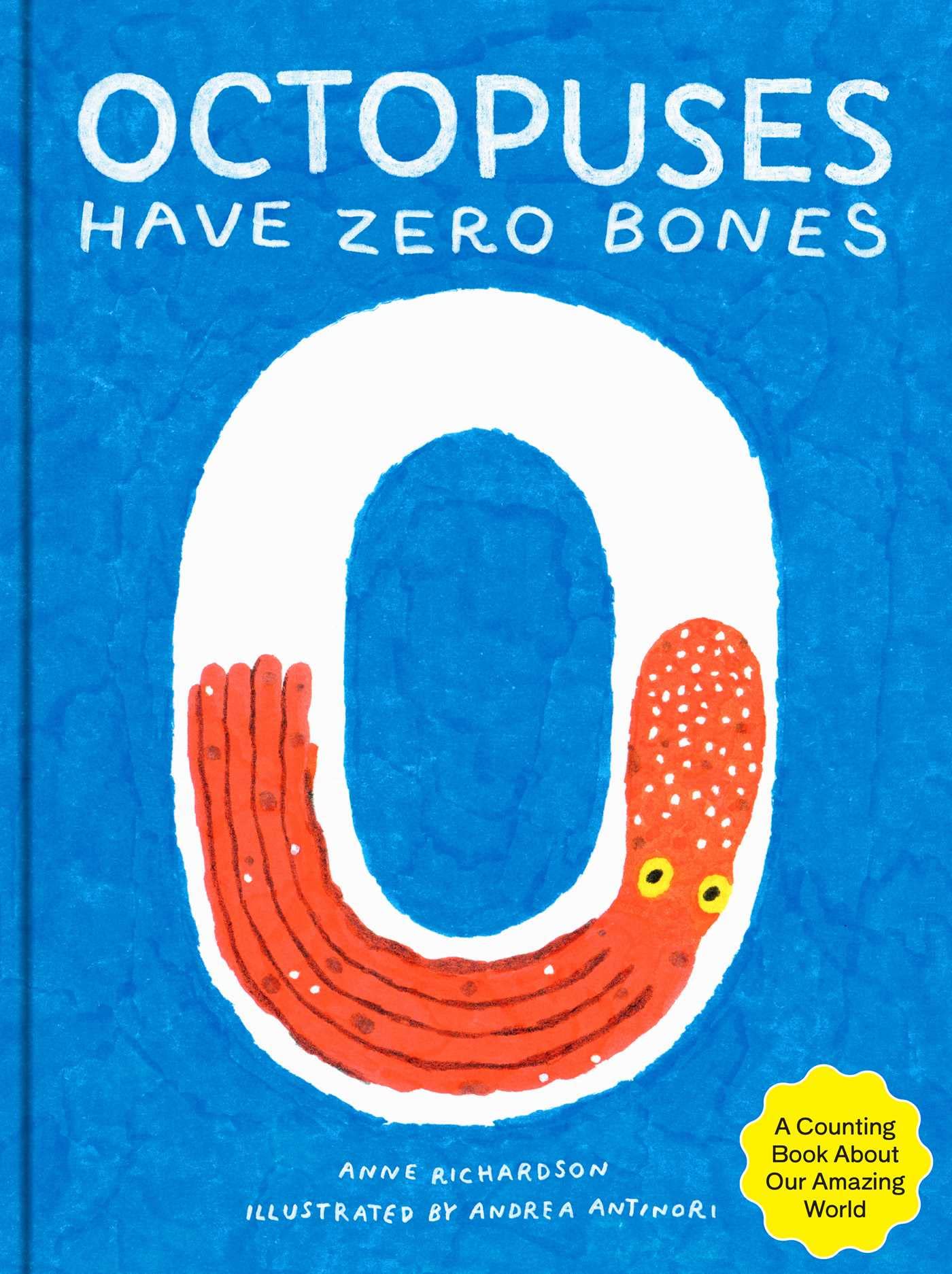
celebrate-picture-books-picture-book-review-octopuses-have-zero-bones-cover

About the Holiday

The month of December is a gift-giver’s delight, and there’s no better gift for everyone on your list than a book (or two or…). With so many new books hitting bookstore shelves, there really is a perfect one to fit everyone’s taste. Young children, especially, benefit from reading a wide range of picture books from laugh-out-loud or touching stories to nonfiction that introduces them to influential people, science, history, nature, math—like today’s book. If you’re looking for gifts to give, it’s not too late to head to your local bookstore to find books that will make your child’s eyes light up.

I’d like to thank Tra Publishing for sending me a copy of Octopuses Have Zero Bones for review consideration. All opinions on the book are my own.

Octopuses Have Zero Bones: A Counting Book about Our Amazing World

Written by Anne Richardson | Illustrated by Andrea Antinori


If you’re looking for a book that opens kids’ eyes and mind to new ways to interact with numbers and fall in love with everything they have to tell about us and the world around us, then you’ll want to wrap your arms around Octopuses Have Zero Bones. This multilayered and eye-opening romp through the ability of numbers to describe, explain, provide perspective, and amaze celebrates the numbers from zero to nine and the power of numbers ten to nine billion.

Kids at all levels will find accessible ways to explore the math concepts that enliven every page, from basic counting to higher-level ideas that include measurement, extrapolation, and estimation as well as complex scientific facts. And how does all of this learning begin? With 0 and simple statement and probing question: “ZERO, all by itself, is nothing. Can you imagine nothing?” It might be hard for kids to think about how “nothing” can be important or have an effect. But Anne Richardson, with illustrative help from Andrea Antinori, reveals that because “octopuses have ZERO bones…” they “can squeeze through very small places.” And, if that doesn’t surprise you, she also presents this fascinating tidbit: “Dry Valleys, Antarctica, gets ZERO rain or snow.” In fact “there’s been no precipitation for two million years.” Two million! That’s nearly as impressive as zero!

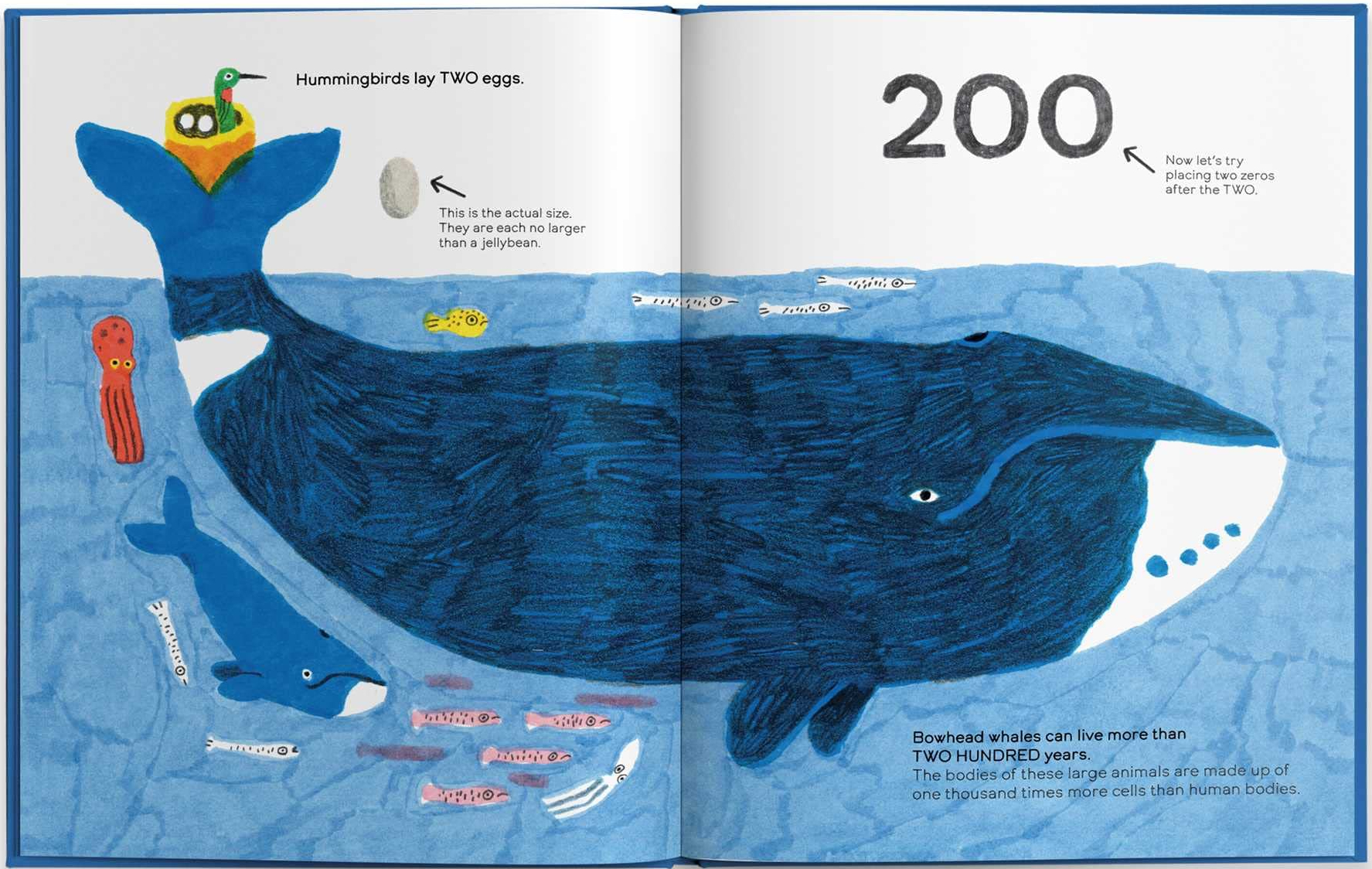
celebrate-picture-books-picture-book-review-octopuses-have-zero-bones-whale

Image copyright Andrea Antinori, 2022, text copyright Anne Richardson, 2022. Courtesy of Tra Publishing.

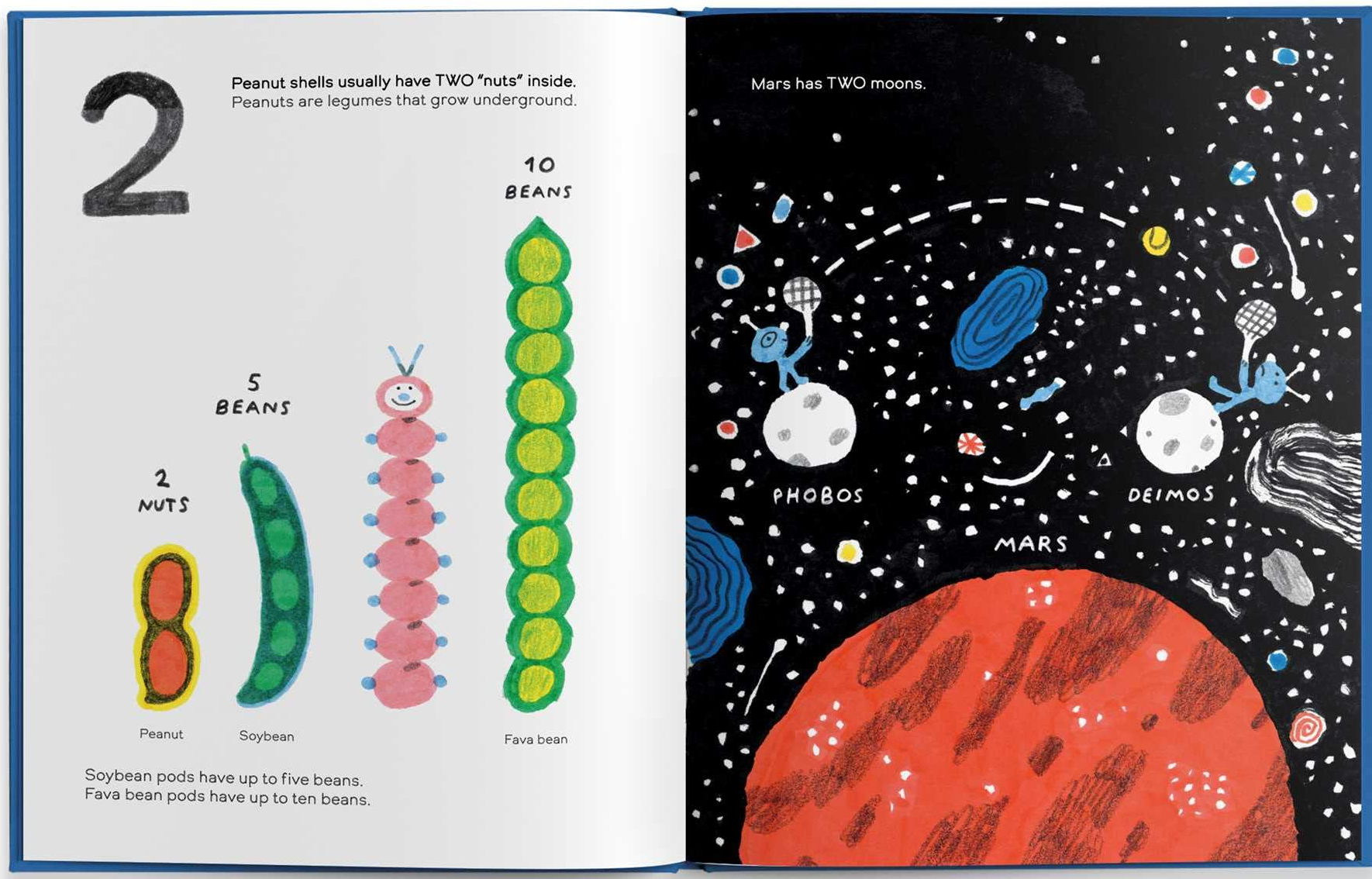
But that’s not all! There are more examples, and then Richardson shows how that simple digit 0 can make a single whole number explode into 100, 1,000, 100,000 and so on. She moves from there to tackle the numbers 1 through 9, by themselves and then attached to one 0. Readers next learn about 10—10 decibels, a creature with 10 legs, 10 fingers, and 10 toes. Those familiar with counting know that 2 comes after 1, and Richardson and Antinori help kids visualize this number with peanut shells that contain two individual nuts, the 2 moons of Mars, and more. Here, readers are shown what happens when two zeros are attached to the number two, and, of course, they’re given a few intriguing examples of 200.

This pattern is continued throughout the pages from 3 and 3,000 to 9 and 9,000,000,000. Along the way, children learn about the different types of clouds, how many times a bear’s heart beats per hour, how many chambers the human heart has, how many grains are in a two-pound bag of rice, and the astounding number of leaves you’d find on a typical mature oak tree. Ever wonder how many gallons of water flow over Niagara Falls every ninety seconds? You’ll find out here—along with the ph of water (7), what that means, and the ph number of other common liquids.

celebrate-picture-books-picture-book-review-octopuses-have-zero-bones-two

Image copyright Andrea Antinori, 2022, text copyright Anne Richardson, 2022. Courtesy of Tra Publishing.

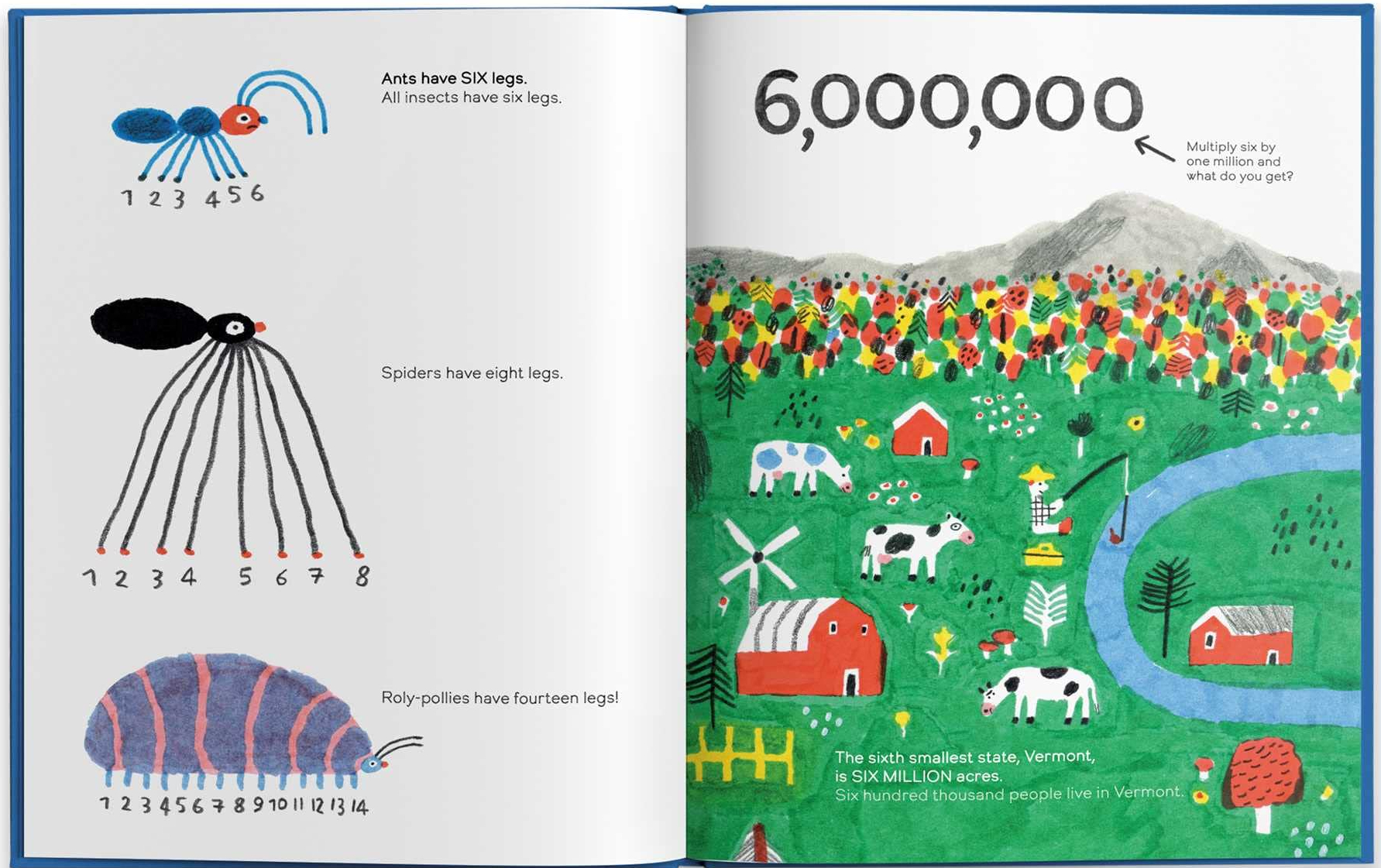
Have you ever tried to measure a raindrop? It’s okay! Richardson shows kids just how big the biggest raindrop can be and reveals what happens if one happens to exceed this limit. Kids fascinated by space will want to check out the pages about the number 8, and future biologists will find interesting facts there too. Entomologists may want to flip to the discussions of the numbers 4, 6, and 9 before settling in to start again at the beginning. The number 9 is pretty awesome, especially if you like narwhals and bananas, and you’ll discover that no matter how antsy you might get while waiting for what seems like for. ev. er, you’ll never, ever be able to jiggle as many times as a cesium atom.

While Octopuses Have Zero Bones ends at nine billion, Richardson reminds readers that while “NINE BILLION is a big number…it’s not the biggest. You can keep counting forever.” Even into the trillions and beyond. In her Author’s Note that follows the text, she reveals the event that sparked the idea for this book and encourages children to “go out into the world and count or measure something, anything”; to do this short-term and long-term; to “be astonished, take a closer look” and “discover many wonderful things.”

celebrate-picture-books-picture-book-review-octopuses-have-zero-bones-six-million

Image copyright Andrea Antinori, 2022, text copyright Anne Richardson, 2022. Courtesy of Tra Publishing.

Andrea Antinori depicts each concept with whimsical illustrations that exude humor and personality while pointing readers to examples of the featured number or numbers. But her pages do much, much more as well. Take two page spreads that portray the number 1 for example. There is an image of our one sun as is mentioned in the text, and there is an image of a man with one heart as mentioned in the text. But this heart is a tattoo, which leads kids to notice that the man has other tattoos—all single images.

He is raising one arm, but at the end of that arm is a hand with five fingers just waiting to be counted. And—oh yeah—next to him is the adorable red octopus from the page about zero, who is also waving at the reader with one arm, but there’s a line of suckers on it (some singular, some in pairs) that also invite counting. And that’s just to get kids started. There are clouds, birds, and a sea full of dots to check out too. Now multiply that kind of clever detail and recurring characters by 30 pages and kids have almost innumerable ways to learn from and engage with this book.

Octopuses Have Zero Bones is a book that readers can page through from beginning to end or dip into whenever curiosity hits. It’s the perfect boredom buster because, as Anne Richardson notes, kids can jump off from any randomly chosen page into their own discovery and research at home, in their neighborhood, or on the Internet.

This book would be a much-used reference on home and bookshelves and is a must for classroom, school, and library collections.

Ages 5 – 9 and up

Tra Publishing, 2022 | ISBN 978-1735311524

You can find a Kids Activity Guide, Teacher’s Guide, and Posters for Octopuses Have Zero Bones to download on the Tra Publishing website.

About the Author

Anne Richardson is an author of experiences that kindle your curiosity. In her work, everything in the world is astonishing and worthy of our attention, from a drop of rain to the way we figure things out together. She is the senior director of Global Collaborations at the Exploratorium, San Francisco, where she works with partners worldwide to imagine and create new science centers and other extraordinary learning experiences. Richardson holds a PhD and an MS in environmental studies from Antioch University New England, and a BA in art history from Northwestern University. She lives in the San Francisco Bay Area with her family, including two little explorers. Visit her at her website.

About the Illustrator

Andrea Antinori is an award-winning illustrator based in Bologna, Italy. Since he was a child, he has loved animals and he has loved to draw them. His favorite animal changes all the time. He likes octopuses very much, but right now, lemurs are the creatures he loves most. He wrote and illustrated the book On the Lives of Lemurs: A Short Treatise on Natural History. Other books he has illustrated include A Book about Whales and The Great Battle, the latter of which has received major international awards including: Best International Illustrated Book — China Shanghai International Children’s Book Fair, Premio Andersen — Best book 6-9 years olds, Selected illustrator for exhibition of Bologna Children’s Book Fair 2017, Italian illustrator in IBBY Honor List 2016. You can learn more about her books and her art on her website and connect with her on Instagram.

Read a New Book Month Activity

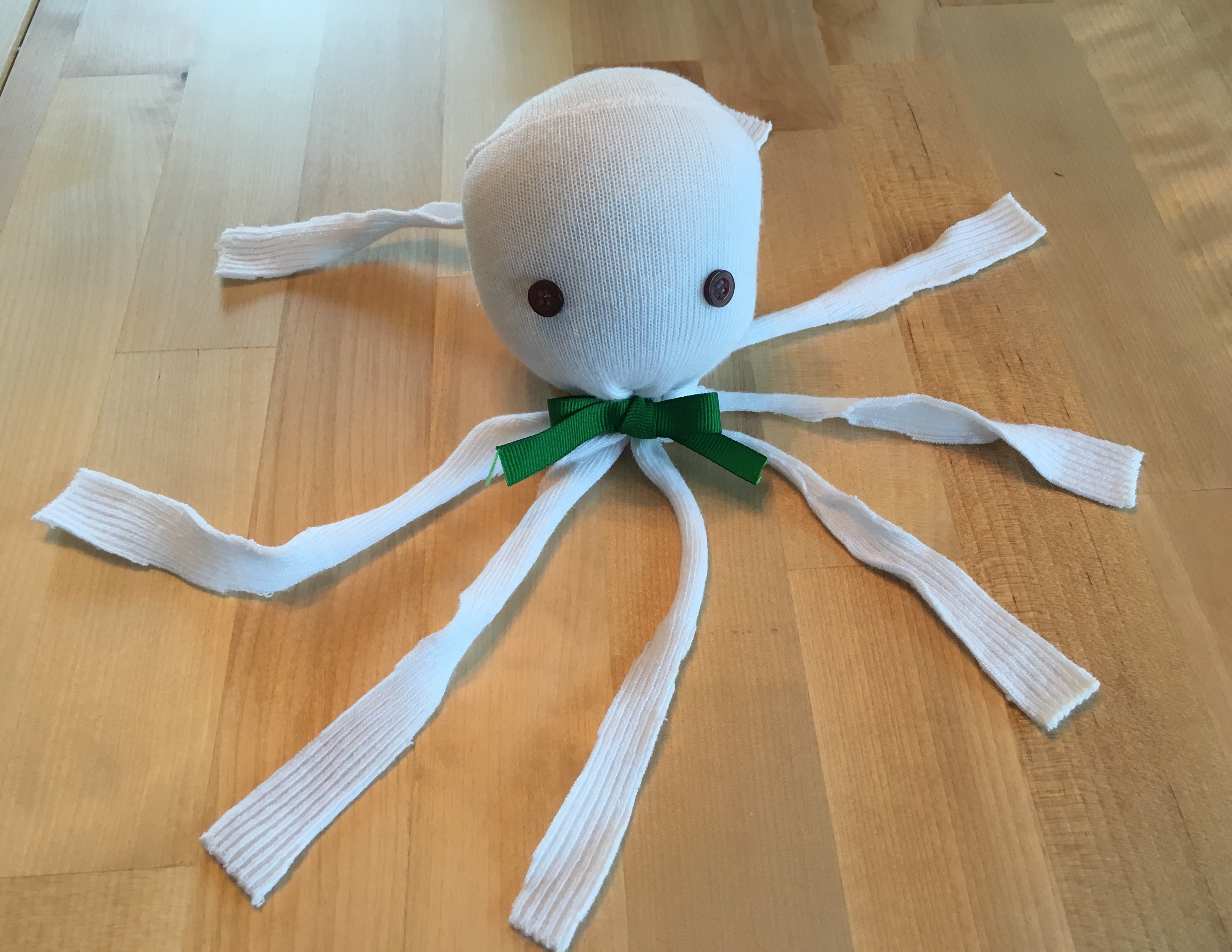
celebrate-picture-books-picture-book-review-sock-octopus-craft

Cute Sock Octopus Craft


Octopuses may have zero bones but they sure do have a lot of arms! With this fast and easy craft you can make your own little octopus to count on to keep you company on your bed, your shelves, or on your desk!

Supplies

  • Child’s medium or large size sock, in any color
  • Polyfill, available at craft and sewing stores
  • Ribbon
  • 2 Small buttons
  • Scissors
  • Hot glue or strong glue

Directions

  1. Fill the toe of the sock with a handful of polyfiber fill
  2. Tie the ribbon tightly around the sock underneath the fiber fill to separate the head from the legs
  3. Tie the ribbon into a bow tie
  4. With the scissor cut up both sides of the sock almost to the ribbon
  5. Cut these two sections in half almost to the ribbon
  6. Cut the four sections in half almost to the ribbon
  7. Glue the eyes to the lower part of the head

celebrate-picture-books-picture-book-review-octopuses-have-zero-bones-cover

Buy a Book, Plant a Tree

If you purchase Octopuses Have Zero Bones from the Tra Publishing website, they, in partnership with One Tree Planted, plant one tree for every book purchased. At checkout, you have the opportunity to make an additional donation.

Purchase from the Tra Publishing website

You can find Octopuses Have Zero Bones at these booksellers

Amazon | Barnes & Noble | Books-a-Million

To support your local independent bookstore, order from

Bookshop | IndieBound

Picture Book Review
October – It’s National Book Month

celebrate-picture-books-picture-book-review-professor-wooford-mcpaw's-history-of-astronomy-cover

About the Holiday

Readers might say that every month is National Book Month, but October is especially set aside to highlight books and the love of reading. Fall is a book bonanza as publishers release new books in all categories, and the holiday gift-giving season beckons. Books, of course, make superb gifts for all ages! So whether you’re looking for a new or new-to-you book to read right now or new titles to give to the family and friends who will be on your list, this month is a perfect time to check out your local bookstore to see what wonderful books are on the shelves! This month is also a great time to discover books that get kids excited about history, science, and technology in a whole new way – like today’s book!

Thanks to Cicada Books for sharing a digital copy of Professor Wooford McPaw’s History of Astonomy with me for review consideration. All opinions on the book are my own.

Professor Wooford McPaw’s History of Astronomy

By Elliot Kruszynski


The study of astronomy harkens back to the earliest days of scientific discovery, when “civilizations in Mesopotamia, Persia, China, India and Greece all examined the night sky. With only the naked eye, they mapped out the stars and used the information they gathered to create calendars, navigate great distances and keep time.” So begins this comprehensive, detailed, and even humorous compendium of our skies, scientists and thinkers, equipment, and a look to the future.

Professor Wooford McPaw and his telescope sidekick, Teley, takes kids back to 3000 BC, when religious leaders determined the longest day of the year by tracking the sun’s progress through the arches and columns erected at Stonehenge, and speeds forward to 1000 BC, when people connected the stars, creating the constellations and stories about them.

celebrate-picture-books-picture-book-review-professor-wooford-mcpaw's-history-of-astronomy-aristotle

Copyright Elliot Kruszynski, 2022, courtesy of Cicada Books.

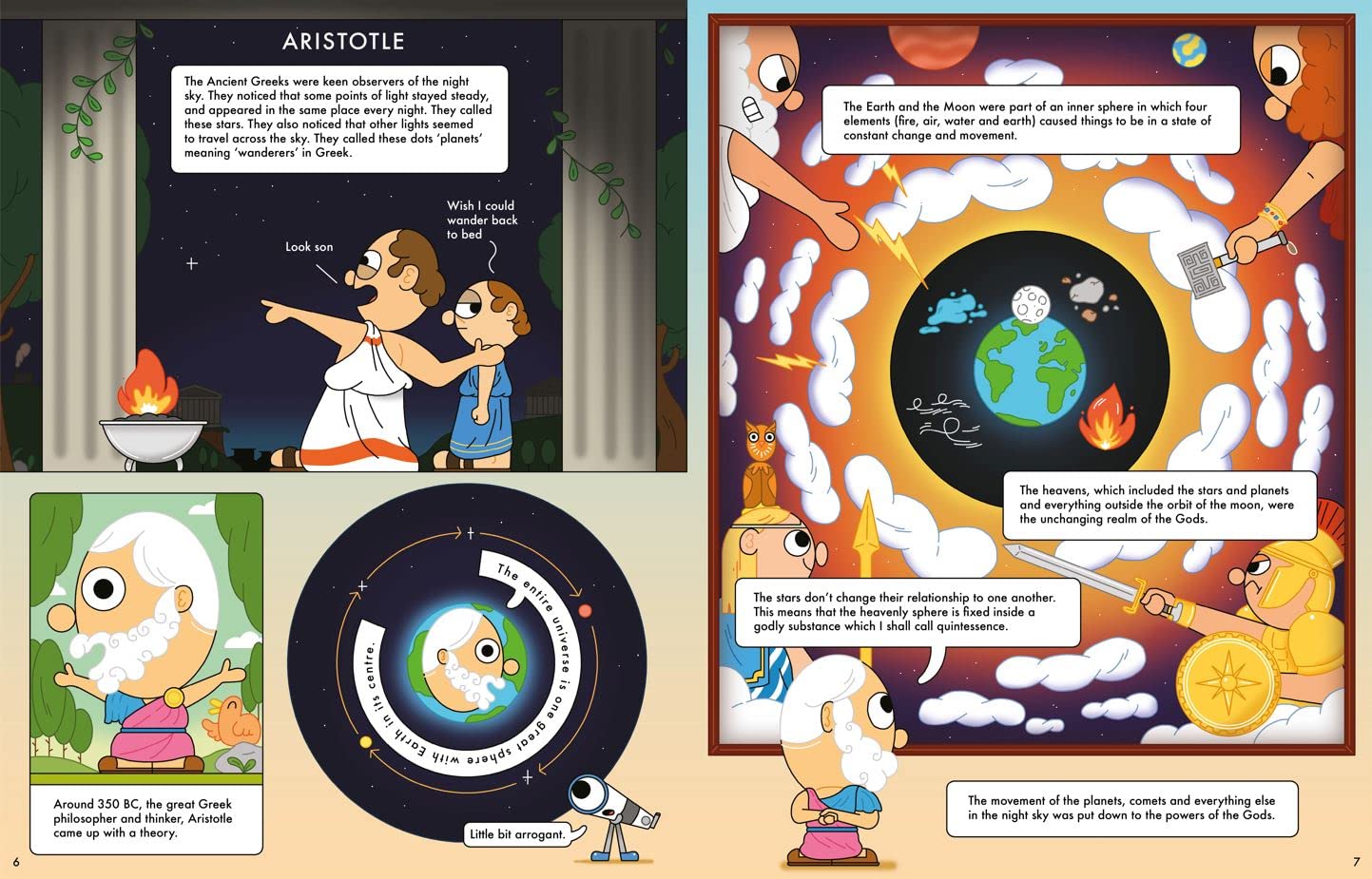
Kids then meet Aristotle and learn about his theories on the placement of the earth, the four elements, and the role of the gods in the universe. Then they discover the conflict between the teachings of Claudius Ptolemy around 140 AD and the discoveries of Nicolaus Copernicus in the 16th century, who left it to future scientists to explore his theory that that the earth revolved around the sun (and not the other way around). And what happened to those scientists? Well, children learn about Galileo Galilei, who, in addition to inventing the telescope, spent a good part of his life under house arrest for saying the earth and the planets did indeed revolve around the sun.

celebrate-picture-books-picture-book-review-professor-wooford-mcpaw's-history-of-astronomy-telescopic-history

Copyright Elliot Kruszynski, 2022, courtesy of Cicada Books.

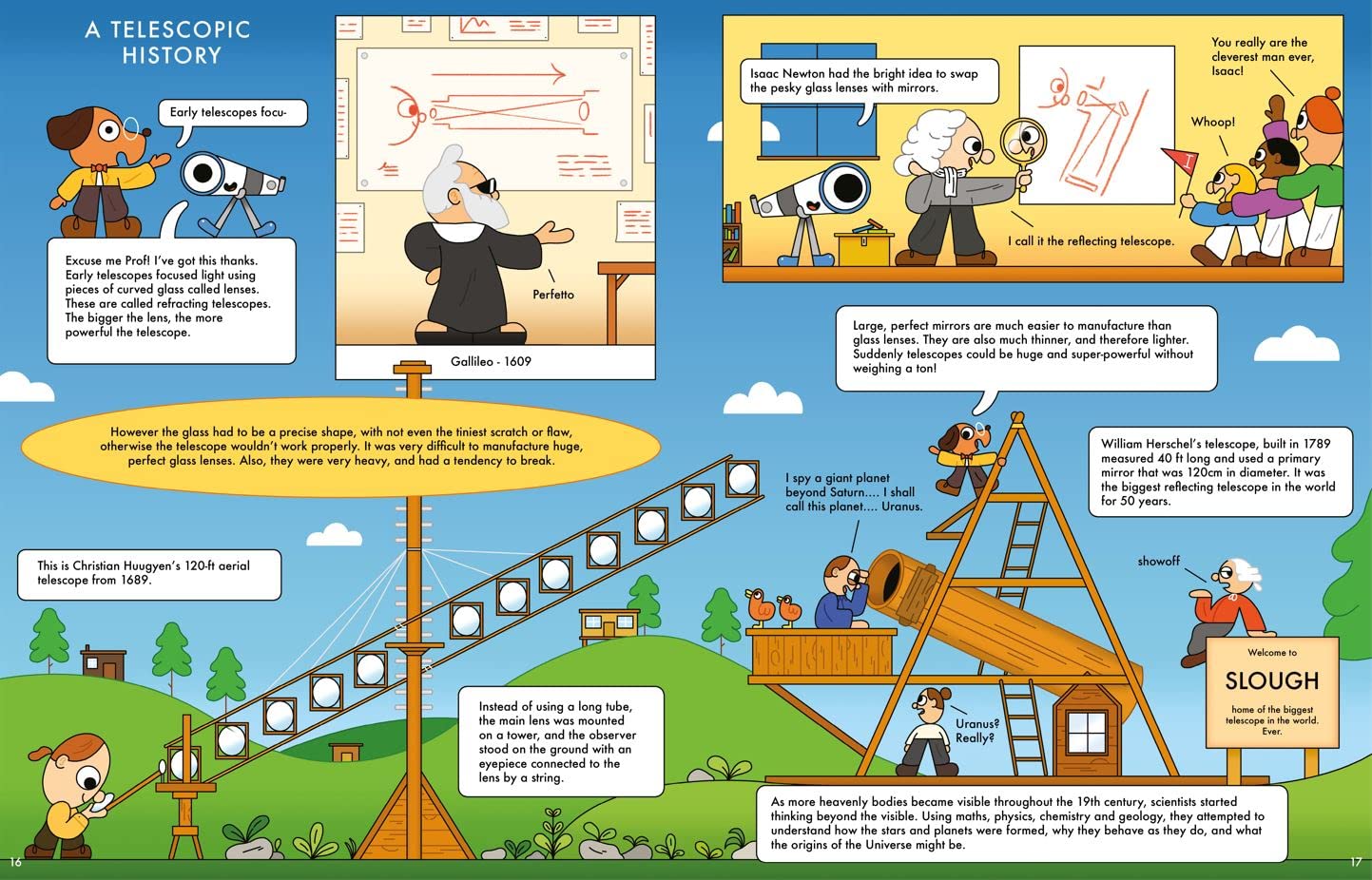
Professor Wooford introduces readers to Isaac Newton, whose “findings, along with the improvement of telescope technology, changed the way that humans (and for some dogs) looked at our planet.” What kind of telescope technology is the Prof talking about? He gives kids a run down from Galileo’s invention in 1609 to a switch from glass lenses to mirrors in the 1700s to today’s Hubble Space Telescope and James Webb Space Telescope. Here’s Teley explaining about lenses:

“Early telescopes, like the one Galileo invented, focused light using pieces of curved glass called lenses. The bigger the lens, the more powerful the telescope. They were called refracting telescopes. However the glass had to be a precise shape, with not even the tiniest scratch or flaw, otherwise the telescope wouldn’t work properly. It was very difficult to manufacture huge, perfect glass lenses. Also, they were very heavy and had a tendency to break.” Teley goes on to explain that it was Isaac Newton who “had the bright idea to swap the pesky glass lenses with mirrors,” which are much easier to make and are thinner and lighter, allowing telescopes to “be huge and super-powerful without weighing a ton.”

celebrate-picture-books-picture-book-review-professor-wooford-mcpaw's-history-of-astronomy-einstein

Copyright Elliot Kruszynski, 2022, courtesy of Cicada Books.

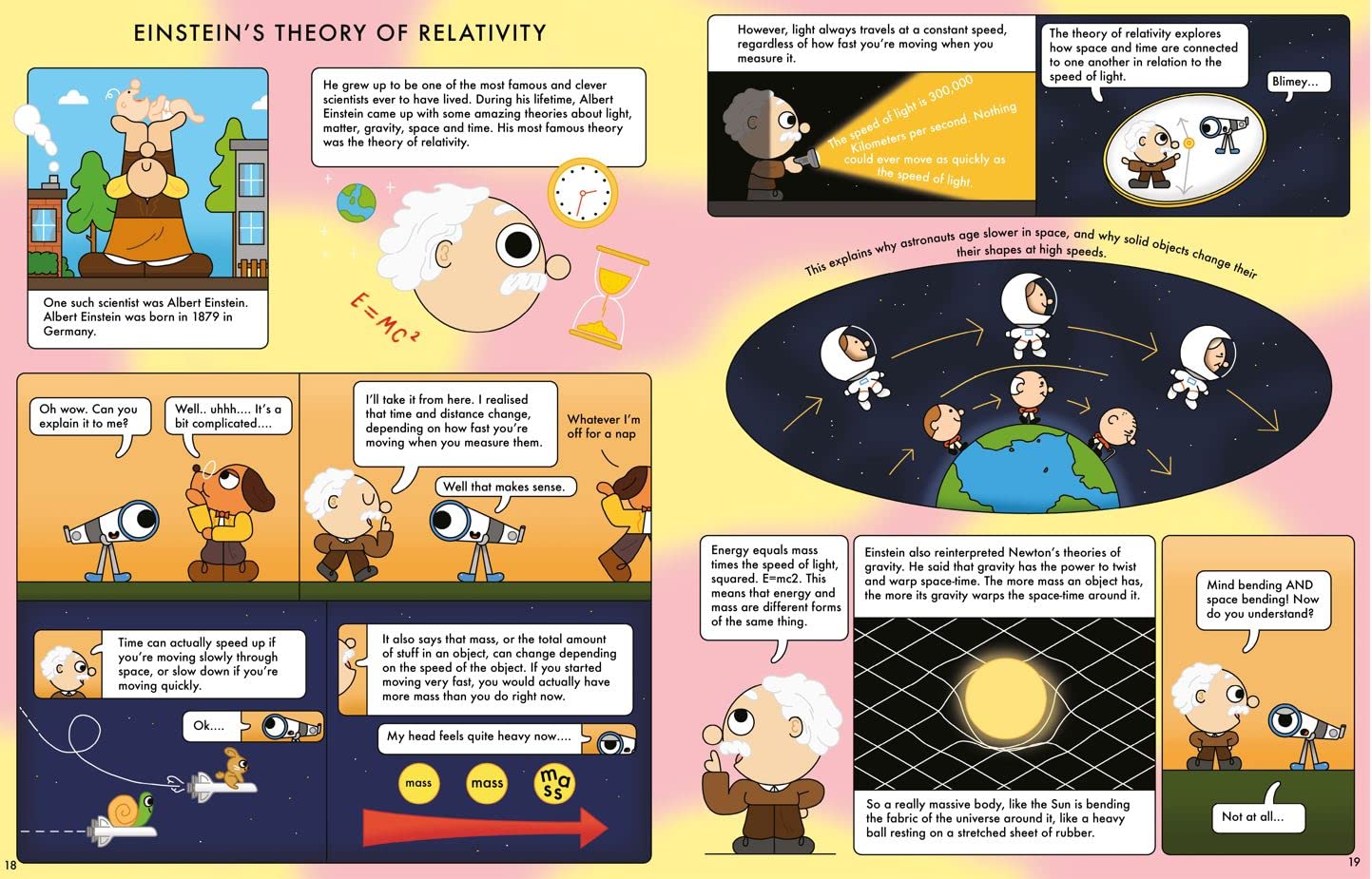
Albert Einstein travels back through time to explain his “mind bending and space bending” Theory of Relativity in terms that readers can understand. Then kids are launched into space—the space race, that is—where they learn about the advancements and setbacks of the Russian and American from 1957 to 1969, when the first moon walk occurred, as well as a weely … I mean … really unusual tradition among space-going astronauts.

celebrate-picture-books-picture-book-review-professor-wooford-mcpaw's-history-of-astronomy-space-probes

Copyright Elliot Kruszynski, 2022, courtesy of Cicada Books.

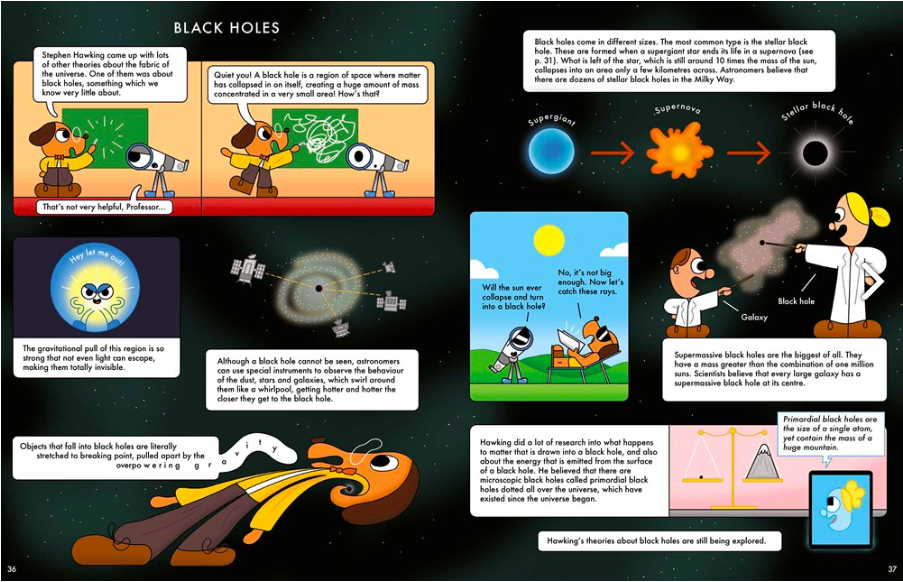
Children get info on different kinds of space probes from rovers to orbiters to interplanetary probes before blasting off into our solar system to find out about the planets (even little Pluto gets a cameo. But where is Earth and all of our other planets located? Professor McPaw explains: “Earth is located in a galaxy called the Milky Way. At its center is a supermassive black hole called Sagittarius A*, which contains as much mass as four million suns.” The prof goes on to teach kids about the three different shapes of galaxies, what dwarf galaxies are, how bigger galaxies cannibalize smaller galaxies, and where the term galaxy comes from.

celebrate-picture-books-picture-book-review-professor-wooford-mcpaw's-history-of-astronomy-black-holes

Copyright Elliot Kruszynski, 2022, courtesy of Cicada Books.

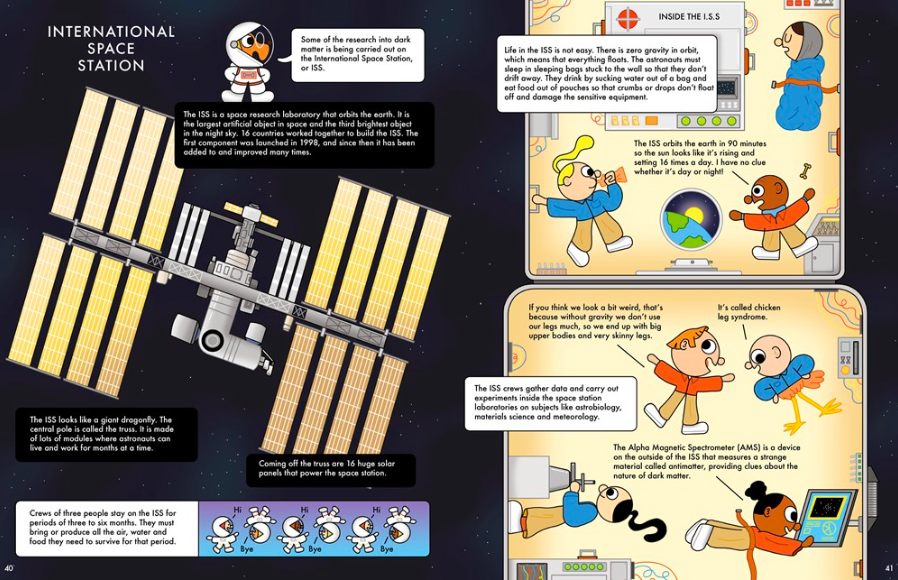
Professor Wooford McPaw and Teley also impart the same fascinating in-depth facts about stars, black holes, and dark matter. And what’s a trip into space without a ride on the International Space Station? Well, readers won’t find out because they get to explore the ISS and learn how the astronauts experience 16 sunrises and sunsets a day, sleep strapped to a wall, and develop “chicken leg syndrome” from not using their legs as much as their upper body in the no-gravity conditions.

By this time, kids are probably wondering about whether there’s life in other parts of the solar system or beyond as well as what the future might hold for astronomers, astrophysicists, other scientists, and even themselves. But are readers going to be abandoned in space? Not at all! Professor Wooford has thoughtfully included a Race to Earth “board game” on the last two-page spread that will get all astronauts … I mean readers … back home in time for dinner.

celebrate-picture-books-picture-book-review-professor-wooford-mcpaw's-history-of-astronomy-international-space-station

Copyright Elliot Kruszynski, 2022, courtesy of Cicada Books.

Elliot Kruszynski’s Professor Wooford McPaw’s History of Astonomy is just the kind of book that both kids who already love space and those who don’t yet know they do will devour, either bit-by-bit or all in one sitting. With affable hosts who give excellent easy-to-understand explanations, historical characters who add funny asides, and a quick-paced graphic-novel format, (title) will spark readers’ interest in learning all about the past, present, and future of astronomy. The book would make a perfect gift and very welcome addition to any home library. Educators and homeschoolers will find it a go-to text for introducing many scientific topics and an engaging way to heighten student’s eagerness for further research. School and public library librarians will find Professor Wooford McPaw’s History of Astonomy to be a favorite to recommend and to have on their shelves.

Ages 6 – 10 and up

Cicada Books, 2022 | ISBN 978-1800660236

To view a portfolio of work by Elliot Kruszynski and connect with him on Instagram, visit his website. 

National Book Month Activity

celebrate-picture-books-picture-book-review-rocket-to-the-moon-tic-tac-toe-game

Out of This World Tic-Tac-Toe Game

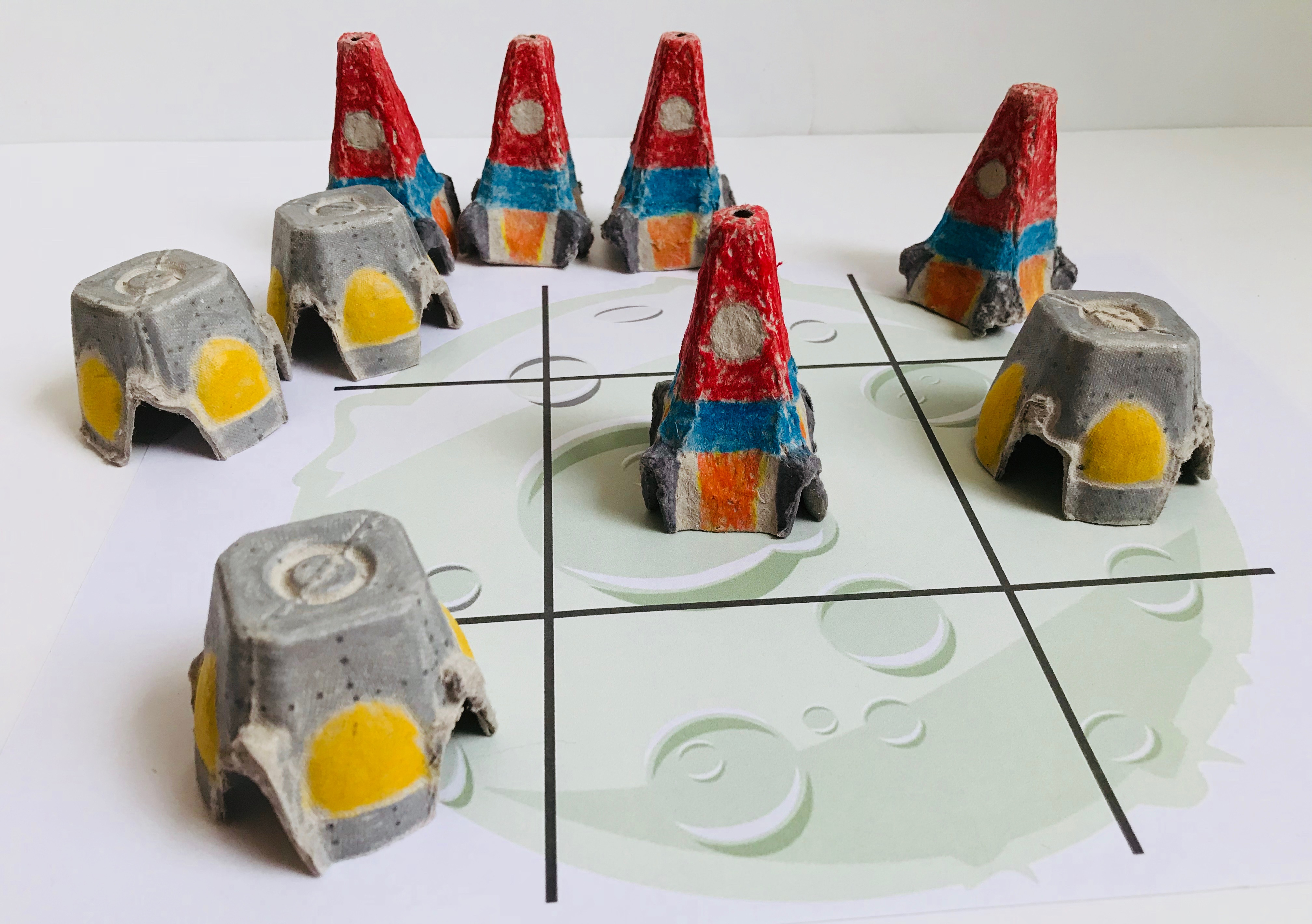
You can launch your own Tic-Tac-Toe Game with this set you make yourself! With just a couple of egg cartons, some crayons, and a printable game board, you’ll be off to the moon for some space-age fun! Opposing players can be designated by rockets and capsules. Each player will need 5 playing pieces. 

SUPPLIES

  • Printable Moon Tic-Tac-Toe Game Board
  • 2 cardboard egg cartons
  • Heavy stock paper or regular printer paper
  • Crayons
  • Black or gray fine-tip marker

DIRECTIONS

To Make the Rockets

  1. Cut the tall center cones from the egg carton
  2. Trim the bottoms of each form so they stand steadily, leaving the arched corners intact
  3. Pencil in a circular window on one side near the top of the cone
  4. Color the rocket body any colors you like, going around the window and stopping where the arched corners begin
  5. With the marker color the arched corners of the form to make legs
  6. On the cardboard between the legs, color flames for blast off

To Make the Capsule

  1. Cut the egg cups from an egg carton
  2. Color the sides silver, leaving the curved section uncolored. (If your egg cup has no pre-pressed curve on the sides of the cup, draw one on each side.)
  3. Color the curved section yellow to make windows
  4. With the marker, dot “rivets” across the capsule

Print the Moon Game Board and play!

celebrate-picture-books-picture-book-review-professor-wooford-mcpaw's-history-of-astronomy-cover

You can find Professor Wooford McPaw’s History of Astronomy at these booksellers

Amazon | Barnes & Noble | Books-a-Million

To support your local independent bookstore, order from

Bookshop | IndieBound

Picture Book Review
June 1 – National Dinosaur Day

celebrate-picture-books-picture-book-review-jack-horner-dinosaur-hunter-cover

About the Holiday

Today, we celebrate dinosaurs—those beasts that, although they are of a distant past, remain ever present in our hearts. Their size, diversity, and shear awesomeness make them a favorite of kids, and ongoing discoveries continue to fascinate adults as well. To celebrate, visit a national history museum, watch your favorite dinosaur movies or TV shows, join your kids in playing with their dinos (you know you want to!), and pick up today’s book!

Jack Horner, Dinosaur Hunter!

Written by Sophia Gholz | Illustrated by Dave Shephard


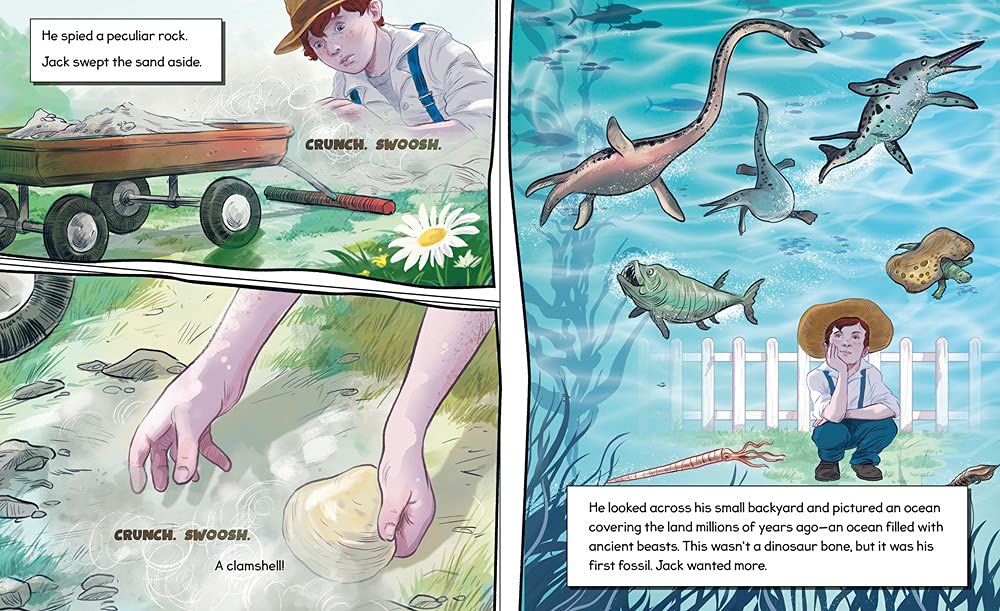
Growing up in Montana, Jack Horner was lulled to sleep by the “crunch, swoosh. Crunch, swoosh” of his father’s gravel business, and as soon as he was big enough to hold a shovel, he began digging. He loved being outdoors, searching for dinosaur bones. He dreamed of being a paleontologist when he grew up. His digging usually only produced rocks, sticks, and dirt, but once he “spied a peculiar rock” and when he had carefully swept the sand aside, he discovered a clamshell. His first fossil find made him look at his backyard differently – as “an ocean covering the land millions of years ago–an ocean filled with ancient beasts.” Jack wanted to find more fossils.

celebrate-picture-books-picture-book-review-jack-horner-dinosaur-hunter-clamshell

Image copyright Dave Shephard, 2021, text copyright Sophia Gholz, 2021. Courtesy of Sleeping Bear Press.

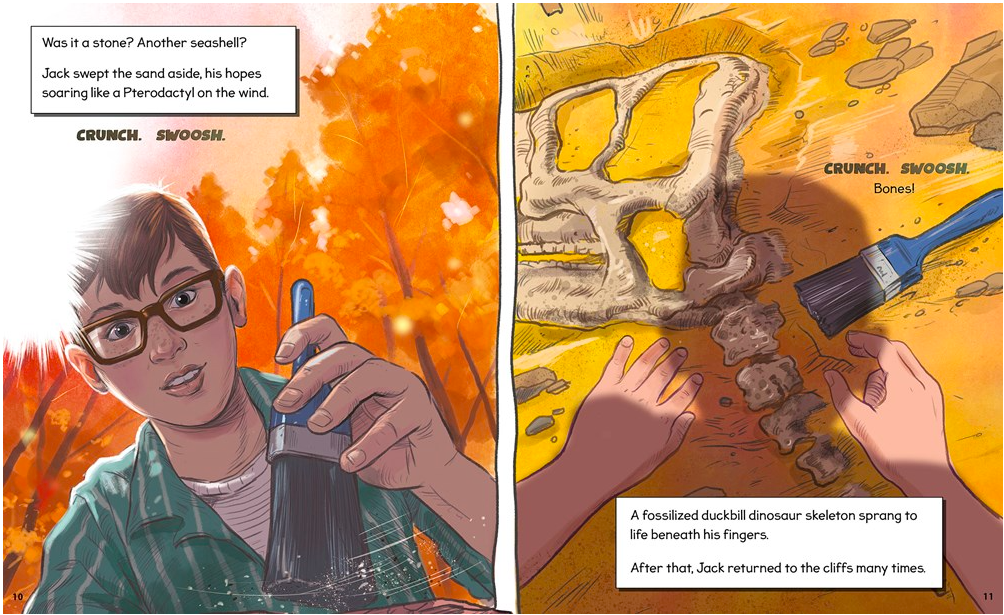
Jack taught himself how to “search for clues among the rocks: irregular textures, colors, and shapes.” He found lots of fossilized shells, but he really wanted to find a dinosaur. He went fossil hunting “in the woods and near the mountains.” Then one day while hiking up a cliff, Jack saw “an odd rock nestled in the ground.” With his tools he brushed the sand aside and uncovered the skeleton of a duck-billed dinosaur. 

celebrate-picture-books-picture-book-review-jack-horner-dinosaur-hunter-duckbill-fossil

Image copyright Dave Shephard, 2021, text copyright Sophia Gholz, 2021. Courtesy of Sleeping Bear Press.

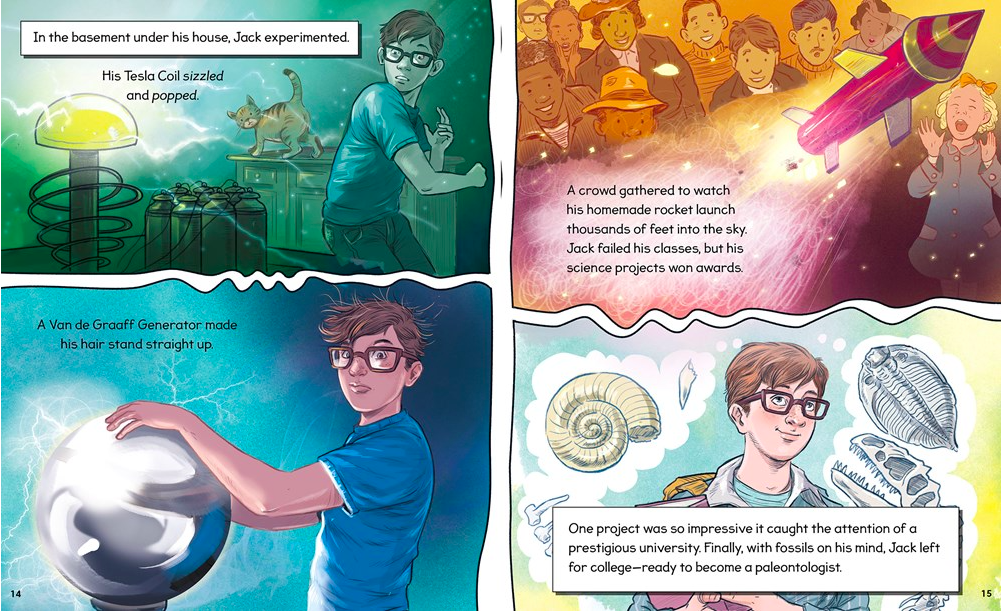
While Jack was quickly becoming an expert on fossils and the landscapes that hid them, he struggled with reading in school.  His teachers told him that if his grades didn’t improve, he’d never be able to become a paleontologist. He took to experimenting in his basement, winning awards for his science projects even as he was failing his classes. One prestigious university, however, did admit Jack on the strength of one impressive project, but just as before Jack was unable to keep up in class. He dropped out and was drafted soon after to join the Vietnam War. 

celebrate-picture-books-picture-book-review-jack-horner-dinosaur-hunter-science-projects

Image copyright Dave Shephard, 2021, text copyright Sophia Gholz, 2021. Courtesy of Sleeping Bear Press.

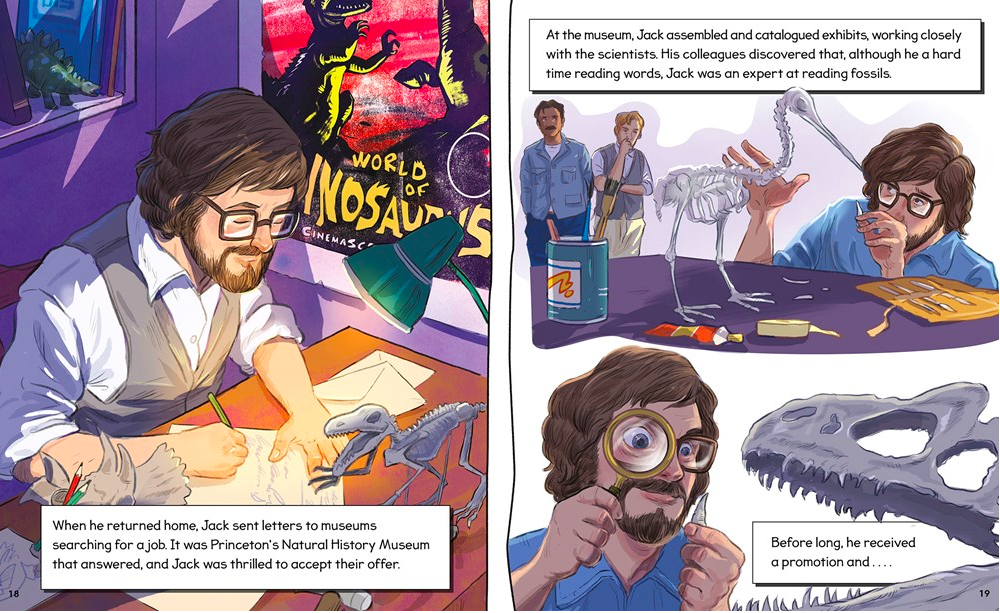
Here, he decided that when he got home, he would try to work closely with paleontologists, if he couldn’t actually be one himself. He was hired by Princeton University’s natural history museum, where he “assembled and cataloged exhibit, working closely with scientists.” His colleagues recognized that Jack was an “expert at reading fossils.” He got a promotion that allowed him to work in the field. 

celebrate-picture-books-picture-book-review-jack-horner-dinosaur-hunter-museum-job

Image copyright Dave Shephard, 2021, text copyright Sophia Gholz, 2021. Courtesy of Sleeping Bear Press.

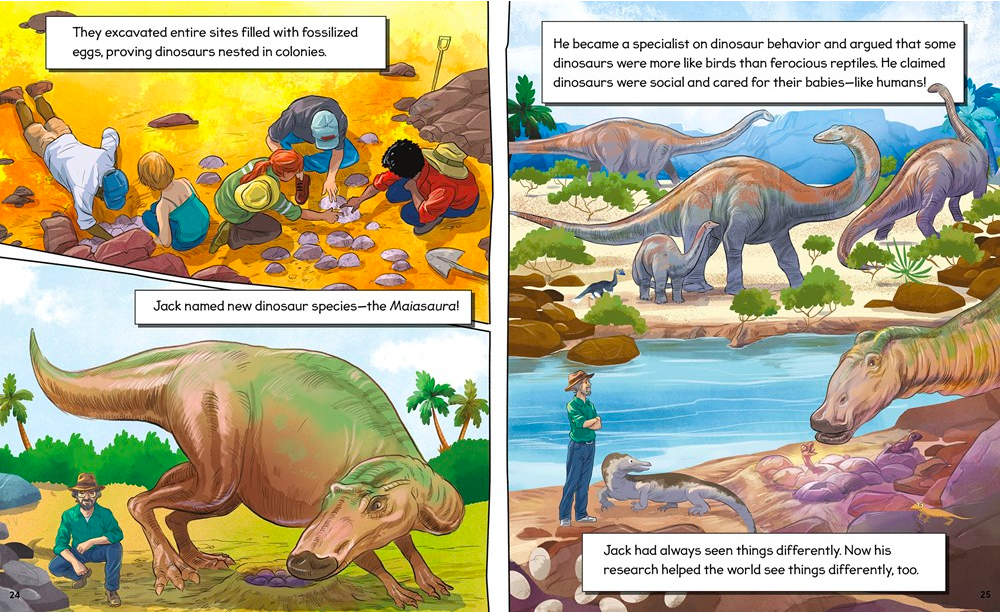
It was during one of these trips into cliffs that Jack “spied something odd. Heart thumping like the tail of an Ankylosaurus, he leapt into action.” When Jack swept the sand away, he and his team discovered a nest of fossilized dinosaur eggs – the first such find in North America. Jack went on to find more fossilized eggs, “proving dinosaurs nested in colonies;” name a new dinosaur species; and become an expert on dinosaur behavior and social structure. He even shared his special expertise when a famous movie producer filmed one of his great blockbusters. Jack had succeeded in his dream to be a “world-famous paleontologist.”

Back matter includes an Author’s Note, more about Jack Horner’s life, and a Dino Lab, that invites readers to design their own dinosaur and provides mix-and-match Greek and Latin words to help kids name their dino.

celebrate-picture-books-picture-book-review-jack-horner-dinosaur-hunter-specialist

Image copyright Dave Shephard, 2021, text copyright Sophia Gholz, 2021. Courtesy of Sleeping Bear Press.

Dinosaur lovers and anyone with dino-sized dreams will be instantly hooked by Sophia Gholz’s immersive biography of Jack Horner, who forged his own path to becoming one of the world’s most influential paleontologists. His self-confidence, unstoppable drive, and ultimate success will inspire all readers to define themselves by what they can do – not by what they may struggle with – and to trust their instincts on the way to achieving their goals. Gholz tells Jack’s story clearly and with the kind of repeated phrasing that builds suspense while also replicating the types of life experiences that create expertise. 

Dave Shephard’s bold illustrations will enthrall kids as they join Jack in the cliffs of Montana to brush away the sand from a duck-billed dinosaur fossil, see the underground strata where fossils lurk, and discover the nest of fossilized eggs. Shephard also depicts Jack’s struggles in school, where his undiagnosed dyslexia causes words and equations to become a jumbled stumbling block to his education. The vibrant format with clear typography will appeal to fans of graphic novels as well as to reluctant readers.

Jack Horner, Dinosaur Hunter! is an exceptional biography of a boy and man who never gave up on finding a way to accomplish his goal. The book will captivate children on its own or as an introduction to a wide range of classroom lessons and is highly recommended for all home, classroom, and public library collections.

Ages 6 – 9

Sleeping Bear Press, 2021 | ISBN 978-1534111196

Discover more about Sophia Gholz and her books on her website.

To learn more about Dave Shephard, his books, and his art, visit his website.

National Dinosaur Day Activity

celebrate-picture-books-picture-book-review-dinosaur-word-search-puzzle

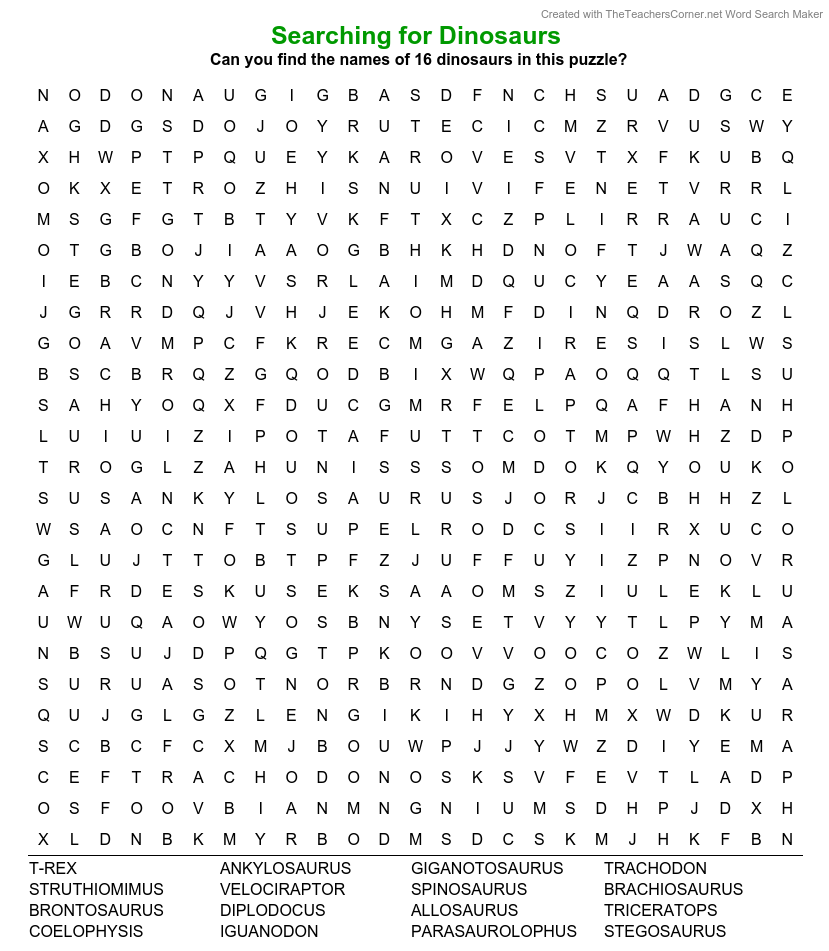
Searching for Dinosaurs Puzzle


Hunt for 16 types of dinosaurs in this printable puzzle!

Searching for Dinosaurs Puzzle | Searching for Dinosaurs Solution

celebrate-picture-books-picture-book-review-jack-horner-dinosaur-hunter-cover

You can find Jack Horner, Dinosaur Hunter! at these booksellers

Amazon | Barnes & Noble | Books-a-Million

To support your local independent bookstore, order from

Bookshop | IndieBound

Picture Book Review
June 1 – National Dinosaur Day

celebrate-picture-books-picture-book-review-everything-awesome-about-dinosaurs-cover

About the Holiday

Today, we celebrate dinosaurs—those beasts that, even though they are from the distant past, remain ever present in our hearts. Their size, diversity, and shear awesomeness make them a favorite of kids, and ongoing discoveries continue to fascinate adults as well. Dinosaurs, in fact, are so huge that Dinosaur Day takes place twice—today and on June 1. To celebrate, visit a national history museum, watch your favorite dinosaur movies or TV shows, join your kids in playing with their dinos (you know you want to!), and pick up today’s book!

Everything Awesome about Dinosaurs and Other Prehistoric Beasts!

By Mike Lowery


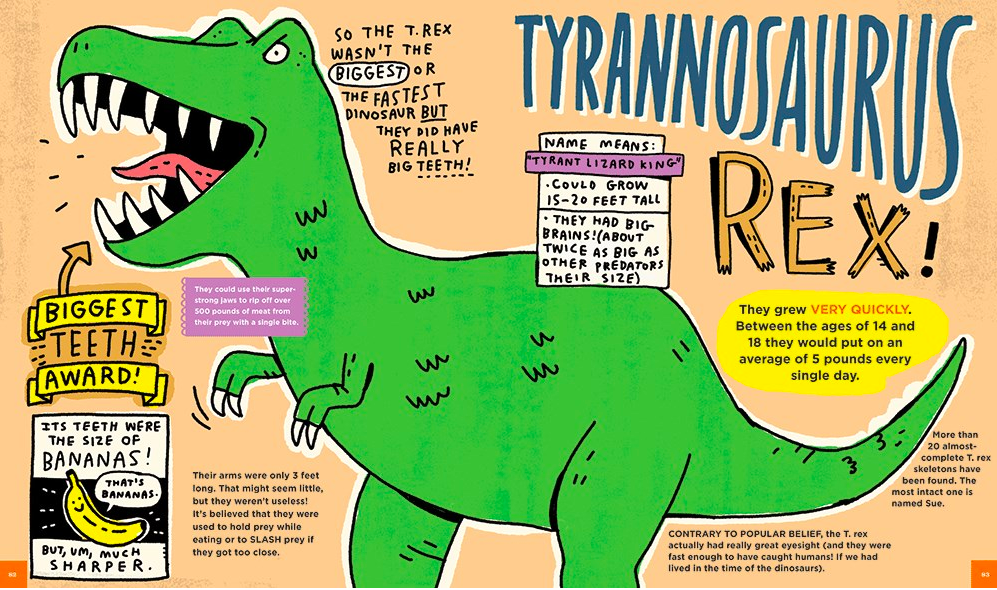
If there’s one thing kids can’t get enough of, it’s dinosaurs. And if there’s one thing Mike Lowery knows, it’s how to wow kids. The mash-up of the two has resulted in a wild and wacky book “that’s totally loaded with info, weird facts, and jokes that you will dig!” There are even dinos at the ready to point out these awesome puns. And these facts aren’t just presented like some old, dried-up report, the whole book—every page—is full of eye-popping illustrations and cool typography that will keep kids reading and reading and learning (and, oh yeah, having T-rex size fun).

celebrate-picture-books-picture-book-review-everything-awesome-about-dinosaurs-mammoth

Copyright Mike Lowery, 2019, courtesy of Orchard Books.

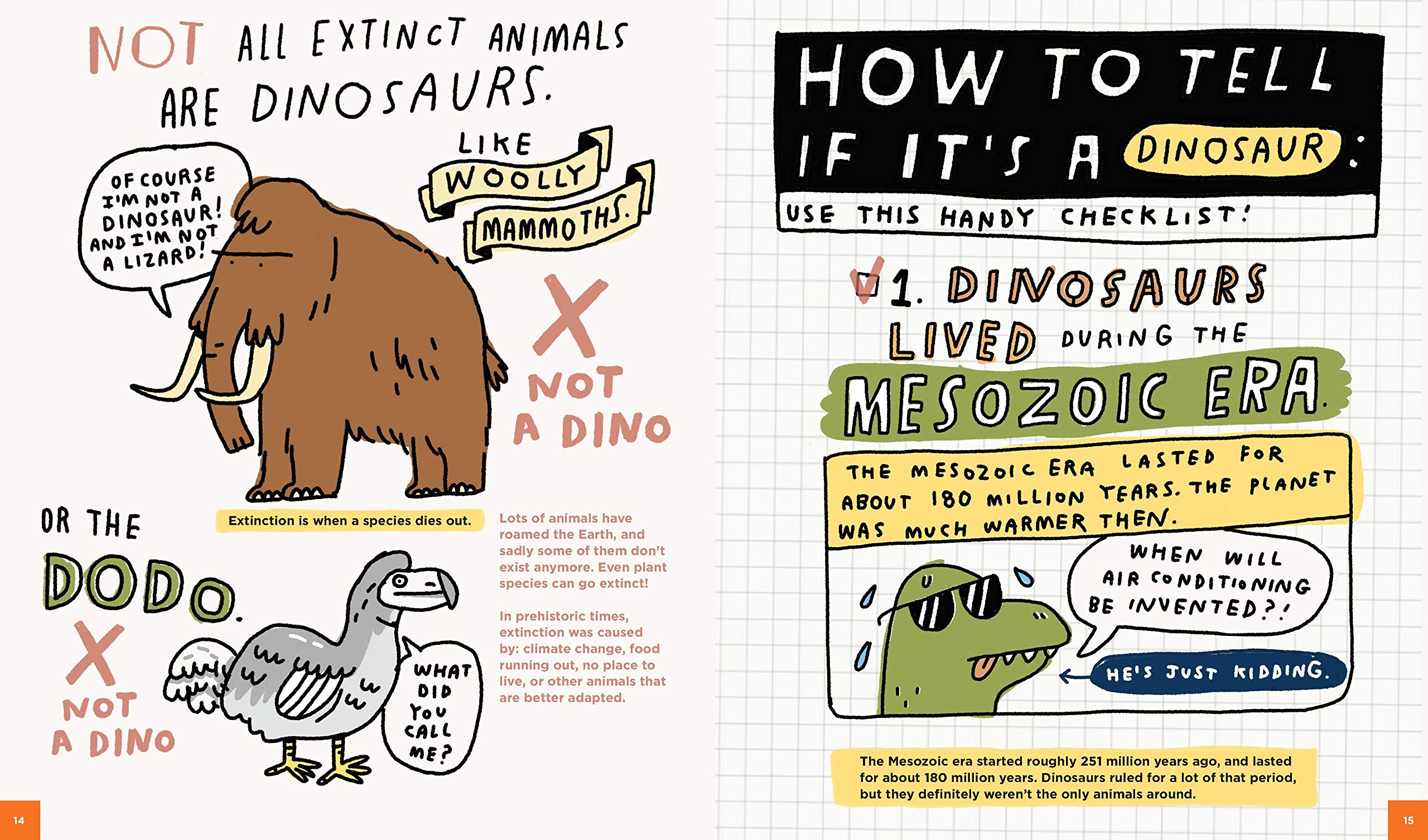
What kinds of things will kids learn? First, there’s a completely captivating prehistoric timeline that lays out the different eras and depicts some of the creatures and vegetation that existed in each. Like jellyfish during the Paleozoic Era, horsetails plants and dicynodonts during the Triassic, stegosaurus and cycads in the Jurassic; bees, birds, and flowering plants along with velociraptors in the Cretaceous; and finally, woolly mammoths and us during the Age of Mammals. Along the way there were also several extinction events. And this all comes even before the Table of Contents!

While kids chew on the fact that “some giant dinos ate up to 12,000 pounds a day,” they can dip into Part One—What Is a Dinosaur? Here, they’ll learn stuff like where the word “dinosaur” came, who coined it, what “prehistoric” means, and who “were some of the first people to keep written records.” They’ll also get to know some animals that weren’t dinosaurs and how dinosaurs are defined. Of course, there are some dino jokes to keep kids chuckling while they read.

celebrate-picture-books-picture-book-review-everything-awesome-about-dinosaurs-backbones

Copyright Mike Lowery, 2019, courtesy of Orchard Books.

Part Two reveals a short history of the earth as well as lots and lots about each era and representative creatures. After learning just how old Earth is, kids will be interested in a Quick Fact about one Jeremy Harper who counted to one million live on the internet. How long did it take him? Longer than you might think. Have you ever tried smooshing the whole history of the earth into just 24 hours? Mike Lowery did and it’s fascinating! Kids will also discover how Earth formed and about early signs of life.

What was going on in the Paleozoic Era? The haikouichthys (one of the first animals to have a skull), tiktaalik (a land and sea creature), and the meganeura (a giant dragonfly) can tell them. It was also the time of the Permian Period, when some pretty weird reptiles roamed the earth and some way-unusual marine life swam the seas. Then came “the Great Permian Extinction” that led into the Mesozoic Era, “aka the age of reptiles.”

celebrate-picture-books-picture-book-review-everything-awesome-about-dinosaurs-sauropods

Copyright Mike Lowery, 2019, courtesy of Orchard Books.

Here, kids learn about the development of dinosaurs, non-dino animals, and bugs. If you think a few stormy days are bad, imagine living during the Triassic Period, when “it once rained for two million years.” What do you wear in weather like that? A “Jurassic parka,” of course. Next up is the Jurassic and then the Cretaceous periods and their gigantic creatures of the land, ocean, and sky.

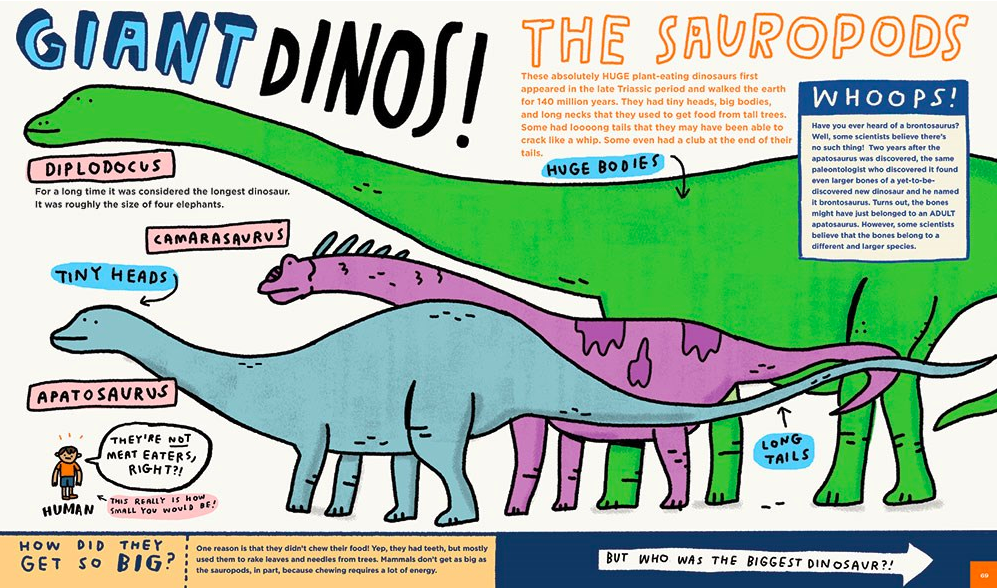
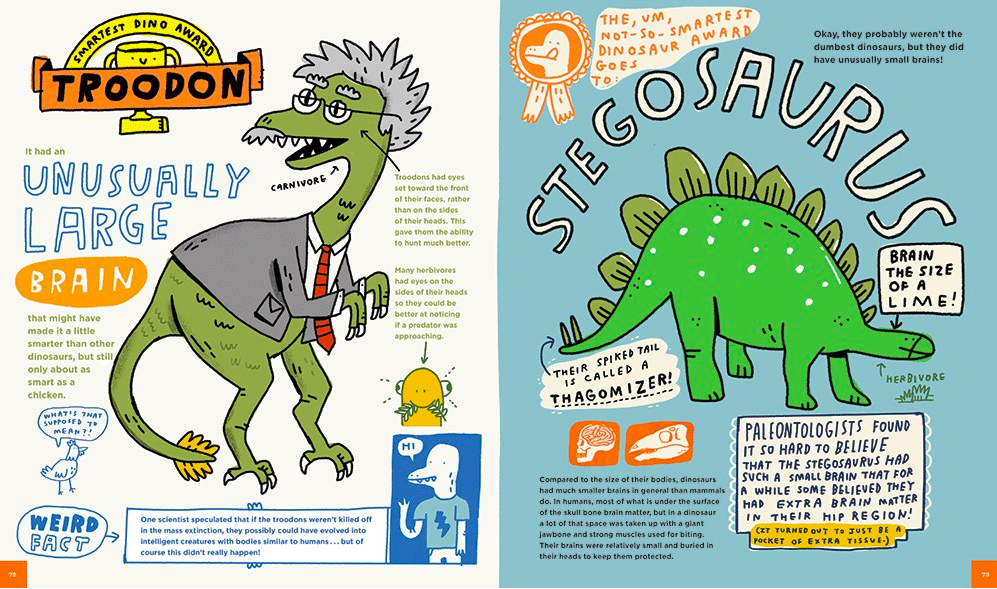
In Part Three readers get to meet the dinosaurs up close and personal (well, not too close). They’ll learn what dinos really ate, how they really sounded, and this delectable fact: “More time passed between stegosaurus and T. rex than the time between velociraptor and microwavable pizza!” And while kids are digesting that, they’ll want to watch out for the gigantic sauropods (who grew that big partly because “they didn’t chew their food…. Mammals don’t get as big as the sauropods, in part, because chewing requires a lot of energy.” Kids will see who won the “smartest dino award” and who was unfortunate enough to win “the, um, not-so-smartest dinosaur award.” They’ll also learn about horned dinos, armored dinos, fast dinos, and “the weirdest lookin’ dino.”

celebrate-picture-books-picture-book-review-everything-awesome-about-dinosaurs-troodon

Copyright Mike Lowery, 2019, courtesy of Orchard Books.

Part Four talks about the Cretaceous-Paleogene extinction event and various theories that have been floated throughout the years. Part Five takes kids on a hunt for bones and other fossils and reveals how paleontologists study them. Part Six offers a tour of post-dinosaur beasts, and Part Seven invites kids to learn how to draw dinosaurs. That’s followed up by a Dino Field Guide, an illustrated list of dinos organized by time periods, and to round it all up, Lowery includes a few more irresistible dinosaur jokes.

celebrate-picture-books-picture-book-review-everything-awesome-about-dinosaurs-t-rex

Copyright Mike Lowery, 2019, courtesy of Orchard Books.

Mike Lowery’s free-wheeling sense of humor, on exhibit in both his text and illustrations, will have kids laughing and learning billions of years’ worth of scientific facts. Funny asides by dinosaurs who just want in on the action put a spotlight on major events and conditions on Earth. Boxed and highlighted facts reveal the science of paleontology and provide explanations of dinosaur and prehistoric animal behavior and comparisons on size that will resonate with kids. Lowery imbues each of his creatures with personality while staying true to their nature and body type. Simply said, if there’s something you want to know about prehistoric creatures, dinosaurs, and the times they lived in, it’s in this book.

A must for home, classroom, and public library collections, you’ll want to put Everything Awesome about Dinosaurs and Other Prehistoric Beasts! on your shopping list for kids, teachers, and anyone who loves science, dinosaurs, and entertaining ways to learn or teach.

Ages 7 – 10 and up

Orchard Books, 2019 | ISBN 978-1338359725

Discover more about Mike Lowery, his books, and his art on his website.

National Dinosaur Day Activity

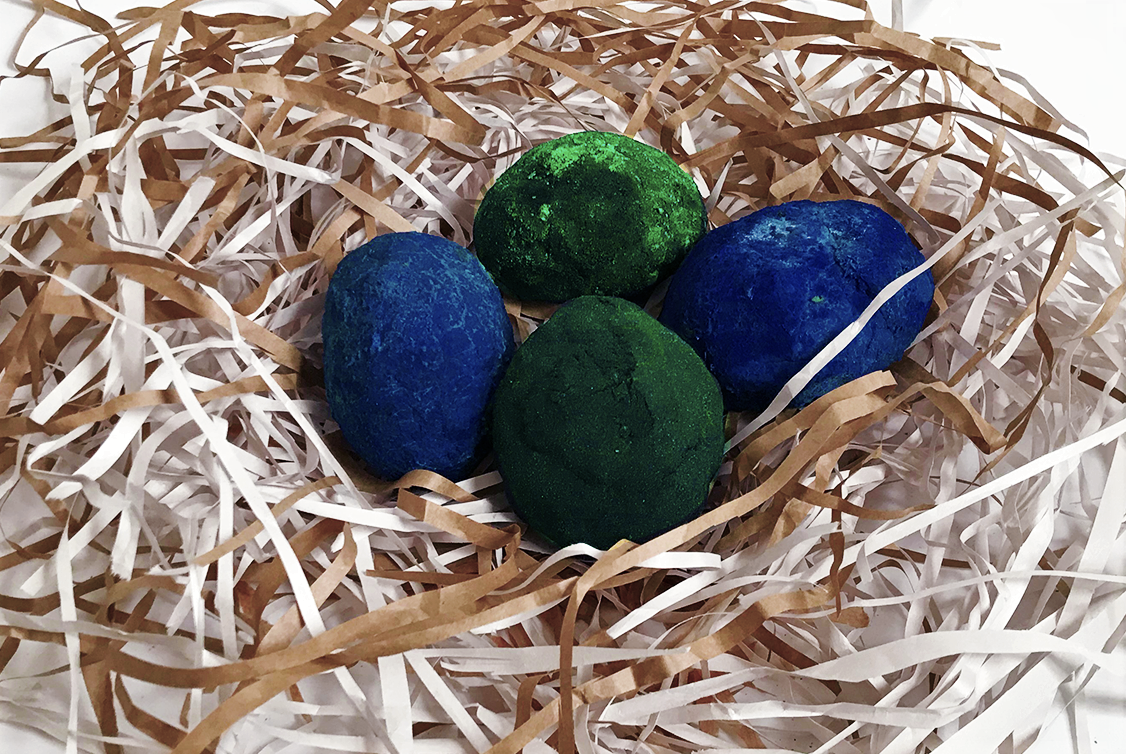
celebrate-picture-books-picture-book-review-dinosaur-eggs-craft-nest

Hatch Your Own Dinosaur Eggs


Think there are no more dinosaur eggs to be found? Think again! You can make your own with this easy craft that will have you hatching some T.-rex-size fun! All you need are a few simple ingredients – and don’t forget to wear an apron or old clothes!

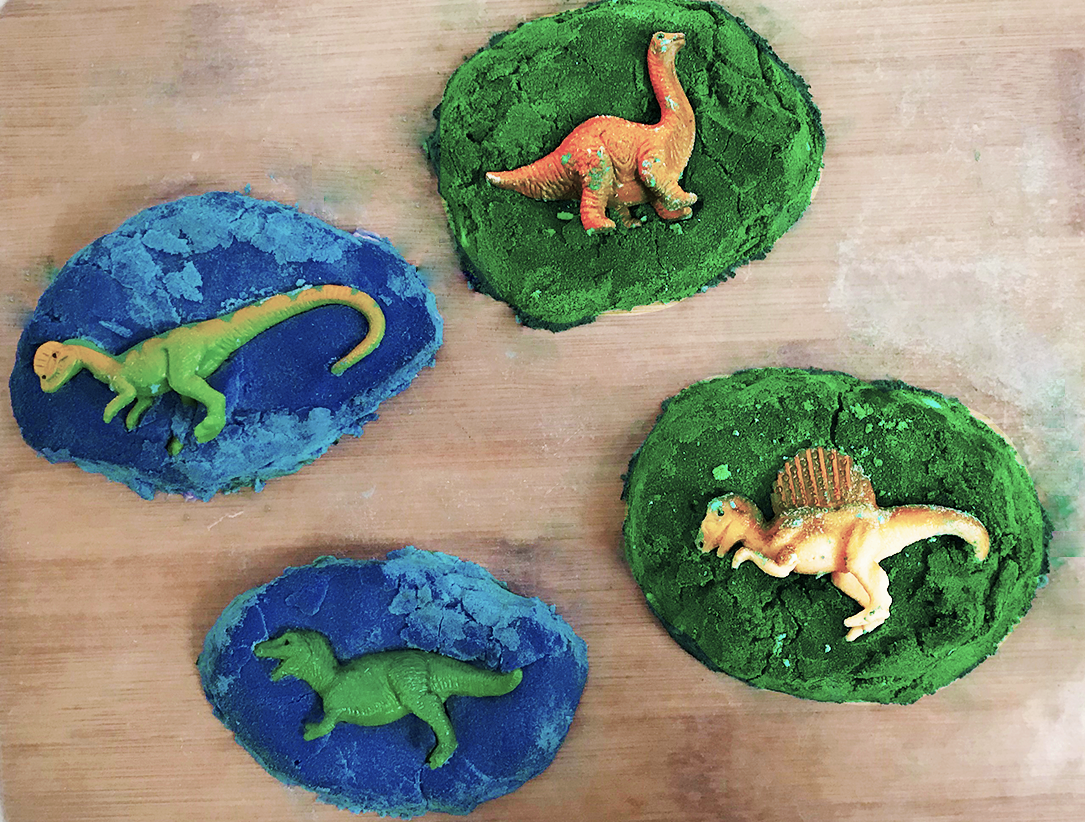
celebrate-picture-books-picture-book-review-dinosaur-eggs-craft-open-eggs

Supplies

  • Old clothes or apron
  • Large box of baking soda (makes between 6 and 8 eggs)
  • Food coloring
  • Water
  • Plastic dinosaur toys
  • Bowl
  • Fork
  • Spoon
  • Wax paper
  • Baking sheet
  • Foil
  • Vinegar
  • Spray bottle (optional)
  • Plastic or metal spoon, stick, popsicle stick, or other implement to chisel with
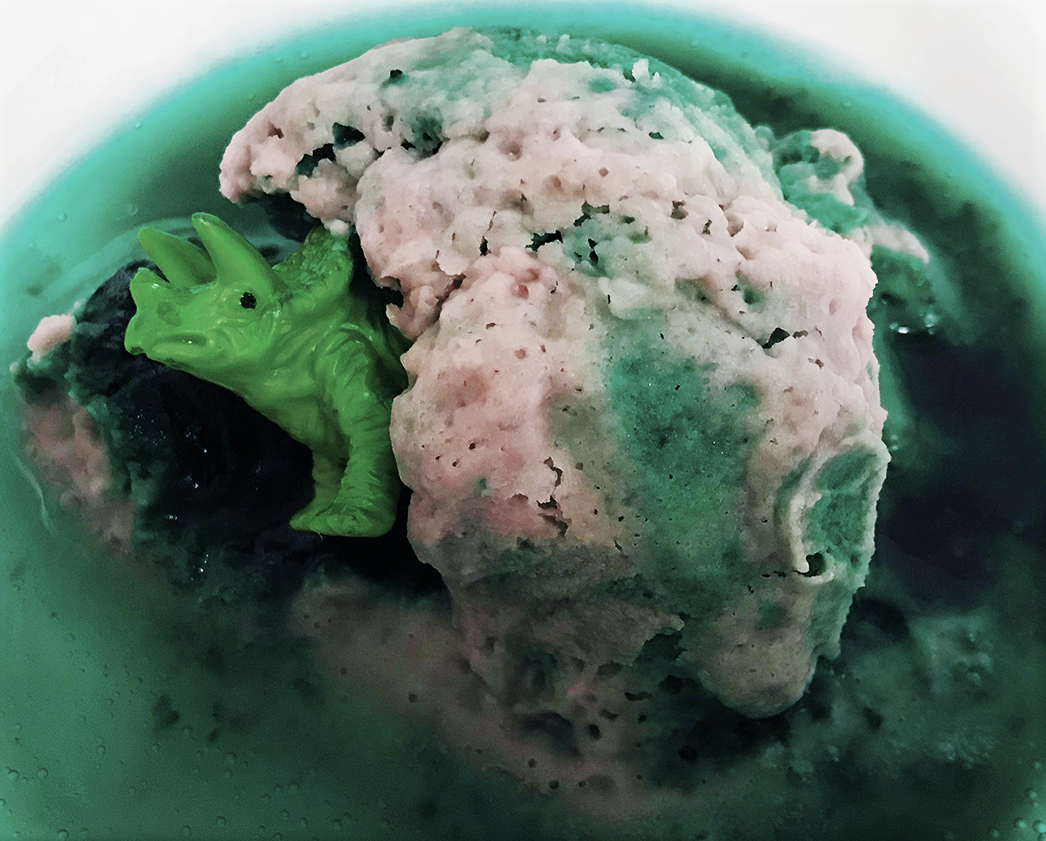
celebrate-picture-books-picture-book-review-dinosaur-eggs-craft-vinegar-egg-open-darker

Spray the egg with vinegar to hatch your dinosaur

Directions

  1. Wear old clothes or an apron
  2. Cover work surface with wax paper, parchment paper, newspaper, or other protection. Food coloring can stain some surfaces
  3. Pour baking soda into the bowl
  4. Add drops of food coloring in whatever color you’d like your eggs to be. The eggs will darken when baked.
  5. Mix in the food coloring with the fork. You may want to use your hands, too
  6. When the baking soda is the color you want it, begin adding water a little at a time
  7. Add water until the baking soda holds together when you squeeze it in your hand
  8. When the baking soda is the right consistency, spoon some out into your hand or onto wax paper
  9. Push one plastic dinosaur into the middle
  10. Cover the dinosaur with more of the baking soda mixture
  11. Carefully form it into an egg shape
  12. Repeat with other dinosaurs
celebrate-picture-books-picture-book-review-dinosaur-eggs-craft-chiseled -darker

Chisel the egg open to hatch your dinosaur

To Bake the Eggs

  1. Set the oven or toaster oven to 200 to 225 degrees
  2. Set the eggs on a baking sheet lined with foil
  3. Bake the eggs for 15 minutes, check
  4. Turn the eggs over and bake for 10 to 15 more minutes
  5. Remove from oven and let cool

To Hatch the Eggs

  1. Eggs can be hatched by chiseling them with a spoon, stick, or other implement
  2. Eggs can also be hatched by spraying or sprinkling them with vinegar

celebrate-picture-books-picture-book-review-everything-awesome-about-dinosaurs-cover

You can find Everything Awesome about Dinosaurs and Other Prehistoric Beasts! at these booksellers

Amazon | Barnes & Noble | Books-a-Million

To support your local independent bookstore, order from

Bookshop | IndieBound

Picture Book Review

December 10 – It’s Read a New Book Month

celebrate-picture-books-picture-book-review-a-peek-at-beaks-cover

About the Holiday

The month of December is a gift-giver’s delight and looking at the long winter ahead there’s no better gift for everyone on your list than a book (or two or…). With so many new books hitting bookstore shelves, there really is a perfect book to fit everyone’s taste. Young children, especially, benefit from reading a wide range of picture books from laugh-out-loud or touching stories to nonfiction that introduces them to influential people, science, history, and nature. If you’re looking for gifts to give, it’s not too late to head to your local bookstore or their online shop to find books that will make your child’s eyes light up.

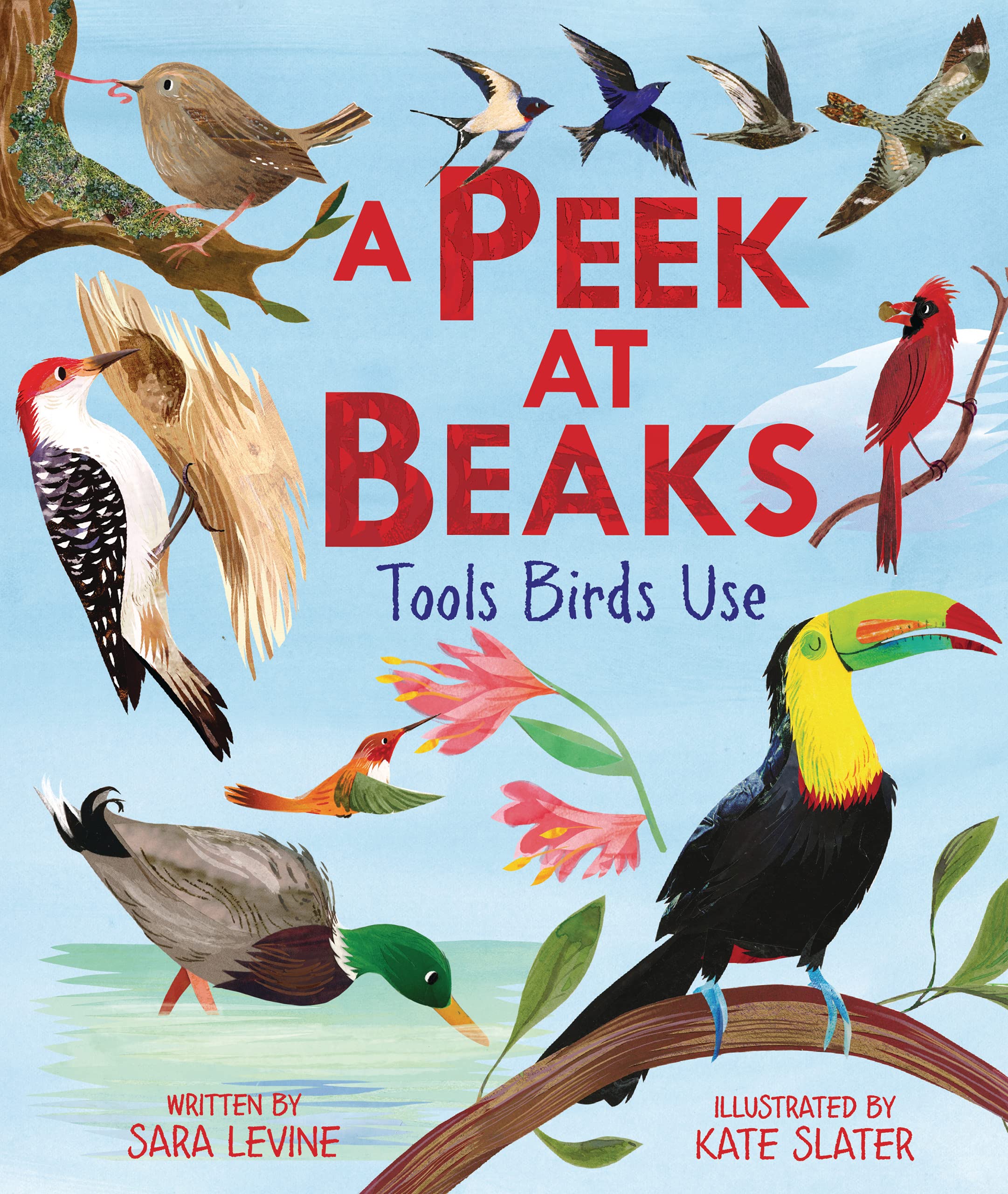
A Peek at Beaks: Tools Birds Use

Written by Sara Levine | Illustrated by Kate Slater


When you “slurp up your milkshake” or cut up your meat or even cool down with an air conditioner, do you ever wonder how birds accomplish these things? They don’t have hands to hold tools, but that’s okay because each type of bird has just the tool they need to survive handily attached right to its face – its beak! How does each bird use its beak to find food? Sara Levine and Kate Slater let you take a peek at how birds’ beaks are uniquely suited for the foods they eat and the places where they find it as well as for grooming and nest-building.

celebrate-picture-books-picture-book-review-a-peek-at-beaks-birdwatching

Image copyright Kate Slater, 2021, text copyright Sara Levine, 2021. Courtesy of Millbrook Press.

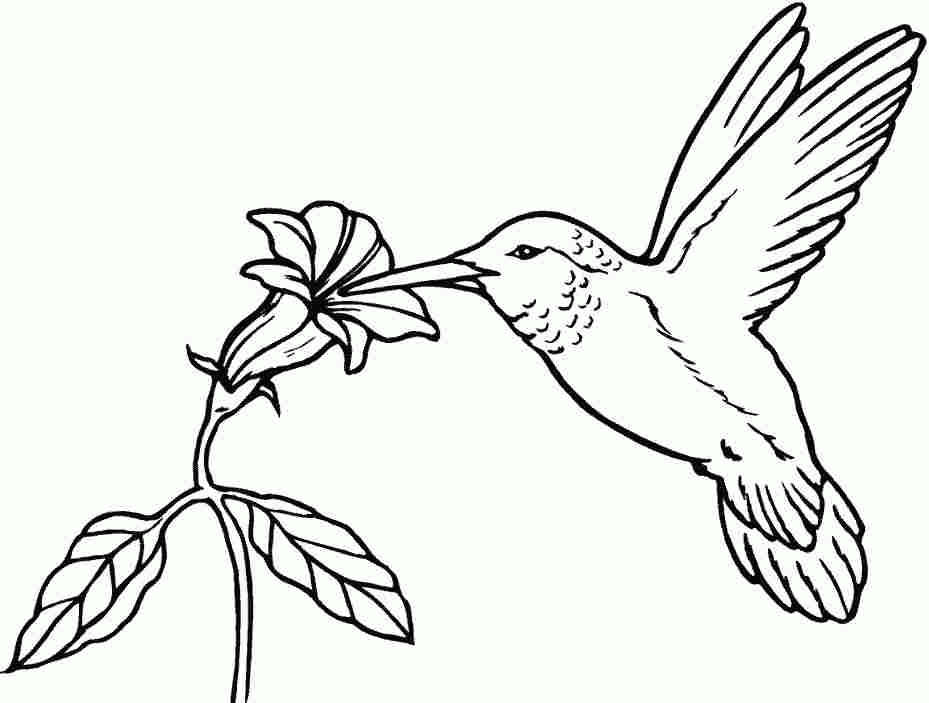
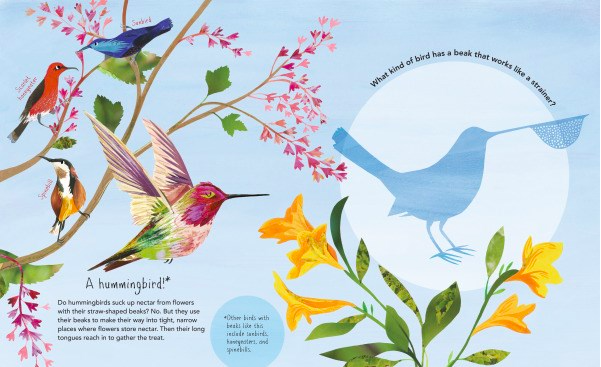
Take that straw we people use to sip up every last drop of a delicious milkshake or glass of lemonade, for instance. Which bird “has a beak shaped like a straw? A hummingbird!” And while hummingbirds don’t “suck up nectar from flowers” through their beaks, “they use their beaks to make their way into tight, narrow places where flowers store nectar. Then their long tongues reach in to gather the treat.” 

If you look into the family toolbox, you’ll probably find a hammer and a needle-nosed pliers. Are there birds whose beaks do similar jobs as these? You bet! The rat-a-tat-tat of a woodpecker searching for grubs or insects in a tree trunk sounds just about the same as the tap-tap-tap or bang-bang-bang of a hammer, and there are shoreline birds that use their long, thin beaks to “probe deep into the mud to find crustaceans, insects, and worms. A special sensory organ at the beak’s tip lets the bird feel when a meal is nearby.” Can you guess which ones they are?

celebrate-picture-books-picture-book-review-a-peek-at-beaks-straw

Image copyright Kate Slater, 2021, text copyright Sara Levine, 2021. Courtesy of Millbrook Press.

Kids who love helping out in the kitchen will be fascinated to learn that there are birds with beaks that act as strainers, nutcrackers, knives, and tongs. And if you think we’re sophisticated with our central air-conditioning one very distinct bird is born with this capability, while a more common bird has one-upped our technological advances by offering it’s chicks a one-touch “take-out” button long before the smartphone was ever developed. 

celebrate-picture-books-picture-book-review-a-peek-at-beaks-hummingbird

Image copyright Kate Slater, 2021, text copyright Sara Levine, 2021. Courtesy of Millbrook Press.

Sure, you might think – birds can find food and build nests with their beaks, but can they show love? The answer is… Yes! The gannet is especially adept at demonstrating their feelings, and they don’t care who hears it. While “many birds show affection with their beaks,… gannets particularly stand out. These birds raise their beaks in the air and clatter them together to show how much they like each other.” After you’ve learned about all of these amazing birds and their beaks, maybe you’d like to raise a ruckus to show your appreciation too! 

Back matter includes a discussion on the evolution of bird beaks and how they change over time and a list of other books for further reading.

celebrate-picture-books-picture-book-review-a-peek-at-beaks-needle-nosed-pliers

Image copyright Kate Slater, 2021, text copyright Sara Levine, 2021. Courtesy of Millbrook Press.

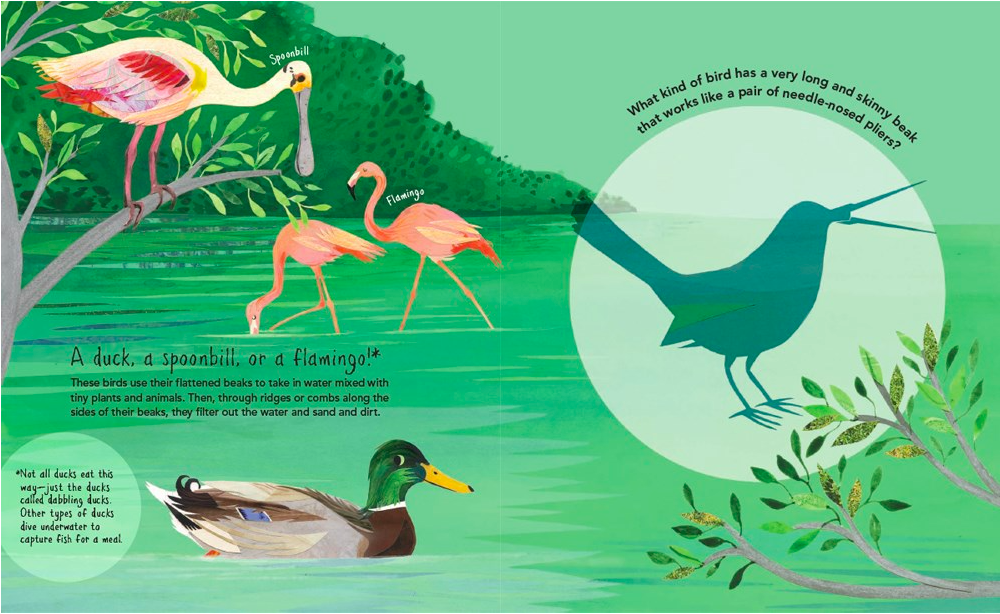
Bird, nature, and science lovers as well as teachers and homeschoolers will be fascinated with Sara Levine’s clever way to engage kids in learning about birds by comparing their beaks to well-known tools children and adults use every day. Especially interesting are descriptions of the birds whose beaks’ special abilities are hidden, such as water birds that use their beaks as strainers to filter out water, sand and dirt before swallowing the nutritious plants and animals left behind. Along with information on the construction of birds’ beaks and how, exactly, birds use them, readers learn about the diet of various species and where they hunt for food.

Levine is always an insightful and captivating educator who sparks kids’ interest in nature-science learning and spurs them to further research. Her question-and-answer format gets kids thinking, observing, and theorizing in a way that increases understanding and resonates across subject matter. At-home birdwatchers will also enjoy watching out for the birds depicted in this book and their behavior.

Kate Slater’s mixed-media collage illustrations are vibrant and textured, adding lovely depth to each page. Her silhouettes of birds sporting tool where it’s beak should be are intriguing invitations for kids to ponder and guess at the answers to Levine’s questions before turning the page to discover the answer. Slater populates the pages with a wide variety of birds, realistically depicted, that will kindle an interest in readers and adults to delve into further research on these fascinating and charming creatures.

A unique and high-interest way to engage kids in learning about birds and nature, A Peek at Beaks: Tools Birds Use is highly recommended for bird-lovers at home as well as for science, environment, and nature learning collections in schools and public libraries. 

Ages 5 – 9

Millbrook Press, 2021 | ISBN 978-1541587342

Discover more about Sara Levine and her books on her website.

To learn more about Kate Slater, her books, and her art, visit her website.

Read a New Book Month Activity

celebrate-picture-books-picture-book-review-bird-coloring-page-2

Busy Birds Coloring Pages


These birds are busy looking for and gathering food to eat! Grab your crayons, pencils, or markers, print the pages, and give the birds and their surroundings some color!

Hummingbird at Flower | Robin Grabbing a Worm | Bird on Branch

celebrate-picture-books-picture-book-review-a-peek-at-beaks-cover

You can find A Peek at Beaks: Tools Birds Use at these booksellers

Amazon | Barnes & Noble | Books-a-Million

To support your local independent bookstore, order from

Bookshop | IndieBound

Picture Book Review

October 26 – It’s National Popcorn Poppin’ Month

celebrate-picture-books-picture-book-review-let's-pop-pop-popcorn-cover

About the Holiday

National Popcorn Poppin’ Month has been celebrated in October for more than 30 years and was made official in 1999 by then Secretary of Agriculture Dan Glickman. With its salty crunchiness and that enticing Pop Pop Pop rhythm, this snack is a favorite the world over. Its history goes back to the Aztecs and beyond. Early explorers of the 1500s wrote about native peoples roasting corn until it popped and described it as looking like a “white flower.” It was eaten and also strung for decoration.

Most people now eat popcorn with salt and butter, but can you imagine having it with milk? Way before Corn Flakes and Cheerios came on the scene, people ate popcorn as cereal! Popcorn’s popularity, well, popped during the Great Depression, when it was one of the only treats people could afford. Why not pop up a batch today! For more interesting popcorn facts and recipes visit www.popcorn.org.

Let’s Pop Pop Popcorn!

Written by Cynthia Schumerth | Illustrated by Mary Reaves Uhles


A group of kids plants rows of seeds, which with rain and sun grow unseen until “Surprise! Like magic sprouts appear! / Green and tender, finally here.” The kids help their plants grow by pulling weeds and watching out for pests. The seeds grow and grow until they are taller—much taller—than the children. What are the kids growing? Corn, but not just any corn…. Can you guess?

celebrate-picture-books-picture-book-review-let's-pop-pop-popcorn-sprouts

Image copyright Mary Reaves Uhles, 2021, text copyright Cynthia Schumerth, 2021. Courtesy of Sleeping Bear Press.

When the ears are picked, shucked, and dried, the kernels are ready to be tossed “Plink, plunk, plink” into a pot and heated up. Do you know what kind of corn it is now, or do you need another hint? Okay… “Steam builds around each kernel’s germ, / puffs the starch called endosperm.” A bit of science brings about explosive results then “first one pop! Then pops galore!” You know now! The kids grew their own popcorn! When the pot is overflowing it’s time for “butter, salt, then give a swish. / Lick our fingers—Mmm! Delish!”

celebrate-picture-books-picture-book-review-let's-pop-pop-popcorn-stovetop

Image copyright Mary Reaves Uhles, 2021, text copyright Cynthia Schumerth, 2021. Courtesy of Sleeping Bear Press.

Fascinating back matter reveals the science behind this favorite treat. Diagrams and photographs let kids see inside a popcorn kernel and view the progression of a kernel as it is heated. They also learn about the two different shapes of popcorn and how they are used. A science activity gives readers the steps for growing their own popcorn from seed to sprout and reveals what transformations take place inside the kernel as the little plant grows. A popcorn art project fills out this STEAM lesson that’s sure to be a favorite.
celebrate-picture-books-picture-book-review-let's-pop-pop-popcorn-party

Image copyright Mary Reaves Uhles, 2021, text copyright Cynthia Schumerth, 2021. Courtesy of Sleeping Bear Press.

There may be no more universally loved snack than popcorn, and Cynthia Schumerth makes learning about the science of growing the plants, preparing the ears for popping, and what happens when the kernels are heated lots of fun. Her bouncy rhyming storytelling will engage kids and get them excited about all the lessons these tiny kernels have to teach. Schumerth’s storytelling builds to its “kaboom” moment, mirroring the suspense popcorn lovers listening for that first Pop. Teachers and homeschoolers will love the resources following the story, which provide for a full lesson appropriate for science, nature, or cross-curricular lessons.

Mary Reaves Uhles’s action-packed illustrations will enthrall kids with their close-up perspectives and relatable details, like the little girl who’s wearing a cat’s ears headband as she digs up the ground for planting. Readers go underground to get a worm’s eye view of the kernels sprouting roots, get down in the dirt to pull weeds, and peek into the pot to make sure there’s going to be enough popcorn for the whole crowd. Images of the kernels pop, pop, popping show the process and will make kids plenty hungry. The final spread of all of the kids enjoying their harvest together is a celebration of popcorn and friendship.

An exuberant story that will spark enthusiasm for science learning and gardening, Let’s Pop Pop Popcorn! will be a quick favorite and is highly recommended for home, classroom, and public libraries.

Ages 5 – 8

Sleeping Bear Press, 2021 | ISBN 978-1534110427

Discover more about Cynthia Schumerth and her books on her website.

To learn more about Mary Reaves Uhles, her books, and her art, visit her website.

Want to know more about Let’s Pop Pop Popcorn!? You can read my interview with Cynthia Schumerth and Mary Reaves Uhles here!

National Popcorn Poppin’ Month Activity

CPB - popcorn1

Popcorn Blast-Off Game


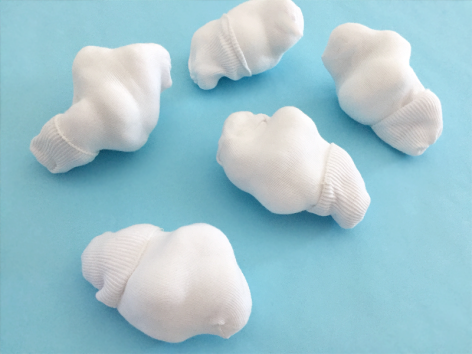
The popcorn is flying! Can you catch it? This is a fun game to celebrate this most delicious month! And if you keep the popcorn socks, it will make a great quick activity for those times when you want to get up and move but just don’t know what to do.
Supplies

  • 6 pairs of girls socks – white
  • A large bag of cotton balls
  • Towel or small blanket

Directions

  1. Stuff the socks with a large handful of cotton balls (about 25)
  2. Knot the sock as you would a balloon and fold down the remaining ankle cuff
  3. Squish the sock to move the cotton balls until your sock looks like a piece of popcorn
  4. Players hold each end of the towel or side of the blanket so it sags
  5. Place popcorn in the middle of the towel or blanket
  6. On the count of 3, players pull tight on the towel or blanket
  7. Try to catch as many flying popcorn pieces in the towel or blanket as you can

celebrate-picture-books-picture-book-review-let's-pop-pop-popcorn-cover

You can find Let’s Pop, Pop, Popcorn! at these booksellers

Amazon | Barnes & Noble | Books-a-Million

To support your local independent bookstore, order from

Bookshop | IndieBound

Picture Book Review