April 3 – National Find a Rainbow Day

celebrate-picture-books-picture-book-review-ava-and-the-rainbow-who-stayed-cover

About the Holiday

April brings plenty of showers and downright downpours that give rainbow lovers lots of opportunities to see this colorful phenomenon. Legend has it that at the end of every rainbow waits a pot of gold—but if you aim to find it, watch out! It’s guarded by a tricky Leprechaun. Rainbows result when light from the sun reflects and refracts through water droplets in the sky, creating a spectrum of colors. Whether people ooh and ahh over the luck, the science, or the beauty of rainbows, there’s no denying that they always attract attention and create smiles.

I’m happy to be partnering with HarperCollins in a giveaway of a copy of Ava and the Rainbow (Who Stayed)! You’ll find the details below.

Ava and the Rainbow (Who Stayed)

By Ged Adamson


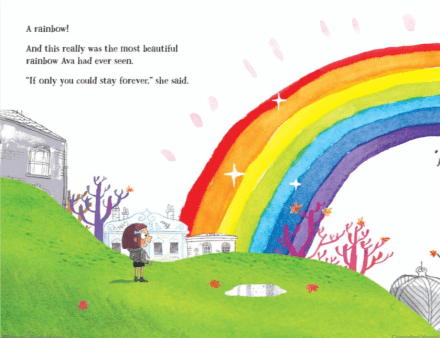
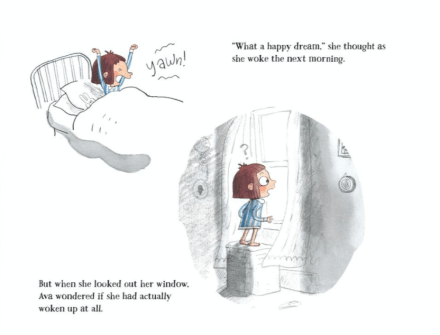
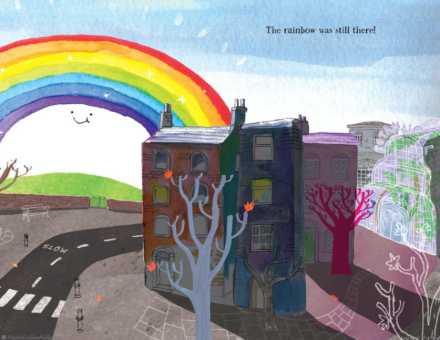
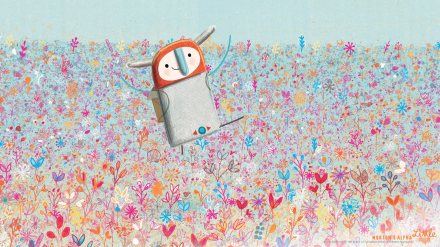
After the rain was over and the sun began to peek out from behind the clouds, Ava was excited because she knew she’d get to see a rainbow. When she reached the perfect rainbow-viewing spot, she was amazed. Up in the sky was “the most beautiful rainbow Ava had ever seen.” She wished it could stay forever. That wish even carried over into her dreams that night, and when she woke up Ava thought she might actually still be asleep. Why? Because when she looked out the window, “the rainbow was still there!”

celebrate-picture-books-picture-book-review-ava-and-the-rainbow-who-stayed-beautiful-rainbow

Copyright Ged Adamson, 2018, courtesy of HarperCollins.

It was even still glowing over the town that night. It didn’t take long for people to start coming from all over to see the famous “rainbow who had decided to stay.” The townspeople loved all the attention—and the customers. Shopkeepers held rainbow-inspired sales, rainbow souvenirs like T-shirts, snow globes, and toys flew off the shelves, rainbow science became one of the most popular lectures by university professors, and a rainbow even became the new town mascot. For weeks there were special events and festivities all centered around the rainbow.

celebrate-picture-books-picture-book-review-ava-and-the-rainbow-who-stayed-ava-wakes-up

Copyright Ged Adamson, 2018, courtesy of HarperCollins.

Ava loved to talk to the rainbow. “She introduced him to her friends…sang to him…and showed him all her favorite books and toys.” The rainbow even stayed throughout the winter, shivering in the cold. When spring rolled around, people seemed to have forgotten all about the rainbow. They didn’t look at him like they used to. In fact, they didn’t look at him at all.

As Ava walked around town, she saw rainbow souvenirs in the trash and graffiti covering signs advertising the rainbow. When she saw the rainbow, Ava was shocked to see him plastered with ads and sporting antennae of all kinds. The rainbow was sad. “‘How could they do this to something so special?’ Ava said in despair.” She cheered up when she saw a crowd of people with cameras rushing toward her and the rainbow, but they were only interested in a little bird in a nearby tree.

celebrate-picture-books-picture-book-review-ava-and-the-rainbow-who-stayed-rainbow-stayed

Copyright Ged Adamson, 2018, courtesy of HarperCollins.

It seemed that the bird was a Russian water sparrow and would only be there for a few hours before continuing its flight. “We’re so lucky!’” someone said. “‘Such a rare and precious sight!’” The rainbow overheard this exclamation and thought about it. The next morning when Ava went to visit the rainbow again, he was gone. Ava hoped that someday he’d return, and every time it rained she looked for him. One day he did come back, and was “a rare and precious sight indeed.”

celebrate-picture-books-picture-book-review-ava-and-the-rainbow-who-stayed-sweet-rainbow

Copyright Ged Adamson, 2018, courtesy of HarperCollins.

Like a rainbow itself, Ged Adamson’s story is multi-layered and reveals a spectrum of ideas about the often-fleeting moments in life—from wishes and dreams to the unusual or funny even to fads and fame. Learning how to truly appreciate these ephemeral experiences as they happen, to let go of what can’t or shouldn’t be controlled, and to stay true to your own nature goes a long way towards living a happy life. Children will be captivated by Adamson’s charming tale and his lush, whimsical art, which is always expressive of a child’s joy and empathy and which sweetly depicts the better understanding they gain as they grow through life’s experiences.

An enchanting story in itself and a wonderful way to engage children in discussions of true value and happiness, Ava and the Rainbow (Who Stayed) would make a terrific addition to home and classroom bookshelves.

Ages 4 – 8

HarperCollins, 2018 | ISBN 978-0062670809

Discover more about Ged Adamson, his books, and his art on his website.

National Find a Rainbow Day Activity

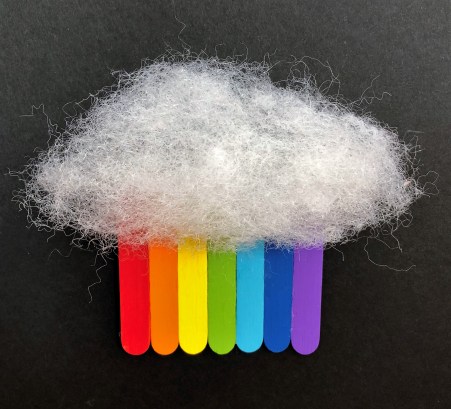
celebrate-picture-books-picture-book-review-rainbow-magnet-craft

Mini Rainbow Magnet


If you’re stuck on rainbows, you can make this mini rainbow to stick on your fridge or locker!

Supplies

  • 7 mini popsicle sticks
  • Paint in red, orange, yellow, green, blue, Indigo, violet (ROYGBIV)
  • Adhesive magnet
  • A little bit of polyfill
  • Paint brush
  • Glue or hot glue gun

Directions

  1. Paint one popsicle stick in each color, let dry
  2. Glue the popsicle sticks together side by side in the ROYGBIV order, let dry
  3. Roll a bit of polyfill into a cloud shape and glue to the top of the row of popsicle sticks
  4. Attach the magnet to the back of the rainbow


Picture Book Review

March 14 – Moth-er Day and Interview with Author Karlin Gray

celebrate-picture-books-picture-book-review-an-extraordinary-ordinary-moth-cover

About the Holiday

Did you know that some moths are even more beautiful than butterflies? It’s true! Adorned in vibrant oranges, greens, blues, and reds and with patterns more intricate than the finest fabrics, moths are some of nature’s loveliest creatures. With spring right around the corner, moths will once again be emerging in woods, fields, and gardens, so today take a little time to celebrate these often overlooked insects and learn more about them and their habitats.

Sleeping Bear Press sent me a copy of An Extraordinary Ordinary Moth to check out. All opinions are my own. 

An Extraordinary Ordinary Moth

Written by Karlin Gray | Illustrated by Steliyana Doneva


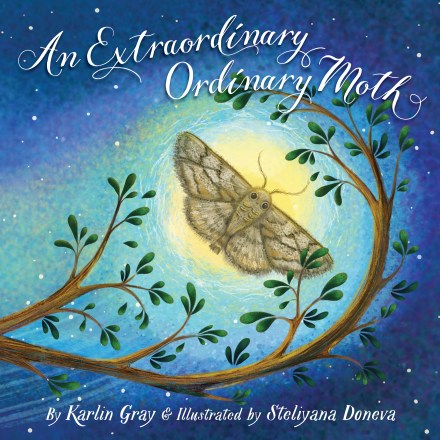
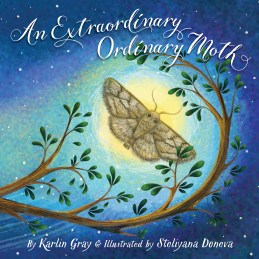
As a grayish-brown moth flits among the leaves framed by the full moon, he says, “I’m an ordinary moth, / as you can plainly see. / A dusty, grayish, dull insect— / nothing-special me.”  He compares himself to the Luna Moth “who floats in graceful green” and to the Spider Moth who’s “so cool at Halloween!” He’s nothing like the Hummingbird Moth who mimics its namesake bird, and he can’t hide like the Wood Nymph Moth that looks like “birdy dung.” He’s much smaller than the Atlas Moth and not as pretty as a butterfly. While all of these are special—extraordinary even—this little guy thinks he is just “a dusty, grayish moth— / very ordinary.”
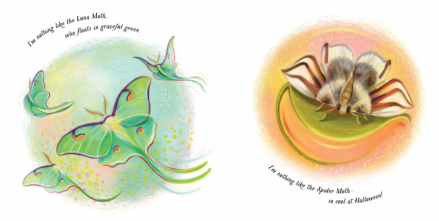
celebrate-picture-books-picture-book-review-an-extraordinary-ordinary-moth-luna

Image copyright Steliyana Doneva, 2018, text copyright Karlin Gray, 2018. Courtesy of Sleeping Bear Press.

But then a little boy runs through the yard shouting “‘A moth! A moth!’” The moth freezes against a wall, afraid and unsure and hoping to hide. But when the moth sees the excitement in the boy’s eyes, he moves “toward his joyful light.” He lands in the boy’s hands, uncertain still if he’ll be shooed away. And sure enough, the boy’s sister screams, “‘Ew, a bug!’” When she knocks her brother’s hand away, the moth flies off.
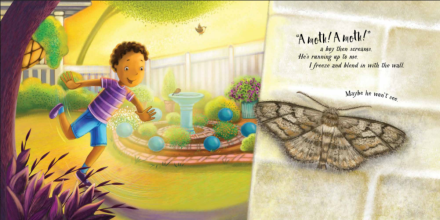
celebrate-picture-books-picture-book-review-an-extraordinary-ordinary-moth-hiding

Image copyright Steliyana Doneva, 2018, text copyright Karlin Gray, 2018. Courtesy of Sleeping Bear Press.

The moth hears the boy tell his sister, “‘Hey, it’s an insect—not a bug— / and my favorite kind!’” then he sees the boy trailing him “all through the yard. / with her two steps behind.” She thinks the moth is nothing special, but her brother disagrees. And as the moth alights on his finger, he shows her why. What looks like dust are really “‘scales that keep him warm at night. / And they flake off in a web so he escapes all right.’”
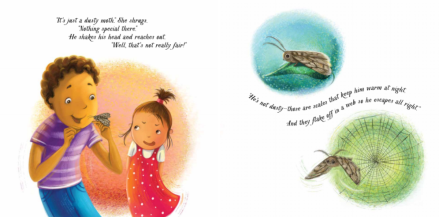
celebrate-picture-books-picture-book-review-an-extraordinary-ordinary-moth-web

Image copyright Steliyana Doneva, 2018, text copyright Karlin Gray, 2018. Courtesy of Sleeping Bear Press.

The little girl’s a bit more interested but thinks his color is “kind of blah.” The boy explains that the moth is the color of tree bark and can camouflage himself during the day while he sleeps. Then at night he’s ready to fly, guided by moonlight and the scents he smells through his antennae. Now the little girl thinks the moth is pretty cool. She calls their mom to come and see, and when Mom wants to know what bug they found, “the girl says, ‘Mom—a moth’s an insect, / and out favorite kind!’”

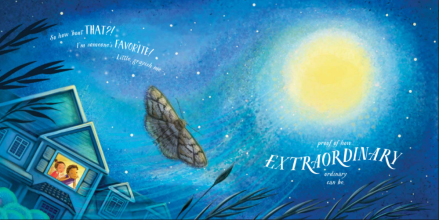
Hearing that, the moth soars in the moonlight with a new self image—“So how ‘bout THAT?! / I’m someone’s FAVORITE! / Little grayish me— / proof of how / EXTRAORDINARY / ordinary can be.”
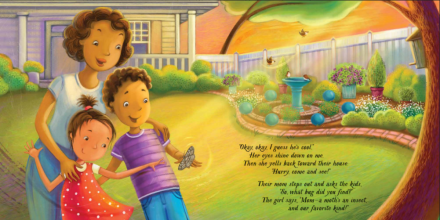
celebrate-picture-books-picture-book-review-an-extraordinary-ordinary-moth-mom

Image copyright Steliyana Doneva, 2018, text copyright Karlin Gray, 2018. Courtesy of Sleeping Bear Press.

Ten Extraordinary Facts about Moths, as well as an activity for constructing a moth observation box follow the text.

Through her vivacious rhymes, Karlin Gray elevates the “ordinary” back-porch moth to star status with fascinating facts that will lure kids to discover more. The conversational verses echo a sweet sibling relationship while the moth, overhearing them, begins to appreciate himself. The bookending of the children’s story with the moth’s thoughts—first comparing himself to other moths and later realizing his own merits—will encourage readers to think about the nature of nature and about the importance of positive interactions with others. Told from the moth’s point of view, the story also has a deeper meaning, reminding readers that, like this moth, people also have special talents  that make them exceptional. Taking extra time to really learn about another’s unique qualities and to get to know them is exciting and has benefits for all.  
celebrate-picture-books-picture-book-review-an-extraordinary-ordinary-moth-moonlight

Image copyright Steliyana Doneva, 2018, text copyright Karlin Gray, 2018. Courtesy of Sleeping Bear Press.

Steliyana Doneva’s gorgeous illustrations of moths and butterflies will dazzle insect-loving kids and convert the more squeamish. Doneva captures each delicate marking and texture of the little grayish moth as it flits in the light and camouflages itself on the wall and tree. The moth is also well spotlighted against Doneva’s vibrant backyard oasis where the little boy and his sister discover him. Nighttime scenes sparkle with starlight, and the full moon brings out the rich blues of an evening sky. The boy’s enthusiasm for moths and nature is infectious and will captivate young readers, enticing them to look closer at the world around them.

An Extraordinary Ordinary Moth is a beautiful, eye-opening book that would spur further discovery for nature and science lovers at home and in science or STEM classrooms.

Ages 4 – 8

Sleeping Bear Press, 2018 | ISBN 978-1-58536-372-8

Discover more about Karlin Gray and her books on her website.

View a portfolio of work by Steliyana Doneva and learn more about her on her website.

Download and have fun with these An Extraordinary Ordinary Moth Activity Sheets!

An Extraordinary Ordinary Moth Matching | An Extraordinary Ordinary Moth Fill in the Blank

Moth-er Day Activity
celebrate-picture-books-picture-book-review-tree-branch-with-white-cocoons

Beautiful Moths Game


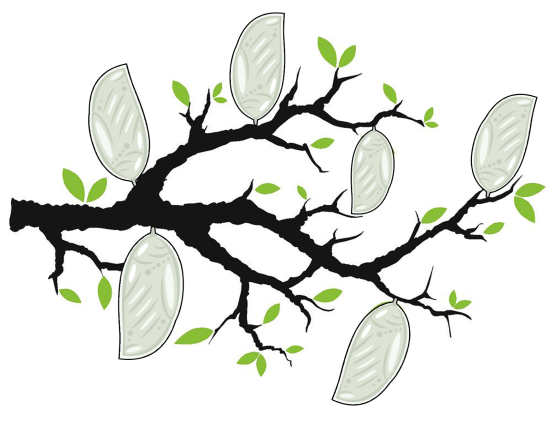
Moths go through many stages of metamorphosis—from egg to caterpillar to cocoon— before they finally emerge as a moth. In this game, help six moths emerge from their cocoons to win!

Supplies

celebrate-picture-books-picture-book-review-moth-cards

Directions

  1. Print a Tree Branch Game Board and set of Moth Cards for each player
  2. Print one Moth Playing Die
  3. Choose a player to go first
  4. The first player rolls the die and places the matching moth card on one of the cocoons on the Tree Branch Game Board
  5. Play then moves to the player on the left
  6. Players continue to roll the die and place moths on each cocoon
  7. If a player rolls a moth that they already have placed on their game board, they pass the die to the next player and wait for their next turn.
  8. The player who fills their Tree Branch with moths first is the winner

Meet Karlin Gray

celebrate-picture-books-picture-book-review-interview-with-karlin-gray-headshot

Today I’m excited to talk with Karlin Gray about how moths became extraordinary in her eyes, what types of characters she’s drawn to, and what might be the best holiday in the world

Did you like to write as a child? How did you get started writing books for children?

Yes, I did like to write as a child. When I was little, I would retell stories like Alice in Wonderland, changing the names and some details. Someone must have explained ‘plagiarism’ to me and, eventually, I learned to write my own stories.

I started writing picture books when my son was a toddler (about seven years ago). I joined a local writing center where I workshopped all three of my contracted books, including AN EXTRAORDINARY ORDINARY MOTH.

Before you began working in the publishing field and writing for children, you worked for newspapers. Can you talk a little about that experience? What did you like most about it? Has it influenced your work for children?

After college, my first two jobs were graphic design positions at weekly newspapers in Northern Virginia and D.C. I loved learning about the publishing process—how words and images were selected, designed, printed, and distributed. It’s a fast-paced, exhausting business. But those jobs taught me to work on a deadline which helps me as a children’s book writer, for sure!

What inspired you to write about moths?

My son. When he was three, he announced that the moth was his favorite insect. I imagined that moth was having a bad day—comparing himself to “cooler” moths like the Luna moth or Spider moth—and then overheard my son’s statement. It’s a nice reminder that sometimes it takes just one kind comment to improve someone’s day.

What do you think makes the “ordinary” extraordinary?

Perspective. My son saw something special in a creature that I never really considered. But his interest piqued my interest, so I did some research. That led me to learning several amazing things about moths. Now, instead of shooing them away, I celebrate moths in An Extraordinary Ordinary Moth.

What was your process in writing An Extraordinary Ordinary Moth?

Once the first line popped into my head—“I’m an ordinary moth, as you can plainly see…”—the story was set in rhyme. Usually, I research then write a story. But here, I did my research as I wrote the manuscript. The first draft took a couple days and was MESSY. I workshopped the manuscript on and off for two years, tightening the story, rhyme, and meter. I eliminated a whole stanza where the ordinary moth compares itself to other moths like the poodle moth. Trust me, it wasn’t easy cutting out the poodle moth! But, like they say, sometimes you have to kill your darlings.

Do you have a favorite place to write? If so, can you describe it a little? Do you have a favorite thing on your desk or in your writing space?

In my house I have an office but I don’t do much writing there. I usually move from the dining table to the kitchen table to the outside table when it’s warm.

In an earlier interview, you mentioned that you had “stories about presidents, magicians, explorers, athletes, mermaids, monsters, scarecrows, cats, mice, and one sad moth” in your desk drawer. What types of characters—or personalities—attract your creative interest? Do you have a preference for nonfiction? If so, why?

Oh yeah, I guess I’ll have to change that since the “sad moth” is out of the drawer and on the cover of a book. I’m a sucker for characters whose “flaws” are really their strengths, and I love a good finding-your-tribe story. Both nonfiction and fiction stories appeal to me but I enjoy the challenge of taking a true story and translating it into a picture book—selecting a character and timeframe, finding dialogue and active details, setting the tone and style, and staying true to the facts as well as the heart of the story.

In your website biography you have links to “things you like.” These are amazing and range from The American Mural Project to Storyline Online to the Landfill Harmonic. Can you talk about what draws you to these types of projects? Why do you think they are important not only for those directly involved in them, but for all kids—and adults?

Those two projects have a lot of heart. I met Ellen—she is a tiny person who has a big personality and a HUGE dream. The fact that one person had a goal to make the biggest indoor art installation is worthy of a book right there! And the Landfill Harmonic group—kids making music with trash!—was made into a book, Ada’s Violin by Susan Hood. I think both of those stories appeal to kids because it shows them that there are no limitations in art.

What’s the best part about writing for kids?

So many things…but probably the best is when kids tell me that they want to be a writer when they grow up. My response is always: “If I could do it, you can do it.”

You share your books at school and bookstore events. Do you have any anecdote from an event you’d like to share?

Twice a month I volunteer at a nearby school where I read books selected by the teacher. When I read my first book NADIA to the kids, the first graders had a hard time believing that I was the author. They knew me as someone who visited every other week and read a book from their shelves. They didn’t know me as a writer so that was a fun surprise for them.

What’s up next for you?

My next picture book is a biography of Serena Williams—SERENA: THE LITTLEST SISTER—and will be published in early 2019.

What is your favorite holiday and why?

Probably New Year’s Eve. We can see the town fireworks from our back deck so we invite a few families over for a casual get-together. It’s a nice way to end the year and the kids love staying up past midnight.

And, until your email, I didn’t know there was a Moth-er Day. (Not to be confused with Mother’s Day.) Very cool. The moth is also celebrated during National Moth Week in July: http://nationalmothweek.org

Do you have any anecdote from a holiday that you’d like to share?

When I was 10-14 years old, I lived in Japan because my dad worked with the military. I remember feeling sorry for Japanese kids because they didn’t celebrate holidays like Christmas or Halloween. But once I discovered that they had an even better holiday—Children’s Day!!—then I just felt sorry for myself.

Thanks so much for this great chat, Karlin! I wish you all the best with An Extraordinary Ordinary Moth and all of your books!
celebrate-picture-books-picture-book-review-an-extraordinary-ordinary-moth-cover

You can find An Extraordinary Ordinary Moth at these booksellers:

Amazon | Barnes & Noble | Books-a-Million | IndieBound | Sleeping Bear Press

You can connect with Karlin Gray on

Facebook | Pinterest | Twitter

Picture Book Review

March 3 – World Wildlife Day

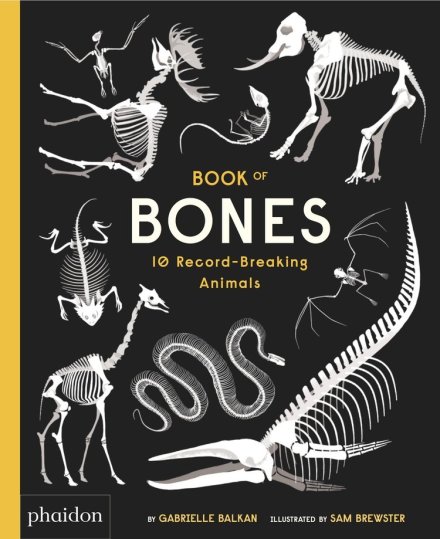
celebrate-picture-books-picture-book-review-book-of-bones-cover

About the Holiday

This United Nations-sponsored holiday was established in 2013 to celebrate the world’s wild animals and plants and to raise awareness of the perils they face. Since that time, World Wildlife Day has grown to be the most important global event dedicated to wildlife. This year’s theme is “Big cats: predators under threat.” The big cats are some of nature’s most majestic animals, and they are now being threatened by habitat destruction, declining prey populations, conflicts with people, poaching, and illegal trade. It is up to us to protect the animals that share our planet. To commemorate today’s holiday, learn more about the world’s creatures and consider donating to a wildlife cause. To learn more about the holiday, visit the official website of UN World Wildlife Day.

Book of Bones: 10 Record-Breaking Animals

Written by Gabrielle Balkan | Illustrated by Sam Brewster


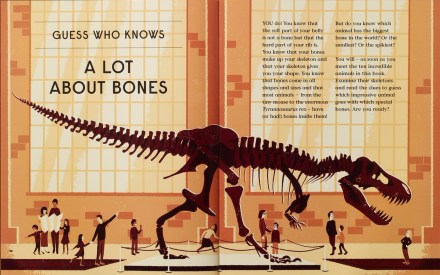
When you think about bones, you know a lot, right? You know they’re hard and not soft, you know they form your skeleton and that they come in different sizes and various shapes, and you know that all vertebrates have them. But have you ever wondered “which animal has the biggest bone in the world? Or the smallest, Or the spikiest?” Well, you’re about to find out thanks to this big book all about bones.

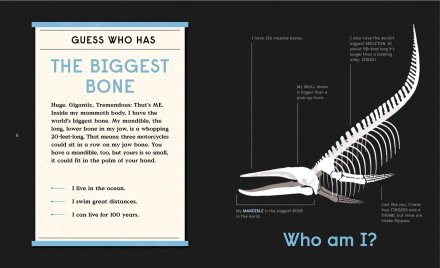
So, let’s get started! About that biggest bone…would you like to take a guess who it belongs to? Here are some clues: This mandible bone “is a whopping 20 feet long. That means three motorcycles could sit in a row” on it. The animal it belongs to lives in the ocean, swims great distances, and “can live for 100 years.” Just take a look at the skeleton on the next page with one long spine, two flippers, fifteen pairs of ribs and a huge skull. Good guess! Let’s turn the page and see… Yes, it is a Blue Whale!

celebrate-picture-books-picture-book-review-book-of-bones-whale-skeleton

Image copyright Sam Brewster, 2017, text copyright Gabrielle Balkan, 2017. Courtesy of Phaidon Press.

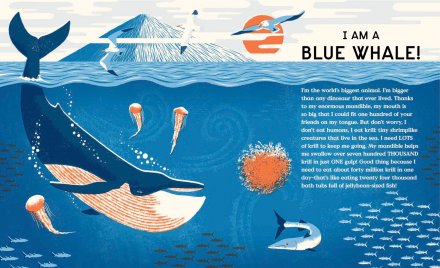
Now that you know, you can learn more about the blue whale—like how its mouth is so big that you and one hundred of your friends could fit on its tongue, how it eats 700,000 krill in one gulp, and slurps down 40,000,000 krill every day! Go ahead—touch the illustration of the whale. Feel all of those bones?

Ready for another one? Okay! We did the biggest, how about the smallest bones? Here are some clues from the animal herself: “I am teeny tiny. My skull is smaller than your pinky nail….Inside my ears are the smallest bones in the world: my hammer, anvil, and stirrup bones,” which are about the size of a • . You’d find this animal on farms, in gardens and in olive groves, and even though it’s small, its bite is poisonous. But you’d have to look very closely to find it because its skeleton is “the size of a paperclip and weighs less than a single raisin. What is it? The Etruscan Shrew! You can pet it to feel its bones—this one isn’t venomous.

celebrate-picture-books-picture-book-review-book-of-bones-whale

Image copyright Sam Brewster, 2017, text copyright Gabrielle Balkan, 2017. Courtesy of Phaidon Press.

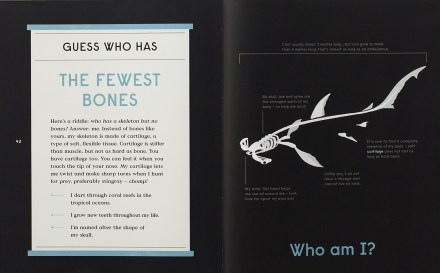
Imagine if your bones were as thin as a strand of spaghetti. It might make lifting heavy boxes and throwing baseballs or running on the playground pretty hard, if not impossible. But for this next animal having such thin bones is just right. Let’s see if you can guess what it is from these clues: “I sleep upside down, snuggled with my family. I flit through cool limestone caves. I am an amazing flyer…but can’t walk very well.” You know it—it’s a bumblebee bat!

This bat is as small as its namesake, and its thin finger bones support its wings. “If your finger bones were as long and thin as [the bumblebee bat’s], your pinky would be as thin as a strand of hair and keep going past your toes!”

celebrate-picture-books-picture-book-review-book-of-bones-fewest-bon

Image copyright Sam Brewster, 2017, text copyright Gabrielle Balkan, 2017. Courtesy of Phaidon Press.

This is fun! How about another? Guess who has the spikiest bones? You’d find these bones covered with keratin on top of the animal’s head to protect its brain—and to keep it from being eaten by snakes or coyotes or other predators. This animal lives in the deserts of Arizona, eats ants, and…can shoot stinky blood from its eyes when threatened! What is it? It’s a Regal Horned Lizard! Now, feel those spiky horns and all of the rib bones that make this lizard so round.

You’re a great guesser! So try them all—there are a lot more animals to discover and fascinating facts to learn in this book! No bones about it! You’ll find out more about the Reticulated Python, Reticulated Giraffe, African Bush Elephant, Peregrine Falcon, Alaska Moose, and Hammerhead Shark. At the end, there’s also a Glossary of Bone Words for you to bone up on!

celebrate-picture-books-picture-book-review-book-of-bones-dinosaur

Image copyright Sam Brewster, 2017, text copyright Gabrielle Balkan, 2017. Courtesy of Phaidon Press.

Gabrielle Balkan makes learning about the ten animals Book of Bones exciting by including the kinds of facts that kids find most eye-popping and eww-inspiring described in ways that they can relate to. Comparing the size of an animal to a paperclip or the thickness of a bone to a strand of spaghetti creates an immediate visual that makes budding scientists want to learn more. Balkan’s conversational style lends a personal touch to the text—as if the reader is interacting with a wildlife expert one-on-one.

Opening the oversized Book of Bones is like walking into a natural history museum where skeleton exhibits stand side by side with natural habitat dioramas. Sam Brewster introduces each animal with accurately drawn skeletons on black backgrounds that let readers see the placement of each bone. Special features are called out in a whisper of gray, adding to the museum display feel. Turning the page allows children to see each animal in its vibrant, natural habitat. Ingenious printing lets readers feel and see the rough bones beneath the skin.

A fun, fact-filled resource for nature lovers, Book of Bones: 10 Record-Breaking Animals would make a great gift and addition to classroom, school library, public library, and home bookshelves.

Ages 8 – 12

Phaidon Press, 2017 | ISBN 978-0714875125

Discover more about Gabrielle Balkan and her books on her website.

To view a portfolio of illustration work by Sam Brewster, visit his website.

World Wildlife Day Activity

celebrate-picture-books-picture-book-review-lioness-and-cub-coloring-page

Lion and Lioness Coloring Pages


The lion is one of the most majestic of the big cats, and is—of course—the king (and queen) of the jungle. Here are two lion coloring pages for you to enjoy!

Lion Coloring Page | Lioness and Cub Coloring Page

Picture Book Review

February 28 – It’s National Bird-Feeding Month

celebrate-picture-books-picture-book-review-bird-builds-a-nest-cover

About the Holiday

As birds begin coming back to your area during this last bit of winter to build nests, mate, and hatch little cheepers, they still need help finding nutritious food to sustain them. Without the lush vegetation and increased insect activity that will come with warmer weather, birds often rely on backyard feeders for food. Attracting colorful birds to your home can be a rewarding and joyful hobby – one you can enjoy year-round. If you’ve been considering hanging a bird feeder to one of your trees, today is the perfect day to get started!

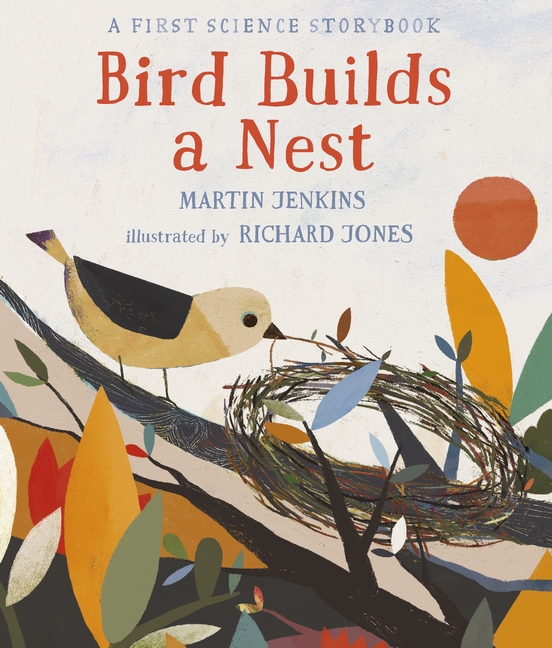
Bird Builds a Nest: A First Science Storybook

Written by Martin Jenkins | Illustrated by Richard Jones


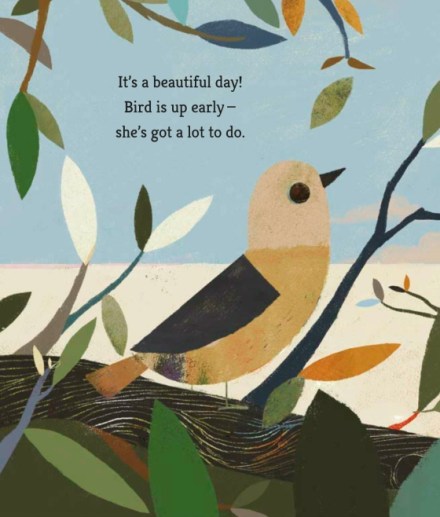
It’s early morning and Bird is already chirping. It’s going to be a busy day! To get started she needs breakfast. Of course, “what she wants is a nice, juicy…worm.” What the worm wants, though, is to not be eaten. So while “bird pulls hard…the worm pulls back.” This is one strong worm, and it ends up winning the tug-of-war. Nearby, though, is a smaller and weaker worm that is just as delicious.

celebrate-picture-books-picture-book-review-bird-builds-a-nest-bird-in-nest

Image copyright Richard JOnes, 2018, text copyright Martin Jenkins, 2018. Courtesy of Candlewick Press.

Full and satisfied, Bird takes off on her next task. She needs to find twigs. “Lots of twigs.” The first one she finds is more like a branch to the little bird—and is too heavy. The next one is as long as a snake and too heavy too. But there are plenty of perfectly small twigs scattered around, so Bird gets to work. She “can carry one large twig or two medium-size twigs or three or four small twigs (although it’s hard to fit that many in her beak at once).”

What is Bird doing with all of these twigs? Building her nest, of course! It takes time to arrange the twigs she brings back to the branch of her tree. “Carefully, she pushes a twig into the side of the nest and pulls its end back out.” As if weaving a basket, Bird intertwines more and more sticks, making her nest strong. It takes hours to complete her new home. Once in a while a twig falls or she drops one, but there are plenty more to find.

celebrate-picture-books-picture-book-review-bird-builds-a-nest-worm

Image copyright Richard JOnes, 2018, text copyright Martin Jenkins, 2018. Courtesy of Candlewick Press.

Once the twigs are all in place, Bird searches for soft material to line it. She gathers dried grass and feathers. These are so light that it’s easy to carry a lot at one time. Back in her nest she places the grass and feathers inside and “turning around and around, pushing with her whole body, she makes a snug little cup, smooth and soft on the inside.” Now the nest is comfy and all ready for…the five little eggs that are waiting to hatch!

Bird Builds a Nest is a First Science Storybook for young readers that, while showing how birds build nests also demonstrates various scientific forces. As kids see the baby birds emerge from the nest for the first time, they can also answer a few questions in the Afterward that prompt them to think about pushing and pulling, moving light and heavy objects, and the force of gravity. An Index reveals where in the text these forces can be found.

celebrate-picture-books-picture-book-review-bird-builds-a-nest-making-it-soft

Image copyright Richard JOnes, 2018, text copyright Martin Jenkins, 2018. Courtesy of Candlewick Press.

Spying a nest in a tree, eave, or other tucked-away space is like finding a secret, and is one of the joys of spring. Martin Jenkins’ delightful day out with Bird gives kids…well…a bird’s eye view of the nest-building process. Just like an artist, this sweet, industrious feathered friend gathers her materials and sets to work to make her instinctual vision come true. Jenkins’ step-by-step description is conversational and homey with words such as snug, tuck, fetching, and twigs that lend themselves to the charming alliteration that gives the story a poetic sound and feel.

Richard Jones’ mixed-media illustrations sing with beautiful folk-art inspired scenes of Bird gathering her material and creating her nest. Softly vibrant earth tones of autumn and spring accentuate Bird’s quiet and solitary endeavor. Bird is bright-eyed and cheerful as she flies back and forth carrying twigs and arranging them just so—activities that are clearly shown for budding scientists to see and understand. Readers will enjoy finding small details here and there—a mouse in a tree hole, a tiny ladybug, hearts in the swirls of the tree bark and formed by leaves, and even a bit of foreshadowing of the eggs to come. The male and female bird cuddle together in the finished nest as two ladybugs find each other under a purple heart, and the little chicks venturing out for the first time will enchant children.

Bird Builds a Nest wonderfully weaves together facts and a sweet story to introduce young readers to one particular natural phenomenon and some of the scientific forces involved. The captivating story would be a terrific addition to home libraries and classroom bookshelves for discussions about the natural world.

Ages 4 – 6

Candlewick Press, 2018 |ISBN 978-0763693466

To learn more about Richard Jones and view a portfolio of his art, visit his website.

National Bird-Feeding Month Activity

celebrate-picture-books-picture-book-review-let's-go-birding-word-search

Let’s Go Birding! Word Search Puzzle


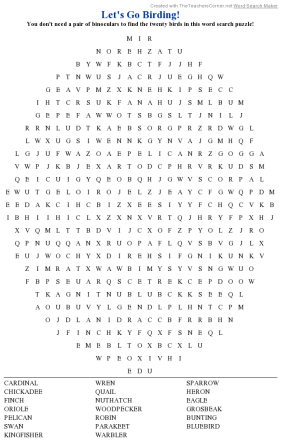
When you put up a bird feeder in your yard, you’ll see so many different types of birds come to visit! Find the names of twenty types of birds in this printable Let’s Go Birding! Word Search Puzzle.

Let’s Go Birding! Word Search Puzzle | Let’s Go Birding! Word Search Solution

Picture Book Review
February 21 – It’s National Bird-Feeding Month

celebrate-picture-books-picture-book-review-warbler-wave-cover

About the Holiday

Spring comes early for our feathered friends. You may have noticed more bird activity in the past few weeks as birds get ready to build nests and mate. February can be a tough month for these little creatures, though. In some places snow still covers the ground, and the spring blooms that offer nutrition haven’t sprouted yet. To remedy this situation, in 1994 John Porter read a resolution into the United States’ Congressional record recognizing February as National Bird-Feeding Month. One-third of the American population have backyard feeders that provide the sustenance birds need to survive. To celebrate, if you have feeders make sure they are well stocked. If you don’t have a feeder in your yard, consider hanging one. Enjoying the beauty and songs of birds is a day brightener!

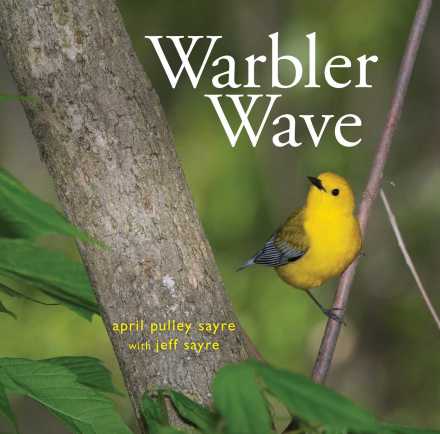
Warbler Wave

By April Pulley Sayre with Jeff Sayre


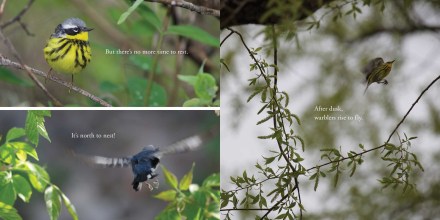
“In spring, as you nightly nap, / warblers flap / over oceans, lakes, / and mountains.” These tiny birds ride on streams of wind, navigating their way around buildings and towers and sharing space with bats, insects, and other birds. Then, nearly out of energy, they alight to rest and look for food.

celebrate-picture-books-picture-book-review-warbler-wave-wag-walk

Copyright April Pulley Sayre, 2018. Courtesy of simonandschuster.com

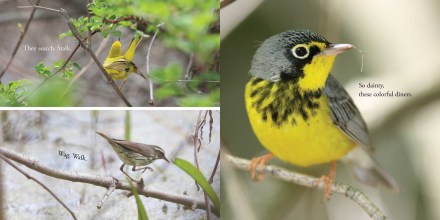
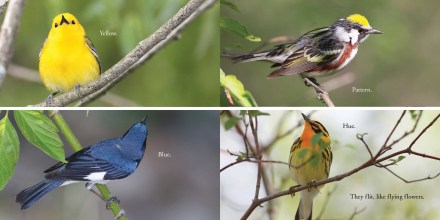
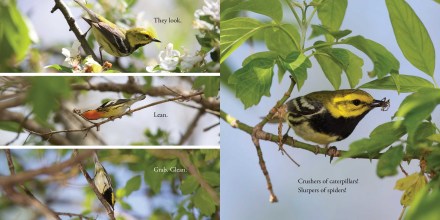
“They search. Stalk. / Wag. Walk. / So dainty, / these colorful diners.” They’re dots of color and intricate patterns among the leaves and “flit, like flying flowers.” They look and listen then dart to capture dinner. They are “crushers of caterpillars! / Slurpers of spiders!” Insects can hide from these clever hunters that know every nook and cranny to search.

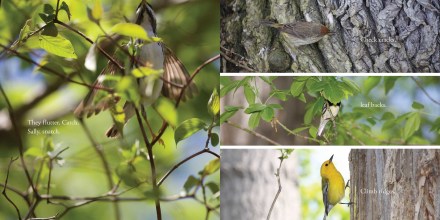
And they’re not above nabbing a snack that a spider has so carefully wrapped. After a meal, “warblers sing. / Preen. / Scan the local scene.” But then as soon as nighttime falls, they’re off again, with miles to go until they reach their nesting grounds. Like good friends, they keep in touch with each other in the darkness as they fly “Surfing rivers of wind way up high…calling zeep, zeep, zeep in the sky.”

celebrate-picture-books-picture-book-review-warbler-wave-colors-patterns

Copyright April Pulley, 2018. Courtesy of simonandschuster.com

Following the lyrical text, an extensive discussion of the “Migration Marathon” warblers take each spring reveals fascinating facts about the birds, their instinct to migrate, and why and how they migrate as well as the role of science in recording warbler migration. For instance, warblers weigh no more than a couple of baby carrots, yet they fly hundreds, sometimes thousands of miles from their winter homes in the southern hemisphere to their summer homes in the northern United States and Canada.

celebrate-picture-books-picture-book-review-warbler-wave-searching-trees

Copyright April Pulley Sayre, 2018. Courtesy of simonandschuster.com

Blackpoll warblers even undergo physical changes in preparation for their 4,000-mile journey taken three days at a time nonstop. And how do these tiny creatures find their way? They’re born with an innate knowledge of the direction they need to fly, and they navigate by the stars, the setting sun, and the earth’s magnetic field (which they may be able to see!). There’s much more to discover here, too, about the lovely warblers that may be flying through your area soon.

celebrate-picture-books-picture-book-review-warbler-wave-looking-for-bugs

Copyright April Pulley Sayre, 2018. Courtesy of simonandschuster.com

April Pulley Sayre’s poetic narrative of the astounding migration warblers undertake every year is as bright and spry as her little subjects. Staccato sentences echo the birds’ quick, sure movements and alertness to the sounds and motions around them while longer passages flow with the rhythm of the birds in flight, soaring to the next stopping place and taking off again for home.

celebrate-picture-books-picture-book-review-warbler-wave-taking-off-again

Copyright April Pulley Sayre, 2018. Courtesy of simonandschuster.com

Gorgeous photographs of a fiery horizon and rising moon that invite warblers to the air each night open the book and lead to lush, close-up views of a variety of warblers in their regal colors and patterns. Their sharp eyes, attentive expressions, and perky personalities are on full display in their native habitat. As dusk descends once more over sea and forest, the warblers take wing while birdwatchers wait to see them.

For children who are bird lovers and for families who have backyard feeders or enjoy taking bird-watching walks, as well as for classroom science and story times, Warbler Wave is a beautiful addition to home, classroom, school, and public library collections.

Ages 3 – 8 and up

Beach Lane Books, 2018 | ISBN 978-1481448291

To learn more about April Pulley Sayre her books, and her work, visit her website.

National Bird-Feeding Month Activity

celebrate-picture-books-picture-book-review-pine-cone-bird-feeder

Pine Cone Bird Feeder


You don’t need a fancy bird feeder to help out the birds in your backyard. With a pine cone, birdseed, and a bit of peanut butter, lard, or vegetable shortening, you can make feeders that birds will flock to!

Supplies

  • Item to Cover, such as a pine cone, conical ice-cream cone, piece of toast or stale bread, bagel, paper towel or toilet paper tube
  • Peanut butter, lard, or vegetable shortening
  • Bird seed
  • String or wire for hanging
  • Large bowl or container
  • Knife for spreading

Directions

  1. Attach the string or wire to the item to be covered
  2. Cover the item with peanut butter, lard, or vegetable shortening
  3. Pour birdseed into a large bowl or container
  4. Roll the covered item in the birdseed until well covered
  5. Hang your homemade bird feeder!

Picture Book Review

January 16 – Nothing Day

celebrate-picture-books-picture-book-review-on-a-magical-do-nothing-day-cover

About the Holiday

Newspaper columnist Harold Coffin established Nothing Day in 1973 to satirize the proliferation of daily holidays. His purpose was to give people a day to do absolutely nothing. Sounds good to me! Still, does celebrating this holiday constitute doing something? This may be the most baffling holiday on the calendar! Why not find something—or nothing—to do with today’s book?

On a Magical Do-Nothing Day

By Beatrice Alemagna


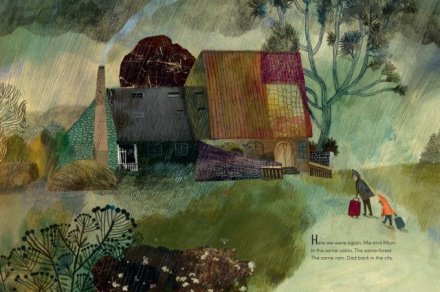
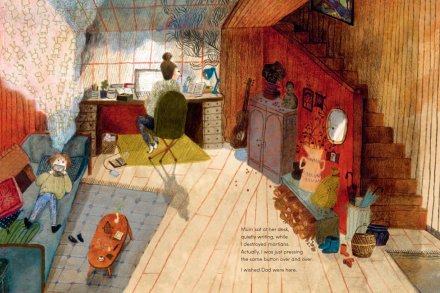
A little girl and her mom are “back again” at the cottage—even trudging up the walk in “the same rain”—while Dad is working back at home in the city. While Mom works at her computer, the girl destroys Martians, but she says, “Actually, I was just pressing the same button over and over.” She wishes that her dad were there.

celebrate-picture-books-picture-book-review-on-a-magical-do-nothing-day-cabin

Copyright Beatrice Alemanga, 2017, courtesy of HarperCollins.

Mom turns away from her writing and watches her daughter playing her video game. “Is this going to be another day of doing nothing?” she growls. Mom takes the device and hides it—“as usual”—and the little girl finds it—“as usual.” But this time she takes it outside. As the rain pelts down from gloomy skies it looked as if everything in the “garden was hiding from the sun.”

celebrate-picture-books-picture-book-review-on-a-magical-do-nothing-day-playing-video-games

Copyright Beatrice Alemanga, 2017, courtesy of HarperCollins.

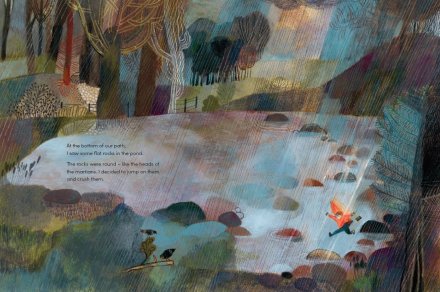
In the pond at the bottom of the hill she finds a line of flat stones. She hops from one to another, crushing them like the Martians in her game. While jumping, though, her game falls out of her pocket and into the pond. The water is so icy cold that she can’t grab it before it sinks out of sight. Oh no! she thinks, “Without my game, I have nothing to do.” The rain strikes her “like rocks,” and she feels “like a small tree trapped outside in a hurricane.”

celebrate-picture-books-picture-book-review-on-a-magical-do-nothing-day--jumping-on-rocks

Copyright Beatrice Alemanga, 2017, courtesy of HarperCollins.

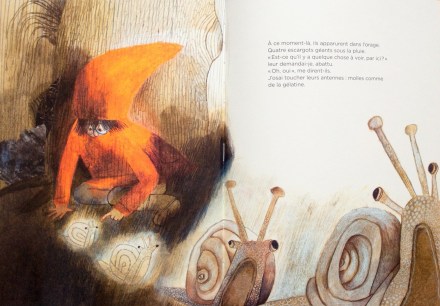
Just then she spies four giant snails slithering by. She asks them if there is anything to do around there, and they tell her yes. She gently feels one of the snail’s antennae. It is “as soft as jello” and makes her smile. She follows the snails and discovers a field filled with mushrooms. Their damp musky smell reminds her of her grandparents’ basement—her “cave of treasures.” She walks on and finds a spot in the earth where she digs her hand into the ground. She feels “thousands of seeds and pellets and kernals, grains and roots and berries touch “her fingers and hand.” When she looks up the sun is shining “through a giant strainer” and blinds her.

celebrate-picture-books-picture-book-review-on-a-magical-do-nothing-day-snails

Copyright Beatrice Alemanga, 2017, courtesy of beatricealemanga.com.

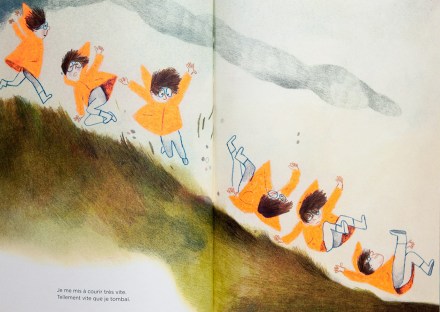
Her heart starts beating fast with energy. She takes off running and runs so quickly that she tumbles down the hill. She lands on her back with a flop, and when she opens her eyes, the world is topsy-turvy new. Energized, she climbs a tree and gazes out at the horizon, breaths deeply in the fresh air, drinks raindrops as they fall from a leaf, and notices bugs she’s never seen before. She talks to a bird, splashes in a puddle, and watches the world through stones as clear as glass.

celebrate-picture-books-picture-book-review-on-a-magical-do-nothing-day-tumbling

Copyright Beatrice Alemanga, 2017, courtesy of beatricealemanga.com.

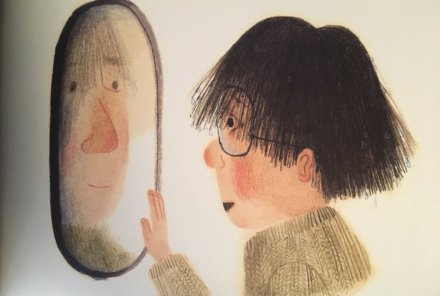
She hurries home and takes off her raincoat. When she glances in the mirror, for a moment she thinks she “sees her dad smiling at [her].” Her mom is still writing, but now she looks different to the little girl—“like one of the creatures outside.” Her mom notices how soaked she is and takes her to the kitchen to dry her off in a big, soft towel. The little girl feels like giving her mom a big hug. For a moment she wants to tell her about all the things she saw and did, but she doesn’t.

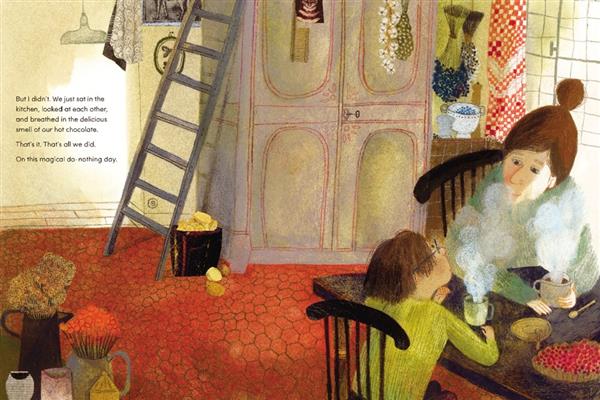
Instead, they enjoy their hot chocolate quietly together. “That’s it,” she says. “That’s all we did. On this magical do-nothing day.”

celebrate-picture-books-picture-book-review-on-a-magical-do-nothing-day-hot-chocolate

Copyright Beatrice Alemanga, 2017, courtesy of HarperCollins.

While the protagonist of A Magical Do-Nothing Day may never have looked at the world outside closely, Beatrice Alemagna certainly has. Alemagna’s exquisite illustrations portray the beauty of our environment—both indoors and out—and our connections to it with novel descriptions and stunning color and perspectives. As the girl ventures outside, video game clutched tightly, her face registers sadness and wariness. The Martians from the game crawl over and surround her, even when the game is off, seeming to fill any space that might be open to exploration, and, indeed, her first forays into the wild are taken game-style, hopping from platform to platform, rock to rock.

celebrate-picture-books-picture-book-review-on-a-magical-do-nothing-day-mirror

Copyright Beatrice Alemanga, 2017, courtesy of HarperCollins.

When the gaming device sinks into frigid water (as cold and impersonal as the gaming experience itself?), the child quickly comes out of her shell with the help of snails that lead her to greater discovery. The story gives readers much to ponder in the relationships between the child and parents and the child’s newfound appreciation for the natural world.

On a Magical Do-Nothing Day is a fantastic book to add to home and classroom libraries to spur children’s exploration—both in the natural world and within. While I used the feminine pronoun in my review, the story is told from the first person point of view and the child is drawn with gender neutral clothing and hairstyle, making this a book with universal appeal.

Ages 4 – 8

HarperCollins, 2017 | ISBN 978-0062657602

Discover more about Beatrice Alemanga, her books, and her art on her website.

Nothing Day Activity

celebrate-picture-books-picture-book-review-rainy-day-with-mushroom-and-cricket-coloring-pageNothing To Do Coloring Pages


Rainy days are perfect “do-nothing” days. The next time you have an indoor day, grab your crayons or colored pencils and enjoy these printable coloring pages

Splashing in the Rain Coloring Page | Cricket Hiding from the Rain Coloring Page

Picture Book Review
November 21 – National Entrepreneurs’ Day

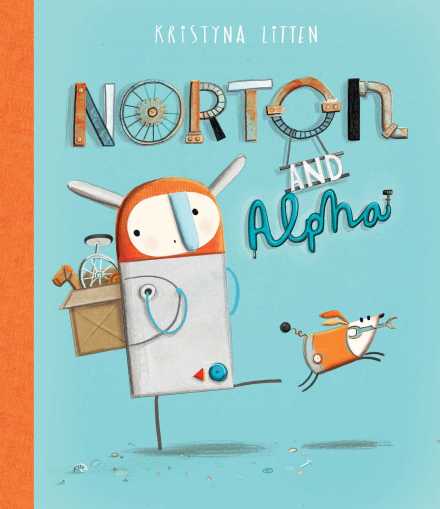
celebrate-picture-books-picture-book-review-norton-and-alpha-cover

About the Holiday

Instituted in 2010, today’s holiday celebrates the entrepreneurial spirit that is alive and well in so many people and that helps advance knowledge and technology, solve problems, and make life better. The third Tuesday of November has been set aside to honor those thinkers and inventors of the past as well as to encourage those now working to see their ideas come to fruition. With their supple minds and unique way of looking at the world, children are natural entrepreneurs, as today’s book shows!

Norton and Alpha

By Kristyna Litten


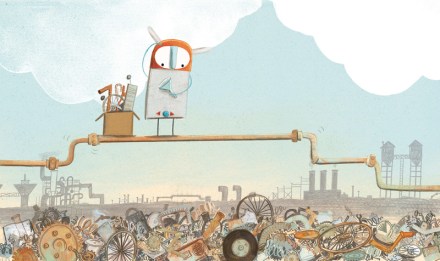
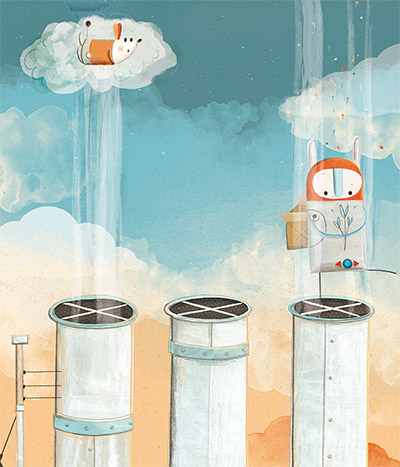
Norton was a very particular kind of collector. He loved finding the kinds of things most people threw away. “Battered wheels, rusty cogs, broken springs…and best of all were the things Norton didn’t have a name for.” Nearly everywhere he went, Norton found useful things. He took them all home and “made the most amazing inventions.”
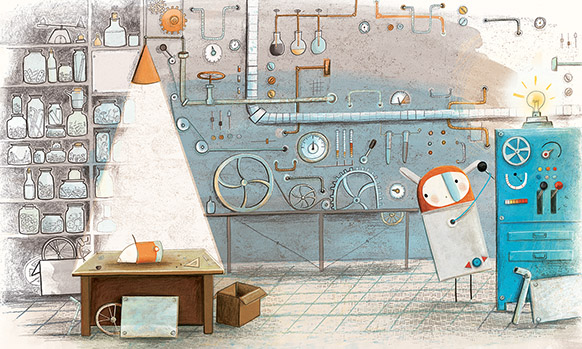
celebrate-picture-books-picture-book-review-norton-and-alpha-lab

Copyright Kristyna Litten, 2017, courtesy of Sterling Children’s Books.

One day Norton found a little springy thing that he added “to his latest project.” It was the perfect final touch, and Norton named his invention Alpha. Alpha accompanied Norton on all of his hunts, following “his little robot nose down unknown paths.” He was small enough to get into all those places Norton couldn’t reach—ones where amazing items lurked.

celebrate-picture-books-picture-book-review-norton-and-alpha-collecting-things

Copyright Kristyna Litten, 2017, courtesy of Sterling Children’s Books.

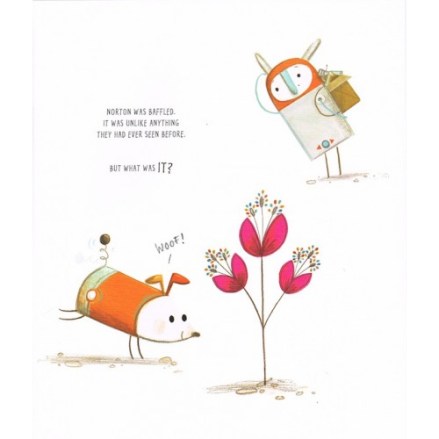
One day “Alpha’s nose felt slightly odd. It tickled and tingled and led him to something very unusual.” Norton had no idea what it was, but he took it along home. In his workshop he tested it in all of his usual ways, but this object didn’t react in any way familiar. In fact, the longer Norton had it, the less useful it appeared to be until Norton finally threw it out the window. As it fell it scattered bits of itself all over the ground.

celebrate-picture-books-picture-book-review-norton-and-alpha-finding-flower

Copyright Kristyna Litten, 2017, courtesy of Sterling Children’s Books.

As Norton and Alpha cleaned up, “they found a little round something their mysterious discovery had left behind.” Norton placed it in a jar just in case. The next day rain kept Norton and Alpha indoors, and the next day after that it was too hot to go out. Friday turned out to be just right, so Norton “oiled their joints and got everything ready for a long day’s collecting.”

celebrate-picture-books-picture-book-review-norton-and-alpha-flower-thrown-out

Copyright Kristyna Litten, 2017, courtesy of Sterling Children’s Books.

When they opened the doors they were greeted by the most beautiful, colorful sight. Norton and Alpha ran and played in the field and collected samples of all “the blue, pink, and orange things.” At home Norton didn’t experiment on them or even try to figure out what they were. Instead, he just used them to decorate his shelves, pipes, boxes, and bins because they “made him smile.”

celebrate-picture-books-picture-book-review-norton-and-alpha-playing-in-field

Copyright Kristyna Litten, 2017, courtesy of Sterling Children’s Books.

Kristyna Litten’s inventive story of a little robot who loves to tinker and collect odd objects and his constant companion, Alpha, will charm children who are always intrigued by the unknown and ready to incorporate found objects into their world. The idea that industrious efforts can coexist with the simple enjoyment of the earth’s beauty may inspire kids and adults to also appreciate those special “found moments” that can bring much happiness to life.

celebrate-picture-books-picture-book-review-norton-and-alpha-going-down-pipe

Copyright Kristyna Litten, 2017, courtesy of Sterling Children’s Books.

Litten’s Norton and Alpha are adorable friends, inviting little readers into their lab, where kids will love lingering over the gears, dials, machines, and shelves stacked with recognizable springs, tacks, nails, washers, hooks, hinges and other items. Readers will “Ooh!” and “Ahh!” when Norton and Alpha open their doors—accomplished through a marvelous double gate-fold spread—and the once-bleak landscape has been transformed into a gorgeous field by the flowers Norton has helped to grow. Children will also enjoy following what happens to the little seed Norton has saved as it is watered by an undetected leak in a nearby bottle and germinated on that very hot day.

With its cute illustrations and inspiring story, Norton and Alpha would be a much-asked-for book on any child’s home bookshelf and a terrific lead-in to inventive classroom playtimes or units.

Ages 4 and up

Sterling Children’s Books, 2017 | ISBN 978-1454924999

Discover more about Kristyna Litten, her art, and her books on her blog.

National Entrepreneur’s Day Activity

celebrate-picture-books-picture-book-review-inventor's-box

Inventor’s Box


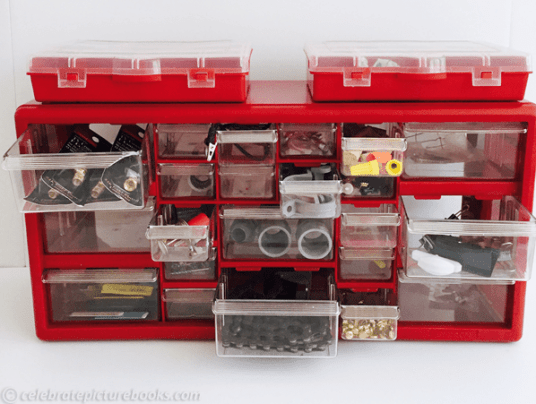
For young inventors or tinkerers, having bits and pieces and some tools to work with all stored in one place encourages creative thinking. Filling the drawers of a tool case, a tool box, or a tackle box with items like springs, brads, wheels, hinges, plastic piping, pieces of wood, glue, tape, and simple tools can spark a child’s imagination. Take your child along to the craft or hardware store and choose items together!

Picture Book Review