June 5 – World Environment Day

About the Holiday

Sponsored by the United Nations, World Environment Day encourages worldwide awareness and action for the protection of the environment. Each year a different country hosts the day’s events. This year the Republic of Korea has been chosen as the host country, with a focus on ending plastic pollution globally. Ridding the planet of plastic pollution is an important contribution to achieving the Sustainable Development Goals adopted by the United Nations, including those on climate action, sustainable production and consumption, protection of seas and oceans and repairing ecosystems and retaining biodiversity. Everyone is needed to make a difference. You can learn more about World Environment Day, the 400 million tons of plastic produced each year (200 tons of which is single-use) and the dangers of microplastics throughout the environment, as well as the UN Decade on Ecosystem Restoration and how you can join the #GenerationRestoration movement on the UN World Environment Day website.

Thank you to Phaidon Press for sharing this book with me for review!

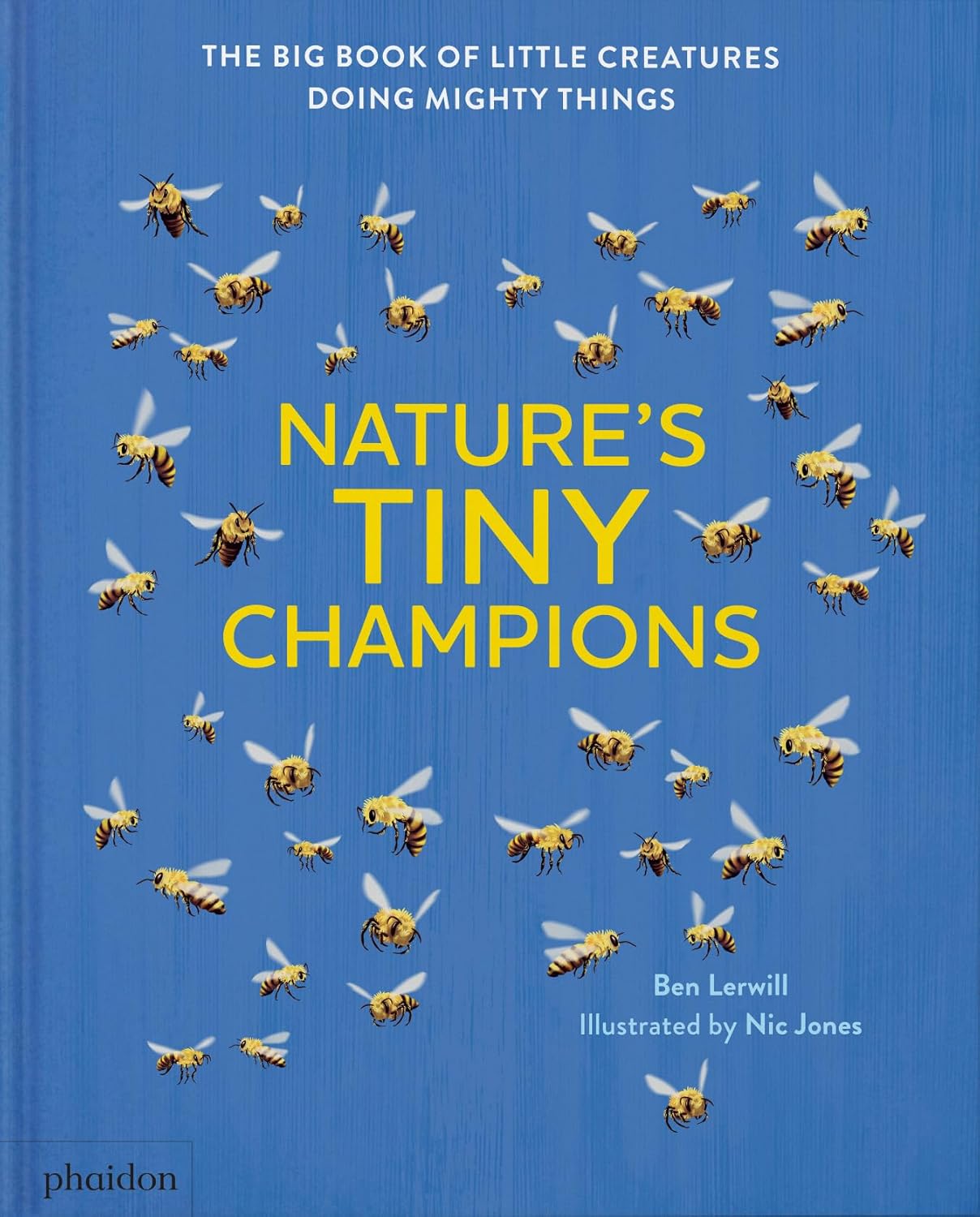
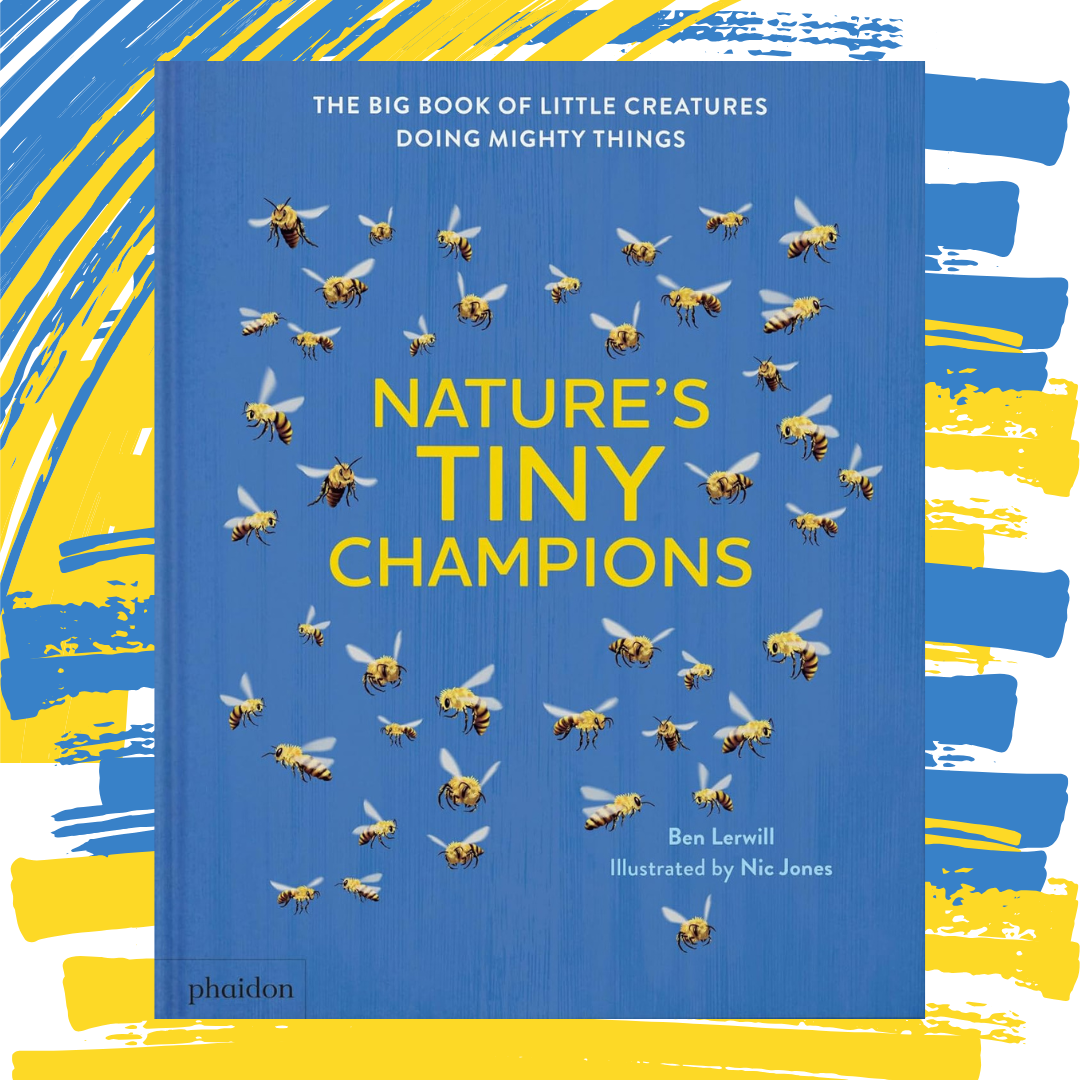
Nature’s Tiny Champions: The Big Book of Little Creatures Doing Mighty Things

Written by Ben Lerwill | Illustrated by Nic Jones


If you are awed by nature then you might know that “there are at least two million animal species on planet Earth.” But were you aware that some scientists believe the number might be more than eight million? So where are they? Well, all around—they’re just not easy to see. As Ben Lerwill reveals, “almost all of them are small enough to fit in the palm of your hand.” In fact, most could “sit on the tip of your little finger, and some are so impossibly minuscule that a whole herd of them could be hiding on the period at the end of this sentence.”

Illustration © 2025 by Nic Jones, text copyright © 2025 by Ben Lerwill.

So should we be thinking out of sight, out of mind? Absolutely not! And Nature’s Tiny Champions is here with detailed profiles of 20 phenomenal creatures to show you what an enormous impact itty-bitty animals make, plus back matter that presents short, illustrated entries on 21 more tiny champions of the air, land, and sea. Ready to dive in? Let’s go!

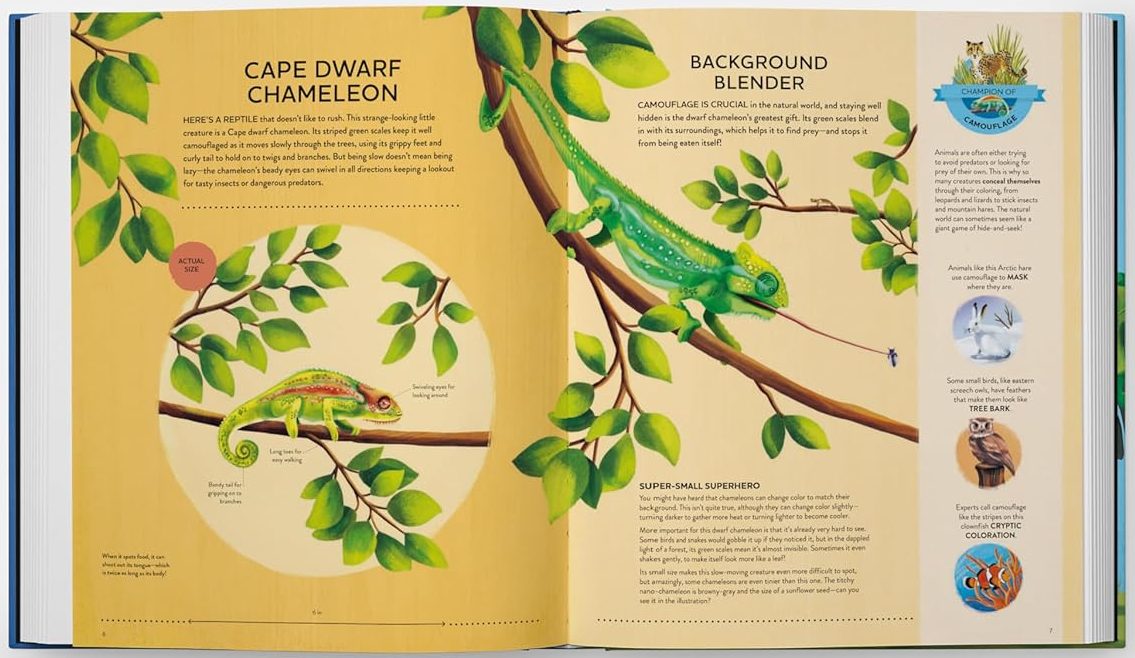
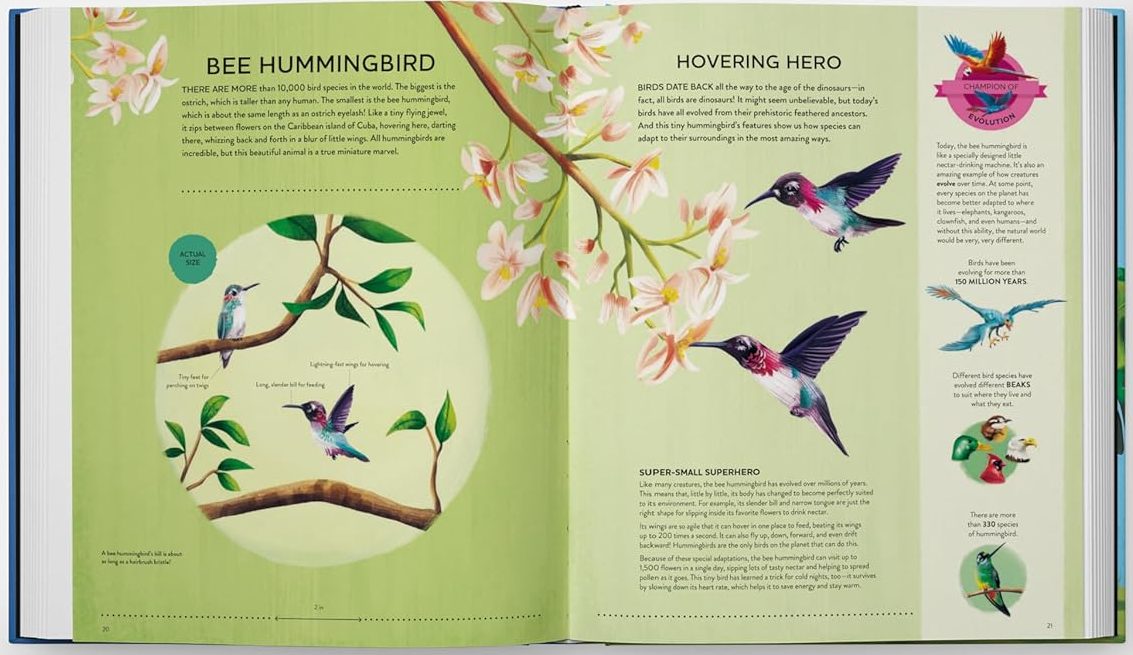
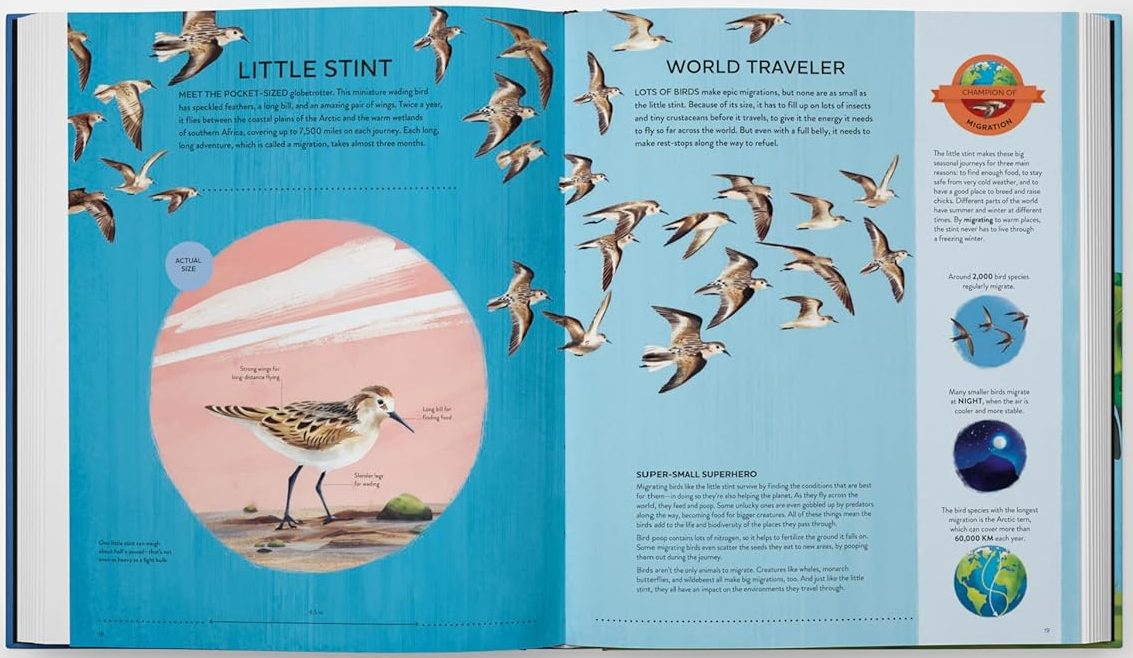
Each two-page spread in this cleverly designed oversized book introduces readers to an animal through Ben Lerwill’s easy-going, conversational description of the primary trait that makes it a champion, an often mind-boggling discussion of its crucial contribution to its ecosystem, and a sidebar containing even more memorable facts about natural phenomena such as camouflage, prey species, migration, metamorphosis, teamwork, survival, keystone species, indicator species, self-defense, and more.

Illustration © 2025 by Nic Jones, text copyright © 2025 by Ben Lerwill.

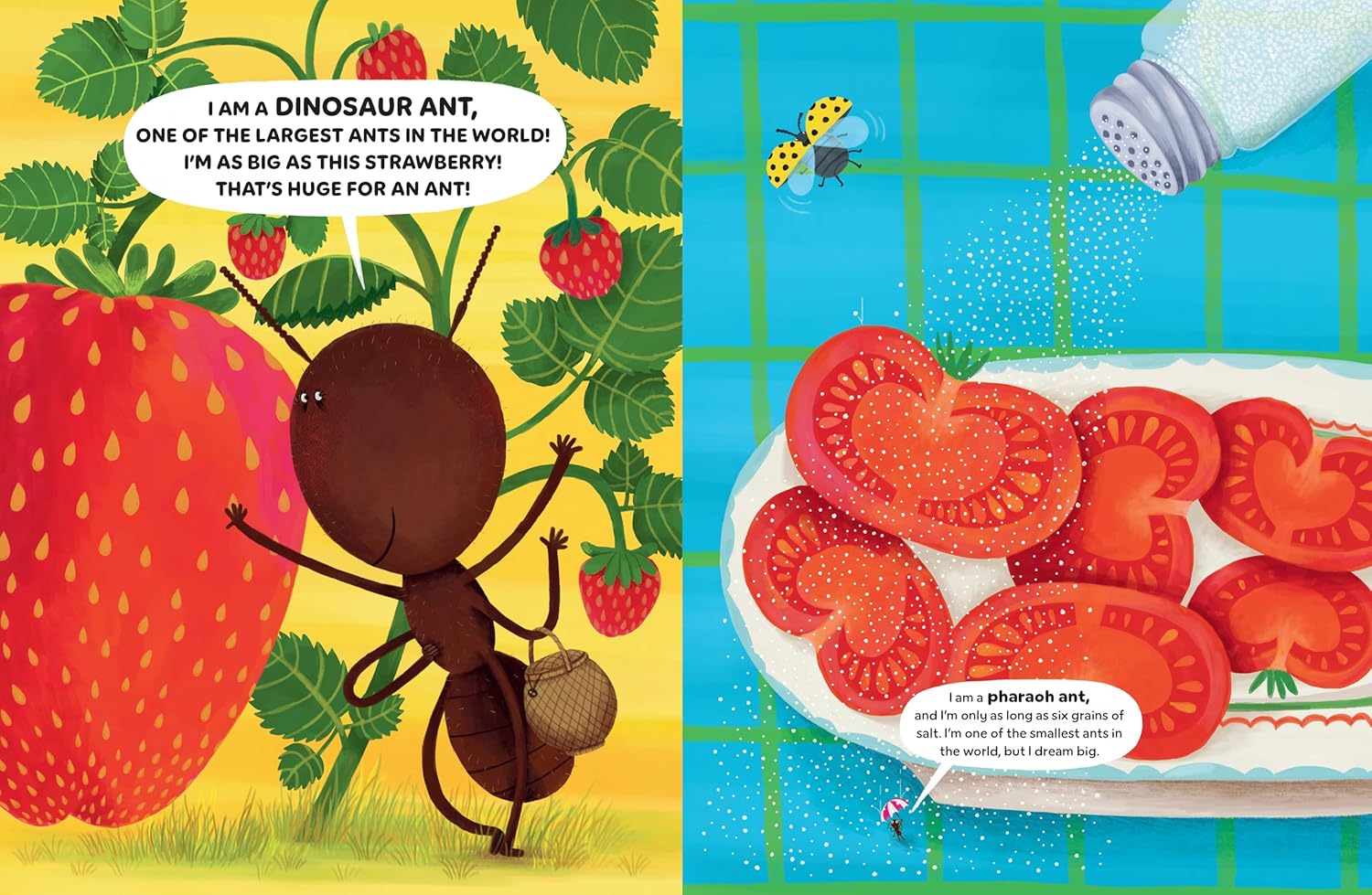
Each page spread stuns with Nic Jones’ vivid and gorgeously realistic illustrations that set each tiny creature in its natural habitat. Actual-size renderings of each animal is a highlight and are sure to spark plenty of “oh my gosh!” and “it’s so cute!” reactions. These images also allow kids to learn about how the animal is perfectly suited to its environment. Kids will enjoy comparing each animal to the size of their hand, finger, or even—in the case of the water bear—a grain of sugar. Where the animal is too small to see and be labeled clearly in its natural size, the image is expanded and labeled with the scale of magnification. 

Ready for a few examples of what readers will learn? Get this:

  • “The tiger piston shrimp is only the size of a french fry, but when it snaps its claw, the noise is louder than a gunshot!
  • “Leafcutter ants can carry 50 times their own weight. That’s like you carrying an RV—with your teeth!
  • A water bear “can go for 30 years without food or water,” it can survive temperatures as cold as -454ºF and as hot as 302ºF, and it has “even stayed alive after being blasted into outer space.”

Illustration © 2025 by Nic Jones, text copyright © 2025 by Ben Lerwill.

For budding zoologists, entomologists, and nature lovers at home and in the classroom, Nature’s Tiny Champions: The Big Book of Little Creatures Doing Mighty Things is a fascinating sure winner that will keep kids enthralled, watching out for the tiny creatures in their own area, and eager to learn more. The book’s impressive  would make a much-appreciated gift. It is highly recommended for home bookshelves and is a book librarians will be thrilled to display and recommend.  

Ages 6 – 9+

Phaidon Press, 2025 | ISBN 978-1838669973

About the Author

Ben Lerwill is a multi-award-winning children’s author and freelance writer who has written for over 50 publications, including National Geographic Traveller, The Sunday Times, and BBC Travel. Previous recognition for his books includes a Wainwright Prize for Children’s Nature Writing shortlist, a National Geographic Kids’ Magazine ‘Book of the Month’ and a Junior Library Guild Gold Standard Selection. Visit him at benlerwill.com.

About the Illustrator

Nic Jones has been a professional illustrator for nearly 5 years. Previous works include Earth Clock: The History of Our Planet in 24 Hours, and Above and Below: Dusk til Dawn.

World Environment Day Activity

Environment Word Search Puzzle


Find the words about our environment and protecting it’s resources in this puzzle! 

Environment Word Search Puzzle | Environment Word Search Puzzle Answer Key

You can purchase Nature’s Tiny Champions: The Big Book of Little Creatures Doing Mighty Things from these booksellers

Amazon | Barnes & Noble | Bookshop

Picture Book Review

April 23 – National Picnic Day

About the Holiday

It’s said that food always tastes better when eaten outdoors. If you’re having warm early spring weather today, why not test that theory, by packing a basket or cooler and heading out to your favorite outdoor spot! Whether simple or elegant, enjoyed alone or with family or friends, a picnic can be just the respite you need from the routine workweek. The word “picnic” probably gets its origins from the French language, specifically from the word pique-nique: (to pick) + (small thing or trifle). It’s thought that picnics became popular in France after the French Revolution in the mid 1800s and the idea then spread around the world. If you just can’t get away or the weather isn’t cooperating, the month of June hosts National Picnic Day with International Picnic Day celebrated on June 18.

Thank you to Tundra Books for sharing a copy of this book with me!

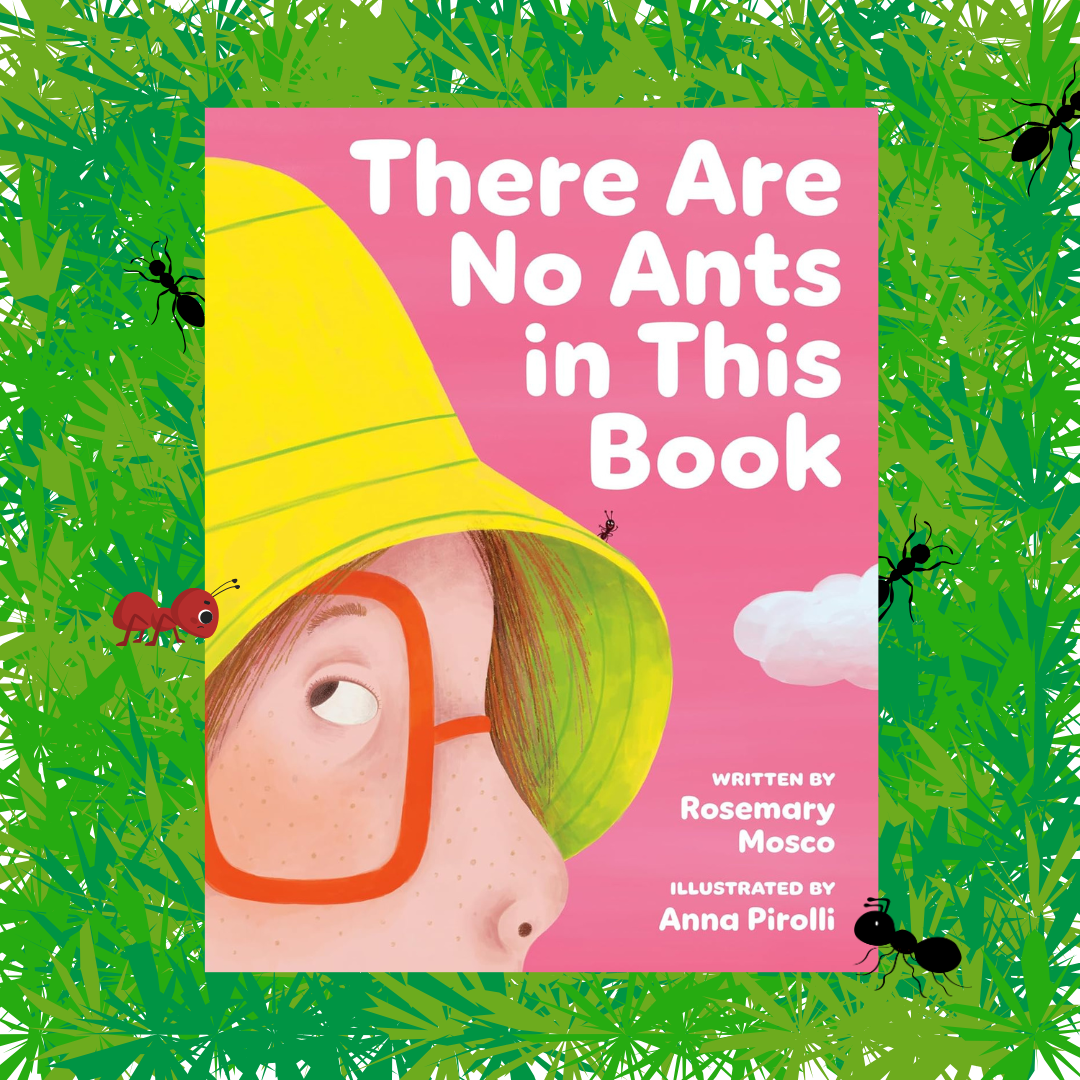
There Are No Ants in This Book

Written by Rosemary Mosco | Illustrated by Anna Pirolli


A child, picnic basket and tote in hand peeks in from the top-left corner of the first page to find a green field just perfect for a picnic. The child is pretty confident they won’t be disturbed by pesky pests purloining food because it says right on the cover that “there are no ants in this book.” But just as the cake is being placed on the blanket, word comes from nearby: “Wrong! There’s one!” Turns out that acorn lying only inches from the picnic cloth is actually the abode of an acorn ant.

Illustration © 2025 by Anna Pirolli, text © 2025 by Rosemary Mosco. Courtesy of Tundra Books.

The child can make an exception for just one ant, but then, out of the clear blue sky, comes “Two!” and “Three!” These two reveal that they are opposites of a sort. Number “two” is “one of the largest ants in the world” and as big as a strawberry. Number “three” is the smallest—”as long as six grains of salt.”

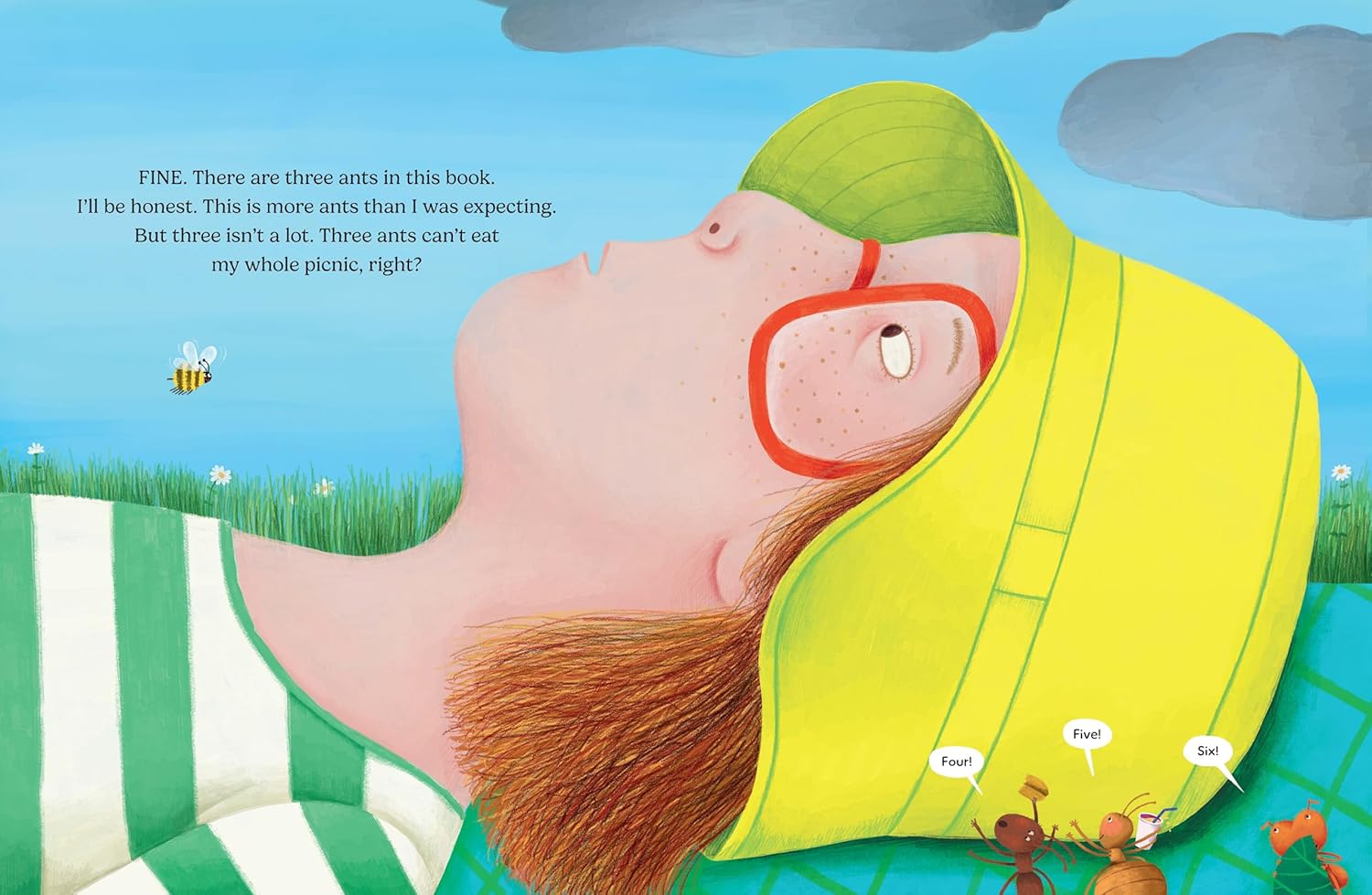
The child is just wrapping their head around this book having “. . . more ants than I was expecting” and figuring “three ants can’t eat my whole picnic, right?” when three more show up, including a honeypot ant that explains, “I fill my big round butt with sweet sugar water . . . in case my family gets hungry” then declares, “I am a walking refrigerator.

Illustration © 2025 by Anna Pirolli, text © 2025 by Rosemary Mosco. Courtesy of Tundra Books.

Kinda freaked out to meet these six interlopers, the child goes into full “ARRRGH!” mode when four more ants drop by. And who can blame them? The book had such promise at the beginning. But now . . . Yeah. Butt! Two of these new ants have positively particular posterior powers! One lives in trees and uses their butt as a kind of nature-made Siri to guide them home, and the other, an acrobat ant, explains “If someone scares me, I stick my butt high up in the air and wave it around.” The third is a clever crafter, and the fourth uses his head (literally) to defend his home.

The child is “shocked.” “Stunned.” Delighted! And invites these ants as well as their “humungous families” to the picnic. But all these tiny pounding feet attract the attention of an anteater. The child, though, does some quick thinking and then points out that the title of the book clearly states, “there are no ants in this book,” which sends the anteater packing. And now? It’s time for the perfect picnic!

Back matter presents realistic illustrations of each of the ten ants found in the book with a bite-sized paragraph revealing what part of the world the ant is native too as well as more about the feature that makes it unique.

Illustration © 2025 by Anna Pirolli, text © 2025 by Rosemary Mosco. Courtesy of Tundra Books.

In her funny and fast-paced tribute to ants, Rosemary Mosco proves that even the smallest creatures have enormous appeal. As each ant makes an appearance to proudly describe its distinct capability or feature, Mosco’s conversational, easy-to-digest writing style makes it simple for kids to remember the prominent details. Kids will also identify with the narrator, who humorously cycles from certainty in the promise of the title to disillusionment to acceptance to all-out appreciation for these tiny critters. 

Vibrant and loaded with personality, Anna Pirolli’s cartoon, graphic-style illustrations use perspective, natural surroundings, and emotive facial expressions to immerse kids in this rollicking educational experience.

If you like a dose of laughter with your science, There Are No Ants in This Book is the ant-idote you’ve been looking for. A perfect addition to any classroom, homeschool, or science educator’s collection, the book will also be an often-asked-for favorite for home story times.

Ages 4 – 8

Tundra Books, 2024 | ISBN 978-1774881163

About the Author

Rosemary Mosco makes books and cartoons that connect people with the natural world. Her nature comics won the National Cartoonist Society’s award for Best Online Short Form Comic and were the subject of an award-winning museum exhibit. She co-wrote the New York Times bestseller The Atlas Obscura Explorer’s Guide for the World’s Most Adventurous Kid, and is the author of the picture books Butterflies Are Pretty . . . Gross! and Flowers Are Pretty . . . Weird! illustrated by Jacob Souva, as well as five other science books. She speaks at birding festivals and looks for cool critters under every rock she can find. Rosemary lives in Massachusetts.

About the Illustrator

Anna Pirolli was born in Genoa and moved to Milan to study illustration at the European Institute of Design. She has worked as a freelance illustrator and art director for companies such as Mondadori, Pearson, Vogue, MTV, Kinder Ferrero, Nickelodeon, Disney and others, following the creative process from concept to creation. She’s also a visiting professor at the Accademia di Brera, where she teaches design applied to the arts. Anna has illustrated the picture books I Hate My Cats: A Love Story by Davide Cali and Anonymouse by Vikki VanSickle, which won the Dilys Evans Founder’s Award at the 2021 Society of Illustrators Original Art Show.

National Picnic Day Activity

A Perfect Day for a Picnic! Maze


Can you lead the ants to the picnic in this printable A Perfect Day for a Picnic! maze?

You can purchase There Are No Ants in This Book from these booksellers

Amazon | Barnes & Noble | Bookshop (discounted books and support for your local independent bookstore)

Picture Book Review

July 2 – World Firefly Day

celebrate-picture-books-picture-book-review-light-the-sky-firefly-cover

About the Holiday

World Firefly Day was instituted by Fireflyers International Network to raise awareness of these summer-night beauties and the dangers to their survival, including habitat destruction, pesticides, light pollution, and over-collection. More and more, as fields and marshlands are paved over for building and waterways open up to recreation, the fireflies that call these places home are disappearing. This year’s theme is “Let’s stay together in the challenging world” and encourages everyone to learn how to “live in harmony” with fireflies. To learn more about fireflies, how you can make your garden or lawn firefly friendly, and more, visit Firefly Conservation & Research.

Light the Sky, Firefly!

Written by Sheri Mabry Bestor | Illustrated by Jonny Lambert


When fireflies begin dotting the summer night sky with light, it may seem like they’ve magically appeared out of nowhere. But as Sheri Mabry Bestor eloquently reveals, these beautiful insects have been lurking and luminescing for a long time. How long? Well, would you believe a full year? As summer rains dampen the earth, a firefly lays her eggs (up to 500!) under brush or fallen leaves. “Under the leaves, the eggs lay still. For the baby fireflies inside the shells, it is time to grow. And begin to glow.”

celebrate-picture-books-picture-book-review-light-the-sky-firefly-laying-eggs

Image copyright Jonny Lambert, 2022, text copyright Sheri Mabry Bestor, 2022. Courtesy of Sleeping Bear Press.

The larvae hatch after a month, and then they begin to eat, eat, eat. Slugs and snails are on the menu and, as a paragraph of scientific information about the firefly’s nighttime dining discloses, “instead of fighting their prey, the larvae bite and then inject the prey with a liquid that keeps it from moving to get away.” All through the rest of summer and fall, the baby fireflies grow. During the winter, the larvae undergo many transformations, growing and outgrowing a series of casings.

celebrate-picture-books-picture-book-review-light-the-sky-firefly-launch

Image copyright Jonny Lambert, 2022, text copyright Sheri Mabry Bestor, 2022. Courtesy of Sleeping Bear Press.

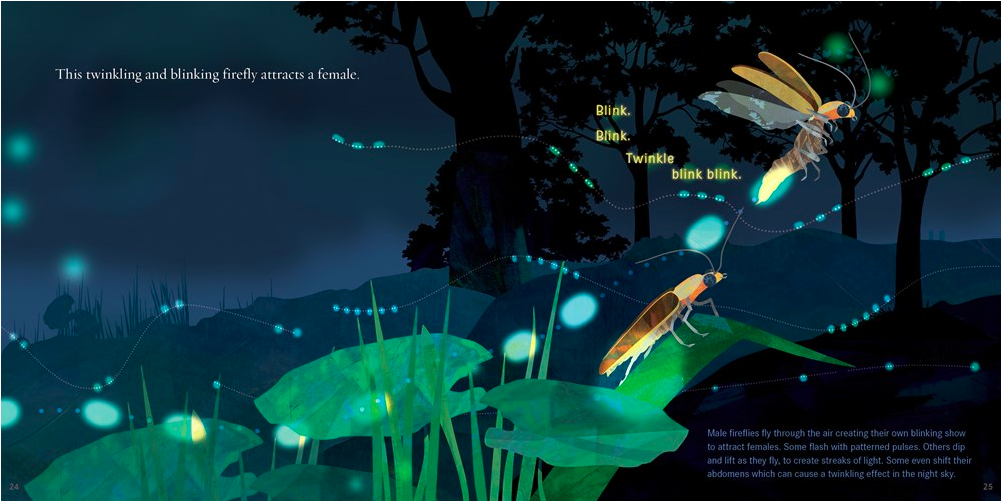
It isn’t until late spring when the larvae are ready to become an adult. When they are ready, they emerge from their mud nest. Then, while the sun is high, they stay low to the ground. But “when the sun begins to set, they begin to climb higher. And when the sky turns black, fireflies launch!” Then “the sky is filled with flashing fireflies. They twinkle like faraway stars.”

celebrate-picture-books-picture-book-review-light-the-sky-firefly-blink-blink

Image copyright Jonny Lambert, 2022, text copyright Sheri Mabry Bestor, 2022. Courtesy of Sleeping Bear Press.

Still, the darkness of night doesn’t protect them from predators, so fireflies always have to be on the alert. If they are caught, fireflies have a bitter surprise for the hungry critter. And what about those “blink, blinks” that we all marvel at? Those signals aren’t random. As Sheri Mabry Bestor explains, “Fireflies blink with specific rhythms called ‘flash patterns,’ and each species has its own. This helps them communicate with each other.” Not only does that luminescent chemical help fireflies, Bestor describes ways in which scientists and doctors are studying it in hopes of helping people.

“In time, the females are ready to lay their eggs. Pitter-patter, drizzle-drip. Summer rain cools the earth. Bees buzz. Birds glide. A firefly finds a place under the leaves that blanket the ground.” The eggs hide, waiting until next summer when it’s their turn to shine.

celebrate-picture-books-picture-book-review-light-the-sky-firefly-summer-again

Image copyright Jonny Lambert, 2022, text copyright Sheri Mabry Bestor, 2022. Courtesy of Sleeping Bear Press.

Sheri Mabry Bestor’s lovely, poetic story of the lifecycle of fireflies is a beautiful read aloud for summer nights or for whenever you and your kids are missing the simple pleasures of summer. While the story plays out from page to page in flowing and sometimes vibrant text, scientific facts about these insects, their transformations, homes, anatomy, protection, and, of course, their bright and glowing communication skills are tucked in the corner waiting to be discovered and explored. Bestor’s rhythmical cadence also highlights the seasonal changes that accompany a fireflies’ growth and the cyclical wonder of nature.

Jonny Lambert’s stunning textured collage-style illustrations portray all the beauty of these unique insects and the landscape they inhabit. Mottled greens and yellows give depth to lush leaves, opaline snail shells catch the light above as the curious snail discovers the glowing eggs below, and delicate spring flowers camouflage the mud nests where the larvae are transforming into adults. The nighttime scenes are breathtaking with deep blue skies, a canvas for the pin pricks of light that create summer’s most spectacular show. Both realistic and dreamlike, these nighttime pages will have kids and adults scurrying outside to watch and be a part of it.

A gorgeous book to celebrate the exquisite charm of fireflies as well as to impart natural science facts, Light the Sky, Firefly is highly recommended for home, school, and public library bookshelves.

Ages 4 – 8

Sleeping Bear Press, 2022 | ISBN 978-1534111158

Discover more about Sheri Mabry Bestor and her books on her website.

You can connect with Jonny Lambert on Twitter.

World Firefly Day Activity

celebrate-picture-books-picture-book-review-firefly-maze

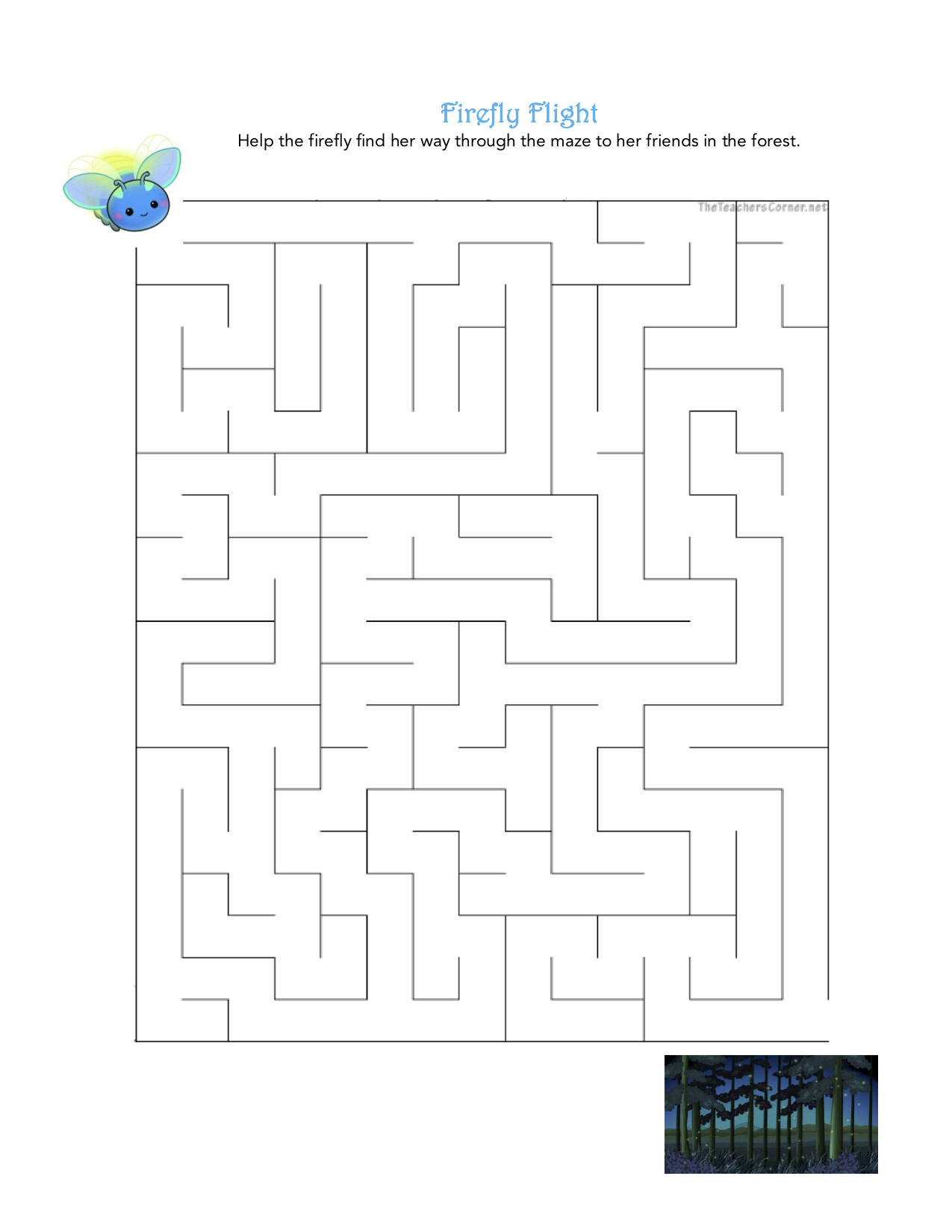
Firefly Flight Maze


This little firefly wants to join her friends in the forest. Can you help her through the maze to find them in this printable maze?

Firefly Flight Maze Puzzle | Firefly Flight Mage Solution

celebrate-picture-books-picture-book-review-light-the-sky-firefly-cover

You can find Light the Sky, Firefly! at these booksellers

Amazon | Barnes & Noble | Books-a-Million

To support your local independent bookstore, order from

Bookshop | IndieBound

Picture Book Review

May 3 – Celebrating National Lumpy Rug Day with Author Sophia Gholz

celebrate-picture-books-picture-book-review-bug-on-the-rug-coverAbout the Holiday

Today’s holiday, in addition to having a humorous and whimsical bent to it, promotes some thoughtful consideration of two rug-related ideas. The onset of spring often inspires people to do some deep cleaning around the house, and that, according to the holiday, should include rugs – that cushy decor that can define a room or provide an impromptu place for pets to nap. As they age, though, rugs and carpets can develop lumps and bulges that compromise the safety and appearance of your home or office. If that’s the case at your house, a steam clean, day in the sun, or re-rolling may restore your rug to its original beauty. But National Lumpy Rug day isn’t all about outward appearance. The holiday also touches on that common practice of “brushing things under the rug” and encourages people to air any complaints, feelings, or topics that they have been avoiding. Making a full sweep of any problems underfoot is a great way to start the spring season, and sharing today’s book with your kids is a hilarious way to celebrate.

Hi Sophia! I’m thrilled to have you visit to talk about your latest book, Bug on the Rug, its endearing characters, inspirational message, and how the story changed from its initial idea. I also love your tips on how adults can use your book to foster discussion and awareness of those misunderstandings that can adversely affect friendships.

Sophia Gholz - headshot

Sophia Gholz is an award-winning children’s book author, magic seeker and avid reader. Sophia enjoys writing fiction with humor and heart. When writing nonfiction, she pulls on her love of science and her strong family background in ecology. When she’s not writing, you can find Sophia reading a book, visiting schools or exploring the great outdoors with her family.

Sophia’s debut book, The Boy Who Grew a Forest: The True Story of Jadav Payeng, was a NCSS Notable Social Studies Trade Book, a Florida State Book Award Gold Medalist, Eureka! Nonfiction Honor Book and a 2020 Green Earth Honor Book. She is also the author of Jack Horner, Dinosaur Hunter! You can connect with Sophia on her Website | Facebook | Instagram | Twitter | YouTube

Bug on the Rug

Written by Sophia Gholz | Illustrated by Susan Batori


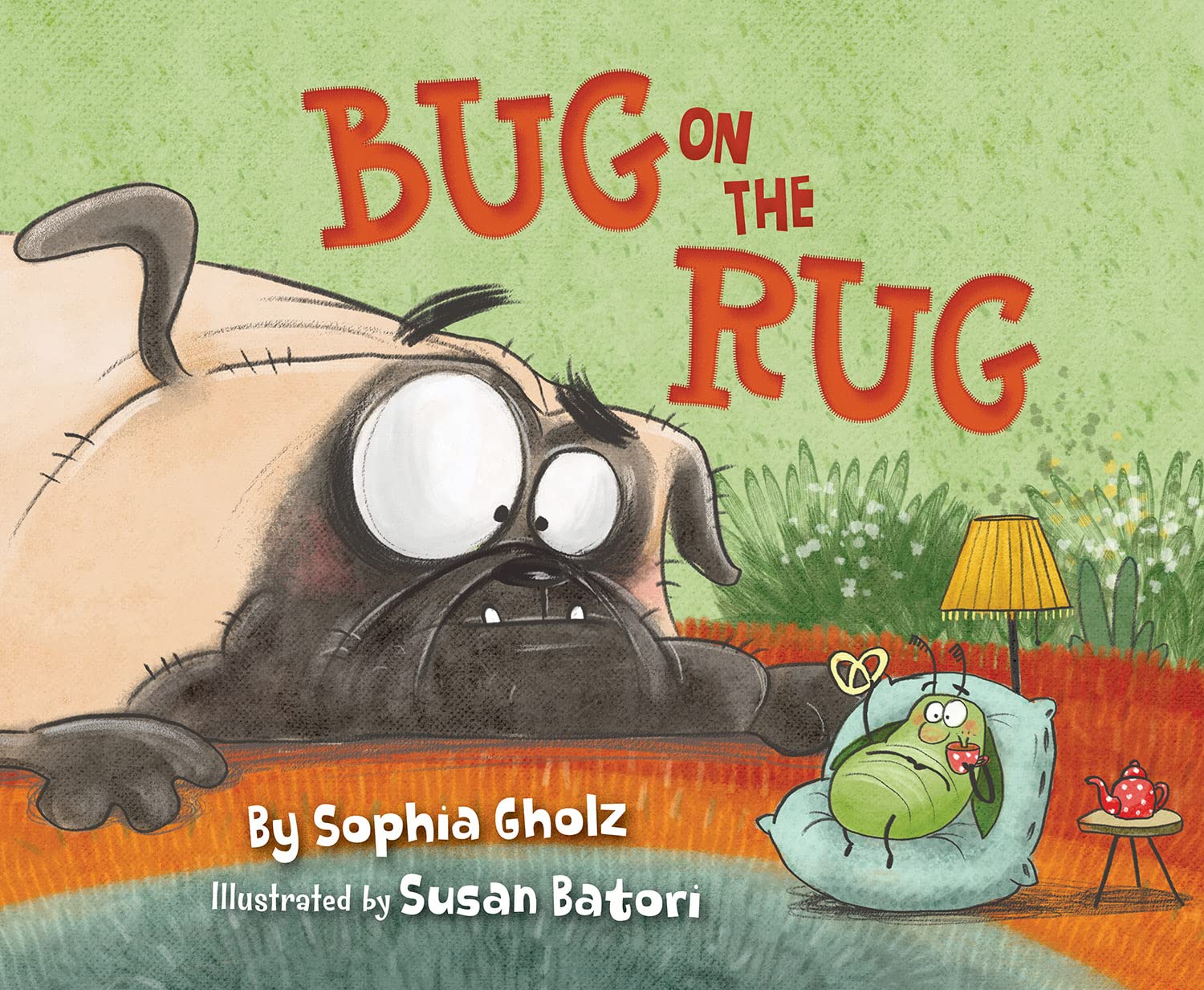
Picture books are entire worlds and stories wrapped in a few hundred words. They share a mood, a lesson, a hug, a friend, a culture, an adventure. I’ve said it before, and I’ll say it again now: picture books are magic. That is why I am so excited to be here at one of my favorite blogs, Celebrate Picture Books, to share my newest book, Bug on the Rug. And today is the perfect day because it also happens to be National Lumpy Rug Day! Hooray! Did I mention that Bug on the Rug features a verrrry cozy rug? So cozy, in fact, it causes quite a stir.

celebrate-picture-books-picture-book-review-bug-on-the-rug-pug

Image copyright Susan Batori, 2022, text copyright Sophia Gholz, 2022. Courtesy of Sleeping Bear Press.

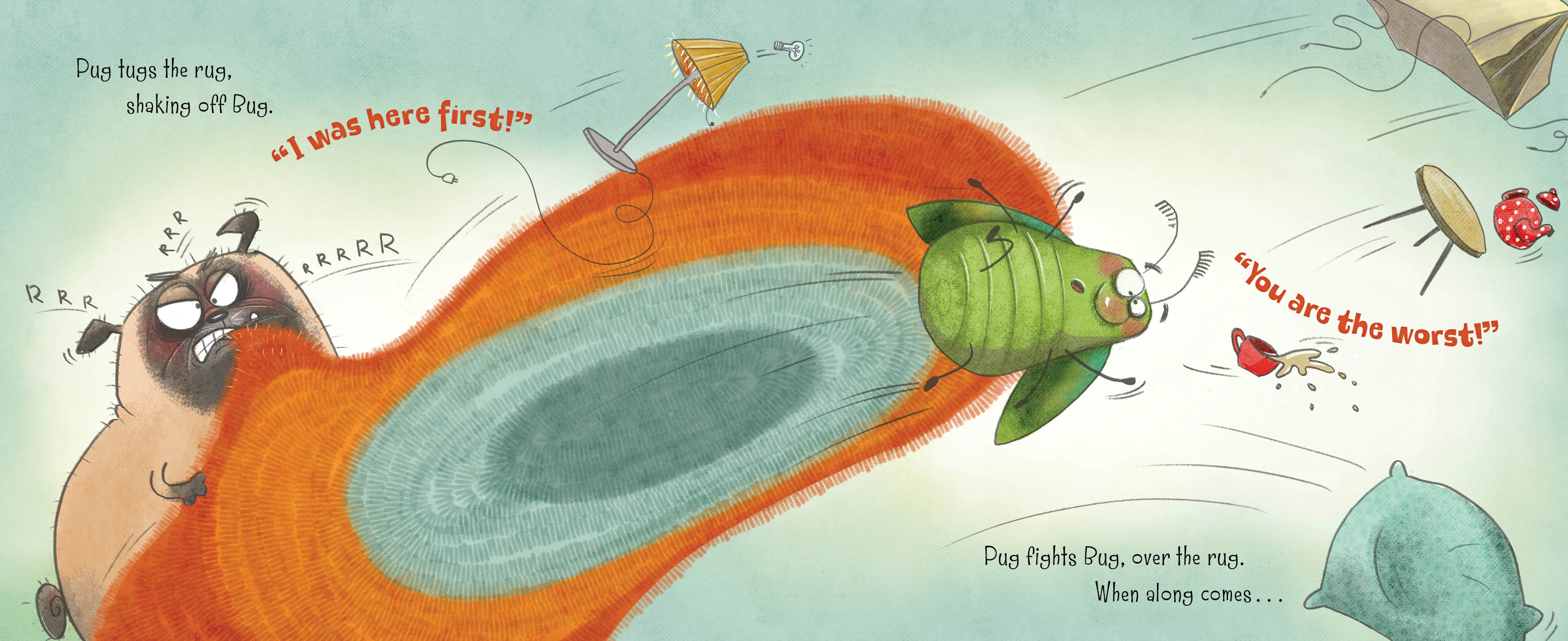
In Bug on the Rug a rug-loving Pug and a rug-stealing Bug battle over a lone rug. These two over-the-top characters both believe they’re right and their claim to the rug takes priority. That is, until Slug comes along and helps open their eyes to the truth of each of their actions. Through empathy, both Pug and Bug learn to take ownership of their mistakes and discover that, in this case, forgiveness and friendship go hand-in-hand.

celebrate-picture-books-picture-book-review-bug-on-the-rug-shaking

Image copyright Susan Batori, 2022, text copyright Sophia Gholz, 2022. Courtesy of Sleeping Bear Press.

I began writing this book with the idea of creating a light story that everyone can have fun with. But as I wrote and these characters took on a life of their own, the story grew. At first glance, Bug on the Rug is silly and filled with word play. But truthfully, this is a friendship book that we can all relate to. Sharing is hard. Making new friends is harder. And admitting to our mistakes? Oof. That is the hardest. But we all make mistakes. It’s natural and if we allow it, we can grow from those mistakes. So, with that in mind and remembering it’s National Lumpy Rug Day, let’s take a moment today to pull out what we may have swept under the rug. Let it go. Shake it out. Smooth out those lumps and enjoy a fresh start!

celebrate-picture-books-picture-book-review-bug-on-the-rug-tears

Image copyright Susan Batori, 2022, text copyright Sophia Gholz, 2022. Courtesy of Sleeping Bear Press.

Thanks, Sophia! I really laughed my way through Bug on the Rug and cheered at the end for these three new friends. I love your rollicking storytelling and know kids and adults will too!

For all you readers out there, Bug on the Rug is a hilarious rhyming romp with a rhythm made for dramatic readings that kids will want to hear again and again. The book will make a favorite addition to home, school, and public libraries for lively and meaningful story times. 

Ages 4 – 7

Sleeping Bear Press, 2022 | ISBN 978-1534111479

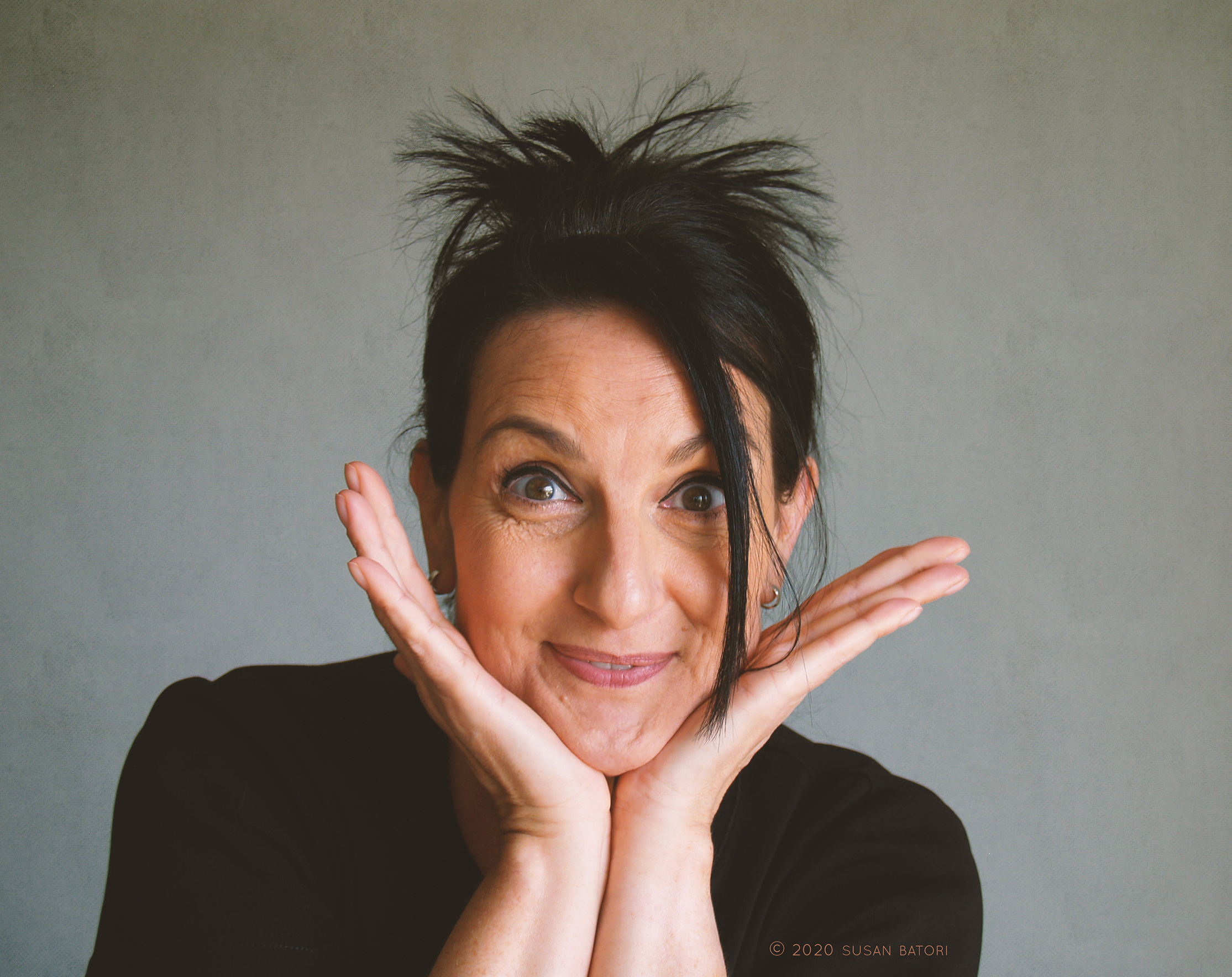
Susan Batori - Headshot

Susan Batori’s books include Don’t Call Me Fuzzybutt and
Letters from Space. She worked in advertising before switching to
children’s book illustration. Susan lives in Budapest, Hungary. To learn more about Susan Batori, her books, and her art, you can view a portfolio of her work here and connect with her on Bēhance | Instagram | Twitter

National Lumpy Rug Day Activity

celebrate-picture-books-picture-book-review-kids-on-rug-clip-art

Bug on the Rug-themed Social Emotional Learning (SEL) Activities 


  1. Use Bug on the Rug to start discussions on empathy and growth. Pull up a rug and ask readers to recall instances in their life when they have made a mistake or when they thought they were right when they were wrong. You can ask questions like: How did that moment make you feel? and How did you change in that instance? Readers can also discuss different instances when putting themselves in the shoes of others – empathizing with others – helped them change their point of view in some way.
  2. Ask readers to take a look at Bug and Pug and list how the characters changed from the start of the book to the end. This can be used to start a discussion about how we grow and develop emotionally through challenging experiences.

celebrate-picture-books-picture-book-review-bug-on-the-rug-cover

You can find Bug on the Rug at these booksellers

Amazon | Barnes & Noble | Books-a-Million

To support your local independent bookstore, order from

Bookshop | IndieBound

March 3 – It’s National Reading Month

celebrate-picture-books-picture-book-review-the-battle-of-the-butts-cover

About the Holiday

March 3rd is not only part of National Reading Month, but it’s World Book Day and World Wildlife Day too! How can readers celebrate all three holidays at the same time? With today’s book! Here’s a little bit about each holiday:

National Reading Month

All month long, people celebrate all the joys and benefits of reading. When you read with your child or children every day you’re helping them develop the language and literacy skills that will promote success in school and beyond. Even if your child isn’t talking yet, they’re listening and learning about their language as you read to them. Older kids also love being read to, and setting aside time to read together builds strong bonds that can last a lifetime. The month is typically marked with special events in schools, libraries, bookstores, and communities.

World Wildlife Day 

In December of 2013 the United Nations General Assembly proclaimed March 3rd to be World Wildlife Day to promote awareness of our environment and the dangers to it. This year’s theme is “Recovering key species for ecosystem restoration,” which seeks to draw attention to the conservation status of some of the most critically endangered species of wild fauna and flora and to drive discussions toward devising and implementing solutions to conserve them. To learn more, visit the World Wildlife Day website.

World Book Day

World Book Day was created by the United Nations Educational, Scientific and Cultural Organization (UNESCO) to be celebrated on April 23rd, 1995 in honor of William Shakespeare, Miguel de Cervantes, and Inca Garcilaso de la Vega, who all died on this date. Some countries, such as Great Britain, Ireland, and Scotland celebrate on March 3. No matter what date you pick – or whether you choose to celebrate on both days – the holiday encourages families and individuals to rediscover the joys of reading for pleasure and promotes the availability of a wide range of books to all and in all languages. 

Thanks to Running Press Kids for sharing a copy of Battle of the Butts with me for review consideration. All opinions on the book are my own.

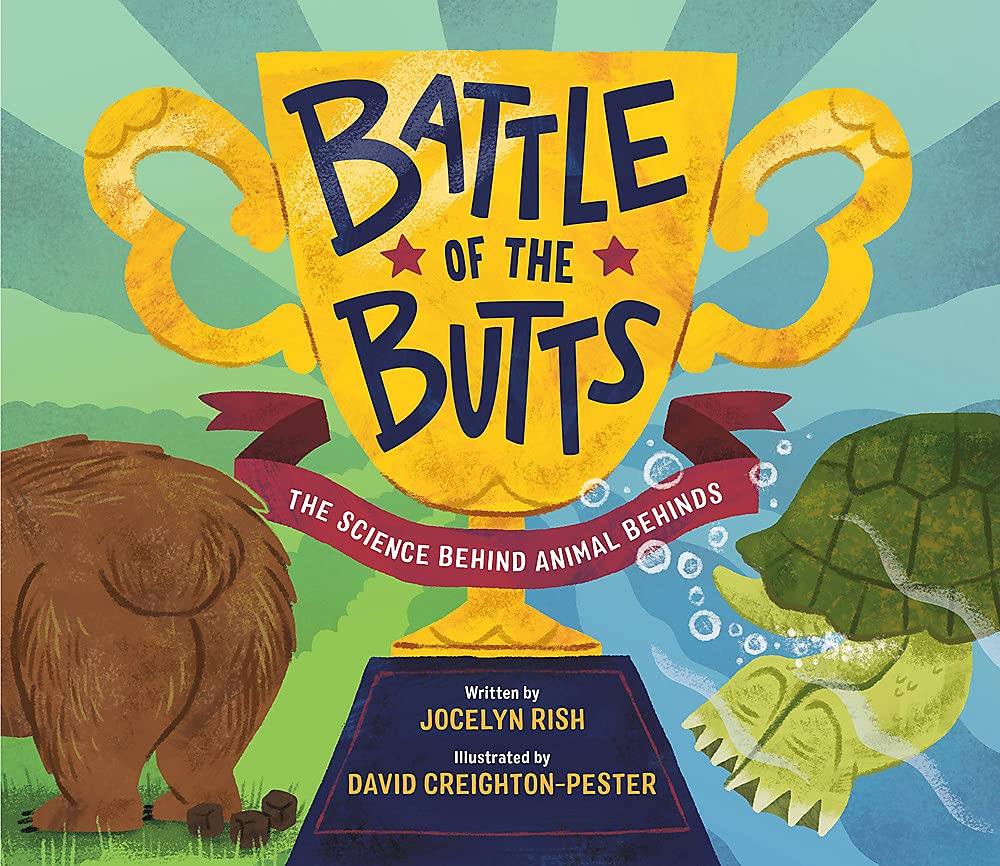
Battle of the Butts: The Science Behind Animal Behinds

Written by Jocelyn Rish | Illustrated by David Creighton-Pester


Get ready to RUUUMBLE! as ten of the world’s most fascinating animals put their butts on the line in Jocelyn Rish’s genius look at how certain sea creatures, mammals, insects, and reptiles eat, swim, talk, and defend themselves using their powerful posteriors. Readers don’t have to passively sit by and read, though. Rish invites kids to judge the challengers based on their own preferences and assign a rating from “Terrific Tushie” to “Boring Backside” on their way to crowning the “King of Keisters.”

celebrate-picture-books-picture-book-review-the-battle-of-the-butts-wombats-sleeping

Image copyright David Creighton-Pester, 2021, text copyright Jocelyn Rish, 2021. Courtesy of Running Kids Press.

As each challenger steps up, readers are presented with their stats, which include their “genus, length, weight, home turf, and posterior power.” Turning the page, kids are then drawn into the science of each critter’s anatomy and how they use it as Rish – in her conversational, detailed, and descriptive text – uses dynamic phrasing and familiar comparisons to help kids visualize each animal’s endgame. An “Extra Booty” paragraph and a highlighted “Butt Bonus” provide more info.

So who’s on the roster for this awesome competition? First up is the manatee, who moves through the water by holding onto or releasing farts. Lest kids begin “picturing a manatee zipping through the water like it has a jetpack on its back end,” Rish goes on to explain the mechanics of their gas-fueled swimming, how they fill up, and the enormity of their intestinal system that allows them to store their gas until they need it. 

celebrate-picture-books-picture-book-review-the-battle-of-the-butts-wombat

Image copyright David Creighton-Pester, 2021, text copyright Jocelyn Rish, 2021. Courtesy of Running Kids Press.

Another fierce contender is the bombardier beetle, which at a max length of 1.181 inches (30 millimeters), proves that mighty things come in small packages. This mini-monster might just become the next superhero, with moves worthy of a big-budget blockbuster. Just picture this movie trailer: “A bombardier beetle strolls through the leaves, minding its own business. A bunch of hungry ants attack. Things don’t look so good for the beetle. Then . . . Pew! Pew! Pew! The bombardier beetle fires a pulsing spray of scalding chemicals from its butt, twisting its tushie in different directions to hit all the ants. The bombardier beetle escapes, while the ants regret their decision to snack on the beetle.” Phew! Pass the popcorn! How do they do this? Rish takes kids step-by-step through the bombardier beetle’s chemical processes that read like a blue-ribbon-winning science fair project, complete with boiling blasts ejected at a “speed of 22 miles per hour.” What if the beetle gets eaten anyway? Find out in the explosive Butt Bonus.

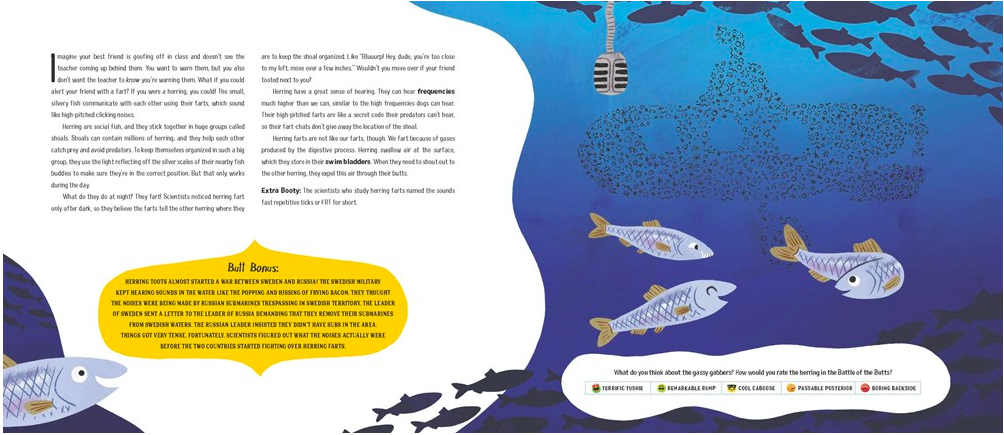
celebrate-picture-books-picture-book-review-the-battle-of-the-butts-herring

Image copyright David Creighton-Pester, 2021, text copyright Jocelyn Rish, 2021. Courtesy of Running Kids Press.

Not all of these challengers use their powers for defense. Parrotfish, which are found in “shallow tropical and subtropical waters around the world” use their poop to do double doody – I mean duty. You might feel a little squeamish about walking barefoot on a beautiful beach that’s near a coral reef once you learn that “a large portion of that white sand is actually parrotfish poop.” Say what?! Yep! Parrotfish “eat the algae, polyps, and bacteria that live on and in coral reefs.”

To get at it, they also end up ingesting coral and, after its well ground up by the 1,000 teeth along the fish’s beak and the “throat-teeth [that] work like a pepper grinder to crush the bits of coral into fine sand,” they deposit this non-nutritious detritus which then becomes the stuff of sandcastles, tanning beds, and sunny day seaside playgrounds. Sounds like a lot of poop, huh? The Butt Bonus tells you just how much.

These are just a few of the entrants vying for your verdict. Will any of them win the crown? Or will it be the wombat, with its armored butt; the Fitzroy river turtle, that’s a butt breather; the herring and its unusual communication style; the silver-spotted skipper caterpillar, that puts medieval warriors to shame; the beaded lacewing and its fatal farts; the Sonoran coralsnake that’s a master of confusion; or the sea cucumber, that throws everything it’s got at would-be predators? It’s up to you! Award your favorite with the trophy while rewarding yourself with a full flush of scintillating facts with which to entertain friends and dazzle your teachers!

A Glossary of words found in bold type throughout the book follows the text.

celebrate-picture-books-picture-book-review-the-battle-of-the-butts-herrings

Image copyright David Creighton-Pester, 2021, text copyright Jocelyn Rish, 2021. Courtesy of Running Kids Press.

If you’re looking for a riveting book steeped in nature and environmental science with some chemistry and lots of laughs thrown in for your child, classroom, or other group of kids, you can’t miss with Jocelyn Rish’s Battle of the Butts. Perfect for both younger kids as a read aloud and for independent readers, the book offers opportunities for exciting learning, expanded research, and even experimentation. Rish’s knowledge of her subject and talent for captivating kids jumps off the page with her smooth, alliterative, and hilarious storytelling.

Accompanying each chapter are David Creighton-Pester’s vibrant and dynamic illustrations that accentuate the humor while realistically showing kids how each creature uses their particular skills in their natural environment. Catapulted poop, shooting toots, and funny facial expressions make each page turn a blast. The book’s excellent format also makes it easy to navigate the short chapters and get the most out of all the material presented. At the end of each chapter, kids are invited to rate the creature in this mega-battle of the butts.

A superb way to engage kids in science learning, The Battle of the Butts would be a favorite on any home bookshelf and is a must for school and public library collections.

Ages 4 – 8 and up

Running Press Kids, 2021 | ISBN 978-0762497775

Discover more about Joycelyn Rish and her books on her website.

To learn more about David Creighton-Pester, his books, and his art, visit his website.

 National Reading Month Activity

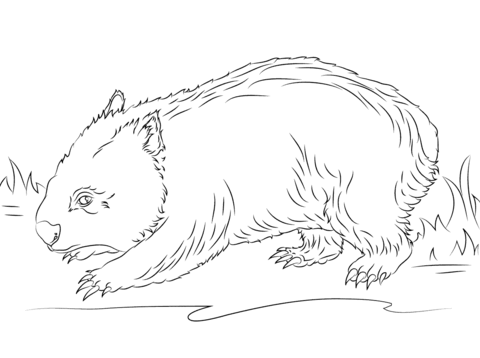
celebrate-picture-books-picture-book-review-wombat-coloring-page

Wildlife Coloring Pages


You can have fun coloring the animals from today’s book while celebrating all three of today’s featured holidays with these printable coloring pages!

Cute Wombat Coloring Page | Parrotfish Coloring Page | Manatee Coloring Page

celebrate-picture-books-picture-book-review-the-battle-of-the-butts-cover

You can find The Battle of the Butts at these booksellers

Amazon | Barnes & Noble | Books-a-Million

To support your local independent bookstore, order from 

Bookshop | IndieBound

Picture Book Review

June 25 – It’s National Insect Week

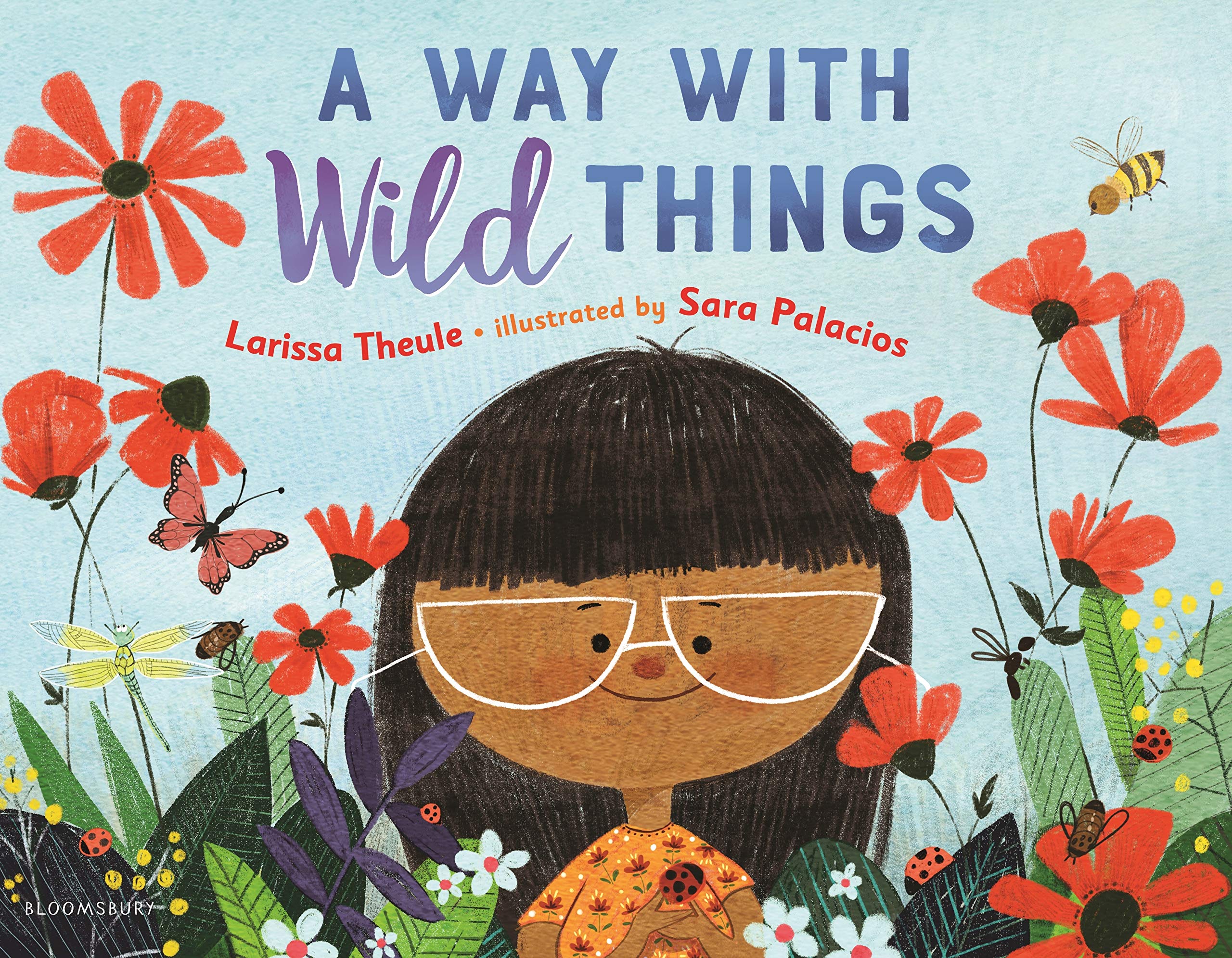
celebrate-picture-books-picture-book-review-a-way-with-wild-things-cover

About the Holiday

Insects are endlessly fascinating, and this week celebrates their diversity, purpose, and beauty. This week was established by the Royal Entomological Society to encourage people to learn more about insects, from those close to home to the exotic species around the world. This year the theme is Entomology at Home and people are invited to participate by learning about local species of insects and enjoying the resources on the National Insect Week website. There’s a photography contest, learning videos for all ages, access to Instar the Magazine for Young Entomologists, and so much more, including a mention of “the most bizarre use” of an insect ever imagined. To discover all of the resources and fun, visit the National Insect Week website.

Thanks to Bloomsbury Children’s Books for sharing a copy of A Way with Wild Things for review consideration. All opinions about the book are my own.

A Way with Wild Things

Written by Larissa Theule | Illustrated by Sara Palacios


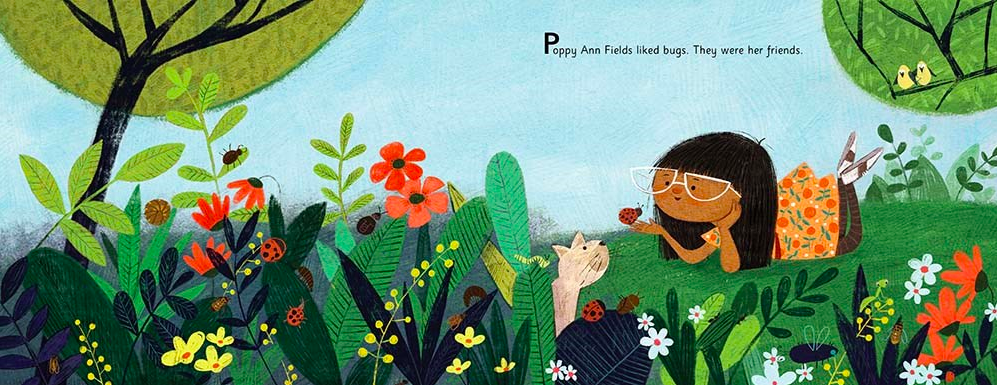
Poppy Ann Fields made friends with lots of bugs. She appreciated all of their natural talents—the way the cicadas formed a symphony, the way the ants marched in perfect lines, the way the shy roly poly said hello, and the “magnificent art” the spider wove. She could spend all day outside among these friends, “but when people came around, Poppy preferred to disappear into the background.”

celebrate-picture-books-picture-book-review-a-way-with-wild-things-bugs

Image copyright Sara Palacios, 2020, text copyright Larissa Theule, 2020. Courtesy of Bloomsbury Children’s Books.

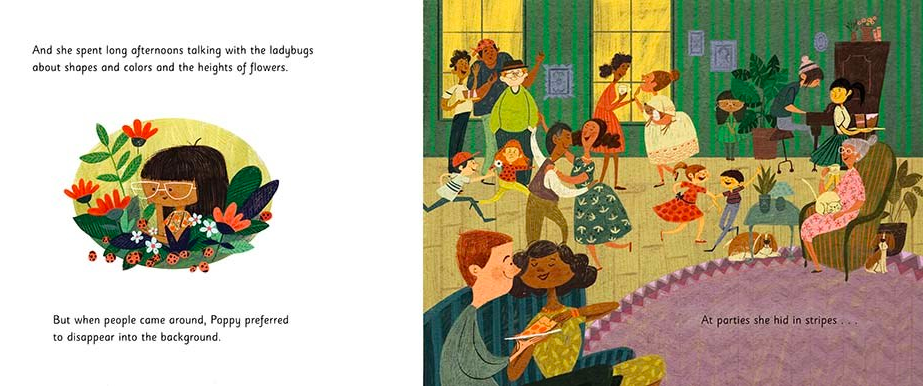
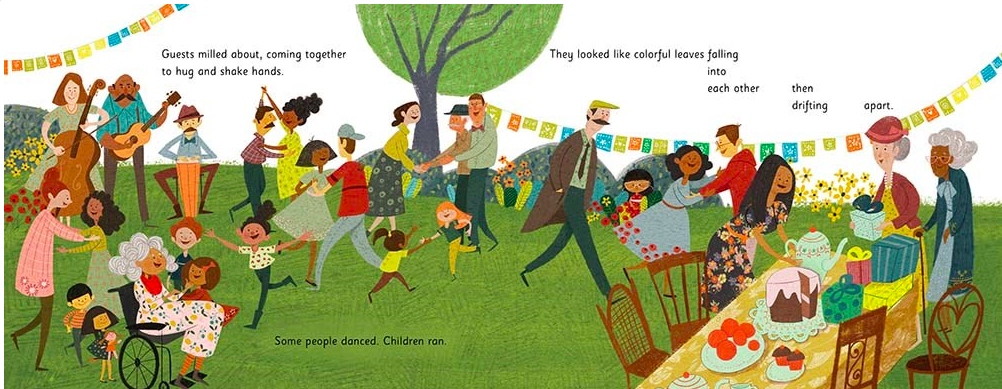
At parties she dressed to blend in with the wallpaper or the brightly flowered rug. She could disappear into the framed landscape on the wall or behind the tree in the corner. To celebrate Grandma Phyllis’s 100th birthday, there was a big party. Poppy watched from behind the flowers and bushes. She watched as people strolled about, meeting and hugging, dancing and running. “They looked like colorful leaves falling into each other then drifting apart.”

A shimmering dragonfly drifted on the breeze and landed on the cake. “Her whole heart glad, Poppy clapped her hands.” She came over to look and that’s when Uncle Dan spotted her. His voice boomed, “‘Poppy Ann Fields, you wallflower, you. So that’s where you’ve been hiding this time.’” Everyone turned to look at Poppy. She froze. The dragonfly took off… “and landed in her hand.” No one could believe it; they smiled and stared in wonder. Then they moved in to get a closer look.

celebrate-picture-books-picture-book-review-a-way-with-wild-things-party

Image copyright Sara Palacios, 2020, text copyright Larissa Theule, 2020. Courtesy of Bloomsbury Children’s Books.

Poppy wished she could run away. She didn’t know where to look, so she gazed at the dragonfly. “She knew the dragonfly had come here for her.” She listened to the cicadas’ music wafting through the air and took a breath. Then she spoke, telling everyone the dragonfly’s scientific name. Grandma Phyllis clasped her hands and gave Poppy a hug. “‘You wildflower, you,’” she whispered. In her heart Poppy knew Grandma Phyllis was right. She was not a wallflower, but “a wildflower.”

An illustrated glossary of Poppy’s bug friends, along with their scientific name and a brief description follows the story.

celebrate-picture-books-picture-book-review-a-way-with-wild-things-birthday

Image copyright Sara Palacios, 2020, text copyright Larissa Theule, 2020. Courtesy of Bloomsbury Children’s Books.

Larissa Theule’s quietly comforting story is balm for those thoughtful, introverted children who interact with the world through observation, contemplation, and gentle interactions. With the soul of a poet, Poppy listens to, watches, and connects with nature, feeling its rhythms and wonder with her whole heart. Theule’s carefully chosen verbs and play on the idea of nature embrace Poppy’s personality. Poppy “preferred” to observe large, noisy gatherings from the sidelines while she “became” things that most people find lovely: landscapes, trees, rain, a group of animals.

When Uncle Dan’s loud voice turns everyone’s attention to Poppy, Theule’s simply stated “she was scared down to her toes” validates the feelings of kids who’d rather not be in the spotlight and gives children and adults an opportunity to talk about these emotions. The party-goers’ enthusiasm to hear what Poppy has to say and Grandma Phyllis’s loving and apt nickname for her granddaughter will reassure introverted readers that they are seen and appreciated for their unique strengths.

Sara Palacios festival of flowers—found outside, in Poppy’s home décor, and on party-goers’ clothing—surrounds Poppy and reveals that she is a part of and does fit in everywhere. One of the joys of A Way with Wild Things is finding Poppy on each page and appreciating Palacio’s creative genius in how she uses camouflage similar to nature. Her vivid, textured illustrations are joyous and full of love for nature, for life, and especially for Poppy who tenderly takes it all in and makes it uniquely hers.

Ages 3 – 6

Bloomsbury Children’s Books, 2020 | ISBN 978-1681190396

Discover more about Larissa Theule and her books on her website.

To learn more about Sara Palacios, her books, and her art, visit her website.

National Insect Week Activity

celebrate-picture-books-picture-book-review-dragonfly-craft-3

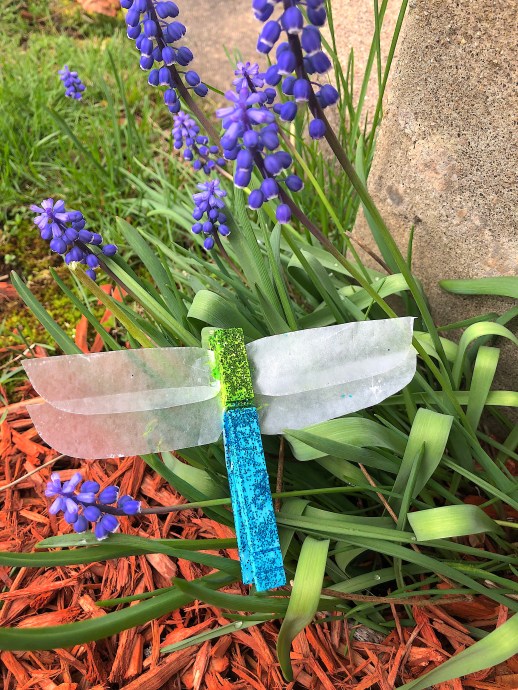
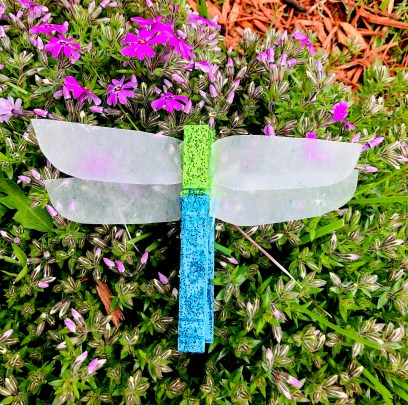
Dragonfly Decoration


Your kids can bring the beauty of nature inside with this easy-to-make dragonfly craft.

Supplies

  • Wooden clothespin
  • Wax paper
  • Bright green craft paint
  • Bright blue craft paint
  • Green glitter
  • Blue glitter
  • Paint brush
  • Thread or fishing line (optional)
  • Adhesive magnet (optional)

celebrate-picture-books-picture-book-review-dragonfly-craft

Directions

To Make the Body

  1. Paint the top part of the clothespin (to the point where the metal hinge crosses the wood) green
  2. Sprinkle green glitter on the wet paint, let dry
  3. Paint the bottom part of the clothespin blue
  4. Sprinkle blue glitter on the wet paint, let dry
  5. If the glitter doesn’t completely stick, apply a thin layer of glue with a toothpick and add more glitter

To Make the Wings

  1. Cut two 5-inch-by-3/4-inch strips from the wax paper
  2. Cut a curved edge at each end of the wax paper strips, cutting straight down from the top and curving around the bottom corner
  3. Cut curved notches in the center, top and bottom, of each wing to allow the wings to fit into the clothespin
  4. Open the clothespin and slip the wings in, curved edge down and allowing the top wing to overlap the bottom wing slightly

To Finish

Attach the thread or fishing line to the dragonfly to hang, or to make a refrigerator magnet, attach an adhesive magnetic strip to the back.

celebrate-picture-books-picture-book-review-a-way-with-wild-things-cover

You can find A Way with Wild Things at these booksellers

Amazon | Barnes & Noble | Books-a-Million

To support your local independent bookstore, order from

Bookshop | IndieBound


June 10 – It’s National Rivers Month

celebrate-picture-books-picture-book-review-mae-the-mayfly-cover

About the Holiday

Rivers are beautiful, provide recreation, and are crucial to our water supply. Did you know that in the United States 65% of our drinking water comes from rivers and streams? This month environmentalists and others work to promote awareness of the importance of keeping the nation’s rivers pollution free to protect the fish and animals that call them home and increase enjoyment for all. To help the cause, find out how you can help an environmental organization in your area. This year get to know your local river system and the insects and animals that live in and near these rivers. 

Thanks to Sleeping Bear Press for sending me a copy of Mae the Mayfly for review consideration. All opinions of the book are my own.

Mae the Mayfly

Written by Denise Brennan-Nelson | Illustrated by Florence Weiser


“Near the bank of the river one warm spring day / a new life began, and her name was Mae.” Before her mama said goodbye, she hugged her daughter and told her that she had her “whole life—a day, perhaps more” to explore her world. As Mae flitted along the river, a large, hungry trout waited for just the right moment to lure her in. It smiled deceitfully and beckoned to her, and, even though her inner voice told her not to, Mae flew down closer to take a look.

celebrate-picture-books-picture-book-review-mae-the-mayfly-fish

Image by Florence Weiser, 2020, text copyright Denise Brennan-Nelson, 2020. Courtesy of Sleeping Bear Press.

That’s when the trout leapt from the water to snatch Mae from the air. But she darted and dodged and got away. Shaking with fear, Mae found a hole in a hollow tree and flew in. “I’ll stay here forever! I’m not coming out!” she told herself.  But once her heart stopped beating so loud, she heard a happy tweet and peeked out of the tree. She saw a mother robin feeding her chicks and a spider web glittered in the sun. “The mist on the river was a fine, pink cloak. / A bullfrog bellowed his morning croak.” 

Mae remembered what her Mama had said and “launched herself from the dark, hollow place.” She followed the river, where she saw flowers and birds, a deer and a bear and one “stubby toad.” Then, she came to a clearing where she found “a singing, dancing jamboree… a wild mayfly jubilee! / Joining in, Mae danced with glee!”

celebrate-picture-books-picture-book-review-mae-the-mayfly-bird

Image by Florence Weiser, 2020, text copyright Denise Brennan-Nelson, 2020. Courtesy of Sleeping Bear Press.

As morning turned to afternoon, Mae was floating on the breeze when she heard a call for help. She went in search of who it was and found Trout lying motionless and barely breathing. Fearful that he might leap at her again, she carefully went closer to inspect. “But Trout was weak, no flip or flail. / Tangled line had caught his tail.” Then Mae noticed something else—his shimmering “rainbow stripes in every hue, silver, pink, and shades of blue.” And in his eyes she saw his fear and realized that she and Trout were alike.

Mae went to work to try to free him. The knot was tight, but Mae worked patiently until the line slipped free and Trout swam away with the current. Mae hoped that he would be okay. Just then she saw a flash as Trout returned and with a flip of his tail said, “Thank you.” As nighttime settled over the river and the moon rose high, Mae settled on a cattail leaf. She listened to the bullfrogs and watched the fireflies glow. “The stars came out early for  sweet, little Mae. / She counted each one… then called it a day.”

Back matter includes a message about mindfulness, an exercise to try and facts about mayflies.

celebrate-picture-books-picture-book-review-mae-the-mayfly-fishing-line

Image by Florence Weiser, 2020, text copyright Denise Brennan-Nelson, 2020. Courtesy of Sleeping Bear Press.

Soaring and uplifting, Denise Brennan-Nelson’s unique story reminds children and adults alike to live each day to the fullest and reveals where the treasures that make life so fulfilling can be found. The short lifespan of a mayfly gives Brennan-Nelson a perfect canvas for compressing the lessons of a lifetime into one day, and her superlative storytelling incorporates parental love, fear, appreciation for our surroundings, courage, selflessness, and friendship. Her language is triumphant, carried breezily on rhyming couplets that are a joy to read aloud. The pitch-perfect ending may bring a tear to the eye but spur readers to find the beauty in every day.

Through Florence Weiser’s lovely textured illustrations, readers can almost feel the breeze ruffling the tall grasses, the spray of river water, and the warmth of the sun as they follow Mae on her adventure. Mae is a cutie with lacy wings and a sweet, expressive face. A powerful image of empathy comes in a close-up, two-page spread in which Mae, looking into Trout’s frightened eye, sees her own reflection. Whereas up to now Mae has been an observer of life, she now becomes an active participant by helping a fellow creature. Working in perfect tandem with Brennan-Nelson’s text, Weiser’s pages take readers on a journey of growth and discovery they’ll take to heart. Calming shades of green dotted with subtle pinks, purples blues, and browns reflect Mae’s mindful approach to life, making this a delightful book to share for quiet story times.

Beautiful and resonant, Mae the Mayfly is highly recommended and would be an often-asked-for addition to home, school, and public library collections.

Ages 5 – 8

Sleeping Bear Press, 2020 | ISBN 978-1534110519

Discover more about Denise Brennan-Nelson and her books on her website.

To learn more about Florence Weiser, her books, and her art, visit her website.

Meet Denise Brennan-Nelson

celebrate-picture-books-picture-book-review-Denise-Brennan-Nelson-headshot

Denise Brennan-Nelson has written a number of books for children, including Tallulah: Mermaid of the Great Lakes, Leopold the Lion, Someday Is Not a Day of the Week, My Momma Likes to Say, Santa’s Secret, and the popular Willow series. As a national speaker, Denise encourages adults and children to tap into their imaginations to create richer, fuller lives. She travels the country, sharing her reading and writing enthusiasm with schoolchildren and teachers. Denise lives in Howell, Michigan with her husband, Bob. She strives to spend each day teaching and learning with a creative spirit. Find out more about Denise at www.denisebrennannelson.com.

Today, I’m really thrilled to be talking with Denise Brennan-Nelson about her inspiring story, her journey in writing it, and how we can all appreciate the life around us. My blog partner Jakki’s sons, Jack and Steve, also loves Mae the Mayfly and had a few questions of their own. 

Jack wonders: What inspired you to write about a mayfly? 

The inspiration to write about a mayfly came when I discovered that they live, on an average, only one day. I started digging and discovered that while mayflies have many interesting qualities, it was their life cycle that reeled me in and set the basis for the story: a mayfly begins as an egg, then hatches into a nymph. It then lives as a nymph for one to three years before emerging from the water as an adult. Once they have molted––the only insect known to molt twice!––they only have about a day to live. ONE DAY? How do you live your entire life in ONE day? Where would you go? What would you do? I had so many questions. And so, the journey began!

Steve would like to know: Where is your favorite place to go and enjoy nature?

Our backyard has many trees and a few paths to meander on. One of those paths leads to a playhouse that my husband built years ago for our children, Rebecca and Rachel. I love to sit on the steps and take it all in––especially the forever-changing trees and the way the light filters through them. It’s quiet and I watch the birds and the chipmunks, squirrels, and occasionally deer show up. It’s far enough away from our house that I can forget about my “to-do” list and relax.

There are also a couple of parks nearby that have trails and lakes and offer a beautiful place to enjoy nature.

Jack and Steve asked if you spent a lot of time at a pond while creating the story.

No, I didn’t spend a lot of time at a pond, but I did a lot of research to help me visualize the setting.

In early drafts, I pictured Mae’s life beginning on a pond but as the story emerged it turned into a river. Unlike a pond, a river “flows.” It seemed to fit with the ebb and flow of Mae’s life.

The river became integral to the story; Mae’s life began there, she experiences a harrowing ordeal with Trout, which causes her to flee the river out of fear, but ultimately, Mae returns “home” to the river and completes her life. (This was in keeping with a mayfly’s lifecycle.)  

Hi Denise! I love your answers to Jack and Steve’s questions! What an amazing character a mayfly makes. You’ve published many, many books for kids. What inspired you to become a children’s writer? What’s the best part about your job?

I had been happily writing for myself – journals and poetry mostly – when inspiration came knocking at my door in the form of a documented study about bumblebees. According to scientists, bumblebees are not “equipped” to fly. Aeronautically, their wings are too small for their bodies. Upon hearing that, I was compelled to write what was in my head and my heart. I wanted to answer the questions I had: What would happen if bumblebees found out about their small wings? Would fear and doubt stop them from doing what they love to do? Once it was written, I felt I had written something that I wanted to share with others. Four years and many rejection letters later, my first book, Buzzy the Bumblebee was published.

The best part about my job is creating something – taking an idea and turning it into something new that entertains and inspires children and adults. I also love the freedom to work when and where I want to, often in my pajamas in the wee hours of the morning.

Mae the Mayfly is a gorgeous, poignant reminder for both kids and adults to look around and appreciate the beauty all around us. Not only the mayfly, but all of the sights that Mae sees are ephemeral parts of nature. How did you choose each of these?

I felt they had to be simple, yet remarkable acts of nature that would draw Mae out from the hollow of a tree. You know that awe-inspiring feeling you get when you discover a bird’s nest or a spider’s web? That was the basis for the sights and sounds Mae encountered.

I also drew from a trip to Yellowstone where the vivid images of rivers, flowers, bear cubs, and other magnificent acts of nature are forever embedded in my mind.

The rhymes of Mae the Mayfly are as light as she is, and your rhythm is as jaunty as a mayfly’s flight. Could you describe your journey in writing this story?

After learning of a mayfly’s short lifespan, the mulling-over period ensued. A lot of thinking and dialogue in my head takes place before taking pen to paper. Often, I share my initial thoughts with family and friends which helps the pieces come together.

I did more research, too. I watched a video showing how some mayfly nymphs resist the pull to come to the surface when it is time to shed their outer covering and expose their wings. After spending years at the bottom of the dark river, why would they resist? I wondered. Why would they want to stay at the bottom of the river when they could break through the surface into the light, and fly––if only for a day?

Ah, fear.

It was starting to come together – I would write about a mayfly and how beautiful and meaningful one day could be, if she can overcome her fears.

Initially, the story was written in prose and then I wrote it in verse. At one point, I even wrote a funny version for my kids about Mae being stubborn and not listening to her mama. That version didn’t end well for Mae, because, well, she didn’t listen to her mama! My kids got a kick out of it.

Before she was Mae, she was Martha. From Martha to Marvin. Then I changed it to May. And then May became Mae.

My first submission was declined. So, I gave it a rest. The idea was there but I needed to start over. I believed in this story with my whole being and I wasn’t giving up. In June 2018, I resubmitted it and in August I learned that Sleeping Bear Press wanted to move forward with it. I signed the contract in September and it was released in March of 2020 amid a pandemic. It wasn’t the launch I envisioned, but the story is about appreciating the simple things and living life to the fullest. It is also about empathy, fear, and gratitude. Perhaps the timing was just right.

Florence Weiser’s illustrations are adorable while truly highlighting the beauty of what Mae sees. Do you have a favorite spread? Why do you love it?

I love the cover and the end sheets, and the illustration of Mama saying good-bye to Mae tugs at my heart. But my favorite is the spread where Mae encounters Trout tangled in fishing line and Mae sees herself – literally and figuratively – in Trout’s eyes. Mae is confronted with a difficult decision between fear, or courage and compassion. This was a pivotal part of the story and Florence did a remarkable job capturing the emotion of both Mae and Trout.

You encourage people to be aware of and open to inspiration and those small moments in life that make them the best version of themselves they can be. How can kids and adults practice this kind of mindfulness while at home during this time of self-isolating and social distancing?

In a robust and enthusiastic voice my dad often proclaims, “This is living!” He says it with such conviction that you might think he won the lottery. On the contrary, he says it to express his delight over life’s simple/small pleasures; a sunset, eating a fresh-picked tomato from the vine, watching the birds, the daffodils sprouting, a delectable meal, a rainstorm . . .

I am by no means an expert on mindfulness, but I have learned a few things that help me enjoy life a little bit more:

  • Be aware/pay attention – the list of things to delight over is endless when we notice what is going on around us
  • Make room for quiet time and stillness every day
  • Focus on one thing at a time and do it with intention and purpose
  • Write down 3-5 things daily that you are grateful for. Do it as a family with a “family journal” or get a notebook for every member and make it a nightly ritual

Lately I’ve been asking people, “What do you like most about the shelter-in-place order that we are being asked to follow?” Over and over, I’ve heard, “It feels good to slow down . . . less hectic . . .” I hope we emerge from this unique experience with the realization that life is not a race, it’s a gift.

What inspires you each time you start a new story?

When I have an idea that interests me I feel invigorated and purposeful. What can I do with it? Where will it take me? What can I learn from it?

In Bird by Bird, Anne Lamott writes, “If you are writing the clearest, truest words you can find and doing the best you can to understand and communicate, this will shine on paper like its only little lighthouse.”

Each time I begin a story I am hopeful that what I write “will shine on paper like its own little lighthouse.”

Thanks so much, Denise! This has been such a wonderful talk! I wish you all the best with Mae, the Mayfly and can’t wait to see more from you in the future.

You can connect with Denise Brennan-Nelson on 

Her website | Facebook | Twitter

National Rivers Month Activity

celebrate-picture-books-picture-book-review-rivers-word-search

World Rivers Word Search Puzzle


The world’s rivers provide homes for fish, animals, and birds; offer opportunities for recreation; and supply drinking water for millions. Can you find the names of twenty rivers of the world in this printable puzzle? Then learn where each river runs!

World Rivers Word Search | World Rivers Word Search Solution

celebrate-picture-books-picture-book-review-mae-the-mayfly-cover

You can find Mae the Mayfly at these booksellers

Amazon | Barnes & Noble | Books-a-Million | Sleeping Bear Press

To support your local independent bookstore, order from

Bookshop | IndieBound 

Picture Book Review