January 15 – It’s International Creativity Month


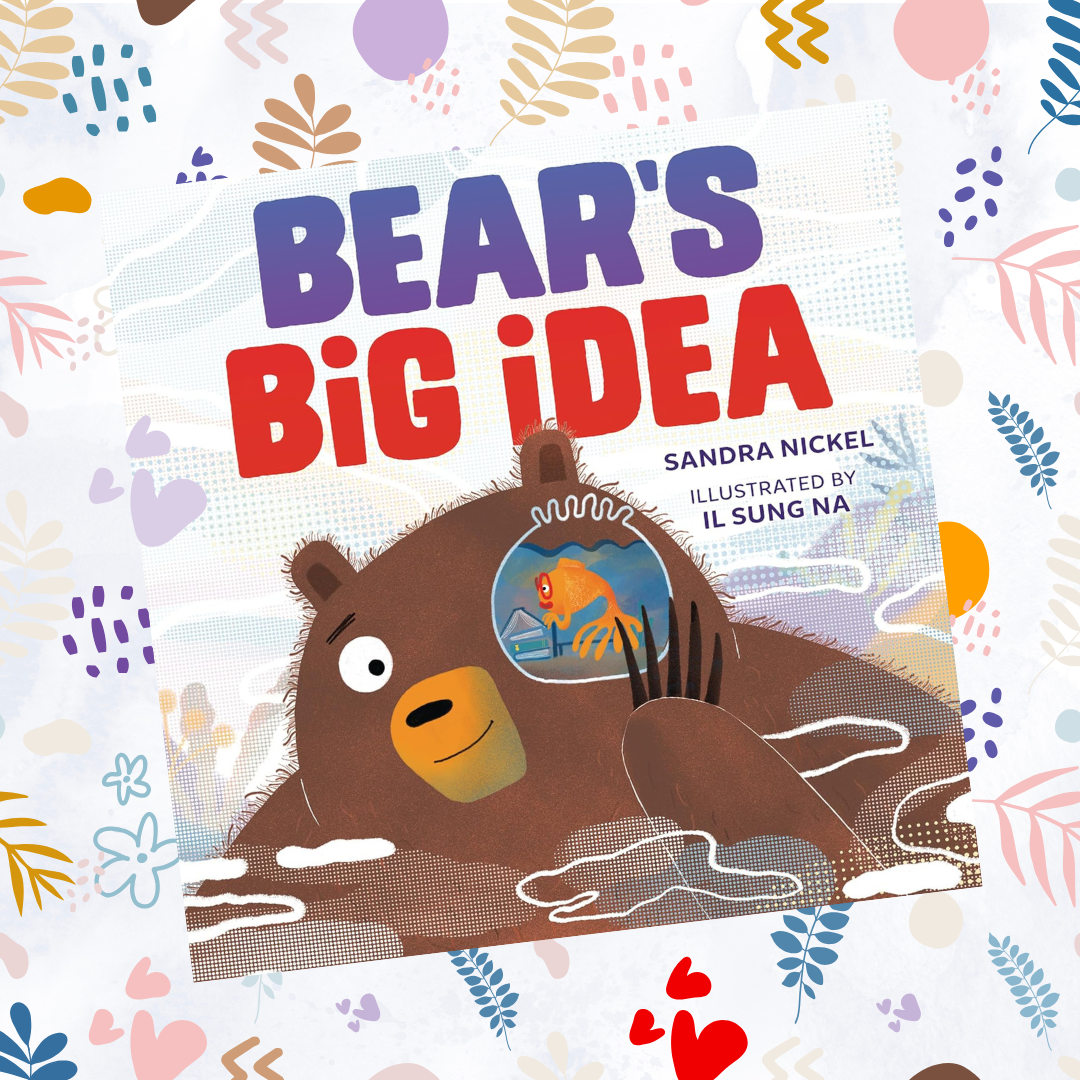
celebrate-picture-books-picture-book-review-bear's-big-idea-cover

About the Holiday

Are you an artist, a writer, a decorator, a chef? How about a floral arranger, a woodworker, a fashion designer, or a gardener? Inside almost every heart lies a desire to create. Whether you use your ingenuity in your job or as an escape from the routine, this month celebrates all that is innovative. Sometimes this comes not in something you can see or touch but in a new thought or novel way of solving a problem—as seen in today’s book!

Thanks to Carolrhoda Books and Barb Fisch at Blue Slip Media for sharing a copy of Bear’s Big Idea with me! All opinions on the book are my own.

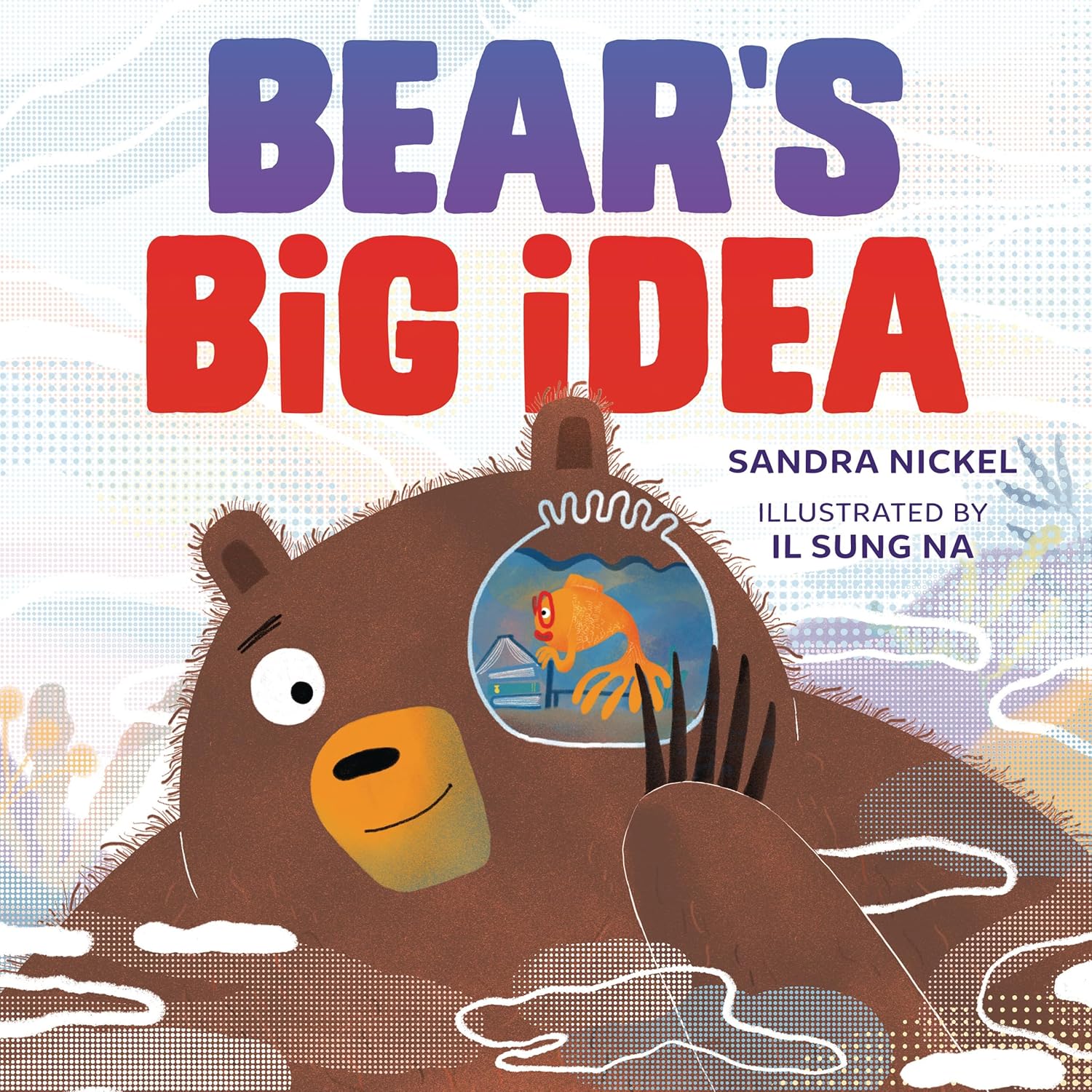
Bear’s Big Idea

Written by Sandra Nickel | Illustrated by Il Sung Na


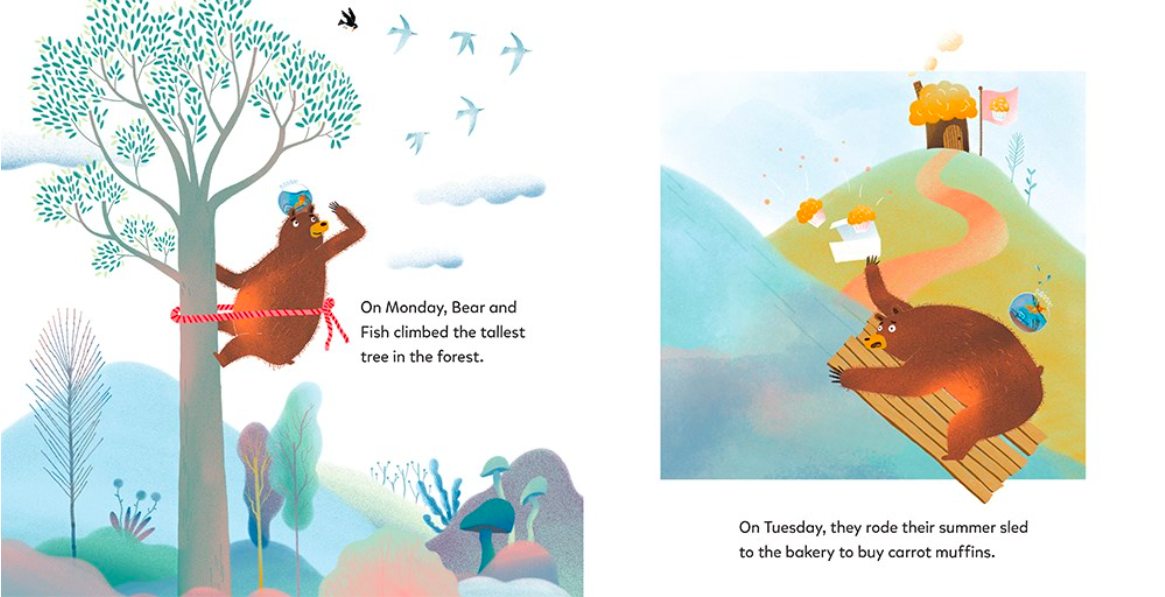
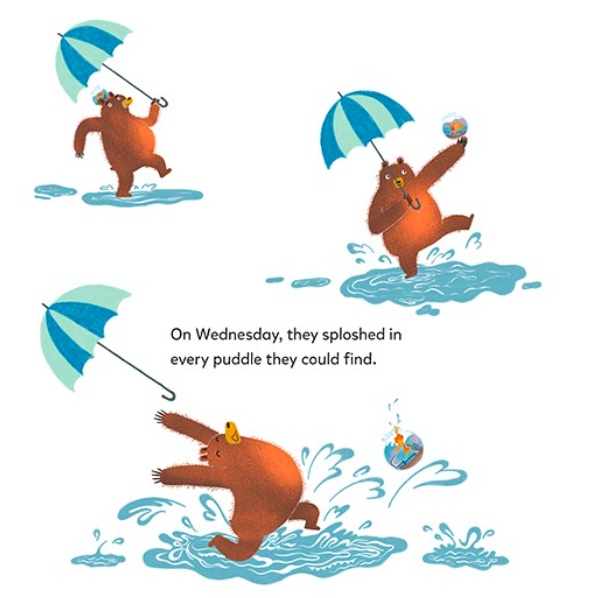
Fish and Bear were best friends. They did everything together, and usually—well, always—Fish was the one with the ideas. “Every morning, Fish would wake up, put on her glasses, and just like that, she would know the perfect thing to do.” Every day of the week, Fish found something—a rope, a sled, an umbrella, and a blanket—and dreamed up an innovative way to have fun with it.

celebrate-picture-books-picture-book-review-bear's-big-idea-Monday

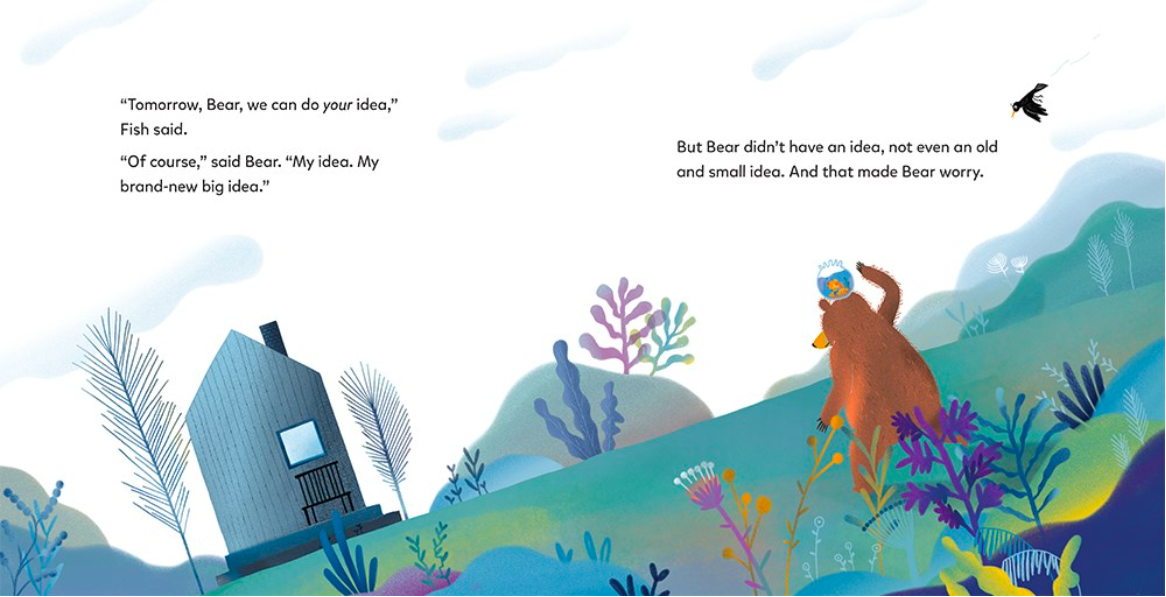
Image copyright Il Sung Na, 2024, text copyright Sandra Nickel, 2024. Courtesy of Carolrhoda Books.

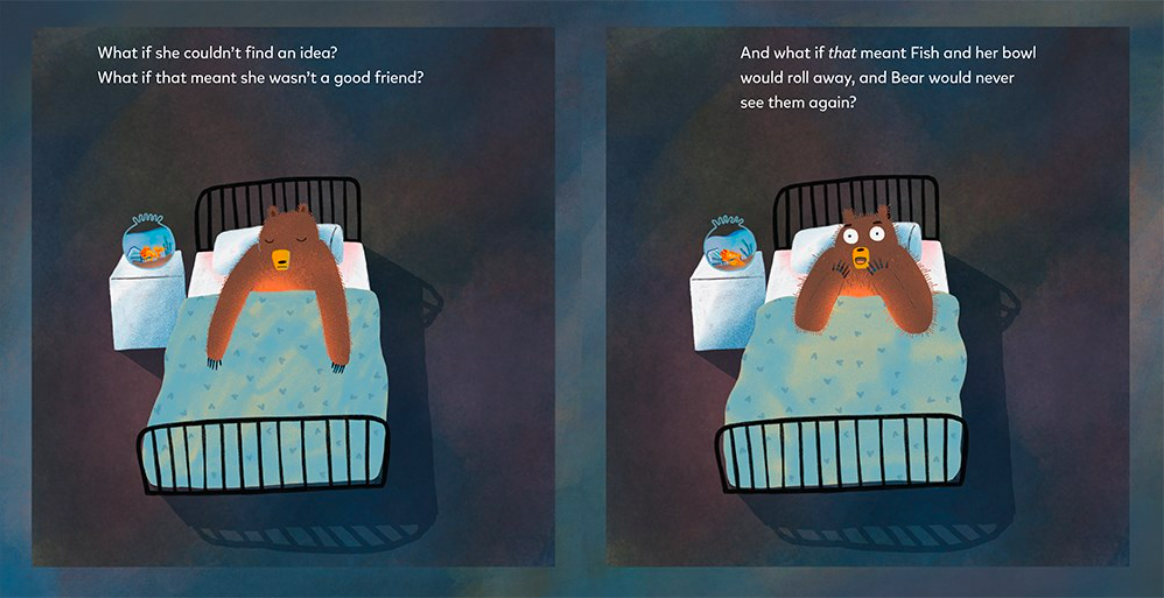
But Fish didn’t want Bear to feel left out, so on Thursday she said that the next day they could do Bear’s idea, “‘Of course, said Bear. ‘My brand-new big idea.'” But Bear was worried. She “didn’t have an idea, not even an old and small idea.” Bear tried to sleep that night, but she was afraid that not having an idea meant she wasn’t a good friend. Would Fish take her bowl and leave? Anxiety muddled Bear’s brain, and all she could think of were now-old ideas.

celebrate-picture-books-picture-book-review-bear's-big-idea-Wednesday

Image copyright Il Sung Na, 2024, text copyright Sandra Nickel, 2024. Courtesy of Carolrhoda Books.

The next morning it was the same. Bear looked everywhere for a brand-new big idea but found nothing. She kept checking in with Fish, asking if she was still there. “‘Always and forever,’ said Fish” with added reassurance. At last, Bear confessed that she couldn’t see an idea anywhere. “‘Don’t worry,’ Fish said. ‘Just because you can’t see something, doesn’t mean it’s not there.'”

celebrate-picture-books-picture-book-review-bear's-big-idea-no-idea

Image copyright Il Sung Na, 2024, text copyright Sandra Nickel, 2024. Courtesy of Carolrhoda Books.

So Bear thought some more, she listened, and she felt the wind whipping up. Suddenly, the air was filled with all of the old things from the past week. As Bear watched the things flying by, she saw it! Her brand-new big idea! She quickly gathered the items together and grabbed Fish’s bowl then rode the sled down to the beach, where she turned those individual items into an ingenious brand-new big idea that even impressed Fish! As pleased as Bear was with her idea, though, she was even happier to discover that good friends were “always and forever there.”

celebrate-picture-books-picture-book-review-bear's-big-idea-sleepless-night

Image copyright Il Sung Na, 2024, text copyright Sandra Nickel, 2024. Courtesy of Carolrhoda Books.

The second book in Sandra Nickel’s Bear and Fish series is a charming story that gently addresses children’s common fears about performance and pressure as well as the nature of friendship itself. Throughout the story, Nickel presents Bear’s conundrum realistically as she first alludes to having a big idea and then worries through the night and part of the next day that she will let down and maybe even lose her bestie because she has no idea at all.

Nickel—through Fish’s encouraging comments and confidence in Bear’s abilities—is always right there, though, with reassurance that children will find comforting in their own life. Nickel’s excellent pacing as well as her metaphorical dark and fog that stymies Bear until her approaching idea clears it away adds depth to the story and shows kids that things such as ideas, learning, self-confidence, and growth come to each person in their own time.

Children will be happy to see Il Sung Na’s fast friends back again in a new adventure. Il Sung’s soft-hued illustrations place Bear and Fish in a whimsically surreal mashup of vegetation from Bear’s forest and Fish’s underwater worlds. Bespectacled, ever-faithful Fish regales Bear with reassuring philosophy from her bowl, but also enjoys a madcap experience of her own thanks to Bear’s big idea. Through Il Sung’s clear depictions of Bear’s emotions, children can empathize with and cheer on Bear while gaining their own sense of self-confidence.

An uplifting, reassuring, and confidence boosting story, Bear’s Big Idea is sure to prompt requests for multiple readings and can spark discussions about feelings of fear, external and internal pressure, true friendship, and using one’s imagination. Bear’s Big Idea would make a valuable addition to home, library, and classroom collections.

Ages 4 – 8

Carolrhoda Books, 2024 | ISBN 979-8765610176

About the Author

Sandra Nickel is a writer of nonfiction picture books for children. Her work includes The Stuff Between Stars, Nacho’s Nachos, and Breaking Through the Clouds. She is the winner of a Christopher Award and holds an MFA in Writing for Children and Young Adults from Vermont College of Fine Arts. When at home in Switzerland, Sandra loves ambling and rambling and eating carrot muffins just as much as Bear and Fish do.

About the Illustrator

Il Sung Na was born in Seoul, South Korea. In 2001, he moved to London to pursue a BFA in Illustration and Animation at Kingston University, where he discovered a passion for children’s books. He completed his MFA Illustration Practice at MICA (Maryland Institute College of Art) in 2015. Il Sung has illustrated several books including Wild Peace, My Tree, and ZZZZ: A Book of Sleep. Currently based in Kansas City, Il Sung teaches illustration courses at KCAI (Kansas City Art Institute) and works on new books.

International Creativity Month Activity

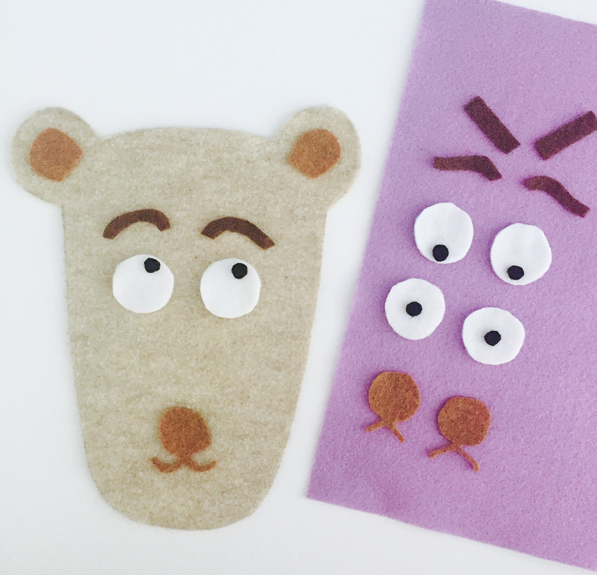
celebrate-picture-books-picture-book-review-bear-craft

Expressive Bear


You can talk about different emotions and feelings or make up your own stories with this Expressive Bear Craft! Use the templates and/or make your own expressive eyes, eyebrows, and nose and mouths. You can also play a game in which the first person to collect all the parts of the bear’s face is the winner.

Supplies

  • Printable Bear Head Template
  • Printable Eyes and Noses Template
  • Printable Eyebrows  and Ears Template
  • Light brown felt or fleece (or color of your choice), 8 ½ x 11 inch piece
  • Dark brown felt or fleece(or color of your choice), 8 ½ x 11 inch piece
  • White felt or fleece, 8 ½ x 11 inch piece
  • Black felt or fleece, for pupils
  • Scissors
  • Glue
  • 1 playing die (optional)

Directions

  1. Print templates
  2. Cut bear head from light felt or fleece
  3. Cut eyes from white felt or fleece
  4. Cut nose and inner ears from dark brown felt or fleece
  5. Cut pupils from black felt or fleece
  6. Glue pupils onto white eyes

Alternatively: Color and play with the paper set

For a Fun Story Time

Give the bear different faces and make up stories of why he looks that way!

To Play a Game

Supplies

  • 1 plastic playing die. Or print this playing die template and draw one of the six facial features on each side.
  • Pencil, pen, or markers (if using printed die template)
  • Cut out, fold, and tape the die together

Directions

  1. Roll the die and follow the instructions below to collect parts of the bear’s face.
  2. The first player to create a full face is the winner.
  • Die dots correspond to:
  • 1—one eyebrow
  • 2—second eyebrow
  • 3—one eye
  • 4—second eye
  • 5—nose
  • 6—inner ears

celebrate-picture-books-picture-book-review-bear's-big-idea-cover

You can purchase Bear’s Big Idea from these booksellers

Amazon | Barnes & Noble | Bookshop (to support your local independent bookstore)

Picture Book Review

January 8 – National JoyGerm Day

celebrate-picture-books-picture-book-review-how-to-cheer-up-a-friend-cover

About the Holiday

Believing that joy can spread from person to person on the strength of simple smiles and greetings, acts of kindness, upbeat moods, and general positivity, Joan E. White of Syracuse, New York, founded JoyGerm Day in 1981. The day officially became a national holiday in 1985, and is now celebrated around the world. The holiday inspires people to find ways today and every day to positively impact the lives around us at home, work, school, or even while shopping or going about one’s daily business.

To honor the day and the idea, find ways to start each morning with a positive attitude for the day to come. Need ideas for how to get started? Say “Hello” to those you meet, listen to and encourage others, happily help out where needed, share a special moment with your kids at home, or send a surprise letter, card, or text to a friend or family member far away. And, of course, don’t forget to treat yourself too! When you feel good, those around you will respond in kind. Happiness really is contagious!  

Thanks so much to Beach Lane Books for sharing a copy of How to Cheer Up a Friend with me for review consideration!

How to Cheer Up a Friend

Written by Stephanie Calmenson | Illustrated by Shannon McNeill


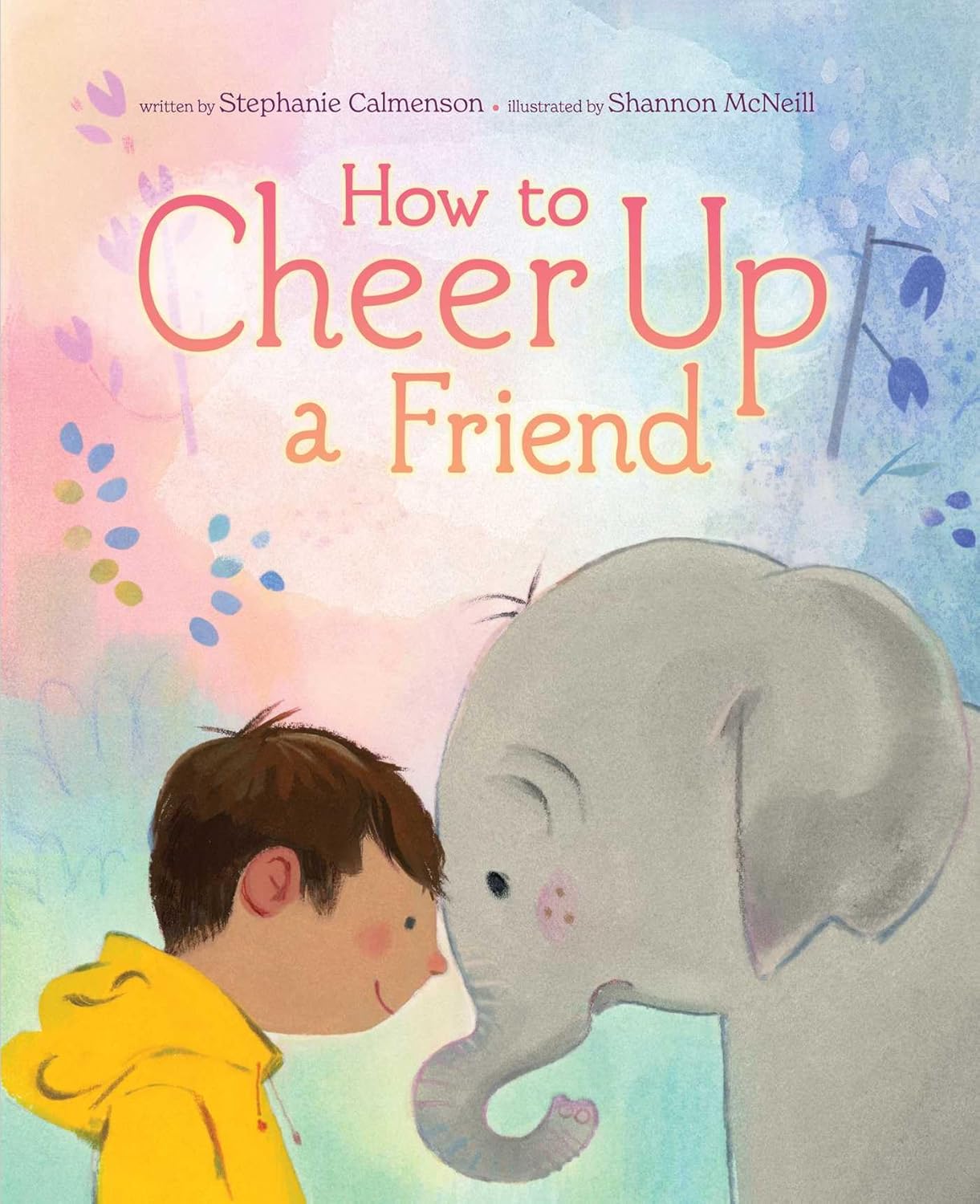
Little ones have big feelings and even bigger hearts. When they see a friend or family member feeling down, they want to help. But “What do you do / when your friend feels blue?” In her sweet book in which the protagonist attempts to cheer up their elephant friend, Stephanie Calmenson offers refreshingly practical advice on how a child (or an adult) can really approach someone experiencing sadness or anger and help them find happiness again. 

Screen Shot 2024-12-31 at 4.50.06 PM

Image copyright Shannon McNeill, 2024, text copyright Stephanie Calmenson, 2024. Courtesy of Beach Lane Books.

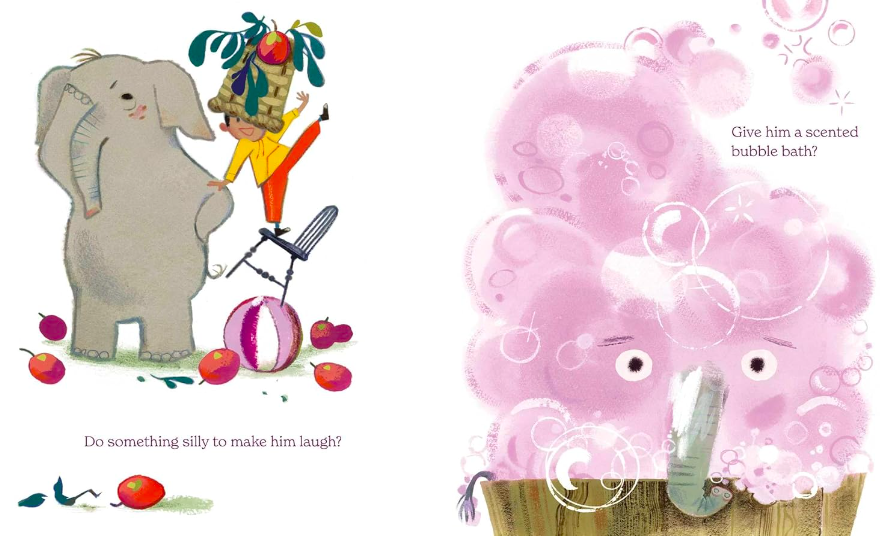
Writing in rhyming couplets, Calmenson starts out by suggesting a few ideas that will get readers giggling and invested in the story, such as “Do you tickle his trunk / to get him out of his funk?” and “Do something silly to make him laugh? / Give him a scented bubble bath?” Soon, the child opens his arms wide, offering a hug—but ready to happily accept either a “yes” or “no” answer.

Quieter ideas follow, including taking a walk or simply listening if he wants to “talk . . . and talk . . . and talk.” Then—only after all his feelings have been vented does the protagonist offer treats—or that hug, which now feels juuust right.

Screen Shot 2024-12-31 at 4.51.18 PM

Image copyright Shannon McNeill, 2024, text copyright Stephanie Calmenson, 2024. Courtesy of Beach Lane Books.

Stephanie Calmenson’s thoughtful look at the underpinnings of sadness or other strong emotions and how friends or family members can best help a loved one shines for its brevity and straightforward take on the issue. This approach will appeal to kids while giving them concrete examples of what to do and say (or not say) to elicit healing time or talk from friends, siblings, or others.

How to Cheer Up a Friend would be equally effective for adults looking for a book to help their own child through periods of sadness or anger as the story validates these emotions and provides a constructive solution for expressing them. The length of the story and its bookended format makes the book a perfect choice for parents, teachers, or other adults to reach for during those times when emotions may be running high or attention spans are short.

Screen Shot 2024-12-31 at 4.51.51 PM

Image copyright Shannon McNeill, 2024, text copyright Stephanie Calmenson, 2024. Courtesy of Beach Lane Books.

Shannon McNeill’s adorable elephant and empathetic child immediately win over readers’ hearts with their connection that is clearly based on mutual love and trust. In her soft-hued gouache, pencil, and cut paper illustrations, McNeill’s droopy, sad-eyed elephant is the picture of sadness, stubbornness, and even laugh-inducing perseverance as his friend tries various silly solutions to restore happiness. The image of the elephant hunkered down in its wash tub as it hides from a hug is an effective portrayal for children who prefer body autonomy or for the barrier some people present when experiencing strong emotions.

As the elephant begins to talk, his words and feelings fill the page as colorful shapes, and he begins to gesticulate, He cries, stomps, and flops down in a tirade to demonstrate those emotions he may not have words for. But as the storm abates, he feels better and can happily accept that big hug in a two-page spread that will delight young readers.

An endearing story that provides satisfying help with an emotion we all experience, How to Cheer Up a Friend is a valuable book for families and teachers to have on hand for those times when feelings are strong. The book is highly recommended for home, library, and classroom collections.

Ages 4 – 8

Beach Lane Books, 2024 | ISBN 978-1665910248

About the Author

Stephanie Calmenson is the acclaimed author of many popular books for young readers including Dinner at the Panda Palace; May I Pet Your Dog?; and the Ready, Set, Dogs! and Allie and Amy series written with Magic School Bus author Joanna Cole. A former early childhood teacher and children’s book editor, Stephanie feels fortunate to be able to teach, entertain, and encourage kids through her books. To read more, please visit StephanieCalmenson.com.

About the Illustrator

Shannon McNeill is a Canadian-born, San Diego-based illustrator whose books include Are We There Yet? by Dandi Daley Mackall, Wild & Wooly by Mary Jessie Parker, How to Cheer Up a Friend by Stephanie Calmenson, and her own Wheels, No Wheels. Her work is influenced by local nature, loitering in coffee shops, old books, child art, and long walks around the block. Learn more at LittleDrawings.com.

National JoyGerm Day Activity

celebrate-picture-books-picture-book-review-you're-groovy-happiness-card

Spread Happiness Cards

Kids can spread happiness to their friends, family, teachers, and other people in their lives with these cute Happiness Cards! Just print, cut, and give!

Spread Happiness Cards

celebrate-picture-books-picture-book-review-how-to-cheer-up-a-friend-cover

You can purchase How to Cheer Up a Friend at these booksellers

Amazon | Barnes & Noble | Bookshop

Picture Book Review

January 30 – It’s International Quality of Life Month

celebrate-picture-books-picture-book-review-charlotte-and-the-quiet-place-noisy-neighborhood

About the Holiday

How one achieves their definition of a good quality of life may differ for every person, but in general it encompasses being happy and satisfied with one’s relationships, work, living conditions, and self. Whether you find happiness and quality of life in outdoor or indoor pursuits, with others or alone, at work or at home, this month’s holiday gives you time to get in touch with your inner quiet place and reflect on changes or improvements to bring you more peace and happiness in life.

Charlotte and the Quiet Place

Written by Deborah Sosin | Illustrated by Sara Woolley


Charlotte is a girl who likes quiet who lives in a noisy world. Everywhere she goes, it seems, it’s impossible to escape from sounds that disturb her peace. At home the hallway creaks where “the floorboards groan,” the living room is like an arcade where the “TV bellows and blares,” and the kitchen is filled with Otto’s barks for his dinner. Even in Charlotte’s bedroom, “which is supposed to be a quiet place, the old steam radiator hisses, whistles, and whines. Where can Charlotte find a quiet place?”

celebrate-picture-books-picture-book-review-charlotte-and-the-quiet-place-noisy-home

Image copyright Sara Woolley, 2015, text copyright Deborah Sosin, 2015. Courtesy of sarawoolley.com

When Charlotte goes to school, things are no better. In the classroom kids are boisterous and bells ring; the lunchroom echoes with clattering trays and scuffing chairs; and the playground blares with big voices and stomping feet but also with the little squeaks and rattle of the swings. “Even in the library, which is supposed to be a quiet place, the children giggle, yammer, and yell. Where can Charlotte find a quiet place?”
celebrate-picture-books-picture-book-review-charlotte-and-the-quiet-place-noisy-subway

Image copyright Sara Woolley, 2015, text copyright Deborah Sosin, 2015. Courtesy of sarawoolley.com

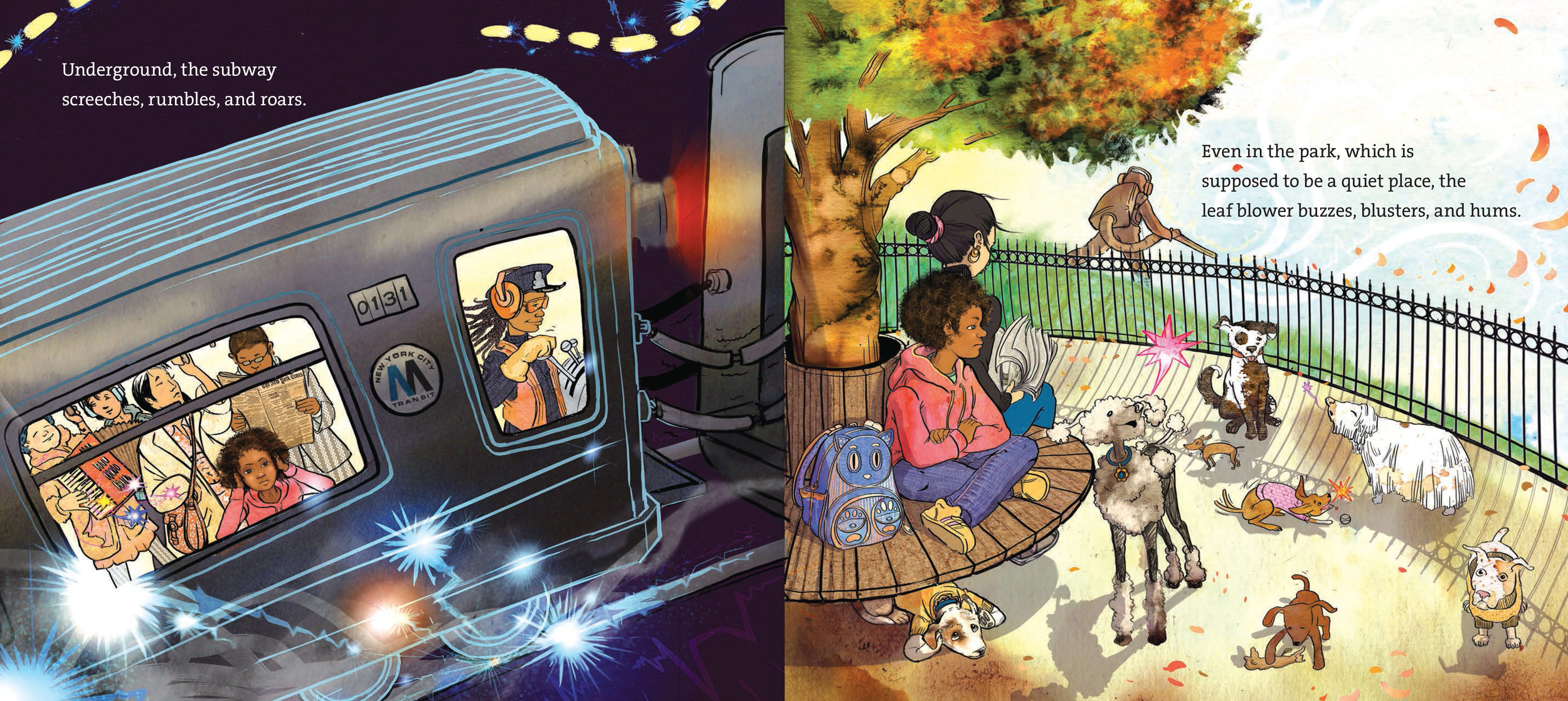
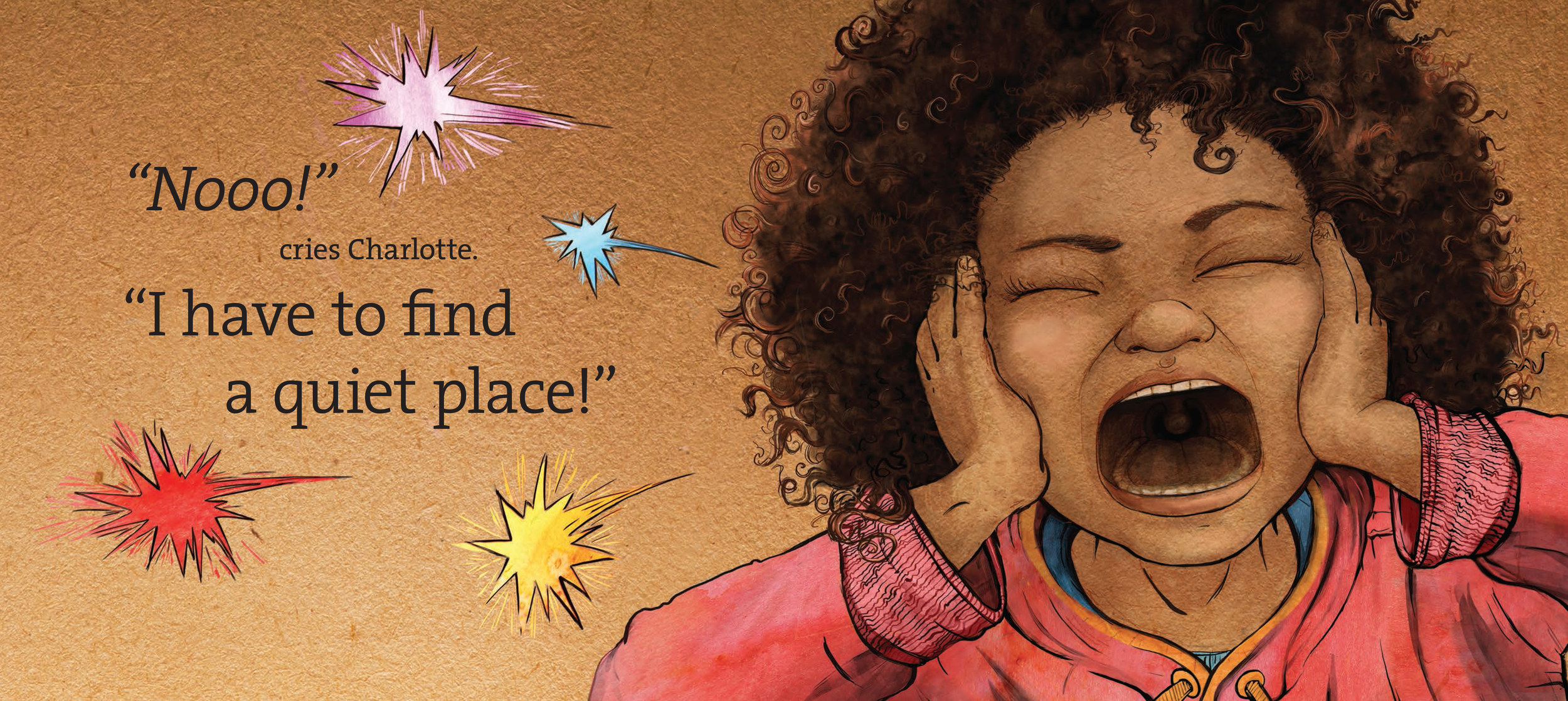
The outside world resounds with the din of jackhammers, horns, sirens, shouts, cars, music, and the “screeches, rumbles, and roars” of the subway. “Even in the park, which is supposed to be a quiet place, the leaf blower buzzes, blusters, and hums.” Charlotte puts her hands to her ears. “‘Nooo!’” she cries, “‘I have to find a quiet place!’”
celebrate-picture-books-picture-book-review-charlotte-and-the-quiet-place-nooo!-charlotte-cries

Image copyright Sara Woolley 2015, text copyright Deborah Sosin, 2015. Courtesy of sarawoolley.com

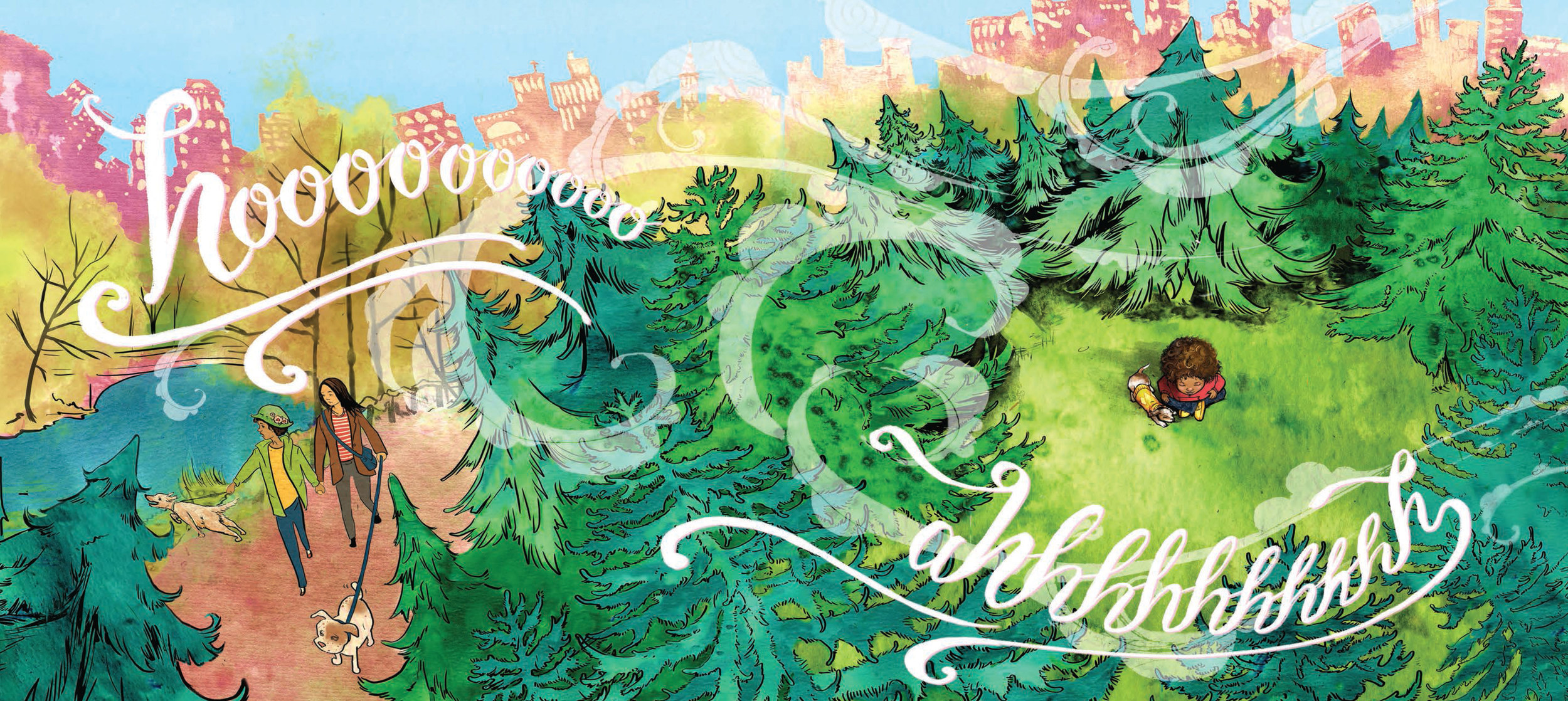
On Saturday Charlotte takes her dog for a walk in the park. Suddenly, Otto spies a squirrel and takes off running, wrenching his leash out of Charlotte’s hand. She chases after him down a hill, over a bridge, into the middle of a grove of trees. Out of breath, Charlotte and Otto sit beneath a tree. Gasping, Charlotte’s “belly rises up and down, up and down. Her breath goes in and out, in and out. Hooooo ahhhhh. Hooo ahhh.”

Slowly, Charlotte’s breath comes easier and “her mind slows down.” In this state, she discovers another, even quieter place. It is a place deep inside where her breath is soft and her “thoughts are hushed and low.” It is “a place as quiet as the small silence on the very last page of her favorite book, the silence right after ‘The End.’”
celebrate-picture-books-picture-book-review-charlotte-and-the-quiet-place-quiet-woods

Image copyright Sara Woolley, 2015, text copyright Deborah Sosin, 2015. Courtesy of sarawoolley.com

In a little while, Charlotte and Otto leave the grove, but now whenever home or school or the neighborhood is too loud, Charlotte remembers where she can find a quiet place. She simply closes her eyes and pays attention to that place deep in her belly and deep in her mind—“that quiet place inside.”

For so many children the world is a blaring, clattering place where their thoughts are drowned out by the noises around them. Deborah Sosin’s award-winning Charlotte and the Quiet Place validates these feelings and offers children a way to discover inner peace wherever they are. As a tonic to today’s hyper-stimulated environment, kids and adults alike will benefit from the method of mindful reflection Sosin presents. Sosin’s combination of evocative verbs and repetition makes the story fresh and an excellent read-aloud while also mirroring the sounds that are a part of our everyday life.

celebrate-picture-books-picture-book-review-charlotte-and-the-quiet-place-noisy-neighborhood

Image copyright Sara Woolley, 2015, text copyright Deborah Sosin, 2015. Courtesy of sarawoolley.com

Sara Woolley’s beautiful watercolor illustrations vividly depict not only Charlotte’s world but the sounds that disturb her peace. Amid the fully realized home, school, and neighborhood environments, complete with realistic details kids will recognize, sharp cracks of equipment, blaring bells and whistles, high-pitched voices, and other noises spark the page. Portrayals of Charlotte, her hands over her ears and her eyes sad, express her distress in a way kids will understand. When Charlotte finds the grove of trees in which she first experiences inner peace, Woolley’s color palette turns softer, with peaceful tones of green, blue, and yellow where, previously, “louder” purples, reds, and golds predominated.

Charlotte and the Quiet Place is a very welcomed book for those times when peace seems elusive and will give comfort to children who prefer quiet places and have more introverted natures. The book would make a wonderful addition to all children’s book shelves as well as to school and public library collections.

Ages 4 – 8

Parallax Press, 2015 | ISBN 978-1941529027

Visit Charlotte and the Quiet Place on her own website! You’ll find resources, images and videos, and more!

View a gallery of artwork for books, comics, and other illustration work by Sara Woolley on her website!

Meet Deborah Sosin

celebrate-picture-books-picture-book-review-interview-with-author-deborah-sosinDeborah Sosin is a writer, editor, and clinical social worker specializing in mindfulness-based psychotherapy. She holds an MSW from Smith College School for Social Work and an MFA from Lesley University. Debbie’s picture book, Charlotte and the Quiet Place, illustrated by Sara Woolley, was published by Parallax Press in 2015 and has won multiple awards including the 2015 INDIEFAB Book of the Year Gold Award, the 2016 Independent Publisher Book Awards Silver Medal, and the 2015 National Parenting Publications Bronze Award. Debbie’s essays and op-eds have appeared in the New York Times, Boston Globe Magazine, Salon, CognoscentiBrevity Blog, The Writer’s Chronicle, Journal News, Writer’s Digest, Zone 3 Literary Journal, JMWW Journal, The Manifest-Station, and elsewhere. Her essays also appear in the anthologies Chicken Soup for the Soul: The Cat Did What? and The Apollo 11 Moon Landing (Perspectives on Modern World History). (Photo by Kevin Day Photography)

You can connect with Deborah Sosin on: Her Website | Facebook | Twitter

Hi Debbie! I’m really thrilled to have you join me today to talk about your work. In your career you write for adults and children, work within the publishing industry, provide publicity services, and teach. How did you get started? Did you always want to write?

I kept a diary starting at around age ten and always loved writing for school or for fun. I started getting more serious about writing for publication in the past ten years, studied at GrubStreet, attended the Kenyon Review Writers Workshop, and eventually went back to school to get an MFA in Creative Writing. I wish I had started earlier, but it’s been rewarding to finally follow my true passion.

What influenced you to write Charlotte and the Quiet Place?

I wrote the book as an independent project as part of my MFA studies at Lesley University. They say “write what you know,” so I thought about my childhood growing up in kind of a noisy house, where my brother played the piano, my father had a radio and TV on simultaneously, and my mother was on the phone a lot. And then I thought about my longtime meditation practice and how tuning in to my breathing has helped me find a quiet place inside. So I wanted to write a story about children finding their own quiet place inside themselves.

You give school presentations on mindfulness and your picture book Charlotte and the Quiet Place for various ages. Is there an experience from any of these that you would like to share?

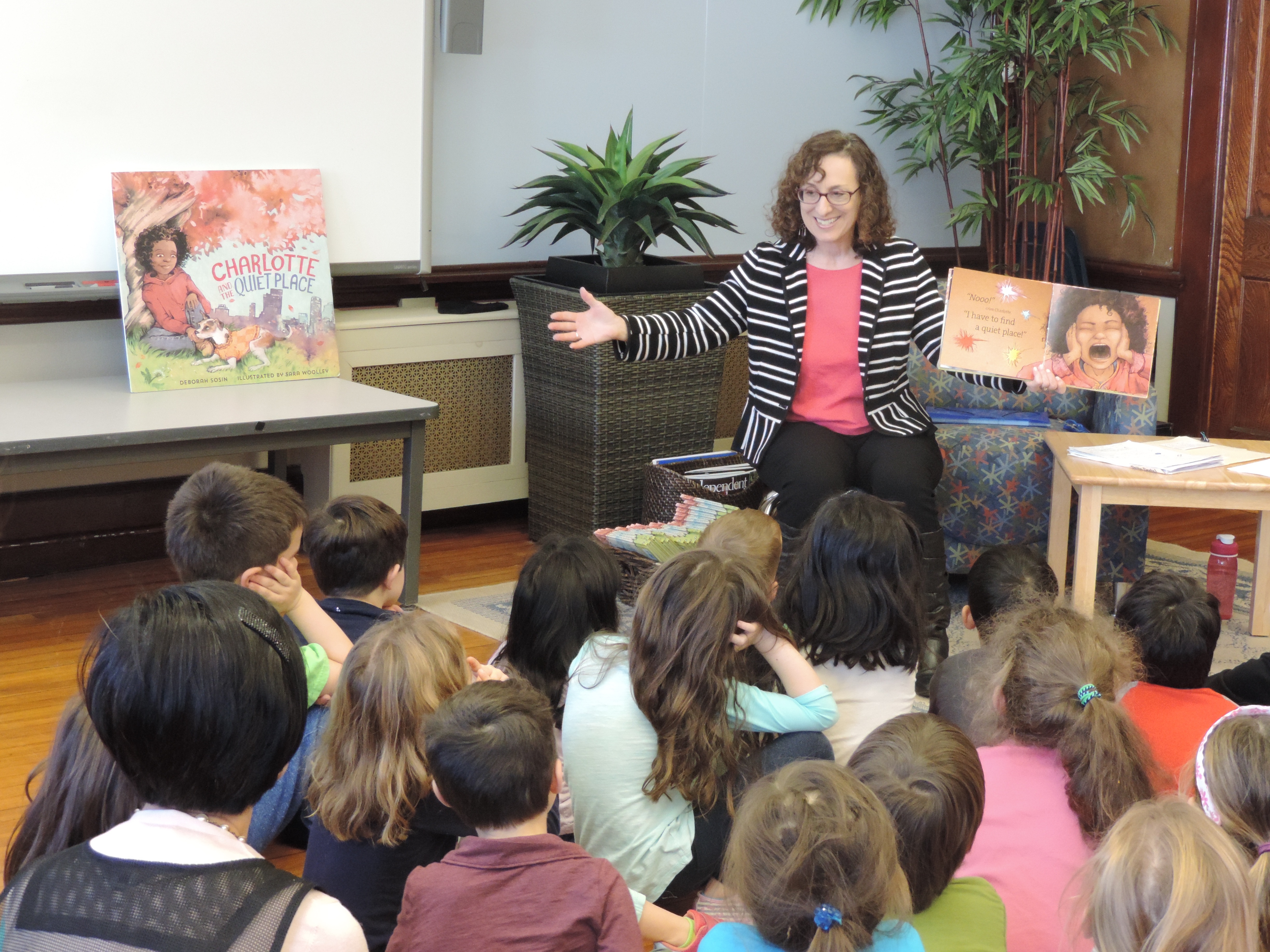
School visits are my favorite part of being an author! No matter what age the students are, they love to help me tell the story by repeating the “noisy” sounds and the “hoo ahh” breathing sounds. We usually do a few calming/breathing exercises together and, without fail, even the squirmiest group will settle into a beautiful, shared, often profound silence. Once, when asked where Charlotte finds her quiet place, one kindergarten girl said, “In her belly and in her brain, where it’s calm.” Many kids get that idea. What could be better? I also love showing them my early scribbles and illustrator Sara Woolley’s wonderful sketches and storyboards, and sharing the step-by-step process of publishing the book, from concept to completion.
celebrate-picture-books-picture-book-review-author-deborah-sosin-visits-Newton-Monetssori-School

Deborah Sosin reads Charlotte and the Quiet Place to students at Newton Montessori School. Photo courtesy of Newton Montessori School.

Can you talk a little about mindfulness and how it can benefit children?

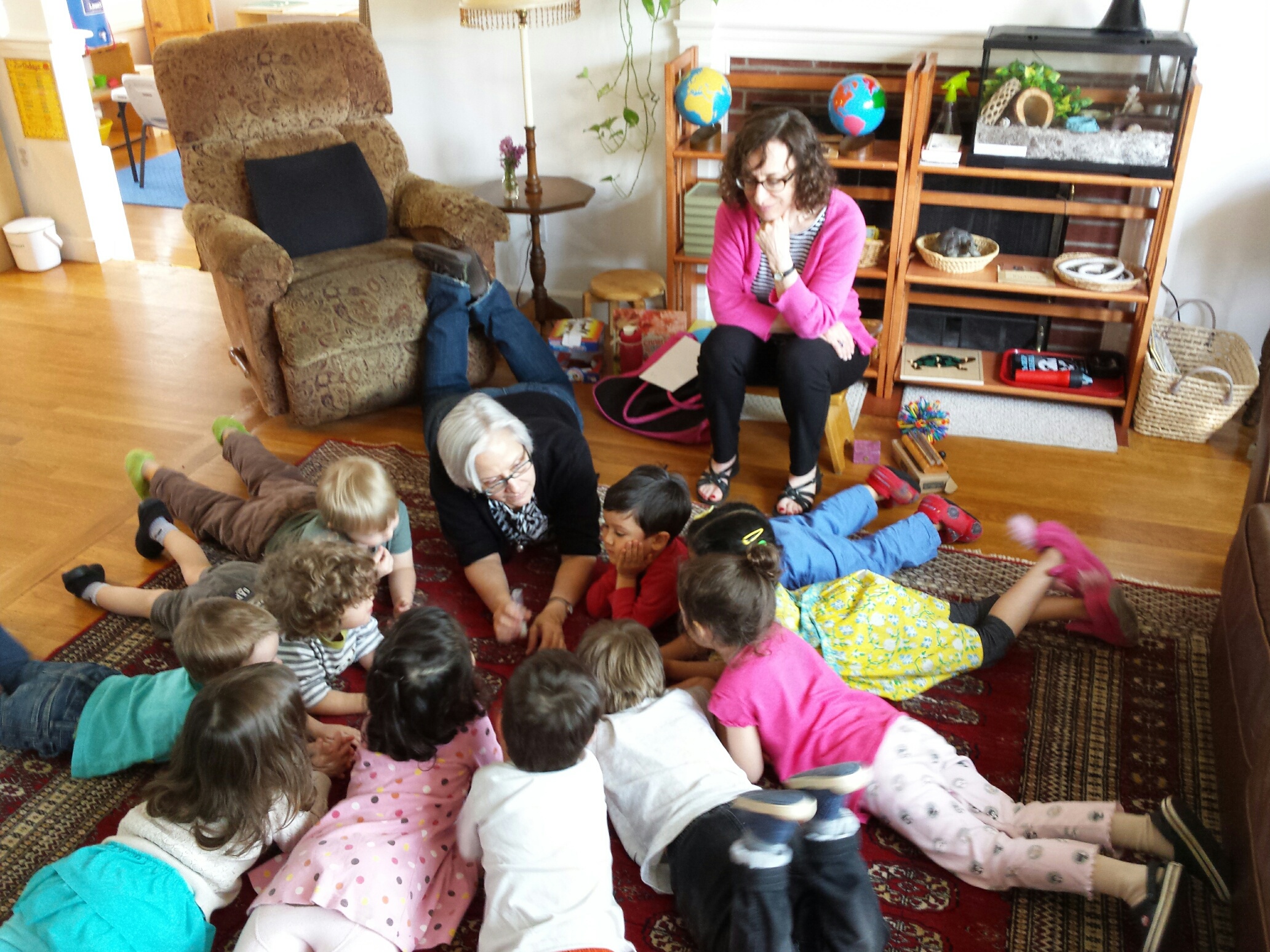
Mindfulness has become a catchword these days, but my favorite definition is from Dr. Amy Saltzman: “Noticing what’s happening right here and now, with a friendly, curious attitude, then choosing what to do next.” Many top-notch scientific studies show that mindfulness can help kids with concentration, attention, self-soothing, anxiety, depression, sleep, mood, compassion, confidence…I could go on. Compared with adults, most kids are naturally mindful, that is “in the moment,” but kids do get stressed out and worried about the past or the future, so mindfulness helps. I sometimes worry that parents and teachers might use it for disciplinary reasons (“Enough! Go be mindful in the corner!”), which is not the point. It’s a whole-life practice, not a technique or intervention. And, as the book shows, mindfulness can lead us to a quiet place inside that we can access whenever we want.
celebrate-picture-books-picture-book-review-interview-with-deborah-sosin-debbie-at-cottage-montessori-school

Students at the Cottage Montessori School in Arlington, Massachusetts play the Silence Game with director Karen Wagner, watching the sand in the hourglass. Photo courtesy of Stacey Moriarty.

Can you tell me a little about your work with Grub Street, a creative writing center in Boston?

I started taking classes at GrubStreet in 2008; my first class was “Six Weeks, Six Essays,” and from that class, I helped form a longtime regular writing group. I started blogging soon after and then submitted personal essays for publication, with some good luck. GrubStreet is a fantastic, inclusive community, with excellent faculty and a huge range of motivated, smart, and enthusiastic students, from beginners to veterans. After a few years, I applied to teach classes there and am proud to be on their instructor and consultant rosters now.

You are an accomplished choral singer, having performed at Lincoln Center, the United Nations, Boston’s Symphony Hall, and on an international tour. When did you begin choral singing? Do you have an anecdote you’d like to share from any of your experiences?

I’ve been singing my whole life and have been in choruses since elementary school. Singing with other people is extremely gratifying and, after all the “verbal”-type things I do, including my work as a psychotherapist, it’s a lovely change of pace. I spent about 15 years in the Zamir Chorale of Boston, which specializes in Jewish choral music. Our tours to Eastern Europe, Italy, and Israel were extraordinary. In 1999, when we sang at Auschwitz and Terezin, the sites of former concentration camps, it was hard to keep our emotions in check, but it felt important to revive the voices of the Jewish people that the Nazis had attempted to quell. A PBS documentary film, “Zamir: Jewish Voices Return to Poland,” chronicled our tour that summer. I think it’s still available through the Zamir Chorale website.

What’s the best part about writing for children?
celebrate-picture-books-picture-book-review-interview-with-deborah-sosin-debbie-at-The-Oblong-Bookstore-event

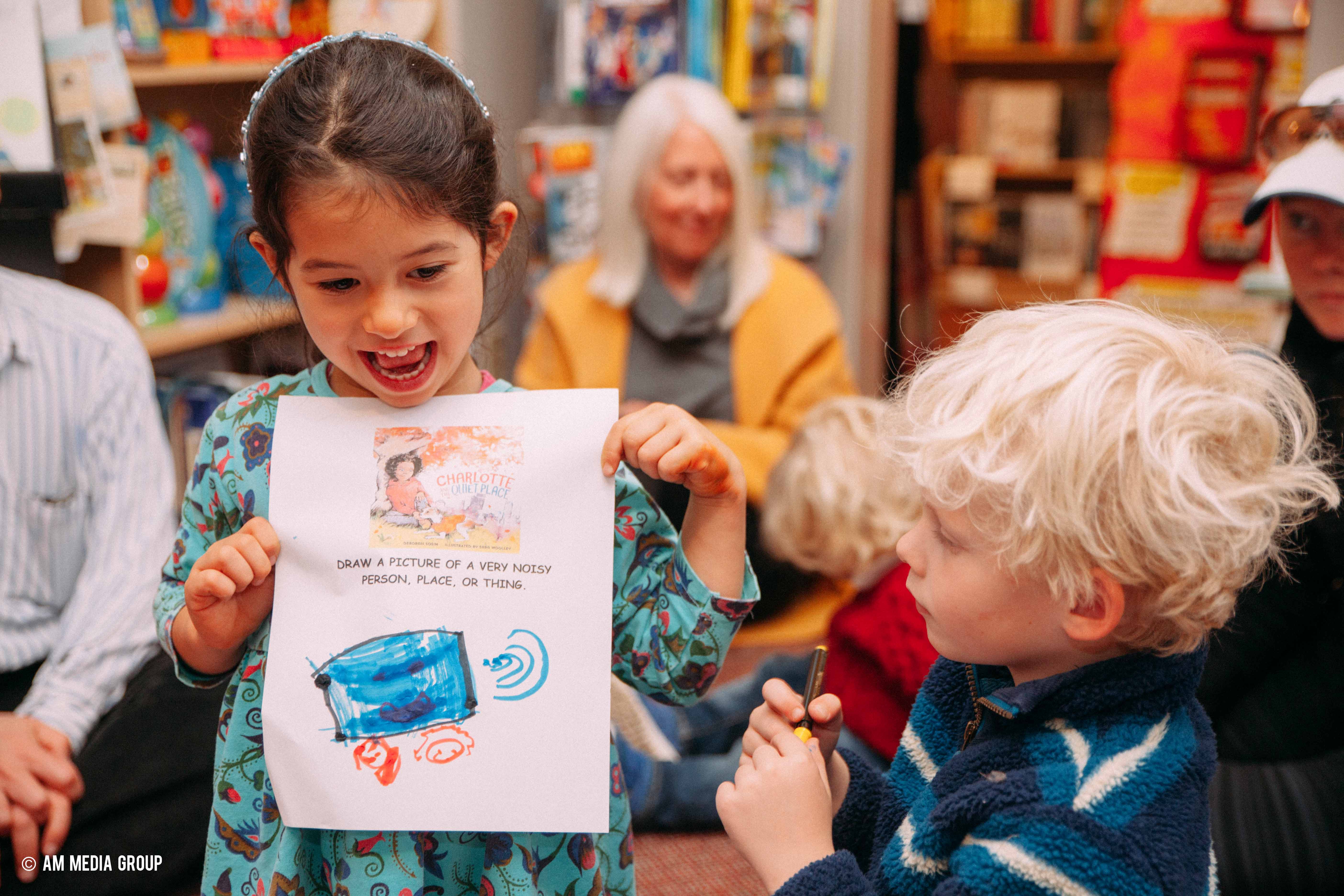
Children enjoy drawing their noisy and quiet places at an Oblong Bookstore event in NY. Photo courtesy of AM Media Group

After having focused almost exclusively on nonfiction for most of my writing career, it’s been wonderful to work in the very precise and rich world of picture-book writing with so many lovely, funny, imaginative, and supportive fellow writers I’ve met through SCBWI and the amazing Writers’ Loft in Sherborn, Mass.

Thanks, Debbie, for stopping by and chatting! I wish you all the best with Charlotte and the Quiet Place and all of your future endeavors!

International Quality of Life Activity
celebrate-picture-books-picture-book-review-smile-cards-craft

Share a Smile Cards


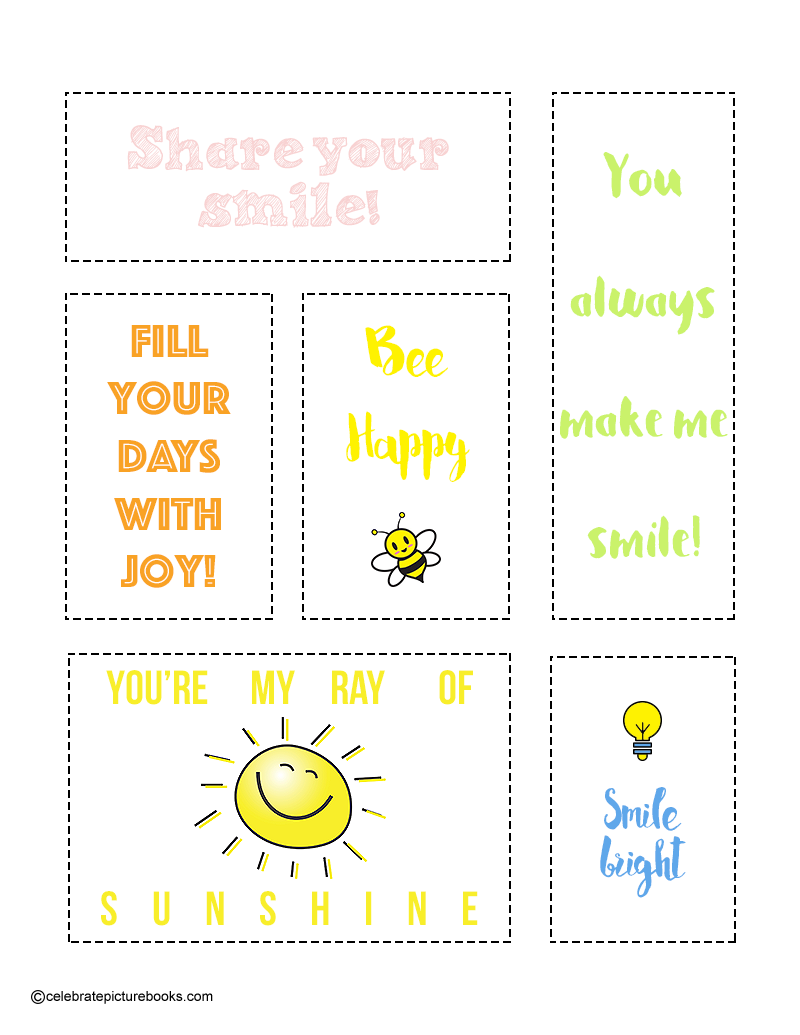
Life is better when you share smiles with those you know—and those you don’t! Try it! When you’re out today at school or other places, look someone in the eye and smile. You’ll probably get a smile back—and you can be sure that you will have made the other person’s and your day better!

Here are some Smile Cards that you can share. Why not slip one into your dad’s pocket or your mom’s purse, put one in your friend’s backpack, or sneak one onto your teacher’s desk? You can even leave one somewhere for a stranger to find! Have fun sharing your smiles, and see how much better you and the others around you feel!

Click here to print your Share a Smile Cards.

celebrate-picture-books-picture-book-review-charlotte-and-the-quiet-place-noisy-neighborhood

You can find Charlotte and the Quiet Place at these booksellers

Amazon | Barnes & NobleIndieBound | Parallax Press 

Picture Book Review


January 27 – It’s Celebration of Life Month

celebrate-picture-books-picture-book-review-a-beginners-guide-to-being-human-cover

About the Holiday

Today’s holiday was established by Food for Health International to encourage people to take a holistic approach to taking care of themselves, not only their physical health but their emotional health as well. Celebrating all that life has to offer while taking time to enjoy family and friends and be mindful of others through mutual respect, inclusion, empathy, and gratitude goes a long way towards greater happiness and health. Sharing today’s book with your kids is a wonderful way to celebrate this month-long holiday all year around.

A Beginner’s Guide to Being Human

Written by Matt Forrest Esenwine | Illustrated by André Ceolin


“Welcome to Humanity! You’re really going to enjoy it.” With this expansive greeting, Matt Forrest Esenwine invites kids in to learn what they need to know “… to get the most out of [their] human experience….” First up is family—that group of people who spend so much time with you and “care about you the most.” But what does a family do? “Families love each other, disappoint each other, support each other, and get angry with each other, over and over—sometimes all in the same day. Weird, right?” But you can be sure that the “…whole ‘caring about you’ part never stops.

celebrate-picture-books-picture-book-review-a-beginners-guide-to-being-human-sidewalk

Image copyright André Ceolin, 2022, text copyright Matt Forrest Esenwine, 2022. Courtesy of Beaming Books.

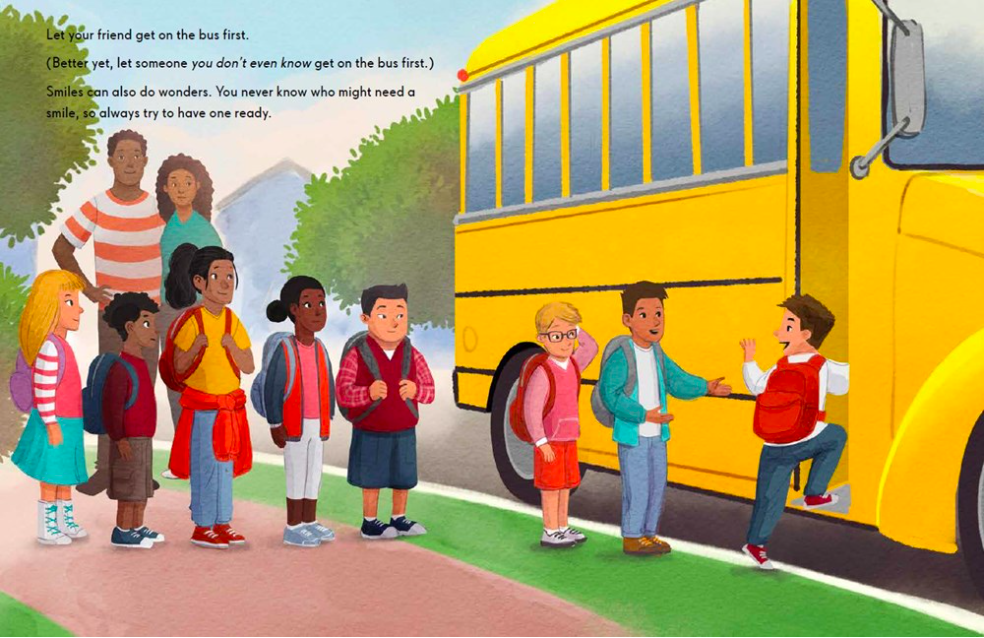
So what do you do with all of that caring that comes your way? You can share it! How? Well, by being kind. Sure, we hear that word all the time, but what does “being kind” really look like? Esenwine and André Ceolin give some easy-to-emulate examples that don’t take any money or super strength or extra time. In fact, everybody carries one of the easiest—maybe even the most meaningful—way to show kindness right on their face: their smile.

celebrate-picture-books-picture-book-review-a-beginners-guide-to-being-human-school-bus

Image copyright André Ceolin, 2022, text copyright Matt Forrest Esenwine, 2022. Courtesy of Beaming Books.

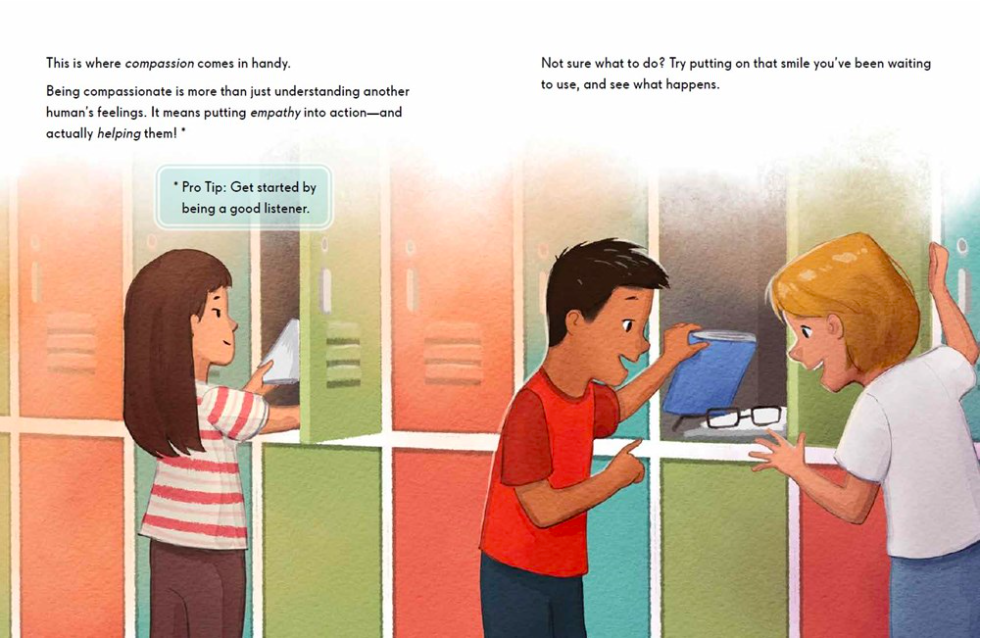
Once kids have kindness down, Esenwine moves on to empathy and urges kids to imagine why others may act the way they do, to think about what else may be going on with someone at home, in school, or elsewhere. Using empathy leads to compassion. What does compassion mean and how does it work? Esenwine and Ceolin show readers a few examples as well as reminding them that “we humans are quite good at ending up in the same situations again and again. Whatever another person is feeling, chances are, you’ll feel the same way at some point too” with a gallery of portraits of kids depicting emotions we all experience from time to time—and, often, every day.

One way of thinking about and reacting to situations that “has produced excellent results for over two thousand years,” Esenwine reveals, is the Golden Rule. He then shows kids how to apply this thoughtful idea to a range of situations to create better communication and understanding than getting angry or pushy or impatient.

celebrate-picture-books-picture-book-review-a-beginners-guide-to-being-human-school-locker

Image copyright André Ceolin, 2022, text copyright Matt Forrest Esenwine, 2022. Courtesy of Beaming Books.

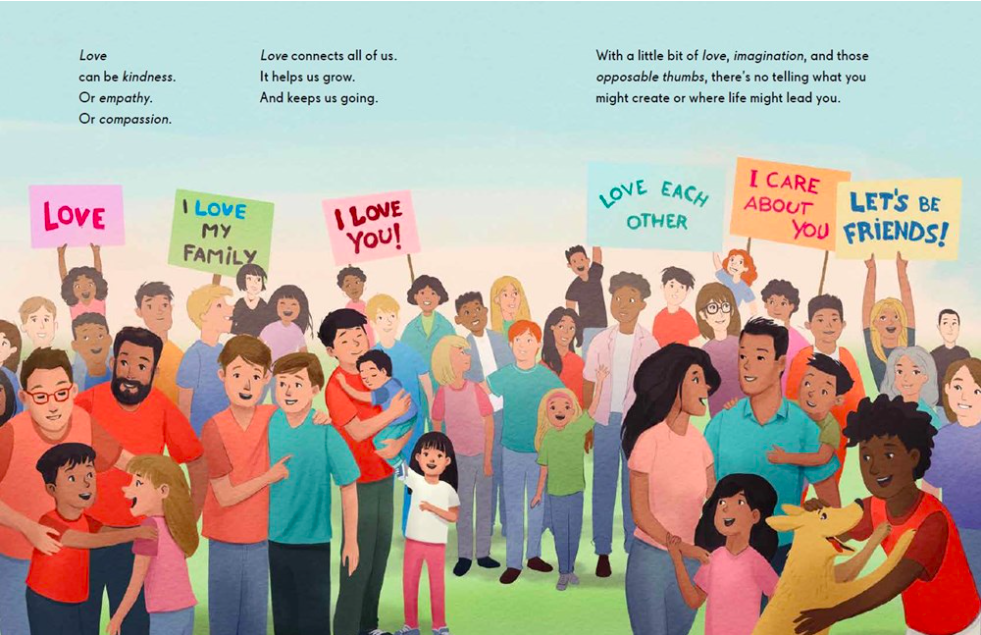
Esenwine acknowledges that there will be bad days among the good, but these too can be handled with honesty, apologies, and forgiveness. Yes, “being human can sometimes be messy,” but that’s where family and friends can help. And, of course, they’re there to celebrate the good times too. So what does all of this kindness and compassion and empathy come down to? The thing that connects us all: Love. “So, welcome to Humanity!” Esenwine emphasizes, “We hope you enjoy your humanness. And we love that you’re here.”

Sprinkled throughout the text are brief “Pro Tips” that in one sentence expand on an idea and give kids confidence in understanding and/or applying the values in their own life.

celebrate-picture-books-picture-book-review-a-beginners-guide-to-being-human-love

Image copyright André Ceolin, 2022, text copyright Matt Forrest Esenwine, 2022. Courtesy of Beaming Books.

Matt Forrest Esenwine has created a book about treating others according to the Golden Rule that goes to the heart not only of how to do that but, so importantly, when and why. Sometimes the need for kindness and empathy can be apparent, as when a child or adult is sad, alone, or has a disappointment or obvious mishap. But what about when someone’s behavior seems to be a personal slight, disrespectful, or just going against the rules?

That’s were Esenwine’s gentle, straightforward, and honest storytelling invites readers to stop and really consider every person and situation individually, to dig deep into one’s own memory and experiences for better understanding and supportive responses. He also addresses the importance of apologizing and forgiveness. And he does all of this with humor and examples that will resonate with kids. Moreover, these elements provide a spark for further conversations among children and adults about specific incidents in a child’s life, possible reasons behind them, and how the child can respond in a kind, empathetic, and compassionate way.

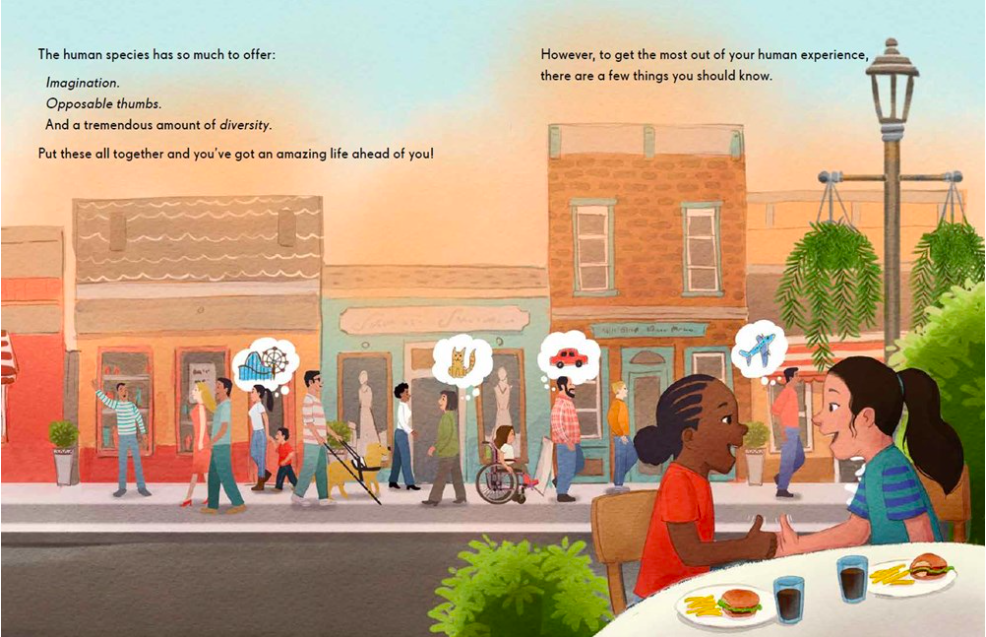
From the first spread, which shows a sidewalk busy with people all thinking their own thoughts (some of whom reappear elsewhere), André Ceolin engages readers in looking closely and thinking about how the people may be feeling, what they are doing, and why they might be behaving in a certain way. He depicts the characters in detailed places and situations familiar to kids that will spark recognition and lead to meaningful discussions and understanding. Ceolin’s images on each page, as well as a portrait gallery of universal emotions, provide excellent social emotional learning tools for adults to share with children when talking about recognizing and reading others’ feelings through facial expressions. Bookending the text, Ceolin emphasizes the support and enduring love of family and good friends.

A well-conceived, heartfelt, and impactful book you’ll want to share again and again, A Beginner’s Guide to Being Human reminds readers that we’re all in this—school, work, sports, clubs: life—together and is a timely must-have addition to home, school, classroom, and public library collections.

Ages 4 – 8

Beaming Books, 2022 | ISBN 978-1506481739

About the Author

Matt Forrest Esenwine is an author and poet from Warner, New Hampshire. His debut picture book, Flashlight Night (Boyds Mills Press, 2017), was selected by the New York Public Library as one of the Best Picture Books for Kids of 2017. His poetry can be found in numerous anthologies, including The National Geographic Book of Nature Poetry (National Geographic Children’s Books, 2015), I Am Someone Else (Charlesbridge, 2019), and Highlights for Children. You can visit him at mattforrest.com and connect with him on Facebook | Instagram | Twitter | YouTube.

About the Illustrator

André Ceolin studied at the School of Visual Arts in New York City. He has illustrated over twenty books for children. André lives in Brazil with his family. You can visit him at andreceolin.com and on Instagram.

Celebration of Life Month Activity

CPB - Random Acts of Kindness cards

Kindness Cards


Here are some cheery cards that are sure to make the recipient’s day happier! Give them to a friend, a family member, your teacher, or your bus driver to show them that you care and that they mean a lot to you!

Random Acts of Kindness Cards Sheet 1 |  Sheet 2 | Sheet 3

celebrate-picture-books-picture-book-review-a-beginners-guide-to-being-human-cover

You can find A Beginner’s Guide to Being Human at these booksellers

Amazon | Barnes & Noble | Books-a-Million

To support your local independent bookstore, order from

Bookshop | IndieBound

Picture Book Review

January 3 – Book Tour Launch for Love Made Me More

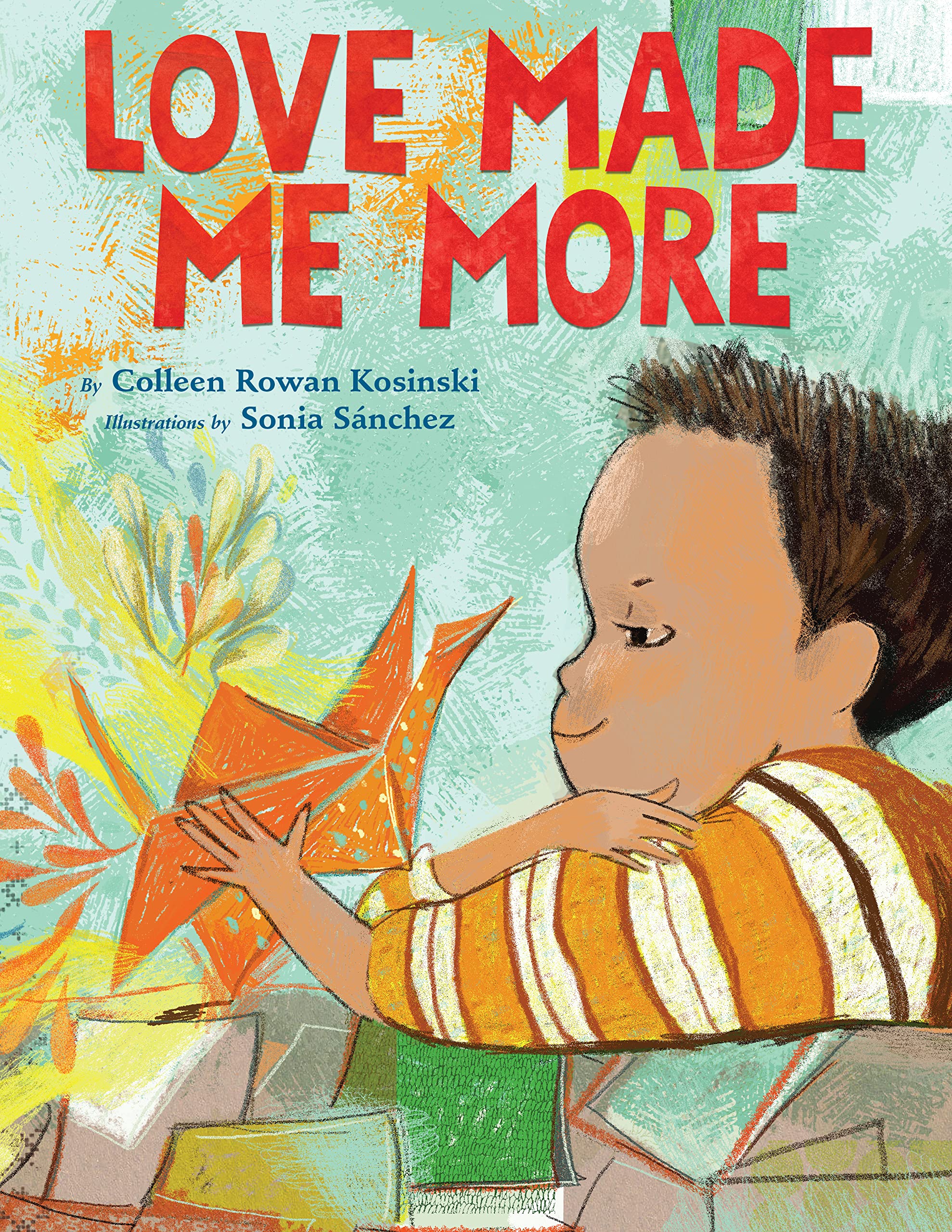
celebrate-picture-books-picture-book-review-love-made-me-more-cover

I’d like to thank Two Lions and Barbara Fisch at Blue Slip Media for sending me a copy of Love Made Me More for review consideration. All opinions on the book are my own.

Love Made Me More

Written by Colleen Rowan Kosinski | Illustrated by Sonia Sánchez


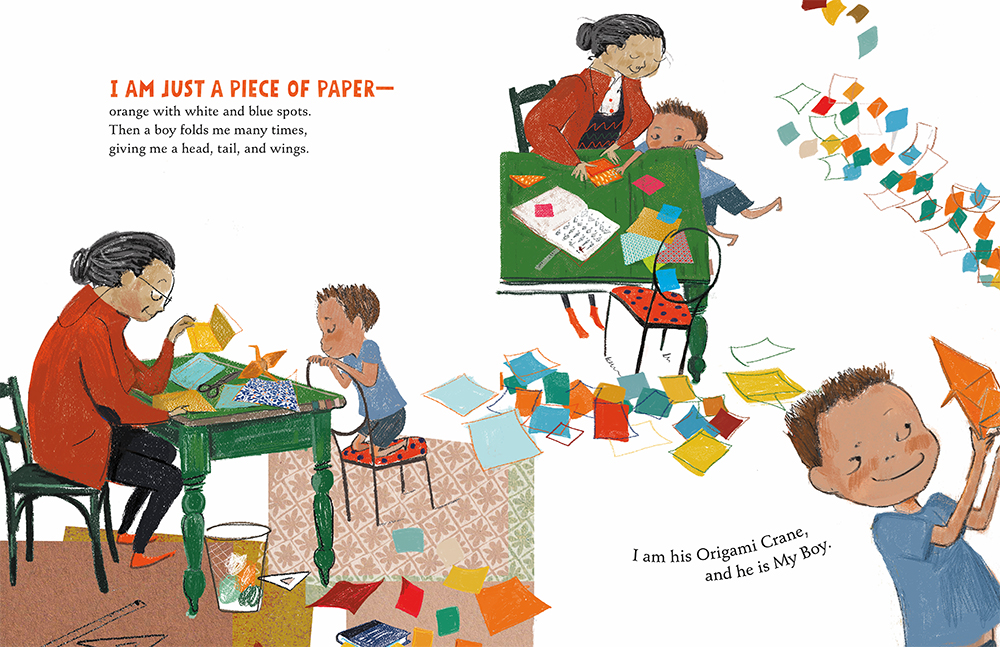
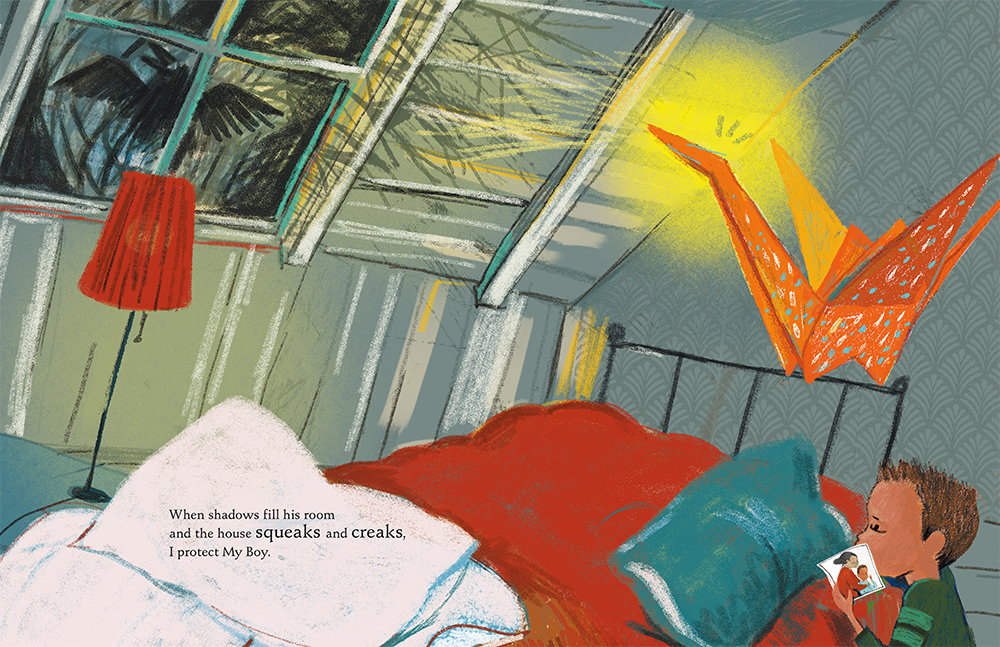
An origami crane reveals how it came to be after its origins as “just a piece of paper—orange with white and blue spots” and the day when “a boy folds me many times, giving me a head, tail, and wings” under the watchful eye of his grandmother. The crane becomes an instant favorite, and for the crane, the boy is “My Boy.” The young child places the crane on his nightstand, so that he sees it right before going to sleep and again as soon as he wakes up.

celebrate-picture-books-picture-book-review-love-made-me-more-making-crane

Image copyright Sonia Sánchez, 2022, text copyright Colleen Rowan Kosinski, 2022. Courtesy of Two Lions.

Over the years, the origami crane shares in his play, his dreams, and his wishes and it comforts him in his grief of losing a loved one and when shadows scare him. But as the boy grows older, finds new friends and interests, and becomes braver, he talks less and less to the origami crane. And while the crane still sits on his nightstand, the paper has grown dusty.

Then “one day,” the origami crane says,”My Boy places a photograph in front of me. I peek around and see a picture of a girl with an orange, white, and blue shirt. My colors. I fume.” The crane is jealous that “now she is the last thing he sees” at night and the first in the morning. But more years pass, and a day comes when the boy reaches for the origami crane once more. The crane is hopeful that they will play together again as in the past, but instead the boy unfolds it and “scrawls tickling words” on the paper before refolding it.

celebrate-picture-books-picture-book-review-love-made-me-more-making-shadows

Image copyright Sonia Sánchez, 2022, text copyright Colleen Rowan Kosinski, 2022. Courtesy of Two Lions.

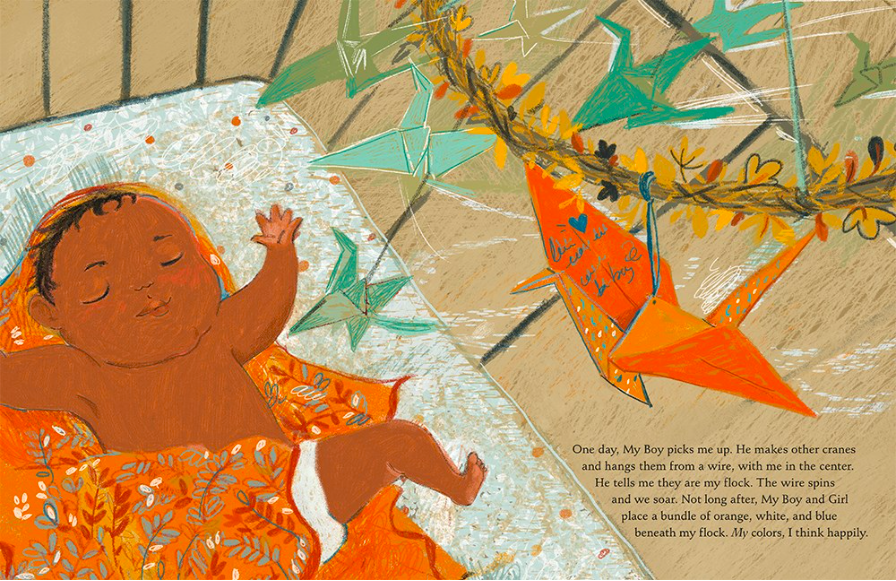
The origami crane has not been forgotten during all of these years. In fact, the crane’s stature has only grown, now offered to the girl with a love-affirming question hidden inside. “‘Yes, I will marry you,’ she says.” The crane embraces her as “My Girl too” as the boy refolds it. Soon, the origami crane finds itself in the center of a flock floating above a crib where a baby, wrapped in an orange, white, and blue blanket sleeps. “My colors,” the crane thinks happily.

The crane is proud that his flock is “the last thing Our Baby sees each night and the first thing he sees each morning” and that “he loves us.” As the baby grows into boyhood and learns how to make an origami crane himself—with his father’s crane close by—the origami crane realizes that what has made it so much more than “just a piece of paper” is all the love it has been shown and has been a part of.

celebrate-picture-books-picture-book-review-love-made-me-more-making-baby

Image copyright Sonia Sánchez, 2022, text copyright Colleen Rowan Kosinski, 2022. Courtesy of Two Lions.

Colleen Rowan Kosinski’s unique story, told from the perspective of an origami crane that has been molded by a boy from a simple piece of paper to become a beloved keepsake, reveals the endurance and transformative power of love. Infused with feelings of belonging and purpose, the story flows through the changes a lifetime brings not only for the boy but for the origami crane. Just as the boy finds friends, meets a girlfriend, gets married, and has a baby, the crane slowly learns to integrate other people and, finally, a flock of origami cranes into its sphere, changes often told with honest emotions and a sense of the years passing by.

When the boy proposes to the girl with the help of the crane and it now accepts his fiancé as “My Girl too,” the crane seems to gain a sense of new life and autonomy when the boy refolds the paper. Instead of defining itself as “his Origami Crane” it now asserts itself as “Origami Crane.” The idea of the importance of being seen, embraced, and given love over an entire lifetime is woven throughout the story and becomes the central theme as the crane realizes that the baby loves it too. Readers take away the knowledge that it is love freely given—and accepted—that makes all the difference in a person’s self-esteem and the way their life evolves.

celebrate-picture-books-picture-book-review-love-made-me-more-making-orange-crane

Image copyright Sonia Sánchez, 2022, courtesy of Two Lions.

Sonja Sánchez’s vibrant and lively illustrations glow with the magic and comfort that the origami crane brings to the boy’s life as a child. Using angled images, strong lines that suggest the creasing that defines the origami crane, and warm earth tones, Sánchez centers her illustrations on the crane. Pages full of movement and color paint a picture of the boy’s childhood spent playing, wishing, and dreaming with the crane always by his side give way to a spread shrouded in brown, where the boy and his friends appear only as silhouettes and the orange crane, pushed to the side of the desk and dwarfed by the boy’s new interests in a computer, guitar, and other objects, is the only bright spot in the brown and darkened room.

Time passes and within two page turns, the boy, grown into a young man, once again has the crane in hand. Its former glow of magic is back as the boy unfolds, writes on, and refolds the paper. A baby comes along and, like his father, sails into imagination and play with the crane, finally learning how to fold his own crane as he grows into boyhood.

Love Made Me More is a singular story to share with children to reaffirm their special bond with a favorite toy or memento, but more: to remind and reassure them of the power of enduring love, expressed in so many ways, to transform people, experiences, and life itself. The book would be a unique, uplifting, and affecting addition to home, school, and public library collections.

Ages 4 – 8

Two Lions, 2022 | ISBN 978-1542006200

About the Author

Colleen Rowan Kosinski is the author of A Home Again and the author-illustrator of Lilla’s Sunflowers and A Promise Stitched in Time. She received her BA from Rutgers University in visual art, is an alumna of Philadelphia’s Moore College of Art and Design, and spent many years as a successful freelance fine artist. Colleen calls New Jersey her home and resides there with her family. To learn more, and to watch a tutorial on making an origami paper crane, visit www.colleenrowankosinski.com. You can connect with Colleen on Facebook | Instagram | Twitter

About the Illustrator

Sonia Sánchez is the illustrator of a number of picture books, including Evelyn Del Rey Is Moving Away by Meg Medina, A Crazy-Much Love by Joy Jordan-Lake, and The Little Red Fort by Brenda Maier. Her books have been nominated for the Eisner Award and named a CBC/NCSS Notable Social Studies Trade Book for Young People and a Bank Street College Best Book of the Year. She lives with her husband, her kids, and a sleepyhead cat in Barcelona, Spain. You can connect with Sonia on Instagram.

Love Made Me More Tour Launch Activity

Make an Origami Crane


Follow along with this tutorial from Origami Tsunami to make your own Origami Crane to love!

celebrate-picture-books-picture-book-review-love-made-me-more-cover

You can find Love Made Me More at these booksellers

Amazon | Barnes & Noble | Books-a-Million

To support your local independent bookstore, order from

Bookshop | IndieBound

Picture Book Review

November 9 – It’s Picture Book Month

celebrate-picture-books-picture-book-review-sleepy-happy-capy-cuddles-cover

About the Holiday

If you love picture books, you know the thrill of holding a new or a new-to-you book in your hands and opening up to that very first page. The children’s sections of bookstores and libraries draw you in with humor, fairy tales, poetry, biographies, science, and so much more—a whole universe of creativity, thought, knowledge, and imagination—that enlightens and entertains. This month take time to indulge your passion for picture books!

I’d like to thank Page Street Kids for sending me a copy of Sleepy Happy Capy Cuddles for review consideration. All opinions on the book are my own.

Sleepy Happy Capy Cuddles

Written by Mike Allegra | Illustrated by Jaimie Whitbread


The air in the rainforest rang with “squeaks, squawks, grunts, growls, hisses, harrumphs, and frenetic feather-and-fur-flying fury. It was quite the rumpus.” But all of these sounds didn’t make the animals happy, in fact, they were miserable and, even worse, all the noise “made them feel very alone—even though they weren’t alone.” But then one day, a visitor emerged from the river with sounds of her own—sounds the other animals had never heard before, like a “fwippa fwip of flickering ears” and a “shookita shimmy of a shaking booty bottom.” 

celebrate-picture-books-picture-book-review-sleepy-happy-capy-cuddles-fwippa-fwip-ears

Image copyright Jaimie Whitbread, 2022, text copyright Mike Allegra, 2022. Courtesy of Page Street Books.

Suddenly, the rainforest was silent as the animals stared at this unusual interloper as she yawned and stretched. A river turtle was the first to approach and ask what, exactly, she was. The answer came quickly (a capybara)—and with an invitation to “join my Sleepy Happy Copy Cuddle.” The turtle rebuffed this invite, thinking it would in some way soften his shell. When the capy reassured the turtle that he would stay as tough as ever, he relented. 

So they cuddled next to each other, and the river turtle had to agree that he felt better. “‘That makes me happy,’ said the capy. So she floofed. Floof!” Hearing this FLOOF, an iguana came by to see what was happening. The iguana did not want to get so close, and the capy let the iguana know this was perfectly all right. So she had another happy cuddler and enjoed another happy FLOOF. All this FLOOFing started to attract more and more animals, each wanting to cuddle in their own way. The capy agreed that all these ways of cuddling were valid and just perfect.

celebrate-picture-books-picture-book-review-sleepy-happy-capy-cuddles-crocodile

Image copyright Jaimie Whitbread, 2022, text copyright Mike Allegra, 2022. Courtesy of Page Street Books.

At last, all the rainforest animals were content. Then a dark shape came slowly moving into view just below the surface of the river, and in a moment a crocodile splashed onto shore with a “ROOOOOOAR!” Undaunted, the capy asked if the crocodile would like a cuddle. The crocodile was baffled, bewildered, and even a bit alarmed. But then he was touched, if a little confused. “‘No one ever wants to cuddle me,’ the crocodile sniffled.” The capy assured the crocodile that she did. Now everyone was capy cuddle happy. 

But what was this? More dark shapes and burbling bubbles were swimming their way. Was it? It was! “‘More Sleepy Happy Capy Cuddlers!'” Lots of them! Now there were plenty of cuddles—and FLOOFS—to go around for everyone!

In a short note Mike Allegra tells a little more about capybaras and includes a photo of the adorable cuddlers.

celebrate-picture-books-picture-book-review-sleepy-happy-capy-cuddles-floof

Image copyright Jaimie Whitbread, 2022, text copyright Mike Allegra, 2022. Courtesy of Page Street Books.

Mike Allegra, a very funny writer well versed in the magical gymnastics of language, dazzles with sentences energized with alliteration, assonance, and delightfully gleeful onomatopoeia. Add to that his recurring “sleepy happy capy cuddles” and infectious “Floofs,” and this is one story that will have kids and adults smiling from page one and long after the story is over. (Of course, adults should be ready to close the cover just to open it again immediately for at least one “one more time!”) What’s even more ingenious, perhaps, is that along with this giddiness comes some thought-provoking truths about feeling alone among a crowd, the diversity of ways to feel comforted, comfortable, and happy, how the most prickly of personalities may need love the most, as well as an education on capybaras and their behaviors.

Jaimie Whitbread brings this transformed rainforest to life with her realistic depictions of a wide variety of animals in all their glorious color and raucous, curmudgeonly, chill, or playful personalities. Her bold imagery clearly shows the difference in the stressed-out tension that existed pre-floof and the relaxed contentedness bestowed by the capy cuddles. Animal lovers and kids eager to do more research on the rainforest will find Whitbread’s illustrations particularly fascinating while the final floof-a-rama super cuddle is sure to inspire group snuggles at home.

A masterful combination of comical and educational that’s sure to be a favorite for kids and adults alike, Sleepy Happy Capy Cuddles is a joyful read aloud and a must for any home, classroom, school, and public library collection. If you’re looking for a gift for any child, this book is a superb choice.

Ages 4 – 8

Page Street Kids, 2022 | ISBN 978-1645675594

Discover more about Mike Allegra and his books on his website.

To learn more about Jaimie Whitbread, her books, and her art, visit her website.

Picture Book Month Activity

celebrate-picture-books-picture-book-review-take-a-bookworm-trek-maze

Take a Bookworm Trek! Maze


These two friends love reading! Can you help them through the maze to meet the bookworm? 

Take a Bookworm Trek! Maze Puzzle | Take a Bookworm Trek! Maze Solution

celebrate-picture-books-picture-book-review-sleepy-happy-capy-cuddles-cover

You can find Sleepy Happy Capy Cuddles at these booksellers

Amazon | Barnes & Noble | Books-a-Million

To support your local independent bookstore, order from

Bookshop | IndieBound

Picture Book Review

October 21 – My Name Is Not Ed Tug Book Tour Stop

celebrate-picture-books-picture-book-review-my-name-is-not-ed-tug-cover

I’d like to thank The Children’s Book Review and Amy Nielander for sharing a digital copy of My Name Is Not Ed Tug with me. 

My Name Is Not Ed Tug

By Amy Nielander


Edimorwhitimormiligimmus Tug knew where he came from and just where he fit into his family. After all, “he was named after his Grandpa Edimor,” who helped him learn how to spell his name with a tall tower of blocks; “his Great Uncle Whitimor,” who taught him how to play the accordion; his Aunt Mili,” who ran a butterfly farm; “and his Granny Gimmus,” who filled his tummy with warm, homemade soup.” Anyone hearing his name might think it was gibberish, but Edimorwhitimormiligimmus thought “it was perfect.”

celebrate-picture-books-picture-book-review-my-name-is-not-ed-tug-edimor

Copyright Amy Nielander, 2022, courtesy of West Margin Press.

School, of course, was a challenge since the other kids had a hard time spelling or even remembering his name. And his teacher, Ms. Mell, found that her mouth grew “quite tired” just trying to pronounce it. But one Monday, Ms. Mell announced that a new student, Ty, would be joining their class. Mrs. Mell had made name tags for each student to make it easier for Ty to remember their names, and she slapped one on Edimorwhitimormiligimmus’s shirt. When he looked, Edimorwhitimormiligimmus saw that the tag simply read “Ed.” He gazed at the tag with sadness. “Edimorwhitimormiligimmus Tug was shocked. He was perplexed. He felt like his heart had been stung by a giant bee. Twice.”

celebrate-picture-books-picture-book-review-my-name-is-not-ed-tug-Granny-Gimmas

Copyright Amy Nielander, 2022, courtesy of West Margin Press.

After school, Edimorwhitimormiligimmus went straight to his room and stayed there, thinking. When he emerged, he had a plan (and a very perfectly sized name tag taped to his sweater). The next day, he approached Ty, who was playing with puzzle blocks. He stood proudly, displaying his sweater, and introduced himself—his whole self. He slowly said each part of his name and, miraculously, Ty repeated it. Edimorwhitimormiligimmus “was so happy his curls bounced.” Then as he and Ty constructed a tall bridge with the blocks, he explained how he and his Grandpa Edimor “love to build things together”—and had even invented those blocks.

celebrate-picture-books-picture-book-review-my-name-is-not-ed-ty

Copyright Amy Nielander, 2022, courtesy of West Margin Press.

At lunch he did the same thing with the kids at his table, and they also repeated his name. To explain how important his Uncle Whitimor was to him, Edimorwhitimormiligimmus, he played his uncle’s favorite song on the accordion. When the class went out for recess, he told more kids about his Aunt Mili and pointed out, and they too learned his name.

On Tuesday, Mrs. Mell was out sick, and Edimorwhitimormiligimmus saw an opportunity to be kind and explain about his name. He and Ty delivered a steaming pot of Granny Gimmus’s soup to her doorstep and told her all about cooking with his granny. “The delicious soup warmed her heart.” Edimorwhitimormiligimmus’s plan worked. Now everyone, including Ms. Mell, knew—and used—Edimorwhitimormiligimmus’s full name.

celebrate-picture-books-picture-book-review-my-name-is-not-ed-soup-for-ms-mell

Copyright Amy Nielander, 2022, courtesy of West Margin Press.

The experience prompted Edimorwhitimormiligimmus to come up with a new plan, a project to ensure all of his friends knew their names were just as perfect for them as Edimorwhitimormiligimmus was for him. And he and his classmates got started with the gift they made for Tyvantennyson to give him at his birthday party.

celebrate-picture-books-picture-book-review-my-name-is-not-ed-tyvantennyson-sign

Copyright Amy Nielander, 2022, courtesy of West Margin Press.

Amy Nielander’s heartwarming and affirming story will captivate kids from the first recitation of “Edimorwhitimormiligimmus Tug”—a name that initially elicits giggles but soon rolls smoothly off the tongue. As they learn how each piece of Edimorwhitimormiligimmus’s name reflects not only the family member he’s named for but also the special things they do together, readers will empathize with the pride he feels in his name and his disappointment when they can’t get it right.

While Nielander’s clever story revolves around one child’s name, there are many other important lessons for both kids and adults woven throughout. Children will understand that their names, personalities, heritage, talents, and dreams are perfect for them just the way they are. For adults, Ms. Mell’s dismissive mangling and shortening of Edimorwhitimormiligimmus’s name to “make it easier for all of us” reminds us that every child deserves to be really seen and accepted for who and everything they are.

Nielander’s illustrations are full of warmth and love, charm and humor as she introduces the unique talents of each member of Edimorwhitimormiligimmus’s inclusive and close-knit family. As Edimorwhitimormiligimmus puts his plan to teach each classmate and Ms. Mell his name into action, the children’s sweet faces and palpable excitement are infectious and will draw readers into this universal hug of a story. The surprise reveal of Ty’s full name and the collective gift the class makes him—with the promise of the same for each child—will delight readers and is sure to spur them to create name signs for themselves.

An engaging, multi-layered story about acceptance, self-esteem, family, and friendship, My Name is Not Ed Tug is a story kids will want to hear again and again. The book is highly recommended for home bookshelves and is a must for classroom, school, and public libraries.

Ages 4 – 8

West Margin Press, 2022 | ISBN 978-1513134871

Discover more about Amy Nielander, her books, and her art on her website.

Take a peek at the book trailer for My Name Is Not Ed Tug!


celebrate-picture-books-picture-book-review-my-name-is-not-ed-tug-cover

You can purchase My Name Is Not Ed Tug at these booksellers

Amazon | Barnes & NobleBookshop 

Picture Book Review