March 4 – National Grammar Day

celebrate-picture-books-picture-book-review-little-white-fish-is-so-happy-cover

About the Holiday

I must confess that today’s holiday is one of my favorites. Even as a kid I howled at the unintentional ridiculousness misplaced punctuation and poor editing created and absolutely loved diagramming sentences (I know, right?!). While the rules of grammar in any language may sometimes seem confusing and unnecessary, they help structure the language so what you write and say makes sense and exactly states your meaning. National Grammar Day was established in 2008 by author Martha Brockenbrough, the founder of the Society for the Promotion of Good Grammar.

Little White Fish Is So Happy

By Guido Van Genechten


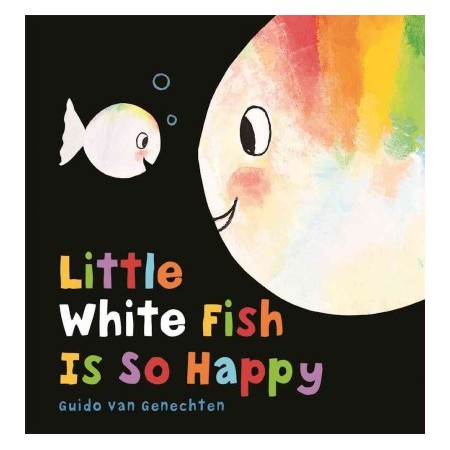
Little White Fish has been swimming on his own, but is so happy that his “mom is coming to get him.” Before he leaves, however, he wants to say “goodbye” to his many friends. “Bye-bye, snail in the shell,” he burbles. The “frog on the rock” also receives a happy “goodbye.” Little seahorse is playing under a leaf, but Little White Fish spies him.

Crab waves from behind a stone as Little White Fish swims by, and goldfish smiles at him from his spot “between the reeds.” As Little White Fish sends his friends a final farewell, they all stand “next to each other” to see him off. The best part of going home for Little White Fish, though, may be getting to swim “in front of” his mom!

In Little White Fish Is So Happy, young grammarians are introduced to a few of the most common prepositions, with clear visuals to reinforce their meaning. Bold type prompts adult readers to emphasize the prepositions and to expand on the idea by pointing out how the words apply to each particular sea creature. The endearing relationship among these friends will charm young children as the idea of being away from home is presented in an upbeat way that encourages independence while also reassuring little ones of parents’ love and attention.
celebrate-picture-books-picture-book-review-well-done-little-white-fish-cover

Well Done, Little White Fish

By Guido Van Genechten


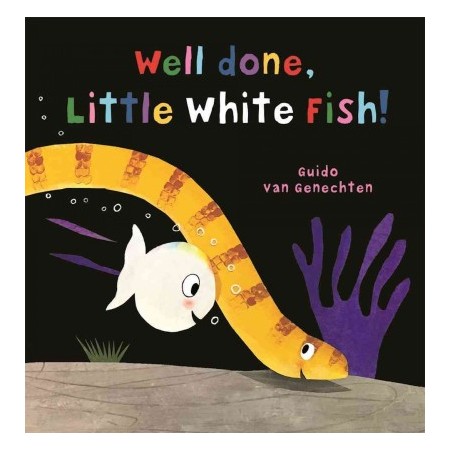
Little White Fish is visiting his friends. First up is crab who is “can cut sea grass with his claws.” This is a pretty cool talent, and Little White Fish wonders what he can do. Turtle is strong enough to carry a rock on his shell, and “sea urchin easily does seven somersaults in a row. And Little White Fish? What can he do?”

Wow! Little jellyfish “can light up the dark.” Little White Fish is astonished; he knows he can’t do that. Starfish is like a ballet dancer when she stands on one leg. “Little White Fish doesn’t even have legs….” Little White Fish knows he must watch out for Octopus when he spits out ink, and he likes playing over and under with sea snake when he makes “a beautiful arch.

And Little White Fish? He “can swim really well, even backwards and upside down!” Now it’s time for his friends to be amazed, and as Little White Fish swims around his group of friends, they all cheer and applaud his special talent.

Well Done, Little White Fish explores individuality as the small fish watches each of his friends demonstrate their talents. At first everyone seems to be cleverer, stronger, and more agile than he is, but when Little White Fish displays his swimming skills, he learns that he too is unique. Bold text points out each creature’s special ability and can also serve as a gentle lesson about verbs. Van Genechten’s adorable sea creatures, with their ready smiles and buoyant enthusiasm, will delight young children as they learn facts about nature while embracing these characters.

Guido Van Genechten’s Little White Fish books, including Little White Fish, Little White Fish Has a Party, and Little White Fish Has Many Friends, make a sweet series for the youngest readers. The spare text is lively and cheerful and makes use of the type of repetition that little ones respond to. The bold, multicolored and multilayered illustrations set on a black background are eye-catching. Small children will love the smiling sea creatures and the playful relationship among the friends.

Ages 2 – 5

Clavis Publishing, 2017

Little White Fish Is So Happy | ISBN 978-1605373263

Well Done, Little White Fish | ISBN 978-1605373270

Grammar Day Activity

Active Words Playtime


It can be fun to teach grammar by playing! Prepositions such as up, down, under, in, on, through, over, and out can provide opportunities for active fun inside or outside. A playground is a perfect place to demonstrate prepositions to kids while they climb, slide, crawl, and swing on the equipment.

Inside, all you might need is a large box or a homemade pillow fort to build your child’s vocabulary. Kids will love jumping up, crouching down, getting in the box or fort, getting out of the box or fort. Pillows or an open-ended box make a great tunnel to crawl through. You and your child can even make up a story to go along with the actions.

That old perennial favorite Simon Says is another great way to play with grammar, so get creative…and enjoy grammar!

Picture Book Review

March 3 – World Wildlife Day

celebrate-picture-books-picture-book-review-lotus-and-feathers-cover

About the Holiday

In December of 2013 the United Nations General Assembly proclaimed March 3rd as World Wildlife Day to promote awareness of our environment and the dangers to it. This year’s theme is “Listen to the Young Voices.” Nearly one-quarter of the world’s population is between the ages of 10 and 24. With a crucial stake in the preservation of the world’s animals and plants and their habitats, more and more young people are getting involved in the preservation of the environment. Today, find a way to get involved in your community or donate to a wildlife cause. A clean, healthy, and protective environment benefits all.

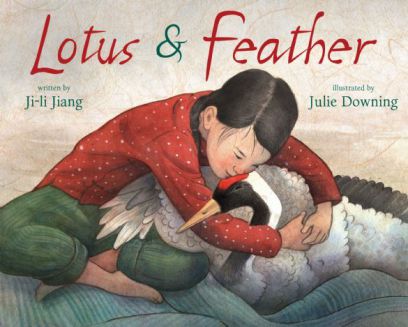
Lotus & Feather

Written by Ji-li Jiang | Illustrated by Julie Downing

Lotus was lonely since her winter illness had left her without a voice. The children at school “treated her like a strange creature,” and she was left without playmates or someone to keep her company on the walk home. She lived with her grandfather who made reed baskets and found solace when he took her to ride in his boat on the nearby lake. As he poled the boat through the still water, Lotus’ grandfather sadly pointed out how the lake had changed. No longer did the lotus flowers, fish, birds, or animals thrive. Instead, the landscape had “‘been ruined by greedy fishermen and hunters, and by ignorant people who took over the land where animals once lived.’”

celebrate-picture-books-picture-book-review-lotus-and-feather-lotus-meets-feathers

Image copyright Julie Downing, courtesy of Disney Hyperion

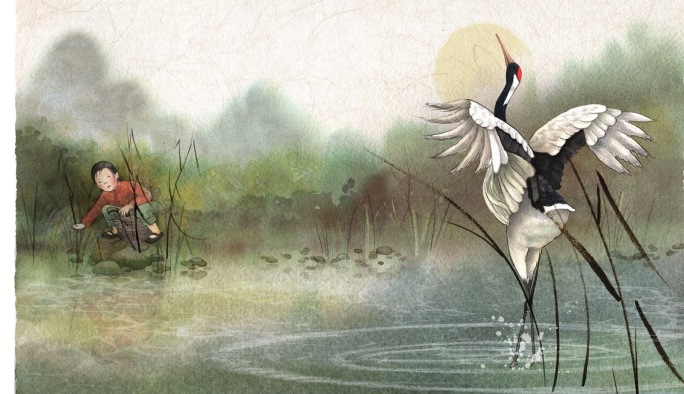
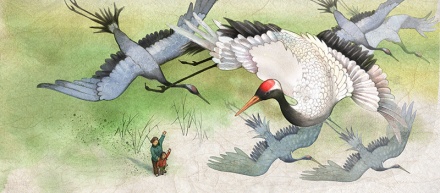
One morning while Lotus was out collecting reeds for her grandfather she spied a rare crane. It’s wide white “wings were edged with black feathers, like lace on a dress”…and “its head was crowned with a red top like a dazzling ruby.” As she watched a gunshot rang out. Unable to alert the hunter by shouting, Lotus banged on her bucket, frightening him away. Lotus rushed toward the wounded bird, picked it up and carefully brought it home to Grandpa.

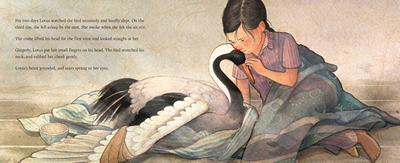
Grandpa tended to the crane’s injury and fed him rice soup while Lotus stroked the soft head. For two days, Lotus hardly slept as she took care of the crane. On the third day she fell asleep next to the crane, waking when he stirred and nestled her cheek. “Lotus’s heart pounded, and tears sprang to her eyes.” Lotus named the crane Feather. As it grew stronger she gathered food for it, and on the day Feather took his first steps, “Lotus jumped and swirled and hugged Grandpa blissfully.”

celebrate-picture-books-picture-book-review-lotus-and-feather-lotus-comforts-feather

Image copyright Julie Downing, courtesy of Disney Hyperion

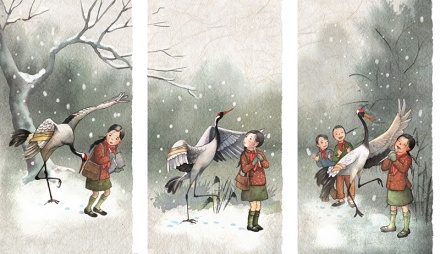
Soon Feather was following Lotus everywhere—even to school. After class Lotus would blow her whistle and Feather would come running and dance as Lotus played. The other children joined in, dancing and playing along every day. One night Lotus heard Feather crowing and woke to find that the village was flooded. Poling his boat through the streets, Grandpa shouted, Lotus banged her pail, and Feather crowed to alert the neighbors. “Over three hundred villagers were saved. Feather was the hero.” He became famous, and people wanted to hear his story again and again.

celebrate-picture-books-picture-book-review-lotus-and-feather-lotus-dancing

Image copyright Julie Downing, courtesy of Disney Hyperion

When Spring arrived Feather was still too weak to fly but he looked longingly at the birds migrating north. Lotus was frightened that her friend might want to leave them, but she “knew she would never separate him from his home and family.” One day Feather spread his wings and leaped into the air. Lotus realized that he had healed and knew it was time for him to leave. Grandpa and Lotus took Feather to the lake. Grandpa tossed Feather into the air, but he returned again and again. Grandpa gave Feather to Lotus. Lotus hugged Feather one more time and threw him into the sky.  

celebrate-picture-books-picture-book-review-lotus-and-feather-lotus-lets-feather-go

Image copyright Julie Downing, courtesy of Disney Hyperion

Holding back tears, Lotus watched as “Feather flapped his big wings and soared north, disappearing into the horizon.” Lotus and the other children missed Feather. They gathered together listening to Lotus play her whistle, imagining that Feather could hear them. One autumn morning, Lotus heard a familiar crow and rushed outside. There stood Feather with his family. Then Lotus gasped. The sky was filled with hundreds of cranes coming to the lake. Lotus blew her whistle, and the notes, “accompanied by the birds’ singing, echoed far, far away in the golden sky.”

celebrate-picture-books-picture-book-review-lotus-and-feather-lotus-waves-goodbye

Image copyright Julie Downing, courtesy of Disney Hyperion

Ji-li-Jiang’s tender story resonates on every page with love and friendship. The relationship revealed in Jiang’s tale exists not only between Lotus and Feather, but between readers and their environment. Beautifully interwoven throughout the plot, the idea of responsibility between friends, to the earth, and to ourselves makes Lotus & Feather a compelling book to read and discuss. Through lyrical passages and detailed storytelling, Jiang develops a deep, emotional bond between Lotus and Feather that readers will respond to. The heartwarming connection between Lotus and her grandfather brings comforting and another level of family commitment to the story.

Julie Downing’s stunning illustrations allow readers to walk, sit, worry, and cheer with Lotus as she finds and cares for Feather. Her sadness is palpable as she walks home from school past a group of classmates playing ball; in the corner of the dark lake, children will find bottles, cans, and other debris floating among the reeds; and Feather makes his debut with a graceful ballet. Readers will love watching the progression of Feather’s healing and Lotus’ reintegration into her circle of friends and will applaud when Feather and his family and friends return to the lake.

Lotus & Feather is a multi-layered story that will captivate readers. It is a must for public and school libraries and would make a beautiful addition to home libraries as well.

Ages 5 – 9

Disney Hyperion, 2016 | ISBN 978-1423127543

Discover more about Ji-li Jiang and her books on her website!

View a portfolio of artwork as well as other books by Julie Downing on her website!

World Wildlife Day Activity

celebrate-picture-books-picture-book-review-world-wildlife-day-word-scramble

Endangered Species Word Scramble

Can you find the names of 15 animals in this printable Endangered Species Word Scramble? Here’s the Solution.

Picture Book Review

March 2 – Read Across America Day

celebrate-picture-books-picture-book-review-the-unexpected-love-story-of-alfred-fiddleducling-cover

About the Holiday

Today marks the 20th anniversary of Read Across America Day, which is sponsored by the National Education Association and promotes the joy and discovery that reading provides. Not only is reading fun, studies show that reading to a child from birth improves literacy and language development and leads to a lifelong love for books. Today, visit your local bookstore or library and find some new books to share—or grab some favorites off your shelf and enjoy them again!

The Unexpected Love Story of Alfred Fiddleduckling

By Timothy Basil Ering


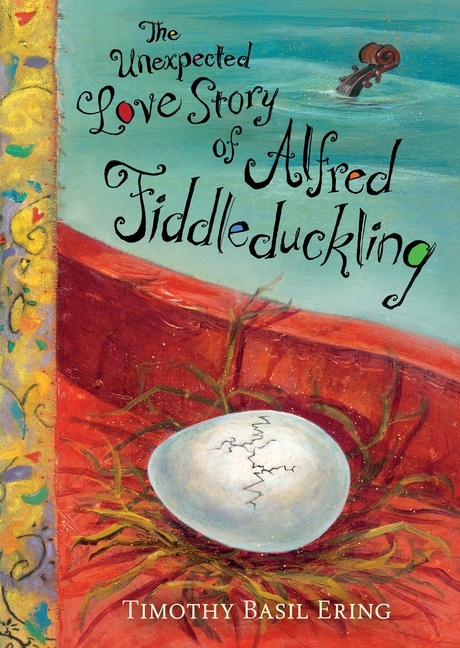
Captain Alfred was sailing home with his boat filled with ducks for his farm. “Nestled safe inside his fiddle case” was one nearly ready-to-hatch egg—a surprise present for his wife. Captain Alfred already had a name picked out for the little one—Alfred Fiddleduckling—and he knew this baby would be very special. But suddenly a “mighty gale whipped the seas into a raging fury” and tossed the little boat and its occupants to and fro. When the storm had blown itself out, a thick, impenetrable fog descended over the ocean.

celebrate-picture-books-picture-book-review-the-unexpected-love-story-of-alfred-fiddleducling-egg

Image and text copyright Timothy Basil Ering, courtesy of Candlewick Press

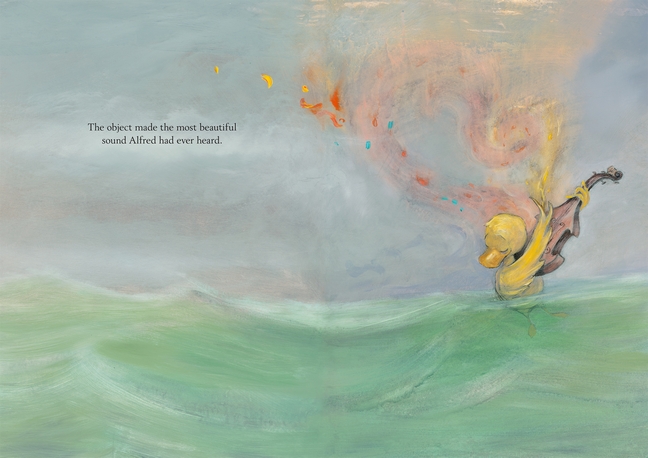
From the porch of a small cottage on the shore’s edge, a woman looked out to sea as “tears of worry dropped from her cheeks, into the mist.” Baby Alfred, however, unaware of these events and hidden by the fog, hatched as the fiddle case floated on the now-calm water. The little duckling looked around and saw something in the water nearby. He paddled out to it and even though it took no notice of him, Alfred “embraced the object with all of his heart.” He “caressed it so that it would not feel as lonely as he did ” and was surprised to hear a most beautiful and unexpected sound.

Alfred immediately fell in love—and imagined that his love was reciprocated. The two drifted along, buoyed by the waves until Alfred’s feet touched ground in a spooky swamp. In a moment, however, the comforting music began again. The sounds, so unexpected in this mist-shrouded swamp, reached the ears of “a beast that was lurking in the tall grasses.” The Beast bounded in the direction of the sound and found Alfred and his love. With drool dripping from its jaws, the beast came closer. Alfred shook, and in his fear “his music became fast and wild!”

celebrate-picture-books-picture-book-review-the-unexpected-love-story-of-alfred-fiddleducling-finds-fiddle

Image and text copyright Timothy Basil Ering, courtesy of Candlewick Press

The beast stood on his hind two legs, rising high and menacing above tiny Alfred and…began to dance. The dog had missed his master’s fiddle playing and he now found a best friend in Alfred. The two trekked through the swamp, searching for home and becoming cold, wet, and helpless as the hours stretched on. The fiddle quivered with music that was as sad and helpless as the two wanderers.

But someone heard those quiet strains—the woman on the porch of the little cottage. “She ran through the fog, straight toward the sound of Alfred’s fiddle. She wrapped her arms around her dog and marveled at the special duckling and his music. “‘Don’t ever stop playing your wonderful music,’” she told Alfred. Alfred played with abandon, pouring out all the happiness in his heart. Out on the sea a raft of ducks and one very surprised captain heard the music…and you can guess what happened next!

celebrate-picture-books-picture-book-review-the-unexpected-love-story-of-alfred-fiddleducling-captain-plays-fiddle

Image copyright Timothy Basil Ering, courtesy of Candlewick Press

Timothy Basil Ering’s wonderfully unique tale of a ship-wrecked duckling and a fiddle who together make beautiful music that reunites a family is captivating. The story holds just the right amount of surprise, suspense, and heart to keep young children riveted to what happens next. Ering’s lyrical phrasing is music to readers’ ears and conveys the various melodies—sweet, quivering, poignant, tempestuous, and finally joyful—that carry the story from one event to another.

Ering’s full-bleed illustrations begin with bright vibrancy that gives way to gauzy grays as the fog rolls in. Despite the weather or ominous surroundings, Alfred remains a bright spot, his yellow fuzz and the multi-colored notes a glowing beacon in the dark. Little readers will love following the confetti notes of Alfred’s playing and guessing the next twist in the plot. The star of the story, plucky little Alfred, is a cutie as  with empathy he embraces the fiddle and bravely ventures through sea and swamp to find home.

The Unexpected Love Story of Alfred Fiddleduckling is joyful, mysterious, and humorous tribute to friendship, love, and the unexpected that would make a great gift and an often-read addition to children’s home libraries.

Ages 2 – 6

Candlewick Press, 2017 | ISBN 978-0763664329

Read Across America Day Activity

celebrate-picture-books-picture-book-review-mug-cookie

Snuggle-in Mug Cookie Treat


Snuggling up and reading is made even better with a quick and tasty treat! Make this warm mug cookie that takes only minutes to put together and then settle in for some favorite or new stories! Here’s a delicious recipe from Food.com for you to try!

Ingredients

  • 2 Tablespoons butter
  • 2 Tablespoons milk
  • ½ Teaspoon vanilla extract
  • 3 Tablespoons brown sugar
  • 4 Tablespoons flour
  • 2 Tablespoons dark or milk chocolate chips
  • 1 Pinch salt

Directions

  1. Place butter and milk in a microwavable mug. Microwave for 30 seconds to melt the butter and warm the milk.
  2. Stir in the brown sugar and vanilla extract.
  3. Mix in flour, chocolate chips, and salt.
  4. Microwave for about 1 minute on High. (Cooking time is based on the texture of cookie you like)
  5. Cool for 5 minutes before serving
  6. Add toppings such as ice cream, whipped cream, or hot fudge or chocolate sauce

Picture Book Review

February 28 – National Women Inventors Month

celebrate-picture-books-picture-book-review-look-up-henrietta-leavitt-cover

About the Holiday

This month we celebrate women inventors, both past and present, who have changed our lives and the world for the better through their intelligence, creativity, unique vision, and perseverance.

Look Up! Henrietta Leavitt, Pioneering Woman Astronomer

Written by Robert Burleigh | Illustrated by Raúl Colón       


Henrietta Leavitt loves the stars. Every night she sits on the front porch and asks herself what were—in the early 1900s—unanswerable questions. How high is the sky? How far away are the stars? She traces the form of the Big Dipper to the North Star and feels that the stars are trying to tell her something.

celebrate-picture-books-picture-book-review-look-up-henrietta-leavitt-student

Image copyright Raúl Colón, text copyright Robert Berleigh. Courtesy of simonandschuster.com

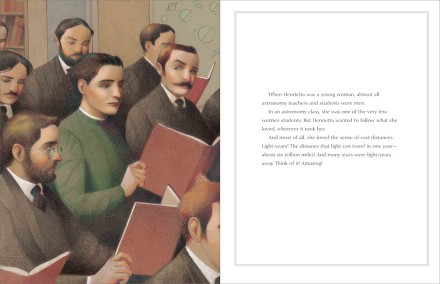
As a young woman she takes an astronomy class—one of the few women to do so. She learns about light years, planets, and the vast distances that fascinate her. After graduation she takes a job at an observatory, and while it houses a large telescope to study the sky, Henrietta is not allowed to use it. She and the other woman who work at the observatory are only there to record, measure, and calculate data, not to have new ideas.

celebrate-picture-books-picture-book-review-look-up-henrietta-leavitt-studies-star-map

Image copyright Raúl Colón, courtesy of Simon & Schuster

But in doing her job, Henrietta begins to notice a pattern in the brightness of certain stars. She discovers new “blinking” stars. Taking careful measurements, Henrietta finds that a star with a slower “blink” time—the time it takes for a star to go from dim to bright, or from off to on—contains more light power than stars with faster blink times. But what does this mean? After more study she realizes that the blink time can determine the true brightness of any blinking star, even those far, far away.

celebrate-picture-books-picture-book-review-look-up-henrietta-leavitt-makes-notes

Image copyright Raúl Colón, courtesy of Simon & Schuster

Henrietta has made a breakthrough in astronomy! By knowing the true brightness of a star, astronomers can figure out the star’s distance from Earth. Henrietta publishes her star chart in a magazine, and it helps other astronomers measure first the Milky Way and then galaxies they didn’t even know existed! Henrietta is an astronomer–one who advances her beloved science! Even as she grows older Henrietta continues to look to the sky, to ask questions and dream.

More information about Henrietta Leavitt and her discoveries, Internet and print resources on astronomy and other women astronomers, a glossary, and more are provided on the final pages.

celebrate-picture-books-picture-book-review-look-up-henrietta-leavitt-sees-stars-in-sleep

Instead of first presenting Henrietta Leavitt as an adult already working as an astronomer, Robert Burleigh chooses to introduce her as a child, when all she had were questions and dreams about the sky and the stars. It’s a fitting emphasis for a picture book aimed at children who themselves are only just discovering the questions that will guide their lives.  Burleigh’s style is simple and straightforward, revealing pertinent facts about the working conditions of a woman scientist in the early 1900s, but emphasizing Henrietta’s internal contemplations that led to her important discoveries. It’s good for children to see that one does not always need to be the “astronaut” rocketing to the Space Station to contribute— the life of the mind is just as noble and needed a pursuit.

Raúl Colón’s watercolor and ink illustrations echo the theme of dreams and contemplation with soft muted colors and antique, sepia tones. Brightness on the pages comes from the points of light that fill the skies and Henrietta’s mind. As a child and young woman, Henrietta sits and stands in the glow of the stars and, one can imagine, her own thoughts.

Ages 4 – 8

Simon & Schuster, 2013 | ISBN 978-1416958192

Discover more about Robert Burleigh and his many, many books in the categories of science, art, poetry, adventure, sports, and more for children and adults on his website!

National Women Inventors Month Activity

CPB - Star Coloring Page

Be the Star You Want to Be Coloring Page


Everyone has “stars in their eyes”—dreams and hopes for what they will accomplish in life. Decorate this printable Be the Star You Want to Be coloring page to show what’s in your imagination and in your heart.

February 27 – International Polar Bear Day

celebrate-picture-books-picture-book-review-little-polar-bear-cover

About the Holiday

Today we celebrate polar bears, the largest member of the bear family and a critical part of the Arctic ecosystem. These beautiful creatures spend much of their time at the edge of ice packs, from which they hunt for food. Their excellent sense of smell allows them to sense food up to a mile (1.6 km) away. Increasingly polar bears are under threat from changes in climate which are shrinking their habitat and affecting their quality of life. In honor of today’s holiday take time to research polar bears and consider donating to a cause for their protection.

Little Polar Bear

By Hans de Beer

At last little Lars is old enough to go hunting with his father, and they head out into the white, frozen expanse to find the perfect fishing spot. While Lars watched from the edge of an ice pack, his dad disappeared underwater for so long that Lars began to worry. When he finally surfaced, however, he brought with him a large fish for dinner. After dinner it was time to sleep. Lars’ father showed him how to build a wall of snow to lie behind that would protect him from the wind.

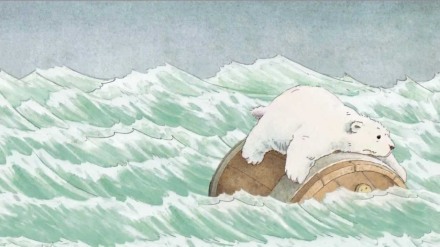
During the night as Lars and his father slept, the ice cracked between them, sending Lars floating away by himself. When Lars woke in the morning, he discovered that he was alone and that the warm sun was melting his ice floe little by little. Just as the ice threatened to disappear entirely, a barrel floated by and Lars crawled on top of it. “Then a storm began to rage. As Lars clung to his bobbing barrel he missed his father and his pile of snow more and more.”

celebrate-picture-books-picture-book-review-little-polar-bear-lars-and-father

Image copyright Hans de Beer, courtesy of NorthSouth Books

By the time the storm subsided Lars was far from home. He found himself in a place with no snow or ice; instead “almost everything was green and the sun was very warm.” Lars left the barrel and padded onto the sandy beach. The hot sand burned Lars’ paws, and he ran to the nearby river to cool them. “But just as he was about to plunge in, a very big, tan animal sprung out of the water.” Frightened, Lars ran away, but the hippopotamus followed him and introduced himself. Henry had never seen a white bear, and Lars had never seen a tan animal.

Lars told Henry about his trip and how he wanted to find father. Henry didn’t know how to help, but he figured that Marcus the eagle would know what to do. With Lars on his back Henry started the long journey across the river, through the jungle, and over the mountains. On the way, Lars loved seeing all the different colors, creatures, and vegetation. He climbed trees, met a chameleon, and sniffed at a butterfly. When they came to the mountains, Henry had trouble climbing, but Lars scampered ahead and showed him where to step.

celebrate-picture-books-picture-book-review-little-polar-bear-lars-on-barrel

Image copyright Hans de Beer, courtesy of NorthSouth Books

Finally, Henry couldn’t go any farther. He and Lars found a place to rest for the night. The view of the water made Lars homesick, but Henry reassured him. The next day, high on the mountain, Lars and Henry found Marcus. “The eagle looked at Lars and then said, ‘Well, well, a polar bear in the tropics! You’re a long way from home aren’t you, young man?’”

Marcus explained that he could indeed help Lars get home, but they would need the assistance of Samson. In the morning a gray whale swam near shore, and Lars climbed on his back. While Henry was happy that Lars could find his way home, he was also sad to see him go. He and Lars said goodbye to each other. As Henry looked on, Samson and Lars swam out into the open ocean with Marcus flying “along a bit to set them on their way.”

After Samson had swum a long distance, icy cliffs once again appeared on the horizon. As they drew closer, Lars spotted his father standing at the edge of the ice scanning the sea. Lars called out to him, and Lars’ father couldn’t believe his eyes. In thanks for bringing back his son, Lars’s father caught a big fish and gave it to Samson. Lars and his father started toward home, and as they walked “Lars talked about all of the amazing things he had seen.” His father was astonished. “‘You didn’t meet anyone who was white?’” he asked. “‘Nobody, except a chameleon,’ said Lars, ‘but that doesn’t count.’” Lars laughed, but his dad couldn’t understand the joke.

celebrate-picture-books-picture-book-review-little-polar-bear-lars-and-henry

Image copyright Hans de Beer, courtesy of NorthSouth Books

Hans de Beer’s sweet, adventurous little polar bear has been long beloved by young readers who have followed his journeys and escapades through many books. This favorite introduction to Lars, his father, and the North Pole was reissued in 2016 and is as timely now as when it was first published. De Beer’s straightforward story of a young bear suddenly taken away from home, surviving by instinct, and discovering new places, friends, and ideas, is at once exciting and comforting. As Lars finds himself in unfamiliar territory populated with animals and creatures he’s never seen before, he doesn’t shy away from the experience, but embraces the diversity of what he sees just as the tropical animals accept him. The kindness and camaraderie shared among the animals is a universal lesson for all.

Little ones love de Beer’s expressive animals and the caring interactions between them. Kids will laugh when Henry pops out of the river to say “boo!” and giggle to see Lars and the chameleon sticking out their tongues together. The soft pastel palette invites kids to linger over the pages and experience both the frozen tundra and lush jungle with the same awe as Lars. Readers will cheer when Lars is reunited with his father, but will also look forward to traveling with their new friend again in his other adventures.

Ages 3 – 8

NorthSouth Books, 2016 (Hardcover) | ISBN 978-0735842649

International Polar Bear Day Activity

CPB - Polar Bear scarf

CPB - Polar Bear Banner

Polar Bear Scarf or Banner

Polar bears aren’t cold in the winter—and neither should you be! Here are directions and printable templates for making a cute scarf to keep you warm, or—if you’d rather—a banner to warm up your room.

Supplies

  • Printable Polar Bear and Igloo Template
  • 1 Strip of blue fleece 4 ½ feet long x 7 inches wide for the scarf
  • 1 Piece of blue scrapbooking paper for a banner
  • Pieces of white, black, blue, and purple fleece or scrapbooking paper to make the polar bear, igloo, snowflakes, and ice floes.
  • String or twine for banner
  • Scissors
  • Fabric or paper glue

Directions for Scarf

To make the fringe at each end of the scarf

  1. Make 7 cuts about 4 inches long
  2. Tie a knot at the top of each fringe section

To make the pieces for the scarf or banner

  1. Trace the polar bear and igloo sections from the Printable Template onto white fleece and cut out
  2. Trace the two ice floes onto blue fleece and cut out
  3. Trace the door of the igloo onto blue fleece and cut out
  4. Trace the polar bear’s scarf onto purple (or any color) fleece and cut out
  5. Cut out round snowflakes
  6. Cut out a small circle from black fleece for the Polar Bear’s nose

On one end of the scarf

  1. Glue the smaller ice floe on one end of the scarf
  2. Tie the bear’s scarf around its neck before gluing the bear to the scarf
  3. Glue the polar bear onto the scarf with its feet on the ice floe
  4. Glue on the polar bear’s nose
  5. Make a small dot for the polar bear’s eye with a marker
  6. Glue snowflakes above polar bear

On the other end of the scarf

  1. Glue the bigger ice floe to the scarf
  2. Glue the three pieces of the large igloo to the scarf, leaving a little space between sections
  3. Glue the small white door of the igloo on top of the last two igloo sections
  4. Glue the small blue door onto the white door
  5. Glue snowflakes above the igloo

Directions for Banner

  1. Cut a point at the bottom of your banner
  2. Follow the directions above to trace the pieces of the polar bear and igloo from the printable template onto scrapbooking paper
  3. Follow the directions above to glue the pieces of the polar bear and igloo to your banner
  4. Attach string or twine to back of banner to make a hanger

Picture Book Review

February 26 – Personal Chef Day

celebrate-picture-books-picture-book-review-mountain-chef-cover

About the Holiday

Today we honor those chefs who create delectable dinners for individual clients or for special occasions. With dedication and hard work, tasty ingredients and imagination, these artists make life better for foodies from coast to coast.

Mountain Chef: How One Man Lost His Groceries, Changed His Plans, and Helped Cook Up the National Park Service

Written by Annette Bay Pimentel | Illustrated by Rich Lo


Tie Sing, born in Virginia City, Nevada, grew up during a time when “America was a tough place to be Chinese.” Most worked in restaurants or laundries and were paid less than white employees. Tie Sing had big plans, though. “He got a job cooking for mapmakers as they tramped through the mountains, naming peaks. With sky for his ceiling and sequoias for his walls, he stirred silky sauces, broiled succulent steaks, and tossed crisp salads.” He quickly became known as the best trail cook in California.

celebrate-picture-books-picture-book-review-mountain-chef-Tie-Sing

Image copyright Rich Lo, text copyright Annette Bay Pimentel. Courtesy of Rich Lo at greatsketch.com

In 1915 Steven Mather was trying to convince politicians to create a national park system even though many business people were against it. Mather invited journalists, tycoons, congressmen, and others to go camping for ten days to show them the wonder of America. He knew that the trip had to be perfect, so he hired Tie Sing as his chef. Tie Sing planned gourmet menus for breakfast, lunch, and dinner that would satisfy the 30 campers. Each day he rose before dawn, cooked eggs and sizzling steaks, and packed box lunches.

As the group hiked across beautiful scenery to the next site, Tie Sing and his assistant washed the dishes, put out the fires, packed the mules, and started the dinner’s sourdough bread. By the time Tie Sing arrived at the new campsite, it was time to begin cooking dinner. “He assembled sardine hors d’oeuvres, sliced juicy cantaloupe, and squeezed lemons to make tart-sweet lemonade. He grilled steaks and venison, fried fish and chicken, and baked sourdough rolls” as good as any fine restaurant. One morning Tie Sing was able to pack the mule early before he served breakfast. When he went back to the mule, however, he discovered it had wandered away—taking all of the best food with it.

celebrate-picture-books-picture-book-review-mountain-elegant-table

Image copyright Rich Lo, text copyright Annette Bay Pimentel. Courtesy of Rich Lo at greatsketch.com

Steven Mather shrugged it off as he left for the day’s hike, but Tie Sing was upset. All of his planning was ruined. That night the dinner wasn’t as fancy, but it was delicious and topped off with “all-American apple pie.” The campers, happily satisfied, talked late into the night about the possibilities of a national park service. The next day, Tie Sing carefully led the mules along a narrow ridge. As the stones crumbled underneath their feet, one mule strayed too close to the edge. He tumbled backward and down the cliff. Bags, boxes, and food went flying. The mule got up and shook itself off, but much of the food, utensils, and equipment was lost.

Hours later Tie Sing limped into camp with “the battered boxes and bent knives and bruised apples he’d salvaged.” The men were ravenous; Tie Sing had to think quickly. He knew just how to use those apples, and under the glow of paper lanterns, the crew enjoyed the most delicious applesauce they’d ever had. Tie Sing knew his job was to fill the party with delicious meals, but “Steven Mather wasn’t the only one who loved the mountains; Tie Sing had the Sierra singing in his blood. He too planned to fill the campers with memories.”

celebrate-picture-books-picture-book-review-mountain-chef-mule-falls

Image copyright Rich Lo, text copyright Annette Bay Pimentel. Courtesy of Rich Lo at greatsketch.com

As the pots bubbled on the camp stove, Tie Sing “bent over tiny slips of paper and wrote in English and Chinese.” Following dinner he handed out fortune cookies, each one holding a handwritten message: “Long may you search the mountains.” “Long may you build the paths through the mountains.” “Where but in the mountains would such a man become a spirit with the mountains?”

In the months following the trip, the members of the group “wrote magazine articles, published books, and made movies about America’s national parks.” Steven Mather’s and Tie Sing’s efforts worked. On August 25, 1916 Congress created the National Park Service. “Today, if you visit Yosemite National Park, you can hike to Sing Peak. It was named for Tie Sing, a mountain-loving American who knew how to plan.”

Three pages of back matter, complete with photographs of Steven Mather’s and Tie Sing’s actual 1915 trip, answer readers’ questions about Tie Sing, how he kept food fresh in the mountains, details of the trip, and short bios on the members of the mountain party.

celebrate-picture-books-picture-book-review-mountain-chef-bent-silverware

Image copyright Rich Lo, text copyright Annette Bay Pimentel. Courtesy of Rich Lo at greatsketch.com

Annette Bay Pimentel’s fascinating and timely story of the establishment of the National Park Service highlights the contributions of a Chinese American dreamer who had big plans for himself and the country he loved. Her detailed storytelling enhanced by lyrical phrasing (a linen tablecloth is washed in an icy snowmelt stream and spread “brighter than white-water foam” over a table) reveals the marvel of Tie Sing’s art. Readers will be awed by the dedication and careful planning it took for the gourmet meals and elegant table settings to come together in such rough surroundings. As food and supplies are lost along the way, children will be held in suspense, wondering if Steven Mather’s and Tie Sing’s strategy worked.

Rich Lo’s beautiful detailed and realistic watercolors transport readers to the mountains and trails of early 1900s California. With vivid imagery Lo lets children see the day-to-day preparations that went into Sing’s meals as well as the dangerous conditions he faced. Lo captures the hazy purple majesty of the mountain peaks, the glow of the campfire in the dark of night, and the vastness of the California environment. Kids may well wonder how Sing managed to create a five-star restaurant atmosphere and menu in the wild, and Lo shows them how it was accomplished.

Mountain Chef gives a unique perspective on an important historical moment—one that still resonates today—and is a compelling book for any classroom as well as for kids interested in history, culinary arts, and the environment and for those who just love a good story.

Ages 6 – 9

Charlesbridge, 2016 | ISBN 978-1580897112

Discover more about Annette Bay Pimentel and her work as well as a Teacher’s Guide on her website!

Learn more about Rich Lo and view a portfolio of his artwork on his website!

Personal Chef Day Activity

celebrate-picture-books-picture-book-review-chef-kids-coloring-page

Cook Up Something Tasty Coloring Page


These kids are making a special treat! Enjoy this printable Cook Up Something Tasty Coloring Page while you have a little treat too!

Picture Book Review

February 25 – Clam Chowder Day

celebrate-picture-books-picture-book-review-blue-moon-soup-cover

About the Holiday

Today we laud that cozy concoction of clams, onion, and potatoes that creates a warm, satisfied feeling in the tummy and is the perfect antidote to winter’s chill. Whether you like New England style clam chowder with its rich, creamy base or the lighter tomato-based Manhattan version, this delicious soup is sure to hit the spot!

Blue Moon Soup: A Family Cookbook

Recipes by Gary Goss | Illustrated by Jane Dyer


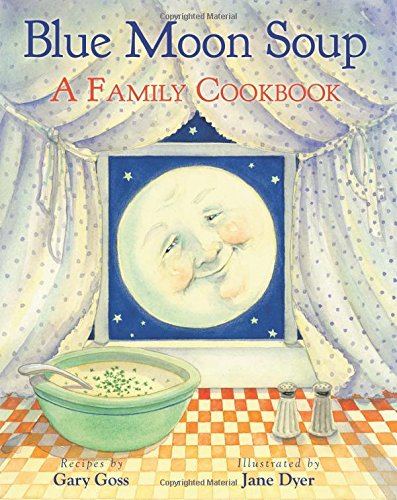
“Beautiful Soup, so rich and green, / Waiting in a hot tureen! / Who for such dainties would not stoop? / Soup of the evening, beautiful Soup!” With these words from Lewis Carroll, Blue Moon Soup introduces 33 delectable soup recipes plus some extras to go with them all wrapped up in the comfort and splendor of a picture book. The clever names of the soups will have kids giggling and eager to try such intriguing dishes as Twist & Shout, Polka Dot Soup, Bouncy, Bouncy Ball Soup, Squish-Squash Soup, and Funny Face Soup.

celebrate-picture-books-picture-book-review-blue-moon-soup-hey-hey-soup

Image copyright Jane Dyer, courtesy of Sky Pony Press

Categorized by seasons, these soups make use of familiar as well as more unusual ingredients while sprinkling in kid-inspired surprises like the ice cream in Believe It or Not! Soup, which is a yummy alternative to the usual frozen version of this favorite treat. Hey, Hey Soup, a “hot and jazzy sweet potato soup named after a great jazz club in Kansas City,” incorporates the flavors of curry while on top floats a chocolate garnish.

celebrate-picture-books-picture-book-review-blue-moon-soup-no-duck-soup

Image copyright Jane Dyer, courtesy of Sky Pony Press

A few offerings from Winter are Ch-Ch-Chili; Brrroccoli Soup au Gratin; Hot Diggity Dog Soup, a tasty minestrone with a hot dog addition; and Sob Soup, an onion soup that will have you crying with joy. Spring brings (No) Duck Soup, a lentil pleaser; Soup of the Evening, a sophisticated feta cheese and spinach dish; Sweet Dreams Soup made from carrots; and Abracadabra, a soup with more than a little magic.

Summer’s active days are perfect for a quick lunch or dinner, and Best Buddy Soup of tomatoes and oranges is a fast goodie to cook—and share. Fruit makes another appearance in You Can’t Elope, made from—you guessed it—cantaloupe, and if you like to bask in the sun, you may love Bisque in the Sun, a creamy pool complete with a couple of shrimp. Before winter rolls around again, Fall drops with veggie-inspired soups made of potatoes, cabbage, pumpkins, squash, and peas.

celebrate-picture-books-picture-book-review-blue-moon-soup-fish-soup

Image copyright Jane Dyer, courtesy of Sky Pony Press

And what about our honored soup of the day—clam chowder? That’s here too in Fish Soup, garnished with goldfish crackers.

An Extra, Extra, Eat All About It! final chapter provides recipes for banana bread, corn muffins, salad, guacamole, nachos, and other delicious sides that make a well-rounded meal. Front matter gives a list of supplies, rules for working in the kitchen, and directions for setting a table.

Gary Goss, former owner of the Soup Kitchen Restaurant in Northampton, Massachusetts knows about soup and kids and what they like. In his Letter from the Chef that opens Blue Moon Soup, Goss talks about the warm, cozy feelings and good memories “soup day” creates and offers tips for making the cooking experience with kids easy and fun. Most recipes call for ingredients usually found in kitchens or easily picked up at the market and have fewer than ten steps to prepare them—steps that kids will enjoy helping with.

celebrate-picture-books-picture-book-review-blue-moon-soup-garden-soup

Image copyright Jane Dyer, courtesy of Sky Pony Press

Jane Dyer’s gorgeous illustrations populated with attentive fish waiters; lamb and lion best friends; a duck and ducklings fishing from the rim of a huge bowl; rabbits serving gazpacho; a cow, cat and, dog jazz trio; and more open each seasonal chapter and introduce some recipes. Each page is also peppered with adorable images of personified vegetables dancing, playing, cooking, and lounging that will charm little chefs as they help in the kitchen. Families may even find themselves making up stories about the characters in the book while the soup simmers.

Blue Moon Soup, a multi-award winning book, would make a delicious and often-consulted addition to anyone’s collection of cookbooks and a wonderful way to introduce kids to the art of cooking.

Ages 7 and up

Sky Pony Press, 2013 | ISBN 978-1620879900

Discover more about Jane Dyer and a gallery of her well-loved children’s books on her website!

Clam Chowder Day Activity

celebrate-picture-books-picture-book-review-soup-ingredients-word-search

Souper Word Search Puzzle

Find the names of 20 ingredients in this tasty printable Souper Word Search Puzzle. Here’s the Solution.

Picture Book Review