December 30 – Bacon Day

celebrate-picture-books-picture-book-review-everyone-loves-bacon

About the Holiday

Bacon has been around since ancient times. In early French it was known as Bako, in German as Bakko, and in Teutonic as Backe. In Middle English it was called Bacoun, but all these words simply meant “back,” as in the back meat of pigs. Preserved and flavored, bacon is a favorite the world over and has seen an explosion of uses in the past few years, from enhancing cupcakes, apple pie, and chocolate chip cookies to spicing up peanut butter sandwiches, lasagna, and French toast. There’s nothing like waking up to the sizzling aroma of bacon, and today’s holiday gives you the okay to indulge!

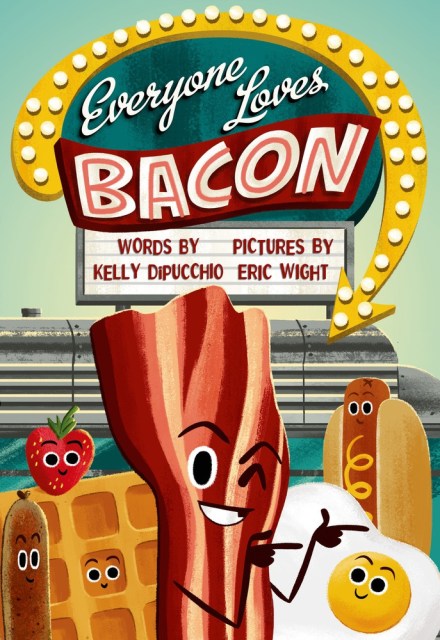
Everyone Loves Bacon

Written by Kelly Dipucchio | Illustrated by Eric Wight


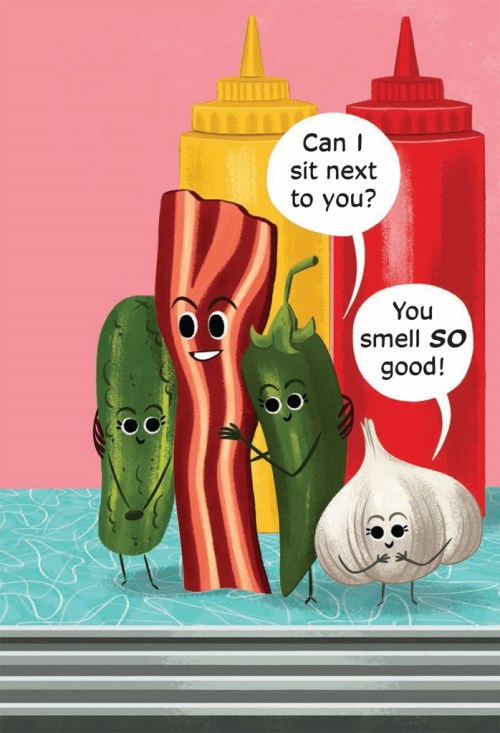
From Egg to Waffle to Pancake, there was no one who didn’t love Bacon—even Bacon himself. Well…maybe French Toast was an exception, but he “doesn’t like anyone.” Bacon loved all the attention the other foods gave him. Jalapeño wanted to sit next to him, and Garlic thought he smelled so good! He made the fruit and vegetables laugh with his “charming stories and funny jokes,” and, boy, could he play the ukulele!

celebrate-picture-books-picture-book-review-everyone-loves-bacon-taking-picture

Image copyright Eric Wight, courtesy of us.macmillan.com

Ham, sausage link, and sausage patty were jealous, “but Bacon didn’t care about them. Not one bit.” After all, “He was becoming a real celebrity. His picture appeared on t-shirts. And billboards. And buses.” Bacon was so enthralled with himself that he began to forget his friends. Sometimes he even “pretended not to know some of his old friends.” Bacon had fans, and that was enough for him.

Bacon began to live the high life of sports cars, designer clothes, and the latest fads. He was even the star of the breakfast pastry parade. “Indeed Bacon was the toast of the town. Until….” Well…we did warn you that “everyone loves Bacon.”

celebrate-picture-books-picture-book-review-everyone-loves-bacon-umbrellas

Image copyright Eric Wight, courtesy of us.macmillan.com

Kelly Dipucchio’s witty cautionary tale about a piece of bacon that gets too big for his broiler sizzles with snappy sentences and the perils of celebrity. She chooses words and experiences that are recognizable to any child navigating the world of school, siblings, and friends, and with sly winks to popular culture shows that mistaking fans for friends ends badly and that there is always someone “bigger” than you.

celebrate-picture-books-picture-book-review-everyone-loves-bacon-spoon-mirror

Image copyright Eric Wight, courtesy of us.macmillan.com

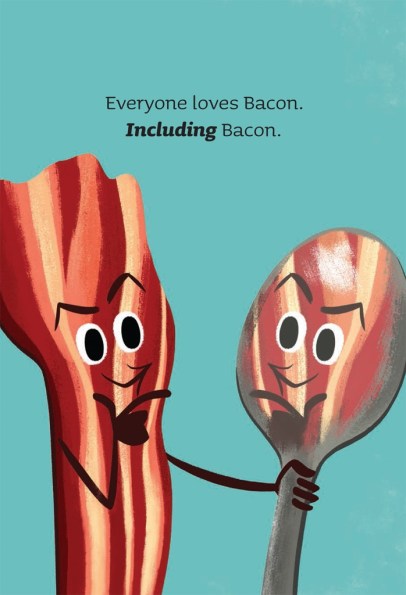
Even if readers don’t like the taste of bacon, they won’t be able to resist Eric Wight’s adorable slice who becomes the star of a 1950s-era diner. From the first page where Bacon admires himself in the back of a spoon, kids will giggle as Bacon takes pictures with equally cute Hotdog, Chicken Leg, Pickle, Garlic, and Jalapeño, leads a citrus parade complete with paper cocktail umbrellas, and plays the ukulele for swooning tater tots, French fries, and curly fries. But as the other foods grow sad and disgruntled with Bacon’s attitude—even brandishing fancy toothpicks—kids will understand and empathize with these forgotten friends. When Bacon meets his fate on the last page, readers are sure to fork over a howl of surprise.

Ages 3 – 6

Farrar, Straus & Giroux, 2015 | ISBN 978-0374300524

To learn more about Kelly Dipucchio and her books, visit her website!

Bacon Day Activity

celebrate-picture-books-picture-book-review-amazin'-bacon-maze

Amazin’ Bacon Maze


There’s some tasty bacon sizzling in the center of this frying pan-shaped maze. Can you find your way through this printable Amazin’ Bacon Maze to eat it up? Here’s the Solution!

Picture Book Review

October 16 – Dictionary Day

celebrate-picture-books-picture-book-review-w-is-for-webster-cover-image

About the Holiday

Dictionary Day honors Noah Webster, who wrote the first American dictionary. He was born in 1758 to a family that loved learning and knew the importance of a good education. Even as a boy Noah Webster loved words. He went on to become a lawyer, newspaper editor, Connecticut and Massachusetts legislator, and he helped found Amherst College in Massachusetts.

He is most well-known, however, for compiling the first American dictionary that is synonymous with his name and still the most popular dictionary in use. His work, first published in 1828, revolutionized the way language and words were presented and remains always current by every year adding new words that come into common use through new products, fads, and slang.

Wordsmiths the world over celebrate both the amazing accomplishment that is the dictionary, and I would imagine, their own well-thumbed and well-loved copies of this remarkable resource.

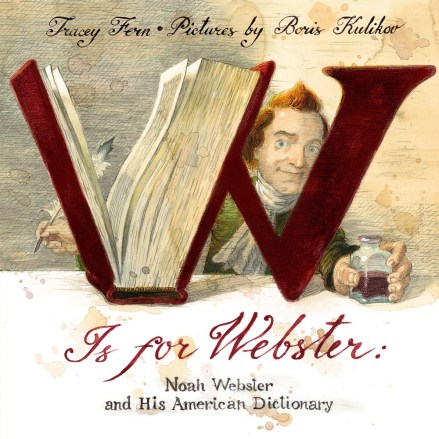
W is for Webster: Noah Webster and His American Dictionary

Witten by Tracey Fern | Illustrated by Boris Kulikov


Noah Webster was always different. Tall and thin with bright red hair, he liked to use big words when he spoke and wanted to do homework instead of goof around in school. Unfortunately for him school was in session for only a few months a year and goofing around seemed to be the major course of study. Of course, Noah didn’t call it “goofing around,” he called it “‘playing roguish tricks.’”

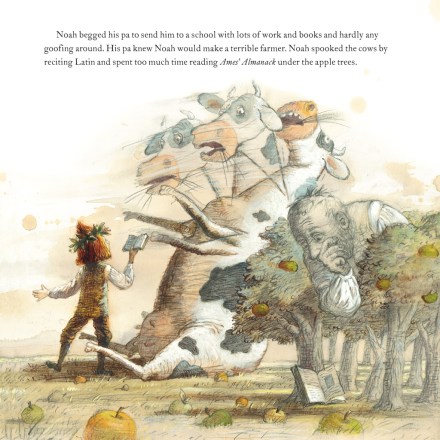
Noah begged to go to a harder school. “His pa knew Noah would make a terrible farmer. Noah spooked the cows by reciting Latin and spent too much time reading Ames’ Almanack under the apple trees.” His pa agreed, and in 1774 at the age of 16 Noah went off to study at nearby Yale College in New Haven, Connecticut. Yale had strict rules. Students had to rise at 5:30 a.m. and study for two hours before class. They were also fined “two shillings for making ‘tumult, noise, hallooing,’ or otherwise goofing around. Noah thought Yale was wonderful.”
celebrate-picture-books-picture-book-review-w-is-for-webster-spooking-horses

Image copyright Boris Kulikov, text copyright Tracey Fern. Courtesy of macmillan.com

Noah hadn’t been at Yale long before the American Revolutionary War broke out. Although Noah signed up to fight, he recognized that he was “‘ill able to bear the fatigues of a soldier,’” which was “Noah’s big way of saying he was a lousy soldier.” He returned to Yale and graduated in 1778, but he left the school with no job and no prospects. Even his pa told him to leave home to find work.

Noah became a teacher, but he found the British textbooks “‘defective and erroneous.’” He believed the students should have American textbooks that better reflected their diverse experiences. With the Revolutionary War at an end and America victorious, Noah wanted to help “hold his new, complicated nation together.” He believed that America needed a language different than the English spoked in Britain. “‘A national language is a national tie,’ Noah insisted to all who would listen, and to many who wouldn’t.”

celebrate-picture-books-picture-book-review-w-is-for-webster-teaching-school

Image copyright Boris Kulikov. Courtesy of macmillan.com

He began the work himself with a speller. Right from the start Noah’s speller was different than the British books. It included everyday words “like scab, grub, and mop.” He also simplified the spelling by taking out unpronounced letters or spelling words phonetically. He also added pictures to every page and presented lists of rhyming words. He also priced his book so almost anyone could afford it. Noah’s speller became a bestseller.

Still, Noah had bigger ideas. He wanted to write a patriotic dictionary with uniquely American words. He took his idea on the road to make money for the venture, lecturing wherever he could. But Noah’s know-it-all tone of delivery, his “prickly personality,” even his “‘porcupine hair’” put people off. And what’s more, they didn’t like the idea of his dictionary. People thought he was a “lunatic” for wanting to replace British words with American ones.
celebrate-picture-books-picture-book-review-w-is-for-webster-working-on-letter-a

Image copyright Boris Kulikov, text copyright Tracey Fern. Courtesy of macmillan.com

In 1806 Noah went ahead and published “A Compendious Dictionary of the English Language. It was a flop, but Noah wasn’t discouraged.” The next year he started working on a bigger dictionary. He copied words out of British dictionaries and added American words and he traced the roots of all the words and wrote definitions, sometimes including quotes from famous people to show differences in meaning. He figured the whole dictionary would take 5 years to finish—eight to ten, tops.

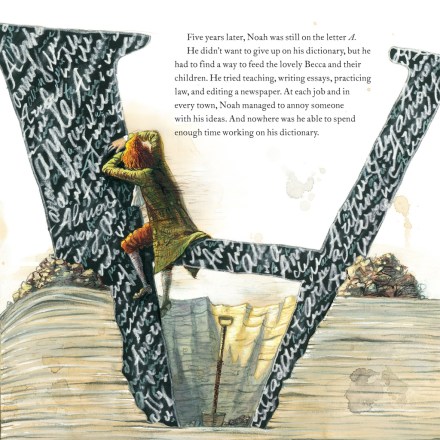
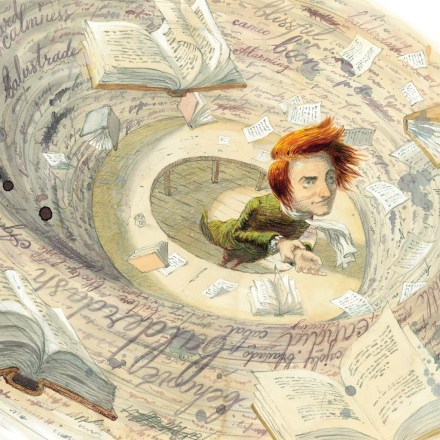
But five years later, Noah was still on the letter A. With no money coming in and a growing family, Noah took a variety of jobs, but he always seemed to rub someone the wrong way, and he lost job after job. He decided to sell his fancy house and bought a farm. Here he was able to gather books, books, and more books around his unusual donut-shaped desk. Standing inside the center of the desk, he spun around and around reading the books and finding words to include in his dictionary.
celebrate-picture-books-picture-book-review-w-is-for-webster-special-desk

Image copyright Boris Kulikov. Courtesy of macmillan.com

By 1822 Noah had exhausted all the books in his study. He took to traveling to other American libraries, moved his family to New Haven to use the Yale library, and in 1824 even sailed to Europe to explore books found in the National Library in Paris and at the University of Cambridge in England.

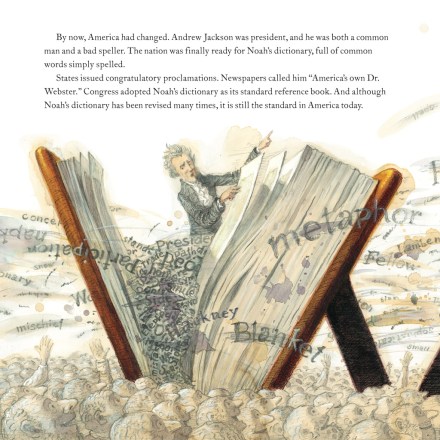
Finally, in 1825 Noah finished his dictionary.  With more than 70,000 words, An American Dictionary of the English Language was the largest English dictionary ever written. “Many people thought it was the best English dictionary ever written.” Why the change of heart? Well, one reason might have been that the President of the United States, Andrew Jackson, “was a common man and a bad speller.” Another might have been that the timing was just right.
celebrate-picture-books-picture-book-review-w-is-for-webster-finished-dictionary

Image copyright Boris Kulikov, text copyright Tracey Fern. Courtesy of macmillan.com

However it came to be, Noah was now lauded as a hero by states and newspapers. Congress even adopted the dictionary as its standard reference book. Noah had not only succeeded in writing an American dictionary, he had “created a new American language for a new American nation.” One that is still beloved today.

An Author’s note as well as a list of resources follow the text.

Webster’s dictionary is intrinsically woven into every American child’s life through language and vocabulary development. Tracey Fern’s captivating story reveals the charm and foibles of its author, a man with just the right temperament and perseverance to tackle and complete such an overwhelming task. Fern’s exceptional storytelling skills and deft turns of phrase allow for a comprehensive review of Webster’s life that is full of exhilaration, empathy, and a good dose of the “big” words Webster loved. Fern builds suspense and tension while offering an insightful look at early American history by including details of the staggering research required and the adverse reactions to Webster and his work.

Boris Kulikov’s expressive illustrations perfectly capture the complex personality of Noah Webster, late-1700s-to-early-1800s American society, and the obstacles Webster faced in writing his dictionary. Fittingly, words, books, or ink blots abound on every page, pouring from the air, sprouting from the ground, stacked like the skyscrapers that would come, and surrounding Noah Webster the way they must have swarmed through his brain. Kulikov infuses humor into his paintings, as when Noah tears at his hair wondering how he will support himself after college, shrugs nonplussed at his students’ shenanigans, and buys himself quiet work time by handing out sweets to his kids. Visual metaphors for the hard, backbreaking and mind bending work also enhance this beautiful biography.

Ages 5 – 10 (adult’s will also enjoy this biography)

Farrar Straus Giroux, 2015 | ISBN 978-0374382407

Visit Tracey Fern’s website to learn more about her and her books!

Discover a gallery of artwork by Boris Kulikov on his website!

Dictionary Day Activity
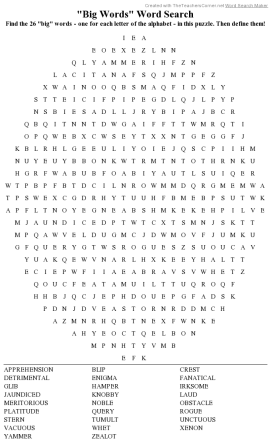
celebrate-picture-books-picture-book-review-big-words-vocabulary-word-search-puzzle

“Big Words” Word Search


Knowing and using a wide range of words allows you to express yourself in exact—and often—fun ways. Find the 26 “big” words—one for each letter of the alphabet—in this printable “Big Words” Word Search puzzle. Here’s the Solution!

Picture Book Review

April 22 – Earth Day

picture-book-review-green-city-allan-drummond

About the Holiday

In 1970 the first Earth Day was celebrated to bring awareness to environmental issues and begin a dialogue about how governments, corporations, communities, and individuals could create change that would benefit the Earth and all her inhabitants. Forty-six years later, we are working toward solutions to problems like pollution, climate change, renewable energy, and more. Today look around your home, office, school, or community and see how you can better support our Mother Earth.

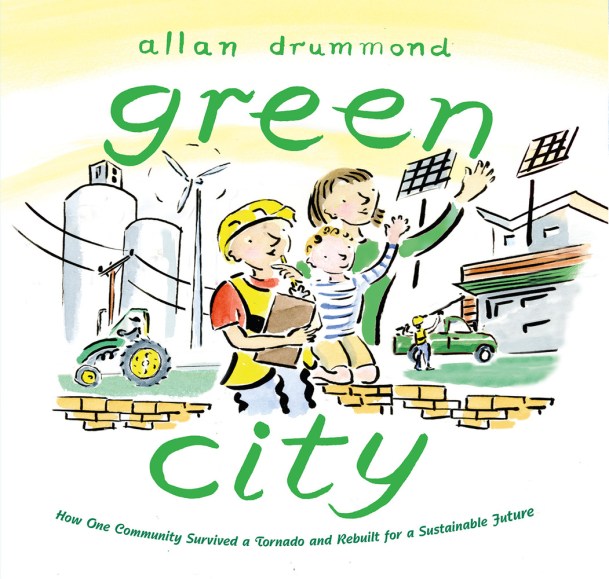
Green City: How One Community Survived a Tornado and Rebuilt for a Sustainable Future

By Allan Drummond


On May 4, 2007 a devastating tornado hits Greensburg, Kansas, destroying the town in 9 minutes. When the residents of the town climb from their shelters, they emerge into a world completely changed. There are no more homes, no school, no hospital, no grocery store or other shops. No banks, theater, churches, or water tower. Even the trees have been shredded. Only three buildings remain.

The citizens are urged to move away. Rebuilding will be impossible, some say, and what’s the point anyway when the wind could destroy it all again? But others see opportunity to construct a different kind of town. With the help of volunteers and donations from around the world, Greensburg begins the Herculean task of designing and building a new town.

After clearing away 388,000 tons of debris and moving into a community of trailer homes, the people begin to envision a unique, green town. Individuals design sustainable houses of different shapes and materials to work with the environment. Businesses, too, incorporate sustainability into their offices, retail centers, and hotels as do the hospital and the water tower. A wind farm large enough to provide energy for the entire town is built on the edge of this innovative city.

A new school is central to the town’s survival, and for three years the teachers hold class in small trailers. Along with their regular studies, the kids become experts in environmental science. After several years Greenburg is now thriving—a testament to conservation and sustainability that is an example for global communities now and in the future.

Allan Drummond tells this fascinating story of a community that would not give up in an honest and sensitive way that highlights the courage and pride of a town amid devastating loss. Told from a child’s point of view, the story has extra impact for readers who are growing up amid an era of environmental awareness and activism. The sustainable construction of homes and other buildings is effectively explained and clearly depicted in Drummond’s colorful illustrations.

The images also demonstrate the process of negotiation and cooperation among townspeople that went into designing and building a new Greensburg. The final two-page spread of the town’s layout will interest kids as well as adults who have followed this story in the news.

Ages 5 – 9

Farrar, Straus and Giroux, 2016 | ISBN 978-0374379995

Earth Day Activity

celebrate-picture-book-review-caterpillar-planter-craft

Hatch a Caterpillar Planter


As spring days grow warmer, it’s fun to start growing your own garden. Propagating plants from seed on a windowsill or sun room gives you an up-close view as the seeds develop roots, sprout, and flourish!

Supplies

  • Egg carton made from recycled paper
  • Seeds for your favorite veggies or flowers
  • Potting soil
  • Spoon or small shovel
  • Craft paint or markers in the colors you’d like for your caterpillar
  • Pipe cleaners or wire
  • Googly eyes
  • Marker

Directions

  1. Carefully cut the egg carton into two rows lengthwise, you may need to trim the cardboard between cups
  2. If the cups have low openings on one side, place the second row of cups inside the first facing the opposite way.
  3. Paint or color the carton, let dry
  4. Push pipe cleaners or wire through the edge of the egg carton on one end to form antennae (I used wrapped wire and painted it)
  5. Attach googly eyes and draw a smile on the front of the carton
  6. Fill cups with soil
  7. Plant seeds according to package directions
  8. Place caterpillar planter in a sunny spot

Picture Book Review

March 28 – Music in Our Schools Day

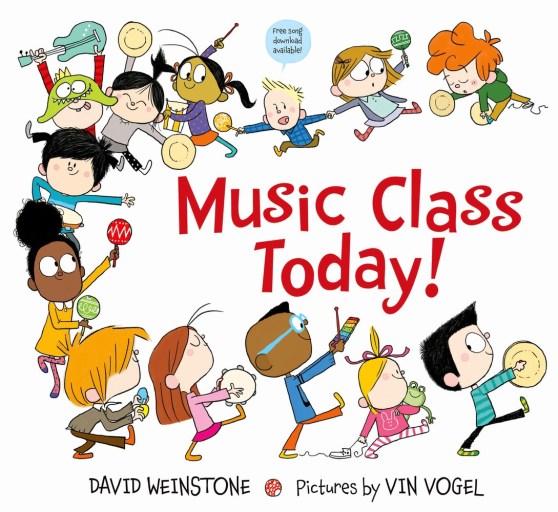
Music Class Today by David Weinstone and Vin Vogel

About the Holiday

The National Association for Music Education sponsors Music in Our Schools Month each March to promote greater awareness of the benefits and enjoyment high-quality music education brings to students and the community. Beginning in 1973 as a single Advocacy Day in New York, this celebration grew to include the entire month in 1985.

During the month special music programs, education, concerts, and classes take place to get kids and adults excited about the joys of music in schools.

Music Class Today

Written by David Weinstone | Illustrated by Vin Vogel


A little boy and his froggy toy join a music class full of other boys and girls led by a guitar-strumming teacher. The class starts with a song welcoming everyone by name and a verse inviting all to shake their musical eggs high and shake the eggs low. “One rolls away—where did it go?”

The new boy peeks around his mom’s back to watch the action, and when it’s time for a song he says, “I think I’ll just watch…But I’m listening!” The teacher gently sings, “That’s all right, that’s okay. / Whenever you’re ready, / come on over and play. / That’s all right, there’s no rush. / Whenever you’re ready, / come play with us!” These verses become a chorus repeated throughout the book, reassuring the little boy that he’s welcome, but that his own speed of acclimation is okay too.

The class continues with the kids kicking up their feet, drumming, and moving around the room in time with the music. The little boy comes out from behind his mom to sit on her lap and watches the fun. The teacher’s chorus brings the boy a little closer—to the edge of his mom’s feet—while clinging tightly to his froggy. He giggles as the kids swirl with scarves, getting dizzy, and falling down.

Now everyone’s dancing, being silly, and having a ball. Froggy joins in, dangling and wiggling at the ends of the boy’s hands. As dancing evolves into free-play time, the little boy accepts the teacher’s invitation to “come join the fun,” and leaves froggy at his mom’s feet with one more request for assurance—“Wait here till I’m done!”

“Good for you, that’s the way. / Everybody’s in the band!” the teacher sings as the little boy takes up the cymbals and leads the parade behind him. All too soon it’s clean-up time and class ends with a good-bye song. The boy is having so much fun that he tells the teacher he and froggy want to stay. The instructor knows just what to say to his happy, excited student: “That’s all right, that’s okay. / We’ll see you soon another day!”

In this cross-genre picture book, David Weinstone brings the musicality and movement of a toddler and preschool music class to the page. His song, also available as a free download, serves as the text of the story about a reluctant joiner who overcomes his apprehension to become a member of the group. The repeated chorus, that calmly and sincerely explains that it is okay for children to wait and watch until they feel comfortable, can be used for many situations and is a welcome message.

Vin Vogel’s sweet illustrations of a wide mix of kids kicking up their heels (literally, as a flying shoe bonks the instructor on the head in one giggle-inducing scene) and having fun are inspired in their focus on the children. The kids play instruments, dance, and cavort across the pages, filling the white space with joy. The view of the classroom changes from page to page to show other mother-child pairs, which helps emphasize that hesitant children are common, as well as baby siblings, toys, instruments, storage bins, and other sights familiar to children.

Ages 1 – 4

Farrar, Straus and Giroux, 2015 | ISBN 978-0374351311

Music in Our Schools Day Activity

CPB - Music in Schools Day game

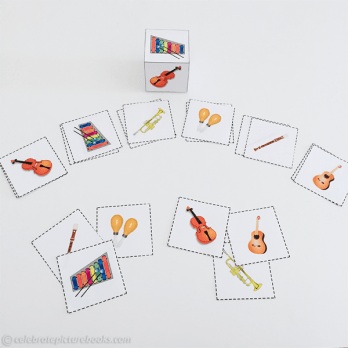
It’s Instrumental! Game


Play this fun game to gather all the instruments you need to create a music group. The first person to collect all 6 instrument cards is the winner!

Supplies

Directions

  1. Print the Paper Cube Template, cut it out and assemble the cube die.
  2. Print the Musical Instruments cards, cut out cards, and separate the instruments into piles
  3. Players take turns rolling the die cube to collect musical instrument cards
  4. The first player to collect all 6 instrument cards is the winner


February 23 – National Dog Biscuit Day

CPB - Dog Biscuit

About the Holiday

People have holidays celebrating their favorite treats—like Cherry Pie Day and Chocolate Chip Cookie Day—so dogs should have a food holiday of their own, right? Well, today is it! Today we remember that our best furry friends like to be rewarded with a special treat or just shown a little extra love with a tasty morsel.

Before anyone thought about what dogs ate, dog “treats” included some pretty awful stuff—moldy bread, rotten leftovers…but an American named James Spratt was struck by an idea when he saw stray, hungry dogs looking for food on one of his travels in England in the 1800s. He created the first dog biscuit, which was more like cake, made of fresh ingredients such as meat, grain, and vegetables. The first commercial dog biscuit was developed in 1908 by the F. H. Bennett Biscuit Co. It was hard and made with meat products, milk, and important minerals.

Dog Biscuit

By Helen Cooper


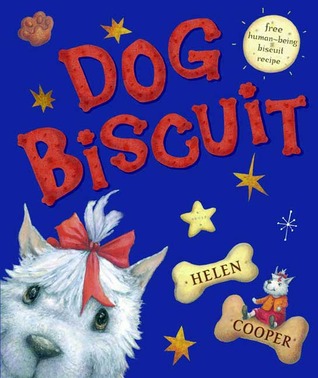
In Helen Cooper’s delightfully evocative Dog Biscuit, Bridget can’t resist eating a treat from the enticing bag she finds in Mrs. Blair’s shed. The biscuit looks like a people cookie; it even tastes good—salty and sweet—but really it’s meant for a dog, not a little girl! Mrs. Blair shakes her head when she recognizes the crumbs around Bridget’s mouth and teases that now Bridget will turn into a dog. As children often do with adults’ jokes, Bridget takes this notion literally, setting in motion a day-long flight of fancy—with a bit of trepidation.

Bridget’s imagination runs as wild as a pack of dogs—does that itch behind her ears mean they’re growing? How is it possible she’s wagging goodbye? And did Mrs. Blair’s dog really just say it used to be a real boy? She begins to regret eating that biscuit but is determined not to tell her mother, especially since she doesn’t seem to notice any difference in her daughter.

As she and her mother walk home from Mrs. Blair’s, Bridget suddenly finds herself awakened to a new world. She identifies with every dog she meets, savors the aroma of the butcher shop, and forgets her people manners at the dinner table. Still, her mother doesn’t notice. Before finally curling up and falling asleep, Bridget again wishes she hadn’t eaten that biscuit.

In sleep Bridget unleashes her full imagination, romping with a pack of new friends through familiar sites now transformed into a mystical doggy paradise that makes her very glad she ate that biscuit—that is until she thinks of her family and howls. At last her mom, who was indeed aware of her daughter’s turmoil, can comfort her. In her mother’s arms Bridget reveals her fears and allows herself to be reassured.

The next day Bridget visits Mrs. Blair, who explains that she was joking and apologizes for worrying her. Over tea and “human being treats” Bridget happily leaves puppyhood behind.

Author-illustrator Helen Cooper beautifully captures Bridget’s imagination, turmoil, and joyous abandon through her vibrant illustrations that are awash in color, swirling lines, clever details, and the use of various type sizes and fonts. Wide-eyed Bridget, her family, Mrs. Blair, and the many dogs that populate this book are exquisitely drawn. Kids will love sniffing out the hidden dogs on every page.

A recipe for Human-Being Treats is included.

Ages 4 – 8

Farrar Straus and Giroux, New York, 2009 | ISBN 978-0374318123

National Dog Biscuit Day Activity

CPB - Dog Biscuits

Homemade Dog Treats

Making homemade dog biscuits is a fun way to spend time together and benefit furry friends. These biscuits make tasty treats for your own pet or consider making a batch to donate to your local animal shelter. This recipe is easy and proven to be a favorite.

Children should get help from an adult when using the oven.

Supplies:

  • 1 large bowl
  • Large spoon or whisk
  • Cookie cutters – shaped like traditional dog biscuits or any favorite shape

Ingredients

  • 3 cups Buckwheat flour
  • ½ cup powdered milk
  • 1 teaspoon salt
  • ¾ cup water
  • 1/3 cup margarine or butter, melted
  • 1 egg beaten

Directions

  1. Preheat oven to 325 degrees
  2. Add buckwheat flour to bowl
  3. Add powdered milk to bowl
  4. Add salt to bowl
  5. Stir to mix dry ingredients
  6. Add water
  7. Add melted margarine or butter
  8. Add egg
  9. Stir until liquid is absorbed
  10. Knead for a few minutes to form a dough
  11. If the dough is too dry, add a little more water, 1 Tablespoon at a time
  12. Place the dough on a board
  13. Roll dough to ½ inch thickness
  14. Cut into shapes with cookie cutters
  15. Bake at 325 degrees for 35 minutes
  16. Biscuits will be hard when cool.

Makes about 40 biscuits