November 18 – It’s National Pet Awareness Month and Q & A with Author Vikki VanSickle

celebrate-picture-books-picture-book-review-if-I-had-a-gryphon-cover

About the Holiday

Pets give us unconditional love, provide companionship, and add entertainment and fun to our lives. This month is set aside to focus on our pets. To celebrate spend extra time with your furry friend, make sure they have everything they need to stay healthy, and give them a little extra treat. If you don’t have a pet, consider adopting a dog, cat, bird, or small animal from your local animal shelter. You’ll both benefit!

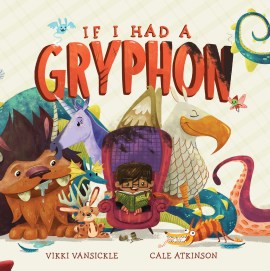
If I Had a Gryphon

Written by Vikki VanSickle | Illustrated by Cale Atkinson


Sam gazes at her first pet—a hamster—as he slumbers on his bed of shavings. She’s a little disappointed because mostly all he does is eat, sleep, and hide. She snuggles into her reading chair with a cup of tea and a book of mythical creatures and thinks: “If only I could have a pet / With strange, exotic powers, / I know that I’d find lots to do / To while away the hours.” She considers having a unicorn whose mane she could braid and who she could ride through fields of posies, then remembers that “Unicorns are pretty, / but they’re also very shy. / On second thought, I’d like to give a hippogriff a try.”
celebrate-picture-books-picture-book-review-if-I-had-a-gryphon-hippogriff

Image copyright Cale Atkinson, text copyright Vikki VanSickle. Courtesy of Tundra Books

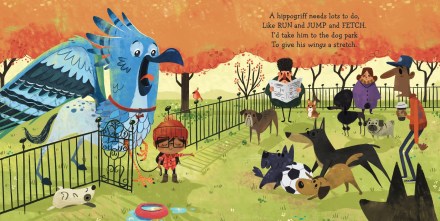
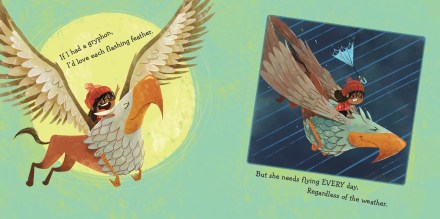
Sam plans to take her hippogriff to the dog park to “run and jump and fetch” and “to give his wings a stretch.” Considering it again, though, she realizes that the dogs may find a hippogriff scary and that “when it comes to playing ball, / Well, things could get quite hairy.” Instead, she decides to get a sasquatch “with burly, curly fur,” but then she remembers all the time she’d spend brushing out the tangles. A gryphon with “flashing feathers” sounds better until she thinks how she’d have to fly it every day “regardless of the weather.”
celebrate-picture-books-picture-book-review-if-I-had-a-gryphon-gryphon

Image copyright Cale Atkinson, text copyright Vikki VanSickle. Courtesy of Tundra Books

A kraken would be an unique pet, but to survive the cold, wet depths while playing with it she’d need a scuba suit. A warmer companion might be a dragon, although she thinks with its “temperamental snout / I’d need a fire extinguisher / to put her sneezes out.” A kirin could be a possibility, although it needs an ocean of grass to keep it happy; and a jackalope, while cute, is much, much, much too hoppy.

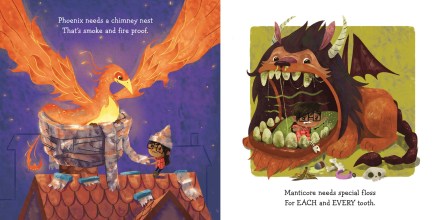
A phoenix might be an enduring pet, but it “needs a chimney nest / That’s smoke and fire proof” while a “Manticore needs special floss / For EACH and EVERY tooth.” There are oh so many creatures to contemplate—from harpies and chupacabras to fairies and kelpies to basilisks and sprites—but each is problematic in its own way.
celebrate-picture-books-picture-book-review-if-I-had-a-gryphon-phoenix

Image copyright Cale Atkinson, text copyright Vikki VanSickle. Courtesy of Tundra Books

Sam takes another look at the adorable hamster in its cage and reconsiders: “He may not be a gryphon, / Or a creature from the sea, / But I am his and he is mine / And that’s enough for me.”

Vikki VanSickle’s entertaining rhymes frolic, gallop, and prance through her encyclopedic array of fantastic beasts. Her young readers will be delighted that the fun of an imaginary menagerie is not just for the older set and will eagerly await each newly considered pet. VanSickle includes all the favorite mystical creatures, plus fascinating new ones that will spark kids’ imaginations and have them scrambling to find out more about them. The juxtaposition of attractive and less so traits of each possible pet adds a nip of humor to the verses that will make kids giggle. Sam’s ultimate realization that her hamster is the perfect companion is a sweet ending that reaffirms readers’ own relationship with their pets.

Cale Atkinson’s Sam is already a dreamer when she acquires her hamster. Her mug of tea sports a picture of a narwhal, her bookmark is a paper-thin dragon, and the book of Mythological Creatures that she consults is already well-thumbed. As the little girl with the square-rimmed glasses contemplates each creature as pet, Atkinson presents an illustration that is both humorous and beautiful. The hippogriff with its bird legs in front and horse legs in back is a gorgeous hue of blue, but it’s expressive reaction to seeing the dogs at the park as well as its enthusiasm to play along also causes the dogs to hide behind a tree; the sasquatch is a cutie, but he also snarls her bike, her bed, trees, and road signs in its thick brown hair; and a turquoise dragon may shimmer with lovely scales, but it also chars walls and furniture. Despite its apparent sloth, Sam’s hamster actually is the perfect pet—besides, he might have a secret of his own!

If I Had a Griffin is a fun romp through a mystical realm of pets that kids will love to hear again and again. The book would be a welcome addition to kids’ bookshelves, especially if they have older siblings enjoying that other series that features magical creatures!

Ages 3 – 7

Tundra Books, 2016 | ISBN 978-1770498099

To learn more about Vikki VanSickle and her books as well as to download an If I Had a Gryphon Activity Guide and coloring page, visit her website!

National Pet Awareness Month Activity
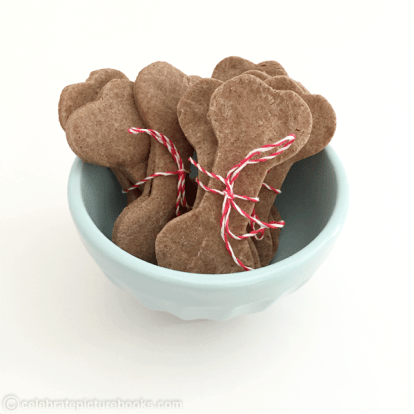
CPB - Dog Biscuits

Homemade Dog Treats


Pets love it when you do something special for them! Here’s a recipe for homemade dog biscuits that will taste even better than store-bought because they’re made with love! Making dog biscuits is a fun way to spend time together and benefit furry friends. These biscuits make tasty treats for your own pet, or consider making a batch to donate to your local animal shelter. This recipe is easy and proven to be a favorite.

Children should get help from an adult when using the oven.

Supplies

  • 1 large bowl
  • Large spoon or whisk
  • Cookie cutters – shaped like traditional dog biscuits or any favorite shape

Ingredients

  • 3 cups Buckwheat flour
  • ½ cup powdered milk
  • 1 teaspoon salt
  • ¾ cup water
  • 1/3 cup margarine or butter, melted
  • 1 egg beaten

Directions

  1. Preheat oven to 325 degrees
  2. Add buckwheat flour to bowl
  3. Add powdered milk to bowl
  4. Add salt to bowl
  5. Stir to mix dry ingredients
  6. Add water
  7. Add melted margarine or butter
  8. Add egg
  9. Stir until liquid is absorbed
  10. Knead for a few minutes to form a dough
  11. If the dough is too dry, add a little more water, 1 Tablespoon at a time
  12. Place the dough on a board
  13. Roll dough to ½ inch thickness
  14. Cut into shapes with cookie cutters
  15. Bake at 325 degrees for 35 minutes
  16. Biscuits will be hard when cool.

Makes about 40 biscuits

Q & A with Author Vikki VanSickle
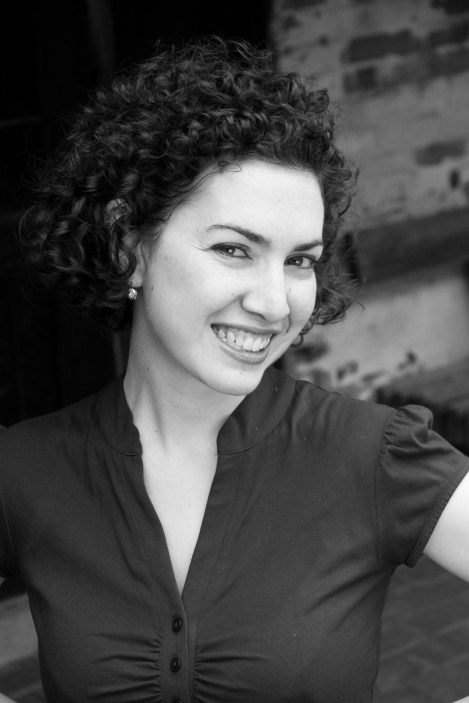
celebrate-picture-books-picture-book-review-vikki-vansickle-head-shot

Today I’m pleased to talk with Vikki VanSickle about her books for kids and tweens, her influences, and the unique place she draws inspiration from.

What were your favorite picture books growing up?

My mind was absolutely blown by Miss Nelson Is Missing by Harry Allard and James Marshall. It was likely the first mystery I was exposed to and I have loved mysteries ever since. This is a perfect example of text and illustration working together. Nothing in the text explains the true identity of Viola Swamp (what a name!), but there are hints in the illustration. It takes a certain kind of genius to make readers side with the adult—a beleaguered teacher—instead of the children in the book

Teddy Rabbit by Kathy Stinson and Stephane Poulin really spoke to me because like the main character, I had a teddy rabbit instead of a teddy bear. It also spoke to my deep fear of the subway. Growing up in a small town I was equally fascinated and terrified by the big city. I found Toronto loud, overwhelming, and very fast-paced. The subway in particular was frightening, and the idea of dropping my beloved Bunny on the tracks was as high stakes as it gets. If little Vikki knew that she would grow up to take the subway every day (without fear or incident, in fact I look forward to the extra reading time) she would not believe it.
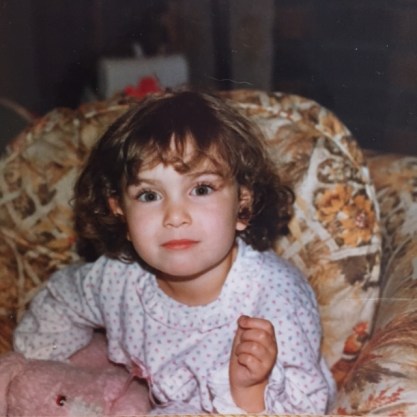
celebrate-picture-books-picture-book-review-vikki-vansickle-as-child

Lastly, Steven Kellogg’s Pinkerton books, Pinkerton, Behave and A Rose for Pinkerton were also favourites of mine. I have always loved pet stories, and the giant, clumsy Great Dane with a heart of gold totally captivated me. Especially when he meets his match in tiny but fierce Rose, a kitten after my own heart.

You’ve said that the idea for If I Had a Gryphon grew out of an observation at a bookshop story time. Can you tell me a little about that?

I used to watch my colleague Elaine create actual magic during story time. I was fascinated with which books resonated with the kids. It wasn’t always the ones that I expected. You don’t know how a book will land until you see it read aloud to children. Two things became clear: rhyme was always a hit (plus it was so fun to read) and pet stories were perennial favourites.

At the same time, I had a lot of little customers with older siblings who were obsessed with Harry Potter. They wanted to share in their older siblings’ love of the series, but when I went looking for good storybooks featuring similar creatures I came up short. There were lots of stories about dragons and unicorns, and some beautiful anthologies about mythological creatures, but no storybooks for the youngest readers. I’m a Harry Potter and mythology fan myself, and decided to write a sort of primer to magical pets.

Which of the mythical creatures that you mention in your book do you like best? Why?

This is a tricky one! Before I saw Cale’s illustrations I would have said a phoenix or gryphon, because I think they’re such majestic and fiercely beautiful creatures. But then the art came in and I found myself totally charmed by the enthusiasm of poor hippogriff, who just wants to play ball. I also love that cuddly-looking sasquatch, I think he’d make a great reading buddy.

You mention in your bio that you liked to go to flea markets when you were growing up. Do you have a favorite item that you found at one? Why is it special?

I am like a kid in a candy store at a flea market—I hardly know where to start and I could spend all day browsing through tables and shelves of random objects. It is such a rich source of story ideas that it’s almost overwhelming. Did that trunk come from overseas? Why? When? Who did it belong to? What does the inscription in this book mean? Who wore that wedding dress, and what happened at the party? How did that teddy bear rip its jacket? The possibilities are endless.

I didn’t bring the treasures home very often, it was enough to ponder the ideas they inspired. The one thing I did buy was Nancy Drew books. I completed my entire collection by searching garage sales, flea markets and antique stores.

You interact with your readers through school visits, library presentations, and at festivals. What do you like best about meeting your readers in person? Do you have a fun or interesting anecdote to share from any of your appearances?

Now that I no longer work in a bookstore, I don’t have as much kid-contact as I would like. Visiting schools and libraries gives me a chance to chat with kids, find out what’s important to them, what books they love, what makes them laugh, and just generally be reminded of what a privilege it is to write for this audience.
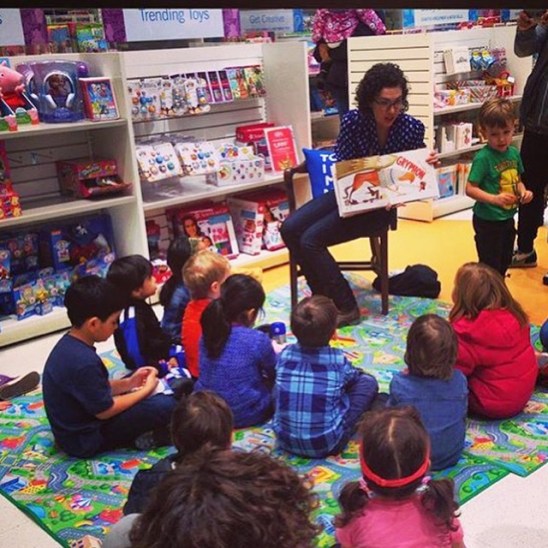
celebrate-picture-books-picture-book-review-vikki-vansickle-reading-to-kids

In terms of presentations, the students keep me on my toes with insightful questions, comments, and by pushing me to be flexible when an activity doesn’t work or they are more interested in process rather than plot. It sounds obvious, but you need to be very present when you’re working with children. I appreciate the opportunity to be in the moment, connect with readers, and talk about stories.

Earlier this fall during the question period a little boy asked me if I knew how many species of dragon there were in the world. When I told him I did not, he replied “That was a trick question. Nobody knows.”

Besides If I Had a Gryphon you’ve written a series of three middle grade novels (Words That Start with B, Love is a Four-Letter Word, and Days That End in Y) and a coming of age novel (Summer Days, Starry Nights). Can you tell me a little about how you approach the different genres and what you enjoy most about each?

I find them to be entirely different experiences. Picture books to me are about structure, space, and beats. It’s very much like writing a play. As the playwright, you do not cast, direct, or design the costumes, set, or lighting for your show. Your task is to create the bones of a project that many other people will then flesh out. With a picture book, the illustrator takes on role of casting director, costume, set and lighting designer. I believe in the interplay between text and pictures, and as the writer I need to leave the space for an illustrator to do so in the narrative.

Novel writing is a messy, chaotic, immersive process, at least for me. It’s very instinctual. I write in first person, trying to understand the voice of the narrator and her motivations, and the plot is often secondary. I’ll jump all over the place, sometimes writing the same scene in many different ways, occasionally working backwards from what I think might be the end, or switching narrators. I get to a certain point (usually between 60-80 pages) when I stop writing to seriously consider what I have done. I read, take notes, reorder, cut, refine, and then I have the beginning of a structured draft.

What’s up next for you?

I’m in the final throes of a middle grade novel which I’ve been describing as “Stranger Things” for tweens and I have a picture book I’ve been muddling over for awhile now that’s starting to come together.

Since Celebrate Picture Books is a holiday-themed blog, I can’t let you get away without asking you a few questions about holidays, so…

What is your favorite holiday?

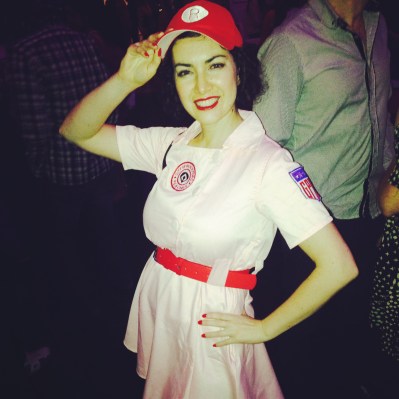
Definitely Halloween—costumes, black cats, AND candy? What’s not to love?

Do you have a funny or interesting holiday anecdote you’d like to share?

Here I am dressed as a Rockford Peach, my all-time favourite Halloween costume.
celebrate-picture-books-picture-book-review-vikki-vansickle-halloween-costume

Has a holiday ever influenced your work?

Not yet, but I would love to write something with a Halloween theme eventually. I have a few ideas rolling around in my head but I haven’t settled on the perfect one yet.

Thanks so much for spending time with me, Vikki! I wish you the best with all of your books!
celebrate-picture-books-picture-book-review-if-I-had-a-gryphon-cover

You can find If I Had a Gryphon at these booksellers:

Amazon | Barnes & Noble | Books-a-Million | IndieBound | Tundra Books

You can connect with Vikki on:

Her Website | Facebook | Twitter

Picture Book Review

November 8 – X-Ray Day and Q & A with Author Sara Levine

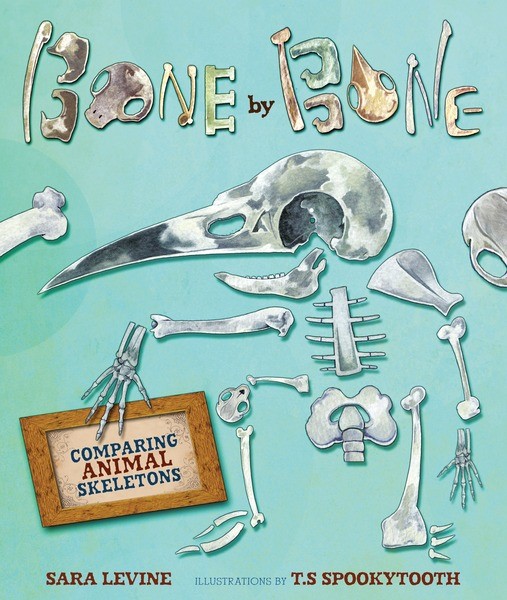
celebrate-picture-books-picture-book-review-bone-by-bone-cover

About the Holiday

In 1895 while Wilhelm Conrad Rontgen was experimenting with cathode rays and glass, he noticed a glow coming from a nearby chemically coated screen. This led him to make an astounding discovery. He found that the electromagnetic energy that caused the glow—which he named X-rays—could penetrate human flesh, but not bone, thus allowing bone to be photographed. For the first time doctors could see inside the body without surgery. X-rays were first used during the Balkan War in 1897 to find bullets, shrapnel, and broken bones in soldiers. While X-rays were an amazing advancement for medical research and patient care, their danger was not readily understood. The novelty of this new technology was used by shoe stores as a fitting device in the 1930s through 50s until the harmful properties of radiation were better appreciated. Today, X-rays and the technology they led to are instrumental in diagnosing injuries and diseases and in targeting a medical response.

Bone by Bone: Comparing Animal Skeletons

Written by Sara Levine | Illustrated by T.S Spookytooth


Can you imagine if we sloshed through life like soup without a bowl? What would we set our hats on? Where would we carry our phones? How could we sit in class or the office or perform our favorite activities? And what would happen to our organs, our hair, our homes? It’s all a little disturbing! Fortunately, we don’t have to worry about that scenario because “we’re vertebrates, animals with bones. Our bones hold us up.” Phew!

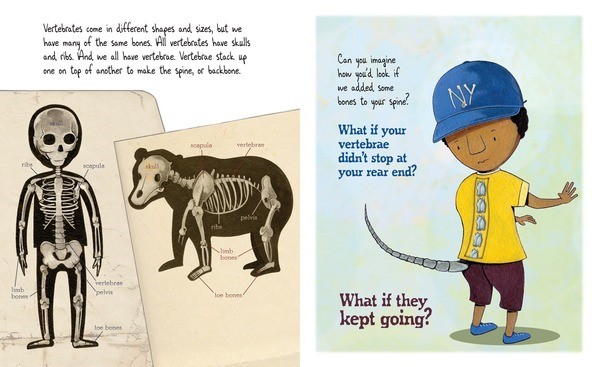
There are different kinds of vertebrates—mammals, reptiles, fish, and more—but many of our bones are similar. For example, “all vertebrates have skulls and ribs. And we all have vertebrae. Vertebrae stack up one on top of another to make the spine, or backbone.” Humans have vertebrae that end…well…you know where, but imagine for a minute if your vertebra kept on going. What if they poked a hole right through your shorts? Yes! You’re right—you’d have a tail. Tails are pretty helpful for some animals. They help them swim, communicate, even keep their balance.

celebrate-picture-books-picture-book-review-bone-by-bone-tailbone

Image copyright T. S Spookytooth, text copyright Sara Levine. Courtesy of Lerner Publishing

Good job! Let’s try again…how about if you only had a skull, vertebrae, and ribs. No arm bones; no leg bones. You’ve got it! A slithery snake! Nah…really…you’d look great! Okay, maybe you’d prefer if you had a skull, vertebrae, and arm bones—but no leg bones—and your nose was transferred to the top of your head. Sounds fishy? Maybe, but not quite. Oh! Did I give it away? Yep, you’d be a whale or a dolphin, and you’d use those powerful vertebrae to propel yourself to the ocean’s surface to grab a breath.

Imagine what kind of gloves and shoes you’d need if your “middle fingers and middle toes were so thick that they supported your whole body.” Hey, you’re good at this! It was a trick question. You wouldn’t need gloves, but you’d wear horse shoes (or no shoes if you’re a less domesticated animal like a zebra). Now, let’s take a trip through a room full of fun-house mirrors. What kind of animal would you be if your neck was reeeaally long and each vertebrae was “as big as your head?” Or if your legs were muuuuuch longer than your arms? Or your “finger bones grew so long that they reached your feet? Seeing those transformations is definitely worth the price of admission, right?

celebrate-picture-books-picture-book-review-bone-by-bone-bat

Image copyright T. S Spookytooth, text copyright Sara Levine. Courtesy of Lerner Publishing

But getting back to the bowl of soup: “Could you be an animal if you didn’t have any bones at all?” Sure! Some insects and sea creatures “have their hard parts on the outside,” and some are just “mushy.” Think of worms, slugs, and jellyfish, just to name a few. But bones make life more fun, don’t ya think? So if all vertebrates have bones, what makes humans different? Well, for one thing we (as well as some apes and monkeys) have opposable thumbs, which means that “we can move our thumbs in a special way that allows us to do many things, including turning the pages of a book,” using tools, and picking up objects. “Did you get that one? If so, give yourself a thumbs-up!”

An Author’s Note including more about bones, the types of vertebrates, a glossary, and resources for further reading follow the text.

With humor and a kid’s sensibility of the bizarre, Sara Levine presents an anatomy lesson that young readers will respond to. Juxtaposing individual bony features of humans and animals is a brilliant idea to give children perspective on the differences in animal skeletons and the uses of each unique trait. Levine’s quiz-like format engages readers, encouraging independent thought and active participation as well as building suspense for what transformation comes next. Kids will laugh and learn and be on the lookout for other ways human and animal skeletons differ as they become more aware of the natural world around them.

With illustrations of tailbones sticking out of pants, empty socks, two fingered hands and two toed feet, a neck that needs two scarves, and more, T. S Spookytooth illuminates what it means to be human in an animal world or an animal in a human world. Kids will laugh imagining themselves as Spookytooth depicts them with animal features and “Ewww” when their portrayal dissolves into a muddy mess. The accurate drawings of human and animal skeletons educate readers on the names and placement of particular bones.

The unique approach to the study of human and animal skeletons, the wide range of animals presented, and the enticing writing and illustrations make Bone by Bone: Comparing Animal Skeletons a wonderful choice for libraries and home bookshelves of budding scientists and nature lovers.

Ages 5 – 10

Millbrook Press, 2014 | ISBN 978-0761384649

To learn more about Sara Levine and her books, visit her website! You’ll also discover fun Bone by Bone activities to enhance your reading!

View a gallery of artwork by T. S Spookytooth, plus videos and more on his website!

X-Ray Day Activity

celebrate-picture-books-picture-book-review-x-ray-craft-dog-paw

Dog Paw and Human Hand X-Ray Craft


X-rays are cool to look at, but they always stay at the doctor’s office! With this craft you can simulate an X-ray of a dog’s paw and a human hand!

Supplies

  • Printable skeleton templates: Human Hand Template | Dog Paw Template
  • Black chalkboard drawing paper, 8 ½ inches by 11 inches
  • White colored pencil
  • White chalk
  • Clear Plastic Report Sheet Protectors
  • Magnetic clip to hang your x-ray on the refrigerator or other metal surface (optional) OR
  • String or wire, adhesive squares, and clothes pins to hang x-ray on the wall (optional)
  • Scissors

Directions

  1. Print the Human Hand and Dog Paw Templates (you may want to print two—one to cut and one to follow when transferring the bones to the black paper)
  2. Cut the bones apart
  3. Lay the bones on the black chalkboard paper
  4. Trace the bones with the white colored pencil
  5. Color in the bones with the white chalk
  6. Slip the black paper into the plastic report sheet protector
  7. If desired, hang the x-ray on the refrigerator with the magnetic clip or on the wall using string, adhesive squares and clothespins


Q & A with Author Sara Levine

celebrate-picture-books-picture-book-review-author-sara-levine

Today, I’m thrilled to talk to Sara Levine about her writing as well as to learn about her early experiences with animals and to discover a kid’s-eye-view of women in science.

Your writing for kids is so infused with humor that really captures their attention. What were some of the books that you liked best as a child?

When I was younger, one of my favorite picture books was Katerine and the Box by Patricia Lee Gauch. I’ve noticed that this book has gone back into print; I was so happy to find it online. It’s basically about creativity. A girl and her friend keep finding new uses for a large cardboard box—a house, a car, a dance platform. I can still recall my feeling of excitement when hearing it read to me—it made me want to go make something. It’s actually a feeling very similar to what I have today when I think of a new idea for a book. There was also a book called Wisher, which was about difference—about a cat who dreamt he was really a fish. I remember that the illustrations were beautiful and somewhat scary—just done in blues, browns and yellows.  As an older child, I loved Charlotte’s Web by E.B White, Lizard Music by Daniel Pinkwater and pretty much everything by Judy Blume.

I don’t suppose any of these books are like the books I write. I used to tell people that I liked my science and my books separate. I just wanted to go outside to learn about science. But, I wanted stories in my books. I don’t think there were any of the sorts of books I write about science out for kids when I was young. At least I didn’t find them. But if I had, I think I would have enjoyed them—the fact that they were funny and interactive. But here’s a picture book I LOVE that I found as an adult that is certainly infused with humor and captures a kid’s (and a grown-up’s) attention: Bark, George, by Jules Feiffer. I think this is currently my favorite picture book.

You grew up on a farm in Guilford, Connecticut. Can you tell me a little about the farm and how or if it influenced your current work?

Calling it a “farm” might be a bit of a stretch. My parents were two kids who grew up in Brooklyn and then moved to CT and decided to get some animals, cheered on by their enthusiastic offspring. First there was a goat, who got lonely. So then there was another goat. And they had a baby. And there was a chicken at school who needed a place to go for the summer. And then never went back to school… And so on. We ended up having over 100 named animals—a horse, a cow, peacocks, geese, a donkey and more. I loved taking care of the animals, with my siblings. It was a wonderful experience, one that I’m very grateful for. But it wasn’t at all lucrative. I think the only money made was by my brother who would sell extra eggs to his teachers.

How did it influence my current work? I’m not sure. Certainly my interest in animals is a lifelong one. I think the stories about the animals actually show up more in my writing for adults than in my picture books. The ideas for the books for children come more from teaching ideas that I think will translate well into a picture book format.

You have a doctorate in veterinary medicine and a masters in fine art. When and how did the two merge into your work as an author?

What a great question. I have always had this science side and this humanities side. A lot of my life, I’ve been struggling with how to balance and feed both sides of myself. It’s taken me a long time to find a way to merge the two interests, and it’s been very satisfying to do so in writing about science, especially for kids.

You offer four different school and library programs, all of which sound fascinating. Do you have any anecdotes from a presentation you’d like to share?

In one of my workshops, the one for Bone by Bone: Comparing Animal Skeletons, I bring in an articulated skeleton for the kids to see and a disarticulated skeleton in a box. The kids learn the bones, and I then hand them each a bone which they take up to the standing skeleton to figure out which bone it is, and then work together to put together the second skeleton on the floor. Inevitably, someone asks if the skeletons are real. They are. I literally found them in the closets, when I started my teaching at Wheelock. There are all sorts of questions about that, generated by the kids, and then, often, someone will ask if the skeletons are “boys or girls.” Recently, at a school near Boston, I was explaining to a group of second graders that both were female, that we could tell by the shape of the hips, and I heard one girl, going, “YES!” and pumping her arm up and down, in victory. The boy next to her says, “Why are you so happy? That means a girl died.” To which she responds, “That’s true. But it also means one more girl in science!”

celebrate-picture-books-picture-book-review-bone-by-bone-workshop

Sara Levine leads a workshop at Cold Spring School

What’s the best thing about writing for kids?

I enjoy trying to think of engaging and interactive ways to teach something that hasn’t been taught before. I like the creativity involved. And, of course, reading it to the kids when I’m done and seeing them respond!

celebrate-picture-books-picture-book-review-bone-by-bone-students-at-al-hamra-school

Students at Al Hamra Academy examine a skeleton

You also write articles for adults and were nominated for a Pushcart Prize in 2007. Can you tell me more about your writing for adults?

I write science related essays for adults. The writing comes more from my own experiences.  I do have a handful of essays published. I think the one that was nominated for the Pushcart, “What Hands Can Do” is still available to read online. Here’s a link to it on Fictionaut. It’s about spaying a dog. And more, of course. I think my most successful essay is “The Body of a Cow” which originally appeared in the Massachusetts Review. It’s also on Fictionaut, if anyone wants to have a look. Eventually, I hope to work the essays into a memoir for adults.

What’s up next for you?

I have a book on dinosaur bones which will be published by Lerner next year. I also have three children’s books written which I’m trying to find homes for at the moment—one on animal classification (but interactive, written like a “do your own adventure” story), one on how plants communicate with animals, and one very funny one (if I can say so myself) called “Breakfast at the Omnivore Café,” which is about what animals eat. This one might never get published because it falls into the cracks between nonfiction and narrative fiction, but I haven’t given up on it yet. The book I’m currently working on is an attempt to explain climate change through stories of the carbon cycle. Doesn’t sound very interesting when put that way, but it’s written as an interactive story, and is also actually quite funny in parts, so I think kids will like it.

Since Celebrate Picture Books is a holiday-themed blog, I can’t let you get away without asking you what your favorite holiday is…

Passover. You get to tell a story to children in a way that is interactive and engaging for kids, AND it involves food. What could be better?

Thanks so much for chatting and sharing your unique perspective on the natural world, Sara! I, for one, would love to read Breakfast at the Omnivore Café—that would be one interesting menu, I bet! I wish you the best with all of your books!

You can connect with Sara Levine on:

Her Website | FacebookTwitter

About Sara Levine

Sara Levine is an assistant professor of biology at Wheelock College and a veterinarian.  Her science books for children include Bone by Bone: Comparing Animal Skeletons (2013) and Tooth by Tooth: Comparing Fangs, Tusks and Chompers (2016).  Her third book, Fossil by Fossil: Comparing Dinosaur Bones will be published in 2018.  Bone by Bone: Comparing Animal Skeletons has received much recognition, including the Utah Beehive Book Award, selection as a Bank Street College Best Children’s Book of the Year, and finalist for the Cook Prize for best STEM picture book.

Sara also writes science-related essays for adults, one of which was nominated for a Pushcart Prize in 2007.  Her writing has appeared in the Boston Globe, the Massachusetts Review, Bayou, and in the anthology And Baby Makes More. In addition to teaching college students, she has taught children’s environmental education classes for the Massachusetts Audubon Society and other nature centers in Massachusetts and Connecticut for over 15 years. 

Sara holds a doctorate in veterinary medicine (DVM) from Tufts University, a master of fine arts degree (MFA) in creative nonfiction writing from Lesley University and a bachelor of arts degree (BA) in English from Haverford College.  She is a native New Englander and lives with her daughter and their dogs and cat in Cambridge, Massachusetts.  

celebrate-picture-books-picture-book-review-bone-by-bone-cover

Bone by Bone: Comparing Animal Skeletons and Sara’s other books can be found at:

Amazon | Barnes & Noble | Books-a-Million | IndieBoundLerner Publishing

Picture Book Review
October 14 – World Egg Day

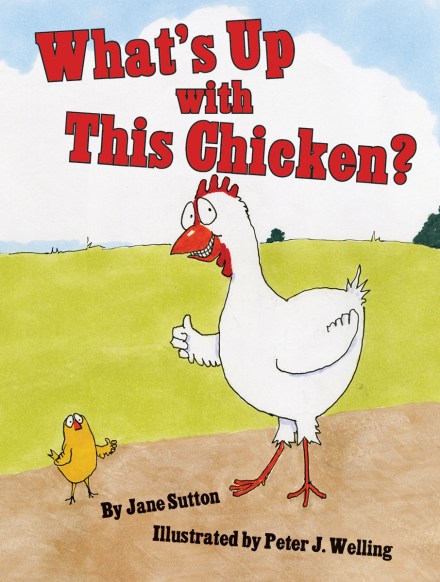
celebrate-picture-books-picture-book-review-what's-up-with-this-chicken-cover

About the Holiday

Marking its 21st birthday, World Egg Day celebrates the health benefits of the humble egg—which offers the highest quality of protein available. An important dietary component for fulfilling the nutritional requirements of people living in both developed and developing communities, the egg is a versatile food, able to be eaten on its own or as a necessary ingredient in many recipes. Eggs are essential for fetal development, healthy brain development, maintaining concentration, aiding the immune system, and more. Today, enjoy eggs your favorite way!

What’s Up with This Chicken?

Written by Jane Sutton | Illustrated by Peter J. Welling


When Sylvia goes out to the barn to collect the chicken’s eggs, something’s up with Trudy. She squawks and screeches when Sylvia tries to reach under her, but Sylvia takes it in stride and with humor: “‘Don’t get so egg-cited!’” she says “‘I’ll get your egg tomorrow.’” But the next day Sylvia is met with the same reaction. Trudy isn’t acting like the other chickens in Grandma’s backyard; if fact, she isn’t even acting like Trudy! “‘What’s up with this chicken?’” Sylvia wonders.

While she and Grandma enjoy “omelets with eggs from Sue, Clara, Doris, and Olga,” Sylvia tells her about “stubborn Trudy.” Grandma doesn’t know what’s wrong either. The next morning Trudy is even more obstinate. Not only does she make a racket, she tries to peck Sylvia, and she puffs “herself up to twice her size.” Sylvia also notices “that Trudy left her roost just once a day to eat, drink, and poop. She was getting skinny.”

Sylvia decides Trudy must be hungry and tries to lure her off her nest by offering chicken feed, but while all the other hens “wolfed it down like chocolate,” Trudy remains firmly on her roost. Sylvia tries everything she can think of to move Trudy, but nothing works. That night she and Grandma consult The Big Book About Chickens. Here they discover that “‘Trudy is broody!’” Grandma reads on: “‘Broody hens stay on their eggs so they will hatch into chicks.’” But Sylvia and Grandma know that Trudy’s eggs are not the kind that hatch.

Sylvia realizes that Trudy just wants to be a mother, and she wishes there were some way to help her. She thinks and thinks and finally comes up with an idea. She runs to Grandma who thinks Sylvia’s plan is “an egg-cellent idea.” A few days later a box arrives with four eggs that would hatch. With thick rubber gloves, a dose of determination, and two tries, Grandma is able to lift Trudy off her nest. Sylvia makes a quick switch of the eggs, and “Broody Trudy settled down on the new eggs.”

Trudy grows thinner every day but she stays on her roost, rolling the eggs to keep them uniformly warm and even blanketing them with her own feathers. One day Sylvia hears peeping! Grandma and she are even in time to watch the fourth little chick peck its way out of its shell. They name the new “little yellow fluff balls Sophie, Danielle, Mildred, and Judy.”

Trudy is a proud and protective mother, shielding them with her wings “like a feathery beach umbrella” and teaching them how to find food and water. Trudy goes back to her regular routine and begins gaining weight. As the chicks grow they get their own nests in Grandma’s coop. But one day Judy squawks and screeches. This time Sylvia knows exactly what’s up with this chicken!”

An Author’s Note about the real-life “Broody Trudy” that inspired the story follows the text.

With a deft and delightful understanding of the puns and humor that set kids to giggling, Jane Sutton has written a fun—and informative—story for animal lovers and anyone who loves a good, natural mystery. Through the well-paced plot and action-packed description, readers learn about a particular behavioral aspect of some chickens and the clever and sensitive way that Sylvia solves the problem. The close relationship between Sylvia and her grandmother adds charm and depth to the story, and their dialogue is spontaneous and playful.

Peter J. Welling’s bright, homey illustrations are the perfect accompaniment to the story. Animated Trudy shoos Sylvia away while the other chickens take dust baths, scratch for bugs, and look just as perplexed as Sylvia and Grandma. Humorous touches abound in Grandma’s choice of home décor and Sylvia’s printed T-shirts as well as in the facial expressions of the human and feathered characters. Trudy’s chicks are adorable, and readers will cheer to see Trudy fulfill her heart’s desire.

What’s Up with This Chicken is a wonderful read-aloud for younger kids’ story times and a fun romp that will keep older, independent readers guessing and wondering how it all comes out right up to the end. The likeable characters—both human and chicken—make this a book kids will like to hear again and again!

Ages 3 – 8

Pelican Publishing, 2015 | ISBN 978-1455620852

Discover more about Jane Sutton and her books on her website!

To view a gallery of artwork plus more books for readers of all ages by Peter J. Welling, visit his website!

World Egg Day Activity

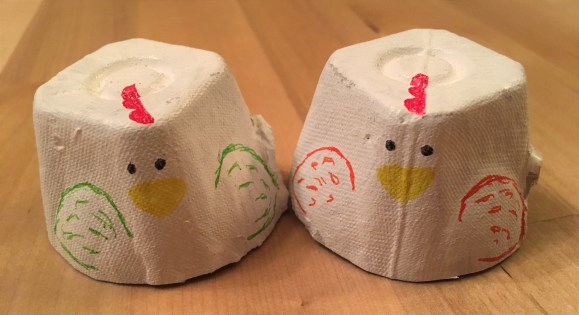
celebrate-picture-books-picture-book-review-egg-carton-chicken-double-chickens

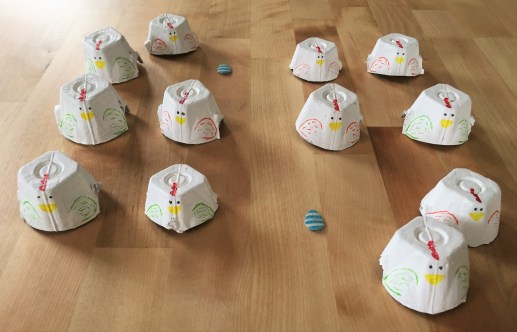
Egg Carton Chickens and a Basket Full of Games


With twelve little chickens you can come up with lots of games to play! This fun craft and game activity is eggs-actly what you need to start hatching some real fun!

Supplies

  • Cardboard egg carton
  • White craft paint
  • Markers: red, yellow, black for the face; any colors you’d like for wings and eggs
  • Paint brush
  • Scissors
  • Glue
  • Construction or craft paper in white and a color of your choice

Directions

  1. Cut the notched flap off the egg carton and set aside
  2. Cut the top off the egg carton
  3. Cut apart all the egg cups and trim slightly so they sit flat
  4. Paint the egg cups with the white paint, let dry
  5. Add the face, comb and wings to the chicken with the markers. Make six chickens with one color wings and six chickens with another color wings.
  6. From the egg carton flap cut thirteen small egg-shaped playing pieces
  7. With the markers, decorate twelve of the eggs in pairs—each egg in the pair with the same design
  8. Color one egg yellow and add a beak, eyes, and wings to make it a chick

Games to Play

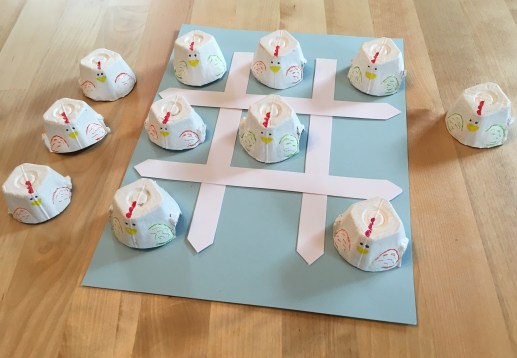
Tic-Tac-Toe (2 players)

  1. On a 8 ½” x 11” piece of paper draw a regular tic-tac-toe board or make it fancy – like the picket fence-inspired board in the picture
  2. To make the fence-inspired board on a colored background, cut 2 9-inch-long x 3/4-inch wide strips of white paper, cutting a pointed tip at one or both ends. Cut 2 white  8-inch x 3/4-inch strips of paper with a pointed tip at one or both ends. Glue the strips to the background.
  3. Each player chooses a set of chickens with the same colored wings
  4. Play the game as you usually do

celebrate-picture-books-picture-book-review-egg-carton-chicken-tic-tac-toe

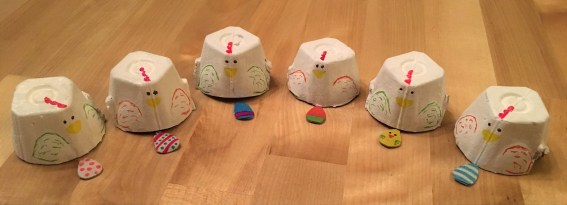
Find the Matching Eggs (2 or more players)

  1. Have one player hide one egg under each chicken
  2. Shuffle the eggs around and form them into three lines of 4 chickens each
  3. Another player lifts one chicken at a time to find matching eggs. If the eggs don’t match, put both chickens back and start again

celebrate-picture-books-picture-book-review-egg-carton-chicken-matching

Where’s the Chick?

  1. Use as many chickens and eggs as you want (fewer for younger children, more for older)
  2. One player hides the chick under one of the chickens and eggs under the others.
  3. Another player has three chances to find the chick

celebrate-picture-books-picture-book-review-egg-carton-chicken-where's-the-chick

I’m sure you can also design your own games for your adorable chickens to play! With more chickens you can even make a checkers set or replicate another of your favorite board games!

Q & A with Author Jane Sutton

JanePhoto2013email.JPG

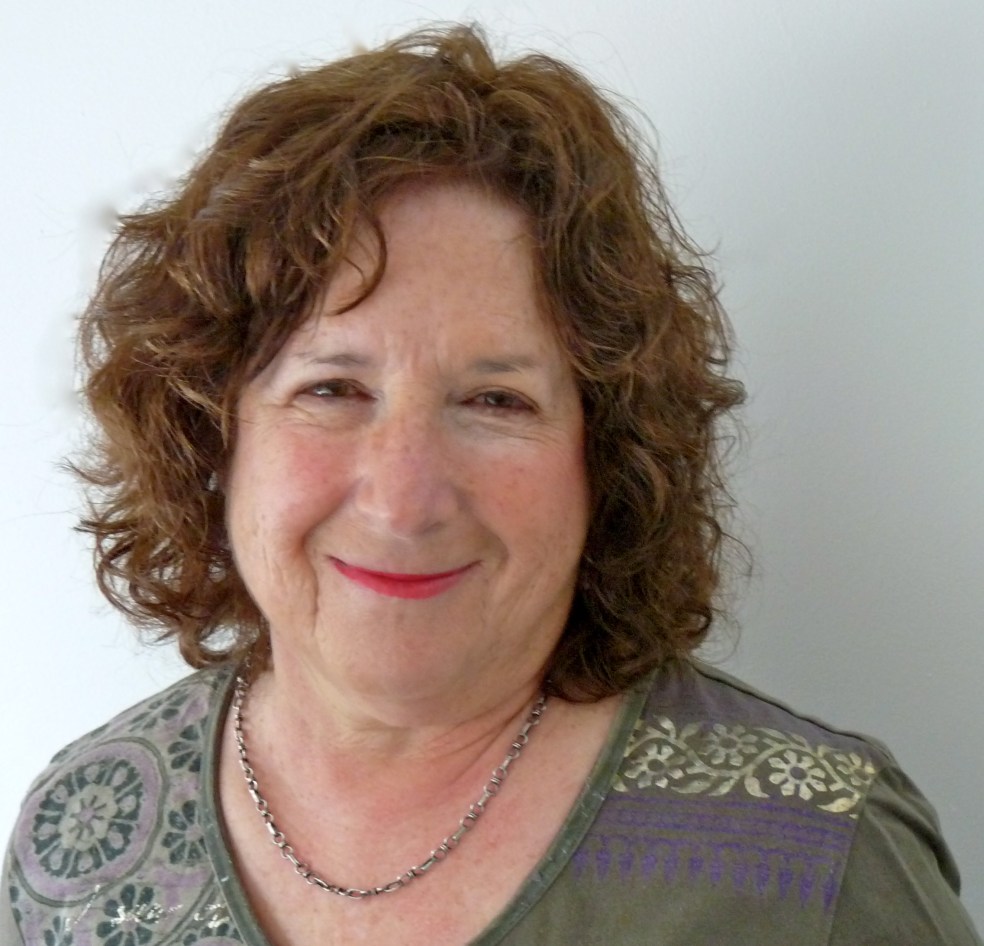
Today, I’m pleased to talk to Jane Sutton about her books, her journey as a writer, her family, and the joys and inspiration of being a new grandmother! 

As someone who loves humor and was voted class comedienne in high school, what were some of the books you most enjoyed as a child and young adult?

 Two of my childhood favorites were Dr. Seuss’s Horton Hatches an Egg and Robert Louis Stevenson’s A Child’s Garden of Verses. As a young adult, I was drawn to Virginia Woolf novels (I know–not exactly humorous, but most comedians are prone to depression).

You write both picture books and books for older children. What inspires or influences your stories?

My childhood memories have been the basis of many of my books—experiences and feelings. What’s Up with This Chicken? was inspired by a true story my friend-since-we-were-11 Fay told me about one of her backyard hens who refused to get off her eggs. I said, “This has to be a children’s book!” So I invented characters, had the child protagonist solve the problem, and snuck in a subtle message about the importance of empathy.

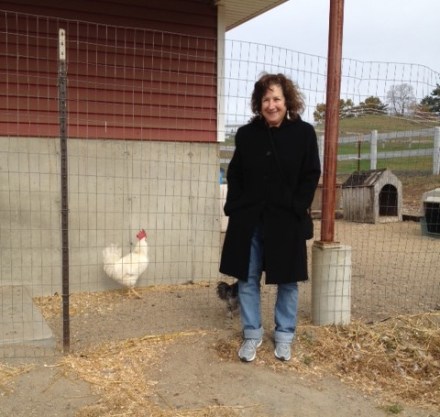
celebrate-picture-books-picture-book-review-jane-sutton-and-chicken

As someone who always wanted to write and who achieved the goal of becoming a published author, can you briefly describe your journey?

At a young age, I was encouraged by my teachers. They would be impressed by something I wrote and send me to show it to another teacher, which really pumped me up. I was an editor of my high school newspaper and after graduating from college had a job writing for a newspaper, wrote ads and press releases, and sold some stories for reading comprehension tests. My first book, What Should a Hippo Wear? was published when I was 29. I’ve had periods where everything I wrote was selling, and periods when nothing I wrote was selling. It’s a tough market!

What’s the best part about writing books for kids?

Well, I never wanted to grow up, and when I realized it was happening whether I liked it or not, I vowed to always remember what it felt like to be a child. Writing for kids helps me do that.

You conduct school presentations and workshops for kids from kindergarten age through grade 5, can you describe a funny or poignant anecdote from one of your events? 

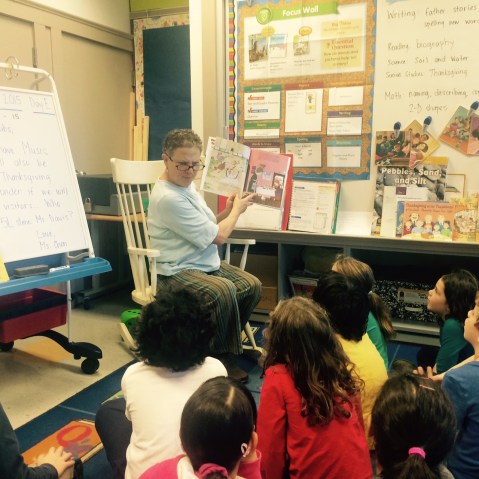
One school had a wonderful program that paired parents and their children as writing partners. The culminating event was a presentation by me about how to make writing come alive. Then the parent-children pairs displayed their books, and it was so lovely to see how much the experience meant to the adults and the children. They also loved showing me—the big famous author—what they’d written and I could sincerely point out parts of their writing that were especially effective. The whole thing made me ferklempt.celebrate-picture-books-picture-book-review-jane-sutton-reading-to-kids

I read that you love elephants and collect elephant-inspired items. Can you tell me about one of your favorites?

One of my favorite elephants is gray and plastic (about the size of a toaster) and lives outside, in view of our kitchen window. My mother, who died in 2004, gave him to me and named him “Sabu.” He has survived about 18 New England winters so far, sometimes getting totally buried by snow and then poking out the tip of his trunk as the snow starts to melt. My mom asked me once if the elephant made me think of her, and yes, he surely does.

Talking about your mom makes me think of the strong relationship between Sylvia and her grandmother in What’s Up with This Chicken. Can you tell me about your own family?

My husband, Alan, taught a variety of grade levels spanning grades 1-6. He served as a science coordinator, curriculum developer, and teacher mentor. He’s written and co-authored six books for educators, four focused on science instruction and two about systems thinking. Currently, he coordinates the systems thinking program at a grades 5-12 public school and also presents workshops at meetings and conferences. We met in college and have been married for 41 years!

My son, Charlie, works for a coalition made up of organizations pushing for a better transportation system in Massachusetts. He’s worked in Massachusetts public policy since graduating from college in 2007. He married the wonderful Amberly, a nurse, in 2014, and they recently had a baby!

My daughter Becky is the director of an SAT tutoring program. Her company tries to make SAT tutoring as fun and effective as possible, so they try to match the kids with tutors who have the right personality for the student’s learning style. The SAT has completely changed in the last year, so they have had to retrain all of their tutors and rewrite all their curricula. For any tutoring program, building students’ confidence is key. So much of standardized testing is psychological.

I understand Becky also writes a blog for all of us grammarians who like a laugh once in awhile called Apostrophe Catastrophes: The Worlds’ Worst. Punctuation. Can you tell me a little about how she got started?

Yes, Becky does a great job with that blog. I love the examples she posts, and her comments are hilarious! She started Apostrophe Catastrophes almost 10 years ago after seeing an errant apostrophe on a giant cake at Governor Deval Patrick’s Inauguration. She pointed it out to the catering staff, and they had no idea what she was talking about, and then she started to notice misused apostrophes everywhere! Friends and family started taking pictures and sending them to her, and eventually, strangers from all over the world started sending in pictures! The Facebook group has almost 4,000 members now! Becky says, “I guess a lot of people share my love for proper punctuation.”

You’re a new grandmother! Can you tell me a little about your grandson?

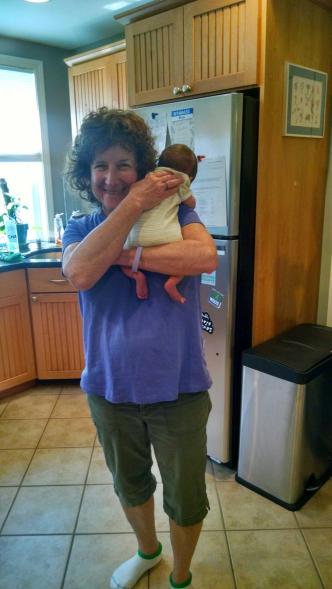
That’s a dangerous question! How much time do you have? Caleb is an adorable, cuddly little person. And he’s now a month old!

celebrate-picture-books-picture-book-review-jane-sutton-and-grandson

What is the best part about being a grandmother? 

 As a new mother, I was very anxious and questioned all my decisions. But as a grandma, there’s none of that anxiety. Being with my grandson is pure joy. And seeing how loving, confident, and tender my son and daughter-in-law are with the baby fills me even more love. And seeing him in my husband’s arms as he gazes down at him…I’m getting ferklempt again!

Have you thought about how being a grandmother might influence or inspire your future work? 

You betcha! Stay tuned.

What’s up next for you?

My next book, a Passover-themed picture book, is scheduled for publication by Kar-Ben in the spring of 2018.

Since Celebrate Picture Books is a holiday-themed blog, I can’t let you get away without asking you a few holiday-related questions! So…

 What is your favorite holiday?

I love Mother’s Day and Father’s Day because they are occasions for my husband and me to get together with our children. And there’s good eating involved.

Do you have an anecdote from any holiday that you’d like to share?

The first time I hosted Thanksgiving, rather than attending one at my parents’ house, my mother gave me very, very specific instructions about what to buy. For example, there had to be 2 Butterball frozen turkeys, both between 11 and 13 pounds. The reason for 2 is so that each of the 4 grandchildren could have a drumstick. My daughter and I were rummaging through the supermarket frozen case trying to find the exact acceptable weight for exacting Grandma. Our fingers were half frozen, and I admit that I kind of dropped a turkey on my daughter’s finger. The turkeys, by the way, were quite delicious.

How has a holiday influenced your work?

The festive, joyous celebration of Chanukah shows up in my 2 Chanukah picture books: Esther’s Hanukkah Disaster (Kar-Ben) and Aiden’s Magical Hanukkah (Hallmark).

celebrate-picture-books-picture-book-review-jane-sutton-and-her books

Thanks so much for chatting, Jane! It’s been wonderful getting to know you. I wish you all the best with all of your books, and am looking forward to seeing your next book!

Connect with Jane Sutton on her website and catch up with her events and other fun activities on her blog!

What’s Up with This Chicken can be found at these booksellers:

Amazon | Barnes & Noble | Books-a-Million | IndieBound | Pelican Publishing Company

Picture Book Review