December 3 – Chester Greenwood Day

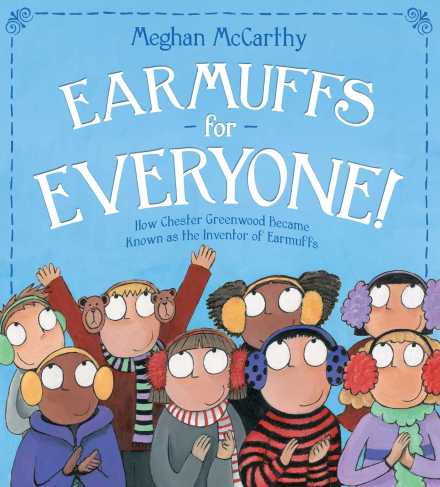
celebrate-picture-books-picture-book-review-earmuffs-for-everyone-cover

About the Holiday

On March 13, 1877 Chester Greenwood—a 19-year-old inventor—received a patent for “improvements in ear-mufflers” and forever sealed his place in history—as well as making winter more comfortable for millions of freezing ears! Today we honor Chester and his invention that brought attention to Farmington, Maine and jobs for many people in the area. 2016 marks the 40th anniversary of Chester Greenwood Day, and the people of Farmington are pulling out all the stops. With a theme of Holiday Celebrations around the World, the day will include a parade, gingerbread contest, chili contest, craft fairs, historical open houses, Polarbear Dip, 5K race, Festival of Trees and more. If you live nearby, why not plan to attend? If not, and you live in an area where the cold winds are blowing, wear your earmuffs with pride!

Earmuffs for Everyone! How Chester Greenwood Became Known as the Inventor of Earmuffs

By Meghan McCarthy


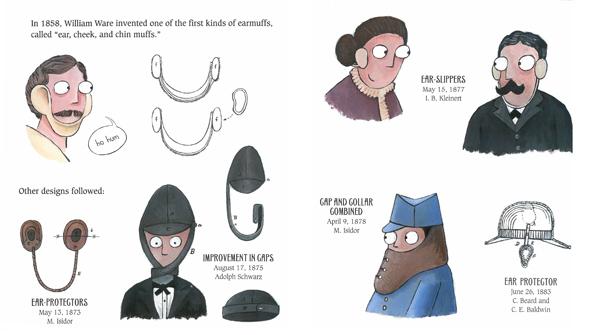
In the mid-1800s inventors were trying to solve the problem of winter’s chill effects on tender ears. William Ware designed an “ear, cheek, and chin muff” that one wore somewhat like a false beard. Ear protecting hats, ear “slippers,” high collars, and other designs followed. But it wasn’t until Chester Greenwood and his sensitive protruding ears came along that earmuffs became practical. While the exact steps Chester took in creating his earmuffs aren’t known, he eventually perfected his invention and received a government patent on March 13, 1877—when he was only 19 years old!

celebrate-picture-books-picture-book-review-earmuffs-for-everyone-patents

Copyright Meghan McCarthy, courtesy of Simon & Schuster

Chester was no one-invention wonder, though. Always on the lookout for clever ways to make money, he went on to improve other products. He applied his foresight to the tea kettle, rounding the edges of the bottom to reduce wear; constructed an interchangeable-tooth rake; and built a collapsible, if cumbersome, tent.

His inventions brought him a comfortable life that he shared with others—a beautiful house for his family in Maine, the first steam car in his town, and a bicycle shop on the bottom floor of his workshop. His wife, also a progressive thinker, worked for women’s suffrage and inspired her husband to hire women in his workshops.

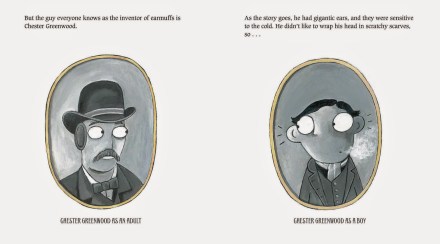
After Chester passed away, some people, most notably Mickey Maguire, thought he deserved more acclaim—even a day dedicated as Chester Greenwood Day. Maguire was so excited about this that he became a kind of inventor himself—an inventor of tall tales. Over time he told some whoppers about Chester which were repeated in the press, making it hard to separate fact from myth. But even without the made-up stories, it’s easy to say that Chester Greenwood had a very remarkable life

celebrate-picture-books-picture-book-review-earmuffs-for-everyone-portraits

Copyright Meghan McCarthy, courtesy of Simon & Schuster

Earmuffs for Everyone! goes beyond the story of Chester Greenwood to include other inventors, a discussion of the patent system (using products well-known to today’s kids), and an explanation of how an inventor’s legacy grows. Meghan McCarthy writes with verve and humor, making the story of Greenwood’s invention as well as others’ creations inviting, accessible, and fun. Her illustrations of early attempts at creating earmuffs as well as other products from the 1800s are sure to delight kids and make them curious about the time period.

In her author’s note following the text, McCarthy expands on the story of Chester Greenwood and the process of applying for and earning a patent.

Ages 4 – 8

Simon & Schuster/Paula Wiseman Books, 2015 | ISBN 978-1481406376 

Discover more about Meghan McCarthy and her books plus fun activities, videos,  artwork, advice for writers and artists and more visit her website!

National Earmuff Day Activity

CPB - Earmuff Maze.png

Here’s to Warm Ears! Maze


One muff on each side of the head—Genius! But it took inventors a lot of trial and error to make the perfect warming headgear. Use your own creative thinking on this Here’s to Warm Ears!earmuff-shaped maze. Solution included.

Picture Book Review

November 24 -Thanksgiving Day

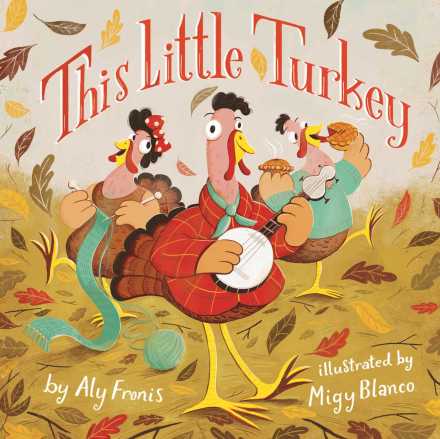
celebrate-picture-books-picture-book-review-this-little-turkey-cover

About the Holiday

The American holiday of Thanksgiving dates back to 1621 and a harvest feast shared by a group of colonists, who had sailed from England in 1620 to “the new world” seeking freedoms and prosperity, and the Wampanoag tribe, who had helped the settlers survive the harsh conditions of their new home. The feast, organized by Governor William Bradford, was held to give thanks for the success of the colonist’s first crops and their settlement. During America’s early years, days of thanksgiving were proclaimed periodically by Congress and Presidents to celebrate particular important events.

In 1817 New York became the first state to proclaim an official day of thanks. Other states followed. In 1827 Sarah Josepha Hale began a 36-year campaign to make Thanksgiving a national holiday. Abraham Lincoln finally signed a proclamation in 1863, making the forth Thursday in November the official holiday. Today, the holiday is celebrated by families with a traditional dinner of turkey, stuffing, potatoes, vegetables, and other goodies, and is finished off with pumpkin pie, apple pie or other favorite sweets.

This Little Turkey

Written by Aly Fronis | Illustrated by Migy Blanco


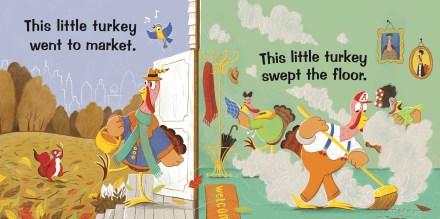
Perhaps you know about “this little piggy” and his cohorts and the way they spend a day, but have you heard of “this little turkey” and his friends and their shenanigans on Thanksgiving Day? Well, let me tell you! “This little turkey went to market”… Wait? Isn’t that what the first little piggie did? Do you think they might have met there? What do you think they bought? Oh, right, I’m getting off track. What about the second little turkey?

celebrate-picture-books-picture-book-review-this-little-turkey-market

Image copyright Migy Blanco, text copyright Aly Fronis. Courtesy of little bee books

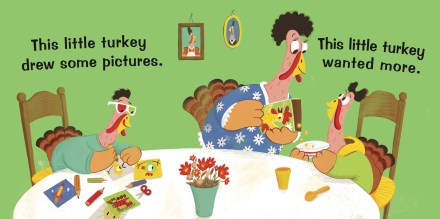
“This little turkey swept the floor.” And did it need it! Wow! So much dust! And the sneezing! Maybe it’s best to see what the third little turkey’s up to. Awww!—“This little turkey drew some pictures” while a little snacking turkey “wanted more.” Elsewhere, a creative turkey is preparing for cold weather, and a sneaky turkey is up to a little mischief!

At home the dinner table is being set in a most entertaining way, but will there be enough plates left for all the little turkeys? You’ll have to read on to see…. Finally, a little turkey calls, “‘Let’s eat!’” and all the turkeys come running to say, “we…we…we…wish you a happy Thanksgiving!’”

celebrate-picture-books-picture-book-review-this-little-turkey-drawing

Image copyright Migy Blanco, text copyright Aly Fronis. Courtesy of little bee books

Little ones love the excitement of a holiday! Special planning and traditions mingle with delicious, sometimes once-a-year aromas, and relatives and friends gather to have fun and swap stories. Aly Fronis’s sweet take on the familiar “This Little Piggie” rhyme invites the youngest children to take part in the preparations and enjoyment of Thanksgiving with phrases that are joyful to read and easy to memorize for read alongs. Young readers will giggle at the foibles and tricks of these little turkeys and recognize common activities they partake in themselves during the holiday weekend.

Migy Blanco’s vibrant pages, populated with an array of cute turkeys and their squirrel and bird friends, are whimsically eye-catching, perfect for the book’s young audience. Depicting the traditions of the holiday—from cleaning and cooking by older family members to drawing and table setting by younger members—each scene is both cozy and playful. Kids will love the small details, such as family portraits hinting at the family’s history, and the tiny plates for the bird and squirrel on the festive dinner table.

Young children will love repeating the holiday-themed verse in This Little Turkey. Drawing turkey faces on children’s fingertips could also turn this book into a fun game that kids will gobble up!

Ages 2 – 5

little bee books, 2016 | ISBN 978-1499803020

Discover more books and illustration for children as well as for adults by Migy Blanco on her website!

Thanksgiving Day Activity

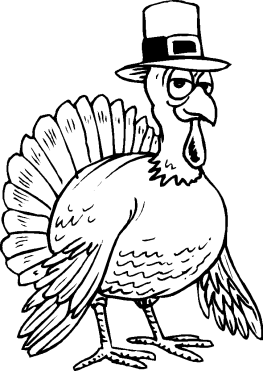
celebrate-picture-books-picture-book-review-turkey-coloring-page

Hats Off for Thanksgiving! Fun Pages


Here are two holiday activity sheets to have fun with on Thanksgiving!

Pilgrim Maze | Turkey Coloring Page

Picture Book Review

November 10 – World Science Day for Peace and Development

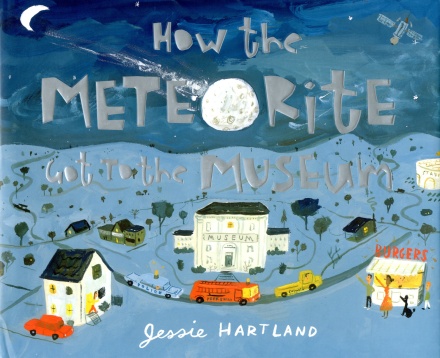
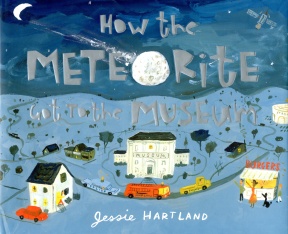
celebrate-picture-books-picture-book-review-how-the-meteorite-got-to-the-museum-cover

About the Holiday

This annual, internationally observed day highlights the importance of science in and for society and is sponsored by the United Nations. Its aim is to promote education and awareness of scientific issues that affect the world and its sustainability as well as to underscore the role that scientists play in improving our lives and developing solutions for the future. This year the theme is “Celebrating Science Centers and Science Museums.” To celebrate, grab the kids (or go alone!) and head out to your local science center!

How the Meteorite Got to the Museum

By Jessie Hartland


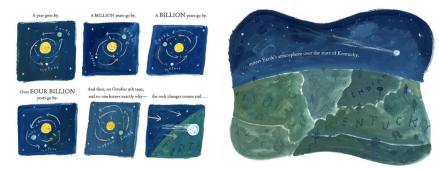
A science teacher leading her students through a science museum stops at the display for the Peekskill Meteorite that fell to Earth in New York state on October 9, 1992. As she explains a bit about meteorites, one student raises his hand and asks, “But how did the meteorite get here—to the museum?” With that question the students—as well as readers—are off and running on an adventure of astro-nomical proportions as the teacher begins: “Hundreds of mllions of miles from Earth, in deep, dark, cold outer space, there are vast fields of space debris flying around.” The smaller rocks are called meteors, and a meteor that falls to Earth is called a meteorite.

celebrate-picture-books-picture-book-review-how-the-meteorite-got-to-the-museum-meteors

Image copyright Jessie Hartland, 2013, courtesy of Blue Apple Books.

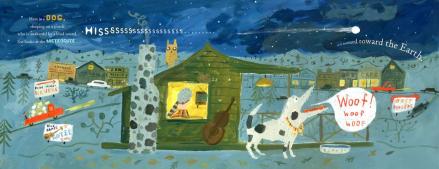
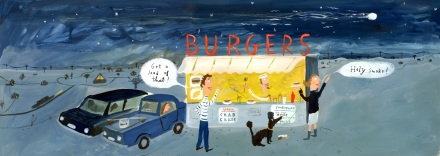
The teacher sets the scene: “Here in outer space is a meteor…flying around and around and around”—for over four billion years! Then for some unknown reason the meteor changed direction and entered “Earth’s atmosphere over the state of Kentucky.” With a Hissssss and a Crack! the zipping meteor alerts a sleeping dog, who begins to bark at it. The space rock, trailing a fiery tail, zooms over a burger stand in Virginia, attracting the attention of some late-night snackers.

In Pennsylvania, a few seconds later, a high school football game suddenly turns historic as the meteorite, hissing and crackling through the sky attracts the attention of video cameras throughout the stands. Yes, this is the same celestial body “which was spotted by the Virginians, and yelped at by the dog as it zipped toward the Earth.”

celebrate-picture-books-picture-book-review-how-the-meteorite-got-to-the-museum-dog-barks

Image copyright Jessie Hartland, 2013, courtesy of Blue Apple Books.

With a Crash, Bang, Boom, the rock hurtles downward. “Here is the teenager, who had been watching late-night TV at her house in Peekskill, NY, when she heard a tremendous CRASSHHH! She has rushed outside and discovered a huge dent in the trunk of her car and a smoking ‘rock’ nearby.” Wanting to discover the culprit of this vandalism, the teenager calls the police who summon firefighters to cool down the “rock.”

After hosing down the ‘rock’ the firefighters “start to suspect that the rock may really be a meteorite.” A geologist is called from Columbia University to examine the rock. “He confirms that what smashed the car is, indeed, a meteorite, which was cooled by Firefighters, investigated by Police, found by the Teenager, gawked at by Sports fans, buzzed about by Virginians, and arfed at by a dog as it raced toward the Earth.”

celebrate-picture-books-picture-book-review-how-the-meteorite-got-to-the-museum-burger-joint

Image copyright Jessie Hartland, 2013, courtesy of Blue Apple Books.

Next, the Curator of Meteorites from the Museum of Natural History in New York City visits the geologist, hoping to obtain this special specimen for the museum. Soon, a Cosmologist develops a program about the meteorite that she presents at a museum symposium, explaining how this 26-pound meteorite crossed over 400-500 miles in just 40 seconds and collided with a car—a-one-in-a-billion chance. The Museum of Natural History secures the meteorite for its collection, and the Exhibits Team designs the “lighting, signage, and diorama for their newest acquisition.”

Which brings us back to the Ross Hall of Meteorites at the museum and the complete story of “the Peekskill Meteorite, which was…barked at tby the Dog, witnessed by Virginians, filmed by Sports Fans, found by a Teenager, poked at by Police, sprayed with water by Firefighters, validated by the Geologist, obtained by the Curator of Meteorites, summed up by the Cosmologist, presented by the Exhibits Team, and explained by the Science Teacher who says: ‘…and that’s how the meteorite got to the museum.’”

An Author’s Note following the text explains more about meteors and introduces Dr. Mark Anders, the Geologist mentioned in the book. A photograph of the car hit by the meteorite offers fascinating viewing.

In her entertaining and informative telescoping text, Jessie Hartland reveals in easy-to-understand steps the people and actions involved in bringing together a museum exhibit for a meteorite. The repetition of the important characters in this true, history-making drama combined with Hartland’s deft command of a vast array of synonyms makes reading each page a joy. Suspense grows as each stage of the meteorite’s trajectory from space rock to “star” exhibit builds on the previous one, exciting kids not only for the tale of the meteorite, but also for the displays they see when visiting a museum.

celebrate-picture-books-picture-book-review-how-the-meteorite-got-to-the-museum-meteorite

Image copyright Jessie Hartland, 2013, courtesy of Blue Apple Books.

Hartland’s folksy two-page spreads are a perfect match for the rhythmic text—both humorous and educational in their details. The meteor—zipping through the dark blue night sky dotted with stars, over a small town, above an out-of-the-way burger joint, and through the cheering sounds of a football game—leads readers on a page-turning chase until it crash lands on the bumper of the teenager’s car. Here, as the police write up their investigation on the left-hand page, the firetruck can be seen hurrying to the scene, siren blaring, on the right, even as raccoons and a cat take the opportunity of the distraction to make mischief.

Hartland’s depictions of the geologist’s office as well as the American Natural History Museum give readers a peek behind the scenes at the tools and displays used by scientists and museum workers. For kids who love museums, science, and fun wordplay, How the Meteor Got to the Museum is an absorbing addition to home bookshelves as well as school, classroom, and other libraries. Jessie Hartland’s other titles in this series—How the Dinosaur Got to the Museum and How the Sphynx Got to the Museum—are also highly recommended.

Ages 4 – 9

Blue Apple Books, 2013 | ISBN 978-1609052522

Discover many more books by Jessie Hartland as well as other artwork on her website!

World Science Day for Peace and Development Activity

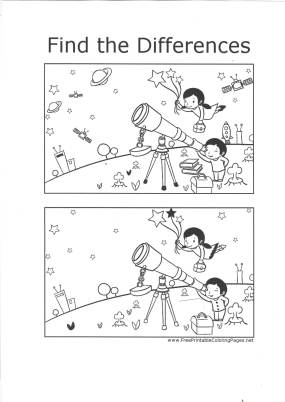
celebrate-picture-books-picture-book-review-astronomy-find-the-differences

Astronomy Buffs Find the Differences Puzzle


These kids are looking for stars and planets, but can you find the 15 differences between the two pictures in this printable Astronomy Buffs Puzzle?

celebrate-picture-books-picture-book-review-how-the-meteorite-got-to-the-museum-cover

You can find How the Meteorite Got to the Museum at these booksellers

Amazon | Barnes & Noble | IndieBound

Picture Book Review


November 9 – National Aviation History Month

celebrate-picture-books-picture-book-review-wind-fliers-cover

About the Holiday

If you look back in history you see that people have always been fascinated with flight. The first kite was invented in 1000 BCE in China; around 400 BCE Archytas of Tarentum developed a steam-powered pigeon; and most people are familiar with the designs of flying machines that Leonardo de Vinci created in the late 1400s. An important discovery that led inventors in the right direction came in 1680 when an Italian mathematician determined that human muscles were incompatible with flight.

Zip ahead about 100 years and the first hot-air balloon flight was undertaken, which led to more and more complex technology, resulting in Wilbur and Orville Wright’s flight in 1903. From there, it seemed, the sky was the limit. Amelia Earhart became the first woman to complete a trans-Atlantic Ocean solo flight in 1932, and in 1947 Charles Yeager broke the sound barrier. But it’s astounding to think that from that modest 12-second first flight by the Wright Brothers to the first man in space—Soviet cosmonaut Yuri Gagarin—it took only 58 years! Today astronauts from countries around the world live and work in the International Space Station, and spacecraft are traversing deep space.

Wind Flyers

Written by Angela Johnson | Illustrated by Loren Long

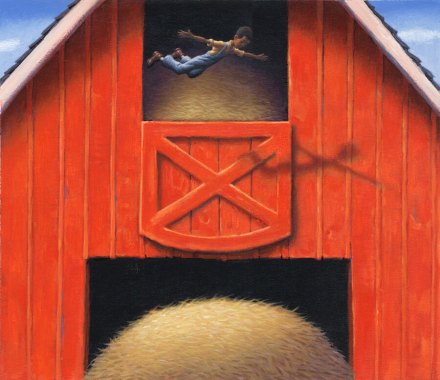
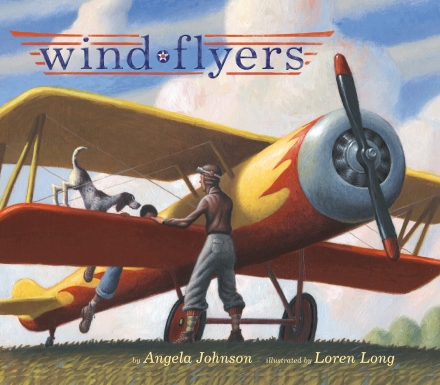
With pride a young African-American boy tells the story of his great-great-uncle who was a Tuskegee Airman in World War II. His uncle was “a smooth wind flyer. A Tuskegee wind flyer…,” the boy says. He knows well his uncle’s history—how like a bird, his uncle believed he was born to fly. “With his arms flapping, he jumped off a chicken coop at the age of five,” and when he was only seven he soared from a lofty barn into a pile of hay. His first real flight came at the age of eleven, when he paid 75 cents to be a passenger with a barnstormer.

celebrate-picture-books-picture-book-review-wind-fliers-jumping-from-hayloft

Image copyright Loren Long, courtesy of Simon & Schuster

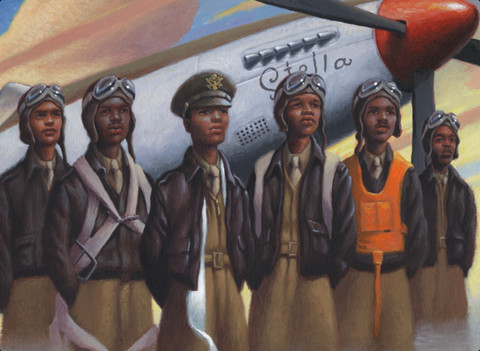
Flying over lakes and fields, his uncle felt as if he were in Heaven, among clouds “like soft blankets, saying, ‘Come on in, get warm. Stay awhile and be a wind flyer too.’” The experience changed him forever. In fact he “cried when they landed because then he knew what it was like to go into the wind, against the wind, beyond the wind.” As a young adult his uncle contributed his dream and his skills to the World War II effort, becoming a Tuskegee Airman, one of the first black pilots in the United States military.

celebrate-picture-books-picture-book-review-wind-fliers-tuskegee-arimen

Image copyright Loren Long, courtesy of Simon & Schuster

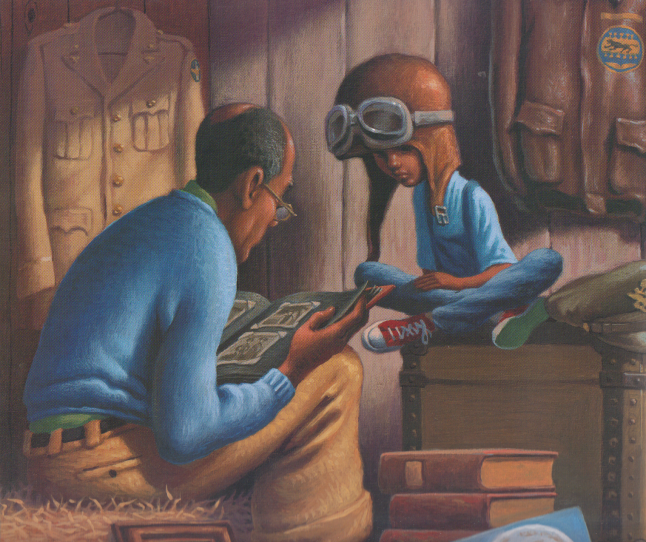
As the pair sit in the uncle’s barn, surrounded by his military uniform, leather jacket, and other memories of his flying career—after the war to continue flying he became a crop duster—the pair look through old photographs, seeing once more those young and brave pilots—the Tuskegee wind flyers. Planes are different now, Uncle says, but the clouds remain the same. The boy and his uncle climb to the highest point of the uncle’s barn to watch the jets—and in those moments they once more become the smooth wind flyers, flying into the wind and beyond.

celebrate-picture-books-picture-book-review-wind-fliers-grandfather-and-grandson

Image copyright Loren Long, courtesy of Simon & Schuster

In her soaring, rhythmic language, Angela Johnson captures the dreams and yearning of a young boy whose greatest desire is to fly among the clouds. Her combination of straight narration with lyrical lines as he joins the Tuskegee Airman in World War II enhances the sense of achievement and pride the young pilots felt. The structure of the story is well chosen, as relating the uncle’s life from childhood through old age through the eyes of his nephew strengthens the themes of strong familial relationships as well as shared dreams across generations.

Loren Long gives Wind Flyers additional power with his strong, vibrant paintings. Two-page spreads provide a sense of the vastness of the skies that so enticed the young would-be pilot. Even the clouds echo the emotion of the page—fluffy, floating, and alive in the flight scenes while linear, flat, and stationary when the plane and the uncle are earthbound. Realistic portrayals of the boy, his uncle, and the other Tuskegee Airmen are reminiscent of the WPA murals of the 1940s while still setting this book firmly in today for a new generation.

Wind Flyers is a wonderful book to share with aviation buffs, budding historians, and dreamers of all types and would make a welcome thoughtful book for quiet story times.

Ages 4 – 9

Simon & Schuster Books for Young People, 2007 | ISBN 978-0689848797

To learn more about Angela Johnson‘s books for all ages, visit her website!

View a gallery of artwork for picture books and other media by Loren Long, visit his website!

National Aviation History Month Activity

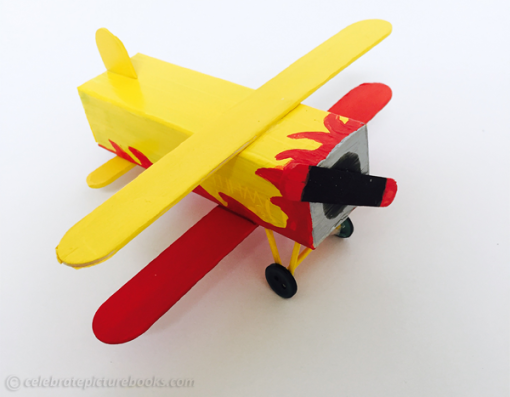
CPB - Biplane side

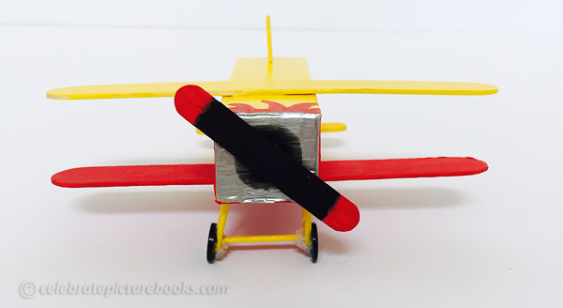
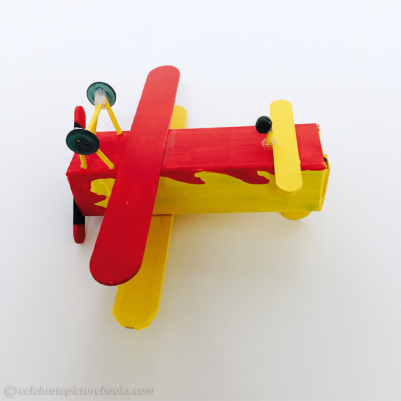
Head in the Clouds Box Biplane

If you love airplanes and flying, you’ll have fun making your own plane from recycled materials! Use your creativity to decorate your plane while you imagine yourself flying through the clouds on a beautiful day. Younger children will have fun sharing this activity with an adult or older sibling too!

Supplies

  • Travel-size toothpaste box
  • 3 6-inch x 1/2-inch craft sticks
  • 2  2 1/2-inch x 7/8-inch mini craft sticks
  • 5 Round toothpicks, with points cut off
  • Paint in whatever colors you like for your design
  • 4 small buttons 
  • 2 mini buttons
  • Paint brushes
  • Strong glue or glue gun

CPB - Biplane front

Directions

  1. Empty toothpaste box
  2. Paint toothpaste box and decorate it
  3. Paint the craft sticks and 5 toothpicks
  4. Paint one small craft stick to be the propeller
  5. Let all objects dry

To assemble the biplane

  1. For the Bottom Wing – Glue one 6-inch-long craft stick to the bottom of the plane about 1 inch from the end of the box that is the front of the plane
  2. For the Top Wing – Glue the other 6-inch-long craft stick to the top of the plane about 1 inch from the front of the plane
  3. For the Tail – Glue one mini craft stick to the bottom of the box about ¾ inches from the end that is the back of the plane
  4. For the Vertical Rudder – Cut the end from one of the painted 6-inch-long craft sticks, glue this to the back of the box, placing it perpendicular against the edge and half-way between each side

CPB - Biplane bottom

To assemble the front wheels

  1. Cut 4 painted toothpicks to a length of ¾-inches long
  2. Cut one painted toothpick to a length of 1-inch long
  3. Glue 2 of the 3/4-inch toothpicks to the back of 1 button, the ends of the toothpicks on the button should be touching and the other end apart so the toothpicks form a V
  4. Repeat the above step for the other wheel
  5. Let the glue dry
  6. Glue the 1-inch long toothpick between the wheels at the center of each wheel to keep them together and give them stability. Let dry

To make the back wheel

  1. Cut two ¼-inch lengths of painted toothpick and glue them together. Let dry
  2. Glue two mini buttons together to form the back wheel. Let dry
  3. Glue the ¼-inch toothpicks to the mini buttons. Let dry
  4. Glue these to the bottom of the plane in the center of the box directly in front of and touching the tail

Display your biplane!

Picture Book Review

Picture Book Review

October 16 – Dictionary Day

celebrate-picture-books-picture-book-review-w-is-for-webster-cover-image

About the Holiday

Dictionary Day honors Noah Webster, who wrote the first American dictionary. He was born in 1758 to a family that loved learning and knew the importance of a good education. Even as a boy Noah Webster loved words. He went on to become a lawyer, newspaper editor, Connecticut and Massachusetts legislator, and he helped found Amherst College in Massachusetts.

He is most well-known, however, for compiling the first American dictionary that is synonymous with his name and still the most popular dictionary in use. His work, first published in 1828, revolutionized the way language and words were presented and remains always current by every year adding new words that come into common use through new products, fads, and slang.

Wordsmiths the world over celebrate both the amazing accomplishment that is the dictionary, and I would imagine, their own well-thumbed and well-loved copies of this remarkable resource.

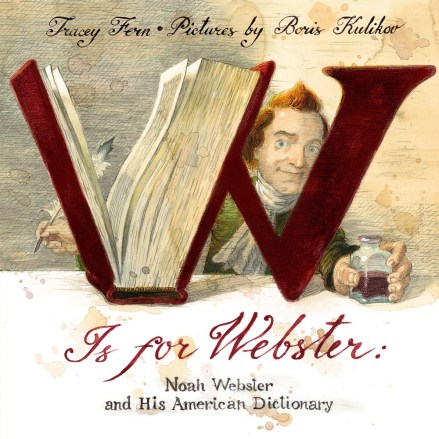
W is for Webster: Noah Webster and His American Dictionary

Witten by Tracey Fern | Illustrated by Boris Kulikov


Noah Webster was always different. Tall and thin with bright red hair, he liked to use big words when he spoke and wanted to do homework instead of goof around in school. Unfortunately for him school was in session for only a few months a year and goofing around seemed to be the major course of study. Of course, Noah didn’t call it “goofing around,” he called it “‘playing roguish tricks.’”

Noah begged to go to a harder school. “His pa knew Noah would make a terrible farmer. Noah spooked the cows by reciting Latin and spent too much time reading Ames’ Almanack under the apple trees.” His pa agreed, and in 1774 at the age of 16 Noah went off to study at nearby Yale College in New Haven, Connecticut. Yale had strict rules. Students had to rise at 5:30 a.m. and study for two hours before class. They were also fined “two shillings for making ‘tumult, noise, hallooing,’ or otherwise goofing around. Noah thought Yale was wonderful.”
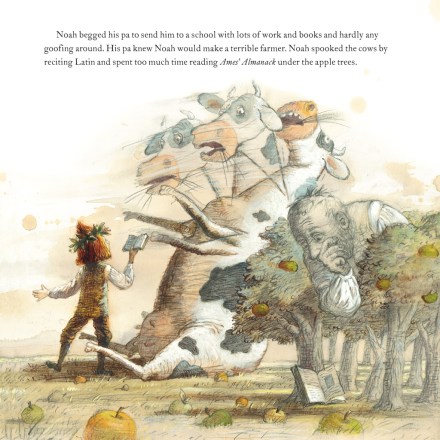
celebrate-picture-books-picture-book-review-w-is-for-webster-spooking-horses

Image copyright Boris Kulikov, text copyright Tracey Fern. Courtesy of macmillan.com

Noah hadn’t been at Yale long before the American Revolutionary War broke out. Although Noah signed up to fight, he recognized that he was “‘ill able to bear the fatigues of a soldier,’” which was “Noah’s big way of saying he was a lousy soldier.” He returned to Yale and graduated in 1778, but he left the school with no job and no prospects. Even his pa told him to leave home to find work.

Noah became a teacher, but he found the British textbooks “‘defective and erroneous.’” He believed the students should have American textbooks that better reflected their diverse experiences. With the Revolutionary War at an end and America victorious, Noah wanted to help “hold his new, complicated nation together.” He believed that America needed a language different than the English spoked in Britain. “‘A national language is a national tie,’ Noah insisted to all who would listen, and to many who wouldn’t.”

celebrate-picture-books-picture-book-review-w-is-for-webster-teaching-school

Image copyright Boris Kulikov. Courtesy of macmillan.com

He began the work himself with a speller. Right from the start Noah’s speller was different than the British books. It included everyday words “like scab, grub, and mop.” He also simplified the spelling by taking out unpronounced letters or spelling words phonetically. He also added pictures to every page and presented lists of rhyming words. He also priced his book so almost anyone could afford it. Noah’s speller became a bestseller.

Still, Noah had bigger ideas. He wanted to write a patriotic dictionary with uniquely American words. He took his idea on the road to make money for the venture, lecturing wherever he could. But Noah’s know-it-all tone of delivery, his “prickly personality,” even his “‘porcupine hair’” put people off. And what’s more, they didn’t like the idea of his dictionary. People thought he was a “lunatic” for wanting to replace British words with American ones.
celebrate-picture-books-picture-book-review-w-is-for-webster-working-on-letter-a

Image copyright Boris Kulikov, text copyright Tracey Fern. Courtesy of macmillan.com

In 1806 Noah went ahead and published “A Compendious Dictionary of the English Language. It was a flop, but Noah wasn’t discouraged.” The next year he started working on a bigger dictionary. He copied words out of British dictionaries and added American words and he traced the roots of all the words and wrote definitions, sometimes including quotes from famous people to show differences in meaning. He figured the whole dictionary would take 5 years to finish—eight to ten, tops.

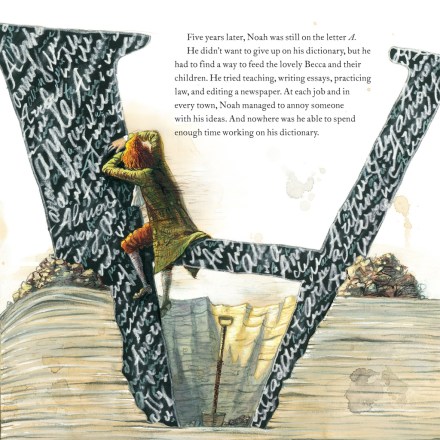
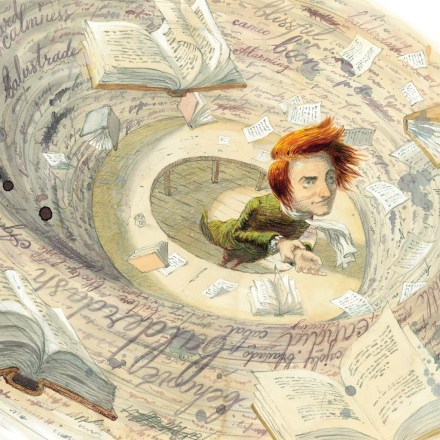
But five years later, Noah was still on the letter A. With no money coming in and a growing family, Noah took a variety of jobs, but he always seemed to rub someone the wrong way, and he lost job after job. He decided to sell his fancy house and bought a farm. Here he was able to gather books, books, and more books around his unusual donut-shaped desk. Standing inside the center of the desk, he spun around and around reading the books and finding words to include in his dictionary.
celebrate-picture-books-picture-book-review-w-is-for-webster-special-desk

Image copyright Boris Kulikov. Courtesy of macmillan.com

By 1822 Noah had exhausted all the books in his study. He took to traveling to other American libraries, moved his family to New Haven to use the Yale library, and in 1824 even sailed to Europe to explore books found in the National Library in Paris and at the University of Cambridge in England.

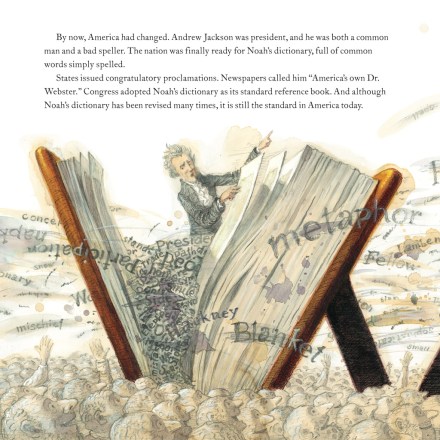
Finally, in 1825 Noah finished his dictionary.  With more than 70,000 words, An American Dictionary of the English Language was the largest English dictionary ever written. “Many people thought it was the best English dictionary ever written.” Why the change of heart? Well, one reason might have been that the President of the United States, Andrew Jackson, “was a common man and a bad speller.” Another might have been that the timing was just right.
celebrate-picture-books-picture-book-review-w-is-for-webster-finished-dictionary

Image copyright Boris Kulikov, text copyright Tracey Fern. Courtesy of macmillan.com

However it came to be, Noah was now lauded as a hero by states and newspapers. Congress even adopted the dictionary as its standard reference book. Noah had not only succeeded in writing an American dictionary, he had “created a new American language for a new American nation.” One that is still beloved today.

An Author’s note as well as a list of resources follow the text.

Webster’s dictionary is intrinsically woven into every American child’s life through language and vocabulary development. Tracey Fern’s captivating story reveals the charm and foibles of its author, a man with just the right temperament and perseverance to tackle and complete such an overwhelming task. Fern’s exceptional storytelling skills and deft turns of phrase allow for a comprehensive review of Webster’s life that is full of exhilaration, empathy, and a good dose of the “big” words Webster loved. Fern builds suspense and tension while offering an insightful look at early American history by including details of the staggering research required and the adverse reactions to Webster and his work.

Boris Kulikov’s expressive illustrations perfectly capture the complex personality of Noah Webster, late-1700s-to-early-1800s American society, and the obstacles Webster faced in writing his dictionary. Fittingly, words, books, or ink blots abound on every page, pouring from the air, sprouting from the ground, stacked like the skyscrapers that would come, and surrounding Noah Webster the way they must have swarmed through his brain. Kulikov infuses humor into his paintings, as when Noah tears at his hair wondering how he will support himself after college, shrugs nonplussed at his students’ shenanigans, and buys himself quiet work time by handing out sweets to his kids. Visual metaphors for the hard, backbreaking and mind bending work also enhance this beautiful biography.

Ages 5 – 10 (adult’s will also enjoy this biography)

Farrar Straus Giroux, 2015 | ISBN 978-0374382407

Visit Tracey Fern’s website to learn more about her and her books!

Discover a gallery of artwork by Boris Kulikov on his website!

Dictionary Day Activity
celebrate-picture-books-picture-book-review-big-words-vocabulary-word-search-puzzle

“Big Words” Word Search


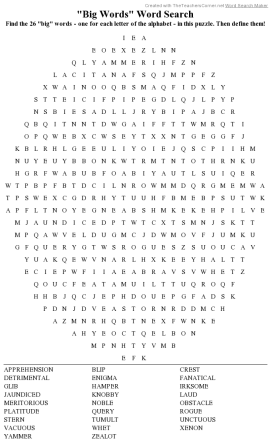
Knowing and using a wide range of words allows you to express yourself in exact—and often—fun ways. Find the 26 “big” words—one for each letter of the alphabet—in this printable “Big Words” Word Search puzzle. Here’s the Solution!

Picture Book Review

October 12 – Emergency Nurses Day

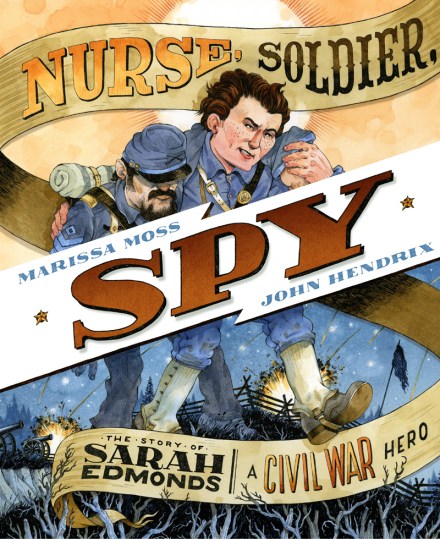
celebrate-picture-books-picture-book-review-nurse-soldier-spy-the-story-of-sarah-edmonds-cover

About the Holiday

Originating in Australia in 1989 and sponsored by the Emergency Nurses Association, today’s observance has become an international event and honors the dedication and care emergency nurses show for their patients in hospitals, at crisis centers, and in disaster and epidemic zones world-wide. This special day is part of Emergency Nurses Week, which runs from October 9 – 15. This year’s theme is Community. Connect. Care. Compassion, which defines the important role of nurses in both health care and wider society.

Nurse, Soldier, Spy: The Story of Sarah Edmonds, A Civil War Hero

Written by Marissa Moss | Illustrated by John Hendrix


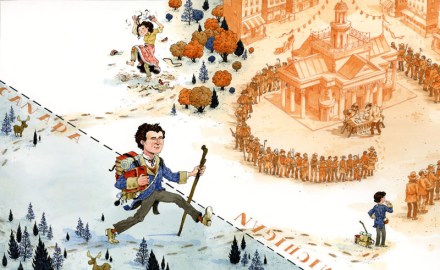
When President Abraham Lincoln called for young men to join the army fighting against the Southern states that wanted to secede from the Union, Frank Thompson signed up. One thing though, Frank wasn’t really a man but, instead, a 19-year-old woman named Sarah Edmonds. Sarah already knew the freedom that posing as a man could bring in her society. Three years earlier to escape a marriage arranged by her parents, Sarah cut her long hair, began wearing pants, and crossed “the border from Canada into the United States, trading a bridal gown for trousers, trading countries, without a single regret.”

celebrate-picture-books-picture-book-review-nurse-soldier-spy-the-story-of-sarah-edmonds-becoming-frank

Image copyright John Hendrix, courtesy of johnhendrix.com

Now, outside the Michigan courthouse, Sarah slowly moved her way along the line to the table where she could sign up to join the troops. When she finally stood in front of the recruiter, however, he stopped her. Sarah was mystified. How did he know she wasn’t a man? She had grown up on a farm, learning the work, copying the gestures, and even wearing the clothes of her brother. But the recruiter took one look at “Frank Thompson” and told her…she was too young to join the army. “He looked at her peachy cheeks free of any sign of a whisker. ‘We aren’t taking any sixteen-year-olds,’” he told her.

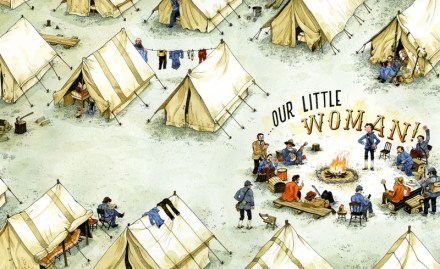
A month later, however, more men were needed, and Sarah was allowed to join up. Now a soldier, Frank was a valuable member of the corps. She was an expert at riding and shooting, and she felt at home among the men, enjoying the jokes, stories, and letters. Keeping her identity a secret was made easier by the fact that soldiers did not change clothes to go to sleep. Her small feet led the other soldiers to give her a nickname: “Our little woman.” A name Frank enjoyed immensely.

celebrate-picture-books-picture-book-review-nurse-soldier-spy-the-story-of-sarah-edmonds-union-camp

Image copyright John Hendrix, courtesy of johnhendrix.com

On the battlefield Frank trained to be a nurse, “which was something only men with the strongest stomachs did because of the long, draining hours and the horrors of surgery without anesthetic.” She fearlessly participated in the battles of Bull Run and Fair Oaks, risking her own life to rescue wounded soldiers. One night the regimental chaplain approached Frank. He wanted to recommend her for a very important—and very dangerous—job. The chaplain wanted to recommend to the generals that Frank become a spy for the North.

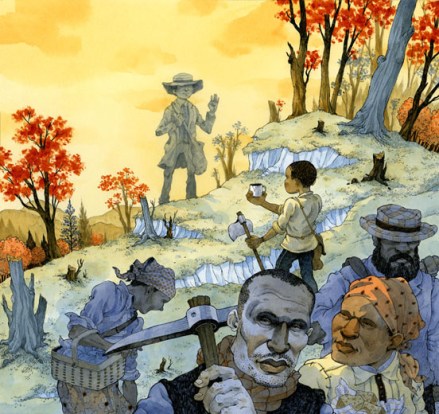
“Frank didn’t hesitate. ‘I’m your man!’” she said. Disguising herself as a freed slave, she infiltrated “a group of slaves bringing breakfast to the rebel pickets, the men who guarded the camp.” With so much work to do, the group quickly accepted her, but when the rest of the men, women, and children went off to their own assignments Frank hesitated, not knowing where to go next. Suddenly, a Confederate soldier caught Frank and ordered her to work on the fortifications. The work was backbreaking and left her hands blistered and bloody. The other workers helped when she had trouble.

celebrate-picture-books-picture-book-review-nurse-soldier-spy-the-story-of-sarah-edmonds-battlefield

Image copyright John Hendrix, courtesy of johnhendrix.com

The work gave Frank an opportunity to count the number of guns the army had, sketch a layout of the fort, and notice that some cannons were fake—just logs painted to look like cannons. By switching jobs with the water boy, Frank was able to get closer to the troops, where she encountered another spy—one working for the Confederate army. When night fell, Frank returned to his Union battalion. Giving the password, Frank was let into camp and made her way to the general’s tent. “Freedom, she knew, wasn’t something to take for granted. It was something to fight for, to cherish. And so long as her heart was beating strong, that’s just what she would do.”

An extensive Author’s Note revealing more about Sarah Edmond’s life and an Artist’s Note on the creation of the illustrations follow the text.

Marissa Moss’s biography of Sarah Edmonds is a suspenseful, gripping, and enlightening story of a woman who broke molds, lived on her own terms, and paved the way for future generations of women. Her well-chosen vignettes from Edmonds’ time as a Union soldier demonstrate not only Edmonds’ bravery and abilities but also create a clear and exciting trajectory of her increasing responsibilities and the danger that went with them. Fascinating details of the Civil War period, the people and attitudes involved, and the duplicitous nature of warfare, add up to a rich account of Sarah Edmonds’ life as well as the Civil War era in general.

celebrate-picture-books-picture-book-review-nurse-soldier-spy-the-story-of-sarah-edmonds-as a spy

Image copyright John Hendrix, courtesy of johnhendrix.com

Meticulously researched and drawn, John Hendrix’s illustrations perfectly accompany and illuminate the text. Accurate depictions of Civil War-era buildings and clothing as well as Union and Confederate uniforms and weapons allow children to become fully immersed in the time period. Wide-view depictions of encampments and battlefields let readers peek into tents and scour trenches, and action abounds. In camp soldiers pick out tunes on banjos, write letters, and hang laundry; on the battlefield fires rage and ammunition explodes as soldiers follow the charge of their leaders; at the Confederate fortifications black workers steer wheelbarrows of rock; and in the medical tent Frank tends to wounded soldiers, the equipment used clearly visible. Scenes portrayed in both daylight and at night highlight the ongoing conflict and the dangerous, secretive work Sara Edmonds undertook.

Nurse, Soldier, Spy: the Story of Sarah Edmonds a Civil War Hero is historical and biographical work at its best. This fast-paced, fascinating look at one particular soldier informs readers about so many aspects of the Civil War era, including societal issues that shaped the United States and are still discussed today. The book is a must for school and public libraries and its in-depth, absorbing content makes it a welcome addition to home libraries for children who love history, art, biographies, and a well-told story.

Ages 5 – 12

Abrams Books for Young People, 2016 (Paperback edition) | ISBN 978-1419720659

Discover many more books, fun stuff, writing tips and more on Marissa Moss‘s website!

View a portfolio of picture book art, editorial illustration, a sketchbook, and more on John Hendrix‘s website!

Emergency Nurses Day Activity

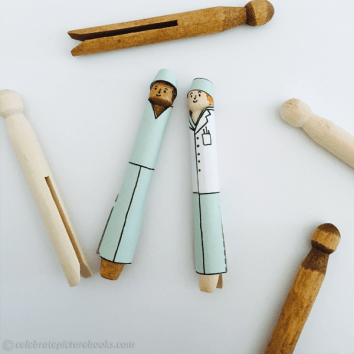
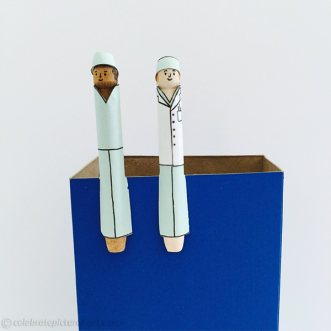
CPB - Doctors Clothespins

Emergency Nurse Clothespin Dolls


Make one of these clothespin figures that honors hard-working and compassionate emergency nurses!

Supplies

CPB - Doctors Clothespins on box

Directions

  1. Draw a face and hair on the clothespin
  2. Cut out the outfit you want your doctor to wear (color pants on your clothespin if you choose the lab coat)
  3. Wrap the coat or scrubs around the clothespin. The slit in the clothespin should be on the side.
  4. Tape the clothes together
  5. Wrap the cap around the head and tape it.
  6. If you’d like to display your clothespin doctor on a wire, string, or the edge of a box or other container, cut along the dotted lines of the clothes template.

Picture Book Review
August 28 – Pony Express Day

celebrate-picture-books-picture-book-review-you-wouldn't-want'to-be-a-pony-express-rider-cover

About the Holiday

Today’s holiday commemorates the intrepid souls who risked life and limb to bring our ancestors important letters in a timely manner. Towns across America hold special, fun events to remember the riders who took to heart the postal carrier’s motto: “Neither snow, nor rain, nor heat nor gloom of night, stays these couriers from the swift completion of their appointed rounds.” Find a local festival or maybe reenactment and have a little Old West fun!

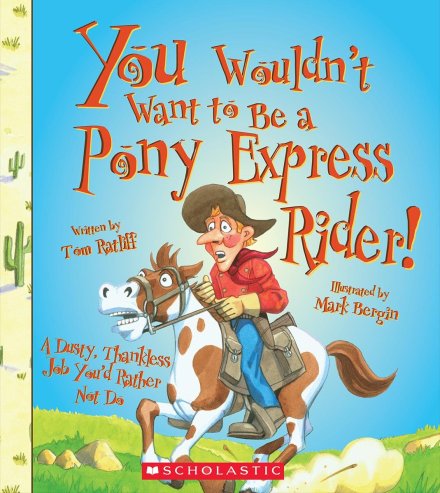
You Wouldn’t Want to be a Pony Express Rider! A Dusty, Thankless Job You’d Rather Not Do

Written by Tom Ratliff | Illustrated by Mark Bergin


So, you’re 16 years old and lookin’ for a job. There’s not much out there, and the pay stinks. Then you see a broadside advertising jobs with a newfangled technology. The description seems pretty good, exciting even—just up your alley. “WANTED: Young, skinny, wiry fellows not over eighteen. Must be expert riders, willing to risk death daily. Orphans preferred.” And here’s the kicker—you make $25 per week! Heck most people only make $25 a month!

You decide to apply for this Pony Express position, and your life takes off in a whole new direction—to California, to be exact! William Russell, Alexander Majors, and William Waddell own the company. It’s real name is the Central Overland California and Pike’s Peak Express Company, but that’s quite a mouthful, so the enterprise is fondly known as The Pony Express. It’s a rapid mail-delivery system that promises letters and packages will go from St. Joseph, Missouri to Sacramento, California (2,000 miles/3,200 km) in only 10 days. Can you imagine?!
Planning begins in January of 1860 and is completed in less than four months. Hundreds of horses are bought and about just as many riders are trained (they have to learn how to change horses in two minutes or less). Along the route 157 relay stations are also constructed. All this is to supply communication for the many pioneers who are steering their Conestoga Wagons out West, battling floods, snow, disease, and those pesky obstacles called the Rocky Mountains to find a better life for themselves and their families. 

You’re young, enthusiastic, and want to be part of this new landscape. You strap on your company-given “two revolvers, rifle, and Bowie knife,” have your horse shod, and take the Rider’s Oath: “While in the employ of A. Majors, I agree not to use profane language, get drunk, gamble, treat animals cruelly, or do anything else that is incompatible with the conduct of a gentleman.” Well, Dang! (Oops!)

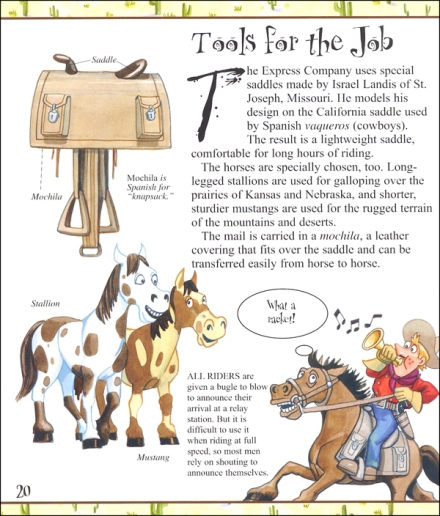
The route West is fraught with danger, so forts and trading posts pop up along the way to protect and supply Pony Express riders. The pioneers also keep an eye out for you, so it’s handy to get to know them. While you ride you can be assured that you have the latest in mail-carrying gear. A special saddle modeled on those used by Spanish vaqueros (cowboys) is more comfortable for the long miles, and a mochila (a leather pouch that fits over the saddle) is stuffed full of the mail.

celebrate-picture-books-picture-book-review-you-wouldn't-want'to-be-a-pony-express-rider-interior-art

Image copyright Mark Bergin, courtesy Scholastic

You were right about the job being exciting! Every day brings a new experience: dehydration, heat exhaustion, blizzards, frostbite, floods, 6-to-10-hour hard rides, plus you’re a target for outlaws and bandits. It’s worth it all, though, to bring a smile to someone’s face when they open a letter from their far-away sweetheart—and all for only $5.00 a letter (that’ll be about $120 in 2016). Just be thankful it’s not a business letter—that’ll set ya back $30, which is…uh…umm…well, a heck of a lot (oops!).

In 1844 some upstart named Samuel F. B. Morse invented the telegraph that uses a code of electrical signals to deliver messages. It only takes 5 years for all the major cities to be connected, and as more people move west, so do the poles and electrical wires.”In June 1860, congress authorizes construction of a telegraph line to California. If the telegraph ever reaches the West Coast, you will most likely be out of a job.” One thing about this Morse Code, though. Because “messages sent long distances have to be copied and recopied several times, mistakes are common.” Betcha in the future, though, there will be some kinda automatic correction system, and errors will be left back here in the past.

It’s 1860—a presidential election year—and the campaign has been ugly and hard fought. The country is divided, and fast delivery of the election results is crucial to keeping the United States together. You are part of saving the country, as the news of Abraham Lincoln’s victory reaches California from Washington in only 7 days and 17 hours—a cross-country delivery record! Within a year, the U.S. is at war and danger looms for the Pony Express riders. To protect the riders and the mail, the Overland Stage Company (soon to be known as Wells Fargo) and their enclosed stagecoaches take over.

And the Pony Express? Well, as you probably know, it’s losing money and limping along, what with the competition and the war and all. In October 1861 the transcontinental telegraph is completed and the Pony Express stables its horses. And you? You’ll be fine. With all the experience you’ve gained, you can easily find a job as a scout to guide folks over the trails to their new Western homes.

These “You Wouldn’t Want to Be…” series of books brings history to life by revealing the seamy side of events—and aren’t those really the most fascinating? Tom Ratliff corrals a heap o’ info on the Pony Express and the pivotal changes the United States experienced during the 1860s. While the text trots out fun sidebars, the short chapters are loaded with concrete facts about the development of the American West as it grappled with the need for faster and better communication.

Mark Bergin depicts the concepts presented with bold, vivid cartoon-inspired illustrations of the pioneers, riders, inventors, and townspeople who made up the Pony Express system. The people’s faces register well-earned skepticism, fright, and weariness, but also pride and excitement to be on the cutting edge of technology. Maps portray the 2,000-mile route from America’s middle to its western sea.

The Pony Express may be long gone, but as this book affirms, the more things change the more they stay the same. Teachers, researchers, and anyone interested in history will want to hoof it to add You Wouldn’t Want to Be a Pony Express Rider! to their collection.

Ages 7 – 10

Scholastic, Inc., 2012 | ISBN 978-0531209479

Pony Express Day Activity

celebrate-picture-books-picture-book-review-pony-express-coloring-page

Pony Express Mail Carrier Coloring Page


Can you color this printable Pony Express Mail Carrier Coloring Page as quickly as a rider could deliver the post? You’ve got 10 days—so don’t rush!

Picture Book Review