October 16 – Dictionary Day

celebrate-picture-books-picture-book-review-w-is-for-webster-cover-image

About the Holiday

Dictionary Day honors Noah Webster, who wrote the first American dictionary. He was born in 1758 to a family that loved learning and knew the importance of a good education. Even as a boy Noah Webster loved words. He went on to become a lawyer, newspaper editor, Connecticut and Massachusetts legislator, and he helped found Amherst College in Massachusetts.

He is most well-known, however, for compiling the first American dictionary that is synonymous with his name and still the most popular dictionary in use. His work, first published in 1828, revolutionized the way language and words were presented and remains always current by every year adding new words that come into common use through new products, fads, and slang.

Wordsmiths the world over celebrate both the amazing accomplishment that is the dictionary, and I would imagine, their own well-thumbed and well-loved copies of this remarkable resource.

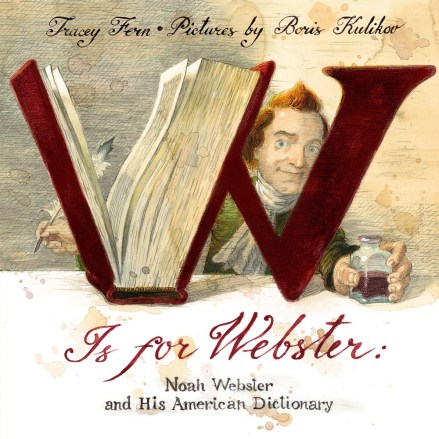
W is for Webster: Noah Webster and His American Dictionary

Witten by Tracey Fern | Illustrated by Boris Kulikov


Noah Webster was always different. Tall and thin with bright red hair, he liked to use big words when he spoke and wanted to do homework instead of goof around in school. Unfortunately for him school was in session for only a few months a year and goofing around seemed to be the major course of study. Of course, Noah didn’t call it “goofing around,” he called it “‘playing roguish tricks.’”

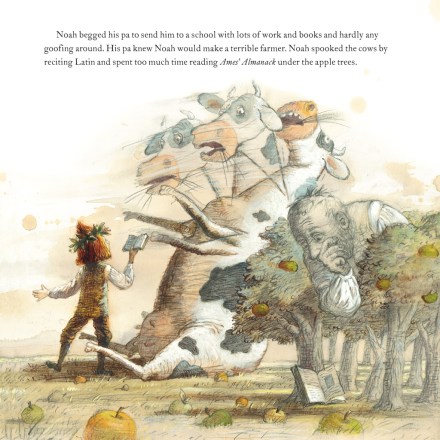
Noah begged to go to a harder school. “His pa knew Noah would make a terrible farmer. Noah spooked the cows by reciting Latin and spent too much time reading Ames’ Almanack under the apple trees.” His pa agreed, and in 1774 at the age of 16 Noah went off to study at nearby Yale College in New Haven, Connecticut. Yale had strict rules. Students had to rise at 5:30 a.m. and study for two hours before class. They were also fined “two shillings for making ‘tumult, noise, hallooing,’ or otherwise goofing around. Noah thought Yale was wonderful.”
celebrate-picture-books-picture-book-review-w-is-for-webster-spooking-horses

Image copyright Boris Kulikov, text copyright Tracey Fern. Courtesy of macmillan.com

Noah hadn’t been at Yale long before the American Revolutionary War broke out. Although Noah signed up to fight, he recognized that he was “‘ill able to bear the fatigues of a soldier,’” which was “Noah’s big way of saying he was a lousy soldier.” He returned to Yale and graduated in 1778, but he left the school with no job and no prospects. Even his pa told him to leave home to find work.

Noah became a teacher, but he found the British textbooks “‘defective and erroneous.’” He believed the students should have American textbooks that better reflected their diverse experiences. With the Revolutionary War at an end and America victorious, Noah wanted to help “hold his new, complicated nation together.” He believed that America needed a language different than the English spoked in Britain. “‘A national language is a national tie,’ Noah insisted to all who would listen, and to many who wouldn’t.”

celebrate-picture-books-picture-book-review-w-is-for-webster-teaching-school

Image copyright Boris Kulikov. Courtesy of macmillan.com

He began the work himself with a speller. Right from the start Noah’s speller was different than the British books. It included everyday words “like scab, grub, and mop.” He also simplified the spelling by taking out unpronounced letters or spelling words phonetically. He also added pictures to every page and presented lists of rhyming words. He also priced his book so almost anyone could afford it. Noah’s speller became a bestseller.

Still, Noah had bigger ideas. He wanted to write a patriotic dictionary with uniquely American words. He took his idea on the road to make money for the venture, lecturing wherever he could. But Noah’s know-it-all tone of delivery, his “prickly personality,” even his “‘porcupine hair’” put people off. And what’s more, they didn’t like the idea of his dictionary. People thought he was a “lunatic” for wanting to replace British words with American ones.
celebrate-picture-books-picture-book-review-w-is-for-webster-working-on-letter-a

Image copyright Boris Kulikov, text copyright Tracey Fern. Courtesy of macmillan.com

In 1806 Noah went ahead and published “A Compendious Dictionary of the English Language. It was a flop, but Noah wasn’t discouraged.” The next year he started working on a bigger dictionary. He copied words out of British dictionaries and added American words and he traced the roots of all the words and wrote definitions, sometimes including quotes from famous people to show differences in meaning. He figured the whole dictionary would take 5 years to finish—eight to ten, tops.

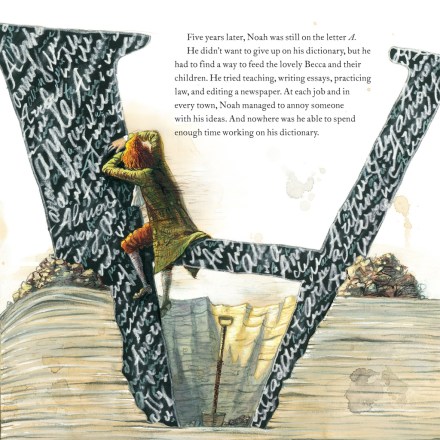
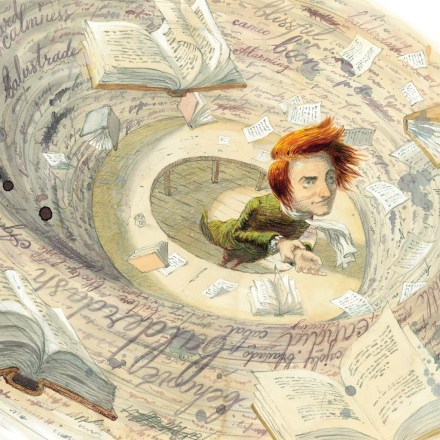
But five years later, Noah was still on the letter A. With no money coming in and a growing family, Noah took a variety of jobs, but he always seemed to rub someone the wrong way, and he lost job after job. He decided to sell his fancy house and bought a farm. Here he was able to gather books, books, and more books around his unusual donut-shaped desk. Standing inside the center of the desk, he spun around and around reading the books and finding words to include in his dictionary.
celebrate-picture-books-picture-book-review-w-is-for-webster-special-desk

Image copyright Boris Kulikov. Courtesy of macmillan.com

By 1822 Noah had exhausted all the books in his study. He took to traveling to other American libraries, moved his family to New Haven to use the Yale library, and in 1824 even sailed to Europe to explore books found in the National Library in Paris and at the University of Cambridge in England.

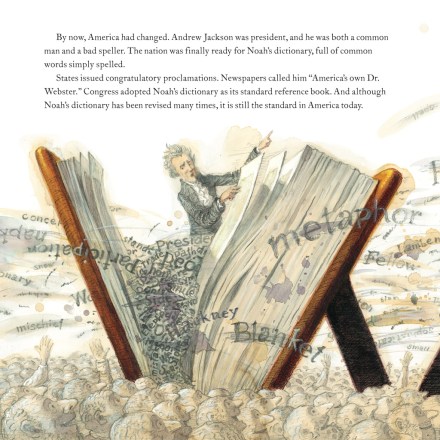
Finally, in 1825 Noah finished his dictionary.  With more than 70,000 words, An American Dictionary of the English Language was the largest English dictionary ever written. “Many people thought it was the best English dictionary ever written.” Why the change of heart? Well, one reason might have been that the President of the United States, Andrew Jackson, “was a common man and a bad speller.” Another might have been that the timing was just right.
celebrate-picture-books-picture-book-review-w-is-for-webster-finished-dictionary

Image copyright Boris Kulikov, text copyright Tracey Fern. Courtesy of macmillan.com

However it came to be, Noah was now lauded as a hero by states and newspapers. Congress even adopted the dictionary as its standard reference book. Noah had not only succeeded in writing an American dictionary, he had “created a new American language for a new American nation.” One that is still beloved today.

An Author’s note as well as a list of resources follow the text.

Webster’s dictionary is intrinsically woven into every American child’s life through language and vocabulary development. Tracey Fern’s captivating story reveals the charm and foibles of its author, a man with just the right temperament and perseverance to tackle and complete such an overwhelming task. Fern’s exceptional storytelling skills and deft turns of phrase allow for a comprehensive review of Webster’s life that is full of exhilaration, empathy, and a good dose of the “big” words Webster loved. Fern builds suspense and tension while offering an insightful look at early American history by including details of the staggering research required and the adverse reactions to Webster and his work.

Boris Kulikov’s expressive illustrations perfectly capture the complex personality of Noah Webster, late-1700s-to-early-1800s American society, and the obstacles Webster faced in writing his dictionary. Fittingly, words, books, or ink blots abound on every page, pouring from the air, sprouting from the ground, stacked like the skyscrapers that would come, and surrounding Noah Webster the way they must have swarmed through his brain. Kulikov infuses humor into his paintings, as when Noah tears at his hair wondering how he will support himself after college, shrugs nonplussed at his students’ shenanigans, and buys himself quiet work time by handing out sweets to his kids. Visual metaphors for the hard, backbreaking and mind bending work also enhance this beautiful biography.

Ages 5 – 10 (adult’s will also enjoy this biography)

Farrar Straus Giroux, 2015 | ISBN 978-0374382407

Visit Tracey Fern’s website to learn more about her and her books!

Discover a gallery of artwork by Boris Kulikov on his website!

Dictionary Day Activity
celebrate-picture-books-picture-book-review-big-words-vocabulary-word-search-puzzle

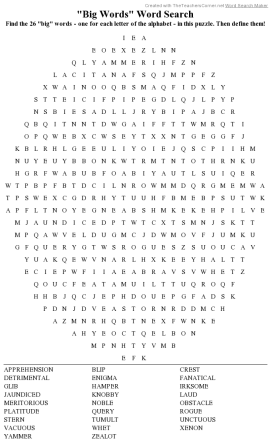
“Big Words” Word Search


Knowing and using a wide range of words allows you to express yourself in exact—and often—fun ways. Find the 26 “big” words—one for each letter of the alphabet—in this printable “Big Words” Word Search puzzle. Here’s the Solution!

Picture Book Review

October 6 – It’s National Pizza Month

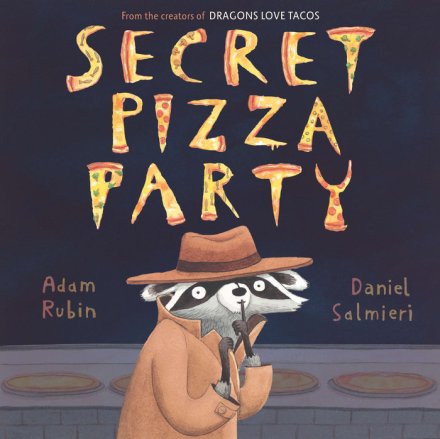
celebrate-picture-books-picture-book-review-secret-pizza-party-cover

About the Holiday

Pizza is one of those foods that just puts a smile on your face. It’s associated with parties, good times with friends, and relaxing weekends. It’s also one of the few foods that is so varied that you can have it made your way with your own favorite ingredients – while your table mates can too. The mix of ingredients also makes pizza a great metaphor for life or a microcosm of society. However you look at pizza, this month indulge in all your favs!

Secret Pizza Party

Written by Adam Rubin | Illustrated by Daniel Salmieri


Raccoon, plastered against the Pizza Shop window, drools over cheesy slices others are eating inside. He so wants a piece and would even be happy with the leftovers in the back alley trash. But when he tries to paw one out of the can, he gets swept away with a broom. Maybe  if he knew how to ask politely things would be different.

Raccoon loves pizza so much that he thinks it should hang in art museums and that people should eat it in the bathtub. “Of course the best part about pizza is the gooey cheesiness, salty pepperoni-ness, sweet tomato-ness, and crispity, crunchity crust. Yum!” Maybe a pizza party will cheer Raccoon up – a secret pizza party. Why should it be secret? Because secret is special— like an intricate secret handshake only you and one other person know, or a secret stair case that leads…who knows where, but somewhere amazing!

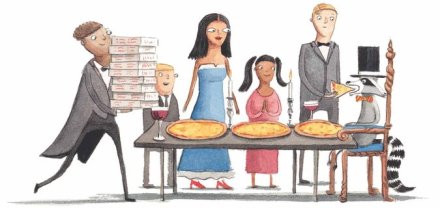
celebrate-picture-books-picture-book-review-secret-pizza-party-good-pizza-party-for-raccoon

Image copyright Daniel Salmieri, text copyright Adam Rubin, courtesy of Penguin Random House

Besides, you know what a regular raccoon pizza party would be like—there would be brooms and horrified faces and panicked shouts of “Get that raccoon off the table!!!” But here’s how a secret pizza party would sound: “Get that raccoon another slice of pizza, he’s the guest of honor.”

So the first order of business for this secret pizza party is…ordering! Before the call is placed, though, you’ve got to think: if you call and order the pizza, you’ll have to give your address. And if you give your address, the pizza guy will know where you live. And if the pizza guy knows where you live he “might recognize you from the posters and chase you off with a broom.” So what are you to do? A disguise will do the trick. “Okay now, play it cool. You’re just an honest pizza-buying citizen who left his wallet in the car,” and as soon as the pizza is in your hands you make a run for it back to your tree.

celebrate-picture-books-picture-book-review-secret-pizza-party-disguised-at-pizza-shop

Image copyright Daniel Salmieri, text copyright Adam Rubin, courtesy of Penguin Random House

Ok, phew, great job! Now you can enjoy…but not too loud or with too much light. You don’t want anyone to see. Wait a minute! What’s that right outside your home? Another secret pizza party where everyone is wearing masks?

Perfect! Ok, you’ve infiltrated the party…you’re reaching for a slice of pizza…and no one suspects a thing. NO! NO! NO! You’re rolling in the pizza on top of the table!! You blew your cover. Grab as many pieces as you can and run because here they come with the brooms…!

celebrate-picture-books-picture-book-review-secret-pizza-party-party-outside-raccoon's-tree

Image copyright Daniel Salmieri, text copyright Adam Rubin, courtesy of Penguin Random House

Adam Rubin’s madcap read-a-loud about a pizza-obsessed raccoon and his quest for a broom-free night of pizza indulging will have kids laughing from Raccoon’s first wistful look to his final triumphant dash. Rubin’s conspiratorial tone makes readers active participants in Raccoon’s covert operation to secure a pizza without a sweeping disaster, ramping up their level of involvement and enjoyment. The text—from the secret handshakes to the broom-bots to words such as “bonk,” “booyah,” “crispity crunchity,” and “happy screams”—is silly, kid-friendliness at its best and is as enticing as the aroma of hot-out-of-the-oven pizza.

Daniel Salmieri’s noodle-armed, broom-wielding humans and animated, fanatical raccoon amplify the humor that infuses every scene in Rubin’s tale. A slice of pizza hanging between two masterpieces in a museum or being devoured in a bubble bath, an intertwining handshake, a ridiculous disguise, and two types of raccoon-sniffing broom-bots are just a few of the images that make Secret Pizza Party a kid’s dream come true. In addition there are plenty of sly details, such as a pizza-shaped lampshade, projectile brooms, and Raccoon’s fairy-tale imagination. My favorite laugh-out-loud moment shows Raccoon blending into the secret pizza party outside his tree house by simply holding up a twig to his natural “mask.”

Full of pizza, playfulness, and a persevering raccoon, Secret Pizza Party is a book that kids will want to hear again and again.

Ages 3 – 9

Dial Books for Young Readers, 2013 | ISBN 978-0803739475

Find out more about books by Adam Rubin on his website!

Daniel Salmieri has a gallery of his work and books on his website for you to see!

 Pizza Month Activity

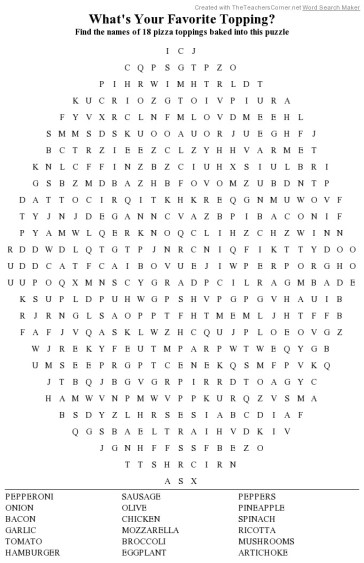
celebrate-picture-books-picture-book-review-pizza-toppings-word-search

What’s Your Favorite Topping? Word Search


Pizza is so delicious, but everyone has their favorite kind. Find the names of 18 different ingredients in this printable What’s Your Favorite Topping? Word Search Puzzle. Here’s the Solution!


April 11 – National Pet Day

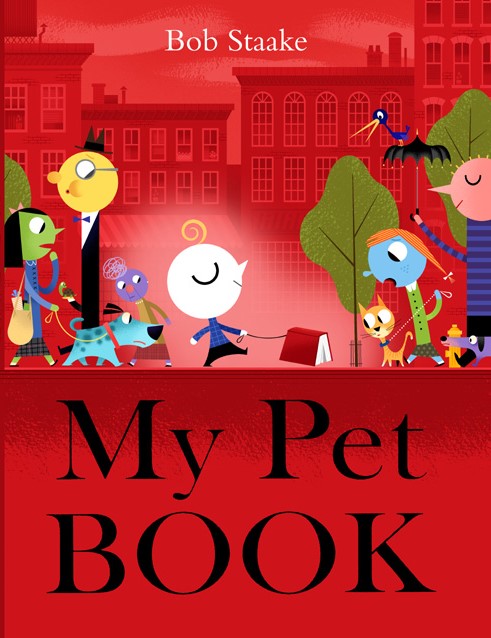
celebrate-picture-books-picture-book-review-my-pet-book-cover

About the Holiday

Pets are often our best friends—they love us unconditionally, are always there for us, and make us laugh. Today we celebrate pets—whether they’re as small as a goldfish, as large as a horse, or as unique as…well, you’ll see as you read on. National Pet Day also raises awareness of the number of animals available for adoption and encourages people to donate to animal shelters or consider taking a dog, cat, bird, or other pet into their family. If you already have a pet, observe the day by giving them an extra pat, offering a special treat, or spending more time with them.

My Pet Book

By Bob Staake


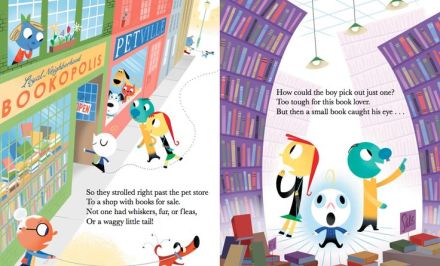
In a town named Smartytown a little boy has a most unusual pet—a book! Not one for puppies and allergic to kittens, he wants a pet that’s “easy.” His mom and dad suggest a book, and the family heads to the bookstore to adopt one. The shelves are so full of appealing potential pets that it’s hard to choose. But then the little boy spies a small “frisky red hardcover,” and it’s love at first sight.

celebrate-picture-books-picture-book-review-my-pet-book-choosing-pet

Copyright Bob Staake, courtesy of Random House Books for Young Readers.

The tiny book turns out to be the perfect pet—it doesn’t need food or water, its cover never sheds or hides fleas, it never needs a bath, and best of all there’s no housebreaking required. The boy takes his pet for walks in the evening, finding it superior to dogs that yap and run away and cats that constantly purr and lick their fur.

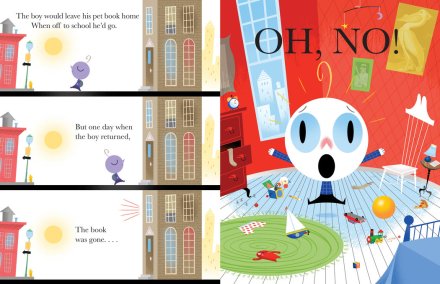
With his new pet, the boy’s days are full of adventure, fun, and excitement. He can’t wait to get home from school and spend time with the little book. But one day when he walks into his house, the boy discovers that his best friend is gone. “‘He ran away! He ran away!’ / The boy began to bleat. / ‘How could a pet book run away / Without a pair of feet?’”

celebrate-picture-books-picture-book-review-my-pet-book-book-gone

Copyright Bob Staake, courtesy of Random House Books for Young Readers.

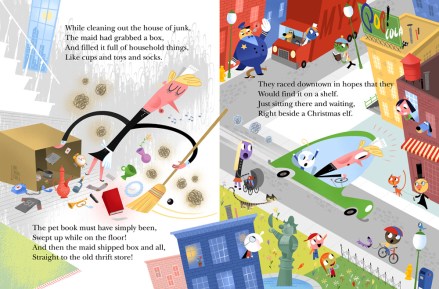
Soon the answer comes: “The maid could hear the crying boy. / (That sound was such a rarity.) / ‘I think I know what happened…’ (gulp) / ‘I gave your book to…charity.’” The boy and the maid race downtown to the thrift store, hoping to find the beloved book. They search through clothes, and furniture, through toys and shelves of books, but the little pet is nowhere to be found. There is only one conclusion—the book has just been sold!

The boy and maid sit down to cry, but then the maid has an idea. Maybe their pet is only hiding, Suddenly the boy remembers something that caught his eye in the dog-and-cat-stuff aisle. They race over to where a lone dog house sits. The boy says, “‘If I were just a scared pet book, / I’d likely sneak in here. / Perhaps the dark would help me hide, / And make me disappear!’”

celebrate-picture-books-picture-book-review-my-pet-book-searching-for-book

Copyright Bob Staake, courtesy of Random House Books for Young Readers.

He reaches in and discovers his pet book just waiting for him. The boy checks his pet over carefully and finds him well from cover to cover. The boy and the maid drive home relieved. Although they are tired, this crazy day has a happy ending, and now the boy and his pet have their own special story to share.

Perhaps Bob Staake is onto something in this humorous page-turner. Don’t we love our favorite books just like pets? And when they’re mysteriously missing, don’t we search and search for them? Through fast-paced and cleverly worded verses, Bob Staake leads his readers on a jaunt of book love that includes love, excitement, companionship, suspense, and a happy ending. What more can you ask for from a book—or a pet?

Staake’s vibrant and whimsical illustrations create a world all its own yet rooted in the here and now. A bit surreal, a bit silly, the action-packed scenes will have kids giggling and searching for every detail.

For book lovers, pet lovers, and those who love a good story, My Pet Book is perfect for snuggling up with.

Ages 3 – 7

Random House Books for Young Readers, 2014 | ISBN 978-0385373128

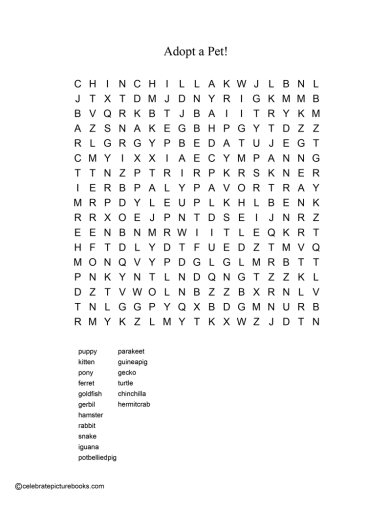
National Pet Day Activity

CPB - Pet Day Word Search

Adopt a Pet! Word Search

There are so many awesome pets to choose from! Can you find all the animals in this fun printable Adopt a Pet! word search?

Picture Book Review

February 14 – Frederick Douglass Day

CPB - Words Set Me Free

About the Holiday

Although the exact date is not known, history records Frederick Douglass’ birthday as around Valentine’s Day in 1818, so February 14 was chosen to honor this most unique and influential man. Born into slavery, Frederick Bailey (he later changed his last name to Douglass) learned how to read and write when still a child. As a young man he used his intellect and courage to secure his freedom. He became a compelling speaker, writer, leader of the abolition movement, and statesman. His writings, especially his autobiography Narrative of the Life of Frederick Douglass, an American Slave, are among the most powerful accounts of the slave experience and are still widely read today.

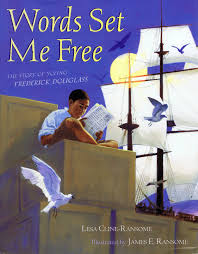
Words Set Me Free

Written by Lesa Cline-Ransome | Illustrated by James E. Ransome


Born into slavery and separated from his mother in infancy, Frederick Bailey is raised by his Grandmama while his mother works on a separate plantation. When she is able Harriet Bailey walks the 12 miles between plantations to spend a few short hours with her son, watching him sleep, before making the long journey back. While Frederick is still a very young child, his mother falls ill and dies. Douglass recalls never seeing his mother’s face in daylight.

At the age of six, Frederick is moved from his Grandmama’s cabin to the plantation house. At eight, he is sent to the master’s brother in Baltimore, Maryland. Here, the master’s wife, Sophia Auld, treats Frederick more like a paid servant then as a slave. When Frederick says he wants to learn how to read and write, she immediately begins teaching him the alphabet. Frederick is always mindful, however, that he may be punished for these lessons, and he has only memorized the letters and a few words before his master puts an end to his education. Angrily, the master explains to his wife, “If you teach him how to read…it would forever unfit him to be a slave.”

These words are perhaps Frederick’s greatest lesson. He never forgets them, and they fuel his resolve to pursue an education. He makes clever use of the few resources he has and slowly learns to read and write. From the newspapers he discovers that the North offers freedom, and Frederick decides to escape. It’s many long years, however, before he can fulfill his dreams. At last, he sees an opportunity to leave the South behind, and using his talent for writing makes his escape a reality.

Lesa Cline-Ransome has written a compelling biography of Frederick Douglass for children in Words Set Me Free. In straightforward language and through first-person point of view, Cline-Ransome reveals the brutal truth of Douglass’s life as a slave and his fight against injustice. As the title suggests, the book focuses on Frederick’s desire to become educated and the obstacles he overcame to succeed. This universally important message continues the work Douglass engaged in long ago.

James Ransome’s stirring paintings highlight pivotal scenes of Frederick’s story. Readers witness the tender moments with his mother, the cruel contrast of slavery and his blossoming intellect, and Frederick’s growing resolve to educate himself and escape.

Ages 5 and up                                                                                                            

Simon & Schuster, New York, 2012 | ISBN 978-1416959038

Frederick Douglass Day Activity

CPB - Words Set Me Free word search

Words Set Me Free word search


Words were so important to Frederick Douglass that he risked everything to learn how to read and write. In this printable Words Set Me Free Word Search Puzzle you will find words about the man we honor today. Solution

February 8 – Opera Day

celebrate-picture-books-picture-book-review-father's-chinese-opera-cover

About the Holiday

Today celebrates a musical art form that began in the 1500s in Italy. An opera is a play that is entirely sung by the actors. Operas can be funny, romantic, or tragic. The actors must have amazing voices that can fill the whole opera house because they do not use microphones. The actors get to sing solos, called arias, that reveal their emotions about particular moments in the story. Because of its grand history in countries such as Italy, Germany, and France, operas are still more popular in Europe than in the U.S. In America we’re more familiar with musicals, like Frozen orAladdin, where some dialogue is spoken and songs tell more about the plot of the story than about the characters’ feelings. If you’d like to listen to a little bit of an opera for children, check out this video of parts of Little Red Riding Hood performed by the BCOpera.

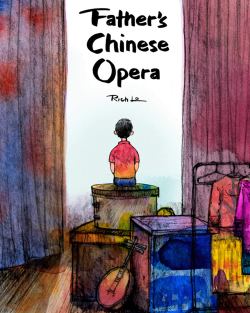
Father’s Chinese Opera

By Rich Lo


Recalling personal experience, author-illustrator Rich Lo writes a unique tale set within the Chinese opera. Revolving around themes pertinent to life, the Chinese opera employs actors as well as acrobats and flag carriers who add action and meaning to the play.

celebrate-picture-books-picture-book-review-father's-chinese-opera-acrobats

Copyright Rich Lo, 2014, courtesy of Sky Pony Press.

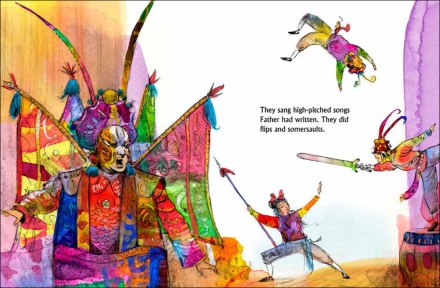
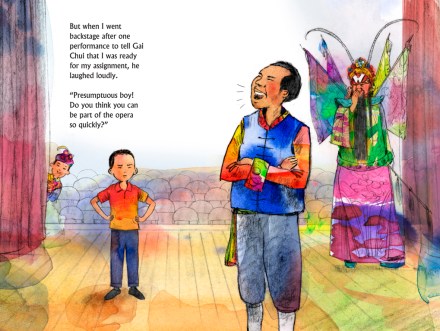
In Father’s Chinese Opera, the son of the band leader and composer for the Hong Kong opera watches the actors flip and somersault across the stage and dreams of joining them. He approaches Gai Chui, the best acrobat in the troupe and asks to be taught the martial arts. Gai Chui agrees and the little boy begins to learn the moves—Praying Mantis, Crouching Tiger, Striking Leopard, and more. The little boy practices hard and believes he is ready to join the other actors, but when he tells Gai Chui he is ready, the master acrobat laughs and tells him it’s not quite that easy.

celebrate-picture-books-picture-book-review-father's-chinese-opera-backstage

Copyright Rich Lo, 2014, courtesy of Sky Pony Press.

Dejected, the boy goes home. His father tells him about how hard he worked to become the leader of an opera troupe, and the boy takes the lesson to heart. The next day he goes back to the opera house and instead of watching the actors, he takes note of the flag carriers—the lowest position in the troupe. He asks if he can be a flag carrier, to which his father agrees—but only for the summer.

As a flag carrier, the boy makes new friends, becomes a better acrobat, and impresses Gai Chui, who tells him that with more practice he will be able to achieve his dreams.

celebrate-picture-books-picture-book-review-father's-chinese-opera-band-leader

Copyright Rich Lo, 2014, courtesy of Sky Pony Press.

Rich Lo’s story is full of truths about hard work and the benefits of developing a deep understanding of all aspects of one’s skills. Children may find a conversation like this seemingly unfair, but Lo reveals that such teaching on the part of a parent or other adult is one of the ultimate demonstrations of love. 

Lo’s watercolor illustrations are vibrant and dreamy, perfectly reflecting the beauty and action of the Chinese opera that so captivates the story’s young narrator. His father and the orchestra, dressed in their conservative blue and tan suits and sitting at the corner of the stage, contrast starkly with the bold, riotous mosaic of the actors’ costumes and the swirling moves of the acrobats. It’s easy to see why the boy is attracted to this art. It is back home—where the colors once again become muted and quiet—however, that the boy learns his greatest lesson.

Sharing Father’s Chinese Opera with children is an excellent way to discuss the idea that while a talent may be inborn, practice and patience are also needed to see it come to its full fruition. The book would be a valuable addition to home, classroom, and library collecions.

Ages: 3 – 7

Sky Pony Press, 2014 | ISBN 978-1628736106

Opera Day Activity

CPB - Opera Day word search

Opera Word Search


Today’s activity is a Word Search puzzle loaded with words about the Chinese opera. Just print out the puzzle and start looking! The Solution is also included.

celebrate-picture-books-picture-book-review-father's-chinese-opera-cover

You can find Father’s Chinese Opera at these booksellers

Amazon | Barnes & Noble | Books-a-Million | IndieBound