March 19 – The Spring Equinox

celebrate-picture-books-picture-book-review-winged-wonders-cover

About the Holiday

Today, we celebrate the first day of spring! What makes the equinox so special? On this date, day and night are equally long around the globe. With longer days and warmer weather, thoughts turn to nature and renewal. For many this means gardening for ourselves and for the returning bees and butterflies. Today’s book takes a look at one of nature’s most inspiring creatures – the monarch butterfly. 

I received a copy of Winged Wonders from Sleeping Bear Press for review of consideration. All opinions about the book are my own.

Winged Wonders: Solving the Migration Mystery

Written by Meeg Pincus | Illustrated by Yas Imamura


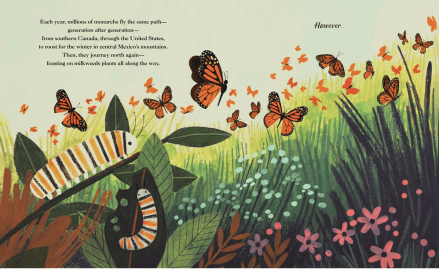
For centuries people pondered the mystery of the monarch butterflies that “swooped in for a spell, like clockwork” from who-knew-where and fluttered off to some unseen destination. People all along their route, “from southern Canada…through the middle of the United States…and all the way to central Mexico” wondered about this annual event. The mystery was finally solved in 1976. What was it that set these butterflies soaring? The newspapers called it “The Great Monarch Migration.”

celebrate-picture-books-picture-book-review-winged-wonders-citizen-scientists

Image copyright Yas Imamura, 2020, text copyright Meeg Pincus, 2020. Courtesy of Sleeping Bear Press.

You might wonder who the person was who “tracked these winged wonders from one end of the continent to the other” and “found their secret roosting place, a marvel of nature.” Perhaps it was Fred, a scientist from Canada, who spent thirty years studying the monarchs and tagging their wings. Or maybe it was his wife, Norah, who sought help in tagging monarchs’ wings from volunteers across the country and “logged and mapped every tidbit of information they sent in to the lab.”

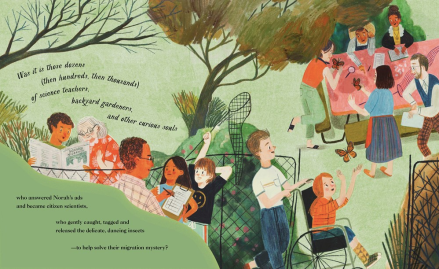
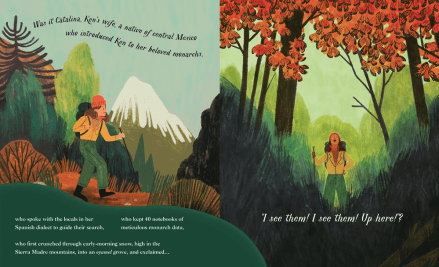
Could it have been the thousands of “science teachers, backyard gardeners, and other curious souls” who answered Norah’s plea? Or you might want to consider Ken and Catalina, a couple in Mexico who spent two years “trying to track the butterflies’ twisting trail” with the help of villagers and farmers. You might even say that it was Jim, a science teacher in Minnesota, who caught and tagged a very particular one-among-millions monarch.

celebrate-picture-books-picture-book-review-winged-wonders-catalina

Image copyright Yas Imamura, 2020, text copyright Meeg Pincus, 2020. Courtesy of Sleeping Bear Press.

So who was it? Who made that 1976 discovery? If you say all of them, you’re right! Communities across the North American countries of Canada, America, and Mexico came together to solve the mystery of one of nature’s most astounding phenomena. But now, another question concerning monarchs looms: “How will they survive?” Since that first discovery, the monarch population has dropped from “at least a billion to millions—a handful now to each hundred then” due to pesticides, pollution, and habitat destruction. Who do you think can help solve this monarch question? “The answer is really no mystery at all.”

An extensive Author’s Note following the text offers more information about the monarch migration discovery as well as ideas and projects for helping the monarch population grow and thrive.

celebrate-picture-books-picture-book-review-winged-wonders-caterpillars

Image copyright Yas Imamura, 2020, text copyright Meeg Pincus, 2020. Courtesy of Sleeping Bear Press.

Mirroring the flight of the monarchs, Meeg Pincus entices readers along the route of her story with fascinating facts about the personalities and eager citizen scientists who dedicated their lives and contributed their time to catching, tagging, and tracking these beautiful butterflies. Surprising details reveal the commitment in time and effort of so many people who enthusiastically answered Norah’s call for help. Her questioning format builds this same feel of excitement and community as page-by-page more people are added for readers to learn about and consider. Pincus’s lyrical storytelling is as buoyant and lovely as her subject while providing readers with a depth of knowledge about the process and experiences of the people along the way.

Yas Imamura’s delicate butterflies flutter above multi-hued green hills, busy downtown shops, and a golden desert before congregating like autumn leaves on a solitary tree as a deer looks on. Readers then begin to meet the scientists & participants: Fred and Norah in their well-packed car awed at spotting a monarch along their route, experimenting with wing tags, and mapping monarch sightings; a diverse group of kids and adults catching, tagging, and releasing butterflies; Ken and Catalina and the people of central Mexico, who share their colorful Día de los Muertos celebrations with these winged visitors; and finally Jim and his students.

Imamura’s glorious color palette complements the orange monarchs with soft pinks, corals, yellows, and reds while dramatically highlighting them against dark green backgrounds. Show-stopping scenes of the monarchs gathered on tree trunks and branches and the final spread of a butterfly garden are awe-inspiring and will spark children’s interest in helping to protect and help these unique creatures.

Winged Wonders: Solving the Monarch Migration Mystery is a must for home, school, and public library collections for nature lovers, citizen scientists, and any child who is a budding environmentalist as well as for lessons on science and community engagement.

Ages 7 – 10

Sleeping Bear Press, 2020 | ISBN 978-1534110403

Discover more about Meeg Pincus and her books on her website.

To learn more about Yas Imamura, her books, and her art, visit her website.

You can download an Educational Guide with activities for Winged Wonders on the Sleeping Bear Press website.

Spring Equinox Activity

celebrate-picture-books-picture-book-review-flower-garden-game

Plant a Flower Garden Game


With this fun game you and your family and friends can grow gardens inside! Roll the dice to see whose garden will fully blossom first!

Supplies

Directions

Object: The object of the game is for each player to fill their garden or garden row with flowers. Depending on the ages of the players, the game can be adjusted to fill all of the rows, some or all rows, or just one. 

Options:

  • Players can “plant” each of the six rows with multiple flowers of the same type
  • Each player can be assigned a single row and “plant” one each of the six types of flowers 
  1. Print number of Game Boards needed 
  2. Print one or more sets of Flower Playing Cards for each player, depending on how many of each flower the players want to put in each row (For example: fewer for younger children, more for older). For sturdier playing items, print on card stock.
  3. Cut the playing cards apart
  4. Print one Flower Playing Die and assemble (for a sturdier die, print on card stock)
  5. Color the “dirt” on the Garden Plot (optional)
  6. Choose a player to go first
  7. The player rolls the die and then “plants” the flower rolled in a row on the game board
  8. Play moves to the person on the right
  9. Players continue rolling the die and “planting” flowers until each of the number of determined rows have been filled with flowers or one row has been filled with all six flowers.
  10. The first person to “grow” all of their flowers wins!

celebrate-picture-books-picture-book-review-winged-wonders-cover

You can find Winged Wonders: Solving the Monarch Migration Mystery at these booksellers

Amazon | Barnes & Noble | Books-a-Million | IndieBound

Picture Book Review

March 12 – It’s Women’s History Month

celebrate-picture-books-picture-book-review-shark-lady-cover

About the Holiday

National Women’s History Month is all about celebrating women who broke barriers with their intelligence, creativity, courage, persistence, and unwavering confidence in their abilities. In every discipline, women have brought and continue to bring new perspectives, experiences, and talents to make contributions toward a better world. Celebrate this month-long holiday by reading about some women pioneers in all areas. Today’s book is a great place to start!

By Jakki Licare

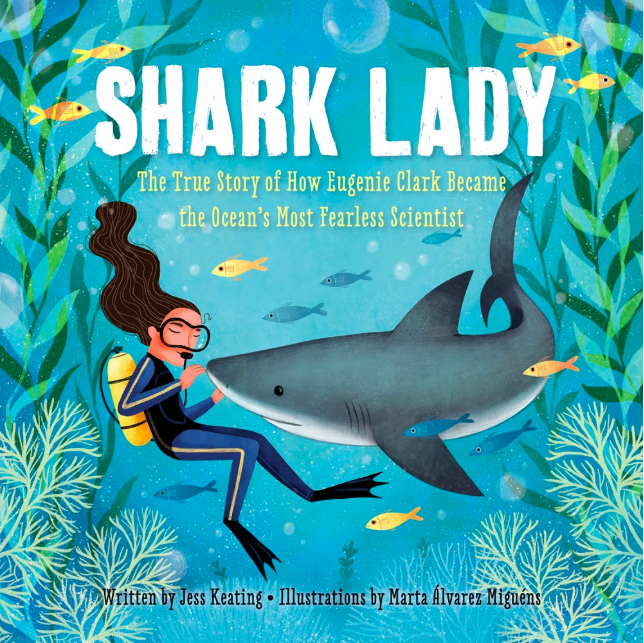
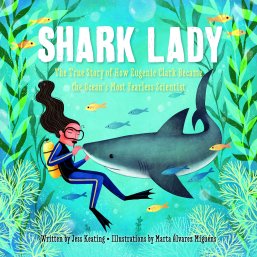
Shark Lady: The True Story of How Eugenie Clark Became the Ocean’s Most Fearless Scientist

Written by Jess Keating | Illustrated by Marta Álvarez Miguéns


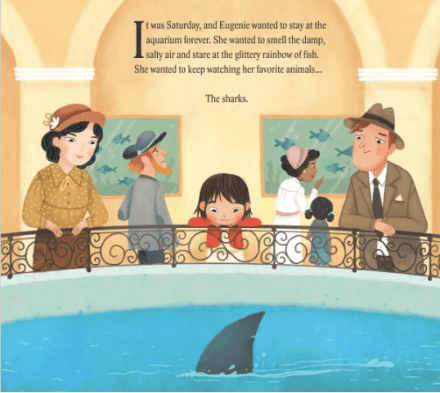
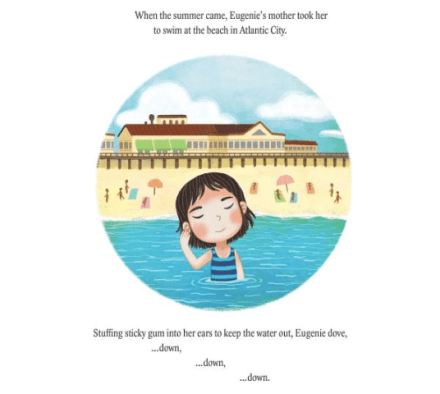
Eugenie’s favorite place was the aquarium. She loved the smell, the colors of the fish, but most of all she loved the sharks. Eugenie wondered what it would be like to live underwater and swim with the sharks. She had to find out. In the summer, Eugenie’s mother took her to Atlantic City. “Stuffing sticky gum into her ears to keep the water out, Eugenie dove, … down, …down, …down.” She pretended to be a shark swimming strong through water. 

celebrate-picture-books-picture-book-review-shark-lady-aquarium

Image copyright Marta Álvarez Miguéns, 2017, text copyright Jess Keating, 2017. Courtesy of Sourcebooks Explore.

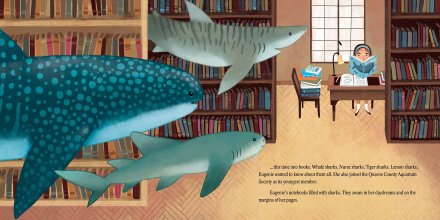
Most people were scared of sharks, but Eugenie thought they were magnificent.  She was determined to learn more about them. “So she dove…this time into books.” At the library she learned about every shark she could find. She also became Queens County Aquarium Society’s youngest member. While Eugenie’s mother couldn’t give her a pet shark, she did surprise Eugenie with a fifteen gallon fish tank. Eugenie bought guppies, clown fish and snails. 

As Eugenie grew older she decided to become a zoologist, but many professors didn’t encourage her. Most thought women couldn’t and shouldn’t be scientists. “Eugenie knew better. Her dream was as big as a whale shark. So again, Eugenie dove.” She studied hard and rose to the top of her field. 

celebrate-picture-books-picture-book-review-shark-lady-diving

Image copyright Marta Álvarez Miguéns, 2017, text copyright Jess Keating, 2017. Courtesy of Sourcebooks Explore.

Eugenie was ready to finally dive into the ocean. In the red sea, she discovered three new species. In the Palau Islands, Eugenie finally saw her first wild shark. It was beautiful. At the time many believed sharks had to always be moving to stay alive, but Eugenie discovered caves with sharks resting together. “Eugenie had proven she was smart enough to be a scientist and brave enough to explore the oceans.”

Still most of the world believed sharks to be dangerous and hunting sharks was very common. Eugenie wanted to prove to the world that sharks weren’t ‘mindless killers.’ Eugenie created an experiment where she would train a shark to push a target. It was a success! Sharks even remembered their training two months later. Eugenie proved that sharks were smart and deserved to be protected. 

Facts about sharks, a detailed timeline of Eugenie Clark’s life, and an Author’s Note follow the text.

celebrate-picture-books-picture-book-review-shark-lady-library

Image copyright Marta Álvarez Miguéns, 2017, text copyright Jess Keating, 2017. Courtesy of Sourcebooks Explore.

Jess Keating’s straightforward manner of writing really homes in on the  struggles and successes of Eugenie Clark. Keating adds in splashes of nautical language,  making this a fun and engaging read. Eugenie’s fight for gender equality was a strong theme that ties in nicely with the world’s misunderstanding of the sharks that Eugenie loved. In Eugenie’s college years, Keating writes how people tried to convince Clark to be a secretary or housewife and poignantly points out that even after she earned her degree many still doubted her ability. Young readers can see how Eugenie didn’t let that stop her from doing what she was meant to do.

Keating emphasizes not only Clark’s passion, but her hard work and courage in a variety of situations as well. The picture book begins with Clark’s passion for sharks and then transitions to the brave girl trying to deep dive with bubble gum in her ears. Later, Keating shows the reader how hard Eugenie worked to earn her degree and how brave she was to deep dive alone. The conclusion of the book  circles back to her passion to protect her beloved sharks’ through scientific experiments. Kids with any passion can see how hard work and perseverance can create a huge impact on the world.  

celebrate-picture-books-picture-book-review-shark-lady-ear-plugs

Image copyright Marta Álvarez Miguéns, 2017, text copyright Jess Keating, 2017. Courtesy of Sourcebooks Explore.

Marta Álvarez Miguéns’ illustrations are beautiful and whimsical. Bright blues and greens invite you to dive right in.  Sharks swim through the library aisles while Eugenie reads and tag along with her through her aquarium trip. The illustrations do a great job of reinforcing Clark’s determination and courage. In the college classrooms Miguéns depicts Eugenie as the only girl in the lecture hall. She depicts her with squinty eyed determination; taking notes while the rest of her classmates look bored. Eugenie is also illustrated bravely diving alone with sharks.

The sharks’ large eyes make the sharks feel friendly and encourages the readers to give them a chance as well. In the conclusion of the book, Miguéns shows Eugenie standing next to a little girl who looks happily at the sharks. This illustration emphasizes the fact that Clark’s scientific achievements have given younger generations the chance to enjoy sharks as well.  The end pages are covered with realistic depictions of different types of sharks and nautical sea creatures, allowing those less familiar with these animals to analyze and compare.

Shark Lady is not just for shark enthusiast. This wonderful book shows us  that any dream is possible with hard work and perseverance. It would make an inspiring addition to home, school, and public library collections.

 Ages 4 – 8 and up

Sourcebooks Explore, 2017 | ISBN 978-1492642046 (Hardcover) | Scholastic, 2018 ISBN 978-1338271478 (Paperback)

Discover more about Jess Keating and her books and illustrations on her website.

To learn more about Marta Álvarez Miguéns, her books, and her art, visit her website.

Women’s History Month Activity

celebrate-picture-books-picture-book-review-shark-fin-craft

Fintastic Shark Fun


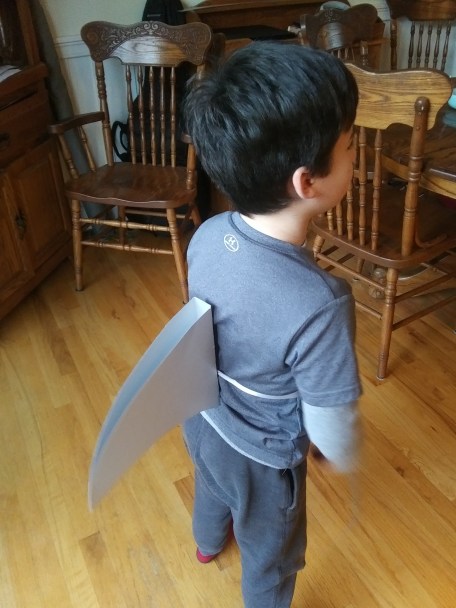
Eugenie wanted to swim with the sharks and now you can too! Follow the directions below and to make your own shark fin. 

Supplies

  • 2 pieces of 8.5 x 11 gray cardstock paper
  • Ribbon
  • Tape
  • Scissors
  • Pencil

fin outline white

celebrate-picture-books-picture-book-review-shark-fin

Directions

  1. Tape the top of the two pieces of paper together
  2. Fold them back together
  3. Measure an inch up from the bottom of the papers (the un-taped side) and trace a straight line across both papers
  4. Trace a shark fin outline onto your paper. The shark outline should stop an inch above the bottom
  5. Cut out the fin on both pieces of paper. If you should cut through the tape, re-tape the tops together
  6. Fold along the lines of both papers so the folds face towards each other.
  7. Tape the folds so the fin becomes a triangle
  8. Cut two slits parallel to the folded lines
  9. Thread ribbon through slits

celebrate-picture-books-picture-book-review-shark-lady-cover

You can find Shark Lady at these booksellers

Amazon | Barnes & Noble | Books-a-Million | IndieBound

Picture Book Review
 

February 25 – Honoring Katherine Johnson

celebrate-picture-books-picture-book-review-counting-on-katherine-cover

About Katherine Johnson

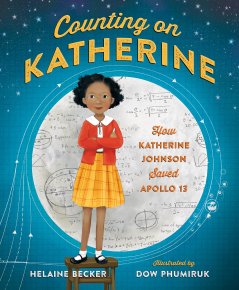
Katherine Johnson passed away yesterday at the age of 101. Recognized from an early age for her brilliance, Katherine went on to become a pivotal mathematician for NASA as the space race led to the first manned missions and lunar landings. She continued working for NASA on the space shuttle and other technological advancements. Fearless in asking the kinds of probing questions that fueled her imagination and precise calculations and in standing up for her rights, Katherine was a trail-blazer for women and people of color. She was awarded the Presidential Medal of Freedom in 2015. Her influence and inspiration continue to shine, especially for children, through books like Counting on Katherine.

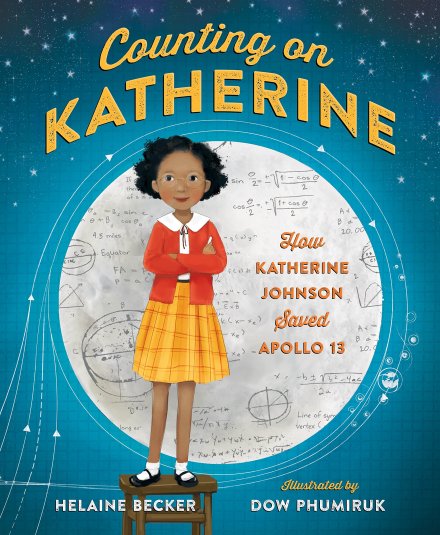
Counting on Katherine: How Katherine Johnson Saved Apollo 13

Written by Helaine Becker | Illustrated by Dow Phumiruk


Katherine may have been born counting. She counted every step she took and every step she climbed. She counted the dishes and silverware as she washed them, and although she may have wanted to count all the stars in the sky, she knew that was beyond anyone’s ability. “Even so, the stars sparked her imagination…. Katherine yearned to know as much as she could about numbers, about the universe—about everything!”

celebrate-picture-books-picture-book-review-counting-on-katherine-school

Image copyright Dow Phumiruk, 2018, text copyright Helaine Becker, 2018. Courtesy of Henry Holt and Company.

Katherine was so smart that she skipped three grades, even passing up her older brother. Katherine graduated from elementary school when she was 10 and was ready for high school, but “her town’s high school didn’t admit black students—of any age. Her father, though, said, “‘Count on me.’” He worked until the family could afford to move to another town where she could attend a black high school.

In high school, Katherine loved all of her classes, but her favorite subject was math. She wanted to become a research mathematician, “making discoveries about the number patterns that are the foundations of our universe.” But there were no jobs like that for women, so Katherine taught elementary school.

celebrate-picture-books-picture-book-review-counting-on-katherine-calculations

Image copyright Dow Phumiruk, 2018, text copyright Helaine Becker, 2018. Courtesy of Henry Holt and Company.

Then in the 1950s, the National Advisory Committee on Aeronautics began hiring new employees. When Katherine applied all the positions had been filled, but the next year she got a job. A few years later when NASA was formed, Katherine became what was known as a human “‘computer.’” She and the other computers––all of whom were women––calculated long series of numbers, contributing to the “space race.”

Katherine asked lots of questions about how high the rocket ship would go and how fast it would travel before beginning her calculations. Her job was to make sure that the earth and the rocket were in the same place when the rocket needed to land. Katherine’s calculations were so precise and her leadership so inspiring that she was promoted to Project Mercury, “a new program designed to send the first American astronauts into space.

celebrate-picture-books-picture-book-review-counting-on-katherine-trajectory

Image copyright Dow Phumiruk, 2018, text copyright Helaine Becker, 2018. Courtesy of Henry Holt and Company.

The engineers and astronauts knew that the missions were going to be dangerous, and John Glenn, distrusting the computer-generated numbers, refused to fly until Katherine approved the numbers. “‘You can count on me,’” she told him. Glenn’s mission was successful and Katherine earned another promotion. Her new job was to “calculate the flight paths for Project Apollo—the first flight to the moon.” She calculated the trajectories that took Apollo 11 and Apollo 12 to the moon and back in 1969. But as Apollo 13 soared through space on its way to the moon, there was an explosion. There were questions about whether the spaceship could reach the moon or make it back to Earth.

celebrate-picture-books-picture-book-review-counting-on-katherine-explosions

Image copyright Dow Phumiruk, 2018, text copyright Helaine Becker, 2018. Courtesy of Henry Holt and Company.

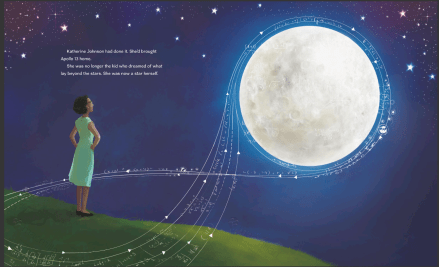
Katherine was again called to make new calculations. In only a few hours, Katherine had a new flight plan that “would take the ship around the far side of the moon. From there, the moon’s gravity would act like a slingshot to zing the ship back to Earth.” But for the plan to work, the astronauts had to follow it exactly. There was no room for a mistake. Katherine and all of the NASA engineers waited nervously to find out if the plan would succeed. Finally, the astronauts reported that they were back on track. “Katherine Johnson had done it…. She was no longer the kid who dreamed of what lay beyond the stars. She was now a star herself.”

An Author’s Note following the text tells more about Katherine Johnson’s life and work, which went on to impact the space shuttle program and satellite projects.

celebrate-picture-books-picture-book-review-counting-on-katherine-moon

Image copyright Dow Phumiruk, 2018, text copyright Helaine Becker, 2018. Courtesy of Henry Holt and Company.

Helaine Becker’s captivating storytelling captures Katherine Johnson’s genius for math and talent for applying it to even the most complex problems in a ground-breaking field. Her self-confidence, curiosity, and love of learning as well as her trajectory at NASA will impress readers, many of whom may also be dreaming of making a mark in new ways. A highlight of Becker’s text is her clear explanations of how Katherine’s calculations for NASA were used and what was at stake when her help was needed most. Becker’s repeated phrase “You can count on me” and her stirring ending weave together the numerical and lyrical aspects of Katherine’s life to inspire a new generation of thinkers.

celebrate-picture-books-picture-book-review-counting-on-katherine-skips-dreaming

Image copyright Dow Phumiruk, 2018, text copyright Helaine Becker, 2018. Courtesy of Henry Holt and Company.

From the first page, readers can see Katherine’s intelligence and inquisitiveness that shined whether she was walking to school, doing chores, or, later, making sure our astronauts made it to the moon and back safely. Dow Phumiruk’s artwork is always thrilling, and here blackboards covered in formulas as Katherine stands on tiptoe as a child and on a ladder as an adult to complete them will leave readers awestruck with her understanding of and abilities with numbers. Illustrations of school rooms and offices give children a realistic view of the times, and her imagery pairs perfectly with Becker’s text in demonstrating the concepts of sending a rocket ship into space and bringing it home again. Phumiruk’s lovely images of space are uplifting reminders that dreams do come true.

A stellar biography that will enthrall children and inspire them to keep their eyes on their goals and achieve their dreams, Counting on Katherine: How Katherine Johnson Saved Apollo 13 is highly recommended for home bookshelves and is a must for school and public library collections.

Ages 5 – 9

Henry Holt and Company, 2018 | ISBN 978-1250137524

Discover more about Helaine Becker and her books on her website.

To learn more about Dow Phumiruk, her books, and her art, visit her website.

Watch the Counting on Katherine book trailer!

celebrate-picture-books-picture-book-review-counting-on-katherine-cover

You can find Counting on Katherine: How Katherine Johnson Saved Apollo 13 at these booksellers

Amazon | Barnes & Noble | Books-a-Million | IndieBound

Picture Book Review
February 11 – National Inventors Day

celebrate-picture-books-picture-book-review-dream-big-little-scientists-cover

About the Holiday

Today’s holiday was established in 1983 and falls on the birthday of Thomas Edison. The day honors all of those thinkers and tinkerers from the past as well as today who, through ingenuity and persistence, design inventions that advance our world. To celebrate, take your kids to a museum or explore more about the creative minds involved in their favorite subjects.

Dream Big, Little Scientists: A Bedtime Book

Written by Michelle Schaub | Illustrated by Alice Potter


So many young scientists are ready for bed; they yawn and sigh and close their eyes. A brown-skinned girl, having stepped from her solar-system rug to sit on her space-themed comforter gazes out her window to see “the sun has tucked itself in bed; the moon is on the rise.” She’s surrounded by reminders of her favorite subject, including posters of Carl Sagan, the phases of the moon, a telescope, and her nighttime reading: Stars and Planets.

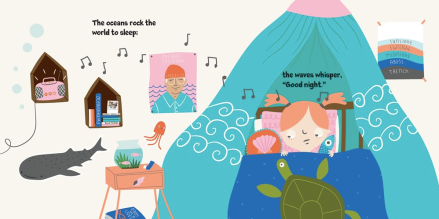
In other places children get ready for bed in rooms that reflect their personalities and love of various sciences too. A future geologist lounges in a room decorated with images of mountains, volcanoes, a poster of Jess Phoenix, and lots and lots of books on rocks. For a child who dreams of being an oceanographer, “the oceans rock the world to sleep; the waves whisper, ‘Good night.’” Jacques Cousteau is the hero here, and two little fish also drift off to sleep in this ocean-themed room.

celebrate-picture-books-picture-book-review-dream-big-little-scientists-kids

Image copyright Alice Potter, 2020, text copyright Michelle Schaub, 2020. Courtesy of Charlesbridge.

Twins are ready to put their heads together to fight climate change. Their bunk beds sport pictures of weather events and posters of Gabriel Fahrenheit and Anders Celsius. “While mossy carpets stretch out wide, tree limbs yawn up high, ” another child, who wears a hearing aid and is inspired by botany, tends to potted seedlings. The pictures of George Washington Carver and Thomas Meehan on the wall show their approval

Snuggled in fuzzy bear footy pajamas, the next child huddles in a blanket tent as other “daytime creatures settle down in den or hole or nest.” Wangari Maathai smiles from her poster on the wall, which is also decorated with a mural of a deer, tiger, and giraffe among greenery, flowers, and mushrooms. A girl who uses a wheelchair finds physics fascinating. Among her mentors are Donna Strickland and Stephen Hawking, and books about the laws of science are her bedtime reading.

celebrate-picture-books-picture-book-review-dream-big-little-scientists-oceans

Image copyright Alice Potter, 2020, text copyright Michelle Schaub, 2020. Courtesy of Charlesbridge.

For a future paleontologist mindful that “slumber’s been a part of life since prehistoric days,” the past sparks her imagination. A microscope, a fossil kit, bones, and dinosaur pictures join a poster of Mary Anning in this room where current projects and future projects fill this busy child’s desk. A doctor in the making relaxes before sleep with yoga, knowing, from the books on medicine, physiology, and health on the bookshelves, of the connection between mind and body.

From slime to the periodic table, the elements of chemistry excite a child who looks to Marie Curie and Alice Ball for inspiration as she experiments with her chemistry kit and ponders the make-up of matter. As these children from “all around the world bed down in different ways,” they are united in their love of science. So, “dream away young scientists, tomorrow you’ll learn more—when you awake and venture out to ask, observe, explore.”

Back matter encourages readers to think like a scientist with short descriptions of all the sciences presented in the story and a link to the Science Kids website. Children are further invited to visit Michelle Schaub’s website to learn about the scientists who appear in each of the posters.

celebrate-picture-books-picture-book-review-dream-big-little-scientists-water

Image copyright Alice Potter, 2020, text copyright Michelle Schaub, 2020. Courtesy of Charlesbridge.

Michelle Schaub’s meditative poem tucks sleepy children into bed as the world outside also quiets and renews itself for another day. Schaub’s smart verses deftly weave together this nightly process with the dreams that spark many children’s daytime passions now and for their futures. Beautiful language and elegant, flowing rhythms bring to life the joys of science and the wonder of our natural world while also touching the heart of every young visionary.

For young readers, turning each page is an invitation to one fun sleepover after another. In her vibrant, cartoon-inspired illustrations, Alice Potter creates rooms that any child would love to call their own. Decorated with comforters, curtains, rugs, and accessories that reflect each child’s chosen science, each bedroom offers plenty of details for children to linger over and explore. One clever detail that readers will love searching for in each child’s room is the photograph of all of these future scientists gathered together. Potter’s depictions of this diverse group of kids is a welcome reflection of our communities and friends.

Dream Big, Little Scientists: A Bedtime Book is an inspiring read for any time of the day and will be asked for often. The book is highly recommended for home, classroom, and public library collections.

Ages 3 – 7 

Charlesbridge, 2020 | ISBN 978-1580899345

Discover more about Michelle Schaub and her books on her website.

To learn more about Alice Potter, her books, and her art, visit her website.

Watch this dreamy Dream Big, Little Scientists book trailer!

National Inventors’ Day Activity

celebrate-picture-books-picture-book-review-dream-big-little-scientists-activity-guide-trading-cards

Big Dreams, Little Scientists Activity Guide


Explore your own love of science with this awesome activity guide! With lots of ideas, suggestions for further study, links, and even trading cards, this guide will have kids observing, doing, and learning with enthusiasm. Cross-curricular activities make this a perfect accompaniment to the book for teachers and homeschoolers. You can download  from Michelle Schaub’s website here:

Big Dreams, Little Scientists Activity Guide

celebrate-picture-books-picture-book-review-dream-big-little-scientists-cover

You can find Dream Big, Little Scientists at these booksellers

Amazon | Barnes & Noble | Books-a-Million | IndieBound

Picture Book Review
February 4 – It’s Children’s Authors and Illustrators Week

celebrate-picture-books-picture-book-review-old-rock-is-not-boring-cover

About the Holiday

Children’s Authors and Illustrators Week was established with the idea of getting authors, illustrators, and children together to share great books, the joys of creating them and the fun of reading. During the week, authors and illustrators hold special events, including storytelling, exciting presentations, and writing workshops in venues around the country. To find out more about the Children’s Authors Network and discover classroom resources to use throughout the year, visit the Children’s Authors Network website.

I received a copy of Old Rock (is not boring) from G. P. Putnam’s Sons for review consideration. All opinions are my own.

Old Rock (is not boring)

By Deb Pilutti


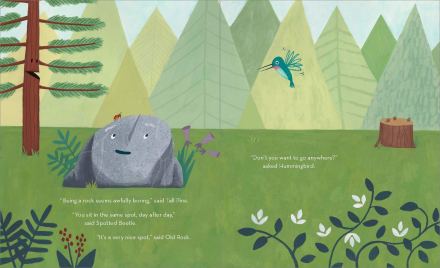
It seemed that Old Rock had been sitting in the same spot forever. Tall Pine and Spotted Beetle thought being a rock must be pretty boring. Hummingbird wondered, “‘Don’t you ever want to go anywhere?’” She knew she would be if she couldn’t fly all over the world and taste exotic nectars. But Old Rock had flown once, and he began to tell his story.

celebrate-picture-books-picture-book-review-old-rock-is-not-boring-hummingbird

Copyright Deb Pilutti, 2020, courtesy of G. P. Putnam’s Sons Books for Young Readers.

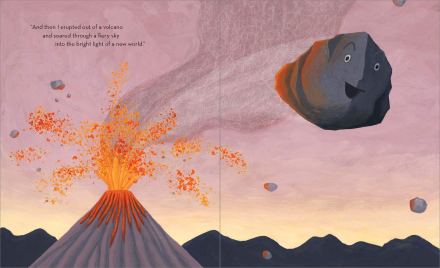
It was during the time when he was surrounded by darkness, but then the volcano erupted and Old Rock “‘soared through a fiery sky into the bright light of a new world.’” Tall Pine, Spotted Beetle, and Hummingbird weren’t very impressed. They still thought Old Rock must be bored. Spotted Beetle told him how much he might see if he climbed to Tall Pine’s very highest branch.

celebrate-picture-books-picture-book-review-old-rock-is-not-boring-volcano

Copyright Deb Pilutti, 2020, courtesy of G. P. Putnam’s Sons Books for Young Readers.

Old Rock countered that he had seen a lot. He’d watched dinosaurs pass by and had even hidden a spinosaurus from a hungry T. rex. He’d traveled in a glacier and been left teetering on a ridge overlooking a vast desert, where he “could see the place where the sky touches the earth.” Spotted Beetle and Hummingbird were intrigued, but Tall Pine dismissed these experiences as “ages ago.” He wanted to know about now. Didn’t Old Rock feel like moving? Tall Pine showed Old Rock how his limbs could dance in the wind.

celebrate-picture-books-picture-book-review-old-rock-is-not-boring-dinosaurs

Copyright Deb Pilutti, 2020, courtesy of G. P. Putnam’s Sons Books for Young Readers.

While Old Rock couldn’t dance, he did recall how he’d turned somersaults off the ridge, landing in a prairie where mastodons grazed near a lake. Tall Pine, Spotted Beetle, and Hummingbird were mesmerized by Old Rock’s story and wanted to know what had happened next. Out of the prairie, sprang a pine forest, Old Rock revealed. And from one of the pine trees a pinecone fell and a seed was released. That seed grew “to be the tall pine who dances in the wind and keeps me company.” Sometimes, he continued, a spotted beetle and a hummingbird meander by. Old Rock was very pleased with his spot, and the others had to agree that it was “very nice” and “not boring at all.”

An illustrated timeline of Old Rock’s life from 18 billion years ago to the present day follows the text.

celebrate-picture-books-picture-book-review-old-rock-is-not-boring-time-line

Copyright Deb Pilutti, 2020, courtesy of G. P. Putnam’s Sons Books for Young Readers.

So much clever thought went into Deb Pilutti’s Old Rock as she reveals to kids what a fascinating and active life the rocks and boulders we see every day have had. Tall Pine, Spotted Beetle, and Hummingbird’s skepticism keeps the suspense building as Old Rock rolls out stories of his various travels and talents. Once he has them hooked, they—like young readers—want to hear more, leading to the just-right ending that sweetly encompasses shared history, happiness with one’s place in life, and friendship. The trio’s questions to Old Rock and their related experiences also engage children to think about issues and opinions from a variety of perspectives.

Pilutti’s mixed-media illustrations are nicely textured to bring out Old Rock’s grainy surface while highlighting nature’s vivid colors. Her vignettes from the dinosaur eras, the ice age (where the skeletons of dinosaurs are also swept up and away in the same glacier as Old Rock), and beyond impress upon readers the long time-frame involved, how the earth has changed, and even the fascinating science of the fossil record.

A multi-layered story, perfect for general story times or as a lead in to science lessons and to promote discussion and research in the classroom, Old Rock (is not boring) would be an original and exciting addition to home, classroom, and public library collections.

Ages 4 – 8

G. P. Putnam’s Sons Books for Young Readers, 2020 | ISBN 978-0525518181

To learn more about Deb Pilutti, her books, and her art, visit her website.

Children’s Authors and Illustrators Week Activity

celebrate-picture-books-picture-book-review-rocks-word-search-puzzle

Rock This Puzzle! Word Search


You can discover a lot about an area by its rocks. Find the twenty rock-related words in this printable puzzle then learn more about them.

Rock This Puzzle! Word Search | Rock This Puzzle! Solution

celebrate-picture-books-picture-book-review-old-rock-is-not-boring-cover

You can find Old Rock (is not boring) at these booksellers

Amazon | Barnes & Noble | Books-a-Million | IndieBound

Picture Book Review
January 13 – It’s International Creativity Month

celebrate-picture-books-picture-book-review-hedy-lamarr's-double-life-cover

About the Holiday

Are you an artist, a writer, a decorator, a chef? How about a floral arranger, a woodworker, a fashion designer, or a gardener? Inside almost every heart lies a desire to create. Whether you use your ingenuity in your job or as an escape from the routine, this month celebrates all that is innovative. Sometimes this comes not only in making something you can see or touch but in a new thought or a novel way of solving a problem—as seen in today’s book!

I received a copy of Hedy Lamarr’s Double Life for review consideration. All opinions are my own.

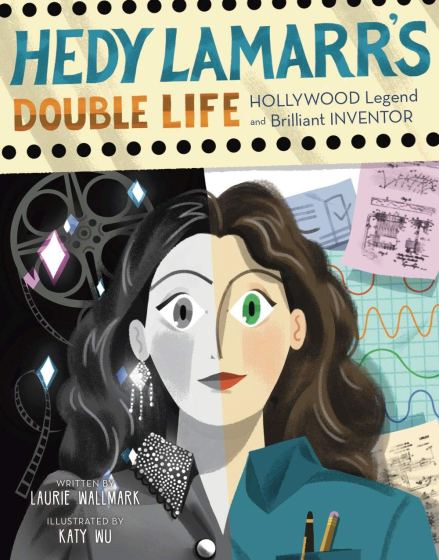
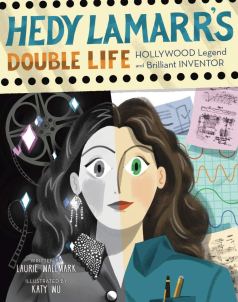
Hedy Lamarr’s Double Life: Hollywood Legend and Brilliant Inventor

Written by Laurie Wallmark | Illustrated by Katy Wu


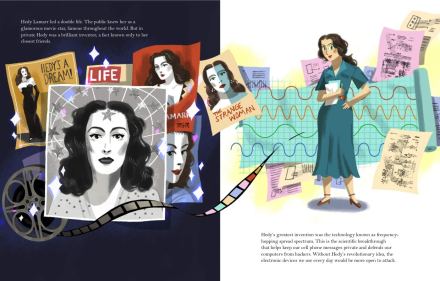
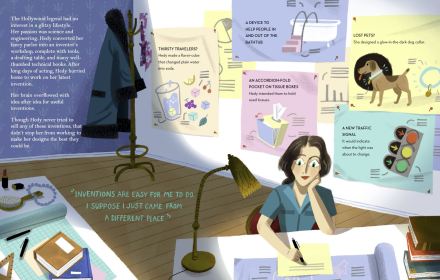
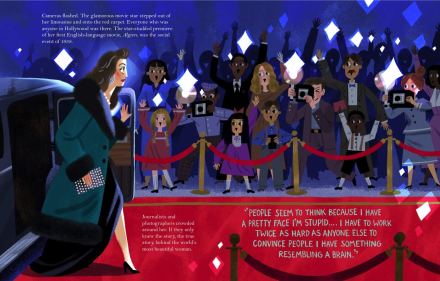
In 1938 people were lining up to see Hedy Lamarr in her first English-language movie Algiers. Hedy was the talk of Hollywood, and journalists and photographers captured her every move—almost. What movie-goers and the press didn’t know was that Hedy Lamarr was also a brilliant inventor. Instead of attending fancy celebrity parties, after a long day on the set, “Hedy hurried home to work on her latest invention. Her brain overflowed with idea after idea for useful inventions.” While she never tried to sell her ideas—like the collar to help find lost pets or the “flavor cube that changed plain water into soda”—she designed and redesigned them to perfection.

celebrate-picture-books-picture-book-review-hedy-lamarr's-double-life-magazines

Image copyright Katy Wu, 2019, text copyright Laurie Wallmark, 2019. Courtesy of Sterling Children’s Books.

But how did Hedy get her start? She was born in Austria and as a child took apart mechanical objects just to see how they worked. Hedy’s father also loved science, and he encouraged his daughter to hold onto her dreams. In addition to science, Hedy loved movies and would use her dolls to reenact the scenes she saw.

When she got older, Hedy got a job as a script girl and then worked as an extra in a movie. She loved acting and once said, “‘I acted all the time…. I was a little living copybook. I wrote people down on me.’” While playing the lead in a stage play, the Hollywood producer Louis B. Mayer saw her and offered her movie contract. Hedy moved to America. It only took her six months to land a starring role in Algiers. After that she starred in many movies with some of the most famous actors and actresses. 

By now, the world was at war. One day, Hedy met George Antheil, a former weapons inspector who now composed music. Hedy remembered a “discussion she had overheard back in Europe about a problem with the guidance system for torpedoes. The guidance system couldn’t prevent the enemy from jamming the weapon’s radio signals” and sending it off course. She learned from George Antheil that the US Navy had the same problem.

They decided to team up to see if they could figure out a solution. Hedy was also an accomplished pianist, and she and George often played musical games on the piano. Once, while they played the same song in different octaves, Hedy had a brainstorm for building “a secure torpedo guidance system.” At the time, torpedo guidance systems only worked if the ship launching a torpedo and the torpedo were on the same frequency.

celebrate-picture-books-picture-book-review-hedy-lamarr's-double-life-home

Image copyright Katy Wu, 2019, text copyright Laurie Wallmark, 2019. Courtesy of Sterling Children’s Books.

Hedy thought that if the ship and the torpedo could switch between a series of different frequencies, the enemy would be foiled. “Hedy called her discovery ‘the hopping of frequencies.” Working together, she and George devised a way to implement Hedy’s idea. When they presented their idea to the National Inventors Council, they were told the “idea had ‘great potential value.’”

There were still some issues to overcome to make the system automated, but Hedy and George answered those too. They applied for a patent, and a year later on August 11, 1942 it was granted. When they gave the idea to the United States Navy, “Hedy was proud her frequency-hopping idea might help America win the war.” But embroiled in the middle of the conflict, the Navy didn’t have “the time or money to implement a new system….”

Hedy, who still wanted to help America defeat the Nazis, was undaunted. She helped raise 25 million dollars by selling war bonds and volunteered at the Hollywood Canteen, where servicemen soon to be deployed gathered. Hedy went on to make more than twenty movies and continued to work on her inventions.

In the 1980s, the US Navy declassified Hedy’s frequency-hopping technology, meaning anyone could use it. Because the patent had long-ago expired, no one needed to give Hedy and George credit for the idea. “Companies raced to include frequency hopping in their own devices.” In 1997, Hedy and George were finally recognized when they “received the Pioneer Award from the Electronic Frontier Foundation for their significant contribution to computers.”

A timeline of Hedy Lamarr’s life, a description of how Hedy and George’s frequency-hopping technology worked, additional resources for further reading, and a list of Hedy’s movies follow the text.

celebrate-picture-books-picture-book-review-hedy-lamarr's-double-life-red-carpet

Image copyright Katy Wu, 2019, text copyright Laurie Wallmark, 2019. Courtesy of Sterling Children’s Books.

Laurie Wallmark knows how to weave a riveting tale that draws readers in to the lives of fascinating and scientifically minded women throughout history. Her detailed biography of Hedy Lamarr will wow kids with the twists and turns of how a vital feature of the electronics they use every day came to be. A history not only of this famous woman but of the times and policies that denied Hedy Lamarr the recognition and profits she deserved, the story is sure to spark plenty of discussion. The inclusion of a few of Hedy’s ingenious ideas as well as quotes on acting, inventing, and her views on life give children a glimpse into the mind of this unique woman.

Katy Wu takes readers back to the 1940s with her stylish illustrations reminiscent of magazine images of the time that depict both Hedy’s glamourous and inventive sides. Even as Hedy steps out of a limo to the glare of flashbulbs, acts under stage lights, and watches movies thrown by a projector’s beam, she’s dreaming of going home to work on her inventions in the light of a desk lamp. When the story turns to Hedy’s frequency-hopping idea, Wu clearly portrays the problems with the torpedo guidance system and the way single-frequency and multiple-frequency communications work. The way player pianos were controlled and how Hedy and George Antheil used this idea is also well portrayed. The final images of people using Hedy’s technology today lets kids fully understand the impact that Hedy Lamarr has had on their lives.

An important story about an extraordinary woman, Hedy Lamarr’s Double Life: Hollywood Legend and Brilliant Inventor will inspire children to follow and accomplish all of their dreams. The book will spur creative thought across subject matter and would be a motivational addition to home, classroom, and public libraries.

Ages 5 and up

Sterling Children’s Books, 2019 | ISBN 978-1454926917

Discover more about Laurie Wallmark and her books on her website.

To learn more about Katy Wu, and view a gallery of her book and art, visit her tumblr.

International Creativity Month Activity

celebrate-picture-books-picture-book-review-national-archives-coloring-book-of-patents

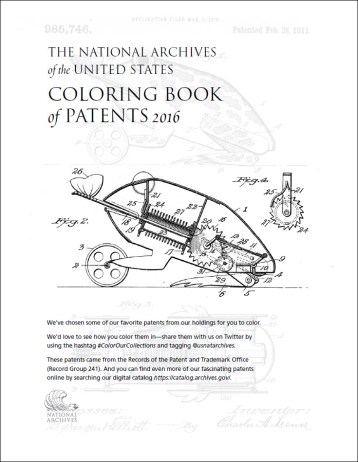
National Archives Coloring Book of Patents


The people at the National Archives of the United States in Washington DC chose some of their favorite patents from the past to share with you as a coloring book. As you have fun coloring these pages full of ideas, let yours fly too!

Click here to get your printable National Archives Coloring Book of Patents

celebrate-picture-books-picture-book-review-hedy-lamarr's-double-life-cover

You can find Hedy Lamarr’s Double Life: Hollywood Legend and Brilliant Inventor at these booksellers

Amazon | Barnes & Noble | Books-a-Million | IndieBound

Picture Book Review

January 8 – COVER REVEAL! Winged Wonders: Solving the Monarch Migration Mystery

celebrate-picture-books-picture-book-revew-Winged-Wonders-Cover-Reveal-image

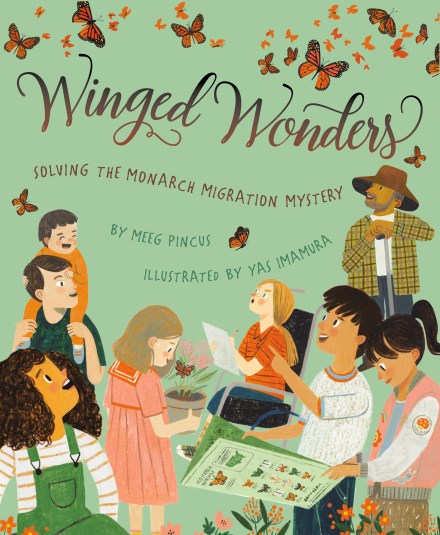
Winged Wonders: Solving the Monarch Migration Mystery

Written by Meeg Pincus | Illustrated by Yas Imamura


For hundreds of years as butterflies with orange-and-black wings as intricate as stained glass came and went in communities across North America, many people wondered “Where are they going?” In 1976, this question was finally answered—it was the Great Monarch Butterfly Migration! Each year, people discovered, millions of monarchs flew thousands of miles from Canada to a roosting place in the Sierra Madre mountains in central Mexico.

Winged Wonders: Solving the Monarch Migration Mystery reveals the diverse community of people who worked together to track the butterflies and find their migration path. Through vibrant illustrations, readers are taken on a journey following the monarchs and meeting the people they encounter along the way.

Backmatter includes an Author’s Note explaining more about the Monarch Migration as well as information on ways that readers can help sustain the Monarch population, making Winged Wonders a stirring book to share with nature lovers, young conservationists, backyard gardeners, and students in STEM/STEAM-related lessons.

When a book is this intriguing, you just can’t wait to see it! But before I reveal the cover of this book, which KIRKUS—in their starred review—calls “riveting” and “a fascinating and inspiring STEAM-driven tale,” let’s chat with author Meeg Pincus and illustrator Yas Imamura who have brought this extraordinary story to kids.

Meet Meeg Pincus

celebrate-picture-books-picture-book-review-Meeg-Pincus-head-shot

Meeg Pincus is a children’s author and speaker who loves telling stories about real people who have helped others, animals, and the planet. She lives in San Diego, California. To learn more about her and her books, visit her website.


Winged Wonders: Solving the Monarch Migration Mystery presents such a fascinating way to look at monarch butterflies. Can you describe the story a little and talk about what inspired you to write it from this perspective?

Thank you, Kathy! Well, I got sucked into the history of the mysterious monarch migration several years ago when I took my kids to see a movie about it at our San Diego science museum’s amazing domed IMAX theatre. (I went back two more times!) I originally started researching a person on the 1970s tracking team for a picture book biography, but then a series of events led me to rethink that. I came to realize that an even more interesting approach was a collective one. It took many people to put the pieces together of this great “discovery”—from scientists to citizen scientists to everyday folks paying attention to nature—and that’s an important lesson for kids. So, using questions, my story takes kids on a journey to meet different people who each played a part, large or small, in solving the great monarch mystery. Then, it comes back around to asking kids what part they might be able to play in keeping the (now threatened) monarchs alive today.

How did you go about researching this story?

To get information on the people involved in tracking the migration, I collected every primary source I could, from articles they wrote to interviews they gave (so, words from their own mouths) and photos of them during that time. I also found secondary sources—articles about the monarchs’ roosting place “discovery” in the 1970s as well as a whole book about all the drama in the world of monarch science (who knew?!). By the way, I use the term “discovery” in quotes because it’s important to realize that there were people in Mexico who knew the whereabouts of the monarchs’ remote roosting place for generations. I also turned to the citizen science organization Monarch Watch, at the University of Kansas (descended from the original tracking team), for information as well; and we were fortunate that one of their experts agreed to serve as the book’s fact-checker.

celebrate-picture-books-picture-book-review-winged-wonders-cover-reveal-national-geographic-cover

This is the 1976 National Geographic issue that broke the story of the Great Monarch Migration, with a story by the main scientist credited with the “discovery.”

What was the most surprising thing you learned while writing Winged Wonders?

Honestly, it was that drama in the world of monarch research. There’s been competition over who gets credit for what, over the sharing (or not sharing) of information, etc. For me, this was actually all the more reason to focus my picture book not just on one person but on how it takes a lot of people working together to further scientific knowledge—and protect species.

This gorgeous cover is just a peek at Yas Imamura’s illustrations. Can you give readers a taste of what they have to look forward to? Do you have a favorite spread?

Oh, we could not have asked for more gorgeous and spot-on illustrations than what Yas created for this book! The whole team at Sleeping Bear Press has been thrilled with her vibrant images, which feel both 1970s and totally today, all at once. I like so many, it’s hard to pick just one—I love how she shows the monarchs flying through Dia de los Muertos celebrations, to them roosting in the trees of central Mexico, to the diversity of citizen scientists she created. I think readers are going to just eat up her illustrations!

celebrate-picture-books-picture-book-review-winged-wonders-Dia-de-Los-Muertos

Image copyright Yas Imamura, 2020, text copyright Meeg Pincus, 2020. Courtesy of Sleeping Bear Press.

On your website, you talk about your work as a Humane Educator. Can you describe Humane Education and its goal? Does being a Humane Educator influence your writing? In what way?

Sure! Humane education teaches about making conscious choices that help people, animals, and the planet. It focuses on empathy and compassion as means to taking action for a more humane, healthy, and just world. I found humane education when my kids were very young and it just brought together all my values and studies. So, I trained with two nonprofit organizations (The Institute for Humane Education and HEART) and started going into local classrooms as a humane educator to do lessons with the kids. As part of my lessons, I decided to read the kids picture book biographies about real people who’ve made a difference for people, animals, and the planet. I fell in love with these books, and realized they also perfectly brought together my background of 20+ years writing/editing nonfiction and my work in humane education—so, I decided to dive into writing them myself as my next career step as nonfiction writer/humane educator!

You also talk about teaching children to be solutionaries. I love that term! Would you define what a solutionary is? You also say that you now write “solutionary stories.” How does Winged Wonders fit into that description and how do you hope the book will influence young readers?

I love the term, too! I got it from my training in humane education. The full definition of a solutionary is “a person who identifies inhumane and unsustainable systems, then develops healthy and just solutions for people, animals, and the environment.” I simplify it for younger kids (I like to use the idea of “solutionary super powers” that we all possess to help others!). Kids really embrace being problem-solvers for people, animals, and the planet. As in Winged Wonders, I focus my books on solutionary people, ideas, and issues—ways people are helping, or can help, create that healthy, kind, and just world for all. I hope my books help inspire kids to find whatever issue affecting people, animals, or the planet sparks their own inner fire and then use their own unique talents and ideas to make a positive impact on it.

One last thing: We’re doing a special Winged Wonders Pre-order Offer with San Diego indie bookstore, Run for Cover—a signed hardback copy with a solutionary sticker and monarch bookmark—which can be sent anywhere in the U.S.

You can connect with Meeg Pincus on

Her website | Facebook | Twitter

Meet Yas Imamura

celebrate-picture-books-picture-book-review-yas-imamura-head-shot

Yas Imamura is an illustrator, graphic designer, and owner of the stationary company Quill & Fox. She grew up in Manila, Philippines, and now lives in Portland, Oregon. Discover more about her work on her website.

What about this story particularly resonated with you?

What I love most about the story is the community aspect to the monarch search—how every person from all walks of life came together in shared curiosity and helped get to the bottom of the monarch mystery.

Can you describe the process for creating and choosing this beautiful cover?

I started with a few sketches, focusing in different imagery. Some early concepts honed in on the monarch butterfly, some with playing on the mystery of their flight. But eventually I ended up emphasizing the people in the story as well, as they play such a huge part in tracking the monarch migration.

Many of your stationery products from your company Quill and Fox as well as your other illustration work incorporate nature themes. What is it about nature that inspires you?

What inspires me most about nature is how incredibly challenging it is for me to really capture. It can be simplistic and incredibly mercurial at the same time, which I think is the beauty of it. As an artist, I feel like I’m always trying to climb that hill.

What kind of research did you do to bring this story to life?

Researching this book was a lot of fun. I was fortunate enough to be given a lot of take-off point resources that I built from. I looked up Catalina’s story a lot to gain insight on her character, her clothes, the era. The movie Flight of the Butterflies also inspired me greatly in pushing the narrative visually. There was so much color to the whole story as we trace the journey of these butterflies, and I really wanted to incorporate all that.

What feelings from the story did you most want to express in your illustrations? What do you hope readers will take away from them?

I want to evoke a sense of fascination and curiosity for these butterflies. And that perhaps learning about the incredible journey and impact of the monarch butterflies could lay the groundwork for us, as caretakers of nature, to give respect and reverence for even the smallest members of our ecosystem.

What do you love about being a picture book illustrator?

Seeing readers, young and old, pour over the pages that I’ve illustrated, especially when they’re reading it to someone else, will never, never get old. It’s the ultimate payoff for me.

You can connect with Yas Imamura on

Her website | Instagram | Instagram: Quill and Fox | Twitter

Thanks so much Meeg and Yas! I’m sure readers are as excited to read Wings of Wonder: Solving the Monarch Migration Mystery as I am! We might have to wait a little bit longer until the book releases in March to read it, but we don’t have to wait any longer to see the stunning cover! 

And now I’m thrilled to reveal…

celebrate-picture-books-picture-book-review-winged-wonders-cover

Winged Wonders: Solving the Monarch Migration Mystery Giveaway

I’m excited to partner with Sleeping Bear Press in Twitter giveaway of:

  • One (1) copy of Winged Wonders: Solving the Monarch Migration Mystery, written by Meeg Pincus| illustrated by Yas Imamura 

Here’s how to enter:

  • Follow Sleeping Bear Press 
  • Follow Celebrate Picture Books
  • Retweet a giveaway tweet
  • Bonus: Reply with your favorite kind of butterfly for an extra entry (each reply gives you one more entry).
  • This giveaway is open from January 8 through January 14 and ends at 8:00 p.m. EST.

A winner will be chosen on January 15. Prize book will be sent from Sleeping Bear Press in February.

Giveaway open to U.S. addresses only. | Prizing provided by Sleeping Bear Press.

To learn more about Winged Wonders: Solving the Monarch Migration Mystery and other marvelous books from Sleeping Bear Press, visit their website.

celebrate-picture-books-picture-book-review-winged-wonders-cover

You can preorder Winged Wonders: Solving the Monarch Migration Mystery from these booksellers

Amazon | Barnes & Noble | Books-a-Million | IndieBound |Run for Cover

Picture Book Review