November 8 – National STEM/STEAM Day

celebrate-picture-books-picture-book-review-santiago-saw-things-differently-cover

About the Holiday

November 8th is National STEM/STEAM Day. This holiday was founded in 2015, and the date was partially chosen for its secret play on words: “NOV 8” can be read as (in)novate! On this day, we highlight the importance of science, technology, engineering, art, and math in education and society at large. This holiday is also meant to uplift voices and perspectives that are often given less representation in STEAM careers and fields of study.

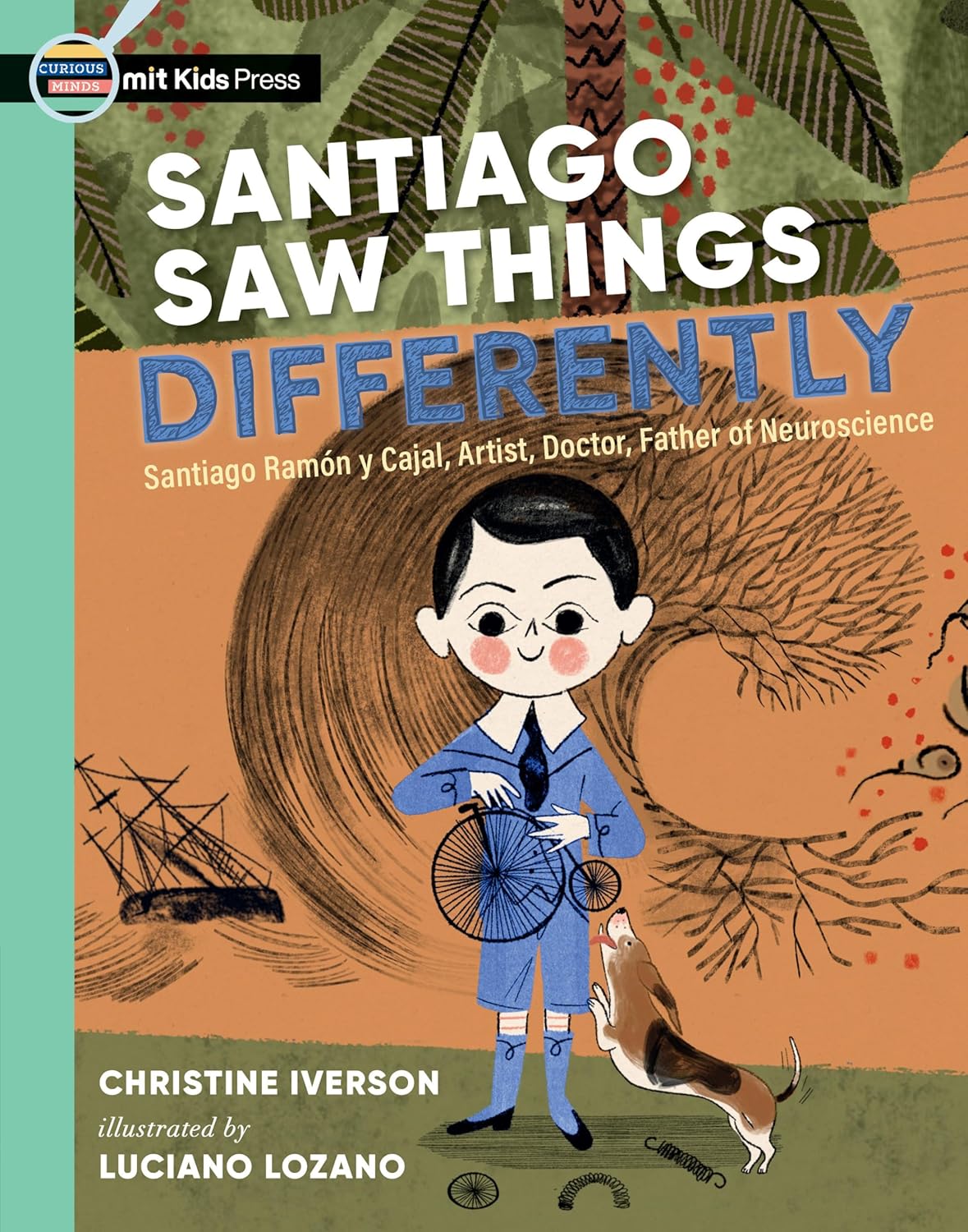
On this National STEM/STEAM Day we review a biography of Santiago Ramón y Cajal, Father of Neuroscience. Despite many people discouraging him along his journey Ramón y Cajal found ways to merge his love for art and observation with his scientific background to create new and important discoveries. 

Reviewed by Dorothy Levine

Santiago Saw Things Differently: Santiago Ramón y Cajal, Artist, Doctor, Father of Neuroscience

Written by Christine Iverson | Illustrated by Luciano Lozano


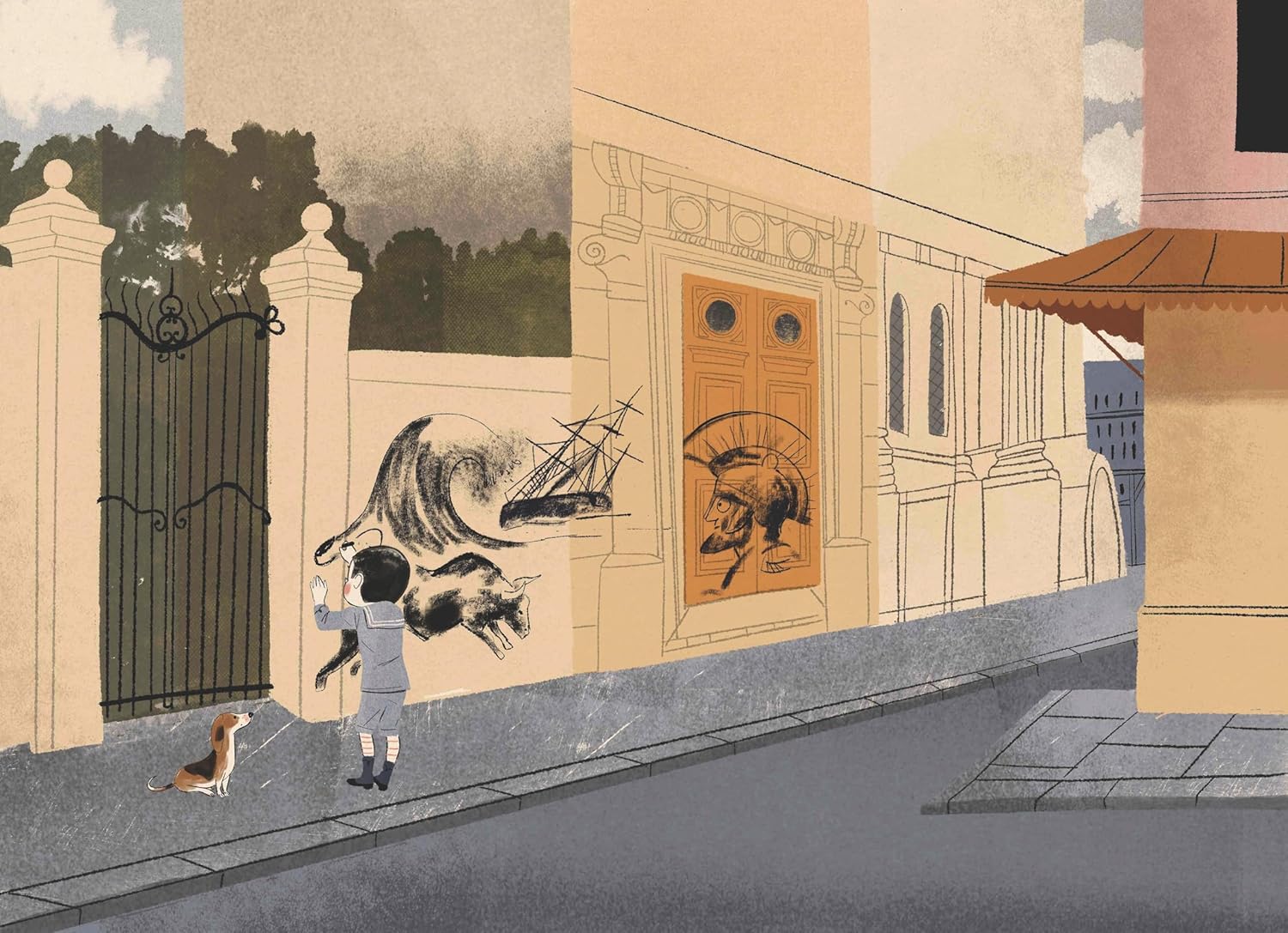
Santiago always had a passion for creating and exploring. As a child in Spain, he spent time creating music and inventing toys with any scraps he could find, drawing elaborate charcoal scenes across neighbors’ walls and racing around his grandfather’s loom shop. There, as “he twirled and tangled woolen thread…. Dust sparked and soared in a kaleidoscope of motion.” Unfortunately, not everybody understood the magic of his creations. Neighbors, and particularly Santiago’s father, believed Santiago’s public displays of art were more bothersome than intriguing. 

celebrate-picture-books-picture-book-review-santiago-saw-things-differently-drawing-on-wall

Image copyright Luciano Lozano, 2024, text copyright Christine Iverson, 2024. Courtesy of MIT Kids Press.

As Santiago’s father ushered him through many different schools, aiming to leave room for no “distractions” from study, Santiago held on to his artistic practice and passion for exploring the natural world in secret. When once admonished for drawing on the margins of his paper, Santiago was forced to spend time in his school’s dark basement. But, in a stroke of luck, “The room was lit by a wisp of light leaking through an old shutter—just enough for drawing.” Another time, stuck in a classroom with no paper, Santiago used his pencil to unlock the door. 

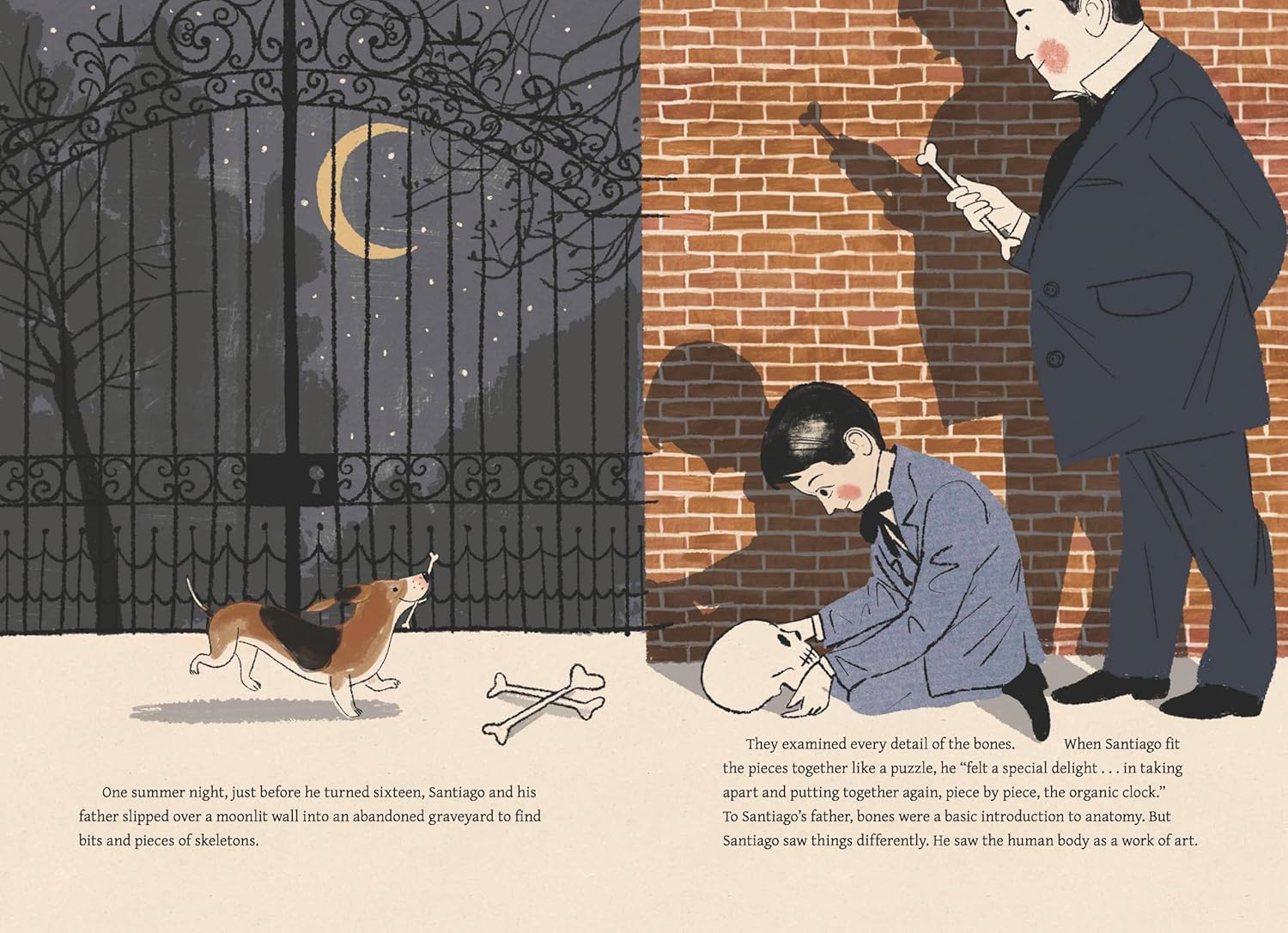
As he grew up, Santiago developed a specific fascination for the human body. At medical school, Santiago observed the way blood vessels in our bodies mirror the canals of the Ebro River near his university. “He saw the human body as a work of art,” a work that replicates in nature and is connected more broadly to the world at large.

celebrate-picture-books-picture-book-review-santiago-saw-things-differently-graveyard

Image copyright Luciano Lozano, 2024, text copyright Christine Iverson, 2024. Courtesy of MIT Kids Press.

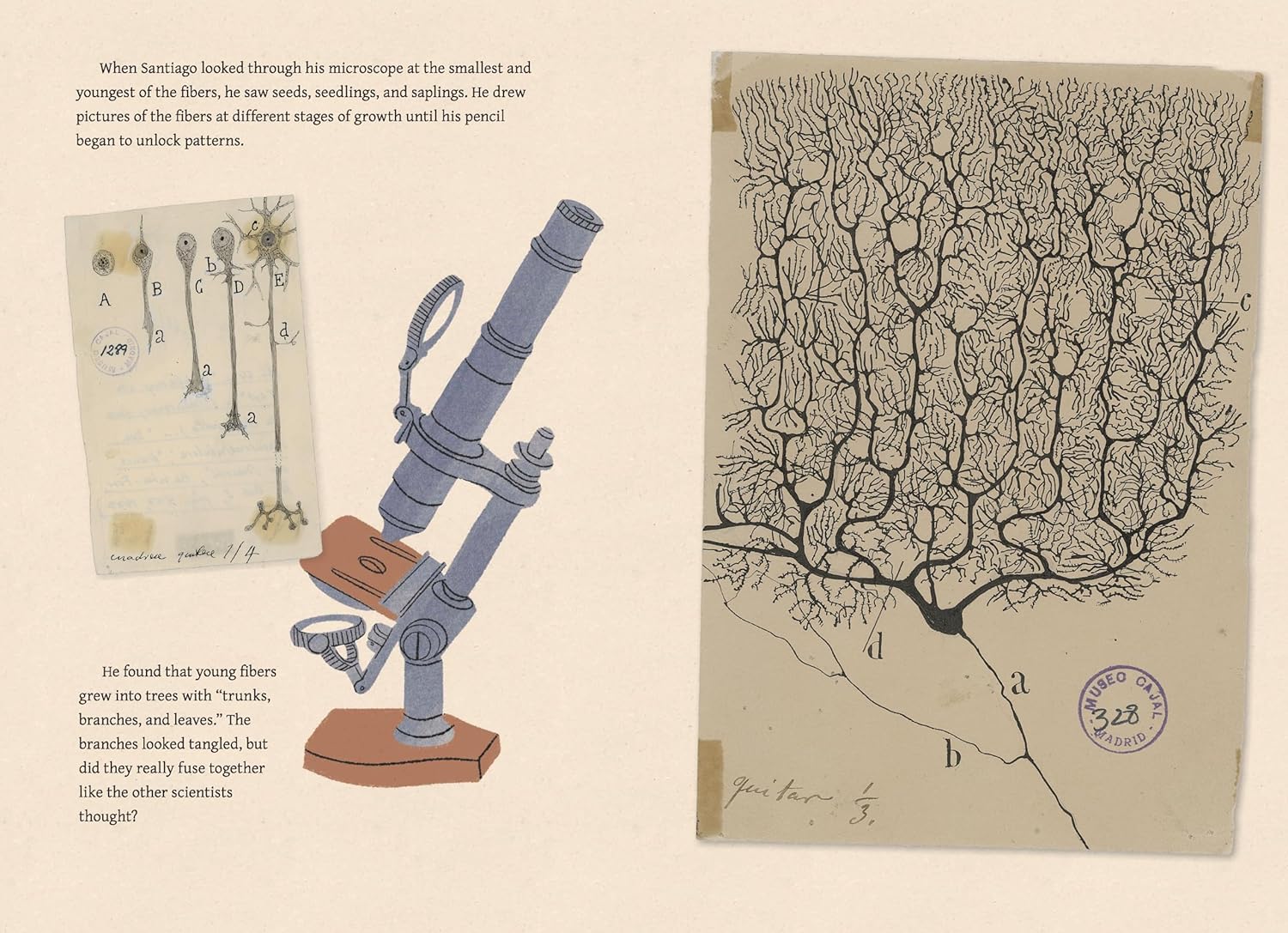
Years later, when scientists were focused on working out how the tiny connectors (or nerve fibers) in our brains worked, Santiago was able to use his microscope and drawing skills to sort out that the fibers spread in a similar fashion to the young trees he had spent so much of his time drawing and observing. With the help of ink stains, study, and lots of drawings of his observations, Santiago drew new conclusions about neurons and cells that helped scientists across the globe to understand the human brain better. 

All because “Santiago saw things differently” he was able to unlock new ways of understanding the brain, gaining him a Nobel prize and the eventual title of the Father of Neuroscience. 

celebrate-picture-books-picture-book-review-santiago-saw-things-differently-microscope-view

Image copyright Luciano Lozano, 2024, text copyright Christine Iverson, 2024. Courtesy of MIT Kids Press.

Iverson writes a detailed lyrical account of the life of Santiago Ramón y Cajal that is accessible for a wide range of readers. For interested older audiences, the book includes extensive back matter on the Anatomy of a Neuron, more biographical information on Santiago Ramón y Cajal and an explanation of the science behind one scene in the story. 

Interwoven with quotes and images from Ramón y Cajal’s original works are Lozano’s masterful swirling illustrations of Santiago and his environment as they both grow and change. Throughout the story, Lozano inserts details for readers to observe and make their own discoveries, such as the dog who follows Santiago throughout his childhood. Lozano illustrates the story mainly in blushing pinks, sky blues and light-yellow browns with accented vibrant greens and darker colors signifying location changes and key turning points in the story. There is a subtle humor helping to lighten the darker parts of Santiago’s life. The tale closes with the image of Santiago face-to-face with a cartoon-like human skeleton (filled with neurons) smiling back at him.

Santiago Sees Things Differently is a celebratory account of innovation, perseverance and appreciation for the often-interdisciplinary nature of outside-of-the-box thinkers. The title page opens with a poignant quote from Santiago Ramón y Cajal himself, encouraging “young investigators” to keep exploring the vast unknown of the natural world and to remember that what is left undiscovered is always larger than what has been already found. Santiago Sees Things Differently provides readers with the empowering knowledge that new perspectives are necessary for new discovery. And that while difference is often looked down upon, it is, often, in fact a superpower. 

(This book is available in both Spanish and English versions)

Ages 5 – 9

MIT Kids Press, 2024 | ISBN 978-1536238334

About the Author

Christine Iverson is a physical therapist with a strong interest in neural pathways. She holds a BS in history from the United States Military Academy at West Point, a doctoral degree in physical therapy from Baylor University, and an M.Ed. with a focus in children’s literature from Pennsylvania State University. She lives in Alexandria, Virginia. Visit her at christineiversonwrites. com.

About the Illustrator

Luciano Lozano is a Spanish author, illustrator, and graphic artist. He is the creator of several picture books, including Mayhem at the Museum: A Book in Pictures, and the illustrator of many others, including I (Don’t) Like Snakes by Nicola Davies. He lives in Spain. Visit him at lucianolozano.com.

STEM/STEAM Day Activities

celebrate-picture-books-brain-coloring-page


Neuroscience Coloring Pages

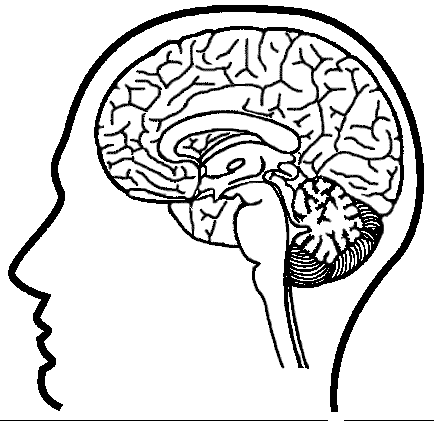
Follow Santiago’s footsteps by coloring pictures of different parts of the brain and scientific tools used in the story with these coloring pages from the University of Washington. You’ll also find brain games, plus loads of printable puzzles, worksheets, bookmarks, and even treasure hunts here too! (Coloring pages available in English and Spanish!)


Build a Hands-on Model of a Neuron

Have fun and learn about neurons by making a model! You can use almost any kind of material you like—clay, perler beads, bread dough, or even candy—to make it. So put on your thinking cap and get creative! You’ll find lots of ideas on this page from The University of Washington’s Neuroscience for Kids Page.

celebrate-picture-books-picture-book-review-santiago-saw-things-differently-cover

You can purchase Santiago Saw Things Differently at these booksellers

Amazon | Barnes & Noble | Bookshop (to support your local independent bookstore)

October 16 – Get Ready for STEM Day (Nov. 8) and World Science Day (Nov. 10)

celebrate-picture-books-picture-book-review-our-galaxy-cover

About the Holidays

Today I’m highlighting two upcoming holidays that celebrate science and introduce kids to the wide-ranging applications that science, engineering, technology, and math have on our lives now and as we move into the future.

STEM Day — November 8

Instituted in 2015, National STEM Day aims to encourage kids to explore the fields of science technology, engineering, and math. This year’s theme is “Hands on Learning” to promote creative and impactful experimentation, innovation, and discovery. Children who are introduced early on to the workings of math and science do better as they advance through school and are more likely to choose science-based careers. Solving many of the problems that the world now faces relies on having a workforce who can think inventively to design a better future for us all. To learn more about STEM and to find lots of free ideas and activities to get kids excited about these subjects all year around—from awesome virtual field trips to labs, space centers, museums, and more to detailed lesson plans and printables to hands-on activities from the National Inventors Hall of Fame—visit Create & Learn.

World Science Day for Peace and Development — November 10

This annual, internationally observed day highlights the importance of science in and for society and is sponsored by the United Nations. Its aim is to promote education and awareness of scientific issues that affect the world and its sustainability as well as to underscore the role that scientists play in improving our lives and developing solutions for the future. 

Thanks go to Phaidon for sharing a copy of Our Galaxy: A First Book of Space with me for review consideration. All opinions on the book are my own.

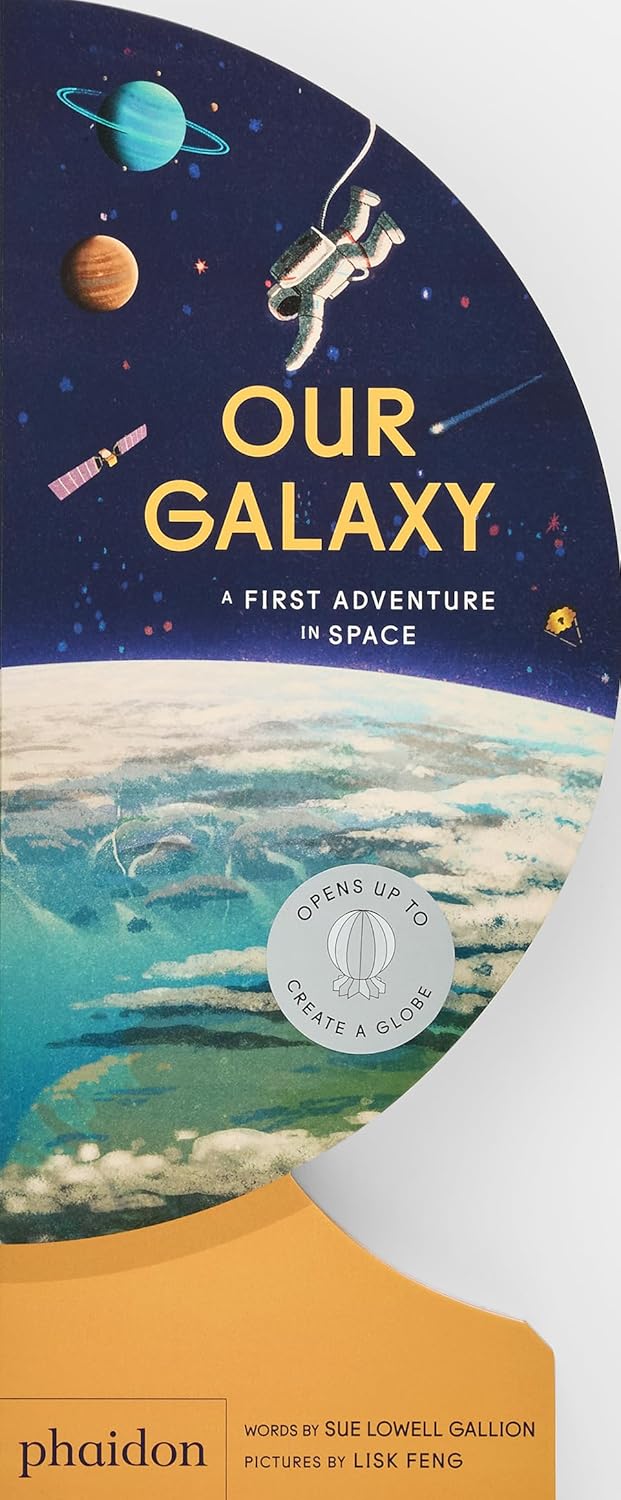
Our Galaxy: A First Adventure in Space

Written by Sue Lowell Gallion | Illustrated by Lisk Feng


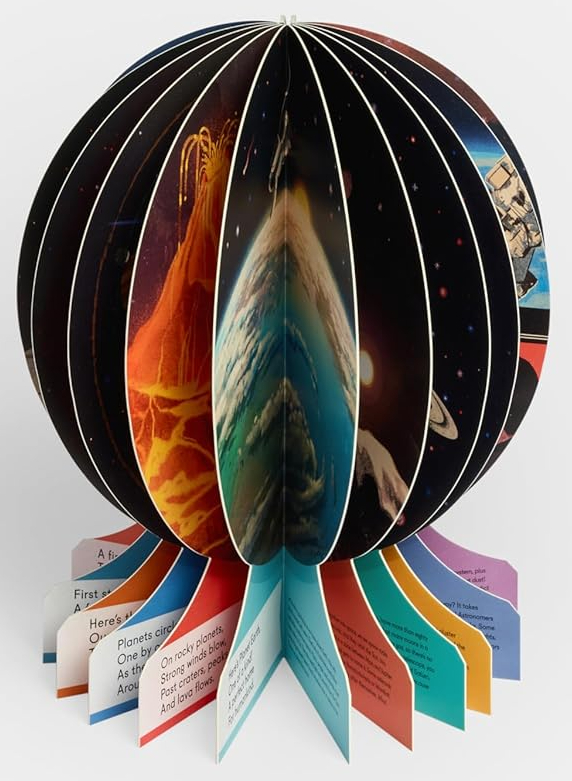
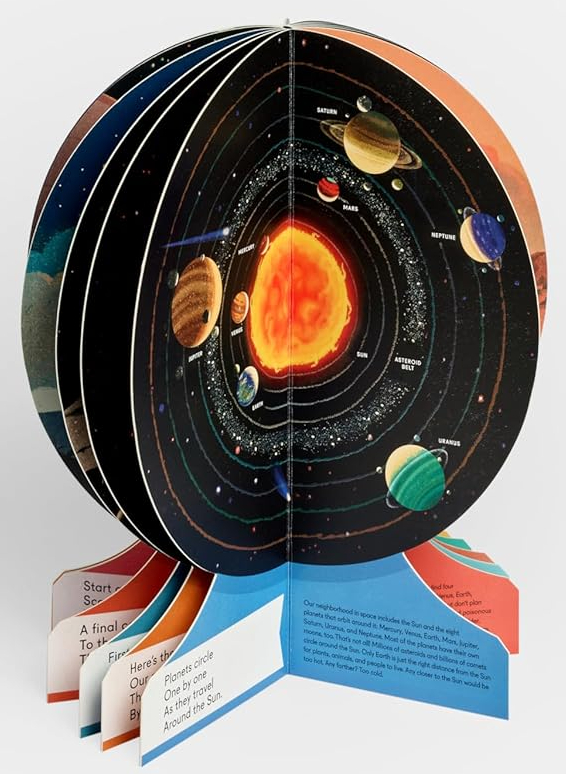
If you want to WOW your young children, students, or library patrons and make them eager to learn about space, science, technology, engineering, and math, open the cover of Our Galaxy: A First Adventure in Space. Then open it a little more . . . and a little more . . . and all the way around until this awe-inspiring book becomes a sturdy, freestanding globe full of adventure and exploration.

celebrate-picture-books-picture-book-review-our-galaxy-globe

Image copyright Lisk Feng, 2024, text copyright Sue Lowell Gallion. Courtesy of Phaidon.

As this journey into space begins, readers find themselves in a planetarium, where Lisk Feng’s mesmerizing illustration of an enormous telescope aimed at the starry sky hints at the marvels above.  Sue Lowell Gallion’s accompanying rhyming couplet invites kids to “Start at sunset, / Scan the sky. / Let’s take a voyage, / Way up high!” 

On the next page readers join viewers on shore to count down “5, 4, 3, 2, 1 . . . Liftoff!” As a rocket is propelled upwards by a fiery blast, a short paragraph explains that “some rockets are like high-tech delivery vehicles” supplying the International Space Station while “other rockets are an astronaut’s ride into space.” She then asks kids whether they’d rather “watch a rocket launch” or “be on board,” a great way to get kids thinking and joining in.

celebrate-picture-books-picture-book-review-our-galaxy-open-pages

Image copyright Lisk Feng, 2024, text copyright Sue Lowell Gallion. Courtesy of Phaidon.

Appropriately, the rocket’s first stop is the Moon. In Feng’s gorgeous painting, kids are beckoned to join two astronauts using a vehicle on the rocky surface as Gallion imparts information about this “familiar face”—facts about the Moon’s orbit, its astronaut visitors, and the long-lasting imprint they’ve made on the Moon. Of course, we wouldn’t be able to take a voyage like this—or even live on Earth—without the Sun, “Our nearest star, / The brightest in our sky, / By far.” Children can almost feel the heat radiating from the sun as they learn about the Sun’s power and size.

celebrate-picture-books-picture-book-review-our-galaxy-Venus-volcanoes

Image copyright Lisk Feng, 2024, text copyright Sue Lowell Gallion. Courtesy of Phaidon.

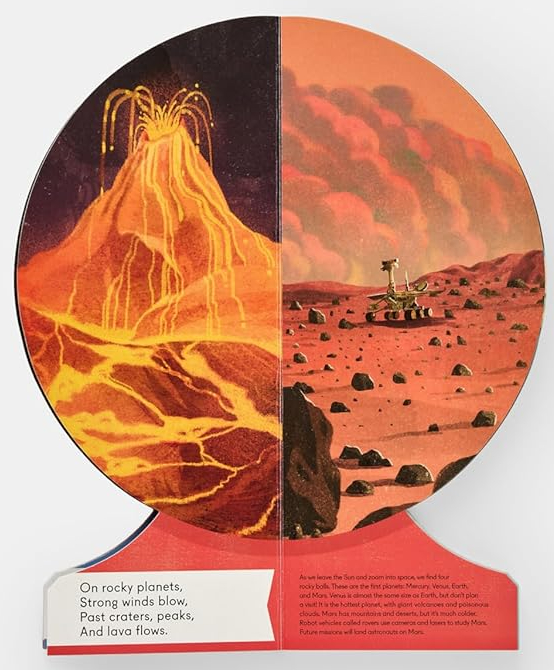
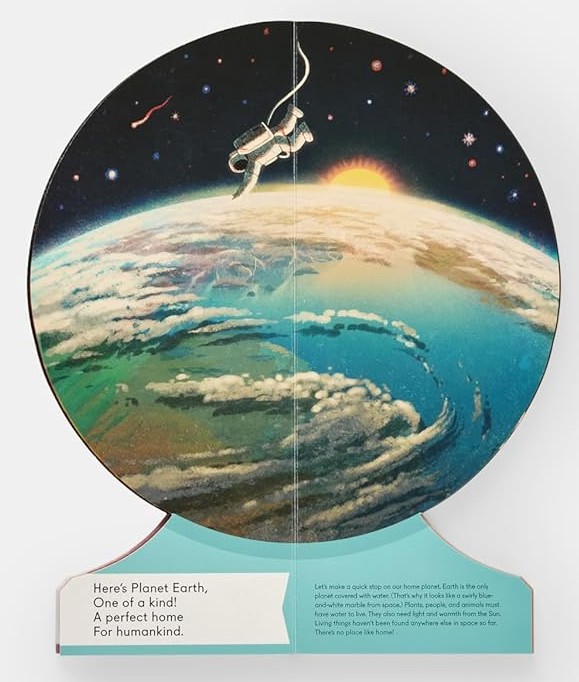
On following pages, kids also learn about our solar system; meet the four rocky planets of Mercury, Venus (complete with a scorching look at one of its volcanoes), Earth, and Mars (which astronauts plan to visit in the future); and discover why Earth is “One of a kind! / A perfect home / For humankind.”

Planets aren’t the only objects in space. On their journey, readers also learn about asteroids—what they are, where they’re found, and even some of their funny names—before zipping on to uncover fascinating tidbits about Jupiter, Saturn, Uranus, and Neptune.

celebrate-picture-books-picture-book-review-our-galaxy-astronaut

Image copyright Lisk Feng, 2024, text copyright Sue Lowell Gallion. Courtesy of Phaidon.

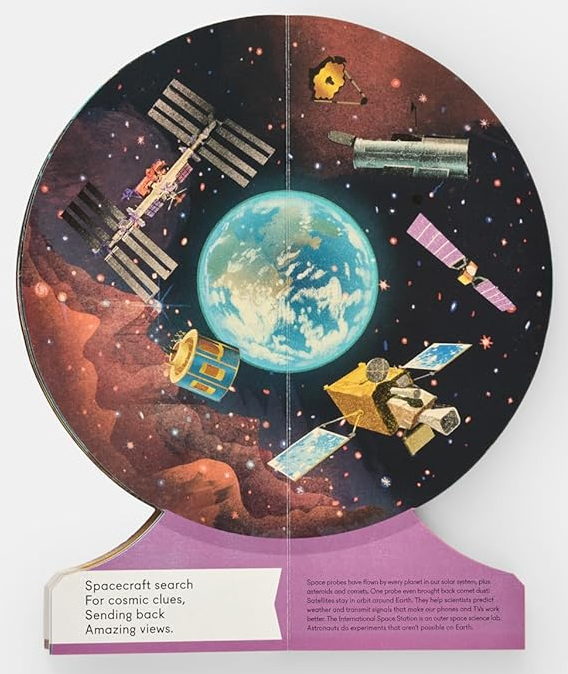
Future scientists and astronauts will want to accept Lisk Feng’s invitation to join astronauts working on the International Space Station and floating in the cosmos. They’ll view a giant telescope that informs scientists about our galaxy and beyond and the technology that monitors space and records data. Kids will also be intrigued by the illustrations of space probes and satellites that, in addition to teaching us about objects light years away, help “scientists predict weather and transmit signals that make out phones and TVs work better.” Returning to Earth, readers have a chance to contemplate “Our universe, / A starry show, / With mysteries / We want to know!”

celebrate-picture-books-picture-book-review-our-galaxy-satellites

Image copyright Lisk Feng, 2024, text copyright Sue Lowell Gallion. Courtesy of Phaidon.

In her poetic and accessible multi-layered text, Sue Lowell Gallion engages both the youngest readers and those ready for more in-depth facts in an inspiring and educational exploration of the wonders of space and a celebration of human curiosity that has propelled us to tremendous scientific achievements. The rigorously researched text is also sprinkled with engaging questions that will get kids excited about joining in discussions at school or at home, while opening their imaginations to what they could accomplish in their future.

In her stunning, realistic illustrations, Lisk Feng captures the breathtaking beauty and vastness of space. Her dazzling images of our solar system are textured and detailed, urging children to look closer (is that a satellite among the asteroids?) and appreciate not only what lies beyond but humans’ early  accomplishments as well as the technology that marks our contemporary era of space exploration.

Sure to ignite wonder, curiosity, and a desire to learn more about space, science, and technology, Our Galaxy: A First Adventure in Space offers endless inspiration for teachers and educators, homeschoolers, and any child enthralled with space. The unique format allows for easy and eye-catching display and will entice kids to dip into this book again and again, making it a must addition to school, public library, and home collections.

Ages 2 – 5+

Phaidon Press, 2024 | Oversized Boardbook: ISBN 978-1838668839

Pair Our Galaxy: A First Adventure in Space with Our World: A First Book of Geography when kids are ready to explore all the wonders on our home planet.

Get Ready for STEM Day & World Science Day Day Activity

celebrate-picture-books-picture-book-review-I-am-the-future-of-stem-activity-book

“I Am the Future of STEM” Activity Book


The coloring pages, puzzles, and other activities in this comprehensive activity book makes an impactful addition to any lesson or simply makes free time fun!

I Am the Future of STEM Activity Book

celebrate-picture-books-picture-book-review-our-galaxy-cover   

You can purchase Our Galaxy: A First Adventure in Space at these booksellers

Amazon | Barnes & Noble | Bookshop (to support your local independent bookstore)

Picture Book Review

May 11 – National Eat What You Want Day

celebrate-picture-books-picture-book-review-poop-for-breakfast-cover

About the Holiday

Do you feel like you’ve been on a diet forever? Have you been denying yourself a favorite treat because maybe it’s not the best thing you can eat? Or do you find yourself always making meals to suit everyone else’s taste when what you really want is just a grilled cheese sandwich? If so, today’s holiday gives you carte blanche to enjoy the foods you want without feeling guilty. It also seems like a fitting day to learn about the rather unusual (at least to us) diet of many creatures in the animal kingdom—and that’s where today’s book come in!

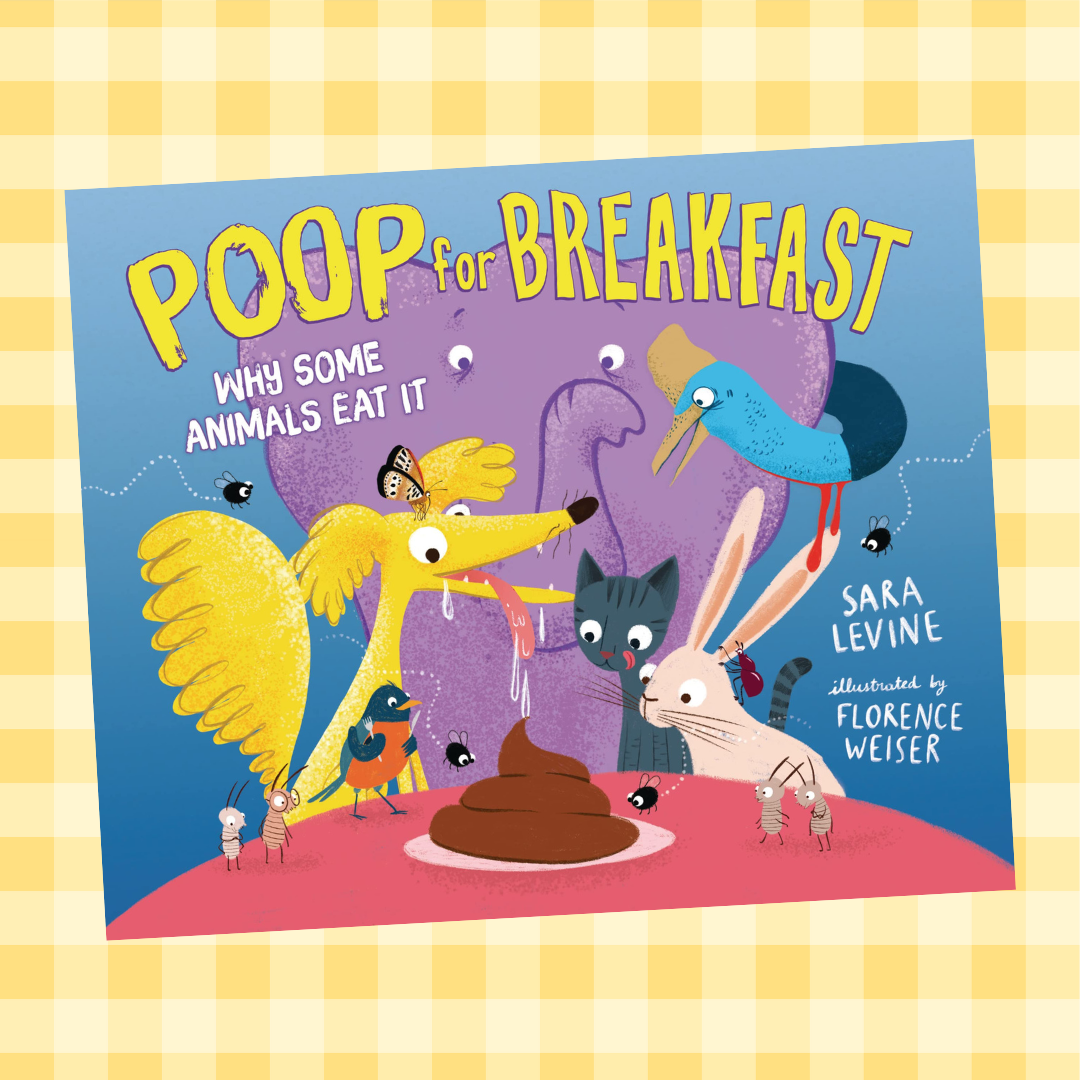
Poop for Breakfast: Why Some Animals Eat It 

Written by Sara Levine | Illustrated by Florence Weiser


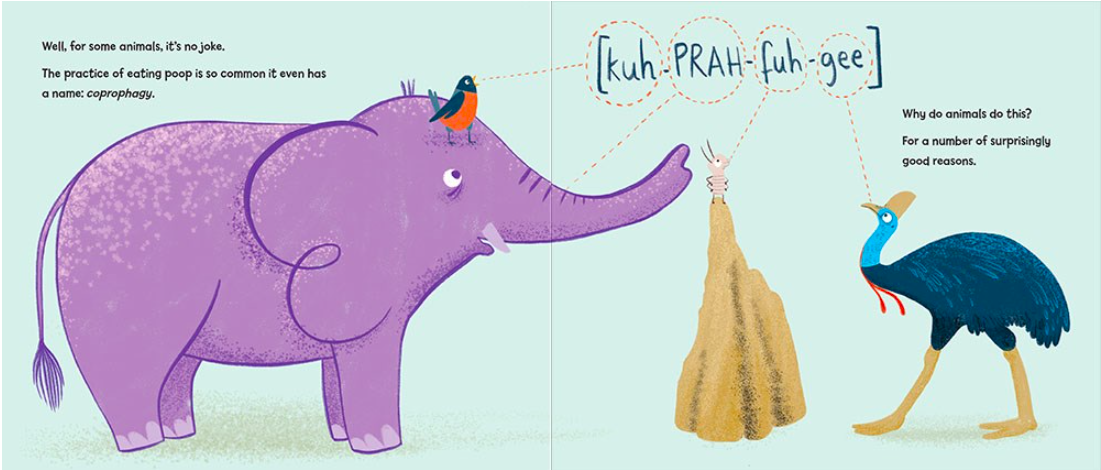
So, you wake up starving for a delicious meal. You’ve been dreaming of pancakes, maybe, or a plate of eggs and bacon. But when you get to the table, there’s a bowl of poop waiting for you?! Come on! While you might sulk (and probably hold your nose), there are plenty of creatures who’d be thinking “Bring it on!” Who are these critters? They’re animals that practice coprophagy, and they do it “for a number of surprisingly good reasons,” Sara Levine reveals.

celebrate-picture-books-picture-book-review-poop-for-breakfast-coprophagy

Image copyright Florence Weiser, 2023, text copyright Sara Levine, 2023. Courtesy of Millbrook Press.

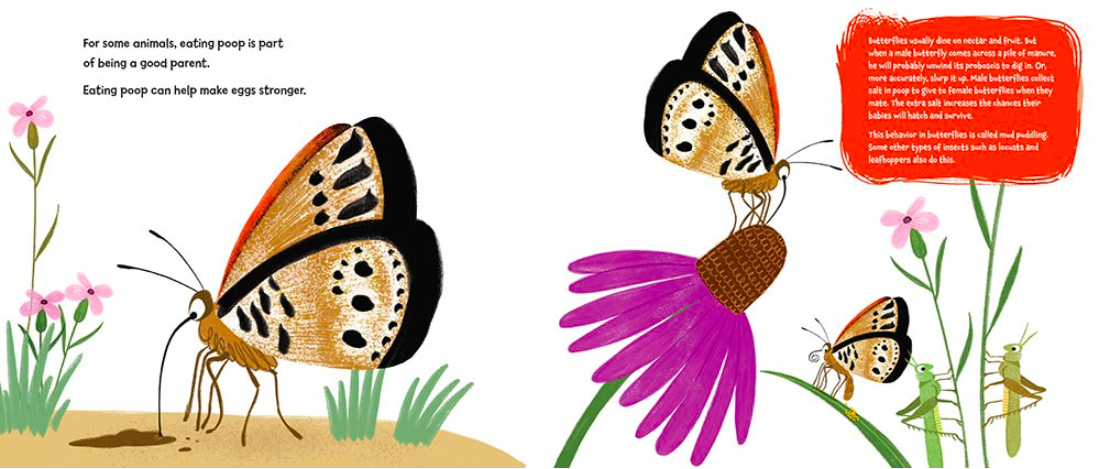
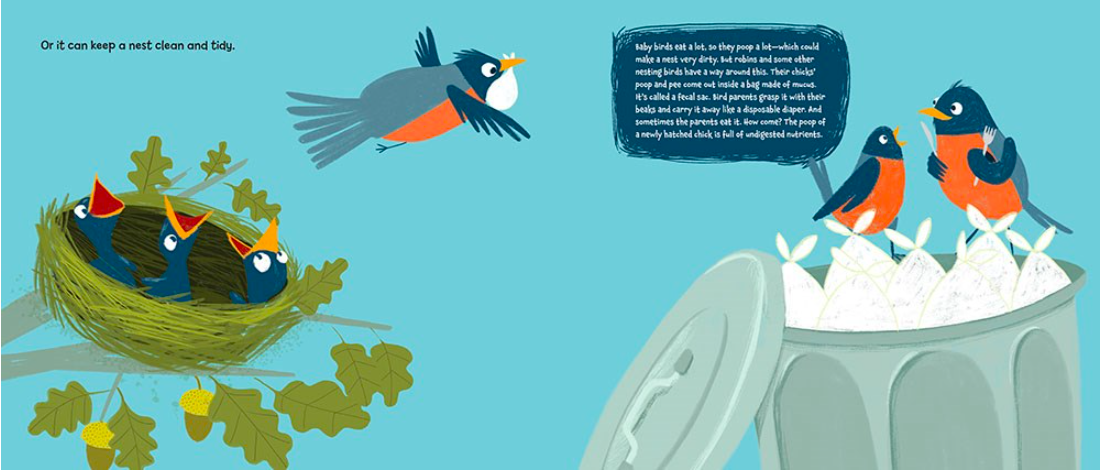
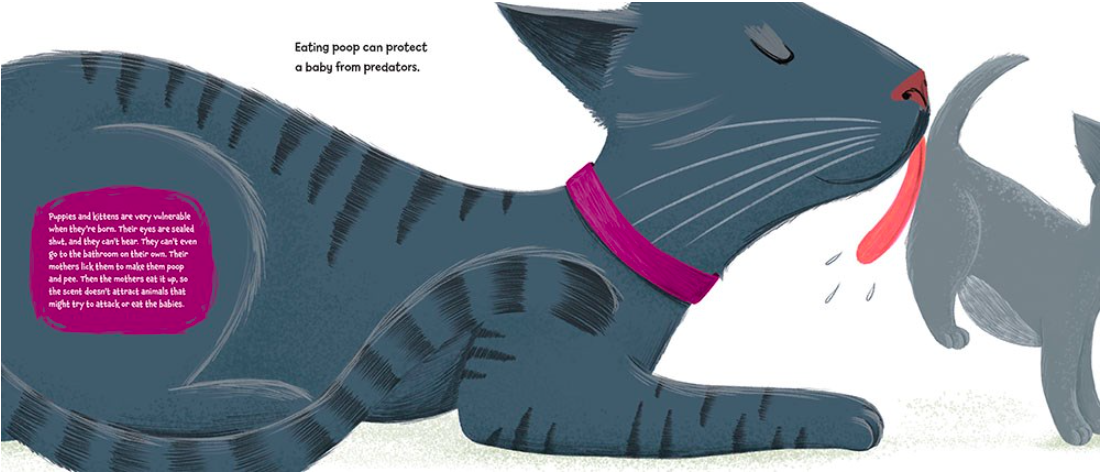
For some animals eating poop is just part of being a Number 1 (or maybe Number 2 is better in this case) parent. Butterflies, cats, and dogs as well as robins and other birds all have specific reasons for dining on doo-doo, from making eggs strong to protecting their babies from predators to keeping “a nest clean and tidy.” Birds have a particularly fascinating way to do this. Since baby birds eat a lot, they poop a lot. Keeping up with that level of cleaning could be daunting. Amazingly, though, these “chicks’ poop and pee come out inside a bag made of mucus. It’s called a fecal sac. Bird parents grasp it with their beaks and carry it away like a disposable diaper. And sometimes the parents eat it. How come? The poop of a newly hatched chick is full of undigested nutrients.”

celebrate-picture-books-picture-book-review-poop-for-breakfast-butterflies

Image copyright Florence Weiser, 2023, text copyright Sara Levine, 2023. Courtesy of Millbrook Press.

While these animals eat poop for external or aesthetic reasons, others engage in coprophagy to keep their digestive system working well. Still others, because of the length or shape of their digestive tract, require that food travels through their body twice to extract all of the nutrients. If you have a rabbit, hamster, guinea pig, or other small rodent as a pet, you know that their poop looks like little round balls or small pellets. As Levine tells readers, “this is the poop that has been through their digestive tract a second time. The first poop comes out soft, sticky, and full of nutrients. It’s called a cecotrope (SEE-ca-trope),” and these animals “gobble it up at night when it comes out. That’s why you don’t see it” in the cage.

celebrate-picture-books-picture-book-review-poop-for-breakfast-robins

Image copyright Florence Weiser, 2023, text copyright Sara Levine, 2023. Courtesy of Millbrook Press.

Since there are so many creatures who do eat poop, why don’t humans? Levine has included a whole list of reasons (and, yes, the frowny- crinkled-nose-face you’re making right now is one of them) for why we don’t—and don’t need to. She’s also provided back matter that includes “The Scoop on Poop”—an explanation of what poop and pee are, how they’re created in the body, and how they’re eliminated through the anus and the urethra as well as a paragraph about creatures that have a single cloaca instead of two openings. Kids will also have fun becoming “poop detectives” with the help of Levine’s and illustrator Florence Weiser’s guide to the sizes and shapes of poop from common pets and wildlife and playing a silly synonym game.

celebrate-picture-books-picture-book-review-poop-for-breakfast-cats

Image copyright Florence Weiser, 2023, text copyright Sara Levine, 2023. Courtesy of Millbrook Press.

Sara Levine is exceptional at presenting fascinating nature science topics in humorous and accessible ways for young audiences, and her latest book is no exception, Leaning into the “Ewww!” factor, Levine dishes up short, take-away reasons certain animals, birds, and insects practice coprophagy followed up with longer passages that explain the science and/or behavior behind them in easy-to-understand language sprinkled with humor that will keep readers riveted to this already high-interest subject.

Florence Weiser’s colorful illustrations perfectly bridge the humorous and the scientific nature of Levine’s text. Readers’ skeptical view of this “gross” habit is amusingly juxtaposed with creatures’ excited anticipation of a delicious meal through the characters’ facial expressions while the anatomical reasons for or against coprophagy are clearly depicted in images of human and various animals’ digestive systems.

Anatomy and nature science education at its best, Poop for Breakfast: Why Some Animals Eat It will keep kids enthralled as each page turn brings on a new round of giggles and avid learning. The book would enhance any home STEM collection and is a must for classroom, school, and public library bookshelves.

Ages 5 – 10

Millbrook Press, 2023 | ISBN 978-1728457963

About the Author

Sara Levine is an author, educator, and veterinarian. Her science books for children include the Animal by Animal series, Germs Up Close, and A Peek at Beaks: Tools Birds Use. Her books have received a number of awards including AAAS/Subaru SB&F Prize, Utah Beehive Book Award, Cook Prize finalist, Monarch Award master list, and Bank Street College Best Children’s Book of the Year.

About the Illustrator

Florence Weiser is a French illustrator currently based in beautiful, rainy Belgium. While growing up in Luxembourg, she always knew she wanted to draw and draw. She lives and works surrounded by nature, from which she gathers most of her inspiration.

celebrate-picture-books-picture-book-review-poop-for-breakfast-cover

You can find Poop for Breakfast: Why Some Animals Eat It at these booksellers

Amazon | Barnes & Noble | Books-a-Million

To support your local independent bookstore, order from

Bookshop

Picture Book Review


April 21 – World Creativity and Innovation Day

celebrate-picture-books-picture-book-review-my-dog-is-not-a-scientist-cover

About the Holiday

World Creativity and Innovation Day has been observed by citizens and organizations in over 50 countries since 2002. In 2018, the United Nations (U.N.) formally established the holiday to promote the importance of creativity and innovation in all aspects of human development, both at the individual and group levels. This day also highlights the importance of applying creativity and innovation to problem-solving for today’s pressing issues, including scientific, economic, social, and sustainable development. Kids seem to do this inherently as they go about exploring and interacting with all the new things they see, hear, and do every day Books like today’s featured title can spur children to put their own unique talents to work to change an improve the world for all. To learn more about World Creativity and Innovation Day, visit the UN website.

Thanks to Betsy Ellor and Yeehoo Press for sharing a digital copy of My Dog Is NOT a Scientist with me for review consideration. All opinions on the book are my own.

My Dog is NOT a Scientist

Written by Betsy Ellor | Illustrated by Louisa Vera


Yara knows she’s the best scientist in town, but how can she prove it when she always loses the school science fair to her neighbor Eddie, who taunts her about being older and smarter and not having a dog like Renzo to mess up his experiments. This year, though, Yara is determined to win. She already has her question to explore: “What makes paper airplanes fly?” and lots of planes to experiment with. But within minutes Renzo has chased down and torn them all apart. “RENZO!!” Yara yells. “Real scientists don’t chase their experiments,” says Eddie.

celebrate-picture-books-picture-book-review-my-dog-is-not-a-scientist-lemon-experiment

Image copyright Luisa Vera, 2023, text copyright Betsy Ellor, 2023. Courtesy of Yeehoo Press.

Next, Yara chooses to use her scientific observational skills to see if she can illuminate a lightbulb with a lemon. But again Renzo causes a catastrophe and Eddie is right there to see it and make a comment.  Undaunted, however, Yara decides to test her hypothesis about “what makes grass grow fast.” She marks off sections of her backyard that are sunny, shady, dry, and wet and gets to work. Renzo feels the call of nature, too – only in a . . . umm . . . different way than Yara. And, yep, Eddie sees it too.

With one week to go to the science fair, Yara comes up with a hypothesis about insects and does a little problem-solving by erecting a Renzo-free tent to carry out her experiment. Maybe Renzo can’t read or maybe he just has to know, but that dogged dog digs deep and finds a way to upset another experiment.

celebrate-picture-books-picture-book-review-my-dog-is-not-a-scientist-renzo-eats-lemon

Image copyright Luisa Vera, 2023, text copyright Betsy Ellor, 2023. Courtesy of Yeehoo Press.

Now the science fair is tomorrow, and while Eddie has a neat and tidy, perfect-looking project to present, “all Yara has to show is Renzo’s damage.” How can she report what she’s learned like a real scientist when she hasn’t learned anything? Yara thinks. With tears in her eyes she’s ready to concede to Renzo that “Eddie’s right…. You’re NOT a scientist . . . and neither am I.” But then Yara looks at her experiments in a different way—from Renzo’s point of view. Renzo, she realized, asked questions, made observations, and “even formed a hypothesis and tested it.”

celebrate-picture-books-picture-book-review-my-dog-is-not-a-scientist-night-before-science-fair

Image copyright Luisa Vera, 2023, text copyright Betsy Ellor, 2023. Courtesy of Yeehoo Press.

Her new perspective gave Yara another idea for her science project. The next day at the science fair, Renzo was Yara’s star exhibit. “Is My Dog a Scientist?” her display asked. Yara tells the judges how Renzo followed his curiosity, how he asked questions, observed, made a hypothesis, and then tested it—just like a scientist. “‘My project proves my dog really IS a scientist,’” she said. The judges agreed and presented Yara with the first-place ribbon. Even though Eddie whined, Yara knew she and Renzo were the best scientists in town—and now everyone else knew it too.

Back matter includes a step-by-step description of the scientific method, some question starters to get young scientists thinking about their own hypotheses, seven questions to spark experimentation, and an invitation for readers to email Yara and Renzo about their experiments. More ideas for experimentation as well as a curriculum guide are also available on Betsy Ellor’s website.

celebrate-picture-books-picture-book-review-my-dog-is-not-a-scientist-science-fair

Image copyright Luisa Vera, 2023, text copyright Betsy Ellor, 2023. Courtesy of Yeehoo Press.

In her clever and creative story, Betsy Ellor perfectly melds the scientific method with sure-to-produce-guffaws humor that will make this book a favorite with kids who are already hard-core scientists as well as those who just like tinkering to explore life’s mysteries. Yara’s determination to win the science fair provides Ellor with a compelling frame to drop examples of real science-based questions and vocabulary into realistic dialog and suspenseful storytelling. The competition between Yara and Eddie also increases the stakes and will have readers rooting for Yara through every mishap. Yara’s inspired thinking on the night before the science fair encourages kids to never give up and prompts them to look at problems with new perspectives and fresh ideas.

Luisa Vera gives kids so much to see and think about in her dynamic illustrations that readers will love exploring for the science, humor, and plentiful details that define the scientific method while demonstrating Yara’s and Eddie’s different approaches to research. But with Yara’s first exasperated “RENZO!!” all eyes will be on this mischievous mutt who just can’t help it if he has a heart for science and a penchant for mischief. Renzo’s various antics will have kids laughing out loud through each of Yara’s experiments and even to the science fair, where even Eddie’s entry attracts the “Renzo” effect.

Funny, effervescent, and loaded with real science, My Dog Is NOT a Scientist is sure to be a catalyst to spark kids’ interest in and understanding of the scientific method as well as the idea that scientific observation and experimentation is a creative process and one that can be unique to each person. The book would enhance any science curriculum for teachers or homeschoolers and is highly recommended for home, classroom, school, and public library collections.

Ages 4 – 8

Yeehoo Press, 2023 | ISBN 978-1953458469

Discover the real-life inspiration behind My Dog is NOT a Scientist!

About the Author

Betsy Ellor lives in a home filled with kid shenanigans, canine chaos and creative projects run wild. Her picture book debut, My Dog is NOT a Scientist launches in 2023 from Yeehoo Press. Her 2021 anthology Heroic Care: 35 Writers & Artists Show What It Means To Care reached the top 30 on Amazon, and her family musical Sara Crewe has been performed across the US.

Midwest-born, Betsy started as a playwright, earning a degree in Creative Writing from Ball State University before shifting her focus to novels and picture books. Betsy works as an interior designer. This explains her uniquely visual voice and her passion for stories that keep creative thinking at the heart of scientific exploration. Betsy lives near the beach in Massachusetts with her son and dog (aka the bringers of chaos). She spends way too much time on the computer but frequently escapes for hiking, biking, paddle boarding, and beach time. Visit Betsy on her website.

About the Illustrator

Luisa Vera was born in Elda, Alicante. After Luisa finished her fine-arts career in Valencia, she went to New York, where she attended the School of Visual Arts. Since 1990, she has dedicated herself professionally to illustration. She is the author/illustrator of Let’s Go to the Museum, a Modern Art Museum Maze and has illustrated Casas del mundo, Salta que salta, among other Spanish-language titles for children. Her work has been featured in the New York Times, the Chicago Tribune, the Dallas Morning News, the Wall Street Journal, the International Herald Tribune, and The Vanguard, and her characters have worn their best clothes on book covers, posters, catalogs, children’s stories, and exhibitions. Luisa lives in Barcelona, Spain. You can follow Luisa Vera on Instagram.

Meet Yara and Renzo in this sneak peek of the book!

World Creativity and Innovation Day Activity

celebrate-picture-books-picture-book-review-sparkle-test-tubes-II

Kids love inventing and experimenting, and these sparkle test tubes give children a fun way to be creative while making a cool way to relax and on those hectic days.

Supplies

  • Plastic test tubes with tight-fitting screw cap, available at craft or science supply stores. Having two or three will allow for more experimentation
  • Glitter glue
  • Hot water
  • Fine glitter
  • Chunky glitter
  • Small glass beads (optional)
  • Neon food coloring (optional)
  • Test tube stand (optional)
  • Whisk
  • Mixing bowl
  • Teaspoon

Directions

  1. Fill a test tube 1/3 full of hot water and pour the water into the mixing bowl
  2. Add 1 – 2 teaspoons of glitter glue (the more glitter glue that is added the thicker the liquid will be and the more the objects will be suspended in the liquid. To allow the objects to flow more freely when the test tube is shaken, add less glue
  3. Whisk the water and glitter glue together
  4. Add chunky glitter, glass beads, or try other small objects
  5. Pour into test tube
  6. Add more water to within a ½ – 1 inch of the top to allow for shaking
  7. Experiment with amount of glitter glue, glitter, and colors

More Science!

Are your kids excited to discover more about the world – and even the cookies they like – through experiments like Yara and Renzo? Then they’ll love the 13 fun and eye-opening experiments on Betsy Ellor’s website. You’ll find them here!

A My Dog is NOT a Scientist Curriculum Guide for teachers, homeschoolers, librarians, and group leaders is also available for download on Betsy Ellor’s website here!

celebrate-picture-books-picture-book-review-my-dog-is-not-a-scientist-cover

You can find My Dog Is NOT a Scientist at these booksellers

Amazon | Barnes & Noble | Books-a-Million

To support your local independent bookstore, order from

Bookshop

Picture Book Review

January 2 – It’s Book Blitz Month & Interview with Author Lydia Lukidis

celebrate-picture-books-picture-book-review-deep-deep-down-cover

About the Holiday

If your motto is “So many books, so little time” then you’ll be happy to know that January is Book Blitz Month! During this month book lovers are given the green light to read as many books as possible! For kids, Book Blitz Month can be particularly exciting as they discover new fiction and nonfiction that captivates their imagination. To celebrate, take your kids to a local bookstore and the library to find new and favorite books to binge on all month long. If you don’t have a dedicated space for your children’s books, this month is also a great time to create a home library for your child so that they have a shelf, a crate, or even a whole bookcase of stories they can enjoy again and again!

I’d like to thank Lydia Lukidis for sharing a digital copy of Deep, Deep Down: The Secret Underwater Poetry of the Mariana Trench with me for review consideration. All opinions on the book are my own. You can read my interview with Lydia below.

Deep, Deep Down: The Secret Underwater Poetry of the Mariana Trench

Written by Lydia Lukidis | Illustrated by Juan Calle


Imagine being invited to visit a mysterious place where only a few have ever been; where only they have truly seen the creatures that inhabit it; and where it’s murky depths are accessible by only one type of vehicle. Would you dare to go? Lydia Lukidis and Juan Calle extend just such an invitation, but no notes for missing school, packing a suitcase, or plucking of courage need to be considered, for through their phenomenal book, readers find a seat in the incredible submersible that will transport them to “…the deepest underwater valley in the world”: the Mariana Trench.

celebrate-picture-books-picture-book-review-deep-deep-down-shark

Image copyright Juan Calle, 2022, text copyright Lydia Lukidis, 2022. Courtesy of Capstone Editions.

The submersible plunges deeper and deeper to where the sun doesn’t penetrate. Here, in the darkness, “food is scarce, and a bone-chilling cold blasts through the water. Earthquakes shake the ocean floor, and the water pressure, like a thick, heavy blanket with a thousand hands, presses down, / down, / down.” What flashes by the porthole window? A monster? No—a fish with a long and slender tail perfectly suited for its austere home, where it can survive for months without eating if necessary. “Diving deeper, a long, thin body slinks and sways, ever so slowly. The cutthroat eel is not fearsome, some rather, mesmerizing.”

The light beam of the submersible also reveals feathery crinoids “twirling and whirling like an underwater acrobat,” and a curious snailfish “dances, ghost-like, to the rhythms of the ocean” as it comes to take its own peek in the window from the other side. Snailfish aren’t affected by the heavy water pressure because “they can swim deeper than any other fish in the world. That’s because their bodies contain RMAO. This special substance protects the fish from high pressure, making sure their bodies aren’t crushed.”

celebrate-picture-books-picture-book-review-deep-deep-down-plunging-down

Image copyright Juan Calle, 2022, text copyright Lydia Lukidis, 2022. Courtesy of Capstone Editions.

It might seem impossible to sink still lower, but the submersible plummets into water populated by tiny creatures, almost insect-like with their multiple pairs of legs and long antennae that propel them and help them find food. But explorers are not at the very bottom of the Mariana Trench even yet. The submersible floats slowly down to the bottom—“the very deepest spot on Earth. Look out the window . . . and witness a world of surprises.” Extraordinary creatures, some small, soft, and translucent and others—neither plant nor animal—large and with protective shells, and all adapted to thrive in their formidable surroundings will amaze you.

At last it’s time for the submersible to return to the surface. Slowly, it makes its way through the darkness to lighter seas, where it passes by more familiar fish and other creatures on its way to “SPLASH!” surfacing once again and “leaving the marvels of the Mariana Trench far below” still waiting to be explored again.

Insets of scientific information on diet, anatomical adaptations, and other aspects that make them suited to their environment also accompany the introduction of each sea creature.

Back matter includes an illustrated cutaway of the ocean above and descending into the Mariana Trench with various sea creatures labeled and oriented to the level in which they are found; “Did You Know?” facts about the water pressure in the Trench, its creation, and how many people have visited; why the Mariana Trench matters; an author’s note; and a glossary.

celebrate-picture-books-picture-book-review-deep-deep-down-deepest-spot-on-earth

Image copyright Juan Calle, 2022, text copyright Lydia Lukidis, 2022. Courtesy of Capstone Editions.

When undertaking an excursion into unknown territory—especially through words and pictures—explorers need guides who can truly immerse them not only in the sights and sounds of an area but also the rhythms and almost intangible aura that makes it so uniquely compelling. Readers of all ages find that quality in Deep, Deep Down. Lydia Lukidis’s lithe and lyrical language is at once straightforward—answering questions any reader might have—and evocative—capturing the enigmatic and secret world at the bottom of the Earth as it flashes into view or slowly reveals itself and retreats again. Her vocabulary, rich with active verbs, ensures that readers appreciate the Mariana Trench as teeming with life and alive with wonders more amazing than we can even imagine.

Don’t be surprised if you find yourself forgetting that you’re looking at illustrations of a vampire squid, anglerfish, rattail fish, cutthroat eels, crinoids, and even the rocky and sandy ocean floor instead of photographs as you inspect Juan Calle’s magnificent pages. As the submersible—seen from many angles—plunges into darker and darker water, bioluminescent fish begin to appear alongside their grayer sea mates (children will enjoy pointing out the dark shapes that lurk in the shadows of the submersible and the stony outcroppings.)

As a rattail drifts into view, each rose-gold scale is visible, shimmering in the beam of light thrown from the submersible; it’s blue eye seemingly as curious about readers as they are about this unusual fish. Calle mesmerizes with careful details, shading, and perspective that portrays each creature in all of their weird and wonderful floating, creeping, or stock-still spectacle.

Deep, Deep Down: The Secret Underwater Poetry of the Mariana Trench will thrill ocean and nature lovers and will spur increased interest and research into this unique, nearly untouched habitat that we are only now beginning to discover. The book is a must for any environmental science enthusiast at home and for all classroom, school, and public library collections.

Ages 7 – 10

Capstone Editions, 2022 | ISBN 978-1684466153

About the Illustrator

Juan Calle is a former biologist turned science illustrator, trained on the Science Illustration program at UC Monterrey Bay. He worked early on his illustrator career for field guides of plants and animals of his country of origin, Colombia, and now owns and works in his art studio, LIBERUM DONUM in Bogota, Columbia, creating concept art, storyboarding and his passion: comic books. You can connect with Juan on Instagram.

Take a plunge into Deep, Deep Down with this book trailer!


Meet Lydia Lukidis

celebrate-picture-books-picture-book-review-Lydia-Lukidis-headshot

Lydia Lukidis is the author of 50+ trade and educational books for children. Her titles include DANCING THROUGH SPACE: Dr. Mae Jemison Soars to New Heights (Albert Whitman, 2024), DEEP, DEEP, DOWN: The Secret Underwater Poetry of the Mariana Trench (Capstone, 2023), THE BROKEN BEES’ NEST (Kane Press, 2019) which was nominated for a Cybils Award, and NO BEARS ALLOWED (Clear Fork Media, 2019). A science enthusiast from a young age, she now incorporates her studies in science and her everlasting curiosity into her books.

Lydia is an active member of SCBWI, CANSCAIP, 12 x 12, and The Authors Guild. She’s very involved in the kidlit community and also volunteers as a judge on Rate your Story. Another passion of hers is fostering love for children’s literacy through the writing workshops she regularly offers in elementary schools. Lydia is represented by literary agent Miranda Paul from the Erin Murphy Literary Agency.

You can visit her on her Website (with order links) | her Blog | Facebook | Twitter and you’ll also find her on Goodreads.

Hi Lydia! I’m really thrilled to have the chance to talk to you about this gorgeous book, how it all came together, and your other work as a writer.

You have degrees in Pure and Applied Science as well as English Literature. After graduating from college did you work in the science field? If so, can you talk about your work a little? How has your science background influenced your writing?

When I was younger, I was drawn to both science and the arts. I once saw them as mutually exclusive but then came to realize how connected these disciplines are. Upon graduating university, I did something completely out of left field but that satiated my artistic desires. I started my own jewelry line! After that, I became a puppeteer, writing plays for children. That brought me back to my love of writing, and here I am writing kidlit. I often focus on STEM topics so it’s full circle. I feel like this is truly where I belong.

What drew you to write about the Mariana Trench for children? What kind of research did you do in creating this book?

In 2019, I read an article about how scientists found a plastic bag floating in the Mariana Trench. They also discovered plastic in the belly of various marine animals. My heart sank. I wondered how we human beings managed to start damaging one of the most remote places on the planet.

At that point, I didn’t know that much about the Mariana Trench and my curiosity grew. I began my research on the internet and then came to realize most of that information was false. The book really came together once I interviewed a slew of experts (7 in total) who’ve devoted their lives to studying the deep sea, the hadal zone, and geology. They also helped me find the right books and articles to read for updated information.

What was the most surprising thing you learned during your research? Do you have a favorite creature or one that you’d like to learn more about?

The most surprising thing was that despite the hostile conditions in the trench (no sunlight, scarcity of food, and crushing pressure), life still thrives deep, deep down. Though, the creatures are not what you would expect. There aren’t any sharks, for example, or any large creatures for that matter. My favorite has to be the sea cucumber. I must have watched hours and hours of them oscillating and floating, like underwater ballet. I was love struck!

Your storytelling in Deep, Deep Down is so fluid and as mesmerizing as the Mariana Trench itself. Can you talk about your writing process for this book and how you achieved such a visceral experience for readers?

Wow, what a compliment! Writing this book was nothing short of magical. I’m normally very hard on myself and many books don’t even make it to my agent. Other books take years to figure out. With nonfiction, finding the right structure is crucial. But somehow, with DEEP, DEEP DOWN, I didn’t have my usual “tormented writing struggle.” The writing was fluid and literally flowed out, and never changed in structure. There was a lot of editing, to be sure, I had to rewrite the manuscripts over 55 times to get the facts right, but the vision never changed. Will that always be the case? No! The next book I tried to write crashed and burned (maybe to be resurrected one day), so I’m grateful for this experience.

As a biologist who turned to illustration and who studied at the University of California at Monterrey Bay, Juan Calle must have been a dream match for Deep, Deep Down. Can you talk about how was he paired with your manuscript? When during the publication process did you begin to see his work? What emotions did his interpretations of your words stir in you?

Yes! It was Capstone who wisely suggested Juan. When I saw the proofs, I think my jaw hit the floor. He did SUCH a great job at getting all the details right (and believe me, it was tough—I had made a 20-page document with reference photos and notes vetted by Dr. Gerringer, my main consultant.) Although we never met, spoke, or even corresponded via email, Juan was able to follow my direction and bring his own flavor to the table. I think I first started seeing artwork about 8 months ago, so it was a speedy process. His work was stunning and scientifically accurate, although we couldn’t always draw everything to scale. It was also infused with magic.

What do you hope children will take away from Deep, Deep Down?

My goal in writing this book was twofold: firstly, to educate children on the deepest ocean of our world and debunk the myth that “scary” creatures live within its depths, and, secondly, to talk about ocean conservation and the importance of this fascinating ecosystem.

Kids may think the Trench is so far removed from their lives and that their actions don’t matter, or that what happens in the Trench doesn’t affect them. But that’s simply not true. Everything is connected, and I’d like to remind them that our actions affect our planet, even in its deepest spots.

You’ve written over 50 books for children and are very active in the writing community. What do you love best about being an author? What do you find rewarding about helping other writers succeed?

Thank you for the sweet words! I got my start with work-for-hire and most of my published books are for the educational market. DEEP, DEEP DOWN is my first trade nonfiction book, so it feels like a big accomplishment.

What do I love about writing? Everything. That said, it’s also a tough profession and every year, I usually have a moment when I reassess why I keep choosing this craft.

I also love supporting the kidlit community; it comes deep from the heart. I know what it is to struggle as a writer, and I see so many others struggling, hustling, working so hard. I like to support and acknowledge their efforts. Every little achievement is a milestone and should be celebrated!

What’s up next for you?

I’m excited to have just announced my second trade nonfiction book, DANCING THROUGH SPACE: Dr. Mae Jemison Soars to New Heights (Albert Whitman, 2024). I actually wrote this in 2015, and it’s a very long and convoluted story about how it got acquired. I did think long and hard whether or not I should tell this story and I ultimately decided to follow my heart because I felt so connected to the hook of the story. I invested in a sensitivity reader and will do so again once we start the editing process at Albert Whitman. They also chose a fantastic illustrator, Sawyer Cloud.

Other than that, I’m knee deep in other WIPs, some of them fiction. I wanted to try to stay in one lane as an author but it’s just not happening—it seems there are different stories of different genres inside me that need to come out. I’m always following the flow of my inspiration, which is often not linear!

Thanks again, Lydia, for sharing so much about your writing life! I know readers are going to love Deep, Deep Down and will be looking forward to Dancing Through Space!

Book Blitz Month Activity

Screen Shot 2022-12-31 at 10.56.42 AM

Creatures of the Mariana Trench Word Search


The Mariana Trench is home to so many amazing creatures! Can you find the names of seventeen in this printable word search puzzle?

Creatures of the Mariana Trench Word Search Puzzle | Creatures of the Mariana Trench Word Search Solution

celebrate-picture-books-picture-book-review-deep-deep-down-cover

You can find Deep, Deep Down: The Secret Underwater Poetry of the Mariana Trench at these booksellers

Amazon | Barnes & Noble | Books-a-Million 

To support your local independent bookstore, order from

Bookshop | IndieBound

Picture Book Review
December 12 – It’s Read a New Book Month

celebrate-picture-books-picture-book-review-dinosaurs-and-other-prehistoric-creatures-cover

About the Holiday

Read a New Book Month couldn’t come at a better time than during the gift-giving season. Books make gifts that have long-lasting appeal and can seem “new” with every reading or provide comfort, laughs, and joy that never gets old. Today I review two pop-up books for the younger set that adults will enjoy sharing as much as the kids will love hearing—and seeing—them.

I’d like to thank Twirl Books and Barbara Fisch at Blue Slip Media for sharing Dinosaurs and Other Prehistoric Creatures and The Pop-Up Guide: Animals with me for review consideration. All opinions on the books are my own.

Dinosaurs and Other Prehistoric Creatures

Written by Arnaud Roi | Illustrated by Charlotte Molas


If you’d like to see your child’s eyes pop open in delight each time they open a particular book and you have a child who loves dinosaurs, then Dinosaurs and Other Prehistoric Creatures is the book for them! This easy-to-hold book opens upward to provide “Wow!”-inducing reactions to seven awesome dinosaurs three reptiles that kids may recognize as early ancestors to some of today’s land and ocean-dwelling animals—fierce and not so. 

With the lift of the first page, kids come face to face with a giant Argentinosaurus who’s foraging among the foliage to satisfy its daily 880-pound dietary requirement. How did these herbivores digest all of those leaves, ferns, grasses, and other plants? They “also swallowed rocks, which helped grind up the food in its stomach.” Readers also discover the period during which these dinosaurs lived, the region they were found in, their maximum size and their maximum weight. All measurements are given in feet and pounds as well as meters and kilograms.

celebrate-picture-books-picture-book-review-dinosaurs-and-other-prehistoric-creatures-utahraptor

Image copyright Charlotte Molas, 2022, text copyright Arnaud Roi, 2022. Courtesy of Twirl.

Other dinosaurs that come out to meet young paleontologists include the Spinosaurus—who, at “over 49 feet (15 meters) long and 13 feet (4 meters) tall” with a maximum weight of 20,000 pounds (9,000 kilograms) “was the largest known carnivore on land. The most distinctive feature of this popular dino was the sail on its back, which measured “almost 7 feet (2.1 meters) tall” in itself! Kids will also enjoy saying hello to the baby Triceratops that appears to be walking right off the page! Standing nearby is a watchful mom or dad ready to protect their little one. Readers will learn that “Triceratops lived in herds” and when threatened “they would form a circle around their young and face the predator with their horns.”

Of course, the Tyrannosaurus pops up to eat and greet with his fierce “banana-shaped teeth that could grow up to 12 inches (30 centimeters) long.” This 20,000-pound behemoth may have roamed North America 68 million years ago, but it had a surprising connection to today’s crocodiles. Kids will also learn about two herbivores— one with claws more than 3 feet (1 meter) long, and one with a very tiny brain but very intimidating spikes to keep predators at bay—and the largest raptor ever found. The prehistoric reptiles represented here plied the land, sea, and air and were no less impressive than the dinosaurs they shared the earth with.

celebrate-picture-books-picture-book-review-dinosaurs-and-other-prehistoric-creatures-quetzalcoatius

Image copyright Charlotte Molas, 2022, text copyright Arnaud Roi, 2022. Courtesy of Twirl.

Arnaud Roi describes each dinosaur and prehistoric creature in engaging language accessible for even the youngest reader and sprinkles in the kinds of facts about the animals’ anatomy, preferred habitat, diet, and physical prowess that make kids’ eyes widen and spur them to learn more. Roi brings the same enthusiasm and feeling of amazement to his subject that kids feel themselves, making this a book readers will really connect with.

In her three-dimensional illustrations, Charlotte Molas puts the dinosaurs front and center while including images of the environments they called home. You can bet kids will love opening, closing, and reopening the pages to interact with the dinosaurs and prehistoric creatures, complete with roars, stomps, chomps, and shrieks.

With a thick padded board cover and sturdy pages, plus eye-popping illustrations and text that’s just right for young learners, Dinosaurs and Other Prehistoric Creatures is a top choice for dinosaur and science lovers. The book would make a terrific gift and take-along and is highly recommended for home, school, and public library collections.

Ages 3 – 5

Twirl, 2022 | ISBN 978-2408037512

celebrate-picture-books-picture-book-review-dinosaurs-and-other-prehistoric-creatures-cover

You can find Dinosaurs and Other Prehistoric Creatures at these booksellers

Amazon | Barnes & Noble | Books-a-Million

To support your local independent bookstore, order from

Bookshop | IndieBound

celebrate-picture-books-picture-book-review-pop-up-guide-animals-cover

The Pop-Up Guide: Animals

Written by Maud Poulain | Illustrated by Peggy Nille


The fourth book in this well-conceived series that includes Pop-Up Guides to Space, Vehicles, and Natural Wonders takes children around the world to meet the animals that live in ten different environments. Upon opening the book kids find themselves in the African Savanna, where a hippopotamus, three flamingos, and three lions have gathered for a drink. A crocodile suns itself on the bank, while another pokes its head above the water. A cheetah, lounging on a tree branch, also pops out to say hello. Behind them, a zebra, giraffes, gazelle, and mother and baby elephants roam and find food.

In her short paragraph, Maud Poulain tells readers about the African Savanna while also setting up talking points about the illustration: “It stays warm all year round here, with just two seasons: wet and dry. During the wet season, the animals have fresh grass and plenty of water to drink at the watering holes. In the dry season, many creatures may have to travel in search of food and water.” In addition to enjoying the vibrant illustration, adults and kids can talk about which time of year it is and how they know to identifying all of the animals and their particular attributes. Each animal is also labeled on the page.

celebrate-picture-books-picture-book-review-pop-up-guide-animals-forest

Image copyright Peggy Nille, 2022, text copyright Maud Poulain, 2022. Courtesy of Twirl.

With the lift of the page, children then enter the temperate Forest, where “trees, shrubs, herbs, and mosses provide shelter and food for all kinds of animals.” Little ones will be “aww!” struck by the cute rabbits, fawn and mother deer, and baby wild boars greet them. A pheasant takes to the air, while a tawny owl and a squirrel hang out in an oak tree. Colorful butterflies flit among flowers, and a pinecone lies hidden, just waiting to be discovered.

The vast expanse of snowy white meets readers next, along with the polar bears, little auks, ringed seals, caribou, orcas, and snowy owls that live in the Far North. There’s even someone riding a sled pulled by sled dogs making their way over the hills. Leaving the glittering snow, readers enter the eye-popping lushness of the Rain Forest, where vivid blues, oranges, greens, yellows, and reds are on display on the birds, chameleon, poison dart frog, tiger, boa, orangutans, and the thick vegetation will wow kids.

celebrate-picture-books-picture-book-review-pop-up-guide-animals-rain-forest

Image copyright Peggy Nille, 2022, text copyright Maud Poulain, 2022. Courtesy of Twirl.

The fish, rays, mammals, and coral of the Ocean swim by up close for kids, and then it’s off to the driest areas of the world—the Desert. In the African desert, “it almost never rains…and while it is hot during the day, it can get cold at night. From there, readers get to know the birds, animals, and amphibians that call Freshwater Rivers home, then it’s back up into the mountains, which are warm and welcoming during spring and summer but can be snow-covered in late fall and winter. How do the animals and birds survive these opposing environments? Readers witness the ptarmigan, “whose fur and feathers change from brown to white” in snowy conditions in transition, while the snowshoe hare nearby has already become fully white. 

Readers finish their tour of the world’s various environments with a dive into the Tropical Seas, where they can see a large array of creatures—from a clown fish, seahorse, and sea turtle to a porcupine fish, sea urchin, sea star, and more—all in bright colors and on the move in their warm-water paradise. But nature’s bounty is not reserved just for these magnificent habitats. The simple backyard also teems with life, and kids get to spend some time with a little girl and her cat as they sit on the porch as life hums around her.

celebrate-picture-books-picture-book-review-pop-up-guide-animals-desert

Image copyright Peggy Nille, 2022, text copyright Maud Poulain, 2022. Courtesy of Twirl.

In her informative paragraphs—which are written in easy-to-understand language and are the perfect length for young children—Maud Poulain introduces readers to an impressive array of the world’s animals while also imparting facts and tidbits about their habits, anatomy, diet, and other attributes that make them well-adapted to their environment. She also reveals details about the plants and weather conditions of each unique region. Every animal is labeled on the page, allowing kids to play and “I-spy” game as the adult reads the text. 

Peggy Nille realistically depicts each animal while giving them personalities that will charm young readers and draw them into learning about their lives and habitats. Eye-catching colors and beautifully detailed dioramas make each pop-out page one that kids will want to linger over. Their time will be rewarded with enchanting finds tucked here and there and plenty of nature’s gifts to talk about. 

This well-constructed book has a thick cardboard cover with elastic bands on the top corners that can be placed around each page as the book is read to keep it upright for easy viewing or wrapped around the back cover to keep the book closed. The pop-ups, made from sturdy card stock, provide a depth of perspective that enhances the reading experience.

For young readers who are just learning about animals and for those who are ready to discover more about the world’s habitats and the animals that live in each, The Pop-Up Guide: Animals is a book they’ll want to read again and again. It would enhance any child’s home library and is highly recommended for school and public library collections.

Ages 3 – 5

Twirl, 2022 | ISBN 979-1036345166

celebrate-picture-books-picture-book-review-pop-up-guide-animals-cover

You can find The Pop-Up Guide: Animals at these booksellers

Amazon | Barnes & Noble | Books-a-Million

To support your local independent bookstore, order from

Bookshop | IndieBound

Picture Book Review
December 9 – It’s Read a New Book Month

celebrate-picture-books-picture-book-review-octopuses-have-zero-bones-cover

About the Holiday

The month of December is a gift-giver’s delight, and there’s no better gift for everyone on your list than a book (or two or…). With so many new books hitting bookstore shelves, there really is a perfect one to fit everyone’s taste. Young children, especially, benefit from reading a wide range of picture books from laugh-out-loud or touching stories to nonfiction that introduces them to influential people, science, history, nature, math—like today’s book. If you’re looking for gifts to give, it’s not too late to head to your local bookstore to find books that will make your child’s eyes light up.

I’d like to thank Tra Publishing for sending me a copy of Octopuses Have Zero Bones for review consideration. All opinions on the book are my own.

Octopuses Have Zero Bones: A Counting Book about Our Amazing World

Written by Anne Richardson | Illustrated by Andrea Antinori


If you’re looking for a book that opens kids’ eyes and mind to new ways to interact with numbers and fall in love with everything they have to tell about us and the world around us, then you’ll want to wrap your arms around Octopuses Have Zero Bones. This multilayered and eye-opening romp through the ability of numbers to describe, explain, provide perspective, and amaze celebrates the numbers from zero to nine and the power of numbers ten to nine billion.

Kids at all levels will find accessible ways to explore the math concepts that enliven every page, from basic counting to higher-level ideas that include measurement, extrapolation, and estimation as well as complex scientific facts. And how does all of this learning begin? With 0 and simple statement and probing question: “ZERO, all by itself, is nothing. Can you imagine nothing?” It might be hard for kids to think about how “nothing” can be important or have an effect. But Anne Richardson, with illustrative help from Andrea Antinori, reveals that because “octopuses have ZERO bones…” they “can squeeze through very small places.” And, if that doesn’t surprise you, she also presents this fascinating tidbit: “Dry Valleys, Antarctica, gets ZERO rain or snow.” In fact “there’s been no precipitation for two million years.” Two million! That’s nearly as impressive as zero!

celebrate-picture-books-picture-book-review-octopuses-have-zero-bones-whale

Image copyright Andrea Antinori, 2022, text copyright Anne Richardson, 2022. Courtesy of Tra Publishing.

But that’s not all! There are more examples, and then Richardson shows how that simple digit 0 can make a single whole number explode into 100, 1,000, 100,000 and so on. She moves from there to tackle the numbers 1 through 9, by themselves and then attached to one 0. Readers next learn about 10—10 decibels, a creature with 10 legs, 10 fingers, and 10 toes. Those familiar with counting know that 2 comes after 1, and Richardson and Antinori help kids visualize this number with peanut shells that contain two individual nuts, the 2 moons of Mars, and more. Here, readers are shown what happens when two zeros are attached to the number two, and, of course, they’re given a few intriguing examples of 200.

This pattern is continued throughout the pages from 3 and 3,000 to 9 and 9,000,000,000. Along the way, children learn about the different types of clouds, how many times a bear’s heart beats per hour, how many chambers the human heart has, how many grains are in a two-pound bag of rice, and the astounding number of leaves you’d find on a typical mature oak tree. Ever wonder how many gallons of water flow over Niagara Falls every ninety seconds? You’ll find out here—along with the ph of water (7), what that means, and the ph number of other common liquids.

celebrate-picture-books-picture-book-review-octopuses-have-zero-bones-two

Image copyright Andrea Antinori, 2022, text copyright Anne Richardson, 2022. Courtesy of Tra Publishing.

Have you ever tried to measure a raindrop? It’s okay! Richardson shows kids just how big the biggest raindrop can be and reveals what happens if one happens to exceed this limit. Kids fascinated by space will want to check out the pages about the number 8, and future biologists will find interesting facts there too. Entomologists may want to flip to the discussions of the numbers 4, 6, and 9 before settling in to start again at the beginning. The number 9 is pretty awesome, especially if you like narwhals and bananas, and you’ll discover that no matter how antsy you might get while waiting for what seems like for. ev. er, you’ll never, ever be able to jiggle as many times as a cesium atom.

While Octopuses Have Zero Bones ends at nine billion, Richardson reminds readers that while “NINE BILLION is a big number…it’s not the biggest. You can keep counting forever.” Even into the trillions and beyond. In her Author’s Note that follows the text, she reveals the event that sparked the idea for this book and encourages children to “go out into the world and count or measure something, anything”; to do this short-term and long-term; to “be astonished, take a closer look” and “discover many wonderful things.”

celebrate-picture-books-picture-book-review-octopuses-have-zero-bones-six-million

Image copyright Andrea Antinori, 2022, text copyright Anne Richardson, 2022. Courtesy of Tra Publishing.

Andrea Antinori depicts each concept with whimsical illustrations that exude humor and personality while pointing readers to examples of the featured number or numbers. But her pages do much, much more as well. Take two page spreads that portray the number 1 for example. There is an image of our one sun as is mentioned in the text, and there is an image of a man with one heart as mentioned in the text. But this heart is a tattoo, which leads kids to notice that the man has other tattoos—all single images.

He is raising one arm, but at the end of that arm is a hand with five fingers just waiting to be counted. And—oh yeah—next to him is the adorable red octopus from the page about zero, who is also waving at the reader with one arm, but there’s a line of suckers on it (some singular, some in pairs) that also invite counting. And that’s just to get kids started. There are clouds, birds, and a sea full of dots to check out too. Now multiply that kind of clever detail and recurring characters by 30 pages and kids have almost innumerable ways to learn from and engage with this book.

Octopuses Have Zero Bones is a book that readers can page through from beginning to end or dip into whenever curiosity hits. It’s the perfect boredom buster because, as Anne Richardson notes, kids can jump off from any randomly chosen page into their own discovery and research at home, in their neighborhood, or on the Internet.

This book would be a much-used reference on home and bookshelves and is a must for classroom, school, and library collections.

Ages 5 – 9 and up

Tra Publishing, 2022 | ISBN 978-1735311524

You can find a Kids Activity Guide, Teacher’s Guide, and Posters for Octopuses Have Zero Bones to download on the Tra Publishing website.

About the Author

Anne Richardson is an author of experiences that kindle your curiosity. In her work, everything in the world is astonishing and worthy of our attention, from a drop of rain to the way we figure things out together. She is the senior director of Global Collaborations at the Exploratorium, San Francisco, where she works with partners worldwide to imagine and create new science centers and other extraordinary learning experiences. Richardson holds a PhD and an MS in environmental studies from Antioch University New England, and a BA in art history from Northwestern University. She lives in the San Francisco Bay Area with her family, including two little explorers. Visit her at her website.

About the Illustrator

Andrea Antinori is an award-winning illustrator based in Bologna, Italy. Since he was a child, he has loved animals and he has loved to draw them. His favorite animal changes all the time. He likes octopuses very much, but right now, lemurs are the creatures he loves most. He wrote and illustrated the book On the Lives of Lemurs: A Short Treatise on Natural History. Other books he has illustrated include A Book about Whales and The Great Battle, the latter of which has received major international awards including: Best International Illustrated Book — China Shanghai International Children’s Book Fair, Premio Andersen — Best book 6-9 years olds, Selected illustrator for exhibition of Bologna Children’s Book Fair 2017, Italian illustrator in IBBY Honor List 2016. You can learn more about her books and her art on her website and connect with her on Instagram.

Read a New Book Month Activity

celebrate-picture-books-picture-book-review-sock-octopus-craft

Cute Sock Octopus Craft


Octopuses may have zero bones but they sure do have a lot of arms! With this fast and easy craft you can make your own little octopus to count on to keep you company on your bed, your shelves, or on your desk!

Supplies

  • Child’s medium or large size sock, in any color
  • Polyfill, available at craft and sewing stores
  • Ribbon
  • 2 Small buttons
  • Scissors
  • Hot glue or strong glue

Directions

  1. Fill the toe of the sock with a handful of polyfiber fill
  2. Tie the ribbon tightly around the sock underneath the fiber fill to separate the head from the legs
  3. Tie the ribbon into a bow tie
  4. With the scissor cut up both sides of the sock almost to the ribbon
  5. Cut these two sections in half almost to the ribbon
  6. Cut the four sections in half almost to the ribbon
  7. Glue the eyes to the lower part of the head

celebrate-picture-books-picture-book-review-octopuses-have-zero-bones-cover

Buy a Book, Plant a Tree

If you purchase Octopuses Have Zero Bones from the Tra Publishing website, they, in partnership with One Tree Planted, plant one tree for every book purchased. At checkout, you have the opportunity to make an additional donation.

Purchase from the Tra Publishing website

You can find Octopuses Have Zero Bones at these booksellers

Amazon | Barnes & Noble | Books-a-Million

To support your local independent bookstore, order from

Bookshop | IndieBound

Picture Book Review