July 27 – Dog Days of Summer Q & A with Ged Adamson

celebrate-picture-books-picture-book-review-ged-adamson-photo

About the Author

Ged Adamson is a writer and illustrator living in London with his partner Helen and their son Rex. His most recent book Douglas, You Need Glasses! was published by Random House and released this past May. Two previous books—Elsie Clarke and the Vampire Hairdresser (2013) and Meet the McKaws (2015)—were published by Sky Pony Press. Ged has two books hitting shelves in the summer and fall of 2017—Shark Dog from HarperCollins and I Want to Grow from Boyds Mills Press. Ged’s cartoons have appeared in magazines, such as Punch and Prospect, as well as in books and on film. He has worked as a storyboard artist and a caricaturist and also works as a composer for TV and film.

About the Holiday

Here we are in the Dog Days of Summer—that time from July 3 to late August—when the air is still, the sun is bright, and the beach beckons. Although the phrase “dog days” conjures up images of Fido panting and lethargic, the term actually refers to the dog star Sirius—the brightest star and, in Greek mythology, the hunter Orion’s dog. To the ancient Greeks and Romans, the “dog days” occurred when Sirius rose and set with the sun, lending its warmth to the day.

Q & A with Ged Adamson

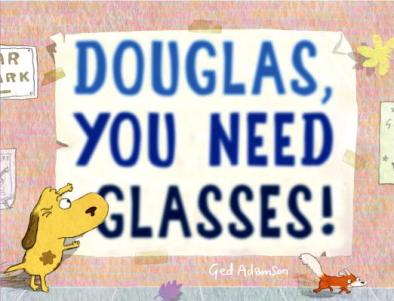
Today, Celebrate Picture Books is featuring another rising star—Ged Adamson. Ged took some time to talk about his work, his inspirations, and that stellar, spectacles-wearing canine Douglas of:
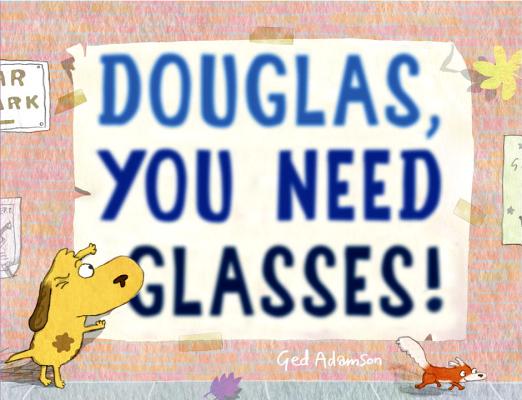
celebrate-picture-books-picture-book-review-douglas-you-need-glasses-cover

What books did you enjoy most as a child?


I wasn’t a great reader of chapter books as a child and I don’t remember us having picture books in the house but we did Roald Dahl stories at school. James and the Giant Peach and Charlie and the Chocolate Factory were favourites.

My mum and dad were avid readers. My dad had some great books. As well as novels, he had a lot of factual books about artists and history. One that I loved was about The Illustrated London News and it was full of beautiful Victorian etchings of everyday life in London. There were always books of cartoons by people like Giles and Frank Dickens. And we had loads of Charles Schultz Peanuts paperbacks.

celebrate-picture-books-picture-book-review-ged-adamson-interview-a-kestrel-for-a-knave-cover

My grandad was Scottish and we used to get a Scottish newspaper every weekend called The Sunday Post. There was a comic section for kids. The two main strips in it were The Broons and Oor Wullie. The characters inhabited a kind of 1950s world which I loved. We would get The Broons and Oor Wullie annuals every Christmas.

The first proper books I read of my own accord were collections of short horror stories that I borrowed from my older brothers. Reading them, I would be scared to death but I couldn’t stop. We did some great books in school that I really enjoyed like Animal Farm by George Orwell, A Kestral For A Knave by Barry Hines and Lord of the Flies by William Golding. And in the school library they had some decent novels for older kids and they had Tintin and Asterix the Gaul in French.

What influenced you to write Douglas, You Need Glasses!?


It was a little drawing I did of a dog in glasses smoking a pipe. Like most doodles, it was done without really thinking. But I was trying to come up with ideas for stories at the time so I wondered if I could do something with this character.
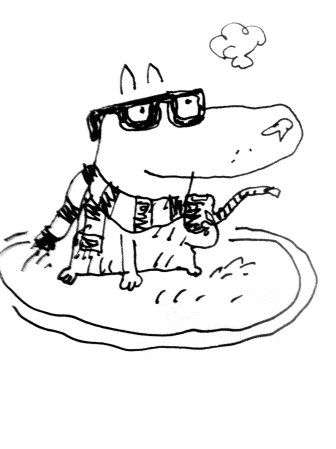
celebrate-picture-books-picture-book-review-ged-adamson-douglas-doodle

Image copyright Ged Adamson

I wear glasses myself so I thought I could use some of my own experiences with short sightedness to develop Douglas’s story. It went through many stages though. In one early idea, Douglas’s newly perfect vision causes him to be too honest about people’s appearances. Another had him befriending a group of insects.

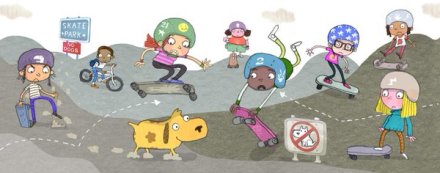
I’d just started to take my illustration style in a different direction, and I wanted to do something that would be visually strong. So from the way Nancy is dressed, the coloured see-through trees, the skate park, the eye chart, through to the big glasses at the end. I was trying to create images that the reader would remember. And most importantly I wanted the story to be funny!
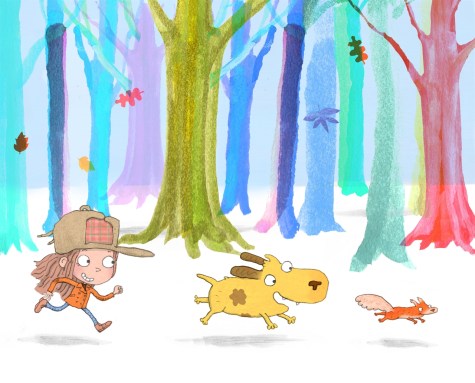
celebrate-picture-books-picture-book-review-ged-adamson-interview-douglas-you-need-glasses

Image copyright Ged Adamson, coiurtesy of gedadamson.com

Can you describe your process when writing and illustrating a picture book?


It will start with an idea. Sometimes, as with Douglas, that will come from a doodle. The next stage is sketches and thinking a lot about the shape of the story. Who are the characters? How will the art look? What is the story saying—what’s its message? I’ll talk to people whose opinions I respect and see what they think—my Agent Isy being one.

The next step is putting together three or four spreads so you get a feel for the tone of the story and how it will look. All the time I’m throwing in bits of text but this changes constantly. I never have a manuscript separate from the images for this reason. To me, the words and pictures can’t exist apart from each other. That’s why I’m always uneasy supplying a manuscript with submissions!

All through this process of me working on a story—and then if I’m lucky, with the publisher—I’ll be chopping things out and adding stuff to solve problems. In my next book, Shark Dog, I’d put a cute little penguin in the final spread. I really liked that penguin! But he had to go because the scene changed from an Arctic sea to a tropical one. And that is a pretty minor change in the grand scheme of things. You have to be prepared for the editor asking to make major overhauls to your book before it goes to the printers.
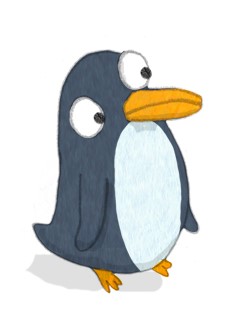
celebrate-picture-books-picture-book-review-ged-adamson-penguin-doodle

Image copyright Ged Adamson

Can you describe your work space a little?


It’s a small room, but it’s mine! I think, no matter how tiny it is, how you arrange the space where you work is important. I like to feel it’s my world and part of my personality. The centre of it is occupied by an old desk with an iMac on it. I replaced my chair recently and I love the new one. It’s like something from an ‘80s quiz show and super comfy. I sometimes record music in there so there are instruments as well as art stuff. There are things I’ve picked up from junk shops and our local market. There’s an old sofa against one wall which is so great when I want to have a break.

celebrate-picture-books-picture-book-review-ged-adamson-interview-ged's-writing-space

Most furniture in our house is second hand. I have bits of paper stuck to the wall with lists of things I need to get done and new book ideas. I’ve got a few pictures up too. There’s one which is just a scene of a rough sea, nothing else—it’s an old framed print. There’s something weirdly relaxing about it. I like that I can look out the window and see the backs of the tall Georgian houses on the other side of the railway tracks. It’s a very London view. I’d like to have a bigger space to work in but I do love my little room.

What is the favorite object on your desk and why?


I want to say something like “Ah, that would be the skull of my great grandfather. He spent his life studying the speech patterns of elk”. But I think it has to be my computer. Though it keeps dropping out of connection which is driving me mad. What the hell, Apple? 

What is the best part about writing picture books?


I remember working on the art for my second picture book Meet The McKaws. I could see the snow coming down outside the window of my little room. I suddenly thought, “I’m really happy doing this”! I hadn’t had that same feeling doing anything else.

Actually, the best part of writing picture books is what I’m experiencing right now with Douglas. People are getting in touch and saying they love the book and the characters. The response from readers is what you look forward to and when you get so much positive feedback for something you spent a long time working on, it’s such a great thing.

But there are other aspects that I love too. Working with talented editors and art directors is a lot of fun and you learn valuable stuff from them too.

It’s also thrilling to see your book on the shelves in a book shop!

What are you working on next?


I’m just finishing work on two books that will be out next year. The first is Shark Dog. It’s about a strange but very friendly animal that stows away on an explorer’s boat. HarperCollins is doing that one. The second is called I Want To Grow, and it’s about a little dinosaur called Herb who gets frustrated that his human friend Muriel is getting taller and he’s not. This one’s with Boyds Mill Press.
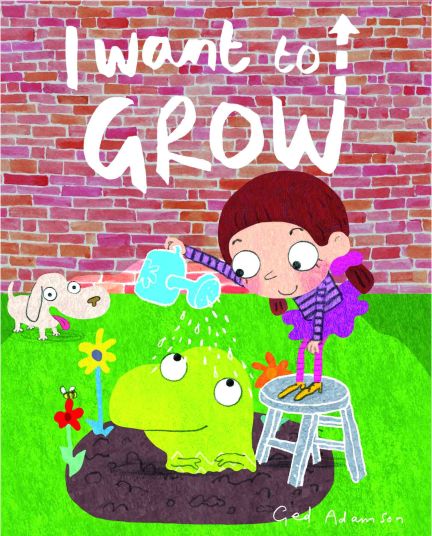
celebrate-picture-books-picture-book-review-ged-adamson-i-want-to-grow-cover

image copyright Ged Adamson

I’m also working on two new ideas. One of those is about a rainbow and it’s almost ready for submission, so I’m excited to see what publishers think.

I can’t properly call this a holiday themed blog without asking you a couple of questions about special dates, so here goes:

What is your favorite holiday?


Because I’ve always done stuff that doesn’t involve a nine to five working week, I feel slightly guilty that I don’t appreciate holidays. Even weekends. On Twitter and Instagram there’ll be loads of people going, “IT’S THE WEEKEND! HURRAY!!” and I’ll be like, “oh yes, yay!”

I do like Christmas though. My son is still quite little so it’s lovely to experience that kid version of Christmas again through him. I’m not the least bit religious, but I really like when people come to our road and sing carols. The TV’s good and there’s lots of drinking and eating. I mean, what’s not to like about that? 

Do you have an anecdote from any holiday you’d like to share?


I remember a school Summer trip where we all stayed for a week in an old country house in the middle of woodland. Rumours began circulating that the place was haunted. Everybody started to get nervous. This wasn’t helped by a drunken teacher one night on his way to bed telling everyone “Don’t worry, the ghosts won’t harm you”. We were now all terrified and a kind of hysteria took over. We started counting the minutes until we could be reunited with our families. Somebody said they saw a ‘misty figure’ as they made their way back from the disco hut. Panic ensued. Even on the coach home there was a sense of looming disaster. Back at school in September, it wasn’t talked about much. I think everyone was embarrassed that we’d allowed ourselves to get into such a state.

Has a holiday ever influenced your work?


In Shark Dog, the explorers and their new pet set off to the seaside in their Morris Minor. For me that is a very English holiday scene but obviously you don’t see many of those cars any more. My mum and dad didn’t drive so our holidays would involve hours on a coach to somewhere like Wales or Devon. In the new story I’m working on, there is a spread with a multitude of people getting off those kind of coaches. It definitely took me back to being a kid!

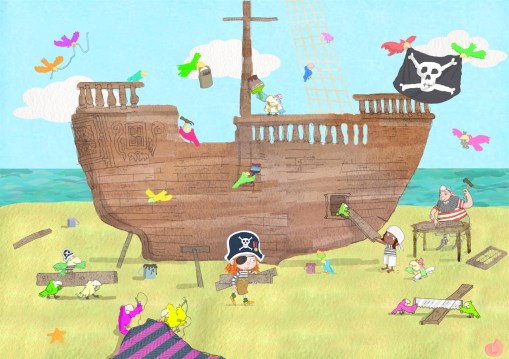
In Meet The McKaws, the story centres on a pirate’s parrot’s family members visiting for a few days. This is an aspect of holiday periods that is fraught with danger!
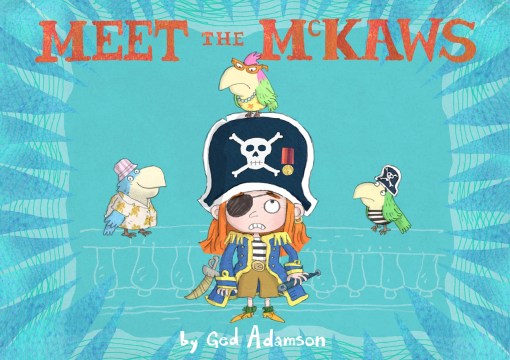
celebrate-picture-books-picture-book-review-ged-adamson-interview-meet-the-mckaws-cover

celebrate-picture-books-picture-book-review-ged-adamson-interview-meet-the-mckaws-rebuilding-the-ship

Image copyright and courtesy of Ged Adamson

I’d like to thank Ged for his insightful and engaging answers to my questions that prove that the Dog Days of Summer are definitely the best (especially when that dog is Douglas)! 
 

celebrate-picture-books-picture-book-review-douglas-you-need-glasses-cover

Ged is giving away a copy of Douglas, You Need Glasses! plus other goodies! Just click to enter the Rafflecopter Giveaway


You Can Connect with Ged Adamson on

Twitter | Instagram | Ged’s Website

You Can Find Ged Adamson’s Books at

Book Depository | Amazon UK | Amazon US | Barnes and Noble | IndieBound

Ged Adamson’s blog tour continues! Don’t miss it!
celebrate-picture-books-picture-book-review-ged-adamson-blog-tour-banner

Review of Douglas, You Need Glasses!

By Ged Adamson


Something may be amiss with Douglas. When Nancy and her playful pooch went out to chase squirrels recently, Douglas ran after a falling leaf while the squirrel escaped up a tree. It’s not the first time something like this has happened. You see, Douglas is a bit nearsighted. Sometimes he mistakes the stair post for Nancy, and his difficulty gets in the way of things (well, mostly Douglas gets in the way of things). He misses important signs—like the one that would have prevented him from tracking wet cement all over the skate park, where there are NO DOGS allowed—and he’s always causing something of a ruckus. Sometimes he even enters the wrong house! But when a game of fetch buzzzzzed toward disaster, Nancy decided something had to be done.
celebrate-picture-books-picture-book-review-douglas-you-need-glasses-skate-park-art

Image copyright Ged Adamson, courtesy gedadamson.com

She took Douglas to the eye doctor where he tried to read a most dog-friendly eye chart. His test revealed that he needed glasses. He found the shelves of Dog Glasses, which offered many options, and had fun trying some on. Each one made him feel different. In one pair he was a rock star; in another a scholar; and in yet another a hippy. He wore them all until he discovered the perfect pair!

On the way home he saw the world in a way he never had before. “‘Wow! Everything looks amazing!’” Douglas said. And it was!

celebrate-picture-books-picture-book-review-douglas-you-need-glasses-interior-art

Image copyright Ged Adamson, courtesy gedadamson.com

Ged Adamson’s funny look at a nearsighted dog will make kids laugh from the first page to the last. Earnest Douglas, going about his doggy days under a bit of a skewed perspective, is so endearing that readers cannot help but love him even as they giggle at his exploits. Adamson’s vibrant multi-hued trees, colorfully clothed kids, and vivid backgrounds with stylish sketched-in details gives the book a fresh, jaunty appeal for a lively, fun story time. Kids facing the prospect of wearing glasses will find lots to give them reassurance and confidence in this book.

Douglas, You Need Glasses is a great addition to any child’s bookshelf!

Ages 3 – 8

Schwartz & Wade, Random House Kids, 2016 | ISBN 978-0553522433

Dog Days of Summer Activity
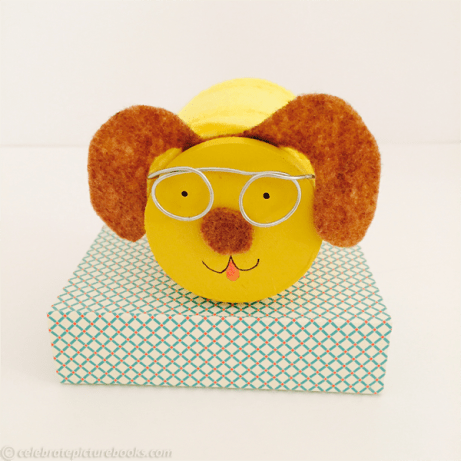
 

celebrate-picture-books-picture-book-review-spool-puppy-craft

Make a Stellar Spool Puppy


No matter where you go and whether you have a real dog or not, you can take this little guy along with you. And just as you would pick out your favorite from an animal shelter, you can make this puppy look any way you’d like!

Supplies

  • Printable ears and nose template
  • 2-inch round wooden spool, available at craft stores
  • 1 skein of yarn in the color you choose. Yardage needed will depend on the thickness of the yarn.
  • Felt
  • Craft paint
  • Paint brush
  • Fabric or strong glue
  • Thin gauge wire
  • Dowel or pencil to wrap wire around to make glasses

celebrate-picture-books-picture-book-review-spool-puppy-craft

Directions

  1. Paint the dowel the color you want your dog to be, let dry
  2. Trace the ears on the felt and cut out (or draw your own ears)
  3. Trace the nose on the felt and cut out
  4. When the spool is dry glue the ears to the body of the spool, allowing the ears to stick up from the top of the spool
  5. Wind the yarn around the spool back and forth until the dog’s body is the size you’d like
  6. Glue the yarn in place with fabric or strong glue

To make the face

  1. Glue the nose over the hole on one end of the spool
  2. Draw the mouth and tongue under the nose with a marker
  3. You will draw the eyes on after the glasses are in place

To make the glasses

  1. Wind the wire around a ½-inch dowel, thick pencil, or rounded handle to make two circles.
  2. Leave about two inches on either side of the circles for the ear pieces of the glasses.
  3. Adjust the size of the circles to fit the spool as glasses.
  4. Put the glasses on the face of the spool, tucking the ear pieces into the yarn on each side
  5. Draw eyes in the center of the glasses

To make the tail

  1. Cut a small square of felt and stuff the edges into the hole on the other end of the spool
  2. You can make the tail as long as you like

Picture Book Review

July 24 – Amelia Earhart Day

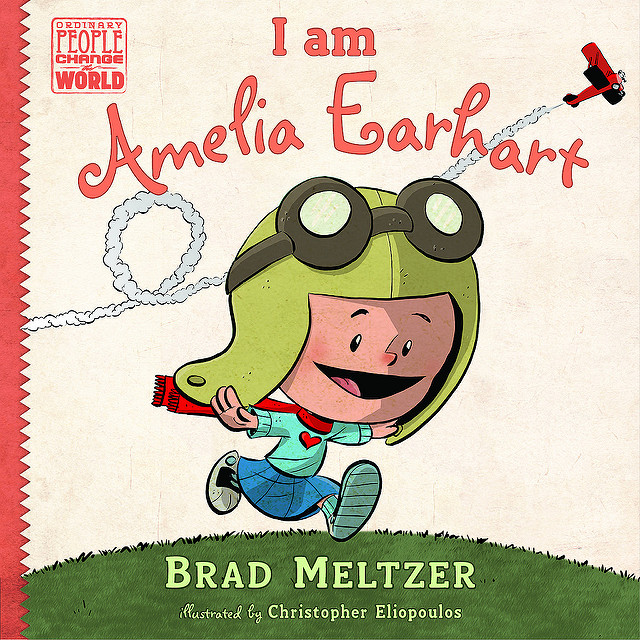
celebrate-picture-books-picture-book-review-i-am-amelia-earhart-cover

About the Holiday

On July 24, 1897 Amelia Mary Earhart was born. With astounding bravery and perseverance, Earhart became the first woman to fly solo across the Atlantic Ocean. She was an author; a founder of the Ninety-Nines, an organization for women pilots; an instructor and career counselor; and she broke many aviation records. Her disappearance over the Pacific Ocean in 1937 remains one of the most baffling historical mysteries.

I am Amelia Earhart

Written by Brad Meltzer | Illustrated by Christopher Eliopoulos


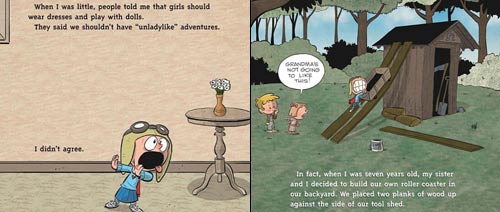
Even as a child Amelia Earhart chafed at the idea that girls could only wear dresses, play with dolls, and have “unladylike” adventures. At the age of seven Amelia and her sister built a roller coaster in their backyard by placing two planks against a shed and making a car from a packing crate with roller skate wheels on the bottom. They even greased the wood to make it “super-fast.”

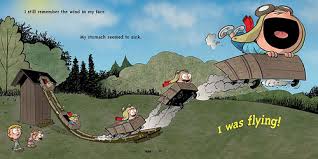
Amelia took the first ride. With the wind in her face she launched off the end of the ramp, catching air and her first feeling of flight. She crash landed a minute later, but declared the experience, “awesome!”

celebrate-picture-books-picture-book-review-i-am-amelia-earhart-interior-art-no-girl-stuff

Image copyright Christopher Eliopoulos

When Amelia was 23 she met Frank Hawks, who took her on her very first flight for ten dollars. It only took her ten minutes to realize that “she had to fly.” To save money for flying lessons Amelia took on many jobs. She worked as a truck driver, a stenographer, and a photographer. In time she learned to fly and within six months of becoming a pilot, she bought a bright yellow biplane that she named Canary.

Amelia admitted that she wasn’t a natural or even the best pilot, but she worked hard to learn the skills she needed. She also bravely dared to do what others wouldn’t or couldn’t. Because of her determination she became the first woman to fly across the Atlantic and then the first woman to fly solo across the Atlantic. At a time when people still traveled from America to Europe by boat, no one thought a woman would be able to fly that far.

To make the flight required the kind of grit that Amelia possessed. The trip took 14 hours and 56 minutes with no stops and no breaks, and when Amelia landed she broke the record for the fastest Atlantic flight ever. She broke other records too, including the woman’s altitude record and a speed record. Despite her success, whenever she set a new goal there were always people who told her she couldn’t do it. But she never let that stop her.

celebrate-picture-books-picture-book-review-i-am-amelia-earhart-interior-art-roller-coaster

Image copyright Christopher Eliopoulos

Her life and achievements serve as inspiration to all who aspire to great heights. Amelia’s advice? “Whatever your dream is, chase it. Work hard for it. You will find it. It is the best lesson I can give you.” And she added this reminder: “I hope you’ll remember that the greatest flight you’ll ever take, is the one no one has tried before.”

Part of Brad Meltzer’s I am… series of biographies, this portrait of Amelia Earhart highlights the traits of bravery and individualism—evident from her youngest years—that fueled her passion for adventure and breaking barriers. Perfectly suited for its audience, the text is conversational and includes funny asides from young Amelia to her readers. The repeated repartee between those who doubted her and Amelia (“you sure this is a good idea?” and “This isn’t a good idea. It’s the best idea!”) emphasizes Amelia’s determination and self-belief that will inspire kids to think likewise about their own dreams. The book follows Amelia from her childhood through her young adulthood and into her record-breaking years with well-chosen facts that illuminate but do not overwhelm. As this is a book to inspire children to reach for their dreams, the book makes no mention of Amelia’s eventual disappearance over the Pacific Ocean, instead leaving kids with wise words from this most iconic and fascinating adventurer.

Children love the accessibility of Christopher Eliopoulos’ I am… series illustrations! Enthusiasm and joy radiate from Amelia Earhart’s face as she races to meet the world head-on. Her dismay with typical “girl stuff” as well as her excitement when flying is evident in her very kid-like expressions. The scenes of Amelia building and riding her homemade roller coaster will make kids’ eyes widen in delight. Amelia’s various flights and planes are beautifully rendered in both up-close views of her aircraft as well as panoramic spreads showing her flying through clouds, over fields, and across the ocean. The full-bleed, vibrant and action-packed pictures will rivet kids’ attention to Amelia’s life and her inspiring message

Ages 5 – 9

Dial Books for Young Readers, 2014 | ISBN 978-0803740822

Keep up with what Brad Meltzer is writing and doing next by visiting his website!

Discover the cartoon world of Christopher Eliopoulos on his website!

Amelia Earhart Day Activity

celebrate-picture-books-picture-book-review-biplane-craft

Soar Toward Your Dreams Box Biplane


If you love airplanes and flying—or if you just have sky-high aspirations—you’ll have fun making your own plane from recycled materials! You can use your own creativity to decorate it or make Amelia Earhart’s Canary while you imagine yourself flying through the clouds on a beautiful day. This is a fun activity to share with an adult or older sibling too!

Supplies

  • Travel-size toothpaste box
  • 3 Long, wide craft sticks
  • 2 Short “popsicle” sticks
  • 5 Round toothpicks, with points cut off
  • Paint in whatever colors you like for your design
  • 4 small buttons or flat beads
  • Paint brushes
  • Strong glue or glue gun

Directions

  1. Empty toothpaste box
  2. Paint toothpaste box and decorate it
  3. Paint the craft sticks and 5 toothpicks
  4. Paint one small craft stick to be the propeller
  5. Let all objects dry

To assemble the biplane

  1. For the Bottom Wing – Glue one long, wide craft stick to the bottom of the plane about 1 inch from the end of the box that will be the front of the plane
  2. For the Top Wing – Glue the other long, wide craft stick to the top of the plane about 1 inch from the front of the plane
  3. For the Tail – Glue one short craft stick to the bottom of the box about ¾ inches from the end that is the back of the plane
  4. For the Vertical Rudder – Cut the end from one of the painted wide craft sticks, glue this to the back of the box, placing it half-way between each side

To assemble the wheels

  1. Cut 4 painted toothpicks ¾-inches long
  2. Cut one painted toothpick 1-inch long
  3. Glue 2 of the short toothpicks to the back of 1 button, the ends of the toothpicks on the button should be touching and the other end apart so the toothpicks form a V
  4. Repeat the above step for the other wheel
  5. Let the glue dry
  6. Glue the 1-inch long toothpick to the center of each wheel to keep them together and give them stability. Let dry

To make the back wheel

  1. Cut two ¼-inch lengths of painted toothpick and glue them together. Let dry
  2. Glue two mini buttons together to form the back wheel. Let dry
  3. Glue the ¼-inch toothpicks to the mini buttons. Let dry
  4. Glue these to the bottom of the plane in the center of the box directly in front of and touching the tail

July 22 – National Hammock Day

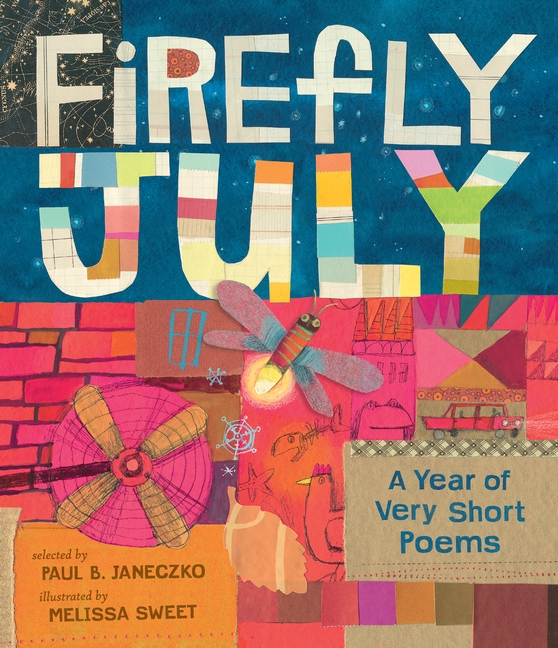
celebrate-picture-books-picture-book-review-firefly-july-cover

About the Holiday

Holidays don’t get more leisurely than this one! Perhaps invented by the Ancient Greeks, perhaps created by people in South America according to Christopher Columbus’s journals, hammocks are the epitome of relaxation. What better time is there to kick back and lounge than during the hot, hazy days of July? So enjoy—and read a book, like today’s collection of poetry!

Firefly July: A Year of Very Short Poems

Selected by Paul B. Janeczko | Illustrated by Melissa Sweet


Firefly July is perfect for lazy summer days when light, but still meaningful reading enjoyed in a hammock or under a shady tree is relaxation at its best. Paul B. Janeczko has collected 36 short (none are over eight lines long) poems from some of the best poets of today and yesterday. Haiku, free form, and rhyming verses illuminate the seasons of the year and encapsulate unforgettable sights, sounds, and feelings.

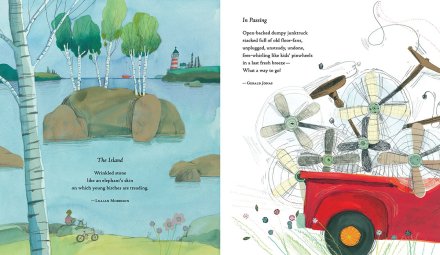
A girl’s spring’s respite spent gazing into the bay from shore is depicted in Lillian Morrison’s The Island:

“Wrinkled stone / like an elephant’s skin / on which young birches are treading.”

celebrate-picture-books-picture-book-review-firefly-july-interior-art

Image copyright Melissa Sweet, courtesy of amazon.com

A nighttime train trip provides mystery and ongoing changes in Carl Sandburg’s Window:

“Night from a railroad car window / Is a great, dark, soft thing / Broken across with slashes of light.”

Joyce Sidman’s A Happy Meeting likens a summer rain to romance and life:

“Rain meets dust: / soft, cinnamon kisses. / Quick noisy courtship, / then marriage: mud.”

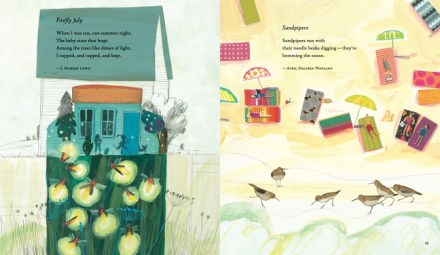
At the seashore, beach birds are industrious in April Halprin Wayland’s Sandpipers:

“Sandpipers run with / their needle beaks digging—they’re / hemming the ocean.”

celebrate-picture-books-picture-book-review-firefly-july-interior-art

Image copyright Melissa Sweet, courtesy of amazon.com

Jim Harrison and Ted Kooser ask such a beguiling question for autumn:

“What is it the wind has lost / that she keeps looking for / under each leaf?”

And the rising giants of city life inspired Susan Nichols Pulsifer in Tall City:

“Here houses rise so straight and tall / That I am not surprised at all / To see them simply walk away / Into the clouds—this misty day.”

Along the way readers will encounter a pickup truck loaded with old rotary fans and another rusting in a field; fog that decorates and creeps; animals and insects that share our space; our past, our present, and our future. And when it’s time to close the book, Jim Harrison and Ted Kooser reveal:

“A welcome mat of moonlight / on the floor. Wipe your feet / before getting into bed.”

celebrate-picture-books-picture-book-review-firefly-july-interior-art

image copyright Melissa Sweet, courtesy of melissasweet.net

I can only wish I’d been able to visit Melissa Sweet’s studio while she created the illustrations for this book! Each painting is as unique in style, beauty, and emotional effect as the poems they interpret. Her renditions of each poem help readers—especially children unfamiliar with metaphor and abstract imaging—to fully understand and appreciate each poem while also leaving room for personal reflection.

The first thing that strikes a reader when opening Firefly July is the gorgeous juxtaposition and mixture of vibrant color. Her illustrations take readers on a journey from an aqua farm house with a patchwork garden to a serene elephantine rock island to the deep turquoise ocean traversed by ships while the full moon beams down upon them. Readers ride crowded subways, gaze out moving train windows, and visit cities bright in daylight and glowing at night. They frolic through fields of delicate grasses and vibrant flowers, quietly walk snowy paths, and take their place among the stars.

Firefly July is as stunning as any coffee table book and is a must for a young reader’s—or any poetry lover’s—library.

Ages 4 and up

Candlewick Press, 2014 | ISBN 978-0763648428

Take a look at more books and artwork by Melissa Sweet on her website!

National Hammock Day Activity

celebrate-picture-books-picture-book-review-hammock-coloring-page

Lazy Days Coloring Page


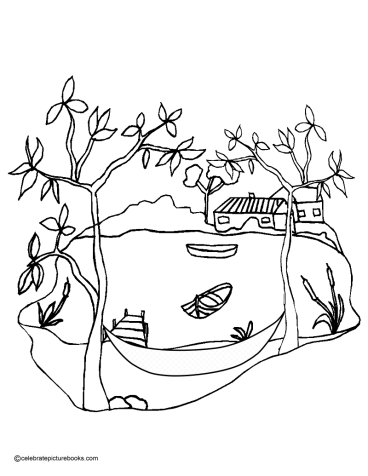
Coloring can be so relaxing—perfect for a day dedicated to kicking back! Color this printable Lazy Days Coloring Page and dream of lounging beside the lake, with the gentle breeze gently rocking the hammock, while you drift off to sleee….zzzz…..

July 21 – It’s National Culinary Arts Month

celebrate-picture-books-picture-book-review-kitchen-dance-cover

About the Holiday

Culinary arts from entrees to desserts and everything in between are celebrated during July. Whether you like going out to restaurants or staying in for a home-cooked meal remember to thank the chef for their time and talents!

Kitchen Dance

By Maurie J. Manning


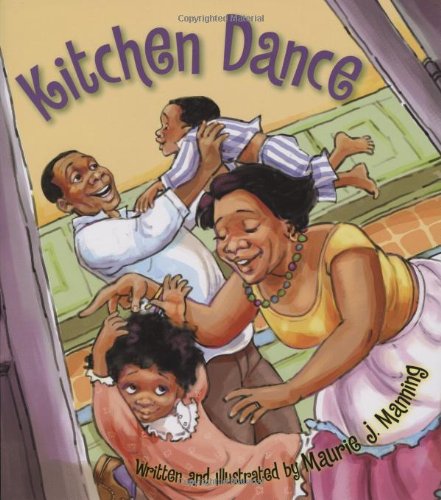
A little girl wakens to sounds coming from the kitchen—“Glasses clinking. Water swishing. Forks clattering.” Then more personal sounds—humming, laughing, and “hush!” The girl slips out of her blankets and climbs to the top bunk to wake her brother, Tito. Together they tiptoe downstairs and peek through the kitchen door. “A bright skirt flashes by! Four feet fly!”

With a wooden spoon microphone the kids’ father sings, “Cómo te quiero! Oh, how I love you. Umm, hmm.” Juggling stacked plates in one hand while using the other to dance hand-in-hand, the kids’ parents glide, slide, and twirl around the kitchen floor. Laughing, their mom closes cabinet doors with a bump of her hips as she spins into her husband’s arms “then out again, like a yo-yo on a string.”

celebrate-picture-books-picture-book-review-kitchen-dance-interior-art-dancing

Image copyright Maurie J. Manning

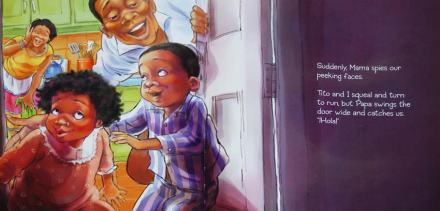
Pots and pans find their storage space with a swirl and a dip while another is dried with the swish of a towel. Around the kitchen the couple dances, “feet tapping, water dripping, sponge wiping, towel snapping.” While singing, “they tango across the room with the leftover tamales.” As they turn toward the door, Mama glimpses her little ones. The kids squeal and start to run, but Papa swings open the door—“Hola!” He pulls Tito into his arms, while Mama catches her tiny daughter.

As the four whirl around the kitchen, Tito and his sister sing into wooden spoons, “Cómo te quiero! Oh, how I love you!” They “twirl around and around in a circle of family.” The dance slows to a gentle swaying as Tito and his sister grow sleepy. Mama and Papa carry their drowsing children upstairs and cover them once more under their cozy blankets. “Cómo te quiero,” Papa whispers. “Besitos, mi’ja,” Mama says “Sweet dreams.”

celebrate-picture-books-picture-book-review-kitchen-dance-interior-art-kids-caught

Image copyright Maurie J. Manning

Maurie J. Manning’s sweet story of a private moment between parents that becomes a celebration of family love offers a fresh, fun, and lively glimpse of the small events that contribute to real connectedness. Telling the story from one of the children’s point of view adds a deeper level of understanding and recognition that of the strong bond between the parents. The repeated phrase, “Cómo te quiero! How I love you!” is reassuring and allows kids to read along with the book’s most important theme.

Manning’s vivacious and vibrant illustrations bring to life the swirling energy of the text. Tito and his sister creep downstairs in a house bathed in shadow only to open the door to flashing yellow, green, purple, and orange brilliance. The scenes of Mama and Papa dancing together, using a wooden spoon as a microphone and pot lids as cymbals as well as twirling hand in hand while balancing stacks of dishes are filled with happiness, and the  picture of the two tangoing with tamales will make kids giggle. Tito and his sister are adorable as they spy on their parents with astonished looks on their faces and then join the dance.

Kitchen Dance is a joy for story time or bedtime, and in these always busy days would be a welcome reminder that carefree moments carry their own special meaning.  Kitchen Dance is a great addition to a child’s bookshelf.

Ages 3 – 8

Clarion Books, 2008 | ISBN 978-0618991105

To learn more about Maurie J. Manning, her books, and her art, check out her website!

Take a look at the Kitchen Dance book trailer!


National Culinary Arts Month Activity

celebrate-picture-books-picture-book-review-wooden-spoon-microphone-craft

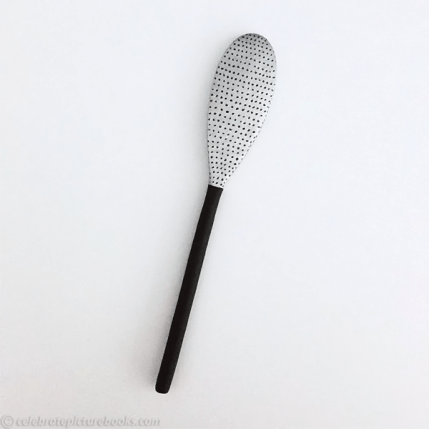
Wooden Spoon Microphone


With this easy craft you can turn a wooden cooking spoon into a fun microphone for playtime or in case you ever have to sing for your supper!

Supplies

  • Long-handled wooden spoon
  • Black craft paint
  • Silver craft paint
  • Black permanent marker

Directions

  1. Paint the handle of the spoon black, let dry
  2. Paint the head of the spoon silver, let dry
  3. After the paint is dry, make rows of small dots on the head of the spoon

July 18 – Get Out of the Doghouse Day

celebrate-picture-books-picture-book-review-the-bear-who-stared-cover

About the Holiday

Being “in the dog house” means that somehow you’ve upset someone, made them mad or in some other way fallen out of favor with them. Maybe you owe them an apology or at least an explanation. Today’s holiday gives people a chance to say “I’m sorry” and patch up any hurt feelings. Like the bear in today’s book, you may find yourself out of the doghouse and on the path to better friendships!

The Bear Who Stared

By Duncan Beedie


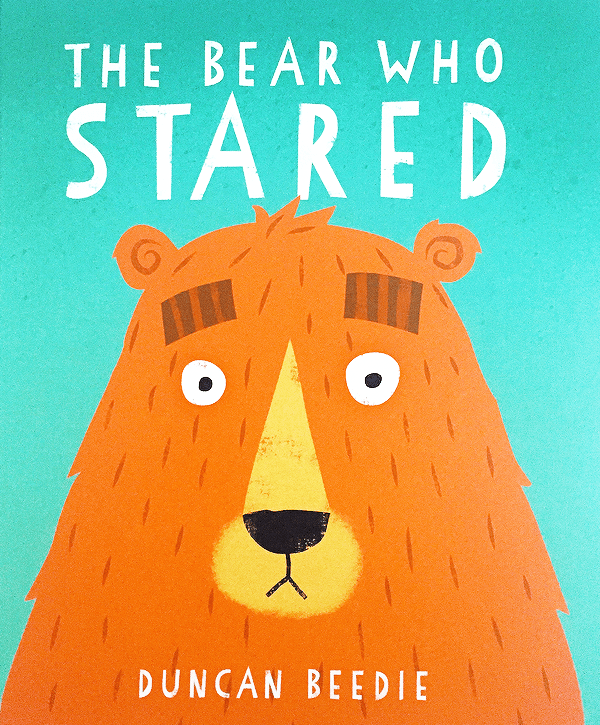
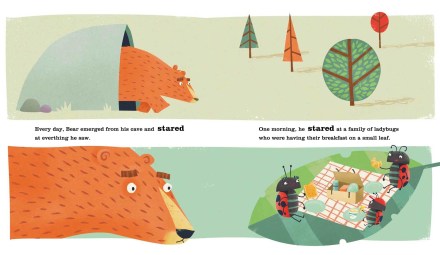
Bear loves to stare…and stare…and stare. One morning he emerges from his den to find a family of ladybugs having a picnic breakfast. He can’t help but gaze at them intently. “‘What are you staring at?’” the daddy ladybug demands before he and his family pack up to find a more private leaf. Bear continues on his way. In a bit he climbs a tree and stares at a bird feeding her chicks. “‘Can I help you?’” the mother bird asks, but Bear remains silent. The chicks don’t like Bear interfering with their meal, so the mother bird angrily tells him to “‘sshhhooooo!’”

celebrate-picture-books-picture-book-review-the-bear-who-stared-interior-art-ladybugs

Image copyright Duncan Beedie, courtesy of simonandschuster.com

At the bottom of the tree Bear spies a badger hole and sticks his head inside. The badger, particularly irritated at Bear’s badgering stare while he is shaving, bites poor bear on the nose. Sore and dejected, Bear wanders through the forest to a large pond. He sits down on a log to ponder his situation. He doesn’t mean to be annoying, he’s “just curious but too shy to say anything.”

A little frog floating on a lily pad in the middle of the pond pipes up, “‘I’ve seen that look before.’” Bear stares at the frog and the frog stares back. “‘Not much fun being stared at, is it?’” he says. Bear confesses that he just doesn’t know what to say to anyone. Just then Bear catches a glimpse of another bear staring back at him from the mossy water of the pond. This bear looks exactly like Bear, except that he is green and wavy. Suddenly, the green bear smiles. “‘You see?’” says the frog. “‘Sometimes a smile is all you need.’” The frog dives off his lily pad into the pond, and the green bear disappears too.

celebrate-picture-books-picture-book-review-the-bear-who-stared-interior-art-staring

Image copyright Duncan Beedie, courtesy of simonandschuster.com

The next day Bear leaves his den and discovers the ladybug family breakfasting again. As soon as they spot Bear, they begin to gather their things. “‘Hello!’” Bear says with a big smile on his face. The ladybugs are surprised and happy. “‘Oh, hello!’” replies the dad, smiling back. With renewed confidence Bear wanders into the forest. He smiles at the birds and smiles at the badger, and they smile at him in return. Bear makes a lot of new friends that day. And there’s even that friend down at the pond who likes to stare as much as he does!

Duncan Beedie highlights the awkward feeling many kids—and even adults—often feel in social situations. Nothing pops immediately to mind to say and yet there’s a desire for connection. As Bear discovers, staring is not the answer—so what is? In The Bear Who Stared Beedie offers a simple, but universal solution through an engaging and humorous story. Bear, sporting a bemused expression that aptly depicts his predicament, is such an endearing character that readers will wish they could give him a hug as he suffers slights from the woodland creatures.

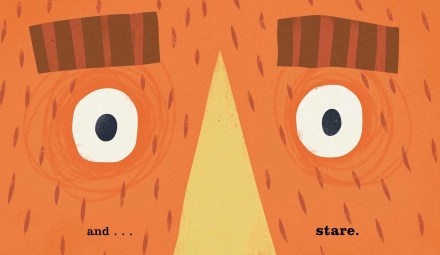
The full-bleed, oversized pages put readers at eye level with bear and his subjects, and the very up-close look into Bear’s staring eyes will make kids laugh. The green, rust, and blue palette on matte paper is bold, but muted, giving the pages an organic, environmental feel that is perfect to carry the story.

The Bear Who Stared is a funny story time read with a heart that kids will ask for again and again.

Ages 4 – 8

little bee books, 2016 | ISBN 978-1499802856

Check out more of Duncan Beedie’s illustration and animation work on his website!

Get Out of the Doghouse Day Activity

celebrate-picture-books-picture-book-review-bear-craft

Expressive Bear Craft


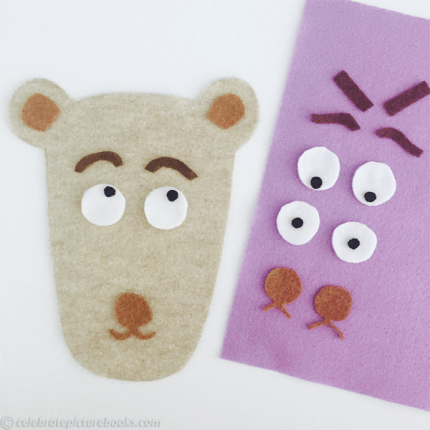
Sometimes it’s hard to manage or even recognize various emotions that land you in the doghouse. With this easy-to-make felt (or paper) set, you can try out different emotions and talk about them, make up stories to go with each facial expression, or play a fun game. Below, you’ll find a couple of ideas!

Supplies

  • Printable Bear Head Template
  • Printable Eyes and Noses Template
  • Printable Eyebrows Template
  • Light brown felt or fleece, 8 ½ x 11 inch piece
  • Dark brown felt or fleece, 8 ½ x 11 inch piece
  • White felt or fleece, 8 ½ x 11 inch piece
  • Black felt or fleece, for pupils
  • Scissors
  • Glue
  • 1 playing die (optional)

Directions

  1. Print templates
  2. Cut bear head from light felt or fleece
  3. Cut eyes from white felt or fleece
  4. Cut nose and inner ears from dark brown felt or fleece
  5. Cut pupils from black felt or fleece
  6. Glue pupils onto white eyes

Or: Color and play with the paper set

To Play a Game

Roll the die to collect parts of the bear’s face. The first player to create a full face is the winner.

  • Die dots correspond to:
  • 1—one eyebrow
  • 2—second eyebrow
  • 3—one eye
  • 4—second eye
  • 5—nose
  • 6—inner ears

For a Fun Story Time

Give the bear different faces and make up stories of why he looks that way!

Picture Book Review

July 15 – It’s National Ice Cream Month

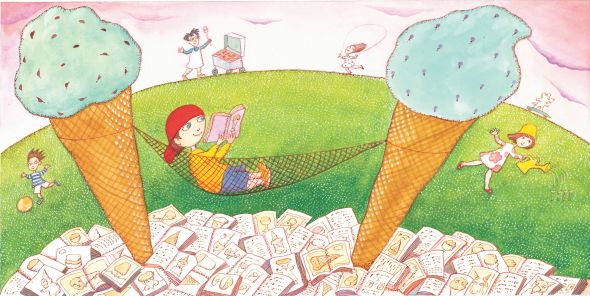
celebrate-picture-books-picture-book-review-ice-cream-summer

About the Holiday

Ice cream has a long and elite history, dating back to Ancient Greece when the confection was made of snow, honey, and fruit. Catherine de’ Medici introduced the treat again in the 16th century. Charles I of England, using his royal clout, proclaimed ice cream to be the prerogative of the crown. He kept the recipe secret and forbid the common people to eat it. The first recorded recipes for ice cream are reported in the 18th century.

This favorite dessert received its true recognition in 1984 when President Ronald Reagan established July as National Ice Cream Month. Today indulge in your favorite flavor or sundae!

Ice Cream Summer

By Peter Sís


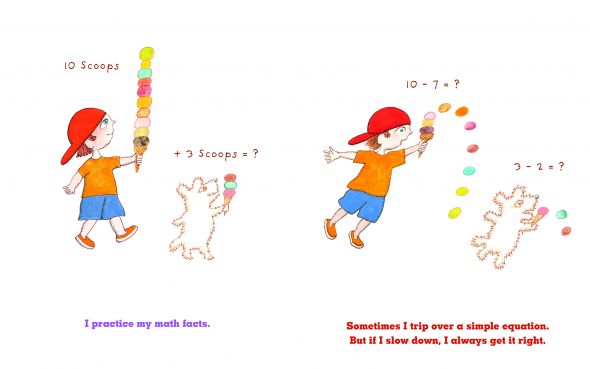
A little boy writes a letter to his grandpa telling him about his summer. “So far it’s been a delicious summer,” he says of his ice cream extravaganza. The boy reports that he’s very busy, but is also paying attention to school work every day. He knows how to read big words like tornado and explosion, and he is even creating his own book. He can solve math problems—even word problems—lickity split on his own and sometimes with his family’s help.

At day camp he and his friends are involved in all sorts of activities, such as sports, cartography, and field trips. The boy tells his grandpa that he’s poring over the encyclopedias he sent, learning about world history from Ancient China to Europe and America. He is discovering fabulous inventions and designing some of his own.

celebrate-picture-books-picture-book-review-ice-cream-summer

Image copyright Peter Sís, courtesy of scholastic.com

He assures his grandpa that he has “been working hard all summer (though I always take a break on sundaes)” and has earned the special trip his grandpa mentioned. As the two meet it’s obvious that Grandpa understands his grandson very well. They both sport ice cream shaped backpacks, and the trip they are embarking on is a hike to the tip of Ice Cream Peak.

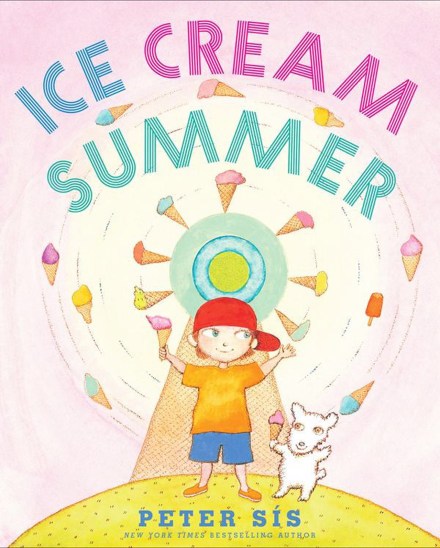
Peter Sís’s celebration of ice cream is a perfect mixture of text and art. While the boy’s letter is kid-like bare bones, the ice-cream hued illustrations humorously and cleverly portray the boy’s delicious obsession. His room, with its scoop-shaped window overlooking an ice cream factory, is filled with a bed, bookshelves, desk, and toys that are all familiarly conical. The boy builds his sandcastle, complete with cone turrets, at the edge of multi-colored scoop waves, and the family’s beach umbrella is a wavy sundae top.

celebrate-picture-books-picture-book-review-ice-cream-summer

Image copyright Peter Sís, courtesy of scholastic.com

At day camp all roads lead to flavorful sites where skyscrapers, attractions, and transportation are all seen through a sweet ice-cream cone lens. Even the Statue of Liberty holds aloft a vanilla soft serve cone. The boy’s travels through history encompass fascinating facts about the invention of ice cream, how it spread across Europe and to America as well as innovations of and improvements to this favorite treat.

The final reveal of Ice Cream Peak, with its sprinkles-covered tip will delight ice cream aficionados of all ages. Kids and adults will want to linger over each page to scoop up all the visual pleasures.

Ages 4 – 8

Scholastic Books, 2015 | ISBN 978-0545731614

To view more books by Peter Sís and discover fun title-related activities, visit his website!

National Ice Cream Month Activity

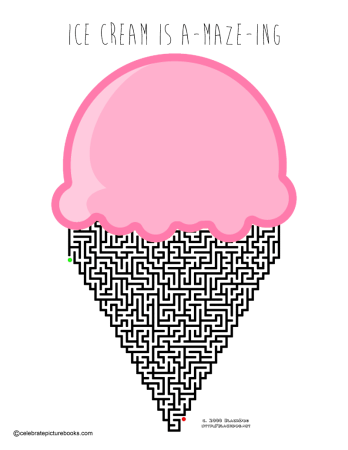
celebrate-picture-books-picture-book-review-ice-cream-maze

Ice Cream is A-maze-ing! Puzzle


Sometimes you’d walk forever and through any kind of obstacle to get your favorite flavor ice cream cone. Have fun following the path through this printable Ice Cream is Amaze-ing Puzzle

Picture Book Review
July 14 – Shark Awareness Day

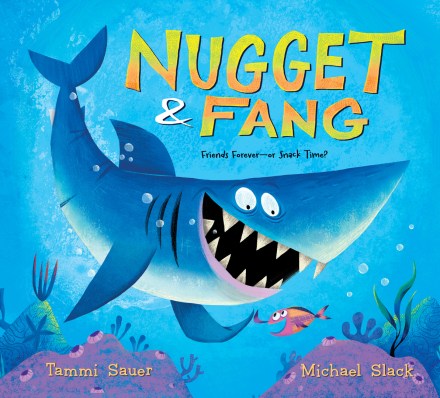
celebrate-picture-books-picture-book-review-nugget-and-fang-coverAbout the Holiday

Today we take a moment to consider the benefits sharks provide to the marine ecosystem. Every year thousands of sharks die and their species threatened due to misconceptions and misuse. As a predator at the top of the food chain, sharks play a crucial role in maintaining balance within the ocean. Protecting this often-misunderstood species is an important goal.

Nugget & Fang: Friends Forever—or Snack Time?

Written by Tammi Sauer | Illustrated by Michael Slack


Deep in the ocean two friends do everything together and life is almost perfect as they swim over ship wrecks, under reefs, and all around. Nugget and Fang are as close as two friend can be—there’s just one thing: Nugget is a minnow while Fang is a shark. Neither of them consider their friendship unusual—until Nugget goes to school. There during Reading, Nugget hears the story of The Three Little Minnows and the Big, Bad Shark. “‘Ha!’” says Nugget. “‘Impossible!’”

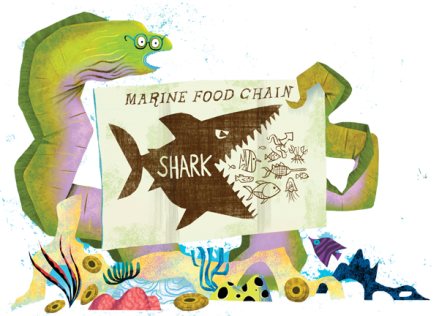
During Math class the students solve a word problem: “What if there were ten minnows and a shark came along and ate four of them? How many minnows are left?” Nugget is scandalized. “‘A shark would never do that!’” he says. But Science period reveals the facts of the Marine Food Chain. Nugget protests that sharks aren’t scary. “‘My best friend is a shark!’” he announces. His classmates are shocked. “Have you lost your gills?” one asks. Another snarks, “Hello—sharks eat minnows!” Nugget can’t believe it.

celebrate-picture-books-picture-book-review-nugget-and-fang

Image copyright Michael Slack, courtesy of hmhbooks.com/nuggetandfang

Back home Nugget gives Fang the bad news. “‘Sounds fishy to me,’” says Fang. Nugget assures him it’s true before swimming far away. “Fang’s heart sank.” He can’t help if he’s “toothy,” he thinks, and he knows he doesn’t mean to be scary. He wants his best friend back. To prove it Fang tries different tactics. On Tuesday he dresses like a mermaid, but Nugget and the other fish see through his disguise. “‘Oh, my algae!’” exclaims Nugget. On Wednesday Fang sends a beautiful sea plant arrangement with a note—“Dear Nugget, I’d love to have you over for dinner.”—which is misinterpreted in the worst possible way. On Thursday Fang pulls out all the stops. He gets a “Nugget” tattoo, sends a special message and gift, and performs an original song and dance, but nothing works.

On Friday Fang is sadly resigned to being alone. While he mopes and cries, he doesn’t see that a fishing net has been lowered to the ocean floor, capturing Nugget and the other minnows. “Help!” shouts Nugget as the net is slowly lifted. Fang wrings his fins, uncertain of what to do. Suddenly, he has an idea. With his big sharp teeth he chomps and chews and tears the net to pieces. Nugget and the minnows swim to safety. They all stare at Fang wide-eyed.

celebrate-picture-books-picture-book-review-nugget-and-fang

Image copyright Michael Slack, courtesy of hmhbooks.com/nuggetandfang

Fang dejectedly begins to swim away. “‘I know, I know,’” he says, “‘I’m toothy. Too scary. Too…shark.’” “Wait!” calls Nugget and uses a little math of his own. “‘There were ten minnows, and a very special shark came along. How many friends are there altogether?’” Now eleven friends live happily deep in the ocean, and everyone—especially Fang—are all smiles.

Tammi Sauer’s tribute to true friendship reveals the danger when “facts” take precedence over what you know in your heart to be true. Her reminder to listen to your inner voice is approached with humor and the honest types of doubts that can niggle and cloud judgement. Throughout the story, her language is accessible and kid-conversational, including puns that will elicit giggles. Sauer’s use of a math word problem to both highlight contrary thinking and provide a solution underscores the influence of education. Nugget & Fang is a wonderful book for kids navigating the school and activities environment while making new—and keeping old—friendships.

Michael Slack immediately sets kids in the right mindset with his bright, cartoon-inspired illustrations. Tiny, colorful Nugget and bold, blue Fang, his “toothiness” on display through his big grin, make a happy, nonchalant pair. They play together through vibrant green, yellow, and purple reefs unaware of marine stereotypes. When Nugget gets “schooled”, his astounded expressions and those of his classmates, humorously depict their predicament. The ocean environment gives Slack an opportunity for plenty of visual jokes and innovation. The Reading teacher holds a clamshell-shaped book, a piece of shipwrecked board serves as a Math blackboard, and the Science food chain poster is appropriately scary. Kids will laugh at Fang’s attempts at reconciliation, and cheer when he becomes a hero.

Nugget & Fang: Friends Forever—or Snack Time? is sure to be a favorite story time read!

Ages 4 – 9

Houghton Mifflin Harcourt, 2013 | ISBN 978-0544481718

Will everything go swimmingly for Nugget and Fang? Watch the trailer and see!

To learn more about Tammi Sauer and her books, visit her website!

View a gallery of work by Michael Slack on his website!

Visit the Houghton Mifflin Harcourt Nugget & Fang page for more goodies!

Shark Awareness Day Activity

celebrate-picture-books-picture-book-review-shark-coloring-page

Looking Sharp, Sharks! Coloring Page


Sharks are some of the most fascinating creatures in the sea. Have fun decorating this printable Looking Sharp, Sharks! Coloring Page—get creative with textures, colors, and materials!