May 29 – It’s National Inventors Month

celebrate-picture-books-picture-book-review-magnolia-mudd-and-the-super-jumptastic-launcher-deluxe-cover

About the Holiday

Today we celebrate all of those inventors who think creatively to devise new products, different ways of performing tasks, better methods of communication, and even innovative ways of viewing the world. Begun in 1998 by the United Inventors Association of the USA, the Academy of Applied Science, and Inventors’ Digest magazine, this month’s holiday encourages people to embrace their creativity and also to support those who work to make their own vision a reality for themselves and to make the world a better place.

Magnolia Mudd and the Super Jumptastic Launcher Deluxe

Written by Katey Howes | Illustrated by Valerio Fabbretti


Every Friday, Magnolia’s favorite adult—her uncle Jamie—visited and spent time inventing with her. He always encouraged Magnolia to think big. One day, Magnolia and her uncle Jamie created their “greatest invention—the Super Jumptastic Launcher Deluxe,” which ran on Mudd Power. But after one experimental launching, Magnolia had to retrieve all the parts to build it again. When she called her uncle to help her repair it, he said she would have to wait. Instead, he was bringing Miss Emily over because they “had ‘something to talk about.’”

celebrate-picture-books-picture-book-review-magnolia-mudd-and-the-super-jumptastic-launcher-deluxe-uncle-jamie

Image copyright Valerio Fabbretti, 2018, text copyright Katey Howes, 2018. Courtesy of Sterling Books.

Magnolia didn’t want her time with Uncle Jamie taken up by Miss Emily. As far as Magnolia was concerned Uncle Jamie and Miss Emily had nothing in common, so on Friday when they told her they were getting married, Magnolia was surprised. When Miss Emily asked Magnolia to be their flower girl and showed her the fancy dress she’d wear, Magnolia thought, “no way!” Later, Uncle Jamie said maybe they could find a different way for her to be involved in the wedding.

Magnolia researched all the different things she could do, and experimented with some of them. She read that in India women decorate their hands with henna tattoos. She devised a henna tattoo-painting machine, but it went a little haywire. In Sweden, she learned, guests scared off trolls by bringing bouquets of stink weed. Magnolia built a troll trap, but only caught herself. And in a German tradition, guests throw plates at the couple’s door for good luck, but when Magnolia retooled her “Fantastic Frisbee Flinger,” she only caused a mess of broken pottery.

celebrate-picture-books-picture-book-review-magnolia-mudd-and-the-super-jumptastic-launcher-deluxe-friday

Image copyright Valerio Fabbretti, 2018, text copyright Katey Howes, 2018. Courtesy of Sterling Books.

Magnolia resigned herself to being “doomed to ruffles and roses.” She was just wishing she could launch the rose petals instead of scattering them when she had an idea. She showed Miss Emily her brainstorm for a bouquet-launcher that worked on Mudd Power. Miss Emily loved it. Together they began to invent. On the day of the wedding, they revealed their “new-and-improved Dual-Directional Super-Jumptastic Flower Launcher Deluxe (with Confetti Blaster),” and as Magnolia and Miss Emily jumped on the launch pad together, Magnolia realized that with Aunt Emily in the family, there was “way more Mudd Power” for inventing.

celebrate-picture-books-picture-book-review-magnolia-mudd-and-the-super-jumptastic-launcher-deluxe-miss-emily

Image copyright Valerio Fabbretti, 2018, text copyright Katey Howes, 2018. Courtesy of Sterling Books.

Katey Howes’ humorous and clever story is as dual-purpose as Magnolia’s super launcher deluxe. Young readers will love seeing Magnolia’s gizmos that fire rockets, squirt paint, capture trolls, fling plates, and toss the bouquet (maybe a little too far!) while learning about some wedding traditions around the world. The heart of Howe’s story, however, lies in the ideas of family, relationships, communication, and acceptance. Readers will understand that Magnolia’s initial dislike of Miss Emily has more to do with her fear of a changing relationship with Uncle Jamie than with Emily’s dangly earrings or preference for sushi over pizza.

When Magnolia balks at being a flower girl, the adults allow her to be herself and work with her to find a job that makes everyone happy. As Magnolia gets to know Emily better, she takes a chance in suggesting a bouquet launcher and is rewarded when Emily (literally) jumps in with both feet (the fact that Miss Emily works at an art gallery hints at her ability to think creatively too). The final image of Magnolia, Uncle Jamie, and Aunt Emily hard at work in their lab reminds kids of the adage, “the more (Mudd Power) the merrier.”

celebrate-picture-books-picture-book-review-magnolia-mudd-and-the-super-jumptastic-launcher-deluxe-thinking

Image copyright Valerio Fabbretti, 2018, text copyright Katey Howes, 2018. Courtesy of Sterling Books.

Valerio Fabbretti’s bright, cartoon-style artwork is ideally suited to bring out the humor and emotions in Howes’ action-packed story. Magnolia’s and Uncle Jamie’s love of science is on display in both Jamie’s office and Magnolia’s room, where diagrams, chemical equations, test tubes and beakers, and retrofitted home appliances create an eclectic décor. Kids will laugh as Magnolia’s inventions go awry, and cheer when Magnolia and Miss Emily discover the perfect wedding job for Magnolia and complete it together. The interracial relationship of Uncle Jamie and Miss Emily is a welcome representation of family.

An entertaining and endearing story, Magnolia Mudd and the Super Jumptastic Launcher Deluxe is an inventive book to launch fun story times as well as discussions on individuality, inclusion, change, and family.

Ages 3 and up

Sterling Children’s Books, 2018 | ISBN 978-1454921745

Discover more about Katey Howes and her books on her website.

To learn more about Valerio Fabbretti, his books, and his art, visit his website.

National Inventors Month Activity

celebrate-picture-books-picture-book-review-sparkle-test-tubes-II

Sparkle Test Tubes


Kids love inventing and experimenting, and these sparkle test tubes give children a fun way to be creative while making a cool way to relax and on those hectic days.

Supplies

  • Plastic test tubes with tight-fitting screw cap, available at craft or science supply stores. Having two or three will allow for more experimentation
  • Glitter glue
  • Hot water
  • Fine glitter
  • Chunky glitter
  • Small glass beads (optional)
  • Neon food coloring (optional)
  • Test tube stand (optional)
  • Whisk
  • Mixing bowl
  • Teaspoon

Directions

  1. Fill a test tube 1/3 full of hot water and pour the water into the mixing bowl
  2. Add 1 – 2 teaspoons of glitter glue (the more glitter glue that is added the thicker the liquid will be and the more the objects will be suspended in the liquid. To allow the objects to flow more freely when the test tube is shaken, add less glue
  3. Whisk the water and glitter glue together
  4. Add chunky glitter, glass beads, or try other small objects
  5. Pour into test tube
  6. Add more water to within a ½ – 1 inch of the top to allow for shaking
  7. Experiment with amount of glitter glue, glitter, and colors

Picture book review

February 11 – National Inventors’ Day

celebrate-picture-books-picture-book-review-women-in-science-cover

About the Holiday

Today’s holiday recognizes the spirit of inventors—those women and men, girls and boys who look at life just a little bit differently and not only imagine the “what if?” but make it happen. Inventors come from all backgrounds and with all different kinds of experience. Today, we celebrate those pioneers of the past, present, and future! If you have a creative mind, today’s the day to tinker around with your idea. Inventions don’t always have to change the world. Have a better way of organizing your closets, a new game to play with your pet, or a new recipe to use the leftovers in the fridge? Go for it—and be proud of yourself!

Women in Science: 50 Fearless Pioneers Who Changed the World

By Rachel Ignotofsky

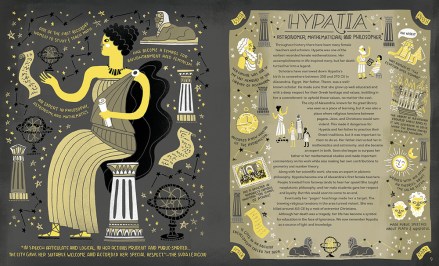
“Nothing says trouble like a woman in pants.” With this revealing attitude from the 1930s, Rachel Ignotofsky introduces her scintillating biographies of 50 intelligent, self-confident, persevering, and inspiring women working in engineering, math, medicine, psychology, geology, physics, astronomy, and more sciences from ancient history through today. The book begins with Hypatia who lived in Greece in the late 300s to early 400s CE and became an expert in astronomy, philosophy,and mathematics, making “contributions to geometry and number theory.” She became one of Alexandria’s first female teachers, “invented a new version of the hydrometer,” and can be found among the intellects in Raphael’s painting “The School of Athens.”

celebrate-picture-books-picture-book-review-women-in-science-hypatia

Image and text copyright Rachel Ignotofsky, courtesy of rachelignotofskydesign.com

Zipping ahead to 1647 readers find Maria Sibylla Merian, considered one of the “greatest scientific illustrators of all time.” Her specialty was entomology. By carefully documenting the lifespan of butterflies, she taught people about the science of metamorphosis, publishing a book on the subject filled with notes and illustrations in 1679. Later she scoured the rainforests of South America, gathering information on never-before-seen insects from that region. Her book, The Metamorphosis of the Insects of Suriname “was published in 1705 and became a hit all over Europe.” Maria was so famous, her picture appeared on German money and stamps.

celebrate-picture-books-picture-book-review-women-in-science-mary-anning

Image and text copyright Rachel Ignotofsky, courtesy of rachelignotofskydesign.com

Other women in the nature sciences include Mary Anning, who as a child discovered the first complete ichthyosaur skeleton and went on to become a paleontologist; Mary Agnes Chase, a botanist and expert on grasses; Marjorie Stoneman Douglas, who as a conservationist helped save the Florida Everglades; and Joan Beauchamp Procter, a zoologist specializing in reptiles who discovered the Peninsula Dragon Lizard in 1923; and more.

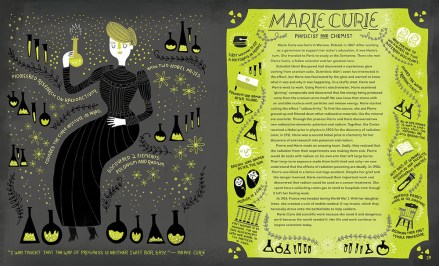
celebrate-picture-books-picture-book-review-women-in-science-marie-curie

Image and text copyright Rachel Ignotofsky, courtesy of rachelignotofskydesign.com

One of the earliest women astronomers and mathematicians was Wang Zhenyi, born in China in 1768. Creating her own eclipse model, she proved her advanced “theories about how the moon blocks our view of the sun—or the earth blocks the sun’s light from reaching the moon—during an eclipse.” She also measured the stars and explained the rotation of the solar system. At the age of 24 she published the 5-volume Simple Principles of Calculation. Zhenyi died at the age of 29, but in her short life she published many books on math and astronomy as well as books of poetry.

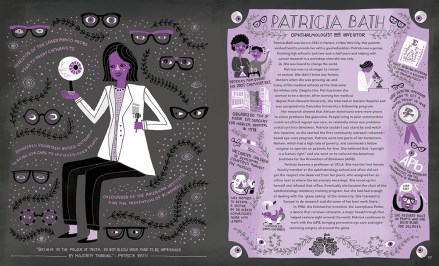
celebrate-picture-books-picture-book-review-women-in-science-patricia-bath

Image and text copyright Rachel Ignotofsky, courtesy of rachelignotofskydesign.com

Women in Science includes many other women who have looked to the stars and mathematics for their careers. Some of these are: Ada Lovelace, the first person to write a computer program; Emmy Noether, who helped Albert Einstein develop his theory relativity, created the field of abstract algebra, and “made new connections between energy and time, and angular momentum”; Cecilia Payne-Gaposchkin a quantum physicist in 1900s England who “discovered that the sun is made mostly of hydrogen and helium gas” and in 1956 became Harvard University’s first astronomy professor; Mae Jemison, who in 1992 became the first African-American woman in space and later started her own technology consulting firm as well as founding BioSentient Corporation, and a science camp for kids; plus many others.

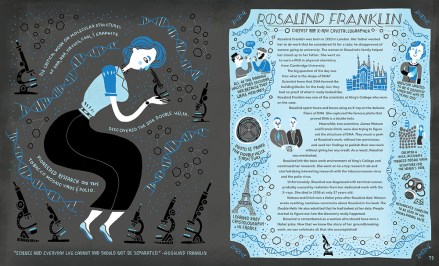
celebrate-picture-books-picture-book-review-women-in-science-rosalind-franklin

Image and text copyright Rachel Ignotofsky, courtesy of rachelignotofskydesign.com

The book also features Engineers, such as Hertha Ayrton who improved electric lights by inventing “a new rod that made a clean and quiet bright light” and the Ayrton fan that blew away mustard gas during World War I; and Lillian Gilbreth, who used her theories of “organizational psychology” in inventing the foot pedal for garbage cans, shelving for refrigerators, and even the “work triangle” for kitchens “that determines the distance from the sink to the stove” and saves time. There are Geneticists such as Nettie Stevens who discovered the “X” and “Y” chromosomes, and Barbara McClintock—the pants wearer from the beginning of the post—and the first person “to make a complete genetic map of corn” and discover jumping genes, or “transposons.”

The field of Medicine has benefited from women such as Elizabeth Blackwell, the first woman doctor; Alice Ball, a chemist and the first African-American woman to graduate from the University of Hawaii, who helped cure leprosy with her chemical work; and Gerty Cori who discovered how our bodies covert glucose, helping us better understand diabetes. In 1947 she became the first American woman to win a Nobel Prize.

celebrate-picture-books-picture-book-review-women-in-science-katherine-johnson

Image and text copyright Rachel Ignotofsky, courtesy of rachelignotofskydesign.com

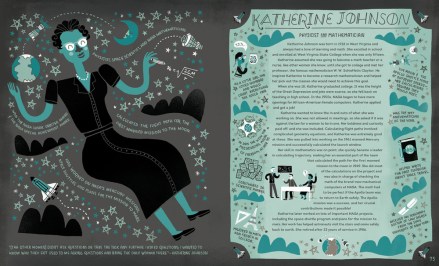
And this list only begins to scratch the surface of all the fascinating stories of women who overcame social, political, and personal obstacles to follow where their intelligence took them. Inspirational, entertaining, and undeniably eye-catching Rachel Ignotofsky’s Women in Science presents expertly written, one-page biographies that hit all the high (and sometimes unfortunate low) points in these scientist’s lives. The striking layout of both the text and illustrations keep readers riveted to the page, The left-hand side contains a representational drawing of the scientist surrounded by the subjects and materials of her work as well as trivia about her and a quotation. On the right-hand page, small illustrated facts frame the woman’s life story.

Interspersed between the biographies are pages offering a timeline of women’s milestones, depicting lab tools, and graphing statistics of women in STEM. The back matter is impressive, with two more pages presenting 15 more scientists, a four-page, illustrated glossary, resources including films, websites, and books, and an index. Rachel Ignotofsky concludes her book by saying, “Let us celebrate these trailblazers so we can inspire the next generation. Together, we can pick up where they left off and continue the search for knowledge. So go out and tackle new problems, find your answers and learn everything you can to make your own discoveries!”

Ages 7 and up

Ten Speed Press, 2016 | ISBN 978-160774976

To discover more books by Rachel Ignotofsky, visit her website!

National Inventors’ Day Activity

celebrate-picture-books-picture-book-review-scientists-word-search

What Kind of Scientist Would You Be? Word Search

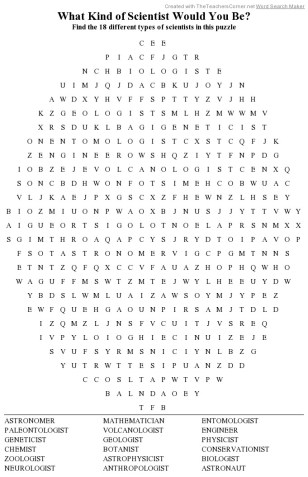
Scientists like the women in today’s book make inventions for every area of life! In the future you might become a scientist and develop something new or different. If so, what kind of scientist would you like to be? Find the names of eighteen scientists in this printable puzzle! Then pick one and write why you would like to be that type of scientist!

What Kind of Scientist Would You Be? Puzzle What Kind of Scientist Would You Be? Puzzle Solution!  

Picture Book Review
January 20 – National Disc Jockey Day

celebrate-picture-books-picture-book-review-when-the-beat-was-born-cover

About the Holiday

National Disc Jockey Day commemorates the death of Albert James Freed, or Moondog, who was an influential disc jockey in the 1950s and is credited with popularizing the term “rock-and-roll.” The idea of using recorded music instead of live performances over the airwaves was tested in 1909, when sixteen-year-old Ray Newby, a student of Charles “Doc” Herrold at Herrold College of Engineering and Wireless in San Fernando, California, became the first to play records on the radio. The idea took off and soon radio broadcasters across the country followed suit. The term Disc Jockey was the brainstorm of radio commentator Walter Winchell in 1934. The 1970s and 1980s saw the rise of Hip-Hop DJs who began using multiple turntables and turntables as instruments to change the music.

When the Beat Was Born: DJ Kool Herc & the Creation of Hip Hop

Written by Laban Carrick Hill | Illustrated by Theodore Taylor III


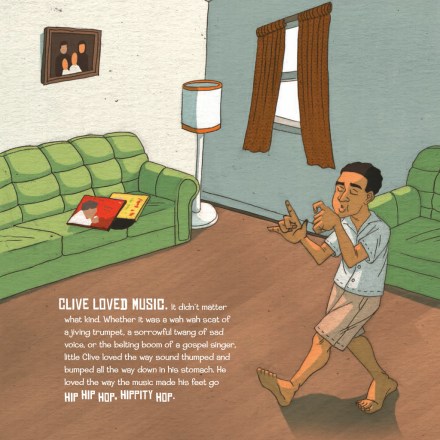
Even as a child “Clive loved music”—all kinds of music. He loved the way it made him feel inside and “the way it made his feet go hip hip hop, hippity hop.” Clive lived on Somerset Lane in Kingston, Jamaica. One of his neighbors was a DJ nicknamed “King George,” who threw the “biggest and baddest” house parties every Saturday night. Clive was too young for parties, but he liked to watch King George and his crew setting up. Clive had never seen so many records in one place.

celebrate-picture-books-picture-book-review-when-the-beat-was-born-clive-loved-music

Image copyright Theodore Tayler III, 2013, text copyright Laban Carrik Hill, 2013. Courtesy of Roaring Brook Press.

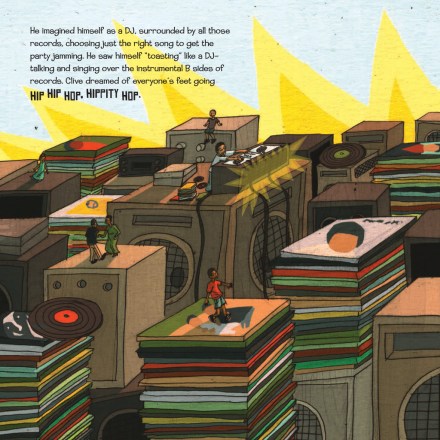
“Clive imagined himself as a DJ surrounded by all those records.” He longed to choose just the right one to get the party started. He pictured himself toasting—rapping over the instrumental B side of records and getting people’s feet going hip hip hop, hippity hop, like his did. When Clive was thirteen he moved to Brooklyn, New York with his mom. At first he wasn’t sure he liked his new neighborhood, but then he discovered sports—track, weightlifting, and especially basketball. Clive grew to be six feet, 5 inches tall.

celebrate-picture-books-picture-book-review-when-the-beat-was-born-stacks-of-records

Image copyright Theodore Tayler III, 2013, text copyright Laban Carrik Hill, 2013. Courtesy of Roaring Brook Press.

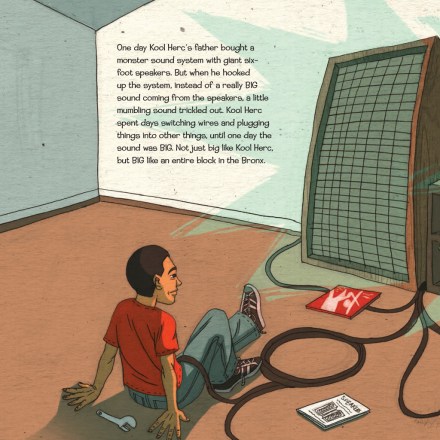
He took to calling “himself ‘cool as Clyde’ after his favorite basketball player, Walt Clyde Frazier.” But to the other kids, Clive was “Hercules.” Clive shortened it to Herc and added “‘Kool’ to make it just right. Kool Herc.” Because of his size, he was able to go to house parties with his mother and listen to the music. One day Kool Herc’s father bought a “giant sound system” with six-foot-tall speakers. But when it was turned on, the sound was puny. Kool Herc worked on it until the sound came blasting out.

celebrate-picture-books-picture-book-review-when-the-beat-was-born-sound-system

Image copyright Theodore Tayler III, 2013, text copyright Laban Carrik Hill, 2013. Courtesy of Roaring Brook Press.

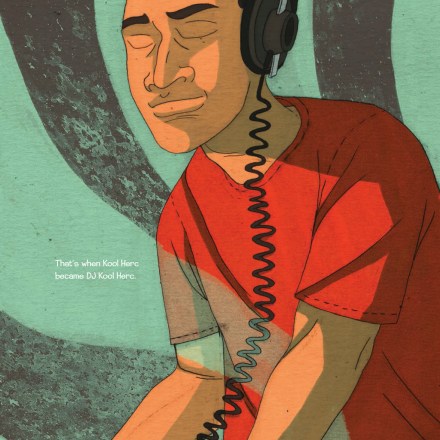
Kool Herc and his younger sister Cindy were ready to put on a party. They rented a rec room in their housing project, posted invitations, and set up the huge sound system. The night of the party, “everybody who was anybody made their way to Sedgewick Avenue for Kool Herc’s hot dance party. That’s when Kool Herc became DJ Kool Herc.”

celebrate-picture-books-picture-book-review-when-the-beat-was-born-DJ-Kool-Herc

Image copyright Theodore Tayler III, 2013, text copyright Laban Carrik Hill, 2013. Courtesy of Roaring Brook Press.

DJ Kool Herc noticed that people danced harder during the instrumental breaks. Kool Herc set up another turntable and put the same record on this turntable too. This way, when one record ended its break, he could play it again on the other. He was able to stretch a ten-second break into 20 minutes or more. Remembering how DJs toasted in Jamaica, DJ Kool Herc began shouting out the names of his friends, compliments about the dancers, and rhymes over the beat.

celebrate-picture-books-picture-book-review-when-the-beat-was-born-dance-party

Image copyright Theodore Tayler III, 2013, text copyright Laban Carrik Hill, 2013. Courtesy of Roaring Brook Press.

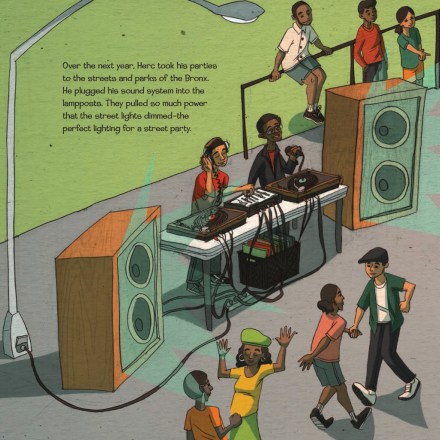
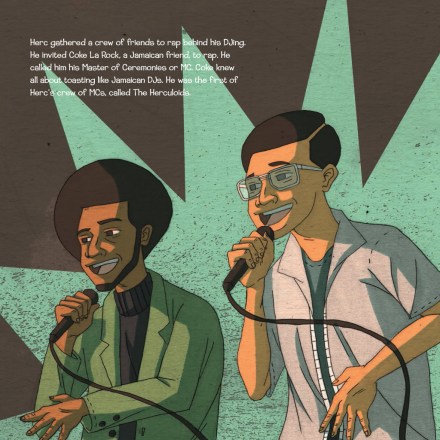
Over the next year, DJ Kool Herc moved his dance parties into the street. When he plugged the sound system into the street lamps, it pulled so much power, the lights dimmed. DJ Kool Herc’s music even turned some of the city’s gang members into the smoothest break dancers in the neighborhood. Kool Herc then invited friends to rap behind the DJ-ing. He called these friends the “Master of Ceremonies” or MCs.

Soon kids were coming from all over New York city to attend DJ Kool Herc’s “biggest, baddest dance parties.” Many “wanted to be DJs just like Kool Herc. Herc didn’t just rock the block. He put the hip hip hop, hippity hop into the world’s heartbeat.”

celebrate-picture-books-picture-book-review-when-the-beat-was-born-the-turtle

Image copyright Theodore Tayler III, 2013, text copyright Laban Carrik Hill, 2013. Courtesy of Roaring Brook Press.

Laben Carrick Hill’s modern biography of a Hip Hop pioneer invites young readers to discover the early years of and influences on the music they love today. Hill superbly structures his story so through the formative details of DJ Kool Herc’s life from childhood into adulthood, readers understand that they too can follow their hearts to achieve their dreams. When the Beat Was Born is inspirational in its depiction of an “ordinary kid” with ingenuity and self-confidence who changed the face of music by combining his multicultural experiences, being open to experimentation, including his friends, and sharing his vision. Straightforward storytelling is punctuated with verses of rap that make reading aloud fun and will engage listeners.

celebrate-picture-books-picture-book-review-when-the-beat-was-born-friends

Image copyright Theodore Tayler III, 2013, text copyright Laban Carrik Hill, 2013. Courtesy of Roaring Brook Press.

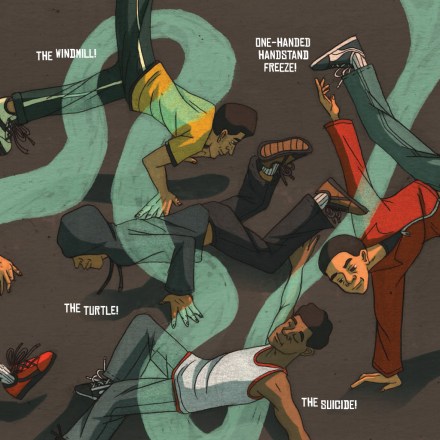
In his bold, vibrant illustrations, Theodore Tayler III lets kids in on the not-so-distant past that saw the rise of Hip Hop music, celebrity DJs, and new dance styles. Keeping the focus on DJ Kool Herc—just as Clive kept his eye on his future goals—Taylor reinforces the theme of the book. Scenes of kids lining up to attend DJ Kool Herc’s parties and dancing in the street give the book an inclusive feel. Images of skyscraper-tall stacks of records mirrors Kool Herc’s ambitions, and depictions of breakdancing moves will get kids wanting to try them for themselves.

When the Beat Was Born is a terrific biography for all children, whether they like music and dancing or quieter pursuits. In the classroom, the book would be a great addition to music, history, or biography units.

Ages 6 – 10

Roaring Brook Press, 2013 | ISBN 978-1596435407

Discover more about Laben Carrick Hill and his books on his website

To view a portfolio of artwork, book illustration, videos and more by Theodore Taylor III, visit his website.
National Disc Jockey Day Activity

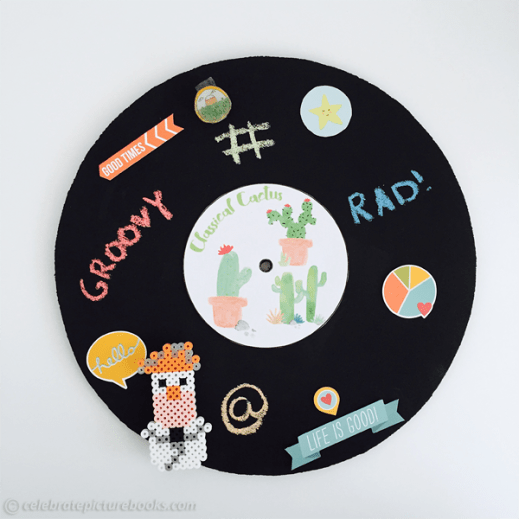
celebrate-picture-books-picture-book-review-groovy-record-chalkboard-blackboard-craft

Groovy Record Chalkboard & Bulletin Board 


Do you play the piano or another instrument? Would you like to make a record some day? Why wait? In this fun craft you can create your own record bulletin board—and even create your own label art! While this record may not spin on turntables around the world, it will drop in a more important place—your very own room!

Supplies

  • Printable Record Label for you to design
  • Foam board, or a corkboard at least 12-inches x 12-inches square
  • Adhesive cork
  • A 12-inch round plate, record, or other round object to trace OR a compass
  • Chalkboard paint, black
  • X-acto knife
  • Paint brush or foam paint brush
  • Mounting squares

Directions

  1. Cut a section from the adhesive cork a little larger than 12 inches by 12 inches
  2. Affix the cork to the foam board
  3. Trace the 12-inch round object onto the cork/foam board OR use the compass to make a 12-inch circle
  4. With the x-acto knife, carefully cut out the circle (adult help needed for children)
  5. Cut out a ¼ -inch circle in the center of the record bulletin board
  6. Paint the cork, sides and inside the spindle hole with the black chalkboard paint. Let dry
  7. Print the label template and design your own record label
  8. When the paint is dry, glue your label to the center of the bulletin board
  9. Hang your bulletin board with the mounting squares
  10. Decorate!

Picture Book Review


September 12 – It’s Read a New Book Month
celebrate-picture-books-picture-book-review-balderdash!-john-newbery-and-the-boisterous-birth-of-children's-books-cover

About the Holiday

Discovering a new book is one of the joys of life! Right now bookstores everywhere are filled with books waiting for you to take them home, open the cover, and start reading. Whether you find a new book published just this year or one that’s older but new to you, take the opportunity of this month’s holiday to add to your home library. Children especially benefit from reading new and classic books—and thanks to the subject of today’s book, they have plenty to choose from!
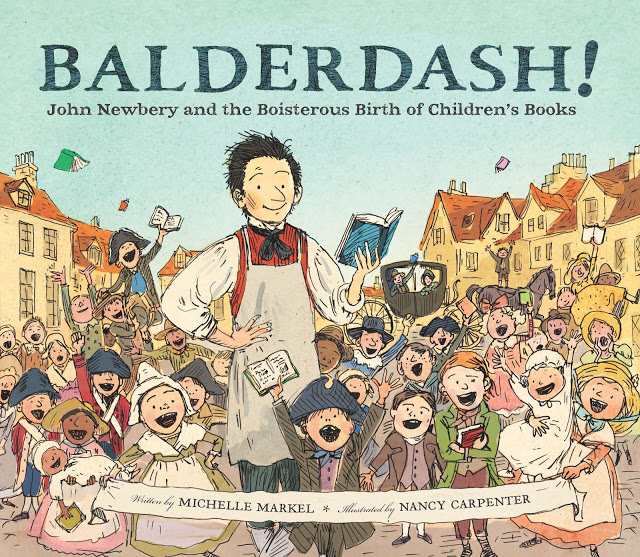
Balderdash! John Newbery and the Boisterous Birth of Children’s Books

Written by Michelle Markel | Illustrated by Nancy Carpenter


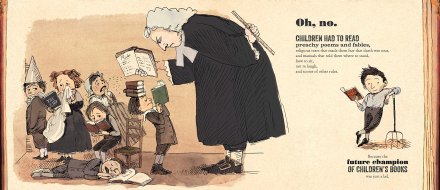
With a hearty “Welcome!” readers are invited to explore—and appreciate—the pages, pictures, words, and even individual letters that make up the book they’re holding. Back in time, a book like this didn’t exist. How far back? Well, let’s return to 1726…. “In those days of powdered wigs and petticoats, England was brimming with books.” There were exciting tales about imaginary places, sailing voyages, mysterious happenings, “pirates, monsters and miniature people”—for adults. What did kids read? Their books were all about teaching them how to have good manners and how to live a good life because death was always near. Scary stuff and not much fun at all!

celebrate-picture-books-picture-book-review-balderdash!-john-newbery-and-the-boisterous-birth-of-children's-books-old-style-books

Image copyright Nancy Carpenter, 2017, text copyright Michelle Markel, 2017. Courtesy of Chronicle Books.

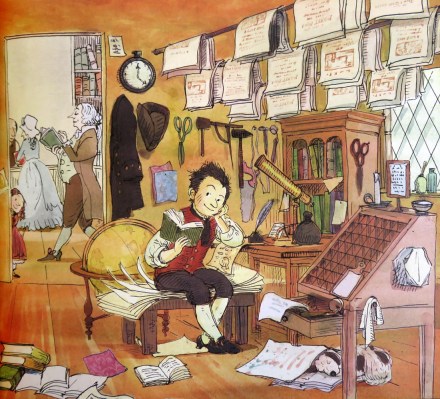
One of the children reading these books was John Newbery who, despite the dreariness, loved to read more than he liked to do his chores. When he grew up, he left the family farm and went to work for a printer. After he learned the business, he became a publisher himself. He moved from his small town to “London, center of the bookselling trade.”

Soon, he found the perfect storefront on a busy street and opened his shop. He had a dream of publishing books for every taste—and for children too. “He knew the youngsters were hungry for stories. Many boys and girls handed coppers to street hawkers for ugly chapbooks of fairy tales, or for chopped-up versions of grown-up books.” When John Newbery tried to offer good books for children, however, the adults balked. They were afraid “that if their little nippers read fun books, they’d turn wild as beasts!”

celebrate-picture-books-picture-book-review-balderdash!-john-newbery-and-the-boisterous-birth-of-children's-books-going-to-london

Image copyright Nancy Carpenter, 2017, text copyright Michelle Markel, 2017. Courtesy of Chronicle Books.

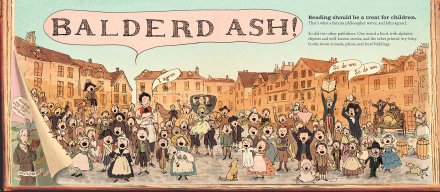
“Balderdash!” John Newbery said. And others agreed. Two publishers issued books of alphabet rhymes and stories, and another published some books of nonfiction. But “John wanted his first book for children to be irresistible.” The books he created included pictures of fun children’s games, enjoyable ways to learn ABCs and other subjects, and fantasy stories. He even wrote a note to moms and dads to alleviate any fears.

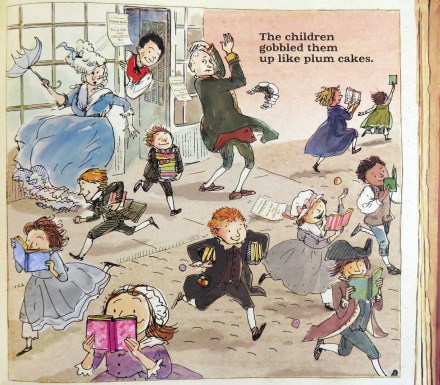
The covers of his books were colorful and attractive and carried the title “A Pretty Little Pocket-Book.” To further entice kids and their parents, John offered to sell books along with a toy for a very good price. John wondered if his books would look “too cheerful,” but “the children gobbled them up like plum cakes.”

celebrate-picture-books-picture-book-review-balderdash!-john-newbery-and-the-boisterous-birth-of-children's-books-kids-with-books

Image copyright Nancy Carpenter, 2017, text copyright Michelle Markel, 2017. Courtesy of Chronicle Books.

As customers bought books in the front of his shop, John created new books in the back. In addition to fiction books, he began printing books on math, science, and other subjects. With the books a success, John Newbery turned his thoughts and his press towards creating a magazine for children, and, finally, a novel. The novel was titled The History of Little Goody Two-Shoes and was a rags-to-riches story about a little girl who succeeded through “study, hard work, and kindness.” It showed children that they too could achieve their dreams. The History of Little Goody Two-Shoes was a hit in England and America.

While the authors of John Newbery’s books were all anonymous or had “silly, made-up names,” it wasn’t hard for people to figure out who was really creating the books that brought their children so much joy and made their lives better.

celebrate-picture-books-picture-book-review-balderdash!-john-newbery-and-the-boisterous-birth-of-children's-books-newbery's-shop

Image copyright Nancy Carpenter, 2017. text copyright Michelle Markel, 2017. Courtesy of Chronicle Books.

An Author’s Note about John Newbery as well as a resources page follow the text.

Kids will love Michelle Markel’s entertainingly informative book that takes them back to a time when the unthinkable was reality. Markel’s charming text is as infectious as John Newbery’s love of books, and readers will laugh at how kids’ books were once perceived. Her conversational tone and bemusement at the state of publishing at the time creates a warm reading experience—like a secret shared between friends.

celebrate-picture-books-picture-book-review-balderdash!-john-newbery-and-the-boisterous-birth-of-children's-books-kids

Image copyright Nancy Carpenter, 2017. text copyright Michelle Markel, 2017. Courtesy of Chronicle Books.

Nancy Carpenter infuses Balderdash! with the sights, dress, activities, and flavor of the time period in her pen-and-ink illustrations. Humor abounds, from the little boy overflowing with tears in the corner of the first page to a young John Newbery relishing the feel and smell of newly printed pages to parents pulling their children away from “dangerous” books. Along the way, kids will want to scope out all the details on each page. A variety of typefaces and sizes further enhances the humor and ambience of the book.

Balderdash! John Newbery and the Boisterous Birth of Children’s Books would make a great addition to home libraries for kids interested in books, history, and innovation. Teachers will also find the book to be a perfect beginning for language arts or history units.

Ages 4 – 8

Chronicle Books, 2017 | ISBN 978-0811879224

Discover more about Michelle Markel and her books on her website!

Read a New Book Month Activity

I Have the Reading Bug! Bookplate and Bookmark


Do you have the reading bug like John Newbery? If so, here’s a bookplate and bookmark for you to print to show your love of books!

I Have the Reading Bug Bookmark | I Have the Reading Bug Bookplate

Picture Book Review

July 3 – International Plastic Bag Free Day

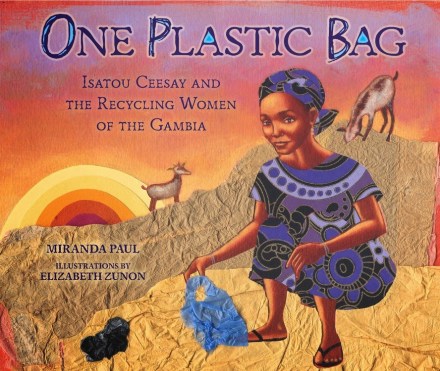
celebrate-picture-books-picture-book-review-one-plastic-bag-cover

About the Holiday

Plastic bags are everywhere! Used by supermarkets, department stores, discount stores, and just about anywhere goods are sold, plastic bags are a take-home-then-throw-away item that never quite goes away. These bags may seem lightweight, but they do heavy damage to the environment, taking hundreds of years to fully decompose. Many shops encourage patrons to bring their own bags and offer cloth and paper bags as well. These are great alternatives that benefit the earth. Today’s holiday was established to promote awareness around the world to the dangers of plastic bags and spur people to use reusable containers.

One Plastic Bag: Isatou Ceesay and the Recycling Women of the Gambia

Written by Miranda Paul | Illustrated by Elizabeth Zunon


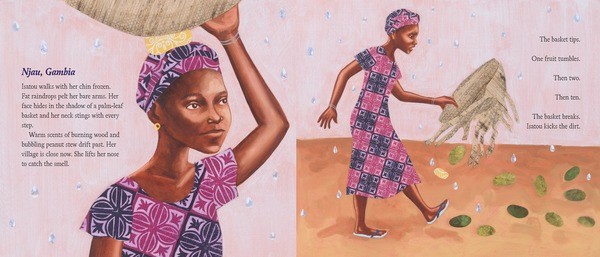
In Njau, Gambia Isatou walks home carrying a basket of fruit on her head. As raindrops begin to fall, the basket shields her, but suddenly the basket tips and falls. The fruit inside tumble to the ground. The basket is in shreds; how will Isatou carry her load? “Something silky dances past her eyes, softening her anger. It moves like a flag, flapping in the wind, and settles under a tamarind tree.” Isatou picks it up and finds that it can hold things. She gathers her fruit and puts them in the bag. She leaves her basket behind, “knowing it will crumble and mix back in with the dirt.”

celebrate-picture-books-picture-book-review-one-plastic-bag-basket

Image copyright Elizabeth Zunon , text copyright Miranda Paul. Courtesy of Millbrook Press.

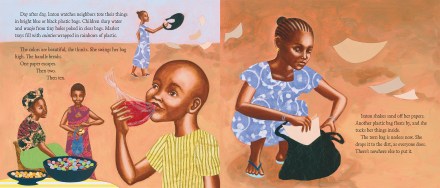
At home Grandmother Mbombeh has a dinner of spicy rice and fish ready. When Isatou tells her about the broken basket and shows her the bag, Grandmother frowns. She has seen more in the city. Now, Isatou notices plastic bags everywhere. They are as colorful as a rainbow. As Isatou swings her bag full of papers, the handle breaks, sending the papers inside flying. She finds another plastic bag lying nearby and transfers her papers. She leaves the torn bag in the dirt as everyone else does.

celebrate-picture-books-picture-book-review-one-plastic-bag-papers

Image copyright Elizabeth Zunon, text copyright Miranda Paul. Courtesy of Millbrook Press.

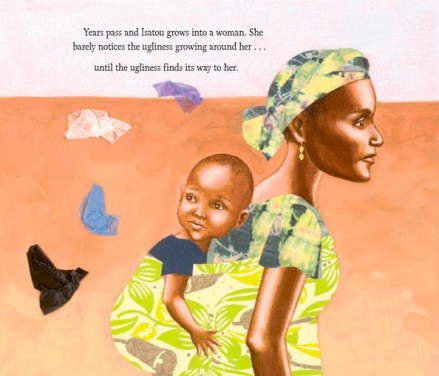
As she passes the spot day after day, she spies her old black bag. It has been joined by others, and the pile grows bigger and bigger. Isatou chooses another path to take and forgets about the bags. “Years pass and Isatou grows into a woman. She barely notices the ugliness growing around her…until the ugliness finds its way to her. One day when coming to Grandmother’s house, she hears one of her goats crying. It’s tied up and there is no sign of her Grandmother’s other goats.

celebrate-picture-books-picture-book-review-one-plastic-bag-Isatou-grown

Image copyright Elizabeth Zunon, text copyright Miranda Paul. Courtesy of Millbrook Press.

Inside, the butcher is talking to Grandmother Mbombeh. He says that the goats have eaten the plastic bags they find lying around. The bags get twisted around their insides, killing the goats. Three of Grandmother’s goats and many more in the village have died. Something must be done. Isatou goes to the road piled with bags. Insects, rotting food, and dirty water mingle with the bags. Goats “forage through the trash for food.”

Isatou retrieves bag after bag from the pile. She and other women wash the bags. While they dry Isatou asks her sister to teach her how to crochet. Isatou has an idea. From a broomstick she carves crochet needles. Then she and her friends cut the bags into strips of thread. The women teach themselves how to crochet with the plastic thread. The work is slow, and some villagers laugh at them. Long into the nights the women continue crocheting by candlelight.

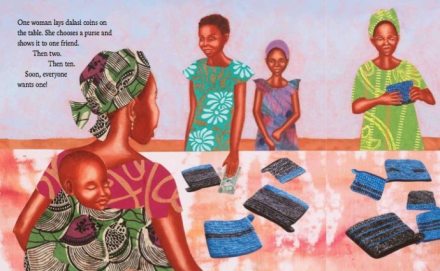
celebrate-picture-books-picture-book-review-one-plastic-bag-purses

Image copyright Elizabeth Zunon , text copyright Miranda Paul. Courtesy of Millbrook Press.

At last a day comes when the women can show what they have been working on. “Fingers sore and blistered, Isatou hauls the recycled purses to the city.” People laugh at her until “one woman lays dalasi coins on the table. She chooses a purse and shows it to one friend. The two. Then ten. Soon everyone wants one!” Later that day Isatou puts the money she has made into her own zippered purse. She can’t wait to show Grandmother that she has earned enough to buy a goat. The trash pile is smaller now. Isatou is determined that one day it will be gone. “And one day…it was.”

An Author’s Note provides more details about this true story as well as a Wolof language glossary and pronunciation guide.

Miranda Paul tells this true story of ingenuity and hope with honesty and evocative language. Young readers will learn how one woman’s concern for her community and courage in the face of opposition changed the lives of the people in her village. Paul’s descriptive text interspersed with native Wolof words allows children to discover details about the customs and daily lives of the citizens of Gambia. Paul’s use of the present tense, makes this a universal story that shows the continuing need for answers to ongoing environmental problems. Isatou’s creative solution to a world-wide problem may spur young readers to develop helpful ideas of their own.

Through her collage illustrations, Elizabeth Zunon brings the vibrant colors and patterns of Africa to readers. The textured papers she uses add depth and details to the women’s clothing, homes, foliage, and the plastic bags that Isotau and her friends transform. Children sit in on the candlelit nighttime crocheting sessions and view the beautiful, finished purses—each one unique.

Ages 6 – 9

Millbrook Press, 2015 | ISBN 978-1467716086

Discover more about Miranda Paul and her books and find resources, videos, photos, and more on her website!

Learn more about Elizabeth Zunon and her books and view a portfolio of her artwork on her website!

International Plastic Bag Free Day Activity

celebrate-picture-books-picture-book-review-book-bag-craft

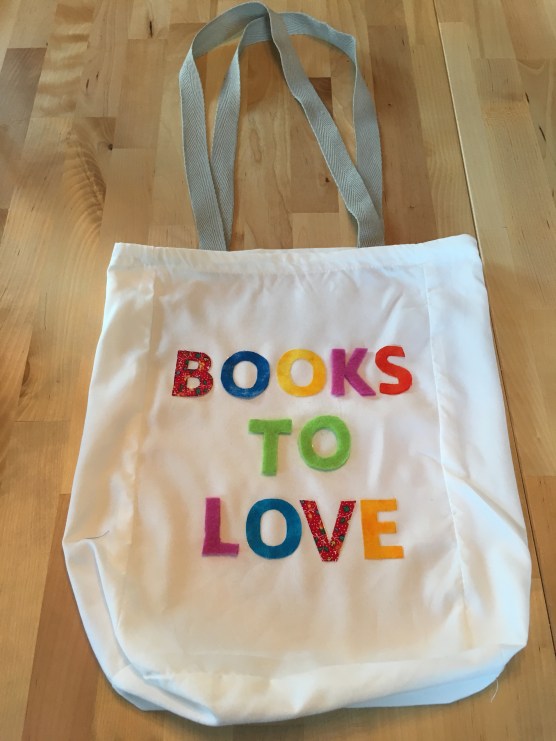
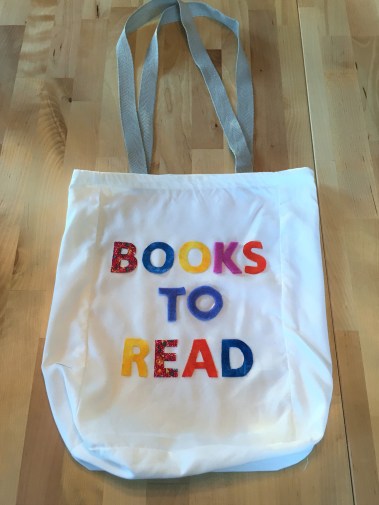
Books to Love, Books to Read Reusable Book Bag


True booklovers can’t go anywhere without a book (or two or three) to read along the way. With this easy craft you can turn a cloth bag into a kid-size book bag!

Supplies

  • Printable Templates: Books to Read Template | Books to Love Template
  • Small cloth bag, available from craft or sewing stores—Recyclable Idea: I used the bag that sheet sets now come in
  • Cloth trim or strong ribbon, available from craft or sewing stores—Recyclable Idea: I used the cloth handles from shopping bags provided from some clothing stores
  • Scraps of different colored and patterned cloth. Or use quilting squares, available at craft and sewing stores
  • Pen or pencil for tracing letters onto cloth
  • Scissors
  • Small sharp scissors (or cuticle scissors) for cutting out the center of the letters
  • Fabric glue
  • Thread (optional)
  • Needle (optional)

celebrate-picture-books-picture-book-review-books-bag-craft

Directions

  1. Print the sayings and cut out the letters
  2. Trace letters onto different kinds of cloth
  3. Cut out cloth letters
  4. Iron cloth bag if necessary
  5. Attach words “Books to Read” to one side of bag with fabric glue
  6. Attach words “Books to Love” to other side of bag with fabric glue
  7. Cut cloth trim or ribbon to desired length to create handles
  8. Glue (or sew) handles onto the inside edge of bag

Picture Book Review

June 29 – International Mud Day

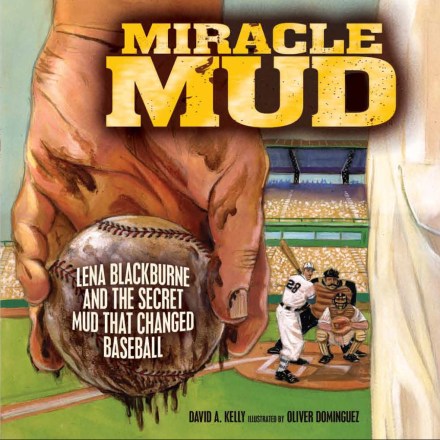
celebrate-picture-books-picture-book-review-miracle-mud-cover

About the Holiday

Today’s holiday was established in 2009 when the students of Bold Park Community School in Wembley, Western Australia teamed with the boys of the Nepalese Panchkhal Orphanage to “celebrate the visceral and primal connection we all share with Earth and the outdoors.” Since that day, schools, families, and early childhood education centers have worked to remind us that we all need to take time to play in the mud sometimes and reconnect with what makes us human. In 2015, the day was expanded to include the entire month of June to allow us to decompress from the high-tech, high-pressure world we live in and to connect with others.

Miracle Mud: Lena Blackburne and the Secret Mud that Changed Baseball

Written by David A. Kelly | Illustrated by Oliver Dominguez


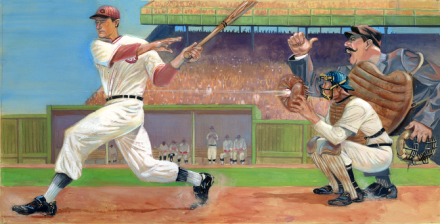
“Lena Blackburne wanted to be a famous baseball player.” Unfortunately, he wasn’t one of the greats. In fact starting in 1910, Lena moved around from team to team, playing a variety of positions. He made appearances at every base and played shortstop; he even had a go as pitcher. But he wasn’t a star at any of these positions. He was never going to make it to the Hall of Fame.

celebrate-picture-books-picture-book-review-miracle-mud-striking-out

Image copyright Oliver Dominguez, coiurtesy of oliver-dominguez.com

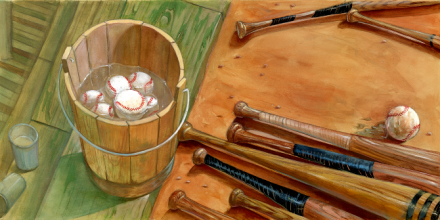
After he retired from playing, Lena became a coach. One day the umpire came to him with a complaint about the soggy baseballs. They were too hard to throw and too hard to see. Besides that, when they were hit, they didn’t soar very far. The problem was that new baseballs had a slick sheen to them, “so players soaked them in dirty water. It got rid of the shine. But it also made the balls soggy and soft.”

celebrate-picture-books-picture-book-review-miracle-mud-soggy-baseballs

Image copyright Oliver Dominguez, coiurtesy of oliver-dominguez.com

Players tried other methods to get rid of the shine, but they had drawbacks too. Shoe polish just turned the balls black, and “spit and tobacco juice…made the balls stink.” Lena Blackburne sat down and considered the problem. The answer came to him in a most unusual place—an old fishing hole where Lena liked to go when he was off the road and home.

celebrate-picture-books-picture-book-review-miracle-mud-spitting

Image copyright Oliver Dominguez, coiurtesy of oliver-dominguez.com

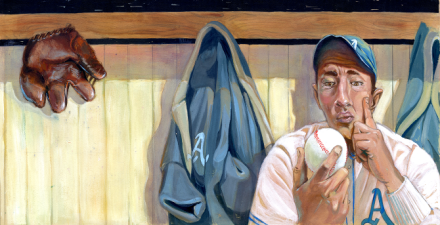
While fishing one day, he happened to step into some dark brown mud. It sucked at his boot, and as Lena pulled his foot out he had an idea. The mud was “smooth and creamy like chocolate pudding. But it felt gritty.” At the ballpark, Lena rubbed the mud on the balls. When the mud dried, it was easy to wipe off. The mud left the balls with a good finish—not soggy, black, or smelly. At the next game, “the pitcher threw muddy fastballs, curveballs, changeups, and sinkers. The batters hit muddy singles, doubles, triples, and home runs.”

celebrate-picture-books-picture-book-review-miracle-mud-thinking

Image copyright Oliver Dominguez, coiurtesy of oliver-dominguez.com

Lena returned to the fishing hole and dug up more mud. He put it into containers and began selling it. Teams all over the league bought Lena Blackburne’s Baseball Rubbing Mud. Lena’s famous mud is still used today and is officially the “only thing that’s allowed on major-league balls.” Lena Blackburne always dreamed of being in the Baseball Hall of Fame. While he didn’t make it there as a player, he is remembered for his contributions to the game he loved in a special exhibit for Lena Blackburne’s Baseball Rubbing Mud.

celebrate-picture-books-picture-book-review-miracle-mud-winning

Image copyright Oliver Dominguez, coiurtesy of oliver-dominguez.com

An Author’s Note including more about Lena Blackburne, his baseball statistics, and his special mud follow the text.

Kids who love baseball will be intrigued by David A. Kelly’s unique take on the game. By exploring a small detail that had large effects on the quality of play, Kelly presents a picture book mystery with a surprise ending for younger readers. Kelly’s inclusion of Blackburne’s disappointments shows children that each person’s unique contributions are often found in expected ways.

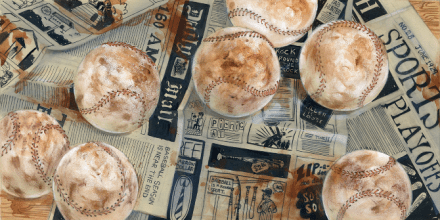
celebrate-picture-books-picture-book-review-miracle-mud-baseballs

Image copyright Oliver Dominguez, coiurtesy of oliver-dominguez.com

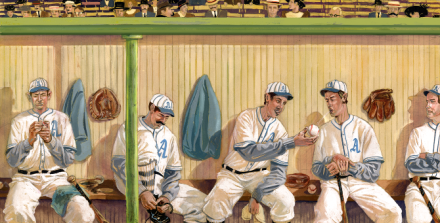
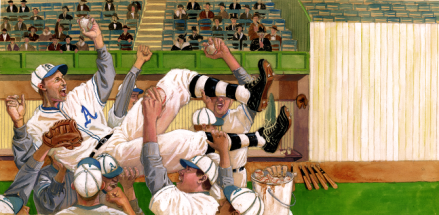
Kids get a front row seat at the baseball stadium in Oliver Dominguez’s stunning illustrations. As Lena swings and misses, readers can almost hear the smack of the ball in the catcher’s glove and the ump yelling, “Steee-rrriike!”  When Lena Blackburne becomes a coach and ponders the problem of the soggy baseballs, kids will enjoy seeing baseballs bobbing in a wooden bucket of water, laugh to see a player spitting on a new baseball, and wonder what idea has Lena so wide-eyed at the fishing hole. Baseball lovers will want to linger over the up-close views of players preparing for a game and celebrating their win.

Ages 6 – 10

Millbrook Press, 2013 | ISBN 978-0761380924

Find out more about David A. Kelly, his ballpark mysteries, and his other books on his website!

View a gallery of artwork and videos by Oliver Dominguez on his website!

International Mud Day Activity

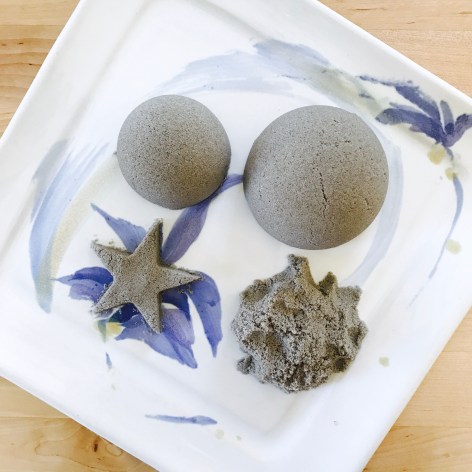
celebrate-picture-books-picture-book-review-kinetic-sand-craft

Make Your Own Sensory Sand


While this sensory sand may not be exactly mud, it’s sure as much fun to play with!

Supplies

  • 1 cup sand
  • ½ tablespoon cornstarch
  • 1 teaspoon dish soap
  • Water as needed – about ¾ cup
  • Bin or bowl for mixing dry ingredients
  • Bowl for mixing dish soap and water

Directions

  1. In the bin combine the sand and cornstarch and mix well
  2. In the bowl combine the dish soap and water until the water is bubbly
  3. Slowly add the water mixture to the dry ingredients, mixing and adding water little-by-little until the desired consistency is reached. The grain of the sand will determine how much water is needed.
  4. The sand can be formed with cookie cutters, molds, hands, etc. and is strong enough to stack.

Picture Book Review

May 7 – Lemonade Day

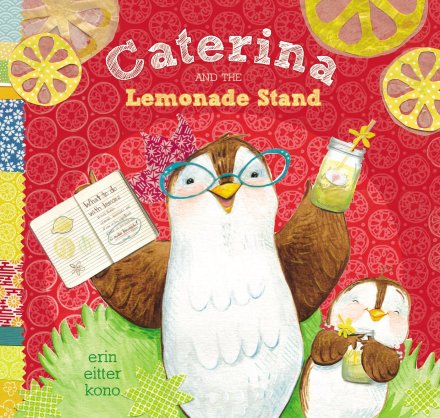
celebrate-picture-books-picture-book-review-caterina-and-the-lemonade-stand-cover

About the Holiday

Lemonade Day was established in 2007 in Houston, Texas by Lisa and Michael Holthouse to encourage kids to discover their inner entrepreneur and set up their own businesses. Lisa was inspired by her own experience of setting up a lemonade stand as a child to buy a pet turtle that her father refused to pay for. The main character in today’s book has similar motivations with an altruistic bent.

Caterina and the Lemonade Stand

By Erin Eitter Kono


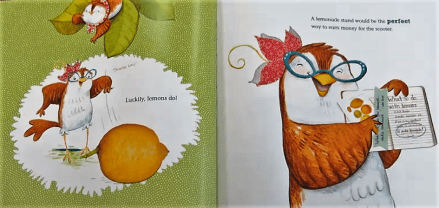
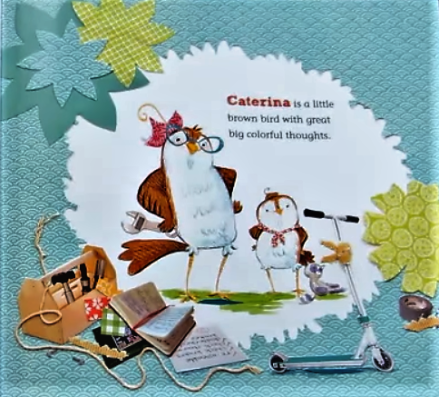
Summertime has finally arrived, and Caterina is ready for fun. As she passes a store window, she is captivated by the shiny new scooter in the window. A quick check of her kitty bank, however, reminds her that “buying new things isn’t always so easy.” Caterina knows that money doesn’t grow on trees, but is also happily aware that lemons do. Caterina has a brainstorm: “a lemonade stand would be the perfect way to earn money for the scooter!”

celebrate-picture-books-picture-book-review-caterina-and-the-lemonade-stand-lemons-grow-on-trees

Copyright Erin Eitter Kono, courtesy of Dial Books for Young Readers.

So Caterina, “a little brown bird with great big colorful thoughts,” puts her mind to the task. As she loves to do, she makes a list of what she’ll need—“lots of lemons, sweet sugar, icy-cold water, and of course…a super stand!” But Caterina looks around her. It seems that everyone has a lemonade stand, including her friends Patrick the bear, Paul Peacock, and even Dig Dig the hampster, her little brother Leo’s best friend.

celebrate-picture-books-picture-book-review-caterina-and-the-lemonade-stand-brown-bird

Copyright Erin Eitter Kono, courtesy of Dial Books for Young Readers.

Caterina realizes that if she “is going to earn enough money to buy the scooter, her stand must stand out.” She begins to think creatively. To make her stand the most attractive and inviting, she decorates it with handmade crafts that are cozy and colorful, studs the lemons with cloves to make them aromatic, fills her booth with the music of Leo’s violin playing, and experiments with flavors.

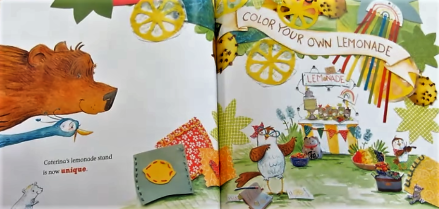
Soon, she has a stand that is unique. A rainbow mobile fluttering with multicolored ribbons hangs next to a banner that reads: “Color your own lemonade.” Nearby sits a basketful of delicious fruit that thirsty customers can add to their glass to create an individual taste sensation. In no time, her stand has earned her “an entire bank full of coins. Just enough to buy a shiny new scooter…for Leo!”

Following the story, Caterina gives some good advice for ways to stand out that include being creative, planning well, working hard, and finding the best assistant.

celebrate-picture-books-picture-book-review-caterina-and-the-lemonade-stand-finished-stand

Copyright Erin Eitter Kono, courtesy of Dial Books for Young Readers.

Erin Eitter Kono’s Caterina is a cutie of a role model for young readers who think differently or who want to stand out in other ways. She shows kids that by using their talents they too can reveal their own unique abilities and personalities. Adults and children will appreciate her loving relationship with her little brother, who is Caterina’s helpful assistant and the beneficiary of the money they earn.  Caterina’s clever solution to her dilemma is hinted at throughout the cheery illustrations, and readers will enjoy watching Caterina’s lemonade stand come together with her handiwork.

For kids full of ideas, Caterina and the Lemonade Stand would make an adorable addition to their home home bookshelves.

Ages 3 – 5

Dial Books for Young Readers, 2014 | ISBN 978-0803739031

Learn more about Erin Eitter Kono and her books and view a portfolio of her illustration and design work on her website!

Spend more time with Caterina, Leo, and their friends on Caterina’s Corner!

Lemonade Day Activity

celebrate-picture-books-picture-book-review-lemonade-stand-coloring-page

Yummy Lemonade Stand Coloring Page


There’s nothing more refreshing than a glass of lemonade on a hot summer day! Enjoy coloring this printable Yummy Lemonade Stand Coloring Page—and drink a cold lemonade while you work.

Picture Book Review