October 23 – Mole Day

celebrate-picture-books-picture-book-review-a-friend-for-mole-cover

About the Holiday

From 6:02 a.m. to 6:02 p.m. on 10/23 chemists, scientists, students, and others who love numbers celebrate Mole Day to commemorate Avogadro’s Number, which is a basic weight measuring unit in chemistry. Defined by the equation 6.02 x 10²³, Avogadro’s number finds that for any given molecule one mole of that substance has a weight in grams equal to its atomic number. The name of this scientific constant naturally led to an association with the furry underground burrowers, and the mole and mascot moles can be found working in tandem to promote a better understanding and enjoyment of chemistry. As today’s book proves there is no better mixture than the chemistry between friends.

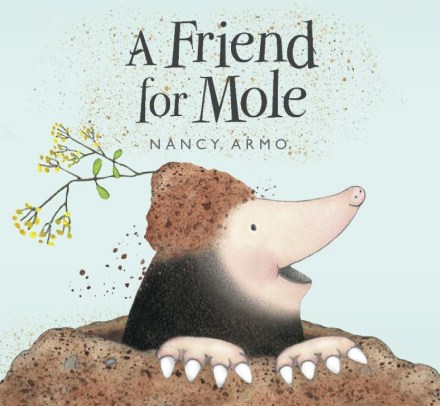
A Friend for Mole

By Nancy Armo

Mole loves his cozy burrow. “He liked his soft bed of leaves, the warm smell of the earth, and the quiet darkness all around.” He can imagine the world above him by all the distinct sounds he hears. But one day those sounds become louder. Instead of gentle tapping and buzzing, he hears stomping, shouting, and laughing. He decides to go up above and see what all the ruckus is about.

“The bright light, loud noises and new smells were overwhelming,” and Mole thinks it was a very bad idea to have left his burrow. He tries to find his way home, but he can no longer see the hole. In a panic he starts to run. He trips over a tree root and rolls under a bush. The soft leaves and darkness remind Mole of his burrow and soon he is fast asleep.

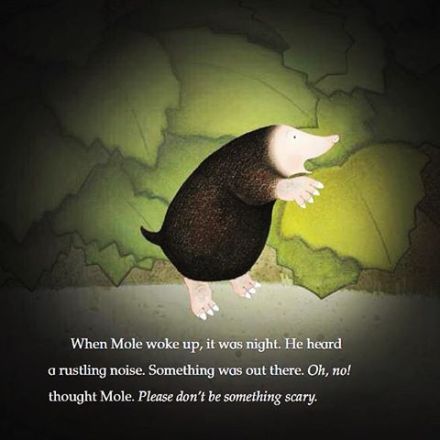
Mole wakes up during the night. He hears rustling and sees two shiny eyes staring at him. “‘Oh no!’” thinks Mole. “‘Please don’t be something scary.’” Mole closes his eyes, hoping to hide. But then he hears a small whimper. “‘Are you afraid of the dark too?’” When Mole takes a peek, he sees a wolf. “‘No,’” Mole answers. “‘I’m afraid of the light.’” Wolf tells Mole that he is lost after being chased by the other animals and that he is scared.

celebrate-picture-book-review-a-friend-for-mole-rustling-sound

Copyright Nancy Armo, courtesy of Peachtree Publshers

Mole and Wolf think about what they can do and devise a clever plan. Mole says he will stay with Wolf in the dark, and Wolf agrees to help Mole find his burrow when the sun comes up. To make the time go faster, Mole and Wolf play games, such as hunting “imaginary slithering creatures,” stomping on “pretend scampering bugs,” and “chasing away scary monsters. It was all so much fun they forgot about being lost and scared.”

As daylight breaks, Mole begins to think about home. Wolf also feels homesick. As they search for the entrance to Mole’s burrow, Wolf shields Mole’s eyes from the sun with his tail, and Mole giggles at the tickly softness of Wolf’s fur. Soon they discover Mole’s burrow, and Wolf realizes that he lives nearby. Although Mole is happy to be home, he also feels sad to say goodbye to Wolf.

He asks if Wolf would like to play again sometime. Wolf shouts, “Yes! That was so much fun! I was scared but having you there made everything okay.” As Mole settles back into his leafy bed, he knows “exactly what Wolf meant.”

In her sweet story of friendship found, Nancy Armo relates that most comforting feeling—the knowledge that friends always stand by you even when times are hard or scary. Her characters Mole and Wolf are perfectly chosen foils with opposite strengths that, combined, help solve their immediate problem and form a strong friendship. Armo’s straightforward storytelling is enriched by the endearing personalities of Mole and Wolf as well as their honest sharing of feelings.

In vivid two-page spreads Armo superbly depicts the daytime and nighttime scenes, transporting readers into the heart of her story. Above the “quiet darkness” of Mole’s burrow, cute mice scamper in the rain while an earthworm, a snail, and a bee take shelter. When his roof rings with noise and curiosity gets the better of Mole, he emerges into an open field, and his tumbling trip over the tree root is nimbly portrayed with a series of flips rendered with a filmy transparency. As nightime falls the Mole’s and Wolf’s adventure plays out on pages with a solid black background. Wolf’s eyes shining on a completely darkened page offers just the right amount of suspense for little readers, and a careful look at the expression in his eyes is reassuring. Kids will enjoy the games the two friends enjoy, and will cheer when the sun dawns on their new friendship.

A Friend for Mole is a great book for young readers navigating the world of meeting new classmates, teammates, and other children who may see the world differently but would make good friends.

Ages 3 – 7

Peachtree Publishers, 2016 | ISBN 978-1561458653

You’ll find fun A Friend for Mole activity sheets, a portfolio of artwork, and more on Nancy Armo’s website!

Mole Day Activity

celebrate-picture-books-picture-book-review-mole-mazeMole Tunnels Maze

Dig into this printable Mole Tunnels Maze that has as many twists and turns as a mole’s home!

Picture Book Review
October 18 – It’s Squirrel Awareness Month

celebrate-picture-books-picture-book-review-those-darn-squirrels-fly-south-cover-image

About the Holiday

Squirrels elicit emotions on both sides of the spectrum. On one hand you can’t help but say “Awww!” when you see their tiny little paws and crafty antics. On the other hand their voracious appetites at bird feeders and penchant for darting into traffic is more likely to make you say “Arrgghhh!” This month is set aside, however, for enjoying the squirrels in your yard, park, or city. And really, don’t they make life just a little more fun?

Those Darn Squirrels Fly South

Written by Adam Rubin | Illustrated by Daniel Salmieri


Everyone knows Mr. Fookwire is a grump whose grumpiness knows no bounds. “He scolded fireflies for being too bright…yelled at clouds for being too fluffy…and pinched his nose with a clothespin” so he doesn’t have to smell the lilacs. Despite these annoyances, though, he had a wonderful summer painting pictures of the birds in his yard even though “those darn squirrels” had set up an easel of their own nearby.

But now fall was here and that meant that all of Mr. Fookwire’s beloved birds would soon be flying south leaving him with only the squirrels for company. While the squirrels usually spent the winter months “playing ping pong, building ships in bottles, and knitting, this winter they had decided to follow the birds to warmer climes. With their expert knowledge in aerodynamic engineering, the squirrels had “built gyro-copters from pinecones…gliders from leaves…and even a zeppelin from an old shopping bag.”

celebrate-picture-books-picture-book-review-those-darn-squirrels-fly-south-squirrels-build-flying-macihines

Image copyright Daniel Salmieri, text copyright Adam Rubin. Courtesy of hmhbookscom

When the day came for the birds to take wing, Mr. Fookwire sadly waved goodbye. Just as he was about to return to the house, he heard a strange rustling, then a whir, and finally a buzz. It was the squirrels soaring away in their homemade aircraft. “‘Great googley-moogley’” Mr. Fookwire exclaimed.

The squirrels followed the birds for days until they landed on a beach. To celebrate the end of their journey and the welcome warmth, the squirrels held a fiesta, complete with mangoes, the marimba, and the merengue. Winter was wonderful here where there were new foods to eat and new birds to discover. One with a long neck, rings around its eyes, and red and blue feathers even looked a little familiar and left the squirrels feeling homesick. They decided to make a long-distance phone call, and chattered away to Mr. Fookwire.

Although he wouldn’t admit it, Mr. Fookwire was happy to receive the call. He decided to pack up his easels, paints, brushes, and cottage cheese with pepper and hit the road in his beautiful vintage car. Driving 12 miles an hour, Mr. Fookwire at last reached the beach, where the squirrels swarmed him in a big hug. “Maybe it was the nice weather. Maybe it was the beautiful scenery, Maybe it was the squirrels dancing in his pants. But for the first time in a very long time, the old man laughed.”

celebrate-picture-books-picture-book-review-those-darn-squirrels-fly-south-squirrels-fly-south

Image copyright Daniel Salmieri, text copyright Adam Rubin. Courtesy of hmhbookscom

Mr. Fookwire was delighted with the local birds and immediately began to paint them. “‘The birds here are even more amazing than the birds back home!’ he exclaimed. ‘Harrumph!’ muttered the floogle bird.” The hot sun took its toll on Mr. Fookwire, however, and he collapsed right into the middle of his painting. The squirrels dragged him into the shade and revived him. Maybe spending the winter at home was better. Mr. Fookwire decided to head back, and the squirrels accompanied him. They didn’t want to miss “the annual snow-fort building competition.”

They all jumped into the car and sped off. Really! After all, Mr. Fookwire was in no condition to drive.

Adam Rubin’s Those Darn Squirrels Fly South contains all the charm and squirrely shenanigans that make the other two books in the series such a hit with kids (and adults). Rubin’s snappy descriptions, silly scenarios, and loveably cantankerous protagonist make for a hilarious story time read that will delight his fans and captivate new readers.

Daniel Salmieri knows how to make kids giggle and laugh out loud with colorful illustrations that perfectly depict Mr. Fookwire’s world—both at home and away. Mr. Fookwire’s noodly arms, giraffe-long neck, and carrot-shaped nose coalesce into a character that is at once funny and endearing. Getting more beak time in this third outing, the familiar birds are joined by a crew of even more brilliant and exotic beach mates. The squirrels are up to their usual contraption-making tricks as they build flying machines from soda bottles, flashlights, baseball caps, and more around-the-house items. The squirrels know how to live wherever they are, and Salmieri’s depictions of them holding a fiesta, hugging Mr. Fookwire, and roaring down the highway is absurdity for the younger set at its best.

Ages 4 – 7

Houghton Mifflin Harcourt, 2012 | ISBN 978-0544555457

You can find out more about Adam Rubin, his books, and his dry sense of humor on his website!

View a gallery of illustration work and more books by Daniel Salmieri on his website!

Go nuts watching this Those Darn Squirrels Fly South book trailer!

Squirrel Awareness Month Activity

celebrate-picture-books-picture-book-review-squirrel-dot-to-dot

Celebrate Squirrels! Dot-to-Dot


Enjoy following the dots to finish this printable Celebrate Squirrels! activity sheet and then color it in!

Picture Book Review
October 2 – It’s National Chili Month

Armadilly Chili picture book review

About the Holiday

What could be more satisfying during a cool autumn month than a spicy bowl of chili?  Whether made with meat or veggies, combined with macaroni, or served in potato skins, the simmered flavors make for a scrumptious meal. Although the origins of chili are lost to history, it’s believed that the dish is a southwestern, specifically Texan, concoction. It began to attract attention in the early 1800s, and by the 1880s”Chili Queens” were selling “bowls o’red” at chili stands throughout San Antonio. In 1893 the San Antonio Chili Stand made an appearance at the Chicago World’s Fair. It’s popularity took off across Texas and throughout the west by the 1920s. When the Great Depression hit, chili became one of the only affordable meals for the hungry population. Today chili is a favorite dish of people all over the world. To celebrate this month’s observation why not whip up a batch of your favorite chili or discover some new recipes!

Armadilly Chili

Written by Helen Ketteman | Illustrated by Will Terry

What a hoot! The knee-slappin’, root-a-tootin’ phrasing in Hellen Ketteman’s Armadilly Chili is shor ‘nuf gonna make this a favorite on any child’s bookshelf. While the plot may be familiar, the southwest setting and Miss Billie Armadilly put a fresh, funny twist on it.

“Miss Billie Armadilly skit-skat-skittered down the lane. A blue-norther’s a-blowin’ and my old, cold bones are rattling for a pot of hot armadilly chili,” she says. She’s gathering ingredients when her friend Tex, a many eyed tarantula, tip taps by. Hey, Tex, she calls, how about tapping your toes this way and helping me gather a boxful of beetles?” But Tex just “wiggles his long jiggly legs and says, ‘Shucks, Miss Billie, I’m going dancing today.’” Miss Billie harrumphs and collects the beetles herself.

Next Miss Billie is picking peppers, and when Mackie the bluebird flies in she thinks she has an assistant. “‘How ‘bout whistlin’ up a tune and helping me pick a peck o’ peppers for my armadilly chili?’” Once again, though, she’s left on her own since Mackie says he is “‘shakin’ my tail feathers to the movies.’” When Miss Billie “scurries to the prickly pear cactus and begins chippity-chop-chopin,’” her friend Taffy, the horned toad, complains about the noise and then begs off from helping, saying she’s got plans to go skating.

celebrate-picture-books-picture-book-review-armadilly-chili

Image copyright Will Terry, courtesy of Albert Whitman & Company

At home, Miss Billie stirs her chili to a scrumptious bubble. The aroma entices first Tex, then Mackie, and finally Taffy to come a’knockin’ at her door looking for a bowlful, but Billie has something to say about that—specifically, “no workin’ with Billie, no sharin’ the chili!”

Billie’s friends hurry away sorry that she feels that way, and Billie sits down to her feast. But after all that work, the chili tastes as “flat as a Texas prairie.” What’s wrong? She realizes what the missing ingredient is just as the doorbell rings. She opens the door to find her friends standing there with bags in their hands. What’s in those sacks? Apologies! As well as hot apple cider, jalapeno biscuits, and homemade chocolate fudge. Now that the friends are all together, the chili tastes just right, and “they talked and laughed into the cold, blustery night.”

celebrate-picture-books-picture-book-review-armadilly-chili-mackie-visits

Image copyright Will Terry, text copyright Helen Ketteman, courtesy of Albert Whitman & Company

What a hoot! Helen Ketteman’s fast-paced Armadilly Chili is a spicy take on the little red hen story  and what it means to be a good friend. Miss Billie is a sassy, no-nonsense heroine who values her work and talents and makes sure others do too. When anger and frustration bubble over, however, the four friends find a way to apologize and make up. The lesson, humorously conveyed as well as Ketteman’s knee-slappin’, root-a-tootin’ phrasing is shor ‘nuf gonna make this a favorite on any child’s bookshelf. 

Will Terry’s vivid illustrations washed with a palette of deep reds, oranges, greens, and yellows bring the Southwest setting to life. Miss Billie and her friends are enchanting versions of their natural counterparts, and kids will love the environmental and homey details on each page, where even the cacti display personalities. Billie’s facial expressions as each of her friends abandon her to her chores are priceless, and their final camaraderie is highly satisfying.

Ages 4 – 8

Albert Whitman & Company, Illinois, 2008 | ISBN 978-0807504581

Discover more about Helen Kellerman and her books plus fun accompanying activities on her website!

View a portfolio of Will Terry‘s books and artwork on his website!

While I take a few personal days, I am reposting earlier reviews updated with new links and interior art.

National Chili Month Activity

CPB - Chili Pepper Game

Hot, Hot, Hot! Chili Pepper Chili Game

Chili just isn’t chili without a little heat! But can you take 15 chili peppers in your bowl? If you want to win the Hot, Hot, Hot! Chili Pepper Chili Game you’ll have to!

Object of the Game

The object of the game is to collect 15 chili peppers in your bowl before any other player.

Supplies

Rules

  1. Any number of players can play at one time. Print 1 Chili Bowl game board and 1 set of 15 Chili Pepper cards for each player
  2. Give 1 Chili Bowl Game Board to each player
  3. Place the Chili Pepper Cards in a pile or in a bowl
  4. Roll the die to see who goes first. The person with the highest roll goes first
  5. To begin play, the first player must roll a 1, 2, or 3. They should roll until they get one of these numbers.
  6. Players roll the die and collect or lose chili pepper cards by the number of dots on the die. If you roll a:
  • 1 – Pick up 1 chili pepper card and place it on your chili bowl game board
  • 2 – Pick up 2 chili pepper cards and place them on your chili bowl game board
  • 3 – Pick up 3 chili pepper cards and place them on your chili bowl game board
  • 4 – Get a chili pepper card from the player on your left
  • 5 – Give a chili pepper card to the player on your left
  • 6 – Lose a turn

     7. If a player does not have chili pepper cards to give to another player or if the player on           their left has no cards to give, the player rolls again.

    8. Continue play until one player has filled their Chili Bowl with chili peppers!

Picture Book Review
September 30 – International Translation Day

celebrate-picture-books-picture-book-review-good-night-little-sea-otter-cover

About the Holiday

Established in 1953 by the International Federation of Translators, today’s holiday celebrates the translators in every language who work to break down barriers and bring great literature to all people across the globe. Everyone’s story matters, and it is through access to a wide range of books that readers acquire deeper understanding of the commonalities and unique experiences that make us all citizens of the world. For children in bilingual and multicultural homes the ability to read and hear books in their native tongue as well as their adopted language is especially comforting and promotes greater literacy and language learning. With eight bilingual editions available, today’s book is a great example of the importance of translators’ work!

Good Night, Little Sea Otter

Written by Janet Halfmann | Illustrated by Wish Williams


As twilight paints the sky pink, purple, and gold, Little Sea Otter gets ready to sleep in her kelp forest bed. Mama Otter fluffs her baby’s fur and snuggles with her, but Little Otter is still wide awake. “‘I forgot to say goodnight to the harbor seals,’” she tells Mama. The baby waves her “soft, silky paw toward the rocky shore” and says goodnight. The harbor seals all along the craggy cliffs wish the little otter goodnight in return.

celebrate-picture-books-picture-book-review-good-night-little-sea-otter-mama-fluffing-pup's-fur

Image copyright Wish Williams, text copyright Janet Halfmann, courtesy of starbrightbooks.org

Hearing the seals’ goodnight song, the sea lions join in, their loud barks echoing in the air. “‘Good night, father sea lions. Good night, mother sea lions and baby sea lions,’” Little Otter calls. Curious about all the commotion, a seagull swoops down and learns that it’s bedtime for Little Otter. The two say “Good night” to each other, and as the seagull flies away to find his own place to sleep, Mama Otter tries to tuck in her little pup.

“But before she could say another word, Little Sea Otter dipped her furry face into the chilly water.” There she sees a whole ocean full of fish to greet. She says “Good night” to the yellow fish, the orange fish, and the purple fish. Of course she can’t forget the long fish or the short fish, the striped fish or the spotted fish either. All these fish are happy to wish the tiny pup sweet dreams too. Mama Otter points out other sea creatures getting ready for bed—different types of crabs, snails, sea stars, anemones, clams, and more. Little Otter says “Good night” to each in turn.

celebrate-picture-books-picture-book-review-good-night-little-sea-otter-harbor-seals

Image copyright Wish Williams, text copyright Janet Halfmann, courtesy of starbrightbooks.org

From every part of the ocean sea turtles, lobsters, octopi, rays, jelly fish, sea horses, eels and others bubble a chorus of “Good night” to Little Otter. She listens and responds to each one and then asks Mama if she has forgotten anyone. “‘Yes, you did,’” Mama says, “scooping her up in her paws. ‘You missed ME!’” Little Otter giggles and says “Good night.” Mama Otter hugs her tight and rolls over and over in the kelp, wrapping them both “in ribbons of seaweed” that will keep them secure on the ocean currents as they sleep.

Little Otter gazes up into the night sky and says “Good night” to the moon and the stars. As Little Otter’s eyes finally close and she drifts into sleep, Mama kisses her gently on the head and the sea whispers “‘rock-a-bye.’”

celebrate-picture-books-picture-book-review-good-night-little-sea-otter-all-ocean-creatures

Image copyright Wish Williams, text copyright Janet Halfmann, courtesy of starbrightbooks.org

Janet Halfmann’s gentle bedtime story is a sweet reminder for children of all the people in their life who love them and are thinking of them every day. As Little Sea Otter puts off sleep with just one more “Good night” and then another and another, Halfmann reveals with lyrical language the wide world of the sea and the creatures in it. The readiness of the ocean creatures to respond with their own heartfelt wishes for the little pup suggest that this is a nightly and eagerly anticipated ending to each day by all.

One might imagine that in addition to “Good night” Little Otter’s nightly repertoire includes the request to be told all the names of the fish and sea animals, just as children love to look through pictures of family and friends and learn their names. Mama’s patient support of her pup’s curiosity and connections to her world provide tender moments between mother and child, as do their final bedtime rituals before drifting off to sleep.

celebrate-picture-books-picture-book-review-good-night-little-sea-otter-spanish-translation

Image copyright Wish Williams, text copyright Janet Halfmann, courtesy of starbrightbooks.org

Wish Williams’ beautiful, vivid illustrations are stunning and detailed, offering a magical realism that is perfect for this book’s wide-eyed audience. Little Otter and her sea creature friends are adorable, their smiling faces glowing with their happiness to see each other and finish the day together. While the fish and other sea creatures are colorful, the hues are true to their natural counterparts. The blue-green ocean swirls and foams along the rocky shore at twilight while whitecaps glitter in starlight when the sun goes down.

Little Otter’s repeated phrase of “Good night” gives children plenty of opportunities to read along. Kids and adults who enjoy the beach and marine environments will also be delighted in the scientific facts about sea otters organically sprinkled into the text. The lovely nature of the mother/child relationship, opportunities for child participation, and gorgeous art make Good Night, Little Sea Otter a welcome addition to home bookshelves for quiet story times and bedtime.

Translations

Star Bright Books also publishes Good Night, Little Sea Otter in eight bilingual editions. For information on each click on the links below:

Arabic/English | Burmese/English | Burmese Karen/English | French/English | Hmong/EnglishNavajo/English | Portuguese/English | Spanish/English

Ages 2 – 6

Star Bright Books, 2010 | ISBN 978-1595722546 (English Edition)

Learn more about Janet Halfmann and her other books on her website!

International Translation Day Activity

We Are All Family English/Spanish Word Search

celebrate-picture-books-picture-book-review-we-are-all-family-word-search

Find the names of family members in both English and Spanish in this printable heart- shaped We Are All Family Word Search! Here’s the Solution!


Sleepy Sea Otters Coloring Page

celebrate-picture-books-picture-book-review-sleep-sea-otters-coloring-page

Say “Good night” to these sweet sea otters before going to bed by coloring this printable Sleepy Sea Otters Coloring Page.

Picture Book Review
September 29 – It’s National Piano Month

The Bear and the Piano by David Litchfield picture book review

About the Holiday

Invented around 1700, the piano was not an immediate hit with composers and performers. It took several decades before musicians embraced its versatility, and over the next 150 years the piano underwent many changes in tonality, size, and shape. In the 19th century the instrument became larger and more powerful to accompany soloists in concert and on tour with large orchestras. At the same time, individuals and families took the piano to heart – and hearth – as it became the primary source of home entertainment and piano lessons a must for all children. The United States became a major producer of pianos, with factories in Boston, New York, and Philadelphia. New technology in the twentieth century provided other types of entertainment that came to toke precedence over the piano, and domestic sales declined.

Today we celebrate the beauty of the piano—both in shape and sound—and all the musical artists who play and compose for this storied instrument.

The Bear and the Piano

By David Litchfield


One day a bear cub happens upon a piano in a clearing in the middle of the forest. Wondering what it could be, he approaches and lays his paw on the keys. The strange thing goes PLONK!—such an awful sound. The bear cub leaves, but is drawn back again and again for days, months, and years. Over time the bear grows up and learns to play the piano. The music is beautiful and transports him to strange and wonderful places.

celebrate-picture-books-picture-book-review-bear-finds-piano

Image copyright David Litchfield, courtesy of davidlitchfieldillustration.com

Other bears soon gather in the clearing to hear the “magical melodies” the bear plays. The bear is happy entertaining his friends. One night a girl and her father hiking in the forest come to the clearing. They listen and then tell the bear what his strange instrument is. They invite him to move to the city with them, where he will be able to play grand pianos for hundreds of people. The music he will play and hear “will make your fur stand on end,” they tell him.

The bear is conflicted. One on paw he knows that leaving the forest will make the other bears sad; on the other he longs to explore the world, to play the piano better, and master more intricate music. He decides to go with the girl and her father.

celebrate-picture-books-picture-book-review-bear-in-big-city

Image copyright David Litchfield, courtesy of davidlitchfieldillustration.com

In the city the bear is a sensation! He quickly becomes a celebrity with his name on marquees and playing to sold-out crowds. The bear records albums that go platinum, he appears on the covers of magazines, and wins awards. His experience is everything he could ever wish for. But deep in his heart there is another longing. He misses the forest and his friends there.

He decides to leave the city and rows a boat across the expanse of water to his old home. Excitedly he runs to the clearing, but when he arrives everything has changed. His piano is gone and there are no friends to greet him. The bear worries that everyone is angry at him for leaving, or worse—that they have forgotten him.

celebrate-picture-books-picture-book-review-bear-playing-for-friends

Image copyright David Litchfield, courtesy of davidlitchfieldillustration.com

Suddenly an old friend peeks around the trunk of a tree. The bear hails him with a hearty “Hello!” The other bear remains silent, however, and then turns and runs into the trees. The bear follows, plunging deeper and deeper into the forest. Suddenly he stops. In front of him is a sight that makes his fur stand on end.

There, protected in the shade of a tree and surrounded by the albums, magazines, t-shirts, and other mementos of the bear’s success sits the old piano. The bear’s friends have not forgotten him and they are not angry. They are proud and welcoming. The bear tells them all about his adventures then sits down to play again—for the most important audience of all.

David Litchfield’s very original and moving story is such a wonderfully conceived microcosm of the changes life brings. Stumbling upon a talent, cause, or inspiration; opening up to other influences; and acting on hard decisions are all part of growing up. These concepts are honestly and sensitively presented in The Bear and the Piano, and the reassuring ending brings comfort as well as a tear to the eye.

celebrate-picture-books-picture-book-review-bear-giving-concert

Image copyright David Litchfield, courtesy of davidlitchfieldillustration.com

Litchfield’s touching illustrations—rendered in gorgeous hues of browns, greens, yellows, and blues—brim with yearning and mystery. The piano sits in a misty glow, silent and draped with vines, when the cub discovers it. While the bear grows and learns to play, the air clears and the colors become brighter. When the bear moves to the city, the pages glint and swirl with the glow of marquees and concert halls announcing his enormous achievements. But as he sits on a rooftop one night contemplating his life and looking out toward his old home, the lights around him are the elements of normal life—lamps in apartment windows, stars, and the moon glimmering on the water. His nostalgia to be home will resonate with both kids and adults.

The Bear and the Piano makes a wonderful gift for any age—especially as a graduation or new-job gift—and is a must-have for anyone’s personal library.

Clarion Books, Houghton Mifflin Harcourt, 2016 | ISBN 978-0544674547

To learn more about David Litchfield, his books, and his artwork, visit his website!

While I take a few personal days during this month, I am reposting earlier reviews updated with new links, interior art, and book trailers.

Watch the beautiful The Bear and the Piano book trailer!

National Piano Month Activity

CPB - Record Bulletin Board

Make a Record Chalkboard Bulletin Board


Do you play the piano or another instrument? Would you like to make a record some day? Why wait? In this fun craft you can create your own record bulletin board—and even create your own label art! While this record may not spin on turntables around the world, it will drop in a more important place—your very own room!

Supplies

  • Printable Record Label for you to design
  • Foam board, or a corkboard at least 12-inches x 12-inches square
  • Adhesive cork
  • A 12-inch round plate, record, or other round object to trace OR a compass
  • Chalkboard paint, black
  • X-acto knife
  • Paint brush or foam paint brush
  • Mounting squares

Directions

  1. Cut a section from the adhesive cork a little larger than 12 inches by 12 inches
  2. Affix the cork to the foam board
  3. Trace the 12-inch round object onto the cork/foam board OR use the compass to make a 12-inch circle
  4. With the x-acto knife, carefully cut out the circle (adult help needed for children)
  5. Cut out a ¼ -inch circle in the center of the record bulletin board
  6. Paint the cork, sides and inside the spindle hole with the black chalkboard paint. Let dry
  7. Print the label template and design your own record label
  8. When the paint is dry, glue your label to the center of the bulletin board
  9. Hang your bulletin board with the mounting squares
  10. Decorate!

Picture Book Review
September 28 – Good Neighbor Day

celebrate-picture-books-picture-book-review-the-uncorker-of-ocean-bottles-cover

About the Holiday

With our busy lifestyles it’s sometimes hard to get to know our neighbors. We might give them a quick wave and smile as we’re driving in and out, but finding time to stop and chat can be more difficult. Today’s holiday encourages us to get to know our neighbors and become friends. Why not take the opportunity to say “hi” to someone on your block or in your building or even share a special note of thanks for being a great neighbor!

The Uncorker of Ocean Bottles

Written by Michelle Cuevas | Illustrated by Erin E. Stead


A man in a red stocking cap and clam digger pants sits at his kitchen table with a cup of coffee, sharing space with a tabby cat. His day as the “uncorker of ocean bottles” is about to begin. He follows the path from his isolated house on the hill down to the water’s edge, where he keeps “his eyes on the waves, watchful for a glint of glass.” When he sees a bottle floating past, it is his job to retrieve it and read the message inside.

“Sometimes to deliver a bottle, he needed only to stroll to the nearest village. Other times, he would journey until his compass became rusty and he felt loneliness as sharp as fish scales.” Some messages have been buffeted by the seas for a long time, and while some messages are sad, most make their recipients very happy, “for a letter can hold the treasure of a clam-hugged pearl.”

Although the man doesn’t mind living alone and loves his job, he sometimes feels a niggling wish to receive a letter himself. It is a fleeting dream, however, and as likely as finding a mermaid’s toenail on the beach,” because the man “had no name and no friends who would ever write him a letter.” One day, thoiugh, the man opens a very singular message: “I’m not sure you will get this in time, but I am having a party. Tomorrow, evening tide, at the seashore. Will you please come?”

celebrate-picture-books-picture-book-review-the-uncorker-of-ocean-bottles-beach-party

Image copyright Erin E. Stead, text copyright Michelle Cuevas, courtesy of Penguin Random House

Without a name or an address the Uncorker is at a loss as to how to deliver this very important invitation. It is such an intriguing invitation, in fact, that the man finds that he wants to go himself. With reasoned purpose, the Uncorker rides his bicycle into town to investigate who might know something about the letter. The maker of cakes studies the note but can offer no insight beyond the fact that he, too, would like to attend such a get- together.

At the candy shop neither the owner, nor a woman buying candy, nor a young girl know anything about the note, but they too wish they had been invited. The Uncorker meets others—a sailor, a seagull, and a one-man band—but no one can help him. The man goes home feeling dejected. Never before has he failed to deliver a message. Lying awake in bed he decides the only thing he can do is to meet the sender of the letter the next night at the seaside and apologize.

He arrives early with a gift of seashells and discovers the seashore “draped in seaweed and starfish. Candles floated in clamshells, There were sand sculptures and umbrellas.” Standing in the festive atmosphere are the maker of cakes, the candy shop owner, the woman and her daughter, and all the others the Uncorker had met in his search the previous day. As the rest of the group play music, the little girl asks the Uncorker to dance, and although the man says he isn’t sure he knows how, he twirls the little girl on the golden sand.

Later, sitting quietly the party gazes out at the ocean that has brought them together. The Uncorker has opened a gift chosen specifically for him and is enjoying a piece of cake while “his heart was a glass vessel filled to the brim.”

Michelle Cuevas’s unique story of a man adrift in life without the anchor of family or friends is a gorgeously written reminder that companionship is often waiting if we just invite it in. With moving language and fresh, evocative metaphors—in two of my favorites, loneliness is “as sharp as fish scales,” and some messages are “very old, crunchy like leaves in the fall”—Cuevas gently nudges readers to acknowledge the little voice inside and discover what else the world has to offer.

Erin E. Stead’s warm green, gold, and gray-hued illustrations rendered in delicate lines and gossamer washes are as wistful as the Uncorker himself. The man’s calm resolve is echoed in the serene ocean water, the soft companionship of his cat, and the tidy seaside town. There is a wonderful quiet, unhurried feeling to each page which seems to allow not only the Uncorker but the reader to enjoy contemplative moments. The final scene of the party happily enjoying the view and each other’s company fulfills not only the Uncorker’s deepest longing, but that of readers as well.

For it’s beauty and message The Uncorker of Ocean Bottles should find a place on every child’s and school library’s book shelf. Adults will enjoy this book as much as children and it would make a wonderful coffee table book.

Ages 4 and up

Dial Books for Young Readers, Penguin, 2016 | ISBN 978-0803738683

Discover more books by Michelle Cuevas on her website!

View a gallery of artwork and children’s book illustration by Erin E. Stead on her website!

Good Neighbor Day Activity

celebrate-picture-books-picture-book-review-bottle-of-friendship-craft

Bottle of Friendship


Sometimes a small gesture means so much more! With this easy craft you can make a unique-to-you message for a neighbor or friend that can later also be used as a vase. After making the Bottle of Friendship, take it to a recipient or leave it on the doorstep as a nice surprise!

Supplies

  • Recycled glass or plastic bottle, or a decorative bottle from a craft store
  • Glitter (Or Glitter Glue)
  • Glue
  • Real or imitation flowers
  • Small piece of paper
  • Thread or string

Directions

  1. Wash and dry the bottle
  2. Along the bottom (or in any design you’d like) spread the glitter glue. If using glue and glitter separately, spread glue and sprinkle with glitter.
  3. Let the bottle dry
  4. Write a note of thanks or friendship on a small piece of paper
  5. Roll and tie with thread or string
  6. Add flowers and the note to your bottle
  7. Deliver!

Picture Book Review


September 27 – It’s Fall Hat Month

celebrate-picture-books-picture-book-review-mr-brown's-fantastic-hat-cover

About the Holiday

As the weather turns cooler in certain parts of the world, it’s time to pull out those old favorite cozy hats or buy a stylish new one to keep your head and ears warm! Whether you like wearing felt hats, knit hats, furry hats, or even top hats—like the character in today’s book—this is the season for you!

Mr. Brown’s Fantastic Hat

By Ayano Imaí


Mr. Brown lived alone and, if you asked him, he’d tell you he liked it that way. He “had no friends and he didn’t want any.” If you were privy to his secret thoughts, however, you’d learn that Mr. Brown was actually very lonely. Mr. Brown liked to take long walks, and when he went out, he always wore his “smart,” distinctive hat. “One day while Mr. Brown was sleeping, a woodpecker flew down and started tapping a hole in his hat, thinking, ‘What a wonderful nest this hat would make!’”
When Mr. Brown woke up he was shocked to discover that a bird had moved into his hat. Someone living this close to him was not what Mr. Brown had in mind at all. Then to Mr. Brown’s dismay the “woodpecker soon told all his friends about the wonderful new home and invited them all to join him.” Soon Mr. Brown’s hat was full of holes—and birds! You might think a regular hat would not have enough room for so many residents—but Mr. Brown’s hat was no ordinary one. As more and more birds moved in, his hat grew taller and taller!

celebrate-picture-books-picture-book-review-mr-brown's-fantastic-hat-birds-live-in-hat

Image copyright Ayano Imaí, 2014, courtesy of minedition

As the days went on Mr. Brown discovered that he was beginning to enjoy the birds’ singing and their company. Now Mr. Brown had renewed purpose in his daily walks: “He loved to show off his hat. Everywhere he went it was full of the music of singing birds.” People on the street took notice and wanted to emulate Mr. Brown. All over town people began wearing tall hats, “but the birds preferred to stay with Mr. Brown no matter how hard people tried to persuade them.”

One day as autumn settled in, Mr. Brown noticed that all the birds had flown away. He was sad and didn’t understand where they had gone or why they had left him. He wondered if he would see them again. The idea of a quiet life no longer held the appeal it once did, and Mr. Brown missed his friends. He tried to convince himself that he didn’t care that the birds had left, but he continued to fill the feeders and watch out for them every day.

celebrate-picture-books-picture-book-review-mr-brown's-fantastic-hat-looking-out-to-sea

Image copyright Ayano Imaí, 2014, courtesy of minedition

Even though it was time for Mr. Brown to take a long winter’s nap, he tried to stay awake, worried that there would be no one to care for the birds if they returned. But nature took its course, and Mr. Brown fell into a deep sleep. One morning after a particularly vivid dream in which Mr. Brown could hear the birds singing, he woke to a tapping sound. He went to the door and peered out.

Spring had come and with it Mr. Brown’s hat had grown roots and sprouted branches and leaves. The old holes were filled with their previous tenants. The sight filled Mr. Brown with joy, and he finally could admit to himself that sharing his life with friends “was better than being alone.”

celebrate-picture-books-picture-book-review-mr-brown's-fantastic-hat-hat-grows-into-tree

Image copyright Ayano Imaí, 2014, courtesy of minedition

Ayano Imaí’s gloriously beautiful book plumbs the nature of solitude and loneliness as well as the value of friendship with an honesty that is at once heartrending and uplifting. For so many quiet, introspective people—children and adults alike—navigating the world of small talk, casual relationships, and making friends is similar to traveling uncharted territory, where the language and mores are foreign. It can become easier to tell oneself that it doesn’t matter, when in reality it matters a great deal. Many times happiness comes when one finds their niche or, in some surprising way, a niche finds them.

Imaí tells the story of Mr. Brown and his fantastical hat in straightforward narration, but more profound meaning is revealed in her illustrations. Mr. Brown, it is discovered, is a brown bear who has taken on the aspects of humans. He walks upright, carries an umbrella and bag, owns a home, and wears a hat. His fur is even the same color as the townspeople’s clothing. But while he may be among people, he is not of them. His home has a grass floor which sprouts mushrooms and weeds; another weed pokes out from the bristles of his brush; a tree branch juts from a wall; and mushrooms share space with the laundry on the drying line.

Mr. Brown comes from nature and belongs with nature, so it is no surprise that the birds flock to him and prefer him to humans, who in an ironic twist long to be like Mr. Brown. I especially like the ending of Mr. Brown’s Fantastic Hat, in which Mr. Brown stays true to himself. He does not suddenly discover his “wild” side and become someone that he is not. He is able to remain a quiet, introspective bear while also embracing his friends, his love for them, and his place in the world. He finds inner happiness and loved ones to share it with.

Ages 3 – 8 (and up)

minedition, 2014 | ISBN 978-9888240845

Fall Hat Month Activity

celebrate-picture-books-picture-book-review-favorite-hat-matching-puzzle

Favorite Fall Hat Matching Puzzle


Each child has a favorite hat for cooler weather. Follow the paths in this printable Favorite Fall Hat Matching Puzzle to find out which hat each child chooses!

Picture Book Review