February 26 – Personal Chef Day

celebrate-picture-books-picture-book-review-mountain-chef-cover

About the Holiday

Today we honor those chefs who create delectable dinners for individual clients or for special occasions. With dedication and hard work, tasty ingredients and imagination, these artists make life better for foodies from coast to coast.

Mountain Chef: How One Man Lost His Groceries, Changed His Plans, and Helped Cook Up the National Park Service

Written by Annette Bay Pimentel | Illustrated by Rich Lo


Tie Sing, born in Virginia City, Nevada, grew up during a time when “America was a tough place to be Chinese.” Most worked in restaurants or laundries and were paid less than white employees. Tie Sing had big plans, though. “He got a job cooking for mapmakers as they tramped through the mountains, naming peaks. With sky for his ceiling and sequoias for his walls, he stirred silky sauces, broiled succulent steaks, and tossed crisp salads.” He quickly became known as the best trail cook in California.

celebrate-picture-books-picture-book-review-mountain-chef-Tie-Sing

Image copyright Rich Lo, text copyright Annette Bay Pimentel. Courtesy of Rich Lo at greatsketch.com

In 1915 Steven Mather was trying to convince politicians to create a national park system even though many business people were against it. Mather invited journalists, tycoons, congressmen, and others to go camping for ten days to show them the wonder of America. He knew that the trip had to be perfect, so he hired Tie Sing as his chef. Tie Sing planned gourmet menus for breakfast, lunch, and dinner that would satisfy the 30 campers. Each day he rose before dawn, cooked eggs and sizzling steaks, and packed box lunches.

As the group hiked across beautiful scenery to the next site, Tie Sing and his assistant washed the dishes, put out the fires, packed the mules, and started the dinner’s sourdough bread. By the time Tie Sing arrived at the new campsite, it was time to begin cooking dinner. “He assembled sardine hors d’oeuvres, sliced juicy cantaloupe, and squeezed lemons to make tart-sweet lemonade. He grilled steaks and venison, fried fish and chicken, and baked sourdough rolls” as good as any fine restaurant. One morning Tie Sing was able to pack the mule early before he served breakfast. When he went back to the mule, however, he discovered it had wandered away—taking all of the best food with it.

celebrate-picture-books-picture-book-review-mountain-elegant-table

Image copyright Rich Lo, text copyright Annette Bay Pimentel. Courtesy of Rich Lo at greatsketch.com

Steven Mather shrugged it off as he left for the day’s hike, but Tie Sing was upset. All of his planning was ruined. That night the dinner wasn’t as fancy, but it was delicious and topped off with “all-American apple pie.” The campers, happily satisfied, talked late into the night about the possibilities of a national park service. The next day, Tie Sing carefully led the mules along a narrow ridge. As the stones crumbled underneath their feet, one mule strayed too close to the edge. He tumbled backward and down the cliff. Bags, boxes, and food went flying. The mule got up and shook itself off, but much of the food, utensils, and equipment was lost.

Hours later Tie Sing limped into camp with “the battered boxes and bent knives and bruised apples he’d salvaged.” The men were ravenous; Tie Sing had to think quickly. He knew just how to use those apples, and under the glow of paper lanterns, the crew enjoyed the most delicious applesauce they’d ever had. Tie Sing knew his job was to fill the party with delicious meals, but “Steven Mather wasn’t the only one who loved the mountains; Tie Sing had the Sierra singing in his blood. He too planned to fill the campers with memories.”

celebrate-picture-books-picture-book-review-mountain-chef-mule-falls

Image copyright Rich Lo, text copyright Annette Bay Pimentel. Courtesy of Rich Lo at greatsketch.com

As the pots bubbled on the camp stove, Tie Sing “bent over tiny slips of paper and wrote in English and Chinese.” Following dinner he handed out fortune cookies, each one holding a handwritten message: “Long may you search the mountains.” “Long may you build the paths through the mountains.” “Where but in the mountains would such a man become a spirit with the mountains?”

In the months following the trip, the members of the group “wrote magazine articles, published books, and made movies about America’s national parks.” Steven Mather’s and Tie Sing’s efforts worked. On August 25, 1916 Congress created the National Park Service. “Today, if you visit Yosemite National Park, you can hike to Sing Peak. It was named for Tie Sing, a mountain-loving American who knew how to plan.”

Three pages of back matter, complete with photographs of Steven Mather’s and Tie Sing’s actual 1915 trip, answer readers’ questions about Tie Sing, how he kept food fresh in the mountains, details of the trip, and short bios on the members of the mountain party.

celebrate-picture-books-picture-book-review-mountain-chef-bent-silverware

Image copyright Rich Lo, text copyright Annette Bay Pimentel. Courtesy of Rich Lo at greatsketch.com

Annette Bay Pimentel’s fascinating and timely story of the establishment of the National Park Service highlights the contributions of a Chinese American dreamer who had big plans for himself and the country he loved. Her detailed storytelling enhanced by lyrical phrasing (a linen tablecloth is washed in an icy snowmelt stream and spread “brighter than white-water foam” over a table) reveals the marvel of Tie Sing’s art. Readers will be awed by the dedication and careful planning it took for the gourmet meals and elegant table settings to come together in such rough surroundings. As food and supplies are lost along the way, children will be held in suspense, wondering if Steven Mather’s and Tie Sing’s strategy worked.

Rich Lo’s beautiful detailed and realistic watercolors transport readers to the mountains and trails of early 1900s California. With vivid imagery Lo lets children see the day-to-day preparations that went into Sing’s meals as well as the dangerous conditions he faced. Lo captures the hazy purple majesty of the mountain peaks, the glow of the campfire in the dark of night, and the vastness of the California environment. Kids may well wonder how Sing managed to create a five-star restaurant atmosphere and menu in the wild, and Lo shows them how it was accomplished.

Mountain Chef gives a unique perspective on an important historical moment—one that still resonates today—and is a compelling book for any classroom as well as for kids interested in history, culinary arts, and the environment and for those who just love a good story.

Ages 6 – 9

Charlesbridge, 2016 | ISBN 978-1580897112

Discover more about Annette Bay Pimentel and her work as well as a Teacher’s Guide on her website!

Learn more about Rich Lo and view a portfolio of his artwork on his website!

Personal Chef Day Activity

celebrate-picture-books-picture-book-review-chef-kids-coloring-page

Cook Up Something Tasty Coloring Page


These kids are making a special treat! Enjoy this printable Cook Up Something Tasty Coloring Page while you have a little treat too!

Picture Book Review

December 13 – National Day of the Horse

celebrate-picture

About the Holiday

Established in 2004, today’s observance encourages people to remember the importance of horses to American history, culture, and character. Both wild and domesticated horses need our care and compassion. To celebrate consider volunteering at a facility that cares for horses, for an organization that uses horses in therapy programs for children or adults, or donating to the protection of wild horses.

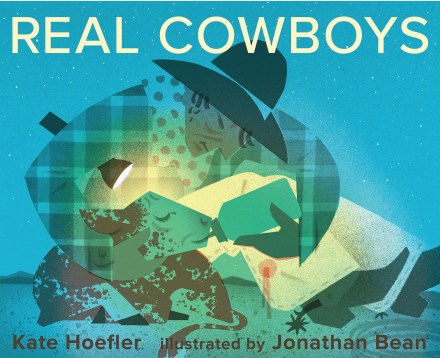
Real Cowboys

Written by Kate Hoefler | Illustrated by Jonathan Bean


Real cowboys wake with the dawn’s light and are careful not to make too much noise for the people still sleeping in the “little houses in the hollow, and up the mountains, and at the edge of fields in the distance.” It is natural for the cowboys to think of others. Their job is to care for the herd; to help a stranded calf and their dog who is trying to lure it to safety; to soothe the herd when thunder rumbles overhead.

celebrate-picture-books-picture-book-review-real-cowboys-dawn

Image copyright Jonathan Bean, courtesy of Houghton Mifflin Harcourt

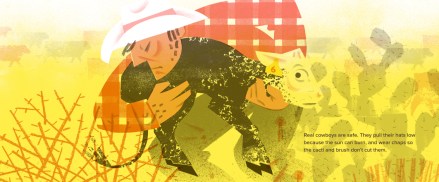
Real cowboys sing soft, slow songs to their cows to encourage them to continue moving when the path is narrow and dangerous and to sleep when coyotes howl in the night. Cowboys are good listeners—heeding the advice and warnings of the trail boss and other cowhands. “Sometimes they listen for trucks, and wolves, and rushing water. And sometimes they just listen to the big wide world and its grass song.” Along the way cowboys keep themselves safe with their wide-brimmed hats and leather chaps.

celebrate-picture-books-picture-book-review-real-cowboys-saving-calf

Image copyright Jonathan Bean, text copyright Kate Hoefler. Courtesy of Houghton Mifflin Harcourt

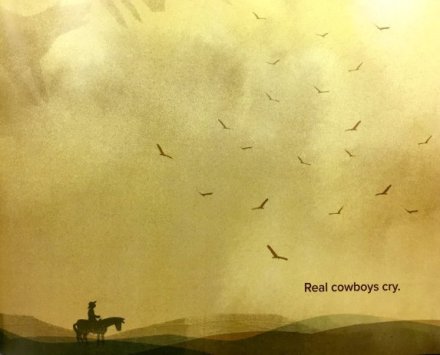
Because the cattle drive is long—lasting “for hours, or days, or weeks”—cowboys learn to be patient. “Even on a fast horse, they have to move with the slow rhythm of a herd….” When they need help, real cowboys don’t hesitate to ask, using hand and hat signals to alert other cowhands. “Real cowboys want peace. They don’t want stampedes, where all the cattle spook, and thunder over the earth, and scatter in dust storms.” Sometimes, however, this happens, and sometimes a few cattle and dogs are lost. Thinking of them when times are quiet, “real cowboys cry.”

celebrate-picture-books-picture-book-review-real-cowboys-cowboys-cry

Image copyright Jonathan Bean, text copyright Kate Hoefler. Courtesy of Houghton Mifflin Harcourt

At night cowboys take turns eating and sleeping so there is always someone to watch over the herd. When they pack up camp and move on, real cowboys are mindful of the earth, and when they are far from home, inside themselves they can feel homesick, even if they look tough on the outside. “Real cowboys are as many different colors as the earth. Real cowboys are girls too.” In their hearts “real cowboys are artists,” creating stories that are bigger than the wide open prairie. “They wonder what’s past the horizon. And one day, when their work is done, real cowboys find out.”

Kate Hoefler’s moving tribute to cowboys and cowgirls demonstrates the qualities of kindness, thoughtfulness, and mindfulness that we want to share with our children. With lyrical language she follows cowboys on a cattle drive, where they experience the joys and sorrows that life entails for all. Hoefler’s pacing echoes the day-to-day movement of the herd as well as readers’ daily life. Delving into the responsibilities and characteristics of these men and women is a unique way to open the world to children and promote discussions about the traits of caring individuals.

celebrate-picture-books-picture-book-review-real-cowboys-stampede

Image copyright Jonathan Bean, courtesy of Houghton Mifflin Harcourt

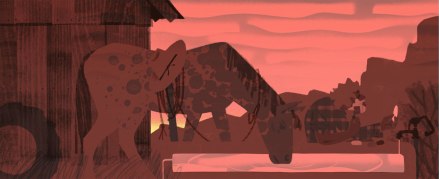
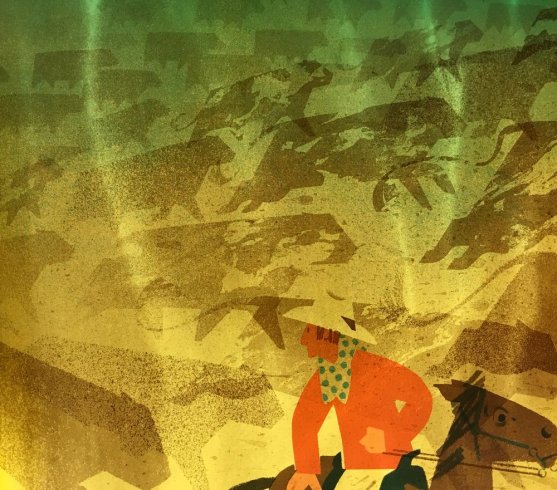
Jonathan Bean’s hand-stenciled illustrations printed in four Pantone colors are particularly effective in portraying the life of the cowboys and cowgirls entrusted with herds of cattle. Early morning dawns to rose skies that color even the horses and reflect in the drinking trough. Cattle, obscured by dust raised on the trail, form the backdrop to a cowboy worriedly watching his dog coax a calf from a cliff, and afternoon turns to night in a two-page spread where a cow nuzzles her calf as it sleeps. Depictions of the enormity of the herd traveling from one place to another amid sweltering days, rain storms, and blizzards are beautifully rendered, and the emotions of the cowboys are clearly discernable and touching.

Real Cowboys is stunning in both language and illustrations. For quiet story times, bedtime, or times for reflection and inspiration, this book would make an excellent addition to children’s bookshelves.

Ages 4 – 7

Houghton Mifflin Harcourt, 2016 | ISBN 978-0544148925

To view a gallery of illustration by Jonathan Bean, visit his website!

National Day of the Horse Activity

celebrate-picture-books-picture-book-review-galloping-horse-coloring-page


Galloping Horse Coloring Page


A horse running at top speed is a beautiful sight! Enjoy this printable Galloping Horse Coloring Page—would you be riding?

Picture Book Review

December 2 – National Mutt Day

celebrate-picture-books-picture-book-review-wolf-camp-cover

About the Holiday

National Mutt Day, also known as Mixed Breed Dog Day, was established in 2005 by animal welfare advocate Colleen Paige to raise awareness of the plight of mixed breed dogs abandoned and in shelters around the country. Approximately 80% of dogs in shelters are mixed breeds and often lose out on finding permanent homes to purebred dogs who are adopted much more quickly. Mixed breed dogs tend to be healthier, behave better, and often have sweeter temperaments than their purebred cousins, making them wonderful family pets. If you are considering adding a pet to your family, consider a mixed breed. You’ll be happy you did!

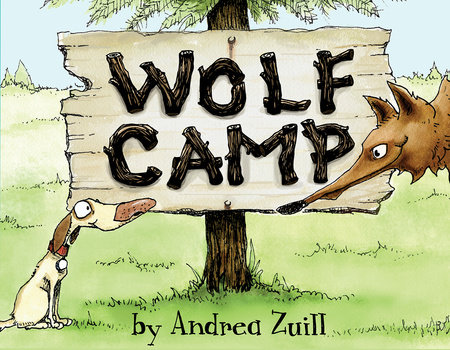
Wolf Camp

By Andrea Zuill


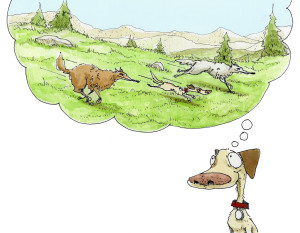
Homer is a regular dog—except when he’s feeling wolfish. He loves the lure of the hunt, and likes to pounce on stuffed Mr. Moose unawares. He thinks this is because it’s been proven by science that “all dogs have a bit of wolf in them.” When Homer takes to daydreaming, his mind wanders to the joys of living as “a real wolf,” running with the pack on the open plains. Then one day in addition to his kibble, a flier for Wolf Camp pours from the dog food bag.

The flier seems to offer everything Homer wants. “Have you ever felt like howling at the moon? Come join us!” it reads. Homer knows he has to go, so he makes sure his people see the notice—whether they are in the bathtub, in bed, relaxing, or just walking through the house. Finally his people relent, and on the designated day he boards the Wolf Camp bus and is off on an adventure.

celebrate-picture-books-picture-book-review-wolf-camp-running-with-wolves

Copyright Andrea Zuill, courtesy of andreazuill.org

Once at camp, Homer is “greeted by Fang and Grrr,” the counselors. Then he meets his fellow campers, big Rex and tiny Pixie. Fang gives a safety speech that includes staying together, refraining from chasing dangerous animals, and other rules. Their first lesson is “marking.” Could Homer help it if he was a little too close to Fang’s feet? Next comes howling. Grrr and Fang sing out a chilling “Ahh-whooooo…” Pixie pipes up with a small “Yeeiiiiiip”; Rex gives an indeterminate  “Wahwawawawa…”; and Homer offers his best “Phooooooof…”

celebrate-picture-books-picture-book-review-wolf-camp-running-bunny

Copyright Andrea Zuill, courtesy of andreazuill.org

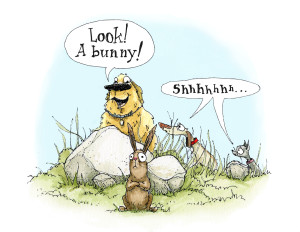
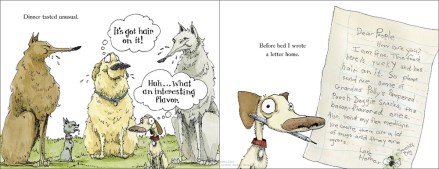
When they learn to track, Rex can’t contain his excitement and shouts out “Look! A bunny!” “Shhhhhhh…,” Homer and Pixie remind him. At last the campers are shown how to hunt, even if Fang and Grrr do run ahead and with Grrrs, snarls, growls, and a cloud of dust acquire dinner by themselves. The meal has “an interesting flavor,” which prompts Homer to write a letter home: “Dear People, How are you? I am fine. The food here is yucky and has hair on it.” He asks his family to send his favorite bacon-flavored doggie snacks as well as flea medicine “because there are a lot of bugs and they are gross.” He even includes a real “smashed bug” in the corner of the paper.

celebrate-picture-books-picture-book-review-wolf-camp-running-letter-home

Copyright Andrea Zuill, courtesy of andreazuill.org

Living and sleeping in the wild have their challenges, but day-by-day the dogs adjust, becoming experts at marking rocks, howling “Ahh-Whoooo,” and hunting. And while taking down a moose may still be daunting, chasing squirrels is easy. The end of the week comes quickly and as Homer receives his “Honorary Wolf” certificate, he feels sad to be leaving his new friends. They howl “one more time as a pack,” and then it’s time to ride the bus back home.

While it’s good to be home with his people, his soft bed and electric blanket, and his familiar toys, Homer feels different. As nighttime falls he goes to the window and sings out a chilling “Ahh-whoooo-Ahh-Ahh-Whooowhooo….”

Andrea Zuill’s funny story of a regular dog who dreams of being more by embracing his bolder heritage will delight dog owners and dog lovers alike. Endearing Homer, with his wagging tail, sweet smile, and unflagging perseverance, is an enthusiastic hero who inspires readers to never give up in the face of obstacles. Humorous dialogue and commentary by Homer, Rex, and Pixie as they perform their camp lessons are presented in speech and thought bubbles and will make kids giggle. Zuill’s nod to “people” camp makes Wolf Camp an accessible story that will resonate with any child facing a new situation, learning new skills, or being away from home for the first time.

Zuill’s vivid, cartoon-inspired illustrations are loaded with personality and expression. Kids will root for earnest Homer, shaggy Rex, and scrawny Pixie, and, while needle-nosed Fang and Grrr initially seem intimidating, they are counselors who have their camp charges’ best interests at heart.

Ages 4 – 8

Schwartz & Wade, 2016 | ISBN 978-0553509120

To learn more about Andrea Zuill and Wolf Camp, as well as view a portfolio of her illustrations, visit her website!

National Mutt Day Activity

celebrate-picture-books-picture-book-review-funny-puppy-coloring-page

Funny Mutt Coloring Page


Mixed breed dogs make wonderful pets with lots of love to give. Here’s a printable Funny Mutt Picture for you to color!

Picture Book Review
July 23 – National Day of the Cowboy

celebrate-picture-books-picture-book-review-cowboy-camp-cover

About the Holiday

Observed annually on the third Saturday of July, the day commemorates the “contributions of the Cowboy and Cowgirl to America’s culture and heritage. The heyday of the cowboy and cowgirl came after the Civil War when Texas experienced a booming wild cattle population. As the United States grew and people moved West, the demand for beef in the Northern states grew. Cowboys and cowgirls drove nearly 5 million head of cattle north, sparking tales, legends, and a rich history of the Great Plains in their boot and hoof steps.

Cowboy Camp

Written by Tammi Sauer | Illustrated by Mike Reed


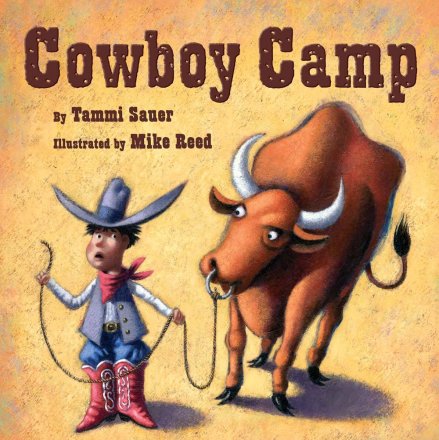
In the first moments of Cowboy Camp, Avery sizes up the other kids (both boys and girls) and decides he “was all wrong.” Not only is his belt buckle too big and his hat too small, but his name is completely UNcowboy. When the Camp leader, Cowboy Dan, introduces himself, Avery thinks he is “the realest looking cowboy” he’s ever seen. Cowboy Dan promises to turn the “little ragamuffins” into real walkin’, talkin’ cowboys. But first a chow time of grits and beans!

celebrate-picture-books-picture-book-review-cowboy-camp-beans

Image copyright Mike Reed, 2005, text copyright Tammi Sauer, 2005. Courtesy of Sterling Children’s Books.

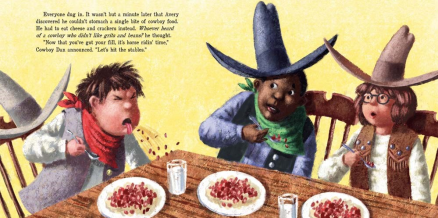
All the other buckaroos dig into their plate eagerly, but Avery spits out his very first bite and is relegated to eating cheese and crackers. “Whoever heard of a cowboy who doesn’t like grits and beans?” Avery thinks. Next up, announces Dan, is horse riding. All the kids saddle up. “It wasn’t but a minute later” though that Avery starts sneezing and has to ride a cow instead.

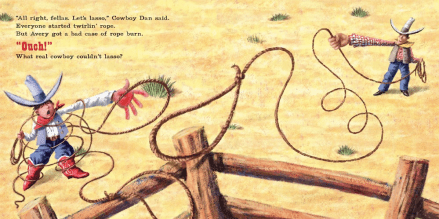
Surely, lassoing will be easier, he reasons. “It wasn’t but a minute later,” however, that his hands are red and chaffed with rope burn and he has to practice with yarn. “Whoever heard of a cowboy who got rope burn?” he thinks. A bit dejected, Avery sits in front of the campfire trying to think cowboy thoughts after all the other kids have “turned in for some shut-eye.” “It wasn’t but a minute later that Avery discovered he wasn’t alone.” Creeping out of the shadows is the meanest looking cowboy Avery has ever seen.

celebrate-picture-books-picture-book-review-cowboy-camp-lasso

Image copyright Mike Reed, 2005, text copyright Tammi Sauer, 2005. Courtesy of Sterling Children’s Books.

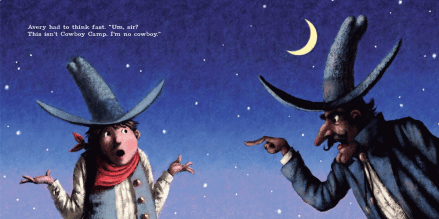
“‘I’m Black Bart,’” the mean looking cowboy says. He tells Avery that he’s there to put a stop to Cowboy Camp because “‘Cowboy Dan and his gang of good cowboys are makin’ it too hard to be a bad guy.’” Avery does some quick thinking. He doesn’t want anything to happen to Cowboy Dan or the camp. He stutters out that this isn’t Cowboy Camp, but Space Camp. Black Bart isn’t so easily fooled. Sensing disaster, Avery gives himself up as proof: “‘Sir,’” asks Avery, “‘Do I look like cowboy material?’”

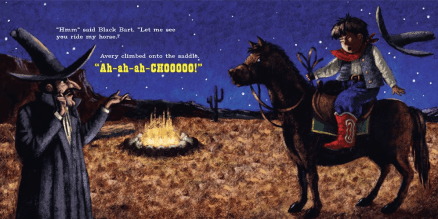
To root out the truth Black Bart gives Avery three tests. First he opens a can of beans from his saddlebag. “‘All cowboys eat beans,’” Bart exclaims. Avery takes a tiny taste from the can and begins coughing and wheezing. “‘Hmm…’” says Bart. Next he sets Avery on his horse. “‘All cowboys ride horses,’” Bart exclaims, but as soon as Avery sits astride the horse, he begins sneezing. “‘Hmm…’” says Bart. He hands Avery his rope. “‘All cowboys know how to lasso,’” Bart exclaims. Avery grabs the rope and immediately begins crying in pain.

celebrate-picture-books-picture-book-review-cowboy-camp-bart

Image copyright Mike Reed, 2005, text copyright Tammi Sauer, 2005. Courtesy of Sterling Children’s Books.

Black Bart has seen enough. “‘You’re no cowboy,’” he agrees. With time a wastin’ to find and stop the real cowboys, Black Bart saddles up and turns his horse toward the rising sun. “‘It wasn’t but a minute later’” that the other campers and Cowboy Dan arrive. Dan congratulates Avery on his bravery and quick wit and proclaims that “‘No one but a real cowboy could outsmart the likes of Black Bart the way you just did.’” Avery smiles. He finally feels like a “real honest-to-goodness cowboy.”

In Avery, Tammi Sauer has created a welcome hero—a boy who uses his individual talents of intelligence and bravery to defeat the bad guy and comes to realize that he does fit into the group. Sauer’s witty plot line is a joy to read and offers real surprise when Black Bart appears on the scene. Bart’s “cowboy test” in which Avery’s supposed failings become his greatest assets is inspired. The realistic dialogue with a Western twang transports kids to the Great Plains and is fun to read, while the repeated “uh-oh” moment—“It wasn’t but a minute later that Avery discovered…”—elicits suspense and will have kids reading along.

celebrate-picture-books-picture-book-review-cowboy-camp-sneeze

Image copyright Mike Reed, 2005, text copyright Tammi Sauer, 2005. Courtesy of Sterling Children’s Books.

Mike Reed beautifully captures the allure of the Wild West in his humorous, sometimes larger-than-life illustrations. The golden plains of Cowboy Camp stretch to the red-rock plateaus in the distance while scrub grass and cacti pop up here and there. Cowboy Dan has a chin almost as long as his 20-gallon hat is tall, and Black Bart is perfectly scruffy and menacing, with a long black coat and bolo tie, as he creeps out of the midnight blue shadows to confront Avery by campfire light. Kids will both sympathize with Avery’s travails even as they giggle at his evocative expressions.

An ingenious bit of illustration occurs in Reed’s depiction of Avery. Although Avery feels as if his belt buckle is too big and his hat too small, in reality both of these are the same size as the other kids. Moreover, a side-by-side comparison with Cowboy Dan, the “realest cowboy,” shows that Avery looks almost identical to his hero with both wearing grey vests and hats. (You can even measure the hats for yourself!) In addition, the other campers are all different in some way, emphasizing the idea that everyone is unique and has their own place in any group and the world in general.

Both for the wonderful story and the burst of confidence building provided, Cowboy Camp belongs on every young reader’s bookshelf.

Ages 4 – 9

Sterling Publishing Co., 2014 | ISBN 978-1454913603 (Paperback) | ISBN 978-1454913894 (Board Book)

To view more of Tammi Sauer’s books and learn what she’s working on next, visit her website!

National Day of the Cowboy Activity

celebrate-picture-books-picture-book-review-cowgirl-coloring-page

The Best Durn Tootin’ Cowboy and Cowgirl Coloring Pages


Well, buckaroos, here’s your chance to create your own Wild West scene. Just print out these Best Durn Tootin’ Coloring Pages and have a rip roarin’ blast!