Holidays don’t get more leisurely than this one! Perhaps invented by the Ancient Greeks, perhaps created by people in South America according to Christopher Columbus’s journals, hammocks are the epitome of relaxation. What better time is there to kick back and lounge than during the hot, hazy days of July? So enjoy—and read a book, like today’s collection of poetry!
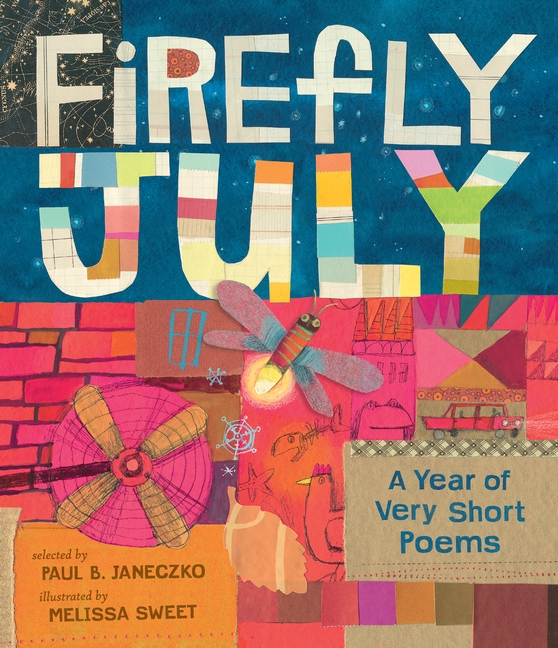
Firefly July: A Year of Very Short Poems
Selected by Paul B. Janeczko | Illustrated by Melissa Sweet
Firefly July is perfect for lazy summer days when light, but still meaningful reading enjoyed in a hammock or under a shady tree is relaxation at its best. Paul B. Janeczko has collected 36 short (none are over eight lines long) poems from some of the best poets of today and yesterday. Haiku, free form, and rhyming verses illuminate the seasons of the year and encapsulate unforgettable sights, sounds, and feelings.
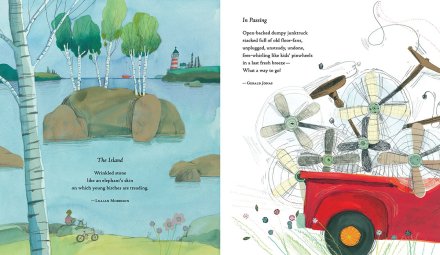
A girl’s spring’s respite spent gazing into the bay from shore is depicted in Lillian Morrison’s The Island:
“Wrinkled stone / like an elephant’s skin / on which young birches are treading.”
Image copyright Melissa Sweet, courtesy of amazon.com
A nighttime train trip provides mystery and ongoing changes in Carl Sandburg’s Window:
“Night from a railroad car window / Is a great, dark, soft thing / Broken across with slashes of light.”
Joyce Sidman’s A Happy Meeting likens a summer rain to romance and life:
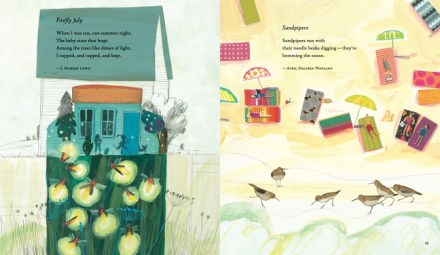
At the seashore, beach birds are industrious in April Halprin Wayland’s Sandpipers:
“Sandpipers run with / their needle beaks digging—they’re / hemming the ocean.”
Image copyright Melissa Sweet, courtesy of amazon.com
Jim Harrison and Ted Kooser ask such a beguiling question for autumn:
“What is it the wind has lost / that she keeps looking for / under each leaf?”
And the rising giants of city life inspired Susan Nichols Pulsifer in Tall City:
“Here houses rise so straight and tall / That I am not surprised at all / To see them simply walk away / Into the clouds—this misty day.”
Along the way readers will encounter a pickup truck loaded with old rotary fans and another rusting in a field; fog that decorates and creeps; animals and insects that share our space; our past, our present, and our future. And when it’s time to close the book, Jim Harrison and Ted Kooser reveal:
“A welcome mat of moonlight / on the floor. Wipe your feet / before getting into bed.”
image copyright Melissa Sweet, courtesy of melissasweet.net
I can only wish I’d been able to visit Melissa Sweet’s studio while she created the illustrations for this book! Each painting is as unique in style, beauty, and emotional effect as the poems they interpret. Her renditions of each poem help readers—especially children unfamiliar with metaphor and abstract imaging—to fully understand and appreciate each poem while also leaving room for personal reflection.
The first thing that strikes a reader when opening Firefly July is the gorgeous juxtaposition and mixture of vibrant color. Her illustrations take readers on a journey from an aqua farm house with a patchwork garden to a serene elephantine rock island to the deep turquoise ocean traversed by ships while the full moon beams down upon them. Readers ride crowded subways, gaze out moving train windows, and visit cities bright in daylight and glowing at night. They frolic through fields of delicate grasses and vibrant flowers, quietly walk snowy paths, and take their place among the stars.
Firefly July is as stunning as any coffee table book and is a must for a young reader’s—or any poetry lover’s—library.
Ages 4 and up
Candlewick Press, 2014 | ISBN 978-0763648428
Take a look at more books and artwork by Melissa Sweet on her website!
National Hammock Day Activity
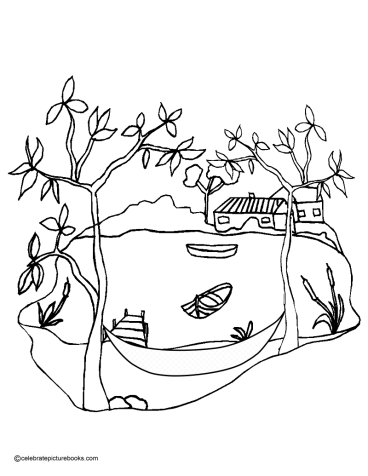
Lazy Days Coloring Page
Coloring can be so relaxing—perfect for a day dedicated to kicking back! Color this printable Lazy Days Coloring Page and dream of lounging beside the lake, with the gentle breeze gently rocking the hammock, while you drift off to sleee….zzzz…..
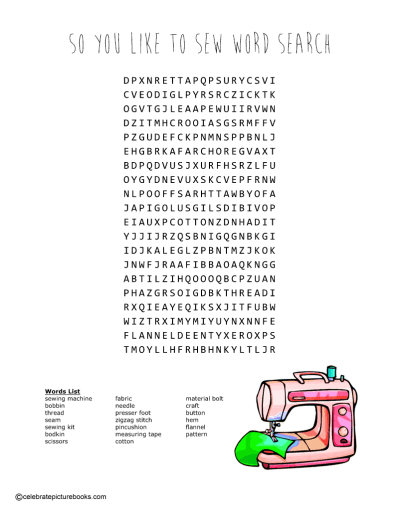
Patented in 1790 by Thomas Saint, the sewing machine revolutionized the textile industry. No longer did clothes and other fabric items need to be made by hand. The sewing machine made this job faster and less tedious. Long a favorite hobby for clothes makers and crafters of all types and ages, sewing is creative and fun! If you like to sew celebrate today by making something new or sharing your talent with a beginner. If you’ve never sewn, consider trying it—needle crafts, either by hand or using a sewing machine can become a life-long enjoyable activity!
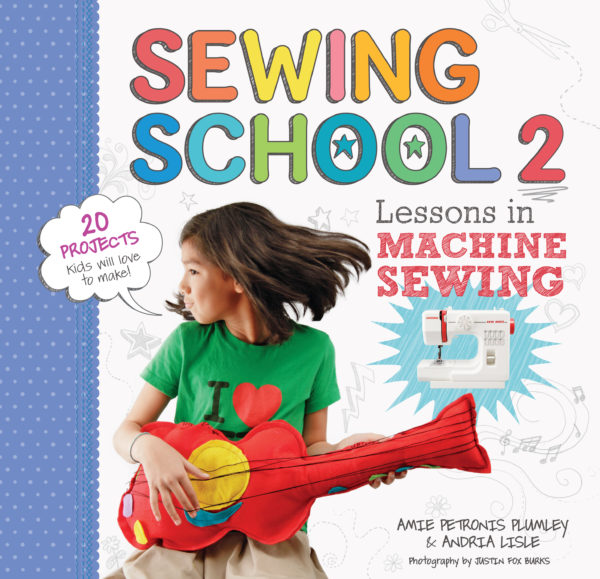
Sewing School 2: Lessons in Machine Sewing
By Amie Petronis Plumley & Andria Lisle | Photography by Justin Fox Burks
Sewing and crafting are popular hobbies shared between friends and family. Skills that were once passed down from generation to generation are being rediscovered by kids and adults alike through widely available craft and sewing chain stores and books like the Sewing School series. In this second edition, kids are taught everything they need to know to feel comfortable at a sewing machine and create awesome projects they can really use.
Divided into five sections, Sewing School 2 is easy to navigate and builds on skills presented in previous chapters. The first section “Getting Started” provides 13 lessons that cover choosing a sewing machine, the elements of a well-stocked sewing kit, learning about different fabrics, how to do basic stitches and techniques, and laying out and cutting patterns.
With clear photographs on every page, kids will easily be able to understand the concepts being described. “Anatomy of a Sewing Machine” points out each part of a machine, from the spool spindle to the take-up lever, presser foot, stitch selector, and more. The most common stitches are depicted here too—straight, reverse, stay, and reinforcement stitches share the page with short discussions of what a bodkin and pinking shears are for.
Budding sewers will learn about the right and wrong sides of fabrics, how to sew “right” sides together and turn the project inside out, and the way to stuff a pillow and finish the opening. One chapter is devoted to starting off right as well as tips on guiding the material through the machine.
After kids have been introduced to the basics, it’s time to try out those new skills! Four sections containing five projects each let kids make items for all the important aspects of their lives. “In My Room” shows them how to make a pillow with a space for secret messages, a welcome sign, a pocket organizer, a sleepy teddy bear, and a striped blanket. The “Let’s Go” section is perfect for kids on the run. Projects include a coin holder, a handy pouch for carrying extras, and a safe place for their electronic gadgets.
The projects in “Time to Play” prove that sewing results in plenty of fun! Things like stuffed guitars, microphones, backpacks, game boards, and decorative hangings are just a stitch away. Finally it’s time to take sewing outside with a section titled “The Great Outdoors.” Kids will wonder how they ever got along without their snack pouch, belt with pocket, water bottle carrier, scarf, and portable tree stump—huh? You’ll just have to get the book and see!
Each project comes with a one-to-three star difficulty rating, a list of all materials needed, a list of the skills used, how to personalize each project, and tips for adult helpers.
The final pages help kids out when things just don’t go as planned, how to do hand-sewn work, and tips for adults who are working with a group.
Amie Petronis Plumley and Andria Lisle have created a wonderful resource for anyone wanting to get in on the fun of sewing. The easy-to-understand directions and conversational tone of the book will put kids at ease, and Justin Fox Burks’ photographs of children using the concepts and happily displaying their work will make beginners excited to start sewing. Burks’ up-close photos of the parts of the sewing machine as well as each technique make Sewing School 2: Lessons in Machine Sewing a leader in its field.
Ages 7 and up
Storey Publishing, 2013 | ISBN 978-1612120492
Sewing School Takeaway Project
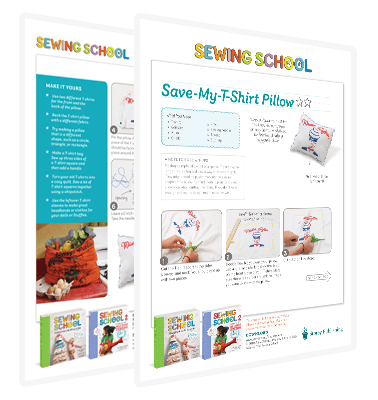
Save-My-T-Shirt Pillow
Sometimes it’s so hard to give away a favorite t-shirt! With this project from Sewing School you don’t have to! Use your hand-stitching skills to create a pillow that will make your room even more awesome! Click here for the Save-My-T-Shirt Pillow directions.
What would we do without our best friends? They’re the ones we go on adventures with, laugh with, commiserate with, even cry with. And no matter what, we know they’ll always be there for us. Best friends can be people we’ve known all our lives or ones we’ve just met; they can live far away or in our own home. Best friends don’t even have to be people—beloved pets or favorite toys are sometimes just what we need. Today is the perfect time to celebrate your best buddy. Get together with them, call, or text. Relive some favorite memories or make some new ones!
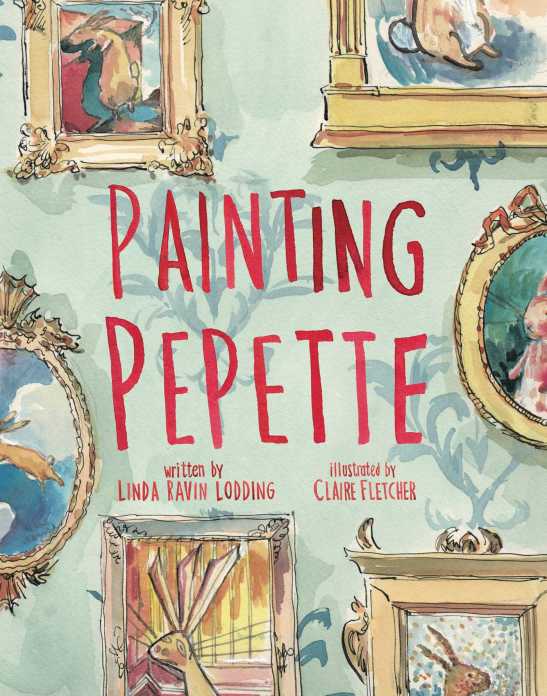
Painting Pepette
Written by Linda Ravin Lodding | Illustrated by Claire Fletcher
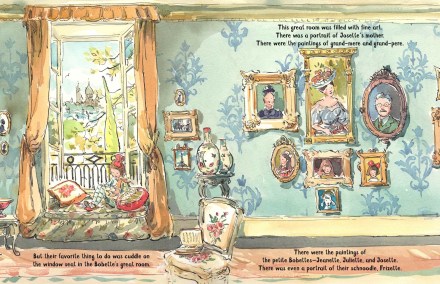
If you peek in the great room window of the grand yellow house at #9 Rue Laffette in Paris, you will most likely see cuddled on the comfortable seat Josette Bobette and her beloved stuffed rabbit Pepette. It’s their favorite place. Looking past them you will see that the great room is filled with fine art. On the walls hang portraits of the family—Josette’s mother is there as well as grand-mère and grand-père, the three Bobette sisters, and even their schnoodle Frizette.
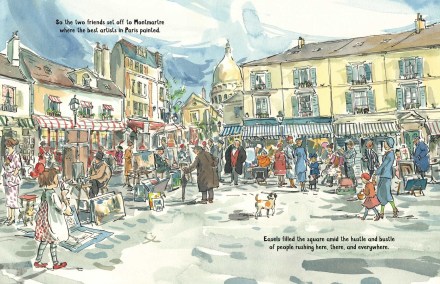
“One day Josette noticed something strange. There was no portrait of Pepette!” Josette determines to find an artist to paint a special portrait of her best friend. The pair heads out to Montmartre, where the all the best artists set up their easels to paint and sell their work. It doesn’t take long for a man in a striped shirt to stop them.
“‘Those ears!’” he cries. “‘Never have I seen such majestic ears. I must paint this rabbit’s portrait!’” Pepette blushes at such an effusive compliment, and Josette exclaims, “‘Magnifique!’” It appears Josette has found just the artist to create Pepette’s portrait. The painter waves his brush with a flourish, declares his painting a “masterpiece,” and holds it up for inspection. Josette gazes at a Pepette with two noses and three ears. Diplomatically, she proclaims the picture “nice” but not quite Pepette. Her best friend agrees.
Just then a man with a thin, curved handlebar mustache spies the pair. Admiring Pepette’s whiskers, the artist begs to capture “the very essence of her rabbitness!” He immediately sets to work, and in no time a most unusual portrait emerges. Pepette seems to melt from a tall red wall. Josette considers it and her reaction carefully. “‘It’s imaginative,’” she says. “‘But you’ve painted Pepette quite, well, droopy.’” Pepette agrees.
As Josette and Pepette enjoy a Parisian snack on the curb of Montmartre, a rakish young man happens along. He is arrested by Pepette’s nose, which he likens “‘a faint star twinkling in a misty, velvet night.’” Josette has a good feeling about this artist and follows him across the square to his easel. Pepette poses on a red tufted stool as the artist paints a rabbit soaring through the clouds. He proclaims the finished portrait “‘one of my best works’” as he displays it to the crowd. Josette likes the clouds but tells the painter that Pepette is afraid of heights and not fond of flying. Pepette agrees.
By now Pepette is the most sought-after model in Paris, and another artist rushes up, captivated by her beauty. The balding man in a dapper suit and round spectacles peers at Pepette. “‘What a colorful lady—balloon blue, pansy pink, and radish red!’” A little suspicious of his vision, Josette allows him to paint Pepette. “‘Ta da!’” the man exclaims, revealing the magic of his brush. Josette studies the canvas with its vibrant dots, dashes, and splashes. While she admires the colors, she reminds the artist that Pepette isn’t pink.
“‘Ah, yes,’” nods the painter. “‘But through art we can see the world any way we want.’”
With the sun setting low in the sky, Josette politely says thank-you and goodbye to the artists. She and Pepette have enjoyed their day, but it’s time to go home. Curled up once more on the window seat, Josette sighs. She had so hoped to have the perfect portrait of Pepette—one that showed her velvety grey listening ears, her heart-shaped nose, and her soft arms that give tight hugs. Suddenly, Josette has an idea! Gathering all her art supplies, she creates the perfect likeness—as special as Pepette herself!
An author’s note on the last page describes the creative atmosphere of 1920s Paris, home to writers, artists, musicians, and fashion designers, that gives a frame to her story. The artists that Josette meets are inspired by Pablo Picasso, Salvador Dalí, Marc Chagall, and Henri Matisse.
In Painting Pepette Linda Ravin Lodding has written a multi-layered story of love, friendship, and unique vision. Through the sweet relationship between Josette and Pepette and with a sprinkling of humorous self-congratulation on the part of the artists, Lodding nudges readers to appreciate that while art can reveal and obscure, reflect and transcend reality, ultimately the success of a piece—complex or simple—lies within the viewer’s heart. Lodding’s lyrical language trips off the tongue and is a joy to read—it’s like following Josette as she skips happily through Paris.
Claire Fletcher’s striking pen and ink illustrations pay delicate homage to cityscapes of a bygone Paris. Adorable Josette in her white pinafore over red-dotted dress, red shoes, and big red bow along with her enchanting rabbit are the perfect tour guides through crowded Montmartre and an introduction of art history. Soft tones of yellow, rose, and green illuminate the apartments and cafes of the square where colorful shoppers and artists mingle. Fletcher’s renderings of Pepette’s various portraits will not only make kids giggle, but entice them to learn more about each artistic style. The final endpapers reveal that the four fine-art portraits now hang in the Muse of Paris, while readers already know that Josette’s perfectly perfect portrait of her well-loved friend has taken its rightful place on the wall in the Bobette great room!
Painting Pepette is a beautiful addition to any child’s bookshelf and a lovely way for teachers to initiate a discussion of art history and get kids excited about artists and different art styles.
Ages 4 – 9
little bee books, 2016 | ISBN 978-1499801361
Follow Josette through Paris as she searches for just the right artist to paint a portrait of her best friend Pepette and comes to a surprising discovery in this beautiful trailer:
Illustrator Clair Fletcher invites you to find more of her artwork by visiting her online gallery.
Best Friends Day Activities
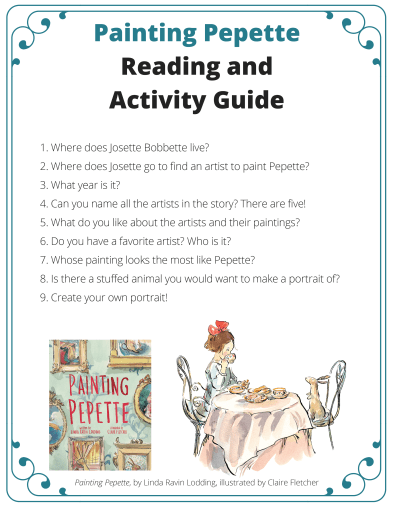
Painting Pepette Reading and Activity Guide
little bee books has created an interactive activity so you can continue exploring Josette’s world and your own artistic talent! Just click here—Painting Pepette Reading and Activity Guide—to start having fun!
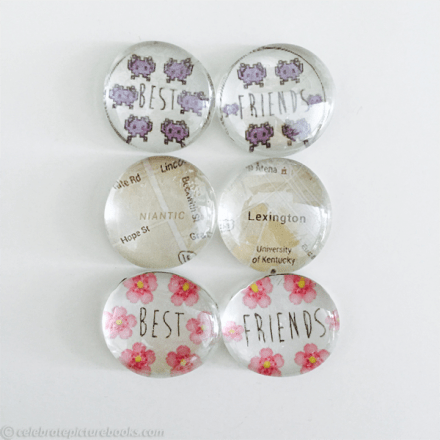
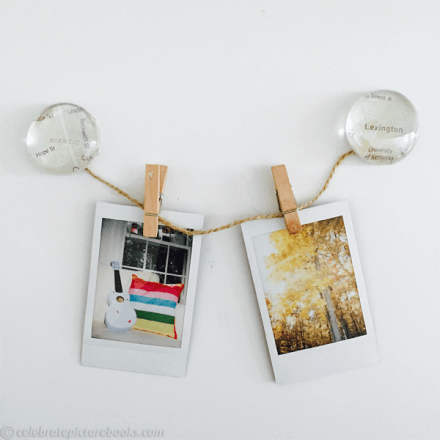
Stuck on You Magnets or Picture Hanger
Best friends stick together whether they’re near or far, right? Here’s a fun craft that you and your friends can make to show how magnetic personalities attract each other! If your best friend or friends are far away, why not make them one too? Or make the alternate picture hanger! Be creative—use inside jokes, favorite characters, or shared experiences to make these crafts personal!
For Magnets
Supplies
To get you started, here are two printable Best Friends Templates! Template 1Template 2
Poster board
Large, 1 ½-inch clear glass stones (decorative fillers), available in craft stores
Markers or colored pencils OR find images online to print out
Medium to large flexible magnets, available in craft stores
Super glue
Toothpicks
Scissors
Directions
Place the glass stone on the poster board and trace around it
Draw your design in the circle on the poster board
Cut out the circle
With the toothpick, apply glue around the very edge of the design side of the circle
Attach the circle to the flat side of the stone, let dry
Trim the cardboard circle if needed
Attach the magnet to the back of the cardboard with glue
For Map Picture Holder
Supplies
Use a mapping program to find a map of your town and your friend’s town
Poster board
Large, 1 ½-inch clear glass stones (decorative fillers), available in craft stores
Twine
Super Glue
Toothpicks
Scissors
Heavy duty mounting squares
Directions
Find maps of your and your friend’s towns
Zoom in so the name of your and your friend’s towns are displayed well. You will be using about a 1-inch area around the towns’ names.
Take a screen shot of the maps
Print the maps
Place the glass stone on the map and trace around it
Place the glass stone on the poster board and trace around it
Cut out the circles on the map and poster board
With the toothpick, glue the map to the poster board, let dry
With the toothpick, apply glue around the very edge of the map side of the circle
Attach the circle to the flat side of the glass stone, let dry
Trim the cardboard circle if needed
Repeat with the other map
Attach a length of twine to the back of each glass stone
Attach heavy duty mounting squares to the back of each glass stone
Attach stones to the wall and hang pictures on the twine
National Fishing and Boating Week promotes the fun of getting out on the water and enjoying time in the sun. Whether you glide in a sailboat, zip around in a motorboat, or leisurely row a kayak, dingy, or other craft, the freedom of the open ocean or river is enticing. Fishing is also a wonderful way to spend time together outdoors. To celebrate this week go boating or learn a new skill, grab your fishing pole and cast your line, or do both together!
Fish
By Liam Francis Walsh
A boy with fishing poles and tackle box in hand and faithful dog at his heals pass a runner as they sprint toward a rowboat. The boy takes the oars and is soon off shore. The pair cast their lines overboard, and soon the little boy brings up an F. Another try snags an I. The boy happily aims his line in another direction, but his dog sees danger on the horizon—a rising C. He tries to warn the boy, but when they turn around again, the waters are calm.
This is one successful fishing trip as the boy’s line again grows taut. He pulls up his catch. A Q—not a keeper. He unhooks it and throws it back as his dog pokes at him in alarm. Again, when the boy looks, the water is peaceful. The two fish in contented silence until the boy catches a big one. The beast runs with the boy’s line, even pulling him out of the boat.
The boy holds his breath as he’s pulled into the depths amid swirling schools of H, B, M, O, and V. Not deterred from his quest, the boy swims toward an H, but it slips from his grasp. The boy tumbles and sinks, but eventually grabs the H and zooms to the surface. He cheers! They’ve caught an F, I, S, and H!
His dog points—something’s coming for them! Suddenly, they’re surrounded by a swarm of Bs and the sharp fins of As. The C swells, swamps the small dingy, and the F, I, S, H are lost in it’s wake. The boy stares dejectedly into the water, but his dog taps him on the back. He has a surprise to share. When the boy turns around, his dog reveals that he’s been a successful fisherman too!
With their quarry safely stowed, the boy rows back toward shore. He leaps out and darts through a group of disoriented road racers toward a sign that reads N I. No one it seems knows what to do. The boy offers his string of letters, and with the FINISH marker complete, the racers cross the line in victory!
With a well-barbed hook, Liam Francis Walsh reels in readers with his fabulous, funny fish story. Wordlessly, but with plenty of visual wordplay, Walsh tells the tale of a boy with a great idea and his eagle-eyed companion with emotion, action, and lots of heart. The bold blue, black, white, and red illustrations have an engaging quality—at once loaded with old-fashioned charm and modern sophistication. Fish is a wonderful addition to anyone’s bookshelf or coffee table. This is one catch you don’t want to let get away.
Ages 5 – 9
Roaring Brook Press, 2016 | ISBN 978-1626723337
National Fishing and Boating Week Activity
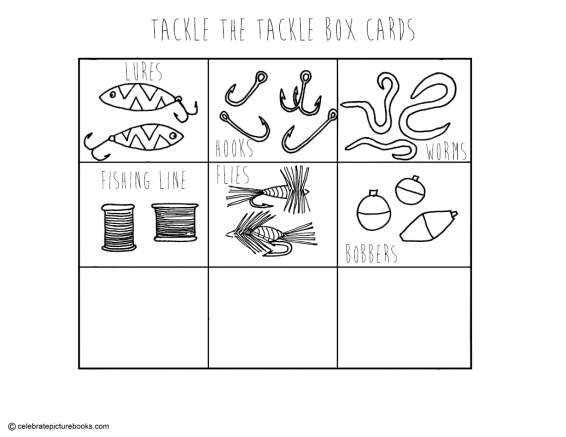
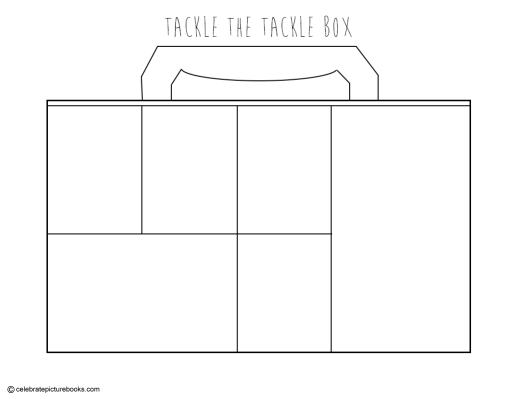
Tackle the Tackle Box Game
A good fisherman always needs a well-stocked tackle box. Play the Tackle the Tackle Box Game to earn lures, bobbers, hooks and more to fill your box. The first player to complete their set is the winner! for more fun you can color the tackle box items any way you like. There are even three extra cards per set for you to draw your own tackle box items!
Established in 1987 by the United States Congress to commemorate the importance of photos to present and future generations, National Photography Month encourages photographers to really look at their subjects and become more intentional about making photos that will be meaningful in the future. Once you’ve taken your pictures, don’t just leave them on your phone, in the cloud, or on your hard drive. Print them and document the place, people, and time of each picture for future generations.
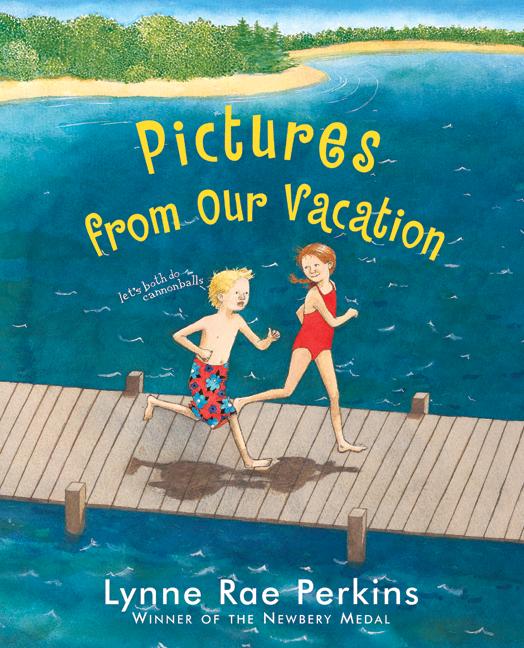
Pictures from Our Vacation
By Lynne Rae Perkins
Just before a family leaves on vacation, a girl and her brother each receive a Polaroid camera and a notebook from their mom so they can document their trip. The first picture the little girl takes is of her feet by mistake. During the two-day trip to the old farm where their dad grew up, the kids play with games from the activity bag and look out the window at the passing landscape. Her second photo taken through the car window reveals “there was not anything to look at out there,” although she does see an orange truck labeled “Yellow” and a motel with a red roof.
She thinks that if she owned a motel it would be called the Blue Motel, and she begins to imagine in detail the accommodations she would offer. In the Jungle Cottage people would sleep in hammocks and shower under a waterfall. In the Sun Cottage, the bed would glow like the sun but turn off for sleeping. The floor of the Flower Garden Cottage would be real grass, and she thinks up many more.
Her reveries last until the family begins searching for a real motel. They stop at the Shangri-La, which advertises POOL, but as the girl’s photograph shows, “it didn’t have water in it.”
When the family reaches the farm, Dad sees happy memories everywhere. They find an old badminton set with warped racquets (shaped like potato chips, the girl says in her picture’s caption) and begin to play. But one minute into the game the rain comes down. It rains for days and the family spends the time playing cards, reading, and drawing.
After the rain stops, Dad takes the family to a hidden swimming spot. They forge their way through the now-overgrown secret path only to find a KEEP OUT sign and a guard dog. They backtrack to the car and drive around and around, having trouble finding the lake. They stop at a park, where the girl takes a picture of hills that were built in ancient times to look like a snake from the air and one of a leftover Chinese food container where a squirrel was eating before it ran away.
At last they find the lake and run out to the end of the dock. But a boy warns them of an impending storm. Suddenly, the storm breaks and as the family shelters in the dock gazebo, the girl learns that tomorrow they are attending a memorial service. The next day the old farmhouse fills up with relatives who have traveled there for a memorial service for Great-aunt Charlotte.
At the service family members tell stories about Charlotte’s brave escapades and afterward the whole crew go back to the farmhouse to spend a several days. They eat dinner and tell more stories, and the cousins play. They roll down the hill, climb trees, and explore. That night as the kids sleep upstairs, murmurs of continued conversation float up through the grate. After a few days, the families disperse and only the girl and her brother and parents stay behind, but the memories and feeling of the full house remain.
Finally the girl’s family leaves too, and as they drive home she looks at the pictures she has taken. “‘These don’t remind me much of our vacation,’” she says. She snaps one last picture as they pass a row of huge electrical towers along the highway. When she looks at the photograph, however, the towers don’t look like the giant robots she imagined. She realizes that “it’s hard to take a picture of a story someone tells, or what it feels like when you’re rolling down a hill or falling asleep in a house full of cousins and uncles and aunts. There are a lot of things like that. But those kinds of pictures I can keep in my mind.”
Lynn Rae Perkins’ paean to formative old-fashioned vacations in which extended family members gathered to pass on history and traditions through stories told around the picnic table is a welcome reminder in this digital age that some “pictures” are better stored in one’s memory than on a device. Perkins’ choices of details seen on the two-day road trip, the incessant rain, and the changed landscape that lead to wrong directions are just the kinds of childhood events that often stick in a person’s memory for life. The story is charmingly told from a child’s point of view with realistic dialogue and a tone of heartfelt nostaligia.
Perkins’ realistic drawings of the family are homey and evocative. The kids lounge in the backseat of the car while the little girl conjures up the décor of her Blue Motel; the old house and fields of the family farm are rendered in warm golds and greens with humor and comfort; and you can almost hear the shouts and laughter of the family members gathered on the lawn at the reunion. This is a vacation kids will love to take.
Ages 4 – 8
Greenwillow Books, HarperCollins, 2007 | ISBN 978-0060850975
National Photography Month Activity
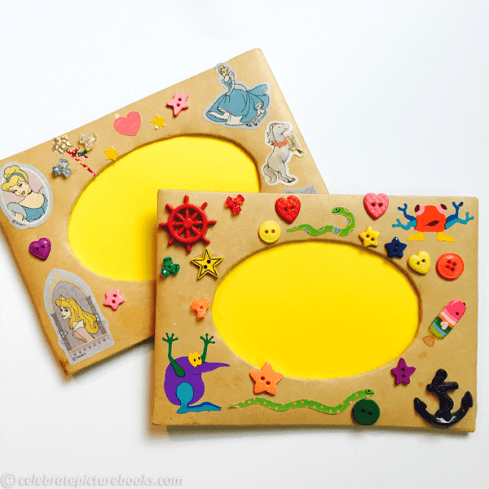
Fantastic Frame!
Your photographs show your unique personality, why shouldn’t the frame you put them in? Today, you can make a frame that perfectly suits your décor or snapshot!
Supplies
Cardboard or bare wood frame, available at craft stores
Brothers share a special bond built on mischief, inside jokes, shared experience, and love. If you have a brother—either by blood or friendship—spend some time with him, give him a call, or just text and say, “hi.”
The Day-Glo Brothers: The True Story of Bob and Joe Switzer’s Bright Ideas and Brand-New Colors
Written by Chris Barton | Illustrated by Tony Persiani
Before the Switzer brothers had their bright idea, the world was a much less colorful place. Bob Switzer, born in 1914, loved to work and saved his money for exciting plans. His younger brother Joe loved magic and had an inventive mind. When the family moved to Berkley, California, Joe developed a magic act that included “black art” in which an object that was painted half black and half white seemed to float and disappear in midair.
Joe loved this trick but thought it could be better. Meanwhile Bob planned to become a doctor. But during the summer before he began college, Bob had an accident that ended his plans. Because his injury effected his head, he had to recover in a darkened room. While Bob healed, Joe spent time in the basement with him studying the glow of fluorescence, hoping to use it in his magic show. Together the brothers built an ultraviolet lamp which they tested in their father’s pharmacy. When they shone it on a shelf full of bottles, a container of eyewash glowed yellow.
Image copyright Tony Persiani, text copyright Chris Barton. Courtesy of Charlesbridge
The brothers had an idea. They experimented with chemicals that could make paints glow in the dark. In regular light the paint looked normal, but under ultraviolet light it radiated attention-getting colors. That was great for Joe’s magic act, but Bob thought these paints could be used for other things too, such as store-window displays. Selling the paint could help pay for Bob’s medical bills too.
Bob and Joe searched through the university and other labs for other fluorescent materials. They then combined them with other ingredients in their mother’s mixing bowl to create glowing paints and even once—when the mixing bowl was not cleaned well enough—a very colorful cake!
Image copyright Tony Persiani, text copyright Chris Barton. Courtesy of Charlesbridge
Joe used these paints to major effect in one of his acts in which a dancing woman “lost her head” as Joe, unseen by the audience in the darkened theater, took off her headdress as she danced away. This trick brought Bob and Joe lots of customers for their original paints. But there was one problem: these colors only shone under ultraviolet light.
One day in 1935, however, one of Bob’s experiments resulted in a surprising innovation—a dye that glowed even in daylight. Bob didn’t know how exactly it had worked, so the brothers continued experimenting. Finally, they discovered the secret when an orange billboard they had created glowed as if it were on fire even in the daytime! The brothers then created reds, yellows, greens, and other colors that could do the same thing.
During World War II these glowing colors were used on fabric panels used to send signals from the ground to airplanes overhead, in lifeboats, on buoys, and on other safety products. After the war the colors continued to influence culture and are still part of our lives today.
Image copyright Tony Persiani, text copyright Chris Barton. Courtesy of Charlesbridge
Older kids with a penchant for science and history will love this biography. Chris Barton goes in-depth to reveal the Switzer brothers’ dreams and motivations that resulted in a most astounding discovery. Barton infuses the story with humor and interesting details that will fascinate curious minds.
Using a retro style, Tony Persiani sets this biography in its time while also giving the story a modern feel. Gray scale tones become dotted with florescent color as the brothers’ experiments bear fruit and give way to eye-popping spreads with the ultimate success of Day-Glo paints and dyes.
Ages 7 – 12
Charlesbridge, 2009 | ISBN 978-1570916731
Brother’s Day Activity
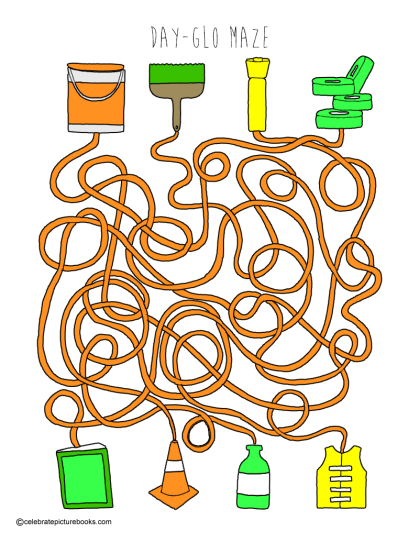
Day-Glow Maze
Follow the twisty glowing paths to match the Day-Glo product to the object they color! Print the Day-Glo Maze puzzle here!
International Museum day was created in 1977 by the International Council of Museums to raise awareness that “museums are an important means of cultural exchange, enrichment of cultures and development of mutual understanding, cooperation and peace among peoples.” The theme for this year is Museums and Cultural Landscapes. Both nature and history comprise the cultural landscape that links museums to their surrounding neighborhood, towns, and beyond. As museums become more involved in their communities, they acquire the responsibility to protect, conserve, and interpret the cultural heritage inside and outside their walls. International Museum Day is growing—in 2015 more than 35,000 museums in 145 countries participated. Today visit one of your favorite museums and learn more about your cultural landscape.
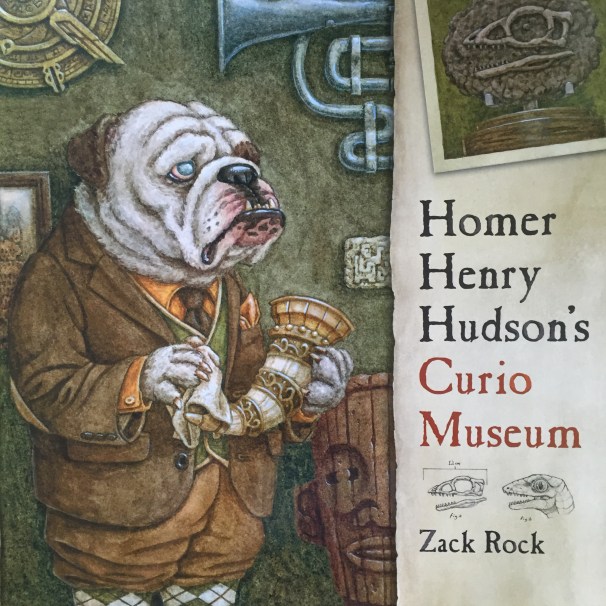
Homer Henry Hudson’s Curio Museum
By Zack Rock
Everything has a story, the narrator tells readers, especially the Homer Henry Hudson Curio Museum, which he says has been described as “a colossal collection of curios, discovered, described, and displayed by that eccentric explorer extraordinaire: Homer Henry Hudson.”
Come in and experience the wonders inside. A dignified bulldog dressed in a dapper tweed suit and leaning on a crooked cane will greet you. His job is to keep the place clean and dusted. Although the museum is stuffed floor to ceiling, he knows the placement of every object, knick-knack, and curiosity. As you explore the museum’s holdings—its portraits, musical instruments, ancient artifacts, taxidermy animals, and other treasures, the caretaker sits silently, hoping you will read the display cards that Homer Henry Hudson has lovingly written out with a description and personal note. He even has his favorite “bits and bobs” that he would like you to see.
One of these is Item #0001, the Conausaurus Skull of a small dinosaur from the late Jurassic Period that HHH found in the soil of his family’s farm. This bony discovery made Homer Henry wonder what else the world held and sparked his love of exploration. Another is Item #0023, a Radial Tide Diviner once used by Calypsonian seers to predict the future based on tidal patterns. It was the discovery of the lost Calypsonian civilization with its valuable artifacts that funded Homer’s further explorations.
Item #3412, a Temple Montepaz Choir Finch with a C sharp trill that chanted to accompany the parrot priest, was a most unusual gift, bestowed on HHH for convincing the Parrot Priest to release a piece of wood stripped from the temple wall. This shard turned out to lead Homer Henry Hudson into his future—for better or worse. With renewed fire, HHH charged toward the promise of riches only to fly his plane into a mammoth stone figurehead, which resulted in injury and his life-long limp.
Item #3415, The Manneken Mort of King Ingmar, is perhaps Homer Henry’s most treasured possession. Composed of fabric bands that represent the stories friends and family tell when someone dies, this Manneken Mort contains hundreds of bands relating the life of King Ingmar. This object HHH acquired for bravery and self-sacrifice when he was younger and still full of enthusiasm for life.
The old bulldog thinks of this curio most. He wonders what his Manneken will look like and whether all the bands of his life been woven. He likes to think his Menneken Mort “would be hundreds—thousands—of feet tall. It’d tower over the Taj Mahal, shame the Sphinx!” But he knows “few memorable tales are told of rusty old codgers who spent their days…leaning upon fear like a crutch.”
Though blind in one eye and nagged by trepidation, the old bulldog packs his suitcase, dons his hat and throws away his cane. As he walks out the door, past pictures of himself on his early expeditions of discover, he knows he might “meet with catastrophe,” be “swallowed by quicksand,” or “gnawed on by piranhas.” But he also knows “there’s no success without failures,” and he has had many successes.
Homer Henry Hudson boards the cruise liner Phoenix and sets out for adventure once more. After all, he well knows that everything has a story. So if you come by the Homer Henry Hudson Museum today, you will see a sign hanging on the door: The Curio Museum is CLOSED Until Further Notice.
Zack Rock has written a compelling and unique picture book for adventurers of all types and ages. Part motivation and part cautionary tale, this story of the once intrepid explorer turned tremulous caretaker has a mysterious, treasure-around-every-corner quality that will appeal to kids. The life of Homer Henry Hudson is told through the display cards that accompany some of the museum’s curios. As the story develops through the cards’ personal notes, readers learn of the museum’s true owner and the life-altering decision he makes.
Rock’s illustrations in greens and parchment-paper golds and browns have a high “Oh, Cool!” factor, as the odd, ancient, and unusual objects of the museum invite kids to explore every nook and cranny of the pages. The exhibits serve not only to fill the museum, however, they remind us how easily the future can get overshadowed and crowded out by the past.
Ages 6 – 10
Creative Editions, 2014 | ISBN 978-1568462608
International Museum Day Activity
Peanut Butter-M&M Cookies
A good cookie is like a museum—full of interesting flavors, colors, and taste. Here’s a cookie recipe adapted from Cookies & Cups that exhibits all these traits!
Ingredients
2 cups all purpose flour
1/2 tsp baking soda
1/2 cup butter
1/4 cup peanut butter
1 cup light brown sugar, packed
1/4 cup granulated sugar
1 whole egg
1 egg yolk
1 Tbsp vanilla
1/2 tsp cinnamon
1/4 tsp ground ginger
3/4 cups m&ms
1/4 cup chocolate chips (for extra chocolate)
Instructions
Preheat oven to 325 degrees
Combine butter and peanut butter in microwave safe bowl and melt together for 30 seconds. Remove and stir. Continue in 15-second increments until mixture is melted and smooth.
In a separate large bowl whisk together flour and baking soda. Set aside.
Combine eggs, egg yolks, vanilla, and sugar. Mix on medium until combined and smooth. Turn mixer to low and slowly pour in your butter/peanut butter mixture. Continue stirring until combined.
With mixer still on low, gradually add your flour mixture until just combined. Batter will be thick.
Now add in your candies and stir until they are evenly distributed.
Now form your batter into “golf ball” sized dough balls. You can also use a 3-Tablespoon scooper.
Place on baking sheet about 2 inches apart
Bake for 10 to 12 minutes
Cookies will be puffy, but should be golden around the edges
Let cool on baking sheet for 2 -3 minutes and then transfer to a wire rack to continue cooling.
Cookies & Cups has lots of creative and delicious goodies for special occasions or for just those times when you want to be good to yourself!















 celebratepicturebooks.com