Discovering a new book is one of the joys of life! Right now bookstores everywhere are filled with books waiting for you to take them home, open the cover, and start reading. Whether you find a new book published just this year or one that’s older but new to you, take the opportunity of this month’s holiday to add to your home library. Children especially benefit from reading new and classic books—and thanks to the subject of today’s book, they have plenty to choose from!
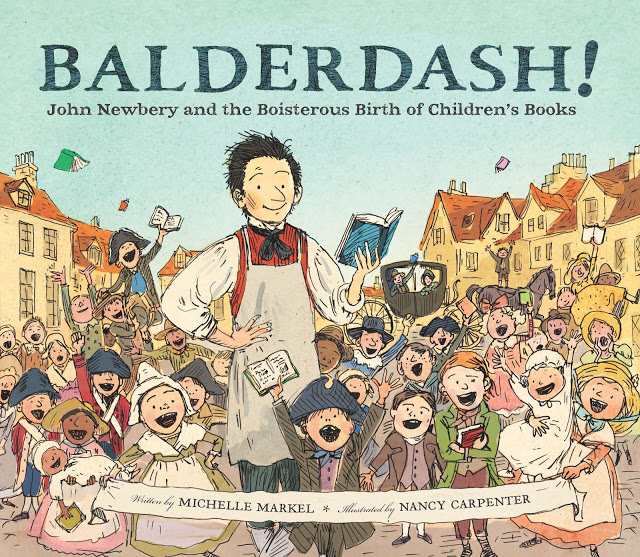
Balderdash! John Newbery and the Boisterous Birth of Children’s Books
Written by Michelle Markel | Illustrated by Nancy Carpenter
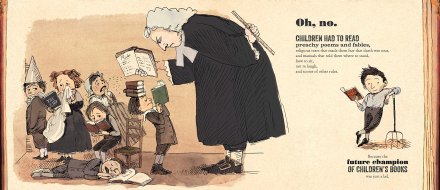
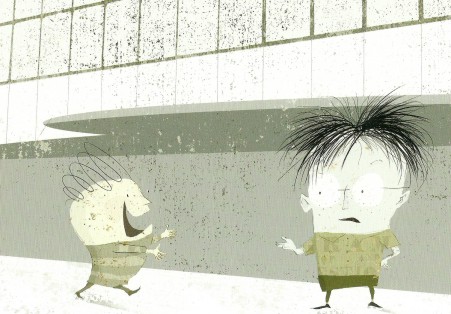
With a hearty “Welcome!” readers are invited to explore—and appreciate—the pages, pictures, words, and even individual letters that make up the book they’re holding. Back in time, a book like this didn’t exist. How far back? Well, let’s return to 1726…. “In those days of powdered wigs and petticoats, England was brimming with books.” There were exciting tales about imaginary places, sailing voyages, mysterious happenings, “pirates, monsters and miniature people”—for adults. What did kids read? Their books were all about teaching them how to have good manners and how to live a good life because death was always near. Scary stuff and not much fun at all!
Image copyright Nancy Carpenter, 2017, text copyright Michelle Markel, 2017. Courtesy of Chronicle Books.
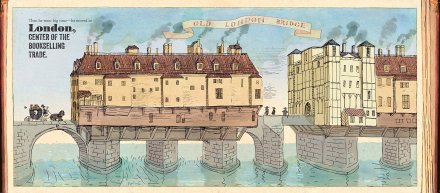
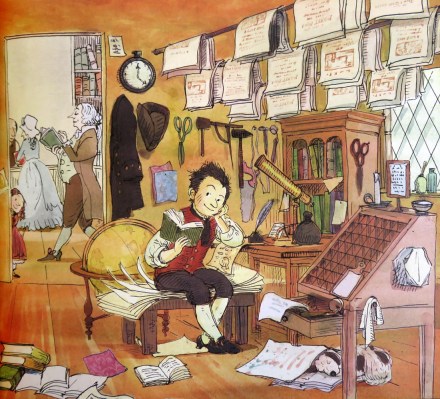
One of the children reading these books was John Newbery who, despite the dreariness, loved to read more than he liked to do his chores. When he grew up, he left the family farm and went to work for a printer. After he learned the business, he became a publisher himself. He moved from his small town to “London, center of the bookselling trade.”
Soon, he found the perfect storefront on a busy street and opened his shop. He had a dream of publishing books for every taste—and for children too. “He knew the youngsters were hungry for stories. Many boys and girls handed coppers to street hawkers for ugly chapbooks of fairy tales, or for chopped-up versions of grown-up books.” When John Newbery tried to offer good books for children, however, the adults balked. They were afraid “that if their little nippers read fun books, they’d turn wild as beasts!”
Image copyright Nancy Carpenter, 2017, text copyright Michelle Markel, 2017. Courtesy of Chronicle Books.
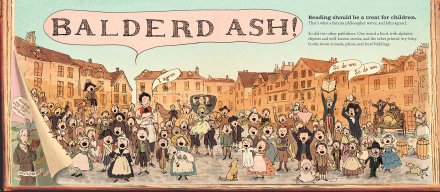
“Balderdash!” John Newbery said. And others agreed. Two publishers issued books of alphabet rhymes and stories, and another published some books of nonfiction. But “John wanted his first book for children to be irresistible.” The books he created included pictures of fun children’s games, enjoyable ways to learn ABCs and other subjects, and fantasy stories. He even wrote a note to moms and dads to alleviate any fears.
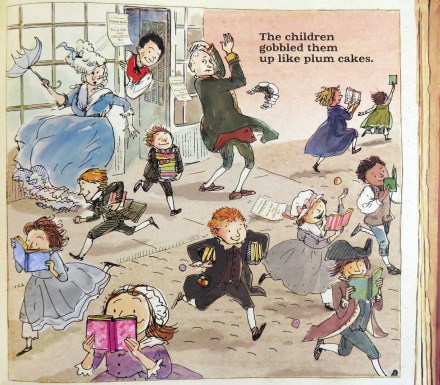
The covers of his books were colorful and attractive and carried the title “A Pretty Little Pocket-Book.” To further entice kids and their parents, John offered to sell books along with a toy for a very good price. John wondered if his books would look “too cheerful,” but “the children gobbled them up like plum cakes.”
Image copyright Nancy Carpenter, 2017, text copyright Michelle Markel, 2017. Courtesy of Chronicle Books.
As customers bought books in the front of his shop, John created new books in the back. In addition to fiction books, he began printing books on math, science, and other subjects. With the books a success, John Newbery turned his thoughts and his press towards creating a magazine for children, and, finally, a novel. The novel was titled The History of Little Goody Two-Shoes and was a rags-to-riches story about a little girl who succeeded through “study, hard work, and kindness.” It showed children that they too could achieve their dreams. The History of Little Goody Two-Shoes was a hit in England and America.
While the authors of John Newbery’s books were all anonymous or had “silly, made-up names,” it wasn’t hard for people to figure out who was really creating the books that brought their children so much joy and made their lives better.
Image copyright Nancy Carpenter, 2017. text copyright Michelle Markel, 2017. Courtesy of Chronicle Books.
An Author’s Note about John Newbery as well as a resources page follow the text.
Kids will love Michelle Markel’s entertainingly informative book that takes them back to a time when the unthinkable was reality. Markel’s charming text is as infectious as John Newbery’s love of books, and readers will laugh at how kids’ books were once perceived. Her conversational tone and bemusement at the state of publishing at the time creates a warm reading experience—like a secret shared between friends.
Image copyright Nancy Carpenter, 2017. text copyright Michelle Markel, 2017. Courtesy of Chronicle Books.
Nancy Carpenter infuses Balderdash! with the sights, dress, activities, and flavor of the time period in her pen-and-ink illustrations. Humor abounds, from the little boy overflowing with tears in the corner of the first page to a young John Newbery relishing the feel and smell of newly printed pages to parents pulling their children away from “dangerous” books. Along the way, kids will want to scope out all the details on each page. A variety of typefaces and sizes further enhances the humor and ambience of the book.
Balderdash! John Newbery and the Boisterous Birth of Children’s Books would make a great addition to home libraries for kids interested in books, history, and innovation. Teachers will also find the book to be a perfect beginning for language arts or history units.
Ages 4 – 8
Chronicle Books, 2017 | ISBN 978-0811879224
Discover more about Michelle Markel and her books on her website!
Read a New Book Month Activity
I Have the Reading Bug! Bookplate and Bookmark
Do you have the reading bug like John Newbery? If so, here’s a bookplate and bookmark for you to print to show your love of books!
Today’s holiday commemorates the date in 1920 when the 19th Amendment to the Constitution granted women the right to vote. The observance of Women’s Equality Day also calls attention to women’s continuing efforts toward full equality, including equal pay, equal opportunities for education and employment, freedom from discrimination and violence, and equal standing in all communities and situations. Workplaces, libraries, organizations, and public facilities now participate with Women’s Equality Day programs, displays, video showings, or other activities.
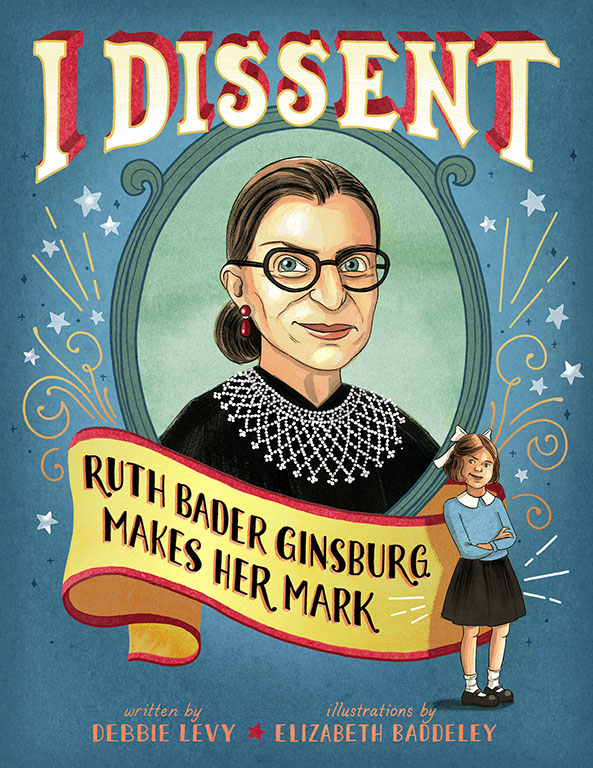
I Dissent: Ruth Bader Ginsburg Makes Her Mark
Written by Debbie Levy | Illustrated by Elizabeth Baddeley
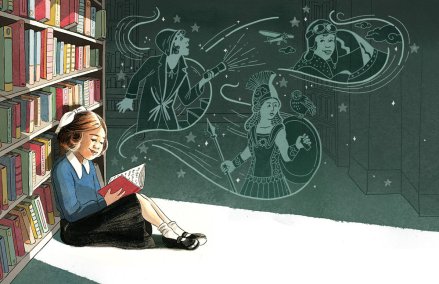
Ruth Bader grew up during the 1940s in Brooklyn, New York’s multicultural neighborhood. It was a time when boys were educated for jobs and bright futures while girls were expected to marry and raise children. Ruth’s mother, Celia Amster Bader, however, “thought girls should also have the chance to make their mark on the world.” She introduced Ruth to books in which she discovered women who used their strength, courage, and intelligence to do big things.
Image copyright Elizabeth Baddeley, text copyright Debbie Levy. Courtesy of simonandschuster.com.
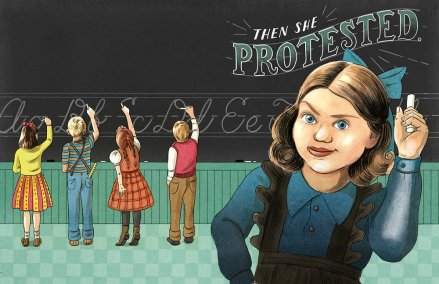
Ruth also saw and felt the sting of prejudice while growing up. Her family was Jewish, and at the time “hotels, restaurants, even entire neighborhoods” denied access to Jews, African Americans, Mexicans, and others. Ruth disagreed and never forgot. She was even discriminated against for being left-handed. In school she was instructed to write with her right hand, but her awkward penmanship earned a D. First, she cried; then she protested by only writing with her left hand—“it turned out she had quite nice handwriting!”
Image copyright Elizabeth Baddeley, text copyright Debbie Levy. Courtesy of simonandschuster.com.
During elementary school, Ruth was outstanding in some classes, such as history and English, and did not do so well in others, such as sewing and cooking. Music, especially opera, was another favorite subject—even though she did not have the voice to match her dreams. She excelled in high school and was even chosen as a graduation speaker. But Ruth had been hiding the fact that her mother was very ill. The day before graduation, her mother died. Ruth did not go to her graduation, but she did fulfill her mother’s wish and entered college.
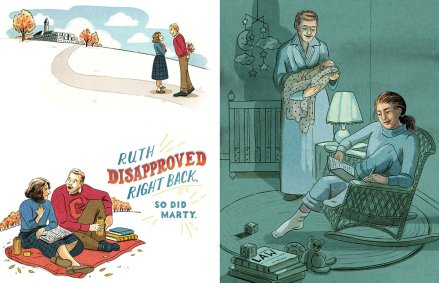
In college Ruth met Marty Ginsberg, and the two fell in love. They both decided to become lawyers to fight prejudice and unfairness in court. People thought this was a great idea for Marty, but disapproved of it for Ruth. “Ruth disapproved right back. So did Marty.” After college they got married, went to law school, and had a baby girl.
Image copyright Elizabeth Baddeley, text copyright Debbie Levy. Courtesy of simonandschuster.com.
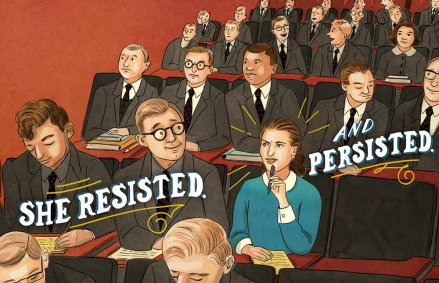
In law school Ruth was one of nine women in a class of 500. She worked hard and tied with another student as first in the class, but after graduation she couldn’t find a job. Employers objected because she was a woman, a mother, and Jewish. Finally, she found work with a judge. Her excellent work for him translated into jobs at one law school after another, and she became “one of the few female law professors in the whole country.”
All around her Ruth saw other women who were denied jobs or paid less than men. Women also had very little voice in courtrooms or in government. Rulings by the Supreme Court, the highest court in America, had helped maintain this inequality. The Court had stated that women were unfit for many jobs because of their “natural and proper timidity and delicacy.” Besides, the Supreme Court also said, “Woman has always been dependent upon man.”
Image copyright Elizabeth Baddeley, text copyright Debbie Levy. Courtesy of simonandschuster.com.
“Ruth really, really disagreed with this!” So she began fighting in court for equal rights for women. But equal rights for women also meant equal rights for men: Ruth believed men should be able to stay home with children if they wanted to while women worked. “These were fresh ideas in the 1970s. Ruth did not win every case, but she won enough. With each victory, women and men and girls and boys enjoyed a little more equality.”
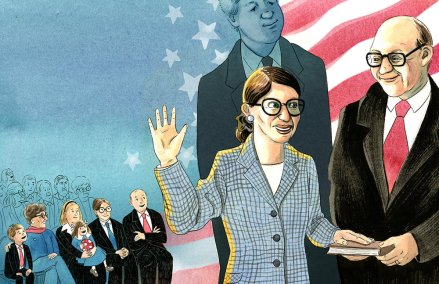
At home, Ruth’s own family agreed with her. Marty was a successful lawyer and also an accomplished chef who cooked the family’s meals. Ruth went on to become a well-known and well-respected lawyer. President Jimmy Carter asked her to be a judge in Washington DC. Then President Bill Clinton chose her to fill a vacancy on the Supreme Court. “Ruth agreed.”
Image copyright Elizabeth Baddeley, text copyright Debbie Levy. Courtesy of simonandschuster.com.
“In 1993, Justice Ruth Bader Ginsburg became the first Jewish woman on the nation’s highest court.” When the nine justices decide a case, they listen to both sides and then vote. The winning side then writes an opinion explaining their ruling. When Justice Ginsburg votes with the winning side, she wears a special lace collar over her robe. When she does not agree with the ruling, she says, “I dissent” and writes an opinion explaining why. She has a special collar for dissenting too.
Some of her dissensions were influenced by her early experiences. She dissented when “the court wouldn’t help women or African Americans or immigrants who had been treated unfairly at work. She dissented when the court did not protect voting rights for all citizens. She dissented when the court disagreed with schools that offered African Americans a better chance to go to college.” And once when she dissented, Congress and the president agreed with her and overturned the Supreme Court’s ruling.
Image copyright Elizabeth Baddeley, text copyright Debbie Levy. Courtesy of simonandschuster.com.
Justice Ruth Bader Ginsburg is now the oldest member of the Supreme Court. Some people think she should retire, but she disagrees. She still has work to do. Over the years, she has “cleared a path for people to follow in her footsteps—girls in college, women in law school, and everyone who wants to be treated without prejudice….Step by step, she has made a difference…one disagreement after another.”
An extensive Author’s Note about Ruth Bader Ginsburg’s life, notes on Supreme Court Cases, and a selected bibliography follow the text.
Debbie Levy’s outstanding biography allows readers to journey with Ruth Bader Ginsburg as her experiences and beliefs lay the foundation for her life’s work. Well-chosen anecdotes from Ginsburg’s childhood make her accessible to kids and may even inspire them to look toward their own futures. Ginsburg’s trajectory from college student to lawyer to judge and finally to the Supreme Court is balanced and uplifting, emphasizing the positive impact of persistence and self-confidence.
Elizabeth Baddeley’s illustrations go hand-in-hand with Levy’s text to fully illuminate the life of Ruth Bader Ginsburg for children. Ginsburg’s intelligence, sense of humor, courage, and principles are evident as she matures from school girl to Supreme Court Justice. Dynamic typography highlights the theme of dissent and disagreement as a force for positive change. The color, expression, and spirit imbued in each page make I Dissent: Ruth Bader Ginsburg Makes Her Mark an exciting and eye-catching read for all children.
I Dissent: Ruth Bader Ginsburg Makes Her Mark is a superb and recommended book for girls and boys. The book’s focus on a woman who continues to make a difference will inspire children and even adult readers to speak up and act on their convictions.
Ages 5 – 9
Simon & Schuster Books for Young Readers, 2016
To learn more aboutDebbie Levyand her books for children and young adults, visit her website!
Rosie the Riveter became a symbol of strong women during World War II and continues to be an iconic figure today. Print and color thisRosie the Riveter Pagethen display it to always remember that women can do anything!
Lighthouses have been protecting ships at sea since earliest times. From fires to gas lamps to electric lights, these warning signals have alerted sailors to reefs, heavy fog, and other dangerous conditions. Once operated by keepers who lived in or near the lighthouse, these beautiful structures are now mostly run automatically. Their color, iconic shapes, and intriguing lore make lighthouses a favorite site along the shoreline. If you live near the water, celebrate today by visiting a local lighthouse museum. If you are more landlocked, do a little research or read a good book about lighthouses.
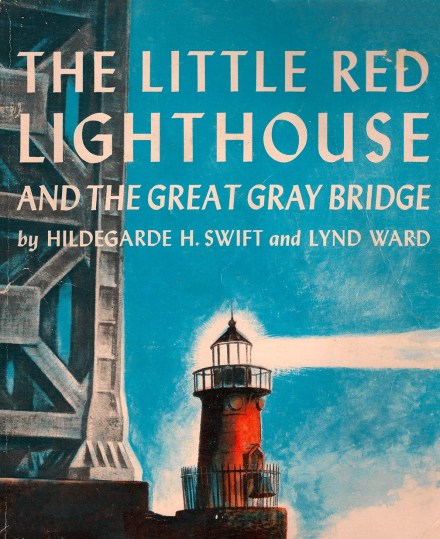
The Little Red Lighthouse and the Great Gray Bridge
Written by Hildegarde H. Swift | Illustrated by Lynd Ward
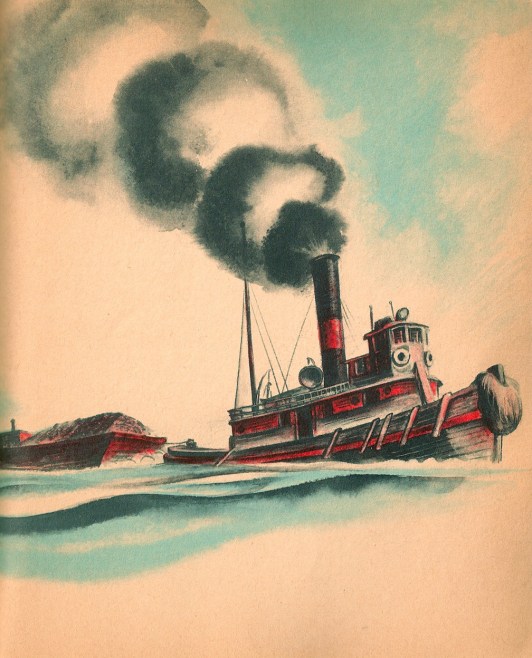
The little lighthouse “was round and fat and red. It was fat and red and jolly. And it was VERY, VERY PROUD.” It stood between New York and the Hudson River, which carried boats of all kinds as it rolled on and on, looking for the sea. As the boats passed the little lighthouse, they talked to it. The big steamer had a deep booming voice while the narrow canoe spoke with a gentle whisper, and the tugboat always gave a cheery hello. The lighthouse did not answer during the day, but at night “a man came to tend the little red lighthouse.”
Copyright Lynd Ward, 1942. Courtesy of Houghton, Mifflin Harcourt Books for Young Readers.
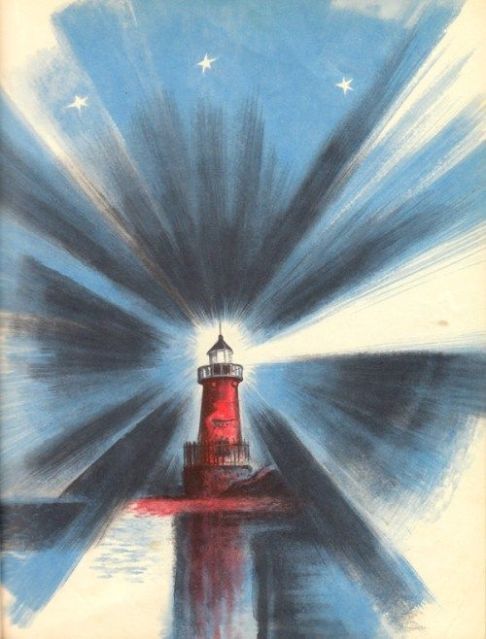
He opened the side door with a key from his jangling ring and “climbed its steep and winding stairs, up, up, up, to the very top. He took off the thick white cap that let it sleep by day.” He turned on the gas, and in a few minutes the lighthouse began to speak. “Flash! Flash! Flash! Look out! Watch me! Danger, danger, danger! Watch my rocks!” It felt very proud, knowing that the boats needed it to stay safe.
Copyright Lynd Ward, 1042. Courtesy of Houghton, Mifflin Harcourt Books for Young Readers.
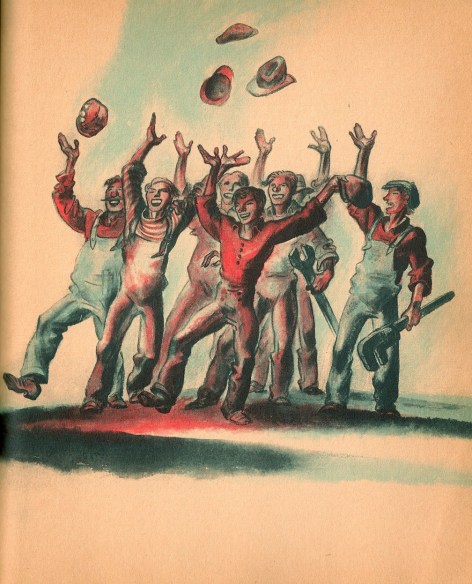
When a heavy fog descended, the keeper came and wound a big clock inside the lighthouse. The clock ran an iron bell that rang to warn the sailors who couldn’t see the lighthouse flashing. With two voices, the lighthouse felt even more proud. “I AM MASTER OF THE RIVER” it decided. But one day construction workers arrived. They dug and dug and then began building enormous girders that reached high into the sky. Then the men attached thin silver cables to the structure. When the cables were in place, the men celebrated. The little lighthouse didn’t know what was happening.
Copyright Lynd Ward, 1042. Courtesy of Houghton, Mifflin Harcourt Books for Young Readers.
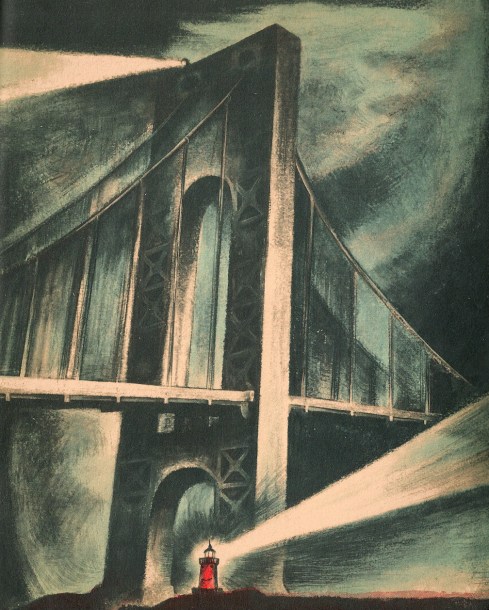
At night, the lighthouse continued to speak with its flashing and ringing voices. During the day, it watched as the huge gray thing grew larger and larger. It was wonderful and powerful, thought the lighthouse. Soon the bridge spanned the Hudson River from shore to shore. “It made the little red lighthouse feel very, very small.”
Then one night a great, bright light shown from the top of one of the bridge’s towers. “Flash! Turn! Flash!” it said in a loud voice. The lighthouse thought it was not needed anymore. Its light was so little while the bridge’s was so big. The lighthouse worried that the keeper would forget to turn its light on or that it would even be torn down. That night as it got darker and darker, the keeper did not come. The lighthouse felt strange.
Copyright Lynd Ward, 1942. Courtesy of Houghton, Mifflin Harcourt Books for Young Readers.
That night a storm roiled the sea. It threatened the boats, and though they looked for the little red lighthouse, they couldn’t find it. There was no bell, and the fog was so thick the bridge light couldn’t shine through. The tug hit the rocks and was smashed. The bridge called down to the lighthouse, “‘Little brother, where is your light?’” The lighthouse was surprised. It told the bridge that it thought it wasn’t needed anymore. But the bridge explained that its light was to alert airplanes, not the ships far below it. “‘You are still master of the river,’” the bridge said. “‘Quick, let your light shine again.’”
But the lighthouse couldn’t turn itself on. It was afraid that the keeper would never come again, and that this was the end for it. Suddenly, the lighthouse heard jangling keys and running steps. It was the keeper hurrying to turn on the light. “‘This will never happen again,’” the man said. Now the lighthouse realized that is was needed. It sent its beam out into the dark night, and soon its bell began to toll too. The lighthouse was glad and even thought it knew it was little, it was “still VERY, VERY PROUD.”
Copyright Lynd Ward, 1942, Courtesy of Houghton, Mifflin, Harcourt Books for Young Readers.
Hildegarde H. Swift’s classic story of the Hudson River lighthouse will enchant readers. The little red lighthouse makes a charming narrator for its tale that teaches kids about the importance of lighthouses while also showing them that even though one may be little, they can still have a profound effect on those around them. The pride and worries of the lighthouse will resonate with young readers, and they will cheer when the light is turned back on and the lighthouse regains its proper place. Swift’s lyrical language will keep children riveted to this fictionalized account of a historical event.
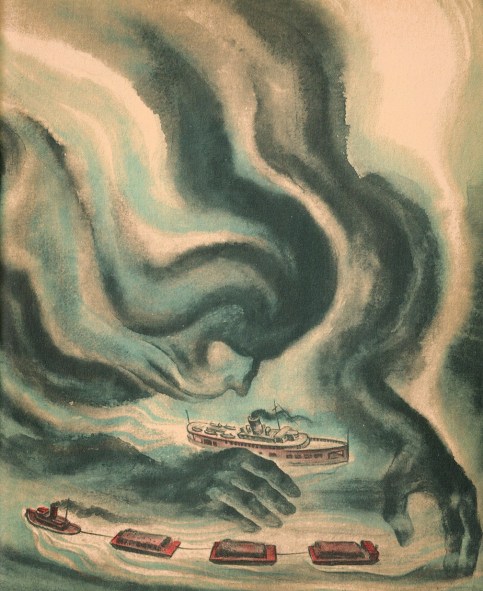
Lynd Ward’s evocative illustrations, rendered in red, blue, black, and white, are both strong and whimsical and seem as fresh today as they were when the book was first published. Features on the ships, lighthouse, and bridge make organic faces, personalizing these characters for children, while Ward’s depiction of the storm as a specter grasping at ships is striking and emphasizes the importance of the lighthouse.
The Little Red Lighthouse and the Great Gray Bridge is a multi-layered story for all readers. Children interested in lighthouses, bridges, boats, and construction will be especially drawn to this book.
Ages 4 – 7
HMH Books for Young Readers, 2002 | ISBN 978-0152045715 (hardcover); 978-0152045739 (paperback)
National Lighthouse Day Activity
Shining Lighthouse Maze
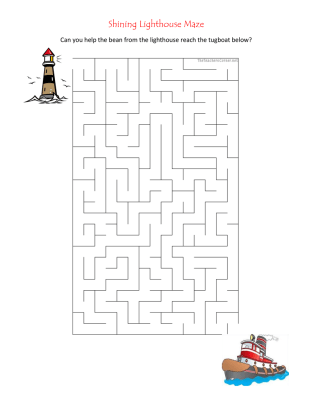
Lighthouses protect ships from rocks, fog, and other dangers. Can you help the beam from the lighthouse reach the tugboat that is approaching in this printable Shining Lighthouse Maze? Here’s the Solution.
Celebrating art is always a great thing! This month we celebrate art created in America. The unique history, landscape, population, and cultural influences of the United States fosters artwork that is distinctively American. This month gives us the opportunity to explore pieces dating back to the founding of our country as well as the paintings, sculpture, crafts, pottery, and other arts being created today. Take the time to visit museums, galleries, arts and craft shows, and theaters to discover old favorites and new inspiration.
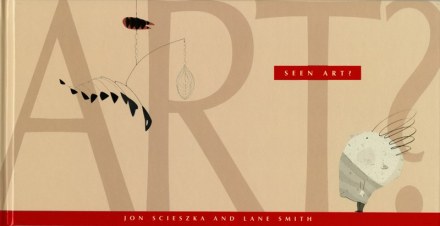
Seen Art?
Written by Jon Scieszka | Illustrated by Lane Smith
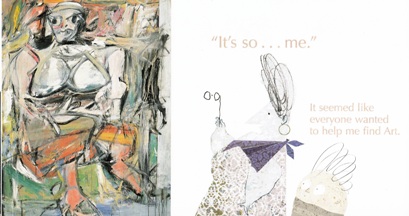
A little boy has arranged to meet his friend Art at the corner of Fifth Avenue and Fifty-third Street in New York City. When he arrives, however, Art isn’t there. The boy asks a woman nearby, “‘Have you seen Art?’” The lady points him in the direction of a beautiful new building further down the street. When he gets there, the boy doesn’t see Art, but he does meet an official-looking gentleman. “‘You seen Art?’” the boy inquires.
Image copyright Lane Smith, 2005, text copyright Jon Scieszka, 2005. Courtesy of Viking Books for Young Readers.
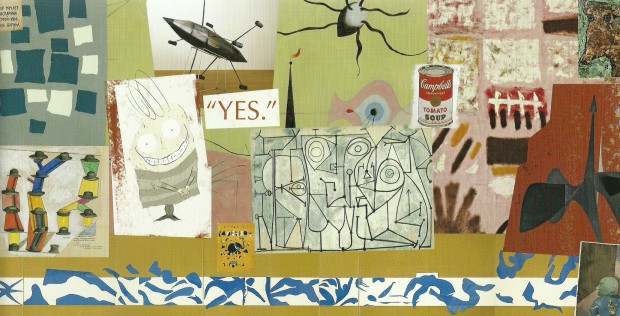
“‘MoMA?” the man asks. The boy thinks, didn’t the lady ask the same thing? Figuring it’s some kind of code word, he answers, “‘Yes.’” Great news! The building is just opening, the man tells him. After giving another woman the code word, the boy is led upstairs. She stops in front of a painting with blue swirls, writhing trees, and a moon glowing over a quiet village. “‘Can’t you just feel the restlessness? The color? The emotion?’” The boy can feel it, but he’s more interested in finding Art.
Image copyright Lane Smith, 2005, text copyright Jon Scieszka, 2005. Courtesy of Viking Books for Young Readers.
A little man standing nearby seems to know where to go, and he leads the boy through a room filled with more paintings and sculpture. The man stops in front of a painting. “‘Look at that red! Look at that open box of crayons inviting us in. The grandfather clock? It has no hands. Time is suspended.’” The boy sees all this too. But, really, what he wants to know is—“‘is Art here?’”
A little girl across the room knows what he means. She can show him art. She takes him past a fur-covered teacup and spoon to a painting of an eye. But this is no ordinary eye. Instead of blue, brown, or green, this eye is clouds. “‘Your dream can be what is real,’” she explains. They see another painting with a melting clock in which time is messed up too, but it’s still not Art.
Image copyright Lane Smith, 2005, text copyright Jon Scieszka, 2005. Courtesy of Viking Books for Young Readers.
Suddenly, a painter hugs the boy for his astute observation. He asks, is art “‘trying to capture dreams? Or is it making images everyone can recognize?’” Next, a lady shows the boy an alarming painting of a woman with whom she identifies, and a baby points out a picture of a brown “‘moo moo’” cow. It seems that in every corner there is another person expounding on a painting in front of them: the shapes, the mystery!, the composition, the color, the atmosphere.
Image copyright Lane Smith, 2005, text copyright Jon Scieszka, 2005. Courtesy of Viking Books for Young Readers.
But each time the boy answers, “‘Not exactly the Art I was looking for.’” Perhaps, he is interested in the Bell-47D1 helicopter hanging from the ceiling. Is it art? The boy strides past more pieces; they are puzzling, personal, playful, provocative and powerful. Art is not just paintings, he is told. Finally! They seem to be getting it. He begins to ask one more time about his friend, but he’s shown more photographs, sculpture, objects, and films.
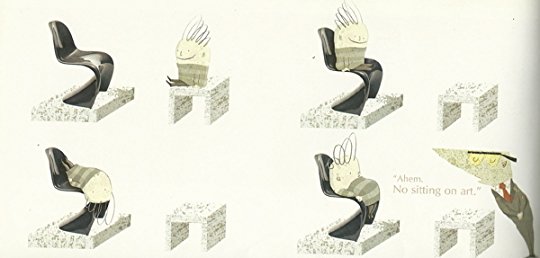
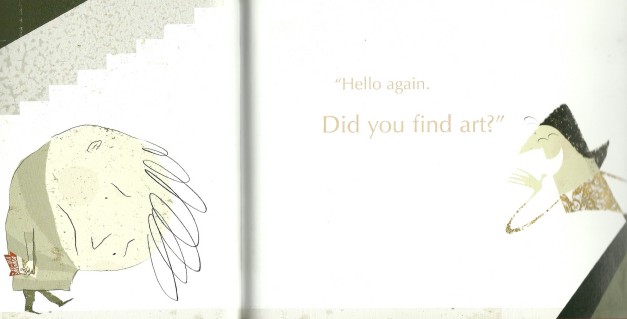
The boy decides he needs to find Art on his own. He discovers a majestic painting as long as two rooms, a slippy-slidey chair, images of soup cans that make him hungry…the café…and sculptures of a family and a goat. Soon itvs time to leave. Back on the sidewalk and feeling dejected, the boy thinks he’ll never find his friend. “‘Hello, again,’” he hears. It’s the lady he met that morning. “‘Did you find art?’” she asks.
The boy is about to say no, but he remembers everything he has seen. “‘Yes,’” he answers. And when he finds Art waiting for him, the two go through MoMA again.
Image copyright Lane Smith, 2005, text copyright Jon Scieszka, 2005. Courtesy of Viking Books for Young Readers.
Notes on each piece along with thumbnail images follow the text.
With clever word play, a humorous nod to the juxtaposed ideas “I know what I like/I like what I know,” and a wink at the world of art criticism, Jon Scieszka takes readers on a tour of the art collection at New York’s Museum of Modern Art. The simple misunderstanding of the word Art in the story introduces children to the nature of interpretation and the variety of forms it can take. Through the many people the little boy meets, Scieszka presents a fabulous opportunity for adults and children to talk about opinions and how each person can have their own while accepting those of others. Scieszka’s rich language is as enticing as the art presented and gives kids and adults a vast vocabulary to use in talking about what art—and life—has to offer.
Lane Smith’s simple line-drawn and abstract figures are the perfect tour guides to the reproductions of famous paintings, sculpture, installations, and other art found at MoMA. Printed in full, vibrant color, the artwork dazzles, drawing readers in to stop and explore each image. An excellent survey of classic and modern pieces will delight and fascinate kids.
For art lovers and those just discovering the world of creativity, Seen Art? is an absorbing book that will entice both children and adults to learn more about art. The book would be a fun and engaging addition to school art programs or units as well as for home libraries.
Ages 3 – 8 and up
Viking Books for Young Readers, 2005 |ISBN 978-0670059867
Discover more about about Jon Scieszka, his books, and other fun stuff on his website.
View a gallery of book illustration and other artwork by Lane Smith on his website.
American Artists Appreciation Month Activity
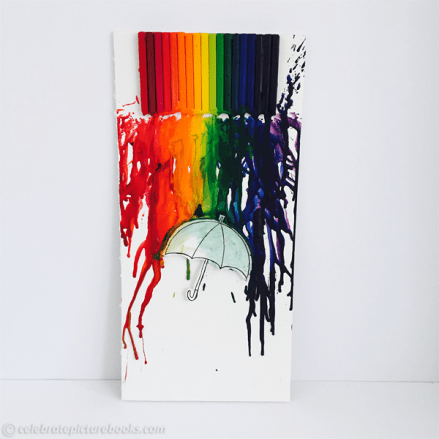
Rainbow Crayon Art
With this cool project you can create an art piece that’s as colorful as a rainbow and as unique as you are! Adult help is needed for children.
Supplies
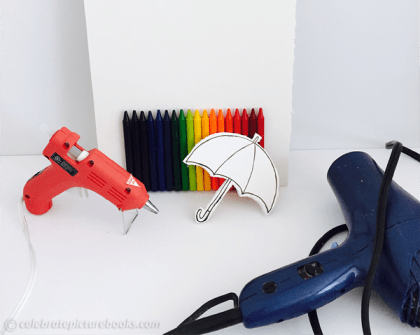
Box of 24 crayons
White foam board or thick poster board, 8 inches by 17 inches
A small piece of corrugated cardboard, about 5 inches by 5 inches (a piece of the foam board can also be used for this step)
A small piece of poster board, about 5 inches by 5 inches
Scissors
X-acto knife (optional)
Hot glue gun
Hair dryer
Old sheets or towels, newspapers, a large box, or a trifold display board
Directions
Remove the various red, orange, yellow, blue, indigo, and violet hued crayons from the box of crayons
Strip the paper from the crayons by slicing the paper with the x-acto knife, or removing it by hand
Line them up in order at the top of the white foam board
With the hot glue gun, attach the crayons to the board with their tips facing down
Cut an umbrella or other shape of your choice from the poster board
Trace the umbrella or other shape onto the corrugated cardboard or a piece of the foam board and cut out
Glue the umbrella or other shape to the foam board, about 4 ½ inches below the crayons, let dry
Set up a space where you can melt the crayons. The wax will fly, so protect the floor and walls by placing the art piece in a large box or by hanging newspapers, old sheets or towels on the walls and placing newspapers on the floor. A trifold display board and newspapers works well.
Stand the art piece upright with the crayons at the top
With the hot setting of the hair dryer, blow air at the crayons until they start to melt
Move the hair dryer gently back and forth across the line of crayons from a distance of about 6 to 12 inches away. The closer you are to the crayons, the more they will splatter.
The crayons will begin to melt and drip downward
You can experiment with aiming the hair dryer straight on or at an angle to mix colors
Wax that drips onto the umbrella or other shape can be chipped off after it dries or wiped off to create a “watercolor” effect on the shape
Once the hair dryer is turned off, the wax cools and dries quickly
Today’s holiday envisions a day when there is no dishonesty or deception of any kind and encourages people to clear the air if there are hard feelings or to tell truths, even if they’re hard. If there is an honest statement you need to say, today may be the perfect opportunity to discuss it.
Kate Warne: Pinkerton Detective
Written by Marissa Moss | Illustrated by April Chu
As Kate read the newspaper advertisement from the Pinkerton Agency for the third time, she knew that this was the job for her. It said: “Wanted: Detective. Must be observant, determined, fearless, and willing to travel.” But in 1856 no one would hire a single woman, so Kate decided to present herself as a widow.
Kate had been raised by her father, a printer. Books had always been her companions, and she knew how to make up a story—even the story of her life. “So Kate Carter became Kate Warne…exactly the kind of person you’d want to hire as a detective.” As soon as she walked through the door, Allan Pinkerton began writing down his impressions of Kate. He thought she was a client seeking help. From her manner and appearance, he knew he would take her case—whatever it was.
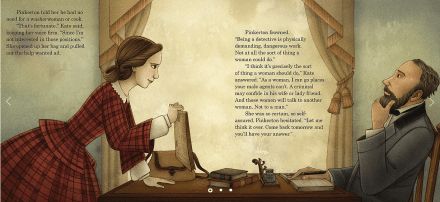
But when Kate told him she was applying for a job, he told her he “had no need for a washerwoman or cook.” Kate told him she was there to apply for the detective position. Pinkerton had reservations. The dangerous work was “not at all the sort of thing a woman could do,” he said. But Kate disagreed. She told him that she would be able to go into places his male detectives could not and could be the confidant of women witnesses. Pinkerton told her he would think it over.
Image copyright April Chu, text copyright Marissa Moss. Courtesy of Creston Books.
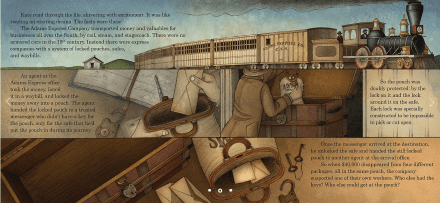
The next day Kate was at the office as soon as it opened. “Today, you’ve made some history,” Pinkerton told her, “You’re now the first woman detective in the country.” He handed her a file marked The Adams Express Case. As she read the case, Kate felt a thrill of excitement. “The Adams Express Company transported money and valuables for businesses all over the South, by rail, steamboat, and stagecoach.” Valuables were well protected by locks that couldn’t be picked.
But $40,000 had disappeared. One suspect stood out from the rest—Nathan Maroney, the manager of the Montgomery office where the packages had come from. He had been the last person to lock up the carrying pouch before the messenger, Mr. Chase, transported it to Atlanta, where it was found to be empty. Maroney was arrested, but there was little hard evidence—only a slit in the pouch that had not been there before Maroney was accused.
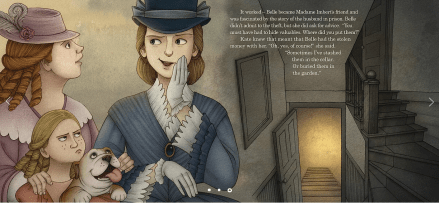
Kate considered the problem then remembered the sleight of hand tricks huskers used to fool people. She figured out how Maroney had stolen the money, but they needed more evidence and a confession. While a male agent pretended to be a fellow thief named “John White” in the same jail cell as Maroney, Kate befriended Maroney’s wife, Belle, pretending to be Madame Imbert. While Belle didn’t confess to the theft, she did ask her new friend for advice on where to hide valuables. Kate told her she hid her valuables in the basement or buried them in the garden.
Image copyright April Chu, text copyright Marissa Moss. Courtesy of Creston Books.
When Belle left town to visit her husband in jail, Kate took the opportunity to do some snooping at her house. Just as Kate found a freshly dug mound behind crates and barrels in the basement, she heard Belle returning home. She hurriedly put everything back in place and rushed upstairs. Belle was suspicious of the dust on Kate’s dress, and Kate knew she and the other agents had to act fast. She alerted another agent who crawled through the basement window while Belle slept. He tidied up the basement, and the next morning when Belle checked her hiding place, everything was in order. She could still trust her friend she thought.
The Pinkerton Agency plan was going like clockwork. Inside the jail cell, Maroney put his faith—and his money—in the detective’s hands. Maroney wrote to Belle, telling her that John White was going to help them. He instructed her to give John White all the money he had stolen. White was going to plant some of it on Mr. Chase, use some of it to bribe a judge to find Maroney not guilty at trial, and keep the rest for Maroney to collect later. At first, Belle didn’t trust John White, but one sentence from her friend “Madame Imbert” eased her mind and she went along with her husband’s plan.
As the ingenious plan was hatched and carried out, Kate made sure that all the money was secure. The money made its way to the Pinkerton agent “Mr. White” with Belle and Maroney none the wiser. As Maroney’s trial proceeded, and he heard Mr. White called as the first witness, Maroney suddenly changed his plea from “not guilty” to “guilty.” “The reputation of the Pinkerton agency was made. So was Kate Warne’s.”
Kate became one of the agency’s most valuable detectives. She was even put in charge of a women’s division and hired many more women who became “some of Pinkerton’s strongest agents.” But Kate Warne, the first woman detective in America, would always be considered the best.
Image copyright April Chu, text copyright Marissa Moss. Courtesy of Creston Books.
An Author’s Note explaining more about the Pinkerton Detective Agency and the first woman detective follow the text.
Children who love mysteries will be enthralled with this true tale of the first woman detective in America and her explosive first assignment. Marissa Moss’s suspenseful, compelling storytelling and excellent pacing reveal the facts of the case, Kate’s insightful reasoning, and the clever ruses the agents used in outsmarting and capturing the thief. Moss infuses the story with the feeling of the time period and a sense of pride in this little-known piece of women’s history.
April Chu’s detailed period drawings take kids to the mid-1800s to follow Kate Warne as she solves her first case. Depictions of Kate’s father’s printing press, the dirt roads traversed by horse-drawn wagons and carriages, the Adams Express locked pouches and secure rail car will excite history and mystery buffs. The full cast of characters are clearly portrayed, allowing young readers to become detectives themselves as they see the action through Kate’s eyes. The dramatic finale to the case will have children on the edge of their seats whether they are hearing the story aloud or reading it themselves.
Kate Warne: Pinkerton Detective is a thrilling picture book introduction to both biographies and mysteries for children. It offers a unique look at the contributions of strong women in history and is an excellent selection for school, public, and home libraries.
Ages 5 – 13
Creston Books, 2017 | ISBN 978-1939547330
Visit with Marissa Moss on her website to discover more about her, her books, and loads of fun activities!
View a gallery of artwork by April Chu on her website!
On July 2, 1776 the Continental Congress voted for Independence from Great Britain. Two days later delegates from the 13 American colonies adopted the Declaration of Independence, a document penned by Thomas Jefferson asserting the equal rights of all and establishing a democratic government. It went on to name the America’s grievances against Great Britain and to create from the colonies the United States of America. Independence Day was made a federal holiday in 1941. The day is celebrated with official ceremonies, parades, picnics, and fireworks displays.
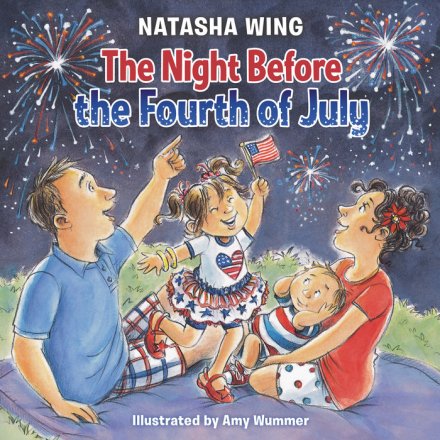
The Night Before the Fourth of July
Written by Natasha Wing | Illustrated by Amy Wummer
The Fourth of July is tomorrow, and one family is getting ready! While Dad hangs the American Flag on the front porch, Mom is decorating the fence with red, white, and blue bunting. While they sleep, the brother and sister dream about fireworks. The next day every one dresses up in patriotic stripes and stars to attend the town parade, complete with “marching bands and 4-H club goats.” Even the Mayor joined in the fun, tossing candy to the crowds from a convertible car, while “an Uncle Sam walking on stilts brought up the rear.”
After the parade friends and family came to the house for a barbeque, but as Dad flipped burgers and the table was laid with summer treats, gray clouds threatened overhead. Just as everyone “sat down it started to pour. ‘Grab the food!’ shouted Mom and [they] raced through the door. In hot dogs! In salads! In blueberry pie! In melon and corn! Keep those potato chips dry!”
Everyone piled into the kitchen and continued to munch. But what about the fireworks? They watched out the window at the rain pouring down. A Fourth of July without rockets and sparkle and light just wouldn’t be the same. But there was no need to worry. After the storm burst, the clouds went away and the sky turned blue.
Image copyright Amy Wummer, text copyright Natasha Wing. Courtesy of Grosset & Dunlap
As dusk approached they all drove to the park. Dad lit the sparklers and set the glow sticks alight. Soon, “the first firework was launched high into the night. It bloomed like a flower exploding with light.” People oohed and ahhhed, but for some little ears the booms were too loud. Then the band played the national anthem and Dad sang along, even if he was “way out of key.”
As the last notes faded into the air, it was time for the finale – a spectacular display of color and wonder. “When the last firework fizzled like fairy dust in the sky, [they] all cheered and shouted, “Happy Fourth of July!”
Part of Natasha Wing’s “The Night Before” series, this summer holiday book offers young readers all the excitement and fun of the Fourth of July from community events to family picnics to, of course, the fireworks that wrap up this patriotic celebration with flair. While maintaining some of the cadence of its Christmas cousin, The Night Before the Fourth of July is jauntily unique. Young readers will be captivated by the story’s joyous preparations and “Uh-oh! What now?” moment and will enthusiastically look forward to their own family traditions.
Amy Wummer’s engaging illustrations invite kids into a big family Fourth of July celebration with all the red, white, and blue decorations and glitzy fireworks. All young readers’ favorite parts of the holiday are here and warmly depicted as the family raises their flag, enjoys the flavor of summer delights, and joins the rest of the town at the annual fireworks show.
The Night Before the Fourth of July is a great book to keep on the shelf for the holiday itself (it makes a great take along to that wait for the sky to turn dark) and for other family story times.
Ages 3 – 5
Grosset & Dunlop, 2015 | ISBN 978-0448487120
Independence Day Activity
Glittery Fireworks Coloring Page
The fireworks display is one of the best parts of the Fourth of July. You can make this printableGlittery Fireworks Coloring Pageas sparkly as the real thing by outlining the bursts with a sprinkling of red, white, and blue glitter! Just grab your colored pencils, crayons, or markers plus some glue and glitter and have fun!
Olympic Day is celebrated by millions of people in more than 160 countries to commemorate the birth of the modern Olympic Games in 1894. The mission of Olympic Day is to promote fitness, well-being, culture and education, while promoting the Olympic values of excellence, friendship and respect. The Olympic Day pillars – move, learn and discover – are promoted in every corner of the globe. To have Olympic-size fun today, why not get together with friends or family and host your own mini-Olympic games? For more ideas and to learn more about today’s observance visitteamusa.org!
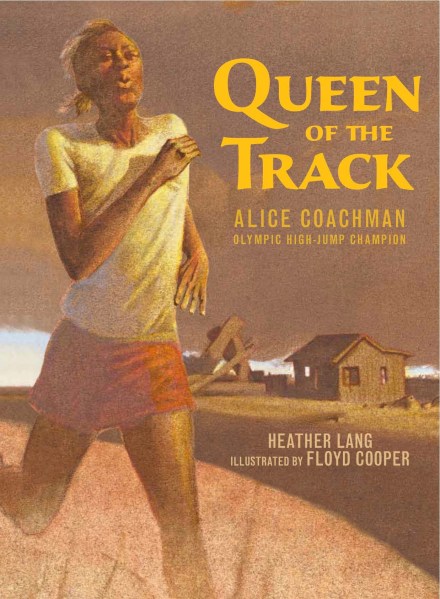
Queen of the Track: Alice Coachman, Olympic High-Jump Champion
Written by Heather Lang | Illustrated by Floyd Cooper
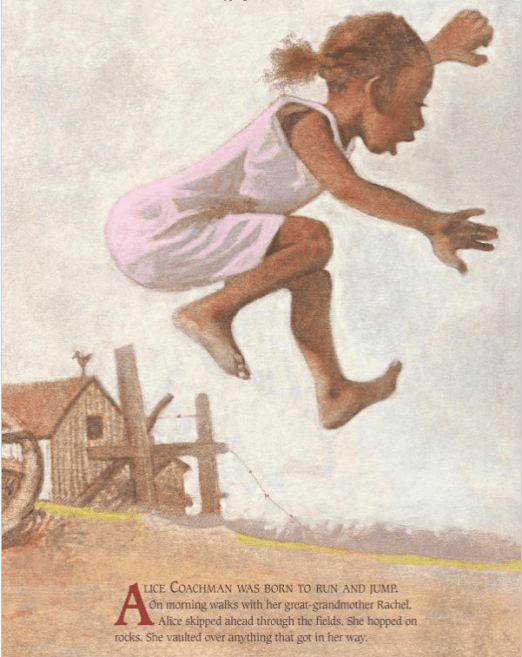
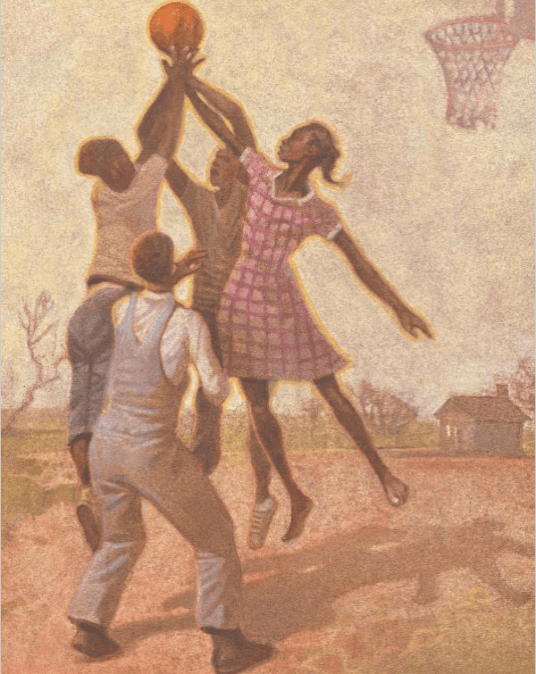
Alice Coachman was a born runner and jumper—skipping, hopping, and vaulting over every obstacle that came her way. As Alice grew older, however, the joy of running and jumping had to come a distant second to chores like cooking, laundry, picking cotton and peaches, and taking care of her younger siblings. Besides, her papa told her, “running and jumping weren’t considered ladylike.” Still, that was all Alice could think about, so after her chores were finished, she went out to play sports with the boys.
Image copyright Floyd Cooper, text copyright Heather Lang. Courtesy of Boyds Mills Press, 2012.
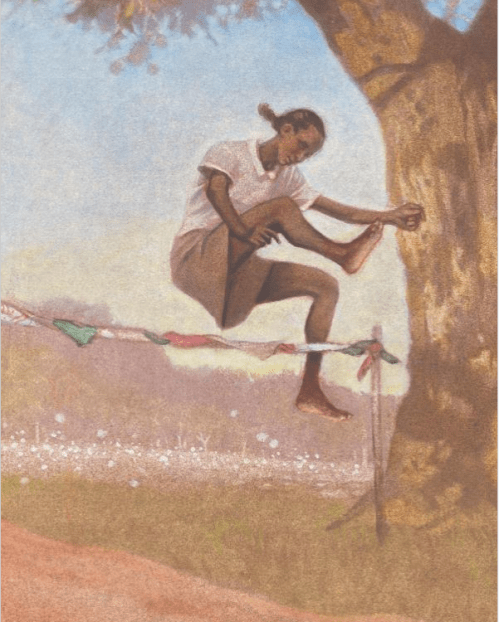
Living in the segregated South, Alice didn’t have the same rights as white people. She had nowhere to practice, but that didn’t stop her. Alice “ran barefoot on dirt roads. She collected sticks and tied rags together to make her own high jumps. Alice jumped so high, she soared like a bird above the cotton fields.” In seventh grade, Alice caught the attention of the high-school track coach. He arranged for her to join the track team at the Tuskegee Relays in Alabama, where the best black athletes from around the country competed. Alice had never worn track shoes or jumped over a real high-jump bar, she “won first place anyway, beating high-school and college girls.
Alice’s speed did more than win races. Once when a tornado ripped through Albany, she volunteered to deliver food to those in need. She ran so fast that the food stayed hot! Her talent won her a scholarship to finish high school at the Tuskegee Institute. Alice missed her family, and they didn’t have the money to really stay in touch. “One time she went home for a surprise visit, and her family had moved to a different house.”
Image copyright Floyd Cooper, courtesy of Boyds Mills Press, 2012
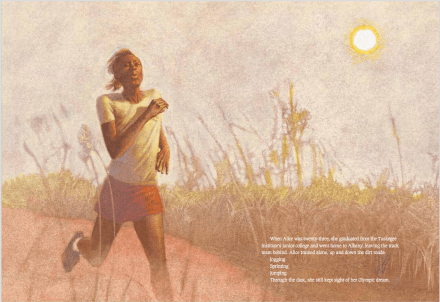
Alice competed on both the track-and-field and basketball teams. She won every event— the high jump, the 50-meter, the 100-meter, and the 400-meter relay—and led the basketball team to three straight championships. Alice was ready to compete in the Olympics. It was 1944, however, and the Olympic Games were canceled as the world was at war.
After graduating college from the Tuskegee Institute, Alice went home to continue practicing. Here, she trained alone on dirt roads. In 1948 with the war at an end, Alice qualified to compete in the London Olympics high jump. Even though years of hard training had weakened her back and made jumping painful, Alice pursued her dream. In London, the ravages of war were still visible, and “England faced serious food shortages. Alice and the other athletes were often hungry and thirsty.” The cold weather “pricked her like pins,” but here Alice and the other athletes—black and white—lived together, and Alice could sit anywhere she wanted on the buses as she toured the city.
Image copyright Floyd Cooper, text copyright Heather Lang. Courtesy of Boyds Mills Press, 2012.
As the Olympic Games opened with spectacular ceremonies, Alice marched into “Wembley Stadium to the applause of eighty-five thousand spectators.” Alice watched for eight days as her teammates lost event after event. Finally, it was Alice’s turn to compete. Her toughest opponent was Dorothy Tyler of Great Britain. “Inch by inch they battled it out—5 feet 3 2/5 inches, 5 feet 4 ½ inches. The sand in the landing pit was thinning out and the landings were tough on Alice’s back. 5 feet 5 1/3 inches.” The day was waning, and even though all of the other events were over, “the king and queen of England and thousands of spectators stayed to watch.”
The bar was placed at 5 feet 6 1/8 inches—as tall as Alice herself. She had never jumped so high before. “She sprinted, pumping her arms. She pushed off and flew…up…soaring…over the bar. Her leap set a new Olympic record!” But it was short lived. Dorothy also cleared the bar on her second attempt. The bar was placed at 5 feet 7 inches. Alice and Dorothy both jumped and missed. What would the judges decide? There are no ties allowed in the high jump.
Suddenly, Alice saw her name appear on the board! The judges awarded the medal to her because she “had made the record-breaking jump on her first try.” On that day—August 7, 1948—Alice Coachman stepped to the top of the podium and “became the first African American woman to win an Olympic gold medal.”
Image copyright Floyd Cooper, courtesy of Boyds Mills Press, 2012
Author’s Notes containing more information about Alice Coachman and the 1948 Olympics as well as lists of resources follow the text.
Heather Lang brings an athlete’s appreciation for the in-born talent and hard practicing that creates a world-class Olympian. Her story reveals not only the details of Alice’s physical training but also the social and economic hurdles she overcame in her quest to compete in the Olympics. Lang’s graceful and evocative prose carries readers down dirt roads and over obstacles, to the halls of the Tuskegee Institute, and into Wembley Stadium as they learn about the singular focus Alice Coachman dedicated to her sport. Children will feel as if they are sitting in the stands watching with suspense as the bar is raised again and again, pushing Coachman to a world record.
Floyd Cooper sets readers in the hot, dusty, sun-burned South, where Alice Coachman—as a little girl and then a teenager—runs barefoot on dirt roads, jumps over homemade bars, leaps to tip the basketball from her brothers’ hands, and delivers food to tornado victims. The golden-brown-hued illustrations catch Dorothy Taylor and Alice Coachman as they soar over the high bar in their fierce competition and capture Coachman’s hopes, dreams, and anticipation as she waits—hands clasped—to hear the judges’ final decision in the 1948 Olympic Games. Readers will cheer to see Coachman standing on the first-place podium, ready to receive her well-deserved gold medal.
A compelling and inspiring biography for children pursuing any talent, Queen of the Track: Alice Coachman, Olympic High Jump Champion would be a welcome addition to home, school, and public libraries.
Ages 5 and up
Boyds Mills Press, 2012 | ISBN 978-1590788509
Discover more about Heather Lang and her books plus videos, pictures, and fun activities that accompany each book on her website!
Learn more about Floyd Cooper, his books, and his artwork on his website!
Today, I’m excited to talk with Heather Lang about her inspirations, her books, brave women, and writing and research lets her be a little like childhood heroine Nancy Drew!
How did you become a children’s writer?
As a child, I loved books and stories and creating things, but I struggled with writing. I was much better at math. I never thought I could become an author, because I wasn’t naturally good at writing. As an adult, with kids of my own, I rediscovered my love for picture books, and I kept thinking how fun it would be to create a picture book! By then I’d realized that the seemingly impossible could be possible with hard work and dedication. So I began writing. It took many years and many rejections, but with support from other writers and my critique group I’ve learned to embrace the process.
Why do you like to write books about brave women?
The women I write about inspire me every day to be brave and step outside of my comfort zone. It’s amazing the things you discover about life and yourself when you dream big, keep an open mind, and push yourself. My hope is that my books will do the same for kids.
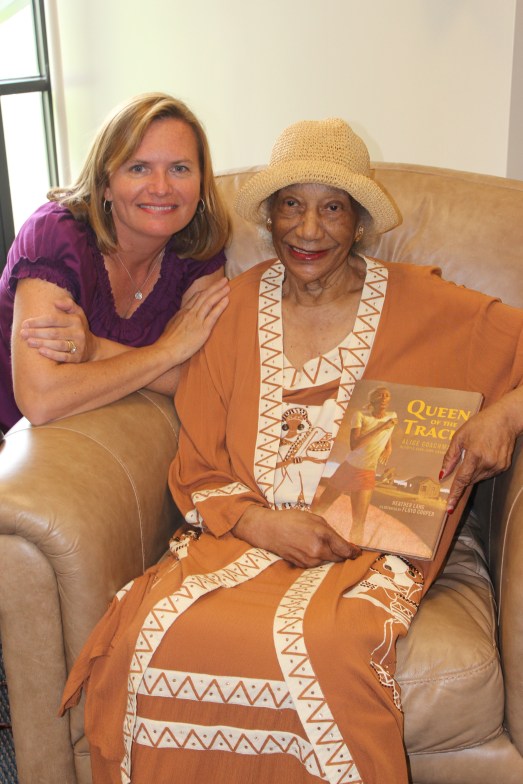
Heather meets Alice Coachman, the first African-American woman to win a gold medal at the Olympic Games.
What inspired you to write Queen of the Track?
After seven years of rejections on my fiction, I needed a little spark in my writing life to keep me going, so I decided to research and write a true story about an inspiring woman. Since I love sports, I looked for an athlete, and who better than the first black woman to win an Olympic gold medal? If Alice Coachman could overcome poverty and segregation and discrimination, surely I could overcome a few rejections. I kept one of Alice’s quotes on my desk: “When the going gets tough and you feel like throwing your hands in the air, listen to that voice that tells you, ‘Keep going. Hang in there.’ Guts and determination will pull you through.”
You seem to dig very deep when researching a book. What would you say is the biggest surprise you’ve discovered during your research?
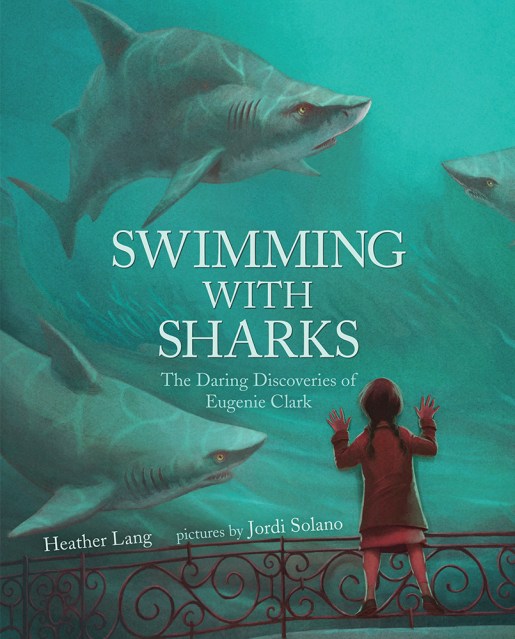
Every book is a treasure hunt, full of surprises and discoveries! My biggest surprise probably came with my most recent book Swimming with Sharks: The Daring Discoveries of Eugenie Clark. When I began my research journey, I was afraid of sharks and swimming in the ocean—terrified actually. As a child, I watched the movie Jaws and believed that sharks were swimming around looking for people to eat. That fear is what drew me to Eugenie Clark, an open-minded young scientist who never judged sharks based on rumors or appearance. I discovered that sharks are intelligent and important and that humans are NOT on the shark menu! I learned to scuba and snorkel, so I could experience Genie’s underwater world and swim with sharks myself. Writing that book transformed my fear of sharks into a passion for them!
Heather learned to scuba dive while writing Swimming With Sharks: The Daring Discoveries of Eugenie Clark.
With the titles “Diving into Nonfiction and the World of Sharks,” “Got Grit?” and “Girls with Grit: Researching and Writing about Brave Girls,” your interactive presentations sound fascinating. Do you have any anecdotes from your speaking engagements you’d like to share?
I have so much fun visiting with kids and am always amazed at some of their questions. “How big are great white sharks?” “How big are their teeth?” “How big are their pups?” “How do they have pups?” I LOVE their raw curiosity! It inspires me and helps me develop my school visit programs. In reaction to the endless questions kids were asking me about sharks, I designed a program that includes hands-on activities that teach kids about shark anatomy and behavior, as well as the food chain and why sharks are important for a healthy ocean. And in the process, I’ve learned even more cool facts about sharks!
You’ve mentioned that you were inspired by Nancy Drew and once wanted to become a spy, which you compare to researching and writing children’s books. What was your favorite Nancy Drew book and why?
I remember two favorites that I owned: The Mystery at Lilac Inn and The Hidden Staircase. For several summers it was my mission to read every Nancy Drew book in the library. If I couldn’t get there, I’d reread the two that I owned. I never tired of them. I worshipped Nancy’s courage, resourcefulness, and willingness to push boundaries. More than anything I wanted to be a spy, just like her. And in a way, that dream has come true. I do lots of spy work for my books. Ideas and stories are all around us if we look, listen, and investigate. I think solid sleuthing is the backbone of an authentic story.
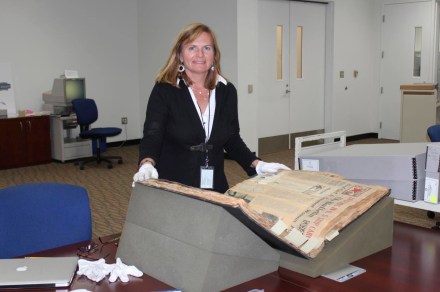
Heather researches Ruth Law’s Scrapbook while writing Fearless Flyer: Ruth Law and Her Flying Machine
If you have a particular place that you write, would you mind describing it a little?
I enjoy mixing it up, depending on what I am working on. When I was writing The Original Cowgirl: The Wild Adventures of Lucille Mulhall, I enjoyed writing on a picnic table at a local barn, surrounded by fields and horses. Sometimes I write in my office, but if the weather’s nice I head out to the screened porch. In the winter, my favorite place to write is by a roaring fire with my dog curled up next to me. And often ideas come to me when I’m in the car or on a walk or out to dinner—not the most convenient places to write. But when an idea strikes, I write it down and do a quick free write if possible, or poof the idea can vanish!
What’s the best thing about being a children’s writer?
My favorite part of being a writer is opening kids’ minds and hearts! I grow tremendously with every book I write, and nothing makes me happier than when my books do the same for kids. Whether a book inspires a child to dream big and be brave or it sparks a new interest in sharks or aviation, those moments are powerful.
What’s up next for you?
My next picture book biography, Anybody’s Game: The Story of the First Girl to Play Little League Baseball, comes out in March 2018. I am also working on a new book about sharks. And I’m so excited for an upcoming research trip to the Amazon for a book I’m writing about the rain forest!
What is your favorite holiday and why?
Christmas in our house is a creative holiday. My daughters and I try to make most of our gifts—anything from soap and candles to knitted hats, woven coasters, and jewelry. And we love to make handmade notecards and ornaments, especially when they involve GLITTER!
Do you have an anecdote from any holiday that you’d like to share?
Every year on Mother’s Day I get to choose exactly what I want to do! No—It’s not going to a spa or a fancy lunch. I choose to get my hands dirty with my husband and kids. It’s the day when we plan our garden, make a trip to the garden center, and plant our seeds and seedlings.
Thanks so much for chatting with me today, Heather! I wish you the best with all of your books!
You can find Queen of the Track and Heather’s other Books at these booksellers: