November 16 – It’s Global Entrepreneurship Week

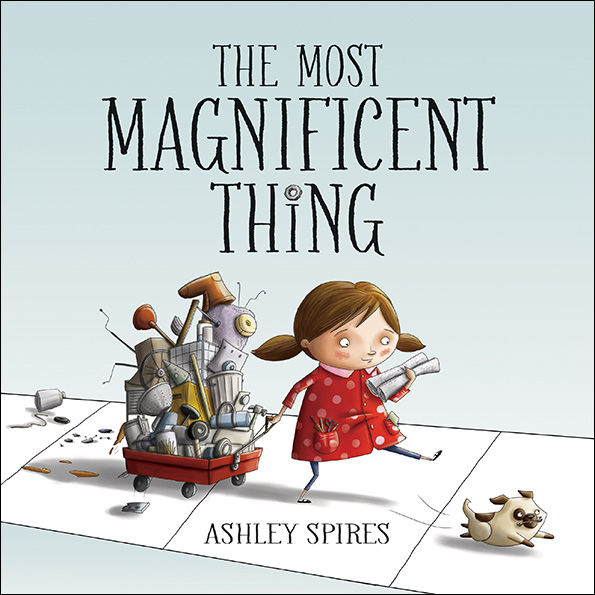
The Most Magnificent Thing by Ashley Spires picture book review

About the Holiday

Do you have a great idea to make the world a better place, a job easier, or life just a little more fun? Then this week is for you! All over the world inventors, thinkers, mentors, universities, and investors collaborate at events, conferences, and competitions to discover new products, creative ideas, and alternate ways of doing things. World leaders from 160 countries and more than 150,000 global organizations work together during this week to improve the lives of all.

The Most Magnificent Thing

By Ashley Spires


A little pony-tailed girl and her puppy do everything together. They race, eat, explore, and relax. When she makes things, her best friend unmakes them. One day the girl has a brilliant idea—she is going to make “the most MAGNIFICENT thing!” In her mind it’s going to be “easy-peasy.” She knows exactly how it will look and how it will work. With her faithful assistant following at her heels, the girl gathers materials and goes to work on the sidewalk outside her home.
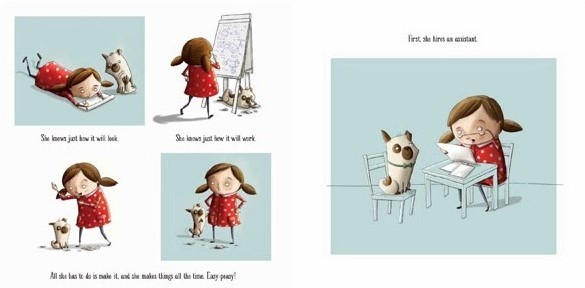
celebrate-picture-books-picture-book-review-the-most-magnificent-thing-easy-peasy

Image and text copyright Ashley Spires, courtesy of Kids Can Press

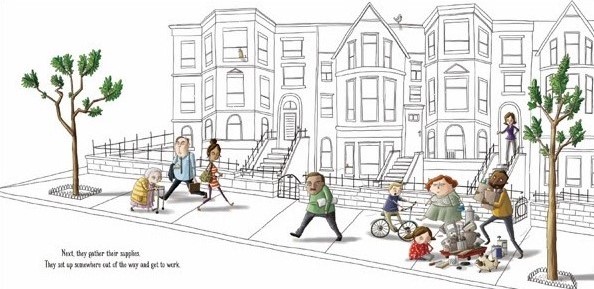
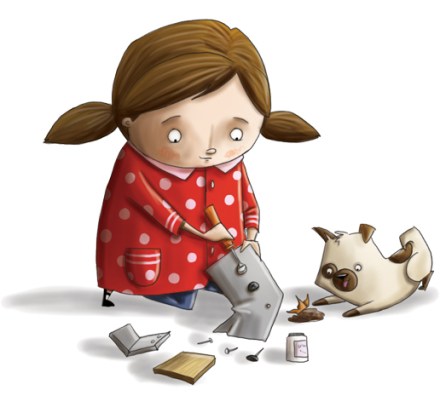
The girl “tinkers and hammers and measures” while her assistant “pounces and growls and chews.” When the little invention is finished, they stand back to examine it. Hmmm…it doesn’t look quite right. It doesn’t feel quite right either. In fact it is all wrong! The girl tries again. She “smooths and wrenches and fiddles” while her assistant “circles and tugs and wags.” It still turns out wrong. Determined to make her vision reality, she gives it another go…and another…and another. She makes her invention different shapes, gives it various textures, measures out assorted sizes. One attempt even smells like stinky cheese! But none of these creations are MAGNIFICENT.
celebrate-picture-books-picture-book-review-the-most-magnificent-thing-neighbors-come-by

Image and text copyright Ashley Spires, courtesy of Kids Can Press

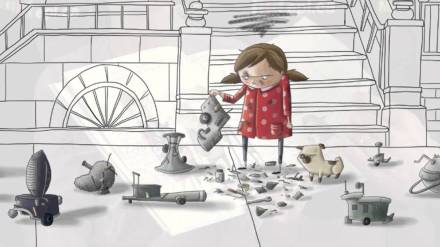
People stop by and offer encouraging—even admiring—remarks, but the little girl just gets mad. Can’t they see how wrong her invention is? In her anger the little girl works at a fevered pitch, shoving parts together, her brain fogged by “all the not-right things.” In her haste she hurts her finger. This is the last straw. She explodes and declares that she QUITS!
celebrate=picture-books-picture-book-review-magnificent-thing-not-magnificent

Image and text copyright Ashley Spires, courtesy of Kids Can Press

The ever-watchful assistant suggests a bit of fresh air. The girl takes her puppy for a walk and at first her feelings of defeat stay with her. Little by little, though, she pays attention to the world around her and her mind clears. Coming home, she encounters all the wrong things she has made lined up on the sidewalk. Her disappointment threatens to return, but then she notices something surprising—there are parts of each iteration that she likes!
celebrate-picture-books-picture-book-review-the-most-magnificent-thing-tinkering

Image and text copyright Ashley Spires, courtesy of Kids Can Press

After studying each earlier attempt, she knows just what to do! Slowly and carefully she once more begins to tinker. At the end of the day she and her assistant stand back to look. The machine may lean a bit, and be a little heavy, and it may need a coat of paint…but as the girl and her puppy climb aboard, they both agree that “it really is THE MOST MAGNIFICENT THING!”

You are never too young or too old for Ashley Spires’ inspiring and inspired story. The journey from idea to realization—so often fraught with disaster (or apparent disaster)—is depicted here honestly and with humor as the on-going process it is. Step-by-step the little girl thinks, gathers materials, tinkers, discovers, tinkers some more, and triumphs. It is this last step that is so “magnificently” presented—it’s only by not giving up that success can be achieved.

celebrate-picture-books-picture-book-review-the-most-magnificent-thing-the-girl-and-her-dog

Image and text copyright Ashley Spires, courtesy of Kids Can Press

Spires’ tale is a delight of language—the girl “smooths, wrenches, fiddles, twists, tweaks, and fastens, pummels, jams, and smashes.” Likewise, her illustrations wonderfully depict the changing emotions of this thoughtful, steely-eyed, shocked, and ultimately thrilled young inventor. Her faithful puppy is a charming companion and foil, and kids will love examining the early inventions that lead up to the final product.

The Most Magnificent Thing is a fabulous book to keep on any child’s or adult’s bookshelf for those times when inspiration hits but achievement seems elusive.

Ages 3 – 7 and up 

Kids Can Press, 2014 | ISBN 978-155453704

Discover more books by Ashley Spires on her website!

Global Entrepreneurship Week Activity
CPB - Inventor's Tool Kit II (2)

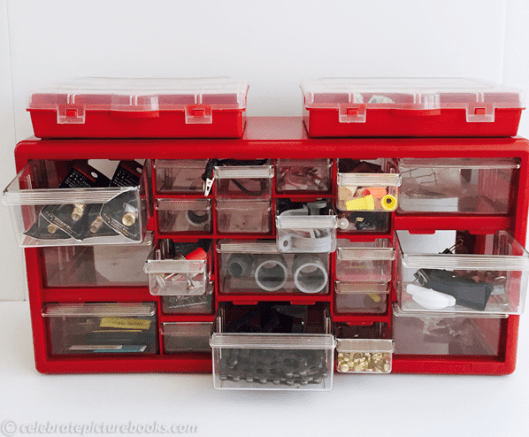
Entrepreneur’s Tool Kit


Every idea begins as a jumble of seemingly unrelated parts. Gathering whatever types of material inspires you and keeping it in a box ready to go when inspiration hits is a great way to support innovation and spark experimentation.

Supplies

  • Small parts organizer with drawers or compartments, available at hardware stores and craft stores
  • A variety of parts or craft materials that can be combined, built with, or built on
  • Some hardware ideas—pulleys, wheels, small to medium pieces of wood, wire, nuts, bolts, screws, hooks, knobs, hinges, recyclable materials
  • Some craft ideas—clay, beads, wooden pieces, sticks, paints, pipe cleaners, string, spools, buttons, glitter, scraps of material, recyclable materials

Directions

  1. Fill the organizer with the materials of your choice
  2. Let your imagination go to work! Build something cool, crazy, silly, useful—Amazing!

Picture Book Review

November 15 – I Love to Write Day

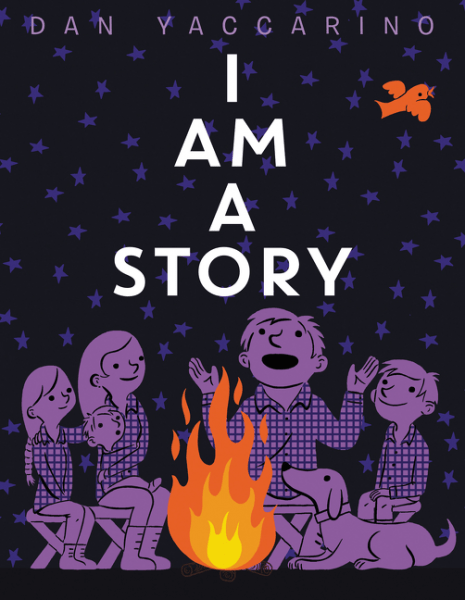
celebrate-picture-books-picture-book-review-i-am-a-story-cover

About the Holiday

I Love to Write Day was created by Delaware-based author John Riddle in 2002. He wanted to share his passion for writing with others and encourage them to pick up a pen or sit down at the computer and compose a poem, a short story, a journal entry, or whatever kind of written expression stirs their hearts. It’s fitting that today’s holiday comes in the middle of NaNoWriMo or National Novel Writing Month, when novelists and would-be novelists strive to begin and finish a complete novel (well, at least a first draft) in one month. If you hold ambitions to write, why not start today? As today’s book shows, you’ll be part of a very honored, long-standing tradition!

I Am a Story

By Dan Yaccarino


Sometimes it seems that from nothing and out of nowhere a story comes. And yet storytelling also seems to be an inborn trait, passed down from generation to generation and discovered in daydreams, alternate realities, those “what if?” moments. In Dan Yaccarino’s book, a story relates its history, beginning with our oldest ancestors. “I am a story,” the narrator states. “I was told around a campfire. Then painted on cave walls.” The story travels over years and across miles, changing the way it is told but not its impact.

celebrate-picture-books-picture-book-review-i-am-a-story-oral-storytellers

Image copyright Dan Yaccarino, courtesy of harpercollins.com

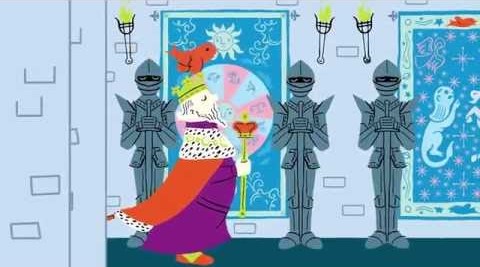
Men inscribed words on papyrus; women used woodblocks, brushes, and ink to bring them to life. Tales were stitched into legend on beautiful tapestries that brightened dank castle walls, and they were transcribed in gilded lettering “into big books to illuminate minds.” Then a man discovered how to print the story so many people could read it, which led to the story being “acted out onstage.”

celebrate-picture-books-picture-book-review-i-am-a-story-tapestry

Image copyright Dan Yaccarino, courtesy of harpercollins.com

Stories were bound into books and families began to collect them, creating “vast private libraries.” Then public libraries opened, and now stories are available for everyone—even in places so remote that the books are brought on donkeys, by camel, or even atop elephants. There are tiny libraries—not much bigger than a birdhouse; vending machines that dispense stories; and old telephone booths that have been transformed with shelves of books.

The story reveals its power to make “people frightened, excited, sad, and happy.” Some have felt and still feel that the story is dangerous, so they have “censored, banned, and burned” it. But the story “did not die.” Millions of people all over the world are inspired by the story every day. “I can go with you everywhere,” the story says, “and will live forever. I am a story.”

celebrate-picture-books-picture-book-review-i-am-a-story-printing-press

Image copyright Dan Yaccarino, courtesy of harpercollins.com

Bibliophiles young and old will love the simply told and expressively illustrated timeline of the story from early oral traditions until today. Between the first page where ancient peoples interpreted the constellations and the last where a family of today tells stories around a campfire under the starry sky, the various forms that stories take are described with vivid, full-bleed pages of people toiling over manuscripts, inventing methods of mass production, and building collections all to ensure that the words continue no matter what changes occur.

Kids will love lingering over the details on each page, and every page could lead to a fun afternoon of discovering more about each stage in the story’s development. For teachers and homeschoolers I Am a Story is a wonderful jumping off book for an English or History unit, and it makes a beautiful addition to any library.

Ages 4 – 8

HarperCollins, 2016 | ISBN 978-0062411068

You know Dan Yaccarino from his TV shows The Backyardigans, Oswald and others as well as his many, many books. You can learn more about him and his work on his website!

Enjoy this I Am a Story book trailer!

I Love to Write Day Activity

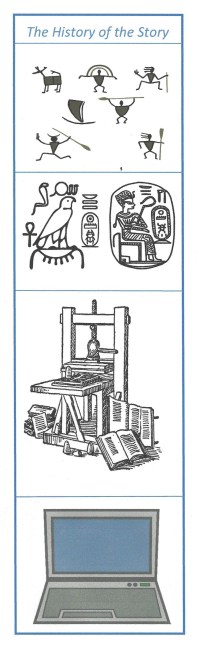
celebrate-picture-books-picture-book-review-the-history-of-the-story-bookmark

The History of the Story Bookmark


From cave paintings and hieroglyphics to the printing press and the computer, people have ensured that their thoughts were not forgotten. Here’s a printable The History of the Story Bookmark plus a blank one for you to fill in. Use them to mark your favorite stories!

celebrate-picture-books-picture-book-review-i-am-a-story-cover

You can find I Am a Story at these booksellers

Amazon | Barnes & Noble | Books-a-Million | IndieBound

Picture Book Review

Picture Book Review

November 14 – International Girls Day

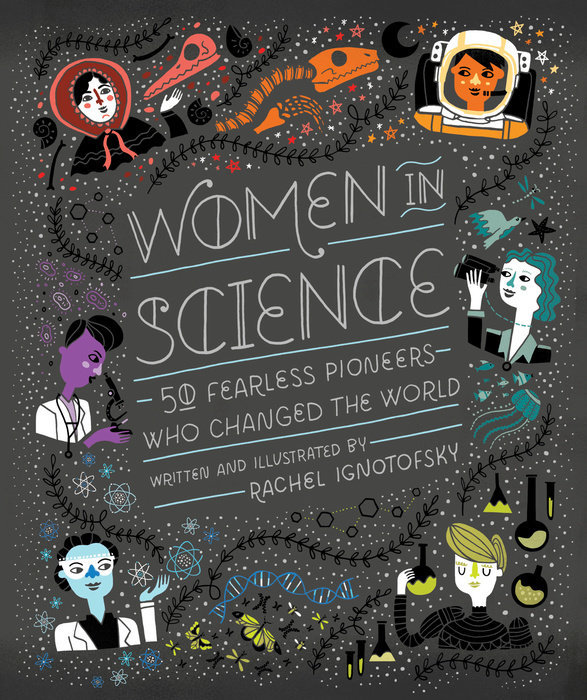
celebrate-picture-books-picture-book-review-women-in-science-cover

About the Holiday

Today’s holiday recognizes the spirit of girls and encourages girls and young women to pursue their dreams, talents, and abilities with the slogan “She Can Do Anything.” Around the world young women have a long way to go to overcome the stereotypes, conditions, and pressures in the media and other organizations that keep them from receiving an equal education and from both attempting and succeeding in their desired profession. Today, celebrate the uniqueness of the girls and women in your life, listen to what they really want and want to accomplish, and support them.

Women in Science: 50 Fearless Pioneers Who Changed the World

By Rachel Ignotofsky


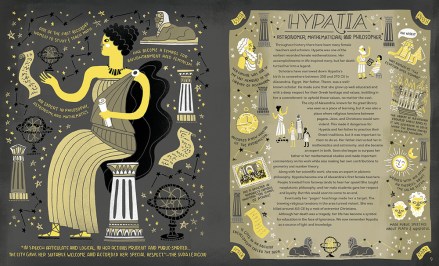
“Nothing says trouble like a woman in pants.” With this revealing attitude from the 1930s, Rachel Ignotofsky introduces her scintillating biographies of 50 intelligent, self-confident, persevering, and inspiring women working in engineering, math, medicine, psychology, geology, physics, astronomy, and more sciences from ancient history through today. The book begins with Hypatia who lived in Greece in the late 300s to early 400s CE and became an expert in astronomy, philosophy,and mathematics, making “contributions to geometry and number theory.” She became one of Alexandria’s first female teachers, “invented a new version of the hydrometer,” and can be found among the intellects in Raphael’s painting “The School of Athens.”

celebrate-picture-books-picture-book-review-women-in-science-hypatia

Image and text copyright Rachel Ignotofsky, courtesy of rachelignotofskydesign.com

Zipping ahead to 1647 readers find Maria Sibylla Merian, considered one of the “greatest scientific illustrators of all time.” Her specialty was entomology. By carefully documenting the lifespan of butterflies, she taught people about the science of metamorphosis, publishing a book on the subject filled with notes and illustrations in 1679. Later she scoured the rainforests of South America, gathering information on never-before-seen insects from that region. Her book, The Metamorphosis of the Insects of Suriname “was published in 1705 and became a hit all over Europe.” Maria was so famous, her picture appeared on German money and stamps.

celebrate-picture-books-picture-book-review-women-in-science-mary-anning

Image and text copyright Rachel Ignotofsky, courtesy of rachelignotofskydesign.com

Other women in the nature sciences include Mary Anning, who as a child discovered the first complete ichthyosaur skeleton and went on to become a paleontologist; Mary Agnes Chase, a botanist and expert on grasses; Marjorie Stoneman Douglas, who as a conservationist helped save the Florida Everglades; and Joan Beauchamp Procter, a zoologist specializing in reptiles who discovered the Peninsula Dragon Lizard in 1923; and more.

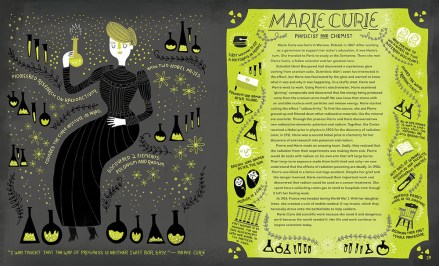
celebrate-picture-books-picture-book-review-women-in-science-marie-curie

Image and text copyright Rachel Ignotofsky, courtesy of rachelignotofskydesign.com

One of the earliest women astronomers and mathematicians was Wang Zhenyi, born in China in 1768. Creating her own eclipse model, she proved her advanced “theories about how the moon blocks our view of the sun—or the earth blocks the sun’s light from reaching the moon—during an eclipse.” She also measured the stars and explained the rotation of the solar system. At the age of 24 she published the 5-volume Simple Principles of Calculation. Zhenyi died at the age of 29, but in her short life she published many books on math and astronomy as well as books of poetry.

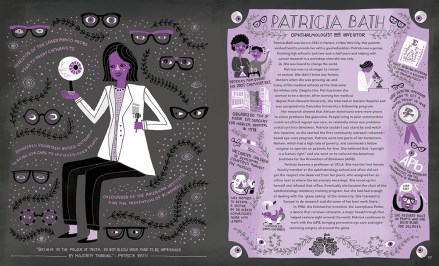
celebrate-picture-books-picture-book-review-women-in-science-patricia-bath

Image and text copyright Rachel Ignotofsky, courtesy of rachelignotofskydesign.com

Women in Science includes many other women who have looked to the stars and mathematics for their careers. Some of these are: Ada Lovelace, the first person to write a computer program; Emmy Noether, who helped Albert Einstein develop his theory relativity, created the field of abstract algebra, and “made new connections between energy and time, and angular momentum”; Cecilia Payne-Gaposchkin a quantum physicist in 1900s England who “discovered that the sun is made mostly of hydrogen and helium gas” and in 1956 became Harvard University’s first astronomy professor; Mae Jemison, who in 1992 became the first African-American woman in space and later started her own technology consulting firm as well as founding BioSentient Corporation, and a science camp for kids; plus many others.

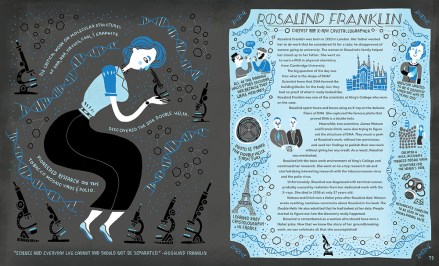
celebrate-picture-books-picture-book-review-women-in-science-rosalind-franklin

Image and text copyright Rachel Ignotofsky, courtesy of rachelignotofskydesign.com

The book also features Engineers, such as Hertha Ayrton who improved electric lights by inventing “a new rod that made a clean and quiet bright light” and the Ayrton fan that blew away mustard gas during World War I; and Lillian Gilbreth, who used her theories of “organizational psychology” in inventing the foot pedal for garbage cans, shelving for refrigerators, and even the “work triangle” for kitchens “that determines the distance from the sink to the stove” and saves time. There are Geneticists such as Nettie Stevens who discovered the “X” and “Y” chromosomes, and Barbara McClintock—the pants wearer from the beginning of the post—and the first person “to make a complete genetic map of corn” and discover jumping genes, or “transposons.”

The field of Medicine has benefited from women such as Elizabeth Blackwell, the first woman doctor; Alice Ball, a chemist and the first African-American woman to graduate from the University of Hawaii, who helped cure leprosy with her chemical work; and Gerty Cori who discovered how our bodies covert glucose, helping us better understand diabetes. In 1947 she became the first American woman to win a Nobel Prize.

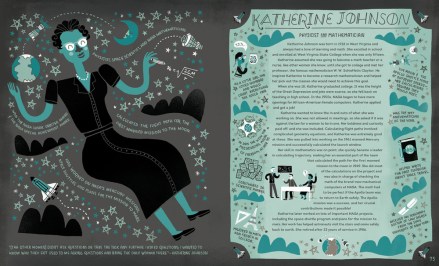
celebrate-picture-books-picture-book-review-women-in-science-katherine-johnson

Image and text copyright Rachel Ignotofsky, courtesy of rachelignotofskydesign.com

And this list only begins to scratch the surface of all the fascinating stories of women who overcame social, political, and personal obstacles to follow where their intelligence took them. Inspirational, entertaining, and undeniably eye-catching Rachel Ignotofsky’s Women in Science presents expertly written, one-page biographies that hit all the high (and sometimes unfortunate low) points in these scientist’s lives. The striking layout of both the text and illustrations keep readers riveted to the page, The left-hand side contains a representational drawing of the scientist surrounded by the subjects and materials of her work as well as trivia about her and a quotation. On the right-hand page, small illustrated facts frame the woman’s life story.

Interspersed between the biographies are pages offering a timeline of women’s milestones, depicting lab tools, and graphing statistics of women in STEM. The back matter is impressive, with two more pages presenting 15 more scientists, a four-page, illustrated glossary, resources including films, websites, and books, and an index. Rachel Ignotofsky concludes her book by saying, “Let us celebrate these trailblazers so we can inspire the next generation. Together, we can pick up where they left off and continue the search for knowledge. So go out and tackle new problems, find your answers and learn everything you can to make your own discoveries!”

Ages 7 and up

Ten Speed Press, 2016 | ISBN 978-160774976

To discover more books by Rachel Ignotofsky, visit her website!

International Girls Day Activity

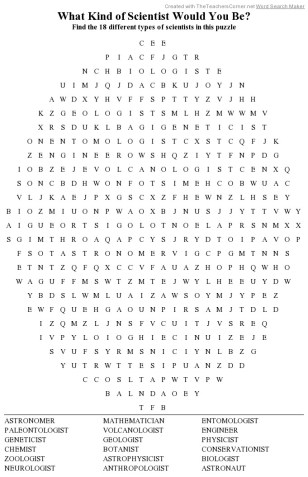
celebrate-picture-books-picture-book-review-scientists-word-search

What Kind of Scientist Would You Be? Word Search


Find the 18 different scientists in this printable What Kind of Scientist Would You Be? Puzzle. Here’s the Solution!  Then pick one and write why you would like to be that type of scientist!

Picture Book Review
November 13 – World Kindness Day

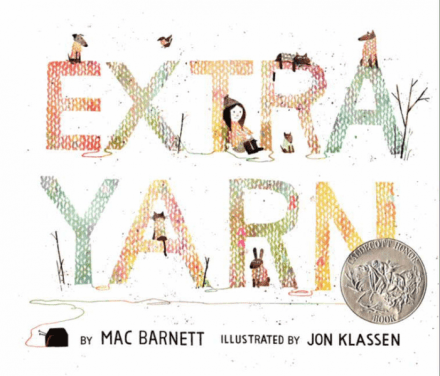
celebrate-picture-books-picture-book-review-extra-yarn-cover

About the Holiday

Perhaps now—more than we’ve seen in a long time—the world needs a day of kindness. Today’s holiday was initiated in 1997 when a number of humanitarian groups made a Declaration of Kindness and dedicated themselves to paying goodness forward and sharing positivity. With so many ways to help our friends, neighbors, even strangers living both near and far away, it’s within each person’s grasp to make the world a better place for all. To learn more about World Kindness Day and ways that you can make a difference, visit Random Acts of Kindness.

Extra Yarn

Written by Mac Barnett | Illustrated by Jon Klassen


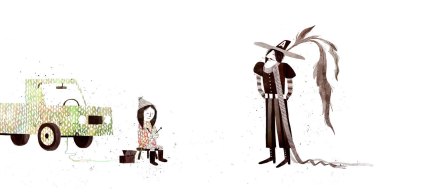
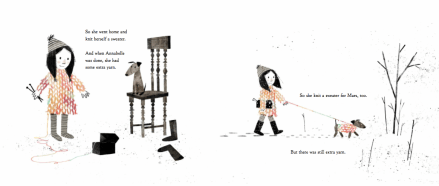
In the dulled world of winter, “Annabelle found a box filled with yarn of every color.” With it she knit herself a sweater, and because she had not run out of yarn, she knit a sweater for her dog, Mars, too. Afterwards, the two went for a walk, and Annabelle carried her box of yarn with her. They happened on Nate and his dog—dreary smudges against the monochrome landscape. “‘You two look ridiculous,’” Nate taunted. “‘You’re just jealous,’ said Annabelle.” Nate denied it, but after Annabelle knit him and his dog their own sweaters, they discovered she was right.

celebrate-picture-books-picture-book-review-extra-yarn-annabelle-knits-sweater

Image copyright Jon Klassen, text copyright Mac Barnett. Courtesy of harpercollinschildrens.com

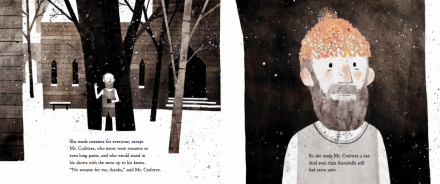
These four sweaters hardly put a dent in the yarn in the box, so Annabelle took it to school. There, the kids in their dark, winter clothes couldn’t stop staring at and whispering about Annabelle. Their teacher, Mr. Norman, shouted for quiet. “‘Annabelle, that sweater of yours is a terrible distraction. I cannot teach with everyone turning around to look at you!’” Annabelle knew just what to do. The class—and even Mr. Norman—looked brighter with their new sweaters. “And when she was done, Annabelle still had extra yarn.”

celebrate-picture-books-picture-book-review-extra-yarn-mr-crabtree

Image copyright Jon Klassen, text copyright Mac Barnett. Courtesy of harpercollinschildrens.com

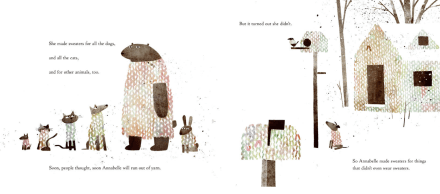
She began knitting sweaters for everyone in town. Mr. Crabtree was the only exception. Since he wore shorts and a t-shirt in even the snowiest weather, Annabelle knit him a cap to keep his bald head warm. When all the people were snug, Annabelle fashioned sweaters for all the animals—from the tiniest birds to the biggest bears. “Soon, people thought, soon Annabelle will run out of yarn. But she didn’t. So Annabelle made sweaters for things that didn’t even wear sweaters.” Suddenly, the town was no longer drab and lifeless.

celebrate-picture-books-picture-book-review-extra-yarn-annabelle-knits-animal=sweaters

Word spread about Annabelle and her endless box of yarn. People came from all over to meet her and see her sweaters. The news even reached a clotheshorse of an archduke, who sailed his ship into port and demanded to see Annabelle. He offered her one million dollars for her box of yarn, but Annabelle turned him down. He raised his offer to two million, but Annabelle shook her head. “‘Ten million!’ shouted the archduke. ‘Take it or leave it!’” “‘Leave it,’ said Annabelle. ‘I won’t sell the yarn.’”

That night the archduke sent robbers to steal Annabelle’s box of yarn, and when they had it, the archduke sailed away under the dark cover of night. In his shadowy castle, the shady archduke opened the box. It was empty. In a fit of rage, he flung the box out the window into the sea, cursing Annabelle with eternal unhappiness. But the box found its way onto an ice floe, and it rode the current back to Annabelle, who was forever after happy.

celebrate-picture-books-picture-book-review-extra-yarn-archduke

Image copyright Jon Klassen, text copyright Mac Barnett. Courtesy of harpercollinschildrens.com

Mac Barnett’s extraordinary story of a box of yarn and a little girl that keeps giving despite teasing, challenges, and attempts to strip her of her gift is an uplifting reminder that even the simplest of gestures can create profound change. With the lilt of a fairy tale but the anchors of reality, Barnett’s tale offers a universal lesson that children and adults can use their individual talents to improve their own lives and those of others. The title of the book may be Extra Yarn, but the question remains: is it the yarn or Annabelle who is special? The final scene proves that goodness and kindness always win out and will find its way back to the giver.

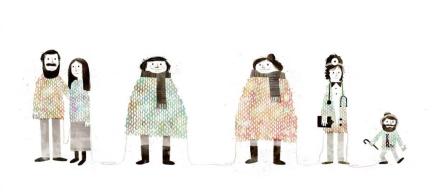
Jon Klassen’s brown, stolid town seems poised to suck readers in to its close, silent emptiness until Annabelle discovers the box of yarn and knits herself a rainbow to wear. With Mars similarly outfitted, they return to the somber outside. Annabelle, at first the only bright spot in the town and school, quickly transforms her classmates and neighbors into colorful individuals with sweaters as unique as they are. After the homes, buildings, mailboxes, and birdhouses acquire their own cozies, the town looks open and inviting. Once the archduke arrives on the scene, the pages turn dusky and gray, but there is one point of light: in the black, nighttime sea the little box floats on an icy raft that shines in the full moonlight.

celebrate-picture-books-picture-book-review-extra-yarn-townspeople

Image copyright Jon Klassen, courtesy of macbarnett.com

Klassen adds plenty of visual humor here too, as when Mars tangles his yarn leash around a grove of trees, and the archduke demonstrates a penchant for monogramming all of his possessions. Kids will be delighted to see some of their favorite Klassen characters so dandily dressed, and the images of the students and townspeople connected by a leading thread of yarn may help them see that Annabelle not only knit them sweaters but made them a much closer-knit community as well.

Ages 3 – 8

Balzar + Bray, HarperCollins Childrens, 2012 | ISBN 978-0061953385

Want to see what other books Mac Barnett has written? Visit his website and find out!

You can find a gallery of picture books and other artwork by Jon Klassen on tumblr!

World Kindness Day Activity

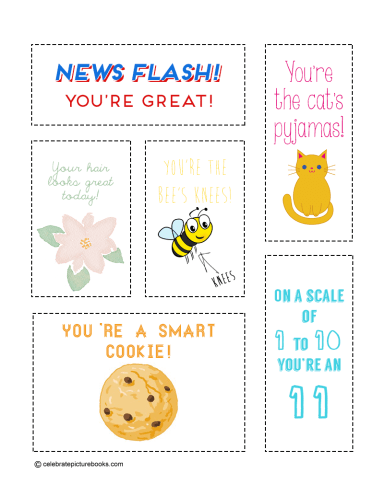
CPB - Random Acts of Kindness cards

Kindness Cards to Share


It’s fun to surprise someone with an unexpected compliment! It makes the other person and you feel happier! Here are some printable Kindness Cards that you can give to anyone you meet today—or any day. If you’d like to write your own, here is a set of Blank Cards. You can give one to your teacher, librarian, favorite store clerk, your postal worker, your neighbors and friends, the person next to you on the bus or train. Or why not brighten someone’s day by leaving a note where they might find it—in a book at the library or bookstore, in a friend’s lunchbox, in your mailbox, on a store shelf, or anywhere you go!

Picture Book Reviews

November 12 – Fancy Rat and Mouse Day

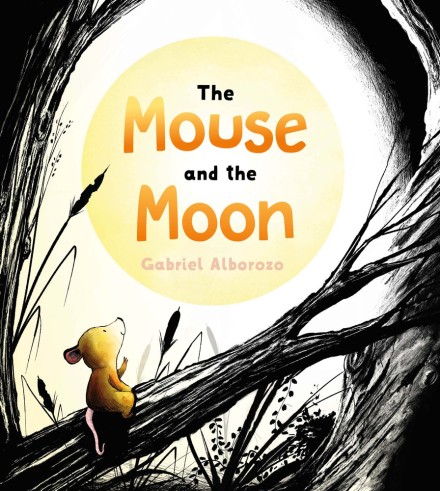
celebrate-picture-books-picture-book-review-the-mouse-and-the moon

About the Holiday

Today gives us a chance to take another look at rats and mice. I’m not talking about the kind of mouse I’ve seen scurrying around in my garage or the kind of rat that…well, honestly, I hope is nowhere near my garage. The guys  we’re celebrating today are fancy, which means they are bred to make good pets. Despite their bad rap, mice and rats are smart, loyal, and clean. They don’t require as much care as a dog or cat, and they can be fun to play with. The American Fancy Rat and Mouse Association holds events around the country to introduce people to these alternative pets. Today, you may want to check one out.

The Mouse and the Moon

By Gabriel Alborozo


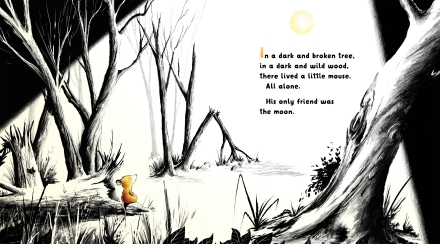
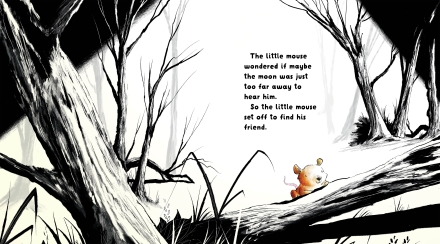
“In a dark and broken tree, in a dark and wild wood, there lived a little mouse. All alone. His only friend was the moon.” The little mouse waited each night for the moon to appear so that he could talk about his day and his hopes, dreams, and fears. The moon always listened silently. The little mouse began to think that the moon was just too far away to hear him, so he went in search of his friend.

celebrate-picture-books-picture-book-review-the-mouse-and-the moon-mouse-lives-alone

Image and text copyright Gabriel Alborozo, courtesy us.macmillan.com

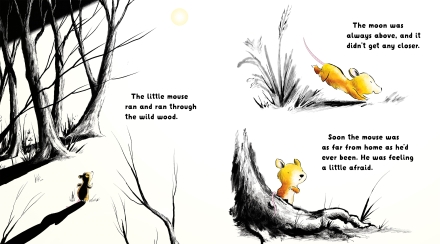
The mouse scampered through the woods, but no matter how far he went, the moon never seemed any closer. Pretty soon the mouse was far from home and “was feeling a little afraid.” When he stopped to rest, the mouse looked into the night sky, but could no longer see the moon. Suddenly, he heard a whispered “‘Hello?’” The mouse cautiously looked around and replied, “‘Hello?’” “And there, floating in a small, still pool, was the moon.” The mouse was excited to have found his friend at last.

celebrate-picture-books-picture-book-review-the-mouse-and-the moon-mouse-goes-to-find-moon

Image and text copyright Gabriel Alborozo, courtesy us.macmillan.com

But what he didn’t see was the tiny fish “hidden from sight, beneath the moon’s reflection.” The little fish was equally glad to finally hear from his friend the moon. “‘I’ve been waiting so long to talk to you!’ bubbled the tiny fish.” The two spent the night telling each other everything. As the sun rose, the moon began to fade. The mouse and the fish both pleaded for the moon to stay. The mouse crept as close to the edge of the pool as he could, and the fish swam close to the surface of the water.

When the moon’s reflection finally vanished in full daylight, “the two new friends saw each other for the first time….Both together and both happy.”

celebrate-picture-books-picture-book-review-the-mouse-and-the moon-mouse-runs-through-woods

Image and text copyright Gabriel Alborozo, courtesy us.macmillan.com

Gabriel Alborozo’s sweet, gentle story of friendship found is a beautiful tribute to perseverance, bravery, and discovery. After spending time telling the moon all about their lives with no response, the fish and the mouse, instead of giving up, go in search of their friend. For the mouse this means leaving his comfort zone and facing on his own some of the fears that he has shared with the moon. The fish, meanwhile, continues calling out until he receives an answer back. While both believe they are talking to their long-held confidant, when the moon disappears, the fish and the mouse happily embrace each other as new friends. Alborozo’s lines are simple and tranquil, with alliteration that flows as smoothly as the ripples on a pond.

Alborozo’s striking black-and-white illustrations, punctuated in the early pages only by the adorable golden-haired mouse, well represent the mouse’s loneliness of the heart. Similarly, the golden-scaled fish lives in a black-and-white world until he and the mouse see each other. As the moon vanishes, the pool and pond grasses are transformed by yellow, green, violet, blue, and orange hues into a sunny, happy landscape echoed in the smiles of the new best friends.

The Mouse and the Moon is a lovely quiet story time or bedtime book, and its comforting charm will make it a favorite with many children. This book would be a nice addition to home bookshelves.

Ages 2 – 7

Henry Holt, 2016 | ISBN 978-1627792240

To discover more picture books as well as a gallery of “bits not in books” by Gabriel Alborozo, visit his website!

Fancy Rat and Mouse Day Activity

celebrate-picture-books-picture-book-review-mouse-coloring-page

Cute Mice Coloring Pages


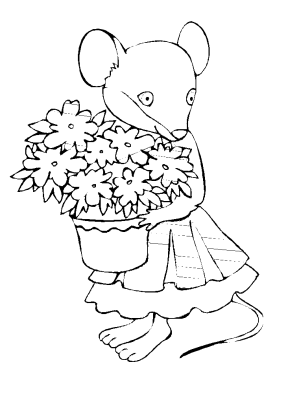
Here are a couple of fancy mice – one just hanging out and one all dressed up in her finest clothes – for you to color. After you’ve colored these pages, why not write a short story about them!

Cute Mouse Coloring Page | Dressed-up Mouse Coloring Page

Picture Book Review
November 11 – Veterans Day

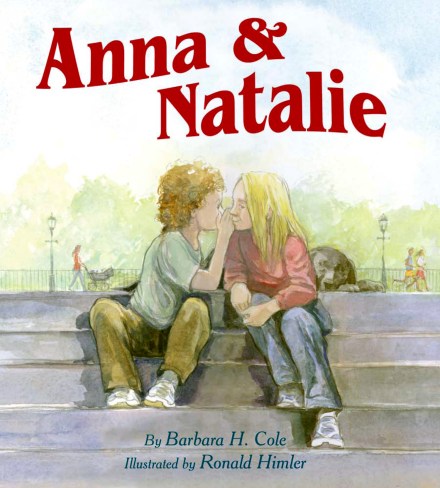
celebrate-picture-books-picture-book-review-anna-and-natalie-cover

About the Holiday

Veterans Day is observed each year on this date to honor and thank all members of the military who are currently serving or have served in the United States Armed Forces. The official ceremony begins at 11:00 a.m. with a wreath laying at the Tomb of the Unknowns and then continues inside the Memorial Amphitheater with a parade of colors by veterans’ organizations and comments by dignitaries. While an official government holiday, some schools remain in session, holding special ceremonies of their own and inviting veterans to relate their experiences.

Anna & Natalie

Written by Barbara H. Cole | Illustrated by Ronald Himler


Every year Mrs. Randall’s third-grade class attends the Wreath-laying ceremony at the Tomb of the Unknown Soldier at Arlington National Cemetery. What’s more every year four students are chosen from her class to carry the wreath. This year everyone wonders who those lucky four will be. Students who want to be in the running to be selected, Mrs. Randall, says, must write a letter telling her why they should be chosen. Hearing that Freddie and Tommy drop out immediately, while Nancy says her letter will be the best.

Anna dreams of being chosen too, but experience tells her she will not. She’s never chosen for the basketball or softball team, the cheerleading squad, or the lines of Red Rover. “Sure, someone always chose her for the spelling team, but the others—the fun ones—never.” But this time seems different. All day—even though Mrs. Randall’s eagle eyes catch it—Anna daydreams and makes plans. When the bus drops her and her sister off, they hurry home to start work.

celebrate-picture-books-picture-book-review-anna-and-natalie-school-bus

Image copyright Ronald Himler, text copyright Barbara H. Cole. Courtesy of Star Bright Books

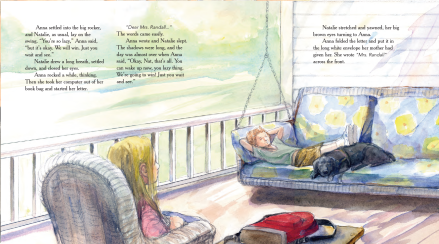
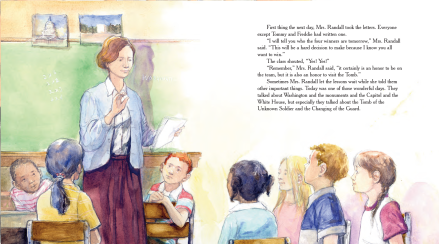
There Anna makes a secret call to her grandpa and then she and Natalie go to the front porch, and while Nat naps on the swing Anna pulls out her computer and begins writing her letter to Mrs. Randall. The next day Mrs. Randall collects the letters with the promise to choose the team by tomorrow and a reminder for those who will not be picked: “‘Remember,’” she says, “‘it certainly is an honor to be on the team, but it is also an honor to visit the Tomb.’” Then “they talked about Washington and the monuments and the Capitol and the White House, but especially they talked about the Tomb of the Unknown Soldier and the Changing of the Guard.”

celebrate-picture-books-picture-book-review-anna-and-natalie-on-the-porch

Image copyright Ronald Himler, text copyright Barbara H. Cole. Courtesy of Star Bright Books

At school the next day, Mrs. Randall says that while she received four excellent letters, one stood out. She begins to read it to the class: “‘I want to be on the team, not for myself, but for many others who have not been honored or remembered….They worked long and hard and saved many lives….And sometimes they were heroes bigger than the strongest men around. Sometimes they carried medicine and food to dangerous places to save the wounded soldiers. My own great-great-grandfather was in this special service and saved lives. I would like to be on the team to say thank you to those forgotten heroes of World War II. Yours truly…’ Mrs. Randall’s voice cracked and choked, and then she read, ‘From Natalie (with help from Anna)’”

The class starts whooping and cheering, but Mrs. Randall interrupts their celebration to read one more line: “P.S.—Would you please let Anna walk with me so I will not be alone and she won’t be either?” The class begins chanting “Yeah, Anna! Yeah, Anna!,” and Anna can’t believe that her dream of being on the team has come true. When Anna gets home from school and tells her family, they proudly make plans to travel with their “two girls” to the ceremony.

celebrate-picture-books-picture-book-review-anna-and-natalie-anna-and-natalie

Image copyright Ronald Himler, text copyright Barbara H. Cole. Courtesy of Star Bright Books

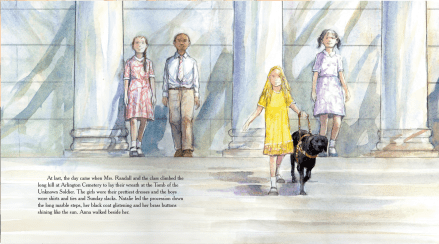
Finally, the day of the Wreath-Laying Ceremony arrives. The students are dressed in their best clothes, and as the four team members prepare to accept the wreath, “Natalie led the procession down the long marble steps, her black coat glistening and her brass buttons shining like the sun. Anna walked beside her.” As the soldier hands the children the wreath fashioned from “dogwood flowers, magnolias, and decorative red birds,” he loudly announces, “The students of Willow Run School and Natalie, a seeing-eye dog, will lay this wreath to honor the men who served in World War II and the dogs who helped them. ATTENTION!”

celebrate-picture-books-picture-book-review-anna-and-natalie-tomb-of-the-unknowns

Image copyright Ronald Himler, text copyright Barbara H. Cole. Courtesy of Star Bright Books

The clear notes of Taps rang across Arlington National Cemetery as Anna and the three other children lay the wreath in front of the Tomb of the Unknown Soldier. Afterward, Anna’s grandfather and parents took pictures of Anna and Natalie to remember “this shining moment of Anna, and of Natalie, who saw the world that Anna could not see.”

An Author’s Note revealing the use of dogs during wartime—from ancient history to today—follows the text.

Barbara H. Cole’s story of Anna and Natalie is compelling in many ways. First, it presents a look at what Veterans Day means to children from their point of view. Second, the story honors not only the brave soldiers who protect our country but also the canine corps which has served our military from our country’s earliest history. Third, in Anna, Cole has created a character who is part of a military family through her great-great-grandfather and also has a personal connection to service dogs through Natalie, her seeing-eye dog. The portrayal of Anna as a child with a disability is honest and inclusive, and while the fact of Anna’s blindness is contained in a surprise ending, this serves to present Anna as just another student in the class—a girl who is an excellent writer, enthusiastic about her dreams to be part of the team, and a good friend.

celebrate-picture-books-picture-book-review-anna-and-natalie-classroom

Image copyright Ronald Himler, text copyright Barbara H. Cole. Courtesy of Star Bright Books

Cole’s straight narration of a school day and a special assignment—complete with asides from students—as well as Anna’s family life creates an environment that will be familiar to readers and carries the story in a natural arc.

Ronald Himler’s realistic illustrations of Anna’s Willow Run School, her home, and Arlington Cemetery beautifully represent this moving story. His pages are full of diverse, real kids, smiling, laughing, getting off the school bus, enjoying a family dinner, and solemnly performing their job at the Tomb of the Unknown Soldier. A hint to Natalie’s true identity is subtly inserted into various scenes, making the final reveal a satisfying moment.

Anna & Natalie is a wonderful choice for all kids observing Veterans Day, Memorial Day, and other patriotic holidays.

Ages 5 – 10

Star Bright Books, 2010 | ISBN 978-1595722119

To learn more about Anna & Natalie and download a Curriculum Guide, visit Star Bright Books!

To view a gallery of artwork and picturebook illustration by Ronald Himler, visit his website!

Veterans Day Activity

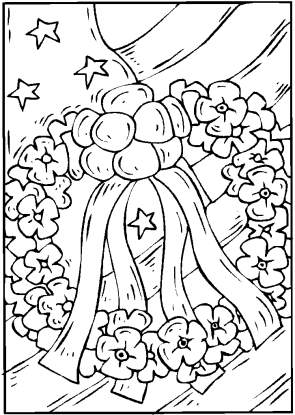
celebrate-picture-books-picture-book-review-american-flag-and-wreath

Wreath and American Flag Coloring Page


Remember everything our members of the Armed Forces do to keep our country safe as you color this printable Wreath and American Flag.

Picture Book Review
November 10 – World Science Day for Peace and Development

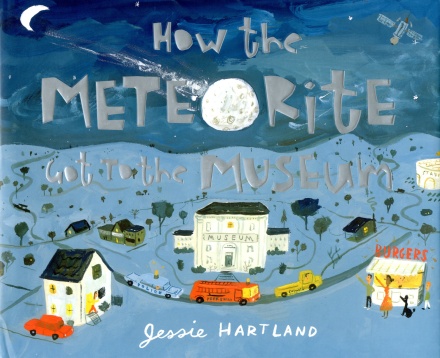
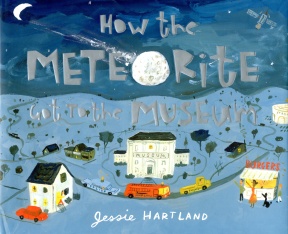
celebrate-picture-books-picture-book-review-how-the-meteorite-got-to-the-museum-cover

About the Holiday

This annual, internationally observed day highlights the importance of science in and for society and is sponsored by the United Nations. Its aim is to promote education and awareness of scientific issues that affect the world and its sustainability as well as to underscore the role that scientists play in improving our lives and developing solutions for the future. This year the theme is “Celebrating Science Centers and Science Museums.” To celebrate, grab the kids (or go alone!) and head out to your local science center!

How the Meteorite Got to the Museum

By Jessie Hartland


A science teacher leading her students through a science museum stops at the display for the Peekskill Meteorite that fell to Earth in New York state on October 9, 1992. As she explains a bit about meteorites, one student raises his hand and asks, “But how did the meteorite get here—to the museum?” With that question the students—as well as readers—are off and running on an adventure of astro-nomical proportions as the teacher begins: “Hundreds of mllions of miles from Earth, in deep, dark, cold outer space, there are vast fields of space debris flying around.” The smaller rocks are called meteors, and a meteor that falls to Earth is called a meteorite.
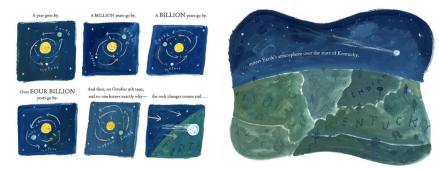
celebrate-picture-books-picture-book-review-how-the-meteorite-got-to-the-museum-meteors

Image copyright Jessie Hartland, 2013, courtesy of Blue Apple Books.

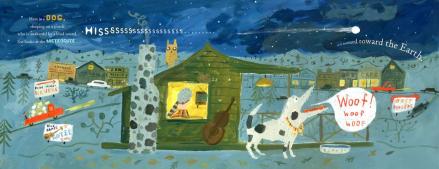
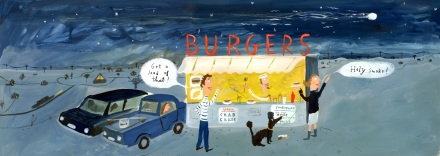
The teacher sets the scene: “Here in outer space is a meteor…flying around and around and around”—for over four billion years! Then for some unknown reason the meteor changed direction and entered “Earth’s atmosphere over the state of Kentucky.” With a Hissssss and a Crack! the zipping meteor alerts a sleeping dog, who begins to bark at it. The space rock, trailing a fiery tail, zooms over a burger stand in Virginia, attracting the attention of some late-night snackers.

In Pennsylvania, a few seconds later, a high school football game suddenly turns historic as the meteorite, hissing and crackling through the sky attracts the attention of video cameras throughout the stands. Yes, this is the same celestial body “which was spotted by the Virginians, and yelped at by the dog as it zipped toward the Earth.”

celebrate-picture-books-picture-book-review-how-the-meteorite-got-to-the-museum-dog-barks

Image copyright Jessie Hartland, 2013, courtesy of Blue Apple Books.

With a Crash, Bang, Boom, the rock hurtles downward. “Here is the teenager, who had been watching late-night TV at her house in Peekskill, NY, when she heard a tremendous CRASSHHH! She has rushed outside and discovered a huge dent in the trunk of her car and a smoking ‘rock’ nearby.” Wanting to discover the culprit of this vandalism, the teenager calls the police who summon firefighters to cool down the “rock.”

After hosing down the ‘rock’ the firefighters “start to suspect that the rock may really be a meteorite.” A geologist is called from Columbia University to examine the rock. “He confirms that what smashed the car is, indeed, a meteorite, which was cooled by Firefighters, investigated by Police, found by the Teenager, gawked at by Sports fans, buzzed about by Virginians, and arfed at by a dog as it raced toward the Earth.”

celebrate-picture-books-picture-book-review-how-the-meteorite-got-to-the-museum-burger-joint

Image copyright Jessie Hartland, 2013, courtesy of Blue Apple Books.

Next, the Curator of Meteorites from the Museum of Natural History in New York City visits the geologist, hoping to obtain this special specimen for the museum. Soon, a Cosmologist develops a program about the meteorite that she presents at a museum symposium, explaining how this 26-pound meteorite crossed over 400-500 miles in just 40 seconds and collided with a car—a-one-in-a-billion chance. The Museum of Natural History secures the meteorite for its collection, and the Exhibits Team designs the “lighting, signage, and diorama for their newest acquisition.”

Which brings us back to the Ross Hall of Meteorites at the museum and the complete story of “the Peekskill Meteorite, which was…barked at tby the Dog, witnessed by Virginians, filmed by Sports Fans, found by a Teenager, poked at by Police, sprayed with water by Firefighters, validated by the Geologist, obtained by the Curator of Meteorites, summed up by the Cosmologist, presented by the Exhibits Team, and explained by the Science Teacher who says: ‘…and that’s how the meteorite got to the museum.’”

An Author’s Note following the text explains more about meteors and introduces Dr. Mark Anders, the Geologist mentioned in the book. A photograph of the car hit by the meteorite offers fascinating viewing.

In her entertaining and informative telescoping text, Jessie Hartland reveals in easy-to-understand steps the people and actions involved in bringing together a museum exhibit for a meteorite. The repetition of the important characters in this true, history-making drama combined with Hartland’s deft command of a vast array of synonyms makes reading each page a joy. Suspense grows as each stage of the meteorite’s trajectory from space rock to “star” exhibit builds on the previous one, exciting kids not only for the tale of the meteorite, but also for the displays they see when visiting a museum.

celebrate-picture-books-picture-book-review-how-the-meteorite-got-to-the-museum-meteorite

Image copyright Jessie Hartland, 2013, courtesy of Blue Apple Books.

Hartland’s folksy two-page spreads are a perfect match for the rhythmic text—both humorous and educational in their details. The meteor—zipping through the dark blue night sky dotted with stars, over a small town, above an out-of-the-way burger joint, and through the cheering sounds of a football game—leads readers on a page-turning chase until it crash lands on the bumper of the teenager’s car. Here, as the police write up their investigation on the left-hand page, the firetruck can be seen hurrying to the scene, siren blaring, on the right, even as raccoons and a cat take the opportunity of the distraction to make mischief.

Hartland’s depictions of the geologist’s office as well as the American Natural History Museum give readers a peek behind the scenes at the tools and displays used by scientists and museum workers. For kids who love museums, science, and fun wordplay, How the Meteor Got to the Museum is an absorbing addition to home bookshelves as well as school, classroom, and other libraries. Jessie Hartland’s other titles in this series—How the Dinosaur Got to the Museum and How the Sphynx Got to the Museum—are also highly recommended.

Ages 4 – 9

Blue Apple Books, 2013 | ISBN 978-1609052522

Discover many more books by Jessie Hartland as well as other artwork on her website!

World Science Day for Peace and Development Activity

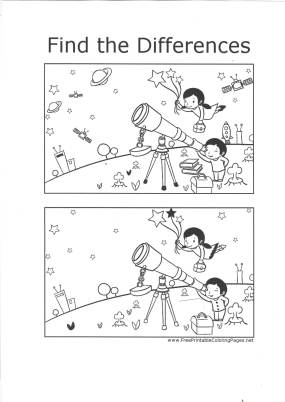
celebrate-picture-books-picture-book-review-astronomy-find-the-differences

Astronomy Buffs Find the Differences Puzzle


These kids are looking for stars and planets, but can you find the 15 differences between the two pictures in this printable Astronomy Buffs Puzzle?

celebrate-picture-books-picture-book-review-how-the-meteorite-got-to-the-museum-cover

You can find How the Meteorite Got to the Museum at these booksellers

Amazon | Barnes & Noble | IndieBound

Picture Book Review