March 10 – It’s Women’s History Month

celebrate-picture-books-picture-book-review-send-a-girl-cover

About the Holiday

Calling all gals, pals, and woman-identifying people! This month is dedicated to YOU and all the women throughout history who have worked to make things fair. Women throughout history have often been treated as less than men, especially women of color. This concept is called gender inequality, and a whole lot of wonderful ladies across the world have been working to change it. In 1987 the National Women’s History Project petitioned to have the US Congress officially designate March as Women’s History Month. From that point on, organizations and communities have celebrated and recognized the month-long holiday by uplifting the stories of role-model women throughout US history. To celebrate Women’s History Month, read about some of the achievements of women in various fields of study, learn about (and from) stories of activism, and spend some quality time with the women and girls who matter most in your life. To learn more about Women’s History Month, visit: https://womenshistorymonth.gov/ 

Thank to Bloomsbury Children’s Books for sending me a copy of Send a Girl! for review consideration. All opinions on the book are my own.

Reviewed by Dorothy Levine

Send a Girl! The True Story of How Women Joined the FDNY

Written by Jessica M. Rinker | Illustrated by Meg Hunt


As a girl growing up in the 1950’s, Brenda Berkman dealt with a lot of adults telling her what she could and couldn’t do. Brenda loved to play sports and spend time outside. But many of her favorite activities were ones that people considered “boy’s games.” When Brenda tried to join a baseball team, the coach said he wouldn’t send a girl to play a boy’s game. But, did Brenda let this stop her? Nope! Brenda was determined to keep doing the things she liked to do, so she made her own all-girls football team with friends instead. 

As Brenda grew older, people’s views on what boys and girls could do began to expand. Brenda had moved to New York and studied to become a lawyer but realized that she yearned for a career that was more active. In 1977 the New York City Fire Department announced that they would finally allow women to take the exam to become firefighters. This was exciting news! Brenda didn’t think that this would ever be a possibility for her because “In the past, every firefighter in the city had to be a man. In fact, they’d only ever been called firemen!”

celebrate-picture-books-picture-book-review-send-a-girl-football

Image copyright Meg Hunt, 2021, text copyright Jessica Rinker, 2021. Courtesy of Bloomsbury Books for Children.

Brenda knew she wanted to do something that would involve helping people, using her mind to strategize, being active, and getting outdoors. Becoming a firefighter seemed like the perfect fit. Becoming a firefighter proved to be a tough journey for Brenda. Even though the fire department now allowed women to apply, many people did not support this decision. “They said, ‘Don’t send a girl to do a man’s job!’ They didn’t think women were courageous enough, smart enough, or strong enough.” Brenda knew she was going to have to work really hard to prove these people wrong. She passed the written test and began to train for the fitness test.

When Brenda took her physical exam, she found that the men in charge were not looking for the strengths firefighters need to do their jobs. None of the women who took the test passed, and Brenda knew this was no coincidence. It wasn’t that the women weren’t strong enough, but rather the people in charge of the firefighters’ test didn’t want women to pass. Brenda realized that she could use her background in law to fight against this injustice. After four long years of working to prove her case in court, Brenda won, and the test was restructured to better match the skills that people need to have as firefighters. 

In 1982 Brenda Berkman and forty others became the first female firefighters to join the New York City Fire Department. In Brenda’s new job, “She hauled hoses! Climbed ladders! Broke through walls! Fighting fires was exciting and gritty, loud and dirty, and sometimes dark and dangerous.” But her fight against people’s bias and discrimination was far from over. Many people still didn’t think that women were tough enough for the job, even after they had proved they were. “They said, ‘I want to be saved by fireMEN!’”
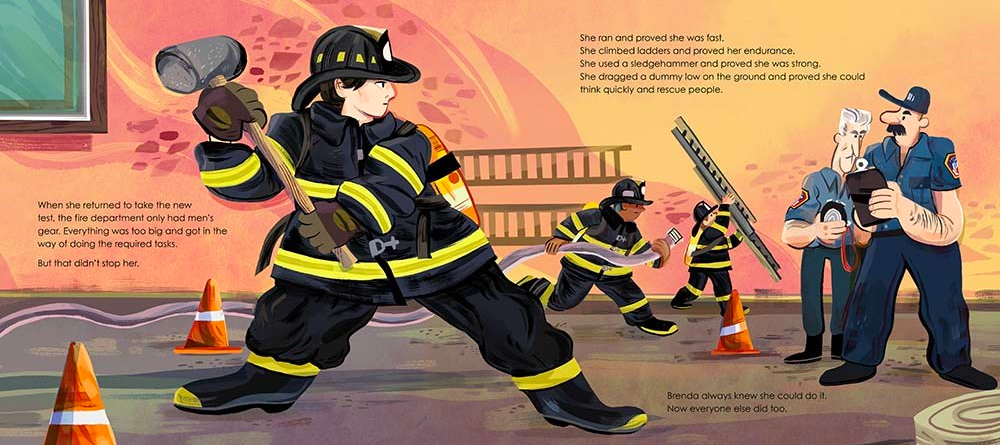
celebrate-picture-books-picture-book-review-send-a-girl-test

Image copyright Meg Hunt, 2021, text copyright Jessica Rinker, 2021. Courtesy of Bloomsbury Books for Children.

And, some of the men already on the New York City Fire Department agreed. They were mean and made the job as difficult as possible for Brenda and the other women firefighters. Sometimes they would pull pranks on the women in their departments that were incredibly cruel and dangerous. “Firefighters need to depend on one another. Brenda wasn’t sure she could depend on all her fellow firefighters. Sometimes it was lonely. Often, she felt invisible.” To combat against this, Brenda formed a group called United Women Firefighters, where women could come and talk about these issues and support each other. 

With this new group, strong friends, and time, things got slowly better for Brenda. People began to change their opinions on firefighting only being for men. Brenda continued to excel as a firefighter, and eventually became a captain of her department. She continued to fight fires—and discrimination—throughout her life, and she proved that firefighting is something you can “send a girl” for. Now there are people of all genders across the nation who fight fires every day and save lives. 

An Author’s Note at the end details the importance of learning stories like Brenda’s and provides more information on the history of firefighting and Brenda’s accomplishments. A list of websites where readers can learn more about women firefighters and other influential women is also included.
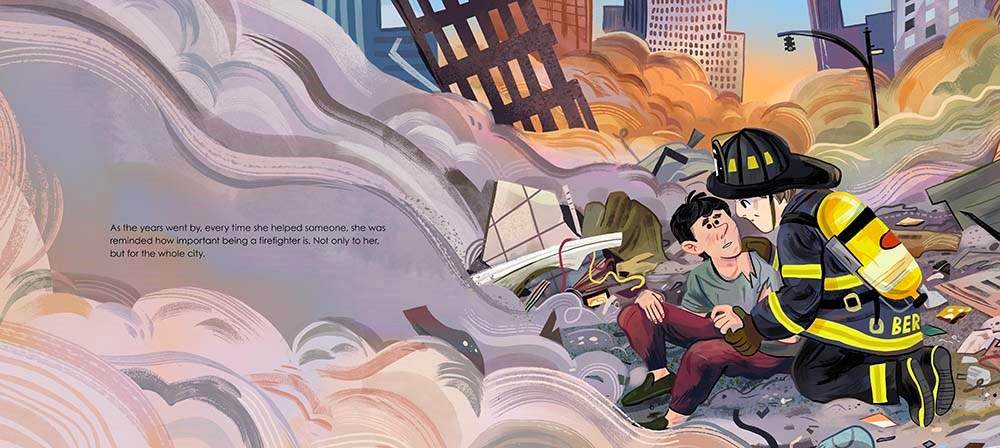
celebrate-picture-books-picture-book-review-send-a-girl-rescue

Image copyright Meg Hunt, 2021, text copyright Jessica Rinker, 2021. Courtesy of Bloomsbury Books for Children.

In this inspiring story of overcoming norms and gender discrimination, Jessica Rinker eloquently recounts Brenda Berkman’s stirring biography. Readers of all ages will rejoice in the perseverance that Berkman exhibited throughout her career. Rinker’s repetition of Brenda’s firefighting tasks takes on an exciting, triumphant tone and echoes the thrill Brenda felt while fighting fires despite all of the hardship she faced. Rinker’s straightforward writing discusses difficult themes of women’s inequality, bullying, and discrimination in an easily digestible manner for young readers. 

Illustrator Meg Hunt provides a diverse cast of characters to make the story come alive. Her multimedia images match the bustling, busy nature of New York City and provide an immersive view into city living. Readers are transported into the story to fight fires right alongside Brenda with intricate, realistic, and colorfully designed spreads. They watch the protagonist age throughout the story with determination and power. The first image of Brenda valiantly hauling a firehose to a window of billowing smoke in an NYC apartment is mirrored near the end. Readers follow Brenda in a full circle—working tirelessly to become a firefighter, shining at her job, and then extending her joy for firefighting to the next generation of young women on the final spread. 

Book lovers of all types will be inspired by Brenda Berkman’s story and how she shaped the history of fighting fires, both literal and metaphorical. An honest, informative and empowering book. The sentiment and lessons in Send a Girl! are of utmost importance for young girls, and really all young readers to hear.

Ages 4 – 8

Bloomsbury Children’s Books, 2021 | ISBN 978-1547601745

Discover more about Jessica M. Rinker and her books on her website.

To learn more about Meg Hunt, her books, and her art, visit her website.

Women’s History Month Activities

celebrate-picture-books-picture-book-review-womens-history-month-word-search

Women’s History Month Word Search


Find the names of fifteen inspirational women in this printable word search puzzle.

Women’s History Month Word Search Puzzle | Women’s History Month Word Solution
Teacher Thrive mint tin book report craft

Mint-Tin Book Report


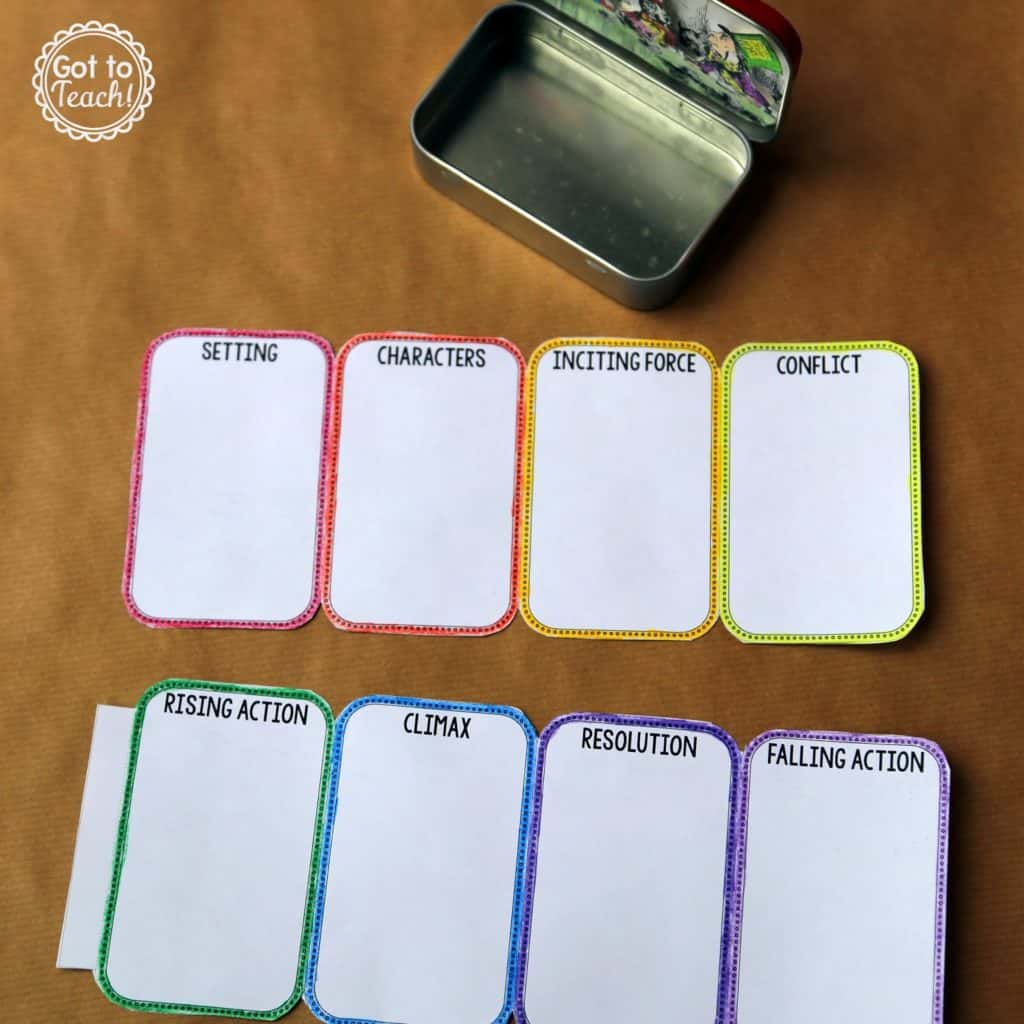
Create a mint-tin book report of Brenda Berkman’s story in Send a Girl! or of another book highlighting an important women’s biography. You can find more about this clever idea from Melissa at Teacher Thrive

Materials

Instructions

Cut out the pages from the printable template and fold along the creases. Glue the “conflict” and “rising action” pieces together using the extra rectangle of paper. Write down the most important facts or highlights from each part of the story and decorate. Fold up the pages accordion style and stick into a mint tin. Use the blank parts to decorate the top and inside of the lid. Then you’ll have a portable, cute book report to carry around wherever you please!

celebrate-picture-books-picture-book-review-send-a-girl-cover

You can find Send a Girl! The True Story of How Women Joined the FDNY at these booksellers

Amazon | Barnes & Noble | Books-a-Million

To support your local independent bookstore, order from

Bookshop | IndieBound

Picture Book Review

March 9 – Unique Names Day

celebrate-picture-books-picture-book-review-my-name-is-wakawakaloch-cover

About the Holiday

Unique Names Day was established in 1997 by Jerry Hill, a hobbyist in onomatology – the study of the etymology, history, and use of proper names – as part of Celebrate Your Name Week. The holiday celebrates uncommon or uncommonly spelled names and encourages those with unique names to always take pride in their name. One way to enjoy the day is to find out more about your name and how or why your parents chose it. You can have fun with names every day this week. Upcoming are Discover What Your Name Means Day, Nametag Day, Middle Name Pride Day, and Descendent’s Day. You can learn more about each daily holiday at Names Universe.

My Name is Wakawakaloch!

Written by Chana Stiefel | Pictures by Mary Sullivan


Wakawakaloch had a problem. Well, it wasn’t really her problem; none of the kids at school could pronounce or even remember her name. After another day in which her name was mangled (Oog called her “‘Walawala,’” Boog shouted “‘Look out, Wammabammaslamma!’” and Goog cheered her on during Club Club with “‘Swing, Lokamokatok!’”), Wakawakaloch was as angry as an erupting volcano.

celebrate-picture-books-picture-book-review-my-name-is-wakawakaloch-easy-club-club

Image copyright Mary Sullivan, 2019, text copyright Chana Stiefel, 2019. Courtesy of HMH Books for Young Readers.

When her parents asked what was wrong, Wakawakaloch said she wanted to change her name to Gloop. Pa thought Gloop was a good name, but reminded his daughter that her name had been “‘in family many, many moons.’” But Wakawakaloch was inconsolable. Not only could no one say her name right, but she never found it on any T-shirts. Ma and Pa thought there was only one thing to do—take her to see Elder Mooch.

Despite his leathery skin and aroma of “rotting mammoth poop,” Elder Mooch was an insightful Neanderthal. He started off with an ill-considered joke that set Wakawakaloch reaching for tissues from the nearby dispenser rock. But she poured out her heart and the fact that she wanted an easy name, one found on T-shirts. She could just imagine all of the heroic and adventurous things she could do with a name and T-shirt like that.

celebrate-picture-books-picture-book-review-my-name-is-wakawakaloch-easy-name

Image copyright Mary Sullivan, 2019, text copyright Chana Stiefel, 2019. Courtesy of HMH Books for Young Readers.

Elder Mooch looked at her and then bestowed his wisdom. He told her she was a “‘forward thinker’” but “‘must be a backward seer too.’” This bit of knowledge cost her two pigeons and left her smoldering. What did he mean by that? Later that night as she tossed and turned in bed, she caught a glimpse of the paintings on her wall. They showed her great-great-great-great-great grandmother Wakawakaloch “performing brave and heroic acts…. Little Wakawakaloch placed her hand on the ancient handprint of her mighty namesake. It was a perfect match.”

celebrate-picture-books-picture-book-review-my-name-is-wakawakaloch-cave-drawing

Image copyright Mary Sullivan, 2019, text copyright Chana Stiefel, 2019. Courtesy of HMH Books for Young Readers.

In the morning, Wakawakaloch was smiling. She no longer wanted to be called Gloop, and she told her parents that she was ready to help others. When the Roll-the-Boulder tournament came round, Wakawakaloch had her personalized T-shirt stand all set. Oog, Boog, and Goog thought her shirts for Chana, Sioban, Xavier, Eoghan were “‘Ooga booga’ (way cool).” Wakawakaloch had even made one for herself. Elder Mooch wanted to buy three, and when little Hoopaloopie came by, Wakawakaloch got to work on another shirt.

celebrate-picture-books-picture-book-review-my-name-is-wakawakaloch-tee-shirts

Image copyright Mary Sullivan, 2019, text copyright Chana Stiefel, 2019. Courtesy of HMH Books for Young Readers.

For all those kids who never find their names on shirts, mugs, necklaces, keychains, or other personalized items and who frequently hear the question, “How do you pronounce that?,” Chana Stiefel’s book is for you! This fresh tale will also resonate with any child who feels different for any reason. Wakawakaloch, with her strong personality, thoughtful introspection, and creative solution, is a character that readers will love and want to emulate. Stiefel deftly navigates this sensitive landscape with a combination of honest feelings and hilarious mispronunciations, prehistorical details, and descriptions. Readers will laugh all the way through but will also be absorbing the lesson that everyone should embrace their own “mighty” personality and be celebrated and recognized for their unique qualities.

In her vibrant illustrations, Mary Sullivan creates a comically anachronistic ancient world, where safety cones made of stone mark the playground, a stone telescope is aimed out the window, mail is delivered (this part may be accurate, I’d have to check), and cupcakes are eaten with forks. Kids will want to linger over each page to point out all of the funny elements that add depth and glee to this story. Wakawakaloch shows the feelings bubbling up inside her with furrowed brows, livid gestures, and ready tears, while the other kids cluelessly continue to distort her name even after being told the right pronunciation multiple times. Wakawakaloch’s visit to Elder Mooch is a funny take on therapy sessions, but his advice leads to a welcome image of contemplation and realization that makes Wakawakaloch appreciate her family history and also want to contribute to its—and society’s—advancement. Wakawakaloch’s T-shirt booth is sure to inspire kids to make their own shirt too.

A delightfully inventive story with many applications and prompts for further discussion as well as activities celebrating individuality, My Name is Wakawakaloch! will be a much-asked-for favorite on home, classroom, and public library shelves.

Ages 4 – 7

HMH Books for Young Readers, 2019 | ISBN 978-1328732095

Discover more about Chana Stiefel and her books on her website.

To learn more about Mary Sullivan, her books, and her art, visit her website.

Check out the My Name is Wakawakaloch! “ooga booga” book trailer!

Unique Names Day Activity

CPB - Name Jars standing

Love Your Name Organizer Jar


Everyone needs a place to store their special stuff! Here’s a way to recycle a plastic jar and make a cool organizer jar with your name on it. This organizer jar also makes a great gift for your friends!

Supplies

  • A large plastic jar, such as a peanut butter jar or mayonnaise jar, cleaned out and with the label removed
  • Acrylic multi-surface paint or markers
  • Chalkboard paint
  • Paint brush
  • Chalk

CPB - Name Jars on sides

Directions

  1. Paint a rectangle on the front of the jar with chalkboard paint
  2. Decorate the rest of the jar with paint, markers, or paper just the way you want! My green jar sports a friendly dinosaur!

celebrate-picture-books-picture-book-review-my-name-is-wakawakaloch-cover

You can find My Name is Wakawakaloch! at these booksellers

Amazon | Barnes & Noble | Books-a-Million

To support your local independent bookstore, order from

Bookshop | IndieBound

Picture Book Review
March 8 – International Women’s Day

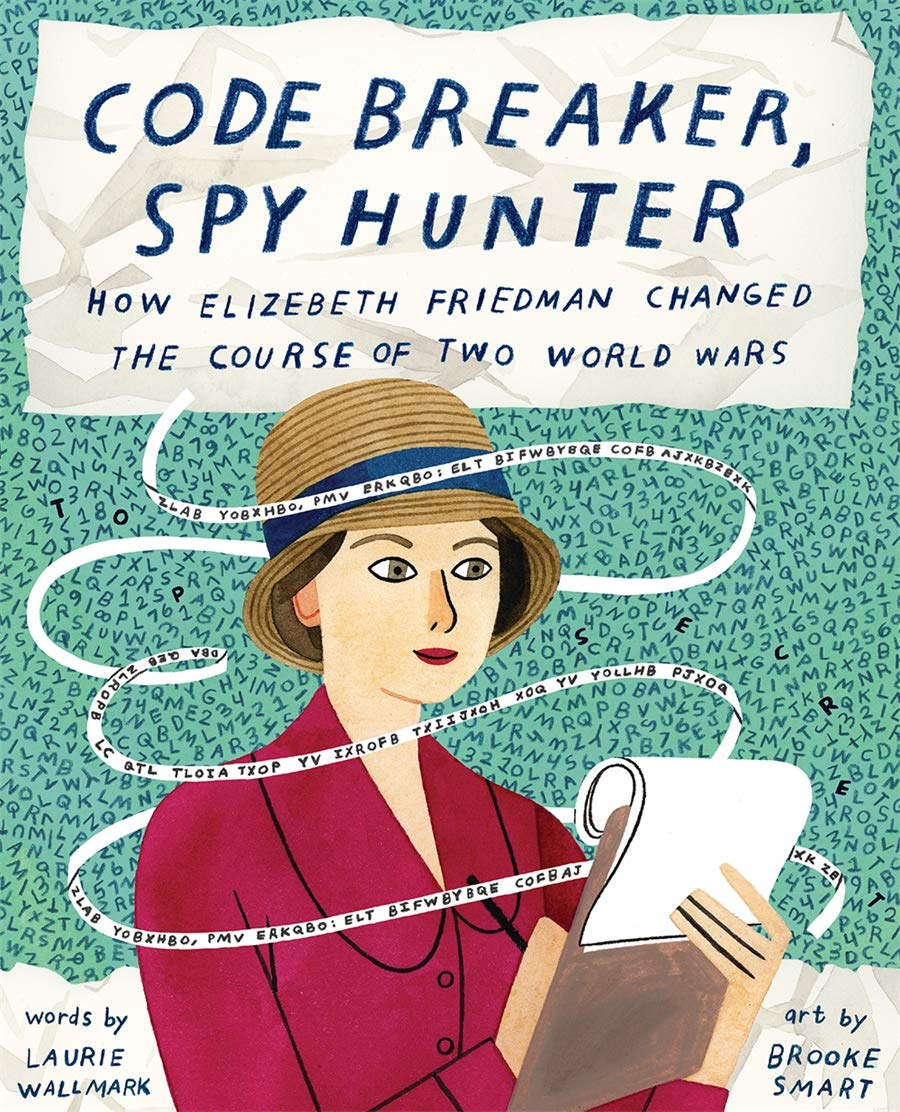
celebrate-picture-books-picture-book-review-code-breaker-spy-hunter-cover

About the Holiday

Today’s holiday is celebrated around the world and focuses on the social, economic, cultural, and political accomplishments of women. Spurred on by this mission, the theme for 2021 is “Choose to Challenge.” The sponsors of today’s holiday know that “a challenged world is an alert world and from challenge comes change.” Individually, each of us can choose to call out and challenge gender bias and inequality wherever we see it. Each of us can choose to seek out and celebrate women’s achievements. Collectively, we can all help create an inclusive world. To celebrate today and all year through, commit to helping forge an inclusive world. To learn more about International Women’s Day and how you can get involved in making positive change toward gender equality, visit the International Women’s Day website.

Thanks to Abrams Books for Young Readers and Blue Slip Media for sharing a copy of Code Breaker, Spy Hunter with me for review consideration. All opinions of the book are my own. I’m excited to be teaming with them for a giveaway of the book. See details below.

Code Breaker, Spy Hunter: How Elizebeth Friedman Changed the Course of Two World Wars

Written by Laurie Wallmark | Illustrated by Brooke Smart


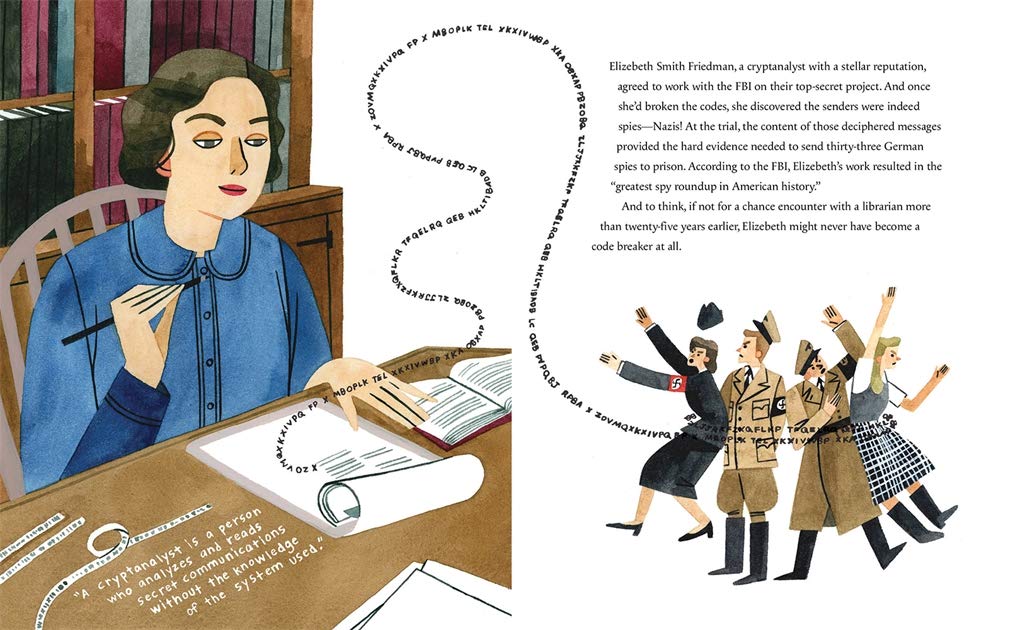
In Code Breaker, Spy Hunter, readers open the cover to an intriguing question: “Could it be? Had enemy spies sneaked into the United States?” World War II was raging, but the United States had not yet joined the effort. And yet the “FBI had intercepted hundreds of coded messages from a secret base in New York.” The problem was no one could read them. Who did the FBI turn to? Elizebeth Smith Friedman, who broke the codes, discovered a cadre of Nazi spies, and provided the evidence “to send thirty-three German spies to prison.” Who was Elizebeth Friedam? Children are about to find out!

celebrate-picture-books-picture-book-review-code-breaker-spy-hunter-cryptanalyst

Image copyright Brooke Smart, 2021, text copyright Laurie Wallmark, 2021. Courtesy of Abrams Books for Young Readers.

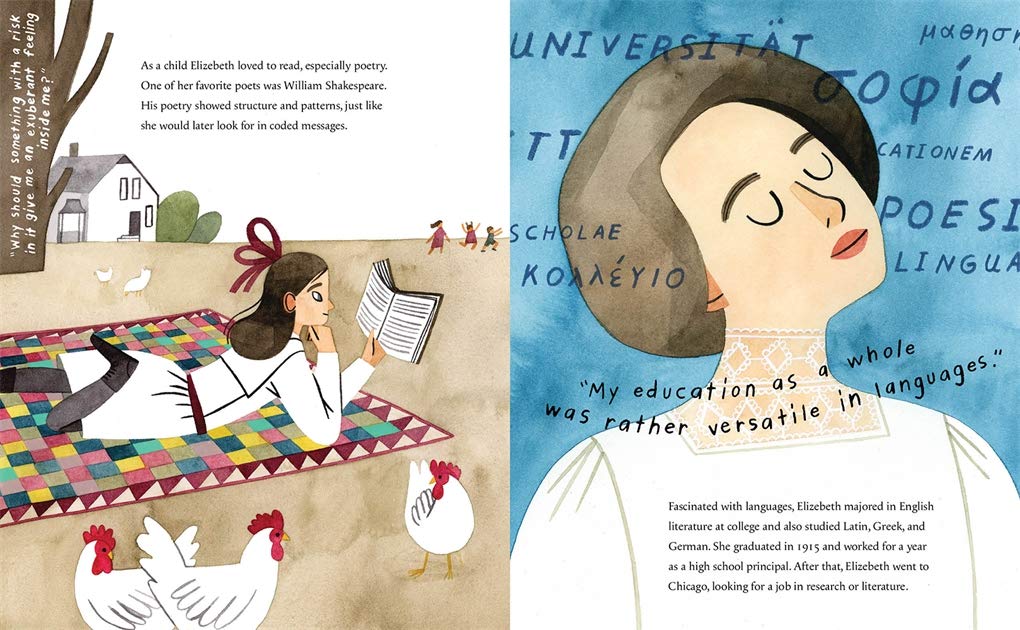
As a child, Elizebeth loved poetry and especially the work of William Shakespeare, with its structure and patterns. In college, she studied English literature, Latin, Greek, and German. While looking for a job in Chicago in 1916, she met the eccentric George Fabyan, who was trying to prove that Francis Bacon was the true writer of Shakespeare’s plays. He hired Elizebeth to “find secret messages Bacon had supposedly hidden in the plays. But the more she explored the plays, the more convinced she became that there were no hidden messages.”

Elizebeth shared her thoughts with a friend, William Friedman, who also loved puzzles and secret codes. Over a year’s time, their discussions resulted in a stronger friendship and finally marriage. In 1917, the US entered World War I and Fabyan asked Elizebeth and William to establish “the country’s first code-breaking unit, the Riverbank Department of Cyphers…. Their methods are now considered the basis for the modern science of cryptology, the study of secret codes.”

celebrate-picture-books-picture-book-review-code-breaker-spy-hunter-childhood

Image copyright Brooke Smart, 2021, text copyright Laurie Wallmark, 2021. Courtesy of Abrams Books for Young Readers.

In 1921, Elizebeth and William moved to Washington D.C., where they worked as code breakers for the Army. At the time, the Army used a large, cumbersome machine to convert messages into code, which precluded soldiers in the field from sending intelligence back. Elizebeth and William invented a complex code that used “only pencil and paper.” After the war, Elizebeth settled down to write books and raise a family, but still the entreaties came to decode messages for court cases sometimes thousands of miles away.

In 1925 with Prohibition the law of the land, smugglers were running rampant. The Coast Guard summoned her, and within three months Elizebeth had cracked “two years of backlogged messages.” Her work and court testimony that helped to convict smugglers made Elizebeth a recognized expert in the new field of cryptology, and when the work became overwhelming for just two people, she created the Coast Guard’s first code-breaking unit.

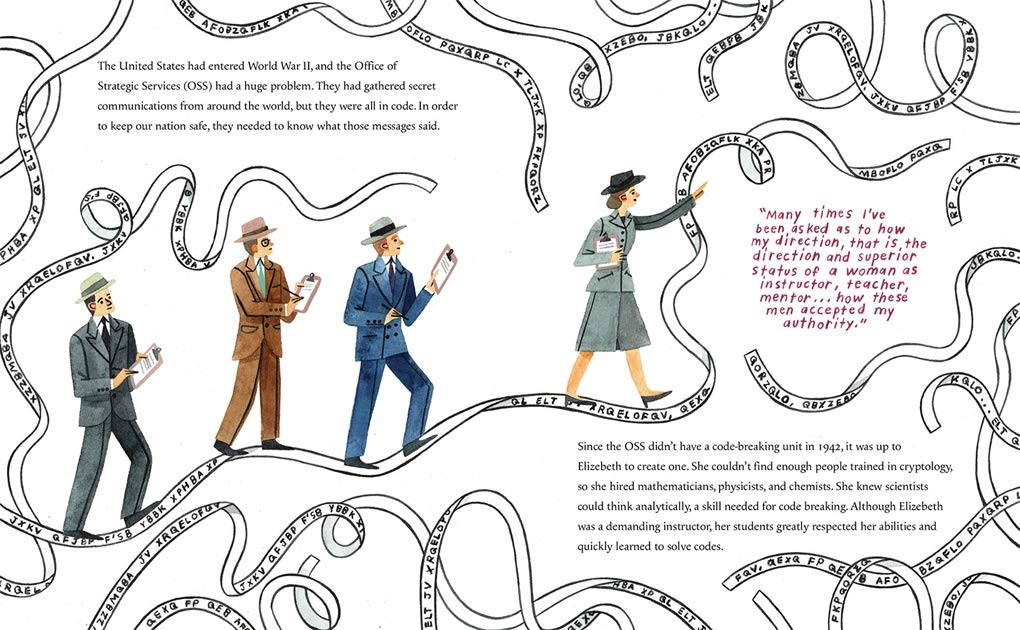
With the entry of the US in World War II, Elizebeth’s expertise was once again needed. Again, she needed to create a code-breaking unit, and in 1942 she hired and taught “mathematicians, physicists, and chemists” the skills of cryptology. Now, Elizebeth’s team was learning important war information about the Nazi’s movements and plans. When the FBI director wanted to nab the spies, Elizebeth recommended waiting “until the military could learn more of the enemy’s secrets.” But he disagreed and raided their hiding place. The spies that escaped quickly changed their codes, making their communications harder to decipher. The FBI director took all the credit for breaking the codes and catching the spies.

celebrate-picture-books-picture-book-review-code-breaker-spy-hunter-world-war-II

Image copyright Brooke Smart, 2021, text copyright Laurie Wallmark, 2021. Courtesy of Abrams Books for Young Readers.

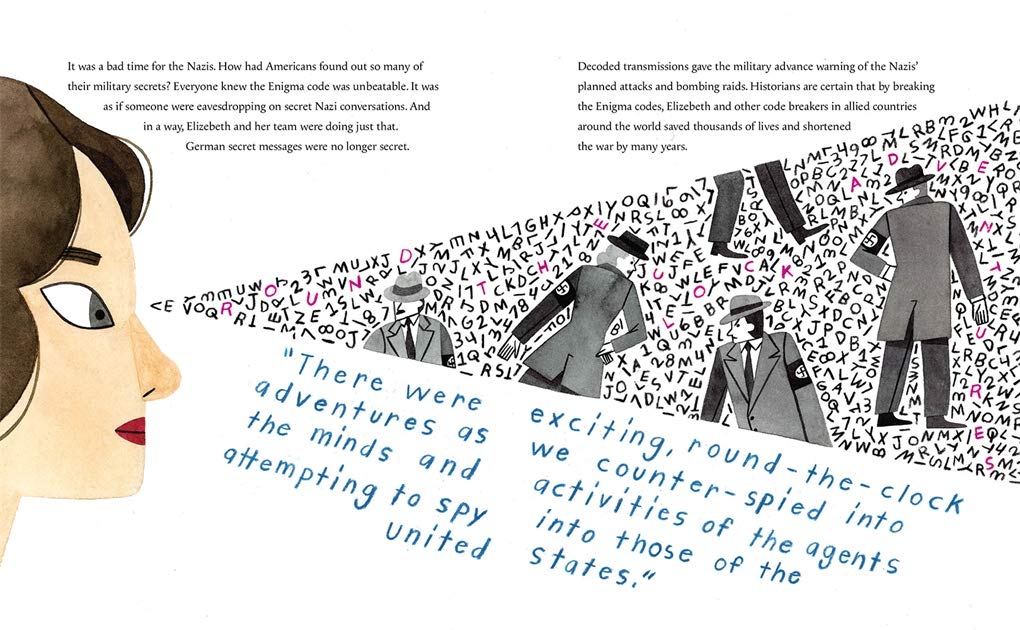
As the war progressed, Elizebeth helped capture an American spy working for the Japanese, and when the Germans developed Enigma, a powerful code-making machine that could “create billions of different cipher alphabets, it was Elizebeth’s team that broke the code for the United States. In Allied countries around the world, other cryptologists were also decrypting Enigma messages. The Nazis were now at a disadvantage, their planned attacks thwarted. Historians believe the work of these code breakers “saved thousands of lives and shortened the war by many years.”

Throughout her life Elizebeth could not speak a word about her work, even to her family. It was classified as Top Secret Ultra by the government and kept locked in the National Archives. At last, in 2015, Elizebeth’s work was declassified. “She is now considered one of the most gifted and influential code breakers of all time.”

celebrate-picture-books-picture-book-review-code-breaker-spy-hunter-counter-spied

Image copyright Brooke Smart, 2021, text copyright Laurie Wallmark, 2021. Courtesy of Abrams Books for Young Readers.

Compelling and wonderfully detailed, Laurie Wallmark’s biography of Elizebeth Friedman immerses children in the world of war-time spies, where cracking codes equaled saved lives and battles won. Wallmark’s storytelling of Elizabeth’s trajectory from Shakespeare scholar to ultra-secret code cracker reads like a thriller and is sprinkled throughout with quotes from Elizebeth that give kids a sense of her personality and the demands of her career. By including several cases Elizebeth was instrumental in solving, Wallmark provides readers with historical context on the broad range of nefarious activity that relied on secret codes to inform their knowledge of today’s uses of encryption as well as international spy networks. Each page is a celebration of Elizebeth’s talent, intelligence, and accomplishments, and her incredible story will enthrall readers.

Brooke Smart’s watercolor and gouache illustrations offer enticing glimpses into the past while following Elizebeth as she meets George Fabyon who shows her around his museum-like house while carrying a small monkey on his shoulder, establishes the United States’ first code-breaking unit, testifies in court, and thwarts the Nazis’ war plans. Interspersed with Smart’s realistic depictions of Elizebeth’s life are images in which lines of coded messages snake across the page, giving readers a look at the kinds of unreadable text Elizebeth and her teams cracked. In addition to presenting a visual representation of the tangled communications that eventually nabbed our enemies, two of these clever illustrations contain messages of their own.

A superlative biography that would enhance any history, social studies, language arts, or STEM curriculum as well as captivate kids who love spy, military, and detective stories, Code Breaker, Spy Hunter: How Elizebeth Friedman Changed the Course of Two World Wars is highly recommended for home bookshelves and is a must for school and library collections.

Ages 7 – 11

Abrams Books for Young Readers, 2021 | ISBN 978-1419739637

Discover more about Laurie Wallmark and her books on her website.

To learn more about Brooke Smart, her books, and her art, visit her website.

International Women’s Day Activity

celebrate-picture-books-picture-book-review-pig-pen-cipher

Send a Secret Message


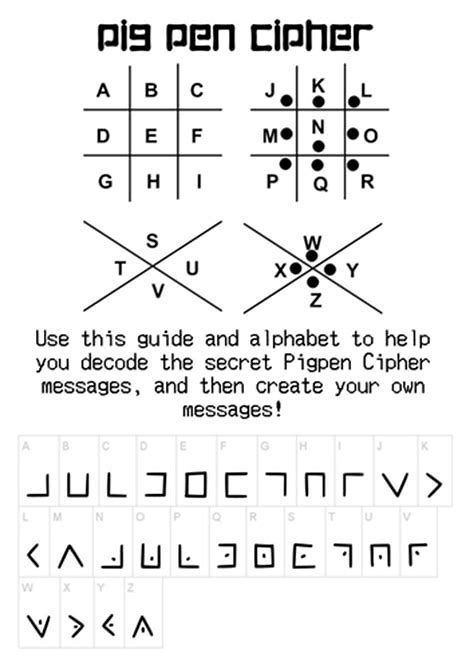
Would you like to be a code breaker – or a spy? Get started with this Pigpen Cipher that makes sending secret messages to friends, siblings, and other family easy and fun. This ancient code is called the Pigpen Cipher because each letter is in its own “pen.” Use it as originally developed then try mixing the letters and pens to create new codes. 

Pigpen Cipher Key

celebrate-picture-books-picture-book-review-code-breaker-spy-hunter-cover

You can find Code Breaker, Spy Hunter at these booksellers

Amazon | Barnes & Noble | Books-a-Million

To support your local independent bookstore, order from 

Bookshop | IndieBound

Picture Book Review

March 5 – National Day of Unplugging

celebrate-picture-books-picture-book-review-a-new-green-day-cover

About the Holiday

National Day of Unplugging is a 24-hour respite from the ever-present technology that can rob us of seeing what’s right in front of us, of actively participating in events, or partaking in activities like playing outside or even reading a physical book. Constant digital connections can also disrupt sleep. This year we’ve been even more tied to our devices for work, school, and socializing, but taking a day to decompress and enjoy nature or just some quiet, contemplation can be refreshing and revitalizing. To celebrate today, push the off button and enjoy a more relaxing day! What you discover may be surprising – just like today’s book!

A New Green Day

By Antoinette Portis


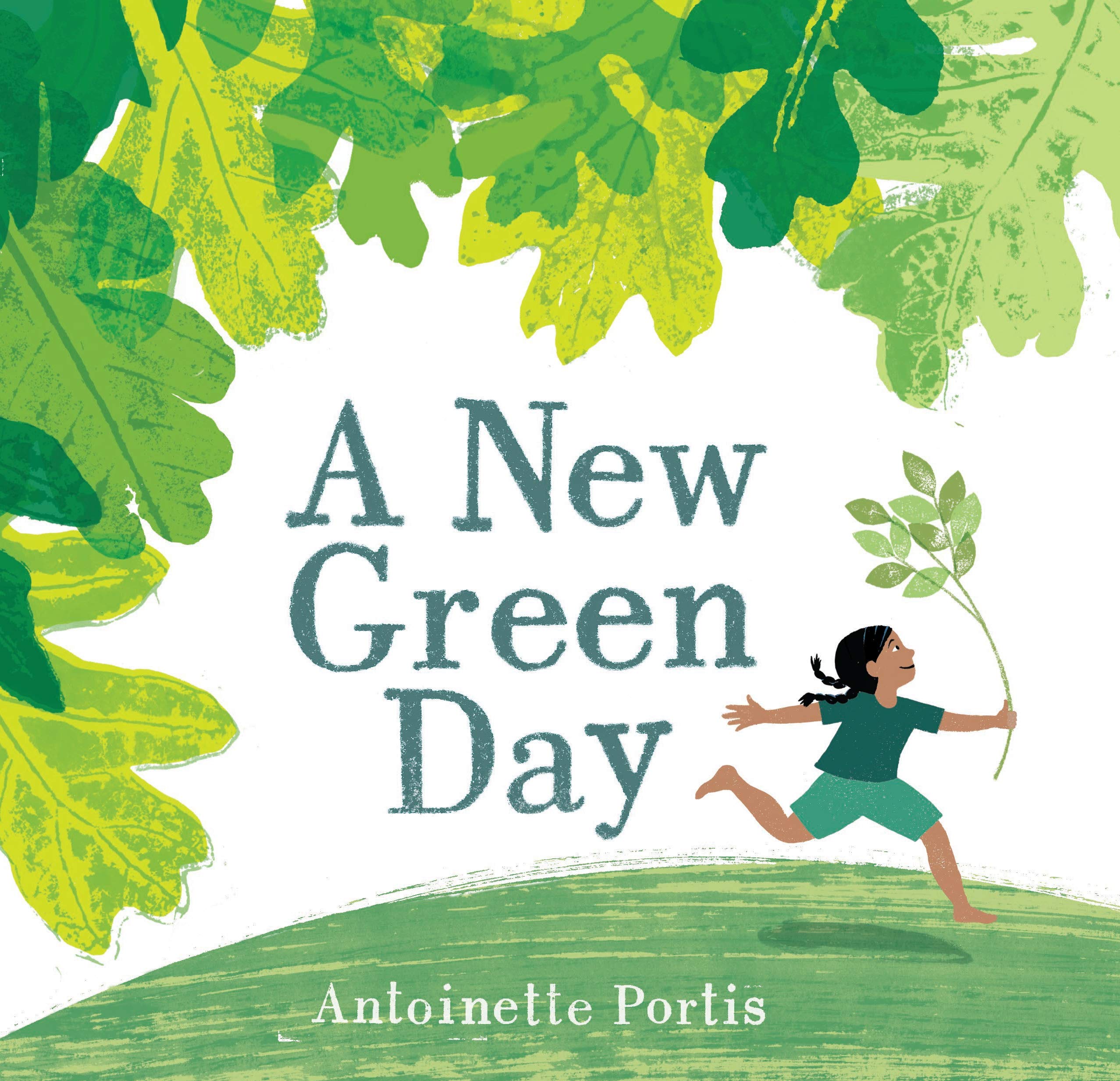
Nature provides many surprises from tiny glimpses of underground industry to shocking displays of overhead power. In between are moments that often go unremarked but which enrich our days and, when we stop to think about them, provide new insights. In her lyrical riddles, Antoinette Portis invites readers to listen as animate and inanimate parts of nature describe themselves and then to guess at their identities.

celebrate-picture-books-picture-book-review-a-new-green-day-inchworm

Copyright Antoinette Portis, 2020, courtesy of Neal Porter Books.

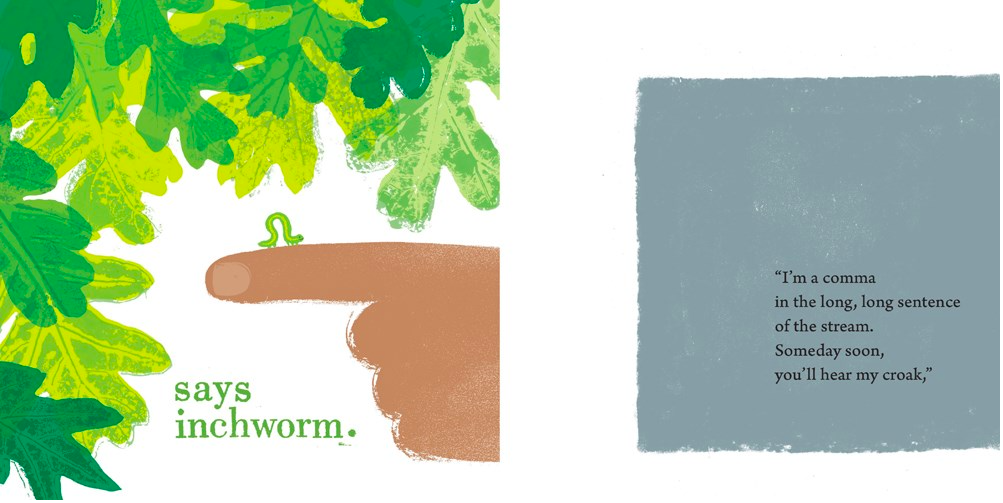
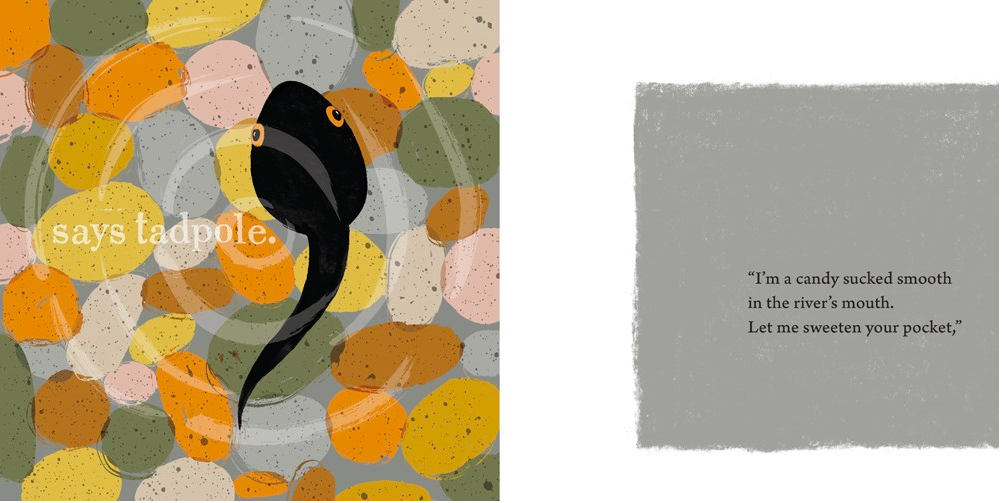
The day begins with this riddle: “‘Morning lays me on your pillow, / an invitation, square and warm. / Come out and play!’” Can you guess? Will you answer? Or will you doze a minute more? When you do rise and go outside, you may notice a “‘glistening ink’” on the sidewalk that tells you someone passed through during the night. Who might it have been?

celebrate-picture-books-picture-book-review-a-new-green-day-tadpole

Copyright Antoinette Portis, 2020, courtesy of Neal Porter Books.

Each riddle, composed of poetic perceptions and whimsical metaphors, is printed in a monochrome square on the righthand pages, enticing readers to contemplate the possibilities before flipping the page. There they discover the answers in sumptuous and lovingly crafted illustrations designed with sumi ink, vine charcoal, leaf prints, and hand-stamped lettering. Each pairing gives kids reasons to head out the door or watch through the window with new perspectives. Who wouldn’t revel in an experience like this: “‘I am cool pudding / on a muggy day. / Let your toes / have a taste!’”

Dynamic, absorbing, and fun, A New Green Day is a perfect take-along for summer outings as well as a captivating addition to any story time. The book is highly recommended for home, classroom, or public library bookshelves.

Ages 3 – 7

Neal Porter Books, 2020 | ISBN 978-0823444885

Discover more about Antoinette Portis, her books, and her art on her website.

National Day of Unplugging Activity

celebrate-picture-books-picture-book-review-dragonfly-craft-3

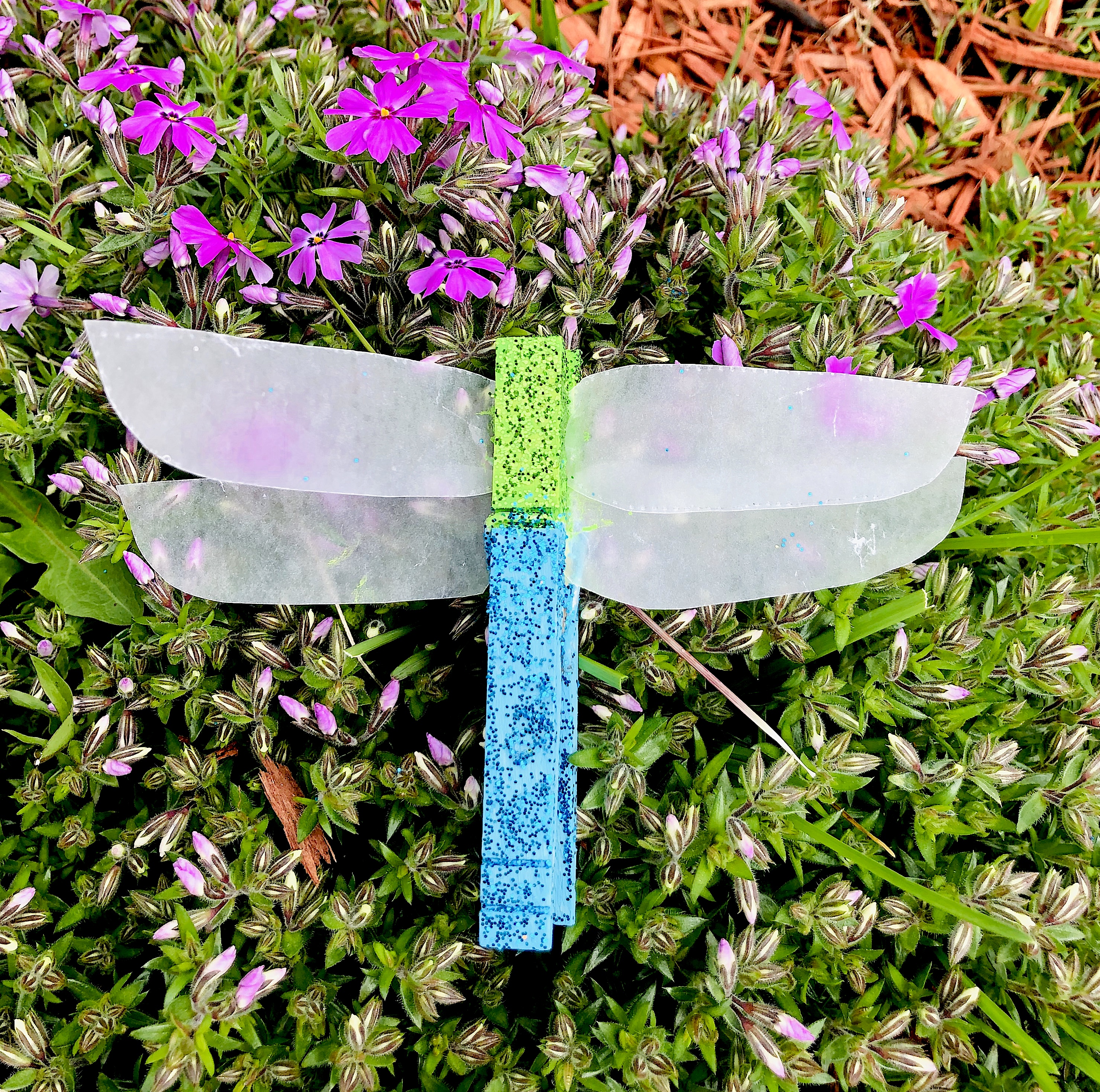
Dragonfly Decoration


After enjoying the outdoors, bring the beauty of nature inside with this easy-to-make dragonfly craft.

Supplies

  • Wooden clothespin
  • Wax paper
  • Bright green craft paint
  • Bright blue craft paint
  • Green glitter
  • Blue glitter
  • Paint brush
  • Thread or fishing line (optional)
  • Adhesive magnet (optional)

celebrate-picture-books-picture-book-review-dragonfly-craft

Directions

To Make the Body

  1. Paint the top part of the clothespin (to the point where the metal hinge crosses the wood) green
  2. Sprinkle green glitter on the wet paint, let dry
  3. Paint the bottom part of the clothespin blue
  4. Sprinkle blue glitter on the wet paint, let dry
  5. If the glitter doesn’t completely stick, apply a thin layer of glue with a toothpick and add more glitter

To Make the Wings

  1. Cut two 5-inch-by-3/4-inch strips from the wax paper
  2. Cut a curved edge at each end of the wax paper strips, cutting straight down from the top and curving around the bottom corner
  3. Cut curved notches in the center, top and bottom, of each wing to allow the wings to fit into the clothespin
  4. Open the clothespin and slip the wings in, curved edge down and allowing the top wing to overlap the bottom wing slightly

To Finish

Attach the thread or fishing line to the dragonfly to hang, or to make a refrigerator magnet, attach an adhesive magnetic strip to the back.

celebrate-picture-books-picture-book-review-a-new-green-day-cover

You can find A New Green Day at these booksellers

Amazon | Barnes & Noble | Books-a-Million

To support your local independent bookstore, order from

Bookshop | IndieBound

Picture Book Review
 

March 4 – National Reading Month

celebrate-picture-books-picture-book-review-once-upon-another-time-cover

About the Holiday

The month of March is dedicated to reading! Starting off with Read across America Day on March 2nd, the month celebrates all the joys and benefits of reading. When you read with your child or children every day you’re helping them develop the language and literacy skills that will promote future success in school and beyond. Even if your child isn’t talking yet, they’re listening and learning about their language as you read to them. Older kids also love being read to, and setting aside time to read together builds strong bonds that can last a lifetime. The month is typically marked with special events in schools, libraries, bookstores, and communities that bring authors, illustrators, and educators together with kids. This year, you can find virtual story times,  resources, and activity ideas on the National Education Association website

Thank you to Beaming Books for sharing a digital copy of Once Upon Another Time for review consideration. All opinions on the book are my own. I’m excited to be teaming with Beaming Books in a giveaway of the book. See details below.

Once Upon Another Time

Written by Charles Ghigna and Matt Forrest Esenwine | Illustrated by Andrés F. Landazábal


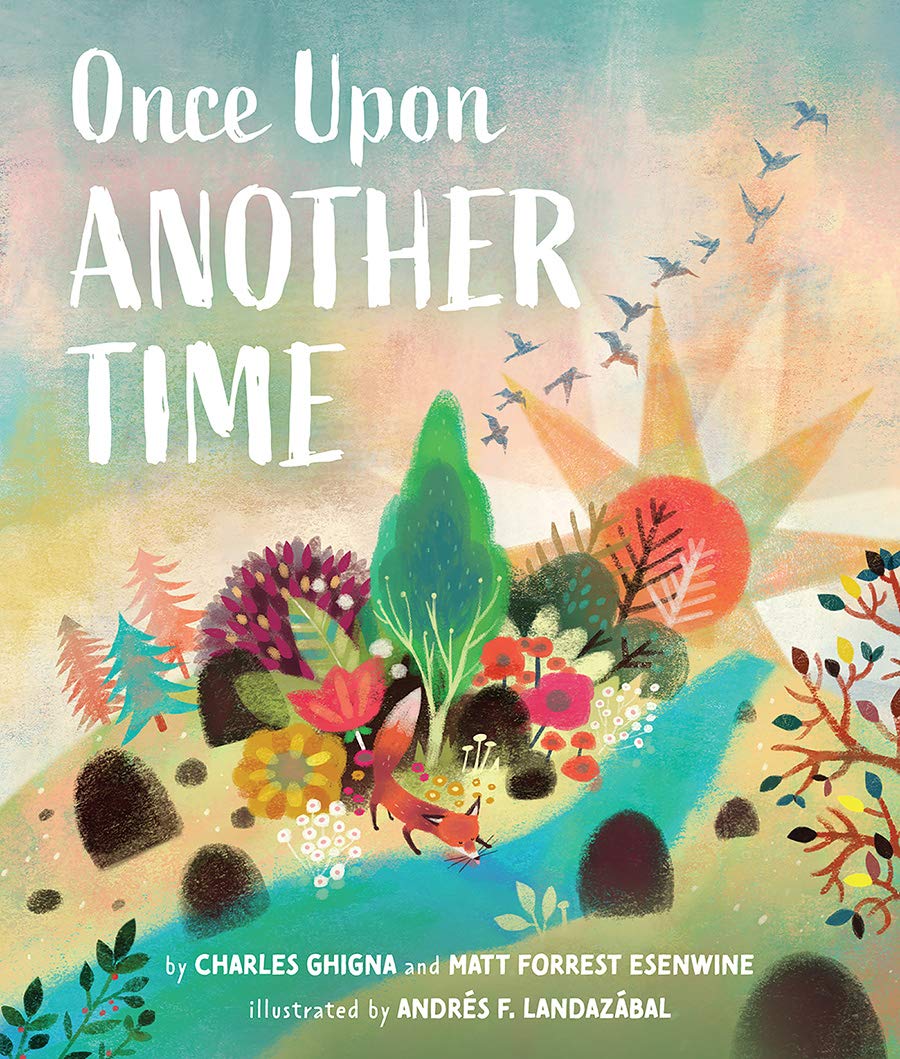
In their contemplative story, Charles Ghigna and Matt Forrest Esenwine entreat readers to look at the world in a way that’s new yet also as old as time itself. Beginning with the wistfulness of a fairytale, the hypnotic verses take children back to a “land of long ago”… where “wonder waited in the hush / of every new sunrise.” Back to when mountains rose into clean skies and rivers ran though lush valleys. Back to when “there were no cities made of steel, / no buildings, no concrete, / no highways, byways, / billboard signs, / no traffic in the street.”

For kids it may seem impossible that there was ever a time that gazing upward offered no chance of seeing a plane or drone and that all “the webs were spider-spun.” It’s hard to imagine a world with no machines, no mining for gold or oil, no farming, and even no human footprints in the soil. But “before one human step was taken… Earth and moon and stars awakened.”

This world’s still waiting to be found by stepping out, taking along no distractions. Then once outside, really look at the smallest things, “feel the wind,” and “taste the rain.” Listen closely, breathe in smells, and climb a tree. In the dark, “watch the moon. / Listen to the cricket’s tune.” And soon the dawning “sun will climb… / just as it did another time.”

celebrate-picture-books-picture-book-review-once-upon-another-time-deer

Image copyright Andrés F. Landazábal, 2021, text copyright Charles Ghigna and Matt Forrest Esenwine, 2021. Courtesy of Beaming Books.

The collaboration between Charles Ghigna and Matt Forrest Esenwine has created a rhyming story that doesn’t just celebrate nature but invites children to rediscover its awesome power to inspire, nurture, and excite. Ghigna and Esenwine’s story structure takes children backward in steps, reflected in page turns, from noisy cities and cluttered skies to the introduction of dams and factories to simple mining practices to the first humans and finally to the birth of our solar system. The impression these pages forge exposes that well-known duality of time: it moves so quickly; it moves so slowly. And so it is with childhood—that time when one can embrace nature—and life—with innocence and wonder. Esenwine and Ghigna ask kids to leave behind the phones, computers, and games to experience sights, sounds, smells, and feelings for real as well as to imagine the past and all the ways we are connected to it.

Andrés F. Landazábal’s lovely illustrations portray the grandeur of nature as well as its simple surprises that are no less breathtaking. A pink, turquoise and golden sunset over desert plateaus contrasts with a twilit wildflower field where a tiny sparrow watches a flock of birds fly away under the eye of a pale crescent moon. Landazábal’s images of nature are soft and mottled while his depictions of modern society show stark lines and the impenetrable nature of concrete, glass, and metal. As the story invites kids to discover the world unhindered, one page spread that will be a particular favorite of readers shows two children walking into their backyard underneath which a fossilized dinosaur sprawls. In his final pages, Landazábal assures readers that no matter where they live—country, suburbs, or city—there are places where they can experience the wonders of nature.

A unique, beautifully poetic invitation for children to explore nature and their place in it, Once Upon Another Time is a story readers will love to hear again and again. The book can also provide a spark for environmental, science, writing, and history lessons. Once Upon Another Time is highly recommended for home, school, and public libraries.

Ages 4 – 8

Beaming Books, 2021 | ISBN 978-1506460543

Discover more about Charles Ghigna, his books, and his poetry on his website.

To learn more about Matt Forrest Esenwine, his books, and his poetry, visit his website.

You can learn more about Andrés F. Landazábal and view a portfolio of his work on his website.

National Book Day Activity

celebrate-picture-books-picture-book-review-shark-and-books-maze

Book-Loving Shark Maze


If you’re like this shark, you love devouring books – the more the better! Can you help this shark find its way to the stack of books in this printable puzzle?

Book-Loving Shark Maze | Book-Loving Shark Maze Solution

celebrate-picture-books-picture-book-review-once-upon-another-time-cover

You can find Once Upon Another Time at these booksellers

Amazon | Barnes & Noble | Books-a-Million

To support your local independent bookstore, order from

Bookshop | IndieBound

Picture Book Review

March 3 – World Wildlife Day and Interview with Author Heather Lang

celebrate-picture-books-picture-book-review-the-leaf-detective-cover

About the Holiday

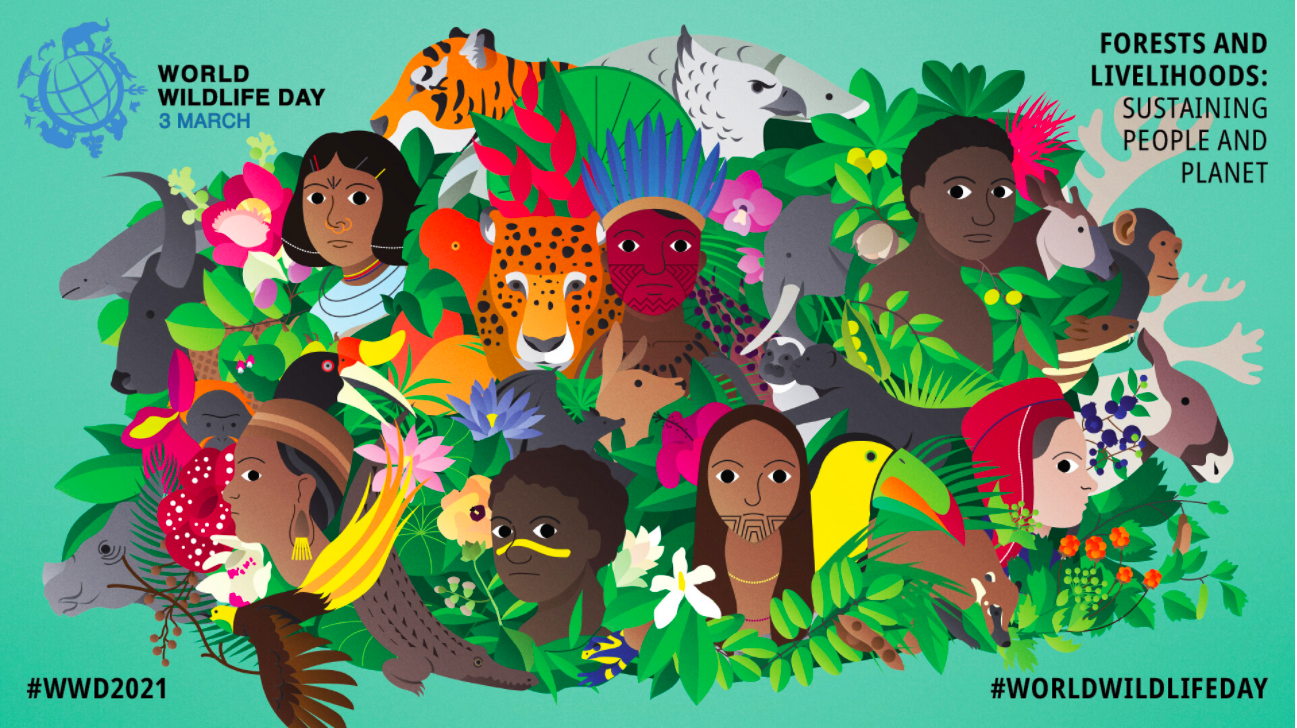
A vast number of plant and animal species are facing endangerment or extinction due to human caused climate change. World Wildlife Day was created in 1973 as an effort to protect the many endangered species of the world. It is an international holiday with a new theme each year to celebrate the biodiversity of our earth while also promoting awareness and advocacy. The theme for this year’s observance is “Forests and Livelihoods: Sustaining People and Planet.” There are many wonderful ways to celebrate this holiday; spend some time in nature, pick up litter around your block, find out about activities going on in your hometown, and read books to educate yourself and others on the livelihood of forests, wildlife and the environment.  To learn more about World Wildlife Day, and the virtual events happening today, visit this webpage: https://www.wildlifeday.org/. If you are searching for books to celebrate, The Leaf Detective is a perfect fit!

Thanks to Boyds Mills for providing a digital copy of The Leaf Detective for review consideration. All opinions on the book are my own.

Reviewed by Dorothy Levine

The Leaf Detective: How Margaret Lowman Uncovered the Secrets in the Rainforest

Written by Heather Lang | Illustrated by Jana Christy


As a child, Meg was quite shy to make friends. She spent lots of time studying and playing with wildlife: “Meg wrapped herself in nature, like a soft blanket.” As she continued to grow, so did her passion for leaves, trees, and nature. Meg attended Sydney University in Australia. In 1979, she became the first person at her graduate school to study the rainforest. Through her studies Meg learned that people had been all the way to outer space to study, but nobody had ever ventured to the tippity top of a canopy tree. Instead, they studied trees from far away through binoculars. Oftentimes scientists would spray trees with chemicals so that the harmed leaves and animals would drop to the forest floor where people could study them up close. Meg sought to change this.

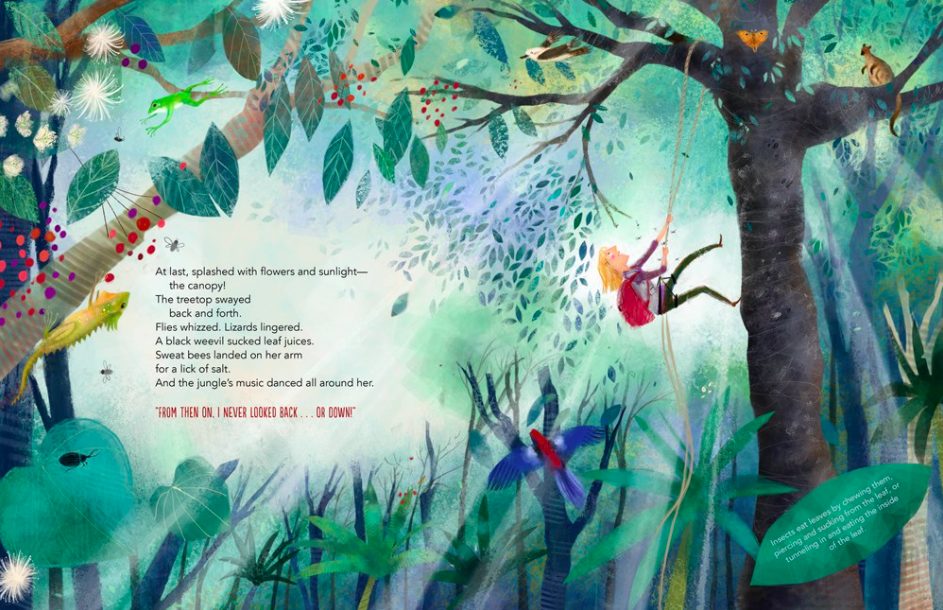
celebrate-picture-books-picture-book-review-the-leaf-detective-harness

Image copyright Jana Christy, 2021, text copyright Heather Lang, 2021. Courtesy of Calkins Creek.

“In the dark, damp forest the trees rose up to distant rustling, squawks and screeches, shadows in the treetops. How could she get up there?” Meg Lowman created her own slingshot and harness and inched up a coachwood tree. When she reached the canopy, she knew she’d found the perfect place to study and explore. Meg is quoted saying, “From then on, I never looked back…or down!”

Meg continued to create new strategies to study the canopy, as a scientist does. And in doing so she made so many discoveries, such as: “We now believe the canopy is home to approximately half the plant and animal species on land.” Many people tried to stop Meg along her journey. They told her she couldn’t take science classes, climb trees, or make inventions because she was a woman. But Meg ignored them. She continued to investigate.

She knew that rainforests were (and are) in danger, and that so many creatures rely on the rainforest ecosystem. People all over the world were cutting down large parts of the rainforests for wood, rubber, paper, and farmland. This worried Meg; she wanted to find a way to protect rainforests before they all disappeared. “She wondered, How can one leaf detective make a difference? How can I save the trees?…Then an idea crawled into Meg’s thoughts—a way to speak for the trees.”

celebrate-picture-books-picture-book-review-the-leaf-detective-bugs

Image copyright Jana Christy, 2021, text copyright Heather Lang, 2021. Courtesy of Calkins Creek.

Meg traveled around the world. She spoke to people across many different countries; taught them how to climb trees, build canopy walkways—she showed people the many gifts rainforests have to offer. Meg educated communities on how they could share their rainforest with outsiders, showcase its beauty to create revenue rather than chopping them down for resources. By using her voice and creative mind, Meg helped implement systems that have saved many trees and creatures across the world.

Meg Lowman continues to study trees, save rainforests, and teach people how to shift their economies to center around ecotourism and sustainable crops rather than resource extraction. She has used her voice to save rainforests across the world, and yet she still says, “If only I could have achieved as much as the tree!… But I have not. I have whittled away at relatively small goals in comparison to the grander accomplishments of a tree.”

Backmatter includes an author’s note detailing Heather Lang’s visit to meet Margaret Lowman in the Amazon rainforest in Perú. The note includes more information on Dr. Lowman’s advocacy work and is followed by an illustrated educational spread on the layers of canopies, and species featured throughout the story are labeled in the final spread, for readers to learn more about specific animals that make their homes in the rainforest.

celebrate-picture-books-picture-book-review-the-leaf-detective-trampoline

Image copyright Jana Christy, 2021, text copyright Heather Lang, 2021. Courtesy of Calkins Creek.

Heather Lang’s lyrical writing matches the carefulness with which Meg studies leaves, trees, and the rainforest canopy. Her compelling storytelling is rich with facts and sensory imagery that immerse readers in the environment and Meg’s determination to understand and, later, save it. Scattered images of leaves drop fun facts and definitions for readers about the rainforest, canopies, transpiration, herbivores, and more. Quotes from Dr. Lowman are thoughtfully placed throughout the story in a manner that neatly flows. The Leaf Detective urges readers to understand that “a tree is not just a tree” but rather “a shelter for animals and people, / a recycler and provider of water, / a creator of food and oxygen, / an inventor of medicine/ a soldier against climate change.”

Jana Christy’s digital drawings contain stunning detail and show an accurate scale of one small person in comparison to the vastness of the rainforest. Her mesmerizing wildlife creatures and immersive watercolor blues and greens transport readers right into the rainforest with “Canopy Meg.” The lush greens of the rainforests contrast strikingly with the spread on deforestation, in which fallen trees lay scattered on the bare, brown ground. Readers will also be interested to see the innovations that have made the trees more accessible to people. One can read the book over and over and notice new details every time. It is a book to treasure, to study, to read and re-read again. 

Come unearth the secrets of the rainforest with Margaret Lowman in this book that’s budding with knowledge, empathy, and magic, and is a tale of how one person can make a difference. The intriguing facts, poignant quotes from Dr. Lowman herself, and beautiful poetic writing will leave readers of this book inspired with wonder and with a hunger for advocacy. The Leaf Detective: How Margaret Lowman Uncovered the Secrets of the Rainforest is an urgent must-read for all ages.

A portion of Heather Lang’s royalties for this book go to TREE Foundation—an organization that funds field trips for children to get into nature, canopy projects, and science book distribution for children with limited access to STEAM, girls especially. 

Ages 6 – 10

Calkins Creek, 2021 | ISBN 978-1684371778

Discover more about Heather Lang and her books on her website.

To learn more about Jana Christy, her books, and her art, visit her website.

Meet Heather Lang

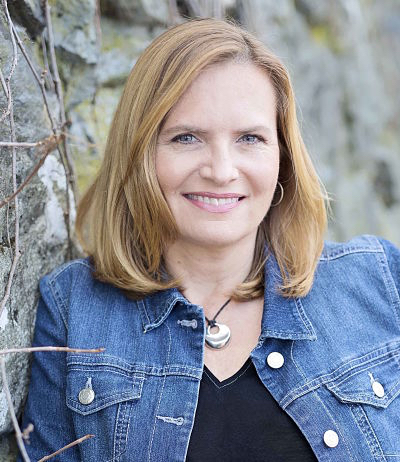
celebrate-picture-books-picture-book-review-Heather-Lang-headshot

Heather Lang loves to write about real women who overcame extraordinary obstacles and never gave up on their dreams. Her research has taken her to the skies, the treetops of the Amazon, and the depths of the ocean. Her award-winning picture book biographies include, QUEEN OF THE TRACK: Alice Coachman, Olympic High-Jump Champion, THE ORIGINAL COWGIRL: The Wild Adventures of Lucille Mulhall, FEARLESS FLYER: Ruth Law and Her Flying Machine, SWIMMING WITH SHARKS: The Daring Discoveries of Eugenie Clark, and ANYBODY’S GAME: Kathryn Johnston, The First Girl to Play Little League Baseball. When she is not writing, she enjoys going on adventures with her husband and four children. Visit Heather at www.heatherlangbooks.com.

Today I am thrilled to be interviewing author Heather Lang about her new biographical picture book The Leaf Detective: How Margaret Lowman Uncovered the Secrets of the Rainforest. Heather provides some thoughtful notes for shy readers, riveting stories from the rainforest and insight into the importance of exploring and caring for nature.

Can you tell us a little bit about what made you decide to write The Leaf Detective?  

We’ve caused enormous harm to our planet over the last few centuries, and I’m especially concerned about our rainforests. I knew I wanted to write a biography that was also a science book about the rainforest. When I read about Meg’s pioneering work and deep passion for trees, I was hooked! I couldn’t wait to find out how this quiet, nature-loving child, who didn’t know women could be scientists, became a world-class scientist and conservationist.

In the story you talk about how Meg was shy to make playmates with other kids. Were you also a shy kid growing up? Do you have any advice for readers who may relate to this aspect of Meg’s childhood? 

Like Meg, I was very shy as a child and remember wishing I were more outgoing. But as I grew older, I began to recognize the many advantages to being shy! My shy nature led me to sit back and observe. And that led to deeper thinking and understanding, a strong imagination, and creativity. Shy people often think more before they speak. They make their words count, which coincidentally is an important part of writing picture books. This also makes shy people good listeners and thoughtful friends. 

I’m still shy in many ways, and my recommendation to readers who might identify with this is to embrace your shyness! At the same time, don’t let it stop you from doing things you want to do. Meg Lowman told me she used to get so nervous before presenting in graduate school that she’d get physically sick. But with practice, practice, practice, she’s become a captivating presenter and educator. If you watch a few of her FUN FACTS FROM THE FIELD videos on my website, you’ll see what I mean! 

How would you describe your connection to nature? Would you consider yourself a “detective” in any ways? 

I’m constantly in awe of nature and its countless gifts and surprises. Nothing sparks my curiosity more than our natural world, and my curiosity is probably my most important tool as a writer. Being open-minded and asking questions not only generates ideas, but also leads me to think more deeply about a topic and examine it closely from lots of different angles. And of course that generates more detective work and more learning about my topic and myself. Being a detective is one of my favorite parts of writing books.

Do you have a favorite rainforest tree or creature? If so, tell me about it a bit!

When I arrived in the Amazon rainforest, I couldn’t wait to see a sloth! But during my time there I became fascinated with ants. They are everywhere in the rainforest, even in the canopy. I think it’s amazing how such tiny creatures can be so hardworking and organized. Their teamwork is unbelievable. And they are invaluable to the health of our rainforests. Among other things, they’re in charge of waste management on the rainforest floor, and they disperse seeds and aerate the soil!

What was the most rewarding part of writing The Leaf Detective?

This writing project was filled with rewards every step of the way! I learned so much about our rainforests and trees and gained a true understanding of how interconnected we all are—plants, animals, and humans. Getting to really know Meg Lowman and learning from her firsthand was thrilling and strengthened my writing in many important ways. It was also really rewarding to stretch myself as a writer and find a way to effectively write a book that seemed ambitious at first—a biography and conservation book that wove in quotes and science facts. 

Are there any stories from your trip to meet Meg that you did not get the chance to include in your author’s note that you’d like to share?

While I was on my Amazon adventure with Meg, I had many exciting moments. I loved learning from the Indigenous people how to use a blow gun, make clay, and braid palm leaves to make thatched roofs. The local shaman taught me how he uses different plants in the rainforest to treat and prevent injuries and illnesses—from bronchitis to poisonous snake bites. He also helped me confront my fear of snakes by bringing one over for me to touch. I even let it gently coil around my neck! But my favorite moments were exploring with Meg, especially at night and early in the morning when there’s so much activity in the rainforest.

What are you working on next?

I’m having a blast working on a new informational picture book series about extraordinary animals for Candlewick Press with my co-author/illustrator and close friend Jamie Harper. The first book, Supermoms!, features cool nonfiction facts about 18 amazing animal moms in a graphic format with humorous callouts. 

I’m also working on a collective biography for readers in grades 3 – 7. More to come on that soon!

Thanks so much for chatting with me Heather! I had a lovely time hearing about your inspiration, stories, writing process and tips for shy readers. Looking forward to learning and reading more from you in the months and years to come.

World Wildlife Day Activity

Screen Shot 2021-03-02 at 9.24.20 PM

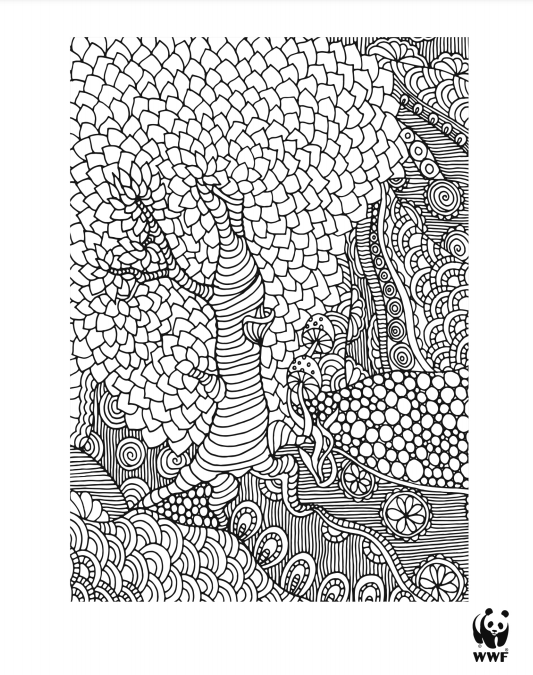
You can create your own rainforest with this coloring page. Use the blank space around the picture to label the layers as shown on the last page of The Leaf Detective!

Rainforest Coloring Page

celebrate-picture-books-picture-book-review-world-wildlife-day-poster-2021

Three different beautiful World Wildlife Day 2021 posters in six languages are available for download here.

You can find The Leaf Detective at these booksellers

Amazon | Barnes & Noble | Books-a-Million

To support your local independent bookstore, order from

Bookshop | IndieBound

Picture Book Review

March 2 – Read Across America Day

celebrate-picture-books-picture-book-review-if-you-come-to-earth-cover

About the Holiday

Today’s holiday, established by the National Education Association in 1997, encourages children all across the country to celebrate reading and all of its joys and benefits. The NEA strives to create a nation of diverse readers and to provide teaching resources that promote diversity and inclusion. In NEA’s digital Read Across America calendar, the theme for March is “Cultivate Compassion.” This year teachers and parents can connect with authors, discover ideas for virtually celebrating Read Across America, and find lots of resources for a full year of reading. A love of reading is one of life’s greatest pleasures and a powerful force for future success. Celebrate today by reading with a child or on your own. There are fabulous worlds and stories waiting to be discovered. Just take a look into today’s book1 For more information on Read Across America, visit the NEA website.

If You Come to Earth

By Sophie Blackall


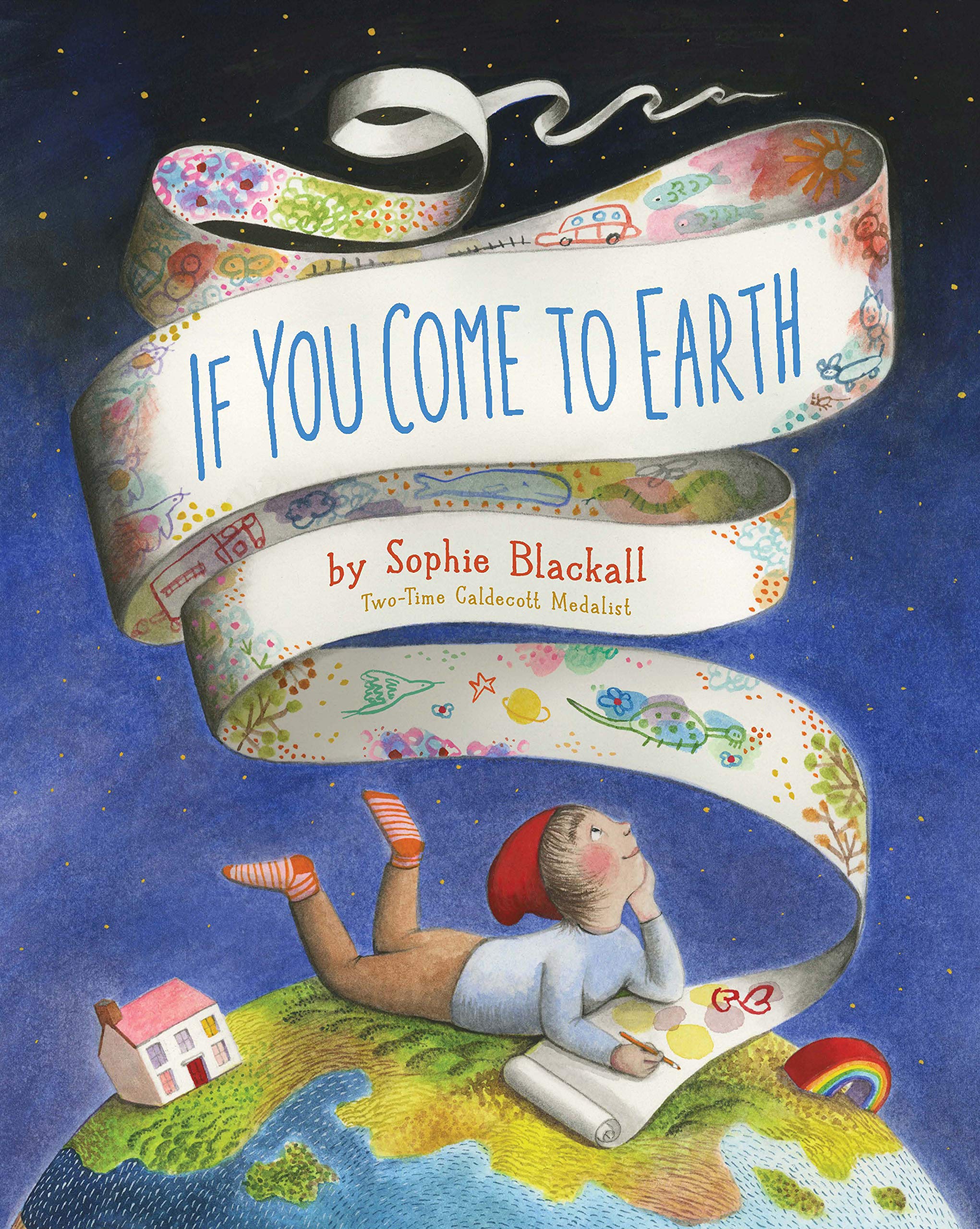
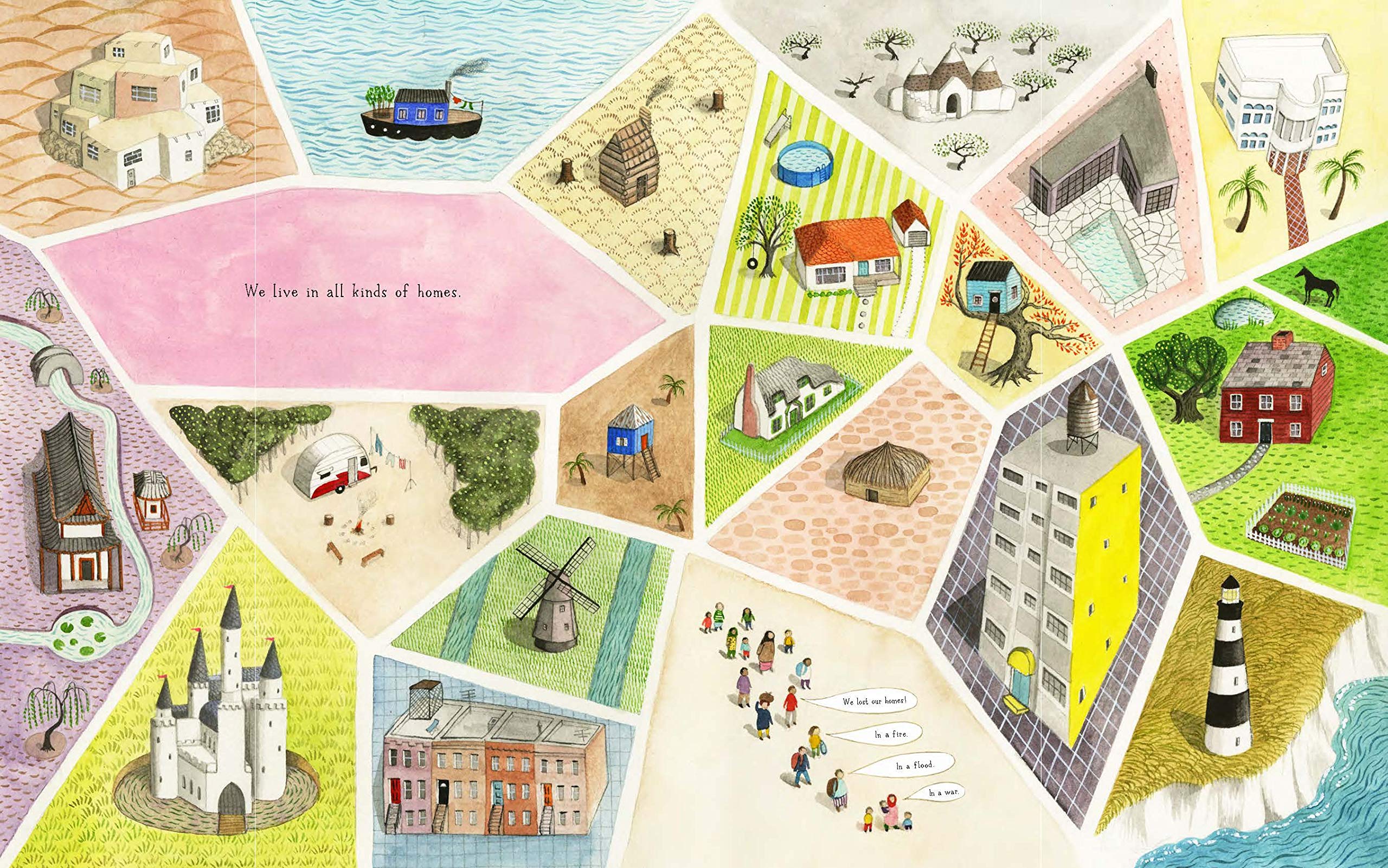
In Sophie Blackall’s beautifully—and often whimsically—illustrated If You Come to Earth, a child named Quinn who wears a red elfin hat writes a letter about Earth to any visitor from Outer Space who may venture to our planet. Quinn starts out with a map of sorts to guide the visitor through the cosmos to our “greeny-blue” home and, closer still, to the cities, towns, and villages where we congregate. A patchwork image shows the visitor the variety of houses people live in—from huts to trailers, castles to houseboats, cabins to treehouses to a familiar lighthouse. One space is also dedicated to those who have lost their homes “in a fire. In a flood. In a war.”

celebrate-picture-books-picture-book-review-if-you-come-to-earth-homes

Copyright Sophie Blackall, 2020, courtesy of Chronicle Books.

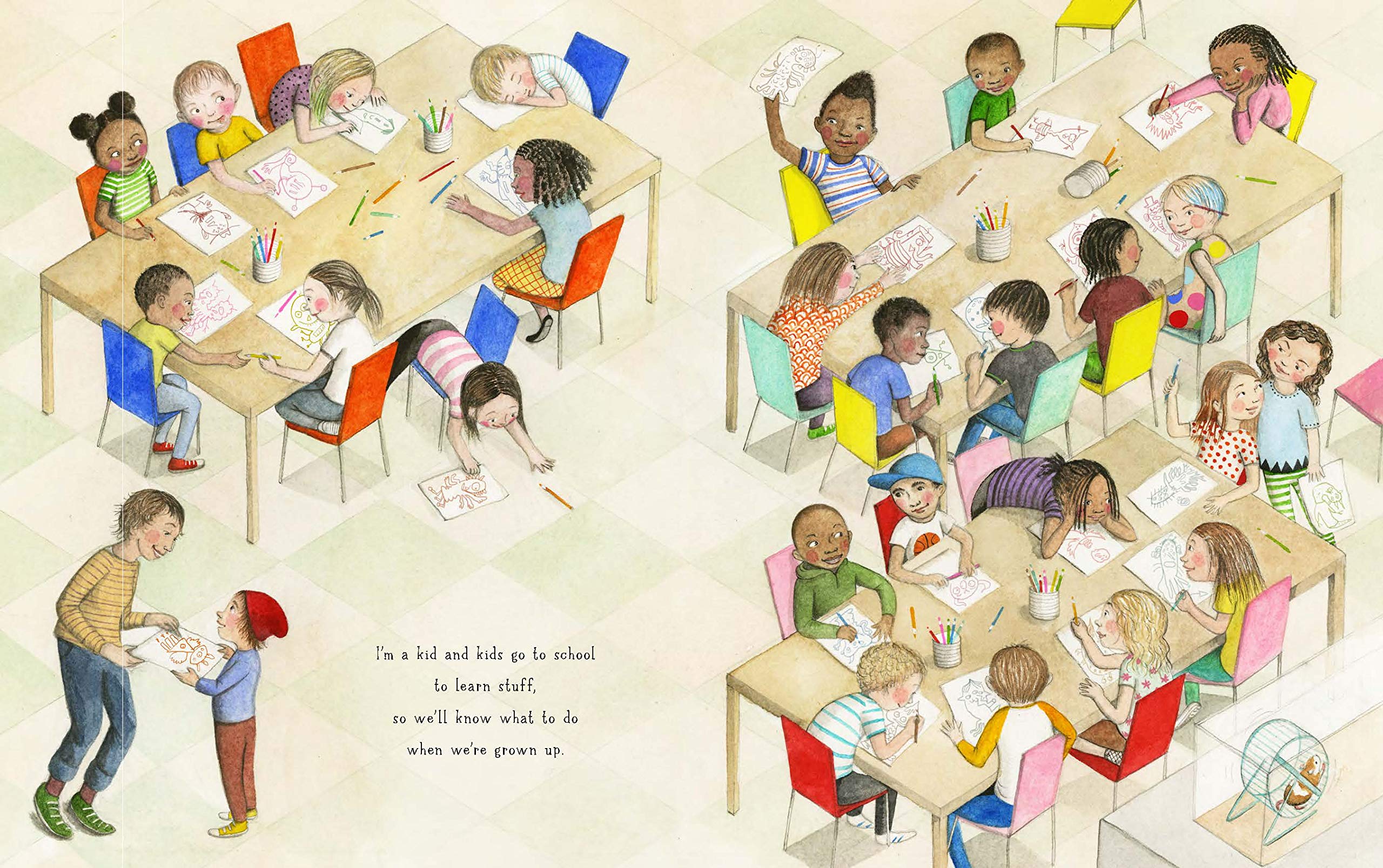
Turn the page to a sunny-day picnic and Quinn reveals that in those homes live “all kinds of families.” Sometimes people are quiet, but Quinn tells the visitor, “inside our heads, we are usually thinking. You can’t see our thoughts, but sometimes we show our feelings on our faces.” What kinds of feelings? Blackall’s portraits show sadness and glee, confusion and surprise, frustration and calm. The child mentions clothing, weather, and transportation. “I’m a kid,” Quinn says, “and kids go to school to learn stuff, so we’ll know what to do when we’re grown up.” Quinn’s class is seen drawing space aliens while they talk together and share colored pencils. One boy is making a face and another is sleeping on his blank piece of paper.

celebrate-picture-books-picture-book-review-if-you-come-to-earth-school

Copyright Sophie Blackall, 2020, courtesy of Chronicle Books.

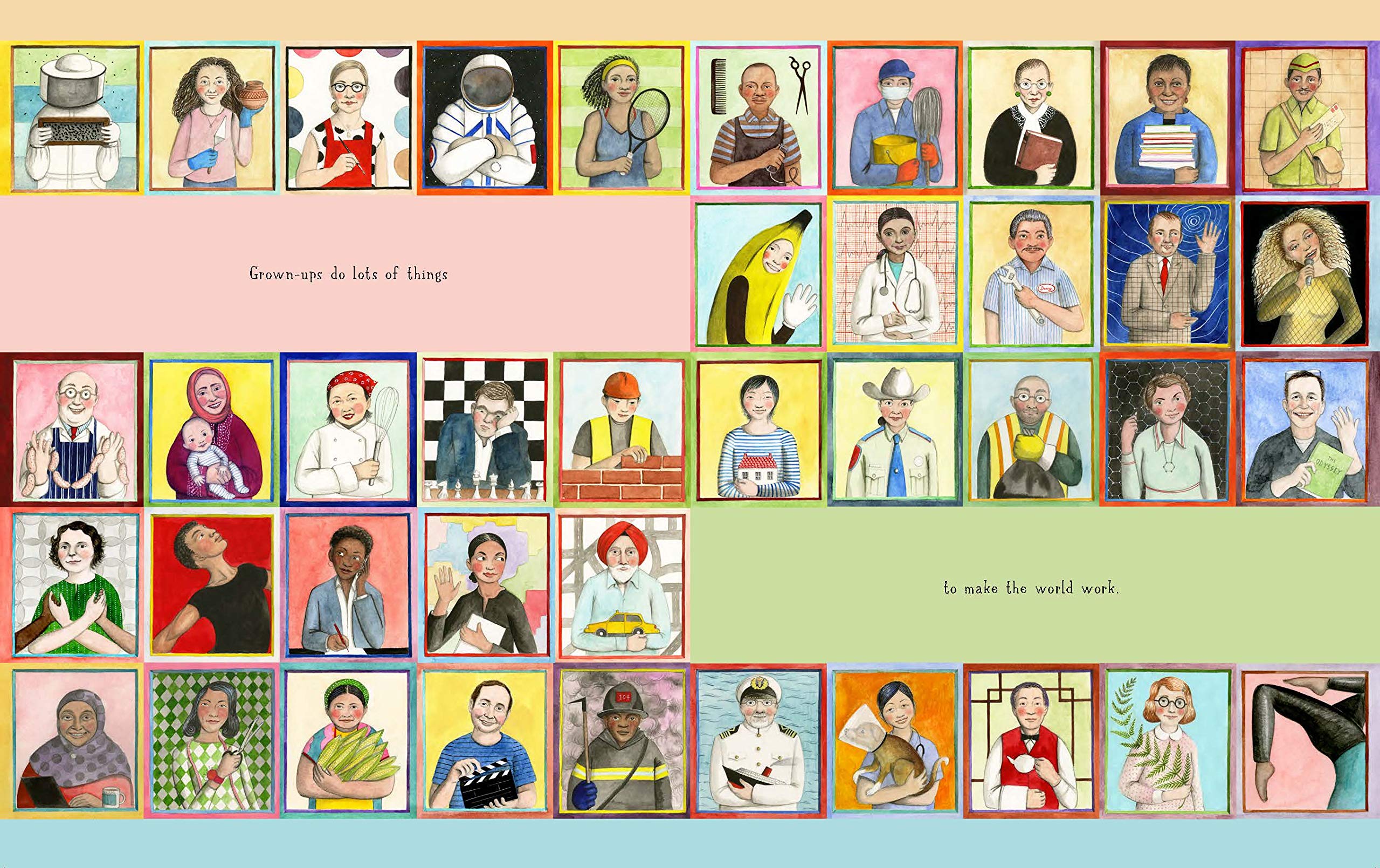
What will these kids grow up to be? Forty snapshots of adults—including a beekeeper, potter, astronaut, tennis player, barber, chef, dancer, chess player, construction worker, veterinarian, doctor, singer, and scientist—will give the visitor an idea of the vast array of jobs people do “to make the world work.” There are ideas for leisure time too. And as a large group sits around table laden with all kinds of food, Quinn says that we “eat when we are hungry” and that “some of us have more food than others,” but that “we all need food and water to survive.”

From this introduction, the visitor learns about the ocean, which appears empty but “actually it’s full.” A stunning montage of sea creatures depicts what the child means. Likewise, the land hosts animals, which bound, creep, and lope across the pages, and the sky is home to birds of all colors and sizes.

celebrate-picture-books-picture-book-review-if-you-come-to-earth-jobs

Copyright Sophie Blackall, 2020, courtesy of Chronicle Books.

Quinn talks about the music in the world, made by animals and people, about deaf people who talk with their hands, and about blind people who read with their hands and includes images of the sign language and braille alphabets. He tells about things created by nature and those made by people; things that are big and things that are small and even things that are invisible but make a big impact. One of these is germs, which “can make you sick” just like “eating a woolly milkcap toadstool or breathing in smoke or getting spat on by a slow loris.”

Quinn reveals different ways people interact and how they grow up from babies to older people. He admits that “there are lots of things we don’t know…. But right this minute, we are here together on this beautiful planet.” Quinn ends his letter with some questions for the possible visitor from Outer Space and an invitation to stay in his room if, indeed, they come to Earth.

celebrate-picture-books-picture-book-review-if-you-come-to-earth-jobs

Copyright Sophie Blackall, 2020, courtesy of Chronicle Books.

Every page of Sophie Blackall’s mesmerizing and welcoming look at life on our planet invites readers to explore her detailed illustrations and imagine what their own additions would be to each topic. Blackall’s straightforward text is sprinkled with humor and poignancy and each line opens up a world of possibilities and the gifts of our rich diversity, both natural and human. The subjects Blackall chooses flow from each other like a long strand of yarn teased from a sweater with an intricate design and are sure to lead to fun, fascinating, and thoughtful discussions. Blackall’s ending will inspire as much as it makes you smile.

Accompanying Blackall’s text are her exquisite illustrations that are fresh and fun and, in many cases, will take your breath away. Both kids and adults will want to spend time carefully studying and talking about each page, as there is so much to see, so many connections to make, and so many secrets tucked away in each of them. Readers will notice allusions to other books and will want to point out all of the things that are “just like me!” Pages dedicated to transportation, birds, animals, sea creatures, and jobs will enthrall kids with these particular interests. Artists, collectors, and philosophers will also find pages to excite them too.

A book kids and adults will want to dip into again and again as well as an excellent read to spark writing workshops, nature studies, and social studies classes for schools and homeschoolers, If You Come to Earth is a must for home, classroom, and public library collections.

Ages 5 – 8 and up

Chronicle Books, 2020 | ISBN 978-1452137797

To learn more about Sophie Blackall, her books, and her art, visit her website.

celebrate-picture-books-picture-book-review-if-you-come-to-earth-cover

You can find If You Come to Earth at these booksellers

Amazon | Barnes & Noble | Books-a-Million

To support your local independent bookstore, order from

Bookshop | IndieBound

Picture Book Review