July 8 – Math 2.0 Day

celebrate-picture-books-picture-book-review-hidden-figures-the-true-story-of-four-black-women-and-the-space-race-cover

About the Holiday

Today’s holiday celebrates the merging of math and technology together as the foundation of most of the things we use every day, such as computers, phones, tablets and other electronics. Math and technology are also employed by architects, scientists, researchers, and manufacturers. Math 2.0 Day was established to bring together mathematicians, programmers, engineers, educators, and managers to raise awareness of the importance of math literacy at all levels of education.


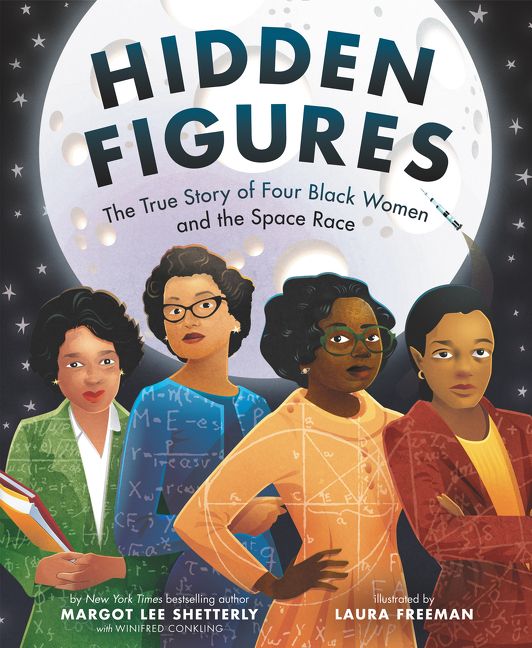
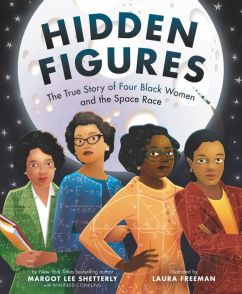
Hidden Figures: The True Story of Four Black Women and the Space Race

Written by Margot Lee Shetterly | Illustrated by Laura Freeman


“Dorothy Vaughan, Mary Jackson, Katherine Johnson, and Christine Darden were good at math…really good.” The United States was involved in World War II, and Dorothy wanted to help the war effort by working for the National Advisory Committee for Aeronautics to make planes faster, stronger, and safer. Developing new airplanes required lots of tests at the Langley Laboratory in Virginia. Today, we use computers to do the kinds of math needed, “but in the 1940s computers were actual people like Dorothy, Mary, Katherine, and Christine.”

celebrate-picture-books-picture-book-review-hidden-figures-the-true-story-of-four-black-women-and-the-space-race-dorothy

Copyright Laura Freeman, 2018, courtesy of lfreemanart.com.

Even though Dorothy was a woman and an African-American in the segregated South, Dorothy did not think her dream of getting a job was impossible. After all, she was really good at math. She applied and was hired as a computer. At Langley, whites and blacks worked in different buildings and had separate facilities. After the United States won the war, Dorothy stayed on to create better aircraft.

Now America and Russia were in competition to build the best airplanes. This required more math, more tests, and more computers. Mary Jackson was hired at Langley to test model airplanes in wind tunnels. Mary had her sights set on becoming an engineer, but most of the engineers were men. To prepare, Mary needed to take advanced math classes, “but she was not allowed into the white high school where the classes were taught.” Mary didn’t take no for an answer. She got special permission to take classes, got good grades, and “became the first African-American female engineer at the laboratory.”

celebrate-picture-books-picture-book-review-hidden-figures-the-true-story-of-four-black-women-and-the-space-race-katherine

Copyright Laura Freeman, 2018, courtesy of HarperCollins.

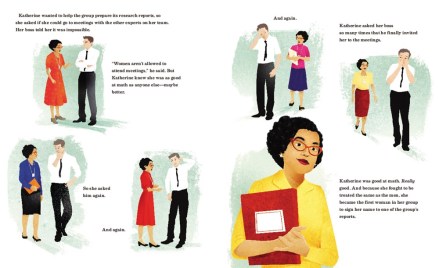
In 1953 Katherine Jackson was hired for a team who tested airplanes while they were in the air. Her work was to analyze turbulence to make planes safer in dangerous gusts of wind. She wanted to go to her team’s meetings, but she was told by her boss again and again that it was impossible; women were not allowed to attend meetings. At last her persistence paid off, and she became the first woman to sign one of the group’s reports.

When machine computers were installed at Langley in the 1950s, they were faster than the human computers but made many mistakes. “Dorothy learned how to program the computers so they got the right answers and taught the other women in her group how to program too.”

In 1957 Russia launched a satellite into space, ramping up the competition with the United States. Now “the United States started building satellites to explore space too,” and the name of the agency was changed to the National Aeronautics and Space Agency or NASA. Then President John F, Kennedy set a goal of sending a man to the moon. First, however, there would need to be many experiments, new space craft, and tests to send astronauts into orbit. This meant more people who were good at math would be needed.

celebrate-picture-books-picture-book-review-hidden-figures-the-true-story-of-four-black-women-and-the-space-race-separate-offices

Copyright Laura Freeman, 2018, courtesy of lfreemanart.com.

When the first manned space flight was planned, Katherine calculated the trajectory that would take John Glenn into space and bring him home again. In 1967 Dorothy Darden came to work at Langley. She loved electronic computers and wanted to become an engineer. “Her first job was to help with NASA’s mission to the moon.”

When Neal Armstrong stepped onto the moon’s surface for the first time on July 20, 1969, he said it was a giant leap for mankind. “It was also a giant leap for Dorothy, Mary, Katherine, Christine, and all of the other computers and engineers who had worked at the lab over the years.” The moon landing was just the beginning. NASA engineers were already dreaming of trips to other planets and super-fast spacecraft. And although it would be hard and require a lot of numbers, “Dorothy, Mary, Katherine, Christine knew one thing: with hard work, perseverance, and a love of math, anything was possible.”

celebrate-picture-books-picture-book-review-hidden-figures-the-true-story-of-four-black-women-and-the-space-race-four-women

Copyright Laura Freeman, 2018, courtesy of HarperCollins.

Margot Lee Shetterly brings her compelling story Hidden Figures to children in this exceptional picture book that skillfully reveals the talents and dreams of Dorothy, Mary, Katherine, Christine as well as the work atmosphere and social injustices of the time period. While acknowledging the struggles and obstacles the four women faced, Shetterly keeps her focus on the incredible achievements of these brilliant women and the positive changes and opportunities for others they created. Brief-yet-detailed descriptions and explanations of math, science, and computer terms flow smoothly in the text, allowing all readers to understand and appreciate the women’s work.

As Dorothy, Mary, Katherine, Christine each begin their work at Langley as young women, Laura Freeman establishes their dreams and their particular field of expertise through richly colorful illustrations that highlight the schematics, tools, equipment, and models they used. In one particularly affecting spread, Dorothy, Mary, Katherine, and Christine go off to their offices on the left-hand side, and their white counterparts head out to theirs on the right-hand side while the blueprint of their building lies under their feet. Dorothy, Mary, Katherine, and Christine’s clothing is also mirrored in color by the women on the other side of the fold. Period dress and electronics show progression through the years, and kids may marvel at the size of early computers. The final image of Dorothy, Mary, Katherine, and Christine as older women is moving and inspirational.

Hidden Figures: The True Story of Four Black Women and the Space Race is an outstanding biography of four women who contributed their gifts for math as well as their self-confidence not only to science but to dreamers in their own and future generations. The book would be a stirring choice for classroom and home libraries.

Ages 4 – 8

HarperCollins, 2018 | ISBN 978-0062742469

Discover more about Margot Lee Shetterly and her books on her website.

To learn more about Laura Freeman, her books, and her art, visit her website.

International Women’s Day Activity

celebrate-picture-books-picture-book-review-women-in-stem-coloring=book

Women in STEM Coloring Book


Discover five women who broke barriers  and made important contributions to the science, technology, engineering, and math fields in this printable  Women in STEM Coloring Book created by the United States Department of Energy.

celebrate-picture-books-picture-book-review-hidden-figures-the-true-story-of-four-black-women-and-the-space-race-cover

You can find Hidden Figures: The True Story of Four Black Women and the Space Race at these booksellers

Amazon | Barnes & Noble | Books-a-Million | IndieBound


Picture Book Review

March 31 – Bunsen Burner Day

celebrate-picture-books-picture-book-review-Marie-Curie-little-people-big-dreams-cover

About the Holiday

Today we celebrate the birthday of German chemist Robert Wilhelm Eberhard von Bunsen who in 1854 was instrumental in developing the Bunsen burner in 1854. At the time, burners used in chemistry labs were fueled with coal gas, which did not burn hot enough, was expensive, and left the beakers sooty. Bunsen and Peter Desaga devised a cleaner and hotter burner that was also easier to use. Now, the Bunsen burner is standard equipment in labs around the world.

Marie Curie (Little People, Big Dreams)

Marie: My First Marie Curie Board Book

Written by Isabel Sánchez Vegara | Illustrated by Frau Isa


From the time when Marie was a little girl, she knew she wanted to be a scientist. Marie was very smart. “At school, she won a gold medal for her studies, which she kept in her drawer like a treasure.” Because women were not allowed to go to college in her country, she moved to France to go to the university there. Even though French was not her first language, Marie was soon the top math and science student in Paris.

celebrate-picture-books-picture-book-review-Marie-Curie-little-people-big-dreams-dreaming

Copyright Frau Isa, 2018, courtesy of Frances Lincoln Children’s Books.

One day Marie met Pierre, who loved science as much as she did. They got married and worked together in their own laboratory, where they discovered radium and polonium. “It was such a thrilling moment for science!” Marie and Pierre even won the Nobel Prize. Marie was the first woman ever to be awarded this honor. When Pierre later had an accident, Marie was left alone to continue their work.

celebrate-picture-books-picture-book-review-Marie-Curie-little-people-big-dreams-marie-and-pierre

Copyright Frau Isa, 2018, courtesy of Frances Lincoln Children’s Books.

All her research and experiments paid off when she was awarded her second Nobel Prize. When war broke out, “Marie’s discoveries were used by doctors to help injured soldiers.” Marie inspired many girls who studied science at her own institute in Paris. Besides science, Marie taught her students that there was nothing to fear, “many things to learn, and many ways to help those in need.”

A timeline and brief yet detailed biography of her life follows the story.

celebrate-picture-books-picture-book-review-Marie-Curie-little-people-big-dreams-marie-with-noble-prize

Copyright Frau Isa, 2018, courtesy of Frances Lincoln Children’s Books.

With thrilling recognition that even in the youngest hearts beat future writers, artists, adventurers, designers, and scientists, the Little People, Big Dreams series introduces preschoolers to inspiring women role models. In Marie Curie: Little People, Big Dreams, Isabel Sánchez Vegara reveals the life and work of Marie Curie with straightforward storytelling that illuminates while affirming the intelligence of her young audience. Uplifting, life-determining personality traits that carried Marie over obstacles and to the top of her profession—such as not taking no for an answer, treasuring your accomplishments, working hard, and helping others—are highlighted for little ones to learn from.

Frau Isa’s stylish illustrations in a striking, subdued color palette will entice the youngest readers to listen and learn. While the spotlight is always on Marie, each page also focuses on one or two main images, such as Marie and Pierre’s lab table, a wounded soldier’s X-ray, and Marie holding her Nobel Prize, that help little ones see and understand the important aspects of the story.

Encapsulating both history and the timeless persistence that drives people to achieve their full potential, Marie Curie—available in both picture book and board book editions—is a must for preschool classrooms and would be a rousing addition to home bookshelves.

Ages 3 – 5

Frances Lincoln Children’s Books, 2018 | ISBN 978-1847809629 (Picture Book); 978-1786032539 (Board Book)

You can check out more about Isabel Sánchez Vegara on Instagram.

Discover more about Frau Isa and her art on her website.

Bunsen Burner Day Activity

celebrate-picture-books-picture-book-review-green=pennies-experiment

Green Pennies Chemistry Experiment


You know what color pennies are! They’re those brownish coins amid all the silver. But what if you could turn those pennies green—like dollar bills? You can with this easy and way cool chemistry experiment!

Supplies

  • 10 – 12 dull pennies
  • Vinegar
  • Lemon juice
  • Salt
  • 2 small bowls
  • ¼ cup measuring cup
  • 1 teaspoon
  • Paper towels

Directions

IMG_6569

Experiment 1

  1. Pour ¼ cup vinegar into a bowl
  2. Add 1 teaspoon salt
  3. Mix thoroughly until salt has dissolved
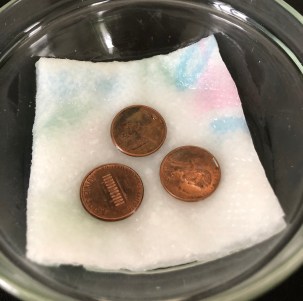
  4. Place a few pennies in the bowl and leave for five minutes.
  5. Take the pennies out and place them on the paper towel.
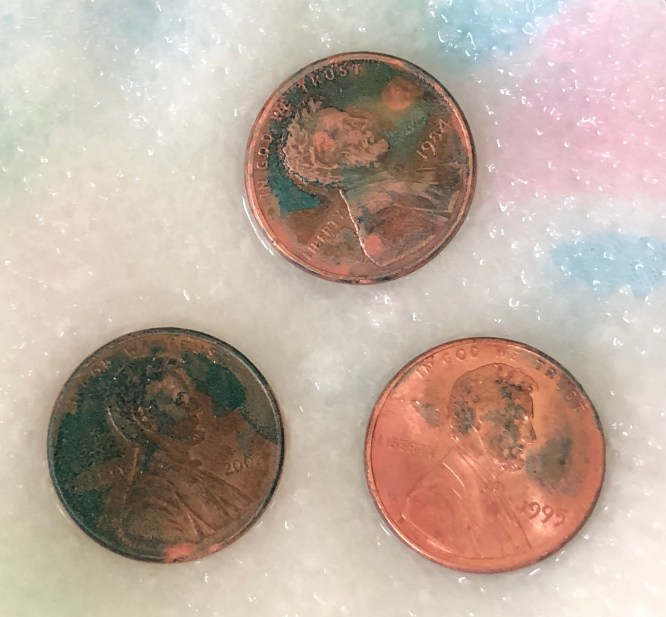
  6. Let the pennies dry and watch what happens. The reaction becomes more dramatic over time, so check on your pennies at different times throughout the day

Extra Observation:

  1. To see the chemical reaction at work, dip one penny half way into the vinegar/salt solution and wait a minute
  2. Lift the penny out of the solution and see the result

IMG_6588

Experiment 2

  1. Fold a paper towel to several thicknesses and place in bowl
  2. Place a few pennies on top of the paper towel
  3. Pour enough vinegar over the pennies to saturate the paper towel
  4. Wait two to three hours and see what happens
  5. You can leave the pennies in the bowl and continue to add vinegar as the paper towel dries. Flip the pennies over to create a chemical reaction on both sides

IMG_6590

Experiment with other acids, such as the lemon juice.

Why do the pennies turn green?

Pennies are made of copper. The vinegar and salt solution helps the copper react with oxygen in the air to form the blue-green patina of malachite on the surface of the penny. This chemical reaction is called oxidation. You can see the same green color on other things made of copper like plumbing pipes and many statues—even the Statue of Liberty!

If you’d like to record your observations of your pennies like a chemist does, download and print this lab sheet.

Picture Book Review

February 2 – It’s National Women Inventors Month

celebrate-picture-books-picture-book-review-the-girl-who-thought-in-pictures-cover

About the Holiday

This month we celebrate all the women, past and present, who have changed the world for the better with their inventions and innovations! Every day, women are working in all industries researching and creating the next products, services, medicines, machinery, games, and some things we can’t even imagine yet that will revolutionize the way we live. Who are these women? They might be your friends, neighbors, sisters, daughters—or maybe even you! To celebrate this month, read up on amazing women inventors, and, if you have a big idea, work to get it noticed and on the market!

The Girl Who Thought in Pictures: The Story of Dr. Temple Grandin

Written by Julia Finley Mosca | Illustrated by Daniel Rieley


If you feel different and sometimes discouraged, the story of Temple Grandin may help you see that everyone has a talent and their own place in the world. Temple was born in Boston and “unique from the start, / an unusual girl, / she loved spinning in circles / and watching things twirl.” Loud sounds, big crowds, bright lights, and scratchy clothes disturbed her. And she did not like to get a “big squeezy hug.”

celebrate-picture-books-picture-book-review-the-girl-who-thought-in-pictures-too-loud

Image copyright Daniel Rieley, 2017, text copyright Julia Finley Mosca, 2017. Courtesy of The Innovation Press.

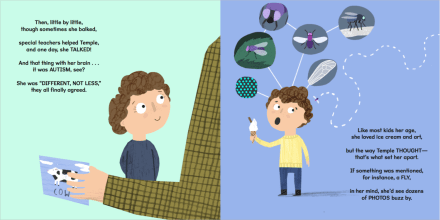
When she became overloaded with stress and frustration, Temple was known to “kick, holler, bang, shrieeeeek! Yet, still, by age three, not one word did she speak.” People told Temple’s parents that she’d never be normal and to send her away, but her mother would not hear of it. With a lot of work, special teachers helped Temple learn to talk. “And that thing with her brain… / it was AUTISM, see? / She was ‘different not less,’ / they all finally agreed.”

celebrate-picture-books-picture-book-review-the-girl-who-thought-in-pictures-doctor

Image copyright Daniel Rieley, 2017, text copyright Julia Finley Mosca, 2017. Courtesy of The Innovation Press.

While Temple was like her peers in many ways, she interacted with words differently. “If something was mentioned, / for instance, a fly, / in her mind, she’d see dozens / of PHOTOS buzz by.” Her different view point made it hard for her at school. The other kids chased her and teased her for the way that she acted and for “…saying things / over and over. / and over… / and over… / AND over.” When she had finally had enough, “she threw a book at a kid / and was kicked out of school!” No one understood Temple and Temple couldn’t understand them.

celebrate-picture-books-picture-book-review-the-girl-who-thought-in-pictures-fly

Image copyright Daniel Rieley, 2017, text copyright Julia Finley Mosca, 2017. Courtesy of The Innovation Press.

Her mother then sent her to visit her aunt, who lived on a ranch out west. Here, among the animals, Temple felt better. Her favorites were the cows, so silent and sweet. “At a NEW school that fall, / Temple found more support / said a teacher who taught her: / ‘You’ll never fall short.” That teacher was right, and at engineering and science she felt right at home.

Her first invention—made from memory—was “a machine / like she’d seen on some farms, / an INVENTION that hugged her / with boards, and not arms.” In this device she felt snug and calm, just like the cows. As she began to succeed, Temple came to see that her attention to detail was a benefit, and she began to feel special. Then she learned about farms where the cows were not treated kindly and resolved to change that.

celebrate-picture-books-picture-book-review-the-girl-who-thought-in-pictures-cows

Image copyright Daniel Rieley, 2017, text copyright Julia Finley Mosca, 2017. Courtesy of The Innovation Press.

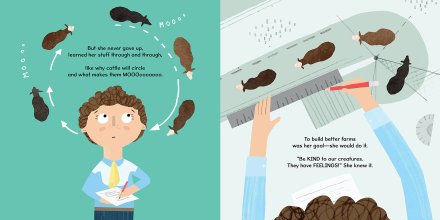
She went on to college and became an expert on farms, earning three degrees. Telling people about her ideas for farming improvements was sometimes scary because they ignored her and, well…weren’t very sweet. But she didn’t give up. She learned more about cattle, like why they circle and moo. “To build better farms / was her goal—she would do it. / ‘Be KIND to our creatures. / They have FEELINGS!’ She knew it.”

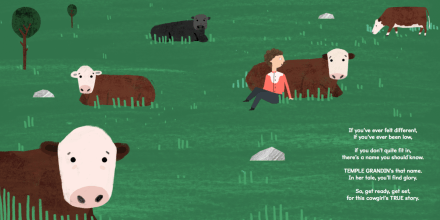
It took time, but people began to see that Temple was right, and farm after farm implemented her ideas. She won awards for this work and other ideas, a movie was made about her life, and she now travels the world telling her story and teaching: “‘Each person is special– / so UNIQUE are our minds. / This world needs YOUR ideas. / It takes brains of ALL kinds!”

celebrate-picture-books-picture-book-review-the-girl-who-thought-in-pictures-letter

Image copyright Daniel Rieley, 2017, text copyright Julia Finley Mosca, 2017. Courtesy of The Innovation Press.

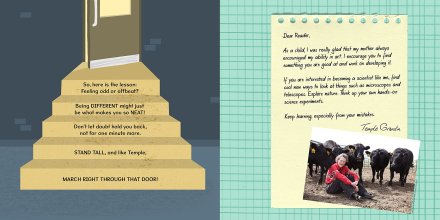
A letter from Temple Grandin to young readers, extensive information about Temple and tidbits from her interview with the author, a timeline of her life, and resources follow the text.

Julia Finley Mosca’s insightful biography of Temple Grandin offers inspiration and encouragement to children at those times when life seems difficult or if they feel misunderstood. Childhood can be filled with moments—both small and large, short or long—when comfort and reassurance are needed. Mosca’s rhyming verses make Temple’s story accessible to a wide age range of readers while providing an inclusive way to show how autism creates a different way of experiencing the world. Temple’s supportive teachers are role models for all educators. Temple Grandin’s fascinating life demonstrates that there is a niche for everyone and that through understanding, perseverance, and acceptance, all children can go far.

celebrate-picture-books-picture-book-review-the-girl-who-thought-in-pictures-cows-in-field

Image copyright Daniel Rieley, 2017, text copyright Julia Finley Mosca, 2017. Courtesy of The Innovation Press.

Daniel Rieley’s cartoon-style illustrations will resonate with readers as Temple takes in everything she sees with wide-open eyes and interprets it in her own way—even before she can speak. The separation between Temple and the other students at her first school is poignantly communicated in a two-page spread in which pointing hands and a lobbed ball of paper appear from the left-hand margin and Temple reads alone on the far side of the right-hand page. Temple’s ability to think in pictures is demonstrated throughout the book with inset images. Readers see some of the farming practices Temple wanted to change, her original drawings, and the resulting equipment now used on farms to improve the conditions of the animals raised there.

The Girl Who Thought in Pictures: The Story of Dr. Temple Grandin is a moving and motivational story for all children and is a must for school and public libraries.

Ages 5 – 10

The Innovation Press, 2017 | ISBN  978-1943147304

Discover more about Julia Finley Mosca and her Amazing Scientists series on the Amazing Scientists website.

Learn more about Daniel Rieley, his books, and his art on his website.

National Women Inventors Month Activity

celebrate-picture-books-picture-book-review-women-in-stem-coloring-book

Historical Women in STEM Coloring Book


From civil engineering to chemistry and botany from radio waves to computer programming, the five women in this coloring book changed science and the world. Enjoy coloring the pages and learning about these amazing women in this printable: Historical Women in STEM Coloring Book

Picture Book Review

September 4 – National Wildlife Day

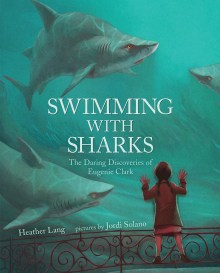
celebrate-picture-books-picture-book-review-swimming-with-sharks-cover

About the Holiday

National Wildlife Day, founded in 2005, serves to bring awareness to the number of endangered animals that need to be preserved and rescued each year. The holiday also acknowledges the zoos, outstanding animal sanctuaries, and other global organizations for everything they do to help preserve this planet’s animals and educate the public about conservation – especially the children, who are our future conservationists and animal’s caretakers.


Swimming with Sharks: The Daring Discoveries of Eugenie Clark

Written by Heather Lang | Illustrated by Jordi Solano


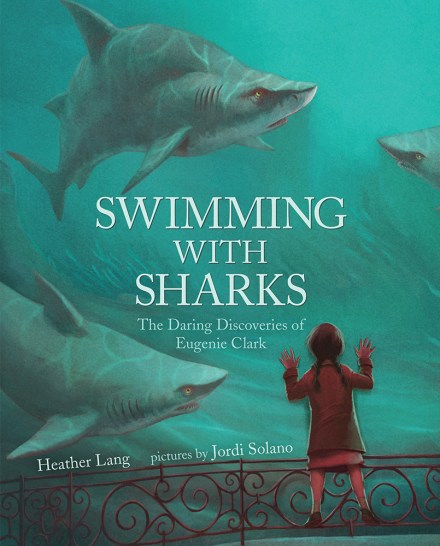
When young Eugenie Clark pressed her face against the aquarium window at the sharks swimming by, she did not see “piercing eyes…rows of sharp teeth…vicious, bloodthirsty killers.” Instead she saw “sleek, graceful fish” and dreamed of being inside the tank to swim among them. She loved to spend Saturdays at the New York Aquarium sharing her knowledge of fish with visitors. She wished there was more information available about sharks and hoped for a day when she could learn more about them.

celebrate-picture-books-picture-book-review-swimming-with-sharks-at-aquarium

Image copyright Jordi Solano, 2016, courtesy of plumpuddingillustration.com

At home her mother bought Genie her own little fish tank, and soon the whole apartment was full of fish and reptiles. Genie kept careful notes on her pets as she tried to answer her many questions. William Beebe, a famous scientist who studied fish, was Genie’s hero. She too wished to explore the ocean like he did. But this was the 1930s and not many people “dared to study the depths of the sea, and none were women.” Eugenie’s mother suggested she study typing and try to become Beebe’s secretary. The life of a secretary was not what Genie had in mind.

Eugenie received a Master’s Degree in zoology, and when a well-known ichthyologist offered her a job as his research assistant and an opportunity to take oceanography classes, she moved to California. There she collected fish and water samples. The beauty of the underwater world astonished her. In the lab she was able to dissect a swell shark to learn “how and why it puffs up.” But Genie wanted to dive deeper—to swim with sharks.

celebrate-picture-books-picture-book-review-swimming-with-sharks-studying

Image copyright Jordi Solano, 2016, courtesy of plumpuddingillustration.com

One day, Genie’s professor allowed her to try helmet diving. Wearing the heavy metal helmet, Genie was able to descend into the cold, murky deep where kelp forests waved with the current. “In 1949 the US Navy hired Genie to study poisonous fish in the South Seas. As she collected fish, she came face to face with a shark. The shark swam closer and closer then suddenly dove and disappeared out of sight. Genie was thrilled by the encounter.

In 1955 Eugenie moved to Florida and opened the Cape Haze Marine Laboratory, becoming the first to study sharks in their natural environment. The more she studied sharks, the more she realized that they were intelligent creatures, not stupid “eating machines” as most people thought. She wondered if sharks could be trained.

Eugenie set up an experiment in which a shark needed to press a white board to receive a reward a short swim away. Soon, the female shark of the pair realized that if the male shark pressed the board, she could swim to retrieve the reward. The pair remembered the exercise even after a ten-week break. Soon, scientists from around the world wanted to work with Genie. 

celebrate-picture-books-picture-book-review-swimming-with-sharks-swimming-under-water

Image copyright Jordi Solano, 2016, courtesy of plumpuddingillustration.com

Word reached her about “‘sleeping sharks,’” off the coast of Mexico. Instead of swimming around, these sharks stayed on the ocean floor. Eugenie was determined to learn how they breathed without moving. She dived deep into their territory, finding a requiem shark in an ocean cave. Here, she was face-to-face with one of the most feared fish in the sea. Genie swallowed any worry and watched as the fish opened and closed its mouth, providing itself with oxygen as a remora fish cleaned its gills.

Genie took water samples and completed other tests that revealed astonishing facts about the ocean caves and the habits of sharks. But while Genie was learning the facts about these mysterious sea creatures, most people still feared them and considered them with suspicion and superstition. As time went by, Genie began seeing fewer and fewer sharks on her dives. They were being killed out of fear, for their fins, and because people thought it would make beaches safer.

celebrate-picture-books-picture-book-review-swimming-with-sharks-sunset

Image copyright Jordi Solano, 2016, courtesy of plumpuddingillustration.com

Genie began talking about her research, and people listened. “Dr. Eugenie Clark had become one of the most respected fish scientists in the world.” She taught people that there is always more to learn and “always more surprises.”

An extensive Author’s Note about the life and work of Eugenie Clark as well as more information on sharks follows the text.

Heather Lang delves into the life’s work of a woman who fearlessly challenged herself and the prevailing science to increase our knowledge of sharks and change people’s perspective on these beautiful creatures. Readers will love Lang’s comprehensive storytelling—beginning with young Genie’s fascination with fish and the sea—that reveals the pivotal events which led to her discoveries. Fascinating anecdotes from Eugenie’s research and personal encounters with sharks will enthrall children, and the idea that there is much more to discover will resonated with young scientists in the making.

celebrate-picture-books-picture-book-review-swimming-with-sharks-looking-at-shark

Image copyright Jordi Solano, 2016, courtesy of plumpuddingillustration.com

Jordi Solano takes readers to the depths of the ocean in his sea-green, atmospheric illustrations that beautifully mirror the world of sharks. Textured and layered images of marine plants and a variety of creatures give children an up-close view of Eugenie Clark’s work and the fish she encountered on her dives. Each type of shark is magnificently and realistically drawn, giving kids an idea of coloring, size, movement, and more. Children will also see Eugenie’s research facilities and the equipment she used in her studies.

For anyone interested in marine science, history, biographies, or the environment in general, Swimming with Sharks: The Daring Discoveries of Eugenie Clark is a can’t-miss book.

Ages 5 – 9

Albert Whitman & Company, 2016 | ISBN 978-0807521878

Discover more about Heather Lang and her books on her website!

View a gallery of artwork by Jordi Solano on Plum Pudding Illustration!

National Wildlife Day Activity

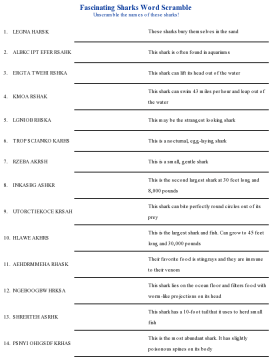
celebrate-picture-books-picture-book-review-fascinating-sharks-word-scramble

Fascinating Sharks Word Scramble


Read the clues and unscramble the names of 14 types of sharks in this printable Fascinating Sharks Word Scramble! Here’s the Solution!

celebrate-picture-books-picture-book-review-swimming-with-sharks-cover

You can find Swimming with Sharks at these booksellers

Amazon | Barnes & Noble | Books-a-Million | IndieBound

Picture Book Review