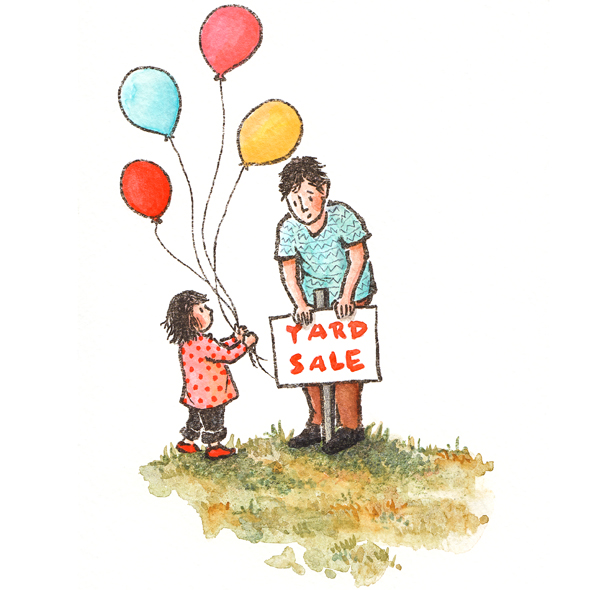
Garage Sale Day was created in 2001 by C. Daniel Rhodes of Alabama, who noticed that his neighbors were holding separate garage sales on different weekends. He decided that it might be convenient and lucrative for sales to be coordinated on the same weekend instead. If you have extra stuff filling up your attic, garage, basement, or cabinets, why not take today’s inspiration to hold or plan a garage or yard sale of your own. If you just feel like getting out or have a shelf, nook, or need that could be filled with a new-to-you item, check out the garage sales in your area and make a day of it!
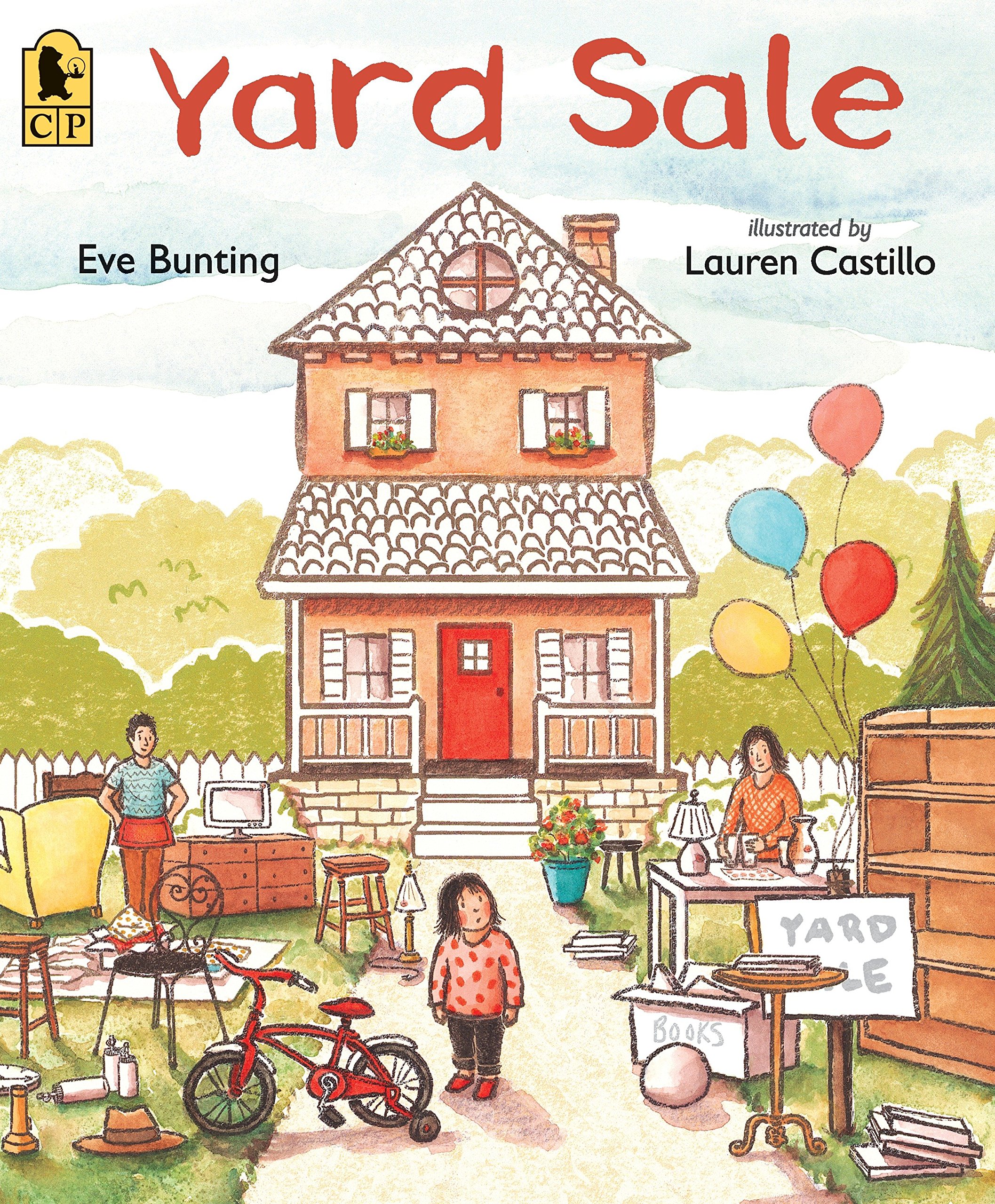
Yard Sale
Written by Eve Bunting | Illustrated by Lauren Castillo
From the first words—“Almost everything we own is spread out in our front yard”—readers realize that this is no ordinary yard sale. A little girl sits on the front porch of her tidy house gazing out sadly at the family’s furniture, toys, books, and knick-knacks that are all for sale. The family is moving to a small apartment: “‘Small but nice,’ my mom told me.” The apartment has a secret bed that opens down from the wall “right in the living room.”
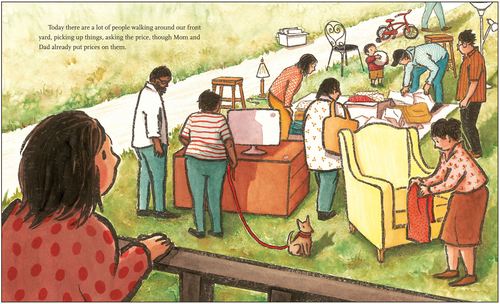
When the yard sale opens people stop by to look, “picking up things, asking the price, though Mom and Dad already put prices on them.” Even though the items are priced low, people haggle over how much they want to pay. A woman complains that ten dollars is too much for the little girl’s bed because the headboard has crayon marks on it. Watching, Callie now wishes she hadn’t made the marks to show how often she had read Goodnight Moon. Her mother settles for five dollars for the bed.
Image copyright Lauren Castillo, text copyright Eve Bunting. Courtesy of laurencastillo.com
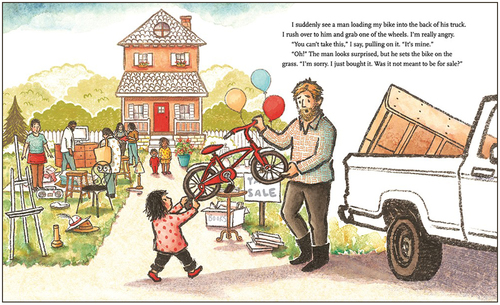
Suddenly, Callie sees a man loading her bike into a truck and runs to grab it. The man is confused, sorry for taking it, but tells her he has just bought it. Callie’s dad runs over and explains again that the apartment has no place for the bike or sidewalks nearby to ride it on. Callie looks at her dad who seems to have tears in his eyes. “But probably not,” she decides. “My dad doesn’t cry.” She relinquishes the bike, but asks the man, “‘Will you give it back to me when we get our house back?’”
Callie’s best friend, Sara, is waiting for her. The two friends hug and talk about why Callie has to move. “‘I wish you didn’t have to go,’” Sara mutters. “‘Why do you, anyway?’” Callie shrugs. “‘I don’t know. It’s something to do with money.’” They don’t understand what has happened, and Sara offers, “‘I could ask my parents if you could stay with us.’” But Callie’s heart tells her where she belongs. “‘My parents would be lonely,’” she says. “‘…I’d miss my mom and dad.’”
Image copyright Lauren Castillo, text copyright Eve Bunting. Courtesy of laurencastillo.com
The sale continues and people drive away with tables, chairs, and clothing. For a moment, Callie feels important when a man asks her if their large potted geranium is for sale and she directs him to her dad. By the end of the day almost everything is gone. Callie’s mom “looks droopy” and her dad is comforting her. Callie sits dejectedly watching the final things being carried away and thinking that she will give Sara her red heart necklace and invite her to visit their new apartment.
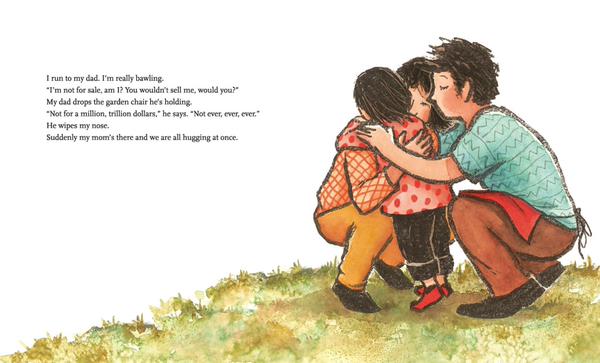
At that moment a woman comes up to Callie and says, “‘Aren’t you just the cutest thing? Are you for sale?’” Callie has a visceral reaction: “A shiver runs through me, from my toes to my head.” She runs to her parents, crying. “‘I’m not for sale, am I? You wouldn’t sell me, would you?’” Her parents drop what they are doing to hug and reassure Callie that they would “‘not ever ever, ever’” sell her. “‘Not for a million, trillion dollars.’”
Image copyright Lauren Castillo, text copyright Eve Bunting. Courtesy of Candlewick Press
With everything gone, Callie and her parents go back inside their “almost empty house.” It’s okay, Callie thinks. None of the stuff is important, and it wouldn’t fit in their new place anyway. “But we will fit in our new place. And we are taking us.”
For so many children frequent relocations or sudden moves from a home they know is a reality. Eve Bunting’s Yard Sale treats this subject with sensitivity and honest emotion through the eyes of a little girl for whom the change is confusing but ultimately reassuring. Bunting does not stint on either the setting of the yard sale itself, where people quibble over a couple of dollars, or the toll the day takes on the family. Her dialogue always rings true, and her straightforward delivery allows for understanding and for the moments of humor to shine through.
Image copyright Lauren Castillo, text copyright Eve Bunting. Courtesy of laurencastillo.com
Lauren Castillo’s ink-and-watercolor paintings anchor this emotional story in a homey, loving environment even as they realistically portray the atmosphere of the yard sale. The full range of feelings are apparent in the characters’ faces from sadness and doubt to kindness and acceptance. Children will respond to Callie with her earnest attempts to understand and feel the comfort and encouragement Callie receives as her parents bend down to talk to her, hold her hand, and give her hugs.
Yard Sale is a poignant story that offers assurance and insight both for children who are facing a move and the friends and classmates who will miss them. The book’s theme is applicable to other daunting circumstances and would be a welcome addition to classroom and local libraries as well as for individuals encountering change.
Ages 4 – 9
Candlewick Press, 2017 (paperback); ISBN 978-0763693053 | 2015 (hardcover); ISBN 978-0763665425
To view more books and artwork by Lauren Castillo, visit her website!
National Garage Sale Day Activity
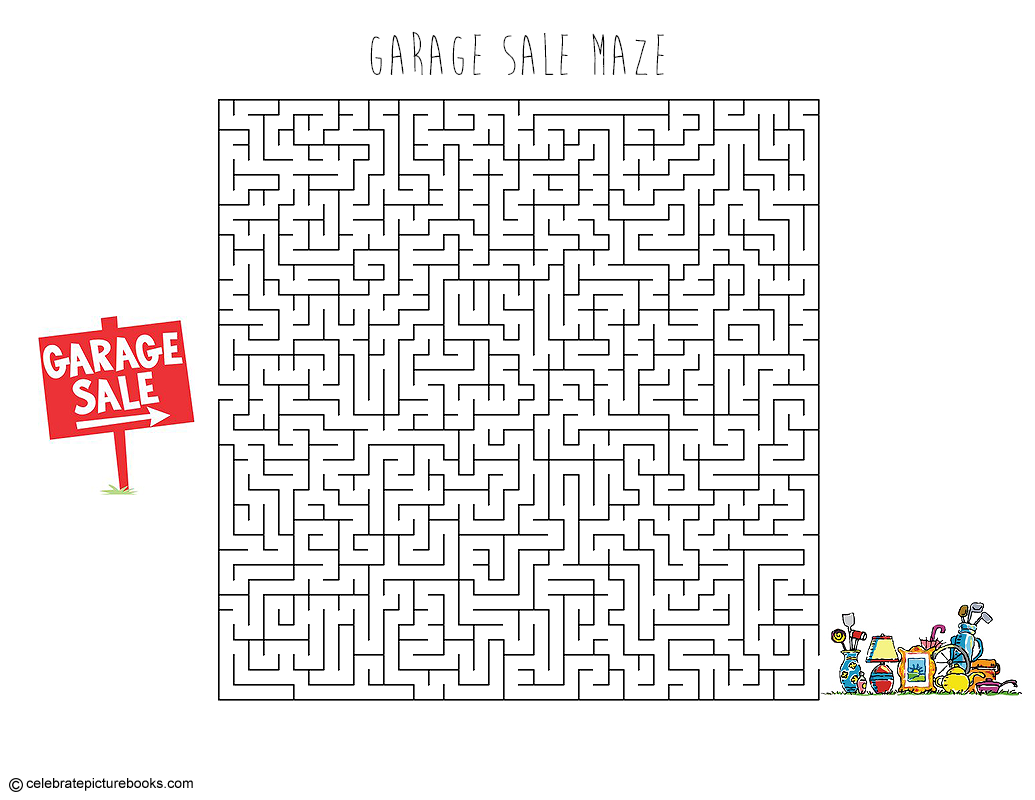
Garage Sale Maze
A garage sale is a bit like a treasure hunt. Can you find your way through this printable Garage Sale Maze from the roadside sign to the items for sale? Here’s the Solution!
This year World Elephant Day celebrates its 10th anniversary. The holiday was launched to raise awareness of the dangers the Asian and African elephant populations face. Poaching, habitat destruction, human-elephant conflict, and mistreatment in captivity all threaten these gentle, intelligent creatures. World Elephant Day encourages people to enjoy seeing elephants in safe, non-exploitive environments and to get involved in their protection and survival. To learn more about elephants, discover how you can be elephant ethical, and commemorate today’s holiday with virtual events led by elephant specialists, artists, zoos, and other organizations, visit theWorld Elephant Day website.
Thanks to Familius for sending me a copy of She Leads: The Elephant Matriarch for review consideration. All opinions on the book are my own.
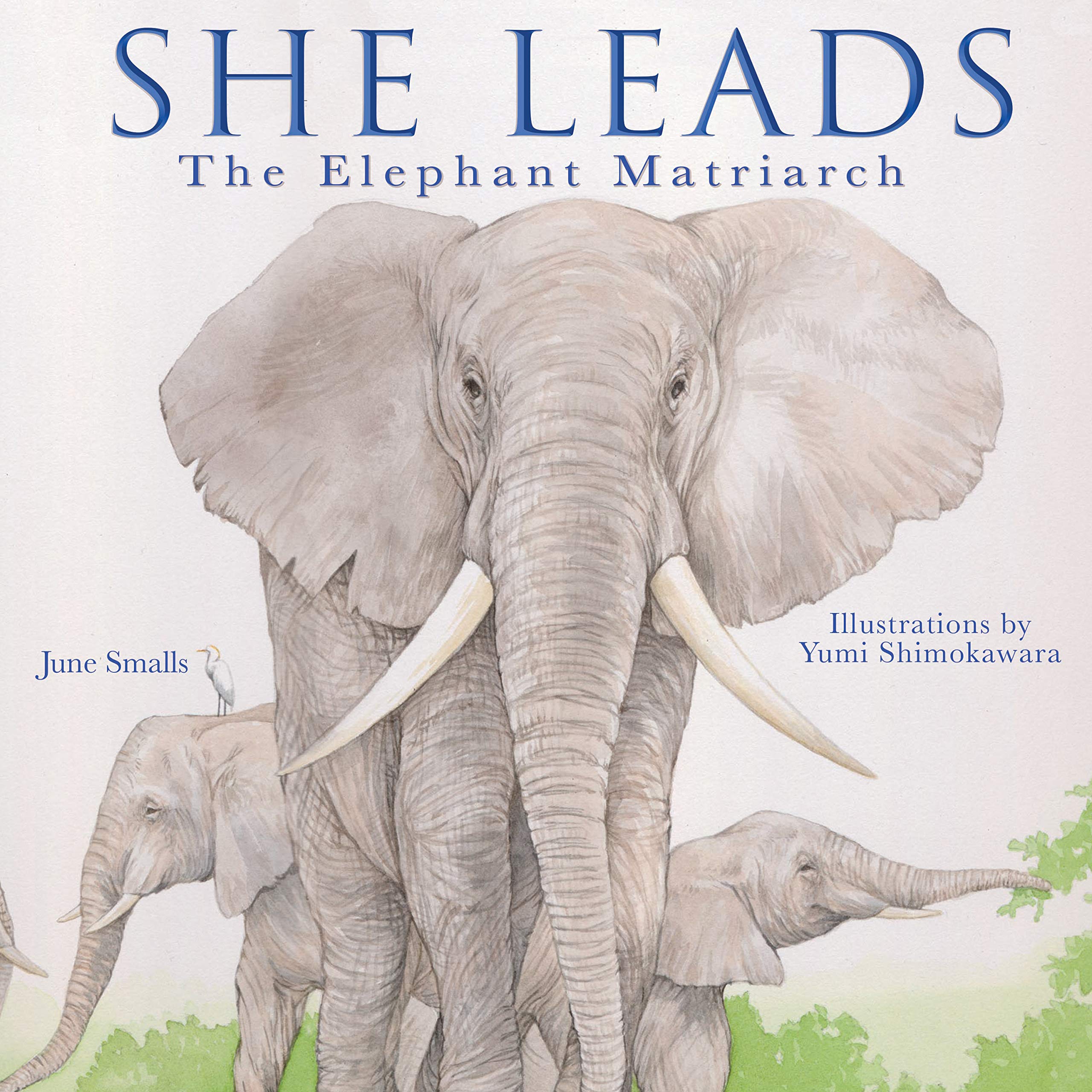
She Leads: The Elephant Matriarch
Written by June Smalls | Illustrated by Yumi Shimokawara
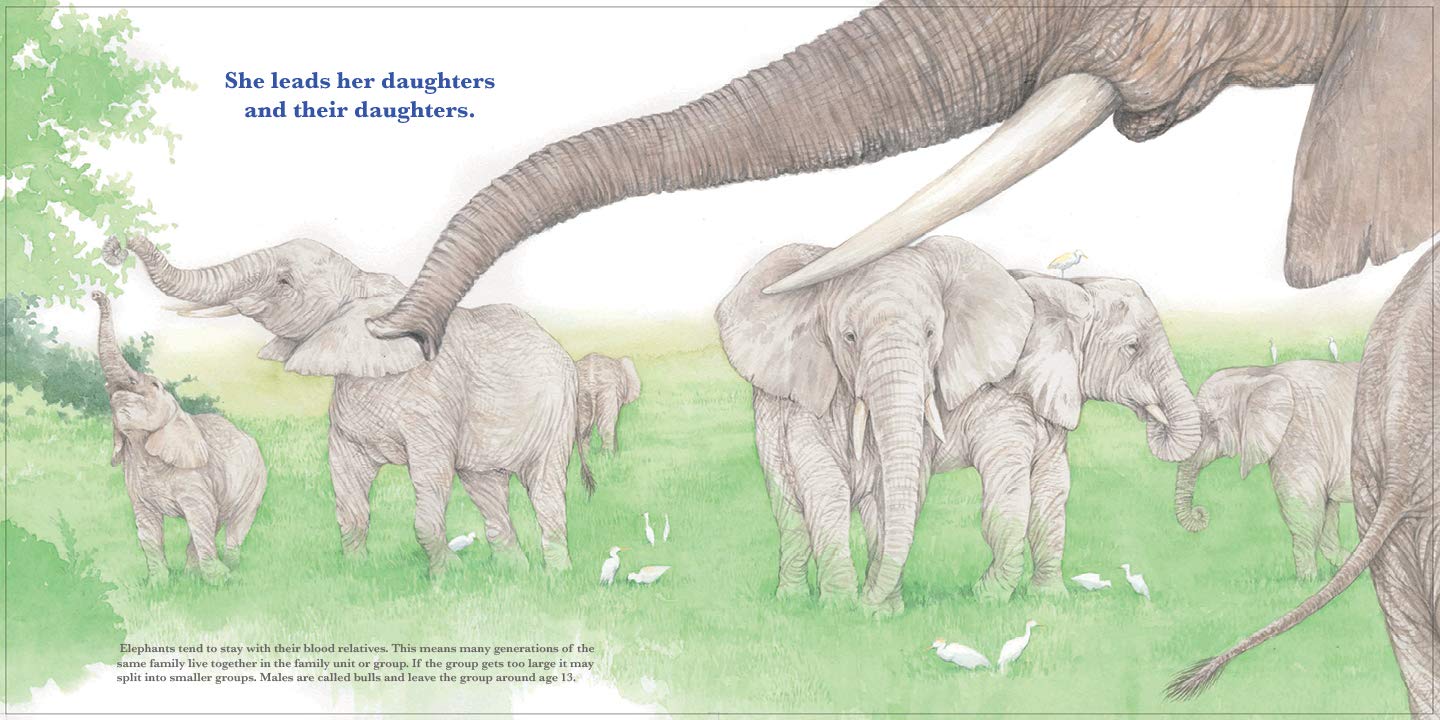
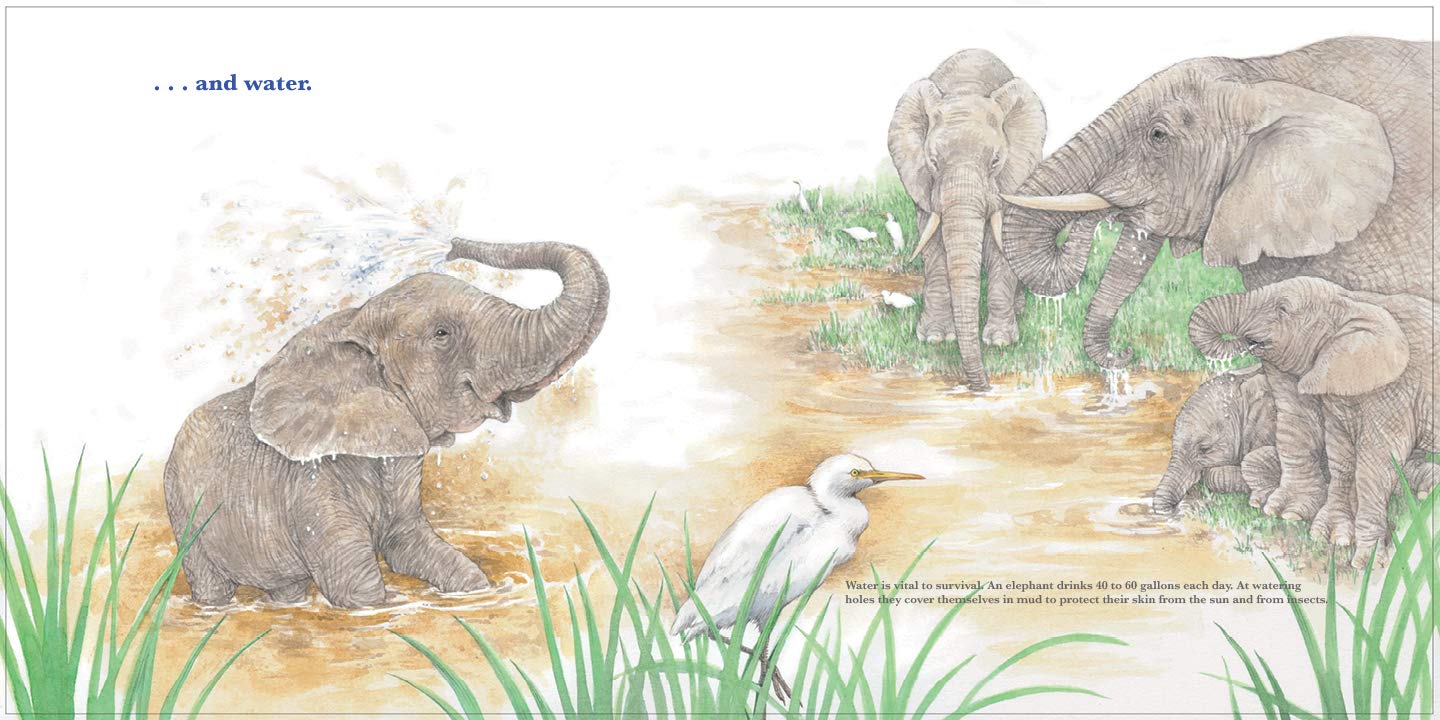
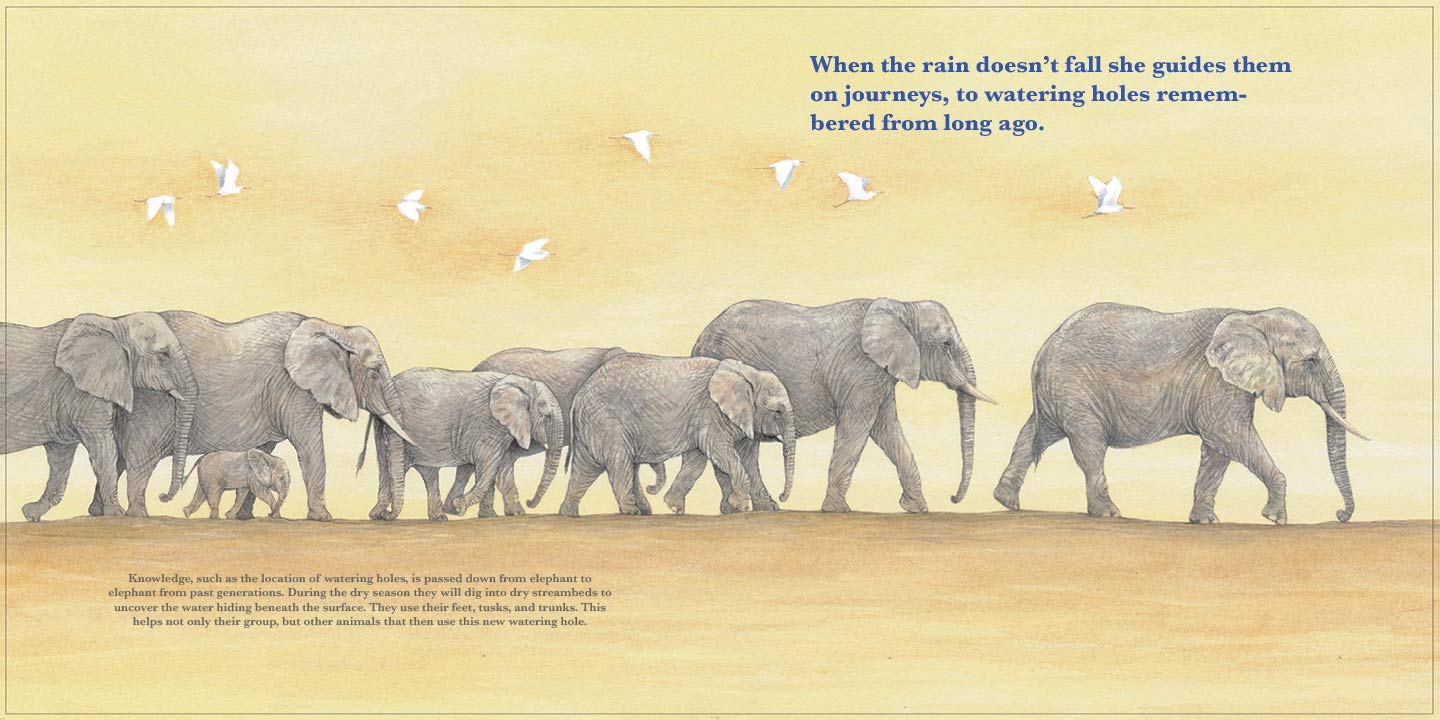
The elephant matriarch is the queen of the family group. “She is usually the oldest, but not always. It is her job to guide and teach her subjects to give them the best opportunities for survival.” Her family group consists of blood relatives—daughters and granddaughters—living together. When groups get too big, some elephants break off and form their own group. The matriarch leads the other elephants to food and water, and when water is scarce “she guides them on journeys to watering holes remembered from long ago.”
Image copyright Yumi Shimokawara, 2020, text copyright June Smalls, 2020. Courtesy of Familius.
Like a loving grandmother, the matriarch teaches younger elephants how to take care of their little ones. Everyone in the family group helps rear the young. “The clumsy babies are sometimes caught in mud or water and the older elephants will work together to push, pull, or dig to rescue them.”
Sometimes, groups of elephants that once lived together will meet. They remember each other and spend time “foraging for food together. These meetings are like a family reunion.” When danger from another animal lurks, the elephants watch and learn how the matriarch defends them. They also huddle together and surround the smaller elephants for protection. “If nature, or predators, or poachers take her friends, she will comfort and care for the orphans.”
Image copyright Yumi Shimokawara, 2020, text copyright June Smalls, 2020. Courtesy of Familius.
Little ones grow and play under the watchful eye of the matriarch and, just like human children, “elephants are not born with all the skills they need.” The matriarch helps teach her children, grandchildren, and great-grandchildren how to use their trunks for heavy work like moving logs and for delicate finessing, such as having the “ability to gently pluck a leaf from a tree.”
Image copyright Yumi Shimokawara, 2020, text copyright June Smalls, 2020. Courtesy of Familius.
The matriarch also thinks about the future when she won’t be able to lead the group anymore. She passes on her knowledge and skills to the elephants in her lineage, “so that when she is gone another matriarch will lead her family.” When the matriarch does die, the elephants mourn their loss in ways similar to humans. “Elephants have been observed burying their dead with grasses and branches,” and they will return to the spot months later to “touch the bones of their lost family member.” A new matriarch emerges to lead the family group. This is “usually the oldest daughter of the matriarch,” and her call “to her daughters and their daughters” can be heard for miles and miles – sometimes up to 110 square miles – as this new queen begins her reign.
Image copyright Yumi Shimokawara, 2020, text copyright June Smalls, 2020. Courtesy of Familius.
June Smalls’ tribute to the matriarchal society of elephants and, through her lyrical storytelling, to strong women in every family and community is both poignant and powerful. The main story reveals the role of the matriarch in leading and teaching her daughters, granddaughters, and great-granddaughters over a lifetime, which can span seventy years. Smalls’ stirring text illuminates the similarities between elephants and humans in everyday needs, behavior, memory, familial care, and even in death. In addition to the story, each page spread includes fascinating, and often touching, facts about how a family group forages for enormous amounts of food, finds crucial water supplies, protects each other, rears their young, and sustains each other in the passing of the matriarch. Smalls’ book ends with an inspirational entreaty to young girls to awaken to their future role as leaders.
Yumi Shimokawara’s stunning realistic illustrations of an elephant matriarch leading and teaching her family group in the wild will thrill readers. On each page spread, young readers follow their elephant peer as she (or he, as male elephants stay with the family group until about age thirteen) plucks leaves from a sun-drenched tree, splashes in a watering hole, walks in the shade of two adults on a long, hot journey, is protected from predators, and plays games with sticks and other babies in the group. Shimokawara’s delicate color palette and beautifully composed images depict the intelligence and gentle manner of these animals in lively and tender moments that children will want to view again and again.
An exquisite combination of inspiration and education, She Leads: The Elephant Matriarch will captivate children as a spark for further learning about these majestic animals, the environment, and nature conservation as well as encouragement to bravely take their place in the world with grace, love, and strength. The book is a must for all home, classroom, and public library collections.
Ages 3 – 8
Familius, 2020 | ISBN 978-1641702324
Discover more about June Smalls and her books on her website.
You can find more books from Familius that joyfully reflect the habits of happy families, including reading, talking, laughing, eating, working, loving, healing, learning, and playing together as well as the Familius blog The Habit Hubhere.
World Elephant Day Activity
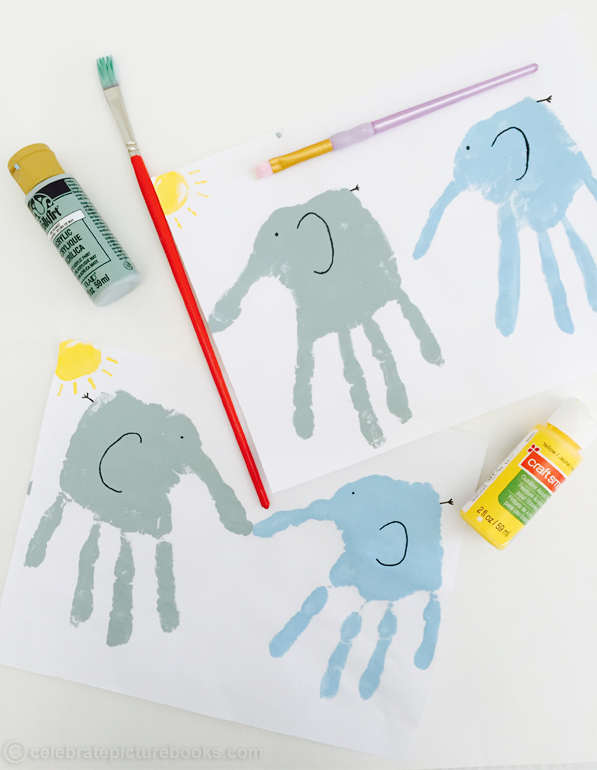
Elephant Handprint Craft
This easy craft is fun for families to do together. Using siblings’ hands or the hands of a child and an adult to make the elephants can make a meaningful and comforting picture to hang in a child’s room or gift for mom, dad, or other family members.
Supplies
Craft paint in two colors of the children’s choice
Yellow craft paint
Black fin-tip marker
Crayons, markers, or colored pencils to make a background
Paper
Paint brush
Directions
Paint one child’s hand and press it on the paper. The thumb is the truck and the fingers make the legs.
Paint the second child’s or adult’s hand and press it on the paper near the other “elephant.”
After the paint has dried, draw on ears and an eye.
Add a sun with the yellow paint or crayon.
Add grass, trees, or other background features if desired.
You can buyShe Leads: The Elephant Matriarch on the Familius website.
This post contains affiliate links. You can read my full disclosure statement here.
For centuries along rocky shores, lighthouses have stood as sturdy beacons warning ships at sea of dangerous waters. In 1789, the United States Congress approved an Act for “the establishment and support of lighthouses, beacons, buoys and public piers and the commission of the first Federal lighthouse, the Cape Henry Lighthouse at Cape May, Virginia Beach.” Two hundred years later, the anniversary of this historic event was celebrated with another Congressional resolution sponsored by Senator John H. Chafee of Rhode Island, which designated August 7 as National Lighthouse Day. On this day, where possible, the country’s lighthouses are open to the public for viewing and tours. To celebrate today, visit a lighthouse if you live close by or read up on lighthouses and the work of brave lighthouse keepers throughout history.
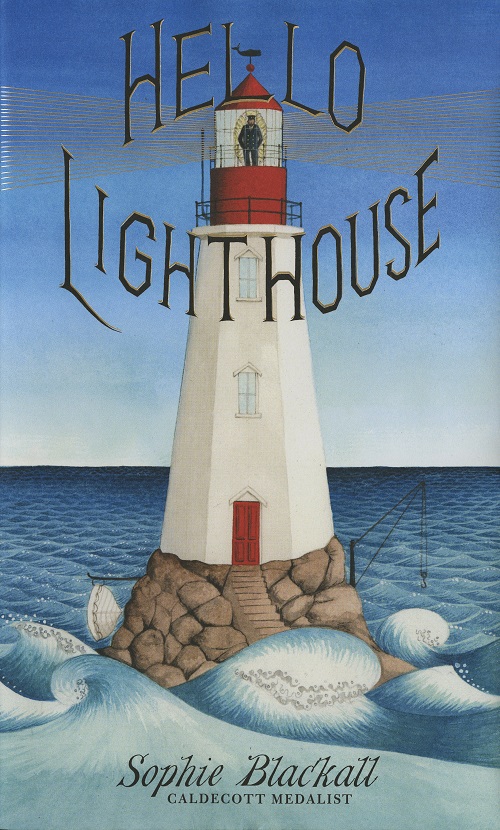
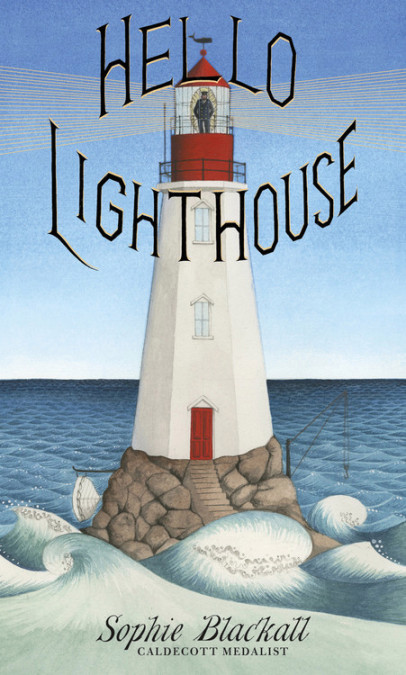
Hello Lighthouse
By Sophie Blackhall
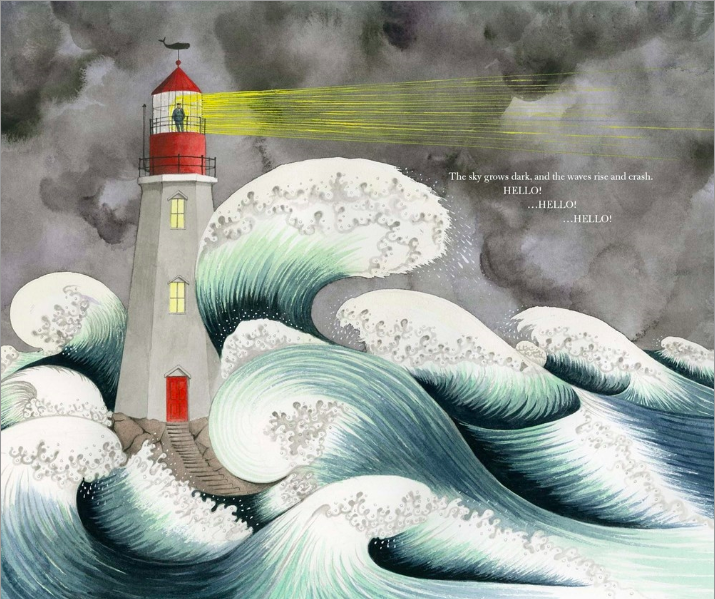
“On the highest rock of a tiny island at the edge of the world stands a lighthouse.” It is sturdy and shines its greeting far out to sea, “guiding the ships on their way.” “Hello! …Hello! …Hello!” The lighthouse has just gotten a new keeper. He begins his job by polishing the lens, refilling the oil, trimming the wick, and giving the “round rooms a fresh coat of sea-green paint.” He works at night too, making sure that the clockwork is wound to keep the lamp moving and writing in the logbook.
Copyright Sophie Blackall, 2018. Courtesy of Little Brown Books for Young Readers.
To have his tea, the keeper must boil his water and for lunch or dinner he fishes for cod right from the lighthouse window. He wishes for someone to talk to—the special someone he writes letters to. He puts these letter in bottles and throws them into the sea. Outside, the wind whips up the waves and they crash against the lighthouse.
One day, the keeper spies the tender ship that is bringing him “oil and flour and pork and beans…and his wife.” The next day fog descends, thick and gray. Instead of a beam of light, a bell clangs to warn the ships away. But, still, a ship founders and breaks apart on the rocks. “Not a moment to lose, the keeper rows out. He pulls three sailors from the deep, black sea. He and his wife wrap them in warm blankets and serve them hot tea. The keeper makes note of all this in his log.
Copyright Sophie Blackall, 2018. Courtesy of Little Brown Books for Young Readers.
In the winter, “the sea turns into a carpet of ice.” The keeper falls ill, and his wife tends to him as well as to the light. She runs up and down the spiral stairs to feed her husband broth and “chip ice off the lantern room windows.” At last his fever breaks. With warmer weather the ice melts, giving way to icebergs that float by going south. “Whales pass by on their journey north.”
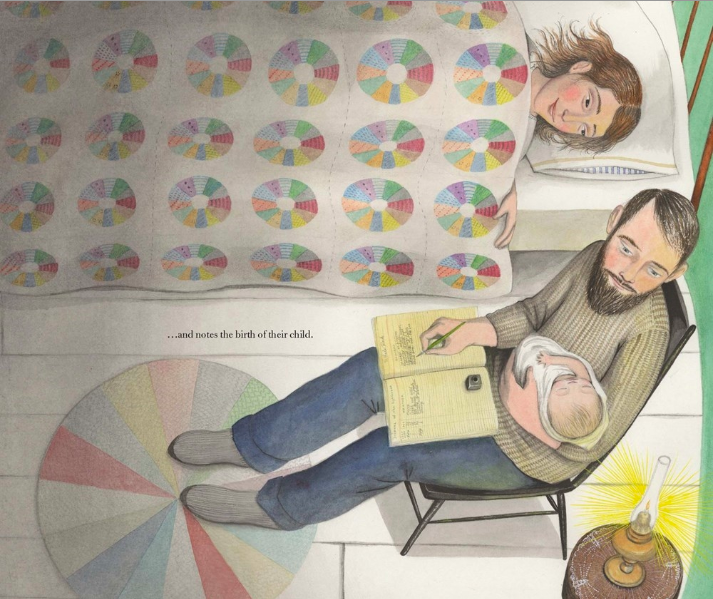
Inside the lighthouse, the keeper’s wife is about to have a baby. She walks around and around, while “her husband boils water and helps her breath in—and out.” When the baby is born, the keeper notes the time and date in the logbook. “The sky erupts in swirls of green. Hello! …Hello! …Hello!”
Copyright Sophie Blackall, 2018. Courtesy of Little Brown Books for Young Readers.
The baby is a toddler when the tender brings an unexpected letter with the coast guard seal along with its regular supplies. After reading it, the keeper tends to the light “just as he’s always done,” but he “knows it’s not for long.” Through the telescope, the keeper and his wife watch the horizon for the arrival of the coast guard. When they come, they install a new light—one that runs by machine. There is “no lamp to fill, no wick to trim. The keeper’s work is done.”
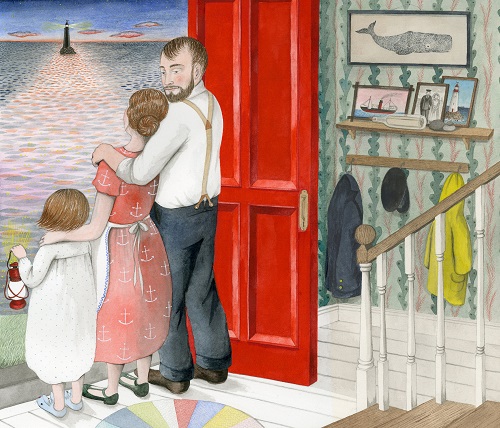
He and his wife and little girl “pack their belongings into the boat and wave farewell to the gulls.” As they sail away on the ship, they look back and say “Good-bye, Lighthouse! Good-bye! …Good-bye! …Good-bye!” From its perch on the tiny island, the lighthouse sends out its constant beam through crashing waves and enveloping fog—”Hello! …Hello! …Hello?” From across the bay, a light from a little house “beams back. Hello! …Hello! …Hello! Hello, Lighthouse!”
An expensive and fascinating Author’s Note about lighthouses, the life of a lighthouse keeper, and how Hello Lighthouse came to be follows the text.
Copyright Sophie Blackall, 2018. Courtesy of Little Brown Books for Young Readers.
As I read Hello Lighthouse, I saw myself as a child—a displaced New Englander growing up in Florida who loved everything about the craggy northern coastline and its history. I would have absolutely adored Sophie Blackall’s detailed and atmospheric book, and today’s young readers will too. The story of the light’s last keeper reveals the work and contemplations of the men and families dedicated to keeping shipping lanes safe. The weather and seasons—and ever-present logbook—are characters in their own right, just as they were for the conscientious and brave lighthouse keepers. Happy surprises—the arrival of the keeper’s wife and baby—will delight children as they add to the depth of the story.
Copyright Sophie Blackall, 2018. Courtesy of Little Brown Books for Young Readers.
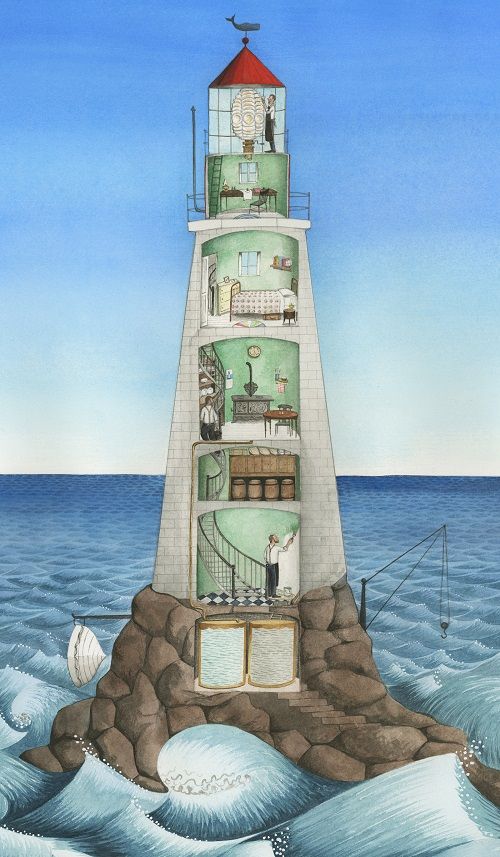
Blackall’s stunning illustrations will swell readers’ hearts with the same intensity as the rolling seas. A cutaway image of the lighthouse offers a realistic view of the five levels of living space accessed by a winding staircase that ultimately leads to the lens. Thrilling portrayals of choppy seas, wind-whipped crashing waves, pea-soup-thick fog, and sailors thrown from their wrecked ship will rivet children to the story. The cyclical nature of a keeper’s work mirrors the round rooms of the lighthouse and is represented throughout the story with circular, porthole-like snapshots of the keeper at work and round accents in the home, such as rugs, tables, and the quilt pattern on the couple’s bed. The final image of the family—the baby now a little girl—communicating with their old home anchors the story in history, togetherness, and a love of the sea.
Hello Lighthouse is a gorgeous, enlightening, and cozy read-aloud for home and classroom libraries that will enthrall young readers again and again.
Ages 4 – 9
Little Brown Books for Young Readers, 2018 | ISBN 978-0316362382 (Hardcover) | ISBN 978-1408357392 (Paperback, Orchard Books, 2019)
To learn more about Sophie Blackall, her books, and her art, visit her website.
National Lighthouse Day Activities
Shining Lighthouse Maze
Lighthouses protect ships from rocks, fog, and other dangers. Can you help the beam from the lighthouse reach the tugboat that is approaching in this printable Shining Lighthouse Maze? Here’s the Solution.
National Archives Lighthouses from the Collection
If you’re fascinated by lighthouses, you’ll love exploring these drawings from the United States National Archives. Click below to download a pdf of lighthouses from around the country.
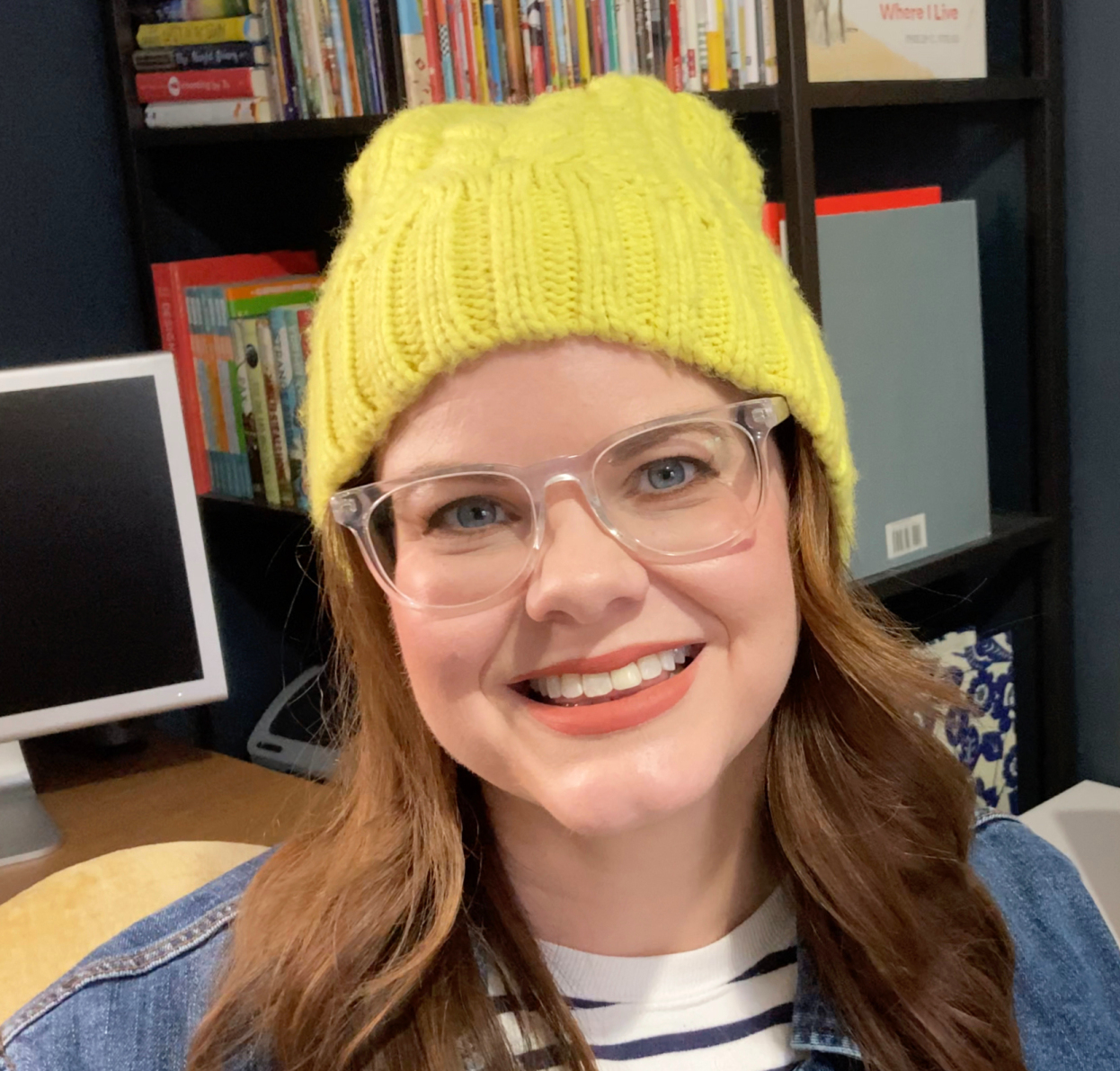
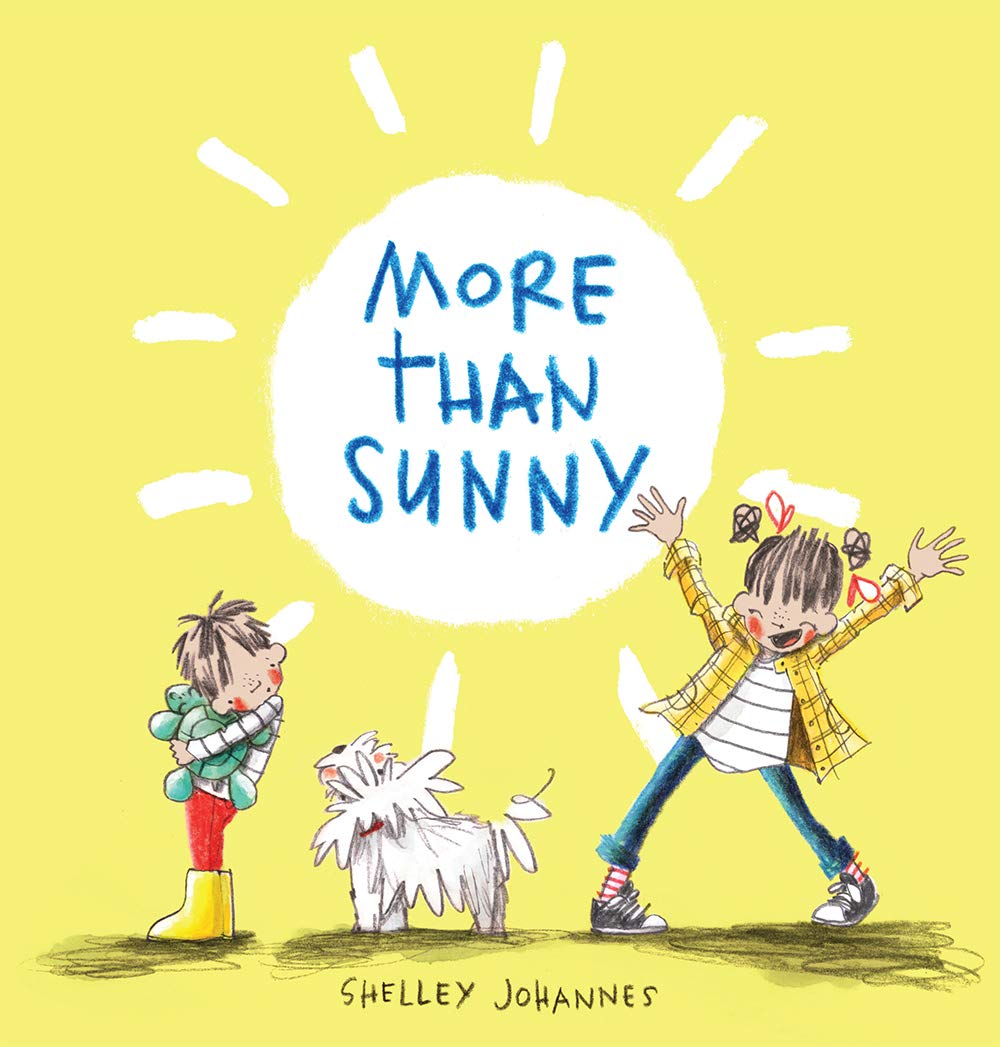
Shelley Johannes is the author-illustrator of the Beatrice Zinker, Upside Down Thinker chapter-book series. A former architectural designer, she has a fondness for tracing paper, process, and accidental discoveries. She and her family live in Michigan with two feathered friends, Max and Alex, who make every day sunny and birdy. More Than Sunny is her debut picture book.
Hi Shelley! I love how you describe all sorts of weather days in your new picture book More than Sunny, so I just couldn’t pass up a chance to share Rain Day with you! Rainy days have their own special fun, and you certainly celebrate that in your book! Of course, when the sun comes out, rainy days also bring rainbows – those beautiful symbols of optimism, something we can all use every day and which shines on every page ofMore than Sunny. Can you talk about what inspired the story?
Thank you, Kathy! And thank you so much for having me here today. Optimism is always in season, but metaphorical sunshine definitely feels even more precious these days.
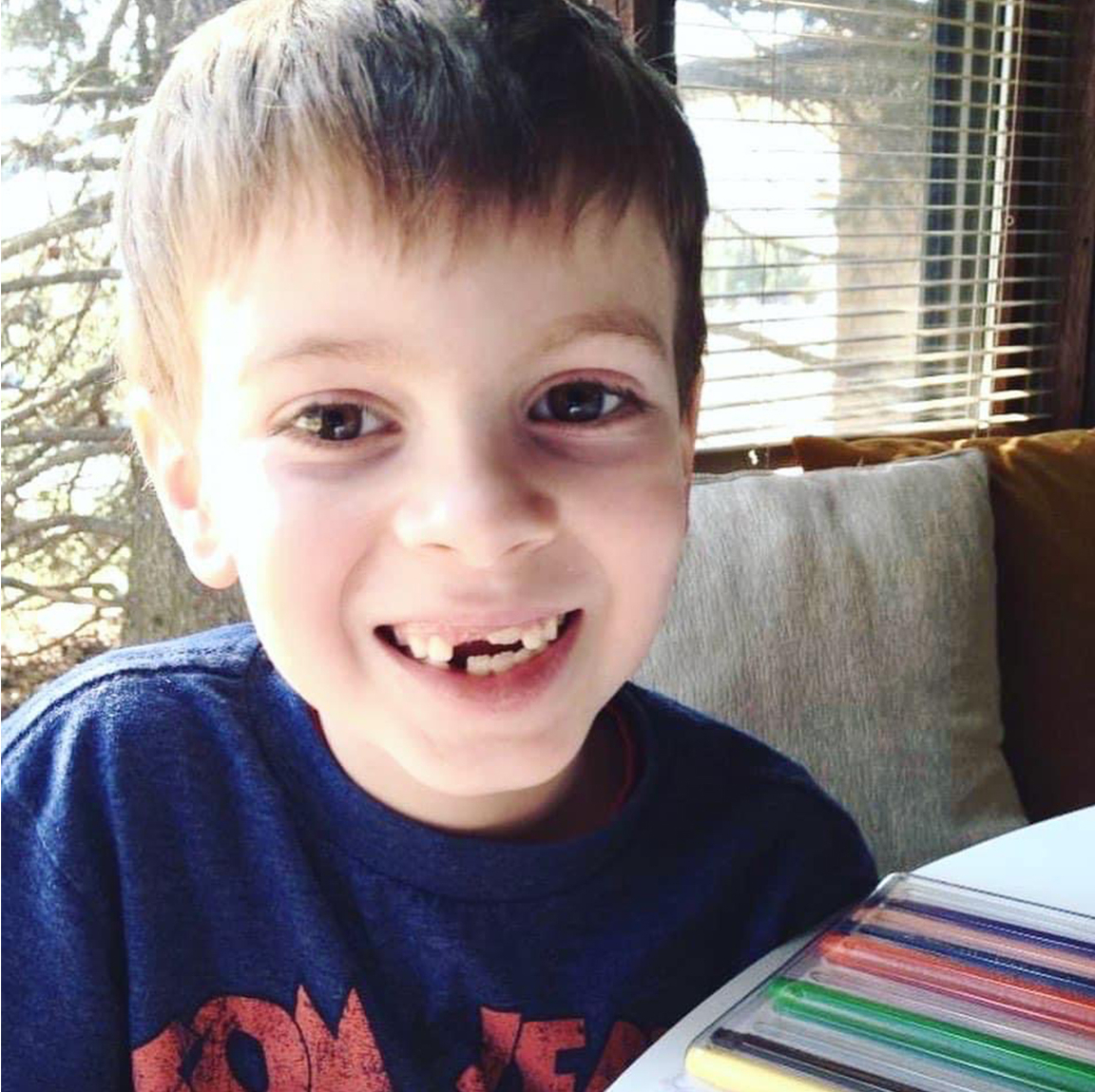
Matthew Johannes
More Than Sunny was inspired by my son Matthew and a first-grade weather project. I’d viewed his daily weather chart—the kind with columns for sunny, cloudy, rainy, windy, snowy—as a mundane task to check off our list, but on the first day, he looked outside and enthusiastically declared, “It’s sunny and birdy today!” When he called the next day “windy and squirrelly”, I knew it had to become a book someday. He turned a routine assignment into something fresh and exciting, and made me pay attention to the beauty I’d forgotten to see. That’s always book-worthy.
In More than Sunny, you describe days with nuances that delight in everything a day can possess. Using your story structure, what would your favorite day have been as a child? How about now as an adult?
I love this question! As a kid, I loved rainy days, and any excuse to curl up with my dog and our special Rainy Day Art Book. So maybe I’d say . . . Dreary and Doggy were my favorite kind of days back then. Rain is so relaxing.
As an adult, it’s a tough call between Springy and Birdy (because May is the most cheerful month, and we are huge bird nerds around here) and Autumn and Squirrelly (because the crisp, colorfulness of fall makes me happy, and we’re huge squirrel nerds too!).
Before writing children’s books, you worked as an architect. Can you talk about that a little? Do you think being an architect influences your writing and art in any way? If so, how?
There was a time I felt bad about my winding path to making books. I felt bad that I didn’t have the guts to go after my dreams sooner. But these days, I’m so grateful for each part of my life and how it shaped me into the person I am today. My years in architecture helped me find my voice and gain the courage to use it. I also learned so much about my love for creative process and collaboration, and the type of people who inspire me. The desire to create, and to make something meaningful, is the motivational underpinning of both fields, so the transition to books felt very natural. The process of designing a building and building a story are surprisingly similar.
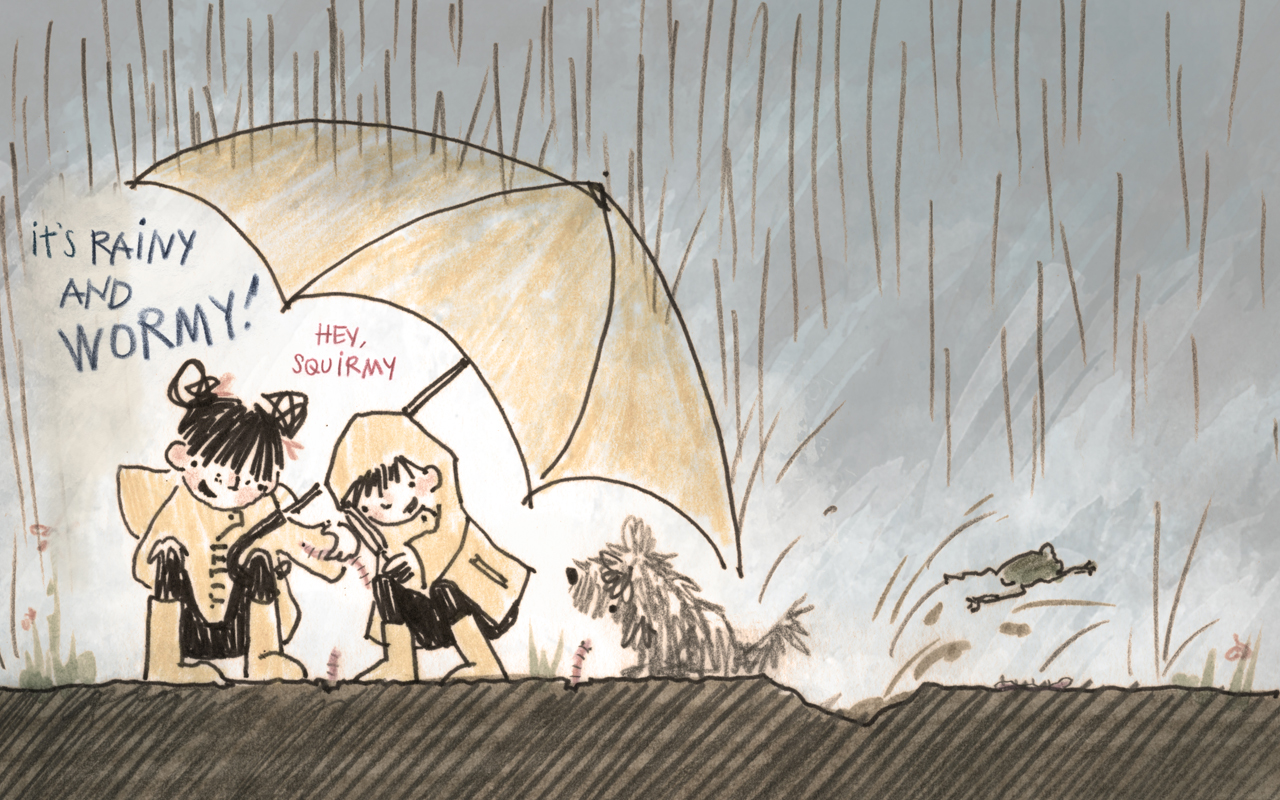
A rainy and wormy day from More than Sunny by Shelley Johannes, 2021, courtesy of Harry N. Abrams.
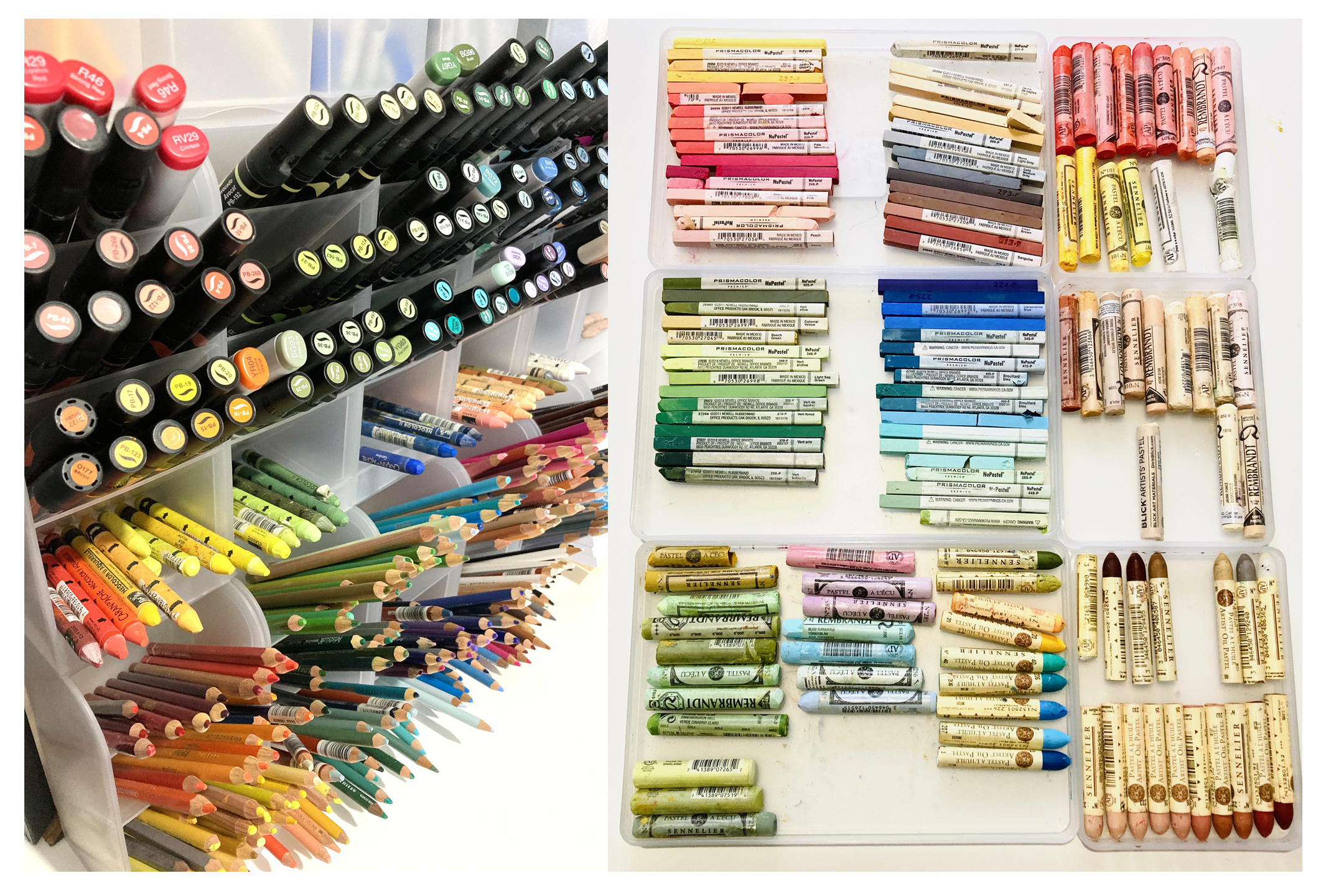
There’s also a direct connection in the way I work. I fell in love with tracing paper and felt-tip pens in my early days in architecture, and I’ve only fallen more in love as time passes. I’ve always loved how a loose sketch or a stray line can capture an idea on paper, and that wonder continues to bring me joy in new ways.
Your son Nolan narrates your wonderful book trailer and his pride and love for you and the More than Sunny really shine through. How great is it to share your writing journey with your kids?
Aw, thank you! We loved making that trailer together! And it was so special to capture his sweet voice just before it shifts into a grown-up one. It’s been so wonderful to share each step of the journey with my kids. I first realized I wanted to make picture books while reading to them as toddlers. They’ve been there for all the ups and downs and in-betweens of the creative process ever since, and enjoyed LOTS of celebratory pizza along the way! So much of each them—and they joy they bring into my life— is woven into everything I make. They inspire so many book moments, and are my most treasured critics and art buddies. I hope being part of this process empowers them to go after all the things they dream of doing, too!
What was your favorite place to read (or write or draw) as a child? What is your favorite place now and why?
As a kid, I loved to read and draw in the quiet privacy of my room, because it was personal and I was shy. These days, I like to mix things up. I write best in a crowded place, with headphones on and music blaring, because it’s easier for me to concentrate when I’m surrounded by stimuli and happy hustle-and-bustle. I also enjoy writing on the go as ideas randomly come to me, and use my Notes app like it’s another piece of my brain. I read anywhere and everywhere, and love listening to audiobooks while riding my bike around my neighborhood!
Though I doodle in sketchbooks all over my house, my studio is still my favorite place to make art. Having a place that’s dedicated to being creative, and filled with my favorite things, makes getting into the zone a bit easier.
What is your favorite season and seasonal activity?
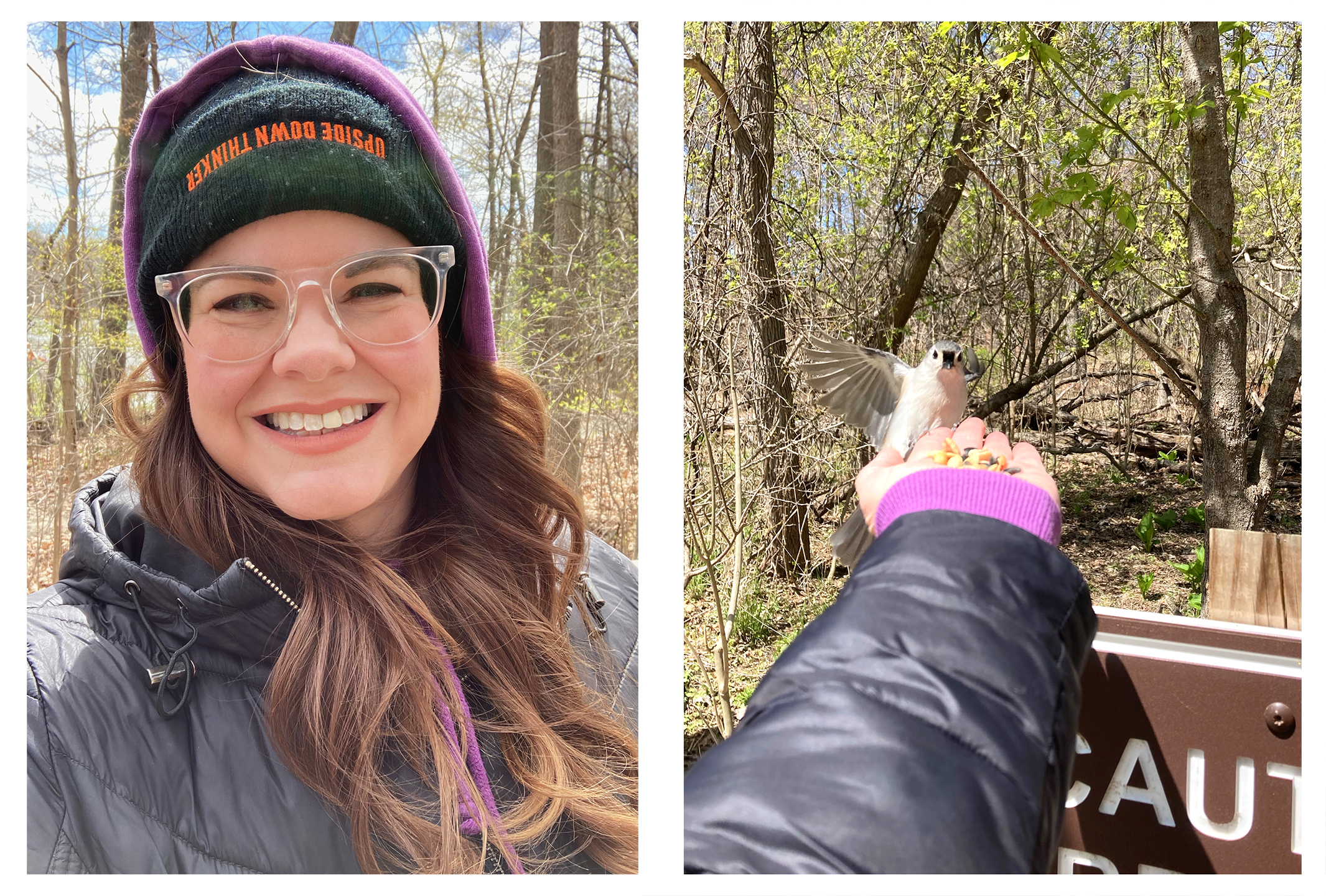
I’m torn between Fall and Spring. It’s hard to beat a cider mill on a crisp Autumn day, especially here in Michigan. Fresh donuts. Crisp apples. Bubbling steam running through the colorful trees. It’s pretty perfect. But then this Spring, we found a nature trail at a local park where wild birds fly down and eat out of your hands, and now we’re addicted to the wonder of that experience too.
Will you be doing any book events this summer that you’d like to tell readers about?
It’ll be a fairly quiet summer (see the answer to the next question!), but I’m doing a virtual event with wonderful Belmont Books on August 26th at 6:30pm ET, and I’d love for everyone to join us! We also had an amazing virtual launch event for More Than Sunny as part of Literati Bookstore’s At Home with Literati series. Jarrett Lerner and I talked about creative process, seeing the world with fresh eyes, and the making of the book. You can watch our conversation here anytime:
What’s up next for you?
This week I am starting the final artwork for my second picture book! I can’t wait to start experimenting with materials and see where it leads me!
Thanks for this wonderful chat and for sharing so many insights. I wish you all the best with More than Sunny and am really looking forward to your next book!
National Rain Day Review
About the Holiday
Today, we celebrate rainy days—but not just any rainy days. Rain Day commemorates an odds-busting record that began in 1874 in Waynesburg, Pennsylvania when one resident remarked to William Allison, the pharmacist at JT Rogers & Co drug store, that it always rained on his birthday—July 29. After that, Allison began keeping an annual record, and all eyes have been on Waynesburg to see if the remarkable run—115 years out of 147—continues. Now weather reporters around the country keep track of this remarkable statistic and broadcast “yes” or “no” to their audiences. As for the people of Waynesburg, they celebrate their notoriety with a huge festival that includes live musical entertainment, arts and crafts and food booths, kids’ games, and, of course, an umbrella-decorating contest. To learn more visit the Rain Day Website. And don’t forget to watch the skies!
More than Sunny
By Shelley Johannes
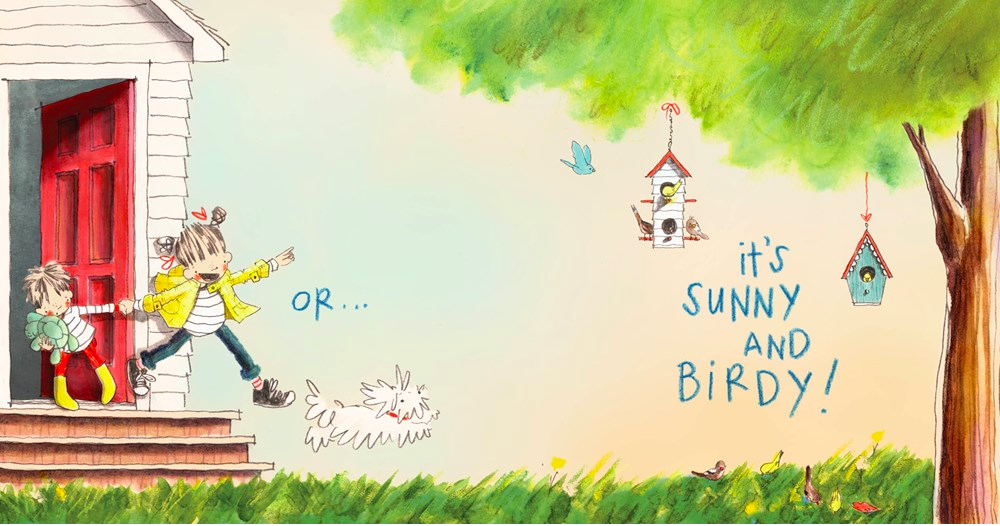
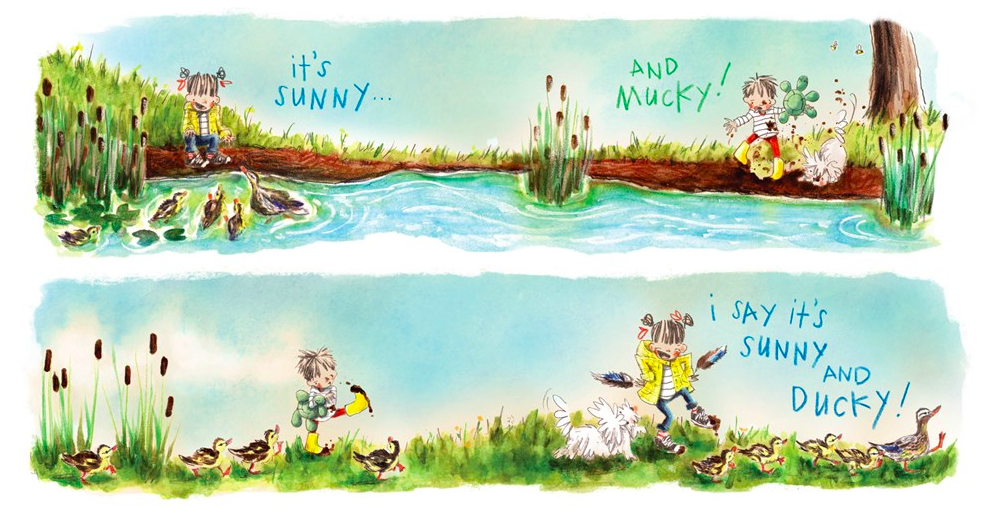
A girl knocks on her brother’s door and, before he’s even fully awake, she bursts in and announces with exuberance that this spring day is “sunny.” Yawning and rubbing his eyes, her brother adds “and early.” But his big sis pulls him outside to show him all the birds at the feeder and birdhouse. It’s not only sunny, she tells him “it’s sunny and birdy!” They head down to the pond, where the siblings have different ideas of what the day’s like. Little brother finds the day “sunny…and mucky!” But his sister, with feathers in her “wings,” states, “I say it’s sunny and ducky!”
Copyright by Shelley Johannes, 2021, courtesy of Harry N. Abrams.
On another day, these two compatible siblings head outside to discover what summer brings besides heat. The sunny day takes them to a field, a tree, and a dock, where they explore, relax, and use their imaginations. But not all summer days are sunny, and that’s okay because being inside when it’s “stormy” these kids make it cozy. And when the storm tapers off a bit, they grab their raincoats and big umbrella and go outdoors, where the girl exclaims, “it’s rainy and wormy!” and her brother inspects the mud and greets a small worm, “Hello squirmy.” The rainy day brings lots of fun with Mom and their dog too.
Copyright by Shelley Johannes, 2021, courtesy of Harry N. Abrams.
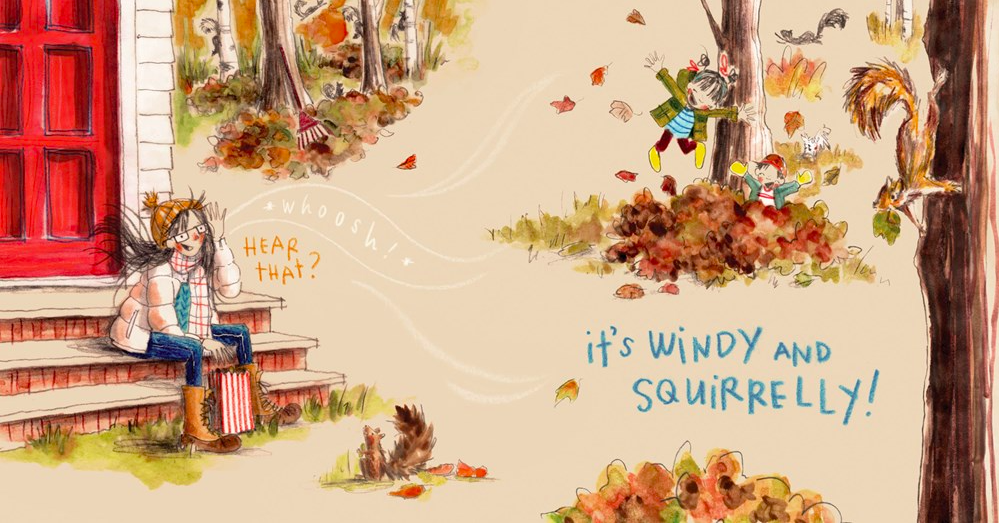
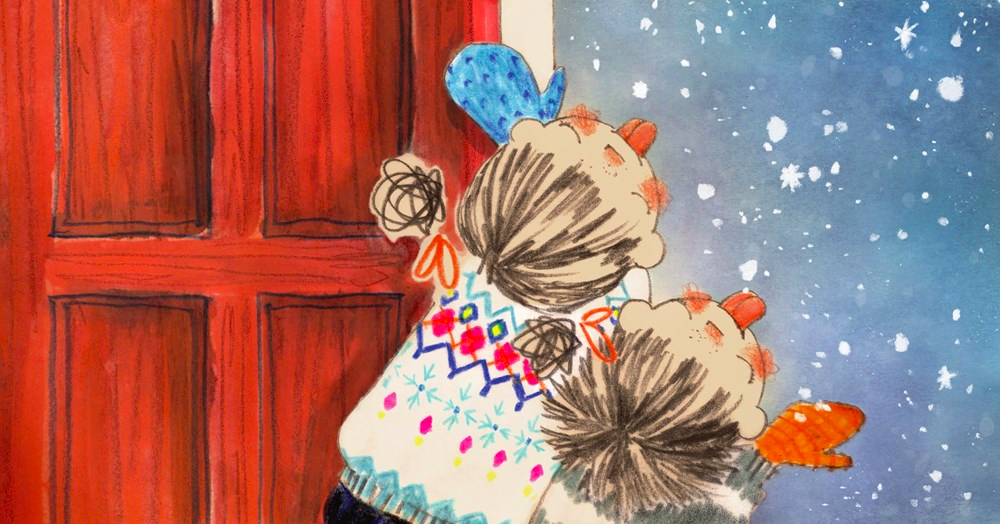
But summer days turn into autumn days with wind and squirrels and piles of leaves to jump in. The kids read and make paper snowflakes, waiting for winter to come. And, finally, the flakes fall. They taste so good. “Can we? Can we?” the siblings ask, eager to be out in the snow. “But I’m warm and socksy,” says Mom. But her kids, tiptoeing and playing, lure her out with “Let’s be snowy and foxy!”
Copyright by Shelley Johannes, 2021, courtesy of Harry N. Abrams.
They take a walk in the woods and, while sledding, see Daddy coming home. “Are you ready and sleddy?!” they ask, but there’s shoveling to be done. That’s all right; there are other ways to have fun in the snow. Tired out and chilly, the family goes inside for bedtime. Now there’s a knock at the sister’s door. Yawning and rubbing her eyes, she goes to see who it is. It’s her brother, and he has something magical to show her.
Copyright by Shelley Johannes, 2021, courtesy of Harry N. Abrams.
Shelley Johannes’s exuberant call to play and explore is a perfect jumping off place for kids to look at and interact with their surroundings with new eyes, imagination, and creativity. Hopping from season to season, Johannes touches on moments of freedom and wonder and those happy discoveries so formative in childhood. Her playful rhymes and bouncy rhythm echo kids’ delighted banter, and her sprightly adjectives invite readers to come up with their own descriptions of their day.
Johannes’s bright, energetic, and cheery illustrations dazzle with lively depictions of the siblings playing outside in all weather. Her smile-inducing portrayals of the siblings mirror real kids and each page is loaded with details readers will love lingering over. Mom and Dad make warm cameos to create a book the whole family will enjoy.
More than Sunny is a generously sized picture book that kids and adults will find themselves joyfully sharing throughout the year. For teachers and homeschoolers, Johannes’s storytelling provides a spark for writing prompts, grammar lessons, and observational skills. Sure to become a quick favorite, More than Sunny is highly recommended for home, classroom, and public library collections.
Ages 4 – 8
Harry N. Abrams, 2021 | ISBN 978-1419741814
Discover more about Shelley Johannes and her books on her website.
One of the best simple pleasures is looking up at the clouds and imagining what shapes you see. Bring those fluffy, white clouds into your room with this craft!
Supplies
White girls’ dress bobby socks in various sizes
Fiber fill, 20-ounce bag
Fishing line, different lengths
Needle
Clear adhesive mountable hooks or clips
Directions
Stuff the socks with fiber fill, pushing it far into the sock and adding more here and there to make various lumps and give it a rounded, cloud-like shape
When the sock is full, tuck the end of the sock in to close it
Cut lengths of fishing line. The lengths will depend on how and where you will hang the clouds
With the needle or by hand, feed one end of the fishing line into the top of the sock and out to attach the line for hanging.
Knot the fishing line
Attach the mountable hooks or clips to the ceiling
So here we are in the dog days of summer with their sweltering heat and soggy humidity. It’s so hot that even the simplest activities leave you drenched and drained. It’s the same every year, so what can you say? Well, today’s holiday gives a wry wink at that summer conversation starter, “Hot enough for ya?” Somehow this folksy phrase always brings a smile and shared commiseration. During these sweltering days enjoy some cooling treats with your kids – how about an ice-cream, a dip in the pool, lake, or ocean, or even that old favorite: running through the sprinkler? No matter where you find refreshment today, don’t forget to ask: “Hot enough for ya?”
And Then Comes Summer
Written by Tom Brenner | Illustrated by Jaime Kim
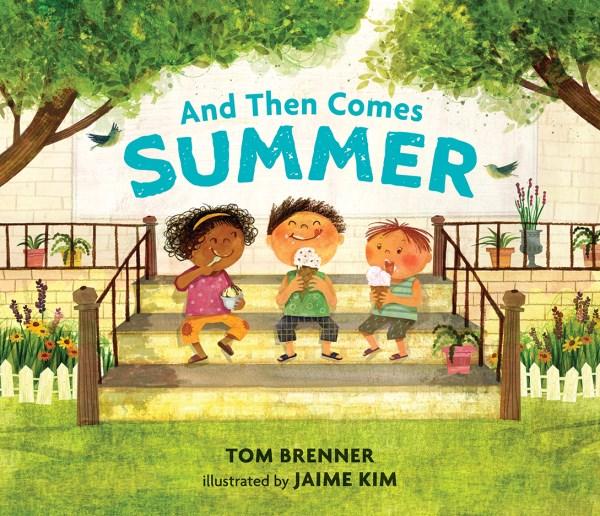
Summer days are like no other days during the year. Full of light and the kind of weather that entices you to stay outdoors, the months of June, July, and August hold promises of beauty and fun. Every day and every place welcome summer in their own way and invite new adventures. “When the days stretch out like a slow yawn, and leaves and grasses sparkle with dew, and the cheerful faces of Johnny-jump-ups jump up…THEN throw on flip-flops and breathe the sweet air.”
Copyright Jaime Kim, 2017, courtesy of jaimekim.com
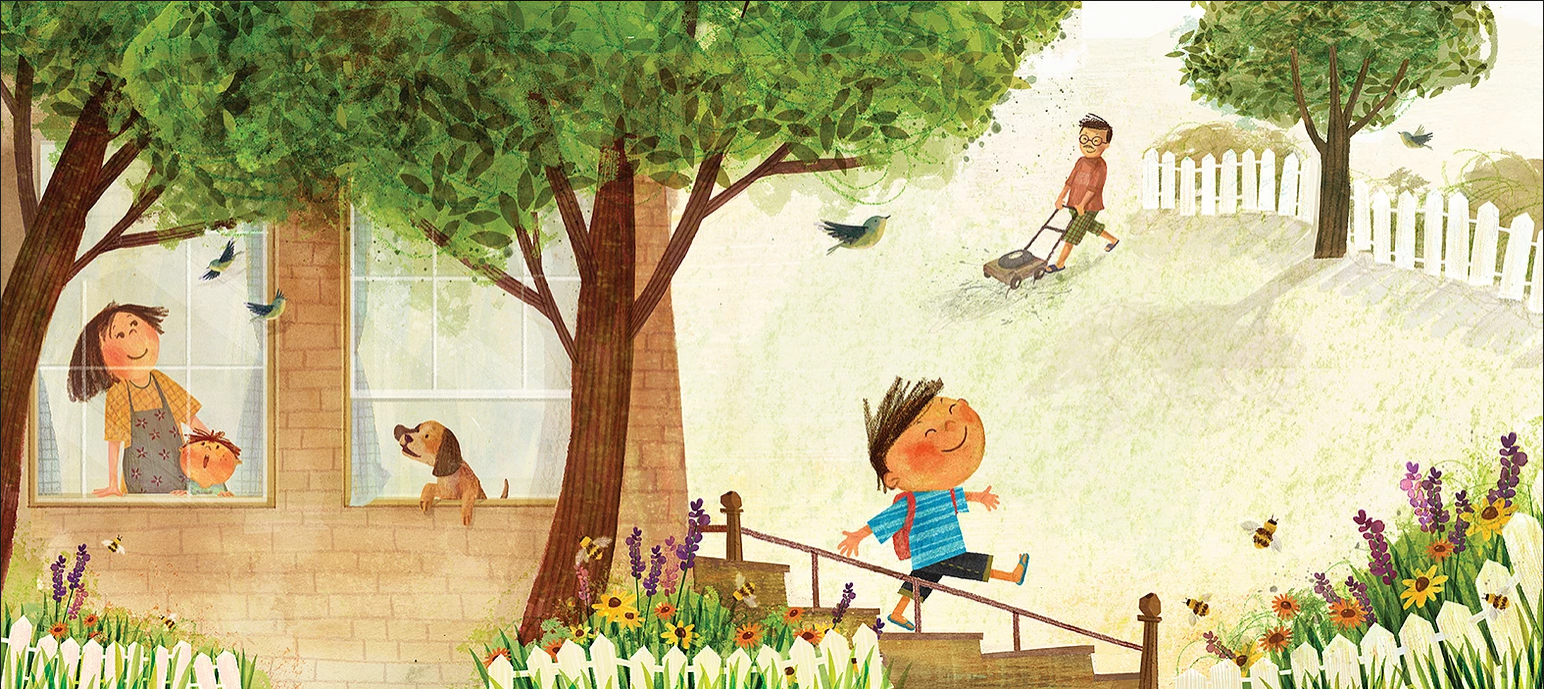
In those flip-flops you’ll run past buzzing bumblebees, flying warblers, and Dad mowing the lawn to your bike. Pump up the tires, raise the seat, put on your helmet, and take off! When the sun stays up past bedtime “and crickets crick-crick in the evening air, and bugs as big as thumbs bang against windows…” then it’s time to play games until night falls.
Copyright Jaime Kim, 2017, courtesy of jaimekim.com
When every day is a play day and you’re out running and jumping or at the beach, and you hear that “familiar jingle,” you know the ice-cream truck is on its way. Then race your friends “to be the first in line” to choose your favorite icy-cold treat. “When the dog days of summer roll around, and it’s so hot you’re practically panting, and not even the sprinklers provide relief…THEN it’s time to head to the lake.” On the way, watch the world go by through your open window. Feel the breeze and enjoy the smells, sounds, and sights of the trip.
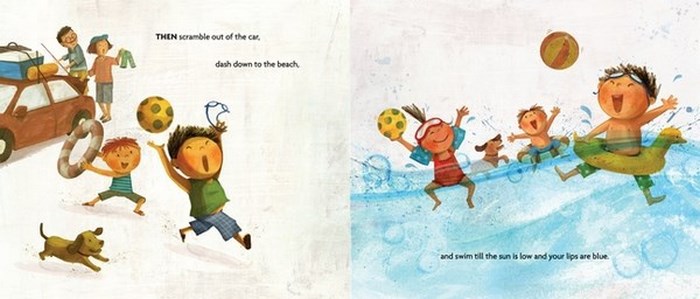
As you approach the familiar vacation spot where “the silver lake winks through the trees, and old friends run to greet you…” then it’s time for swimming and tents and roasted marshmallows while you tell stories and “plan tomorrow’s adventures.”
Image copyright Jaime Kim, 2017, text copyright Tom Brenner, 2017. Courtesy of Candlewick Press.
Tom Brenner’s tribute to the wonders of summer reflects that free and easy feeling that vacation months bring to kids. The little moments that become favorite memories are all here, recorded in Brenner’s lyrical and evocative pages. The rhythm and repetition play out like the best summer days—some, nuggets of individual joy and others, building to the excitement of eagerly anticipated vacations.
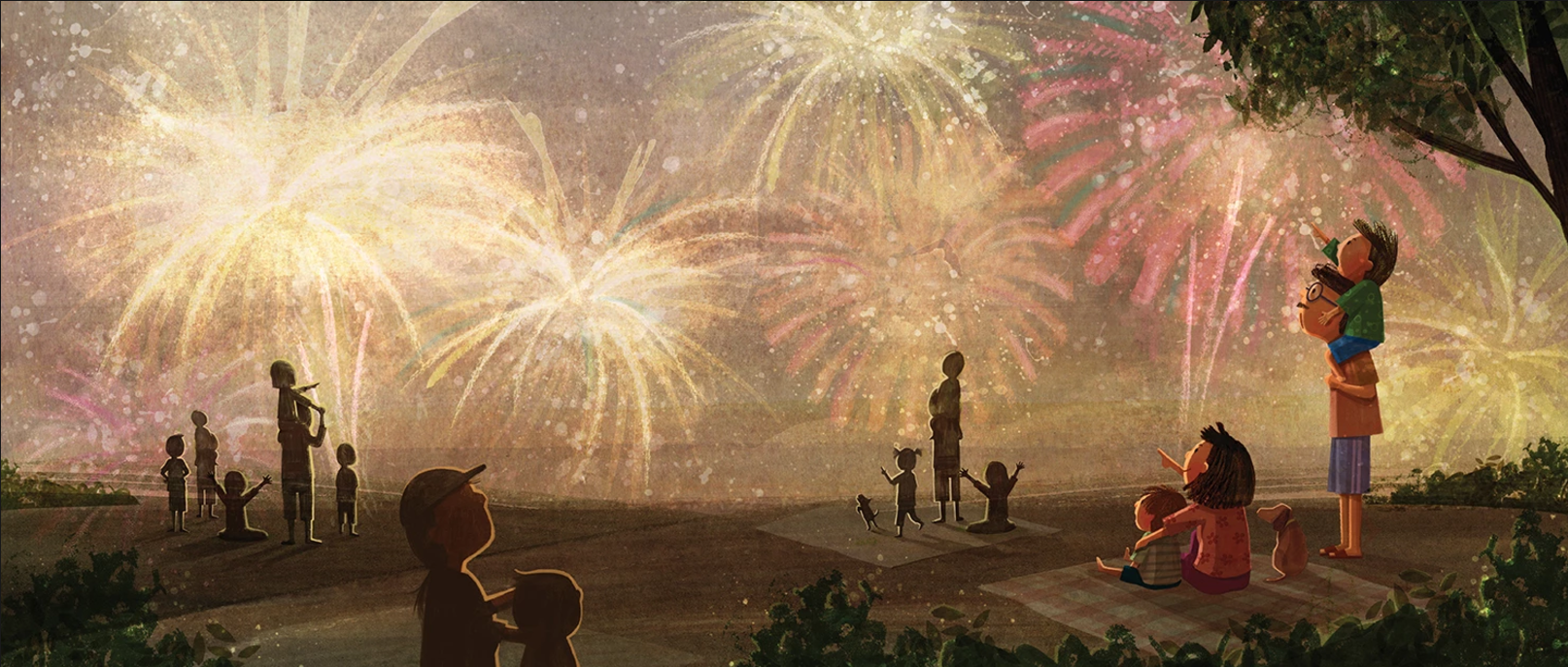
Jaime Kim transports kids to backyards, main streets, lemonade stands, and finally a shimmering lake in her sun-drenched illustrations of kids enjoying the freedom of summer. Readers can almost hear the shouts, sprinkler spray, running feet, fireworks, and crackling campfire as they turn the pages to join Kim’s enthusiastic kids in their summertime romps.
And Then Comes Summer is a joyous book to share with kids during summer or any time of the year.
Ages 4 – 8
Candlewick Press, 2017 | ISBN 978-0763660710 (Hardcover) | ISBN 978-1536217377 (Paperback)
Discover a portfolio of illustration work by Jaime Kim on her website!
Hot Enough for Ya Day? Activity
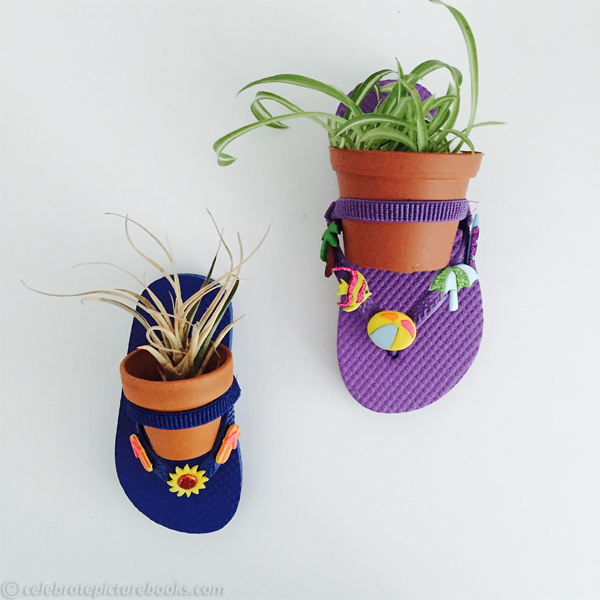
Flip-Flop Flower Pots
Have you outgrown your flip-flops from last year? You can turn them into fun plant holders with just a few buttons and mounting squares! Paint the pots with your own designs to make your hangings even more unique!
Supplies
Small flip-flops with elastic heel backings
Decorative buttons
Glue or needle and thread
Small plastic flower pots
Paint for decorating the pot (optional)
Flower or plant
Dirt
Mounting Squares
Directions
Plant the flower or plant in the flower pot
Decorate the straps of the flip-flops with the buttons. You can glue them on or sew them on with a needle and thread
Place the flower pot into the flip-flop, letting it rest on the toe separator and securing it with the elastic backing
Attach mounting squares to the back of the flip-flop to hang.
You can find And Then Comes Summer at these booksellers
Farmers’ Markets are bursting with fresh produce during the summer months, and that is especially true for blueberries, those little round morsels of sweetness. The United States Department of Agriculture recognized July as National Blueberry Month in 2003, and it’s been delicious eating ever since! Blueberries are the perfect accompaniment to muffins, pancakes, bread, fruit salads, and of course they’re delectable just on their own! So visit a farmers’ market today and pick up a peck.
Blueberry Cake
By Sarah Dillard
A little bear comes into the kitchen and tugs at his mother’s apron strings. When she turns her head, her cub asks shyly, “Blueberry cake?” Mama looks thoughtfully at her little one and sends him outside with a bucket. The cub dashes through the back yard and into the forest. Playfully, he wears the bucket like a hat and then does cartwheels until he comes to the edge of the woods. Peeking through the trees, the cub exclaims, “Oh!”
Copyright Sarah Dillard, 2021, courtesy of Aladdin.
What meets his eye is a wide-open field, a sea of blueberries. The little one sits down in the middle of a patch of delicious berries and begins filling the bucket with a concentrated, “Blueberries.” But it’s just so hard not to take a taste. Maybe just a handful. “Blueberries!” he exclaims. Then something else catches the little bear’s attention. It’s a butterfly – a monarch wanting to play chase. The cub runs after the butterfly, swinging the bucket and spilling the blueberries little by little along the way.
Copyright Sarah Dillard, 2021, courtesy of Aladdin.
The game brings the cub to another field – this one dotted with black-eyed Susans and queen Anne’s lace. They’re so pretty that the cub can’t help but pick some. Into the bucket they go. At home, the little bear holds the bucket out for Mama and asks, “Blueberry cake?” Mama looks at the offering and asks, “Blueberries?” The cub offers the flowers, but Mama still wonders where the blueberries are. The little bear inspects the bucket and quietly says, “No blueberries.” Mama crosses her arms and delivers the bad news: “No blueberry cake.”
Copyright Sarah Dillard, 2021, courtesy of Aladdin.
That night in bed, the cub dreams of what might have been and just as the sun begins rising over the horizon, he’s ready to try again. The cub dashes back to the blueberry field and fills the bucket until it’s brimming with delicious berries. The sun is still dawning when he gets home and puts the bucket on the kitchen counter and returns to his room. When Mama gets up, she’s surprised to find the blueberries. When the little bear comes downstairs again, he skips into the kitchen, his eyes alight, and he exclaims, “Blueberry cake!” The flowers, arranged in the bucket, decorate the middle of the table, and Mama lays out a placemat and plate for her little cub. He eagerly watches his mama cut a slice of cake and serve it. He gazes at the cake, and has just one thing to say: “Applesauce?”
A recipe for blueberry cake that’s easy enough for “little cubs and other small people” to make with some help “from a mama or papa bear” follows the story.
Copyright Sarah Dillard, 2021, courtesy of Aladdin.
With just six words, a darling cub, and a loving mother, Sarah Dillard creates a story that will charm kids. Dillard’s sunny illustrations are infused with poignant moments of childhood that are fanciful, disappointing, surprising, humorous, and always full of love. An expressive reading of the simple dialogue brings out all the feeling of the gentle ups and downs of the story and can also serve as a lesson in recognizing emotions for young readers. Kids will also have a blast joining in and reading along.
Ages 3 – 8
Aladdin, 2021 | ISBN 978-1534451346
Discover more about Sarah Dillard, her books, and her art on her website.
National Blueberry Month Activity
A Bounty of Blueberries Maze
Can you help pick blueberries to make some delicious treats in this printable puzzle?
Today’s holiday honors transcendentalist Henry David Thoreau, who was born on this date in 1817 and who, along with his many other talents and interests, advocated for a simplified life. As summer heats up with a full calendar of activities, vacations, work, day trips, and more, take today “off” and just enjoy the simple pleasures around you. This is great advice throughout the year, too. Dedicating some time to fully appreciate the small things can be rejuvenating!
More than Sunny
By Shelley Johannes
A girl knocks on her brother’s door and, before he’s even fully awake, she bursts in and announces with exuberance that this spring day is “sunny.” Yawning and rubbing his eyes, her brother adds “and early.” But his big sis pulls him outside to show him all the birds at the feeder and birdhouse. It’s not only sunny, she tells him “it’s sunny and birdy!” They head down to the pond, where the siblings have different ideas of what the day’s like. Little brother finds the day “sunny…and mucky!” But his sister, with feathers in her “wings,” states, “I say it’s sunny and ducky!”
Copyright by Shelley Johannes, 2021, courtesy of Harry N. Abrams.
On another day, these two compatible siblings head outside to discover what summer brings besides heat. The sunny day takes them to a field, a tree, and a dock, where they explore, relax, and use their imaginations. But not all summer days are sunny, and that’s okay because being inside when it’s “stormy” these kids make it cozy. And when the storm tapers off a bit, they grab their raincoats and big umbrella and go outdoors, where the girl exclaims, “it’s rainy and wormy!” and her brother inspects the mud and greets a small worm, “Hello squirmy.” The rainy day brings lots of fun with Mom and their dog too.
Copyright by Shelley Johannes, 2021, courtesy of Harry N. Abrams.
But summer days turn into autumn days with wind and squirrels and piles of leaves to jump in. The kids read and make paper snowflakes, waiting for winter to come. And, finally, the flakes fall. They taste so good. “Can we? Can we?” the siblings ask, eager to be out in the snow. “But I’m warm and socksy,” says Mom. But her kids, tiptoeing and playing, lure her out with “Let’s be snowy and foxy!”
Copyright by Shelley Johannes, 2021, courtesy of Harry N. Abrams.
They take a walk in the woods and, while sledding, see Daddy coming home. “Are you ready and sleddy?!” they ask, but there’s shoveling to be done. That’s all right; there are other ways to have fun in the snow. Tired out and chilly, the family goes inside for bedtime. Now there’s a knock at the sister’s door. Yawning and rubbing her eyes, she goes to see who it is. It’s her brother, and he has something magical to show her.
Copyright by Shelley Johannes, 2021, courtesy of Harry N. Abrams.
Shelley Johannes’s exuberant call to play and explore is a perfect jumping off place for kids to look at and interact with their surroundings with new eyes, imagination, and creativity. Hopping from season to season, Johannes touches on moments of freedom and wonder and those happy discoveries so formative in childhood. Her playful rhymes and bouncy rhythm echo kids’ delighted banter, and her sprightly adjectives invite readers to come up with their own descriptions of their day.
Johannes’s bright, energetic, and cheery illustrations dazzle with lively depictions of the siblings playing outside in all weather. Her smile-inducing portrayals of the siblings mirror real kids and each page is loaded with details readers will love lingering over. Mom and Dad make warm cameos to create a book the whole family will enjoy.
More than Sunny is a generously sized picture book that kids and adults will find themselves joyfully sharing throughout the year. For teachers and homeschoolers, Johannes’s storytelling provides a spark for writing prompts, grammar lessons, and observational skills. Sure to become a quick favorite, More than Sunny is highly recommended for home, classroom, and public library collections.
Ages 4 – 8
Harry N. Abrams, 2021 | ISBN 978-1419741814
Discover more about Shelley Johannes and her books on her website.
Take a look at the More than Sunny book trailer!
National Simplicity Day Activity
Fluffy Clouds Craft
One of the best simple pleasures is looking up at the clouds and imagining what shapes you see. Bring those fluffy, white clouds into your room with this craft!
Supplies
White girls’ dress bobby socks in various sizes
Fiber fill, 20-ounce bag
Fishing line, different lengths
Needle
Clear adhesive mountable hooks or clips
Directions
Stuff the socks with fiber fill, pushing it far into the sock and adding more here and there to make various lumps and give it a rounded, cloud-like shape
When the sock is full, tuck the end of the sock in to close it
Cut lengths of fishing line. The lengths will depend on how and where you will hang the clouds
With the needle or by hand, feed one end of the fishing line into the top of the sock and out to attach the line for hanging.
Knot the fishing line
Attach the mountable hooks or clips to the ceiling












 celebratepicturebooks.com