September 18 – Gymnastics Day

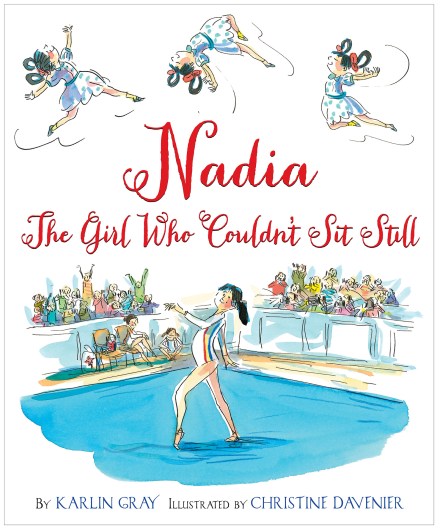
celebrate-picture-books-picture-book-review-nadia-the-girl-who-couldn't-sit-still-cover

Image copyright Christine Davenier, courtesy of Houghton Mifflin Harcourt Publishing Co.

About the Holiday

Initiated in the late 1990s, National Gymnastics Day encourages kids to explore this exciting sport. As part of this year’s National Gymnastics Day, gymnasts, families, friends, and enthusiasts from gymnastics clubs globally will participate in a variety of activities, including open houses, hand stand contests, carnivals, and fitness activities to build awareness of gymnastics and its benefits. Many clubs will use this as a way to provide opportunities for underprivileged children to participate in the sport. Why not find and attend a special event at a gym or gymnastics club today to celebrate!

Nadia: The Girl Who Couldn’t Sit Still

Written by Karlin Gray | Illustrated by Christine Davenier


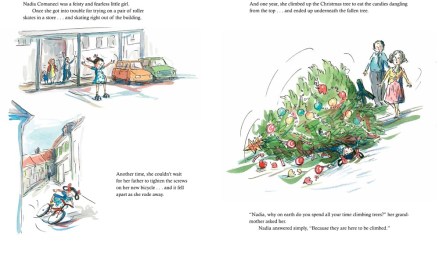
“In the village of Oneşti, Romania, a country rich with forests and mountains” Nadia Comaneci could often be seen swinging from tree branch to tree branch. She was a little girl who loved to play. She was “feisty and fearless,” attempting new things on a whim and always with a sense of adventure. Once while trying on a pair of roller skates, she skated right out of the store! Another time she was so impatient to ride her new bike that she pedaled off before her father could even tighten the screws. The bike “fell apart as she rode away.” And one year her love of climbing trees extended to the family Christmas tree, which toppled over on her, pinning her to the ground.

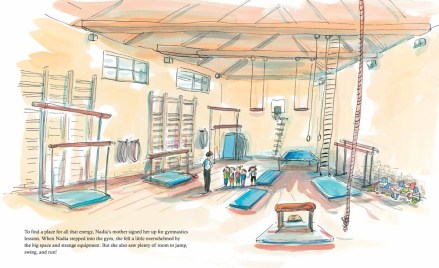
To channel all that energy, Nadia’s mother enrolled her in gymnastics lessons. Nadia’s eyes lit up when she saw the room full of ropes, ladders, bars, mats, and trampolines to discover, but she didn’t leave her new skills at the gym. Nadia and a friend cartwheeled around the school playground, capturing the attention of Bela and Marta Karolyi, who owned a gymnastics school. They invited the girls to join.
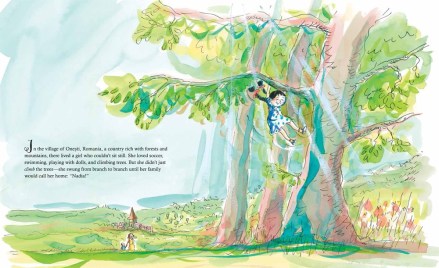
celebrate-picture-books-picture-book-review-nadia-the-girl-who-couldn't-sit-still-swinging-in-trees

Image copyright Christine Davenier, courtesy of karlingray.com

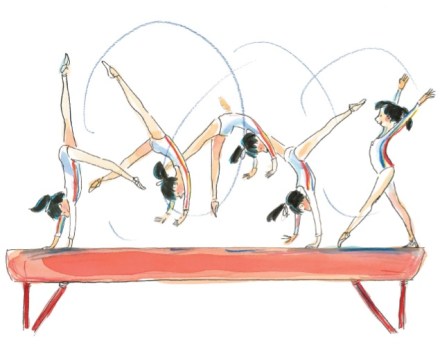
Nadia was only 6 when she began studying with Bela and Marta. Immediately, she discovered that she liked gymnastics better than her school subjects. She progressed quickly from performing “a straight cartwheel on a line painted on the floor” to doing it on a low balance beam and finally to perfecting it on the high balance beam. She began learning harder and harder moves, “flying from bar to bar, from floor to vault, and high above the beam.”

At 9 years old, Nadia competed in her first National Junior Championship. Despite her skill and hard work, she fell from the high beam during a leap not once but three times. Nadia finished the competition in 13th place. Her disappointment only strengthened her resolve. She went back to the gym and continued to practice many hours every day. Her determination paid off, “and at the next National Junior Championship games, she won first place.”

The ultimate recognition of her skill came when she was chosen to be part of the 1976 Romanian Olympic team. The games were held in Montreal, Canada, and all eyes were on the returning gold medalists from Russia, Olga Korbut and Lyudmila Turischeva. But excitement soon filled the venue as Nadia performed on the beam, the floor, and the vault where she scored 9.9, 9.75, and 9.7 on a scale of 1 (the lowest score) to 10 (a perfect score). The next event was the uneven parallel bars on which Olga Korbut had just scored a 9.9. “Nadia mounted the bars. Now fourteen years old, she was a long way from the forests in Romania. But she swung around as easily as she had jumped from branch to branch as a little girl. The audience gasped as she twirled and whipped and flipped.”
celebrate-picture-books-picture-book-review-nadia-the-girl-who-couldn't-sit-still-gym

Image copyright Christine Davenier, courtesy of karlingray.com

Nadia dismounted and landed perfectly on the mat below as the audience “exploded with applause.” Nadia returned to her team to wait for her score. And wait…and wait. Finally, the score appeared on the board—1.00. The worst score. How could that be? “‘What is Nadia’s score?’” Bela asked the judges. “One of the officials held up ten fingers as a voice announced over the loudspeaker: ‘Ladies and gentlemen, for the very first time in Olympic history, Nadia Comaneci has received the score of a perfect ten!’”

Because no one had ever achieved a 10 before, the scoreboards were programmed only for a high of 9.9. Nadia couldn’t bask in her accomplishment for long, however. She moved on to her next event—and her next perfect 10! “When the competition ended, she had earned seven perfect 10s.” At the medal ceremony both Olga and Lyudmila congratulated their competitor as the new Olympic champion. In all Nadia won five medals and became the youngest ever Olympic gold medalist in gymnastics.
celebrate-picture-books-picture-book-review-nadia-the-girl-who-couldn't-sit-still-balance-beam

Image copyright Christine Davenier, courtesy of karlingray.com

Nadia became a darling of the press. They surrounded her, asking “how it felt to have the world’s attention, if she had been confident she would win, and when she would retire.” She answered each reporter with enthusiasm and confidence, and promising that she was a long way from retiring. When she returned home, it seemed that all of Romania had come out to welcome her and her teammates—even the country’s president.

Now Nadia was famous all over the world. She returned to practicing and inventing new routines, preparing for other competitions and the 1980 Olympic Games. She had come far from swinging branch to branch in the trees of Oneşti, but she would always be that little girl who couldn’t sit still.

Karlin Gray’s compelling biography captures all the spunk and spirit of Nadia Comaneci that made the world fall in love with her at the 1976 Olympic Games. Adults of a certain age well remember watching her in astonishment as she seemed to effortlessly swirl, twirl, and flip through her routines, flashing her sweet smile as she waved to fans. In the first pages Gray reveals anecdotes of Nadia’s adventurous nature that will captivate readers even as they giggle at her predicaments.
celebrate-picture-books-picture-book-review-nadia-the-girl-who-couldn't-sit-still-mishaps

Image copyright Christine Davenier, courtesy of karlingray.com

The straightforward narration of Nadia’s trajectory from playground cartwheeler to Olympic champion enhances both the gritty determination of her studies with her coaches as well as the suspense of her competitions. All children—no matter what their talent—will draw inspiration from Nadia’s story, which includes disappointments as well as unbounded accomplishments. Gray’s lyrical language flows as smoothly as Nadia flew through the air and will land in readers’ hearts as a perfect 10.

From the cover, which sports Nadia in her iconic floor exercise pose, to the last page, Christine Davenier depicts the world of gymnastics with beauty and the kind of realistic details that create a classic. The two-page spread of the gym where 6-year-old Nadia learns to love gymnastics portrays the enormity of the space and the equipment for a small girl—as well as the enormity of her achievement.

Kids will love the almost “play-by-play” illustrations of how Nadia learned to perform her feats, from starting with a line on the floor to perfecting the high beam and more. Nadia is shown leaping, somersaulting, doing handstands, and even wavering and falling as she practices and competes. The thrill of the Olympic Games, from the opening ceremonies to the rapt and cheering audiences to the awards ceremony are drawn with stirring action, color, and attention to the specifics of that very special 1976 summer in Montreal.

An Afterword expands on Nadia Comaneci’s courageous life choices and career post-gymnastics and includes a timeline, notes, a selected bibliography, and websites for further study.

Nadia: The Girl Who Couldn’t Sit Still will fascinate kids and would be a very welcome addition to school classroom—as well as home—libraries.

Ages 5 – 10

Houghton Mifflin Harcourt, 2016 | ISBN 978-0544319608

Visit Karlin Gray‘s website to learn more about her and to download fun activities!

View a gallery of artwork by Christine Davenier on her website!

Discover more about Nadia: The Girl Who Couldn’t Sit Still on the Houghton Mifflin Harcourt website!

As I take some personal days over the next couple of weeks, I am reposting some earlier reviews with updated interior art and links.

National Gymnastics Day Activity
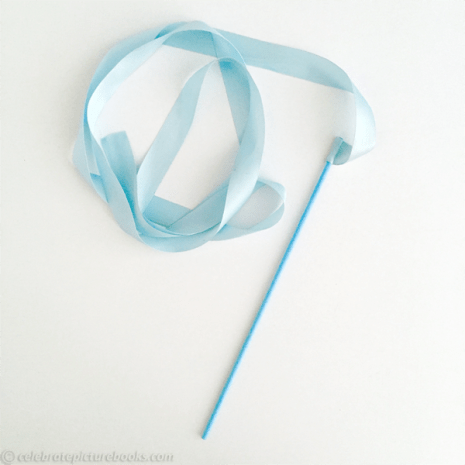
celebrate-picture-books-picture-book-review-rhythmic-gymnastics-ribbon-craft

Rhythmic Gymnastics Ribbon


You can recreate the grace of rhythmic gymnastics with this easy craft! The swirling beauty of the ribbon makes any movement fun!

Supplies

  • 12-inch dowel
  • 6-foot length of ribbon
  • Paint the same color as the ribbon
  • Hot glue gun or strong glue
  • Paint brush

Directions

  1. Paint the dowel and let dry
  2. Glue the edge of the ribbon to one end of the dowel. Wrap the ribbon about ½ inch around the dowel and secure with glue. Let glue dry.

Picture Book Review

Picture Book Review

September 15 – Make a Hat Day

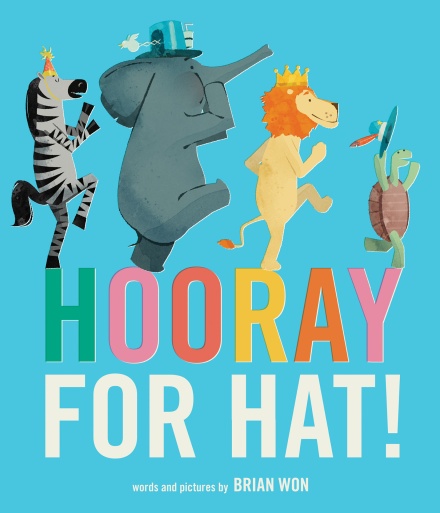
celebrate-picture-books-picture-book-review-hooray-for-hat!-cover

About the Holiday

Hats are great for cold days, days when you want to dress up or express a certain fashion statement, or to cover up a bad do or bedhead. Today’s holiday may spur you to learn how to knit a hat or inspire you to invite your friends to a crazy hat-designing party! Make a Hat Day also shares the spotlight with Felt Hat Day, which exhorts people to rediscover an old and cherished fashion accessory.

Hooray for Hat!

By Brian Won


Elephant wakes up on the wrong side of the bed. He’s hardly had a chance to fully shake off sleep when the doorbell rings. He clomps down the stairs yelling, “‘Go away! I’m grumpy!’” But there’s no one at the door. Instead Elephant finds a prettily wrapped present on his doorstep. Unwrapping it Elephant finds the grandest hat he’s ever seen. It has everything – A pompom, a star, a feather, a mortar board with a tassel, a crown, a coo-coo clock bird, and even a cup holder! Elephant puts it on. How can he be grumpy with such a hat on his head? He can’t! “‘Hooray for Hat!’” he cheers and goes off to show Zebra.

celebrate-picture-books-picture-book-review-hooray-for-hat!-gift-for-elephant

Image copyright Brian Won, courtesy of brianwon.com

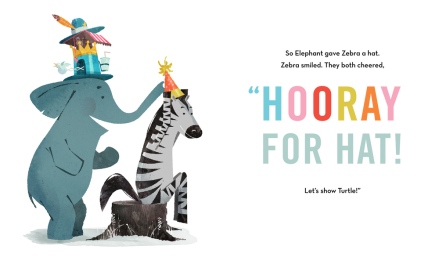
Elephant finds Zebra sitting alone on a tree stump. She doesn’t even turn around when her friend approaches. “‘Go away! I’m grumpy!’” she states. Elephant removes the top hat from his own new chapeau—a party hat with the pompom—and gently places it on Zebra’s head. Zebra can’t help but smile. “‘Hooray for Hat!’” they both cheer and head out for Turtle’s house.

celebrate-picture-books-picture-book-review-hooray-for-hat!-hat-for-zebra

Image copyright Brian Won, courtesy of brianwon.com

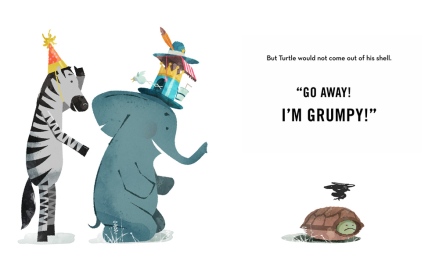
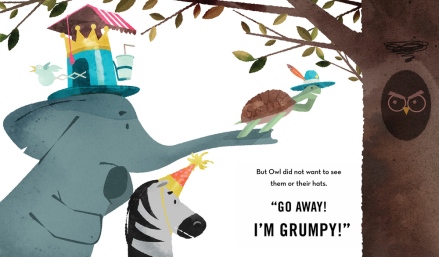
Oh, but Turtle is so grumpy that they won’t even come out of their shell. Elephant lifts down the cowboy hat with the star and feather from his own towering hat and gives it to his pal. Out pops Turtle who proudly joins the parade. “‘Hooray for Hat!’” they all cheer and march off to show Owl. “But Owl did not want to see them or their hats. “‘Go Away! I’m grumpy!’” she hoots from her tree trunk hole.

celebrate-picture-books-picture-book-review-hooray-for-hat!-hat-for-turtle

Image copyright Brian Won, courtesy of brianwon.com

But Elephant is as wise as Owl, and thinks the striped mortar board is just the thing to change her mood. “‘Hoo-Hoo-Hooray for Hat!’” Owl says, leading the way to find Lion. But Lion’s frowning face peers out at them from his den, and he shoos the group away with the familiar “‘Go Away! I’m Grumpy!’” Down comes the golden crown from Elephant’s hat and while Lion loves it, he’s more concerned with their friend Giraffe who isn’t feeling well. “‘What can we do?’” Lion asks the group.

They all know exactly what to do. They pack up the very special hat and take it to Giraffe, who is standing with her head hidden in a treetop. “Do Not Disturb” reads the sign hanging on the trunk. But as soon as Giraffe dons that hat, a toothy smile breaks out, and the six best buddies cheer, “‘Hooray for Friends!’”

celebrate-picture-books-picture-book-review-hooray-for-hat!-hat-for-owl

Image copyright Brian Won, courtesy of brianwon.com

Brian Won’s joyful celebration of the power of surprise, friendship, and a great hat is a day brightener for anyone, whether they wake up grumpy or feeling fine. His adorable animal friends don’t mind a little grumpiness—they’ve experienced it themselves—but only want to make each other happier. The repeated phrasing throughout the story invites kids to read along, and the absence of pronouns offers open interpretation and inclusiveness. The confetti-colored hats will make kids smile and the tribute to friendship will have them cheering along with this fun picture book.

A cheer-ful book, Hooray for Hat! would make a happy addition to children’s libraries for those days when they need a little more encouragement or inspiration. Kids will want to get together with Elephant, Zebra, Turtle, Owl, Lion, and Giraffe again and again and will no doubt love to create a magnificent hat of their own!

Ages 3 – 7

Houghton Mifflin Harcourt Publishers, 2014 | ISBN 978-0544159037

Visit the world of Brian Won on his website

Hooray for this book trailer!

 Make a Hat Day Activity

celebrate-picture-book-picture-book-review-hat-match-game

Hats Off to You! Matching Game


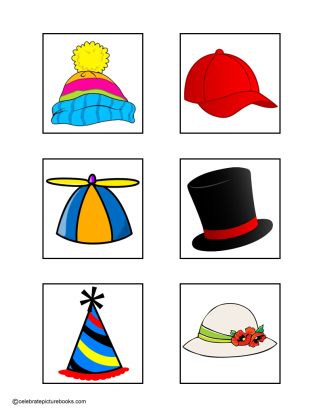
Can you match the pairs of identical hats? Of course you can!

Supplies

Directions

  1. Print 2 pages of the Hats Off to You! game cards (or more to make the game harder)
  2. Cut the cards apart
  3. Shuffle the cards
  4. Lay the cards face down on a table
  5. By turning one card over at a time, find all the matching pairs

August 27 – International Bat Night

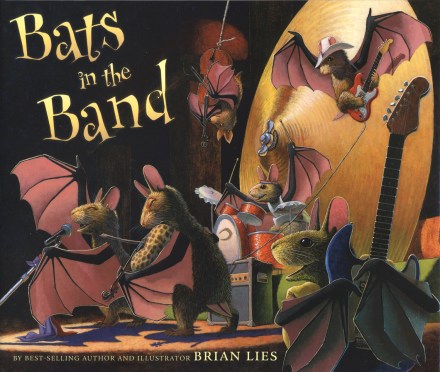
celebrate-picture-books-picture-book-review-bats-in-the-band-cover

About the Holiday

From the time that darkness falls on August 27 until the sun rises on August 28, people in more than 30 countries organize walks, talks, and all kinds of educational and fun activities related to bats and their conservation. Why not find an event in your neck of the woods—or cave—and celebrate this most unusual and beneficial animal!

Bats in the Band

By Brian Lies


Huddled together a colony of bats sleeps through the winter, but as the icy weather warms they stretch their wings and take flight to find food. As they swoop through the air chasing the echoes they hear, these animals that live by echolocation sense “that something’s not right. / And then when a bugle blast shatters the night, / that one lonely note tells us just what is wrong: / We’re hungry for sound—we’ve been silent too long.”

The bats swarm to a summertime theater now quiet and dark except for a small glow that invites  them inside. They enter the building—passing hawkers of T-shirts, posters, and hats—and set up the stage and the lights. Some bats have brought their own instruments while others improvise with the leftovers of last season’s concertgoers. “Behind the stage curtain, they’re getting in tune, / making up things out of straws, out of spoons.”

celebrate-picture-books-picture-book-review-bats-in-the-band-one-bat-band

Image copyright Brian Lies, courtesy of Houghton Mifflin Harcourt (hmhco.com)

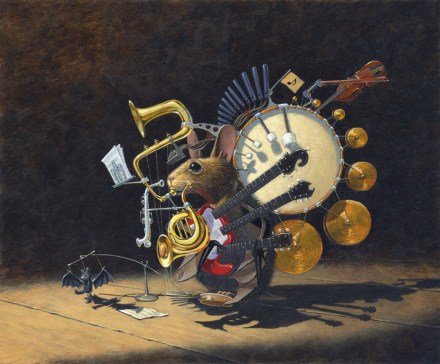
Finally, the conductor lifts his baton, and the concert begins. “We sing together as one voice. / It seems the very walls rejoice! / All together, rafters ringing… / it’s as though our souls are singing.”  Then the strings “change the mood to sweet and mellow” before a one-bat band takes over. “Next up, there’s a country song—/ some lonesome bat done someone wrong. / He’s  gone and broken someone’s heart. / Now everything has come apart.”

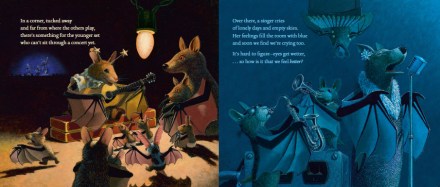
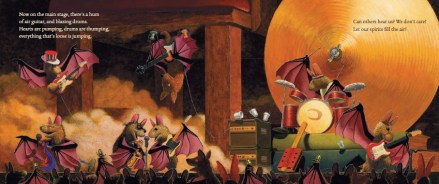
There’s even an entertainer for children far off in a corner where the pups can run and play. Now on stage a blues singer “cries of lonely days and empty skies” that make the bats cry. “It’s hard to figure—eyes get wetter, / …so how is it that we feel better?” There’s not much time for reflection though as a hard-rock band begins “blazing,” “pumping,” and “jumping.”

celebrate-picture-books-picture-book-review-bats-in-the-band-blues-singer

Image copyright Brian Lies, courtesy of Houghton Mifflin Harcourt (hmhco.com)

While everyone is dancing to the beat, the sun begins to rise signaling that it’s time for the bats to go. But in one last blast, all the musicians jam together. “The music soars. Finale’s here, the ending of the song. / It builds and builds—now here it comes! / It’s going…/ going…/ GONG!” With that last bang of the cymbal the bats, “worn out, wrung out, half asleep,” fly from the theater and out into the dawning day. In the air they discover the music in everything from “the roar of a car, or the bark of a pup—/ the sound of the rest of the world waking up.” As they fall into slumber up in their cozy rafters, the bats continue to sway unconsciously. “It’s not our intention, but you understand. / We’re dreaming of being the bats in the band.”

Brian Lies “Bat” books are well-known and well-loved. Bats in the Band continues the excellent storytelling and poetry of his other titles, this time to a rock-n’-roll beat. The idea of bats needing to hear sound after a long winter’s silence is brilliant, and these bats play almost as many different styles of music as there are species of bat. The rhyme scheme is true and musical, carrying the story well through its words and rhythm.

celebrate-picture-books-picture-book-review-bats-in-the-band-rock-n-roll-bats

Image copyright Brian Lies, courtesy of Houghton Mifflin Harcourt (hmhco.com)

Lies’ illustrations remain as clever as ever. The two-page spread of the bats choosing and tuning up their instruments is a joy. Bats make a xylophone from keys hanging on a peg board and two nails for mallets. Instead of a harp, a bat plucks the tines of a plastic comb, and a bendy straw serves as a fine wind instrument. The string section plays while hanging upside down (of course!). The pups’ entertainer will bring a smile to readers’ faces, and the blues singer performs under cool blue lights.

Kids and adults will love lingering over the detailed pages, where allusions to actual concert atmospheres abound. Look for the bats holding aloft lightning bugs in a tribute to a long-held tradition.

Bats in the Band is a rockin’ addition to Brian Lies collection and will be welcome on any child’s shelf—whether they are completing the set or just starting it!

Ages 4 – 8

Houghton Mifflin Harcourt, 2014 | ISBN 978-0544105690

Visit Brian Lies‘ website to learn more about him, view his many books, and see a gallery of his artwork.

International Bat Night Activity

celebrate-picture-books=picture-book-review-spiral-bat-words-word-search

Spiraling Bats Word Search


Find the bat related words in this printable Spiraling Bats Word Search that dips and soars like the flight of a bat! Here’s the Solution.

Picture Book Review

August 12 – International Youth Day

celebrate-picture-books-picture-book-review-nadia-the-girl-who-couldn't-sit-still-cover

Image copyright Christine Davenier, courtesy of Houghton Mifflin Harcourt Publishing Co.

About the Holiday

In so many ways children and young adults are not only our future but they lead the world forward now. In recognition of this, the United Nations established International Youth Day to work toward ensuring that all children have access to resources to make positive and progressive choices. The theme for this year’s International Youth Day revolves around sustainable consumption, an important topic for the world our young people are inheriting.

It’s fitting that today’s holiday comes during the Olympic Games, a showcase of the best determination, hope, and spirit of today’s youth and tomorrow’s promise. A “perfect” reminder of that is the subject of today’s book!

Nadia: The Girl Who Couldn’t Sit Still

Written by Karlin Gray | Illustrated by Christine Davenier


“In the village of Oneşti, Romania, a country rich with forests and mountains” Nadia Comaneci could often be seen swinging from tree branch to tree branch. She was a little girl who loved to play. She was “feisty and fearless,” attempting new things on a whim and always with a sense of adventure. Once she tried on a pair of roller skates and skated right out of the store! Another time she was so impatient to ride her new bike that she pedaled off before her father could even tighten the screws. The bike “fell apart as she rode away.” And one year her love of climbing trees extended to the family Christmas tree, which toppled over on her, pinning her to the ground.

To channel all that energy, Nadia’s mother enrolled her in gymnastics lessons. Nadia’s eyes lit up when she saw the room full of ropes, ladders, bars, mats, and trampolines to discover, but she didn’t leave her new skills at the gym. Nadia and a friend cartwheeled around the school playground, capturing the attention of Bela and Marta Karolyi, who owned a gymnastics school. They invited the girls to join.

celebrate-picture-books-picture-book-review-nadia-the-girl-who-couldn't-sit-still-swinging-in-trees

Image copyright Christine Davenier, courtesy of karlingray.com

Nadia was only 6 when she began studying with Bela and Marta. Immediately, she discovered that she liked gymnastics better than her school subjects. She progressed quickly from performing “a straight cartwheel on a line painted on the floor” to doing it on a low balance beam and finally on the high balance beam. She began learning harder and harder moves, “flying from bar to bar, from floor to vault, and high above the beam.”

At 9 years old, Nadia competed in her first National Junior Championship. Despite her skill and hard work, she fell from the high beam during a leap not once but three times. Nadia finished the competition in 13th place. Her disappointment only strengthened her resolve. She went back to the gym and continued to practice many hours every day. Her determination paid off, “and at the next National Junior Championship games, she won first place.”

The ultimate recognition of her skill came when she was chosen to be part of the 1976 Romanian Olympic team. The games were held in Montreal, Canada, and all eyes were on the returning gold medalists from Russia, Olga Korbut and Lyudmila Turischeva. But excitement soon filled the venue as Nadia performed on the beam, the floor, and the vault where she scored 9.9, 9.75, and 9.7 on a scale of 1 (the lowest score) to 10 (a perfect score). The next event was the uneven parallel bars on which Olga Korbut had just scored a 9.9. “Nadia mounted the bars. Now fourteen years old, she was a long way from the forests in Romania. But she swung around as easily as she had jumped from branch to branch as a little girl. The audience gasped as she twirled and whipped and flipped.”

celebrate-picture-books-picture-book-review-nadia-the-girl-who-couldn't-sit-still-gym

Image copyright Christine Davenier, courtesy of karlingray.com

Nadia dismounted and landed perfectly on the mat below as the audience “exploded with applause.” Nadia returned to her team to wait for her score. And wait…and wait. Finally, the score appeared on the board—1.00. The worst score. How could that be? “‘What is Nadia’s score?’” Bela asked the judges. “One of the officials held up ten fingers as a voice announced over the loudspeaker: ‘Ladies and gentlemen, for the very first time in Olympic history, Nadia Comaneci has received the score of a perfect ten!’”

Because no one had ever achieved a 10 before, the scoreboards were programmed only for a high of 9.9. Nadia couldn’t bask in her accomplishment for long, however. She moved on to her next event—and her next perfect 10! “When the competition ended, she had earned seven perfect 10s.” At the medal ceremony both Olga and Lyudmila congratulated their competitor as the new Olympic champion. In all Nadia won five medals and became the youngest ever Olympic gold medalist in gymnastics.

celebrate-picture-books-picture-book-review-nadia-the-girl-who-couldn't-sit-still-balance-beam

Image copyright Christine Davenier, courtesy of karlingray.com

Nadia became a darling of the press. They surrounded her, asking “how it felt to have the world’s attention, if she had been confident she would win, and when she would retire.” She answered each reporter with enthusiasm and confidence, and promising that she was a long way from retiring. When she returned home, it seemed that all of Romania had come out to welcome her and her teammates—even the country’s president.

Now Nadia was famous all over the world. She returned to practicing and inventing new routines, preparing for other competitions and the 1980 Olympic Games. She had come far from swinging branch to branch in the trees of Oneşti, but she would always be that little girl who couldn’t sit still.

Karlin Gray’s compelling biography captures all the spunk and spirit of Nadia Comaneci that made the world fall in love with her at the 1976 Olympic Games. Adults of a certain age well remember watching her in astonishment as she seemed to effortlessly swirl, twirl, and flip through her routines, flashing her sweet smile as she waved to fans. In the first pages Gray reveals anecdotes of Nadia’s adventurous nature that will captivate readers even as they giggle at her predicaments.

celebrate-picture-books-picture-book-review-nadia-the-girl-who-couldn't-sit-still-mishaps

Image copyright Christine Davenier, courtesy of karlingray.com

The straightforward narration of Nadia’s trajectory from playground cartwheeler to Olympic champion enhances both the gritty determination of her studies with her coaches as well as the suspense of her competitions. All children—no matter what their talent—will draw inspiration from Nadia’s story, which includes disappointments as well as unbounded accomplishments. Gray’s lyrical language flows as smoothly as Nadia flew through the air and will land in readers’ hearts as a perfect 10.

From the cover, which sports Nadia in her iconic floor exercise pose, to the last page, Christine Davenier depicts the world of gymnastics with beauty and the kind of realistic details that create a classic. The two-page spread of the gym where 6-year-old Nadia learns to love gymnastics portrays the enormity of the space and the equipment for a small girl—as well as the enormity of her achievement.

Kids will love the almost “play-by-play” illustrations of how Nadia learned to perform her feats, from starting with a line on the floor to perfecting the high beam and more. Nadia is shown leaping, somersaulting, doing handstands, and even wavering and falling as she practices and competes. The thrill of the Olympic Games, from the opening ceremonies, to the rapt and cheering audiences to the awards ceremony are drawn with stirring action, color, and attention to the specifics of that very special 1976 summer in Montreal.

An Afterword expands on Nadia Comaneci’s courageous life choices and career post-gymnastics and includes a timeline, notes, a selected bibliography, and websites for further study.

Nadia: The Girl Who Couldn’t Sit Still will fascinate kids and would be a very welcome addition to school classroom—as well as home—libraries.

Ages 5 – 10

Houghton Mifflin Harcourt, 2016 | ISBN 978-0544319608

Visit Karlin Gray‘s website to learn more about her and to download fun activities!

View a gallery of artwork by Christine Davenier on her website!

Discover more about Nadia: The Girl Who Couldn’t Sit Still on the Houghton Mifflin Harcourt website!

International Youth Day Activity

celebrate-picture-books-picture-book-review-rhythmic-gymnastics-ribbon-craft

Rhythmic Gymnastics Ribbon


You can recreate the grace of rhythmic gymnastics with this easy craft! The swirling beauty of the ribbon makes any movement fun!

Supplies

  • 12-inch dowel
  • 6-foot length of ribbon
  • Paint the same color as the ribbon
  • Hot glue gun or strong glue
  • Paint brush

Directions

  1. Paint the dowel and let dry
  2. Glue the edge of the ribbon to one end of the dowel. Wrap the ribbon about ½ inch around the dowel and secure with glue. Let glue dry.

Picture Book Review

July 14 – Shark Awareness Day

celebrate-picture-books-picture-book-review-nugget-and-fang-coverAbout the Holiday

Today we take a moment to consider the benefits sharks provide to the marine ecosystem. Every year thousands of sharks die and their species threatened due to misconceptions and misuse. As a predator at the top of the food chain, sharks play a crucial role in maintaining balance within the ocean. Protecting this often-misunderstood species is an important goal.

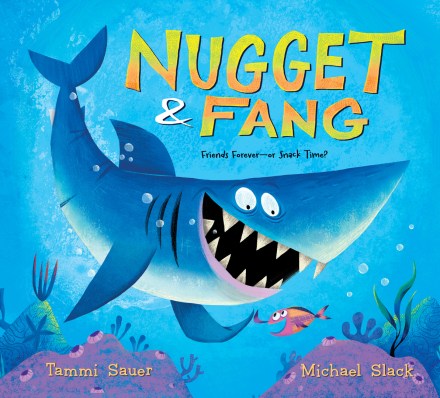
Nugget & Fang: Friends Forever—or Snack Time?

Written by Tammi Sauer | Illustrated by Michael Slack


Deep in the ocean two friends do everything together and life is almost perfect as they swim over ship wrecks, under reefs, and all around. Nugget and Fang are as close as two friend can be—there’s just one thing: Nugget is a minnow while Fang is a shark. Neither of them consider their friendship unusual—until Nugget goes to school. There during Reading, Nugget hears the story of The Three Little Minnows and the Big, Bad Shark. “‘Ha!’” says Nugget. “‘Impossible!’”

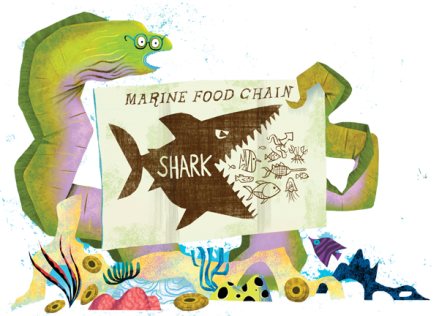
During Math class the students solve a word problem: “What if there were ten minnows and a shark came along and ate four of them? How many minnows are left?” Nugget is scandalized. “‘A shark would never do that!’” he says. But Science period reveals the facts of the Marine Food Chain. Nugget protests that sharks aren’t scary. “‘My best friend is a shark!’” he announces. His classmates are shocked. “Have you lost your gills?” one asks. Another snarks, “Hello—sharks eat minnows!” Nugget can’t believe it.

celebrate-picture-books-picture-book-review-nugget-and-fang

Image copyright Michael Slack, courtesy of hmhbooks.com/nuggetandfang

Back home Nugget gives Fang the bad news. “‘Sounds fishy to me,’” says Fang. Nugget assures him it’s true before swimming far away. “Fang’s heart sank.” He can’t help if he’s “toothy,” he thinks, and he knows he doesn’t mean to be scary. He wants his best friend back. To prove it Fang tries different tactics. On Tuesday he dresses like a mermaid, but Nugget and the other fish see through his disguise. “‘Oh, my algae!’” exclaims Nugget. On Wednesday Fang sends a beautiful sea plant arrangement with a note—“Dear Nugget, I’d love to have you over for dinner.”—which is misinterpreted in the worst possible way. On Thursday Fang pulls out all the stops. He gets a “Nugget” tattoo, sends a special message and gift, and performs an original song and dance, but nothing works.

On Friday Fang is sadly resigned to being alone. While he mopes and cries, he doesn’t see that a fishing net has been lowered to the ocean floor, capturing Nugget and the other minnows. “Help!” shouts Nugget as the net is slowly lifted. Fang wrings his fins, uncertain of what to do. Suddenly, he has an idea. With his big sharp teeth he chomps and chews and tears the net to pieces. Nugget and the minnows swim to safety. They all stare at Fang wide-eyed.

celebrate-picture-books-picture-book-review-nugget-and-fang

Image copyright Michael Slack, courtesy of hmhbooks.com/nuggetandfang

Fang dejectedly begins to swim away. “‘I know, I know,’” he says, “‘I’m toothy. Too scary. Too…shark.’” “Wait!” calls Nugget and uses a little math of his own. “‘There were ten minnows, and a very special shark came along. How many friends are there altogether?’” Now eleven friends live happily deep in the ocean, and everyone—especially Fang—are all smiles.

Tammi Sauer’s tribute to true friendship reveals the danger when “facts” take precedence over what you know in your heart to be true. Her reminder to listen to your inner voice is approached with humor and the honest types of doubts that can niggle and cloud judgement. Throughout the story, her language is accessible and kid-conversational, including puns that will elicit giggles. Sauer’s use of a math word problem to both highlight contrary thinking and provide a solution underscores the influence of education. Nugget & Fang is a wonderful book for kids navigating the school and activities environment while making new—and keeping old—friendships.

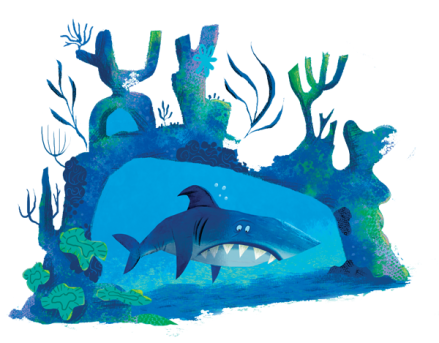
Michael Slack immediately sets kids in the right mindset with his bright, cartoon-inspired illustrations. Tiny, colorful Nugget and bold, blue Fang, his “toothiness” on display through his big grin, make a happy, nonchalant pair. They play together through vibrant green, yellow, and purple reefs unaware of marine stereotypes. When Nugget gets “schooled”, his astounded expressions and those of his classmates, humorously depict their predicament. The ocean environment gives Slack an opportunity for plenty of visual jokes and innovation. The Reading teacher holds a clamshell-shaped book, a piece of shipwrecked board serves as a Math blackboard, and the Science food chain poster is appropriately scary. Kids will laugh at Fang’s attempts at reconciliation, and cheer when he becomes a hero.

Nugget & Fang: Friends Forever—or Snack Time? is sure to be a favorite story time read!

Ages 4 – 9

Houghton Mifflin Harcourt, 2013 | ISBN 978-0544481718

Will everything go swimmingly for Nugget and Fang? Watch the trailer and see!

To learn more about Tammi Sauer and her books, visit her website!

View a gallery of work by Michael Slack on his website!

Visit the Houghton Mifflin Harcourt Nugget & Fang page for more goodies!

Shark Awareness Day Activity

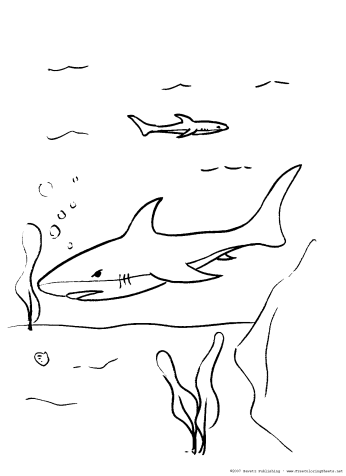
celebrate-picture-books-picture-book-review-shark-coloring-page

Looking Sharp, Sharks! Coloring Page


Sharks are some of the most fascinating creatures in the sea. Have fun decorating this printable Looking Sharp, Sharks! Coloring Page—get creative with textures, colors, and materials!

July 13 – National Culinary Arts Month

celebrate-picture-books-picture-book-review-the-hole-story-of-the-doughnut-cover

About the Holiday

July is a great month for celebrating culinary arts. With kids home from school it’s fun to spend time together in the kitchen learning new skills and making experimental or favorite recipes. On-the-go meals or vacations can also take you to new and enticing restaurants, where you may try regional cuisine and discover exciting flavors.

The Hole Story of the Doughnut

Written by Pat Miller | Illustrated by Vincent X. Kirsch


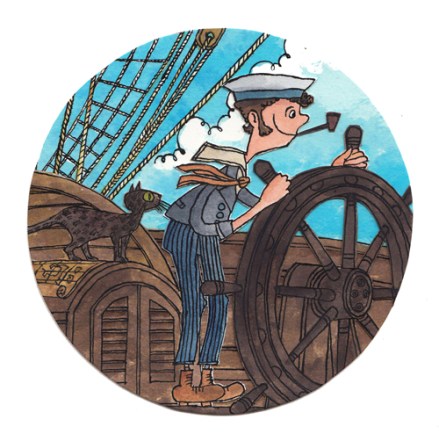
In 1844 at the tender age of 13, Hanson Gregory left the family farm and went to sea as a cabin boy on the schooner Isaac Achorn. He quickly became the cook’s assistant and also learned how to rig the sails and “steer a ship over trackless waves by sun and stars.” By the age of 19 Gregory had become the captain of the schooner Hardscrabble, and within a few more years was racing “his cargo from Maine to California as commander of a clipper, the fastest ship on any ocean.”

celebrate-picture-books-picture-book-review-hole-story-of-the-doughnut

Image copyright Vincent X. Kirsch, courtesy of vincentxkirsch.com

Hanson Gregory may have been one of the best captains to sail the seas—once awarded a medal for heroism for rescuing seven shipwrecked Spanish sailors even though his own ship and crew were endangered. But his greatest achievement was not attained because of his seafaring skills—it was his ingenuity in the galley that people remember.

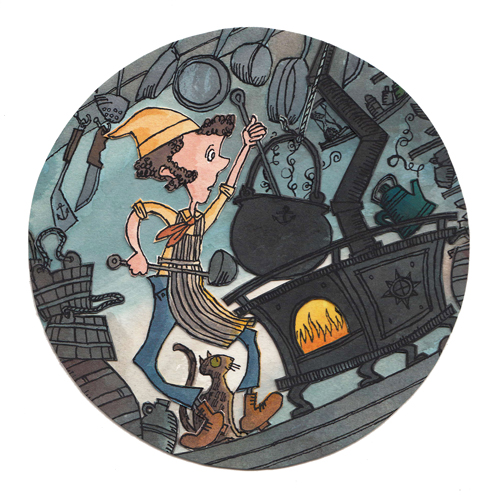
On June 22, 1847 as a 16-year-old cook’s assistant, Hanson was rustling up the crew’s breakfast—coffee and fried cakes, the same as every morning. While the pot of lard bubbled on the stove, Gregory formed balls of sweetened dough and dropped them in. They sizzled and crisped—at least around the edges. The centers were raw, heavy with grease, and they dropped like cannonballs in the stomach. “Sailors called them Sinkers.” But this morning Gregory had an idea. He removed the lid from the pepper can and cut out the center of the balls. “Then he tossed the rings into the bubbling lard.”

celebrate-picture-books-picture-book-review-hole-story-of-the-doughnut

Image copyright Vincent X. Kirsch, courtesy of vincentxkirsch.com

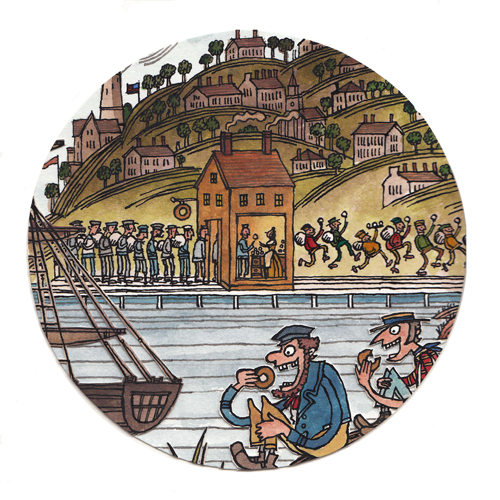
The cook and the sailors took one look at this odd concoction and…ate them up! “The cakes were brown, and sweet, and fully cooked. Sighs of delight rose above the noisy sea. A new breakfast tradition was born.” Gregory told his mom about his invention, and she fried up large batches of these ‘holey cakes’ that were a sensation at a friend’s store and on the docks.

You might think this is a pretty interesting tale in itself, “but sailors like their stories bold” and so they “spun legends worthy of such a delicious treat.” One tale had Captain Gregory inventing the doughnut while he saved his ship from disaster. Another told how Gregory, distraught over the drowning of five sailors pulled to the ocean floor by of their “sinker” breakfast, punched holes in every cake to make them look like life rings and vowed, “‘Never again!’”

Captain Gregory had a sense of humor about his accomplishment. During an interview he once stated that “he had invented ‘the first hole ever seen by mortal eyes.’” Gregory lived to be 89 and is buried “overlooking the sea where stormy weather can be spotted as readily as it once was from the quarterdeck of the Hardscrabble.”

An author’s note expanding on the story of Captain Gregory, the doughnut, doughnut shops, a timeline, and a selected bibliography follow the text.

celebrate-picture-books-picture-book-review-hole-story-of-the-doughnut

Image copyright Vincent X. Kirsch, courtesy of vincentxkirsch.com

Doughnuts have never been so evocative! In Pat Miller’s humorous, informative history of this favorite pastry treat, readers can smell the salt air, feel the ocean swell and roll under their feet, and even ache a little for those poor sailors forced to eat “sinkers.” Seamlessly interwoven into this foodography is a fascinating look at the early days of sail. Miller’s language is immediately stirring: the Ivanhoe bucks and plunges, the sea becomes a monster, and Captain Gregory spears a sinker on the wheel spoke. Kids will marvel at a 13-year-old going off to sea and becoming an inventor at 16.

Vincent X. Kirsch provides just the right touch to this captivating true story with his cartoon-inspired watercolor and cut paper artwork. Ingeniously incorporating Hanson Gregory’s innovation of removing the center of the fried cakes, Kirsch’s illustrations are “cored” to allow for text, while the extracted section appears on the facing page as a glimpse through a porthole. The maritime atmosphere—from ship to shore—of the mid-1800s is beautifully represented in the folk-style sketches, and the humor that is so intrinsic to this story is wonderfully embraced.

The Hole Story of the Doughnut will delight foodies and history buffs alike and would make a fun gift and a delectable addition to personal libraries for all ages.

Ages 5 – 12

Houghton Mifflin Harcourt, 2016 | ISBN 978-0544319615

Vincent X. Kirsch’s website is full of illustrations from his books for children—take a look at his portfolio!

Spend some time with Pat Miller on her website that offers activities, tips, resources and many more books!

Culinary Arts Month Activity

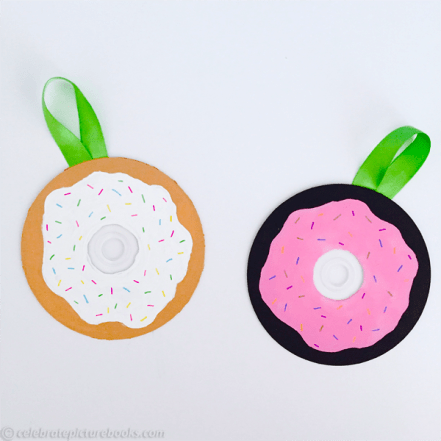
celebrate-picture-books-picture-book-review-cd-doughnut-craft

CD (Compact Doughnuts) Decoration


Are some of  your CDs a little passé? Not if you can turn them into cute décor like this doughnut hanging.

Supplies

  • Unused CDs
  • Craft paint in tan, black, pink, yellow, white (or any colors you want for the doughnut and the icing)
  • Ribbon, any color and length you want
  • Fine-tip markers in bright colors
  • Glue
  • Glue dots (optional)
  • Paint brush

Directions

  1. Paint a wavy edge around the CD, let dry
  2. Paint the center of the CD, leaving the clear circle unpainted
  3. When the icing paint is dry, draw sprinkles on the icing with the markers
  4. With the ribbon make a loop hanger and attach it to the back of the CD with glue or glue dots
  5. Hang your decoration

celebrate-picture-books-picture-book-review-the-hole-story-of-the-doughnut-cover

You can find The Hole Story of the Doughnut at these booksellers

Amazon | Barnes & Noble | Books-a-Million | IndieBound


May 9 – It’s Get Caught Reading Month

celebrate-picture-books-picture-book-review-the-whisper

About the Holiday

Supported by the Association of American Publishers (AAP), Get Caught Reading Month promotes literacy and reminds people of all ages how much fun reading is. Begun in 1999 by former Congresswoman Pat Schroeder, President and CEO of AAP, the initiative brings together publishing industry executives, authors, illustrators, teachers, librarians, politicians, celebrities, and readers to spread the word about the joys of books. To join the celebration, take a picture of yourself or a friend reading, hold a book drive, challenge yourself to a reading goal, and/or read to someone else.

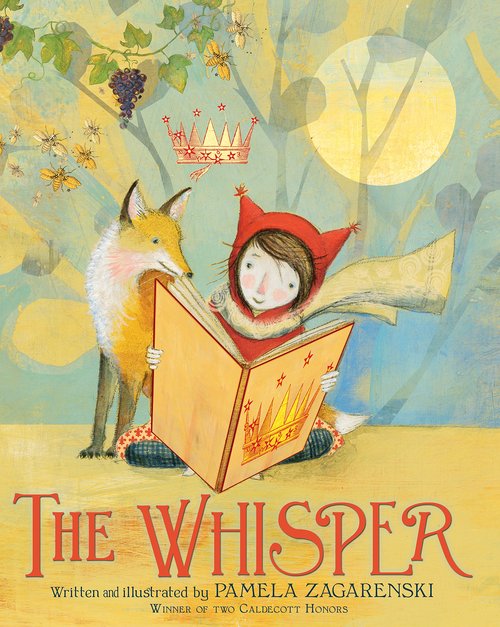
The Whisper

By Pamela Zagarenski


A little girl loves stories and the magical realms they can take her to. One day while waiting for school to be dismissed, she spies a book on a shelf. Her teacher allows her to take it home with her, and the little girl happily runs off with it when the clock strikes 3:00. On the way home, she doesn’t notice that all the letters are escaping from the book or that a wily fox is catching them in a net.

At home she secludes herself in her room, excited to read the mysterious book. She turns the pages, awed by the beautiful pictures. But by the time she has finished, she has tears in her eyes. “Where were the words? Where were the stories?” The girl flips through the book again, but this time she hears a small whisper: “Dear little girl, don’t be disappointed. You can imagine the words. You can imagine the stories.”

The whisper seems so knowing that the girl does at it suggests. She turns to the first page where a blue bear followed by a beekeeper walks under a honeycomb sun toward a brown bear. The girl stares at the picture and thinks of a title: Blue Bear’s Visit. Her story begins: “Blue Bear arrived on the first day of spring. He promised…”

Warming to the idea of creating stories, the girl examines the second picture. She notices the same white rabbit that was in the first picture. In the foreground a “magnificent ox” is listening to a man whispering into its large, soft ear. The Secret, the little girl titles this story, which starts: “Mr. Ox, you must please promise not to tell anyone, but we need your help. Last week…”

With the third picture the words tumble out more easily, forming sentences that give life to the massive white elephant, regal lion, and that rabbit again who are traveling the sea in a long, open boat. The Quest, she calls it. In Tigers Prayer, preparations are being made: tea is brewing, a clown with a pointed hat plays his accordion, a windhorse jumps through hoops, and the rabbit rides a golden ring as a lion hears what Tiger has to say. A Birthday Party comes next, and it seems Pan has planned a very secret party. An owl perches in the crook of a tree asking for the password with a “Hoo, Who?” which is answered quickly because the vanilla cake with raspberry filling and vanilla cream frosting holding 6 candles must be delivered.

The Magical Cloak sees the little girl’s imagination truly take flight as she decides the man in the “elaborate coat” is a wizard or magician whose bubbles come to life once released from the blower. Enormous whales now fill the harbor. They are beautiful, but something must be done….Next, hurry to meet the owl! He is picking up passengers at midnight. But what does the golden key in his beak open? Only the story The Golden Key locked in the little girl’s mind will tell.

Hours go by as the little girl creates tales for each picture in the book. As the night grows late, she sleeps, carried into slumber on dreams woven from the pictures and stories she imagined. When she wakes up, the girl wishes to spend more time with her new friends, but it’s time for school so she gathers up the book and hurries away.

On the path to school she meets a fox who is carrying a bag. “Excuse me, little girl,” says the fox. “I believe I have the words to your book.” The fox then explains how he caught the words as they spilled from the pages the day before. The fox gives her his parcel, but asks for a favor. The girl is happy to oblige and lets the fox stand on her shoulders to reach a bunch of grapes dangling from a nearby vine.

The girl rushes into school and apologizes for being late. She relates the story of the fox and the words and the magical night she has spent making up tales for the pictures in the book. “I have so many stories to tell you,” says the girl to her teacher. “‘I can’t want to hear,’” the teacher replies with a smile.”

Opening a book by Pamela Zagarenski is to fall into an alternate realm of such beauty and imagination that you forget the real world exists.  Her paintings are composed of rich, regal hues swirling with images and designs that overlap and float to create the kind of experience only the deepest, most complex dreams allow. The characters and details follow page to page uniting the pictures and, subtly, the stories the little girl discovers in them: The teapot, once introduced, waits under a tree on the next page and rides the waves of the whale-filled sea in the next. The bees and the rabbit are constant companions on each spread, and the animals will fill the reader with awe.

The little girl’s imagined stories are tantalizing with just the right mix of the mysterious and the tangible to entice readers to add more. The frame of the Aesop Fable The Fox and the Grapes is inspired and could lead to a conversation about how “life is what you make it.”

The Whisper is a book readers will want to linger over and dip into again and again, and would be especially fun on those days when there’s “nothing” to do. It makes a beautiful gift for any occasion.

Ages 4 – 9 (this book would also appeal to adults)

Houghton Mifflin Harcourt, 2015 | ISBN 978-0544416864

Gardening for Wildlife Month Activity

In addition to Get Caught Reading Month, May is Gardening for Wildlife Month. It’s the perfect time to celebrate the joys and colors of spring and enjoy the many plants, flowers, and wildlife nature provides. Whether your garden is small or large, just being planted or already blooming, you can be mindful to make yours wildlife friendly to help and protect the environment.

This week’s crafts and activities will revolve around gardens and plants of all types. I hope you enjoy them!

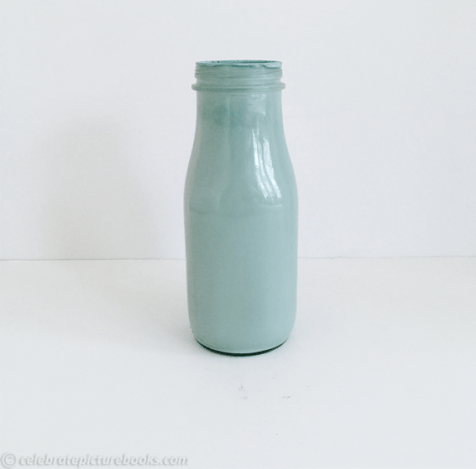
celebrate-picture-books-picture-book-review-vase

Painted Bottle Vase

Do you often pick up a smoothie or other drink at the grocery store and then just throw away the glass or plastic bottle? Those containers, with their elegant shapes, make beautiful vases with just a little paint!

Supplies

  • Plastic or glass bottle
  • Multi-surface craft paint in your favorite color
  • Paint brush
  • Wax paper

celebrate-picture-books-picture-book-review-vase-top

Directions

  1. Wash and thoroughly dry your bottle.
  2. Pour 3 to 5 tablespoons of craft paint into the bottle
  3. Invert the bottle on the wax paper
  4. Let the paint drip down the sides of the bottle, this may take several hours to overnight
  5. When the paint reaches half-way down the sides of the bottle, you can “help it along” with the paintbrush, filling in any empty spaces
  6. Let the bottle sit, inverted, until the paint dries. This can take one to several days, depending on the atmosphere.
  7. When the paint is dry, use the vase for artificial flowers.

Join me tomorrow to see how to make flowers to go in your vase!

Picture Book Review