January 25 – A Room of One’s Own Day

celebrate-picture-books-picture-book-review-my-very-own-room-cover

About the Holiday

Everyone needs a little space of their own—a place to think, read, write, or just say Ahhhh… after a long day. In today’s world of Man Caves and Women’s Sheds, designing a spot where you can get away and spend some rejuvenating alone time doing a particular hobby or just doing nothing is becoming easier and more accepted. Kids need their own spaces too—a personal place surrounded by the things they love.

My Very Own Room / Mi propio cuartito

Written by / Escrito por Amada Irma Pérez | Illustrated by / Ilustrado por Maya Christina Gonzalez


One morning a little girl woke up in a bed overrun with brothers. Victor’s elbow was poking her in the ribs, and Mario was curled up on the pillow with his leg across her face. In the next bed slept the girl’s three other brothers. The girl had had enough—after all she was nearly 9 years old. After years of sharing a room with her five brothers, “more than anything in the whole world [she] wanted a room of [her] own,” but space in her tiny house was hard to come by. What’s more, besides the eight immediate family members, sometimes friends and relatives from Mexico came to stay. It could be fun, but there was no privacy.

To get away she sometimes crept out early in the morning and climbed “the crooked ladder that leaned against the elm tree” in her backyard. It wasn’t that she didn’t love her brothers, she just needed a place of her own. She looked around the house for a space that would be just right. She peeked behind the flour-sack curtain that divided the living room from the storage closet. It seemed perfect! She imagined it with her “own bed, table, and lamp—a place where she could read the books she loved, write in her diary, and dream.”
celebrate-picture-books-picture-book-review-my-very-own-room-mixing-paint

Image copyright Maya Christina Gonzalez, courtesy of Lee & Low Books

While the storage nook seemed the solution, the girl’s mother shook her head. The space was already assigned to her aunt’s sewing machine, her uncle’s garden tools, furniture, and old clothes—the things needed for others to make a better life in America. But then her mother saw the tears in her daughter’s eyes and decided that perhaps the things in the storage space could find a new home on the back porch with blankets and a tarp to protect them from the weather.

With a hug and a kiss, the little girl thanked her mother, and they and the five boys began rearranging the house. Finally, all that was left behind the flour-sack curtain were a few cans of leftover paint. There was blue, white, and pink, but not enough of any one color to paint the room. Suddenly, the girl had an idea. She and her brothers mixed the three together and made…magenta! Tío Pancho offered a spare bed and after measuring the room and then the bed with a piece of yellow yarn, the little girl discovered that the bed would indeed fit. An upended wooden crate became a nightstand. But what about a lamp?

Mamá brought out her box of Blue Chip stamps that she’d been collecting for years. The stamps were awarded with gas and food purchases. When they were stuck into booklets and used at special stores, the stamps were as good as money. The girl and her brothers “licked and licked and pasted and pasted.” When they were finished, they all went to the stamp store. As soon as she stepped into the store, the girl spied the lamp she wanted. “It was as dainty as a beautiful ballerina, made of white ceramic glass with a shade that had ruffles around the top and bottom.”

celebrate-picture-books-picture-book-review-my-very-own-room-books

Image copyright Maya Christina Gonzalez, courtesy of Lee & Low Books

Back home she carefully set the lamp on her bedside table, but “something was still missing, the most important thing…Books!” The next day the little girl brought home six books from the library—six was her “lucky number because there were six children” in her family. That night, the little girl nestled into her new room, turned on the light and began to read. When her two youngest brothers peered in through the curtain, she invited them in, and as they snuggled on her bed, she read them a story. At the end they said goodnight, and her brothers returned to their own room. Lying back against her pillow, the girl felt “like the luckiest, happiest little girl in the whole world” because each person in her family had worked to make her wish come true. She drifted off into peaceful sleep under a “blanket of books” in her very own room.

Amada Irma Pérez’s touching story from her own childhood is a delightful reminder for readers of the strong bonds of family love that puts other’s needs ahead of one’s own. The family’s commitment to each other is found not only in their willingness to help rearrange the house to accommodate a maturing daughter and sibling, but in the collection and storage of goods that will contribute to a better life for friends and relatives. Children familiar with reward points will be fascinated to learn about their predecessor “blue chip stamps.” The straightforward storytelling is infused with the kinds of hopes and suspense that resonate with kids, and the tender, quiet ending leaves readers with a lingering feeling of comfort and happiness.

Maya Christina Gonzalez fills the pages of My Very Own Room with joyous vibrancy and empathy that emphasizes the family’s connection. Soft edges and swirling patterns create a comforting environment, while elements, such as the long piece of yellow yarn, underscore the familial ties. While the little girl finds solace in the backyard elm tree and hunts for a space to call her own, her mother looks on with understanding, which leads to depictions of mother and daughter that are particularly moving. With warmth and welcome, each page invites readers into the family home to share a transitional event in their life.

The text is presented in both English and Spanish on each page, and is followed by a brief biographical note, including photographs, by Amada Irma Pérez.

It’s heartening to read a story in which siblings are so immediately supportive of each other. The gentle pace and upbeat tenor of My Very Own Room makes it a wonderful choice for quiet family story times or group school or library readings.

Ages 5 – 10

Lee & Low Books, 2008 | ISBN 978-0892392230

Learn more about Amada Irma Pérez and her books on her website!

Discover a gallery of book illustration and fine art by Maya Christina Gonzalez plus resources for educators on her website!

A Room of One’s Own Day Activity

celebrate-picture-books-picture-book-review-bedroom-coloring-page

Decorate Your Room Coloring Page


If you had a room to fix up just the way you’d like, how would it look? Here’s a printable Decorate Your Room Coloring Page for you to enjoy. Put your own knick-knacks on the shelf and your things on the nightstand by the bed. Then give your room a color scheme – and move in!

Picture Book Review

January 15 – National Hat Day

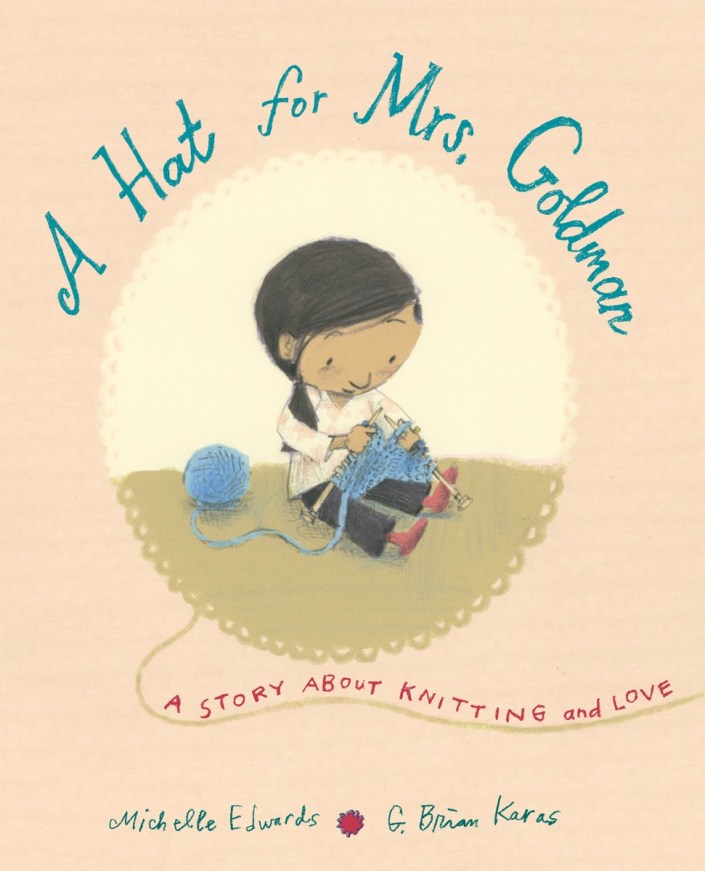
celebrate-picture-books-picture-book-review-a-hat-for-mrs.-goldman-cover

About the Holiday

Hats are always stylish, and during this time of year they can be a necessity for keeping warm! No matter if you make your own hat or buy it in a shop, whether you like stocking hats, felt hats, hats with earflaps, or hats that just hide a bad hairdo, this is the perfect season to indulge your fashion fancies!

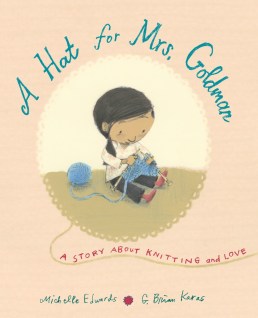
A Hat for Mrs. Goldman: A Story about Knitting and Love

Written by Michelle Edwards | Illustrated by G. Brian Karas


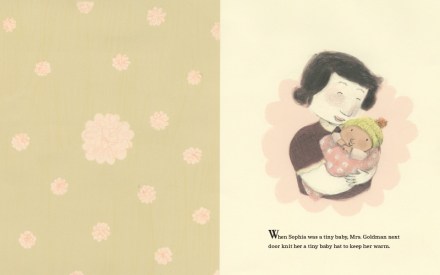
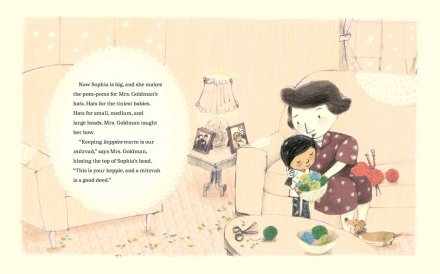
One of the first gifts Sophia received when she was a baby was a knitted hat from her neighbor Mrs. Goldman. Now that Sophia is more grown up, she helps Mrs. Goldman make pom-poms for the hats she knits for other babies, friends, and neighbors. “‘Keeping keppies warm is our mitzvah,’ says Mrs. Goldman, kissing the top of Sophia’s head. ‘This is your keppie, and a mitzvah is a good deed.’”

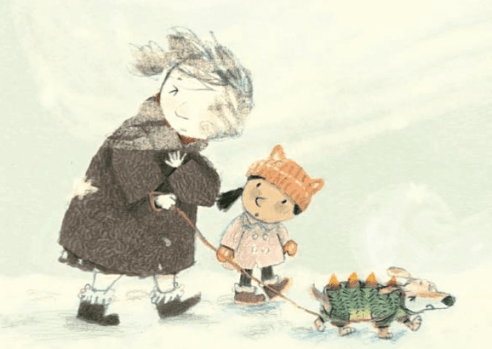
One day in late autumn Sophia and Mrs. Goldman walk Mrs. Goldman’s dog Fifi. While Fifi is kept warm in a dinosaur sweater and Sophia is cozy in the fuzzy kitten hat and mittens that Mrs. Goldman made them, Mrs. Goldman’s head and ears are unprotected in the icy wind. When Sophia asks her friend why she doesn’t have a hat, Mrs. Goldman tells her “‘I gave it to Mrs. Chen.’”

celebrate-picture-books-picture-book-review-a-hat-for-mrs.-goldman-sophia-as-a-baby

Image copyright G. Brian Karas, 2016, text copyright Michelle Edwards, 2016. Courtesy of Schwartz & Wade.

Sophia begins to worry about Mrs. Goldman. Who will knit a hat for her? “Not Mrs. Goldman. She’s too busy knitting for everyone else.’” Last year Mrs. Goldman had tried to teach Sophia to knit, but it was too hard and took too long, so she decided to stick with making pom-poms. But Sophia thinks maybe it’s time to try again. She goes to her knitting bag and pulls out the hat they had started together. “The stiches are straight and even. The soft wool smells like Mrs. Goldman’s chicken soup.”

celebrate-picture-books-picture-book-review-a-hat-for-mrs.-goldman-pom-poms

Image copyright G. Brian Karas, 2016, text copyright Michelle Edwards, 2016. Courtesy of Schwartz & Wade.

Holding the needles, Sophia thinks about what she was taught. Even though she drops stitches, she continues to knit. “She wants to make Mrs. Goldman the most special hat in the world.” The next day snow falls on Mrs. Goldman’s head as they walk Fifi. Sophia frets, and at home she begins knitting morning, noon, and night to finish her hat. Winter has set in and one day when the pair walk Fifi, “Mrs. Goldman wraps Mr. Goldman’s scarf around her head like she’s a mummy.” But the wind grabs it and rips it away. Sophia catches it, but shivers at the thought of how cold Mrs. Goldman must be.

celebrate-picture-books-picture-book-review-a-hat-for-mrs.-goldman-sophia-and-mrs-goldman

Image copyright G. Brian Karas, 2016, text copyright Michelle Edwards, 2016. Courtesy of Schwartz & Wade.

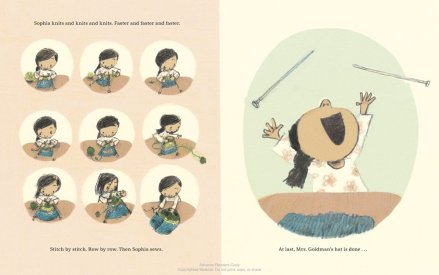
At home Sophia knits in a frenzy, adding row after row of stitches until the hat is finished. When Sophia looks at it, though, she finds holes where they shouldn’t be and lumpy and bumpy areas. She thinks what she has made looks more like a monster than a hat. Sophia takes out the box containing all the hats Mrs. Goldman has made for her, but they are much too small for Mrs. Goldman to wear. While Sophia’s mama and papa have hats made by Mrs. Goldman, she knows she can’t give those away.

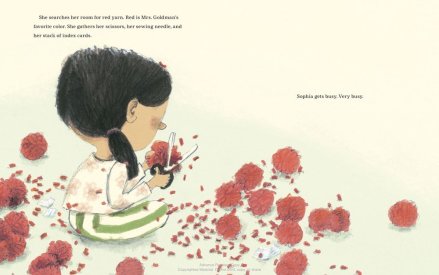
Sophia imagines all the hats she makes with her neighbor and how Mrs. Goldman always tells her that her pom-poms add beauty, and that “‘that’s a mitzvah too.’” Sophia’s heart swells. She finds red yarn—Mrs. Goldman’s favorite color—and her pom-pom making supplies and goes to work. When she is finished and the pom-poms are attached, “Mrs. Goldman’s hat is the most special hat in the world.”

celebrate-picture-books-picture-book-review-a-hat-for-mrs.-goldman-sophia-finishes-hat

Image copyright G. Brian Karas, 2016, text copyright Michelle Edwards, 2016. Courtesy of Schwartz & Wade.

Sophia runs next door and surprises Mrs. Goldman with her gift. Mrs. Goldman hugs Sophia and tears come to her eyes. “‘Don’t you like it?’” Sophia asks, but she needn’t worry. “‘I more than like it, I love it,’ declares Mrs. Goldman. ‘Gorgeous. Like Mr. Goldman’s rosebushes. And you know how I love his roses.’” With a kiss for Sophia, Mrs. Goldman begins counting the twenty pom-poms on her hat—“each one made with love.” Mrs. Goldman slips the hat on her head. Now when she and Sophia take Fifi for a walk, Fifi wears her dinosaur sweater, Sophia wears her kitty hat and mittens, and “Mrs. Goldman wears her Sophia hat. Her keppie is toasty warm. And that’s a mitzvah.”

celebrate-picture-books-picture-book-review-a-hat-for-mrs.-goldman-giving-hat

Image copyright G. Brian Karas, 2016, text copyright Michelle Edwards, 2016. Courtesy of Schwartz & Wade.

Michelle Edwards’ heartwarming story of a little girl who sees that her friend is in need and determines to help draws on children’s natural generosity and shows readers that their efforts are recognized and appreciated. Edward’s gentle and well-paced storytelling allows readers to understand the events and thoughts that bring Sophia to once again attempt knitting. Sophia’s solution to use the pom-poms she knows she makes well (and with love) to cover the holes demonstrates not only the ingenious creativity of kids, but also the idea that love can fill the voids in life.

celebrate-picture-books-picture-book-review-a-hat-for-mrs-goldman-snow

Image copyright G. Brian Karas, 2016,  courtesy of Schwartz & Wade.

Brian Karas imbues the story of Sophia and Mrs. Goldman with a magical wonder that floats from page to page like the fluffy snowflakes that are the catalyst for Sophia’s mitzvah. A combination of full-page illustrations and snapshot images show days spent with Mrs. Goldman as well as the moments, hours, and days that adorable Sophia spends knitting her special hat. Sophia, tongue sticking out in determination, wields her knitting needs; she ponders her holey hat while imagining a frightened Fifi; and scraps of red yarn dot the floor and even sit atop Sophia’s head as she creates pom-pom after pom-pom. When Mrs. Goldman pulls the hat over her own head, kids will feel cheered, while adults may feel a small lump in their throat.

A Hat for Mrs. Goldman is a gem. Its tender portrayal of kindness, love, and close personal relationships makes it an outstanding choice for any child’s home library.

Ages 4 – 8

Schwartz & Wade, 2016 | ISBN 978-0553497106

Discover more about Michelle Edwards and her books, plus activities, recipes, and information on knitting on her website!

Enter a gallery of books, sketches, blog essays, and more by G. Brian Karas on his website!

National Hat Day Activity

celebrate-picture-books-picture-book-review-winter-hat-match-puzzle

Winter Hat Match Puzzle


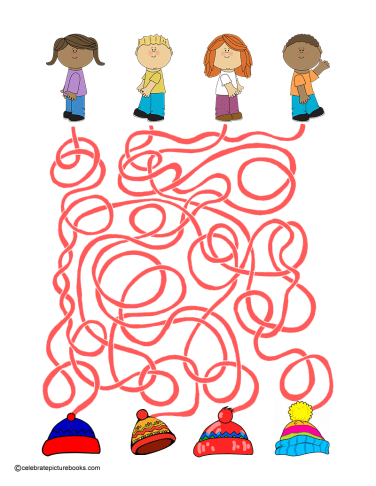
These kids have all lost their hats! Can you follow the paths in this printable Winter Hat Match Puzzle to reunite each child with the right hat?

celebrate-picture-books-picture-book-review-a-hat-for-mrs.-goldman-cover

You can find A Hat for Mrs. Goldman at these booksellers

Amazon | Barnes & Noble | Books-a-Million | IndieBound

Picture Book Review

January 14 – International Kite Day

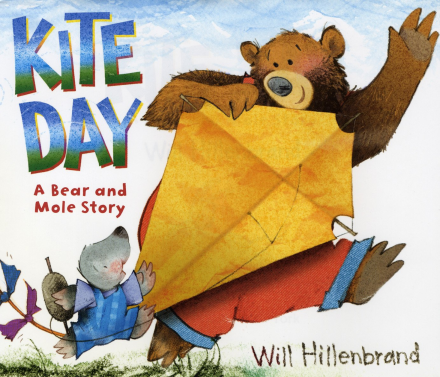
celebrate-picture-books-picture-book-review-kite-day-a-bear-and-mole-story-cover

About the Holiday

International Kite Day originated in India in the state of Gujarat to commemorate the last day of winter and the first day of summer as well as the coming harvest season. The kites represent the spirits of the gods who are awakened from their winter sleep. The people of Gujarat begin making kites months in advance to accommodate the numerous festivals and the millions of people from around the world who attend them.

Kite Day: a Bear and Mole Story

By Will Hillenbrand


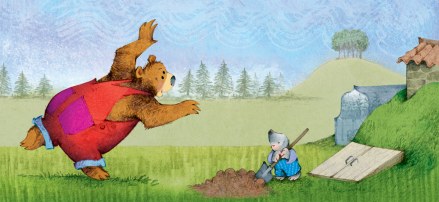
Bear sensed a familiar aroma in the air. He pointed his nose toward the sky and took a big whiff. “He smiled and then shouted, ‘Kite day!’” He dashed home and announced the news to Mole, who was digging in his garden. While Mole researched in a stack of books, Bear gathered supplies. While “Bear measured and cut, Mole drew.” Then “they both constructed.”

celebrate-picture-books-picture-book-review-kite-day-a-bear-and-mole-story-mole-digging

Image copyright Will Hillenbrand, courtesy of Holiday House

With their beautiful yellow creation in hand, “they raced outside into the meadow.” Mole ran with the string while Bear threw the kite high above him. The breeze picked up the kite and sent it’s rainbow bowtie tail fluttering “Zoom. Zoom. Zoom.” The kite soared higher and higher—into a graying sky. “Then dark, heavy clouds rolled in. Rumble. Rumble. Rumble.”

celebrate-picture-books-picture-book-review-kite-day-a-bear-and-mole-story-flying-kite

Image copyright Will Hillenbrand, courtesy of Holiday House

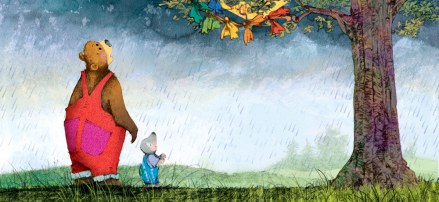
Suddenly, a gust of wind snapped the kite string, and it spun “Away, away, away.” “‘Oh no!” screamed Mole and Bear” as the kite dove downward. The two ran as fast as they could to catch up with it. They came to a stop under a huge tree. Caught in the branches was their kite. “Splat. Splat, Splat. Rain pelted the broken kite.” Then Mole and Bear saw something amazing. “‘Look!’ cried Bear. ‘Oh,’ sighed Mole.” The kite was sheltering a nest of chicks! “‘Chirrup, chirrup, chirrup’” they cheaped. “‘Thank you!’ sang the mother bird.”

celebrate-picture-books-picture-book-review-kite-day-a-bear-and-mole-story-kite-in-tree

Image copyright Will Hillenbrand, courtesy of Holiday House

Will Hillenbrand’s sweet friends Bear and Mole never fail to bring a smile to young reader’s faces as they share both joyful and scary experiences together. Little ones will love the repeated words that invite them to read along, and active verbs—such as snatched, plunged, and pelted—provide lyrical and advanced vocabulary. Kite Day offers gentle suspense and a cheerful resolution that will enchant young readers. Hillenbrand’s adorable, expressive characters, vibrant colors, and lovely pastel backgrounds will fully engage kids during any story time.

Children would love to add Kite Day, along with the Hillenbrand’s three other Bear and Mole Stories, to their home bookshelf.

Ages 3 – 6

Holiday House, 2013 | ISBN 978-0823427581

Discover more about Will Hillenbrand and his books as well as book-related activities and a gallery of illustations on his website!

Fly with this Kite Day book trailer!

International Kite Day Activity

celebrate-picture-books-picture-book-review-kite-coloring-page

Cool Kite Decorating Page


Part of the fun of making your own kite is decorating it! Use this printable Cool Kite Page to create the perfect flier! Try colored pencils, markers, glitter, tissue paper, stickers, or other decorations to make it uniquely yours!

Picture Book Review

January 2 – Motivation and Inspiration Day

celebrate-picture-books-picture-book-review-radiant-child-cover

About the Holiday

While Motivation and Inspiration Day was instituted in reaction to the 9/11 attacks, the holiday’s influence and meaning has grown and now includes world-wide participation. Falling on the second day of the year, it encourages us to reflect on our lives—where we are and where we want to go. Take some time to consider what motivates and inspires you and follow those inner and external voices to help you achieve your dreams.

Radiant Child: The Story of Young Artist Jean-Michel Basquiat

By Javaka Steptoe


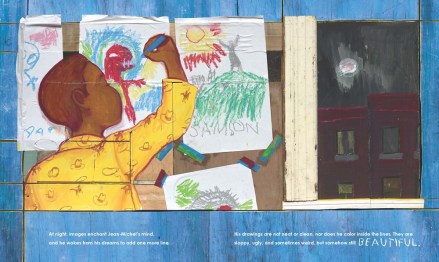
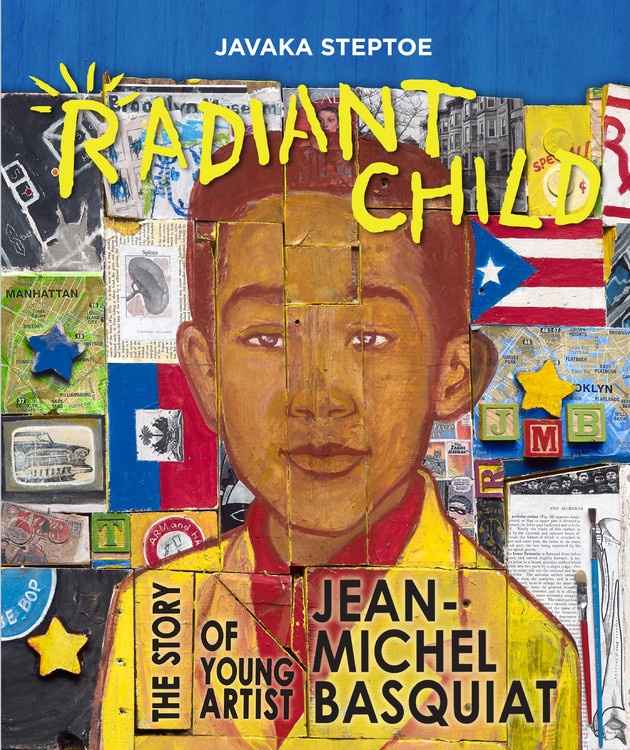
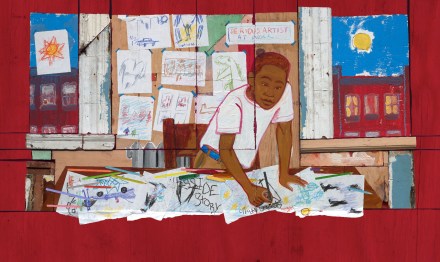
“Somewhere in Brooklyn, between hearts that thump, double Dutch, and hopscotch / and salty mouths that slurp sweet ice, a little boy dreams of being a famous artist.” All day Jean-Michel sits surrounded by colored pencils and “a storm of papers” and draws. As he sleeps his dreams swirl with images. When he wakes he adds to his drawings, scribbling away. What he creates is “sloppy, ugly, and sometimes weird, but somehow still beautiful.”

celebrate-picture-books-picture-book-review-radiant-child-beautiful-art

Image and text copyright Javaka Steptoe, courtesy of Little, Brown Books for Young People

Jean-Michel’s talent comes from his Puerto Rican mother, who has a natural sense of style and design and who always makes time to draw with her son, lying on the floor next to him. She takes Jean-Michel to art museums and theaters and reads poetry to him, but she also shows him the art of the city—its sounds, sights, style, and “patchwork” colors. Jean-Michel loves to visit the museum and read about the artwork and the artists. From these stories he “learns what it means to be a famous artist.”

When Jean-Michel is seriously injured in a car accident, his world seems scary and confusing. He mother gives him an anatomy book, which he memorizes. It erases his fears and becomes influential in his work. After returning home his life changes when his mother suffers a breakdown and can no longer live at home. “He tries drawing the terrible out of his blues, but things are not the same.” Jean-Michel visits his mother when he can, “always bringing his artwork to show, telling her that one day it will be in a museum, ‘when I am a famous artist.’”

celebrate-picture-books-picture-book-review-radiant-child-drawing

Image and text copyright Javaka Steptoe, courtesy of Little, Brown Books for Young People

As a teenager, Jean-Michel follows his dream, moving from Brooklyn to New York City. There he stays with friends, painting, creating collages, and writing poems on paper strewn about him. At night he paints on city walls, trash cans, and other urban canvases. His art, signed ‘Samoo,’ attracts attention. People wonder, “‘Who is Samoo?’”

Soon his art can be found in art galleries and hanging in the homes of the people who buy his work. Jean-Michel continues to create, listening to “a sound track that is all his own.” Through talent, inspiration, and his mother’s loving influence, Jean-Michel Basquiat conquered the art world, becoming a king among artists, and fulfilling his desire to be a famous artist.

An extensive Author’s Note about Jean-Michel Basquait’s life, including his struggles with addiction and his death in 1988, the motifs and symbolism in his work that now is displayed in museums around the world and sells for millions of dollars, and a personal comment on the impact Basquait’s art had on the author follow the text.

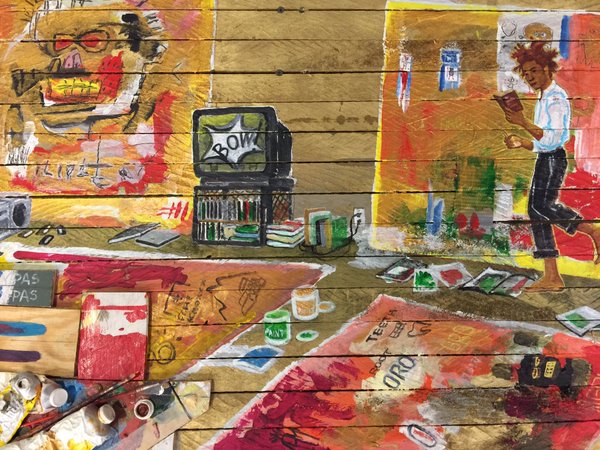
celebrate-picture-books-picture-book-review-radiant-child-studio

Image and text copyright Javaka Steptoe, courtesy of Little, Brown Books for Young People

Javaka Steptoe’s compelling biography of this complex, brilliant artist who people called “radiant, wild, a genius child” beautifully brings to life the inspirations and motivations that fueled his unique and intense talent. Steptoe delivers the story in staccato and flowing sentences, using consonance, assonance, repetition, the rhythms of a poet. Taking the reader from Jean-Michel’s childhood to adulthood to show how maintaining his focused determination, self-confidence, and persistence over many years led to his ultimately becoming a famous artist demonstrates that success is not a matter of luck, but of belief in oneself despite obstacles. Steptoe sensitively addresses the serious injury Basquiat suffered, his mother’s mental illness and Basquiat’s continued love for her, and his unsettled teenage years to complete this far-reaching life story.

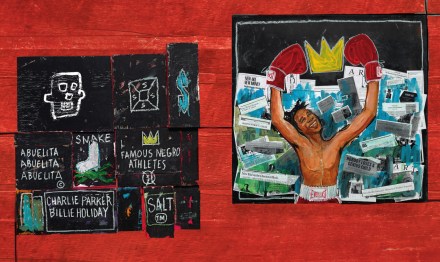
celebrate-picture-books-picture-book-review-radiant-child-boxing-image

Image and text copyright Javaka Steptoe, courtesy of Little, Brown Books for Young People

Steptoe’s mixed-media paintings were created on found wood from neighborhoods across New York City. While Steptoe does not reproduce any of Basquiat’s work, he states that readers will find “original pieces that were inspired by him and my interpretations of his paintings and designs.” As befitting his subject, Steptoe offers pages that burst with vibrant color and intricate details and beat with the pulse of the city, the people, the dreams, and the imagination that Basquiat transcribed onto paper, walls, and canvas. Part collage, part fine art, Steptoe’s illustrations will fascinate children and entice them to linger to take in all the emotion and meaning in each. The final spread, a crowd scene made up of photographs, sets Basquiat in the midst of people whom he and his art continue to inspire.

Radiant Child: The Story of Young Artist Jean-Michel Basquiat offers children an inspirational model of creativity, compassion, and confidence no matter where their talents lie. The book is an excellent choice for school, public, and home libraries.

Ages 6 – 10

Little, Brown Books for Young Readers, 2016 | ISBN 978-0316213882

Learn more about Javaka Steptoe, his books, art exhibitions, and life on his website!

Motivation and Inspiration Day Activity

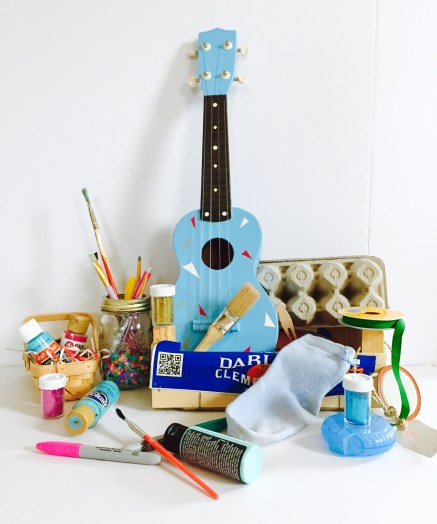
celebrate-picture-books-picture-book-review-motivation-and-inspiration-day-craft

Found-Item Crafts


Each person finds motivation and inspiration in different things, places, and people. Today, try to create something new from the materials around you. Boxes, bottles, wire, magazines, cloth, wood, sponges—almost anything—can be transformed with some imagination. With those old socks, corks, flower pots, candle stubs, bits of ribbon, clementine crate, paint, glitter, beads, and more, you can make something useful, a decoration for your room, or even a gift for a friend!

Picture Book Review

December 30 – Bacon Day

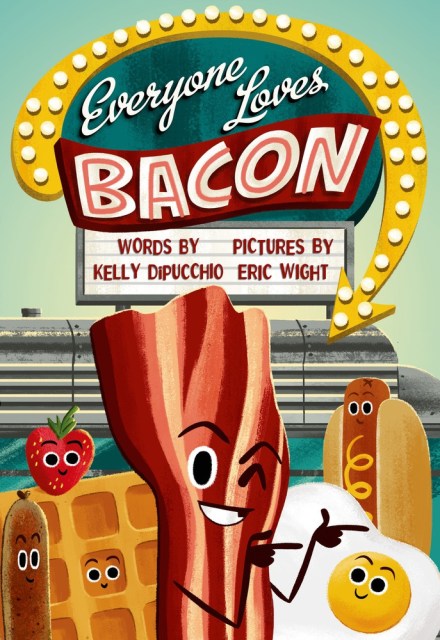
celebrate-picture-books-picture-book-review-everyone-loves-bacon

About the Holiday

Bacon has been around since ancient times. In early French it was known as Bako, in German as Bakko, and in Teutonic as Backe. In Middle English it was called Bacoun, but all these words simply meant “back,” as in the back meat of pigs. Preserved and flavored, bacon is a favorite the world over and has seen an explosion of uses in the past few years, from enhancing cupcakes, apple pie, and chocolate chip cookies to spicing up peanut butter sandwiches, lasagna, and French toast. There’s nothing like waking up to the sizzling aroma of bacon, and today’s holiday gives you the okay to indulge!

Everyone Loves Bacon

Written by Kelly Dipucchio | Illustrated by Eric Wight


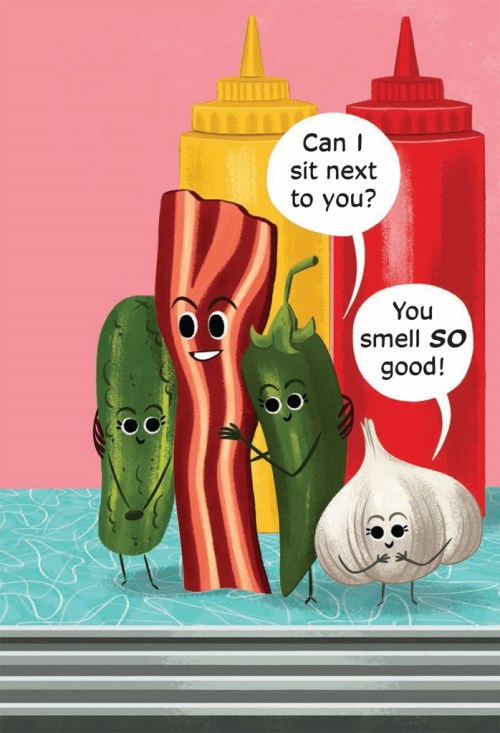
From Egg to Waffle to Pancake, there was no one who didn’t love Bacon—even Bacon himself. Well…maybe French Toast was an exception, but he “doesn’t like anyone.” Bacon loved all the attention the other foods gave him. Jalapeño wanted to sit next to him, and Garlic thought he smelled so good! He made the fruit and vegetables laugh with his “charming stories and funny jokes,” and, boy, could he play the ukulele!

celebrate-picture-books-picture-book-review-everyone-loves-bacon-taking-picture

Image copyright Eric Wight, courtesy of us.macmillan.com

Ham, sausage link, and sausage patty were jealous, “but Bacon didn’t care about them. Not one bit.” After all, “He was becoming a real celebrity. His picture appeared on t-shirts. And billboards. And buses.” Bacon was so enthralled with himself that he began to forget his friends. Sometimes he even “pretended not to know some of his old friends.” Bacon had fans, and that was enough for him.

Bacon began to live the high life of sports cars, designer clothes, and the latest fads. He was even the star of the breakfast pastry parade. “Indeed Bacon was the toast of the town. Until….” Well…we did warn you that “everyone loves Bacon.”

celebrate-picture-books-picture-book-review-everyone-loves-bacon-umbrellas

Image copyright Eric Wight, courtesy of us.macmillan.com

Kelly Dipucchio’s witty cautionary tale about a piece of bacon that gets too big for his broiler sizzles with snappy sentences and the perils of celebrity. She chooses words and experiences that are recognizable to any child navigating the world of school, siblings, and friends, and with sly winks to popular culture shows that mistaking fans for friends ends badly and that there is always someone “bigger” than you.

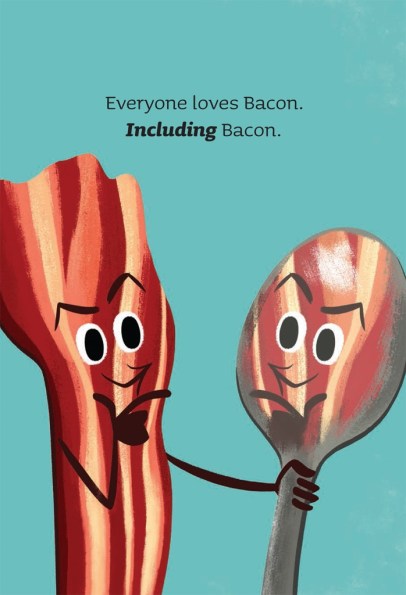
celebrate-picture-books-picture-book-review-everyone-loves-bacon-spoon-mirror

Image copyright Eric Wight, courtesy of us.macmillan.com

Even if readers don’t like the taste of bacon, they won’t be able to resist Eric Wight’s adorable slice who becomes the star of a 1950s-era diner. From the first page where Bacon admires himself in the back of a spoon, kids will giggle as Bacon takes pictures with equally cute Hotdog, Chicken Leg, Pickle, Garlic, and Jalapeño, leads a citrus parade complete with paper cocktail umbrellas, and plays the ukulele for swooning tater tots, French fries, and curly fries. But as the other foods grow sad and disgruntled with Bacon’s attitude—even brandishing fancy toothpicks—kids will understand and empathize with these forgotten friends. When Bacon meets his fate on the last page, readers are sure to fork over a howl of surprise.

Ages 3 – 6

Farrar, Straus & Giroux, 2015 | ISBN 978-0374300524

To learn more about Kelly Dipucchio and her books, visit her website!

Bacon Day Activity

celebrate-picture-books-picture-book-review-amazin'-bacon-maze

Amazin’ Bacon Maze


There’s some tasty bacon sizzling in the center of this frying pan-shaped maze. Can you find your way through this printable Amazin’ Bacon Maze to eat it up? Here’s the Solution!

Picture Book Review
December 23 – Roots Day

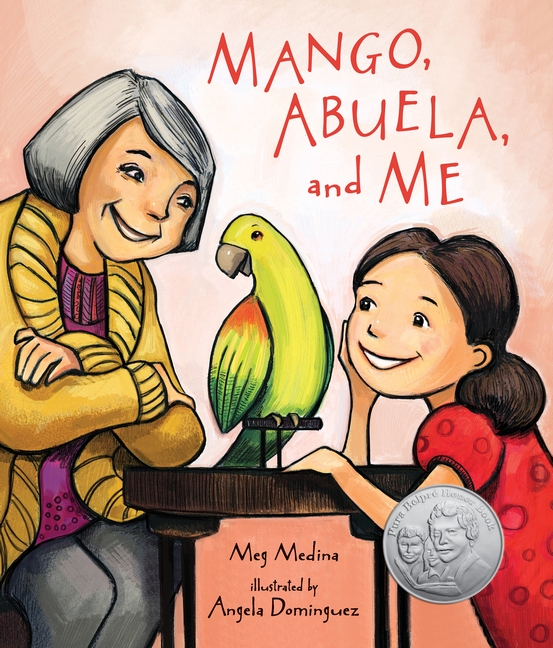
celebrate-picture-books-picture-book-review-mango-abuela-and-me

About the Holiday

Roots Day was established to inspire us to look into our family background and learn about our heritage. It’s fascinating to discover facts about our ancestors’s lives and the stories that have come down from generation to generation. If you will be with family this weekend, talk about your collective history and get to know each other in a whole new way!

Mango, Abuela, and Me

Written by Meg Medina | Illustrated by Angel Dominguez


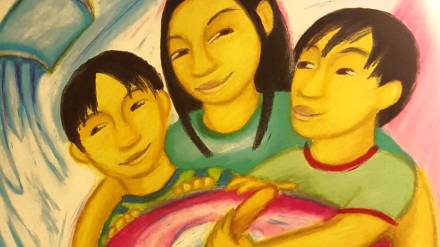
During the winter Mia’s Abuela moves from her house far away to live with her family. Mia feels shy around her unfamiliar grandmother, but quickly adapts, sharing her room and her drawer space. The one thing they cannot share is language. Abuela “can’t unlock the English words” in Mia’s book, and Mia knows only a little Spanish.

celebrate-picture-books-picture-book-review-mango-abuela-and-me-letter

Image copyright Angela Domingues, text copyright Meg Medina. Courtesy of Candlewick Press

On the first night Abuela shows Mia two things she has carefully brought with her—a feather from a wild parrot that roosted in her mango trees and a photograph of her late husband. “Tu Abuelo,” she explains to Mia.

For the rest of the winter, Mia spends time with her grandmother, but regrets that she can never tell her important things about her life. Abuela does’t know that Mia’s good at art or can beat the boys in a race. Likewise, Abuela can’t tell Mia about her life or answer Mia’s many questions. 

celebrate-picture-books-picture-book-review-mango-abuela-and-me-language-barrier

Image copyright Angela Domingues, text copyright Meg Medina. Courtesy of Candlewick Press

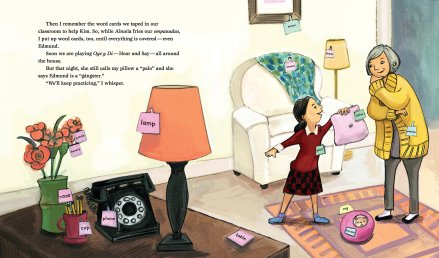
When Mia confides in her mother, her mom reminds her of how she helped her best friend, Kim, learn English when she was new at school. One day while Mia and her grandma bake meat pies, Mia pretends to be her teacher, naming each ingredient in English. Abuela reciprocates with the Spanish word. Mia suddenly has an idea. She tags everything in the house with its English name and the pair practices.

celebrate-picture-books-picture-book-review-mango-abuela-and-me-word-tags

Image copyright Angela Domingues, text copyright Meg Medina. Courtesy of Candlewick Press

The next day on a trip to the pet shop to buy hamster food, Mia sees something in the window that gives her another exciting idea. Right in the middle of the display sits a colorful parrot. “Let’s buy him,” Mia exclaims. “For Abuela.” The parrot can keep Abuela company while she is in school, Mia thinks.

Abuela is thrilled with the gift, and they name the parrot Mango because he is the color of the tropical fruit. Abuela teaches him to say Buenos tardes. Good afternoon, Mia teaches him. “Buenos tardes, good afternoon,” Mango repeats. Abuela, Mia, and Mango spend the days practicing new English and Spanish words, learning the days of the week, the months, and the names of coins. Encouraged by her success, Abuela asks to learn more and harder words so she can meet people in the neighborhood.

celebrate-picture-books-picture-book-review-mango-abuela-and-me-pet-store

Image copyright Angela Domingues, text copyright Meg Medina. Courtesy of Candlewick Press

Best of all, Mia and Abuela can now talk about everything. Their “mouths are full of things to say,” and they tell each other about their day and their lives. From his perch Mango watches and listens. Night falls and as the light is turned off, Mia says “Hasta mañana, Abuela.” “Good night, Mia,” Abuela whispers.

celebrate-picture-books-picture-book-review-mango-abuela-and-me-baking-together

Image copyright Angela Domingues, text copyright Meg Medina. Courtesy of Candlewick Press

Meg Medina beautifully represents the relationship between a little girl and her grandmother who are unfamiliar with each other but bound by familial love. The little girl’s acceptance of her grandmother and desire to communicate is strongly depicted in the activities they do together. Mia’s clever ideas to promote the mutual learning of each other’s language shows the kind of inclusiveness that builds friendships. 

Angela Dominguez depicts the developing friendship between Mia and her Abuela in bright paintings that mirror the reds, blues, greens, and yellows of the tropics. The pair’s closeness grows organically from page to page as Mia first shies away from the grandmother who is a stranger to her to attempts at communication to deep feelings of love as they bridge the language barrier through dedication, hard work, and the help of a unique friend.

Ages 5 – 8

Candlewick Press, 2015 | ISBN 978-0763669003 (English) / 978-0763680992 (Spanish)

Learn more about Meg Medina and her books on her website

Discover more about Angela Dominguez and her books on her website!

Watch the Mango, Abuela, and Me book trailer!

Roots Day Activity

celebrate-picture-books-picture-book-review-recipe-card


Family Recipe Card


Every family has at least one favorite recipe. Maybe it’s a recipe handed down through the generations or maybe it’s a brand new treat! Print this Family Recipe Card on card stock or glue it to a 4″ x 6″ index card. Write down your recipe and save it. Why not start your own box of special recipes that you can pass down?

Picture Book Review
December 19 – Look for an Evergreen Day

celebrate-picture-books-picture-book-review-arturo-and-the-navidad-birds-cover

About the Holiday

Today’s holiday was established by the National Arborist Association to remind people to appreciate the beauty of evergreens that got that name because they stay green year round, These majestic trees add color to the doldrums of winter and remind us that summer will come again. To celebrate, why not take a walk and rediscover the evergreens in your neighborhood!

Arturo and the Navidad Birds / Arturo y los Pájaros de Navidad

Written by Anne Broyles | Illustrated by KE Lewis

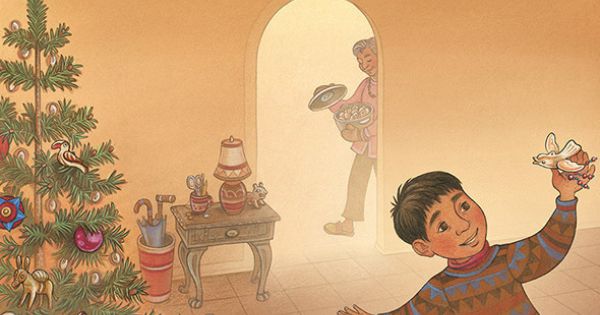
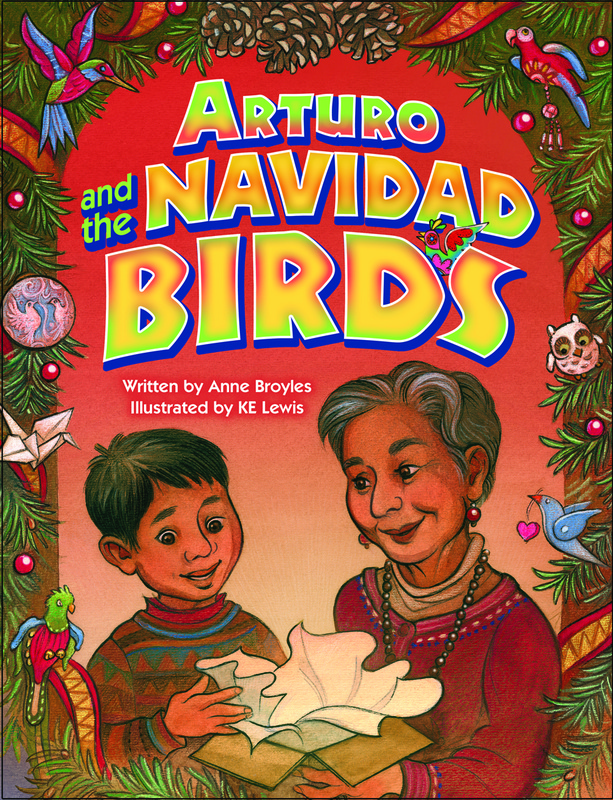
The day for decorating the Christmas tree had arrived, and Arturo “bounced up and down in front of the pine tree. ‘Hurry, Abue!’” he exclaimed. The tree looked so empty, but Arturo’s grandmother brought out the box of ornaments, and soon the two were admiring the little treasures. A tiny mouse nestled into a walnut shell bed had been made by Abue Rosa’s mother when she was a little girl. Although it was hard for Arturo to imagine his grandmother as a little girl, he loved hearing the story of how she carried the mouse in her pocket. “‘I called him Hermanito—my little brother! Find a good home on our tree!’” Abue Rosa said. Arturo placed the ornament on a low branch.
celebrate-picture-books-picture-book-review-arturo-and-the-navidad-birds-flying-bird-ornament

Image copyright Karen Lewis, courtesy of karenlewis.com

The next ornament out of the box was a square piece of “cardboard decorated with mahogany-colored beans.” This had been made by his mother. Arturo hung it in the middle of the tree because his mother “was the middle child between Tío Hernan and Tía Ines.” A donkey ornament that Arturo’s abuelo bought when he and Rosa were first married went high up on the árbol de Navidad. The pair added ornament after ornament on the tree and it “began to shine with Abue Rosa’s stories.” Then Abue Rosa went into the kitchen to fix dinner. While she was gone Arturo rummaged through the box and found a “tiny, blown-glass bird. ‘Fly, bird. Like a plane. Vroom, vroom!’”

The little bird hit the wall and fell to the floor, its wings broken. “Horrified, Arturo covered the pieces with newspaper just before Abue came back.” As they finished decorating the tree, Abue Rosa looked through the box and asked Arturo, “Have you seen the glass pajarito that my dearest friend, Sofie, game me? It’s all I have left from her.” Arturo couldn’t look at his grandmother, instead asking to take a break.

celebrate-picture-books-picture-book-review-arturo-and-the-navidad-hug

Image copyright Karen Lewis, courtesy of karenlewis.com

Arturo ran to his room and grabbed the glue, but he couldn’t make the wings stick. As he looked at the broken bird, tears filled his eyes. He wondered if his grandmother could forgive him. Then he had an idea. In the basement he found a pinecone and some craft materials. When he finished making his pinecone bird, he gazed at it in disappointment. It didn’t look like any bird he had ever seen and certainly not like the glass bird.

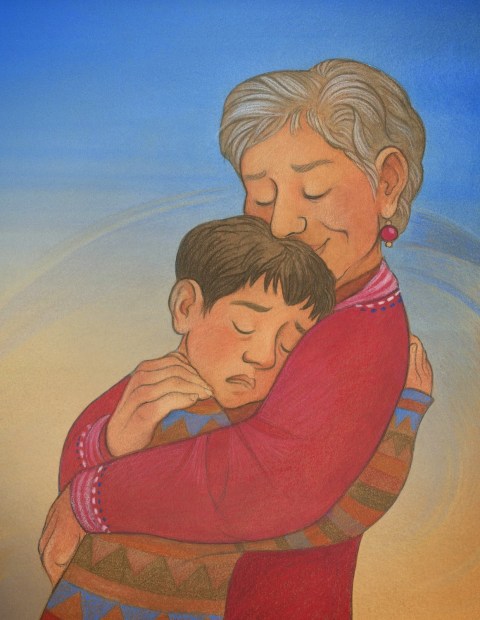
“‘Donde estas, mi’jo?’” Grandma Rosa called from the top of the stairs. Arturo slowly climbed the stairs, carrying both birds. “Arturo took a deep breath. He held out the homemade bird. ‘I made this for our tree.’” “‘Qué bonita!’” How beautiful, Abue Rosa exclaimed. Arturo continued to tell his grandmother that he made it because….He held out his other hand with the broken bird inside. Abue Rosa gasped, and Arturo felt a sob filling him. “‘I didn’t mean to,’” he said.

celebrate-picture-books-picture-book-review-arturo-and-the-navidad-hot-chocolate

Image copyright Karen Lewis, courtesy of karenlewis.com

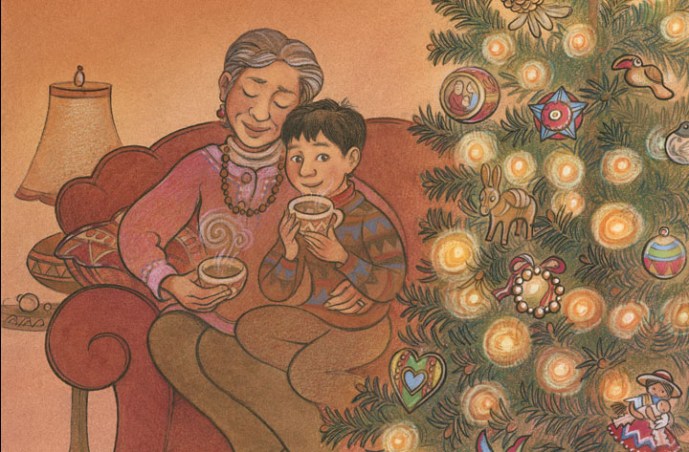
Abue Rosa hugged Arturo and told him that even without the bird she still remembered Sofia. “‘Now when I look at this bird you made, I will think of you and Sofia.’” Together they placed the pinecone ornament on the tree and turned on the lights. Afterward, they enjoyed cups of hot chocolate together. “‘The tree is full now,’ Abue said as Arturo snuggled against her, ‘of memories.’ He nodded. ‘And love.’”

Anne Broyles’ story of a boy and his grandmother who share the true meaning of love and memories is a touching holiday read. Through an incident which many children experience in one way or another, Broyles reassures young readers that—as Arturo’s grandmother states—people are more important than things. Her realistic portrayal of Arturo’s and his grandmother’s actions and emotions will resonate with readers, and the close bond between the two is a highlight of the story. Kids will enjoy the details in the stories of the ornaments as well as in Abue Rosa’s home.

Karen Lewis enhances the cozy tone of the story with her sepia-toned illustrations of Abue Rosa’s home and the personal memories surrounding her Christmas tree ornaments. Kids will recognize and empathize with Arturo’s and his grandmother’s feelings, which are genuine and clearly depicted. Kids will also like seeing the homemade and favorite ornaments that Arturo hangs on the tree as well as the loving relationship between Arturo and his Abue Rosa, which is beautifully revealed throughout the story.

Each page is told in both English and Spanish, making Arturo and the Navidad Birds a wonderful holiday choice for English-speaking, Spanish-speaking, and bilingual families.

Ages 4 – 8

Pelican Publishing, 2013 | ISBN 978-1455618019

To learn more about Anne Broyles and her books, as well as to find book-related activities, visit her website!

Discover a portfolio of illustration work, animation, and picture books on Karen Lewis’s website!

Enjoy this Arturo and the Navidad Birds book trailer!

Look for an Evergreen Day Activity

celebrate-picture-books-picture-book-review-evergreen-tree-maze

Puzzling Pine Tree Maze

The branches of a tall evergreen tree can form a kind of maze for the birds and squirrels who call them home. Can you find your way through this printable Puzzling Pine Tree Maze?

Picture Book Review