December 9 – Lost and Found Day

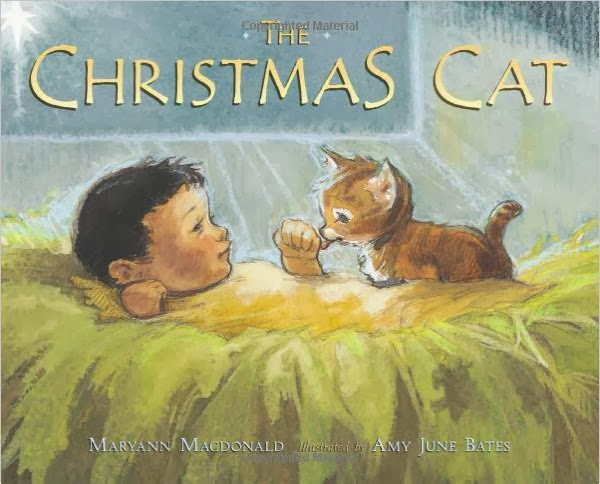
celebrate-picture-books-picture-book-review-the-christmas-cat-cover

About the Holiday

We all know that feeling of joy when something we love and think lost is found again. Today’s holiday commemorates that emotion and gives us a chance to reflect on the things that are most important to us. While Lost and Found Day was established in 2012, the first Lost and Found repository was opened by Napoleon Bonapart—who knew a thing or two about loss—in 1805. Today, take a moment to remember a time when you found something precious.

The Christmas Cat

Written by Maryann Macdonald | Illustrated by Amy June Bates


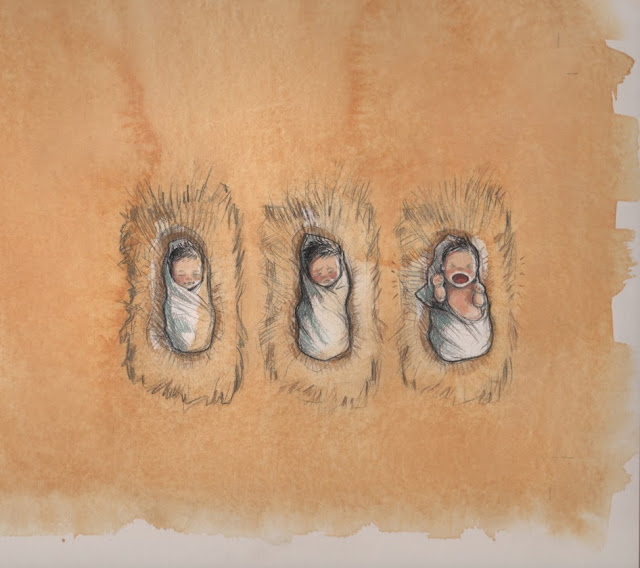
“Jesus was beautiful, like all babies,” but on the night he was born he cried and cried. Mary tried everything to comfort him—a warm blanket, feeding him, rocking him—but nothing soothed him. Looking on, the other animals longed to help. “Doves fluttered down from the rafters, settling on the creaky stable door.” Although their coos were soft and musical, the baby did not stop crying.

celebrate-picture-books-picture-book-review-the-christmas-cat-crying-jesus

Image copyright Amy June Bates, courtesy of amyjunebates.blogspot.com/

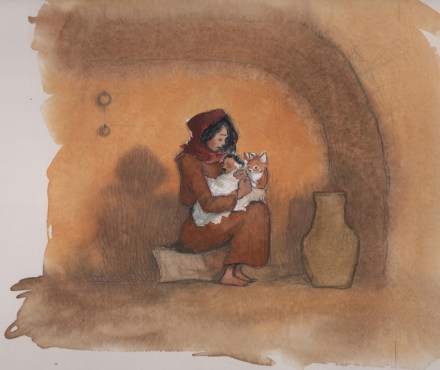
The gentle brown cow tried next, lowing the lullaby she used on her own calf, but Jesus cried louder. And even though the donkey meant well, her braying “made Jesus cry loudest of all.” Then from a hiding place a little kitten crept “step by careful step” toward Mary and Jesus. Leaping lightly onto Mary’s lap, the kitten “nuzzled Jesus’s neck. Then he began to purr, a calm, contented purr that came from deep inside.” Jesus gazed at the tiny kitten, and as he touched the soft fur his crying quieted. The barn grew silent and the new family and all the animals slept soundly.

celebrate-picture-books-picture-book-review-the-christmas-cat-mary-and-jesus

Image copyright Amy June Bates, courtesy of amyjunebates.blogspot.com/

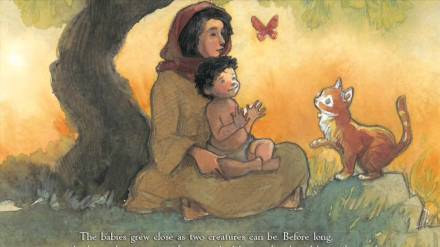
As time passed and the kitten grew into a cat, he and Jesus became close companions, playing together under the fig tree. When it was naptime, “it was the cat’s turn to watch over the baby and purr him to sleep.” But one day their peaceful life was shattered. Jesus’s father, Joseph, learned through an angel that King Herod was looking for Jesus. Harod had heard rumors that Jesus would grow up to be king one day. “Herod’s soldiers, the angel said, were racing toward Bethlehem, hoping to find the baby Jesus and destroy him.”

Joseph, Mary, and Jesus hurried to leave their home, packing everything they had to go now—in the middle of the night—to escape detection and flee to Egypt. With all their goods piled onto their donkey, Mary and Joseph were ready to leave. But where was Jesus’s cat? “Mary and Joseph combed through the tall grass, searched the shadows near the fire and looked high in the branches of the fig tree. But the cat was nowhere to be found.”

celebrate-picture-books-picture-book-review-the-christmas-cat-and-jesus-playing

Image copyright Amy June Bates, courtesy of Dial Books for Young Readers

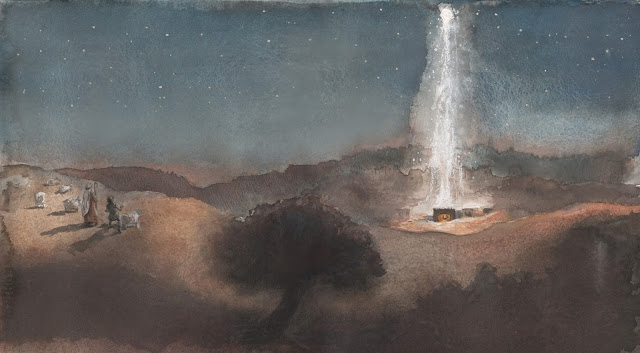
It was much too dangerous to linger, and so, sadly, the family left Bethlehem without their beloved pet. In the chill night air, Jesus was uncomfortable; he missed his cat. “He clenched his tiny fists and screamed.” Joseph worried. Were the campfires on the horizon Herod’s soldiers? Could they hear Jesus crying? Both Mary and Joseph missed the calming influence of their cat. Suddenly, Jesus heard a familiar wail. Out of the basket tied to the donkey’s flank popped his companion. Jesus reached out for him, and the cat leaped into his arms.

After the two had greeted each other as long lost friends, they fell asleep to the cat’s tender purring as “the donkey carried them far away from Herod’s soldiers and their terrible swords, far away to the safe land of Egypt. Love had saved them.” As the two grew older together, they loved each other as only a pet and it’s child can. “They were meant for each other…from the very first Christmas night, in the bright starlight.”

celebrate-picture-books-picture-book-review-the-christmas-cat-bethlehem

Image copyright Amy June Bates, courtesy of amyjunebates.blogspot.com/

In her Author’s Note following the text, Maryann Macdonald reveals that her story is inspired by Leonardo da Vinci’s drawings of La Madonna del Gatto or the Madonna of the Cat, in which the baby Jesus is depicted holding and playing with a cat as he sits on his mother’s lap, as well as legends of a cat that lived in the stable where Jesus was born.

Maryann Macdonald’s gentle story of the baby Jesus soothed by a kitten on the night he was born and saved by this same pet on his flight to Egypt will captivate young children. The focus on the child-animal bond will delight little ones with pets of their own and makes the Christmas story immediately accessible. Macdonald’s lyrical language beautifully portrays the emotion and setting of the story, and she establishes the danger faced by the family with age-appropriate suspense.

Amy June Bates enhances the story with gorgeous traditional paintings of Mary, Joseph, and Jesus, the stable and its animals, and the nighttime journey to Egypt. Her watercolor, gauche, and pencil illustrations glow with warm ambers, greens, and midnight blues. The barn animals are sweetly gentle and earnest in their attempts to soothe the crying baby, and the realistic portraits of the family demonstrate their love for each other. Children will especially like the images of Jesus and his pet cat cuddling and playing together. The final illustration of Mary, Jesus, and their cat echoes the drawing by Leonardo da Vinci that accompanies the Author’s Note.

For pet owners and animal lovers, The Christmas Cat would make a meaningful addition to their holiday collection.

Ages 3 – 6

Dial Books for Young Readers, 2013 | ISBN 978-0803734982

To learn more about Maryann Macdonald and her books, visit her website!

To view a portfolio of artwork by Amy June Bates, visit her blog!

Lost and Found Day Activity

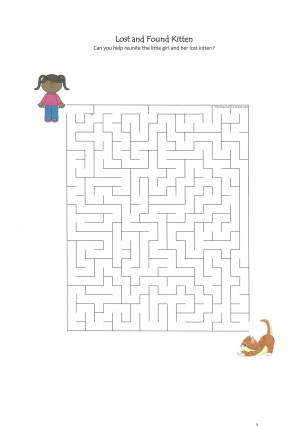
celebrate-picture-books-picture-book-review-lost-and-found-kitten-maze

Lost and Found Kitten Maze


A little girl has lost her kitten! Can you help her get through the printable Lost and Found Kitten Maze to find her pet?

Picture Book Review

November 21 – False Confession Day

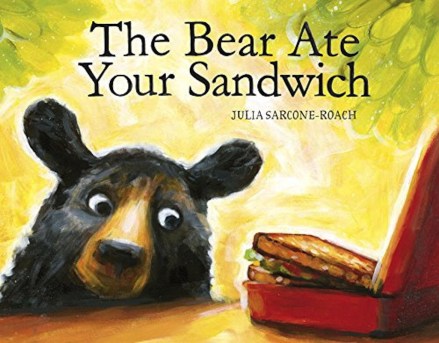
celebrate=picture-books=picture-book-review-the-bear-ate-your-sandwich-cover

About the Holiday

I have to confess that the origins of this holiday are unknown, but the purpose is just to have a little fun. Sure, for 24 hours confusion may reign supreme, but today can give you good practice in learning not to believe everything you hear. If you’re going to participate, keep your confessions light and “jokey.”  Maybe play the game Three Truths and a Lie with friends or coworkers. Just remember there are certain things you should never falsely confess—a crime, something that may result in injury, or false claims that hurt feelings. It may also be a day to help someone out. Instead of playing the “blame game,” accept a little responsibility—even if it’s not yours. But making a false confession for someone else? Hmmm…let’s see what happens in today’s book!

The Bear Ate Your Sandwich

By Julia Sarcone-Roach


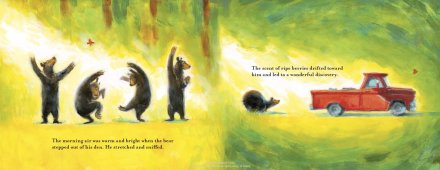
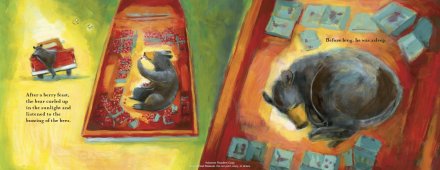
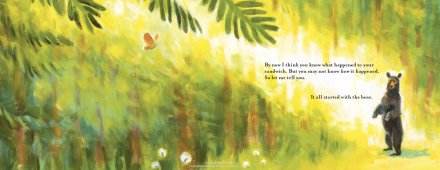
So, something happened to your sandwich? Well… “it all started with the bear. When the bear woke up and left his den for his morning exercises, he caught a whiff of ripe berries in the back of a pickup truck. After eating his fill, he fell asleep in the bed of the truck. He woke once again to find himself “being quickly swept along like a leaf in a great river. The forest disappeared in the distance and high cliffs rose up around him.” The city was a forest like he had never seen before.

celebrate=picture-books=picture-book-review-the-bear-ate-your-sandwich-morning-exercises

Copyright Julia Sarcone-Roach, courtesy of jsarconeroach.com

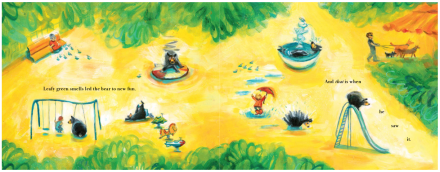
Still, he found many similarities to home. The fire escapes, clothes lines, and roofs offered challenging places to climb, the lamp posts scratched his back just fine, and there was a new sidewalk that was just as squishy as the mud in the forest. This forest also had many intriguing smells, but each time the bear explored one he found someone else had gotten there first. He continued to follow his nose and discovered a playground full of fun things to do. He was at the top of the slide “when he saw it.”

celebrate=picture-books=picture-book-review-the-bear-ate-your-sandwich-eating-berries

Copyright Julia Sarcone-Roach, courtesy of jsarconeroach.com

“There it was. Your beautiful and delicious sandwich. All alone.” The bear was wily, though. “He waited to make sure no one saw him (not even the sandwich) before he made his move.” Feeling safe the bear grabbed that sandwich and gobbled it all up. But he was just licking his lips when he heard a “sniff, snuffle, slobber, snort behind him.” He turned around to find four canine witnesses to his misdeed.

He fled the scene, loping down the street to the nearest tall tree and escape. From the top of this telephone pole, he could see way down the river to his own forest. He stowed away on a boat and fell asleep to its gentle rocking. “When he opened his eyes, he heard the breeze in familiar branches and the birds’ and bugs’ evening song.” He was home.

celebrate=picture-books=picture-book-review-the-bear-ate-your-sandwich-at-the-playground

Copyright Julia Sarcone-Roach, courtesy of jsarconeroach.com

“So. That’s what happened to your sandwich.” Really! I was there—“I saw it all.” I even tried to save your sandwich, but all I could retrieve was this tiny piece of lettuce. I know you’re disappointed, and “I’m sorry to have to tell you about your sandwich this way, but now you know….” Would your own puppy pal lie to you?

Julia Sarcone-Roach knows how to spin a yarn. Her clever and funny confessional story will have kids’ glued to the eye-witness testimony of a bear who is both sympathetic and a scoundrel according to the report. The surprise ending will make readers laugh—especially if they have mischievous siblings, friends, or pets. Sarcone-Roach’s vibrant, gauzy illustrations echo the fantastical imagination of the sly Scottie while giving vibrant life to the forest and city. Her depictions of the bear performing his morning exercise ritual, clambering across apartment buildings, encountering his competition for scraps, and attempting the playground equipment are endearing, and his utter astonishment at being caught is a comical joy.

celebrate=picture-books=picture-book-review-the-bear-ate-your-sandwich-beginning

Copyright Julia Sarcone-Roach, courtesy of jsarconeroach.com

Ingenious clues sprinkled throughout the pages may lead some skeptical readers to doubt the veracity of the story, but the ending is delightfully satisfying and unexpected to all—except, perhaps, for the pup’s owner.

The Bear Ate Your Sandwich is a fun, charming, (mis?)adventure that kids will giggle through and ask for over and over. It would make a favorite addition to home libraries.

Ages 3 – 8

Knopf Book for Young Readers, 2015 | ISBN 978-0375858604

Discover so much more by Julia Sarcone-Roach on her website—including books, illustration, film, and more!

False Confession Day Activity

celebrate-picture-books-picture-book-review-find-the-truth-maze

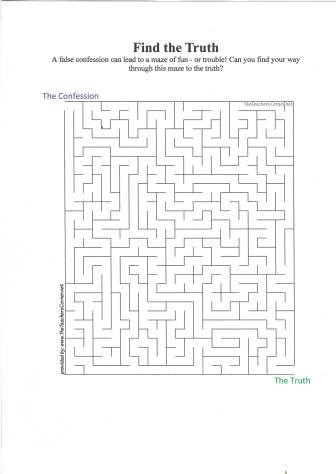
Find the Truth Maze


A false confession can lead you to a maze of fun—or trouble! Can you make your way through this printable Find the Truth Maze?

Picture Book Review

November 12 – Fancy Rat and Mouse Day

celebrate-picture-books-picture-book-review-the-mouse-and-the moon

About the Holiday

Today gives us a chance to take another look at rats and mice. I’m not talking about the kind of mouse I’ve seen scurrying around in my garage or the kind of rat that…well, honestly, I hope is nowhere near my garage. The guys  we’re celebrating today are fancy, which means they are bred to make good pets. Despite their bad rap, mice and rats are smart, loyal, and clean. They don’t require as much care as a dog or cat, and they can be fun to play with. The American Fancy Rat and Mouse Association holds events around the country to introduce people to these alternative pets. Today, you may want to check one out.

The Mouse and the Moon

By Gabriel Alborozo


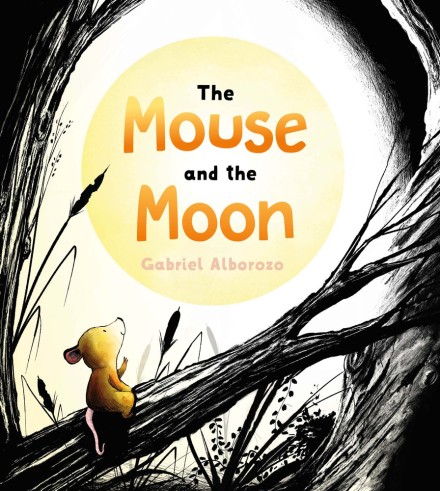
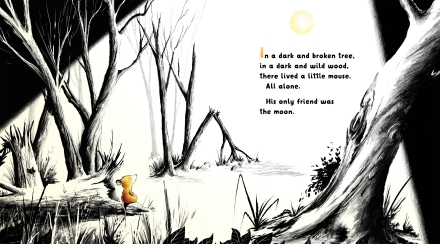
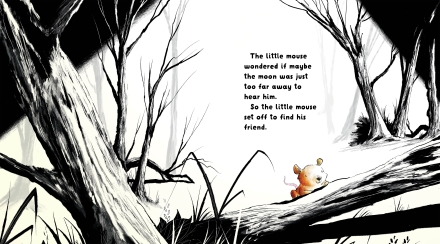
“In a dark and broken tree, in a dark and wild wood, there lived a little mouse. All alone. His only friend was the moon.” The little mouse waited each night for the moon to appear so that he could talk about his day and his hopes, dreams, and fears. The moon always listened silently. The little mouse began to think that the moon was just too far away to hear him, so he went in search of his friend.

celebrate-picture-books-picture-book-review-the-mouse-and-the moon-mouse-lives-alone

Image and text copyright Gabriel Alborozo, courtesy us.macmillan.com

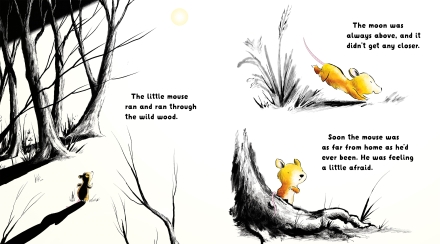
The mouse scampered through the woods, but no matter how far he went, the moon never seemed any closer. Pretty soon the mouse was far from home and “was feeling a little afraid.” When he stopped to rest, the mouse looked into the night sky, but could no longer see the moon. Suddenly, he heard a whispered “‘Hello?’” The mouse cautiously looked around and replied, “‘Hello?’” “And there, floating in a small, still pool, was the moon.” The mouse was excited to have found his friend at last.

celebrate-picture-books-picture-book-review-the-mouse-and-the moon-mouse-goes-to-find-moon

Image and text copyright Gabriel Alborozo, courtesy us.macmillan.com

But what he didn’t see was the tiny fish “hidden from sight, beneath the moon’s reflection.” The little fish was equally glad to finally hear from his friend the moon. “‘I’ve been waiting so long to talk to you!’ bubbled the tiny fish.” The two spent the night telling each other everything. As the sun rose, the moon began to fade. The mouse and the fish both pleaded for the moon to stay. The mouse crept as close to the edge of the pool as he could, and the fish swam close to the surface of the water.

When the moon’s reflection finally vanished in full daylight, “the two new friends saw each other for the first time….Both together and both happy.”

celebrate-picture-books-picture-book-review-the-mouse-and-the moon-mouse-runs-through-woods

Image and text copyright Gabriel Alborozo, courtesy us.macmillan.com

Gabriel Alborozo’s sweet, gentle story of friendship found is a beautiful tribute to perseverance, bravery, and discovery. After spending time telling the moon all about their lives with no response, the fish and the mouse, instead of giving up, go in search of their friend. For the mouse this means leaving his comfort zone and facing on his own some of the fears that he has shared with the moon. The fish, meanwhile, continues calling out until he receives an answer back. While both believe they are talking to their long-held confidant, when the moon disappears, the fish and the mouse happily embrace each other as new friends. Alborozo’s lines are simple and tranquil, with alliteration that flows as smoothly as the ripples on a pond.

Alborozo’s striking black-and-white illustrations, punctuated in the early pages only by the adorable golden-haired mouse, well represent the mouse’s loneliness of the heart. Similarly, the golden-scaled fish lives in a black-and-white world until he and the mouse see each other. As the moon vanishes, the pool and pond grasses are transformed by yellow, green, violet, blue, and orange hues into a sunny, happy landscape echoed in the smiles of the new best friends.

The Mouse and the Moon is a lovely quiet story time or bedtime book, and its comforting charm will make it a favorite with many children. This book would be a nice addition to home bookshelves.

Ages 2 – 7

Henry Holt, 2016 | ISBN 978-1627792240

To discover more picture books as well as a gallery of “bits not in books” by Gabriel Alborozo, visit his website!

Fancy Rat and Mouse Day Activity

celebrate-picture-books-picture-book-review-mouse-coloring-page

Cute Mice Coloring Pages


Here are a couple of fancy mice – one just hanging out and one all dressed up in her finest clothes – for you to color. After you’ve colored these pages, why not write a short story about them!

Cute Mouse Coloring Page | Dressed-up Mouse Coloring Page

Picture Book Review

November 8 – X-Ray Day and Q & A with Author Sara Levine

celebrate-picture-books-picture-book-review-bone-by-bone-cover

About the Holiday

In 1895 while Wilhelm Conrad Rontgen was experimenting with cathode rays and glass, he noticed a glow coming from a nearby chemically coated screen. This led him to make an astounding discovery. He found that the electromagnetic energy that caused the glow—which he named X-rays—could penetrate human flesh, but not bone, thus allowing bone to be photographed. For the first time doctors could see inside the body without surgery. X-rays were first used during the Balkan War in 1897 to find bullets, shrapnel, and broken bones in soldiers. While X-rays were an amazing advancement for medical research and patient care, their danger was not readily understood. The novelty of this new technology was used by shoe stores as a fitting device in the 1930s through 50s until the harmful properties of radiation were better appreciated. Today, X-rays and the technology they led to are instrumental in diagnosing injuries and diseases and in targeting a medical response.

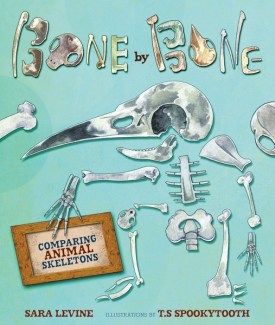
Bone by Bone: Comparing Animal Skeletons

Written by Sara Levine | Illustrated by T.S Spookytooth


Can you imagine if we sloshed through life like soup without a bowl? What would we set our hats on? Where would we carry our phones? How could we sit in class or the office or perform our favorite activities? And what would happen to our organs, our hair, our homes? It’s all a little disturbing! Fortunately, we don’t have to worry about that scenario because “we’re vertebrates, animals with bones. Our bones hold us up.” Phew!

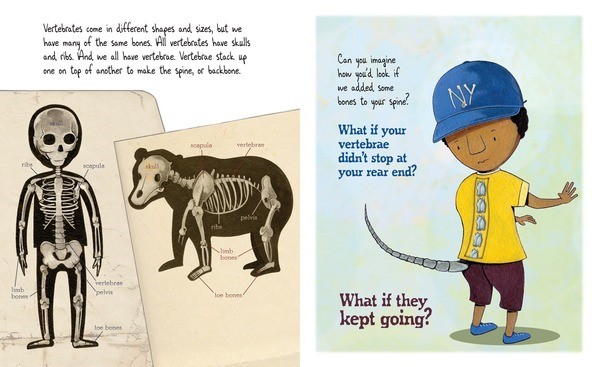
There are different kinds of vertebrates—mammals, reptiles, fish, and more—but many of our bones are similar. For example, “all vertebrates have skulls and ribs. And we all have vertebrae. Vertebrae stack up one on top of another to make the spine, or backbone.” Humans have vertebrae that end…well…you know where, but imagine for a minute if your vertebra kept on going. What if they poked a hole right through your shorts? Yes! You’re right—you’d have a tail. Tails are pretty helpful for some animals. They help them swim, communicate, even keep their balance.
celebrate-picture-books-picture-book-review-bone-by-bone-tailbone

Image copyright T. S Spookytooth, text copyright Sara Levine. Courtesy of Lerner Publishing

Good job! Let’s try again…how about if you only had a skull, vertebrae, and ribs. No arm bones; no leg bones. You’ve got it! A slithery snake! Nah…really…you’d look great! Okay, maybe you’d prefer if you had a skull, vertebrae, and arm bones—but no leg bones—and your nose was transferred to the top of your head. Sounds fishy? Maybe, but not quite. Oh! Did I give it away? Yep, you’d be a whale or a dolphin, and you’d use those powerful vertebrae to propel yourself to the ocean’s surface to grab a breath.

Imagine what kind of gloves and shoes you’d need if your “middle fingers and middle toes were so thick that they supported your whole body.” Hey, you’re good at this! It was a trick question. You wouldn’t need gloves, but you’d wear horse shoes (or no shoes if you’re a less domesticated animal like a zebra). Now, let’s take a trip through a room full of fun-house mirrors. What kind of animal would you be if your neck was reeeaally long and each vertebrae was “as big as your head?” Or if your legs were muuuuuch longer than your arms? Or your “finger bones grew so long that they reached your feet? Seeing those transformations is definitely worth the price of admission, right?

celebrate-picture-books-picture-book-review-bone-by-bone-bat

Image copyright T. S Spookytooth, text copyright Sara Levine. Courtesy of Lerner Publishing

But getting back to the bowl of soup: “Could you be an animal if you didn’t have any bones at all?” Sure! Some insects and sea creatures “have their hard parts on the outside,” and some are just “mushy.” Think of worms, slugs, and jellyfish, just to name a few. But bones make life more fun, don’t ya think? So if all vertebrates have bones, what makes humans different? Well, for one thing we (as well as some apes and monkeys) have opposable thumbs, which means that “we can move our thumbs in a special way that allows us to do many things, including turning the pages of a book,” using tools, and picking up objects. “Did you get that one? If so, give yourself a thumbs-up!”

An Author’s Note including more about bones, the types of vertebrates, a glossary, and resources for further reading follow the text.

With humor and a kid’s sensibility of the bizarre, Sara Levine presents an anatomy lesson that young readers will respond to. Juxtaposing individual bony features of humans and animals is a brilliant idea to give children perspective on the differences in animal skeletons and the uses of each unique trait. Levine’s quiz-like format engages readers, encouraging independent thought and active participation as well as building suspense for what transformation comes next. Kids will laugh and learn and be on the lookout for other ways human and animal skeletons differ as they become more aware of the natural world around them.

With illustrations of tailbones sticking out of pants, empty socks, two fingered hands and two toed feet, a neck that needs two scarves, and more, T. S Spookytooth illuminates what it means to be human in an animal world or an animal in a human world. Kids will laugh imagining themselves as Spookytooth depicts them with animal features and “Ewww” when their portrayal dissolves into a muddy mess. The accurate drawings of human and animal skeletons educate readers on the names and placement of particular bones.

The unique approach to the study of human and animal skeletons, the wide range of animals presented, and the enticing writing and illustrations make Bone by Bone: Comparing Animal Skeletons a wonderful choice for libraries and home bookshelves of budding scientists and nature lovers.

Ages 5 – 10

Millbrook Press, 2014 | ISBN 978-0761384649

To learn more about Sara Levine and her books, visit her website! You’ll also discover fun Bone by Bone activities to enhance your reading!

View a gallery of artwork by T. S Spookytooth, plus videos and more on his website!

X-Ray Day Activity

celebrate-picture-books-picture-book-review-x-ray-craft-dog-paw

Dog Paw and Human Hand X-Ray Craft


X-rays are cool to look at, but they always stay at the doctor’s office! With this craft you can simulate an X-ray of a dog’s paw and a human hand!

Supplies

  • Printable skeleton templates: Human Hand Template | Dog Paw Template
  • Black chalkboard drawing paper, 8 ½ inches by 11 inches
  • White colored pencil
  • White chalk
  • Clear Plastic Report Sheet Protectors
  • Magnetic clip to hang your x-ray on the refrigerator or other metal surface (optional) OR
  • String or wire, adhesive squares, and clothes pins to hang x-ray on the wall (optional)
  • Scissors

Directions

  1. Print the Human Hand and Dog Paw Templates (you may want to print two—one to cut and one to follow when transferring the bones to the black paper)
  2. Cut the bones apart
  3. Lay the bones on the black chalkboard paper
  4. Trace the bones with the white colored pencil
  5. Color in the bones with the white chalk
  6. Slip the black paper into the plastic report sheet protector
  7. If desired, hang the x-ray on the refrigerator with the magnetic clip or on the wall using string, adhesive squares and clothespins


Q & A with Author Sara Levine

celebrate-picture-books-picture-book-review-author-sara-levine

Today, I’m thrilled to talk to Sara Levine about her writing as well as to learn about her early experiences with animals and to discover a kid’s-eye-view of women in science.

Your writing for kids is so infused with humor that really captures their attention. What were some of the books that you liked best as a child?

When I was younger, one of my favorite picture books was Katerine and the Box by Patricia Lee Gauch. I’ve noticed that this book has gone back into print; I was so happy to find it online. It’s basically about creativity. A girl and her friend keep finding new uses for a large cardboard box—a house, a car, a dance platform. I can still recall my feeling of excitement when hearing it read to me—it made me want to go make something. It’s actually a feeling very similar to what I have today when I think of a new idea for a book. There was also a book called Wisher, which was about difference—about a cat who dreamt he was really a fish. I remember that the illustrations were beautiful and somewhat scary—just done in blues, browns and yellows.  As an older child, I loved Charlotte’s Web by E.B White, Lizard Music by Daniel Pinkwater and pretty much everything by Judy Blume.

I don’t suppose any of these books are like the books I write. I used to tell people that I liked my science and my books separate. I just wanted to go outside to learn about science. But, I wanted stories in my books. I don’t think there were any of the sorts of books I write about science out for kids when I was young. At least I didn’t find them. But if I had, I think I would have enjoyed them—the fact that they were funny and interactive. But here’s a picture book I LOVE that I found as an adult that is certainly infused with humor and captures a kid’s (and a grown-up’s) attention: Bark, George, by Jules Feiffer. I think this is currently my favorite picture book.

You grew up on a farm in Guilford, Connecticut. Can you tell me a little about the farm and how or if it influenced your current work?

Calling it a “farm” might be a bit of a stretch. My parents were two kids who grew up in Brooklyn and then moved to CT and decided to get some animals, cheered on by their enthusiastic offspring. First there was a goat, who got lonely. So then there was another goat. And they had a baby. And there was a chicken at school who needed a place to go for the summer. And then never went back to school… And so on. We ended up having over 100 named animals—a horse, a cow, peacocks, geese, a donkey and more. I loved taking care of the animals, with my siblings. It was a wonderful experience, one that I’m very grateful for. But it wasn’t at all lucrative. I think the only money made was by my brother who would sell extra eggs to his teachers.

How did it influence my current work? I’m not sure. Certainly my interest in animals is a lifelong one. I think the stories about the animals actually show up more in my writing for adults than in my picture books. The ideas for the books for children come more from teaching ideas that I think will translate well into a picture book format.

You have a doctorate in veterinary medicine and a masters in fine art. When and how did the two merge into your work as an author?

What a great question. I have always had this science side and this humanities side. A lot of my life, I’ve been struggling with how to balance and feed both sides of myself. It’s taken me a long time to find a way to merge the two interests, and it’s been very satisfying to do so in writing about science, especially for kids.

You offer four different school and library programs, all of which sound fascinating. Do you have any anecdotes from a presentation you’d like to share?

In one of my workshops, the one for Bone by Bone: Comparing Animal Skeletons, I bring in an articulated skeleton for the kids to see and a disarticulated skeleton in a box. The kids learn the bones, and I then hand them each a bone which they take up to the standing skeleton to figure out which bone it is, and then work together to put together the second skeleton on the floor. Inevitably, someone asks if the skeletons are real. They are. I literally found them in the closets, when I started my teaching at Wheelock. There are all sorts of questions about that, generated by the kids, and then, often, someone will ask if the skeletons are “boys or girls.” Recently, at a school near Boston, I was explaining to a group of second graders that both were female, that we could tell by the shape of the hips, and I heard one girl, going, “YES!” and pumping her arm up and down, in victory. The boy next to her says, “Why are you so happy? That means a girl died.” To which she responds, “That’s true. But it also means one more girl in science!”

celebrate-picture-books-picture-book-review-bone-by-bone-workshop

Sara Levine leads a workshop at Cold Spring School

What’s the best thing about writing for kids?

I enjoy trying to think of engaging and interactive ways to teach something that hasn’t been taught before. I like the creativity involved. And, of course, reading it to the kids when I’m done and seeing them respond!

celebrate-picture-books-picture-book-review-bone-by-bone-students-at-al-hamra-school

Students at Al Hamra Academy examine a skeleton

You also write articles for adults and were nominated for a Pushcart Prize in 2007. Can you tell me more about your writing for adults?

I write science related essays for adults. The writing comes more from my own experiences.  I do have a handful of essays published. I think the one that was nominated for the Pushcart, “What Hands Can Do” is still available to read online. Here’s a link to it on Fictionaut. It’s about spaying a dog. And more, of course. I think my most successful essay is “The Body of a Cow” which originally appeared in the Massachusetts Review. It’s also on Fictionaut, if anyone wants to have a look. Eventually, I hope to work the essays into a memoir for adults.

What’s up next for you?

I have a book on dinosaur bones which will be published by Lerner next year. I also have three children’s books written which I’m trying to find homes for at the moment—one on animal classification (but interactive, written like a “do your own adventure” story), one on how plants communicate with animals, and one very funny one (if I can say so myself) called “Breakfast at the Omnivore Café,” which is about what animals eat. This one might never get published because it falls into the cracks between nonfiction and narrative fiction, but I haven’t given up on it yet. The book I’m currently working on is an attempt to explain climate change through stories of the carbon cycle. Doesn’t sound very interesting when put that way, but it’s written as an interactive story, and is also actually quite funny in parts, so I think kids will like it.

Since Celebrate Picture Books is a holiday-themed blog, I can’t let you get away without asking you what your favorite holiday is…

Passover. You get to tell a story to children in a way that is interactive and engaging for kids, AND it involves food. What could be better?

Thanks so much for chatting and sharing your unique perspective on the natural world, Sara! I, for one, would love to read Breakfast at the Omnivore Café—that would be one interesting menu, I bet! I wish you the best with all of your books!

You can connect with Sara Levine on:

Her Website | FacebookTwitter

About Sara Levine

Sara Levine is an assistant professor of biology at Wheelock College and a veterinarian.  Her science books for children include Bone by Bone: Comparing Animal Skeletons (2013) and Tooth by Tooth: Comparing Fangs, Tusks and Chompers (2016).  Her third book, Fossil by Fossil: Comparing Dinosaur Bones will be published in 2018.  Bone by Bone: Comparing Animal Skeletons has received much recognition, including the Utah Beehive Book Award, selection as a Bank Street College Best Children’s Book of the Year, and finalist for the Cook Prize for best STEM picture book.

Sara also writes science-related essays for adults, one of which was nominated for a Pushcart Prize in 2007.  Her writing has appeared in the Boston Globe, the Massachusetts Review, Bayou, and in the anthology And Baby Makes More. In addition to teaching college students, she has taught children’s environmental education classes for the Massachusetts Audubon Society and other nature centers in Massachusetts and Connecticut for over 15 years. 

Sara holds a doctorate in veterinary medicine (DVM) from Tufts University, a master of fine arts degree (MFA) in creative nonfiction writing from Lesley University and a bachelor of arts degree (BA) in English from Haverford College.  She is a native New Englander and lives with her daughter and their dogs and cat in Cambridge, Massachusetts.  
celebrate-picture-books-picture-book-review-bone-by-bone-cover

Bone by Bone: Comparing Animal Skeletons and Sara’s other books can be found at:

Amazon | Barnes & Noble | Books-a-Million | IndieBoundLerner Publishing

Picture Book Review
October 23 – Mole Day

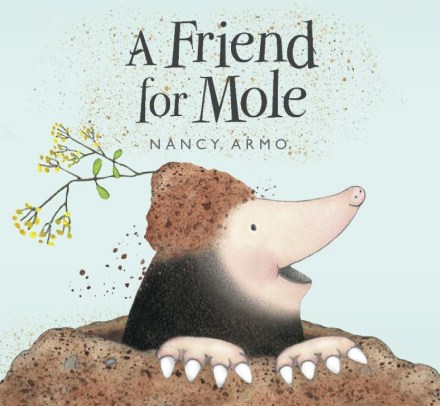
celebrate-picture-books-picture-book-review-a-friend-for-mole-cover

About the Holiday

From 6:02 a.m. to 6:02 p.m. on 10/23 chemists, scientists, students, and others who love numbers celebrate Mole Day to commemorate Avogadro’s Number, which is a basic weight measuring unit in chemistry. Defined by the equation 6.02 x 10²³, Avogadro’s number finds that for any given molecule one mole of that substance has a weight in grams equal to its atomic number. The name of this scientific constant naturally led to an association with the furry underground burrowers, and the mole and mascot moles can be found working in tandem to promote a better understanding and enjoyment of chemistry. As today’s book proves there is no better mixture than the chemistry between friends.

A Friend for Mole

By Nancy Armo

Mole loves his cozy burrow. “He liked his soft bed of leaves, the warm smell of the earth, and the quiet darkness all around.” He can imagine the world above him by all the distinct sounds he hears. But one day those sounds become louder. Instead of gentle tapping and buzzing, he hears stomping, shouting, and laughing. He decides to go up above and see what all the ruckus is about.

“The bright light, loud noises and new smells were overwhelming,” and Mole thinks it was a very bad idea to have left his burrow. He tries to find his way home, but he can no longer see the hole. In a panic he starts to run. He trips over a tree root and rolls under a bush. The soft leaves and darkness remind Mole of his burrow and soon he is fast asleep.

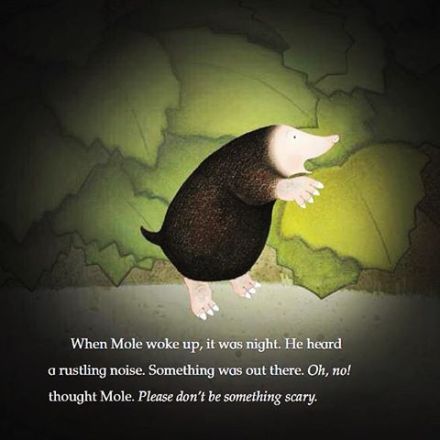
Mole wakes up during the night. He hears rustling and sees two shiny eyes staring at him. “‘Oh no!’” thinks Mole. “‘Please don’t be something scary.’” Mole closes his eyes, hoping to hide. But then he hears a small whimper. “‘Are you afraid of the dark too?’” When Mole takes a peek, he sees a wolf. “‘No,’” Mole answers. “‘I’m afraid of the light.’” Wolf tells Mole that he is lost after being chased by the other animals and that he is scared.

celebrate-picture-book-review-a-friend-for-mole-rustling-sound

Copyright Nancy Armo, courtesy of Peachtree Publshers

Mole and Wolf think about what they can do and devise a clever plan. Mole says he will stay with Wolf in the dark, and Wolf agrees to help Mole find his burrow when the sun comes up. To make the time go faster, Mole and Wolf play games, such as hunting “imaginary slithering creatures,” stomping on “pretend scampering bugs,” and “chasing away scary monsters. It was all so much fun they forgot about being lost and scared.”

As daylight breaks, Mole begins to think about home. Wolf also feels homesick. As they search for the entrance to Mole’s burrow, Wolf shields Mole’s eyes from the sun with his tail, and Mole giggles at the tickly softness of Wolf’s fur. Soon they discover Mole’s burrow, and Wolf realizes that he lives nearby. Although Mole is happy to be home, he also feels sad to say goodbye to Wolf.

He asks if Wolf would like to play again sometime. Wolf shouts, “Yes! That was so much fun! I was scared but having you there made everything okay.” As Mole settles back into his leafy bed, he knows “exactly what Wolf meant.”

In her sweet story of friendship found, Nancy Armo relates that most comforting feeling—the knowledge that friends always stand by you even when times are hard or scary. Her characters Mole and Wolf are perfectly chosen foils with opposite strengths that, combined, help solve their immediate problem and form a strong friendship. Armo’s straightforward storytelling is enriched by the endearing personalities of Mole and Wolf as well as their honest sharing of feelings.

In vivid two-page spreads Armo superbly depicts the daytime and nighttime scenes, transporting readers into the heart of her story. Above the “quiet darkness” of Mole’s burrow, cute mice scamper in the rain while an earthworm, a snail, and a bee take shelter. When his roof rings with noise and curiosity gets the better of Mole, he emerges into an open field, and his tumbling trip over the tree root is nimbly portrayed with a series of flips rendered with a filmy transparency. As nightime falls the Mole’s and Wolf’s adventure plays out on pages with a solid black background. Wolf’s eyes shining on a completely darkened page offers just the right amount of suspense for little readers, and a careful look at the expression in his eyes is reassuring. Kids will enjoy the games the two friends enjoy, and will cheer when the sun dawns on their new friendship.

A Friend for Mole is a great book for young readers navigating the world of meeting new classmates, teammates, and other children who may see the world differently but would make good friends.

Ages 3 – 7

Peachtree Publishers, 2016 | ISBN 978-1561458653

You’ll find fun A Friend for Mole activity sheets, a portfolio of artwork, and more on Nancy Armo’s website!

Mole Day Activity

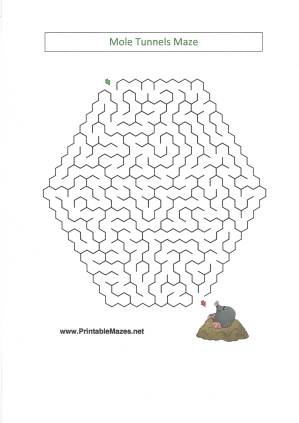
celebrate-picture-books-picture-book-review-mole-mazeMole Tunnels Maze

Dig into this printable Mole Tunnels Maze that has as many twists and turns as a mole’s home!

Picture Book Review
October 20 – International Sloth Day

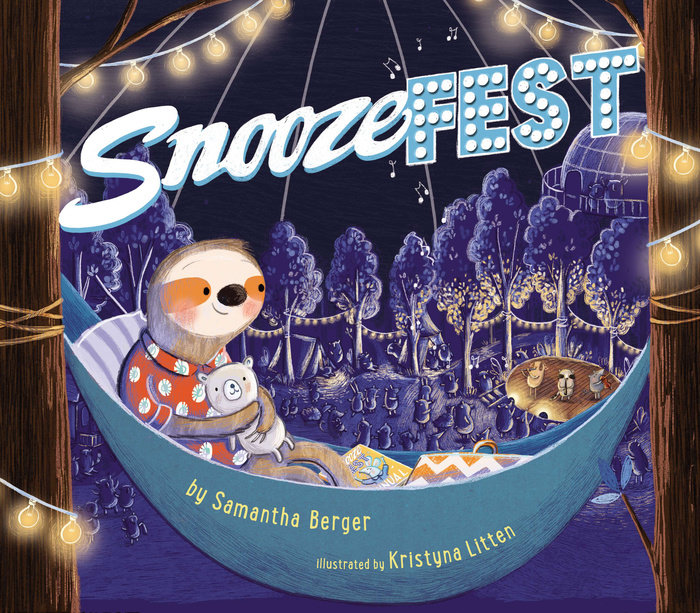
celebrate-picture-books-picture-book-review-snoozefest-cover-image

About the Holiday

The AIUNAU, a non-profit dedicated to protecting all wildlife, established International Sloth Day in 2010 to raise awareness of the dangers facing these seemingly always smiling, gentle animals. With three species already extinct, sloths need protection from power lines, cars, and those who would capture them as pets as well as from other environmental issues that decrease their habitats. While sloths may not be found in your neck of the woods, concern for all wildlife is an important part of being a global citizen.

SnoozeFest

Written by Samantha Berger | Illustrated by Kristyna Litten


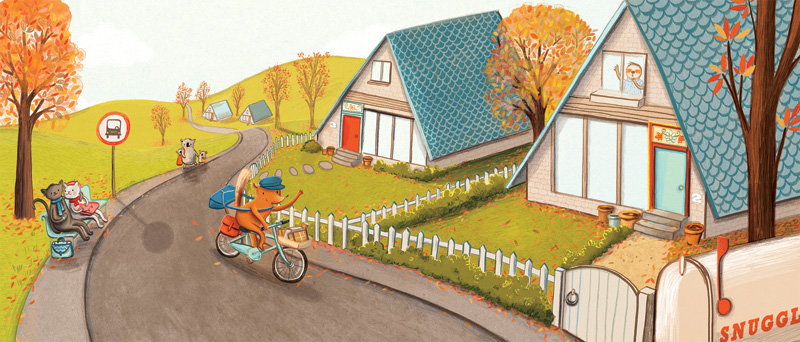
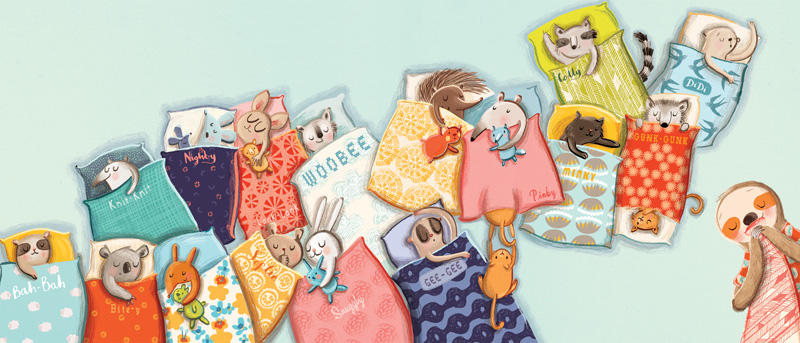
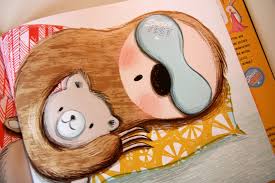
Snuggleford Cuddlebun is the sleepiest sloth in Snoozeville. “Now that sloth can sleep, for a month at a go. / The few time she rises, she moves in slo-mo.” But there is one annual event that sets her heart—and her feet—racing enough to leave her cozy bed—SnoozeFest. “This is the place where the best sleepers go to snore their way through this naptacular show.” So Snuggleford packs up her her jammies and teddy, her pillow and book and joins the other great sleepers on the bus that will take them to the NuzzleDome.

celebrate-picture-books-picture-book-review-snoozefest-snoozeville

Image copyright Kristyna Litten. courtesy of Dial Books for Young Readers, Penguin

As Snuggleford looks for the best place to camp, she sees that she’s in good company. The wildcats, wombats, koala bears, brown bats, squirrels, and armadillos are also setting up tents, laying down sleeping bags, and lounging in hammocks—which is Snuggleford’s favorite too. After finding her spot “she strolls through the stands / for posters and T-shirts / and swag from the bands.” Soon it’s time for the show to begin with the P.J. Parade, where sleepwear from such designers as Diane von FirstInBed and Louis Futon are on full display.

celebrate-picture-books-picture-book-review-snoozefest-sleeping-bags

Image copyright Kristyna Litten. courtesy of Dial Books for Young Readers, Penguin

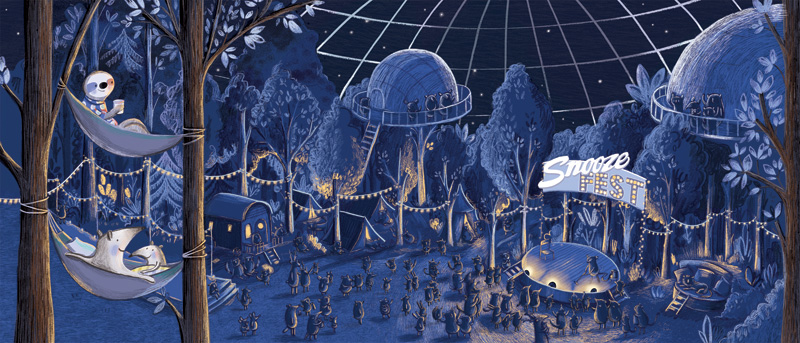
“Then all the big spotlights dim down in the Dome, / and everyone turns on their night-light from home.” The first band to perform is the “Chamomile Rage” and although the crowd is half asleep by the middle of the first song, “the snoozers yawn deeply, yet still clap for more. / The second act’s also a guaranteed snore.” Then “a poet named Burrows recites a haiku / and imitates rain with his didgeridoo.”  More acts take the stage—the Nocturnal Nesters and the Quiet Quartet, Tranquility Trio and the Drowsy Duet. Yes, “These are the best bands for deep relaxation, / followed by Sweet Dreams and Deep Hiber-Nation.”

For Snuggleford Cuddlebun the concert is all she could want. In fact, “Several days later the SnoozeFest is done. / And who’s still asleep? Why it’s Miss Cuddlebun.” She folds up her things, tosses away her trash, and rides the bus back home. There she climbs into bed and shuts her eyes and dreams of next year’s SnoozeFest.

celebrate-picture-books-picture-book-review-snoozefest-nighttime

Image copyright Kristyna Litten. courtesy of Dial Books for Young Readers, Penguin

Samantha Berger’s SnoozeFest is one of the cutest, most original bedtime books around. With wit and charm Berger makes full use of the festival setting and experience. Her inspired rhymes, adorable band names, and atmosphere that combines just the right amount of excitement and slumber-inducing lilt, will delight kids of all ages and adults as well. From Snoozeville to the NuzzleDome to a full verse of blanket nicknames, Berger has come up with the “wumphiest, coziest, comfiest” words to send little ones off to dreamland.

celebrate-picture-books-picture-book-review-snoozefest-sleeping-suggleford

Image copyright Kristyna Litten. courtesy of Dial Books for Young Readers, Penguin

Krisyna Litten’s illustrations, designed with a vintage-yet-modern air and color palette, are the perfect accompaniment to Berger’s story. Anyone would love to join Litten’s sweet Snuggleford and the other “great sleepers” at SnoozeFest. Snuggleford’s endearing slothy smile as well as the joyful camaraderie of the other festival goers invite kids to explore every page. The crowd consists of loveable moles, koalas, raccoons, bears, foxes, porcupines, and more adult and baby animals enjoying the show.  Two-page spreads of the darkened festival grounds lit by nightlights and starlight are gorgeous, peaceful landscapes of blues and gold that set a sleepy tone for little readers.

SnoozeFest would be a very welcome addition to any child’s bookshelf for story times and bed times, and would make a perfect gift.

Ages 3 – 7

Dial Books for Young Readers, Penguin, 2015 | ISBN 978-0803740464

You’ll have plenty of fun discovering lots of books, videos, and more creative stuff by Samantha Berger on her website!

You can catch up with Krisyna Litten on her blog!

You won’t want to snooze through this book trailer!

International Sloth Day Activity

celebrate-picture-books-picture-book-review-sloth-coloring-page

Sweet Sloth Coloring Page


Sloths are sweet, gentle animals who love to hang out. Give the little one in this printable Sweet Sloth Activity Page a colorful world and put it up in your room!

You can find Snoozefest at these booksellers

Amazon | Barnes & Noble | IndieBound

Picture Book Review

October 18 – It’s Squirrel Awareness Month

celebrate-picture-books-picture-book-review-those-darn-squirrels-fly-south-cover-image

About the Holiday

Squirrels elicit emotions on both sides of the spectrum. On one hand you can’t help but say “Awww!” when you see their tiny little paws and crafty antics. On the other hand their voracious appetites at bird feeders and penchant for darting into traffic is more likely to make you say “Arrgghhh!” This month is set aside, however, for enjoying the squirrels in your yard, park, or city. And really, don’t they make life just a little more fun?

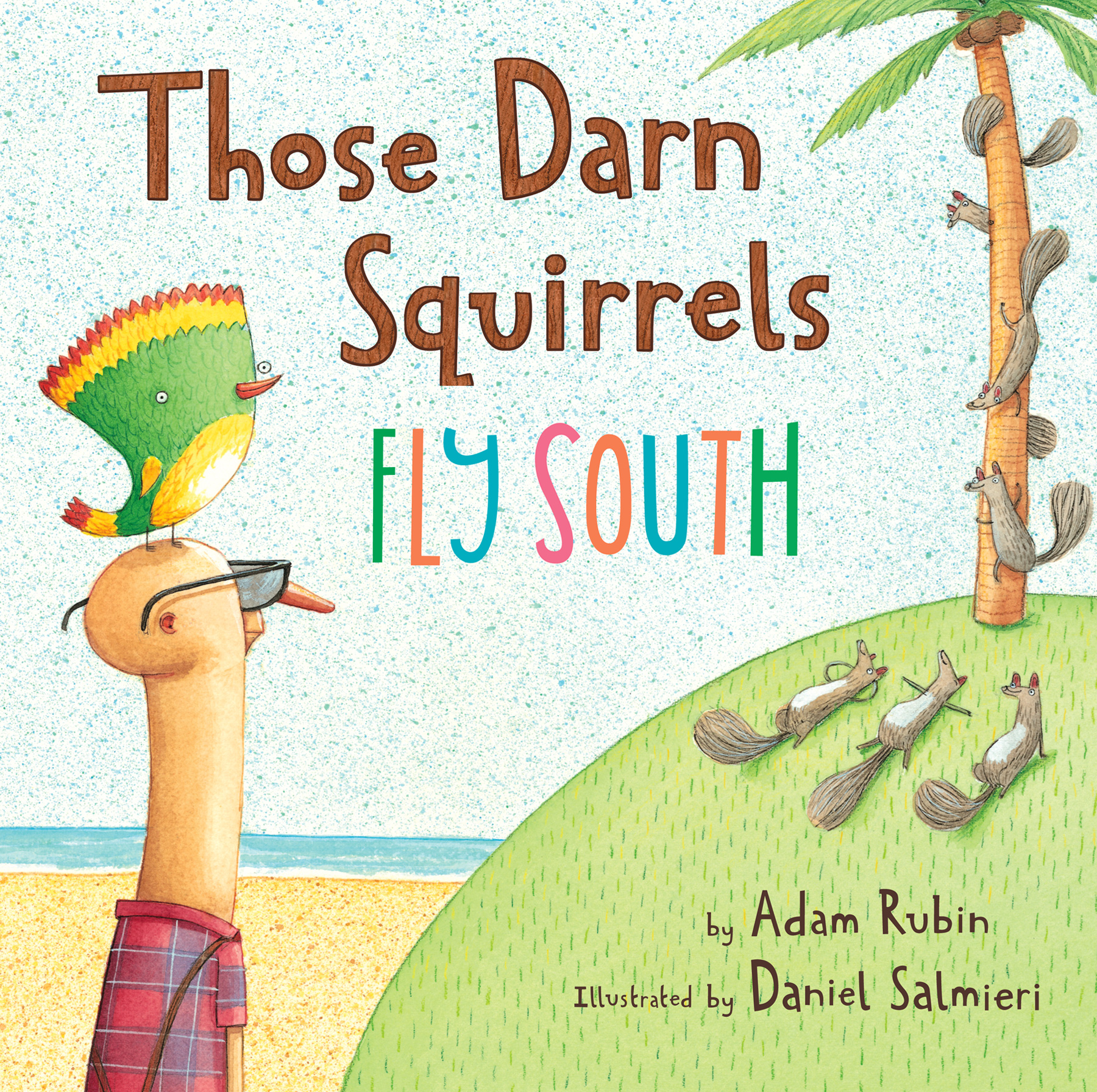
Those Darn Squirrels Fly South

Written by Adam Rubin | Illustrated by Daniel Salmieri


Everyone knows Mr. Fookwire is a grump whose grumpiness knows no bounds. “He scolded fireflies for being too bright…yelled at clouds for being too fluffy…and pinched his nose with a clothespin” so he doesn’t have to smell the lilacs. Despite these annoyances, though, he had a wonderful summer painting pictures of the birds in his yard even though “those darn squirrels” had set up an easel of their own nearby.

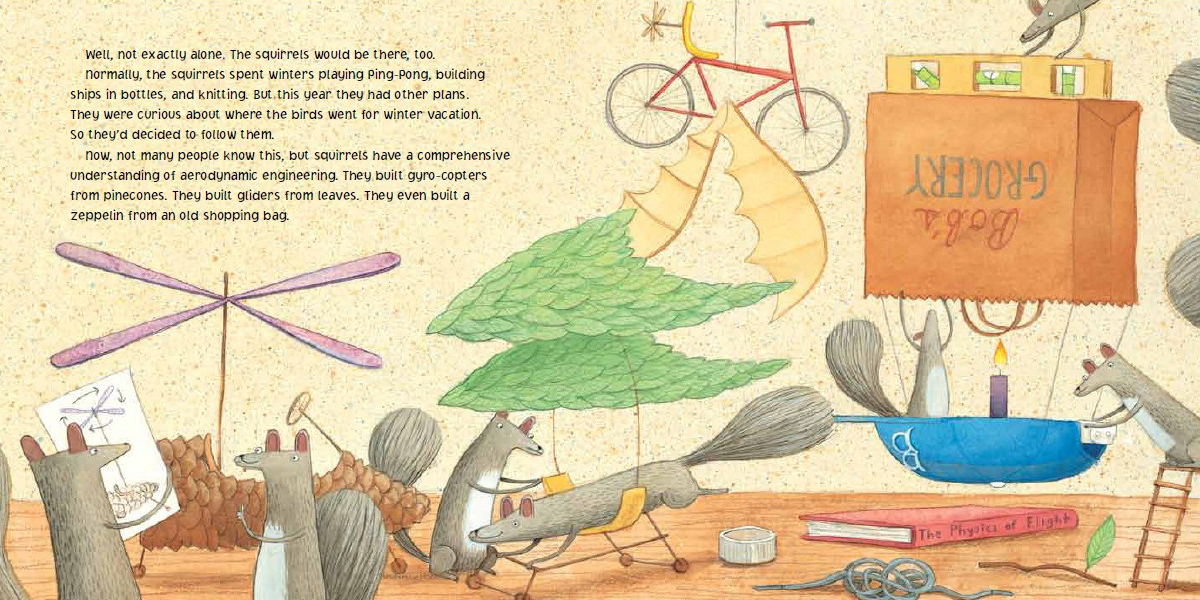
But now fall was here and that meant that all of Mr. Fookwire’s beloved birds would soon be flying south leaving him with only the squirrels for company. While the squirrels usually spent the winter months “playing ping pong, building ships in bottles, and knitting, this winter they had decided to follow the birds to warmer climes. With their expert knowledge in aerodynamic engineering, the squirrels had “built gyro-copters from pinecones…gliders from leaves…and even a zeppelin from an old shopping bag.”

celebrate-picture-books-picture-book-review-those-darn-squirrels-fly-south-squirrels-build-flying-macihines

Image copyright Daniel Salmieri, text copyright Adam Rubin. Courtesy of hmhbookscom

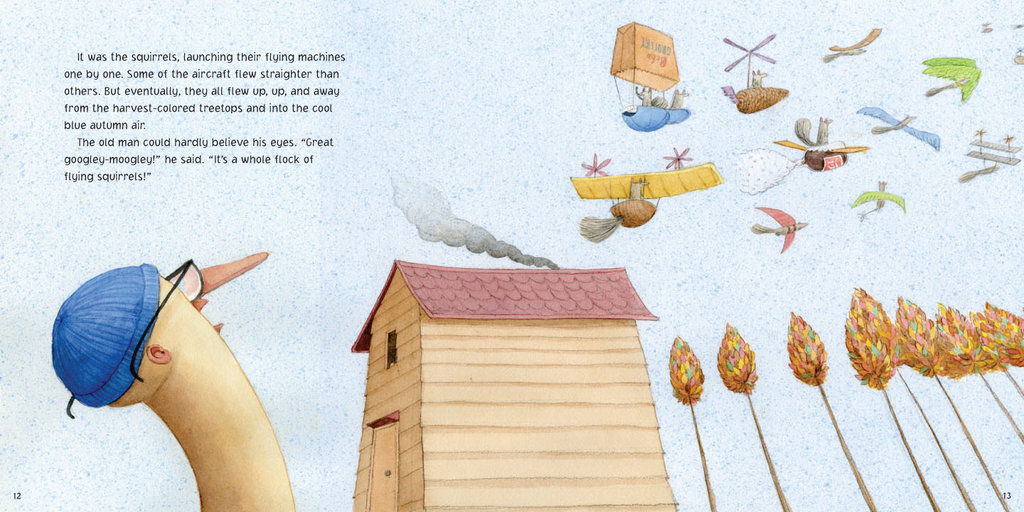
When the day came for the birds to take wing, Mr. Fookwire sadly waved goodbye. Just as he was about to return to the house, he heard a strange rustling, then a whir, and finally a buzz. It was the squirrels soaring away in their homemade aircraft. “‘Great googley-moogley’” Mr. Fookwire exclaimed.

The squirrels followed the birds for days until they landed on a beach. To celebrate the end of their journey and the welcome warmth, the squirrels held a fiesta, complete with mangoes, the marimba, and the merengue. Winter was wonderful here where there were new foods to eat and new birds to discover. One with a long neck, rings around its eyes, and red and blue feathers even looked a little familiar and left the squirrels feeling homesick. They decided to make a long-distance phone call, and chattered away to Mr. Fookwire.

Although he wouldn’t admit it, Mr. Fookwire was happy to receive the call. He decided to pack up his easels, paints, brushes, and cottage cheese with pepper and hit the road in his beautiful vintage car. Driving 12 miles an hour, Mr. Fookwire at last reached the beach, where the squirrels swarmed him in a big hug. “Maybe it was the nice weather. Maybe it was the beautiful scenery, Maybe it was the squirrels dancing in his pants. But for the first time in a very long time, the old man laughed.”

celebrate-picture-books-picture-book-review-those-darn-squirrels-fly-south-squirrels-fly-south

Image copyright Daniel Salmieri, text copyright Adam Rubin. Courtesy of hmhbookscom

Mr. Fookwire was delighted with the local birds and immediately began to paint them. “‘The birds here are even more amazing than the birds back home!’ he exclaimed. ‘Harrumph!’ muttered the floogle bird.” The hot sun took its toll on Mr. Fookwire, however, and he collapsed right into the middle of his painting. The squirrels dragged him into the shade and revived him. Maybe spending the winter at home was better. Mr. Fookwire decided to head back, and the squirrels accompanied him. They didn’t want to miss “the annual snow-fort building competition.”

They all jumped into the car and sped off. Really! After all, Mr. Fookwire was in no condition to drive.

Adam Rubin’s Those Darn Squirrels Fly South contains all the charm and squirrely shenanigans that make the other two books in the series such a hit with kids (and adults). Rubin’s snappy descriptions, silly scenarios, and loveably cantankerous protagonist make for a hilarious story time read that will delight his fans and captivate new readers.

Daniel Salmieri knows how to make kids giggle and laugh out loud with colorful illustrations that perfectly depict Mr. Fookwire’s world—both at home and away. Mr. Fookwire’s noodly arms, giraffe-long neck, and carrot-shaped nose coalesce into a character that is at once funny and endearing. Getting more beak time in this third outing, the familiar birds are joined by a crew of even more brilliant and exotic beach mates. The squirrels are up to their usual contraption-making tricks as they build flying machines from soda bottles, flashlights, baseball caps, and more around-the-house items. The squirrels know how to live wherever they are, and Salmieri’s depictions of them holding a fiesta, hugging Mr. Fookwire, and roaring down the highway is absurdity for the younger set at its best.

Ages 4 – 7

Houghton Mifflin Harcourt, 2012 | ISBN 978-0544555457

You can find out more about Adam Rubin, his books, and his dry sense of humor on his website!

View a gallery of illustration work and more books by Daniel Salmieri on his website!
Go nuts watching this Those Darn Squirrels Fly South book trailer!

Squirrel Awareness Month Activity

celebrate-picture-books-picture-book-review-squirrel-dot-to-dot

Celebrate Squirrels! Dot-to-Dot


Enjoy following the dots to finish this printable Celebrate Squirrels! activity sheet and then color it in!

Picture Book Review