March 26 – It’s Umbrella Month

celebrate-picture-books-picture-book-review-the-umbrella-queen-cover

About the Holiday

This month we celebrate umbrellas, those perky protective accessories that have been around since earliest times. Ancient civilizations used palmetto fronds for shade and during inclemet weather. The first waterproof umbrellas were created by the Chinese, who waxed or lacquered their paper parasols. Umbrellas were strictly women’s accessories until Jonas Hanway, a Persian travel writer, used one in public in England in the 1700s. English men then took up the practice, calling their version a “Hanway.” The first collapsible umbrella was designed in 1710, and in 1928 the folding pocket umbrella appeared. Since then, umbrellas have become fashionable and necessary accessories for all.

The Umbrella Queen

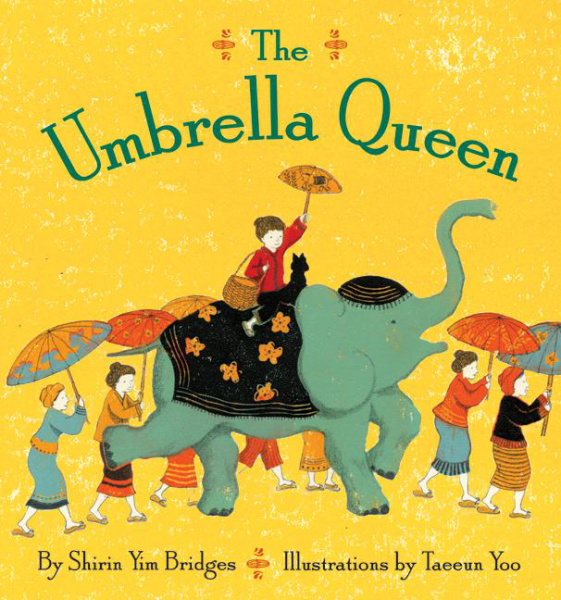
Written by Shirin Yim Bridges | Illustrated by Taeeun Yoo


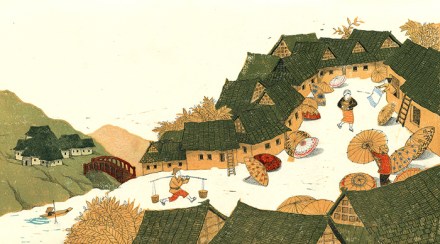
The residents of a small village in Thailand are well known for the beautiful paper umbrellas they make and sell in the local shops. The umbrellas are colorful, but always decorated with flowers and butterflies. Every New Year’s Day the villagers hold an Umbrella Parade, and the woman who has painted the most beautiful umbrella is chosen as the Umbrella Queen.

Noot is a little girl who longs to paint her own umbrellas and partake in the parade. One day her mother gives her an umbrella to paint and shows her how to copy her design. Noot is a natural artist, and her finished umbrella is nearly indistinguishable from her mother’s. She is given her own painting spot in the garden and five umbrellas to decorate.
celebrate-picture-books-picture-book-review-the-umbrella-queen-village

Image copyright Taeeun Yoo, courtesy of taeeunyoo.com

Noot paints the familiar butterflies and is about to start on the flowers when she is inspired to draw elephants instead. She covers all five umbrellas with elephants doing handstands, playing and squirting water, walking trunk-to-tail, and just being silly. When her mother sees these umbrellas, she is unhappy. Flowers and butterflies sell in the local shops, not elephants. Noot understands the importance of the money made from the umbrellas to her family. For the next year she paints the large umbrellas with the traditional design. At night, however, using bits and pieces, she fashions tiny umbrellas. These she paints with elephants, and displays them on her windowsill.
celebrate-picture-books-picture-book-review-the-umbrella-queen-emperor-visits

Image copyright Taeeun Yoo, courtesy of taeeunyoo.com

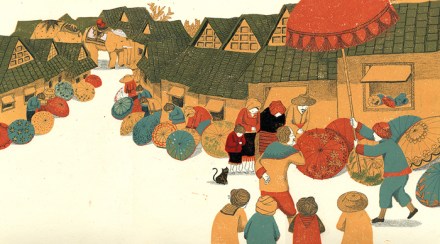
As New Year approaches there is much excitement in the village. It is rumored that the king will be visiting and will choose the Umbrella Queen himself. One day the villagers receive the message that the king will indeed arrive. The villagers spruce up their town and each woman displays her umbrellas in front of her home.

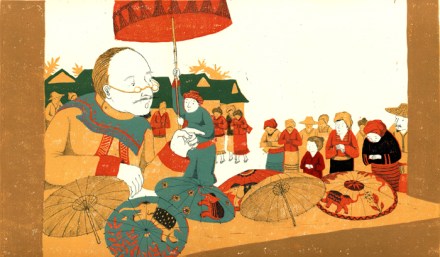
The king walks the length of the street, considering each umbrella until he comes to Noot’s house. He is very impressed with the umbrellas painted by Noot’s mother, but his gaze wanders to Noot’s windowsill, and he asks who painted the “strange” umbrellas.
celebrate-picture-books-picture-book-review-the-umbrella-queen-emperor-judges-umbrellas

Image copyright Taeeun Yoo, courtesy of taeeunyoo.com

A bit embarrassed by the attention, Noot shyly answers the king’s questions about the size of the small umbrellas and the unusual designs. In trying to explain herself, she forgets to look at the ground when talking to the king, and when her eyes meet his she realizes that, instead of judging her, he is charmed. “I like elephants,” she tells him, and he laughs. The king then takes Noot’s hand and names her the Umbrella Queen because “she paints from her heart.”

Shirin Yim Bridges has written a unique story that effectively and engagingly presents the often conflicting dilemma of responsibility to others while staying true to yourself. Noot’s journey from an observer in her family’s business to a valued artist is told straightforwardly, and the familial love and support are clearly emphasized. The king’s recognition of Noot’s talent and heart will be highly satisfying for young readers or listeners.

Taeeun Yoo’s delicate illustrations in gold, red, black, and green set the story firmly in Thailand and perfectly demonstrate the close-knit village and relationships as well as the intricate beauty of the umbrellas and the pride the villagers take in them.

The Umbrella Queen is a wonderful story about family, discovering your talents, and self-expression that would find a welcome spot on any child’s bookshelf.

Ages 4 – 8

Greenwillow Books, Harper Collins, New York, 2008 | ISBN 978-0060750404

Learn more about Taeeun Yoo, her books, and her art on her website!

Umbrella Month Activity
CPB - Umbrella Matching Game

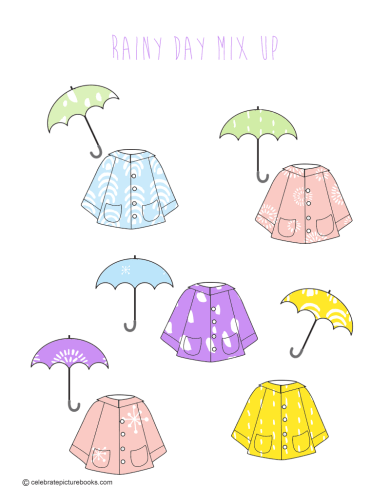
Rainy Day Mix Up Matching Game


A sudden storm scattered all the umbrellas and raincoats! Can you put the pairs together again? Draw a line to connect the umbrella and the raincoat that have the same pattern. Print the Rainy Day Mix Up Game here!

Picture Book Review

March 25 – Earth Hour Day

picture-book-review-green-city-allan-drummond

About the Holiday

Earth Hour was organized by the World Wide Fund for Nature as a way to engage people in the discussion on climate change. First enacted in Australia in 2007, the observance has grown to include cities, businesses, corporations, and individuals world wide. For one hour – from 8:30 to 9:30 p.m. local time – participants will turn off all unnecessary lights in a show of solidarity and commitment to protecting our earth. Among the places going dark this year are the Empire State Building, the Space Needle, the Golden Gate Bridge, the Colosseum in Rome, the Pyramids of Egypt, the Sydney Opera House, and the Eiffel Tower.

Green City: How One Community Survived a Tornado and Rebuilt for a Sustainable Future

By Allan Drummond


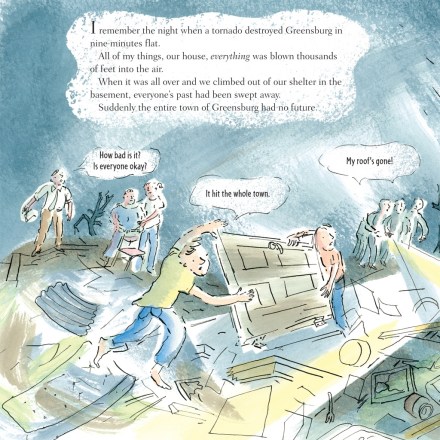
On May 4, 2007 a devastating tornado hit Greensburg, Kansas, destroying the town in 9 minutes. When the residents of the town climbed from their shelters, they emerged into a world completely changed. There were no more homes, no school, no hospital, no grocery store or other shops. No banks, theater, churches, or water tower. Even the trees had been shredded. Only three buildings remained.

celebrate-picture-books-picture-book-review-green-city-after-tornado

Image and text copyright Allan Drummond, courtesy of us.macmillan.com.

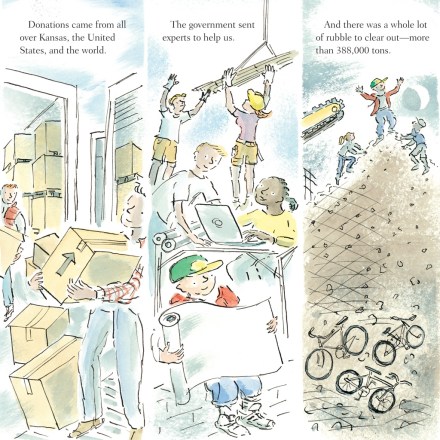
The citizens were urged to move away. Rebuilding would be impossible, some said, and what was the point anyway when the wind could destroy it all again? But others saw opportunity to construct a different kind of town. With the help of volunteers and donations from around the world, Greensburg began the Herculean task of designing and building a new town.

celebrate-picture-books-picture-book-review-green-city-rebuilding-starts

Image and text copyright Allan Drummond, courtesy of us.macmillan.com.

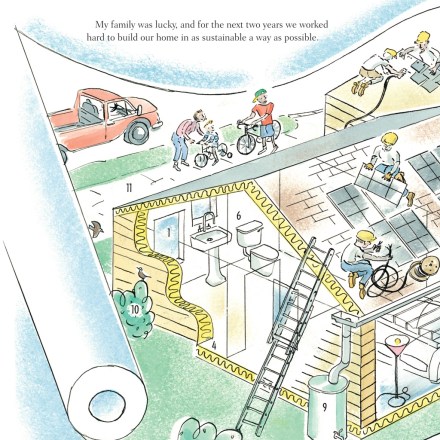
After clearing away 388,000 tons of debris and moving into a community of trailer homes, the people began to envision a unique, green town. Individuals designed sustainable houses of different shapes and materials that would work with the environment. Businesses, too, incorporated sustainability into their offices, retail centers, and hotels as did the hospital and the water tower. A wind farm large enough to provide energy for the entire town was built on the edge of this innovative city.

celebrate-picture-books-picture-book-review-green-city-one-house

Image and text copyright Allan Drummond, courtesy of us.macmillan.com.

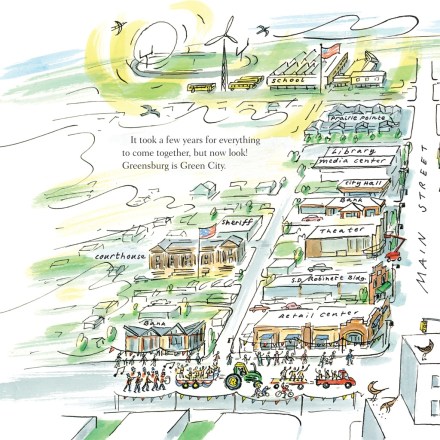
A new school was central to the town’s survival, and for three years the teachers held class in small trailers. Along with their regular studies, the kids became experts in environmental science. After several years Greenburg became a thriving city—a testament to conservation and sustainability that remains an example for global communities now and in the future.

celebrate-picture-books-picture-book-review-green-city-Greensburg-now

Image and text copyright Allan Drummond, courtesy of us.macmillan.com.

Allan Drummond tells this fascinating story of a community that would not give up in an honest and sensitive way that highlights the courage and pride of a town amid devastating loss. Told from a child’s point of view, the story has extra impact for readers who are growing up amid an era of environmental awareness and activism. The sustainable construction of homes and other buildings is effectively explained and clearly depicted in Drummond’s colorful illustrations.

The images also demonstrate the process of negotiation and cooperation among townspeople that went into designing and building a new Greensburg. The final two-page spread of the town’s layout will interest kids as well as adults who have followed this story in the news.

Ages 5 – 9

Farrar, Straus and Giroux, 2016 | ISBN 978-0374379995

Discover more about Allan Drummond, his illustration work and his books on his website!

Earth Hour Activity

celebrate-picture-books-picture-book-review-flashlight-clip-art

Flashlight On, Flashlight Off Game


It’s fun to play games in the dark! During Earth Hour flip off your lamps and overhead lights and play this game that challenges your memory while you think about our planet! This game can be played with two or more players.

Supplies

  • Flashlight 
  • 6 – 12 small objects (the number of objects can be adjusted depending on the ages of the players)
  • A table or floor area large enough to lay out the objects

Directions

With the Flashlight On:

  1. Lay out the objects on a table or on the floor
  2. Give all the players time to look at the objects and try to memorize them
  3. Choose one player to remove one of the objects

With the Flashlight Off

  1. Turn off the flashlight
  2. While the room is dark, the designated player removes one object from the rest
  3. Turn the flashlight back on

With the Flashlight Back On

  1. The other players try to figure out which object is missing

Variations

  • In addition to removing one object, the other objects can be moved around to different positions
  • Remove more than one object at a time
  • Add an object instead of removing one

Picture Book Review


March 24 – It’s Women’s History Month

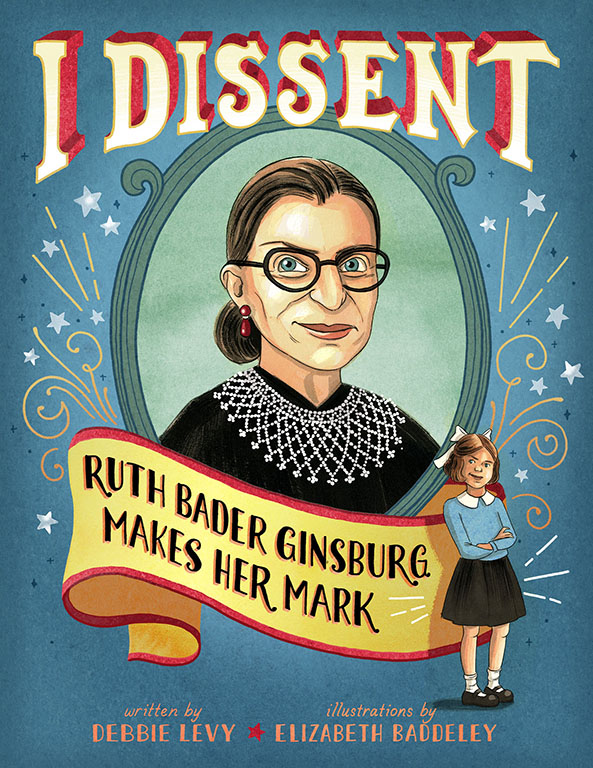
celebrate-picture-books-picture-book-review-i-dissent-cover

About the Holiday

During the month of March we celebrate the roles and contributions of women throughout history. The theme for 2017 is “Honoring Trailblazing Women in Labor and Business.” From earliest times, women have participated in and influenced events, often without receiving recognition. This month encourages all women to stand up to discrimination and stand up for what they believe in. 

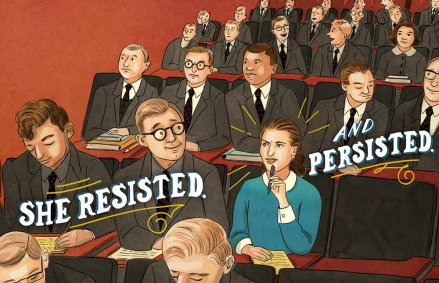
I Dissent: Ruth Bader Ginsburg Makes Her Mark

Written by Debbie Levy | Illustrated by Elizabeth Baddeley


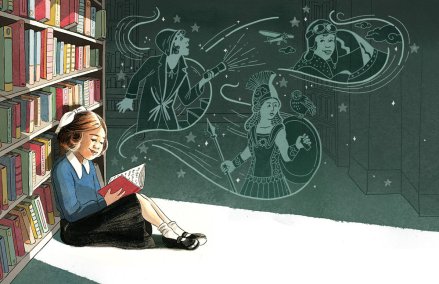
Ruth Bader grew up during the 1940s in Brooklyn, New York’s multicultural neighborhood. It was a time when boys were educated for jobs and bright futures while girls were expected to marry and raise children. Ruth’s mother, Celia Amster Bader, however, “thought girls should also have the chance to make their mark on the world.” She introduced Ruth to books in which she discovered women who used their strength, courage, and intelligence to do big things.

celebrate-picture-books-picture-book-review-i-dissent-in-the-library

Image copyright Elizabeth Baddeley, text copyright Debbie Levy. Courtesy of simonandschuster.com.

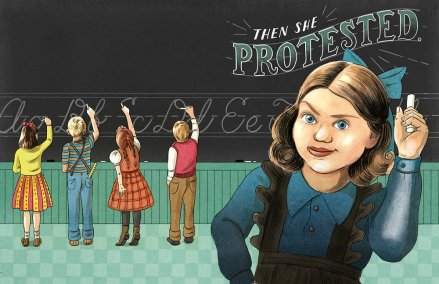
Ruth also saw and felt the sting of prejudice while growing up. Her family was Jewish, and at the time “hotels, restaurants, even entire neighborhoods” denied access to Jews, African Americans, Mexicans, and others. Ruth disagreed and never forgot. She was even discriminated against for being left-handed. In school she was instructed to write with her right hand, but her awkward penmanship earned a D. First, she cried; then she protested by only writing with her left hand—“it turned out she had quite nice handwriting!”

celebrate-picture-books-picture-book-review-i-dissent-in-the-left-handed

Image copyright Elizabeth Baddeley, text copyright Debbie Levy. Courtesy of simonandschuster.com.

During elementary school, Ruth was outstanding in some classes, such as history and English, and did not do so well in others, such as sewing and cooking. Music, especially opera, was another favorite subject—even though she did not have the voice to match her dreams. She excelled in high school and was even chosen as a graduation speaker. But Ruth had been hiding the fact that her mother was very ill. The day before graduation, her mother died. Ruth did not go to her graduation, but she did fulfill her mother’s wish and entered college.

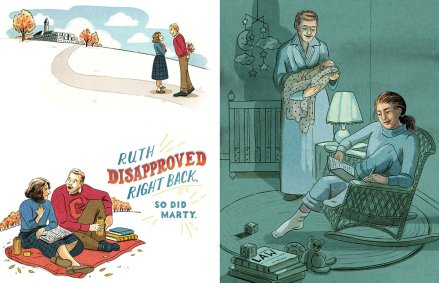
In college Ruth met Marty Ginsberg, and the two fell in love. They both decided to become lawyers to fight prejudice and unfairness in court. People thought this was a great idea for Marty, but disapproved of it for Ruth. “Ruth disapproved right back. So did Marty.” After college they got married, went to law school, and had a baby girl.

celebrate-picture-books-picture-book-review-i-dissent-college

Image copyright Elizabeth Baddeley, text copyright Debbie Levy. Courtesy of simonandschuster.com.

In law school Ruth was one of nine women in a class of 500. She worked hard and tied with another student as first in the class, but after graduation she couldn’t find a job. Employers objected because she was a woman, a mother, and Jewish. Finally, she found work with a judge. Her excellent work for him translated into jobs at one law school after another, and she became “one of the few female law professors in the whole country.”

All around her Ruth saw other women who were denied jobs or paid less than men. Women also had very little voice in courtrooms or in government. Rulings by the Supreme Court, the highest court in America, had helped maintain this inequality. The Court had stated that women were unfit for many jobs because of their “natural and proper timidity and delicacy.” Besides, the Supreme Court also said, “Woman has always been dependent upon man.”

celebrate-picture-books-picture-book-review-i-dissent-in-the-law-school

Image copyright Elizabeth Baddeley, text copyright Debbie Levy. Courtesy of simonandschuster.com.

“Ruth really, really disagreed with this!” So she began fighting in court for equal rights for women. But equal rights for women also meant equal rights for men: Ruth believed men should be able to stay home with children if they wanted to while women worked. “These were fresh ideas in the 1970s. Ruth did not win every case, but she won enough. With each victory, women and men and girls and boys enjoyed a little more equality.”

At home, Ruth’s own family agreed with her. Marty was a successful lawyer and also an accomplished chef who cooked the family’s meals. Ruth went on to become a well-known and well-respected lawyer. President Jimmy Carter asked her to be a judge in Washington DC. Then President Bill Clinton chose her to fill a vacancy on the Supreme Court. “Ruth agreed.

celebrate-picture-books-picture-book-review-i-dissent-family-life

Image copyright Elizabeth Baddeley, text copyright Debbie Levy. Courtesy of simonandschuster.com.

In 1993, Justice Ruth Bader Ginsburg became the first Jewish woman on the nation’s highest court.” When the nine justices decide a case, they listen to both sides and then vote. The winning side then writes an opinion explaining their ruling. When Justice Ginsburg votes with the winning side, she wears a special lace collar over her robe. When she does not agree with the ruling, she says, “I dissent” and writes an opinion explaining why. She has a special collar for dissenting too.

Some of her dissensions were influenced by her early experiences. She dissented when “the court wouldn’t help women or African Americans or immigrants who had been treated unfairly at work.” She dissented when the court did not protect voting rights for all citizens. She dissented when the court disagreed with schools that offered African Americans a better chance to go to college.” And once when she dissented, Congress and the president agreed with her and overturned the Supreme Court’s ruling.

celebrate-picture-books-picture-book-review-i-dissent-supreme-court

Image copyright Elizabeth Baddeley, text copyright Debbie Levy. Courtesy of simonandschuster.com.

Justice Ruth Bader Ginsburg is now the oldest member of the Supreme Court. Some people think she should retire, but she disagrees. She still has work to do. Over the years, she has “cleared a path for people to follow in her footsteps—girls in college, women in law school, and everyone who wants to be treated without prejudice….Step by step, she has made a difference…one disagreement after another.”

An extensive Author’s Note about Ruth Bader Ginsburg’s life, notes on Supreme Court Cases, and a selected bibliography follow the text.

Debbie Levy’s outstanding biography allows readers to journey with Ruth Bader Ginsburg as her experiences and beliefs lay the foundation for her life’s work. Well-chosen anecdotes from Ginsburg’s childhood make her accessible to kids and may even inspire them to look toward their own futures. Ginsburg’s trajectory from college student to lawyer to judge and finally to the Supreme Court is balanced and uplifting, emphasizing the positive impact of persistence and self-confidence.

Elizabeth Baddeley’s illustrations go hand-in-hand with Levy’s text to fully illuminate the life of Ruth Bader Ginsburg for children. Ginsburg’s intelligence, sense of humor, courage, and principles are evident as she matures from school girl to Supreme Court Justice. Dynamic typography highlights the theme of dissent and disagreement as a force for positive change. The color, expression, and spirit imbued in each page make I Dissent: Ruth Bader Ginsburg Makes Her Mark an exciting and eye-catching read for all children.

I Dissent: Ruth Bader Ginsburg Makes Her Mark is a superb and recommended book for girls and boys. The book’s focus on a woman who continues to make a difference will inspire children and even adult readers to speak up and act on their convictions.

Ages 5 – 9

Simon & Schuster Books for Young Readers, 2016

To learn more about Debbie Levy and her books for children and young adults, visit her website!

Discover a gallery of illustration by Elizabeth Baddeley on her website!

Women’s History Month Activity

celebrate-picture-books-picture-book-review-rosie-the-riveter-coloring-page

Rosie the Riveter Coloring Page


Rosie the Riveter became a symbol of strong women during World War II and continues to be an iconic figure today. Print and color this Rosie the Riveter Page then display it to always remember that women can do anything!

Picture Book Review

March 23 – Near Miss Day

celebrate-picture-books-picture-book-review-oh-no-astro-cover

About the Holiday

Today’s holiday commemorates a most auspicious moment in history that never happened! On March 23, 1989 a huge asteroid missed hitting Earth by only 500,000 miles. Did you feel the breeze as it blew by? Yeah, me too! I think we can all remember exactly where we were when we happily escaped suffering the same fate as the dinosaurs. So drink a toast to serendipity and the gravity of natural forces.

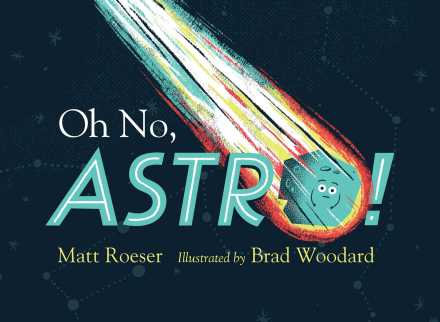
Oh No, Astro!

Written by Matt Roeser | Illustrated by Brad Woodard


Astro was not a typical asteroid. Instead of zooming around crashing into obstacles, he believed in “personal outer space” and had for millions of years. One day when Astro spies an approaching satellite, he greets him cordially and lays down the rules: “please keep your distance” and “stay in your orbit.” But the satellite ignores him and comes closer and closer until…

celebrate-picture-books-picture-book-review-oh-no-astro-interior-art-satellite

Image copyright Brad Woodard, courtesy of Simon & Schuster

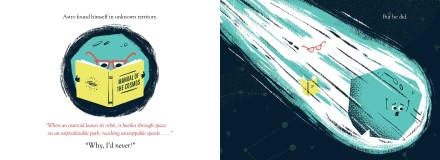
“‘Good gravity! You’ve struck me!” Astro exclaims. He’s just about to “point out to the satellite that it had done considerable damage to one of his favorite craters” when he discovers that he is spinning out of his orbit and out of control. How humiliating! The usually unflappable space rock suddenly finds himself hurtling past Mars. At the same time young astronomer, Nova, is “enjoying a quiet night of stargazing” through her telescope. She catches sight of Astro as he zips past an astronaut, rushes past the Moon, and finds himself on an inevitable collision course with Earth.

As he enters Earth’s atmosphere he begins to break apart, shedding bits of the past, as the universe watches. He lands on Earth with a SMASH! Reeling from the impact Astro slowly opens one eye and then the other. He finds that he’s smaller but in one piece. Standing by is Nova, waiting to welcome him to his new home. “‘My stars,’” he mutters. “‘Dare I say that was…FUN?!’”

And as Astro gazes at the night sky from a fresh perspective with Nova by his side, he asks, “‘What on Earth shall we do next?!’”

celebrate-picture-books-picture-book-review-oh-no-astro-hurtling

Image copyright Brad Woodard, courtesy of Simon & Schuster

For anyone stuck in the rut of their own orbit, Matt Roeser’s story of the unwitting space traveler is a humorous invitation to explore the universe around them. Roeser’s language—from calling asteroids “rambunctious” and the satellite a “celestial wanderer” to exclamations of “good gravity!” and “Pluto’s revenge!”—is an inspired treat. Kids and adults will laugh at Astro’s attempts to handle his undesirable predicament with dignity. Complacent Astro with his dry-as-space-dust wit and sparkling puns makes a stellar guide on this journey to more self-discovery and life enjoyment.

In the hands of Brad Woodard, deep space is a very cute and cool place! Rendered in flat tones of black, aqua, yellow, red, and white, Woodard’s illustrations give Oh No, Astro! a retro feel for a space-savvy audience. The oblivious satellite floats through Astro’s orbit with wide eyes and a sweet grin, while angular Astro with his stick arms, expressive face, and boldly displayed “No loitering” banner would be a welcome alien intruder in any back yard. Inquisitive and inclusive Nova, in her ponytails and Saturn-patterned dress, is the perfect companion to greet him! The night sky abounds with constellations, but Astro is the real star!

In the final pages, Astro leads readers in a “A Selection of Space Facts” from the  very Manual of the Cosmos, 2nd edition that he used to sort things out in  his own life. A short list of suggested reading is also included.

Kids would love to find Oh No, Astro! on their bookshelf for story times of cosmic fun!

Ages 4 – 8

Simon & Schuster Books for Young Readers, 2016 | ISBN 978-1481439763

Visit Matt Roeser’s Website to discover his gallery of book jacket designs!

You can learn more about design and illustration work by Brad Woodard at Brave the Woods!

Near Miss Day Activity

celebrate-picture-books-picture-book-review-name-that-asteroid-word-search-puzzle


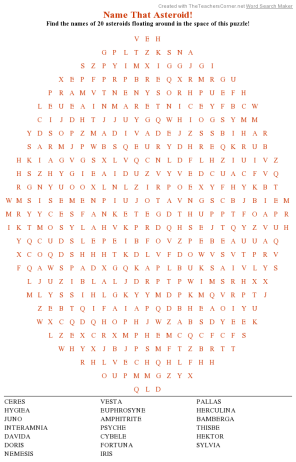
Name That Asteroid! Word Search


Can you find the names of 20 asteroids floating around in this printable Name That Asteroid! Word Search Puzzle? Here’s the Solution!

Picture Book Review
March 22 – World Water Day

celebrate-picture-books-picture-book-review-water-is-water-cover

About the Holiday

March 22 was designated as World Water Day by the United Nations to bring awareness to the important issue of fresh water for the world’s citizens. Today, 1.8 billion people use sources of water that are contaminated, posing a constant risk of deadly diseases. The Sustainable Development Goals, instituted in 2015, have targeted a deadline of 2030 to provide access to clean water for everyone. This year’s theme is “Wastewater,” and revolves around the development of science and engineering solutions that would allow wastewater to be recycled and used in gardens, green spaces, cooling systems, and irrigation. Now more than ever, we all have a responsibility to keep the environment clean and safe. To celebrate today’s holiday find out how you can help!

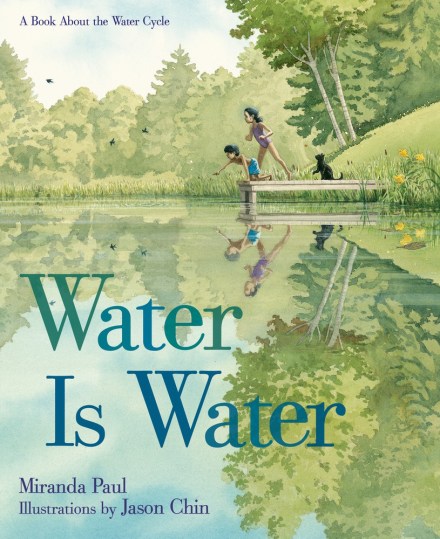
Water Is Water: A Book About the Water Cycle

Written by Miranda Paul | Illustrated by Jason Chin


On a soaking rainy day a sister and brother run up to the house with a turtle they’ve caught in the pond out back. They drink glasses of water and offer a bowlful for the turtle too. “Drip. Sip. Pour me a cup.” Out on the porch Dad is ready with warm mugs of hot chocolate. The ghostly steam tickles their noses. “Whirl. Swirl. Watch it curl by. Steam is steam unless…it cools high.” As the kids return the turtle to the pond they watch a dragon and an eagle play across the sky. “Clouds are clouds unless…they form low.”

celebrate-picture-books-picture-book-review-water-is-water-rain-at-school

Image copyright Jason Chin, text copyright Miranda Paul. Courtesy of us.macmillan.com

Through the misty fog the school bus rumbles up the hill as a little garter snake wriggles in the fallen leaves at the end of the children’s driveway. By the time the bus drops the kids off at school the fog has turned to rain. It plinks on the sidewalks and pounds the earth, creating puddles just in time for recess. “Slosh in galoshes. Splash to your knees! Puddles are puddles unless…puddles freeze.”

celebrate-picture-books-picture-book-review-water-is-water-snowman

Image copyright Jason Chin, text copyright Miranda Paul. Courtesy of us.macmillan.com

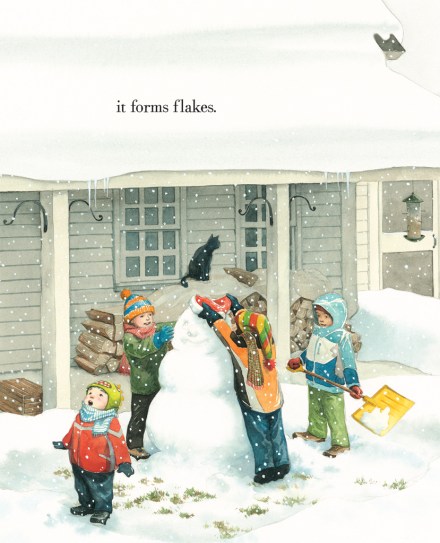
The turtle is hiding now that winter’s come, and a group of friends slip and speed across the pond, some playing hockey, some figure skating, and a couple just learning the ropes. Then suddenly it’s snowing! A brilliant red cardinal watches from the birdfeeder as three sneaky kids with snowballs spy on their friends who are building a snowman. With a “smack!” the snowball fight begins. Soon, however, spring is back with rushing streams and “Creep. Seep. Squish in your boots” mud. And that “mud is mud unless…there are roots.”

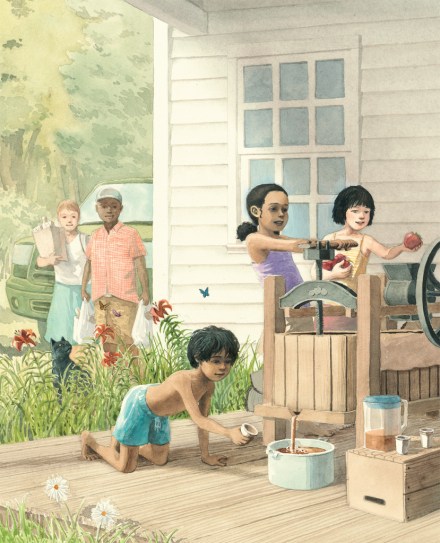
The apple trees in the backyard soak up the spring rains that feed the red, plump apples that are apples “unless…they get pressed. Drip. Sip. Pour me a cup. Cider is cider…until we drink it up!”

More information about water, including illustrated definitions of water-related terms, percentages of water in a variety of plants and creatures, and its importance to the world as well as suggestions for further reading, follow the text.

celebrate-picture-books-picture-book-review-water-is-water-making cider

Image copyright Jason Chin, courtesy of us.macmillan.com

Miranda Paul’s lyrical journey through a year of our interactions with water is a beautiful reminder of all the forms water takes. From life-filled ponds to pouring rains to glasses of refreshment, water sustains every creature and plant on earth. Paul’s transitional “unless…” elegantly introduces each transformation in the natural water cycle in a way that children recognize and appreciate. Her rich rhyming and rhythmical language is a joy to read and makes Water an active character in the story.

celebrate-picture-books-picture-book-review-water-is-water-drinking-cider

Image copyright Jason Chin, courtesy of us.macmillan.com

Jason Chin’s superb artwork is as lush and dynamic as the world around us. Each two-page spread is a masterpiece of atmosphere and details that bring not only water’s cycle to life but also that of the children, growing and playing in and around water throughout the year. As the children shelter from the rain at the beginning of the book, a bushel of apples sits snug against the cider press in the corner of the porch foreshadowing the final pages where fresh cider fuels summer fun. Chin’s children are real kids—joyful and playful, enthusiastically and humorously interacting with nature and each other with the kind of abandon that makes hearts sing. Young readers and adults will love lingering over each page.

Water is Water: A Story of the Water Cycle is the kind of book that can get kids excited about one of the quieter aspects of science—but one that is so important to our daily lives. It would make a wonderful accompaniment to elementary school lesson plans and a gorgeous addition to library and home bookshelves.

Ages 5 – 10

Roaring Brook Press, 2015 | ISBN 978-1596439849

Discover more about Miranda Paul and her books plus resources for teachers and writers on her website!

View a portfolio of artwork by Jason Chin and learn more about him and his books on his website!

World Water Day Activity

celebrate-picture-books-picture-book-review-water-words-word-search

A Sprinkling of Water Words Word Search


This tree grew tall and strong by soaking up water through its roots. Can you find the 20 water-related words that are hidden inside this printable tree-shaped A Sprinkling of Water Word Word Search Puzzle? Here’s the Solution.

Picture Book Review
March 21 – World Poetry Day

celebrate-picture-books-picture-book-review-enormous-smallness-cover

About the Holiday

Sponsored by the United Nations Educational, Scientific, and Cultural Organization (UNESCO), World Poetry Day celebrates one of the world’s oldest and most treasured forms of linguistic expression. On this day we honor the poets who translate physical beauty into words, expose social injustice in heartrending verse, and make us laugh with quirky juxtapositions. To celebrate the holiday, attend a poetry reading, revisit poems from your favorite author or discover a new writer, or pen a poem yourself!

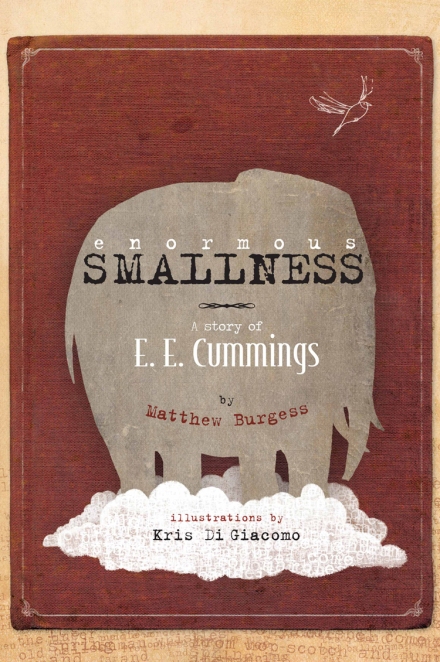
enormous SMALLNESS: A Story of E. E. Cummings

Written by Matthew Burgess | Illustrated by Kris Di Giacomo


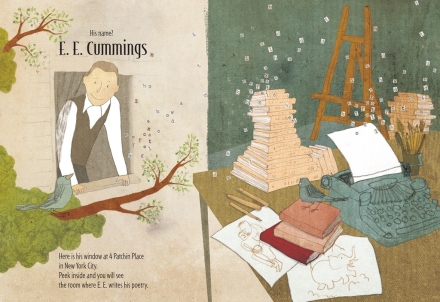
Hello! Welcome to 4 Patchin Place, the home of poet E. E. Cummings! This is where he wrote his poetry on a clackety typewriter, stopping only for tea poured out by the love of his life, Marion Moorehouse. How did he become a poet? That is an interesting story! E. E. was born Edward Estlin Cummings on October 14, 1894 in Cambridge, Massachusetts. His house was full of extended family, a handyman, a maid, and several pets. From an early age he loved to translate the things he saw into words. “His first poem flew out of his mouth when he was only three: “‘Oh, my little / birdie, Oh / with his little / toe, toe, toe!’”

celebrate-picture-books-picture-book-review-enormous-smallness-welcome

Image copyright Kris Di Giacomo, text copyright Matthew Burgess. Courtesy of Enchanted Lion Books

Estlin’s mother wrote down all the poems he told her and made a little book of them, titled “‘Estlin’s Original Poems.’” When he was six, he expressed his love of nature in a poem about trees, and when his mother asked him what else he saw, he “looked around as if his eyes were on tiptoes and when his heart jumped he said another poem: “‘On the chair is sitting / Daddy with his book. / Took it from the bookcase / Beaming in his look.’”

celebrate-picture-books-picture-book-review-enormous-smallness-elephant

Image copyright Kris Di Giacomo, text copyright Matthew Burgess. Courtesy of Enchanted Lion Books

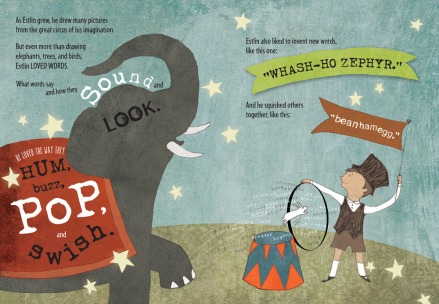
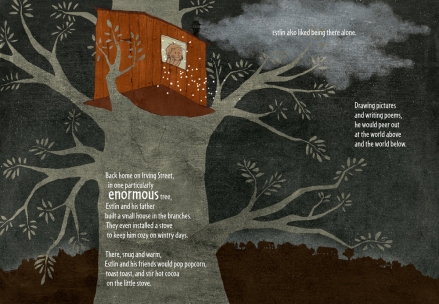
As he grew, Estlin was fascinated by the animals he saw at the circus and in the zoo. He drew pictures of them and wrote about them, using the words he loved so well—and even making up his own words. Estlin had a zest for life and for making life fun for himself and his little sister. During the summers, the family traveled to Joy Farm in New Hampshire, where Estlin swam, milked the cow, rode a donkey, and wandered through the fields and forest. His father had built him a little log cabin in the woods, and in the afternoons Estlin went there to draw and write. At home he also had a special place all his own. In an enormous tree his father built a tree house, complete with stove to keep him warm on cold days.

celebrate-picture-books-picture-book-review-enormous-smallness-tree-house

Image copyright Kris Di Giacomo, text copyright Matthew Burgess. Courtesy of matthewjohnburgess.com

Estlin had support for his writing at school too. His favorite teacher encouraged him saying, “anything is possible, / as long as you are true to yourself / and never give up, even when the world / seems to say, stop!” From his Uncle George, Estlin received a guide to writing poems. Estlin followed the rules in the book, penning poems nearly every day. When Estlin was 17 he attended Harvard College and began publishing his poems in the school’s magazines. While at Harvard, Estlin realized he had to follow his heart to be happy. He wanted to be like the new artists who were shaping the world—people like Gertrude Stein, Paul Cezanne, and Igor Stravinsky, “artists who were,” he once said, “challenging the way we think and see.”

celebrate-picture-books-picture-book-review-enormous-smallness-paris

Image copyright Kris Di Giacomo, text copyright Matthew Burgess. Courtesy of Enchanted Lion Books

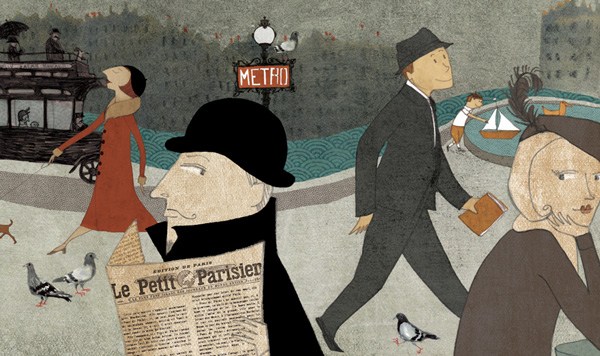
After he graduated, Estlin returned home, but when he had saved enough money he moved to New York and fell in love with the city immediately. He and his friends took in everything new the city had to offer. Soon, however, the United States entered World War II. On April 17, 1917 Estlin volunteered to be an ambulance driver in France. Before he received his assignment, though, he had time to explore Paris. He was “bowled over by the museums, the ballet, and the colorful, crowded streets.” He enjoyed the city so much he returned often during his lifetime.

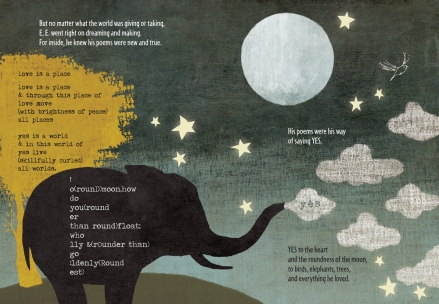
During the war, Estlin was mistaken for a spy and sent to prison for several months. After the war he wrote a book about his experiences titled The Enormous Room by E. E. Cummings. “The book was published and praised! Estlin was becoming E. E.!” A year later he published his first book of poetry—Tulips & Chimneys. In his poems he experimented with punctuation and using lower case letters instead of capitals.

celebrate-picture-books-picture-book-review-enormous-smallness-yes

Image copyright Kris Di Giacomo, text copyright Matthew Burgess. Courtesy of matthewjohnburgess.com

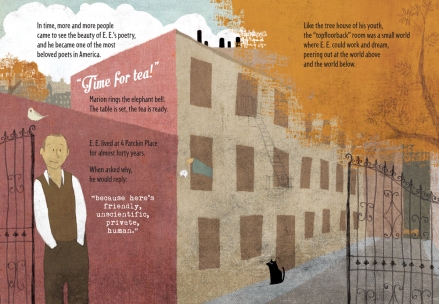
Through his fanciful typography, E. E. “wanted his reader’s eyes to be on tiptoes too, seeing and reading poetry (inaway) that was new.” But some people didn’t understand or like his poetry; it was too strange and too small, they said. But E. E. knew he had to stay true to himself. He believed that “his poems were new and true” and “were his way of saying YES” to everything he loved. As time went on more and more people began to “see the beauty of E. E.’s poetry, and he became one of the most beloved poets in America.”

E. E. Cummings lived and worked at 4 Patchin Place for almost 40 years, but in his mind he would often return to his childhood home. He “could still see himself as a boy gazing out at the sunset”—a memory that he put into words: who are you,little i / (five or six years old) / peering from some high / window;at the gold / of November sunset / (and feeling:that if day has to become night / this is a beautiful way)”

celebrate-picture-books-picture-book-review-enormous-smallness-patchin-place

Image copyright Kris Di Giacomo, text copyright Matthew Burgess. Courtesy of matthewjohnburgess.com

Simply put, Matthew Burgess’s enormous SMALLNESS: A Story of E. E. Cummings is a biography that will make you smile. Upbeat and full of the wonder and whimsy that influenced Estlin Cummings’ prodigious talent, the story encourages readers to always follow their heart. Burgess’s easy-going, conversational style invites kids along on the journey of Cumming’s life, stopping off at points that resonate with kids—early imaginary play, school, family vacations, home life, college, travel, and ultimate success. Seeing the support Cummings received throughout his life will inspire young readers just starting out on their own roads of discovery.

Kris Di Giacomo’s enchanting illustrations will immediately capture the imagination of readers. The playful quality of Cummings’ personality and poems is mirrored in each spread as a variety of children’s drawings and typography are sprinkled throughout. As six-year-old Estlin composes poems for his mother, he stands on tiptoe in his nightshirt surrounded by toys; he experiences life from rooftop and treetop and gazes into the night from his tree house; New York lights up with fireworks and the lights of Broadway; and his poems spring from the pages in their own inimitable way.

For children interested in writing, biographies, history, the arts, and the life of the imagination, enormous SMALLNESS: A Story of E. E. Cummings is a perfect choice for their home bookshelves.

A chronology of E. E. Cummings’ life, five poems, and an Author’s Note follow the text.

Ages 4 – 9

Enchanted Lion Publishing, 2015 | ISBN 978-1592701711

To learn more about Matthew Burgess, his books, and his poetry, visit his website!

View a gallery of illustration by Kris Di Giacomo on her website!

World Poetry Day Activity

celebrate-picture-books-picture-book-review-grow-a-poem-craft


Grow a Poem


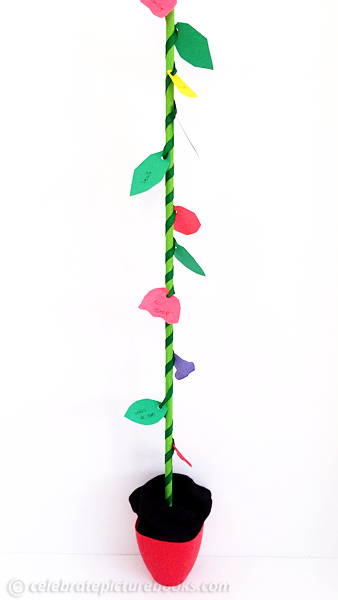
A poem often grows in your imagination like a beautiful plant—starting from the seed of an idea, breaking through your consciousness, and growing and blooming into full form. With this craft you can create a unique poem that is also an art piece!

Supplies

  • Printable Leaves Template
  • Printable Flower Template
  • Wooden dowel, 36-inch-long, ½-inch diameter, available in craft or hardware stores
  • Green ribbon, 48 inches long
  • Green craft paint
  • Green paper for printing leaves (white paper if children would like to color the leaves)
  • Colored paper for printing flowers (white paper if children would like to color the flowers)
  • Flower pot or box
  • Oasis, clay, or dirt
  • Hole punch
  • Glue
  • Markers or pens for writing words
  • Crayons or colored pencils if children are to color leaves and flowers

Directions

  1. Paint the dowel green, let dry
  2. Print the leaves and flower templates
  3. Cut out the leaves and flowers
  4. Punch a hole in the bottom of the leaves or flowers
  5. Write words, phrases, or full sentences of your poem on the leaf and flower templates
  6. String the leaves and flowers onto the green ribbon (if you want the poem to read from top to bottom string the words onto the ribbon in order from first to last)
  7. Attach the ribbon to the bottom of the pole with glue or tape
  8. Wrap the ribbon around the pole, leaving spaces between the ribbon
  9. Move the leaves and flowers so they stick out from the pole or look the way you want them to.
  10. Put oasis or clay in the flower pot or box
  11. Stick your poem pole in the pot
  12. Display your poem!

Picture Book Review

March 20 – World Storytelling Day

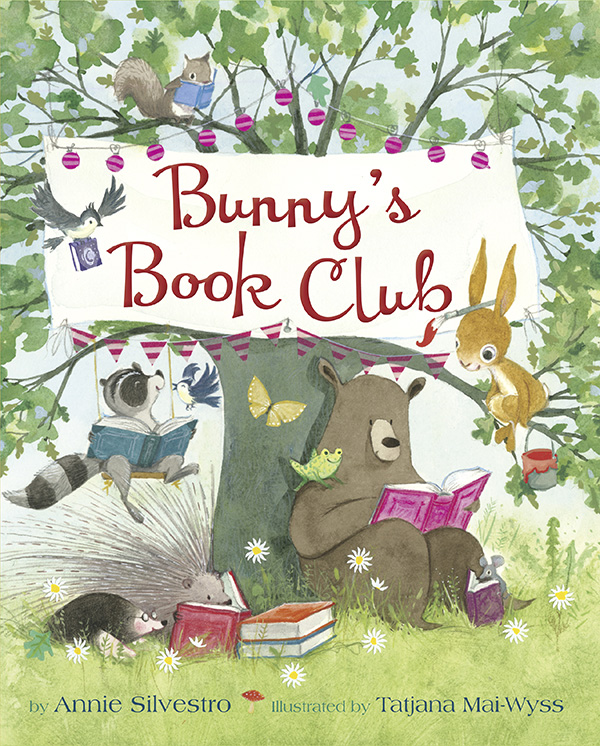
celebrate-picture-books-picture-book-review-bunny's-book-club-cover

About the Holiday

Today’s holiday was first held in Sweden in 1991. Established to celebrate the art of oral storytelling, the day invites people around the globe to tell and listen to stories both old and new. To participate attend a special storytelling event in your area or relate some family stories at home. Of course reading terrific books out loud is also a fun way to honor the day!

Bunny’s Book Club

Written by Annie Silvestro | Illustrated by Tatjana Mai-Wyss


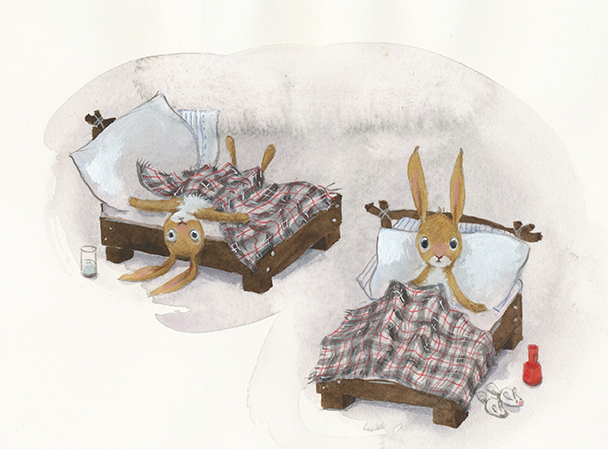
Bunny would do just about anything to hear a story. “He’d loved them ever since he first heard the lady with the red glasses reading aloud outside the library.” All summer long he listened to stories that took him to thrilling and magical places. But when the weather turned cooler and story time moved indoors, bunny knew he had to do something—“he couldn’t live without books.”

Bunny was afraid that animals weren’t allowed in the library. Finally, after several sleepless nights Bunny “tiptoed through the dark” to the library. But when he got there the door was locked, the windows were bolted, and there were no holes in the building to be found—“until finally he noticed…the book return!” Bunny hopped as high as he could, grabbed the handle, and slipped inside. “Bunny’s eyes sparkled at the sight of the shelves bursting with books.”

celebrate-picture-books-picture-book-review-bunny's-book-club-bunny-cant't-sleep

Image copyright Tatjana Mai-Wyss, courtesy of tatjanamaiwyss.com

Bunny hopped here and there through the adventure section, where he found books about “swashbucklers, sharks, and superheroes.” He grabbed as many as he could carry and pushed them through the slot. Back home he read and read, and every night he returned to the library for more books. Pretty soon his house was filled top to bottom with books.

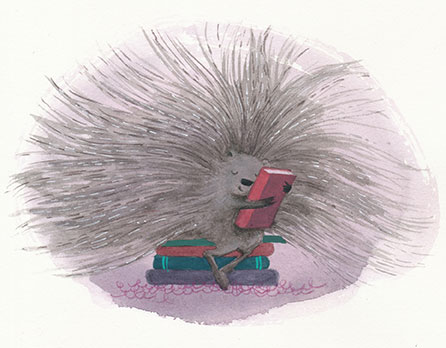
One night while reading, Bunny heard a knock on the door. It was Porcupine, wondering where Bunny has been. When Porcupine found out, he couldn’t believe it. What was so special about reading? The next night Bunny took Porcupine to the library. “‘Whoa,’ said Porcupine.” He immediately wondered if there was a book about balloons. He also found stories “on deserts and dunes, on caterpillars and cocoons” and even one on hedgehogs that made him so happy he hugged it with all his might. Back at Bunny’s and cuddled up with tea and carrot muffins, the two friends read into the night.

celebrate-picture-books-picture-book-review-bunny's-book-club-porcupine and-bunny-read

Image copyright Tatjana Mai-Wyss, courtesy of tatjanamaiwyss.com

It wasn’t too long before Bear showed up at Bunny’s wondering about why the light burned so late so often. Bunny handed him a book, and Bear squeezed onto the couch and began reading. Soon, all of Bunny’s friends began dropping by asking for books about space, volcanoes, and mysteries. One night Bunny took them all on a trek to the library. They were so engrossed in their books that they didn’t hear a key turn in the lock, “the clack, clacking of footsteps,” or the light flick on.

It was the librarian! All the animals gasped—they’d been caught! “‘All libraries have rules,’ said the librarian sternly” as she asked the animals to follow her. At the desk, the librarian in the red glasses crouched down and gave each animal their own library card. Bunny was thrilled to know they were welcome at the library. He found the perfect book and “proudly checked out the very first official selection for Bunny’s Book Club.”

celebrate-picture-books-picture-book-review-bunny's-book-club-porcupine-hugs-book

Image copyright Tatjana Mai-Wyss, courtesy of tatjanamaiwyss.com

Annie Silvestro’s sweet story about the lure of stories and the lengths to which a true book lover will go to hear or read one, will enchant young children. The gentle suspense will keep little ones riveted to the story as clever Bunny finds a way into the library, Porcupine and Bear have a few sticky moments, and the librarian catches the crew unawares. Little ones will recognize their own delight in books as Bunny shares his discover with his friends and they form a most cozy book club.

Tatjana Mai-Wyss’s adorable Bunny, Porcupine, Bear and other animals make perfect book club friends for little readers. Mai-Wyss’s soft-hued watercolor illustrations of the tidy library and Bunny’s book-filled home invite children in to poke around and become one of the group. They’ll love following Bunny’s footprints through the library stacks and discovering the cozy comforts of Bunny’s home. The final tw0-page illustration of the friends snuggled together in the warmth of a roaring fire and surrounded by snacks and books is definitely “awwww” inspiring.

Bunny’s Book Club may inspire families to take a special nighttime trip to the library and young readers to create a book club of their own. It would be welcome on any child’s bookshelf.

Learn more about Annie Silvestro and her books on her website!

Discover more about Tatjana Mai-Wyss and review a portfolio of her illustration on her website!
Ages 3 – 7

Doubleday Books for Young Readers, 2017 | ISNB 978-0553537581

World Storytelling Day Activity

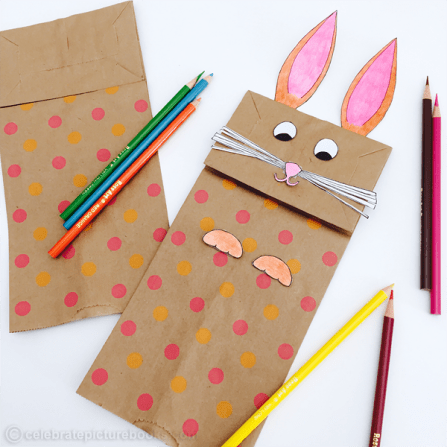
celebrate-picture-books-picture-book-review-bunny-puppet

Story Buddy Puppet


Hop to it! Have fun telling your favorite stories with this bunny puppet!

Supplies

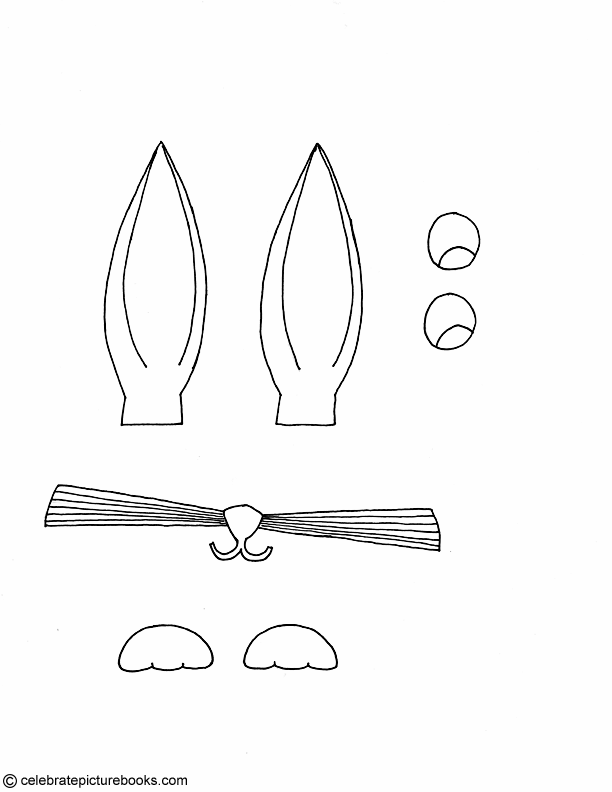
  • Printable Bunny Template
  • Paper sandwich bag
  • Colored pencils, crayons, or markers
  • Scissors
  • Glue

Directions

  1. Print out the Bunny Template
  2. Color the Bunny Template
  3. Cut out the bunny’s features
  4. Clue the bunny’s features to the sandwich bag

Picture Book Review