December 28 – Endangered Species Act Day

celebrate-picture-books-picture-book-review-a-voice-for-the-everglades-cover

About the Holiday

The Endangered Species Act was signed into law in by President Richard Nixon on this date in 1973.  The primary law in the United States for protecting imperiled species, the Act protects critically imperiled species from extinction as a result of the consequences of economic growth and development undeterred by concern for conservation. The US Supreme Court called it “the most comprehensive legislation for the preservation of endangered species enacted by any nation”. The purposes of the Endangered Species Act are to prevent extinction and to recover species to the point where the law’s protections are not needed, therefore protecting diverse species as well as the ecosystems in which they live or depend on. Today’s book reveals the story of a National Park that provides a unique refuge for many rare and endangered species. To celebrate the holiday, learn more about how the Endangered Species Act affects your state.

Thanks go to Albert Whitman & Company for sharing a copy of A Voice for the Everglades: Marjory Stoneman Douglas with me for review consideration. All opinions on the book are my own.

A Voice for the Everglades: Marjory Stoneman Douglas (Part of the She Made History Series)

Written by Vicki Conrad | Illustrated by Ibon Adarne and Rachel Yew


“Long ago a trickle of water / spilled from a lake / and formed a tiny stream.” The stream spread until it covered almost half of the state of Florida, creating a shallow lake that moved like a slowly running river – “a river bursting with wildlife, / whispering to the world / to listen, to notice, to discover its wonders.” Mangroves and cypress trees grow from the water, the soil fed by the cycles of growing and dying sawgrass. The water, trees, and grass attract a “rainbow of birds” that wade in the shallows, hunting for food. “These are the Everglades. / The wildest, richest, and most diverse ecosystem in all the world – / every plant and animal needing another to survive.”

celebrate-picture-books-picture-book-review-a-voice-for-the-everglades-stream

Image copyright Ibon Adarne and Rachel Yew, 2021, text copyright Vicki Conrad. Courtesy of Albert Whitman & Company.

But leaders and developers wanted to drain the water to create land to build on, land they could sell, land with which they could make money. They pumped the water out and built dams and drains to make farmland, but the farmland turned dry and burned easily. The animals and birds fled. The ecosystem was “desperate for a voice to protect them.”

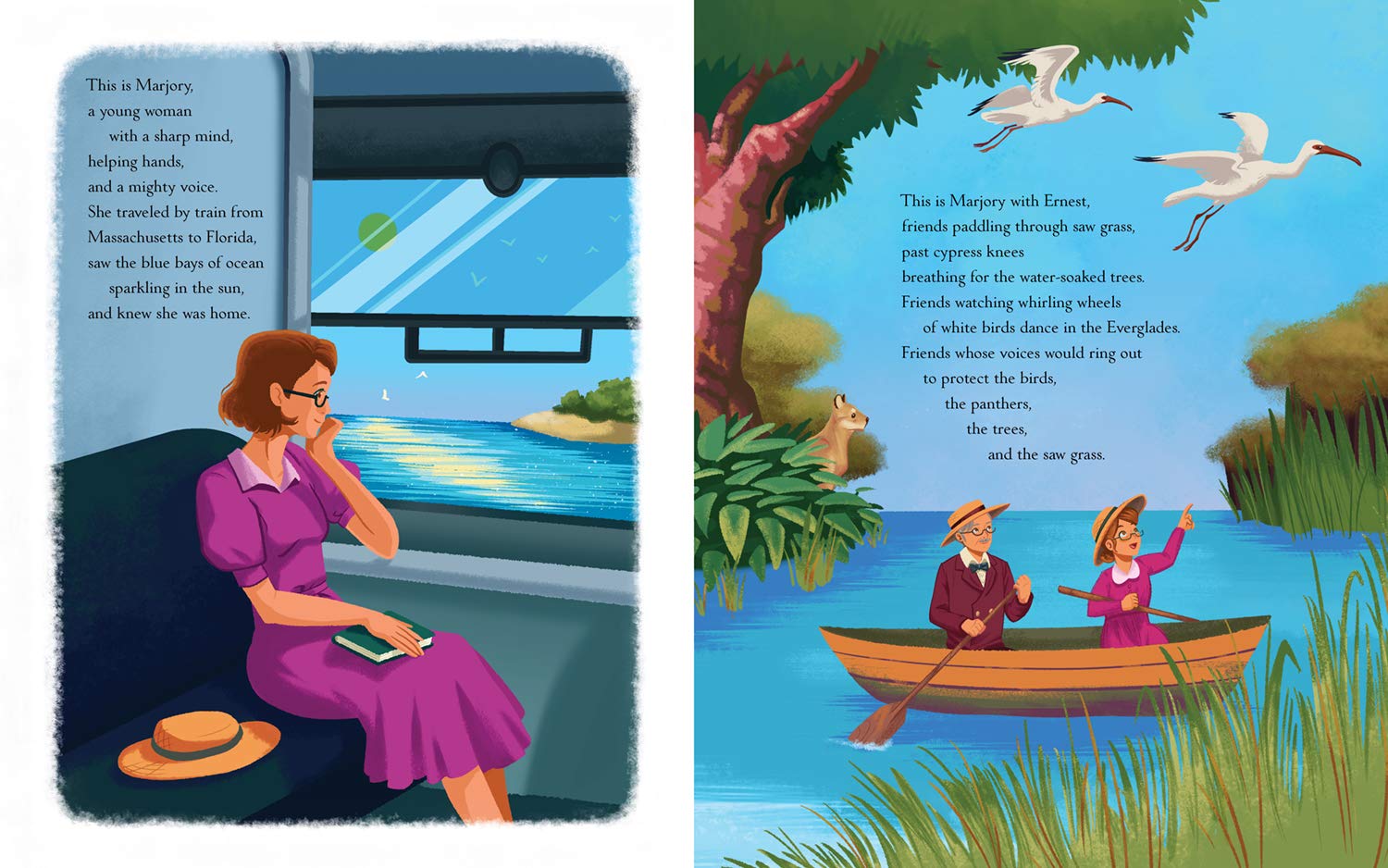
When Marjory traveled from Massachusetts to Florida and saw the beautiful scenery, she knew immediately that this was her new home. She made a friend, Ernest, and together they spent time paddling a boat through the Everglades, “watching whirling wheels of white birds dance” and spying panthers, alligators, turtles, manatees, and more of the animals that lived there. Where other people saw a swamp, Marjory and Ernest saw “treasure.”

Marjory and Ernest wanted to do something to preserve the Everglades. They studied the map and the formation of the Everglades. Marjory called it “a river of grass.” Ernest wrote a bill for the United States Congress to consider, and “Marjory wrote a poem, / hopeful it would move Congress.” Although lawmakers did tour the Everglades and see its miraculous sights, the bill did not pass.

celebrate-picture-books-picture-book-review-a-voice-for-the-everglades-train

Image copyright Ibon Adarne and Rachel Yew, 2021, text copyright Vicki Conrad. Courtesy of Albert Whitman & Company.

Marjory decided to write a book about the area she loved, and in 1947 The Everglades: River of Grass was published. Her book helped people see the marvels that lived within the Everglades: “the manatee munching seagrass / protecting her calf from harm”; “the red-bellied turtle, / laying eggs in the abandoned alligator nest, / dry and protected from water.”; the only place in the world where an alligator and a crocodile live together.”

At last people began to take notice – and care. Their voices joined with Marjory’s and Ernest’s and Everglades National Park was established that same year. “Yet only one-fourth of the Everglades was protected.” Marjory understood that “all the ecosystems needed one another.” When plans to build the world’s largest airport on land that was part of the Everglades, Marjory, now eighty years old, established the Friends of the Everglades, and their three-thousand voices convinced President Richard Nixon to stop the building.

Marjory continued to fight for the Everglades, giving speeches and putting hecklers in their place. When she was ninety-nine years old, Marjory could be found chipping away at a concrete drain to restore the land to its former waterway. At 105 years old, Marjory was awarded the Presidential Medal of Freedom. Adults and children sent her letters thanking her for saving the Everglades, but Marjory knew there would always be more work to be done to protect this unique ecosystem.

Back matter includes an extensive, illustrated discussion of the Everglades ecosystem, the nine different habitats that make it such a unique area, and many of the plants, animals, birds, and fish that call it home. More on the life of Marjory Stoneman Douglas and her legacy as well as how readers can help the Everglades are also included.

celebrate-picture-books-picture-book-review-a-voice-for-the-everglades-national-park

Image copyright Ibon Adarne and Rachel Yew, 2021, text copyright Vicki Conrad. Courtesy of Albert Whitman & Company.

A compelling biography of a woman with vision and grit who took on a nearly impossible task and saved one of the world’s unique environmental treasures, A Voice for the Everglades: Marjory Stoneman Douglas will inspire young environmentalists and would serve as a captivating resource to begin studies about ecosystems, conservation, endangered and rare species, and many other topics revolving around nature science. Marjory Stoneman Douglas, whose perseverance, dedication, and voice still resonate today, continues to be a role model for children and adults alike.

Through Vicki Conrad’s lyrical text and light incorporation of a “This is the House that Jack Built” cadence readers see how people’s actions build on and affect each other – whether detrimentally (as the building plans; pumps, dams, and drains; and disappearing wildlife do) or beneficially (as Marjory’s and Ernest’s appeals to Congress, Marjory’s writings, and her continued advocacy do) and understand that once voice can make a difference. Conrad does an excellent job of portraying the beauty and uniqueness of the Everglades and giving kids a view of the many wonders to be found there.

In their vivid illustrations, Ibon Adarne and Rachel Yew depict the rich colors of the diverse flora and fauna found in the nine cohesive habitats, from the vibrant pink roseate spoonbills to the purple passion flowers to the elusive crocodiles and the breathtaking, fiery sunsets that blanket them all. Adarne and Yew also allow children to navigate the meandering waterways that weave through the mangroves and sawgrass in their slow, steady, and life-giving pace. The breadth of wildlife within the pages offer many opportunities for further learning and research at home and at school.

An enticing and educational look at one of the world’s most valued natural treasures – whose story and resources continues to influence nature studies and advocacy today – A Voice for the Everglades: Marjory Stoneman Douglas is a book that every school and public library will want to add to its collection and would be an inspiring inclusion for home bookshelves for nature lovers and homeschoolers.

Ages 4 – 8

Albert Whitman & Company, 2021 | ISBN 978-0807584965

Discover more about Vicki Conrad and her books on her website.

You can connect with Ibon Adarne on Twitter.

You can connect with Rachel Yew on Twitter.

Endangered Species Act Day Activity

celebrate-picture-books-picture-book-review-everglades-national-park-coloring-page

Everglades National Park Coloring Page


Travel to the Everglades and see the diverse wildlife that lives there with this printable coloring page!

Everglades National Park Coloring Page 

celebrate-picture-books-picture-book-review-a-voice-for-the-everglades-cover

You can find A Voice for the Everglades: Marjory Stoneman Douglas at these booksellers

Amazon | Barnes & Noble | Books-a-Million

To support our local independent bookstore, order from 

Bookshop | IndieBound

Picture Book Review

September 29 – It’s Intergeneration Month

celebrate-picture-books-picture-book-review-shaped-by-her-hands-cover

About the Holiday

Cuddle ‘round for two loving holidays—Intergeneration Month and National Attend Your Grandchild’s Birth Day—which each encourage grandparents to be present figures in their grandchildren’s lives starting from birth! Already, many grandparents across the globe play active roles in caring for children. In the US alone, 4.8 million preschoolers were under the care of grandparents in 2011. Whether you are a grandchild, parent, or grandparent, it is important to support family and spread some love. Hug someone special today to celebrate this holiday. In honor of this day, we present a story about artist Maria Povika Martinez, co-written by her great-granddaughter. Her historical account teaches the importance of love, family, and the passing down of knowledge through generations.

Thanks to Albert Whitman & Company for sharing a copy of Shaped By Her Hands with me for review consideration. All opinions on the book are my own.

Review by Dorothy Levine

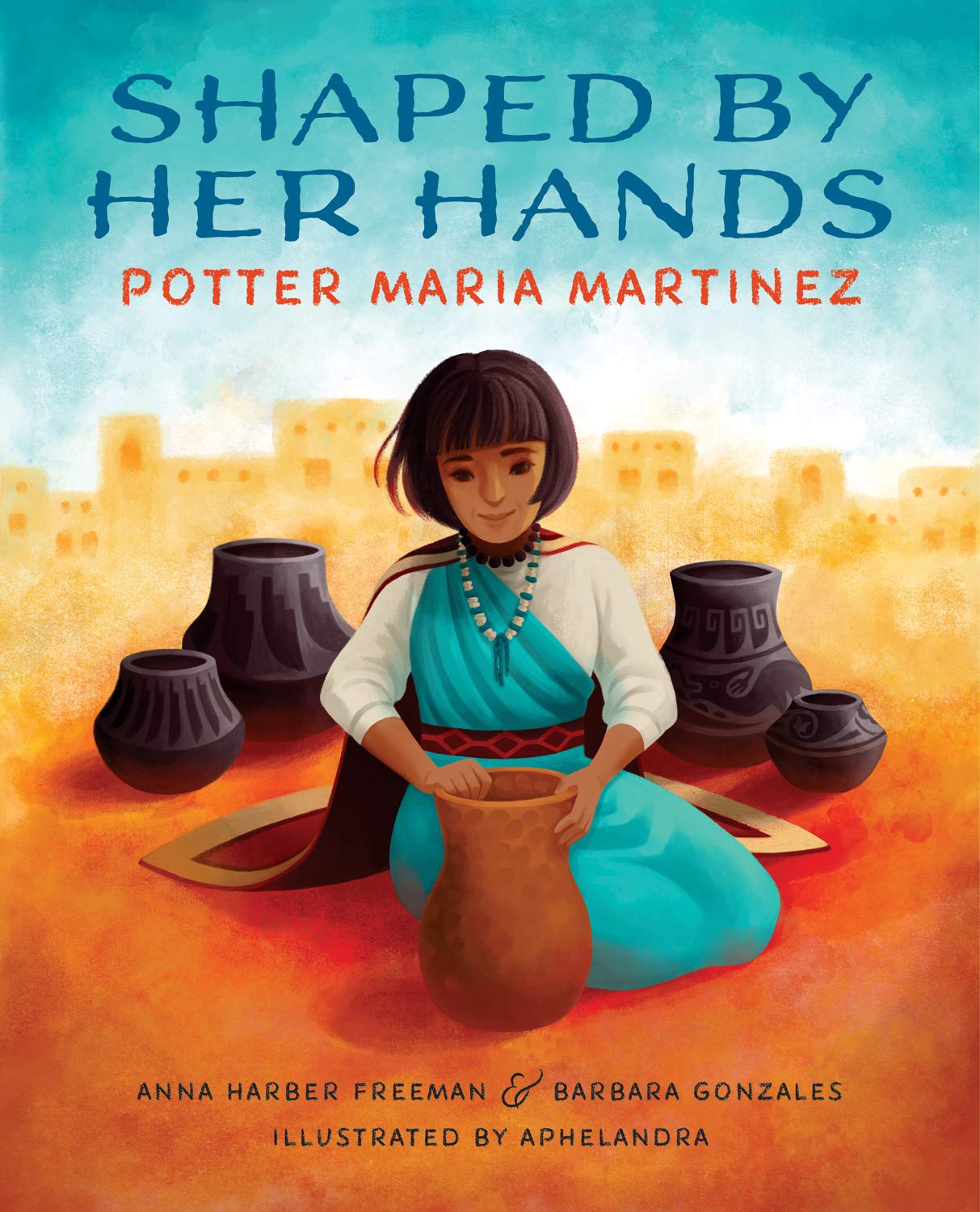
Shaped By Her Hands: Potter Maria Martinez (Part of the She Made History Series)

Written by Anna Harber Freeman and Barbara Gonzales | Illustrated by Aphelandra

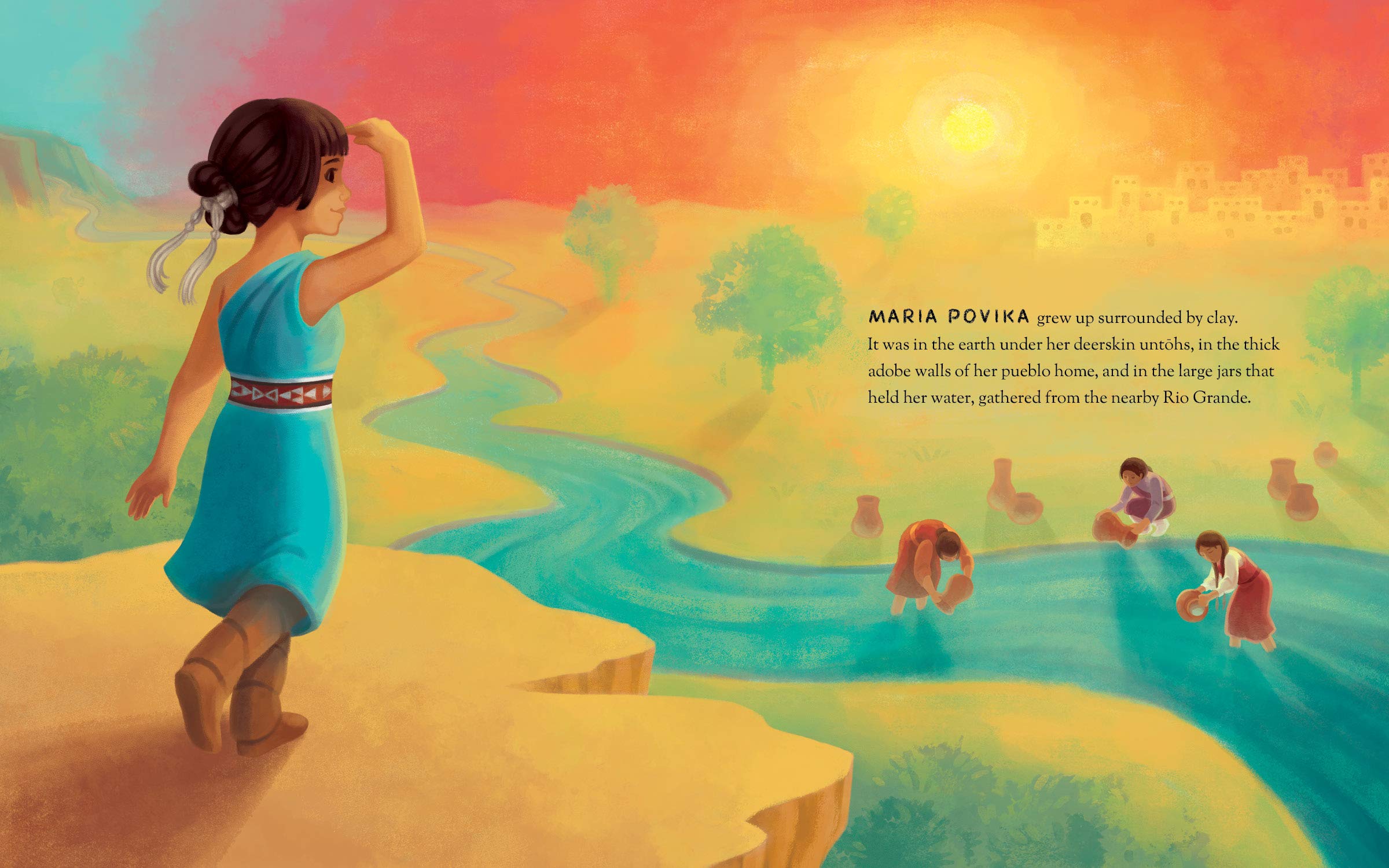
As a child growing up in the pueblo of San Ildefonso, New Mexico in the 1890s, Maria always loved clay. While her siblings played with straw dolls and her parents planted crops, Maria spent her time making clay pots. But, to her frustration, her pots would always crack when she set them out to dry in the sun. Maria’s aunt, or ko-ōo, Nicolasa offered to help and showed Maria “the centuries-old tradition of san-away.” Nicolasa still made clay pots using these traditional methods, even though more and more people were buying tin pots from stores. 

celebrate-picture-books-picture-book-review-shaped-by-her-hands-river

Image copyright Aphelandra, 2021, text copyright Anna Harber Freeman and Barbara Gonzales, 2021. Courtesy of Albert Whitman & Company.

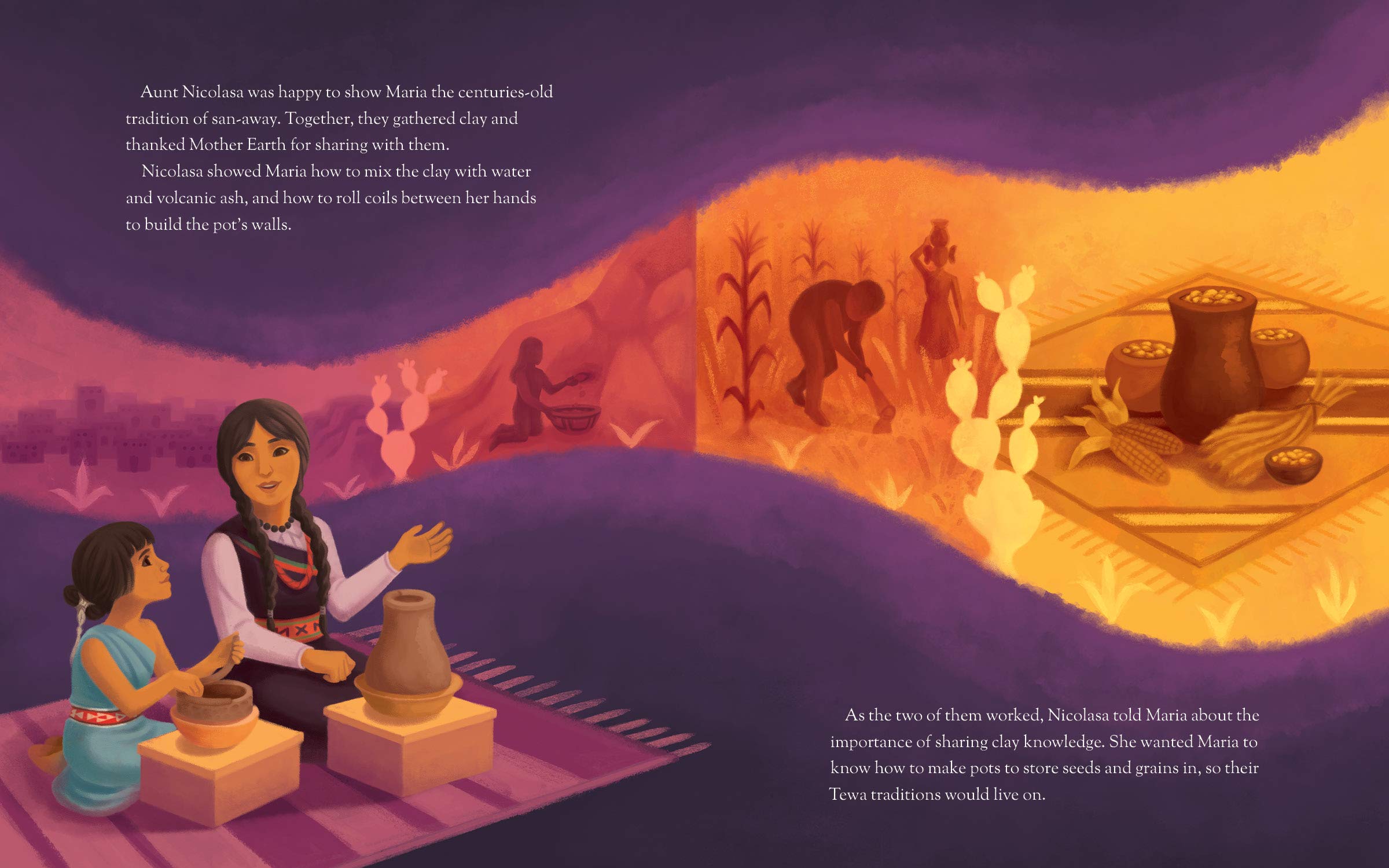
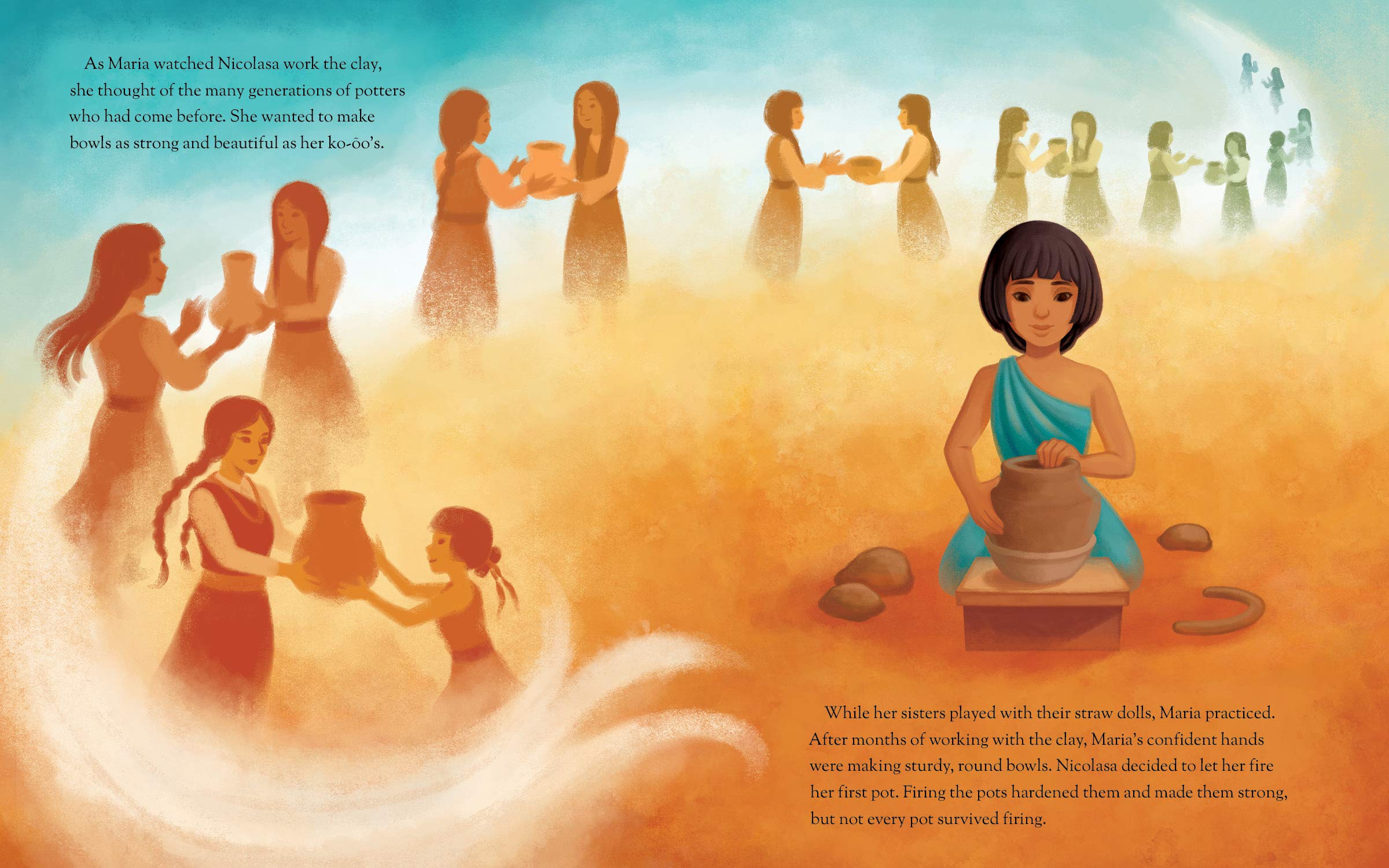
Nicolasa taught Maria how to coil the clay in circles and then lay the pots together on a fire to make them dry, solid, and strong. “As Maria watched Nicolasa work the clay, she thought of the many generations of potters who had come before. She wanted to make bowls as strong and beautiful as her ko-ōo’s.” Nicolasa and Maria thanked Mother Earth for the clay she shared with them. 

When Maria grew older, she continued to make pots and gained a reputation for her skilled work. One day in 1908, an archeologist named Edgar Lee Hewett came to visit Maria. He had discovered an old shard of black pottery in a dig nearby. Mr. Hewett wanted to know if Maria could recreate a pot in the similar style. She decided to take on the challenge.

celebrate-picture-books-picture-book-review-shaped-by-her-hands-Nicolasa

Image copyright Aphelandra, 2021, text copyright Anna Harber Freeman and Barbara Gonzales, 2021. Courtesy of Albert Whitman & Company.

After much experimentation, Maria and her husband, Julian Martinez, discovered a technique: “One afternoon, they tried smothering the fire to keep the smoke in. When they pulled out the pot, it was shiny, and black as a raven.” With this new method, Maria combined her own style with old traditions to create a new style of pottery that was marvelous. Mr. Hewitt took some of these pots Maria made. “He put one of the pots in the Museum of New Mexico, where he worked.” The others he took to shops in Santa Fe. To Maria’s surprise, they sold like crazy! Julian began to paint designs on the black shiny pots—decorations of serpents, feathers, and water—using a yucca-blade brush. 

As more and more pots sold, Maria and Julian taught the rest of her family and some friends to make the pots with them. They became so famous that many people across the country invited them to demonstrate their skills to others. When Maria’s husband died, she continued to make pots with her family. “First, her children came to paint the designs. Later, her grandchildren came to help with the painting and polishing. They made pots as a family, remembering to thank Mother Earth, and teaching new hands to form, polish, and design.” 

The story is followed by back matter that provides more information about Maria, the Tewa people, and the San Ildefonso Pueblo for readers. Both authors include a note about how they were influenced by Maria and why they believe it is important to share her story with young people today. 

celebrate-picture-books-picture-book-review-shaped-by-her-hands-generations

Image copyright Aphelandra, 2021, text copyright Anna Harber Freeman and Barbara Gonzales, 2021. Courtesy of Albert Whitman & Company.

The story is co-written by Barbara Gonzales, the great-grandchild of Maria, and Anna Harber Freeman, whose grandmother was a member of the Osage Nation and who is a lifelong fan of Maria’s work with degrees in multicultural education and art. Their biography of Maria Martinez shines with its lyrical, straightforward telling that reveals the deep history of the Tewa people as well as the meaning and uses of the pottery that Maria and her ko-ōo Nicolasa created by hand. The importance of passing down knowledge and traditions from one generation to another is organically woven throughout the story. Many readers will recognize Maria and Julian’s distinctive pottery and be inspired by the history behind it.

Aphelandra is a descendant of the Oneida Nation, and the daughter of a crafts artist and landscaper. She writes that she grew up surrounded by natural beauty and creativity, which can be seen in her illustrations. The illustrations in Shaped by Her Hands consist largely of soft yellow, green, and red hues. In the part of the story in which Maria is sent off to boarding school, the colorful tones found throughout the book are confined to a single window, depicting the feeling of entrapment and homesickness Maria felt. Aphelandra vividly weaves in the storytelling of past generations through her use of color, shadow and circular imagery. Her painted landscapes gorgeously depict the natural San Ildefonso scenery. 

This beautifully crafted tale shares the history of Maria Povika Martinez while introducing readers to Tewa people’s values of kindness, passing on of knowledge, and respect for elders and Mother Earth. An inspiring read for all children, especially those interested in artistic and creative endeavors, Shaped By Her Hands: Potter Maria Martinez is highly recommended for home bookshelves and a must for school and public library collections.

Ages 4 – 9 

Albert Whitman & Company, 2021 | ISBN 978-0807575994

Discover more about Anna Harber Freeman and her books on her website.

To learn more about Barbara Gonzales and her pottery and to view a video with Barbara and other artists discussing an exhibition of San Ildefonso Pueblo potters at the Museum of Indian Arts and Culture, visit the adobe gallery website.

You can learn more about Aphelandra, her books, and her artwork on her website.

Intergeneration Month Activity

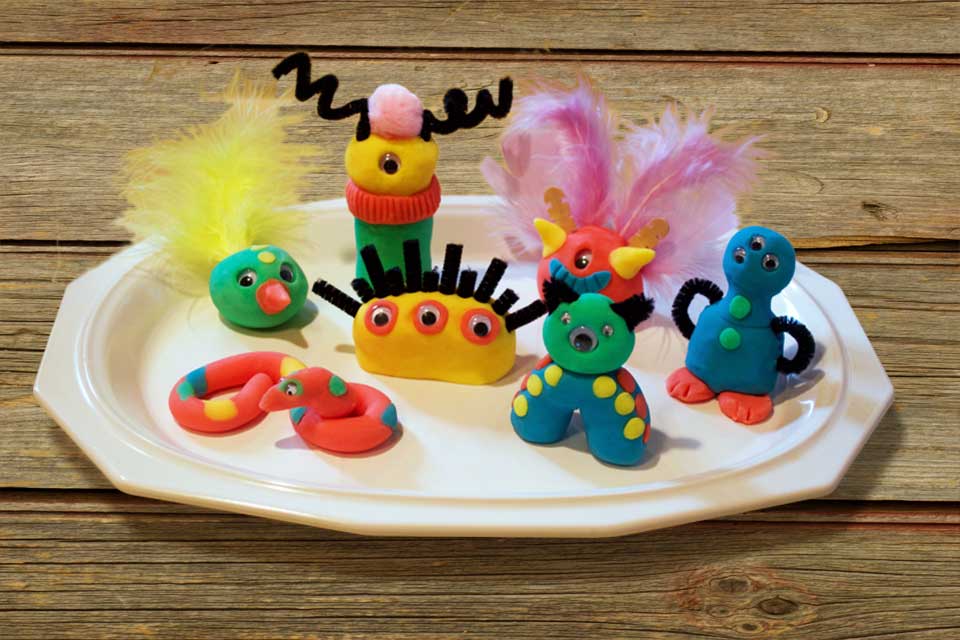
Highlights Kids Homemade Clay figures

Photo and craft sample by Madison McClain, courtesy of Highlights Kids (highlightskids.com)

This craft comes from Highlights Homemade Clay, by Marie E. Cecchini posted on April 12, 2016. You can find the post on the Highlights kids website.

Make your own homemade clay in honor of Maria’s art form then make your own pot or creation!

What you’ll need

  • 2 cups baking soda
  • 1 cup cornstarch
  • 1 ¼ cups water
  • Cooking pot
  • Food coloring (optional)
  • Wiggly eyes, chenille sticks, pompoms, feathers, etc. (optional)

What to do

Note: Food coloring can be added to the water before mixing in the other ingredients or can be added to the clay after it has cooled. Adding coloring later may be a little messier, but you can divide the clay and create different batches of various colors.

  1. Combine ingredients in the pot and cook mixture over medium heat, stirring until it thickens to a consistency like mashed potatoes.
  2. Let the clay cool
  3. Knead the clay until smooth.
  4. Make creations!
  5. Leave clay pieces in the sun to dry.

celebrate-picture-books-picture-book-review-shaped-by-her-hands-cover

You can find Shaped By Her Hands: Potter Maria Martinez at these booksellers

Amazon | Barnes & Noble | Books-a-Million

To support your local independent bookstore, order from

Bookshop | IndieBound

Picture Book Review
August 25 – National Park Service Day

celebrate-picture-books-picture-book-review-headstrong-hallie-cover

About the Holiday

On August 25, 1916, President Woodrow Willson signed what is now called the Organic Act, establishing the National Park Service. In the 105 years since that historic signing, 400 areas in each of the 50 states, U.S. territories, and the District of Columbia, totaling 84 million acres, have been designated as national parks. Today we honor the park rangers who conserve and preserve these natural wonders and educate visitors. This year’s theme – Park Scrapbooks – encourages park visitors to take pictures, buy postcards, and record memories for family and future generations. To discover the national parks near you and the stories behind them as well as to learn more about how you can help out all year round, visit the National Park Foundation website and the National Park Service website.

Headstrong Hallie! The Story of Hallie Morse Daggett, the First Female “Fire Guard”

Written by Aimée Bissonette | Illustrated by David Hohn


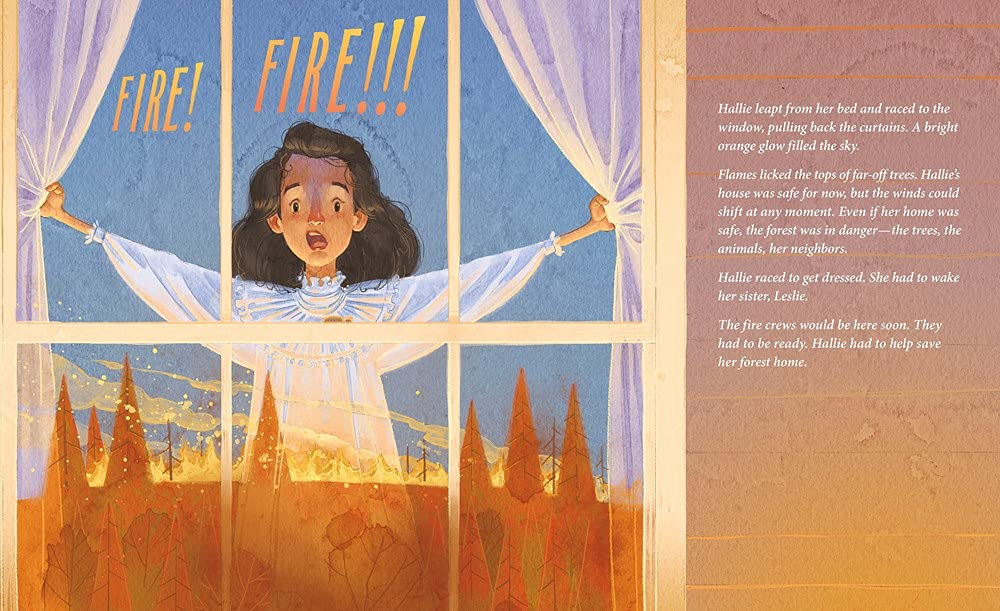
Hallie Morse Daggett loved the forest near her home. She had no fear as she “hiked among the tall trees of California’s Siskiyou Mountains, listened for the calls of familiar birds, and looked for signs of wildlife.” She fished in the Salmon River and was an excellent hunter. The only thing Hallie feared about the forest was fire, especially the summer fire season. “Hallie had seen the horrible power of fire race through the trees, leaving them scorched and leafless. She had seen the animals of the forest scatter and flee from racing flames…. And she had seen those flames come dangerously close to her family’s home.”

celebrate-picture-books-picture-book-review-headstrong-hallie-window

Image copyright David Hohn, 2021, text copyright Aimée Bissonette, 2021. Courtesy of Sleeping Bear Press.

Whenever fire did come to the forest, though, Hallie and her sister Leslie were among the first to help the US Forest Service by stamping out flames and bringing them food and supplies. But Hallie wanted to do more. She vowed to word for the Forest Service when she grew up. As soon as she finished boarding school in San Francisco, Hallie wanted to get bac to the forest she loved. She began sending letters to the US Forest Service, asking for a job. But she always received “no” for an answer.

celebrate-picture-books-picture-book-review-headstrong-hallie-fire

Image copyright David Hohn, 2021, text copyright Aimée Bissonette, 2021. Courtesy of Sleeping Bear Press.

After the devastating Great Fire of 1910, which “burned millions of acres of forest in Washington, Idaho, and Montana, Hallie was more determined than ever. But the response to her letters was always “no.” “The Forest Service didn’t hire women.” But then in 1913, when the fire lookout at the Eddy Gulch Lookout Station quit, Hallie saw her chance. She wrote a heartfelt letter and this time she got the job!

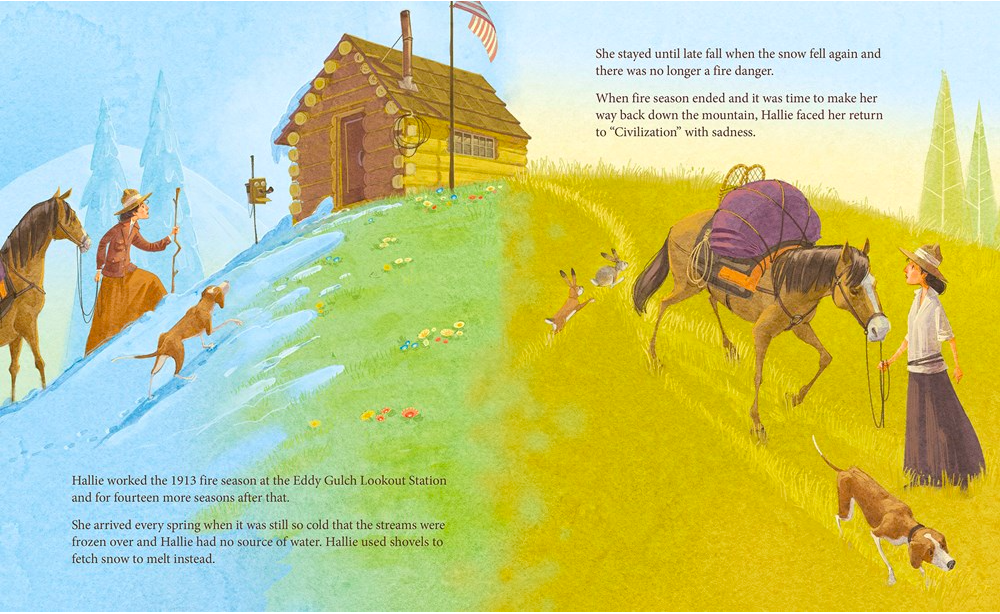
When the news spread, some of the Fire Service men thought the conditions would make her quit in a couple of days. “They didn’t know Hallie.” She loved the tiny lookout cabin and the breathtaking view. Hallie lived surrounded by wildlife—and a few animals even invited themselves in to stay. Sometimes she had visitors, and Leslie came every week to bring her supplies, letters, and newspapers.

celebrate-picture-books-picture-book-review-headstrong-hallie-horse

Image copyright David Hohn, 2021, text copyright Aimée Bissonette, 2021. Courtesy of Sleeping Bear Press.

Her days were spent searching the woods for fire or smoke through her binoculars. At night she watched for the glow of fire, “which she described as ‘red stars in the blue-black background of moonless nights.’” In her first season, Hallie’s eagle eye and quick response to forty fires kept the acres burned to less than five. In all Hallie worked for fifteen seasons—early spring to late fall—as the Eddy Gulch lookout.

In 1927, the tiny Eddy Gulch lookout cabin was replaced with a new building with wraparound windows and catwalk. But this building didn’t feel like a home to Hallie. She remained in her position for one more season and then retired, happy that she had found her place and lived her life in the way she wanted.

An Author’s Note following the text reveals more about Hallie Morse Daggett and her work as a lookout, complete with photographs.

celebrate-picture-books-picture-book-review-headstrong-hallie-cabin

Image copyright David Hohn, 2021, text copyright Aimée Bissonette, 2021. Courtesy of Sleeping Bear Press.

Aimée Bissonette’s inspiring biography of the first woman to work as a Fire Guard for the US Forest Service emphasizes the kind of grit, self-awareness, and perseverance that empowers girls and boys to stay true to themselves while pursuing the kind of life and lifestyle that is most meaningful to them. Bissonette’s straightforward storytelling is fast-paced and focused on Hallie’s unwavering self-confidence, fearlessness, and love of her job. For children who are happiest in contemplation and working alone, Hallie’s story will come as encouragement and validation for a life lived differently.

David Hohn’s color-saturated illustrations of the forest fires Hallie lived through and helped prevent crackle with the golds, reds, and flying embers of these powerful events. Contrasting these images are illustrations of the peaceful, sun-drenched mountains and woodlands that Hallie called home. While bears, bobcats, and smaller wildlife stalk nearby, Hallie, as a young girl, is shown easily traversing the rocky hills, confident and unfearful. Readers will enjoy seeing Hallie scanning the forest with her binoculars, calling for firefighters at the first sight of flames, and relaxing in the rustic cabin she lived in during the long fire season.

A well-told story about a woman determined to make a difference while living her authentic life, Headstrong Hallie! will inspire kids and is a standout choice for nature lovers and others looking for unique opportunities to put their stamp on the world.

Ages 6 – 9

Sleeping Bear Press, 2021 | ISBN 978-1534110618

Discover more about Aimée Bissonette and her books on her website.

To learn more about David Hohn, his books, and his art, visit his website.

National Park Service Day Activity

celebrate-picture-books-picture-book-review-if-I-were-a-park-ranger-mesa-verde-coloring-page

Majestic Parks Coloring Pages


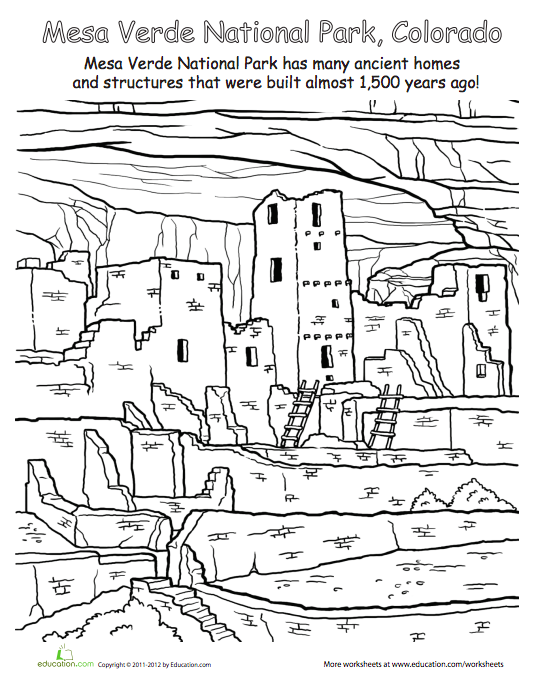
You may not be able to visit all of these parks, but you can still enjoy their beauty with these printable coloring pages!

Mesa Verde National Park | Gates of the Arctic National Park | Hawaii Volcanoes National Park | Biscayne National Park | 

celebrate-picture-books-picture-book-review-headstrong-hallie-cover

You can find Headstrong Hallie! The Story of Hallie Morse Daggett, the First Female “Fire Guard” at these booksellers

Amazon | Barnes & Noble | Books-a-Million

To support your local independent bookstore, order from

Bookshop | IndieBound

Picture Book Review
April 14 – It’s Global Astronomy Month

celebrate-picture-books-picture-book-review-the-stuff-between-the-stars-cover

About the Holiday

Instituted by Astronomers Without Borders, a group who sees in our shared sky an opportunity to create “a global community that appreciates, studies, and shares the wonders of the universe, to broaden perspective, transcend borders, and improve lives,” Global Astronomy Month brings people together with arts events, parties, and special events. To find resources, such as April sky maps in English and Spanish, and more information on how you can participate, visit the Astronomers Without Borders website.

Thanks to Abrams Books and Blue Slip Media for sending me a copy of The Stuff Between the Stars for review consideration. All opinions on the book are my own. I’m excited to be hosting a giveaway of the book. See details below.

The Stuff Between the Stars: How Vera Rubin Discovered Most of the Universe

Written by Sandra Nickel | Illustrated by Aimée Sicuro


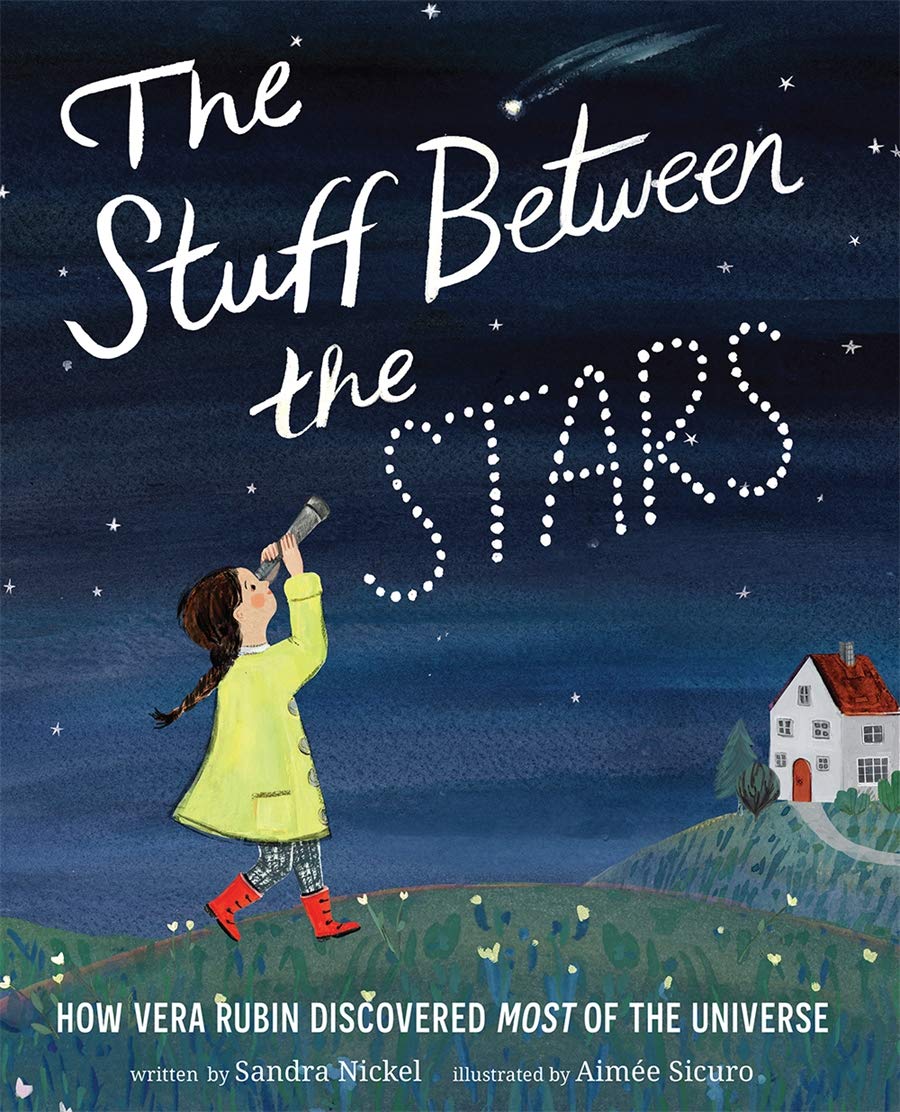
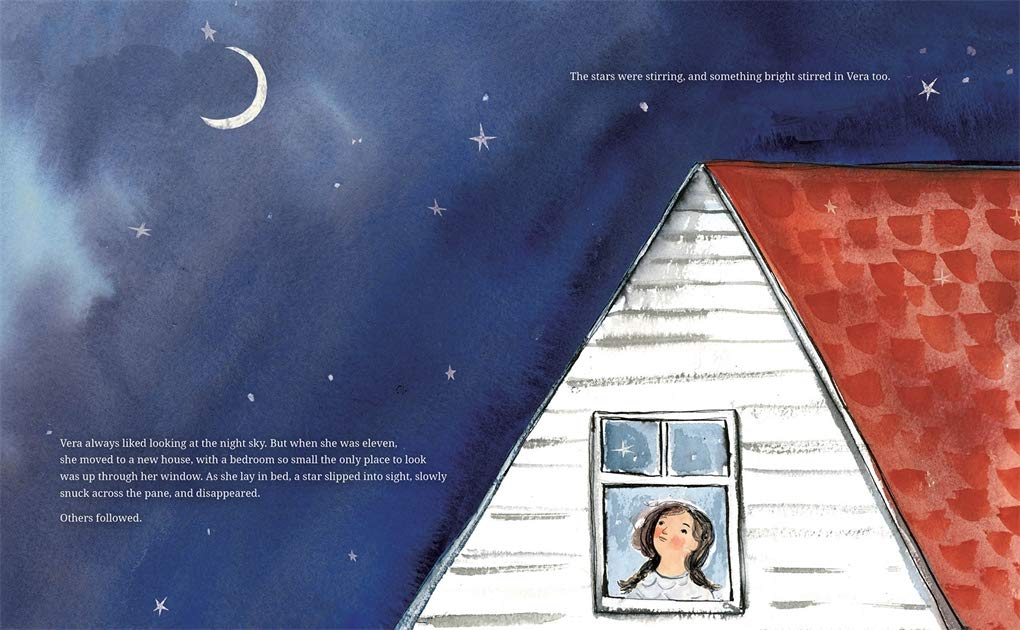
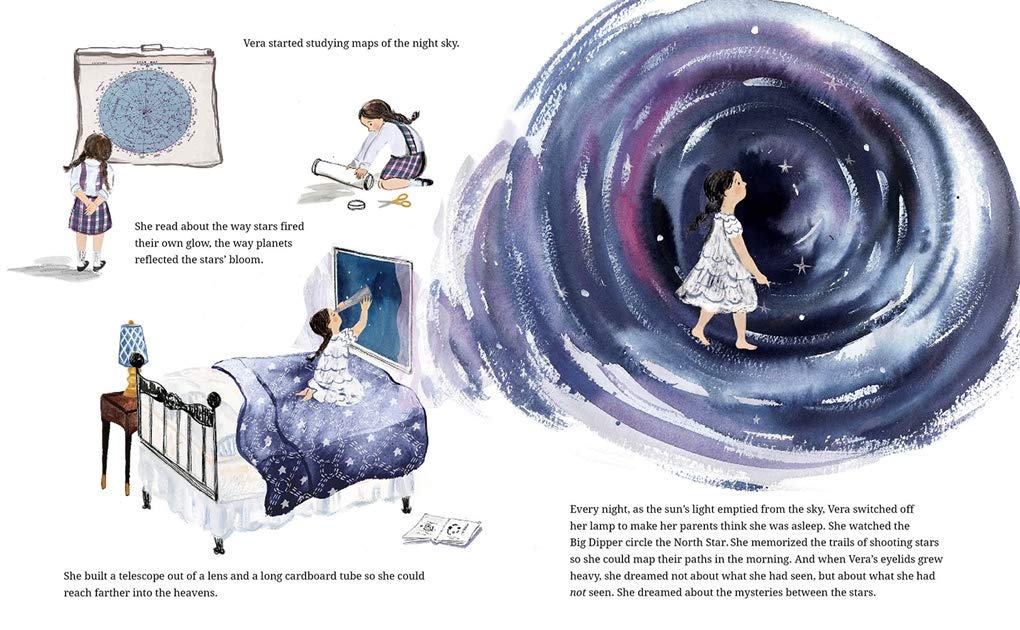
Vera had always been fascinated with the night sky. As she gazed up through her bedroom window, she saw when “the stars were stirring, and something bright stirred in Vera too.” She began studying everything she could about the stars, planets, and how they interacted in the night sky. She even made her own telescope from a cardboard tube and a lens. At seventeen Vera began attending Vassar College as the only astronomy major in her class. Here, she could use the school’s telescope whenever she wanted.

celebrate-picture-books-picture-book-review-the-stuff-between-the-stars-window

Image copyright Aimée Sicuro, text copyright Sandra Nickel. Courtesy of Abrams Books for Young Readers.

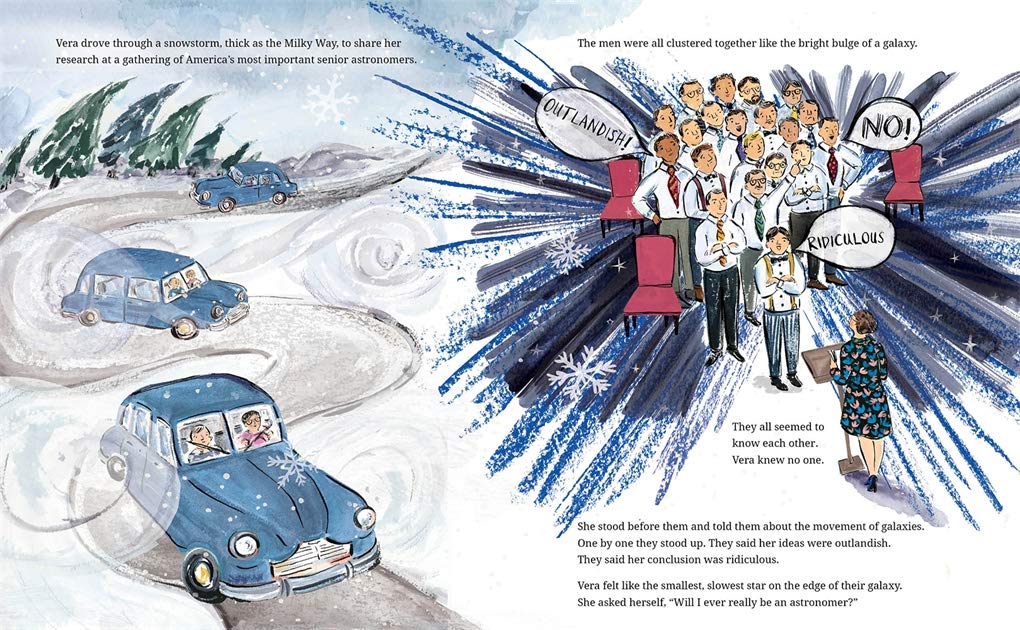
While at Vassar, she fell in love with Robert Rubin, a mathematician. They married and soon Vera was going to have a baby. During her pregnancy, she explored an idea she had: “was it possible that galaxies rotated around a center in the universe like the Big Dipper circled the North Star?” By the time her son was born, Vera decided she was right. Vera presented her conclusions at a meeting of America’s top astronomers. They thought her ideas were “outlandish” and “ridiculous” and told her so. “Vera felt like the smallest, slowest star on the edge of their galaxy” and wondered if she’d “ever really be an astronomer.”

celebrate-picture-books-picture-book-review-the-stuff-between-the-stars-young

Image copyright Aimée Sicuro, text copyright Sandra Nickel. Courtesy of Abrams Books for Young Readers.

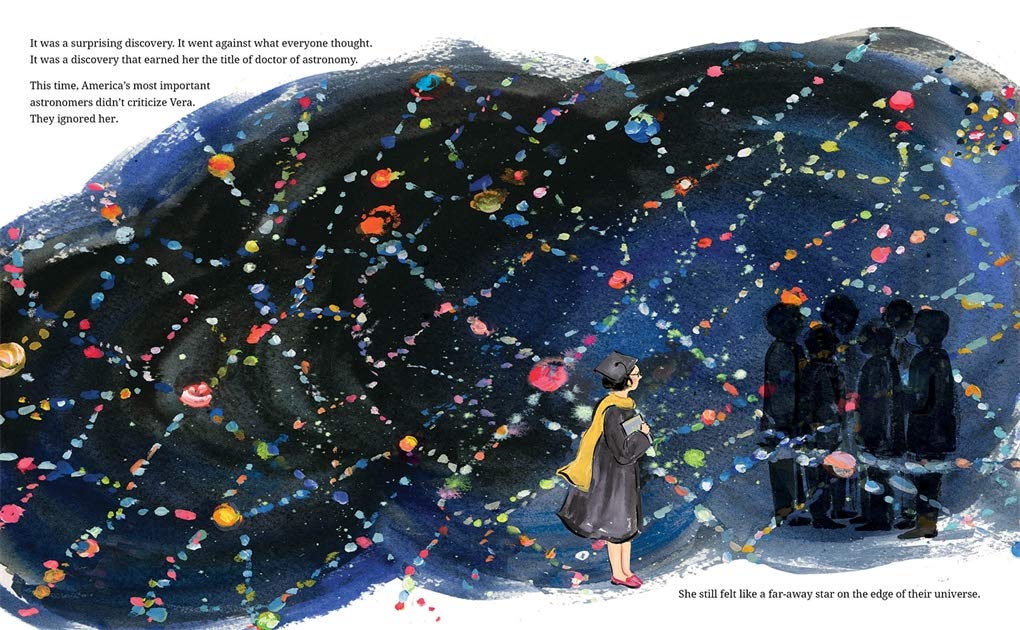
After Vera had a baby girl, she decided to concentrate on a new question that she thought would be fun. She wondered if galaxies were scattered haphazardly or whether there was “a pattern to where they spun.” After many months of staying up late into the night doing calculations, Vera determined that galaxies were “clumped together like dew drops on a spider’s web.” This was a major discovery; one that earned her a doctorate in astronomy. Instead of criticizing her, America’s top astronomers ignored her.

celebrate-picture-books-picture-book-review-the-stuff-between-the-stars-outlandish

Image copyright Aimée Sicuro, text copyright Sandra Nickel. Courtesy of Abrams Books for Young Readers.

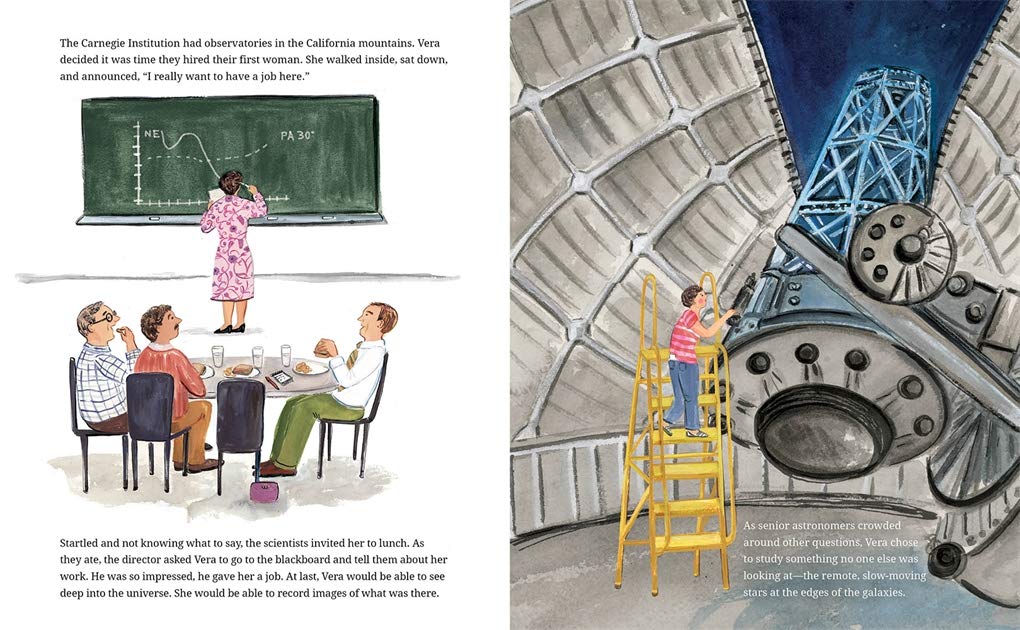
Vera had two more children, and as her family grew she dreamed of observing galaxies from a mountaintop like the senior astronomers and watch gravity work within galaxies. She began teaching astronomy at colleges in Washington D.C., and other astronomers began hearing about her and wanting to know more about her ideas that had been dismissed in the past. More than ever Vera wanted to view the sky from an observatory in the mountains—one like the Carnegie Institution had in the California mountains.

One day she went to the Carnegie Institution and announced that she would like a job there. When the director and other scientists learned about her work and theories, they were so impressed that she landed a job. While the other senior astronomers worked on other questions, Vera studied the “slow-moving stars at the edges of the galaxies.”

celebrate-picture-books-picture-book-review-the-stuff-between-the-stars-galaxies

Image copyright Aimée Sicuro, text copyright Sandra Nickel. Courtesy of Abrams Books for Young Readers.

In Arizona Vera studied the Andromeda Galaxy and the stars on its outside spiral. What Vera found was astounding. Instead of moving slower at the edges of the galaxy because of waning gravity from the center, these stars moved at the same speed. She remembered that earlier astronomers had theorized about a mysterious, unseen “dark matter” with its own gravity that “might be at work in the universe.”

Vera believed dark matter “could fill the space between the stars.” In fact, she was sure it was there by the way the stars moved. Once again, when Vera revealed her findings, most astronomers didn’t want to believe it. They didn’t want to believe that all this time they’d only been studying a small fraction of the universe. After Vera studied two hundred more galaxies, the astronomers had to agree that she was correct. At last “Vera was no longer at the edge of astronomy, she was at it’s very center.”

Backmatter includes an Author’s Note detailing more about Vera Rubin’s work, a timeline of Rubin’s life, resources on quotes found in the text, and a selected bibliography.

celebrate-picture-books-picture-book-review-the-stuff-between-the-stars-observatory

Image copyright Aimée Sicuro, text copyright Sandra Nickel. Courtesy of Abrams Books for Young Readers.

Sandra Nickel’s straightforward and comprehensive storytelling gives kids a well-rounded view of Vera Rubin’s life as she doggedly pursued a career in astronomy despite all the naysayers and snubs along the way and made an astounding discovery that still baffles scientists today. Rubin’s inspirational example will resonate with young readers and give them a pathway to accomplishing their own goals. Nickel does an excellent job of explaining the complex ideas Rubin studied, theorized on, and wrote about, allowing readers to fully understand her impact on the field of astronomy and our understanding of the universe. Nickel’s lyrical prose is also sprinkled with metaphors that link Rubin’s feeling and life changes to the night sky she loved to observe.

Through Aimée Sicuro’s mixed-media illustrations, readers follow Vera Rubin as she matures from a curious child who loves watching the night sky to a college student to a mother to an astronomer making discoveries that changed the way scientists understood the universe. Her detailed images give kids visual representations of Rubin’s work and ideas, including a complex mathematical calculation she works on while her family sleeps and her idea that galaxies were clumped together. Depictions of the Palomar Observatory will thrill space buffs and show readers why Rubin so wanted to study the sky from a mountain top. The final image of a group of children gazing up at the night sky as a shooting star flashes by offers an inspirational quote from Vera Rubin.

A superb biography that will inspire and nurture young minds, The Stuff Between the Stars is highly recommended for home, school, and public library collections.

Ages 6 – 9

Abrams Books for Young Readers, 2021 | ISBN 978-1419736261

Discover more about Sandra Nickel and her books on her website. You can also find curriculum guides and activity sheets to download on her site.

You can connect with Aimée Sicuro on Instagram.

Watch the book trailer for The Stuff Between the Stars!

Global Astronomy Month Activity

celebrate-picture-books-picture-book-review-astronomy-coloring-page-telescope    celebrate-picture-books-picture-book-review-astronomy-coloring-page-kids

Explore the Galaxies Coloring Pages


Indulge your love of star stuff with these printable coloring pages!

Looking through the Telescope | Studying the Stars | Milky Way Dot-to-Dot

celebrate-picture-books-picture-book-review-the-stuff-between-the-stars-cover

You can find The Stuff Between the Stars at these booksellers

Amazon | Barnes & Noble | Books-a-Million

To support your local independent bookstore, order from

Bookshop | IndieBound

Picture Book Review
 

March 30 – It’s Women’s History Month

celebrate-picture-books-picture-book-review-a-most-clever-girl-cover

About the Holiday

National Women’s History Month is all about celebrating women who broke barriers with their intelligence, creativity, courage, persistence, and unwavering confidence in their abilities. In every discipline, women have brought and continue to bring new perspectives, experiences, and talents to make contributions toward a better world. Today’s book celebrates a writer who broadened readers’ understanding of women and their lives through her complex and compelling novels. 

A Most Clever Girl: How Jane Austen Discovered Her Voice

Written by Jasmine A. Stirling | Illustrated by Vesper Stamper


While Jane loved stories, there were some she couldn’t abide. These were stories about women who fainted at the slightest thing, stories about orphans with dark secrets, and stories about couples who fell in love at first sight. To Jane these books were boring, unbelievable, and predictable. But they were all the rage. Instead, Jane like the ridiculous, and she made up her own stories that “poked fun” at the popular literature of the day. When she read her “stories to her family,… they couldn’t stop laughing.”

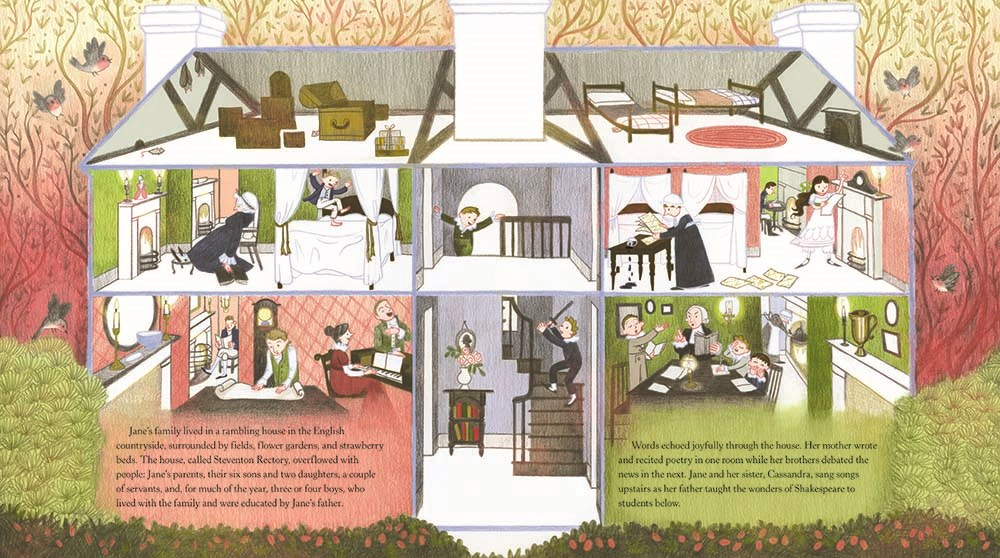
Jane lived in a large house in the English countryside. It was always full of people, fun, and learning. Jane’s father was the village rector of Steventon in Hampshire, England, and her mother wrote poetry. Sometimes Jane’s family (mother, father, six sons, and two daughters) staged plays in the barn. They made their own sets and costumes and played all the roles. When there was quiet time, Jane wrote and wrote in the study her father had created just for her and her sister.

celebrate-picture-books-picture-book-review-a-most-clever-girl-rectory

Image copyright Vesper Stamper, 2021, text copyright Jasmine A. Stirling, 2021. Courtesy of Bloomsbury Children’s Books.

Jane loved the satires she wrote, but “she stared to dream about writing stories that mattered to her. They would come from her own voice—a style that was uniquely hers.” She began to pay attention to tiny personal details, particular conversations, and the way her family, friends, and neighbors interacted. She found it all fascinating. Jane’s father encouraged her writing, saving up to buy her the best pens, blank books, and even a “portable mahogany writing desk.”

Jane had an idea about a story involving “three or four families in a country village,” and soon the characters came to life in her imagination, even when she wasn’t writing. She “wrote three novels before she turned twenty-four. Jane’s voice was clever and real… But something was still missing.”

Over the years as Jane’s brothers left home, the big house grew quiet. When her father stopped teaching, money grew short and Jane’s parents decided to move to a small house in another town, Bath. They sold their possessions, even the books in her father’s library, and left the neighbors and friends they’d known so well. Jane wondered if she would feel at home anywhere else. When they moved into their new home, Jane put away her writing things. Time passed, but “Jane persisted in a very determined, though very silent, disinclination for Bath.” Years passed and Jane spent her time in “busy nothings.”

celebrate-picture-books-picture-book-review-a-most-clever-girl-characters

Image copyright Vesper Stamper, 2021, text copyright Jasmine A. Stirling, 2021. Courtesy of Bloomsbury Children’s Books.

When her father died, Jane, her sister, and their mother had to move into a cheap apartment, and then when they could no longer afford that, they moved in with her brother Frank in a rough-and-tumble town. “The weight of Jane’s losses threatened to drown her,” and she still couldn’t write. Four years later, her brother Edward gave her, her sister, and their mother a small cottage near their childhood home. Here she found her way to happiness.

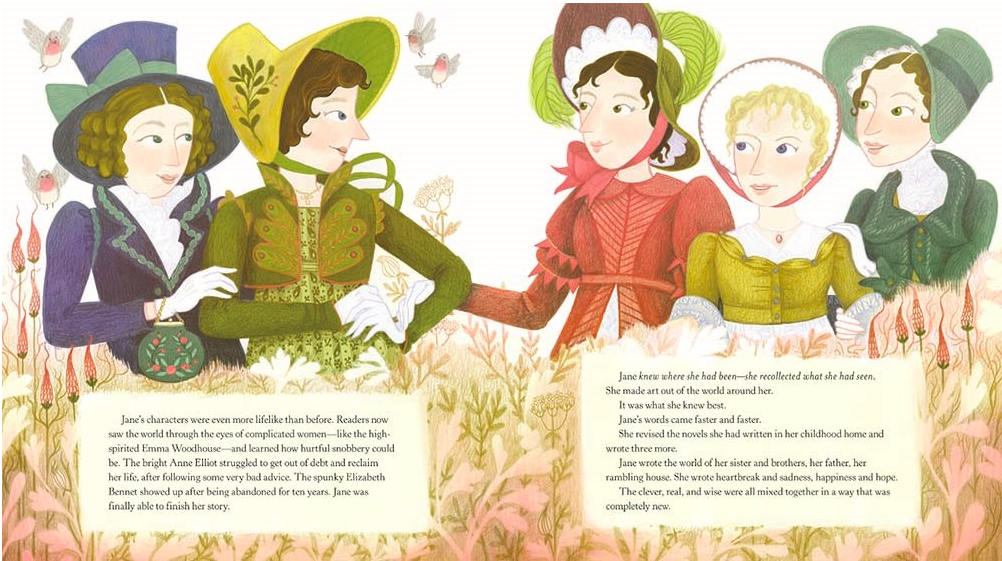
At last she brought out her pens, paper, and writing desk and began to write. Her voice was still clever and “filled with real people, but grief and loss had added something new. Jane’s voice was wise.” Her characters were even more realistic and complicated. She wrote about happiness and wealth, but also about heartbreak and sadness “mixed together in a way that was completely new.”

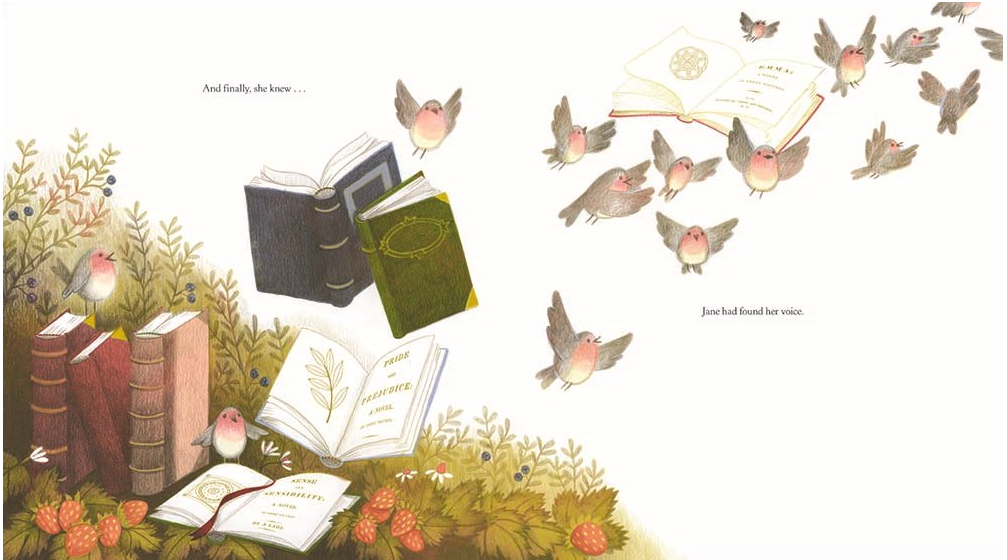
Jane’s novels were a hit—even with the future king of England. George IV loved them so much that his librarian wrote to Jane and asked her to write one of those “love-at-first-sight” stories she hated. Jane wrote back and told him that she could not unless her life depended on it, that she must remain true to her own style. At long last, “Jane had found her voice.”

Extensive backmatter includes a list of quotes from Jane Austen’s novels that are used in the story, more about Jane Austen’s life, Notes from the Author and Illustrator, a list of Austen’s novels, further resources for young readers, and a bibliography.

celebrate-picture-books-picture-book-review-a-most-clever-girl-novels

Image copyright Vesper Stamper, 2021, text copyright Jasmine A. Stirling, 2021. Courtesy of Bloomsbury Children’s Books.

Jasmine A. Stirling’s in-depth biography of Jane Austen shines with specific details about her and her family’s life, their happy times and tribulations that informed her writing and made it so distinctive for its time and beloved even now. Stirling’s engaging and lively storytelling invites children to share the joys and heartaches that molded Jane Austen’s personality and writing. Quotations from Austen’s novels sprinkled throughout the story give young readers a taste of Jane’s writing and the truths and understanding her novels embody.

Dazzlingly lovely, Vesper Stamper’s expressive illustrations draw readers into Jane Austen’s world and give them a glimpse into her childhood and adult experiences as well as the society of the time. Cleverly designed images allow kids to understand how much Jane loved to read, to laugh along with her as she reads the sentimental and gothic stories she satirized, and to see at a glance all the shenanigans, work, and entertaining that went on in her beloved home. The elegance of these surroundings and the dinner parties that enlightened Jane’s writing are realistically reproduced and her characters come to life on the page. A moving metaphorical image shows Jane riding away from the home she loved while pages of her novels fly out of the writing desk strapped to the back of the carriage. Jane’s sadness is depicted on pages sketched in gray, but her vibrancy returns with her brother’s generosity and the novels that finally take wing.

A superb biography of a beloved and influential writer that will spark enthusiasm for Jane Austen’s novels as well as literature and writing in general, A Most Clever Girl: How Jane Austen Discovered Her Voice is a must for students of all ages as well as for those who simply love reading and writing stories. The book would make an exceptional addition to lesson plans for readers from elementary school to high school and is highly recommended for home, school, and public library collections.

Ages 5 – 12 and up

Bloomsbury Children’s Books, 2021 | ISBN 978-1547601103

Discover more about Jasmine A. Stirling and her books on her website.

To learn more about Vesper Stamper, her books, and her art, visit her website.

Women’s History Month Activity

celebrate-picture-books-picture-book-review-jane-austen-coloring-page

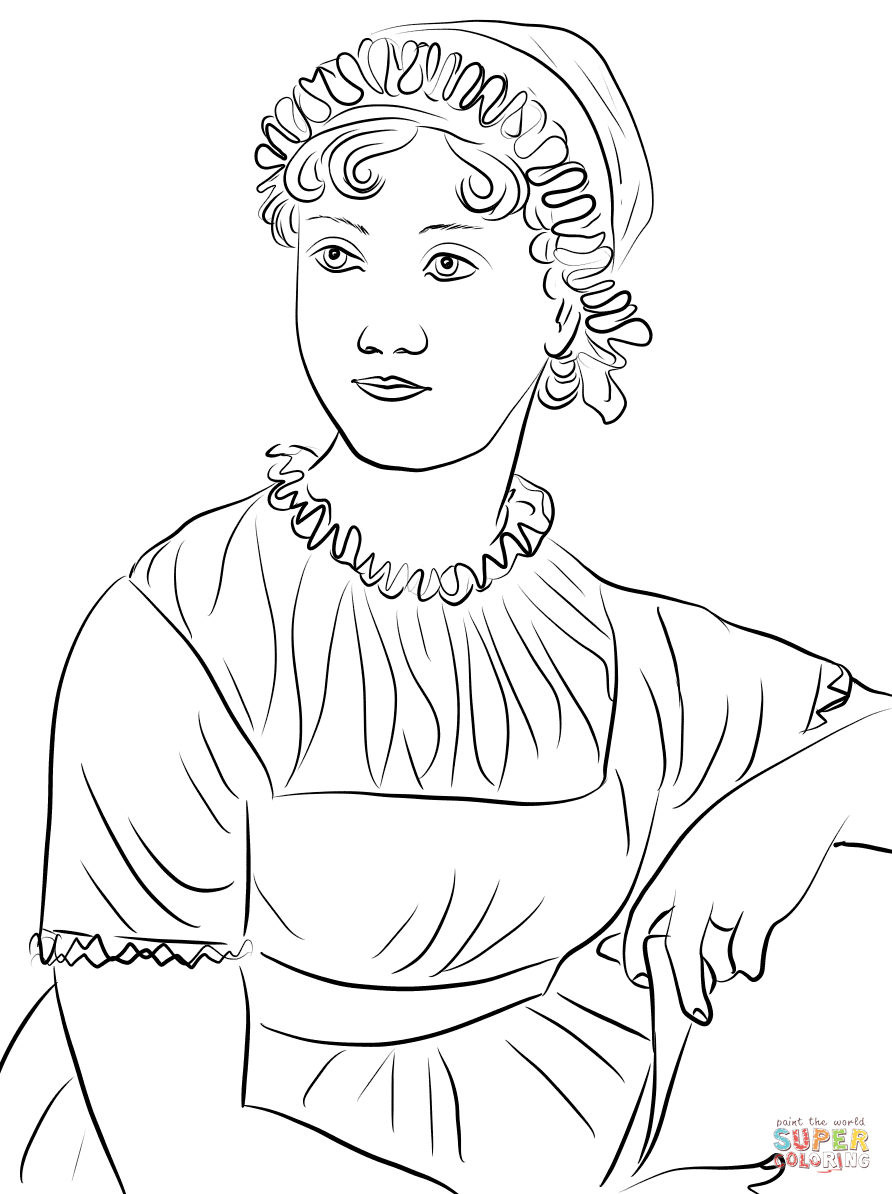
Jane Austen Coloring Page


Enjoy this printable coloring page of Jane Austen as you learn more about this clever writer.

Jane Austen Coloring Page

celebrate-picture-books-picture-book-review-a-most-clever-girl-cover

You can find A Most Clever Girl: How Jane Austen Discovered Her Voice at these booksellers

Amazon | Barnes & Noble | Books-a-Million

To support your local independent bookstore, order from

Bookshop | IndieBound

Picture Book Review
March 24 – It’s Women’s History Month

celebrate-picture-books-picture-book-review-june-almeida-virus-detective-cover

About the Holiday

From its beginning as a single-day observance in 1911 in Sonoma, California, the celebration of women’s achievements and contributions throughout history grew to a week-long event in 1980 and finally to encompass the entire month of March in 1987. During this month we remember the trail-blazing women of yesteryear who used their creativity, intelligence, and perseverance to promote rights for women while contributing their own innovations to science, art, social reform, medicine, and other disciplines as well as today’s pioneers who carry on their legacy and make our world a better place. Today, we feature a book about a woman who revolutionized virology and medical research, connecting the past and the present. To learn more about the holiday, visit the National Women’s History Museum website and check out their resource toolkit.

June Almeida, Virus Detective! The Woman Who Discovered the First Human Coronavirus

Written by Suzanne Slade | Illustrated by Elisa Paganelli

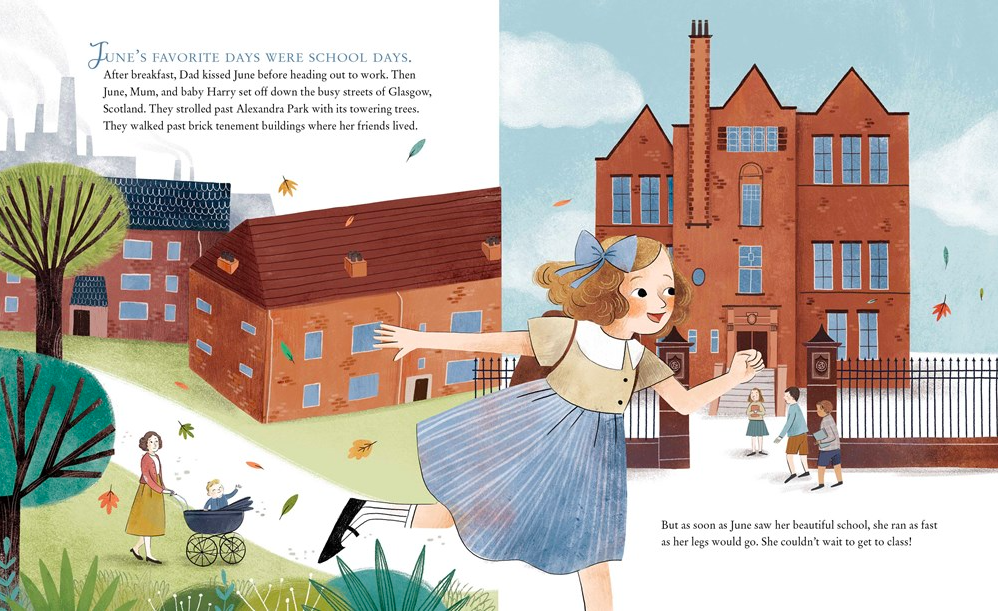
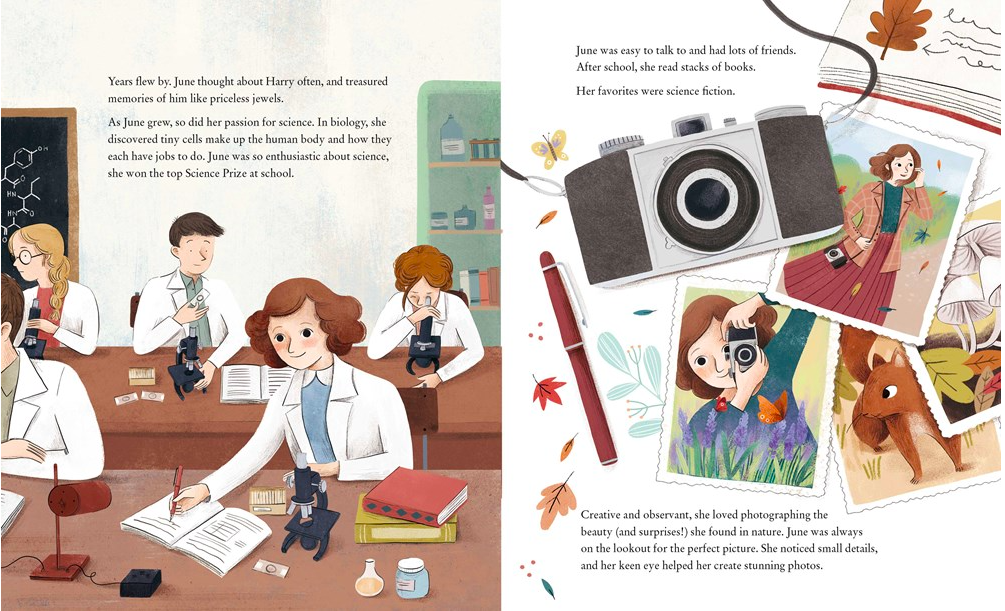
Growing up in Glasgow, Scotland, June Almeida loved school. After class she couldn’t wait to share what she’d learned—especially science subjects—with her mother, father, and little brother, Henry. When June was ten, however, her life changed when Henry became sick and passed away. Throughout elementary school and into high school, June loved studying science, especially biology in which she learned about the cells in the body and their functions. “June was so enthusiastic about science, she won the top science prize at school.”

celebrate-picture-books-picture-book-review-june-almeida-virus-detective-childhood

Image copyright Elisa Paganelli, 2021, text copyright Suzanne Slade, 2021. Courtesy of Sleeping Bear Press.

But science wasn’t the only thing June loved. She had lots of friends, was an avid reader, and became an excellent photographer. Whenever she was out with her camera, “she noticed small details, and her keen eye helped her create stunning photos.” June dreamed of attending college, but the jobs her father and mother held did not pay enough, and when June was sixteen, she dropped out of school to get a job to help pay the bills. June wanted to make a difference, “so she applied to work at the nearby hospital” and was hired as a lab worker. Here she learned how to examine cells with a microscope. “Her findings helped doctors treat patients.”

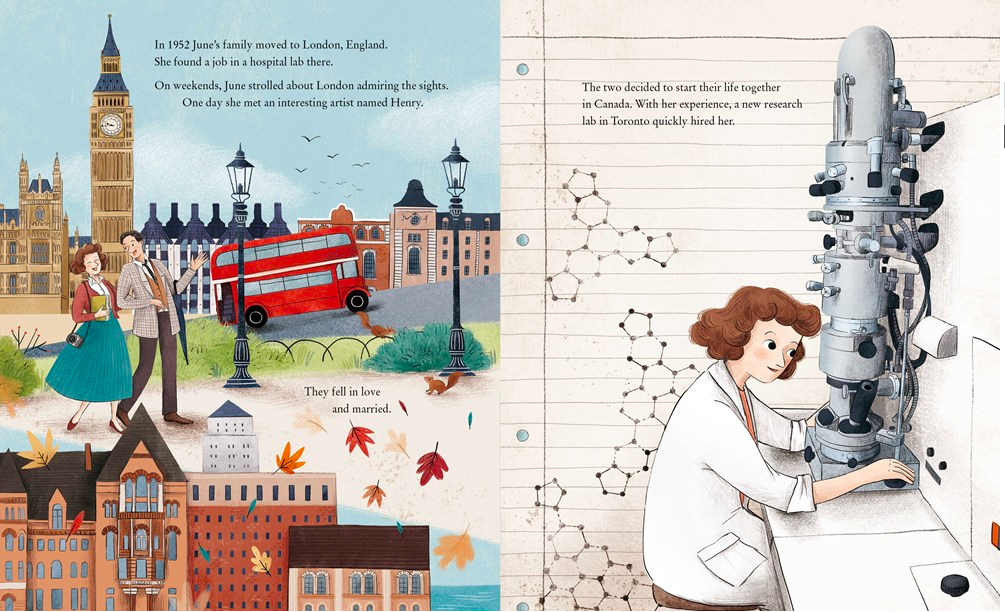
When June was twenty-two, she and her family moved to London. She got a job in a hospital lab and also met and married an artist named Henry. June and Henry moved to Canada, where she quickly found a job at a “new research lab in Toronto.” In this lab, June worked with an electron microscope that could magnify things 25,000 times and produced detailed pictures of the samples being studied. These photos “were helpful. But it was hard to tell which tiny blobs were viruses and which were cells.” June thought she could improve on the photos.

celebrate-picture-books-picture-book-review-june-almeida-virus-detective-photographer

Image copyright Elisa Paganelli, 2021, text copyright Suzanne Slade, 2021. Courtesy of Sleeping Bear Press.

June knew that in the body antibodies would surround viruses as they worked to fight it. June wondered if by introducing antibodies to her samples, scientists would be able to determine the virus from the cells. June’s idea worked. The scientists were astonished. Because of June’s innovation, they now had clear pictures that would help them study and combat viruses.

After June took time away from work to have a baby in 1960, she returned to her research and often lectured about her work. She was recruited to work at a hospital lab in London, so she and her family moved once again. At the time, a researcher named David Tyrrell had been trying to identify a virus that had affected a young boy. Could it be a new virus? He was hoping that June could help.

celebrate-picture-books-picture-book-review-june-almeida-virus-detective-hospital

Image copyright Elisa Paganelli, 2021, text copyright Suzanne Slade, 2021. Courtesy of Sleeping Bear Press.

When June received the sample, she knew that “since it was an unknown virus, there were no antibodies to help find it.” But she was an expert at using another method that might work. Carefully, June implemented the intricate steps. Then she put the sample under the microscope and scanned the picture. “June was stunned.” Each virus blob was encircled by tiny dots “like a crown. ” She had seen this twice before when looking at viruses from sick animals. She had written a paper on it, but it had been rejected by other researchers because they thought her pictures were just blurry and not those of a new virus.

June presented her findings to doctors who agreed with her discovery. They decided to name the new virus coronavirus, after the Latin word for crown, corona. June and David then published a paper telling other doctors and researchers about the new virus. Following this discovery, June continued to study viruses, such as hepatitis B and HIV. Her pictures of these viruses helped researchers develop medications that could “block them from making people sick.” Even after she retired, June never lost her love of learning, teaching herself to play the flute, about antiques, and how to use a digital camera to continue creating incredible photos.

Backmatter includes more about June Almeida and her life’s work, an illustrated timeline of her life, and a selected bibliography.

celebrate-picture-books-picture-book-review-june-almeida-virus-detective-London

Image copyright Elisa Paganelli, 2021, text copyright Suzanne Slade, 2021. Courtesy of Sleeping Bear Press.

Suzanne Slade’s compelling biography of June Almeida gives context for and insight into the research and discovery of the coronavirus and informs present-day events and breakthroughs. Slade’s fluid storytelling clearly reveals Almeida’s intelligence and passion for science as well as her determination to use her skills to the betterment of society. Kids will be astounded that June was able to begin her career at the age of sixteen, and that her beloved hobby of photography became a career that changed medical research. Slade’s sprinkling of personal details about Almeida’s life creates a well-rounded understanding of this influential woman.

Through Elisa Paganelli’s realistic and detailed illustrations, children have the opportunity to see a researcher at work in world-class laboratories. Readers will be especially impressed by images of the electron microscope and how Almeida improved the photographs these powerful machines produced. Children familiar with the shape of the coronavirus will be interested in seeing the faithfully reproduced photographs and how the virus got its name. Kids will also enjoy seeing illustrations of Almeida’s family life, including her daughter Joyce, who is herself a doctor.

An inspirational and fascinating biography of a woman with a very innovative mind, June Almeida, Virus Detective! will thrill children interested in science, medicine, and the arts. The book would be an impactful addition to STEM and STEAM lessons. It is highly recommended for home libraries and is a must for school and public library collections.

Ages 6 – 9 

Sleeping Bear Press, 2021 | ISBN 978-1534111325

Discover more about Suzanne Slade and her books on her website.

To learn more about Elisa Paganelli, her books, and her art, visit her website.

Women’s History Month Activity

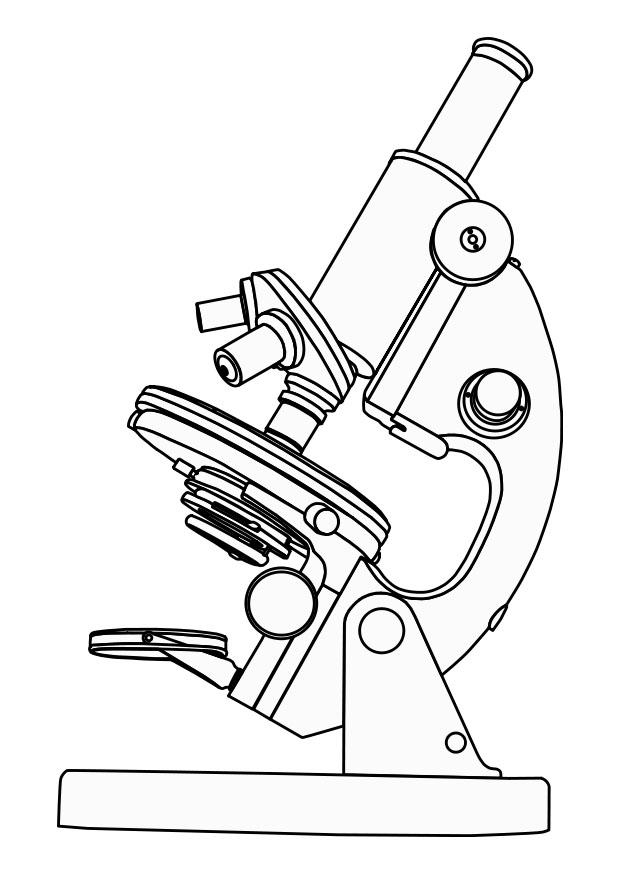
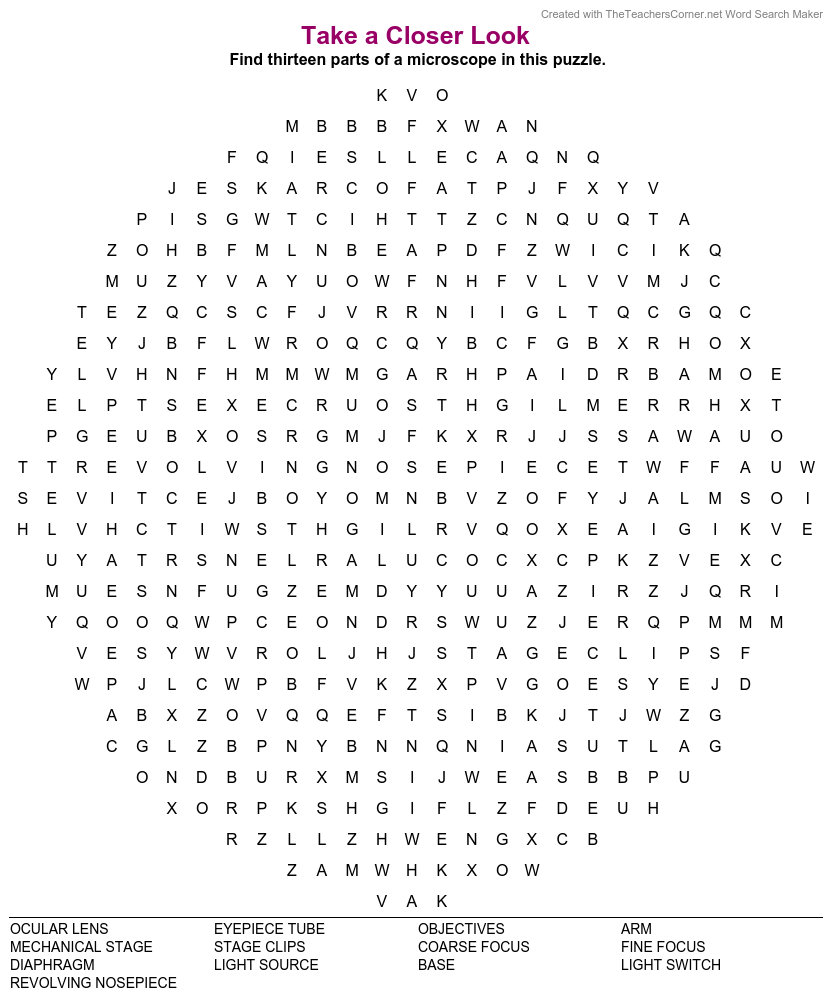
celebrate-picture-books-picture-book-review-microscope-coloring-page          celebrate-picture-books-picture-book-review-microscope-wordsearch-puzzle

Take a Closer Look Coloring Page and Word Search 

You can examine the parts of a microscope with this printable word search puzzle and coloring page.

Take a Closer Look Word Search Puzzle | Take a Closer Look Word Search Solution | Coloring Page

celebrate-picture-books-picture-book-review-june-almeida-virus-detective-cover

You can find June Almeida, Virus Detective! at these booksellers

Amazon | Barnes & Noble | Books-a-Million

To support your local independent bookstore, order from

Bookshop | IndieBound

Picture Book Review
March 13 – It’s Women’s History Month

celebrate-picture-books-picture-book-review-shaking-things-up-cover

About the Holiday

National Woman’s History Month was established by the United States Congress in 1987 to recognize and celebrate the achievements of American women in the past and today. This year’s theme is “Nevertheless She Persisted: Honoring Women Who Fight All Forms of Discrimination against Women” which provides an opportunity to recognize the tireless efforts of women in all walks of life who fight against discrimination to be heard and to achieve their goals. There’s no better time than now to get involved to ensure that all women have equal rights and standing in all areas of their lives.

Shaking Things Up: 14 Young Women Who Changed the World

Written by Susan Hood 


Illustrated by Shadra Strickland, Hadley Hooper, Lisa Brown, Emily Winfield Martin, Sara Palacios, Erin K. Robinson, Sophie Blackall, Melissa Sweet, Oge Mora, Isabel Roxas, Julie Morstad, LeUyen Pham, and Selina Alko


This superb collection of biographies in verse highlights not only well-known pioneers but some delightfully fresh names and a few who are influencing the arts, science, and cause of human rights today. Each of the women profiled show the qualities of  bravery, persistence, intelligence, and ability over a vast spectrum of fields. Their success led the way for today’s women and will inspire tomorrow’s.
celebrate-picture-books-picture-book-review-shaking-things-up-Molly-Williams

Image copyright Shadra Strickland, 2018, text copyright Susan Hood, 2018. Courtesy of HarperCollins.

Organized on a timeline from the early 1780s to 2014, Shaking Things Up begins with Taking the Heat and Molly Williams, who was the first known female firefighter in America. When the flu knocked out all the members of the Oceanus Fire Department and a fire raged, Molly, the servant of James Aymar, a volunteer fireman, “… knew the drill; / she’d seen what must be done. / she hauled the pumper truck by hand, / adept as anyone.” For her work she was named Volunteer 11 and made part of the crew. It took about two-hundred years before another woman—Brenda Berkman—was added to the New York Fire Department.

celebrate-picture-books-picture-book-review-shaking-things-up-Mary-Anning

Copyright Hadley Hooper, 2018, courtesy of HarperCollins.

Young paleontologists-in-the-making will be amazed by the story of Mary Anning, who, while searching the British coast for fossils to sell to support her family, uncovered the skeleton of an ichthyosaur in 1812. In Buried Treasure, children learn how she went on to discover “the first two complete plesiosaurs and a pterosaur, laying the foundation for Charles Darwin’s theory of evolution.”

Children who love spies, news reporting, and uncovering the truth will want to know about Nellie Bly, who as an investigative journalist took on disguises to infiltrate institutions and write about “corruption and cruelty.” She was also widely admired for her around-the-world trip that beat Jules Verne’s “80 days” by eight days. As told in Woman of the World: “Bly hopped a ship and told her tale / of all she saw on Earth. / She wrote of camels, temples, jewels / with gutsy wit and mirth.” Nellie was only twenty-five when she undertook her travels in “a record-breaking race. / No soul on Earth had ever sped / the globe at such a pace!”

celebrate-picture-books-picture-book-review-shaking-things-up-Mary-Anning-poem

Image copyright Hadley Hooper, 2018, text copyright Susan Hood, 2018. Courtesy of HarperCollins.

If it weren’t for Annette Kellerman, women may never have made such a splash in swimming. Kellerman was a champion swimmer who began the sport to strengthen her legs after having rickets. Turning the Tide reveals that when she took to the water “without pantaloons—her swimsuit was deemed obscene!” After she was arrested she calmly stated, “who can swim fifty laps / wearing corsets and caps? / Her statement could not be contested,” and she went on to create the modern one-piece swimsuit, changing swimming for women forever.

In The Storyteller, a full alphabet of attributes describes Pura Belpré, a children’s librarian and the New York Public Library’s first Latina librarian. By offering—and often writing—Spanish books and creating programs for the Spanish-speaking community, Belpré revolutionized her library and touched many lives. 

celebrate-picture-books-picture-book-review-shaking-things-up-nellie-bly

Copyright Lisa Brown, 2018, courtesy of HarperCollins.

Children who reach for the stars will be transported by Lift-Off and the inspiration of Mae Jemison, the first female African-American astronaut. When young Mae gazes into the dark night sky, the “glittering stars, swirling galaxies / fill her, thrill her.” It doesn’t matter if she is afraid of the dark and afraid of heights, Mae looks and goes where she wants, where she needs to to learn and understand. And when she’s ready? “Ignition. / All systems are go. / Three / Two / One / Blast off!”

celebrate-picture-books-picture-book-review-shaking-things-up-secret-agents

Image copyright Sophie Blackall, 2018, text copyright Susan Hood, 2018. Courtesy of HarperCollins.

Break It Down reveals the way Angela Zhang attacks the questions she has about the way the world works, questions that lead her to answers and incredible achievements. From creating magic solutions with a Harry Potter potion kit at five years old to discovering answers to questions like why rainbows follow storms at seven years old to using a Stanford University lab at fifteen, Zhang has chipped away “at the ‘black boxes of life,’” including the “biggest black box of all– / a cure for cancer.” For Zhang science is “… both stone and chisel, / and I, your willing apprentice, / yearn to care away life’s mysteries / as a sculptor chisels marble / to find beauty inside.”

celebrate-picture-books-picture-book-review-shaking-things-up-Malala-Yousefzai

Image copyright Selina Alko, 2018, text copyright Susan Hood, 2018. Courtesy of HarperCollins.

Also included are poems about artist Frida Kahlo, World War II secret agents Jacqueline and Eileen Nearne, anti-hunger activist Frances Moore Lappé, civil rights pioneer Ruby Bridges, architect Maya Lin, and Noble Peace Prize winner Malala Yousafzai.

An illustrated timeline precedes the text, and suggested resources for further study on each woman follows the text.

Susan Hood has created fourteen poems that are as unique as the woman they describe. Some rhyming and some free verse, the poems include facts, quotes, intriguing details and the rhythms, sounds, and dreams of these young women. A paragraph following each poem reveals more about the woman and her work. Readers will be awe-struck by the enticing stories that inform each lyrical biography and will long to learn more about the women and their lives.

The theme of individuality is carried through in the illustrations, which are each created by a different illustrator. Colorful, whimsical, and realistic, the illustrations let children see the faces of the women presented, surrounded by their work and set within their time period. Readers will want to linger over the images and discuss the details included. A quotation from each woman accompanies her illustration.

Shaking Things Up offers an inviting way to introduce children to these amazing women and is an excellent reminder that they too can dream of what could be and make it happen. A must for classroom and school libraries, the book would be an inspirational addition to home bookshelves as well.

Ages 4 – 10

HarperCollins, 2018 | ISBN 978-0062699459

Discover more about Susan Hood and her books on her website.

You can learn more about these illustrators on their websites:

Shadra Strickland | Hadley Hooper | Lisa Brown | Emily Winfield Martin | Sara Palacios | Erin K. Robinson | Sophie Blackall | Melissa Sweet | Oge Mora | Isabel Roxas | Julie Morstad | LeUyen Pham | Selina Alko

Check out the Shaking Things Up book trailer!

Women’s History Month Activity

celebrate-picture-books-picture-book-review-freda-kahlo-coloring-page

Amazing Women Coloring Pages


There are so many incredible women to learn about during this month. Today, enjoy these coloring pages of inspiring women.

Mary Anning | Mae Jemison | Freda Kahlo 

celebrate-picture-books-picture-book-review-shaking-things-up-cover

You can find Shaking Things Up: 15 Young Women Who Changed the World at these booksellers

Amazon | Barnes & Noble | Books-a-Million

To support your local independent bookstore, order from

Bookshop | IndieBound

Picture Book Review