September 18 – Gymnastics Day

celebrate-picture-books-picture-book-review-nadia-the-girl-who-couldn't-sit-still-cover

Image copyright Christine Davenier, courtesy of Houghton Mifflin Harcourt Publishing Co.

About the Holiday

Initiated in the late 1990s, National Gymnastics Day encourages kids to explore this exciting sport. As part of this year’s National Gymnastics Day, gymnasts, families, friends, and enthusiasts from gymnastics clubs globally will participate in a variety of activities, including open houses, hand stand contests, carnivals, and fitness activities to build awareness of gymnastics and its benefits. Many clubs will use this as a way to provide opportunities for underprivileged children to participate in the sport. Why not find and attend a special event at a gym or gymnastics club today to celebrate!

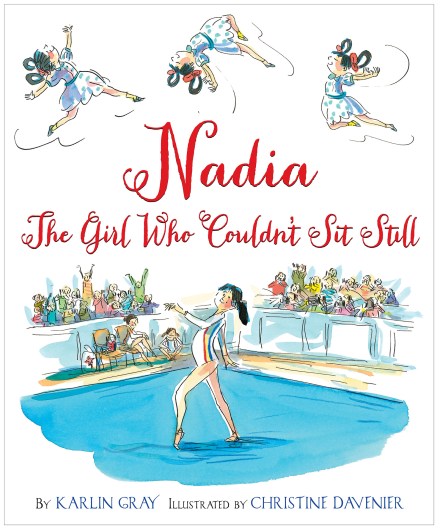
Nadia: The Girl Who Couldn’t Sit Still

Written by Karlin Gray | Illustrated by Christine Davenier


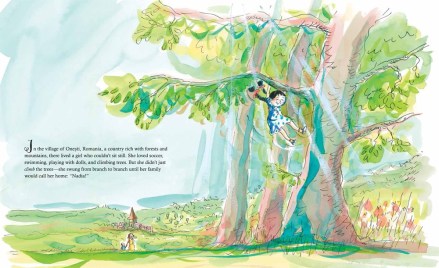
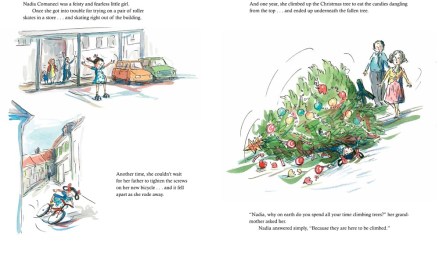
“In the village of Oneşti, Romania, a country rich with forests and mountains” Nadia Comaneci could often be seen swinging from tree branch to tree branch. She was a little girl who loved to play. She was “feisty and fearless,” attempting new things on a whim and always with a sense of adventure. Once while trying on a pair of roller skates, she skated right out of the store! Another time she was so impatient to ride her new bike that she pedaled off before her father could even tighten the screws. The bike “fell apart as she rode away.” And one year her love of climbing trees extended to the family Christmas tree, which toppled over on her, pinning her to the ground.

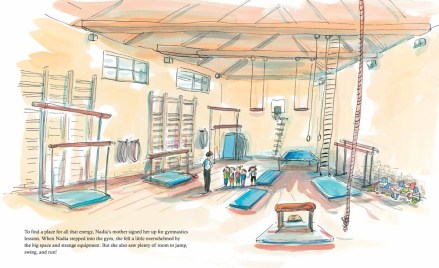
To channel all that energy, Nadia’s mother enrolled her in gymnastics lessons. Nadia’s eyes lit up when she saw the room full of ropes, ladders, bars, mats, and trampolines to discover, but she didn’t leave her new skills at the gym. Nadia and a friend cartwheeled around the school playground, capturing the attention of Bela and Marta Karolyi, who owned a gymnastics school. They invited the girls to join.
celebrate-picture-books-picture-book-review-nadia-the-girl-who-couldn't-sit-still-swinging-in-trees

Image copyright Christine Davenier, courtesy of karlingray.com

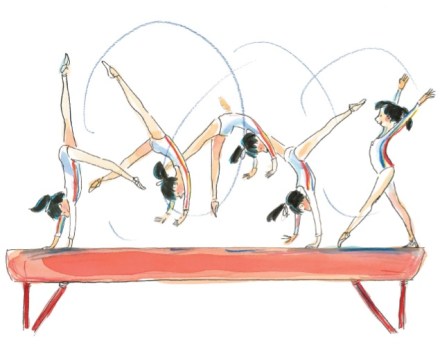
Nadia was only 6 when she began studying with Bela and Marta. Immediately, she discovered that she liked gymnastics better than her school subjects. She progressed quickly from performing “a straight cartwheel on a line painted on the floor” to doing it on a low balance beam and finally to perfecting it on the high balance beam. She began learning harder and harder moves, “flying from bar to bar, from floor to vault, and high above the beam.”

At 9 years old, Nadia competed in her first National Junior Championship. Despite her skill and hard work, she fell from the high beam during a leap not once but three times. Nadia finished the competition in 13th place. Her disappointment only strengthened her resolve. She went back to the gym and continued to practice many hours every day. Her determination paid off, “and at the next National Junior Championship games, she won first place.”

The ultimate recognition of her skill came when she was chosen to be part of the 1976 Romanian Olympic team. The games were held in Montreal, Canada, and all eyes were on the returning gold medalists from Russia, Olga Korbut and Lyudmila Turischeva. But excitement soon filled the venue as Nadia performed on the beam, the floor, and the vault where she scored 9.9, 9.75, and 9.7 on a scale of 1 (the lowest score) to 10 (a perfect score). The next event was the uneven parallel bars on which Olga Korbut had just scored a 9.9. “Nadia mounted the bars. Now fourteen years old, she was a long way from the forests in Romania. But she swung around as easily as she had jumped from branch to branch as a little girl. The audience gasped as she twirled and whipped and flipped.”
celebrate-picture-books-picture-book-review-nadia-the-girl-who-couldn't-sit-still-gym

Image copyright Christine Davenier, courtesy of karlingray.com

Nadia dismounted and landed perfectly on the mat below as the audience “exploded with applause.” Nadia returned to her team to wait for her score. And wait…and wait. Finally, the score appeared on the board—1.00. The worst score. How could that be? “‘What is Nadia’s score?’” Bela asked the judges. “One of the officials held up ten fingers as a voice announced over the loudspeaker: ‘Ladies and gentlemen, for the very first time in Olympic history, Nadia Comaneci has received the score of a perfect ten!’”

Because no one had ever achieved a 10 before, the scoreboards were programmed only for a high of 9.9. Nadia couldn’t bask in her accomplishment for long, however. She moved on to her next event—and her next perfect 10! “When the competition ended, she had earned seven perfect 10s.” At the medal ceremony both Olga and Lyudmila congratulated their competitor as the new Olympic champion. In all Nadia won five medals and became the youngest ever Olympic gold medalist in gymnastics.
celebrate-picture-books-picture-book-review-nadia-the-girl-who-couldn't-sit-still-balance-beam

Image copyright Christine Davenier, courtesy of karlingray.com

Nadia became a darling of the press. They surrounded her, asking “how it felt to have the world’s attention, if she had been confident she would win, and when she would retire.” She answered each reporter with enthusiasm and confidence, and promising that she was a long way from retiring. When she returned home, it seemed that all of Romania had come out to welcome her and her teammates—even the country’s president.

Now Nadia was famous all over the world. She returned to practicing and inventing new routines, preparing for other competitions and the 1980 Olympic Games. She had come far from swinging branch to branch in the trees of Oneşti, but she would always be that little girl who couldn’t sit still.

Karlin Gray’s compelling biography captures all the spunk and spirit of Nadia Comaneci that made the world fall in love with her at the 1976 Olympic Games. Adults of a certain age well remember watching her in astonishment as she seemed to effortlessly swirl, twirl, and flip through her routines, flashing her sweet smile as she waved to fans. In the first pages Gray reveals anecdotes of Nadia’s adventurous nature that will captivate readers even as they giggle at her predicaments.
celebrate-picture-books-picture-book-review-nadia-the-girl-who-couldn't-sit-still-mishaps

Image copyright Christine Davenier, courtesy of karlingray.com

The straightforward narration of Nadia’s trajectory from playground cartwheeler to Olympic champion enhances both the gritty determination of her studies with her coaches as well as the suspense of her competitions. All children—no matter what their talent—will draw inspiration from Nadia’s story, which includes disappointments as well as unbounded accomplishments. Gray’s lyrical language flows as smoothly as Nadia flew through the air and will land in readers’ hearts as a perfect 10.

From the cover, which sports Nadia in her iconic floor exercise pose, to the last page, Christine Davenier depicts the world of gymnastics with beauty and the kind of realistic details that create a classic. The two-page spread of the gym where 6-year-old Nadia learns to love gymnastics portrays the enormity of the space and the equipment for a small girl—as well as the enormity of her achievement.

Kids will love the almost “play-by-play” illustrations of how Nadia learned to perform her feats, from starting with a line on the floor to perfecting the high beam and more. Nadia is shown leaping, somersaulting, doing handstands, and even wavering and falling as she practices and competes. The thrill of the Olympic Games, from the opening ceremonies to the rapt and cheering audiences to the awards ceremony are drawn with stirring action, color, and attention to the specifics of that very special 1976 summer in Montreal.

An Afterword expands on Nadia Comaneci’s courageous life choices and career post-gymnastics and includes a timeline, notes, a selected bibliography, and websites for further study.

Nadia: The Girl Who Couldn’t Sit Still will fascinate kids and would be a very welcome addition to school classroom—as well as home—libraries.

Ages 5 – 10

Houghton Mifflin Harcourt, 2016 | ISBN 978-0544319608

Visit Karlin Gray‘s website to learn more about her and to download fun activities!

View a gallery of artwork by Christine Davenier on her website!

Discover more about Nadia: The Girl Who Couldn’t Sit Still on the Houghton Mifflin Harcourt website!

As I take some personal days over the next couple of weeks, I am reposting some earlier reviews with updated interior art and links.

National Gymnastics Day Activity
celebrate-picture-books-picture-book-review-rhythmic-gymnastics-ribbon-craft

Rhythmic Gymnastics Ribbon


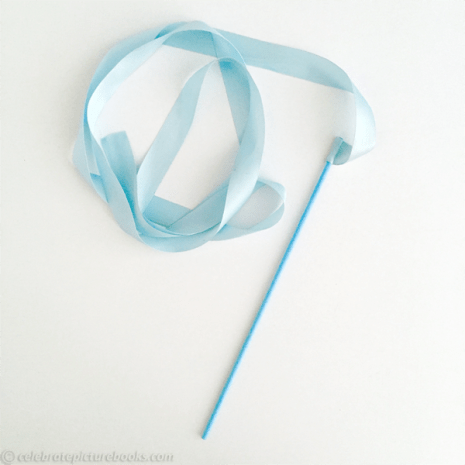
You can recreate the grace of rhythmic gymnastics with this easy craft! The swirling beauty of the ribbon makes any movement fun!

Supplies

  • 12-inch dowel
  • 6-foot length of ribbon
  • Paint the same color as the ribbon
  • Hot glue gun or strong glue
  • Paint brush

Directions

  1. Paint the dowel and let dry
  2. Glue the edge of the ribbon to one end of the dowel. Wrap the ribbon about ½ inch around the dowel and secure with glue. Let glue dry.

Picture Book Review

Picture Book Review

September 6 – Read a Book Day

celebrate-picture-books-picture-book-review-six-dots-a-story-of-young-louis-braille-cover

About the Holiday

Avid readers, rejoice! Today is your day – a whole 24 hours dedicated to the fine pursuit of perusing an old favorite or a newly discovered book! To celebrate visit a local bookstore or library then find a cozy nook or shady spot and settle in for a good, long read.

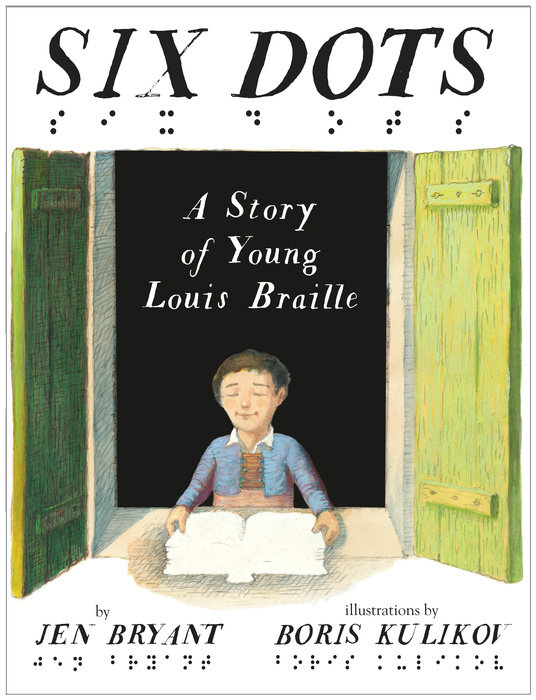
Six Dots: A Story of Young Louis Braille

Written by Jen Bryant | Illustrated by Boris Kulikov


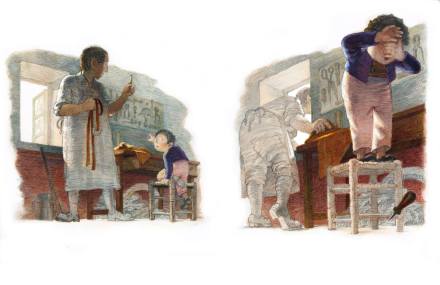
When Louis Braille was born he was so small that no one in town expected him to live. But he did! Louis thrived and with his curious eyes took in everything around him. Louis was smart, too, with a prodigious memory for names and stories. His father worked with leather, making harnesses and bridles. Louis wanted to be just like him and often reached for the sharp tools on the workbench, but his father always warned him away.

One terrible day, however, when Louis’ father glanced away, Louis grabbed an awl and tried to work it into the smooth leather, but it slipped. Louis’ damaged eye was bandaged and he was told not to touch it. But when the bandage began to itch, young Louis couldn’t help himself and spread the infection to his other eye. By the age of five, Louis was left in darkness, unable to see the faces of those he loved or the attractions of home.

celebrate-picture-books-picture-book-review-six-dots-a-story-of-young-louis-braille-accident

Image copyright Boris Kulikov, courtesy Alfred A. Knopf

Louis learned the sounds of the world. He discovered the number of steps around his house, to the outbuildings, and eventually to the shops and businesses in town. His brother taught him how to whistle and use the reverberations to avoid obstacles. He also learned to feel the shapes of letters made of straw, leather, or nailed replicas made by his family. He played dominoes by feeling the dots with his fingers.

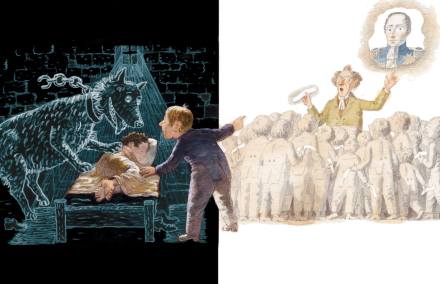
While Louis listened to others read to him, he longed to be able to read on his own. Whenever he asked if there were books for blind people, however, the answer was always, “No.” A noblewoman who lived nearby heard of Louis and invited him to study at the Royal School for the Blind in Paris. At the age of 10 he moved to the boarding school.

The Royal School was anything but sumptuous. Louis’ room was crowded, damp, and dark. His uniform itched, and meals were meager and cold. He so wanted to return home, but the promise of books for the blind kept him there. Those books were reserved for the best students, and Louis vowed to be one. Finally, Louis was led to the library. A book thudded onto the table in front of him. “‘Voila! There it is,’” the guide said.

Louis opened the book. To read it he had to feel the raised letters, but the letters were huge and a page only held a few sentences. To make matters worse, the book consisted of only a few pages. “‘Is that all?’” Louis asked. The guide told him there were others but that they were all the same. More than ever Louis wanted to go home.

celebrate-picture-books-picture-book-review-six-dots-a-story-of-young-louis-braille-dreams

Image copyright Boris Kulikov, courtesy Alfred A. Knopf

In the morning Louis was shaken awake; the headmaster had an important announcement.  It seemed that a French army captain had devised a secret code read by touch instead of sight. This code could be used at the school, the headmaster said. The code consisted of raised dots set in patterns that represented various sounds. The boys learned the new code then learned how to write it, using an awl-like implement that punched dots into paper.

While the code was a breakthrough, it was hard to learn and all the other boys in the school had given up—but not Louis. Still, reading the code was not like reading a book with letters, words, and sentences. Louis asked the headmaster if the army captain would work with him to improve the code, but when the headmaster asked, the answer was “No.”

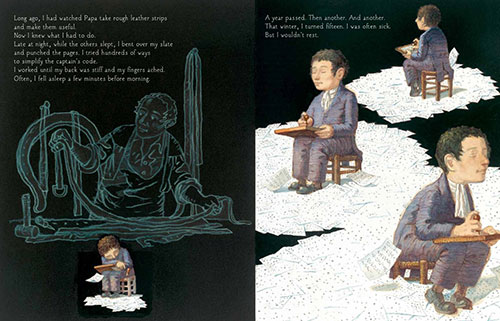
Louis knew what he had to do. Night after night he punched dots into paper with the awl-like tool—just as he had watched his father do with leather. He tried “hundreds of ways to simplify the captain’s code.” Three years passed, and Louis turned 15. Finally, he had a workable solution. He asked the headmaster to read to him a book he had never heard. As the headmaster read, Louis copied his words, punching letters onto paper. Louis’ “new code used just six dots, arranged in two columns, like dominoes. Each dot pattern stood for a letter of the alphabet.”

celebrate-picture-books-picture-book-review-six-dots-a-story-of-young-louis-braille-inventing

Image copyright Boris Kulikov, courtesy Alfred A. Knopf

When the headmaster finished reading chapter 1, Louis turned his pages over and “reading by touch, recited the entire chapter.” After that “word spread quickly. The other students rushed to try it. Si facile! ‘So easy!’ Et si vite! ‘And so fast!’ ‘We can read words and write letters like everyone else,’” the other boys exclaimed.

As Louis watched his friends read he remembered watching his “Papa in his shop, bent over rough strips of leather, making them useful. I had become like him, after all,” Louis thought.

An Author’s Note, more fascinating biographical information about Louis Braille’s life and other inventions, resources, and the Braille alphabet follow the text.

In her Author’s Note Jen Bryant says she wanted to express what it felt like to be Louis Braille. In Six Dots she succeeds in bringing the story of this very young inventor and genius to life with details of his accidental blindness, family support, school experiences, and ultimate victory. Told from Louis Braille’s point of view, the story has an immediacy that presents Braille’s frustrations, challenges, and achievements sensitively and honestly. His perseverance against all odds will inspire readers and give them a new perspective on the unique person Braille was, the importance of books for all, and what children not much older than the readers of Six Dots can accomplish.

Boris Kulikov’s mixed media illustrations take readers back to the France of the early 1800s, depicting with soft colors and period details the town, people, and influences in Louis Braille’s life. Braille’s initial accident is treated with thoughtful consideration of the book’s audience, and his blindness and dreams are portrayed with transparent outlines on a black background. Readers will be interested to see how Louis’s family and friends supported and helped him (an unusual occurrence of the time). As Louis grows, readers discover his other talents for music and sewing, and the tools Louis used to produce his Braille pages are clearly shown.

Ages 4 – 9

Alfred A. Knopf, 2016 | ISBN 978-0449813379

View Jen Bryant’s website for activities, videos, and links related to Six Dots—you’ll also discover more of her books too!

To see a gallery of images by Boris Kulikov for books and other illustration work, visit his website!

Read a Book Day Activity

celebrate-picture-books-picture-book-review-library-coloring-page

I Love the Library! Coloring Page


Today is a perfect day to visit your library and check out some awesome books! Here’s a printable I Love the Library! Coloring Page for you to enjoy too!

August 26 – Women’s Equality Day

celebrate-picture-books-picture-book-review-for-the-right-to-learn-malala-yousafzai's-story-cover

About the Holiday

Today’s holiday commemorates the day in 1920 when the 19th Amendment to the United States Constitution was ratified, giving  women the right to vote. Over the years women all over the world have fought and are still striving to gain equal footing with men in areas such as employment, salary, and education and to be free from fears of violence and discrimination. Empowering women across the globe and ensuring their voices are heard is an issue for all people to be involved in.

For the Right to Learn: Malala Yousafzai’s Story

Written by Rebecca Langston-George | Illustrated by Janna Bock


Malala Yousafzai lived in the Swat Valley of Pakistan, where her father, Ziauddin, ran a school in the town of Mingora. Malala loved school and even when she was tiny visited classes with her father often. Not all Pakistani children could go to school—some families couldn’t afford it and some believed girls should stay home to clean, cook, and keep house. But Malala’s father believed his daughter had the same right to an education as his sons. Malala thrived at school. She learned multiple languages and won many academic awards.

“But Taliban leaders who controlled the area were against letting girls go to school. They declared that females should be separated from males. They wanted to outlaw education for girls.” The Taliban leaders even tried to intimidate Malala’s father. “One ordered Ziauddin to close his school because girls and boys used the same entrance.” Ziauddin refused.

celebrate-picture-books-picture-book-review-for-the-right-to-learn-malala-yousafzai's-story-writing

Image copyright Janna Bock, courtesy of Capstone Press

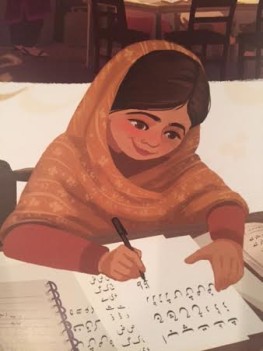
While her father was worried, Malala’s determination grew stronger. She studied harder at school, and during the school holidays while most Pakistani women covered their hands with henna flowers and vines, Malala painted science formulas on hers. The Taliban continued to exert a tight grip on the Swat Valley, and instituted new rules: men could not shave, women had to cover their faces, movies were banned. And the radio “crackled with the sound of the Taliban preaching: No education for girls! Girls who attend school bring shame to their families!”

The Taliban frightened many, and empty seats in school classrooms began to be more frequent. Ziauddan and Malala appeared on TV to express the importance of education. In response the Taliban threatened Ziauddan and his school. Despite the threats Malala and her father continued to speak and write, “demanding equal education for girls.” The Taliban began patrolling the streets, perpetrating violence and destruction on anyone who didn’t obey their rules.

In December 2008, the Taliban announced that all girls’ schools would close by January 15. “Even before the deadline, bombs started to rain down on nearby schools as warnings.” The British Broadcasting Corporation wanted to reveal to the world what was happening. They wanted a girl to write a blog about her experience and “how it felt to be denied an education. Malala volunteered.

celebrate-picture-books-picture-book-review-for-the-right-to-learn-malala-yousafzai's-story-sneaking-to-school

Image copyright Janna Bock, courtesy of Capstone Press

She took the pen name Gul Makai and related her blog by phone to a reporter who typed and published her words for two months. The first post appeared on January 3, 2009. On January 14 Malala wrote: “‘They can stop us from going to school, but they can’t stop us learning!’” Because activists were growing angry, the Taliban let girls ages 10 and younger go to school. Malala and her friends were 11. They began dressing to look younger and hid school books in their clothes. If they had been caught lying about their ages, they and their teachers could have been beaten or executed.

In May 2009 the Pakistani army began battling the Taliban and ordered everyone to evacuate. Malala and her family had to pack their belongings and leave. Malala wanted to take her books along, but there wasn’t room. She could only hope that they—and her home—would survive the fighting. Three months later, the people of Mingora were allowed to come home, but the town was not the same as they had left it. Shops and buildings were destroyed, burned frames of cars were strewn across the roads. The school’s walls were riddle with bullet holes. But the Taliban was gone. Ziauddin reopened his school for boys and girls.

While Malala returned to school, her life was not the same. Because of her blog, speeches, and interviews, she was internationally famous. Everyone wanted to hear what she had to say—everyone but the Taliban. “Talban leaders began to threaten her on the Internet. Saying she was working for the West, they announced Malala was on their hit list. The police warned the Yousafzai family to leave, but Malala refused to hide. She refused to be silenced.”

Because of the danger, Malala’s mother wanted her to ride the bus to school instead of walk. On October 9, 2012 as Malala and her classmates rode the bus home after school, the bus was stopped and a man boarded, demanding to know which girl was Malala. While no one spoke, the girls couldn’t stop their eyes from flashing quickly toward Malala. That was all the man needed. He “pointed a gun at Malala. Three shots shattered the silence.”

The bus driver rushed Malala and two of her friends to the hospital. Word spread quickly about the shooting through the town and around the world. Malala lay unconscious for days as the Taliban threatened her again should she live. As determinedly as Malala fought for equal education, she fought for survival. Finally, she was flown to a hospital in England for more surgery and to keep her safe. Gifts and wished poured in from all over the world. Malala stayed in the hospital for three months and underwent many procedures to correct the damage done by the Taliban’s bullets.

When she had recovered, Malala returned to her family and to her place on the world stage where she continues to speak out for the rights of all. On July 12, 2013 in a speech at the United Nations, Malala “declared, ‘One child, one teacher, one book, and one pen can change the world.’” On December 10, 2014 Malala became the youngest recipient of the Nobel Peace Prize for her “strength, power, and courage” to “lift her voice for children everywhere.”

celebrate-picture-books-picture-book-review-for-the-right-to-learn-malala-yousafzai's-story-speaking-to-the-UN

Image copyright Janna Bock, courtesy of Capstone Press

Malala. Those three syllables have become synonymous with bravery, freedom, and education. Rebecca Langston-George tells Malala’s remarkable story with the same unstinting vision that fuels Malala’s mission. Told sensitively, but candidly, this compelling biography reveals the harrowing evolution of the Taliban’s reach that, far from intimidating young Malala, only served to make her more determined. Langston-George’s excellent command over her well-chosen details and gripping pacing enhances the power of this important true story. Readers should come away inspired—not only by Malala’s life, but the fact that they too can make a difference.

Janna Bock depicts the changing landscape of Malala’s hometown both physically and philosophically with illustrations that help readers clearly envision and understand Malala’s life and environment. The faces of the townspeople and the Yousefzai family register distress and fear, but also determination, courage, and optimism as schools close, Mingora comes under fire, and the citizens become refugees. Malala’s shooting, and recovery are portrayed with thoughtful consideration of the readers, and the ending takes children inside the United Nations to witness Malala’s ultimate triumph.

An Author’s Note detailing more about Malala’s story then and now as well as a glossary and index follow the text.

For the Right to Learn: Malala Yousafzai’s Story is an important biography of current events and people shaping the world and our children’s future and is a must read for all.

Ages 8 – 12

Capstone Press, 2016 | ISBN 978-1623704261

Discover more fascinating books by Rebecca Langston-George on her website!

View a gallery of art by Janna Bock on Tumblr!

Women’s Equality Day Activity

celebrate-picture-books-picture-book-review-star-border-writing-template

Be a Star! Letter to Your Teacher


The school year is about to begin! Do you feel excited? Nervous? Ready to learn? Your teachers are looking forward to meeting you! With the printable Be a Star! Letter to Your Teacher Template, tell your teacher something funny about yourself, something serious, and something you’d like to learn about this year. Add a thank you for all their work and dedication and give it to your teacher on the first day of school! If you’ve already started school, give it to your teacher this week!

Picture Book Review

August 15 – National Relaxation Day

celebrate-picture-books-picture-book-review-whoosh!-lonnie-johnson's-super-soaking-stream-of-inventions-cover

About the Holiday

Relaxation Day was founded in 1985 by then fourth-grader Sean Moeller, who already knew a thing or two about balance in life when he suggested that “cleaning and real work are not part of relaxation.” Today’s holiday gives you permission to kick back and enjoy yourself. The subject of today’s book invented a great way to take advantage of a day off—and also demonstrates that sometimes work and relaxation go hand-in-hand!

WHOOSH! Lonnie Johnson’s Super-Soaking Stream of Inventions

Written by Chris Barton | Illustrated by Don Tate


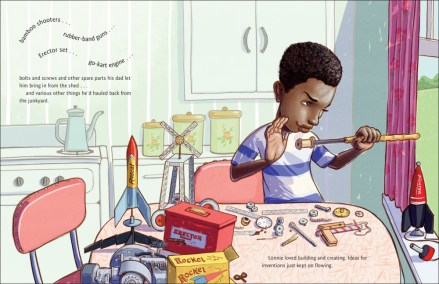
Lonnie Johnson had a way with stuff. In his hands bolts and screws, gears and springs, spools, clothespins, “spare parts his dad let him bring in from the shed, and various other things he’d hauled back from the junkyard” fueled Lonnie’s ideas for inventions and rocket ships. The kids at school loved to watch him launch the rockets he’d devised on the playground. Lonnie wanted to have a career as an engineer. Getting there took a lot of determination and courage. Once, the results of a standardized test said that he would not make a good engineer. Lonnie felt discouraged, but he knew that the person who had graded his test didn’t know him—or Linex.

celebrate-picture-books-picture-book-review-whoosh!-lonnie-johnson's-super-soaking-stream-of-inventions-young-lonnie-inventing

Image copyright Don Tate, courtesy of charlesbridge.com

Linex was the robot Lonnie had built from scrap metal. “Compressed –air cylinders and valves allowed Linex’s body to turn and its arms to move. The switches came from an old, broken jukebox. Lonnie used a tape recorder to program Linex, and as a bonus the reels looked like eyes.” Lonnie’s goal was to enter Linex in a science fair, but first he wanted to be able to program it. It took several years before he discovered how. Using his little sister’s walkie-talkie, Lonnie took Linex to the “1968 science fair at the University of Alabama—where only five years earlier, African American students hadn’t even been allowed.” Lonnie’s team won first place.

Lonnie went to college at Tuskegee Institute, where he realized his dream of becoming an engineer. His career “took him beyond Alabama—way beyond.”  He went to work for NASA. Before the orbiter Galileo could be sent to Jupiter, Lonnie developed a system that would ensure the craft would have a constant supply of power for its computer memory in case the main power was lost. Some fellow scientists doubted his idea would work, but it did. “As it photographed Jupiter and its moons, Galileo was supported by the power package that Lonnie designed.”

celebrate-picture-books-picture-book-review-whoosh!-lonnie-johnson's-super-soaking-stream-of-inventions-linex

Image copyright Don Tate, courtesy of charlesbridge.com

Even though Lonnie worked for NASA, he continued tinkering with his own ideas—in his own workshop. One problem he was trying to solve involved the need for the world’s refrigerators and air conditioners to have a cooling system that didn’t use the damaging chemical R-12. “He had an idea for using water and air pressure instead.” He built a prototype and experimented with it in his bathroom sink. When he turned his pump and nozzle on, a stream of water blasted across the room.

Suddenly, Lonnie saw another use for his invention—as a water gun. He created a design small enough for children’s hands, and tested it at a picnic, where it was a hit. Lonnie took his idea to a toy company…and another…and another. Finally one company agreed to make his water gun. Spurred on by this success, Lonnie found investors to help him build other original inventions: “a water-propelled toy airplane, two kinds of engines, and his cooling system” that had led to the water gun. He even quit his day job to devote his time to inventing.

But things don’t always work out. Each project fell through—even the water gun. It was a scary time as he and his family had to move out of their house and into an apartment. But Lonnie believed in himself. He took his water gun to another toy company. In 1989 he found a toy company willing to take a look. Lonnie made the trip to Philadelphia and wowed the executives with his invention.

celebrate-picture-books-picture-book-review-whoosh!-lonnie-johnson's-super-soaking-stream-of-inventions-water-powered-nozzle

Image copyright Don Tate, courtesy of charlesbridge.com

Now kids everywhere enjoy the fun of the Super Soaker. Today, Lonnie can be found in his workshop doing what he loves: “facing challenges, solving problems and building things” because “his ideas just keep on flowing.”

Chris Barton’s biography of Lonnie Johnson is a fascinating look at a man who succeeds in turning “No” into “Yes” by the power of his intelligence, ideas, and determination. Kids will love hearing about how one of their favorite toys came to be and will be inspired to chase their own dreams despite challenges and setbacks. Barton’s detailed narration provides a full picture of Lonnie Johnson and his times, specifics that attract and inform like-minded kids. Including the results of Lonnie’s exam should encourage kids who think differently. The story is enhanced by the conversational tone that makes it accessible to kids of all ages.

Don Tate illuminates Lonnie Johnson’s life story with his bold, full-bleed paintings that follow Lonnie from his being a child with big ideas to becoming a man who has seen these ideas through to success. With an eyebrow raised in concentration, young Lonnie demonstrates confidence and skill as he works on an invention, and kids will love seeing the tools of his trade laid out on the kitchen table. With his eyes narrowed in frustration and disappointment, Lonnie reads the results of his childhood exam. As Lonnie grows older and designs systems for NASA, the illustrations depict the schematics of the Galileo power package and Lonnie’s surprise at the strength of the water stream in his prototype cooling design. As all kids know, the spurt of a Super Soaker is awesome, and this fact is demonstrated in a “Wowing” fold-out page.

WHOOSH! Lonnie Johnson’s Super-Soaking Stream of Inventions is a welcome biography of the man who designs systems for the greater world but has never lost his youthful enthusiasm to invent.

Ages 5 – 10

Charlesbridge, 2016 | ISBN 978-1580892971

Check out more fiction and nonfiction books by Chris Barton on his website!

Discover more books written and illustrated by Don Tate as well as a portfolio of his work and book-related activity guides on his website!

National Relaxation Day Activity

celebrate-picture-books-picture-book-review-kids-in-pool-coloring-page

Dive In! Coloring Page


The Super Soaker is a great way to cool off! Another relaxing water activity is swimming in a pool! So dive in to this printable cool pool Dive In! Coloring Page!

August 12 – International Youth Day

celebrate-picture-books-picture-book-review-nadia-the-girl-who-couldn't-sit-still-cover

Image copyright Christine Davenier, courtesy of Houghton Mifflin Harcourt Publishing Co.

About the Holiday

In so many ways children and young adults are not only our future but they lead the world forward now. In recognition of this, the United Nations established International Youth Day to work toward ensuring that all children have access to resources to make positive and progressive choices. The theme for this year’s International Youth Day revolves around sustainable consumption, an important topic for the world our young people are inheriting.

It’s fitting that today’s holiday comes during the Olympic Games, a showcase of the best determination, hope, and spirit of today’s youth and tomorrow’s promise. A “perfect” reminder of that is the subject of today’s book!

Nadia: The Girl Who Couldn’t Sit Still

Written by Karlin Gray | Illustrated by Christine Davenier


“In the village of Oneşti, Romania, a country rich with forests and mountains” Nadia Comaneci could often be seen swinging from tree branch to tree branch. She was a little girl who loved to play. She was “feisty and fearless,” attempting new things on a whim and always with a sense of adventure. Once she tried on a pair of roller skates and skated right out of the store! Another time she was so impatient to ride her new bike that she pedaled off before her father could even tighten the screws. The bike “fell apart as she rode away.” And one year her love of climbing trees extended to the family Christmas tree, which toppled over on her, pinning her to the ground.

To channel all that energy, Nadia’s mother enrolled her in gymnastics lessons. Nadia’s eyes lit up when she saw the room full of ropes, ladders, bars, mats, and trampolines to discover, but she didn’t leave her new skills at the gym. Nadia and a friend cartwheeled around the school playground, capturing the attention of Bela and Marta Karolyi, who owned a gymnastics school. They invited the girls to join.

celebrate-picture-books-picture-book-review-nadia-the-girl-who-couldn't-sit-still-swinging-in-trees

Image copyright Christine Davenier, courtesy of karlingray.com

Nadia was only 6 when she began studying with Bela and Marta. Immediately, she discovered that she liked gymnastics better than her school subjects. She progressed quickly from performing “a straight cartwheel on a line painted on the floor” to doing it on a low balance beam and finally on the high balance beam. She began learning harder and harder moves, “flying from bar to bar, from floor to vault, and high above the beam.”

At 9 years old, Nadia competed in her first National Junior Championship. Despite her skill and hard work, she fell from the high beam during a leap not once but three times. Nadia finished the competition in 13th place. Her disappointment only strengthened her resolve. She went back to the gym and continued to practice many hours every day. Her determination paid off, “and at the next National Junior Championship games, she won first place.”

The ultimate recognition of her skill came when she was chosen to be part of the 1976 Romanian Olympic team. The games were held in Montreal, Canada, and all eyes were on the returning gold medalists from Russia, Olga Korbut and Lyudmila Turischeva. But excitement soon filled the venue as Nadia performed on the beam, the floor, and the vault where she scored 9.9, 9.75, and 9.7 on a scale of 1 (the lowest score) to 10 (a perfect score). The next event was the uneven parallel bars on which Olga Korbut had just scored a 9.9. “Nadia mounted the bars. Now fourteen years old, she was a long way from the forests in Romania. But she swung around as easily as she had jumped from branch to branch as a little girl. The audience gasped as she twirled and whipped and flipped.”

celebrate-picture-books-picture-book-review-nadia-the-girl-who-couldn't-sit-still-gym

Image copyright Christine Davenier, courtesy of karlingray.com

Nadia dismounted and landed perfectly on the mat below as the audience “exploded with applause.” Nadia returned to her team to wait for her score. And wait…and wait. Finally, the score appeared on the board—1.00. The worst score. How could that be? “‘What is Nadia’s score?’” Bela asked the judges. “One of the officials held up ten fingers as a voice announced over the loudspeaker: ‘Ladies and gentlemen, for the very first time in Olympic history, Nadia Comaneci has received the score of a perfect ten!’”

Because no one had ever achieved a 10 before, the scoreboards were programmed only for a high of 9.9. Nadia couldn’t bask in her accomplishment for long, however. She moved on to her next event—and her next perfect 10! “When the competition ended, she had earned seven perfect 10s.” At the medal ceremony both Olga and Lyudmila congratulated their competitor as the new Olympic champion. In all Nadia won five medals and became the youngest ever Olympic gold medalist in gymnastics.

celebrate-picture-books-picture-book-review-nadia-the-girl-who-couldn't-sit-still-balance-beam

Image copyright Christine Davenier, courtesy of karlingray.com

Nadia became a darling of the press. They surrounded her, asking “how it felt to have the world’s attention, if she had been confident she would win, and when she would retire.” She answered each reporter with enthusiasm and confidence, and promising that she was a long way from retiring. When she returned home, it seemed that all of Romania had come out to welcome her and her teammates—even the country’s president.

Now Nadia was famous all over the world. She returned to practicing and inventing new routines, preparing for other competitions and the 1980 Olympic Games. She had come far from swinging branch to branch in the trees of Oneşti, but she would always be that little girl who couldn’t sit still.

Karlin Gray’s compelling biography captures all the spunk and spirit of Nadia Comaneci that made the world fall in love with her at the 1976 Olympic Games. Adults of a certain age well remember watching her in astonishment as she seemed to effortlessly swirl, twirl, and flip through her routines, flashing her sweet smile as she waved to fans. In the first pages Gray reveals anecdotes of Nadia’s adventurous nature that will captivate readers even as they giggle at her predicaments.

celebrate-picture-books-picture-book-review-nadia-the-girl-who-couldn't-sit-still-mishaps

Image copyright Christine Davenier, courtesy of karlingray.com

The straightforward narration of Nadia’s trajectory from playground cartwheeler to Olympic champion enhances both the gritty determination of her studies with her coaches as well as the suspense of her competitions. All children—no matter what their talent—will draw inspiration from Nadia’s story, which includes disappointments as well as unbounded accomplishments. Gray’s lyrical language flows as smoothly as Nadia flew through the air and will land in readers’ hearts as a perfect 10.

From the cover, which sports Nadia in her iconic floor exercise pose, to the last page, Christine Davenier depicts the world of gymnastics with beauty and the kind of realistic details that create a classic. The two-page spread of the gym where 6-year-old Nadia learns to love gymnastics portrays the enormity of the space and the equipment for a small girl—as well as the enormity of her achievement.

Kids will love the almost “play-by-play” illustrations of how Nadia learned to perform her feats, from starting with a line on the floor to perfecting the high beam and more. Nadia is shown leaping, somersaulting, doing handstands, and even wavering and falling as she practices and competes. The thrill of the Olympic Games, from the opening ceremonies, to the rapt and cheering audiences to the awards ceremony are drawn with stirring action, color, and attention to the specifics of that very special 1976 summer in Montreal.

An Afterword expands on Nadia Comaneci’s courageous life choices and career post-gymnastics and includes a timeline, notes, a selected bibliography, and websites for further study.

Nadia: The Girl Who Couldn’t Sit Still will fascinate kids and would be a very welcome addition to school classroom—as well as home—libraries.

Ages 5 – 10

Houghton Mifflin Harcourt, 2016 | ISBN 978-0544319608

Visit Karlin Gray‘s website to learn more about her and to download fun activities!

View a gallery of artwork by Christine Davenier on her website!

Discover more about Nadia: The Girl Who Couldn’t Sit Still on the Houghton Mifflin Harcourt website!

International Youth Day Activity

celebrate-picture-books-picture-book-review-rhythmic-gymnastics-ribbon-craft

Rhythmic Gymnastics Ribbon


You can recreate the grace of rhythmic gymnastics with this easy craft! The swirling beauty of the ribbon makes any movement fun!

Supplies

  • 12-inch dowel
  • 6-foot length of ribbon
  • Paint the same color as the ribbon
  • Hot glue gun or strong glue
  • Paint brush

Directions

  1. Paint the dowel and let dry
  2. Glue the edge of the ribbon to one end of the dowel. Wrap the ribbon about ½ inch around the dowel and secure with glue. Let glue dry.

Picture Book Review

July 13 – National Culinary Arts Month

celebrate-picture-books-picture-book-review-the-hole-story-of-the-doughnut-cover

About the Holiday

July is a great month for celebrating culinary arts. With kids home from school it’s fun to spend time together in the kitchen learning new skills and making experimental or favorite recipes. On-the-go meals or vacations can also take you to new and enticing restaurants, where you may try regional cuisine and discover exciting flavors.

The Hole Story of the Doughnut

Written by Pat Miller | Illustrated by Vincent X. Kirsch


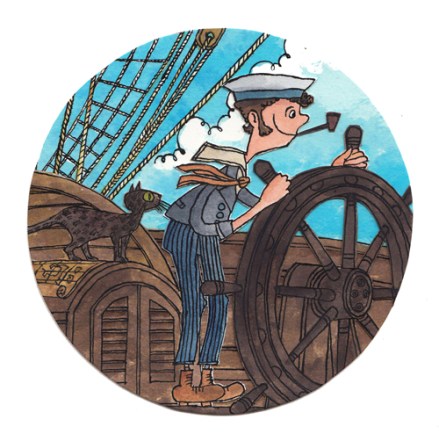
In 1844 at the tender age of 13, Hanson Gregory left the family farm and went to sea as a cabin boy on the schooner Isaac Achorn. He quickly became the cook’s assistant and also learned how to rig the sails and “steer a ship over trackless waves by sun and stars.” By the age of 19 Gregory had become the captain of the schooner Hardscrabble, and within a few more years was racing “his cargo from Maine to California as commander of a clipper, the fastest ship on any ocean.”

celebrate-picture-books-picture-book-review-hole-story-of-the-doughnut

Image copyright Vincent X. Kirsch, courtesy of vincentxkirsch.com

Hanson Gregory may have been one of the best captains to sail the seas—once awarded a medal for heroism for rescuing seven shipwrecked Spanish sailors even though his own ship and crew were endangered. But his greatest achievement was not attained because of his seafaring skills—it was his ingenuity in the galley that people remember.

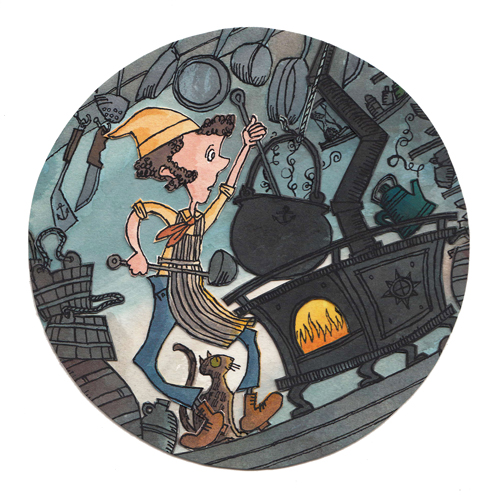
On June 22, 1847 as a 16-year-old cook’s assistant, Hanson was rustling up the crew’s breakfast—coffee and fried cakes, the same as every morning. While the pot of lard bubbled on the stove, Gregory formed balls of sweetened dough and dropped them in. They sizzled and crisped—at least around the edges. The centers were raw, heavy with grease, and they dropped like cannonballs in the stomach. “Sailors called them Sinkers.” But this morning Gregory had an idea. He removed the lid from the pepper can and cut out the center of the balls. “Then he tossed the rings into the bubbling lard.”

celebrate-picture-books-picture-book-review-hole-story-of-the-doughnut

Image copyright Vincent X. Kirsch, courtesy of vincentxkirsch.com

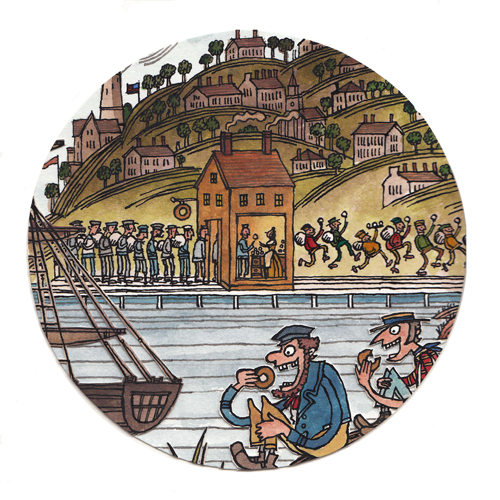
The cook and the sailors took one look at this odd concoction and…ate them up! “The cakes were brown, and sweet, and fully cooked. Sighs of delight rose above the noisy sea. A new breakfast tradition was born.” Gregory told his mom about his invention, and she fried up large batches of these ‘holey cakes’ that were a sensation at a friend’s store and on the docks.

You might think this is a pretty interesting tale in itself, “but sailors like their stories bold” and so they “spun legends worthy of such a delicious treat.” One tale had Captain Gregory inventing the doughnut while he saved his ship from disaster. Another told how Gregory, distraught over the drowning of five sailors pulled to the ocean floor by of their “sinker” breakfast, punched holes in every cake to make them look like life rings and vowed, “‘Never again!’”

Captain Gregory had a sense of humor about his accomplishment. During an interview he once stated that “he had invented ‘the first hole ever seen by mortal eyes.’” Gregory lived to be 89 and is buried “overlooking the sea where stormy weather can be spotted as readily as it once was from the quarterdeck of the Hardscrabble.”

An author’s note expanding on the story of Captain Gregory, the doughnut, doughnut shops, a timeline, and a selected bibliography follow the text.

celebrate-picture-books-picture-book-review-hole-story-of-the-doughnut

Image copyright Vincent X. Kirsch, courtesy of vincentxkirsch.com

Doughnuts have never been so evocative! In Pat Miller’s humorous, informative history of this favorite pastry treat, readers can smell the salt air, feel the ocean swell and roll under their feet, and even ache a little for those poor sailors forced to eat “sinkers.” Seamlessly interwoven into this foodography is a fascinating look at the early days of sail. Miller’s language is immediately stirring: the Ivanhoe bucks and plunges, the sea becomes a monster, and Captain Gregory spears a sinker on the wheel spoke. Kids will marvel at a 13-year-old going off to sea and becoming an inventor at 16.

Vincent X. Kirsch provides just the right touch to this captivating true story with his cartoon-inspired watercolor and cut paper artwork. Ingeniously incorporating Hanson Gregory’s innovation of removing the center of the fried cakes, Kirsch’s illustrations are “cored” to allow for text, while the extracted section appears on the facing page as a glimpse through a porthole. The maritime atmosphere—from ship to shore—of the mid-1800s is beautifully represented in the folk-style sketches, and the humor that is so intrinsic to this story is wonderfully embraced.

The Hole Story of the Doughnut will delight foodies and history buffs alike and would make a fun gift and a delectable addition to personal libraries for all ages.

Ages 5 – 12

Houghton Mifflin Harcourt, 2016 | ISBN 978-0544319615

Vincent X. Kirsch’s website is full of illustrations from his books for children—take a look at his portfolio!

Spend some time with Pat Miller on her website that offers activities, tips, resources and many more books!

Culinary Arts Month Activity

celebrate-picture-books-picture-book-review-cd-doughnut-craft

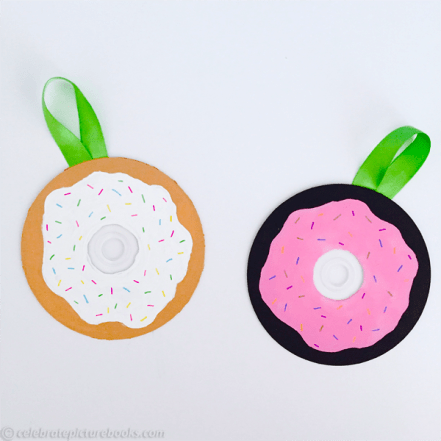
CD (Compact Doughnuts) Decoration


Are some of  your CDs a little passé? Not if you can turn them into cute décor like this doughnut hanging.

Supplies

  • Unused CDs
  • Craft paint in tan, black, pink, yellow, white (or any colors you want for the doughnut and the icing)
  • Ribbon, any color and length you want
  • Fine-tip markers in bright colors
  • Glue
  • Glue dots (optional)
  • Paint brush

Directions

  1. Paint a wavy edge around the CD, let dry
  2. Paint the center of the CD, leaving the clear circle unpainted
  3. When the icing paint is dry, draw sprinkles on the icing with the markers
  4. With the ribbon make a loop hanger and attach it to the back of the CD with glue or glue dots
  5. Hang your decoration

celebrate-picture-books-picture-book-review-the-hole-story-of-the-doughnut-cover

You can find The Hole Story of the Doughnut at these booksellers

Amazon | Barnes & Noble | Books-a-Million | IndieBound


July 11 – World Population Day

celebrate-picture-books-picture-book-review-p-is-for-passport

About the Holiday

In 1989 the Governing Council of the United Nations Development Program established this date as a time to focus on urgent population and humanitarian issues. Each year revolves around a different theme. This year the theme is “Investing in teenage girls.” Education, health, and safety issues for girls around the world is an emerging issue that demands serious attention.

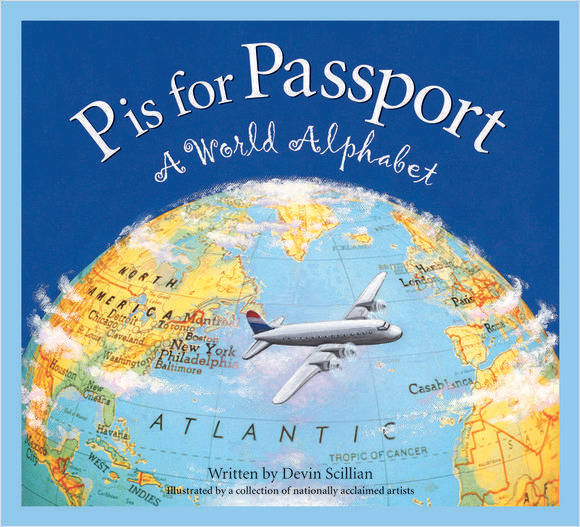
P is for Passport: A World Alphabet

Written by Devin Scillian | Illustrated by nationally acclaimed artists


One of the best ways to learn about the world’s diverse population is to travel—either in person or through a great book. P is for Passport is your own personal guide to the myriad people, landmarks, animals, natural resources, modes of transportation, and other things that make up our world. Each letter of the alphabet introduces readers to a concept that begins with that letter (A for animals, B for breads, etc.). A short definition of the place, event, object, or idea is given on one page, and the facing page contains a poem that cleverly and lyrically describes it with examples from around the globe.

celebrate-picture-books-picture-book-review-p-is-for-passport-currency

Image copyright K.L. Darnell, courtesy of Sleeping Bear Press

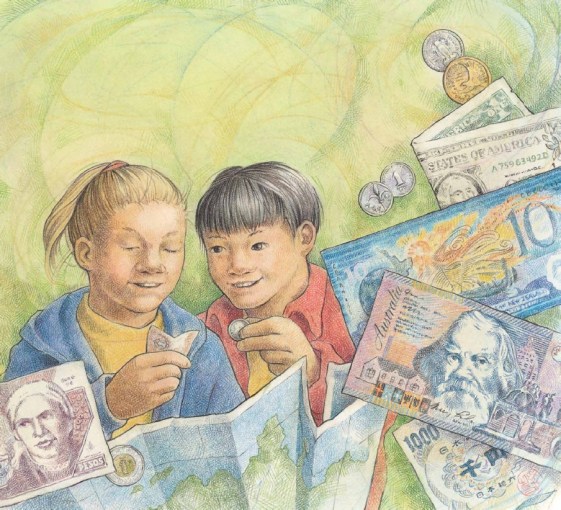
After getting the right Currency with the letter C and filling K’s Knapsack, armchair travelers will traverse the world’s varied terrain. E takes them to the “epic elevation” of “mighty Mount Everest”; for the letter I they will sail to the Emerald Isle of Ireland, the Isles of Greece, and the Isle of Skye as well as to chilly Greenland, warm Tahiti, and green Iceland; J will find them in the densest jungles; of course, “O is for Oceans that “roll and roar and sway”; and D is for deserts:

“We’re in Dakar and it’s dreadfully dry, whipped by the sand in the breeze. / Or it’s a day in Death Valley, dangerously hot at 120 degrees. / A dazzling sun dries out the Gobi, a harsh and punishing land. / The largest on earth is called the Sahara, nine million miles of sand….”

celebrate-picture-books-picture-book-review-p-is-for-passport-bread

Image copyright Gary Palmer, courtesy of Sleeping Bear Press

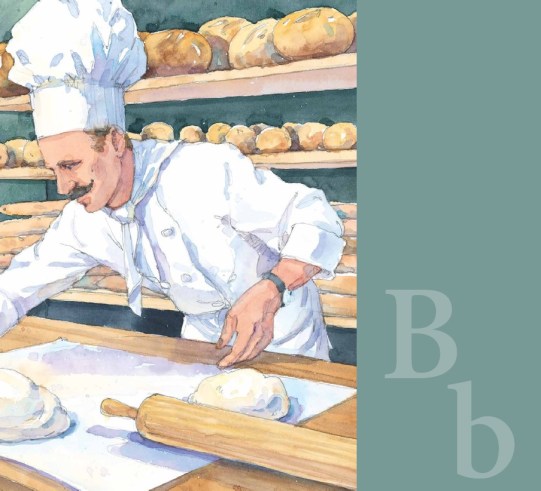
By now readers will be hungry, so B provides buttery buns, bagels, baguettes, biscuits, and more. Feel like something else? Then flip to G for Grain found in pasta, porridge, dumplings, ramen, couscous, wheat, and rice. While travelers eat they can peruse the languages at L:

“Polish is spoken in Poland. In Japan, it’s Japanese. / In Brazil they don’t speak Brazilian, but rather Portuguese. / L is the list of Languages, so many ways to speak. / Like English and Spanish, Italian and Hebrew, Arabic and Greek. / So pack a handy phrase book and learn a few things to say. / A friendly ‘Bonjour!’ or ‘Buenos dias!’ can go a very long way.”

Q is your Quest “…both large and small, from climbing Kilimanjaro to seeing Niagara Falls.” You’ll cross countries by R—Railway and “…rise right through the Rockies , or across the French Riviera, / or rumble across the Australian outback making your way to Canberra.” Along the way you’ll be entertained by M—Music from mandolins, marimbas, maracas, and many different musicians—and S for Sports, such as soccer, surfing, sailing, skiing, and so many more.

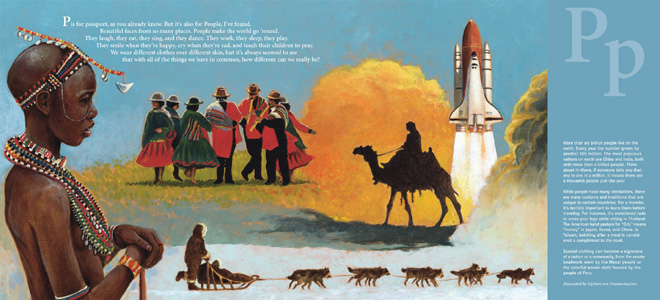
Lastly, T stands for Travel as “you see, each trip a traveler takes is a moment that you spend / getting to know a whole new world. And that world becomes your friend.” And from your travels you’ll remember P, the People:

“They laugh, they eat, they sing, and they dance. They work, they sleep, they play. / They smile when they’re happy, cry when they’re sad, and teach their children to pray. / We wear different clothes over different skin, but it’s always seemed to me / that with all of the things we have in common, how different can we really be?”

celebrate-picture-books-picture-book-review-p-is-for-passport-people

Image copyright Gijsbert van Frankenhuyzen

As today’s date also hosts the holiday International Town Criers Day, honoring those early “news reporters,” it’s appropriate that Devin Scillian is our featured author. Besides authoring this and other books, he is a television journalist. His childhood spent living in cities across the globe and his work make him a perfect traveling companion for P is for Passport and its introduction to the marvels of the world around us. Delivering the sights, sounds, aromas, play, and people of foreign lands through fascinating rhymes and facts is a wonderful way to get kids excited about travel and geography.

Twenty-four artists from around the United States and Canada lend their unique talents to depicting each letter. Beautiful two-page spreads burst with color and bold, up-close views of representatives for each letter-inspired text. Brilliant red and blue parrots share space with violet orchids, blue poison dart frogs, a coiled green snake, and a stealthily creeping jaguar in Karen Latham and Rebecca Latham’s painting for the letter J. Susan Guy’s soft watercolor of a frozen landscape cut only by a sleek train and its glowing headlamp transports readers to cold northern regions for the letter N. Volcanoes steam and spout while hot, golden lava burns a path through forestland in Ross Young’s vivid painting for the letter V.

Each illustration is equally compelling. Children and adults will want to linger over each page and will find P is for Passport just the beginning of their world exploration. The book would be a welcome home library addition for geography enthusiasts of all ages.

Ages 7 – 12

Sleeping Bear Press

Hardcover, 2003 ISBN 9781585361571 | ebook, 2013 ISBN 9781627533577

World Population Day Activity

celebrate-picture-books-picture-book-review-train-shaped-word-search

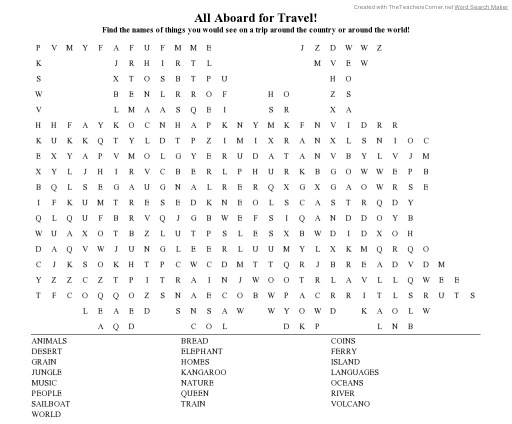
All Aboard for Travel! Word Search


The best way to meet your fellow citizens of the world is to travel! Today’s word search is shaped like a train—one of the best ways to see the countryside. So hop on board and start exploring! Get your printable All Aboard for Travel! puzzle.