May 1 – May Day and Interview with Author Denise Brennan-Nelson

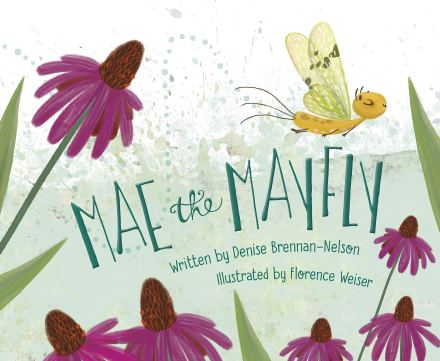
celebrate-picture-books-picture-book-review-mae-the-mayfly-cover

About the Holiday

May Day has for centuries celebrated the coming of spring. In ancient calendars May 1 heralded the first day of summer. Often celebrated with flowers and dancing, May Day has ushered in many traditions, such as dancing around a Maypole and May Day baskets, which are cone-shaped baskets filled with flowers. A May Day basket is usually given in secret as the giver hangs it on a friend’s doorknob and then rings the doorbell and runs away. (Which sounds like a perfect way to celebrate the holiday in these days of social distancing.) Whether nature is blooming in full or just starting to bud where you live, May Day offers the promise of brighter days ahead. Today’s book—and its adorable character Mae—shows us how to celebrate that feeling every day.

I received a copy of Mae the Mayfly from Sleeping Bear Press for review consideration. All opinions of the book are my own.

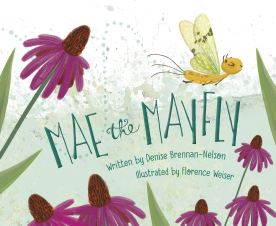
Mae the Mayfly

Written by Denise Brennan-Nelson | Illustrated by Florence Weiser


“Near the bank of the river one warm spring day / a new life began, and her name was Mae.” Before her mama said goodbye, she hugged her daughter and told her that she had her “whole life—a day, perhaps more” to explore her world. As Mae flitted along the river, a large, hungry trout waited for just the right moment to lure her in. It smiled deceitfully and beckoned to her, and, even though her inner voice told her not to, Mae flew down closer to take a look.
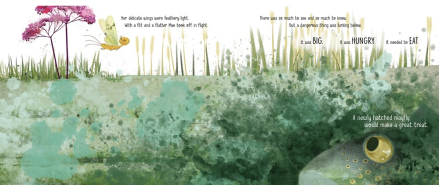
celebrate-picture-books-picture-book-review-mae-the-mayfly-fish

Image by Florence Weiser, 2020, text copyright Denise Brennan-Nelson, 2020. Courtesy of Sleeping Bear Press.

That’s when the trout leapt from the water to snatch Mae from the air. But she darted and dodged and got away. Shaking with fear, Mae found a hole in a hollow tree and flew in. “I’ll stay here forever! I’m not coming out!” she told herself.  But once her heart stopped beating so loud, she heard a happy tweet and peeked out of the tree. She saw a mother robin feeding her chicks and a spider web glittered in the sun. “The mist on the river was a fine, pink cloak. / A bullfrog bellowed his morning croak.” 

Mae remembered what her Mama had said and “launched herself from the dark, hollow place.” She followed the river, where she saw flowers and birds, a deer and a bear and one “stubby toad.” Then, she came to a clearing where she found “a singing, dancing jamboree… a wild mayfly jubilee! / Joining in, Mae danced with glee!”

celebrate-picture-books-picture-book-review-mae-the-mayfly-bird

Image by Florence Weiser, 2020, text copyright Denise Brennan-Nelson, 2020. Courtesy of Sleeping Bear Press.

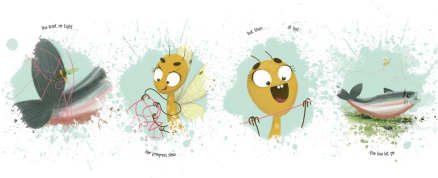
As morning turned to afternoon, Mae was floating on the breeze when she heard a call for help. She went in search of who it was and found Trout lying motionless and barely breathing. Fearful that he might leap at her again, she carefully went closer to inspect. “But Trout was weak, no flip or flail. / Tangled line had caught his tail.” Then Mae noticed something else—his shimmering “rainbow stripes in every hue, silver, pink, and shades of blue.” And in his eyes she saw his fear and realized that she and Trout were alike.

Mae went to work to try to free him. The knot was tight, but Mae worked patiently until the line slipped free and Trout swam away with the current. Mae hoped that he would be okay. Just then she saw a flash as Trout returned and with a flip of his tail said, “Thank you.” As nighttime settled over the river and the moon rose high, Mae settled on a cattail leaf. She listened to the bullfrogs and watched the fireflies glow. “The stars came out early for  sweet, little Mae. / She counted each one… then called it a day.”

Back matter includes a message about mindfulness, an exercise to try and facts about mayflies.
celebrate-picture-books-picture-book-review-mae-the-mayfly-fishing-line

Image by Florence Weiser, 2020, text copyright Denise Brennan-Nelson, 2020. Courtesy of Sleeping Bear Press.

Soaring and uplifting, Denise Brennan-Nelson’s unique story reminds children and adults alike to live each day to the fullest and reveals where the treasures that make life so fulfilling can be found. The short lifespan of a mayfly gives Brennan-Nelson a perfect canvas for compressing the lessons of a lifetime into one day, and her superlative storytelling incorporates parental love, fear, appreciation for our surroundings, courage, selflessness, and friendship. Her language is triumphant, carried breezily on rhyming couplets that are a joy to read aloud. The pitch-perfect ending may bring a tear to the eye but spur readers to find the beauty in every day.

Through Florence Weiser’s lovely textured illustrations, readers can almost feel the breeze ruffling the tall grasses, the spray of river water, and the warmth of the sun as they follow Mae on her adventure. Mae is a cutie with lacy wings and a sweet, expressive face. A powerful image of empathy comes in a close-up, two-page spread in which Mae, looking into Trout’s frightened eye, sees her own reflection. Whereas up to now Mae has been an observer of life, she now becomes an active participant by helping a fellow creature. Working in perfect tandem with Brennan-Nelson’s text, Weiser’s pages take readers on a journey of growth and discovery they’ll take to heart. Calming shades of green dotted with subtle pinks, purples blues, and browns reflect Mae’s mindful approach to life, making this a delightful book to share for quiet story times.

Beautiful and resonant, Mae the Mayfly is highly recommended and would be an often-asked-for addition to home, school, and public library collections.

Ages 5 – 8

Sleeping Bear Press, 2020 | ISBN 978-1534110519

Discover more about Denise Brennan-Nelson and her books on her website.

To learn more about Florence Weiser, her books, and her art, visit her website.

Meet Denise Brennan-Nelson

celebrate-picture-books-picture-book-review-Denise-Brennan-Nelson-headshot

Denise Brennan-Nelson has written a number of books for children, including Tallulah: Mermaid of the Great Lakes, Leopold the Lion, Someday Is Not a Day of the Week, My Momma Likes to Say, Santa’s Secret, and the popular Willow series. As a national speaker, Denise encourages adults and children to tap into their imaginations to create richer, fuller lives. She travels the country, sharing her reading and writing enthusiasm with schoolchildren and teachers. Denise lives in Howell, Michigan with her husband, Bob. She strives to spend each day teaching and learning with a creative spirit. Find out more about Denise at www.denisebrennannelson.com.

Today, I’m really thrilled to be talking with Denise Brennan-Nelson about her inspiring story, her journey in writing it, and how we can all appreciate the life around us. My blog partner Jakki’s sons, Jack and Steve, also loves Mae the Mayfly and had a few questions of their own. 

Jack wonders: What inspired you to write about a mayfly? 

The inspiration to write about a mayfly came when I discovered that they live, on an average, only one day. I started digging and discovered that while mayflies have many interesting qualities, it was their life cycle that reeled me in and set the basis for the story: a mayfly begins as an egg, then hatches into a nymph. It then lives as a nymph for one to three years before emerging from the water as an adult. Once they have molted––the only insect known to molt twice!––they only have about a day to live. ONE DAY? How do you live your entire life in ONE day? Where would you go? What would you do? I had so many questions. And so, the journey began!

Steve would like to know: Where is your favorite place to go and enjoy nature?

Our backyard has many trees and a few paths to meander on. One of those paths leads to a playhouse that my husband built years ago for our children, Rebecca and Rachel. I love to sit on the steps and take it all in––especially the forever-changing trees and the way the light filters through them. It’s quiet and I watch the birds and the chipmunks, squirrels, and occasionally deer show up. It’s far enough away from our house that I can forget about my “to-do” list and relax.

There are also a couple of parks nearby that have trails and lakes and offer a beautiful place to enjoy nature.

Jack and Steve asked if you spent a lot of time at a pond while creating the story.

No, I didn’t spend a lot of time at a pond, but I did a lot of research to help me visualize the setting.

In early drafts, I pictured Mae’s life beginning on a pond but as the story emerged it turned into a river. Unlike a pond, a river “flows.” It seemed to fit with the ebb and flow of Mae’s life.

The river became integral to the story; Mae’s life began there, she experiences a harrowing ordeal with Trout, which causes her to flee the river out of fear, but ultimately, Mae returns “home” to the river and completes her life. (This was in keeping with a mayfly’s lifecycle.)  

Hi Denise! I love your answers to Jack and Steve’s questions! What an amazing character a mayfly makes. You’ve published many, many books for kids. What inspired you to become a children’s writer? What’s the best part about your job?

I had been happily writing for myself – journals and poetry mostly – when inspiration came knocking at my door in the form of a documented study about bumblebees. According to scientists, bumblebees are not “equipped” to fly. Aeronautically, their wings are too small for their bodies. Upon hearing that, I was compelled to write what was in my head and my heart. I wanted to answer the questions I had: What would happen if bumblebees found out about their small wings? Would fear and doubt stop them from doing what they love to do? Once it was written, I felt I had written something that I wanted to share with others. Four years and many rejection letters later, my first book, Buzzy the Bumblebee was published.

The best part about my job is creating something – taking an idea and turning it into something new that entertains and inspires children and adults. I also love the freedom to work when and where I want to, often in my pajamas in the wee hours of the morning.

Mae the Mayfly is a gorgeous, poignant reminder for both kids and adults to look around and appreciate the beauty all around us. Not only the mayfly, but all of the sights that Mae sees are ephemeral parts of nature. How did you choose each of these?

I felt they had to be simple, yet remarkable acts of nature that would draw Mae out from the hollow of a tree. You know that awe-inspiring feeling you get when you discover a bird’s nest or a spider’s web? That was the basis for the sights and sounds Mae encountered.

I also drew from a trip to Yellowstone where the vivid images of rivers, flowers, bear cubs, and other magnificent acts of nature are forever embedded in my mind.

The rhymes of Mae the Mayfly are as light as she is, and your rhythm is as jaunty as a mayfly’s flight. Could you describe your journey in writing this story?

After learning of a mayfly’s short lifespan, the mulling-over period ensued. A lot of thinking and dialogue in my head takes place before taking pen to paper. Often, I share my initial thoughts with family and friends which helps the pieces come together.

I did more research, too. I watched a video showing how some mayfly nymphs resist the pull to come to the surface when it is time to shed their outer covering and expose their wings. After spending years at the bottom of the dark river, why would they resist? I wondered. Why would they want to stay at the bottom of the river when they could break through the surface into the light, and fly––if only for a day?

Ah, fear.

It was starting to come together – I would write about a mayfly and how beautiful and meaningful one day could be, if she can overcome her fears.

Initially, the story was written in prose and then I wrote it in verse. At one point, I even wrote a funny version for my kids about Mae being stubborn and not listening to her mama. That version didn’t end well for Mae, because, well, she didn’t listen to her mama! My kids got a kick out of it.

Before she was Mae, she was Martha. From Martha to Marvin. Then I changed it to May. And then May became Mae.

My first submission was declined. So, I gave it a rest. The idea was there but I needed to start over. I believed in this story with my whole being and I wasn’t giving up. In June 2018, I resubmitted it and in August I learned that Sleeping Bear Press wanted to move forward with it. I signed the contract in September and it was released in March of 2020 amid a pandemic. It wasn’t the launch I envisioned, but the story is about appreciating the simple things and living life to the fullest. It is also about empathy, fear, and gratitude. Perhaps the timing was just right.

Florence Weiser’s illustrations are adorable while truly highlighting the beauty of what Mae sees. Do you have a favorite spread? Why do you love it?

I love the cover and the end sheets, and the illustration of Mama saying good-bye to Mae tugs at my heart. But my favorite is the spread where Mae encounters Trout tangled in fishing line and Mae sees herself – literally and figuratively – in Trout’s eyes. Mae is confronted with a difficult decision between fear, or courage and compassion. This was a pivotal part of the story and Florence did a remarkable job capturing the emotion of both Mae and Trout.

You encourage people to be aware of and open to inspiration and those small moments in life that make them the best version of themselves they can be. How can kids and adults practice this kind of mindfulness while at home during this time of self-isolating and social distancing?

In a robust and enthusiastic voice my dad often proclaims, “This is living!” He says it with such conviction that you might think he won the lottery. On the contrary, he says it to express his delight over life’s simple/small pleasures; a sunset, eating a fresh-picked tomato from the vine, watching the birds, the daffodils sprouting, a delectable meal, a rainstorm . . .

I am by no means an expert on mindfulness, but I have learned a few things that help me enjoy life a little bit more:

  • Be aware/pay attention – the list of things to delight over is endless when we notice what is going on around us
  • Make room for quiet time and stillness every day
  • Focus on one thing at a time and do it with intention and purpose
  • Write down 3-5 things daily that you are grateful for. Do it as a family with a “family journal” or get a notebook for every member and make it a nightly ritual

Lately I’ve been asking people, “What do you like most about the shelter-in-place order that we are being asked to follow?” Over and over, I’ve heard, “It feels good to slow down . . . less hectic . . .” I hope we emerge from this unique experience with the realization that life is not a race, it’s a gift.

What’s up next for you?

My publisher is currently reviewing two stories that I have submitted. Fingers crossed that they accept both of them!

What inspires you each time you start a new story?

When I have an idea that interests me I feel invigorated and purposeful. What can I do with it? Where will it take me? What can I learn from it?

In Bird by Bird, Anne Lamott writes, “If you are writing the clearest, truest words you can find and doing the best you can to understand and communicate, this will shine on paper like its only little lighthouse.”

Each time I begin a story I am hopeful that what I write “will shine on paper like its own little lighthouse.”

Thanks so much, Denise! This has been such a wonderful talk! I wish you all the best with Mae, the Mayfly and can’t wait to see more from you in the future.

You can connect with Denise Brennan-Nelson on 

Her website | Facebook | Twitter

May Day Activity
celebrate-picture-books-picture-book-review-mae-the-mayfly-activity-page

Mae the Mayfly Mindfulness Activity


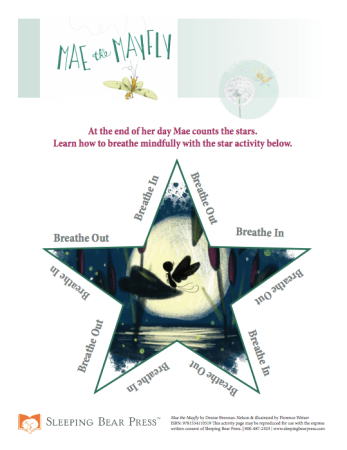
Like Mae, you can calm your mind and be present in the moment as you enjoy your surroundings. Use this printable activity to get into that peaceful state of mind. Just look at the picture inside the star and follow the breathing directions as you trace each arm. You can download it from the Sleeping Bear Press Website under Teachers Guides here:

Mae the Mayfly Mindfulness Activity
celebrate-picture-books-picture-book-review-mae-the-mayfly-cover

You can find Mae the Mayfly at these booksellers

Amazon | Barnes & Noble | Books-a-Million | IndieBound | Sleeping Bear Press

Picture Book Review

April 24 – Arbor Day

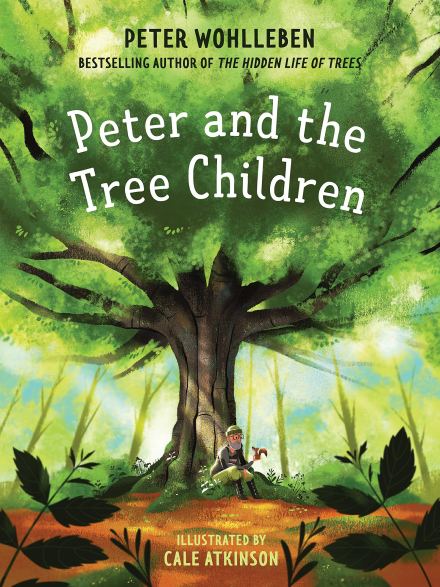
celebrate-picture-books-picture-book-review-peter-and-the-tree-children-cover

About the Holiday

Today is Arbor Day, a national celebration of trees that began as a campaign by J. Morton Sterling and his wife after they moved from Michigan to Nebraska in 1854. Morton advocated for the planting of trees not only for their beauty but as windbreaks for crops on the state’s flat farmland, to keep soil from washing away, as building materials, and for shade. In 1872, Morton proposed a tree-planting day to take place on April 10. On that day nearly one million trees were planted in Nebraska. The idea was made official in 1874, and soon, other states joined in. In 1882 schools began taking part. Today, most states celebrate Arbor Day either today or on a day more suited for their growing season. To learn about events in your area, find activities to download, and more, visit the Arbor Day Foundation website.

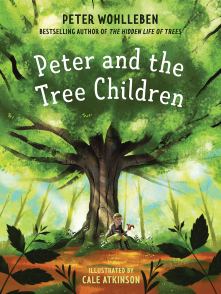
Peter and the Tree Children

Written by Peter Wohlleben | Illustrated by Cale Atkinson


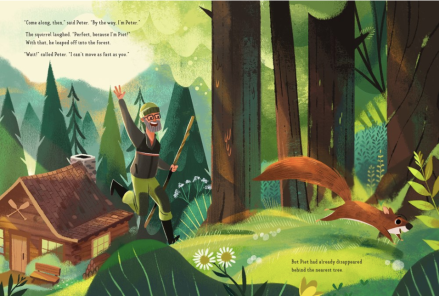
One day while Peter enjoyed his morning coffee on his porch while listening to the birds singing, “a squirrel scampered up and sat down next to him as though they were old friends.” With tears in his eyes, the squirrel told Peter that he was all alone with no family. Peter was empathetic—his children didn’t live with him anymore—but, he said, “‘I still have the trees.’” He then told the squirrel how tree families live in the forest and asked if he would like to go look for some. This cheered the squirrel, and they headed out into the woods. On the way, Peter introduced himself, and the squirrel said his name was Piet.

celebrate-picture-books-picture-book-review-peter-and-the-tree-children-piet

Image copyright Cale Atkinson, 2020, text copyright Peter Wahlleben. Courtesy of Greystone Kids.

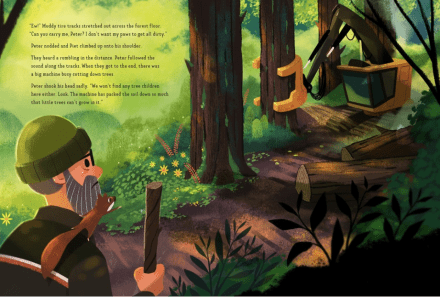
When they reached a sunny clearing, Piet wondered where the tree children were. Peter told him it was too hot there and led the way deeper into the woods. The way was muddy, so Piet climbed on Peter’s shoulders. In the distance, they could hear a loud rumbling. As they grew nearer, they saw a “big machine busy cutting down trees.” Peter told Piet that they wouldn’t find tree children here either because the heavy machine had “‘packed the soil down so much that the little trees can’t grow in it.’”

celebrate-picture-books-picture-book-review-peter-and-the-tree-children-machine

Image copyright Cale Atkinson, 2020, text copyright Peter Wahlleben. Courtesy of Greystone Kids.

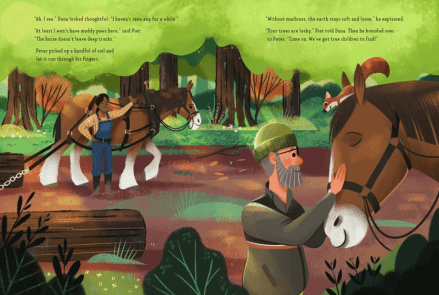
They walked on sadly until they heard another noise. It was Peter’s friend Dana and her horse dragging a tree trunk. Piet introduced himself and told Dana of their mission to find tree children. She said she hadn’t seen any for a long time while Peter explained to Piet that Dana’s horse left the soil soft and loose unlike the big machine. After a close call with a hawk, Piet rode in Peter’s jacket.

celebrate-picture-books-picture-book-review-peter-and-the-tree-children-Dana

Image copyright Cale Atkinson, 2020, text copyright Peter Wahlleben. Courtesy of Greystone Kids.

They came to a rocky overlook where they watched a crew planting small trees in a clearing below. Peter looked at all of the big trees that had been cut down, and his face turned red with anger. Piet sniffed one of the little trees, wondering if they’d found tree children at last. He liked the orangey scent the seedling gave off. But Peter told him the trees were sad. “‘This smell is how trees talk to each other, and it means that the trees don’t feel so well. They miss being shaded and protected by their families.’” He wanted to show Piet some happy trees.

celebrate-picture-books-picture-book-review-peter-and-the-tree-children-overlook

Image copyright Cale Atkinson, 2020, text copyright Peter Wahlleben. Courtesy of Greystone Kids.

At last they came to a dark, cool beech forest, where “the silvery-gray trees formed a roof of leaves way up high.” On the ground Piet noticed “‘butterflies everywhere.’” Peter chuckled and told him that those green fluttering wings weren’t butterflies but “‘freshly sprouted beech children.’” Now it was Piet’s turn to laugh. He told Peter how he had hidden beechnuts in this spot in the fall and then forgotten where he’d buried them. They both thought that this forest where beech trees and their children grew together was the most beautiful they’d ever seen.

The sun was beginning to set, so they started the long walk home. Back on Peter’s porch, Piet looked sad again. He didn’t eat the snack Peter brought him and a tear rolled down his cheek. Everyone had a family except him, he said. Peter picked Piet up and told him that he liked him very much. Then he invited him to stay. “Piet’s eyes grew wide. ‘Does that mean we’re family now?’” Peter replied “‘Of course.’” Piet smiled, and then they made plans to visit the tree children again tomorrow.

Back matter reveals five more fascinating facts about how trees grow.

celebrate-picture-books-picture-book-review-peter-and-the-tree-children-lodge

Image copyright Cale Atkinson, 2020, text copyright Peter Wahlleben. Courtesy of Greystone Kids.

Peter Wohlleben’s engaging guides, Peter and Piet, educate children about the conditions necessary for trees to grow from seed to adult in his follow up to The Hidden Life of Trees for adults and Can You Hear the Trees Talking? For older children. In an attempt to cheer up Piet, Peter takes him into the forest in search of tree families and their little ones. Along the way, readers learn about the harmful effects of heavy logging machinery and the benefits of sustainable forestry. They also discover the fascinating fact that trees talk to each other through scent, which will inspire them to learn more. Adverse conditions and natural dangers draw Peter and Piet closer together, building a bond that culminates in Peter’s adopting Piet as a new family member. This turn of events, as well as Piet’s part in helping to foster the tree children they find, will cheer young readers.

Little ones will immediately empathize with Cale Atkinson’s cute squirrel, Piet, as he shares his sadness at not having a family with Peter. As Peter and Piet head into the forest, Atkinson’s sun-dappled pages invites readers to point out the butterflies, caterpillars, and flowers along their route. Kids may be surprised to see Dana and her horse and want to learn more about this type of forestry. Images of the impressive beech tree and thriving tree children will spur readers to look for young seedlings and saplings among stands of trees in their own area.

Ages 4 – 8

Greystone Kids, 2020 | ISBN 978-1771644570

Discover more about Peter Wohlleben, his books, and his work on his website.

To learn more about Cale Atkinson, his books, and his art, visit his website.

You can find Peter and the Tree Children at these booksellers

Amazon | Barnes & Noble | Books-a-Million | IndieBound

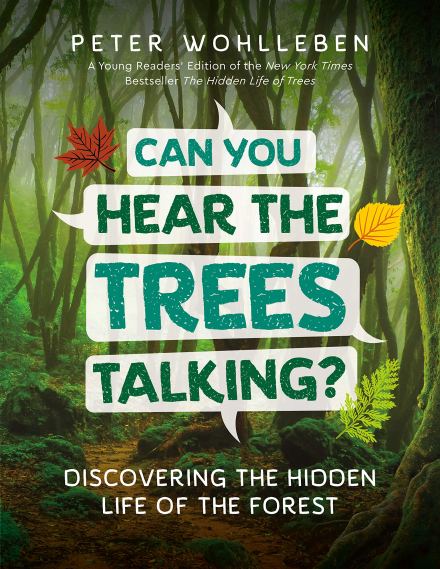
celebrate-picture-books-picture-book-review-can-you-hear-the-trees-talking-cover

Can You Hear the Trees Talking? Discovering the Hidden Life of the Forest

By Peter Wohlleben


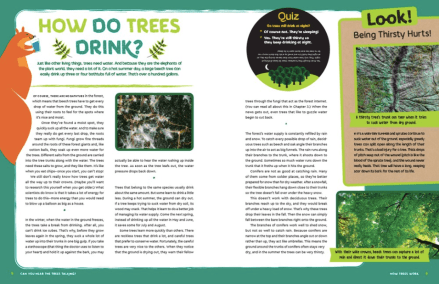
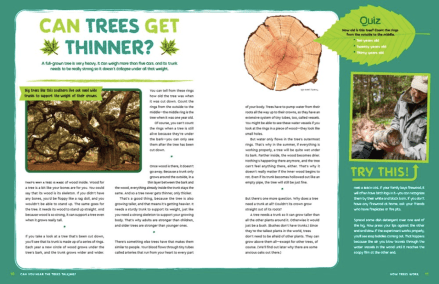
For older children, Peter Wohlleben’s endlessly astonishing Can You Hear the Trees Talking? Reveals the depth of senses, awareness, and long-lasting family bonds that trees possess. In seven chapters, Wohlleben discusses in a conversational tone how trees work, what it’s like for them growing up in a forest, trees’ friends and enemies, how types of trees are different, forest animals, the impact of trees, and a tree’s transformations over a year. Each chapter is broken into short sections of discussions on one topic, illustrated with stunning photographs that clearly depict the concept.

Here are just a few highlights:

From Do Trees Have Grandparents?: Trees can recognize members of their own family. How? Through their roots! “If a tree’s roots meet those of a neighboring tree, the can check whether they belong to the same species.” If they are related, “now their roots will grow together. The trees send messages and exchange the sugar they have made through this connection. It’s as if they’ve invited each other to dinner.” And what about old stumps? Looking at the condition of the stump can tell you a lot. “If the bark is falling off and the stump is rotten, the tree is out of touch with its neighbors” and is no longer alive. “If the edge of an old stump is very hard and still has solid bark, the stump is still alive… [and] getting food from its family through its roots.”

Screen Shot 2020-04-23 at 4.23.16 PMcelebrate-picture-books-picture-book-review-can-you-hear-the-trees-talking-breathe

Copyright Peter Wohlleben, 2019, courtesy of Greystone Kids.

In What Do Tree Children Learn at School? kids discover that mother trees don’t leave their children alone and on their own. Mother trees search out their children with their roots, and when they’ve found them, these caring mothers connect with their babies and nurse them with sugar water. They need this nourishment because “in an old-growth forest, it’s very dark at ground level. With so little light, the tree children can’t produce their own sugar with their leaves, so they have to rely on their parents.

Can Trees Talk? Reveals that “a single tree notices when something bites it. After the initial shock, the tree will taste who is nibbling on it. Yes, you read that right: trees can taste. Because whenever an animal bites into the bark, a leaf, or a branch, it injects a bit of saliva into the wound. And every animal’s spit tastes different.” The tree then pumps a foul-tasting or even poisonous liquid into the site that wards off the predator. For example, to defeat bark beetles, trees “release a sticky, bitter substance called pitch” that trap beetles. The tree then alerts other trees to the danger by releasing a scent that causes nearby trees to begin generating pitch for themselves.

celebrate-picture-books-picture-book-review-can-you-hear-the-trees-talking-drink

Copyright Peter Wohlleben, 2019, courtesy of Greystone Kids.

We all know that animals, such as squirrels, hide food for the winter, but did you know that jays are masters of this autumn task? In Who’s the Best Forest Detective? Kids learn that when jays bury nuts and worms there are certain considerations. “Acorns and beechnuts remain fresh for more than six months, while dead earthworms only last a few days. The bird knows it has to eat the worms first so they don’t spoil.” And with the ability to “remember up to ten thousand hiding places,” quickly finding his stash is easy. “Usually, two thousand acorns and beechnuts are enough to see it through the winter. But because the jay can’t be sure that will be enough, it prefers to bury a few thousand more just in case.”

celebrate-picture-books-picture-book-review-can-you-hear-the-trees-talking-thinner

Copyright Peter Wohlleben, 2019, courtesy of Greystone Kids.

With quizzes, prompts for observation, and interesting experiments to try, Can You Hear the Trees Talking? will keep young readers riveted to the pages and eager to get out into nature to explore the trees in a forest, a park, in their neighborhood, and close to home. This book would make a superb and often-referred-to addition to home, school, and public library collections.

Ages 8 – 12 and up

Greystone Kids, 2019 | ISBN 978-1771644341

You’ll find a Can You Hear the Trees Talking? Companion Guide for parents and teachers to download on the Greystone Books website.

Discover more about Peter Wohlleben, his books, and his work on his website.

You can find Can You Hear the Trees Talking? at these booksellers

Amazon | Barnes & Noble | Books-a-Million | IndieBound

Arbor Day Activity

celebrate-picture-books-picture-book-review-paper-plate-tree-craft-2

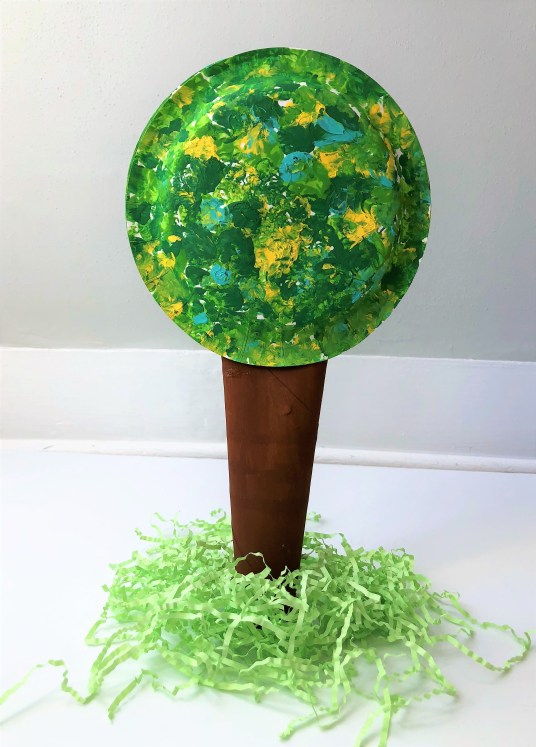
Paper Plate Tree


On Arbor Day children love planting trees in their yard or as part of a community project. With this easy craft, they can also make a tree for the table or to hang on their wall or bulletin board.

Supplies

  • Two paper plates 
  • Paper towel tube
  • Brown craft paint
  • Green craft paint (using a variety of green paints adds interest)
  • Paintbrush, cork, or cut carrot can be used to apply paint
  • Glue or hot glue gun or stapler

Directions

  1. Paint the paper towel tube brown, let dry
  2. Paint the bottoms of the two paper plates with the green (or other color) paints, let dry
  3. Flatten about 4 inches of the paper towel tube 
  4. Glue or tape the flat part of the paper towel tube to the unpainted side of one paper plate
  5. Glue the edges of the two paper plates together, let dry.
  6. Pull out the bottom of the tube so the tree can stand up, or hang your tree on a wall or bulletin board or in a window

celebrate-picture-books-picture-book-review-peter-and-the-tree-children-cover

You can find Peter and the Tree Children at these booksellers

Amazon | Barnes & Noble | Books-a-Million | IndieBound

Picture Book Review

April 20 – It’s National Humor Month

celebrate-picture-books-picture-book-review-when-a-tree-grows-cover

About the Holiday

National Humor Month was established in 1976 by comedian and author Larry Wilde, who is also the director of the Carmel Institute of Humor, to promote all things funny and raise awareness of the benefits of laughter and joy. The health benefits of an optimistic outlook are well documented. Lightheartedness also improves communication skills and boosts morale. Reading funny books is a fantastic way to share a laugh—for kids and adults—and to encourage a love of literature. In fact, there’s even a Funny Literacy Program that offers lots of resources and activities to fill your days with humor! Click here to learn more. This year, perhaps more than any, a little laughter helps us and our kids get through difficult times. Get started with today’s book and enjoy a laugh not only during April but every day! 

I received a copy of When a Tree Grows from Sterling Children’s Books for review consideration. All opinions are my own.

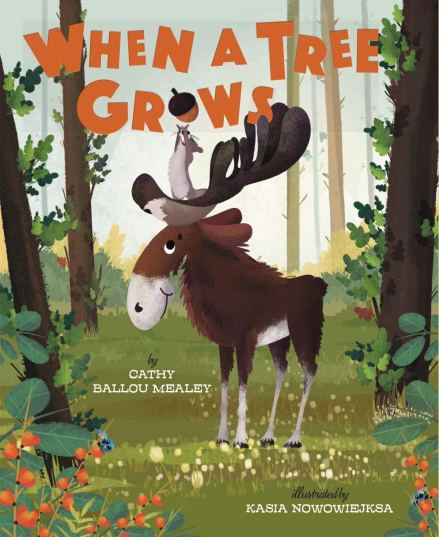
When a Tree Grows

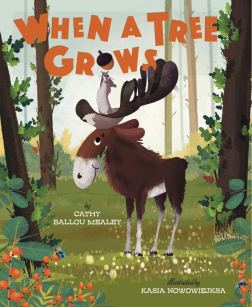
Written by Cathy Ballou Mealey | Illustrated by Kasia Nowowiejska


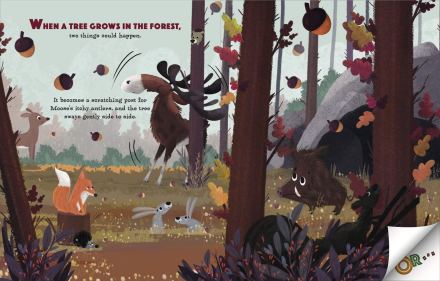
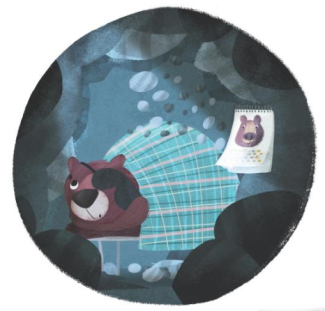
We all know that age-old question “When a tree falls in a forest does it make a sound?” Inexplicably, this riddle seems to forget all about the adorable woodland animals—many of which we meet in this hilarious book that poses many thought-provoking conundrums of its own. For instance: “When a tree grows in the forest, two things can happen. It becomes a scratching post for Moose’s itchy antlers, and the tree sways gently side to side. OR… CRASH-BOOM! Moose pushes a little too hard, the tree falls on a cave, and the bear inside wakes up.”

celebrate-picture-books-picture-book-review-when-a-tree-grows-scratchcelebrate-picture-books-picture-book-review-when-a-tree-grows-scratch

Image copyright Kasia Nowowiejska, 2019, text copyright Cathy Ballou Mealey, 2019. Courtesy of Sterling Children’s Books.

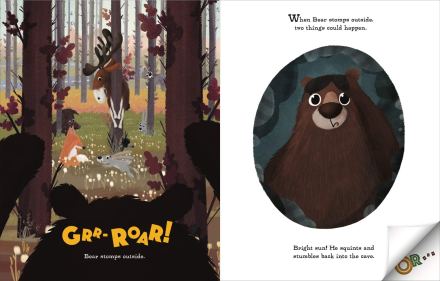
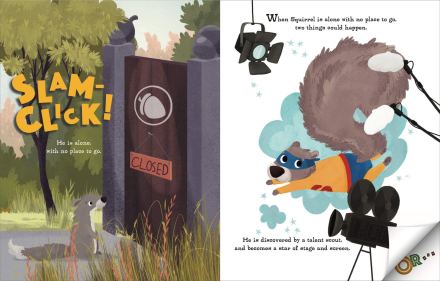
But how does Bear react? He can stay inside… OR come out to see what all the ruckus is about. And when he comes outside? Well, the domino effect could take over the forest… OR not. Alert readers will notice that Bear’s not the only one affected by the falling tree. Squirrel loses his home, but does he find the perfect replacement when a Nifty Nuts truck loaded with acorns gets entangled in this roller-coaster ride of a story… OR not?

celebrate-picture-books-picture-book-review-when-a-tree-grows-bear

Image copyright Kasia Nowowiejska, 2019, text copyright Cathy Ballou Mealey, 2019. Courtesy of Sterling Children’s Books.

As readers follow the action, they’ll wonder—will Squirrel discover a lifetime supply of nuts? Fame and fortune? An empty spot in his heart? And when (if?) “Scribble-Scratch! He writes a letter to Moose,” will Moose eat it or read it? The answers to these forest-related questions lead to a fantastic welcome-home feast with party hats and decorations and, of course, lots and lots of acorns that Squirrel will either gobble all up… OR….

celebrate-picture-books-picture-book-review-when-a-tree-grows-squirrel

Image copyright Kasia Nowowiejska, 2019, text copyright Cathy Ballou Mealey, 2019. Courtesy of Sterling Children’s Books.

Nuttiness abounds in this funny story that will have kids on the edge of their seats and excitedly chiming in as each situation plays out, leading to more and more consequences for Squirrel. Cathy Ballou Mealey’s action-packed storytelling, punctuated with onomatopoeia, makes each page a joy to read aloud. Underlying all of the shenanigans is a sweet friendship story that will tug at readers’ hearts as the gently suspenseful circumstances seem to take Squirrel farther and farther away from the forest. Kids will cheer along with Moose, Bear, and a bevy of other cute animals as they celebrate Squirrel’s homecoming and enthusiastically approve of what Squirrel does with his windfall to guarantee that all the friends can stick together forever.

celebrate-picture-books-picture-book-review-when-a-tree-grows-bear-awake

Kasia Nowowiejska populates this most friendly of forests with adorable, wide-eyed animals whose expressions perfectly reflect their dilemmas without giving away the secret answers. Kids will laugh out loud to see Moose nervously clinging half-way up a tree as Bear growls, applaud squirrel’s aim with a slingshot, and wish they could join in the party when Squirrel comes home. Nowowiejska’s beautiful earth-tone color palette provides depth and texture to the lush foliage while highlighting each animal’s choices in clever and original ways that kids will love. The onomatopoeic phrases are spotlighted with vibrant, bold lettering, ensuring that readers will add their own spin to this fun element of the story.

No “OR…”s about it, When a Tree Grows will be a hit for lively, animated story times and would be an often-requested addition to home, classroom, and public libraries.

Ages 3 and up 

Sterling Children’s Books, 2019 | ISBN 978-1454921202

Discover more about Cathy Ballou Mealey and her books on her website.

To learn more about Kasia Nowowiejska, her books, and her art, visit her website.

Meet Cathy Ballou Mealey

celebrate-picture-books-picture-book-review-Cathy-Mealey-headshot

Cathy Ballou Mealey lives with her family north of Boston, where she delights in watching silly squirrel antics and is waiting patiently for a moose to appear. Her favorite nut is the hazelnut and her favorite cupcake is cardamom crème.

Thank you for inviting me to the fabulous Celebrate Picture Books! I am delighted to join your celebration of Get Caught Reading Week by talking about writing inspiration and what we might learn from our hobbies and jobs, and also sharing a story starter for a favorite fall holiday!

I’m delighted that we get to talk about all of these things—and more! So let’s get started at the beginning of your journey with When a Tree Grows!

What was the spark of inspiration that led to When a Tree Grows?

When A Tree Grows was inspired by a distant creaky Crash! that I heard in the woods while hiking with my family. Was it a falling tree? An animal? I wondered: What if that crash had scared a bear or frightened a deer?

Building on that “OR” question, I framed a wacky story with two different possible outcomes, one rather expected and one funny, unexpected outcome. Readers will find that “OR” spotlighted on the bottom corner of each recto page with a clever curled paper art effect.

You must have had fun coming up with the alternate scenarios in your book. Can you share any that didn’t make the cut?

An early draft had a sweet city scene between Squirrel and a pigeon, but it didn’t make the final cut. It was tender and poignant, but needed a funnier alternative outcome to move the storyline along. In the end, I am happy that only Squirrel, Moose and Bear share the spotlight!

I love Kasia Nowowiejska’s illustrations that combine adorable, expressive animals with silly antics. Do you have a favorite spread? Did anything in the illustrations surprise you? 

I agree! Kasia is from Poland, and I loved the European flair in her forest sketches. Seeing the warthog was a complete, delightful surprise. Warthogs are not animals we would typically see in a North American woodland, and that leads to great discussions with young readers.

You have degrees in psychobiology and classical civilization. Can you describe these a bit and how they are connected? Does your study of psychobiology help inform the character development in your stories?

Psychobiology is the study of the brain, behavior and cognitive processes. I found it fascinating to research why and how we think, feel and do the things we do! I learned how to be a good observer, listener, and follower of the empirical method. I also studied classical civilization because I loved Latin, and the professors were extremely gifted storytellers. They brought ancient texts to life through dramatic readings and captivating extemporaneous performances. Exactly how these field of study inform my present work is unclear, but a liberal arts education really does cultivate curious minds!

In your bio, you also say that you were a crossing guard, hash-slinger, gift-wrapper, and pet sitter. This sounds like perfect prep for becoming a picture book author! Have any of these jobs inspired a story? Do you have a funny or surprising experience you’d like to share?

Writers DO find a way to wring fictional purpose out of anything, don’t we? I have found that one common theme across many of my stories is work. In When A Tree Grows, Squirrel gets a job in the Nifty Nuts factory as a quality control inspector. That’s one job I have not done! But working as a department store gift-wrapper was a job where quality mattered. Customers could buy a specialty paper/ribbon combination or choose the free “store wrap” which was red with tiny white checkered squares. The squares had to line up perfectly, no matter how lumpy or bumpy the item was, or the boss would make us re-wrap it. Wrap a floor lamp? Rocking chair? I like to imagine one of my co-wrappers invented printed gift bags out of desperation.

In previous interviews, you’ve described how you wrote your first picture book to enter the Cheerios “spoonful of stories” contest. But did you always like to write? What kinds of writing did you do? What inspired you to try the picture book form?

As a kid I loved to write and illustrate greeting cards, so my earliest efforts were short and to the point, just like picture books. I also wrote scripts for Muppet-like puppet shows, assigning the best roles to myself, of course. When school assignments piled up and writing lost its luster, I stopped scribbling for pleasure. Decades later, having children led to reading many picture books and to many boxes of Cheerios. So those factors definitely helped re-ignite my passion for writing and picture books specifically.

When a Tree Grows was released on April 2. What have you found to be the best part of being a published author? If you’ve held any book events, can you describe the reactions of kids to your story?

Of course seeing Tree on bookstore shelves and in readers’ hands is delightful. Hearing people laugh at the funny spots is a thrill! I like to ask a helper to wave a big sign that says “OR” to dramatize the page turns during readings. And kids love to see Squirrel scooping coins out of the fountain to buy a bus ticket home – so naughty!

What’s up next for you?

Next up for me is a still-secret, super funny picture book with an amazing publisher in Canada. A sloth and a squirrel team up for a special mission. Look for an announcement soon, and a book sometime in 2021!

What’s your favorite holiday and why?

Halloween – because it is in the fall, my favorite season. It also happens to be my birthday! Costumes, candy, glowing pumpkins, being outside after dark – all these elements make magical memories for kids. And on top of all that I got a cake, candles, and presents too? Pretty great.

Has a holiday ever influenced your work?

What a great idea! Let’s imagine re-casting When A Tree Grows as a Halloween story.

When an Owl hoots in the forest on Halloween, two things could happen.

Warthog blows out the candle in her pumpkin. Trick or treat is over.

OR…

Eek! Warthog is startled and tosses her candy into the air.

When Warthog tosses her candy into the air, two things could happen.

What do YOU think should happen next?

Oh my! Let’s see…

Bat neatly snatches all the candy out of the air with her trick-or-treat bag.

OR…

A candy corn ricochets off a tree and bonks bat, sending her wildly off course.

Readers? What do YOU think? Add your ideas in the comments section below!

Well, this was tons of fun, Cathy! I’m so glad we had a chance to chat! I wish you all the best with When a Tree Grows!

You can connect with Cathy Ballou Mealey on

Her website | Facebook | Instagram | Twitter

Get Caught Reading Month Activity

celebrate-picture-books-picture-book-review-moose-headband-craft-when-a-tree-grows

Moose starts a whole string of events in today’s book! What will you get up to in your own moose antlers?

Supplies

  • Stiff brown paper
  • Brown hair band
  • Pencil
  • Scissors
  • Tape

Directions

  1. Trace your hands with fingers spread on the brown paper. Leave a 1 – 2 inch tab on the end of the wrist for wrapping around the head band
  2. Cut out the hand prints
  3. Place one hand print on the right side of the headband with the thumb of the hand pointing up.
  4. Wrap the tab around the headband and secure with tape
  5. Place the second hand print on the left side of the headband with the thumb pointing up.
  6. Wrap the tab around the headband and secure with tape.

celebrate-picture-books-picture-book-review-when-a-tree-grows-cover

You can find When a Tree Grows at these booksellers

Amazon | Barnes & Noble | Books-a-Million | IndieBound

Picture Book Review

April 16 –National Orchid Day

celebrate-picture-books-picture-book-review-flower-talk-cover

About the Holiday

National Orchid Day was established to celebrate one of the world’s most intricate and diverse flowering plants. With over 25,000 recognized species each, the orchid and the sunflower families of flowers vie for the title of largest as new species are discovered every year. Orchids range in size from a tiny 2.1mm flower with transparent petals only one cell thick to the grammatophyllum speciosum or Queen of Orchids, which grows to nearly 10 feet tall. Vivid coloring and striking patterns make the petals of each species things of wonder and prized plants for homes and botanical gardens. To celebrate today, learn how flowers use their colors and other features with today’s book!

I received a copy of Flower Talk: How Plants Use Color to Communicate from Millbrook Press to check out. All opinions are my own.

Flower Talk: How Plants Use Color to Communicate

Written by Sara Levine | Illustrated by Masha D’yans


A little purple prickly pear has something he wants to get off his spines. He shouts up at the reader holding the book. “Pssst! Down here! That’s right—I’m a plant, and I’m talking to you!” Once the reader is all attention, he goes on: “I want to clear up some of your crazy ideas about what the colors of our flowers mean.” You’ve got it all wrong if you think “red roses stand for love and white ones are good for weddings.” The prickly pear may see that the reader feels a bit confused, even a little embarrassed, so he softens his tone a bit and explains that while we may interpret a flower’s colors in certain ways, that’s not what they’re really for.

celebrate-picture-books-picture-book-review-flower-talk-cactu

Image copyright Masha D’yans, 2019, text copyright Sara Levine, 2019. Courtesy of Millbrook Press.

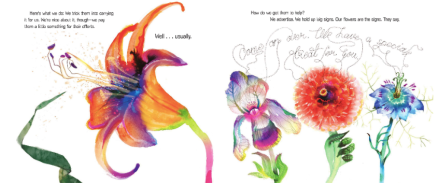
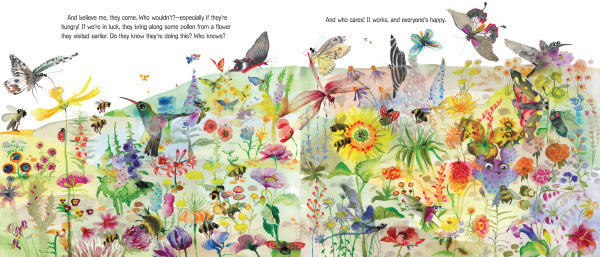
He then continues to reveal “we use our flowers to talk to the animals” so that we can make seeds and more plants. To do that each plant needs pollen from another plant of the same kind. Flowers are like big ads, the prickly pear explains, that attract just the right birds, bees, or butterflies to help them out. Often, if they’re hungry, they fly from flower to flower and bring pollen along with them.

celebrate-picture-books-picture-book-review-flower-talk-insects

Image copyright Masha D’yans, 2019, text copyright Sara Levine, 2019. Courtesy of Millbrook Press.

But how does each bird, butterfly, or bee know which flowers to pollinate? That’s where a flower’s colors come in, the prickly pear says. “A flower’s color invites specific animals to visit.” Then he lets children in on their conversations. Hear the red flowers talking? They’re calling out to birds, offering hummingbirds a bit of nectar in exchange for carrying pollen. Insects can’t see the color red. Blue and other vibrant flowers whisper sweet nothings to bees, inviting them to take along some pollen – to their hives and also to other flowers, thanks! White flowers are perfectly hued to attract pollinators at a particular time of day. Brown flowers may not be showy, but they appeal to certain insects too. And green flowers? Well they don’t need to talk at all. The prickly pear encourages kids to guess why.

celebrate-picture-books-picture-book-review-Flower-talk-ads

Image copyright Masha D’yans, 2019, text copyright Sara Levine, 2019. Courtesy of Millbrook Press

Colors aren’t the only trick that flowers have either. Most emit a scent and some are just the right shape. But now, the prickly pear excuses himself with an abrupt “Go take a hike.” Why the brush off? It seems he’s making a new flower and is just about done with it. When you see it, you’ll think it’s the bee’s knees!

Back matter includes an illustrated step-by-step look at how pollination works, information on how to protect pollinators, and a list of other books for further reading.

celebrate-picture-books-picture-book-review-flower-talk-field

Image copyright Masha D’yans, 2019, text copyright Sara Levine, 2019. Courtesy of Millbrook Press.

With an impish attitude, Sara Levine’s hilarious and knowledgeable prickly pear narrator engages kids in witty banter while taking them on a colorful garden tour. As the cactus explains a plant’s growing cycle and the need for pollinators, the information it imparts is eye-opening for children and adults. Why and how each flower’s color and scent attract just the right pollinator is clearly described in conversational language that kids will laugh along with and learn from. Every page contains an “ah-ha” moment that will spark discussion and an excitement to plant a colorful garden and watch nature at work.

Like a riotous field of wildflowers, Masha D’yan’s dazzling illustrations put colors on glorious display as the flowers lure insects and animals to them. D’yan’s detailed images provide a great place for young naturalists to start researching the various plants introduced. Depictions of the prickly pear, birds, and bees match the humor of Levine’s text. Kids will love lingering over the two-page spreads to point out the various animals and insects and how they interact with the plants. They’ll also like following the growth of the prickly pear’s bud as it grows bigger and blossoms.

A superb book for teaching children about this fascinating feature of flowers and plants as well as providing a guide for gardeners interested in attracting a variety of pollinators, Flower Talk: How Plants Use Color to Communicate would be an outstanding addition to home, classroom, and public libraries.

Ages 7 – 11

Millbrook Press, 2019 | ISBN 978-1541519282

Discover more about Sara Levine and her books on her website.

To learn more about Masha D’yans, her books, and her art, visit her website.

National Plant a Flower Day Activity

celebrate-picture-books-picture-book-review-flower-pot-stake-craft

Flower Garden Stakes


It’s fun to start a garden from seeds, but how do you remember what you’ve planted where? With these easy to make garden stakes, you can mark your pots with style! 

Supplies

  • Wide craft sticks
  • Chalkboard paint in various colors
  • Colorful chalk
  • Paint brush

Directions

  1. Paint the stakes with the chalkboard paint, let dry
  2. With the chalk, write the name of the different flowers or plants
  3. After planting your seeds, stick the stake in the pot 
  4. Wait for your seeds to grow!

celebrate-picture-books-picture-book-review-flower-talk-cover

You can find Flower Talk: How Plants Use Color to Communicate at these booksellers

Amazon | Barnes & Noble | Books-a-Million | IndieBound

Picture Book Review

April 14 – National Gardening Day

celebrate-picture-books-picture-book-review-in-the-garden-cover

About the Holiday

For many of us, spring means gardening. Today’s holiday encourages avid gardeners and those new to this rewarding activity to turn over some dirt, plant seeds, and prepare to tend the little sprouts on their way through the season. While this year may pose challenges to regular gardening routines, ordering options, creative solutions

In the Garden

By Emma Giuliani


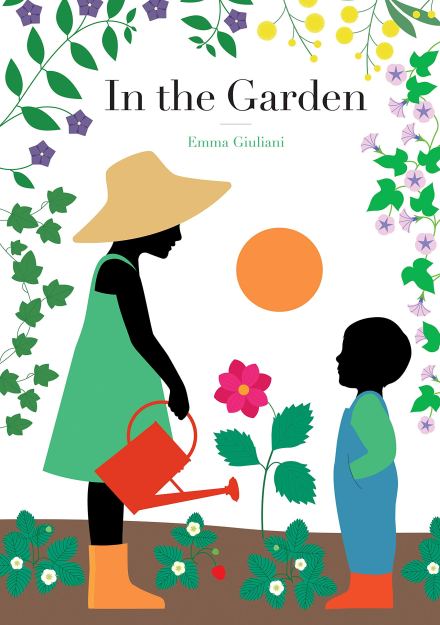
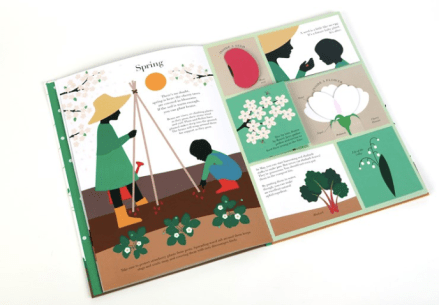
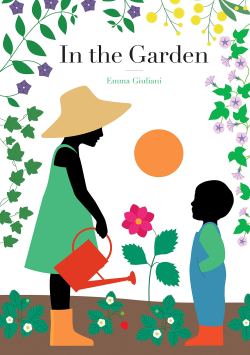
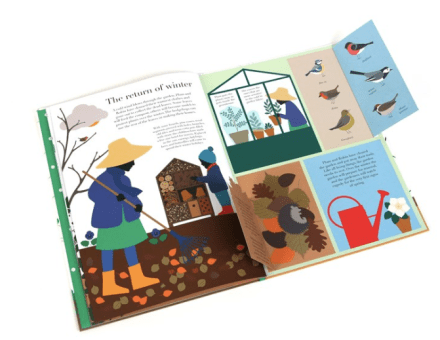
In her stunningly illustrated interactive guide through the seasons, Emma Giuliani introduces Plum and her little brother, Robin, and invites readers to join them as they tend to their garden and all the plants, animals, and birds that call it home. Plum and Robin begin at winter’s end. “This morning it’s cold. It’s not yet spring, but, in the garden, Plum and her brother Robin see the first catkins appearing on the branches of the willows and hazels. The blossoming mimosa makes the gardeners impatient for spring to come.” As Robin counts the long, drooping catkins, Plum rakes a layer of compost over the ground. On the facing page, children get a close-up view of the fuzzy catkins, can peek inside a bud, burrow underground with earthworms just waking from hibernation, and view a few early bloomers. They also learn about what makes up the earth’s soil and get a recipe for compost.

celebrate-picture-books-picture-book-review-in-the-garden-shed

Copyright Emma Giuliani, 2020, courtesy of Princeton Architectural Press.

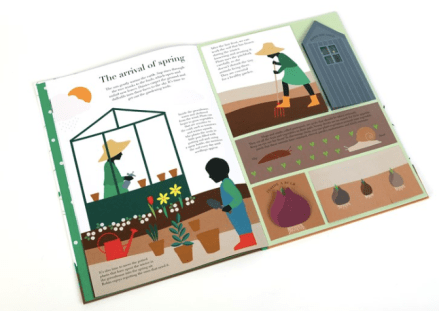
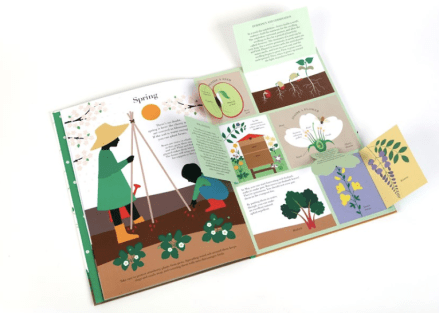
With the arrival of spring, Plum is in her little greenhouse, planting vegetable seeds and spritzing the soil with water to keep it moist while Robin repots some plants who have spent the winter in the greenhouse. Outside, Plum aerates the garden bed with a pitchfork, careful of any tiny creatures below. Children can open the door to Plum’s well-stocked shed to see all the tools tidily stored there and lift the flaps to look inside a bulb and help a hyacinth, a daffodil, and a tulip grow.

celebrate-picture-books-picture-book-review-in-the-garden-open-shed

Copyright Emma Giuliani, 2020, courtesy of Princeton Architectural Press.

At last the warm weather of spring has arrived. The cherry trees are blossoming, and Plum and Robin are setting stakes and planting bean seeds. Next, they provide protection for the tender strawberry plants that are beginning to bloom. Young gardeners will enjoy opening a bean seed to learn what’s inside and then following its growing process. The bees are visiting the cherry blossoms, pollinating the flowers and making honey. What does a bee see as it hovers around the flower? Pull down the flap to see for yourself and learn all the parts of a flower. What other plants are flowering now? Open the flap to see!

celebrate-picture-books-picture-book-review-in-the-garden-spring

Copyright Emma Giuliani, 2020, courtesy of Princeton Architectural Press.

Summer begins and “what a joy to be in the garden in June! The gentle breeze, the smell of cut grass, and the tangy taste of strawberries and cherries make the gardeners smile.” While Plum waters the tomato plants, “Robin looks for ripe strawberries under the leaves.” Join him! Robin is also picking cherries before the birds eat them. How do those bright red, round fruits grow? Lift the flap to learn and see how they develop from flower to fruit. Plum is getting help with the aphids on the bean plants from industrious—and hungry—ladybugs. “Dragonfly larvae are transforming into graceful flying insects….Their presence is a sign of a healthy garden.”

celebrate-picture-books-picture-book-review-in-the-garden-open-spring

Copyright Emma Giuliani, 2020, courtesy of Princeton Architectural Press.

It’s high summer and the garden is glorious. Bean pods hang from the vines, and Plum contemplates whether they are ready to pick. She may leave some “husks dry out on the plant before picking them.” Dried completely indoors, they can be stored and eaten during the fall and winter. Take a look inside a pod to see the seven red beans there. Flowers greet you too: an orange marigold with petals like a pinwheel, a brilliant pink and purple fuchsia, and a perky mignon dahlia. Robin took cuttings of these plants and potted them to grow some more. Learn how you can do that with your plants too!

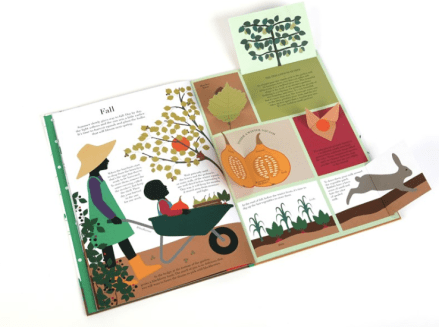
The summer heat is waning and the days are growing shorter. Fall is here. The catkins of early spring have become hazelnuts that are ready to be harvested. Even the squirrel approves! Plum and Robin teach you how to store them—and when to pick the winter squash and keep them for months as well. Can you count the number of seeds inside the winter squash? Plum’s beautiful trellised pear tree is bearing sweet fruit. Yum! But look out—a crafty rabbit is after the last leafy vegetables in the garden. No need for a fence, though. Milk will do the trick of shooing him away.

celebrate-picture-books-picture-book-review-in-the-garden-open-fall

Copyright Emma Giuliani, 2020, courtesy of Princeton Architectural Press.

The air is chilly again and winter is on the horizon. “Plum and Robin have donned their warmest clothes and gone out to collect the dead leaves. Some leaves will feed the compost, others will become mulch to protect plants over the winter. The hedgehogs can use the rest of the leaves in making their homes.” Do you see the pile of crunchy leaves? Lift them gently…shhh! A hedgehog is snoozing underneath. Robin and Plum have built an insect hotel to keep the bugs cozy during the winter and have filled the greenhouse again. For the colorful birds who stay awhile or all winter, Robin and Plum put out a bird feeder and fill it with locally produced seeds.

After putting all of their tools back in the shed, Plum and Robin head indoors to plan next year’s garden and “watch eagerly for the very first signs of spring.”

celebrate-picture-books-picture-book-review-in-the-garden-open-winter

Copyright Emma Giuliani, 2020, courtesy of Princeton Architectural Press.

If your family tends a garden or is thinking of starting one, Emma Guiliani’s superb book is a must. At 16 inches tall, In the Garden provides fascinating facts about plants, insects, and animals; helpful tips on when and how to plant a variety of fruit, vegetables, and flowers, information on natural ways to ward off pests; and how to recognize when fruit and vegetables are ready for picking and how to store them. Through copious flaps, children get inside views of flowers, seeds, buds, and vegetables to learn the names of each part and how they contribute to the growth of the plant. Along the way, young and adult gardeners discover how early gardening can begin, directions on how to create and use compost, when bushes can be planted, information on pollination; and how to winter over the garden for the coming spring.

Giuliani’s crisp, lush illustrations are marvels, combining intricate paper cuts that replicate the shapes of delicate bulbs and buds, flowers and seeds, smooth and serrated leaves, the long bean pod, and even Plum’s garden shed with a window in the door. Her extraordinarily beautiful color palette immerses readers in the garden experience; you can almost smell the rich earth, hear the bees buzzing at the blossoms, and feel the air changing season to season.

A brilliant resource and a joy to peruse, In the Garden is a book that adults and children—both gardeners or nature lovers—will share throughout the seasons and from year to year. The book is most highly recommended for home, school, and public library collections.

Ages 7 – 12

Princeton Architectural Press, 2020 | ISBN 978-1616898939

You can connect with Emma Giuliani on Instagram.

National Gardening Day Activity

celebrate-picture-books-picture-book-review-flower-garden-game

Plant a Flower Garden Game


With this fun game you and your family and friends can grow gardens inside! Roll the dice to see whose garden will fully blossom first!

Supplies

Directions

Object: The object of the game is for each player to fill their garden or garden rows with flowers. Depending on the ages of the players, the game can be adjusted to fill all of the rows, some or all rows, or just one.           

  1. Print one Game Board for each player
  2. Print one or more sets of Flower Playing Cards for each player, depending on how  (for sturdier playing items, print on card stock)
  3. Cut the flowers into their individual playing cards
  4. Print one Flower Playing Die and assemble it (for a sturdier die, print on card stock)
  5. Color the “dirt” on the Garden Plot with the crayon (optional)
  6. Choose a player to go first
  7. The player rolls the die and then “plants” the flower rolled in a row on the game board
  8. Play moves to the person on the right
  9. Players continue rolling the die and “planting” flowers until each of the number of determined rows have been filled with flowers or one row has been filled with all six flowers.
  10. The first person to “grow” all of their flowers wins!

To play a printable Vegetable Garden Board Game, click here.

celebrate-picture-books-picture-book-review-in-the-garden-cover

You can find In the Garden at these booksellers

Amazon | Barnes & Noble | Books-a-Million | IndieBound | Princeton Architectural Press

Picture Book Review

March 19 – The Spring Equinox

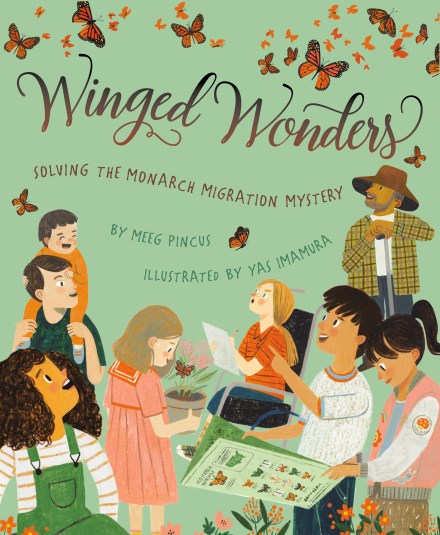
celebrate-picture-books-picture-book-review-winged-wonders-cover

About the Holiday

Today, we celebrate the first day of spring! What makes the equinox so special? On this date, day and night are equally long around the globe. With longer days and warmer weather, thoughts turn to nature and renewal. For many this means gardening for ourselves and for the returning bees and butterflies. Today’s book takes a look at one of nature’s most inspiring creatures – the monarch butterfly. 

I received a copy of Winged Wonders from Sleeping Bear Press for review of consideration. All opinions about the book are my own.

Winged Wonders: Solving the Migration Mystery

Written by Meeg Pincus | Illustrated by Yas Imamura


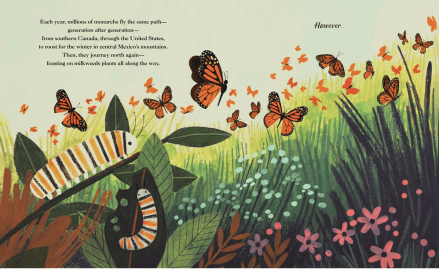
For centuries people pondered the mystery of the monarch butterflies that “swooped in for a spell, like clockwork” from who-knew-where and fluttered off to some unseen destination. People all along their route, “from southern Canada…through the middle of the United States…and all the way to central Mexico” wondered about this annual event. The mystery was finally solved in 1976. What was it that set these butterflies soaring? The newspapers called it “The Great Monarch Migration.”

celebrate-picture-books-picture-book-review-winged-wonders-citizen-scientists

Image copyright Yas Imamura, 2020, text copyright Meeg Pincus, 2020. Courtesy of Sleeping Bear Press.

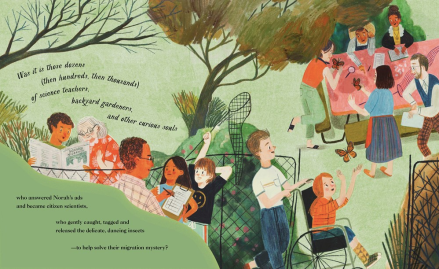
You might wonder who the person was who “tracked these winged wonders from one end of the continent to the other” and “found their secret roosting place, a marvel of nature.” Perhaps it was Fred, a scientist from Canada, who spent thirty years studying the monarchs and tagging their wings. Or maybe it was his wife, Norah, who sought help in tagging monarchs’ wings from volunteers across the country and “logged and mapped every tidbit of information they sent in to the lab.”

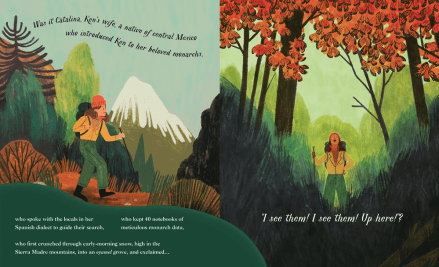
Could it have been the thousands of “science teachers, backyard gardeners, and other curious souls” who answered Norah’s plea? Or you might want to consider Ken and Catalina, a couple in Mexico who spent two years “trying to track the butterflies’ twisting trail” with the help of villagers and farmers. You might even say that it was Jim, a science teacher in Minnesota, who caught and tagged a very particular one-among-millions monarch.

celebrate-picture-books-picture-book-review-winged-wonders-catalina

Image copyright Yas Imamura, 2020, text copyright Meeg Pincus, 2020. Courtesy of Sleeping Bear Press.

So who was it? Who made that 1976 discovery? If you say all of them, you’re right! Communities across the North American countries of Canada, America, and Mexico came together to solve the mystery of one of nature’s most astounding phenomena. But now, another question concerning monarchs looms: “How will they survive?” Since that first discovery, the monarch population has dropped from “at least a billion to millions—a handful now to each hundred then” due to pesticides, pollution, and habitat destruction. Who do you think can help solve this monarch question? “The answer is really no mystery at all.”

An extensive Author’s Note following the text offers more information about the monarch migration discovery as well as ideas and projects for helping the monarch population grow and thrive.

celebrate-picture-books-picture-book-review-winged-wonders-caterpillars

Image copyright Yas Imamura, 2020, text copyright Meeg Pincus, 2020. Courtesy of Sleeping Bear Press.

Mirroring the flight of the monarchs, Meeg Pincus entices readers along the route of her story with fascinating facts about the personalities and eager citizen scientists who dedicated their lives and contributed their time to catching, tagging, and tracking these beautiful butterflies. Surprising details reveal the commitment in time and effort of so many people who enthusiastically answered Norah’s call for help. Her questioning format builds this same feel of excitement and community as page-by-page more people are added for readers to learn about and consider. Pincus’s lyrical storytelling is as buoyant and lovely as her subject while providing readers with a depth of knowledge about the process and experiences of the people along the way.

Yas Imamura’s delicate butterflies flutter above multi-hued green hills, busy downtown shops, and a golden desert before congregating like autumn leaves on a solitary tree as a deer looks on. Readers then begin to meet the scientists & participants: Fred and Norah in their well-packed car awed at spotting a monarch along their route, experimenting with wing tags, and mapping monarch sightings; a diverse group of kids and adults catching, tagging, and releasing butterflies; Ken and Catalina and the people of central Mexico, who share their colorful Día de los Muertos celebrations with these winged visitors; and finally Jim and his students.

Imamura’s glorious color palette complements the orange monarchs with soft pinks, corals, yellows, and reds while dramatically highlighting them against dark green backgrounds. Show-stopping scenes of the monarchs gathered on tree trunks and branches and the final spread of a butterfly garden are awe-inspiring and will spark children’s interest in helping to protect and help these unique creatures.

Winged Wonders: Solving the Monarch Migration Mystery is a must for home, school, and public library collections for nature lovers, citizen scientists, and any child who is a budding environmentalist as well as for lessons on science and community engagement.

Ages 7 – 10

Sleeping Bear Press, 2020 | ISBN 978-1534110403

Discover more about Meeg Pincus and her books on her website.

To learn more about Yas Imamura, her books, and her art, visit her website.

You can download an Educational Guide with activities for Winged Wonders on the Sleeping Bear Press website.

Spring Equinox Activity

celebrate-picture-books-picture-book-review-flower-garden-game

Plant a Flower Garden Game


With this fun game you and your family and friends can grow gardens inside! Roll the dice to see whose garden will fully blossom first!

Supplies

Directions

Object: The object of the game is for each player to fill their garden or garden row with flowers. Depending on the ages of the players, the game can be adjusted to fill all of the rows, some or all rows, or just one. 

Options:

  • Players can “plant” each of the six rows with multiple flowers of the same type
  • Each player can be assigned a single row and “plant” one each of the six types of flowers 
  1. Print number of Game Boards needed 
  2. Print one or more sets of Flower Playing Cards for each player, depending on how many of each flower the players want to put in each row (For example: fewer for younger children, more for older). For sturdier playing items, print on card stock.
  3. Cut the playing cards apart
  4. Print one Flower Playing Die and assemble (for a sturdier die, print on card stock)
  5. Color the “dirt” on the Garden Plot (optional)
  6. Choose a player to go first
  7. The player rolls the die and then “plants” the flower rolled in a row on the game board
  8. Play moves to the person on the right
  9. Players continue rolling the die and “planting” flowers until each of the number of determined rows have been filled with flowers or one row has been filled with all six flowers.
  10. The first person to “grow” all of their flowers wins!

celebrate-picture-books-picture-book-review-winged-wonders-cover

You can find Winged Wonders: Solving the Monarch Migration Mystery at these booksellers

Amazon | Barnes & Noble | Books-a-Million | IndieBound

Picture Book Review

March 17 – St. Patrick’s Day

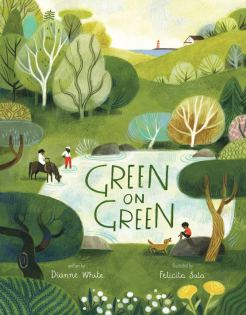
celebrate-picture-books-picture-book-review-green-on-green-cover

About the Holiday

St. Patrick’s Day commemorates the life of Saint Patrick and is celebrated on the date of his death around AD 493. Saint Patrick is known for spreading Christianity across Ireland and establishing the country’s first organized church. While he did not profess the Christian faith while growing up, he credited God for helping him to escape, after 6 years, from Irish pirates who kidnapped him at the age of 16 and put him to work as a shepherd. He believed he was later called to preach the gospel in a dream and spend 16 years preparing for this work. The first St. Patrick’s Day Feast took place in the early 1700s and the first St. Patrick’s Day Parade in the American colonies was held in New York in 1762. Today, March 17 is a day of religious significance and a day for fun. So, don’t forget to wear green, look for leprechauns, and read today’s perfectly colored book!
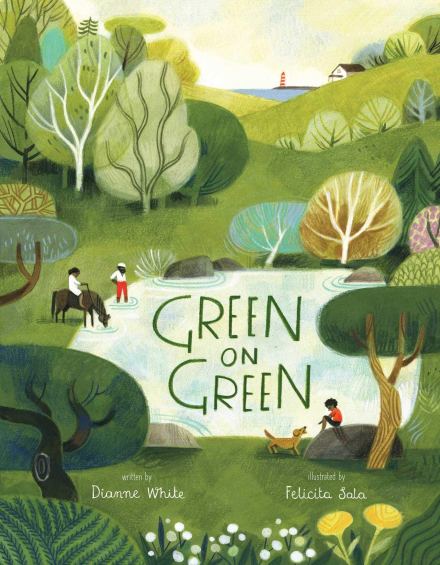
Green on Green

Written by Dianne White | Illustrated by Felicita Sala


In this gorgeous celebration of nature and the anticipation of new life, Dianne White and Felicita Sala take readers on a lyrical journey through the seasons as colors burst, meld, overlap, and give definition to our observations and activities. The story opens in springtime, where a little boy and his mom, who’s just showing a baby bump, enjoy a field of yellow and blue flowers. Red accents include a small ladybug, the boy’s shirt, and a lighthouse in the distance.

celebrate-picture-books-picture-book-review-green-on-green-lemonade

Image copyright Felicita Sala, 2020, text copyright Dianne White, 2020. Courtesy of Beach Lane Books.

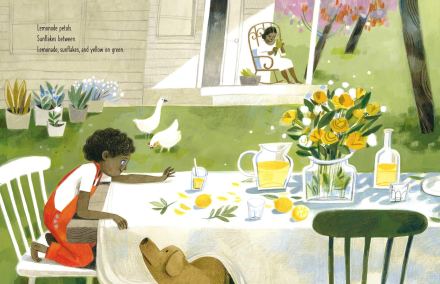
At home the thirsty boy reaches across a picnic table, decorated with those wildflowers, that holds “Lemonade petals. / Sunflakes between. / Lemonade, sunflakes, and yellow on green.” Spring is also soft blue skies, white birds like miniature clouds, and a pond where cattails and water lilies grow and a little splash promises the boy underwater discovery. Of course, spring also means changing weather and so the boy in his yellow rain boots runs through his yard, where “breezes and rain and yellow on green” make art from a showery day.

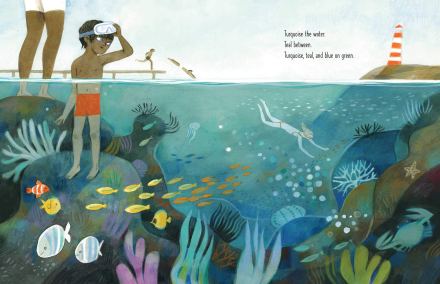
Summer comes with its brilliant blue ocean trimmed in white and blue seashells that dot the sand. Underneath, more colors appear. Now, “Turquoise the water. / Teal between. / Turquoise, teal, and blue on green.” Summer is also as golden as the full sun and ripe peaches enjoyed on a picnic with friends. Soon, there will be another child to join them.

celebrate-picture-books-picture-book-review-green-on-green-ocean

Image copyright Felicita Sala, 2020, text copyright Dianne White, 2020. Courtesy of Beach Lane Books.

Autumn appears with its own palette of red and yellow, orange and… “Brown the squirrel. / Brown the mouse. / Brown the trees around our house.” The baby is growing bigger now and the family gathers inside for hot soup, steaming cups of tea, and homemade bread. Later, their friends will join them for Thanksgiving dinner with a full “table and candles and brown on green.”

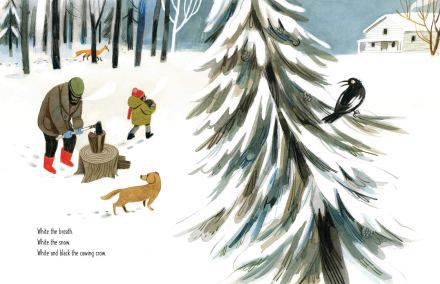
Winter brings “White the breath. / White the snow. / White and black the cawing crow” as  the little boy and his dad chop and carry wood for their fire. They then take a walk along snowy ridges past other homes with smoking chimneys and a herd of deer foraging for food and leaving hoof prints in the pristine blanket of white.

The holidays come and go and late winter sees the birth of the family’s newest member. As Mom rocks the baby to sleep, Dad takes his son outside to see new life there too among the trees. In the glow from the windows, the violet twilight, the quiet earth, and the anticipation of spring, they know: “Peaceful the evening. / Pine between. / Evening and pine and green…on green.”

celebrate-picture-books-picture-book-review-green-on-green-winter

Image copyright Felicita Sala, 2020, text copyright Dianne White, 2020. Courtesy of Beach Lane Books.

Dianne White’s tender and serene tribute to the cyclical hues and emotional cues of life is a beautiful read aloud for quiet story times throughout the year. Her spare sentences and repeated phrasing create exquisite imagery while inviting readers to look deeper and discover in each experience a fresh “green” appreciation for its beauty and meaning. Her emphasis on family and community is as warm as a hug and offers children the comfort of belonging and the reassurance of love.

Felicita Sala’s mixed media illustrations surprise on every page with vistas that are at once sweeping and personal. Each spread is highlighted with small bursts of accent colors that draw the eye, extend the transition from season to season, and are blended—as on any artist’s palette—to create the stirring colors seen from page to page and in nature itself. Sala’s images of the family alone and with friends as they prepare for the birth of their second child quietly portray the rhythms of daily life as they enjoy the seasons in their individual ways and together. The endpapers present the portrait of a tree in spring, summer, fall, and winter.

For contemplative and family story times and to spark creative activities throughout the year, Green on Green would also make a meaning story to share with a child as they prepare to become a big brother or sister. The book is highly recommended for home, school, and public library collections.

Ages 4 – 8

Beach Lane Books, 2020 | ISBN 978-1481462785

Discover more about Dianne White and her books on her website.

To learn more about Felicita Sala, her books, and her art, visit her website.

St. Patrick’s Day Activity

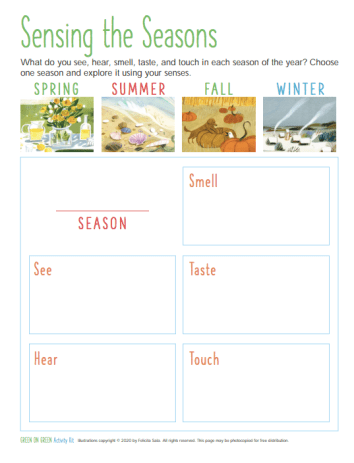
Green-on-Green-activity-kit-sensing-the-seasons-page

Green on Green Activity Kit


If you’re looking for fun activities that will get your kids thinking, observing, writing, and drawing, you’ve found them all in this one printable Green on Green Activity Kit available on Dianne White’s website.

celebrate-picture-books-picture-book-review-green-on-green-cover

You can find Green on Green at these booksellers

Amazon | Barnes & Noble | Books-a-Million | IndieBound

Picture Book Review